This exhibition has been conceived as a dialogue across courts, cultures, and centuries, bringing together masterpieces that reflect the artistic brilliance and ceremonial sophistication of the Islamic world and its intersections with Europe. Presented at TEFAF Maastricht—where connoisseurship, rarity, and historical resonance converge—the works assembled here invite the viewer into a world shaped by imperial ambition, technical ingenuity, and poetic imagination.
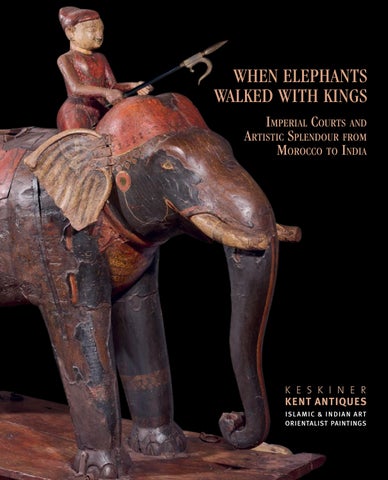
At the heart of the exhibition stands an extraordinary automaton: a near life-size Mughal elephant ridden by a prince. Both sculpture and spectacle, this remarkable object embodies the Mughal court’s fascination with engineering, pageantry, and power. Elephants, symbols of sovereignty and imperial authority, were central to Mughal ceremonial life; rendered here with astonishing realism and animated movement, the automaton transcends its function to become a testament to early mechanical ingenuity and royal wonder.
Surrounding this monumental highlight is a carefully curated selection of works that illuminate the richness and diversity of artistic production across the Ottoman and Mughal worlds. A distinguished group of Iznik ceramics demonstrates the height of Ottoman ceramic achievement, their luminous glazes and rhythmic designs reflecting a refined aesthetic cultivated at court. Complementing these is a rare jade perfume flask from the Ottoman imperial workshop, enamelled and set with rubies and green sapphires in gold mounts—an object of intimate scale yet exceptional luxury, encapsulating the courtly synthesis of precious materials and refined craftsmanship.
The exhibition further explores the intellectual and pictorial traditions of the Islamic world through a collection of Mughal miniature paintings, celebrated for their narrative clarity, chromatic subtlety, and psychological depth. Alongside these are Islamic manuscripts of exceptional rarity and importance, including a remarkable Ottoman almanac
featuring an illustration of the Holy Kaaba—an image that bridges devotional practice and visual culture.
A rare Ottoman tent panel adds another dimension to this panorama of imperial life. It evokes the splendour of the moving court, where portable architecture mirrored the magnificence of permanent palaces. This sense of place is echoed in European visions of the East: atmospheric paintings of Constantinople by Alois Schönn and Alberto Pasini, and Carl Adolph Heinrich Hess’s dynamic depiction of the cirit game, capturing moments of movement, ceremony, and encounter between cultures.
Together, these works form a constellation of objects united not only by rarity and quality, but by their capacity to evoke lived experience—ritual, spectacle, devotion, and leisure—across empires. This exhibition is offered as an invitation: to look closely, to reflect on shared histories, and to appreciate the enduring power of art to transcend boundaries of time and geography.
For collectors and institutions visiting TEFAF Maastricht, this exhibition offers a rare opportunity to engage with works of exceptional quality, provenance, and scholarly significance. Each object presented here has been selected not only for its aesthetic and historical importance, but for its ability to enrich and deepen distinguished collections—public and private alike. Whether as a singular masterpiece or as part of a broader curatorial vision, these works stand as enduring witnesses to the artistic, intellectual, and technical achievements of their time. We invite museums, foundations, and collectors to consider these objects not merely as acquisitions, but as custodianship of cultural heritage, ensuring that their stories continue to be studied, admired, and shared with future generations.
Mehmet Keskiner Director
ACKNOWLEDGEMENTS
The preparation and publication of this catalogue would not have been possible without the generous assistance of many distinguished scholars, experts, and collaborators, to whom we are deeply indebted.
Our special thanks are due to Dr Julian Raby, who most generously shared his insights on a wide range of matters and contributed to several articles in this catalogue. We are equally grateful to Dr Ursula Weeks for her invaluable research on the Mughal elephant automaton, and to Dr Eleonore Cellard, who kindly shared her expertise and authored the article on the Maghribi Qur’an section.
We extend our sincere thanks to Margaret Erskine, a specialist in Persian and Indian miniature painting, for preparing the catalogue entries for the miniature paintings, and to David Williams, arms and armour specialist, who generously offered his views and advice on various subjects. We would also like to thank Ebtisam Abdulaziz and S. M. Khayyam for their very valuable contribution to our exhibition with their wonderful works which helped us create a dialogue between classical and contemporary.
We are also grateful to René Bouchara for designing our stand at TEFAF Maastricht and for achieving the sense of harmony between the works of art that we sought to bring to existence in this exhibition.
Finally, I would like to take this opportunity to express my heartfelt thanks to my brother, Dr Bora Keskiner, whose extensive research and authorship form the foundation of much of this catalogue. The effective presentation of the works would not have been possible without the dedication and expertise of Peter Keenan, Richard Harris, and fine art photographer Richard Valencia, whose contributions were essential to bringing this project to fruition.
Mehmet Keskiner Director
Mughal India
17th Century
Height: 180 cm.
Length: 190 cm.
Depth: 90 cm.
EXTREMELY RARE MUGHAL AUTOMATON IN THE FORM OF AN ELEPHANT BEING RIDDEN BY A PRINCE
Carved and painted wooden automaton in the form of a near life size elephant being ridden by a prince. The elephant stands on a trolley with four wheels. The elephant goad (ankush) held by the prince is a later addition. Inside the elephant’s body are chords and a wheel arranged so that shifting the tail to the right and left mechanically moves the elephant’s ears back and forth and the right arm of the prince up and down.
Royal elephants played a highly important role in the Mughal Empire as symbols of imperial power. They were used in warfare, state ceremonies, logistics and even executions. The present automaton is a rare survival showing the ongoing interest in royal elephants in Mughal art.
The rider of the present elephant is not dressed like a simple mahout. He is arrayed like a Mughal prince, with a turban typical of the first half of the 17th century, a luxurious orange jama and a pearl necklace. In many ways, his appearance recalls that of Mughal princes depicted in miniature paintings. For example, in the Dara Shikoh Album (British Library, Or. 3129, f. 59v) Prince Dara Shikoh (1615-1659) is portrayed wearing a strikingly similar orange jama and a pearl necklace. Fig.1 Please see J. P. Losty & Malini Roy, Mughal India – Art, Culture and Empire, British Library, London, 2012, p. 131.
Fig. 1 Portrait of Prince Dara Shikoh, British Library (Or. 3129, F. 59v) After J. P. Losty & Malini Roy, Mughal India – Art, Culture and Empire, British Library, London, 2012, p. 131.
There are written accounts and visual depictions of Mughal princes and emperors riding elephants. There is a wonderfully detailed painting of a very young Akbar riding an elephant, signed by the court artist Zayn al-Abidin, dated 1609-1610, in the Staatliche Museen zu Berlin, Museum für Islamische Kunst (Ident. No:I.4598 fol. 2v), please see the link, https://recherche.smb.museum/detail/1521446/kaiser-akbar-dressiert-einen-ele fantenbullen?language=de&question=akbar&limit=15&sort=relevance&control s=none&objIdx=1 In this painting, Akbar’s elephant bears striking resemblances to ours.
The trappings and ornaments on the present elephant also connect it to royal Mughal elephants, many of which are depicted in detail in Mughal painting, such as those in the Akbarnama
A painting in the Museum of Islamic Art, Qatar, (MS.51.200) depicts a Mughal prince riding a royal elephant with a crimson caparison, decorated with gold medallions, framed by a thick black border, comparable to the caparison of the present elephant. Fig.2 See, Asok Kumar Das, “The Elephant in Mughal Painting”, in Flora and Fauna in Mughal Art, ed. Som Prakash Verma, Marg Publications, Bombay, 1999, p. 50.
Elephants from the imperial Mughal elephant stables (the Filkhana) were decorated with roundels around their rear legs which were sometimes gilt metal roundels, used to control untameable elephants. The pointy tips of their ivory tusks were cut and adorned with thick rings. And they were decorated with embroidered covers and head caps. The present elephant displays all
As can be seen clearly in our automaton, the chests and ears of royal Mughal elephants were often decorated with dots or stylized flower heads. This decoration can be seen in a painting in the Cleveland Museum of Art showing Emperor Jahangir riding an elephant. Please see the link, https://www.clevelandart.org/art/1920.1970 Fig.3
Mughal emperors were passionately interested in curiosities such as automata. Beside local automata, they acquired European-made examples. This ongoing interest was supported by ancient Indian legends of mechanical elephants used for deceiving the enemy. The legend of King Udayana, mentioned in texts from the 7th century, tells of a wooden mechanical elephant built by King Pradyota of Ujjain.
The medieval Islamic world also showed interest in mechanical elephants. One of the most renowned mechanical devices from the 13th century CE is an elephant clock, made by the Muslim polymath alJazari (d. 1206). It was a large, water-based clock featuring a mechanical elephant and a human automaton who marks the time.
In the following centuries, the most famous example of an automaton from the Indian subcontinent is Tipu’s tiger. It is a life-size mechanical tiger mauling a British soldier, made for the ruler of Mysore, Tipu Sultan (r. 1782-1799). This tiger automaton demonstrates local Indian craftsmanship in creating significant mechanical objects. Although not an automaton, a related wooden model of an elephant and mahout from the palace of Tipu Sultan is in the National Army Museum (Acc. no. NAM 1963-12-192-1), London. Please see the link, https://collection.nam.ac.uk/ detail.php?acc=1963-12-192-1
The Mughals were interested in European automata as well. In 1595, the Jesuits brought an ape that squirted water from its eyes and mouth. In the painting of ‘Jahangir feasting Shah Abbas’ datable to about 1620 (detached from the St. Petersburg Album, and now in the Freer Gallery of Art, Accession Number: F1942.16a),
Fig. 2 (Left) The present automaton (Right) Detail from “Mughal prince riding an elephant”, Museum of Islamic Art, Qatar, (MS.51.200)
Fig. 3 (Bottom) The present automaton (Top) Detail from “Portrait of Emperor Jahangir Riding an Elephant”, Cleveland Museum of Art, Acc. No. 1920.1970
Khan Alam holds a golden Diana, which is almost certainly an automaton from Augsburg. In 1619, the Flemish jeweller Jacques de Coutre presented a ship automaton to Jahangir. See, Jessica Keating, “Metamorphosis at the Mughal Court”, Association of Art Historians, September 2015, pp. 732747 (especially p. 740).
The jeweller Austin Hiriart of Bordeaux, whom Jahangir titled ‘The Skilful’ (Hunarmand), was commissioned to create a huge ornate gold throne for Jahangir and impressed the emperor with his engineering for several machines that used mechanisms – one a military proto tank and the other for shackling wild elephants. Hiriart’s interaction with Robert Shirley, English ambassador to Persia, in 1614 appears to indicate that he made an automaton. An East India company record says that Shirley left “carrying the Frenchman's elephant with him” and in a letter he wrote in 1620 Hiriart recalls that some years before he had “sent an elephant through Persia with Sir Robert Shirley”.
The Mughals’ interest in mechanical elephants can be stretched back to the great warlord Timur (d. 1405) who was accepted to be the predecessor of Mughal emperors. For example, a wooden elephant toy, possibly an automaton, is depicted in the miniature painting titled “Timur as a child playing as king”, circa 1590, in the Timurnama in the Khuda Bakhsh Library (cat. no. 551 H.L. no. 107 Folio 2b), Patna. Fig.4 Please see, Susan Stronge, Made for Mughal Emperors – Royal Treasures from Hindustan, I. B. Tauris, London, 2010, pl. 67, p. 98.
The present automaton is of great art-historical and documentary value. It is a rare and important survival attesting the crucial role of royal elephants in Mughal culture as symbols of imperial prestige and military might. It documents the ongoing, passionate interest in elephants and their crucial place in Indian art.
Provenance
Private European Collection
Acknowledgments
We would like to thank Dr Ursula Weekes and Dr Julian Raby for their kind help and valuable contribution to the research of this article.
Fig. 4 “Timur as a Child Playing as King”, circa 1590, by Daswanth and Jagjivan Kalan, in the Timurnama Khuda Bakhsh Library (cat. no. 551 H.L. no. 107 f. 2b), Patna.
FIRED IN PARADISE
TIMELESS OTTOMAN
IZNIK CERAMICS
The small group of sixteenth-century Iznik ceramics presented here represents one of the most refined artistic achievements of the Ottoman world. Produced in the town of Iznik (ancient Nicaea) in northwestern Anatolia, these wares were created for imperial and elite contexts during the heyday of Ottoman ceramic production, distinguished by a luminous fritware body, a rich palette of cobalt blue, turquoise, emerald green, and bole red, and designs that combine geometric precision with vibrant natural forms.
Born of a dynamic fusion of influences, Iznik ceramics reflect a rich exchange of artistic traditions. Ottoman artisans responded to Chinese blue-and-white porcelains with their own uniquely Ottoman vocabulary of floral sprays, saz leaves, and arabesque motifs, while charting a visual language that would become synonymous with Ottoman courtly taste.
The appreciation of Iznik ceramics extended far beyond their original context. In the late nineteenth century and the first half of the twentieth century, a renewed European interest in Islamic art fostered the growth of important collections that helped establish Iznik pottery as a subject of scholarly and curatorial attention. Among these foundational collections was that of Sir Alan Barlow (later dispersed to institutions such as the British Museum, the Victoria and Albert Museum, and the Fitzwilliam Museum), whose early twentieth-century album of Iznik watercolours documented many of the finest vessels then in private hands and whose gifts substantially enriched British public collections.
The Calouste Gulbenkian Collection in Lisbon stands as another landmark in the history of Iznik collecting. Calouste Sarkis Gulbenkian steadily assembled a remarkable group of Iznik pottery and tile panels from the early twentieth century onwards, many of which remain on display today and testify to the breadth and diversity of Ottoman ceramics from the sixteenth through the seventeenth centuries.
Major museums across Europe and North America also house important Iznik holdings. The British Museum in London maintains a significant collection of Iznik wares in its Islamic galleries, offering viewers a rich survey of shapes and styles from this period. The Victoria and Albert Museum likewise holds an extensive array of Iznik pottery and tiles, including iconic pieces such as the mosque lamp made for the Süleymaniye Mosque in Istanbul—a touchstone for the study of sixteenth-century Ottoman ceramics.
This exhibition’s selection thus participates in a long history of encounter and exchange: created at the height of Ottoman artistic achievement, later admired and collected by European connoisseurs, and now represented for audiences to appreciate both as objects of aesthetic refinement and as witnesses to centuries of artistic dialogue.
Ottoman Empire
Second Half of the 16th Century
Height: 20.5 cm.
IZNIK POLYCHROME POTTERY TANKARD DECORATED WITH RUMIS AND FISH-SCALE DESIGN
Fritware, white ground painted in green, cobalt-blue, bole-red under a clear glaze, the body decorated with white rumis, blue and green fish-scale design, the square handle decorated with blue stripes.
In Iznik ceramics, the earliest recorded fish-scale design is found on a jug in the shape of a fish in the Benaki Museum, Athens, dating from circa 1510. Please see, John Carswell, Mina Moraitou and Melanie Gibson, Iznik Ceramics at the Benaki Museum, Benaki Museum - Gingko, London, 2023, p. 54. In the following decades, the design was stylized and became one of the favourite motifs of Iznik potters.
The fish-scale design is one of the major decorative elements, with cross-cultural background, in the repertoire of Iznik ceramics. It appears both in the West and the East as a popular motif. In the West, for example, it is found on the rim of Italian Majolica dishes from the mid-16th century. Please see, Frederick Hitzel & Mireille Jacotin, Iznik: l’aventure d’une collection, Paris, 2005, p. 71. In the East, it appears on Chinese ceramics produced under the Yuan dynasty (12711368) such as the plate in the Topkapi Palace Museum, Istanbul. Please see, Morris Rossabi, Genghis Khan and the Mongol Empire, Washington D.C., 2009, Fig. 30.8, p. 228.
The fish-scale design was much favoured by Iznik potters, and it became a major motif. It was particularly preferred in the background on dishes for creating a sense of depth as can be seen in an important dish in the Louvre Museum (inv. no. 6320), Paris. Please see, Nurhan Atasoy & Julian Raby in Iznik: The Pottery of Ottoman Turkey, Thames & Hudson, London, 1989, No. 364. Also see, No. 370.
A closely related Iznik tankard with very similar decoration is in the Calouste Gulbenkian Foundation Museum (Inv. No. 816), Lisbon. See, ibid, p. 346, fig. 751.
Two other comparable Iznik tankards decorated with blue and green fish-scale design are in the Ömer M. Koç collection and the Musee National de la Renaissance – Chateau d’Écouen. Please see, Hülya Bilgi, Ateşin Oyunu–SadberkHanımMüzesiveÖmerM.Koç KoleksiyonlarındanİznikÇiniveSeramikleri, Vehbi Koç
Vakfı, İstanbul, 2009, No. 178, p. 300 and Frédéric Hitzel et al. Iznik – L’Aventure d’une Collection, Musee National de la Renaissance – Chateau d’Écouen, Paris, 2005, No. 41. p. 83. For another related example in the David Collection please see, The David Collection: Islamic Art, Copenhagen, 1975, p. 108.
Provenance
Private Collection, France, early 1990s.
Sotheby’s London, Islamic Works of Art, Carpets and Textiles, 14 October 1987, Lot 399.
Dreyfus Collection, Paris. Gustave Dreyfus (d. 1914) was an art collector born in Paris. He amassed a celebrated collection of Italian Renaissance works of art. His Parisian apartment at 101 boulevard Malesherbes was a frequent meeting place for fellow collectors and amateur historians. Both Dreyfus and Henri Vever served as the Commission de Musée du Louvre, the group governing the museum. In July 1930, after Dreyfus’ death in 1914 and his widow’s in 1929, the family heirs sold the remaining collection to the Duveen brothers, a renowned firm of art dealers that had galleries in London, Paris and New York.
Ottoman Empire
Second Half of the 16th Century
Diameter: 30 cm.
RARE IZNIK POLYCHROME POTTERY DISH DECORATED
WITH WHITE PRUNUS BLOSSOMS AND LEAVES
Fritware, the white ground painted under a clear glaze in green, cobalt-blue, bole-red, black, the interior is decorated with juxtaposed white prunus blossoms and green leaves. The bold effect of the bright red ground is heightened by the potter's decision to leave the cavetto blank, providing breathing room and balance for the composition.
The first example of blossoming prunus reserved in white against a red background occurs in the Selimiye mosque in Edirne (1572). For further information about the prunus blossom motif in Iznik ceramics please see, Nurhan Atasoy & Julian Raby. Iznik: The Pottery of Ottoman Turkey, Thames & Hudson, London, 1989, pp. 249-254. In Iznik ceramics, especially on dishes, the prunus blossom motif usually appears on prunus blossom trees. The present dish is a rare example in which the prunus blossoms are used as an individual, juxtaposed motif.
A comparable Iznik dish similarly decorated with prunus blossoms is in the Ömer M. Koç collection. Please see, Hülya Bilgi, AteşinOyunu–SadberkHanımMüzesiveÖmerM.Koç KoleksiyonlarındanİznikÇiniveSeramikleri, Vehbi Koç Vakfı, İstanbul, 2009, No. 252, p. 404.
The only other documented comparison known to us is an Iznik tankard, similarly decorated with juxtaposed white prunus blossoms and leaves, in the Benaki Museum, Athens. Please see, John Carswell, Mina Moraitou and Melanie Gibson, Iznik Ceramics at the Benaki Museum, Benaki Museum - Gingko, London, 2023, No. 58, p. 112.
Provenance
Private Dutch Collection.
Ottoman Empire
Second Half of the 16th Century
Diameter: 30 cm.
IZNIK POLYCHROME POTTERY DISH DECORATED WITH A BLUE SAZ LEAF SURROUNDED BY ROSES
Fritware, the white ground painted under a clear glaze in green, cobalt-blue, bole-red, black, the interior is decorated with a central blue saz leaf adorned with prunus blossoms, surrounded by four red roses stemming out from a central tuft, the rim is decorated with alternating double tulip buds and flower heads.
The saz leaf is an important motif in Ottoman art, frequently used by the artists employed in the court atelier. The first representative of the saz style at the Ottoman palace was Şahkulu, an artist brought from Tabriz by Sultan Selim I (r. 1512-1520). This style was a departure from the classical miniature painting, characterised by pictures drawn with a brush in black ink, featuring long pointed leaves, giving birth to the term ‘saz leaf’. Paintings in the saz style may remind a thick forest with intertwined curved leaves and khatai blossoms. In fact, the word saz, used to mean ‘forest’ in the Dede Korkut stories that date back to the 10th or 11th century.
In the Ottoman period flowers were a constant part of daily life, grown in gardens everywhere, from palaces to humble homes. They were blessed reminders of the gardens of heaven. Foreign travellers and ambassadors who visited the empire, frequently remarked about this love of flowers. Rose had an especially important place in poetry and all art fields as the symbol of prophet Muhammad. In illustrated Ottoman prayer books, roses with their leaves inscribed with names/titles of the prophet are called gül-i Muhammedî (rose of Muhammad).
A closely related Iznik dish, similarly decorated with a saz leaf surrounded by flowers and its rim with alternating double tulip buds and flower heads, is in the Musée National de la Renaissance – Chateau d’Écouen (inv. no. E. CI. 8474). Please see, Hitzel, Frédéric et al. Iznik – L’Aventure d’une Collection, Musée National de la Renaissance – Chateau d’Écouen, Paris, 2005, no. 279, p. 208. For a second dish with a saz leaf similarly bearing prunus blossoms see, ibid, no. 319, p. 225.
Provenance:
Manny Davidson Collection.
Sotheby’s London, Important Spanish and Iznik Pottery from a European Private Collection, 11 October 2006, Lot 77.
Jean Soustiel, Paris.
Ottoman Empire Second Half of the 16th Century Diameter: 30.3 cm.
FINE IZNIK POLYCHROME POTTERY DISH DECORATED WITH BLUE SAZ LEAVES, CARNATIONS AND ROSES
Fritware, the white ground painted under a clear glaze in green, cobalt-blue, bole-red, black, the interior is decorated with a symmetrical arrangement of red and blue saz leaves, carnations and rosettes stemming out from a central tuft, rim framed by a band of stylized wave scrolls.
In the Ottoman period, flowers decorating the present dish, were a constant part of daily life, grown in gardens everywhere, from palaces to humble homes. Flowers were blessed reminders of the gardens of heaven. Foreign travellers and ambassadors who visited the empire, frequently remarked about this love of flowers. Rose had an especially important place in poetry and all art fields as the symbol of prophet Muhammad. In illustrated Ottoman prayer books, roses with their leaves inscribed with names/titles of the prophet are called gül-i Muhammedî (rose of Muhammad).
The saz leaf is also an important motif frequently used by the artists employed in the Ottoman court studio. The first representative of the saz style at the Ottoman palace was Şahkulu, an artist brought from Tabriz by Sultan Selim I (r. 1512-1520). This style was a departure from the classical miniature painting, characterised by pictures drawn with a brush in black ink, featuring long pointed leaves, giving birth to the term ‘saz leaf’. Paintings in the saz style may remind a thick forest with intertwined curved leaves and khatai blossoms. In fact, the word saz, used to mean ‘forest’ in the Dede Korkut stories that date back to the 10th or 11th century.
Two closely related Iznik dishes, similarly decorated with feathery blue and red saz leaves and flowers, is in the
Musee National de la Renaissance – Chateau d’Écouen (inv. no. E. CI. 8120). Please see, Hitzel, Frédéric et al Iznik – L’Aventure d’une Collection, Musee National de la Renaissance – Chateau d’Écouen, Paris, 2005, no. 57, p. 91 and no. 219, p. 178.
Other comparable Iznik dishes decorated with symmetrically organised saz leaves flanked by flowers, can be found in the Virginia Museum of Fine Arts (inv. no. 78.53), Richmond, the Archaeological Museum of Iznik and the British Museum (inv. no. 92.6-13.69), London. Please see Nurhan Atasoy & Julian Raby. Iznik: The Pottery of Ottoman Turkey, Thames & Hudson, London, 1989, Nos. 387, 389, 390, p. 226.
The present dish is a fine and important example of Iznik ceramic production, displaying an iconic aesthetic and presence with its vibrant colours and brilliant finish.
Provenance
Stefanos Lagonico Collection, thence by descent until Jean Lagonico No. 29.
Stefanos Lagonico (1890-1943) was a prominent member of the Alexandrian Greek community. Members of this distinguished group were among the earliest modern connoisseurs of Islamic art. Their loans made up majority of the ground-breaking Exposition d’art Musulman in Munich in 1910. In 1937 Lagonico left Egypt and settled in France with his collection of 47 remarkable Iznik ceramics where they were handed down to his son Jean and eventually sold.
Sold at Sotheby’s Monaco, 7 December 1991, Lot 37. Christie’s London, 17 October 1995, Lot 315. Private Collection, Austria.
Ottoman Empire
Circa 1570-1580
Diameter: 29 cm.
IZNIK BLUE AND WHITE POTTERY RIMLESS GRAPE DISH
Fritware, under glaze painted in shades of cobalt blue and green, decorated with three large bunches of grapes with curved tendrils and fleshy leaves, cavetto decorated with a band of palmettes, surrounded by a geometric border.
The present dish belongs to a small group of blue and white Iznik dishes which did not have everted rims and wave & rock borders. These examples used another shape; the rimless, saucer-shaped dish shape, following Chinese models. They are among the best examples of the cross-cultural relation between Chinese and Ottoman art. Chinese blue and white porcelain from the Yuan (1279-1368) and Ming (1368-1644) periods were avidly collected by the Ottomans. Inspired by these pieces, court artists and Iznik potters produced their own interpretations.
The saucer-shaped rimless dish was a Chinese invention which had been introduced in Chinese ceramics in the early 15th century. It first makes its appearance in Iznik ceramics in the 1530s, in the tuğrakeş spiral and the potters’ styles. For more information about the history of the ‘rimless grape dish’ please see Nurhan Atasoy & Julian Raby. Iznik: The Pottery of Ottoman Turkey, Thames & Hudson, London, 1989, pp. 121-124. In most of the recorded rimless grape dishes the cavetto is decorated either with a band of flowers or bunches of flowers. The present dish stands out as a rare example with its band of palmettes.
A comparable Iznik rimless grape dish can be found at the Çinili Köşk (inv. no. 41/24), Istanbul, ibid, p. 122, no. 190. For another similar example in the Ömer M. Koç collection please see, Hülya Bilgi, AteşinOyunu–SadberkHanımMüzesiveÖmerM.Koç KoleksiyonlarındanİznikÇiniveSeramikleri, Vehbi Koç Vakfı, İstanbul, 2009, no. 200, p. 335.
Provenance
Sotheby’s London, Arts of the Islamic World, 24 October 2018, lot 183.
Private Swiss Collection. Formerly in a private UK collection formed between 1970s and 1980s.
7 IZNIK POLYCHROME POTTERY DISH DECORATED WITH A CYPRESS TREE, ROSES AND TULIPS
Ottoman Empire
Second half of the 16th Century
Diameter: 32.2 cm.
Of shallow rounded form, painted in underglaze cobalt blue, green and relief red outlined in black, decorated with a cypress tree flanked by tulips and roses, the rim with alternating flowerheads and paired tulips, paired stylised flowers and rosettes to underside.
The colour scheme and design of the present dish is original and rare. The coral red roses and cobalt blue tulips are combined with a central cypress tree in the centre.
The cypress pattern first appeared on Ottoman tiles adorning the Muradiye mosque in Edirne around 1435, probably influenced by Yuan-period Chinese porcelain where cypresses are depicted as if covered in scales. The use of the motif shifted to Iznik dishes in the second half of the sixteenth century in conjunction with a decorative theme linked to the gardens of paradise (where the cypress stands framed by intricate sprays of flowers).
The cypress tree (servi) has a symbolic meaning in Ottoman poetry. It is traditionally likened to the slender, tall beloved. Depictions such as serv-i bülend (the tall cypress tree) serv-i hirâman (the cypress tree with a graceful gait) or serv-i revân (the walking cypress tree) were much loved and frequently used in poems to depict the slender and tall beloved.
For comparable Iznik dishes decorated with cypress trees please see, John Carswell & Mina Moraitou and Melanie Gibson, Iznik Ceramics at the Benaki Museum, Benaki Museum - Gingko, London, 2023, pp. 98, 99. Also see, Nurhan Atasoy & Julian Raby. Iznik: The Pottery of Ottoman Turkey, Thames & Hudson, London, 1989, p. 235 (cat. 428, 429, 431-434).
Provenance
Sotheby's, New York, 12 and 13 December 1991, lot 189 Ex-collection William Kelly Simpson (1928-2017), New York
Ottoman Empire
Second half of the 16th century
Diameter: 28.5 cm.
RARE IZNIK BLUE & WHITE POTTERY DISH DECORATED WITH A CENTRAL RADIATING ROSETTE
Fritware with a white slip, painted in two shades of blue under a clear glaze, decorated with a central radiating rosette surrounded by seven small flower bunches, framed by a band of stylized wave scrolls, on a slightly concave body sitting on a low, wide foot ring.
This rare dish belongs to a small group of Iznik ceramics decorated with the so-called “abstract design”, as identified by Nurhan Atasoy & Julian Raby in Iznik: The Pottery of Ottoman Turkey, Thames & Hudson, London, 1989, p. 240. Like our dish, the decoration of the most impressive pieces of this group, have a radiating emphasis Iznik potters composed their abstract styles by combining different elements from other styles. Radiating motifs were a common compositional device of the 15th century both in Iran and Miletus ware but in this case the main source of inspiration was Chinese models. These were an eclectic synthesis of the potters. They suggest that under the layers of Ottoman court styles there was a substratum of ceramic ideas which surfaced periodically. For further information on Iznik abstract styles please see, ibid, pp. 240-241.
A comparable blue & white iznik dish, with a very similar radiating rosette design in the centre is in the Fitzwilliam Museum (Acc. No. C.30-1911), Cambridge. Please see the link, https://data. fitzmuseum.cam.ac.uk/id/image/media-42213
Provenance
Private Collection, Geneva, Since 1960s.
Ottoman Empire Second Half of the 16th Century Diameter: 26.2 cm.
IZNIK POLYCHROME POTTERY DISH DECORATED
WITH AN OWL, A DEER, A DOG, A HARE AND BIRDS
Of shallow rounded form with everted rim, painted in cobalt blue, green and red with black outlines, the circular central medallion decorated with a deer, an owl, a hare, a dog and three birds interspersed with foliate motifs, the medallion encircled by a frieze of stylised petals, the rim with a frieze of alternating blue and red rosettes on a green band, the reverse with alternating stylised foliage motifs. The bold effect of the bright green ground is heightened by the potter’s decision to leave the cavetto blank, providing breathing room for the composition.
Depiction of wild animals is part of an old iconographic tradition in Anatolia and the present aesthetic can be stretched back to figural Seljuk art. In Ottoman art some of the earliest depictions of animals are found on Iznik ceramics in the 1520s and 1530s. Probably the most famous examples are those on the Sünnet Odası (Circumcision Hall) tiles, in the Topkapi Palace, Istanbul.
Nurhan Atasoy and Julian Raby in Iznik: The Pottery of Ottoman Turkey state that “the animals of the ‘greenground group’ were a collection of the exotic and the mythical. There were coursing dogs, deer, hares, ducks, monkeys, lions, horned snakes, simurghs and confronted harpies. The style has affinities with the ‘animal chase’ which was a favoured motif in Seljuk metalwork. The mixture of real and fantastic animals was, however, characteristic of the Balkan ‘teratological’ style, and although there are few precisely comparable objects, it was probably Balkan precious metalwork which inspired the Iznik potters.” For further discussion and the illustration of a closely related Ottoman silver tankard which shows dogs chasing hares please see, Nurhan Atasoy and Julian Raby, Iznik: The Pottery of Ottoman Turkey, Thames and Hudson, London, 1989, p. 276, Fig. 617.
A closely related dish is in the Musée National de la Renaissance, Ecouen (inv. no. ECL 8362), presenting an almost identical central medallion and border on a turquoise ground. Please see, Frédéric Hitzel et al. Iznik – L’Aventure d’une Collection, Musee National de la Renaissance – Chateau d’Ecouen, Paris, 2005, p. 283. A similar dish in the Benaki Museum (inv. no. 11148) follows an analogous iconographical structure with animals depicted in the medallion and a green ground. Please see, John Carswell, Mina Moraitou and Melanie Gibson’s Iznik Ceramics at the Benaki Museum, Benaki Museum - Gingko, London, 2023, p. 121.
An Iznik tankard, similarly decorated with animals on a green ground, was sold at Christie’s London, for £157,250. Please see, Art of the Islamic and Indian World sale, 6 October 2011, Lot. 319. Looking at the group as a whole, one cannot help but wonder whether not just those noted above, but indeed the majority of the group were done by the same inventive artist, with the slight differences accounted for by a development in his style over time. The small number of surviving pieces is such that it is certainly possible that these may be the work of a single individual.
Provenance
Léon-Edmond-Marie Bachelier (1862-1947).
To his granddaughter Marie Lucy Giraud (b.1910), thence by descent.
Collection Guillaume Ephis (Collection Label on the Reverse).
Ottoman Empire
Second half of the 16th century
Diameter: 28.5 cm.
IZNIK POLYCHROME POTTERY DISH DECORATED WITH ROSES AND
A SHAMSA MEDALLION
Underglaze painted, decorated in cobalt blue, green and coral red, with an ogival medallion (shamsa) flanked by symmetrical floral sprays, the rim with scroll and rock border.
The stylized medallion motif, seen in present piece, is called shamsa in Turkish, a word deriving from the Arabic shams, meaning ‘sun’. In Ottoman art, they are used as frame for diverse designs and arranged in various ways that play a fundamental role in compositional layouts. Foremost among the arts in which shamsa medallions have been used is bookbinding. In time, these medallions became oval in shape and sometimes pendants were added at both ends which are called “salbekli şemse” in Turkish. Especially in the arts of the book, they frequently feature darts drawn around the edges that are assumed to represent sunrays. The shamsa in the present dish is filled with two symmetrically arranged white arabesques.
For an Iznik dish with a similar design, formerly in the Adda Collection, please see Nurhan Atasoy & Julian Raby. Iznik: The Pottery of Ottoman Turkey, Thames & Hudson, London, 1989, fig. 417, p. 232. For another closely related Iznik dish in the Sadberk Hanim Museum, Istanbul, see Hülya Bilgi. Ateşin Oyunu – Sadberk HanımMüzesiveÖmerM.KoçKoleksiyonlarındanİznikÇinive Seramikleri, Vehbi Koç Vakfı, İstanbul, 2009, No. 172, p. 290.
Provenance
Private collection, London. Acquired before 1967.
11 IZNIK BLUE
AND WHITE POTTERY ‘WHEATSHEAF STYLE’ DISH
Ottoman Empire
Second half of the 16th Century
Diameter: 31.5 cm.
Underglaze painted fritware, decorated with central floral rosette surrounded by chinoiserie scrolling foliate springs and lobed medallions containing a pair of flowering plants on dense scrolling ground, the lip with wave and rock design interspersed with scrolls, the underside surrounded by repeated floral motifs, and old French collection label reading: “Panneau 4 no. 98 Collection Darses Paris” and red wax seal marked M.D.
This dish is a rare and unusual example of the blue and white types produced during the second half of the 16th century, which adapted Chinese motifs and united them with more characteristically Ottoman forms. Here, we can see two elements of the 1570s which are the wave motif' on the rim and the 'wheatsheaf'’.
The ear of wheat motif is combined with Ming-style tendrils. These are interspersed with densely decorated medallions which replace the peonies. For a comparable Ming bule and white cupstand decorated with similar tendrils please see, Neolithic to Ming. Chinese Objects –The Myron S. Falk Collection, Smith College Museum of Art, Northampton, Mass., 1957, no. 32.
For comparable Iznik blue and white dishes in the 'wheatsheaf' style, see Nurhan Atasoy & Julian Raby. Iznik: The Pottery of Ottoman Turkey, Thames & Hudson, London, 1989, fig. 447 (David Collection, Copenhagen, Inv. No. 27/1978), p. 241 and John Carswell & Mina Moraitou and Melanie Gibson, Iznik Ceramics at the Benaki Museum, Benaki Museum - Gingko, London, 2023, cat. 52, p. 106.
Provenance
Private collection, London. Acquired before 1967.
Darses Collection, Paris. Old French collection label reading: “Panneau 4 no. 98 Collection Darses Paris” and red wax seal marked: M.D. M. Darses was a collector of Iznik ceramics, who lived in Paris by the end 19th, early 20th century.
Ottoman Empire 17th Century
Diameter : 30.5 cm.
IZNIK POLYCHROME POTTERY DISH DECORATED
WITH A CENTRAL ROSETTE, GREEN LEAVES AND STYLIZED CHINESE CLOUDS
Fritware, painted in green, coral red and black under a clear glaze, decorated with a central rosette surrounded by four green leaves, stylized Chinese clouds on a background with tight spiral wave scrolls, the rim with a band of small green medallions.
This rare dish belongs to a small group of Iznik ceramics decorated with the so-called “abstract design”, as identified by Nurhan Atasoy & Julian Raby in Iznik: The Pottery of Ottoman Turkey, Thames & Hudson, London, 1989, p. 240. Although most of the 16th century examples with abstract design are blue and white, this 17th century dish is a highly original, polychrome reinterpretation of this style.
Iznik potters composed their abstract styles by combining different elements from other styles. These were an eclectic synthesis of the potters. They suggest that under the layers of Ottoman court styles there was a substratum of ceramic ideas which surfaced periodically. For further information on Iznik abstract styles please see, ibid, pp. 240-241.
Provenance
Private Collection, London, Acquired before 1967.
13
RARE IZNIK POLYCHROME POTTERY
BORDER TILE DECORATED WITH BLUE & WHITE RUMIS
Ottoman Empire Second Half of the 16th century 15 x 25.3 cm.
Fritware, underglaze painted, the coral-red ground decorated with white and cobalt-blue interlacing scrolling rumis with a black outline, the bevelled upper and lower edges with blue and red lappets on a white ground.
The rumi motif has a special place in the Iznik decorative repertoire. This much favoured motif is called rumi by the Ottomans, islimi by the Persianate dynasties and arabesque by the Europeans. There are divergent views on the origin of this motif, some regarding it floral in origin, others as zoomorphic, such as the theory that it derives from the wings of birds or mythical animals in central Asian art. The motif developed in Samarra in the 9th century and spread to the Islamic lands, becoming a dominant feature in Karahanid, Ghaznavid, Fatimid, Abbasid, Andalusian Umayyad and Mamluk art and above all becoming popular in Anatolia, also known as Rum, from which the name rumi derives. Some outstanding examples of rumi motifs are found in Anatolian Seljuk stone carving and woodwork usually combined with lotus and palmette motifs. For a collection of compositions with rumis please see, Owen Jones. The Grammar of Ornament – A Unique Collection of Classical Designs from Around the World, Girard & Steward, 1856, pl. 36-38.
Tiles of similar design in situ, which also have the bevelled edge, are found in the privy chamber (Has Oda) of Sultan Murad III (r.1578-9) in the Topkapi Palace, built in 1578. Please see, J. M. Rogers (ed.), The Topkapi Saray Museum - Architecture, Boston, 1988, pl. 64.
Tiles with an identical design can be found in the Gulbenkian Museum, Lisbon (Türkische Kunst und Kultur aus osmanischer Zeit, exhibition catalogue, Frankfurt, 1985, vol.2, no, p.176), the Los Angeles County Museum of Art (bequest of Edwin Binney 3rd), the David Collection, Copenhagen (inv.no. 45 / 1966) and the Benaki Museum, Athens. For the Benaki tiles please see, John Carswell & Mina Moraitou and Melanie Gibson, Iznik Ceramics at the Benaki Museum, Benaki Museum - Gingko, London, 2023, pp. 202, 203, No. T38.
Provenance
With Dikran Kelekian (1867-1951), Paris. Shown by sticker on the reverse.
Henri-Rene d'Allemagne (d. 1950), by repute, Paris.
Ottoman Empire
Second Half of the 16th Century
Dimensions: 13 x 25 cm
IZNIK POLYCHROME POTTERY BORDER TILE DECORATED WITH TULIPS, KHATAYIS AND ROSETTES
Fritware, painted under transparent glaze in coral red, cobalt blue and green, decorated with tulips, khatayi blossoms on both sides of a central rosette.
The tulip has a symbolic meaning in Ottoman art. The letters of the word tulip (Lâle) in Turkish and Persian are the same letters used for writing the word Allah (God). These two words have the same numerological value (66) in the abjad system (a decimal alphabetic numeral system in which the twenty-eight letters of the Arabic alphabet are assigned numerical values). Tulip is one of the leading decorative elements in Ottoman art; frequently used together with roses, hyacinths, saz leaves. It is also used with khatai blossoms as can be seen in the present tile. Tulip also played a role in imagery in Ottoman poetry. In many poems, tulip leaves are likened to the cheeks of the beloved. The word lāleh-khad (lâle-had), often used in Ottoman poetry, means ‘tulip-cheeked’. Tulips were among the most favoured motifs used in the Ottoman court workshops in the 16th century. The name ‘tulip’ is thought to have derived from the Turkish word tülbend (from the Persian word [dulband]) -meaning ‘large cotton band which is used in the making of turban or headgear’because of the fancied resemblance of the flower to a turban.
There are many hypothesis about the origin of the khatai motif. One of these is that this motif was created by an artist who travelled from Herat to China, or that it was inspired by the lotus blossom, but all agree that the name derives from ‘Hitay’, a region of China.
The present tile is a rare and important example of the art of Iznik pottery with its perfect design, vibrant colours and brilliant firing. Tiles with identical design in situ are found in the Sultan Ahmed Mosque and the Tomb of Aba Eyub al-Ansari (Eyup Sultan) in Istanbul. Please see, Walter Denny, Gardens of Paradise – 16th Century Turkish Ceramic Tile Decoration, Published by Ertuğ & Kocabıyık, 1998, pp. 155, 157, 180, 181. Also see, Belgin Demirsar Arlı et al. Tiles – Treasures of Anatolian Soil –Ottoman Period, Kale Group Publications, Istanbul, 2008, pp. 278-279. A tile with identical design is in the Sadberk Hanim Museum (14096 –P551), Istanbul. Please see, Hülya Bilgi, Ateşin Oyunu – Sadberk Hanım MüzesiveÖmerM.KoçKoleksiyonlarındanİznikÇiniveSeramikleri, Vehbi Koç Vakfı, İstanbul, 2009, no. 80, p. 172.
Provenance
Private French Collection, Paris. Acquired in 1990 from Tajan. (Ader Picard Tajan, Art IslamiqueTableaux Orientalistes, Paris, 6 April 1990, Lot 89).
Ottoman Empire
Second Half of the 16th Century
Dimensions: 13 x 25 cm
IZNIK POLYCHROME POTTERY BORDER TILE DECORATED WITH TULIPS, KHATAYIS AND ROSETTES
Fritware, painted under transparent glaze in coral red, cobalt blue and green, decorated with tulips, khatayi blossoms on both sides of a central rosette.
The tulip has a symbolic meaning in Ottoman art. The letters of the word tulip (Lâle) in Turkish and Persian are the same letters used for writing the word Allah (God). These two words have the same numerological value (66) in the abjad system (a decimal alphabetic numeral system in which the twenty-eight letters of the Arabic alphabet are assigned numerical values). Tulip is one of the leading decorative elements in Ottoman art; frequently used together with roses, hyacinths, saz leaves. It is also used with khatai blossoms as can be seen in the present tile. Tulip also played a role in imagery in Ottoman poetry. In many poems, tulip leaves are likened to the cheeks of the beloved. The word lāleh-khad (lâle-had), often used in Ottoman poetry, means ‘tulip-cheeked’. Tulips were among the most favoured motifs used in the Ottoman court workshops in the 16th century. The name ‘tulip’ is thought to have derived from the Turkish word tülbend (from the Persian word [dulband]) -meaning ‘large cotton band which is used in the making of turban or headgear’because of the fancied resemblance of the flower to a turban.
There are many hypothesis about the origin of the khatai motif. One of these is that this motif was created by an artist who travelled from Herat to China, or that it was inspired by the lotus blossom, but all agree that the name derives from ‘Hitay’, a region of China.
The present tile is a rare and important example of the art of Iznik pottery with its perfect design, vibrant colours and brilliant firing.
Tiles with identical design in situ are found in the Sultan Ahmed Mosque and the Tomb of Aba Eyub al-Ansari (Eyup Sultan) in Istanbul. Please see, Walter Denny, Gardens of Paradise – 16th Century Turkish Ceramic Tile Decoration, Published by Ertuğ & Kocabıyık, 1998, pp. 155, 157, 180, 181, and Belgin Demirsar Arlı et al. Tiles – Treasures of Anatolian Soil – Ottoman Period, Kale Group Publications, Istanbul, 2008, pp. 278-279. A tile with identical design is in the Sadberk Hanim Museum (14096 – P551), Istanbul. Please see, Hülya Bilgi, AteşinOyunu–SadberkHanımMüzesiveÖmer M.KoçKoleksiyonlarındanİznikÇiniveSeramikleri, Vehbi Koç Vakfı, İstanbul, 2009, no. 80, p. 172.
Provenance
Private French Collection, Paris. Acquired in 1990 from Tajan. (Ader Picard Tajan, Art Islamique - Tableaux Orientalistes, Paris, 6 April 1990, Lot 89).
Ottoman Empire Second Half of the 16th Century
Dimensions:
24.6 x 24.6 cm.
IZNIK POLYCHROME POTTERY TILE DECORATED WITH SAZ LEAVES, LOTUSES AND PRUNUS BLOSSOMS
Underglaze painted fritware, the white slip ground painted in relief red, cobalt blue, green and turquoise with black outlining with interwoven tendrils, saz leaves, lotuses, filled with prunus blossoms.
The saz leaf is an important motif frequently used by the artists employed in the Ottoman court studio. The first representative of the so-called “saz style” at the Ottoman palace was the court painter Shahkulu, an artist brought from Tabriz by Sultan Selim I (r. 15121520). This style was a departure from the classical miniature painting, characterised by pictures drawn with a brush in black ink, featuring long pointed leaves, giving birth to the term ‘saz leaf’. Paintings in the saz style may remind a thick forest with intertwined curved leaves and khatai blossoms. In fact, the word saz, used to mean ‘forest’ in the Dede Korkut stories that date back to the 10th or 11th century.
The present tile belongs to a group of Iznik ceramics featuring a muchloved and sought after design. The design, placing spring flowers on a dramatically curved saz leaves, creates a perfect sense of movement which displays both vitality and harmony.
A comparable Iznik tile with a very similar decoration is in the Louvre Museum (Museum No. AD 8370), Paris. Please see the link, https:// collections.louvre.fr/en/ark:/53355/cl010333564
Provenance
Private collection, London. Acquired Christie's London, 8 October 2015, Lot 82.
Previously in a Greek private collection since 1960s. The label on the reverse states that this panel was displayed in the owner's dining room: “Επάνω ἀπό
[τ]τραπεζαρίαν” (In the dining room, above the showcase).
Ottoman Empire Second Half of the 16th Century
Dimensions: 18.5 x 25 cm.
RARE IZNIK POLYCHROME POTTERY TILE DECORATED WITH SPRING BLOSSOMS
Fritware, decorated in underglaze cobalt blue, turquoise, relief red with black outlines. Spring flowers and blossoms, decorating the present tile, were a constant part of daily life in the Ottoman period, grown in gardens everywhere, from palaces to humble homes. Flowers were blessed reminders of the gardens of heaven. Foreign travellers and ambassadors who visited the empire frequently remarked about this love of flowers.
In Ottoman art, and in Islamic art in general, designs and decorations with the juxtaposition and repetition of the same motif have symbolic meanings. These motifs primarily symbolize and emphasize the endless and infinite repetition in the cycle of life and in God’s creation. For further discussion on the use and symbolism of repeated motifs please see, Titus Burckhardt, Sacred Art in East and West – Its Principals and Methods, Translated by Lord Northbourne, Perennial Books, London, 1967.
Four comparable Iznik tiles with identical design are recorded. The first one, in the Gulbenkian Museum, Lisbon, is published on the cover of the book, Anadolu’da Türk Devri Çini ve Seramik Sanatı, Authors: Gönül Öney & Zehra Çobanlı, T.C. Kültür ve Turizm Bakanlığı, 2007 and in Fig. 6, p. 283.
For the second tile in the Çinili Köşk (inv. no. 41/506), Istanbul, please see, Alpay Pasinli & Saliha Balaman, Türkische Fliesen und Keramik – Çinili Köşk, Archäologische Museen Istanbuls, Istanbul, 1991, p. 96.
The third and fourth are in the Benaki Museum (inv. no. 104), Athens. Please see, John Carswell, Mina Moraitou and Melanie Gibson, Iznik Ceramics at the Benaki Museum, Benaki Museum - Gingko, London, 2023, Fig. T22, pp. 190, 191. The present tile is rare in terms of its highly original design and the use of turquoise in the ground.
Provenance
Private French Collection
Ottoman Empire
18th Century
Height: 23 cm.
Diameter: 19 cm.
KUTAHYA BLUE AND WHITE CIRCULAR PILGRIM’S POTTERY FLASK
Of circular form, the circumference applied with four suspension loops, bulbous protruding mouth and flattened foot, decorated in underglaze blue with black outlines, featuring stylised floral motifs.
Pilgrim’s flasks or zamzamiyyahs were used for storing the holy zamzam water brought home by Muslim pilgrims from Mecca. According to Muslim tradition, the spring or well of Zamzam appeared to Hagr and Ishmael after they had been abandoned in the desert by Abraham. Later the spring disappeared and was rediscovered by the Prophet’s grandfather Abd alMuttalib. The indication of where to dig was revealed to him in a series of dreams. This story is elaborated in the Compendium of World Chronicles (Jāmi‘ al-Tawārikh) written by the famous Ilkhanid grand vizier Rashid al-Din Fazlullah (d. 1318). The zamzam water was used for other purposes such as copying Qur’ans with ink made from it. For further information please see Hajj: Journey to the Heart of Islam, Ed. Venetia Porter, London, 2012, pp. 72-73.
Kutahya, in Western Turkey, has been an important centre of ceramic production in Ottoman history. Potters of Kutahya produced high quality underglaze painted pieces which gained fame for their rich variety of forms and vibrant polychrome palettes. The city became a major centre of production in the 18th century after the decline of the Iznik kilns. Decrees in Ottoman archives addressed to the qadi of Kutahya from Istanbul, document the court’s orders, primarily for tile production.
The earliest dated example of Kutahya pottery is a small ewer in the British Museum (museum no. G.1), London, made in the memory of an individual called Abraham of Kutahya and dated 1510. Please see the link, https:// www.britishmuseum.org/collection/object/W_G-1 The second dated example is a vase with a dedication to Der Mardinos in Ankara, dated 1529. Please see, Garo Kürkman, Toprak, Ateş, Sır: Kütahya Çini ve Seramikleri, Suna ve İnan Kıraç Vakfı, Istanbul, 2005, pp. 53, 56.
The present flask is a rare blue and white example sharing the aesthetics of earlier blue and white Iznik and Chinese (Yuan & Ming) ceramics. One of the largest commissions of blue and white production from Kutahya was the 165 illustrated tiles of the Saint-Sepulchre Church in Jerusalem (1718).
For a comparable Kutahya flask, dated 1177 AH / 1763 AD, in the Monastery of San Lazzaro in Venice, please see ibid, p. 221. For another related 18th century Kutahya flask in the Pera Museum, Istanbul, please see the link, https://www.peramuseum.org/artwork/flask/17/230
19
SAFAVID CUERDA-SECA TILE DECORATED WITH A NIGHTINGALE RESTING ON A BRANCH
Safavid Persia
17th Century
Dimensions: 19.5 x 23 cm.
Tile in square form, cuerda-seca decorated in green, blue, yellow, brown with black outlines, depicting a nightingale resting on a branch with a khatayi (lotus) blossom.
The cuerda-seca (dry cord) technique, with which the present tile was produced, is used when applying coloured glazes to ceramic surfaces. Although some scholars postulated an Iranian origin, citing Umayyadera examples from Suza, many scholars believe that this technique originated primarily in al-Andalus (Muslim Spain and Portugal) in the second half of the 10th century.
Buildings in the Safavid cities, especially those in the capital (Isfahan) and nearby Na‘in were decorated with elaborate cuerda-seca tile panels. While mosques and madrasas employed the traditional tile-making style of repeating geometric and vegetal designs, tile panels with narrative scenes were a significant innovation for secular settings. These scenes mostly depicted outdoor settings with courtly figures in garden landscapes with trees and branches like the present tile. Some of these were used in royal garden pavilions and much favoured by the Safavid elite during the reign of Shah Abbas I (r. 1588-1629).
Similar Safavid cuerda-seca tiles are preserved in the Victoria and Albert Museum (museum nos. 139-1891, 182-1853), London. For the V&A panel depicting a couple entertaining in a garden see, Tim Stanley, Palace and Mosque: Islamic Art from the Middle East, V&A Publications, London, 2004, p. 59. For other comparable Safavid cuerda-seca tiles see, Gérard Degeorge and Yves Porter’s The Art of the Islamic Tile, Flammarion, Paris, 2002, pp. 150-155.
Provenance
Lennart Heyman (1918-1974) Collection.
Lennart Heyman was trained in oriental rugs from his father's carpet gallery Heyman & Olesen in Stockholm. Heyman was both a collector and dealer of antiques and oriental carpets. He took assignments as a valuer of carpets in Sweden and abroad, including for Sotheby's and Christie's, London. The business premises were located at “Birger Jarlsgatan 3” until his death in 1974.
20 SAFAVID CUERDA-SECA TILE DECORATED WITH A DEER AND SPRING FLOWERS
Safavid Persia
17th Century
Dimensions: 23.5 x 23.5 cm.
Tile in square form, cuerda-seca decorated in green, blue, yellow, brown with black outlines, depicting an deer and spring blossoms.
The cuerda-seca (dry cord) technique, with which the present tile was produced, is used when applying coloured glazes to ceramic surfaces. Although some scholars postulated an Iranian origin, citing Umayyad-era examples from Suza, many scholars believe that this technique originated primarily in al-Andalus (Muslim Spain and Portugal) in the second half of the 10th century.
Buildings in the Safavid cities, especially those in the capital (Isfahan) and nearby Na‘in were decorated with elaborate cuerda-seca tile panels. While mosques and madrasas employed the traditional tile-making style of repeating geometric and vegetal designs, tile panels with narrative scenes were a significant innovation for secular settings. These scenes mostly depicted outdoor settings with courtly figures in garden landscapes with spring flowers like the present tile. Some of these were used in royal garden pavilions and much favoured by the Safavid elite during the reign of Shah Abbas I (r. 1588-1629).
Similar Safavid cuerda-seca tiles are found in the Victoria and Albert Museum (museum nos. 139-1891, 182-1853), London. For the V&A panel depicting a couple entertaining in a garden please see, Tim Stanley, Palace and Mosque: Islamic Art from the Middle East, V&A Publications, London, 2004, p. 59. Also see the following link, https://collections.vam.ac.uk/item/O93167/tile-panel/ For other comparable Safavid cuerda-seca tiles see, Gérard Degeorge and Yves Porter’s The Art of the Islamic Tile, Flammarion, Paris, 2002, pp. 150-155.
Provenance
Paul & Jacqueline Duchein Collection, Paris.
Paul and Jacqueline Duchein met in Montauban, in 1938, where they lived for the rest of their lives and became passionate art collectors. Especially Paul had always been in the heart of modern and surrealist art. He became an exhibition curator, an artist, an art critic and published articles in the magazine Le Pharmacien de France leaving his mark on several generations of art lovers. He was a Chinese porcelain connoisseur since his youth. The couple created an extraordinary art collection including some five hundred paintings, decorative works of art and African masks. Paul Duchein died in 2024. The majority of the couple’s collection was sold at Christie’s Paris on 24 September 2024.
Qajar Persia
19th Century
Attributed to Safar ‘Ali
Dimensions: 33.5 x 37.5 cm.
QAJAR POLYCHROME MOULDED POTTERY TILE DEPICTING
A PRINCE AND PRINCESS WITH TWO COURTIERS, ATTRIBUTED TO SAFAR ‘ALI
Fritware, moulded, underglaze polychrome painted tile, depicting a prince and a princess in the centre with a courtier on both sides, in a spring garden with domed buildings in the background. The princess holds a parasol with two flowers. The band on the top is decorated with birds resting on intertwined vine leaves.
In the late 19th century, Qajar artists began to use Safavid elements in their works. For example, in this tile the prince and his attendant are depicted wearing Safavid-style turbans.
The tradition of depicting courtly scenes has always been alive for centuries in regions where the Muslim faith spread. The tradition of depicting kings and courtiers has deep roots especially in Safavid and Qajar art. Figures were not just used for a decorative purpose but also to convey religious, cultural and political messages. The most frequent themes are a ruler seated on a throne as a symbol of sovereignty; battle scenes, scenes of palace life showing activities such as shooting with a bow and arrow on horseback, hunting with hawks/falcons, playing polo, entertaining in gardens, figures of musicians, dancers, servants offering wine in a cup which represent palace entertainments. The present tile can be interpreted under this category.
An almost identical Qajar tile, decorated with the same composition and signed by the artist Safar ‘Ali, allows us to attribute the present tile to him. For Safar ‘Ali’s tile please see, L’Empire des Roses: Chefs-d’œuvre de l’Art Persan du XIXe Siècle, Snoeck, Louvre Lens, Paris, 2018, p. 305, Fig. 294.
A second comparable Qajar tile, decorated with a similar composition, is in the Victoria and Albert Museum (Accession No. 230-1887), London. Please see the link, https://collections.vam.ac.uk/item/O113643/tileunknown/ ant are depicted wearing Safavid-style turbans.
Provenance
Victor Gubbins Collection, Eden Lacy, Lazonby.
Zand Persia
Second half of the 18th Century Circle of Zand court artist Abu’l Hasan Ghaffari Mustawfi Kashani (d. 1798, active between 1781-1794). Dimensions: 22 x 37 cm (unframed), 36 x 49.5 cm (framed).
FEAST HELD BY SHAH ABBAS IN HONOUR OF VALI MUHAMMAD KHAN GOVERNOR OF BUKHARA
Gouache and gold on paper. The present painting is an exceptionally fine reinterpretation of a famous and welldocumented mural (wall painting) -measuring 5.7 meters by 2.2 meters- in the Safavid Chehel Sutoun Palace in Isfahan, painted in c. 1647. The Chehel Sutoun Palace murals are vibrant, historical records, diplomatic tools and artistic masterpieces, depicting key events like royal receptions and battles. The present composition depicts the royal feast held by the Safavid ruler Shah Abbas in honour of the Uzbek Vali Muhammad Khan, the governor of Bukhara.
The reception which took place during Vali Muhammad Khan’s visit to Isfahan represents the close relation between these two powerful leaders. The two dignitaries are shown in conversation, surrounded by courtiers, servants, musicians and dancers. The rich details, including the vibrant colours of the costumes and the facial expressions of every single individual have been masterfully and meticulously painted.
For a detailed illustration of the centre of the mural in the Chehel Sutoun Palace, please see the exhibition catalogue Shah Abbas – The Remaking of Iran, British Museum, authored by Sheila R. Canby, catalogue of the exhibition held between 19 February – 14 June 2009, British Museum Press, London, 2009, p. 25.
The portrait of Mirza Jahanshah Qaraqoyunlu by the Zand court artist Abu’l Hasan Ghaffari Mustawfi Kashani (d. 1798, active between 1780-1794), in the Louvre Museum (inv. no. MAO 599), Paris, supports our attribution to his circle. Please see the link, https:// collections.louvre.fr/ark:/53355/cl010321252 In this portrait, the execution of Mirza Jahanshah’s turban and kaftan is strikingly similar to the turban and kaftan of Shah Abbas in the present painting.
In addition, a painting with a similar subject to ours -Shah Abbas II Receiving a Mughal ambassadorattributed to Abu’l Hasan Ghaffari supports our attribution as well. The quality is similar, and it is almost the same size as ours; 24.5 x 33.5 cm. Please see the exhibition catalogue, Royal Persian Paintings – The Qajar Epoch 1785-1925, Edited by Layla S. Diba and Maryam
Ekhtiar, I. B. Tauris Publishers in Association with Brooklyn Museum of Art, New York, 1998, pp. 148149. Abu’l Hasan Ghaffari was celebrated for painting historical personalities and events.
Vali Muhammad Khan (Khan of the Uzbek Khanate, d. 1611)
Vali Muhammad Khan was the son of Jani Bek was a leader of the Ashtarkhanid (Toqay-Timurid, Janid) dynasty in the Khanate of Bukhara from 1605–1611 AD. He became leader after the death of his brother, Baqi Muhammad Khan, but was opposed by Imam Quli Khan.
In the struggle for power, the political elite of Bukhara supported Wali Mohammad, an older member of the Toqay-Timurid family, who was the governor in Balkh and Badakhshan. Vali Muhammad Khan was not the primary choice to become leader and Imam Quli Khan enlisted support of many people, especially merchants and landlords. Upon hearing of a well organised assassination attempt, Vali Muhammad Khan fled the area and headed to the palace of Shah Abbas I to try and garner support. Abbas obliged the Khan, and gave him an army and sent him back to Bukhara, but the attempting at crushing the insurgency failed and Vali Muhammad Khan died in 1611. He was succeeded by Imam Quli Khan.
Provenance
Private French Collection. Bought in Paris in 1960s, thence by descent.
Acknowledgement
We would like to thank Margaret Erskine for writing this article on the present miniature painting and Dr Julian Raby for proof-reading and sharing his thoughts.
Company School. Calcutta, India. Circa 1800.
Dimensions: 33.5 x 24 cm
GEORGE FREDERICK CHERRY (1761-1799), RESIDENT OF THE EAST INDIA COMPANY IN
BENARES STRUCK
WITH A SWORD BY VIZIER ALI
Gouache heightened with gold on paper. The scene takes place in a room at the British Residency of Benares, with two main figures seated in European-style chairs and two attendants waving morchals to either side. The walls in the background are decorated with strikingly detailed gold murals depicting a lion hunt scene and local figures.
The scene depicts a meeting between George Frederick Cherry (1761-1799), resident of Benares in the State of Oudh and Vizier Ali, the eldest son of Asaf ud-Daula. Vizier Ali was later deposed as the Nawab of Oudh, a task undertaken by the British. Hence, on the morning of 14 January 1799 he arrived at the Residency for an interview and was entertained at breakfast accompanied by four attendants. An entourage of almost two hundred were waiting outside. During the breakfast meeting Vizier Ali struck George Frederick Cherry with his sword and his attendants attacked the other British in the room including Captain Conway, a military aide. George Cherry had done his best to pacify Vizier Ali but to no avail.
For further reference please see, Clive Wiliams, The Nabobs of Berkshire, Purley -on-Thames, 2010, pp. 157-158.
George Frederick Cherry (1761–1799)
George Frederick Cherry was a British-born political officer of the East India Company, murdered in Benares by Wazir Ali Khan as part of a minor insurrection against the British. George Frederick Cherry was born in 1761 in Gillingham, Kent, the first-born of Susan Cherry (née Curtis) and George Cherry (who in 1785 became chairman of the Victualling Board) in a family of ten children. He married Martha Maria Paul (1765-1819).
He was the British Resident at Lucknow until 1796, immediately prior to the period in which Wazir Ali Khan was removed as Nawab of Awadh by the British and replaced by Saadat Ali Khan II. The role of a resident extended to intelligence gathering, and at this, in the relative turbulence of late 18th century Awadh, Cherry excelled, running a network of spies and informers - such as Mirza Abu Taleb Khan, who wrote about some of his interactions with the East India Company.
He had made sufficient enemies in Lucknow by 1796 that he was relocated to Benares, considered a less exposed town, to act as political-agent to the Governor General. In 1797 Wazir Ali Khan was deposed and required by the British to live in Benares with a pension. The young Ali - only 19 - was far from satisfied with his lot, and indications before 1799, and evidence of later enquiries suggests he was plotting against the British and with a view to regaining his lost position.
Ali appears to have been informed of his fate in the early part of January 1799, and his remonstrances fell on deaf ears. Appearing to acquiesce to the situation, he gave it out that he would relocate on the 15 or 16 January. On 13 January Cherry was informed that Ali would visit him the following morning, and on the 14th Ali appeared at breakfast time, leading a more-or-less normal 200-strong entourage. Cherry escorted Khan and four supporters into his house. Ali took the opportunity to complain loudly about his lot, to assert promises broken by the British, and to blame Cherry for failing to look after his interests. Then, in what looked like a choreographed movement, an associate, Waris Ali, restrained the sitting Cherry from behind his seat, Wazir Ali Khan struck Cherry with his sword, and Cherry was further struck by others of Ali's party. Cherry managed to struggle out of the house but was quickly killed.
Ali fled, evading capture for some months, but was eventually turned over to the British authorities by Pratap Singh of Jaipur, Rajah of Jaipur, on the condition Ali was not executed nor fettered. Ali was imprisoned for the remainder of his life.
Provenance
Collection of an English gentleman who inherited the painting in 2006 from his father’s collection which was formed in mid-20th century.
Acknowledgement
We would like to thank Margaret Erskine for writing this article on the present miniature painting.
Company School, Lucknow, India.
Circa 1780
Dimensions: 27.5 x 42cm.
WATERCOLOUR OF A HIPPOPOTAMUS
FROM THE COLLECTION
OF WARREN HASTINGS (1732-1818) GOVERNOR GENERAL OF INDIA
Pen, ink and watercolour on 'J Kool' watermarked paper, scale and identification in brown ink above, the verso plain, mounted, framed and glazed.
Along the top edge: No.1Hippopotamiaamphibious, Male
The present painting is closely related to a watercolour of a hippopotamus by the Dutch explorer and naturalist Robert Jacob Gordon (1743-1795), which is now in the Rijksmuseum (RP-T-1914-17-197), Amsterdam. Please see the link: https://id.rijksmuseum.nl/200475574
Robert Jacob Gordon produced fine and detailed studies of flora and fauna whilst in South Africa in the late 18th century. It is likely that Warren Hastings commissioned the present painting after seeing Gordon’s watercolour.
Company painting (Hindi: kampani kalam) is a term for a highly original, hybrid Indo-European style of paintings made in British India by Indian artists. Many of these artists worked for patrons in the East India Company or other foreign companies in the 18th and 19th centuries.
The company style blended traditional elements from Rajput and Mughal painting predominately, with a more Western treatment of perspective, volume and recession.
Most paintings were small, reflecting the Indian miniature tradition, but some of the natural history paintings of plants and birds were usually life size.
First emerging in Murshidabad, leading centres were the main British settlements or influence centres of Calcutta, Madras, Banaras, Delhi, Lucknow, Patna, Trichinopoly or Tanjore. Subjects included portraits, landscapes and views, and scenes of Indian people, portfolios of animal or botanical subjects.
Series of figures of different castes or trades were also sought after. Architectural subjects were popular, usually done in a detailed and frontal style more like that of an architectural draftsman than the Romanticised style used by most European painters visiting India. The techniques varied, but mostly drew on Western watercolour technique, from which transparency of texture, soft tones and modelling in broad strokes were borrowed.
Provenance
Warren Hastings, Governor General of India (d.1818). Hobhouse Limited, London, 1986. Barry Sainsbury (d.1999).
Published
Indian Drawings of Plants and Animals, exhibition catalogue, Hobhouse Limited, Spring 1986, No. 5.
Warren Hastings (d. 1818) – Governor General of India
Warren Hastings FRS (6 December 1732 – 22 August 1818) was a British colonial administrator, who served as the first governor of the Presidency of Fort William (Bengal), the head of the Supreme Council of Bengal, and so the first governor-general of Bengal in 1772–1785. He and Robert Clive are credited with laying the foundation of the British Empire in India. He was an energetic organizer and reformer. In 1779–1784 he led forces of the East India Company against a coalition of native states and the French. In the end, the well-organized British side held its own, while France lost influence in India. In 1787, he was accused of corruption, but he was eventually acquitted in 1795 after a long trial. He was made a privy councillor in 1814. He passed away in 1818. The city of Hastings in New Zealand, and Hastings in Victoria, Australia, were named after him. There is also a road in Kolkata, India, named after him.
Acknowledgement
We would like to thank Margaret Erskine for writing this article on the present miniature painting.
25 MAHARAJA GHAMAND OF KANGRA SMOKING WITH MAHARAJA DEVI CHAND OF BILASPUR
India. Pahari – Kangra. Circa 1765.
Black outer borders with black ruled lines.
Image size: 22.2 x 20 cm.
Sheet: 23.5 x 22.2 cm
Opaque water-based pigments with gold on paper. The two rulers, Maharaja Ghamand Chand of Kangra and Maharaja Devi Chand of Bilaspur, political allies and interrelated by marriage - sit facing each other on a carpeted terrace and smoking hukkahs.
They are accompanied by attendants and courtiers - with two waving morchals (ceremonial fans) and two ministers standing below. Behind them the flat gold-brownish landscape curves upwards to a strip of blue cloudy sky edged with a vermilion sunset. Our superb double portrait is executed in a Mughal-influenced naturalistic style which seems to have emerged fully-formed in Kangra around the middle of the eighteenth century.
Realistic portraits such as the present example were almost certainly influenced by the artist Nainsukh of Guler and his school - a style which was rapidly gaining in popularity across the Punjab Hills in the mid 18th century.
Provenance
Collection of Dr. William K. Ehrenfeld (1934-2005), San Francisco.
Private Collection, Acquired directly from the Ehrenfeld collection on 8th December 1988.
Published
W. G. Archer, Indian Paintings from the Punjab Hills: A Survey and History of Pahari Miniature Painting,London and New York, 1973, Vol. I, pp. 280-81 and Vol II, p. 194.
Daniel Ehnbom, Indian Miniatures: The Ehrenfeld Collection, New York, 1985, cat. no. 114.
Acknowledgement
We would like to thank Margaret Erskine for writing this article on the present miniature painting.
Exhibited
Indian Miniatures from the Ehrenfeld Collection, The American Federation of the Arts, New York, September 1985 - March 1988.
After W. G. Archer, IndianPaintingsfromthePunjabHills:A SurveyandHistoryofPahariMiniaturePainting,London and New York, 1973, Vol. I, pp. 280-81 and Vol II, p. 194.
Mughal India. Circa 1740.
Dimensions: 20.3 x 16.3 cm.
‘LALITA RAGINI’: A
RAGAMALA ILLUSTRATION IN THE STYLE OF GOVARDHAN II
Gouache on paper heightened with gold. This exquisite painting is the visual representation of a musical mode (raga) from classical Indian music. It is a pictorial metaphor for a raga, belonging to a Ragamala (Garland of melodies).
The mode represented in this painting is ‘Lalita Ragini’. It is a morning raga which is often depicted showing a young prince holding white flower garlands (mala) in each hand, quietly departing his lover in the morning, after a night of passion. He looks back at his lover as he leaves with a longing gaze. She is still sleeping - with eyes closed on her bed on an open-air terrace. Behind her is a small pavilion with a brilliant orange awning.
One description of Lalita Ragini from the Metropolitan Museum of Art New York (Object Number: 1975.409.1) reads:
“Wearing many ornaments and garments, splendid, the fair mistress lies exhausted upon her bed at dawn”.
Raga (Sanskrit, colour or passion) is the term for a set framework for improvisation. Having originated in the first millennium, ragas were systematized and classified during the thirteenth through sixteenth century. By the fifteenth century, ragas had become associated with specific moods, times, seasons, affective properties, deities, lovers, and heroes. Around 1590-1620, illustrated ragamala series became a favorite subject for Rajput patrons, as well as for some Mughals, such as Abd-ur Rahim, patron of the Freer Ramayana and the Laud Ragamala. Specific iconographies were developed for depicting each mode. These formulae lent themselves to variations, which were sometimes dependent on region. The commission of a ragamala
series would also have been understood as a sign of a patron's cultivated sensibility.
The eighteenth-century artist Govardhan, not to be confused with the seventeenth century Mughal artist Govardhan working at the court of the Mughal emperor Shah Jahan, was at the court of the later Mughal emperor Muhammad Shah (r. 1707-1748). He has a distinctive style and often depicting rows of trees beyond terraces as seen in this painting. Muhammad Shah's capital at Delhi was sacked in 1739 by Nadir Shah raiding the court and taking on a grand scale treasures including the Peacock Throne, paintings and manuscripts back to Iran. Although the effect on the court studio at this time must have been disastrous, patronage was forthcoming from noblemen outside the immediate court who encouraged and supported eminent artists such as Govardhan who had established an atelier with a group of followers and was able to continue his gifted painting at such a disruptive time in Mughal history.
A closely related Lalita Ragini painting, from the same period, is in the Victoria and Albert Museum (Accession Number: IS.90-1952), London. Please see the link, https://collections.vam.ac.uk/item/O433906/lalita-raginipainting-unknown/
There is a comparable Lalita Ragini painting in the Johnson Album 37 (No. 8) in the India Office Library, in the British Library, London.
For further discussion see:
T . Falk and M. Archer, Indian Miniatures in the India Office Library, London , 1981, pp. 19, 105 and 313, cat. nos. 168-175, 179.
S.R. Canby, Princes, Poets and Paladins, Islamic and Indian Paintings from the collection of Prince and Princess Sadruddin Aga Khan, London, 1998, no. 115.
Exceptional Paintings from the Personal Collection of Prince and Princess Sadruddin Aga Khan, Christies, 28 October, 2025, lot 22.
Provenance
Property from a Washington D.C. Private Collection Sotheby’s London, 14th October 1980, lot 227. With Indar Pasricha, London, in the 1980s.
Acknowledgement
We would like to thank Margaret Erskine for writing this article on the present miniature painting.
27 ‘DESAKH RAGINI’: AN ILLUSTRATION FROM A RAGAMALA SERIES
India, Rajasthan, Kota.
Circa 1760
Dimensions: 40 x 26 cm
Gouache on paper, yellow panel at top with nagari text, red border. Four male acrobats attired in shorts performing around a pole with a female acrobat wearing blue pantaloons balanced at the top of the pole in a landscape, plantain trees in the background.
This energetic ragamala illustration stands out with its strong , vibrant colours of a Rajput eighteenth century atelier. Kota on the Chambal River is situated in Rajasthan near to Bundi, a sister state with close, similar styles of painting.
A ragamala is a collection of melody modes, regarded as an essential basis of traditional Indian music. In Northern India, a raga is a selection of twenty-two notes in certain meaningful progressions. Ragas and raginis relate to specific moods and seasons at different times of the day and in the Rajasthani tradition, a full ragamala series consists of thirty-six illustrations. Desakh ragini displays well acrobats performing around a central pole, a popular act at village fairs around India. The acrobats, defying gravity, causing gasps from their audiences. The colourful intensity is captured so well by the artist of this Kota painting.
For further discussion see:
K. Ebeling, Ragamala Painting, Basel, 1973, colour plates C19 and C20.
E. and R.I. Waldschmidt, Miniatures of Musical Inspiration Part II. Ragamala - Pictures from Northern India and the Deccan, Berlin, 1975.
C. Glynn, R. Skelton and A. Dallapiccola, Ragamala Paintings from the Claudio Moscatelli Collection, London, 2011, no. 10.
Provenance: Private UK Collection.
Acknowledgement
We would like to thank Margaret Erskine for writing this article on the present miniature painting.
28
THE BEAUTIFUL SOHINI SWIMMING TO MEET HER LOVER MAHIVAL AT NIGHT
India, Lucknow.
Circa 1780
Dimensions: 18 x 28.5 cm. (Painting), 25 x 33 cm. (Folio).
Sohini swimming on a terracotta pot with a sword at her side, clad in a transparent choli and striped gold pantaloons, Mahiwal seated on the riverbank playing a flute, a sword before him in the grass, buffaloes grazing alongside, an ascetic seated in the foreground, Lucknow, c. 1780, gouache on paper, painted on a gilt-decorated album page
This fabled legend of two lovers engaging in a clandestine meeting on a moonlit night is a popular subject in North Indian painting. The romance, which combines Muslim and Hindu literary traditions, is often depicted in Indian miniature paintings from Lucknow. The sheathed swords with gold hilts are also of particular note giving elevated status to the two tragic young lovers.
Mahiwal , with the given name of Mirza Izzat Khan , according to the legend, was the son of a wealthy merchant-ruler from Turkestan. On a return journey in the early seventeenth-century, across Northern India , the merchant-caravan paused at Gujarat in the Punjab. It was here at Gujarat that Mirza Izzat Khan encountered the beautiful Sohini working in her father's pottery shop.
Following this encounter , the enamoured lover stayed on in Gujarat working for Sohini's father, caring for his buffalo herd and earning the name 'Mohini', tender of buffaloes. The unhappily-married Sohini was later betrayed by her sister-in-law who knowing Sohini was unable to swim gave her an unglazed terracotta pot knowing that it would dissolve mid-stream and that Sohini , who could not swim, would drown in the Chenab river. Mahiwal, in an attempt to save her, drowns with his love in the turbulent current of the river shortly afterwards in the moonlight..
For further discussion and comparisons see:
P. Pal, S. Markel and J. Leoshiko, Pleasure Gardens of the Mind, Los Angeles, 1993, nos. 23a-b.
Provenance:
From a distinguished private American collection, New York.
Acknowledgement
We would like to thank Margaret Erskine for writing this article on the present miniature painting.
29 A RAGAMALA ILLUSTRATION: SINDHAVA PUTRA OF SIRI
Bilaspur, Punjab Hills.
Circa 1730
36 x 26 cm (folio)
25.5 x 16.5 cm (painting)
Gouache on paper, red border, takri inscription on reverse. A warrior mounting a brown stallion, the horse decked with a plume, reins and saddle, the male figure wearing a pink jama and turban decorated with an aigrette, trees to either side.
Horsemanship and equestrian pursuits have always been the passions of emperors, kings and maharajas alike over the centuries and it is unsurprising that such a subject is depicted in a ragamala series painted at Bilaspur in the Punjab Hills. The artist has captured so well the light leap onto the horse's back by the rider and the horse's accoutrement. All vividly portrayed, adding to the importance of this ragamala illustration.
This particular painting was offered at Sotheby's in October 1981 along with five others from the series and from the same owner. Sotheby's also sold two others from the same series and provenance earlier in 1981 in New York. Two others from this series are published by W.G. Archer, in his magnum opus Indian Miniature Paintings from the Punjab Hills, London, 1973. Archer refers to a similar ragamala series comprising of seventy-seven paintings that he and Gopi Krishna Kanoria inspected at the home of Thakur Ishwari Singh Chandela of Bilaspur in 1954.
For further comparisons and discussion see:
W.G. Archer, Indian Paintings from the Punjab Hills, London, 1973, Vol. I., p.237 and Vol.II, p. 170, no. 31 (i-ii).
K. Ebeling, Ragamala Painting, Basel, 1973, p. 277, no. 315.
Fine Oriental Miniatures, Manuscripts and Islamic Works of Art, Sotheby's, New York, 21 May, 1981, lots 87-88.
Fine Oriental Miniatures, Manuscripts and Printed Books, Sotheby's , London, 12 & 13 October, 1981, lots 96-101.
G. Fantoni, Indian Paintings and Manuscripts, Sam Fogg Exhibition Catalogue, no 21, London, 1999, no. 57.
Provenance
Sotheby's London, 12-13 October 1981, Lot 96.
Former Collection of Dr. Alma Camruddin Latifi, Bombay, CIE, OBE (1879–1959). A brilliant scholar, Dr Latifi studied law at St John’s College (Cambridge, 1902), before joining the Indian Civil Service (ICS). He held several important administrative and political posts in Punjab and Hyderabad between 1902 and 1926. From the 1930s, he built up a significant collection of Indian paintings, some of which were loaned to the Royal Academy, London, exhibition The Art of India and Pakistan, 1947–1948. He also made several donations to the British Museum and the Bombay Museum.
Acknowledgement
We would like to thank Margaret Erskine for writing this article on the present miniature painting.
Dr. Alma Camruddin Latifi (1879–1959)
30 THE MUGHAL EMPEROR JAHANGIR ENTHRONED
Delhi, India Circa 1820.
Dimensions: 21 x 14 cm.
Gouache on paper. The Mughal emperor Jahangir (r. 16051627) enthroned under a canopy on terrace, receiving four courtiers standing before him, an attendant waving a cauri in the background.
This Mughal court scene is a good example of work by Mughal artists working in Delhi at the beginning of the nineteenth century, often depicting subjects painted by earlier Mughal artists at the beginning of the seventeenth century during Jahangir's reign.
Jahangir was a great patron of the arts, especially painting. He continued his father Akbar’s legacy of a stable, expanding empire with generally tolerant policies, marked by political intrigue, especially involving his famous wife, Nur Jahan. Jahangir improved the justice system and initiated early contact with the English East India Company. He is remembered as a most influential ruler who blended artistic brilliance, intellectual curiosity and administrative effort, leaving a rich cultural and political mark on the Mughal Empire.
For further discussion and comparisons see: M.C. Beach, The Imperial Image, Paintings for the Mughal Court, Washington, D.C., 1981.
T. Falk and M. Archer, Indian Miniatures in the India Office Library, London, 1981, no. 231.
Provenance: Edwin Hardy Collection, San Francisco, California.
31 A PORTRAIT OF A YOUNG NOBLEMAN, POSSIBLY SAFI KHAN
Mughal India
Circa 1680
Painting: 16.5 cm. x 10.7 cm.
Including borders:
25.5 cm. x 19.6 cm.
A young nobleman standing facing left holding a rose sprig, wearing a striped, yellow jama and a yellow turban decorated with a jewelled sarpech, a sword and shield hanging from his floral patka, flowers including irises and grass at his feet, gouache on paper, mounted on an album page with gilt decorated borders, an inscription in English on reverse with a reference to the name Ibbetson.
This charming, delicate seventeenth century Mughal miniature painting of a young nobleman against a plain background with flowers at his feet is a fine example of Mughal painting executed during the reign of Aurangzeb (r. 1658-1707) with all the qualities of Mughal portrait painting established during the reign of Shah Jahan (r. 1627-1658). It bears many similarities to a likeness of Safi Khan, a mansahbdar working at the court of Aurangzeb.
For a comparable portrait of Safi Khan from the Johnson Album compiled by Richard Johnson (1753-1807) now in the British Library, formerly in the India Office Library, see, T. Falk and M. Archer, Indian Miniatures in the India Office Library, London, 1981, no. 123 (iv). Also see, Emily, Hannam, Eastern Encounters, Four Centuries of Paintings and Manuscripts from the Indian Subcontinent, The Royal Collection Trust, London, 2018, nos. 35 and 36.
Provenance
The Ibbetson Collection
The interesting inscription on the reverse of the painting connects the portrait to the Ibbetson family and possibly Sir Denzil Charles Jelf Ibbetson KCSI (18471909). The Ibbetson family moved to Australia where Sir Denzil spent part of his early life before arriving at Cambridge to take a second degree in mathematics at St John’s College. In 1870, he arrived with his bride Louisa Coulden in India, taking up a post in the Punjab. In his later career he served as Chief-Commissioner of the Central Provinces and Berar from 1898-1899. He was appointed LieutenantGovernor of the Punjab in 1907 and made a Knight Commander of the Order of the Star of India (KCSI) in the 1903 Durbars Honours List. During his time in India, he made a significant contribution to the understanding of the Indian census and caste system. He died in London, in 1909.
Acknowledgement
We would like to thank Margaret Erskine for writing this article on the present miniature painting.
Southern Spain or Morocco
13th Century
Dimensions: 27.2 x 26.4 cm. Sepia, blue, red ink and gold on vellum.
RARE QUR’AN FOLIO IN MAGHRIBI SCRIPT WITH GOLD SURAH HEADING
Folio in square format vellum inscribed on both sides with seven lines, in maghribi script in sepia ink, diacritics and vocalization in red, blue and gold. The verses separated by gold and polychrome illuminated motifs in various rosettes, palms, and marginal illuminations marking the divisions of the text. The surah title inscribed in gold letters in kufic script with a marginal medallion illuminated with palmettes in the extension.
The Text:
The Qur’an, Surah al-Balad, verses: (end of) 19 and 20. Followed by Surah al-Shams verses: 1-3 and -on the reverse- Surah al-Shams verses: 3-10.
Translation:
“… In the name of God, the lord of mercy, the giver of mercy. By the sun in its morning brightness and by the moon as it follows it, by the day as it displays the sun’s glory, and by the night as it conceals it, by the sky and how He built it, and by the earth and how He spread it, by the soul and how He formed it, and inspired it [to
know] its own rebellion and piety. The one who purifies his soul succeeds.” The Qur’an, translated by M. A. S. Abdel Haleem, Oxford University Press, 2004, p. 423
The large curves of the free-flowing maghribi script bring lightness while retaining an aspect of solemnity from the formal, majestic kufic. Calligraphy in the western part of the Islamic world was not regulated by the same rules regulated in the east. The fourteenth century historian Ibn Khaldun informs us that calligraphers from the Maghrib were trained to write whole words rather than separate letters, as was the tradition in the east. They retained a freedom of interpretation while seeking an overall balance on the page through intrinsic awareness of proportion. For further discussion please see, From Cordoba to Samarqand – Masterpieces from the Museum of Islamic Art in Doha, Musée du Louvre Editions, 5 Continents, 2006, p. 162.
A folio from the same Qur’an is published in the exhibition catalogue, The Unity of Islamic Art, The King Faisal Foundation, Westerham Press, 1985, No. 11, p. 28.
Provenance
Ex-Private French Collection, Paris, formed between 1975-2000.
33
ILLUMINATED QUARTER SECTION ( RUB‘A ) OF QUR’AN IN MAGHRIBI SCRIPT
Morocco, Alawi Dynasty. Probably 17th or 18th century.
Text panel : 182 x 134 mm.
Folio : 277 x 212 mm.
From the beginning of surah XIX, Maryam to the end of surah XXXVI, Yāsīn
Laid paper, 53 folios plus nine guard pages on watermarked paper. Each folio contains 16 lines of black Maghribi script within ruled frames, with titles in elegant gold Kufic ending in illuminated roundels. The sacred word Allāh and formulas such as lā ilāha illā Allāh are written in gold. The manuscript is provided with a carefully executed system of vocalisation and orthoepic signs in red, blue, green, and orange, consistent with the reading of Warsh ‘an Nāfi‘. Multiple textual divisions, including prostration marks (sajda), are indicated by ornamental devices in the outer margins.
Bound in a 19th-century plain red morocco with flap, featuring a gold-stamped frame and a floral medallion at the centre. Cream paper doublures. The outer margins have been eaten by insects, creating a delicate lace-like effect, yet the text area and its marginal decorations remain remarkably intact.
Codicology
This manuscript was undoubtedly a royal commission, given the quality of the materials employed. The paper used is of excellent quality, extremely well-polished, and most likely of Italian importation. Two watermarks have been spotted: one in the shape of a sun, close to Briquet’s watermarks (Briquet 13957, dated 1593) though slightly different, and another in the form of overlapping mountains, which can likewise be compared to Briquet 11946 (dated 1514).
Although the volume corresponds perfectly to the third quarter of a four-volume manuscript, we nonetheless assume that it originally belonged to a single-volume Qur’an of approximately 250 folios. While the beginning of the third section, with the opening of Sūrah Maryam, was given a special layout with an ornamental band, the design of a Qur’an conceived in multiple volumes would nevertheless have required the section to begin on the verso of
the folio, with the recto either left blank or occupied by an illuminated double-page opening. Here, however, the text begins on the recto of the folio. We therefore assume that it was originally a complete Qur’an with clearly delineated quarter sections, which was later divided into four volumes, probably at the time of binding or later.
Script and illumination
The script, written in sixteen lines per page, is small yet relatively thick and elegant, with a line module of 11–12 mm. The deep black ink differs from the black-brown ink used in earlier Qur’ans and may be compared with examples from the first half of the eighteenth century (e.g. British Library, Or. 13382, dated 1113/1701–2).
The written area is framed by blue, red, and gold rules (jadwal), an eastern practice gradually introduced in Morocco from the late sixteenth century and becoming more systematic in the eighteenth.
The decorative program is particularly rich, ensuring that no double-page opening is left without ornament. The color palette combines red, blue, green, and black, as well as gold. While geometric interlace remains a defining feature, vegetal elements play an increasingly prominent role. Compared with earlier Maghribi Qur ’ans, leaves and flowers are more fully developed, their stylized forms offering discreet echoes of Ottoman motifs such as carnations, tulips, and hançeri, widely familiar through other decorative arts, notably ceramic tilework.
The opening of Surah Maryam, marking the beginning of the third quarter, is set within a large illuminated panel. Its title, written in Thuluth-Maghribi, appears in a central rectangular cartouche from which interlace motifs extend to form eight-pointed stars, complemented in the margin by floral spandrels and a vignette of gold arabesques on a blue ground. Subsequent Surah headings are written in gold mannered Kufic style and terminate in large, varied roundels in the outer margin. Additional medallions mark the hizb, its halves (nis ¸ f ) and quarters (rub̆), taking the form of discs or interlace stars enriched with pearls and vegetal scrolls.
Finally, five elaborate sajda markers – rendered as interlace, drop-shaped, or mihrab-like forms – punctuate the manuscript. One, shaped as a niche (mihrab),
bears the term sajda in Kufic script surmounted by a floral motif composed of a carnation flanked by tulips.
Contextualisation
This illuminated manuscript belongs to a period of artistic renewal in Morocco, shaped by sustained royal patronage. Many Qur ’ans and other manuscripts were commissioned by̆Alawi sultans and members of the ruling family, who were themselves learned bibliophiles and founders of major royal libraries in Fez, Meknes, and Marrakesh. At the same time, manuscripts reflect significant developments resulting from intensified exchanges with the Eastern Islamic world, starting from the sixteenth century under the Saadian dynasty. As a result of these contacts, Maghribi manuscripts began to incorporate discreet, yet meaningful innovations influenced by Ottoman book arts, transmitted through diplomatic gifts, scholarly travel, and the circulation of luxury volumes.
The present manuscript reflects this elite context through the exceptional quality of its materials and execution. The use of finely polished imported paper, the systematic application of ruled frames, the dense and continuous decorative program attest to a costly commission. The script combines a refined Maghribi hand with use of Thuluth-Maghribi and Kufic for the Surah headings, while the illumination reveals an increased emphasis on vegetal and floral motifs, including stylized carnations and tulips adapted from Ottoman models.
Comparable luxury Qur ’ans are known to have been produced for members of thĕAlawi ruling family, such as the manuscript preserved in the National Library of Cairo, completed in 1142/1729–30 for the princĕAli b. Muhammad (Cairo, Dar al-kutub al-misriyya, MS 25). Within this tradition, the richness and coherence of the present section, together with its careful layout and refined ornamentation, strongly suggest that it was likewise intended for a high-ranking patron – most likely a sultan, prince, or princess of thĕAlawi dynasty –either for private devotion or for dynastic endowment.
References
Hiba Abid, « Tulipes, œillets et maghribî : évolutions et conservatisme de l’art du livre maghrébin à l’épreuve de l’expansion ottomane », Perspective [En ligne], 2 | 2017, mis en ligne le 30 juin 2018.
Juan Pablo Arias-Torres. ‘Sicut Euangelia Sunt Quatuor, Distribuerunt Continentiam Eius in Quatuor Libros: On the Division of Iberian Qur’ans and Their Translations into Four Parts’, in The Latin Qur’an, 1143–1500: Translation, Transition, Interpretation, De Gruyter, 2021. pp. 425–53.
Muhammad al-Mannuni.“Tarikh al-mushaf al-sharif bi’lMaghrib”, Majallat Măhad al-makhtutat al-̆Arabiyya 15.1, pp. 3–47. 1969
Muhammad al-Mannuni. Tarikh al-wiraqa alMaghribiyya, Rabat. 1991. Măhad
Provenance
Private French Collection, Paris
Acknowledgement
We would like to thank Dr Eleonore Cellard for writing this article on the present Qur’an section.
34
RARE OTTOMAN ALMANAC ( RUZNAME ) WITH THE ILLUSTRATION OF THE HOLY KAABA
Ottoman Empire
Dated: A.H. 1095 / 1683
A.D. (in fol. 2a).
Dimensions: 20.5 x 15 cm.
Arabic manuscript on paper, 7 folios, written in naskh script in red and soot ink, inner margins ruled with gold. The present almanac is written in Turkish and based on the work of the famous Ottoman scholar Muslihuddin Mustafa Efendi better-known as Şeyh Vefa (d. 1491) who was attached to the court of Sultan Mehmed II (the Conqueror, r. 1444-1446 / 1451-1481) and later his son Bayezid II (r. 1481-1512). The Vefa district in Istanbul was named after him.
The title on Fol. 1b and some of the following explanatory texts end with the words “naqalahu Shaikh Wafa” in Arabic which means “as narrated by Şeyh Vefa”.
This is a double solar calendar comparing Julian calendar months with the Persian solar calendar that begins with the March equinox. Such double solar calendars were frequently used by sunni Muslims.
In this Islamic ‘book of hours’ there are given prayer times which are constant in the solar calendar but not in the lunar calendar. The surrounding texts indicate weather predictions, standard signs of the seasons, birthdays and death anniversaries of prophets and anniversaries of important historical events.
The diagram on the left on fol. 1b is the dâire-i nevrûz-i sultânî (the diagram of the spring equinox). The diagram at the bottom on fol. 1b depicts the Kaaba, identifies the holy places surrounding it (maqām) and the entrances (bāb) of the great mosque of Mecca (Masjid al-Haram). All these names written in soot ink. This diagram also provides the names of the winds in red. The diagram on fol. 2a shows the twelve months of the year according to the Julian calendar and the twelve signs of the zodiac.
Provenance
Library of Montgomerie Miller, ex-libris inside back cover.
Sold by Chiswick Book Shop, New York, on 29/09/1964, accompanied by the invoice. Purchased from David O’Neal in 1997.
Thence private American collection.
RARE AND EARLY TRANSLATION OF IBN AL-NAHHAS’S
(D. 1411) MASHARI‘ AL-ASHWAQ: KITAB FADAIL AL-JIHAD
THE BOOK ON THE VIRTUES OF WAR
Ottoman Empire
Signed by the calligrapher Ahmed bin Abdullah
Dated: 20 Jumada I 1072 A.H. / 11 January 1662 C.E.
Dimensions: 30 x 18 cm.
Title: Kitab Fadail al-Jihad Tarjumah Mashari’ al-Ashwaq ila Masari’ al-Ushshaq Min Kalam Mawlana Baqi Efendi
Arabic manuscript on paper, soot ink, coloured inks, gold, 315 folios, in its original leather binding, profusely decorated with gold intertwined arabesques.
A translation from Arabic into Turkish by the court poet Baki Efendi (1526-1600) of Mashari’ al-Ashwaq ila Masar’i al-Ushshaq ('The Paths of Longing to the Battlegrounds of Lovers [of God]') by Ibn al-Nahhas (d.1411). The translation was commissioned by the grand-vizier Sokullu Mehmed Pasha (d. 1579) in 1567.
The author of the book is Ahmad Ibrahim Muhammad al-Dimashqi al-Dumyati (died 814 A.H. / 1411) – commonly known as Imam Ibn Nahhas. He was a scholar of Islamic sciences and a warrior. Al-Sakhawi writes, “He strove in doing good, and preferred obscurity. He did not become proud because of his knowledge, on the contrary, maybe those who did not know him would think him to be a commoner, with his pleasant appearance, beautiful beard, stocky and even body…”
The calligrapher states in the colophon that the present manuscript was copied from the original copy written by the translator Abdulbaki Efendi (d. 1600). Abdulbaki Efendi’s copy of Kitab Fadail al-Jihad is in the museum section of the Millet Manuscript Library in Istanbul (Inv. No. Ali Emîrî, Şer‘iyye, nr. 1286). This is the earliest recorded copy after the author’s copy in the Millet Manuscript Library.
Provenance
Joseph Toussaint Reinaud (4 December 1795 – 14 May 1867)
Joseph Toussaint Reinaud’s note about the Manuscript
Joseph Toussaint Reinaud (4 December 1795 – 14 May 1867)
Joseph Toussaint Reinaud was a French orientalist. He was born at Lambesc, Bouches-du-Rhône. He came to Paris in 1815, and became a pupil of Silvestre de Sacy. In 1818-19 he was at Rome as an attaché to the French minister, during which time, he conducted investigations of manuscripts.
In 1824 he entered the department of oriental manuscripts in the Royal Library at Paris, and in 1838, on the death of De Sacy, he succeeded to his chair in the School of Living Oriental Languages. In 1847 he became president of the Asiatic Society, and in 1858 conservator of oriental manuscripts in the Imperial Library.
His first important work was his classic description of the collections of the Duc de Blacas (1828). He contributed to history with an essay on the Arab invasions of France, Savoy, Piedmont and Switzerland (Invasions des Sarrazins en France, et de France en Savoie, en Piémont et dans la Suisse, 1836), and various collections for the period of the crusades; he edited (1840), and in part translated (1848), the geography of Abulfeda. To him too is due a useful edition of the very curious records of early Arab intercourse with China of which Eusèbe Renaudot had given an imperfect translation (Relation des voyages, etc., 1845), and various other essays illustrating the ancient and medieval geography of the East.
Ottoman Empire
Signed: Harrarahu Al-Sayyid Huseyin Rushdi al-Kastamoni Hace-i Mabeyn-i Hümayun-i Hazret-i Shahane (Al-Sayyid Huseyin Rushdi al-Kastamoni, master of the secretariat of the sultan, wrote it).
Dated: 1260 A.H. / 1844 C.E.
Dimensions: 10.5 x 8 cm.
COLLECTION OF SURAS FROM THE QUR’AN AND PRAYERS WITH SEVENTY-SIX DIAGRAMS AND ILLUSTRATIONS,
SIGNED BY OTTOMAN COURT CALLIGRAPHER HUSEYIN RUSHDI AL-KASTAMONI
Arabic manuscript on paper, written in naskh script in soot ink, 148 folios, 11 lines to page, inner margins ruled with gold, verse endings marked with gold roundels, title and sura headings written in white thulth script on a gold ground, the frontispiece decorated with an opening headpiece, in its original brown stamped, ‘zilbahar’-style leather binding.
The manuscript includes seventy-six diagrams and illustrations which are listed below:
1 Asma-i muhr-i kabir-i sharif - The names of the noble grand seal (with names of the four archangels).
2 Asma-i Rabb al-‘Alamin – Names of God, Lord of the Worlds.
3 Asma-i al-Nabi Muhammad – Names of Prophet Muhammad.
4 Hilyah-i Hadrat-i Adam Safiullah – Description of Prophet Adam.
5 Hilyah-i Hadrat-i Nuh - Description of Prophet Noah.
6 Hilyah-i Hadrat-i Ibrahim - Description of Prophet Abraham.
7 Hilyah-i Hadrat-i Ishaq - Description of Prophet Isaac.
8 Hilyah-i Hadrat-i Ismail - Description of Prophet Ishmael.
9 Hilyah-i Hadrat-i Lut - Description of Prophet Lot.
10 Hilyah-i Hadrat-i Davud - Description of Prophet David.
11 Hilyah-i Hadrat-i Musa Kalimullah - Description of Prophet Moses.
12 Hilyah-i Hadrat-i Harun - Description of Prophet Aaaron.
13 Hilyah-i Hadrat-i Ya‘qub - Description of Prophet Jacob.
14 Hilyah-i Hadrat-i Yusuf - Description of Prophet Joseph.
15 Hilyah-i Hadrat-i Isa - Description of Jesus.
16 Hilyah-i Hadrat-i Muhammad (1) - Description of Prophet Muhammad.
17 Hilyah-i Hadrat-i Muhammad (2) - Description of Prophet Muhammad.
18 Hilyah-i Hadrat-i Abu Bakr - Description of Caliph Abu Bakr.
19 Hilyah-i Hadrat-i ‘Umar - Description of Caliph ‘Umar.
20 Hilyah-i Hadrat-i ‘Uthman - Description of Caliph ‘Uthman.
21 Hilyah-i Hadrat-i ‘Ali - Description of Caliph ‘Ali.
22 Roundels with the names of Talha and Zubair.
23 Roundels with the names of Abdallah and Sa‘d.
24 Roundels with the names of Sa‘id and Abi ‘Ubaid.
25 Roundels with the names of Hasan and Husayn.
26 Roundels with the names of Yamlikha and Makthalina (Two of the Seven Sleepers).
27 Roundels with the names of Mithlina and Marnush (Two of the Seven Sleepers).
28 Roundels with the names of Dabarnush and Shazanush (Two of the Seven Sleepers).
29 Roundels with the names of Kafashtatayyush and Qitmir (Last of the Seven Sleepers).
30 Prayers written in a cypress tree frame.
31 Prayers written in a cypress tree frame.
32 Prayers written in a cypress tree frame.
33 Prayers written in a cypress tree frame.
34 Prayers written in a cypress tree frame.
35 Prayers written in a cypress tree frame.
36 Prayers written in a cypress tree frame.
37 Prayers written in a cypress tree frame.
38 Prayers written in a cypress tree frame.
39 Prayers written in a cypress tree frame.
40 Hilyah - Wasf al-Nabi (Description of Prophet Muhammad).
41 Hilyah - Wasf al-Nabi (Description of Prophet Muhammad).
42 Muhr-i Nubuvvet-i Muhammad ‘Alayh al-salam –the Seal of Prophet Muhammad.
43 Muhr-i Hadrat Sulayman ‘Alayh al-salam - the Seal of Prophet Solomon.
44 Roundel with the name of Abu Bakr.
45 Roundel with the name of ‘Umar.
46 Roundel with the name of ‘Uthman.
47 Roundel with the name of ‘Ali.
48 Roundel with the name of Prophet Muhammad.
49 Muhr-i Kabir-i Sharif – The Noble Grand Seal.
50- Rasm-i Pancha-i Sharif – The Noble Hand.
51 Rasm-i Zulfiqar-i Ali – The Sword of Caliph Ali.
52 Rasm-i Qadam-i Sharif – The Footprint of Prophet Muhammad.
53 Rasm-i Na‘layn-i Sharif – The Sandals of Prophet Muhammad.
54 Rasm-i Hurma-i Sharif – The noble date tree.
55 Rasm-i Shajara-i Tuba-i Sharif – The noble ‘tuba’ tree.
56- Rasm-i Ayn-i ‘Ali – The Noble Eye of Caliph ‘Ali.
57 Vard-i Muhammadi – The Rose of Prophet Muhammad.
58 Rasm-i Liva’ al-Hamd-i Sharif – The Banner of Noble Thankfulness to God.
59 Rasm-i Asa-i Musa – The staff of Prophet Moses.
60 Rasm-i Tabar-i Mu‘tabar-i Sharif – The Noble Axe.
61 Rasm-i Bayt-Allah al-Mukarram – The Kaba in Mecca.
64 Rasm-i Maqam-i Mahmud – The Praiseworthy Place.
65 Banner with the declaration of faith.
66 Banner with the declaration of faith.
67 Banner with the declaration of faith.
68 Banner of Thankfulness to God.
69 Banner of Prophet Muhammad.
70 Banner of Thankfulness to God.
71- Banner of Thankfulness to God.
72 Banner of Thankfulness to God.
73 Banner of Thankfulness to God.
74 Banner of Thankfulness to God.
75 Banner of Thankfulness to God.
76 Banner of Thankfulness to God.
Published
Nabil Safwat, A Collector’s Eye: Islamic Calligraphy in Qur’ans and other Manuscripts, London, 2010, pp. 276-277, No. 73.
Provenance
Christie’s, Islamic, Indian and Southeast Asian Manuscripts, Miniatures and Works of Art, 24th November 1987, Lot 78.
The Shakerine Collection.
EXTREMELY FINE ILLUMINATED OTTOMAN QUR’AN
SIGNED BY MEHMED HILMI EFENDI
Ottoman Empire
Dated: 1223 A.H. / 1807 C.E.
Dimensions: 17x12 cm.
Arabic manuscript on paper, written in naskh script in soot ink, 302 folios, inner margins ruled with gold, verse endings marked with gold roundels, title and sura headings written in white thulth script on a gold ground, the frontispiece richly decorated with gold, in its original brown leather binding. Minor smudging on the colophon page but the calligrapher’s name and the date clearly legible.
Calligrapher al-Sayyid Mehmed Hilmi was born in the city of Merzifon. His father’s name was Ibrahim. He came to Istanbul to complete his education. He studied calligraphy under the famous court calligrapher Şekerzade Mehmed Efendi (d. 1753) who was sent to Medina by Sultan Ahmed III (r. 1703-1730) to copy the Qur’an written by Sheikh Hamdullah (d. 1520), preserved in the tomb of Prophet Muhammad. Mehmed Hilmi was close to the Ottoman court and served Vizier Tosun Mehmed Pasha when he was the chief of the janissaries (yeniçeri ağası). Please see, Müstakimzade Süleyman Saadeddin Efendi, Tuhfe-i Hattatin, Istanbul, 1928, p. 377.
The present Qur’an is a rare and important example in exceptionally fine naskh script, in the style of the famous court calligrapher Hafiz Osman Efendi (d. 1698) who reinterpreted the classical letter proportions established by Sheikh Hamdullah Efendi (d. 1520).
Provenance
From the library of Ove Hassler (1904-87), provost in Linköping, and then his son, Eivind Hassler (1939-2009)
Ottoman Empire 17th Century
Attributable to Shahin, Armenian master working for the Ottoman court workshop, possibly intended to be a diplomatic gift. Height: 11 cm.
MAGNIFICENT OTTOMAN ENAMELLED JADE PERFUME FLASK DECORATED WITH RUBIES AND
GREEN SAPPHIRES IN GOLD MOUNTS
Pear-shaped perfume bottle consisting of two large plaques of jade, the front encrusted with rubies and green sapphires in gold collar mounts, the back decorated with incised, symmetrically designed gold rumis, gilded silver mounts framing the body on both sides, decorated with khatayi blossoms set with rubies and green sapphires, the cover and the base decorated with a band of blue and black enamel, the cap finial connected to the body with 18 karat gold chains.
Jade always had a special place in Islamic culture, especially in Timurid, Mughal and Ottoman art. Timur’s jade cenotaph (Samarkand, Uzbekistan), Ulugh Beg’s jug (Calouste Gulbenkian Museum, inv. no. 328), Timurid prince Miranshah’s seal (State Hermitage Museum, SA-8481), the wine cup of Mughal emperor Jahangir (Victoria & Albert Museum, inv. no. IM.152-1924) can be counted among important Islamic royal jades which have survived to this day.
Persian scholar al-Biruni (d. 1050), in his “Book on Mineralogy” (al-Jamāhir fi Ma’rifat al-Jawāhir), notes that jade was favoured and used by the Turks to decorate saddles, daggers, swords and belts. He discusses the dual nature of jade both as a ‘stone of victory’ and as a medicinal stone with prophylactic qualities. For further discussion please see, Christine Ji-Eun Kim’s M.A. Thesis, The Jade Dragon Sword: Representations of Power and Legitimacy in the Timurid Empire, Koç University, Istanbul, 2019, pp. 66-70.
After Sultan Selim I’s victory over the Safavids in 1514, the Ottoman court became the destination for many leading Iranian artists and craftsmen, including jade carvers and jewellers. The most prominent among them was the famous court painter Şahkulu (Shah Quli) of Tabriz. These artists’ transfer to Istanbul was part of Selim’s broader effort to assert Ottoman supremacy not only militarily but also culturally. By bringing master artists from the Safavid realm into the imperial palace, Selim ensured that the most advanced artistic traditions of Iran would be absorbed into and transformed within the Ottoman court. The present flask is closely related to some renowned and well-documented masterpieces produced in the Ottoman court workshop.
The first is a bejewelled and enamelled clock -the earliest recorded Ottoman enamelled artwork-, signed by the Armenian court artist Shahin, in the Topkapi Palace Museum treasury (Inv. No. 53/85). Please see Feza Çakmut, Şule Gürbüz, Topkapi Sarayi Saat Koleksiyonu – Dünyanın Kıskandığı Saatler, 2012, pp. 56-57. Enamel decoration was invented in China, then brought from Iran to the Ottoman Empire, with some of its finest quality examples produced by Armenian masters like Shahin. For further discussion please see, Arsen Yarman, Osmanlı Döneminde Mücevher ve Ermeni Kuyumcular, YKY, Istanbul, 2022, vol: I, p. 108. Also see, ibid, vol: II, pp. 23-25.
The floral decoration and use of blue enamel on Shahin’s clock is strikingly similar to our flask. Fig.1 The resemblance is especially evident in the khatayi blossom decoration on both sides of our flask and the floral decoration on the front and the back of Shahin’s clock.
Fig. 1 The front and back of Shahin’s bejewelled and enamelled clock in the Topkapi Palace Museum treasury (Inv. No. 53/85), after Feza Çakmut etal,TopkapiSarayiSaatKoleksiyonu–DünyanınKıskandığı Saatler, 2012, pp. 56-57.
Furthermore, the blue enamel on the dial of Shahin’s clock provides further evidence and supports our attribution. With a similar aesthetic approach, the same blue enamel is applied on the finial of the clock just like the neck of our flask. Fig. 2
An important Ottoman silver pencase (divid), stamped with the tughra of Sultan Mehmed IV (r. 1648-1687), sold at Sotheby’s London, Arts of the Islamic World, on 9 April 2014, Lot 160, also features the same blue enamel decoration. Please see the link: https://www.sothebys.com/en/ auctions/ecatalogue/2014/arts-islamic-world-l14220/lot.160.html
In addition, the black enamel decoration of the present flask -around the base and the rim- is related to a mid-17th century bejewelled and enamelled Ottoman mace -presented to the Russian tsar Alexei Mikhailovic (r. 1629-1676) in 1656- now in the Kremlin museums, Moscow. Fig. 3 Please see the exhibition catalogue, The Tsars and the East – Gifts from Turkey and Iran in the Moscow Kremlin, Arthur M. Sackler Gallery, Smithsonian Institution, Exhibition held between 9 May – 13 September 2009, Washington D. C., 2009, pp. 68-69.
Another comparison linking our flask to the Ottoman court workshop is a pair of 17th century royal Ottoman candlesticks in the Turkish and Islamic Arts Museum (Acc. No. 149 a-b), Istanbul, brought from the Mausoleum of Sultan Ahmed I (r. 1603-1617). Please see, Nazan Ölçer et al, Museum of Turkish and Islamic Art, Akbank, Istanbul, 2002, p. 304.
These candlesticks are related to our flask in two respects. Firstly, the encrusted jewels decorating the candlesticks are cut perfectly round just like those on the flask. Fig. 4
Secondly, the finials on the borders of the trays are in the same shape as the cap finial of our flask. Fig. 5
The back side of the flask features a highly sophisticated application of ‘dotted rumi’ decoration. This type of decoration was favoured by the Ottoman court workshop in the second half of the 16th century. For example, the jade flap of a 16th century Ottoman Qur’an binding (inv. no. 2/2121) in the Topkapi Palace treasury features identical dotted rumis. Fig. 6 Please see, Emine Bilirgen, Süheyla Murat, Topkapi Palace – The Imperial Treasury, Istanbul, 2001, p. 109 (Qur’an binding).
The exceptionally high quality of workmanship and attention to detail sets this flask aside as a special production of the Ottoman court workshop, and suggests that it was possibly intended to be a diplomatic gift. Among the comparable art works from the Topkapi Palace Museum treasury, the resemblance between the dotted rumi decoration on the reverse of the flask and the jade flap of the 16th century Ottoman jade Qur’an binding (inv. no. 2/2121), mentioned above, is
3 Black Enamel Detail, the Present Piece (Bottom), Bejewelled and Enamelled Ottoman mace presented to the Russian tsar Alexei Mikhailovic (r. 1629-1676) in 1656- in the Kremlin museums, Moscow. (top) After The Tsars andtheEast–GiftsfromTurkeyand Iran in the Moscow Kremlin, Arthur M. Sackler Gallery, Smithsonian Institution, Exhibition held between 9 May – 13 September 2009, Washington D. C., 2009, p. 69.
Fig.
Fig. 4, Details of Encrusted Jewels, the Present Piece (right), 17th century royal Ottoman candlestick in the Turkish and Islamic Arts Museum, Istanbul, (left) After Nazan Ölçer et al, Museum of Turkish and Islamic Art, Akbank, Istanbul, 2002, p. 304.
Fig. 2 Blue Enamel Detail, the Present Piece (bottom), Shahin’s Clock (top)
particularly striking. The close resemblance -of floral decoration and the use of the same enamelbetween the flask and the above-discussed clock, also in the Topkapi Palace Museum treasury, supports the attribution to master Shahin.
Provenance
Descendents of the Carrus Collection, Nantes.
From the collection of Georges Carrus (1902-1967), thence by descent. Georges Carrus was born in the city of Constantine in Algeria in 1902. He graduated from Ecole Polytechnique in 1922 and from Ecole Nationale des Mines in 1925. In 1930 he moved to Buenos Aires and worked as the director of Sté Anonyme d’Export-Import et Financiere Louis Dreyfus in Buenos Aires. Buenos Aires was an important centre of wealth and culture and played an important role in shaping Carrus’s taste as a collector. In 1937 he became a member of the Argentine chamber of commerce council. In 1940s he served in the French army, and he was active in a mission between the United States and France in 1943. Later he served in Blidah, in Algeria, until 7 September 1945. He worked as the director of the Export-Import Society (Société Export-Import a Buenos Aires), Argentine. Carrus played an important role in the development of the economic relations between France and Argentine. He received the order and title of “chevalier de la légion d’honneur” due to his services to France, in 27 October 1955. He died in Buenos Aires in 1967.
Acknowledgement
Fig. 5 Finial Details, the Present Piece (right), 17th century royal Ottoman candlestick in the Turkish and Islamic Arts Museum, Istanbul, (left) After Nazan Ölçer et al, Museum of Turkish and Islamic Art, Akbank, Istanbul, 2002, p. 304.
Fig. 6 Detail of Dotted Rumi Decoration, the Present Piece (left), the Jade Flap of the 16th century Ottoman Qur’an Binding, Topkapi Palace Treasury (inv. no. 2/2121) (right) After Emine Bilirgen et al, TopkapiPalace–TheImperial Treasury, Istanbul, 2001, p. 109.
We would like to thank Dr. Julian Raby for his kind help and valuable contribution to the research of this article.
39 OTTOMAN SWORD WITH GILDED SILVER MOUNTS AND A MUGHAL JADE HILT
Stamped with the tughra of Sultan Abdulmecid (r. 1839-1861)
Curved slender steel blade expanding towards the tip with ridges to the flat edge, the jade hilt of typical pistol-grip form, the surface finely engraved with a flower-head issuing leaves and a bud down the spine, wooden scabbard partially leather covered in the middle, the rest covered with finely engraved gilded silver, gilded silver hilt quillons, scabbard with attached crimson cord.
By the beginning of the 18th century, the Ottomans developed an increasing interest in Mughal art. Besides being avid collectors of Mughal jade (see, Topkapı: The Treasury, Thames & Hudson, London 1987, No. 64 and No. 65.), under the reign of sultan Ahmed III (r. 1703-1730) the two public fountains (built in front of the Topkapi Palace and in the Üsküdar district in Istanbul) were decorated in the Mughal style (a special decoration with recessed niches designed specifically for the display of vessels and vases). For more information please see, Turgut Saner, “Lale Devri Mimarlığında Hint Esinleri: , Vol: III, Istanbul, 1999, pp. 35-49. The present sword, combining an Ottoman blade and scabbard with a Mughal jade hilt, stands out as a remarkable example showing the continuation of this cross-cultural relation. For another rare example, this time combining a Deccan blade with an Ottoman jade hilt, please see, Bashir The Arts of the Muslim Knight – The Furusiyya Art Foundation Collection, Skira, Milan,
For an 18th century Mughal jade hilt with almost identical decoration to our hilt please see, Art of the Islamic and Indian , 21 April 2016, Lot 22. https://www. christies.com/en/lot/lot-5985184
40
EXTREMELY FINE QAJAR RAM-HEADED GOLD-INLAID STEEL MACE CONCEILING A
SWORD AND DAGGER
Qajar Persia 18th century
In Qajar art maces decorated with animal heads are representati revival of ancient Iranian imagery. For example, Qajar bull-headed maces are associated with the heroes of the epic of pre-Islamic Iran completed in 1010 CE. These maces repr hero Bahram Gur’s weapon made in memory of the cow that nursed him. An emblem of royal power and good, it was inherited by oth heroes in the epic, notably Feridun and Rustam. For a gold-inla bull-headed Qajar mace in the Metropolitan Museum of Art (Object No: 36.25.1882), New York, please see the following link, https://www.metmuseum.org/art/
The present mace, decorated with a ram’s head, is a much rarer design than bull-headed maces in Qajar art. Its aesthetic background, like its bullheaded counterparts, stretches back to pre-Islamic Iran. For example, there is a Sassanian period (226-651 C.E.) bronze mace with three rams’ heads in the Ashmolean Museum, Oxford. Please see the link, https://www.ashmolean.org/collectionsonline#/item/ash-object-460388 For further information about t Ashmolean mace please see, Adam Lech Kubik & Shah Nadeem Ahmad, “Bronze Mace with Three Rams’ Heads from Ashmolean Museum,
Mace heads in the form of multiple anthropomorphic or zoomorphi heads have been an important symbol of power and regalia. They used by individuals of high status in pre-Islamic and Muslim Ir Central Asia throughout centuries.
This royal quality mace is extremely fine in terms of its gold-i decoration and finish. The silvery look of the steel body and th glittering gold create a brilliant contrast. A comparable royal produced with similar technique, dedicated to prince Muhammad Bahawul Khan, is in the British Museum (Museum No. 1878,1230.80 London. Please see, https://www.britishmuseum.org/collection/
Detail with bull-headed mace from "Bahram Gur Slays the Lion", After Sheila R. Canby, The Shahnama ofShahTahmasp-The PersianBookofKings, The Metropolitan Museum of Art, New York, Folio 557V, p. 290.
India, possibly Rajasthan. 19th Century Length: 54 cm.
FINE INDIAN GOLD-INLAID SADDLE AXE ( TABARZIN )
The steel head and the handle richly inlaid with gold cartouches filled with curves.
The Arabic inscriptions in thuluth script on the head reads: -“Ya Qādi al-Hājāt” (Oh God, [who is] Bestower of Wishes!) -“Ya Kāfi al-Muhimmāt” (Oh God, [who is] Sufficient for All Matters).
Saddle axes were usually designed for use in battle but some more refined, gold-inlaid examples -like the present axe- served as symbols of authority and were carried before a dignitary during ceremonies and processions. Some of these ceremonial axes, bearing poems by dervishes, are associated with religious mystics, sufis who often exercised considerable political influence. The present axe which bears Arabic invocations with God’s names may have belonged to either of these two groups.
The shape follows a Persian prototype which was widely used in India. For examples of saddle-axes produced by the famed Iranian craftsman Lotf-'Ali, who was active during the reign of Nader Shah (r. 1736-1747) please see, A. S. Melikian-Chirvani, “The Tabarzīns of Lotf‘alī”, (Ed. R. Elgood), London, 1979, pp. 116-135. His work was known and admired in India.
A comparable Indian inlaid decoration is in the Victoria & Albert Museum (Museum No. O67804), London. Please see the link, https://collections.vam.ac.uk/item/O67804/axeunknown/
Provenance
Private French Collection
Deccan
17th Century
Dimensions: 75 x 26.5 cm.
INDIAN BRASS STANDARD ('ALAM) HEAD
Made of brass, with drop-shaped central panel, with pierced inscription of “Allah, Muhammad, Ali”, in thuluth script, in the centre, with surrounding bands with four dragon heads, the panel extending through the oval plaque to three palm fronds.
The ‘alam, or processional standard, plays a central role in the Shi’i commemoration of the death of Imam Husayn on the day of ‘Ashura. Although the designs of ‘alams from the Deccan in many ways follow those of the Safavids, particularly in their use of a pierced metal, the use of brass is a notable departure from the pierced steel that characterizes Safavid standards. For an overview of the history of the 'alam in Shi'i commemorative processions, see James W. Allan, The Art and Architecture of Twelver Shi'ism: Iraq, Iran and the Indian Sub-Continent, London, 2012, pp. 121-138.
As the original meaning of the Arabic word for standard -‘alam (sign, indicator)- indicates, these objects act as a sign to announce the imminent appearance of religious beliefs and virtues. Standards were also used in processions of kings and frequently depicted in royal portraits. Mark Zebrowski, Gold, Silver and Bronze from Mughal India, Alexandria Press, London, 1997, p. 324.
There is a similar Deccan brass standard is in the Metropolitan Museum of Art (Number: 2013.37), New York, please see, https://www.metmuseum.org/ art/collection/search/457977 For other comparable examples see, Mark Zebrowski, Gold, Silver and Bronze from Mughal India, Alexandria Press, London, 1997, p. 328.
Provenance
Ex-Sam Josefowitz Collection
Sam Josefowitz (1921-2015)
One of the greatest collectors of the twentieth century, Josefowitz had a particular interest in Old Master prints, and of French late nineteenthcentury paintings and prints, especially of the Pont-Aven school. Born in Lithuania, his family moved to the US in the late 1930s, where he was educated and trained as a chemical engineer; in later life, he divided his time between homes in Switzerland, near Lausanne, and in Whitchurchon-Thames, in the UK. From a family of great entrepreneurs, he established with his brother David (a collector of German Expressionist paintings) the Concert Hall Society, a pioneering mail-order firm of long-playing records, which developed into a highly successful industry. He bought his first Picasso print aged 16 and started collecting French paintings in the 1950s. A generous supporter of the Prints and Drawings department (the Jacques Bellanges exhibition in 1997 was based on his collection) he donated funds to assist the digitisation project at the British Museum during the 1990s.
Made of two interlocking hemispheres, cast brass engraved and decorated in silver inlay with a band of alternating cartouches and roundels filled with geometric and vegetal interlace, bands containing undulating floral vines, the top and bottom with large roundels containing interlaced foliate tendrils, traces of enamel, numerous drilled holes. There is a cup (incense holder) located inside.
The term ‘Veneto-Saracenic’ refers to a distinctive style of Islamic metalwork from the 15th and 16th century; originally thought to be made by Muslim craftsmen in Venice but now understood as metalwork made in Egypt or Syria. Some of these pieces were exported to Europe, sometimes bearing the European patrons’ coats of arms. The term reflects the extensive trade and cultural exchange between Renaissance Venice and the Mamluk Empire.
This type of incense burner, sometimes described as a ‘handwarmer’, was inspired by armillary spheres produced in China as early as the Tang dynasty (618907) for the use of astronomers. They were made in the Mamluk empire, sometimes for export to European
skies, with the points of light representing the stars. See, Sylvia Auld, Renaissance Venice, Islam and Mahmud the Kurd – A Metalworking Enigma, Al-Tajir World of Islam Trust, 2004, pp. 108-109.
Perhaps the most famous example of this type, and one of the earliest Mamluk spherical brass incense burners (Circa 1270) is the one made for the Mamluk Amir Badr al-Din Baysari, in the British Museum (Museum Number: 1878,1230.682), London. Please see, https://www.britishmuseum.org/collection/ object/W_1878-1230-682
Also see the exhibition catalogue Renaissance of Islam: Art of the Mamluks, (Texts by Esin Atil), the National Museum of Natural History, Washington, 1981, p. 59.
For other comparable examples please see, Islamic Art and Florence from the Medici to the 20th Century, Ed. Giovanni Curatola, Giunti, Firenze Musei, Florence, 2018, p. 199; Marco Spallanzani, Metalli Islamici a Firenze Nel Rinascimento, The Bruschettini Foundation for Islamic and Asian Art, Genova, 2010, p. 155; Islamic Metalwork in the Freer Gallery of Art, Texts by Esin Atil, W. T. Chase, Paul Jett, Freer Gallery of Art, Washington 1985, p. 171 and James W. Allan, Metalwork of the Islamic World – The Aron Collection, Sotheby’s, London, 1986, p. 103.
There is a closely related Mamluk ‘Veneto-Saracenic’ incense-burner in the Bargello National Museum, Florence, which bears striking similarities with the present piece. The vertical stems, with stylized floral designs in the middle and those on our incenseburner are almost identical. See, Marco Spallanzani, Metalli Islamici – A Firenze Nel Rinascimento, The Bruschettini Foundation For Islamic and Asian Art, Florence, 2010, p. 137.
For a second similarly decorated Mamluk ‘VenetoSaracenic’ incense-burner in the Poldi-Pezzoli Museum (Inv. No. 765), Milan, please see, Sylvia Auld, Renaissance Venice, Islam and Mahmud the Kurd –A Metalworking Enigma, Al-Tajir World of Islam Trust, 2004, p. 125.
Provenance
Franco Saitz (d. 2020) Collection, Milan. The late Franco Saitz was a well-known collector of oriental works of art in northern Italy.
Ottoman Empire 16th- 17th Century
Dimensions: 170 x 85 cm.
RARE OTTOMAN APPLIQUÉ ‘SIEGE
OF VIENNA’
IMPERIAL TENT PANEL
On white cotton background, mixed silk fabrics, in hemmed appliqué technique, with a dense arabesque (rumi) infilling in red, green and grey.
The central shamsa (literally stylised sun) motif and the surrounding rumi motif seen in the present panel were much favoured in Ottoman art in the 16th and 17th centuries. The shamsa medallion is inspired by -and shares a common aesthetic with- 15th century Ottoman bindings. There are two closely related published examples.
The first, which resembles the centre of our shamsa, is the binding of the Maqāsid al-Alhan of ‘Abd al-Qadir alMarāghī, dated 838 AH / 1435 CE, in the Topkapi Palace Library (MS.R.1726), Istanbul. Fig.1 Please see, Julian Raby and Zeren Tanindi, Turkish Binding in the 15th Century – The Foundation of an Ottoman Court Style, Ed. Tim Stanley, Azimuth Editions, London, 1993, p. 115.
The second, which is comparable to the main body of the shamsa of the present panel, is Taj al-Ma’athir of Sadr al-Dīn al-Nishāpūrī, dated 859 AH / 1455 CE, in the Österreichische Nationalbibliothek (MS.AF.70), Vienna. Fig.2 Also see, ibid, 1993, p. 130.
Fig. 1 Shamsa detail from the back cover of the Maqāsid al-Alhan of ‘Abd al-Qadir alMarāghī in the Topkapi Palace Library (MS.R.1726), Istanbul.
After Julian Raby and Zeren Tanindi, TurkishBindinginthe 15thCentury–TheFoundation ofanOttomanCourtStyle, Ed. Tim Stanley, Azimuth Editions, London, 1993, p. 115.
Fig. 2 Shamsa detail from the front cover of the Tajal-Ma’athir of Sadr al-Dīn al-Nishāpūrī in the Österreichische Nationalbibliothek (MS.AF.70), Vienna.
After Julian Raby and Zeren Tanindi, TurkishBindinginthe 15thCentury–TheFoundation ofanOttomanCourtStyle, Ed. Tim Stanley, Azimuth Editions, London, 1993, p. 130.
Imperial Ottoman tents consisted of an outer tent or shell and an inner tent. The inner shells of the tents –like the present panel – were decorated with appliqué work. This type of work is called “nakışlı”, “münakkaş” (appliqué) in Turkish. This embroidery technique involves sewing different shaped and coloured pieces of fabric to a background to create different patterns.
Tents have a very important place in the history of nomadic and semi-nomadic Turkish and Turkic people. Hundreds and thousands of tents formed portable towns that could be moved seasonally. In the 15th, 16th and 17th centuries tent encampments played a decisive role in military campaigns conducted by Ottoman Turks. Please see, Nurhan Atasoy’s Otağ-ı Hümayun: Osmanlı Çadırları, Aygaz, Istanbul, 2000.
In the army, undecorated tents were used by the janissaries. The imperial, richly decorated tents -to which our panel once belonged to- were used by the Sultan and high-ranking officials. They were located at the centre and strategic points of the encampment.
Apart from military campaigns, such imperial tents were used to hold official banquets, receptions, oaths of allegiance, circumcision ceremonies and wedding celebrations. They were also used to house the members of the royal family during hunting parties.
An illustration from Lokman’s Hünername (vol: II), dated 1588, depicting the Ottoman army besieging Vienna (Fol. 257b) shows Ottoman tents with shamsa medallions similar to the shamsa on the present panel. J. M. Rogers et al, Topkapi – The Albums and Illustrated Manuscripts, Thames & Hudson, London, 1986, pl. 160.
Another illustration in the Şehname-i Sultan Mehmed III, dated 1596, also depicts tent panels with shamsa medallions comparable with the present panel. Please see, Nurhan Atasoy, Otağ-ı Hümayun: Osmanlı Çadırları, Aygaz, Istanbul, 2000, p. 57.
16th century Ottoman velvets decorated with similar shamsa medallions support a late 16th century dating rather than an early 17th century one. For example, a 16th century Ottoman velvet cushion cover, with a very similar shamsa design, is in the Textile Museum, Washington (Acc. No.1:62). Please see the link, https://collections-gwu.zetcom.net/en/collection/ item/14185/
3 Tile revetment of the Süleymaniye Mosque in Istanbul, 1550-1557.
Fig. 4 Tile revetment of the Süleymaniye Mosque in Istanbul, 1550-1557.
Further comparison, supporting the dating to the second half of the 16th century, is with the tile revetment of the Süleymaniye Mosque in Istanbul, built between 1550-1557.
These tiles are decorated on the top, with a band of spiralling rumis and trefoils. Figs. 3-4. Identical spiralling rumis and trefoils are found in our tent panel. The spiralling rumis are in the band, at the top, and around the central shamsa motif. The same motif, usually called ‘wave scrolls’, can be found on the rims of 16th century Iznik dishes. The trefoils, on the other hand, can be seen in the band at the bottom of our tent panel.
A related Ottoman silk, dated to the third quarter of the 16th century, decorated with similar spiralling rumis is in the Metropolitan Museum of Art (inv. no. 44.41.2), New York. Please see, Nurhan Atasoy, etal.İpek–TheCrescent & the Rose: Imperial Ottoman Silks and Velvets, Azimuth Editions, London, 2001, p. 272, fig. 208.
For related, albeit slightly later examples in the Badisches Landesmuseum Karlsruhe, please see Ernst Petrasch et al. Die Karlsruher Turkenbeute, Hirmer Verlag Munchen, Munchen, 1991. For a monograph on an Ottoman tent at the Royal Armory in Madrid, by Antonio Fernandes Puertas’s please see La Tienda Turca Ottomana de la Real Armeria
Provenance
Private Collection of a French Gentleman, collection formed in the 1950s and 1960s by his father. Byrepute acquired from Nasli Heeramaneck (1902-1971). Heeramaneck was a renowned art dealer and collector. The catalogue of his collection of Islamic art in the Los Angeles County Museum of Art was published in 1973.
Fig.
45
LEISURE BENEATH THE TENT: COFFEE AND CHESS IN CONSTANTINOPLE ALOIS SCHÖNN (1826-1897)
Signed ‘A. Schönn’
Oil on Canvas
Dimensions: 108.5 x 177 cm.
In this painting, Alois Schönn captures a wonderfully rich scene uniting the traditional coffee service ceremony with the magnificent view of Constantinople from the Suleymaniye hill, one of the seven hills of the city. On the left is the Suleymaniye Mosque, one of the masterpieces of Ottoman architecture. Further down is the Golden Horn with ships gathered in front of the Kasim Pasha shipyard. The mosque further down, on the right side, by the sea is the Yeni Mosque with the Galata Bridge to its left. The coffee house is covered with a lavishly embroidered tent. Visitors are depicted smoking waterpipe, chubuk, playing chess and a couple in deep conversation.
This is an exceptionally fine example of Schönn’s keen observation of daily life in Constantinople, full of meticulously depicted detail. The gallery of characters, including the black guard and the servant boy, all of them are evidence of the wonderfully rich, cosmopolitan character of the imperial capital.
ALOIS SCHÖNN (1826-1897)
Born in Vienna in 1826, Alois Schönn began his career when the city was a cultural hub of the Austro-Hungarian Empire. He was educated at the prestigious Academy of Fine Arts Vienna (Akademie der Bildenden Künste Wien). He was immersed under the tutelage of influential figures such as Leopold Kupelwieser and Joseph von Führich. These two artists instilled in Schönn a strong foundation in drawing, composition and the classical ideals. This environment also exposed him to the works of other prominent Austrian artists, such as Ferdinand Georg Waldmüller and Friedrich von Amerling. He was fascinated with the Orient and he travelled extensively in the Middle East and the Balkans. He meticulously sketched people, architecture, landscapes and daily activities. His elaborate oil paintings are a rich repository of his keen interest and observation. Many of his paintings often carry a sense of reality derived from his direct experiences.
His orientalist paintings are his most celebrated contributions to art. Schönn’s treatment of light was particularly proficient. His sensitivity to the atmosphere distinguished his works and enhanced the quality of his orientalist paintings. He also painted genre scenes depicting the everyday life of people in Austria and the Balkans. Schönn achieved considerable recognition during his lifetime and his works were regularly exhibited in Vienna and other European cities. He received several awards and honours. Later in his career, he became a professor at the Vienna Academy of Fine Arts. His legacy endures through his works, and his Orientalist paintings remain a wonderful record a European artists fascination with the East. He passed away in 1897.
Provenance: Private German Collection, Land Braunschweig, Niedersachen.
Signed and dated lower right: C.A. Hess 1831. Oil on panel.
Dimensions: 100 x 134 cm.
CARL ADOLPH HEINRICK HESS (1769-1849)
CIRIT GAME IN FRONT OF THE BAYILDIM MANSION IN CONSTANTINOPLE
This painting depicts a rare and exciting spectacle praised by all major European travelers; a cirit game. Much favored by the Ottoman elite, cirit was played by two teams of players on horseback, armed with poles. In this painting, the game is played by high-ranking Ottoman officials, with an agha or vizier in the center of the composition, riding his white horse which bears splendid trappings.
The building on the hill, on the right upper corner, is the Bayildim Köşkü (the Bayildim Mansion) or the Bostancı Köşkü (the Bostanci Mansion), built by Sultan Mahmud I (r. 1730-1754). Antoine Ignace Melling, in his Voyage Pittoresque de Constantinople (Paris, 1819), under the chapter ‘View of the Park of Pera’, drew it in detail, and praised the magnificent view of the mansion. Fig. 1
Fig. 1 Antoine Ignace Melling, VoyagePittoresquedeConstantinople (Paris, 1819), the ‘Bayildim Mansion’ to the right.
In the same book, under the chapter “View of Kiadhhane”, Melling provides a wonderful depiction of a cirit game in the Kagithane district. In the text he likens the Turkish cirit players to the Arab conquerors of Spain. According to Melling, “Sultan Selim III and members of the elite enjoyed watching these games. Selim III’s grandvizier Yusuf Ziyaüddin Pasha (d. 1819) who fought against the French in Egypt was famed for his mastery in cirit.”
The bearded cirit-player with the costume of a vizier, in the center of our painting could be Yusuf Ziyaüddin Pasha (d. 1819) mentioned by Melling. Carl Hess could have seen him playing cirit during his visit to Constantinople before he settled in Vienna in 1808. At the time of his visit the pasha must have been an elderly man as seen in the painting. Yusuf Pasha was a very famous cirit-player. Historical resources record that he lost an eye while playing cirit and for this reason was nick-named ‘Yusuf Pasha the blind’.
Fig. 2 “Tournoi Turc” in Comte de Marie-GabrielAuguste-Florent Choiseul-Gouffier’s Voyage pittoresquedansl'Empireottoman,enGrèce, danslaTroade,lesîlesdel'Archipeletsurles côtes de l'Asie-mineure
The figures in the present painting also bear similarities with the engraving titled “Tournoi Turc” in Comte de Marie-Gabriel-Auguste-Florent Choiseul-Gouffier’s (17521817) Voyage pittoresque dans l'Empire ottoman, en Grèce, dans la Troade, les îles de l'Archipel et sur les côtes de l'Asie-mineure, published in 1842. Fig. 2
Choiseul-Gouffier records his observations on the cirit game in the following lines:
“We were seated in a pavilion, watching the magnificent spectacle of the cirit game. The game is played with poles called cirit, measuring two feet (sixty-five centimetres). The horses had splendid trappings and were excited by the loud and lively music. Each horse had a special saddle which allowed the rider to bow down and grab his cirit from the ground. There were servants who collected the cirits from the ground and brought them to their masters. Many were bowing down to protect their heads from the cirits Cirit is the favourite game of the Turks”.
After this section, Choiseul-Gouffier continues with the following lines in which he depicts a scene which may shed light to the figures in our painting: “The Agha was riding a white horse. He was riding with vigour. He ended up playing with his loyal rival, a black eunuch. The eunuch was not aiming at the Agha, and even trying to protect him from the harm of the cirits thrown by the other players. The Agha was applauding and paying him money for his service.”.
In the Tableau General de l‘Empire Othoman by Ignace Mouradja d’Ohsson (1740-1807), in the third volume, there is a double page engraving of a cirit game with the caption “Exercice du Djirit”.
The Bayildim mansion in this painting was built by Sultan Mahmud I in 1748. Miss Julia Pardoe who stayed in Constantinople between 1835 and 1836, praised this mansion with the following lines: “A wooden kiosk occupies the crest of the hill immediately above the valley, and is a favourite resort with all classes of people who can afford to enjoy an hour’s leisure in the balmy season and to indulge themselves in the contemplation of one of the loveliest spots on the Bosphorus”. See, Julia Pardoe, The Beauties of the Bosphorus, 1838, p. 95.
The most famous cirit teams in the Ottoman capital, supported even by the sultans, were the bamyacilar (okra-sellers) and lahanacilar (cabbage-sellers). The present painting is a rare depiction of cirit painted by a travelling artist, documenting the game, as it was played by court officials, in all its splendor.
CARL ADOLPH HEINRICH HESS (1769-1849)
Carl Adolph Heinrich Hess, born in 1769 in Dresden, was a German orientalist painter who was celebrated for his mastery in painting animals. Hess trained partly under Kloss, partly through studying old masters and, especially after traveling through Russia, Hungary and Turkey as an attentive observer. He achieved mastery especially in the depiction of horses.
Meyer's Conversation Lexicon, published in 1888, praises his horse paintings with the following words: "Few other painters have demonstrated such a deep understanding of horse breeds in their connection with people and country as Carl Hess. His pictures are also excellent in terms of their backgrounds and human figures." Following his travels, he settled in Vienna in 1808. He was appointed painting teacher at the art academy.
His most famous work is the large painting The March of the Cossack of the Ural through Bohemia, exhibited in 1799. Engravings of his paintings were made by Matthew Dubourg in 1813. Three of these are in the British Museum, London. Please see, https://www.britishmuseum.org/collection/term/ BIOG31398
An etching after the Head of a Horse by Hess is in an album compiled by Queen Victoria (Queen Victoria Album 4) in the Royal Collection Trust. See, https://www.rct.uk/collection/search#/2/ collection/814411/head-of-a-horse Hess passed away on 3 July 1849 in Wilhelmsdorf near Vienna.
Provenance: Private German Collection
47 ALBERTO PASINI (1826-1899) BY THE FOUNTAIN
OF HATICE TURHAN
SULTAN
IN CONSTANTINOPLE
Signed A. Pasini, lower left
Oil on canvas
Unframed: 35 x 27 cm
Framed: 50 x 41 cm
By the Fountain affirms Pasini’s reputation as both an excellent draughtsman and meticulous colourist. The painting captures the viewer’s attention at once with wonderful details from daily life. Street sellers negotiate deals and entice customers, tethered horses patiently await the return of their owners, men standing with weapons converse intently, bright green watermelons populate the foreground -one already split open to reveal a juicy pink interior-, a lady clothed in pear green stands to the edge of the market and behind the steps smoke rises through the beige awnings, under which a crowd of people congregate. The blue sky, intense light and dark shadows accentuate the heat of summer.
The building with grilled windows in the centre of the painting is the public fountain of Hatice Turhan Sultan (d. 1683), Sultan Mehmed IV’s (r. 1648-1687) mother. The fountain, in the Eminönü district, was built in 1664 as part of the Yeni Mosque complex. The accurate depiction of the fountain attests Pasini’s direct, realistic depiction, based on his extensive travels.
ALBERTO
PASINI (1826-1899)
Alberto Pasini was born in Busseto in 3 September 1826. At the age of seventeen he entered the Academy of Fine Art of Parma. He studied landscape painting and drawing. In Parma he was supported by his uncle Antonio Pasini. In 1852 he exhibited a series of thirty designs. He was noticed by the artist Paolo Toschi who encouraged Pasini to travel to Paris where he joined the workshop of Pierre-Luc-Charles and Eugène Cicéri. In 1853 his lithograph of The Evening gained him admittance to the Paris Salon and to the workshop of the famous Théodore Chassériau.
Pasini first travelled to Constantinople on his landmark journey to the East accompanying the French Minister and diplomat Nicolas Prosper Bourré in 1855, which marks the beginning of his career as an Orientalist painter. He also travelled to Tehran, through Egypt, and Armenia. In subsequent trips, he visited Egypt, the Red Sea, Arabia. In 1862 at Istanbul, he painted a picture depicting a victory of the Turks led by Sultan Abdulmecid (r. 1839-1861). Later, in 1867, he received a commission from Sultan Abdulaziz (r. 1861-1876) for four other paintings, now in the Dolmabahçe Palace, and stayed until in Istanbul 1869.
During his sojourns there, Pasini was clearly inspired by the city's unique and richly ornate architecture and customs. He made numerous en plein air sketches which were used as inspiration -along with memory and notes- after he returned to Paris and Italy. He was a regular exhibitor at the Paris Salon. He died in 1899.
Provenance:
Ex-Private Italian Collection
The Public Fountain of Hatice Turhan Sultan, Constantinople
48 EBTISAM ABDULAZIZ BETWEEN SAREES (2025)
Acrylic on canvas, 91.5 x 122 cm.
The intricate patterns found in Indian women’s sarees inspired Ebtisam Abdulaziz for the present work. Particularly the diamond-shaped motifs on sarees caught the artist’s eye. She was drawn to their rhythmic geometry and cultural richness, which guided the composition and overall mood of the piece.
EBTISAM ABDULAZIZ
Born in 1975 in Sharjah, UAE, Ebtisam Abdulaziz is a multidisciplinary artist and writer. She explores issues of identity and culture through installation, performance, mixed-media, painting and works on paper. Combining the scientific with the arbitrary, Abdulaziz draws from her training in science and mathematics, methodically exploring subconscious states and the expansiveness of daily life. She creates codes, systematic structures, graphic language, and performative gestures to force viewers to question their assumptions about rules in the natural and formulaic world. The intimate juxtapositions of these concepts centre awareness on our surrounding environment and the issues that perplex and shape us.
Ebtisam Abdulaziz work has been exhibited at the 53rd Venice Biennale as part of the United Arab Emirates and Abu Dhabi Pavilions, Venice, Italy; at the 7th and 10th Sharjah Biennial, Sharjah, United Arab Emirates; Dubai Next, Basel; The Institut du Monde Arabe, Paris, France; The Kunst Museum, Bonn, Germany; The Mori Art Museum, Tokyo, Japan; Benin Biennial 2012, Kora Centre, Benin; FotoFest Biennial, Art in Houston, Texas; Cara Gallery; Smack Mellon gallery in New York; NYUAD Art Gallery; Guggenheim Abu Dhabi, The Florida Museum of Photographic Arts; Tampa; American University Museum at the Katzen Arts Center. In 2014, her work was part of the touring exhibition of Past Forward: Contemporary Art from the Emirates, which took place across several American cities and is included in international collections.
Her installations, paintings, works on paper and videos are held in numerous public and private collections. Her video work, Autobiography 2007, was purchased for the Guggenheim Museum collection, Abdu Dhbai, UAE. Abdulaziz was named as one of 100 powerful Arab Women of 2013 list. She has been living between Abu Dhabi and Washington, D.C. since 2014.
Provenance: Directly from the artist
Signed on the back and dated 21.01.26.
Dimensions: 42 x 56 cm.
Natural stone and organic pigments on paper.
S. M. KHAYYAM
SILENT WHISPERS IN BLUE
Syed Muhammad Khayyam Shah, or Khayyam as he’s known, was born in Quetta in Pakistan’s southwest Baluchistan province. He trained at the prestigious National College of Arts in Lahore, renowned for its dynamic reinvention of traditional Mughal miniature painting in contemporary art practice in the 20th century. Khayyam is at the forefront of a new generation of Pakistani artists embracing these layered traditions of past and present near and far.
Silent Whispers in Blue, commissioned for TEFAF 2026, comprise portraits of Mughal emperors, artists and nobility in haloes of rich lapis lazuli or a blend of malachite and turquoise. Khayyam’s meticulous technique is evident in the vibrant colouring, “in a portrait, I might apply seven layers of different colours, allowing each layer to dry completely before adding the next. Only after all layers are applied does the final colour fully emerge.”
Khayyam uses historic methods and materials of Indo-Persian book arts, preparing all his own pigments from mineral and organic raw materials: from the finest lapis lazuli, malachite and turquoise, to red cinnabar, Indian yellow, saffron, sindoor, cochineal, and indigo. To give greater opacity to the lighter shades, Khayyam mixes the pigments with powdered gofun made from crushed oyster shells. Khayyam fades out the faces of the sitters to capture the idea of memory and trace, using the neem rang technique meaning ‘half colour.’ This refers to a partial or thin wash of colour used to build depth, subtlety, and soft transitions in the painting. Khayyam says, “I use this technique to create fading effects. By applying thin washes layer by layer, the colours gradually fade and blend, giving the painting a soft, delicate, and ethereal quality that is characteristic of Mughal miniatures.”
Each person relates to a historic individual, whose portrait appears in the Padshahnama, or Book of Emperors, the official chronicle of Shah Jahan’s reign. The evocative title, Silent Whispers, captures their human presence but also reminds us of absence, like faces cast on an ocean of time. Their clothing and turbans remain bright, as a material residue that persists beyond their lives, representing a quintessential legacy of this opulent empire in the textile traditions they sponsored. Yet Khayyam removes their jewellery and the emperors’ emblems of royalty to disrupt and level the hierarchy of the Mughal court.
In Silent Whispers in Blue, three successive emperors appear in the centre foreground, Akbar, Jahangir, and Shah Jahan, responsible for the golden age of Mughal art and architecture in the late 16th and early 17th century. The portrait of Akbar alone is in three-quarter profile, in keeping with the Persianate mode of figural representation that was still dominant during his reign, due to the legacy of the first Mughal artists of Persian origin. Akbar’s distinctive face thus serves as an anchor point for the composition contrasting with the Indian mode of full profile for everyone else, which was Jahangir’s preferred convention in the early 17th century and was strictly adhered to by Shah Jahan in his Padshahnama
Throughout his work, Khayyam underscores the multiculturalism of the Mughal court, while also seeking to democratize viewership of his work compared to the select few who glimpsed the Padshahnama in Shah Jahan’s own day. The roundel format cleverly echoes the Mughal emperor’s penchant for being represented with haloes, but Khayyam’s addition of gentle three-dimensional volume to each roundel also brings to mind the Mughal’s fascination with European art and their interest in the miniature portraits brought by English travellers such as Sir Thomas Roe to the court of Jahangir. At another level, the repeated rhythm of the roundels across the entire field of vision also somehow captures a more contemporary Warhol-like commodification of the Mughal identities portrayed.
Provenance:
Directly from the artist
Acknowledgement:
We would like to thank Dr. Ursula Weekes for writing this article on the present painting.
Signed on the back and dated 21.01.26.
Dimensions: 42 x 56 cm.
Natural stone pigments and organic pigments on paper.
S. M. KHAYYAM
SILENT WHISPERS IN TURQUOISE
Syed Muhammad Khayyam Shah, or Khayyam as he’s known, was born in Quetta in Pakistan’s southwest Baluchistan province. He trained at the prestigious National College of Arts in Lahore, renowned for its dynamic reinvention of traditional Mughal miniature painting in contemporary art practice in the 20th century. Khayyam is at the forefront of a new generation of Pakistani artists embracing these layered traditions of past and present near and far.
Silent Whispers in Turquoise, commissioned for TEFAF 2026, comprise portraits of Mughal emperors, artists and nobility in haloes of rich lapis lazuli or a blend of malachite and turquoise. Khayyam’s meticulous technique is evident in the vibrant colouring, “in a portrait, I might apply seven layers of different colours, allowing each layer to dry completely before adding the next. Only after all layers are applied does the final colour fully emerge.”
Khayyam uses historic methods and materials of Indo-Persian book arts, preparing all his own pigments from mineral and organic raw materials: from the finest lapis lazuli, malachite and turquoise, to red cinnabar, Indian yellow, saffron, sindoor, cochineal, and indigo. To give greater opacity to the lighter shades, Khayyam mixes the pigments with powdered gofun made from crushed oyster shells. Khayyam fades out the faces of the sitters to capture the idea of memory and trace, using the neem rang technique meaning ‘half colour.’ This refers to a partial or thin wash of colour used to build depth, subtlety, and soft transitions in the painting. Khayyam says, “I use this technique to create fading effects. By applying thin washes layer by layer, the colours gradually fade and blend, giving the painting a soft, delicate, and ethereal quality that is characteristic of Mughal miniatures.”
Each person relates to a historic individual, whose portrait appears in the Padshahnama, or Book of Emperors, the official chronicle of Shah Jahan’s reign. The evocative title, Silent Whispers, captures their human presence but also reminds us of absence, like faces cast on an ocean of time. Their clothing and turbans remain bright, as a material residue that persists beyond their lives, representing a quintessential legacy of this opulent empire in the textile traditions they sponsored. Yet Khayyam removes their jewellery and the emperors’ emblems of royalty to disrupt and level the hierarchy of the Mughal court.
In Silent Whispers in Turquoise, there are no emperors present, instead Khayyam gives the position of honour to the Mughal artist Balchand, whose portrait is in the centre foreground, flanked by prominent Hindu noblemen on the front row, and key Muslim grandees of the imperial court on the second row. In so doing, Khayyam draws particular inspiration from the painting in the Padshahnama of Jahangir welcoming Shah Jahan on his return from the Mewar Campaign in 1615, by Balchand, where the artist includes his own self portrait at the lower left (Royal Collection Trust, Windsor, RCIN1005025.f).
Fig. 1
Throughout his work, Khayyam underscores the multiculturalism of the Mughal court, while also seeking to democratize viewership of his work compared to the select few who glimpsed the Padshahnama in Shah Jahan’s own day. The roundel format cleverly echoes the Mughal emperor’s penchant for being represented with haloes, but Khayyam’s addition of gentle three-dimensional volume to each roundel also brings to mind the Mughal’s fascination with European art and their interest in the miniature portraits brought by English travellers such as Sir Thomas Roe to the court of Jahangir. At another level, the repeated rhythm of the roundels across the entire field of vision also somehow captures a more contemporary Warhollike commodification of the Mughal identities portrayed.
Provenance: Directly from the artist
Acknowledgement:
We would like to thank Dr. Ursula Weekes for writing this article on the present painting.
Fig. 1 The Mughal artist Balchand, detail from the painting in the PadshahnamaofJahangir welcomingShahJahanonhis return from the Mewar Campaign in 1615
BIBLIOGRAPHY
Akalın, Şebnem et al. Yadigar-ı KütahyaSunaveİnanKıraçKoleksiyonundanKütahya Seramikleri, Akdeniz Medeniyetleri Araştırma Enstitüsü, İstanbul, 1997.
Allan, James W. IMetalwork of the Islamic World – The Aron Collection, Sotheby’s, London, 1986. .
Alexander, David. The Arts of War – Arms and Armour of the 7th to 19th Centuries, The Nour Foundation, Azimuth Editions and Oxford University Press, London, 1992.
Allan, James. Islamic Metalwork: the Nuhad Es-Said Collection, London, 1982.
Alpaslan, Oktay. Arça S.‘Osmanlı sarayında İtalyan İpeklileri/I tessuti in seta italiani nel Palazzo ottomano’ In Bellingeri G., Ölçer N. & Romanelli G. (Eds) Osmanlı Döneminde Venedikveİstanbul/VeneziaeIstanbulinEpoca Ottomana, Electa, Milan, 2009, pp. 210-225
Arlı, Belgin Demirsar et al. Tiles – Treasures of Anatolian Soil – Ottoman Period, Kale Group Publications, Istanbul, 2008.
Atasoy, Nurhan, etal.İpek–TheCrescent& the Rose: Imperial Ottoman Silks and Velvets, Azimuth Editions, London, 2001.
Atasoy, Nurhan, A Garden for the Sultan: Gardens and Flowers in the Ottoman Culture, Aygaz, Istanbul, 2002.
Baer, Eva. Metalwork in Medieval Islamic Art, New York, 1983.
Balakrishnan, U.R. & M. Sushil Kumar, Dance ofthePeacock:JewelleryTraditionsinIndia, Bombay, 2001.
Ballian, Anna-Rosa & Mina Moraitou, Maria Sardi. Benaki Museum – A Guide to the Museum of Islamic Art, Athens, 2006.
Barışta, H. Örcün. Osmanlı Dönemi Istanbul CamiveTürbelerindenAğaçİşleri, Atatürk Kültür Merkezi, Istanbul, 2009.
Bayani, Manijeh. “A Note on the Content and Style of Inscriptions” in Oya Pancaroğlu, Perpetual Glory – Medieval Islamic Ceramics fromtheHarveyB.PlotnickCollection, The Art Institute of Chicago, Yale University Press, New Haven, 2007, pp. 154-155.
Belger, Krody Sumru. Flowers of Silk & GoldFourCenturiesofOttomanEmbroidery, Merrell & The Textile Museum, Washington D.C., 2000.
Bilgi, Hülya. Ateşin Oyunu – Sadberk Hanım MüzesiveÖmerM.KoçKoleksiyonlarından İznikÇiniveSeramikleri, Vehbi Koç Vakfı, İstanbul, 2009.
Grube, Ernst. Cobalt and Lustre, The Nour Foundation, Ed. Julian Raby, Azimuth Editions, Oxford University Press, 1994.
Gürsu, N. The Art of Turkish Weaving: Designs through the Ages, Redhouse Press, Istanbul, 1988.
Jones, Owen. The Grammar of Ornament –A Unique Collection of Classical Designs from Around the World, Girard & Steward, 1856.
Kayaoğlu, Gündağ. Tombak, Dışbank, 1992.
Krahl, Regina & John Ayers. Chinese Ceramics in the Topkapı Saray Museum – Istanbul –A Complete Catalogue III – Qing Dynasty Porcelains, Sotheby’s Publications, London, 1986.
Kadoi, Yuka. “On the Timurid Flag”, Beiträge zur Islamichen Kunst und Archäologie, Band 2, Weisbaden, 2010, p. 140-151.
Lane, Arthur. EarlyIslamicPottery, London, 1947.
Leach, Linda York. Mughal and Other Indian Paintings, Dublin, 1995.
Lings, Martin. TheQur’anicArtofCalligraphy and Illumination, Westerham, 1976.
Mackie, Louise W. SymbolsofPower–Luxury TextilesfromIslamicLands7th–21stCentury, Ed. Daniel Shaffer, The Cleveland Museum of Art, Yale University Press - New Haven and London, 2015.
Melikian-Chirvani, Assadullah Souren. “The Tabarzīns of Loţf‘alī”, Islamic Arms and Armour, Edited by Robert Elgood, Scolar Press, London, 1979, pp. 116-135.
Melikian-Chirvani, Assadullah Souren. Victoria and Albert Museum Catalogue – Islamic Metalwork from the Iranian World – 8th-18th Centuries, London, 1982.
Mohamed, Bashir. The Arts of the Muslim Knight – The Furusiyya Art Foundation Collection, Skira, 2007.
Monnas, L. Renaissance Velvets, V&A Publishing, London, 2012.
Watson, Oliver. Ceramics of Iran – Islamic PotteryfromtheSarikhaniCollection, Yale University Press, London, 2020.
Ölçer Nazan, et al. Museum of Turkish and Islamic Art, Akbank, Istanbul, 2002.
Petrasch, Ernst et al. Die Karlsruher Turkenbeute, Hirmer Verlag Munchen, München, 1991.
Phillips, A. Everyday Luxuries: Art and Objects in Ottoman Constantinople, 1600-1800, Verlag Kettler, Berlin, 2016.
Pitarakis, Brigitte et al. A Treasured Memory –Ecclesiastical Silver from Late Ottoman Istanbul in the Sevgi Gönül Collection, Sadberk Hanim Müzesi, Istanbul, 2006.
Piotrovsky, Mikhail. Beyond the Palace Walls –Islamic Art from the State Hermitage Museum, NMS, 2006.
Porter, Venetia. Arabic and Persian Seals and Amulets in the British Museum, The British Museum, London, 2011.
Rackham, Bernard. Islamic Pottery and Italian Maiolica, London, 1959.
Ribeiro, Maria Queiroz. Iznik Pottery – Museo Calouste Gulbenkian, Lisboa, 1996.
Rogers, J. M., Hülya Tezcan, Selma Delibaş. Topkapı - Costumes, Embroideries and other Textiles, Thames and Hudson, London, 1986.
Rogers, J.M. Topkapı: The Treasury, Thames & Hudson, London 1987.
Safwat, Nabil F. Understanding CalligraphyThe Ottoman Contribution: From the Collection of Cengiz Çetindoğan, Azimuth Editions, London, 2014.
Saner, Turgut. “Lale Devri Mimarlığında Hint Esinleri: Çinihane”, Sanat Tarihi Defterleri, Vol: III, Istanbul, 1999, pp.35-49.
Shu-Ping, Teng et al. Treasures from Across the Kunlun Mountains: Islamic Jades in the National Palace Museum Collection, National Palace Museum Taiwan, Taipei, 2008.
Soudavar, Abolala. Art of the Persian Courts, Art and History Trust Collection, Rizzoli, New York, 1992.
Spallanzani, Marco. Metalli Islamici a Firenze Nel Rinascimento, The Bruschettini Foundation for Islamic and Asian Art, Genova, 2010.
Stanley, Tim. Palace and Mosque: Islamic Art from the Middle East, V&A Publications, London, 2004.
Steingass, F. A Comprehensive Persian – English Dictionary Including the Arabic Words and Phrases to be Met with in Persian Literature, 1892, p. 114
Taylor, Roderick. Ottoman Embroidery, Studio Vista, London, 1993.
Tezcan H., Delibaş S. & Rogers J. M. The Topkapı Saray Museum, Costumes, Embroideries and other Textiles, A New York Graphic Society Book, Little, Brown and Company, Boston, 1986.
Voigt, Friederike. “Equestrian Tiles and the Rediscovery of Underglaze Painting in Qajar Iran”, Revealing the Unseen: New Perspectives on Qajar Art, Edited by Gwenaëlle Fellinger & Melanie Gibson, Gingko – Louvre Editions, Paris, 2021, pp. 151-161.
Walter B. Denny, Iznik:TheArtistryofOttoman Ceramics, London, 2004.
Ward, Rachel. “Tradition and Innovation: Candlesticks made in Mamluk Cairo”, Islamic Art in the Ashmolean Museum, Oxford Studies in Islamic Art, Vol: 10, Part II, Edited by J. W. Allan, Oxford, 1995, pp. 147-158.
Watson, Oliver. Ceramics From Islamic Lands – Kuwait National Museum – The Al-Sabah Collection, Thames & Hudson, London, 2004.
EXHIBITION CATALOGUES
Alexandria 1925 - Exposition d’Art Musulman, Les Amis de l’Art, Alexandrie, 1925.
Oregon 1973 - Indian Miniatue Paintings fromTheCollectionofEdwinBinney,3rd,The Mughal and Deccani Schools with Some Related Sultanate Material, an exhibition at the Portland Art Museum, December 2, 1973-January 20, 1974, Portland Art Museum, Oregon, 1973.
Washington 1981 - Renaissance of Islam: Art of the Mamluks, Texts by Esin Atil, the National Museum of Natural History, Washington, 1981.
Istanbul 1983 - The Anatolian Civilisations–Seljuk/Ottoman, vol. III, Turkish Ministry of Culture and Tourism, Istanbul, 1983.
Washington 1985 - Islamic Metalwork in the FreerGalleryofArt, Texts by Esin Atil, W. T. Chase, Paul Jett, Freer Gallery of Art, Washington 1985.
Washington 1987, Chicago 1987, New York 1988 - TheAgeofSüleymantheMagnificent, National Gallery of Art, Texts by Esin Atıl, Exhibition dates: National Gallery of Art, 25 January-17 May 1987, the Art Institute of Chicago, 14 June-7 September 1987, the Metropolitan Museum of Art, New York, 4 October 1987-17 January 1988, Washinton, 1987.
London 1988 - SüleymantheMagnificent, texts written by J. M. Rogers & R. M. Ward, British Museum Publications, London, 1988.
Venice 1993 - Guardi – Quadri Turcheschi, 28 August – 21 November 1993, Vol: I-II, Fondazione Giorgino Cini, Istituto di Storia dell’Arte, Venice.
Budapest 1994 - Nagy Szulejman Szultan Es Kora, Magyar Nemzeti Muzeum, Budapest, 1994.
New York 1998 - Royal Persian Paintings – The Qajar Epoch 1785-1925, Edited by Layla S. Diba and Maryam Ekhtiar, I. B. Tauris Publishers in Association with Brooklyn Museum of Art, New York, 1998.
Istanbul 2000 - The Sultan’s Portrait: Picturing the House of Osman, catalogue of the exhibition held at the Topkapı Palace Museum between 6 June and 6 September 2000, by Serpil Bağcı, Filiz Çağman, Julian Raby, Jürg Meyer zur Capellen, Hans Georg Majer, Jürg Meyer zur Capellen, Gülru Necipoğlu, Banu Mahir, Gül İrepoğlu, Günsel Renda, Istanbul, Türkiye İş Bankası, Publishing no: 464, Art Series: 65, 2000.
Paris 2000 - Splendeurs de la Ceramique OttomanedesCollectionsSuna-İnanKıraçetdu Musée Sadberk Hanım, Musée Jacquemart- André – Institut de France, Istanbul, 2000.
Istanbul 2001 – Topkapı Palace – The Imperial Treasury, texts by Emine Bilirgen & Süheyla Murat, MAS, Istanbul, 2001.
Indianapolis 2002 - Gifts to the Tsars: 1500-1700, Treasures from the Kremlin, texts by Shifman, B. and G. Walton, Indianapolis Museum of Art, Indianapolis, 2002.
Istanbul 2003 - Lale Devrinin bir Görgü Tanığı Jean-Baptiste Vanmour, Texts written by Eveline Sint Nicolaes et al, Koçbank, İstanbul, 2003.
Alabama 2004 - Ottoman Treasures: Rugs and Ceramics from the Collection of Dr. and Mrs. William T Price, Birmingham Museum of Art, Alabama, 2004.
Istanbul 2005 – Asırlar Sonra Bir Arada: Sadberk Hanım Müzesi’nin Yurtdışından Türkiye’ye
Kazandırdığı Eserler, 4 December 2005 – 28 February 2006, Sadberk Hanım Museum, Istanbul, 2005.
Amsterdam 2006 - Istanbul: The City and the Sultan, exhibition catalogue, December 16, 2006 - April 15, 2007, organised by Stichting Projecten De Nieuwe Kerk, Amsterdam, 2006.
Istanbul 2006 - Sandıklarda Saklı Saray Yaşamı, Exhibition held in the Dolmabahçe Palace, TBMM Milli Saraylar, Mas Matbaası, İstanbul, 2006.
Paris 2006 - From Cordoba to Samarqand –Masterpieces from the Museum of Islamic Art in Doha, Exhibition held between 30 March – 26 June 2006, Musée du Louvre Editions, 5 Continents, 2006.
Hong Kong 2007 - Crossroads of Ceramics –Turkey, where the East and the West Meet, World of Ceramic Exposition Foundation, Joseon Royal Kiln Museum, Kwon Doo Yhun, 2007.
Istanbul 2007 - Çatma & Kemha – Ottoman Silk Textiles, Texts written by Hülya Bilgi, Exhibition held between 14 April – 10 June 2007, Sadberk Hanım Museum, Istanbul, 2007.
Istanbul 2008 - Istanbul, Isfahan, Delhi. 3 Capitals of Islamic Art. Masterpieces from the Louvre Collection, exhibition catalogue, 2008.
Istanbul 2008 - The Lure of the East – British Orientalist Painting, Ed. Nicholas Tromans, Tate Publishing, Tate – Pera Museum - Sharjah Museum, 2008.
Paris 2008 - Le Chant du Monde L’Art de l’Iran Safavide 1501-1736, text by Assadullah Souren Melikian-Chirvani, Musée du Louvre, Paris, 2008.
Seville 2008 - OttomanCalligraphyfromthe Sakip Sabancı Museum, Real Alcazar, Seville, 4 April – 15 June 2008, Sakip Sabanci Museum, 2008.
Istanbul 2009 – BirReformcu,ŞairveMüzisyen: Sultan III. Selim Han, Topkapı Palace Museum, TC. Kültür ve Turizm Bakanlığı, Istanbul, 2009.
Istanbul 2010 - Âb-ıHayat–Geçmişten Günümüze İstanbul’da Su ve Su Kültürü, Istanbul, 2010.
Abu Dhabi 2009 - Islam – Faith and Worship, Abu Dhabi Culture and Heritage, Abu Dhabi, 2009.
Athens 2010 - Aspects of Armenian Art: The KalfayanCollection, Museum of Byzantine Culture Thessaloniki, June 11 – October 10, 2010, Athens, 2010.
Los Angeles 2011- Linda Komaroff et al, Gifts of the Sultan – The Arts of Giving at the Islamic Courts, Los Angeles County Museum of Art, Yale University Press, New Haven and London, June 5 – September 5, Los Angeles, 2011.
Copenhagen 2015 - Sensual Delights: Incense Burners and Rosewater Sprinklers from the World of Islam, Joachim Meyer, Catalogue of an exhibition held at the David Collection, March 20-September 6, 2015, The David Collection, Copenhagen, 2015.
Florence 2018 - Islamic Art and Florence from the Medici to the 20th Century, Ed. Giovanni Curatola, Giunti, Firenze Musei, Florence, 2018.
Lens 2018 - L’Empire des Roses: Chefs-d’œuvre de l’Art Persan du XIXe Siècle, Snoeck, Louvre Lens, Paris, 2018.
Istanbul 2020 - Motif from the Sadberk Hanim Museum Collection, written by Turgut Saner, Şebnem Eryavuz and Hülya Bilgi. Sadberk Hanim Museum, Istanbul, 2020.
Paris 2021 - Cartier Et Les Arts De L’Islam Aux Sources De La Modernité, Musée des Arts Décoratifs, DMA, Paris, 2021.