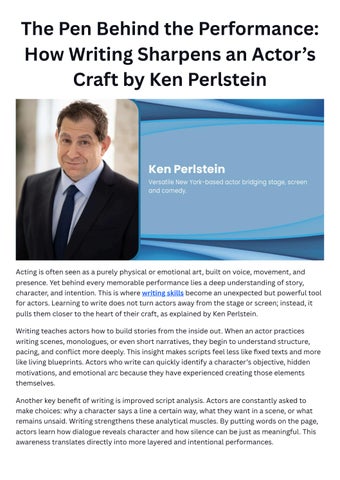
The Pen Behind the Performance: How Writing Sharpens an Actor’s Craft by Ken Perlstein
Acting is often seen as a purely physical or emotional art, built on voice, movement, and presence. Yet behind every memorable performance lies a deep understanding of story, character, and intention. This is where writing skills become an unexpected but powerful tool for actors. Learning to write does not turn actors away from the stage or screen; instead, it pulls them closer to the heart of their craft, as explained by Ken Perlstein. Writing teaches actors how to build stories from the inside out. When an actor practices writing scenes, monologues, or even short narratives, they begin to understand structure, pacing, and conflict more deeply. This insight makes scripts feel less like fixed texts and more like living blueprints. Actors who write can quickly identify a character’s objective, hidden motivations, and emotional arc because they have experienced creating those elements themselves. Another key benefit of writing is improved script analysis. Actors are constantly asked to make choices: why a character says a line a certain way, what they want in a scene, or what remains unsaid. Writing strengthens these analytical muscles. By putting words on the page, actors learn how dialogue reveals character and how silence can be just as meaningful. This awareness translates directly into more layered and intentional performances.
Writing also helps actors develop a stronger personal voice. In an industry filled with auditions and competition, originality matters. Actors who write gain clarity about the stories they connect with and the themes that resonate with them. This self-knowledge enhances authenticity on stage and on screen, allowing performances to feel grounded rather than generic. It can also inspire actors to create their own material, opening doors instead of waiting for them. From a practical standpoint, writing improves communication. Actors collaborate daily with directors, writers, and fellow performers. Being able to articulate ideas clearly, offer thoughtful feedback, or pitch creative concepts is a valuable professional skill. Writing sharpens language, thought, and expression, all of which strengthen an actor’s ability to work effectively within a creative team. Finally, writing builds confidence. Something is empowering about shaping a story from nothing, about trusting one’s imagination and instincts. That confidence carries into auditions and performances. Actors who write are less afraid to take risks because they understand that creativity is not fragile; it is something they can actively generate. In learning to write, film actors do not step outside their art. They deepen it. Writing becomes another rehearsal space, one that strengthens empathy, insight, and imagination. For actors seeking longevity and depth in their careers, the pen can be just as crucial as the spotlight.