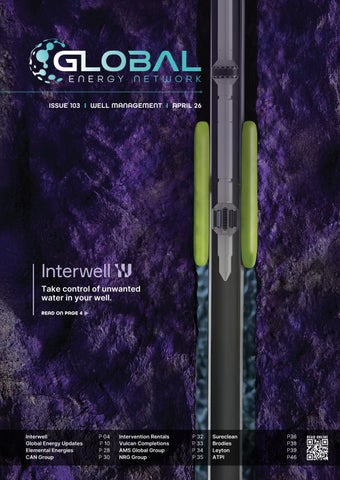
Welcome to the April issue of ‘GEN Magazine’, where this month we are exploring the theme of “Well Management”
A big thank you to our front cover star Interwell, where this month you can read all about how their “Water shut off solution” on pages 4-5.
We are also delighted to welcome contributions in this edition from Elemental Energies, CAN Group, Intervention Rentals, Vulcan Completion products, AMS Global, Sureclean, NRG Group.
The rest of this month’s magazine as always provides you with a review of the Energy sector in the North Sea, Europe, Norway, Middle East, USA and Australia, along with industry analysis and project updates.
Thanks as always to our corporate partners, Dräger, PD&MS, Osso, Cegal, Stats Group, Wellpro, Elementz, Leyton, Archer Well, Elemental Energies, Opito, QHSE, Brodies llp, Tess, Intervention Rentals, Vulcan, Viper Innovations, Infinity Partnership, RCP, Scotsbridge and of course our corporate
partner
and
partner
Unwanted Water? Shut It Off. Take Back Control.
From 70% water cut to 0.6%
Precision Water Shut-Off Solutions
One Partner. Multiple Solutions.
→Lower intervention cost
→Reduced operational risk
→Permanent zonal isolation
Unwanted Water Is Costing
When Water Takes Over
A subsea gas producer faced a rapidly rising water cut after a failed OH packer compromised annular barrier integrity. Unwanted water began entering the well, driving up operational costs and threatening production stability.
As water levels surged, the well was pushed toward premature shut-in, putting the asset at risk and exposing the operator to significant abandonment costs.
Precision Isolation
A focused annulus isolation strategy was deployed to shut off the water source at its origin.
The solution combined a horizontal CannSeal annulus isolation across 4 meters with HEX RPB technology to deliver robust, long-term zonal isolation. This precise, engineered approach enabled effective water shut-off while preserving overall well integrity.
Production Restored
The intervention reduced water cut from 70% to just 0.6%, successfully restoring & increasing production. A sustained drawdown of 1,300 psi improved well performance and extended productive life. By isolating the unwanted water source, the operator avoided high abandonment costs and regained full control of the asset.
The BISEP® has an extensive track record and provides pioneering double block and bleed isolation while maintaining pipeline ow. Fail-safe hydraulically activated dual seals provide tested, proven and fully monitored leak-tight isolation, every time, any pressure.
size range: 3” - 56” max pressure: 153bar / 2220psi type approved
Editorial newsdesk@globalenergynetwork.net
+44 (0) 1224 084 114
Advertising sales@globalenergynetwork.net
+44 (0) 1224 084 114
Design Jennifer McAdam jen.mcadam@globalenergynetwork.net
Edit ori al Tsvetana Paraskova newsdesk@globalenergynetwork.net
The Network Welcome to
Global Leaders in Engineering and Energy Transition Solutions
We deliver engineered, manufactured and operations solutions that support our customers’ assets or facilities across their life cycle from design, construction, manufacture, refurbishment or repurposing as well as decommissioning.
Unity is a well decommissioning specialist and Europe’s largest independent provider of well integrity services, technology and engineering solutions for the global upstream energy industry. Our three business units – Wells, Decom and Innovation - support onshore and offshore life-of-well production and abandonment operations by maintaining wellhead and near-surface well integrity.
Worldwide Provider of Inspection, Auditing & Quality Services
A trusted global partner delivering accredited safety services to key energy sectors. From offshore and marine to renewables and commercial industries, our innovative solutions protect lives, safeguard assets and ensure compliance with precision.
BENTEC is a global leader in energy engineering and technology – trusted by major operators, known for our technical credibility, and relied upon to deliver in the world’s most complex environments.
With decades of experience in the design and manufacture of rig and energy systems, BENTEC combines engineering expertise with practical insight and advanced digital capability.
GQS provides proven, effective and efficient product conformity and assurance services. Through our experience, people and systems, we exceed expectations and meet any challenge requested.
Sureclean redefines NORM management by embedding unique radiological expertis
Sureclean has appointed senior radiological protection expert Karen Gunn as Radiological Director, marking a decisive step in its mission to become the global leader in NORM decontamination.
The move embeds Radiation Protection Adviser (RPA) and Radioactive Waste Adviser (RWA) expertise directly within Sureclean’s operational structure, setting the company apart from traditional NORM contractors that rely on external advisory support. By bringing this authority in-house, Sureclean is integrating regulatory interpretation, operational design and waste governance under one accountable delivery model.
Interocean Partners with JERA Nex bp to Drive Global Offshore Wind Operations
Interocean Marine Services (Interocean), a leading provider of offshore support services, has signed a Master Services Agreement with JERA Nex bp covering specialist marine consultancy and assurance services in support of its North Sea and global offshore wind operations.
Mobilising from Aberdeen, Interocean would be able to deliver a fully integrated suite of marine services, including assurance, engineering, offshore operations support, Health, Safety, Security, and Environment (HSSE) consultancy, and emergency response, alongside dedicated specialist support for rig moves, tanker offtake, and vessel assurance. This breadth of capability can provide scalable, world-class support to JERA Nex bp’s international offshore wind portfolio.
NETWORK news
JMSL Launches Integrated Service Model to Strengthen Project Delivery Capability
Updated structure strengthens capability across manpower, fabrication, and project services
JMSL has completed a strategic realignment of its services, introducing defined delivery models across manpower, fabrication, and project services to support integrated project execution.
The updated structure forms part of JMSL’s three-year growth strategy and refreshed business plan, alongside the launch of a new website designed to support this integrated service approach, in line with evolving client requirements and continued focus on integrated, delivery-led services across UK and international projects.
Brimmond marks 30 years after record year despite challenging market conditions
Aberdeenshire engineering specialist Brimmond is celebrating 30 years in business after delivering the strongest financial performance in its history, while continuing to expand its international presence despite a challenging year across several key industries.
Headquartered in Kintore, Aberdeenshire, Brimmond specialises in the design, manufacture, rental and repair of lifting, mechanical and hydraulic equipment. Over the past three decades, Brimmond has grown from a small hydraulic hose repair business to a global supplier serving customers across energy, marine, aquaculture, defence and renewable sectors.
nails Hammerhead marine operations and installation contract
Energy and marine consultancy ABL has been contracted to provide marine warranty survey services for the marine operations and installation activities on ExxonMobil’s Hammerhead development offshore Guyana.
The Hammerhead project is intended to be the seventh of multiple developments in the Stabroek block, approximately 200 kilometres offshore Guyana, in water depths ranging from 850 to 1,725 metres.
It includes 18 production and injection subsea wells and the deployment of a spread-moored floating production, storage and offloading vessel (FPSO) that will offload directly to conventional export tankers in a tandem mooring configuration. Produced gas will be transferred to the gas-to-energy pipeline system for disposition at either the Unity facility or the onshore gas-to-energy plant.
maintains UAE operations while prioritising safety amid regional developments
Petrasco Energy Logistics continues to operate and support clients across the UAE and the wider Middle East during the current regional developments. While the situation remains fluid, the company is maintaining operations as close to normal as possible and placing the highest priority on the safety and wellbeing of its employees, partners and clients.
Petrasco, a specialist provider of international logistics solutions to the energy industry, has implemented enhanced monitoring and operational protocols across its regional network to ensure business continuity while responding responsibly to evolving developments.
UK
Energy Update
The fate of the Energy Profits Levy and the UK’s role in security of oil and gas supply amid the war in the Middle East have dominated the headlines in the UK’s North Sea oil and gas sector in recent weeks.
Amid the war in the Middle East and the sharp focus back on homegrown energy, Offshore Energies UK (OEUK) said that a solution to reducing dependence on fossil fuel imports in an increasingly volatile world is to bet on domestic oil and gas supply and remove barriers to its development.
With the right investment conditions and support for pragmatic energy policies, the UK can meet up to half of that demand from its own resources in the North Sea, OEUK CEO David Whitehouse said.
The alternative is to increase imports, including LNG imports and more natural gas from Norway.
“While LNG provides our energy system with beneficial flexibilities, replacing homegrown natural gas with more LNG is not a good bet,” Whitehouse noted, adding that the Middle East war exposed the constraints to LNG supply from a volatile region.
“A solution is to back homegrown energy. This is not about locking in more oil and gas, but safeguarding from intensifying global competition and geopolitical volatilities,” OEUK’s Whitehouse wrote in The Times.
“It is also about maximising the opportunities of a homegrown energy transition: investment, revenue, jobs and security.”
Referring to the energy profits levy, for which industry has called on the government to review the mechanism, Whitehouse said that the EPL was introduced “as a temporary tax to exceptional market conditions because of Putin’s war in Ukraine but it is eroding investor confidence and future revenues and costing jobs.”
Therefore, OEUK is asking ministers “to bring forward the oil and gas pricing mechanism a permanent, revenue-based tax on UK oil and gas that ensures the industry pays high rates of tax when prices are high but protects and promotes investment when prices are low.”
debate and building consensus for a modern industrial Britain, secured by homegrown energy. Let’s grasp the opportunity,” Whitehouse said.
Amid the war, leaders from the UK industry, academia, and civic society are urging the government to strengthen national resilience by prioritising homegrown energy – from oil and gas to renewables – recognising that energy security is national security.
The leaders join manufacturers, renewables developers, offshore operators, and civic groups in calling for a pragmatic approach to building out renewable energy while maintaining the homegrown oil and gas the UK needs for decades to come.
Current projections show by 2030 the UK will rely on LNG from places like Qatar and the US for more than a quarter of its gas and for almost half by 2035 – up from around 14 percent last year, OEUK says.
LNG cargoes are traded globally and are four times more carbon intensive than homegrown gas. They can be diverted away from the UK during periods of high international demand, increasing the risk of price spikes and supply shortages, the leading offshore industry body said.
“This is now the second global energy shock in just four years. It underscores the risks to the UK and across wider Europe of a system that favours increasing reliance on imports – which now make up more than 40% of our energy in the UK,” OEUK’s Whitehouse noted.
“Only by making the most of all forms of domestic production, from oil and gas to our world class renewables sector can we weather the challenges of today and seize the opportunities of tomorrow.”
By Tsvetana Paraskova
“This is better for the UK taxpayer, and sends a strong signal that in a precarious world we are depolarising the energy
Elizabeth de Jong of Fuels UK, which represents the nation’s petrol and diesel providers for cars and trucks, commented, “Without home production, we’ve become a country dangerously exposed to instabilities abroad and would be relying on imports from countries where we have geopolitical concerns.”
UK North Sea Energy Update
The UK, most European countries, Canada, Japan, and other key partners condemned the de facto closure of the Strait of Hormuz and the threat to free commercial shipping in the world’s most important oil and LNG chokepoint.
In response to the joint statement, OEUK energy policy director Enrique Cornejo said that the UK offshore energy sector was ready to play its part in boosting supplies.
“The commitment to stabilise energy markets and increase output in ‘certain producing nations’ is also welcome,” Cornejo added.
“As the second largest oil and gas producer in Europe, this should include the UK which must play its part in boosting the supply of energy – bringing forward the Oil and Gas Price Mechanism to increase investment, approving key projects such as Jackdaw and Rosebank, and continuing to expand offshore wind production.”
Separately, new UK-wide polling commissioned by OEUK showed at the end of March overwhelming public support for using the UK’s own oil and gas resources alongside renewables to strengthen national security, manage overreliance on imports, and ensure stable, long-term decision-making on how the sector is taxed.
The research, conducted by Opinium in the middle of March, found that 76 percent of the polled UK adults find it convincing that “because global events can disrupt energy supplies, the UK should continue producing oil and gas at home rather than relying more on imports.”
In non-war related news from the UK North Sea industry, the North Sea Transition Authority (NSTA) announced at the end of March that it had received bids for more than 2 million acres of seabed at the closure of the UK’s second carbon storage licensing round.
The NSTA is encouraged by the engagement from the licensees from the first licensing round and hopes the second round would help the carbon storage industry grow and build momentum.
The second carbon storage licensing round was launched in December 2025, following close consultation with The Crown Estate and Crown Estate Scotland, and other seabed users, and was launched after receiving expressions of interest.
The applications in the second licensing round “pave the way for further carbon stores in the UK and highlight the sustained progress in the sector, which has experienced a series of landmark developments in the past few months as existing projects head towards first injection,” the NSTA said in a statement.
People want renewables and UK oil and gas working side by side – not one instead of the other – and they want decisions based on long‑term rules, not short‑term politics
Moreover, 74 percent said the UK should “produce as much of its own oil and gas as possible rather than rely on imports.”
Forty percent believe the best approach to UK energy security is investing in a balanced mix of renewables and UK oil and gas, compared to just 26 percent who want a renewables-only approach and 13 percent who want oil and gas only.
The poll also found that 59 percent think oil and gas companies should pay higher taxes when prices are unusually high. But crucially, 67 percent say any windfall tax must be rules-based, providing clear, predictable certainty about how companies will be taxed.
“People want renewables and UK oil and gas working side by side – not one instead of the other – and they want decisions based on long-term rules, not short-term politics,” OEUK’s Whitehouse said, commenting on the poll.
“A rules-based approach to taxation is part of that stability. It ensures the public receives a fair share in times of genuine windfalls while giving companies the certainty needed to keep investing in UK energy, UK jobs and the UK’s transition.”
The regulator will now move to review and assess the applications received and work with the applicants and other stakeholders before deciding on whether or not to award licences.
“The UK holds a unique position in developing offshore energy in general, including carbon storage. As we transition, we benefit from decades of experience in the North Sea, commercial know-how, optimal geological conditions, and spatial coordination,” said Andy Brooks, NSTA Director of New Ventures.
Adura, the new North Sea oil and gas producer created by the combination of Equinor and Shell’s assets in the area, has signed a new seven-year, senior-secured Reserve Based Lending (RBL) facility. This $3-billion facility marks Adura’s inaugural syndicated bank facility since it was formed in December 2025, the company said at the end of March.
The facility “provides the financial strength and flexibility to deliver on our strategic plan and to continue supplying the UK with secure, reliable energy,” Adura’s CEO Neil McCulloch commented.
Adura has interests in ten North Sea producing oil and gas assets – Buzzard, Clair, Gannet, Mariner, Nelson, Penguins, Pierce, Schiehallion, Shearwater, and Victory, as well as in two projects in execution - Jackdaw and Rosebank, and a number of exploration licences.
EU
Energy Update
The Middle East war sent shockwaves through global energy markets, including in Europe which saw spiking natural gas prices as Qatar’s LNG exports went offline and its liquefaction complex at Ras Laffan, the world’s largest, was hit by Iranian missile strikes.
Governments across Europe scrambled to contain the fallout from the spiking energy prices and boost domestic resource development, mainly renewable energy installations, while companies announced milestones in several key clean energy projects across the UK and Europe.
Oil & Gas
The war in the Middle East, the strikes on LNG infrastructure in Qatar, and the de facto closure of the Strait of Hormuz, through which 20 percent of global LNG flows pass, have triggered a sharp spike in European gas and power prices. The Title Transfer Facility (TTF) benchmark for Europe’s gas trading more than doubled between March 2 and March 20 in the biggest surge since the 2022 energy crisis as Qatar’s LNG supply is now offline and is set to remain off the market for a prolonged period of time after Iranian strikes left the Ras Laffan complex with “extensive damage,” as QatarEnergy itself has acknowledged
The gas-exposed markets in Europe now see strengthening renewable project economics through improved capture prices and revenue expectations, according to Rystad Energy.
In the broad picture, the war in the Middle East is likely to shift the policy lens back towards energy security.
“The sharp move in gas and power markets following the strikes over the weekend and this week highlights that Europe’s structural vulnerability lies in continued dependence on imported fossil fuels exposed to geopolitical risk,” Rystad Energy said.
A more prolonged outage would further tighten the global supply and keep prices elevated for longer
Energy consultancy Wood Mackenzie noted that the extended outage in Qatar, the world’s second-largest LNG exporter behind the United States, risks tightening global supply, raising prices, and delaying capacity growth through 2028.
By Tsvetana Paraskova
The shock from the loss of a large portion of global LNG supply is transmitting directly into European power markets, with price reactions varying according to national gas exposure, intelligence firm Rystad Energy said
The sharp move higher in gas prices did not remain confined to commodity markets and directly fed into European wholesale electricity pricing through the market’s price formation mechanism.
“Beyond the immediate volatility, the market reaction underscores the structural linkage between global LNG supply, European electricity pricing and Europe’s broader energy security trajectory,” said the consultancy, noting that “This escalation in conflict strengthens the structural case for accelerating the energy transition.”
“Market expectations had been for a short disruption, with a controlled restart restoring supply to pre-conflict levels by mid-2026. That outlook now appears increasingly unlikely,” said Kristy Kramer, Head of LNG Strategy and Market Development at WoodMac.
“A more prolonged outage would further tighten the global supply and keep prices elevated for longer.”
Each additional month of disruption removes around 1.5 percent from annual global LNG availability, reckons Daniel Toleman, research director, global LNG, at Wood Mackenzie.
“Even if supply were maintained at 2025 levels, the market would still face demand destruction in Asia, lower storage injections in Europe, and sustained upward pressure on gas and LNG prices,” Toleman said.
Lower LNG availability in Europe is expected to reduce storage injections through the summer and accelerate fuel
switching. Gas-to-coal switching is likely to continue. European storage levels may only reach around 70 percent when the 2026/2027 winter approaches, below the recent average, according to Wood Mackenzie.
Low-Carbon Energy
In response to the events in the Middle East, UK Energy Secretary Ed Miliband outlined in the middle of March a package of measures to go “further and faster” in the pursuit of national energy security.
To boost the UK’s energy security, the UK government announced that ‘plug-in solar’, low-cost solar panels that families can buy at supermarkets and put on their balconies or outdoor space, will be made available in the UK for the first time.
The UK also intends to bring forward the next annual renewables auction to July, inviting renewables companies to invest in UK energy. The most recent round was the biggest ever for clean energy in Britain.
Reliance on internationally-traded gas has left the UK over-exposed to global price shocks, fiscal risk and hostile state activity, warned a new report by Public First, produced in collaboration with the Royal United Services Institute (RUSI) and commissioned by RenewableUK.
The report highlights the importance of investing in and safeguarding the UK’s domestic energy supply as a national security priority, recognising that there are unique benefits to renewables playing the leading role in maintaining a resilient lowcost power system.
While the UK’s energy system is resilient, this comes with a heavy price tag for consumers due to unpredictable spikes in the costs of fossil fuels, according to the report.
With the closure of the Strait of Hormuz, Europe wakes up, yet again, to its dependence on unreliable fossil fuel imports. This is not a one off. This is the new normal
The government is also working with the Competition and Markets Authority (CMA) to ensure that fuel suppliers cannot engage in unfair practices towards consumers such as price gouging.
“Global events demonstrate there’s not a moment to waste in our drive for clean power because there can be no energy security while we are so dependent on fossil fuels,” Miliband said.
“Everything we are doing is about one purpose: fighting the corner of the British people by taking back control of our energy.”
RenewableUK has welcomed the government’s decision to bring forward to July the next annual clean energy auction, Contracts for Difference Allocation Round 8.
“Recent global events have shown, yet again, how exposed we remain to shocks in international fossil-fuel markets, and the best way to reduce that vulnerability is to generate more of our own electricity here in the UK, at the stable prices wind and solar offer,” RenewableUK chief executive Tara Singh said.
“There could be as many as 18 offshore wind farms potentially competing for contracts, alongside new onshore wind and solar sites…To secure it, developers need clear and decisive action on grid connection dates, charges and delivery timelines, so that projects can bid with confidence.”
In light of the events in the Middle East, the WindEurope association said that home-grown electricity from renewables is Europe’s only futureproof energy strategy.
“With the closure of the Strait of Hormuz, Europe wakes up, yet again, to its dependence on unreliable fossil fuel imports. This is not a one-off. This is the new normal,” WindEurope said, adding that “Europe needs to come together and focus ruthlessly on switching from fossil fuels to home-grown clean electricity.”
To deliver on goals, offshore wind in particular, Europe needs stronger ports and shipyards to support the supply chain, WindEurope said in a separate call to stakeholders.
The offshore wind expansion, especially in the North Sea, might soon hit a new bottleneck in the ports and shipyards.
“Europe’s offshore supply chain is only as strong as the ports and vessels that support it,” WindEurope said.
In company news, Kight PowerHub said it would build a battery manufacturing facility in Dumfries, the first domestic battery factory in Scotland.
John Swinney, First Minister of Scotland, visited the Dumfries site where the new manufacturing facility will create up to 700 high-technology jobs in the south of Scotland.
The Dumfries facility will be the first home energy storage factory in Scotland and serve as the primary assembly plant for the Kight Powerhub.
The UK-designed and assembled Powerhub uses a pioneering battery chemistry never previously deployed in domestic settings, delivering zero fire risk,
backed by leading insurance companies with 100 percent usable capacity at all times, a 25-year industry-leading warranty with up to 20,000-cycle lifespan and full battery back up in the event of a power grid outage, Kight said.
Norwegian energy major Equinor has entered into a 2-year bio-methanol supply agreement with Wallenius Wilhelmsen, a major global player in shipping and vehicle logistics, supporting a growing marine segment for low-carbon fuels. Under the agreement, Wallenius Wilhelmsen will receive the bio-methanol bunkers at the Ports of Zeebrugge and Antwerp, positioning the partnership within key European maritime hubs. Supplies will commence in late 2026, Equinor said.
Another major energy company, TotalEnergies, has launched France’s first advanced plastics recycling plant, with an annual capacity of 15,000 tons, at its Grandpuits site southeast of Paris. This start-up marks another step in the conversion of the Grandpuits refinery into a zero-crude platform.
The new plant uses innovative recycling technology supplied by TotalEnergies’ partner Plastic Energy. It transforms hardto-recycle plastic waste from French households, which is currently sent to landfill or incineration, into a synthetic oil through a pyrolysis process, involving heating the waste to high temperatures in an oxygen-free environment and under pressure. This advanced recycling process makes it possible to recycle waste that cannot be recycled mechanically.
The synthetic oil is then treated as petrochemical feedstock, as a substitute for fossil fuels. It contributes to producing recycled plastics of the same quality as virgin plastics, compatible with the strictest requirements for food contact and medical applications, TotalEnergies said.
“The start-up of the first advanced plastics recycling plant in France is an important milestone in the conversion of our Grandpuits site into a zero-crude complex,” said Valérie Goff, Senior Vice President, Renewables, Fuels & Chemicals at TotalEnergies.
“Alongside Plastic Energy, contributing its technology, and our partners Citeo and Paprec, we are supporting the emergence of a brand-new French plastic recycling activity”.
USA
Energy Update
Amid the shock loss of oil and gas supply from the Middle East, the United States remains the world’s biggest crude oil producer and the top LNG exporter. However, the global supply crisis is being felt in the US with soaring prices of international crude benchmarks and surging domestic petrol prices that are denting consumer finances.
Soaring Oil Prices, Higher US Oil and Gas Production
In the first monthly Short-Term Energy Outlook (STEO) since the war in the Middle East began, the U.S. Energy Information Administration (EIA) expects Brent crude oil price will remain above $95 per barrel over the next two months, before falling below $80 a barrel in the third quarter of 2026 and around $70 per barrel by the end of the year. Yet, the price forecast is highly dependent on the EIA’s modelled assumptions of both the duration of conflict in the Middle East and resulting outages in oil production.
Higher oil prices, due to the war and the de facto closure of the Strait of Hormuz, are expected to lead to more US crude oil production. The EIA expects US crude production will average 13.6 million barrels per day (bpd) in 2026 and rise to 13.8 million bpd in 2027. The 2027 forecast was revised up in March by 500,000 bpd compared to the February forecast.
US natural gas prices, however, are set to remain relatively untouched by the massive disruption to LNG supply out of the Middle East, with the Strait of Hormuz closed and the missile strikes on Qatar’s Ras Laffan LNG complex, which, as Qatar acknowledged, resulted in “extensive damage”.
The US has abundant domestic gas production, while its LNG exports were already close to maxed out even before the start of the war—meaning that no additional significant volumes can be shipped out of the US and thus raise significantly US natural gas prices.
The EIA expects US natural gas prices to be relatively unaffected by the supply shock in the Middle East. The administration forecasts that the US Henry Hub spot price would average about $3.80 per million British thermal units (MMBtu) in 2026, a downward revision of 13 percent compared to the February projection. The Henry Hub spot price is set to average nearly $3.90/MMBtu in 2027, the EIA says, after revising down its February forecast by 12 percent. Lower prices in 2027 mostly reflect more associated natural gas production as a result of the jump in oil prices and the related increase in production later in the forecast.
Higher crude oil production would result in more associated natural gas production in the US. The EIA expects marketed natural gas production to average 121 billion cubic feet per day (Bcf/d) this year, an increase of 2 percent from 2025. Production would then rise by an additional 3 percent in 2027 to reach 124 Bcf/d. The 2027 forecast is almost 2 Bcf/d higher than the February outlook.
US Petrol Prices Soar
By Tsvetana Paraskova
While maxed out US LNG export capacity is bad news for Europe and Asia, which are scrambling for supply, it is good news for America’s natural gas prices.
US oil and gas producers could get windfall from the higher oil prices, but the US consumers have had to contend with surging prices at the pump, where petrol and diesel prices hit the highest since 2022-2023, since the largest factor in determining the prices of these fuels is the price of crude oil. With oil traded in global markets, US gasoline and diesel prices respond to worldwide supply and demand rather than production in any single country. During the Middle East war, diesel prices have jumped more than petrol prices because the global and US markets for middle distillates were tighter and tightening faster than gasoline markets.
High fuel prices are a headache for the Trump Administration, which moved to pull all levers to try to stop the surge in oil prices—including releases from the Strategic Petroleum Reserve (SPR), and a 60-day waiver of the Jones Act, which requires that cargo transported between US ports be carried on vessels that are US-built, US-flagged, and UScrewed. The waiver applies to certain energy commodity and fertilizer cargoes.
Surpassing a decades old record demonstrates that Alaska remains globally competitive and capable of attracting significant investment under strong environmental and regulatory standards
The US Administration has also moved to temporarily ‘unsanction’ Russian and Iranian oil sales of crude already loaded on tankers in an attempt to free more oil on the market. The Administration can ill-afford high gasoline and energy prices ahead of the midterm elections in November, when Republicans will have to defend razor-thin majorities in both chambers of Congress.
Alaska’s Biggest Oil and Gas Lease Sale
The Trump Administration is grappling with the fallout of the war in the Middle East, but it also scored a major success in the latest lease sale in Alaska, where the National Petroleum Reserve oil and gas lease sale generated record-high proceeds in a wellattended auction that saw big names vying for hundreds of tracts in the Alaska National Petroleum Reserve.
The oil and gas lease sale in the middle of March resulted in 187 leases and $163.7 million in total receipts, the Department of the Interior said
The sale, which was the first for the reserve since 2019 and the first under President Donald Trump’s One Big Beautiful Bill Act, made history for the leasing programme in the 23-million-acre National Petroleum Reserve in Alaska—it generated the
most revenue ever, the highest number of tracts received bids, and the second-biggest acreage was sold in a single sale.
The Bureau of Land Management (BLM) offered 625 tracts across approximately 5.5 million acres for bid in the lease sale. In response, 11 companies submitted bids on 187 tracts covering 1,334,967 acres. ExxonMobil, ConocoPhillips, and units of Shell and Repsol bid and won tracts, among others.
The lease sale “underscores the National Petroleum Reserve in Alaska’s vital role in strengthening America’s energy security while fueling economic growth across Alaska,” Secretary of the Interior Doug Burgum said.
“The Reserve was created to support our nation’s energy needs, and this successful sale demonstrates what’s possible when we align responsible development with that original purpose,” Secretary Burgum added.
Alaska’s business and resource organizations cheered the results of the lease sale, saying that it shows renewed investor confidence in Alaska’s North Slope and the state’s longterm resource potential.
“This record-setting lease sale sends a clear signal that when Alaska offers a stable fiscal and regulatory environment, investment follows,” said Steve Wackowski, president & CEO of the Alaska Oil and Gas Association.
“That confidence is critical to advancing responsible development of Alaska’s vast resources, supporting jobs, sustaining the Trans-Alaska Pipeline System, and strengthening U.S. national security in an increasingly uncertain world.”
Connor Hajdukovich, executive director of the Resource Development Council for Alaska, commented,
“Surpassing a decades-old record demonstrates that Alaska remains globally competitive and capable of attracting significant investment under strong environmental and regulatory standards.”
The war in the Middle East and the de facto closure of the Strait of Hormuz have created the worst oil and gas supply disruption in the history of energy markets.
The sudden disappearance of about 20 percent of daily global oil and LNG flows via the Strait of Hormuz sent oil and gas prices surging, importers scrambling for supply that is not trapped in the Middle East, and nations looking to contain fuel shortages and a major inflation spike due to the energy supply shock.
Before the war, both the oil and gas markets were expected to see growing oversupply over the coming months and years. But the conflict upended all these forecasts of glut, and moved the markets into structural deficits that would take months, and in the case of LNG possibly years, to recover.
In addition, the closure of the key export route for Middle East’s oil to most tanker traffic has forced all major producers in the Gulf to slash upstream production. Some upstream, refining, and port assets in the Middle East have also been hit by Iranian drones or missiles that have damaged the infrastructure, further complicating efforts to put production and exports back online once the export routes are clear to navigate again.
As of March 11, Gulf producers had cut total oil production by at least 10 million barrels per day (bpd), the International Energy Agency said in its monthly report for March. Supply losses have increased since this assessment as the conflict dragged on well beyond the middle of March.
Moreover, more than 3 million bpd of refining capacity in the region has shut due to attacks and a lack of viable export outlets. Refinery runs elsewhere have become increasingly limited due to restricted feedstock availability.
Disruptions have not been limited to upstream production and exports, with several refineries and gas processing facilities shut down due to attacks or for safety concerns, said the IEA.
The war in the Middle East is creating the largest supply disruption in the history of the global oil market
“The war in the Middle East is creating the largest supply disruption in the history of the global oil market,” the agency noted.
The Cost of War
Middle East Producers Slash Output
The biggest producers in the Gulf have already had to curtail upstream production. Iraq, Saudi Arabia, Kuwait, and United Arab Emirates (UAE) have all slashed output as storage onshore and on tankers filled up, and tankers had no way out of the Strait of Hormuz.
Apart from production curtailments and spending later to restart wells once the Hormuz crisis is resolved, energy producers in the Gulf face billions of US dollars of spending on repairing infrastructure that has been hit by Iranian strikes. The loss of refining and LNG capacity will extend way beyond the eventual opening of the Strait of Hormuz to free traffic.
By Tsvetana Paraskova
Only Saudi Arabia has meaningful capacity to redirect more than half of its crude oil exports from the Strait of Hormuz-bound export ports to the Yanbu port on the Red Sea. But even the accelerated loadings at Yanbu could not fully offset the loss of available export capacity via Hormuz, forcing Saudi Aramco to slash its term supply to Asia for April loading cargoes.
The damage and shutdowns in the Middle East have affected LNG trains, refineries, fuel terminals, and critical gas-to-liquids facilities. The costs to repair and restore energy infrastructure damaged as of 25 March could reach at least $25 billion, according to Rystad Energy’s estimates, based on an initial assessment of impacted facilities.
Costs are expected to rise further, and spending is set to be chiefly driven by work on engineering and construction, followed by expenditure on equipment and materials, the energy intelligence firm said.
“The Gulf region’s recovery will be defined less by financial capital and more by structural constraints. While some assets may be restored within months, others could remain offline for years,” commented Audun Martinsen, Head of Supply Chain Research at Rystad Energy.
“Beyond the status of the Strait of Hormuz, every day of damaged or shut-in infrastructure pushes pre-war production capacity further out of reach,” Martinsen noted.
So far, the biggest damage is estimated to be at Iran’s South Pars offshore field and Qatar’s Ras Laffan LNG facility, according to Rystad Energy.
Beyond the status of the Strait of Hormuz, every day of damaged or shut in infrastructure pushes pre war production capacity further out of reach
“The scale of damage and long lead times for critical equipment could result in slow recovery at Ras Laffan, while Iran’s legal exclusion from Western supply chains means it will have to rely on Chinese and domestic contractors, which is a technically feasible approach that could be slower and more expensive.”
Moreover, urgent repairs will have to take precedence in place of planned expansion, Martinsen noted.
As operators are likely to prioritise restoring existing fields instead of new developments, demand for EPC contractors and OEMs will rise, especially those with regional experience and existing agreements with national oil companies.
Near-term work will most likely focus on inspection, engineering, and site preparation, followed by equipment replacement and construction as procurement constraints ease, Rystad Energy reckons.
QatarEnergy has already warned that the damage to its Ras Laffan Industrial City caused by missile strikes would cost the Qatari state energy firm about $20 billion a year in lost revenue and take up to five years to repair, impacting supply to markets in Europe and Asia.
The attacks damaged two LNG producing Trains 4 and 6 totalling 12.8 million tons per annum (MTPA) of production, representing approximately 17 percent of Qatar’s exports.
In the early days of the war, even before the strikes on Ras Laffan, QatarEnergy had stopped production of LNG and associated products and declared Force Majeure to its affected buyers.
The damage sustained by the LNG facilities following the strikes at Ras Laffan “will take between three to five years to repair,” said Saad Sherida Al-Kaabi, Qatar’s Minister of State for Energy Affairs and president and CEO of QatarEnergy.
“The impact is on China, South Korea, Italy and Belgium. This means that we will be compelled to declare force majeure for
up to five years on some long-term LNG contracts,” Al-Kaabi noted.
The attacks also targeted the Pearl GTL (Gas-to-Liquids) facility, a production sharing agreement operated by Shell, which converts natural gas into highquality cleaner burning drop-in fuels and produces base oils used to make premium engine oils and lubricants, and paraffins and waxes.
“The damage caused to one of the two trains at Pearl GTL is being assessed and is expected to be offline for a minimum of one year,” Al-Kaabi added.
Qatar’s output of condensates, LPG, naphtha, sulphur, and helium has also suffered losses due to the outage.
The outage of Qatari LNG is one of the most severe gas market shocks of the past decade.
“A disruption of this magnitude exposes how little flexibility exists in global LNG markets,” Josephine Mills, senior analyst at Enverus Intelligence Research, says
“With short-run LNG supply elasticity extremely limited, price rather than volume must absorb the adjustment, leaving global gas prices highly vulnerable if the outage is prolonged.”
Wood Mackenzie, for its part, comments that the damage to Ras Laffan fundamentally alters the global gas market outlook.
“Market expectations had been for a short disruption, with a controlled restart restoring supply to pre-conflict levels by mid-2026. That outlook now appears increasingly unlikely,” said Kristy Kramer, Head of LNG Strategy and Market Development at WoodMac.
“A more prolonged outage would further tighten the global supply and keep prices elevated for longer,” Kramer noted.
Norway continues to maintain high oil and gas production levels from its continental shelf, while petroleum resources are estimated to have increased over the past year.
Companies operating on the Norwegian Continental Shelf (NCS) continue to make new discoveries and consider fast-tracking developments via tie-backs to existing infrastructure as Norway looks to boost its hydrocarbon production further amid the major supply shock in the Middle East.
While Norway’s oil and gas output and exports are maxed out and cannot help materially in alleviating the shocking loss of supply stuck at the Strait of Hormuz, Western Europe’s biggest oil and gas producer continues to bet on stable longterm production, to act as the most reliable supplier in testing times.
High Production, Rise in Resources
Last year, oil production on the NCS hit its highest level since 2009, the Resource Accounts 2025 report by the regulator, the Norwegian Offshore Directorate, showed.
More than half of the production is being replaced with new reserves, and the total petroleum resources on the NCS have increased, the analysis found.
Norway saw high liquids and gas production, while the reserve growth replaces 60 percent of production. Contingent resources in fields declined in 2025, but contingent resources in discoveries rose, according to the directorate.
Overall, Norway saw an increase in total petroleum resources last year.
Despite few new development plans in 2025, licensees on the fields have replaced three of five produced barrels with new reserves.
The Troll and Johan Sverdrup fields have the largest remaining reserves on the NCS, according to the regulator.
53 percent liquids and 47 percent gas. The volume of discoveries has increased from 2024, thanks to high resource growth from exploration activity in 2025. Several older discoveries also have a changed status. These discoveries were previously excluded from the contingent resources because development was deemed unlikely, but they are now covered by this class and therefore contribute to the increase in total resources, the directorate said.
Even with high oil and gas production and a rise in discovery volumes, Norway still has a lot of oil and gas waiting to be discovered.
All three ocean areas of the NCS – the North Sea, the Norwegian Sea, and the Barents Sea – still hold substantial undiscovered resources, according to the regulator.
The Barents Sea has the highest resource estimates, as exploration activity here has remained low over a long period of time. The North Sea holds the fewest undiscovered resources, yet it has seen the highest level of exploration activity.
About 63 percent of Norway’s undiscovered resources are located in the Barents Sea, said the regulator. The Barents Sea North is the ocean area with the highest estimate for undiscovered liquids resources, while the Barents Sea South has the highest estimate for gas resources.
However, these are the ocean areas with the greatest uncertainty in resource estimates, which is reflected in the considerable range between the high and low estimates, the report says.
By Tsvetana Paraskova
In 2025, there were a total of 91 discoveries on the NCS with the total resource estimate distributed between
But there are also considerable undiscovered resources in the North Sea and the Norwegian Sea. Due to existing infrastructure, there is a considerable potential for value creation in these areas, even in minor discoveries. In the North Sea, liquids are expected to account for the largest share of discoveries, while
there is an equal distribution between undiscovered liquids and gas in the Norwegian Sea.
The Norwegian Offshore Directorate expects undiscovered resources to make up 22 percent of the overall resources on the NCS. Sixty percent of this is in areas open for exploration. These are distributed across 29 percent in the Barents Sea, 15 percent in the Norwegian Sea, and 16 percent in the North Sea.
How Norway’s Tight Reservoirs Could Be Developed
Separately, the directorate’s latest mapping from early March showed that cooperation between the companies, cost reductions, and application of new technology can contribute to profitable production from tight reservoirs.
The NCS contains large quantities of oil and gas in so-called tight reservoirs. Many of the about 90 discoveries still awaiting a development decision are located in such tight reservoirs. However, in order to extract these resources in a profitable way, the industry will need to improve cooperation, cut costs, and apply more modern technology, the regulator noted.
Many discoveries remain undeveloped due to challenging reservoir properties and high risk. Profitability for these discoveries is also lower than for the reservoirs that have been produced so far, according to the directorate.
The regulator, which has been assigned by the Ministry of Energy to map the challenges and opportunities to develop these resources, pointed to several types of technology that can lead to increased production from tight reservoirs. These include hydraulic fracturing, slimhole drilling, coiled tubing drilling, and controlled acid jetting (CAJ) technology.
“Several of these technologies are welltested elsewhere around the world. They aren't entirely new on the NCS, either, but are underused. We need more experience to improve our risk understanding and bring the costs down,” said Arne Jacobsen, Assistant Director for Technology and Subsurface at the Norwegian Offshore Directorate.
Modelling and field studies of the Victoria, Warka, Sabina, and Linnorm discoveries show that these types of technology could substantially increase the recovery rate. Many deposits with tight reservoirs were awarded in the APA 2025 tender, for example Victoria in the Norwegian Sea. Technology such as hydraulic fracturing could be very important here, according to the regulator.
New Discoveries
Over the past weeks, Equinor has made several discoveries in the North Sea and the Barents Sea, and these discoveries are now under consideration for potential fast-track development via existing infrastructure in their respective areas.
Equinor announced in early March that together with its partners it had made a commercial oil discovery in the Snorre area in the North Sea.
Preliminary estimates suggest the volumes in the discovery are between 25 and 89 million barrels of recoverable oil equivalents.
The partnership has already planned for a rapid and cost-effective development.
“The new discovery will be tied back quickly to existing subsea facilities and produced through the Snorre A platform,” said Erik Gustav Kirkemo, senior vice president for the Southern Area in Exploration & Production Norway at Equinor.
Kirkemo noted that Equinor’s ambition is to maintain roughly the same production level in 2035 as in 2020. This would mean production of around 1.2 million barrels of oil and gas per day from the Norwegian continental shelf.
“About 70 percent of this will come from new wells and developments, and we plan to drill 250 exploration wells, most of them near existing fields,” Kirkemo said.
Separately, Equinor has discovered oil in the Troll area and gas and condensate in the Sleipner area, both in the North Sea. Both discoveries are considered commercial and were made in areas with well-developed infrastructure for export to Europe.
The Byrding C discovery was made five kilometres northwest of the Fram field in the Troll area and is estimated to contain 4–8 million barrels of recoverable oil.
What is new is that we are now planning the field development prior to discovery. This makes it possible to bring new discoveries into production in just two to three years
“Near field exploration is important for extending the lifetime of fields already in operation. Since most of the infrastructure has already been paid off, these are competitive barrels.”
According to Trond Bokn, senior vice president for Project Development at Equinor,
“What is new is that we are now planning the field development prior to discovery. This makes it possible to bring new discoveries into production in just two to three years.”
The Frida Kahlo discovery was drilled from the Sleipner B platform. The well is located northwest of the Sleipner Vest field and is estimated to contain 5–9 million barrels of oil equivalent of gas and condensate. The well will be brought on stream as early as April, Equinor said.
Equinor has also made an oil discovery in the Polynya Tubåen prospect in Barents Sea close to the massive Johan Castberg field, which started up production last year.
Preliminary estimates put the size of the discovery at between 14 and 24 million barrels of recoverable oil equivalent.
The licensees are considering whether they could tie the discovery back to the Johan Castberg field, the Norwegian regulator said.
Australia Boosts Gas Supply as Middle East War Roils Fuel Markets
Australian oil and gas producers boasted higher output in the quarter preceding the second global energy shock in four years. Metals producers in the country are also accelerating mining activities as the government places emphasis on critical minerals supply.
New LNG Projects Advance
Santos has executed a binding term sheet with the South Australian Government for the long-term supply of natural gas to support the transformation of the Whyalla Steelworks into a low-emissions green iron facility, subject to certain conditions.
The transaction features the supply of 20 PJ of gas per year from 2030, for a 10-year term for a total of 200 PJ of gas.
The planned first gas delivery on 1 March 2030 would coincide with the expiry of Santos’ Horizon contract with the GLNG joint venture.
This agreement will support the long-term future of the Moomba Central Area of the Cooper Basin in South Australia, operated by Santos, the Australian company said.
“We’ve been a gas supplier to Whyalla for many years and we are pleased to be working with the South Australian government on its green steel vision for a future made in Australia,” said Kevin Gallagher, Santos Managing Director and Chief Executive Officer.
Separately, Santos and its joint venture partner Beach Energy have taken a final investment decision (FID) to proceed with the Moomba Central Optimisation (MCO) project in the Cooper Basin, South Australia.
Santos will invest AUS$357 million in the project which is planned to be delivered over three years.
The Central Fields contain more than half of the remaining 2P reserves in the Cooper Basin and have higher productivity wells. The MCO project is designed to unlock the full productivity of the Central Fields, with an Internal Rate of Return (IRR) greater than 25 percent expected from Central Fields full-field development that the MCO project is expected to enable.
“The Cooper Basin has been a cornerstone of Australia’s gas supply for more than 60 years. The MCO project will unlock significant value by modernising our infrastructure and extending the productive life of this world-class resource,” Santos’ Gallagher said.
In 2025, Santos’ base oil and gas business performed exceptionally well with production maintained and the best unit production costs in a decade, achieved through continued commitment to the disciplined low-cost operating model, the company said
“We achieved our 2030 emissions reduction target of 30 per cent, five years early,” Gallagher commented.
“The Moomba CCS phase 1 project, one of the lowest cost CCS projects in the world, was the centrepiece of this success providing real emissions reduction and underscores the credibility of Santos’ decarbonisation pathway.”
By Tsvetana Paraskova
The MCO project will replace seven ageing gas-driven compressor stations with one electric-driven compressor station that will debottleneck upstream infrastructure and unlock future production growth from the Cooper Basin Central Fields. At the Moomba Gas Plant, new inlet compression and additional power generation capacity will be installed to receive gas and power the upstream satellite.
Woodside Energy, for its part, reported record production of 198.8 million barrels of oil equivalent, or 545,000 boe/day, for the full year 2025, underpinned by outstanding production performance at Sangomar, Senegal’s first oil project, producing at nameplate capacity for most of the year, and world-class reliability at the operated Pluto LNG and NWS Project assets in Australia.
Record output partially offset lower realized oil and gas prices for Woodside in 2025, the Australian company said.
Australia Keeps Close Eye on Fuel Market amid Middle East War
The Australian Competition and Consumer Commission (ACCC) is keeping a close eye on the domestic petrol market amid the Middle East conflict.
“While these international costs are largely outside the control of local petrol retailers, we remind retailers that making false or misleading statements to consumers about the reasons of price increases would be in breach of the Australian Consumer Law,” Commissioner Anna Brakey said.
ACCC also urgently met with fuel market participants to seek more detailed explanations for recent pricing conduct during the Middle Eastern crisis, amid consumer concerns about sudden petrol and diesel price spikes and distribution issues in regional and rural Australia.
Australia Joins G7 Critical Minerals Alliance
In recent weeks, Australia has also joined the G7 Critical Minerals Production Alliance, Australia and Canada said in a joint statement after Australia’s Prime Minister Anthony Albanese welcomed his Canadian counterpart Mark Carney on a visit to Canberra.
The leaders noted Australia and Canada’s combined strengths as major global critical minerals producers and committed to working more purposefully in partnership to advance their mutual interests and promote thriving, dynamic global critical minerals supply chains.
Australia is at the forefront of global efforts to diversify supply chains for critical minerals and rare earths, and the materials the world will increasingly need for clean energy, defence and medical technology.
The ACCC also began weekly market updates to provide increased transparency to consumers and enhanced scrutiny of retailers’ behaviour.
South Australia Becomes World’s Fourth Most Attractive Mining Destination
The latest Annual Survey of Mining Companies from the Fraser Institute showed at the end of February that South Australia ranks fourth globally for investment attractiveness and first for mineral potential.
The survey captures investor sentiment from mining and exploration companies around the world and provides a snapshot of how jurisdictions are perceived on a range of policy, regulation, and overall investment attractiveness.
Western Australia remains Australia’s flagship mining jurisdiction and overturns a terrible result from last year’s 17th place, to place at 6th in the latest survey. Queensland has returned to 13th place, after dropping down to 39th last year.
“The survey is a snapshot in time. We have seen in previous years how quickly rankings can change,” said Warren Pearce, CEO of the Association of Mining and Exploration Companies (AMEC).
“For AMEC members, the Survey reinforces the need for governments across Australia to remain focused on improving regulatory efficiency, reducing duplication and ensuring land access frameworks operate effectively while respecting environmental and cultural heritage obligations,” Pearce noted.
They also pledged to strengthen and deepen collaboration in critical minerals investments and standards, and between Australia’s Critical Minerals Strategic Reserve and Canada’s Critical Minerals Sovereign Fund.
Separately, the Australian Government has pledged AUS$53 million in grants to help create a critical metal refining industry by backing a landmark new research centre.
Under the Cooperative Research Centres (CRC) program, the Critical Metals for Critical Industries (CMCI) CRC has been awarded AUS$53 million to drive the development and commercialisation of new critical minerals refining technologies.
“Securing the future of critical minerals for our critical industries is how we realise the economic, social and environmental benefits of a Future Made in Australia, with more solar panels, wind turbines and defence equipment produced onshore,”
said Tim Ayres, Minister for Industry and Innovation and Minister for Science.
Minister for Resources and Northern Australia, Madeleine King, commented,
“Australia is at the forefront of global efforts to diversify supply chains for critical minerals and rare earths, and the materials the world will increasingly need for clean energy, defence and medical technology.”
Australia’s Renewables Break New Records
More renewable electricity was switched on in Australia in the final quarter of 2025 than in any other quarter on record, according to the Clean Energy Council’s (CEC) latest quarterly investment report from the end of February.
Nine large-scale wind and solar projects were commissioned during Q4 2025, delivering 2.1 gigawatts (GW) of new generation capacity, the CEC’s Quarterly Investment Report: Large-scale renewable generation and storage (Q4 2025) found
The generation capacity that came online in the last quarter of 2025 is equivalent to powering at least 1.4 million Australian homes, or powering Greater Brisbane approximately 1.5 times. The strong result broke the previous quarterly record of 1.3 GW switched on in the third quarter of 2021.
“Combined with world-leading uptake of rooftop solar and home batteries, largescale renewable projects are already making our energy system more reliable and resilient,” Clean Energy Council CEO, Jackie Trad, said.
“We are now approaching half of our electricity consistently being supplied from renewables, and the construction pipeline is further solidifying this shift.”
Intel
On The Pulse of Global Energy
Tenders ending Soon
DENMARK: North Sea Mid & Hesselo Wind Farms
Operator: Danish Energy Agency
Asset: North Sea and Kattegat Sites
Scope: 1.8 GW minimum offshore wind capacity development accompanied by grid connection options under a new two sided Contract for Difference model.
Value: Est. DKK 47 billion (State Aid Payment Cap)
Closing Date: Spring 2026
International & EPC
SPAIN: Inaugural Offshore Wind Tender
Operator: Government of Spain (MITECO)
Field: Canary Islands and Coastal Regions
Scope: Front end planning and inaugural auction scheme for the first 1 GW of Spanish offshore wind capacity to boost local industrial supply chains.
Status: Public Consultation Active
Decom & Renewables
UKCS: Northern North Sea Decommissioning
Operator: CNR International
Scope: Decommissioning of the Ninian field facilities including the Ninian South and Central platforms plus extensive subsea tie backs.
Requirement: Subsea removals optimized for multi vessel campaigns. Seeking supply chain collaboration for heavy lift and disposal.
Timeline: Target tenders Q3 2026 with subsea plug and abandonment commencing in 2027
UKCS: Subsea Decommissioning
Operator: Waldorf Petroleum Resources
Asset: Helvellyn Field
Scope: Decommissioning activities associated with the Helvellyn subsea well and pipeline systems including project management, engineering, removal, and recycling.
Value: Up to £25 million
Closing Date: June 30 2026
ANGOLA: FPSO Asset Integrity
Operator: Azule Energy
Asset: Agogo Integrated West Hub
Scope: Long term asset integrity, NDT inspection, and topside fabric maintenance following the recent first oil of the Agogo FPSO.
Status: Supplier Pre Qualification
Divestments & Restructuring
UK OIL & GAS ASSETS: Greater Laggan Area Acquisition (March 26 2026)
Acquirer: Serica Energy Target: 40 percent operated interest in the Greater Laggan Area and associated infrastructure.
Sector: UKCS Gas Production
Disclosed Value: Base consideration plus $55.7 million cashflow adjustment
Status: Successfully Closed
Funding, Mergers, Consolidation and JVs
UK NORTH SEA: The Mega Merger (March 30 2026)
Key Players: TotalEnergies and NEO NEXT
Target: Creation of NEO NEXT+ which becomes the largest independent operator on the UK Continental Shelf.
Sector: Offshore E&P Estimated
Value: Major Consolidation (250,000 boe per day target)
Status: Merger Completed
NORTH SEA: Carbon Storage Expansion (March 24 2026)
Lead Companies: North Sea Transition Authority and developers
Sector: Carbon Capture and Storage
Scale: Over 2 million acres of seabed applied for following the closure of the second UK carbon storage licensing round.
Status: Bids Under Review
EUROPEAN GRID: Radial Interconnectors JV (Feb 2026)
Lead Companies: Danish and German Grid Operators
Sector: Offshore Wind Integration
Scale: Bilateral agreement to connect Danish and Swedish EEZ wind farms directly to the German grid to maximize electricity yields. Status: Basic Agreement Reached
Value: $Multi Billion
Operator: Chevron
GEN Intel Insight: Chevron and its joint venture partners have officially reached a Final Investment Decision (FID) to dramatically expand the production capacity of the strategic Leviathan reservoir. The expansion includes drilling three additional offshore wells and adding critical subsea infrastructure to boost regional gas delivery. Subsea7 has already secured a massive supply chain contract for the transport and installation of 17 kilometres of subsea flowlines and umbilicals, with offshore execution targeted for early 2028.
Value: $500 Million+
Operator: CNOOC
GEN Intel Insight: SLB OneSubsea has secured a major integrated Engineering, Procurement, and Construction (EPC) contract for the massive Kaiping South development. The scope encompasses 20 wells, requiring the delivery of standardized subsea production technology including dual electric submersible pumps, gas lift trees, manifolds, and control systems. This deepwater project in the South China Sea presents immediate in country manufacturing and supply chain partnership opportunities.
Value: $196 Million
Operator: Var Energi
GEN Intel Insight: Ocean Installer has secured a large contract for the Balder Next New Wells project on the Norwegian Continental Shelf. The scope covers comprehensive project management, engineering, and the supply of flexible pipelines and risers. Once Var Energi formally approves the project FID, the remaining scopes are expected to be awarded to Ocean Installer, classifying it as a major structural contract worth over 2 billion NOK.
Value: $150 Million
Operator: Shell
GEN Intel Insight: Deepwater development activity in the US Gulf of Mexico continues to surge, with Subsea7 securing a sizeable contract for the Kaikias field in the Mars Ursa Basin. Operating in water depths of up to 1,650 metres, the scope of work includes the critical transportation and installation of a subsea umbilical, riser, and a rigid flowline. Project management will be driven out of Houston, with offshore operations slated for 2027.
Value: USD 500 Million
Operator: Saudi Aramco
GEN Intel Insight: Saipem secured a massive EPCI contract for Saudi Arabia's Safaniyah expansion, the world's largest offshore oilfield. Under Aramco’s LTA framework, the scope includes engineering, procurement, construction, and installation of a 65-kilometer, 48inch trunkline plus subsea facilities. With fabrication at Saipem’s Dammam yard, the project triggers immediate, high-value procurement and sub-contracting opportunities for the Middle Eastern supply chain.
Value: Multi-Billion
Operator: Eni
GEN Intel Insight: Eni has officially taken the Final Investment Decision for the Gendalo and Gandang deepwater gas projects in the Kutei Basin. The massive development entails drilling seven wells in 1,800-meter water depths, installing subsea production systems, and tying them back to the existing Jangkrik Floating Production Unit. This aggressive fast-track model will inject capital into the Southeast Asian subsea and offshore construction supply chains, targeting first gas by 2028.
Value: $150 Million
Operator: KN Energies
GEN Intel Insight: Aker Solutions has been awarded the Front End Engineering and Design (FEED) contract for a major Carbon Capture and Storage (CCS) infrastructure project. The terminal will have a capacity of 2.8 million tons of CO2 per year, receiving carbon from industrial sources across the Baltic region. With FEED completion scheduled for Q3 2026 and FID expected in 2027, this represents a crucial early stage opportunity for the European CCS supply chain.
Value: $80 Million
Operator: MorGen Energy (Trafigura)
GEN Intel Insight: Trafigura subsidiary MorGen Energy has approved the FID to begin construction on a 20MW green hydrogen production facility in Milford Haven, Wales. Located on a former oil refinery site in the Celtic Freeport, construction is expected to commence rapidly in 2026. The facility aims to produce 2,000 tonnes of low carbon hydrogen annually by 2028, driving a massive wave of localized EPC and subcontractor requirements.
Value: $Multi Million
Operator: BUMI Armada
GEN Intel Insight: Katoni Engineering has been awarded a highly lucrative three year integrated EPC contract to deliver services for the Armada Kraken Floating Production Storage and Offloading (FPSO) vessel. The scope covers multi discipline engineering, procurement, brownfield topside modifications, and offshore construction supervision, heavily utilizing the UK Continental Shelf supply chain to execute modifications within a live production environment.
NORTH KUTEI BASIN INDONESIA
Value: $Multi Billion
Operator: Eni / Petronas
GEN Intel Insight: Following a major capital markets update in March 2026, Italian major Eni confirmed the approval of the massive North Kutei Basin developments. Operating under a new joint venture with Petronas named Searah, this project will instantly position the partnership as a leading E&P player in Southeast Asia. This development is primed to inject massive capital into the regional supply chain to feed highly lucrative Asian LNG markets.
Value: $2 Billion
Operator: Ocean Winds (EDP/Engie)
GEN Intel Insight:
Following a €2 billion financial close, Ocean Winds awarded Seaway7 the transport and installation contract for the BC-Wind development. Located 23 kilometers off Poland, Seaway7 will install 26 transition pieces and a massive offshore substation. This marks a critical milestone for the accelerating Polish offshore wind sector, opening secondary logistics, vessel support, and port marshalling contracts for the European supply chain ahead of the 2027 execution window.
Value: $250 - 500 Million
Operator: Eni
GEN Intel Insight: TechnipFMC has been awarded a substantial EPCI contract for the Coral North development, the second floating liquefied natural gas project offshore Mozambique. The scope involves manufacturing and installation of flexible flowlines, risers, subsea manifolds, and umbilicals in ultradeep water. By replicating the proven Coral South infrastructure playbook, Eni is fast-tracking this development, creating a lucrative window for global subsea manufacturing vendors to bid on secondary equipment packages.
Well Management
Well Completions and Drilling Set to Sustain Strong Momentum
The world needs additional upstream investment to meet global oil and gas needs as the rate of depletion from operating fields has accelerated in recent years, the International Energy Agency has said.
Global drilling activity is returning, with energy majors looking to tap new hotspot basins to ensure supplies in the long term, analysts say.
Energy security, which has become front and centre amid the war in the Middle East, would need drilling and accelerated well completions in all major oil and gasproducing regions, as energy buyers look to diversify exposure to one region only.
IEA Warns of Accelerated Output Declines
The average rate at which output at oil and gas fields declines over time has significantly accelerated globally in recent years, largely as a result of higher reliance on shale and deep offshore resources, the IEA said in a report at the end of 2025.
In light of this analysis, upstream companies now need to work much harder than before just to maintain production at current levels, according to the Paris-based agency.
The IEA’s most recent analysis has shown that nearly 90 percent of annual upstream oil and gas investment since 2019 has been earmarked for offsetting production declines rather than to meet demand growth.
Investment in 2025 was estimated at about US$570 billion. If these investment levels are maintained, modest production growth could continue in the future.
“But a relatively small drop in upstream investment can mean the difference between oil and gas supply growth and static production,” the IEA said.
The supply mix of oil and gas has shifted over the past decades. Back in 2000, conventional oil fields contributed 97 percent of total oil output globally. But by 2024 this share had fallen to 77 percent as a result of rising output from unconventional fields. In the natural gas
segment, about 70 percent of the gas produced today is from conventional fields, while nearly all of the rest is shale gas produced in the United States, the IEA said.
Yet, even with the shale revolution, overall global oil and gas production still relies heavily on a small number of supergiant fields, largely in the Middle East, Eurasia, and North America, which together accounted for almost half of global oil and gas output in 2024.
“Decline rates are the elephant in the room for any discussion of investment needs in oil and gas, and our new analysis shows that they have accelerated in recent years,” said IEA
Executive Director Fatih Birol.
Decline rates are the elephant in the room for any discussion of investment needs in oil and gas, and our new analysis shows that they have accelerated in recent years
“The situation means that the industry has to run much faster just to stand still,” Birol added.
“And careful attention needs to be paid to the potential consequences for market balances, energy security and emissions.”
Detailed IEA analysis of the production records of around 15,000 oil and gas fields from around the world has revealed that the global average annual observed post-peak decline rate is 5.6 percent for conventional oil and 6.8 percent for conventional natural gas.
Capital investment in supply is needed, the agency said, noting that if all capital investment in existing sources of oil and gas production were to cease immediately, global oil production would fall by 8 percent every year on average over the next decade, or by around 5.5 million barrels per day (bpd) each year.
This would be the equivalent to losing more than the annual output of Brazil and Norway each year. Natural gas production would drop by an average of 9 percent, or 270 billion cubic meters (bcm), each year, equivalent to the current total natural gas production from the whole of Africa, according to the IEA.
Filling the supply gap to maintain today’s production through to 2050 would require annual discoveries of 10 billion barrels of oil and around 1,000 bcm of natural gas, the analysis found.
Africa Set to Drive High-Impact Wells Drilling
This year, the global upstream sector is expected to continue the strong momentum in high-impact wildcat drilling activity after robust 2025, according to Rystad Energy.
In 2025, the success rate for highimpact wildcat wells rose to 38 percent from 23 percent in 2024, while total discovered volumes surged by 53 percent year on year to around 2.3 billion barrels of oil equivalent (boe), according to Rystad Energy’s research and analysis
Wells are designated as high-impact based on a variety of factors: the size of the potential resources, whether they could open new hydrocarbon plays in frontier or emerging basins, and their significance to the operator.
Such activity in 2026 is expected to drive exploration momentum higher in specific basins and countries, with 42 high-impact wells identified globally.
Of these Africa is set to continue leading global activity, accounting for around 40
percent of planned high-impact exploration wells. The biggest driver would be along the Atlantic margin, with exploration expected to focus on the Orange Basin in Southern Africa and the Gulf of Guinea in West Africa, according to Rystad Energy.
Ultra-deepwater and frontier exploration will represent most of the planned high-impact drilling, accounting for about 60 percent of planned such activity. The international majors will lead these activities, followed by national oil companies (NOCs) and international NOCs (INOCs), which together represent 26 percent.
“What we are seeing in 2026 is a clear shift in where operators are willing to deploy capital. Ultra-deepwater and frontier plays remain capitalintensive, but they also offer scale and material upside at a time when conventional opportunities are increasingly limited,” said Aatisha Mahajan, Head of Exploration, Oil & Gas Research, at Rystad Energy.
“Africa stands out because it still combines geological potential with the prospect of large, commercially meaningful discoveries, particularly for operators looking to secure long-life resources in a tightening global supply environment.”
Key Wells to Watch in 2026
Westwood Global Energy Group also expects Africa, as well as South America, to remain the key regions for high-impact drilling this year.
Operators are expected to drill 19 high-impact wells in Africa and 15 wells in South America in 2026.
In total, Westwood forecasts around 65 highimpact wells globally to complete in 2026, which would be flat compared to 2025.
“While drilling plans continue to firm up throughout 1Q 2026, current projections suggest that the observed slowdown in high impact exploration drilling will continue,” Jamie Collard, Exploration Research Manager at Westwood, said in a February analysis.
While drilling plans continue to firm up throughout 1Q 2026, current projections suggest that the observed slowdown in high impact exploration drilling will continue
Africa will see five key frontier basin tests in Namibia and West Africa, while the Suriname-Guyana Basin and the Santos and Campos basins in Brazil will continue to host the majority of the high-impact drilling in South America. Another 10 to 12 high-impact wells are expected to be drilled in Asia Pacific in 2026, according to Westwood.
In Europe, six high-impact wells are expected in 2026—offshore Norway and in the Western Black Sea in Romanian and Bulgarian waters. Meanwhile, activity in North America will remain subdued with around five high-impact wells expected this year, Westwood noted.
By Tsvetana Paraskova
Rethinking Completion Design Through Integration
Combining leading capabilities to deliver pragmatic solutions and unique insights in support of major project delivery
The power of integrated analysis
When geomechanical models highlight that sand control is required (1), there are several key considerations in optimising the lower completion.
The primary goal is to evaluate and mitigate the risks associated with sand production and formation damage to select the most appropriate lower completion solution (2). This will ensure the e cient and safe extraction of reservoir fluids.
with a full computational fluid dynamics (CFD) model of the well inflow, areas of higher velocity can be identified. By this means hot-spo ing and erosion can be accurately assessed (3). This is a considerable improvement to using rules of thumb for screen
Geomechanics
Geomechanics plays a fundamental role in the well construction and completion selection process. Developing a model showing the timing and extent of formation failure will highlight the requirement for sand control in the completion of a well. Alternatives such as oriented perforating and hydraulic fractures can also be reviewed with geomechanical modelling.
erosion risks which can both overestimate or underestimate the erosion risks when compared to detailed models, neither of which is desirable.
In addition to erosion risks, key consideration of well completion decisions such as gravel pack Vs standalone sand screen, deployment of inflow control devices (and sizing and location of such devices) can be optimised.
Combining the output from CFD models with dynamic flow simulation so ware results in higher quality inputs (e.g. inflow profiles) and therefore superior dynamic clean-up models can be developed.
Well Engineering
Completion design must balance performance, operability, and long-term integrity. Applying practical well engineering experience ensures solutions are not only technically robust, but executable in real operating environments. By aligning design with operational realities, risks are reduced, and delivery becomes more predictable from planning through to execution.
(1) Perforation failure model
Advanced Numerical Modelling
CFD modelling provides a deeper understanding of flow behaviour and clean-up performance. By quantifying formation damage, inflow dynamics, and fluid interactions, uncertainty can be reduced early in the design process. This enables more informed decision-making and supports optimisation of completion strategies before execution begins.
(2) SAS Joint
Ken Macrae Completions Engineering Manager
At Elemental Energies, we believe that innovation is at the heart of completion engineering, achieved by integrating multidisciplinary teams with a broad set of transferable skills. Together, we apply our collective experience to successfully deliver complex projects spanning oil and gas, carbon capture, and geothermal energy.
Mike Byrne Head of Well Technology
Our specialists in CFD and finite element analysis bring decades of experience and continue to develop new and exciting ways to support our clients across the energy industry. Together with the integrated expertise available across wells, subsurface, facilities and well technology, Elemental Energies is ready to take on even more complex challenges and deliver unique insights and exceptional results.
CAN
Group
40 YEARS.
ONE TRUSTED PARTNER.
Since 1986, CAN Group has built from its foundations in Rope Access excellence, today delivering smart, data-driven Asset Integrity solutions.
Guided by the same principlespeople first, safety, care and excellence always.
Here’s to 40 years, and the journey ahead.
40 CAN-Do:
Years on
CAN Group is proud to mark 40 years in business, celebrating four decades of innovation, care, resilience and excellence within the asset integrity arena.
What began as a pioneering idea, introducing rope access offshore in the North Sea as a more costeffective alternative to traditional scaffolding access, quickly set new standards as it became a tried, tested and trusted method of access across the energy industry. From the outset in April 1986, CAN has continued to challenge traditional approaches not simply to work differently, but to work smarter – reducing risk, improving safety and delivering operational success for its clients.
Driven by this approach, CAN’s foundations in rope access and tradesbased remediation services expanded over the years to meet the challenges of the evolving energy industry, transitioning into mainstream inspection and advanced nondestructive testing services, and thereafter adding engineering elements including integrity and inspection management services and vendor assurance, strengthening its capability to support assets across their full lifecycle.
Headquartered in Aberdeen, UK, the CAN Group of companies today deliver a comprehensive range of innovative & integrated asset integrity services and solutions to the energy industry worldwide from its strategic locations in the UK, North America and West Africa.
Key to the success and sustainability of CAN are its people, corporate competence and their CAN-Do attitude, delivering their range of solutions safely and with integrity. Keeping sight of both plant integrity and the integrity of the
services it offers, CAN has evolved to have one of the most comprehensive UKAS accredited scopes as a Type C, Independent Inspection Body, as well as being the first company in the UK to be accredited for Integrity Management to ISO 17020 – assuring its clients of independence, impartiality and a best-inclass service.
With innovation in its DNA, seeking smarter ways to protect people and assets while delivering value, from alternative access to data-rich solutions, are the principles that continue to drive the company forward. Most recently, CAN has collaborated with a major operator in the energy industry to deliver Angola’s first remote Class Approved inspection utilising confined space Unmanned Aerial Vehicle Technology, minimising the risk to personnel and optimising operational efficiency being just one example of how the business continues to provide smart and safe solutions to deliver excellence.
In this digital age, CAN embraces and utilises leading technologies to deliver digitally rich datasets that support faster and more robust decision-making. This includes optical solutions such as LiDAR and photogrammetry, which are used to create accurate digital models for detailed analysis, work planning, and the visualisation of assets and critical infrastructure.
Reflecting on CAN’s journey throughout the years, Group Directors Adam Byrne & Innes Walker, who have a cumulative tenure of almost 70 years at CAN said;
“Forty years on, and with so many highlights along the way, we’re proud of having the same CAN-Do spirit and attitude that’s driven us since day one. From looking out for each other, delivering for our clients, and helping to shape a safer, smarter industry, our commitment to safety and caring for our people, clients and the environments we work in continues to power everything we do, keeping us focused on what matters most, every day.”
As a people-powered organisation, Adam and Innes, add: “Reaching 40 years in business is a milestone built on our people who deliver our range of services day in, and day out. It reflects decades of our teams caring about doing the right thing, every time. Our people underpin our culture & values, reflecting who we are and what we stand for, and remain central to our continued success.
“We are proud of the long-standing partnerships we’ve built over the years, from our workforce, our clients and our partners past and present – they have all been instrumental in shaping CAN into the company it is today, and we can’t thank them enough for being part of this journey.”
Forty years on, CAN Group remains committed to being a trusted partner, combining experience, innovation and care to build on its heritage for the future.
Here’s to 40 years, and the journey ahead.
Delivering Control, Confidence and Continuity in Well Integrity Operations
In well completions, integrity issues rarely stay neatly contained. A pressure anomaly, annulus concern, valve issue, or uncertainty around barrier status can quickly lead to lost time and onshore time, added cost, and difficult operational decisions.
When teams are already working within tight schedules and tighter budgets, the priority is not just to respond. It is to respond safely, efficiently, and in a way that gives the operator confidence in what happens next.
That is the reality we see across the work we support. Operators are under constant pressure to reduce time, avoid unnecessary disruption, and maintain confidence in well status throughout the life of the asset. In that environment, even relatively focused integrity work can have a wider operational impact. If the job is not delivered with the right structure, the right people, and the right information, it can create repeat operational risk, planning delays, and more exposure than anyone wants.
At Intervention Rentals, we have built our well integrity and pressure control capability around that challenge. Our role is not simply to provide equipment or personnel. It is to help operators maintain control of integrity-critical activity in the field through experienced technicians, specialist equipment, disciplined procedures, and reporting that gives a clear picture of well condition and completed work. Across the North Sea, Europe, and North Africa, our focus has been on keeping critical wellsite equipment compliant, reliable, and ready for operation, with safety and barrier integrity central to every scope.
That is particularly relevant in annulus management, where the technical task is only one part of the bigger picture. Monitoring A, B, and C annulus pressure, carrying out top-ups, verifying fluid levels, checking valves and access points, and tracking pressure behaviour all feed into a much more important outcome: helping the operator understand the condition of the well and reduce uncertainty around future intervention. Our support is designed to do exactly that. We combine practical delivery with structured monitoring and reporting, so the result is not just a completed task, but stronger visibility of well status and greater confidence in ongoing integrity.
Our Northern European case experience includes annulus condition assessments, status reporting, top-up operations, integrity verification, and ongoing monitoring. In practice, this involves controlled gas bleed-down, brine replenishment to the
required pressure, and structured postoperation monitoring to confirm annulus integrity. For the operator, the value was clear: maintaining annulus condition, reducing the risk of repeat intervention, and improving confidence in the well’s continued performance.
The same thinking applies across wider wellhead and well integrity support. We deliver valve repair and maintenance, barrier verification, pressure testing, leak checks, reinstatement support, torque management, interface pressure testing, and emergency wellhead response through a structured, risk-based process: inspect, verify, restore, test, and clarify. That structure matters. It helps remove ambiguity, supports operator well risk ranking, allows immediate escalation where needed, and ensures the work is delivered in line with operator procedures rather than as an isolated maintenance task.
Our North Sea case experience reflects that approach. Within our scope of work on one of our long-term contracts we support planned well maintenance activity through valve repair, pressure support, integrity verification, and planned monitoring, helping reduce downtime, improve planning confidence, and lower repeat intervention risk. In another, we provide offshore support for critical well equipment during a live campaign, including valve maintenance, barrier verification, pressure testing, leak checks, and reinstatement. This helps the operator achieve a faster return to service, reduced
operational disruption, and improves the quality of integrity records going forward.
We also see the same operator pressures in measurement and calibration. Good integrity decisions rely on trusted data, and delays in calibration or testing can quickly affect wider operations. Our onsite calibration and digital monitoring capability is designed to reduce that disruption. A recent example involved four transducers that would typically have been sent off-site, creating up to 20 days of downtime and reducing test capacity by half. Using our mobile calibration van, we removed, calibrated, and reinstalled all four on-site, returning them to service within four hours. That is not just a technical win. It is a practical example of how the right support can protect operational continuity.
For us, that is where real value is created in the well completions space. Operators do not need more noise around capability. They need support partners who understand the operational pressure behind the scope, who can deliver safely and consistently offshore and onshore, and who can provide the clarity needed to make the next decision with confidence.
That is how we position Intervention Rentals. As a solutions-led partner that brings together experience, specialist equipment, structured delivery, and practical data-led support to help operators protect well integrity, reduce disruption, and keep critical work moving in the right direction.
Vulcan launches new high-pressure casing technology as global activity strengthens
Vulcan Completion Products has launched the first of a series of new casing and completion technologies, advancing its product development programme and reinforcing its position in high performance well construction solutions.
At the centre of the current rollout is the PROBE™: MAGMASEAL, a high pressure, high temperature (HPHT) casing shoe system developed for fracturing operations.
The engineered wet shoe solution integrates advanced casing shoe technology with a latch-in plug mechanism, enabling reliable isolation and pressure testing during critical stages of well construction.
Rated to 12,500 psi and 200°C (400°F), with a 10,000 psi working pressure and 15,000 psi development ongoing, the PROBE™: MAGMASEAL is designed for challenging operating environments.
Its slick-body profile reduces drag during casing run-in, while dual non-cemented steel poppet valves enhance sealing and pressure integrity. By eliminating the need for Toe Sleeves or TCP, the system simplifies completion design and reduces
operational complexity while maintaining performance in demanding fracturing programmes.
Mark Dundee, Vice-President at Vulcan, said: “Our focus is engineering tools that perform in demanding wells. The PROBE™: MAGMASEAL supports pressure integrity and efficient completions and we have further casing and completion products scheduled for release in 2026.”
Building on more than five years’ established presence across the Middle East, the Caspian and APAC, Vulcan has recently secured new significant agreements in these markets.
An eight-strong UK-based design and engineering team, supported by a strengthened global QA/QC capability, continues to advance the portfolio, which is protected by 57 patents.
Established 2017, Vulcan delivers innovative well technologies. The firm has 50 staff, and operates in 50 countries with 20 distributors and 90 customers worldwide.
Mark Dundee, Vice-President
For more information about Vulcan Completion Products, visit: www.vulcan-cp.com
Q&A with Martin Taylor, Operations Director
Q
For those who don’t know about AMS Global Group, can you introduce the business and what you do?
AMS Global Group has been supporting the industrial and marine sectors for 10 years with technical services and equipment, specialising in high-hazard operations. Within the group, we offer services ranging from marine assurance to radiation monitoring.
Regardless of the service you engage us for, we provide our clients with confidence, compliance, and support for efficient operations.
Q Q
What has been the biggest driver in the growth of over the past years?
I say it all the time, and it sounds generic, but our team is everything. We have worked hard as an organisation to recruit well, develop, and retain the best talent so that any growth that comes our way is easier to deliver.
The catalyst for our growth is down to the efforts of our co-founders, Neil Carr and Gary Bruce. Their ability to enter the market completely green and secure AVL status with major companies has allowed conversations to start and strong working relationships to follow.
Listening to our customers has always been key; we build solutions.
Q
What makes AMS Global Group different as a service company?
When I look across the group and compare us to competitors in each division, the real difference is the breadth of support we provide to industry.
Take an offshore oil and gas platform at any given time; we can have multiple touchpoints supporting that operation. We may have supplied or serviced the safety equipment onboard the asset, supported a service company with a rental equipment package to enable safe confined space entry, and at the same time we may have delivered marine assurance or vessel LSA servicing to the PSV or ERRV operating nearby.
That’s something we’re genuinely proud of. When you step back and look at it, in just 10 years we’ve built a business that supports multiple links right across the operational chain, and that’s what sets us apart.
What does 2026 look like for AMS?
For 2026 to be a success for us, our partners, and our clients, we need to close the gaps in the chain. The more we work together as a chain, the stronger we will be at the end.
We have surrounded ourselves with good people who we trust and who know what the plan for AMS is going forward.
In our 10th year, it feels very much like we are celebrating quietly and building this year for the next 10 years.
Delivering Wells with Confidence in a Changing Global Upstream Market
How integrated technical, assurance and personnel capability helps operators manage risk, maintain flexibility and move projects forward
A
changing upstream market
Across the global upstream sector, operators are under pressure to deliver technically demanding projects with leaner teams, tighter capital discipline and greater scrutiny on governance. Whether the requirement is exploration, development drilling, brownfield activity or wider well lifecycle support, success increasingly depends on having the right technical and project support model around the asset. Today’s challenge is not simply access to expertise. It is access to expertise in a form that is practical, scalable and aligned with the realities of modern project delivery.
Why integration matters
This is where NRG Group’s integrated model adds real value. By combining well management, well examination, well integrity and specialist personnel support under one group structure, NRG helps operators strengthen planning, technical assurance and execution quality without creating unnecessary organisational complexity. That integrated model is increasingly valuable in a market where many companies do not want to carry large permanent teams, but still need confidence that projects are being supported by experienced people with the right technical depth and delivery mindset.
Africa in focus
In that environment, integrated support can make a meaningful difference. The ability to combine engineering, assurance and experienced personnel helps reduce execution risk, improve project readiness and support better decision-making at key stages of the well lifecycle.
Flexible support for global operators
The underlying requirement is not unique to Africa. Across the wider international upstream market, operators are looking for support that can scale to suit the project. Some require full operator-side well management. Others need independent assurance, peer review, integrity input or experienced personnel who can integrate quickly into an existing team. The common factor is the need for technically credible, delivery-focused support that can be deployed in a practical and efficient way.
NRG’s model is designed to meet that need across the global upstream sector.
Successful well delivery depends on more than engineering alone, it requires the right integration of technical expertise, assurance and people.
NRG Group is built around that principle.
Sub-Saharan Africa is a strong example of where this matters. Operators and investors across the region are advancing opportunities that must balance international technical standards with local content requirements, contracting realities, logistics and in-country delivery considerations.
Delivering with confidence
In a market shaped by technical complexity, cost discipline and the need for greater flexibility, operators benefit from support models that are joined-up rather than fragmented. Bringing together engineering, assurance and people capability in one structure helps create stronger alignment between planning, governance and execution. For NRG Group, that is where the business adds value: helping operators move projects forward with confidence through practical, scalable wells capability.
Daniel Mackay
Redefining Decommissioning: From Service Provider to Integrated Partner
Decommissioning activity across the UK Continental Shelf is accelerating. With that activity comes increased scrutiny, tighter regulatory frameworks, and growing pressure on operators and tier one contractors to deliver programmes that are not only efficient, but demonstrably compliant, traceable, and environmentally responsible.
This is exposing a fundamental challenge in how decommissioning has traditionally been delivered.
For years, projects have relied on fragmented contracting models, industrial cleaning, NORM management, radiological advisory, and waste disposal delivered by separate parties, each responsible for a discrete element of the scope. On paper, this creates specialisation. In practice, it creates interfaces.
And interfaces can create risk.
Handovers between contractors introduce disconnects. Disconnects lead to gaps in documentation, inconsistencies in approach and, ultimately, increased exposure to compliance failure or delay, often at the most critical stages of a campaign.
Nowhere is this more evident than in NORM management.
Despite being one of the most sensitive and heavily scrutinised aspects of decommissioning, NORM is still frequently treated as a secondary consideration, something to be managed alongside core scopes rather than integrated within them.
The result can be a more reactive model, where elements of compliance are addressed later in the programme rather than fully designed in from the outset.
As regulatory expectations increase, this approach may become progressively more challenging to sustain.
A structural shift in delivery
The industry is now moving toward a more integrated model, one that reduces interfaces, embeds compliance within operations and provides a single point of accountability across the decommissioning lifecycle.
This shift is being driven by necessity.
Decommissioning is not simply an execution challenge. It is a governed process. Every activity must be planned, controlled and evidenced, with full traceability from offshore identification through to final disposal.
Achieving this requires more than capability in isolation. It requires alignment, between operational delivery, regulatory interpretation and waste governance.
In effect, it requires a different type of contractor.
Defining the new model
The emerging contracting model is one of integrated, advisory-led delivery.
In this structure, industrial cleaning, NORM management and radiological compliance are no longer separate workstreams. They are combined within a single delivery framework, where decisions are made with full visibility of operational, regulatory and environmental implications.
Crucially, this model removes the traditional divide between those who advise and those who execute.
Instead of external consultants interpreting regulations in isolation, and contractors delivering against that advice, both sit within one accountable structure. This enables faster decision-making, more practical solutions and a far stronger alignment between what is required and what is delivered.
It is a model built around control, not coordination.
From concept to delivery – Embedding Radiological Expertise
This shift is not theoretical.
At Sureclean, we have built our decommissioning model around this principle, integrating industrial cleaning, NORM decontamination and in-house radiological authority into a single, accountable delivery structure.
Appointing Karen Gunn as Radiological Director, Sureclean are embedding Radiation Protection Adviser (RPA) and Radioactive Waste Adviser (RWA) capability directly within our operations, we have removed the traditional reliance on external advisory support and fundamentally changed how projects are delivered.
Regulatory interpretation, operational design and waste governance now sit within one aligned model, enabling decisions to be made in real time, based on both compliance requirements and operational realities.
This is a step change in how radiological risk is managed.
Grounded in execution, not theory
The credibility of this model is not defined by structure alone, but by experience.
Because we are actively delivering offshore cleaning, NORM monitoring and onshore decontamination, our perspective is grounded in execution. We are operating at the coal face of decommissioning activity, not advising from the periphery.
Radiological compliance cannot be effectively managed in isolation from operations. It must reflect the realities of confined space entry, offshore constraints, waste handling logistics and the sequencing of work scopes.
By combining hands-on delivery with embedded radiological expertise, we are able to provide guidance that is practical, proportionate and aligned with real-world conditions, not theoretical best practice. This ensures compliance is not just achieved, but achieved efficiently.
Controlling waste at source
One of the most significant advantages of this integrated model is the ability to control NORM and waste at source.
Traditionally, contaminated equipment is transported onshore for treatment, introducing additional handling, increased exposure risk and unnecessary cost. By contrast, integrating NORM decontamination into offshore cleaning activities allows contamination to be managed earlier in the lifecycle.
This reduces the number of personnel handling contaminated materials, minimises the risk of incidents, and removes duplication in mobilisation and processing. It also significantly reduces the volume of material requiring onshore treatment, delivering both cost and environmental benefits.
Critically, this approach is underpinned by digital traceability. At Sureclean, our in-house developed tracking platform enables contaminated materials to be managed in real time from offshore identification through to final disposal, all within a single system.
By capturing classification, movement, treatment and disposal data at source, we remove reliance on fragmented contractor reporting and manual documentation. The result is a fully auditable, cradle-to-grave waste and equipment tracking process, providing operators with clear visibility, stronger compliance assurance, and a more robust position at regulatory sign-off.
These are not incremental improvements. They fundamentally change the efficiency, control, and risk profile of a decommissioning campaign.
Full lifecycle accountability
Through this model, Sureclean delivers full lifecycle control across NORM management, from offshore monitoring and classification through to cleaning, decontamination, waste treatment and final disposal.
This provides a single point of accountability across the entire process.
The impact is clear:
Reduced interface risk through integrated delivery Improved traceability with end-to-end visibility and reporting Stronger compliance assurance through embedded regulatory expertise Greater efficiency through aligned planning and execution
In an environment where audit defensibility, environmental responsibility, and cost control are all under increasing pressure, this level of control is becoming essential.
Moving beyond service delivery
This evolution reflects a broader shift in how contractors are expected to operate.
The industry is moving away from transactional service provision and toward strategic innovative partnership, where contractors are not only responsible for delivery, but contribute to how projects are designed, sequenced, and governed. This is particularly important in decommissioning, where early decisions have significant downstream implications. By engaging an integrated partner with both operational capability and embedded regulatory expertise, operators can address risk at the planning stage, rather than managing consequences later in the programme.
It’s a proactive model, rather than a reactive one. Setting a new standard
As decommissioning activity continues to scale, the limitations of traditional contracting models are becoming increasingly apparent.
Fragmentation creates risk. Separation between advisory and execution creates inefficiency. Treating NORM as an afterthought creates exposure.
The alternative is clear.
Integrated, advisory-led delivery, combining operational capability with in-house technical authority, represents the next phase of decommissioning.
At Sureclean, this is not a future ambition. It is how we are already delivering across major UK operators and tier one contractors, supporting complex decommissioning campaigns with a model built around control, compliance and performance.
We are no longer just executing scopes of work.
We are shaping how those scopes are designed, governed and delivered.
By Robbie Smith Sinclair
Safety challenges in the UK’s renewable energy transition
The UK’s transition towards net zero is reshaping the energy sector at pace. Offshore wind capacity continues to expand rapidly, hydrogen projects are moving from concept to early deployment, and large scale solar and battery installations are becoming increasingly common across the country.
While this transition is essential to meeting the UK’s climate and energy security targets, it is also changing the risk profile of the energy sector. New technologies, operating models and workforce arrangements are introducing health and safety challenges that may not always sit comfortably within existing, well-established risk controls and operating procedures.
Many of the UK energy sector’s existing safety systems were designed around oil and gas operations, particularly those associated with the North Sea. Whilst these undoubtedly provide a robust platform to build upon, as renewable technologies mature, both regulators and duty holders are being required to assess whether existing approaches remain fit for purpose, or whether they need to be adapted to reflect new hazards, work patterns and organisational structures.
Offshore wind farm safety
Offshore wind presents some of the most significant safety challenges within the renewables sector. Construction, commissioning and maintenance activities routinely involve working at height, complex lifting operations and prolonged exposure to harsh marine environments
Worker transfer remains a particular risk area. Personnel frequently move between vessels and turbines using transfer boats or helicopters, often in challenging weather conditions. While lessons can be drawn from decades of offshore oil and gas experience, offshore wind developments often involve shorter project lifecycles, tighter commercial margins and a more fragmented contractor base. These factors can increase the risk of inconsistency in training, supervision and emergency preparedness.
The challenge for duty holders is ensuring that the drive for rapid deployment and cost efficiency does not dilute the
Hydrogen is a key component of the UK’s decarbonisation strategy, particularly in relation to industrial processes, energy storage and the decarbonisation of heat. However, hydrogen presents well known hazards, including high flammability, explosion risk and difficulties associated with leak detection and containment.
Unlike established fuels, hydrogen infrastructure is still at a relatively early stage of development in the UK, and there is limited operational experience, at least at scale. This raises questions around workforce competence, emergency response planning and the adequacy of existing safety management systems. Storage, transport and blending introduce further risks, particularly where hydrogen is integrated into facilities that were not originally designed for its use.
Regulators are already signalling the need to ensure that technological innovation does not outpace the systems required to effectively manage the risks presented by that new technology.
An ageing workforce and skills transition
The energy transition is taking place alongside a significant demographic shift within the workforce. Many highly experienced oil and gas workers are approaching retirement, taking with them decades of safety critical knowledge and operational experience.
At the same time, renewable energy projects are attracting new applicants who may not yet have comparable experience in high hazard environments. While essential retraining and reskilling initiatives are underway, the pace of change raises
concerns about potential experience gaps, particularly in areas such as hazard identification, risk assessment, permit to work systems and emergency response.
Effective knowledge transfer, both at employee and corporate level, will be essential if lessons learned from past incidents are to be fully embedded in the next generation of the energy workforce. Without deliberate mechanisms to capture and pass on that experience, there is a risk that known hazards are relearned rather than avoided.
Recently, regulators have also shown increasing interest in how responsibility for health and safety is managed across supply chains, especially where safety critical work is outsourced or shared between multiple parties, a practice which is common in renewable energy projects.
Mental health, fatigue and wellbeing
There is now no doubt, including in the mind of the regulator, that health and safety duties extend beyond physical hazards alone. Offshore working patterns, long rotations, isolation and demanding schedules can place significant strain on workers’ mental health and wellbeing.
Fatigue remains a particular concern, especially where weather delays, travel pressures and tight project deadlines intersect. Psychological safety, access to appropriate support and proactive wellbeing measures are increasingly viewed as integral components of effective risk management, rather than additional support offered by marketleading businesses.
The energy transition presents an opportunity to embed wellbeing considerations into new operating models from the outset, rather than retrofitting them in response to problems as they arise.
Looking ahead
The UK’s move towards renewable energy is essential and inevitable, but it brings with it a complex and evolving safety landscape. As technologies, workforce arrangements and project models change, so too must safety frameworks, training approaches and regulatory oversight.
Adapting to new energy sources will necessarily mean adapting approaches to health and safety, ensuring that progress towards net zero does not come at the expense of worker protection.
Claire Campbell, Brodies LLP
The UK’s largest innovation funding consultancy
Leyton is an international consulting firm that helps businesses leverage financial non-dilutive incentives to accelerate their growth and achieve long lasting perfor-
We simplify your access to these complex incentives. Our combined teams of highly skilled Tax and Technical specialists, enhanced with cutting-edge digital tools developed internally, maximise the financial benefits for any type of business.
Concrete: Powering the Future of Solar Energy Storage
As the global community continues its pursuit of net zero carbon objectives, renewable energy technologies such as solar and wind power are redefining the modern energy landscape.
However, one critical challenge persists, the intermittent nature of these energy sources. To address this, industries and researchers are developing increasingly efficient and sustainable energy storage methods. Among the most promising of these innovations is Concrete-Based Thermal Energy Storage (CTES), a technology with the potential to transform how thermal energy from the sun is captured, stored, and utilised across both power generation and the built environment.
What Is CTES and Why It Matters
CTES utilises concrete, a material renowned for its strength, affordability, and widespread availability, as a medium for storing thermal energy. When integrated with Concentrated Solar Power (CSP) plants, this system can absorb, retain, and release heat for power generation long after sunset. In CSP plants, mirrors concentrate sunlight onto a receiver, heating a working fluid such as air or molten salt. This heat is transferred to a medium like concrete, which stores it for later conversion into electricity, delivering continuous renewable power even during the night or cloudy periods.
Conventional energy storage materials, such as molten salts and rocks, have several drawbacks. Molten salts are efficient but expensive, prone to corrosion, and can solidify at high temperatures, while rocks often experience uneven heat distribution. Concrete offers a more practical alternative. It is non-flammable, easy to shape into modular units, and operates under normal atmospheric pressure. With production costs of around £25–£30 per kilowatt-hour, CTES is among the most cost-effective thermal energy storage systems.
The Science Behind the Storage CTES is a form of sensible heat storage, which stores energy by raising the temperature of a solid medium. As the concrete heats, it retains thermal energy within its mass that can later be released through heat exchangers to drive turbines or warm buildings.
While concrete performs well at moderate to high temperatures (up to around 400°C),
Author Nikki Modare, Assistant Manager, Leyton
traditional formulations can crack or lose structural strength under repeated heating cycles. Researchers are now developing advanced mixtures using geopolymer concretes and high-alumina binders that improve durability under extreme conditions. Geopolymer concretes made from industrial by-products such as fly ash or slag have shown significant improvements, offering up to 3.5 times the heat storage capacity of conventional concrete.
Enhancing Heat Retention with Smart Additives
Scientists are improving the heat-transfer properties of CTES by adding conductive additives. Materials such as graphene, carbon nanotubes, and metal powders, such as copper or iron, create microscopic pathways within the concrete, allowing heat to move more efficiently. These additives can increase thermal conductivity by more than 100 per cent, supporting faster charging and discharging cycles.
Ceramic materials such as silicon carbide and alumina have also proved effective, increasing conductivity several times while resisting high temperatures. Metallic fibres, particularly steel and copper, further enhance both heat distribution and structural integrity, reducing cracking under thermal stress.
Another area of interest involves Phase Change Materials (PCMs), which absorb and release heat as they melt and solidify. These materials improve the energy density of concrete-based storage systems. Organic PCMs such as paraffin are ideal for lower temperatures, while inorganic salts like sodium nitrate are more suitable for higher temperature applications. Microencapsulating PCMs prevents leakage and improves long-term performance, making them ideal for hybrid energy storage designs.
Applications from Buildings to Solar Power Plants
The adaptability of CTES enables its use across diverse applications. In the built environment, concrete floors, walls, and foundations can serve as thermal batteries, storing heat during the day and releasing it at night to reduce heating
and cooling demands. Projects across Europe are already exploring energy piles and foundation systems that combine structural function with low-temperature energy storage.
On a larger scale, commercial and industrial operations are integrating CTES into CSP plants. In countries such as Germany, Spain, and the United Arab Emirates, modular concrete systems are being tested to extend electricity generation beyond daylight hours. In a 50-megawatt CSP facility, concrete storage systems can provide several hours of additional power after sunset, effectively reducing reliance on fossil-fuel backup systems.
Challenges and Opportunities
Although promising, CTES does face technical hurdles. One of the most persistent issues is the difference in thermal expansion between steel pipes and concrete, which can lead to cracking or loss of thermal contact. Researchers are addressing this by developing materials whose expansion properties more closely match those of steel, or by designing pipe-free systems in which the fluid flows directly through the concrete.
Another challenge involves preventing heat loss over time. Even small imperfections or microcracks can reduce performance, especially in large installations. Advances in insulation and the use of conductive fillers are helping mitigate these losses.
From an environmental perspective, replacing traditional cement with lowcarbon alternatives such as alkali-activated materials or industrial by-products can significantly reduce emissions. Life cycle studies indicate that swapping molten salt systems for CTES can cut overall environmental impacts by around 7% per kilowatt-hour of electricity produced.
Looking Ahead
Concrete-based thermal energy storage represents a practical, scalable, and sustainable solution for stabilising renewable energy systems. By drawing on readily available materials and wellunderstood construction techniques, CTES bridges the gap between laboratory innovation and real-world application. As advances in materials science and system design continue, this technology could become a vital component of solar infrastructure worldwide.
Far from being a static construction material, concrete is being reimagined as a dynamic, energy-storing substance; one capable of storing the heat of the sun and releasing it when needed most, helping power a cleaner, more reliable future.
mance.
US Government, TotalEnergies Strike $1 Billion Deal; Company to Reinvest Reimbursed Offshore Wind Fees in Oil and Gas Projects
The US Department of the Interior (DOI) and TotalEnergies have signed settlement agree ments to terminate the company’s two offshore wind leases in the United States, con firming recent reports that a deal was being drafted under which TotalEnergies would be reimbursed USD 928 million (around EUR 806 million) paid in lease fees.
Under the deal, TotalEnergies, along with its partners, will relinquish the offshore wind lease areas in Carolina Long Bay and New York Bight, and recover the lease fees from the US government. The company will then invest an equal amount in the construction of the 29 Mt Rio Grande LNG plant and the development of its oil and gas activities in the US, according to TotalEnergies’ press release from 23 March.
According to a press release from the DOI, TotalEnergies has also “pledged not to develop any new offshore wind projects in the United States”.
The company secured both lease areas in 2022, first the Attentive Energy lease area in New York Bight (OCS-A 0538) and then Carolina Long Bay (OCS-A 0545). The information from the time the lease sales closed stated that TotalEnergies (and partners) won the sites by bidding USD
795 million for the New York Bight area and USD 160 million for the Carolina Long Bay offshore wind lease area.
According to the DOI’s press release, OCS-A 0538 in the New York Bight was fully executed by Attentive Energy (a joint venture between TotalEnergies and EnBW at the time) on 1 May 2022, after payment of USD 795 million, and the lease area in Carolina Long Bay (which the DOI states as being OCS-A 0535), was fully executed by TotalEnergies on 1 June 2022, after payment of a little over USD 133.3 million.
The DOI said on 23 March that under the new deal, TotalEnergies will invest the reimbursed USD 928 million in 2026 in the development of Train 1 to 4 of the Rio Grande LNG plant in Texas, and the development of upstream conventional oil in the Gulf of America and of shale gas production.
TotalEnergies, NextDecade, and their partners Global Infrastructure Partners (GIP), GIC, and Mubadala made the final investment decision (FID) for the development of Train 4 of Rio Grande LNG (RGLNG) in September 2025, according to a report from our sibling news site Offshore Energy.
Totally Not All Energies
For the settlement agreement on the French energy company’s offshore wind leases, the DOI stated that TotalEnergies would redirect capital from “expensive, unreliable offshore wind leases toward affordable, reliable natural gas projects that will provide secure energy for hardworking Americans.”
“Under this innovative agreement driven by President Donald J. Trump’s Energy Dominance Agenda, the American people will no longer pay for ideological subsidies that benefited only the unreliable and costly offshore wind industry”, the DOI stated in its press release.
TotalEnergies said on 23 March that its own studies on these leases had shown that offshore wind developments in the US, unlike those in Europe, were “costly and might have a negative impact on power affordability for U.S. consumers” and that other technologies are available to meet the country’s growing demand for electricity more affordably, so the company considers there is no need to allocate capital to offshore wind technology in the US.
The oil & gas projects in the US will not only support domestic supply but also the demand in Europe, according to the company, which has several gigawattscale offshore wind projects in Europe, as well as in the Asia-Pacific region, and was reported to also be eyeing offshore wind projects in Brazil.
Industry urges Sweden to extend permit deadlines
Green Power Sweden calls for longer project timelines
Green Power Sweden has called on the government to extend startup periods for renewable energy permits to at least ten years.
The organisation said that lengthy grid connection timelines and uncertain market conditions are delaying projects, even when permits have already been granted.
It added that wind, solar and energy storage developments risk not being completed under the current deadlines.
The group warned that these delays are hindering electrification efforts and undermining Sweden’s competitiveness and energy security.
It noted that onshore wind projects typically have start-up periods of five to seven years, while offshore wind projects are often given ten years.
Green Power Sweden has proposed extending start-up periods to at least 10 years for onshore projects and 15 years for offshore and more complex developments.
“Today, projects in wind power, solar power and energy storage risk not being realized even though they have already
received permits,” said Nils Grunditz, chief executive of Green Power Sweden.
“This makes it more difficult for industry and the transport sector to adapt to climate change, while at the same time Sweden loses both competitiveness and energy security.”
“Projects that do not start before the start-up period and expire are a waste of
CRP Subsea wins Nordlicht 1 CPS deal
CRP Subsea has secured a contract with Jan De Nul to supply cable protection systems for Vattenfall’s Nordlicht I offshore wind farm in the German North Sea.
The company said it will deliver 141 NjordGuard cable protection systems to protect inter-array cables at both ends during installation and operation.
Jan De Nul noted that three NjordGuard designs will be engineered for monopile and J-tube interfaces at the wind farm.
Production will take place at CRP Subsea’s facility in the North West of England with delivery scheduled for December 2026.
The Nordlicht I project will have an installed capacity of 980MW and is scheduled to be operational in 2028.
“We are proud to partner with Jan De Nul on the Nordlicht I wind farm project,” said Andy Smith, head of sales at CRP Subsea.
resources that municipalities, authorities and companies have already invested,” said Lars Andersson, responsible for energy systems and energy storage at Green Power Sweden.
“We know that Sweden will need significantly more electricity in the coming years to reach its climate goals and extended deadlines would create better socio-economic efficiency.”
“Our tailored designs for both monopile and J-tube interfaces ensure the cables are protected throughout installation and operational life, helping them achieve efficient and secure offshore operations.”
px Group wins carbon capture
O&M contract
Teesside’s px Group has won a ‘multimillion pound’ contract to operate and maintain two facilities at the UK’s first commercial scale carbon capture and storage project. The announcement comes as the wider project, the East Coast Cluster, celebrates £1.5bn in contracts awarded.
The UK has been following a clusterbased approach to carbon capture, aiming to group high energy users together, and to connect them to suitable storage locations: in this case, oil and gas extraction sites in the North Sea. On the west coast, ENI reached financial close for its Liverpool Bay CCS project in April 2025. Work is underway on connecting this to the HyNet cluster. Both projects plan to eventually make use of their networks to capture carbon generated from the production of ‘blue’ hydrogen, where electrolysis is powered by fossil fuels. Other projects are under developed. Also on the English east coast, Viking is targeting energy users in the Humber Cluster. In Scotland, the Acorn capture and transmission network is being developed, with the aim of connecting the Scottish Cluster of energy users to storage sites. Further projects are at different stages of development.
The network in Teesside will make some of use of existing pipeline infrastructure to connect assets—the cluster strategy is in many ways linked to Westminster’s desire to ‘level up’ or ‘regionally rebalance’ areas suffering the long term impacts of deindustrialisation, and the more recent threat of decarbonisation cutting energy sector opportunities.
Under the initial five-year agreement, px Group will recruit and employ an onsite team of around 100 people locally, including apprentices, to take both sites from commissioning through to sustained, safe operations. The contract is one of the most significant industrial O&M appointments in Teesside’s recent history, px Group says, and a major step forward in px Group’s position as a leading O&M partner for net zero and low-carbon industrial projects.
The group will support commissioning and handover phases, developing the site-specific operating model, managing performance acceptance, and maintaining full operational safety standard. Once in steady operations, px Group will lead the ongoing engineering and maintenance programme to ensure both facilities run safely, reliably and in full compliance with regulatory requirements.
Around 100 roles will be recruited locally from Teesside, with a deliberate focus on apprenticeships and long-term career development. px Group will partner with Cogent Skills, specialists in science and technology workforce development, to deliver structured training and qualifications for the new team, building a skilled workforce capable of supporting not just these facilities, but the wider wave of net zero infrastructure investment coming to the region.
Seadrill Secures 480 Day Extension for Ultra Deepwater Drillship in Angola
Global Energy Network reports that offshore drilling contractor Seadrill has successfully secured a major 480 day contract extension for the Sonangol Quenguela drillship. The agreement was reached after French energy major TotalEnergies exercised a seven well priced option for ongoing operations offshore Angola.
Originally slated to conclude its current drilling campaign in February 2027, this new extension firmly commits the 2019 built ultra deepwater vessel to work continuously with TotalEnergies through June 2028. The Sonangol Quenguela is operated under Sonadrill, a 50 50 joint venture established between Seadrill and the Angolan state owned oil company Sonangol E.P.
While specific day rates for the newly exercised 480 day option were not publicly disclosed, Seadrill confirmed it will continue to generate significant management fees for providing essential operational and technical support to the joint venture.
This latest contract execution highlights the sustained demand for high specification deepwater drilling assets in West Africa and secures critical long term revenue visibility for the region. The Sonangol Quenguela operates alongside two other managed drillships in the Angolan sector, the West Gemini and the Sonangol Libongos, further cementing the strong operational footprint of the Sonadrill joint venture.
SLB OneSubsea Awarded Integrated EPC Contract for Deepwater Development
Global energy technology company SLB announced today that its OneSubsea™ joint venture has been awarded a multi well, integrated engineering, production, and construction (EPC) contract by China National Offshore Oil Corporation (CNOOC).
The contract encompasses 20 wells and covers the delivery of integrated subsea production systems for the deepwater Kaiping 18-1 field development in the South China Sea. Under the contract, SLB OneSubsea will deliver standardized subsea production technology that includes dual electric submersible pump (ESP), gas lift and gas injection horizontal trees, manifolds, connectors, and control systems, along with installation and commissioning support.
“This award highlights the continued adoption of our standardized subsea systems, and the efficiency gains they can deliver on complex multi well projects,” said Mads Hjelmeland, chief executive officer of SLB OneSubsea. “By applying proven designs and working closely with regional partners, we can help streamline execution and support effective delivery for CNOOC.”
SLB OneSubsea’s standardized and simplified subsea architecture is designed to reduce system complexity, drive operational efficiencies, and support future field expansions. The integrated delivery model also helps to compress installation schedules and minimize offshore vessel requirements.
Project execution will leverage collaboration with regional partners to support in-country manufacturing and supply-chain capability, contributing to efficient delivery and providing continuity for future subsea developments.
Katoni Engineering awarded three-year integrated EPC contract for North Sea asset
Katoni Engineering has been awarded a three year contract to deliver integrated Engineering, Procurement and Construction ser vices for a major offshore production asset in the UK North Sea
The award reinforces Katoni’s growing reputation as a delivery partner within the mature North Sea basin, where operators continue to prioritise brownfield optimisation, asset integrity and production reliability across ageing infrastructure. Under the agreement, Katoni will provide a fully integrated EPC solution covering multi-discipline engineering, procurement, brownfield topside modifications and offshore construction supervision. The scope also incorporates rope-access interventions and comprehensive QA/QC oversight, supporting safe execution, regulatory compliance and operational continuity.
The contract will see Katoni’s engineering and project management teams working alongside the operator to execute modifications within a live production environment, with a clear focus on minimising downtime and maintaining production efficiency. The company’s experience in complex brownfield delivery and offshore construction management was understood to be a key factor in securing the award.
The contract builds on work already delivered by Katoni in the North Sea and further strengthens its presence across the UK Continental Shelf. The company continues to position itself as a singlesource EPC partner capable of managing projects through the full lifecycle, supporting operators with safe, compliant and cost-effective delivery.
With continued investment in sustaining and enhancing existing offshore assets, this award marks a further step in Katoni Engineering’s expansion within the UK offshore energy sector.
Saudi Solutions secures $37 million contract with Aramco to enhance computing capabilities
Saudi Solutions has secured a $37 million contract with Saudi Aramco to enhance computing capabilities, reflecting a broader trend in digital transformation among energy firms.
Saudi Solutions, a prominent technology firm, has secured a significant contract valued at $37 million with Saudi Aramco to enhance its computing capabilities.
According to the news report, this agreement is pivotal as it aligns with Aramco’s ongoing efforts to modernise and optimise its operational efficiency amid a rapidly evolving technological landscape.
The partnership will see Saudi Solutions deploy advanced computing systems that promise to bolster Aramco’s data processing and analytical capabilities. This investment not only underscores Aramco’s commitment to embracing digital transformation but also reflects the growing trend among energy companies to leverage technology for improved management of resources and operations.
Financially, the deal is expected to yield substantial benefits for both parties. For Saudi Solutions, the contract provides a significant revenue stream, thereby enhancing its position within the competitive landscape of technology providers. For Aramco, this initiative is anticipated to drive operational efficiencies that could lead to cost savings and improved margins.
This agreement also indicates a broader shift within the sector, as major players increasingly invest in high-performance computing solutions. Such technologies are becoming essential for data-heavy operations, with energy firms seeking to harness analytics to inform decisionmaking and optimise production processes.
The collaboration demonstrates Saudi Arabia’s strategic focus on fostering technology-driven initiatives, aligning with the country’s Vision 2030 objectives aimed at diversifying its economy and enhancing technological capabilities across various sectors.
Decommissioning
Global offshore decommissioning regimes tighten as liabilities escalate
Comparative legal analysis points to a clear global shift: offshore decommissioning is subject to intensifying regula tory oversight, expanding financial assurance obligations and deeper integration of environmental considerations in end of life planning.
Decommissioning is no longer a technical afterthought but a core regulatory and financial priority across offshore basins. Regulators are tightening approval processes, strengthening financial security obligations and extending liability frameworks to ensure obligations are fully funded, executed and monitored.
Once treated as a final operational step, it is now a complex, capital-intensive discipline with direct implications for balance sheets, licence security and state revenues. The International Guide to Offshore Decommissioning by CMS reviews ten jurisdictions including Angola, Australia, Brazil, Bulgaria, Malaysia, the Netherlands, Norway, Poland, Romania and the UK, illustrating how regulatory and liability regimes are evolving.
Regulatory frameworks and liability
Angola’s regime, under Presidential Decree No 91/18 and the Petroleum Activities Law, requires provisional and final decommissioning plans supported by Environmental Impact Studies at least 24 months before cessation. Contractors remain liable for negligence and must ensure wells are permanently abandoned.
Australia’s Offshore Petroleum and Greenhouse Gas Storage Act 2006 places responsibility on the titleholder. Full removal is the “base case” unless alternatives deliver equal or better
environmental outcomes. While no fixed security is required, operators must demonstrate sufficient financial capacity, and a 2022 levy allows cost recovery.
Brazil operates a multi-agency system involving ANP, IBAMA, the Navy and the National Nuclear Energy Commission. Liability is joint and several among consortium members and extends beyond removal into post-monitoring. Sanctions include fines, licence suspension and potential civil and criminal liability.
Bulgaria and Malaysia require financial guarantees and early planning. Malaysia’s Environmental Quality Act 1974 imposes fines of up to RM500,000, possible imprisonment and cost recovery for breaches.
The Netherlands and Norway maintain structured regimes. Dutch licence holders must submit detailed plans and retain liability, often jointly. Norway requires cessation plans years in advance, with authorities deciding whether installations are removed, reused or left in place, while financial arrangements must protect the state.
Poland and Romania embed decommissioning obligations early, requiring financial guarantees and approved plans, with penalties including licence revocation. In the UK, the Petroleum Act 1998 allows authorities to impose obligations on a wide range of parties, supported by strong enforcement and cost recovery powers.
Financial exposure and market impact
The cost of offshore decommissioning is substantial. Brazil alone is expected to invest over BRL 27 billion by 2025, reshaping contractor markets and capital planning. Petrobras’ 2024 decision to reduce its 2025 to 2029 decommissioning budget by around $1.1 billion highlights financial pressure.
In the UK and Norway, ageing North Sea infrastructure is driving sustained activity. Joint and several liability and strict financial assurance requirements have led to early provisioning and ongoing cost reassessment, with regulators able to demand additional security.
Other jurisdictions are adopting similar approaches. The Netherlands emphasises cost transparency, while Poland and Romania require upfront guarantees. Australia’s levy system and trailing liability provisions extend responsibility to previous owners.
Different funding models reflect a common principle. Liabilities must be backed by secure, ring-fenced resources. Angola uses escrow funds, Malaysia applies abandonment cess systems and Brazil relies on comprehensive guarantees.
Environmental and transition considerations
Environmental oversight is central across all jurisdictions. Impact assessments, monitoring and post-removal surveys are standard, ensuring seabed restoration and pollution prevention.
Energy transition considerations are emerging. Brazil’s Law No 15.097/2025 allows offshore renewables to be considered alongside decommissioning. Norway and the UK permit reuse or in-situ retention where justified, while other jurisdictions remain focused on environmental restoration.
Conclusion
Across all ten jurisdictions, a consistent pattern is evident. Detailed regulation, joint and several liability, mandatory financial security and increasing scrutiny define the landscape. Decommissioning is no longer a final phase but a defining element of offshore asset governance, integrating legal, financial and environmental responsibilities across the asset lifecycle.
Boskalis Subsea Services Secures Decom Work for Shell
Boskalis Subsea Services has secured a multi million dollar offshore decommissioning contract with Shell UK.
The award marks the first decommissioning-specific project Boskalis will carry out for the operator.
Under the contract, Boskalis Subsea Services will remove subsea infrastructure and carry out associated remediation activities across several offshore assets.
The work scope includes site surveys, removal and recovery of concrete mattresses, grout bags, pipelines, umbilicals and subsea structures. The project also covers pile remediation, targeted debris recovery and the retrieval of umbilicals.
Operations are scheduled to be executed over more than 100 vessel days using the construction support vessel Boka Northern Ocean.
“This award represents an important milestone for Boskalis, as our first decommissioningspecific project for Shell UK. We are extremely pleased to have been selected for this scope and look forward to applying our offshore execution expertise, subsea capability and strong safety focus to deliver the project safely and efficiently,” said Stuart Cameron, Managing Director at Boskalis Subsea Services
Chouest Group Expands Decommissioning Platform with Acquisition of Champagne Energy Solutions
The Chouest Group announced the acquisition of Champagne Energy Solutions (CES), previously known as Champagne Energy & Environmental Services (CEES), a leading provider of offshore decommissioning, plug & abandonment (P&A), and environmental services in the Gulf of America.
This transaction marks the first acquisition in the Chouest Group’s focused expansion into the offshore decommissioning sector, with additional strategic acquisitions expected in the near term as the company builds a fully integrated platform in this space.
CES brings a strong track record of execution in offshore decommissioning and environmental
services, positioning itself as a premier provider of diving and pipeline installation and removal solutions in the region, with deep customer relationships across major operators and independents in the Gulf of America.
By integrating CES into its broader portfolio, the Chouest Group enhances its ability to deliver end-to-end decommissioning solutions, including P&A, subsea intervention, environmental compliance, marine logistics support, make safe, demolition, and recycling.
This acquisition aligns with the Chouest Group’s long-term vision of building a vertically integrated services platform by combining marine logistics, subsea robotics, engineering, and environmental execution under one umbrella.
Global Events
Wind Europe
V 21-23 April y 2026 , Madrid, Spain
OTC
V 4 - 7 May 2026
, Houston, Texas
All Energy
V 13 - 14 May 2026
, Glasgow, UK
Oman Petroleum + Energy
V 18 - 20 May 2026
, Oman
Austalia Energy Producers
V 18 - 21 May 2026
, Adelaide, South Ausralia
Global Energy Show
V 9-11 June 2026
, Calgary, Canada
Delivering Scalable and Cost-Effective Travel Management Solutions for the Energy Sector
Operating across the UK and Europe, our client - a leading organisation in the energy sector - required support for its high volume of complex corporate travel.
To meet its strategic objectives, the client needed a scalable energy travel management solution that could help support growth goals, ensure compliance with industry and regional legislation, and provide management with clear visibility of travel spend and activity. Utilising our energy-specific teams and offices across European countries, we got to work finding the perfect solution that met every requirement head-on.
The Challenge
Prior to our involvement, the client had been managing a large volume of corporate travel requirements, placing significant strain on time and labour for internal administrative teams.
Looking to the future, the organisation had set its sights on reducing manual administration tasks across booking, invoicing, and backoffice processes - all time-intensive tasks. However, adding an extra hurdle to consider, control, consistency, and compliance could not be sacrificed or negatively impacted.
Additionally, limited online adoption and fragmented processes were driving inefficiencies and higher costs, highlighting the need for a more streamlined corporate travel management solution.
The Solution
The solution was the implementation of ATPI’s advanced online booking platform, which had been carefully configured to support the needs of the energy sector, with the built-in ability to manage high-volume travel and complex approval workflows. With cutting-edge tools designed for the energy industry at our disposal, including ATPI Crew Link, ATPI CrewHub, and ATPI TravelHub, ATPI take the lead on the full configuration and rollout of these in-house solutions. For this client, the rollout included customised booking fields, mandatory data capture, and integration with invoicing and reporting systems. This ensured a seamless process from booking, through to payment and improved data accuracy across the travel programme. To maximise efficiencies, ATPI implemented an online booking strategy aimed to increase online adoption. This resulted in a stable and scalable solution requiring minimal post- implementation changes.
The Results
The custom-made travel management solution provided by ATPI delivered measurable business outcomes for the client. After implementation, results included:
• A 22% year-on-year increase in online booking adoption, exceeding 70% adoption in 2025.
• Over £19,500 in booking fee savings, driven by increased online usage.
• Significant reduction in manual travel administration, improving operational efficiency.
• Improved data accuracy and reporting, enabling clearer visibility of travel spend.
• Streamlined invoicing and faster payment processing, with minimal manual intervention.
• A scalable corporate travel programme capable of supporting future growth and change.
Looking to optimise travel for your energy operations while maintaining safety and efficiency?
> ATPI CrewHub: Take the stress out of group crew travel, drive down costs, and speed up the booking process at the click of a button with ATPI CrewHub. Designed to transform the way you manage group travel, ATPI CrewHub gives you full autonomy of your journey, allowing you to book via one inclusive platform.
> ATPI CrewLink: Providing precision travel management for complex crew operations, ATPI CrewLink was purpose-built by industry experts to simplify and streamline the demands of crew management. By aligning with sector-specific requirements and responding to real-world challenges, ATPI CrewLink empowers organisations to manage dynamic crew operations with control, agility, and insight.
> ATPI TravelHub: Our all-in-one travel dashboard manages the entire travel process for your organisation, from travel requests and bookings, all the way through to approvals and analysis. An unrivalled, allin-one travel dashboard, ATPI TravelHub provides quick and easy access to decisionmaking data and self-booking capabilities, boosted compliance, and reassurance that duty of care is fulfilled.
Nicola Reith, ATPI General Manager - Scotland
Take the stress out of crew travel
Introducing ATPI CrewHub, ATPI’s proprietary booking platform that reimagines travel for large groups.
Drive down costs and speed up the booking process at the click of a button.
Scan me!
Leading Energy Transformation in Africa
Optimising the productive life of our clients’ assets, enabling their energy transition objectives.
Providing the wells expertise to deliver a sustainable Carbon Zero future.
The world’s largest independent well and reservoir management company, providing a uniquely integrated service trusted by leading operators and suppliers across the globe.