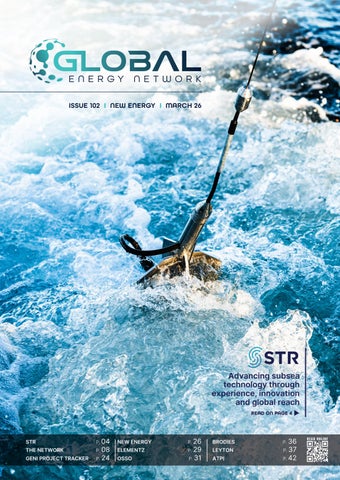
ISSUE 102- New Energy

Page 1


Welcome to Issue 102 The energy map is being redrawn, and our platform is evolving with it. Welcome to the first edition of the Global Energy Network (GEN) magazine.

Our focus this month is New Energy. The transition is accelerating, with global investment hitting a record $2.3 trillion in 2025. Clean power is no longer just competing at the margins; it is now driving all incremental power generation. We are seeing this scale firsthand, notably with the UK recently securing 1.4GW of onshore wind, solar, and tidal capacity.

But scaling this infrastructure requires ruthless subsea efficiency. That is why STR fronts this issue. Inside, Group Technical Director Raymond Forsyth explains how the supply chain must move past complex legacy systems. He breaks down how new technologies; like Titan Mux for scalable sensor payloads and SeaCast for continuous data collection; remove operational friction and save critical vessel time.

True to our new global mandate, this issue follows the capital. We track the latest North Sea M&A , examine Australia's massive $43 billion offshore decommissioning pipeline , and report from the ground on the Middle East's LNG boom.

The

on the

has changed, but our focus on

Dan Hyland Editor

Advancing subsea technology through experience, innovation and global reach

As offshore energy projects move into deeper waters, harsher environments and increasingly complex operational settings, the industry’s expectations of subsea technology are being fundamentally redefined.

What was once considered advanced capability is now a baseline requirement, with an increasing demand for solutions that are designed for scale, ease of adoption and long-term operational efficiency from the outset.

At STR, this is a space we know well. For decades, we have supported offshore operations across the oil & gas, renewables, telecommunications and oceanographic sectors. This breadth of operational experience gives us a unique vantage point on the factors that truly drive offshore reliability, efficiency and performance. It is this insight that shapes how we design, qualify and deploy new technology.

That philosophy is reflected in two of our latest technologies, TitanMux and SeaCast. While they serve different operational needs, both were developed with the same objective: to remove inefficiency, improve reliability, reduce risk and help clients do more with less, wherever in the world they are working.

Simplifying subsea integration with TitanMux

Remotely operated vehicles remain central to subsea inspection, maintenance and construction activities, yet sensor integration has long been a point of friction.

Over the years, we have repeatedly seen how complex cabling, bulky enclosures and long setup times can reduce uptime, introduce failure points and ultimately increase operational costs.

TitanMux was developed, with direct client input, to fundamentally reset how subsea sensor integration is approached. Rather than incrementally improving legacy systems, we set out to remove structural complexity at source, simplifying how sensors are integrated, reducing system fragility and enabling scalable, high-density sensor payloads for modern ROV operations.

An early TitanMux adopter, has stated,

“STR’s support, professionalism, proactive approach and team attitude are exceptional, consistently adding value beyond the equipment alone.”

This feedback reflects how TitanMux is more than just a tool, it represents a step change in operational efficiency.

Flexibility was a core design principle. The TitanMux's high-bandwidth architecture supports a broad range of data connections, giving clients the ability to configure sensors and payloads to suit specific mission objectives. Its intelligent power management, featuring monitored AC and DC outputs, smart fusing and soft-start control, provides enhanced protection to integrated equipment and extends overall system longevity.

The result is a compact, subsea interface platform capable of supporting up to 20 sensors, which is an industryleading capacity for its size. Designed for demanding offshore environments, TitanMux is housed as standard in a titanium enclosure and depth-rated to 6,000 metres. Robust sealing and connector specification significantly reduces the risk of failure through water ingress, improving reliability while minimising unplanned downtime offshore.

At the surface, clients can monitor and manage performance through an intuitive 12-inch touchscreen and bespoke web browser interface, featuring advanced diagnostics supporting real-time configuration and proactive troubleshooting. For our clients, this translates into faster mobilisation and a more streamlined approach to their subsea operations.

Collecting critical data continuously made possible with SeaCast

Efficiency above the surface is just as critical as reliability below. Sound velocity profiling remains a fundamental requirement for offshore survey work, yet traditional methods continue to interrupt operations, forcing vessels to stop while equipment is deployed and recovered.

From our experience supporting survey teams worldwide, we observed this inefficiency and its tangible impact, not only on safety and emissions, but also on vessel time and cost.

SeaCast was developed to change that. A compact, autonomous sound velocity profiling system, SeaCast enables continuous, real-time data collection while the vessel remains underway. It delivers high-resolution sound velocity profiles to depths beyond 300 metres at four knots and 200 metres at six knots. This rapid deployment and recovery which is completed in under ten minutes, reduces crew workload and removes manual handling risks.

The lightweight design and intuitive software allow for efficient mobilisation and integration across a wide range of platforms, from conventional survey vessels to uncrewed surface vessels.

For clients, the benefits are immediate. SeaCast typically delivers around four hours of vessel time savings per day, substantially reducing project costs and fuel consumption while enhancing overall efficiency and safety.

Technology shaped by experience and close collaboration with clients, delivered globally

While developing innovative technology is essential, ensuring it performs reliably in the field is equally important. At STR, our strength lies not only in engineering, but in our ability to support equipment throughout its operational lifecycle. This capability is strengthened by our global network of technology and service bases, including Aberdeen and Great Yarmouth in the United Kingdom, Akrehamn in Norway, Houston in the United States, Perth in Australia, Singapore, with the UAE representing our most recent expansion into the Middle East. These strategically located hubs allow us to support offshore projects wherever they operate, providing rapid mobilisation, local technical expertise and consistent service standards across regions.

Our worldwide operations provide more than reach, they provide real-world understanding. Projects in diverse environments feed operational experience back into our technology development, creating a closed-loop system where innovation is continuously informed by field-proven performance. By integrating rental, service and in-house engineering, we ensure our solutions evolve in line with global industry needs.

Delivering smarter offshore operations worldwide

Each year, we continue to invest heavily in research and development, as part of a long-term technology roadmap focused on delivering complementary systems that address real operational constraints and scale across global offshore operations.

As the global offshore sector continues demonstrable growth across renewables, oil and gas, carbon capture and emerging energy infrastructure, the need for smarter, safer and more efficient subsea technologies will only increase.

By combining engineering intelligence with operational experience and global support, we are helping clients unlock greater value from their assets. Whether simplifying sensor integration with TitanMux or enabling leaner, lower-impact survey operations with SeaCast, our focus remains the same: delivering mission-ready technology that works in the real world.

For STR, innovation is not simply about introducing new products. It is about applying decades of offshore operational intelligence to define what the next generation of subsea capability should look like and delivering technology that sets new expectations for performance, reliability and efficiency beneath the surface. 

The Remote Tecno Plug® provides fail-safe double block and monitored isolation of pressurised pipelines while the system remains live and at operating pressure.

size range: 10” - 56”

max pressure: 200bar / 2900psi

Block & Monitor Isolation

Zero-Energy Zone

compliant Dual Leak-Tight Seals

Editorial

newsdesk@globalenergynetwork.net

+44 (0) 1224 084 114

Design Jennifer McAdam jen.mcadam@globalenergynetwork.net

Advertising sales@globalenergynetwork.net

+44 (0) 1224 084 114

Edit ori al Tsvetana Paraskova

THREE60 Energy, Innovair and Oil States Announce Strategic Alliance for Caisson Integrity Management

THREE60 Energy, Innovair, and Oil States are pleased to announce a strategic alliance to deliver integrated solutions for caisson integrity management in the global oil and gas sector. The collaboration combines proven inspection, engineering, and repair expertise to provide a seamless, end-to-end service that enhances safety, assures compliance, optimises operational efficiency, and reduces lifecycle cost and complexity for operators.

The alliance builds on THREE60 Energy’s Engineering, Procurement, Construction & Commissioning (EPCC) capabilities, Innovair’s advanced inspection technologies, and Oil States’ field experience in repair and installation. 

Proserv HIPPS Technology Unlocks Infrastructure-Led Tieback for Zephyrus Deepwater Development

Field-proven pressure protection enables faster, lower-emissions path to first oil in the Gulf of America

Proserv, the global controls technology specialist, has helped unlock a commercially viable, infrastructure-led development for Beacon Offshore Energy’s Zephyrus field through the deployment of its High Integrity Pressure Protection System (HIPPS) subsea controls.

Beacon and its partners have signed a production handling agreement to tie the Zephyrus field back to existing subsea infrastructure in the Mars Corridor. By leveraging established facilities, the development is expected to reduce emissions, lower capital expenditure, and accelerate time to first oil. 

NETWORK news

Hunting PLC – Organic Oil Recovery Pilot Test Result

Hunting PLC, the global precision engineering group, today notes the stock exchange announcement issued by Buccaneer Energy PLC, which details the pilot test results using Hunting’s Organic Oil Recovery enhanced oil recovery solution.

As noted in the announcement, production within the oil wells reported a 100% uplift and reduced the water cut to zero. Buccaneer Energy notes that the OOR technology will be rolled out across other wells within its portfolio.

Hunting is delighted with this successful pilot treatment, which highlights the impact that the Company’s OOR solution has on oil production. 

Does AR7 signal a turning point for the UK offshore wind supply chain?

Following a turbulent few years, with supply-chain bottlenecks, higher interest rates, and the rapid sector retreat of oil and gas supermajors – Allocation Round 7 (AR7) has provided offshore wind with a very welcome sense of momentum.

This latest upsized round is supporting an unprecedented 8.4GW of offshore wind capacity—equivalent to around £22bn of new investment into the UK’s clean energy transition.

This has been, in my opinion, skewed deliberately towards larger projects, close to existing infrastructure and with large integrated developers, namely RWE and to a lesser extent SSE – both organisations with strong balance sheets, proven delivery capability, and established supply-chain relationships. 

Cegal Delivers Critical IT Asset Transition Project for Tenaz Energy

When Canadian company Tenaz Energy acquired a major portfolio of offshore assets from NAM, a Shell and ExxonMobil joint venture, in the Dutch North Sea in late 2024, the company faced a formidable IT challenge.

With just a small team in Calgary and limited internal IT staff, Tenaz needed to assume full operational control of 25 platforms, the WGT pipeline and a gas treatment centre in Den Helder, which handles half of Dutch gas flows. The transition required not only the migration of 1.6PB of engineering and subsurface data but also taking full control of complex legacy IT systems and onboarding of former NAM/Shell staff, all under a tight deadline for operational handover by May 1st 2025.

Venterra, the offshore wind services group, has significantly strengthened its presence in Asia Pacific with the expansion and opening of an enhanced Oceanscan facility in Singapore, marking a major investment in regional capability to support clients across the offshore energy sector.

Oceanscan has operated in Singapore for several years; the new, larger facility represents a step-change in scale and capability. It provides expanded office, storage, testing and mobilisation space, reflecting growing client demand and Venterra’s long-term commitment to the region’s offshore wind and wider energy sector. 

HCS is a Scottish engineering company that has built up a very successful reputation over the last 20+ years to manufacture high-quality, bespoke equipment. We have an extensive manufacturing capability. Our engineering talent is renowned in the oil & gas sector for their design and manufacturing of IWOCS, production control systems and subsea assemblies.

www.hcs-control-systems.com

The Oceanscan Group, a member of Venterra Group Plc, headquartered in Aberdeen UK, has subsidiary companies based in Lowestoft, Inverurie, Beccles, and Cannock in the UK. Internationally, we've established offices in Houston, USA and Singapore.

UK-based energy engineering and management consultancy with a global portfolio of projects, and an extensive network of experienced engineers and project managers. Our head office is in Aberdeen, where we connect with authorities and suppliers as part of a worldrenowned energy supply chain.

Established in 1986, Fibron has become widely recognised as a leading supplier of bespoke umbilicals, cables and terminations to some of the most complex and challenging projects across the globe. We have broad experience across many different sectors and have a particular strength in the development of prototypes.

www.fibron.com

Paratus Commercial Services Limited was established with the primary purpose of providing training, consultancy, and support for small to medium sized businesses. Our aim being to help these businesses effectively prepare for commercial activities such as sales/bidding opportunities and supply chain management, sharing valuable insights, strategies, and cautionary advice across different sectors.

FCS is a Project Management and Recruitment Company, providing Project Management and Technical personnel to the Oil & Gas Industry. FCS believes that whether your Company’s requirement is for a complete Project Management Team with logistical support, or for individual Project personnel, FCS can meet and exceed your expectations.

The UK partnership brings together BlueFloat Energy and Nadara with the aim of contributing to a world-leading floating offshore wind industry in the UK, combining innovative technology with a plan to attract and grow a skilled workforce and stimulate a thriving local supply chain.

www.bluefloat.com

Trusted corporate finance advisors with deep sector knowledge, working across the fast evolving energy landscape, worldwide.

Welcome to Subco Engineering, where we redefine the engineering landscape with our mantra: “Engineering, on-demand.” At Subco, we specialise in delivering fixed scope workpacks, providing a seamless and efficient solution to the fluctuating demands of engineering projects.

UK

North Sea Oil & Gas Review

The UK’s energy choices and the future of the North Sea offshore industry remained the top themes of the UK North Sea oil and gas sector in the first two months of the year.

While debate and controversy continue, the North Sea industry regulator unveiled a new Data and Digital Strategy through the end of the decade, while service companies signed major deals for key assets offshore the UK.

Britain needs an energy strategy reset— not one that disregards the commitment to net zero by 2050, but one that is grounded in economic realities and changed geopolitical landscape, analysts at the Tony Blair Institute said in a new paper in February.

First and foremost, the UK needs to project fiscal predictability to investors, the way Norway does, as North Sea oil and gas will remain a key energy source for the UK for decades to come, the paper argues.

“The reality is that oil and gas will remain part of the UK energy mix for years to come. Of course, the aim should be to increase the proportion of the UK economy that runs on electricity at pace; currently it is just over one-fifth,” according to the paper.

“But even in the most ambitious net-zero scenarios, oil and gas will be required to power the UK economy until 2050 and beyond.”

The UK needs to reset its energy strategy to keep its North Sea oil and gas industry alive and strengthen its homegrown energy supply, the institute said.

“In a world of rising energy demand, tighter public finances and intense geopolitical competition, the UK cannot afford to treat domestic production as a moral signal rather than a strategic asset,” the paper said.

A stable and investment-friendly approach to the North Sea would strengthen the UK’s net-zero transition, too, in several ways.

First, North Sea oil and gas sustains fiscal capacity at a time when public finances are constrained, by preserving investment and the long-term taxable base of the basin. This strengthens fiscal capacity, reduces pressure on households, and makes the broader transition more affordable and politically sustainable.

declines, the country will continue to consume oil and gas for decades. Allowing domestic production to fall faster than demand simply increases exposure to international markets and geopolitical risk, without reducing global emissions, the institute’s analysts say.

Moreover, support for North Sea oil and gas would also support a managed transition for workers, regions, and supply chains. Abrupt policy shifts that undermine investment do not accelerate decarbonisation. Instead they destabilise communities, erode consent, and weaken the industrial base needed for the next phase of the energy transition, said the paper, echoing concerns expressed by many industry associations and large industrial energy users.

Finally, “From a climate-realist perspective, cleaner domestic production is preferable to outsourcing emissions while claiming territorial progress,” the institute said.

“The UK can draw lessons from Norway’s approach. This does not necessarily mean lower taxation, but long-term stability and predictability, as well as full investment deductibility within a clear fiscal framework – even at high headline tax rates,” the analysts wrote.

“The UK needs a reset. Not to take it away from climate ambitions (the Net Zero by 2050 target must stand firm), but to implement the approach that will make those ambitions a reality: an energy strategy grounded in economics, system performance and political durability,” they say.

Offshore Energies UK (OEUK), the leading offshore industry body, has urged all political parties to unite behind Scotland’s offshore energy sector ahead of the elections in May. Without urgent cross-party support, Scotland risks losing both secure homegrown energy and the wider industrial base that depends on it, OEUK said.

With 128,400 Scottish jobs linked to offshore energy and critical supply chains stretching across ports, fabrication yards, engineering firms and emerging low carbon technologies, OEUK urges parties to put pragmatism over polarisation.

Then, strong industry would reduce the UK’s exposure to net imports and improve resilience to international market and geopolitical shocks. Even as UK production

“Decarbonisation must deliver reindustrialisation,” said OEUK Chief Executive Officer David Whitehouse.

Energy Review UK North Sea

“That means supporting domestic oil and gas production, creating a fiscal and regulatory framework that encourages investment and approving Rosebank and Jackdaw while building our world class renewables; urgently reforming transmission charges, committing to carbon storage at Acorn and supporting Scotland’s industrial sector,” Whitehouse added.

OEUK’s key asks for Scottish politicians include champion an all-energy approach to Scotland’s industrial future; favour pragmatic, ongoing access to homegrown oil and gas; recognise and support the offshore energy supply chain as a strategic industrial asset; promote Scotland as global leader in responsible decommissioning; and change the narrative on the inevitability of job losses.

Separately, OEUK welcomed the finding of a new report by the British Geological Survey (BGS) which has found that the Central North Sea has untapped potential to become a key storage area for carbon dioxide (CO2) on the shelf.

The currently untapped potential beneath the Central North Sea lies in extensive sandstone formations in the region, BGS said in the report. Multiple sequences of stacked Palaeogene sandstone units represent a vast potential CO₂ storage resource, with more than 10 billion tonnes of theoretical capacity, which could be about one quarter of the basin’s total regional storage capacity.

“If progressed effectively, this approach could not only support the UK’s climate commitments but also position the country as a global leader in carbon capture and storage technology,” OEUK Energy Policy Director, Enrique Cornejo, commented on BGS’s report.

Energy Pathfinder have reduced industry burden.

Looking ahead, NSTA reckons that data ownership, integration, and governance need to be improved, while there remains a digital and data skill gap across the offshore energy sector and with the pace of change in technology within the NSTA.

NSTA’s ambition is to offer an integrated view on the UK Continental Shelf (UKCS) where the regulator can understand the current state, assess future impacts of decisions and scenarios, and employ predictive analysis from multiple lenses.

The purpose of data and digital progress is to “harness data and digital tools to inform and enhance strategic decisions that support UK energy production and security, drive emissions reductions, and accelerate the energy transition to a sustainable energy future,” NSTA said.

In contract and company news, Wood has secured another 16-month contract extension with Shell U.K. Limited for technical personnel and engineering support services across key assets in the Southern North Sea.

Continued investment, collaboration between industry and government, and clear regulatory frameworks will be essential to turn this potential into reality.

“Continued investment, collaboration between industry and government, and clear regulatory frameworks will be essential to turn this potential into reality.”

The North Sea Transition Authority (NSTA) has published NSTA Data and Digital Strategy 2026 – 2030, outlining how the regulator would use digital and data to support UK energy production and security, drive emissions reductions, and accelerate the energy transition.

Guided by the pillars of the previous NSTA Digital Strategy 2020 – 2025, focus moved to addressing legacy applications and building new products with partners to make data more accessible.

NSTA’s Digital Energy Platform was strengthened by digitalising key processes, modernising legacy applications and creating the National Data Repository (NDR). Now in public ownership, the NDR runs on a cloudfirst platform and has grown more than 100fold since 2019, with over one million files available for reuse. New services such as Pipeline Works Authorisation (PWA), Well and Installation Operator Service (WIOS), and

Over 150 Wood specialists will work across the Leman and Sole Pit offshore gas platforms, associated normally unattended installations (NUIs), the Kroonborg walk-to-work (W2W) vessel, and the Shell-operated Bacton Gas Plant.

Bacton is connected to the National Transmission system and contributes up to 33 percent of the UK’s gas supply.

AF Offshore Decom has signed a contract with Ithaca Energy for the engineering, receipt, cleaning, dismantling, and recycling of a floating storage unit (FSU) from the UK sector of the North Sea. The vessel has a total weight of about 24,000 metric tonnes and will be received at AF Environmental Base Vats (AFEBV) in 2026.

Boskalis Subsea Services, a subsea provider of decommissioning, IRM and construction solutions, has launched a new collaborative delivery model, ‘The Decommissioning Collective’, designed to change how subsea infrastructure decommissioning is planned and executed in the North Sea.

Drawing on more than two decades of subsea decommissioning experience, Boskalis Subsea Services created The Decommissioning Collective to address one of the industry’s most persistent challenges: inefficiencies driven by isolated schedules, differing standards, and short-term decision-making.

Now, through The Decommissioning Collective, participating operators could align around common ways of working, standardised procedures, and coordinated planning, Boskalis Subsea Services said. 

EU

Oil & Gas Review

Exploration leases offshore Greece, new field startups and contracts offshore Norway, and the recordbreaking UK solar and onshore wind auction featured in Europe’s energy industry in the past few weeks.

Oil & Gas

US oil and gas supermajor Chevron Corporation, together with HELLENiQ ENERGY, in February signed Lease Agreements with Greece which will enable exploration of four blocks offshore the Mediterranean country.

The blocks are located south of Crete (South Crete 1, South Crete 2) and within the Peloponnese (South of Peloponnese, and Block A2 blocks). The consortium, in which Chevron holds a 70-percent operating interest and HELLENiQ ENERGY a 30-percent interest, was selected following an international call for tender launched by the Greek government in 2025.

Under the terms of the Lease Agreements, the consortium will complete 2D and 3D seismic exploration work programmes in phase one of the leases, to assess the hydrocarbon potential of the areas.

“With our expertise in developing oil and gas projects worldwide, Chevron has the resources, experience, and technology to advance and unlock new energy supplies in this frontier region,” said Kevin Mclachlan, Vice President of Exploration at Chevron.

Equinor and Eneco have signed a five-year agreement for deliveries of gas to Eneco, a main supplier of natural gas, electricity, and heat in the Netherlands. The volumes are up to 0.5 billion cubic meters (bcm) per year with deliveries to the Dutch gas grid from 1 February this year.

“This is among the first agreements that we make on the Attributes SAS platform and an example of how key European energy players regard Norwegian gas as a contribution to energy security and attractive also from a sustainability point of view”, said Helle Østergaard Kristiansen, Equinor’s Senior vice president Gas & Power.

a subsea development tied back to Edvard Grieg through existing infrastructure. The development comprises three wells targeting both new and existing reservoir segments, and will help extend plateau production from the Solveig field while making efficient use of available capacity on the Edvard Grieg platform.

Aker BP has also awarded Aker Solutions a long-term agreement for Maintenance, Modification and Operation services (MMO) covering all Aker BP‑operated assets on the Norwegian continental shelf.

The five-year agreement, effective 1 March 2026, includes options for two additional four-year periods, ensuring a predictable and long-term collaboration between the companies.

“The Norwegian continental shelf needs a step change in productivity, and this alliance delivers exactly that,” said Karl Johnny Hersvik, CEO of Aker BP.

Transocean Ltd has announced contract fixtures for two of its harsh environment semisubmersibles in Norway. In aggregate, the fixtures represent approximately $184 million in firm contract backlog.

Low-Carbon Energy

The UK’s latest clean energy auction for Contracts for Difference (CfD) Allocation Round 7 awarded record solar, onshore wind, and tidal projects - building on January’s offshore wind success.

The auction turned out to be the largest ever procurement of solar projects in the UK, with 4.9 GW secured, providing a major boost for one of the cheapest and cleanest energy sources available, the UK government said

Aker BP has started oil production from the Solveig Phase 2 development in the North Sea. The project adds about 39 million barrels of oil equivalent in recoverable resources to the Solveig field. Solveig is located around 15 kilometres south of the Edvard Grieg platform and is

Taken together with offshore wind results, the government has now secured 14.7 GW of clean, homegrown electricity, enough to power the equivalent of 16 million homes.

New onshore wind has been agreed at a price of £72.24 per MWh and new solar at £65.23/MWh, both under half the £147/ MWh cost of building and operating new gas power stations.

“By backing solar and onshore wind at scale, we’re driving bills down for good and protecting families, businesses, and our country from the fossil fuel rollercoaster controlled by petrostates and dictators,” Energy Secretary Ed Miliband said.

“This is how we take back control of our energy and deliver a new era of energy abundance and independence.”

Rebecca Beresford, Director of Markets at the National Energy System Operator (NESO), commented,

“Providing certainty for developers is critical to delivering on our collective future energy needs. We’re really proud of the work our teams do to help deliver these auctions and to administer the Contracts for Difference process.”

The 28 onshore wind projects with a total capacity of 1,306 MW will strengthen the UK’s energy security by generating enough electricity to meet the needs of over 1.2 million homes, RenewableUK said

powering Scotland’s island communities.

SSEN has picked the five contract partners with which it will work to deliver the future investment—Burntisland-based Briggs Marine; DOF Subsea UK and N-Sea, both of which have bases in Aberdeen; and Enshore Subsea and Jan De Nul. Specific projects will be allocated according to each contract partner’s specialisms and resources.

The investment programme will renew and upgrade the subsea electricity links connecting island communities across Scotland, further improving resilience and increasing capacity to meet growing demand, SSEN said.

This is how we take back control of our energy and deliver a new era of energy abundance and independence.

These projects are set to enable the UK to avoid burning more than 1.46 million tonnes of CO2 to generate electricity from gas, the bulk of which would have been imported at a cost which the UK cannot control.

“Onshore wind farms generate clean energy at a predictable and stable cost and they’re one of the UK’s cheapest forms of new power, so they offer the best value for money for hard-pressed bill-payers trying to deal with the cost-of-living crisis,” RenewableUK’s Head of Onshore Wind delivery, James Robottom, said.

The UK and California have signed a cooperation agreement for climate and clean energy. The Memorandum of Understanding (MoU) will strengthen partnership to boost transatlantic investment, supporting jobs and industry, and strengthening relationships between research institutions in the UK and California, the UK government said.

The agreement is set to connect the UK’s fast-growing clean energy sector with the Californian market, opening up new export opportunities, supporting skilled jobs opportunities across the UK, and backing British businesses to compete and grow, it added.

“California is the best place in America to invest in a clean economy because we set clear goals and we deliver,” California Governor Gavin Newsom commented.

In company news, SSEN Distribution has announced a £950 million framework for investment in the subsea networks

Italy-based Prysmian has signed a contract for the delivery of the Eastern Green Link 4 (EGL4) electrical cable interconnector project with GB transmission owners, SP Energy Networks’ transmission business and National Grid Electricity Transmission plc.

The contract, over 2.3 billion euros, is for Eastern Green Link 4, the new high voltage direct current (HVDC) electrical link that will connect Fife in Scotland with Norfolk in England. It will be able to transmit up to 2 GW of clean renewable energy – enough to power around 2 million homes. EGL4 is one of five similar projects being developed that will significantly increase the capacity of the electricity network between Scotland and England.

TotalEnergies and Airbus have signed two clean firm power contracts to supply 3.3 TWh to all major Airbus sites in Germany and the United Kingdom. The electricity supplied to Airbus into the next decade

will have a baseload profile and come from new renewable assets with a capacity of 200 MW. This supply will cover half of the electricity needs of the sites concerned, starting from 2027.

TotalEnergies has also teamed up with Tikehau Capital to create a joint investment platform to promote the development of charging infrastructure for electric vehicles in urban public spaces in Belgium and the Netherlands.

The investment platform will pursue the development of public concessions that are currently under construction or in operation by TotalEnergies in several major Belgian and Dutch cities. It will also respond to new calls for tender that expand the urban public charging infrastructure in Belgium and the Netherlands.

Poland’s biggest energy company, Orlen, and Germany-based renewable energy and green hydrogen developer ABO Energy have signed a Memorandum of Understanding (MoU) under which ABO will produce green hydrogen in Finland and supply part of it to Poland starting in the 2030s.

ABO Energy has two hydrogen projects in Finland: the Kurunpuhto hydrogen project in Nivala and the Pyyryväinen project in Oulu.

Both projects would be implemented in phases, with the first phase in Kurunpuhto potentially completed by 2030 and full capacity in both projects reached by 2035.

The deal with Orlen reaffirms ABO Energy’s belief there will be demand for green hydrogen produced in Finland. It also provides a higher certainty to move forward with the next stages of Finland’s hydrogen projects, the company said. 

USA

Oil & Gas Review

Winter Storm Fern in late January temporarily reduced US oil and gas production due to freezing conditions, but natural gas output is set for record highs in 2026 and 2027, while crude oil production in the near term is expected to remain close to the 2025 all-time highs.

Despite the market headwinds and lower oil prices in 2025, employment numbers in the oil and gas industry in Texas remained stable, a local trade association says.

The main industry group, the American Petroleum Institute (API), has called for additional oil and gas supply in the coming Demand Decade, and praised the US Department of the Interior’s proposals to update oil and gas rules and support domestic energy.

US Natural Gas Production Set for Record Highs in 2026 and 2027

Frigid weather conditions across the United States during the Winter Storm Fern at the end of January led to a 3-percent drop in US natural gas production from December to January, the US Energy Information Administration (EIA) said in its monthly Short-Term Energy Outlook.

Yet, the production decline was only temporary as almost all of the production came back online in February. By the second half of 2026, the EIA expects production to ramp up as new pipeline capacity comes online in the Permian Basin and gas producers increase drilling activity in response to higher prices in the first half of 2026.

The winter storm led to massive withdrawals and a surge in US natural gas futures. Following the frigid weather, the EIA now expects that the United States will finish the withdrawal season at the end of March with less than 1.9 trillion cubic feet of natural gas in storage. This would be 8 percent lower than previously forecast.

Production from the Haynesville region is set to grow by 1.2 Bcf/d in 2026 and then by 1.6 Bcf/d in 2027, thanks to higher gas prices, which will allow drilling in the Haynesville region to remain economical, even with relatively deeper and more expensive well development. In addition, Haynesville’s proximity to LNG export terminals and major industrial natural gas consumers along the US Gulf Coast will also draw operators to the region.

The Permian region is expected to contribute 1.4 Bcf/d to forecast production growth in 2026 and 0.6 Bcf/d in 2027, due to higher volumes of associated gas produced during oil production. Oildirected rig activity in the Permian will be relatively low as West Texas Intermediate prices fall. Despite the expected lower prices, the EIA estimates that increases in gas to oil ratio (GOR) will drive natural gas production growth in the Permian region. The administration expects the GOR to continue its steady increase in the Permian.

In recent years, the Appalachia region has provided the largest share of US domestic natural gas output, accounting for around 32 percent of US Lower 48 states production annually since 2016. Production growth has slowed in recent years because of pipeline capacity constraints. But the Mountain Valley Pipeline is set to begin operations and boost gas flows takeaway capacity.

US crude oil production is set to remain near the record 13.6 million barrels per day (bpd) produced in 2025 before decreasing by 2 percent to 13.3 million bpd in 2027. If realized, a fall in annual US crude oil production next year will mark the first decline since 2021, the EIA notes.

The administration forecasts that higher natural gas prices will encourage production that will increase by 2 percent to average 120.8 billion cubic feet per day (Bcf/d) in 2026 and then further rise to a record-high 122.3 Bcf/d in 2027. Around 69 percent of forecast production over the next two years will come from the Appalachia, Haynesville, and Permian regions.

In the near term, slight production growth from the Federal Gulf of America and Alaska will be offset by declines in the Lower 48 United States in the next two years as low crude oil prices reduce incentives to drill. The slowdown in drilling activity is set to offset recent increases in drilling productivity that have bolstered US crude oil production.

Of course, much of the EIA’s crude oil production forecast hinges on domestic crude oil prices, especially for onshore production in the Lower 48 United States. The EIA expects the West Texas Intermediate crude oil price will fall from its 2025 average of $65 per barrel to $52 a barrel in 2026 and $50 per barrel in 2027. These prices are lower than recent breakeven production prices. Oil industry executives responding to the Dallas Fed Energy survey report the two largest basins in the Permian had breakeven prices of $61 per barrel in the Midland Basin and $62 a barrel in the Delaware Basin.

Texas Upstream Employment Remains Steady despite Lower Prices

Texas upstream oil and gas employment remained essentially flat in 2025, even as producers continued to deliver strong output amid challenging market conditions, according to data released by the Texas Workforce Commission.

While employment declined by 3,500 jobs in November compared with October, January-November employment was little changed, with a net gain of 300 direct upstream jobs. Employment was also modestly higher than a year earlier, rising by 100 jobs, or 0.1 percent, the Texas Oil & Gas Association said

“This resilience demonstrated by increased energy output in 2025 depends on policies that support infrastructure development and market flexibility so the oil and natural gas industry can adapt to uncertainty and continue delivering the affordable, reliable energy that powers our modern way of life,” commented Todd Staples, president of the Texas Oil & Gas Association.

“Navigating these volatile circumstances is a vivid reminder: growth is not guaranteed,” Staples noted.

Demand Decade

The American Petroleum Institute (API) held in January its annual State of American Energy event, at which API President and CEO Mike Sommers said

that “The next ten years are shaping up to be the Demand Decade—an era that is going to require historic amounts of new energy.”

API’s policy agenda for 2026 revolves around infrastructure, access, and international competitiveness, Sommers said.

“The United States is the world’s energy superpower – but that status isn’t guaranteed,” the executive said.

“Infrastructure. Access. International competitiveness. Across all three, the priority is the same: durable policy that outlasts political cycles and supports longterm investment, reliability, and growth.”

Sommers noted that “Energy realism — with a critical role for oil and gas — is winning the argument.”

Proposal to Strengthen Domestic Oil and Gas Production

The Bureau of Land Management (BLM) announced at endJanuary a proposed rule to update decades-old oil and gas regulations that limit the practice of commingling. The change is aimed at improving efficiency, protecting taxpayers and tribes, and strengthening domestic energy production.

These proposed changes are aimed at removing barriers that have constrained development in areas with complex mineral ownership and to encourage practices that minimize surface impacts by reducing the number of well pads needed, BLM said.

The public comment period on the proposed rule will close on 31 March 2026.

Holly Hopkins, API Vice President of Upstream Policy, commented on the Department of the Interior’s proposed commingling rule saying that the “announcement marks a major step toward greater flexibility for new technologies and innovation that will further unleash our nation’s vast energy resources.”

The Energy Workforce & Technology Council also applauded the proposed rule.

Modernizing federal policies to reflect the current operational realities is essential to maintaining US competitiveness and ensuring the responsible development of domestic energy resources, EWTC President Tim Tarpley said

America’s incredible oil and natural gas resources play a critical role in U.S. energy dominance and are essential to meeting growing demand at home and abroad

The proposed rule would modernize guidelines that currently allow commingling only when mineral ownership and royalty conditions are identical.

Commingling allows production from multiple leases to be combined using a single well pad. Under the proposed rule, the BLM would allow a wider range of methods, including modern metering technologies, to ensure accurate measurement of production and fair royalty distribution.

“America’s incredible oil and natural gas resources play a critical role in U.S. energy dominance and are essential to meeting growing demand at home and abroad,” Tarpley noted. 

MID East

Oil & Gas Review

At the beginning of 2026, the Middle East hosted a major LNG conference where top energy executives gathered to share their views on the future of the global gas markets and sign quite a few deals.

In addition, major international companies expanded their footprint in the Middle East with key collaboration agreements with the national oil companies (NOCs) in the region.

LNG2026 Qatar

Government officials, policymakers, industry experts, and innovators from more than 80 countries took part in the LNG2026 conference in Qatar in early February. LNG2026’s theme “Leading LNG: Powering Today and Tomorrow” featured market trends, breakthrough technologies, and innovations shaping a sector that remains essential for global energy security and a cornerstone of the energy transition, QatarEnergy said The conference offered opportunities for collaboration, knowledge sharing, and high-value deals that will help advance the LNG industry.

In the opening address at LNG2026, Saad Sherida Al-Kaabi, Qatar’s Minister of State for Energy Affairs and President and CEO of QatarEnergy, said that the company’s expansion projects would double Qatari LNG production.

“The mega-projects we have launched a few years ago will more than double QatarEnergy's LNG production from 77 million tons per annum to 160 million tons per annum, including 142 million tons per annum from Qatar's North Field,” Al-Kaabi said.

“Hereby, our projects will contribute about 40% of the new global LNG supplies over the next decade.”

Al-Kaabi expressed a bullish view on the global gas market, saying that Qatar continues to believe in gas as the energy of the future and that increasing demand would continue to be driven by global economic growth and other factors such as the artificial intelligence boom and data centers infrastructure.

Oil will also be needed “for a very long time,” the executive said.

“It is important for policymakers to be realistic about what can and cannot be delivered. They need to listen to the people who understand the business,” Al-Kaabi noted.

During the conference, QatarEnergy signed several long-term agreements to supply LNG to various markets in Asia.

QatarEnergy Deals

The state company of Qatar signed a 27year Sales and Purchase Agreement (SPA) with JERA for the supply of up to 3 million tons per annum (MTPA) of LNG from Qatar to Japan. Deliveries are set to begin in 2028. With the deal, Qatar would boost its share on the Japanese LNG market.

QatarEnergy also signed an agreement with Japan’s Ministry of Economy, Trade and Industry (METI) and JERA, Japan’s largest power generation company, for supplying Japan with additional LNG quantities during emergency situations.

The memorandum of understanding also includes mechanisms for bilateral consultation on appropriate response measures in emergency situations such as natural disasters.

The deal highlights QatarEnergy’s critical role in ensuring energy security to all its customers through access to supplemental LNG volumes during emergencies and supply disruptions, the company said.

Moreover, QatarEnergy signed a 20-year agreement with Petronas for the supply of two million tons per annum of LNG from Qatar to Malaysia starting in 2028.

Al-Kaabi commented that “QatarEnergy is pleased to enter into this new LNG SPA with Petronas, which highlights our continued commitment to support the growing energy needs of Malaysia as well as our customers across the globe.”

Big Oil Boosts Footprint in the Middle East

In early February, TotalEnergies and Kuwait Oil Company (KOC) signed a Memorandum of Understanding to strengthen their cooperation, exchange expertise, and conduct technical studies. The MoU notably includes studies related to new exploration opportunities in the country, for which TotalEnergies will mobilize its technical expertise.

“We are pleased to strengthen our cooperation with Kuwait Oil Company through this MoU, which reflects our shared ambition to contribute to Kuwait’s objectives in developing its resources,” TotalEnergies chairman and CEO Patrick Pouyanné said.

Kuwait’s Prime Minister, Sheikh Ahmad Abdullah Al-Ahmad Al-Sabah, said at the Kuwait Oil & Gas Show and Conference (KOGS) that the country is getting ready to invite international oil companies to help it develop recently discovered offshore oil and gas fields.

Kuwait Petroleum Corporation (KPC) is also in talks with international financial institutions to create a lease and leaseback model of Kuwait’s domestic crude oil pipeline network, the Kuwaiti prime minister added.

In Israel, US supermajor Chevron Corporation, via its subsidiary Chevron Mediterranean Limited (CML), and the working interest owners of the Leviathan natural gas reservoir have reached a Final Investment Decision to expand the production capacity of the strategic Leviathan production platform offshore Israel.

The Leviathan expansion project includes drilling three additional offshore wells, adding additional subsea infrastructure, and enhancing the treatment facilities on the Leviathan production platform. The project is expected to come online towards the end of this decade.

“This milestone demonstrates our ongoing commitment to partner with the State of Israel to develop natural gas resources and provide essential energy to millions of people in Israel, Egypt and Jordan,” said Jack Baker, managing director of Chevron’s Eastern Mediterranean region.

In Syria, Chevron signed in February a deal with the state-owned Syrian Petroleum Company and the Qatar-based Power International Holding to develop the country’s first ever offshore oil and gas field offshore.

Syria expects that drilling could begin before the summer of 2026, and that it could take up to four years to find gas reserves, Youssef Kabalawi, the CEO of Syrian Petroleum Company, said.

Deals and Bonds

In the Arab Gulf region, Saudi Aramco, the state oil firm of Saudi Arabia and the world’s biggest oil company, announced in early February the completion of a $4 billion bond issuance across four tranches under its Global Medium Term Note Program.

Saudi Arabia and its oil giant have tapped the debt markets in recent months as oil prices declined.

The latest bond issue is part of Aramco’s focused strategy to further optimize its capital structure and boost value creation for shareholders, Aramco’s Executive Vice President and Chief Financial Officer, Ziad T. Al-Murshed, said.

“The attractive pricing achieved on the transaction reflects global investors’ continued confidence in Aramco’s financial strength and resilient balance sheet. We remain firmly committed to maintaining disciplined capital management and delivering long-term value to our shareholders,” Al-Murshed added.

In the United Arab Emirates, ADNOC and Abu Dhabi National Energy Company

PJSC (TAQA) have signed a 27-year Utilities Purchase Agreement to supply critical utilities to the TA’ZIZ Industrial Chemicals Zone in Ruwais Industrial City, Abu Dhabi. The duration of the agreement includes the offtake of the utilities and construction of the plant.

steam production, process cooling, and a range of water and wastewater utilities required to enable TA’ZIZ’s chemicals and transition-fuels projects.

At the India Energy Week 2026 forum in Goa, Sultan Al Jaber, UAE Minister of Industry and Advanced Technology and Managing Director and Group CEO of ADNOC, urged policy makers to look beyond short-term volatility to the transformative opportunity of rising global energy demand.

Global energy demand is growing, driven by three powerful megatrends – the rise of emerging markets, the exponential growth of AI, and the transformation of energy systems.

America’s incredible oil and natural gas resources play a critical role in U.S. energy dominance and are essential to meeting growing demand at home and abroad

Global oil demand will remain above 100 million barrels per day through 2040, with demand for both LNG and electricity soaring by 50 percent or more, Al Jaber said.

Under the deal, ADNOC and TAQA will jointly develop the central utilities project, including the electricity grid connection,

“Demand at this scale and pace requires investment in all forms of energy,” Al Jaber added, noting that “The biggest risk is not over supply, it is underinvestment.” 

Image Courtesy: WAM

NOR

Oil & Gas Review

Norway has awarded dozens of new production licences on its shelf, while its natural gas output hit a one-year high and companies made a series of new discoveries.

New Awards in Annual Licensing Round

Norway in January awarded 57 new production licences to 19 companies on the Norwegian continental shelf in the annual APA 2025 licensing round.

Western Europe’s largest oil and gas producer holds an annual round offering exploration acreage in the best-known and mature areas on the Norwegian Continental Shelf—the so-called awards in predefined areas (APA) round. After more than 50 years of exploration activity, the APA rounds currently cover most of the area that has been open to drilling on the shelf.

Of the 57 production licences offered in APA 2025, as many as 31 are located in the North Sea, 21 are in the Norwegian Sea, and five in the Barents Sea.

“Norway is Europe’s most important energy supplier, but in a few years production will begin to decline. Therefore, we need new projects that can slow the decline and deliver as much production as possible,” said Energy Minister Terje Aasland.

This year’s APA licensing round “is a significant contribution to ensuring continued activity in the oil and gas industry. That activity is important for jobs, value creation, and Europe’s energy security,” Aasland added.

The Norwegian Offshore Directorate, the regulator of the industry, commented that the APA round results are encouraging for future production.

“This year’s awards show that the companies still see the potential for profitable exploration in mature areas. Resources proven near established installations will be crucial to ensure high value creation and effective utilisation of infrastructure moving forward,” said Kalmar Ildstad, Director of regulations, licence and area management at the Norwegian Offshore Directorate.

“It’s also encouraging that several companies have submitted applications to conduct new assessments of discoveries with tight reservoirs, where production has so far been deemed unlikely,” Ildstad added.

Equinor alone was awarded 35 new production licences on the Norwegian continental shelf in the APA round—21 in the North Sea, ten in the Norwegian Sea, and four in the Barents Sea, with 17 of the licences having Equinor as an operator.

“Our geological knowledge is high, and we are constantly learning more through further exploration,” said Jez Averty, Equinor’s senior vice president for subsurface, the Norwegian continental shelf.

“Awards in lesser-known areas, such as we have received in the northeastern part of the North Sea and in the southwestern Møre Basin, provide new and exciting opportunities,” says Averty.

Equinor plans to drill 20 to 30 exploration wells every year. A total of 80 percent of the exploration will be near existing infrastructure, while 20 percent will explore new concepts and lesser-known areas, the Norwegian energy major said.

“Access to new acreage is crucial for our ambition to maintain a high level of production and predictable energy deliveries to Europe from the NCS towards 2035,” Averty noted.

“There is still a lot of energy left on the NCS, but we need new discoveries to curb the expected production decline. Phasing in oil and gas from new discoveries to existing infrastructure is a core task going forward.”

Norway’s Gas Production Hits One-Year High

Norway’s gas production reached a 12-month high, while oil output hit the highest in five months in December 2025, preliminary figures by the Norwegian Offshore Directorate showed in January.

Gas production exceeded the regulator’s forecast by 2.9 percent and oil output surpassed the estimates by 5.1 percent. Compared to December 2024 production numbers, gas output in December rose by 1.6 percent and oil production jumped by 9.7 percent, due to the start-up of the Johan Castberg oil field in the Barents Sea in 2025.

Total investments in oil and gas activity in 2025, including pipeline transportation, came in at 273 billion Norwegian crowns, or $29 billion, an 8.7 percent rise compared to 2024, Statistics Norway said in its quarterly survey in February.

For this year, operators on the Norwegian continental shelf now estimate investments at 255 billion crowns, or $27 billion, which is higher than the estimate given in the previous quarter.

Yet, the investment estimate is lower than the spending in 2025, largely due to the fact that many fields have completed their development in recent years, which pushes the estimated investments in field development lower.

“It is expected that a few more projects will have PUDs submitted this year, which will increase the field development estimate for 2026 beyond what is included in this count,” Statistics Norway said.

Series of Discoveries

Meanwhile, companies operating on the Shelf and the regulator announced several oil and gas discoveries at the start of 2026.

It is expected that a few more projects will have PUDs submitted this year, which will increase the field development estimate for 2026 beyond what is included in this count

Vår Energi’s appraisal well 7122/8-3 A has confirmed the Zagato oil discovery in the Goliat area in the Barents Sea. Preliminary estimates indicate the size of the discovery is between 21 and 75 million barrels of oil equivalent.

The licensees are considering tying the discovery back to existing infrastructure on the Goliat field, the Norwegian Offshore Directorate said.

In the Norwegian Sea, Equinor and its partners have proven oil in a wildcat well in the Othello South prospect, 4 kilometres north of the Heidrun field and 240 kilometres west of Sandnessjøen.

Preliminary estimates indicate the size of the discovery is between 0.95 and 12.6 million barrels of recoverable oil equivalent. The licensees will assess the discovery to potentially further develop it in the northern part of the Heidrun field.

In Norway’s North Sea, Equinor and its partner ORLEN have discovered gas and condensate in the Sissel prospect in production licence 1137.

The exploration well 15/8-3 S was drilled about 5 kilometres southeast of the Utgard field in the North Sea and 250 kilometres southwest of Stavanger.

The preliminary estimate puts the size of the discovery at between 6.3 and 28.3 million barrels of recoverable oil equivalent.

Moving forward, the licensees will now consider opportunities to develop the discovery as a tie-back to existing infrastructure in the area.

Also in the North Sea, OKEA and its partners have discovered petroleum in the Knockando Fensfjord prospect through a well drilled from the Brage installation. The discovery was made in connection with drilling a development well for oil in production licence 055.

Preliminary estimates indicate additional resources for Brage, which could be oil or gas, or both, so further drilling will be necessary.

Vår Energi in February raised its guidance for full year 2026 production in the range of 390,000 to 410,000 barrels of oil equivalent per day (boepd) and increased its long-term production target to more than 400,000 boepd. This is supported by a portfolio of 13 high-value projects in execution, a flexible pipeline of around 30 early-phase projects being matured, and a strengthened asset base with increased reserves and resources, CEO Nick Walker said. 

Credit: Vår Energi
The Sleipner field in the North Sea Photo: ©Equinor

AUS

Oil & Gas Review

Australia Launches New LNG Export Project as Renewables Grow

Early this year Australia shipped the first LNG cargo from a new gas export project while it moved toward creating the planned Critical Minerals Strategic Reserve and saw renewables making up more than half of energy supply.

New LNG Projects Advance

At the end of January, Australia’s energy giant Santos announced the first LNG cargo from Barossa LNG was successfully loaded to the Kool Blizzard. The cargo departed Darwin LNG on 25 January and was set to be delivered to the Sakai terminal in Japan on a delivered ex-ship basis.

Santos is the operator and has a 50 percent interest in the Barossa Gas Project, with joint venture partners PRISM Energy International Australia with 37.5 percent and JERA Australia holding the remaining 12.5 percent.

“This is an outstanding achievement for a project of this scale and complexity in the global offshore upstream sector,” Santos Managing Director and CEO Kevin Gallagher said.

“It demonstrates Santos’ self-execution capability in delivering major development projects and the success of our disciplined, low-cost operating model.”

The Barossa LNG project is expected to secure about 300 permanent positions in the Northern Territory for the next 20 years, with an estimated AUS$2.5 billion worth of wages and contracts expected to flow for Territorians over that time.

In its quarterly report for the fourth quarter of 2025, Santos noted that a 30-percent higher free cash flow for the fourth quarter versus the previous quarter lifted free cash flow for the full year to approximately AUS$1.8 billion, which Gallagher described as “a strong result in a year of relatively soft commodity prices for the industry.”

The other major Australian oil and gas producer, Woodside Energy, also reported strong 2025 production, in fact, a recordhigh output of oil and gas.

Woodside achieved record annual production of 198.8 million barrels of oil equivalent in 2025, which exceeded its 2025 production guidance.

The company noted that its Scarborough Energy Project was 94 percent complete as of the end of January. The gas project off the Pilbara coast of Western Australia is on budget and on track for first LNG in the fourth quarter of 2026. The Scarborough Floating Production Unit (FPU) has arrived in Australia.

At the end of 2025, Woodside took a final investment decision to develop the Greater Western Flank Phase 4 as part of the North West Shelf Project. The project extends production from the North West Shelf by around one year and delivers an internal rate of return of approximately 30 percent, the company said.

Woodside has also finalised agreements with leading global customers to supply conventional ammonia from the Beaumont New Ammonia Project, which achieved targeted first ammonia production in December 2025.

These deliveries will commence in 2026 and continue through year-end, under contracts that reflect prevailing market prices, Acting CEO Liz Westcott said.

Progress on Critical Minerals Strategic Reserve

Once at full rates, Barossa LNG and the Pikka phase 1 project in Alaska together are expected to lift Santos’ production by around 25 to 30 percent by 2027 compared to 2024 levels, the executive added.

The Australian Government has announced new details of its AUS$1.2 billion Critical Minerals Strategic Reserve which will secure the supply of key minerals vital for Australia’s economy, national security, and Future Made in Australia ambitions.

Australia will focus first on antimony, gallium, and rare earth elements, which are crucial for the clean energy transition, high-technology manufacturing, and advanced military equipment.

The Reserve will operate by securing rights to minerals produced in Australia and on-selling those rights to meet demand, giving an added boost to Australia’s critical minerals sector and strengthening reliable supply chains for the country’s trading partners.

The Reserve will also support Australia’s collaboration with international partners to diversify critical minerals supply chains, including with the United States, Japan, Republic of Korea, Europe, Canada, and the UK.

The Government will advance consultation with international partners on developing collaborative efforts to maximise the impact of the CMSR on global supply chains.

for the National Electricity Market (NEM) in the quarter, the Australian Energy Market Operator (AEMO) said in a report in January.

AEMO’s latest Quarterly Energy Dynamics report showed that wholesale electricity prices averaged $50 per megawatt hour (MWh) across the NEM, a $39/MWh, or a 44-percent, reduction from the fourth quarter of 2024 and a 43-percent decline from the third quarter of 2025.

The quarter saw strong growth in renewable and storage output, with wind generation rising by 29 percent, grid scale solar up 15 percent, and battery discharge nearly tripling to an average of 268 megawatts (MW), supported by 3,796 MW of new battery capacity added since late 2024.

The world needs critical minerals - Australia has plenty of them and our critical minerals reserve will help us weather global economic uncertainty and help to boost trade and investment

Moreover, the Government intends to bring forward enabling legislation this year to provide Export Finance Australia with additional powers to effectively support the Reserve.

“The world needs critical mineralsAustralia has plenty of them and our critical minerals reserve will help us weather global economic uncertainty and help to boost trade and investment,” Treasurer Jim Chalmers said.

Australia’s Minister for Resources, Madeleine King, commented, “The Strategic Reserve will provide vital support for Australian critical minerals mining and processing projects, creating jobs and ensuring Australia is at the centre of efforts to build stable and reliable supply chains for our international partners.”

Added King, “The Strategic Reserve’s initial focus on antimony, gallium and rare earths will give added certainty to Australian projects, help attract further investment and help the sector deal with potential future market disruptions.”

The Association of Mining and Exploration Companies (AMEC) welcomed the details of the Strategic Reserve’s launch, and called on the government to ensure “state and federal permitting processes are appropriate, efficient, streamlined and fitfor-purpose to enable rare earth, gallium and antimony projects to proceed and enable the government’s objectives with the CMSR to be met.”

Record renewable energy generation supplied more than half of Australia’s total electricity needs for the first time during the October-December 2025 quarter, nearly halving wholesale electricity prices

At the same time, coal-fired power generation fell to an all-time quarterly low, after dropping by 4.6 percent year-on-year, while gas-fired generation plunged by 27 percent to its lowest level since 2000, AEMO’s report found.

“This is a landmark moment for the NEM. For the first time, renewables and storage supplied more than half of the system’s energy needs for a full quarter,” said Violette Mouchaileh, AEMO Executive General Manager Policy and Corporate Affairs.

“It reflects years of sustained investment and demonstrates that more wind, solar and battery capacity in the system reduces reliance on higher cost coal and gas generation, placing sustained downward pressure on wholesale electricity prices,” Mouchaileh added.

Also in the December quarter, the pipeline of new projects connecting to the National Electricity Market (NEM) reached a record 64 gigawatts (GW), a quarterly increase of 7.4 GW, or 14 percent, since the September quarter, AEMO said in a separate report.

In addition, 1.8 GW of new generation and storage capacity progressed through commissioning to reach full output during the quarter, joining the NEM. This total comprised nine projects—two solar farms and seven battery projects.

Battery storage continues to dominate the 64 GW investment pipeline, accounting for nearly half – or 46 percent — of all projects. This is followed by hybrid solar and battery projects (19.7 percent), wind (16 percent), solar (11.9 percent), hydro (4.7 percent), and gas (1.4 percent).

“The ongoing increase to 64 GW in the connections pipeline shows that confidence in Australia’s renewable energy transition remains strong, with new applications activity rising from 20 GW to 26 GW,” AEMO Onboarding & Connections Group Manager, Margarida Pimentel, said. 

March 2026 Brent crude trades near US$70/bbl.

Prices

The Network

1

1 year ago (March 2025)

Brent crude traded largely in the US$70-80/ bbl range during early 2025, with prices supported by ongoing geopolitical tensions and disciplined supply coordination from OPEC+. Periodic optimism around global demand recovery was balanced by softer economic indicators in key consuming regions, while persistent inflation and higher interest rates continued to temper consumption expectations.

5 YEARS AGO

5 years ago (2021)

In March 2021, Brent crude was trading around US$65/bbl, continuing its recovery from the historic collapse of the previous year. Vaccine rollouts and the gradual reopening of economies helped restore confidence, while coordinated OPEC+ production cuts tightened supply. Despite lingering uncertainty, sentiment had clearly shifted away from crisis management toward cautious recovery.

10 YEARS AGO

10 years ago (2016)

Brent crude hovered near US$40/bbl in March 2016, recovering slightly from the lows seen earlier that year but still reflecting a deeply oversupplied market. Surging U.S. shale production and sustained OPEC output had created a significant supply glut, forcing widespread cost reductions and reshaping investment strategies across the industry toward efficiency and balance sheet resilience.

Tenders ending Soon

SENEGAL: Subsea Systems & Support (Phase 2)

Operator: Woodside Energy

Asset: Sangomar Field

Scope: Provision of subsea equipment, tooling, and support for a planned 33-well subsea system (16 producers, 17 water injectors).

Value: Est. $2.5 billion (Total Project Value)

Closing Date: Log in to GENIntel for more information

International & EPC

KUWAIT: HPHT Reservoir Services & Tooling

Operator: Kuwait Oil Company / SLB

Field: Mutirba Oil Field

Scope: Supply chain subcontracts supporting the integrated field development, specifically focusing on high-pressure, high-temperature (HPHT) and sour gas environments.

Status: Expression of Interest (EOI)

Decom & Renewables

NORWAY: FPU Decommissioning Preparation

Operator: Vår Energi AS

Scope: Early-stage decommissioning preparation and heavy-lift feasibility studies for the Balder FPU.

Requirement: Engineering consultancies, environmental assessment, and marine warranty surveyors.

Timeline: Target decommissioning in 2028 (Studies commence Q3 2026). View Decom North Sea Opportunities

Funding, Mergers, Consolidation and JV's

WEST AFRICA: Funding Local Content (Feb 19, 2026)

Key Players: Chariot Limited, Shell Trading, & Etu Energias

Target: Producing Assets in Blocks 14 and 14K (Offshore Angola)

Sector: Offshore E&P

Disclosed Value: $24 million (Initial Funding Package)

Status: Agreed

NIGERIA: Pre-FEED Engineering Services

Operator: Shell

Location: Bonga Southwest

Scope: Early-stage engineering and design (Pre-FEED) ahead of the targeted May 2027 FID.

Value: Major Contract (Part of $10bn CAPEX)

Closing Date: Log in to GENIntel for more information

AUSTRALIA: Subsea Tie-back Engineering

Operator: ConocoPhillips

Asset: Charlemont Gas Discovery (Otway Basin)

Scope: Front-end planning and subsea infrastructure design following the successful discovery of natural gas across the Waarre A, B, and C reservoirs.

Value: Est. £45m

Closing Date: Log in to GENIntel for more information

Divestments & Restructuring

US O&G ROYALTIES: Major Asset Consolidation (Feb 10, 2026)

Acquirer: Warwick Capital Partners & GRP Energy Capital

Target: Viper Energy (73,500 net royalty acres)

Sector: US Oil & Gas Minerals & Royalties

Disclosed Value: $670 million

Status: Successfully Closed

NORTH AMERICA: The $58bn Shale Roll-Up (Feb 2026)

Lead Companies: Devon Energy & Coterra Energy

Sector: Onshore E&P (Permian / Delaware Basin)

Estimated Value: $58 billion

Status: Confirmed Merger

EUROPEAN OFFSHORE WIND: The East-West Supply Chain JV (Feb 24, 2026)

Lead Companies: Dajin Offshore (China) & Szczecin Shipyard “Wulkan” (Poland)

Sector: Offshore Wind Foundations

Scale: 40 ready-to-install internal platforms for Nordseecluster B

Status: Contract Signed / Production Commencing

The GENI Vibe: Q1 Macro Sentiment

This month’s global asset tracker highlights over $18 billion in active capital deployment, with heavy regional focus on West African expansion and strategic North Sea tie-backs. Our proprietary GENI Pulse data indicates a strong shift toward high-pressure, high temperature (HPHT) developments and extending the life of existing concessions.

Here are the critical updates from the GENI Asset Tracker this month:

Operator:

Shell

Est. Value: $10 billion

GENI: The pre FEED phase is set to commence shortly, paving the way for a massive $20bn total investment ($10bn CAPEX / $10bn OPEX). FEED will follow, with FID targeted before May 2027.

Operator: Woodside Energy

Est. Value: $2.5 billion

GENI: Targeting 250MMboe via a 33-well subsea system (16 producers, 17 water injectors). Execution relies heavily on Phase 1’s reservoir performance and capital allocation priorities.

Operator: Waha Oil Company (TotalEnergies /ConocoPhillips

Est. Value: $2 billion

GENI: A newly signed 25year extension (to 2050) unlocks fresh investment. The North Gialo development alone is expected to add 100,000 boe/d to the concession’s current 370,000 boe/d output.

Operator:

BW Energy Est. Value: $100 million

GENI: Drilling preparations are advancing for a July 2026 start. The campaign includes four planned production wells, with two additional appraisal wells currently under consideration.

Operator: Kuwait Oil Company / SLB

Est. Value: $3 billion

GENI: SLB has secured a massive five-year integrated field development contract. The scope covers endto-end services focused specifically on highpressure, high-temperature (HPHT) reservoirs in sour conditions.

Operator: Chevron

Est. Value: $1.5 billion

GENI: FID achieved. Stage I will drill three production wells tied back to the existing platform, expanding processing capacity to hit 21 Bcm per year.

Stage II will follow with further drilling and a fourth subsea pipeline.

Operator:

Equinor / Orlen

Est. Value: $100 million

GENI: Discovered via the Deepsea Atlantic rig at a depth of 4282m, this 6.3-28.3MMboe find is currently being assessed for potential tie-backs to existing local infrastructure.

Operator:

Chevron / NNPC

Est. Value: $500 million

GENI: A successful drilling campaign via the Awodi-07 well concluded in late 2025, encountering 675 feet of hydrocarbon pay (310 feet appraised).

BALDER NEXT PROJECT NORWAY

Operator:

Vår Energi AS | Est. Value: $150 million

GENI: Following the Q4 2025 sanctioning of the Jotun FPSO debottlenecking, the stage is set for the Balder FPU decommissioning in 2028. FID for Balder Next is anticipated later this year.

Operator: PETRONAS Carigali

Est. Value: $500 million

GENI: OceanMight has secured a minor EPC contract for the fixed offshore structure and host tie-in.

Works are scheduled for completion by February 2027.

Operator: Shell / Subsea7

Est. Value: $300 million

GENI: Subsea7 has won the transportation and installation contract for a subsea umbilical, riser, and rigid flowline. Engineering starts immediately in Houston, with offshore execution booked for 2027.

Operator:

ConocoPhillips

Est. Value: $200 million

GENI: The Charlemont 1 well, drilled in 110m of water in the Otway Basin, has successfully encountered natural gas across three target reservoirs (Waarre A, B, and C).

New Energy

New Energy Looks to Overcome Headwinds as Investments Hit New Record

Investment in energy transition solutions continues to set new records while regions outside the US look to bolster cooperation and proceed with the addition of clean power generation.

Investment Hits Record-High, Again

Global investment in the energy transition rose by 8 percent on the year to hit a record-high of $2.3 trillion in 2025, according to BloombergNEF’s annual report Energy Transition Investment Trends (ETIT).

The jump from 2024 highlights the resilience of clean energy investments in 2025 despite a number of geopolitical, trade, and policy shifts and uncertainties, BNEF noted.

Electrified transport represented the largest share of investment under study, with $893 billion spent on electric vehicles and the development of charging infrastructure, up by 21 percent compared to 2024.

Renewable energy investment fell by 9.5 percent to $690 billion amid uncertainties in the largest market, China, which introduced new power market regulations.

Globally, grid investment hit $483 billion.

Moreover, investment in clean energy supply outpaced fossil fuel supply investment for a second consecutive year in 2025, with the gap widening to $102 billion, from $85 billion in 2024, the report found.

While clean energy investment –which in BNEF’s analysis includes renewables, nuclear, carbon capture, hydrogen, energy storage, and power grids – continued to grow, fossil fuel supply investment fell for the first time since 2020, declining by $9 billion year-on-year.

The drop was driven mainly by reduced spending on upstream oil and gas and fossil power generation, although these were partly offset by higher investment in gas and coal.

Although energy transition investment hit an all-time high, growth has slowed in recent years, from 27 percent in 2021 to 8 percent in 2025, BNEF noted.

The largest market, China, continued to lead overall investment with $800 billion in 2025, but posted its first decline in funding renewables since 2013. India’s investment jumped by 15 percent to $68 billion. The EU shrugged off headwinds to grow 18 percent to $455 billion,

contributing the most to the global uptick. US investment also recorded a 3.5-percent increase to $378 billion, despite the Trump Administration’s moves to slow the energy transition, according to the BNEF report.

“This past year has showcased that despite policy and trade headwinds, the global energy transition is resilient and provides a number of opportunities for investors,” said Albert Cheung, Deputy CEO at BloombergNEF.

“As many economies look to strengthen energy security and build domestic supply chains, clean energy investment will continue to rise, especially as it relates to global data center buildouts.”

Clean power is already contributing the most to new global electricity supply, according to Rystad Energy’s latest scenario analysis. All net growth in global electricity supply in 2025, approximately 1,070 terawatthours, originated from low-carbon sources, including renewables and nuclear power. This is a structural shift in power supply as renewables are no longer competing at the margins but are now driving all incremental power generation.

“As renewables move from the margins to the driver’s seat, energy investment is becoming increasingly market-driven rather than policyled, reshaping opportunities across power, infrastructure, technology, and traditional energy alike,” the energy intelligence firm said.

Outlook of Clean Energy Investment and Markets

Geothermal energy is also gaining momentum, with investment entering a period of accelerated growth, Rystad Energy reckons Capital expenditure (capex) in global geothermal energy is expected to jump by about 20 percent annually through 2030, according to Rystad Energy’s latest geothermal economics model.

“In the US, growth is being driven by the expansion of enhanced geothermal systems (EGS) and rising demand for baseload power from data centers,” said Alexandra Gerken, Vice President, New Energies Analysis, at Rystad Energy.

“Europe, on the other hand, is focusing on decarbonizing heat, while Southeast Asia is turning to geothermal to meet growing electricity demand,” Gerken added.

“The sector’s longer-term potential in cooling applications is growing as well, a market set to expand alongside global data center activity that’s less considered.”

In wind power, Wood Mackenzie says preliminary data showed a recordbreaking 2025, with global wind capacity additions expected at 170 GW for the year.

In 2026, developers are set to connect 160 GW of wind projects globally, which would be down by 6 percent from the preliminary numbers for 2025. An annual decline in China, due to the end of its 14th Five-Year Plan, is expected to be the single largest factor behind the slowdown this year. However, the rest of the world is poised for growth, WoodMac’s analysts said early this year.

The global solar industry wrapped up a challenging 2025 with policy shifts in the top three markets, China, the US, and India, says Michelle Davis, Head of Global Solar at Wood Mackenzie.

“Despite the challenging events of 2025, solar market fundamentals and demand will remain strong in 2026, especially as the global economy continues to electrify,” Davis said.

Even as the industry continues to face numerous challenges and bottlenecks, solar is still expected to be one of the primary new sources of electricity generation that supplies the accelerated power load growth in the next five years.

Cumulative solar capacity installed worldwide is set to nearly triple from almost 3 TWdc of capacity today to nearly 8 TWdc by 2034, according to WoodMac.

UK and European Offshore Wind Looks Beyond Challenges

The offshore wind industry kicked off this year with optimism following a record-breaking UK auction and a major declaration of northwest European governments to accelerate the deployment of offshore wind power in the North Sea.

The latest UK auction, known as Contracts for Difference AR7, saw a record 8.4 GW of offshore wind capacity secured in Europe’s biggestever offshore wind auction. This capacity would be enough to provide clean electricity to power the equivalent of more than 12 million homes.

The price for offshore wind at the auction was 40 percent lower than the cost of building and operating a new gas power plant, the UK government said in January.

This auction is expected to unlock around £22 billion in private investment, supporting around 7,000 jobs, bringing growth and jobs to all regions of the country, particularly to the industrial heartlands.

“Clean, homegrown, power is the right choice for this country to bring down bills for good and this auction will create thousands of jobs throughout Britain,” Energy Secretary Ed Miliband said.

Chris Stark, Head of Mission Control, commented, “This is a stonking result for delivering on our mission for clean power by 2030. Amid global headwinds and pressures facing the offshore wind sector in recent years, we’ve secured a record amount of capacity at a competitive price for the consumer.”

RenewableUK’s Executive Director of Policy and Engagement, Ana Musat, said: “The UK has made the right decision to roll out renewables at speed and at scale, giving our country greater energy security and protecting consumers against volatile global gas prices which caused the last energy crisis.”

The start of 2026 also marked the signing of the so-called Hamburg Declaration, in which Belgium, Denmark, France, Germany, Ireland, Luxembourg, the Netherlands, Norway, and the United Kingdom signed a historic clean energy pact at their North Sea Summit.

The declaration aims to put offshore wind back on track. The UK and the EU member states signatories to the declaration target to develop up to 100 GW of their joint 300 GW ambition through cross-border cooperation projects. These would comprise hybrid offshore wind projects including infrastructure with grid connections to more than one country, as well as cross-border radially connected wind farms.

“We are committed to support a successful implementation of the Joint Offshore Wind Investment Pact for the North Seas between governments and the industries, sending a strong signal to investors, industries, and citizens that Europe is prepared to lead with clarity, consistency, and ambition,” the signatories said in the declaration.

The European Commission welcomed the renewed commitment to power clean, independent, and secure offshore energy in the North Seas region.

“In these turbulent geopolitical times, Europe must stand strong and united — and choose independence. That means doubling down on clean, safe, home-grown energy,” said European Commissioner for Energy and Housing, Dan Jørgensen, who represented the Commission at the North Sea Summit.

“It means building on our natural strengths, and few are greater than the North Sea and its vast offshore wind potential. It means strengthening our interconnections so that affordable energy can flow freely across our continent.”

RenewableUK’s Deputy Chief Executive, Jane Cooper, commented,

“This historic declaration puts offshore wind right at the heart of Europe’s power system, with the UK leading the way.”

“We are strengthening our security collaboration to ensure the North Sea’s critical energy infrastructure is protected from harm, so that we can continue to generate the huge quantities of clean power needed by the UK and our neighbours reliably at all times.”

TESS HOSE MANAGEMENT

Advanced lifecycle maintenance for maximum uptime & safety

TESS Hose Management (THM) is an advanced hose maintenance system that includes customised software and hardware, expertise, processes, and a specially trained workforce. This system provides optimal hose lifecycle management, reduced maintenance costs, and increased uptime. TESS takes full responsibility for compliance with regulations and standards.

The cost of a hose failure

A hose rupture may cause the release of harmful substances, which may lead to:

• Downtime and operational shutdowns

• Hazardous incidents such as fire and accidents

• Environmental emissions

• Risk of injury and loss of life

• Stop in production and loss of revenue

• Damaged reputation

• Serious environmental damages

Survey and registration

Technical data and condition of every hose are up-loaded to the THM database.

Hose maintenance plan

Planned inspections and replacements, based on a risk assessment of each hose installation.

ID tag

Each hose has a unique ID for fast identification and ordering.

Cloud-based database

Cloud and mobile app for hose management and maintenance, with offline capability.

Hose replacement

Hose replacements are based on inspection result and intervals in the maintenance plan

Uptime secured by service

Our 24/7 Hose Support ensures that the correct hose is being delivered and installed.

Discover how THM can transform your operations - get in touch

Elementz: achieving true transformation through integration

They say that transformation happens when potential is integrated, and as the subsea industry changes faster than ever before, that harmonisation across the entire ecosystem has never been more important.

From energy, offshore renewables and telecommunications, to defence, and other critical marine assets information and tasks that once sat in silos need to be more and better connected than ever before: horizontal solutions, therefore, are the way forward in unlocking the industry’s next chapter.

Whilst they may build on valuable experience gained in the oil and gas sphere, these ways forward must be flexible enough to be applicable across sectors, each of which face their own operational constraints and headwinds. There are major shared challenges too, such as handling volumes of data, stakeholder communication, integrating technologies, and working together to create meaningful, mutually beneficial paths forward will undoubtedly achieve the best possible outcomes.

The use of multi-sector platforms in shaping the future of subsea operations needs a refreshed way of working built on trust, collaboration, and integration – but this isn’t a future aspiration, it’s a current reality.

Embracing these principles and successfully navigating their complexities is already underway where organisations embrace ecosystem thinking and it sits right at the epicentre of the Elementz “blue digital ecosystem.” It’s here, it’s now and it’s being built by those working hard to avoid fragmentation. Taking tools, technology and methodology that have been successful tried and tested in the global oil and gas sector and adapting them for the likes of offshore wind cable inspection, subsea telecommunications monitoring, and critical infrastructure protection is creating a future-looking environment that facilitates transformation.

Close cooperation between operators, asset owners, inspection providers, and technology partners is the best method of protecting subsea assets and their efforts need to be supported by platforms that are open yet secure, carefully governed, and compliant. The idea that working together can yield the results needed for all concerned gave birth to Elementz’s operator-led advisory board, Compass, which brings together leading energy operators and asset owners to identify shared challenges and accelerate digital evolution whilst de-risking adoption and creating an operationally realistic roadmap.

Backed by Compass and building on its foundation, the Tide Breaker programme has been developed in tandem with global energy operators to spur real-world subsea innovation and champion the power of collaboration. The Data Lab, Scotland’s innovation centre for data and AI, is supporting Tide Breaker by advising on programme design, participant selection and helping to ensure robust, wellgoverned delivery. With ONE Digital Tech also supporting, Tide Breaker will benefit from connections into the region’s wider entrepreneurial ecosystem and help ensure the programme drives impact at scale.

Following a rigorous selection process, two North east businesses were recently selected to enter the programme and embark on development and testing, followed by evaluation, commercial integration and the dataset access that will allow their solutions to be refined to better suit industry requirements.

One of the successful applicants in the first cohort is Fathom who will develop a physicsbased AI empowered, structural analysis digital twin for offshore assets that turns

data into qualified life, performance and risk thus providing a cost-saving, standardsaligned, engineering-grade subsea digital twin. Fusing multiple streams, Fathom will be providing fast, auditable results that enable complete assessment that is both portfolio-ready and scalable.

The other successful applicant is Voltquant, which will deploy its digital engineer platform to standardise and speed up compliance checks across engineering projects. The system automatically reviews drawings, datasheets, and reports against internal standards, returning traceable findings that help teams detect issues earlier, reduce rework, and maintain a strong audit trail. It supports human approval workflows, so decisions remain accountable and consistent. Voltquant will also deploy its AI Risk Intelligence platform for subsea integrity management, turning inspection results into structured, evidence linked insights that improve barrier health visibility, enable consistent risk ranking, and drive faster action planning. The result is faster movement from inspection outputs to evidence linked decisions and risk reducing interventions.

The exceptional calibre of the first cohort reinforces why Tide Breaker was set up, and the need to accelerate their exposure to major operators, remove opaqueness and get solutions into the hands of users.

By supporting up-and-coming companies and products at an early stage, and fostering their ambition and ingenuity, Elementz has underlined its commitment to using the power of collaboration, trust and integration to transform and modernise the subsea sector in ways that strengthen the blue digital ecosystem and achieve true transformation through integration. 

+44 (0)151 452 1717

sales@deepsea-tech.uk

deepsea-tech.com

Your Global Partner for Complete Subsea Solutions

Deepsea Technologies provides integrated subsea engineering, manufacturing, and field support, delivering reliable, high-integrity equipment across the entire asset lifecycle. We partner closely with clients to solve complex challenges and enhance long-term offshore performance.

– Custom Subsea System Design & Engineering

– Connection Systems: Taper-Lok®, Retlock®, DBSC

Subsea Structures: Manifolds, PLETs, PLEMs & PLRs

– Controls & Distribution Systems

– Testing & Qualification Services

– Global Field Support

– Legacy Equipment Refurbishment

Contact us today to discuss your subsea challenges.

Delivering geothermal at scale through cooling and fluid efficiency

Geothermal energy has been an integral part of global energy systems for more than a century, yet its role has historically been limited. However, the global energy landscape has shifted dramatically.

In 2024, the EU Energy Council endorsed conclusions to accelerate geothermal deployment as part of Europe’s energy transition and the International Energy Agency estimates up to $140bn in annual investment, with geothermal potentially meeting 15% of global electricity demand growth by 2050

Yet geothermal remains a lower margin sector. With higher CAPEX and tighter financial controls, projects must relentlessly pursue operational efficiencies, particularly during drilling.

Handling the heat

The thing about drilling geothermal wells is that, by definition, you are drilling in a high temperature environment. After all, heat is precisely what the project is all about. Ambient downhole heat and friction from drilling raise fluid temperatures, which must be cooled at surface before being returned downhole. If not sufficiently cooled, fluids can emit vapours that pose health and safety risks, while excessive temperatures can exceed equipment ratings, damaging measurement tools

or causing drill bit failure. This leads not only to equipment replacement but also to costly delays. Each day’s delay can carry a six-figure price tag, and with wells typically taking 90 to 180 days to drill, even short interruptions can significantly impact margins.

Mud cooling is therefore critical to commercial success. However, cooling comes at a cost, so solutions must balance risk mitigation with cost control. Some sites can use a nearby river or water well as a cooling medium, provided safeguards are in place. Where this is not possible, engineered systems such as chillers, dry air coolers or cooling towers are required.

On a geothermal development in Germany’s Upper Rhine Valley, with downhole temperatures of 155 to 190°C and mud flowline temperatures of 80°C, OSSO delivered a high volume mud cooler package that achieved a 25% temperature reduction, safeguarding equipment integrity and protecting the drilling schedule. Building on this success, OSSO has secured multiple geothermal contracts across Europe. While demand is clearly growing, each project presents specific technical requirements, reinforcing the need for a consultative approach and tailored cooling solutions. To support this expanding portfolio, the company has established a dedicated European entity in Amsterdam to provide specialist local servicing and technical support.

Water under pressure

Geothermal projects can generate large volumes of wastewater from drilling processes, often containing mud, heavy

metals and salts, making direct discharge impossible without treatment to meet environmental standards. Many projects still rely on tankering this water offsite for treatment and disposal, but this approach is expensive, time consuming and increases emissions. In some cases, wastewater volumes overwhelm local facilities, requiring multiple tankers operating simultaneously and travelling greater distances which can strain community relations, particularly in rural areas affected by heavy vehicle traffic.

Moving away from sole reliance on tankering and treating water directly on site offers a practical alternative. Solutions proven in other industries, such as our WTS20 system used in construction and industrial applications enable automated and reliable on site treatment, efficiently removing contaminants and making water safe for release on site which can significantly reduce tankering costs and minimise the risk of contamination incidents during periods of heavy rainfall.

The same principle applies to cooling fluids which, over time, become contaminated with drilling mud, cuttings and other naturally occurring substances from the reservoir. Once this reaches a certain level, the fluid becomes unusable and must be replaced, creating additional cost burdens. Recycling cooling fluid through separation and treatment technologies, like the WTS20, reduces waste volumes, extends fluid lifespan and addresses both cost and environmental concerns.

Final thoughts

Geothermal has enormous potential, but it is a lower margin sector where efficiency is essential and intelligent cooling and responsible water management are fundamental to commercial viability. Projects that integrate these approaches from the outset will be best positioned to control costs, reduce emissions and deliver geothermal energy at scale. 

Scotland and Australia: Powering the Energy Transition Together

Scotland is renowned for its engineering brilliance in tough offshore conditions. After more than five decades in the North Sea, Scottish companies have developed world‑class subsea and marine capabilities that now support the global shift to low‑carbon energy. This deep technical expertise, shaped by real‑world offshore conditions, is increasingly valuable as countries accelerate their energy transition.

Australia is preparing for one of the world’s most significant clean‑energy build‑outs, backed by vast renewable resources and strong ambition. Investment in offshore wind, hydrogen, CCS, solar, and next‑generation technologies is gathering pace, opening major opportunities for collaboration.

Energy Exchange Australia (EXA) returns to Perth from 10–12 March 2026, bringing together more than 8,000 energy professionals. It remains a key forum for reconnecting with industry, sharing knowledge, and exploring the technologies that will shape the coming decades.

Scotland’s Decom Strengths: Built in the North Sea, Ready for the  World

Decommissioning is an essential and highly technical part of the energy landscape. Scotland’s supply chain has developed over decades, operating in harsh North Sea conditions that have built deep experience across subsea removal, heavy lifting, well P&A and environmental management.

The NSTA forecasts around £27 billion of UKCS decommissioning expenditure between 2023 and 2032, with more than 2,000 wells expected to be decommissioned by 2033. Scotland already secures a major share of this activity, demonstrating strong capability and readiness to support global markets.

A Strengthening UK–Australia Partnership

In 2024, the UK and Australia signed a partnership to advance offshore decommissioning — a timely alignment of expertise and need. The agreement supports Australia’s Offshore Resources Decommissioning Roadmap and its estimated AU$43 billion in future liabilities. For Scottish companies, it opens new opportunities in well decommissioning, subsea engineering, asset integrity and project planning.

EXA 2026: Scotland Is Ready to Engage

At EXA 2026, Scotland will showcase strengths across offshore wind, tidal energy, hydrogen, CCS, robotics, digital technologies and decommissioning. Fifteen Scottish companies will exhibit at the Scotland Pavilion (Stand A26), presenting innovative solutions for offshore energy and low‑carbon systems. SDI Trade Specialists Linda Miles and Huishan Chapman will be onsite to facilitate introductions and support business engagement. The delegation will enjoy a busy week of exhibiting, presenting, networking, learning, and — most importantly — connecting.

Aerial view of Port of Cromarty Firth, Scotland.

Scotland moves towards clean power future with 1.4GW of onshore wind, solar and tidal secured in latest auction

33 clean energy projects in Scotland with the capacity to generate 1.4GW of electricity have today (February 10) been awarded a Contracts for Difference (CfD) in the latest UK Government auction process.

Scotland continues to be the driving force for the UK’s onshore wind sector as 21 projects with a combined 1.1GW of capacity were awarded contracts as part of Allocation Round 7a (AR7a).

Today’s auction has also procured a record 330MW of solar capacity in Scotland with 11 successful projects. 2.4MW of tidal power was also secured building on Scotland’s world-leading pipeline.

These projects are expected to bolster investor sentiment and strengthen supply chain stability while adding to the £15 billion of economic benefits and 47,000 jobs already delivered by the renewable energy industry in Scotland each year.

Today’s announcement from the Department for Energy and Net Zero comes after two Scottish offshore wind projects secured 1.5GW in a similar auction last month.

The UK Government’s CfD scheme is a financial agreement that supports low-carbon electricity generators by providing a guaranteed price determined through competitive auctions, shielding both projects and consumers from volatile market prices, and ensuring new renewable generation is delivered at best value to consumers.

Claire Mack, Chief Executive of Scottish Renewables, said:

“Today’s auction result is another strong step towards energy independence and will galvanise continued activity throughout the supply chain.

“Scotland’s onshore wind sector continues to lead the UK market with 1.1GW of projects procured today. This builds on our strong capabilities here in Scotland to deploy onshore wind at a scale that delivers clear benefits for consumers and the wider economy.

“Solar power has an important role to play in meeting our future energy needs and the 11 projects that secured contracts will build investor confidence for the sector.

“Scotland’s remarkable marine energy resource gives our tidal sector huge global potential and we are delighted that Orbital has received a contract for its 2.4MW Eday 5 project in Orkney.

“To build on the success of AR7 across all technologies, we urge the UK Government to remain closely engaged with industry to deliver the solutions that tackle highly volatile network charges to ensure future capacity is secured at best value to consumers.” 

Navigating OEUK’s

new safe weight limit policy: what you need to know

The UK offshore energy sector is no stranger to evolving safety standards, but the introduction of Offshore Energies UK’s (OEUK) new Safe Weight Limit Policy marks one of the most significant workforcewide changes in recent years.

From November 2026, any worker travelling offshore must not exceed a closed weight of 124kg (19st 5lb), a limit driven by the need to ensure safe helicopter winch rescue capability and other emergency response procedures.

OEUK estimates that more than 2,200 workers are currently above this threshold. Employers therefore face a sensitive and complex period of transition—balancing health and safety duties, employment law obligations, and the practical realities of supporting affected workers.

As an employment lawyer working closely with offshore organisations, here are the key considerations for any organisation or individual in the industry.

1. Understand the rationale behind the policy

The policy stems from a comprehensive review by OEUK, which confirmed that the increasing average weight and body size of offshore workers is creating multiple safety challenges. These include:

• helicopter winch capacity limits in emergency rescues;

• stretcher weight limits and team lifting capability;

• confined space extractions and workingatheight rescue; and

• the cumulative impact on emergency evacuation systems.

While weight related reviews occurred previously in 2008 and 2015, OEUK’s latest analysis showed that risks had reached a point that required a collective industry response. Legally, the driver sits principally in the Offshore Installations (Prevention of Fire and Explosion, and Emergency Response) Regulations 1995, which requires operators to ensure that every person on an installation can be safely evacuated “so far as is reasonably practicable”. If a worker exceeds the safe operational limit of rescue equipment, that legal obligation cannot be met.

This is not, therefore, a discretionary change, it’s a safety and compliance necessity.

2. Make the most of the transitional period

Between now and the policy’s enforcement in November 2026, employers have a crucial window to help workers prepare and clear and consistent communication is essential.

For example, employers must make it clear to their workforce why the policy exists, how it affects them, what support is available, how their weight will be monitored and what the potential employment outcomes are.

Many offshore employers already offer substantial benefits such as gym memberships or discounted access occupational health support and/or health and wellbeing coaching, now is the moment to highlight and, where possible, expand these resources.

From an employment law perspective, robust recordkeeping will be vital later if disputes arise. Employers should evidence:

• Communications issued

• Support offered

• Engagement with occupational health

• Adjustments considered

• Regular checkins with affected workers

This documentation could be essential for defending potential unfair dismissal or discrimination claims.

3. Prepare for recruitment implications

Looking ahead, the weight limit will inevitably influence offshore recruitment processes.

Every offshore worker must already pass an offshore medical, and the weight requirement will simply form part of that assessment. However, employers must handle this carefully:

• you cannot ask for weight details upfront at application stage—it risks discrimination issues;

• job offers should instead be conditional upon passing the offshore medical, including the weight requirement;

• offer letters must explicitly state this condition; and

• employers should prepare for the possibility that some offers may need to be withdrawn if a candidate does not meet the standard.

Handled correctly, this reduces legal risk while maintaining fairness and transparency.

4. Know how to manage the “Can’t vs Won’t” scenario

A challenging distinction will arise between workers who cannot get below 124kg and those who will not attempt to.

For those who won’t engage, employers may be able to rely on conduct or capability processes—after demonstrating reasonable efforts to support them. For those who cannot safely lose weight, the situation is more complex.

Employers must consider:

• medical assessments;

• potential disabilities (e.g., diabetes, cardiovascular conditions);

• the duty to make reasonable adjustments;

• whether any alternative onshore role exists

However, the absolute weight limit means that—even where health conditions contribute to weight—an employer may still be justified in restricting offshore travel for safety reasons. The key is to follow a fair, welldocumented process before making any decision.

Currently, weight itself is not a protected characteristic, however:

• weight related health conditions may amount to a disability;

• age or sex discrimination claims are also possible if workers argue that particular groups are more likely to be affected.

The sector’s response so far has been encouraging: employers, unions and the workforce recognise the serious safety risk and the necessity of a unified approach. But the next 18 months will determine how effectively and fairly this policy is embedded.

For employers, the priority is clear: support affected workers, communicate transparently, document every step, and prepare now for the employment law implications. Handled well, the policy not only reduces emergency response risk but also contributes to longterm health benefits for the offshore workforce. 

Listen to Will’s discussion with Graham Skinner of OEUK for more details about the Safe Weight Limit Policy 

The UK’s largest innovation funding consultancy

Leyton is

of business.

Next-Generation Solar Technologies

As the world accelerates toward net-zero goals, solar energy stands as one of the most powerful tools in the renewable arsenal.

Yet, even as traditional silicon photovoltaics have become cheaper and more widespread, researchers continue to seek the next big leap in performance and scalability. Perovskite–silicon tandem solar cells are an emerging technology that has been redefining the limits of solar efficiency and reshaping the future of clean energy production.

Breaking the Efficiency Barrier

Perovskite materials are a class of crystalline compounds known for their exceptional light absorption and tunable properties. So, when layered on top of silicon in tandem structures, these compounds capture a broader spectrum of sunlight, converting more energy into electricity.

Conventional silicon solar cells have a theoretical efficiency ceiling of around 29%, whereas recent breakthroughs have pushed tandem cell efficiencies beyond 33%. Therefore, this results in lower installation costs per watt, greater energy returns, and a dramatic enhancement in the scalability of solar power across industries.

From Lab to Market

The solar industry has learned from experience that moving from a prototype to mass production can be a formidable challenge. Here, innovation is focusing not only on improving material performance but also on manufacturing techniques that can translate breakthroughs into affordable, large-scale deployment.

One of the most promising approaches is roll-to-roll printing, a continuous fabrication process similar to newspaper printing, which enables the rapid and

cost-effective deposition of perovskite films. This method supports flexible substrates, enabling lighter and bendable panels suitable for applications ranging from rooftop arrays to building-integrated photovoltaics (BIPVs). Combined with solution-based processing and reduced material waste, roll-to-roll systems could drive a significant step change in solar production economics.

R&D Driving Commercial Readiness

Research and development in this space is tackling key challenges such as stability, scalability, and durability. While perovskite layers are highly efficient, they have historically struggled with moisture and thermal degradation. Today’s R&D programmes are creating new encapsulation techniques, hybrid architectures, and additive manufacturing processes that enhance longevity without sacrificing performance. For example, researchers are developing multi-layer encapsulation systems using polymer and glass composites that effectively protect perovskite layers from moisture and oxygen (these are two of the primary causes of degradation). These barriers not only improve durability under realworld weather conditions but also extend operational lifetimes closer to those of conventional silicon modules.

Furthermore, several projects are exploring combinations of perovskite with other materials, such as tin-based compounds, to replace lead while maintaining high efficiency. Multi-junction structures that integrate perovskite with gallium arsenide or copper-indium-gallium-selenide (CIGS) layers are also demonstrating excellent thermal stability, ensuring robust performance across varying climates.

Collaborations between universities, research institutes, and private energy companies are proving critical. Pilot projects in the UK, EU, and Asia are moving tandem technologies closer to mass production readiness, supported by public and private funding schemes that recognise their strategic value to sustainable energy infrastructure.

Global Implications

The implications of these advancements extend far beyond technological milestones. For emerging economies and remote regions, perovskite-based solar modules could provide lightweight, portable, and cost-effective alternatives to conventional panels. This opens opportunities for energy access in areas where logistical or financial barriers have historically limited the adoption of renewable energy.

Moreover, tandem solar cells can enhance energy density in space-constrained locations, such as urban rooftops and industrial sites, supporting a more flexible and decentralised energy landscape. As nations strive to decarbonise their power grids, perovskite-silicon integration presents a pathway to accelerate renewable energy penetration while maintaining economic viability.

Environmental Impact

On the environmental front, improved efficiency directly translates into reduced material requirements per watt of power generated. Lower energy payback times and smaller carbon footprints help align the technology with global sustainability goals. Combined with recyclability research and non-toxic material alternatives, the next generation of solar cells could become one of the cleanest and most circular technologies in the renewable sector.

A Brighter Solar Horizon

The emergence of perovskite-silicon tandem solar cells marks a defining moment in the solar revolution. Efficiency records continue to fall, while scalable production techniques bring these innovations closer to commercial reality. With strategic investment in R&D, robust policy frameworks, and international collaboration, the promise of affordable, ultra-efficient solar energy could soon move from laboratories to rooftops worldwide. 

an international consulting firm that helps businesses leverage financial nondilutive incentives to accelerate their growth and achieve long lasting performance.
We simplify your access to these complex incentives. Our combined teams of highly skilled Tax and Technical specialists, enhanced with cutting-edge digital tools developed internally, maximise the financial benefits for any type

Aker Solutions awarded long-term MMO frame agreement by Aker BP

Aker Solutions has been awarded a major1 five-year contract with Aker BP for Maintenance, Modification and Operation services (MMO). The contract covers all Aker BP’s key assets on the Norwegian Continental Shelf, including the new Yggdrasil area.

The five-year framework agreement includes options to extend the contract for up to two additional four-year periods starting from March 1, 2026.

The work will be executed within the nextgeneration MMO alliance covering Valhall, Fenris, Ula, EIGA (Edvard Grieg and Ivar Aasen), Skarv, Alvheim, and the Yggdrasil area.

The alliance is designed to raise the bar in project execution and delivery. The goal is to embrace new technology and advanced execution methods to boost productivity, reduce costs, and shorten project lead times by fundamentally changing how we work.

This will be achieved through greater organizational integration, adoption of new digital and AI-driven ways of working, and a commercial model that rewards performance and transformation.

“This contract marks a new chapter for Aker Solutions. We are proud to serve as the MMO provider for the Yggdrasil Area, including three topsides, Hugin A, Hugin B, and Munin. It’s an area that will set a new benchmark for remote operations and low-manned and unmanned production platforms,” said Kjetel Digre, Chief Executive Officer at Aker Solutions.

This contract provides a significant share of local deliveries, creating activity and ripple effects across Norwegian industry. Engineering and project management will be carried out in Stavanger, Sandnessjøen and Mumbai. Fabrication will take place at Aker Solutions’ yards in Egersund and Sandnessjøen. The agreement will also provide work for offshore employees.

“Our alliance is built on trust and long-term commitment. Together, we are at a pivotal moment of transformation - embracing new technology and advanced execution methods to boost productivity, reduce costs, and shorten project lead times by fundamentally changing how we work.” said Digre.

The award will be booked as order intake in the first quarter of 2026, in the Life Cycle segment, representing an estimate of the work to be called off during the five-year fixed period.

1 Aker Solutions defines a major contract as being between NOK 8.0 billion and NOK 12.0 billion 

BP awards $1bn deal for O&M on two Azeri fields

Supermajor BP has extended platform and rig operations and maintenance contract with Turan Drilling & Engineering Company on the Azeri Chirag Gunashli (ACG) oil field and the Shah Deniz gas field in the Caspian Sea.

The renewed contract covers operations and maintenance services for eight BPoperated offshore oil and gas production platforms in the Caspian.

These include the Central, East, and West Azeri, Deepwater Gunashli, West Chirag, Chirag, ACE, and Shah Deniz Alpha installations.

The scope encompasses personnel support, maintenance execution, spare parts management, warehousing, and the deployment of a newly established asset integrity and fabric maintenance engineering team.

The contract extension is for an initial term of five years, with three further one-year options. The extension, valued at over $1bn if all options are exercised, will begin in March 2026.

“We believe this contract will help us maintain our commitment to safe, efficient operations aligned with global industry standards,” said Russell Morrice, BP’s VP for wells.

BP has produced around 4.6bn barrels of ACG oil and 264bn cu m of Shah Deniz gas and loaded more than 6,000 tankers at Ceyhan. 

Turan Drilling & Engineering Company is a joint venture between SOCAR and USbased Helmerich & Payne.

SLB Awarded Multiple Offshore Drilling Contracts by Mubadala Energy for Tangkulo Deepwater Development in Indonesia

Contracts support offshore gas development with first gas targeted before end of 2028

Global energy technology company SLB has been awarded multiple offshore drilling services contracts by Mubadala Energy, the Abu Dhabi headquartered international energy company, for the Tangkulo natural gas deepwater development and associated exploration and appraisal drilling activities in the Andaman Sea, offshore Indonesia.

Under the awards, SLB will work with Mubadala Energy to deliver integrated drilling and well services across the full well life cycle. The scope includes directional drilling, drilling fluids, cementing, wireline, slickline, coiled tubing, well testing, mud logging and upper and lower completions. The integrated model is designed to streamline execution while enhancing safety, reliability and operational performance.

“This contract award reflects Mubadala Energy’s strategic vision to develop Indonesia’s offshore resources responsibly and efficiently,” said Abdulla Bu Ali, president director, Mubadala Energy Indonesia. “Through this partnership, we will deploy advanced drilling technologies to support safe, efficient execution and delivery of first gas anticipated by end of 2028. The Tangkulo field is a cornerstone project in our Southeast Asia portfolio and underscores our role in supporting Indonesia’s long-term energy security and economic growth.”

The project will leverage SLB’s offshore and deepwater technologies, including real-time downhole monitoring, to reduce operational risk, improve well placement and strengthen project economics.

Transocean secures contracts worth $184m for two rigs

The Encourage rig received a seven-well contract extension, while the Enabler utilised two additional one-well options.

Transocean has secured contract fixtures for its Encourage and Enabler rigs in Norway, amassing a firm backlog of approximately $184m (SFr141.4m).

The Encourage rig received a contract extension covering seven wells.

This extension is projected to provide around 365 days of work and will commence in the first quarter of 2027, continuing seamlessly from its current programme. The contract is expected to add around $152m to the company’s backlog, not including additional services. 

Worley secures dual wins across offshore hydrogen and US LNG

Australian offshore engineering company Worley has secured two energy transition contracts, spanning Europe’s offshore hydrogen ambitions and US LNG expansion.

The engineering firm will support AquaDuctus, the GW-scale offshore hydrogen pipeline anchoring the AquaVentus initiative in Germany’s North Sea.

Recognised as an IPCEI, the project enables open-access transport of green hydrogen from offshore wind farms to mainland Europe, linking Germany with the Netherlands, Belgium, Denmark, the UK, and Norway.

Worley’s scope covers the full lifecycle— project development, planning, and execution—including engineering, permitting, EPC supervision, and cost monitoring. 

Wood secures contract extension across key assets in the Southern North Sea

Wood, a global leader in consulting and engineering, has secured another 16-month contract extension with Shell U.K. Limited for technical personnel and engineering support services across key assets in the Southern North Sea.

Over 150 Wood specialists will work across the Leman and Sole Pit offshore gas platforms, associated normally unattended installations (NUIs), the Kroonborg walk to work (W2W) vessel and the Shell operated Bacton Gas Plant.

The Leman and Sole Pit platforms transport gas supply to the Shell Bacton Gas Plant, which is connected to the National Transmission system and contributes up to 33% of the UK’s gas supply. 

Australia’s biggest-ever rig removal to start next week

Santos will next week start work on removing their Harriet Alpha platform, the biggest offshore rig to ever be removed from Australian waters.

Speaking at an Energy Club WA event in Perth, Jason Young – the firm’s general manager of wells, supply chain and decommissioning – spoke about the challenge ahead.

“We’ve got a big program coming up this year – it’s about to start next week, actually – to pull out Harriet Alpha, which will be the biggest platform we’ve pulled out, probably the biggest platform that has been removed in Australia to date.

“So, we’re looking forward to working with our partners, commencing next week, to pull that platform out safely and recycle most of that back here,” he said.

While decommissioning was once an element of the production process which was put off for engineers of the future to worry about, Santos is now well entrenched in having to address the challenges of dealing with their ageing oil and gas infrastructure as the field in which they have operated decline.

“Over the last six years, we’ve probably spent already a billion dollars in decommissioning in offshore through our twin ventures like Chevron on Barrow Island but also in our own operating space,” said

Young, referencing the two FPSOs which have been removed and the 40 wells which have been plugged and abandoned.

With decom work having to become such a focus for Santos, Young said the company has adopted a sustaining decommissioning model.

“We’re keeping a flat activity for the next eight years and just working through our decommissioning obligations, starting with the high risk activities first, and then working down from there.,” he said, adding that approach enables Santos to have a consistent spend of around $200-$300m each year and avoid “peaks and troughs” which in itself drives performance.

“We can start to build our own in house team that can start one project, take the learnings, take it to the next, and that’s where the huge amount of value is going to be. Keeping your good team that we have currently got, and making sure those learnings keep getting passed through, from project to project to project to ride that continuous improvement train,” he said.

Santos announced their intention permanently decommission the Harriet Joint Venture (HJV) offshore platforms

and structures in their September 2024 environment plan which was approved by the Western Australian state government later in the same year.

The plan addressed removing the 13 platforms/structures located in WA state waters, approximately 115km west of the Dampier Archipelago, on Production Licences TL/1, TL/6, TL/8 and TL/9 in the Carnarvon Basin.

The Harriet Alpha platform – which Santos indicated in their plans would be removed to 900mm from the seabed – was installed in 1986 and is located in production licence TL/1 approximately 6km north-east of Varanus Island in approximately 22.8m water depth.

The platform comprises an 8-legged jacket substructure supporting four topsides modules (west deck, east deck, pancake on top of west deck and accommodation) and eight P&A’d wells.

The jacket supports externally nine conductors, four caissons, 10 risers and one I-tube. The jacket is fixed to the seabed via eight grouted sleeve/insert piles which protrude above the mudline by approximately 29m and 17m, respectively (internal to the jacket members).

Harriet Alpha is currently isolated from the wells and flowlines and bypassed subsea, so Harriet Bravo production no longer flows through the Harriet Alpha topsides. Six anode skids are located at the base of the platform.

Harriet Alpha

At the end of 2024 McDermott announced they been awarded the engineering, procurement, removal and disposal (EPRD) contract by Santos for the decommissioning of the Harriet Alpha platform and associated infrastructure, located offshore Western Australia.

At the time Mahesh Swaminathan, McDermott’s Senior Vice President, Subsea and Floating Facilities, said: “This is our largest decommissioning project to date, reflecting our continued commitment to delivering bespoke solutions for the timely, safe, and environmentally responsible removal of infrastructure at the end of its operational life cycle.

“McDermott’s growing decommissioning portfolio in Australia also underscores the commitment we share to continue supporting circularity efforts in a lower carbon economy.” 

Global Offshore Decommissioning Market Set to Surge to $16.73 Billion by 2034 as Regulators Tighten the Grip

The global offshore decommissioning market is on the verge of a massive growth supercycle. According to a newly released report by Fortune Business Insights, the sector is projected to nearly double in value, surging from $9.07 billion in 2026 to an unprecedented $16.73 billion by 2034, expanding at a Compound Annual Growth Rate (CAGR) of 7.96%.

The data, set to be featured in the upcoming decommissioning-focused issue of the GEN publication, reveals that this boom is driven not purely by the broader energy transition narrative, but by the unavoidable reality of aging infrastructure, severe asset degradation, and increasingly aggressive regulatory enforcement.

Europe (The North Sea) Remains the Epicenter For the UK and European supply chain, the report confirms that the North Sea remains the undisputed global capital of decommissioning. Europe dominated the global market in 2025, commanding a staggering 49.65% share.

Assets installed in the late 1970s and 1980s originally designed for a 25-year lifespan—have now been pushed to their absolute engineering

limits. With rising integrity risks, advanced corrosion, and escalating maintenance costs, operators find that continued life-extension is no longer economically justifiable or legally permissible.

Regulators are simultaneously closing loopholes. The North Sea Transition Authority (NSTA) recently made headlines by publicly identifying operators falling behind on their plugging and abandonment (P&A) obligations, signaling a new era of strict enforcement where operators must provide full financial assurance for their decommissioning liabilities.

The Shift to “Mega-Contracts” The Fortune Business Insights data highlights a fundamental shift in how decommissioning is being executed. The industry is moving rapidly away from fragmented, multi-vendor projects and toward Integrated Single-Contract (EPCstyle) models.

Operators are now increasingly awarding end-to-end decommissioning contracts to single lead contractors or consortiums to lock in cost certainty, transfer execution risk, and simplify regulatory compliance. Companies with heavy-lift capabilities, subsea services, and certified recycling yards—such as Allseas Group, Heerema, and AF Gruppen—are gaining a massive competitive advantage. 

Another ‘major’ North Sea decom job comes AF Offshore’s way

AF Offshore Decom (AFOD), a subsidiary of AF Gruppen, has been hired on a new decommissioning project on the UK Continental Shelf (UKCS) by Ithaca Energy, a North Sea oil and gas operator and producer.

AF Offshore Decom (AFOD), a subsidiary of AF Gruppen, has been hired on a new decommissioning project on the UK Continental Shelf (UKCS) by Ithaca Energy, a North Sea oil and gas operator and producer.

AF Offshore underlined: “This contract strengthens our position as a leading provider of sustainable decommissioning solutions and reflects our effective working relationship with Ithaca Energy.

“We look forward to continue working with Ithaca and our team are ready to get started on these new projects.”

The Alba field lies about 130 miles (210 kilometers) northeast of Aberdeen, in the UK Central North Sea, in water depths of approximately 453 feet (138 meters). Discovered in 1984 in Block 16/26, this is a heavy oil field. The first oil was achieved in January 1994.

The field facilities include a fixed steel platform, the Alba Northern platform, and an FSU, the first to be purpose-built for the UK sector of the North Sea. The field was further developed in 2001 through the addition of the Alba Extreme South subsea production centre.

While Alba’s crude oil is offloaded from the stern of the FSU to a shuttle tanker before being transported to refineries in northwest Europe, the gas is used for fuel and the platform is also connected by a gas line to the Britannia platform in which Ithaca Energy holds a 32.38% non-operated working interest, via a 2.5 mile (4 kilometer) pipeline linking the two facilities. 

Egypes

V 30 March - 1 April 2026

, Cairo, Egypt

OTC

V 4 - 7 May 2026

, Houston, Texas

Oman Petroleum + Energy

V 18 - 20 May 2026

, Oman

GEN Energy Cup

V 27 March 2026

, Trump International Links

EXA / CECE

V 10-12 March 2026

, Perth, Australia

Supporting Australia’s Energy Evolution

Anyone with any link or stake in the energy industry and its supply chain is well versed in the changes we are collectively going through. There’s no running or hiding from it – but there’s no reason why we should be either.

Instead, it's about embracing change. It’s about taking new developments in your stride. It’s about adding more strings to your bow, so as if to say, expanding your resources, your area of expertise, and the services you supply.

This is something that ATPI has proudly done over the last ten years; combining our decades of experience (and trusted reputation) in the oil and gas industry with new opportunities to expand into the renewables sector, either through helping existing clients with the move into renewables or welcoming new clients on board. In both cases, though, we remain proud to support everyone involved in the world of traditional energy sources, just as we are proud to support the diversification of the global energy mix.

This has been a global initiative within ATPI, not just refined to any one regional team or base, reflecting the international requirements of the industry and our clients. Within Australia specifically, though, change is well underway.

Industry Evolution in Australia

Like any continent, Australia is undergoing significant transformation, balancing its storied relationship with coal, oil, and gas, while making space for renewable energy sources. This transition is being led part by demand, thanks to the cost competitiveness of renewable sources with solar and wind touted as the cheapest options for new energy sources, part by government policy to produce 82% renewable electricity by the end of the decade, and part by the passage of time; much of Australia’s fabled coal and mining infrastructure has now aged, causing maintenance challenges that can be solved by investing in new energy sources instead. And invest Australia has.

Large-scale solar and wind projects are common across Australia, particularly in New South Wales, Queensland, and Western Australia. Wind farms and power hubs are already generating massive amounts of power, demonstrating huge potential for years to come.

However, this isn’t to say there is no room for oil and gas within Australia. The industry isn’t just a thing of the past in Australia; over the last 12 months, developments on sites such as the Scarborough Energy Project and the Barossa Gas Project have led the way in investment and the demand for skilled workers to drive production.

These simultaneous developments aren’t happening in isolation either. The same story is happening in many regions, proving that these allegedly competing sources can – and should – exist in harmony.

Converting Trusted O&G Support into Renewable-focused Services

The expertise that has driven the success of the oil and gas market has its place in renewables too. As is the case with ATPI.

Heavily experienced in traditional oil, gas, and mining, we have met the demand of our customers to expand our support to wind and solar, delivering workforce management and logistic and travel planning support. Always working closely with our customers, we blend our expertise, in-house technologies, and proven solutions to help champion each industry and supporting supply chain.

The same experience and reputation that helped us pioneer improved energy travel logistics and management globally is now doing the same in renewables while also addressing and overcoming logistic challenges unique to the renewable sector, such as the requirement to arrange accommodation in more remote locations (i.e., apartments and caravans) as opposed to traditional, large-scale crew accommodation that is standard within oil and gas projects.

Many of the services we provide are applicable across industries, with key expertise including:

Our specialists provide a deep knowledge of workforce travel requirements and crew management in traditional and renewable sectors, meaning they are equipped with a track record of delivering seamless travel solutions that streamline operations whether a drilling rig or wind farm.

Duty of care isn’t exclusive to one industry or another; that’s why we prioritise comprehensive 24/7 wellbeing support to safeguard crews throughout journeys, maintaining the highest standards of safety.

Regardless of end location, our industryfocused travel tech and gateway solutions enable smooth travel to overcome logistical obstacles and ensure continuity across the board. We embrace innovation through the cutting-edge tools at our disposal, empowering workforce management and travel.

As Australia’s trusted travel partner, it's our responsibility to ensure that all clients – whether traditional or renewable – have access to support and solutions that are unique to their specific project needs. 

Steve Ebbage, Strategic Sales ManagerATPI Australia

Take the stress out of crew travel

Introducing ATPI CrewHub, ATPI’s proprietary booking platform that reimagines travel for large groups.

Drive down costs and speed up the booking process at the click of a button.

Scan me!

Turn static files into dynamic content formats.

Create a flipbook