ISSUE 108 I SEPTEMBER 2026
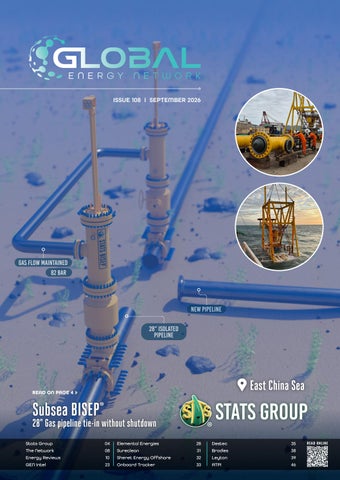
gas flow maintained 82 bar
new pipeline 28” isolated pipeline
East China Sea
READ ON PAGE 4 }
Subsea BISEP®
28” Gas pipeline tie-in without shutdown Stats Group
04
Elemental Energies
28
Destec
35
The Network
08
Sureclean
31
Brodies
38
Energy Reviews
10
Sheret Energy Offshore
32
Leyton
39
GEN Intel
23
Onboard Tracker
33
ATPI
46
READ ONLINE
CONTENTS
Contents
08
04
The Network
10
26
Drilling, Wells & Pipelines
Energy Reviews
24
GENI Intel Project Tracker
Subsea BISEP® 28" Gas pipeline tie-ins without shut down
ISSUE 108 drilling wells & pipelines
28 Elemental Energies 31 Sureclean 32 Sheret Energy Offshore 33 Onboard Tracker 35 Destec
36
38
On the Move
Brodies
39
42
44
46
Leyton
Decommissioning
Contracts
ATPI
Welcome to the September issue of GEN magazine. Drilling, wells and pipelines remain at the heart of the global energy industry, with continued innovation helping operators improve safety, efficiency and performance across some of the sector's most complex operations. In this September issue of Global Energy Magazine, we explore the technologies, expertise and solutions supporting the industry from the wellbore to critical pipeline infrastructure.
October
Health & Safety, Skills & Training
Issue
We are delighted to welcome STATS Group as our cover partner. Their article, Utilising hot tapping and BISEP line stopping to maintain flow during subsea pipeline tie ins, explores how proven intervention technologies can help maintain production while essential subsea work is carried out. This issue also features contributions from Elemental Energies, AMS Global Group, Sureclean, Sheret Energy Offshore, EPIC Group, Onboard Tracker, TESS and DESTEC.
Be Part of The Next GEN of Media
it!
Contact hello@globalenergynetwork.net
As always, my sincere thanks go to all our partners for their continued support. I hope you enjoy this issue and the insight it brings from across our industry. Enjoy the issue!
Dan Hyland
READ ONLINE www.globalenergynetwork.net/magazine
3
4
Utilising hot tapping and BISEP line stopping to maintain flow during subsea pipeline tie-ins STATS Group delivers subsea pipeline tie-in without interrupting gas production
globalenergynetwork.net I September 2026
Cover Feature
S
TATS Group has completed a landmark subsea pipeline isolation and tie-in project in Asia Pacific, allowing a new offshore platform to be connected to an existing gas pipeline while production continued uninterrupted. The project involved a high-pressure 28inch subsea gas pipeline operating at 82 bar and marks the first subsea deployment of STATS’ BISEP® line stopping technology with an integrated bypass system in the region. The solution enabled the operator to isolate a section of live pipeline safely, carry out tie-in works, and maintain gas flow throughout the operation. The work was delivered for a major Chinese engineering contractor supporting the development of a new offshore platform. A full shutdown of the pipeline was not considered viable because of the importance of maintaining gas supply and avoiding the commercial and operational impact of lost production. Subsea pipelines play a critical role in offshore energy infrastructure, transporting gas and other hydrocarbons from remote fields to processing facilities and end users. As operators look to develop new fields, extend the life of existing assets and improve energy security, the ability to connect new infrastructure without shutting down production is becoming increasingly important. Traditionally, a new tie-in to an existing pipeline could require a full or partial shutdown, particularly where no preinstalled connection point exists. In live gas networks, such interruptions can create significant challenges, from deferred revenue and contractual penalties to potential supply constraints. Hot tapping and line stopping technologies offer an alternative by allowing operators to modify or expand pipeline systems while they remain in service. For this project, STATS deployed two BISEP line stop tools 74 metres apart to isolate the target section of pipeline. The tools provided a verified double block and bleed isolation, creating a safe worksite for the tie-in while an integrated bypass allowed gas to continue flowing around the isolated section. This approach reduced the need for additional subsea intervention work and helped simplify the offshore scope. It also avoided the need to depressurise the entire pipeline, an important consideration for a system operating at high pressure and serving critical gas demand. The operation began with hot tapping through client-supplied mechanical clamps and full-bore valves. STATS used its SureTap® hot tapping systems to create the access points needed to deploy the BISEP technology and recover the cut sections of pipe, known as coupons, from the pipeline.
Once the hot taps were complete, the BISEP tools were installed into the flowing pipeline and activated to form a leak-tight isolation. Each isolation was tested and verified before the isolated section was depressurised, vented and prepared for cutting. STATS then issued an isolation certificate, allowing the client to proceed with breaking containment and tie-in activities. STATS also provided lightweight mechanical strap clamps and additional small hot taps to support venting and purging of the isolated spool. The pipeline section was then cut and removed, creating the access required to connect the new field development to the existing subsea infrastructure. A key feature of the project was the integrated bypass through the BISEP launcher. This maintained product flow during the isolation period and removed the need for a separate, more complex bypass arrangement. By reducing the number of hot tap branches and mechanical clamps required, the configuration helped lower project complexity and minimise diver intervention. The pipeline remained isolated for 28 days while the tie-in was completed. Following successful completion, the BISEP tools were recovered, the bypass pipework was decommissioned and removed, and completion plugs and blind flanges were installed to reinstate the system safely. STATS said the project was executed with zero disruption to production, reduced offshore scope and a compressed schedule. The company attributed the successful outcome to detailed planning, engineering validation and disciplined execution, supported by system integration testing in China before offshore deployment. The achievement underlines the growing role of live pipeline intervention as operators seek to maintain output while adapting ageing or expanding infrastructure. For gas networks in particular, the ability to complete major subsea works without interrupting flow
can support supply security and help reduce the cost and risk associated with shutdown-dependent strategies. Commenting on the milestone project, Alasdair Arthur, Project Manager based in Kuala Lumpur, Malaysia, said: “This was both a challenging and highly rewarding project, and I am extremely proud to have been part of the team that successfully delivered the first subsea BISEP project featuring an integrated bypass system.” He added: “The success of this operation reflects STATS Group’s broader capability in executing complex subsea pipeline intervention solutions. We have now established extensive experience and a proven track record across subsea pipeline diameters ranging from 8 inches to 48 inches, supporting projects throughout Asia Pacific, the Middle East and the Gulf of Mexico.” The wider significance of the project extends beyond a single tie-in. Offshore assets are ageing, new fields are being brought onstream and operators are increasingly looking for ways to reconfigure, repair or repurpose infrastructure without interrupting production. Technologies that can provide verified isolation while keeping pipelines live are becoming central to that shift. The successful subsea deployment of the BISEP with an integrated bypass demonstrates how established pipeline intervention methods are being adapted for more complex offshore environments. By maintaining production, reducing subsea scope and providing a verified isolation, the project delivered safety, cost and operational benefits for the pipeline operator. As energy companies balance reliability, supply security and asset life extension, live intervention techniques are expected to play an increasing role in future subsea developments. For STATS Group, the project adds another regional milestone to its track record in hot tapping, line stopping and subsea pipeline isolation.
PROVIDING SPECIALIST TOOLS AND TECHNOLOGY SERVICES FOR A SAFER ENERGY INDUSTRY, DISCOVER MORE AT WWW.STATSGROUP.COM
5
Editorial Design newsdesk@globalenergynetwork.net
Jennifer McAdam jen.mcadam@globalenergynetwork.net
Advertising Editorial
hello@globalenergynetwork.net Tsvetana Paraskova
FEATURING
Highest-impact, safety-critical training
PARTNERS
World-class safety-critical training and learning solutions for people and workforces in oil & gas, wind, power, and beyond. Globally recognised, locally delivered across the UK, the Americas, and the Middle East.
Training Services Simulation & Technology Workforce Development Managed Services
TRAVEL MANAGEMENT PARTNER The ATPI Group delivers world-leading corporate travel and events solutions to organisations operating in a variety of specialist sectors around the world.
LOGISTICS PARTNER Leading provider of logistics services to this industry, offering its customers airfreight, road freight, sea freight, project forwarding, customs compliance, training and consultancy, packing, crating, lashing & securing services, warehousing, distribution, freight management, rig relocation and mobilisation services and offshore logistics. Disclaimer: The views and opinions published within editorials and advertisements in this publication are not those of our editor or company. Whilst we have made every effort to ensure the legitimacy of the content, GEN cannot accept any responsibility for errors and mistakes.
WANT TO BE PART OF IT? VIEW our media pack at
globalenergynetwork.net or scan the QR code
3tglobal.com
Spotlight on THE This month's 'New Members' spotlight:
Engineering Seabed to Surface for
Since its inception in 1997, Thru-Tubing
Sustainable Energy Solutions
Systems (TTS) has developed many
Industry-leading products and services for the renewable, nearshore construction
innovative applications designed for interventions in slim hole (monobore)
Specialist Equipment Solutions originated as James Scott Engineering established in 1909, and now boasts over 100 years' of experience in providing reliable, high-
and oil and gas sectors across all phases
wells and through tubing completions. Additionally, TTS has designed a line of
quality electrical, instrumentation and
of the lifecycle.
tubing and through tubing plugs
mechanical installation solutions.
www.acteon.com
www.thrutubing.com
www.ses-offshore.com
iKapa Resources can assist with Well
DeepOcean is an integrated provider of safe, high quality, innovative services and technologies for the subsea industry. Demonstrating an extensive track record, DeepOcean offers a breadth of subsea services including Survey and Seabedmapping, Subsea Installation, Seabed Intervention, Inspection, x Maintenance and Repair (IMR), and Recycling.
Islay Subsurface Ltd originated from Islay Petrophysics, founded in 2010 by Iain Whyte to offer high-calibre petrophysical services from operations to studies and well integrity. Since then, the company has assisted over 80 operators and well management companies, from small-scale projects to large onshore and offshore x endeavours.
www.deepoceangroup.com
www.islaysubsurface.com
Engineering, Asset Management, Surface, Subsea and Drilling Equipment, Spares, Inspection Services, Consultancy and buying surplus new or used equipment.
www.ikaparesources.co.za
This month's 'Renewed Membership' spotlight:
Petrasco aims to be the logistics partner of choice for the Energy industry; meeting the need for urgency in your logistics is our mission. The Energy industry has unique and pressing logistical requirements. Petrasco recognises the need to keep the vital components flowing to maintain production and operations around the globe.
Enerion™ is a leading provider of products
Ailsa Reliability Solutions Ltd. are an
and services to the energy sector. We
independent organisation specialising in
have extensive experience in engineering,
solutions to improve customers' reliability
manufacturing and service of equipment
and availability of their plant and assets,
and are committed to deliver flexible and
using the latest condition monitoring
future-oriented solutions to
equipment and technology available on
our customers.
the market.
www.enerion.com
www.ailsareliabilitysolutions.com
www.petrasco-energy.com
Join The Network today! Contact: hello@globalenergynetwork.net
The Next GEN of Media www.globalenergynetwork.net
The Network
NETWORK news FIND ALL THE FULL NETWORK NEWS ARTICLES @ globalenergynetwork.net
ModuSpec secures multiple drillship intake projects
DeepOcean completes subsea tieback construction for Teal West development
Aurora Energy Services targets £100m turnover for rapidly expanding Integrated Services group
Global rig and well control equipment assurance specialist ModuSpec has secured several projects valued at around $750,000 to support clients with the intake and acceptance of deepwater drillships.
Global ocean services provider DeepOcean has successfully completed subsea construction and tie-in work at the Teal West development on the UK Continental Shelf for Anasuria Operating Company (“Anasuria”).
Kane Winton takes charge of 400-strong division in new managing director role
The projects include visiting two drillships currently operating in the US Gulf of America (GOA) and three in the Mediterranean for potential future deployment in West and Southern Africa, as well in the Mediterranean Sea.
Teal West is an offshore oil and gas development project located in the Central North Sea, on the UK Continental Shelf. The field has been developed as a subsea tieback to the existing Anasuria FPSO (floating production, storage and offloading) facility.
For the drillships in the GOA, a multi-disciplinary team will assess critical rig equipment, including well control, drilling, marine and station keeping systems, to support the operator’s selection process. One drillship in the Mediterranean has already secured a contract for a multi-well exploration campaign commencing in Q4 2026
DeepOcean’s scope of work included the installation of a flexible production riser and flowline, together with an umbilical connecting the Anasuria FPSO to the Teal West subsea Christmas tree. The scope also included the protection of the flowline and umbilical, as well as the commissioning of the newly installed infrastructure.
Unique Group Delivers Subsea Engineering for America’s First OpenOcean Human Habitat in Four Decades
Bilfinger Signs Framework Agreement with Harbour Energy Germany to Optimize Oil & Gas Production
Unique Group, global leaders in subsea technologies and engineering, has successfully delivered the engineering, survey and infrastructure systems supporting Vanguard, the first open-ocean subsea human habitat deployed in United States waters in more than 40 years. Developed by ocean engineering firm DEEP and installed on the seabed at Tennessee Reef within the Florida Keys National Marine Sanctuary, Vanguard is designed to enable crews of up to four aquanauts to live and work underwater during extended scientific and operational missions.
• Five-year framework agreement with twoyear extension option signed • Engineering and maintenance services for natural gas and crude oil production facilities in northwestern Germany • Multidisciplinary team will increase efficiency and asset performance • Specialized safety advisors and gas and respiratory protection services ensure a high level of occupational safety across facilities
The landmark project presented a complex subsea engineering challenge, creating infrastructure capable of supporting longduration human habitation while operating safely within a protected marine environment and withstanding extreme weather conditions over a 20-year design life.
International industrial services provider Bilfinger has signed a multi-year framework agreement with Harbour Energy Germany. The contract includes engineering and maintenance services for the continuous optimization of natural gas and crude oil production facilities in northwestern Germany. In addition, Bilfinger provides specialized safety services across facilities.
Aurora Energy Services (Aurora) has appointed Kane Winton to the newly created role of Managing Director of Integrated Services as the Inverness-headquartered company restructures its operations to meet growing demand across energy and infrastructure sectors. The move brings a number of Aurora’s core business lines and approximately 400 staff under one leadership structure and is a response to client demand for more streamlined integrated services. Kane, who joined Aurora less than two years ago, was originally tasked with building an engineering and project management division targeting around £4 million in annual turnover.
Xodus to support environmental approvals for the next phases of the Northern Endeavour Decommissioning Program Xodus Group will support environmental approvals for Phases 2 and 3 of the Northern Endeavour Decommissioning Program, the next major stage in the removal of one of Australia’s largest offshore oil field developments. The programme, delivered by Australia’s Department of Industry, Science and Resources (DISR) involves the staged decommissioning of the Laminaria-Corallina oil fields, located approximately 550 km northwest of Darwin. Phase 2 covers the permanent plugging and abandonment of the Laminaria-Corallina subsea wells. Phase 3 will involve the decommissioning and removal of the remaining subsea infrastructure.
Feature your company news in the next issue of Global Energy Network
The Next GEN of Media
Magazine in print and online - Join The Network today!
Contact: hello@globalenergynetwork.net
9
10
UK
Energy Review The new UK government’s approach to North Sea oil and gas, the end of the consultation periods for the Rosebank and Jackdaw energy projects, and the latest insights into the UK’s wells and decommissioning activity were the highlights of the UK North Sea oil and gas industry in recent weeks. Offshore Energies UK (OEUK), the main UK North Sea industry association, did not wait too long after the new government took office to call for prioritising homegrown energy from the North Sea over energy imports. OEUK has congratulated Miatta Fahnbulleh on her appointment as Secretary of State for Energy Security and Net Zero and urged her to meet North Sea industry representatives to make clear the new government backs homegrown energy production over growing reliance on imports. “There is now an opportunity for the new Energy Secretary to work with the sector to deliver on Prime Minister Andy Burnham’s commitment to reindustrialise Britain by supporting the workers, businesses and communities that underpin the UK’s domestic energy industry,” OEUK said. The association quoted independent polling data from Opinium from July showing that the government’s own supporters are looking for a reset on energy policy from the new prime minister. Almost 70 percent of Labour voters say the UK should prioritise North Sea oil and gas production compared to just 9 percent who said it doesn’t matter where oil and gas comes from. “The UK will still need oil and gas for decades to come,” David Whitehouse, chief executive of Offshore Energies UK, said. “The question is whether we produce as much of that energy as possible here, supporting our own jobs, communities and economy, or become increasingly reliant on imports while exporting investment and economic value overseas.”
By Tsvetana Paraskova
Offshore Energies UK has also called for an acceleration of consent for the development of the Rosebank and Jackdaw oil and gas projects highlighting in its response to the public consultations their strategic importance to the UK’s energy security, economy, and industrial future.
The public consultations were part of the regulatory process required before the fields could obtain the final government go-ahead and potentially commence production. “These projects are coming at a time when domestic gas production is declining and import dependence is growing, even as we increase production of energy from wind and other renewables,” OEUK’s Whitehouse said. “UK production meets only 39% of UK gas demand according to latest figures, and without new investment, the UK’s reliance on imported gas will continue to increase.” Continued Whitehouse, “A positive decision on Rosebank and Jackdaw will play a part in restoring investor confidence, demonstrating that the revised regulatory regime is functioning effectively. We need a regulatory framework that enables projects to move forward.” The public consultation period on the Jackdaw gas project ended on 10 August, and the public consultation period for the Rosebank oil and gas field ended on 17 August. The fields’ operator, Adura, said that together, Rosebank and Jackdaw represent a combined anticipated investment of £10.8 billion, more than three-quarters of it spent in the UK. The projects are also expected to deliver £1.4 billion in tax revenues before the end of this parliament, rising to £3.8 billion by the end of the next. The projects will support 3,500 jobs at peak construction, 880 high-quality, wellpaid jobs sustained throughout production in communities across the UK, and 125 apprenticeships. Together, Rosebank and Jackdaw have the potential to make up 10 percent of domestic natural gas production, according to Adura. Across its producing lifespan, Rosebank alone is expected to generate £24.3 billion in Gross Value Added (GVA) for the UK economy across construction and operations, supply chain activity, and in the wider economy.
Energy Review UK & North Sea Rosebank is set to produce around 69,000 barrels of oil per day at its peak, equivalent to roughly 10 percent of anticipated UK Continental Shelf oil output. With total UK oil production forecast to fall in coming years, Rosebank is large enough to slow that decline, Adura notes. Meanwhile, North Sea operators produced 21,000 extra barrels of oil equivalent (boe) every day in 2025 by running their facilities more efficiently and reducing the number of unplanned shutdowns, the new UKCS Production Efficiency report by the North Sea Transition Authority (NSTA) showed in August. Production efficiency, which indicates how well companies are performing by comparing actual production with maximum potential output, increased by one percentage point to 76 percent last year. The improvement equated to the production of 21,000 additional boe per day in 2025, more than 7.5 million boe in total, according to NSTA’s annual production efficiency report. This represents an impressive turnaround following a decrease of 2 percentage points between 2023 and 2024. For the first time since 2021, operators reduced production losses caused by issues with facilities, wells, and systems used to transport oil and gas to onshore terminals in 2025, the report found. “The rise in production efficiency in 2025 shows that even mature basins such as the North Sea can reward those with high operating standards with additional barrels,” NSTA Operations Director Tom Wheeler said. Another NSTA annual report, UKCS Wells Insights Report 2026, showed in August that overall development well activity fell by about 24 percent in 2025 compared with 2024, whilst expenditure remained stable at £1.6 billion. Operators drilled 38 development wellbores, including six mechanical sidetracks.
“A fall in the overall number of interventions and decline in E&A drilling, combined with rising rig costs points to a concerning loss of skills and resource,” said Keith Hogg, NSTA Wells Manager. “This all means it remains vital that operators engage with the supply chain and commit to investing in wells,” Hogg added. Separately, the UKCS Decommissioning Cost and Performance Update 2026 by the NSTA showed that decommissioning remained a major activity across the UKCS in 2025, as industry spending hit a record £2.6 billion, reflecting continued progress in the decommissioning of wells, platforms, and subsea infrastructure.
The signatories pledged to share data, expertise and resources, and identify opportunities to share vessels for this type of work. Industry estimates suggest using vessels instead of rigs could lower the total bill for remaining subsea wellhead removals by approximately 30 percent, or about £200 million, the NSTA said. The signatories also vowed to embrace opportunities to engage the supply chain early, and share data and scheduling information with them. In company news, bp has announced that it is launching a process to market its North Sea business for a potential sale, following months of media speculation that the supermajor would be looking to exit the UK North Sea upstream.
Despite this record level of expenditure, the estimated cost of completing the remaining UKCS decommissioning programme has reduced only marginally to £43.4 billion.
The decision forms part of bp’s ongoing portfolio review and reflects its disciplined approach to capital allocation – all in service of creating a simpler, stronger and more valuable company.
While operators and the supply chain continue to pursue efficiencies, progress has been offset by inflationary pressures, market uncertainty, growing competition for specialist offshore resources, and increasing demand from other energy sectors, the NSTA said.
“The North Sea remains integral to the UK's energy system,” CEO Meg O’Neill said.
The period to 2032 remains a critical phase for UKCS decommissioning, according to the regulator. Around £21 billion, almost half of the remaining forecast expenditure, is expected to be incurred by 2032. “Decisions taken now by operators, contractors and regulators will have a significant influence on the overall cost and efficiency of the programme, as well as the long-term competitiveness of the UK decommissioning sector,” the NSTA said in the report.
“However, as we focus our portfolio and direct capital to our highest-value opportunities, we believe our North Sea business will be better positioned as part of another company.” Serica Energy said it expects to sign a rig contract in the coming weeks for a drilling programme estimated at around 400 days duration, with an option to extend, giving the potential to drill up to six wells across the company’s expanded North Sea portfolio. Drilling is expected to begin with the Bruce SCE and SCW wells in the third quarter of 2027, with the potential for first production 12 months from the start of drilling, Serica said in August in its trading update for the first six months of 2026.
Despite the record high spending last year and increased activity in recent years, a backlog of approximately 500 wells awaiting final abandonment remains.
“A key growth area going forward is the West of Shetland basin, following the acquisition of the Greater Laggan Area from TotalEnergies completing in March,” Serica CEO Chris Cox said.
This reflected both operators’ and NSTA’s focus on restoring production.
“With more than 1,000 additional wells forecast to be decommissioned over the next five years, activity levels will need to increase significantly if industry is to meet regulatory expectations and provide the certainty of work needed to attract and retain critical supply chain resources,” the NSTA said.
“The acquisition brings operatorship of the Shetland Gas Plant, providing a strategic infrastructure position from which Serica can pursue third-party throughput, near-field development and exploration opportunities. This creates a platform to build a material West of Shetland business,” Cox noted.
Despite the lower activity count, efficiency improved and average costs fell from £9.6 per barrel of oil equivalent in 2024 to £7.6 per barrel of oil equivalent in 2025, the report found.
NSTA and 17 UK North Sea operators have signed a charter of well decommissioning, with a set of guiding principles, including working collaboratively to develop a smoother approach to wellhead removals.
Expro has been awarded a multi-millionpound contract by a major UK operator, reinforcing its position as a leading supplier of subsea safety systems in the UK North Sea plug and abandonment (P&A) market.
Moreover, North Sea operators produced an extra 16 million barrels of oil from 56 reinstated wells in 2025 as they focused on well interventions which boosted production and efficiency, the NSTA said in the wells insights report.
Signatories included Adura, Apache, bp, CNOOC International, Dana Petroleum, ENI, EnQuest, Harbour Energy, INEOS Energy Europe, Ithaca Energy, NEO NEXT+, NSTA, Perenco, Serica Energy, Shell, Spirit Energy, and TAQA UK.
Exploration and appraisal activity declined in 2025, while well intervention activity shifted towards more restoration work, though still at lower rates than in 2021-2023, with less safeguarding and surveillance activity.
Under the terms of the agreement, Expro will provide its 7-3/8” large bore Subsea Test Tree Assembly (SSTTA) safety system to support the unnamed client’s P&A campaign across a portfolio of mature subsea wells. This includes six firm wells, with a further six optional wells.
11
12
Theme Header
EU Energy Review The first hydrocarbon project offshore Cyprus, renewable energy milestones in the UK and Ireland, and new offshore wind projects featured in Europe’s energy industry in the past few weeks. Oil & Gas European energy majors Eni and TotalEnergies have reached the Final Investment Decision (FID) to develop the Cronos project in the deep waters offshore Cyprus, with the target to bring the first Cypriot gas to market in 2028. The Cronos project, operated by Eni, will bring to production the gas volumes from Cronos field, which holds more than 3 Tcf of gas initially in place (GIIP). The Cronos field was discovered in 2022 and successfully appraised in 2024. Eni and TotalEnergies are partners in the project with 50 percent each, and Eni is the operator. Located in deep offshore waters approximately 185 kilometers southwest of the coast of Cyprus, Cronos will be developed through four subsea wells. Production start-up is expected in 2028, with a plateau of around 500 million cubic feet per day (Mcf/d), equivalent to around 2.8 million tons of LNG per year (Mtpa), 50 percent of which will be marketed by Eni and 50 percent by TotalEnergies. The development of Cronos will partly rely on existing facilities in Egypt, generating significant synergies for a fast-track development, which will help accelerate its start-up and reduce the carbon intensity of the field’s production, the French company said. The gas will be transported and processed in existing Zohr facilities in Egypt, then transferred and liquefied in the Damietta LNG plant for export as LNG to international markets, primarily Europe.
By Tsvetana Paraskova
"As Cyprus’ first gas development project, Cronos will support the development of a new regional gas hub in the Eastern Mediterranean, leveraging Egypt’s infrastructure. This new gas route in the Mediterranean will contribute to Europe’s energy security by diversifying its LNG supply sources,” said Patrick Pouyanné, chairman and CEO of TotalEnergies. Also in Cyprus, UK-based oil and gas supermajor Shell has reached an agreement to sell its 100-percent-owned subsidiary BG Cyprus Ltd to Hungary’s MOL Group for up to $720 million, subject to customary adjustments and milestonelinked contingent payments. BG Cyprus holds a 35-percent nonoperated interest in the Cyprus Offshore Block 12, which contains the Aphrodite gas field operated by Chevron’s local subsidiary. Chevron, MOL, and NewMed Energy, which will be the new co-owners of the field, would be working toward a final investment decision to develop Aphrodite. All the potential produced gas from Aphrodite is expected to be sold to the Egyptian Natural Gas Holding Company (EGAS), Shell said. “We believe Aphrodite remains an attractive development opportunity and will play an important role in supporting regional energy needs,” said Cederic Cremers, Shell’s Integrated Gas President. “Our decision to exit is driven by disciplined capital allocation and portfolio choices, as we focus on opportunities that strengthen our integrated LNG value chain.”
Energy Review Europe Low-Carbon Energy Renewables provided 52.1 percent of the UK’s electricity last year, up from 50.5 percent in 2024, the Digest of UK Energy Statistics (DUKES) by the UK government showed. Fossil fuels accounted for 32.3 percent of electricity supply last year, almost all from gas (31.75 percent), as coal was phased out in 2024, according to the energy statistics. Renewable generation reached a new record of 153 terawatthours (TWh) in 2025, up by 5.9 percent from a year earlier, thanks to new “Wind power, together capacity and more favourable weather with other fossil-free conditions for solar sources of generation, PV. The record output can help meet the was driven by record levels of generation growing demand for from offshore wind, clean electricity in solar PV, and bioenergy.
Europe,”
Renewable capacity increased by 5.3 percent, or by 3.3 gigawatts (GW), including new capacity at Dogger Bank offshore wind farm and Cleve Hill, the largest solar farm in the UK.
“It’s great to see that renewables have generated over half the UK’s electricity for the second year running, outperforming fossil fuels significantly, and proving once more that clean power is right at the heart of our modern energy system, consistently providing most of the electricity we need to keep British homes and businesses up and running,” said RenewableUK’s CEO, Tara Singh. The RenewableUK association also commented on the appointment of Miatta Fahnbulleh as the new Energy Secretary that “renewables are our best bet for delivering affordable, homegrown power.” Singh noted that “As well as delivering energy security and affordable power, the renewable energy industry and its growing supply chain are also helping to reindustrialise parts of the country which need new opportunities after years of decline, creating skilled jobs, attracting investment and supporting British manufacturing from our coastal communities to industrial heartlands.”
developer, JERA Nex bp, to discontinue development earlier this year, The Crown Estate has moved quickly to return the site to market and maintain momentum on one of the most advanced offshore wind opportunities available to developers.
The accelerated tender process could see rights awarded by the end of 2026, helping to keep a significant renewable energy project on track. Once operational, Morgan could generate enough electricity to power up to 1.5 million homes, supporting the UK’s energy security ambitions and economic growth, The Crown Estate said. Ireland set a record of solar power output in July, due to abundant sunshine, according to provisional data from EirGrid, the operator and developer of Ireland’s electricity grid. July was a record month for the amount of solar energy powering the electricity system with grid scale solar contributing 9.4 percent to the overall fuel mix for the month. This compares to 8.2 percent in June and 7.8 percent in May. At 22 percent, wind energy held a significant share of the total amount of energy generated in Ireland in July. Elsewhere, gas generation accounted for 43 percent of all electricity used, and 24 percent of Ireland’s power supply was imported via interconnection, EirGrid’s data showed.
RenewableUK expects offshore wind alone to deliver £100 billion of investment and reach almost 100,000 jobs by 2030.
The Danish Energy Agency awarded in August two offshore wind projects to Vattenfall in the latest successful Danish offshore wind tender.
The Crown Estate in July launched a competitive tender process to secure a new developer to build and operate the up to 1.5 GW Morgan wind farm in the Irish Sea. Following the decision of the previous
Vattenfall has been awarded the Hesselø project in the Kattegat Sea between Denmark and Sweden, with a minimum installed capacity of 800 MW. The other project, North Sea I Mid Offshore Wind
Project, is located in the North Sea, off the coast near Hvide Sande, with a minimum capacity of 1,000 MW. Grid connection has been reserved for both projects, with the connection point located approximately 50 km inland. The consent will be granted for 30 years, with an option to extend it by a further 10 years, Vattenfall said. “Wind power, together with other fossilfree sources of generation, can help meet the growing demand for clean electricity in Europe,” said David Flood, Head of Business Unit Offshore at Vattenfall. “Projects like this demonstrate how we are scaling offshore wind while maintaining a strong focus on affordability and long-term value.” France’s government has picked Cherbourg, Brest, Nantes-Saint-Nazaire, Port-la-Nouvelle, and Marseille-Fos as the French ports that would receive a combined 260 million euros of support to adapt their infrastructure to host the supply chain of the floating offshore wind industry. France aims to become a leader in floating wind development and have nearly 6 GW of floating wind installed by 2040. ScottishPower Renewables and Abu Dhabi Future Energy Company PJSC – Masdar have completed a major construction milestone at the £4-billion East Anglia THREE offshore wind farm, with all 95 foundations now installed off the Suffolk coast. Turbine installation is already under way, and offshore and onshore construction will continue at pace over the coming months, paving the way for East Anglia THREE to become fully operational by the end of 2026, delivering 1.4 GW of homegrown clean power to the UK, ScottishPower Renewables said.
13
14
USA Energy Review High US oil and gas production has helped cushion to some extent the major supply disruption from the Middle East, while the US Administration continued to offer lease sales to increase energy output. US Oil and Gas Production Helps Soften the Disruption Blow
US On Track for Record Natural Gas Production
The US entered the period of the worst disruption in oil markets with record crude oil and near-record natural gas production, which has softened the blow on global energy supply from the Strait of Hormuz crisis, the American Petroleum Institute (API) said in August.
In a sign of expanding US oil and gas production, the US Energy Information Administration (EIA) forecast in August that America’s natural gas production would hit a record high this year.
The existence of an American cushion to ease what would have been a much more severe shock did not happen overnight— it has been decades in the making since the shale revolution led to a jump in US oil and gas production. Years of investments in new supply and infrastructure have now made the United States the world’s biggest crude oil producer of more than 13.5 million barrels per day (bpd), API said. “That transformation didn’t happen by accident. The U.S. oil and natural gas industry invests roughly $150 billion every year in oil and natural gas upstream production alone — not including billions more invested annually in pipelines, refineries, export terminals and other critical infrastructure,” API said in its analysis. “Those sustained investments fundamentally changed America’s role in global energy markets.” In two decades, the US has turned into a major producer and exporter of oil, gas, and fuels, helping stabilise global energy markets in times of extreme volatility and supply shocks, such as the Middle East crisis this year. “America’s role as an energy stabilizer reflects years of investment across changing market conditions — and policies and infrastructure that allowed those investments to reach consumers,” API said.
By Tsvetana Paraskova globalenergynetwork.net I September 2026
“Preserving that advantage means continuing to create the conditions for long-term investment, infrastructure and domestic energy development so America is prepared for whatever comes next.”
US marketed natural gas production is expected to average 122.5 billion cubic feet per day (Bcf/d) in 2026, surpassing the previous record of 118.5 Bcf/d set in 2025, the EIA said in its August 2026 Short-Term Energy Outlook (STEO). In the first half of 2026, marketed natural gas production averaged 121.3 Bcf/d, or 4 percent higher compared to the same period in 2025. Most of the production expansion is concentrated in the Permian region in Texas and New Mexico and the Haynesville region in Louisiana and Texas, the EIA said. The administration expects Permian gas production will average 29.2 Bcf/d in 2026, which would be a 6-percent increase compared with last year. Natural gas production in the Permian region is primarily by associated gas produced during crude oil extraction and is supported by crude oil prices. The high oil prices support oil-directed drilling in the Permian region and the resulting rise in both crude oil and natural gas production. The Permian gas output growth is also driven by the rising ratio of gas to oil in wells. In the Haynesville region, natural gas production is set for a 9-percent jump this year over 2025, the EIA reckons. Unlike Permian operators who drill mostly for oil, Haynesville operators drill mostly for natural gas, so Haynesville production is driven by the price of natural gas benchmark Henry Hub. Despite expectations of a small decline in the US Henry Hub gas benchmark prices this year, drilling in the Haynesville remains economical even amid the relatively deeper wells and more expensive development costs. In addition, the Haynesville’s proximity to LNG export terminals and major industrial natural gas consumers along the US Gulf Coast draws operators to actively drill in the region, the EIA says.
Energy Review USA US Gulf Lease Sale The Trump Administration continues to offer tracts in oil and gas lease sales and the latest auction in August generated $82.7 million in high bids for 59 blocks in federal waters in the US Gulf of America. The Marine Minerals Administration’s Lease Sale Big Beautiful Gulf 3, or BBG3, saw 16 companies submitting 69 bids totalling $99,476,285, the Department of the Interior said. Lease Sale BBG3 is the third of 30 Gulf of America lease sales required under the One Big Beautiful Bill Act of the Trump Administration. The Gulf of America accounts for approximately 14 percent of total US crude oil production and remains a critical market for the energy services and technology sector. Supermajors Chevron, Shell, and BP were among the companies that have submitted bids. “Lease Sale BBG3 underscores the Department of the Interior’s commitment to an active offshore energy strategy focused on energy security, economic development and responsible stewardship of America’s offshore resources,” the DOI said. “By expanding domestic offshore capabilities, the United States can reduce reliance on foreign producers, support affordability for consumers and reinforce its role as a global energy leader.” Holly Hopkins, API’s Vice President of Upstream Policy, commented on the lease sale that the “third successful Gulf of America lease sale is another vote of confidence in American energy and reflects the long-term investment certainty Congress and Secretary Burgum have restored.” “At a time of global energy disruption, our industry is continuing to invest in the future supply America and our allies will depend on for decades to come,” Hopkins said.
“Continued leasing opportunities in the Gulf, including through the proposed five-year offshore program, can sustain that investment and strengthen longterm energy security.”
“While we will continue to see movement month to month, employment levels have remained steady despite continued economic uncertainty,” said EWTC President Molly Determan.
Tim Tarpley, president of the Energy Workforce & Technology Council, noted that predictable lease sales provide the consistency companies need to plan, invest, and maintain the workforce and capabilities required to support US offshore energy production.
“Energy services companies understand how important it is to maintain the skilled workforce necessary to respond when demand increases,” Determan added. “That balance between operational discipline and workforce readiness continues to shape hiring decisions across the sector.”
“The decisions made today will determine whether companies are investing in people, equipment and technology years from now,” Tarpley said.
“The decisions made today will determine whether companies are investing in people, equipment and technology years from now,”
“Regular lease sales give our companies something incredibly valuable: the ability to plan. That consistency helps keep investment, jobs and expertise in the Gulf.”
Tarpley said.
Energy Services Employment Stable amid Heightened Uncertainty The same Energy Workforce & Technology Council released in August its July 2026 jobs report, showing that energy services employment remained relatively stable even as the broader US labour market weakened. Energy services employment totalled 628,136 jobs in July, a decrease of 614 positions from June, according to preliminary data from the Bureau of Labor Statistics (BLS) and Energy Workforce analysis. Despite month-to-month fluctuations, energy services employment has remained within a narrow range as companies continue to take a disciplined approach to hiring and align workforce levels with sustained customer demand, the Council said.
Middle East Review SPONSORED BY
WIDER AFRICAN ENERGY SUMMIT
15
16
MID Energy Review East
The new energy reality in the Middle East’s key oil and LNG chokepoint, the Strait of Hormuz, did not prevent the top national oil companies in the region to advance projects and report solid earnings for the second quarter of the year.
New Strait of Hormuz Reality The consequences of the Strait of Hormuz closure go far beyond the near-term disruption to oil and LNG flows. The fact that this vital chokepoint in the Middle East is no longer a certain energy trade route is a major challenge that oil markets need to factor in for the foreseeable future, independent research firm Rystad Energy said in an analysis in August. The shock supply loss is forcing markets to adapt to the new reality, but the adaption comes at a cost, W. Schreiner Parker, Head of Emerging Markets & NOCs at Rystad Energy, wrote in the special insight. “Every major geopolitical shock has left behind an energy system that was reorganized rather than restored,” Parker said. “The rise of new producing basins, the globalization of liquefied natural gas (LNG), the shale revolution and successive geopolitical crises have each reshaped the system that preceded them. None recreated the previous equilibrium – each established a new one.” The production and export decisions and exports are changing as the market realizes that the old Strait of Hormuz equilibrium has been irrevocably broken, according to Rystad Energy’s expert. “The system will not reorganize through government policy or military strategy alone. It will evolve through millions of independent investment decisions, each responding to changing perceptions of risk and return,” Parker argues.
Middle East Remains Critical for Portfolio Renewal of Biggest Firms
By Tsvetana Paraskova
Despite the Middle East crisis, the region is set to remain crucial for portfolio expansion and upstream asset base renewal for world’s largest international and national oil companies beyond the near term, analysts at Wood Mackenzie say.
Despite the near-term disruption, no region matches the Middle East for scale and cost advantage, according to Wood Mackenzie’s Mid-Year Outlook for oil and gas. The energy consultancy expects the Middle East region to remain central to the longer-term plans of the world’s largest oil and gas operators.
Saudi Aramco Profit Rises despite Hormuz Crisis Aramco has reported a 33-percent increase in its adjusted net income for the second quarter from a year earlier as high oil prices and the Saudi oil giant’s ability to re-route most crude exports more than offset the constrained flows at the Strait of Hormuz. Aramco’s adjusted net income came in at $33.385 billion for the second quarter, up by 33 percent from the $25.19 billion for the same period of 2025 and beating an analyst consensus of about $31 billion. The oil giant’s average realised crude oil price jumped to $108.10 per barrel for April to June, the period in which Brent oil prices averaged $97 a barrel. Despite the major disruption to flows in the second quarter, Aramco benefited from its diverse asset base, including strategic infrastructure such as the EastWest Pipeline, storage capacity, and export terminals, President and CEO Amin Nasser said. “That enabled us to sustain production and exports while advancing key projects, despite the challenging regional environment,” the executive noted. Ziad Al-Murshed, Aramco’s Executive Vice President and CFO, commented, “Our resilience stems from decades of longterm planning and our strategic domestic and international infrastructure that provide flexibility and optionality.” Following the closure of the Strait of Hormuz, Aramco has re-routed a large
Energy Review Middle East part of its crude oil exports to its Red Sea recovery, through the development of port of Yanbu. But the Red Sea route was the gas cap resources located above the challenged in July when the Iran-aligned field’s oil reservoirs. Houthi group threatened to block SaudiBy leveraging synergies with existing linked shipments in the Red Sea and the offshore facilities and clean power Bab el-Mandeb Strait. This, in turn, from the UAE grid, Umm Shaif has prompted dark transits Gas Cap is designed to through Bab el-Mandeb minimise costs and limit and new re-routing of emissions. Furthermore, the Saudi oil exports northward to Egypt, the project has the Digital capabilities are the Suez Canal, or the potential to increase central to the program, Saudi port of Sidi Kerir gas production to up on the Mediterranean. to 1.5 billion cubic feet through the application of per day in the future, data, scientific analysis, Since the Houthis further supporting the and artificial intelligence began threatening UAE’s long-term gas for the full field lifecycle Saudi oil shipments growth strategy. in the Red Sea and southward to Bab elThe FID includes three Mandeb, Saudi Arabia has engineering, procurement been shuttling on tankers more and construction (EPC) packages crude from Yanbu to the Egyptian port totalling $5.1 billion for large-scale of Ain Sukhna on the Red Sea, and then offshore infrastructure awarded by on the SUMED onshore pipeline to the Sidi ADNOC to consortiums including major Kerir port. UAE and international contractors. The development also includes a $365-million UAE and Kuwait Accelerate 14-well drilling and integrated drilling services programme to be delivered by Energy Growth Strategies ADNOC Drilling over 18 months using Kuwait Oil Company (KOC) has awarded three existing rigs. Halliburton a multi-year agreement to “ADNOC is accelerating its integrated support the development of the Ahmadi gas strategy to further harness the Innovation Valley (AIV), a flagship initiative UAE’s vast gas resources and expand that advances Kuwait’s energy sector our global LNG platform, as global transformation. demand for natural gas continues to The research and development (R&D) rise,” said Sultan Ahmed Al Jaber, UAE centre will support KOC to deliver Minister of Industry and Advanced solutions in brownfield, greenfield, Technology and ADNOC Managing and unconventional fields, address Director and Group CEO. higher operational complexity, and build technology designed for Kuwait’s “The Umm Shaif Gas Cap FID is another upstream challenges, Halliburton said. important milestone in delivering this strategy and reinforcing ADNOC’s The centre embeds applied research as position as a reliable gas supplier.” a permanent capability from concept through prototyping, piloting, and ADNOC has also announced an update to commercialization. the Official Selling Price (OSP) methodology for its Abu Dhabi crude grades, following a “Digital capabilities are central to the regular commercial review. program, through the application of data, scientific analysis, and artificial Effective 1 November 2026, ADNOC will intelligence for the full field lifecycle,” transition from the current ICE Futures Abu the oilfield services giant said. The UAE’s national oil company ADNOC is accelerating its integrated global gas growth strategy with a $6.2-billion final investment decision (FID) to develop the Umm Shaif Gas Cap project in Abu Dhabi alongside its international partners, France’s TotalEnergies, Italy’s Eni, and China National Petroleum Corporation (CNPC). Umm Shaif is Abu Dhabi’s oldest offshore field, producing since 1962. The new project will unlock by 2030 more than 600 million cubic feet per day of gas production while maximizing condensate
Dhabi-based pricing methodology, which uses the Murban futures contract and prices crude two months ahead of loading, to a prompt-month pricing methodology based on the Platts Dubai benchmark [PCAAT00], plus an ADNOC-announced differential that will be announced in the month preceding target delivery month. The updated methodology will apply across ADNOC’s Abu Dhabi onshore and offshore crude grades, including Murban, Das, Umm Lulu, and Upper Zakum, and aligns pricing more closely with the month of loading. The new pricing mechanism reinforces ADNOC’s commitment to pricing transparency for its growing customer and investor base, the national oil company said. Separately, ADNOC said in August that it has deployed its artificial intelligence (AI)-enabled Real-Time Operations Center (RTOC) platform, in collaboration with SLB, across its fleet of more than 120 rigs. The platform provides teams with a faster and more connected way to monitor, analyse, and manage drilling operations across ADNOC’s onshore and offshore assets. The platform, enabled by SLB’s DrillOps™ intelligent well delivery and insights solutions, replaces multiple tools and reduces engineering effort by 30-40 percent, enabling engineers to support two to three times more rigs while maintaining effective oversight, ADNOC says. “The Real-Time Operations Center creates value across ADNOC’s drilling operations every minute by embedding AI into the heart of our drilling operations, helping our teams make faster, smarter decisions at scale,” said Musabbeh Al Kaabi, ADNOC Upstream CEO. “Built securely here in the UAE, it is further proof that ADNOC is moving from AI ambition to real-world impact as we become the world’s most AI-enabled energy company.”
17
18
NOR Energy Review Norway’s latest available oil and gas production figures showed output jumped from last year and exceeded forecasts, while companies continued reporting oil and gas discoveries and technology breakthroughs.
Higher Oil and Gas Output Offshore Norway Norway’s oil and gas production jumped by 11 percent in June from a year earlier, and by 7.7 percent from May 2026, the latest data from the Norwegian Offshore Directorate showed. Total oil and gas output in June 2026 also beat the regulator’s forecasts by 3 percent, mainly driven by a surge in gas production as Norway steps up supply to Europe. Preliminary production figures for June 2026 showed an average daily production of 2.022 million barrels of oil, natural gas liquids (NGL), and condensate, according to the regulator’s estimates.
Energi, and Petoro – are now considering whether it could be possible to tie the field back to the producing Johan Castberg field. This is the 17th exploration well in production licence 532, which was awarded in the 20th licensing round on the Norwegian Continental Shelf back in 2009. Well 7220/5-EC-2 H was drilled by the Transocean Enabler drilling rig and encountered a 30-metre oil column in sandstone in the Tubåen Formation in reservoir rocks totalling 41 metres, with good to very good reservoir quality. The total thickness of the Tubåen Formation is 68 metres.
Oil production rose by 6.4 percent from the prior month and by 8.9 percent from a year earlier, to Strong production in average 1.827 million barrels per day (bpd) the second quarter in June. That’s also enabled us to capture 1.8 percent higher value from higher prices, than the directorate’s forecast. contributing to strong Gas production jumped by 9.3 percent in June 2026 from May and by 13.4 percent from June last year.
Equinor and its partners have made an oil discovery drilling a wildcat well near the Johan Castberg oilfield in the Barents Sea. The well in the “Skrugard North Tubåen” prospect was drilled around 6 kilometres north of the 7220/8-1 discovery well on the Johan Castberg field and 240 kilometres northwest of Hammerfest.
globalenergynetwork.net I September 2026
One of the Norwegian companies operating offshore Norway and in Iraq, DNO ASA, said in August that it had approached the board of directors of Genel Energy plc with a possible cash offer, with a cash and share alternative, by DNO Iraq AS, a wholly owned subsidiary of DNO, to acquire the entire issued and to be issued share capital of Genel.
cash flow and financial results
Discoveries, Financials, and Technology Breakthroughs
By Tsvetana Paraskova
The well was not formation-tested, but data and samples have been collected, the offshore directorate said.
Preliminary estimates indicate the size of the discovery at 7.6-10.5 million barrels of recoverable oil equivalent. The licensees in the prospect – Equinor (operator), Vår
Although the Genel Board rejected the approach on 4 August 2026, DNO remains willing to engage with the board in relation to the Proposal, the company said. The proposal is non-binding and subject to customary pre-conditions, including completion of due diligence to the satisfaction of DNO.
Energy Review Norway There can be no certainty that any offer for Genel will be made, DNO noted. Norwegian energy major Equinor has benefited from the high oil and gas prices in recent months, reporting an adjusted operating income after tax of $3.225 billion for the second quarter, up by 93 percent from the $1.670 billion for the same period last year. Equinor attributed the surge in profits to higher liquid prices globally and a jump in European natural gas prices, which were only partially offset by lower US natural gas prices. Equinor’s realised European gas price rose by 32 percent on the year to $15.8 per million British thermal units (MMBtu) for the second quarter, while realised liquids price surged by 55 percent to $97.90 per barrel. Higher oil and gas production additionally boosted Equinor’s earnings as total equity production rose by 3 percent on the year to 2.165 million barrels of oil equivalent per day (boepd), thanks to rising output offshore Norway and volumes from the Adura JV with Shell in the UK and from the Bacalhau field in Brazil. “Strong production in the second quarter enabled us to capture value from higher prices, contributing to strong cash flow and financial results,” Equinor’s president and CEO Anders Opedal said. “Reliable energy is important in a volatile world marked by heightened geopolitical tension. Our role is to deliver energy safely and efficiently every day,” the executive added. Higher realised oil prices also helped Aker BP, another operator offshore Norway, book a net profit of $521 million for the second quarter, compared to a loss of $324 million for the same period of 2025. Cash flow from operations jumped to $3.1 billion, the highest quarterly operating cash flow in Aker BP’s history, from $2 billion for the second quarter of 2025. The quarterly performance underlined the quality and resilience of the portfolio, with high-performing producing hubs, a deep pipeline of near-field opportunities and major projects moving towards start-up in 2027, Aker BP said. “Our core areas offer significant opportunities for near-field exploration, tie-backs, infill drilling and improved recovery,” CEO Karl Johnny Hersvik said. “The strategic collaboration with Equinor, including the transactions in Ringvei Vest, Yggdrasil and Wisting, is an important step in shaping a portfolio with stronger alignment, higher recovery potential and continued long-term value creation.”
19
Aker BP also highlighted the benefits of executing offshore projects in alliances instead of the traditional project model of dividing the work among operator, contractors, and service companies. Instead, Aker BP bring people together in integrated teams with shared goals, with eight strategic alliances across the value chain. These alliances have become one of the company’s strongest competitive advantages and a key reason why Aker BP consistently delivers some of the world’s most efficient offshore developments, the firm said. “When we align objectives instead of contracts, we unlock the full competence of every company involved. That’s how we continue to improve performance year after year,” said Tommy Sigmundstad, SVP D&W, Supply Chain Management & Logistics. According to Aker BP, “For nearly a decade, Aker BP’s alliance model has demonstrated that when companies replace traditional customer-supplier relationships with genuine collaboration, they create value that no single organisation could achieve alone.”
Norway’s Offshore Wind Industry Resilient despite Policy Changes The Norwegian supply chain for offshore wind is adapting and finding ways to deliver despite the recent policy changes. At the beginning of the summer, the Norwegian Parliament voted to initiate external quality assurance of the state aid scheme regarding floating offshore wind projects at Utsira Nord. “While some feared this could stall progress, recent updates suggest a more agile response,” industry association Norwegian Offshore Wind said. With bipartisan support in Parliament to prioritise speed, there is growing optimism among industry participants that the external quality assurance process will be wrapped up in time for the autumn budget, avoiding a dreaded one-year delay. “The Ministry of Energy must work at high speed to initiate and complete this external quality assurance as quickly and predictably as possible,” Arvid Nesse, CEO of Norwegian Offshore Wind, said in July.
INTEL
On The Pulse of Global Energy One platform. Infinite Intelligence. Market intelligence for the global energy sector: tracking tenders, deals, assets, and offshore activity shaping the industry.
Join the industry leaders who stay ahead of the curve. GENIntel
“If there is one defining characteristic of the offshore wind industry, it is endurance,” Nesse added. “This supply chain does not walk away when the wind changes direction; we adapt and find ways to deliver.”
The Next GEN of Media www.globalenergynetwork.net
20
Theme Header
AUS Energy Review Australian Gas Projects Advance as Clean Energy Reshapes Power Market Australian companies are advancing natural gas projects and launching condensate exports from new projects while batteries and energy storage have fundamentally changed the domestic electricity market. Hydrocarbon Projects Woodside Energy, as operator of the Browse Joint Venture, welcomed at the end of July the Western Australian Government’s decision to grant State Significant Project status to the proposed Browse to North West Shelf Project. The Browse LNG project entails the Browse to North West Shelf (NWS) Project to deliver natural gas from the Calliance, Torosa, and Brecknock fields to the existing Karratha Gas Plant. The project proposes to connect the natural gas fields via a 900-kilometre pipeline, connected to two floating production storage and offloading facilities, while a CCS solution has been incorporated into the offshore design. Production capacity at Browse is planned to be 11.4 million tonnes per annum (LNG, LPG, and domestic gas) and a peak condensate production rate of 50,000 barrels per day (bpd). The project is currently in the concept definition phase, and key activities continue in support of progress towards front-end engineering and design entry, Woodside said earlier this year. The designation of the project as a State Significant Project reflects the plan’s strategic importance to Western Australia while providing a framework for enhanced whole-of-government facilitation and support, Woodside said. State Significant Project status represents the highest level of prioritisation available under the Western Australian Government’s Lead Agency Framework, which is designed to guide proponents through the approvals process. It will support coordinated engagement as the project progresses towards key approvals and development milestones.
By Tsvetana Paraskova globalenergynetwork.net I September 2026
An independent economic impact assessment indicates the project delivers benefits well beyond the oil and gas sector, and could deliver a long-term uplift of around AUS$141 billion in gross
domestic product (GDP) nationally and approximately AUS$56 billion in taxes and royalties, including around AUS$19.8 billion in petroleum resource rent tax, Woodside noted. By processing gas at the existing Karratha Gas Plant, the project would also help secure the ongoing operating future of this important infrastructure and sustain the highly skilled Pilbara workforce that has been built over four decades of reliable operations. Woodside vowed to continue to work closely with Government, industry, Indigenous stakeholders, unions, and local communities as the proposal advances through approvals processes and key project milestones. Referring to another project in Australia, Woodside said in its Q2 report that the Scarborough Energy Project was 98 percent complete as of the end of June and remains on budget and on track for first LNG cargo in the fourth quarter of 2026, with first gas from the Scarborough reservoir achieved in July. The successful completion of the Pluto planned maintenance during the quarter marked a key milestone in preparing for Pluto Train 2 integration and processing of Scarborough gas, Woodside added. The other major Australian oil and gas company, Santos, has announced the successful sale and lifting of the first condensate cargo from the Barossa gas project, located about 285 km north of Darwin. The cargo of around 300,000 barrels of condensate was loaded from the BW Opal FPSO vessel at Barossa on 24 July 2026 aboard the Aframax tanker Boccadesse for delivery to SK Incheon Petrochem in South Korea. The first sale and loading follows the commencement of LNG production at the Darwin LNG plant which is now producing at 97 percent of planned rates, Santos said.
Energy Review Australia Northern Territory Approves Major Energy and Data Centre Project The Northern Territory’s state government has granted Beetaloo Digital an exclusive commitment over 185 hectares of land at Weddell, about 30 km from Darwin, in a milestone of a proposed AUS$40-billion integrated data centre/gas-fired power generation project. Beetaloo Digital is proposing a hyperscale computing infrastructure project for AI, cloud computing, and large-scale data processing, to be powered by up to 2-GW of on-site gas-fired power generation. The exclusive commitment over the land will give the company time to develop its plans for the project, the Finocchiaro CLP Government said. The Beetaloo Digital project, which Beetaloo Digital says has the potential to attract AUS$40 billion in private investment at full development, will involve the construction of possibly two hyperscale AI data centre campuses at Weddell. These campuses would be powered by up to 2-GW of on-site power generation fuelled by Beetaloo gas. “Data centre proponents are looking to the Territory because of the promise of reliable and affordable Beetaloo gas-topower supported by renewables, and because of how close and connected we are to major Asian markets and digital superpowers,” Chief Minister Lia Finocchiaro said.
Renewables and Batteries Reshape Australia’s Market Record power output from renewable energy sources and growing battery participation helped lower Australia’s wholesale electricity prices in the National Electricity Market (NEM) to their lowest second-quarter average since 2020, the Australian Energy Market Operator’s latest Quarterly Energy Dynamics (QED) report showed. Renewables hit a record 42.1 percent of generation, up from 37.1 percent a year earlier, driven by strong year-onyear output growth in wind (up by 20 percent), grid-scale solar (up 12 percent) and rooftop solar (up 6.9 percent), the Australian Energy Market Operator (AEMO) said. Coal generation fell by 5 percent, while gas-powered generation slumped by 30 percent to its lowest Q2 average since 2003, according to the report. During the second quarter in the NEM, 14 new generation and storage projects totalling 3.9 gigawatts (GW) were commissioned to full output, while household battery capacity surged by 3,283 megawatt hours (MWh) or 41 percent. Grid-scale battery capacity more than doubled over the past year to exceed 9 GW, AEMO said.
"These technologies are changing demand patterns, supporting system reliability and increasing the amount of lower-cost energy available across the market,” said Violette Mouchaileh, AEMO Executive General Manager Policy & Corporate Affairs. Moreover, “Despite ongoing volatility in international energy markets, east coast gas prices were lower than a year ago, and storage inventories were strong heading into winter,” Mouchaileh added.
The CEC believes that additional policy mechanisms are needed alongside voluntary approaches to mobilise the scale of investment required to provide certainty in a way that avoids placing households in competition with data centres. To address this challenge, the CEC proposes a ‘Flexible Contracting Framework’ (FCF) to ensure that data centres match their electricity consumption with new renewable energy generation investment while maintaining operational flexibility.
Average NEM wholesale electricity prices dipped by 47 percent year-on-year to The Prime Minister’s July 2026 AUS$74 per MWh in the second quarter. commitment to 'create a legal obligation for Victoria recorded the largest decline, the next generation of large-scale of 60 percent, followed by New data centres to underwrite South Wales with a 53 percent new power supply' confirms decline, Queensland with the policy direction; what These technologies a 44 percent plunge, remains is the market Tasmania with a 39 design to deliver it, the are changing demand percent decrease, and CEC said. patterns, supporting South Australia, with prices down 38 percent. The Council’s proposed system reliability and framework would increasing the amount AEMO’s report showed require new data that by the end of June, centres to purchase of lower-cost energy a total of 17 proposed their electricity from available across the data centre projects, new renewable energy representing a combined projects, complemented by market maximum connection renewable energy certificates capacity of 9 GW, were in the interim while new wind and progressing through various stages solar farms are being constructed. of the transmission connection process, noting that realised demand is typically The approach would create a flexible lower than the connection capacity. contracting arrangement that delivers a strong investment signal for new Australia’s Opportunity renewable energy while providing a to Become Digital Hub in solution for data centre operators to Asia-Pacific manage their energy needs with delivery timelines of new generation. Australia’s data centre industry could become a catalyst for billions of dollars in Importantly, the proposed framework new electricity investment while avoiding would ensure new electricity supply pressures being placed on existing enters the grid and avoids data centres electricity users, the Clean Energy Council competing with existing users such as (CEC) said in a new paper. households and businesses. Australia’s data centre sector is expected to grow rapidly over the coming decades, with electricity demand from the industry projected to increase from around 2 percent of National Electricity Market demand today to nearly 10 percent by 2050. The data centre industry would be a unique opportunity for long-term renewable energy contracts, according to the paper.
© corlaffra - stock.adobe.com
“Australia doesn’t have to choose between powering homes and powering the digital economy,” said Clean Energy Council CEO, Jackie Trad. “We can do both, provided every major new electricity user helps secure the next generation of wind, solar and battery projects.”
21
Everything mooring. Your trusted partner across the lifecycle of the project. • Design engineering • Products and procurement • Offshore installation • Mooring integrity management • Intervention and decommissioning Find out more
Eight Basins, one supply chain. The first summit built around the whole decommissioning market rather than one shelf of it.
400+ Two days covering the UK and Norwegian continental shelves, the Gulf ofMexico, Australia, Southeast Asia, Brazil, West Africa and the Middle East, read by what has been delivered rather than by what has been estimated.
Senior delegates from across the global decommissioning community
8
Basins covered, read by delivery rather than liability
20+ Register interest decomexecutionsummit.com info@decomexecutionsummit.com
Operator and duty holder delegations
12+ Regulators and state bodies
intel
23
Monthly intelligence summary for the GEN supply chain community. Rig and vessel markets, operator activity, regional signals and the GENI Index.
69
GENI INDEX · WEEK 34 · 21 AUGUST 2026 Global Energy Network Intelligence Index · Sub-indices updated weekly
/100 overall
4 vs july
activity strengthens across every basin while geopolitical risk resets the index Drilling & Exploration
79
Renewables & Transition
72
M&A & Capital Flow
73
Geopolitical Risk
48
Supply Chain Confidence
74
Four of the five sub-indices are stable or improving. The overall score falls because the Middle East position reversed inside four weeks. The June memorandum of understanding between the United States and Iran expired on 17 August, the US naval blockade remains in place, tanker attacks through the Strait of Hormuz have resumed and Brent has moved from near 72 dollars in mid July to above 91 dollars. The EIA now forecasts Brent to average around 85 dollars in the third quarter, 11 dollars higher than its July forecast, and expects disruption of about 0.6 million barrels per day to run through the end of 2027. Geopolitical Risk carries the correction. Supply Chain Confidence softens on freight, insurance and transit risk rather than on demand. THE RIG MARKET
Baker Hughes week of 14 August 2026 · contractor fleet data
US Total Rigs
593
US OIL Rigs
HARSH ENVIRONMENT SIGNAL
455 1
5
The highest count since March 2025. Up 54 rigs, or 10 percent, year on year.
DECOM BUYS THE FLEET
alaris has booked a 41 well plug and abandonment campaign in the UK North Sea for VALARIS 248, 1,080 days from mid 2027, adding about 140 million dollars to backlog. Decommissioning is no longer competing for jackup capacity at the margin. It is now setting multi year fixtures.
Highest since May 2025. Gas rigs up 4 to 128, the highest since May 2026. Miscellaneous unchanged at 10.
GENI INDEX REGIONAL SIGNALS · WEEK 29 Global Energy Network Intelligence Index · Sub-indices updated weekly
REGION
SIGNAL
KEY DRIVER
GEN VIEW
UK North Sea
STRONG
Rosebank public consultation closed 17 August. Decision now sits with Energy Secretary Miatta Fahnbulleh. NSTA reports record £2.6bn decommissioning spend in 2025 and £43.4bn remaining. Wellhead severance
The Rosebank consent decision is the single largest UKCS variable this quarter for the Aberdeen supply chain. Meanwhile the decommissioning volume is in wells, not structures. Around £21bn falls before 2032 and half of it is wells.
Norway NCS
STRONG
ONS 2026 runs in Stavanger 24 to 27 August under the theme Courage. New Equinor Barents Sea discovery drilled by Transocean Enabler. Heimdal main topside removal campaign continues to Stord.
The shelf is running exploration and retirement in parallel with the same constrained rig fleet. ONS week is the access point. Dan Hyland and the Stavanger team are the route in.
Brazil
STRONG
Intermoor takes a third Petrobras award in under a year, a three year mooring and subsea integrity contract with 20,000 square metres allocated at Açu Port. P-37 dismantling tender still unplaced with Relimpp leading at 39 million dollars.
Petrobras is buying integrity and readiness capacity ahead of the removal wave. The decommissioning provision now stands at 29.77 billion dollars. Yard and port capacity is the gap.
West Africa
STRONG
President Tinubu signed the Deep Offshore Oil and Gas Projects Incentives Tax Remission Order on 6 August, resetting profit oil to 70:30 for greenfield projects reaching FID by 31 December 2029. Government projects up to 50 billion dollars unlocked, starting with Bonga South West at around 10 billion dollars. Saipem takes a 260 million dollar Eni drilling contract offshore Côte d'Ivoire.
The most consequential fiscal move in the region this year. Nigerian deepwater has a deadline attached to it now, which pulls FEED and long lead procurement into 2027 and 2028. Kwasi Senya and the Africa team should be working the Bonga South West vendor list.
Middle East
ELEVATED
The US and Iran memorandum of understanding expired on 17 August with no replacement. The US naval blockade remains and tanker attacks through Hormuz have resumed. Brent above 91 dollars. ADNOC takes a 6.2 billion dollar FID on the Umm Shaif Gas Cap with 5.1 billion dollars of EPC awarded.
The July normalising call has reversed. Capital is still committing at pace, but transit risk, crew change and insurance now sit on every regional bid. Expect schedule and escalation clauses to harden.
SE Asia
ACTIVE
PETRONAS Carigali's 31 platform decommissioning tender remains unawarded. The latest Activity Outlook moves the main removal wave to 2027 to 2030 and raises the count to 42 facilities. Velesto takes a 51 million dollar drilling contract from Hess Malaysia.
Malaysia's volume is larger and later than previously guided. That favours contractors who can hold capacity. GEN Kuala Lumpur under Nik Adoone is positioned for the award cycle and MOGSC registration remains the entry ticket.
GoM (US)
MIXED
The Marine Minerals Administration is now the operating bureau after the July merger of BOEM and BSEE. BOEM's proposed rollback of the 2024 supplemental bonding rule remains unfinalised. Valaris takes a letter of award for a two well exploration programme for VALARIS DS-18.
Exploration is moving while the liability framework sits unresolved. The backlog of more than 2,700 wells and 500 platforms is unchanged and remains the largest untendered decommissioning market in the world.
AUS & APAC
MIXED
Xodus and Elemental retained for environmental approvals on Phases 2 and 3 of the Northern Endeavour programme, moving it into well abandonment. Federal Court dismissed the Reindeer financial assurance challenge on 7 August. Pilot Energy and Triangle Energy both in administration over a AU$200m Cliff Head bill.
Two signals pulling opposite ways. Government led work is progressing and creating precedent, while the private financial assurance regime has just failed in public. Reform is still pending. Perth and Emma Davidson are the contact route.
FID CONFIRMED
POLICY MOVE
LEADERSHIP MOVE
6.2 billion dollars.
6 August 2026
Effective 1 September 2026.
Umm Shaif Gas Cap, UAE
Nigeria Deep Offshore Tax Remission Order
ConocoPhillips chief executive succession
ADNOC has taken a final investment decision on the Umm Shaif Gas Cap development with TotalEnergies, Eni and CNPC, unlocking more than 600 million cubic feet per day of natural gas and associated liquids, close to 10 percent of current UAE daily gas consumption. Three EPC packages totalling 5.1 billion dollars have been awarded to consortiums of UAE and international contractors. Production expected by 2030.
Tinubu signed the Deep Offshore Oil and Gas Projects Incentives Tax Remission Order, ring fencing greenfield projects from mature field profit oil ratios and restarting the sliding scale at 70:30 in the contractor's favour. Adds a standard production tax credit of up to 3 dollars per barrel below 400 million barrels of reserves and up to 4.50 dollars above it. FID deadline of 31 December 2029.
Chief financial officer and executive vice president for strategy and commercial Andy O'Brien succeeds Ryan Lance as president and chief executive. Lance becomes executive chair. Vice president for finance and controller Konnie Haynes-Welsh becomes senior vice president and chief financial officer.
The Next GEN of Media
Log in to GENIntel for more information - www.globalenergynetwork.net Log in to GENIntel for more information - www.globalenergynetwork.net
24
Drilling, Wells & Pipelines Intel
PROJECT INTELLIGENCE
4 3
2
7
6 8
12
5
1 11
9
Angola · Deepwater
01
Romania · Black Sea
02
United Kingdom · UKCS
10
03
Greater PAJ, Azule Energy
Neptun Deep, OMV Petrom and Romgaz
Greater Buchan Area, NEO NEXT+
OPERATOR: Azule Energy (Eni and bp), with Sonangol
OPERATOR: OMV Petrom, with Romgaz
OPERATOR: NEO NEXT+ Energy, with Serica Energy
EST. VALUE: approximately 4 billion euro development
EST. VALUE: approximately 1.5 billion dollars
E&P and Equinor EST. VALUE: 5.1 billion dollars STATUS:
FID 23 June 2026, first oil 2029
Angola's first integrated cross-block development, Blocks 31 and 31/21, five fields and a new build FPSO of 95,000 barrels per day. Saipem, CIMC Raffles, Baker Hughes, OneSubsea and Vallourec engaged at sanction. Fabrication at Saipem's Ambriz yard, a boost for Angolan local content. West Africa's marquee FID of the year.
globalenergynetwork.net I September 2026
STATUS:
Drilling and installation under way, first gas 2027
Six of ten production wells complete and the Neptun Alpha platform installed as at 20 July. Drilling continues from the Transocean Barents with Halliburton, and Saipem holds the EPCIC scope. First gas targeted for 2027 and positioned as a cornerstone of European gas security.
and Jersey Oil and Gas
STATUS:
FDP pending, first oil 2027
Sevan 400 FPSO redeployed over the Buchan, Verbier and Glenn fields. FEED tenders for subsea infrastructure live now. The UK brownfield template that bridges decommissioning into redevelopment. Aberdeen supply chain engagement priority.
Upstream oil and gas developments to watch, Drilling, Wells & Pipelines 25 operator, location, value and supply chain insight. The Next GEN of Media Compiled by GEN Intel
Access the full interactive dashboard and pipeline data today at globalenergynetwork.net
Norway · NCS
04
Indonesia · North Sumatra
05
06
UAE · Offshore
Yggdrasil area, Aker BP
South Andaman, Mubadala Energy
Umm Shaif Gas Cap, ADNOC
OPERATOR: Aker BP, with Equinor and PGNiG partners
OPERATOR: Mubadala Energy, 80 percent
OPERATOR: ADNOC, with TotalEnergies, Eni and CNPC
EST. VALUE: NOK multi-billion hub development
EST. VALUE: approximately 2 billion dollars first phase
EST. VALUE: 6.2 billion dollars, 5.1 billion dollars of EPC
STATUS:
toward first oil 2027
STATUS:
Hugin B topside sailed away from Verdal. Aker BP extends the Deepsea Nordkapp semisub to end 2028, locking in scarce harsh environment rig capacity. Drilling, subsea, hook-up and commissioning scope through 2027.
Saudi Arabia · Offshore
FID targeted 2026, first gas 2028
STATUS:
The Layaran and Tangkulo giant gas discoveries, more than 6 to 8 trillion cubic feet in Layaran alone. FPU, subsea and gas export pipeline scope opens after FID. A landmark for the Indonesian and regional supply chain, with a PLN offtake deal signed.
07
Malaysia · Sarawak
FID taken, production by 2030
Unlocks more than 600 million cubic feet per day of gas and associated liquids, close to 10 percent of current UAE daily gas consumption. Three EPC packages awarded to consortiums of UAE and international contractors.
08
Australia · Browse Basin
09
Marjan and Berri, Saudi Aramco
Kenyalang and Kasawari CCS, TotalEnergies and PETRONAS
Browse Upstream, Woodside
OPERATOR: Saudi Aramco
OPERATOR: TotalEnergies (Kenyalang) and Petronas
OPERATOR: Woodside 41.27 percent, Shell, BP and
EST. VALUE: Est. value: multi-billion, LTA CRPO
Carigali (Kasawari CCS) EST. VALUE: multi-billion cluster
STATUS:
STATUS:
packages bids under evaluation
Long-term agreement packages across the Marjan and Berri increments, jackets and deck modules at Marjan, Abu Safah, Berri, Manifa and Safaniya. Contractor pool includes Saipem, McDermott, L and TEH, Lamprell and NMDC Energy under an umbrella framework.
Australia · Carnarvon
Kenyalang toward 2030, Kasawari CCS first injection as early as 2027
TotalEnergies unveils an integrated 4 trillion cubic feet Kenyalang cluster feeding Bintulu LNG. Alongside it, the Kasawari CCS project, one of the world's largest offshore carbon capture builds, with MHB on the EPCIC alliance. A twin subsea and CCS opportunity for MOGSC members.
10
Namibia · Orange Basin
MIMI
EST. VALUE: more than 20 billion dollars pre-FID STATUS:
FID by June 2032
Australia's largest undeveloped conventional gas. Two FPSO concept plus a 900 km trunkline to the North West Shelf Karratha plant, 11.4 million tonnes per year LNG potential. Woodside lifted its stake via the PetroChina pre-emption. Pre-FEED supply chain engagement active.
11
12
Guyana · Stabroek
Greater Gorgon Expansion, Chevron
Mopane, Galp
Haimara, ExxonMobil
OPERATOR: Chevron Australia, with partners
OPERATOR: Galp 80 percent and Custos 20 percent
OPERATOR: ExxonMobil Guyana, with Hess and
EST. VALUE: 10.5 billion dollars FEED
EST. VALUE: pre-FID, FID targeted 2027
EST. VALUE: multi-billion gas development
STATUS:
FEED tendering and bidding active
A subsea tie-back of the Chandon and Geryon fields into existing Barrow Island infrastructure, Phase 3 of the Greater Gorgon expansion. Australian content commitments drive Perth supply chain engagement. APAC FEED awards expected in the second half of 2026.
STATUS:
appraisal drilling progressing
CNOOC
STATUS:
Mopane discovered 2024, appraisal continuing under Galp operatorship alongside the TotalEnergies Venus and Shell Graff plays. Estimated 10 billion barrel resource potential. Galp is the first Namibian operator, leveraging its Bacalhau FPSO experience.
environmental assessment underway
The consortium's proposed ninth Stabroek development and a standalone gas project anchored on Haimara, Bluefin and Hatchetfish. A new build FPSO of 1 to 1.5 billion cubic feet per day. FPSO, subsea and drilling scope open on sanction. The Guyanese local content push shapes the vendor list.
WORLD PROJECTS
Powered By
Intel
26
Drilling, Wells & Pipelines
Drilling, Wells and Pipelines The need to replenish oil and gas reserves and the drive for supply diversification amid the Middle East conflict are laying the foundations for increased drilling and workover of wells across the world and higher investments in midstream to bring new resources to market. High impact and frontier exploration, well interventions, and keeping operational wells in optimal condition to support production are leading a resurgence in drilling.
Supply Investment Rebounds Despite the Middle East conflict, capital investments in fuel supply are expected to rise about 3 percent in 2026 from 2025 levels, driven mainly by investment in natural gas projects, the International Energy Agency (IEA) said in its annual World Energy Investment 2026 report in the middle of this year. Total spending on fossil fuel supply in 2026 is expected to reach just over $1 trillion this year, returning to 2024 levels after a decline of almost 3 percent in 2025, the IEA reckons. Expectations for investment across different fuels vary widely, with oil set for another subdued year. However, natural gas and coal are set for continued growth as the next major wave of LNG projects advances and energy security concerns in Asia have prompted renewed demand for coal. “The conflict in the Middle East has once again highlighted the economic vulnerabilities associated with reliance on exports from the region,” the international agency said. In the oil and gas upstream sector, investment is expected to rise marginally this year, to $546 billion, up from $542 billion in 2025, as declines in capital outlays in the Middle East and North America are
globalenergynetwork.net I September 2026
set to be offset by higher investments in Central and South America and Africa.
Tom Ellacott, Senior Vice President, Corporate Research at Wood Mackenzie.
In the downstream segment, global net refinery capacity is set to grow in 2026, reflecting a slowdown in closures. However, new refinery investment is expected to fall to decade-level lows, the IEA has estimated.
“Most players have adopted a wait-andsee approach to the market turmoil, preferring to accumulate cash on the balance sheet rather than return it to shareholders or increase investment. Capital discipline has proved more durable than either the bears or bulls expected.”
LNG investments are set for a record high of $49 billion this year, more than double compared to 2025, as more than 230 billion cubic metres (bcm) of projects outside the Persian Gulf are advancing toward peak construction. Overall investment in natural gas supply is set to rise to $331 billion in 2026 from $300 billion in 2025, according to the IEA. Yet, the industry remains cautious about upstream oil and gas investment despite the windfall earnings due to the price spikes in the first half of the year amid the Iran war, Wood Mackenzie said in its MidYear Outlook. Despite oil prices averaging in the first half about $30 per barrel above the assumption of $60 per barrel from early 2026, the capital budgets of the biggest international and national oil companies have barely moved. Most firms have maintained their original shareholder return frameworks against a backdrop of increasing equity values. “What is perhaps most telling about the corporate response to the turbulent macro forces impacting the oil and gas sector is just how little changed,” said
Top Oilfield Services Firms See Drilling Momentum Accelerating Despite the decline in drilling and production activity in the Middle East in the first half of the year, the world’s biggest oilfield services providers expect demand for production and supply from outside the Middle East and the rebound in offshore exploration and appraisal to sustain drilling in the coming quarters. SLB, for example, said in its secondquarter results report that it sees a strong foundation for its business in 2027. Excluding the Middle East, SLB’s revenue grew quarter over quarter across all Divisions, supported by higher offshore activity, a rebound in US shale drilling, and strong demand for production and recovery solutions, chief executive officer Olivier Le Peuch said. Production system and digitalisation drove the growth in the second quarter from the previous quarter, SLB’s top executive noted.
Drilling, Wells & Pipelines
By Tsvetana Paraskova
SLB noticed that growth is broadening across geographies outside the Middle East and spanning both short- and longcycle resource plays. “The regional conflict has heightened the industry’s focus on supply diversification, which is expected to shape the next upcycle and is reinforcing the strategic importance of deepwater, exploration, and production and recovery activities,” Le Peuch said. “Looking ahead, the combination of improving activity in the Middle East, strengthening offshore momentum led by exploration and deepwater, stronger demand for production and recovery solutions, continued Digital growth and increasing adoption of our Data Center Solutions business provides a strong foundation for SLB's growth heading into 2027,” the executive added. Baker Hughes Company, for its part, noted that energy security and rising power demand are driving investment across both its energy and industrial value chains. The Oilfield Services & Equipment (OFSE) segment at Baker Hughes saw North America revenue rising by 1 percent quarter-on-quarter in the second quarter to $933 million, while international revenue jumped by 9 percent to $2.518 billion, led by increased sales and drilling in Latin America, Middle East/Asia, and Europe/ CIS/Sub-Saharan Africa. “Looking ahead, favorable underlying fundamentals support our confidence in achieving the midpoint of our full-year guidance as we continue to manage through the Middle East uncertainty,” Baker Hughes CEO Lorenzo Simonelli commented.
Halliburton expressed optimism about the recovery of the US shale drilling and market seen in recent months.
operators controlling the market, due to the same preference for local contractors from several countries in the region.
“In North America, I am encouraged by the recovery we saw this quarter and I expect incremental improvements through the year,” commented Jeff Miller, Halliburton’s chairman, president and CEO.
Saudi Arabia-based Advanced Energy Systems (ADES) has now moved from the third to first place among the world’s biggest offshore rig fleet managers with 77 units currently under its management, Westwood’s analysis showed in July.
Halliburton’s revenues in North America rose in the second quarter from earlier this year, primarily driven by higher stimulation activity and increased well construction activity onshore, and higher fluids activity in the Gulf of America. International revenues also rose, led by Argentina, Mexico, the North Sea, and Africa.
“Unless the market sees a mega-merger of multiple companies, then ADES is likely to remain the world’s largest offshore rig contractor in terms of managed fleet size for at least the next few years,” Edralin said.
Offshore Drillers Set for Further Consolidation The offshore drilling industry is moving toward a leaner, more efficient rig fleet, with additional consolidation expected in the coming months, according to an analysis by Westwood Global Energy Group. The global offshore rig count decreased from 717 to 693 between 2024 and 2026, with the top 10 managers now controlling over half of the fleet, Westwood’s insight says. Of the world’s major offshore rig regions, the one where the Top 10 is the strongest is the US Gulf, while it is weakest in Latin America, where the most active countries, Brazil and Mexico, lean much more heavily on local rig contractors, said Cinnamon Edralin, Americas Research Director at Westwood. Asia Pacific is the region with the second lowest share of the 10 biggest offshore rig
“As the industry trends towards a leaner, more efficient supply, we continue to expect more consolidation, whether piecemeal by single- or multiple-rig packages, or whole companies.” UK Operators Urged to Maintain Wells in Optimal Conditions Finally, the North Sea Transition Authority’s (NSTA) has urged operators to maintain wells in optimal condition to support continued production and strengthen the wider supply chain. The number of well interventions across the UKCS have declined in recent years, despite benefits for production and the supply chain, the regulator said in its latest Wells Insights Report. However, efficiency has improved and average costs were driven below £10 per barrel of oil equivalent (boe). The NSTA has urged the industry to prioritise development drilling campaigns within existing fields.
27
Engineering the whole well Why operators are moving from individual services to integrated technical teams across exploration, development and decommissioning
By Mike Adams, CEO, Elemental Energies
M
ost operators do not have a shortage of good engineers. The practical challenge is bringing the right disciplines around a project at the right time, with enough capacity to carry the work from technical definition into execution.
systems and software. Clients can access an individual specialist, commission a discrete study or deploy a complete integrated team around a long-term project, from asset due diligence through to field decommissioning.
Large E&P organisations were built to own assets, allocate capital and manage risk across regions and portfolios. Their technical expertise is therefore spread across functions, asset teams, countries and legacy organisations. That structure provides essential governance, but it can be difficult to flex when a project suddenly requires a larger wells team, specialist subsurface capability, facilities input and operational planning to work as one unit.
Specialist expertise remains essential
The traditional supply chain is often organised around equipment, products or individual service lines, leaving the operator to integrate the technical and commercial interfaces. As teams become leaner, that role absorbs scarce in-house capacity. Elemental Energies was built around technical capability rather than a particular asset, geography or product line. More than 400 people across 22 technical disciplines now span subsurface, well technology, geochemistry, wells, facilities, project management and decommissioning, connected through common workflows,
globalenergynetwork.net I September 2026
Integration creates value only when the underlying technical capability is strong. Operators need capabilities that are difficult to maintain at full scale within every asset team. Geochemistry informs source, charge, fluid correlation, compartmentalisation and reservoir connectivity. Geomechanics addresses wellbore stability, drilling margins, sanding, compaction, subsidence and caprock integrity. Computational fluid dynamics can test complex flow, erosion, solids transport and thermal behaviour before design decisions are committed. Each discipline also has standalone value. An operator may need a geochemical study for a prospect, a geomechanical model for a difficult well or CFD analysis of a production constraint. These highly technical needs are often intermittent, making access to an established external team more effective than maintaining the same depth permanently in-house.
The wider value appears when they are connected to the disciplines influencing the decision. Geomechanics should inform well design and the operating envelope; geochemistry should feed the geological and reservoir model; and CFD should influence equipment selection, well deliverability and facilities design. The specialist adds more value inside the engineering team than as a late assurance check.
Building a culture of integration An integrated team is not created simply by placing several disciplines under the same brand or project. It requires a culture in which people share the technical basis and outcome, involve other disciplines early and challenge assumptions outside their immediate scope, while respecting where accountability and deeper expertise sit. Elemental Energies has built that culture deliberately while bringing together teams with different histories and strengths. Common workflows, software, management systems and shared projects provide the structure. More important is the expectation that geoscientists, well engineers, facilities specialists and project managers act as one technical organisation, rather than protecting legacy business or discipline boundaries.
Drilling, Wells & Pipelines The latest North Sea Transition Authority outlook shows around £21 billion of UKCS decommissioning expenditure expected by 2032, with wells representing approximately half of forecast cost. This is an industrial-scale programme requiring repeatable engineering, campaign planning and better use of rigs, vessels and intervention systems. The value starts well before execution. Subsurface and wells teams can jointly confirm the isolation objective and challenge the proposed barrier scope. Well integrity, geomechanics and well technology specialists can assess alternative methods. Facilities and subsea teams can coordinate preparation, access and removal requirements. Project managers and supplychain specialists can then convert the engineering into a campaign that carries lessons and performance data from one well to the next. We have seen the same principle in our own delivery. On one recent offshore P&A campaign, an integrated team completed four well abandonments and a slot recovery with productive time above 85 per cent, finishing 10 per cent below budget. The outcome was not achieved by reducing technical standards. It came from detailed planning, control of interfaces and rapid access to the right expertise when operational conditions changed.
An asset due diligence exercise may involve geophysics, geology, geochemistry and reservoir engineering defining the resource and uncertainty; production technology and wells establishing how it can be accessed; facilities engineering determining how it can be processed and exported; and project controls developing a credible cost and schedule. Decommissioning specialists can then identify the liabilities. The result is a practical view of the asset, not a series of disconnected reports. For an operator with substantial in-house capability, an integrated external team can provide specialist depth and delivery capacity, allowing the operator to deploy its own people where they add most value.
Decommissioning is proving the model Decommissioning is where this model is developing fastest. An operator may retain well operatorship and outsource much of the planning and execution, or appoint a specialist technical partner to take well operatorship for defined wells or campaigns, subject to regulatory approval. Both models allow experienced operator personnel to remain focused on producing assets, redevelopment and new investment, while placing P&A delivery with a team built for that work.
The model is moving earlier in the lifecycle The same logic applies to exploration and field development, which create sharp peaks in demand for specialist and operational capability. An HPHT or deepwater campaign may require geoscience, geomechanics, well engineering, marine, logistics, QHSE and offshore personnel to operate as one team, without the operator needing that organisation permanently. On a recent HPHT exploration campaign, our integrated onshore and offshore well management team supported the delivery of two discoveries, with zero incidents and both wells drilled below their approved expenditure. In that case, the operator retained the licence, investment decisions and technical authority, while the external team provided the organisation and delivery capacity required to execute the campaign safely and efficiently. Field development presents a broader version of the same requirement. Operators need confidence that the subsurface case, well architecture, production assumptions, facilities concept, execution strategy and economics are compatible. Bringing those disciplines together early makes it possible to challenge a development as a system, avoiding a situation in which each element is optimised separately and the interfaces become visible only during FEED or execution.
Carbon storage developments reinforce the value of integration. They require reservoir understanding, geochemistry, geomechanics, well design, integrity, flow assurance and facilities engineering to support one long-term containment and injection case. Much of the expertise comes from E&P, but the performance objective and risk profile are different. An integrated team can carry established technical knowledge into the new application while ensuring that assumptions remain consistent across the store, wells and surface facilities.
A practical division of responsibility There is no single delivery model that will suit every operator or project. A client may require one specialist or a discrete study. A major operator may use an integrated partner to reinforce its internal team or take ownership of a defined workstream. At the other end of the spectrum, the technical partner may take well or project operatorship for defined P&A or other scopes, where the regulatory framework and commercial structure support it. Responsibilities must match the chosen model. Where the client remains operator, it may retain asset stewardship, technical authority, risk ownership and investment decisions while the engineering partner delivers the agreed scope. Where the partner assumes operatorship, it also takes on the defined technical, regulatory and delivery accountabilities. The legal, commercial and management system boundaries must be explicit in either case, placing responsibility with the team equipped to discharge it. Decommissioning is demonstrating that operators can transfer larger scopes to specialist technical organisations with confidence, including operatorship where appropriate. Exploration, development, due diligence and low-carbon projects are applying the same principle in different forms. None of this replaces strong technical capability; it changes how that capability is organised and accessed. Whether operators keep the work in-house, reinforce their own teams or place a defined scope with a partner, what matters is getting the right disciplines, connected and accountable, at the point each decision is made.
The future of engineering www.elementalenergies.com
29
30
Drilling, Wells & Pipelines
globalenergynetwork.net I September 2026
Industrial-grade reassurance across the well lifecycle Radiological risk does not begin when contaminated material reaches the quayside or when a waste route is required. By Robbie Smith-Sinclair
F
rom live well operations through plug and abandonment (P&A) to final disposal, effective NORM management starts with competent governance and a clear understanding of how materials will move through the project. This is where the Radiation Protection Adviser (RPA) and Radioactive Waste Adviser (RWA) should shape the strategy from the outset, while options remain open. Early RPA and RWA involvement allows surveys, risk assessments, monitoring, control measures, waste characterisation and disposal routes to be considered together before work begins. In Scotland, this continuous oversight helps prevent avoidable non-compliance with SEPA authorisations; in other jurisdictions, it provides the same disciplined control against local regulatory requirements. The consequences of failure extend far beyond a regulatory penalty. On a P&A campaign, stopped work, remediation, waste reclassification, altered disposal routes, rehandling and lost offshore time can create seven-figure exposure. Serious or persistent non-compliance can also trigger formal enforcement, restrict activity and place the environmental authorisation required to continue operating at risk. During live operations, NORM can be present within produced fluids, scale, sludge and contaminated equipment. How these materials are identified, contained, cleaned and transferred will influence the waste generated and the options available later. Poor segregation or unnecessary handling can turn a manageable issue into a larger and more expensive liability.
No single service model suits every well, asset or jurisdiction. Where a project requires adjacent services such as drilling waste management, filtration or pit cleaning, Sureclean can use its industry knowledge and specialist supply chain to identify the most appropriate delivery route. This may involve evaluating available technologies, selecting capable providers and integrating their input within a wider plan governed by clear radiological, safety and environmental controls. Sureclean’s role is to ensure that NORM is considered throughout that decisionmaking process, not treated as an isolated issue after the operational scope has been defined. End-of-life campaigns bring together industrial cleaning, hazardous material management, waste logistics and radiological control. Equipment and systems must be assessed before they are opened, cleaned or removed. Waste must be correctly characterised, segregated, packaged and traced. Operators need confidence that every stage fully meets the applicable regulatory framework. With in-house RPA and RWA capability, Sureclean can provide governance from initial assessment through execution and close-out. Our specialists work alongside operational and project teams to translate radiological requirements into practical controls, identify potential compliance gaps and intervene before they become costly non-compliances. Where appropriate, NORM decontamination can be undertaken offshore during the preparation phase. Controlling contamination at source
For more information visit:
www.sureclean.com
reduces the movement of affected materials, limits the people and locations involved, and avoids transferring an unresolved problem onshore. It can also reduce waste volumes by separating material that can be cleaned and recovered from material that genuinely requires disposal. For longer-term P&A and decommissioning programmes, Sureclean can design and operate bespoke modular NORM decontamination facilities. These provide controlled, scalable processing capacity aligned with the project’s waste profile, operational location and regulatory requirements. Combined with robust tracking and compliant final disposal routes, they create a clear chain of control from initial identification to final destination. This lifecycle approach creates continuity. Knowledge gained during surveys and live operations informs later cleaning and waste decisions. Specialist contractors can be selected against the actual risk. Mobilisations, equipment and waste routes can be planned earlier, reducing interfaces and avoiding duplicated activity. Across international operations, the framework and infrastructure may change, but the fundamentals remain consistent: understand the hazard, establish governance early, control contamination at source, minimise waste and maintain traceability throughout. Sureclean’s focus is not simply removing NORM. It is giving operators the expertise, structure and assurance to manage it correctly across the full well lifecycle, while bringing together the right wider capabilities for each project. That is industrial-grade reassurance: the right governance, the right solution and the confidence that comes from getting it right from the start.
32
Drilling, Wells & Pipelines
Spend two hours a day looking for answers. Give away thirteen working weeks a year. The mathematics is simple. Two hours, five days a week, fifty-two weeks a year. Five hundred and twenty hours. Thirteen working weeks.
T
he cost is not merely time. It is the loss of attention that follows every search, every tab, every incomplete answer. In offshore energy, uncertainty delays decisions and decision-makers carry the cost. Sheret was built to return that time. We monitor over three hundred curated global sources, classify what they produce and make it searchable through a disciplined decision framework. Ask a question and receive a cited, structured intelligence report in under a minute. Claims are separated from inference. Limits are stated with precision. The purpose is not to give you more information. It is to give you a clearer basis for judgement.
Vigil follows sector developments as they unfold. One click turns a relevant story into a bespoke report. Wide Research broadens the evidence, tests the contrarian case and identifies what remains unresolved. Signal tracking watches the questions that matter and alerts you when the evidence changes.
The time to decide starts at
sheret.net or email
david@sheret.net
And when the stakes justify human judgement, experienced offshore energy directors review, challenge and augment the output across subsea, offshore wind, oil and gas, decommissioning and marine services. The architecture provides discipline. The professionals provide context. You return to the work that only you can do: deciding.
GLOBAL POB & MUSTERING SYSTEMS
POB MANAGEMENT
ELECTRONIC MUSTERING
REPORTS & ANALYTICS
globalenergynetwork.net I September 2026
TRAVEL LOGISTICS
ACCESS CONTROL
Drilling, Wells & Pipelines
From Feedback to Feature: How Onboard Tracker Transformed Timewriting for Clients Timesheets are no one’s favourite part of the working day, especially for those completing the work. For mobile and offshore workers, the process can be especially cumbersome. They need to log where their time was spent and record any changes made to the original plan.
M
anagers then have to approve the information; operations teams chase anything missing and payroll and finance rely on that data being accurate. At OnboardXchange, Onboard Tracker’s annual superuser forum which brings together 80+ clients from across the energy, renewables and marine sectors, allowing clients to share insights and have their say on the product roadmap, Timewriting emerged as one of the most requested developments. The feedback highlighted a common frustration: too much time was being spent creating, checking, chasing and correcting timesheets, particularly across workforces where people regularly move between sites, jobs, projects and clients. The Onboard Tracker team strive to deliver the future of crew management for their clients and knew there was a better way to process and reconcile time activity. Looking at the existing process and understanding clients' pain points, they knew it could be simplified and made easier using information already held within the platform.
Tracker doing the ‘heavy lifting’ for you. They can then review the information, make any necessary adjustments, record overtime and submit their actual hours worked on any device, anywhere. The feedback also highlighted that inaccurate time capture creates problems far beyond the person completing the timesheet. Incomplete or inaccurate timesheets can create additional administration and headaches for operations teams, delay approvals, lead to payroll inaccuracies. By improving the accuracy and timeliness of workforce cost data, Timewriting also supports better budget control, forecasting and greater confidence in billing. Tanya Harley, Product Manager at Onboard Tracker said: “Timewriting is a significant
Traditional systems ask users to create a timesheet from scratch. However, Onboard Tracker gives clients one to complete. Onboard Tracker already holds workforce movement data, including scheduled jobs, locations and assignments. Rather than opening a blank timesheet, users are presented with a pre-populated record based on their scheduled movements with Onboard
Delivering the future of crew management. onboardtracker.com
addition to the Onboard Tracker platform because it closes the gap between scheduled workforce movements and the reality of the work carried out onsite. “Feedback from previous OnboardXchange events made it clear that clients wanted a better way to manage time capture. By listening to their challenges first-hand, we were able to design Timewriting around the end user and make the time capture process as simple as possible. “We continue to develop the Onboard Tracker platform with our users, making sure it adapts to the everyday issues they encounter and supports the way their teams work. “With OnboardXchange returning this year, we’re looking forward to continuing those conversations with users and hearing what challenges we can help them solve next.” The addition of Timewriting extends Onboard Tracker’s workforce management capabilities from planning and mobilisation through to competence, travel, training and now time capture, with the development itself demonstrating the role client feedback continues to play in shaping the platform.
33
34
Drilling, Wells & Pipelines
TESS INTEGRATED SUPPLY SOLUTIONS
TESSgate
PartnerContainer RFID DIGITAL SOLUTIONS IN OPERATION
SAVINGS ON SUPPLY COSTS
Inventory Management
ROUND THE CLOCK ACCESS TO STOCK
Environment
Turnover rate measurement
Fewer transports
Automated refilling
Reduced waste and consumption
Real-time inventory and forecasts
Option for emission-free deliveries
Economy Automated cost allocation to the correct project and personnel
Access Management 24/7 Access to products Role based access
Monthly consolidated invoices TESS owns deferred inventory, freeing up company capital
01224 594 050 globalenergynetwork.net I September 2026
PartnerShop
Share access with subcontractors and partners
35
Destec Engineering Ltd.: Pioneering High-Pressure Containment and On-Site Machining Solutions Delivering 57 years of innovation and precision, Destec Engineering provides industry-leading portable machine tools and on-site services that reduce costs and enhance efficiency across the oil, gas, petrochemical and power generation sectors.
F
reduce the number of personnel required in the field but are also more cost-effective for the client.
With distributors spread across six continents, Destec has become an indispensable partner to the oil and gas industry. The company is committed to the design and manufacture of portable machine tools, where accuracy is of paramount importance. Destec has a fully equipped machine workshop with a wide selection of CNC lathes, vertical boring and milling machines. Supported by an experienced design team actively engaged in the design and development of its products, Destec provides supporting calculations and stress analysis and uses in-house developed computer programmes.
Destec stands tall as a one-stop solution for all machinery requirements. This significantly reduces the costs associated with stripping down equipment, transporting it to a machine shop, returning it to site and reassembly. That is why its clients rely on the trusted service of taking a special-purpose machine to the job instead.
or 57 years, Destec Engineering Ltd. has delivered high-quality and innovative engineering solutions to industry challenges. Specialising in ‘High Pressure Containment’ and ‘On-Site Machining’, the company has developed both products and services for the oil, gas and power industries. Formed in 1969, Destec takes pride in its versatile and wide range of in-house designed and manufactured portable machine tools.
Serving clients across the oil, chemical and petrochemical industries, as well as power generation, steel, marine and others, Destec’s well-equipped team, backed by modern design and manufacturing equipment, works closely with clients to reduce costs. Destec Engineering has designed, developed and built special-purpose machines for the oil, petrochemical and nuclear industries. Its multi-disciplined and trained technicians, combined with years of expertise, provide on-site services that not only significantly
Known for its quality assurance, Destec’s clients are drawn to the versatility and adaptability of its products, coupled with accuracy. Destec serves clients’ needs through cost-efficient solutions, while its perfectly surface-finished products ensure they perform well in situ. Over the years, the company has generated a sense of trust among its clients through its qualityassured products and on-site services.
Destec’s products are trusted throughout the oil and gas industry, backed by years of experience in the use of high-pressure and high-temperature metal-to-metal static sealing. Its engineers are driven by quality assurance and follow established codes and standards for design modifications. Destec’s on-site machining service uses portable machines to carry out those modifications and rebuild equipment on site. With years of experience in the field and a passion-driven team of engineers, Destec has created a niche for its products and services that is unparalleled in the industry.
For more information visit: www.destec.co.uk sales@destec.co.uk • service@destec.co.uk
36
People on the Move
People on the Move UK & Europe bp
Aurora Energy Services
Sam Skerry (EVP Supply, Trading and Shipping)
Pauline Walsh and Ronnie Bonnar (Board Additions)
Effective 1 August. Takes over from retiring deputy chief executive Carol Howle. Almost 30 years at bp, mostly leading trading businesses across oil, natural gas and derivatives, most recently senior vice president for mergers and acquisitions and business development.
Walsh joins as a non-executive director, a utilities and infrastructure executive.
bp
Onboard Tracker
Sonya Adams (EVP People and Culture)
Piotr Zambrzucki (Software & Integrations Developer)
Effective 1 August. Succeeds Kerry Dryburgh. More than 25 years at bp across Asia Pacific, Europe and the United Kingdom.
Bringing valuable experience from the oil and gas sector in Aberdeen. Previously at nexos, Piotr has worked extensively in full-stack development roles supporting brownfield activities.
Vestas
Onboard Tracker
Anna Mascolo (President, Northern and Central Europe and Global Offshore)
Holly Samphier (Sales & Business Administrator)
One executive holding a regional onshore territory and worldwide offshore responsibility at the same time, one of the most senior regional roles in global offshore wind. Joins from Shell, where she led Low Carbon Solutions.
Holly recently graduated from The University of Stirling with a degree in Business and Marketing. Holly’s appointment further enables Onboard Tracker’s™ sales team.
Shell
Onboard Tracker
Felix Farber (EVP Low Carbon Solutions)
Vicky Andrew (promoted to Senior Implementation Consultant)
Shell's former head of its Europe, Middle East and Africa lubricants business succeeds Anna Mascolo.
Strengthening Onboard Tracker's™ client onboarding capabilities as demand for the platform continues to grow.
Munro's Travel Motive Offshore Group
Cheryl Henderson (Operations Director)
Jordan Tapscott (Americas Regional Director)
Around 2 August. Strengthens the senior team at the specialist travel management company.
22 July. The Boyndie, Aberdeenshire subsea equipment rental and services specialist targeting Gulf of America, Brazil, Guyana and Suriname deepwater expansion.
Granite Kirsty Shillan (Chief Operating Officer) Around 9 August. Appointed alongside a graduate programme launch and transmission and distribution contract wins.
africa Galp Energia Namibia Saave Nakashole (Deputy Country Manager, Public and Operational Affairs) Early July. Former Namcor executive moving to the Mopane operator. Connects directly to the Mopane card on the Project Intelligence page.
SOUTH aMERICa ASCO
Petrobras
Paul Hunt (Chief Financial Officer)
William Vella Nozaki (Interim Chief Energy Transition and Sustainability Officer)
Around 2 August. Appointed alongside Robert Wagstaff as principal, as the logistics and materials management specialist continues defence sector growth.
globalenergynetwork.net I September 2026 globalenergynetwork.net I September 2026
Head of Integrated Energy Transition Management since August 2024 and a Transpetro board member since December 2023. The directorate is central to Petrobras strategy on carbon capture, use and storage and low carbon hydrogen.
The Next GEN of Media
Appointments, promotions and industry moves across the global energy sector this month. The standout move Innovation People&on Technology the Move 37 The Next GEN of Media in August: ConocoPhillips and Suncor announced chief executive successions on the same day. www.globalenergynetwork.net
Global north aMERICa ConocoPhillips
Occidental Petroleum
Andy O'Brien (President and Chief Executive, and Board Director)
Sylvia Kerrigan (SVP and Chief Legal Officer)
Currently chief financial officer and executive vice president for strategy and commercial. Joined Conoco in 1997, reached the executive leadership team in 2022, and has run the Alaska and international businesses, commercial, LNG, finance, corporate strategy, investor relations and mergers and acquisitions.
Remains in post to the end of 2026 before moving to a senior strategic adviser role in 2027.
ExxonMobil Canada Justin Murphy (President)
ConocoPhillips
Late July. Formerly senior vice president of business development in Indonesia.
Konnie Haynes-Welsh (SVP and Chief Financial Officer) Effective 1 September. Currently vice president for finance and controller. Joined in 2012, previously treasurer, with roles across corporate strategy, compliance and the Lower 48 organisation.
Pulse Seismic Pamela Wicks (President and Chief Executive) Announced 7 August. The Canadian seismic data owner licensing one of the larger onshore libraries covering the Western Canadian Sedimentary Basin.
Suncor Energy Peter Zebedee (President and Chief Executive) From April 2027. Currently executive vice president upstream, formerly chief executive of LNG Canada, with earlier roles at Shell, Petro Canada and Syncrude. Takes the president and chief financial officer role first from 14 September, with oversight of all non operating functions.
DNV Joshua Clover (Country Manager, Americas, Industrial Services) Adds senior regional leadership at one of the largest independent assurance and risk management providers serving energy and maritime.
Suncor Energy Rich Kruger (Executive Vice Chair)
Chevron to Northrop Grumman
From April 2027. President and chief executive since April 2023.
Randy Sinclair (Vice President, Investor Relations) Moving 10 August. Rose to lead investor relations at Chevron before moving across to Northrop Grumman.
Suncor Energy Adam Albeldawi (EVP Upstream)
aUSTRaLaSIa
Effective 14 September. Currently chief human resources officer and senior vice president external affairs. More than 20 years at Suncor, previously led the in situ business.
Government of Victoria Jaclyn Symes (Minister for Energy and Climate) Takes the Victorian portfolio as the state accelerates its renewable build out and works through the east coast gas supply position.
Suncor Energy Shelley Powell (EVP Development and Projects)
ExxonMobil Australia
Effective 14 September. Currently senior vice president operations improvement and support services, with 30 years at Suncor. Tasked with executing the in situ growth plan.
Margaret Rogacki (Nominated as Chair) Previously director of Australia LNG at ExxonMobil.
asia Occidental Petroleum Brad Pollack (SVP and General Counsel) Announced 12 August. Succeeds Sylvia Kerrigan.
Chevron Shu Xiong (President and Managing Director, Chevron Bangladesh) Succeeds Eric Walker after six years in the post.
The full weekly appointments digest is available every Thursday via The Wire, part of the GEN Intel report suite at www.globalenergynetwork.net
38
Legal Fundamentality of Fossil Fuels
Unlocking energy in the UK
Underpinning any new development or proposition is the need to build on existing skills, experience and capability. As has been stated many times, energy transition is not simply a case of switching off the hydrocarbon taps on a single day and moving to all renewable energy the next. There needs to be a managed process as highlighted in the ‘just transition’ principle. This means that continued development and management of offshore oil and gas resources is vital to support energy consumption in the time needed for the developments for renewables projects highlighted above.
Laura Petrie, partner, Brodies LLP
In recent times there has been a lot of speculation over the changes that Andy Burnham may propose for the UK energy market in order to stimulate development and improve prices for consumers. It is fair to say that there are significant challenges in both scaling back the blockers to development while also ensuring that ongoing energy price rises are managed in a way that both encourages development but protects consumers. Given the range of variables which impact the energy industry, there is no single policy or measure that will magically unlock the development and progress needed to achieve development and cost reductions. Instead, there needs to be a package of adjustments, designed to build appropriate energy infrastructure, encourage investment and utilise the opportunities already in play within the UK market.
Packaging up progress Both the National Grid (for electricity) and the National Transmission System (NTS) (for gas) require significant upgrades in order to be ready to transport the increased energy potential inherent in the UK. Development of infrastructure for the National Grid is underway but faces barriers to development including planning processes, local objections and potential supply chain shortages. Where consumers want lower prices, there needs to be development to the infrastructure in order to allow wider transmission of larger amounts of energy. Similarly, to benefit from the offshore wind opportunities available to the UK, there needs to be capacity in our transmission system to get the generated energy to where it is needed. Accordingly, steps need to be taken to ensure a streamlined concept to development process for these upgrades while still being sensitive to local landowners concerns and local authority planning
requirements. Many argue that work is needed to reduce the timescales for the planning and objection processes, either through providing more resource to local authorities to work through applications or by allowing for fast-track processes for less objectionable developments. The NTS upgrades are a more challenging proposition. The pipelines are largely buried and route through industrial, residential and greenfield areas. However, in order to support energy transition and development of alternative fuel sources, such as hydrogen, upgrades will be necessary. Despite being initially hailed as the best replacement for natural gas, developing the hydrogen industry in the UK has proved challenging. Steel shortages, supply chain shortages, slow mass production of technology and delays in industry initiatives such as the hydrogen development model all mean that what could have been a significant step on the way to energy transition has instead stalled and is now on the back burner (no pun intended!). All this indicates that there are many areas supporting the energy transition that will likely need government focus, addressing manufacture shortages and delays, encouraging the supply chain workforce to engage in UK opportunities by making the UK an attractive place for skilled workers and focusing on supporting industry initiatives to create and promote clear frameworks, processes and guidance for those engaging in development. There remains significant additional renewable capability in solar, onshore wind, biomass and geothermal sources, all of which also require particular investment, engagement and structure in order to be fully developed and integrated into the UK energy mix.
While the Energy Profits Levy meant that development of oil and gas fields came under greater scrutiny from an economic perspective, it was not the only contributing factor to the slow down in UKCS developments. Increased consideration and greater transparency regarding approvals and environmental impact is vital to ensure that the oil and gas industry is properly stewarded, however, delays in reviews and extensive time periods for approval processes mean that it not cost-effective to invest into the UKCS. These issues have also had a subsequent effect on UKCS supply chain whereby limited work in the region has seen the workforce and suppliers refocus their business models on international energy markets, where approvals processes are more efficient, tax regimes more inviting and projects are developing at scale – both in the oil and gas and the renewables markets.
Radical Rectification The industry ask of Andy Burnham is to consider energy in the round. While small changes such as the removal of VAT on household energy bills provide instant, minor reliefs for the voters, more wholesale changes are needed across the board both in policy directed at the energy industry and for the wider connected industries and infrastructures that underpin the UK’s energy supply chain. There is no simple or single solution but engagement with those involved in the energy industry before making policy plans and promises will help develop a framework that could build the UK’s energy market into an enviable example of just transition.
Read Brodies’ report ‘Evolution not revolution: Investing in the energy transition’ at
globalenergynetwork.net I September 2026
brodies.com/energy-transition
Innovation & Technology SPONSORED BY
The UK’s largest innovation funding consultancy Leyton is an international consulting firm that helps businesses leverage financial non-dilutive incentives to accelerate their growth and achieve long lasting performance. We simplify your access to these complex incentives. Our combined teams of highly skilled Tax and Technical specialists, enhanced with cutting-edge digital tools developed internally, maximise the financial benefits for any type of business.
LEYTON.COM
Engineering the Energy Transition: Drilling, Wells, Pipelines and the Future of Energy Facilities of the future may combine local While renewable power, hydrogen and carbon capture are renewable generation, storage, hydrogen reshaping the future, existing oil and gas infrastructure production and carbon capture, operating continues to play a role in energy security and industrial supply. as integrated energy hubs rather than It is about producing, transporting, managing and retiring isolated assets. energy assets in smarter, safer and lower-carbon ways. New Technology Driving
A
cross drilling, wells, pipelines, demand management, decommissioning and emerging technologies, engineering innovation is becoming central to the energy transition. The skills and infrastructure developed for traditional energy are now being adapted to support a more flexible and sustainable future.
Smarter Drilling and Well Engineering Drilling and wells remain essential to today’s energy system, but expectations are changing. Operators must reduce emissions, improve safety, extend asset life and lower costs, often while working in complex geological and operational environments. Automation, real-time monitoring and advanced downhole sensors allow engineers to track pressure, vibration, temperature and formation behaviour as drilling takes place. This data can be used to optimise performance, reduce nonproductive time and prevent costly failures. Improved cementing techniques, corrosionresistant materials and digital well models are helping operators understand long-term risks clearly. These innovations support safer production today while preparing wells for future roles, including carbon dioxide injection, geothermal energy or hydrogen storage.
Pipelines as Strategic Energy Infrastructure Pipelines have traditionally been associated with oil and gas transportation, but they are being viewed as strategic assets for the low-carbon economy. Existing networks may play an important role in transporting hydrogen, captured carbon dioxide or renewable gases.
Article by Dylan Langford
R&D Tax Incentives, Leyton UK
However, repurposing pipelines is technically complex. Hydrogen can create material integrity challenges, including embrittlement in some steels, while carbon dioxide transportation requires control of pressure, impurities and corrosion risks. Engineers must assess whether existing infrastructure can be safely adapted or whether new systems are required. Digital monitoring is transforming pipeline operations. Fibre-optic sensing, acoustic leak detection, drone inspection, satellite surveillance and AI-based analytics are making it easier to identify corrosion, movement, leaks and third-party interference. These tools improve safety and reliability while reducing environmental risk. As energy systems become more integrated, pipelines will need to become more flexible, intelligent and future-ready.
Demand Management and Energy Efficiency In a system increasingly powered by variable renewables, energy users must become more responsive, efficient and adaptable. For industrial sites, this means using digital controls, smart metering and forecasting tools to manage when and how energy is consumed. Energy-intensive processes can be shifted to periods of lower cost or lower carbon intensity, helping companies reduce emissions and improve resilience. In upstream and midstream operations, demand management also involves improving the efficiency of pumps, compressors, rigs and processing facilities. Electrification, variable-speed drives, waste heat recovery and intelligent power management can all reduce fuel consumption and operating costs.
Transformation
Digitalisation is changing how energy assets are designed, operated and maintained. Artificial intelligence, machine learning, robotics and advanced sensors are enabling predictive and automated approaches across the sector. Robots and remotely operated systems can inspect subsea infrastructure, tanks, pipelines and confined spaces without placing workers in hazardous environments. Drones can monitor offshore structures, flare stacks and remote pipeline routes and cost-effectively. AI tools can analyse large volumes of operational data to detect early signs of equipment failure or performance loss. Advanced materials are playing a major role. New coatings, alloys, composites and corrosion-resistant systems can extend asset life and improve performance in harsh environments. A connected asset, monitored in real time and supported by predictive analytics, can be safer, cleaner and more efficient than traditional infrastructure.
Decommissioning as an Opportunity Decommissioning is one of the challenges facing mature energy regions. Wells must be plugged and abandoned safely, offshore platforms removed, pipelines cleaned or isolated, and materials handled responsibly. Although decommissioning is often seen as a cost, it is also an opportunity for innovation. Better planning tools, remote inspection technologies and improved cutting and lifting methods can reduce risk and improve efficiency. Digital asset records and 3D models allow operators to assess different decommissioning options before work begins.
For more information visit: leyton.com
39
40
Clean Energy & Renewables
clean energy sponsored by:
Over 30 years of delivering innovative subsea excavation and trenching solutions for the oil & gas, renewables, decommissioning, and wider energy sectors. www.rotech.co.uk
Global round up, August 2026 UNITED KINGDOM
THE MONTH IN CONTEXT
One developer, two continents, opposite directions
AR8 closes with more capacity eligible than AR7 actually awarded Over 17 gigawatts entered the application window, and a new deepwater category opens a direct route for UKCS engineering. The application window for Allocation Round 8 of the contracts for difference scheme closed on 7 August. More than 17 gigawatts of fixed bottom offshore wind capacity is eligible to compete in Pot 3, with the bid ceiling held at £113 per megawatt hour, unchanged from AR7. Pot 4 covers more than 500 megawatts of floating offshore wind, now competing alongside a newly introduced other deepwater offshore wind category, with a maximum strike price of £271 per megawatt hour. Government will confirm auction budgets once applications have been assessed. Results are expected between 27 November 2026 at the earliest and 17 February 2027 at the latest.
RWE won 6.9 gigawatts in Britain in January. On 6 August it was paid $1.22 billion to leave the United States. The clearest way to read clean energy this month is through a single company. RWE was the dominant winner of the UK's Allocation Round 7, taking contracts for difference on almost 6.9 gigawatts across Norfolk Vanguard East and West, Dogger Bank South East and West and Awel y Môr. On 6 August, RWE US Offshore settled with the Department of the Interior for $1.22 billion, having concluded there was no path forward to permit its projects in the United States for the foreseeable future. What it did with the proceeds is the part worth reading closely. RWE committed $900 million to an indirect 16 percent stake in the Louisiana LNG project, with proceeds funding terminal construction, and signed a $300 million turbine reservation agreement securing future gas fired generating capacity. The capital did not leave energy. It moved from offshore wind into LNG and gas.
globalenergynetwork.net I September 2026
Around that decision sits a €42 billion investment programme. RWE has 10.3 gigawatts of renewables, battery storage and flexible generation under construction, has secured future income on more than 15 gigawatts through contracts for difference, capacity payments and power purchase agreements, and commissioned 752 megawatts in the first half of 2026. Projects reaching final investment decision since the start of 2025 have achieved an average internal rate of return of 9.9 percent. The market backdrop is more sober than that suggests. GWEC records global offshore wind auctions slowing to 11.4 gigawatts in 2025 even as around 25 gigawatts of projects sit ready to build, and the TGS and 4C Offshore second quarter review describes conditions as subdued, with energy security concerns supporting the longer term recovery case rather than near term activity. Demand is consolidating into fewer, policy backed markets. Britain is now the largest of them.
The benchmark is AR7, still the largest round delivered to date at 14.7 gigawatts across all technologies. That comprised 8.4 gigawatts of offshore wind, 4.9 gigawatts of solar, 1.3 gigawatts of onshore wind and 20.9 megawatts of tidal stream. Six fixed bottom projects totalling 8.25 gigawatts cleared at £91.20 per megawatt hour in England and Wales, with SSE's Berwick Bank Phase B clearing at £89.49 in Scotland under a separate provision. Two floating projects took 192.5 megawatts at £216.46, Blue Gem Wind's Erebus in the Celtic Sea and Copenhagen Infrastructure Partners' Pentland in Scotland. Government doubled the fixed bottom budget mid round from £900 million to £1.79 billion. The new deepwater category is the detail that matters most for the North East. It creates a route to market for projects that are neither conventional fixed bottom nor established floating, which is exactly the water depth band where UKCS mooring, subsea, cable and heavy lift experience transfers without retraining or
Clean Energy & Renewables requalification. Anyone in the Aberdeen supply chain assessing where offshore wind work will actually land should be reading Pot 4 rather than Pot 3. Two ownership notes for members. RWE remains the concentration risk in the UK build out, holding the majority of AR7 capacity, which ties a large share of Britain's programme to one company's investment decisions. And Masdar sits alongside RWE on the Dogger Bank South contracts for difference at £91.20, which gives members with Middle East relationships a second route into the same projects.
CONTINENTAL EUROPE Germany and the Netherlands tear up their auction rules after failed rounds Negative bidding is being abandoned across three markets, and the Baltic is where the steel is actually going in the water. The European auction model is being rewritten. Germany, the Netherlands and Denmark are moving away from negative bidding, where developers pay for the right to build, towards contracts for difference. Germany reached that point after an offshore auction failed to attract a single bid and subsequent 2026 rounds were suspended, and is now working through a package that includes a North Sea investment pact, regulatory protection for existing projects and a Bundesrat reform push. The Netherlands has launched a €1 billion temporary support scheme, TOMOZ, to enable 2 gigawatts of capacity in 2026, bridging to full contracts for difference from 2027. Analysis cited by WindEurope suggests the shift could lower generation costs by up to 30 percent. Germany's flexible generation auctions are the nearest commercial event. The first two rounds are scheduled for 8 September and 29 December 2026, with 4.5 gigawatts available in each and bids capped at €244 per kilowatt annually. Qualifying long duration plants must supply at least 80 percent of contracted capacity continuously for ten hours and be able to repeat delivery after a three hour lead. RWE alone has more than 3 gigawatts of new gas fired capacity ready to bid.
Not every market is opening. Sweden has rejected Eolus's Vaestvind and Najaderna projects on defence grounds, part of a round in which 11 projects were rejected, alongside a shift towards a tender model. A study by Menon Economics with TGS and 4C Offshore puts European offshore wind at around 180,000 full time equivalent jobs and €26 billion of gross value added in 2025, with each direct job supporting roughly two more through the wider supply chain.
NORTH AMERICA The lease buyout programme reaches roughly $2.6 billion Interior has settled with a series of developers, and the states are still litigating. The RWE settlement is the largest single agreement in a programme under which the Department of the Interior has allocated roughly $2.6 billion to cancelling offshore wind leases through repurchase arrangements. Earlier agreements covered TotalEnergies leases for the Attentive Energy project off New York and Carolina Long Bay off North Carolina and South Carolina in March, two further leases in April, and Invenergy's relinquishment of four leases valued at $765 million in June, covering one in the New York Bight, two floating projects in Maine and one off California. BOEM administers approximately 40 active offshore wind leases. The legal position remains contested. A coalition of states led by New York has challenged the cancellations, arguing the department failed to provide a reasoned explanation or complete environmental review and that the settlements exceed statutory authority. The five projects suspended on national security grounds in December all secured preliminary injunctions permitting construction to resume.
MIDDLE EAST NEOM finishes construction on the world's largest green hydrogen plant The $8.4 billion Oxagon complex moves into commissioning, with first operations targeted for 2027. The NEOM green hydrogen and ammonia project in Saudi Arabia has completed construction and moved into commissioning, according to co-developer ACWA Power. A 2.2 gigawatt solar array forms part of around 4 gigawatts of combined onshore solar, wind and storage feeding the complex at Oxagon, NEOM's industrial port on the Red Sea. When operating it is designed to produce 600 tonnes per day of hydrogen by electrolysis using thyssenkrupp technology, and up to 1.2 million tonnes per year of green ammonia. Neom Green Hydrogen Company is an equal partnership between ACWA Power, Air Products and NEOM. Attention now shifts to commissioning the electrolysers, storage vessels and export infrastructure, expected to run through the remainder of this year and into 2027. Not all offtake is finalised. ACWA Power has been in advanced discussions with Norway's Yara International on marketing and distributing ammonia volumes not taken by Air Products in Europe. The wider Saudi position hardened in early July, when ACWA Power received an exclusive government mandate to export green hydrogen and its derivatives, covering green ammonia, green methanol, green methane and synthetic fuels. The company is separately developing the Yanbu Green Hydrogen Hub with EnBW, an integrated facility combining captive renewable generation, desalination, electrolysis and an export terminal, targeted for commercial operations by 2030. Two things follow for the supply chain. Commissioning at this scale is a specialist scope in its own right, with a defined window and a shortage of people who have done it before. And the plant is about to generate the first real operating data on utility scale electrolysis, which will reprice every green hydrogen business case sitting behind it, in this region and elsewhere.
For suppliers the distinction is now sharp. Projects already in the water are proceeding under court protection and will finish. Anything not yet permitted has no visible route forward, and the capital behind it is being redeployed into gas and LNG. Price that difference rather than the policy headlines, because the two categories are heading to opposite outcomes.
GEN Clean Energy & Renewables SPONSORED BY:
© NEOM Green Hydrogen Company (NGHC)
Construction continues regardless of the auction politics, and it is largely in the Baltic and the German North Sea. RWE has sent first power to the German grid from Nordseecluster A, the 660 megawatt opening phase of its 1.6 gigawatt project, with Sofia and Thor also progressively commissioning. In Poland, Baltic Power, developed by ORLEN and Northland Power, has installed 50 of its 76 Vestas 15 megawatt turbines off Choczewo and Łeba and is testing for grid integration ahead of full operation at around 1.2 gigawatts. Van Oord has completed foundation installation on the project.Grid infrastructure is where the largest single
contracts now sit. Transmission operator 50Hertz will have an offshore converter platform built at the NEPTUN shipyard in Rostock under contracts worth up to €2.5 billion, with Siemens Energy and NSORe delivering a 2 gigawatt platform. For fabrication yards and heavy transport contractors, converter platforms are now a larger prize than foundations.
41
42
Decommissioning
Global round up, August 2026 UNITED KINGDOM CONTINENTAL SHELF
aUSTRaLIa Court clears the regulator as an abandoned platform goes dark off Dongara The Federal Court has dismissed the Reindeer challenge, and in the same month the Cliff Head collapse has handed the Commonwealth a AU$200 million question. The Federal Court dismissed The Wilderness Society's judicial review of NOPSEMA's acceptance of Santos' environment plan for the Reindeer field off Western Australia, in a judgment released on 7 August. Justice Abraham, who heard the matter on 7 and 8 April, found that NOPSEMA was not legally required to satisfy itself that Santos held the financial capacity to meet decommissioning costs. It was the first time a court had considered whether section 571(2) of the Offshore Petroleum and Greenhouse Gas Storage Act obliges titleholders to hold financial assurance covering decommissioning throughout the life of a title.
Photo: VALARIS
UK CONTINENTAL SHELF The NSTA puts 2025 decommissioning spend at £2.6 billion and signs 17 operators up to a shared approach on wellhead removal. The North Sea Transition Authority published its UKCS Decommissioning Cost and Performance Update on 13 August. Industry spent £2.6 billion on decommissioning in 2025, a record, and up from £2.4 billion in 2024. The estimated cost of completing the remaining programme fell only marginally, to £43.4 billion in 2025 prices from £43.6 billion, with the regulator citing inflation, geopolitical instability and competition for specialist offshore resource from other regions and other energy sectors. Around £21 billion of the remaining forecast, almost half, falls before 2032. Well decommissioning accounts for roughly half of expected costs to that date. Operators spent about £1.3 billion on wells in 2025 and worked on 257 of them, taking 114 through to final abandonment, against 238 worked and 103 abandoned in 2024. A backlog of 500 inactive wells still awaits final abandonment and more than 1,000 further wells are forecast for decommissioning over the next five years. Alongside the report the NSTA published a wellhead severance charter signed by 17 operators. Signatories include Adura, Apache, bp, CNOOC International, Dana Petroleum, ENI, EnQuest, Harbour Energy, INEOS Energy Europe, Ithaca Energy, NEO
globalenergynetwork.net I September 2026
NEXT+, Perenco, Serica Energy, Shell, Spirit Energy and TAQA UK. The principle is to use vessels rather than rigs for the final step of lifting the wellhead off the seabed, freeing rig capacity for earlier phase plugging work. Industry estimates put the saving at around 30 percent of the remaining subsea wellhead bill, or about £200 million. The average cost per wellhead removal over the past five years has been £700,000 across a sample of more than 100 wells, and approximately 1,000 subsea wells remain to be decommissioned on the UKCS. UK based organisations took 71 percent of the value of decommissioning contracts awarded in 2025, above the 50 percent voluntary commitment in the North Sea Transition Deal. Valaris books a 41 well UKCS abandonment campaign The jackup VALARIS 248 has picked up a 41 well plug and abandonment contract in the UK North Sea, disclosed in the contractor's fleet status report on 5 August. The campaign is expected to start in mid 2027 and run for 1,080 days, with two unpriced one year options attached, and adds approximately $140 million to contracted revenue backlog. The same rig also took a 101 day extension with GE Vernova for accommodation support on an offshore wind project, worth around $7.5 million. Valaris put total backlog at approximately $4.6 billion as at 5 August, with more than $160 million of that added since its May update.
The practical case sits 11 kilometres off Dongara. Pilot Energy entered voluntary administration in mid July and its joint venture partner Triangle Energy followed a week later, both citing exposure to decommissioning obligations under Commonwealth legislation. The Cliff Head platform, which last produced in 2024, carries an estimated AU$200 million decommissioning bill. The two companies had a combined market value of roughly AU$9 million. Resources Minister Madeleine King has said taxpayers will not be left carrying the cost and that she would not hesitate to extend the Northern Endeavour levy or use other measures. On 13 August the ABC reported that the platform's navigation lights had gone out, with the Maritime Union of Australia raising mariner safety concerns and Marine Safety WA warning vessels of the hazard. Northern Endeavour moves into the well abandonment phase Xodus Group has been selected to support environmental approvals for Phases 2 and 3 of the Northern Endeavour decommissioning programme, announced on 4 August. The programme is delivered by the Department of Industry, Science and Resources and covers the staged decommissioning of the Laminaria and Corallina fields, around 550 kilometres northwest of Darwin. Phase 2 is the permanent plugging and abandonment of the subsea wells. Phase 3 covers removal of the remaining subsea infrastructure. Xodus will provide environmental impact assessments, EPBC Act approvals support, oil spill modelling, GIS services, regulatory engagement and implementation planning, working with Elemental Consulting Services. Phase 1, which covered well suspension, flushing of subsea infrastructure and the disconnection and tow of the 274 metre FPSO, is now operationally complete.
Petrobras buys mooring integrity capacity as the floater tenders stall Intermoor takes a third Petrobras award in under a year while the P-37 dismantling contract remains unplaced. Intermoor, the moorings and anchors business of Acteon, was awarded a three year contract by Petrobras on 4 August covering inspection, preservation, maintenance and operational readiness services for subsea interconnection, mooring and anchoring materials. The scope covers chains, steel wire ropes, anchors,
The floater side has not moved. Petrobras' tender to dismantle the P-37 FPSO, which operated in the Marlim field of the Campos Basin, remains unplaced. Relimpp continues to lead on price at US$39 million for the engineering, preparation, removal and disposal scope.
Photo: COOEC
C
M
Y
CM
MY
CY
P&A Decision 7YTTSVX 7]WXIQ
DecomX
BRaZIL & LaTIN aMERICa
connectors, load collars, anode collars and adapters, and includes visual and dimensional inspection, non destructive testing, cleaning and surface preparation, and repair and reconditioning of anchoring components. The contract allocates 20,000 square metres at Intermoor's Açu Port yard to temporary storage of Petrobras materials under maintenance. It is the third Petrobras award to the company in under a year.
CMY
K
SECTIONS WITH NO NEW ACTIVITY THIS MONTH The following regions produced no decommissioning developments between 15 July and 18 August that were not already covered in the August issue.
Norwegian Continental Shelf The Heimdal main topside removal campaign, which began on 15 July with Sleipnir mobilising to the field, has continued through August with modules going to Aker Solutions at Stord. No new award or milestone has been announced. ONS 2026 runs in Stavanger from 24 to 27 August, after this issue goes to press.
Gulf of Mexico. Secretarial Order 3451 establishing the Marine Minerals Administration was signed on 10 July and reported last month. BOEM's proposed rollback of the 2024 supplemental bonding rule, published on 9 March with comments closed on 15 May, has still not been finalised. The one item that may qualify is the request by Senate and House Democrats for
the GAO to investigate the merger, which needs a publication date check before use.
Southeast asia PETRONAS Carigali's tender for up to 31 platform removals remains unawarded, unchanged from last month. West Africa. The Nigerian Upstream Petroleum Decommissioning and Abandonment Regulations, 2026 continue to generate law firm commentary, but there has been no new regulatory action, award or enforcement step in the window.
Middle East No new decommissioning award. McDermott's QatarEnergy definition engineering contract for 27 platforms was reported in the August issue.
From barrier concept to ALARP proof faster, clearer, and regulator ready.
Find out more at: www.geoactive.com/decomx
DecomX
geoactive.com/decomx
44
Contracts
Global round up, August 2026 THE MONTH IN CONTEXT
Energy Secretary Miatta Fahnbulleh. The project carries around £10.8 billion of investment and more than 350 million barrels of oil equivalent. Every Aberdeen contractor with a West of Shetland capability is waiting on that decision.
NORWEGIAN CONTINENTaL SHELF Equinor buys dedicated capacity for tight reservoirs
stimulation
SLB will convert a vessel rather than charter one, which is the tell.
A record first half sets the run rate for the awards now landing Westwood counts 38 offshore field sanctions in the first half at $66.4 billion of committed capex, and forecasts a bigger second half. Offshore project sanctioning in the first half of 2026 ran 90 percent ahead of the same period in 2025, with 38 field developments taken to final investment decision and $66.4 billion of committed field development capex, more than three times the level recorded a year earlier. Within that, floating production system EPC awards totalled around $12.9 billion across eight units and subsea EPC awards reached $5.6 billion. The forward view is larger again. Westwood puts a further $70.5 billion of field
development capex and more than $30 billion of additional FPS and subsea EPC awards in the second half, with ten more floating production units expected to be sanctioned at around $23.5 billion of EPC value. The awards recorded below are the leading edge of that. One structural change sits behind the numbers. The Subsea7 and Saipem merger, valued at around $4.6 billion and creating Saipem 7, is due to close in the second half of this year. The combined business would carry roughly 45,000 employees and $45.2 billion of backlog. For the supply chain that means one fewer bidder on integrated SURF scopes and a single point of contact where there were two.
UNITED KINGDOM CONTINENTaL SHELF Abandonment work starts setting multi year fixtures A 41 well campaign and a repeat topside services award show where UKCS spend is actually going. Valaris has booked a 41 well plug and abandonment contract in the UK North Sea for the jackup VALARIS 248, disclosed in its fleet status report on 5 August. The campaign is expected to start in mid 2027 and run for 1,080 days, with two unpriced one year options attached, adding approximately $140 million to contracted revenue backlog. The same rig took a 101 day extension with GE Vernova for accommodation support on an offshore wind project, worth around $7.5 million and already under way. Valaris put total backlog at approximately $4.6 billion as at 5 August, with more than $160 million added since its May update. The scale of that single fixture matters. Abandonment work is no longer taking spot slots between drilling programmes.
globalenergynetwork.net I September 2026
It is now committing a harsh environment jackup for three years, which tightens the same fleet that new drilling and offshore wind accommodation both draw on. EnerMech has secured a multi year contract for topside process and shutdown services with a North Sea operator, announced in early August. The scope covers nitrogen purging, nitrogen and helium leak testing, bolt torquing and tensioning, cryogenic pipe freezing, on site machining, system pressurisation and flange management, managed from the company's Aberdeen base and supported by its SIMPro engineering software. It is the company's second major topside process services award in the North Sea in recent months and builds on more than twelve years supporting the same operator's assets. The bigger UKCS commercial event of the month was not an award. The Rosebank public consultation closed on 17 August, leaving the consent decision on Britain's largest undeveloped offshore field with
SLB and Equinor signed a multi year agreement on 6 August for advanced reservoir stimulation services across the Norwegian Continental Shelf, including a major upgrade of the well stimulation vessel MV Island Captain. The vessel will be converted into a fully proppant capable stimulation unit with expanded proppant storage, advanced handling and blending systems, increased pumping capacity and an optimised deck layout. After the upgrade it will carry up to two million pounds of proppant, enabling high intensity offshore treatments across the shelf. The commercial signal is in the capital commitment. Equinor is securing dedicated capacity through an asset conversion rather than buying vessel days, which points to tight reservoirs becoming a standing part of the NCS development mix rather than an occasional scope. Context for the wider shelf: Equinor awarded contracts worth around NOK 6 billion for four subsea development projects at the start of July, covering Omega Sør near Snorre and Tyrihans Nord in the Norwegian Sea among others, as the first of several planned coordinated subsea waves. That falls just outside this month's window but sets the tendering pattern the shelf is now working to.
MIDDLE EaST Saipem's summer run continues with a $1.8 billion regional award Three awards in six weeks, and the client on the largest is not being named. Saipem was awarded an offshore engineering, procurement, construction and installation contract in the Middle East valued at approximately $1.8 billion, announced around 12 August. The scope covers offshore and subsea facilities and will draw on the company's regional vessel fleet. Neither the client nor the project was disclosed. It closes out a heavy summer for the contractor. In July, Saipem in joint venture with PT Tripatra Engineers and Constructors took an EPCI contract for an FPSO on Eni's Kutei North Hub development, with Saipem's share valued at approximately $2 billion. That was followed by around $400 million of contract release purchase orders from Aramco under the existing long term agreement. ADNOC has taken a $6.2 billion final investment decision on the Umm Shaif Gas Cap development with TotalEnergies,
Contracts Eni and CNPC, unlocking more than 600 million cubic feet per day of natural gas and associated liquids, close to 10 percent of current UAE daily gas consumption. Three EPC packages totalling $5.1 billion have been awarded to consortiums of UAE and international contractors, with production expected by 2030. The counterweight is transit risk. The memorandum of understanding between the United States and Iran expired on 17 August, the naval blockade remains in place and tanker attacks through the Strait of Hormuz have resumed, with Brent moving above $91. Capital is still committing at pace in the region, but crew change, insurance and schedule assumptions are being rewritten on every live bid.
SOUTHEaST aSIa Brunei, Malaysia and Indonesia all place work in a four week window The region delivered more separate awards than any other this month. Subsea7 announced a sizeable contract from Brunei Shell Petroleum on 31 July covering subsea installation for a Pipeline Replacement Project offshore Brunei. The scope is EPCI of subsea pipeline and riser systems in water depths up to 50 metres, with project management and engineering running from Subsea7's Kuala Lumpur office supported by Perth, Paris and other locations. The relationship with BSP dates to 2018. Vantris Energy, formerly Sapura Energy, secured contracts worth about RM830 million, around $203 million, announced in early August. The package comprises a transportation and installation work order from Petronas Carigali under an existing contract, a notice of assignment from Petronas Carigali for the Sapura Esperanza tender assisted drilling rig, and a new drilling services contract from Vestigo Petroleum using the Sapura Jaya. The awards lift the company's orderbook to more than RM6 billion, around $1.47 billion. Velesto Drilling has taken a $51 million contract for integrated drilling and completion services from Hess Exploration and Production Malaysia, a Chevron subsidiary, deploying a NAGA rig. PETRONAS Carigali's tender for the removal of up to 31 offshore platforms remains unawarded, now more than two years into evaluation. The latest Activity Outlook moves the main decommissioning wave to 2027 to 2030 and raises the facility count to 42, from 33 over 2026 to 2029. The volume is larger and later, which favours contractors able to hold capacity rather than those needing near term utilisation.
BRaZIL aND LaTIN aMERICa Petrobras keeps buying integrity and readiness rather than removal A third Intermoor award in under a year, while the floater disposal tender stays open.
Intermoor, the moorings and anchors business of Acteon, was awarded a three year contract by Petrobras on 4 August for inspection, preservation, maintenance and operational readiness services covering subsea interconnection, mooring and anchoring materials. The scope runs across chains, steel wire ropes, anchors, connectors, load collars, anode collars and adapters, and includes visual and dimensional inspection, non destructive testing by magnetic particle and liquid penetrant methods, cleaning and surface preparation, and repair and reconditioning of anchoring components. The contract allocates 20,000 square metres at Intermoor's Açu Port yard to temporary storage of Petrobras materials under maintenance. It is the third Petrobras award to the company in under a year, following a multi phase decommissioning campaign on the Petrojarl I FPSO in June. The pattern is consistent. Petrobras is contracting the capability to keep an ageing floating fleet on station and to prepare the yard capacity that the removal wave will need, while the removal contracts themselves move slowly. The tender to dismantle the P-37 FPSO from the Marlim field remains unplaced, with Relimpp still leading on price at $39 million.
WEST aFRICa A fiscal reset now, contracts to follow Nigeria attaches a deadline to deepwater FID, and Eni commits a drillship to Côte d'Ivoire. President Bola Tinubu signed the Deep Offshore Oil and Gas Projects Incentives Tax Remission Order on 6 August. The order ring fences new greenfield projects from the profit oil ratios applied to mature fields, restarting the sliding scale at 70:30 in the contractor's favour, and adds a standard production tax credit of up to $3 per barrel for projects with reserves up to 400 million barrels and up to $4.50 per barrel above that. It applies only where final investment decision had not been taken before commencement, and FIDs must be made by 31 December 2029. Government estimates put the unlock at up to $50 billion of deepwater investment, beginning with the Bonga South West project at around $10 billion. For the supply chain the deadline is the point. Projects that have sat un-sanctioned on post tax returns now have a clock attached, which pulls FEED and long lead procurement into 2027 and 2028. Saipem has been awarded a drilling contract valued at $260 million by Eni Côte d'Ivoire, deploying the seventh generation drillship Santorini on a long term development campaign expected to begin in early 2027. The contract includes options for additional work periods and potential deployment in neighbouring countries.
aUSTRaLIa aND aPaC The Commonwealth programme moves into its most expensive phase Northern Endeavour reaches well abandonment, which is where the money is. Xodus Group has been selected to support environmental approvals for Phases 2 and 3 of the Northern Endeavour decommissioning programme, announced on 4 August. The programme is delivered by the Department of Industry, Science and Resources and covers the staged decommissioning of the Laminaria and Corallina fields around 550 kilometres northwest of Darwin. Phase 2 is the permanent plugging and abandonment of the subsea wells. Phase 3 covers removal of the remaining subsea infrastructure. Xodus will provide environmental impact assessments, EPBC Act approvals support, oil spill modelling, GIS services, regulatory engagement and implementation planning, working with Elemental Consulting Services. Phase 1 is now operationally complete. Well abandonment is typically the largest single cost component of an offshore decommissioning programme, so Phase 2 is the point at which the Commonwealth's spend steps up. It is also the point at which the precedent it sets starts to matter to every Australian titleholder, since this is the programme against which future campaigns will be benchmarked.
GULF OF MEXICO aND NORTH aMERICa Exploration commitments return while the liability rules stay open Valaris takes a drillship letter of award as the bonding rollback remains unfinalised. Valaris has secured a letter of award for a two well exploration programme for the drillship VALARIS DS-18 with an undisclosed operator, expected to start in the fourth quarter of 2026 and run for up to seven months. The rig's previously disclosed contract with Occidental in the US Gulf will now begin in direct continuation of the new programme rather than in its original window, pushing that campaign to May 2027. Seadrill reported second quarter contract awards and extensions adding around $200 million of backlog across the US Gulf and Malaysia. Subsea7 has begun installing the umbilical for Beacon Energy's Monument development in the US Gulf, with construction vessels continuing on a series of offshore projects across the basin. The regulatory backdrop is unchanged. The Marine Minerals Administration is now the operating bureau following the July merger of BOEM and BSEE, and BOEM's proposed rollback of the 2024 supplemental bonding rule, published in March with comments closed in May, has still not been finalised. Operators are committing to new exploration while the financial assurance framework that governs their end of life obligations sits unresolved.
Be in the know! Become a NETWORK member and sign up to GENIntel today
45
46
Global Events Oil & Gas Asia (OGA) V 2-4 Sept 2026 , Kuala Lumpur ROG.e (Rio Oil & Gas) V 21-24 Sept 2026 , Rio Centre ECC, Brazil Wind Energy Hamburg V 22-25 Sept 2026 , Hamburg, Germany Energy is Future V 7-9 Oct 2026 , Istanbul, Turkey
Your Trusted Global Travel Partner Your Trusted Global Travel Partner
Creating Connections and Making Meetings Happen: Seamless Event Travel Management
Events and conferences are the beating heart of the industry. For many, we love what we do because our jobs create the opportunity to meet new people and expose ourselves to new challenges and ideas. Conference halls and exhibition floors provide a vital shared space for the industry to assess priorities, share developments, and revitalise operations. As the energy industry evolves, there's comfort in that. Experiencing the buzz around the show and hearing people talk about new technologies can leave you with the feeling that the industry is heading in the right direction. It's this feeling that makes ATPI - a Direct Travel company proud to support industry events and conferences around the world, from the North Sea to the Middle East, and the Americas to the AsiaPacific region. Event Travel Management Many organisations still manage corporate travel and event attendance as two separate entities. If you're jet-setting across the world, this fragmented approach just won't suffice. Mixed suppliers, individual thinking and planning, and disconnected decision-making create a process that is difficult to sustain. ATPI's commitment to providing streamlined and holistic travel experiences includes event travel management support, covering flights, rail, accommodation, ground transport, traveller assistance, duty of care responsibilities, and onthe-ground, localised aid. Connecting the event with the journey, ATPI coordinates delegates through their travel plans and accommodation. Through a centralised process, coordinated bookings, and easily accessible support, we're here to reduce uncertainty, mitigate limited internal capacity, and allow attendees to focus on their event plans. Why It Matters Managing information, locations, preferences, hotel choices, and arrival and departure times to align with event sessions and activities under one roof avoids the risk of errors, duplication, and outdated data. This is especially true for companies where internal teams from across the globe all converge in one location, using different airlines, and all with strict itineraries to follow. Different travel needs can open a Pandora's box of complex logistics, where any
VIEW ALL EVENTS AT
www.globalenergynetwork.net/ globalenergynetwork.net I September 2026 gen-networking-events/
Cally Dey, ATPI General Manager - Dubai
disruption quickly creates wider problems that threaten event plans. Delayed flights, late arrivals, changes to event schedules: without a centralised partner, booking teams can easily lose track. Headaches are avoided when a single team can coordinate adjustments. ADIPEC 2026 As far as energy-specific industry events go, they don't come much bigger than ADIPEC. Every year the show welcomes hundreds of thousands from overseas, creating competition for airfares and accommodation. For our global clientele, our ever-growing presence across the Middle East and our network of suppliers eases any concerns around availability. Following conflict in the region, certain flight paths and options have remained in flux, with airlines and aviation authorities reassessing routing and restoring airspace access. Over the last four months, recovery has been phased rather than immediate, with some routes still awaiting a return to full strength. For ADIPEC, the knock-on effect is on the supply chain of airlines and available transport; a challenge that ATPI's in-country teams are more than equipped to support. Event travel rarely goes exactly as expected. But on-the-ground support can be the difference maker, providing visibility to help resolve issues before they affect wider plans. ATPI will be attending ADIPEC to connect, discover, and learn what the future focus and drivers are across the sector, enabling us to ensure that we show up and are ready to support them across their travel requirements through service, support, and technology. Visible on the ground, we will be there to manage travel to and from the show, the duty of care you're owed while in the region, emergency response if there were to be any disruption, and allowing you to focus on what you came for: enjoying the show. Our teams aren’t just another supplier; we are embedded in our customer's business with a 360-degree customer-centric ethos.
If you would like to find out how ATPI can help streamline your travel management, email:
atpienergytravel@atpi.com
Drilling, Wells & Pipelines
ENERGY AND CREW TRAVEL REIMAGINED Smarter technology for complex crew and business travel Smarter systems. Seamless execution. Total control.
47