Program News and Updates
Occupational Therapy
Learning Disorders
Pediatric Seating Clinic
EducationAL Evaluation
Clinic provides improved mobility and independence
Education program provides evaluation and support for struggling students
Children who struggle to move need more than just a standard wheelchair: They may need specialized mobility equipment. The Seating Clinic at Kennedy Krieger helps people with special needs find seating systems to optimize their mobility while ensuring safe and effective positioning. Our specialists are experts in determining which solutions best meet the needs of our patients. We also provide specialized evaluations for complex medical equipment including: • Custom manual • Adaptive strollers wheelchairs • In-home positioning chairs • Wheelchair seating • Gait trainers • Walkers components • Bathing equipment • Recreational mobility • Toileting equipment equipment During an initial evaluation, therapists work with the family and rehabilitation equipment specialists to determine the most appropriate seating and mobility equipment. The Seating Clinic sees both existing Kennedy Krieger patients as well as individuals coming from outside the Institute who wish to just use the clinic’s services. We also offer a seating clinic specifically for patients with spinal cord injuries.
The Center for Development and Learning provides learning disorder evaluations for children and young adults. These evaluations provide a diagnosis, determine appropriate interventions, and monitor the progress of students in kindergarten through grade 12 who are experiencing academic delays and struggles. We also offer evaluations for young adults who are considering or attending college or post-secondary educational institutions. Our comprehensive evaluations include: • Findings and interpretation • Recommendations for appropriate accommodations • Referrals • Academic resources
shouldn’t every child have the chance to achieve it?
Additionally, the clinic offers consultations for parents and caregivers seeking advice or suggestions about school placement or IEP issues.
Neurorehabilitation
Sports Concussion Clinic New clinic addresses pediatric brain concussions Built on the expertise of Kennedy Krieger’s nationally recognized brain injury program, the Institute recently launched a Sports Neurorehabiltiation Concussion Clinic. Intended to address the needs of patients with mild traumatic brain injuries (concussion) who do not need intensive rehabilitation, the clinic treats children and adolescents, between ages 5 and 18 years. By quickly evaluating children soon after a concussion, we strive to help them return to daily activities, such as school and athletics, as soon as possible. We also offer training and support for families trying to help their children return to normal activities. Our approach and services include: • Diagnosing concussions • Evaluating physical and cognitive symptoms • Developing a treatment plan
potential
• Providing follow-up care • Determining when athletes can safely resume play
Physician Survey: Are concussions taken seriously? We are seeking the input of medical professionals nationwide to answer questions including: • Do you believe concussions are effectively diagnosed and treated? • What is the role of athletes, parents, coaches, and physicians in detecting them? • Do athletes, their coaches, and their families fully understand the potentially serious long-term impact? To participate in a brief survey, visit www.kennedykreiger.org/healthcare-professionals.
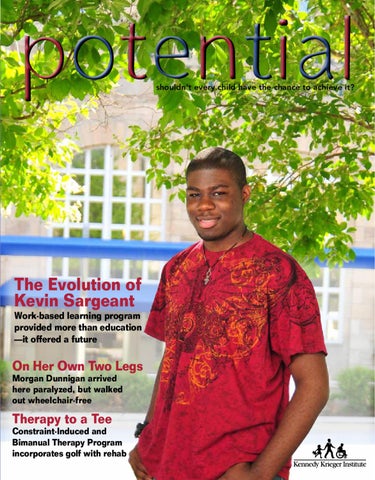
The Evolution of Kevin Sargeant
Work-based learning program provided more than education —it offered a future
On Her Own Two Legs Morgan Dunnigan arrived here paralyzed, but walked out wheelchair-free
Therapy to a Tee
Constraint-Induced and Bimanual Therapy Program incorporates golf with rehab
Stories of Potential
Every child is born with great
potential
shouldn’t every child have the chance to achieve it?
A publication of Kennedy Krieger Institute Volume 11/Number 2
n i d m , y I am very brave. m n I Ben’s Story
Stories of Potential Letter from our
President The most basic definition of the word “potential” is a possibility that’s capable of existing in reality. At Kennedy Krieger, it seems we’re redefining what those possibilities are. In this issue, you’ll meet several students and patients who faced circumstances and conditions that some professionals deemed insurmountable. When he was diagnosed with Asperger’s syndrome, Kevin Sargeant’s family worried whether he would ever thrive in grade school, let alone go to college. Morgan Dunnigan’s family was told she would never walk again. And Taylor Wilkerson, a patient with cerebral palsy and a hemiparesis in his right arm, defies the odds every day as a promising young golfer who turned to Kennedy Krieger’s Constraint-Induced and Bimanual Therapy Program to help improve his swing. It’s a story we hear often: So many of our patients come to us with grim prognoses, having been told that their best hope is learning to live with their illness or injury. But here, they find optimism and hope. For the individuals you’ll read about in this issue, what others believed to be impossible became realistic when their own perseverance and determination met that of the physicians, therapists, nurses, teachers, and other caregivers at Kennedy Krieger who devote themselves to helping children reach their full potential. All of these patients—and the numerous providers and caregivers who work alongside them—are living, breathing examples of how seriously Kennedy Krieger takes its mission of helping children everywhere to realize the potential they were born with. Their stories are both incredible and a valuable testament not only to the work we do, but to the potential inside so many people, given the right care and support. Sincerely,
3
Ben’s Story
FEATURES Therapy to a Tee: Constraint-Induced and Bimanual Therapy Program incorporates golf to help one patient on his path to rehabilitation.
4
On Her Own Two Legs: When an uncanny twist of circumstances left Morgan Dunnigan paralyzed, doctors predicted her condition was permanent...
6
The Evolution of Kevin Sargeant: High school’s work-based learning program provided more than just an education—it offered a future he never imagined possible.
8
RESEARCH Frontiers An Opportunity for Growth: For patients with Albright disorder, an elusive treatment emerges.
12
Program Spotlight Sleeping: Getting There and Staying There—Sleep disorders common in children with developmental disabilities
13
News brief & Events
14
Find us on Facebook, follow us on Twitter, watch us on YouTube, listen to us on iTunes. To learn more, visit www.kennedykrieger.org/connect.
potential Editor: Art Director: Graphic Designer: Creative Services Coordinator:
Lauren Glenn Manfuso Peggy White Emily Lee Sarah Finecey
Gary W. Goldstein, M.D.
On the cover: Kevin Sargeant has a bright future ahead. Photography by Steve Parke
Media Inquiries: Marketing Director: Publication Information: Patient Referrals:
Elise Babbitt-Welker Bryan Stark 443-923-7330 888-554-2080; www.kennedykrieger.org
potential is published by the Marketing and Public Relations Department of the Kennedy Krieger Institute, 707 North Broadway, Baltimore, Maryland, 21205. The Kennedy Krieger Institute provides care in accordance with all constitutional rights and without discrimination as to race, color, sex, age, national origin, religion, marital status, sexual orientation, genetic information, physical or mental disability, veteran status, or sources of payment for care. Additional safeguards include the preservation of personal dignity as well as cultural, psychosocial, spiritual and personal values, beliefs, and preferences.
It was a perfect day at the beach. The sun was shining, and the water was just right. Ben and his friends splashed in the waves and built sand castles, while his mom, Joanne, and the other parents chatted under the umbrellas, keeping a watchful eye on the children. But as the day came to a close, everyone headed back to the house, just a few blocks away. What happened next would change Ben’s life forever, and no one could possibly have seen it coming. One minute, everyone was enjoying a leisurely ride home on their bikes. The next minute, tragedy struck when Ben was hit by a car. He was unconscious, and after paramedics determined the possibility of a brain injury, Ben was airlifted to a hospital three hours away. During the coming weeks, Joanne, her husband, Dave, and their family could only wait and hope for the best. “I really try not to remember those days,” says Joanne. “You’re watching your little child who looks fine, who just has a couple abrasions, but knowing that what looks like sleep is actually a coma.” After 23 days in pediatric intensive care, it was time for Ben to begin rehabilitation at Kennedy Krieger Institute. After all they had been through, the family needed reassurance as they faced an uncertain path. “As we thanked everyone for what they had done for Ben, one of the doctors said ‘the real miracles happen at Kennedy Krieger,’” Joanne recalls. Because of the extreme severity of his injury when Ben arrived at the Pediatric Brain Injury Program at Kennedy Krieger Institute, his therapists had to start small. “Ben had to relearn everything,” says Joanne. “Not just how to walk and talk, but how to breathe and swallow. And the therapists at Kennedy Krieger knew how to help him do that.” His therapists worked to make him comfortable and to help him do something as seemingly simple as keeping his eyes open. Then they started moving his body for him, helping him sit in a chair. And, after all that, they had Ben try to use the muscles in his torso and his arms. As Ben continued to take small steps toward recovery, his therapists, nurses, and doctors found new and engaging ways to make therapy fun, a common practice in the Brain Injury Program. Kelly Dunkleberger, one of Ben’s therapists, remembers trying to figure out exactly what made Ben laugh, what he enjoyed. “We used all his interests from sports to video games,” notes Kelly. “We would incorporate things like table hockey to help him relearn hand control, and we’d play video games so he could practice visual scanning.” For Joanne, the sense of play and personalization of Ben’s therapies was one of the best parts of their time at Kennedy Krieger. A family favorite was VIP Video Game Fridays. “Our treatment team knew that Ben was the kind of kid who appreciates recognition,” Joanne says, “so they gave him a ‘VIP’ pass and let him play video games by himself for 20 minutes in the morning. It made him feel really special, and he wound up really enjoying his therapy.” Although to some it might seem like an unconventional approach, the team’s understanding helped Ben progress quickly. Now, three years later, Ben is back in school and back on two feet and his parents are making sure he gets as many opportunities as possible to enjoy his childhood. After Ben left the inpatient unit, he continued intensive outpatient therapy through the Institute. Joanne and Dave also received special parent training at Kennedy Krieger that taught them how to bring therapy into the home, so that the transition from the hospital to everyday life would be as seamless as possible. So, when Ben is having a blast swimming, shooting hoops, and running on the track team, he’s actually getting therapeutic benefit. “Not that long ago we were working to get him to just open his eyes,” says Joanne, “and now we’re worried about standardized tests at school. Now I know why they say the real miracles happen at Kennedy Krieger.” And as far as his family is concerned, it can only go up from here. “I don’t have limits for him,” Joanne says. “I can’t.” To learn more visit www.rehabilitation.kennedykrieger.org.
www.kennedykrieger.org
Therapy to a Tee
Constraint-Induced and Bimanual Therapy Program incorporates golf to help one patient on his path to rehabilitation From the beginning, and without hesitation, Katherine Wilkerson always offered her unwavering support of anything her son Taylor wanted to do. The thing is, though, until the age of 9, there was never much of anything the boy was too interested in trying. Diagnosed with cerebral palsy (CP) when he was 6 months old, Taylor had little patience for the instructions and prodding of the physical and occupational therapists who tried to help him gain dexterity and functionality in his left hand, rendered weak and ineffectual by a hemiparesis— a muscular weakness on one side of the body, often associated with CP. And so, instead of incorporating the advice of his therapists, Taylor simply learned to compensate by relying on his right side, using his left only as a helper of sorts. “He was too independent,” his mother explained. “He decided he wasn’t going to go along with it, and so he didn’t.” But then came golf, and with it a gradual realization that he needed his left arm after all. It was a discovery that would eventually lead him to the Kennedy Krieger Institute’s Constraint-Induced and Bimanual Therapy program, where a unique form of treatment awaited him. Taylor had watched his father play golf for years, until eventually watching was no longer enough. But the game wasn’t as easy as his father made it look, especially for Taylor, who in the beginning could barely grip a golf club, potential 4
let alone swing one. Still, he adapted. By the time Taylor turned 13, he’d made his middle school’s golf team. And yet even with a better swing and stronger game than most kids his age, he lacked the good grip and followthrough that can make a golfer great. So when, during a beach vacation in 2009, a family friend—and a Kennedy Krieger physical therapist—told Taylor and his mother about the Constraint-Induced and Bimanual Therapy Program (CIBT), the boy who had once rejected the instruction of therapists, found himself eagerly seeking their help. “He came here very motivated to get his arm stronger,” says Teressa Garcia Reidy, the occupational therapist who started working with Taylor when he was first admitted to Kennedy Krieger. “But his grip was weak, and his movement wasn’t very coordinated or fluid.” First launched in 2005, the CIBT program aims to help children with hemiparesis to learn to use their weaker limb by constraining their functional limb in a cast. It’s an intensive program that can be physically and emotionally challenging for children who are already struggling to get by without the assistance of the limb they’ve come to rely on, all while using a limb they’d long ago given up on. Patients attend several hours daily with physical and occupational therapists who strive to make therapy fun, not frustrating. “And,” Reidy says, “all therapy is play-based and childdirected, which makes it pretty fun for kids.”
Taylor Wilkerson works with golf pro Kelly Tomlinson, a local golf pro from the Country Club at Woodmore, to improve his swing. Occupational therapist Teressa Garcia Reidy (left) watches and offers input on hand placement.
The range of patients varies. They may work with todinteractive and physically demanding Nintendo Wii. “He dlers, teenagers like Taylor, elementary school-age children, went from not being able to really play the game to beatand older teenagers. Sometimes, Reidy says, they’ll have ing me at it,” Reidy says. patients who return for a refresher course to boost their funcWhile such recreational activities might not sound trationality. “As a clinician, I think the earlier you come to a proditionally therapeutic, they actually play an important role gram like this, the better off you are,” says Reidy. “More and in strength-building and improving dexterity. After all, to more research is supporting this kind of intensive therapy.” succeed they both require varying degrees of hand control Perhaps making it easier for patients are the constant and coordination in both hands. reminders that everything they’re doing will ultimately help Today, thanks to the skills Taylor has picked up in CIBT them succeed at something they want, a goal that plays a therapy, his mom says his chances of succeeding at what he primary roal in designing their therapy plan. A few years wants are much greater. ago, Reidy says, therapists in the program began giving patients a questionairre to evaluate their day and pick out problem areas. “We “He came here very motivated to get his arm stronger, really look at what’s important to the patient,” Reidy says, “and we really listen to what they but his grip was weak, and his movement wasn’t very want to work on.” And from day one, what Taylor wanted to coordinated or fluid.” —Teressa Garcia Reidy work on was golf. Knowing that, Reidy developed a plan for Taylor that focused on strengthening his grip and level of control. That plan culminated in a therapy session with a golf pro who worked “If he sets his mind to something he can do it,” Kathwith him on his swing and how to incorporate his new-found erine says. “Now, if something were to happen with his dexterity into his swing. “I never expected anything like dominant arm, he knows he could do OK with his left hand. that,” Taylor says. “I was just so excited that they would do And, long-term, this will open doors for him. I’m hoping something like that for me. I think I learned a lot about my that down the road he’ll look back and say, ‘Hey, if I hadn’t grip and how to hold the club better.” done this, I wouldn’t have done so well.’” n On first glance, the regimen Reidy devised might read more like a child’s summer activity list: along with golf, there were also card games, board games, basketball, and For more information or to schedule an appointment, please call particularly golf-related video games using the highly 443-923-4587 or toll-free at 888-554-2080. potential 5
On Her Own Two Legs When an uncanny twist of circumstances left Morgan Dunnigan paralyzed, doctors predicted her condition was permanent. With Kennedy Krieger’s help she proved them wrong.
Above: Morgan Dunnigan works with physical therapist Deanna Johnson during a follow-up visit to the Institute in 2010. Inset: Morgan has some recreational therapy time with her mom, Laura, and her little brother, Connor. Top right: Morgan and Johnson work in the aquatherapy gym.
Lying in a hospital bed on a Sunday night, Morgan Dunnigan believed her parents and physician when they said she would wake up the next morning for a surgery that promised to make the pain in her neck disappear, make the tumor hurting her spine go away, make everything better. They couldn’t have been more wrong. Instead, the next morning—a cold Monday in December 2005—she woke up paralyzed from the neck down, unable to breathe unassisted. The story behind 6-year-old Morgan’s ordeal began with a strange itching sensation in her neck. It didn’t seem major, says her mother, Laura Dunnigan. Morgan would scratch her neck and go on about her business. But eventually the scratching and itching evolved into pulling and tugging at her neck and shoulder muscles, trying to relieve the discomfort. “Even Morgan’s teacher started to notice she was pulling at her neck, but that she seemed to be able to go about her day,” Laura recalls. “It wasn’t until it really became painful one night, well after multiple doctors couldn’t find a reason for it, that we took her to the emergency room.” The seven months before held a series of misdiagnoses and misguided opinions: maybe it was stress, maybe a skin condition, maybe it was the detergent they used, maybe she was just looking for attention after the birth of her baby brother. “But then in December she started crying in her sleep, saying it hurt,” Laura remembers. Distraught, exasperated, and at their wit’s end, Laura and Morgan’s dad, Colin, took her to a local hospital, where an MRI revealed a tumor growing along her spine. The doctor surmised the tumor had been growing there since she was a baby, gradually compromising her spine and the surrounding nerves. He recommended surgery, and soon. But in a horrible twist of fate, the night before her
“I always tell her how fortunate I feel that I got to see her take her first steps twice, The second time, in some ways, was even better, because they were so hard-won.” — Laura Dunnigan, mother
surgery, Morgan’s spine could take no more. The tumor won while she slept, and the Dunnigans were horrified when they woke their daughter that morning and discovered she could not move. Then, as they were wheeling her into the surgical unit, she began struggling to breathe. Colin’s last memory of her that morning was the sight of a nurse using a breathing bag on Morgan as her oxygen dropped to a dangerously low level. The operation was successful and the tumor removed, but the damage seemed to be done. Morgan woke from surgery still unable to move or breathe. With the surgery complete and the tumor successfully removed, the Dunnigans searched for a hospital to help Morgan recover. But there was another devastating challenge for the family to contend with: None of the physicians Laura and Colin consulted believed Morgan could recover. “They didn’t even refer to her by her name,” Laura says, her eyes welling with tears. “They kept saying, ‘As a quad, your daughter will do this.’ That was very upsetting.” Determined to keep searching, the Dunnigans eventually came to the office of Dr. John McDonald at the International Center for Spinal Cord Injury at Kennedy Krieger Institute. The moment they arrived, hope came on the horizon. The people in the center, Laura says, wanted to know about Morgan as an individual—her likes and dislikes, her personality, her life before the injury—not just the severity of her injury. Best of all, while other hospitals declared it impossible for Morgan to walk again, the staff at Kennedy Krieger—after an exhaustive battery of tests and reviewing her medical history—believed it not only possible, but probable. “Dr. McDonald said, ‘There’s no reason Morgan can’t walk again,’” Laura says. “They didn’t
www.kennedykrieger.org
know when it would be. It could be four weeks, four months, or four years. But finally we had hope.” Even so, there was still hard work ahead. And so began months of intensive therapy. When Morgan was admitted to Kennedy Krieger on January 10, 2006, she was capable only of a slight arm movement. Prodded by her mom, dad, and therapists Elena Bradley and Deanna Johnson, Morgan worked incredibly hard, using a variety of the technologies available at Kennedy Krieger’s state-of-the-art physical therapy gym, including an innovative functional electrical stimulation (FES) bike, which stimulates paralyzed muscle, promoting movement after paralysis. But it wasn’t all work and no play. In fact, play, as it turned out, proved an important part of Morgan’s recovery, from coloring to crafts to games. “Of all the places we looked at, I’ve never seen a place as playful as Kennedy Krieger,” Laura says. “They really make it fun for these kids. They don’t just say, ‘OK, let’s do sit-ups.’ They find a way to make it fun. And I really think that made a major difference.” Barely one month after arriving, Colin was sitting in Morgan’s hospital room, while his daughter and wife worked in the therapy gym. Suddenly, in came Laura with an astonishing announcement. “She said, ‘Morgan just took a step!’” Colin recalls. It was literally a baby step, but it was a step, nonetheless. It was one step further than they ever thought possible, and it was only the beginning. “I always tell her how fortunate I feel that I got to see her take her first steps twice,” Laura says. “The second time, in some ways, was even better, because they were so hard-won.” And just a few weeks later in May, four months after she rolled into Kennedy Krieger on a stretcher, she stepped out the front door on a walker. “The day she discharged, I remember she walked out the front door, and down the block, and then we put her in the wheelchair,” Laura says. “And I remember thinking, ‘OK, here we go. We’re starting our life now.’” n To read about physical therapist Elena Bradley’s experience working with Morgan, visit www.blog.kennedykrieger.org.
To learn more or make an appointment with the Intermational Center for Spinal Cord Injury, call our Care Management Office at 443-923-9222 or toll-free at 888-923-9222, or email info.sci@spinalcordrecovery.org.
potential
7
The
Evolution of Kevin Sargeant High school’s work-based learning program provided more than just an education—it offered a future he never imagined possible. Given a choice, Kevin Sargeant says he could do without all of the independence and opportunities that adulthood promises. But adulthood, it seems, is coming for him nonetheless. Six years ago, the prospect would have had him quivering in confusion, fear, and anxiety—if he chose to acknowledge it at all. Back then, Kevin says, he was shelled up, locked in, lower-functioning, or any other of the myriad terms often used to describe children diagnosed with autism spectrum disorders. “For so long, I was just on autopilot. I was just living this empty life, but I didn’t even realize it was empty, because I didn’t know anything else,” says Kevin, who was diagnosed with Asperger’s syndrome when he was 11 years old. “The world existed to help Kevin, and Kevin existed to be helped, and that’s all there was.” To say simply that he’s changed wouldn’t do justice to the transformation that occurred between his first day as a sixth grade student at Kennedy Krieger Middle School and his graduation in May 2010. By all appearances and accounts, he is, in fact, a completely different young man. “It’s been done to death, the caterpillar to butterfly analogy,” says Joe Ryland, who taught Kevin several times throughout the course of his high school education at Kennedy Krieger. “But to see him come out of that shell over time, it was amazing.” Of course, as Kevin evolved, so did his perspective. Today, his world—and his own place within it— differs drastically. Thanks to his education here, Kevin Sargeant thrived in Kennedy Krieger High School’s work-based learning program, which helps Kennedy Krieger High School students to learn more about potential career paths.
including his experience with the high school’s work-based learning program, which gives students a chance to experience real-world job experiences, there’s now a world out there just waiting for him to venture into it. Perhaps the biggest change of all, however, is that he’s ready.
When Age Is Just a Number It is perhaps one of the foremost goals in any school system: prepare your students for the world ahead. But for students diagnosed with developmental, intellectual, or learning disabilities, adulthood and independence don’t necessarily go hand in hand. Milestone birthdays may come and go and still find these children needing significant support and assistance from parents and caregivers. For many of these young men and women, coming of age is more a concept than a reality. Independence can be either a dream or a nightmare, depending. “I realized a long time ago that adult living was going to be harder than being a kid, so I’ve never really looked forward to it,” Kevin says. “For some reason everyone thinks independence is cool, but when I look back to being 8 years old, I could go out, ride my bike, have fun all day, come home to a nice warm dinner, take a bath, hug my mom, and then do it all over again the next day. Adults have bills to pay.” Kevin only recently began considering the possibility of a future outside the routine comfort and security of his mother’s home and the familiar surroundings of his school. It wasn’t until his involvement with the Kennedy Krieger High School’s work-based learning program that he imagined life as an independent adult and realized that it was something he not only could do, but had to. continued on the next page
potential
8
potential
9
“Kevin can see now that work isn’t something to be afraid of. It’s an opportunity to get new skills and figure out how to navigate a workplace.” –parent, Jennifer Sargeant Above: Joe Ryland (left) taught Kevin several times during his high school education.
On-the-Job Learning Starting their freshman year, Kennedy Krieger high school students embark on a four-year program that begins by exploring different vocations, then declaring a major, and, finally, participating in workbased learning opportunities, whether in one of several school-run businesses or, the best-case scenario, an actual internship outside the perimeters of the high school’s Greenspring Campus. Selected from one of five industries—information technology, hospitality and tourism, manufacturing and construction, horticulture, or retail and consumer services—a student’s major stays with him throughout his education and plays a significant role in the curriculum. The goal is that, upon graduation, students emerge from high school with training in their vocation of choice, and, ideally, prepared to work and earn a living, though some still require substantial support and guidance in some form or another.
“One of the biggest goals for those of us in special education is to prepare these students for transition out of high school and into the community and workforce,”says assistant principal Shanna Pool. “The key is to consider their individual strengths and potential needs, which may be related to a disabling condition,, and use that information to develop training opportunities in school to assist these students in reaching their full potential.” One former student in Kennedy Krieger’s retail industry, for instance, showed a keen aptitude for customer service, Pool says, an interest that was nutured into a marketable skill at Port Discovery Children’s Museum. For Kevin, the best fit turned out to be information technology. He likes computers and the somewhat predictable, cause-and-effect nature of them. “When you click a button, something happens, and it happens for an exact reason,” he told the National Public Radio (NPR) program, All Things Considered. The NPR program featured Kevin during a show about Kennedy Krieger’s work-based learning program and its success in helping
students with disabilities to develop skills and, subsequently, a brighter future. “With computers,” Kevin explained, “there’s no guesswork.” Because he has autism, he says, computers are sometimes easier to read than people.
From Classwork to Career Work It makes sense. Social interaction—particularly difficulties reading social cues—is a common challenge for people with autism. It’s also a huge hurdle in finding and retaining a job, starting with the job interview. Often awkward under the best of circumstances, job interviews become even more difficult when a job candidate has a disability that prevents him from easily conversing and interacting with employers and peers. Kevin, for instance, struggled during his own interview with the Baltimore nonprofit Parks and People Foundation, where he was applying to do an IT internship during his senior year. “In school Kevin had plenty of things to say, and he’s very articulate,” Pool says, “but when he got in front of a potential employer he seemed unsure of himself and had very little to say, only answering questions with a yes or no.”
Pool attended the interview with Kevin, providing the cues and guidance he needed to describe the hands-on experience he received as an information technology major and to give the kinds of comprehensive answers future employers look for during an inerview. “Next time he goes to an interview, he’ll be able to take that experience with him.” she says. In the end, Kevin got the internship. Within a few weeks, his supervisor and teachers found he needed little assistance or guidance during his workday, and Kevin was working without a Kennedy Krieger staff member by his side. In the process, he became a valuable member of the Parks and People team. “Usually, the best you can hope for when you put a student in work-based learning is that they’ll be successful,” Ryland says. “But to find that they’ll actually be an asset to the company they’re placed with? It’s ideal, but not expected. Kevin really proved himself there.”
What Comes Next? Now, having graduated from high school in May 2010, Kevin is preparing to take classes at a local community college.
Eventually, he sees himself moving out of his mother’s house, working, and possibly pursuing his master’s degree. It’s a decision his family supports, particularly his mother. “As a parent, you’re always worried about your child being vulnerable, so we need to be certain he’s able to handle situations on his own, even situations he’s never experienced before,” explains Kevin’s mother, Jennifer Sargeant. “Right now, I don’t know that he’s 100 percent there, but he’s definitely on the road, and he’s willing to work on what he needs to in order to be independent.” Of course, there are still challenges, Kevin says. “I’m still trying to figure out certain things, especially social cues, like why people do certain things, and what they mean when they do.” Still, he’s come a long way. Ryland remembers an incident during Kevin’s senior year that showed just how far his student has come. That morning, one of his classmates—a girl—was visibly upset, but would speak to no one about what was troubling her. “Kevin went and sat next to her, and he said, ‘If you need anything, I’m here for you.’”
It was an action that in a typical classroom might be viewed as kind, but unextraordinary. But for a student with Asperger’s, who struggles with social interaction, it showed amazing perception and progress. It turned out the girl was having troubles at home. She’d been up all night, Ryland recalls, distraught and hurting. “But Kevin talked to her and actually made her feel better. As a freshman, he wouldn’t have even noticed. Back then, he was only worried about Kevin. Now, he was able to see her, see that she was upset, and comfort her. That’s huge.” It’s also indicative of the future Kevin sees for himself. While he excels in IT work, Kevin has goals beyond computers. “I want to study psychology,” he says. “My friends call me the therapist, because they come to me when they have a problem. Everyone has problems in their life and needs someone to talk to.” He wants to work with grown-ups, he says. Most of all, he wants to help people the way he’s been helped. “Seven years ago,” he says, “you’d never have guessed I’d be here now.” n
research frontiers
Program Spotlight
An Opportunity for
f
Growth
For patients with Albright disorder, an elusive treatment emerges.
For years, Albright hereditary osteodystrophy lurked in the shadows of the developmental disorder world, obscure and unrecognizable to many physicians. Affecting an estimated fewer than 200,000 patients across the United States, the disease was virtually as difficult to diagnose as it was to treat, often leaving patients uncertain of their futures and how to lead healthy, quality lives. Albright syndrome prevents the body from recognizing and responding to certain hormones, particularly parathyroid hormone, which regulates the body’s absorption and use of calcium and phosphorus, and, consequently, bone growth and formation. One of the confounding aspects of the disease is that, for much of their childhood, patients appear to grow absolutely fine. Then, suddenly, their bones prematurely fuse, and, before they can experience the critical growth spurt that accompanies puberty, they stop growing entirely. For men this often means an average height of around five feet, while women average 4 feet 9 inches. Meanwhile, the sheer rarity of the disease causes a disparity in research funds, which for many years has rendered unlikely the development of any sort of targeted pharmaceutical approach to treat Albright syndrome. But then came Emily Germain-Lee and, with her, research for a treatment that could help many of these patients to overcome some of the complications associated with the disease and live healthier and happier lives because of it. At the Albright Clinic at Kennedy Krieger Institute, Dr. Germain-Lee treats the world’s largest group of pediatric and adult Albright hereditary osteodystrophy patients, providing the most comprehensive care available to patients with this disorder, which is augmented by Kennedy Krieger’s breadth of experience and expertise in diagnosing and treating developmental disorders and conditions associated with them. Staffed by a multidisciplinary team that includes experts in endocrinology, orthopedics, genetic counseling, neurology, physical and occupational therapy, and other specialties, the Albright Clinic also provides patients the opportunity to participate
in several clinical research trials. It’s an impressive offering, considering the rarity of the disease and the number of physicians experienced in treating it. Shortened height is only one of the challenges these patients face. Obesity, hormonal abnormalities, cognitive problems, learning disabilities, obsessive compulsive disorder, autism—all are risks and conditions common in patients with Albright syndrome. Then there are the often painful bony deposits that form under the skin and the limb malformations, such as short fingers, that the disease causes. Unfortunately, like so many developmental disorders, there is no cure and just treating the symptoms and complications, which are often rare and complicated in and of themselves, can prove difficult for physicians. The foundation of Germain-Lee’s Albright work is grounded in a genetic abnormality, found in about two-thirds of her patients, which leads to a deficiency of human growth hormone (HGH). Secreted by the brain’s pituitary gland, growth hormone is responsible for stimulating cell reproduction, growth, and regeneration throughout the body, including a person’s bones. In 2003, Germain-Lee discovered that in patients with this condition, their inability to effectively process hormonal signaling disrupts their body’s ability to make growth hormone, ultimately contributing to their short stature obesity. “These patients get something of a double whammy,” she explains. “They end up short not only because a genetic defect causes their bones to fuse earlier, but also because they lack the growth hormone needed to encourage continued growth.” And so Germain-Lee embarked on an FDA-sponsored clinical trial, in which she administers HGH to Albright patients deficient in the hormone, believing that perhaps such a treatment could improve their height and weight. So far, the results are promising. “Indeed, over the many years I’ve been doing this, I’ve found that it does increase their final heights, and I’ve also
Sleeping:
Getting there and staying there Sleep disorders common in children with developmental disabilities Any parent who’s ever struggled to put a child to bed— whether as an infant or a teenager—knows well the effects that poor sleep habits can have on an entire household. For some children the trouble might be something as common as difficulty falling asleep. For others, perhaps night terrors or sleep walking. In children with developmental disabilities, sleep disorders are all too common and run the gamut. In fact, says Dr. Jennifer Accardo, name a developmental disability, and there is probably a set of sleep problems that typically accompanies it. An estimated two-thirds of children with developmental disabilities suffer from some form of sleep disorder or problem—a significantly higher number than the 30 to 40 percent of typically developing children with sleep issues. And for parents who are already trying to cope with the challenges of raising and caring for a child with a developmental disorder, sleep struggles—and the related health and behavioral problems they can cause—are one more uninvited worry. “One of the huge problems resulting from a child not sleeping well is that it affects their entire family,” Accardo says. “Because when there’s a child awake, what you also get is a parent who’s awake and trying to cope with the child. Then you have a sleep-deprived parent with that much less energy to devote to parenting an already challenging child.” “It’s very widespread among our patient population,” says Accardo, a neurologist and sleep specialist who oversees the Institute’s Sleep Center and Lab. “Many of the kids here tend to be ‘all of the above’ kinds of kids. It’s not just snoring or airway obstruction, it’s also behavior, it’s a bit of everything,” Accardo explains. “That’s why a big
continued on page 15 potential
12
www.kennedykrieger.org
part of our program is based on neurology and behavioral psychology working together. The kids who come through the Sleep Center really experience both aspects of care.” With so many of these children experiencing sleep issues, it makes sense, then, that physicians at Kennedy Krieger—whether they specialize in Down syndrome, cerebral palsy, autism, or other disabilities—often encounter sleep problems in their patients. For these physicians and the families they work with, the Sleep Center offers something more. “We are specifically interested in working not only with children with disabilities who have sleep problems, but also their families,” says Accardo. The entire family, after all, can be affected by a child’s sleeping troubles, and likewise, can play a role in the solution. These are children with complex problems, she explains, who, in addition to sleep-related difficulties, may present a variety of physical or behavioral problems that complicate the issue even further. “Any sleep clinic you go to will see some kids with disabilities,” Accardo explains. “But they’re really the focus of this clinic. That’s who we see, and it’s what we’re about.” Some of the issues the clinic often sees are difficulty falling and staying asleep, chaotic or disruptive sleep patterns, unusual behaviors during sleep, and snoring. The sleep center’s team offers both medical management and behavioral interventions, depending on the child. “A lot of clinicians tell us, ‘I have this one patient who has never slept very well, he’s doing this unusual thing when he sleeps, nothing is working, his parents are at the end of their rope, and we just can’t figure it out,’” Accardo says. “It’s these types of complex kids who we are set up to see.” continued on page 15
www.kennedykrieger.org
potential 13
news brief & events
ROAR For Autism To raise awareness and critical funds for autism research, Kennedy Krieger Institute held its seventh annual ROAR for ge Autism on May 1, at Oregon Rid Park in Cockeysville, Md. Disease According to the U.S. Centers for has Control, the prevalence of autism Krieger y ned Ken n. dre chil 110 risen to 1 in in continues to be a national leader earlier vide pro to ing striv , arch autism rese again, diagnosis and intervention. Once ed toadults and children of all ages join oundsurr nce sile the ak bre gether to help millions ing autism by “ROARing” for the ’t. can who of children and activities for everyone, ROAR for Autism featured events mile rides, a 10-mile ride for including challenging 50- and 25designed for beginner cyclists, and recreational bikers, a 5-mile ride preferred to remain on two feet a youth fun ride. Participants who located at Oregon Ridge Park. hiked the many nature trails also Village was back again, featuring The popular Wegmans Wellness g those with children on special healthy food for families, includin re walk, and great food, the diets. In addition to a bike ride, natu games, balloon animals, and family fun festival featured carnival e to enjoy. musical entertainment for everyon nt, visit For more information on the eve and become a fan of the rg er.o ieg ykr ned ken www.ROAR. ook.com/ROARforAutism. event on Facebook at www.faceb
Bands on the Bay Music lovers and families came out to rock ‘n’ roll for a good cause at the sixth annual Bands on the Bay event May 1. The annual fundraiser for the Hunter Nelson Sturge-Weber Center at Kennedy Krieger Institute featured music by the Doug Segree Band; Orlando Phillips, a Caribbean music steel drum musician, and former lead vocalist of Caribbean music group Mama Jama; the Fitzmaurice Band; and solo artist, Adam Day. The Washington Redskins cheerleaders also made a special appearance. The event also featured silent and live auctions offering a chance to win exclusive items, such as sports and entertainment memorabilia, hand crafted items, sports tickets, and more. The Bands on the Bay fundraiser is organized by the family of Jenna Heck, an Annapolis-area child born with the rare disorder Sturge-Weber Syndrome (SWS). SWS is most easily identified by a port-wine birthmark on the face of those affected and also characterized by blood vessel abnormalities in the brain, skin, and eyes, which can cause countless health complications including seizures and glaucoma. Funds raised at Bands on the Bay benefit the Sturge-Weber Center. During the past five years, the event has raised more than $800,000 to support SWS research that would have been impossible otherwise. For more information about Bands on the Bay, visit www.BandsontheBay.org.
New blog shares stories of patients who inspire Kennedy Krieger’s employees
The Institute’s website and magazine are filled with stories of how our physicians, nurses, therapists, scientists, and teachers help children to unlock their potential through innovative patient care, special education, and research programs. But until recently, there has also remained an untold narrative: how the children and families we serve, in turn, inspire the employees of Kennedy Krieger and give profound meaning and inspiration to our work. To tell these stories, the Institute recently introduced its Inspiring Potential blog at www.blog.kennedykrieger.org. We welcome your feedback and comments. Feel free to email us at InspiringPotential@KennedyKrieger.org. Learn More. Get Involved. Stay Connected.
potential
14
Receive News, Updates, & Alerts Learn about news, advancements, inspiring stories, great events, and more through our publications, e-mail updates, sms alerts, and online communities www.kennedykrieger.org/subscribe
Volunteering & Events Whether you’re donating your time and talents or attending an Institute event, your support is the key to unlocking the potential of a child with special needs. www.kennedykrieger.org/engage
Join Us Online Visit our online communities to follow, watch, read, listen, and join the conversation. www.kennedykrieger.org/connect
Autism is a puzzle. You could hold the missing piece. Linking researchers and families online to advance research, interpret findings, and empower advocates in the autism community. Join the nation’s largest online autism research effort today at www.ianproject.org.
Sleeping
Getting there and staying there continued from page 13 One beneficial aspect of the program is the clinic’s Sleep Lab. Staffed by pediatric neurologists with expertise in sleep medicine, the Sleep Lab offers studies that can incorporate both polysomnographic and EEG technology. The lab also plays an important role in the clinic’s treatment approach. “Our lab is geared toward children with disabilities and staffed by technicians who understand these kids and are familiar with their unique neurological and behavioral challenges,” Accardo says. In addition to the technical benefits offered by the lab, the program’s behavioral psychology component plays an integral role in treating children, whether by modifying their environments and shaping better sleep habits, or by preparing patients for the unusual experience of a sleep study, during which multiple monitors are attached to the child. “We want to see kids who, because of behavioral challenges or other problems, would otherwise have difficulty getting through a sleep study,” says Accardo. For more information or to schedule an appointment, please call 443-923-9400 or toll-free at 888-554-2080.
An Opportunity for continued from page 12 seen decreases in their weights and improvements in their lipid parameters,” Germain-Lee says. The trial, she continues, is ongoing. She has now initiated the second phase of this trial for growth hormone-sufficient Albright children. “I get patients from all over the world coming here to Baltimore seeking help in treating the problems caused by a poor response to hormones.” For years, treating those problems typically included managing calcium and phosphorus levels, orthopedic therapies, nutritional management, and addressing cognitive and behavioral issues. But there were no options for correcting the patients’ height or preventing any of the numerous other
www.kennedykrieger.org
Growth
problems they experience. However, Germain-Lee’s work with growth hormone is the starting point in the search for promising treatments. “So far, it looks like this therapy is having a real impact on height,” she says. “My overall goal is to improve their quality of life, because when you’re as short as many of these individuals are, it has a big effect on your self-esteem. Changing that can have a big impact on people’s confidence and well-being.” Conducting the growth hormone trial at Kennedy Krieger Institute, she says, with its incredible resources for her patients’ cognitive, developmental, and skeletal problems, has been invaluable for her patients and their families.
potential 15
NON-PROFIT U.S. POSTAGE
PAID
PERMIT #7157 BALTIMORE MD
707 North Broadway Baltimore, Maryland 21205
C h a r i t a b l e
G i f t
P r o g r a m
Leave a Legacy that Unlocks a Child’s Potential It’s human nature to want to be remembered for something great. And can you think of anything greater than helping a child isolated by autism learn to communicate? Or paving the way for a child with a spinal cord injury to take her first step? Today, many are making a child’s future their legacy by becoming participants in Kennedy Krieger’s Planned Giving Program. These planned gifts allow for a great deal of flexibility and choice, depending on your personal financial needs. Some options offer immediate tax benefits, while others provide a guaranteed income for life. But all ensure that as long
Please complete and return to the Kennedy Krieger Institute using the enclosed postage-paid envelope. Name:_____________________________________________________ Address:___________________________________________________ Phone:____________________________________________________
as there are children with developmental disabilities, Kennedy Krieger will be there to help them unlock their potential.
To find out more, contact the Kennedy Krieger Foundation at 443-923-7300 or visit www.helpkids.kennedykrieger.org.
Potential_FALL2011-mailingpanel_v2.indd 16
q I’m interested in learning more about how to put the Kennedy Krieger Institute in my will. q Contact me about planned giving options at the Kennedy Krieger Institute.
6/24/11 10:17 AM