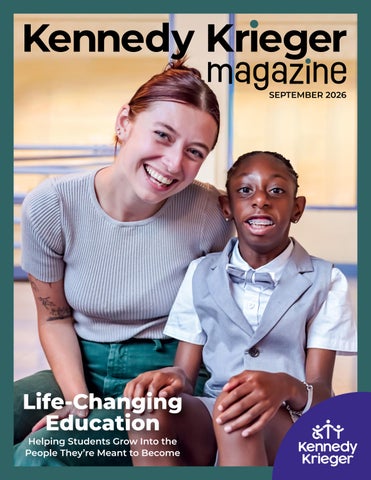
SEPTEMBER 2026
Life-Changing Education Helping Students Grow Into the People They’re Meant to Become
Letter From Our President Dear Friend, At Kennedy Krieger Institute, education is a pathway to possibility. Each day, our educators at our five schools meet students where they are and help them grow into the people they are meant to become. Through highly individualized approaches, our schools support the educational needs of publicly funded students from Maryland and Washington, D.C. Our students typically have intellectual disability, medical and psychiatric complexity, and behavioral challenges. Our approach, which is highly successful, is intended to ensure that every student receives the depth of understanding and the opportunity to achieve that they deserve. What makes education at Kennedy Krieger so powerful is our commitment to the whole child. Our interdisciplinary teams of educators, classroom aides, therapists, and clinicians work together to create environments where students feel seen, included, and empowered. Progress is celebrated in all its forms because every step forward matters. In this issue of Kennedy Krieger Magazine, we highlight the future of this work through plans for a Center for Specialized Education Innovation (Page 8). As you will read, this initiative reflects the insight of one of the nation’s most respected education leaders, Dr. Nancy Grasmick (pictured here at Kennedy Krieger High School’s 2026 graduation), who served as Maryland’s state superintendent of schools for two decades, making her the longest-serving state superintendent in the country. Throughout her distinguished career, she has been a passionate advocate for high standards, equity, and innovative approaches in education that help to ensure all students have every opportunity to succeed. Her perspective helps underscore the importance of advancing a precision approach to education through tailored, datainformed strategies designed to meet each student’s unique strengths and challenges. We are energized by what lies ahead, and we’re excited to bring this vision to life in the years to come. Kennedy Krieger is where students discover what is possible, and where hope happens for every child, every family, and every future. Warmly,
Bradley L. Schlaggar, MD, PhD President and Chief Executive Officer The Zanvyl Krieger Faculty Endowed Chair Kennedy Krieger Institute
INSTITUTE BOARD OF DIRECTORS Chair Maynard McAlpin Ronald R. Peterson Beth F. McGinn Vice Chair Andrew Miller, JD Matthew A. Gotlin, CFA Howard B. Miller, Esq. Preston G. Athey Wendy L. Morris Sandra R. Berman Sandra S. Pagnotti-Mayhew Thomas S. Bozzuto Anju Rao, PhD Van D. Brooks Stephanie L. Reel, MBA Watchen H. Bruce Peter B. Rosenwald II Richard W. Cass Bradley L. Schlaggar, MD, Ikechukwu Tony Chukuka PhD Stephanie Cooper Kenneth C. Schuberth, MD Greenberg Andrew H. Segal, MD Dulany R. Dent Robert L. Sloan Nancy S. Grasmick, EdD Barbara S. Slusher, PhD, Michele J. Guyton, PhD MAS Alvin C. Hathaway Sr., PhD, Francie Spahn, Esq. DMin David G. Sweiderk Richard J. Himelfarb Paul S. Thesiger, MD Erik B. Howard Alicia L. Wilson, Esq. Raymone T. Jackson Joyce S. Wong, MD Renee R. Jenkins, MD, FAAP Judy C. Woodruff Daniel S. Koch, JD Adam S. Zarren, Esq. FOUNDATION BOARD OF DIRECTORS Chair Preston G. Athey Vice Chair Nancy S. Grasmick, EdD James M. Anders Jr., CPA, MBA, CGMA® Robert A. Baruch Linda S. Cameron, MBA Richard W. Cass Cynthia Cavanaugh K. Patrick Davis Aimee Fulchino
Matthew A. Gotlin, CFA Alvin D. Katz, CPA Jodi I. Love Beth F. McGinn K. Brigid Peterson, JD Ronald R. Peterson Bradley L. Schlaggar, MD, PhD Robert L. Sloan Francie Spahn, Esq. David G. Sweiderk
September 2026 Volume 26, No. 2 EDITOR Laura Thornton
ART DIRECTOR Erin Parsons
CONTRIBUTING WRITERS Noah Baptiste, Arriane Kernes, Colette Nguyen, Lauren Padilla, Alyssa Racosky, and Marc Shapiro
DESIGNER Catie Bates
PROOFREADER Nina K. Pettis SENIOR DIRECTOR OF MARKETING OPERATIONS Sarah Mooney DIRECTOR OF PR AND SOCIAL MEDIA Abigail Lefin
PHOTOGRAPHY David Stuck, Kim Zaruba, and others AVPS OF MARKETING AND COMMUNICATIONS Justus Burkhardt and Jessica Gregg AVP OF PHILANTHROPY MARKETING Melinda Michel
For media and public relations inquiries, email: Media@KennedyKrieger.org
SEPTEMBE
R 2026
For more stories and news, visit: KennedyKrieger.org/Magazine On the cover: Chozin, 8, a student of Kennedy Krieger School Programs, with his teacher, Orlagh McKenzie. Read his story on Page 6.
Life-Chan gin Education g
Helping Stud ents Grow People They Into the ’re Meant to Become
What’s inside... Precision Education
Our school programs have developed evidencebased, individualized approaches to educating students with specialized learning needs. Our new research center will codify and share these practices with the wider community, helping even more children across the country and around the world learn and grow.
6
Chozin
His parents refused to let a diagnosis define his future.
8
7
Kendall
Finally, she had the opportunities she’d always wanted.
12
Dominic
After an incredible recovery, he knew he had to give back.
and this... 4 Living Skills Classrooms
11 On Display: Art That Heals
5 CORE Careers Job Training
13 Newborn Screening
10 Therapeutic Foster Care
14 News, Events, and Awards
10 A Unique Perspective Kennedy Krieger Magazine is published by the Marketing and Communications Department of Kennedy Krieger Institute, 707 North Broadway, Baltimore, Maryland 21205. Kennedy Krieger Institute recognizes and respects the rights of employees, trainees, and patients and students, and their families. Kennedy Krieger Institute is a 501(c)(3) nonprofit organization committed to improving the lives of individuals with nervous system disorders through medical care, education, and community programs. Email us at Magazine@KennedyKrieger.org to update your contact and mailing information. Send an email to Unsubscribe@KennedyKrieger.org or visit KennedyKrieger.org/Unsubscribe to unsubscribe from future Kennedy Krieger Institute communications. ©2026 Kennedy Krieger Institute
Skills for INDEPENDENCE Life skills classrooms at Kennedy Krieger School Programs offer students hands-on opportunities to develop daily living skills.
By Noah Baptiste Within Kennedy Krieger School Programs, students with disabilities are learning life skills through hands-on settings. By simulating living spaces and other common environments, the classes allow students to translate what they learn into realworld situations, support their independence, and prepare them for life after school. “These genuine experiences help students see the value and relevance of what they’re learning,” says Bibiane Kanzler, principal of Kennedy Krieger’s Powder Mill Campus school, which serves students in second grade through age 21. “We see many students develop a sense of pride in their work when they can apply their new skills in meaningful and practical ways.” The Powder Mill Campus school, located in Prince George’s County, outside Washington, D.C., has provided life skills instruction for many years, but it wasn’t until the 2025–2026 school year that the school introduced a classroom that simulates an apartment space. The apartment includes a kitchen area with a stove, microwave, dishwasher, and refrigerator; a laundry area with a washer, dryer, and ironing station; and a sleeping area with a bed and wardrobe. Previously, the instruction in food preparation, cleaning, and other life skills was primarily delivered in a traditional classroom setting, which limited the students’ ability to physically practice their skills.
“We see many students develop a sense of pride in their work ... .” 4
– Bibiane Kanzler
Building Confidence
In Kennedy Krieger High School’s newly remodeled kitchen skills classroom, students practice skills such as following directions, solving problems, safety awareness through cooking, and meal preparation. The class also strengthens students’ motor skills and creates natural opportunities for social interaction with peers. “Our kitchen skills classroom bridges the gap between academic instruction and everyday life, making learning both practical and purposeful,” says Lindsay Turwy, principal of Kennedy Krieger High School. “We recognize that cooking is far more than a household task—it’s a powerful way to build independence, confidence, and communication skills.” The classrooms have been well received by both the students and their parents. “The parents are so excited when their child brings kitchen skills home, and they’re deeply encouraged by the capabilities their children have developed,” Turwy says.
Experiential Learning By constructing alternative learning settings that help students stay engaged, Kennedy Krieger’s life and kitchen skills classrooms are models for other schools serving students with disabilities. These environments demonstrate how experiential learning can make skill development more meaningful and effective. Funding for the Powder Mill Campus life skills classroom was provided, in part, by The Morris and Gwendolyn Cafritz Foundation, while the remodeling of the high school kitchen classroom was funded by the Orokawa Foundation and the Lois and Philip Macht Family Philanthropic Fund. Visit KennedyKrieger.org/Schools for more information on Kennedy Krieger School Programs. Left: Serhan works with teacher Sara Josephson in the Powder Mill Campus school’s life skills classroom. Above: Brandon and Aiden work in Kennedy Krieger High School’s kitchen skills classroom.
Fostering Careers
Kennedy Krieger’s CORE Careers program supports individuals with developmental disabilities in finding jobs—and thriving in the workplace. By Arriane Kernes Kennedy Krieger Institute is recognized nationwide for its excellent school programs and patient care. Its commitment to individuals with neurological, rehabilitative, and developmental needs doesn’t end there. Through the CORE Careers program, offered by Kennedy Krieger’s Neurodiversity at Work department, the Institute also helps individuals with disabilities enjoy the dignity of work through employment. “Community members may come to us ready for employment, or they may already have found a job but need support in their new workplace, or they may come to us really needing those building blocks to get ready to have a job,” explains Hannah Wayne, director of Neurodiversity at Work. “We designed CORE Careers to offer different pathways to employment—to offer the steppingstones that everyone needs to be a part of the workforce.”
Training for the Real World CORE Careers is part of Neurodiversity at Work’s larger CORE Foundations program, where the words “Community,” “Opportunity,” “Respect,” and “Employment” don’t just provide the letters that make up the acronym, but also guide the program’s entire mission. CORE Careers focuses on the “Employment” aspect: In Empowering Employment, its 20-week, on-the-job, train-to-hire program, participants—referred to as “community members”—learn valuable job-development skills through hands-on training. CORE Careers is designed to adapt to the needs of community members at their pace, no matter how
far along they are in their careers. Services offered include mock interviews; social skills training; help with building resumes; a weekly job-readiness curriculum; ongoing, long-term, one-on-one employment support; and more. CORE Careers also partners with and supports a variety of businesses by providing training, guidance, and resources to help create inclusive and supportive workplace environments.
“Seeing the longevity of [a community member’s] success in a specific job … is so rewarding.” – Hannah Wayne Virtual Reality Recently, CORE Careers introduced virtual reality simulations to take its workforce training even further. For example, the program is using a special platform (Floreo) with virtual reality headsets (by Meta Quest) to help community members practice street safety, navigate public transportation and bus schedules, and recognize street signs. The virtual reality simulations are also being used to help community members develop social skills and other real-world skill-building opportunities that promote independence. It’s innovations like these that allow CORE Careers to give community members the opportunity for an entire lifetime of fulfillment. The impact is undeniable, and it only continues to grow. “We support several community members who have been employed in their jobs for longer than five years at this point,” Wayne says. “Seeing the longevity of their success in a specific job and seeing their increased responsibilities over time is so rewarding.” Visit KennedyKrieger.org/NDW to learn more about the Institute’s Neurodiversity at Work department. John Perry (left) and Jhonathan Rowe (above) work at Kennedy Krieger and receive on-the-job support from the Institute’s Neurodiversity at Work department.
5
DEFYING Expectations
Chozin first came to Kennedy Krieger as a baby. Now, he’s a third grader at Kennedy Krieger School Programs, learning and looking to the future. By Colette Nguyen Eight-year-old Chozin wakes up every morning excited about two things: going to school and eating. For many families, these moments are part of the daily routine. For Chozin’s parents, they are milestones once thought to be out of reach.
Chozin was born with mandibulofacial dysostosis with microcephaly, an extremely rare genetic disorder. It affects fewer than 40 people worldwide and causes developmental, intellectual, and physical disabilities. His doctors predicted he might never walk, talk, or live a typical life. However, his parents refused to let a diagnosis define his future. Health complications emerged early. At 6 months old, Chozin struggled to eat and required surgery to place a gastrostomy tube (G-tube). His doctor referred him to Kennedy Krieger Institute for an intensive feeding program designed to help children transition away from G-tube feeding.
From Patient to Student After successfully completing the feeding program, Chozin returned home and enrolled in his local school. The transition was challenging. He remained nonspeaking, and experienced learning delays that made it nearly impossible to progress in a typical classroom setting. “When a child cannot express themselves, it is difficult for them to be in a typical school,” says his mom, Molika. “I knew finding him an education that met his needs as soon as possible was the only way to ensure he would learn and thrive.” An educational advocate recommended Kennedy Krieger’s Fairmount Campus elementary and middle school. Molika remembered the support she’d received years earlier at Kennedy Krieger, and she immediately felt a sense of hope. The staff welcomed Chozin with open arms and focused not on limitations, but on opportunities. 6
“My child has a future, and it is bright.” – Molika An Exciting Future Today, Chozin is a confident, charismatic third grader who loves learning to speak, read, draw, and dance. His impact on the school’s community is evident not only in his dedication to learning, but also in his kindness and care for others. “Chozin is special because he is an incredibly hard worker, and that’s not something you can teach,” Fairmount Principal Shelly Ritchie says. What once felt impossible for Chozin now unfolds in everyday moments. At home, he is a role model to his two younger siblings, whether he is teaching them something new, encouraging them, or playing by their side. When he grows up, he wants to be a police officer, like his dad. His growth is a powerful reminder that, with the right support, a child’s potential can reach far beyond expectations. “My child has a future, and it is bright,” Molika says. “Kennedy Krieger has given him this opportunity, and it has changed our lives.” Visit KennedyKrieger.org/Schools to learn more about Kennedy Krieger School Programs.
New Possibilities
By Alyssa Racosky
After switching to Kennedy Krieger High School, Kendall finally had the opportunities she’d always wanted: clubs, the school play, and a path toward a career. When Kendall started ninth grade at Kennedy Krieger High School, she was excited for her new adventure. Her mom, Angelque, felt a little nervous about the transition. After attending a small day program unaffiliated with Kennedy Krieger Institute, Kendall was moving to a much larger school environment, and her family wondered how she would adjust. “When she came home after her first day, she was overly excited,” Angelque recalls. “I remember her saying Kennedy Krieger High School was the best school.” Kendall, 15, is a creative and outgoing student who loves music, art, dance, cooking, and all things K-pop. Diagnosed with autism, she enjoys meeting new people and trying new activities. Before attending high school, opportunities to explore extracurricular activities were limited. Her family wanted a school that would provide both academic support and a more traditional high-school experience. After visiting several options, Kennedy Krieger High School stood apart from the crowd. The high school provides individualized support, including a one-on-one aide and counseling services. The school team works closely with Kendall’s family, providing updates and collaborating to meet her needs and support her goals. “It provided the academic support and resources
Kendall needed, while also offering clubs, social activities, sports teams, and career training,” Angelque says.
Confidence, Creativity, and a Career Since enrolling in Kennedy Krieger High School, Kendall has embraced those opportunities and gained confidence along the way. She participates in the Graphic Design Club, performed a ribbon dance in the talent show, and appeared in the school’s production of “Roald Dahl’s Willy Wonka JR.” as both Mrs. Bucket and an Oompa Loompa. “Kendall has shown more interest in interacting with peers at school and out in the community,” Angelque says. “She’s become much more confident.” One of the biggest impacts has come from her involvement in graphic design. What began as a school activity has sparked a potential career interest. Kendall now attends programs and camps that support her goal of becoming a graphic designer. For Kendall, Kennedy Krieger High School has become more than just a school. It’s a place where she can explore her interests, build friendships, develop confidence, and begin shaping the future she envisions for herself. Kendall’s experience at school has also led to changes at home. She is more eager to talk about her day and share her experiences without being prompted. For her family, success means helping her become as independent as possible while pursuing a career she enjoys. With the support of Kennedy Krieger High School, she is already taking important steps toward that future—one filled with confidence, creativity, and new possibilities. Visit KennedyKrieger.org/KKHS to learn more about Kennedy Krieger High School.
“She’s become much more confident.”
– Angelque
7
Education REVOLUTION A new center at Kennedy Krieger will study and share best practices for teaching children with special learning needs. By Abigail Lefin Kennedy Krieger Institute has big plans for the next generation of educators—and for education itself. The Institute is preparing to open a new Center for Specialized Education Innovation that combines research and education to codify and develop the very best practices for teaching students with complex learning needs. Those practices, it is hoped, will transform education in Maryland—and across the country. For Dr. Nancy S. Grasmick, director of Kennedy Krieger’s long-established Center for Innovation and Leadership in Special Education and a former chair of the Institute’s board of directors, this step has been long in coming. “Teaching is a very important dimension of our society, because ultimately, it makes every other profession possible,” explains Dr. Grasmick, who served for 20 years as Maryland state superintendent of education before coming to Kennedy Krieger. Research at the new center will focus on developing evidence-based methods of educating children with unique learning needs—for example, through inclusion in mainstream classes—and on sharing these methods with educators and policymakers.
A National Leader in Education Kennedy Krieger operates five schools in Maryland for children, teens, and young adults up to age 21 whose special learning needs cannot be served by their local school systems. The schools are unique—and are already national models. In June 2026, half of Kennedy Krieger School Programs’ graduating students received a Maryland High School Diploma, while the others each earned a certificate of completion. “Validating the techniques that have driven this measurable success will mark a meaningful turning point in special education,” Dr. Grasmick says. That’s what the new center will take on: corroborating and sharing what the Institute has learned to benefit schools and students across the country. “This will give teachers a higher level of competence,” Dr. Grasmick adds. “Just imagine what we might anticipate in terms of the success of their students.” 8
“Our goal is for children everywhere to have the opportunity to learn.”
– Dr. Nancy S. Grasmick
A Commitment to the Children The center will also be led by the future occupant of Kennedy Krieger’s newest endowed chair. “This position will provide funding in perpetuity and will signal the Institute’s long-term commitment to the center’s important work,” says Kennedy Krieger President and CEO Dr. Bradley L. Schlaggar. Yet, additional funding will be needed. “This is an expensive proposition. To be able to do this kind of work, we need to bring on a whole team of people,” Dr. Grasmick adds. “Our goal is for children everywhere to have the opportunity to learn,” she adds. “We’re already successful at that with our own students. It’s time, now, to give every child in the U.S. that opportunity.” Visit KennedyKrieger.org/Schools to learn more about education at the Institute. Above: Dr. Nancy S. Grasmick reads to students of Kennedy Krieger School Programs.
‘A Trusted Resource’ Kennedy Krieger has a long history of educating students with specialized needs. By Laura Thornton As Toni Scott greets the preschoolers—and their family members—attending the Early Learning Classrooms (ELC) at Kennedy Krieger Institute’s Early Childhood Development and Education Center (EDEC), she can’t help but get excited about their future. “Our friends,” as she refers to the children, “are learning and growing, day by day, and their parents see us as a partner and trusted resource,” says Scott, ELC’s director.
as EDEC in 2023 and launched its first inclusive preschool classrooms the next year, bringing together neurodivergent children and their typically developing peers, who serve as role models for learning and social interaction. Therapeutic specialists (e.g., occupational therapists and speech-language pathologists) work closely with classroom teams, providing individualized support and services to ensure each child can thrive. “Our goal is to improve kindergarten readiness for typically developing as well as neurodivergent children,” Scott says. “Our programs are reflective of our communities, so it’s a more global approach to learning.”
She recalls one friend who started at ELC with limited language and social interaction skills. “To see this child blossom after a couple of years with us, saying words, engaging with peers, greeting staff members in the hallway, and showing so much promise as they get ready for kindergarten—it’s a testament to our staff and what we’re doing here.”
Sharing Our Knowledge
Decades of Specialized Education
Part of the center’s mission will be to collaborate with the Institute’s and Kennedy Krieger School Programs’ training departments to disseminate this information. “In addition to teaching our students according to best practices,” Dr. Parsons says, “our vision is also to train others to do the same, so more students can benefit.”
Kennedy Krieger has been educating students for decades. In addition to offering schooling to inpatients and day hospital patients, it runs five schools across Central and Southern Maryland for students with learning challenges that cannot be met by their local school systems. A sixth school— on Maryland’s Eastern Shore—is in the works, thanks to recent state funding.
Over the years, Kennedy Krieger has amassed a great deal of data on the effectiveness of various teaching methods, and its soon-to-open Center for Specialized Education Innovation (see facing page) will codify best practices to share nationally, explains Dr. Linda Myers, vice president of school programs.
“The state funding is a big vote of confidence—and a responsibility we take very seriously,” says Dr. Aaron Parsons, vice president of school programs. Day-schooling started at Kennedy Krieger in the late 1970s, with a few classrooms at 707 North Broadway, Baltimore—then the Institute’s only building. EDEC also dates to the late 1970s, when it was established as PACT, which affiliated with Kennedy Krieger in 1998. PACT rebranded itself
“Our friends are learning and growing, day by day.” – Toni Scott
9
40
of Loving YEARS Care
Kennedy Krieger’s Therapeutic Foster Care program recently celebrated its 40th anniversary. By Lauren Padilla Since 1986, Kennedy Krieger’s Therapeutic Foster Care (TFC) program has offered a continuum of services for children and young adults with medically complex, developmental, emotional, and/or behavioral conditions who require temporary or permanent out-ofhome placement. “When we began the program, I never imagined we would have such a profound impact on the lives of the families and children we serve,” says Paul Brylske, longtime director of the TFC program and a licensed clinical social worker, who recently retired after 40 years of service to the Institute. Today, TFC remains committed to ensuring the best outcomes for those in its care. In 2025, TFC served 52 children and young adults, ranging in age from birth to 21 years old. Of them, 99% achieved placement stability while in the program, Brylske says. Reflecting on the program’s 40-year milestone, Christyn Hand, TFC’s newly named program director and a licensed clinical social worker, says, “The future of our program will continue to be built on the hearts and hard work of our foster parents and our dedicated staff.” Visit KennedyKrieger.org/TFC to learn more about how you can make a difference. 10
A Unique Perspective Many Kennedy Krieger employees don’t have to imagine what it’s like to experience the Institute as a patient, student, or family member. By Lauren Padilla Imagining someone’s experience is one thing. Living it is another. Many Kennedy Krieger Institute employees have felt the Institute’s impact firsthand, either as patients or students themselves, or as family members. Their insights give them a unique perspective, not only on their work, but also on how thousands of people with disabilities, and their families, engage with the organization each year.
STELLA AND JASPER
When Stella Cotton, a credentialing specialist, joined Kennedy Krieger in 2013, she was unknowingly taking the first step on the path to her future son. Through her department, she learned about Kennedy Krieger’s Therapeutic Foster Care program. She decided to become a respite care provider, offering support to foster families on a temporary, as-needed basis. Everything changed in September 2023 when she met Jasper, her first placement. The connection was instant, and Cotton finalized the adoption in December 2025. “Kennedy Krieger has not only given me a job for the past 13 years,” she says. “It’s also helped me build a family.”
JHONATHAN AND COLE
Jhonathan Rowe and Cole Slusher are both members of Neurodiversity at Work’s CORE Foundations program, which supports individuals with disabilities in obtaining and
maintaining meaningful employment. They’re also employees of the Institute. Slusher, a rehab aide, has been part of Kennedy Krieger’s occupational therapy team for five years. “Everyone is nice, and I have lots of friends at work,” he says. For nearly three years, Rowe has worked as an assistant at the Early Childhood Development and Education Center, serving meals and keeping the facility clean. “It makes me feel good to be part of a great team that’s dedicated to providing the best care for the children at the center,” he says.
ALYSSA AND MICHAEL
Growing up, Kennedy Krieger was a fixture in Alyssa Racosky’s family. Her younger brother Michael, who has autism, started receiving services at the Institute as a kindergartener. “When he had an appointment, that meant I also had to go,” says Racosky.
“This was my family at the time.” – Alyssa Racosky When Michael first came to Kennedy Krieger, he was nonspeaking. Today, he’s attending the University of Maryland, Baltimore County. The difference Kennedy Krieger made in Michael’s life left a lasting impression on Racosky. “We always looked up to Kennedy Krieger as such an amazing place,” says Racosky, who joined the Institute’s staff as a social media specialist in 2024. “Interacting with the families and the patients, sometimes I think about it: This was my family at the time.” Visit KennedyKrieger.org/Careers to learn more about working at Kennedy Krieger. Left: Stella and Jasper. Above: Michael and Alyssa. Right: Acrylic artwork painted and donated by Courtnei Moore, nursing care manager.
Art That Heals
Through KaleidoHOPE, artists have donated over 200 works of healing art to Kennedy Krieger. KaleidoHOPE: A Healing Art Initiative of Kennedy Krieger Institute has brought creativity, color, and HOPE to the Institute’s healthcare and educational spaces. Launched in 2025 through the generosity of The Charles T Bauer Charitable Foundation, KaleidoHOPE has invited artists of all ages and backgrounds to donate artwork designed to uplift and inspire. “With butterflies as the unifying symbol, representing transformation, inspiration, and HOPE, each piece has become part of a larger kaleidoscope of healing,” explains Deeannah Taylor, director of organizational initiatives. She adds that a group of butterflies is called a “kaleidoscope.” Together, these two ideas inspired the name KaleidoHOPE. Hundreds of unique pieces have been contributed by the community, including individual works, school-team submissions, and collaborative art projects. Artwork spans a wide range of media, from painting and photography to mosaics, murals, mixed media, and fiber art, all of which center on themes of healing, comfort, and inspiration. Today, these heartfelt creations bring comfort and joy to patients, students, families, staff members, and visitors, reminding us that, like butterflies, we can emerge stronger, brighter, and full of HOPE, says Elisa Delia, senior vice president and chief of staff. Visit KennedyKrieger.org/KaleidoHOPE to learn more and get involved. 11
Donor Spotlight
Giving Back By Jessica Gregg
After Kennedy Krieger helped Dominic relearn how to walk and talk, his parents An Impressive Fundraiser threw a bull roast fundraiser in support of Keri decided those were all reasons to celebrate and the Institute. The amount they raised is started a bull roast—a traditional approach After Kennedy Krieger Dominic relearn how to toplan walk almost as impressive as helped Dominic’s recovery. to communal fundraising in Maryland—in support and talk, his parents threw a bull roast fundraiser in support of Kennedy Krieger’s inpatient services. She and her The prognosis for Dominic was not good. In March of the Institute. The amount they raised is almost as impressive family called on their friends and colleagues in the 2024, he suffered significant injuries in a car accident, as Dominic’s recovery. Baltimore area to lend support. including a traumatic brain injury, a broken spine and shoulder, a collapsed lung, and a damaged spleen.
“He was not expected to live,” his mom, Keri, says. If he did live, she recalls, he was not expected to regain his ability to walk. Dominic, then 20, spent six weeks in an acute care hospital, where he underwent a seven-hour spinal repair surgery and began healing in the intensive care unit. “We got to the point where we expected him to be able to comprehend us, but not respond to us,” Keri says.
An Incredible Recovery
“We had a lot to be thankful for, so I wanted it to be successful,” Keri says. Their request was met with an outpouring: The American Legion in Dundalk offered their hall for free. Girls in the Kitchen Catering pitched in, too. Keri’s employer, First Home Mortgage Corporation, donated; so did lots of their friends. “I felt like everybody I knew made a basket for the raffle,” Keri says.
“We had a lot to be thankful for … .”
After being discharged from acute care, Dominic came to Kennedy Krieger’s inpatient Pediatric Rehabilitation Unit, where he participated in physical therapy, occupational therapy, and even music therapy. Both Dominic and his parents began to envision his life after these lengthy hospital stays. “He made some good recovery. He could hold a conversation, and he had some movement in his right side,” Keri remembers.
The inpatient team was kind and listened to the family’s concerns, even helping them navigate insurance claims. After four weeks as an inpatient, Dominic transitioned to outpatient therapies and regained even more mobility. A year after his accident, he was walking, driving, and even heading back to work.
Nearly 250 people came to the event, which raised $30,000 for Kennedy Krieger’s inpatient rehabilitation hospital.
“We are using the money to support our inpatients at discharge, and will support smaller purchases needed – Keri during their stay,” says Dr. Melissa Trovato, director of rehabilitation and outpatient services. “That includes walkers, forearm crutches, wheelchairs for our inpatients to use while at Kennedy Krieger, or even transportation home—anything insurance might not cover or that is needed more quickly than insurance will pay for it.” The family is thrilled their gift is making such an impact, Keri says: “The opportunity to go to Kennedy Krieger was the biggest blessing.”
Visit KennedyKrieger.org/FundraiseYourWay to learn how you can support the Institute in ways that are unique and meaningful to you. Above: Dominic and Keri
12
RESEARCH CORNER
ADVOCACY IN ACTION “Everyone at the Moser Center … is dedicated to this group of rare disorders.” – Dr. Eric Mallack Dedicated to Saving Lives
Advocacy by Kennedy Krieger’s own Dr. Eric Mallack is helping more babies get screened and treated for a rare and otherwise fatal genetic disorder. By Marc Shapiro Thanks to the efforts of clinician-scientists and advocates, including one of Kennedy Krieger Institute’s own faculty members, a devastating genetic disorder called metachromatic leukodystrophy (MLD) was recently added to the federal list of recommended newborn screenings. MLD affects the brain, spinal cord, and peripheral nerves. It often develops in the first year of life. Without early disease detection and gene therapy, children with the condition slowly lose the ability to walk and speak, and eventually to move, swallow, and breathe, succumbing to the disease by 4 or 5 years old. MLD affects one in 100,000 newborns per year in the U.S.—about one baby every week. In December 2025, Dr. Eric Mallack, director of clinical research at Kennedy Krieger’s Moser Center for Leukodystrophies, provided a congressional briefing at the U.S. Capitol on MLD, speaking about how the disease can be detected with a simple blood test and prevented with a new gene therapy if administered before symptoms appear. Later that month, MLD, along with Duchenne muscular dystrophy, was added to the Recommended Uniform Screening Panel (RUSP) for newborns. “With this gene therapy, children can develop, go to school, and go on to live their lives,” Dr. Mallack says. “Newborn screening makes that possible.”
The term “leukodystrophy” is used for a group of rare genetic diseases that lead to abnormalities in the brain’s and/or spinal cord’s white matter, which facilitates nerve communication. More than 40 leukodystrophies have been discovered, and they are often fatal. The Moser Center, one of the most comprehensive leukodystrophy centers in the U.S., is named for the late Dr. Hugo Moser, former president of Kennedy Krieger. Institute research associate Ann Moser, his wife, continues their research and advocacy in adrenoleukodystrophy (ALD), a disorder similar to MLD that harms the nerves in the brain and spinal cord. In 2015, thanks in part to the Mosers’ work, ALD was added to the RUSP.
Delivering New Treatments In addition to providing clinical care, Dr. Mallack uses advanced MRI techniques to understand brain development, predict disease onset, monitor disease progression, and understand treatment effectiveness in patients with leukodystrophy. Together with his team, in partnership with The Johns Hopkins Hospital, he has developed a program of neurogenetic therapies to address this devastating group of disorders. “Everyone at the Moser Center—the residents, the faculty, the nurses—is dedicated to this group of rare disorders,” Dr. Mallack says. “That makes the Institute a really special place, and having that level of commitment really advances care.” Visit KennedyKrieger.org/MoserCenter to learn more about the Institute’s leukodystrophy research. Above: Ayden, a patient at Kennedy Krieger, with Dr. Eric Mallack
13
KENNEDY KRIEGER IN THE NEWS
Scan the QR code or visit KennedyKrieger.org/News for these stories and more! WJZ/CBS BALTIMORE
MEDSCAPE
TECHNICAL.LY
“How Excessive Screen Time Impacts Childhood Development”
“What Doctors Should Know About Autism ‘Unmasking’ in Girls”
“New Software out of Maryland Turns Smartphone Video Into Rehabilitation Therapy”
To cut back on kids’ screen time, ease in the restrictions, rather than cutting back all at once, advises Kennedy Krieger psychologist Dr. Natalie Delgado.
“All teens are looking for belonging,” explains Dr. Ericka Wodka, Center for Autism Services, Science and Innovation clinical director.
Developed in part at Kennedy Krieger, this new AI-powered technology makes it easier to record movement, says Dr. Ryan Roemmich, Center for Movement Studies director.
(June 15, 2026)
(July 20, 2026)
(July 27, 2026)
SOCIAL SPOTLIGHT
Find out what’s happening at Kennedy Krieger in real time and join the conversation! Scan the QR code or visit KennedyKrieger.org/Social for links to the Institute’s social media channels.
Instagram, June 11, 2026: At 9 months old, Matias was paralyzed from the hips down. Today, he can walk, dance, play soccer, and even ride a bike. Matias survived a rare pediatric cancer called neuroblastoma, and faced unimaginable challenges from the start. Before emergency surgery to remove the tumor, it pressed into his spinal cord, leaving him paralyzed at just under a year old. Determined to give him the best chance forward, his family brought him to work with the International Center for Spinal Cord Injury at Kennedy Krieger—where, over the past six years, he has made incredible progress. Visit KennedyKrieger.org/Matias to watch a video about Matias.
AWARDS Included in Baltimore Magazine’s Top Nurses in Baltimore 2026 list were Capucine Dingle, school nurse; Elizabeth DiPietro, assistant vice president of inpatient nursing; Kristine Mauldin, senior nursing care manager; Laura McNabb, outpatient nurse coordinator; Barbara Obst, Therapeutic Foster Care nurse coordinator; and Lisa Wetzelberger, nursing care manager. 14
The Maryland Daily Record named Dr. Amy Bastian, chief science officer, and Marcella Franczkowski, assistant vice president of early childhood education strategy, to its 2026 list of Top 100 Women.
Kennedy Krieger Institute was one of 64 Maryland companies and nonprofit organizations named to Executive Alliance’s 2026 Honor Roll Award for Women’s Representation. Executive Alliance is a Maryland not-for-profit organization that supports and engages in activities promoting the advancement of women in professional and executive positions.
EVENTS Our events are a great way to bring family and community members together in support of Kennedy Krieger! Scan the QR code or visit KennedyKrieger.org/Events to register, sponsor, and explore events.
UPCOMING EVENTS
EVENT RECAPS
ROAR for Kids
Harvesting Hope Thursday, Nov. 12 Cece’s Roland Park, Baltimore Embrace the magic of fall with a cozy evening filled with delicious food, live music, and a charming open-air courtyard. Hosted by the Women’s Initiative Network for Kennedy Krieger Institute.
ROAR for Kids 2026 was a roaring success! Nearly 1,700 participants and volunteers joined us on race day, raising over $250,000.
Festival of Trees Friday–Sunday, Nov. 27–29 Maryland State Fairgrounds, Timonium Join us for a joyful holiday celebration with hundreds of designer-decorated trees, wreaths, and gingerbread houses for sale and on display. Our winter wonderland ushers in the holiday season for families throughout the region. Tinsel on Tap Saturday, Nov. 28 Maryland State Fairgrounds, Timonium Get ready to jingle, mingle, and celebrate at Kennedy Krieger’s second annual holiday popup party for adults ages 21 and older. It’s the perfect event for adding holiday cheer to your Thanksgiving weekend. Save the date for the Champions of Hope Gala! Saturday, April 17, 2027, at the Baltimore Marriott Waterfront
Dr. Lee Wachtel, medical director of the Neurobehavioral Unit, received the 2025 American Psychiatric Association’s Frank J. Menolascino Award, which recognizes individuals who have made significant contributions to psychiatric services for individuals with intellectual and/or developmental disabilities.
Kaitlin Waybright, meaningful day services coordinator for the Neurodiversity at Work department, received a 2026 Maryland Association of Community Services’ Excellence in Supervision Award, which honors direct support professionals and frontline supervisors.
Hope in Bloom The inaugural Hope in Bloom event was truly a celebration of the incredible community that makes Kennedy Krieger so special. The event raised nearly $625,000, which will support a new, fully accessible playground—a joyful, inclusive space where children can learn, play, and build confidence—for Kennedy Krieger’s Fairmount Rehabilitation Programs.
Dr. Harolyn Belcher, vice president and director of the Center for Excellence in Public Health Leadership, received the 2026 American Pediatric Society’s David G. Nichols Health Equity Award, an endowed award given for excellence in advancing child and adolescent health and well-being. Dr. Belcher also received a 2025 Health Services Leadership Award from Scouting America’s Baltimore Area Council. 15
NON-PROFIT U.S. POSTAGE
PAID
PERMIT #7157 BALTIMORE MD 707 North Broadway Baltimore, Maryland 21205
Make HOPE Happen
When you give to Kennedy Krieger Institute, you’re helping us transform the lives of our patients and students, and their families. Your gift supports groundbreaking care, education, and research that make hope happen. Thank you for being part of our team! Make your donation today! Visit KennedyKrieger.org/S26 or use the QR code, or mail us your donation using the return envelope inside this issue. Right: Chozin (center) and his family. Chozin’s parents refused to let a diagnosis define his future. Read his story on Page 6.
WHY W E G IV E “When we were introduced to Kennedy Krieger School Programs 10 years ago, we were struck by how effective music can be in reaching kids with severe learning challenges. Since then, our annual gifts have supported the specific needs of the music teachers and therapists in all of the Kennedy Krieger schools, and helped them take their music programs to new heights.” – NANCY AND PRESTON ATHEY