JANUARY 2026
Boundless IMPACT Across the Country and Around the World
Dr. Schlaggar (center), with members of the Neurodevelopmental Disabilities Residency Program at Kennedy Krieger
Letter From Our President Dear Friend, For decades, Kennedy Krieger Institute has been a beacon of hope and innovation for children and families facing neurological, developmental and behavioral challenges. Our impact extends beyond Baltimore, touching lives across Maryland, throughout the U.S. and around the world. This issue of Kennedy Krieger Magazine highlights that impact. In Maryland, Kennedy Krieger serves tens of thousands of children, adolescents and adults each year through clinical care, education and community programs. Our commitment to inclusive education and early intervention transforms outcomes for patients and students with rare and common neurodevelopmental disorders, such as autism, cerebral palsy, hundreds of genetic disorders, and more. Nationally, the Institute leads groundbreaking research in neuroscience and rehabilitation, shaping best practices and influencing policy. Our training programs prepare the next generation of clinicians, educators and scientists, ensuring Kennedy Krieger’s expertise is shared widely. (Check out the map on Pages 8 and 9 showing where our graduates are making a difference.) Internationally, Kennedy Krieger collaborates with other institutions and researchers to advance the understanding of complex conditions and promote equity in care. Families travel across continents seeking our specialized services, and our research publications inform care worldwide. I am proud to share the legacy of care Kennedy Krieger provides to those who train with us. They are the next generation of leaders who will carry our extraordinary mission forward. Warmly,
Bradley L. Schlaggar, MD, PhD President and Chief Executive Officer The Zanvyl Krieger Faculty Endowed Chair Kennedy Krieger Institute
INSTITUTE BOARD OF DIRECTORS Chair Daniel S. Koch, JD Ronald R. Peterson Maynard McAlpin Vice Chair Beth F. McGinn Matthew A. Gotlin, CFA Howard B. Miller, Esq. Preston G. Athey Wendy L. Morris Sandra R. Berman Stephanie L. Reel, MBA Thomas S. Bozzuto Bradley L. Schlaggar, MD, Van D. Brooks PhD Watchen H. Bruce Kenneth C. Schuberth, MD Richard W. Cass Andrew H. Segal, MD Ikechukwu Tony Chukuka Robert L. Sloan Stephanie Cooper Barbara S. Slusher, PhD, Greenberg MAS Nancy S. Grasmick, EdD Francie C. Spahn Michele J. Guyton, PhD David G. Sweiderk Alvin C. Hathaway Sr., PhD, Paul S. Thesiger, MD DMin Melissa K. Trovato, MD Richard J. Himelfarb Alicia L. Wilson, JD Raymone T. Jackson Judy C. Woodruff Renee R. Jenkins, MD, FAAP Adam S. Zarren, Esq. Stephen M. Keelty FOUNDATION BOARD OF DIRECTORS Chair Preston G. Athey Vice Chair Nancy S. Grasmick, EdD James M. Anders Jr., CPA, MBA, CGMA® Alexander B. Bartlett Robert A. Baruch Linda S. Cameron, MBA Richard W. Cass Cynthia Cavanaugh Aimee Fulchino
Matthew A. Gotlin, CFA Alvin D. Katz, CPA Jodi I. Love Beth F. McGinn K. Brigid Peterson, JD Ronald R. Peterson Bradley L. Schlaggar, MD, PhD Robert L. Sloan Francie C. Spahn David G. Sweiderk
January 2026 Volume 26, No. 1 EDITOR Laura Thornton
ART DIRECTOR Erin Parsons
CONTRIBUTING WRITERS Noah Baptiste, Laura Farmer, Arriane Kernes, Alyssa Racosky and Marc Shapiro
DESIGNER Catie Bates
PROOFREADER Nina K. Pettis AVPS OF MARKETING AND COMMUNICATIONS Justus Burkhardt and Jessica Gregg
PHOTOGRAPHY David Stuck, Kim Zaruba and others SENIOR DIRECTOR OF MARKETING OPERATIONS Sarah Mooney AVP OF PHILANTHROPY MARKETING Melinda Michel
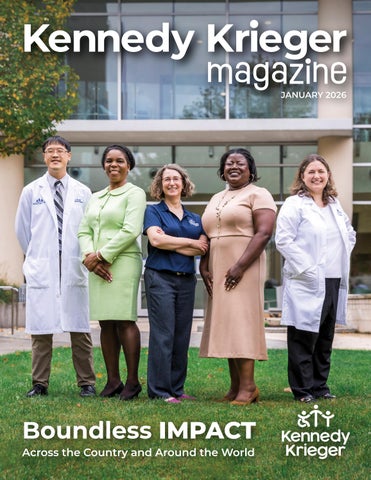
For media and public relations inquiries, email: Media@KennedyKrieger.org For more stories and news, visit: KennedyKrieger.org/Magazine On the cover: Many of Kennedy Krieger’s faculty members trained at the Institute, including Dr. Eric Chin, Dr. Mirian Ofonedu, Dr. Stacy Suskauer, Dr. Melanie PinkettDavis and Dr. Jacqueline Harris. Read about our professional training programs on Page 8.
JANUARY 2026
Boundles
Across the
s IMPACT
Country and
Around the
World
What’s inside... Legacy of Care
Kennedy Krieger’s professional training programs attract students and fellows from throughout the U.S. and around the world. As alums, they join communities across the country and beyond, having an immeasurable impact on the lives of countless children and families.
4
Streaming Science for All Demystifying science with our podcast and webinar
5
Life-Changing Diagnosis “We finally had answers,” Hayden’s mom says.
8
6
Serving Military Families Culturally informed care for kids and teens
and this... 10
KIND: Online Training for Parents and Clinicians
13
Research Corner
11
Early Childhood Development and Education Center
12
Donor Spotlight: Honoring Michael J. Batza, Jr.
14
Institute News
15
Events and Awards
Kennedy Krieger Magazine is published by the Marketing and Communications Department of Kennedy Krieger Institute, 707 North Broadway, Baltimore, Maryland 21205. Kennedy Krieger Institute recognizes and respects the rights of employees, trainees, and patients and students, and their families. Kennedy Krieger Institute is a 501(c)(3) nonprofit organization committed to improving the lives of individuals with nervous system disorders through medical care, education and community programs. Email us at Magazine@KennedyKrieger.org to update your contact and mailing information. Send an email to Unsubscribe@KennedyKrieger.org or visit KennedyKrieger.org/Unsubscribe to unsubscribe from future Kennedy Krieger Institute communications. © 2026 Kennedy Krieger Institute
STREAMING Science for All
Kennedy Krieger makes information about neurodevelopmental disabilities more accessible with its podcast and webinar series. By Noah Baptiste Through the rise of podcasting and online media in today’s digital age, Kennedy Krieger Institute has embraced the opportunity to extend its impact on families, educators, advocates and other professionals beyond traditional care settings. By offering a monthly podcast—Your Child’s Brain—and a quarterly webinar series—Exploring the Brain—the Institute is expanding access to expert insights on pediatric brain health and development and related topics. In 2021, with assistance from WYPR-FM, a public radio station in Baltimore, Kennedy Krieger President and CEO Dr. Bradley L. Schlaggar led the creation of Your Child’s Brain to provide meaningful conversations about neurodevelopmental disabilities to the broader community. “Kennedy Krieger’s depth and breadth of expertise is truly astonishing, and we wanted accessible, plain-language, public-facing ways to share that,” Dr. Schlaggar says. Kennedy Krieger launched Exploring the Brain the next year to offer a deeper dive into neurodevelopmental disabilities, education, advocacy and related topics with Kennedy Krieger experts. “In a world flooded with information from countless sources, Exploring the Brain offers vetted, reliable insights, and even gives the audience a chance to engage directly with our panelists,” Dr. Schlaggar explains. Both platforms feature Dr. Schlaggar and a wide range of experts from across the Institute. Bringing their conversations to the public has aided Kennedy Krieger in demystifying conditions that are commonly misunderstood and overlooked, and in helping families understand how to optimize education and access to available resources. “By having conversations that normalize differences and reduce stigmas, we’re shaping communities where families feel supported,” says Linda Prudente, 4
Kennedy Krieger’s former (and recently retired) assistant vice president of marketing and communications, who was instrumental in promoting and coordinating episodes of Your Child’s Brain. “When people understand the reasons behind a child’s behavior or learning style, they’re more likely to respond with empathy rather than judgment.”
“We’re shaping communities where families feel supported.”
– Linda Prudente
Community members have also made significant contributions to the platforms. Parents of children with neurodevelopmental disorders frequently appear on Your Child’s Brain. When family members’ voices are amplified, listeners gain a stronger understanding of neurodevelopmental disorders and their impact on everyday life, Prudente says. The platforms’ inclusion of diverse perspectives transforms information into valuable advice, explains Maureen van Stone, director of the Maryland Center for Developmental Disabilities at Kennedy Krieger, who has made appearances on both platforms. “These platforms cultivate collaboration,” she says, “by bringing professionals and community members together to exchange ideas, share expertise and address key issues shaping the field of disability advocacy.” Visit KennedyKrieger.org/YCB and KennedyKrieger.org/ETB to learn more.
A Life-Changing Diagnosis
By Alyssa Racosky
Strange symptoms started keeping Hayden from excelling in school and sports. At Kennedy Krieger, he was diagnosed with POTS and finally got the treatment he needed. When Hayden first began experiencing symptoms in the August before seventh grade, he thought they were nothing more than “head rushes.” Dizziness, vision loss and shakiness became a routine, but things escalated dramatically during basketball tryouts. After an intense workout, his face turned red and purple, and his heart raced uncontrollably. That night, on the eve of his first day at a new middle school, Hayden found himself in the emergency room. He left with a heart monitor but no real answers. In the weeks following, his symptoms intensified. The once straight-A student and dedicated athlete struggled to focus in class and felt drained after the simplest tasks. On the court, he was no longer the player he had always been. Doctors ran tests and guessed myocarditis, even allergic reactions, but nothing stuck. “I felt like I was living in hospitals, but no one could tell me what was happening,” he recalls. Hope finally came after a five-anda-half-hour drive from New Jersey to Kennedy Krieger Institute. There, Hayden met Dr. Christina Kokorelis, who approached his case with compassion. She listened closely, ordered a tilt table test and confirmed what others had missed: Hayden had postural orthostatic tachycardia syndrome (POTS), a type of dysautonomia.
POTS symptoms are caused by a faulty autonomic nervous system, which regulates involuntary functions like circulation, explains Dr. Kokorelis, who directs the Institute’s POTS clinic. Each case of POTS is unique, and treatment is individualized. For Hayden, now 17, the diagnosis was life-changing. Increased fluid intake, salt pills, electrolytes and eventually medication helped reduce his symptoms and restore his strength. Within weeks, he felt himself returning to the game he loved. His mom, Marisa, says the moment was equally transformative. “It was like taking my first real breath of relief,” she says. “We finally had answers.”
“With the right care… you can take your life back.”
– Hayden
Now thriving again, Hayden has set his sights beyond the basketball court. Through his TikTok content and website “Rise With POTS,” he’s determined to create the resources and community he once longed for. He’s even started what is believed to be the first in-person POTS meet-up group in New Jersey since the pandemic. His dream is to be a doctor and specialist in the very condition that once threatened to derail his life. “I want others to know they’re not alone,” Hayden says. “With the right care, you can rise above your symptoms and take your life back.” Visit KennedyKrieger.org/POTS to learn more about the Institute’s POTS clinic. 5
SERVING THOSE Kennedy Krieger’s Behavioral Health Services for Military Families helps kids and teens adjust to the challenges of having a parent in the military. By Laura Farmer The families of America’s military service members face unique pressures: frequent moves, deployments of one or both parents, and the stress of serving in dangerous environments. Providers who care for these families must be especially resourceful to meet their needs—wherever they are. That’s the mission of Kennedy Krieger Institute’s Behavioral Health Services for Military Families, founded in 2011 within the Institute’s Behavioral Psychology Department. The program is based in Odenton, Maryland, near the U.S. Army’s Fort Meade installation, and it offers behavioral healthcare at multiple Institute locations and through telehealth. “When military families come to Kennedy Krieger, we never pretend to know what it’s like to walk in their shoes,” says psychologist Dr. Jennifer L. Crockett, the program’s director, whose husband served more than 20 years in the U.S. Army. “But we want to make sure they don’t have to start from scratch, explaining what it means to be a military family.”
WHO
In 2015, the team pioneered one of the Institute’s first telehealth programs—years before the pandemic normalized virtual care. “We were among the first to test telehealth in the homes of military families,” Dr. Crockett says. “Our small team paved the way, creating the infrastructure the Institute needed.” Today, the program is recognized as a model for providing behavioral health services to militaryconnected families. A key priority of the program is ensuring continuity of care for each family despite frequent relocations. “These families move far more often than typical families do, and combined with waitlists, that creates major barriers to care,” explains psychologist Dr. Sara Hinojosa. She recalls a mother in tears because her family was moving again just as her son was finally starting treatment. “When I told her I could keep seeing them in their new state, she cried with relief.” Frequent moves are particularly tough on teenagers. “They’re trying to break into social networks that are already established,” says psychologist and program coordinator Dr. Michelle Bubnik-Harrison. “Some adjust quickly and form strong networks, but for many, the constant cycle of reestablishing relationships can be really hard. In behavioral psychology, we focus on building resilience—we help prepare kids and teens for whatever challenges lie ahead.”
“We focus on building resilience—we help prepare kids and teens for whatever challenges lie ahead.”
– Dr. Michelle Bubnik-Harrison
6
SERVE The team also invests in strengthening community ties. Psychologist Dr. Jaime Benson, the program’s Maryland liaison, serves on the board of the Fort Meade Alliance and has helped launch resources like the Resiliency Services Portal and local events celebrating military children. “Although military families face significant challenges, they can lean on military and community supports that help build resilience,” Dr. Crockett says. “Kennedy Krieger is proud to help foster that strength.” Visit KennedyKrieger.org/Military for more information.
Expert Training for Culturally Informed Care By Laura Thornton Over 1.6 million children in the U.S. have at least one parent serving in the military, according to government statistics. For these children, being able to see a psychologist who is knowledgeable about military life is crucial. That’s why Kennedy Krieger’s Behavioral Health Services for Military Families program— one of the Institute’s Behavioral Psychology Outpatient Programs—offers not only care that is grounded in a solid understanding of what life is like for military families, but also training to postdoctoral fellows in providing culturally informed care. This specialized training originated at the program’s Odenton site, 20 miles southwest of Baltimore and 5 miles from Fort Meade. It is co-led by Dr. Jaime Benson and Dr. Christi Culpepper, both psychologists. Over the course of a year, postdoctoral fellows in the program work with their supervisors to provide culturally informed care to military-connected families. They also participate in a monthly training series, hearing from experts, including members of the military, on military life and how it affects families. “Many of our trainees have gone on to serve families in the military community,” Dr. Culpepper says. “This training is very impactful in terms of preparing the next generation of psychologists to offer care that takes into consideration the ways in which growing up in a military family can affect children and adolescents.” “When providers understand military culture, they’re in a much better position to see the hidden challenges that service members and their families experience,” Dr. Benson adds. “It’s not just about knowing the lingo or the lifestyle—it’s also about truly respecting their experiences and shaping care that actually fits their reality.”
7
Career-Changing Training
Legacy OF CARE An in-depth look at Kennedy Krieger’s professional training programs, and their alums and impact
Every year, about 1,000 develop exp developme experience Pathology C Therapeuti duration fro
On these tw Kennedy K where they for a career
For more in Krieger, ch KennedyK
By Marc Shapiro In a showcase of Kennedy Krieger Institute’s extensive training programs, Dr. Miya Asato, vice president of training, discusses the wide range of offerings, from dayslong to six-year training programs for all levels of clinicians and trainees. Training programs run the gamut of medical specialties, as well as social work, and emphasize clinical care, research and advocacy. “We have some of the best teachers in the field, providing clinical supervision, research, mentorship and other types of training,” Dr. Asato says. Among the Institute’s signature training programs is the four-year neurodevelopmental disabilities (NDD) residency program, a unique opportunity that trains clinicians in child neurology, developmental pediatrics and neuroscience. Four NDD alums—now at such storied institutions as the National Institutes of Health, Baylor College of Medicine, Children’s National and the Children’s Hospital of Chicago— discuss how essential the program was for them in laying out the groundwork for their careers, and how they still carry the lessons of their training with them every day. Visit KennedyKrieger.org/Alums to read the full story. 8
Where Are They Now? More than 5,600 alums who trained at Kennedy Krieger over the past decade are serving patients, students and families all across the country—and around the world. Here’s where they’re making an impact.
Kennedy Krieger Institute’s professional training programs welcome 0 individuals from across the country and around the world to pertise in specialized areas focused on neurological conditions and ental disabilities. The Institute offers a total of 31 different training es, including the Nursing Training Program, the Speech-Language Clinical Fellowship and the Social Work Department’s MACRO ic Foster Care Internship. These training experiences can range in om just a few days to more than four years.
wo pages, and in additional online content, we share stories about Krieger’s training alums—what they trained in at Kennedy Krieger, y’re working now, and how their Institute training prepared them r in serving individuals with neurological differences and disabilities.
nformation about professional training programs at Kennedy heck out the stories and graphics on these pages and visit: Krieger.org/Training
Opportunities That Keep on Giving By Arriane Kernes For many of the Institute’s trainees, Kennedy Krieger leaves the particularly lasting impression of being the perfect place to stay and build one’s career. It’s not uncommon for trainees to transition into permanent roles at the Institute directly out of their training, or to eventually come back as faculty members at some point in the future. “It is important to note that many people who have trained at Kennedy Krieger have stayed on as faculty,” says Dr. Jacqueline Harris, director of the Epigenetics Clinic at Kennedy Krieger, who first came to the Institute as a trainee in the Neurodevelopmental Disabilities Residency Program. “That speaks to the Institute’s unique place in the country—and the world—as far as the care of [the] individuals [we serve].” This can be attributed to various factors, one of the most prominent being the esteemed environment fostered by colleagues, new and longtime alike. To read the full story, visit: KennedyKrieger.org/FacultyAlums
Stay in Touch!
Alums in Md. 3,852
Alums Across the U.S. 0
International Impact
161
An additional 56 alums work in U.S. territories and other countries around the world.
A trainee’s connection to Kennedy Krieger doesn’t end when they complete their training program. Through The Dock, the Institute’s networking website for training alums, former trainees can get updates about new research at the Institute, clinician and faculty openings, conferences, and more. If you’re a training alum, visit TheDock.KennedyKrieger.org/Home to join today. 9
Sharing Our Knowledge
Through its KIND curricula, Kennedy Krieger is training clinicians and families around the world in pediatric neurodevelopmental disabilities. By Laura Farmer
For the past three decades, neurodevelopmental pediatrician Dr. Mary Leppert has welcomed medical trainees to Kennedy Krieger Institute’s Department of Neurology and Developmental Medicine, creating hands-on learning opportunities while seeking to alleviate the shortage of clinicians in the U.S. trained in pediatric neurodevelopmental disabilities. But ensuring the department’s trainees are fully up to speed in this particular field while continuing to serve the department’s patients has always been a challenge. “We work with about 250 trainees a year, and for a long time, they were cycling through without a clear learning plan or structured teaching,” Dr. Leppert explains.
autism, communication disorders and disruptive behaviors. “It was a more formal version of what my colleagues and I were teaching in the clinic,” Dr. Leppert explains. Recently, the team has designed a proprietary program for Kennedy Krieger to share with trainees and providers across the country and around the world: Kennedy Krieger Instruction in Neurodevelopmental Disorders—KIND for short. It’s a series of video-centric learning modules, each about 15 minutes long and covering specific topics pertaining to neurodevelopmental disabilities in children and teens. But it’s not just medical professionals who benefit from this valuable learning approach. In 2025, with support from the Maryland Behavioral Health – Dr. Mary Leppert Administration, Kennedy Krieger launched the Maryland Guide for Families of Children with Disabilities, a version of KIND for families. This free, public course leads families through the journey of diagnosis, healthcare, education, family dynamics, legal considerations and the transition to adulthood.
“The Institute has an incredible depth of knowledge, and that And so in 2012, she brain trust is what makes a and developmental neurologist Dr. curriculum like this possible.” Joanna Burton, who co-directs the Institute’s Infant Neurodevelopment Center, decided to tackle the problem. They created a yearlong NICU curriculum through Johns Hopkins Medicine’s Institute for Excellence in Education and piloted an online learning platform, giving trainees a shared baseline of knowledge and allowing instruction to be tailored to each learner. Four years later, the curriculum expanded into a module for Project ECHO® (run by The University of New Mexico), a hub-and-spoke model of delivering specialty knowledge to local providers. The Institute’s ECHO team, initiated by Dr. Leppert and child and adolescent psychiatrist Dr. Joyce Harrison, developed a multilevel program consisting of 10-to-15-minute online lectures on 10
“I’m especially proud of this course,” Dr. Leppert says, “because it brings the Institute’s extraordinary expertise directly to families in a practical, nuanced and deeply needed way.” To learn more, visit KennedyKrieger.org/KIND and listen to our podcast at: KennedyKrieger.org/YCBMarylandGuide
Where Every Child Can
LEARN AND PLAY Kennedy Krieger’s Early Childhood Development and Education Center offers play-based learning experiences for young children. By Laura Thornton At Kennedy Krieger’s Early Childhood Development and Education Center (EDEC), children from across the neurocognitive spectrum play and learn together, developing important skills that will set them up for success in school—and throughout their lives. “Early childhood education leading to kindergarten readiness is more than academics—it’s nurturing our children’s social, emotional, physical and cognitive development,” explains Dr. Jacqueline Stone, the Institute’s chief clinical officer. “Our staff members address all learning environments—at the center, and at home and in the community— for the child and family.” Founded in 1981 as PACT, the center formally affiliated with the Institute in 1998. In 2022, propelled by federal and state funding, it transformed into EDEC to offer innovative, integrated and inclusive programming. The center has three core programs. World of Care offers in-house nursing care, along with physical, occupational and speech therapies, and it welcomes children 6 weeks to 5 years old with and without disabilities. Southeast Early Head Start specializes in attachment-based and trauma-informed models of care for families living in Baltimore City who are facing a range of high-risk factors. And Early Learning Classrooms, which receives funding through a Maryland State Department of Education Prekindergarten Expansion Grant, uses a play-based curriculum to serve children 3 to 5 years old with and without disabilities. All center locations—including the playgrounds—are fully accessible to children who use wheelchairs and other adaptive equipment. Children and families come to the center for its services but quickly become part of its family, explains Amonee Randolph, an early intervention teacher for infants and toddlers. Several times a year, staff members collaborate with each child’s family to create a personalized learning plan that supports each child’s learning and social and
emotional development. “The individual care plans make families feel supported and—more importantly—seen,” Randolph says. “Families often come to us after being told what their child can’t do,” adds physical therapist Temrah Okonski. “We are here to show families what their child can do.”
“Starting early is essential to changing the trajectory of early development.”
– Dr. Jacqueline Stone
“Starting early is essential to changing the trajectory of early development,” Dr. Stone says. “This center integrates development, education and healthcare to provide a holistic approach that will produce meaningful outcomes. Our vision is to impact not only the children and families we serve directly, but also to establish a model for quality early childhood education that can be used across Maryland and the country.” Visit KennedyKrieger.org/EDEC to learn more about the center. Kennedy Krieger is deepening its commitment to early childhood across all areas—clinical care, education, research, training and advocacy. To support this work, Marcella Franczkowski serves as assistant vice president for early childhood strategy, promoting partnerships and collaboration with the community to advance early childhood priorities throughout the Institute. 11
Donor Spotlight
A Humble Leader Kennedy Krieger would not be what it is today without former Board Chair Michael J. Batza, Jr., and his four decades of selfless dedication. By Laura Thornton In 1986, Kennedy Krieger Institute was facing financial difficulties, making its future uncertain. But Michael J. Batza, Jr., chair of the board of directors at the time, believed the Institute was an organization worth fighting for. He reached out to financial consultant Jim Anders, then at Ernst & Whinney (now Ernst & Young), for advice. “Mike came over to ask if we could bring a team to Kennedy Krieger to help out,” recalls Anders, who, at Batza’s suggestion, joined the Institute as administrator and chief operating officer, the position he holds to this day. “It was a challenging time, but Mike was very hands-on. He was at the Institute 20-plus hours a week for months, putting the work in, on top of his day job.” Batza didn’t just see Kennedy Krieger safely through a difficult year—he set it up for decades of successful, life-changing service to patients, students and families. He continued to serve on the board until his passing last summer. A little over two decades ago, he and his family endowed the Batza Family Foundation Research Chair at Kennedy Krieger, held by Dr. Stewart Mostofsky, director of the Institute’s Center for Neurodevelopmental and Imaging Research. “For one person to give that much time to one institution is extraordinary,” says Ron Peterson, chair of Kennedy Krieger’s board of directors and former president of the Johns Hopkins Health System. “He was very generous with his time and personal resources.” “Mike understood how unique the Institute is and how special it is to have here in Baltimore,” adds Institute President and CEO Dr. Bradley L. Schlaggar. “His foundational work and his continued leadership, volunteering and philanthropy truly put the Institute in a position to succeed in its mission.” Batza spoke often to friends and colleagues about Kennedy Krieger. Recently, his longtime friend and 12
business partner Earl Linehan and Earl’s wife, Darielle, made a leadership gift to the Institute to honor Batza’s decades of dedication to Kennedy Krieger. “Mike was a great guy who was a leader in everything he did, and he lived life to the fullest,” says Linehan, who first met the Batzas when both couples were newly married and living in Evanston, Illinois. “He was dedicated to a lot of causes, but Kennedy Krieger always occupied a special place in Mike’s heart.”
“Mike was a very humble man who did all of these incredible things but never expected anything in return.” – Dr. Nancy Grasmick Batza and his wife, Pattie, raised their three daughters in the Baltimore area, where Batza developed Heritage Properties, a real estate firm and longtime sponsor of the Institute’s annual Festival of Trees. Despite his busy work schedule and his devotion to his family, he always made time to support community organizations. “He was pivotal to providing Kennedy Krieger with the stability and growth it needed to become what it is today,” says Dr. Nancy Grasmick, former board chair and director of the Institute’s Center for Innovation and Leadership in Special Education. In fact, it was Dr. Grasmick who initially introduced Batza to the Institute, when the Batzas sought her advice on educational testing for a young family member. “But more than that, Mike was a very humble man who did all these incredible things but never expected anything in return.” Visit KennedyKrieger.org/Batzas to read more. Above: Mike Batza, Jr. (left), with his friend Earl Linehan, who recently honored Batza’s memory with a gift to the Institute.
RESEARCH CORNER
International Collaboration Kennedy Krieger’s world-renowned expertise in rare disease research facilitates international studies and clinical trials that bring hope to patients and families. By Laura Thornton
Finding the genetic cause of a patient’s seemingly unique set of symptoms can be like searching for a needle in a haystack. But for Julie Cohen, director of genetic counseling services at Kennedy Krieger Institute, it’s her job. “Connecting patient cases with a gene can take years and span continents, and is a very laborintensive process, but it’s the first step toward improving patient care through genomic medicine,” she says. “When we can link a gene variant with a rare disease and correlate that with clinical outcomes, we can begin to tailor treatments to individual patients, offering hope to them and their families.” The National Institutes of Health defines a rare disease as a condition affecting fewer than 200,000 people in the U.S. But many rare diseases affect only a few hundred—sometimes even fewer— people worldwide, which can make learning about a rare disease very difficult. Researchers need to study as many patients with a disease as possible to determine the progression of the disease, how it affects people, and what treatments will work best. For that, “International collaboration is critical,” says Dr. Ali Fatemi, the Institute’s chief medical officer and director of the Moser Center for Leukodystrophies. “When it comes to studying rare diseases, these are multinational efforts.” Cohen and the Institute’s other genetic counselors see patients who typically have been experiencing symptoms for some time but don’t have a diagnosis. Cohen and her colleagues order genome
sequencing—of which Kennedy Krieger was an early adopter—to study a patient’s DNA. If they find a piece of DNA with a genetic change that doesn’t correspond to a known diagnosis, they use GeneMatcher.org, developed at Johns Hopkins Medicine, to see if anyone else from around the world has identified a patient with the same genetic change. Following this global approach, Cohen and her colleagues have uncovered—or helped uncover—more than 40 rare diseases, some affecting only a handful of people. “We’re diagnosing patients who’ve gone undiagnosed for decades, as well as very young children,” she says. “Internationally, we’re at the forefront of this work.” Kennedy Krieger also plays an outsized role in conducting studies on the progression of rare diseases, and on clinical trials of treatments for those conditions. But with so few people diagnosed with any given rare disease, data collection must be conducted on a global scale to ensure enough study participants. The international approach not only makes for the most successful studies and trials, but also helps spread Kennedy Krieger expertise around the world, helping clinicians, patients and families far beyond Maryland and the U.S., and fueling an impact that knows no bounds. Visit KennedyKrieger.org/GeneticsLab to learn more and watch a video about genetic research at the Institute.
“When it comes to studying rare diseases, these are multinational efforts.”
– Dr. Ali Fatemi 13
KENNEDY KRIEGER IN THE NEWS
Scan the QR code or visit KennedyKrieger.org/News for these stories and more! Winner of Maryland Lottery Ravens Second-Chance Prize Donates Winnings to Patient at Kennedy Krieger (Oct. 23, 2025)
Long Covid Risk for Children Doubles After a Second Infection, Study Finds
One of the winners of the Maryland Lottery’s Baltimore Ravens Second-Chance Promotion won a pair of Ravens club seats and a $500 shopping spree at the team store. He donated all of it to a patient at Kennedy Krieger.
Dr. Laura Malone, director of the Institute’s Pediatric Post-COVID-19 Rehabilitation Clinic, was a leading source for a New York Times article on long COVID and children.
(Sept. 30, 2025)
SOCIAL SPOTLIGHT
Find out what’s happening at Kennedy Krieger in real time and join the conversation! Visit KennedyKrieger.org/Social for links to the Institute’s social media channels.
Oct. 10, 2025: Tips to Boost Your Mental Health For World Mental Health Day on Oct. 10, we asked three of our experts about what we can do to support our mental health. Here’s what they suggest: • Turn your screens off and go outside. – Dr. Matt Edelstein, director of the Brief Treatment Clinic • Help others and move toward your goals. Start something you’ve always wanted to do. – Dr. Carmen López-Arvizu, director of outpatient psychiatric services • Put your phone down and just be bored for a little bit. – Dr. Benjamin J. Schindel, Department of Neurology and Developmental Medicine Watch the full video on Instagram at: KennedyKrieger.org/3MentalHealthTips
Inspire Healing and HOPE Through Art KaleidoHOPE: A Healing Art Initiative of Kennedy Krieger is offering artists— professional and amateur alike—a unique opportunity to showcase their work throughout the organization, contributing to a vibrant and healing environment for patients, students, families and staff. Artists from Baltimore and beyond who are passionate about using their talents to support healing and HOPE are invited to donate their work, regardless of age, experience, ability or art medium. Visit KennedyKrieger.org/KaleidoHOPE to learn more. 14
EVENTS
AWARDS
Our events are a great way to bring family and community members together! Scan the QR code or visit KennedyKrieger.org/Events to register, sponsor or explore events.
For the second year in a row, Forbes named Kennedy Krieger to its list of Best Employers in Maryland, and U.S. News & World Report recognized the Institute as a Best Children’s Hospital.
Pickleball for All | Sept. 20, 2025: Kennedy Krieger hosted the region’s first fully inclusive and adaptive charity pickleball tournament, welcoming 55 players of all skill levels. Held at Dill Dinkers in White Marsh, Maryland, the event raised more than $23,000. Proceeds will benefit Team Kennedy Krieger and the Institute’s Adaptive Sports Program.
Harvesting Hope | Nov. 8, 2025: The Women’s Initiative Network (WIN) for Kennedy Krieger Institute hosted Harvesting Hope, a new signature event, at Cece’s Roland Park. The event raised more than $93,000. Proceeds will support the creation of a dedicated Teen Lounge within the Institute’s Child Life and Recreation Therapies Department.
UPCOMING EVENTS ROAR for KIDS
WIN Spring Event
Sunday, April 12, 2026
Friday, May 8, 2026
The Maryland Zoo in Baltimore
M&T Bank Exchange
Danielle Gregg (left), director of training for the Center for Child and Family Traumatic Stress; Dr. Cristina Sadowsky (center), clinical director of the International Center for Spinal Cord Injury; and Toni Scott (right), director of the Early Learning Classrooms at the Early Childhood Development and Education Center, were listed as Women We Admire’s 2025 Top 50 Women Leaders in Baltimore. Dr. Joyce Harrison, a child and adolescent psychiatrist for the Center for Developmental Behavioral Health, received the Champions for Children Outstanding Mental Health Clinician Award and a citation from Maryland Sen. Chris Van Hollen. Baltimore Magazine named Dr. Ji Su Hong, a child and adolescent psychiatrist for the Center for Autism Services, Science and Innovation, one of the region’s Top Doctors for 2025. The Maryland Daily Record recognized Dr. Carmen LópezArvizu, director of outpatient psychiatric services, as a Maryland Hispanic Leadership Awards honoree for 2025. This prestigious award honors Hispanic leaders for their outstanding professional accomplishments, unwavering community involvement and dedication to mentoring others. 15
NON-PROFIT U.S. POSTAGE
PAID
PERMIT #7157 BALTIMORE MD 707 North Broadway Baltimore, Maryland 21205
Impact that lasts generations. When you give to Kennedy Krieger Institute, you’re helping us transform the lives of our patients and students, and their families. Your gift supports groundbreaking care, education and research that make hope happen. Thank you for being part of our team! Make your donation today! Visit KennedyKrieger.org/J26 or use the QR code, or mail us your donation using the return envelope inside this issue. Right: Pepper, who has spina bifida, is a member of the Bennett Blazers, Kennedy Krieger’s adaptive sports team for kids and teens. Her favorite sport is wheelchair racing— she loves the competition and seeing how fast she can go!
WH Y I G IV E “Kids with health challenges have always tugged at my heartstrings. I have met so many wonderful people at Kennedy Krieger and heard so many wonderful testimonies about the Institute that I know I am putting my volunteer time and effort in the right place. I am honored and humbled to be a volunteer for such a great cause.” – SYLVIA DECK
Since 2018, Sylvia has designed BFPE International’s sponsored tree for the Institute’s Festival of Trees fundraiser. She also donates proceeds from her holiday decor work and, as a Festival of Trees raffle committee member, has secured over 500 in-kind donations.