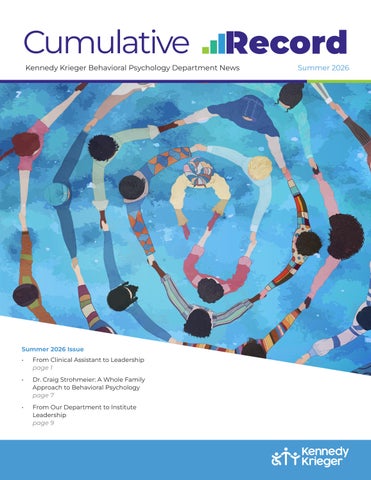
Kennedy Krieger Behavioral Psychology Department News
Summer 2026 Issue •
From Clinical Assistant to Leadership page 1
•
Dr. Craig Strohmeier: A Whole Family Approach to Behavioral Psychology page 7
•
From Our Department to Institute Leadership page 9
Cumulative Record | Su26 | 2
Summer 2026
Letter From the Editor This issue is a tribute to the people who make our department what it is: our staff. We’re celebrating three groups of people in these pages, and they tell one continuous story. First, the staff who have been here more than 20 years — the ones who’ve trained generations of clinicians, who remember
From Clinical Assistant to Leadership
when our current protocols were still just ideas, and who carry the departmental and institutional memory that no manual could ever capture. Then, our newest staff — bringing fresh energy, new perspectives, and a reminder of why we all chose this work in the first place. And finally, the staff who started in entry-level roles and built careers here, climbing step by step into positions of real expertise and leadership. Different starting points, different timelines, but the same thread running through all of them: This is a place people choose to stay, grow and come back to. “Coming back” is something I am familiar with. A few years ago, I left this department for another opportunity across Broadway at Johns Hopkins. I am grateful for my time there and appreciative of the lessons learned and skills acquired, but three years later, I came back. What brought me back wasn’t nostalgia or comfort. It was the recognition that what we’ve built here — the culture, the colleagues, the sense of shared purpose — is genuinely rare. What we have here in the Behavioral Psychology Department is incredibly special. Longevity in this field isn’t just about tenure. It’s a signal.
Every career journey begins somewhere. For three exceptional members of our department, that starting point was as a clinical assistant. Through dedication, professional growth, and a commitment to the individuals and families we serve, each has continued to take on new challenges and opportunities — building meaningful careers within our department along the way. In this issue, we are proud to highlight their stories. While each career path is unique, the journeys of Dr. Steve Lindauer, Marguerite Wakeman and Chidi Agha all share a common thread: a willingness to learn, a passion for their work, and a commitment to growing both personally and professionally. Their stories are a wonderful reflection of the opportunities available within our department — and an inspiration to those just beginning their own careers.
When people stay for 20-plus years, when they climb the ladder from an entry-level role into something bigger, when they leave and choose to return — that tells you something about the place they’re staying, climbing and returning to. It tells you the work matters, the people matter, and the department is worth investing a career in. So to everyone featured in this issue, whether you’ve been here two decades, two months, or you’re reading this from a desk you worked your way up to — thank you. You are the reason this department feels less like a workplace and more like a professional home. Here’s to loyalty that’s earned, not assumed, and to the people who keep coming back.
Lindsay Melvin Editor-in-Chief
Cumulative Record | Su26 | 1
STEVE LINDAUER A help wanted ad in the newspaper brought Steve Lindauer, PhD, to Kennedy Krieger Institute in July 1995. Having just received his undergraduate degree in psychology from UMBC, he interviewed for a position as a clinical assistant. He admits he was skeptical about taking the position until his first day. “It was one of the only psychology jobs out there,” he says. “On Day 1, just seeing the kids, I thought they were absolutely amazing. I love that population. They were fantastic.
(from L to R) Heather Liberto, Par Kaur, Dr. Steve Lindauer and Marguerite Wakeman.
“I also realized that behaviorism actually has a purpose beyond rats and pigeons. I had limited exposure to children with developmental issues, and this was really my first in-depth experience. I was really struck by the potential that the kids have, and I absolutely absorbed the fact that you can change their trajectories. With a little bit of assistance, a little nudging and consistent support, their outcomes can be so much better.” After working as a clinical assistant for six months, he was promoted to the role of behavior data specialist on the inpatient Neurobehavioral Unit. He soon became a clinical specialist, working with children and contributing to multiple publications. That experience sent him to graduate school to learn more. At the University of Kansas from 1998 to 2002, he received his master's degree in human development and a doctorate in developmental and child psychology, with a focus on applied behavior analysis.
“ What I like most about my job is solving problems.” – Steve Lindauer
Now, he oversees the Behavioral Psychology outpatient programs, which comprise seven distinct clinics, located in Odenton and Columbia as well as Baltimore. Collectively, the clinics have approximately 100 clinicians and 50 support staff members who serve over 6,500 unique patients each year. “What I like most about my job is solving problems,” he says. “Back as a clinical specialist on the inpatient unit, the problem was, 'How do you develop a treatment for this child? What type of treatment is going to be most appropriate for that individual child in that individual family?' “Then I started to get involved in solving financial issues and logistics problems," he adds. "For instance, I looked at the show rates for people who got reminder calls for their appointments. If a family got a call, the show rate was much higher.” But nothing has compared to the challenges he faced with the COVID-19 pandemic. He assumed his current position in January 2020, two months before the pandemic caused many people to have to stay home from work, school, appointments and other activities. “That was a real test by fire, but it was also inspirational," he recalls. "We were constantly shifting and reinventing. For instance, essentially overnight, we had to switch to 100% telehealth. We had to figure out how to expand as quickly as possible, when seeing kids in the clinic didn’t work anymore.
Cumulative Record | Su26 | 2
“After losing 46% of families from our caseload, we also had to figure out how to generate new referrals.” First, the team pulled up cases of all the patients the department had worked with during the five years before the pandemic. Then, they contacted the families to see how everyone was being impacted by the pandemic and to inform them of the new telehealth services. “This generated the initial referrals that refilled our client lists and gave us time to create other referral streams.” One of Steve’s priorities as director is to make sure that every staff member feels they are an equal and valued member of the Behavioral Psychology Department team. “Without our care center, we can't do anything. Without our insurance team, we can't do anything. Without our intake team we can't do anything. The administrative support staff is like the grease that makes everything work. If there's a problem, they jump in and solve it, then make the entire system flow again.” Teamwork is one key reason Steve has remained at Kennedy Krieger for the past 23 years. “The other is that we do things that nobody else can do. We work with kids nobody else can work with. We see kids locally, nationally, and internationally. Being associated with that as a part of this program is just amazing.” So are the success stories of former patients. “I have a family that I used to work with who suddenly reached out to me,” Steve recalls. “I hadn’t seen their child in probably 18 or 20 years when the dad called, out of the blue, just to give me an update. He said his son was working in the aerospace field in California, doing a fantastic job. “I was having one of those weeks where you think ‘What else can go wrong?’ And this just made my day.” n Dr. Steve Lindauer, his wife and three children live in Sparks, Md., with three dogs and two cats. “We are a ‘sporty family,’” he says. “All of my children have played travel sports (ice hockey, field hockey and gymnastics), which has taken us all over the country for tournaments.” Cumulative Record | Su26 | 3
CHIDIEBELE AGHA Chidiebele Agha always knew he wanted to work in healthcare. As a first-generation American, Chidi was born into a Nigerian family that emphasized the important benefits of medicine and health care as professions. One of six children, with parents who both worked as nurses, Chidi majored in healthcare administration and policy at University of Maryland, Baltimore County, graduating in 2011 after he had already begun work as a clinical assistant in the Neurobehavioral Unit. “Although being a doctor wasn’t for me, I wanted to be in the setting that was my primary focus,” he explains. “The idea of understanding how systems work, how healthcare is delivered, figuring out how to make things more efficient and effective has always been a keen interest.” Now he serves as director of finance for the department of Behavioral Psychology Department, overseeing financial management of 350 to 400 staff and 40 to 50 trainees. His work steering the finance team also reflects the career possibilities within the department. Over the years, his role has evolved from providing direct patient care to serving in an administrative capacity including working in the care center for the Psychiatry Department and in the
“ You can see the tangible growth in the patients from when they arrive to when they are discharged. ” – Chidiebele Agha (continued on page 21)
MARGUERITE WAKEMAN Marguerite Wakeman, program coordinator for the Behavioral Psychology Department, recalls how “the nightmarish chaos of COVID-19,” as she describes the pandemic, unexpectedly boosted her confidence about her administrative and operational capabilities. “The pandemic immediately completely overthrew everything that I was doing,” she says. “We were trying to pivot and determine whether the actions we were taking to convert inperson patient appointments to virtual visits was meeting the needs of the department.” It took her about six weeks to build an entire monitoring system for virtual patient services. She needed to define and trace the volume of patients so her colleagues could decide whether to bring in more. “I remember the 18-hour days where I was just rolling out of bed, getting right to it, and then rolling back into bed at the end of the day,” she says. “Meanwhile, I was also nursing my baby daughter.” When Marguerite began working at the Behavioral Psychology Department as a clinical assistant in 2008, she thought her future would be in clinical work. After graduating from the University of Florida with a degree in psychology, she moved to Washington, D.C., to live with her father and launched herself at Kennedy Krieger as a clinical assistant. Although she assumed she would be helping children meet their treatment goals, Marguerite discovered she preferred roles
“ You don't know what you're doing unless you have data.” – Marguerite Wakeman
that used her organizational strengths within the administrative side of medicine. Over the next decade, she shifted from working as an inpatient clinical assistant to becoming a behavioral data specialist and then became an admissions coordinator, before being named program coordinator for the entire department. In 2019, she got her master’s degree in leadership and management from Notre Dame of Maryland University. Since then, she has designed and executed new revenue and productivity reporting structures to track more than 140 clinicians who deliver over $30 million in yearly outpatient mental health services. She works closely with clinicians in the military programs, providing the data they need to justify grants they receive from the Department of Defense, also known as the Department of War. She has also fostered collaboration across departments to adapt to major transitions in electronic health record management and other business pressures. And she has developed electronic health record training procedures for new staff, adapting them for synchronous online learning.
Marguerite says what she appreciates most about working in the behavioral psychology department is having the freedom to focus on challenges without having her time totally scheduled. She remembers one such moment as a turning point of self-discovery. “I knew that clinical work wasn’t right for me when I was able to figure out something kind of tricky with Excel,” she recalls. “It saved a lot of time, and everybody in the clinic started using it.” The department's other behavior data specialists reported saving half an hour a day using Marguerite's approach. “I felt really satisfied and proud of myself. All I knew was that I wanted to keep doing things like that.” Fascinated by the relationship between good clinical work and the data and policies that make it possible, she came to see she could help patients more by serving as an administrator. “You don't know what you're doing unless you have data,” she explains. Where once she worked with data for just one to three patients at a time, “now, there are programs we have created that have helped thousands of (continued on page 21) Cumulative Record | Su26 | 4
‘Started as CAs’ Features We are proud to highlight Carl Owens, Geri Strother, and Par Kaur, who also began their careers here in our department as clinical assistants. Carl, Geri, and Par have grown tremendously, impacted our department and the families we serve in a unique way, and continue to embody the values and the mission of Kennedy Krieger.
Carl YOUR POSITION WHEN YOU STARTED: Clinical Assistant on NBU YOUR CURRENT POSITION: Data Analyst YEARS IN BP DEPARTMENT: 37 years. QUOTE: “One of the things I have always valued about our department is our long-standing tradition of using data to drive decisions, well before it became an industry buzzword. If you want to work at Kennedy Krieger, the Behavioral Psychology Department is the absolute gold standard to aim for.”
Geri YOUR POSITION WHEN YOU STARTED: Clinical Assistant, NBU-IP CURRENT POSITION: Assistant Director, Patient Services, NBU-IP YEARS IN BP DEPARTMENT: 28 years QUOTE: “It is a truly a gift to care for someone. I’ve learned so much about myself as a professional and a person through the many gifts that I’ve received over the years on the NBU and through the department.”
Par YOUR POSITION WHEN YOU STARTED: Clinical Assistant I NBU-IP YOUR CURRENT POSITION: Community Outreach Coordinator YEARS IN BP DEPARTMENT: 10 years QUOTE: “Over the past 10 years, the Behavioral Psychology Department has provided me with far more than a job – it has given me a career that continues to challenge, inspire and shape my growth. Throughout this journey, I have had the privilege of learning from incredible mentors and building lasting relationships with colleagues who have supported my growth both professionally and personally. Today, I am proud to educate our community about the remarkable work our department provides and the positive impact we make in the lives of those we serve.” n Cumulative Record | Su26 | 5
WELCOME, NEW STAFF AND FACULTY MEMBERS! Tarvana Abraham, Clinical Assistant I Tyrell Alexander, Clinical Assistant I
Breshae Morris, Clinical Assistant I
Maria Alvarado Estrada, Behavioral Data Specialist I
Tayla Murphy, Behavioral Data Specialist I
Abena Apatu, Patient Services Specialist Shanae Barnes, Clinical Assistant I Emily Bonnett, Clinical Assistant I Kaylah Brickhouse-Dagley, Patient Services Specialist
Tracy Nguyen, Clinical Assistant I Malea Norris, Clinical Assistant I Brionna Payton, Clinical Assistant I Stella Procope, Clinical Assistant I Shreya Ramesh, Clinical Assistant I
Chinenye Christopher, Clinical Assistant I
Madison Raut, Recreational Activities Aide
Darrell Davis, Clinical Assistant I
Jaila Ray, Behavioral Data Specialist I
Ariel Ellis, Clinical Assistant I
Alisson Romero, Behavioral Rehab Asst I
Mya Ellis, Clinical Assistant I
Angela Saint-Louis, Clinical Assistant I
JaLee Foster, Clinical Assistant I
Kaung San, Clinical Assistant I
Dawson Fraczkowski, Clinical Assistant I
Aeryn Sanner, Clinical Assistant I
Damien Frail, Behavioral Data Specialist I
Gracie Smith, Clinical Assistant I
Emily Gundry, Behavioral Data Specialist I
Craig Strohmeier, Psychologist II
Lucy Haffner, Behavioral Data Specialist I
Areona Thompson, Clinical Assistant I
Allison Hope, Behavioral Data Specialist I
Ashiya Tripline, Recreational Activities Aide
Anna Huynh, Clinical Assistant I
Cheryl Umana, Behavioral Data Specialist I
Savannah Johnson, Clinical Assistant I
Momoka Utsumi, Clinical Assistant I
Julia Jones, Behavioral Data Specialist I
Malic Wallace, Clinical Assistant I
Taylor Kallini, Behavioral Data Specialist I
Brittany Wang, Clinical Assistant I
Shannon Lu, Clinical Assistant I
Amira Welch, Clinical Assistant I
Nolan Marriott, Behavioral Data Specialist I
Sean Wells, Behavioral Data Specialist I
Connor McNamara, Clinical Assistant I
Sannya Whyte, Clinical Assistant I
Jamya McQuay, Clinical Assistant I
Tiffany Wright, Behavioral Data Specialist I
Aaron Mobley, Clinical Assistant I
Caitlin Xenakis, Administrator
Janiyah Moore, Clinical Assistant I
Hudson Zhou, Clinical Assistant I Cumulative Record | Su26 | 6
Dr. Craig Strohmeier: A Whole-Family Approach to Behavioral Psychology One of the more important approaches for children with behavioral challenges is to teach their parents how not to accommodate difficult behavior, says behavioral psychologist Craig Strohmeier, PsyD, BCBA-D. Craig’s interest in the assessment and treatment of challenging behavior in children and how to improve family dynamics is what brought him to Kennedy Krieger Institute’s Behavioral Psychology Department in 2013 as a postdoctoral fellow. And it’s that same interest that brought him back this year.
Instead of resuming his role as a behavioral psychologist in the Neurobehavioral Unit Outpatient Clinic, Craig is now working in the Brief Treatment Clinic — a move he calls a “professional pivot.” Clinic director Matt Edelstein, PsyD, BCBA-D, describes the clinic’s mission as “behavioral parenting training. Our role is to have parents be on a parallel learning process with their child.” Parents of children with challenging behaviors such as self-injury, disruption, aggression, disruptive vocalizations and property destruction may feel that the only way to prevent their children’s outbursts is through accommodation responses like complying with unreasonable requests, only driving on a certain route, or only eating in a certain restaurant. Unfortunately, accommodation responses are ultimately counterproductive. Craig’s has found of parents of children admitted to the Brief Treatment Clinic, 85% are using accommodation behaviors almost daily at the start of admission. When he began working at the clinic, 63% were continuing to do so even after learning how to implement an individualized behavioral treatment plan. That number has since improved. “There are parents who are understandably scared to interact with their child’s severe behavior, or they are very emotional seeing their child in distress,” Craig says. “The goal is getting them to engage, rather than avoid and accommodate. We need to find out what is preventing them from implementing a plan even when they have the skills to do it.” Craig’s educational journey took him from Millersville University of Pennsylvania, where he received his undergraduate degree, to Temple University for a master’s degree in counseling psychology. He continued his studies at Philadelphia College of Osteopathic Medicine, where he earned a master’s degree and doctorate in clinical psychology. He completed a doctoral internship at May Institute, and a postdoctoral
Cumulative Record | Su26 | 7
fellowship at Kennedy Krieger and the Johns Hopkins University School of Medicine. During his time at Philadelphia College of Osteopathic Medicine, Craig’s dissertation research examined the experiences of adults diagnosed with ADHD, anxiety and depression. Some of what he learned has aided his current work. “My dissertation didn’t involve intervention for these individuals, but I learned about methods that clinicians use to help patients approach tasks or activities they’d been avoiding,” he says. “Later, when I started using those same strategies with parents, it also helped them become more involved with the recommended treatment.” In 2022, Craig received a grant to study the influence such methods might have on parents’ adherence. After he took a job in 2024 supervising behavior therapy teams for a Rutgers University-affiliated program for severe behavior, conversations with Steve Lindauer, PhD, director of Kennedy Krieger’s Behavioral Psychology Department outpatient programs, persuaded him to return to the Institute to work in the Brief Treatment Clinic, where engaging with patients’ parents was already a priority. “We clicked on where to go with these findings clinically — and for future research,” Craig says. “I have spent a lot of time building my professional work and my professional life. So, when I talked with others in the clinic and found they shared a mutual excitement for my work, I knew I had to go back to the place where those ideas were born. “The department has always reinforced that clinical work, innovation, research and training are not separate pursuits,” he adds. By applying innovation to opportunity, both the Neurobehavioral Unit Outpatient Clinic and the Brief Treatment Clinic have been successful in reducing challenging behaviors in children.
“ When you are looking at a clinical case and there isn't a clear answer for how to solve the problem for the family, you go to a very close analysis of what's going on for them and what they need.” – Craig Strohmeier
“When you are looking at a clinical case and there isn't a clear answer for how to help the family, you proceed with a very close analysis of what's going on for them and what they need. If what you figure out helps them, and if you've documented your process by collecting data, then you also have practice-based research to offer back to your trainees and the field.” Craig says. “It's also a model of accountability. You can show what your process was and what led to this change that helped the family that you worked with,” he adds. “Finding something that works and having an opportunity to do something about it is what the department is all about.” n Craig Strohmeier lives in Howard County with his wife and 4-year-old son. Cumulative Record | Su26 | 8
From Our Department to Institute Leadership Great leaders often begin by making a difference right where they are. We are proud to celebrate three exceptional colleagues whose careers began in our department and have since led them to leadership roles across the Institute. Their journeys reflect the talent, dedication, and commitment that have long been hallmarks of our department. Each has taken the knowledge and experience gained here and carried it forward, making an impact in new roles while continuing to contribute to the broader mission of our Institute. Their stories are a wonderful reminder of the many possibilities that can grow from a career that starts right here in our department.
MAUREEN VAN STONE, Esq., MS Director of the Maryland Center for Developmental Disabilities (MCDD) Founder, Project HEAL Maureen is an assistant vice president and the director of the Maryland Center for Developmental Disabilities (MCDD) at Kennedy Krieger Institute (Maryland’s designated University Center for Excellence in Developmental Disabilities Education, Research, and Service), and the founder of Project HEAL (Health, Education, Advocacy, and Law), a MCDD community-based program. Project HEAL is Maryland’s only comprehensive medical-legal partnership, which provides advocacy and civil legal services to children with disabilities who receive services at Kennedy Krieger. Maureen is an associate faculty for the Department of Mental Health at the Johns Hopkins Bloomberg School of Public Health and affiliate faculty for the Wendy Klag Center for Autism and Developmental Disabilities. Maureen is an emeritus member of Kennedy Krieger’s ethics committee. Maureen serves as an at-large member of the board of directors of the Association of University Centers on Disabilities and serves as the policy co-chair. Maureen is appointed to the executive committee of the Maryland Developmental Disabilities Council, the Maryland Developmental Disabilities Waiver Advisory Committee, and the Maryland State Department of Education’s State Personnel Cumulative Record | Su26 | 9
Development Grant Advisory Committee. Maureen served on the board of directors of the Council of Parent Attorneys and Advocates, Inc. from 2014 to 2026 in numerous leadership roles. Maureen earned a bachelor’s degree in psychology at the University of Southern California, a master’s degree in developmental psychology at The Johns Hopkins University, and a Juris Doctor at Whittier Law School, with a concentration on children’s legal issues. Maureen began her career on Kennedy Krieger’s Inpatient Neurobehavioral Unit (NBU) as a clinical assistant, behavioral data specialist, clinical specialist I and II, and a research assistant. Her six years on the NBU inspired her to attend law school to become an advocate for Kennedy Krieger patients, students and families. n
JOSEPH WAKEMAN Enterprise Intelligence, Director Joseph started in 2007 as a clinical assistant on the Neurobehavioral Unit. Over the next several years, he was promoted to the behavioral therapy teams before shifting to a technical support role in 2012. In this position, he provided assistance with computer and software problems as well as helped with the development of databases and custom tools to help track information and streamline workflows. In 2016, Joseph shifted to providing similar support to the Behavioral Psychology outpatient programs, creating data collection systems, supporting research projects, and creating databases to support clinical outcomes initiatives. This included helping transition systems to support remote work and telehealth operations with the onset of the pandemic. In 2021, Joseph moved from Behavioral Psychology to Information Systems to become the manager of the Business Intelligence team for the Institute, which is responsible for developing reporting and analytics within Epic and Power BI to support operations and quality improvement efforts across Kennedy Krieger. He has since been promoted to director of Enterprise Intelligence, which includes the Business Intelligence team, data architects responsible for creating data storage solutions, application developers, and SharePoint engineers. n Cumulative Record | Su26 | 10
MICHAEL DELIA, M.S.Ed., OHST A Career Shaped by Purpose: My Journey at Kennedy Krieger Institute written by Mike Delia My journey at Kennedy Krieger Institute began long before I walked through the doors of the Neurobehavioral Unit. It started at my parents’ kitchen table with a Sunday morning edition of The Baltimore Sun. My mother, a special education teacher who dedicated her career to serving students with disabilities, slid the newspaper across the table and pointed to an opening at Kennedy Krieger. After a couple of disappointing jobs following college graduation, she looked at me and said, “The Neurobehavioral Unit is the place for you.” At the time, neither of us could have imagined that simple suggestion would lead to a career spanning three decades. I still remember my first day in January 1996. It was Martin Luther King Jr. Day. The morning was cold and dark as I arrived for the 7:30 a.m. shift change. Like many new employees, I was nervous and unsure of what awaited me. But those fears quickly faded thanks to two experienced clinical assistant supervisors who welcomed me with a simple message: “We’ve got your back. We’ll show you the ropes.” That reassurance made all the difference. As a clinical assistant on the evening shift, life revolved around the familiar rituals of unit life — competing for the elusive “leave early” slot, planning dinner at Mama Mia’s, and building friendships that made even the toughest days enjoyable. What stood out most, however, were the children we served. Each student had unique strengths, challenges, and behavioral needs. I found myself fascinated by the science behind the treatment protocols and captivated by the dedication of the staff who worked tirelessly to help these children succeed. I often found myself asking questions. Why were certain interventions so effective? How did teams make decisions that led to life-changing outcomes for students and families? That curiosity fueled my desire to learn more. Eventually, I was given opportunities to work in Cumulative Record | Su26 | 11
session rooms conducting functional behavioral assessments and collecting data that informed treatment decisions. Those experiences opened a new world to me. The work wasn’t just about collecting numbers — it was about uncovering patterns, understanding behavior, and helping children make meaningful progress. As I gained experience, I became a behavioral data specialist. For the first time, I had the opportunity to work closely with individual inpatients throughout their treatment journeys. Watching students make progress over time and seeing families regain hope was both humbling and inspiring. What impressed me most was the collaboration behind the scenes. The faculty meetings were extraordinary learning experiences. Teams gathered around graphs and data, challenging one another's thinking, reviewing outcomes, and developing innovative treatment plans. There was a level of rigor, teamwork, and commitment that left a lasting impression on me. Then came my first faculty presentation. Standing in front of experienced clinicians and researchers was intimidating. I vividly remember the anxiety and self-doubt that accompanied those early presentations. But, as had happened throughout my career, Kennedy Krieger surrounded me with mentors who believed in me. Faculty supervisors and program leaders encouraged me, coached me, and helped me
find my voice. They reminded me that success was never about one person. It was about a team united by a common goal: helping students achieve significant reductions in challenging behavior so they could successfully return home, to school and to their communities. Those years were filled with unforgettable experiences. I attended applied behavior analysis conferences, contributed to research efforts, and even collaborated with the Feeding Disorders Program to support students with food selectivity. Every opportunity reinforced my passion for work. Yet, when I reflect on those NBU years, what I remember most are the people. I remember the friendships formed in cramped cubicles, the conversations during shuttle rides from the Fells Point parking lot, the softball games after work, and the countless laughs shared with colleagues who became lifelong friends. Together, we celebrated successes, supported one another through challenges, and created memories that still make me smile today. Over time, I came to realize that while the Neurobehavioral Unit provided incredible clinical training, some of the most challenging and rewarding work happened beyond its walls, in schools, homes and communities. Supporting students and families in real-world settings required a different skill set and presented new opportunities to make an impact. That realization led me to take a leap of faith and transition to the LEAP Program when it was still located in Fairmount. What followed has been an incredible 20-year journey. I discovered a passion for leading classroom teams and supporting educators working with students who presented significant behavioral challenges. Day after day, I watched dedicated staff invest everything they had into helping students succeed. Their commitment inspired me, and I found purpose in helping those classroom teams grow and thrive.
That passion opened doors I never expected. I became an assistant principal, then principal, and eventually director of the LEAP Program. Each role brought new challenges and opportunities, but the mission remained the same: improving the lives of students with disabilities and supporting the professionals who serve them. Today, I have the privilege of serving as director of School Safety. It is a role that allows me to look at safety through a broad lens, from emergency preparedness and crisis response to supporting staff who are injured while working directly with students. Every day, I am reminded that creating safe environments is fundamental to everything we do. Helping protect and care for both students and staff has become one of the most meaningful and rewarding chapters of my career. When I think back to that Sunday morning with my mother and The Baltimore Sun, I realize that everything I wanted was captured in that moment. I wanted a career where I could make a difference in the lives of individuals with disabilities. Kennedy Krieger gave me that opportunity and so much more. It gave me lifelong friendships. It allowed me to meet my wife. It challenged me to grow as a professional and as a person. Most importantly, it provided a place where I could spend a career giving back to others. For those just beginning their journey at Kennedy Krieger, my advice is simple: stay curious, stay committed, and look for what motivates you. The opportunities here are endless if you are willing to pursue them. My own career is proof of that. Nearly 30 years after walking into that dark January morning shift change, I remain grateful for the path that began with my mother’s encouragement and a newspaper article. Kennedy Krieger has never simply been where I worked. It was where I grew, where I found purpose, and where I discovered the profound impact that dedicated people can have on the lives of others. n Cumulative Record | Su26 | 12
CATALDO'S CORNER
Five Attributes That Define Our People The success and longevity of a department like ours, and an organization like Kennedy Krieger, depend on having the right people. But what makes the individuals who work here so exceptional? Drawing from the interviews featured in this issue of Cumulative Record, five defining attributes emerge.
Purpose
For many, the journey begins with a search for purpose. People are drawn to work that is meaningful, aligns with their values, and allows them to make a difference. Chidiebele Agha always knew he wanted a career in healthcare. Raised in a family that emphasized the value of medicine and service, he sought a profession dedicated to improving lives. Marguerite Wakeman envisioned a future helping children achieve their fullest potential. Mike Delia arrived at Kennedy Krieger after a series of disappointing jobs following college. His mother, whose career was devoted to serving students with disabilities, pointed him toward a newspaper advertisement and told him, “The Neurobehavioral Unit is the place for you.” Their paths varied, but they shared a common motivation: a desire to contribute to something larger than themselves.
Passion
For Chidi, passion meant approaching healthcare through a systems lens by understanding how care is delivered, identifying opportunities for improvement, and helping organizations operate more effectively. Marguerite discovered a similar passion for operational innovation. While working in a clinical role, she developed an Excel-based system that dramatically improved efficiency and was quickly adopted by colleagues. Seeing the broader impact of her work inspired her transition from clinical practice into leadership of major operations and revenue streams. Geri Strother captured the spirit of such commitment best: “It is truly a gift to care for someone. I've learned so much about myself as a professional and as a person.” Lasting success requires a deep commitment to our mission and to the patients and families we serve.
Partnership
Purpose may bring people through our doors, but passion is what sustains them. The work we do is too challenging and too important to be approached as merely a job.
No individual has all the answers, and the right answer is rarely apparent from the beginning. Meaningful progress occurs when dedicated people bring their perspectives together and work collaboratively toward a shared solution.
Steve Lindauer initially accepted a position at Kennedy Krieger because psychology opportunities were limited. Yet, as he recalled, “On Day 1, just seeing the kids, I thought they were amazing. I love that population. They were fantastic.”
Par Kaur reflected, “I have had the privilege of learning from incredible mentors and building lasting relationships with colleagues who have supported my growth professionally and personally.” Craig Strohmeier's decision to return to Kennedy
Cumulative Record | Su26 | 13
Purpose
Passion
Partnership
Krieger was shaped by that same collaborative culture. “When I talked with others at Kennedy Krieger and found they shared a mutual excitement for my work, I knew I had to go back to the place where those ideas were born. The department has always reinforced that clinical work, innovation, research and training are not separate pursuits.” Mike Delia saw partnership demonstrated daily: “Day after day, I watched dedicated staff invest everything they had into helping students succeed. Their commitment inspired me, and I found purpose in helping those classroom teams grow and thrive.” At Kennedy Krieger, progress is rarely the result of individual effort alone. It is built through collaboration, mentorship and shared commitment to a common mission.
Process
Perseverance
to decision-makers so they can make informed decisions based on trends and the information we have. We are all in this together. There are no silos.” Ultimately, success is not about proving who is right. It is about collectively getting it right.
Perseverance
The stories in this issue also highlight a final quality shared by many of our colleagues: perseverance. Each has described significant challenges that demanded resilience, creativity and commitment. They met those challenges head-on, often investing extraordinary effort to ensure patients, families and colleagues received the support they needed.
A defining strength of our department is our commitment to objective, data-driven problemsolving. Everyone is entitled to an opinion, but not to their own data. An effective process allows teams to explore challenges, test solutions, and adapt based on evidence rather than opinion. When we can agree on a clear operational definition of a problem and establish meaningful measures, we create a foundation for productive collaboration. Data then becomes the guide, helping us understand whether we are making progress or whether additional adjustments are needed.
Perhaps no challenge tested our organization more than the COVID-19 pandemic that. Steve described as “a real trial by fire,” but also a source of inspiration. “We were constantly shifting and reinventing. Overnight, we had to switch to 100% telehealth.” For Marguerite, the experience was both chaotic and transformative. What initially seemed overwhelming ultimately strengthened confidence in the department's administrative and operational capabilities. In just six weeks, she developed a comprehensive monitoring system for virtual patient services. Reflecting on that time, she recalled: “I remember the 18-hour days where I was just rolling out of bed, getting right into it, and then rolling back into bed at the end of the day. Meanwhile, I was nursing my baby daughter.”
As Carl Owens, a member of the department for 37 years, observed, “One of the things I've always valued about our department is our longstanding tradition of using data to drive decisions.” That philosophy resonates with Chidi as well. His priority is “providing accurate financial data
Stories like these remind us that perseverance is not simply enduring hardship. It is responding to challenges with determination, innovation and a steadfast commitment to our mission. n
Process
Cumulative Record | Su26 | 14
A Lasting Impact Some careers are measured not only in years, but in the relationships built, the knowledge shared, and the lasting impact made along the way. In this issue, we are proud to recognize three remarkable members of our department who have each dedicated more than 20 years to our team. Over the course of their careers, they have witnessed — and helped shape — the growth and evolution of our department. Their expertise, commitment and countless contributions have made a lasting difference to our colleagues, our work, and the individuals and families we serve. Cumulative Record | Su26 | 15
TERRI PARSONS: Administrative Services Coordinator II
Terri grew up in Elmira, New York. After receiving her bachelor's degree in psychology from Chowan University in North Carolina, Terri began work at the department as a clinical assistant in November 2005. She soon became a clinical specialist with the Neurobehavioral Unit inpatient and outpatient clinics before moving to her current role as the administrative services coordinator for both. Terri says that working in a variety of positions with the NBU has given her a great understanding of what the department does and how much it can accomplish. Often the first point of contact for families in stressful situations, she not only guides parents and caretakers on the department’s services and programs, but also helps them find additional resources if they are in crisis mode. Terri, who says her motto is “NBU for Life,” loves working with our patients and families. Outside of work, she enjoys spending time with her husband and their 11-year-old son.
KIM BYERS SUZER:
PAIGE DOBRY:
A Baltimore native, Kim has dedicated more than 37 years of continuous service to Kennedy Krieger. Since joining the Institute in June 1989 — when it was still known as the Kennedy Institute --Kim has held pivotal roles across multiple locations, including Biddle Street, Eastern Avenue and the main Broadway campus. For the past 23 years, she has worked as an administrative supervisor at the Aliceanna site. Throughout this journey, she has specialized in community and residential programming, financial management, and building meaningful connections with colleagues and families from all over the world. When she retires from the department next year, Kim plans to celebrate having spent a fulfilling, impactful career dedicated to helping others.
In 1990, Paige Dobry began working as a receptionist for the Department of Behavioral Psychology. At the time, the Kennedy Krieger Institute was housed completely in the building at 707 Broadway. She fondly remembers relying on her Olivetti typewriter to type up the handwritten evaluations for each clinic. Next, while continuing to perform office duties, Paige began working for Pediatric Feeding Disorders, a program that combines behavioral psychology, applied behavior analysis and medical care to treat children with food refusal, selectivity and tube-feeding dependence. “It amazes me to look at how much the Institute, especially our Behavior Psychology Department, has grown. Of all Mike Cataldo’s achievements, this has got to be one of his proudest accomplishments.” Paige says she is honored to have worked with such dedicated men and women over the past 36 years, and is particularly proud to have been a part of such a special department. “More than I can express, I have appreciated the support of my colleagues during happy, and especially during difficult times.” n
Administrative Services Supervisor
Administrative Services Coordinator II
Cumulative Record | Su26 | 16
LEGACY CORNER STAFF Nigel Bagley, 21 years, Sr. Clinical Asst., Neurobehavioral Unit Inpatient
Denise Kurek, 24 years Supervisor, Patient Services, Neurobehavioral Unit Outpatient
Tenieka Bland, 21 years Program Coordinator, Behavioral Psychology-Admin
Tresi Liimonti, 25 years Behavioral Rehab Asst II, Pediatric Feeding Disorders
Kimberly Byers-Suzer, 37 years Supervisor, Administrative Services, Behavioral Psychology-Finance
Teresa Lincoln, 29 years Behavioral Rehab Asst I, Pediatric Feeding Disorders
Marilyn Cataldo, 41 years Manager, Educational Program, Neurobehavioral Unit Inpatient
Elizabeth Masler, 23 years Psychology Assoc II, Pediatric Feeding Disorders
Michelle Chin, 29 years Senior Research Coordinator, Neurobehavioral Unit Outpatient
Treva McGetchy, 22 years Financial Counselor I, Behavioral Psychology-Insurance
Christopher Dillon, 19 years Behavioral Analyst I, Neurobehavioral Unit Inpatient Therapy
Carl Owens, 36 years Data Analyst, Behavioral Psychology-Admin
Gillian Dobry, 35 years Admin Services Coordinator II, Pediatric Feeding Disorders
Terri Parsons, 20 years Admin Services Coordinator II, Neurobehavioral Unit Outpatient
Kerry Drinkuth, 21 years Pediatric Feeding Admissions Coordinator, Pediatric Feeding Disorders
Dawn Resau, 31 years Manager, Therapy Services, Neurobehavioral Unit Inpatient Therapy
Brian Dudley, 25 years Clinical Spec II, Pediatric Feeding Disorders
Keynesia Rice, 22 years Senior Staffing Coordinator, Neurobehavioral Unit Inpatient
Bridget G. Gibbons, 19 years Psychology Associate II, Pediatric Consultation/Rehab Heather Gohng, 28 years Clinical Spec II, Pediatric Feeding Disorders Sherie Henry, 24 years Manager, Care Center Team, Behavioral Psychology- Care Center Melissa Holliday, 21 years Pediatric Feeding Admissions Coordinator, Pediatric Feeding Disorders Karen Janowiak, 21 years Project Coordinator, Behavioral Psychology-Training Cumulative Record | Su26 | 17
Geri Strother, 28 years Assistant Director, NBU Clinical Operations, Neurobehavioral Unit Inpatient Coleen Tranks, 24 years Supervisor, Pediatric Feeding Admissions, Pediatric Feeding Disorders Martha Valencia, 25 years Manager, Business Ops, Behavioral Psychology Brigitte Wieciech, 23 years Clinical Services Coordinator II, Behavioral Psychology - Pediatric Feeding Disorders
(from L to R) Dr. Susan Perkins-Parks, Dr. Gina Richman, Dr. Nancy Grace.
FACULTY Michael Cataldo, 51 years Sr. Vice President, Professor, Behavioral Psychology
John Huete, 23 years Psychologist, Neurobehavioral Unit Outpatient
Jennifer Crockett, 21 years Director, Telehealth & Behavioral Services Military Families, Behavioral Psychology
Patricia Kurtz, 33 years Director, Neurobehavioral Outpatient Services, Broadway, Neurobehavioral Unit Outpatient
Michelle Frank-Crawford, 22 years Director, Neurobehavioral Therapy Services, Neurobehavioral Unit Inpatient Therapy
Steven Lindauer, 22 years Director, Behavioral Psychology Outpatient Programs, Pediatric Developmental Disorders Clinic
Peter Girolami, 23 years Director, Pediatric Feeding Disorders Program, Pediatric Feeding Disorders
Julia O'Connor, 32 years Director, Neurobehavioral Outpatient Services, Patuxent Woods Neurobehavioral Unit Outpatient
Nancy Grace, 34 years Director, Pediatric Developmental Disabilities Clinic, Pediatric Developmental Disorders Clinic Louis Hagopian, 35 years Director, Neurobehavioral Programs, Neurobehavioral Unit Inpatient Samantha Hardesty, 20 years Behavior Analyst, Neurobehavioral Unit Inpatient Therapy Tana Hope Bogush, 27 years Psychologist, Child and Family Therapy Clinic
Susan Perkins-Parks, 31 years Director, Behavior Management Clinic, Behavior Management Clinic Gina Richman-Egel, 39 years Director, Child and Family Therapy Clinic, Child and Family Therapy Clinic Keith Slifer, 38 years Director, Pediatric Consultation Program, Pediatric Consultation/Rehab
Cumulative Record | Su26 | 18
EVENTS NBU Prom
The Recreation and Education Team was thrilled to bring Prom back to the NBU this year! On May 29, patients and staff came together to enjoy a magical evening in an “Enchanted Garden.” The celebration was filled with beautifully dressed guests, photo opportunities, delicious food, lively music, and exciting awards. It was truly a joyful event that gave patients and their families the
P rom Night
chance to create meaningful, unforgettable memories together.
2026
BTC Clinic Families don’t come to the Brief Treatment Clinic because things are easy — they come because they’ve tried everything they know, and they’re still searching for a way forward. At the clinic, we meet children and caregivers in some of their most overwhelming moments, providing evidence-based, practical, compassionate support for behavioral challenges that impact everyday life. Through our Family Fund, we’re able to remove barriers to care — helping families access critical services, tools, and guidance when they need it most. This November, 15 members of the Brief Treatment Clinic are taking that commitment one step further by lacing up for the Philadelphia Marathon — running the full marathon, half-marathon and 8K in honor of the families we serve. Every mile run represents a child working toward stability, a caregiver searching for hope, and a family striving for a better path forward. Your support fuels more than a race — it directly empowers families with the resources, care, and encouragement they need to keep going. Together, we can turn endurance into impact and ensure no family has to navigate these challenges alone.
LEARN MORE AND SUPPORT THE BRIEF TREATMENT CLINIC: fundraising.kennedykrieger.org/campaigns/Behavioral-Momentum Cumulative Record | Su26 | 19
Research Highlight The Department of Behavioral Psychology has expanded knowledge through its study and treatment of behavior problems across the developmental spectrum, focusing on genetic disorders and the problems of aggression and self-injury. It has produced more than 1,000 publications, with high-impact papers changing practice and stimulating further innovation. In each issue, Cumulative Record highlights published research that represents the department’s exceptional work.
Family Accommodation and Severe Problem Behavior: Considering Family-Based Interventions to Expand Function-Based Treatment Craig W. Strohmeier, PsyD, Jonathan D. Schmidt, PhD, Christopher M. Furlow, PhD Journal of the American Academy of Child & Adolescent Psychiatry Volume 59 / Number 8 / August 2020
Abstract Family involvement in routines that exacerbate and maintain child anxiety is referred to as family accommodation. Family involvement is also related to maintenance of severe problem behavior (SPB) demonstrated by children with intellectual and developmental disabilities (IDD). Family members may deliver attention, tangible items, or remove aversive task demands that produce temporary cessation, or avoidance of SPB, but long-term maintenance. This Clinical Perspectives article describes parallels between the treatment of family accommodation in child anxiety and the assessment and treatment process for SPB. Suggestions are described for borrowing the concept of family accommodation to help caregivers of children who demonstrate SPB begin to approach previously avoided contexts. A case vignette is provided to illustrate strategies for targeting family accommodation as an expansion of function-based treatments for SPB.
LINK TO FULL ARTICLE: jaacap.org/article/S0890-8567(20)30081-2/abstract Cumulative Record | Su26 | 20
Chidiebele Agha continued from page 3
Marguerite Wakeman continued from page 4
Neurobehavioral Unit Outpatient Clinic as an administrative services coordinator supporting various directors. Along the way, he earned a master’s degree in health administration and community health at Towson University.
patients because of the data I've pulled together.”
However, Chidi credits much of his current success to knowledge he gained about children with intellectual and developmental disabilities and severe behavior challenges during the year he spent as a clinical assistant. “You can see the tangible growth in the patients from when they arrive to when they're discharged. You can see how much they progress and how happy the families are,” he says. “That’s the main driving factor of why I love this department so much. It really gives me a sense of purpose. “There’s also maneuverability and opportunity for growth here. I started when I was 21, and a few years later, I’d had three different roles and I was learning with every transition.” He says his priority now is “keeping the books accurate and providing accurate financial data to the decision makers so that they can make good decisions based on the trends and the data that we have.” Chidi appreciates how everyone in the department works together. “We’re all in this together. There are no silos. I try to make myself available to whoever needs me,” he says. “When people ask, ‘What is it about behavioral psychology that attracts you?’ I say, ‘I don’t know.’ But I do know that the department has given me everything I ever wanted. “I’m indebted to the work we do. If they’ll have me for life, I’ll be here.” n Chidi Agha, who lives in Randallstown, says he loves playing basketball “although I am past my athletic prime.” He also enjoys puzzles and brainteasers.
She also credits her time in the department with introducing her to her husband, Joe Wakeman, director of Enterprise Intelligence for Kennedy Krieger. “I met him a week after I started here,” she says. “He was also working on the inpatient Neurobehavioral Unit. After he helped me with a patient I was struggling to manage, he said, ‘Do you want to go on a break together?’ The next thing you know, we’ve been married 12 years and have two daughters.” In addition to her daily work, Marguerite heads up many of department’s charitable efforts. She has led the ROAR for Kids fundraising team for the past four years as well as holiday giving drives. “The most satisfying moment is when we've given out all the toys, coats and food baskets we've collected,” she says. “It really drives home how many people we’ve impacted.” n Marguerite Wakeman lives in the Hamilton area of Baltimore with her husband and their two daughters, ages 12 and 6, as well as a cat a dog and a hamster. In her free time, she enjoys knitting.
Cumulative Record Cumulative Record is produced by the Kennedy Krieger Behavioral Psychology Department.
Editor-in-Chief Lindsay Melvin
Senior Editor & Writer Linell Smith
Cumulative Record | Su26 | 21
Graphic Designer Abby Jackson
Cumulative Record | Su26 | 23