
Image source: nytimes.com

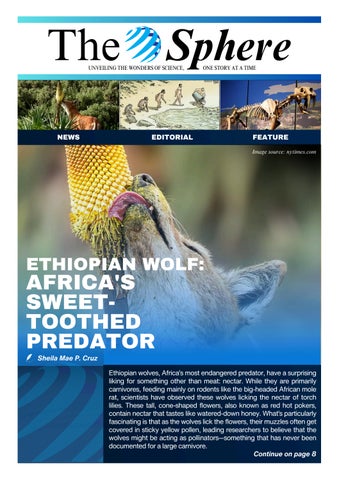
Image source: nytimes.com

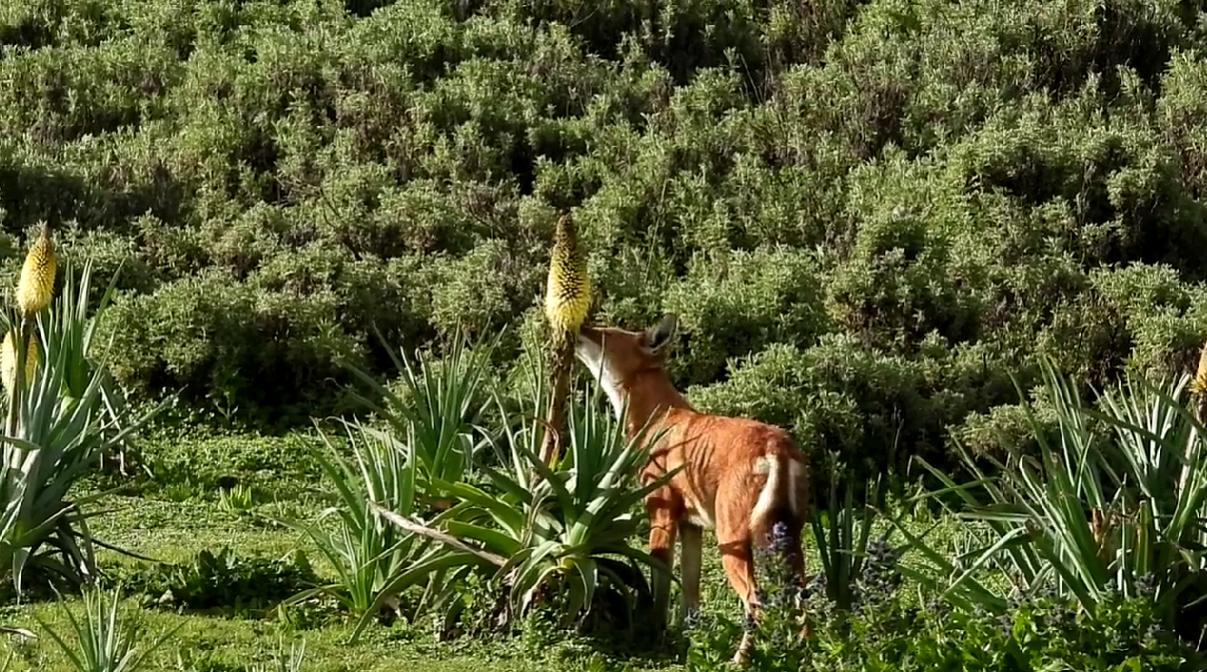
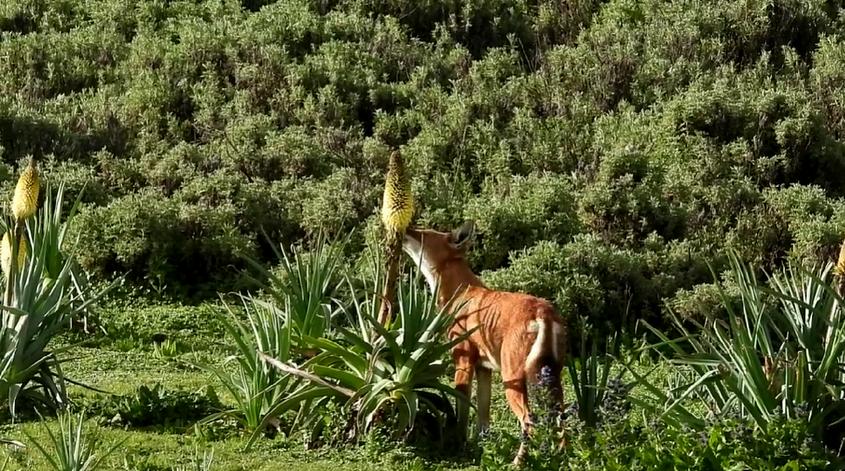
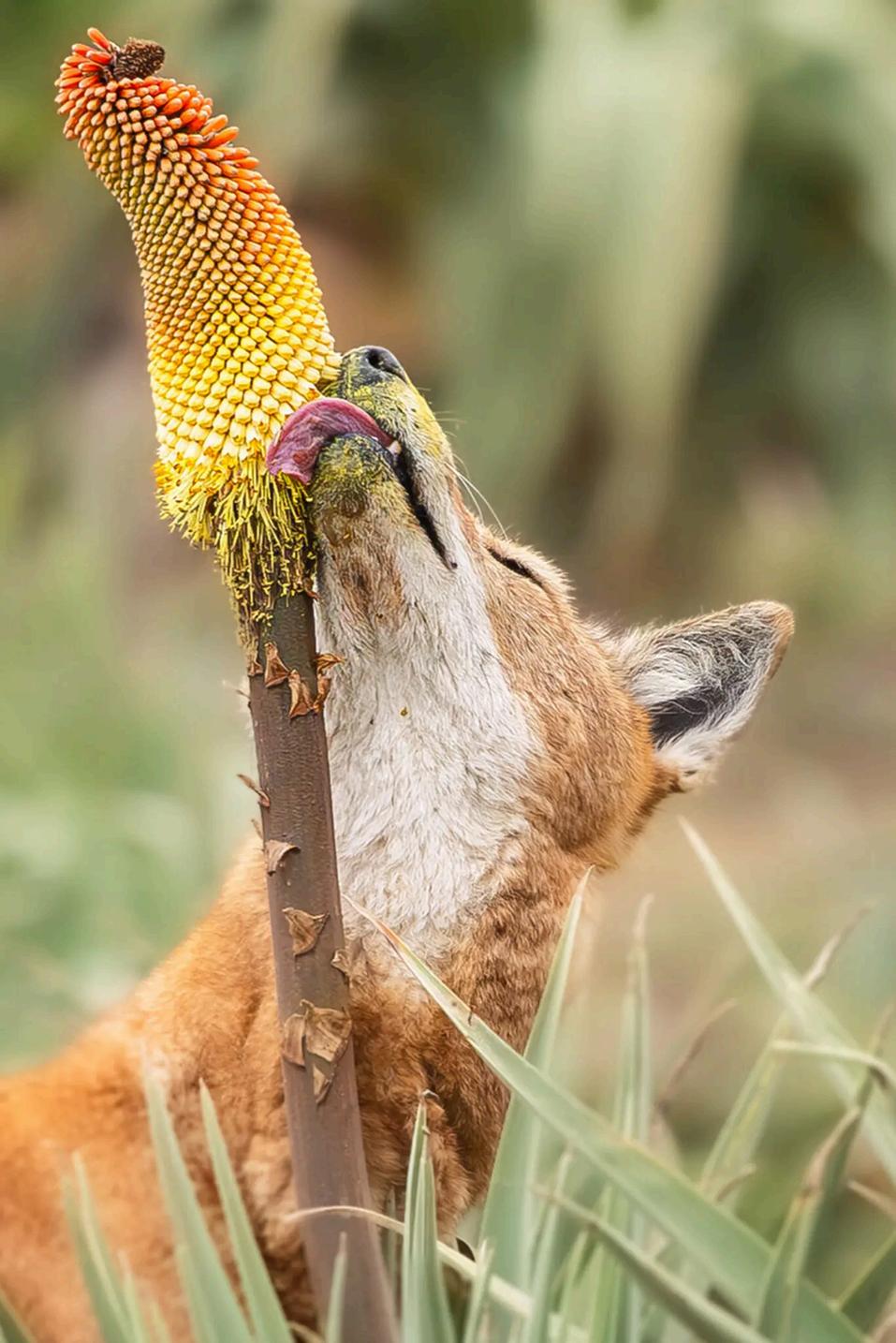
Ethiopianwolves,Africa’smostendangeredpredator,haveasurprising liking for something other than meat: nectar. While they are primarily carnivores,feedingmainlyonrodentslikethebig-headedAfricanmole rat, scientists have observed these wolves licking the nectar of torch lilies These tall, cone-shaped flowers, also known as red hot pokers, containnectarthattasteslikewatered-downhoney What’sparticularly fascinatingisthatasthewolveslicktheflowers,theirmuzzlesoftenget covered in sticky yellow pollen, leading researchers to believe that the wolves might be acting as pollinators something that has never been documentedforalargecarnivore
Continue on page 8

EDITOR-IN-CHIEF
SHEILA MAE P CUZ
EDITORIAL STAFF
JOSHUA S ORDIALES
JOAN FORTUNA
MARY ROSE ANN SARAD
IRVIN JUNE CATALAN
ALLYANA EUNICE VICENTE
Port Talbot, Wales – Two tropical moths journeyed 4,500 miles from the jungles of Guyana to a home in south Wales, hitching a ride as larvae in a photographer's boot bag Ecologist Daisy Cadet, 22, and her mother Ashleigh discovered the clearwing moths, one alive and one deceased, on their windowsill during winter Initially mistaken for a common UK species, DNA tests revealed the moths were a previously unknown species, now named Carmenta brachyclados.

Natural History Museum experts described the find as an “improbable event.” Daisy uncovered cocoon remains in the muddy boots from her mother’s trip, offering a clue to the moths’ incredible journey The discovery highlights the unpredictable ways wildlife can traverse the globe.


Instructions: When the Panama land bridge between North and South America was uncovered, some North American mammal lineages crossed to South America and underwent dramatic radiation. For terrestrial species, (1) did the completion of the land bridge represent a vicariance or dispersal event? (2) Did the recent construction of the Panama Canal represent a vicariance or dispersal event for terrestrial organisms? (3) For marine organisms?
When the land bridge was completed, it gave land animals a way to move between North and South America This allowed North American mammals to travel to South America, leading to big changes in the types of animals living there. When animals actively move from one place to another, they often settle in new environments The movement of land animals across the Panama land bridge is called a dispersal event because it was made possible by the bridge, letting them migrate to new habitats

Building the Panama Canal was a big change for land animals. The canal acted like a barrier, splitting up habitats that used to be connected This separation caused animals on each side to become isolated from each other Over time, these separated groups could adapt to their own environments, and new species might form because they would no longer be able to breed with each other.
For sea creatures, the land bridge was a big change Before it formed, the Pacific and Atlantic Oceans were connected, letting marine animals move freely between them But when the land bridge appeared, it blocked this connection and separated marine life in the two oceans Later, building the Panama Canal caused a new kind of change It allowed some marine species to move between the Atlantic and Pacific Oceans again, changing where they live and how they connect because of shifts in water flow and salt levels.


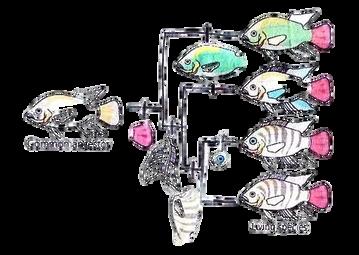
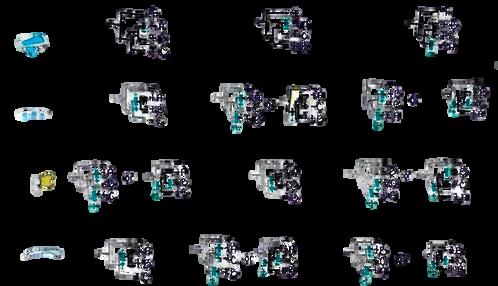
Instructions: Assuming the four living species in the Figure below evolved from their common ancestor without convergence or reversal, reconstruct their evolutionary relationships and label the transitions.
Which evolved first: stripes, or spiky back bins? How do you know?
The first trait to evolve was the spiky back. The spiky back fins appeared first because three species have them More species have spiky back fins than stripes, which means the spiky back fins must have evolved before the stripes
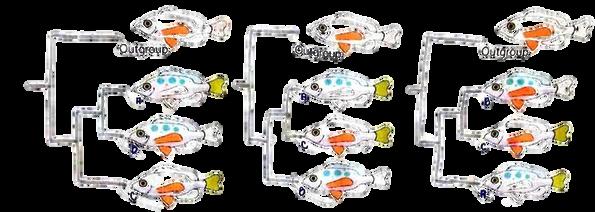
The four fish in the Figure below evolved from a common ancestor with some homoplasy. What are the possible evolutionary trees for the ingroup? Which is the most parsimonious?
Characters
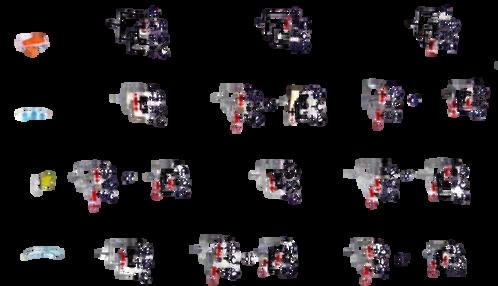
After looking at the evolutionary traits in the descendants, we found a clear pattern of characteristics shared throughout their history. At first, all the descendants have green eyes and a lavender body, showing that these traits are ancient and have been passed down over time
Hyporhesis 1: However, these traits are not very helpful in this case since all the descendants share them As evolution continues, we notice that all descendants develop countershading, which likely gives them advantages in different environments and becomes common throughout the lineage. Additionally, several new traits appear and are shared by the descendants, such as a blue dorsal fin and patches, a green tail fin, and orange side fins These new traits are unique adaptations that developed separately in different branches of the lineage. When we analyze this, the first hypothesis gives the simplest explanation for the traits we see This conclusion is supported by the idea of convergence, which means that similar traits evolved independently in different species, as seen in the new traits in the descendants. For example, in the first hypothesis, Species A and B have a blue dorsal fin and patches, which are more complex than the form of Species C This leads us to believe that Species C is more primitive than Species A and B.
(2). Consider the nucleotide sequence TGACTAACGGCT. (a) Transcribe this sequence into mRNA. Use the genetic code to translate it into a string of amino acids. (b) Give an example of a point mutation, an insertion, a deletion, a frameshift mutation, a synonymous substitution, a nonsynonymous substitution, and a nonsense mutation. (c) Which of your examples seems likely to dramatically influence protein function? (d) Which seems likely to have little effect? Why?
References: Roser, M., Appel, C., & Ritchie, H. (2024). Human height. Our world in data.
Stulp, G., & Barrett, L. (2016). Evolutionary perspectives on human height variation. Biological Reviews, 91(1), 206-234
(c) Among these mutations, a nonsynonymous substitution and a frameshift mutation are most likely to dramatically influence protein function A nonsynonymous substitution alters the amino acid sequence, which can disrupt the protein's structure or function, depending on the role of the affected amino acid A frameshift mutation, which changes the entire downstream amino acid sequence, often results in a nonfunctional protein, especially if it occurs early in the sequence. Both types of mutations can severely impact the protein’s function and the organism’s overall health
(d) On the other hand, a synonymous substitution is the mutation least likely to have an effect on protein function Since the substitution does not change the amino acid encoded by the codon, the resulting protein sequence remains unchanged, and thus, the protein’s function is unaffected Although synonymous mutations may influence aspects such as mRNA stability or translation efficiency, their direct impact on protein function is minimal.