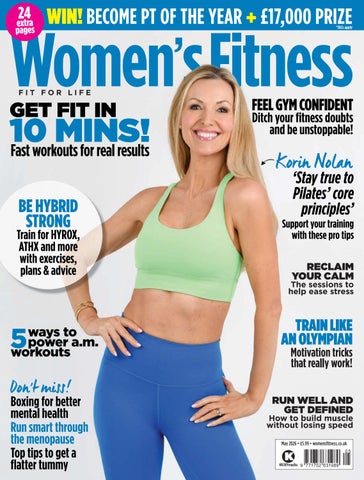
WomensFitnessMay2026

Page 1


Fast workouts for real results

FEEL GYM CONFIDENT Ditch your fitness doubts and be unstoppable!

Korin Nolan

BE HYBRID STRONG

Train for HYROX, ATHX and more with exercises, plans & advice

5 ways to power a.m. workouts Don't miss!

Boxing for better mental health

Run smart through the menopause Top tips to get a flatter tummy

‘Stay true to Pilates’ core principles’ Support your training with these pro tips

RECLAIM YOUR CALM The sessions to help ease stress TRAIN LIKE AN OLYMPIAN Motivation tricks that really work! RUN WELL AND GET DEFINED How to build muscle without losing speed

WOMEN’S FITNESS MAGAZINE

KELSEY MEDIA, THE GRANARY, DOWNS COURT, YALDING HILL, YALDING, KENT, ME18 6AL, UK

(PLEASE DON’T SEND SAMPLES TO THIS ADDRESS)

EDITOR-IN-CHIEF: SARAH SELLENS

HEALTH EDITOR: EVE BOGGENPOEL

ART EDITOR: XAVIER ROBLEDA

SOCIAL MEDIA & NEWSLETTERS: AMY DOWRICK

THANKS TO: SARAH CAMPUS, JO EBSWORTH, AIMEE FULLER, KATJA GASKELL, ROB HOBSON, LUCY MILLER, SEAN MURPHY, NOEMI NAGY-BHAVSAR, LOUISE PYNE, DONNA RICHARDSON, LILY SMITH, KATY SUNNASSEE

ADVERTISEMENT SALES: TALK MEDIA

INVESTMENT MANAGER: BONNIE HOWARD, 01959 543587, BONNIE.HOWARD@KELSEY.CO.UK

AD PRODUCTION SUPERVISOR: GRACIE STANDEN01732 445300

PRODUCTION@TALK-MEDIA.UK

EDITORIAL: WF.ED@KELSEY.CO.UK

MANAGEMENT

CHIEF OPERATING OFFICER: PHIL WEEDEN

MANAGING DIRECTOR: OSWIN GRADY

RETAIL DIRECTOR: STEVE BROWN

AUDIENCE DEVELOPMENT MANAGER: ANDY COTTON

OPERATIONS DIRECTOR: GILL LAMBERT

SUBSCRIPTIONS MARKETING MANAGER: NICK MCINTOSH

HEAD OF EVENTS: KAT CHAPPELL

PRINT PRODUCTION MANAGER: GEORGINA HARRIS

PRINT PRODUCTION CONTROLLER: HAYLEY BROWN

SUBSCRIPTIONS

12 ISSUES OF WOMEN’S FITNESS ARE PUBLISHED PER ANNUM

UK ANNUAL SUBSCRIPTION: £78

EUROPE ANNUAL SUBSCRIPTION: £126

REST OF THE WORLD ANNUAL SUBSCRIPTION: £138

UK SUBSCRIPTION AND BACK ISSUES: 01959 543 747

OVERSEAS SUBSCRIPTIONS: 0044 (0)1959 543 747

TOLL FREE USA SUBSCRIPTIONS: 1-888-777-0275

UK CUSTOMER SERVICE TEAM: 01959 543 747

CUSTOMER SERVICE EMAIL ADDRESS: CS@KELSEY.CO.UK

CUSTOMER SERVICE AND SUBSCRIPTION

POSTAL ADDRESS: WOMEN’S FITNESS, CUSTOMER SERVICE TEAM, KELSEY MEDIA, THE GRANARY, DOWNS COURT, YALDING HILL, YALDING, KENT, ME18 6AL, UNITED KINGDOM

FIND CURRENT SUBSCRIPTION OFFERS ON OUR WEBSITE: SHOP.KELSEY.CO.UK/WF

ALREADY A SUBSCRIBER? MANAGE YOUR SUBSCRIPTION ONLINE: SHOP.KELSEY.CO.UK/MYACCOUNT

DISTRIBUTION

FRONTLINE DISTRIBUTION SOLUTIONS

2 EAST POULTRY AVENUE

LONDON, EC1A 9PT

TEL. 020 7429 4000. SEYMOUR.CO.UK

DISTRIBUTION IN NORTHERN IRELAND AND THE REPUBLIC OF IRELAND

NEWSPREAD

TEL: +353 23 886 3850

Information given is not a substitute for medical advice, so ensure you check with your GP, medical professional or other relevant qualified professional before making any changes to your healthcare, diet or exercise routine.

Kelsey Media 2023 © all rights reserved. Kelsey Media is a trading name of Kelsey Publishing Ltd. Reproduction in whole or in part is forbidden except with permission in writing from the publishers. Note to contributors: articles submitted for consideration by the editor must be the original work of the author and not previously published. Where photographs are included, which are not the property of the contributor, permission to reproduce them must have been obtained from the owner of the copyright. The editor cannot guarantee a personal response to all letters and emails received. The views expressed in the magazine are not necessarily those of the Editor or the Publisher. Kelsey Publishing Ltd accepts no liability for products and services offered by third parties.

Kelsey Media takes your personal data very seriously. For more information of our privacy policy, please visit kelsey.co.uk/privacy-notice. If you have any queries regarding Kelsey’s data policy, you can email our Data Protection Officer at dpo@kelsey.co.uk

ENTER A NEW EXERCISE ERA

Here’s a very brief fitness history of me: in my 20s, I was an endurance runner and I worked very hard at it. It. Was. Everything. In my 30s, I had children and running wasn’t everything anymore. I couldn’t keep up with my own pace standards and I didn’t know what to anchor my training to. Then, at a cover shoot in 2021, a PR friend introduced me to HYROX and it was a game-changer. When around 4,000 people lined up to take part in the London Excel event in April 2022, I was one of them – and what I discovered was something that called upon my endurance skills, tested me mentally and gave my gym training purpose. But more than that, it introduced me to a new fitness community – both locally and globally.

Earlier this year, I took part in ATHX – another hybrid competition that focuses on strength, endurance and functional fitness – alongside WF contributor Sarah Campus, and it was palpable that this fitness category is showing no signs of slowing down. So, when we planned the magazine topics for 2026, I had to put a Hybrid Training Special on the list. HYROX has kicked off a new era of fitness competitions and I’m in the very privileged position to see it develop.

If hybrid exercise sounds like something you’d enjoy too, turn to page 30 for our Hybrid Special section, where you’ll find out why it’s a fitness modality that’s so popular among mid-lifers, as well as training plans for some of the hottest hybrid events in the UK right now.

Another area of exercise which is going nowhere anytime soon is Pilates – but what is it exactly, and how can you make it work best for you and your goals? This month’s cover model, pioneering Pilates instructor Korin Nolan, separates fact from fiction – and reveals just how reformer and other forms of Pilates can elevate your health and fitness. Turn to page 16 to read more. Keep on moving!

REGULARS

07 Fit buzz

The latest things to do, buy and try

12 COVER ‘How do I build lean muscle?’ PT Sean Murphy on running strength

16 COVER ‘We mustn’t lose sight of Pilates’ core principles’ Instructor Korin Nolan on using Pilates for your overall fitness

22 Women to watch We chat with kitesurfer Lily Young

24 COVER Fuller on fi tness Aimee’s reveals her simple motivation tips

FIT BODY

30 COVER Train for a hybrid race! Training plans for three big events

36 COVER ‘HYROX got me fi tter at 50’ Here’s everything the sport could do for you

40 COVER Reclaim your calm PT Sarah Campus’ advice for managing stress

44 Active travel Columnist Sarah Campus gets fit in Barbados

48 COVER Own your workout Advice to beat your gym worries

FIT FUEL

54 Fuel up Discover this month’s plant food and drink launches

56 Eat like an elite Boxer Caroline Dubois’ top nutrition strategies

60 COVER 5 ways to fuel your morning workout Expert advice from nutritionist Rob Hobson

64 Powerful plates Nutrient-dense meals for low appetites

68 COVER Soothe your stomach Solutions for a bloat-free system

Korin Nolan’s Pilates advice

Take care of your tummy

Model: Korin Nolan

Photography: Zak Walton

FIT HEALTH

76 Wellbeing wonders

The latest ways to be healthy

78 COVER Run through menopause

Advice from Dr Juliet McGrattan

82 Pilates for hybrid athletes

How to boost your performance

86 COVER Roll with the punches

Try non-contact boxing to support mental health

92 How to run your way

No-nonsense advice for runners

96 Rest and Recover

We recharge at Ragdale Hall Spa

GET FIT IN 10 MINUTES!

100 Make every workout count How to maximise each session

102 Lower-body burner

A speedy workout for your lower body

106 Total-body Pilates

Your 10-minute total-body Pilates circuit

110 Going for goal

What to do when you miss a workout

114 Turn up the intensity

Five intense conditioning workouts to try

118 Yoga for amazing arms

A 10-minute yoga workout for your arms

FIT BUZZ

Smooth moves

Born in the English countryside and built for modern life, Now You Live (nowyoulive.com) is a new activewear and athleisure brand offering a considered wardrobe of elevated essentials that go beyond the gym. Designed to transition seamlessly from movement to downtime, we love the sleek and sculpted Clayton Jacket, £130, seen here with the Willoughby Legging, £90, both made from the brand’s signature YouMove women’s performance fabric, with four-way stretch, a soft-touch feel and medium support that moves with your body.

Game, set and match!

DO THIS...

Sweet escape

Long established as one of the leading UK wellness festivals, The Big Retreat (thebigretreatfestival. com) returns to the Pembrokeshire Coast National Park in Wales from May 22-25, to help visitors relax and recharge. Designed so that guests can build their own version of a feel-good escape, you can choose from more than 300 uplifting experiences spread across a dozen zones, all rooted in movement, adventure, creativity, nature, food, music and meaningful connection.

By day, reconnect to your body with yoga, wild swimming, paddleboarding and breathwork, or head to the Fitness Field for high-energy workouts if you prefer to move fast and feel the adrenaline. At night, enjoy live performances from the likes of Rebecca Ferguson, DJ Fat Tony and Craig Charles on the main stage. Can’t make it? Check out details for the brand-new edition, The Big Retreat Cambridgeshire (bigretreatcambridgeshire.com) taking place September 11-13, held within the picturesque Abbots Ripton estate for a latesummer countryside escape.

An adult four-day ticket for either event starts from £269, while day tickets start from £79 and kids under five go free.

Australia’s leading activewear brand Elite Eleven (eliteelevensporting.com) is turning heads on and off the court with performance-driven tennis designs built for speed, movement and functionality. Inspired by looks worn at the 2025 Grand Slams, the latest styles include the pleated Swift Skort, £35, the racer-back Classic Training Tank V2, £30, and the Rally Dress, £50, featuring a sleek silhouette with a built-in shelf bra and adjustable straps. Made from lightweight performance fabrics for unrestricted play, each style is available in classic White, Bright Lilac or Pink Papaya for you to mix and match with co-ordinating shorts and visors. Talk about ‘love all’!

WEAR THIS...

BUY THIS...

Get grounded

Combining performance, sustainability and minimalist design, the new Vivobarefoot Primus Trail Flow, £150, is a lightweight barefoot trail running shoe built for mindful movement across all terrains. Engineered with a breathable 100 per cent recycled mesh upper and anti-slip lacing to keep your feet cool and secure, the thin yet rugged outsole provides exceptional grip and comfort, while the absence of an insole brings your foot even closer to the ground for a fully immersive barefoot experience. Available in three colours, it’s perfect for off-road adventures, trail running or exploring the coastline this summer.

Clever kit

WEAR THIS...

Known for its NASA-developed temperature-regulating motorsport base layers, British performanceapparel brand Walero (walero.works) has unveiled a new standard of intelligent activewear that responds to your body’s needs no matter the activity, season or adventure. The four-piece Walero Active collection boasts Outlast technology, originally engineered for NASA astronauts to manage extreme bodytemperature shifts, to help your body stay warm when it’s cold and cool when it’s hot (research shows it helps to reduce sweating by up to 30 per cent).

Each garment – including the Long Sleeve Half Zip Top, £195, and Women’s Leggings, £159, seen here – is tested by athletes and engineered to blend technical performance with soft, sustainable materials, seamless construction and four-way stretch for friction-free comfort, while antimicrobial qualities help the activewear to stay fresher for longer.

BUY THIS...

Smart strides

The new Amazfit Active 3 Premium, £169, is a lightweight, AI-powered running watch built for those starting their running journey or building towards a more ambitious goal. Designed specifically to help new and entry-level runners discover how to pace themselves, recover effectively and combine running with strength training to feel stronger and more capable each week, the slim design brings simple structure to training so you can build confidence without feeling overwhelmed.

Key features include AI coaching via Zepp Coach for adaptive training plans that evolve with you, advanced recovery insights such as training load, fatigue, Heart Rate Variability (HRV) and sleep tracking, and BioCharge energy tracking to help you easily understand your overall energy levels. Offline maps and route planning also encourage new runners to explore with confidence; uk.amazfit.com

Tri for fun

DO THIS...

As the UK’s largest triathlon and world’s only triathlon held at a UNESCO World Heritage site, the Supertri Blenheim Palace swim-bike-run festival is a bucket-list event for keen triathletes and is perfect for newcomers to the sport. Taking place on June 6-7, with distances to suit everyone, including the SuperSprint and the Weekend Warrior, entrants can swim in the sheltered Palace lake, cycle on fully closed roads through the lightning-fast Estate, and run past the Palace and across its stunning parkland.

New for 2026, entrants also get the chance to race on the same course as the world’s best triathletes, following the announcement that Supertri has added the Pro Series to the weekend event. Find out more and sign up today at supertri.com

Power your vision

Designed for competition and suitable for all sports and outdoor activities, the rimless Adidas DUNAMIS Sports Sunglasses, £180, boast a unique aerodynamic spoiler shape to cut through the air, a new ventilation system with increased air flow at the temples to reduce lens fogging, and new adjustable nosepads to help you find the perfect fit. The ultimate companion for tarmac or trail, the lenses also feature a hydrophobic, oleophobic, antiscratch and anti-dust treatment, helping them to adapt to changing conditions so you can eliminate visual distractions; adidas.co.uk

Party on pedals

TRY THIS...

British spin bike brand Apex Rides (apexrides.com) is starting an exciting new chapter by discontinuing sales of its bike and relaunching with a revolutionary, one-of-a-kind app. The new Apex app, previously locked to and only usable via the brand’s own Apex Spin bike, now allows subscribers to access the brand’s premium studio-quality classes led by world-class instructors, alongside epic playlists and live leaderboards, using any Bluetooth-enabled indoor bike – either at home or in the gym.

Designed to make connected cycling more inclusive, flexible and accessible, this function is not currently offered by any other Spinning app in the same capacity in the UK. Compatible with dozens of best-selling bike brands, including Matrix, Keiser, Schwinn, Wattbike, Technogym and LifeFitness, membership costs £29.99 a month.

QUICK & EASY

Booster Protein

Boost your meal’s protein or enjoy as a snack

This month, learn to lift to support your running goals with Ultimate Performance expert Sean Murphy

Meet the expert

Sean Murphy is global chief personal training officer at Ultimate Performance (U.P.), with more than 15 years’ experience as a leading authority in the fitness industry. He oversees more than 300 trainers worldwide and sets the standards that have made U.P. the global benchmark in strength training since 2009. A senior member of the Executive Team, Sean leads the development and execution of the U.P. Method, with responsibility for trainer education, exercise execution, gym-floor performance and clients’ results. Visit ultimateperformance.com

training improves your running economy

Many runners worry that adding strength training will leave them too fatigued to perform well in their key sessions. In reality, the opposite is often true. When programmed properly, strength training can improve running performance while helping you maintain both muscle strength and definition.

Running is excellent for cardiovascular fitness, but it does relatively little to preserve muscle. Well-structured strength training alongside running has been shown to improve running economy, meaning you use less energy to run at the same pace. Just as importantly, resistance training gives your body a reason to keep muscle. Running alone simply doesn’t provide that signal.

The goal isn’t to train like a bodybuilder or overwhelm your schedule. Most runners need a small amount of well-structured strength work done consistently. Think of strength work as a small but important addition that supports your running rather than competing with it. With the right structure, you can maintain strength and definition without affecting your key runs each week.

Strength

Two sessions are enough

You don’t need long gym sessions to maintain muscle as a runner. Two well-structured strength workouts each week are enough.

Each session can be around 30-40 minutes and should focus on the main movement patterns that support running. A simple structure works well: one lower-body push exercise such as a squat, split squat or leg press; a hip hinge such as an incline hyper or Romanian deadlift; an upper-body push such as a chest press; and an upper-body pull such as a row or pulldown. Calf training should also be included – for example, standing calf raises – as the calves and Achilles tendon absorb a huge amount of force during running.

Perform three sets of each exercise in the six-to-10 repetition range, using a weight that feels challenging but controlled. Most runners underestimate how strong they can be, so the goal should be to finish most sets knowing you could complete one or two more repetitions, if needed.

Occasionally, on your final set, push right to your limit. If you never go close to failure, you never really know where that limit is. Muscles only stay or grow when they are challenged. If you don’t challenge them, you’re not giving them a reason to maintain their strength or size.

Aim for two, 30- to 40-minute sessions a week to maintain muscle mass
‘Heavy leg training immediately before speed work or long runs can leave legs feeling flat and reduce the quality of key sessions’

Place around run sessions

The key to balancing running and strength training is simply how you arrange the week.

Most runners structure training around four sessions: speed work, threshold running, an easy run and a longer-distance run. Strength training should sit around these sessions rather than interfere with them.

The majority of runners find it easiest to organise their week around key runs first and then place strength around them. A simple weekly structure might look like this: Monday: speed run; Tuesday: strength session;

Wednesday: easy run; Thursday: threshold run; Friday: strength session; Saturday: easy run or rest; Sunday: long run.

This approach works well because strength training follows harder running days rather than preceding them. Heavy leg training immediately before speed work or long runs can leave your legs feeling flat and reduce the quality of those key sessions. By grouping harder work together and allowing recovery afterwards, you maintain the quality of your running while still building strength.

Strength training supports performance

Running involves thousands of repeated ground contacts. Each mile can include more than a thousand foot strikes, placing repeated stress on the hips, knees, calves and Achilles tendon.

Strength training helps the body handle this load more e ectively. Stronger muscles help control each stride, absorb force and keep your running mechanics consistent as fatigue builds.

It can also improve running economy and lactate threshold

e ciency, meaning that you’re able to sustain faster paces with less energy cost.

Just as importantly, resistance training is what signals the body to maintain muscle. Running alone does little to preserve muscle definition, particularly when weekly mileage increases.

Two short strength sessions each week can therefore support both of these goals: maintaining muscle strength and improving your running performance.

Stronger muscles keep running mechanics consistent – even as you tire

‘We must stay true to Pilates’ core principles’

Pilates in 2026 looks stronger than ever. We talk to pioneering Pilates instructor Korin Nolan (@korinnolanpilates) about this trending workout – and how you can use Pilates to support your overall fitness

Words: Joanna Ebsworth | Photography: Zak Walton

Korin Nolan knows all about the rise of Pilates. As one of the UK’s most experienced Pilates teachers, with more than 20 years in the industry and over one million women taught in person and via her platforms, the Sheffield-born mum of three became a Pilates pioneer when she opened South East London’s first dynamic reformer studio in 2014 – long before equipment-based Pilates had reached a peak in the UK.

A single parent back then, Korin risked it all when she purchased six reformer machines and quit her Pilates teaching job to launch her own studio, Power Pilates UK (powerpilatesuk.com), at a time when most people had never seen, let alone used, a reformer. Fast forward 12 years, however, and the 47-year-old’s gamble has paid off; classes at Korin’s dynamic reformer studio continue to sell out despite a move to larger premises with more reformers and more instructors. The on-demand

Pilates platform she co-founded in 2018, Dynamic Pilates TV (dynamicpilatestv.com), has thousands of members from 70 countries, and her brand-new app, The Class Plan (theclassplan.com), is helping Pilates instructors build fun, effective workouts with inspiring educational and planning tools.

It’s impressive stuff from the former dancer and TV presenter who first discovered mat Pilates at the age of 19 while studying at the London College of Dance, although Korin is the first to admit she ‘just knew’ reformer Pilates would take off in the South-East London suburbs in the same way it already had in the city. Whether or not she expected the practice to transform from a niche fitness regime into the global wellness phenomenon it is today – fuelled by social media, celebrity and athlete endorsements, and a growing interest in low-impact workouts – is another matter entirely. But if new statistics

are anything to go by, the Pilates bubble is a very long way off bursting. Case in point? Back in 2021, there were 3,918 Pilates and yoga studios in the UK and the market was worth £800m; today, there are 5,000 businesses operating, with more on the way, and the market is set to reach £1bn this year. Furthermore, recent research from ClassPass shows Pilates ranked as the most popular workout of the year for the second year in a row, with data revealing bookings rose by 84 per cent from 2023 to 2024, and by another 66 per cent from 2024 to 2025.

Clearly, Pilates has serious staying power. But while its boom has helped the practice become widely available, its transition into the mainstream has sparked debate – from accusations of elitism to concerns around fast-track qualifications and slipping teacher standards. So, is Korin concerned Pilates is losing sight of its core values as its popularity continues to grow?

“ I’d never experienced anything like it! My body was shaking, sweating and uncontrollable

Providing purpose

‘Aside from the fact that people are becoming more aware of the importance of their core strength and posture, one of the upsides of Pilates’ growing popularity is that it has become more accessible, so people from all walks of life are able to do it,’ says Korin. ‘It’s even being introduced into gyms as part of people’s memberships, and that helps to make it cheaper. But at the same time, some of these gyms can have 20 reformer beds, and while that may sound like a positive thing to help increase availability and reduce costs, it’s actually not. Classes should be kept fairly small, between 10-12 people maximum, so that instructors can get around to everyone to correct clients’ bodies, provide cues and offer modifications where needed.

‘We mustn’t lose sight of the six core principles of Pilates –centering, concentration, control, precision, breath and flow – because they form the foundation of the method developed by Joseph Pilates during the 1910s and 1920s,’ adds Korin. ‘Each principle has to be encompassed within an exercise to make it a Pilates exercise in the first place, so you really do have to focus on a lot of different things to execute a movement properly, whether you’re an instructor or a client.’

A new practice

Korin initially fell in love with the transformative power of mat Pilates while completing her dance degree, so much so that she ditched her dreams of performing on a West End stage to train as a Pilates instructor with renowned course provider Body Control Pilates. Afterwards, she spent many years juggling motherhood with teaching Pilates while also working in television, where jobs included a presenting role on Channel 5’s The Wright Stuff from 2004 to 2008. But it was when she tried reformer Pilates for the very first time in her 30s that she fell in love with the practice again.

‘Reformer Pilates is a resistancebased form of training performed on a specialist bed-like machine called a reformer,’ explains Korin. ‘It features a sliding carriage, adjustable springs, straps and a footbar, and it’s all about working under tension with precision to improve your strength, stability, mobility and flexibility.

‘As I found out when I tried my first dynamic reformer class, it’s quite a step up from mat Pilates, which relies mostly on body weight. I remember going into it thinking, “I’ll be fine because I’m strong and I’ve done Pilates for years.” But I’d never experienced anything like it! When I came out, my body was shaking and sweating and uncontrollable, and I was like, “That’s a killer!”.’

After this, Korin began doing reformer classes regularly, which she says led to a transformation in her own body composition. ‘I think one of the reasons why reformer Pilates has become so popular is because it works and it gets results. Mat work isn’t easier than reformer – it’s just a different challenge. On the mat, you don’t have the support of the equipment, so you have to control your entire body yourself. Whereas reformer adds resistance and instability, so both can be as hard or as gentle as the teacher and class level make them. Reformer Pilates might be low impact, but it’s still really challenging, and I think people like to feel they’re getting something from their workout. It’s hard but incredibly effective and addictive, and that keeps people coming back for more. Very few people who try reformer Pilates hate it.’

Strong foundations

It’s easy to see how glowing testimonials from the likes of Korin and millions of others around the globe have helped reformer Pilates develop a reputation as the ‘best workout in the world’. But Korin is keen to stress that Pilates works best

The 6 Pilates Principles (in simple terms)

Centering

Everything starts from your centre: your deep core, glutes, inner thighs and back. In Pilates, movement comes from the centre first and everything works outwards from there.

Concentration

You have to think about what you’re doing. Pilates isn’t something you can do while mentally writing your shopping list. You’re focusing on how you move, where you feel it, and doing each exercise properly.

Control

Joseph Pilates originally called his method Contrology. It’s not about how many reps you do, it’s about controlling the movement and not letting it control you – slow, controlled and with good form.

Precision

It’s not just doing the exercise, it’s doing it well. Small adjustments make a big difference in Pilates: where your foot is, pelvis or shoulders are –it all matters.

Breath

Breathing properly helps the muscles work better, especially the deep core. It also helps with rhythm, control and not holding tension in your neck and shoulders. In Pilates, we use lateral breathing, which means we take the breath lower down and breathe laterally as opposed to up and down.

Flow

Pilates shouldn’t look stiff. The exercises flow into each other and the movement should look smooth and controlled rather than robotic. Think of it as strength with fluidity.

Korin’s 3 tips for Pilates success

Learn to spot a good teacher

‘Look for someone who explains how to do each movement in detail and what to do to get more out of it, who takes the time to give clear cues that aren’t rushed and who modifies and adapts each exercise for different bodies, injuries and stages of life. A good teacher should talk about the breath, core and pelvic floor engagement (and how those things fuse together), and they should also come around regularly to look at your technique and correct it.’

Schedule Pilates sessions wisely

‘It’s good to aim for two-to-four sessions a week, in combination with strength training, but even one mat class a week can be a gamechanger for your core strength and posture, because it reminds you about your form, technique and breath. Pilates can help you build a really strong foundation for all movement, improving the way you walk, stand, sit and lift, and it’s amazing for stress relief because it forces you to focus on many things at once.’

Mix up the intensities

‘Remember that Pilates doesn’t just support strength and endurance; it also supports mobility, flexibility and recovery while ironing out imbalances to reduce the risk of injury. Sessions don’t have to be intense – they can also be restorative, rehabilitative and relaxing. I’ve come to realise that rest is just as important as strength training, and that doing a nice, slow 30-minute mat class at home is just as valid as a dynamic reformer class.’

alongside other fitness modalities. ‘I know I probably sound like I’m contradicting everything I’ve just said about how amazing reformer Pilates is, but the truth is that while it is a great form of resistance training, reformer machines don’t allow you to keep adding load upon load like gym machines do. And that means they don’t provide you with enough resistance to facilitate progressive overload, which is what you need to build muscle mass.

‘Yes, you’ll be able to build some muscle mass if you’re a beginner to exercise, but there’s a limit to what you can achieve. And as we know in this day and age, building muscle mass is really, really important for women, especially those over 35. I strength train maybe three times a week, do Pilates at least twice and walk a lot as well,’ notes Korin, before adding: ‘I see Pilates as my foundational movement, where I work my deep intrinsic muscles. It’s where I get my core strength, and where I work the deep muscles in my shoulder girdle and my hips, knees and ankles, so I’m strong and I can do heavier work at the gym.

‘Equally, while some dynamic flow reformer classes can definitely get your heart rate up and help you build a bit of a sweat, they won’t work your cardiovascular system in the same way as doing a HIIT class or going for a run. My point is no one should rely on one form of exercise for overall fitness. It’s like only eating protein and expecting to get everything you need for a healthy diet, when you also need carbohydrates, healthy fats and fibre.’

Return to form

According to Korin, Joseph Pilates never intended reformer Pilates to be taught as a singular workout, which explains why he invented multiple pieces of large apparatus alongside the reformer, including the Cadillac, barrel, tower and chair (Wunda chair).

‘Joseph Pilates primarily taught his method in a one-on-one, hands-on

manner in his New York studio, supervising high-profile clients –including famous dancers, athletes and actors – as they moved from one piece of equipment to the next and performed exercises with precision and control,’ explains Korin. ‘For this reason alone, I think Pilates has always been seen as a bit elitist.

‘Of course, as new variations of classical Pilates have developed, such as contemporary and dynamic, and group classes have become more widely available, Pilates has become more accessible to the masses,’ continues Korin. ‘But for many, reformer Pilates still remains inaccessible due to its costly nature. It’s a tough one because studios are expensive to run, training courses are a big investment, the equipment costs a fortune and instructors are limited to the number of people they can teach in one class (I have nine beds in my studio) so you need to charge more to make money.

‘On top of that, competition is constantly increasing and people are always on the lookout for the next big thing to post on Instagram,’ she adds. ‘That’s one of the reasons why I introduced chair equipment to my studio and launched Fusion classes, where people switch between the reformer and chair for a more varied class. It’s so popular that it’s become our signature class, and it almost feels like we’re seeing a return to the classical roots of Pilates.

‘The downside of this is that classes could become even more expensive as more equipment is introduced and class numbers are reduced to ensure instructors can monitor everyone effectively. But I do believe there are many ways to practise Pilates other than going to a studio. It’s available in NHS physiotherapy departments and community halls, or you can spend £25 a month on a membership online such as Dynamic Pilates TV. You can even do it for free by following classes on YouTube, so it’s not all elitist – you just have to look for it.’

“ Reformer Pilates challenges your balance and you have to work a lot deeper from your core – it might be low impact, but it’s still really challenging

Lily Young Women to watch

Early days

I always knew I wanted to be a professional athlete from a young age, because I just loved competing. Growing up in Weymouth, I was a swimmer to begin with, but my dad, uncle and granddad were really into water sports, and I finally gave in and tried windsurfing when I was around 13 – probably because swimming can be a bit tedious. After that, I got super addicted and started

windsurfing competitively with the British Sailing Youth Team in 2014.

I was about to enter the senior team when it was confirmed that kitesurfing would be making its debut at the Paris 2024 Olympics. That’s when I was approached to try kitesurfing, because they were looking for taller women to compete who could be more on the stronger side. I switched sports in 2018, fell in love with kitesurfing almost immediately, and I’ve been really successful at it ever since.

The Olympic-class version of kitesurfing I do is called kite foiling, and it’s a more extreme version of the traditional kind you see people doing at the weekend. Our boards have a hydrofoil attached, which helps lift the rider above the water so

we can go super fast as we race around a course, which usually takes around 12-15 minutes to complete.

While I’ve won medals at both the World and European championships, I just missed out on qualifying for the 2024 Olympics because I got beaten by a friend, but we’d worked together, and it was super special when she won an Olympic medal. Things like that have made the journey really enjoyable, and when I look back on what I’ve done so far, I realise I’ve had the best time ever – and it’s not over yet!

Training

Meet Lily

World number one kitesurfer Lily Young, 27, represents the British Sailing Team in the Formula Kite class – one of the fastest, most physically demanding disciplines in sailing. A silver medallist at the 2025 Formula Kite European Championships, she is currently chasing her LA 2028 Olympic dream.

Competitive kitesurfing events usually happen between March and October, so when we’re not training at our home base in Weymouth, we’ll spend much of November to March in training camps abroad to avoid the English weather (rain isn’t great for kite foiling). Unfortunately, I injured my hand very badly in training in mid-December, which required a skin graft from my arm, so I missed the main training block of the year. But with the help of my amazing team of doctors and physios, I was able to return to training this March. If we’re training hard in the summer in Weymouth, a typical training week might include four-to-five sessions on the water for around two-and-a-half hours each, at least four strength and conditioning (S&C) sessions that are heavily leg-based, and two bike rides. You’ve got to have really strong legs to help you control and resist the power going through the board, so my S&C sessions involve lots of squats, singleleg squats, leg presses and leg extensions. You also need a strong core to help you resist the elements, and any upper

Lily has been kitesurfing since 2018

body work we do is more about injury prevention, so a shoulder doesn’t pop out when we hit the water at 30 knots.

I do a lot of cycling to train my legs and increase my cardio endurance, which helps to increase the time I can train on the water while being mentally present. We usually do four races a day during an event, and when you’re racing, it can feel like you’re doing a really uncomfortable wallsit that burns your glutes, quads and hamstrings, so I do stretching and foam rolling for recovery when I can’t see my physio.

Mindset

I work on my mindset a lot, because my sport involves an element of fear. I’ve had to accept that doing an extreme sport means I can experience awful injuries sometimes, and I often have to weigh up the risk versus the reward in terms of how hard I push myself on the water.

I love learning new skills and new sports, and the method I’ve always used to do that is to watch something, practise it a thousand times on my own, and break it down into really small bits. I also apply that same strategy when I’m trying to get over a mental block (rather than jumping straight into something), so it feels less overwhelming. Right now, if I’m out on the water with my coach, we won’t talk about my hand. But if at any point I say I’m done, or I’ve had enough, that’s totally fine. I found it really hard to deal with nerves when I was younger, and I’d get super anxious before competing. These days, however, I know that the person who’s going to win on the day isn’t the person who’s best in training: it’s the person who can best deal with the pressure on the day. Now, I know I perform better when there is pressure, and I tell myself that all my hours of training will pay off in the end.

Lily often does four races a day at events

Goals

My dream is to win gold at the LA 2028 Olympics, and my amazing team help me work towards that goal every day through the programme we’ve developed. In January 2027, we’ll be trying to qualify as a team for a spot at the Olympics, so that’s the first big marker towards my main goal before I can try to earn my spot as an individual.

A strong core is vital to help you resist the elements

To stay updated with Lily’s journey towards the LA28 Olympics, follow @britishsailing and @lily_mayyoung on Instagram.

‘I work on my mindset a lot, because my sport involves an element of fear’

FULLER on fitne

Olympic broadcaster Aimee Fuller reveals the motivation hacks that keep her moving, because even Olympians find excuses!

Motivation is one of the most common things people ask me about. How do you stay consistent? How do you have so much energy? How do you keep going? It’s about protecting it and finding what works for you. What do you do when you can’t be bothered to train? The truth is, motivation isn’t something that magically appears, it’s something you create with small habits and systems that make showing up easier. And I’ll be honest, there are days I do crash and succumb to a Deliveroo and a lie-in.

We’re all human, right? But it’s about minimising those moments and finding a way

to get back on the horse more quickly so we can fulfil that desire to feel good mentally and physically, and even look good, too.

My motivation hacks

One of my biggest motivation hacks is accountability. Set a goal with someone else. It could be a friend, a training partner or a class you book together, or even just booking that class and committing to it. When there’s someone expecting you to show up, you’re far more likely to turn up. It’s about the community, both in studio and around us at home, that supports your healthy habits. Look around you. Are your friends fit? Do they like to

Turn exercise into a hobby rather than a chore to stay motivated

move? Can that Sunday afternoon in the pub become a walk and talk around your local park with a coffee? For example, I box once a week with my best friend. We commit to a time and a date and it’s locked in. It’s not just a workout, it’s a catch-up, a laugh and a guaranteed sweat session. That commitment makes it so much easier to stay consistent.

Let’s be honest, we don’t always want to get up at 6am to train before work, so where can you fit it in? Is it 30 minutes in a lunch break, or simply deciding to get off the tube two stops early on the way home from work and walk?

Sometimes motivation isn’t about pushing yourself harder, it’s about making fitness more social and accessible, and allowing adequate rest – whether it’s active (such as walking) or actually just taking a beat and having some time away from the gym, and hitting the sauna and ice bath instead.

Micro workouts count

MEET THE EXPERT

Two-time

Team GB Winter Olympian, Aimee Fuller is a former pro snowboarderturned TV sports broadcaster. Follow her @aimee_fuller

Another big lesson I’ve learned is that there’s no right or wrong type of exercise. It’s all about finding what works for you. As a former professional snowboarder, strength and conditioning training was a huge part of my life. It was literally my job, and it became habitual and it began to feel like a grind. These days, I still love that style of training, but I’ve found ways to make it feel fun rather than like work.

I regularly go to an F45 class and I’m also a big fan of Barry’s sessions. The energy, the music and the group environment give me that extra push. But the key thing is finding ways to fit training into my schedule so it supports my life rather than taking it over.

I don’t know about you, but I don’t want to feel like I have to

A mat and a little bit of space means you can fit in a yoga session pretty much anywhere

commit one-and-a-half hours to the gym every day. It doesn’t need to be that way. A speedy 45 minutes in the gym, and a walk when you are on a work call rather than sitting at your desk, means 30 minutes sitting could be 30 minutes of free movement. So take control of your time by giving yourself that option. If it eats into your time, it stops feeling sustainable.

My biggest tip? Little and often wins. Consistency is everything. At home, I keep things simple. I’ve got two sets of weights, my MiraFit weights at 10kg and 12.5kg, and that gives me options. Some mornings I’ll do a quick 15-minute strength session. If I have an early start, that 15 minutes sets me up and makes me feel alive, then I’ll head out for a walk. Later in the day, I might do another 15 minutes. It doesn’t have to happen in one big block.

So rather than saying ‘I have no time’, those minutes can add up across the day and before you know it you have done an hour in chunks. And when something feels accessible, you’re far more likely to stay motivated.

Find fun in fitness

This is something I started doing years ago when I was competing. When I was

travelling as a professional snowboarder, I used to try to fit yoga into my schedule to help with recovery and mobility. I’d often do 20 minutes first thing in the morning, then another 30 minutes later in the day after being on the mountain.

People often use the excuse of having no gym or no space, but nothing stops you from taking a yoga mat or laying a towel down in a hotel and doing a few press-ups and some mobility work. Splitting it up made it realistic. Movement doesn’t have to look perfect or follow strict rules. It just needs to work for your lifestyle.

Another great way to stay motivated is to turn exercise into a hobby rather than a chore. I love playing padel with friends. It’s competitive, it’s social and you’re moving without even thinking about it. When exercise becomes something you enjoy, something you look forward to, it stops feeling like punishment. That’s really the key to sustainable long-term motivation.

Find the activity that lights you up. Train with people who make it fun. Break sessions into manageable chunks. And build movement into your life in a way that feels energising, not exhausting.

Because the best workout routine isn’t the most intense one. It’s the one you actually stick to.

Aimee’s motivation toolkit

If you’re struggling to stay consistent, try these simple strategies to make movement easier and more enjoyable.

1. Train with a friend

Accountability is powerful. Book a weekly workout with a friend – boxing, running club once a week, or a class – and treat it like a standing date. You’re far less likely to cancel.

2. Keep equipment at home

Having a few weights or resistance bands nearby removes barriers. Even a quick 10- to 15-minute session counts.

3. Break workouts into chunks

You don’t need a full hour. Two 15-minute sessions across the day can be just as effective and often far more achievable.

4. Make fitness social

Sports such as padel, group classes or team workouts turn exercise into something you genuinely look forward to.

5. Choose what you enjoy There’s no ‘perfect’ workout. The best activity is the one that fits your lifestyle and keeps you coming back.

6. Invest in some new kit

Look good, feel good – and that goes for your shoes, too. I’ve just got a brand-new pair of bright pink Skechers to run in, so you won’t miss me.

7. Enjoy the process

When fitness feels fun, flexible and realistic, motivation follows naturally.

Catching up over a game of padel
For Aimee, exercise becomes e ortless when played with friends

Unsung heroes of fitness

Introducing the PT of the Year competition – celebrating the Unsung Heroes transforming lives across the UK

In every gym across the UK, there are quiet champions who rarely step into the spotlight. They’re the early risers unlocking studio doors, the steady voices of reassurance after a tough day, the patient coaches who stay late to celebrate a client’s first push-up. They do not train for applause or headlines. They show up because they care.

This year, the PT of the Year competition, launched by YOUR Personal Training (YPT), is dedicated to those very people. The theme is simple and powerful: Unsung Heroes.

Personal trainers often become the backbone of someone’s wellbeing journey. For many women, especially, a trainer is more than a coach. They can be a source of confidence after childbirth, a guide back to strength

following injury, or the catalyst for reclaiming self-belief during challenging life transitions. These moments rarely make social media highlight reels, yet they are transformative. The Unsung Heroes campaign shines a light on the trainers who quietly change lives behind the scenes.

The PT of the Year competition celebrates trainers who make a genuine difference in the lives of their clients and communities. It recognises dedication, empathy and impact as much as technical excellence. While aesthetics and athletic performance may draw attention, it is often the softer skills that truly define a great personal trainer: listening deeply, understanding individual barriers, creating safe and inclusive

environments, and believing in clients long before they believe in themselves.

Making a difference

Yet the real reward lies in acknowledging the meaningful work being done every day in gyms across the country. Recognition validates effort. It reminds trainers that their patience, resilience and commitment matter.

The Unsung Heroes theme resonates strongly within today’s fitness landscape. As conversations around mental health, body confidence and inclusive training continue to grow, the role of the personal trainer has expanded. Trainers are no longer just programme writers. They are accountability partners, educators and advocates for healthier lifestyles in the broadest sense. They help women feel strong rather than small. They encourage performance over perfection. They shift the narrative from punishment to empowerment. By telling the stories of these trainers, the PT of the Year competition does more than hand

THE PRIZE –WORTH OVER £17,000!

One standout trainer will be crowned PT of the Year, receiving national recognition and a prize package designed to support their long-term career development. The prize includes:

•£10,000 of CPD courses across 10 years from YOUR Academy, to a maximum of two courses per year (worth up to £500 per course)

•1-year free gym rent at a YPT partner facility – there are over 600 to choose from (worth over £6,000)

•A Hyperice Hypervolt Massage Gun (worth over £350)

•An UltraHuman Air Ring (worth £329)

•An Applied Nutrition Bundle (worth over £100)

•A Vow Nutrition Voucher (worth over £150)

In celebrating them, Women’s Fitness, Men’s Fitness and YOUR Personal Training are championing the very best of the industry – not ego, not hype, but heart. Because behind every empowered woman lifting weights with confidence, there is often a trainer who chose to care deeply about her success. That is a story worth telling.

out an award. It captures the human side of fitness. It reminds us that progress is not always loud or dramatic. Sometimes it is a quiet decision to keep going. Sometimes it is showing up for a session when life feels overwhelming. And often, it is a trainer standing beside a client, offering steady encouragement and unwavering belief.

How to nominate your PT

Nominations are now open for the PT of the Year competition, inviting members and peers to recognise the trainers who have made a genuine difference. Submissions can

be made online by scanning the QR code (left).

A judging panel, made up of experts from YOUR Personal Training, Women’s Fitness and Men’s Fitness, will carefully review each nomination to select the winner.

Members and gym communities are encouraged to reflect on the individuals who have shaped their journeys. Who stayed patient when progress felt slow. Who adapted clients’ sessions around injuries or busy schedules. Who sent a supportive message at exactly the right time. These are the Unsung heroes who deserve recognition.

About YOUR Personal Training

YOUR Personal Training is the UK’s leading personal training management company, supporting hundreds of trainers nationwide to deliver life-changing coaching. Its approach combines mentoring, education and extensive business support so trainers can focus on what matters most: helping clients achieve real results. Directed by James Lorey and Aaron McCulloch, both experienced trainers and industry advocates, YOUR Personal Training champions the Unsung Heroes of fitness – professionals who go above and beyond for their clients every day. By empowering trainers, YOUR Personal Training creates a ripple effect: motivated, knowledgeable coaches mean stronger, more confident clients across the UK.

FUEL WITH PURPOSE

Training taking it out of you?

Hydrate smarter for performance with Pro Plus Fizz Hydration

Whether you’ve been following a marathon training plan or building mileage for a new 5K PB, the demands add up fast: early alarms, commutes, strength sessions, long runs and then trying to recover in between.

When training volume ramps up, it’s not just your legs that feel it. You might feel flat or like everything takes more effort than it should.

One of the most overlooked issues is hydration and the electrolyte minerals your body loses through sweat.

Why water alone isn’t always enough

During training, especially long runs or sweaty sessions, you lose fluids and electrolyte minerals. That’s why hydration isn’t just about ‘drinking more’, it’s about matching what you take in with what you lose.

As bestselling author and award-winning nutritionist Rob Hobson explains:

‘Electrolytes aren’t something everyone needs every day, they’re a tool for specific situations where fluid and mineral losses are higher than normal. Electrolytes are a precision tool, not a lifestyle habit.’

Introducing Pro Plus Fizz Hydration: electrolyte support and a caffeine kick

Pro Plus Fizz Hydration is a tropicalflavoured effervescent food supplement

designed to support hydration by providing electrolyte minerals. Each tablet also contains 75mg of caffeine, which helps to increase alertness and maintain concentration.

Formulated with a blend of essential minerals and added caffeine, each tablet dissolves easily in water for a refreshing hydration drink, offering more than water alone.

Ideal for use before or after exercise, during recovery, after late nights, while travelling, on long days on your feet, or whenever you need to perform.

Key features

Hydrating electrolyte blend (per tablet): potassium 300mg, magnesium 56.25mg, calcium 120mg, chloride 120mg, sodium 135mg.

75mg caffeine per tablet helps to increase alertness and maintain concentration.

Tropical flavour: a light, refreshing alternative to high-sugar energy drinks. Informed Sport approved. Vegan-friendly: suitable for vegetarians and vegans.

Maximise your performance with Pro Plus Fizz Hydration (£5.99 for 20 tablets - 30p per tablet; Amazon) Food supplements should not be used as a substitute for a varied and balanced diet, and healthy lifestyle. Contains caffeine. Not recommended for children and pregnant women (contains 75mg caffeine per tablet). Do not exceed more than 400mg caffeine per day from all sources. Calcium and magnesium contribute to normal energy-yielding metabolism. Magnesium contributes to a reduction of tiredness and fatigue and electrolyte balance.

p30

Training plans for three hybrid fi tness events

p36

What HYROX could do for your midlife fi tness

FIT BODY

p40

PT Sarah Campus’ restorative workout advice

p44

Fitness meets wellness in Barbados

Want more workout inspiration? Head to womensfitness.co.uk and also follow us at instagram.com/ womensfitnessuk

p48

How to build your confi dence in the gym

TRAIN FOR A HYBRID RACE!

You’ve been watching others compete and now you want in on the action. We hear you! Here’s how to prep for the biggest hybrid events in the UK right now

Hands up if you’ve been watching the hybrid racing scene proliferating and fancy getting involved. Us too – and now is a great time to give it a go. From the sell-out success of HYROX, to newer event series such as ATHX or METRIX, hybrid racing is the workout du jour. ‘Hybrid racing has grown because it gives traditional gym training a real-world purpose,’ says Women’s Fitness contributor and leading personal trainer Sarah Campus (sarahcampus.com). ‘Events such as

HYROX, ATHX, METRIX and By Athena combine running with functional strength in a way that mirrors how many people already train, which is a mix of cardio and strength along with conditioning.

‘The format is accessible to train for since most of the work can be done indoors in a standard gym and even at home,’ adds Sarah. ‘This removes a lot of barriers compared to traditional endurance events.’

With events proliferating and people of all ages and abilities taking

part, the past five years have seen the UK hybrid racing scene blossom into a firm fitness modality that attracts hundreds of thousands of athletes each year. Indeed, participation in HYROX alone has surged more than 5,600 per cent since it arrived in the UK. Where the first event had about 700 competitors, some UK race weekends now attract more than a whopping 15,000 competitors.

Want to give hybrid racing a go? Here’s how to take your fitness to the next level…

Photography: HYROX

HONE FITNESS FOR A HYROX

Work out like a HYROX athlete! Want a taste of HYROX? Try this workout from 247 athlete and Elite 15 racer Gabby Moriarty (@getfitgabby)

800m air bike

Set up an air bike to the correct height, then sit on it with both feet on the pedals and both hands on the handles. Reset the monitor, then begin pedalling and driving the handles until the screen shows 800m. When you’re done, get off and go to the next move.

15 burpee bar touch

From standing, squat down and put your hands on the floor. Kick your feet back and hold a plank position. Jump your feet back in towards your hands and jump up, aiming to touch a target such as a point on the wall. Land softly and repeat.

HYROX (hyroxuk.com) needs no introduction – it’s the biggest hybrid fitness event in the world right now, with more than 80 races globally and thousands of affiliated gyms and training clubs. Combining endurance running with functional strength workouts, it tests both stamina and strength –and that’s what makes it so appealing. ‘HYROX sits right in the middle of endurance and strength,’ explains Mintra Tilly, sport concept designer of HYROX. ‘A marathon is purely aerobic. CrossFit competitions often involve highly technical lifts and gymnastic skills. Obstacle races can be unpredictable and terrain-dependent. HYROX is different. It’s structured and repeatable. You don’t need to master handstands or Olympic lifts. The movements are functional and fundamental – run, push, pull, carry, lunge – but when you combine them over race distance, it becomes a serious physical and mental test.’

You can compete solo, in pairs or as a relay team, but training is a must-do to conquer the eight 1km runs and stations: ski-erg, sled push, sled pull, burpee broad jumps, row, sandbag lunges, farmers’ carry and wall balls. As Mintra notes, ‘You don’t have to be ultra-competitive, but you need a willingness to push through discomfort. HYROX rewards discipline, pacing and mental resilience.’

20

dual walking lunges

Hold 2 x 10kg or 12.5kg dumbbells by your sides and take a large step forward into a lunge. The back knee is close to the ground, the front knee over the ankle. Push off with your back foot and repeat for 10 steps and then turn around and repeat.

15 box jumps

Stand less than a foot away from a step, feet shoulder-width apart, knees bent. Swing your arms back and using your arms to propel you, jump onto the box with both feet. Land in a squat; pause for a count of two and jump back down. That’s one rep.

20 wall balls

Facing a wall, hold a medicine ball (9 kg for men, 6 kg for women) at chest height. Squat down, then drive upward and throw the ball to the target (10ft for men, 9ft for women). Catch the ball as it rebounds and lower into a squat. Repeat.

Set up a rower, then sit on it with your feet strapped in and hands on the handle. Start the monitor, then row using a full stroke – legs, body, then arms –until the display shows 15 calories. Once complete, return the handle, unstrap feet and get off.

15 calorie row
WOD 2 Complete four rounds, no rest between move
WOD

MAKE MOVES AT METRIX

One of the newest additions to the hybrid racing scene is METRIX (metrix.fitness).

Launching last year, it blends fitness racing with a nightclub-style production, such as live DJs and club-like lighting. Athletes compete in pairs across five stations – ski erg, burpees, row erg, bike erg and sleds + shuttles – with four minutes rest inbetween. It’s designed for all levels.

‘Everyone starts and finishes together, no matter who you are or where you’re at in your fitness journey,’ says co-founder Toby Spooner. ‘We’ve had Olympic-level athletes on the floor alongside people who’ve never competed in anything before, and they’re all sharing the same experience.’

In fact, around 30 per cent of all METRIX participants have never entered a competitive fitness event previously.

Training is achievable but the event is still a challenge. ‘A lot of first-timers go out too hard early, especially when the energy in the room is high, and then feel it later,’ warns Toby. ‘Training smarter comes down to understanding effort over time – practising longer intervals, doing race-style simulations, and getting comfortable working across different energy systems.’ Regular exercisers can get fit for it in just four weeks, and when you’ve finished, hang out and enjoy the recovery zones.

METRIX is characterised by it’s nightclub vibes

4

LIFT & SWEAT AT ATHX

ATHX is becoming increasingly popular

ATHX (athxgames.com) is a rising hybrid star launched in the early 2020s and growing in popularity. Indeed, with 13 events across the globe this year, the number of participating athletes is on the up – and it’s not hard to see why. Testing three areas of fitness –heavy lifts in the Strength zone, cardio work in the Endurance zone, and functional fitness in the Metcon zone – ATHX boasts a multi-zone format that, with the recovery zones, lasts 2.5 hours.

Athletes can compete as individuals or pairs, and the workouts will keep bodies guessing because they change each year. This year’s events consist of 1RM (rep max) strict press,

3RM back squat and 5RM deadlift in the Strength zone, a 22-minute run/row format in Endurance, and a timed MetCon workout including five functional moves and two ski-erg efforts.

‘What sets ATHX apart is the ecosystem behind the event: athletes train within an affiliated gym network that follows a consistent methodology and movement standards, meaning competitors arrive on the start line prepared,’ explains Lisa Brennen, Head of Marketing at ATHX. ‘Women who thrive at ATHX tend to enjoy strength and endurance training, and are motivated by structured challenges and measurable progress.’

3 OF THE BEST Stay supported and cool in sports bras that look good worn alone

Sweaty Betty power High Impact Sports Bra £55, sweatybetty.com

Champion x Shock Absorber Pump Padded Bra £40, shockabsorber.co.uk

Anita Air Control Padded Sports Bra £74, boobydoo.co.uk

Ace an ATHX in 4 weeks! This plan from Martin and Will Shaw at Elevate Fitness ATHX Regional Hub combines strength, conditioning and race-specific work to get you ready for competition day.

UPPER BODY

a1: bb strict press 4 x 3 - paused at chest

b1: heavy dual db push press

3 x 4

c1: paused high incline bb press (75°)

3 x 3

c2: seated db lateral raise

3 x 10

d1: mag grip / neutral lat pulldown 3 x 8

d2: max reps hrpu

3 x 45s

e1: overhead straight bar triceps ext

3 x 8

e2: cable seated row 3 x 10 ENGINE BUILDER part a: every 7 mins: x 3 1.2k row aim to complete in 5-6 mins

cals

b1: leg press 3 x 6 -

c1: dual db box step-up 3 x 5 each leg

d1: bb reverse lunge 3 x 4 each leg

d2: dual kb deficit deadlift

3 x 10

e1: seated/ laying hamstring curl 3 x 10

ENGINE/ SKILLS

lite: E4MOM

x 5 (20 mins)

400-600m run open: E4MOM x5 (20 mins)

600-800m run

pro: E4MOM x 5 (20 mins)

800-1,000m

20

c2: bb hip thrust from floor 3 x 5

d1: bb chaos (banded with kb’s) z press - 3 x 5

d2: ez bar / db triceps skullcrusher 3 x 10

metcon: (10’tc /3 rounds)

UPPER BODY

bb strict press 3 x 2

b1: bb strict press into max push press reps ( 3 x 3 strict + reps to failure)

c1: paused high incline bb press (75°) 3,3,5

c2: seated db lateral raise 3 x 8

d1: mag grip / neutral

d2:

b1:

c1:

c2: db lateral raise

3 x 10

d1: mag grip / neutral lat pulldown

3 x 10

e1: overhead straight bar triceps ext 3 x 10

e2: cable seated row 3 x 12

ENGINE/ SKILLS part a: every 2:30 run 400m x 8 every 2:00 run 400m x 8 skills

each leg

d1: dual kb deadlift 3 x 15

d2: heavy kb swing 3 x 10

e1: seated/ laying hamstring curl 3 x 12

a1: bb strict press 1rm

b1: bb back squat 3rm

E2MOM x 5 (10 mins) 10-15 box jump-overs ATHX SIMULATION

c1: bb deadlift 5rm metcon : solo/ pairs 25 ‘tc 60 cal ski 60

HYROX got me fitter at 50

- and here’s what it could do for you!

Have you heard of HYROX? The hybrid fitness race is the fastest-growing fitness event in the world, so even if you haven’t taken part in a race yourself, chances are that you know someone who has.

Founded by events organiser Christian Toetzke and three-time Olympic hockey medallist Moritz Fürste, the first HYROX event was held in 2017 in their native Hamburg, Germany, with 650 people taking part. By the end of the 2025/2026 season, 105 races will have taken place around the world, reaching an incredible 1.5 million athletes.

Every HYROX event follows the same formula, a combination of eight one-kilometre runs and eight functional workout stations that include burpee broadjumps, sandbag lunges and wall balls. Participants can compete solo, in pairs (each running 8km and sharing the stations) or in a relay team of four (each member running 2km and completing two of the stations).

It’s particularly popular with millennials and Gen Z, and it’s especially popular among women. Globally, women make up 48 per cent of HYROX participants, and in the UK that number is even higher, with women representing 56.8 per cent of all HYROX racers. While social media has helped to fuel HYROX’s popularity among young women, the sport is also proving popular with midlifers, thanks to its accessibility.

‘It’s tough,’ says Moritz of the race. ‘But it’s accessible. We didn’t want to make it so hard that people who are not professional athletes might not experience the beauty of finishing the race – 99 per cent of the people that step up to the start line, finish.’

Most competitors are aged between 29 and 49, but women of all ages are taking part. In 2025, 82-year-old Mary Walter competed at a HYROX event in Chicago, crossing the finish line with her 59-year-old daughter, Jen; and 74-year-old British woman Annie Reid qualified for the HYROX World Championships.

Taking on the challenge

Despite HYROX’s popularity, the fitness phenomenon only came onto my radar because of my younger brother, Nick. Having already competed in a handful of HYROX events, he suggested that we take part in a mixed doubles race. Always up for a challenge –and keen to mark my recent 50th birthday – I immediately said yes.

As a regular endurance swimmer, a reluctant runner and a gym refusenik, preparing for my first HYROX event required an entirely new training regime – especially when I realised that women taking part in the mixed doubles races must use the men’s weights! This means a 20kg sandbag for the lunges instead of a 10kg one, 24kg kettlebells for the farmer’s carry versus 16kg, and 50kg weights!

Katja and her brother have caught the HYROX bug

‘HYROX is now the fastest-growing fitness event in the world’

more on the sled push, bringing it to a total of 152kg.

I scaled back my swim training and instead started running 5km twice a week, followed by a longer run at the weekend. I also joined my local gym. There are dedicated HYROX gyms around the country, including in London where I am based. But as I couldn’t find a convenient location or class time, I decided to create my own training plan and turned to social media for help. Instagram is full of HYROX-focused accounts and I found a handful that posted what felt like manageable workouts.

I added three gym sessions to my weekly routine, where I practised the various HYROX stations, gradually increasing the weight of the sandbag used in the lunges as well as the weight of the kettlebells used in the farmer’s carry. To my surprise, I discovered that I really enjoyed the sled push and sled pull. I also accepted the fact that no amount of training would ever make me fall in love with burpee broad-jumps.

As I increased the weights and reps, I found myself getting stronger, fitter and leaner. By the time race day came around, I felt confident that, at the very least, I would be able to finish. In the end, my brother and I completed the course in one hour 26 minutes, and I was thrilled. Six months later, we competed again and knocked almost six minutes off our time, crossing the finish line in one hour and 20 minutes.

‘MIDLIFE ISN’T ABOUT SLOWING DOWN’

Three women share how HYROX transformed their strength, confi dence and sense of community

Daisy Huntington, 42

‘Training for HYROX has given me a massive confidence boost and a sense of belonging. Completing mixed doubles with my husband – and enjoying those post-HYROX drinks in Barcelona and Amsterdam –has shown me that midlife isn’t about slowing down; it’s about finding the discipline to see what you’re truly capable of.’

Lisa Blamire, 42

‘Hybrid training felt like the perfect fit because I’m naturally quite gritty. I love a challenge, I love structure and I love feeling like I’m progressing. HYROX gave me a clear goal that wasn’t about shrinking myself or chasing a certain look. It was about feeling capable, strong and proud of what my body can do. I compete, I’ve also volunteered at events, and I love being part of that community on both sides of the barrier.’

Beth Lafargue, 39

‘Training for HYROX has made me physically feel stronger and fitter, but the biggest shift has been mental. I’m much more confident with my fitness and where I’m headed. It’s helped me move from just going through the motions at the gym, to training with real purpose. And it feels great to be part of a new community which is both supportive and fun!’

At station 3, women pull a 78kg sled for 50m

Get stronger through midlife

Medical professionals have long promoted the importance of strength training for women navigating midlife. This form of exercise is vital for maintaining bone and muscle health, particularly after menopause, when declining oestrogen levels accelerate bone density reduction and contribute to muscle mass loss. ‘The main thing that my female clients in their 40s and 50s want to do is strength training,’ says Paul Belkin, a London-based personal trainer and qualified HYROX coach. ‘And the thing with HYROX is that you can combine moving and lifting heavy weights with running, which is good for your cardio.’

Personal trainer and health coach Jay Homewood agrees. ‘HYROX training builds functional strength. It combines endurance with real-world strength movements – perfect for maintaining muscle mass and joint function as we age.’

But what about if you’re a beginner? Despite having exercised my entire life, strength training was something I had avoided until I started training for HYROX.

‘Hybrid fitness training is definitely appropriate for beginners,’ says Paul. ‘Obviously, if you’ve never done anything like it before, then don’t sign up for an hour-long HYROX class. But the beauty of this kind of training is that you can break it down. Start with a bit of running, gradually add weights to the sled push, and slowly start carrying heavier kettlebells. It’s excellent training, even if you don’t end up doing a race.’

In addition to building strength and muscle mass, I have noticed that my endurance levels have increased since I started training for HYROX. Not only am I running quicker, but I’m also lifting heavier weights. Even the dreaded burpees are (marginally) easier. I’ve seen benefits when training in the pool, too; I find I’m now swimming further and faster than I was before.

‘Training for HYROX is brilliant for healthy ageing,’ says Jay. ‘It improves cardiovascular health, builds functional strength and supports mobility and balance. It’s also a supportive fitness community that helps you stay motivated and consistent.’

It’s for all these reasons and more that I’m still a member of my local gym, why I’m still running, and why I’ve just signed up for my third HYROX race!

Photography: HYROX, Katja Gaskell
The 50m sled push targets the lower body
Katja takes the 20kg sandbags in her stride

Reclaim your calm

Don’t stop moving when life gets busy – use exercise as a tool for stress management instead

Stress has a way of sneaking into every corner of life. It seems to be just there in the background – from early alarms, full inboxes and family logistics, to the constant pressure of ‘we need to do it all’ and do it well. As a personal trainer, run coach and women’s wellness expert, I see this daily. As a marathon runner, hybrid athlete and mum of three, I feel it, too. Even when movement is your job and your passion, stress doesn’t magically disappear.

Here’s the good news, though: movement doesn’t have to be another stressor. It can be one of the most effective and accessible tools to help us reclaim our calm, even when time is tight and energy is low. This, however, only works when we shift how we think about exercise and movement. Stress management isn’t about squeezing in harder workouts or pushing through exhaustion.

It’s about using the right kind of movement, at the right time, to support your nervous system rather than overload it. Movement is medicine and, when life is busy, movement should help you to exhale, not just burn calories. Let’s talk about how to make that happen.

Choose exercise wisely

When we are stressed, the body is already in a heightened state: cortisol is elevated, breathing is shallow and the nervous system is stuck in ‘go’ mode. While intense workouts absolutely have their place, they aren’t always the answer to chronic stress, especially when sleep, recovery and bandwidth are limited. This is where intentional

Moving slowly tells your body it’s safe to relax

Photography: Shutterstock

movement comes in. Think of movement as communicating with your nervous system. Slow, rhythmic and mindful movements tell your body it’s safe to slow down. Walking, easy running, mobility work, swimming, yoga, and strength training with a controlled tempo, can all help regulate stress when done with a purpose.

One of my favourite tools for busy women is low-impact cardio. Something as simple as a 20to 30-minute walk outside, preferably without your phone, can lower cortisol levels and improve mood almost immediately. If you’re a runner like me, this might look like leaving the watch at home and running purely by feel, with no pace goals and no performance metrics; just breath, rhythm and pure presence.

Another powerful (and often overlooked) stress-relief tool is strength training with intention. Strength work doesn’t have to mean aggressive lifting. Slowing down your reps, focusing on posture and breath, and choosing moderate loads can be incredibly grounding. This style of training builds physical resilience whilst also reinforcing a sense of control and confidence – something that stress tends to erase.

Layer calm into life

Then there’s micro-movement and habit stacking, which are game-changers for women with packed schedules. Stress relief doesn’t require a full workout; just five minutes of mobility in between meetings, a short stretch before bed or a few deep squats and shoulder rolls while cooking dinner. These small movements add up – not just physically, but mentally. They remind your body that movement is supportive, and not demanding.

Breathwork layered into movement is where the magic really happens. Exhaling for longer than you inhale, syncing your breath to your steps or reps, and intentionally slowing transitions can shift your body out of fight-or-flight and into rest-and-restore mode. This is especially helpful if you’re dealing with anxiety, hormonal imbalance or burnout.

Just five minutes of mobility can lower stress

Be prepared to pivot

Finally, stress-supportive movement requires permission to adjust. Some seasons call for training hard, others call for maintaining or even pulling back. This is very important to acknowledge if you’re to avoid burnout, injury and overtraining. Progress isn’t linear and neither is wellness. The strongest women I know aren’t the ones who never miss workouts; they’re the ones who know when to pivot to rest, cross-training or lower-intensity work.

Stress locks your nervous system in ‘go’

Reclaiming calm isn’t about doing more, it’s about doing what serves you now. Movement should meet you where you are, not where you think you ‘should’ be. When chosen intentionally, it becomes a powerful anchor in busy, demanding seasons. You don’t need longer workouts, better kit or perfect routines; you need movement that helps you breathe deeper, stand taller and feel more at home in your body – with presence and confidence. Calm isn’t something you earn after everything else is done. Sometimes, it’s something you move your way back to, one step, one breath and one moment at a time.

Sarah’s 10-minute reset for calm

Short on time? This quick movement reset helps dial down stress and reset your nervous system.

3 minutes - Go for an easy walk or march in place, breathing intentionally through your nose.

4 minutes - Do a slow strength sequence: 8 bodyweight squats, 8 bent-over rows or band pulls, a 30-second plank. Move and breathe slowly.

3 minutes - Finish with gentle mobility: hip circles, chest openers and neck rolls. Take one deep breath in and one long breath out. Notice how your body feels before rushing back into your day.

5 moves to boost mojo

Sometimes the best workouts are the ones that boost your mood and motivation. Try these energising moves today!

1. High knees

Reps: 20 seconds

• Stand with feet hip-width apart and start jogging.

• Exaggerate the high-knee phase of the run cycle by bringing each leg up until the knee is almost at hip level.

2. Star jumps

Reps: 20 seconds

• Start with your legs together and arms by your sides (A).

• In one motion, jump and spread your legs out to the sides and raise arms out and up over your head (B).

• Land in this position, then return to the start position and repeat.

3. Weighted lunge

Reps: 15 each leg

• Stand with your right foot forward and left foot back in a wide stance.

• Hold a kettlebell in your left hand at your side (A), then bend your knees, keeping your core muscles engaged and lowering your left knee almost to the fl oor (B).

• Making sure your right knee is over your ankle, and your right foot is pointing straight ahead, pause for a few seconds, then push through your right heel and return to standing. Complete reps, then swap legs.

4. Weighted squat Reps:

15

• Stand with your feet hip-width apart, holding a kettlebell by the horns in both hands and at chest height (A).

• Push your hips back as if sitting down and bend your knees to lower into a squat (B)

• Push yourself back to the start position and repeat.

5. Kettlebell swing

Reps: 10

• Place the kettlebell on the floor. Stand with your feet roughly shoulder-width apart and your toes slightly turned out.

• Bend your knees, push your hips back and grab the top of the kettlebell with both hands. Keep your back straight.

• Swing the kettlebell back between your legs (A) and stand up quickly by snapping your hips forward and squeezing your glutes. Swing the kettlebell in an arc to chest height as you stand (B).

• Let the kettlebell fall back through your legs (don’t put it down on the mat) and repeat.

Meet the expert

Sarah Campus is a highly qualified women’s PT and nutrition coach. She is also a mum-of-three and the founder of LDN MUMS FITNESS. As a fitness and holistic wellness expert, Sarah regularly features on TV and in the media, offering tips and advice to keep the whole family healthy and active. Visit sarahcampus.com and instagram.com/sarahcampus

Sun, sweat & slow living

Women’s Fitness columnist Sarah Campus heads on an active family escape where fitness meets feel-good wellness

We touched down in Barbados to a comfortable 30oC, which set the tone for what this island does best: warm welcomes, e ortless movement and a way of life that encourages activity and relaxation in equal measure.

My family and I, with three children aged seven, five and three, departed London Heathrow from Terminal 3 on board Virgin Atlantic for the nine-hour flight, landing ready to swap winter layers for flip-flops and swimwear. Upon arrival, we were greeted in a true welcoming Bajan style and took a short 15-minute taxi ride to Hilton Barbados on the west coast at Needham’s Point, where our Bajan adventure began.

Hilton Barbados o ers bed and breakfast packages, with children under five eating and drinking free. We stayed in two interconnecting rooms, both with private balconies overlooking glittering turquoise waters, with a constant tropical breeze drifting in from the Caribbean Sea.

After a few days settling into island life, we travelled east across the island to the all-inclusive Wyndham Grand Sam Lord’s Castle, Barbados. The 20-minute drive along impressively well-maintained roads hinted at what followed. From the moment we stepped out of the taxi, it was immediately clear this was not just a luxury resort, but one with holistic mental and physical wellness at its core.

The island for all

Barbados genuinely caters for everyone, from energetic families with children of all ages, to solo travellers seeking movement, mindfulness and sunshine. As a family with three children under eight, we appreciated the ease of travel, the welcoming culture and the wide range of activities suitable for all ages. Both hotels we stayed at – Hilton Barbados and Wyndham Grand Sam Lord’s Castle – o ered childcare facilities including kids’ clubs.

Couples can enjoy the perfect balance between adventure and relaxation, while solo travellers can benefit from an island that feels safe, family-friendly and very easy to explore.

Barbados is widely regarded as one of the safest islands in the Caribbean, something that provides instant reassurance, particularly for families and women travelling alone. That sense of ease allows you to relax into the experience from day one, while still travelling mindfully.

‘From the moment we stepped out of the taxi, it was clear this was not just a luxury resort, but one with holistic mental and physical wellness at its core’

A destination for active souls

Barbados is the perfect destination for active souls. Had I arrived on the island just a few days earlier, I would have joined Run Barbados, one of the Caribbean’s most popular running festivals. Held annually, the event welcomes everyone from seasoned athletes to first-time runners and families, with distances ranging from fun runs to 10Ks, half and full marathons, all set against Barbados’ spectacular coastal scenery.

It perfectly reflects the island’s approach to inclusive fitness, which is fun and deeply connected to the outdoors. That same spirit carries through the island year-round, making Barbados a brilliant choice for travellers who want to stay active without the pressure of a rigid schedule.

But this trip was not about ticking o workouts from my training plan, although it would have

Wyndham Grand Sam Lord’s Castle suite
There’s plenty of space in Grand Sam’s main bedrooms
Sarah relaxes Harbour Lights in Carlisle Bay
The view is stunning at Wyndham Grand Sam Lord’s Castle
Even the foyer has a balcony at Grand Sam

been easy to maintain one. Instead, it was about moving in ways that felt both natural and restorative.

No active holiday is complete for me without picking up a racket, so we headed to the tennis courts at Wyndham Grand Sam Lord’s Castle. The resort’s two courts became a place for relaxed competition and quality family time, rallying with my boys while my daughter happily took on the role of ball girl under blue skies and a warm sea breeze.

Beyond tennis, the resort encourages movement through choice rather than pressure. From gym sessions in world-class facilities to swimming in one of six outdoor pools, including an adults-only pool with a swim-up bar, a children’s pool and a spa pool – there are ample options for both activity and relaxation. Simply walking the grounds or strolling along the beach while soaking

‘Barefoot walks along white powdered sand, turquoise sea swims, a 60-minute turtle and shipwreck boat trip, and laid-back lounging defined the day’

up coastal views felt grounding in itself. And when it was time to slow down, the transition into rest and recovery felt e ortless, supported by wellness spaces designed to help you truly switch o .

Exploring beyond the resort

There’s plenty of exploring to be done beyond the resort, too. One of the standout features of Wyndham Grand Sam Lord’s Castle is its complimentary shuttle service, making it easy to explore the island without the stress or cost of organising transport.

First up: Oistins Fish Market. We took the shuttle to Oistins, a must-visit for anyone wanting to experience authentic Bajan culture. By day, it is a working fishing town, and by evening it transforms into a vibrant hub of live music, conversation and incredible food. Hundreds of market stalls o er freshly grilled fish, boldly spiced Bajan chicken,

Sarah’s children take a dip at the family pool with a swim-up bar
Working out at Hilton Barbados
Greeting the day on the edge of the Atlantic
Carlise House in Bridgetown, the capital of Barbados
Sarah’s son takes in the view at Grand Sam

rice and peas, with plenty of seating and a buzzing atmosphere that makes it unforgettable. Another shuttle took us to Harbour Lights Beach Club, where the pace slowed right down. Barefoot walks along white powdered sand, turquoise sea swims, a 60-minute turtle and shipwreck boat trip, and laid-back lounging defined the day. It is the perfect place for families to play together, couples to unwind and solo travellers to instantly switch o .

Sailing and shared adventure

Barbados is made for ocean lovers, and sailing quickly became one of the highlights of our stay. With Wet and Salty Sailing and Ocean Luxx Sailing, we spent two half-days out on the water, swimming in the crystal-clear Caribbean Sea, having a wonderful time snorkelling with turtles, stingrays and hundreds of fish, and discovering numerous shipwrecks. Sailing o ered a surprising full-body workout, engaging the core and improving balance, yet it never once felt like exercise. Being out at sea felt like freedom, fresh air and shared adventure for the five of us, all rolled into one. These experiences are ideal for families, couples and solo travellers alike – active, social and deeply calming.

Food that fuels

Barbados is also a dream destination for food lovers, especially those who want flavour without sacrificing freshness. The island’s cuisine is built around locally caught fish, tropical produce and vibrant spices. Cutter fish and cou cou, fish cakes, jerk chicken with rice and peas, plantain and macaroni pie are staples. Every meal felt both nourishing and indulgent after days spent sailing, swimming or exploring.

Whether dining at one of the all-inclusive restaurants at Wyndham Grand Sam Lord’s Castle or sampling local dishes in Oistins and around the island, food becomes part of the wellness experience – satisfying, social and deeply rooted in culture.

Wellness without compromise

What sets Wyndham Grand Sam Lord’s Castle apart is its ability to meet di erent needs at di erent moments. Children can enjoy the kids’ club while parents take time out in the world-class Island Essence Spa. Families can move seamlessly between activity and downtime, while couples and solo travellers can share adventures by day and enjoy quiet evenings by the sea, or candlelit meals at the Sam Lord’s restaurant overlooking the castle itself.

The resort’s emphasis on wellbeing, both physical and mental, makes it easy to feel looked after without being over-scheduled. Everything is included, from cocktails and alfresco dining to beachfront yoga. It is a genuinely family-friendly resort, filled with activities for all ages.

Barbados is more than a sunshine escape. It’s a destination that encourages you to move, rest and reconnect. From tennis and sailing adventures to beach club afternoons and cultural evenings in Oistins, it delivers an active holiday without exhaustion – and relaxation without any boredom.

TRAVEL FACTS

A seven-night stay at Wyndham Grand Barbados, Sam Lord’s Castle starts at £1,566.50* per person with British Airways Holidays, based on two adults and two children sharing a Deluxe Room and travelling in March 2026. All guests are on an all-inclusive basis and flights are included.

*Package price is correct at the time of writing and is subject to availability.

Walking racehorses along Pebble Beach
Powder white Sands at Wyndam’s

Ownworkout

Shake off self-doubt and build confidence every time you show up at the gym with these simple strategies

Words: Lucy Miller

Feeling nervous about the gym? You’re far from alone. Gym anxiety can strike anyone at any stage of their fitness journey, whether you’re a beginner or a seasoned gym-goer. If the thought of stepping into the weights room makes your stomach flutter, take a deep breath – it’s completely normal.

In fact, new research* reveals that nearly nineout-of-10 women (88 per cent) have experienced gym anxiety, with two-thirds (66 per cent) admitting they’ve skipped a workout because of it. Another study published in PLOS One found that many women felt judged for how they looked or how they exercised, leading to feelings of inadequacy at the gym.

Whether you’re dipping your toes into weight training for the first time, tackling the treadmill or exploring a new class, the gym can feel intimidating. ‘Walking into a gym full of strangers and then having to perform in an open space can leave you feeling really vulnerable, and bring up fears, doubts and insecurities that we’re able to ignore in regular day-to-day life,’ says Adam Tallamy, one of the UK’s top life coaches (adamtallamy.com). ‘Add to that confidence issues, self-judgement and the inner critic – many of us are incredibly hard on ourselves – and it can take us straight back to those daunting PE lessons, where you were judged, selected and ranked on ability.’

The good news? Gym anxiety is something you can overcome with the right mindset and small strategies. ‘You can walk in with confidence and leave feeling empowered,’ assures Adam. ‘It’s so important to know that you deserve to take up space, and the best way to feel comfortable doing that is to be armed with knowledge, strategies and confidence.’ You’ve got this.

Start small – and start now

‘After the new year rush, the gym should be quieter now, which makes it the perfect time to familiarise yourself with the space, equipment and layout,’ says Samantha Cubbins, Gymshark’s Lifting Club manager.

You don’t need to spend hours at a time in the gym; begin by easing yourself in with short visits. Whether that’s 15 minutes on the treadmill or a circuit of bodyweight exercises, this can help you build a routine and boost confidence.

‘Every visit is progress and will make the gym feel less intimidating,’ says Adam. ‘Once you get through the first handful of sessions and build a habit, that fear will drop away quite quickly. It’s all a trick of the mind at the end of the day.’

Dress for confidence, not comparison

It’s not about what you wear, but how you feel when working out. ‘Some women might feel nervous about being seen in Lycra by lots of men,’ says Adam, so if you’re struggling with confidence, try wearing something that makes you feel both comfortable and empowered.

‘Whether it’s a pair of high-waisted leggings, an oversized T-shirt or a matching set in your favourite colour, enjoying what you wear to the gym can significantly impact your confidence and how you show up for yourself.’

Have a plan before you begin

‘Walking into a gym without a plan can leave you feeling lost and without direction, unsure of where to start,’ says Samantha. However, having a plan before you arrive can help alleviate that frozen feeling. There are hundreds of routines online or apps to choose from, such as the Gymshark Training App or Apple Fitness+ workouts.

‘Pick an app or a gym plan that matches your level and goal to help give you some direction. Micro-goals can work wonders too; aim to lift a little heavier, run a little further or add one extra rep each session,’ adds Samantha.

‘You could also tie your gym workouts to another daily event, like dropping the kids off at school, which should help to integrate it into your day.’

‘I went from anxious first-timer to confident creator’

‘At the start of my fitness journey, I felt nervous every time I stepped into the gym. I worried people were judging me or that I was doing exercises wrong. But the more I showed up, the easier it got. You learn, you grow and soon you realise everyone’s just focused on their own goals.

‘My anxiety mostly came from worrying what others thought, feeling unsure about my technique and the fear of being laughed at as a beginner. Gyms can feel intimidating at first, especially on the main floor where everyone seems to know exactly what they’re doing. The atmosphere can feel unfamiliar – and for women, that’s often amplified in maledominated spaces.

‘Even five years into my journey, I still feel that nervous flutter when trying a new gym. What helps is reminding yourself that this is all part of learning something new – and it does get easier with time.’

Find your people

Confidence grows quickly when you feel supported. ‘If possible, go to the gym with a friend or commit to a specific class,’ says Adam. ‘Doing this helps to make you accountable and will lead to more success.

‘If you’re feeling brave, a warm smile, a friendly chat or a compliment on the gym floor can truly make your workout more enjoyable and uplifting,’ he adds.

Samantha agrees: ‘It’s easy to feel nervous when standing next to other women with a “better” figure, but the gym is less intimidating when it feels human.’

Use sound to shift your mindset

‘A great playlist is like a confidence boost in your pocket,’ says Samantha. Build a playlist full of your favourite mood-boosting songs, or set up a podcast that you know is going to keep you entertained, and have it ready to go before you even step onto the gym floor.

‘Make music part of your routine, refreshing playlists regularly so your workouts remain exciting and uplifting.’

Consistency = confidence

‘If you can give yourself permission to just show up, not look great, not be the best and even get it wrong, then you’re much more likely to keep showing up,’ explains Adam. It’s not about perfection. Every time you walk through those gym doors, you’re building resilience.

‘It might also help to know that the people you think are in the best shape are often the ones with the biggest insecurities, whether they’re aware of it or not, and most are not,’ adds Adam. ‘You’re never alone.’

‘And remember, consistency builds familiarity,’ says Samantha. ‘Women who attend the gym four or more times a week reported significantly higher confidence levels and lower feelings of intimidation than those who train once a week –so schedule in those sessions and stick to them.’

ThisUltimateGuideto Open‑WaterSwimming givesyou allthetoolstotrain,raceand performatyourbest.Producedby theteambehind220Triathlon magazine,its100+pagesare packedwithexpertadvicetoinform andinspireswimmersofevery ability.Whetheryou’reabeginner lookingtoswimsafelyinlakes,rivers andthesea,oranexperienced athletechasingacompetitiveedge, thisguidewillhelpyouthriveinany open waterevent.

p54

Latest

Five

p60

FIT FUEL

p64

Nutrient-dense meals for low appetites

p68

Expert tips to beat the bloat and feel great

Keep your eyes on the finishing line with the help of this month’s fit-fuel foods and drinks

Ancient grain treat

Love a mid-morning biscuit? Nourish that sweet tooth with something a little healthier. Teffie (£7.50 for a taster box, teffie.me) is an indulgent-tasting snack that boasts a bucketload of health benefits, including four times more fibre than broccoli (per 100g) and less natural sugar than a cup of blueberries. Made from the ancient grain teff, it’s a low-GI bite that’s rich in prebiotic starch, and the added bonus is it tastes like a brownie!

Frozen fruit bites

Boost your breakfast

If you’re after a grab-and-go breakfast that’s packed with protein but still feels like a yummy treat, look no further because FUEL10K has just launched two new flavours: White Choc with Raspberry and Salted Caramel & Almond (from £3.75, Tesco). Combining tasty ingredients with a protein-boosted recipe, the new granolas are a good source of fibre. Enjoy with yoghurt, milk or as a snack.

We love to stock up on health-giving snacks, and Tru Fru is a top hot-weather treat as we move into the warmer months. Now available in new flavour Strawberries in White & Dark Chocolate (£6, Tesco) each bite boasts a juicy frozen strawberry immersed in two layers of silky chocolate. At just 83 calories per portion, you can enjoy the yummy snack without feeling overindulgent, but don’t delay because these strawberry nibbles will soon be gone!

Blend and go

Juice with purpose

Own your mornings with the new Ninja BlendBoss (£129, ninjakitchen.co.uk) that blends fruit and veg into smoothies, shakes or juices in seconds. Featuring an easy-carry handle and cup-holder design, plus Auto-iQ technology that uses targeted pulse, pause and blend patterns, users simply ‘blend, flip and sip’. Choose from five colours: Cyberspace, Lavender Lemonade, Watermelon Bubblegum, Stone, and Blue Raspberry.

Smart snacking

Satisfy between-meal hunger with nutritious brand RAISE’s moreish Snacks (£1.35, Sainsbury’s). Big on taste without the trade-offs, each packet is crammed with seed and nut clusters that provide protein, fibre and antioxidants. Choose from six flavours – Dark Chocolate & Sea Salt, Dark Chocolate & Orange, Maple & Roasted Pecan, Caramel Sea Salt, Raspberry and Coconut & Almond Be quick, though, the whole family will want them!

Functional drinks are having a moment, and we’re all here for Benefit Juice’s Women’s Health blends (from £9, thebenefitbrand. com). The drinks use tailored formulas, made from 100 per cent fruit and vegetables, to provide the nutrients, vitamins and minerals women need. Each flavour has a function: Menopause boasts vitamins to support menopausal symptoms, Pregnancy has folic acid, iron and more for mums-to-be; while Wellness is enriched with vitamins and minerals to support general health.

Healthy made easy

Make fuelling effortless with meal delivery brand Kurami (kurami.co.uk). Crafted with science, all meals are without ingredients containing gluten and diary, plus they’re designed to bring you closer to 30g of fibre a day. Inspired by Mediterranean eating traditions, these nutritionistapproved meals are ready in just five minutes and include more than 100 plant varieties weekly. Choose from meat, pescatarian, vegetarian and vegan options, along with fresh deliveries each week or frozen deliveries so you can stock up.

EAT LIKE AN ELITE

World champion boxer Caroline Dubois, 25, shares the training diet and recovery strategies that keep her fighting fit

‘My daily diet’

Throughout the week, especially when I’m training, I make sure to maintain a healthy and balanced diet. I know it sounds cliché, but your diet is just as crucial as your training – if I want to perform to my very best in the ring, I have to be fuelled in the right way. For me, protein is a real source of energy, so I make sure to include it twice a day, accompanied by veg and maybe a carb depending on how deep into training camp I am at that time.

Balance is key, I try to stay away from language such as ‘cheat meals’ or ‘junk food’, but I have cravings for sugar in camp and I can never go completely cold turkey from processed sugar. I make sure to be mindful and follow the important 80/20 rule. This means that 80 per cent of the time I eat clean and healthy, and 20 per cent of the time I will eat whatever I’m craving. I like to keep ice pops in the freezer for whenever I need a little pick-me-up. And I keep some popcorn, too, for those moments when I allow myself to have a treat.

Breakfast: My go-to breakfast is a three-egg omelette with fruit, but if I’m in a rush, I’ll have porridge with a protein shake. I also love eggs served with good sourdough and smoked salmon.

Lunch: This has to be chicken and rice, or any form of protein with a carb such as sweet potatoes, quinoa or bulgur wheat. I try to stay away from white rice as much as possible.

Snacks: In terms of snacks, I like eating fruit throughout the day, and I’m also a big fan of frozen fruit, especially for making smoothies. It’s a nutritious and healthy option, and it helps boost my immunity in camp and improves how I’m feeling in training.

Dinner: Dinner is protein – steak, salmon or a form of fatty meat to recover from training. When I’m close to a fight, I cut out excess carbs, but if I’m over three weeks from a fight, I will still have carbs.

Rest and recovery

Around training, particularly fight camp, my nutrition is much more performancefocused. I usually make sure I have a solid meal with carbohydrates and protein a few hours before I train so I feel properly energised.

During longer or more intense sessions, I include electrolytes in my water to stay hydrated and maintain performance. I sweat quite a lot when I train, so replacing those minerals helps keep my energy levels steady and prevents that unwanted sluggish feeling toward the end of a session.

Straight after training, recovery becomes the priority. I normally have a protein shake, or sometimes chocolate milk because it is quick and gives me both protein and carbohydrates. That really helps kickstart muscle repair and replenish glycogen stores. I then follow that up with a balanced meal with lean protein, carbs and some healthy fats.

On a rest day, things look slightly different. I’m not fuelling for performance in the same way, so I don’t always need a post-workout shake. Instead, I focus more on overall nourishment and hydration throughout the day. I still prioritise protein to support recovery and make a conscious effort to keep my fluids up – sometimes still adding electrolytes if I feel like I need them, especially after a heavy training block.

‘The one meal I always make...’

Red meat is always part of my weekly routine. It is one of the best natural sources of iron, which plays a key role in carrying oxygen around the body. This is especially important for women, who can sometimes be more prone to iron deficiency, particularly if they’re active, training regularly or balancing a busy schedule. When iron levels are low, energy can dip, recovery can feel slower and overall performance can suffer. Making sure

I include iron-rich foods helps me stay energised, supports muscle function and keeps my overall health on track.

My go-to option is a good-quality butcher’s steak served with potatoes and vegetables on the side. It’s simple, super tasty and keeps me feeling strong. You get protein for muscle repair, carbohydrates for energy and fibre and micronutrients from the vegetables. It’s one of those meals that feels nourishing without being

complicated and you really cannot go wrong with it.

A typical way I prepare it is pretty straightforward. I season the steak with salt and pepper, sear it in a hot pan with a little olive oil for about two minutes each side until medium-rare. While it cooks, I plate baby potatoes, cooked with a dash of olive oil, garlic and herbs. I have it with steamed or sautéed greens like broccoli or green beans with some lemon.

The nutritionist says:

Nutritionist Louise Pyne gives her verdict on Caroline’s diet

‘Caroline maintains that her diet is just as crucial as her training, and she’s absolutely right. Prioritising fuel and recovery through nutrition helps her perform at her best in the ring.

Quality protein, whether from eggs or meat, is the cornerstone of her diet, providing the building blocks for muscle synthesis after training. Her meals are varied and nutrient-rich, featuring plenty of frozen fruit and mixed vegetables to supply antioxidants that help counteract exercise-induced inflammation.

Like any serious athlete, Caroline understands the importance of hydration. She not only drinks water but also replenishes electrolytes to maintain optimal fluid balance.

Caroline isn’t afraid of red meat, a food often demonised in popular diets, and that’s a good thing. Red meat is a superior source of iron, which supports healthy energy levels, and a 100g serving of steak provides around 20-25g of high-quality protein, making a weekly portion a smart addition for recovery. She also enhances iron absorption by drizzling lemon over her green beans, maximising the nutritional benefits of her meals.

Overall, Caroline is doing an excellent job of balancing performance and nutrition. Her diet demonstrates a clear understanding that food is fuel. By combining protein, antioxidant-rich produce, proper hydration and iron-rich meals, she supports sustained energy, effective recovery and long-term health in a very thoughtful way.’

My 3 fridge essentials

Caroline’s ultimate fridge staples

Eggs: I know it might be perceived as controversial to store eggs in the fridge, but I do, so they make the list!  Eggs are a powerhouse for any elite fighter. They are packed with high-quality protein, which is super important for muscle repair and recovery. Boxing involves explosive movements, heavy bag work, sparring, running and strength training, all of which create muscle breakdown. Eggs also take about two minutes to cook, and you can have them in so many different forms – I’m loving scrambled eggs at the moment, but sometimes you can’t beat a couple of poached eggs with salmon and avocado on a slice of nice sourdough.

Steak: I’ve already gone over all the benefits of including steak or any other red meat into your diet, but for me, it’s now just built into my daily routine. For any of you who really want to make new ground in the way they train, I urge you to prioritise red meat as the key component of your lunch or dinner. Iron is so important for oxygen transport in the blood, which directly benefits endurance. Steak, veg and possibly a carb such as potatoes or rice is the perfect meal to get the most out of a hard workout.

Greek yoghurt: Greek yoghurt is one of those easy wins. It’s high in protein, super filling and takes zero effort to prepare. You can throw in some berries, honey or a handful of nuts and you have a solid snack in minutes. It is great after training when you want something quick but still want to hit your protein target. It also keeps you fuller for longer, which helps if you are managing weight while staying fight-ready.

fuel your morning workout

If you’re an early-bird exerciser who doesn’t want to start her workout hungry, here’s how to get the nutrients you need

2.

1. Do you need to fuel?

Morning training doesn’t automatically require breakfast. If you’re doing light cardio, mobility or a short weights session of less than 45 minutes, water or coffee may be enough. If the workout is intense, strength-focused or longer than an hour, performance will likely benefit from some carbohydrate beforehand. Overnight, liver glycogen falls, which can make hard efforts feel tougher. Around 20-30g of carbohydrate, such as a banana, toast with honey or a small glass of juice, can lift energy without feeling heavy. Match your fuel to demand rather than eating automatically.

Choose gut-friendly fuel

Early morning digestion differs from later in the day. Blood flow will soon shift towards working muscles, so large, high-fat or high-fibre meals can leave you uncomfortable. If eating within an hour of training, keep it simple and easy to digest. Lower fibre, lower fat and moderate carbohydrate options such as toast, fruit, yoghurt or a few dates tend to sit best. Save heavier, high-fibre breakfasts for afterwards. Pre-workout fuel should feel light and supportive. If you feel sluggish or nauseous, the portion is likely too large.

3. Prioritise postworkout protein

For women, particularly from midlife onwards, training without adequate protein afterwards is a missed opportunity. Resistance exercise stimulates muscle protein synthesis, but you need enough dietary protein to maximise it. Aim for around 20-30g within an hour of training, such as eggs on toast, Greek yoghurt with fruit, a protein shake or scrambled tofu on sourdough. Long gaps between training and eating can compromise recovery and drive later cravings. Starting the day with protein also supports steadier energy. Try the Organic Protein Company Whey Protein Powder (£24 for 400g, organicproteincompany.co.uk).

4.Don’t overlook hydration

You wake up mildly dehydrated, and even small fluid losses can affect concentration and perceived effort. Drink a glass of water soon after waking. A quick hydration check is urine colour – pale straw is ideal, while darker yellow suggests you need more fluid. Coffee can enhance alertness and performance, but it shouldn’t replace water. Many women assume low energy in early sessions is a fuelling issue when it’s actually hydration. Start with water, then build from there.

‘Coffee can enhance alertness and performance, but it shouldn’t replace water intake’

5.Adapt to hormones and stress

Morning energy is influenced by hormones, sleep and stress. In the second half of the menstrual cycle, resting metabolism rises slightly and some women fatigue more quickly, making a small carbohydrate snack helpful. During perimenopause and menopause, sleep disruption and changes in body composition make fuelling even more important. Undereating before or after sessions can affect recovery and muscle maintenance. Women focused on preserving strength may also benefit from creatine monohydrate (3-5g daily), which is well supported for lean mass and power. Try Elite All Black Creatine Monohydrate (£35.19 for 500g, healthspanelite.co.uk). Listen to patterns in your energy and adjust rather than forcing the same routine daily.

Rob Hobson, registered and sports nutritionist, is the author of the Low Appetite Cookbook (Thorsons, £18.99).

Powerful plates

ELow appetite?

No problem.

These nutrient-dense meals from The Low Appetite Cookbook are designed to keep you fuelled

Rice noodle and chicken broth with lemongrass and Thai basil

Serves 2

375 kcal | 27g protein | 5g fibre

This gently spiced broth, with its mix of lean chicken, miso, fresh herbs and citrus, is full of Thai-inspired flavour but still feels clean and light. The veg and rice noodles make it more substantial, so it’s a good option when you want something warming that still feels energising. It’s also quick to prepare, making it perfect for busy days or when your appetite is smaller.

Ingredients

• 80g dry rice noodles

• 1 tsp extra virgin olive oil

• 1 tsp sesame oil

• 1 garlic clove, sliced

• 2cm piece of fresh ginger, peeled and grated

• 500ml fresh chicken stock

• 1 lemongrass stalk, bruised

• 1 tsp white miso paste

• 1 tsp light soy sauce

• Juice of ½ lime

• 120g cooked chicken breast, shredded

ating well when your appetite is low can feel counterintuitive. Whether it’s due to stress, illness, ageing or the growing use of low-appetite medications, smaller portions mean there’s less room for nutritional error – and when you’re eating less overall, what you choose to eat matters more than ever.

Low appetite isn’t just about weight loss. Over time, under-eating can compromise muscle mass, energy levels and micronutrient intake – all of which are essential for long-term health, resilience and performance. Protein becomes more important. Fibre still matters. And maintaining strength, particularly in midlife and beyond, requires a more strategic approach to food. Low appetite often comes with low motivation, and when eating feels like a chore, complicated recipes and long ingredient lists simply aren’t realistic.

That’s why these meals are built around minimal, nutrientdense ingredients and straightforward methods that require very little time in the kitchen. The focus is on practical combinations that deliver maximum nourishment without relying on large portions or elaborate preparation. In The Low Appetite Cookbook, simplicity sits alongside science. These recipes are designed to help you stay well nourished, maintain strength and feel confident that you’re meeting your needs, even on the days when eating feels like an effort.

• 1 small head of pak choi, shredded

• 1 small carrot, ribboned

• 2 tbsp frozen edamame beans, defrosted

• 1 spring onion, thinly sliced

• Handful of Thai basil or coriander

Method

1. Cook the rice noodles according to the packet instructions. Drain, rinse and set aside.

2. Heat the oils in a non-stick saucepan set over a medium heat. Add the garlic and ginger and cook for 1 minute until fragrant.

3. Add the chicken stock and lemongrass, then simmer gently for 10 minutes. Remove the lemongrass.

4. Stir in the miso paste, soy sauce, lime juice and chicken, and simmer for 2–3 minutes until warmed through, then add the pak choi, carrot and edamame beans and simmer for 1–2 minutes until the pak choi is just wilted.

5. Divide the noodles between 2 small bowls, ladle over the broth and vegetables and top with spring onion and Thai basil or coriander.

Nutrient booster! Sprinkle with pumpkin seeds.

Herby lentils with whipped feta, cumin, carrots and toasted almonds

Serves 2

370 kcal | 17g protein |6.5g fibre

This dish is a great example of simple ingredients coming together to create something nourishing and full of flavour. The lentils and whipped feta offer a good source of protein, while toasted almonds and spices add interest and texture. It’s light, satisfying and ideal if you’re after a lighter meal that still delivers on nutrition.

Ingredients

• 100g feta cheese

• 100g skyr or Greek yoghurt

• 1 large carrot, peeled and halved lengthways

• 1 tsp cumin seeds

• 1 small garlic clove, finely chopped or grated

• 2 tsp extra virgin olive oil, plus extra for drizzling

• Zest and juice of ¼ lemon

• 1 tbsp roughly chopped flat-leaf parsley

• 90g cooked puy lentils

• 1 heaped tbsp toasted flaked almonds

• Sea salt

Method

1. Bring a medium saucepan of water to the boil.

2. Blend the feta and skyr using a stick blender until smooth or beat in a large bowl with a spatula. Season with a little salt then set aside.

3. Simmer the carrot for 3 minutes in the pan of boiling water. Drain and leave to steam-dry before cutting into diagonal slices.

4. Toast the cumin seeds in a dry pan for 30 seconds.

5. In a bowl, combine the garlic, olive oil, lemon zest and juice, toasted cumin seeds, parsley and carrots with a pinch of salt. Toss gently to coat.

6. Spread the whipped feta between 2 small plates then top with the lentils and the carrot salad. Finish with almonds and a small drizzle of olive oil.

Lunch

Protein booster! Increase the lentils or combine with leftover cooked quinoa.

Photography: Andrew Burton

Extracted from The Low Appetite Cookbook by Rob Hobson (Thorsons, £18.99), available now.

Sesame-crusted tuna steak with edamame and avocado Salad

Serves 2

390 kcal | 34g protein | 5.5g fi bre

Tuna and edamame pack in the protein in this dish. The Asian fl avours of sesame, lime and soy keep it fresh and vibrant, while the mix of colourful whole foods adds a serious nutrient boost. You’re getting good fats from avocado and seeds, a load of B vitamins, plus key minerals magnesium, zinc and phosphorus.

Ingredients

• 200g fresh tuna steak, halved

• 1 tsp light soy sauce, plus a drizzle to serve

• 2 tbsp sesame seeds

• 1 tsp sesame oil

For the salad

• 100g frozen edamame beans, defrosted

• 6cm piece of cucumber, deseeded and diced

• 1 spring onion, thinly sliced on the diagonal

• ½ small avocado, diced

• 2 tsp pumpkin seeds

• 1 tsp sesame oil

• Juice of ½ lime

• Sea salt and black pepper

Method

1. Rub the tuna steaks with soy sauce and press each side into the sesame seeds to coat.

2. Heat the sesame oil in a frying pan over a medium-high heat. When really hot, sear the tuna for 1-2 minutes per side, depending on your preference. Remove from the heat and let rest briefly before slicing.

3. In a bowl, combine the edamame, cucumber, spring onion, diced avocado, pumpkin seeds, sesame oil and lime juice. Season with salt and pepper, then toss to combine

– keep going until the avocado starts to break up and coat the other ingredients.

4. Divide the salad between 2 plates and top with the sliced tuna with a little extra soy sauce.

Dinner

Nutrient booster! Add diced red pepper, rocket or lentil sprouts to the salad.

your stomach S the

Food, drinks, hormones, stress... you name it – it seems more and more things can lead to bloating as we get older. But there are solutions. Follow these expert tips for a happier, flatter tum!

Bloating is one of the most common gut complaints, especially in women over 40.

A number of factors can influence bloating, but hormone fluctuations during perimenopause and menopause play a key role. ‘The causes are typically multifactorial, involving a complex interplay between hormonal fluctuations, gastrointestinal function, dietary triggers and stress,’ says Dr Nirusha Kumaran (drkumaran. com), an expert in women’s health and longevity.

‘During the perimenopausal and menopausal transition, shifts in key sex hormones – namely oestrogen, progesterone and androgens –can significantly influence digestive health.

Progesterone is known to slow gastrointestinal motility, which may result in delayed transit and increased gas retention. Oestrogen supports the integrity of the gut lining and helps regulate microbiome composition, whilst androgens such as testosterone contribute to maintaining healthy bowel function.

USE HERBS

‘Bitter herbs support digestion and elimination: dandelion root, turmeric and chamomile are good,’ says Tipper Lewis, naturopathic herbalist and brand ambassador at Neal’s Yard Remedies. ‘If stress is making your digestion worse, try chamomile, lemon balm, rose, lime flower and lemon verbena,’ she adds.

Lower androgen levels have been associated with increased prevalence of irritable bowel syndrome-like (IBS) symptoms.’

Stress further compounds these hormonal and digestive changes.

‘Stress reduces the tone of your vagus nerve (the nerve that is responsible for rest and digestion) and suppresses production of stomach acid and digestive enzymes, leading to inefficient digestion and bloating. Chronic stress disrupts the gut-brain axis, potentially triggering gut microbiome imbalances and heightened visceral sensitivity, both of which are known contributors to bloating and IBS,’ says Dr Kumaran.

Adding another layer of complexity, the gastrointestinal tract functions not only as a digestive organ, but also as a major endocrine (hormone) organ. ‘It produces a variety of gut hormones – including glucagon-like peptide-1

(GLP-1), serotonin, somatostatin, glucocorticoids, and ghrelin. These hormones play a critical role in regulating gut motility, appetite, enzyme secretion and nutrient absorption,’ explains Dr Kumaran.

‘These hormones are secreted by specialised enteroendocrine cells and are closely linked to the nervous system and gut microbiota. For example, ghrelin stimulates appetite and enhances gastrointestinal motility, while somatostatin acts in opposition by slowing gut transit. Dysregulation of these hormonal pathways, possibly due to ageing, microbial imbalances or chronic stress, can also contribute to bloating and increased digestive discomfort.’

Dr Kumaran suggests that to support hormonal balance you increase your intake of magnesium, B vitamins and omega-3 fatty acids, as these may aid hormone metabolism and reduce related digestive symptoms.

Mind your microbiome

Another under-recognised factor is low digestive enzyme output and changes in the microbiome. Some women also develop increased intestinal permeability, aka leaky gut, which can trigger immune responses, gas and bloating. And in cases of compromised gut function, such as small intestinal bacterial overgrowth (SIBO), sluggish bile flow, dysbiosis or increased intestinal permeability, even healthy foods may provoke bloating and discomfort.

‘As oestrogen and progesterone levels drop, motility in the gut can slow down, increasing water retention and gas. At the same time, stress, which often spikes in midlife, reduces stomach acid (HCI) production, impairing digestion and leading to fermentation and bloating,’ says nutritionist Emma Bullock-Lynch (wassen.com). ‘Common dietary triggers include high-FODMAP foods: onions, garlic, apples, legumes, ultra-processed snacks, artificial

sweeteners and even healthy staples such as cruciferous veg, if not cooked well. Eating too quickly or multitasking during meals also contributes,’ says Emma, who suggests taking digestive bitters or enzyme supplements before meal, as well as managing any stress you might have through breathwork, yoga, or daily movement such as walking.

Causes of ‘food baby’

KEEP A FOOD DIARY

‘If you’re bloated in the mid-abdomen, it’s more likely related to what you eat, while upperabdominal bloating may involve how you eat,’ says Dr Rossi. If bloating is occasional or follows a high-fibre meal, it’s usually harmless. However, if it’s persistent or affects your quality of life, keep a food and symptom diary and seek support. Avoid cutting out nourishing foods for more than a few weeks, and always consult a healthcare professional, especially if you have a history of an eating disorder.’

Another prominent expert in the world of gut health is Dr Megan Rossi, aptly named The Gut Health Doctor (theguthealthdoctor.com).

‘Bloating is a feeling of pressure in the gut, sometimes with visible protrusion, often called a “food baby”,’ says Dr Rossi, who explains three main causes of bloating. ‘Firstly, the sheer volume of food or fluid consumed. Secondly, excess gas is produced when gut bacteria ferment either malabsorbed food components such as lactose (milk sugar) or high-fibre foods (for example, chickpeas, cauliflower or cherries). Lastly, gas gets trapped inside the gut, often due to gut-lining sensitivities or microbe imbalances.

But apparently, a little bloating after a fibre-rich meal is okay, she says, and quite normal. ‘It’s usually a good sign that your gut microbiome is active and thriving. This is because your bacteria produce gas when they digest fibre. But everyone’s gut is different, and people can react differently to the same foods,’ says Dr Rossi.

‘From my research at King’s College London and 15 years as a clinician, I’ve found that bloating is typically triggered by a combination of 22 food and lifestyle factors, not just single ingredients. For instance, new research shows that a high-salt

Three herbs to try

Nutritionist Dr Naomi Newman-Beinart recommends the following ingredients, known for their digestive benefits…

Fennel seeds

Long been used to ease digestive discomfort, fennel contains compounds that help relax muscles in the gut and reduce gas and cramping. Sipping fennel tea after a meal or gently chewing the seeds can help relieve post-meal bloating.

Ginger

A powerful anti-inflammatory, ginger stimulates saliva, bile and gastric enzymes to support digestion, helping food move through the digestive tract and preventing that sluggish bloated feeling. Add ginger to smoothies, herbal teas or warm water with lemon.

Peppermint

This common herb contains menthol, which has a soothing e ect on the gut. It can help relieve spasms in the digestive tract and reduce trapped gas. Peppermint tea is a great post-dinner option to support your digestion.

Foods such as cabbage can worsen bloating

diet may change your gut microbiome and increase gas retention.’

And it’s not always gluten that’s a problem, as people often think. ‘It’s a common myth that foods such as gluten are to blame, leading many to restrict beneficial foods unnecessarily, such as rye and barley. Cutting out fibre-rich foods long-term may worsen symptoms and increase gut sensitivity, which is why some people feel more bloated after restrictive diets,’ says Dr Rossi. And we ought not demonise fibre. ‘Aim for 30 different plants a week, from fruits, vegetables, legumes, nuts, seeds, wholegrains, herbs and spices. Diversity not only feeds your gut microbes but also helps support hormone regulation and overall wellbeing. If you find high-fibre foods exacerbate your bloating, it’s important to go slow and steady to train your gut microbes.’

Menopause nutritionist Charlotte Hunter (issviva.co.uk) agrees. ‘The recommended minimum fibre intake is 21g per day, but I’d suggest aiming for closer to 30g. Fibre keeps your appetite in check helps you feel fuller for longer, curbs the urge to snack and promotes a healthy balance of gut bacteria,’ she says. ‘Soluble fibre is your digestive system’s best friend. It acts as a bulking agent, keeping your bowels moving and reducing bloating. Studies have also shown a fibre-rich diet is linked to lower belly fat. Excellent sources include veg, fruit, legumes, oats, flaxseeds and chia seeds.’

What to avoid

Bloating is incredibly common, especially during the warmer summer months when changes in routine, travel and eating habits can a ect digestion,’ says nutritionist and psychologist Dr Naomi Newman-Beinart, who suggests limiting the following...

Carbonated drinks

The bubbles in fizzy drinks can cause trapped gas in your digestive system.

Cruciferous vegetables

Broccoli, cauliflower and cabbage, while healthy, can cause bloating if you eat lots of them as they can produce gas during digestion. Try eating smaller amounts and substituting with other vegetables.

Processed and salty foods

While we need some sodium as it’s an essential electrolyte, too much of the processed stuff can cause the body to retain water, leading to bloating.

Chewing gum and sugar-free sweets

These often contain artificial sweeteners such as sorbitol and maltitol, which are sugar alcohols that can cause digestive discomfort. Instead, Dr Newman-Beinart suggests choosing the types of foods that support digestion and reduce inflammation, including the below:

Water-rich foods

Cucumber, melon and leafy greens help keep you hydrated and flush out excess sodium.

Probiotic-rich foods

Live yoghurt, kefir and sauerkraut support the gut microbiome and can reduce bloating over time

High-potassium foods

Bananas and avocado help regulate sodium levels and reduce water retention.

Make an investment in your fitness, health and wellness with a subscription to Women’s Fitness, the magazine that o ers a 360-degree approach to staying in shape – both physically and mentally.

Each month you’ll get a helping hand with setting and smashing your goals, with inspiring content and motivating features written by the Women’s Fitness team of industry experts. Whether you’re following a training regime for the first time, or planning yet another year of fitness events, the Women’s Fitness team is with you every step of the way, providing results-driven workouts, sports nutrition advice, the latest fitness news and gears, plus ways to support your mental fitness.

Guarantee your copy every month with a subscription to Women’s Fitness and have each issue delivered directly to your door. Not only will you save money on your subscription, but you’ll also get the free weekly e-newsletter. Why not treat yourself or a loved one and enjoy a good read?

GREAT REASONS TO SUBSCRIBE

MISSED

APRIL 2026

COVER STORY Sally Gunnell

INSIDE Speedy workouts for fast results, run well at any age, hybrid barre exercise & more!

DECEMBER 2025

COVER STORY Ashley Roberts

INSIDE Your 30-day reset, AI fitness, workouts for the time-poor, menopause recipes & more!

AUGUST 2025

COVER STORY Meggan Grubb

INSIDE Stay fit on holiday, a home cardio workout, plyo moves for power, hybrid gym gear & more!

MARCH 2026

COVER STORY Lucy Miller

INSIDE Budget home fitness advice, the power of hybrid exercise, set goals that will last & more!

NOVEMBER 2025

COVER STORY Chloe Thomas INSIDE Expert recovery advice, fasting tips, Pilates for health, recipes, workouts & more!

JULY 2025

COVER STORY Dame Denise Lewis

INSIDE Stay safe in the heat, the benefits of exercise snacking, a UK break for tennis fans & more!

FEBRUARY 2026

COVER STORY Gabby Allen

INSIDE Weight training advice, getting fit for the slopes, the power of consistent training & more!

OCTOBER 2025

COVER STORY Kelsey Wells INSIDE Your 24-page home workouts special, foam roller moves, yoga for midlife & more!

JUNE 2025

COVER STORY Kate Rowe-Ham

INSIDE Cycle to better fitness, healthy high-protein recipes, exercise kit for travel & more!

JANUARY 2026

COVER STORY Katya and Aimee

INSIDE 8 weeks to strength and fitness, indoor running plans, reset your nervous system & more!

SEPTEMBER 2025

COVER STORY Shakira Akabusi INSIDE The benefits of zone 2, upper-body exercise, 10K training advice, padel tennis & more!

MAY 2025

COVER STORY Zoe Hardman

INSIDE Turn walks into workouts, how to protect joints, reformer Pilates exercise & more!

FIT HEALTH

p76

Best ways to feel healthier, happier and more yourself

p78

Adapt your marathon training for menopause

p82

The Pilates Doctor on boosting mobility

Want more health recommendations?

Head to womensfitness.co.uk and also follow us at instagram.com/ womensfitnessuk

p86 Why boxing supports mental health

p92

How to get the results you want from running

p96

Activity and relaxation at Ragdale Hall Spa

WF writer Eve Boggenpoel draws on her background in beauty, wellbeing and holistic health to bring you her pick of the best ways to feel happier, healthier and more yourself each month

Drink your greens

Getting your 30 fruit and veg in every week can be a challenge. On those days when you need a top-up, Innermost Greens Blend (£29.95 for 30 sachets, innermostglobal.com) contains 25 real greens – including wheatgrass, spirulina, kale and matcha – plus fibre-rich foods and plant-based nutrients to support your body. Enhanced with probiotics, digestive enzymes, vitamins and minerals to support gut health, digestive function, immunity, daily performance, simply add to water or smoothies, or have on its own, for an immediate nutrient boost.

Ride the wave

If you love curls but need a tool tailored to your longer tresses, you’re in luck. The SinglePass Curl x 32mm (£179.99, t3micro. co.uk) from T3 has a 6.5-inch ceramic-coated barrel that curls wide sections, longer lengths and difficult-to-reach areas (hello, back of the head) in just one glide, thanks to a clever microchip that monitors temperature to keep it consistent. Nine settings mean you can adjust heat output to your hair type and texture, while a ventilated cool tip gives you complete control. The clamp has also been redesigned to prevent unwanted crimping. Beach waves, here we come…

Chew on this

We love a gummy, and Grass & Co Focus Max is our new favourite. Packed with 500mg of 10:1 lion’s mane extract (allowing for faster absorption and stronger effects), plus ginseng, omega-3 DHA from algae, and essential vitamins B5, B12, D3 and K2, the elderflower-flavoured gummies enhance concentration and cognitive focus. We tested them after a night of just three hours’ sleep, and we powered through our working day. Seriously impressive.

App-free pelvic health

It’s not uncommon for sporty women to have an overactive pelvic floor, and if you’re one of them, you might want to try pelvic floor trainer Pelvic Partner. Designed to help you connect to your body rather than your phone, the app-free device has unique 360° squeeze sensors and gives gentle vibration cues to guide you when to squeeze and when to release. It’s made from FDA-approved, body-safe silicone, is fully rechargeable, has a two-year warranty and comes with a satin storage bag. Priced £59.99, smilemakerscollection.com

No sweat

Training hard? Dove has you covered – literally. Its latest launch, Whole Body Deo (£6.30, Boots) is ideal for your back, thighs and even under your boobs, so feeling whiffy needn’t put you off your stride. You have three formats to choose from: opt for the Deo Spray for lightweight protection and essential oils for sensitive skin, pick the gynaecologically-tested Deo Cream to hydrate and nourish intimate areas, or swipe over the Deo Stick for all-day protection. Available in fresh Lavender & Camomile, comforting Raspberry & Rose and calming Sea Mist & Peony.

Wet and wild

Looking for something to slip on your feet after a wild swim? Look no further than Merry People’s Billie Clogs (£69.95, uk.merrypeople.com). With built-in arch support for healthy toes, they also include a removable insole to accommodate wider feet or your own orthotics. Durable, tough and with enhanced traction on the base of the sole, these natural rubber clogs will see you through your outdoor adventures, from strolling on the beach to camping under the stars. New-season colours include Rust, Fuchsia Pink and Seafoam.

Renew and recycle

With the warmer weather on the way, what better time to refresh your workout wardrobe? Designed to boost your mood and motivation, BAM’s new SS26 range (from £20, bambooclothing.co.uk) will pepper your days with uplifting colour. The Pretty in Pink capsule brings comfort with super-soft leggings and versatile tops in shades from blossom blush to smoky burgundy, while Inspired by Nature has luxurious layers in natural hues to bring a sense of calm and balance to your days. Even better, BAM’s Post Wear Project lets you return your old BAM workout kit to the Salvation Army Trading Company who will then sell, recycle or repurpose your cast-offs, keeping clothing out of landfill. Find out more at bambooclothing.co.uk

Give your face a workout

When it comes to anti-ageing skincare, we prefer a helping hand over invasive treatments, which is why we’ve started using Dr. Levy’s Contour Pro wand (£249, drlevy.swiss). Designed to lift and tone, the device uses electro-muscle stimulation (EMS) and agereversing radio-frequency (RF) for smoothing, contouring and tightening. Barely bigger than a highlighter pen, the device delivers low-level microcurrent to accelerate collagen production, smooth fine lines and heighten cheekbones.

There are three workouts to choose from, each lasting twothree minutes – BeautifEye Sculpt, to lift and energise tired eyes; Cheekbone Contour, to sculpt the face and lift jowls; and Plumpy Lips, to enhance natural volume.

After applying Dr. Levy Freezing Anti-Fatigue Mask (£69) as a conductive base, even on the lowest setting, we felt our muscles contract in reaction to the tiny, needlelike pulses, and saw results from the first use. Smile lines were instantly softened, giving a fuller more youthful appearance to our face, and our jowls looked less ‘saggy’. Repeated use saw continued improvement, so this is one device we’ll definitely continue using.

For best results, make your marathon training perimenopause-specific

RUN STRONG THROUGH menopause

Menopause affecting your running? In her new book The Runner’s Guide to Menopause, Dr Juliet McGrattan reveals how to stay on track when training for a half marathon

All women are affected differently by menopause. Some cruise through without any major symptoms and little impact on their running while others are literally stopped in their tracks. By acknowledging the challenges and making some simple adjustments you can set yourself up for success.

The challenges of running in menopause

To stand confidently on the start line of a half marathon, you need a few months of consistent running in your pocket. The biggest challenge in perimenopause is that you never know how you will feel day to day. The levels of the hormones oestrogen and progesterone fluctuate wildly while they decline in perimenopause and this variation leads to unpredictable symptoms which makes consistent training difficult.

Menopause symptoms can affect every system in your body, so it’s likely you’ll notice some impact on your running. Here are some you might experience:

Fatigue – following a training plan to get progressively fitter is a stress on your body, it makes every runner tired but add menopausal fatigue to this and it can feel overwhelming.

Low motivation – this could be due to falling oestrogen levels. Testosterone may have a role to play here but its levels fall much more slowly and gradually than oestrogen. Getting out for a run can require a lot more effort.

Reduced performance – many women find they’re running more slowly and running feels harder as a result of the hormonal shifts.

Fuelling problems – you might find you can no longer run fasted or that sports gels or drinks that you’ve used before now upset your stomach.

Other menopause symptoms – aches and pains, unexpected periods, breast pain, headaches, poor body temperature control, frequent injury, skin changes – the list is endless!

The problems with traditional plans

Performance can drop in menopause so adapt accordingly

You might have used training plans multiple times in the past but find they stop working for you once you hit perimenopause. Many women find their running performance drops, and plans which are focused on pace targets that you can’t reach, can feel very demoralising. Traditional plans can be quite short, with little wriggle room if you need to take time out due to menopause symptoms. They can also be inflexible and hard to adapt to how you’re feeling on the day. Many plans have lots of runs where you’re pushing yourself at high intensity. These types of run sessions can be hard to execute with menopause symptoms, and they’re also harder to recover from. Recovery becomes important in menopause, particularly as you move into post menopause. Recovery processes in the body slow down with age, so too many runs and too few rest days can result in fatigue and injury.

Adjustments for success

You can follow a half marathon plan successfully whatever stage of menopause you are at with some simple adjustments. First of all, make sure you are truly ready to begin the plan. Before your first half marathon you want to have been consistently running three times per week and feel confident running 10K. The first week of the plan should not be a step up for you, it should look easily manageable.

Extend your plan to give you a more gradual increase in your fitness and plenty of scope to move things around according to how you feel. A 16-week plan is a good timeframe for a half marathon. It allows for crucial ‘step back’ weeks when your body has a chance to strengthen and adapt to the training. You can even add one or two emergency ‘menopause weeks’ if you have lots of symptoms. Knowing there is slack in the system takes the pressure off you.

Warming up well is more important than ever, particularly if menopause is giving you lots of

aches, pains and stiffness. Your plan should have lots of very slow runs where you feel comfortable and can chat freely. It’s during these that your aerobic capacity and endurance is built, which will help you run better at all distances. Slow running is powerful. One session a week when you ramp up the intensity and do some intervals, hills or Fartlek (mixed-pace) running will ensure you are gaining strength and speed.

You may have got away with avoiding strength work so far but with an age-related decline in muscle mass going on, you need to take action. Strong muscles will give you running power, speed and stability as well as helping to prevent injury. If you feel overwhelmed and there’s not enough

Warming up is crucial in perimenopause

time in your week, switch out a run for a strength session, you’ll feel the benefit.

These simple adjustments can make half marathon training go from feeling unachievable to possible. Be kind to yourself, listen to your body

FOCUSDAY 1 DAY 2

Conditioning

Strength training Priority 4

8/10 e ort

Make sure you train at the right intensity

and be prepared to do things a little differently to get you to that start and finish line feeling strong and successful.

A typical training week

If you’re training for a half marathon, discipline is key. Running faster than the prescribed effort shifts the workout’s purpose, increases unnecessary stress on your body and raises the risk of injury. Training at the right intensity is what drives real progress.

The first few weeks of your training plan will focus on conditioning weeks, prioritising lowintensity workouts to build a strong aerobic base. See below for an example of a typical early training week at this stage. Full half marathon plans, for all levels, are available in The Runner’s Guide to Menopause

The Runner’s Guide to Menopause by Dr Juliet McGrattan (Bloomsbury Sport, £16.99) is out now!

Fartlek Priority 2

Easy run with strides Priority 3

3 miles (4.8km)

Warm-up 15 mins, zone 2

4 × 60m strides with 60m jog recovery

Rest of run easy Rest

3 miles (4.8km)

Warm-up 15 mins, zone 2

4 × 60m strides with 60m jog recovery

4–6 × 30s at mixed pace from 5km to marathon with 30s recovery Rest of run easy

Strength training Priority 5

8/10 e ort Long run Priority 1

6 miles (9.6km) Zone 2 Rest

Pilates for hybrid athletes

Don’t think Pilates has a place in your schedule? Here’s how it could boost mobility, recovery and performance in hybrid training

Hybrid sport and Pilates are both experiencing huge growth. This reflects a wider shift in how we think about fitness. Being active and fit is no longer a luxury – it’s becoming an essential part of modern life, for better ageing, longevity and overall health. It makes sense, then, that the question shouldn’t be about which fitness discipline makes you fitter: hybrid training or Pilates. The more useful question is how the two can complement each other.

Hybrid’s physical edge

Hybrid exercise is a demanding test of strength, endurance and cardiovascular fitness. The mental and physical strain is intense. Training is highintensity and high-load, which helps explain its rapid rise in its popularity.

The format of a HYROX race, for example, is structured and standardised, making it challenging but achievable. Athletes can compete either individually, in pairs or as part of a relay team. The shared preparation and team support

add another layer of excitement as well as accountability. Finishing a hybrid event is exhilarating – but also physically demanding. This is because movements are often repetitive and high-intensity. They can create strain in joints and soft tissues, and during training and competition, the body may be pushed to its limits. It’s not only the muscles that work hard. The central nervous

Hybrid events are often physically demanding

system (CNS) is also heavily taxed because high-intensity exercise and compound lifts place a constant demand on the brain to co-ordinate movement. The following day, recovery can bring deep muscle soreness and mental fatigue. This is known as DOMS (delayed-onset muscle soreness). Some athletes also experience a temporary ‘crash’ as dopamine levels drop after an event.

Pilates for recovery

So how do you recover effectively from demanding training or competition? Recovery requires rest, lowerintensity movement and reduced impact on the joints. Active recovery is vital – and this is where Pilates becomes a powerful tool.

Pilates is both a rehabilitation method and a strength-building system. It focuses on controlled movement, alignment and form. Your first Pilates class might not feel magical immediately. But as your body adapts to these subtle changes, the benefits become clear. Your nervous system begins to slow

Pilates is a rehabilitation method
‘Over time, athletes will feel that their body is working with them rather than against them’

down. Controlled movement and breathwork help the body feel safe, reducing tension. Pilates demands focus without force, engaging mind as well as muscles. Here’s how it can help.

Enhance flexibility and muscle length

Hybrid workouts often focus on large muscle groups, particularly during heavy pushes, pulls and carries. This can tighten and shorten muscles, especially the hip flexors, hamstrings and upper back muscles. Over time, these tight muscles can become more vulnerable to repetitivestrain injuries

Pilates helps counteracts this effect. In a class or 1-to-1

Controlled dynamic moves help lengthen muscle groups

Working symmetrically helps correct imbalances

session, the focus will be on lengthening and strengthening the body through controlled, dynamic movement that helps the muscles to maintain their length and strength.

Correct imbalances and ease tension

Everyone has a dominant side and a weaker side. Hybrid training can make these imbalances more noticeable because many movements involve unilateral loading or pushing actions. Even if you don’t feel it at the time, the dominant side can overcompensate, leading to tension and discomfort in the long run.

Pilates addresses this by focusing on symmetry and evenly-distributed loads. It brings smaller muscle groups to the forefront while the larger muscle groups are less intensely engaged, helping distribute load more evenly through the body and reducing unnecessary gripping, tension and clenching.

Breathwork is another key component of Pilates. This helps you move away from shallow breathing, improving your posture, restoring rib mobility and reducing stress.

Build a stronger core and mindset

Pilates also teaches you how to connect to the deeper core muscles. With better core control, your movement quality, speed and overall performance improve. Pilates acts as a foundation programme for more demanding training.

High-intensity competitions can also require athletes to disconnect slightly from physical discomfort in order to push through the effort. In contrast, Pilates focuses on the mind-body connection.

Rather than ignoring pain or tension, it encourages an awareness of how the body moves. Over time, athletes will feel that their body is working with them rather than against them – and this trust is what competitors can gain the most from Pilates.

How to get started

In Pilates classes, you don’t compete. I often tell clients:

Pilates gives you a strong foundation for other training

Pilates focuses on the mind-body connection

‘Close your eyes if you feel you need to see how others compare to you’. This allows participants to quietly build strength and confidence. Calmness combined with strength creates confidence. Pilates is kind on joints, improves flexibility and strengthens mindset. Whether you are doing heavy carries, sled pushes or rowing intervals, you rely on a strong, efficient core and spine. Adding Pilates to your routine can make a meaningful different. Give it a go for at least six-to-10 sessions, and after that, aim to do Pilates twice a week in your active recovery phase. This powerful fitness combination can bring balance to demanding training – much like yin and yang.

Noemi’s 7 steps to hybrid success

Alignment

Start from the most aligned position and never ignore posture.

Breathing

Move away from shallow breathing to restore rib mobility.

Stamina & Focus

Build the mental endurance to stay present during movement.

Co-ordination

Manage unilateral moves with symmetry and control.

Functional Movement

Efficiently distribute loads across the whole body.

Injury Prevention

Create space and fluidity to avoid repetitive strain.

Active Recovery

Use low-impact movement to help regulate your nervous system.

Meet the expert

Noemi Nagy-Bhavsar is a highly qualified physio-based Pilates instructor with a background win neurorehabilitation. She trained with the Australian Physiotherapy Pilates Institute and graduated from the International Peto Institute. Her mission is to help people of all ages feel their best through movement medicine. She is the founder of Beyond Move Studio, a multi-award winning inclusive Pilates, Barre and yoga studio in North London (@beyond_move)

Roll with the punches

For an energising and powerful way to manage your mental health, look no further than non-contact boxing, says Eve Boggenpoel

Boxing can help lower anxiety levels

You know boxing is good for your heart, strength and balance, but did you know it’s a great way to support your mental health, too? As well as helping to lower stress, manage anger and reduce anxiety and depression, throwing a punch at the gym is also shown to boost selfesteem, increase concentration and enhance self-agency. Indeed, when practised as a non-contact sport, the e ects of boxing are so far-reaching – even reducing the negative symptoms of schizophrenia and helping manage post-traumatic stress disorder – the NHS has set up its first on-site boxing

gym in conjunction with mental health charity O the Ropes. Already a popular space to work out, the NHS gym comes complete with two rings, multiple punch bags and a tranche of specialist equipment.

The facility, based at Goldie Leigh Clinic in South East London, has been given a 10-year lease by Oxleas NHS Foundation Trust, and aligns with the government’s 10-year Health Plan. ‘Boxing provides a physical outlet for stress, frustration and pent-up emotions in a controlled environment,’ explains psychiatrist Dr Ify Okocha, chief executive of the Trust.

Box away stress

‘The underlying mechanisms are likely to include the release of endorphins and other brain chemicals, such as dopamine and serotonin, which enhance mood. The compounding e ects of this result in a boost to self-esteem and an increase in confidence.’

And the results are indeed impressive. Over a two-anda-half-year review period,  91 per cent of O the Ropes participants reported improved overall wellbeing, 88 per cent reported reduced stress and increased confidence and 75 per cent noted improvements in social connection.

So how does it work?

We asked TheBox founder Lucy Pinto for her top three boxing moves to support your mental wellbeing

The Stress Buster Releases tension, boosts mood and improves hand-eye co-ordination

Reps: 3 rounds of 1-min punching combos, with 1 min skipping between rounds

•Stand in basic boxing stance. Throw alternating jab-cross combos at a bag or in the air (shadow boxing), focusing on breathing out with each punch. Keep movements controlled, engage your core, and follow with light skipping to maintain rhythm and release stress.

The Confidence Builder

Builds self-confidence, enhances body awareness, improves footwork Reps: 2–3 mins per round, repeat 2–3 rounds

•Shadowbox in boxing stance, incorporating jabs, crosses, hooks, uppercuts and slips. Move your feet constantly – step forwards, backwards and side-to-side. Add in hill sprints, or high-knee drills if training indoors, and build up pace. Visualise an opponent to improve your focus and decision-making, boosting confidence in movement and reactions.

The Conditioning Crusher

Strengthens core muscles, improves punch power, enhances your overall endurance

Reps: 1 min boxing, 1 min core drills, 1 min skipping, 1 min lower-body work. Repeat 2-3 rounds

•In boxing stance, throw slow punches, alternating between jabs and crosses. Focus on rotating your knuckles and punching with them.

•Alternate between high and low planks (plank commandos). Keep your core tight and your back long.

•Grab a rope and skip, or head to the bag for skill drills (e.g. repeated jab, cross, hook sequences).

•Lunges: Step or jump into reverse lunges. Aim for full depth on each rep to engage your legs and glutes.

Active recovery between rounds

Skip lightly for 30 seconds after each round. This helps maintain heart rate and co-ordination.

TheBox founder Lucy Pinto throws an uppercut

Always guard your face with the free hand

‘There is evidence that the concentration on boxing techniques such as footwork and following instructions forces the brain to be present in the moment, thus preventing worrying thoughts or concerns,’ explains Dr Okocha. ‘This mindfulness and staying in the moment reduces anxiety.’

Fostering change

Warren Dunkley, an ex-boxer, occupational therapist and co-founder of O the Ropes, is a coach at the facility and has seen the results first-hand. ‘Some members have gone from being extremely isolated to forming friendships and

‘The HIIT-style nature of boxing – one to two minutes of activity followed by a breath-focused recovery period – offers space for mindfulness’

meeting outside the gym for a co ee or social activities,’ he says. ‘We’ve also watched members with backgrounds of domestic abuse begin to blossom into their former selves. Over time, we’ve seen people’s fitness increase and their skills develop to the point that they are now registered under England Boxing and preparing for their first competitive bout.’

Even the structure of boxing sessions has been shown to support emotional wellbeing. The HIIT-style nature of boxing – one to two minutes of intense activity followed by a breathfocused recovery period in between rounds – o ers space for mindfulness. ‘Alongside the positive release of endorphins, working out using a boxing clock/timer helps members

self-regulate, pushing themselves when needed and resting when required,’ says Warren. ‘This cognitively helps create a sense of selfachievement and attainment of personal goals which can be invaluable when improving one’s self-e cacy.’

Getting started

Lucy Pinto, boxing coach and founder of community boxing gym TheBox (theboxfit.co.uk), agrees. ‘Boxing with us is much more than a physical workout, it’s a mental reset. Members use boxing to release stress, focus their minds and pivot away from the pressures of work and daily life. I’ve seen people walk into the studio feeling unsure, heads down, and leave with their heads held high, proud of what they’ve achieved.

‘Our coaches don’t just teach punches; they provide real-time guidance, encouragement and

‘I’ve seen people walk into the studio feeling unsure, heads down, and leave with their heads held high, proud of what they’ve achieved’

feedback, helping members to always feel supported, release stress, boost self-esteem, and enjoy the cognitive and emotional benefits of boxing.’

And this is only enhanced by being part of a supportive and empowering community.

‘If you’re keen to find a club, look for one that focuses on classes with a skills-based foundation,’ advises Lucy.

‘Most competitive boxing

KNOW YOUR PUNCHES

Jab Start with the jab (lead hand; see left), and use the cross (rear hand) for power. Focus on technique and control initially, rather than speed or power. Extend your jab to a point in front of you, keeping your weight on your back foot. Ensure that when throwing punches, your free hand is kept in the guard position, protecting your face.

Cross

A straight punch thrown with the rear hand. Turn your hips and shoulders as you punch, while keeping your other hand guarding your face.

Hook

A punch thrown in a curved motion toward the side of the punch bag (or head or body). Keep your elbow bent, wrist straight and rotate your hips for power.

Uppercut

An upward punch aimed at chin (or body) height. Bend your knees slightly and drive the punch up using your legs and hips.

Slip

A ‘defensive’ move where you slightly shift your head left or right to avoid a punch, while keeping your guard up.

programmes di er from general training, they’re not about repetitive workouts or “beasting it out” but about developing technique, strategy and strong execution.’

If you’re ready to give it a go, you don’t need much kit, just a pair of good boxing gloves, wraps to protect your wrists (although they’re not vital at the beginning, says Lucy), a skipping rope and a space with enough room to move safely. A punching bag is optional but helpful.

Work on your stance before learning to punch, as this forms the basis of what follows.

‘Stand with feet shoulder-width apart, one foot slightly forward (left foot if you’re righthanded), knees slightly bent, with your front foot’s big toe in line with your back heel,’ says

It

worked for me

‘BOXING HAS BEEN LIFE-CHANGING’

Nikki Gwyer, 30, recounts the enormous di erence boxing has made to her mental health since joining TheBox

‘Getting into a regular routine and finding a love of boxing has made an enormous di erence to my life. Challenging myself several times a week has gradually taught me that I am capable of achieving hard things. This mindset shift has been life-changing and boosted my confidence and self-esteem massively.

As I continued to put myself out of my comfort zone, for example by starting to spar in boxing, I realised I could apply this e ort and consistency to my work and my personal life. Essentially, I learnt that if I could show up for myself in the gym, then I can show up for myself in other ways, too.

Lucy. ‘Keep your hands up to protect your face, elbows in and chin slightly tucked.’

You can also cross-train with skipping, which supports your boxing skills. ‘Skipping is excellent for building stamina, footwork and rhythm,’ says Lucy. ‘Try one to three minutes of skipping between punch combinations to simulate movement in a boxing round. Master the basics first; the basic bounce (both feet together) and boxer’s skip, transferring weight from one foot to the other.’

For best results, just don’t throw in the towel too soon, says Warren. ‘Consistency is key, and little and often is best – 20 minutes, three or four times a week, will definitely have a positive mental impact on anyone.’

When I look back at the first time I stepped inside a boxing gym, I remember how I felt – lacking confidence, feeling unfit and demotivated – but gradually my confidence grew. This helped enormously with my mental health. I’ve struggled with anxiety, sleep and emotional regulation for most of my life, and when I was diagnosed with ADHD in 2025, these symptoms and experiences made even more sense to me.

One of the best ways to manage these issues has been through exercise. Occupying my brain through boxing has been life-changing, as you are solely focused on the movements you’re doing at the time. Now, not only is boxing something I love, but it’s also a tool I use to show up for myself in all aspects of life.’

Meet the expert

Lucy Pinto is an England boxing coach, Level 4 Personal Trainer and founder of TheBox, Brighton, a studio offering boxing, strength, yoga and education. Her training philosophy blends science-based programming with motivating group environments and community, built around movement, positivity plus personal transformation. TheBox is also home to TheBox Academy, which has trained over 100 students as Level 3 Personal Trainers. Find out more at theboxfit.co.uk and follow TheBox @theboxbrighton

Throwing a cross against a boxing pad

HOW TO RUN YOUR WAY

Whether you’re just starting out or planning an ultra, Allie Bailey ’s no-nonsense 31-day approach to bolstering your running – and your life – will help you on your way

This book has come from my running, my recovery and an ongoing process in which I try to be an example of what is possible. I still get sick and I still get sad, but I know now how to deal with these things in a way more helpful way than I used to. It’s never too late to change, and it’s never too late to live that life less ordinary. Shall we begin?

Get the results you want

When I take on new athletes, one of the first questions I ask them is: what is the result you want to create? If you’re not specific about what you’re building (and I mean really specific), you’ll always end up unhappy, uncomfortable and looking for more.

Language is really important here. I prefer to work with results rather than goals. The achievement of a goal will not make us happy or change our lives. It’s the process of getting there that does that. In endurance running, there is so much that is out of our control – the weather, stomach issues, bottlenecks on the course, accidental injury – that setting specific SMART objectives or goals as indicators of success simply does not work.

Results are different. Results refer to impact and changes. Results are outcomes and consequences; they are constantly moving, malleable and change as we change. Results are long term; goals are short term. Results are multidimensional, non-specific and they give us constant direction; goals are tight and specific. Learning the difference and understanding what the result is that you want to create will not only change your running, it will change your life.

Running with a buddy is great for motivation

The work

Ask yourself: what is the result that I want to create? Think about something you are training for or working towards. Write down your description and be as specific as possible. Remember to only include things that you can control, for example: you cannot control whether you win a race, or even finish it, but you can control how you feel during the process. For example, ‘I would love to be a contented, happy runner who doesn’t worry about time or pace and is able to go out with a group without worrying what others think. I would like to be fit enough to go out for a 10-mile-plus social run at weekends and have enough confidence to enter races by myself.’

Cue: Results outlive goals

The motivation myth

According to psychologists there are two types of

motivation: extrinsic and intrinsic. Extrinsic motivation comes from outside of yourself – validation or praise from other people. Intrinsic motivation comes from inside you; from your personal drive, values, beliefs, personal enjoyment, curiosity, genuine interest and deep personal fulfilment. The activity itself is its own reward.

Intrinsic motivation is the dream. Well, in theory it’s the dream; in reality it can be tricky. According to selfdetermination theory, intrinsic motivation is supported by the fulfilment of fundamental psychological needs: autonomy, competence and mastery. Now, you’d like to think that if you had that bubbling about inside you then you’d be permanently motivated to go running, right? Wrong, actually.

People who operate on the intrinsic motivation level are more than capable of being

demotivated, So, how do we remain motivated to keep doing what we’re doing, even if we don’t feel like doing it? The answer is simple. We just keep doing it. Why? Because motivation follows action, not the other way round. You do not need to be motivated to do something –that is the big myth; you need to do something in order to be motivated. The doing is the spark that lights the fire.

The work

This is not easy work, but it is extremely rewarding and can change your life if you do it right. A lot of the time there will

be some kind of childhood experience linked to extrinsic motivation: such as only being rewarded by a parent if you did well. I always suggest an athlete ropes in a coach that knows what they are doing when it comes to mindset. For now, here are some questions you might find helpful to work out where your motivation lies. List your extrinsic and intrinsic motivators and whys. Take some time to think about which of the motivators are the healthiest for you. Which do you think have longevity? Are you running for the right reasons? How can you act to become more intrinsically

Listing your motivators can help keep you on track

RESILIENCE CHECKLIST

Try Allie’s suggestions for building your running resilience

What are my personal strengths (mental and physical)?

What would I like to be stronger in (mentally and physically)?

What is a recent disappointment and how have I learned from it? Be as descriptive as you can.

Who are all the members of my support network and in what way have they supported me? If you have noticed gaps in this network, write down some ideas on how to fill them, for example, join a club, go to group therapy.

How will I be kind to myself when I make mistakes?

How will I ensure that I continue to cultivate my resilience in the areas listed above?

What is the result I want to create from this work?

motivated? For example, you could find some new trail routes, or join a club.

Cue: Motivation follows action

Cultivate resilience

My second attempt at the Dragon’s Back Race in 2025 was not what I wanted it to be. The race was brutal; it was the worst weather they had seen in 10 years. The course was changed and there were winds of up to 60mph on the hills with constant heavy rain, clag and, at times, sleet. It was the worst I have ever felt on a race mentally, but there was something holding me up and seeing me through: it was my resilience.

Resilience isn’t toughness. It is not about being able to withstand pain or the ability to let things just drip off us. Resilience is not about being

relentlessly positive, independent and not worrying about what other people think. Resilience means feeling things deeply, failing, hurting, being scared and being vulnerable, but getting on with it anyway. It’s about acceptance and understanding, and developing the ability to sit with, process, learn and develop from any uncomfortable feelings and thoughts. It’s about growing from experience. And it is an essential tool in any ultrarunner’s armoury.

I think it’s important to understand that resilience really does come from trial and error, and, a lot of the time, failure. It’s about being malleable: having the ability to accept a new version of reality even if it’s less good than the one before; being willing to try something new, or to try again

Extract taken from 31 Days: A Zero-Bullsh*t Mindset Masterclass for the Modern Runner, by Allie Bailey (Vertebrate Publishing, £14.95), available now.

Resilience means being able to adapt to reality

even in the face of adversity. It’s about not letting difficult or traumatic events define us but allowing them to lend a new lens through which to view our reality and responding to that.

The work

Becoming resilient is about identifying things you want to improve, problem-solving from a place of reality and learning from mistakes, then repeating that over and over again. It is not about being cold, hard, shouty and shut-off. It sounds obvious, but the more you do something, the better you will get at it, the less painful it becomes and the more confident you will be. Cultivating resilience should be something you prioritise. Cue: Resilience is problemsolving based in reality and experience.

Rest & recover

The latest escapes to revive, recharge and restore tired bodies

Where to stay now

Ragdale Hall Spa sits in the heart of the Leicestershire countryside, in Melton Mowbray, within a grand hunting lodge built by Robert Shirley, the 6th Earl Ferrers, in the 1700s. This hall blends history, luxury and purpose – and it’s a place where movement, fitness and recovery are integral to the experience.

First impressions

John, our guest liaison, greets us with warmth and professionalism. Bags are taken, coats stored and we are guided to the Garden Room for a welcoming cup of tea – a quiet pause to breathe and settle.

Ragdale’s story has always been one of transformation. In 1973, it became a ladies-only Slimming Hydro under Slimming Magazine, o ering structured exercise classes and a famously strict 500-calories-aday menu. Today, the ethos is entirely di erent: fitness remains central, but nourishment, indulgence and restoration are carefully balanced, designed to energise, strengthen and soothe.

The food Lunch reflects this evolution. Gone are rigid calorie-controlled menus. Instead, plates arrive brimming with vibrant vegetables, high-quality salmon and chicken, and thoughtfully prepared dishes designed to fuel movement rather than restrict. There’s also room to indulge in puddings. By the time we leave the dining room, energy has returned and the body feels ready for the afternoon’s activity.

The spa is a place where we can relax before dinner. As we sit in our robes, we nourish our bodies with a nutritious three-course dinner and a glass of wine to help us unwind before bedtime. I enjoyed a nourishing soup for a starter, followed by a coq au vin and an indulgent chocolate pudding, washed down with Ruby Port.

Fitness facilities

The Heart and Soul Fitness Centre o ers a range of seasonal fitness classes. In the Awakening Phase at the time of visiting, some of the classes on o er include Pilates Ball,

Legs, Bums &Tums, Pilates Hoop, Aerobic & Tone, Aerobic Fat Burner, Dance Party and Circuits. For more mindful movement, there’s The Art of Self Reiki, Tai Chi Sword, Hatha Yoga Roll, Release and Relax, Sound Bathing and Candlelight Yoga as well as Binaural Beats Relaxation. The fitness programme is all curated by Dean Hodgkin, Ragdale’s fitness director, supported by a team of talented instructors who make every class purposeful, progressive, results-driven and fun.

We tried Hoop Pilates, which blends techniques to build core strength, balance and flexibility. The hoops challenge alignment, deepen stretches and engage muscles in ways that help the body to become strong and co-ordinated. The gym complements the studio classes, o ering state-of-the-art equipment and space for personal training or independent workouts. Whether lifting, cycling or doing functional training, the gym ensures every guest has the tools to pursue their personal fitness goals with a PT.

Health and wellbeing

Wellbeing doesn’t get overlooked, either. We try Candlelight Stretch at the end of the day – soft lighting and flickering candles create a serene atmosphere as muscles release, tension melts and our nervous system slows. It’s restorative, meditative and the perfect counterbalance to any high-impact activity.

At the Heart and Soul studios, we begin exploring how we can train our bodies and minds to become the very best they can be, with hatha yoga. This is a grounding practice that reconnects the breath, posture and muscle awareness. As you lengthen your limbs, your mind focuses and energy begins to build. A restorative relaxation class, it invites us to chill out before heading to the spa. As evening falls, the rooftop infinity pool o ers one final moment of calm. Steam rises from the warm water, candlelight reflecting softly on the surface. Floating weightless, muscles relaxed and mind clear, we gaze across the

Leicestershire countryside with the stars out – a perfect culmination of a weekend built on movement, restoration and focus.

Recovery continues in the spa, which unfolds like a journey. The Thermal Spa welcomes the body with warmth, while the Lazy River Pool carries you gently through twists and turns. The Alpine Room refreshes with crisp, invigorating air, and the Thunder Cave rumbles with atmospheric sound to awaken circulation. The Sulphur Room soothes with gentle mineral-rich warmth, but my favourite was the garden sauna, where I looked out and saw a robin and a feather.

The Colourflow Cave is a highlight: at its centre, a glowing amethyst radiates calm, while rippling colours and soft light create a deeply immersive experience. The Thought Room encourages contemplation and focus, while the Scent Room heightens awareness with therapeutic aromas. And finally, the Candlelit Reflection Pool invites quiet meditation.

The treatments

When it’s time for our treatments, I choose the Serenity Touch, which includes a Clarins ritual to leave skin radiant and the body fully restored – and I can still smell the Blue Orchid Oil now! My friend has a moisturising body treatment. Every detail – light, scent, texture, sound – is carefully orchestrated to complement the fitness-led day and allow muscles to recover and energy to rebalance.

The treatment begins with your Clarins Therapist conducting a skin analysis to understand your particular skin type and needs, and then using Emotion Touch Therapy to determine what Clarins products best suit your skin during your 60-minute treatment. After selecting coloured lighting to reflect your mood, your therapist gets to work.

Your face is cleansed and lightly exfoliated using relaxing motions before you receive a hot-stone décolleté massage to help you drift deeper into a state of utter relaxation. A facial mask is applied to help restore your skin, and while it nurtures your skin, you receive a soothing hand and foot massage. Next comes eye care, serum application and a luxurious moisturiser to hydrate your skin throughout your spa day. After a reawakening ritual to slowly stir you from your treatment, your therapist recommends how to maintain the results at home.

Final thoughts

Ragdale Hall is a place to rest and exercise in equal measure, ideal for couples with di erent interests – from gym lovers to yoga fans. It’s a fitness-led, expert-curated and restorative experience. Every moment – from hatha yoga to Hoop Pilates, Candlelight Stretch, gym workouts and the spa – is designed to leave guests stronger, energised and renewed. It’s the perfect place to switch o and reset.

Ragdale was once a grand hunting lodge
Therapeutic aromas flood the Scent Room
The Terrace Suite adds a touch of luxury
An amethyst glows in the Colour Flow Cave
Donna finds her flow with hatha yoga

COMING UP IN THE JUNE ISSUE...

20-minute sessions for maximum fitness

Racquet sports to try this summer

Expert ways to fast when you’re active

Pilates to help ease knee pain

How to strength train for cycling …plus lots more!*

DON’T MISS OUT!

The

GET FIT IN 10 MINUTES!

p100

How to make every workout count

p102 Moves to shape your lower body, fast!

p106

Total-body Pilates you can do at home

p110

What to do when you miss a session

p114 Five fast cardio workouts to try

p118 A speedy yoga flow to tone your arms

Make every workout count

Level up every sweat session with these six easy tips for maximising results

1. Leave stretching until later

A pre-workout stretch may be second nature but sports science research suggests that static stretch poses could be detrimental to your fitness. Static stretching can shock cold muscles, risking injury and depleting muscle strength by up to 30 per cent, say experts. Limber up with light cardio and some dynamic moves to raise your heart rate and flush your muscles with oxygen. Save those static poses until your cool-down!

2. Turn up the music

There’s nothing like uplifting music to boost your exercise endurance. Not only is it a distraction, it’s also a rousing performance tool. Studies show some exercisers who listen to music put in up to 10 per cent more e ort without realising it. For the best results, choose tracks with a beat that matches the pace of your workout. Optimal exercise music has between 135 and 190 beats per minute.

3. Check your posture

It sounds simple, but it’s surprising how many people don’t give posture a thought when they exercise. Perfect posture – shoulders open and relaxed, spine straight and core muscles engaged – ensures you target the right muscles and work to your capacity. It’s also an absolute must for preventing injury, particularly lower-back strain.

Before any dynamic movement, remember the posture drill: move your shoulder blades out and down to broaden your upper body and tighten the muscles around your midri . Never hold your breath during a lifting exercise – breathe in deeply as you prepare for the move and breathe out through pursed lips as you lift.

4. Buddy up

Exercising with a friend or trainer has many motivational benefits. For starters, you’re less likely to skip sessions if there’s someone waiting for you at the gym or park. You can check each other’s form and get competitive in cardio sessions to maximise intensity. There is strength in numbers – buddying up is also a good safety tip if you decide to train outdoors.

5. Do more in less time

Make every minute of your workout count. Research shows people who spend a long time in the gym often clock up ‘dead miles’. Thirty minutes of exercise working at 80 per cent of your capacity (eight on the Scale of Perceived Exertion) is as good as an hour at 60 per cent. A study published in The Journal of Applied Physiology found people who reduced the length of their workouts by 25 per cent could still improve their fitness, provided they boosted the intensity.

6. Keep your body guessing

You won’t get fitter by doing the same thing day in, day out. Aside from being dull, your body gets used to the routine and stops developing new muscle. To make progress, change your workout every few weeks. Increase the weight of your dumbbells, perform more reps in a set time or make subtle changes to your exercises – for instance, add a resistance band. For cardio, cross-train in a variety of activities, rather than sticking to one exercise type, and up the intensity of your workouts using the Scale of Perceived Exertion. Mix up swimming strokes or do a trail run rather than pounding pavements.

Start

Lower-body burner

Build stronger legs in just 10-minutes with this advanced-level circuit

WHAT TO DO

Jumping jacks

This move increases the heart rate and warms up the body for exercise. Reps: 20

•Stand with your feet together, hands by your sides and knees slightly bent. •Engage your abdominals and keep your eyes looking forwards •Simultaneously, jump and separate your legs, swinging your arms upward and touching them overhead. Repeat 20 times.

Quick tip!
of gently and gradually increase the intensity.
After a warm-up, do this circuit twice, resting for one minute in between. You’ll need dumbbells and a gym ball.

Squat and push

This squat challenges your quadriceps, glutes, hamstrings, arms and shoulders. Reps: 20

• Stand with your feet wider than shoulder-width apart and hold a dumbbell close to your chest with both hands (A).

• Squat until your thighs are parallel to the fl oor and simultaneously push your arms straight out in front to shoulder height (B). Keep your focus forwards, core engaged and your knees in line with your toes.

• Drive up through your heels to return to a standing position to complete one rep. Aim to do 20 reps.

Quick tip! Don’t round your back as you squat –maintain a straight spine throughout.

Quick

tip! Keep your heels flat on the floor throughout the exercise.

Dumbbell side lunge + touch

This exercise will work your inner thighs, hamstrings and quadriceps as well as your core. Reps: 20 (alternating legs)

• Holding dumbbells, stand straight, focus forwards, with your arms in front of your body, palms facing backwards (A).

• Activating your core, take a big side lunge with your left leg, keeping both feet facing forward.

• Keeping your back fl at, lean forward from your hips and lower the weights towards your left foot (B). Push o your left foot to return to the start position. Repeat on the other side.

• Aim to do 20 reps on each side.

Dumbbell lunge

The lunge will hit all parts of your thighs and challenge your stability. Reps: 20 (alternating legs)

• Take a dumbbell in each hand and stand straight, core engaged, with your arms by your sides, palms facing in (A).

• Keeping your torso upright, lunge forward with your right leg and lower your body until the knee of your rear leg is close to the fl oor (B). Don’t let your front knee extend beyond your foot.

• Extend the hip and knee of your right leg and return to standing to complete one rep. Aim to do 20 reps.

Quick tip!

As you lunge, your lead knee should point in the same direction as your foot.

Quick

tip!

Make sure your shoulders stay flat on the mat.

Gym-ball leg curl

Uses your bodyweight to challenge your hamstrings. Reps: 20

• Lie fl at on your back with your lower legs on a gym ball, feet together. Your hands should be next to your hips.

• In a smooth movement, push your hips up so your body is in a straight line (A), then pull your heels towards you, rolling the ball towards your bottom (B).

• Pause, then roll the ball back until your body is back in a straight line. Aim to do 20 reps.

Total-body Pilates

Strengthen, trim and tone your whole body with this intense workout

Get moving!

Remember to warm up before your workout and always cool down afterwards.

Roll down to push up Mobilises your spine, stretches the entire back of your body, and strengthens your shoulders, arms and core. Sets: 3

• Stand with your feet hip-width apart (A), and inhale to prepare.

• Exhale as you roll down one vertebra at a time until your hands are by your toes or shins, depending on your fl exibility (B).

• Inhale as you walk your hands out to plank position in three hand ‘steps’ (C).

• In full press-up position (D), inhale and lower your chest between your hands (E).

• Exhale as you draw your navel to your spine, push up and repeat three times.

• Now reverse the steps to roll back up, one vertebra at a time, to standing using your abdominal muscles to rebuild your spine.

Keep your abs drawn in and your weight in the centre of your feet as you roll down.

• Repeat the entire process three times.

Side bend

Strengthens and tightens your core, particularly the oblique muscles of your waist. It also strengthens the muscles of your shoulders, inner thighs and hips. Reps: 5-8

• Sit on your left hip with your left knee bent and your top leg opened, foot fl at on the fl oor slightly in front of your left ankle. Your bottom leg rests on the fl oor with that foot just behind your top foot. Your body is supported on your right arm – hand in line with your hip and a little away from your body. Your top hand rests on your top knee (A).

• Inhale to prepare and lengthen your supporting arm, drawing your torso away from the fl oor and your shoulder away from your ear.

• Exhale to lift your pelvis upwards squeezing your inner thighs together and reaching your top arm overhead (B).

• Inhale to bend your knees and return your hip back to the fl oor and your hand back to your knee.

• Repeat five-to-eight times on each side. To increase the intensity you could hold a dumbbell in your top hand.

Keep your hips stacked one on top of the other throughout. Imagine a sheet of glass in front of your hips and keep both hip bones touching the glass.

• Beginner version (C): Sit on your left hip with both knees bent and your upper body resting on your bottom elbow. Place your top hand on your top hip. lnhale to prepare Exhale, engage your abs and lift both hips upwards, reaching your top arm overhead. Inhale to lower lightly back to the fl oor. Repeat five-to-eight times on each side.

A B C
Imagine your hips are in a sling, being lifted up from above.

100

Perhaps the best-known Pilates exercise. Strengthens your entire core and flattens your abs. Reps: 100

• Lie on your back with your knees bent and feet and knees hip-width apart.

• Exhale to contract your abs and bring both knees up to a table top position (A). Inhale, then exhale to lift your head, shoulders and arms o the fl oor (B).

• Begin to beat your arms as if pressing up and down (B) on heavy springs.

• Inhale for five arm beats and exhale for five arm beats up to 100 beats.

• Beginners should start with 50 beats and build up to 100.

Keep your spine upright and in a neutral alignment.

Keep navel to spine throughout and your shoulders away from your ears, shoulder blades drawn down.

Try to keep your front knee stable and in line with your ankle –avoid it rolling in or out.

Keep your shoulders back and down and your chest lifted.

Lunge and biceps

Strengthens and tightens your bottom, thighs, front of arms and shoulders. Reps: 10-12 (each leg)

• Stand with a fl ex band under your left foot, holding one end in each hand with your palms facing each other (A).

• As you exhale and engage your core, step back with your right foot, bending both knees to an approximate right angle. At the same time bend your elbows, bringing your fi sts to your shoulders (B).

• Inhale as you step back to the start position.

• Repeat the exercise 10-to-12 times on each leg.

Squeeze your inner thighs together tightly for a stronger effect.

Keep

Think of lengthening out as you lift your legs.

Double leg lift

Strengthens your core, particularly the obliques (side waist), and tones your legs and inner thighs. Reps: 8, then 8 more

• Lie on your side with your head on an outstretched arm, with your legs together and your toes just in front of your hips. Your top hand is on the fl oor in front of your chest and your lower hand has its palm facing upwards (A)

• Inhale to prepare, then exhale, engage navel to spine and squeeze your legs together as you lift them from the fl oor (B).

• Inhale and gently lower your legs back to the fl oor.

• Continue in time with your breath eight times.

• Now hold your legs in the raised position and lift and lower the top leg eight times (C).

• If you want more resistance use a fl ex band.

Keep your hips stacked one on top of the other and your tummy and waist drawn in.
your eye line directly in front of you.

Going for g al

Missing the odd workout here or there is not an excuse to give up altogether. If you can broadly stick to an exercise routine, even if you miss the odd day, you’ll still reap the rewards and get fitter

When you skip a workout, it’s common to start feeling de-motivated and skip another. And then another. And before you know it, you’ve given up your latest fitness routine and gone back to your old habits. You feel bad about yourself… and you feel like you’ve failed. It’s a vicious circle. But here’s the important thing: every single workout counts. Every session will add up in terms of calories burned and every workout you do will help keep you on track mentally. Every workout skipped will increase feelings of negativity and make you feel you aren’t in control of your life.

Is it okay to skip a workout?

When you stick to a workout regime, you feel empowered. You feel like you’re taking control. But if you do miss a workout or two, don’t beat yourself up. Just get back on track. If it helps with motivation, each time you exercise, tick it off in your diary, on your mobile phone calendar or in a fitness notebook. Write down how you feel at the end of each workout. Do you feel proud, pleased or motivated to do the next one? Even if you feel tired during the session, you will more than likely feel motivated at the end of the session and proud of what you’ve accomplished.

Just keep going

The key is to make sure you stay active. Forget about those days that didn’t go to plan – when the gym closed before you got there, or you didn’t have the energy to get up and go for that brisk walk. Simply focus on being active today, tomorrow – and keep going. Here’s why every workout matters...

1. You’ll build fitness

Regular cardiovascular exercise, such as running, cycling, swimming, brisk walking, exercise classes or anything else with a continuous element, will raise your heart rate and improve the health of your heart, lungs and cardiovascular system.

2. Rewards keep coming

Regular exercise, especially high-intensity intervals where you work hard for short bursts of time, will create an ‘after-burn’ e ect that lasts way beyond the exercise session. This is known as Excess Post-Exercise Oxygen Consumption (EPOC), where your metabolic rate stays elevated for anywhere from 24 to 48 hours after your workout. EPOC, also referred to as ‘oxygen debt’, is the amount of oxygen needed to return your body to normal after a workout. Exercise that places greater demands on the body can increase the need for oxygen after a workout, creating the EPOC e ect.

a run in nature

3. Every little counts

Science backs up the e ectiveness of short workouts. A study published in the American College of Medicine’s Health & Fitness Journal showed that short bouts of regular exercise are e ective for losing weight o the hips and waist, as well as helping to lower blood pressure. The American College of Sports Medicine recommends exercising for three-to-five times per week, for 20-90 minutes each time. Shorter, more frequent workouts will help you achieve the results you want.

Regular cardiovascular exercise will enable you to burn calories – a 15-minute run can burn anywhere from 150-200 calories, depending on your age, weight, fitness level and how hard you work.

Up the feelgood factor with
Even shorter workouts have health benefits

4. Confidence will soar

Being consistent with your workout routine will give you the motivation to stick at it and move closer to your goals. The more you work out, the more in control you will feel.

Every time you train you increase your confidence

5. You’re stacking habits

Getting into a regular routine of exercising at a certain time of day will help you make exercise a regular part of your life – once it becomes part of your routine, it will be something you’re less likely to skip.

the Turn up intensity

Ready to level up your workout? Try one of our favourite high-intensity sessions and maximise results in less time

Prepare to feel the burn! If your goal is to lose weight or build strength, a highintensity interval training (HIIT) workout can be a time-e cient way to support your training goals. Switching between bouts of high-intensity and low- or moderate-intensity exercise can challenge your body and make for a really e ective workout. The best bit? Not one of our main workouts takes more than 10 minutes. HIIT training is one of the best methods for losing weight and improving fitness, but that doesn’t mean it’s going to be easy. During the high-intensity interval periods, it’s important to exercise as hard as you can – this means no talking, lots of sweating and plenty of heavy breathing – and try to do it with proper form. The active rest is there to help you regain a little energy for the next interval, in which you should be able to exercise just as hard. Remember, you’re stronger than you think!

MATCH THE EFFORT

To make sure you’re doing the intervals correctly, keep your rate of perceived exertion (RPE) within the recommended range. A level one RPE should feel super-easy, like watching the TV or sitting down. A level five RPE should make you feel a bit breathless, but still able to have a conversation. A level 10 RPE is an ‘all-out e ort’ and should feel incredibly hard. Let the RPE be your guide – if the resistance, pace or time is too hard or easy, adjust the variables to meet the recommended exertion level.

Cross-trainer intervals

Go to the gym, get on the cross-trainer and prepare to break a sweat

Cycling hard hills

Cycle gently to a steep hill and repeatedly power up it, then pedal slowly back home

Running super sprints

On a flat road, track or treadmill, run as fast as you can between the active jog recoveries

Rowing machine mission

Row the target distance in the given time, then try to beat your time on the next round

Swimming pool power

Watch the clock and try to beat your sprint time in the second, same-distance sprint

Yoga for amazing arms

Yoga isn’t just about flexibility – it’s a smart way to build arm and shoulder strength. This targeted flow works your entire upper body

BEFORE YOU BEGIN: Warm up with two minutes of cat cow, thread the needle, bridge arm sequence and spinal rolls. Then complete two rounds each of sun salutations A and B.

Sequence A: Mountain pose, extended mountain pose, standing forward bend with head in, standing forward bend with spine

1. Extended mountain pose, stretching to side

Hold five breaths on each side

•Begin in the mountain pose, centring your weight on all four corners of your feet, focusing on your breath.

•Turn your palms outwards, inhale and lift your arms out to the side and up towards the ceiling, stopping when they’re parallel overhead.

•Reach up through your hands without compressing your neck. Keep your shoulders down. Take five breaths (A).

•On an exhalation, reach both arms over to the left, feeling a stretch in the right side of your body – don’t let your torso come forwards. This is a side stretch so it’s better to move a little to the side in the right way than a lot in the wrong way.

•Take hold of your right wrist with your left hand and lengthen the stretch. Take five breaths (B).

•Repeat on the other side. Do the pose twice on each side.

extended and looking up, plank, push-up, cobra or upwardfacing dog, downward-facing dog, standing forward bend with extended spine, standing forward bend with head tucked under, then roll to stand up, and repeat.

Sequence B: Mountain pose, extended mountain pose, chair pose,

standing forward bend with head in, standing forward bend with spine extended and looking up, plank, push-up, cobra or upward-facing dog, downward-facing dog, warrior I (right leg), then bring leg back and move into push-up. Repeat with warrior I left leg leading on round two. Next, perform the following moves.

2. Eagle pose

Hold six-to-10 breaths on each side

•Stand in the mountain pose, feet slightly apart.

•Inhale, bend your knees a little and lift your right foot up and cross your right thigh over your left thigh, bending a little further. Point your right toes down (A).

•Exhale, bend a little further and hook your right foot behind your left calf (B).

•Balance on your left leg, pressing the four corners of your foot into the floor.

•Inhale and stretch your arms out in front of you, bend them at right angles and cross your left arm over your right – that means the left elbow will be on top. Exhale.

•Inhale and raise your forearms until you feel a stretch across your upper arms and back.

•Bring your hands together to face each other

– they may not reach, which is fine (C).

• Take six-to-10 breaths here. On each inhalation, press your palms together and lift your elbows up a little more. On each exhalation, lower your buttocks a fraction further without letting the knees come forward; remember you are sitting on an imaginary chair. Repeat on the other side.

•To help you balance, focus on a point directly in front of you rather than on the floor. But make sure this doesn’t lead to breath-holding. Remember to breathe.

3. Downward-facing dog with arm holding opposite leg

Hold five breaths on each side

•Kneel on all-fours, your legs hip-width apart and your hands under your shoulders.

•Exhale and curl your toes under, straighten your arms to lift your buttocks and extend your legs, lifting your hips towards the ceiling.

•Draw your shoulder blades back and relax your head.

•Draw in your abdominals, pull up your thigh muscles and press your thigh bones back.

•If you can, straighten your legs – beginners or those with tight hamstrings should keep their legs bent. Point your tailbone to the ceiling (A).

•On an inhalation, take your left hand under your body and put it on the outside edge of your right ankle, twisting your torso deeply.

•Look under your right arm to the ceiling, facing up. Use your left hand as a lever and pull gently, causing a release and stretch in your right shoulder (B).

•Take five deep breaths, drawing the ankles towards the back of the room, keeping your thigh muscles strong. With each exhalation, twist your body further, looking up without straining your neck.

•Repeat on the other side.

•To exit, come back to downward dog, bend your knees and come back onto all-fours.

4. Plank to push-up

Repeat five times

•Start on all-fours with your hands slightly wider than shoulder-width apart.

•Inhale, spread your feet hip-distance apart, tuck your toes under and straighten your legs so that you’re in one diagonal line from your head sloping down to your feet.

•Exhale and tuck your chin in slightly. Keep the back of your neck long (A).

•Engage your abdominal muscles and core, drawing them towards your spine. Keep your breath even and long.

•On an exhalation, maintaining the shape of the plank and keeping your abdominal muscles tight, bend your arms and lower your body down towards the mat (B).

•Inhale and come back up to plank, hold for one breath, then repeat the push-up.

•Complete 10. Rest for a moment and repeat.

•Variation: beginners and intermediates should keep their knees bent on the floor as they do the push-up, then straighten into Plank.

5. Upward-facing

dog (cobra variation)

Hold five breaths

•You can begin this pose in push-up (see above, B) if you are stronger or more experienced. Beginners and early intermediates should begin lying on the floor face down.

•Inhale, keeping your head in line with your spine, press your palms into the floor and lift your torso slightly o the floor (A).

•If you began in push-up, using your hands, feet and rising body for momentum, exhale and slide your hips forwards as you roll over your toes, so the tops of your feet rest on the floor.

•Inhale, lifting your torso up o the floor so your chest opens and points upwards, and straighten your arms (B).

•Keep your legs active by squeezing your upper thigh muscles together to lift your knees o the floor. Your body’s weight should rest on your feet and palms (C).

•Roll the shoulders down and back, keeping your chest lifted. Lift your hips up towards your hands to help open your torso. Look forwards and take five long, slow breaths.

•To exit, roll over your toes with an exhalation, lifting your hips into downward-facing dog pose, then move into child’s pose.

7. Camel pose

Hold five-to-10 breaths

•Kneel upright on a mat, thighs hip-width apart, tops of your feet against the mat (A).

•Inhale, lift your chest and torso. Keeping your hips lifted, stretch your right arm back behind you to rest on your right ankle. Exhale (B).

•Inhale and do the same with the left hand, looking ahead.

•Exhale and open your chest and shoulders, lifting your sternum gently upwards.

•Keep your neck long, chin tucked in and look forwards.

Advanced practitioners can take the head back and look up if it doesn’t strain the neck.

•Draw your tailbone under and pubic bone upwards to release the quad stretch (C).

•Take five-to-10 deep breaths, feeling the opening across your chest and hip flexors.

To release, exhale back into a kneeling position.

•Varation: tuck toes under, rest hands on upright bricks.

6. Downward-facing dog

Hold five breaths. Repeat poses four, five and six as a sequence three times, leaving out the pauses

•Come onto all-fours, legs hip-width apart, hands under shoulders, fingers fanning out.

•Exhale and curl your toes under, straighten your arms to lift your upper body and extend legs to lift your hips up towards the ceiling.

•Draw your shoulder blades back and relax your head. Draw in your abdominals, pull up your thigh muscles, press your thigh bones back and imagine your heels stretching towards the back of the room.

•If you can, straighten your legs – beginners or those with tight hamstrings should keep their legs bent. Point your tailbone to the ceiling.

•Point your heels towards the floor – don’t worry if they don’t touch, focus on lengthening your spine and lifting your tailbone (A).

•Take five deep breaths, keeping your thigh muscles strong and your head relaxed.

•Variation: beginners bring feet in a little more.

8. Child’s pose

Hold five breaths to front and each side

•Kneel with your knees apart, toes together, pelvis resting on your shins and the tops of your feet on the floor. Inhale.

•Exhale and bring your arms out in front of you with your palms facing down. As you walk your arms out, your torso comes forward so it drapes between your thighs.

•Keep your head in line with your spine. Relax your head and neck and feel your shoulders sink to the floor (A).

•Keep your arms active by pressing your fingertips into the floor and feeling the stretch in your entire arm. Take five breaths here.

•Now move both arms out to the right and drape your torso over your right bent knee. Feel the stretch in your left side and keep your arms active. Take five deep breaths (B). Repeat on the left side (C).

•During this posture, try to increase the stretch by a fraction on each exhalation.

9. Savasana

•Start seated on the floor. Bend your knees with feet hip-distance apart and hold the tops of your shins with your hands.

•Now lower your torso back by placing your forearms and palms onto the floor and leaning back on your elbows.

•Lower your torso to the floor one vertebra at a time until the back of your head rests on the floor.

•Turn your palms up to face the ceiling, arms a foot away from your torso. Straighten your legs and let your feet relax out to the sides (A).

•Close your eyes, relax your whole body and focus on your breathing. Stay in this pose for up to five minutes.

•Tip: you may cool down, so use a blanket.

Words: Anna
Magee
| Photography: Danny Bird

Available at Asda, Co-op, Morrisons,

Subject to availability. Serving suggestion.

Ocado, Sainsbury’s, Tesco & Waitrose.

Turn static files into dynamic content formats.

Create a flipbook
WomensFitnessMay2026 by KELSEY Media - Issuu