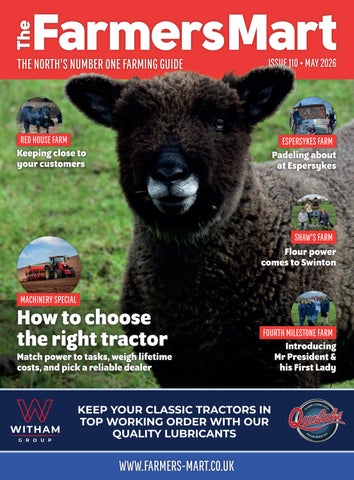
Match power to tasks, weigh lifetime costs, and pick a reliable dealer
Flour power comes to Swinton SHAW’S FARM
Padeling about at Espersykes ESPERSYKES FARM Introducing Mr President & his First Lady FOURTH MILESTONE FARM
KEEP YOUR CLASSIC TRACTORS IN TOP WORKING ORDER WITH OUR QUALITY LUBRICANTS
22 Introducing Mr President & his First Lady
James & Nicola Waterhouse celebrate 25 years as he becomes Ayrshire Cattle Society President at Fourth Milestone Farm near York.
26 Keeping close to your customers
Red House Farm’s Broadwiths: growing potatoes and beef through long-term contracts, customer partnerships and smart investment.
32 Flour power comes to Swinton
New stone-milled flour venture at Shaw’s Farm: Andrew & Jenna Lane Falshaw take homegrown wheat from field to bag, backed by Swinton Estate.
37 Padeling about at Espersykes
James & Laura Kilby diversify Espersykes Farm by turning buildings into two new padel courts—a step toward a fitness hub.
44 Fertiliser and muck spreading are essential operations
Choose the right fertiliser and muck spreader—and dealer support—to boost yields, efficiency and uptime.
47 The single most important investment for farmers
How to choose the right tractor: match power to tasks, weigh lifetime costs, and pick a dealer with reliable parts and service.
Editor
Ian Wilkinson
ian.wilkinson@kelsey.co.uk Tel: 07811 943968
Managing Director
Fiona Mercer
Finance Director
Gary Evans
Production Manager
Kelly Orriss Kelly.orriss@kelsey.co.uk
Sales Executive
Tim Holton timholton1959@outlook.com Tel: 07946 587770
Design
Tom Cartledge tom@cvgroup.co.uk
Writer
Chris Berry chrisberrymedia@gmail.com
Sales Manager
Ian Wilkinson ian.wilkinson@kelsey.co.uk Tel: 07811 943968
Ad Production Manager
Nick Bond nick.bond@kelsey.co.uk
Digital Content Manager
Rachael Harper rachael.harper@kelsey.co.uk
Press Releases
Ian Wilkinson ian.wilkinson@kelsey.co.uk Tel: 07811 943968
Subscriptions
Claire Aspinall
Customer Services cs@kelsey.co.uk
100 YEARS OF STIHL CELEBRATING 100 YEARS OF STIHL INNOVATION.
ROOTED IN TRADITION. INSPIRED BY INNOVATION.
stihl.co.uk
We're celebrating working in nature with you for 100 years. Since 1926, STIHL has led the way in both petrol and battery technology - helping you tackle every job with confidence. Thank you for being an essential part of our journey.
I
can’t believe we are already nearly halfway into 2026; thank heavens the weather is now generally a lot warmer, which is great news for crop growth, and also for those lush pastures and grazing our animals outside.
CHRIS Berry has been on site with more of our hard-working farmers: the hard-working Broadwith’s of Red House Farm in Bedale, who have a significant arable acreage of 1,600 given over to cereals and their all-important potato crops, which they send to the likes of McCain and KP. He has also seen the Falshaws at Shaw’s Farm at Masham, who have their hands full with cattle, sheep and pigs; and James Waterhouse at Fourth Milestone, near York. James is a dairy farmer—he is also just about to become President of the Ayrshire
New novel brings romance to Swaledale farm
A Swaledale farm, pub and a local show have proved the inspiration for A Yorkshire Show of Affection a new book released this week that is described as ‘a heartwarming romantic tale from the Dales’.
Cattle Society. James Kilby at Espersykes Farm, Old Malton, has an interesting set-up supporting his wife, Laura, and a young family. James farms with his father, John. They have a mixed farm with arable, sheep and pigs, and they find time to do some contracting.
We also have info on farm buildings, which are an important asset and should be looked after, and some interesting info on tractors, which are a very important and valuable asset. Farmers should spend their cash wisely.
Ian Wilkinson Managing Editor
At Farmers Mart, we are always looking for farms and farming operations to do features on. We love meeting up with farmers to hear their many and varied stories, and seeing their variety of herds and groups of animals. We are also looking for farming businesses to do features on, knowing how hard they often work in providing that all-important support that farmers need in these challenging times.
If you’d like to know more, please contact Ian.
‘The central characters are a Swaledale sheep farmer (Joe) who is prepping his sheep for Upper Show and is also a fell runner; and a young lady (Janey) from Notting Hill, who comes to stay for a few days at his farm with her best friend. Both Joe and Janey have had partner troubles,’ says farming writer Chris Berry, author of the new release.
‘I first visited Muker Show in 1991 and fell in love with the show that only has Swaledale sheep being shown, there are no other breeds, no classes for other species. It’s effectively the Champions League for Swaledale sheep farmers. It also has a fell race, the wonderful Muker Silver Band and of course the rugged beauty of the upper Dales countryside.’
‘In A Yorkshire Show of Affection the village referred to is the fictitious Upper, but I’m sure that many readers familiar with Muker and its wonderful little show will see the connection.
While pointing out that all characters, except one, are the figments of his imagination and not to be confused with anyone he knows, Chris has used the benefit of knowledge gleaned from writing thousands of farm stories over 35 years in rural journalism, particularly over the accommodation for the holiday stay.
‘I wrote a story about the Coates family of Keld last year, who won the Sheep Farm of the Year in a major awards evening, who also have their unique holiday accommodation, the
Swaledale Burrow. I’ve used something similar for where Janey and her friend Davey stay while up in North Yorkshire for four days, and I’ve ultraglammed it. In this book Joe has 1000 Swaledale sheep and the story involves he and Janey getting together while he is preparing his ewes and tups for the upcoming show and sales.
‘I’ve loved creating this book. It’s my first romance novel that I hope readers really enjoy as much as I have writing it and coming up with lots of fun moments and characters that I hope typify the rural and farming community.
‘The only real name and real person I’ve used in the book is a nod of appreciation to my good friend, legendary Kilnsey Show’s Crag Race commentator Roger Ingham, who makes a cameo appearance.
Chris has also included a special note in the back of the book about Muker Show committee raising funds to buy the showfield.
Copies of A Yorkshire Show of Affection are available via Amazon now, as paperback, hardback or e-book, or by ordering at any bookshop. Signed copies of the paperback are available by messaging Chris Berry Author on Facebook or by sending a cheque for £12.99 made payable to Chris Berry Media Services to ybooks, 18 Greystones Close, Aberford LS25 3AR.
Managing Pain in Farming: A Holistic, Practical Approach
FARMING places some of the toughest physical demands on the body. Long hours and repetitive manual work often lead to persistent pain and injury. Supporting recovery therefore requires a holistic approach that considers both physical health and wider wellbeing.
Dr Karthik Dhandapani is a Consultant in Pain Medicine and uses an integrated approach to managing pain with over 13 years’ experience, based at Clifton Park Hospital in York. As a specialist orthopaedic facility, Clifton Park Hospital provides comprehensive care to patients via the NHS, utilising private medical insurance or choosing to self-fund their care.
Q: What practical, holistic options can farmers use to manage chronic pain day to day?
A: Simple measures can make a big difference. Over the counter pain relief such as paracetamol, ibuprofen, or codeine can help with physical strain when used safely. Cold therapy, such as a cold shower or bath at 10–15°C for 5–15 minutes, 1 to 3 times a week, can reduce muscle soreness and fatigue.
Self massage using a tennis ball or massage gun, along with heat, infrared light, or non medicated gels such as tiger balm, can help. Always check with your doctor if you have medical conditions or allergies before using the treatments suggested.
Q: Back, neck, and joint pain are common on farms. What modern treatments help people stay working?
A: Targeted nerve or joint injections combined with physiotherapy can significantly reduce pain and inflammation. Strengthening the muscles around painful joints is equally important, as these muscles stabilise and protect the joints. Early assessment and treatment can stop short term pain from becoming long term.
Q: What issues in farmers only show up with proper diagnostic assessment?
A: “Sciatica” describes pain radiating from the lower back into the leg, but it has several probable causes. Pain may originate from muscles, ligaments, joints, discs, or nerves, sometimes even outside the spine. A thorough assessment by a pain specialist helps guide investigations such as MRI scans or nerve conduction tests to identify the true cause.
Q: What’s the biggest misunderstanding about long term pain?
A: Many farmers accept pain as part of the job. However, pain is a warning signal from the brain with both physical and emotional components. Pushing through injury can keep the nervous system in a constant “threat” state, allowing pain to persist. Early treatment can prevent this cycle.
Q: How do rehabilitation and lifestyle changes help?
A: Strength and endurance training reduce injury risk and support recovery. Good nutrition, quality sleep, safer lifting techniques, stress reducing habits, and staying socially connected all play a role in healing.
Q: When should farmers seek urgent medical help?
A: Urgent assessment is needed if one develops bowel or bladder problems, worsening weakness or numbness, night pain, fever, unexplained weight loss, walking difficulties, or pain after injury.
Take the next step
If pain is affecting your work or quality of life, early specialist support can make a real difference. To enquire about pain management services at Clifton Park Hospital or to book an appointment with Dr Karthik Dhandapani, contact our team on 01904 464 550.
consultations start from £250.
Heightened Risk Of Grass Staggers In Cattle After Wet Winter
Grass staggers (hypomagnesaemia or grass tetany), caused by low blood magnesium levels, could be more of a risk in cattle this spring where farms have experienced excessive winter rainfall, according to Rumenco’s Technical Services Manager Dr Alison Bond.
COMMON sub-clinical symptoms, including reductions in milk yield and feed intake, will directly impact performance in dairy and beef suckler herds, she says, whilst a small percentage of cases may result in ‘downer cows’ due to muscle dysfunction, or death.
“Magnesium deficiency is often a risk in the spring, as typical seasonal conditions conspire to impact on its availability,” she explains. “These can include a dilution effect in lush fast-growing grass, for example, or magnesium uptake being inhibited by late frosts or early applications of nitrogen and potassium fertilisers.
“This season, where many farms have endured excessively high rainfall over the winter months, risks of deficiency could be higher than usual, with minerals including magnesium being leached from soils at a greater rate.
“Providing supplementary magnesium as a routine is the best strategy, because once symptoms become evident, even in a small number of cattle, a lot of damage will already have been done.”
Dr Bond points out that the average lactating suckler cow requires 26g/day of magnesium, or around 0.2% of her daily dry
matter intake. However, assuming a daily dry matter intake of grazed grass of 13kg/day, the cow will be significantly deficient during the peak grass growing period.
“Spring grass will typically have a magnesium level of just 1g/kg of dry matter, so – on a grazing only diet – the cow is
receiving only 13g/day, or about half of her 26g/day requirement. These figures apply to an average spring, so the deficiency is likely to be greater where farms have endured a very wet winter. When a similar calculation is made for dairy heifers, for example, the deficit in an average spring is around 20%, so also significant.
“Supplementation is essential at this time of year to make up the shortfall, thereby avoiding often invisible sub-clinical losses, or the more obvious symptoms like reduced intakes, lower milk production, hyperexcitability, muscle spasms and starey eyes, for example.”
Free access mineral blocks and buckets are, according to Dr Bond, the most reliable and cost-effective way to supplement magnesium, as well as other important vitamins, minerals and trace elements. She recommends Rumenco’s Supalyx Magnesium bucket, which contains 15% of palatable bioavailable magnesium as well as other minerals, vitamins and trace elements. Alternatively, she advises the provision of Maxx Cattle Mag, also formulated with a highly palatable and bioavailable magnesium source.
“Palatability and bioavailability are key points with these formulations,” she adds, “and supplementing with blocks or buckets allows free access for all stock, with minimal labour requirements.
“Magnesium deficiency is in many ways an invisible source of losses in cattle, so making it easily available in this form during the high-risk months will be an effective preventative measure for many.”
Livestock throughput rises as market turnover tops £3bn
LIVESTOCK throughput across England and Wales edged up in 2025, with total numbers increasing to 10.76 million total livestock head sold, according to the latest figures from the Livestock Auctioneers Association (LAA).
Notably, total market turnover rose significantly to just over £3bn, up £554m year-on-year, and this has never previously exceeded £2.5bn. The uplift highlights both strong demand and significantly improved values across many classes of stock.
The figures show a rise of 42,000 head compared with 2024, reflecting continued confidence in the live auction system despite a contracting national herd and flock.
The uplift was largely driven by finished stock, which rose by 86,000 head to 6.83 million compared to 2024. Finished sheep accounted for the majority of this growth, increasing by 78,000 head to 6.52 million, while finished pigs rose by 13,000 head and finished cattle rose by 2,000 head.
Despite broader national trends showing a declining sheep flock, auction marts continue to demonstrate resilience, with strong engagement from farmers looking to secure competitive prices through selling in the live ring to a wide audience of buyers. Recent AHDB data indicates a national sheep flock
down by around 2%, yet mart throughput has held firm - bucking the wider trend.
LAA representatives say this reflects the continued value of the live auction system as a transparent and competitive marketplace, where buyers from across the supply chain compete openly for stock.
“The live ring continues to deliver real value for farmers,” says LAA policy and strategy officer Alastair Brown. “It provides a transparent, competitive marketplace, with a buyer for every type of stock and no hidden deductions, creating genuine opportunities to achieve the best possible price.”
Strong demand for finished stock has been a standout feature of the year, with prime cattle, prime sheep and cull ewes all achieving historically high average values. This trend filtered down the supply chain with store cattle similarly reaching historically high average values.
In the cattle ring, store and prime values have risen significantly year-onyear, with increases of around £500 per head reported in many cases due to tight global and national supplies. Young calves have also seen strong demand, with some markets achieving exceptional prices of up to £1,000/head, reflecting continued appetite for quality stock despite higher input costs across the sector.
Store and breeding sheep numbers remain under pressure, reflecting long-term contraction in the national flock, while wider cattle numbers have also been influenced by a shrinking suckler herd and shifts within the dairy sector. However, although they’ve dropped in 2026, buoyant milk prices in 2025 supported increased numbers of young dairy-bred cattle entering the system.
The LAA says these figures underline the importance of livestock markets not just in price setting, but in providing access to a broad and competitive buyer base at times when margins are under pressure.
“Markets have been operating for hundreds of years, and they remain as relevant as ever,” says LAA executive secretary, Chris Dodds. “Farmers continue to see the value in the live ring because it consistently delivers competition, transparency and, ultimately, the best possible price.”
Total throughput figures of all classes of livestock through livestock markets in 2025 (England and Wales)
Cobalt Deficiency Spike Drives Need for Preventative Action in Lambs
SHEEP farmers are being encouraged to take a proactive approach to managing cobalt deficiency, also known as pine, in newly weaned lambs, as surveillance data1 continues to show a consistent seasonal spike in cases between July and September.
Figures from the Animal and Plant Health Agency (APHA) and Scotland’s Rural College (SRUC) quarterly surveillance reports1 identify cobalt deficiency as the third most common diagnosis during this period between 2016 and 2025. This highlights the need for targeted management during the post-weaning transition, when lambs are particularly vulnerable to nutritional and metabolic challenges.
Cobalt requirements
Cobalt is an essential trace element required for the synthesis of vitamin B12 in the rumen and plays a critical role in supporting growth, appetite and immune function. Deficiency can result in ill-thrift, reduced daily liveweight gain, lethargy and poor overall performance, known collectively as ‘pine’. In more advanced cases, neurological signs and liver damage associated with ovine white liver syndrome can occur.
‘lock up’ cobalt in the soil, further reducing its availability to livestock.
Nia Williams, Technical Livestock Manager at Nettex, says the continued incidence of cobalt deficiency in mid- to late summer is likely influenced by a combination of environmental, nutritional and management factors.
Deficiency
She explains: “Weather patterns can have a significant impact on cobalt availability, with high rainfall leaching cobalt and other trace elements from soils and drought conditions limiting cobalt uptake. We often see a seasonal decline in pasture cobalt levels over the summer months because of this, coinciding with when lambs are weaned and have high requirements for growth.
“In addition, high iron or manganese levels, high pH soils and recent liming, can
“There is also a close and interchangeable association between cobalt deficiency and parasitic challenge,” adds Ms Williams. “On one hand, high worm burdens can damage the gut, reducing vitamin B12 absorption, while on the other, cobalt/vitamin B12 deficient lambs may have compromised immunity, increasing susceptibility to parasites. It is important to work closely with your vet or animal health adviser to establish if cobalt deficiency may be exacerbating a parasite challenge.”
Prevention
Strategic supplementation remains one of the most effective ways to mitigate risk, with products such as Nettex’s Cobalt, Selenium & Vitamin B12 Drench providing a practical and reliable method of maintaining adequate trace element status during the high-risk weaning period.
Ms Williams adds: “The post-weaning phase is a critical stage in a lamb’s development and with appropriate nutritional support, cobalt deficiency is largely preventable, helping to avoid unnecessary production losses and sustain optimal growth performance.”
Nettex’s Cobalt, Selenium & Vitamin B12 Drench also contains vitamin B1 (thiamine) and therefore can also help to reduce the potential risk of Cerebrocortical Necrosis (CCN), which typically affects lambs aged four to eight months.
“CCN is commonly triggered by dietary changes, such as weaning or movement onto new pasture, which disrupt rumen microbial populations,” explains Ms Williams.
Early clinical signs include blindness, isolation, aimless wandering and the characteristic “stargazing” posture, where the head is held arched backwards. The disease can progress rapidly, with affected animals becoming recumbent and developing seizures.
“A prevention strategy through the use of drenches such as Nettex’s Cobalt, Selenium & Vitamin B12 Drench is always preferable to treatment, especially in the case of CCN, as treatment requires veterinary intervention and multiple injections of vitamin B1 for at least three days,” adds Ms Williams.
Close observation, alongside appropriate nutritional and health management, is key to supporting lamb performance and reducing the risk of both conditions during the post-weaning period.
Steven J Dresser - Covering Every Aspect of Agricultural Electrical Installations
Dresser’s continues to be a thriving business with an established
strong team
Based in Thirsk, North Yorkshire, Dresser’s serve the farming community throughout Yorkshire and the North East. The company consists of 15 qualified tradesmen and 4 full-time office staff.
DRESSER’S services include:
• Every aspect of agricultural electrical contracting
• Electrical condition reports for insurers
• Livestock alarm monitoring
• Intruder alarm installations and maintenance
• CCT V installations and maintenance
• IT and data installations
• Perimeter protection and security lighting
• Electric motor sales, repairs and rewinds
• Fire alarm and emergency lighting installation and maintenance
• Installation of standby generators and change over switch gear
• Solar PV installation and repairs
01845 574691
office@stevenjdresser.co.uk
Installing Solar PV Now!
STEVEN explains that despite the government’s decision to abolish feed in tariffs SOLAR PV still provides tremendous cost savings to clients given the ever-increasing cost of electricity and the demand for constant usage. A return of 10% upwards is still easily achievable without feed in tariffs.
Steven said: “The company continues to install a wide range of Solar PV schemes, including installations at numerous dairy farms, pig fattening sites, poultry units and for manufacturing businesses.
New National Colostrum Survey Launched to Improve Calf Health and Welfare
A new national survey has been launched to assess how colostrum is managed on UK beef and dairy farms and identify opportunities for improvement, following recent data highlighting gaps in passive transfer [¹]
Run by Red Stag Media in conjunction with MSD Animal Health, the colostrum survey aims to build a clearer picture of on-farm practices, identify areas for improvement, and highlight ways to optimise calf health and welfare. Five farmers who complete the survey will be randomly selected to each receive a £100 voucher.
The previous colostrum survey, carried out in 2023 [2], revealed missed opportunities for monitoring key parameters such as calf serum total protein and colostrum IgG concentration [2]. It also showed that some farms were not optimally managing colostrum storage temperatures or harvesting colostrum promptly after calving, small adjustments that can deliver significant health benefits, says Dr Kat Baxter-Smith, Veterinary Adviser at MSD Animal Health.
“Colostrum management remains one of the most important, but often most variable, aspects of calf rearing on UK beef and dairy farms,” she explains. “We know that getting those first feeds right has a lifelong impact on health, growth and performance.
“It’s also increasingly important for calf rearers and finishers, as colostrum management on the dairy farm can influence how calves go on to perform on other units.”
Evidence suggests that a high proportion of calves on some farms are still failing to achieve adequate passive transfer, even where colostrum quality appears good [1]
A recent case report published in Vet Record [1] highlighted the scale of the challenge. The study [1], based on a seasonal-calving dairy herd in Northern Ireland, found that more than three-quarters of calves tested had inadequate passive transfer, despite colostrum testing at the recommended 22% Brix or above. All calves later developed scours.
Authored by Dr Ryan Davies of Veterinary Technical Consulting Ltd and Dr Katie Denholm of the University of Glasgow, the paper [1] emphasised the importance of testing calves for passive transfer using blood samples at 24 hours to seven days of age, rather than relying solely on colostrum quality testing.
Dr Baxter-Smith adds: “Even where colostrum quality looks good on a Brix refractometer, that doesn’t always mean calves are successfully absorbing enough antibodies. Without monitoring passive transfer through blood sampling, it’s easy to miss what’s really happening.
“Through this survey, we hope to identify weak points in colostrum management, which can then be addressed through practical guidance and support. Small adjustments, such as harvesting colostrum sooner after calving, storing it correctly, improving hygiene, or reviewing feeding
protocols can make a significant difference to calf immunity.
“By completing this survey, farmers are helping us build a clearer national picture of colostrum management,” she adds. “That insight will allow vets and advisers to provide more targeted, practical guidance that ultimately improves calf health and farm profitability.”
MSD Animal Health is encouraging all UK beef and dairy farmers and calf rearers to complete the survey and play their part in strengthening calf immunity. Farmers can opt to be entered into the £500 prize draw upon completion.
The survey can be completed here: http://unbouncepages.com/ msd-calf-colostrum-survey/
References: [1] Davies RCT, Denholm K. A holistic approach to colostrum management: Enrichment of maternal colostrum combined with extended colostrum feeding as control measures for bovine rotavirus-associated neonatal calf diarrhoea. Vet Rec Case Rep. 2025;e70214. https://doi.org/10.1002/vrc2.70214 [2] Denholm, K., Baxter-Smith, K., Simpson, R. and Williams, P. (2023) “A survey of colostrum management practices on UK dairy farms,” Livestock, 28(4), pp. 150-159. doi: 10.12968/live.2023.28.4.150.
KEEP YOUR CLASSIC TRACTOR IN TOP WORKING ORDER
Whether your classic tractor is a hardworking farm staple or a cherished pride and joy, looking after it properly means using the right oils from a manufacturer you can trust. The Witham Group is one of the UK’s leading suppliers of agricultural lubricants. Having manufactured oils since 1921, they possess a wealth of historic expertise specifically tailored to classic machinery. Their dedicated range includes specialised engine and transmission oils, greases, brake fluids, coolants, and rust prevention products.
Here are some of their most popular products for classic tractors:
ENGINE OIL:
Qualube All Farm 3 Super Universal 15W-30
Formulated as a traditional ‘Super Tractor Oil Universal’ (STOU),
require separate transmission and engine oils. It was originally introduced for early turbocharged diesel engines, such as the Ford 7000, and for tractors fitted with the wet brake systems of that era.
TRANSMISSION OIL:
Qualube Classic Straight 90 Gear Oil
This gear oil is free from modern additives, catering to older applications where a pure, nontreated formulation is preferred. It offers robust load-carrying capabilities, ensuring protection against wear and extending the service life of vintage gears and components.
COOLANT:
Qualube Universal Blue Anti-Freeze Recommended for older vehicles where a modern “long-life” coolant is not required, this product provides cost-effective, high-level protection. Serving as both an anti-freeze and a summer
coolant, it offers maintenancefree protection against freezing and boiling, while providing excellent corrosion resistance when mixed with the appropriate amount of water.
One stop shop for classic tractors
From specialist engine oils and gear lubricants to authentic paints and rust prevention, the Witham Group has everything your classic tractor needs for the months ahead. Their team draws on a unique historical knowledge base to help you find the perfect products for your specific vehicle.
CLASSIC & VINTAGE PRODUCT RANGE
New spray aims to improve efficiency of pig identification
A new and vibrant pig marking spray is due to be launched at the British Pig & Poultry Fair 2026 on 13th & 14th May, offering producers a fast, effective solution for temporary animal identification.
PigMark from Nettex is a high-visibility, fast-drying marker spray, available in red and blue, designed to improve the accuracy and efficiency of identification during routine pig management. It is made in the UK and delivers durable, clearly visible marks that withstand handling with minimal smudging.
Nia Williams, Nettex livestock specialist says: “Clear identification is an important part of good stock management, and PigMark helps improve workflow efficiency, reducing
the need for reapplication and supporting better organisation during sorting, treatment and transport.”
PigMark will be showcased alongside a range of other leading pig healthcare and enrichment solutions from Nettex, including the innovative Pig CalmBlock. This specialist pressed feed block provides
both environmental enrichment and nutritional support, helping to reduce aggression and vice behaviours in pigs.
Designed to encourage natural foraging and rooting behaviour, CalmBlock is edible, chewable and easily manipulated, offering a convenient and effective way to help reduce stress within groups. In a major farm study involving 962 piglets1, CalmBlock was found to reduce tail biting compared to a control group with no enrichment.
Ms Williams adds: “CalmBlock also provides supplementary minerals, including a high level of magnesium and Phytotec®, a unique blend of plant extracts and yeast components to help maintain optimal health and performance.”
Visitors to the Nettex stand (20-653) will also be able to learn more about other products in the Nettex pig range, including:
• StopBite - a tail biting deterrent containing Denatonium Benzoate, an extremely bitter substance that helps prevent biting behaviour.
• StimuLife - an oral paste containing optimum levels of vitamin E, digestible energy and probiotics to help support the piglet’s natural immune function.
• RevitaLyte – a highly palatable blend of electrolytes, betaine, prebiotics and organic acids on a high-energy base, aiding hydration and stimulating water and feed intake, particularly during key challenging periods.
Copper key to dairy cow fertility following waterlogging
DAIRY farms grazing pastures that have been waterlogged over the winter should be mindful of potential mineral imbalances and their impact on the reproductive performance of cows and heifers.
This is the advice of Rumenco’s Technical Services Manager Dr Alison Bond, who says that the anaerobic soil conditions resulting from flooding will have interfered with the mineral and trace element profile, potentially changing the availability of important nutrients in grass.
She points to the risk of higher levels of available molybdenum, which is a known consequence of waterlogging and can lead to secondary copper deficiency.
“Copper deficiency is a common cause of reproductive problems in cattle,” she says, “as it causes depressed or delayed oestrus, and a reduction in conception rates. For spring calving herds, the early grazing season is the time for getting cows back in calf, so it will be particularly important to avoid any mineral imbalances at this time.
“Where there are high levels of available molybdenum, as can happen in soils that have been waterlogged, there is an increased risk of copper deficiency. This is due to an interaction between the available copper and molybdenum reducing overall copper absorption. In these situations, it is important to ensure that cattle are adequately supplemented to avoid any impact on fertility in particular.”
Dr Bond recommends the use of appropriately formulated mineral blocks as a convenient, low-labour, and cost-effective solution for grazing cattle.
“Rumenco has developed Rumevite Cattle Booster as a high energy and protein
feed and mineral block suitable for dairy cows, suckler cows, replacement heifers and other growing cattle,” she adds. “This block has been specifically formulated with optimal levels of minerals, vitamins and trace elements, including copper, to support fertility in breeding cattle, and protected zinc to guard against issues such as lameness and mastitis. In addition, Rumevite Cattle Booster contains good levels of energy, along with natural and urea protein sources that will complement and support the utilisation of lower quality forages or grazing as the season progresses, ensuring animals stay on track with growth and production.
Dr Bond says the free-access nature of mineral blocks avoids bullying and ensures all cattle should receive adequate supplementation, with little impact on daily routines.
“Younger cattle can be particularly susceptible to copper deficiency, so supplementation of bulling heifers, for example, should be a priority, especially if there are any concerns about mineral imbalances in grazing or forage.”
Growing fodder beet could be attractive option after difficult 2025 forage season
After the lack of forage in many areas in 2025 due to the drought, this season could see increased interest in growing fodder beet on livestock farms, believes ProCam agronomist, Nick Duggan.
ONCE fodder beet gets its roots down, it can be quite drought tolerant, says Nick, so it could appeal to farmers looking to diversify forage crops to mitigate risk.
“Although inputs can be quite high, fodder beet does offer a big crop of energy,” explains Nick, who operates in Herefordshire, South Shropshire, Powys and the Cotswolds.
“Compared with stubble turnips yielding about 4-6t of dry matter/ha (DM/ha), fodder beet might yield 20t DM/ha. And, at around 12.5ME, the energy content of its roots is similar to grass.
“There’s also the flexibility to feed fodder beet to sheep, beef or dairy, and to lift or graze it, although it’s important
to ‘wean’ livestock onto it gradually, especially cattle, because its high energy content can cause acidosis,” he adds.
To help ensure that farmers grow the right varieties for their situation based on robust data, Nick says ProCam has been evaluating the performance of fodder beet varieties over multiple seasons, with on-farm trials conducted in the North and West of the country as well as other locations country wide.
“We test a range of varieties,” he continues. “These range from low DM beets for grazing, to high energy types for lifting and chopping for livestock, or for use in anaerobic digestion (AD) plants.
“Typically, 20 or so varieties might be tested annually in these replicated trial plots, with 4-5 new varieties included each year. But a lot of the established varieties have been in the trial for maybe six years –so we have long term data and can robustly benchmark new varieties.”
Assessments begin with variety emergence and vigour, and conclude at harvest by measuring yields, says Nick, with beets lifted and tops and roots weighed separately. Yields per hectare are then calculated, corrected for %DM.
“Also at harvest, each variety is assessed for disease resilience, and for the amount of root protruding above the soil. More root protruding is helpful if grazing. If lifting beet, you want more root in the ground for protection from frost.
“Agronomically, we encourage all farmers to keep the tops as healthy as possible with a summer nutrition programme. As well as helping to protect roots from frost, a healthy canopy helps sustain the crop into winter. This helps if growing for energy for AD plants, but also tops have good feed value, at about 17% crude protein, and can provide 2-2.5t DM/ha.”
In addition to evaluating varieties, ProCam also evaluates the performance of primed seed, says Nick, which is available with certain fodder beet varieties. Primed seed is pre-germinated for faster emergence, and tends to produce more uniform plants at the cotyledon stage, he notes.
“Faster establishment, in turn, helps with weed suppression, and once fodder beet reaches 12 leaves, it becomes more tolerant to virus yellows.
“Plus, primed seed can deliver higher yields. Results can vary, but in five years of trials on the variety Geronimo we saw a yield uplift of approximately 1.5t DM/ha from Active Boost primed seed compared with conventional seed.
“With the unpredictable spring weather we get nowadays, I think primed seed is extremely useful technology for fodder beet growers.”
Taking precision feeding into the field
Farmers could significantly improve their maize yields and silage quality by analysing their crops and applying more precise nutrition. That’s according to new research by Mole Valley Feed Solutions, which found that a large number of crops suffered from critical nutrient deficiencies last year.
RATHER than assessing soil nutrition, the researchers decided to look at what the plants themselves were taking up. They sent samples of 23 maize crops from Cornwall to Gloucestershire at around the 20cm growth stage for Scientific Agricultural Partnership (SAP) analysis in June / July. And the results were stark: Almost all were critically low in nitrate, ammonia, molybdenum and sulphur, and most were low in magnesium, calcium, manganese and boron.
As a result, Lisa Hambly, head of grassland and forage agronomy at Mole Valley Farmers, suggested applying specific soil and foliar treatments to rectify these deficiencies. “Everyone talks about nitrogen, but crops need more than that. For example, sulphur is very underrated in crops and is essential for plants to utilise the nitrogen – if that is a limiting factor you can apply as much nitrogen as you like but it won’t get utilised in the correct way. It can cause more disease problems and issues when it comes to drying down at harvest.”
The crops sampled were all grown on soils that reached the target indices for pH, nitrogen, phosphate and potash (NPK), explains Bethany Sealey, junior ruminant account manager. “The key requirements for maize are NPK, magnesium,
sulphur, calcium, zinc, boron, manganese, copper and iron.”
Crops that are deficient in key nutrients will not only fail to reach their genetic yield potential, they will also likely fail to deliver the required nutrition to cows once ensiled, she adds. “This year we want to follow the results right through from field to clamp, to link the whole nutrition cycle together.”
With increasingly unpredictable weather causing a forage shortage in many areas last year, producers are focusing on resilience, explains Ms Hambly. “We need to pay greater attention to the very early stages of a crop’s life: By six leaves maize has already decided how many spaces it’s got on the plant for corn kernels. One week’s difference in development was everything last year.”
Newer varieties’ yield potential is significantly higher than older varieties, and extraearly varieties will yield less than their later counterparts, possibly by 3t/ha. Those crops simply cannot be treated in the same way. “You have to look at it like feeding a cow – high-yielders need more nutrition than low-yielders,” says Ms Hambly.
More precise nutrition will maximise the plant’s genetic potential while improving nutrient use efficiency and protecting the environment, she adds. “We could be producing a lot more high-quality homegrown forage as a result.”
After this winter’s heavy rain, the first step before planting maize – or any other crop, including grass – should be to dig a hole and analyse soil condition and nutrition. “Following
heavy rainfall, nitrogen and sulphur will have leached, and there will be more compaction. Getting that back in balance will make a massive difference.”
SAP testing the plants and correcting deficiencies at an early stage will then yield significant benefits. “Every season, field conditions are going to be different, and connecting the whole forage system together based on testing what is happening, and taking steps to change the outcomes, is what will move nutrition on farm forwards,” she adds.
“To drive this knowledge forward we are expanding testing to grass and multi-species leys this year, alongside a grassland fertiliser trial, as these are under-researched areas.
Creating a systems-based approach to grass nutrition will lead to better understanding, which will feed into our ruminant diets.”
This links closely to balancing the ration, based on forage results. “Moving in-field nutrition forward will improve diet efficiency and accuracy – and that includes analysing muck and slurry that goes back on the field,” says Ms Hambly. “We are increasingly connecting the dots between soil, crops, silage, cows, and ultimately muck. It’s taking precision feeding right back to the field; and this joined-up thinking will increase farmers’ sustainability, efficiency and profitability.”
Benefits of breeding for wool quality
As global demand for sustainable textiles grows, wool presents an opportunity for farms to increase revenue by improving the quality of a flock’s wool. Competition shearer and sheep farmer, Matt Smith has been improving the value of his Romney flock’s wool for years but suggests it may be another ten years before he reaches the fleece quality that will bring a significant uplift in his flock’s wool value.
“WE have spent heavily on genetics and part of this has been to increase the micron density of our flock’s wool. Better quality wool is in high demand as a sustainable material to make high end clothing, and a higher micron density and comfort factor will bring better prices for our fleeces,” he explains.
The fleece from his Romney flock commands a good price, but he believes he can improve on this because he has found a new way to measure the micron density and comfort factor of the wool they produce.
“I have been fortunate to trial a new handheld wool measuring device from Woven Optics. It tests the micron and comfort factor of any sample in real time, which has enabled me to look at how breeding decisions have had an impact on wool quality,” he says.
The device from Woven Optics has been developed in Australia where it has proved accurate way to test wool in any situation. In the UK, Woven Optics has partnered with Heiniger to bring the device to farms like Matt’s.
“I have been working with Hefin Rowlands, from Heiniger, to measure and monitor our Romneys using the Woven Optics device. While the device would be a significant investment to own it is still a small cost compared to what we invest in genetics,” he says.
He suggests it is also the easiest and best way to monitor how our breeding decisions are improving the wool price of the flock. Something he hopes other farms will realise and look to in order to increase the value of wool throughout the UK.
“It is the enabler that can change the way farms in the UK think about breeding, sheep health and wool value. To have a machine capable of testing wool, on farm in seconds, is the key we need to get wool
back on track and start prioritising it as a genetic target,” he says.
For Matt, it is a part of larger debate that relates to animal health as much as productivity for meat or wool.
“Sheep breeding has moved away from selecting traits that will provide better quality wool. However, with prices recovering and, on the increase, I think now is the best opportunity we have had for years to champion British wool by helping bring analysis to farms so that they too can invest in breeding that will further increase the value of our wool,” he says.
He suggests that by breeding for carcass weight to fulfil meat buyers’ desire to sell larger prime cuts, wool quality has been forgotten. He sees this as a mistake that has taken sheep farmers down a path that is compounding common health issues.
“Through contract shearing on farms all over the country, I have seen the move away from fleece quality cause flocks to have fleeces that are more yellow in colour. The fleece also has a stronger smell which makes the sheep more prone to problems with flies,” he says.
Through a lack of desire to focus on wool quality, he believes some breeds are
becoming more dependent on chemicals, antibiotics and anthelmintics. His fear is that this will lead to resistance and further health concerns.
“As a sheep breeding nation, we are in danger of forgetting the relevance of wool quality to sheep health. Changes in colour, and sheep sweating more as temperatures rise, both contribute to problems with flies. If we prioritise wool quality as part of the breeding process we can reduce the impact of these problems and reduce dependence on pharmaceuticals,” he adds.
Matt sees technology like the Woven Optics wool measuring device as the solution to helping farms move away from intensive breeding and look to wool quality as a way to improve sheep health while increasing the value of every sheep.
“Breeding trends are not going in the right direction and are not sustainable. By adding value to each sheep through wool quality farmers can breed healthier sheep that are more valuable. We have the technology and I am already working hard to make use of its potential because I can see that there is money to be made from wool and benefits to flock health and my overall farm system,” concludes Matt.
Post-em biostimulant boosts maize establishment to mitigate weed and weather stress
THE performance of this year’s maize crops can be boosted with the application of a new post-emergence biostimulant which improves root, shoot and leaf development to make young plants more vigorous and less susceptible to stress. Application in conjunction with a compatible herbicide at the same post-emergence timing further enhances crop performance without the need for an additional sprayer pass.
Trialled by ProCam agronomists last year and now available on a nationwide basis, Pro+ Fulvivex is a biostimulant comprising concentrated humic and fulvic acids as well micro and macro-nutrients which stimulate cell division to promote root, shoot and leaf growth. It also improves nutrient uptake and chlorophyll production, resulting in healthier, more vigorous plants which go on to produce higher yields.
“Pro+ Fulvivex stimulates specific hormonal pathways to enhance biological activity within crops including cereals, oilseed rape, sugar beet and maize,” explains Ryan Came-Johnson, maize technical lead for product manufacturer, Corteva.
“It also improves photosynthesis efficiency by activating enzymatic processes and increasing chlorophyll production, thereby enabling plants to utilise nutrients more effectively and making them more tolerant of stress.
“The end result in maize is a healthier, more vigorous crop which goes on to produce a greater fresh weight and higher dry matter yield. In fact, trials have shown that the inclusion of Pro+ Fulvivex can increase dry matter yield by 0.8 to 1.6 tonnes per hectare, with larger cobs resulting in an increase in overall starch production.”
ProCam agronomist Guy Peters trialled Pro+ Fulvivex in the South West in 2025 and was impressed by its ability to push crops ahead of weed competition and weather-related stressors.
“Despite advances in maize genetics, we’re still essentially trying to grow a tropical crop in a temperate environment which, in recent years, has become increasingly volatile,” Guy explains. “Last year’s drought highlighted just how easy it is for mother nature to put forage stocks in short supply, so it makes sense to take every step to ensure maize crops establish
quickly and are able to grow away from weed or environmental pressures with as few hindrances as possible.”
For maize, this means getting the crop to the tasselling stage as quickly as possible to maximise the number of sunny days left in the season for the crop to set and fill cobs.
“Last year we saw that crops treated with Pro+ Fulvivex were able to get ahead and stay ahead of weed competition more effectively,” Guy continues. “It mixed well with a wide range of post-emergence herbicides without hindering their performance, and without causing any undue crop effect, which meant it could be applied while the crop was still quite small, but before weeds had grown large enough for them to be difficult to control, and without the need for a separate sprayer pass.
“It is an extra product to put through the sprayer, but it’s a well-priced, cost-effective way of ensuring crops can get ahead of weeds before they steal soil moisture or out-compete the crop for nutrients and sunlight. If we get another dry summer this year, it will once again prove invaluable in helping crops to produce larger roots so that they can cope with drought conditions, and make the most of sunny weather to produce energy dense, starch-filled cobs.”
Pro+ Fulvivex is approved for application on maize at BBCH GS12-16 (two to six leaves) and at a low rate of just 150 g/ha in 150-300 litres of water per hectare.
“It partners well with Corteva’s maize specific rimsulfuron plus thifensulfuron-methyl herbicide, Dragster, which is approved for use in the GS13-18 (three to eight leaves) window,” Ryan adds. “The two products can therefore be applied at the same time, negating the need for an additional sprayer pass. With fuel prices as high as they currently are, this makes a lot of sense, with the inclusion of Dragster providing rapid contact action to control a wide range of annual and perennial grass and broadleaved weeds including fat hen, black bindweed, redshank, barnyard grass, hairy fingergrass, couch grass and more.”
Guy Peters, Agronomist, ProCam
Ryan Came-Johnson, Maize Technical Lead, Corteva
Farmers urged to check public liability cover as spring activity increases
Farmers and rural business owners are being encouraged to review their public liability insurance this spring to make sure it accurately reflects everything they do to generate income.
WITH machinery returning to the roads, livestock being turned out and more members of the public using footpaths and bridleways across the countryside, the risk of third party incidents naturally increase. Public liability insurance is designed to protect farm businesses if they are held responsible for accidental injury to members of the public or damage to third party property.
David Murchie, Head of Agriculture at Carlisle-based H&H Insurance Brokers, said it was essential that all income-generating activities were covered by public liability insurance to avoid potential issues if a claim arises.
“While most farmers recognise the importance of public liability insurance, it’s vital to remember that the cover only applies to activities that are actually declared on the policy,” said David. “If something generates income and it isn’t noted, there’s a real risk it won’t be covered in the event of a claim.”
David highlighted that campsites, holiday lets, farm shops, contracting work, renewable energy installations and letting land for grazing can all introduce new risks, particularly where members of the public, contractors or delivery drivers are involved.
“Diversification has become an essential part of many rural businesses,” he said. “But each new activity brings its own exposure to risk. Even small scale or seasonal ventures need to be discussed with your broker, so your public liability cover remains fit for purpose.”
Incidents involving walkers on rights of way, livestock escaping onto roads or drivers injured while delivering to properties can all lead to claims, even where farmers have acted responsibly and taken sensible precautions.
“Where responsibility is alleged, public liability is the policy that responds,” said David. “That’s why it’s so important to take a step back and look at the business as a whole, rather than assuming an existing policy automatically covers everything.”
As farms head into one of the busiest times of the year, spring is an ideal time to review insurance arrangements, said David. He advised farmers to work with their broker to ensure their insurance policy
was an accurate reflection of their current business.
“It’s not just about having public liability insurance in place,” David added. “It’s about making sure it continues to protect the business as it evolves. A simple review now can help prevent costly issues later on.”
H&H Insurance Brokers operates across the North of England and the South of Scotland and specializes in agricultural and rural insurance. The firm also works with clients across a range of sectors including tourism and hospitality, property, forestry and construction.
As well as Carlisle, the firm has offices in Wigton, Kirkby Stephen, Hexham, Durham, Newtown St Boswells and Northallerton.
David Murchie, Head of Agriculture at H&H Insurance Brokers
Texel Society backs members with groundbreaking new pedigree registry services model
The British Texel Sheep Society has unveiled a forward-thinking, data-driven membership structure, putting genetic progress firmly in the hands of its members.
IN a first for the UK livestock sector, Texel breeders will no longer pay to record or access performance data. Instead, the Society is reinvesting in its membership, making cutting-edge genetic tools fully accessible within the standard membership fee.
At the core of this approach is a clear message: better data delivers better sheep and a stronger, more profitable future for Society members and their commercial customers.
Under the new structure, flocks are recognised through a tiered membership structure. With members allocated to one of five membership categories; Bronze, Silver, Gold, Platinum or Diamond.
These tiers are based on the quantity and quality of data submitted via the
Society’s iTexel platform. Crucially, all tiers are open to all flock sizes, ensuring inclusivity while rewarding ambition and commitment.
Breeders can progress through the tiers by recording commercially relevant traits such as lambing ease, birth weight, eightweek weight, scan weight and shearling ewe weight.
Additional recognition is given for flocks embracing advanced technologies, including ultrasound and CT scanning and genotyping.
Top-tier flocks will gain access to exclusive opportunities, including eligibility for performance classes at major shows and pre-sale shows at the Society’s National sales and regional Club sales, linking data credibility directly with marketplace visibility.
Texel Sheep Society chief executive John Yates said the initiative reflected the Society’s long-standing commitment to innovation and member value.
“This is about investing in the Society’s members and the future of the Texel breed. By removing financial barriers and embedding data at the heart of what the Society does, every breeder, regardless of size, is able to benefit from the most advanced genetic tools available.
“Accurate, high-quality data underpins everything, from genomic evaluations to sire and dam verification and ultimately helps Society members breed sheep that meet the needs of the commercial sector.”
The move builds on a series of strategic investments by the Society, including bringing performance recording in-house in 2019, launching the iTexel database in 2020, and adopting routine genomic evaluations in 2024. Together, these developments have strengthened pedigree integrity, improved breeding accuracy and enhanced the value of Texel genetics across the supply chain, with the Society leading on all fronts.
Importantly, the removal of recording and data access fees marks a decisive shift, placing performance information at the centre of Society services, not behind a paywall. It also delivers greater transparency between flocks, helping breeders benchmark progress and make more informed decisions.
For commercial producers, the benefits are clear: a breed backed by robust data, proven performance and continuous genetic gain. For members, it’s a tangible demonstration of a Society investing in their success, simplifying and integrating the entire process of pedigree registration and genetic improvement.By aligning innovation with accessibility, the Texel Sheep Society is not just supporting its breeders, it is securing the long-term competitiveness of the breed.
Introducing Mr President & his First Lady
Chris Berry visits James & Nicola Waterhouse at Fourth Milestone Farm
I have known many farmers, farming couples and farming families for many years and one of those who I’ve seen and talked to and become firm friends with over my 35 years writing about farming is a great dairy farmer called James Waterhouse of Fourth Milestone Farm on the A64 just east of York.
James had another 10 years before he was to marry Nicola when I first took photographs of him for what was then the Yorkshire Farmer magazine that I had launched in 1991. There he was at the Great Yorkshire Show with his and his dad’s Ayrshire cows. They had breed champion at the Great Yorkshire Show for five consecutive years 1990-1994 and one Interbreed champion. James was rarely out of the Ayrshire spotlight but typically took it all in his stride with his trademark grin.
This year is to be a very special time for James, one of his proudest moments, as he becomes President of the Ayrshire Cattle Society this month and the beaming smile on his face when he thinks about it as I am interviewing him and Nicola at Fourth Milestone shows just how much it means.
‘I’m his First Lady,’ Nic says with another smile and what a year it is for them both! Not only has James achieved a personal dream, he and Nic also celebrate their silver wedding anniversary!
‘It’s very much an honour,’ says James, who of course is talking just as much about being married to Nic for 25 years as he is about becoming president!
‘We’ve been breeding Ayrshire cows here for three generations and hopefully Mia will be the fourth generation to do so. We went accredited in 1950 and we’ve been breeding Ayrshires at Fourth Milestone ever since.
‘I’m looking forward to us both going around all the different shows representing the Ayrshire Cattle Society which has its own Ayrshire Cattle Services which puts its own bulls through AI Centres, mainly Cogent.
‘The great attributes of the UK Ayrshire cow are its robustness to eat forage, produce high milk solids, and has very good feet, legs, udder, topline and longevity.
‘We have cows on their 9th 10th and 11th lactations, and the newer style Ayrshire, with the genetic gains the society has had, are carrying that on in the breed. They are still producing more milk and lasting longer. That’s the reason the Ayrshire Cattle Services has had large amounts of semen exported to South Africa, New Zealand and America in more recent times.
So, what is James looking forward to most about his presidency?
‘I’ve always got off farm and seen others. I did that a lot when I was in the Ayrshire Young Breeders Club. I’d go to so many different farms where you learn different things. It’s that kind of thing I’m looking forward to, as well as going to as many shows as we can fit in and judging the herd competitions that come as part of the role.
‘I’m looking forward to getting over to Northern Ireland and down to Cornwall. I’ve been over to Northern Ireland with Ian Hutchinson our North East Ayrshire Cattle Society chairman when we judged 17 herds in 2 and a half days.
‘And I’m really looking forward to the Royal Highland Show, especially being
President there as a Yorkshireman. If we can get to it, it would be really nice to get to the Royal Cornwall Show – and to Dairy Day, which is also the National Ayrshire Show. Hopefully both our daughters –Mia and Anna will be there with Young Breeders.
‘Mia’s in her final year at Harper Adams and is planning to go to New Zealand in June/July 2027. She’s done an AI course and also clips with Wendy Young. Anna is doing her A levels in May. They’ve both shown nearly all their lives.
James and Nicola took over at Fourth Milestone in 2002 after just being married a year. At that time the farm was 250 acres and was dairy and arable. The dairy herd ran to 100 Ayrshire cows and125 acres was down to cereals, growing wheat, triticale and spring barley.
It was going into a contract farming agreement that increased cow numbers, as James explains.
‘We went into a contract dairy farming agreement with Mark Cash and with him we increased the cow numbers to 300 during 2013 and 2014. By then we were going totally spring calving and grass based, with no arable cropping.
‘When that agreement came to its end of 3 years in 2015, Mark stayed on, and we went into partnership with him until he got his tenancy. Since then we have employed farm managers.
In common with any other farming operations new equipment is needed and new systems are employed – James and Nic’s farm is no different in that respect.
‘We put in a new Waikato parlour, milking 30 cows aside in a swingover. It’s a simple unit for cows to be milked and I see my cows twice a day.
‘One of our most recent changes has been in the amount of time we serve our cows. In 2012 we’d be serving cows for 12 weeks, we went down to 9 weeks in the last three or four years and this and last year we’ve got it down to 8 weeks. We are also doing a better job each year and making sure we keep the profitable ones.
‘We use sexed semen and our serving is 4 weeks to dairy, and the second 4 weeks to beef. We now have a mix of Ayrshire cows and New Zealand grazing type cows, like Friesian/Jersey X.
‘We keep around 100 dairy calves. The other 250 calves are all reared until they get their passport at two weeks and go to a
local buyer in East Yorkshire. All that leaves is for us to sell any remainder of dairy heifer calves, which we sell largely at Carlisle.
James’ grazing system is another nod to New Zealand with 40 paddocks and two to three grazings of each dependent on the growth of grass throughout the season.
‘Each time they leave the parlour they’re on a fresh patch of grazing through using a simple reel and movable electric fence, or just moving paddocks. Our cows can walk up to 3 miles a day. All our tracks are covered with astroturf which is a lot kinder on their feet. It’s a waste product from sports fields that we use.
In the last 6-7 years the farmed acreage has increased through greater land rented.
‘Everything we have is now down to grass,’ says James. ‘We’ve tried with herbal leys, we put some in 10 years ago and have dabbled with them on and off. We’ve always had clover and grass.
One of the other changes has seen James putting up a shed so that cows can be housed in winter. Continues on
‘We were outwintering until 5 years ago. We put this big shed up and I was happier, rather than seeing animals outside over winter. They did very well outside on fodder beet and bales, but it was a lot easier and nicer seeing them in shed.
‘Normally our calved cows go out around 7-12 February. The first day might see only 30 that have calved and by the end of that first week there could be 60-70 going out. They are all out by mid-April.
‘It all depends on grass growth. Hannah, our farm manager, walks the farm once a week. Our measurements go into Agrinet and those measurements tell us how much crop is in each paddock, how long it will last our cows in each paddock daily, and how much grass we’ve grown in 7 days. We like to finish with a cover of about 2200 dry matter on our grazing platform – which is usually mid to end of November, that’s when we take cows off.
James and Nic also have another system that works for them both family-wise and work/life balance.
‘We milk until the last Friday before Christmas,’ says James. ‘That’s when our last cow is milked until February.
‘There are two sides to it. First, it means that we have a nice, easier Christmas and New Year. On the other hand, we don’t have a milk cheque in February and until the beginning of March. So, we’ve got to have accumulated funds.
‘Like most dairy farmers we’ve increased in either cow numbers or litres per cow. Our herd average is about 5500 litres across the 350 cows. The Ayrshires will average 6500-7000 litres.
‘Our cows are eating a high forage diet, from grass. Our output is less, but our input
is also way down. Our cows will eat about a tonne of cake and our average lactations is about 5 and a half, because our cow isn’t under as much stress. We are probably the lowest antibiotic user in Bishopton Veterinary Practice.
‘We are with Arla. We went with Express Dairies after the end of the MMB and Express were bought out by Arla where we’ve stayed ever since.
James says it was 2012 when they made the conscious decision to go into dairy at scale.
‘We thought that with enough cows milking we would be able to employ people. It’s now myself and Hannah on the farm plus 2 part-time staff during the week and 2 more at the weekend. Nicola handles all the financial side of the farm and helps Hannah with budgets and passport applications.
James says the land is variable throughout the farm.
‘We can have blow away sand to clay in the same field, and next door there might be clay loam. The way we are farming now, direct drilling, the soil fertility is a lot better.
‘The land next door, that was arable a few years ago, is building up its organic matter, so that can still get wet and the water can sit there for a month or two. We have reseeded as the landlord has given us more.
‘Our grass crop is looking good at the minute, and coming out of drought last year our grass crop went into winter looking well.
James has been showing Ayrshires for nearly all of his 55 years. He loves showing his own homebred cows. In the past decade he’s had exhibitor-bred champion at the Great Yorkshire Show.
The Waterhouse family has had breed champion at Ryedale and Stokesley many times. He gets much pride seeing Mia and Anna showing at the North East All Breeds Dairy Calf Show at York and all other shows.
James says the current milk price of 34ppl in April is disappointing but talks of
continuing to do what they do.
‘We are on a low-cost system. Hopefully that means we can weather the storm, but obviously the further down it goes the tighter it gets.
‘Last year we had a very good milk price and were able to invest in a new Loadall and other machinery and repairs, whereas
with the milk price now hovering just over 30ppl, this year there won’t be any investment, no new machinery, tightening our belts.
Nicola has just given up her work for an accountant, so that she can chauffeur her president, or at least I think that’s what she said! James gave his trademark grin!
Keeping close to your customers
Chris Berry talks with James & Sarah Broadwith of Red House Farm, Kirklington
GUARANTEED prices, great relationships with those you supply and the confidence and ability to invest, which that brings to any enterprise, have been the cornerstone of a family farming business concentrating on potatoes and beef production for nigh on twenty years and this has stood in good stead their family’s 125-year farming history reaching such a milestone. The Broadwith family celebrate that this year at Red House Farm, Kirklington near Bedale.
James and Sarah Broadwith work closely with KP, McCain’s and Dovecote Park. James says that it has allowed them to grow, on the understanding that they are rooted in contracted prices.
‘All our potatoes are grown on-contract and that means, subject to meeting the specification, we know what we are getting before putting the crop into the ground.
Today, the overall farmed acreage within the business runs to around 1600 acres, which was only 285 acres when James returned to the farm, joining his father Ian in 2001.
Aldersons of Worsall
Inter-Drain chain trenchers for open cut
Inter-Drain Trenchless ploughs for efficient gravel use
AFT wizz wheels and chain trenchers for sports turf
Gravel trailers and ancillary equipment
GPS survey & final plans Full design and installation service
‘Back then, after having completed my degree in rural enterprise and land management at Harper Adams and having worked for Northallerton Auctions for two years as trainee auctioneer and land agent, the home farm alone would not have been enough to accommodate me, as the fourth generation of farming, as I am, here at Red House,’ says James.
‘At that time the farm was a mix of arable and 200 breeding ewes. I had wanted to come home, and in order to do so we had to make more of the farm business, to justify my being here.
‘As a first step, I’d already bought 10 continental X calves, pre-foot and mouth disease, even though I’d never had cattle before, although historically the farm had had cattle in previous generations.
‘During foot and mouth disease there were still quite a few little dairy farms around here, none of which milk anymore now, but at the time they had to keep their calves longer than they would normally because of restrictions on movement.
Continues on page 30
‘When the restrictions were lifted it was autumn 2001 and we were able to buy I think about 90 calves, black and white bulls at various ages, filling the fold yard. I fed them a barley mix and sold them finished at Thirsk Auction Mart . Our cattle operation grew from there.
James and Sarah married in 2002. Sarah also studied at Harper Adams, her parents still farm between Sowerby and Dalton and also have land at Rainton and Boroughbridge.
‘We reared black and white bull calves until 2008. Barley was relatively cheap during that period, we had the Beef Special Premium and Slaughter Premium too. We paid £10-15 per calf plus £1 for every day over a week old. . The cattle were my business, a separate business to my father’s farming business.
‘Dad took early retirement from the farm in the early 2000s.He went to work for the North York Moors National Park as a Park Ranger. He’s fully retired now, but still helps out a bit. Continued from page 29
In 2008 cereal prices went very high. We sold all our black and white bulls as stores because, at that time, we could make more money selling the grain. In the meantime we looked for opportunities to go into cattle again.
‘We’d always wanted to work closely with a customer, because of the confidence that brings, and it was at this point we answered an advertisement that had been published in the Farmers Guardian for beef farmers in the north of England, to work with a leading retailer, finishing cattle or taking calves through to finish. That was Dovecote Park setting up their Cattle Connect scheme with a major supermarket.
‘We took the first calves out of their rearing unit on the scheme, and that was the start of our relationship with Dovecote Park that is now 18 years on. The scheme was about keeping the calves, from supermarket’s contracted dairy farmers, in the food chain. We bought those calves, and the contract system meant we had a minimum base price when they went to slaughter. It was unique.
Continues on page 32
‘We went to the bank seeking a bigger overdraft to fund the purchase and the fact they were offering a guaranteed minimum base price when we sold them helped.’
While they probably weren’t aware just how large their potato acreage was to become, James says they actively started increasing their commitment to potatoes due to similar circumstances of working with customers – and with other farmers.
‘We’d always had 25 acres of potatoes on rotation at Red House and we had already increased that by renting further land from a neighbour, but our major step came in 2012 when we built our own potato store and increased the area where we grew potatoes in our own right to 65 acres. Building a long term store was a huge financial commitment.
‘ 2012 was a very hard year, it rained from early summer and affected yields of all crops badly but the cattle price climbed high which made up a bit of the difference. We got through it and actually that severe weather was probably partly responsible for the next opportunities that came along. Three farmers offered us extra land to farm, totalling 225 acres.
‘At that point, including grass rented for the Aberdeen Angus cattle that Dovecote Park wanted, we were then farming 660 acres, plus Sarah’s dad was growing 165 acres of potatoes alongside his combinable crops.
‘In 2014 we started working with Dick in the spring and autumn, amalgamating our labour and machinery across our drilling and harvesting teams.
Greater growth over the years now sees James and Sarah farming the 1600 acres farmed overall today.
‘Two years ago, Dick wanted to take things easier, he’s 78, still active, but decided to pass us the potato part of his business. We now also do the contract work on his combinable crops, which runs to around 800 acres. Dick still has pigs on bed and breakfast.
‘We now have a team of 4 full-time staff, ranging from a young apprentice to someone whose been at my Dad’s for over 40 years,’ says Sarah. ‘In spring and autumn we have up to 10-12 people , including local farmers who come every year. And our old stockman, who has his own farm now, comes to help do cattle jobs for odd days here and there which is really valuable.
The potato business now forms the largest revenue of James and Sarah’s
enterprise, with the cattle coming in second. They are both now a huge undertaking for a farm that was once less than 300 acres, and saw James and Sarah massively busy planting their new crops of potatoes just as we went to press with this edition of Farmers Mart.
‘The corn we grow forms a smaller part of our overall income; and then there’s the contracting for Sarah’s dad on top,’ says James.
‘When farm subsidies changed we were very conscious of not relying on them, and we haven’t been.
‘We are always production and customer focused on premium products whatever we grow.
‘We’ve built our business by building relationships with our customers. On potatoes that’s KP and McCain’s. We also have a potato farmers growers’ group, United Potato Farmers Ltd. (UPFL) which is 100 per cent dedicated to supplying KP. I’m a director of the group. Two-thirds of our potatoes go to KP and a third go to McCains.
James and Sarah’s current crisping potato varieties are Taurus, 1010 and Triple 7. Their main variety for McCains is Royal. They plant from April and start lifting in mid- September.
James says that irrigation plays a vital role.
‘We irrigate through a variety of water sources dependent on location including boreholes and reservoirs.
‘We aim for between 4000-4500 tonnes in total across whole acreage. We start selling from January through to July. We have a state-of-the-art Dutch ventilation system from Omnivent in our long term store, which was only the second of its type in the country at that time.
James and Sarah are still investing in their cattle operation too.
‘We recently invested in a Lely Vector robot to feed the cattle,’ says Sarah. ‘We knew we were going to take on more of dad’s land and that in doing so the management of everything was going to get a bit more challenging.
‘The robot gives us flexibility on feeding work where we now basically put the food into the kitchen for the robot. We can do that at a time to suit us. We set up the parameters for feeding and the robot makes the decisions as to what to do next. The cattle are fed to appetite which ends up being 4-7 times in a 24-hour period.
The robot works day and night and pushes up feed every hour. It’s been brilliant and financially stacks up well.
‘We are still growing Angus X Holstein. We buy 5 batches between September and February. We turn them out in April for 6 months. We sell finishers from the end November or the start of December through until June. It’s a system that works well with the arable.
‘Calves arrive at around 4 months old, and we will take everything through until just less than 20 months. We’ve been using an EID electronic weighing system since 2009 for monitoring live weight gains.
‘The cattle usually leave us at an average of 660 kilos liveweight, 347 kg dead, across heifers and steers. This year we are three quarters of the way through and are averaging 358kg deadweight with 74% being
graded R- and above. We’ll work out the year’s averages including liveweight gain come June, as we know some of the last ones will be a bit lighter.
The other crops grown include 200 acres of winter wheat intended for milling. This year it’s a new variety KWS Vibe after having historically grown Skyfall. Maize and sugar beet are grown over 100 acres to feed the cattle. They also grow 100 acres of oilseed rape.
Sarah says they are in an SFI scheme
‘We have also been in mid-tier and entry level stewardship.
‘We’ve built a lot of sheds over the years and also laid a lot of concrete through capital grants. But we have managed everything without any diversified income at all.
James and Sarah have two sons. Stuart, the eldest at 19 , is at Harper Adams studying agriculture. He’s very interested and is fully involved in the potato planting operation going on as I write this. Alistair (15) is a talented sportsman and recently captained the England U16 hockey team against Ireland and in a match during the 6 Nations in Germany.
Flour power comes to Swinton
Chris Berry talks with Andrew & Jenna Lane
Falshaw of Shaw’s Farm
FALSHAW’S Flour. It’s the new name on the farming scene near Masham which is already known for its mills, but this is a different kind of mill to the bigger names in the town. This is the brainchild of husband and wife Andrew and Jenna Lane Falshaw on their farm at Shaw’s Farm on the Swinton Estate.
‘It’s the wife’s idea, she comes up with the ideas,’ says Andrew. ‘There’s lots of people doing things like meat boxes from the farm. I quite like the arable side and Jenna and I both felt it would be something slightly different taking a crop right to the end point to sell ex-farm rather than doing it with livestock.
‘We’ve bought two mills that were originally in Grewelthorpe and had then been moved to Mark Exelby’s farm nearby. One is a gritstone and the other a sandstone mill. We’ve just started with the gritstone mill.
‘I’ve kept 5 tonnes of the Skyfall milling wheat we harvested last year to run through. We’re aiming to produce a wholemeal, a brown flour partial extraction and hopefully a white flour,’ says Andrew.
‘Swinton Estate is very supportive of farms on the estate
and they’re quite keen to use some of Falshaw’s Flour through the hotel and the shop at the country club. We’ve also friends that have butchers’ shops and there are friends who are local bakers, including those who bake bread individually. Who knows where this will take us, but we are considering Farmers Markets.
‘We’ve just produced our first bags of flour and we are so happy with the quality. We’ve had some amazing feedback already and A Taste of Wensleydale in Bainbridge are already customers. We produced some Falshaw’s Flour for the recent Nidderdale Feast.
Shaws runs to 450 acres and is a mixed farm that includes 200 acres of crops, with the rest down to grass, which provides pasture for the cattle and sheep. Andrew works alongside his father Martin. Andrew, Jenna and Martin run a mix of pedigree and commercial livestock, including a small sow herd.
‘We grow around 60-70 acres of winter wheat,’ says Andrew. ‘The rest of the arable acreage is winter barley, spring beans and forage maize, all grown to feed the cattle.
My great granddad came here in 1937. I’m the fourth generation and we have two sons, Hayden (15) Kitson (10) who
both get involved, so we may have a fifth-generation farming here too. Hayden is currently looking at agricultural colleges, as he is keen to explore a career in farming.
But Andrew has changed his name from Falshaw to Lane Falshaw to keep Jenna’s family line going.
‘My surname was Lane, but I’m the last of the Lane line,’ says Jenna. ‘And so Andrew took on my name too.
Family lines, in terms of bloodlines, are important to their livestock operation too.
‘I took on my first farm when I was in my 20s,’ says Jenna.
‘I bred rare breed sheep and horses while also working at Breckenbrough School at Sand Hutton, near Thirsk. I had Soay and Jacob, and showed my horses a Gypsy Cob and Friesian, that was at the beginning of the Friesian horses over here. I rented a 50-acre farm from Swinton Estate in Colsterdale.
Leyburn Livestock Auction Mart
‘When I had my hill farm I was looking to have a native breed and came across the British White that I instantly thought as a really fabulous breed with a nice temperament and a good dual-purpose beef and suckler cow.
‘Having them was in the back of mind for a long time and then the opportunity arose at York Rare Breed Sale when I saw an in-calf cow that fitted the bill, and that started us on our journey.
And what a journey it has been!
‘We recently got top price for the breed at Melton Mowbray. It was a sale record, and beat what was already our own sale record. Even though the British White has only a small amount of bloodlines it is currently growing really well.
‘We now have five British White pedigree cows and a bull; and we use the bull as a first calving bull on our commercial heifers. We have a suckler herd of 85 cows made up of mainly Charolais X Limmie X. Some of our commercial stock go as stores and, dependent on feed left, we sometimes finish the bulls ourselves.
Andrew says the cattle are housed during winter and all stock is inside for lambing and calving. Continued from page 34
‘We retain our pedigree females and sell the bulls as pedigree. We also run three other Bulls, two are Charolais and there is a Limousin. Any homebred replacements go to the British White. We now have a mixture of three-quarter bred beef. We occasionally buy the odd one or two in, cows with calves at foot, if necessary. Calving is usually in the spring, from the end of February until May.
Andrew says they sell their stock mainly into Leyburn, Pateley Bridge and Northallerton marts.
The rest of the livestock enterprise includes sheep and pigs.
‘We have Ryelands and Coloured Ryelands,’ says Jenna. ‘We started off with them as something for the boys. They’re nice, docile sheep that are good on their feet, manage with little input and grow off grass really
well. We have 40 ewes of each that lamb in January. We have shown them, but we mainly sell the quality pedigrees to others that show and sell the rest of the lambs deadweight. They grade out very well.
‘Everything has to run commercially. The cattle have to be able to compete with other commercial beef cattle and they do.
The third livestock element are the pigs, which again are rare native breeds.
‘We have 10 Gloucester Old Spot sows,’ says Jenna. ‘It’s another pedigree breed and we grow some to sell as pedigree stock and some for meat. We’ve been pedigree for three years and had Gloucester Old Spot X in the past. The pigs are now an all year round business with sows farrowing pretty much every other month.
In terms of income to the farm the beef is number one, followed by the wheat sold off farm, the sheep and the pigs,
but the Lane Falshaws are not going to be selling their beef, pork or lamb direct from the farm.
‘We’ve had some interest from butchers about our pedigree native breeds and I think we would rather supply to those,’ says Andrew.
Shaw’s Farm was originally around 220 acres and Andrew says it has built up over the years to its 450 acres today through taking on extra land when it has come up.
‘We are in the SFI scheme and grow herbal leys and have a bit of over winter cover cropping. We are also looking into FIPL grants as we get going properly with the mill.
Andrew’s parents, Martin and Elaine now live at Fearby. Andrew and Jenna swapped houses with them seven years ago, so that they could live on the farm. Continued from page 37
Padeling about at Espersykes
Chris
Berry talks with James and Laura Kilby about going to court!
HOW fit is your farm? I’m not talking about grass, crops, what you’re doing with your soil –this is about something different because James and Laura Kilby of Espersykes Farm, Old Malton are looking towards fitness as an income, starting with the launch of two new Padel courts in one of their farm buildings. It’s not new. There are others turning former grain stores and livestock buildings into cash generators where they are near to a reasonably sized population that is increasingly looking at their health and wellbeing.
Padel is currently the fastest growing sport in the world and
even though there are already several in Yorkshire, and largely based on farms, there seems plenty of room for at least one per each area of around 15 mile distance travel.
James and Laura took part in sports through young farmers clubs and now have their three daughters - Beatrice (10) Violet (7) Etta (5) - who are as sporty as they come, with hockey, swimming, gymnastics and pony clubs all adding to their weekly calendar. It was only natural that their recent move to Old Malton should see them take advantage of their location, only a mile out of Malton and eight miles from Pickering.
‘We have 10 commercial tenants at Espersykes,’ says James, who farms with his father John in a farming partnership with himself, his dad and wife Laura.
‘We let the farm buildings out already and so this is a natural progression. We will be putting in two Padel courts very soon and we are in a great area for it. We see this as perhaps the start of Espersykes becoming a fitness and wellbeing centre, with other leisure pursuits such as gymnasium and other sports maybe, and all in a safe place.
‘Doing what we did through young farmers, that included
hockey and other sports, stood us in good stead and we are mad keen on that being the same for our girls,’ says Laura.
‘Our two older girls already play hockey for York City and all three are in swimming clubs and gymnastics. We get a great social life out of it with parents of their friends and the Padel courts will increase that even further, so it works financially and for our wellbeing. I’m on the committee for our local pony club and I’m now going to be managing the Padel courts. It can only be a good thing.
Continues on page 40
James left school at 16. After studying at Lady Lumley’s in Pickering he initially went to Askham Bryan College on day release for a year before spending two years at Bishop Burton College for his NDA in agriculture.
‘I came straight on to the farm from there,’ says James. ‘Which at the time was at our previous farm at Scagglethorpe.
‘We now farm about 800 acres in hand at Espersykes and near Rillington. We also contract farm for three farmers bringing our overall farming acreage to1250. The contract farming is all arable. We sit down with the landowner or land agent and come up with a mutually agreed cropping plan that generally revolves around cereals and keeping things simple. We moved here 18 months ago. Espersykes had been in the Peacock family since 1932.
James says their overall arable cropping is based across their owned and rented land as well as the contract farmed land.
‘We grow around 500 acres of winter wheat. We aim to grow Group 1 milling wheat, most of which goes to Bradshaw’s at Driffield.
‘We mainly grow Cheer, which is fairly new; but we also still have some Crusoe and Skyfall. Cheer did fairly well last year and we have redressed a lot of that. We grow around 250 acres of milling wheat, with the rest all feed wheat, and that is all Beowulf.
‘It’s good 4 tonne wheat land at Espersykes, on medium loam. Rillington it’s pretty much blowy sand.
The rest of James’ cropping includes sugar beet that goes to Newark across 50 acres, as they have 1600 tonnes of quota; 100 acres of Craft winter malting barley; 50 acres of Buccaneer winter malting barley; 100 spring barley malting Laureate; 100 acres each of oilseed rape and winter beans; 70 acres of combinable peas for human consumption; and 30 acres of let potato land; as well as old fashioned ridge and furrow permanent grasses.
When I spoke with James his major concern, in addition to the grain price hovering around £175/tonne, was the price of fertiliser.
‘It’s an absolutely ridiculous price at the moment. Fortunately, we bought most of our fertiliser in the autumn but we might have another load to buy. We use liquid fertiliser and the last load we bought
Hydraulic hoses made to measure and fabrication work undertaken.
Digitroll - UK’s only supplier and fitter of blockage monitor kits.
Vaderstad new and old machines available. Vaderstad complete refurbishment work undertaken. Kramp Dealer. Many more services available upon request...
was £380/tonne. That might not seem as much as those who buy granular fertiliser, but it’s only 24 per cent nitrogen with being liquid.
James is matter-of-fact about his cultivation priorities.
‘We do anything and everything, whatever suits on the day, whether that is ploughing or minimum tillage or direct drilling. I don’t really see the point where you try to save £50/acre on your cultivation if you do a proper job that won’t compromise your yield. Saving £15/acre is peanuts compared to another half a tonne per acre of crop.
Pigs, sheep and cattle are all now part of the Kilby farming plan, as James explains.
‘We’ve slowly reintroduced livestock and we now have 3000 pigs on bed and breakfast for Ian Mosey. That’s now our second biggest enterprise after arable cropping. We get them as weaners at 5 weeks old (11 kilos) and they are here 9 weeks, going out at around 55 kilos. We’ve been with Mosey for four years and we put up a building specifically to do pigs.
‘We lamb 120 ewes and buy 300 store lambs to run on through winter. They’re all Texel X and we buy and sell everything through Malton Market.
Continues on page 43
‘We produce quality lambs that are too big and too good to go deadweight. We get ours to 50 kilos. Malton Market is known for its quality and it’s just two miles away.
James says they had more cattle prior to the move to Espersykes, that they were previously farming under a contract farming agreement, but that the cattle had to go in order to help fund the farm purchase.
‘We had our own dairy X Blues bought as weaned and taken to fat, but we now have 65 on at the moment. We have an arrangement with Elite Beef where they come to us at around 180 kilos and we keep them until they’re fat. It’s a joint venture of Morrisons and Buitelaar.
James’ dad John plays a very active part in the farm and James says he’s always been given his head from his dad.
‘Dad’s in his mid-70s and he’s a typical farmer who doesn’t want to retire and still has a keen interest in the job, working most days and loves his agronomy. We have an independent agronomist who walks the crops. Dad is fully FACTS qualified and has caught the bug of increasing yields through buying straights as cheap as he can and making
the branded chemicals, to a point, himself.
‘He’s always given me the trust and responsibility to get on with the job and we are currently in a relatively good place. Where some might have struggled with Inheritance Tax when Rachel Reeves’ announcement came, we were slightly ahead of the game on that because with our move to Espersykes upcoming at the time we’d had those conversations.
‘We have one full-time lad, Harry Wood, who is an apprentice at Bishop Burton College, and we have one or two self-employed farmers in peak season. Otherwise it is largely me, dad, Harry and my wife Laura, who does all the books.
‘We both had a great time in Young Farmers. I was with Rillington and Laura went to Amotherby YFC. Laura’s family (Fargher) are farmers on Castle Howard estate. They have Aberdeen Angus cattle and supply beef into the farm shop at Castle Howard.
‘We go all over the place with the girls,’ says Laura. ‘Their pony club exploits see them go to Ryedale Show and others. I went to Harper Adams where I studied land and estate management and worked at Ampleforth College for 10 years.
‘We are looking forward to launching our Padel courts very soon.
Fertiliser and muck spreading are essential operations in modern farming
They directly influence soil health, crop yields, and overall farm efficiency. Choosing the right machine for these tasks is not simply a matter of cost or brand preference; it requires careful consideration of farm size, soil type, nutrient management plans, and the materials being applied.
FARMERS must ensure that the equipment they invest in is suited to their specific needs, capable of delivering accurate application rates, and robust enough to withstand demanding working conditions.
Fertiliser spreaders, whether mounted, trailed, or self-propelled, must provide consistent and even distribution across the field. Poor spreading can lead to uneven crop growth, wasted inputs, and environmental issues such as nutrient runoff. Modern machines often include precision technology such as GPS guidance and variable rate application, allowing farmers to apply nutrients exactly where they are needed. This not only improves efficiency but also supports sustainable farming practices by reducing over-application.
Similarly, muck spreaders play a crucial role in recycling organic matter back into the soil. Whether dealing with farmyard manure, compost, or slurry solids, the machine must handle varying material densities and moisture levels. A well-designed muck spreader will break up and spread material evenly, ensuring nutrients are distributed effectively and improving soil structure. Durability is especially important here, as these machines are subjected to heavy loads and corrosive materials.
Given the technical demands of both fertiliser and muck spreading, selecting the right machine should involve more than comparing specifications on paper. This is where the role of a knowledgeable dealer
becomes invaluable. A reputable dealer can assess a farmer’s specific requirements, recommend suitable machinery, and explain the advantages and limitations of different models. They can also provide demonstrations, allowing farmers to see how equipment performs in real-world conditions.
Equally important is the level of service and support offered after the purchase. Farming is time-sensitive, and equipment breakdowns during critical periods can have serious consequences. Access to prompt servicing, readily available spare parts, and skilled technicians can make a significant difference in minimizing downtime. In
many cases, the reliability of after-sales support should carry as much weight as the machine itself and its purchase price.
Ultimately, investing in fertiliser and muck spreading equipment is a long-term decision. While initial cost is always a factor, farmers should look beyond the price tag and consider total value. A slightly more expensive machine backed by strong dealer support and service can prove far more economical over time than a cheaper option with limited backup. By carefully selecting both the right machine and the right dealer, farmers can ensure efficient operations, improved productivity, and greater peace of mind.
NEW FARMING SHOW
✓ Latest machinery and equipment
✓ Agricultural suppliers and services
✓ Live auction
✓ Free entry, free parking
✓ One-day, focused event
For many farmers, a tractor is the single most important investment they will make
IT’S the heartbeat of nearly every agricultural operation—used for ploughing, planting, hauling, loading, mowing, spraying, and everything in between. The right tractor can transform daily efficiency and safety, while the wrong choice can cost precious time, strain budgets, and limit productivity for years. With the average new tractor costing tens or even hundreds of thousands of dollars, it’s not a purchase to take lightly. Selecting the correct machine— and the right dealer behind it—is as critical as any decision made on the farm.
A Major Investment
A modern tractor is far more than a collection of gears and hydraulics; it’s a complex, technologically advanced tool designed to maximize power, precision, and efficiency. From compact 25-horsepower models built for small acreages to 300-horsepower machines capable of running large-scale implements, there is a wide range of options to fit every type of farm. Yet that variety also makes the buying process complicated.
According to tractorgeneral.com 2026 buyers are not only comparing horsepower
and price—they’re also evaluating emissions standards, telematics systems, fuel type, transmission options, and the overall total cost of ownership.
Because a tractor can serve 15 to 20 years or more when maintained properly, the initial purchase marks a long-term financial and operational commitment. It’s useful to think about the lifetime cost rather than just the sticker price. Beyond financing or lease terms, farmers must consider fuel consumption, maintenance, insurance, replacement parts, and potential downtime. A tractor that sits idle during harvest because of a faulty hydraulic pump—or worse, unavailable dealer support—can quickly turn from asset to liability.
Matching the Tractor to the Job
The first rule of tractor selection is matching the machine to the workload. Size and horsepower must suit the acreage, terrain, and the implements to be run. As smallfarms.cornell.edu notes, it’s not just horsepower that matters, but also weight and frame size. A light tractor with powerful horsepower can still slip or tip under load if not properly balanced. Generally, farms under 10 acres can handle a compact
tractor of 20–40 HP for mowing, tilling, or small livestock chores. Mid-sized mixed farms—10 to 25 acres—tend to favor utility tractors between 40 and 70 HP, capable of heavier loader and baling work. For larger commercial operations exceeding 50 acres, 100 HP or more is often necessary to drive implements such as seeders, sprayers, and hay balers efficiently.
Beyond size, buyers must evaluate the workload type. Hydrostatic transmissions, for instance, are ideal for loader work and frequent direction changes. Power Shuttle or CVT systems make more sense for long hours in the field where smooth shifting and fuel efficiency pay off over time. Similarly, the right hydraulic system ensures enough lift and flow for modern implements, while four-wheel drive improves traction on hilly or wet terrain.
Each feature carries cost implications but buying a tractor that’s underpowered or poorly suited to future needs usually costs more in the long run. As the saying goes, “Buy the tractor you’ll need three years from now, not the one you need today.”
hand, and whether they provide demonstration models or operator training.
The Role of a Good Dealer
After identifying the right machine, the second critical decision lies in choosing the right dealer. A reliable dealer isn’t just a salesperson—they are a long-term partner in keeping the tractor running efficiently.
The purchase price tells only part of the story. Strong after-sales support, including easy access to parts, skilled technicians, and responsive service, determines the real value of ownership.
Proximity matters too. When a hydraulic hose bursts midharvest, you can’t afford to wait days for a part delivery from a dealer several hours away. Local dealers with stocked parts and certified technicians minimize downtime. They should also offer preventative maintenance programs, warranty service, and sound financing options. Before purchasing, it’s wise to ask how quickly they respond to service calls, what parts they keep on
A dealer’s reputation often reflects their level of customer care. Farmers can research testimonials, speak with other local producers, or ask to tour the service department to assess professionalism and capability. A strong relationship with a trusted dealer brings confidence that any issue—from software updates to emergency repairs—will be handled efficiently.
Long-Term Considerations
Because tractors evolve rapidly with new emissions standards, automation tools, and alternative fuels like methane or electric power, buyers should consider how today’s purchase fits future needs. Features such as GPS auto-steer, telematics, and remote diagnostics—once optional—are now key productivity tools that reduce fuel use and chemical overlap. Understanding what technology you truly need helps balance cost against benefit.
Maintenance should also shape the decision. Models with accessible filters, simple
diagnostic displays, and widely available replacement parts make servicing easier and cheaper. A tractor’s resale value, often influenced by brand reliability and service history, may also guide brand selection.
Making the Right Choice
Buying a tractor is not like buying any other piece of machinery—it’s an essential investment in the farm’s productivity, sustainability, and safety. Farmers must balance technical specifications with financial reality, and emotional excitement with practical foresight. The decision requires planning, honest assessment of needs, and a partnership with a dealer who stands behind the machine.
The best tractor is not necessarily the biggest, most powerful, or most expensive. It’s the one that fits the farm’s operation, works efficiently for years, and is supported by a dependable dealer network. When chosen thoughtfully, a tractor isn’t just a purchase—it’s an enduring partner in the livelihood and legacy of every farming enterprise.
Continued from page 47
Check our up to date website with photographs: www.startintractors.co.uk
Ama spread, V2 discs, weigh cell, cover.
£28,995
£39,095 Valencia Orange, Spinel Red & Obsidian Grey.
JCB COMPACT DIGGER / LOADER 4 in 1 front bucket, 2016, 4550 hours, extra service hose.
Essential Maintenance Is Key
At this time of year, as the weather improves, farmers should pay close attention to the condition and management of their buildings to ensure they remain safe, secure, and suitable for housing animals. Now is the time for essential maintenance to take place. Proper maintenance now can prevent costly repairs later and continues the care of livestock.
ONE of the most important tasks is inspecting roofs and gutters. Winter weather or heavy rainfall may have caused damage such as loose sheets, broken tiles, or blocked drainage systems. Leaks can quickly create damp conditions inside buildings, which not only weaken the structure over time but also create an unhealthy environment for animals. Damp bedding encourages bacteria growth and increases the risk of respiratory issues, so addressing roof damage promptly is essential. You do not want to go into next winter already with problems. It’s too easy to leave buildings as they are when the weather is good
Ventilation should also be carefully checked. As temperatures begin to rise, it is crucial that buildings maintain a steady flow of fresh air without causing drafts. Poor ventilation leads to a build-up of moisture, ammonia, and airborne pathogens, all of which can harm livestock. Farmers should ensure vents are clear, adjustable, and functioning properly, allowing them to respond toany changing weather conditions that mat occur while keeping animals comfortable.
Another key area is structural integrity. Farmers should walk through all buildings and look for signs of wear and tear such as cracked walls, loose fittings, or unstable doors and gates. These issues can pose safety risks both to animals and workers. Repairing damaged fixtures, reinforcing weak
areas, and ensuring all entry points close securely will help prevent injuries and keep livestock contained, now is the right time to undertake these vital repairs, much better doing the work in the sun rather than waiting for rain.
Flooring and drainage are equally important. Wet or uneven floors can lead to slips, injuries, and hoof problems in animals. Checking that floors are level, well-drained, and free from excessive manure build-up will improve hygiene and animal welfare. This is also a good time to clean and disinfect housing areas thoroughly, reducing the risk of disease as animals when it comes to the time of bringing them inside again.
Security should not be overlooked. Farm buildings often contain valuable equipment such as tractors, feed, and livestock, making them targets for theft. Farmers should check locks, hinges, and lighting around buildings. Installing motion sensors or cameras where appropriate can add an extra layer of protection. Keeping buildings secure not only protects assets but also ensures animals are safe from disturbances or potential harm.
Security should be a yearround concern for farmers as thieves don’t respect the weather.
Attention should also be given to feed storage areas. Feed must be kept dry, clean, and protected from pests such as rodents or birds. Damaged storage bins or poorly sealed containers can lead to contamination, which poses a health risk to animals and results in wasted resources. Regularly inspecting and maintaining these storage systems helps preserve feed quality. Farmers should always consider animal comfort directly. Bedding should be clean, dry, and sufficient for insulation, particularly in preparation for colder nights. Water systems must be checked to ensure a consistent supply of fresh, unfrozen water. Lighting within buildings should also be adequate, as proper visibility supports animal wellbeing and makes daily tasks easier and safer for workers.
This time of year, By focusing on repairs, ventilation, cleanliness, security, and animal comfort, farmers can maintain a safe and healthy environment that supports both livestock welfare and
JCB PARTS ONLINE
JCB has launched a new website to help customers order genuine parts quickly and conveniently, reducing downtime and keeping machines working.
The JCB Parts Online platform is now live at parts.jcb.com/uk, providing agriculture customers with anytime access to genuine JCB components, backed by the company’s global dealer network.
The genuine advantage
Farm machine uptime is critical. When parts need replacing, availability and compatibility are essential.
JCB Parts and Attachments General Manager - Product and Marketing, Tania Tams, said:
“We know how crucial uptime is for our customers. JCB Parts Online makes sourcing genuine parts more conven -
ient, with access to components across the full range, supplied and supported by local dealers.
“JCB machines are designed as complete systems and genuine parts ensure everything works together as intended. Non-genuine alternatives may not meet the same standards, which can affect performance, increase wear and potentially compromise warranty protection and long-term value.”
Flexible fulfilment
Designed for convenience, JCB Parts Online allows customers to order anytime, from any device. More than 1,200 commonly used part numbers are available at
launch, with further expansion planned.
Customers can search by serial or part number, with orders fulfilled through JCB’s dealer network. Click and collect or direct delivery options are available, including same or next day services.
Access from anywhere
The platform provides access to essential components including powertrain parts, electrical systems, chassis components, ground engaging tools, lubricants, service fluids and filters.
Customers can order genuine parts when it suits them, while still benefiting from trusted dealer fulfilment and technical support.
500R sprayer to make Cereals debut as John Deere plans new product showcase
John Deere’s 500R sprayer will be making its first appearance at Cereals as the company plans a show stand packed full of innovation.
THE self-propelled machine was unveiled in 2025 and will be travelling to Diddly Squat in June to take part in Sprays and Sprayers Arena demonstrations, as well as lining up alongside the 300M and R975i on the stand.
John Deere combined an eye-catching new design for its largest sprayer with technology and features to optimise performance while also simplifying daily operations.
The UK and Ireland’s largest arable farmers and contractors are expected to extract the most value from the 500R, which has been developed to meet the needs of those looking for the ultimate in cab comfort, spray accuracy, droplet quality and precision telematics.
The 550R and the 540R have tank capacities of 5,000 litres or 4,000 litres respectively. Both have the option of a 30m or 36m steel boom – capacity and boom
span are the only key differences in what is otherwise two almost identical standard specifications.
Chris Wiltshire, John Deere’s Tactical Marketing Manager for the UK & Ireland, said the sprayer won’t be the only new piece of equipment this year.
“We will have more news to share before the event gets underway, so there will be several very good reasons to come to our stand at what should be a really great show in its new location,” he said.
Over the past 18 months, John Deere has launched a huge array of new products, including, most recently, its 8R high-horsepower machines. While the Waterloo-built 634hp tractor will not be making its way to the Cotswolds in 2026, there will be plenty of green and yellow metal.
The flagship X9 combine, which delivers an average of 45% more capacity across all crop types with no sacrifice in grain quality
– all while using 20% less fuel – will lead the harvesting line-up on the stand.
Both the 6M and 6R series tractors will also be on show, where attendees can see what makes these cost-effective tractors some of the most versatile machines on the market, with precision ag, high engine performance, and first-class cab comfort. Attendees will also be able to learn more about John Deere’s See & Spray technology, as well as the subscription-based Precision Essentials package, which allows operators to see the benefit of precision technologies without having to purchase the equipment outright, unlocking a simple, scalable way to introduce guidance and automation onto farms.
“Cereals is about the people as well as the product, and as usual we will have a big team of experts on hand to meet customers,” Chris added. “We look forward to the chance to catch up with our existing contacts and also making some new ones.”
Jefferson Tools expands range with Spring/Summer 2026 catalogue
WITH spring and summer bringing a sharp rise in activity across workshops, sites and maintenance operations, Jefferson Tools unveils an expanded catalogue of professional equipment for the season ahead.
For many professionals across the construction, automotive, agricultural and maintenance sectors, spring is not simply the start of warmer weather – it is the point at which workloads intensify. Longer days and improved site conditions traditionally trigger a surge in construction activity, property maintenance, landscaping work and machinery servicing, while workshops and depots use the period to upgrade equipment ahead of the year’s most demanding operational stretch.
It is against this backdrop that Jefferson Tools launches its Spring/Summer 2026 catalogue, introducing an expanded range of professional equipment and accessories tailored to the practical demands of the season. Spanning more than 250 pages, the latest catalogue reflects a deliberate focus on the areas where customer demand typically rises at this time of year: outdoor maintenance, workshop productivity, site preparation and equipment organisation. New additions range from welding equipment and workshop accessories to ladders, storage systems and outdoor maintenance products, all selected to help professionals work more efficiently during peak trading months.
Rather than centring solely on high-profile product launches, the catalogue demonstrates Jefferson Tools’ continued strategy of strengthening its wider ecosystem of workshop and trade equipment – building out the supporting products and complementary categories that professionals increasingly expect from a single supplier.
Among the notable additions are new welding tables and accessories, wide platform step ladders, fibreglass hammers and axes, cordless grease guns, magnetic workshop accessories and expanded storage and racking solutions. Alongside these additions, Jefferson Tools has expanded its pressure washing range as part of its broader move into outdoor maintenance,
laying the foundations for further growth in the category aimed at landscapers and gardening enthusiasts.
For heavier-duty workshop environments, the catalogue includes several notable machinery additions, including the new 270-litre 4HP 10-bar compressor, designed for professional users requiring dependable air delivery in high-demand workshop settings. Jefferson Tools has also continued to expand its Nemesis workshop range, further broadening its offering for automotive and industrial servicing applications.
According to Darren Binns, National Sales Manager at Jefferson Tools, the company’s latest seasonal launch reflects close alignment with how customer purchasing priorities shift as spring arrives.
“Across almost every sector we serve, spring and summer represent the busiest and most intensive period of the year,” he says. “Customers are preparing workshops for heavier throughput, contractors are mobilising for larger projects, and many businesses use this time to replace or upgrade equipment before workloads peak.”
The catalogue has been shaped around these seasonal realities, with Jefferson Tools focusing its latest expansion on the categories where demand typically rises most sharply during the warmer months, while continuing to broaden its wider professional offering.
Beyond individual product launches, the expanded catalogue also reflects a broader market trend towards supplier consolidation, with tradespeople increasingly seeking fewer, more comprehensive supply partners capable of meeting a wider range of operational needs.
“Customers increasingly want convenience without compromise,” Binns adds. “They want to source more of what they need from one trusted supplier, but they still expect professional-grade performance across every category. Our ongoing range expansion is about meeting that expectation while maintaining the reliability and value Jefferson Tools is known for.”
The Jefferson Tools Spring/Summer 2026 catalogue is available now through authorised stockists across Ireland and the UK.
Profi+ Setting 2, Vario Gen 4 Transmission £123,500 +VAT
Goodyear Farm Tires forms new strategic partnership with TIA Agri
TIA Agri has formed a strategic partnership with Goodyear Farm Tires to become the principal stockist of the popular longstanding brand to the UK and Irish agricultural market.
FROM its headquarters in Telford, wholesaler TIA Agri will stock and supply the full range of Goodyear Farm Tires, part of Titan International.
Goodyear Farm Tires re-entered the UK and European market in 2019, drawing on more than a century of agricultural innovation that began in 1898.
Its legacy remains a defining strength, particularly through its vintage tractor tyre range, which continues to support restorers, collectors and farmers maintaining classic machinery.
Alongside this heritage offering, TIA Agri will be expanding its product availability with the complete modern, high-performance ranges including the popular Optitrac tyres and the advanced Low Sidewall (LSW) Technology line.
Designed to tackle some of the everyday challenges farmers face, Goodyear’s Low Sidewall (LSW) tyres feature a larger rim and shorter sidewall, giving machines greater stability both in the field and on the road.
All products will be available on a next-day delivery basis to TIA’s extensive
network of dealers across the UK and Ireland.
Gordon Hamilton, Sales Manager for TIA Agri, said: “We are extremely proud and excited to have launched our new partnership with Goodyear Farm Tires.
“Being able to offer Goodyear Farm Tires is another crucial part of the jigsaw as we develop TIA Agri because it’s a brand which has such a fantastic heritage and product range. “I’ve worked in the tyre industry for a long time, beginning life in the depot, and Goodyear was our premium offering going back over 20 years now. It has truly stood the test of time when it comes to manufacturing quality and a manufacturer you can trust.
“Initially, our focus will be on building stock for the core day-to-day offering but, very quickly over the coming months, we will have the entire range in stock and ready to be delivered, via dealers, to farmers the length and breadth of the UK and Ireland.
“We also have the knowledge and expertise to offer technical support to farmers so we will be working with Goodyear Farm Tires to provide the very best all-round package to customers. Our
customers have high expectations of us and it’s a mantle we strive to uphold.”
TIA Agri was formed in the UK in 2023, and after laying the foundations in its first year, the company has built on its offering and achieved rapid growth throughout 2024 and 2025, thanks in large part to a service-based approach that goes far beyond the initial sale.
The company provides hands-on aftersales support designed to help farmers get the very best performance from their tyres. This includes on-farm visits for pressure checks, weight distribution analysis and tailored technical advice.
Lindsay Hart, European Sales Director for Goodyear Farm Tires, said: “TIA Agri has a fantastic reputation and excellent experience within its team, so this is an exciting opportunity for us to further enhance the Goodyear Farm Tires offering within the UK market.
“Having all the products available in the UK and on a next day delivery basis has been a key objective since our return to the UK, and we are now able to deliver that to farmers through TIA.
“We have exciting new product launches coming imminently and we will be working with TIA Agri to maximise that, as well as the existing modern and our ever-popular vintage range.
“There is real synergy between Goodyear Farm Tires and TIA Agri, with quality, excellent service and reliability at the heart of both organisations.”
TIA Agri is a subsidiary of TIA (GB) Limited, a firm that within its quarter-century in the business has grown to become the largest family-owned business in the UK tyre trade industry, stocking a comprehensive range of tyres and commercial wheels.
The company has established a strong international footprint, supplying customers in more than 78 countries, and continues to grow its reputation for dependable transport solutions.
Specialising in Single & Double Cab Pickups
Avon Tuning HD showcases full remapping offering
CEREALS 2026 provides an ideal platform for Avon Tuning HD (ATHD), and automotive division Avon Tuning, to further highlight the performance benefits and potential fuel savings of remapping agricultural machinery, cars, trucks and vans.
The large stand at Cereals will feature Avon Tuning HD’s remapped New Holland T5 tractor, which is used for training new and existing agents on remapping agricultural machinery, along with a selection of vehicles remapped by the automotive team. These include a modified BMW M3, along with some of the latest generation of Land Rovers – Defender, Discovery and Range Rover – that can now be remapped by the Avon Tuning engineers.
Gareth Jones, director of both divisions, says the show represents a chance for our full skill set to be shown. “The ECUs on the latest generation Land Rover models have just been cracked so we’re carrying out extensive research and developing maps on these vehicles as we speak. These
models are popular in the agricultural world and spend a lot of time towing trailers. If we can apply a new map to these vehicles that provides greater performance and efficiency when towing, then this will be of great benefit to farmers and growers.”
ATHD’s agricultural agent network now exceeds 175, with more dealers and engineers offering the remapping and diagnostic service to their customers. Cereals 2026 will promote opportunities for new agents to join the network, with the option to demonstrate how some of the software works.
“This is our second year at Cereals and the new venue is the perfect opportunity for us to show our entire service. We’ve also sponsored every lanyard at the show and our stand position on the main avenue puts us in prime position to talk to farmers and growers about increasing machine efficiency through professional remapping.”
trusted name for farmers and rural businesses across the UK. They supply used, new, and reconditioned parts , helping keep hardworking trucks going without the hefty main dealer price tag.
Every vehicle that comes through their yard is stripped with care, with parts checked and prepared for reuse. It means you get reliable components at a fraction of the cost—ideal when you’ve got a fleet to maintain or an ageing pickup that still has plenty of life left in it.
Better still, parts can be ordered directly from their website, and right now there’s a 15% discount across the entire site —a welcome saving when margins are tight and every pound counts.
Can’t find what you need? No problem. The team understands that not every job is straightforward, and they’re always on hand to help source
specific parts quickly—because they know time off the road costs money. Thornton Breakers doesn’t just supply parts—they’ll fit them too. They offer collection and fitting services on major components like engines, gearboxes, axles, and galvanised chassis. For smaller jobs, there’s a while-you-wait fitting service on selected parts including doors, lights, mirrors, canopies, rear body panels, and wheel sets—ideal if you need to get back to work the same day. (Booking is essential.)
Straight-talking, dependable, and built around the needs of working vehicles, Thornton Breakers delivers exactly what rural drivers need: quality parts, fair prices, and service you can rely on
For parts, advice, or bookings: E: info@thorntonbreaker.co.uk T: 01422 243100
Specialising in the dismantling of single cab and double cab pickups , Thornton Breakers has become a