RailwaysIllustratedJune2026

Page 1


Welcome

As you read this, I have just celebrated 30 years as a professional journalist. That’s not a bad milestone for someone who sort of ‘fell into’ journalism. A perfect combination of a job being advertised while I was unemployed led to me starting work at RAIL magazine on April 29, 1996. In the intervening 30 years I have worked with, and for, some great people, who trained and mentored me to eventually become an editor nearly ten years later – my first stint at the helm of Railways Illustrated. I did start writing out a roll call of those who helped me along the way, but it got too long, and I was worried I might exclude some names, so, in good old ‘you know who you are’ fashion, I offer my sincere thanks to you for working with me! But I wouldn’t have got here without the support of family, friends and colleagues. But also, and more importantly, from readers. So anyone who has contributed to any of the magazines I’ve worked for, I sincerely thank you. Whether it’s been to send me an image, words, giving me a tip off – or simply just by buying the magazine, I sincerely thank you. Without you, and your support, I wouldn’t have a job writing about the things I’m most passionate about. There have been some bumps along the way, as you’d expect, and some challenges. I’ve had to write stories I didn’t really want to, but news is news and it needs reporting. A few people have fallen out with me, but again, I have to put my magazine and its readers first. You can’t cover something up because it will annoy a few people.

Those 30 years have seen massive changes as well. The very first issue I worked on announced the order for Class 66s (although they were originally to be Class 61s) plus the revealing of the EWS livery – which wasn’t actually launched as such! 37057 Viking actually ran light to Peterborough on my first day at work!

My most enjoyable job has been RI, a magazine that mirrors my passion – railway preservation, classic traction and infrastructure. 30 years on, I’m at my happiest on a. Mk. 1 coach on a heritage railway behind a Class 20, or a 25, or a 50… or…. well, pretty much anything.

It’s great to get out on the main line, enjoying firsts – like a 40 to Oban, 20s to Kyle of Lochalsh or any of the other many things that simply never would have happened under BR. In my early journalism days, a lot of the reporting was about the ongoing privatisation – new liveries, new train orders (all of which were delayed!) and countless cheesy photocalls with politicians claiming “another great deal for the taxpayer.”

Now it’s the reverse, reporting on franchises being taken back into national control and the launch of GB Railways. It just reminds me that the railways never stand still, things come, and go, and change is daily. But one thing is for sure, there is always something to write about!

I do apologise if this might come across as a bit of a ‘me, me, me’ editorial, it’s not intended to. But that said… I doubt I’ll do another 30 years.

Coming up in this issue

The news section is probably the most comprehensive I’ve ever done in recent times, maybe that is something to do with the summer coming and more

KEEP IN TOUCH

If you have any comments, photographic contributions, feature suggestions, or constructive feedback, please contact Pip Dunn by email at pip.dunn@eastfieldmedia.com or via the postal address provided on page 4.

just happening. But I’m relieved WCR is finally going to fit CDL to its Mk. 1s. It will be great for the charter market to have these coaches back in regular use.

GB Railfreight has moved into Cornwall, bringing with it a splash of colour to the locos operating in the county. Grand Central is looking to run new services and add more new trains to its order for what we now know will be Class 820s.

A few weeks ago, a friend of mine sent me a picture of 33203 asking what happened to it. Knowing it had been moved to Scotland to become a café, or part of a restaurant, it got me thinking of what other unusual scrappings there had been. I had soon drawn up a list of 80 or so. Some of the more bizarre ones are featured in this issue, and more will follow next month. It was a feature I really enjoyed writing!

Our nostalgia helping this month is very close to my heart – Class 50s at work in Cornwall in the 1980s; at Penzance, Newquay and many places in between. I have fond memories of sampling these workings back in the day, although not as many times as I'd have liked to. The sight and sound of a 50 on either a heavy load, or a ridiculously short train of just four Mk. 1s was one of life’s great pleasures.

We also offer some tips on how to improve your photography. Taking a great picture is a skill, but one that can be mastered if you take the time to learn. Hopefully this feature will give you some inspiration to improve your shots.

Poland is a country with a rail system that has more than one UK connection, and it is still using locomotives which are an English Electric design - you only have to look at the EU07s to know they are related to the Class 83s. Like most older kit though, they are in decline, so if you fancy a dabble with them, we tell you all you need to know to plan a trip over there.

And finally, Ten Pictures comes from Tony Gales, who had a 30 year gap between his interest in railways as a child and reigniting his passion in the mid-2010s. He selects his ten favourite images - five from each of those eras.

Anyway, that’s enough from me for this month, and so, as always, enjoy the issue!

Editor Pip Dunn

On Sale Date: Usually first Thursday of the month

This Issue On Sale: May 7, 2026

Next Issue On Sale: June 4, 2026

EDITOR: Pip Dunn

PAGE DESIGN: Druck Media

PUBLISHER: Tim Hartley

MANAGING DIRECTOR: Dan Savage

EDITORIAL ADDRESS: Railways Illustrated, Kelsey Media Ltd, PO Box 99, Horncastle, Lincs LN9 6LZ

WEBSITE: www.railwaysillustrated.com

EMAIL: pip.dunn@eastfieldmedia.com

Contributors: Glen Batten, Simon Bendall, Jack Boskett, Frank Brown, Steve Donald, Ian Edmondson, Graeme Elgar, Terry Eyres, Ralph Ford, Tony Gales, Chris Gee, Anthony Hicks, Jon Hird, John Humphries, Kevin Jarvis, Brad Joyce, Artie Justsits, Oliver Kirkby, Tom McAtee, Colin Marsden, Andy Mason, Neil McLaren, Bernard Mills, Thomas Mills, Craig Munday, Martyn Normanton, Zain Peek, Al Pulford, Robin Ralston, Rob Reedman, Paul Roberston, Steve Sienkiewicz, Nick Skelton, Jamie Squibbs, Alex Stojanovic, James Sutcliffe, Nigel Tout, Transport Topics, John Turner, Jason Warner, Andrew Watts, Kevin Whitehurst, John Whiteley and Jimmy Wilson

ADVERTISING

Advertising representatives

Connor Crowley 01507 529411 connor.crowley@kelsey.co.uk

Andy Bruce 01507 529537 andy.bruce@kelsey.co.uk

Group advertising manager Sue Keily sue.keily@kelsey.co.uk

CUSTOMER SERVICES

General Queries and Back Issues 01507 529529

Monday-Friday 8.30am-5pm help@classicmagazines.co.uk www.classicmagazines.co.uk

KELSEY MEDIA LTD

Sales and Distribution Manager: Carl Smith Head of Customer Marketing (Subscriptions): Claire Aspinall Customer marketing director: Kevin McCormick

ARCHIVE Enquiries

Jane Skayman 01507 529423 jane.skayman@kelsey.co.uk

Origination and Printing

Printed at Acorn Web Offset Ltd, Normanton.

Distribution

Frontline Distribution Solutions, 2 East Poultry Avenue, London, EC1A 9PT

EDITORIAL CONTRIBUTIONS

Contributions to this magazine should be clearly typed and ideally sent by email. Please contact the editor by email with any possible feature ideas before submission. Photographs submitted to Railways Illustrated are accepted on the basis that they are the copyright property of the person submitting them, or after they have received suitable permission from the copyright owner. Please do not submit pictures to Railways Illustrated that have been sent to other publications. Opinions expressed in this magazine are not necessarily those of the editor or publisher.

© KELSEY MEDIA LTD

All rights reserved. No part of this publication may be reproduced or transmitted in any form or by any means, electronic or mechanical, including photocopying, recording, or any information storage retrieval system without prior permission in writing from the publisher.

18 Because they Could

The Branch Line Society, GB Railfreight, Eastern Rail Services and Europhoenix Rail joined forces to deliver five days of Class 37 haulage from March 19-23 on the BLS’s ‘Because we can 4’ charter. RI presents a selection of images from the trip…

34 Just get rid of it!

Not every loco met its end at a big BR loco works or a well-established scrapyard, some were cut up onsite where they ‘fell’, or were even thrown in a hole or binned when their planned conversion to a restaurant fell through!

54 English Electric ‘Roarers’…. Alive in Poland

English Electric had great success exporting diesel and electric locos in the middle of the last century, and in Poland, its derivate of the BR Class 83 is still alive and well working trains in the country. Jason Warner tells you what you need to know about these familiar locos.

58 Class 50s in Cornwall

SUBSCRIBE ANDSAVE

Pip Dunn looks at some of the more unusual disposals of diesel and electric locos over the years.

46 So you want to improve your photography?

Do you ever look at a picture in RI and think I wish I could take an image that good? Here are just a few basic tips in equipment and technique to get that bit better at photography

64 Ten Pictures

John Whiteley returns with some memories of classic British Rail locomotives at work on iconic railway routes, taking a nostalgic look back at the reign of Class 50s in 1980s Cornwall, where he made several visits to photograph the popular locomotives in action.

This month’s Ten Pictures is from Tony Gales. Born in Newcastle-upon-Tyne in 1962, his grandfather had worked on the railway as a steam driver and his father had a keen interest in photography and cycling. As a result, weekend afternoons were spent cycling to local places on the ECML for some early trainspotting.

Why not take out a subscription?

the moment, a subscription by Direct Debit means you will beat any price rises, you usually receive the magazine earlier than the on-sale date, and you won’t miss an issue.

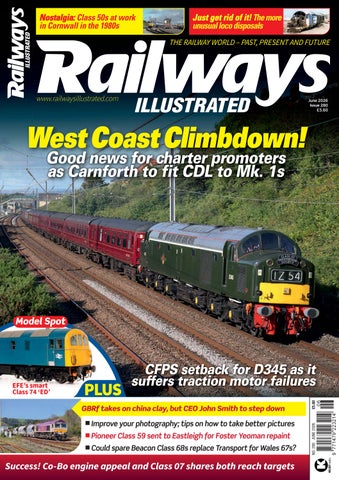
WCR relents and agrees to fit CDL to its Mk. 1s

AFTER SEVERAL years of legal wrangling with the Office of Road & Rail, charter operator West Coast Railways has finally admitted defeat and agreed to fit Central Door Locking it its fleet of 80-plus Mk. 1 coaches.

The usual level of secrecy surrounds the activities at its Carnforth depot, but it understood some vehicles may already now have the equipment fitted. However, in a statement WCR said: “Following feedback and evaluation of the costs associated with our Mk. 2s, we have approached the Office of Rail and Road (ORR) to reinstate our Mk. 1s. We are going to fit CDL across our entire fleet of Mk. 1s used on the main line.

“This is a significant undertaking [and] will take time to complete. To this end, we are currently discussing with the ORR to finalise a timeline that balances the technical requirements of the installation with our goal of commencing the 2026 ‘Jacobite’ season.”

However, WCR has yet to have confirmed agreement from the ORR that it can start running with Mk. 1s again. Legislation to introduce CDL was announced way back in 1999, but derogation after derogation was granted until 2017 when the ORR said no more delays would be forthcoming after 2023.

That led others, such as Locomotive Services, Hastings Diesels, Vintage Trains and the Scottish Railway Preservation Society to start their own fitment programmes, some of which in agreement with the ORR allowed them to operate non-CDL stock past the March 31 2023 deadline if they could prove a fitment plan was in place.

WCR refused to fit CDL, and launched legal appeals which it lost. It also bought out Riviera Trains solely to acquire its fleet of CDL fitted Mk 2f air-conditioned coaches. However using these coaches, painted in BR blue and grey

colours, on the steam-hauled Fort William to Mallaig ‘Jacobite’ operation, often with no train supply, proved very unpopular.

However, the ORR indicated that while WCR has relented, it is not as simple as welcoming its Mk. 1s back on the network. It said: “We note that WCR recognises the need for CDL. However, work remains to establish the feasibility, detail, and delivery timeline of the proposed approach. ORR has not issued any exemption to the relevant requirements of the Railway Safety Regulations 1999 in relation to this matter.”

See From the Front Coach, page 50

More guests in the pipeline for the Severn Valley

THE SEVERN Valley Railway is close to securing four more locos to star at its May 14-17 diesel gala. All being well, GWR hopes to send 57604 Pendennis Castle, while a Colas loco – class not yet specified and subject to availability, a GBRf loco – hopefully a Class 69 and/or 66 and a Rail Operations Group Class 93 could be in the frame to appear.

Other confirmed guest locos from FOCs are a Heavy Haul Rail Class 59,

most likely 59001 Yeoman Endeavour, a West Coast Railways Class 57/0 and a DB Cargo Class 67. The DEPG’s Hymek D7018 and 55009 Alycidon from the Deltic Preservation Society are the confirmed guest heritage locos.

Home fleet locos expected to take part are H3802 – the hydrogen-powered Class 08 converted from 08635, D9551, D8568, 20048, 33108, D821 Greyhound, 46045, 50033 Glorious,

D1015 Western Champion and D1062 Western Courier

Meanwhile, 55009 has been added to the line-up for the Keighley & Worth Valley Railway’s June 18-21 diesel gala and should work alongside 08993, D9520, 31108, 37025/250, an EPR Class 37 (or two) and 47715.

There will be a one-way charter from Scotland to the KWVR, promoted by the SRPS, which will

also bring in a rake of air-braked coaches. On June 17, 45118 The Royal Artilleryman works from Linlithgow to Keighley. On June 22, 37025 works a one-way charter back to Linlithgow.

Two EPR Class 37s are also pencilled in for the Mid Norfolk Railway’s May 22-24 diesel event while Hymek D7017 is expected to be announced for the North Yorkshire Moors’ June 12-14 diesel event.

On April 16, 47237 and 33025 pass Armistead Hall, near Giggleswick, on the ‘Little North Western’ route as they lead 5Z42, the 09.57 Carnforth-Southall taking the ECS to London for the ‘Great Britain XVI’ eight day steam hauled charter around Britain. The train is a mix of Mk. 2 coaches all with CDL. Chris Gee

LSL’s green Class 20s rescue stuck Pendolino…

LOCOMOTIVE SERVICES green Class 20s, 20096 and 20107 Jocelyn Fielding, were called to a very unusual Class 390 Pendolino rescue mission at Manchester on April 16.

Avanti’s 390126 ran into trouble on the approach to Manchester Piccadilly while working 1H08, the 08.53 from Euston, after its pantograph got entangled in the overhead wires. The

train understandably came to a halt, but just short of the station. Eventually passengers were de-trained and escorted over the tracks to continue with their days. The 20s came light from Crewe and were used to haul the stricken unit into the platform. This meant a temporary Dellner coupler had to be fitted to 20096.

the Dellner-fitted Class 390. John Humphries

Later in the day, 47593 Galloway Princess was sent to drag the 390 out to Longsight, again requiring the temporary Dellner to be fitted to allow it to couple to the train. That done, the 47 joined the 20s on a light engine move back to Crewe. Manchester Piccadilly station was closed all day causing travel chaos for thousands of passengers.

…and save the day on WCML charter

IN BRIEF

Robertsbridge station at the Rother Valley Railway was reopened on April 18, with Hastings DEMU 1001 used to take guests to the opening event.

The first Class 60 expected to move to DBI Holdings, 60063, has been repainted at Toton in two tone grey similar to the Trainload liveries carried by the class when delivered in 1989-93.

Two more guest locos have been added to the ELR’s July 2-5 diesel gala line up with 20303 and 37610 from Swietelsky UK set to appear, subject to availability. D9531, D5054, D7076, 40106, D832, 43025/060, 47765, 56006 and 58023 are all also due to work trains.

Slightly delayed, on April 7, the three new stations on the Camp Hill line in Birmingham opened at Moseley Village, Kings Heath and Pineapple Road. A half hourly service runs between Birmingham NS and Kings Norton.

Power cars 43423/467 were used to move 60103 Flying Scotsman on March 23 from Alton to Kings Norton. The unusual train was formed of 43467, 60103, two coaches and 43423.

The latest Class 158 to be refurbished for East Midlands Railway is 158785, with the work undertaken at Bristol Barton Hill. The move of 37042 from Stainmore to Wolsingham on the Weardale Railway was undertaken by road on April 20.

THE SAME pair of LSL Class 20s, 20096/107, were called upon to assist a charter train through to its destination, on April 8.

They had been sent from Crewe to Tebay to rescue 37409 Loch Awe which had failed with high water temperature while working 1Z71, the 17.14 Carlisle-Crewe Saphos Trains charter. The 37 itself had earlier been sent from Upperby to Oxenholme to assist 1Z70, the 10.35 Crewe-Carlisle after steam loco 71000 Duke of Gloucester had failed. That led to the 37 working 1Z71 in the first place instead of the booked steam loco. The 20s took the train back to Crewe.

Two other interesting rescue missions of late include WCR’s 57314 Conwy Castle being sent light from Carnforth to Glasgow Central to remove Transpennine Express’s 397008 when it failed before working 1M80 to Manchester on March 30. It was taken to Polmadie for repairs. On April 15, EPR’s 37407 Blackpool Tower and 37512 Thornaby Demon ran light from York to then top-and-tail East Midlands Railways’ 170517 as 5Z14, the 19.23 Warrington Central-Derby Etches Park.

20096 and 20107 Jocelyn Fielding call at Preston running an hour late with 1Z71, the 17.14 Carlisle-Crewe charter on April 8. They are hauling 37409 Loch Awe which had failed at Tebay. James Sutcliffe
20096/107 stand at the buffer stops at Manchester Piccadilly on April 16 having dragged 390126 into the station after its pantograph got tangled in the OLE. The inset pic shows the emergency coupling needed to allow the 20s to haul

Could spare Class 68s be set for Welsh Marches?

INDUSTRY SPECULATION is rife that Transport for Wales could be looking to replace its DB Cargo Class 67s with Beacon Rail Class 68s for its Cardiff-Manchester Piccadilly/Holyhead loco-hauled trains.

TfW told RI “[Our] long-term strategy for the loco hauled Mk. 4 rolling stock, including associated traction options, is currently under review. At this juncture all traction options form part of the review.”

Beacon has eight Class 68s currently not on lease, 68010-017 which would be sufficient locos to cover the five booked turns for TfW. 68010-015 were stood down by Chiltern Railways earlier this year while 68016/017 have been relinquished by DRS, the company that ordered the 34-strong fleet, 32 of which are owned by Beacon. DRS now has just 11 Class 68s in its fleet – 68001-09 owned by Beacon and 68033/034 which it owns outright.

Despite TfW having 12 Class 67s modified to work with the Mk. 4s –67008/010/012-017/020/022/025/029 - the locos and coaches have suffered from repeated poor reliability, and it’s commonplace that at least one of the five booked turns is routinely covered by a DMU. Some of the issues, however, are also attributable to the coaches.

The Class 68s would have to be modified to work with Mk. 4 coaches, which given they can work with Mk. 3 and Mk. 5 coaches, should not be too challenging to undertake.

Could the reign of Class 67s on the Welsh Marches be coming to an end? 67025 leads 1W61, the 14.50 Cardiff-Manchester Piccadilly into its destination on March 13. Tom McAtee

The DB Cargo contract for traction provision is understood to be until 2027. If Class 67s are dispensed with from the Welsh Marches route, along with their pending loss of the Royal train in 2027, it would leave just one,

occasional contract – the Belmond Pullman that would be booked for the 125mph locos that were delivered in 1999/2000.

Already four of the 30-strong fleet have been sold, two to TfW and two to Colas, while five are withdrawn and three have been sold for scrap. In other TfW fleet news, the Class 398 Stadler tram-trains are due to enter traffic “in late Spring/early Summer.”

The Wensleydale Railway’s ongoing work to reopen the line west of Leyburn for the five miles to Redmire is making good progress, with the operations team out on April 10 using 03144 to haul a weedkilling train. The short train pauses at Primrose Farm, just to the west of Newton-le-Willows on the Bedale to Finghall section of the 22-mile line. Oliver Kirkby

TfW Stadler

TRANSPORT FOR Wales is in the process of decommissioning its wheel lathe at Canton Depot, prior to a new wheel lathe being installed. As a result, some of its Class 231 DMU and Class 756 BMMU Stadler

units visit Holyhead for tyre turning

units are being hauled from Canton to Holyhead to use the newly-commissioned wheel lathe at TfW’s Holyhead depot. March 16 saw 37510 Orion haul 231006 as 5Q40, the 0809 Cardiff

Canton-Holyhead Carriage Depot. 37800 Cassiopeia followed on April 2 taking 231009 and 756105 as 5Q40, the 1019 Cardiff-Holyhead. It returned the next day with 231006 as 5Q78, the 1110 Holyhead-Cardiff.

On April 9 37510 ran light to Holyhead to collect 231009 and 756105 to return them to Cardiff and two days later it returned with 231001 and 756103. These units were taken back to Canton on April 14, again by 37510.

GBRf CEO John Smith to step down ‘within a year’

ON MARCH 25 it was confirmed that GBRf CEO John Smith, who has led the company from its inception in 2001, will be standing down from his role.

GBRf said: “As the business celebrates its 25th anniversary this month, GBRf founder and Chief Executive Officer John Smith is to step back from his role as Chief Executive Officer. As a result, and as part of its long-standing

succession planning, the company and its shareholder, Infracapital, has begun the process to appoint his successor, with the transition expected to take place over the coming year. John will continue to lead the business during this period and will support a smooth handover once a successor is in place.”

Liam Day has been promoted from Asset Director to Interim Managing

Director and Ian Langton has been promoted from Production Director to Chief Operating Officer (COO).

John Smith added: “It’s been a privilege to lead GBRf for the last 25 years. We’ve achieved things I wouldn’t have thought possible when I founded the company - and that is due to the talent, dedication and passion of the people who have worked here.

“This transition is being carefully managed over the coming year, and I remain fully committed to leading the business throughout this period. I would also like to congratulate Liam Day and Ian Langton on their well deserved promotions. Their leadership will be instrumental as we continue to build on our success and look ahead to the next decade of growth.”

Birmingham RailCar Workgroup Class 104 leaves Llangollen

THE THREE Class 104 vehicles owned by the Birmingham RailCar Workgroup (BRCW) have left the Llangollen Railway after 33 years based at the railway. In a statement, the BRCW says: “In February 2026 we received notice from Llangollen Railcars that it wished to immediately terminate custodianship of the three Class 104 vehicles on loan to it since 1993. Following withdrawal of M50454 and M50528 in October 2025 after 33 years of

operation, Llangollen Railcars did not have the resources to undertake repairs so returned the vehicles to BRCW.

“Whilst we are naturally disappointed that resource was not available to allow the set to continue its successful life in Wales, we are excited to announce that M50454 and M50528 are starting a new chapter at the Great Central Railway under custody of Renaissance Railcars.

“The Great Central operates a successful railcar fleet, and the relocation is historically fitting with Class 104s known to have operated the route prior to closure. This means that all preserved 104s will serve in locations that saw the class in BR times.

Spares donor M50447 has moved to the North Norfolk Railway to provide parts in support of the restoration of M50479 and the long-term operation of the two-car set resident there.

“Finally, BRCW wishes to thank Llangollen Railcars for its assistance in the relocation arrangements, as well as the maintenance and operation of M50454 and M50528 for the past 33 years, bringing pleasure to many thousands of passengers over the years, often flying the flag during times when no other Class 104s were operational. Both parties wish each other well for the future with our respective contributions to railcar preservation.”

Shunter fans have a field day on two railtours

THOSE SEEKING rare haulage from Class 08 shunters had two productive days on charters in April. Three locos worked on April 4’s ‘Alstom Depot bash’ charter, with 08887 and 09007 piloting the train at Alstom’s Longsight depot and 08617 Steve Purser doing likewise at Oxley.

57306 Branch Line Society, 66701 and 66694 Steve Hannam also worked on the train during the day which also visited Alstom’s Edge Hill site. It raised over £4,200 for charity.

On April 18, UK Railtours visited Wabtec’s Doncaster works site. The train left King’s Cross behind 57305 and then at Doncaster 66790 Louise was added to the rear. In the works, 08669 Bob Machin and 08724 were used to pilot the train, one on each end. The charter then visited the Hunslet East branch in Leeds.

Other shunters working passengers trains of late at heritage lines include 08703/825 at Chinnor on March 20-22, while on April 10/11, 08573 and 09001 were out at Peak Rail and D3236 (08168) was working at the Ecclesbourne Valley Railway.

LSL’s Pacer 142003 has been used for a series of route leaning missions for staff. It passes Pleasington running as 5Z37, the 09.25 Crewe-Carlisle Upperby on April 13. Steve Sienkiewicz

GBRf wins china clay contract from DB Cargo

GB RAILFREIGHT has secured a two-year contract with Imerys to transport china clay from local Cornish rail sites to Fowey Docks and Cliffe Vale in Staffordshire. It replaces the previous operator DB Cargo which had operated the trains since buying the Trainload Freight businesses in 1996.

Kaolin, mined in Cornwall, is a raw material used in a wide range of

products including paper, cosmetics, paint and pharmaceuticals. It has been a significant industry in Cornwall for centuries.

66312 Nigel Harris was sent to Cornwall in late March for some staff training, and the first GBRf loco to be used to haul the trains was 66787 Three Bridges ASC which was then replaced by 66734 Platinum Jubilee. As a rule, a

single loco can operate all the trains, including the longer distance flows.

Carl Kent, Sales Director at GB Railfreight, said: “We are pleased to enter into this agreement with Imerys, supporting the movement of critical local volumes and reinforcing our ambition to grow railfreight in the South West. We look forward to delivering our market-leading service to

Newcastle welcomes Class 91s after five year hiatus

FROM MARCH 30, Class 91s are once again working booked passenger trains north of York following LNER introducing a daily turn from King’s Cross to Newcastle. The locos last had booked turns on this route in September 2020. The 14.33 King’s Cross-Newcastle, returning at 18.27 to London, is now booked to be worked by a Class 91/ Mk 4 ‘InterCity 225’ set on Mondays

to Fridays while on Saturdays a 91 is booked to work the 12.33 King’s Cross-Newcastle and 16.27 return.

A dozen Class 91s are retained in traffic by LNER to work four daily diagrams, 91101/105-107/109-111/114/119/ 124/127/130. They are due to be replaced in 2027/28 by Class 897 CAF EMUs.

On April 16, 91110 Battle of Britain Memorial Flight was in trouble when

it failed at Stevenage with a reported seized axle while working 1D25, the 17.39 King’s Cross-Bradford Foster Square. The train was cancelled and the Newark Thunderbirds 67023 Stella and 67027 rescued the set and towed it to Hitchin where it was dumped. The loco was expected to be collected by road while the coaches were returned to Neville Hill by rail on April 20 by 67023/027.

a

Mondays to Saturdays,

Newcastle on April 7, 91106 Swallow InterCity 225 heads north on the 14.33 King’s Cross-Newcastle at Raskelf, south of Thirsk. Chris Gee

Imerys for at least the next two years.”

“In addition to transporting kaolin, we provide seasonal treatment services to help keep the rail network operating reliably for both passenger and freight services, including Belmond’s Britannic Explorer, across the region. This will see an increased number of ‘blue’ trains operating from 2026 and beyond in the area.”

Hope for Waverley reopening

AFTER FUNDING for a feasibility study into the business case for extending the Waverley Route south of Tweedbank for the 63 miles into Carlisle was granted, the results are due to be presented late in 2027. The line closed in January 1969, but first 35 miles from Edinburgh to Tweedbank were relaid and reopened in September 2015 and ever since there have been calls to reinstate the rest of the route via Melrose and Hawick down to Cumbria. The Scottish and UK governments are sharing the cost of a £10m feasibility study.

GB Railfreight is now operating the china clay traffic in Cornwall, having taken over from DB Cargo. On April 8, GBRf’s 66734 Platinum Jubilee passes St Blazey with 6C53, the 15.19 Par Harbour-Exeter Riverside. Craig Munday
Class 91s are once again running north of York with
daily turn,
to

GB Railfreight 60 recovered from Wensleydale

GB RAILFREIGHT’S stricken 60087

Ingleborough was collected by Reid Freight on March 23, from Leeming Bar on the Wensleydale Railway and moved to Toton by road.

It had been dumped at Leeming Bar since October 27, 2025 having failed at Northallerton on October 13 with a defective axle. It was taken

on a wheelskate to Leeming Bar and stored there pending developments. GBRf then put all ten of its operational Class 60s, 60002/021/026/047/056/ 076/085/087/095/096, up for sale, although reports suggest they have all been withdrawn from sale. If that is the case, then it is possible 60087 won’t be repaired.

While 60095 Whernside has remained active, on hire to DC Rail, it is to be replaced by 60026 Helvellyn. The Beacon Rail blue 60 was collected from Doncaster on April 17 and taken by 66054/122/176 in a convoy to Toton for an exam prior to returning to traffic. Also withdrawn from GBRf’s tender list are its three Class 47s, 47727

Edinburgh Castle, 47739 and 47749 City of Truro. They look set to be retained for at least another year by GBRf. Of these, 47727 has returned to Melton RIDC, to work alongside resident shunter 56098, and 47739 was moved to Great Yarmouth on March 27 to be used by ERS for train supply work and shunting.

Nightmare journeys for East Coast passengers

LNER AND other train operators experienced serious delays on the East Coast Main Line the evening of April 16 after a ‘concern for welfare’ incident in Retford.

The TOC said: “At around 19.30 [that] evening, an LNER driver contacted Network Rail control teams after seeing a person on the railway close to Retford station. This alerted British Transport Police (BTP), and all trains were stopped in the area due to the immediate threat to life.

“BTP and Network Rail teams arrived at the location and found

a vulnerable man on top of a railway bridge over a river at around 20.20. While officers and specially-trained police negotiators managed the situation, to protect the safety of those involved, trains were unable run through the area. Police brought the incident to a safe conclusion at around 03.20 on the Friday morning.”

The 19.30 King’s Cross-Edinburgh was one such train affected. Minor delays saw the train pass Tallington ‘just’ 16 minutes late but then due to the incident the train was held up and was 318 minutes late by Stoke Junction

and then further delayed passing Grantham at 03.24 nearly seven hours late. The train continued to lose a few more minutes but was further delayed on the approach to Newcastle where it arrived at 06.09, 477 minutes behind schedule, three minutes shy of eight hours late. The train was then cancelled.

1S32, the 20.03 King’s Cross-Edinburgh was also terminated at Newcastle 455 minutes late at 06.38 and other trains were seriously delayed and terminated short of their destinations. Reports suggest some LNER staff had to then sleep on their trains as there were

insufficient taxis to take them home after passengers had been dealt with. Also caught up in the problem was Caledonian Sleeper’s 1S25, 20.35 Euston-Inverness which was booked to be diverted via the ECML that night. Hauled by 92020 Billy Stirling, the train, already nearly 1½ hours late, was held up at Connington, just south of Peterborough and was over 4½ hours late by the time it finally reached Edinburgh where the train split into its three portions for Aberdeen, Fort William and Inverness, but all three trains continued to their destinations.

ROG’s tri-mode Class 93s made a first working to Inverness on March 18 to collect a rake of HST trailers. Passing Slochd are 93008 and 93009 with
CMD-Hamilton EG Steele. Graeme Elgar

Grand Central’s Hitachi TMMUs will be Class 820s

THE NEW Hitachi AT300 tri-mode multiple units ordered by Open Access operator Grand Central will be the Class 820. The order is for nine five-car units, but the units numbers have not been confirmed, though 820001-009 seems highly likely.

If GC wins additional track access rights to operate to Cleethorpes, it will look to order an additional two Class 820 units. GC said: “In the event our application to operate trains to Cleethorpes is approved we will seek to order additional rolling stock to support the services. In the meantime, we are working on a rolling stock strategy that would allow the services

to start up before the new rolling stock is available.”

The current fleet is ten five-car Class 180 DMUs leased from Angel Trains and two five-car Class 221 DEMUs from Beacon Rail. All date from 2001 and were previously used by other TOCs. They work GC’s current timetable from Bradford and Sunderland to King’s Cross. However GC is looking to start trains from Cleethorpes which will run to Doncaster and then join up with trains from either Bradford or Sunderland, thus not needing any more paths south of Doncaster on the busy ECML. It wants to run four trains in each direction between Cleethorpes and

King’s Cross. They would call at Grimsby, Habrough, Barnetby and Scunthorpe. GC says: “by stopping at each of these stations, as well as Cleethorpes we will be able to introduce new, direct connectivity to London and continue to connect underserved communities.”

If the Cleethorpes trains are confirmed, then as a short term stopgap, GC will look to take on some or all of the four spare Class 180s that Angel has in store, 180109-111/113, before its 820s arrive. This could also allow it to return the two Class 221s to Beacon Rail which could then transferred to CrossCountry Trains.

Hastings DEMU heads to Inverness

IN A groundbreaking charter, the Branch Line Society, Hastings Diesel Ltd and GB Railfreight will be taking a nine-car Class 201 Hastings DEMU combination all the way to Inverness, the first time these units have been to Scotland.

As these four Class 180s have not worked since 2023, they would need some level of refurbishment. They were ordered by First Great Western and built in 2000/01 but retired in 2008 and then used briefly by Northern, EMR and Hull Trains as well as by Grand Central. Meanwhile, CrossCountry Trains is widely expected to take at least six more five-car Class 221s, with ex-Avanti 221101-106 likely to join its fleet on lease from Beacon Rail. It may also take two more units if 221142/143 are returned by Grand Central and replaced by Class 820s or, as a possible short term fix, surplus Angel Trains Class 180s.

Belmond’s BE starts for 2026

The Saturday will see 1001 run from Haymarket to Inverness, via the Highland Main line and will return via Elgin and Aberdeen back to Edinburgh. The Sunday sees the DEMU return home via the WCML again.

The train is set for May 22-24 and starts at Tonbridge with six-car 201013 and three-car 201001 working through to Edinburgh via the WCML.

Passengers need to book their own accommodation and the train is initially open to BLS members only, but should be made open to non-members if there is capacity. The fare is £349, or £399 if you wish to sit in one of the four motor coaches.

Another regeared GBRf Class 66/6

GBRF’S 66772 Maria is the fifth Class 66/7 to be regeared for heavy trainload work and has been renumbered 66682.

Previously regeared have been 66771/776/777/779, which are now 66671/686/687/689.

Another three locos are still expected to be modified while 66795/796 still have yet to be renumbered as 66695/696.

THE LIGHT blue train of ten Mk. 3s that forms Belmond’s luxury ‘Britannic Explorer’ has started to tour the UK again as the 2026 season has got underway.

GBRf is the train operator and 66748 St Michael’s Mount remains as the preferred dedicated locomotive, with support coming from other GBRf 66s as required. Already the train has visited Cornwall, Pwllheli, the Lake District and the Yorkshire Dales. Popular with photographers, the highlights are the trips along the Cambrian Coast line to Pwllheli which have to be worked by pairs of Network Rail Class 97/3s due to the requirement for ETCS. The ten ex-Irish Rail Mk. 3 coaches had spent the winter at Assenta Rail’s site at Hamilton, near Glasgow, where medications were undertaken to make the doors more reliable. This had been the biggest issue with the train in 2025, causing some unwanted early terminations and cancellations.

The season started on March 20 with 66748 accompanied by 66313 Lucie as 1Z20, the 1548 Victoria-Keighley, which was 90 minutes late starting, but arrived five minutes early. March 24 saw 97302/304 take the train to Pwllheli and a week later, on March 31, the train returned to the Cambrian line, with 37254 Cardiff Canton and 97302.

All the coaches, 99101-110, are now in use for the 2026 season, all painted in the same matching light blue livery, as carried by 66748.

The main line registered preserved Hastings Class 201 set is set to break new ground for the units with a first ever visit to Scotland when it heads to Inverness in May. With DMBSO S60116 leading, the set passes Bathampton working the ‘Bath & Cranmore DEMU’ charter from Hastings on April 11. Glen Batten

Arlington repaints LSL 37/5 in ‘Blackberry’ black

THE FIRST Locomotive Services’ Class 37 to be painted in its favoured blackberry black livery, 37521, was outshopped from Arlington Fleet Services in early April. 37667 Flopsie is also at Eastleigh and expected to emerge in the same livery. Both were in BR Green with their D6817 and D6851 numbers.

The livery has already been seen on 57002/302/311 and 90002/026 but other heritage locos in the LSL fleet, such as its Class 20s, 37/4s, 45 and 50, are not expected to go black.

Foster Yeoman livery revived on Heavy Haul Rail 59

AS REPORTED back in RI August 2025, the first-built Class 59, 59001 Yeoman Endeavour, is being repainted back into a version of the silver Foster Yeoman livery it carried when delivered in January 1986.

The Heavy Haul Rail loco moved to Arlington Fleet Services at Eastleigh

on April 10. HHR confirmed the livery will be Foster Yeoman silver and blue “but with elements of the new Heavy Haul Rail brand incorporated.”

Foster Yeoman ordered four Class 59s which were delivered together and a fifth loco, 59005, arrived in June 1989. They gave rise to four

locos for Amey Roadstone Company, 59101-104 and six with National Power, 59201-206.

All, bar 59003, are now owned by HHR and used on the same stone trains from the Mendips that employed the 59/0s and 59/1s from new. The body design was then used on the Class 66s.

HHR branding has continued to be applied to locos in their current Freightliner liveries including the first Class 70 - 70003 in the PowerHaul livery. 66545 in the original green and yellow while 66413/419, in the more recent Genesee & Wyoming-inspired orange livery, have also had HHR branding applied.

RIGHT: Ex-works in LSL’s blackberry black, 37521 leads fellow black loco 57311 The Institution of Mechanical Engineers with a single coach pass Swanbourne working 5K47, the 09.44 Eastleigh Works-Crewe on April 8. John Turner
As mentioned on page 10, DB Cargo has lost the Cornish china clay traffic to GBRf which means visits by its 66s in the West Country will now be far rarer. On March 28, 66168 hauls 6V76, the 10.35 Westbury-Goonbarrow Junction on the last DB working along the Dawlish sea wall, before GBRf took over. Thomas Mills

Police investigate possible fraud on 40012 sale

SOME SHAREHOLDERS

of 40012

Aureol have reported the majority shareholder Paul Hill to the Police over possible fraud when he sold the loco, but Mr Hill has categorically denied any allegations of wrongdoing.

The Class 40 Appeal was set up in 1985 to buy one of the last remaining Class 40s which had just been retired by BR and was successful in securing 40012 in 1988. It moved to Midland Railway Butterley in 1989 and was returned to working order, visiting a number of heritage railways in the early 1990s.

It then suffered a major engine failure but was repaired. In recent years the loco had been based at the East Lancashire Railway after the MRB stopped Mr Hill from driving the loco at its railway.

Reduced working parties, combined with the loco needing major expenditure and Mr Hill now being in his mid-70s saw the decision taken to sell the loco. He had advised the shareholders this was the plan via the C40A’s newsletter.

Mr Hill told RI that he had “put aside money from the sale to pay back any shareholders” and he was in the process

of doing that, but it would “take at least another month.” He did confirm some shareholders were not contactable as their contact details were no longer correct, and some had passed away.

He strongly denied allegations by some shareholders that he was profiteering from the sale and that the sale had been decided solely with the best interests of the loco at heart.

He urges anyone who bought shares in the locos to get in touch, while the West Midlands Police said the investigations were “still ongoing” and that “anyone who has any information on the sale should come forward.”

The loco was collected on December 5 from the ELR by classmate D213 Andania and moved to Worksop. Preventative maintenance on the loco has been undertaken by the new owner; it has been dried out, had its engine running and tested, the coolant drained and the batteries disconnected.

However no serious work will be undertaken until the matter over the sale has been resolved and the new owner is clear to progress with its refurbishment. It has poor bodywork, a coolant leak and a cracked turbo amongst other issues.

ACMU announces launch of three new initiatives

THE ALTERNATING Current Multiple Unit Society (ACMUS) has announced three new initiatives to help preserve 25kV AC EMUs of Classes 307, 311, 312, and 313. It added the last two surviving vehicles of the Class 311 unit, 311103, to its growing ‘Meet The Fleet’ initiative. The Class 311 will remain owned and based at the Summerlee Museum of Scottish Industrial Life, but will be supported under the society’s umbrella of preserved AC EMUs, which also includes all surviving vehicles of units 309624, 313121, 315856 and 317345, all owned by separate organisations but united by the society.

Lakshman Pathak, Chairman of the ACMUS said: “Since our launch we have been forging strategic partnerships with organisations to bring dedicated marketing, promotion, and financial support to a variety of AC EMUs.

“The immediate steps for the Class 311 involve preparations to celebrate its diamond jubilee this May, alongside continued weatherproofing and cosmetic restoration by the dedicated core Glasgow Electric Group team.”

The ACMUS has also announced the launch of the 313 Club, a support

initiative for preservation and promotion of 313121. The launch of this fund builds upon the society’s partnership with the Fife Heritage Railway to support the unit, which began last year, initially as a promotion and collaboration agreement.

Mr Pathak added: “The launch of the 313 Club represents a positive development in our relationship with the Fife Heritage Railway. Following the successful collaboration between the two organisations by fundraising for, and directly financially contributing to, 313121, ensuring it gets the support it needs.”

Finally, the ACMUS has announced a third new partnership with the Colne Valley Railway to take responsibility for the restoration of the hybrid EMU set featuring 312792 and 307123, with the goal of returning the set to operational passenger-carrying condition. Initially the focus will be a cosmetic restoration of 307123, the oldest preserved Mk. 1 AC EMU. The intention is to alter its external appearance to as close as practical to its original BR green condition. Meanwhile, supported by CVR volunteers, a full restoration of 312792 will commence, securing its future as the only pair of Mk. 2 EMU vehicles to survive.

The rare sight of two EPR Class 37s moving an EMR Class 170 occurred on April 15 when 37407 Blackpool Tower and 37512 Thornaby Demon hauled 5Z14, the 19.23 Warrington Central-Derby Etches Park, seen passing Manchester Oxford Road. Tom McAtee

GWR suffers a minor landslip

THE GLOUCESTERSHIRE Warwickshire Railway has suffered another landslip on the Malvern side of the embankment between Gotherington and Bishop’s Cleeve, but this time it is not thought to be overly severe.

It has, however, resulted in shortterm timetable changes while essential repair works were undertaken, although the GWR is optimistic that the line is expected to be fully reopened by mid-May.

From April 21, midweek trains were only running between Broadway and

Winchcombe. The GWR says: “These changes are necessary to allow safe and effective access for engineering teams working to stabilise and repair the affected area. Wherever possible, services will continue to operate using available traction from our fleet, including ‘Bubble Car’ W55003 and steam locos hauling seven-coach trains.”

Weekend trains are planned to operate as advertised through to Cheltenham Racecourse, although engineering work may affect this and trains could be amended at short

notice, and trains may operate over a reduced section of the line.

It added: “The railway is working hard to maintain as much of the advertised service as possible while ensuring the safety of our passengers, volunteers, and infrastructure. We will continue to provide updates as work progresses. We would like to apologise for any inconvenience caused and would like to thank you for your patience and understanding during this time.

“The railway is deeply grateful to the supporting Gloucestershire

Warwickshire Railway Trust which is funding the repair costs. Donations to the Trust’s general funds can be made here: gwrt.org.uk/donate/ how-to-donate.

The GWR is holding a three-day diesel gala on July 24-26 with visiting locos 25262, 27056 and Hymek D7018 joining residents 20137/228, 24081, 26043, 37215/248, 47105/376 and DMU 55003. It will bring examples of four Sulzer Type 2s together for the first time in nearly 30 years and the first time all in BR blue since the 1970s.

DB Cargo fits digital signalling kit to 66 at Toton

DB CARGO has fitted its first Class 66, 66070, with the new in-cab European Train Control System (ETCS) digital signalling system at

Toton Traction Maintenance Depot. It follows on from 66039 which was modified at Wabtec Doncaster as first of class.

Next to be modified is 66003 with 66053 also stopped for the upgrade. The new equipment will allow the locomotives to work over lines with digital signalling.

DBC sends first of 25 Class 66s to

THE FIRST of 25 Class 66s that Romania Operator Grup Feroviar Roman (GFR) has bought from DB Cargo has made its journey to the continent. 66035 Resourceful moved 66014 from Toton to Dollands Moor on April 13 ready for its transfer through the Channel Tunnel.

Like 66014, 66006/024/040 have all been repainted in GFR’s blue while other locos are being prepared for their moves. DBC has previously sent Class 66s from the UK to both France and Poland for reuse.

Also fitted with ETCS are Heavy Haul Rail’s 66591 and Locomotive Services’ Deltic D9000 Royal Scots Grey

Romania

The 17 DB Polska 66s are now in the process of being renumbered. So far 66166/196/248 have gained their new numbers 651002, 651004 and 651003 respectively. 66196 retains its EWS number on the bodyside of its original EWS livery, while the other two locos are in DB Cargo red. Other locos will be renumbered, presumably to 651001-017 at random as they are due maintenance. The locos sport the full UIC numbers, so 92 51 3 651 002-5 for 66166, on white cabside panels.

DB Cargo’s 66035 Resourceful hauls 66014 past Longhedge Junction en route from Toton to Dollands Moor for export to Romania on April 13. Zain Peek

The rumour mill

The sale of most of locos put up for disposal by GB Railfreight looks to have been suspended as no buyers with “sensible and serious offers” were made * That said, 47739 has gone on long term hire to Eastern Rail Services at Yarmouth… * …which could be a ‘try before you buy’ scenario… * …and could lead to ERS buying “all three 47s”… Could an application for a Train Operating licence follow? * Alternatively, GBRf could be keeping the 47s to free up Class 66s for the annual autumn RHTT season * Non-standard 59003 could, however, be sold and heading back into Europe – it spent 1997-2014 working in Germany. Norway has been suggested as a destination. * We could even see a few Class 60s return to GBRf work? * But 60026 is heading back on hire to DC Rail, replacing 60095 * And talking of 60s, its seems the deal for DBI Holdings to take some working DB Cargo locos has moved a step forward

with 60063 being repainted…. Into the old BR Trainload livery * But will it gain its Trainload Petroleum logos? Who knows?!? * 60074 is understood to be next in line for revival and sale to DBI * Northern “is looking” at taking on an ex-Chiltern Mk. 3 set for working on the S&C this summer due to unit shortages. Presumably powered by a Class 68? * Which could provide some stopgap work for the Beacon 68s until their possible transfer to TfW happens!

* LSL’s 47830 is due to go to Eastleigh for a repaint. Apparently it is staying green, but it certainly won’t be named after the man who ruined the railways!

* The BLS/GBRf four-day September Charity tour is rumoured to be “in doubt.” * InterCity is possibly looking at a tour to Oban with 50050 in late summer/early Autumn. * The nationwide introduction of Class 99s “is postponed until at least July.” * One rumour that might have legs is the

suggestion some Colas 56s are being earmarked for export... to Ghana * That is part of the reason why four 56s are still being kept in active traffic with Colas * Another that is highly plausible is the four remaining DRS Class 57/3s being taken on by LSL, complete with Dellner couplers to provide WCML cover for rescuing stricken trains * The ‘calf’ loco for the 13e project has been sort of identified, except no one at Positive Traction is revealing the donor. Some money is on 08782 being the soon-tobe-cabless loco * No work has physically started on propping up the bridge at Grosmont which means the NYMR can’t operate into the station. With that in mind, any guest locos for the June gala will have to come in by road which could curtail the roster. * However, it is hoped trains can still run north of Goathland and reverse alongside Grosmont MPD, so the thrash up that 1-in-49 incline can still be savoured…

* …which will be a ‘must’ if D7017 definitely appears as planned * Vintage Trains’ 47773 is reported to be needing “a six figure sum to get it sorted” so more work for 37418? * But also the fact 37901 retains vacuum brakes has not been lost on Vintage Trains which could be looking to use it on some trains… could be a nice reunion for the former 37150 with 37240; they worked along the Cambrian line in 1985 * While 20189 is having yet another repaint in blue, 20142 still is hanging on to its Metropolitan Railway maroon… * but there are high hopes 20227 will be going back into blue “very soon”. Please make this happen! * 66302/304 are set to become ‘dedicated’ locos for Caledonian Sleeper. They will retain their DRS blue but have CS branding added * DRS to use some 93s on container trains… * …and some, or all, of the 88s may go off lease when their lease period expires.

And the news you probably haven’t heard yet…

Complied by Artie Justsits

Britannic Explorer passengers worried they might be off to the Port of Immingham Passengers with incredibly fat wallets on board the Britannic Explorer luxury touring train seemed rather worried they might be off for a visit to the Port of Immingham. Having had their train hauled by locomotives named after St Michael’s Mount and the Heart of Wales, the appearance of a Class 66 named after North Lincolnshire’s hottest tourist attraction had many of the more-money-than-sense brigade hastily looking online to see what attraction this unknown-to-them Port could hold.

Having discovered that the “Port of Immingham is the UK’s largest port by tonnage, handling around 46 million tonnes of cargo every year,” they were ecstatic. Then the realisation that “together with ABP’s other ports on the Humber at Grimsby, Hull and Goole, Immingham is part of the UK’s leading port complex, an unparalleled gateway for the trade connecting businesses across the UK, Europe, and beyond,” the passengers were beyond themselves with excitement as they piled into the bar car to quaff champagne and mega expensive wines.

But the clincher was that fact that the “port is a critical part of the supply chain for sustainable electricity generation and other energy production, helping power the nation and helping to cement the Humber as ‘the UK’s Energy Estuary’.”

The fact the contract manager for the BE is also known to have a penchant for covering rare track and the fact there is the choice of eight different roads to take to get to the buffer stops means its inevitable Port of Immingham will be added to the BE’s itinerary soon.

God help them when a loco named Ratcliffe Power Station backs on in No. 5 road at the Port to take them south…

There are suggestions that the e-mail from Belmond saying locos hauling the high end luxury ‘Britannic Explorer’ must be named after the exotic destinations the train visits, was blocked by the GBRf Spam Filter as St Micheal’s Mount was deemed offensive… Or a reference to horse racing…

LNER trial to return ECML overnights “a success”

London North Eastern Railway has said its plan of returning overnight trains to its East Coast timetable went well with a pre-introduction trial run in mid-April.

An industry insider said: “Passengers loved their 10½ hours sat on an Azuma with those lovely soft and comfortable seats. Getting into Newcastle at 06.08 was ideal for connecting with Tyne & Wear Metro trains and local trains across the north.

They added: “We might have to look at leaving a little bit later than 19.30 though, that four-hour pathing stop at Stoke Junction was great for peace and quiet, allowing people to get some sleep, but wasn’t a good use of resources. But next time we might even turn the lights down.”

It’s not been announced yet just how LNER plans to market ten hours from King’s Cross to Aberdeen on an Class 800 as enjoyable without falling foul of the Trades Description Act…

ORR busy dreaming up next way to shaft charter operators

Having won its battle with WCR to fit Central Door Locking onto Mk. 1 coaches, the ORR is working on other ways to make train operators to spend bucketloads of money on pointless and unnecessary ‘enhancements’ that will reduce the number of lives lost and serious injuries from travelling on a Mk. 1 coach fall from zero down to, er, zero.

It is considering the mandatory fitting of life jackets under every seat. These will be needed for the unlikely chance of the train crashing into an ocean.

“These high visibility vests will have a whistle and a light on them, so you can attract attention while stuck in

the middle of nowhere and with help miles away,” said an ORR killjoy. Oxygen masks are also being considered, although in fairness these could prove popular when you are next stuck on a charter sat next to someone who hasn’t washed in a month and is eating a bag of Happy Shopper cheese and onion crisps…

Payback for giving us the Class 141s, says Iran

Iran says it has closed the Strait of Hormuz as retaliation for having 11 Class 141 railbuses exported to the country in 2005.

Iran’s Islamic Revolutionary Guard, now called Islamic Revolutionary Train Managers, have been seeking revenge ever since those heaps of cr*p on four wheels descended on their shores some 20 years ago.

“Death to the infidels,” Kamran Ali, head of Iranian railways screamed, when in fact the infidels were of course the British Rail management who signed off on ordering 20 of the units in the first place back in the 1980s. “And where is Halifax anyway? And is Pontefract even a real place?” asked Ali.

Some man in a pink shirt is understood to be wanted in Iran having duped the Iranians into taking the trains in payment for three magic carpets which didn’t work.

Press release from WCR is just a blank sheet of paper Er, that’s it. We’d love to tell you more… but can’t.

Just one of the many exotic destinations the Britannic Explorer might not actually be going to…

Because they could

TheBranchLineSociety,GBRailfreight,EasternRailServicesandEurophoenixRailjoined forcestodeliverfivedaysofClass37haulagefromMarch19-23ontheBLS’s‘Becausewecan4’ charter.RIpresentsaselectionofimagesfromthetrip…

THE BWC4 tour itself was ʻonlyʼ the three days while the train was in Scotland, but to move the six ERS coaches north from Great Yarmouth, they ran as positioning moves from Peterborough to Dundee on the Thursday and back from Linlithgow on the Monday via Crewe and the WCML.

These legs were worked by 57306 Branch Line Society as far as Leicester where EPRʼs 37423 Perseus and 37611 Pegasus – both recently named (or in the case of 37611, renamed) for the journey north.

On the Friday the train, operated by GB Railfreight, headed from Dundee to Stranraer and then returned north and visited Largs and Gourock. The second day saw the train start at Glasgow Queen Street High Level and visit Haymarket, via Airdrie, then head to Carlisle, Kilmarnock, Glasgow Central, Glasgow QSHL and ended at Dalmarnock.

The Sunday started at Exhibition Centre and headed to Balloch, Milngavie, East Kilbride, Larkhall, Lanark, Edinburgh via Shotts, Carstairs and Paisley Canal before ending at Polmont.

Passing near Miltonise, south of Barrhill, 37611 Pegasus leads and 37423 Perseus tails as they head into Galloway working 1Z06, the 08.21 Dundee-Stranraer on March 20. Special dispensation had to be granted for 37423 to travel to Stranraer due to its roof mounted air horns. Jamie Squibbs

ABOVE:
For the run to Lanark 37611 was leading with 37423 on the rear, and the train approaches the end of the branch line on 1Z09, the 12.41 from Larkhall on March 22. Robin Ralston
On the Saturday, the train visited Carlisle amongst other destinations and crosses the River Esk at Metal Bridge, near Gretna, on 1Z09, the 16.30 Carlisle-Kilmarnock leg. Jimmy Wilson
A real rarity for a loco-hauled train was a visit to Paisley Canal, but on the Sunday evening, the last leg of the Scottish trip was when 37423 worked 1Z12, the 18.39 Edinburgh-Paisley Canal and then 37611 worked 1Z14, the 20.40 back to Polmont. Not an easy place to get a good picture in the dark, but nevertheless worth including for its rarity. Al Pulford

Coaching Stock News

Chiltern ends Mk. 3 use

The curtain came down on Chiltern Railways’ use of its Mk. 3 sets on March 18, this also marking the end of the loco-hauled variant of the stock in regular passenger service after some four decades.

The last working was an early morning run with 68011 propelling 1H12, the 07.46 Princes Risborough-Marylebone, led by DVT 82309 and formed of set AL04 (12619, 12618, 12603, 12614, 12607, 10271).

The next day saw the stock removed from Chiltern’s Wembley depot to Burton Wetmore top and tailed between 68011 and 68012 and with the stored trio of 12627, 82302 and 82303 also included. All of the former Chiltern Mk. 3 fleet is now at the Nemesis Rail depot to await its future.

Meanwhile, only one Mk. 5 set now remains in store at Long Marston in the form of the troubled first-built CH01 (11501, 12701-703, 12801), this having yet to visit Eastleigh for any preparatory work. The remainder of the CAF sets have now departed for Eastleigh once again with 68019 transferring CH08 (11508, 12722724, 12808) on March 24 while 68025

arrived to collect CH09 (11509, 12725727, 12809) on April 15. Also still at Eastleigh at this point being prepared was CH11 (11511, 12731-733, 12811).

More of the sets have returned to passenger traffic for the first time under Chiltern though with 68022 working 1H25, the 08.15 Birmingham Moor Street-Marylebone, on March 20, which was formed of CH12 (11512, 12734-736, 12812).

Two days later, CH04 (11504, 12710712, 12804) also debuted when it formed a 1I91 11.25 Birmingham Moor Street-Wembley Stadium football special with 68027 for company before taking up regular traffic on March 23.

Set CH10 (11510, 12728-730, 12810) was noted in use during late March while CH03 (11503, 12707-709, 12803) made its Chiltern debut on April 13 when 68024 powered it on 1H25 once more. Next to appears should be CH06 (11506, 12716-718, 12806) which departed Eastleigh for Banbury depot on April 16 behind 68026.

Ex-LNER Mk. 4s go for scrap

Disposals of the Mk. 4s removed from traffic by LNER last autumn have

Liveries

The recently created Heavy Haul Rail has unveiled its new corporate colours with the release of 66537 from Loughborough on March 18, it displaying an attractive teal and green scheme. Meanwhile, the application of HHR logos to traction still in versions of the Freightliner colours is continuing with 70003 the first Class 70 to be treated at Midland Road in mid-April while orange 66419 has also been done. Indeed, vinyls were to the fore during the period with 67023 now joining 67027 in sporting East Coast

begun from Worksop, this seeing the InterCity-style oxblood coaches move by road to EMR’s Liverpool scrapyard. First away in the last full week of March were TSOs 12406, 12424, 12432 and 12485 with 11416 and 11417 following a week later. Meanwhile March 19/20 saw two more first class vehicles, 11406 and 11413, depart Worksop for Dereham on the Mid Norfolk Railway.

More acquisitions for Eastern Rail Services

With the nationwide tour of the Railway 200 ‘Inspiration’ exhibition train in its final stages, Network Rail has released the two spare Mk. 3s acquired for the project. Latterly stored at Asfordby, 11099 and 12154 have been purchased by Eastern Rail Services with 57303 and 57306 Branch Line Society transferring the pair to Yarmouth on April 8. Meanwhile, ERS has reactivated Mk. 2e TSO 5787, the former DRS vehicle being included in UK Railtours’ ‘The Plant’ charter to Wabtec, Doncaster on April 18. Two days earlier, Mk. 2f BSO 9529 had departed Yarmouth by road for disposal at the Stafford yard of J Watson & Sons after undergoing spares recovery.

Locomotive Services returns Mk. 3s to Upperby

The four HST trailers previously used in the overhead line test trains with 91117 Project Electra have been returned to store at Carlisle Upperby by Locomotive Services. Still in East Midlands Trains colours, 41063, 41117, 42100 and 42220 had latterly been stored at Yarmouth since these workings concluded in May last year.

On March 19, 47810 Crewe Diesel Depot ventured to East Anglia from Crewe with barriers 6393 and 6394 in order to collect the quartet, the trip also being used to return Mk. 2f BSO 9513 to ERS, its hire no longer being required since the overhaul of

Locos

Chiltern Railways grey/silver: 68014

Chiltern Railways two-tone blue: 68025/027

Locomotive Services’ own Mk. 2d BFK 17159. After stopping at Crewe, the four Mk. 3s reached Carlisle on March 20. LSL has also acquired Mk. 3a TSO 12114 from Crewe Heritage Centre with the former Great Anglia vehicle tripped across to the company’s depot by 37401 Mary Queen of Scots on March 18.

West Coast Railways news

Former Riviera Trains Mk. 2f RFO 1212 has lost its BR blue/grey livery in favour of West Coast maroon, the buffet making its debut in its new guise on April 16 when it was included in the set for the ‘Great Britain XVIII’ steam tour.

Almost a month earlier on March 18, Mk. 2 TSO 5171 was belatedly recovered from its festive hire to the Keighley & Worth Valley, 40145 and 37669 heading the coach back to Carnforth.

Meanwhile, with ‘West Country’ 34028 Eddystone now on hire to West Coast, its support coach has returned to the main line as well after its overhaul was completed over the winter, Mk. 1 BFK 35011 sporting the obligatory maroon.

Mk.

3 movements

The three Mk. 3a TSOs hired to the Midland Railway Trust by Nemesis Rail since last summer were retrieved from Swanwick Junction on April 15, 31128 Charybdis arriving to take 12079, 12146 and 12167 back to Burton.

Leaving the Midlands depot on April 1 behind 20007 and 20205 were the unlikely combination of ‘sleeper’ 10551 and HST trailers 42051 and 42369, the Type 1s taking the trio of Romic-owned vehicles to the Mid Norfolk Railway.

Six days later, the rest of Romic’s HST set with power cars 43094 and 43122 was transferred to Worksop Yard to await its next duty. Now owned by 125 Preservation, Mk. 3 buffet 40701 was moved by road from Leeming Bar to the Nene Valley Railway on March 20 to immediately join the group’s HST set based there.

Colas with East Coast Thunderbird logos: 67023

Freightliner Powerhaul with Heavy Haul Rail logos: 70003

Freightliner orange with Heavy Haul Rail logos: 66419

Thunderbird logos, although these are smaller than on its sister to accommodate the reapplication of Colas lettering as well.

Former Chiltern Railways hire-in 68014 has been returned to its underlying silver and grey colours after visiting Eastleigh TMD to have the operator’s white and green Greener Future wrap removed. At the same time, classmates 68025 and 68027 have emerged from the south coast depot with Chiltern blue vinyls in place.

Grup Feroviar Roman blue: 66040

Heavy Haul Rail two-tone green: 66537

Locomotive Services black: 37521

RMS Locotec: 08573

Units

c2c: 357017/018/039

CrossCountry red: 170117, 220023/025/028

East Midlands Railway purple: 158785

London Overground revised: 378233/234

Lumo: 222601

South Western Railway with Legoland vinyls: 701060

Coaches

BR maroon: 1212, 35011

GBRf 69009 Western Consort passes Raynesway, near Spondon, working 7M18, the 07.19 Doncaster Up Decoy-Toton North Yard, on March 30. Steve Donald

Shunter News

Delivered at the end of 2025, Heidelberg Materials named its 08e battery loco at Whatley depot on April 18. In a competition held amongst local schools, the winning suggestion of Battery Bill came from Cillian Gallagher of Bishop Henderson Primary School in Radstock. This was unveiled by Cillian and his family at a small ceremony at the depot where staff continue to learn how to use the new technology in Heidelberg’s rail operations. Simon Bendall

Alstom 08s swap over

Released from repairs at Eastleigh Works, 08454 was tripped to Southampton Eastern Docks in the small hours of March 30 sandwiched between 66057 and 66028, a change in Network Rail policy preventing the usual transfer to road transport in Eastleigh East Yard.

With this achieved in the docks, the shunter was duly taken north to Alstom’s Widnes Technology Centre.

This allowed 08451 to be moved south to bolster the shunter provision at Wembley, unloading taking place on April 2.

Beacon Rail 18 collected

After two years of being largely inactive at Scunthorpe Steelworks, 18003 was retrieved on March 24 and moved back south to join most of its classmates at Wolverton Works, where it arrived the next day.

Wagon News

New deliveries

A further rake of 18 new JPA cement tanks for Breedon arrived through the Channel Tunnel early on March 25 with 92044 Couperin provided to take 81 70 9316 089-99 and 100-005/007 forward to Wembley later that morning. Two days later, 66519 worked the train forward to Earles Sidings for commissioning and entry into service.

Meanwhile, WH Davis has completed several more MWA box wagons for Heavy Haul, 70006 collecting 81 70 5891 770/773-776 from Shirebrook on March 23 and taking them to Dowlow along with several earlier examples that had previously returned to the wagon works for attention.

New build DB Cargo BAA steel wagon 900465 was finally released from Stoke on March 23, some six months after the previous delivery took place. Initially taken to Warrington Arpley by 66121, both this and 900464 had remained on site following the completion of the build last year with the latter having yet to be seen outside the workshop building.

Surplus TEAs stored

With an excess of TEA tankers since the closure of Lindsey refinery, April 15 saw two rakes of DB-owned vehicles dispatched to Worksop Yard for store. The afternoon arrival from Immingham

GBRf ends RSS contract

GB Railfreight’s decision to employ main line locos as ‘super shunters’ at the infrastructure yards it operates on behalf of Network Rail has seen all five of the Class 08s hired from RSS dispensed with. This triggered a wave of transfers from mid-March as a result of the considerably reduced workload.

Whitemoor was the first to be cleared with 08629 departing for Wolverton Works around March 18, its arrival displacing the only recently arrived 08830 back to Wishaw. Also from Whitemoor, 08738 headed initially to Bescot Yard on March 19 to allow 08703 Steve Blick to be released for its booked appearance at the Chinnor & Princes Risborough diesel gala.

Also from Bescot, 08460 was redeployed to Neville Hill on March 27 to allow the long-serving 08405 to be taken away. By mid-April, the latter was located in a haulage yard in Chesterfield while a sale to a new owner was completed.

The aforementioned 08738 left Bescot around April 9, it initially heading to Wishaw before arriving at Kingsbury a week later to take over from 08730 as yard pilot on hire to European Metal Recycling.

After fulfilling this role for three years, 08730 duly returned to Wishaw for an exam. Of the Eastleigh Yard duo, 08511 departed for Chinnor on April 9, it joining 08703 on hire to the

preserved line for permanent way work, while 08683 headed straight to Wishaw 24 hours later.

RMS 08 repainted and named Fresh from overhaul, 08573 departed Chesterfield for Peak Rail on April 8 and a starring role in that weekend’s diesel gala. The work has included a repaint into the company’s blue and grey livery, having previously carried RT Rail black, while it gained the name Bob following arrival at Rowsley.

Swietelsky UK 08 moves

Overhauled last year, 08527 has been released back into traffic with its arrival at Peterborough Yard on April 10, it covering shunting duties at GB Railfreight’s wagon repair depot. This in turn allowed 08799 Ian Goddard to be returned back to Worksop Yard the same day.

Preserved 02s on the move

The end of March saw two Class 02s on the road, beginning with the transfer of D2868 from Barrow Hill to Peak Rail in advance of April’s diesel gala. Then on March 30, the National Railway Museum’s D2860 was transferred from York to Shildon. Lastly, fresh from taking part in Chinnor’s diesel gala, Class 03 D2069 departed the line after a four year stay in mid-April, it returning to a previous haunt at the Gloucestershire-Warwickshire Railway.

was in the hands of 66103 and featured EWS-870234/240/241/250/ 254/260/268/271/278/280/290/296 and EWS-870308/309/329/333 while an overnight movement from Alexandra Dock Junction, Newport, was in the hands of 66133 and conveyed EWS870208/217/221/235/236/239/251/266/ 274/282/284/289/299 and EWS-870312/ 326/332/335/336/338/342/344. With the yard already quite full, these have been placed on the sidings nearest the running lines, largely obscuring views of the Swietelsky UK operation from adjacent vantage points!

Snowploughs rounded up

Network Rail’s now annual round-up of snowploughs following the conclusion of their winter deployment has once again seen a number of ZZAs delivered to Eastriggs for the duration of the warmer months.

On March 18, 37175 and 37254 Cardiff Canton departed from Fort William sandwiched in between ADB965206 and ADB965241, the formation initially working to Mossend before continuing on to Eastriggs the next morning.

A further Colas pairing of 37057 Barbera Arbon and 37175 were then in action from April 13, initially running to Inverness to pick-up ADB965230. However, sister plough ADB965224 had

to be left behind in the Highland capital after it was found to be blocked in by a test train, ironically also Colas operated! After spending the night at Larbert, the Type 3s took the single ZZA to Eastriggs on April 14 and were back again the next day after moving ADB965210 the relatively short distance from Carstairs. Amongst these rail transfers, ADB965211 and ADB965237 both arrived at the Kilmarnock workshops of Brodie Rail late on April 13 after a lengthy road transfer from Tonbridge.

Latest disposals

Further stored HTA hoppers were deposited at WH Davis on March 25 to be stripped for parts and then disposed of, 66789 British Rail 1948-1997 handling

the restricted-speed 8Z87 transfer from Coalville Mantle Lane. Departing at 03.25, the train featured second-built 310001 in addition to 310042/058/087/099, 310148/186, 310245 and 310307. A further batch of two-axle PCA cement presflos has also been stood down as the replacement JPAs arrive. Having worked from Earles Sidings into Walsall earlier that day with their final load, 70005 then powered 6Z61, the 17.47 Walsall -York Yard South, on March 20 with BCC-10778/779/791/797, 10800/808/ 811/816/818/820/822/824/826/828/ 830/831/834/836/837/880, 10900, 11016/041/042/049/056/074/095/ 096 and 11102/112/116/125/141.

66656 arrives in Tees Yard with a lengthy 6N31 Scunthorpe-Tees Yard steel slab train on April 6,.The train will split here with portions going forward to Lackenby and Skinningrove. The yard now contains several stored Class 66s, in order 66110, 66069, 66113, 66170, 66154, 66012, 66135 and 66165. Andy Mason

Unit Focus

CLASS 142

13/4 - 142003 5Z37 09.25 Crewe HS-Carlisle Upperby, 5Z57 16.30 return, first of five consecutive days of the unit undertaking route learning duties over the Settle & Carlisle line.

CLASS 158

17/4 - 158785 5M55 11.17 Bristol Barton Hill-Nottingham Eastcroft, refurbished. 18/4 - 158852 5V81 08.57 Nottingham Eastcroft-Bristol Barton Hill, for refurbishment.

CLASS 175

16/3 - 175006 into traffic with GWR, working 2C26, the 13.40 Plymouth-Penzance and 2P21, 15.52 return. 20/3 - 175111 5V84 11.54 Wolverton-Laira. 27/3 - 93008 + 175103 + 175105 + 93007 7Q70 08.30 Ely Papworth-Wolverton. 30/3 - 175114 became the first threecar set to carry passengers with GWR, forming 2C11, the 10.14 Plymouth-Penzance and 2P16 13.14 return. 10/4 - 175112 first day in use, forming 2C00, the 05.33 Plymouth-Penzance, 2E06, 07.45 Penzance-Exeter St Davids, 2C20, 11.27 Exeter St Davids-Penzance and 2P20, 15.15 Penzance-Plymouth, thereby becoming the first three-car to work to Exeter in passenger service. 13/4 - 175115 5V84 11.54 Wolverton-Laira, heavily delayed at Acton Mainline with a fault for over two hours, cancelled at Westbury before continuing the next morning as 5D84 09.35 Westbury-Laira.

CLASS 220

18/3 - 20205 + 20007 + 220028 7D26 10.14 Derby Litchurch Lane-Central

Names

After a long hiatus, GB Railfreight has revived its series of football club namings with the christening of 66303 after Preston North End. Outgoing GB Railfreight chief executive John Smith is now a trustee of the Settle and Carlisle Railway Trust, whose chairman Bryan Gray previously held the same position at the football club. With the nearby line celebrating its 150th anniversary this year, it was decided to link the two with the unveiling carried out by former player and manager David Moyes, now in charge of Everton.

South Western Railway has marked the 30th anniversary of the opening of the Legoland theme park at Windsor by naming ‘Arterio’ 701060. Unveiled at Waterloo, the semantic-stretching Legoland Locomotive name has been accompanied by the application of an orange and blue vinyl wrap to the driving cars of the unit. Meanwhile, Northern has marked the same anniversary of the Rugby Super League, of which the train operator has been an official partner for

Rivers, refurbished.

18/3 - 220021 5Z93 07.27 Central Rivers-Derby Litchurch Lane.

2/4 - 220001 5Z93 07.26 Central RiversDerby Litchurch Lane.

2/4 - 220023 5D26 09.41 Derby Litchurch Lane-Central Rivers, refurbished.

11/4 - 220006 5D93 07.37 Central Rivers-Derby Litchurch Lane.

11/4 - 220025 5D26 09.02 Derby Litchurch Lane-Central Rivers, refurbished.

CLASS 221

w/c 30/3 - 221137 reformed back to five cars after 60887 returned from corrosion repairs.

CLASS 222

9/4 - 222004 5R60 16.12 Derby Etches Park-Central Rivers, last Class 222 for Lumo to be released by East Midlands Railway.

CLASS 333

23/3 - 37800 + 333013 + 37884 8Q18 14.05 Neville Hill-Holbeck, for modifications.

CLASS 378

28/3 - 378234 5Q59 09.32 WembleyAlstom, Widnes.

28/3 - 378233 5Q60 14.54 Alstom, Widnes-Wembley.

11/4 - 378217 5Q59 09.29 WembleyAlstom, Widnes.

11/4 - 378234 5Q60 14.54 Alstom, Widnes-Wembley.

CLASS 701

18/3 - 57306 + 701055 5Q45 13.00

Arriva, Wimbledon, extracted from long term store and to be commissioned. 20/3 - 701049 debuted in traffic, forming 2O53 18.00 Waterloo-Waterloo via Kingston loop. 31/3 - 701008 also in service, working

the past decade. The name on 195002 was unveiled at Leeds by former players

Adrian Morley and Danny McGuire with Northern offering an accompanying £10 ticket promotion to club supporters.

Preserved Class 47 D1994 (47292) has received the Her Majesty’s Railway Inspectorate 175 nameplates previously carried by 57306 in a ceremony at the Churnet Valley Railway, with the loco owned by former railway inspectors.

2C07 05.50 Waterloo-Reading.

7/4 - 701023 carried its first passengers on 2U45 15.33 Waterloo-Windsor & Eton Riverside.

8/4 - 701016 5Q30 15.28 Arriva, Eastleigh-Wimbledon, another stored unit to be commissioned.

18/4 - 701019 into traffic with 1D07 06.39 Wimbledon-Dorking.

CLASS 730

16/3 - 37501 + 730209 5Q17 10.10

Bletchley-Gascoigne Wood. 17/3 - 37501 + 730231 5Q78 13.20

Gascoigne Wood-Bletchley. 24/3 - 730203 into service, forming 1Y08, the 06.50 Northampton-Euston with 730231. 24/3 - 37510 + 730234 5Q16 08.17

Bletchley-Gascoigne Wood.

24/3 - 37510 + 730209 5Q77 14.55

Gascoigne Wood-Bletchley.

25/3 - 37800 + 730006 5Q65 10.18

Gascoigne Wood-Soho.

25/3 - 37800 + 730016 5Q16 14.54

Soho-Gascoigne Wood.

31/3 - 37510 + 730230 5Q16 08.15

Bletchley-Gascoigne Wood.

31/3 - 37510 + 730234 5Q77 15.19

Gascoigne Wood-Bletchley.

2/4 - 37510 + 730016 5Q67 10.28

Gascoigne Wood-Soho.

7/4 - 37510 + 730010 5Q16 09.37

Soho-Gascoigne Wood.

10/4 - 730206 made its passenger debut on 2B06, the 06.56

Bletchley-Euston.

14/4 - 37501 + 730010 5Q65 10.17

Gascoigne Wood-Soho. 16/4 - 37501 + 730204 5Q58 12.02

Derby Litchurch Lane-Old Dalby. 17/4 - 37501 + 730218 5Q16 10.54

Bletchley-Gascoigne Wood. 17/4 - 37501 + 730230 5Q77 17.50

Gascoigne Wood-Bletchley.

Meanwhile, 125 Heritage has marked the 50th anniversary of the production HSTs with an event at the Colne Valley Railway where restored 43023 was christened HST 50 by the previous editor of this magazine Andy Coward. Europhoenix has reapplied the Perseus nameplates previously carried by 37601, which were removed in February 2025 upon its transformation into 37501, to 37423 while

CLASS 769

10/4 - 37884 + 769450 5Q08 09.21 Allerton-Kilmarnock Bonnyton, for overhaul.

CLASS 800

17/3 - 800103 5Q80 09.45 Doncaster Carr-Reading, 5X80 14.26 Reading-Eastleigh Works.

31/3 - 800005 5X82 08.49 Eastleigh Works-Reading, 5Z83 10.29 Reading-North Pole.

31/3 - 800310 5X84 14.18 Eastleigh Works-Reading, 5Z85 15.17 Reading-North Pole.

CLASS 801

16/3 - 66775 + 801210 5X66 10.52 Eastleigh Works, 5Q66, 12.17 Reading-Ferme Park, 801210 then solo 5Z66, 16.06 Ferme Park-Doncaster Carr. 1/4 - 802007 5Z80 08.30 North Pole-Reading, 5X81 09.10 Reading-Eastleigh Works. 1/4 - 802104 5Z82 14.16 North Pole-Reading, 5X83 15.20 Reading-Eastleigh Works.

CLASS 810

25/3 - 810018 5Q08 21.51 Merchant Park-York, then overnight runs between York and Darlington before returning to Merchant Park. Same unit undertook daytime test runs on 30/3. 1/4 - 810016 5Q57 12.36 Merchant ParkDerby Etches Park, delivery to EMR. 6/4 - 810015 into passenger service, forming 1F07 07.43 Leicester-Sheffield. 8/4 - 810016 also into traffic on 1C11 05.56 Sheffield-St Pancras. 15/4 - 810018 5Q59 13.09 Doncaster-Derby Etches Park, delivery to EMR after a morning test run from Merchant Park to Doncaster via Peterborough.

37611 has also regained its Pegasus ’plates, these having been off since its protracted repaint commenced in November last year.

Meanwhile, DRS has been busy stripping nameplates from surplus traction at Crewe with all of the former Chiltern Class 68s now anonymous while 57307 has lost its popular Lady Penelope adornments with both it and 57308 stood down.

Unit News

Final bow for South Western Class 455s

The protracted farewell of South Western Railway’s Class 455 fleet finally reached its conclusion on Friday, March 20 with 5712 and 5732 working their last day of trains.

The preceding four days had seen these two units, the last operational pair, work the same afternoon diagram, this commencing with 2F91, the 17.02 Waterloo-Guildford, before returning to London as the 2G58 18.04 departure. An evening round trip to Chessington South (2M57/2M64) was then performed before another run to Guildford as 2D63, the 20.53 departure from Waterloo and 2D78, the 22.45 return. Additionally on March 17 and 18 only, 5712 and 5732 also did a single morning peak diagram, this being 2S07, the 05.52 Waterloo-Weybridge, and 2S16, the 07.33 return.

Finally, 43 years of serving the Sussex and Surrey commuter belt and beyond came to an end on March 20 with the two units working an amended diagram, SWR control clearly pulling some strings to give the Class 455s a fitting farewell. The highlight was an afternoon blast down the main line to Basingstoke (2L39, the 13.42 from Waterloo and 2L52, 15.24 return) that was scheduled at short notice.

Prior to this jaunt, the morning was spent on more typical duties, shuttling between Waterloo, Hampton Court and Guildford, trains to which they returned for the evening peak. With a crowd of enthusiasts now in tow, the class bowed out of service on 2J69, the 22.06 Waterloo-Hampton Court, 2J76, the 22.54 Hampton Court-Waterloo, 2M75, the 23.46 Waterloo-Chessington South and finally 2M98, the 00.28 Chessington South-Wimbledon, after which they departed empty to Wimbledon depot amid a final mournful horn.

Seven days later, 5712 and 5732 were hauled away from Wimbledon by 37884 Cepheus, destined for Derby Litchurch Lane and eventual scrapping.

However, in addition to preserved 5871 at Strawberry Hill, a further Class 455 car will continue to exist on the Southern, for now at least. March 28 saw Driving Trailer 77730 from 5702 arrive at Basingstoke by road from Derby, where it was duly craned into the training compound at Network Rail’s Rail Operating Centre where it will be used for exercises.

The rest of 5702 was disposed of to Ward’s Ilkeston scrapyard by road from Litchurch Lane on February 11 as was the last car of 5719, 77764. By March 6, 5706, 5708, 5739 and 5873 had also gone the same way.

Final Class 197 delivered to Transport for Wales

Almost five years after 197001 was delivered by CAF, the final Class

197 DMU arrived at Crewe Carriage Sidings on March 23 to begin commissioning. Two-car set 197041 had been transferred by road from the manufacturer’s Newport plant to Donnington Rail Freight Terminal on March 17/18 with 66515 arriving five days later to haul it to Crewe.

Meanwhile, after something of a hiatus, late March saw a further three sets make their passenger carrying debuts, this beginning on the 19th with 197023 working 1D48, the 00.47 Chester-Holyhead, before working south with 1V90, the 04.21 Holyhead-Cardiff Central, and then west on 1B38, the 10.06 Cardiff Central-Fishguard Harbour.

The debut of 197032 on March 21 was far less ambitious, spending the day on the Bidston-Wrexham shuttle, commencing with 2J42, the 06.36 Bidston-Wrexham Central. 197025 was also kept reasonably local for its first day on March 25, forming 1F90, the 05.42 Chester-Liverpool Lime Street, and 1D00 06.46 return.

Next to make its debut was 197038 on April 2 with 2F46, the 06.22 Wrexham General-Bidston. This burst of activity means that just 197039 and 197040 have yet to carry passengers alongside 197041.

Five-car ‘Desiro’ demise

Rather overshadowed by the Class 455 rundown, South Western Railway has also removed the last remaining Class 458/5 sets from traffic. Five-car units 458529-536 were not included in the refurbishment programme that created the shortened Class 458/4 sub-class of 458401-428 and were always intended for an early withdrawal once sufficient Class 701s were available.

With 458531/532/534/536 already transferred to Long Marston, the last

operational pair of 458530 and 458533 were both stopped at Wimbledon on March 12 as they were due exams. Removed from traffic on January 7, 458535 was transferred from Wimbledon to Long Marston between 93004 and 93010 on April 17, this marking the debut of the tri-mode locos on the Southern Region. Also still to make the same trip is 458529, which was stood down in September 2025.

Southeastern disposes of first BREL ‘Networkers’

Late March saw the first pair of BRELbuilt Class 465 Networkers sent for scrap with all such disposals up to this point having come from the Metro-Cammell batch. However, with both 465005 and 465188 having seen extensive stripping for spares at Slade Green, neither was likely to run again and they were getting in the way on the congested depot.

First away was 465188, it going by road to Sandbach Commercial Dismantlers with 65837 and 72974 departing on March 16 and 72975 and 65884 around four days later. The four cars of 465005 then followed to Sandbach with 64763 and 72036 going on March 31 and 72037 and 64813 on April 2. A third set, 465032, is also due to make the same journey. Meanwhile, all of the Networkers stored at Ely Papworth have now departed following the acquisition of 466043 for preservation and the transfer of 465920 and 466001 to EMR, Kingsbury on March 18, 37218 providing the haulage to the Midlands scrapyard.

Kingsbury also took receipt of 466016 by road from Wabtec on April 1, the stripped set having been a longstanding eyesore alongside Doncaster station.

Great Northern receives final Class 379s from store Worksop Yard has been cleared of stored Class 379s following the transfer of the last remaining sets to Great

Northern to await repairs and a return to traffic. On March 25, 57303 took 379015 south to Ferme Park and the Class 57 repeated the journey on April 1 with the final pair of units, 379012 and 379013.

Notably the sets are located at Ferme Park, rather than across the ECML at Hornsey, so their return is not imminent. Already at Hornsey but still to carry passengers for Great Northern are 379011/014 while the sixth non-runner, 379030, was returned to the depot from Selhurst on April 14 after a three-month stay.

Also back at Hornsey is ETCS cab signalling test unit 387101, which was returned from Derby Litchurch Lane by 57303 on April 15. The testbed had previously moved from Asfordby to Derby on March 24, this time courtesy of 57305. The unit has not carried passengers since the autumn of 2022.

Welsh 153s make a return

Recent weeks have seen Transport for Wales extract a number of previously stored Class 153s from Landore in order to assist its stretched DMU fleet. On April 3, 153325 and 153909 returned to Cardiff Canton from Landore and were immediately returned to traffic, while 153312 was collected from the Swansea depot by 153935 on April 16 and taken to Crewe. Neither set has carried passenger since February 2025 with both due to receive heavy exams.

Meanwhile, Network Rail’s grey developmental railhead treatment set 153317 was collected from Worksop on March 30 and transferred by road to Ely Papworth. Unloaded the following day, it appears to have joined other Angel Trains-owned classmates in store.

66790 Louise and 66723 Chinook top-and-tail 6X26, the 11.00 Goole-Gascoigne Wood, past the site of Kellingley Colliery on April 2 moving a new tube train for store. Anthony Hicks

CFPS’s Class 40 suffers traction motor setback

AFTER UNDERTAKING a Carnforth to Keighley test run on March 18, the Class 40 Preservation Society’s D345 was discovered to have developed an issue on two of its six traction motors.

They have been removed and sent away for repairs, further delaying the loco’s long anticipated return to main line use.

In a statement the CFPS said: “D345 worked from Carnforth to Keighley recently which acted as a test run following its recent maintenance. 37669 was supplied for insurance purposes and a Mk. 1 coach was collected and taken back to Carnforth.

“D345 completed the return trip and operated in both directions, [but some] faults were identified, with several minor ones being rectified over the following days.

“Unfortunately, D345 needs to have two traction motors repaired before it can return to the main line. It was lifted [in late March] at Carnforth and the traction motors removed. They are now being worked on at Bowers and we are hopeful that they will be back in the loco by early June, but as always, the usual caveats apply. We have requested that they be expedited through its workshops and returned to Carnforth ASAP allowing

us to pick up charter work during the summer period.

“This isn’t good news for the CFPS as it will further erode our finances at a time when we have already spent a considerable sum on D345 following its withdrawal from service in autumn 2024. Additionally, 40106 is also heading for the paint shop at the ELR next month.

“We thank the support of WCR for prioritising D345’s lift and removing the traction motors over a 48-hour period.”

Despite announcing that it would be working with the Railway Touring Company and West Coast Railways for some charter operations later in the year, the CFPS has sensibly not

advertised the loco for any trains until it has been fully signed off as fit for traffic. It added: “We remain positive in the direction we are taking and have been assured that once D345 is returned to service, there is main line charter work waiting for it. We have kept The Railway Touring Company fully appraised of our situation and thanks are due to it for its perseverance and support.” It had been hoped D345 might have been fit for either RTC’s August 15 Oxford-Blaenau Ffestiniog or September 19’s Crewe-Fowey charters, but until the loco has a clean bill of health it will not be available to work any charter trains.

Engine rebuild target for Class 28 reached

THE NEAR £17,000 target set by the Class 15 Preservation Society to finish off the engine overhaul on the Crossley engine for Class 28 D5705 has been reached.

This is a major milestone in the overhaul of the sole surviving Metrovick Co-Bo Type 2, which last worked a train on the early 1970s. The engine is away in Louth and the money was needed for a number of jobs to complete the overhaul. When the work is done, the power unit will

be returned to Bury where D5705 is undergoing its overhaul.

It moves the chance of D5705 running again in the near future much closer, but the group still needs donations to complete the work.

It is also working to return another now unique diesel loco, Class 15 BTH Type 1 D8233 to traffic.

Recent work on D5705 has included the No.1 end traction motor blower and its snail now being properly attached while the armature retaining

nut was only hand tight, so further investigation required. The cab seat pedestals have also been painted in gloss black.

Work is also continuing on D8233. The side frames have now been stripped back to bare metal and painted in black primer, and more air pipes were painted white gloss. New air pipes made up from stock, are now in either primer or undercoat.

Several new bolts have been cleaned up, some of which had been waiting

to be cleaned for a few years. A few air pipes and all of the air pipe brackets have also been returned after being restored off-site.

The loco’s four traction motors have been moved from the Speedlink van where they’ve been stored for the last few years, and relocated to a more suitable location near to the works, and importantly a power supply. All of the traction motor support links had had their bushes pushed in, ready for the traction motor refitting.

D345 leads 37669 as they pass Eldroth, on the Settle Junction to Carnforth line, as they work 5Z47, the 13.56 Keighley-Carnforth on March 18. This was a test run for the CFPS’s Class 40, but sadly it suffered issues with two traction motors which will have to be repaired. Ian Edmonsdon

McLaren Rail buys Les Emery’s Class 31 and 37

FOLLOWING THE death of preservationist Les Emery, his three diesel locos based at the Pontypool & Blaenavon Railway are all in the process of being sold to new owners.

Confirmed as buying Class 31 D5627 and Class 37 D6916 is McLaren Rail, a business that specialises in offering experience days out, including driving a train. It already owns two Class 47s, 47367 and D1501 Gateshead, that it bought last year and are now based at the Chinnor & Princes Risborough Railway.

Les’ third loco, 37023, is also for sale and negotiations were close to being concluded with the owner of four other Class 37s.

MR has been on the lookout to acquire more ex-BR locomotives of different types. Neil McLaren said: “One of the locomotives will stay at Blaenavon, and the home for the other has not yet been finalised. The Class 31 needs some remedial work, but the 37 is in good shape.”

He also confirmed McLaren Rail was in talks about possibly acquiring another locomotive, but also said the ongoing high price of diesel was “causing us to be cautious on our expansion at the current time.”

Class 31 D5627 is one of two locos based at the Pontypool & Blaenavon Railway that, along with Class 37 D6916, has been bought from the estate of Les Emery by McLaren Rail. One loco is expected to stay in Wales and the other will be moving to a new home. Neil McLaren
There was a father and son traincrew on 50033 Glorious when it worked the diesel turn at the Severn Valley Railway on April 6 with driver Gus Dunster supported by his secondman Ted Dunster. The latter exchanges the token as the loco arrives at Highley working the 14.50 Bridgnorth-Kidderminster. Brad Joyce

D9015 misses out on GCR gala workings

THE HOPED for return to action for Deltic D9015 Tulyar at the Great Central Railway’s April 24-26 diesel gala was postponed, but while the loco didn’t make its return to traffic as had been hoped, it did arrive at Loughborough in time to be on display.

The Deltic Preservation Society which has been restoring D9015 since 1997, said in a statement: “While we are approaching the final stages of Tulyar’s 30-year restoration we have unfortunately run out of time to complete the remaining minor tasks and finish the exam, move the loco to the GCR and undertake testing with coaching stock in time to run a members’ only event before the GCR Spring diesel gala. D9015 will not therefore be ready to play an active part in the gala.

“While this is disappointing for both the DPS and the GCR, the gala appearance was always provisional and subject to the locomotive’s restoration being completed.

“We are continuing to work on D9015 in two areas. The cab windows, with their newly manufactured rubber seals, have now been fitted and we expect the recertified fire bottles to be back with us around Easter. Once

these have been installed we can continue with the remaining items on the examination list.

D9015 was moved by Allely’s on April 20. The DPS added: “D9015 will be on static display during the gala and at the Society’s AGM on Saturday May 9. While we plan to have the loco open for members to have a look round it will not be hauling passengers at this stage.

“We expect D9015 to begin its testing at the GCR sometime later in May and we are then planning to have a members’ day followed by a celebratory ‘Tulyar Returns’ weekend before its first gala appearance in September.”

In other DPS news, the group’s engineering team prepared 55009 Alycidon for its move to the SVR to star at its Spring diesel festival on May 14-17. It was moved by Rail Adventure using Swietelsky UK’s 37405 on April 15. The DPS is also planning a members’-only day at the SVR in June.

“June onwards is going to be a busy time for both 55009 and D9015 and we are very excited about all their forthcoming running appearances.”

After its visit to the SVR, 55009 will be moving firstly to the Keighley & Worth

The final jobs on the restoration of the Deltic Preservation Society’s D9015 Tulyar were sadly not completed in time for the group to commit its appearance at the Great Central Railway’s April diesel gala. The loco rests in the shed at Barrow Hill on April 9 after undergoing final brake tests. Alex Stojanovic

Valley Railway for its June 18-21 diesel gala, then onto the Nene Valley Railway and will star at its ‘Best of British’ event during July 2026 where it will line up along steam loco 60163 Tornado.

On July 6/7/13/14 the Class 55 will be working driving experience courses and on July 11/12 both ECML locos will be hauling passenger trains.

Chinnor Class 37 changes hands and may move on

THE CLASS 37 that has been based at the Chinnor & Princes Risborough Railway since 2018, 37227, has been sold t o an individual who volunteers at the Kent & East Sussex Railway.

Nick Wellington is the new owner who said: “Nothing has been decided

[on where it will live]. I have six offers, including [staying at] Chinnor”

In a statement, Graeme said: “Nick has a long history of interest in Class 37s and worked at BRB HQ co-ordinating their cascade from the freight sectors to the Civil Engineers fleet to replace Class 26, 31 and 33s. He moved

Red letter day for 08

PRESERVED CLASS 08 shunter D4118 has been repainted back into the Post Office red livery it carried from April 1991, and regained its TOPS number 08888. It has also been renamed Postman’s Pride, which it carried from April 1991 to 1999.

The loco, which is now based at the Dean Forest Railway, had previously

been at the Avon Valley Railway before having a spell on hire in industry.

It now runs alongside 09106 which itself was repainted into a retro 1980s BR livery, when it lost its HNRC orange for Red Stripe Railfreight.

Both locos are due to be in action at the DFR on May 17 for a shunter day, the first workings for the new red 08.

Weardale 31 returns to action at Shackerstone

ALTHOUGH BASED at the Weardale Railway, 31459 has returned to action at the Battlefield Line after after contract repairs were undertaken at Shackerstone.

With all the work completed, the loco was put back into passenger train operation on both April 3/11 running top-and-tail with 33201 on seven return trips between Shackerstone and Market Bosworth on the four-mile line. The Class 31/4 was then returned by road to Wolsingham on April 17 where it will work alongside 31285 and 31465.

to managing the Petroleum sector loco fleet and had the first Class 37/4s painted in Trainload freight grey.

“Previously he has been a shareholding owner in a Class 33 and now a 73, and is a diesel driver at the Kent & East Sussex Railway as well as Signal & Telecomms Engineering manager.”

Graeme’s father, the late Russell Watkins, purchased 37227 in April 2004 from HNRC and formed Graeme Watkins Railways Limited as the company to run the locomotive. It was based at the Battlefield Line from 2003 to 2011 before spending several years at the Nemesis Rail depot at Burton-upon-Trent.

D4118 has been repainted back in to Post Office red, which it wore throughout most of the 1990s, renumbered back to 08888 and renamed Postman’s Pride at the Dean Forest Railway. Martyn Normanton

‘Slug’ and ‘Rods’ star at Twin Peaks events

THE ECCLESBOURNE Valley Railway and Peak Rail both held diesel events on April 10/11 with the one rover ticket covering both heritage lines and a bus shuttle in between them. Shunters featured heavily as did a visit from Europhoenix’s ‘Slug’ 37901 Mirrlees Pioneer at Peak Rail.

Joining the 37/9 hauling trains at Peak Rail were visiting Class 02 D2868 from Barrow Hill, RMS Locotec’s 08573 – named Bob on the Friday - and home-based locos 09001 and Class 44 D8 Penyghent, while the EVR was able to turn out Class 08 D3236 alongside 33103, Class 47 D1842 and 73001. Both lines featured a DMU, PR having its two-car Class 108 and the EVR using Class 122 ‘bubble car’ 55006.

Another attraction at PR was Positive Traction’s Class 08e, 08308 which did ‘driver for a fiver’ runs while further south both the 08 and Class 122 were used to work on the Ravenstor incline branch line.

225 Group to assist with Class 91

THE 225 Group is in talks with the Museum of Scottish Railways (MoSR) to discuss how it can support and get involved with the ongoing preservation of 91131, which has been based at Bo’ness since 2023.

In February, 225 Group Director Eric Holmes visited Bo’ness and met with the Museum’s Collections Manager Vicky Kerrigan and they are hoping to build a long-term partnership, with

the 225 Group involved in the care and maintenance of 91131 as well as helping to tell the story of both this locomotive and the wider InterCity 225 fleet.

It says: “To make this collaboration a success, we need support. If you’d like to participate in events at Bo’ness and/or help with the care and maintenance of 91131 please get in touch at volunteering@225group.org.uk.”

26 for Swanage, 50 for Norfolk

ANOTHER TWO guest locos have been added to the Swanage Railway’s gala line up for May 7-10 with 20066 and 26007 from Barrow Hill visiting Dorset. They will line up alongside fellow ‘small Sulzers’ 33053 and D6515. 20066 is staying at the line for a year. Also visiting should be a Swietelsky UK Class 37, either 37607 or

37610, 45041 Royal Tank Regiment from the Nene Valley and UKRL’s 58023 Leicester Depot. Meanwhile, LSL’s 50050 Fearless will be the star attraction at the North Norfolk Railway’s June 12-14 mixed traction gala. It will work alongside Class 31 D5631 and Class 37 D6732. It is the first 50 to work at the line since 50008 Thunderer in 2023.

Classic EMU goes back into BR blue

PRESERVED THIRD rail EMU, Class 405 4-SUB 4732 has been repainted in all over BR Blue which was their default livery in the 1970s. The repaint was undertaken at Rampart Rail’s Barrow Hill workshop and the unit will be moved to be on display at the One:One Collection in Margate.

RES 47 heads to Keighley

ON MARCH 24, 47715 was collected from Princes Risborough by Rail Adventure’s 43423/467 and taken to the Keighley and Worth Valley Railway where it was put straight into use working trains on the 4¾-mile branch line to Oxenhope.

The loco will be staying in Yorkshire for the summer and will take part in the line’s diesel gala alongside 31108, 37250, 55009 and a Europhoenix Class 37.

During its visit to Peak Rail, Europhoenix Rail’s 37901 Mirrlees Pioneer stands at Matlock having arrived with the 16.40 from Rowsley on April 11. Pip Dunn
24081 is captured at Winchcombe with the Toddington-Winchcombe shuttle during the line’s ‘For the Bricks’ weekend on April 5. Jack Boskett

Class 07 SVR-bound after successful fundraising

THE £40,000 shares target for the SVR Class 14 company to acquire Class 07 D2996 has been reached and the shunter should now move to Bridgnorth in the coming weeks.

A successful and continuous social media campaign, using a range of amusing GIFs, reminded donors how much had been raised and when, and encouraged others to donate. Those who took out £150 worth of D shares were entitled to a range of benefits and gifts.

The loco, which was one of 14 centre-cab 0-6-0 275hp shunters built by Ruston & Hornsby in Lincoln in 1962, was used mostly at Southampton Docks. Despite not being

one of the six locos upgraded with dual brakes, D2996 lasted in traffic long enough to gain its 07012 TOPS number and remained in use until the class was retired in July 1977. As their docks work had ended a few years earlier, they were deemed as non-standard.

Along with ten of its classmates, it was sold into industry and worked at Powell Duffryn Fuels, working firstly at Cwm Mawr disposal Point in Tumble and then at Coed Bach Disposal Point at Kidwelly, before being bought in 1992 by Harry Needle. It was sold to Victor Korzeniewicz, who also owns 26007, but he decided to sell the loco earlier this year.

Class 26 the star at Chinnor gala

An Comunn Gaidhealach, Nemesis Rail’s 31128 Charybdis and GBRf 66727

Maritime One. Home fleet locos D2069, 08825, 37227 and 47715 were also in use working trains on the 3½-mile line.

THE CHINNOR & Princes Risborough staged its three-day diesel gala over the weekend of March 20-22 with visiting Class 26, 26043, based at the nearby Gloucestershire Warwickshire Railway one of the stars of the event. This was the first Class 26 to work on the Oxfordshire line. It was joined by other guest locos RSS’s 08703 Steve Blick, Loram’s 37418

Locos leave Loughborough for repairs

TWO LOCOS have left the Great Central Railway for repairs, although the departure of 37714 Cardiff Canton was very short, and it has returned. 50017 Royal Oak left on March 17 and was moved by road to the UKRL site at Loughborough for attention to its cylinder liner seals and a traction motor change. 37714 had left on March 17 and taken the short distance to the Loram site at Derby where it had attention to its traction motors, but it was returned on April 2 to the GCR.

Not long after being repainted back into original BR Southern Region lined green D2996 rests inside Barrow Hill Roundhouse in February 18, 2023. The loco has now been sold and will be moving to the Severn Valley Railway soon. Pip Dunn
The Cotswold Mainline Diesel Group’s 26043 visited the CPRR for its March gala, the first Class 26 on the line. It approaches Horsenden Crossing on a driver experience run on March 19. Frank Brown
The Class 56 Group’s 56006 had a running day at the East Lancashire Railway on March 21 and it gets ready to move off after a short night shoot organised by ‘Midland Diesel
Photo Charters’ to raise money for the Group. Terry Eyres

What’s happening

D9551 – Bridgnorth: In Mid-March the Class 14’s fuel header tank was given a final coat of gloss and the air pipes off the brake frame were painted in undercoat. The team took delivery of a freshly overhauled turbo which was stored inside in the dry.

The other main task was to remove two fire bottles from the small nose end of the loco. The ‘Teddy Bear’ was then shunted out, the small roof panels removed and the first was strapped up, this came out pretty easily. The second one put up more of a fight but finally released from its resting place. The fire bottle stand was also removed and the roof panel was then refitted.

Other work undertaken was to rebuild the terminal box for the compressor which lives on the brake frame. Parts were cut out and new metal welded in and this will be finished off at the next working party by the resident welder.

The water pipe and thermostat housing were cleaned up and areas that required painting were prepped ready for paint. The cover off the compressor terminal box was taken back to bare metal as was a conduit that leads to the terminal box.

An air pipe that fits to two large air tanks on the brake frame were also taken back to bare metal. These were all given a coat of primer and later the water pipe was painted in undercoat.

The radiator elements were then fitted to one side of the cooler group. One water pipe was given a final coat of gloss and the rest of the day was spent identifying and fitting clamps to the brake frame.

D5185 – Loughborough: During the pleasant mid-March weather, the Class 25 was moved out of the shed to allow the pistons to be lifted out. Using the crane all six were lifted clear then taken over to the rack where they can now have their measurements taken to see the true condition of them.

The plan is to clean the ring grooves in the lathe and cut them to the right size for the new rings.

25059 – Barrow Hill: The Keighley & Worth Valley Railway’s Class 25 has had its engine governor refitted after a strip down and a thorough clean, and adjustments made to bring it back into the correct specifications by adjusting the shims and pins to the correct thickness and position respectively. A new ‘top hat’ seal has been fitted as the old one had perished away.

The engine room roof has been refitted and bolted down. This has benefited from the fibreglass sheet being completely replaced for a brand new one. The brake frame air receivers, which have been away for testing, have been refitted and should be good for another ten years of use.

The fan roof has been re-riveted as the rivets had all corroded and the sheet was coming up off the frame. It was then sanded, barrier coated and then primed ready for top coating. Finally, the cab side window has been refitted. The cab has been masked, primed and is now ready for top coating.

26040 – Carlisle: On March 18, the loco’s defective bogie was removed after the loco was lifted using a crane, and this means defective traction motors can now be removed and repaired.

As well as repairing the traction motors, the team will have a challenging task to refurbish No.1 end cab which is in extremely poor condition.

27056 – Loughborough: An oil change on the Class 27 has been undertaken. The sump was mopped out to collect as much of the leftover deposits as possible. The new oil filters have been fitted to the filter housing and this has been sealed. New seals for the crankcase door are ready to go on. There is about another 50 litres of oil that needs to go in to bring the level up to the fill point for a full oil change.

The other main work on the engine has been to check valve clearances and set them to the correct gap size.

The ‘B-exam’ has been started with all the auxiliary electrical machines being inspected for condition of the motors and brush lengths. Out of all of the machines only one brush was at the point where a measurement needs to be taken, the rest have lots of life in them.

The main and auxiliary generators have also been inspected and are in fine condition. The loco is nearly ready for its return to traffic. Whilst the loco was in bits, both air train pipe gauges were sent away to Valley Instruments for service and calibration and then refitted.

31130 – Bitton: With the air receivers all now replaced and piped up attention has turned to refitting the Class 31’s cleaned and repainted fuel tank. With the fuel tank resting on the Avon Valley Railway’s fork lift truck it was very gingerly positioned to the

underside of the loco so that any intrusive dangling pipework could be removed before being crushed. A flurry of activity then occurred attempting to get it in the right position before it was strapped in place from the solebar, leaving the main retaining straps to be put around it before bolting them to the underside. This was not an easy task and involved much hammering. At this moment, although in position, it has still not been bolted up successfully.

evident that one wire had moved and had been pinched between the upright support and the floor. Fortunately it was one of the end to end wires, and the rewiring work eliminated this problem.

D6535 – Loughborough: The No. 1 end cab has started to be welded after having the rust cut out. The east side has had its grilles fitted which makes them all fitted now after a year of

On September 5, 2025, D9551 calls at Rothley with the 15.30 LoughboroughLeicester North while the loco, based at the Severn Valley Railway, was visiting the Great Central Railway for its diesel gala. Pip Dunn

Attention then turned to the engine block and the oil being thrown from the ‘B’-bank turbo. Owing to time constraints, and the loco being desperately needed back in traffic, it has been decided just to inspect, clean and repair/ replace components from B4, 5 and 6 cylinders (hoping that one of these is the main culprit) before attending to B1, 2 and 3 at the end of the season.

Therefore a start has been made on removing all of the exhaust, air and water pipework and fittings applicable to these three cylinders in order to remove the heads.

Unfortunately however, owing to the failure of the crane, it has only been possible to strip the fittings and the three head lifts will have to be done at a later visit. The sanding and repainting of all four battery box doors and the rear of bodyside skirting panels has also continued, not to mention many brackets and smaller items and a very efficient production line was in place.

The team is still some way off returning the loco to service but have at least come a bit nearer to identifying the mechanical problems and hope to be in a position to order up replacement parts after the next working party visit. Obviously progress on 31101 has almost stalled at the moment but the odd bit of rewiring is still occurring and the engine is being barred over.

31459 – Shackerstone: The loco successfully returned to action in April working seven trains top-and-tail with 33201 at the Battlefield Line on Good Friday and again on April 11.

This was after a power unit rebuild which saw new roof hoops made and new engine air intakes, along with many other smaller jobs that also required attention.

33108 – Kidderminster: The BRCW Type 3 had been having intermittent earth fault trips for a while and back in November the floor was lifted ready for some wiring work. It was soon

happening to…

The No. 2 end cab has had a start on the rust being cut out. Both end roofs have now been sanded ready for painting. The west side has had its second skim of filler but will need a third before painting.

37003 – Dereham: The plan of attack for the continuation of the loco’s body overhaul has been to work from one cab door, around the nose end, to the other door at No. 2 end, to get one end of the loco complete before moving on to the other.

One main feature of the noses is the grilles in each side. By their nature, these are more open to the elements than a solid body panel, and this was evident when they were removed to look inside. The driver’s side needed some patch repairs but the secondman’s side will require greater intervention to repair it, or indeed, replace it.

The frame on the driver’s side has been cleaned, repaired, primed and given a preliminary coat of black

Our monthly round up of restoration projects around the country,

compiled by

paint, whilst the secondman’s side is now about to receive the attention it requires.

The driver’s side sand filler has seen attention too, both with a refurbishment of the hatch itself, and the repair of previous accident damage on that corner that saw the top of the inlet curved upwards instead of being straight like the other three.

Beyond this, there’s been a lot of priming, filling, sanding and repeating to iron out the various imperfections

that have inevitably worked their way in over 65 years of life! This includes a patch below the driver side nose grille which does not follow the contour of the tumblehome.

If you’d like to support our efforts in bringing D6703 back, you can donate via www.c37lg.co.uk/donations.

40118 – Shackerstone: The team restoring the Class 40 has been commissioning the fuel transfer pump, wiring it to the control cubicle

and ensuring it runs in ‘prime’ mode (it won’t work in ‘normal’ mode as there is no water in the radiators).

This work was slightly complicated by the motor terminals having slightly odd identification references, which needed cross checking to the drawings, and a blown 15 amp fuse which needed replacing.

However, the oil priming pump was then run alongside the fuel pump and the power unit was hand barred to keep it free and lubricated.

50026 – Arlington Fleet Services

Eastleigh: With the generators due to go back in place in mid-March, the opportunity was taken to clean and repaint the floor usually hidden beneath them, but like most jobs this was originally just going to be a slightly corroded area under the ETH gen, and ended up with repainting the entire compartment floor, most of which wasn’t actually that bad but a bit of extra protection is always a good idea.

Once the generators were back, the main job was to align the ETH generator to the flexible main generator coupling - this is flexible as the engine and main generator are mounted on rubber feet, to allow the engine to sway, whilst the ETH and auxiliary generators are not.

The positioning is initially eyeballed by using a ruler to gauge any obvious differences, then followed by alignment with two specialist gauges. The first gauge checks the height and lateral movement of the ETH generator coupling in relation to the output coupling from the main generator. The gauge will display a reading in thousandths of an inch.

Readings which vary as the generator and engine move together. Anything more than 0.025in is considered too much and the generator position must be adjusted via a set of bolts located in the generator bearers (feet).

Once this first reading is acceptable a second gauge is used. This one is placed between the two coupling faces while the engine is barred over again. This checks that the generator is sat straight on from the engine and not at any kind of angle, with a similar premise to the first measurement and a maximum variation of 0.020in.

Once finished, all the sleeve bolts and locking plates are reinserted and both measurements are taken a final time before being marked down on the shaft.

Classmate 50021 Rodney has its radiator fan lifted out and refitted inside 50026. Due to a defect on 50026’s fan it was decided it best to send it away

for rebalancing just to be on the safe side, and when returned this fan will be fitted to 50021.

55009 – Barrow Hill: The strip down of PU451, which had failed inside 55009 in May 2024, has commenced and once the main generator was removed it revealed that the drive shaft had indeed failed completely.

The drive shafts are approximately 4in in diameter and 3ft long. Further investigation appears to show the drive shaft has cracks that predated the final failure as there appears to be rust in the area of the break.

The DPS is now in the position where it needs to investigate the repair of the phasing case and potentially manufacture a new drive shaft. These haven’t been made for well over 40 years and the DPS doesn’t even have a technical drawing.

Therefore it is now looking at another serious challenge; copy an original or find the Napier drawings to assist the quest and also to fund the whole process.

Please consider a donation to the ongoing power unit appeal via GoFundMe; https://gofund. me/891d95963

The loco has also undergone some successful testing before being placed over the inspection pit and a ‘C-exam’

undertaken, prior to heading to the Seven Valley Railway.

D9015 – Barrow Hill: Tulyar has been undergoing a ‘D-exam’ as part of its return to service checks. One of the final jobs on the list was fitting the exhaust shrouds which has now been completed. The rubbers around the cab windows had perished completely and a supplier was found who could form and produce the seal profile to the bespoke requirements. Work on refitting the windows is ongoing. D9015’s fire bottles are heading for recertification and once refitted the final stages of the ‘D-exam’ can continue.

55019 - Barrow Hill: Royal Highland Fusilier is receiving some much needed attention after a long period of service and will be on shed at Barrow Hill for 2026.

E6040 – Sheffield Park: Routine maintenance on the Class 73 at the Bluebell Railway has included replacing a couple of switches to the window demisters in the cabs as these were rotten.

The team then moved onto repairing one of the sander bottle valves that was suspected as being defective.

After three years out of traffic, 50026 Indomitable is edging closer not only to a return to traffic, but also a return to the main line. Back on May 12, 2023, it has just arrived with the 11.32 River Frome-Swanage. Pip Dunn

TOY&TRAIN COLLECTORS’ FAIRS

GatesheadInternational

Just get rid of it…!

Not every loco met its end at a big BR loco works or a well-established scrapyard. Some were cut up onsite where they ‘fell’, or were even thrown in a hole or binned where their planned conversion to a restaurant fell through! Over two parts, Pip Dunn looks at some of the more unusual disposals of diesel and electric locos over the years.

The usual way of things when a locomotive reaches its life is fairly simple. It is formally condemned, it’s stripped of all reusable parts (if it’s not already suffered that fate) and then it is disposed of. That can be sale to another party or, more usually, for scrap.

The latter sees the loco taken to a scrapyard – be it an area of a BR works, or to a

private breaker’s yard. Then a man or two, armed with oxyacetylene torches, slowly break up the loco up into chunks of scrap metal over the course of a couple of days or so. That metal is then sent away for recycling.

Cutting up methods varied. The Class 55s, for examples had their noses and then cabs cut off first leaving the bodysides last,

some Class 47s had they bodysides cut off first, some locos were chopped in half first. Some were bereft of bogies when broken up, most weren’t.

But not every loco is disposed of by being cut up, and here are just some of the more unusual, or notable scrappings. Some of the locos featured in this piece do follow the aforementioned procedure, but

it might be in an unusual place or a one off for a particular company executing its final disposal.

As I have researched this article, it seems there are far more unusual disposals than I banked on, so this will be part 1 and we’ll look into a few more next month! But for now, in no particular order, here are some of the more unusual scrappings over the years.

46009: Many accident-damaged locos are deemed to be uneconomic to be repaired and duly scrapped. This loco, however, was deliberately wrecked!

To demonstrate the robustness of the metal flasks containing nuclear material that were regularly conveyed by rail, the CEGB staged a head on crash between a train at 100mph and a 'derailed' flask.

In a staged test at Old Dalby on July 17, 1984, 46009 was ‘driven’ at 100mph into a flask laid on its side across the track. Of course, there wasn’t a driver in the 46, it was

remotely controlled. The loco and is three Mk. 1s were written off, naturally. The loco was crushed into a mangled mess, and the vehicles were scrapped on site, presumably by a local contractor.

27043: In the mid-1970s, Eastfield Depot kept 24006, withdrawn in July 1975, as a training loco, used mostly for rerailing exercises, and it spent the next five years slowly being vandalised – and stripped of anything reusable.

For some reason, when it was sent to nearby Glasgow Works for disposal, Eastfield decided it needed a replacement and that came in the shape of 27043 which had been condemned in April 1980 after sustaining fire damage. It followed the same role as the 24 but by August 1985 it too was to be disposed of. It was found to be heavily contaminated with blue asbestos, but unlike the many other locos which were riddled with this dangerous substance, 27043 wasn’t cut up.

Instead it was sealed in plastic and taken to Paterson’s Tip at Mount Vernon in Glasgow and buried in November 1985. Already buried at the site were three DMU cars, 53836, 59347 and 53889 along with the body of Park Royal railbus 79971, which were disposed of in July 1984.

Paterson’s Tip is still in business, although I have a feeling the M74 may have been built over the area where the 27 was dumped. And before anyone suggests digging it up and restoring it, can we get the other demic 27s resurrected first?!

37509: The disposal of a Class 37 on-site at Cardiff Canton in August 2005 might not strike as an unusual disposal to many, but

it was actually scrapped without its owner’s permission. Sort of.

EWS had vacated Canton and the new site user, Pullman Rail, requested EWS collect the loco along with some Class 08s. The shunters were retrieved by EWS, but the 37 was not, as EWS deemed it was not fit to be moved by rail, and, losing patience, PR is understood to have had the loco scrapped on site by an unknown scrap merchant.

66734: On June 28, 2012, GB Railfreight’s 66734 The Eco Express (once DRS’s 66402) was hauling a North Blyth-Fort William alumina train with a rake of tank wagons when, following a landslide where the West Highland line skirts Loch Treig, it hit boulders and other rocks. It derailed and became perched on the side of the very steep embankment, but thankfully did not slide down into the Loch.

The driver was airlifted to safety but the loco was now in a position where recovery was effectively impossible, well, certainly not cost effectively.

It was covered with a tarpaulin and sat on the lineside for over year. Eventually QTS Group was contracted to dispose of the loco, which meant laying a ‘path’ to get equipment on site, then building a scaffold around the loco and slowly disposing of it in parts, recovering as much of the loco as possible for reuse or recycling – one of the cabs was used for a driver simulator at Peterborough.

The engine was reused in a new build Class 66 and later an imported Class 66 took its number so the 66734 you see today – in its special platinum jubilee livery – is not the 66 that ended its days in the most bizarre circumstances.

LEFT: At the Old Dalby test track on July 17, 1984, in a staged collision, 46009 was driven at 100mph into a nuclear flask tipped on its side to show the structural integrity of the flask, which did not get damaged. The 46 was instantly written off and scrapped on site.

BELOW: After it hit a landslide on the West Highland Line, 66734 The Eco Express spent several months perched on the hillside by Loch Treig until it was broken up on site, where it was seen on June 22, 2013. Pip Dunn

Nigel Tout

ABOVE: Resting in Fratton yard on January 5, 1981 is 74005 awaiting cutting up at Fratton fuel point yard. This was the only Class 74 sold to Pounds Ship Breaking Ltd of Fratton, and was gradually cut with the last bits removed in June as it was unable to move any distance due to wheelset condition.

D8206, D6122, D600 and D601: Dai Woodham at Barry was a breaker famous for the disposal, and indeed saving, of many steam locos. But it also cut up four diesels - a Class 15, a Class 21 and two of the five D600 ‘Class 41s’.

What is interesting however, is while D8206 and D600 were broken up in February and March 1970 respectively, about a year after they arrived, the Class 21 and D601 lingered on until as late as June 1980.

When you consider that at that time the fledgling diesel preservation movement was gaining traction, pardon the pun, it’s a real shame that both these North British locos were not secured and were instead c ut up.

The key question though, is was it D6121 or D6122 that was scrapped in South Wales?

It seems that the two locos probably changed identity in the spring of 1964. But that’s for discussion in a different article.

Also of interest is the fact D6122 was the only Class 21 not scrapped in Scotland where the entire class worked. That was because it was moved to Hither Green in October 1967 for re-railing demonstrations and training.

As a result, it was sold to Woodhams in June 1968 and taken there on November 1 that year. Then followed 11½ years deteriorating in the Welsh rain…

74005: While the disposal of 74005 was the most intriguing of the 'big' electro-diesel scrappings, most of the ten-strong class were scrapped in relatively interesting circumstances.

The first withdrawn, 74006, was also the first to be scrapped, when it was cut up by Cohen’s in Kettering in August 1977 – the last main line loco cut up by this breaker and the penultimate ex-BR loco it disposed of.

Next to go was 74002, broken up in December 1977 at Cashmore’s yard in Newport – just before the last of the class had been retired by BR. Cashmore’s would also break up 74003, but not until June 1981 – by which time it was the last surviving Class 74. This was also the last loco cut up by this breaker.

In August 1978, withdrawn 74010 was moved to the Derby RTC for a proposed use as a Departmental mobile generator,

but it was never actually used as such. It was taken to Derby Etches Park depot in December and then in July 1979 was moved to Doncaster Works and scrapped in October, the only 74 disposed of by a BR works.

Five locos, 74001/004/007-009 were sent to Bird’s at Long Marston in August 1978 and all were scrapped within days of arriving. 74005 was the only main line loco sold to Pounds of Portsmouth but it couldn’t be moved to its yard due to its condition, so its staff broke it up on site at Fratton depot in January-June 1981. It was the penultimate Class 74 to be disposed of and the last of just seven ex-BR locos dealt with by Pounds.

D6146 and D5051: These two Type 2s – a Class 21 and a Class 24, share the dubious claim to fame of being the only diesel locos known to have been scrapped at BR’s Inverurie Works. We are all, probably, familiar with the big works such as Crewe, Swindon and Doncaster, but Inverurie was overhauling locos until it was closed in 1969. In fact you could tell a Class 20 overhauled there as, in

the BR blue era, the yellow on the nose end didn’t wrap round.

But it didn’t scrap many locos. The Class 24 was the first of the 151-strong fleet to be condemned after sustaining fire damage in Ayrshire in September 11 1967. It was taken to Inverurie, presumably for assessment, but repairs were not sanctioned and instead

the loco was withdrawn on December 2. It was scrapped at the works, the first Class 24 disposed of, in September 1968.

The disposal of D6146 came about the same month. The 58-strong Class 21 fleet saw 20 locos converted to Class 29s with Paxman engines, but the remaining original 38 MAN locos were soon condemned,

with 30 laid up in December 1967 alone. In amongst those locos were some which had already effectively been withdrawn from traffic much earlier, including D6127 which last worked on March 29 1962 – when it suffered a serious, body-melting fire, and D6146 which sustained collision damage in April 1965.

LEFT: Having become the first Class 50 to be condemned, 50011 Centurion was then moved to Crewe Works and spent the next four years as an engine testbed for overhauled Class 50 engines. A year after that role finished, it was scrapped at Crewe – the only Class 50 cut up there and the last loco to be disposed of at the site. Ralph Ford

BELOW: After it was hit head on by a Class 303 EMU at Singer in January 1987, 37011 was written off but it would be 2½ years before it was finally scrapped, by Rollason’s at Wellington. It was the only loco this dealer scrapped. It is seen in the yard in August 1989 midway through its disposal. Kevin Jarvis

RIGHT: The story of the two Class 01 Barclay shunters ending up at the Holyhead Breakwater is fascinating. When their role ended in 1980, scrapping on site was inevitable, and that was undertaken by a private breaker in February 1982. Before it was condemned, 01002 was seen in action in the late 1970s. Transport Topics

The latter was dumped at Inverurie and failed to make the threshold for repairs to be authorised, which was probably very high anyway! Like most of the Class 21 fleet, it was sold for scrap to J MacWilliam of Shettleston (which scrapped 31 Class 21s), but was deemed unfit to be moved by rail and so was scrapped in Aberdeenshire instead. Whether it was actually staff from MacWilliam who scrapped the two locos on site, or BR staff, is not clear.

50011: There was a definite sense of shock when it was revealed in February 1987 that 50011 Centurion was about to gain the unwanted notoriety of becoming the first Class 50 to be withdrawn from traffic and condemned. It worked a parcels train from Plymouth to Crewe on February 20, shorn of nameplates and was then taken into the nearby loco works destined to take up a new role…

Despite 50011’s axing, ‘F-exam’ overhauls would continue on the class for another year or so at Laira and part of that would see overhauled power units being sent from Crewe to Devon for fitting inside whichever 50 was being given a final overhaul. So as a result, 50011 was kept at Crewe to test these power units before they were sent by road to be used.

That kept Centurion in Cheshire, where ironically it had started its working life in March 1968, for some five years after it had been laid up, by which time all Class 50s had been axed – bar three railtour locos. Its role inevitably became redundant, in March 1991, and it was cut up on site by staff from Texas Metals of Hyde, in September 1992. It was also the last loco scrapped at Crewe Works which had broken up 114 ex-BR locos, mostly of Classes 15 and 40 but also a few 20s, 24s, 31s, 47s, 76s and AC electrics.

33203: Withdrawn back on April 19 1991, this loco was actually sold for a preservation attempt despite being in a sorry state and heavily stripped, and arrived at the Swanage Railway in October 1992. As better Class 33s became available it was clear it wasn’t worthwhile restoring 33203, so it was sold to Harry Needle who took it to Meadowhall, but still no tangible restoration took place.

Then it was sold to DRS – albeit only as a spares donor – in December 2000 and soon dumped at Longtown. Four years later Harry bought it back and this is where it took a strange turn… It was sold to a private buyer who wanted to turn it into part of a restaurant at the old loco shed at Newton Stewart in Galloway and it was moved there in July 2005.

The project stalled and the 33/2 was scrapped on site there in May 2006 by Halliday Skip Hire.

37011: Apart from D6983, withdrawn in 1966, no Class 37s had been withdrawn come the 1980s and indeed these versatile locos were now being refurbished.

Not lucky enough to be given a life-extending rebuild was 37011, although its last overhaul having been in December 1982, meant it probably would have just missed out on refurbishment anyway.

But on January 30, 1987, a runaway Class 303 EMU, 303051, hit the loco at Singer and caused serious damage to No. 1 end. Repairs were understandably not authorised, and despite ending up at Crewe Works, it was then sold to Rollason’s Scrapyard at Wellington where it arrived in August 1989, and it was cut up by September 9.

Why Rollason's never scrapped any other locos is intriguing, maybe it wasn’t worth the effort, so this ex-Eastfield boiler-fitted 37 was the only loco to go to the grave there.

20165/209: These two locos were acquired by DRS, the former from an EWS tender list and the latter as part of the deal which saw the Carlisle freight operator buy the six Hunslet Barclay Class 20/9s in 1998.

Both were only ever used as sources of spare parts, indeed 20209 had been a spares donor since 1989 for HB. Eventually, the remains of the shells were sold to Michael Douglas, a scrap merchant which operated from a yard next door to DRS’s Kingmoor depot. Allegedly, they were just craned over the fence for scrapping, but I have never had that confirmed. It’s plausible, but likewise they could have been scrapped at Kingmoor and the chunks of scrap metal craned over the fence? Either way, they were the only two locos scrapped by this scrap merchant.

01001/002: These two little shunters lived a charmed life after they were moved to Holyhead Breakwater in May 1973 as D2954 and D2955. They were sent there to work the very occasional trains of stone along the line when it was needed to shore up the breakwater. BR was responsible for the operation of this short route because it owned the Sealink ferries.

Technically only one loco would be needed, but as the line was isolated and no longer connected to the main line, two were sent, as the Barclay 0-4-0s were allegedly the only locos light enough to work the line. They were actually hired by BR to William Wild & Sons Ltd which looked after the breakwater.

Renumbered in June 1974, by which time 01001 had already effectively been retired, it was left to 01002 to work what few, ad hoc and unpredictable trains there were. 01001 was formally withdrawn in June 1979 and still retained for spare parts for its active classmate, which was condemned on March 15 1981, although it hadn’t been used since the middle of 1980.

Disposal was undertaken on site at their small shed at Holyhead in February 1982 by RE Trem of Finningley, though their number panels were saved. They were still in their BR black livery when scrapped.

31202: It was the incident that caused the demise of this loco that is, perhaps, more interesting than how it was disposed of. On the night of October 27 1988, 31202/226 ran away at Cricklewood sidings, crashed through a buffer stop, rolled down an embankment and ended up on the side of the North Circular Road in North London, with 31226 resting on top of the now heavily damaged 31202.

While 31226 was recovered, rerailed and taken to Stratford (and later sent to MC Metals in Glasgow for disposal), 31202 couldn’t be moved or rerailed – it basically had broken its back. So it was cut into two parts on site at the roadside and then taken back to Leicester to be scrapped ‘properly’.

31252: In January 1995, 31252 was withdrawn from traffic, but sent to Mainline Freight’s tiny Peterborough depot as a spares donor to assist with any running repairs to any of the many Class 31s that would still visit for fuelling and minor exams.

Over the years the loco became rooted to the spot and when it was sold for scrap in April 2000, it was found to be unfit to move by rail, so a gang from EMR arrived to break it up. In 1985 it had been the first Class 31 painted in Railfreight grey.

Interestingly, I got a call that it was being broken up and nipped down and did a deal with the scrappie for £20 for one of the number panels…. Except they cut off the entire cabside, which I just about managed to get into my Vauxhall Nova and get back home.

Next issue

In the next issue we'll look at some locos cut up on site after accidents, the first HST power car to be disposed of, a loco stripped to death in a yard in Perth and a host of other scrapping oddities.

so rather

LEFT: Withdrawn in 1980 after sustaining fire damage, 27043 spent five years at Eastfield depot in Glasgow as a rerailing training loco. Its role ended in 1985 when it caught fire again, possibly set alight by vandals. It was found to contain excessive amounts of blue asbestos,
than scrap the loco, it was taken to Mount Vernon, sealed in plastic, dumped in a landfill tip and buried. Robin Ralston

Infrastructure monitoring trains continue to attract attention wherever they run and at whatever time of the day! Swietelsky UK’s 37419 Agamemnon and 37424 top-and-tail 1Q18, the 18.24 LongsightSandbach test train, through Deansgate on April 9. Tom McAtee

As reported on page 10, GB Railfreight has taken over the china clay workings in Cornwall for at least the next two years. With its fleet of Class 66s having a vast array of liveries, photographers should be in for some interesting pictures. The second loco to appear was 66734 Platinum Jubilee and on April 13 it passes Golant while working 6G09, the 12.32 Goonbarrow-Fowey. Jon Hird

A rural railway scene that could have been from the 1960s sees a two-car Class 115/117 hybrid unit 51354 and 51880 work the 12.45 Williton-Bishop Lydeard past Woolston on the West Somerset Railway on March 28. Bernard Mills

Given

the superb restoration of the station, loco and coaches, this could easily be an image from the mid-1960s, but in fact is March 28 this year. Class 26 5310 arrives at Carrog on the 11.05 from Llangollen. Kevin Whitehurst

On April 13, Colas 37057 Barbara Arbon and 37175 ran light engine to Inverness to collect an independent snowplough and return it as 7Z37, the 11.09 Inverness Millburn Yard-Larbert. The locos propel the plough through Balloch, near Culloden on the Highland Main line. There was not the time to turn the plough on the triangle at Inverness so it had to be pushed rather than hauled. Graeme Elgar

The Belmond Britannic Explorer has started its 2026 season of trains and preferred loco 66748 St Micheal’s Mount brings up the rear of the 1Z68 Barrow-Carnforth leg on March 21 as it the passes a rare high tide at Grange. 66313 Lucie is leading the train. Ian Edmondson
A creative picture of 20137 at Toddington on April 12 as seen through the passenger window of an Austin 1300 during the Gloucestershire Warwickshire Railway’s vintage vehicles day. Jack Boskett

On March 20, Locomotive Services’ 47810 Crewe Diesel Depot passes Waitby on the Settle to Carlisle line, working 5Z33, the 11.44 Crewe Holding Sidings-Carlisle Upperby Depot. The train comprises two barrier vehicles and four ex-East Midlands Railway HST trailers.

On April 6, 70011 stops at Crag Hall Signalbox for the driver to exchange tokens for the line to Boulby with 6F33 Tees Dock to Boulby Potash empties. The line behind the ’box is the entrance into Skinningrove Steelworks. Andy Mason

Nick Skelton

So you want to improve your photography?

Do you ever look at a picture in RI and think, “I wish I could take an image that good?” Pip Dunn offers just a few basic tips in equipment and technique to get that bit better at photography

ABOVE: Drone shots need to be taken with full compliance with CAA regulations and you also need to be wary of privacy rules. 66313

Lucie and 66748

St Michael’s Mount top-and-tail 1Z69, the 14.33 CarnforthBarrow-in-Furness leg of the ‘Britannic Explorer’, heading over Arnside Viaduct towards Meathop and Grange-overSands on March 21.

Steve Sienkiewicz

Photography has come on leaps and bounds in the last 20 years with the move to digital camaras and now smartphones.

For a start, it’s much cheaper – no film to buy, no film to develop, no waiting to finish a film before getting it developed and no more taking one shot and hoping it works out alright.

I used to do a job and rattle off a 36 exposure film, now I can play around with settings and come home from an event with at least 300 pictures! Admittedly, not all of them are useable and also, several will be ten pics of the same subject, just from slightly different angles.

At RI we get some excellent pictures submitted, taken by some brilliant photographers who know how to take a shot, but also know how to tweak it slightly to bring the picture to its full potential. They can address any small error they may have made in their exposure settings when taking the pic, maybe crop it slightly to prefect the composition, or even photoshop out minor imperfections.

This article is aimed at giving you just a little bit of guidance or inspiration on some of the ways to take better shots.

Equipment

I think it must have been about 20 years ago when I got my first digital SLR camera.

I’d had a couple of those point and shoot compact cameras, which at the time I thought were brilliant as they were so portable, but for shots of moving subjects of decent quality, such as trains, I still needed a camera where I could fully control the settings and change lenses. This meant an SLR (single lens reflex) camera.

I’ve updated my SLR a couple of times in those two decades and now use a Canon 6D Mk2 which I must have got at least eight years ago. I’m not sure why I’ve always chosen Canon, maybe it was on the advice of trusted photographers, maybe I’m just used to the way they handle. There are many other quality options such as Nikon, Sony, Olympus and Pentax.

I don’t have too many lenses; I have a 24-105mm lens for general use and an 16-35mm wideangle zoom for close ups and interiors. I also have a 75-300mm telephoto lens but I rarely use it.

In recent years, mirrorless cameras have become very popular as an alternative to an SLR. These use an electronic rather than optical viewfinder, so there is no need for a reflex mirror. This makes for a camera that is generally smaller and lighter, but still with very high quality results.

I don’t take my SLR out all that often these days, except when I know I’ll really need it. For a visit to a gala, I’ll just use my iPhone. It’s not that long ago when using a phone for railway photography was sometimes sniffed at, but that is no longer the case. The latest smartphones are great for pictures, and the image files are of a size that is certainly publishable quality. You can even shoot RAW on them – more on that in a bit – and you can shoot video as well. The latest versions also allow you to shoot stills while videoing which is a

function I really like, although I do find the quality of those stills is not as good as that of an iPhone still in its own right.

File format

On most digital cameras you can shoot in RAW or JPEG, or both. RAW files store all data from the camera sensor, capturing more detail in the highlights and shadows, and offer greater editing flexibility - for example you can make post-shoot tweaks to exposure and white balance. The downside is that files are so much bigger – typically 30MB-plus – so they take up a lot more space on your hard drive. JPEGs are a compressed file and have some element of in-camera processing, which discards some data, reducing detail for smaller file sizes.

In short, it is widely accepted that shooting RAW is best for high quality and better editing, whilst JPEGs are ok if you don’t intend to edit the picture afterwards and want to use the image quickly (for example on social media). JPEGs are more widely used by those who like to take a picture but are not edging towards the professional use of their images. Having said that, carefully taken JPEGs can often still be perfectly usable for magazines. I admit I shot JPEGs for ages but recently I have exploited the feature that most cameras have – the ability to shoot both – it saves a JPEG and as RAW image of every shot you take. This does demand a lot of storage on your computer. I suggest buying a plug-in external hard drive back up with a capacity of at least one Terabyte, for a couple of reasons – firstly it has the room to store masses of big photo files, but also it’s a handy back up if your computer hard drive fails!

Poles

A fairly recent development in the last 15 years or so has been pole photography, brought

about by the availability of affordable ways to control a camera remotely, such as with a tablet and WiFi. I see a lot of people moaning about pictures taken with poles, which in my opinion is ludicrous. A pole is just a useful new tool available to the modern-day photographer, in the same way that colour film revolutionised photography and digital photography revolutionised it further. I dare say in the early noughties, some diehards were belittling digital camaras.

I don’t have a pole myself, I’ve never used one, but there has been the odd occasion where I wish I had one. As an editor looking for good images, I don’t have a problem with pole pictures and very often, unless you know the photo location well, you wouldn’t even know this method had been used. Poles can open up locations where you can’t get decent shots any other way. With excessive lineside vegetation often a big problem for photographers these days, in some cases a pole is the only way to get a shot.

Pole photography requires a lot of practice, as when you are controlling a camera at height remotely, many different errors can and will occur. Poles are therefore better suited to pictures that have been carefully planned, rather than ‘on the hoof’ instant photos you take when you suddenly see something you want to shoot.

Drones

Drones can be more controversial and there are legal implications with using them, which you must fully understand before you use them. For example, they are subject to restrictions on height and are banned completely in some areas of airspace. They can also be intrusive. You wouldn’t want a drone taking a photo of your family in your garden, and

in a similar way you do have to respect the privacy of private companies at their depots and the like.

For some uses, such as the pic we ran a few issues ago of a train passing along the Dawlish Sea wall taken by a drone, they are excellent. Again, they offer an angle that would have been impossible before, unless you had access to a helicopter! Drone shots of the Greatest Gathering were fascinating, as they showed the enormity of the site and the exhibits.

A photo taken using a drone can show an impressive vista, but as most drones use wide angle lenses, it can be easy to end up with the train looking very distorted.

I am not anti-drone when it comes to pictures – again, they are just a modern tool available to the photographer, although personally I feel that some drone shots are taken from excessive height.

Editing

What level of editing, or processing, you do on a picture is down to the individual’s taste, skill and availability of time. It also depends on the quality of the image to start with and what format was used. Photos taken in RAW format are simply not intended to be the finished article ‘straight out of the camera’ and will need tweaks to contrast, colour and the like with software such as Photoshop or Lightroom.

With these tools you can also make many more adjustments to refine an image, for example to make sure it is level, and to a certain extent you can change the composition by selective cropping of the image. These tools can sometimes be used to revive a poorly taken image, for example if you got the exposure wrong when you took the shot, especially if you were shooting in RAW.

ABOVE: Getting height to get a better shot is nothing new. Stepladders were the tool of choice to get some extra height for many years, but now poles can be used as well. Colas Rail’s 70801 leaves Hellifield with 6J37, the 12.58 CarlisleChirk on June 21, 2019. Anthony Hicks

These tools also allow you to remove things from the image, and here you need to be careful. You might want to edit out cars, people, clutter or whatever, if you feel they are in the way and detract from the main subject. However, in my opinion this is best kept to a minimum, especially if you are submitting a photo for possible use in a book or magazine.

Many years ago, naively in hindsight, I ran what I thought was a superb picture where the photographer got possibly the greatest bit of luck imaginable – a shot of a Class 67 heading south at Abbotswood Junction, with another 67 heading towards Worcester on the line from Evesham. It wasn’t until it came out in the magazine that I got a call to say it was two pictures ‘stitched’ together and the 67 on the overbridge had actually appeared a few minutes later than the one on the Bristol line. If I had known this I wouldn’t have used the photo because it is effectively distorting history.

However, in my time in publishing I have occasionally used images which have received more minor manipulation, for example removing excessive ‘bellowing’ that might have been incriminating for the person in the photo.

It’s important to point out that the practice of enhancing or doctoring a photo is nothing new - in film days it was possible, although tricky, to make small alterations to an image in the darkroom, such as removing a telegraph pole growing out of a steam loco’s chimney!

So what kit do I actually need?

Like most things in life, to get the best pictures it helps to invest in some decent kit, and learn how to use it. But I will also say, you don’t need to buy the most expensive products by any stretch of the imagination. You don’t need a Hasselblad or Leica camara, any well-known brand will do fine. But likewise, some cheap knock off copy bought off

a market stall in Istanbul might not give you the longevity you need!

You need to do your research. Talk to others and listen to their experiences with their kit. What kind of images do you actually want? What features on the camera will you actually use? There is plenty of advice online, read it, read some more and then make a balanced decision based on your budget and requirements.

Getting that shot

For most people, just turning up at the lineside and shooting whatever goes past is perhaps less common these days, simply due to fewer interesting trains, unless you’re a fan of multiple units.

There’s no denying the fact the railway has far less variety than it had years ago in terms of the traction, but on the other hand, the availability of information is far superior than in days gone by. Not only is it easier to find out what unusual or photogenic trains are running, and where, but now we have real time information of the likes of Real Time Trains (RTT), Open Time Trains, Traksy, Railcam and other online resources which give you a pretty good idea where a train is.

I remember I struggled to photograph freight trains in the 1990s because the only resource available was the Freightmaster book. You could go out to see a timetabled freight train only to find out it had run early, or it had been cancelled, or might be hours late. RTT eliminates that jeopardy.

To start building a varied portfolio of railway pictures, nothing beats having an extensive knowledge of locations. This only comes with time and effort. Obviously you can look at where other photographers have taken successful photos and use that as a starting point.

But a lot of satisfaction can come from exploring the lineside and finding locations

by yourself, so get your walking boots and OS map out! These days you can even recce some locations from the comfort of your home using online aerial or streetview mapping. It also helps to have an understanding of sun angles. Online resources such as The Photographer’s Ephemeris and SunCalc are invaluable. Everyone will have their favourite locations for a photo, however for conventionally lit shots with ‘sun over your shoulder’ most spots are only at their best at certain times of the day due to the position of the sun. But remember, rules are there to be broken, for example a really nice glint or silhouette shot can have great impact. If the weather is cloudy, consider taking the opportunity for an angle which would normally be on the shadowy side of the train if the sun was out.

Look at the clutter around you, is it going to get in the way, or is it distracting? Do you really want a pylon sticking out of the train? Interesting infrastructure can make a successful picture. There are far fewer signalboxes and semaphore signals around these days, but the railway has many fantastic bridges, and some stations are real gems.

One mistake I often see is photos ‘composed’ very tight on the train itself, with little or no surrounding scenery to ‘place’ the picture. If you can, take a few steps back and show the whole scene. Put another way, try a composition where the train is a bit smaller in the shot. You can always crop the photo a little bit afterwards, if you don’t like the result.

Good photography is a skill, you can’t just pick up a decent camera and expect to get a great shot straight away. You need to learn those skills (I’m still working at it!) but stick at it, persevere and you’ll get there. In many ways it’s a darned sight easier to get good results now with extremely capable and flexible digital cameras where you can see your results instantly, without the constraints of yesteryear. Happy photting!

1

Charters shouldn’t cost an arm and a leg….

gas which in turn forced prices up on everything else.

can get a meal and a pint or two. However, all want value for money.

97

6 Carlisle-Oban SRPS LSL 45118

7 Carlisle-Linlithgow+ SRPS LSL 37025

10 Watford Junction-Carlisle MP LSL HST

17 Cardiff-Carlisle MP LSL HST

17 Linlithgow-Keighley+ SRPS LSL 45118

18 Carnforth-Windsor & Eton Riverside SR LSL 47/57

20 Hastings-Paignton HDL GBR 1001

22 Keighley-Linlithgow+ SRPS LSL 37025

23 Preston-Oban MP LSL HST

27 Derby-Penzance

Promoters

LSL 47/57

The whole of civilisation, bar perhaps a tiny few, are now hoping that a degree of –admittedly fragile ‘stability’ – could possibly return to the global stage and we might see those high fuel prices drop a bit.

So far the charter market doesn’t seem to have been affected, but not too many tours have been announced since the war, so maybe it’s a bit too soon to know what effect it will have. But if fuel prices stay high then that will have to be passed onto the passenger.

I like to think I’m not too tight (stop laughing at the back), but I do like to get value from any purchase and I hate paying over the odds or being ripped off. For example, it riles me when a pub charges as much for a soft drink as it does a pint of beer. Likewise, it annoys me when a motorway service station charges twice as much for a poor quality sandwich than those you buy in a supermarket.

I think we all have a price point where we think, “Nah, that’s too much, I’ll leave it on the shelf.” And some, supermarkets especially, have got wise to that recently and introduced their budget ‘value’ or ‘essential’ ranges.

The other day, it got me wondering, with railtours well over £100 a ticket now even for a ‘bog standard’ ‘plain vanilla’ day out in standard class, is there any scope for a ‘value’ railtour? UK Railtours has done that recently with a cheap HST tour, but can you do it with a cheap loco hauled trip?

Any charter has lots and lots of fixed costs and likewise quite a few variable costs. Coaching stock hire might appear to be pretty much fixed, but it stands to logic if the mileages the vehicles do is reduced, so should the costs. A reduced mileage tour will use less fuel and could realistically be done with just one set of traincrew. Limiting reversals and/or run rounds while also avoiding going down eight mile freight branches with a 10mph speed restriction means more time can be spent at speed.

But a tour which starts at, say 09.00 –close to where the coaches are based – and finishes at, say, 19.00, covers a ‘just’ couple of hundred miles with some interesting traction and a decent destination, could be a winner. It could go to a vibrant city, a historically interesting town or a seaside resort; all have things to do during a two hour break.

Such a train could be delivered with one set of traincrew without them breaking any driving hours limits. Reducing the amount of required traincrew hours is a major way of cutting costs.

If you went, for example, from Crewe to Bath with a variation on the outward and return routes, possibly, say, via Oxford one way and Gloucester on the way back, then that would offer a bit of variety.

BLS Branch Line Society 07785 112044 www.branchline.org.uk

EBR Excursions by rail 01388 661394 www.excursionsbyrail.co.uk

HDL Hastings Diesels n/a www.hastingsdiesels.co.uk/railtours/

IC Inter City Tours 0800 038 5364 https://inter-city.co.uk

MP Midland Pullman 0800 038 5360 https://midlandpullman.com

SRPS Scottish Railway Preservation Society 01698 263814 www.srps.org.uk

SR Statesman Rail 0845 310 2458 www.statesmanrail.com

UKR UK Railtours 01438 715050 www.ukrailtours.com

VT Vintage Trains 0121 708 4960 www.vintagetrains.co.uk

WCR West Coast Railways 0844 850 4685 www.westcoastrailways.co.uk

27 Dorridge-Penzance RTC WCR 37x2 + - one way trip Operators/stock providers

GBRf GB Railfreight LSL Locomotive Services Limited RAV Rail Adventure

Vintage Trains

West Coast Railways

ECS mileage can be a major cost factor. Therefore, if you can arrange a tour where the stock comes off a depot and starts at the first available station, for example stock from Burton and the train’s first pick up being Burton or Willington, then you should realistically be able to cut the overall price of a charter train.

But as I have mentioned before in FTFC, the main places for available coaching stock these days are very limited – pretty much restricted to Bo’ness, Tyseley, Great Yarmouth, Carnforth, Crewe and Southall. And often the locos – especially the interesting ones – to haul the train are at a different place.

I understand that different people want different things from a railtour. Some want ‘new’ engines, others want rare track, some want mileage, others just want a social day out with friends and a break in a place where they

Or, what about half day tours – you run CreweDerby-Sheffield-Crewe in the morning, say with D213 or 50050 and then either the same route or something like Crewe-Shrewsbury-Wolverhampton-Cannock-Crewe in the afternoon with 45118 or D9000? It allows people to have a much cheaper day out, with no hotels, yet still enjoying heritage traction, on the main line without breaking the bank. People can then choose if they want to do just one or both mini-tours.

I’m not saying stop running the track-bashing, loop-covering, Class 66-hauled, full day marathon tours with lots of variety, plenty of mileage and multiple pick-up points. However, if promoters and TOCs could work together to deliver some ‘value’ budget tours, it would help those who are finding the hefty prices of charters means they are priced out of the market and cannot justify a day out with their mates, or just a ride out behind a nice classic old diesel.

Nothing is getting cheaper these days but soon we might be at the stage when people have to look at selling a kidney – or an arm and a leg – or the wife’s Louis Vuitton handbag – just to travel on charter train. And that is not a good place to be…

WCR to fit CDL to its Mk. 1s West Coast Railways has finally publicly confirmed it is going to fit Central Door Locking

to its Mk. 1 coaches. “Hallelujah, at last” I hear you cry. And what a farce it’s been, with huge amounts of money wasted on court battles, buying up Mk. 2 air conditioned coaches and losing business, all to finally admit what everyone was telling it years ago, that it wouldn’t win a fight against the Office of Rail and Road.

In a statement WCR said: “Following valuable feedback from our passengers and an evaluation of the operational costs associated with our Mk. 2 carriages, WCR has formally approached the Office of Rail and Road (ORR) to reinstate our traditional Mk. 1 rolling stock. These traditional carriages have been a hallmark of the Jacobite experience for over 25 years, and we know how much our passengers value their classic charm.”

In other words, “passengers don’t like Mk. 2 air cons on a steam service with no train supply” and the penny has dropped that if the ‘Jacobite’ is going to continue, it needs Mk. 1s with a steam loco that passengers can hear. With that in mind WCR now has to go back to the ORR and draw up a plan as to how, and more importantly, when, it will be fitting CDL.

The WCR statement continues: “[We are] committed to the long-term future of heritage rail. We have reached an agreement with the ORR to install CDL across our entire fleet of Mk. 1 carriages used on the main line.

“While this safety upgrade is a significant undertaking, we are currently working in close partnership with the ORR to finalise a timeline that balances the technical requirements of the installation with our goal of commencing the 2026 Jacobite season.”

The use of ‘entire fleet’ is both intriguing and welcome. I assume what it actually means is all those Mk. 1 (and some Mk. 2) coaches that could realistically have a future in charter trains will be upgraded and not any old wreck rusting at Carnforth. So that implies the mass of Mk. 1s it had in traffic before the ban, including those it bought from Riviera Trains a few years ago purely to stop others getting their hands on them. And if all that comes off, then we might start to enjoy Mk. 1s again not just on the ‘Jacobite’ but also on day trips runs by other promoters. Who knows, the ‘air-cons’ might soon be redundant?!

Fitting CDL to a massive fleet of Mk. 1s isn’t going to be easy, and I’m not sure if WCR will be using an existing design or devising its own. One assumes it will work hard to prioritise getting a rake or two of seven vehicles for use on the lucrative Fort William to Mallaig steam service and then work on other coaches through the summer and winter. If only it had used that downtime during Covid to do the work, then it would have saved itself a lot of hassle.

BELOW: On March 28, GBRf’s 57305 tails 1Z43, the 15.56 Keighley-Rylstone, UK Railtours’ ‘Cracoe Jack’ charter which had 69006 Pathfinder Railtours on the front. The train had earlier run from Bewdley to Keighley. Anthony Hicks

ABOVE: WCR’s Mk. 1s look to finally be on course for making a return to the main line, which will please everybody. They will be especially popular on charters hauled by vintage locos such as the Class 40 Preservation Society’s D345, seen here at Burton-onTrent having arrived on the 17.02 charter from Newcastle on November 12 2022, just a matter of months before these coaches had to be taken out of use as they had no CDL fitted. Pip Dunn

For the ‘Jacobite’, WCR concedes it will have a delayed start to the 2026 season, but there is no date – as yet – as to how long that delay will be. Surely it needs to be up and running by June to exploit the summer tourist season.

WCR adds: “we sincerely apologise for the delay in launching this year’s service. Our priority is ensuring we can return to the tracks using the traditional rolling stock you know and love. As soon as our start dates are confirmed, we will notify all existing customers directly.

“Thank you for your continued patience and support as we work to bring the traditional ‘Jacobite’ experience back to the Highlands.”

Yes, all of this could have been avoided, but yes, to a degree, you to have to admire David Smith not rolling over and fighting a battle he believed in – as did I. But there came a point where it was clear it wasn’t going to win and that was over three years ago. Time to draw a line under it, get the new CDL system fitted, get the coaches back into traffic and move on.

But there will be a sigh of relief not only in Fort William, but also in King’s Lynn and countless other places where promotors have had to endure a poorer product.

Choppers to Lincolnshire

InterCity has added a Class 20-hauled charter to its programme for Friday May 29 with a railtour to celebrate the 125th Anniversary of

both the opening of Worksop Railway Station and the Mallard public house on the station.

The train will be worked by top-and-tailed Class 20s and the train will also run directly into Swietelsky UK’s Worksop Depot for the Quail map brigade. The train should also be piloted by 08877 at Worksop Depot.

The train starts at Crewe and runs via Stoke-on-Trent and Derby – which are both pick-ups – and then on via Chesterfield, Sheffield and Shireoaks to Worksop, where passengers can alight.

Those who remain aboard will enjoy the train visiting the Swietelsky UK Depot although it is not possible to alight whilst in the depot.

The train then returns to Worksop for a break. The return trip is via Retford Low Level, Gainsborough Central and Brigg to Barnetby to reverse, before setting off for Crewe via Market Rasen, Lincoln Central, Swinderby, Newark Castle, Nottingham and Derby. After that, the train will retrace its earlier route via Uttoxeter. The train is all Mk. 3 First Class coaches and tickets start at £105.

Plymouth ‘Whizzo’ change

Vintage Trains has changed its planned May 22/23 Class 52 tour or Plymouth to just a single day now, on Saturday May 23.

An early start from Birmingham Snow Hill – before 06.00 – will see D1015 Western Champion heading towards Paddington but at Greenford the train will reverse and 37240 or 47773 will work it into the terminus. This allows D1015 to then lead the train all the way to Plymouth – hopefully running non-stop from Slough to Plymouth. A near-three hour break at Plymouth is envisaged and VT also hopes – subject to signalling – to run from Plymouth to Paddington without stopping. The assist loco will then turn the train again and the 52 will return to Birmingham, getting home well past midnight.

A long day for sure, but it has brought the costs down, and as I said in the opening piece, that might be a factor for many.

SRPS goes for 16 wheels

As alluded to in last month’s FTFC, the Scottish Railway Preservation Society has confirmed another charter, for August 22, running from Leven to Llandudno via Edinburgh, Lockerbie and Carlisle.

The outward leg will be worked by Class 40 D213 Andania with Peak 45118 The Royal Artilleryman on the return. As is now the case for SRPS trains, LSL will be the Train Operator and the coaches will be the SRPS’s Mk. 1 set.

TRANSPORT TOPICS

forpurchase onpremiumqualityphotopaper.Newitemsbeingaddedevery

BestofBritishistheUK’s premiernostalgia magazine, coveringevery aspectoflife fromthe1930s totoday.

Packedwith content celebrating classicentertainment, transport andmore, plus Postbagandthe YesterdayRememberedmemoir section,asubscription to Bestof British isalways great value. SimonStabler,editor

At Advanced Camera Services we offerhighquality repairsandservicing onallmakesof cameras, lenses,photographicandopticalequipment. Our techniciansarefullytrained for Nikon, Canon, Panasonic, Pentax, Fuji and Sony products,amongmanyotherbrands. Whether youjust require asensorclean,orindepth camera repairs you can relyonus. We arethe UK’s leadingspecialistin UV andIR cameramodification. Ourhighlytrained teamhasmany years’experienceandispassionate about camerasand photography.

When youneeda camera repairormodification, you can expectaprompt service withthehighestqualityfromourfactory trained technicians.

You can expect: •6Months warranty onpartsandlabour.

• Freeestimates. •Experiencedfactory trained technicians. Ourgoalis to return your camera to thehigheststandard, withaquick turnaroundtime. Usingthelateststate oftheartequipment, we areable to recondition your cameralikenew.

INTERNATIONAL CAMERA REPAIRSPECIALISTS

We serviceprofessionalequipmentfromall overtheUK, Europeand beyond.Simplysend yourequipment to our camera repair centre. We will returnitfully repairedandguaranteedassoonaspossible!

LEICAM9SERIESSENSOR CORROSION

We arenowofferingtheserviceof replacingthe corroded Low Pass Filteronthe LeicaM9 Seriesof cameras.

Infra-red–Ultra Violet– FullSpectrum ConversionSpecialists Since we producedthe worldsfirstUVDSLR Conversion over2decades ago, we have becomeTHEleadingDSLRand Mirrorless Camera ConversionSpecialists forIR,UV, FullSpectrum,andcustomfilter applications. We supplyequipmentandservicesall overthe world for useinUniversities, Police Forces,Museums, Art Galleries, Film& TV Production,andLaboratories,butalso, to themanonthestreet,orina fieldnear you.

We don’t justdoallthenicheandspecialiststuff. We alsorepairandservicemany35mmfilm cameras,someMediumformatequipment, and we areoneofthefew workshopswhomaystillwilling to havealook at the ‘cherished’ camerasfound at thebackofthecupboard/drawer/loft.

English Electric ‘Roarers’…. Alive in Poland

English Electric had great success exporting diesel and electric locos to many nations in the middle of the last century, and in Poland, its derivate of the BR Class 83 is still alive and well working trains in the country. Jason Warner tells you what you need to know about these familiar locos

ABOVE: EU07-052 calls at Bialystok on January 21 while working 'Hancza' IC13000, the 15.12 Mockava-Krakow Glowny PKP Intercity train, working in place of an EU160 electric loco.

Remarkably some 35 years after the last Class 85 roared in the UK, Poland still run the EU07 Electric locomotive on express passenger trains Why is that relevant? Well, the EU07 was based on the Class 83 built by English Electric which shared its bodyshape with UK Classes 81-85. The EU07s themselves were based on the 20 EU06 locomotive built at the English Electric plant in Newton-le-Willows, then in Lancashire.

While all the EU06s were retired by 2015, their derivatives, the EU07 are themselves

now in their twilight years, and it is highly recommended that you make a visit to Poland before they are stood down.

All locomotives were initially built as EU07s but various updates/revisions some now start with EP07, EU07A, EP07P and EP08. Initially 240 were built between 1965-1977, then another 243 from 1983-1992.

15 EP08s (a more powerful EU07) were built from 1972-1975. An additional three were built from the Class ET41 (double 07 units). So, in total 500 locomotives were

completed in Poland. For simplicity of this article, we shall refer to all the variations as EU07s.

PKP Intercity has relied on the EU07 for many of its passenger trains for years but the introduction of newer EU160/EU200 locos have seen a massive reduction in the number of EU07s used.

Poland, unlike the UK, still has a plethora of locomotive-hauled trains which ply their trade in all areas of the country. The rolling stock varies from air-conditioned stock to ‘fresh-air’ stock – with opening windows and

How to get there

Getting to Poland is relatively easy with a number of airlines flying to Poland from the UK. The main operators are Wizz and Ryanair. They both fly into the main cities of Poland, these being Warsaw, Poznan, Gdansk, Krakow, Wroclaw, Lodz, Lublin and Katowice. All these cities still have 07s serving them.

You can access the PKP system from any of these airports as follows:

Warsaw - a direct line takes you into the centre of Warsaw.

Poznan - catch a local bus (Route 159) to Poznan main station.

Wroclaw - catch a local bus on (Route 106) to Poznan Main Station.

Lodz - catch a local bus on (Route 65) to Lodz Kaliska Station.

Krakow - a direct line takes you into the centre of Warsaw.

Gdansk - a direct line takes you into Gdansk Main Station.

Lublin - catch a local bus on (Route 5) to Lublin Main Station.

Katowice - a direct line takes you into the railway system. Alternatively you can catch a local bus on (Route 11) to Katowice Main Station.

Obviously if you don’t want to catch public transport you can take a taxi or an Uber.

compartments, just like the old BR Mk. 1s and early Mk. 2 coaches.

A recent timetable change has seen the reduction of EU07 diagrams to around 30 turns a day. However, they are still used in place of the newer locomotives and EMUs. It is still possible to travel all over Poland behind the class.

Where the 07s work

The current diagrams are distributed between four centres, these being Warsaw, Wroclaw, Gdynia and Krakow and these can be found at www.55p.cz/pl.html

Most Intercity trains are named trains; they don’t carry headboards but are popular with the locals. The Polish countryside is similar to the UK’s, and there is a lovely mix of rolling fields, green valleys and even snowcapped mountains.

Some recommended routes would be train 83172/38172 between Zakopane and Krakow, R76936 from Wroclaw to Szklarska Poręba Gorna and TLK73104 from Krakow to Poznan - which travels through one of Poland’s many forests.

BELOW: On January 16, EP07-1039, hauling dead EP07 1059, is ready to depart Lublin Glowny with IC2602 'Bolko', the 1228 Lublin Glowny-Wroclaw Glowny PKP Intercity train instead of the booked ED74 EMU. The design of the body is clearly related to the EE Class 83s that worked passenger trains in the UK between 1960 to 1982.

ABOVE: EP07-544 stands at Warszawa Zachodnia with IC21010 ‘Kyiv Express’, the 0600 Dorohusk-Warszawa Zachodnia PKP Intercity train. The date is January 21.

Tickets

Unlike the UK, ticket prices in Poland are very low and are priced to encourage people to go by train. However, to roam around the country it is best to purchase rover tickets.

PKP Intercity offers a three-day mid-week rover called a Multiprzejazd Ticket which is unbeatable value.

The ticket is valid from 00.00 on Tuesday to 23.59 on Thursday (72 hours) and these currently can be purchased for around £24 Second Class and £31 First Class. These offer unlimited no restrictions on PKP Intercity services. www.intercity.pl/pl/multiprzejazd/

Alternatively Interrail offers a Polish only version ticket and this is available for three, four, five, six, or eight days. These cost from £56-126. www.interrail.eu/en/interrail-passes/ one-country-pass/poland

If you don’t want a rover, then as mentioned the fares are such good value you can buy singles as required to move about the country.

Overnight Services

There are several EU07-hauled internal ‘sleeper’ routes in the country and these run between Chelm and Swinousjie, Warsaw and Jelenia Gora, Kolobrzeg and Krakow and between Zakopane and Swinousjie.

There are both first and second class ‘sleeper’ options available with berths ranging from singles to six people. They are very popular and early booking is advisable.

Accommodation and food

Poland offers a multitude of good hotel accommodation/apartments some including breakfast as standard with a budget to suit all. These range from as low as £20 to £100 per night. All the major staions have accommodation within close proximity.

All the main stations have cafés, bakeries and supermarkets within their vicinities. The local convenience store Zabka (The Green

Frog) has locations all the country and it stocks everything you need when on the go.

Fleet list

At the time of writing there are 112 PKP Intercity EU07s in service or undergoing overhaul. These are split between EP07, EU07, EU07A and EP08 derivatives. www.statystyki-taborowe.xaa.pl/siodemki.html has the full list. Any of these can work the passenger trains specified.

There is a strong Polish enthusiast community, and several locomotives have been painted in retro liveries. The majority of these are based on the original green liveries. These locomotives have a very strong following and as such the enthusiasts always turn out to capture pictures and ride behind them.

Enter Polregio

There is also another passenger operator of EU07s in Poland, this being Polregio, Poland’s main regional operator. Currently it operates one EP07P between Poznan and Szklarska Poręba Gorna. Until recently there were two diagrams, one utilising a EU07-1500 series PKP Cargo locomotive. It is possible that this may return in the spring of 2026.

And also…

For added variety there are many other locomotive-hauled trains hauled by both Electric and Diesel Locomotives. The mainstay of services are hauled by EU160, EU200, EU44 EP09, SU42, SU4220, 754 and SU160 locossee vagonweb or boznica (links below).

So, from the fleet of 500 (07/08s), 141 (at time of writing) have been scrapped. That leaves 359, of which PKP Intercity has 136 (including stored) Polregio has five and the rest are distributed with PKP Cargo and various private operators.

Around 235 are active. This means that they can be seen around the network on

a multitude of freight workings, including numerous coal, container and tanker trains. The depots they are based at are Gydnia, Warsaw, Poznan and Krakow.

As briefly mentioned earlier, as the locos were such a solid design, 200 double units were also constructed for freight. These are known as ET41 units and are basically a permanently coupled EU07 with the inner cab removed. Around 48 of these are still in traffic.

There are also some good locations to photograph them. To see a few at speed I recommend Staroleka station, near Poznan, and Skowarcz station, south of Gdansk, as these locations are also freight intensive.

I also recommend the Small Polish Railway Atlas 2025 published by Eurosprinter, available from www.platform5.com

Some helpful tips

Most of the local population speak English but the following are useful to know:

Tak (yes), Nie (No), Dziękuję -pronounced jen-KOOyeh, (Thank you)

Facebook Groups worth checking out are Gdzie są elektryki i diesel / EU07/EP07/EP08 for status and passenger workings; What’s App : European-LiveGen – Poland; About Poland Railway system - www. egtre.info/wiki/Poland_-_General_Information; Train formations: Vagonweb www.vagonweb.cz/razeni/ razeni.php?zeme=PKPIC&rok=2026 or Bocznica: www.bocznica.eu/

For those interested in rare track, visit www.egtre. info/wiki/Poland_-_Lines_with_Obscure_or_Sparse_ passenger_services

The Rozklab-pkp PKP Portal Pasazera app is great for real time running and maps of scheduled routes while the Yahoo Polrailgen Group (https://groups. io/g/polrailgen) and www.polrails.net/en/electriclocomotive-ep07-1005-2025/7172 are also both good reference sources.

DieselMultipleUnit REGISTER

Diesel Multiple Unit Register is acompletelistofevery diesel anddiesel-electricmultiple unit vehicle that hasrun on Britain’smainline railnetwork, as operated by BritishRail, itspredecessors andthe modern operatorsthathavesucceeded it.

Thelistings give thecurrent statusof allthe vehicles,showing thecurrent operator,whichvehicles arepreserved andwhichhavebeenscrapped.Historic information is also included,withentry to serviceand withdrawaldates,scrapping locationsand dates,details of everynumbercarried,the set formations forsecondgenerationunits andanumberofusefulreference tables.

This book is ahandy referenceguide forall of Britain’sdieselmultiple units, summarising the status ofmore than 7,500individual vehicles. A5 size.240 pages. Illustrated with over 70 colourphotographs. £26.95 plus P&P.

SAVE£2.ORDERDIRECTFOR£24.95PLUSP&P

Payjust£24.95plusP&P at www.platform5.com usingpromotion code DREG at thebasket,ororder by post/telephonefromPlatform5Mail Order. Offerends31/07/2026.

Also available:

DIESEL&ELECTRIC LOCO REGISTER 6thEDITION

1960sSteam:

Acompletelistofevery main linedieselandelectriclocomotive operated by BritishRailways, itsconstituents andsuccessors, plus shunters anddepartmentallocomotives. Published2024.A5size. 256pages.£25.95plusP&P.

Recollectionsfromthe EndofanEra by Trevor Ermel

This book captures thefinal yearsofmainlinesteam through thelens of therespected railway photographer Trevor Ermel. Beginning in 1963,itchartshis journeywhichbegan withlocomotivespotting in theNorth East,through to taking photographymuchmore seriously, driven by an urgent need to preserve avanishingworld.Thiscollectionofevocative pictures andthe storiesbehindthem were gathered from acrossthe UK.The storiesthataccompany theimagestellofTrevor’sexploitsand thegreat lengthstowhichhewenttocreatethis poignant andlasting tributetothe powerand beauty of steam during itstwilightinthe 1960s. A4 size.96pages.£22.95plusP&P.

Railways Illustrated is the monthly magazine devoted to British railway enthusiasts, delivering the best trackside coverage of the modern rail scene. Each issue contains indepth news, features and views in addition to reviews, events diary, preservation and much more. Railways Illustrated tackles the issues affecting today’s enthusiasts, heritage and modern railway industries alike, as well as providing objective reviews of railway books, DVDs and models.

ABOVE: Of the numerous viaducts in Cornwall, the ten-arch viaduct at Coombe St Stephen, between St Austell and Truro, is one of the most impressive. In common with several such structures in the county, it has been rebuilt, and the piers of the original Brunel structure are still visible to the left of the present-day viaduct. On August 19, 1985, 50037 Illustrious crosses at the head of the 10.24 Penzance-Liverpool LS, hauling a mixed rake of blue and grey Mk. 1 and Mk. 2 coaches.

The English Electric D400 Type 4s, later the Class 50s, were built in 1967-68 following the success of a prototype locomotive DP2. Externally DP2 used the same body as a Class 55 Deltic, and when I photographed it at Edinburgh Waverley in 1963 I wasn’t aware that it would be the forerunner for what become the Class 50s.

The 2700hp Class 50s were designed to haul express passenger trains at 100mph, and all 50 were built at Vulcan Foundry, Newton-le-Willows. They were initially allocated to Crewe Diesel Depot to work the principal West Coast Main Line express passenger trains north of Crewe, together with some parcels and freight traffic along the route.

In 1970 multiple-unit jumper cables were fitted to enable pairs to be used on the accelerated timings on the Anglo-Scottish trains prior to electrification of the WCML. However, by early 1974 full electric working had commenced on the WCML, resulting in the Class 50s being

ABOVE: St Austell was the capital of the china clay industry, and in August 1985, 50045 Achilles is arriving on the 10.24 Penzance-Liverpool LS. Most trains stop here and on the right are the sidings once used for the bogie wagons of the Motorail train from Paddington, while in the distance is evidence of the china clay workings and tips. 50045 was withdrawn in December 1990, having last worked a train in September that year. Sent to CF Booth for disposal in January 1992, it would not be until April 2000 that it was finally broken up.

Bodmin Road station (now Bodmin Parkway) is in a delightful location close to the River Fowey, is about four miles from the town of Bodmin. On August 22, 1985, 50010 Monarch departs and starts the steep climb of almost six miles up the River Fowey valley, known locally as the Glynn Valley, to Doublebois. The Class 50 is heading the 10.24 Penzance-Liverpool LS, which it will work to Birmingham NS. 50010 was an early withdrawal, being stood down from service in September 1988, but it remained at Laira Depot as a spares donor and became the only Class 50 to be broken up on site at the Plymouth depot, being disposed of by Coopers Metals in May 1992.

John Whiteley remembers … Class 50s in Cornwall

John Whiteley returns with some memories of classic British Rail locomotives at work on iconic railway routes. For this issue, he takes a nostalgic look back at the reign of Class 50s in Cornwall during the 1980s, where he made several visits to the county to photograph the popular locomotives in action.

ABOVE: The distance from Par to Newquay is approximately 20 miles, mostly single track and running through china clay country. Until 1987, the signalbox at Newquay could be particularly busy on summer Saturdays with several locomotive-hauled trains arriving at the station from London, the Midlands and the North. On the left 50001 Dreadnought is preparing to leave on the 10.05 to Newcastle, while on the right 50023 Howe is on the 11.35 to Paddington, having arrived earlier in the day on the 22.00 from Newcastle. 50023 was the first Class 50 to be repainted both into Large Logo and Network SouthEast liveries.

transferred to the Western Region to work between Paddington and the West of England, allowing BR to withdraw the last of the Class 52 Westerns. Trials and crew training with locomotive 400 had started at Bristol Bath Road in

late 1972, after which the type were introduced onto the Paddington to Bristol route. All the Class 50s appeared in the plain BR blue livery with full yellow ends, and from 1978 they were named after Warships.

From 1979-83 a refurbishment of the fleet was carried out at BREL Doncaster, which considerably improved their performance. Externally the main difference was the fitting of a headlight at both ends, although there were

After a

and windy morning on August 24, 1985, 50013 Agincourt

ABOVE:
wet
passes Par with the 12.15 Penzance-Glasgow parcels. The chimneys from the clay drying plant at Par Harbour are visible in the distance and on the right are the lines towards St. Blazey yard and depot, along with the branch to Newquay. 50013 was the last of the class to receive Large logo livery, in August 1984, and carried it until withdrawal in March 1988, the fourth of the fleet to be condemned. It was cut up by Vic Berry staff at old Oak Common in June 1989.

other external changes also carried out, such as the removal of the bodyside sanding ports. In 1980 the revised blue livery appeared, firstly on 50023 Howe, incorporating large numbers and bodyside BR double-arrow logo, which quickly became known as Large Logo

livery. Also in 1980 Class 50s appeared on the former London & South Western Railway Waterloo to Exeter route and, later, with the advent of sectorisation, many Class 50s were painted into Network SouthEast’s blue, red, white and grey livery.

During the 1980s and early 1990s a number of other liveries also appeared on the locomotives, most notable of which was the lined Brunswick green applied to 50007 Hercules in 1984, with it also being controversially renamed Sir Edward Elgar

LEFT: Well beyond china clay country, Hayle has a small harbour leading out into St Ives Bay on the north coast of Cornwall. In August 1985, 50045 Achilles crosses the 227-yard viaduct above the harbour, heading the 10.18 PaddingtonPenzance. Along with 50005/007/009/016, 50045 was one of five 60mph-restricted Departmental locos, in the DCWA pool, that were returned to 100mph passenger use for Network SouthEast in May 1989 when Class 50s replaced Class 33/1s on the Waterloo to Salisbury semi-fast trains.

the

ABOVE: In the early evening of September 6, 1985, 50029 Renown crosses Coombe Viaduct after passing Saltash with the 13.40 Paddington-Penzance. Saltash is the first station in Cornwall, just across the River Tamar, at the west end of the Royal Albert Bridge which can be seen in the background, beyond which is the 1961-built road bridge. Coombe Viaduct is the first of more than 30 major viaducts situated on
75 miles of main line to Penzance.

ABOVE: The terminus at Penzance viewed on August 20, 1986, some 75 miles from Saltash. On the right 50009 Conqueror is preparing to leave the station with the 18.10 to Paddington, while on the left 50026 Indomitable is on the up Travelling Post Office (TPO) which is due to leave at 19.27, also bound for Paddington. While 50009 was withdrawn in January 1991 and scrapped at Old Oak Common Depot just one month later, 50026 is one of 18 Class 50s to survive into preservation and it is hoped that it will be recertified for main line running over the coming months.

RIGHT: 50030

Repulse crosses Lynher Viaduct, about four miles from Saltash, heading the 12.00 Penzance-Plymouth on August 29, 1986. These local trains between Penzance and Plymouth were generally formed of four or five coaches, but were often increased during the busy summer months to cope with demand for holidaymakers visiting the area. 50030 is another survivor of the Class 50 fleet and is undergoing overhaul by the Renown Repulse Restoration Group at Rowsley South on Peak Rail.

to mark the 50th anniversary of the death of the composer.

The Class 50s soon gained a huge following and became extremely popular in their own right. Although withdrawals commenced early in 1987 due to the InterCity sector not

taking on the locos, their popularity with enthusiasts meant that 18 of the original 50 locos avoided scrapping. Some can regularly be seen working on various heritage railways, and occasionally on the main line, with several registered for main line operations.

My very first photograph of a Class 50 was taken on June 29, 1969, at Greenholme when I was waiting for steam locomotive 4472 Flying Scotsman on a special working. As I waited for the steam special D432 (later 50032 Courageous) came sweeping round the corner on

ABOVE: Looking very smart in its original Network SouthEast livery, 50032 Courageous passes the Great Western lower quadrant signals as it arrives at Liskeard at the head of the 11.10 Paddington-Newquay, formed of Mk. 2 air conditioned stock. The nameplate was positioned higher on the bodyside for Network SouthEast locomotives and Courageous was unique in that its nameplates were blue rather than red. Withdrawn in October 1990, 50032 was another Class 50 to be scrapped at Old Oak Common in February 1991.

the climb to Shap Summit heading an afternoon Euston to Glasgow express, with the unmistakable sound of the engine beat and its fans, which had given the Class 50s the nickname ‘Hoovers’.

I also enjoyed several holidays in Cornwall, the first being in 1962 photographing the diesel-hydraulics. Several years later family holidays were taken, generally staying either at Newquay or near Liskeard.

Photographing the ever changing scenery on the curving switchback of the Cornish Main Line with its numerous viaducts and severe gradients has been a delight, and selecting pictures for this article has brought back many happy memories.

BELOW: In its revised Network SouthEast livery, 50044 Exeter has just crossed Bolitho Viaduct, shortly after departing from Liskeard, heading the 16.28 NewquayWolverhampton, formed mainly of InterCity coaches. 50044 is now owned and operated by the Class 50 Alliance and is registered for main line operations, although it hasn’t appeared on charters that often in recent times. In preservation, it has been returned to its original unrefurbished look, without headlights. It has had spells as D444 and 50044, as well as spending a few years in BR two tone green, a first for a Class 50, and the only example to ever carry this livery.

10 PICTURES

Tony Gales

I was born in Newcastle-upon-Tyne in 1962. My grandfather had worked on the railway as a steam driver and my father had a keen interest in photography and cycling. As a result, weekend afternoons were spent cycling to local locations on the ECML for some early trainspotting.

When I was around 15 this evolved into black and white photography, all home-developed, with the help of my pharmacist father and his contacts in the developing and printing world.

The first ‘serious’ camera I owned was a Pentax K1000, which I used for the first five photographs showcased here. As a teenager, I had little cash to spare, so a railway photography trip would involve a bike ride, one single shot, then a wait until the film was full before developing. There was therefore an agonising wait of weeks before the results would be seen. Local haunts were

Heaton carriage sidings and station (before its demolition), and Gateshead shed.

My final photography trip from that era was a trip to Barry Island in the early eighties, where I captured the end of the steam era, bringing the curtain down on what I am calling the ‘first act’ of my photography journey.

As is so often the case, life then ‘got in the way’ as I pursued a career in aviation and, in consequence, I didn’t take a railway photograph for over 30 years!

Around 2015 when my wife and I were living in Essex, we would occasionally visit the Epping Ongar Railway (EOR). On my bucket list was to hear a Deltic again, and in 2016 the EOR delivered. I was first in the queue for a cab ride, and used a Nikon bridge camera for the reunion shot of 55019 Royal Highland Fusilier. This trip sparked an interest in heritage railway photography and in 2021 I was very lucky that the

EOR took me on as a volunteer shunter, despite never having worked in the railway industry. I spent over two years volunteering and I think it was the most fun ‘job’ I ever had.

Since retiring, I have moved to mid-Wales, where opportunities for railway photography are more limited, so I now concentrate on heritage railways. For what I am calling the ‘second act’, the last five images, my camera equipment evolved rapidly, including a Canon DSLR, iPhone 10 and latterly a drone, which has opened up a whole host of new photographic possibilities, as it can reach sites that are inaccessible to a standard camera.

The combination of bicycle and camera continues. I find that riding beside the line helps find suitable locations, and there is never any trouble parking. And if the photos turn out to be disappointing, at least I’ve had some exercise! I hope you enjoy my selection of ten pictures.

47408, approaching Edge Hill as it heads to Liverpool LS with a train from the east in the early eighties.

I always like the compressed perspective that a telephoto lens can bring, in this case emphasising the overhead knitting and the rail

structure whilst also framing the locomotive. This image shows one of the first batch of Class 47s, the Generators, 47408 – before it was named

Finsbury Park - as it heads into Liverpool LS with a train from either York or Newcastle or possibly from Preston.

55019 Royal Highland Fusilier at Newcastle Central, in the early 1980s.

With night film photography, reciprocity failure (a change in the film’s response to low light conditions), was a serious consideration. Trial and error resulted in my rule of thumb that an exposure

of 8 seconds at f8.0 should work and it did. I didn’t realise when I took this picture of 55019 Royal Highland Fusilier that there would be a 35 year wait for a reunion with this particular Deltic. It is waiting

to head south hauling one for her many ‘sleeper’ trains which linked Scotland to London in the 1970s until 1987 when BR withdrew them as they ‘didn’t make any money’ despite being a public service.

46050 passing through Heaton station on July 8, 1980; my favourite railway photograph.

46050 passes through Heaton station in the northern Newcastle suburbs, on July 8, 1980. Given the ‘one-shot’ nature of my photography, I managed to time framing the loco with the decaying station

building just right. Shortly after, the station was demolished. A station sign was carried home with difficulty on a bicycle by a local schoolboy, and hangs in my garage to this day. Class 46s were still an

everyday sight in the North East with many of the class allocated to nearby Gateshead, which would be their last depot until the final examples were condemned in November 1984.

Dai Woodham’s scrap yard, Barry Island, June 1981 as many steam locos wait either scrapping or sale for preservation.

The scrapyard operated by Dai Woodham at Barry was in the 1970s and early 1980s something of a Mecca for steam enthusiasts to see the hundreds of rusting steam locos awaiting either scrapping or sale.

My brother and I managed this visit, and we were amazed that we were ‘allowed’ to climb over the locomotives at leisure. The photo captures the extent of the locomotives in storage. At the time, we were

very sceptical of the apparent attempts to preserve the locomotives. How wrong we were as most did escape the yard and have been lovingly restored, with only 84 locos actually broken up here.

55019 Royal Highland Fusilier is seen at work on a visit to the Epping and Ongar railway on September 17, 2016.

My railway photography revival came in 2015 after a near 30-year hiatus. A highlight was finding out 55019 Royal Highland Fusilier was a visitor at the Epping and Ongar Railway, close to where I lived at the time in Essex. On September 17, 2016, ‘RHF’ is backing onto to its coaches at Ongar for its next trip to North Weald. I never expected that within a few years, I would be winding the points and setting the signals that frame the locomotive in the photograph.

D6729 at North Weald, November 29, 2021. I hope this photo captures some of the atmosphere of volunteering at the railway.

Class 37 D6729 is seen at North Weald on November 29, 2021. I hope this

the

of and under all manner of rolling stock and controlling the movement of the train. It is a real privilege to help operate trains with a handful of enthusiasts, when the railway is officially closed.

A full-scale train set

photo captures some of the atmosphere of volunteering at
railway. Shunting involves climbing in, over, out
all to yourself. The Class 37 has since left the former tube line turned heritage railway and is now based at the Pontypool & Blaenavon Railway.

50008 Thunderer leaving Corfe Castle, Swanage Diesel Gala May 10, 2025.

Earlier in the day I had missed the iconic Corfe Castle shot I had hoped for, so set off on foot from the station, looking for locations. I struck lucky as

50008 Thunderer left towards Swanage.

The blurring of the castle by the exhaust adds to the atmosphere, rather than spoiling the photo. This annual diesel

event is always popular with enthusiasts because it usually has a good selection of visiting locos, superb scenery and a seaside town to visit as well.

On August 18, 2025 two Class 158s work the 07.22 Holyhead-Birmingham International with Conwy Castle in the background.

Drone photography of the main line brings its own challenges. Apart from the necessity of good weather, a drone requires a couple of minutes to get into position, conflicting with limited battery endurance of around 20 minutes. The speed and silence of main line trains compared with heritage rail mean that access to Realtime Trains is essential to anticipate the train’s arrival. Fortunately, the trains were on time on August 18, 2025, and I managed to catch the 07.22 Holyhead to Birmingham International, worked by a pair of Transport for Wales Class 158s with Conwy Castle in the background.

45108 west of Harman’s Cross heading for Corfe Castle, the second last train of the weekend.

Another shot from the Swanage 2025 diesel gala showing another type of loco which would have never visited the branch in BR days, a Class 45 Peak. I had never stayed right to the end of a gala, but did so on this occasion. This is a drone shot of 45108 west of Harman’s Cross heading for Corfe Castle, the second last train of the weekend. The atmosphere felt different, relaxed and peaceful with the crowds departed, and a softening of the light towards sunset, a successful gala in the bag.

In each issue, a photographer chooses their 10 favourite railrelated images and explains what it is about those photographs that makes them stand out. There are no other rules. The photos can feature steam, diesel or electric trains, stations, infrastructure, or people – they just need to be railrelated and have a story behind them.

If you think you have a suitable selection, please get in touch at rieditor@mortons.co.uk

EFE delivers big ‘ED’

One of the few remaining gaps in the range of British Rail main line locomotives, at least in OO gauge, has been filled with the release of the Class 74 electro-diesels. Simon Bendall examines the interesting new model from EFE Rail.

ABOVE: The two sides of the Class 74 were substantially different, this being the plainer side. Air horns were also fitted on the cab roofs, replacing the whistle utilised on the Class 71s.

Since the EFE Rail range first arrived on the scene in 2020, it has delivered a diverse selection of models across all three main scales, these taking in subjects ranging from industrial steam in O gauge to pilot scheme BR diesels in N gauge.

Owned by Bachmann, the EFE brand is used for models produced in conjunction with third parties, be it fresh issues of existing tooling or, increasingly, all new subjects. This arrangement

has allowed the brand to be a bit more niche and accordingly fill some useful gaps.

A recent release in OO gauge adheres to this ethos perfectly in delivering the first ready-torun recreation of the Class 74 electro-diesels. This ten-strong batch of Southern Region locomotives were rebuilt from the Class 71 electrics during 1967/68 at Crewe Works, the work seeing the installation of a 650hp Paxman diesel engine.

While the motor-generator and flywheel ‘booster’ set was retained, out went the redundant pantograph while the control and brake equipment was also updated to give compatibility with much of the Southern’s EMU fleet. With buckeye couplings and rubbing plates also installed, they could now work in pushpull mode, increasing their versatility. Upon completion, the ten Class 74s were initially numbered E6101-10, later

Glass fibre panels featured extensively on the roof to allow light into the engine compartment and other internal sections, these being finished in a beige colour on the model.

RIGHT:

ABOVE: The bodyside and roof alterations required to convert a Class 71 into a Class 74 were quite substantial with a raft of new grilles provided. Other work included fitting a fuel tank and new high level brake pipes and control jumpers.

to become 74001-10 under TOPS, with all of the fleet finished in BR blue throughout their second careers. Principally used on the Southern’s south western division, duties from Waterloo included passenger services to Bournemouth, overnight mail

of service with the first withdrawal in June 1976 and the final eight stopped en masse in December the following year. The last example was scrapped in early 1981.

A choice of blue

and newspaper traffic and boats trains to Southampton. They also saw use on cross-London freights, including milk traffic, with regular visits to Acton in their initial years. Although never the most reliable fleet, they gave a decade

Although Hornby and the now defunct DJ Models previously went head to head with the Class 71 in OO gauge, to neither company’s gain, the Class 74 never made it to production despite it being planned by DJM. This EFE model bears no relation to either and is entirely new from the ground up. Despite the limited livery options, the first batch of models still manages to encompass five different releases with E6101 and E6104 covering the pre-TOPS period while 74007 and 74010 represent their later years. These all have a recommended price of £214.95 while the final release depicts 74009, the factory-applied weathering on this latter example increasing its price by £10.

The specification is entirely in keeping with any other current day model, which includes a central motor driving all four axles, all-wheel pick-up, a body-mounted

ABOVE: The bogies correctly employ spoked wheels while the worksplate on the cabside is printed on a raised moulding to give it some relief.

LEFT: A selection of headcode blinds are provided in the box, these sliding into place behind the glazing once the body has been removed. These are illuminated from behind and can be switched on and off using either the DCC chip or a switch under DC control

ABOVE: The roof fan grille was very small in comparison with most classes with two rectangular grilles also provided alongside, these all being etched on the model.

BELOW: During the mid-1970s, 74003 is stabled at Bournemouth with parcels stock, this consisting of a mix of Mk. 1 CCT, GUV and BG. Overnight mail and newspaper trains provided regular work for the electro-diesels over the south western division for much of their careers. Simon Bendall Collection

sprung close-coupling mechanism at each end and provision of a 21-pin DCC decoder socket. A space is allowed for the installation of a speaker if fitting a sound chip but this is left to the purchaser to source their preferred type.

On the grille

The plastic bodyshell is fitted with nine etched grilles, four of these being on one side with a further quartet on the roof, illustrating just how different the two bodysides of the Class 74s were. Separate parts include all the usual details such as windscreen wipers, air horns that look a touch under-nourished, wire handrails all round, lamp brackets and the high-level brake pipes.

On the bufferbeams, stiffly sprung buffers are a feature with the rubbing plate, ETH equipment and some brake pipes coming pre-fitted. The rest of the bufferbeam fittings are included in the accessory bag as are interchangeable headcode displays, these featuring a variety of route codes as well as red and white blanks. The headcodes slide into place behind the glazing but require the removal of the body to gain access.

The bogies are perhaps one of the model’s most impressive aspects, featuring plenty of depth and relief thanks to the use of an assortment of separate parts. Spoked wheelsets are

ABOVE: Etched grilles also proliferate on the sides with five in total, these being generally to a high standard, although the fit against the aperture sides could perhaps have been tighter.

an unplanned

of over an hour after over-heating. A common issue for the class, it would be replaced by

correctly provided, these being fully metal with the correct number of spokes. The fuel tank and battery box are equally well represented with separate pipe runs in evidence.

Cab variations

There are some minor variations evident between different models as some Class 74s had ventilators on their cab pillars while others did not. These are represented with simple raised mouldings, the illustrated model of 74007 being one of those that lacked this feature.

The lighting suite is limited by the nature of the prototype with the headcode displays being illuminated while cab interior lights are also provided. These can be controlled via a DCC chip while DC users are provided with two switches underneath the fuel tank that can turn off the leading interior light and trailing headcode blind.

The model is well finished in a good shade of BR blue with the numerous glass fibre roof panels represented using a beige colour. The limited printing includes some very fine worksplates, which are applied to a raised moulding to give them some depth, while the representation of the chequer kickplates beneath the cab doors is also a nice touch. An early version of the data panel along with an Eastleigh allocation sticker is provided beneath the number to complete the look of what is an unexpected but nonetheless welcome addition to the pantheon of Southern motive power.

ABOVE: In the type’s final month of operation, 74003 stands at Romsey on December 3, 1977, with the ‘Class 74 Farewell’ railtour, as organised by Railway Pictorial Publications Railtours. This ran from Waterloo to Southampton Docks, Lymington Pier and Bournemouth using 4-TC units as the stock but at this point, 74003 was having
‘rest’
74010 later in the day for the return to London.
Simon Bendall Collection

OrwellModelRailways

IpswichModel Railway Centre

48-52 TomlineRoad, Ipswich,SuffolkIP38DB 01473724578 Openingtimes Monday to Friday10am to 4pm, Saturday 10am to 5pm, withLate NightOpeninguntil6pmon Wednesday enquiries@orwellmodelrailways.co.uk www.orwellmodelrailways.co.uk

Et Cetra,208Barnett WoodLane, Ashtead, Surrey KT212DB Suppliersoffinescaletrack componentsin4&7mmscales. Visit website to view fullrangeofproducts.

Office hours:10.30 to 16.00Monday to Friday.Closed SaturdayandSunday Telephone01372458604• www.clfinescale.co.uk

DOORS OPEN AT 10am

•Oneof the leadingphotography & video events in the UK

•Perfect for beginners, enthusiasts, andprofessionals

•Explore the latest cameras, lenses, lighting &accessories

•Big-namebrands exhibiting & offering exclusive show deals

•Livedemos from industry professionals throughout theday

•Hands-on workshops to build real skills

•Try outgear before you buy

•Network with creatives, brands& like-mindedpeople

•Great forstudents, hobbyists & workingcreatives

•Friendly, creative atmosphere open to all skilllevels

•Three best dayof the year to buy anyequipmentdue to exclusive show deals

The Demise of the Diesel Hydraulics

Locomotives and Coaching Stock 2026

AUTHOR: Robert Pritchard

PUBLISHER: Platform 5

ISBN: 978-1-915984-56-2

PRICE: £32.95

WEBSITE: www.platform5.com

AUTHOR: Stephen Marshall

PUBLISHER: Transport Treasury

ISBN: 978-1-917776-34-9

PRICE: £29.95

WEBSITE: www.ttpublishing. co.uk

This is a 176-page hardback book and is, rather like an old LP record sleeve, 12in square which might make it an awkward fit for some bookcases, but will certainly make it stand out!

The book was being written by Devon-based enthusiast Stephen Marshall until he sadly passed away last year. It has been completed by Roger Geach.

It follows Steve’s own personal journey with diesel hydraulics and while it starts in 1969, there are only a couple of images for both that year and 1971, and so the book doesn’t really ‘get going’ until 1972 when Steve enhanced his photography.

It does mean a few Class 22s, 35s and 42s are included but the vast majority of the images are understandably of Class 52 Westerns, some alongside the diesel electrics that replaced the hydraulics.

There is a good mix of lineside shots and station pictures – Steve was a keen haulage basher and Class 52s were his favourite class, but he also enjoyed a day photographing not just 52s, but anything that passed.

Having the delights of the Dawlish sea wall, the Devon banks and plenty of locohauled trains meant he was never short of subject matter to point his lens at.

The bulk of the images cover the period from 1975 right through to the end of the Class 52s in February 1977, although the preservation era for Classes 35, 42 and 52 are also featured sufficiently, including D1015 Western Champion’s main line return in 2002.

Each image, of which there are typically two per page covering all areas where these locos worked, has an informative caption. While this might be seen as ‘yet another book’ on hydraulics and doesn't, in fairness, include too much that hasn’t been seen before, it nevertheless is a quality product with some very nice pictures and a lasting tribute to a lovely man. (PD)

THE ANNUAL Platform 5 combined volume is now out, its 42nd edition since the first one in 1985. As always it’s A6 hardback in size. This edition stretches to 432 pages and is the best part of an inch thick.

It features all the content from the four previously published pocket books that came out nearly five months ago. However the combined volume has been updated to make it more up to date, although the images are those shared from the previously published series of booklets.

The level of detail is just right, listing information that is relevant and useful to both enthusiasts and railway employees, without being overly complicated.

allocations and locations of stored vehicles.

As always it lists locos first, then coaches, DMUs, EMUs and finally track machines. It details major detail differences, liveries, names,

As always, it is a ‘must have’ book, being very useful to anyone involved in the industry and as a great source of reference for years to come. (PD)

North of the Border

AUTHOR: Roger Palmer

PUBLISHER: Transport Treasury

ISBN: 978-1-917776-29-5

PRICE: £14.95

WEBSITE: www.ttpublishing.co.uk

SUBTITLED AS A look at the railways of Scotland in the 1970s and 1980s, this is a 112-page A4 perfect-bound paperback pictorial book.

It is all black and white photography and features a wide variety of locations and traction – the pictures of ‘skinhead’ Class 24s north of Inverness particularly grabbed my attention. There are also plenty of multiple unit shots, especially DMUs such as the Class 126s, which will please fans of the units.

The lengthy captions are informative and mainly concentrate on detailing the history of the railway in the image or commentary on the infrastructure, but the loco and train information is also included.

If I had one criticism, a few images could have been cropped a bit tighter; there is a lot of dead ballast and track in the foreground of some of the pictures. But overall this is an excellent book, well-priced and is certainly well worth acquiring if you like classic BR diesels and electrics. (PD)

BR Departmental Coaching Stock Disposal

ROGER HARRIS is the master of allocation history books which are invaluable reference texts for railway historians now and in the future. Having tackled the loco fleets, he has also covered DMUs and coaching stock.

This latest volume is a very niche subject, looking at the disposals of BR departmental coaching stock – and although it says it is Volume 1, the

author also states it’s his last book! If that’s confusing… it’s because Volume 2 was published just over a year ago!

Either way, it looks at a raft of different vehicles – vans, coaches and other specialist vehicles and lists them region by region. It’s not a reading book, it’s a reference book, but it’s information you just won’t find on the internet.

AUTHOR: Roger Harris

PUBLISHER: Roger Harris Publishing

PRICE: £31

I’m not sure of the print run, but what I will say, is Roger’s books always sell out, so if you do want a copy, don’t delay. It’s available from the author directly or ordering via Platform 5. (PD)

Railways of the North East - Teesside

AUTHOR: Michael Rhodes

PUBLISHER: Platform 5

ISBN: 978-1-915984-45-6

PRICE: £22.95

WEBSITE: www.platform5.com

THE THIRD and final volume of the Michael Rhodes’ trio of books looking at the railways of the North East in the 20 years between 1975 and 1995, this 96-page book covers the variety of trains and traffic seen in the Teesside area. As is to be expected, the images are not only of a very good quality, but many of them show places that rarely get much coverage in books or magazines,

as Michael had a knack of eeking out freight workings on underused branch lines and shunters at obscure railheads. Captions are educational, well written and informative.

It’s a mix of black and white –especially for the older pictures – and colour for the more modern shots, although even those are over 30 years old now! The area’s longer branches, likes those to

Redmire, Eastgate and Boulby –only one of which still is regularly used by freight these days – each get a chapter of their own. Passenger trains – mostly, but not exclusively DMUs - get good coverage in the areas they worked alongside the freight trains. But really, it's the variety of goods traffic – both wagons and traction – that is the real star of this excellent book.

Scottish Region in the 1970s and 1980s revisited

AUTHOR: Andy Gibbs

PUBLISHER: Amberley

ISBN: 978-1-3981-2499-8

PRICE: £15.99

WEBSITE: www.amberley-books.com

THIS 96-PAGE, softback perfect bound colour pictorial book is an entertaining rail rover around Scotland in the 1970s and 1980s, so a mass of good old BR blue and then the early days of the sector liveries.

As you’d expect there are plenty of Class 20s, Sulzer Type 2s, 37s, 40s and 47s with multiple units, HSTs and

electric locos also appearing, as do a few shunters including a couple of pictures of the Scottish-only Barclay Class 06s.

Captions are brief, but do give the key information of locos, locations and trains – where known. The two pictures a page format does mean some of the most scenic shots do get

Head to classicmagazines.co.uk to pre-order your next issue of Railways Illustrated

a ‘bit lost’, but there are plenty of close up profile images of locos which will please the modellers.

The pick of the bunch (or should that be the pic of the bunch?) is of a triple-headed Class 20-hauled MGR coal train. While most of the images are run of the mill Scottish stuff, they are still very nostalgic indeed. (PD)

We will send it directly to you – easy! Save time by not having to nip out to the shop. Visit www.classicmagazines.co.uk/pre-order-ri

Railwayana: latest sale results

Results

GWRA held its latest live auction online on March 14/15.

Steam Nameplates: The Suffolk Regiment (61645) £15, 500, Chichester Castle with cabside (Northern Counties Committee 78) £12, 500, King Richard III (6015) £12, 000, Camel (3340) £10, 000, Courier (LNWR 866/LMS 5057) £6500, Wilson Worsdell (60127) £5600, Upton Castle (5093) £5000, The Ranger (12th London Regt) (46165) £5000, Sir Harry le Fise Lake (30803) £4800, St Frusquin (60075) £4000, Eland (61001) £3800, Nannerth Grange (6826) £3700, Raby Castle (61625) £2900, Sweeney Hall (4973) £2600, Raynham Hall (61611) £2600, Elveden (61604) £2500 and Norcliffe Hall (6957) £2000.

Steam Nameplate Badge: Devon County Crest ex-West Country Class £5800.

GWR Cabside Numberplates: 6015 (King Richard III) £2500, 6837 (Forthampton Grange) £2200, 2351 £2100, 5045 (Earl of Dudley) £2100, 1024 (County of Pembroke) £2000, 2921 (Saint Dunstan) £1700, 2931 (Arlington Court) £1500, 4043 (Prince Henry) £1500, 5038 (Morlais Castle) £1500, 5936 (Oakley Hall) £1150, 6966 (Witchingham Hall) £1100, 80 (CI) £1000, 7925 (Westol Hall) £1000, 3619 (CI) £950, 7743 £900, 2855 £600, 8749 £550, 4622 (CI) £480, 5204 £400, 6389 (CI) £400, 9729(CI) £400, 5263 (CI) £380, 8793 (CI) £360 and 9752 (CI) £290.

Diesel Nameplates: Western Lord with cabside (D1047) £12, 000, The Royal Marines (45048) £10,000, Victorious (D860) £9400, Inverness TMD (37025) £6000, St Mawes Castle (43094) £5000, Bristol St. Philip’s Marsh (43040) £4200, Caerhays Castle (43162) £4200, Nunney Castle (43009) £4100, Caldicot Castle (43029) £4000, Trematon Castle (43192) £3800, Great Western (43185) £3700, Muricidae (47195) £3300, Totnes Castle (57605) £3200, Clitheroe Castle with Castle Cement badge (60029) £2900, EWS Energy (66050) £2900, Robert Boyle (60013) £2500, Glofa Tŵr The Last Deep Mine in Wales - Tower Colliery (60052) £2400, Sophie with Trackoff Badge (66581) £1900, Environment Agency (43097) £1600, Great Western Society 1961-2011 Didcot Railway Centre (43024) £1500, Port of Grimsby and Immingham (60097) £1500, British Steel Llanwern (37902) £1450, The Duke of Edinburgh’s Award Diamond Anniversary 1956-2016 (43022) £1400, Dartington International Summer School (43156) £1200, Gefco with Badge (47049) £1200, John Grooms with Badge (43020) £1000, Captain Peter Manisty RN with Plaque (47833) £1000, CLIC Sargent (60087) £1000, Newton Abbot 150 (43137) £980, Travelwatch Southwest (43034) £900, Mary Kingsley (221134) £900, The Port of

Felixstowe (47291) £850, Avesta Polarit with Badge (60038) £800, Capital Radio’s Help a London Child (47366) £750, Lafarge Buddon Wood (66042) £550, Lafarge Charnwood (66022) £500, Chûn Castle (43153) n/s, Castle-An-Dinas (43160) n/s and Peter Bath MBE 1927-2006 (47810) n/s.

Diesel Nameplate Badges: Cory Brothers 1842-1992 (47053) £550 and Royal Logistics Corps Badge (47033) £300.

Diesel Flamecut Numbers: 47782 £280, 37334 £180 and 37705 £180.

Diesel Worksplates: BR Derby 1950 (Fell) £4900, EE VW 3815/D1186 1968 (50045 Achilles) £2300, EE SW No.3344/8397 1963 (37166) £1600, Built Crewe 1963 (D1047 Western Lord) £1300, Beyer Peacock AEI/ Sulzer No.8046 1965 (25286) £1200, BR Darlington AEI/Sulzer 1961 (25019) £1000, EE VF No.2875/D591 1961 (37011) £1000, EE VF No.3074/D624 1960 (40128) £1000, Beyer Peacock AEI/Sulzer No.8052 1965 (25292) £950, BRCW DEL103 1960 (33101) £800, EE VW No.3332/D831 1963 (37157) £800, Brush Traction No.266 1960 (31239) £750, BRCW DEL138 1961 (33028) £700, BRCW DEL98 1960 (33006) £650, EE VW No.3615/D1014 1966 (20144) £600, EE VW No. 3407/D865 1963 (37221) £600, BR Derby Sulzer/CP 1961 (D20-49) £600, Brush Traction No. 229 1960 (31205) £600, BR Crewe Brush/Sulzer 1966 (47519) £600, NBL GEC 1958 (cab plate) (D8400-09 or D6100-02) £550, EE VF No. 2808/D523 1960 (40086) £550, Brush No. 778 1976 (cab plate) (56029) £550, NBL GEC No. 27951 1960 (D6147) £500, BR Crewe Brush/Sulzer 1966 (D1100-11 and D1988-99) £460, NBL GEC No. 27858 1959 (D6128) £420, Built Swindon 1964 (D9528) £400, Clayton Equipment Co Ltd Hatton Derby (D8500-87) £400, BR Derby Brush/ Sulzer 1962 (D154-88) £400, EE RSH No. 2972/8224 1961 with Engine Plate (20066) £380, Brush Sulzer No. 544 1964 (47301 P&O Nedlloyd) £380, BR Derby Brush/Sulzer 1962 (D154-88) £360, BR Derby AEI/Sulzer 1966 (25318) £340, Brush Sulzer No. 572 1964 (47329) £320, NBL No. 28025 1960 (D2772) £300, BREL Doncaster 1978 (56051) £300, BR Crewe Brush/Sulzer 1964 (47457 Ben Line) £270, NBL 1960 (cab plate) (D6316-34) £260, Built Swindon 1958 (D2005-33) £200, Built Swindon 1962 (D2178-86) £200, BR Crewe Brush/Sulzer 1965 (D1962-83) £200, Built Doncaster 1960 (D2089-113) £190, Built Darlington 1959 (08537) £170, Built Darlington 1956 (08236) £140, Bogie No. 7000/98 1962 with 2 Others (Hymek) £120, NBL No. 27817 1958 (D2722) n/s, NBL 1960 (cab plate) + NBL No. 6306/7 1959 (bogie plate) n/s, NBL No. 27900 1960 (D6327) n/s, BRCW Del 105 1960 (resin) (33102) n/s and Brush Sulzer No. 470 1963 (47119 Arcidae) n/s.

Diesel Worksplate (NIR): Hunslet No. 7199 1970 (103 Merlin) £1300.

Diesel Depot Plaques: Stewarts LaneBattersea Power Station £700, EastfieldWest Highland Terrier £600, Toton-Cooling Towers (small) £600, Leicester-Panther £550, Thornaby-Kingfisher £550, Stratford-Cockney Sparrow (47291) £500, Immingham-Star and Garter £380 and Cardiff Canton-Goat £300.

Diesel Emblems: HST Swallow R/H Facing (43198) £400, Brush Makers Plate £340 and Double Arrow (small) £300.

Electric Nameplates: Allerton T&RS Depot with Quality Approved badge (90027) £3400,

Let’s Go-East of England (90011) £2900, Selhurst (73116) £2500, Multimodal (90019) £2000, The Royal Bank of Scotland (87012) £1000, The White Rose (373303/304) £750, Philip G Walton (86620) £650, Force ‘O’ Weymouth (73109) £600, John Grierson (325006) £600 and Virgin Radio Star (390040) n/s.

Electric Worksplates: Rebuilt by British Railways 1967 (74001-010) £2300, Brush Traction No. 1074 1994 (92011 Handel) £750, NBL GEC (cab plate) plus NBL No. 6 1960 (bogie) (84001-010) £460, BR Eastleigh Lot No. 30712 1963 (411 7599576021) £80 and BR York Lot No. 30955 1981 (317722 77021) n/s.

Electric Depot Plaque: Crewe ElectricEagle (92011 Handel) £400.

Electric Emblems: 3 EWS Channel Tunnel Rings (92011 Handel) £850, Lion over Wheel £750, Virgin Pendolino Shield £320, Virgin PendoliNo. Shield (390040) £260 and Eurostar Cab Door Panel (373108) £120.

DVT Nameplate: Sir Henry Doulton 1820-1897 (82134) n/s.

Headboards: The Irish Mail £1600, The Caledonian £1200, The Ulster Express £1100, The Merchant Venturer £900, The Humbersider £150 and Isle of Man Railway 125th Anniversary £140.

Hawkseye: Bitton £800.

LT Bullseyes: Kennington £200, Clapham No.rth £140, Colliers Wood £140, Shepherd’s Bush n/s and Tottenham Court Road n/s.

SR Targets: Lyme Regis £5300, Heathfield £3100, Ewell West £2600, Sherborne £2200, Wimborne £1500, Broadstone £900, Boxhill £850, Gravesend Central £750, Betchworth £600, Redhill £480, Dorking North £440, Catford £400, Feltham £340 and Dumpton Park £320.

Totems:

BR (E) Blue: Holt £3300, King’s Lynn £2600, Swaffham £2600, Six Mile Bottom £2500, Magdalen Road £2100, Weybourne £2100, Dersingham £1900, Wickham Market £1800, Mellis £1700, Sudbury £1700, Leiston £1200, Tivetshall £1000 and Finningham £800.

BR (M) Maroon: Derby Nottingham Road £6500, Bassenthwaite Lake £6200, Bakewell £4600, Peak Forest

for Peak Dale £4600, Keswick £4500, Chapel-En-Le-Frith Central £3300, Borrowash £3000, Cockermouth £3000, Darley Dale £2500, Blundellsands and Crosby £1700, Matlock Bath £1400, Bangor £1300, Irchester £1000, Rowsley £1000, Wigan £1000, Askam £950, Wilmslow £900, Penmaenmawr £850, Old Dalby £750, Caernarvon £700, Heaton Park £700, Llandudno Junction £680, Tamworth £650, Holywell Junction £600, Blackpool South £550, Stalybridge £500, Allerton £480 and Hindley North £420.

BR (NE) Tangerine: Scarborough Central £5000, Pontefract £2400, Seamer £2100, Market Weighton £2000, Thirsk £1900, Ferryhill £1400 and Huddersfield £1200.

BR (S) Green: Yeovil Town £6600, Stalbridge £6000, Bournemouth West £2800, Rotherfield & Mark Cross £2600, Partridge Green £1900, Addiscombe £1900, Weymouth £1900, Barcombe Mills £1600, Tunbridge Wells West £1400, Hassocks £1300, Wandsworth Common £1200, Wivelsfield £1200, Lewisham £1000, Woodside £1000, Tonbridge £850, Winchester City £850, Gillingham £650, Brockley £600, Chestfield & Swalecliffe Halt £500, Epsom Downs £500, Wandsworth Town £500, New Cross £420, Frimley £400, Kent House £400, Sevenoaks £400, Stoneleigh £280, Folkestone West n/s and Peckham Rye n/s.

BR (Sc) Light Blue: Aberdour £3000, Dundee Tay Bridge £2200, Kinross Junction £2200, Boat of Garten £2000, Prestwick £1150, Lumphanan £1100, East Linton £1000, Ardlui £900, South Beach £440 and Whitecraigs £440.

BR (W) Chocolate & Cream: Bath Green Park £7400, Penzance £5400, Royal Oak £4300, Albrighton £3000, Birmingham Snow Hill £2900, Cheltenham Spa Malvern Road £2700, Gwinear Road £2400, Saltash £2300, Birmingham Moor Street £2000, Lostwithiel £1900, Exeter St Davids £1800, Hanwell £1700, Redruth £1700, Liskeard £1500, Reading General £1500, Handsworth & Smethwick £1000, Theale £1000, Pangbourne £900, Ystrad Mynach £900, Chepstow £850, Filton Junction £850, Tilehurst £850, Soho & Winson Green £600, Horfield £550, Chippenham n/s, Dudley n/s and Hockley n/s.

Future Events

On May 16 Talisman Railwayana Auctions will hold its next live auction at the Cedric Ford Pavilion, Newark Showground, Newark NG24 2NY (Preview not available at time of writing).

Main Line Railwayana Auctions will hold an online timed sale between May 25-31 at mlrauctions.co.uk/ (Preview not available at time of writing).

The hammer prices shown in Railways Illustrated do not include Buyers’ Premium or VAT if applicable.

CameraCentreUK– TrainSpotter Packages

CAPTURETHERAILSLIKENEVERBEFORE–KITSFOREVERYTRAINENTHUSIAST

Frombudget-friendlysetups to pro-levelfull-framekits,and even extremesuperzoom, we’vegottheperfectpackage for every railway photographer.

TheFlyingScotsman Package–Full-Frame/ProLevel

Professionalperformance for railway enthusiastswho demandthebest

Choose YourCamera:

•CanonEOSR5II|Sony A1II|NikonZ8

Choose YourLens:

•TelephotoOptions:

o CanonRF100-400mmf/5.6-8ISUSM –lightweightalternative to extremesuperzoom

o Sony FE100-400mmGM –sharpand versatile

o NikonZ100-400mmf/4.5-5.6VRS –pro telephoto for fast-movingtrains

Wide-AngleOptions:

o CanonRF15-35mmf/2.8LIS –ultra-wide forstationsand sweepinglandscapes

o SonyFE16-35mmf/2.8GM –dramaticwidecompositions

o NikonZ14-30mmf/4S –environmentalandlow-lightwide-angle

•PracticalUses&Scenarios:

•Wide-anglelens:Capturepanoramicshotsofstations, heritage raillines, or longsteamtrainsonviaducts.

•Telephotolens: Photographhigh-speedmainlinetrainsfromadistance, or capturedetailsliketrain numbersandlocomotive features.

•Perfect fordusk, dawn,or foggydaysthanks to full-frame’s excellentlow-light performance.

•Ideal forphotographerswho want flexibility, sharpness andpro-level results forprintsoronlinegalleries.

ACCESSORIES

Stabilization

•Monopods–Lightweightandportable forlong-zoomlenses;perfect for photographinghigh-speedtrainsfromembankmentsorbridges.

• Tripods–Essential forlong-exposureshots low-lightsteamtrains, orlandscape-style railway scenes. Filters

•PolarisingFilters–Reduceglareontrainwindowsorshiny surfaces, enhanceskiesand scenery.

•ND(NeutralDensity)Filters–Capturemotionbluronmovingtrains fordynamiceffects. Power&Storage

•ExtraBatteries– Keepshootingallday, especiallyimportant forburstshootingorlong tracksidesessions.

•High-SpeedSDCards–Ensure fastwriting forburstmode&videocapturewithoutlag. OtherAccessories

•CameraStraps–Comfortable forlong walksalong railway lines.

LensCleaningKits– Keepoptics cleanfromdust,smoke, &debrisonheritage railways.

• CameraBags–Protect yourgearwhiletraveling to stations, embankments, orsteam rallies.

CanonAPS-CLenses

•RF18-45mmf/3.5-6.3(wide-angle)..........£269

•RF24-105mmf/4-7.1(standardzoom)....£389

•RF24-105mmf/4LISUSM(prozoom)....£1299

•RF75-300mmf/4.5-5.6(telephoto)..........£250

•RF100-400mmf/5.6-8ISUSM(supertelephoto)..................................................£679

•RF200-800mmf/6.3-9ISUSM(extreme reach) .£2199

Fujifilm APS-CLenses

•XF16-80mmf/4ROISWR(standardzoom)£549

•XF18-55mmf/2.8-4RLMOIS(wide-to-standard) ..............................£649

•XF33mmf/1.4RLMWR(prime versatile)...£670

•XF50-140mmf/2.8RLMOISWR(telephoto) ............................£1399

•XF18-135mmf/3.5-5.6RLMOISWR(all-in-one zoom)...........................................................£689

FeaturedItemHighlight:

• CanonEOSR5–45MP full-framesensor 20fpsburst,and superbautofocusmakeitperfect for fast-movingtrainsinany light.

• SonyFE100-400mmGM –combines reachwithincredible sharpness, stabilized forhandheldshotsfrombridgesor embankments.

KeyBenefits:

•Full-framequality forsharper cleanerimageswithmore dynamic range

•Swaplenses forwide-anglelandscapesor extreme telephoto actionshots

•Designed forenthusiastsandprofessionalswho wantultimate control overtheirshotsPre-Owned&Second-HandGear High-qualitycamerasandlensesatlowerprices

• Save upon topbrandslike Canon,Nikon,Sony, andFujifilm, Olympus

•Fully tested&guaranteed–allpre-ownedgearcomeswitha warranty

•Ideal forenthusiastswho want to upgradelensesortrynew cameraswithoutpayingfullprice

VisitCameraCentre UKin-storeoronline to pick yourperfect trainspottingkit–andget closer to theactionthan everbefore!

SigmaLenses forMirrorlessCameras

•Sigma2470mmF2.8DGDNIIArt................................................................£1099

•Sigma2870mmF2.8DGDNContemporary.................................................£703

•Sigma60600mmF4.56.3DGDNOSSports...............................................£2069

•Sigma150600mmF56.3DGDNOSSports................................................£1199

•Sigma100400mmF56.3DGDNOSContemporary....................................£819

•Sigma1850mmF2.8DCDNContemporary(APSC)...................................£465

•Sigma1424mmF2.8DGDNArt...................................................................£1299

Nikon APS-C Lenses

•NIKKORZ16-50mmf/3.5-6.3VR (wide)...........................................£279

•NIKKORZ24-70mmf/4S(standard zoom)...........................................£675

•NIKKORZ24-200mmf/4-6.3VR(all-inone).............................................£599

•NIKKORZ24-70mmf2.8SIIFXLens (ProZoom).................................£1999

•NIKKORZ50-250mmf/4.5-6.3VR (telephoto)..................................£225

•NIKKORZ100-400mmf/4.5-5.6VRS (long telephoto)........................£1999

•NIKKORZ180-600mmf/5.6-6.3VR (super-telephoto)......................£1610

•NIKKORZ70-200mmf/2.8VRSIIFX (pro telephoto)..........................£2949

NikonAPS-C/Full-SonyAPS-C Lenses

•E 55-210mmf/4.5-6.3OSS(APS-C telephoto)..............................£199

•E 70-350mmf/4.5-6.3GOSS (APS-C telephoto)..................£649

•FE24-70mmf/2.8GMII(FullFramestandardzoom).......£1859

•(Full-Frame versatilezoom)...£829

•FE100-400mmf/4.5-5.6GMOSS (Full-Frame telephoto).........£2099

•FE200-600mmf/5.6-6.3GOSS (Full-Framesuper-telephoto) ..............................................£1499

•FE70-200mmf/2.8GMOSSII (Full-Frame fast telephotolens) ..............................................£2349

Classic Cromptons

➔ Using images from the Paul Robertson Collection we go back to the 1980s with a selection of BRCW Type 3 Class 33 ‘Cromptons’ at work on the Southern and Western Regions. All three subclasses, all in BR blue, are remembered in their days as a truly mixed traffic loco - working passenger and freight trains.

➔ Stylish shunters: The 14 Class 07s were purpose-built by Ruston & Hornsby in Lincoln to do a specific job; shunting at Southampton’s busy docks. When that work dried up, they were withdrawn in the summer of 1977, but too good to go to the scrapyard, 11 found new homes in industry and half the fleet still survives today. Pip Dunn looks back at their varied history.

➔ Scrapping oddities Pt 2: We present a second helping of some of the more unusual disposals of BR diesels and electric locos over the years such as locos retained to transport power units, locos scrapped ‘in private’, a loco destined to be a glamping unit, and those machines which were the only ones to be broken up at their last resting place.

➔ Ten Pictures: Mark Bugler’s interest in railways stems from 1975, although growing up in Weymouth, he would often go missing as a toddler in the early ’60s, watching trains shunting in the yard from the footpath on the adjacent bank. May 1975 was the turning point when he joined his cousin on a week-long Southern Railrover, visiting Reading and London’s stations. It opened up a whole new interest in railways.

Plus all the latest news from around the UK and the best in railway photography.

Pre-order your copy of the next issue of Railways Illustrated or take out a subscription at classicmagazines.co.uk NOW!

33025 Sultan passes Cockwood Harbour, between Dawlish Warren and Exeter St David’s with an empty stock train bound for the Devon city on May 31, 1985. David Chambers/Paul Robertson collection

Turn static files into dynamic content formats.

Create a flipbook