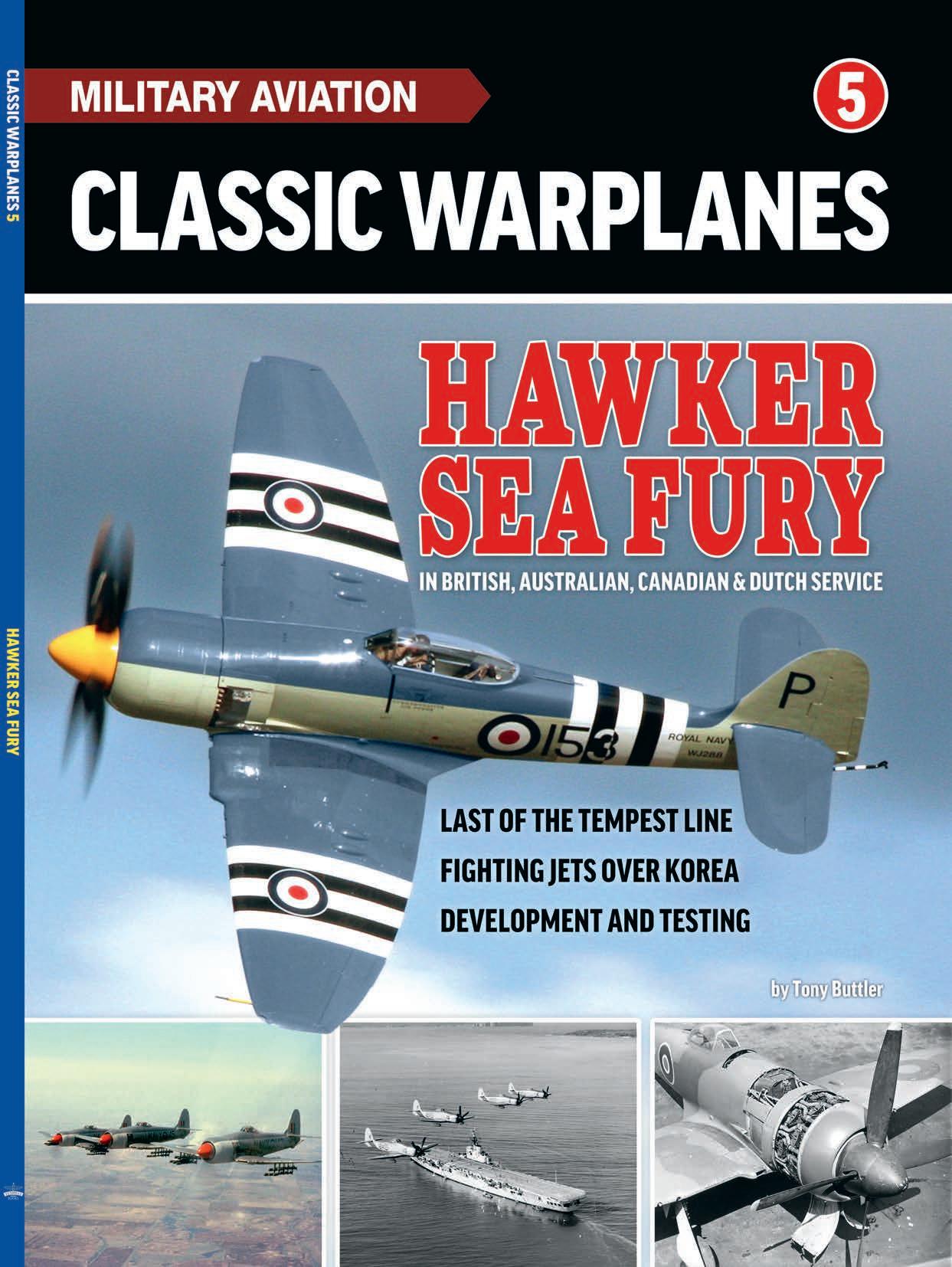
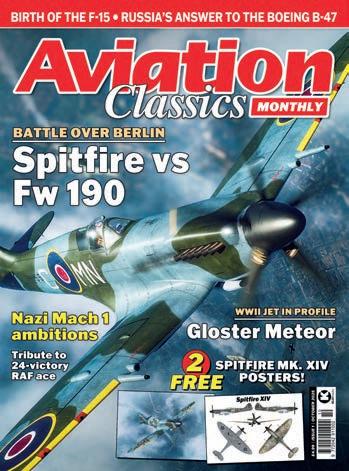
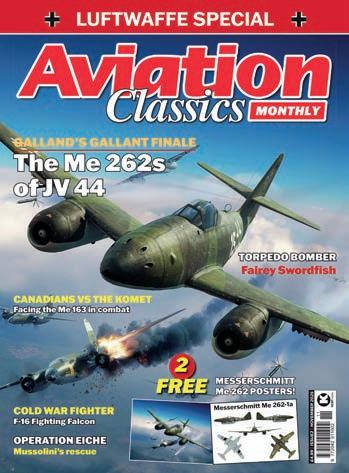
Aviation Classics Monthly is a new high-quality magazine dedicated to the legendary aircraft that ruled the skies from World War II through to the end of the Cold War. Each issue features iconic warplanes, from the pistonengine fighters and bombers of WWII, such as the Spitfire, B-17, and Zero – to the jet-powered marvels of the Cold War such as the F-86 Sabre, MiG-21, and B-52 Stratofortress. With meticulously researched features, rare archival images and specially commissioned art, Aviation Classics Monthly brings to life the engineering and operational histories of these famous machines as well as commemorating the skill and sacrifice of those who built, flew and maintained them. Whether recounting combat missions, explaining
development histories, or reviewing restoration efforts, the magazine honours the crews and the machines that shaped aerial warfare over the decades.
Every 88-page issue includes a gatefold eight-page cover with poster artwork suitable for framing.
REASONS TO SUBSCRIBE:
• NEW ART... Fantastic new high-quality artworks every month.
• GREAT STORIES... Compelling tales of aircraft and air combat, illustrated with rare photos.
• AIRCRAFT PROFILES... Detailed development histories of iconic aircraft.
• IN-DEPTH HISTORY... Authoritative writing from top aviation history specialists.
• LATEST NEWS... Keep up to date on historic airframes, air museums and shows.
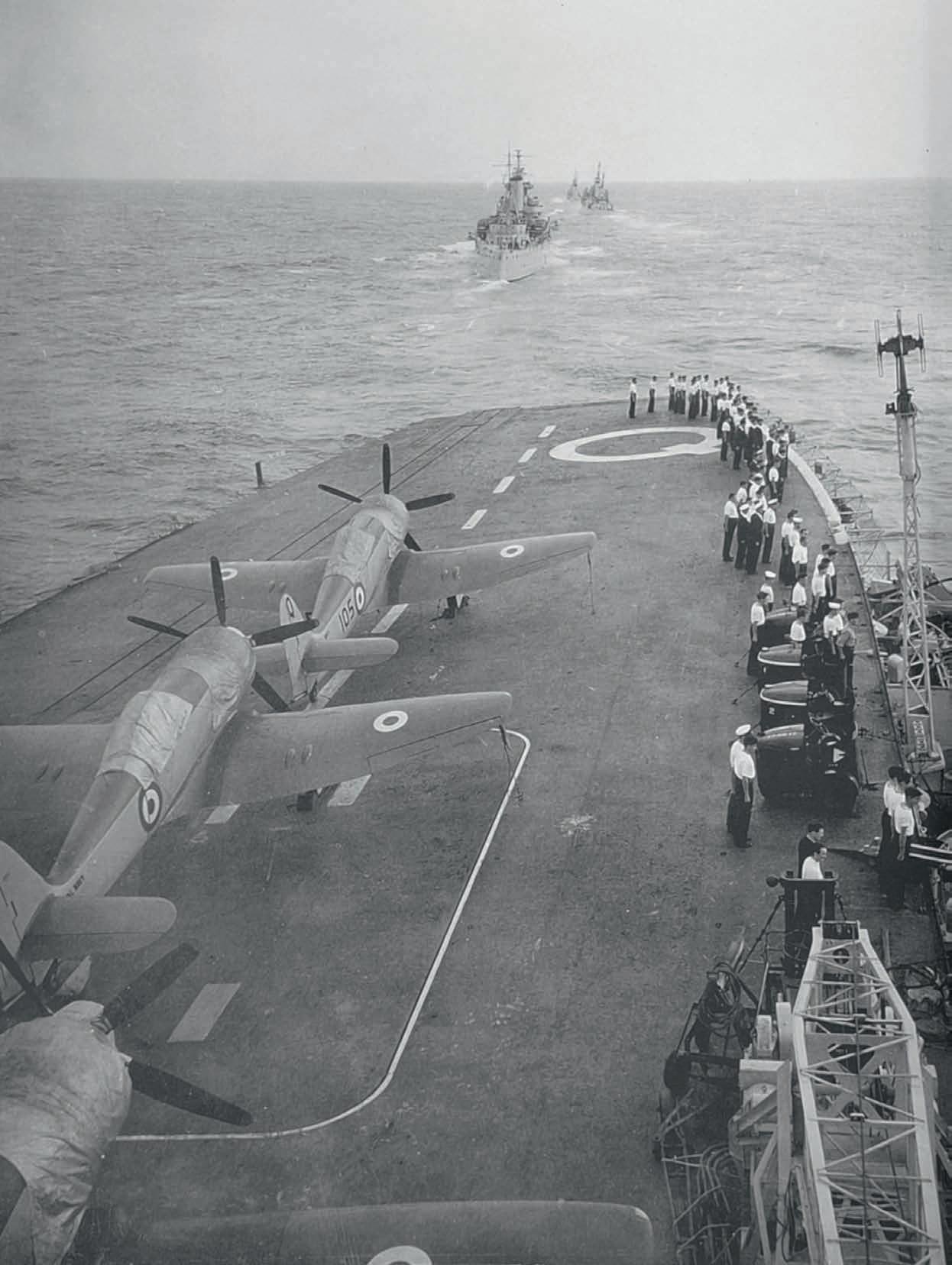
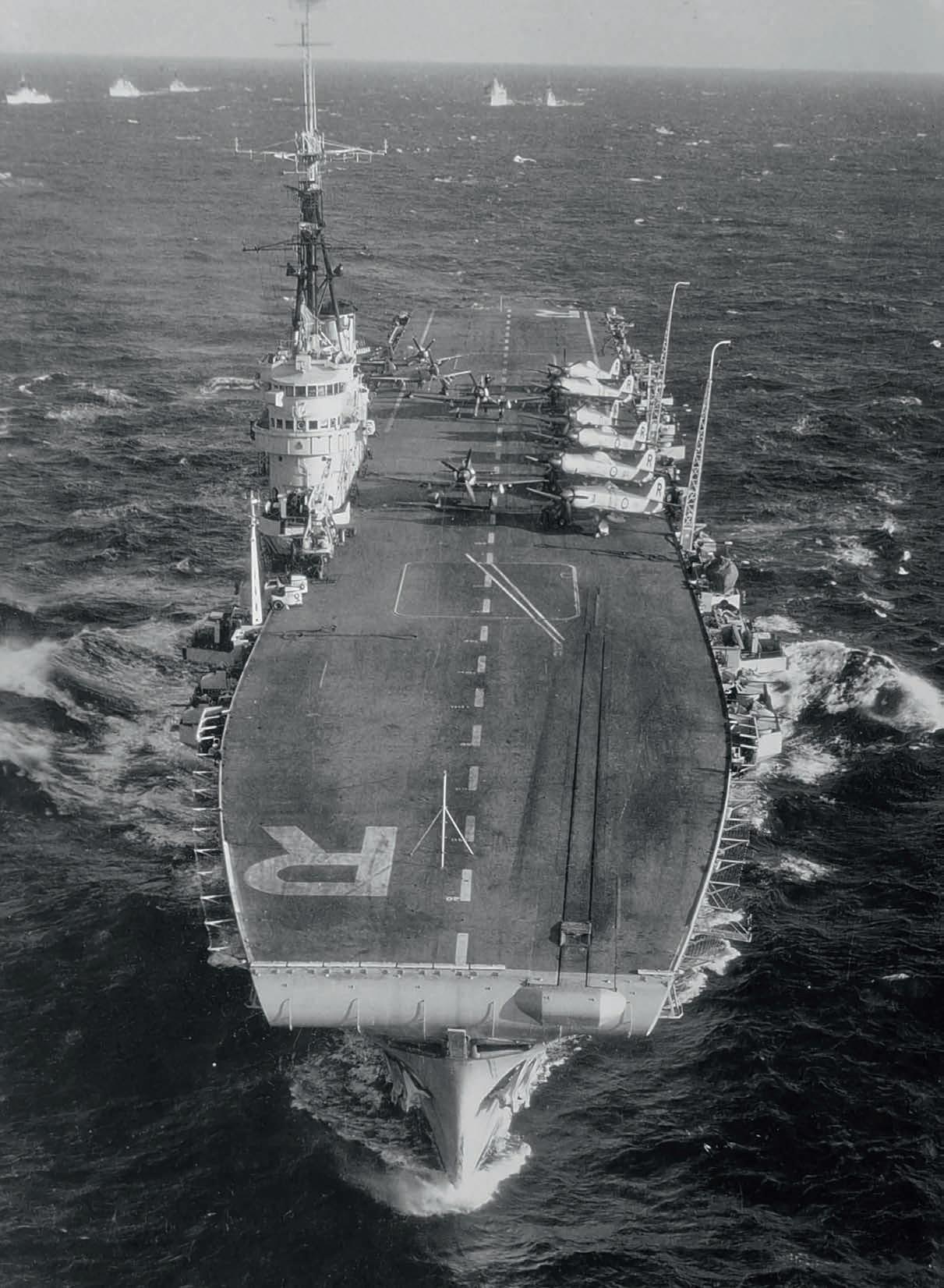
HMS Vengeance astern of HMS Devonshire, HMS Swiftsure and HMS Cleopatra. Sea Furies of No.802 Squadron are parked on the flight deck. Fleet Air Arm Museum

Author: Tony Buttler MA FRAeS
Production Director: Steve Wright
Retail Sales Director: Steve Brown
Marketing Manager: Georgia Clark
Design: Druck Media
Cover Design: Darren Hendley
Cover Image: Dave Miller
Acknowledgements: The author wishes to thank the following for their contributions, and indeed for making this book possible (sadly, some of these people are no longer with us):
Vice Admiral Sir Edward Anson, Herman van Bruggen (Dutch Centraal Archieven Depot), Phil Butler, Lt Cdr Peter Davis, Lt Cdr David Eagles, Lt Cdr Brian Ellis, Chris Farara (Brooklands Museum), Norman Friedman, Coen van den Heuvel (Flash Aviation for Dutch information), Lt Cdr Alan Leahy, Lt Cdr Paul Millett, Eric Morgan, Cdr J. H. Nethersole, Lt Cdr Ian Normand, Lt Cdr Peter Sheppard, Phil Spencer, Solent Sky Museum, Ray Sturtivant, the Canadian Warplane Heritage and the Staff of the National Archives. Special thanks for Richard Caruana, Martin Derry and Steve Thomson.
Kelsey Publishing Ltd. Registered No. 02387149
Kelsey Media is one of the fastest growing media businesses in the UK. Founded more than 30 years ago, the independently owned publisher has rapidly grown from a traditional print publisher into a pioneering media network that reaches millions of people every day in ways that are relevant to them. At last count, Kelsey Media’s portfolio consisted of more than 80 multi-media brands.
Published by Kelsey Publishing Ltd, The Granary, Downs Court, Yalding, Kent ME18 6AL
All rights reserved. No part of this magazine may be reproduced, scanned, transmitted in any form including electronic, mechanical or photocopying or by storage of material, without prior permission from the publisher. All effort has been made to ensure content is correct. The publisher, editor and author cannot accept any responsibility for any errors in articles. The views expressed are not necessarily those of the publisher, editor or author.

From an aviation historian’s viewpoint it was a delight to be asked to write a book about the Hawker Sea Fury, a ghter which appears to be something of an unsung hero in any lineup of British military aircraft. It was a lovely aeroplane, a delight to y and, alongside de Havilland’s Hornet and Sea Hornet, represented the pinnacle of British piston- ghter aircraft development. However, although the Hornet was also a wonderful aircraft, several pilots who operated both types have told me that if they wanted to do aerobatics or y for enjoyment it was the Hornet, but if they had to go to war they would have preferred the Sea Fury. As far as is known, this is one of the rst British books to be devoted purely to Hawker’s ghter. There is a title covering the aircraft in the well-known Warpaint series of modeller’s books, and another in the American WarbirdTech series, but usually Sea Fury has been tacked onto the end of titles covering Hawker’s previous ghters, the wartime Typhoon and Tempest. Why? There might be a couple of reasons for this.
First, the main highlight of the Sea Fury’s career was the Korean War. In fact, until I began putting this book together I had never really appreciated the degree of concentration and intensity of Sea Fury (and Fairey Firefly) operations that took place in Korea, which continued almost throughout the entire conflict. Korea however, is a war that gets relatively little attention in published works, probably because it was not popular with the public – “the wrong war, the wrong time, wrong place and wrong enemy” said US General of the Army Omar Bradley. In an era when global media coverage was a long time off Korea was still unknown to much of the British public. This was a public that was tired from six years of a much bigger war not long ended, so one can appreciate the lack of enthusiasm about the fighting and the Sea Fury’s involvement.
Also, both the Typhoon and Tempest racked up a substantial career during World War Two and any in-depth description of their service needs plenty of space and text. Most of the Sea Fury’s operations in Korea may seem pretty unglamorous by comparison to the earlier type’s operations and successes over Britain and Europe. Those campaigns will also be ‘closer to home’ for most readers, so it is quite easy to put the Sea Fury down the pecking order. It is also worth noting that the final version of the Tempest to enter service, the Mk.II powered like the Sea Fury by a Bristol Centaurus radial, was earmarked for operations against the Japanese in the Pacific. However, it did not reach a squadron until after the War had ended and so that Tempest version’s development and service career rarely gets much coverage either.
Hopefully, this modest publication will go a little way to addressing the imbalance of space given to the Sea Fury when compared to its more ‘famous’ predecessors, but the objective here is to cover only the type’s naval service. The Sea Fury joined a pile of Fleet Air Arm squadrons, plenty of RNVR, training and experimental units, and also served with several overseas air arms. What is not so well known is that the RAF had also intended to buy the land Fury powered by a Napier Sabre engine, but the orders were cancelled after the war in Europe came to an end.
Centaurus-powered land-based Furies were bought by Iraq, Pakistan and Egypt, but these fall outside the book’s parameters (as do the numerous civilian-operated aircraft). Reconditioned Sea Furies were acquired by Burma, Cuba and West Germany, but here we will concentrate just on those aircraft which operated from carriers – the examples that joined the Royal Navy’s Fleet Air Arm, the Royal Australian Navy, the Royal Canadian Navy and the Royal Netherlands Naval Air Service. It is worth noting however, that Cuban Sea Furies took an active part in the ‘Bay of Pigs’ landing of April 1961, some ten years after the type’s debut in Korea. They shot down or damaged several bombers and rocket attacked and sank a freighter – the old piston fighter could still show some teeth!
Begun in the first place as a lightweight fighter, the Sea Fury was eventually kitted out with plenty of ground-attack weapons. It had its flaws and, especially in its early days, suffered problems with the reliability of its Centaurus powerplant. Numerous examples were lost after their engine failed. In fact, Hawker test pilot Frank Murphy gained quite a reputation for dead stick landings, and on one occasion after his engine cut on take-off he had to pick a gap in the traffic running along the Great West Road before safely making a belly-landing. The frequency of failures was improved once the engine’s lubrication system had been modified.
Nevertheless, the Sea Fury has a claim to be considered as one of the finest piston-engined fighters to enter operational service anywhere, although the Americans might just push their Grumman F8F Bearcat. That great test pilot Captain Eric Brown found there was very little to choose between the two which, from this author’s point of view, seems the best way to leave the argument. In all the Sea Fury put in a considerable volume of service. The contemporary jet-powered fighters were all still very new and the Services operating them had to learn a lot of different techniques and practices to make them work. In the meantime, the Sea Fury just carried on, and in doing so it brought a superb conclusion to the history of British piston fighters since the early years of World War One. Sea Fury was a true thoroughbred.
I was very pleased when Kelsey asked if they could produce Sea Fury in this new format. Apart from the correction of typos and minor pieces of tidying up, the text remains unaltered. However, many of the photographs used in the first edition are now no longer available or accessible to the author. Consequently, quite a number have been replaced by a new selection, some of which at least will hopefully be new to readers. A contract situation also meant that the airframe histories have had to be omitted. Nevertheless, this work remains a detailed history of the muchneglected Sea Fury.
Tony Buttler Bretforton February 2008 and June 2026
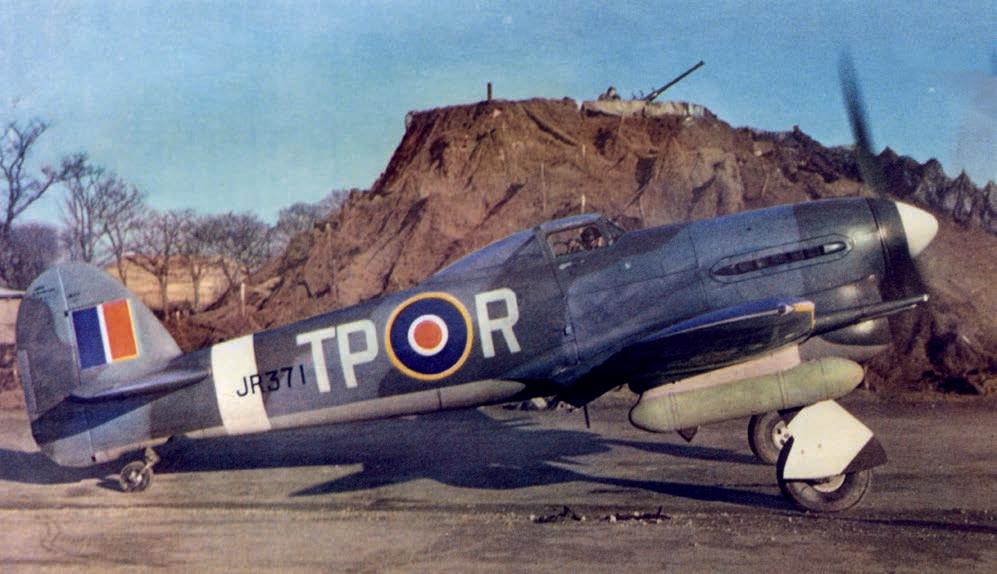
Gloster-built Hawker Typhoon Mk.IB JR371 TP-R of 198 Squadron. Although the date and location are not known, this photograph may have been taken whilst 198 was based at Manston, Kent, in 1943/44 or Tangmere, Sussex, from March 1944 when engaged in countering Luftwaffe fighter-bomber sweeps along the coast. The partially visible black and white stripes seen on the undercarriage doors do not represent D-Day stripes; they were applied as a recognition feature as an aid to anti-aircraft gunners to be able to distinguish the Typhoon from Luftwaffe aircraft, notably the FW190. JR371 survived the war and was sold for scrap in March 1947. Newark Air Museum (NAM)
In the early 1930s Hawker aircraft put into production its Fury single-seat biplane ghter, a successful and attractive aircraft which served in the RAF’s front line until 1939. In due course a ‘Fury Monoplane’ development became the world-famous Hurricane, followed in turn by the company’s Typhoon and Tempest. All three of these aeroplanes had long wartime careers although the Typhoon in particular was considered to be large for a single-seat ghter and possessed of a rather thick wing. The Tempest reversed the trend with a thinner wing and enhanced performance, but still remained a large ghter. By 1942 the Air Staff had realised that a new lightweight ghter was desirable and in September of that year it raised Speci cation F.6/42 to cover the concept. Design proposals were received from Airspeed, Boulton Paul, Folland, Hawker, Vickers-Armstrong, Supermarine and Westland. Hawker submitted three proposals; the P.1018, P.1019 and P.1020 each used the same airframe but tted with a Napier Sabre, Rolls-Royce Griffon or Bristol Centaurus engine respectively. This was the starting point for what would become the Sea Fury.
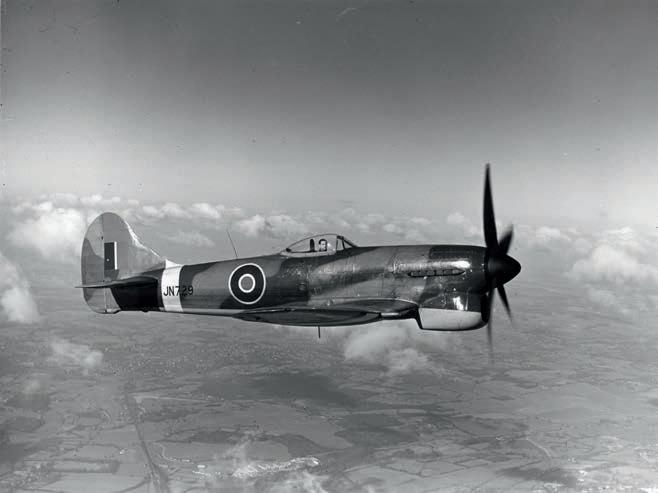
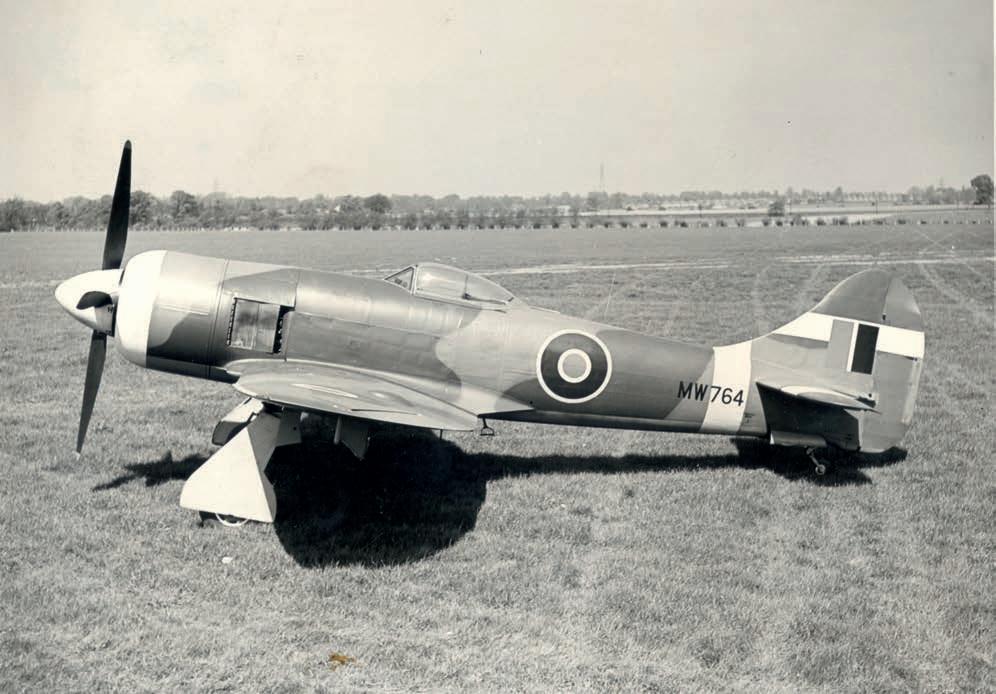
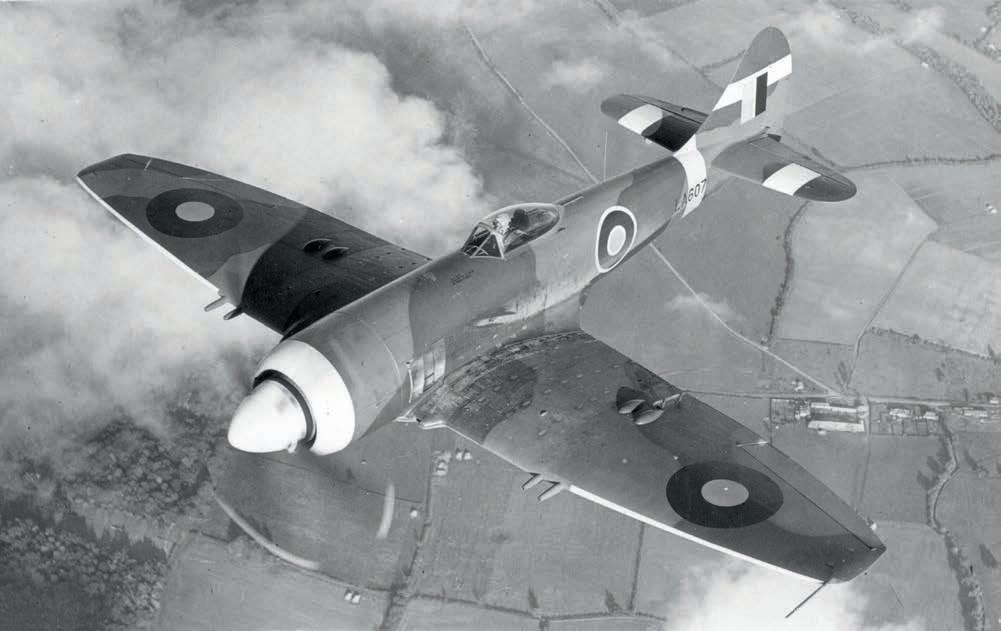
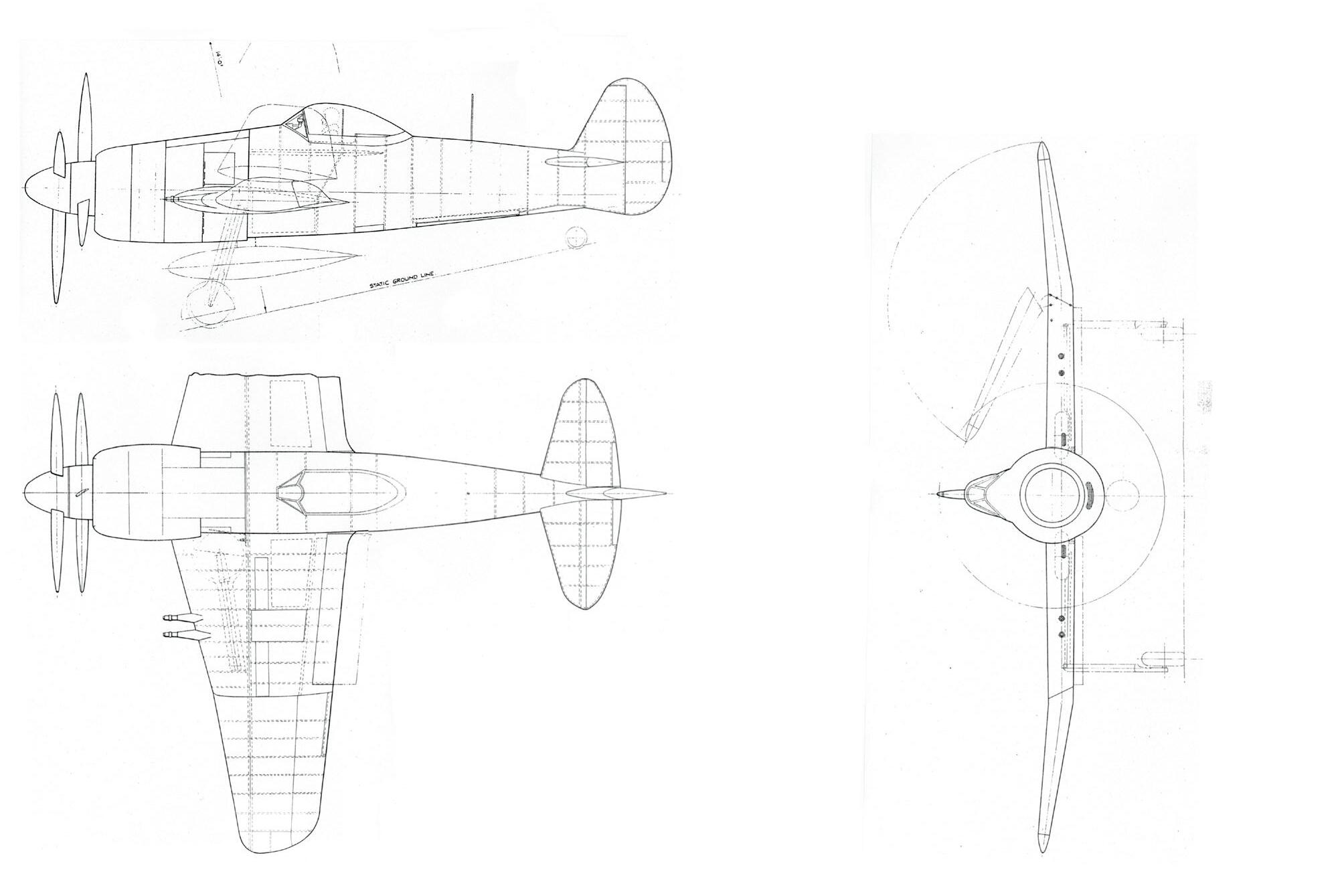
A rival project submitted to Specification N.22/43 was Folland’s Fo.118 of 8th May 1943. The powerplant was a ‘Modified’ Bristol Centaurus XII.SM with two-speed supercharger and constant speed contra-rotating six-blade propeller, an engine specifically designed for fighter applications. Folland’s designers gave the estimated maximum speed of this aircraft as 394mph at sea level and 469mph at 20,000ft. Overall span was 36ft, folded span 21ft 2in, overall length 32ft, wing area 224.5sq.ft. The Fo.118 looked remarkably like the Sea Fury. Solent Sky
The desire for a lighter and smaller fighter had led to discussions within the Hawker company in considering developments of the Tempest to meet the Air Staff’s request. On 13th November 1942 the Director of Technical Development (DTD) at the Ministry of Aircraft Production (MAP), N. E. Rowe, visited Hawker’s chief designer, Sydney Camm, to discuss the firm’s proposals. These included a one-piece wing using Tempest outer wings married together on the centreline of the aircraft. In January 1943 the decision was made to utilise and modify the design of the Centaurus-powered Tempest F.Mk.II to conform to F.6/42 and this was known as the ‘Improved Tempest’ or the ‘Tempest Light Fighter (Centaurus)’.
In the meantime, most of the Air Staff’s discussions over F.6/42 had centred on whether to order Folland’s Fo.117 or Hawker’s projects, but in February 1943 Kingston’s (i.e. Hawker’s) proposals were supported by a new specification, F.2/43, allocated directly to the company. The layout for the ‘Improved Tempest’ powered by a Sabre was completed on the drawing board on 2nd November 1942, the Centaurus variant was ready on 4th December and a Griffon version followed. However, the last
of these fell behind and its drawings were not completed until 18th September 1943.
Detail design for a prototype began in early 1943 and during March, as the process of design accelerated, the wings were slightly increased in span to allow the inboard guns to clear the propeller disc. The following month Camm drew Bristol’s attention to Specification N.7/43 for a naval fighter and suggested that the F.2/43 fitted with a more powerful engine could be adapted to meet it. Rowe welcomed the idea and drawings, weight and performance estimates were prepared for what became the Hawker P.1022. The design proposals that were submitted to N.7/43 by various manufacturers during late April and early May 1943 were as follows – Boulton Paul P.103, Boulton Paul P.104, Fairey N.7/43 (in fact a series of designs), Folland Fo.118, Hawker P.1022 (which the Ministry estimated would achieve a speed of 437mph at 21,000ft with an all-up-weight of 11,140lb), and two Westland N.7/43 projects. The Fo.118 was a development of Folland’s Fo.117 project powered by a Bristol Centaurus.
The Ministry’s official assessment of these proposals indicated that the best performance estimates came from Folland and Hawker. In fact the Folland project appeared, by a small margin, to offer the greatest potential, but this manufacturer
lacked the resources to put such an advanced type into full production on a large scale. Consequently, the P.1022 was chosen and a new Specification, N.22/43, together with Operational Requirement OR.155, was written to cover it. Actually these documents related to production aeroplanes and so, when officially issued in April 1944 the specification had been retitled 22/43/H (although Hawker files still referred to N.22/43). Folland was told of the Fo.118’s rejection on 20th May 1943, N. E. Rowe’s letter stating that the decision had been taken not to proceed with an entirely new design at present, but to endeavour to meet the need by the development of established types (which the P.1022 was).
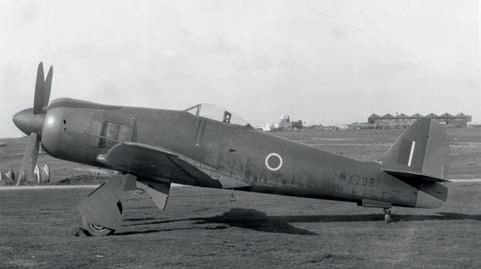
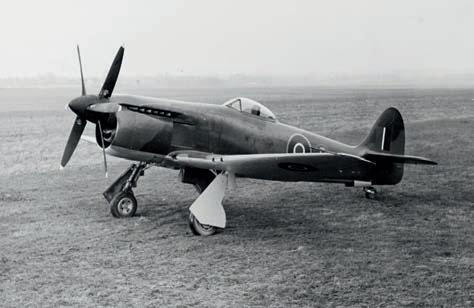
The Centaurus Fury land-based fighter was covered by F.2/43 and Operational Requirement OR.121. This stated that the aircraft’s optimum performance must be at 20,000ft, its rate of climb should not be less than an average 4,500ft/min between ground level and 20,000ft, and the objective was a speed of 450mph at 22,000ft. The aircraft would possess four 20mm Hispano Mk.V cannon and be able to carry two 250lb, 500lb or 1,000lb bombs. A contract for two F.2/43 aircraft was cleared on 27th March 1943 and received by Hawker on 9th April, serials NX798 and NX802 being allocated, and a full-
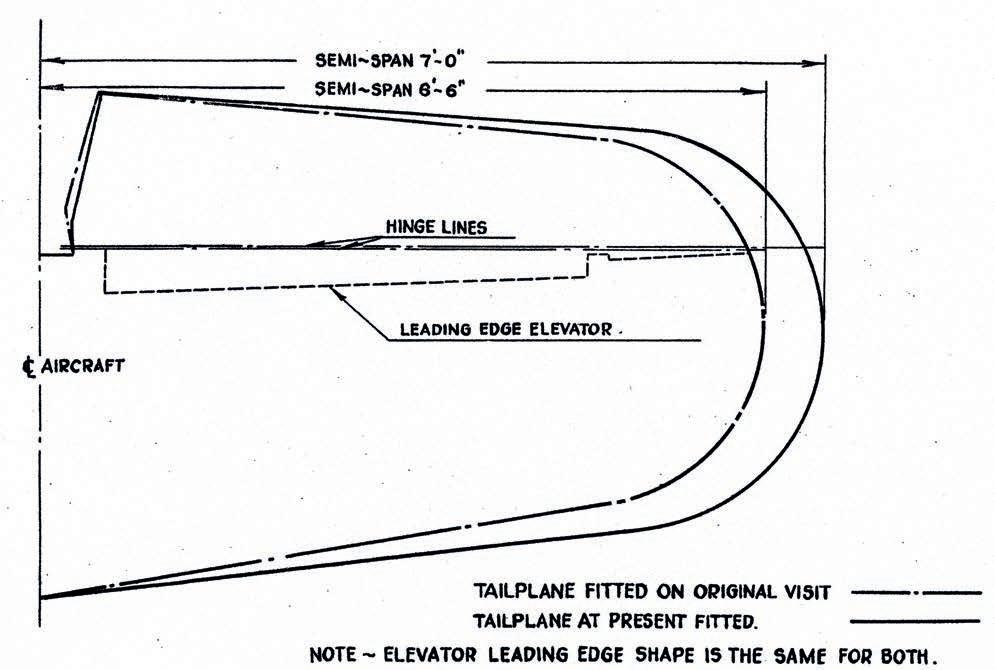
Sketch showing the different sizes of horizontal tailplane fitted to NX798 on its first and second visits to A&AEE Boscombe Down, the semi-span being increased from 6ft 6in to 7ft.
size mock-up was examined officially at Kingston on 6th and 7th May. At this stage Camm wanted contra-rotating propellers provided for production F.2/43s but Rowe replied that these would be incorporated later. (In fact, apart from the Griffon prototype LA610, they never were; a single four-bladed airscrew proved sufficient for the Sabre Fury and ultimately a five-bladed propeller for the Sea Fury). The first drawings for the wings were issued to the experimental shop in June and the first fuselage drawings followed in August.
A little earlier, in July 1943, Camm had suggested that Boulton Paul should, as a sub-contractor, undertake the design work for a navalised F.2/43. On 12th July it was agreed that Boulton Paul could indeed carry out this work, which would include
a trial installation on a Tempest of a wing folding mechanism and arrestor gear. During September further agreement was reached with Rowe and Boulton Paul’s designer J. D. North that Hawker would build the F.2/43 version while Boulton Paul would assemble and complete the two naval fighter prototypes; however, those parts standard to each version would be supplied by Hawker. This plan eventually changed and ultimately Boulton Paul worked on only one naval prototype, whilst Hawker became increasingly involved with the naval programme.
By early January 1944 the plan was to have a Centaurus III installed in the first land-based prototype (which was to be at the test aerodrome by May 1944), either a Centaurus XXII or a Griffon in the second,
with the fifth aircraft having the alternative engine. The third and fourth machines would be the (Centaurus-powered) naval prototypes and the sixth the second Griffon-engined machine.
Work on the Griffon-powered prototypes never seemed to receive the same degree of urgency as the others and these were not ordered until November 1943. In November 1942 Camm had criticised the power of both the Centaurus and the Sabre when comparing these engines to the Rolls-Royce Merlin 61. N. E. Rowe agreed, but added that “…the 61 is highly developed, whereas the others are only beginning their development life…”
The Merlin 61 of 1942 was the first of the two-speed, two-stage supercharged Merlins for fighters equipping various marks of
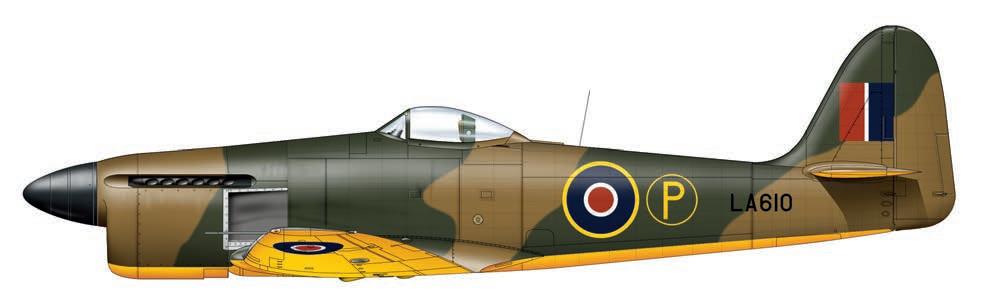
Hawker Fury (Griffon) prototype LA610. Dark Earth/Dark Earth upper surfaces with Yellow undersides; ‘C1’ type roundels on fuselage sides, ‘C’ type below wings, ‘B’ type above wings. Prototype marking on fuselage sides in yellow; propeller spinner and serial in black. Art by Richard J.
Caruana
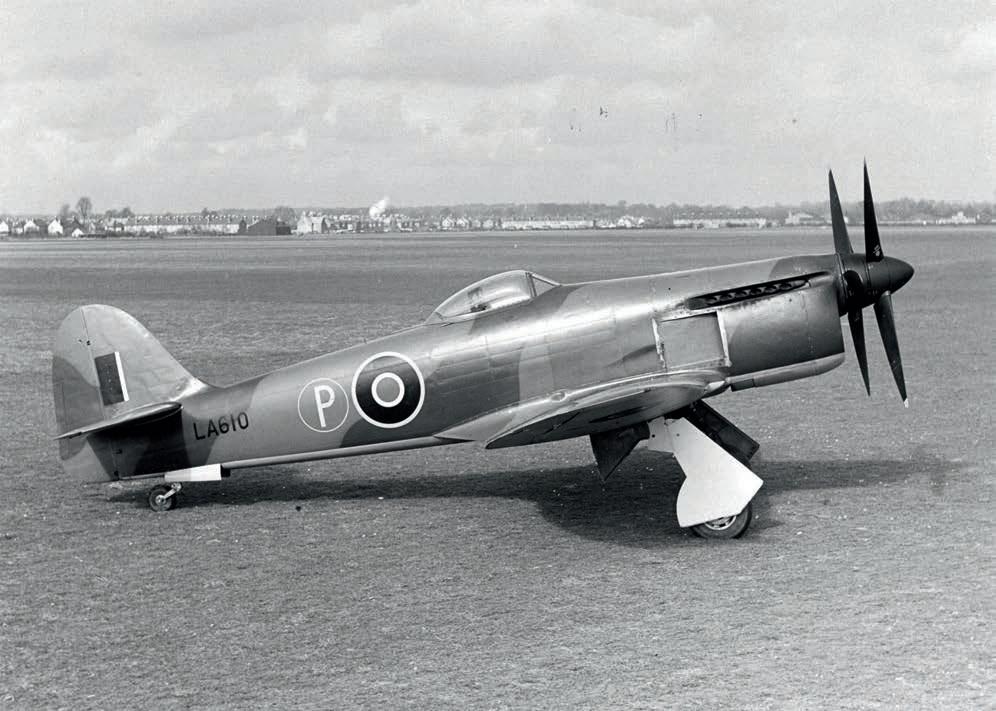
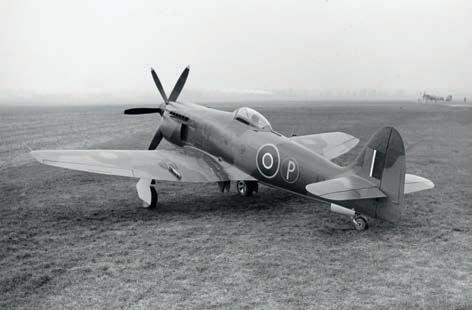
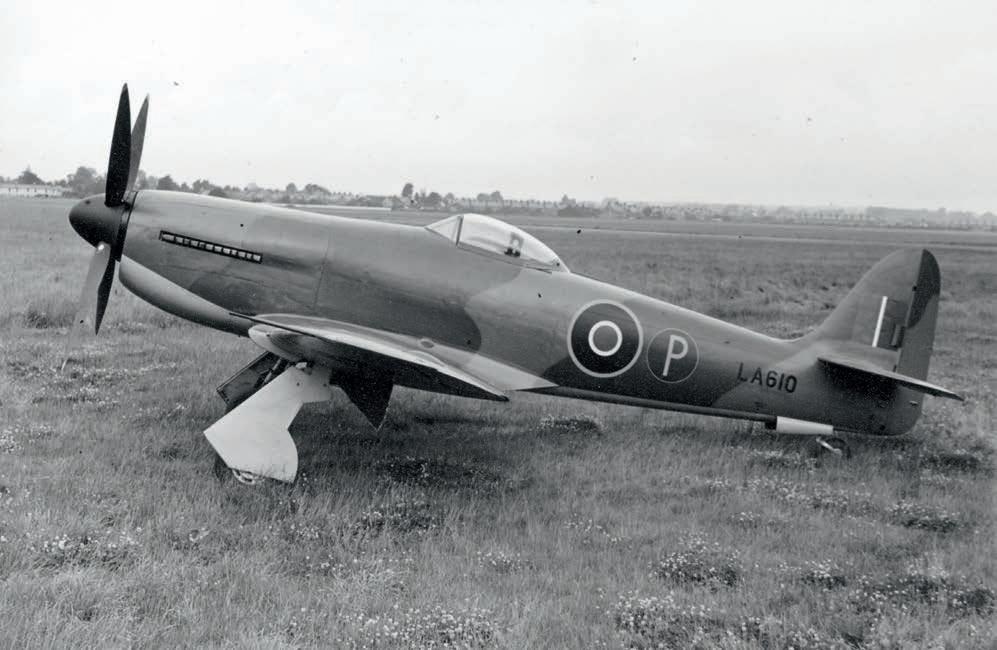
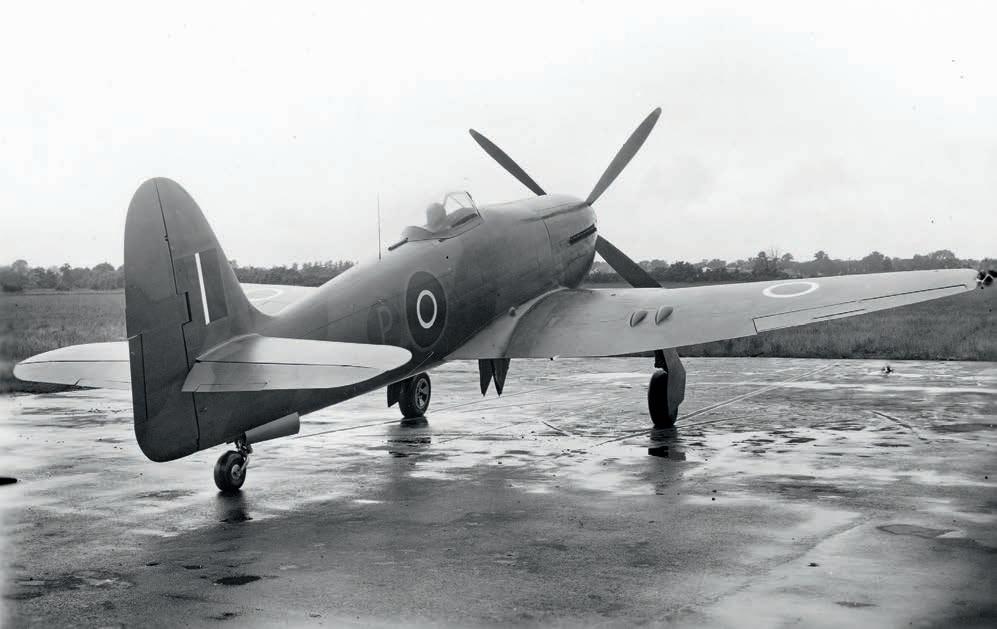
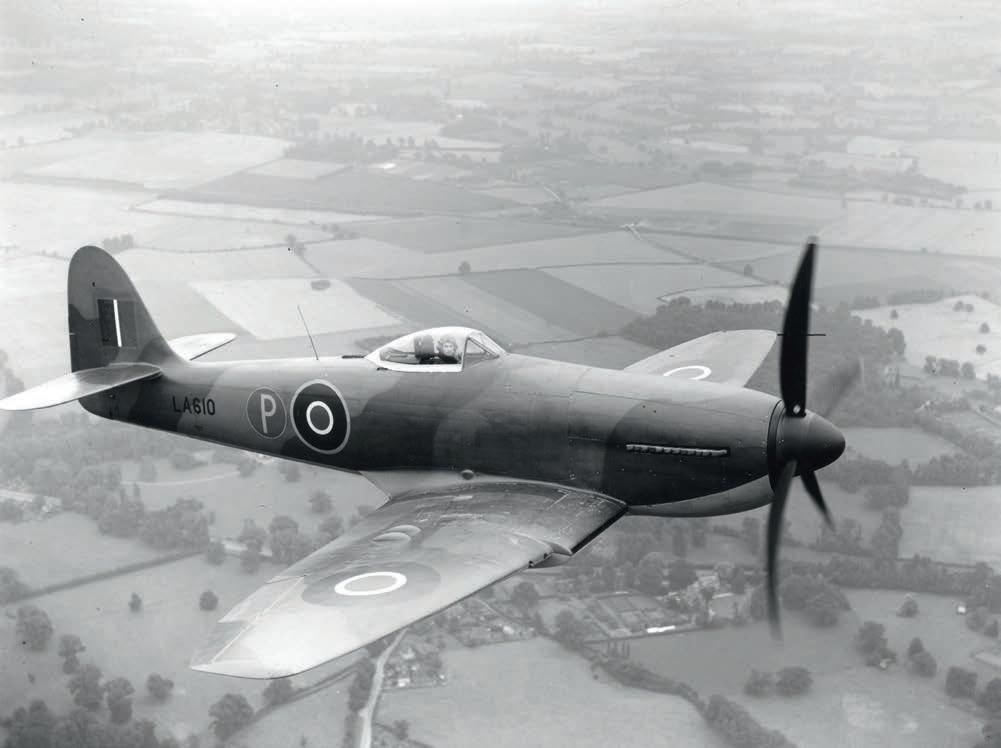
LA610 displays the Griffon powerplant and contra-rotating propellers. Unfortunately, there are no known air-to-air photographs showing LA610 flying whilst fitted with this type of engine. Hawker Aircraft
Spitfire including the Mk.IX, the Vickers 432 prototype and a quantity of Bristol Beaufighter IIs (usually associated with the Merlin XX). In fact, in view of the Air Staff’s demand for an air-cooled fighter, Rowe was particularly interested in the Centaurus and the promise being shown by Camm’s development of the Centaurus-powered Tempest II. The predicted combat power of the Bristol CE.12.SM (Centaurus XII) was 2,000hp at 18,500ft, which Rowe declared was practically ideal for the low/medium altitude fighter the Air Staff had in mind where the objective was a maximum rate of climb between ground level and 20,000ft.
The first copies of the draft Specification N.22/43 arrived in Hawker’s hands on 6th March 1944. On 20th April a meeting was held to discuss the production of both the N.22/43 and F.2/43 by Hawker and N.22/43 by Boulton Paul. It was stated that the Admiralty had a definite requirement for a hundred N.22/43s a month which, it was assumed, was to go into production as soon as possible – sixty machines per month from Hawker and forty from Boulton Paul. Construction of the land and carriedbased versions would proceed almost simultaneously but, as the development work on the two F.2/43 prototypes was
the more advanced, they would fly before the naval prototypes. It was assumed that production would begin at the end of 1945 and Hawker received the first contracts from the Ministry, for two hundred F.2/43s and three hundred N.22/43s, on 28th April 1944.
On 31st May 1944 the amended prototype programme stood as follows:
1st aircraft F.2/43 (Centaurus)
2nd F.2/43 (Griffon)
3rd N.22/43
4th N.22/43 (built by Boulton Paul)
5th an F.2/43 test airframe for both fuselage and wings
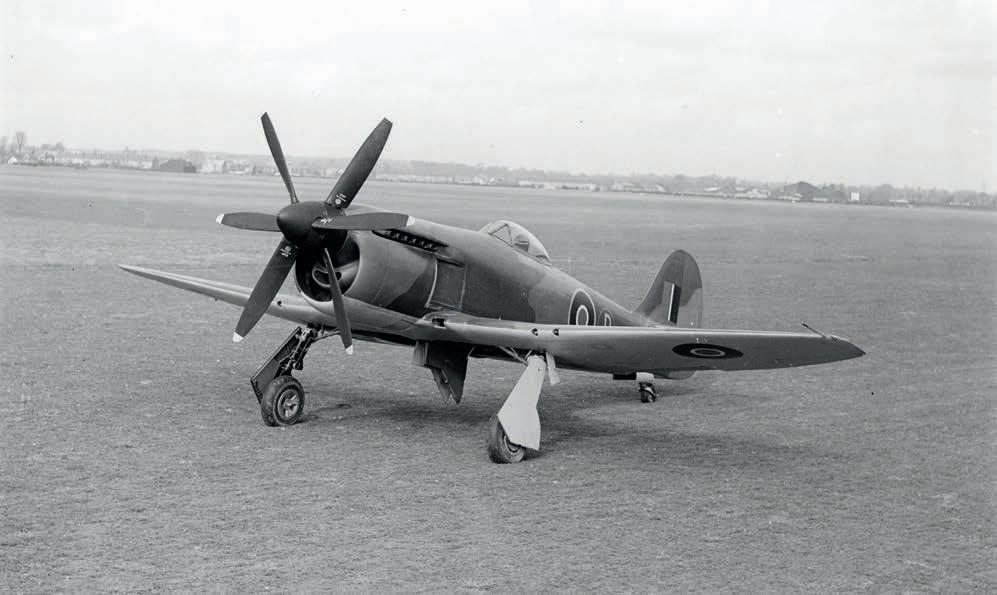
A three-quarter front angle view of LA610 which highlights the very different look of the Griffon installation compared to the standard Bristol Centaurus fitting. Hawker Aircraft
6th F.2/43 (2nd Centaurus)
7th F.2/43 (2nd Griffon)
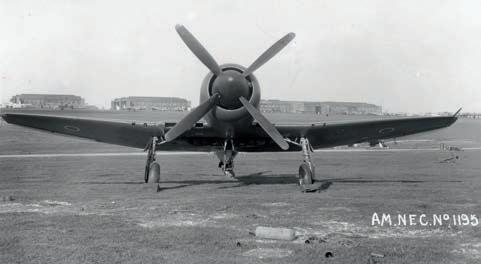
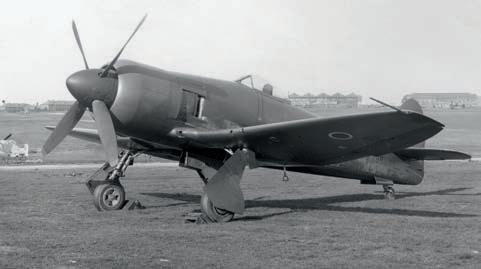
However, on 15th June a contract for building a third naval prototype was received, which was queried by Sydney Camm because this machine had not previously been mentioned. On 4th July 1944 the first F.2/43 prototype, NX798, was despatched by road from Hawker’s Experimental Shop to the test aerodrome at Langley for airframe and engine development, ultimately flying for the first time on 1st September 1944. In view of the desire to progress with the naval version it was agreed during a meeting with Rowe that Hawker would fit non-folding wings to the first N22/43 aircraft SR661, but the firm’s second N22/43 prototype SR666, and Boulton Paul’s N.22/43 VB857 would both have folding wings. These aircraft would be fitted with Centaurus XII engines because the required Centaurus XXII would not be ready in time (in fact the XXII never did enter production). On 19th September 1944 a party from the RAF Photographic Reconnaissance Unit visited Langley to inspect NX798 and present some broad requirements for a photo-reconnaissance (PR) version of the aircraft. The Admiralty, also interested in a PR capability, continued its assessment of the Fury’s suitability for this role until January 1946, when difficulties encountered in fitting an F.52 camera brought an end to the idea.
A major airframe strength test was conducted during September 1944 on F.2/43 NX798’s rear fuselage aft of the rear transport joint to assess its structure. On 3rd October the Ministry requested that
flight trials should be carried out as soon as possible on NX798, suitably re-ballasted to represent an N.22/43. The second F.2/43, Griffon powered LA610 (NX802 now became the third development aircraft), arrived at Langley on 30th October to be prepared for its first flight, and throughout that month a full strength test was conducted by the Royal Aircraft Establishment (RAE) at Farnborough, this time on the main plane.
In June 1945 a proof loading test was carried out on a Sea Fury to check that the rear fuselage and tail end possessed sufficient strength under arrested landing conditions. Finally, during December 1946 and January 1947 a complete Fury centre fuselage was tested to ascertain that the engine mounting and centre fuselage were strong enough to withstand the stresses that would be experienced in flight.
In what was to become a series of alterations to the orders for production aeroplanes, on 1st November 1944 (according to an original Hawker document) the original contract for N.22/43s was reduced to just 100 machines. However, other official documents indicate an alternative path to obtain the same result, in that the entire April 1944 order for 300 was cancelled in November, while further batches, totalling 200, had been ordered on 28th August 1944. Of these, 100 were later cancelled, leaving 100 on order. The precise path taken is now uncertain, but at one stage during this period it appears that an order for 500 Sea Furies was under consideration.
Two days later Hawker was advised that the F.2/43 land-based fighter would be named the Fury F.Mk.I, thus reviving
the famous name from the days of the biplane, and, quite naturally, the N.22/43 (22/43/H) carrier aircraft would be named Sea Fury commencing with the F.Mk.X. (This mark was later designated F.Mk.10, following changes in Ministry numerical policy). The Navy reduction was confirmed on 29th January 1945 when the Ministry also advised that its contract with Boulton Paul had been cancelled. It was agreed on 17th March that the N.22/43 prototype being built by Boulton Paul, VB857, would be assembled and finished at Kingston. VB857’s rear fuselage was delivered from Boulton Paul in early April and the partially completed wing arrived with Hawker on 7th June.
On 23rd February 1945 the order for the Fury Mk.I was reduced by fifty to 150, on 20th September it was cut again to 120 and on 21st February 1946 to just sixty. These reductions were made as it became increasingly clear that, as the war drew to an end and peace ‘broke-out’, such quantities of aircraft would no longer be required by either the RAF or FAA.
On 14th April 1945 a Design Clearance Conference at Kingston was held to review the position on the Sea Fury, because this type was now given priority over the Fury F.Mk.I. Production of the Sea Fury would definitely be based on the Centaurus because Napier’s Sabre would not be ready in time (some discussions had indicated that Napier’s engine might yet equip the Sea Fury!). Documents from April 1945 also suggest that, at that point, the entire production of RAF Furies would have been powered by the Sabre NS.93.SM which, in production, later became the Sabre VII.
Although the drawings for an F2/43 fitted with a Napier Sabre were completed first, the manufacture of airframe prototypes received little priority for quite a while.
On 21st October 1944 J. E. Serby from MAP wrote to Hawker to discuss building two prototype aircraft with Sabre engines installed, which would take about a year to complete. Camm queried the wisdom of going ahead with these aeroplanes because it was his understanding that the Sabre was going out of production at some point in 1945. However, Serby confirmed that he had been assured by the Ministry’s Air Commodore Banks that this was not so.
A trial installation of a Sabre V in an F.2/43 was requested by MAP on 15th November, and on 5th March 1945 it was further stated that this aircraft would be equipped with a de Havilland propeller. The following day a letter from N. E. Rowe confirmed that three Sabre prototypes were required, one F.2/43 and two N.22/43s. One of these would be prototype LA610 converted from its existing Griffon configuration whilst the others would be new aircraft serialed VP207 and VP213 (later, both reverted to F.2/43 land Fury specification).
On 3rd May 1945 Serby reported again that Sabre engines would be fitted to production Furies but that they would
not be ready for the start of airframe production. The cause of the delay was the development work on the engine’s methanol/water injection system and was why, from this time, the Sea Fury received complete priority over the Fury with deliveries of the former expected to commence in January 1946; at this stage Fury deliveries were expected to start in August 1946. However, by early June 1945 it was clear that LA610 would have to be fitted with a Sabre VA in order to allow this variant’s aerodynamics to be determined as soon as possible. The use of a common undercarriage on all versions (in fact that of the Sea Fury) was agreed on 20th June, and on 25th July LA610’s fuselage arrived back at Kingston to allow conversion work for the trial Sabre engine to be carried out. This was completed by 18th September 1945.
The Final Airframe Conference was held on 12th and 13th December 1945 when it was announced that the principal role of the RAF’s Fury F.Mk.I would now be ground support. This was the first official intimation regarding such a change in the aircraft’s primary duty and the consequent requirements for additional armour and fuel, necessary for the ground-attack role, would have important implications on the aircraft’s design. These alterations would prove difficult to achieve
and, at a meeting held at Kingston on 25th February 1946, Hawker was advised that if the Fury F.Mk.I could not be used for ground-attack purposes it would be very unlikely that the Air Staff would have any requirement for it at all. Hawker stated that the only way to make the aircraft suitable for ground-attack operations was to fit an air-cooled engine, such as the Centaurus XVIII.
With its Sabre now in place, LA610 was moved to Langley on 29th March 1946 for its next ‘first’ flight. Discussions continued with regard to the weight of both armour and propeller, Camm reporting on 10th May that the propeller’s weight of 586lb had to be reduced suggesting that a four-blade, rather than a five-blade unit be utilised. On 20th May it was agreed that a four-blade propeller could be fitted to production aircraft, but on 14th August Hawker was advised that the Fury F.Mk.I contract had been cancelled!
Two days later a meeting was held at Kingston to ascertain what further work should be done with the three Sabre prototypes; LA610, VP207 and VP213. It was decided to offer one for engine testing, a second to be retained by Hawker for development purposes, whilst no further work would be conducted on the third, VP213, which was to be held for spares. In mid-September 1946 the Ministry of ➤
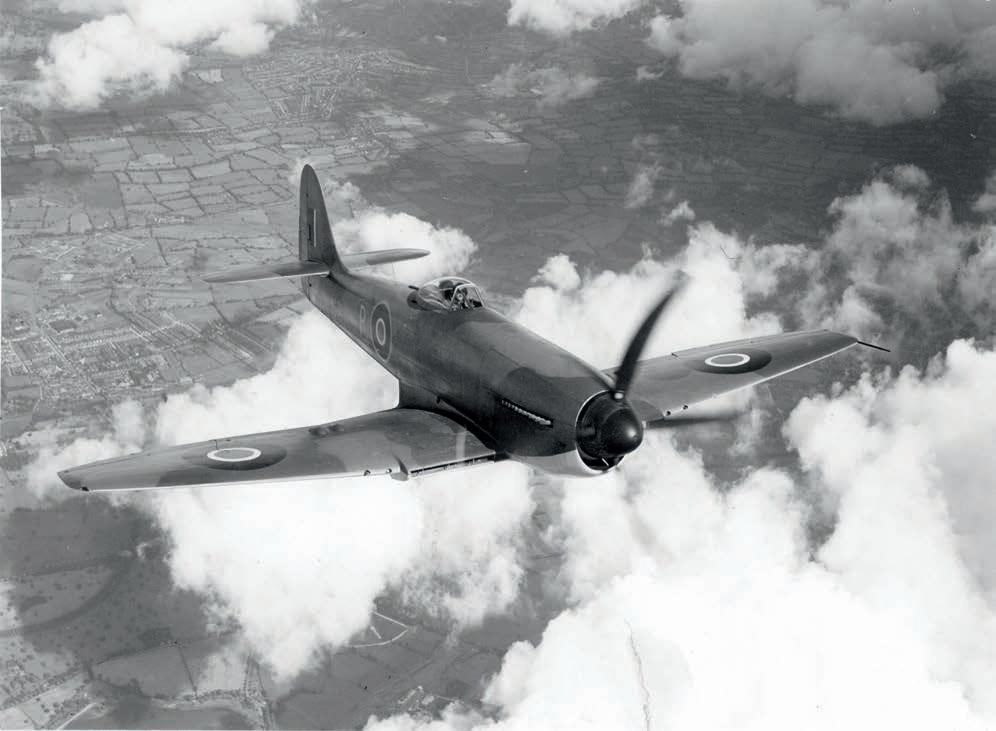
LA610 seen later in its career after having been refitted with a Napier Sabre VII liquid-cooled engine with wing radiators.
Hawker Aircraft
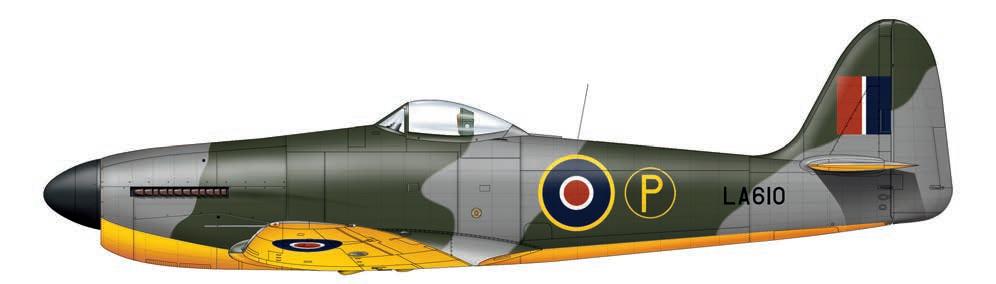
Hawker Sabre Fury, LA610. Ocean Grey/Dark Green upper surfaces with Yellow undersides. Black spinner and serial. ‘C1’ type roundels on fuselage sides, ‘C’ type above and below wings. Yellow ‘P’ markings on fuselage sides. Art by Richard J. Caruana
Supply (which had taken over the functions of MAP) advised that it did not consider a flight test programme to be of sufficient general interest to warrant further work being conducted at Ministry expense. It was suggested that VP207 rather than LA610 should go to Napier for engine development, since it was considered that the former was more suitable since it was equipped with larger radiators and coolers than LA610.
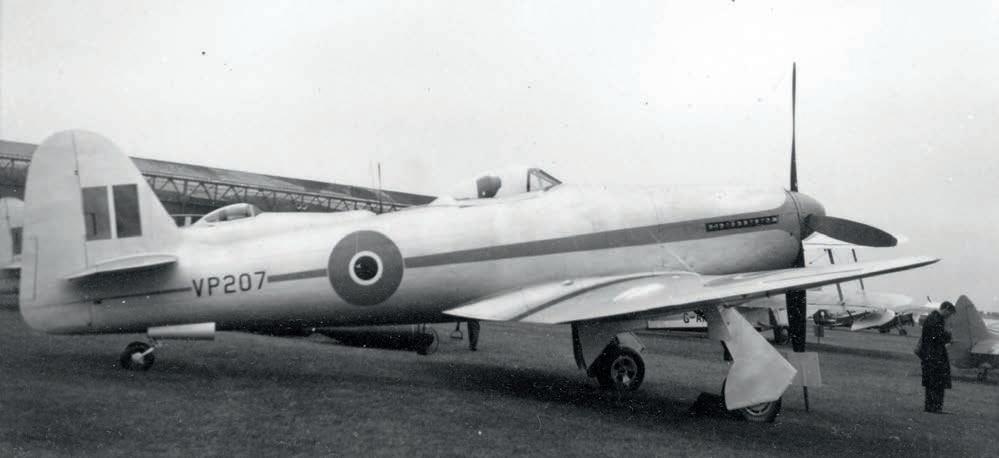
However, on 24th April 1947 it was decided that VP207 would not be taken over by the engine company and it ultimately become a Hawker demonstration aircraft to assist in the drive for overseas sales, for which role it was painted in a red and white colour scheme. LA610 later became the civil registered G-AKRZ whilst VP213, as implied, was never completed. In due course Napier
brought the development of the Sabre VII to a close which, apart from the Fury F.Mk.I and the Folland Fo.108 43/37 test bed aircraft, is believed to have had no other military application.
Following a considerable amount of swapping and reconsideration of plans, the final list of Fury/Sea Fury prototypes was as follows:
i) Fury NX798. Built by Hawker. Fitted with a Centaurus XII engine and fourbladed Rotol propeller, it was first flown on 1st September 1944 from Langley. It was later fitted with a Centaurus XVIII and four-blade 12ft 9in diameter Rotol propeller and, as such, flew on 19th March 1946. This was the first time that a Centaurus XVIII, the planned Sea Fury production engine, was test flown in a prototype Fury,
although the flight had to be terminated following the failure of the engine’s No. 8 sleeve.
ii) Fury LA610. Built by Hawker. Originally ordered as the third Tempest II prototype, but was eventually completed as the Griffon 85 Fury with two Rotol contra-rotating three-bladed propellers and an annular radiator underneath. It was first flown from Langley on 27th November 1944 piloted by Philip Lucas. On 5th February 1945 test pilot Bill Humble flew this aircraft with a Griffon 81 and a larger fin. It was later fitted with a Centaurus XV, a Sabre VA and finally a Sabre VII and Rotol four-blade 14ft diameter propeller; it flew for the first time in this, its final engine/propeller configuration, on 3rd April 1946. With this combination of engine and propeller, LA610 became the fastest piston-engined aeroplane built ➤
June
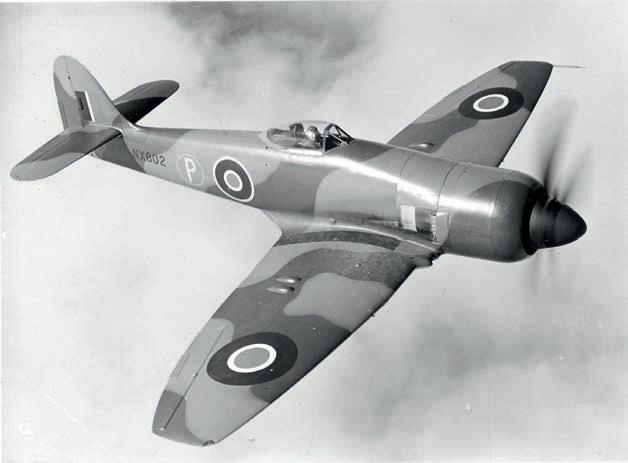
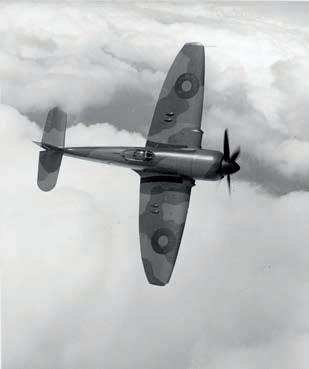
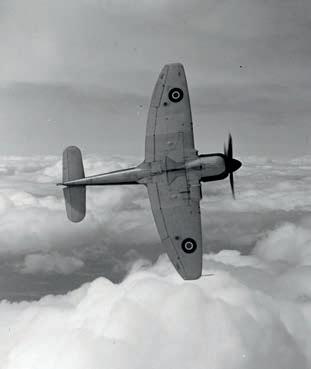
by Hawker and achieved a top speed of over 480mph.
iii) Fury NX802. Built by Hawker. Fitted with a Centaurus XV and four-blade propeller and first flown on 25th July 1945. Later it too received a Centaurus XVIII but this time with a five-blade 12ft 9in diameter Rotol propeller.
iv) Sea Fury SR661. Built by Hawker. A semi-navalised Sea Fury prototype which was despatched to Langley on 31st January 1945. In view of the urgency at the time, this machine had been adapted from the standard Fury with a Centaurus XII engine and four-blade propeller; as noted the wings could not be folded but it did have an arrestor hook. The first flight was on 21st February 1945 and in due course a Centaurus XV (with a five-blade 12ft 9in diameter Rotol propeller) replaced the original power unit.
v) Sea Fury SR666. Built by Hawker. The first fully navalised Sea Fury prototype, it was fitted with a Centaurus XV, five-blade 12ft 9in-diameter Rotol propeller, engine exhausts, folding wings and arrestor hook. It first flew on 12th October 1945. A Centaurus XVIII was fitted later.
vi) Sea Fury VB857. Built by Boulton Paul. This aircraft was also a fully navalised prototype with Centaurus XV and Rotol five-blade 12ft 9in diameter propeller. Manufactured by Boulton Paul, final assembly was completed by Hawker. Its maiden flight took place on 31st January 1946.
vii) Fury VP207. Built by Hawker. This was the second Sabre VII prototype and was equipped with the same engine and propeller combination as finally installed in LA610. VP207 was however fitted with a production type oil cooler and flew for the first time on 9th May 1947.
viii) Fury VP213. Production commenced but was subsequently suspended and never completed.
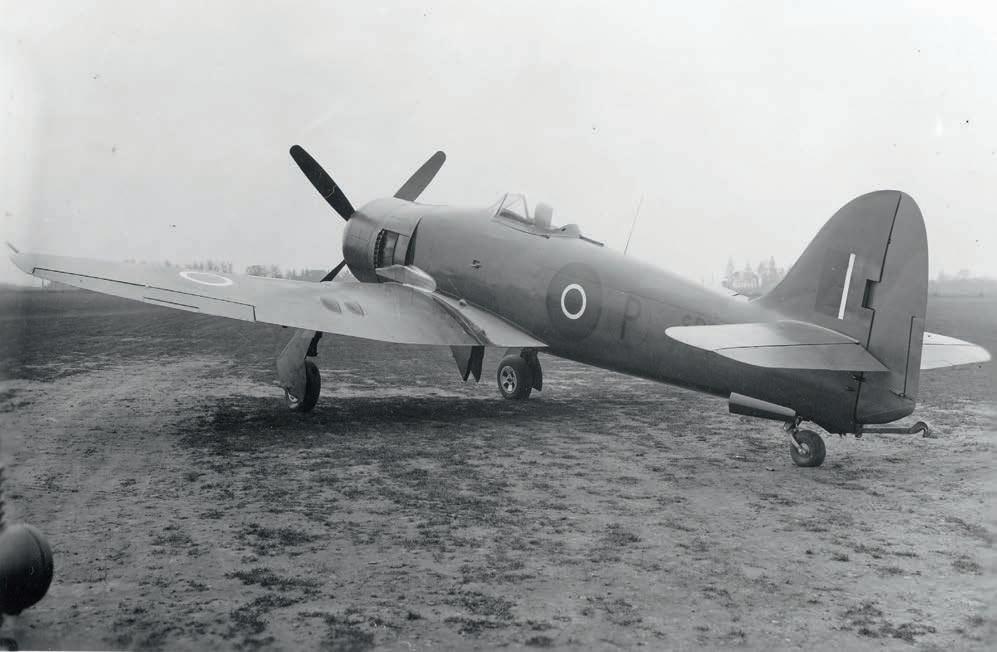
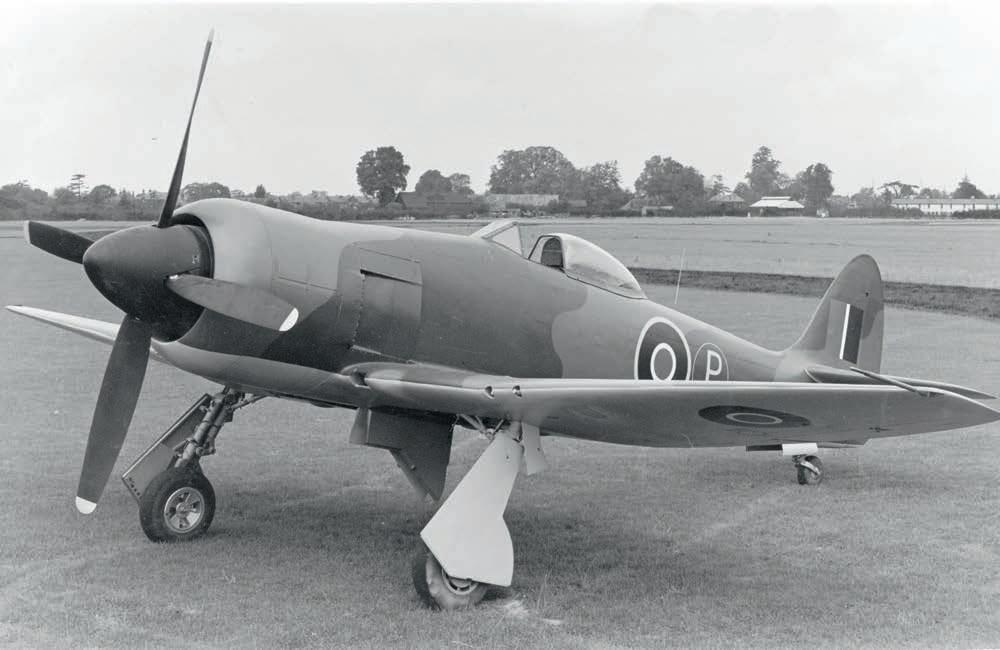
Sea Fury prototype SR661. This was a semi-navalised aircraft fitted with a Centaurus XII engine, a four-blade propeller and short arrestor hook. Although hard to discern, (as is the ‘P’ on the fuselage), due to the type of film employed, SR661 is finished with a disruptive camouflage scheme and not yet with the Extra Dark Sea Grey associated with early production Sea Furies. This aircraft made its first flight on 21st February 1945. Crown Copyright
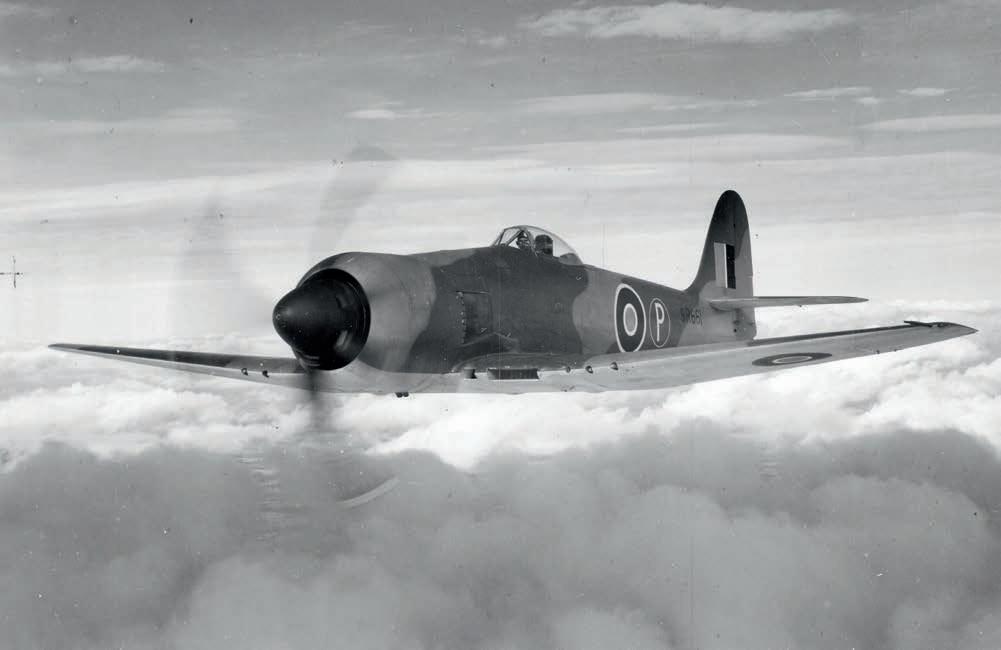
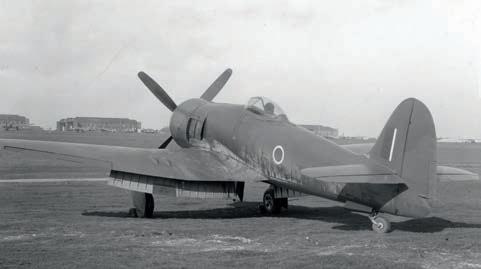
SR661 seen during a test flight in 1945. The camouflage pattern is very evident in comparison to the earlier photograph. This aircraft did not have a wing fold mechanism. Crown Copyright
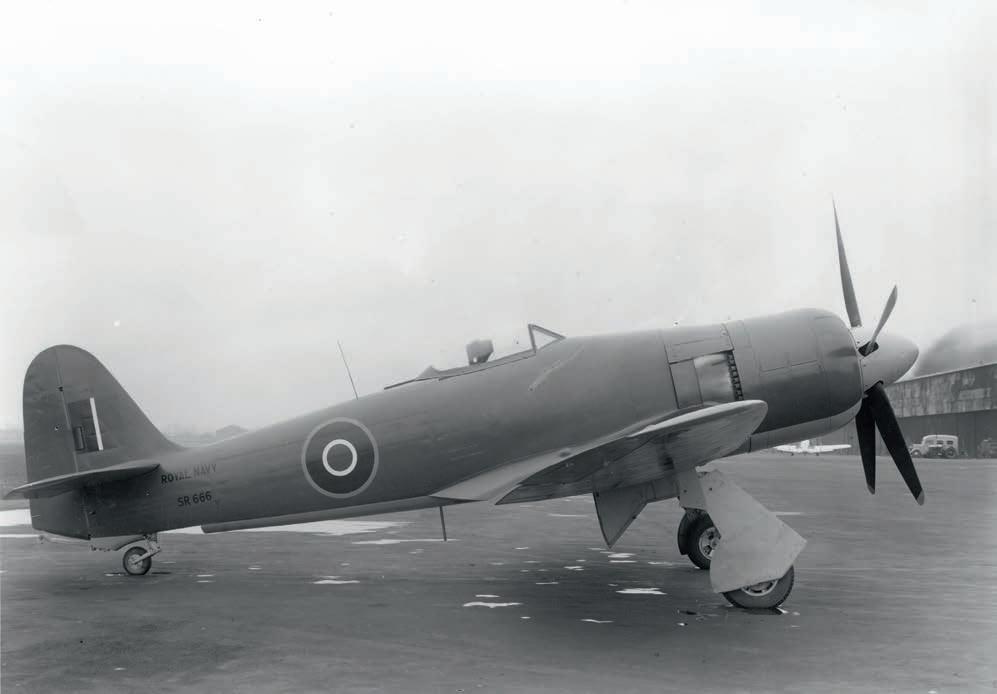
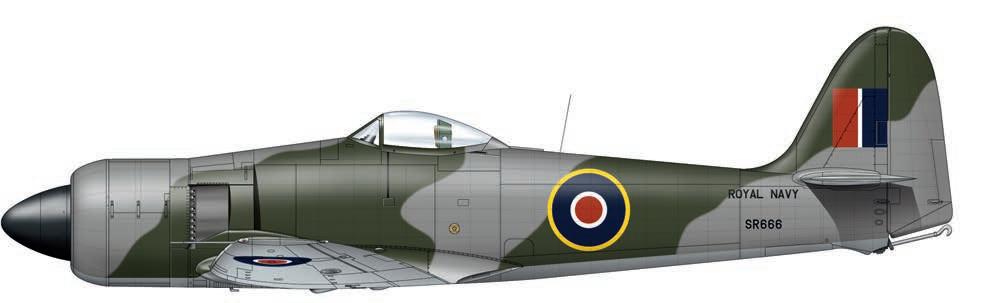
Sea Fury prototype SR666. This was the first fully-navalised Sea Fury prototype and it introduced both wing folding and a five-blade propeller. The magazines containing the ammunition for the outer pair of cannon were situated in the folding wing sections; the ammunition feed thus posed some awkward problems which were ultimately overcome. SR666 is fitted with its original short arrestor hook. Crown Copyright
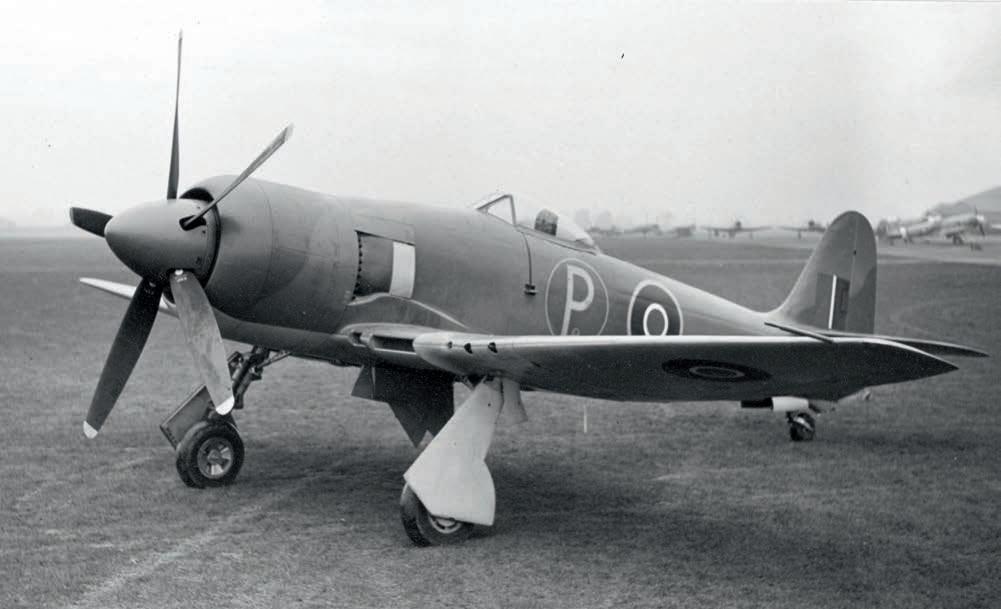
The identity of this Sea Fury prototype is not visible, but it is most likely to be SR666, given the position of the letter ‘P‘. Note that the oil cooler intake has been installed in the port wing leading edge outside the air intakes. Chris Farara
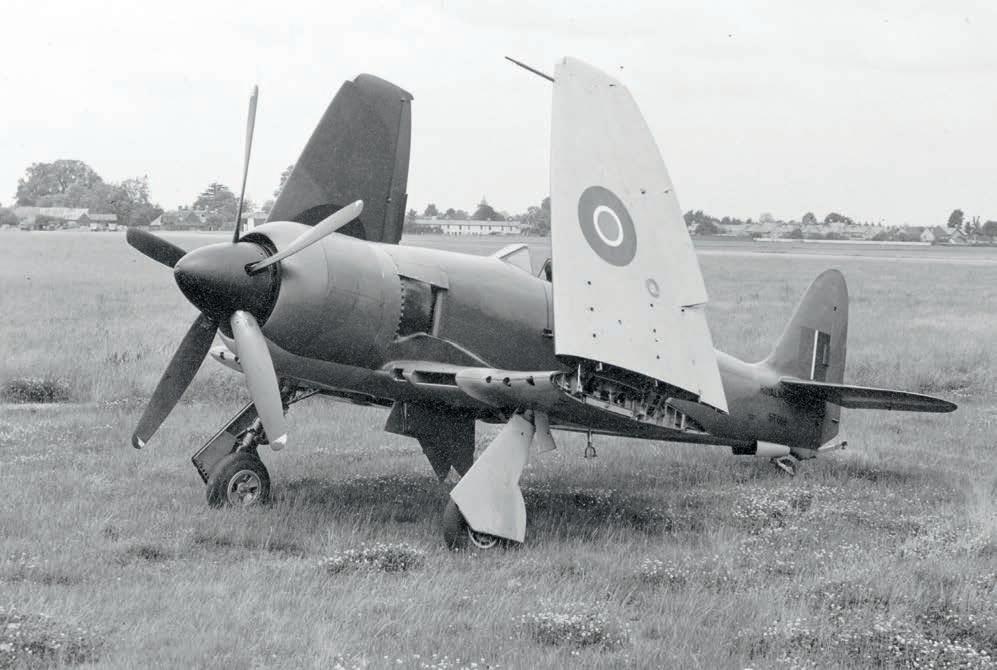
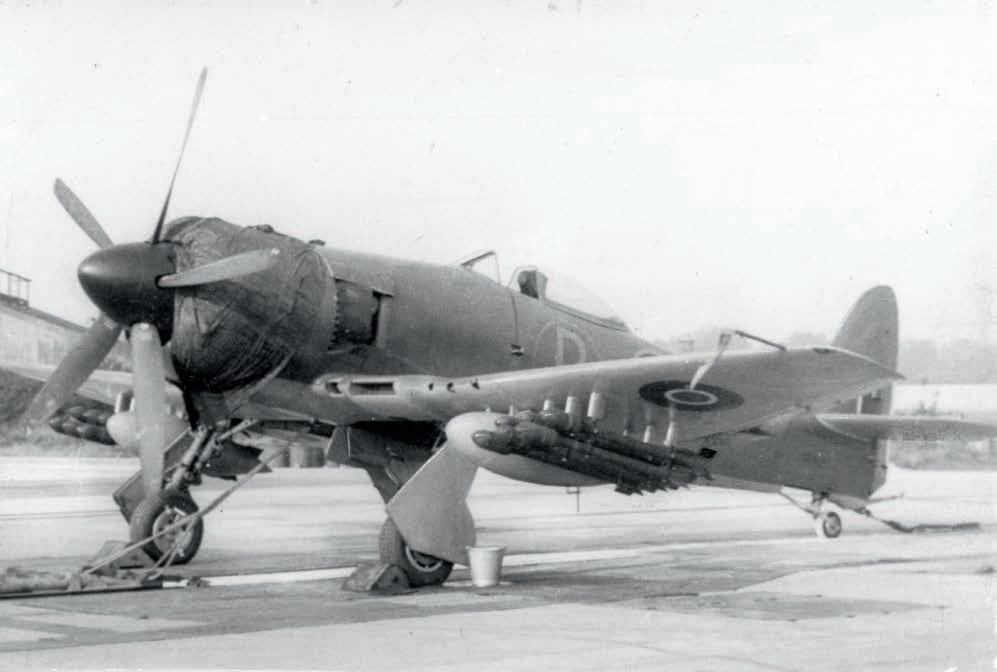
On 19th July 1946 SR666 began the Sea Fury’s acceleration proofing trials on the RAE catapult at Farnborough, but the tailwheel collapsed after the first launch. It was able to land on the grass at Hawker’s Langley airfield and a tailwheel lock was subsequently fitted which allowed the Sea Fury to return to RAE on 25th September to continue its trials. In the picture it is ready for a launch with both drop tanks and rocket projectiles loaded under the wings.
As noted, the first Hawker F.2/43, NX798, flew for the first time during the evening of Friday 1st September 1944 in the hands of Philip Lucas, Hawker’s deputy chief test pilot. At the beginning of the following week Camm informed the Ministry that “Lucas was extremely pleased with it, particularly with the feel of the controls which he said were ‘…like flying a Snipe’.” Camm was referring to the Sopwith Snipe biplane which had entered RAF service close to the end of the First World War and which had been renowned for its superb handling. Camm also reported that NX798’s ailerons were considered to be better than the spring tab ailerons used on the Tempest and closed by saying “…it looks as though we have achieved something”.
Lucas’s flight report revealed more. From the start it was apparent that the new aircraft showed considerable promise and, as a fighter, had clearly superior qualities in control, stability and pilot view over the Tempest. However, some attention was required to the control balances, which were badly out of harmony, as well as to engine vibration, which was significant. At a later date it was decided to replace the original rigid engine mounting with a flexible shock absorbing alternative, and to also fit a rudder trimmer; these measures substantially reduced the two problems. By 4th October it was possible to compare Centaurus-powered NX798’s maximum level speed to the level speeds obtained by production Tempest Mk.Vs. NX798 had previously achieved 453mph at 26,350ft, whilst the Tempest V only realised 432mph at 18,500ft using its engine’s FS (Fully Supercharged) gear at maximum power altitude (MPA), and 412mph at 6,500ft in MS (Medium Supercharged) gear at MPA.
After thirty-two manufacturer’s flights, on 22nd October NX798 went to the Aircraft & Armament Experimental Establishment (A&AEE) at Boscombe Down for a brief series of handling trials. At this stage the aircraft was not considered to be fully representative of the intended requirement and so changes were to be made – the flexible engine mounting and rudder trimmer needed to be installed and, additionally, an automatic control was
to be fitted to both the oil cooler shutter and main engine cowling grille. A&AEE calculated that NX798’s maximum flying weight would be 11,307lb, but at that moment the maximum permissible weight was 11,250lb.
The A&AEE trials found that on opening the throttle during take-off, NX798 would swing to the right when the tail rose. The swing could be checked comfortably on the rudder, and there was enough rudder power for crosswind take-offs. The climb away and acceleration were good. When trimmed for a low cruising speed of 215mph ASI at 10,000ft, if the aircraft was ‘disturbed’ by, for example, a 10mph gust of wind it would diverge and the pilot had to take control within thirty seconds. At higher speed (350mph ASI at 10,000ft), NX798 diverged more rapidly and pilot control was needed within twenty seconds. In turns at low altitude the aircraft did not tighten its turn, but at altitudes above 20,000ft the aircraft tightened in turns at all speeds. The elevator control was light and effective at all speeds and NX798’s ailerons were found to be extremely light and effective throughout the speed range. Their weight did not increase with speed.
The A&AEE report noted that the type possessed great potential and, with that, the possibility to become an excellent fighter, although some improvements were essential in order to address NX798’s tendency to become increasingly nose heavy with increased speed, which was considered unacceptable. Additionally, the report referred to the tightening in turns at high altitude as a poor characteristic, plus a violent wing drop on landing and the severe engine vibration. This was, however, the first fighter to be flown from Boscombe with really successful spring-tab ailerons and rudder and it was thought that, due to the lack of increased weight with speed using this type of control, a new standard of manoeuvrability at very high speed would be established. A&AEE’s report also commented that “…throughout the six days that this aircraft was at this Establishment, its serviceability record was 100%. For a prototype aircraft this must be considered exceptionally good”.
NX798 returned to Boscombe Down in May 1945 to take part in handling trials after a larger tailplane and elevator and some modified wing root fairings had been introduced. The original horizontal tailplane semi-span had been 6ft 6in, this was increased to 7ft 0in. General handling flights and tests were made at two loadings covering both the forward and aft positions of practical centre-of-gravity, the tests gave special emphasis to longitudinal behaviour and stalling characteristics. As such these modifications were considered by A&AEE’s pilots to have made an appreciable improvement to the longitudinal stability, which was now considered satisfactory up to 25,000ft. The stalling characteristics were also much better, the aircraft was statically stable over most of its speed range over its practical centre-of-gravity parameters, and the previous marked tendency to drop a wing on landing was no longer apparent.
A&AEE’s report showed that the Fury’s take-off with the centre-of-gravity at the aft loading position was normal and straightforward, except for its directional control. On opening up the engine, NX798 tended to swing to the right and, if 25° of flap was used, full left rudder was required to check the swing even when taking off dead into wind. Normal climb speed was 180mph ASI and in a dive the aircraft’s general behaviour at high speeds was satisfactory. It gained speed rapidly and the dive itself was smooth and free from disturbance up to the maximum speed reached in the trials – 480mph ASI at 8,000ft. A series of dives was made from trimmed level flight at 28,000ft during which a maximum Mach number of 0.79 was reached at 23,000ft (just about 400mph).
The Fury’s manoeuvrability increased appreciably with altitude (that is the stick force required to produce a given value of normal acceleration decreased with altitude). In tight turns at 5,000ft the stick force was moderate at speeds up to 350mph ASI, but became heavy at speeds above 400mph ASI. At 27,000ft, however, the stick force in turns was light and at 4‘g’ the aircraft would continue in the turn with zero stick force. For the landing approach the best speed with flaps and undercarriage
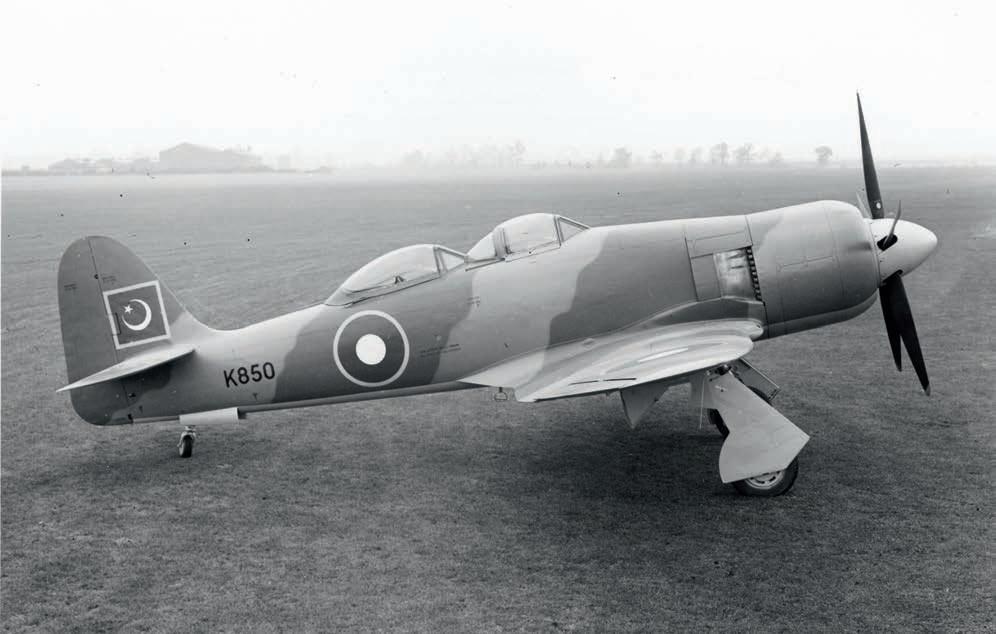
Fury trainer K850 as supplied to Pakistan. It is included here to illustrate the twin-bubble canopy installation similar to the design first installed on T.Mk.20 prototype VX818, but which the pilots at A&AEE Boscombe Down thought was flawed. Hawker Aircraf
down and engine ‘off’ was said to be 110mph ASI, and sufficient elevator trim was available to trim for hands-off flight at this speed. Touchdown was satisfactory with no difficulty experienced in carrying out a three-point landing, whilst ‘opening up’ and going round again following a baulked landing was straightforward and satisfactory.
Switching to the practical forward centre-of-gravity loading position made little difference to the behaviour at take-off, in a climb, level flight, at the stall or in a dive. In tight turns at 5,000ft the stick force increased appreciably when compared to the aft loading instance and above 400mph ASI it was considered to be too heavy. However, there was no tendency for the Fury to tighten in the turn, even at altitudes up to 28,000ft. On the landing approach it was only just possible to trim NX798 at the best speed of 110mph ASI with everything down, engine idling, and the elevator trimmer control wound fully ‘nose up’.
Overall, the Fury possessed some good features, although engine vibration remained a problem and detracted from the otherwise pleasant impressions gained from flying the aircraft (rubber shock-absorbing engine mountings had still to be fitted at this time). Additionally, the oil cooling system was considered inadequate and in need of attention. Several recommendations were made for necessary improvements, including a more powerful rudder to counteract the swing on take-off and more effective aileron control at low speeds.
Little information has been traced relating to the performance of LA610 when fitted with Griffon power units, in fact the machine does not appear to have been flown very much with this type of engine. Records are available for fifteen flights by Philip Lucas and Bill Humble with the Griffon 85 between the twenty-minute maiden flight of 27th November 1944 through to 22nd December. These included handling checks, a climbing trial and a forced landing at Farnborough during the second of two flights on 18th December.
Entries exist for six flights with the Griffon 81 between 5th February and 25th April 1945, which were shared between Lucas and Humble, and one with Frank Murphy on 10th March where overspeeding of the contra-rotating propellers was recorded. Doubtless, other test flights were made but information concerning these is not available. Later, whilst fitted with a 3,060hp Sabre VII, LA610 attained a speed in excess of 480mph in level flight. Logbooks indicate eleven flights flown in LA610 by Bill Humble between 3rd May and 26th July 1946.
Handling trials of Sea Fury prototype SR661 commenced at A&AEE Boscombe Down in May 1945; these revealed a lack of rudder power for take-off and insufficient acceleration during take-off. In due course a larger rudder was fitted together with a five-blade propeller and from 2nd to 10th July SR661 underwent further, albeit brief, handling trials in this form. The new propeller improved the take-off distance considerably and also supplied
a better braking effect on touchdown. In this condition the aircraft was considered satisfactory, although the deck landing trials themselves (undertaken by Cdr D. Robertson aboard HMS Ocean on 10th and 11th August) showed that there was still insufficient rudder control for a take-off from a carrier.
In general, the longitudinal and directional characteristics flying with the centre of gravity at the aft limit were satisfactory, although the aircraft tightened in turns at 30,000ft. The engine vibration, by now much improved, was still felt to be uncomfortable at certain rpm, and more left rudder trim than previously experienced was needed for climbing at best climbing speed. Referring to the deck trials, RAE Farnborough stated that the aircraft had good control as well as a good view for deck landing but some improvements were needed, most importantly more rudder power for take-off and a tail wheel lock. In fact, RAE felt that SR661 was unacceptable for deck landing in its present form. On 9th January 1946 this prototype arrived at A&AEE to start the fighter’s gunnery trials.
In 1946 the second Sea Fury prototype, SR666, went to Farnborough to perform some acceleration tests on the Establishment’s land catapult. Lt Cdr Eric Brown flew the first of these on 19th July, but suffered damage on take-off caused by a tail swing to starboard while still on ‘deck’. SR666 was catapulted in a tail-down attitude and was fitted with a fully-castoring tail wheel and a single towing hook, the first Fleet Air Arm ➤
aircraft so equipped (before the arrival of the Sea Fury, British carrier aircraft had been launched with the strop attached to twin towing hooks that conferred a degree of directional stability).
Consequently, the tail wheel collapsed during take-off, so Brown flew SR666 direct to Hawker’s Langley airfield to alight on the grass and make repairs. One outcome of this incident was that a tail wheel lock was introduced which proved a great success and prevented castoring. The acceleration proofing trials were finally completed on 3rd and 5th October 1946.
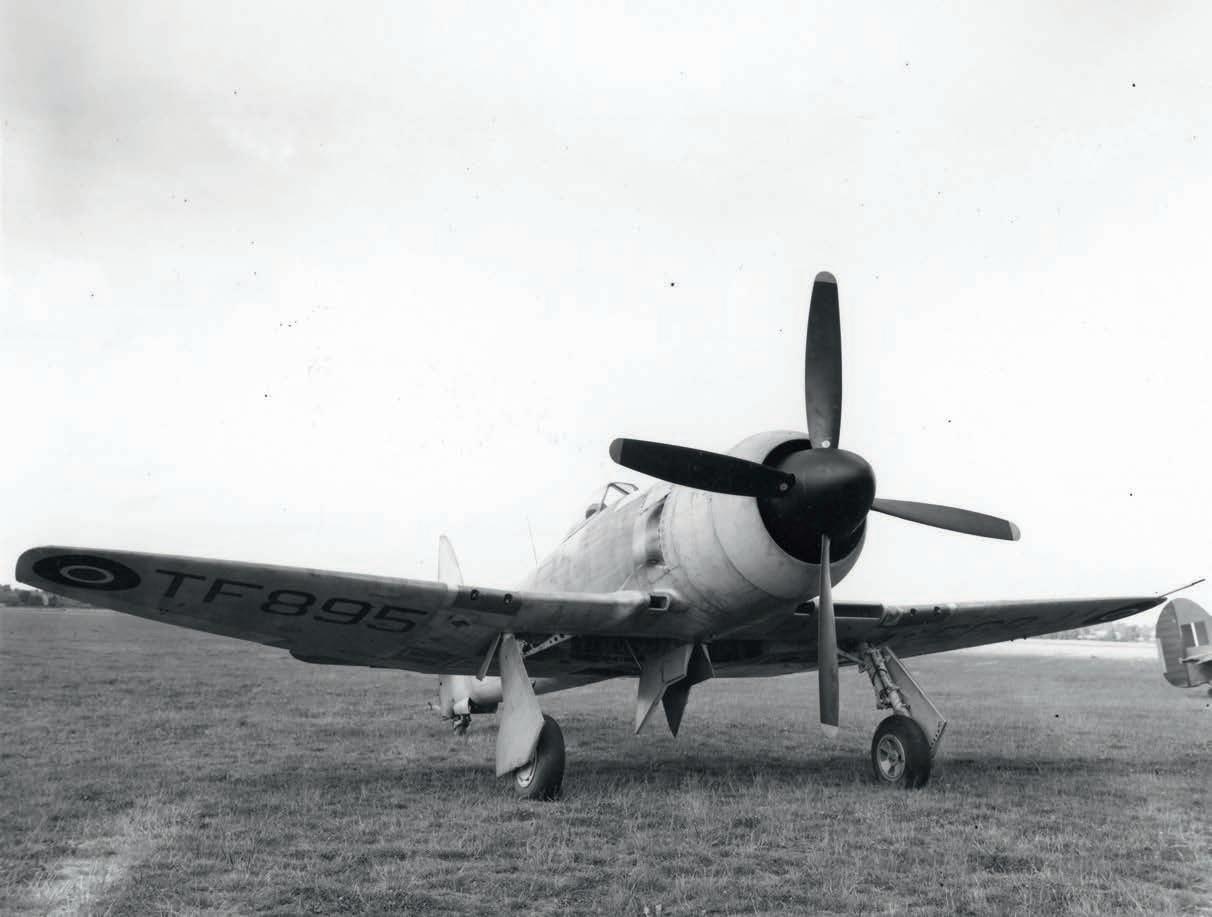
During 1946 the number of Sea Furies on order began to rise again to help fill a gap in capability. On 13th August Hawker was asked to quote for an additional 35 Mk.10 aircraft, bringing the total number under construction to 135, excluding prototypes; these were formally ordered on 23rd October. Earlier however, on 4th June 1946 the manufacturers had been advised that five-bladed propellers for the Sea Fury would not be ready until 1st November, and so the first forty-five aircraft would have to be fitted with Tempest II-type four blade propellers. The first production Sea Fury, TF895, made its maiden flight on 15th August 1946 fitted with a Centaurus XVIII and a four-blade Rotol propeller. The pilot was Hawker’s R. V. ‘Doc’ Morrell.
A considerable number of early production machines were employed on airframe and engine development work and, in due course, Sea Furies began to arrive at A&AEE Boscombe Down for a variety of tests to clear the type for service use. From 18th March 1947 Lts Elliot and Morrell began intensive deck landing trials from HMS Illustrious using F.Mk.10s TF899 and TF900, and joined on 24th March by TF898 which was used for side wind catapult launches. A week later TF900 repeated some of the tests after having received a new type of rigid sting arrestor hook, which was longer than its predecessor and improved the aircraft’s directional stability on deck after catching an arrester wire. Previously, when tested by the Service Trials Unit on HMS Victorious, the original short hook had given rise to various problems which were cured by the longer hook. A total of 172 landings had been accomplished by 15th May.
Between July and December 1947 TF900 was used for handling trials without external stores. While the handling characteristics were found to be above average for piston-engined fighters, there were some relatively minor adverse features, amongst which was the lack of an aileron trimmer. The controls were found to be pleasant, and in particular the excellent rolling performance was praised.
After completing just fifty examples of the F.Mk.10, production was switched to the FB.Mk.11 fighter-bomber. The Navy had identified the need for such a type and adapting the Sea Fury proved a relatively simple task, basically involving the addition of facilities for carrying under wing bombs and rocket projectiles plus the provision of rocket-assisted take-off gear (RATOG). The requirement for RATOG had been dropped from the specification in September 1943 but reinstated for production Sea Furies in late October 1944. VB857 made the first sorties with RATOG at RAE Farnborough during November and December 1947. The carriage of rocket projectiles under the wings was assessed in August 1948, using FB.Mk.11 TF986, and the trials found that the Sea Fury’s handling characteristics were not greatly affected when these stores were in place. Similarly, both TF986 and TF900 were used between December 1947 and September 1948 to see if the carriage of under-wing bombs made any difference to their flying qualities, but the type’s handling with these weapons was not very different to one flying without them. In August 1948 production FB.Mk.11 VR920 was tested by RAE with RATOG gear in place and in February 1951 brief handling trials were conducted using FB.11 VW588 with RATOG. The trials showed that the installation was satisfactory and, in general, rocket-assisted take-offs were found to be straightforward.
Eventually, well over 700 Sea Furies were built with the initial F.Mk.10 followed by the definitive FB.Mk.11, and then followed in turn by the T.Mk.20. In 1948 Hawker introduced a two-seat Sea Fury advanced trainer that retained the majority of the principal features and characteristics of the F.10 whilst incorporating a complete set of duplicate flying and engine controls for the second cockpit. Specification N.19/47 was issued on 24th March 1948 to cover the aircraft which, apart from the second set of controls, called for just one 20mm cannon in each wing but with provision for bombs or rockets. In fact it was Iraq that had first pressed for a training variant.
With the continued growth of engine power during and following the recent war, it was recognised that a training aircraft was required which used an engine that provided a similar level of power to front line types. The specially designed piston trainers operated so far used much less powerful engines than the fighters the pilots would eventually graduate to, and this difference in power, performance and handling characteristics, often created problems. The idea was quickly taken on board by the Royal Navy and the Sea Fury trainer was supplied to the RN as the T.Mk.20, not only to provide experience to potential Sea Fury pilots but also for weapon instruction.
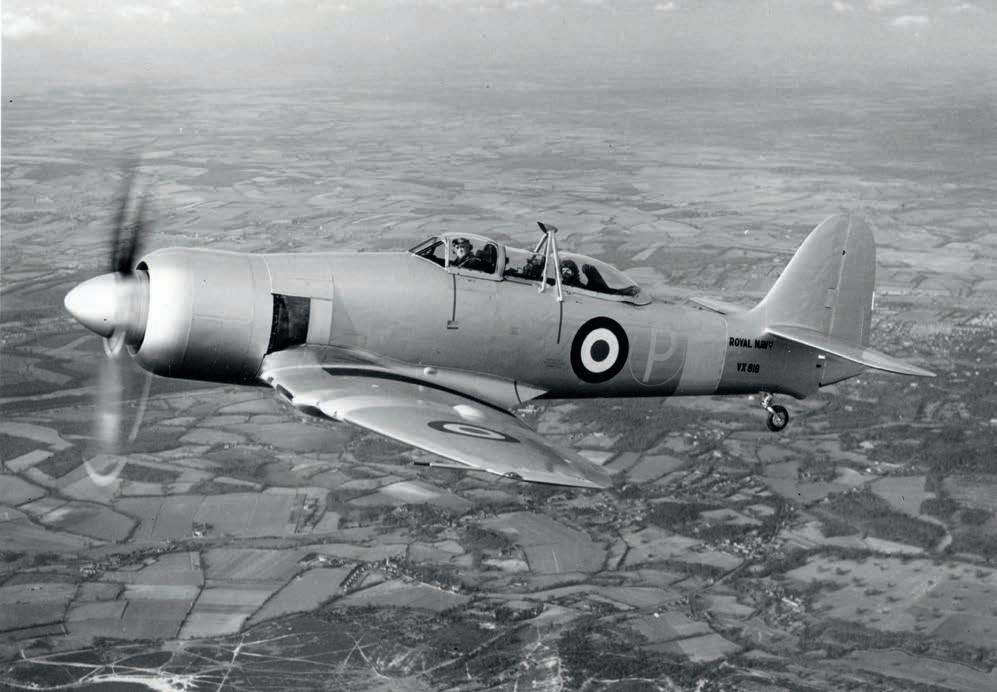
The first example was VX818 which made its maiden flight from Langley on 15th January 1948 after being diverted from an Iraqi order for four two-seat trainers and completed to Admiralty requirements. This aircraft was fitted with a retractable tail wheel, although the 60 production FAA T.20s all received fixed tailwheels. VX818 was initially fitted with a separate bubble canopy for each cockpit, however, when
A&AEE pilots began to test the prototype after its arrival at Boscombe Down on 11th March 1948, they found that the second canopy had the potential to fail at high speeds or during high-speed manoeuvres. Consequently it was redesigned with a Perspex ‘tunnel’ that connected the two canopies and provided additional strength. This title covers the Sea Fury in service with those countries which operated the aircraft from aircraft carriers – namely Britain, Australia, Canada and Holland. For the record however, Centaurus Fury development was continued by Hawker as a private venture and was duly rewarded with production orders from Iraq. They requested 30 Fury fighters and fighter-bombers that were essentially Sea Furies with fixed wings and special Hawker bomb racks, but minus the arrestor hook and other naval features.
Known within the company as the Fury Baghdad, they were supplemented by two trainers as well as a later order for 25 single-seat aircraft and three more two-seat trainers. Pakistan ultimately acquired a total of 92 single-seat Sea Furies and four trainers designated as Mk’s.60 and 61 respectively, essentially F.Mk.10s but with manually-operated wing folding rather than the usual hydraulic arrangement. After Fury prototype NX798 had been acquired by Egypt, 12 Sea Furies were ordered by this country, while refurbished examples also found their way to Burma, Cuba, Pakistan (five of the 92 single-seat aircraft supplied being ex-FAA FB.11s) and West Germany (which acquired [possibly] eight two-seaters in 1959 as target tugs).
Concluding this chapter, one can do little better than quote Captain Eric Brown, who is perhaps Britain’s most famous test pilot. He has stated that the Sea Fury was “…a first class naval aircraft”
and its contemporary was the US Navy’s Grumman F8F Bearcat carrier-borne fighter. There was little to choose between the two – the Bearcat had the edge in climb and manoeuvrability but the Sea Fury was the better weapons platform. Captain Brown told the author “…that the five-bladed Centaurus Sea Fury had the edge over the similarly powered four-blade propeller because the extra weight of the naval fittings was countered by the more powerful engine/propeller combination. The Tempest II was also a very fine aeroplane but was some 20mph slower than the Sea Fury, so it would not have bettered the Fury or Bearcat in combat”.
The Fury and Sea Fury set a new standard of manoeuvrability for a single seat fighter. During Society of British Aircraft Constructors displays at Radlett and Farnborough, Hawker chief test pilot Bill Humble produced a brilliant performance in which he flew such extraordinarily tight turns that he had good reason to wear an anti-g suit.
Yet the design did not necessarily represent Camm’s ideal since the adaptation of the Tempest’s wing was something of a convenience for promoting rapid production in wartime through the use of jigs and tooling already available. However, the Tempest wing provided a good starting point.
The Fury also symbolised a milestone in Hawker history because it marked the end of an era for the company – there would be no more piston fighters designed at Kingston. For some time Camm and his team had been working on a jet fighter and this eventually entered service as the Sea Hawk, but in the meantime the Sea Fury became the Royal Navy’s principal singleseat shipboard fighter. ■
The first production Sea Fury F.Mk.10 was TF895, shown here with the four-blade propeller it received for its first flight.
The first Sea Fury F.Mk.Xs to join the Fleet Air Arm were delivered to No.778 Squadron at RNAS Ford, Sussex in March 1947 where they commenced intensive flying trials for Service use. In May No.787 Squadron acquired its first examples. This unit was the Naval Air Fighting Development Squadron of the Central Fighter
Establishment at RAF West Raynham in Norfolk which concentrated on assessing the new type’s combat capabilities. The first front-line unit to receive the Sea Fury was No.803 Squadron, a Canadian unit based at RNAS Eglinton, County Londonderry in August 1947; however, it was No. 807 Squadron which received the honour of taking Hawker’s fighter to sea for the first
time when it embarked HMS Implacable for ten days on 4th May 1948. Accompanied by the Fairey Firefly FR.4s of No.810 Squadron, the two comprised the 17th Carrier Air Group (CAG), formed to serve aboard the light fleet aircraft carrier HMS Theseus.
Only two other front-line squadrons operated the F.Mk.X: No.802 which
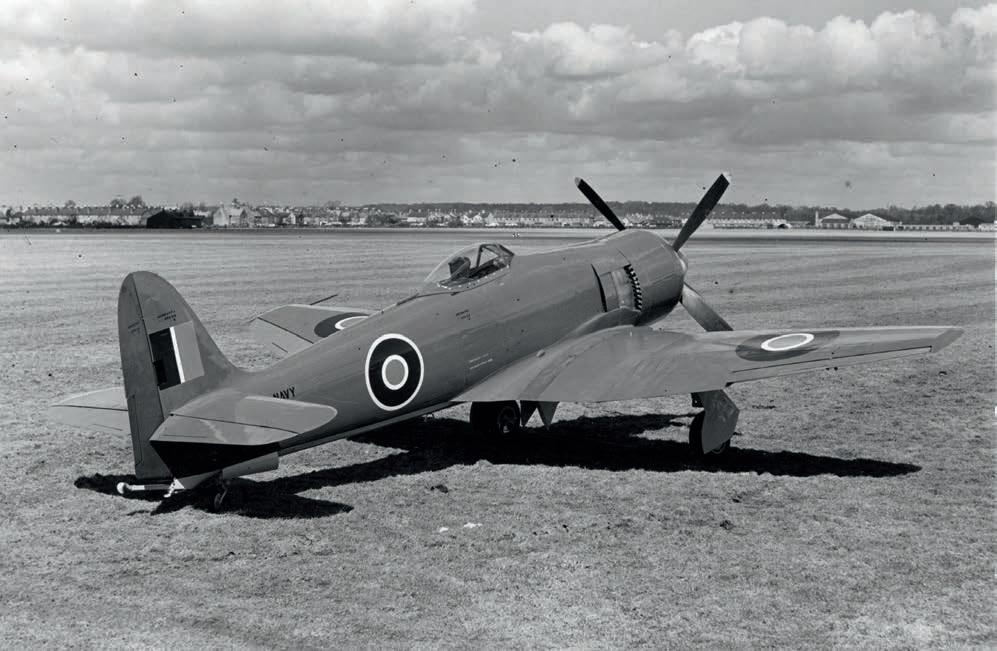
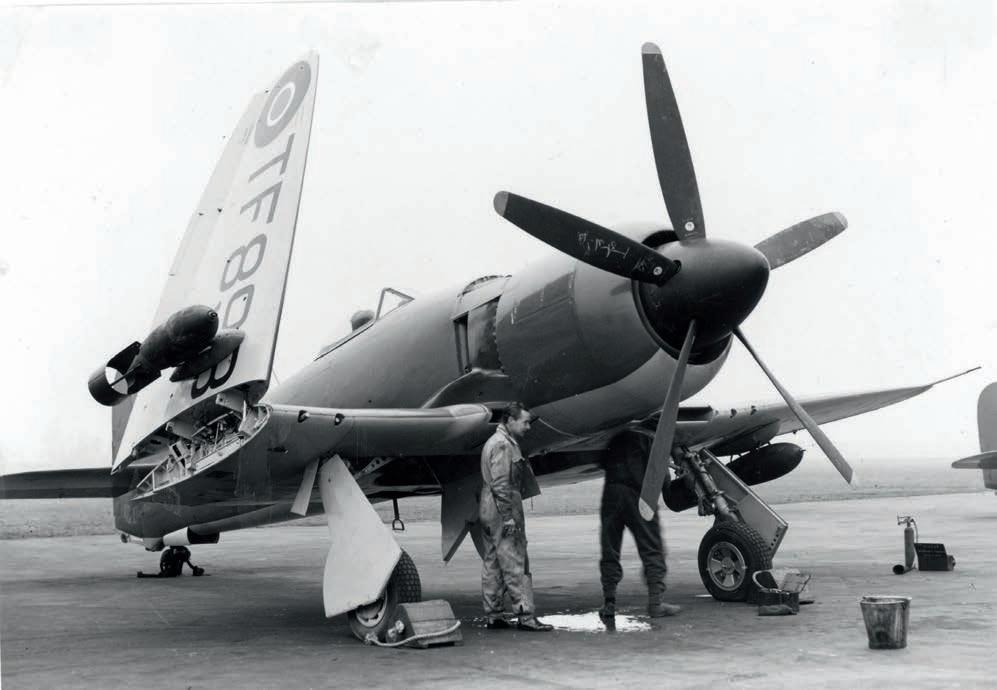
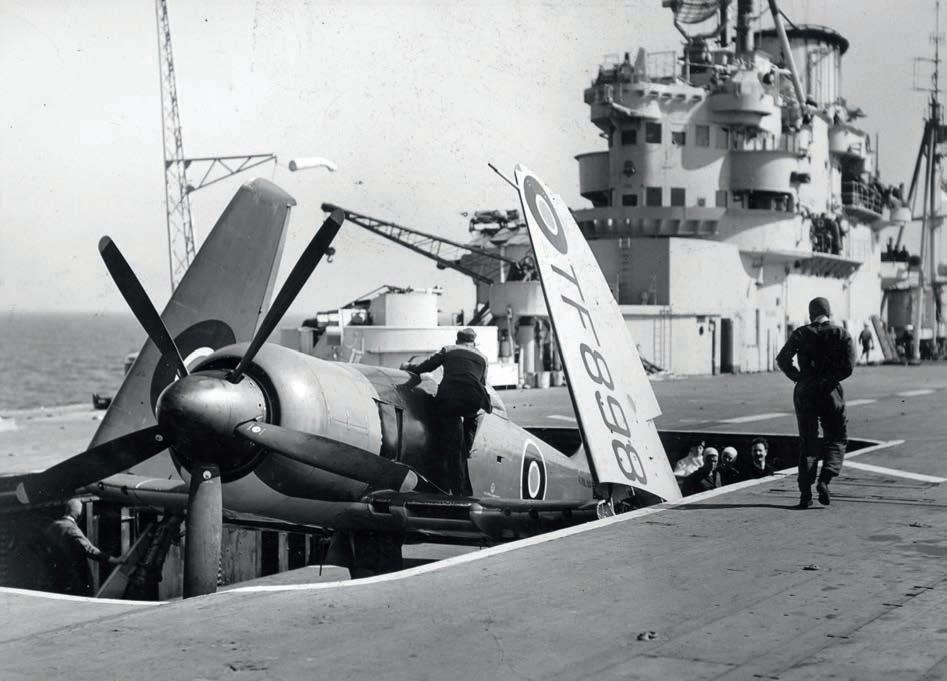
The fourth production Mk.10 TF898 demonstrates its wing folding with two 1,000lb bombs on board. Eric Morgan
received thirteen examples at RNAS Leeon-Solent, Hampshire and the Australian No.805, which formed for the first time as an Australian unit at Eglinton on 28th August 1948. By the end of 1948 the Mk.X was being removed from front-line duties with the FAA, both 802 and 807 having received FB.Mk.11s earlier that year. The Australian and Canadian Navies retained the F.Mk.X for a little longer, while a variety of FAA, Canadian and Australian secondline units made full use of the mark for some considerable time.
A quantity survived into 1954 in the hands of No.767 Squadron conducting Deck Landing Officer training, and a few were allocated to RNVR units in the mid-1950s. In June 1948 the F.Mk.X was officially redesignated F.Mk.10 in accordance with the new practice that replaced Roman numerals with Arabic (for convenience the Arabic format is used for the remainder of this book).
Number 807 Squadron became the first to receive the Sea Fury FB.Mk.11 commencing in February 1948. However, full conversion from the F.10 took until December and as a consequence No.802 Squadron became the first front line FB.11 unit when it completed its transition in June. In 1950 No.802 was chosen to provide the Fleet Air Arm with its official formation aerobatic display team for the Festival of Britain, due to commence the following year. A routine was developed and perfected during HMS Vengeance’s Mediterranean cruise in the autumn
of 1950, followed by public displays throughout the 1951 air show season. A deployment to Korea ensued in 1952 before No.802 disbanded in the UK on 10th December, only to re-form again at RNAS Arbroath, Angus on 2nd February 1953 with Sea Furies once more.
The Sea Fury’s front line service and retrospective history has been dominated by the war in Korea (see Chapter 3); it would be an error however to associate the Sea Fury solely with that conflict. For many Sea Fury units, as recorded in their respective squadron diaries and ‘line books’, significant periods of time were spent training, conducting exercises, overseas deployments and visits. For example, in 1954 No.811 Squadron had lodged at RAF Leuchars, Fifeshire, since the previous August, it moved to RNAS Leeon-Solent, Hampshire in early February and then joined HMS Warrior on 17th February with a complement of nine Sea Furies for a spring cruise to Malta. The ship later went on to visit Aden and Singapore, by which time 19 Sea Furies were on strength. The squadron returned to Lee-on-Solent in December to disband.
Rather typically perhaps was No.898 Squadron which re-formed at Arbroath on 4th July 1951 with eight Sea Fury FB.11s. Within three weeks it had embarked on HMS Ocean for intensive flying in the Mediterranean. In fact, the unit stayed in the Mediterranean for the whole of the 18-month period that it had Sea Furies on strength, either at Hal Far, Malta or
aboard HMS Ocean, Theseus or Glory Additionally, a two-week period was spent at Kasfareet in Egypt in June and July 1952. No. 898 disbanded on 1st January 1953 and amalgamated with No.807 Squadron; it re-formed in August 1953 equipped with the Hawker Sea Hawk F.Mk.1.
Far less typical however was the resurrection of No.806 Squadron which re-formed on 3rd May 1948 at Eglinton as the Royal Navy’s Official Aerobatic Team in readiness for a tour of North America. Assembling such a special squadron to show off the Navy’s aerobatic skills overseas was quite unique. For the purpose it received three de Havilland Sea Hornet F.MK.20s, a de Havilland Sea Vampire F.Mk.20 and two Sea Fury FB.11s; the Sea Furies having been taken from a reserve held at RNAS Culham, Oxfordshire. The Commanding Officer was Lt Cdr D.B. Law and the Navy’s most skilled and polished display pilots were selected to go, the squadron being conveyed aboard the recently commissioned Canadian aircraft carrier HMCS Magnificent to Dartmouth in Nova Scotia.
They arrived in early June and were ferried ashore as bad weather prevented any flying. Displays and flypasts were performed at many venues in both the USA and later Canada, including New York’s Idlewild Airport, better known today as JFK International Airport, and over Niagara Falls. In fact, the principal reason behind No.806 being re-formed as an aerobatic team was to represent Britain at the ceremony held to declare Idlewild
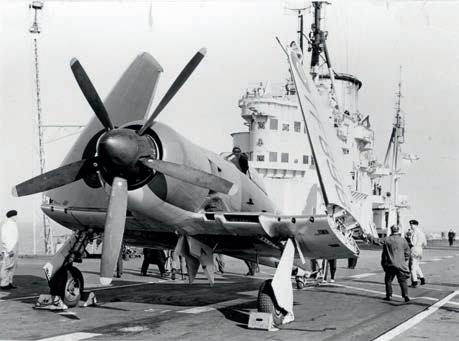
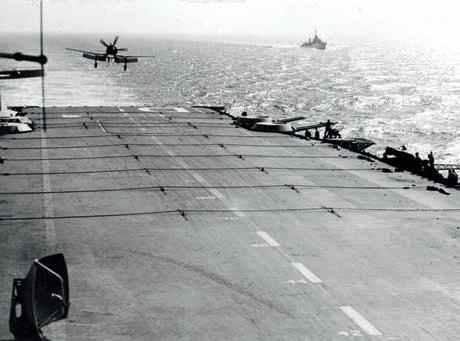
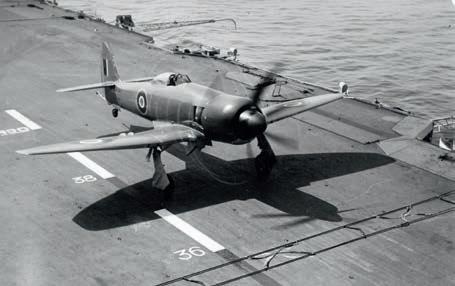
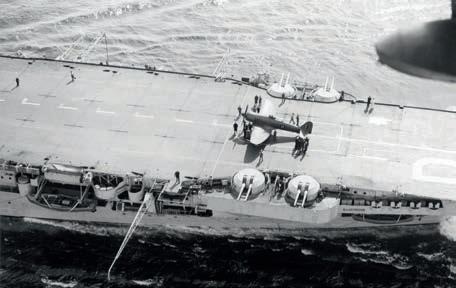
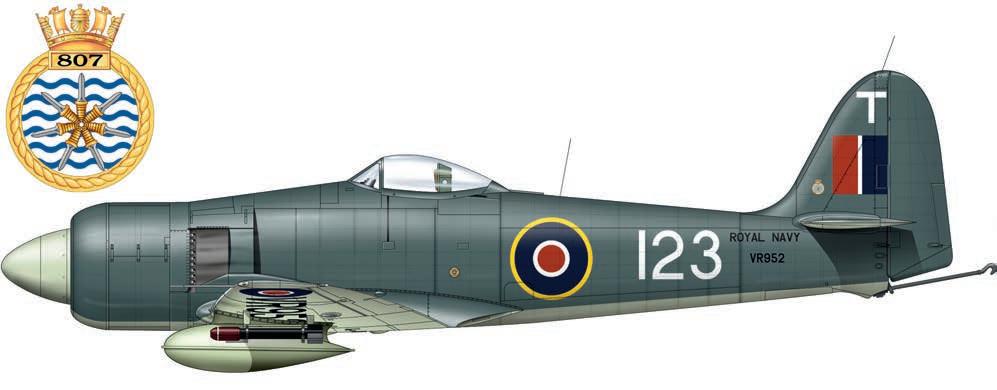
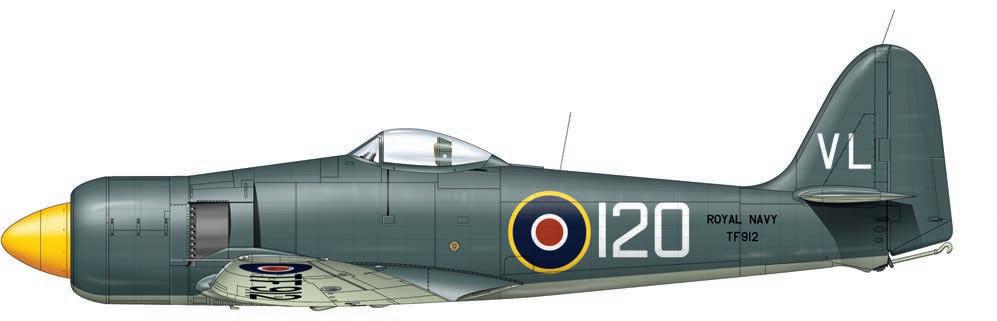
Hawker Sea Fury FB.11, VR952/123-T, No 807 NAS, HMS Theseus, recorded at Hal Far (Malta), September 1949. Extra Dark Sea Grey upper surfaces with Sky undersides; ‘C1’ roundels on fuselage sides, ‘C’ roundels in four wing positions. Code ‘123’ in white, RN script and serial in black (the latter repeated below the wings; ‘T’ on fin in white. Unit crest on fin, ahead of fin flash. Art by Richard J. Caruana
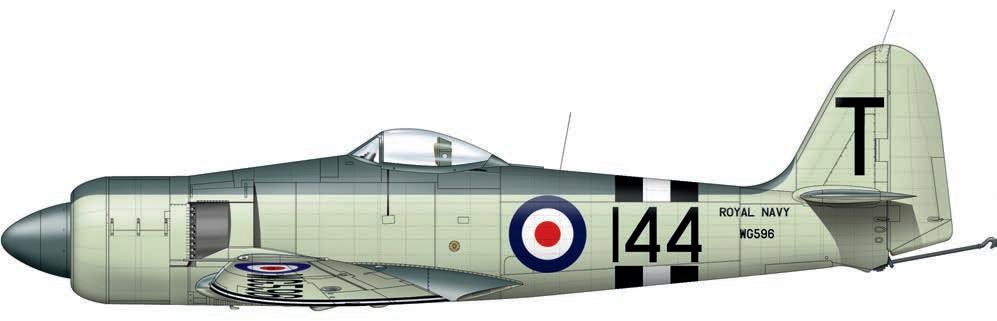
Hawker Sea Fury FB.11, WG596/144-T, No.898 NAS, HMS Theseus, 1953. Extra Dark Sea Grey upper surfaces and spinner with Sky undersides; black serials and codes. Black/white/black bands around rear fuselage and wings; roundels in six positions. Note that the black/white bands were painted for Home Waters exercise. Art by Richard J. Caruana
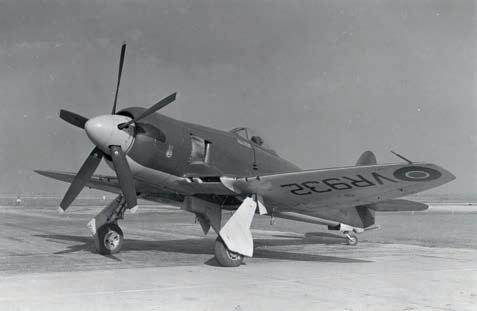
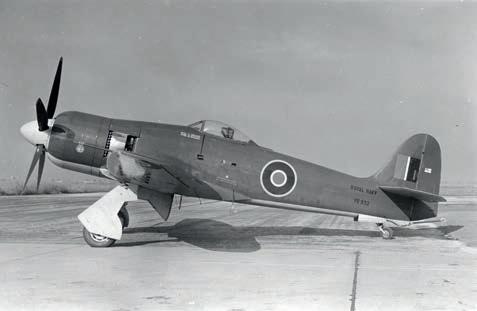
VR932 of 806 Squadron pictured at Idlewild. Note the badge on the side of the engine cowling. Edgar Deigan via Peter Green open. This took place in August and was called the International Air Exposition. On the day No.806 performed towards the end of the show and thrilled the crowd. Such individual and co-ordinated precision aerobatic flying as performed by No.806 was quite new in North America and left a huge impression. The
Sea Hornets with their superb aerobatic capabilities have generally received most credit, but the Sea Furies too were a big success. Lt Reynolds, for example, would roll his Sea Fury onto its back immediately after take-off and then make his climb inverted. The Sea Furies would perform aerobatics with the Sea Hornets and execute solo high-speed passes at very low level (often upside down) and solo aerobatics at higher altitudes to demonstrate the type’s manoeuvrability. One RN Fury was replaced by a Canadian Navy aircraft after the former’s engine had suffered from overspeeding, and then two more RCN Furies joined ➤
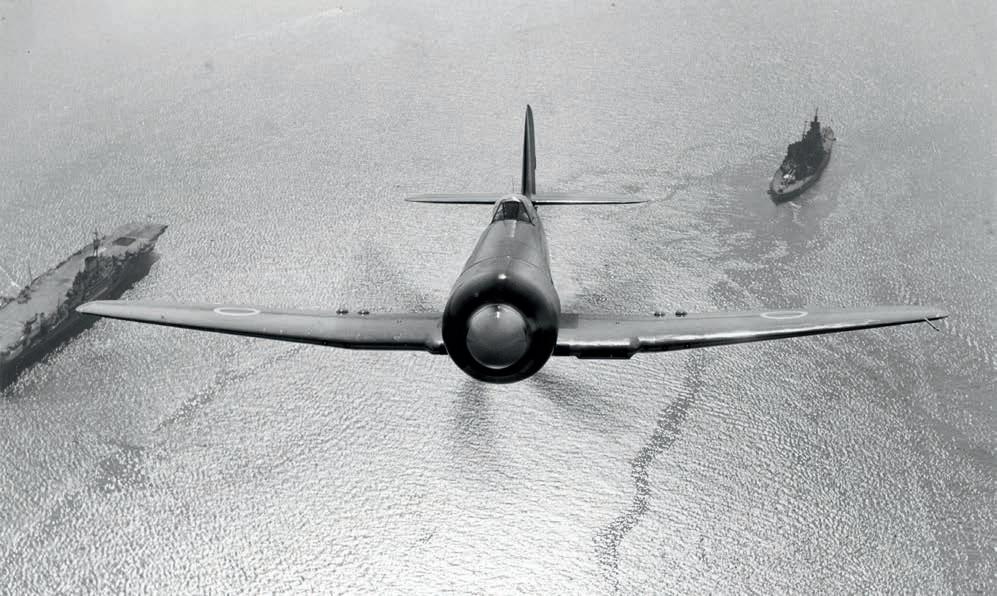
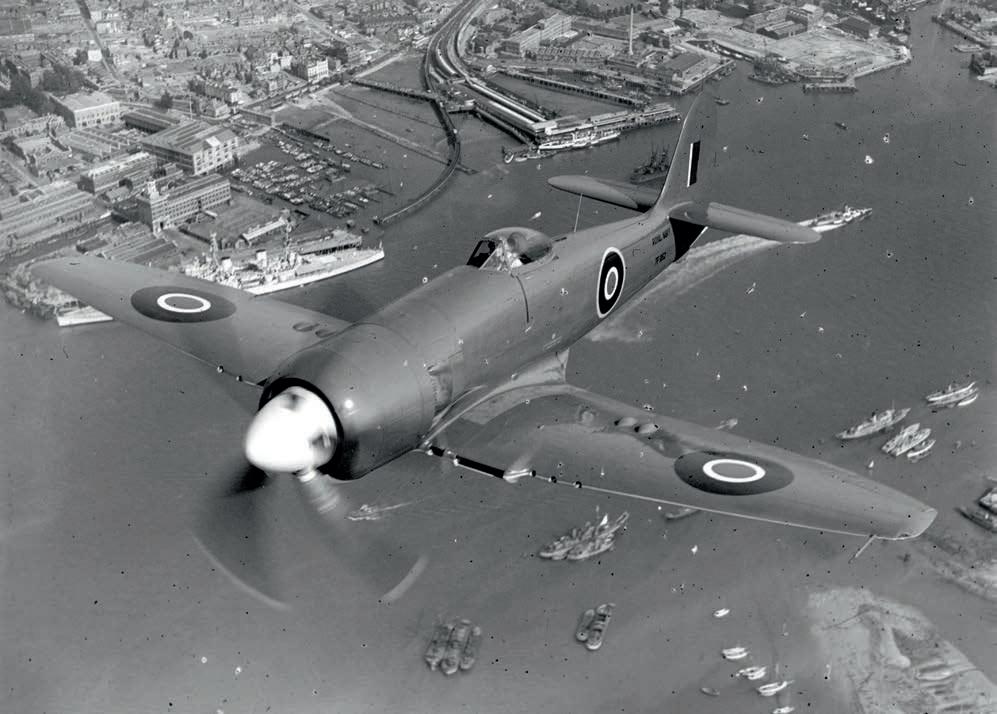
Sea Fury F.Mk.10 – ‘The Eyes of the Fleet’ according to a contemporary Hawker document. Clearly defined is the prominent taper of the rear fuselage. Although un-dated this is likely to be mid-1947, judging by the presence of a World War One vintage 15in-gunned battleship top right. All examples in RN hands had been removed from service for scrapping at this time, bar HMS Royal Sovereign which was serving with the Soviet Navy. Eric Morgan
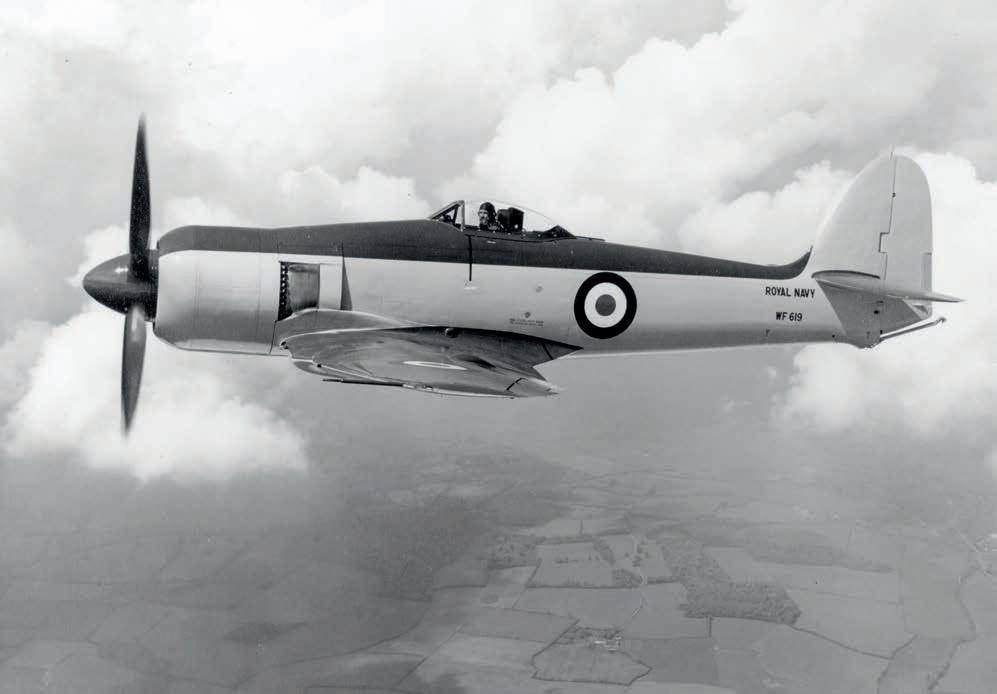
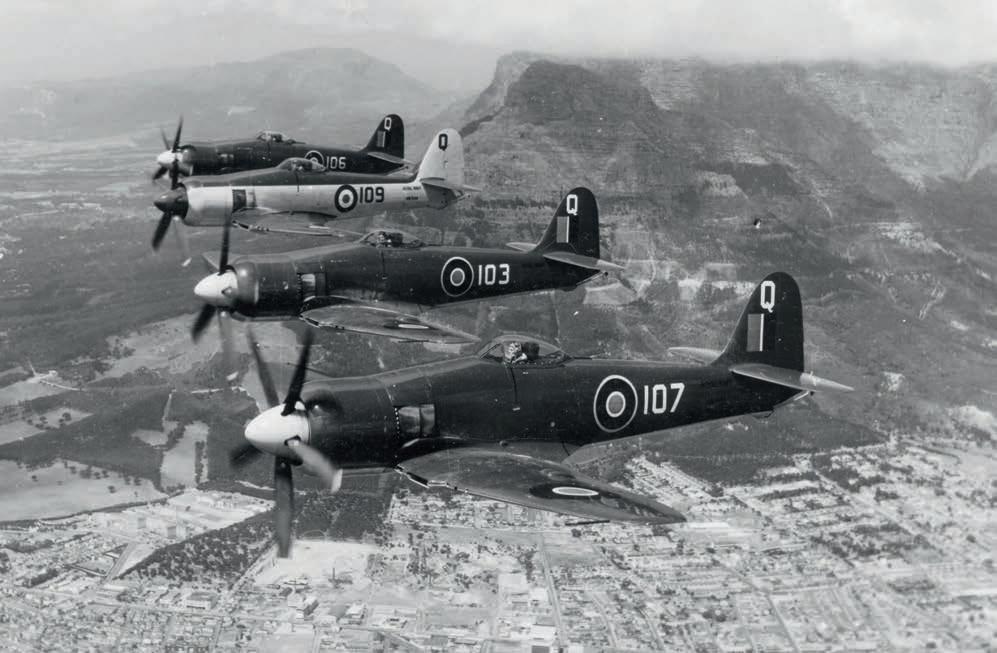
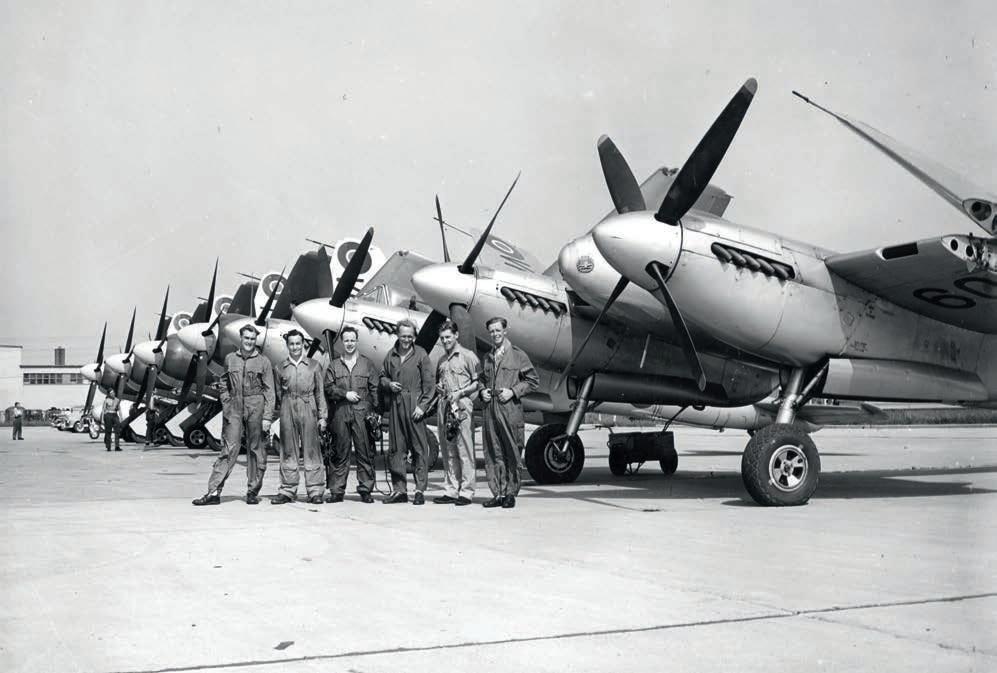
Line up of 806 Squadron’s aircraft brought together in 1948 to display British naval aeroplanes in North America. This view shows two de Havilland Sea Hornets, four Sea Fury FB.11s, and one de Havilland Sea Vampire, the nose which is just discernible at the far end of the row. Initially 806 had two Sea Furies, but the numbers on strength varied as the tour progressed. Crown Copyright
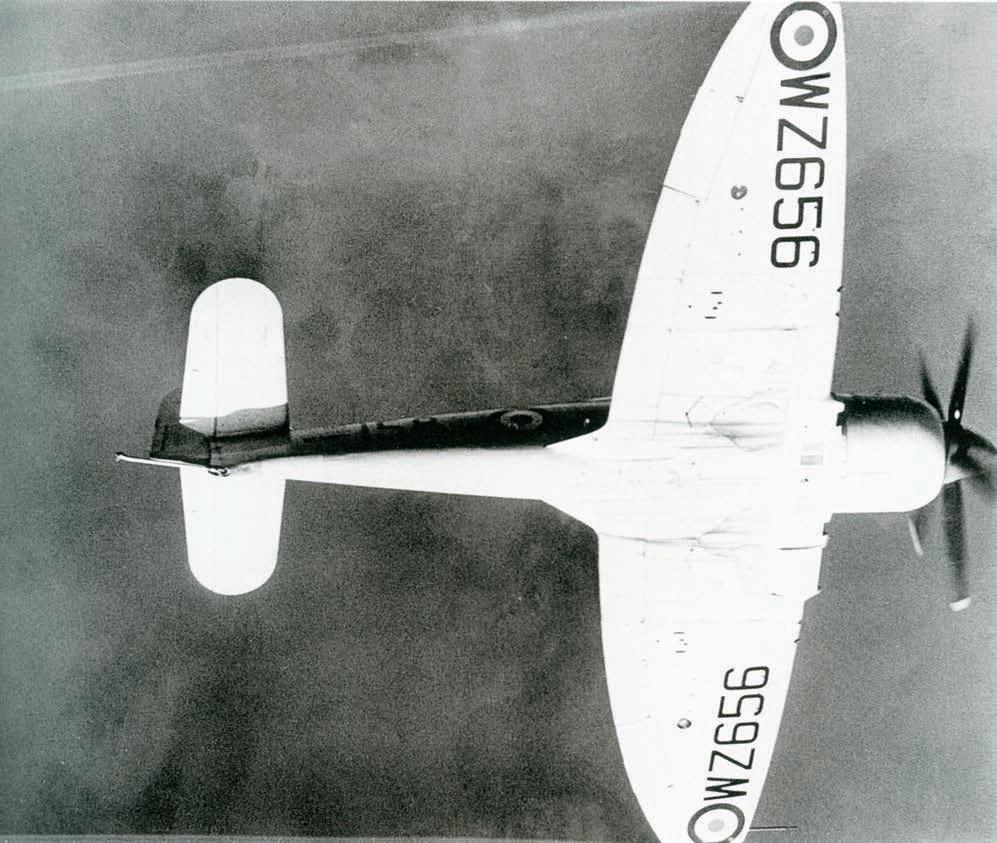
WZ656 158/BR was the very last Sea Fury to come off the production line in 1954. It had a relatively short life and was Struck Off Charge in December 1956 with only ninety hours on the clock. It is seen here in early 1955 flying with No. 1833 RNVR Squadron based at Bramcote. Bob Stynes via Ray Sturtivant
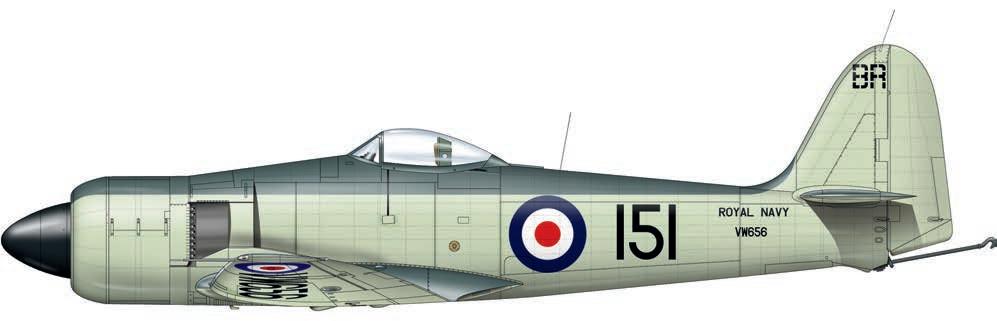
Hawker Sea Fury FB.11, VW656/151-BR, No 1833 NAS, Bramcote, 1954. Extra Dark Sea Grey upper surfaces with Sky undersides. Spinner, serials and codes in black. Roundels in six positions. Art by Richard J. Caruana

for the Canadian part of the tour. These were flown by RCN pilots who became famous for flying very close to the leader’s aircraft during formation barrel rolls; the highlights of this leg were displays at the National Exhibition in Toronto from 25th August. The squadron’s last performance
took place over Ottawa on 11th September and soon afterwards No.806 left Dartmouth for the UK and was disbanded there on 25th September 1948. Overall, No.806 Squadron had caused a sensation in America and Canada, yet sadly it was never given the opportunity to show off its skills
to a home audience. By all accounts those who witnessed the display flying were very lucky indeed.
Throughout the Sea Fury’s career with the FAA it would appear that there was only one occasion (excluding Korea) when munitions were dropped in
anger. No.804 Squadron aboard HMS Glory visited Singapore (via Japan) in October 1951 to replenish stores and aircraft, having completed a tour off Korea. During this period No.804’s Sea Furies conducted ground-attack sorties against communist terrorists in Malaya as part of Operation Firedog, the campaign conducted by British and Commonwealth forces, against the terrorists, from 1948 to 1960.
For a period during their front-line service Sea Fury squadrons aboard aircraft carriers would serve alongside a Fairey Firefly unit and in each case the two would form a Carrier Air Group (the 17th CAG has already been referred to). Similarly, other CAGs would be formed when required: for example 14 CAG comprised the Sea Fury FB.11s of No.804 Squadron and Firefly Mk.5s of No.812 Squadron for service aboard HMS Glory. Doubtless both squadrons, i.e. the CAG, would have been involved in Firedog had it not been necessary for No.812 to transfer all of its Fireflies to HMAS Sydney whilst in Japan!
Deliveries of two-seat Sea Fury T.Mk.20 trainers to the Fleet Air Arm first began in February 1950 and the variant eventually served with numerous front and secondline squadrons, training units and station flights. It proved extremely useful and
could be employed for many aspects of flying training and other tasks, as well as normal FB.11 duties if required. However, the T.Mk.20s were never deployed on aircraft carriers; they were not fitted with an arrestor hook although they could have been so equipped if required. The last T.20 was delivered to the FAA in December 1951 and the last FB.11 in August 1954. During 1953 the FAA’s front-line Sea Fury squadrons began their transition to Sea Hawk jet fighters.
Many second-line squadrons, evaluation and training units flew Sea Furies. No.736 Squadron was a part of the School of Naval Air Warfare at RNAS St Merryn in Cornwall before it moved to RNAS Culdrose, Cornwall, in February 1950 to become the Naval Air Fighter School (NAFS), within the auspices of the 52nd Training Air Group (TrAG). As such it boasted a strength of up to fifty Sea Furies in addition to Seafires, Fireflies and Sea Hornets. In May 1950, No.736 was split in half with one portion breaking away to form No.738 Squadron, also at Culdrose, equipped with Sea Furies. In August 1952 No.736 transferred all of its piston-engined aircraft to No.738, thus allowing No.736 to become the Advanced Jet Flying School.
No.738 Squadron still formed part of the NAFS and when the remaining Sea Furies from No.736 arrived, they became ‘A’ Flight to undertake fighter combat training, while the machines already on strength formed ‘B’ Flight for groundattack instruction. Having moved to RNAS Lossiemouth, Morayshire on 9th November 1953, No.738 Squadron’s Sea Furies were gradually replaced by Sea Hawk F.1s from May 1954; the last Sea Furies had departed by March 1955.
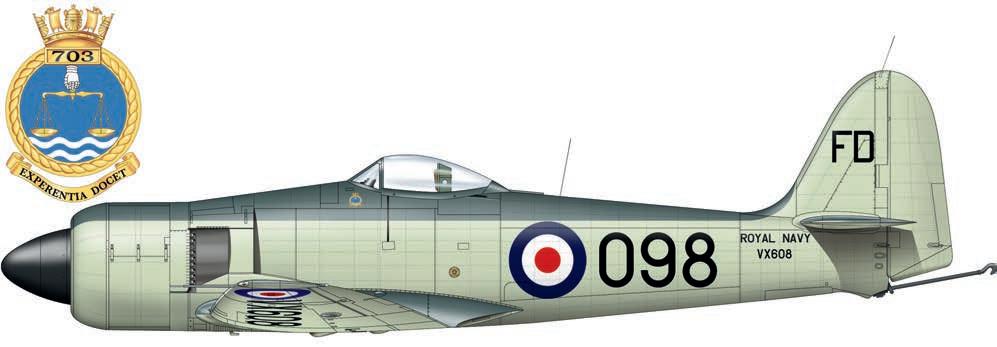
Neither of the Royal Navy’s large post-war aircraft carriers, HMS Ark Royal and HMS Eagle introduced in the 1950s, operated a Sea Fury squadron. However, in December 1951 a lineup of No.703 Squadron aircraft was photographed on the deck of the newly commissioned HMS Eagle. No.703 was the Navy’s Service Trials Unit and operated a mix of types at its base at RNAS Ford. A Sea Fury, Blackburn Firebrand, Firefly, Sea Hornet and a Supermarine Attacker were photographed lined up ready for departure, and it was the Sea Fury flown by Lt Mearns that made the first in-commission take-off from Eagle
The role of No.767 Squadron, which in September 1949 joined the 50th TrAG, was to train Deck Landing Control Officers in readiness to join aircraft carriers. To do this a continuous series of circuits
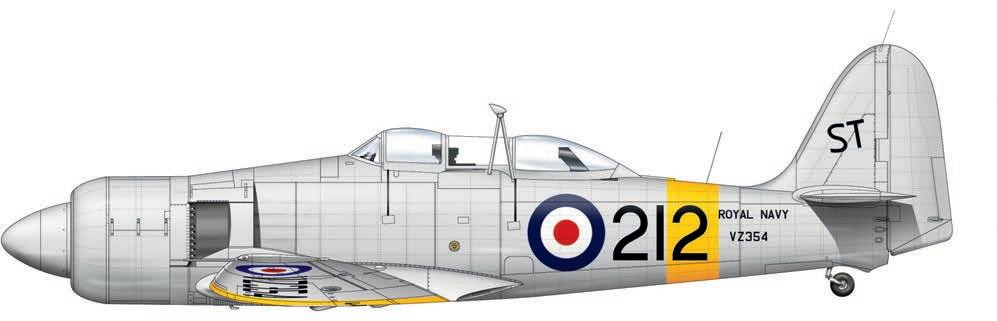
Hawker Sea Fury T.20, VZ354/212-ST, No.1831 Naval Air Squadron, RNVR, Stretton, 1953. Aluminium overall with all lettering in black; roundels in six positions. Yellow bands around rear fuselage and wings. Art by Richard

J. Caruana
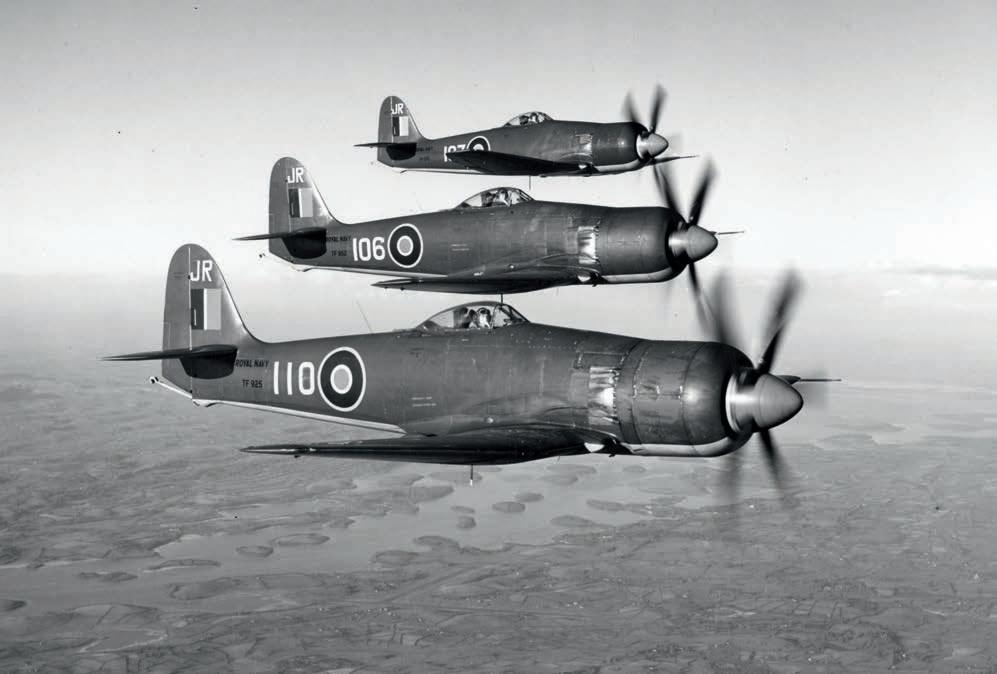
One of the few photographs one sees showing F.Mk.10 and FB.Mk.11 Sea Furies flying together. Here we have three aircraft from Australian 805 Squadron in flight over Loch Erne in Northern Ireland before the unit moved to Australia. Nearest is F.10 TF925 ‘110/JR’, then TF952 ‘106/JR’, and at the back FB.11 VR950 ‘107/JR’. Ray Sturtivant
and landings was performed by the unit’s Sea Furies, Fireflies, Seafires, and later, jets. The practice was usually performed on carriers and, during the period when Sea Fury FB.11s were on strength, these included HMS Illustrious, Vengeance and Triumph. As such it became known as the ‘Clockwork Mouse’ squadron. Also within the 50th TrAG there existed No.799 Squadron at RNAS Yeovilton, Somerset. It was No.799’s duty to conduct refresher flying and from 1951 it was officially known as the Refresher Flying Training Unit. The Royal Naval Volunteer Reserve Air Branch was formed in 1947 and existed
for ten years until abolished as part of the defence cutbacks introduced after the Defence White Paper of 1957. The maximum number of squadrons at any one time over this period was 12 and in all six would eventually operate singleseat Sea Furies whilst another utilised the T.Mk.20. The first RNVR squadron to fully equip with Hawker’s fighter was No.1831 at RNAS Stretton, Cheshire, from August 1951 with an initial establishment of nine FB.11s. By March 1952 No.1832 Squadron based at Culham was receiving the first of nine Sea Fury FB.11s as replacements for their long-lived Seafire F.Mk.17s, becoming
the second RNVR unit to convert. This squadron relocated to RNAS Benson, Oxfordshire in July 1953. However, prior to this, on 1st October 1952 two subsidiary units were formed from No.1832 Squadron, initially as Nos.1832A and 1832B until April 1953 when they were renumbered 1836 and 1835 Squadrons respectively. They also came within the Southern Air Division and the Sea Furies were pooled between these units and their parent No.1832.
The RNVR squadrons normally operated solely from their respective home bases, but for their annual two-week deployment they would detach to ➤
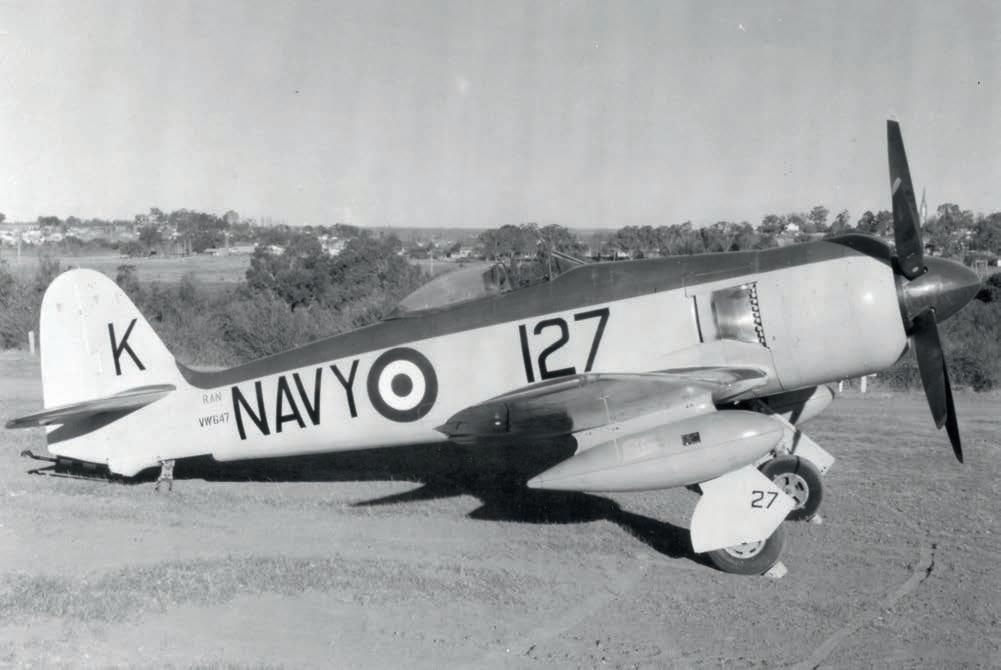
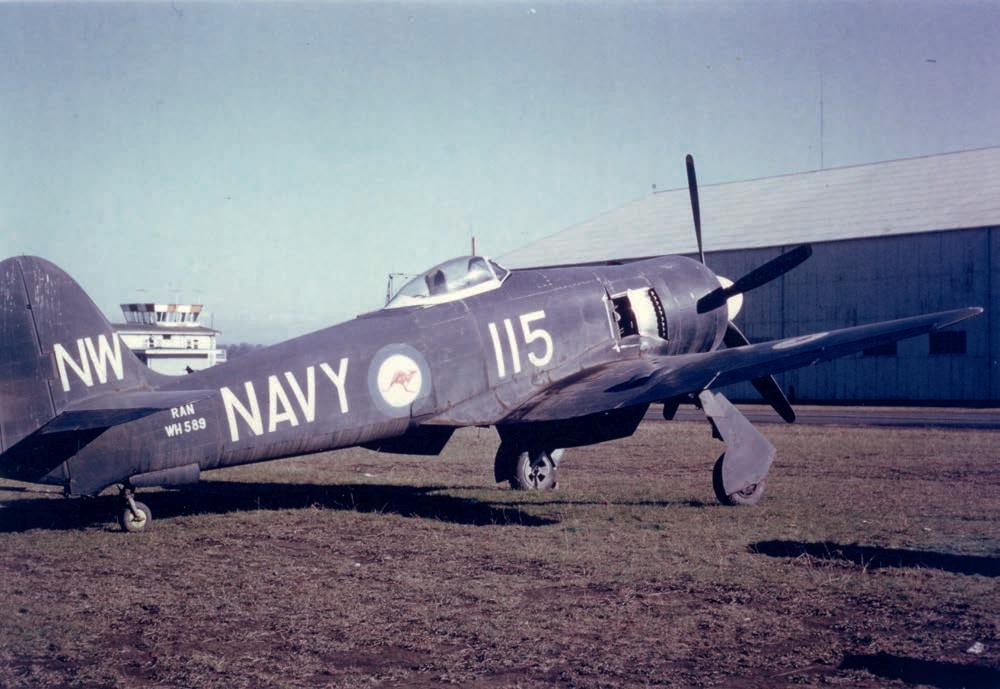
Australian Sea Fury WH589 115/NW in a well-worn dark blue colour scheme. The aircraft had been serving with No. 724 Squadron at
but this image was taken in early 1969 when it was sold after a number of years in storage.
carriers or other airfields. For example, No.1831 undertook deck landing training aboard HMS Illustrious in June and July 1953 and for two weeks in August 1954 deployed to Hal Far, Malta.
On 1st June 1952, following a reorganisation, No.1831 became part of the RNVR’s Northern Air Division, whilst at the same time the Southern Air Division was formed which included No.1832. Later, Nos.1833 and 1834 began to acquire Sea Furies as more became available following the end of the Korean War. Number 1834 Squadron re-formed at Benson on 10th October 1953 within the Southern Air Division receiving Sea Fury FB.11s and T.20s. The squadron’s time at Benson was short as a transfer to Yeovilton occurred in January 1954 where it remained, until disbanded, in May 1955. Number 1833 Squadron based at RNAS Bramcote, Warwickshire was a component of the Midland Air Division (formed on 1st July 1953) and began to receive FB.11s in February 1954.
The single-seat Sea Furies replaced Seafire FR.Mk.47s and supplemented Sea Fury T.20s, first received in 1950. This was the squadron’s last piston-engined fighter; the Sea Fury was replaced by Supermarine’s Attacker from mid-1955. No.1830 Squadron based at RNAS Abbotsinch, Renfrew, was equipped principally with Fireflies and, from 1st June 1952, was part of the Scottish Air Division. Its use of the Sea Fury however was restricted to the T.20 which was used from October 1952 until October 1954. The RNVR retained single-seat Sea Furies until around autumn 1955, whilst a few T.20s lingered on into mid-1956 with 1832 Squadron.
At the end of the Second World War Britain possessed a surplus of light fleet aircraft carriers of the Colossus and Majestic classes, many of which remained incomplete in shipyards or very recently completed. The opportunity existed for several small navies to acquire examples and to operate them with relatively modern
aircraft. Argentina, Brazil, France, India Australia, Canada and the Netherlands all obtained and operated light fleet carriers in addition to the Royal Navy (RN). They were very successful vessels given their modest speed and dimensions, with several surviving in service for decades. The RN, Royal Australian Navy (RAN), Royal Canadian Navy (RCN) and Royal Netherlands Navy (RNethN) all selected the Sea Fury to operate from their respective vessels.
The Sea Furies allocated to the RAN were diverted from RN contracts and assigned to RAN squadrons Nos. 805, 808 and 850. The first to equip was No.805 which, as related, formed as a RAN Sea Fury squadron at Eglinton on 28th August 1948 having previously been an RN FAA unit. Having received their aircraft No.805 commenced a period of training prior to deploying to Australia’s new aircraft carrier HMAS Sydney (the ex-HMS Terrible, named but never commissioned into the RN), for passage to Australia. The ship was completed in 1948 and commissioned on 5th February 1949, following which No.805 joined her on the 8th. HMAS Sydney was initially equipped to accommodate an establishment of 12 Sea Furies, 24 Fireflies and a single Supermarine Sea Otter; quantities very similar to those employed by RN light fleet carriers for peacetime duties. The unit’s Australian land base was RANAS Nowra, Sydney, the RAN’s only Air Station, at which No.805 arrived on 25th May 1949.
Meanwhile, the 20th CAG had been re-established in August 1948 for service aboard Sydney to which No.805 was allocated. The squadron was accompanied, initially, by No.816 RAN with Fireflies but was replaced in mid-1951 by No.808 with Sea Furies, both squadrons then spent the autumn of 1951 and early winter of 1951/52 operating in Korean waters aboard Sydney. Later, in October 1952, No.805 aboard Sydney took part in Operation Hurricane, the testing of the first British atomic bomb in the Monte Bello Islands, approximately
80 miles off the north-west coast of Western Australia, in which a 25KT nuclear device successfully vapourised the frigate HMS Plym. The squadron’s role was to operate as a guard unit flying patrols in the area before returning to Nowra on 11th November.
The remainder of No.805’s Sea Fury era consisted of a mixture of cruises aboard Sydney and time at Nowra, with its last deployment to the ship ending on 30th March 1956, following which the squadron developed an aerobatic display team (see Chapter Five) before disbanding two years later on 26th March 1958.
Number 808 Squadron followed a similar path to No.805 but formed as an RAN unit at St Merryn on 25th April 1950 with 13 Sea Fury FB.11s. It joined Sydney on 29th August as a component of the 21st CAG which had formed on 19th March 1950 for service aboard Sydney and included No.817 Squadron and its complement of Fireflies; they reached Nowra on 6th December. 21st CAG disbanded in June 1951 and No.808 was transferred to the 20th CAG as related earlier. Following duty in Korea the unit alternated between Nowra and Sydney, before boarding the carrier HMAS Vengeance in 1953 on temporary loan (1953 to 1955) to the RAN. No. 808 Squadron was disbanded on 5th October 1954.
The third and final frontline Sea Fury unit was No.850 Squadron which began a brief existence as an RAN squadron at Nowra on 12th January 1953. A cruise on HMAS Vengeance followed later in the year and then another on Sydney from September 1953 until May 1954. This included detachments to Iwakuni, Japan and Kai Tak, Hong Kong, plus time spent patrolling Korean waters monitoring the cease-fire after the end of that conflict. Number 850 disbanded on 3rd August 1954. Number 723 Squadron formed, as a RAN squadron operating FB.11s and several other types of aircraft, at Nowra on 7th April 1952. Its purpose was to supply aircraft for communications, fleet requirements, air-sea rescue and training and additionally, to work with the
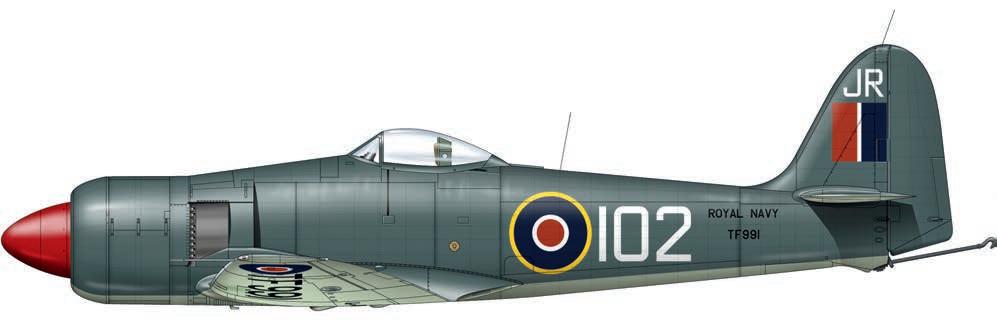
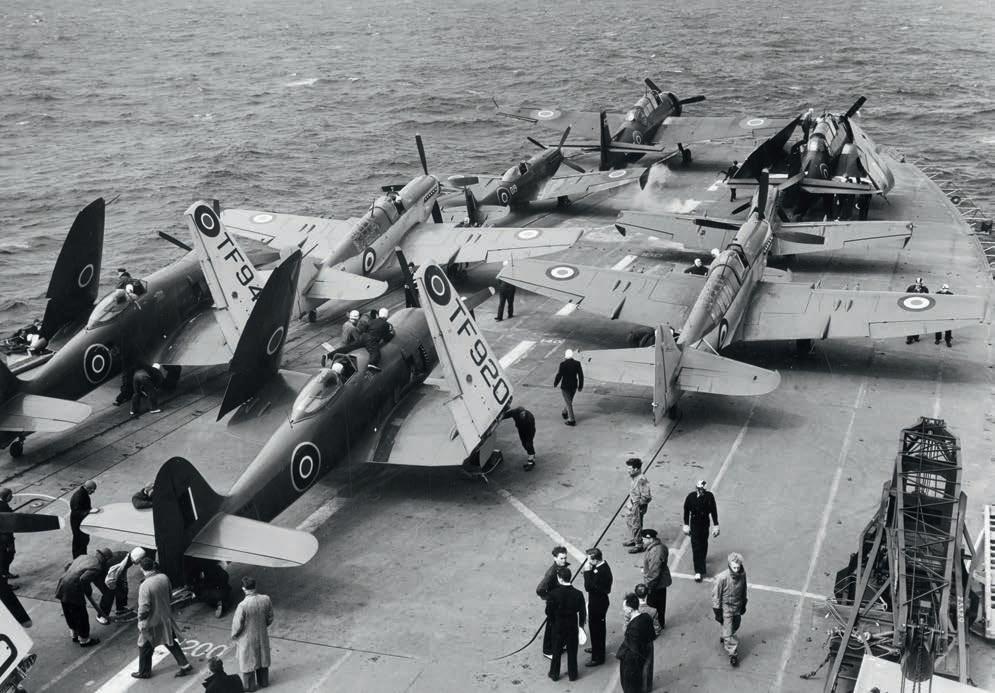
The Royal Canadian Navy’s first aircraft carrier owned outright (rather than loaned) was HMCS Magnificent which completed her first deck landing trials in the English Channel in 1948. At this time most of her crew had moved over from HMS (ex-HMCS) Warrior which had been seconded to the Canadian Navy until Magnificent was completed. This fascinating and very busy photograph was taken after the first aircraft had come aboard and shows, in order of landing - two Grumman Avengers, two Seafire F.Mk.XVIIs, two Firefly FR.Mk.IVs and two Sea Fury F.Xs (F.10s). Ray Sturtivant
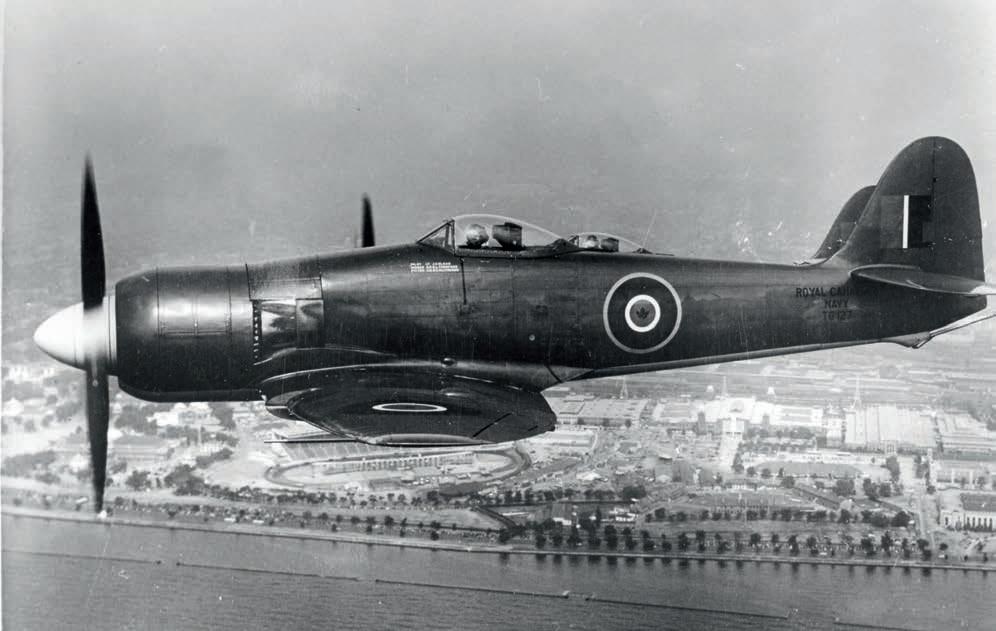
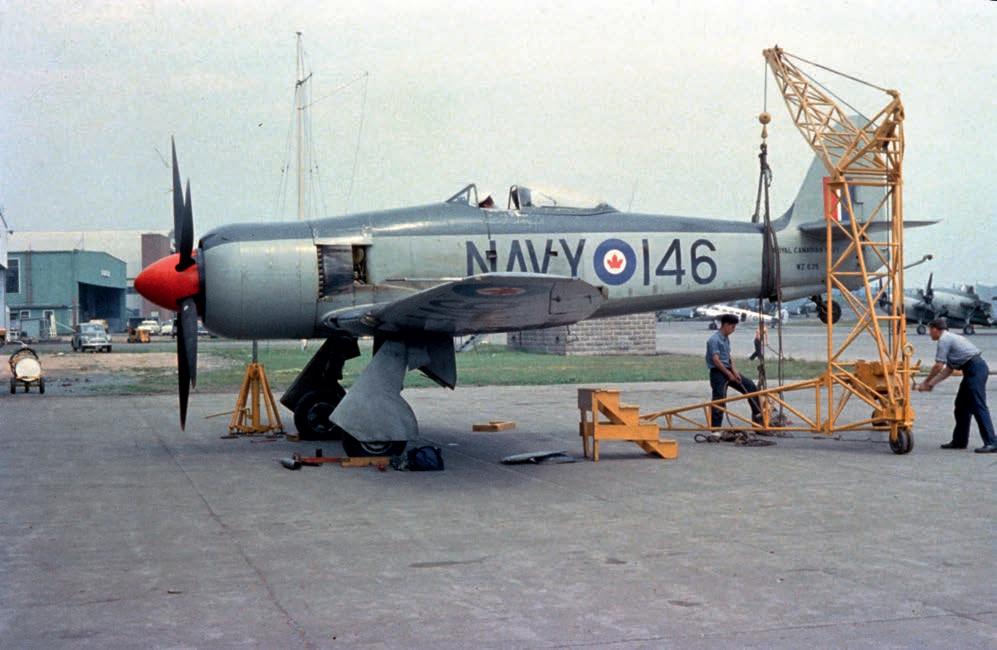
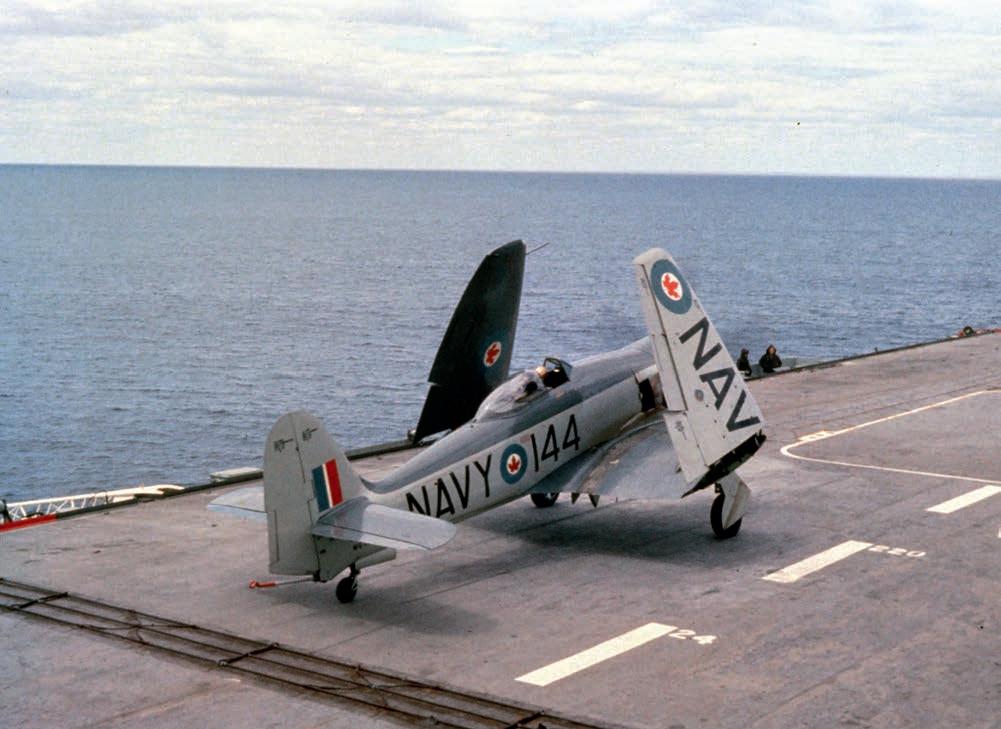
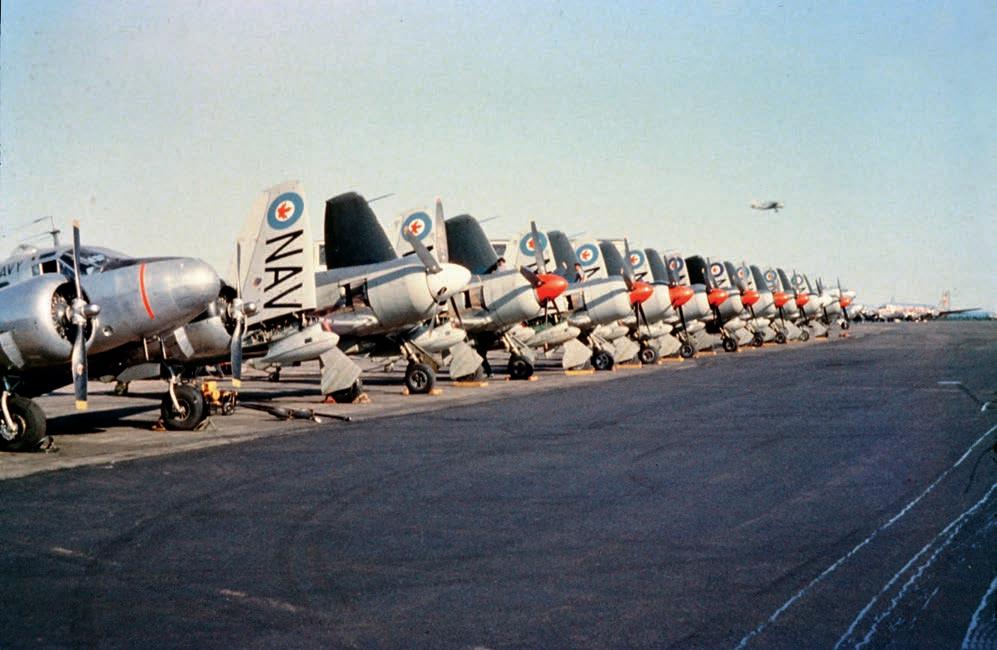
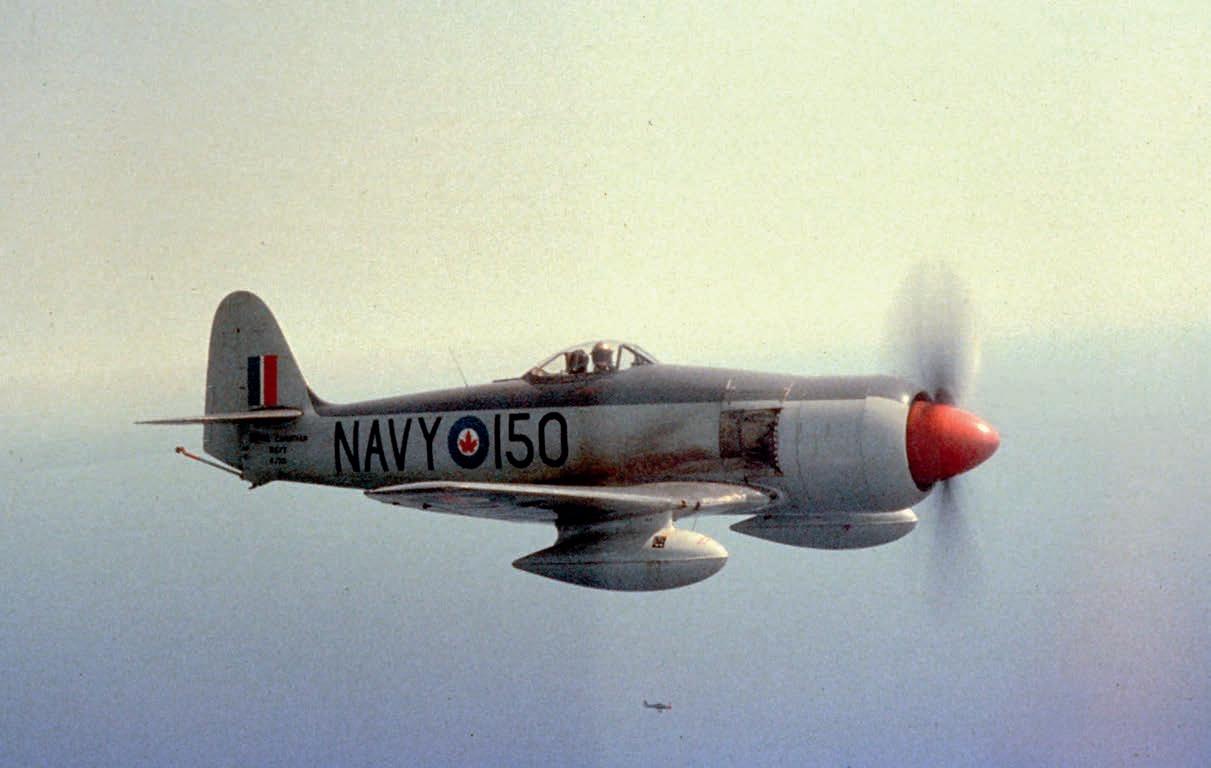
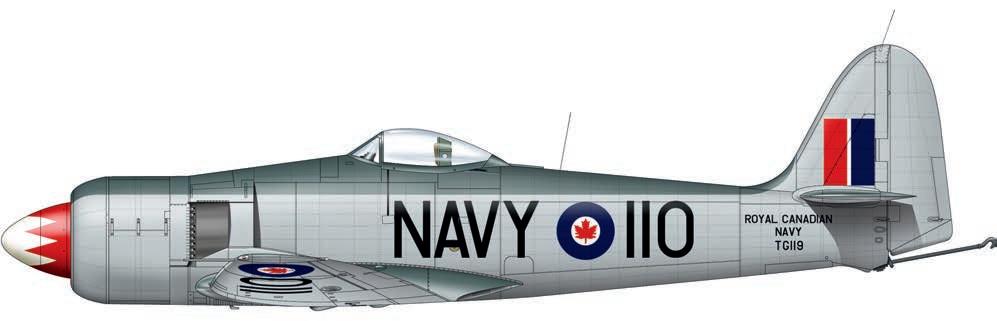
Hawker Sea Fury FB.11, TG119/110, No.871 Squadron, Royal Canadian Navy, 1953. Extra Dark Sea Grey upper surfaces with Light Sea Grey undersides; all lettering in black. Blue/white roundels with red maple leaf in six positions; ‘NAVY’ in black below starboard wing, ‘110’ below port, both reading from leading edge. Red/white spinner. Art by Richard J. Caruana
Australian Joint Anti-Submarine School. The Squadron was disbanded on 25th October 1956. Towards the end of the decade No. 725 Squadron formed at Nowra on 13th January 1958 and also operated Sea Furies for a short period, again supplying aircraft for fleet requirements duties. It relinquished its Sea furies in May 1959. In the meantime, No. 724 operated Sea Furies until as late as October 1962 for fleet requirements, operational training, aircrew conversion, trials, target towing and other second and third line duties. As such it was officially known as a Miscellaneous Air Squadron of the RAN.
Most of the remaining RAN Sea Furies were taken out of service in 1958 to be replaced by de Havilland Sea Venoms, although previously these jets had been withdrawn from squadron service in March 1957 for an extensive programme of modifications to rectify weaknesses in a wing rib. The weakness had been created as a consequence of excessive acceleration loading during steam catapult launches plus the additional weight of ancillary equipment. It was not until the following year that the Sea Venoms returned to service and allowed the Sea Furies to be retired. No.805 Squadron at Nowra reequipped with Sea Venoms in March 1958.
Those Sea Furies acquired by the RAN were serials VW232, VW622 to VW627, VW629 to VW632, VW634 to VW640, VW642 to VW648, VW660, VX627, VX661, VX707, VX724 to VX730, VX748 to VX764, WE673 to WE679, WE791, WE795 to WE797, WE799, WF591 to WF593, WG627, WG628, WG630, WH581, WH583, WH586 to WH590, WJ279, WJ284, WJ297, WJ299, WM479 to WM482, WM490 and WZ642 to WZ653.
Although Australian Sea Furies had seen action over Korea, it was not to be their last taste of ‘combat’. The author is indebted to David Eagles who relates an incident, well known in Australia, that involved Sea Furies and an Auster light communications aircraft.
The incident occurred over Sydney on 30th August 1955 after a private pilot had hired Auster VH-AET for flying practice from the Kingston Smith Flying School
at Bankstown on the south side of the city. The pilot was attempting his second touch-and-go landing when the engine stopped as he throttled back at about 10ft above the touch down point. The aircraft came to a quiet stop in the middle of the strip and the pilot climbed out and hand swung the prop. However, he had left the throttle well open and the hand brake ‘fell off’ when the engine roared into life. The Auster bundled past him and leapt into the air, narrowly missing the control tower. It was well trimmed and slowly orbited the airfield, gaining height and steadily drifting downwind towards the city.
RAN pilot Cdr JRW Groves was flying back to Schofields NAS just north-west of Sydney in an Auster Autocar and was asked to divert towards Bankstown. He met the Auster at 1,500ft in a fairly tight orbit and confirmed that there was no-one on board, after which he continued to track it. The RAAF was alerted and launched a Commonwealth Wirraway (a two-seat training aircraft) from nearby Richmond Airbase with orders to shoot the Auster down when it was in that part of its orbit which took it over the sea and five miles from land. In the back of the Wirraway was Squadron Leader Tom Janes with a handheld Bren gun. However, the Auster didn’t reach a point in its orbit that was five miles from land until it had reached an altitude of 10,300ft. For this operation the Wirraway had had its rear canopy and fairing removed before take-off and Janes was now so cold that his hands were sticking to the Bren gun and he was unable to insert the magazine. Meanwhile, an RAAF Gloster Meteor had arrived from a more distant airbase and the Wirraway broke off and left the scene. However, both (sic) of the Meteor’s guns jammed on its first pass after just a few rounds had been fired.
Two more Meteors were readied for take-off while the first one attempted to blow the Auster off its orbit with slipstream, but to no avail. Then two Sea Furies arrived from Nowra flown by Lt Bob Bluett and Lt Peter McNay, both of whom were on loan from the RN. McNay lowered flap
and, after confirming again that the Auster was unoccupied, gave it a short burst from astern. Bluett followed up with a beam attack and the Auster burst into flames and spiralled into the sea. The Furies involved were VW645 and WZ650. After return to Nowra Bluett’s aircraft (VW645) was decorated with a small Auster silhouette and he was given a gaudy-ribboned ‘AusterAlien Medal’!
Towards the end of 1945 the Royal Canadian Navy (RCN) formed its own air arm. Among the aircraft acquired was the Sea Fury FB.Mk.11 of which 35 were initially obtained from FAA production. Ignoring temporarily No.803’s use of the Sea Fury F.Mk.10 in the UK, the first Canadian Sea Fury, an FB.Mk.11 to be officially accepted on Canadian soil was at RCAF Rockliffe, Ontario, on 23rd June 1948. The last example was received in 1951 and the squadrons selected to operate the Sea Fury were Nos. 803 and 883. Number 803 Squadron had re-formed in June 1945 and transferred to RCN control on 24th January 1946 equipped with Seafires F.Mk.XVs for service aboard the light fleet carrier HMCS Warrior, loaned to Canada from 1946 to 1948, until HMCS Magnificent (a light fleet carrier fully altered to meet Canadian requirements) was commissioned. The squadron joined the 19th CAG following its formation in May 1947 then, three months later, reequipped with Sea Fury F.Mk.10s in August at Eglinton.
No.883 Squadron, having formed in 1945 and disbanded as an RCN unit in 1946 due to a lack of manpower, re-formed as a RCN unit on 15th May 1947 at Dartmouth, Nova Scotia with Seafire F.Mk.XVs as a component of the 18th CAG. In September 1948 No.883 was re-equipped with eight Sea Fury FB.11s and then transferred soon afterwards to the 19th CAG, which was thus comprised entirely of Sea Furies. On land both squadrons shared the former RCAF airfield at Dartmouth which, on 1st December 1948, was renamed RCNAS Shearwater.
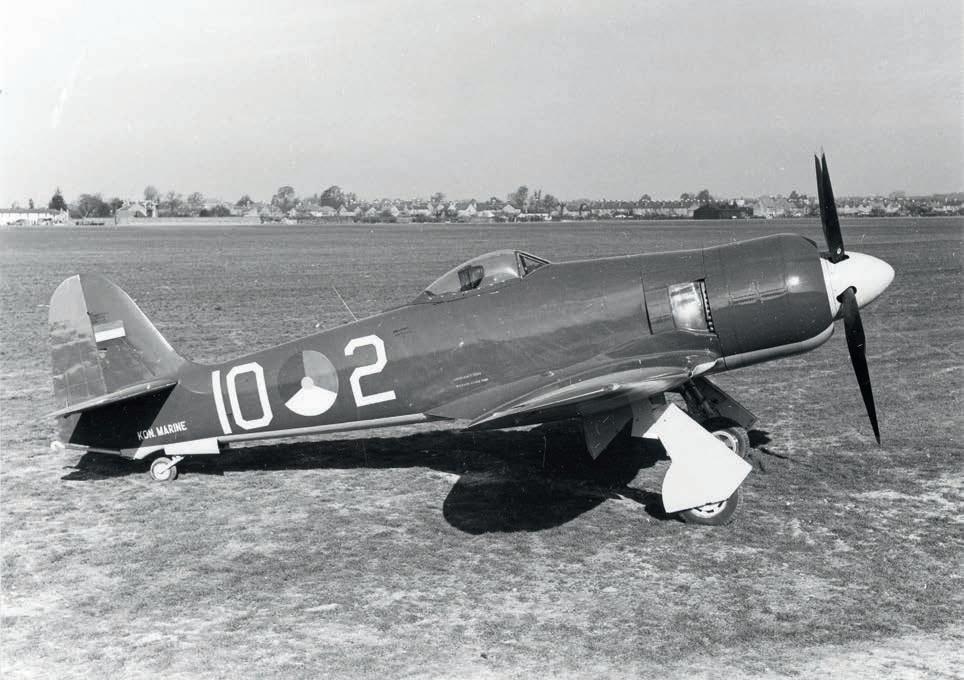
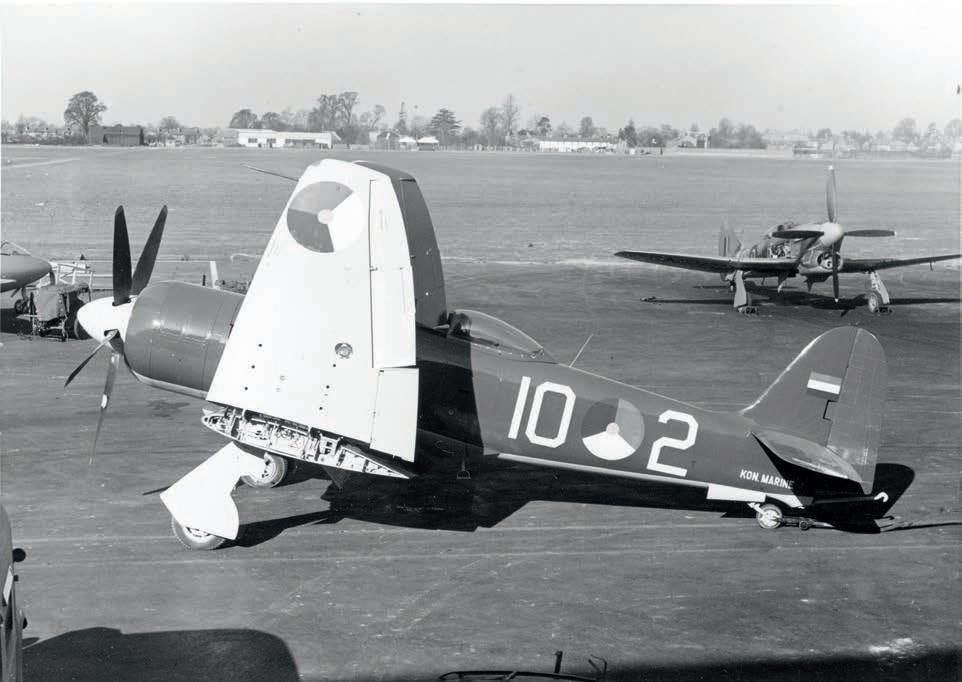
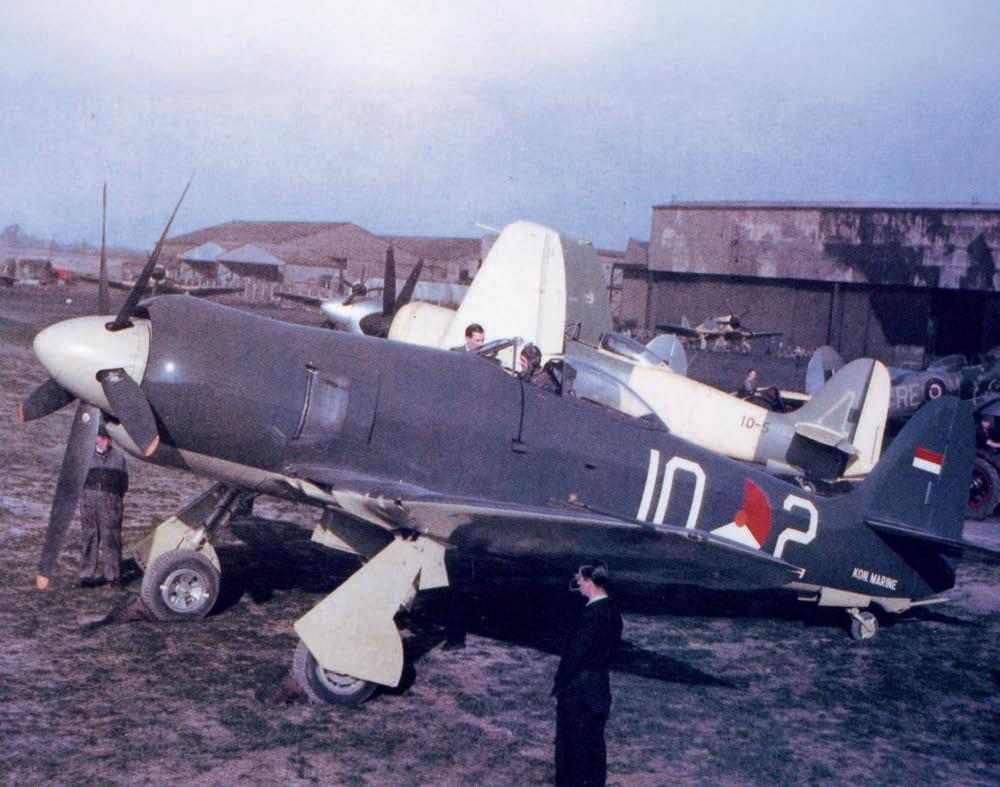
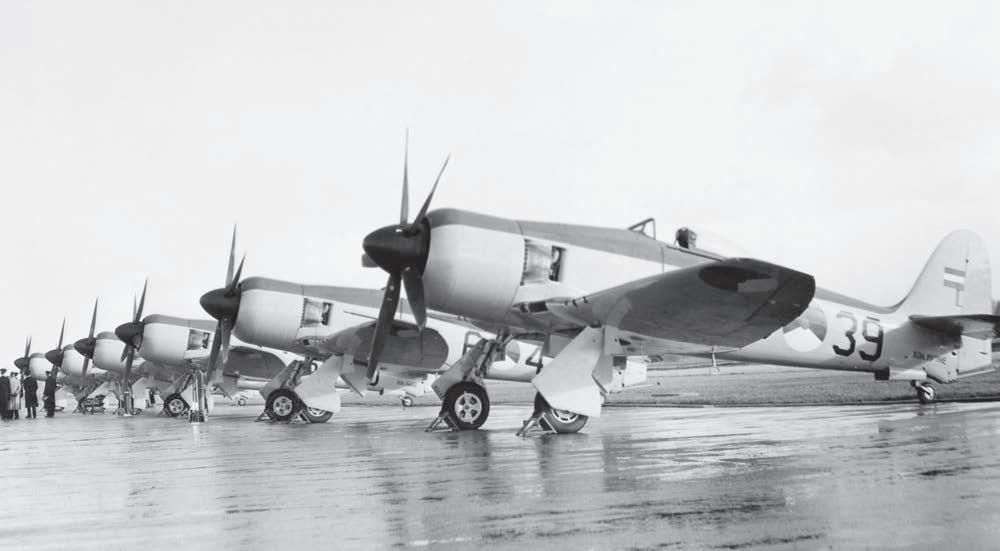
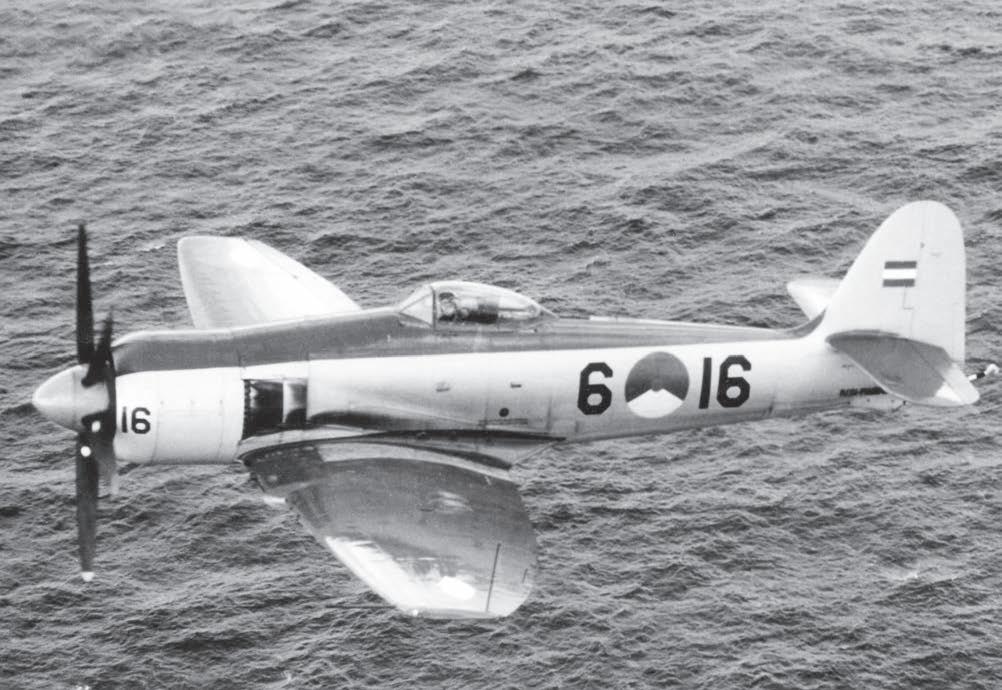
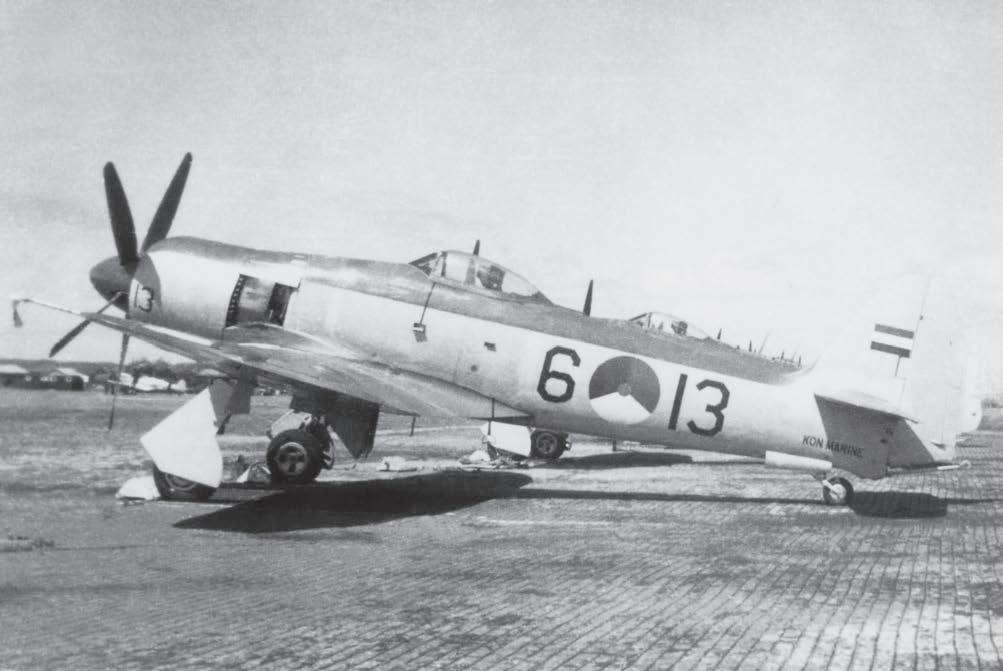
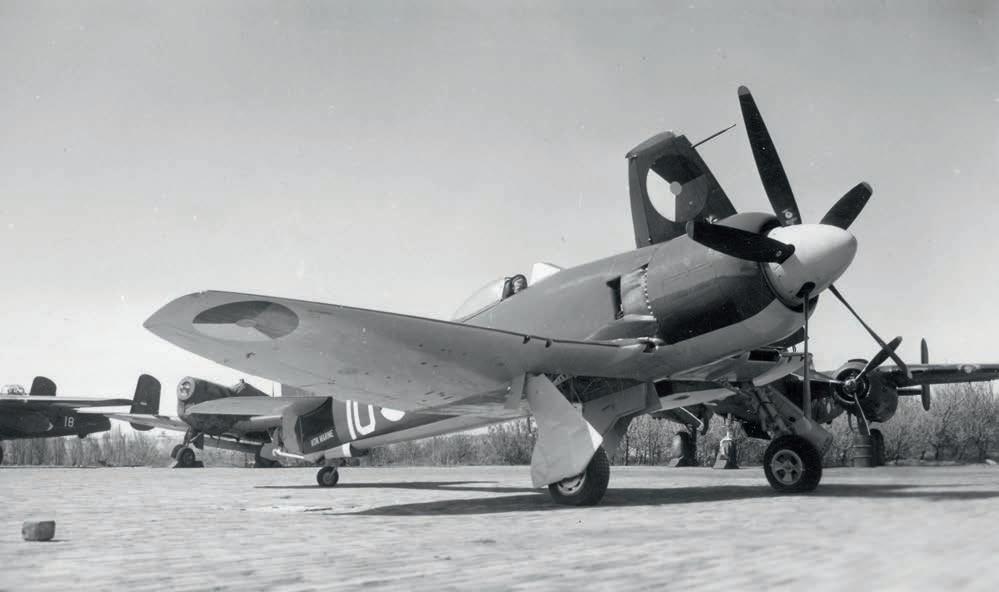
A view of Dutch Sea Fury 10-2, again at Langley and with, unusually, just the one wing folded up.
No details are available on the rear of this photo print to explain what is on view, but it appears that 10-7 is on display at a public event.
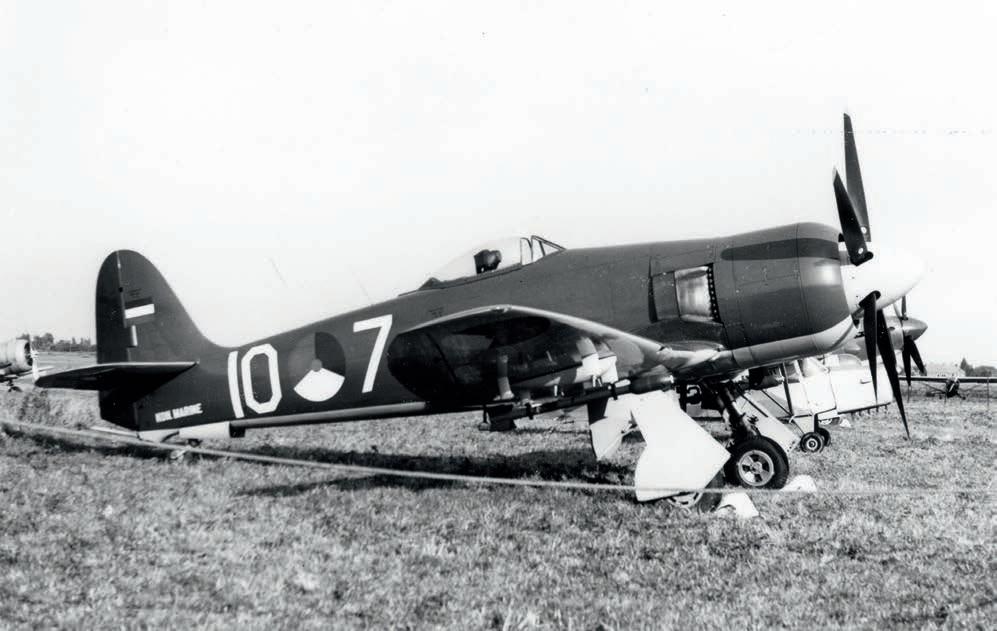
As with the Australians, Sea Furies for Canadian use were supplied to RNAS Eglinton in Northern Ireland to allow No.803’s air and ground crews to convert to, and work up to, a reasonable flying and maintenance standard in readiness to board their ship. In August 1947 thirteen F.10s were loaned to 803 at Eglinton for this
purpose and for trials, but they were never officially taken on charge and did not carry Canadian markings. However, two F.10s did find their way to Canada to carry out cold weather trials, TF901 being replaced by TF909 after the former had been lost.
FB.11s started to arrive at Eglinton in late May 1948. HMCS Magnificent was
commissioned on 21st March 1948 and subsequently conveyed Sea Furies across the Atlantic; the number embarked being sufficient to supply both Nos. 803 and 883 squadrons. They reached Canada in early June where the training continued, including a period at Quonset Point, Rhode Island, a US Naval base, to ➤
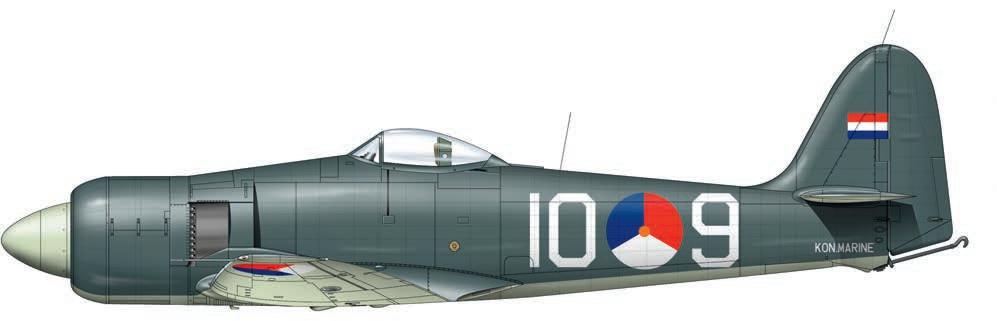
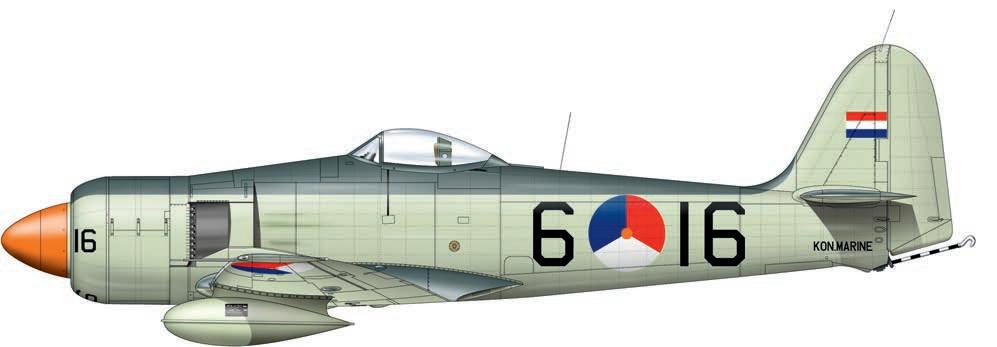
practice carrier landings. However, US Navy methods did not necessarily suit the Sea Fury in which tail-down landings was the preferred method of recovering onto an aircraft carrier’s deck – the US Navy method was to touch down on main wheels only; causing the British aircraft to frequently bounce over the arrestor wires.
On 1st May 1951, Nos.803 and 883 were renumbered 870 and 871 Squadron respectively to fit into a unified sequence of numbering in which RCN squadrons were allocated sequential numbers. No.870 Squadron was equipped with nine FB.11s when it formed and joined the 31st Support Air Group, (previously the 19th SAG and prior to that the 19th CAG), accompanied by the Firefly AS.Mk.5s of No.880 Squadron. No.871 Squadron formed with 10 FB.11s and joined the 30th Carrier Air Group in company with the Avenger TBM3Es of No.881 Squadron. Both Sea Fury squadrons served aboard the Magnificent in their respective groups as required. In 1952 RCN squadrons were redesignated and adopted a US Navy format; No.870 became V(fixed-wing) F(fighter) -870, while No.871 became VF-871.
Although RCN destroyers participated in the Korean War the Magnificent and her Sea Furies did not, principally because
the nation’s government had declared that the vessel’s primary role was to provide convoy and ship protection against air, surface and submarine threats. Canadian FB.11s however could still carry the same range of weaponry as its FAA counterparts, which meant that ground-attack duties would have been possible if required, but close air support duties for the Army were considered to be secondary missions. It is understood however, that when the ceasefire was signed in July 1953 to bring a close to hostilities, VF-871 was being prepared for a tour in Korean waters. Had the fighting carried on then it seems this unit would have gone to war aboard the Royal Navy carrier HMS Warrior.
Consequently, Canadian Sea Furies never fired their guns in anger and their career generally involved training and exercises, but not always close to home. In June 1952 for example, Magnificent and her aircraft participated in Exercise Castanets in European waters prior to entering the Mediterranean. This was followed in September by Operation Main Brace in the North Atlantic where the Sea Furies worked as an air group with aircraft from HMS Theseus. Their job was to provide combat air patrols, to serve as fighter escorts and to search for ‘enemy’ submarines. In February
1953, while ashore at Dartmouth, VF-871’s aircraft took part in the close air support exercise Operation Assiniboine. In June Magnificent formed part of the assembly of warships gathered at Spithead for the Coronation Review during which VF-871’s aircraft took their place in the flypast. This was later followed by the very large NATO Exercise Mariner in which Magnificent’s Sea Furies performed anti-submarine sorties and long-range combat air patrols.
This was the last major exercise to involve the RCN’s Sea Furies and on 30th March 1954, having just completed its final cruise on Magnificent, VF-870 was disbanded in readiness to reform on newly acquired American McDonnell F2H-3 Banshee jet fighter. The same type replaced VF-871’s aircraft in August 1956; their last Sea Fury cruise aboard Magnificent occurred between September and December 1955. The RCN’s fixed-wing training unit, VT-40, also operated a few Sea Furies and the last official flight of an RCN Sea Fury took place on 3rd April 1957 when WG565 was ferried to VG-924, a Reserve Air Squadron based at Calgary.
The Sea Furies eventually supplied to Canada were TF985, TF992 to TF999, TG113 to TG129, VR918, VR919, VW225, VW227, VW230, VW231, VW239, VW552, VW563,
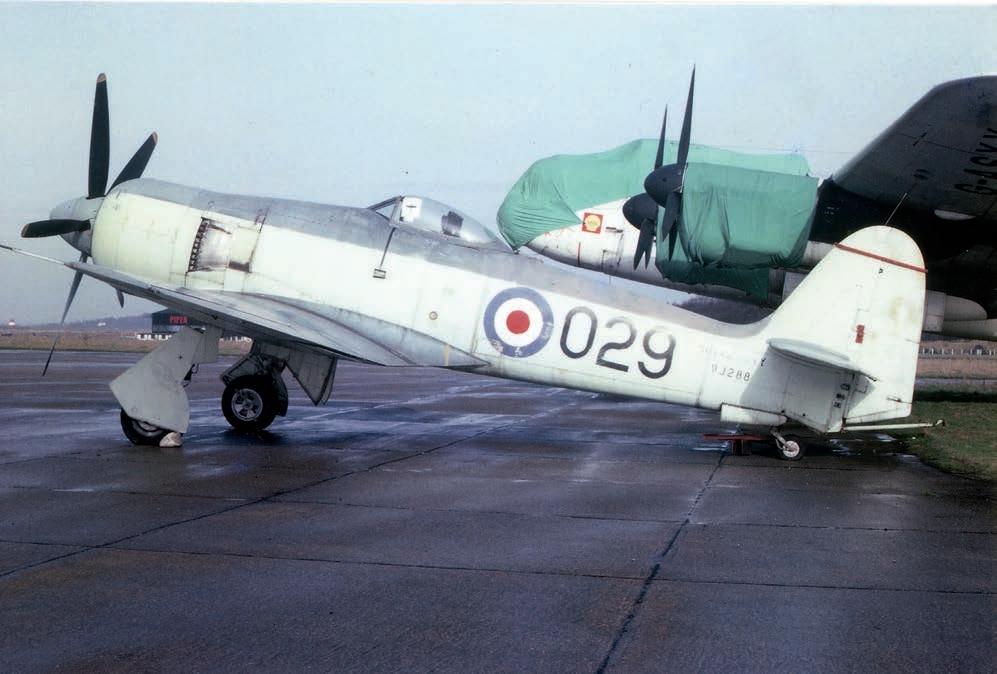
VW571, VW584, VX675, VX682, VX686, VX688, VX690, VX692, VX695, WG564, WG575, WJ300, WJ301, WM472 to WM478 and WZ633 to WZ641, sixty-four in all. Until mid-1950 Avro Canada at Malton, Ontario, was responsible for the repair and overhaul of RCN Sea Furies, following which the task passed to Fairey Aviation of Canada Ltd.
From 1946 the Royal Netherlands Navy (RNethN) operated the former Royal Navy escort carrier HMS Nairana, (renamed HrMs Karel Doorman) until April 1948. This
was replaced by the ex-RN light fleet carrier HMS Venerable, which was also named HrMs Karel Doorman. The first Sea Furies acquired by the Royal Netherlands Naval Air Service (the Marine Luchtvaartdienst or MLD) were ordered on 21st October 1946. They were designated F.Mk.50, an export version of the F.Mk.10 fitted with a different radio and other equipment specified by the Dutch. The aircraft were given serials 10-1 to 10-10 and were delivered from the Hawker factory during April and May 1948 (one Hawker document refers to this version as the Mk.51).
During 1951 these aircraft (less 10-1, which had by then crashed) were
upgraded to fighter-bomber standard and redesignated FB.60s. The first aircraft was allocated to the Opleiding Gevechtsvlieger or OGV (the Fighter Pilots School) and briefly to No.4 Squadron RNethN.
On 22nd June 1948 a further twelve FB.11s were ordered and supplied from Hawker’s production line, then manufacturing examples in the ‘VX’ sequence of British serials. They were diverted from a Royal Navy order and delivered directly from Hawker to the Dutch as FB.60s between May and July 1950 as 10-11 to 10-22; they were never issued to the RN. In the meantime, a license agreement had been arranged with
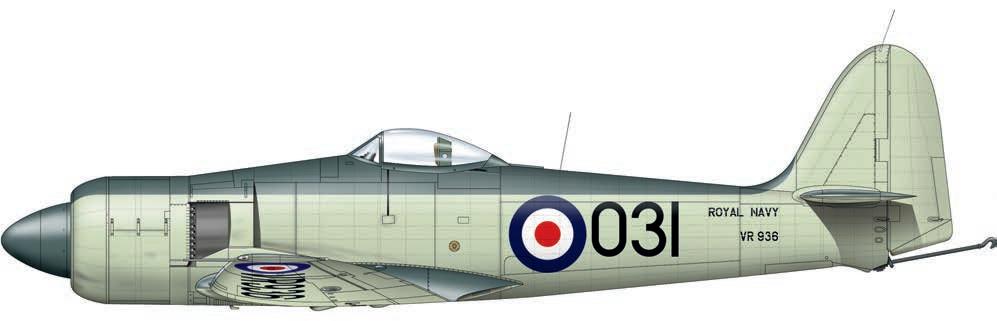
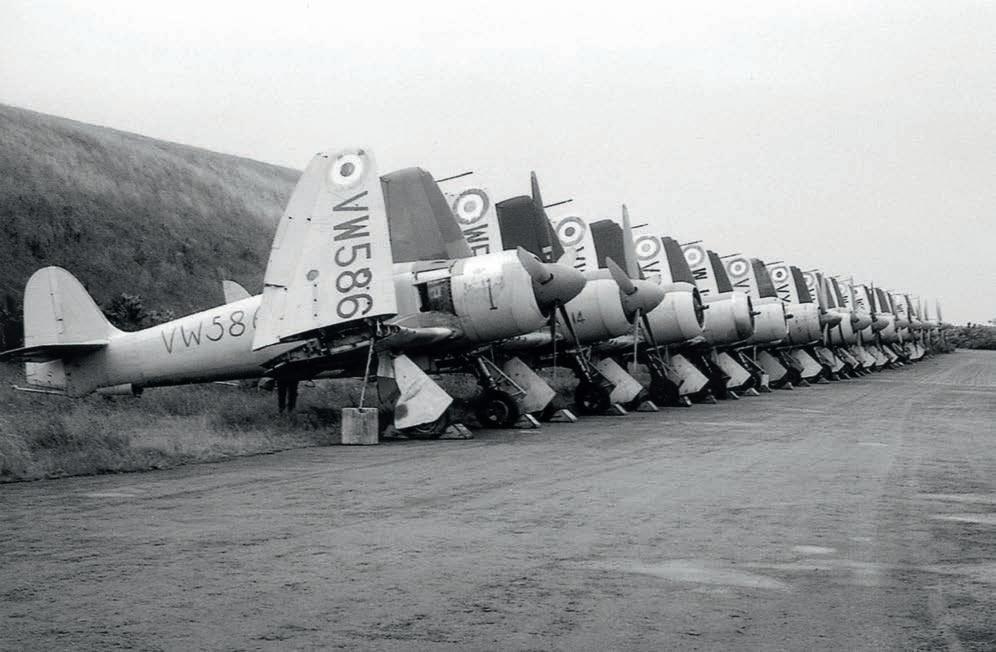
line
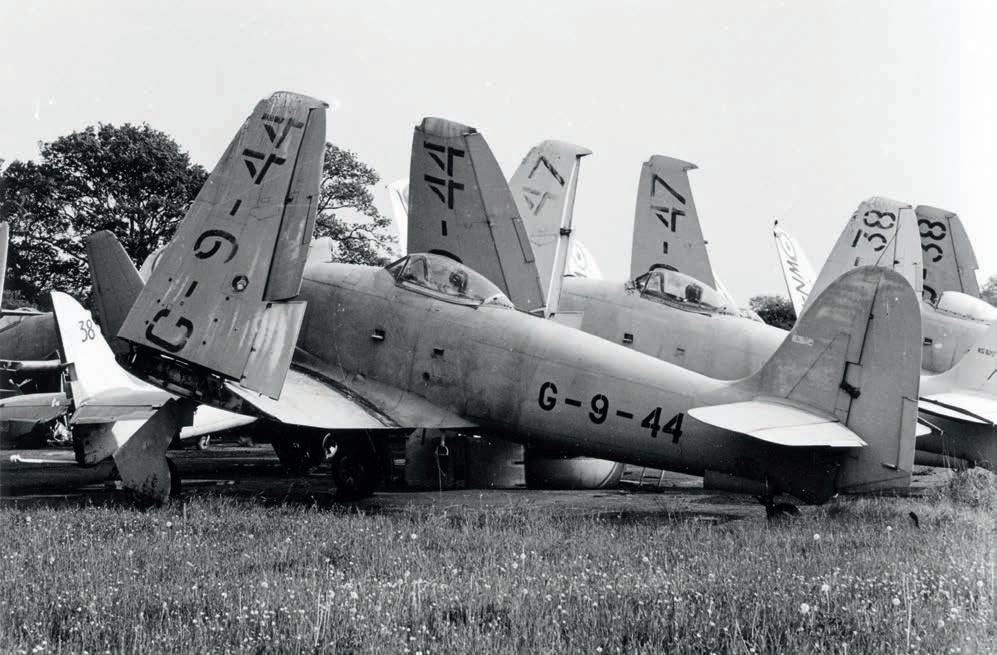
After their retirement by the Fleet Air Arm many Sea Furies were bought back by Hawker Aircraft to satisfy the potential for substantial overseas sales. A good number were given numbers in the ‘G-9’ series to indicate their company ownership and a selection can be seen here at Dunsfold in 1961. However, by this time these survivors were being used for spares, the sales of G-9-45 (WZ632) and G-9-59 (WX655) having been blocked some time previously.
the Fokker Company in Holland to build Sea Furies on a production basis, which resulted in a further 25 FB.60s being supplied. These were given the serials 6-23 to 6-47, the original aircraft having been renumbered 6-2 to 6-22, and 6-23 made its first flight on 15th April 1951. It remains a possibility that 6-23 and 6-24 might have been built from components supplied by Hawker. Deliveries to the MLD were completed between July 1951 and February 1952 and for a short period the first four were briefly used by No.4 Squadron.
Dutch Sea Fury serial numbers were later to be amended once more, whereby the numeral ‘6’ was replaced by the letter ‘J’, thus 6-2 became J-2 and 6-14 became J-14, etc. The reason for this, and earlier changes, was that the original number ‘10’ had represented the letter ‘J’, the tenth letter of the alphabet which itself represented Jachtvliegtuig, or ‘Fighter’ in Dutch. The later use of ‘6’ related to the letter ‘F’, the sixth letter of the alphabet which in this case represented the English word ‘Fighter’. The switch to ‘J’ meant a return to Jachtvliegtuig once again.
The principle front-line squadron, Number 860, re-formed as a fighter unit at Valkenburg in the Netherlands with Sea Furies on 15th July 1950, having previously operated Firefly Mk.1s in the Dutch East Indies. No.860 Squadron had originally formed as a Dutch-manned FAA unit in 1943 and had transferred to RNethN control in July 1946 having retained its FAA sequence squadron number. The squadron boarded HrMs Karel Doorman for a short cruise in late 1950 with a complement of eight Sea Furies, plus 13 Fireflies from an accompanying squadron, and a Sea Otter. It was during this short voyage to Malta and back they briefly met the USS Coral Sea, complete with its complement of almost 130 aircraft!
For much of 1951, as it worked up to full capability, No.860 Squadron operated from
St Merryn and this included detachments aboard the carriers HMS Illustrious and Indomitable for training. The unit finally returned to Valkenburg on 4th December 1951 which became its principle land base from that point onwards. Regular visits and several cruises were made aboard Karel Doorman plus another in September 1952 on Illustrious. Two Dutch Sea Fury pilots also flew with No.807 Squadron during the Korean War while four FAA aircrew were loaned to the Dutch squadron, temporarily short of pilots, to ensure enough were available for the unit to participate in a NATO exercise. The RNethN often worked closely with the RN and FAA, which meant that Sea Furies from either air arm could, at times, be seen at each other’s airfields or aboard their respective aircraft carriers. No.860 Squadron was finally disbanded on 15th June 1956 prior to receiving Sea Hawks. The unit’s aircraft were passed to the MLD’s No.3 Squadron, which was in principle an operational training unit, and they remained there until the Sea Fury was finally retired from MLD service in 1957. In the meantime, a large number of surplus RN Sea Furies had been bought back by Hawker and many, after refurbishment and reconditioning, were sold to Burma and Cuba. Some however, were never sold on for active duty but were acquired during the 1960s by a Fire School in Holland for fire-fighting practice. These stayed firmly on the ground until their demise.
The Fleet Requirements Unit or FRU based at Hurn Airport near Bournemouth was unusual because, despite being equipped with standard naval aircraft, it was operated by a civilian company – Airwork Services Ltd. The firm operated under contract to the Admiralty and its aircraft were flown by civilian pilots. The first Sea Furies to join Airwork (VX638, VX642, VX663 and WN474) arrived in October 1955, a move
that extended the type’s career by several years and resulted in many airframes ending their service lives at Hurn.
The FRU’s task was to supply aircraft to provide radar calibration and targettowing facilities for warships operating in home waters. New or re-commissioned vessels undergoing work-up and acceptance trials have always required crew training for gunnery tracking, radar and radio calibration, and facilities for simulated air attack training. Second World War experience had shown that training ships against air attack was absolutely vital but the problem was finding the aircraft and aircrew to do it. At the start the FRU was run by the Navy, but eventually it passed to civilian operation.
In late spring 1962 Airwork had a complement of twelve pilots to fly 14 Sea Hawks, six Gloster Meteors and three surviving Sea Furies. The latter (TF956, WJ226 and WJ231) remained until the early summer and were withdrawn soon afterwards. By this time the only Sea Furies still extant in Britain were twenty-six FB.11s held in store at RNAS Lossiemouth, a F.10 that was still employed as an instructional airframe at Arbroath and a further selection in store at Hawker Aircraft’s Dunsfold facility in Surrey.
Many were still flying abroad, including those in the hands of the German civil company Deutsche Luftfahrt Beratungsdienst and used for target towing. Following the end of the Korean War several war-scarred, worn and battered Sea Furies had been brought back to the UK and held at the naval storage units at Abbotsinch, Anthorn in Cumberland and at Donibristle, in Fifeshire. In 1957 most came up for disposal and some were scrapped, others as noted were bought back by their manufacturer for refurbishment and re-sale abroad, but some found further FAA employment as ground instruction airframes at various Naval Air Stations. ■
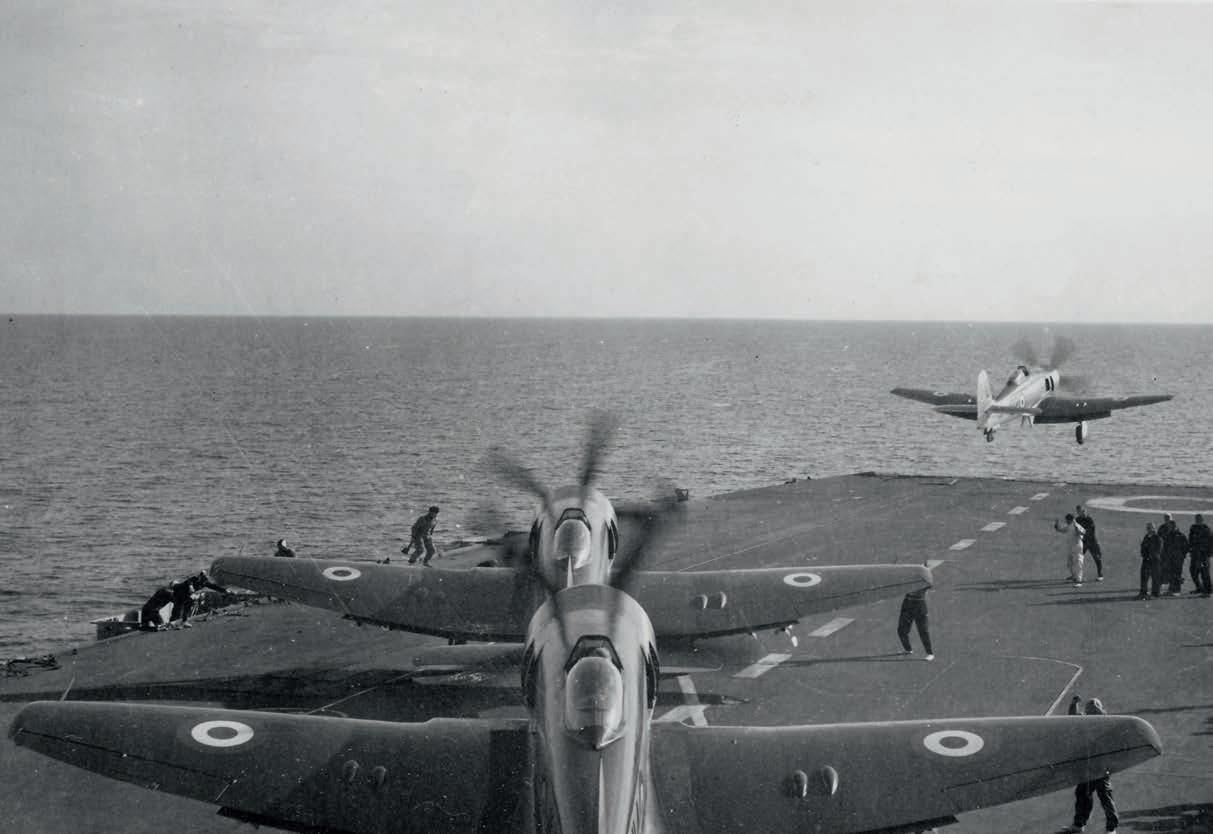
The ashpoint that triggered the Korean War was the invasion of the southern Republic of Korea by the forces of the communist Democratic People’s Republic of Korea from the north, launched without warning on 25th June 1950. At the end of the Second World War Japanese forces occupied Korea, but they were quickly disarmed by American forces south of a
dividing line termed the 38th parallel and by Soviet Union forces to the north. It had been intended that the two Koreas would soon unify; they didn’t, and in due course developed into separate regimes.
Both argued that they were the rightful government of Korea as a whole; border clashes commenced which ultimately resulted in full-scale conflict, a conflict for which South Korea was ill-prepared. The United Nations condemned the invasion,
and it was under their auspices that naval and air forces were sent to the area to support the south’s forces. American presence in the area was reinforced and support from other UN nations requested, under a UN Charter. Warships, air and ground support arrived from several nations including Australia, Canada, France, the Netherlands, New Zealand, Turkey and the UK. Eventually the North Koreans were forced back. ➤
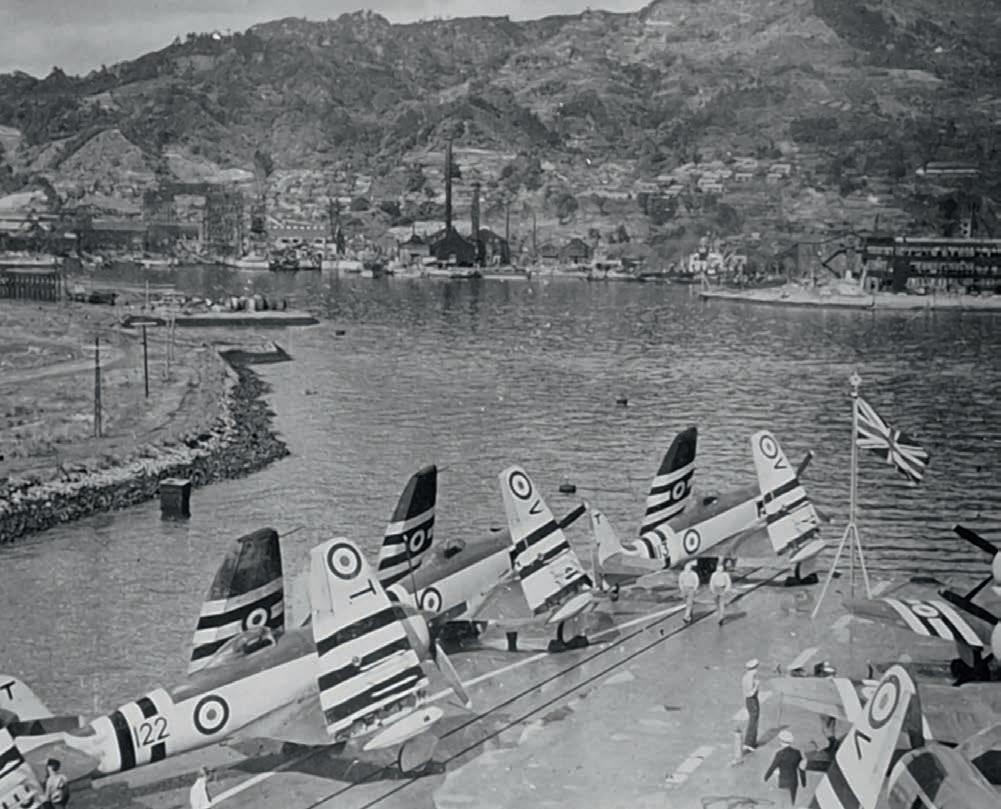
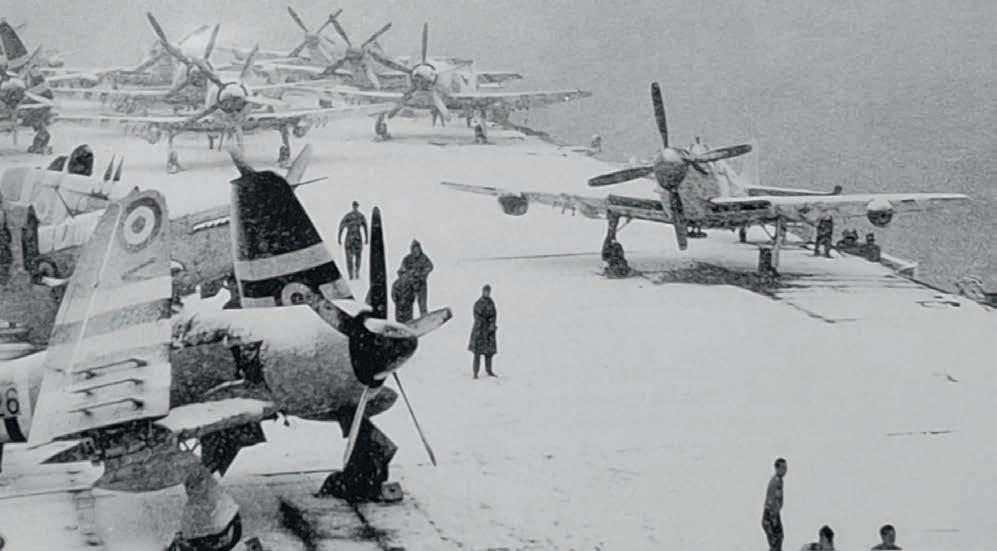
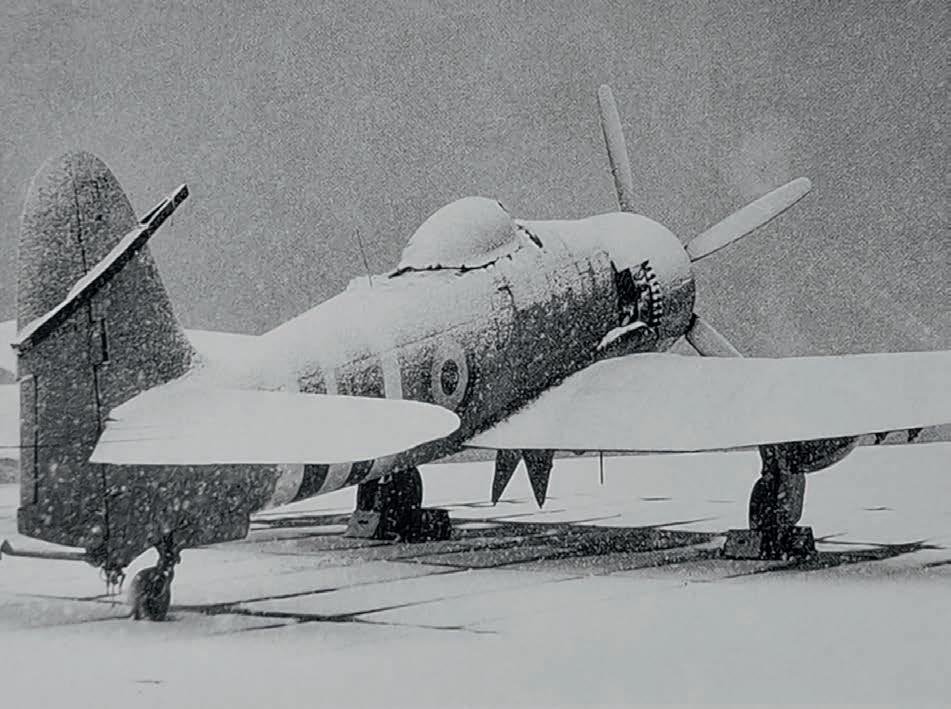
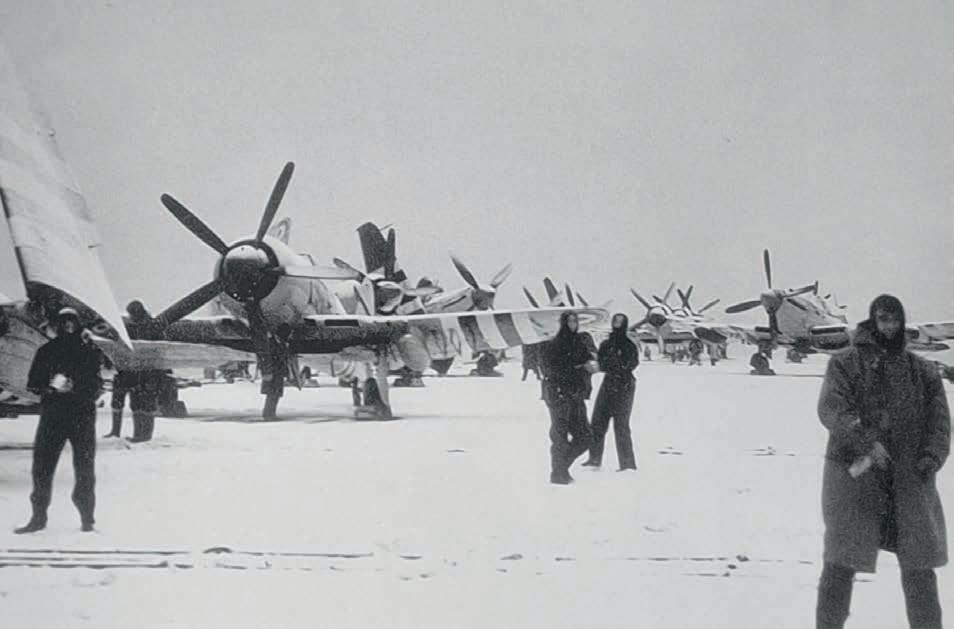
The first Royal Navy carrier to enter the fray, in early July, was HMS Triumph with 12 Supermarine Seafire F/FR.Mk.47s and 12 Fairey Firefly FR.Mk.1s; she remained on duty until the end of September, by which time only three Seafires and eight Fireflies remained serviceable, in spite of replacements received via HMS Unicorn Her replacement was HMS Theseus with 23 Sea Fury FB.MK.11s of No.807 Squadron and (approximately) 12 Firefly 5s of No.810 Squadron.
Although the Seafire F.47 was known to be a better interceptor than its replacement, the Sea Fury was far more reliable, robust
and offered greater offensive options and range than the Seafire, particularly at low to medium altitude. The Sea Fury also possessed the additional benefit of a radial powerplant, much less vulnerable to small arms fire than liquid-cooled piston engines, as North American F-51D Mustang pilots could testify (indeed in late 1950, USAF pilots flying ground-attack sorties in Korea, had requested, unsuccessfully, that they be re-equipped with Republic F-47 Thunderbolts). The FB.11 was also well suited to conducting Combat Air Patrols and, although the experience of air attack against UN vessels at sea was very rare – it did happen.
North Korea possessed an air force at the onset of war which consisted of approximately 65 fighters (Yakovlev Yak-9s, Lavochkin La-7s and La-11s) and perhaps 60 ground-attack Ilyushin Il-2s and Il-10s, many of which were quickly dealt with by the USAF. However, on 23rd August 1950 two North Korean Il-2s or Il-10s, armed with bombs, attacked and hit the destroyer HMS Comus whilst 85 miles out to sea, holing the ship and necessitating her return to Japan for repair. On 17th September 1950 a bomb-carrying Yak-9 accompanied by an Il-10 attacked and hit the US cruiser Rochester, then raked the cruiser HMS Jamaica before the Il-10 was shot ➤
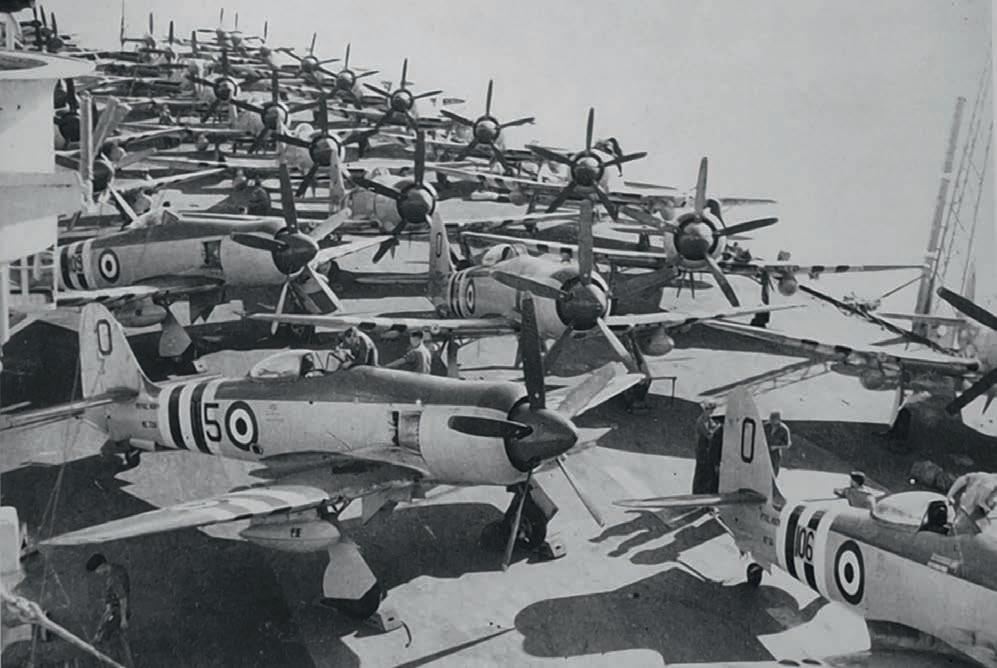
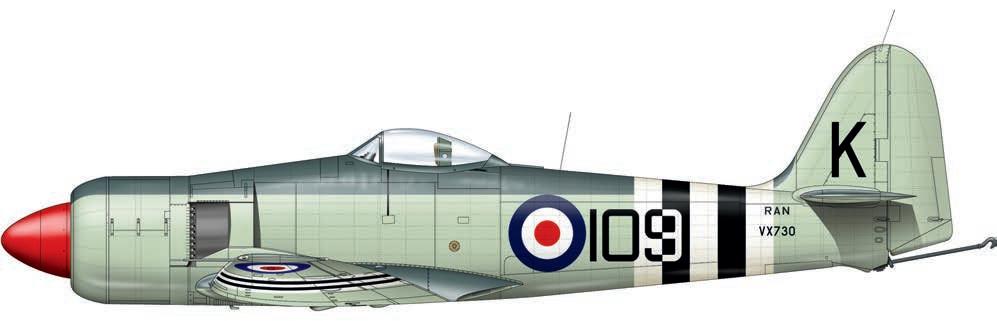
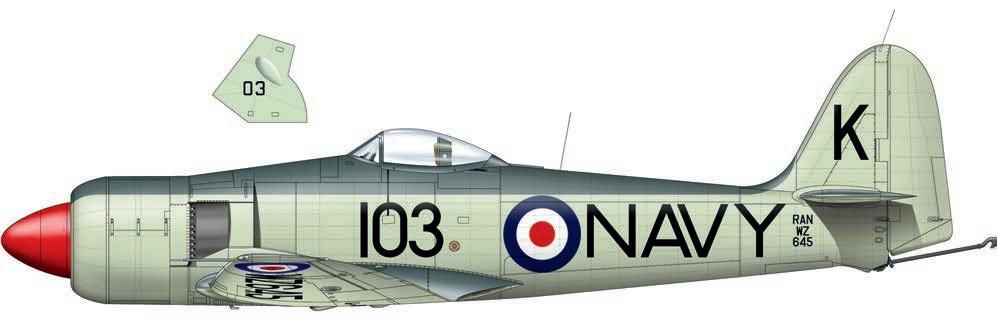
Hawker Sea Fury FB.11, WZ645/103-K, No.805 Squadron Royal Australian Navy. Extra Dark Sea Grey upper surfaces with Sky undersides; black lettering and red spinner. ‘03’ repeated in black on mainwheel undercarriage doors. Art by Richard
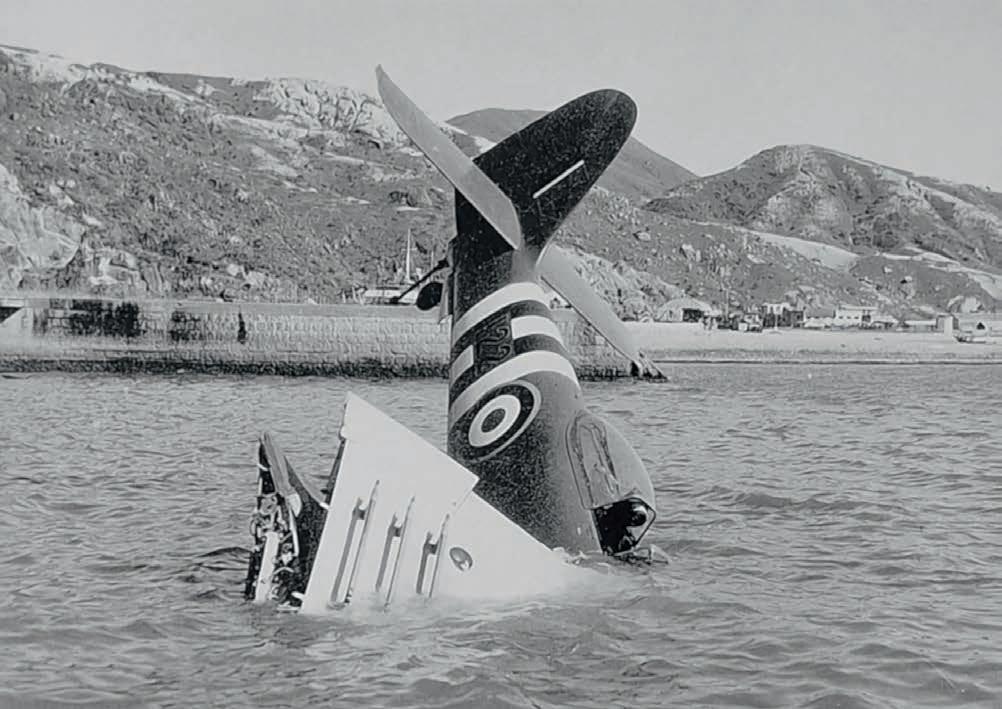
VW234 122/T, No.807 Squadron. This Sea Fury skidded off the end of the runway at Kai Tak, Hong Kong and into the sea on 22nd November 1950 after the starboard wing folded during take-off. The black and white stripes suggest that it had either served in Korea or was on its way to do so. Oddly, there are no stripes across the wing, the camouflage appears to be of the earlier pattern, the ‘D’ fuselage roundel is outlined, as is the code ‘122’ on the fuselage, and a type ‘C’ national marking can be discerned on the fin. Newark Air Museum
down. Fatalities were caused on both HMS Comus and Jamaica. Although small, the air threat to vessels at sea could not be ignored or overlooked.
Previously, on 4th July 1950, it had been announced by the US president that a blockade of the entire Korean coast was to be established forthwith. It was also announced that non-American naval vessels would, with the US Navy, blockade the western seaboard whilst the east would be
solely a US Navy responsibility. By early 1951 this policy changed and, as a result, Commonwealth ships often operated off the east coast: HMS Theseus for instance operated with the Independence class carrier USS Bataan briefly off the east coast in early April 1951.
For the British carriers, blockade involved monitoring shipping movements, particularly anti-submarine and antiminelayer patrols against junks and other
vessels, supplying close air support for ground forces and CAPs as required.
For HMS Theseus and her CAG, strikes commenced against selected military targets, the Sea Fury making its combat debut on 9th October with the first of what would eventually total thousands of groundattack strikes.
Chinese Communist forces entered the war in support of their near-defeated North Korean neighbour in November 1950, their
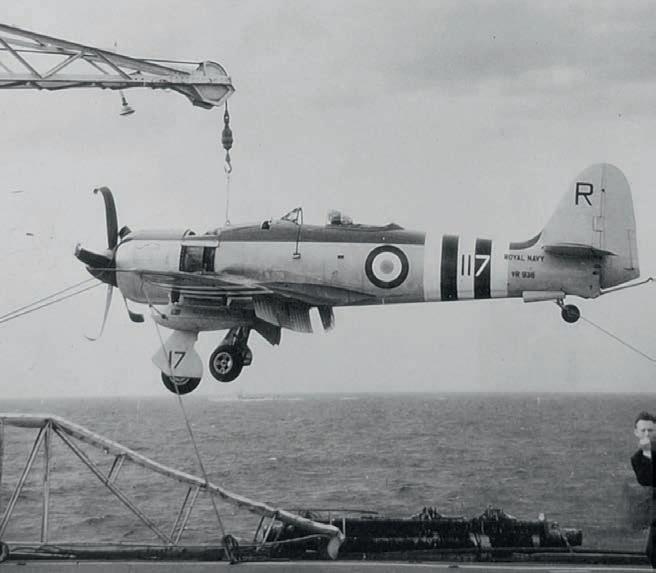
In October 1951 VR938 117/R of No.804 Squadron aboard HMS Glory suffered a collapsed starboard undercarriage when landing aboard. Here the damaged aircraft is being lifted off the ship in readiness to go to the Aircraft Holding Unit (AHU) at Sembawang on 10th October. FAA Museum
intent being to maintain a communist bufferstate between China and the USA. China’s sudden assault came as a shock to the UN, despite earlier intelligence being received intimating that China would not tolerate an American presence so close to their border. By December 25th Chinese forces had advanced across the 38th parallel.
China produced another shock when their air force introduced Sovietsupplied Mikoyan MiG-15 jet fighters in November, although they were not yet to be encountered by FAA aircraft. In December, Theseus’s aircraft made over 600 strikes against the advancing enemy army. Besides bridges, the targets included oil and ammunition dumps, gun positions, tanks, trucks, trains and enemy troops. During these winter periods flying was often hampered by snowfalls on the carrier deck, and bad weather in general.
Many more strikes followed in the first months of 1951, despite a worn-out catapult, as the Chinese advance was stemmed, before Theseus was relieved in late April by HMS Glory with 21 or 22 Sea Furies of No.804 Squadron and a dozen Fireflies of No.812 aboard. In addition, a Westland Dragonfly helicopter, presumably replacing a Sea Otter, was also provided. In all Theseus lost eleven Sea Furies during her deployment, eight to enemy ground fire and the rest to ➤
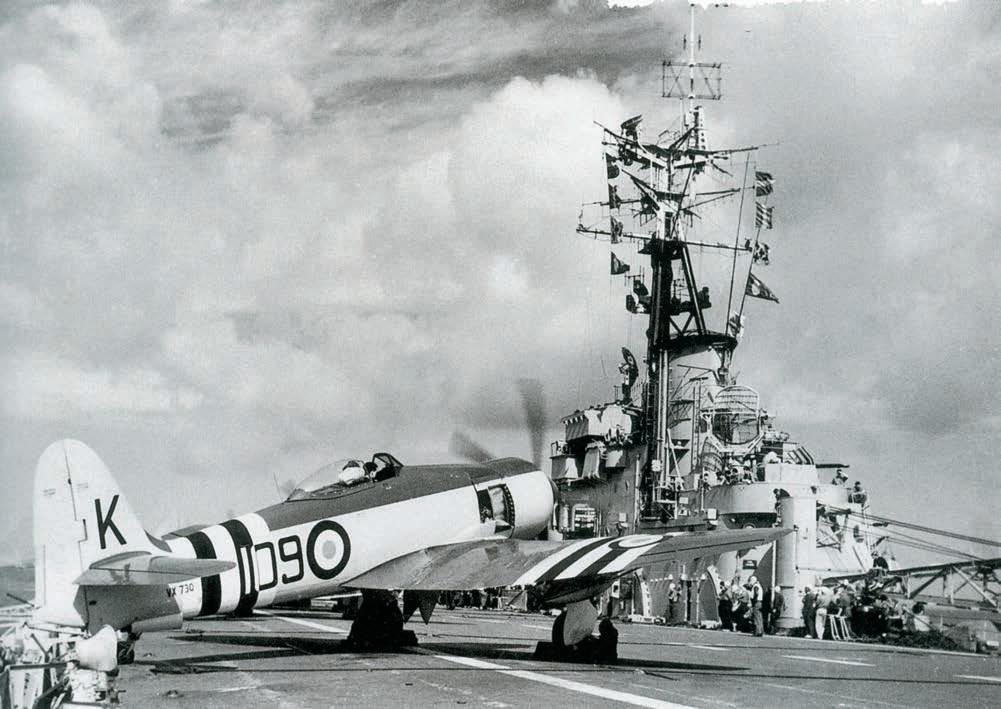
taken no further part, but today
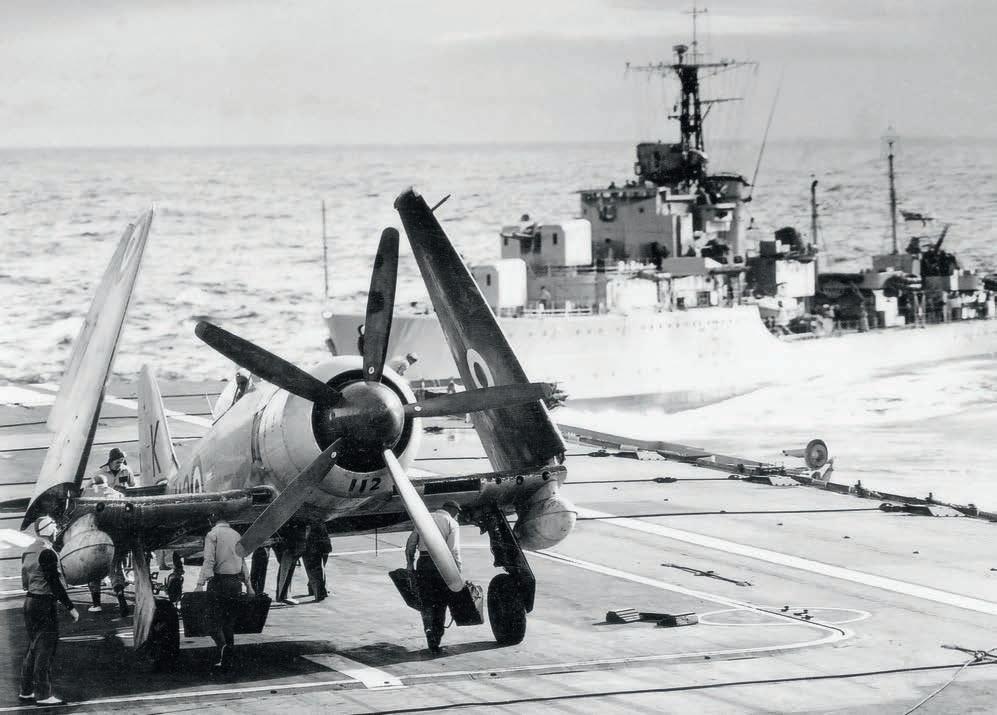
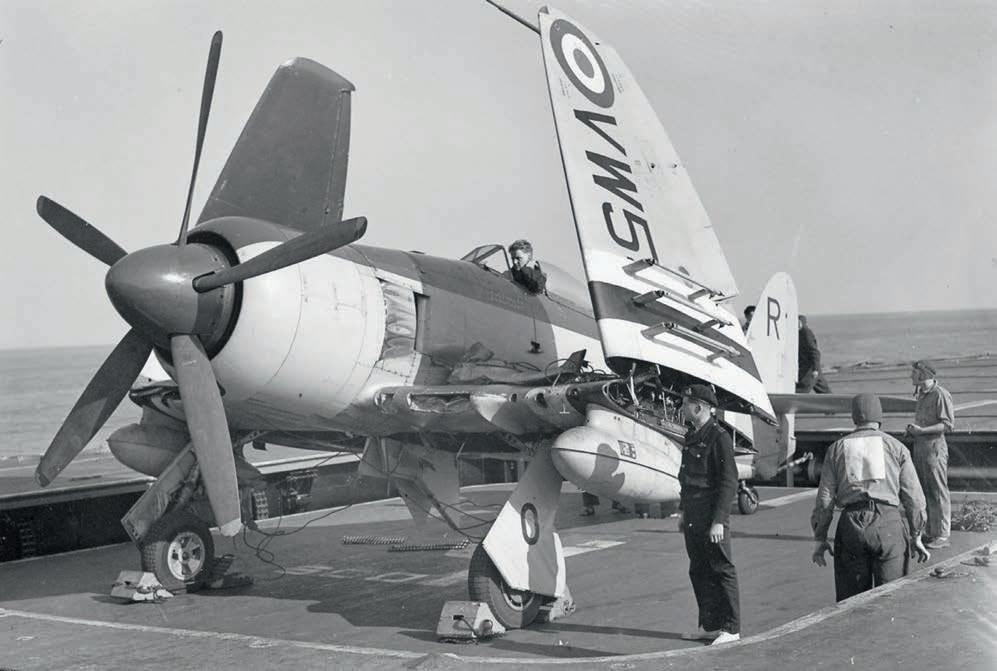
Sea Fury of No.804 Squadron on the deck lift of HMS Glory in Korea, 1951. FAA/T.Panopalis Collection
HMS Glory in Korean 1951 again with Sea Fury ‘R’ ready for take-off.
FAA/T.Panopalis Collection
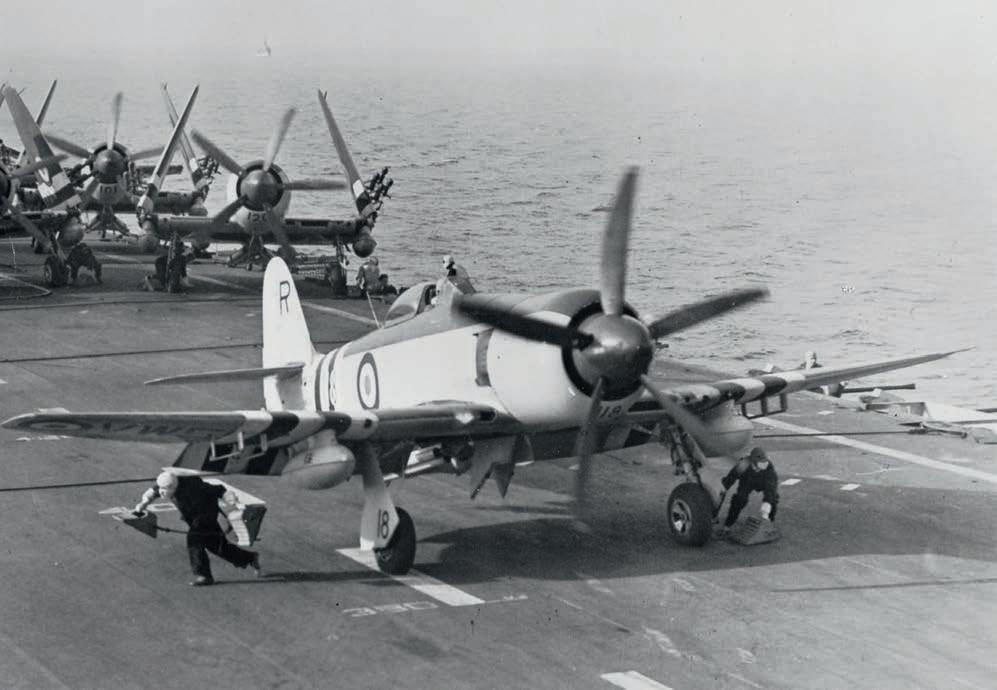
Another Sea Fury readying for take-off aboard HMS Glory in Korea 1951.
FAA/T.Panopalis Collection
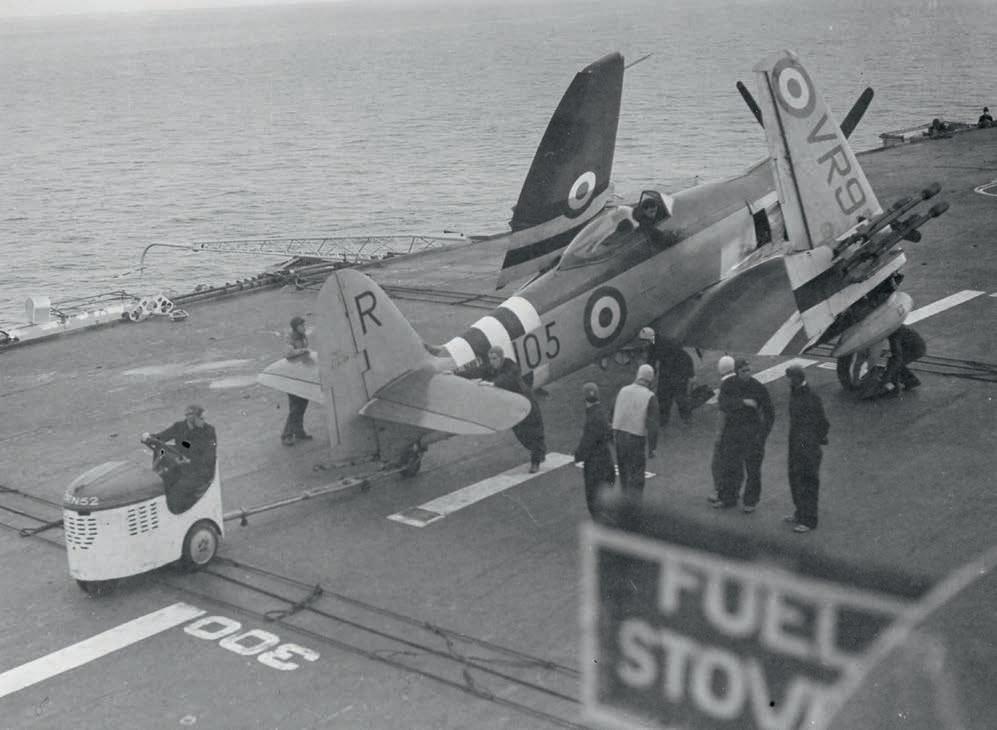
Sea Fury VW561 (O/111) No.802 Squadron hits the barrier aboard HMS Ocean after missing the wires – Korean War 1951. FAA/T.Panopalis Collection
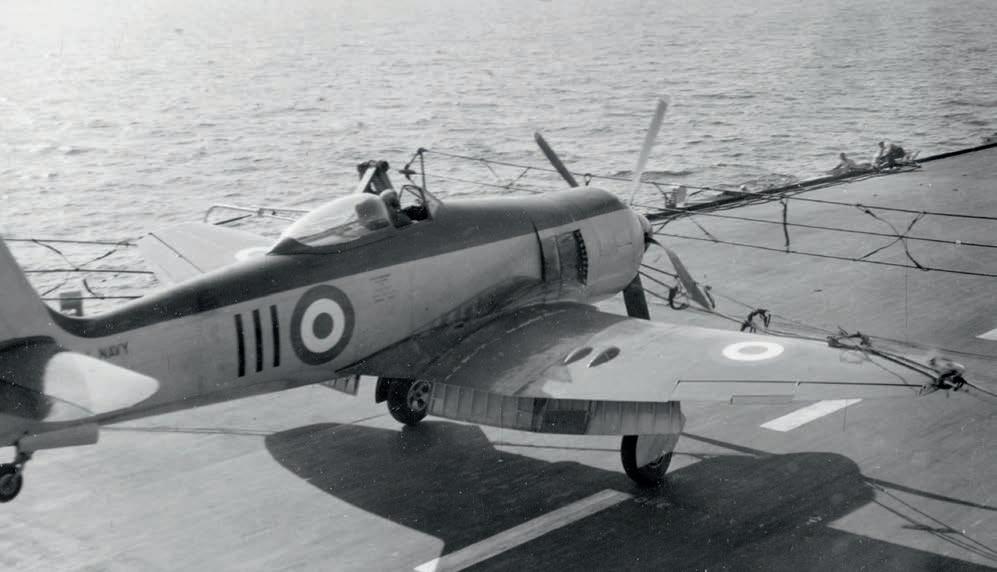
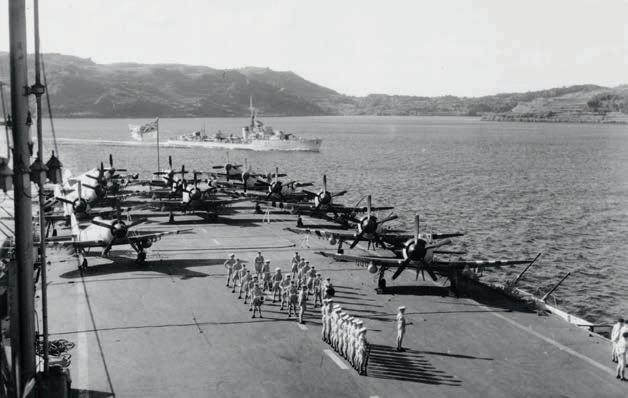
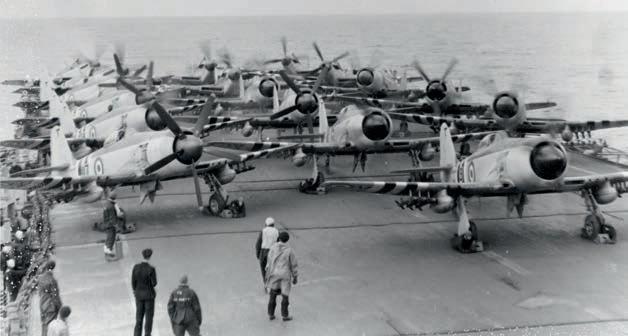
engine defects; there was one pilot fatality when Lt Beavan was seen to spin into the sea, cause unknown.
HMS Glory was able to commence operations quickly as she had conducted intensive flying training and preparation during her passage to Korea. Her tour lasted until early October 1951. Each carrier’s time in theatre was broken up into a series of patrol cycles of roughly eighteen days, separated by relatively brief returns to harbour in Japan to replenish fuel, ammunition and other stores etcetera, but as soon as possible, vessels returned to Korean waters. 1951 proved to be the year when the frontline was stabilised, once the Chinese advance had been stemmed and pushed back across the 38th parallel during March. Savage fighting on the ground continued with major offensives or smaller ‘pushes’ and probes conducted by both sides, but until the armistice over two years later the dividing line lay, very roughly, along the line of the ‘38th’. So the war on the ground became something of a stalemate with fluctuating fortunes for both sides, whilst the UN air campaign against industry, supply lines, communications, munitions, and logistics continued unabated.
Glory’s Sea Fury operations began on 28th April and their first targets were factories which were attacked with rockets; Lt Stephenson was lost on this day when his Sea Fury crashed after entering thick cloud. Ox-carts, suspected of carrying ammunition, became targets for the first time in order to use up spare 20mm ammunition when returning to the ship. Railway tunnels became another new target, the objective being to fire rocket projectiles into the mouth of the tunnel to destroy rolling stock being sheltered
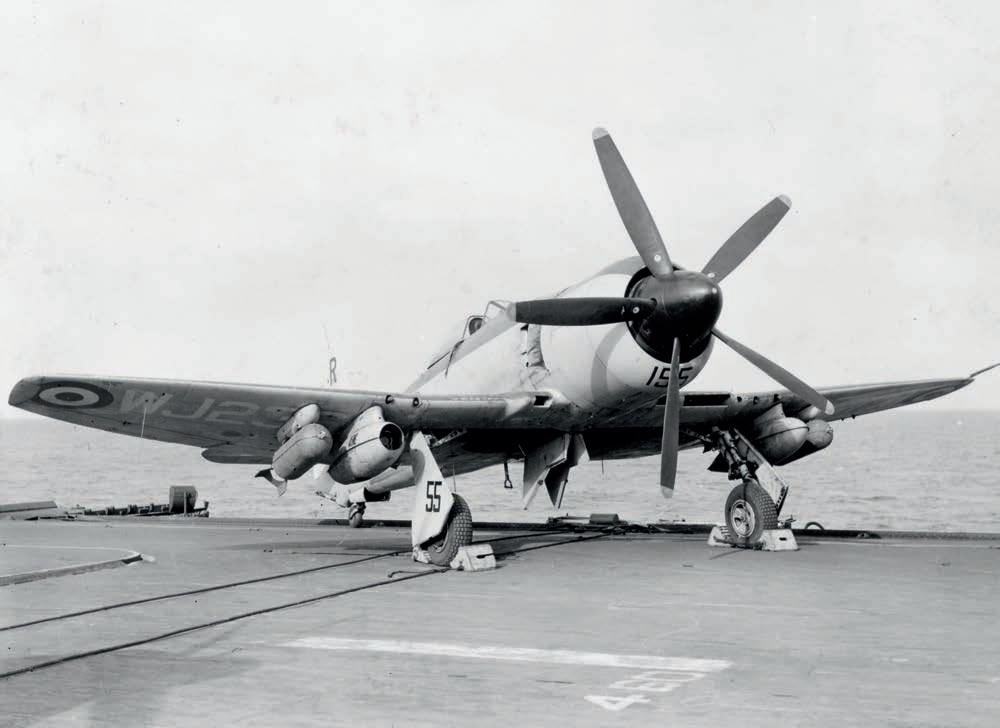
155/R aboard HMS Glory in 1952. The drop tank on the inner starboard pylon has been adapted as a camera pod, with bombs on the outer pylons and a standard drop tank on the inner port. Here the under-wing serials are not painted in their more usual black.
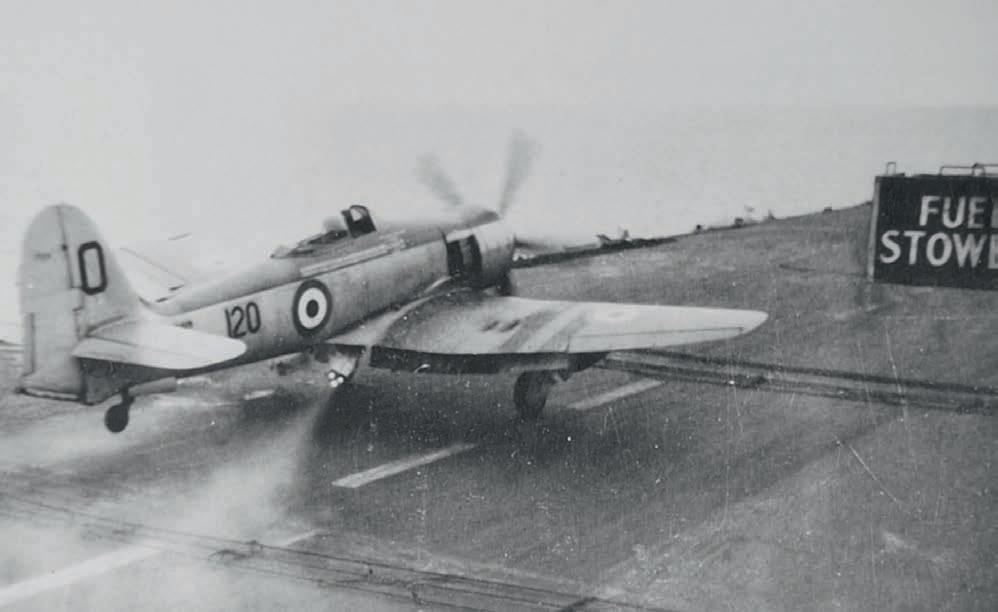
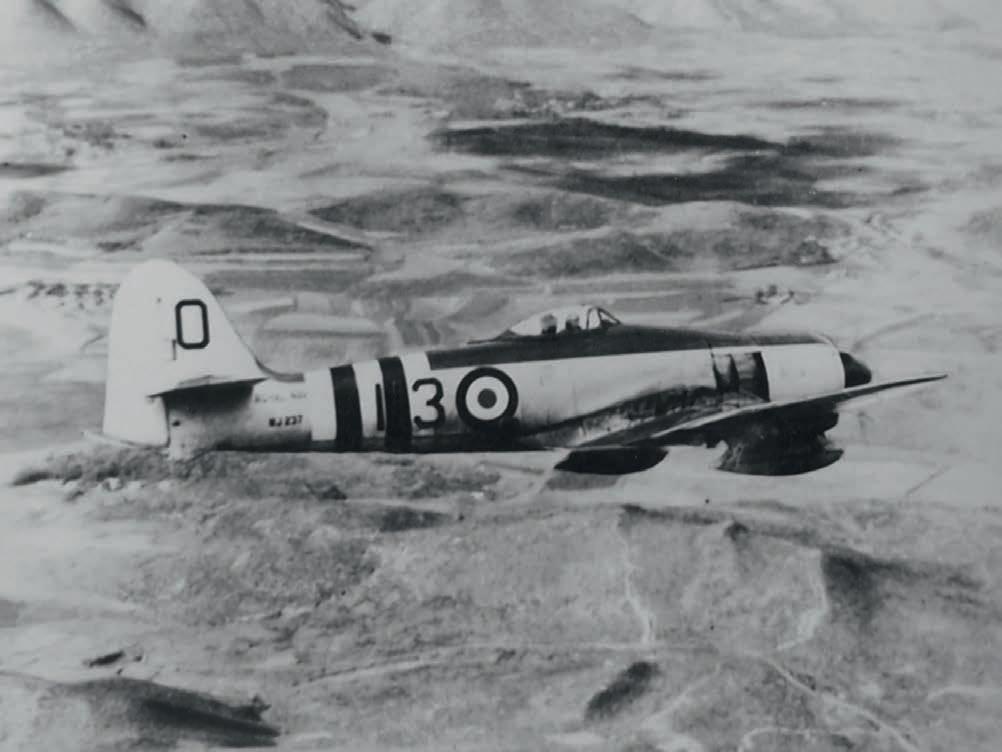
inside. On 10th June the Sea Furies sank or destroyed several junks. In fact, junks and fishing sampans were regular victims throughout this tour as part of the overall blockade operations employed during the summer. The port of Chinnampo’s junk traffic proved to be a much-used supply route for the enemy and, in all, 679 were damaged or sunk during Glory’s tour. Sea Furies were also used to check the fall of shot for warships bombarding shore targets, and to photograph other potential targets.
Indeed, reconnaissance became an important task for the Sea Furies and photography was used extensively both before and after many operations. On one occasion a flight of No.804’s aircraft was attacked by USAF Lockheed F-80 Shooting Star jet fighters, though without any damage. HMS Glory’s deployment came to an end on 30th September and the final tallies included forty bridges and seven tunnels, while 804’s Sea Furies had flown 1,820 sorties for the loss of five aircraft, all of which (apart from Lt Stephenson) had ditched or crashed into the sea or a river. Only one loss appears to have been due to enemy action.
HMS Glory was relieved by HMAS Sydney with two squadrons of Sea Furies aboard: Nos.805 and 808 with a total of
approximately 24 aircraft, and No.817 with 12 Fireflies. Sydney’s deployment lasted until 27th January 1952 and her presence represented a considerable and significant increase in her country’s commitment to the war. The Fireflies were all transferred from No.812 Squadron after Glory had finished her deployment, although the Sea Furies were new arrivals. When Sydney’s aircraft conducted their first sorties on 5th October 1951, it was the first time that a Dominion aircraft carrier had ever sent aircraft into battle. On the 11th they spotted for the gunfire of the cruiser HMS Belfast and battleship USS New Jersey, and sixteen Sea Furies attacked a body of over two thousand enemy troops. Operations were then curtailed by Typhoon Ruth which caused a lot of minor damage to the ship as well as the loss of a Firefly, which was lost overboard with five others and one Sea Fury written off.
Later in the month the Sea Furies attacked coastal shipping, heavily damaging many junks and sinking six, and followed this with close air support operations. On the 25th an No. 808 Squadron Sea Fury ditched in the sea during a strafing raid on a supply centre and the next day another was lost after it crash landed on a mudflat in the Han River, both having been hit by flak. The
pilots were saved but Lt Clarkson of No.805 Squadron was killed when his Sea Fury dived into the ground near the Han River, probably as a result of flak. Many attacks on bridges, ground forces and junks proved successful, but defensive flak was proving effective and destroyed two Sea Furies on 7th December; Sub Lt Sinclair being killed. Two more were shot down on the 13th although both pilots were rescued, however Sub Lt Coleman became Sydney’s third Sea Fury fatality when his aircraft disappeared in bad weather. At the final count the total number of attack sorties conducted by the Australian aircraft numbered over 2,300.
Early February 1952 brought the arrival of HMS Glory for a second tour off Korea with Nos.804 (Sea Fury) and 812 (Firefly) aboard once more. As before the principal duties were ground strikes and on the 12th one Sea Fury had to force-land on a beach after being hit by small-arms fire; the pilot was saved. A second was downed by similar means the next day, again the pilot was rescued, but on 15th March Lt Overton died when his Sea Fury was shot down by ground fire during a low level photographic and strafing run. On the 21st, No.804 Squadron’s ground attacks were in support of a landing made by South Korean Marines.
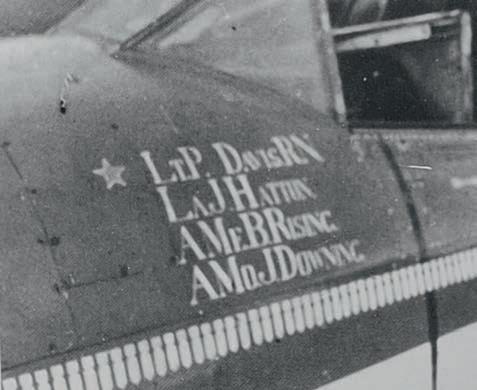
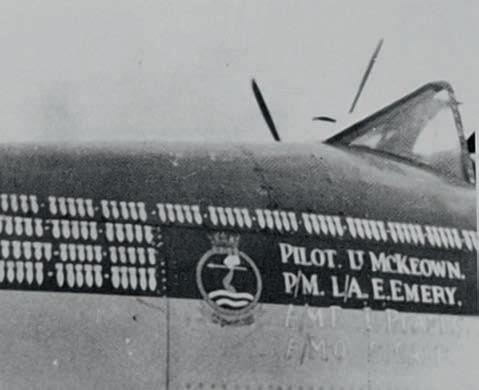
During this tour the Sea Furies began to employ a new underwing camera pod, which was in fact a 45gal drop tank fitted with both forward and rear-facing cameras. Up until this point a single vertical camera had been employed, however this new design produced better results as pictures could be taken both during a low dive and the pull out. Aiming was less difficult too, and the images produced were more helpful in identifying camouflaged targets. Although the Admiralty had dropped its original plan to fit an F.52 camera in 1946 (see Chapter One), Hawker Aircraft had marketed the fighter with two F.24 cameras mounted one behind the other in the bottom of the fuselage, set behind the cockpit, roughly level with the wing trailing edge; the forward camera was positioned vertically and the other to starboard, at an oblique angle.
However, this arrangement created problems because leaking oil from the Centaurus engine would flow back along the lower fuselage and obscure the camera ports. The modified 45gal drop tank was an expedient originated by the Royal Navy, not Hawker, and was introduced during Glory’s deployment in early March 1952. On later deployments it appears that the Sea Fury’s ‘pod’ had only the forward-facing camera in place. As such the ‘pod’ appeared like a normal drop tank albeit with a truncated nose.
During Glory’s second deployment to Korea, her Sea Furies began using 500lb bombs with considerable success. Bombs offered better destructive power against the more resilient targets encountered, however their use, at first, was somewhat experimental. Although the Sea Fury FB.11 was a fighter-bomber, so far they had only carried 60lb rocket projectiles over Korea. The necessary modifications required for the carriage of bombs were made during March, with bomb-dropping trials conducted off Japan between Glory’s third and fourth war patrols of her second tour. The best bomb delivery method, it was
found, employed a 45° dive from 4,000ft with release at 2,000ft. However, more accuracy could be obtained if the bombs were dropped at 1,500ft, in which case they were fitted with 30-second delay fuses so as to avoid the subsequent explosion. During Glory’s second tour one Sea Fury was lost to small-arms fire and another through engine failure.
In early May 1952 HMS Ocean arrived in theatre for the first time with No. 802 Squadron’s Sea Furies and No. 825’s Fireflies; in addition, two Dragonfly helicopters were transferred from Glory HMS Ocean relieved Glory and commenced a six-month tour of duty for which the Sea Furies were supplied with 1,000lb bombs; a substantial weapon. Squadron operations commenced on 11th May during which two Sea Furies were lost, neither though through enemy action. Three days later another was lost to ground fire and the pilot, Lt McDonald, was killed, and then a fourth was lost during a dive-bombing attack. By the time the tour ended two more Sea Furies had been shot down by ground fire and three others lost due to technical problems.
During this tour the emphasis on target selection shifted somewhat to attacking communist supply lines more often and their communications: bridges, railways and roads etc, although attacks on troop concentrations, ammunition dumps, antiaircraft guns and coastal traffic still had to be maintained. On occasion a skip-bombing technique was employed, where the pilot would attempt to bounce his bombs off the ground or railway line and into the throat of a tunnel. From June electrical power installations were cleared for attack, restrictions having been in place up to this point for political reasons.
On 9th July strikes against targets on the Sillyong-Myon peninsula commenced during Operation Boodles which required all of Ocean’s aircraft to conduct sustained strikes against targets on the peninsula, in support of gunfire from the HMS Belfast and two destroyers. Two days later Ocean’s
Furies and Fireflies formed part of a massive Allied aerial force that raided the North Korean capital Pyongyang as part of Operation Pressure Pump, the carrier’s aircraft striking railway marshalling yards. Despite heavy AA fire no Fleet Air Arm aircraft was lost, but on the 24th July Lt Cdr Dick, No.802’s commanding officer, was killed when his Sea Fury crashed during a low-level attack. On 27th July 1952 four Fireflies were attacked by MiG15s, the first occasion that the Royal Navy had been confronted by these jet fighters, and one Firefly had to ditch due to damage received.
On 9th August 1952 four Sea Furies from 802 Squadron were on CAP north-west of Chinnampo, piloted by Lt Peter ‘Hoagy’ Carmichael, Lt Peter ‘Toby’ Davis, Sub Lt Brian Ellis and Sub Lt Carl Haines, flying at approximately 4,000ft. They were attacked by eight MiG-15s. Following a series of passes by both sides, one MiG was shot down and two others damaged. Lt Carmichael was credited with the kill although the speed of events over the fourto five-minute duration of action made the overall picture rather confused. Elsewhere another Sea Fury was damaged by a MiG and later in the day further combats ensued between the two types with damage to both sides; one Sea Fury making a wheels-up landing on Chodo Island. The next day saw Carmichael, Davis, Ellis and Sub Lt Carter involved in another combat with MiGs over Chaenyong against seemingly better quality pilots! One MiG was thought to have been damaged.
In retrospect the MiGs pilots had been foolish to descend to the Sea Furies’ height for a dogfight rather than making a fast diving attack before climbing away, using their great speed to maximum advantage. It was now clear that the presence of MiGs would restrict piston aircraft operations and new tactics would have to be adopted in dealing with them. Therefore, FAA ➤
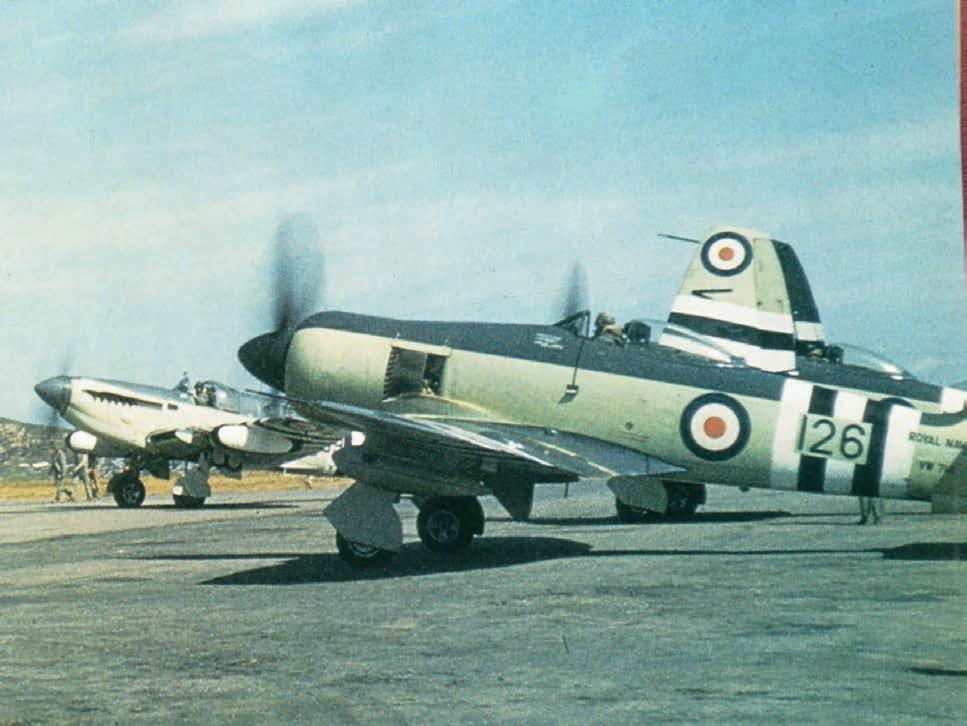
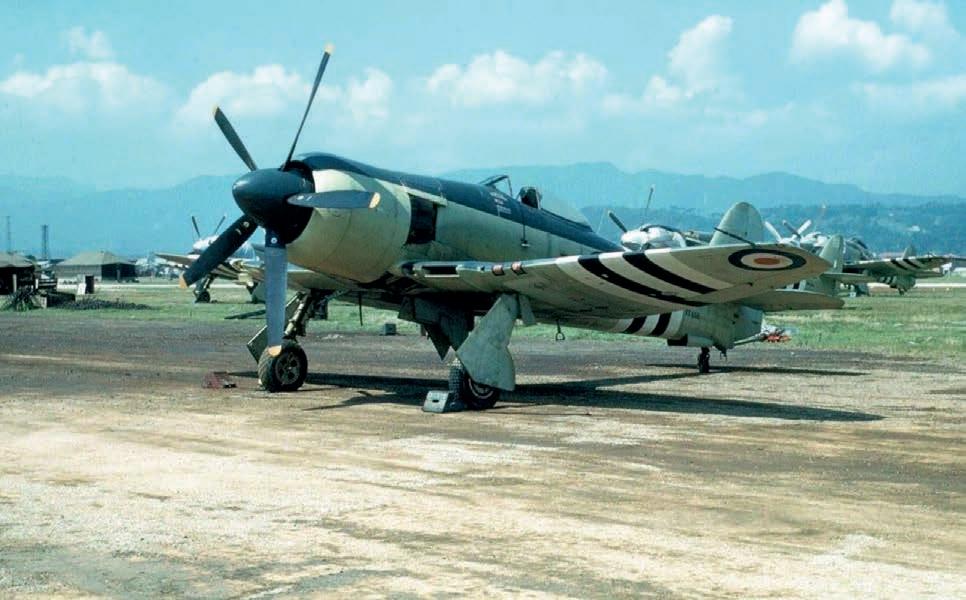
Australian Sea Fury WE790 105/K from No.808 Squadron HMAS Sydney is serviced by US Marine Corps mechanics in 1951/52. USAF
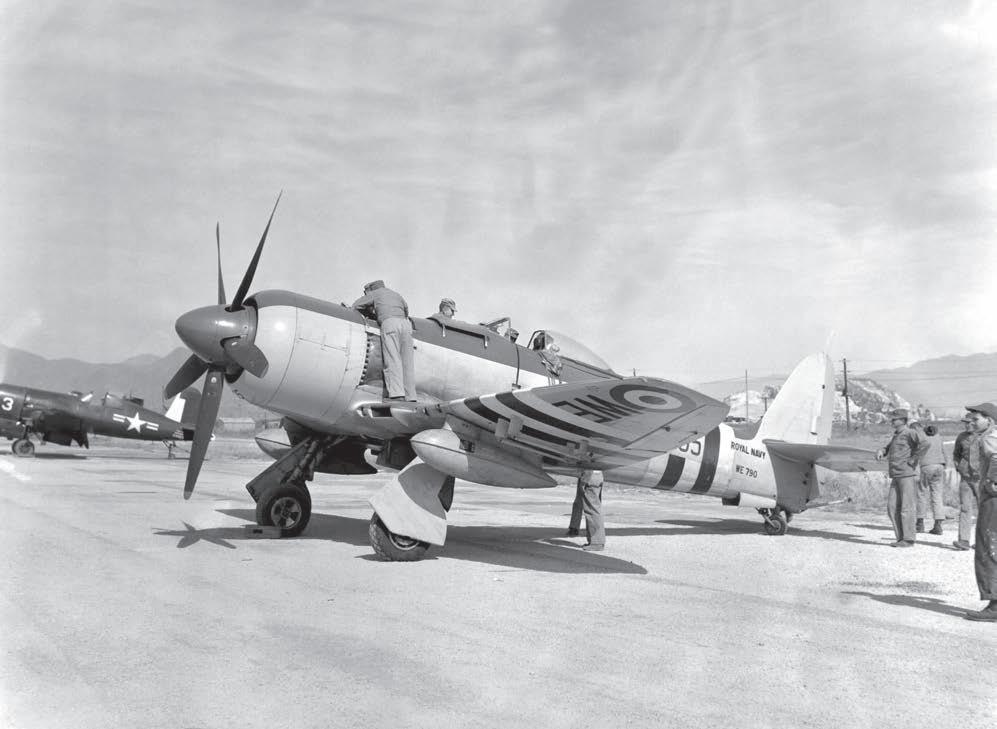
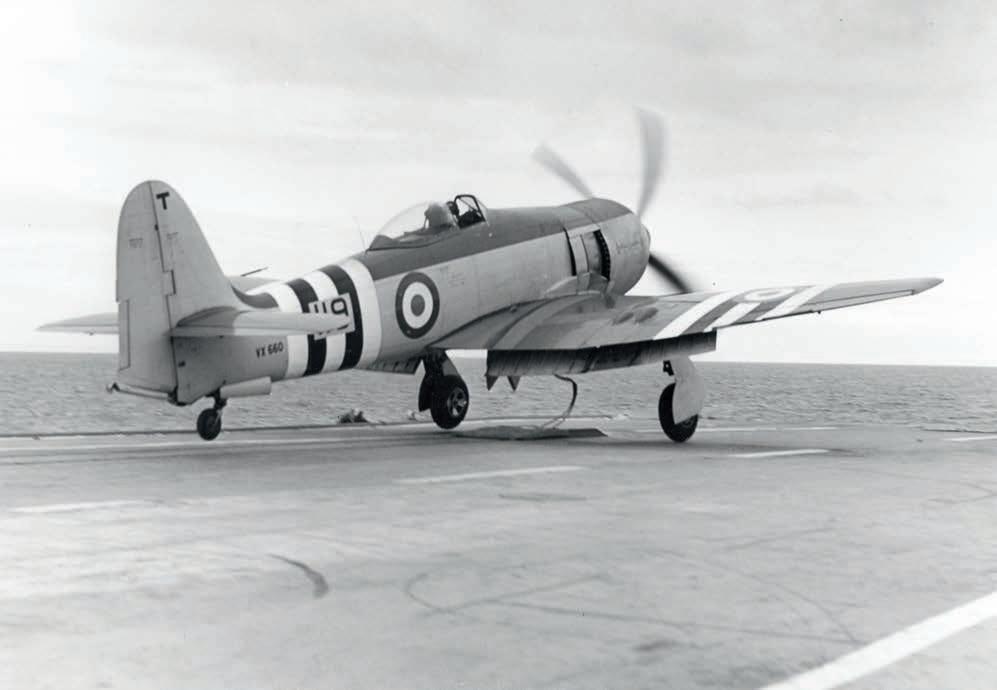
No.807’s 120/T, probably photographed at the same time, is almost certainly VX611 since it was carrying this registration during 1951. Flight
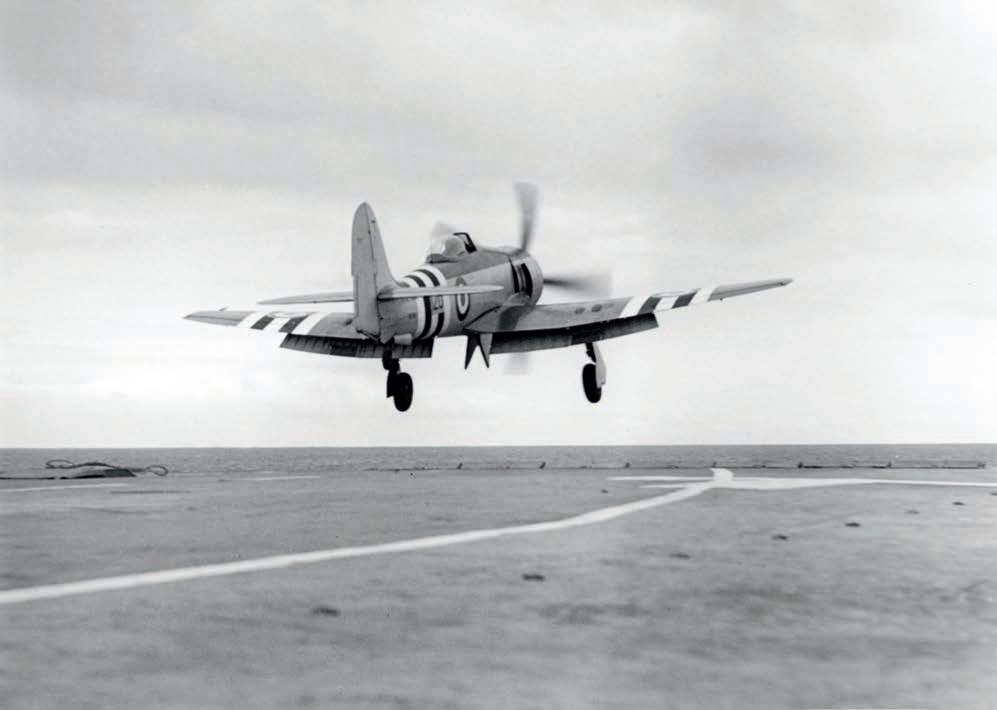

TF968 125/T was an early production FB.Mk.11 and was also flying with 807 in 1951. Flight
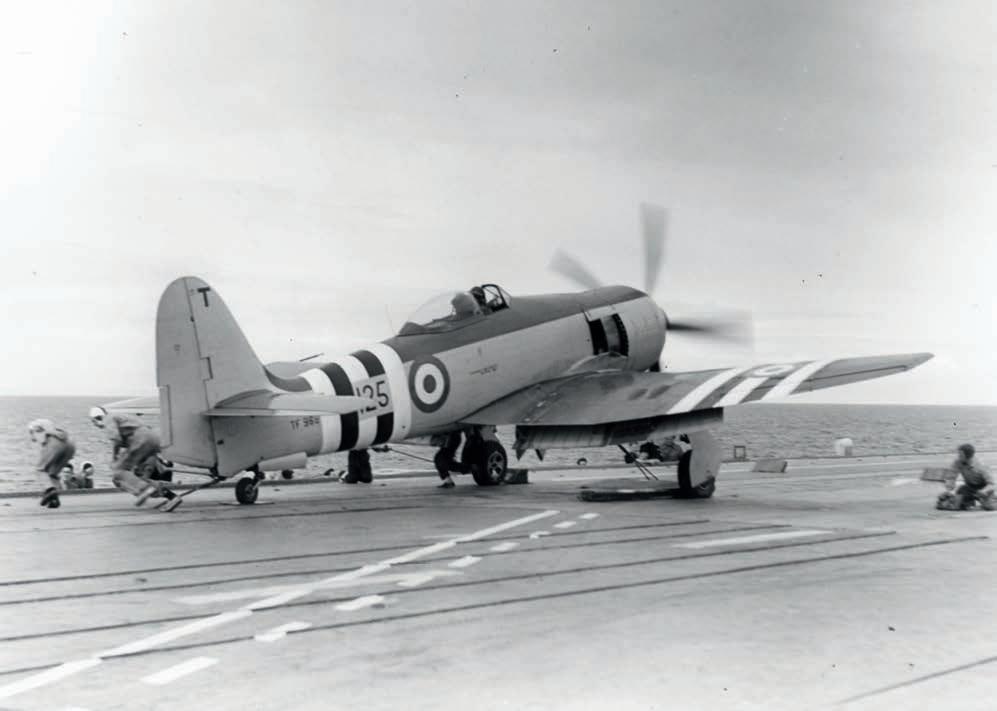
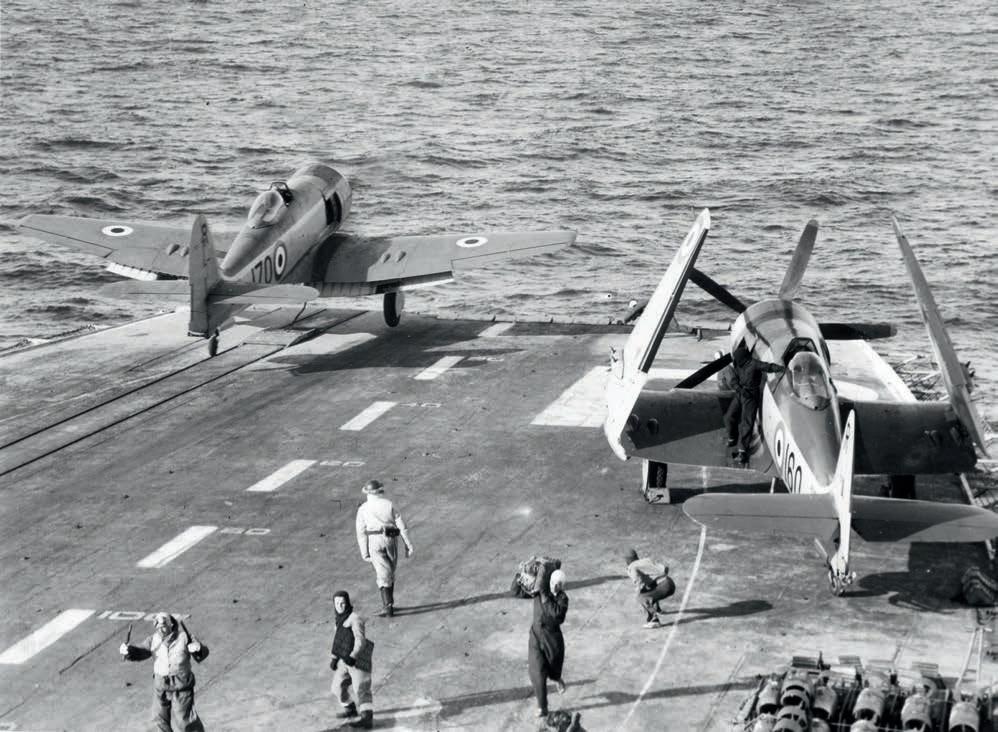
Sea Furies take-off from Glory in 1952-53. These aircraft belonged to 801 Squadron but it is not possible to identify which specific examples they are. Code 170/R (on the left) and 160/R on the right was used in each case by two or three different aircraft during this period, with the earliest examples having been lost in action. Crown Copyright
strikes in areas where MiGs were likely to be encountered, were to be arranged to coincide with USAF North American F-86 Sabre patrols which, weather permitting, occurred at least once a day, sometimes more. These patrols were specifically to comprise eight or more F-86s. This tactic provided sufficient protection and succeeded in preventing further Sea Fury losses in air-to-air combat. Indeed, after the 11th August there were no further MiG attacks on Ocean’s aircraft.
Railway bridges were hit in the Pyongyang area in late August, and the total number of bridges destroyed during Ocean’s seventh patrol of this deployment was 32, many of which were quickly repaired and had to be struck again; a situation aggravated by the presence of rapidly installed flak guns.
Ocean was relieved in November 1952 by Glory, on her third tour, with Sea Furies of No.801 Squadron and Fireflies of No.821 Squadron aboard for a further six-month deployment. On 18th November Lt NevilleJones died when his Sea Fury was brought down by anti-aircraft fire, and many aircraft were damaged by AA guns. Railway bridges and tunnels were on the menu again; three Sea Furies were lost on 5th January 1953 with Sub-Lt Rayner and Sub-Lt Simmonds losing their lives and Lt Mather being
captured. MiG-15s appeared again on 7th February but their attack on four Sea Furies was ineffective. Lt MacPherson was killed when his Sea Fury was shot down at low level on the 11th, and Sub-Lt Bradley died three days later when he had to ditch in the sea after engine failure. Another MiG attack on 23rd April damaged a Sea Fury, and two more were lost on the 25th to enemy fire during ground-attack operations.
The early part of this tour had been dogged by defective 20mm cannon ammunition which, it was revealed, had been manufactured in 1943. It was directly responsible for at least two incidents in which one Sea Fury received a damaged wing and another crashed, killing its pilot, when the ammunition exploded in the wing. Until the arrival of reliable ammunition, the cannons on the Sea Fury and Firefly alike were restricted to self-defence use only; ground strafing was suspended, presenting a serous reduction in offensive capability.
On 19th May 1953 HMS Ocean arrived for her next Korean deployment as the Commonwealth aircraft carrier; aboard were No.807 Squadron’s Sea Furies and No. 810’s Fireflies (which included night fighter variants that were sent ashore in early July, to help deal with night-time nuisance raids over Seoul by Polikarpov Po-2 light
biplanes). On 27th July an armistice between the opposing forces was called, bringing an end to just over three years of fighting and nearly 23,000 sorties by RN and RAN aircraft. The final strikes, against bridges, were conducted on 22nd July, following which Ocean continued her patrol in the area until 31st November, still flying sorties but at a far reduced rate. Following the ceasefire her aircraft were prohibited from passing through a boundary set outside North Korea’s coastline.
During this tour Ocean’s Sea Furies accomplished an unusual achievement on 1st June whilst the carrier lay stationary in harbour at Sasebo between patrols. Thirteen Sea Furies were launched from the deck of the vessel using RATOG (rocket-assisted take-off gear), prior to performing a fly-past and other displays for the celebrations marking the coronation of Queen Elizabeth II the following day.
During the course of the Korean War, four RN and two RAN Sea Fury Squadrons had been employed. At times they flew virtually non-stop operations and the type’s serviceability throughout was considered to be good. At least twenty-nine Sea Furies were lost to enemy ground fire and many more were written off as a result of accidents or through engine failure. Many Fireflies were also lost for ➤
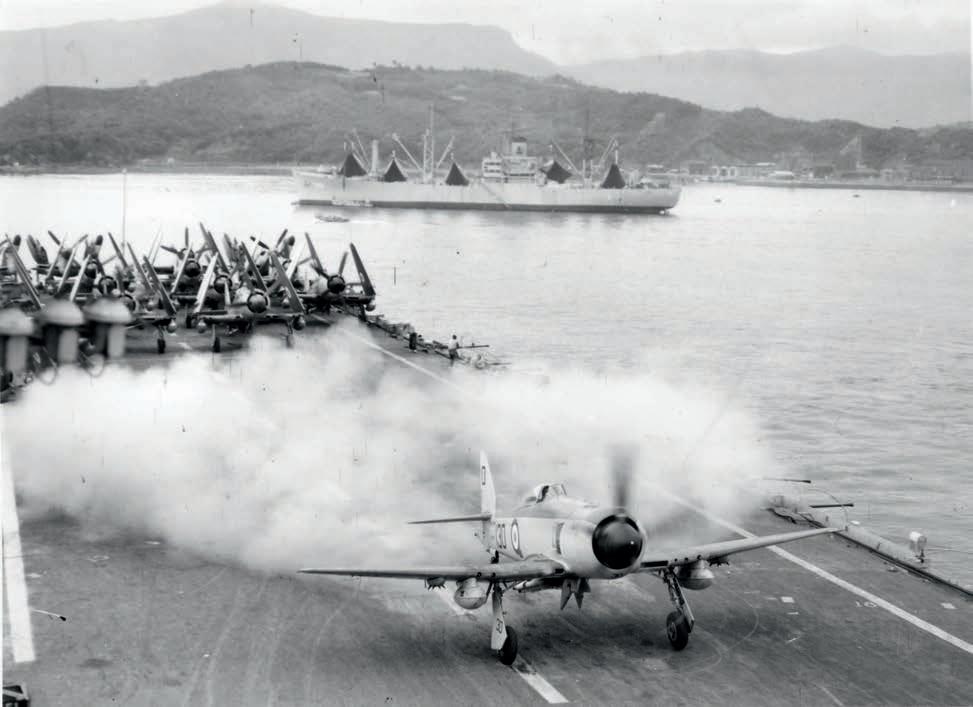
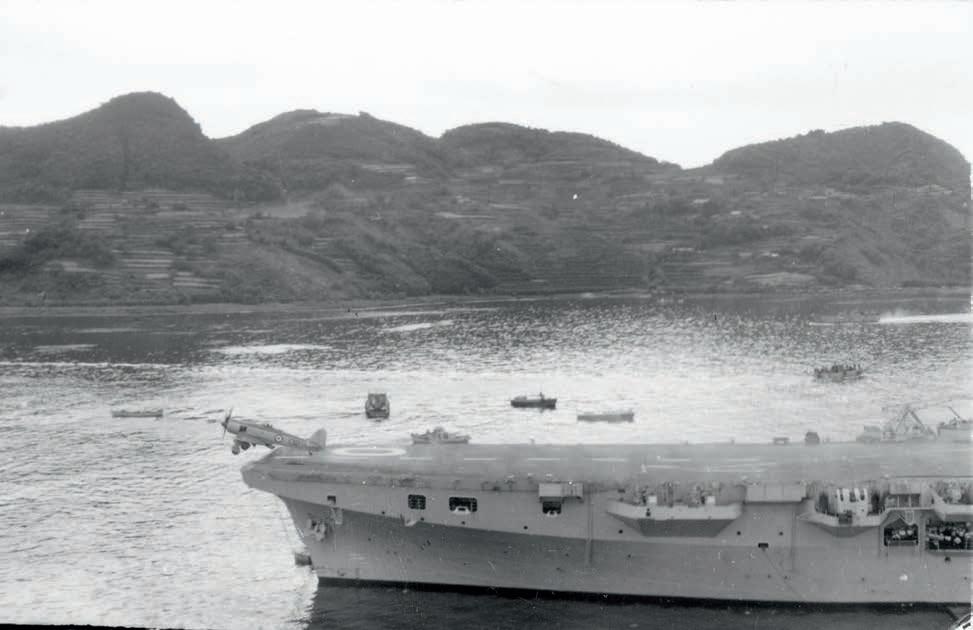
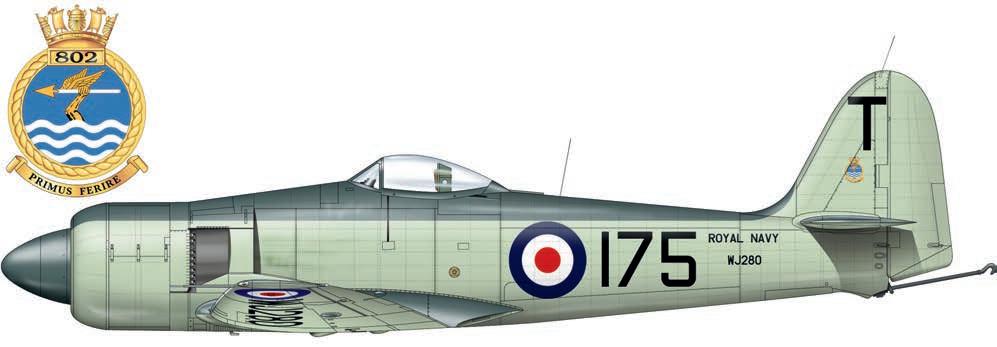
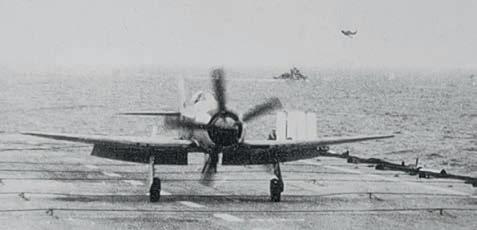
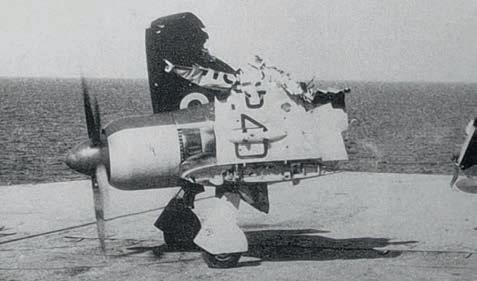
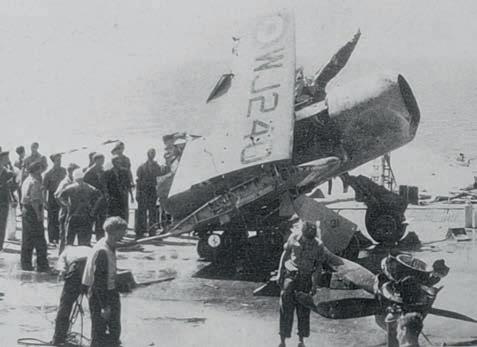
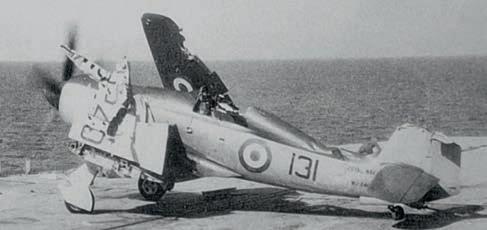
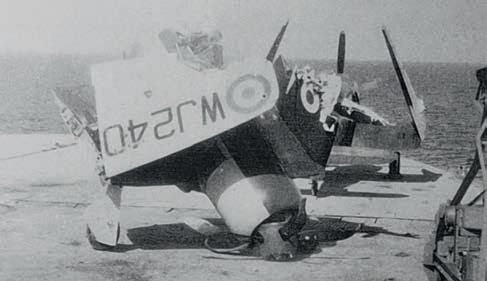
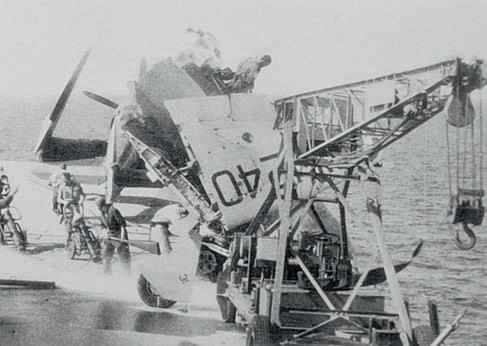
On 11th August 1953 Lt D. G. ‘Gunner’ Halliday was seriously injured when his aircraft WJ240 131/0 from No.807 Squadron, was hit by another Sea Fury WH623 went over the side; while this series of images graphically illustrates what happened to WJ240, illustrating how dangerous flying could be on occasion aboard an aircraft carrier. The first image shows WH623 missing the wire, the rest show WJ240 with its engine running and beginning to disintegrate before finally coming to a halt. It was destroyed by the resulting fire.
much the same reasons. Pilots would be deemed to have completed their tour if they accumulated 100 sorties overland; they would then be rotated home. Combat air patrols however, in the region of the pilot’s own carrier or other ships, did not count towards the total since it was regarded that, relatively speaking, little danger was involved on those flights!
The Sea Furies usually flew in flights, called divisions, which consisted of four aircraft and operated far less often at squadron strength. They would fly in a standard finger-four formation which allowed each pilot to visually cover the rear of others. Operating in squadron strength was generally unworkable – divisions of four aircraft was more flexible and allowed different targets to be hit at the same time. The performance of the Sea Fury and Firefly aircrews was outstanding, their work rate was astonishing too; virtually every day, when in theatre and if the weather permitted, they were in action somewhere over Korea or Korean waters. Indeed, this was often two or three times a day for the best part of three years. Their success would probably have been reduced had North Korea possessed a more effective air force, but they didn’t, and both the Sea Fury and Firefly played a major role in the conflict, providing one of Britain’s biggest contributions to the effort overall. This should not be understated! Often the interdiction operations could become repetitive, perhaps boring, but great
damage was inflicted on the communists, despite their ability to repair roads, bridges and railways, replace casualties among their infantry, or replace stockpiles of ammunition all seemingly overnight, courtesy of huge manpower resources.
For FAA aircrews there was always the possibility that ‘boredom’ may turn to acute anxiety if they found themselves shot down, injured and alone in very hostile territory waiting hopefully for the sound of a rescue helicopter. To that end all aircrew were given instructions whilst in Japan on escape and evasion techniques plus, the recommended contents of their escape kit should they be shot down. The kit was quite extensive and included a ‘gooley’ chit, compass, knife, two flares, map, .38 revolver (24 rounds) and a Sten sub-machine gun no less; where the latter was to be stowed in a Sea Fury ready for a quick retrieval remains uncertain!
All of the RN and RAN aircraft carriers that served off Korea were light fleet carriers which performed superbly overall, despite their modest physical proportions and proportionately small air groups. However, there was one other British carrier present, despite the statement above, which was not a light fleet carrier nor, to be pedantic, an aircraft carrier in the usual sense at all, although she had every appearance of being one. Commissioned in 1943, HMS Unicorn was built as an aircraft depot, maintenance and support vessel with an appearance very similar to a scaled-down
HMS Ark Royal of 1939 vintage.
Unicorn’s flight deck was left clear of obstruction and had a catapult fitted so that aircraft requiring her maintenance facilities could be landed on or flown off if required; it also allowed the vessel to function as an operational fleet carrier should that need arise, as it did during World War Two. During the Korean War the vessel operated in its intended roles as well as becoming an aircraft ferry and troopship, and, by virtue of the fact that Unicorn was fitted with eight 4” guns (two on each quarter), it was used, improbably, in 1951 as a shore-bombardment vessel. Unicorn conveyed spare aircraft to Japan or to Korean waters, including the last 14 Seafire 47s held at Singapore in order to boost Triumph’s complement and maintain 10 or 11 serviceable fighters. The ship removed damaged and time-expired aeroplanes and, at times, acted as a spare deck in theatre to ease the operating cycle of the duty carrier or to provide refresher deck landing practice for pilots.
Unicorn remained in the Far East throughout the war, covering over 125,000 nautical miles, and dealt with hundreds of aircraft over 37 months; without her presence the problems faced by the Royal and Australian Navies would have been that much more difficult. HMS Unicorn is almost forgotten now, as is virtually all that the British and Commonwealth naval forces involved had accomplished from June 1950 to July 1953. ■
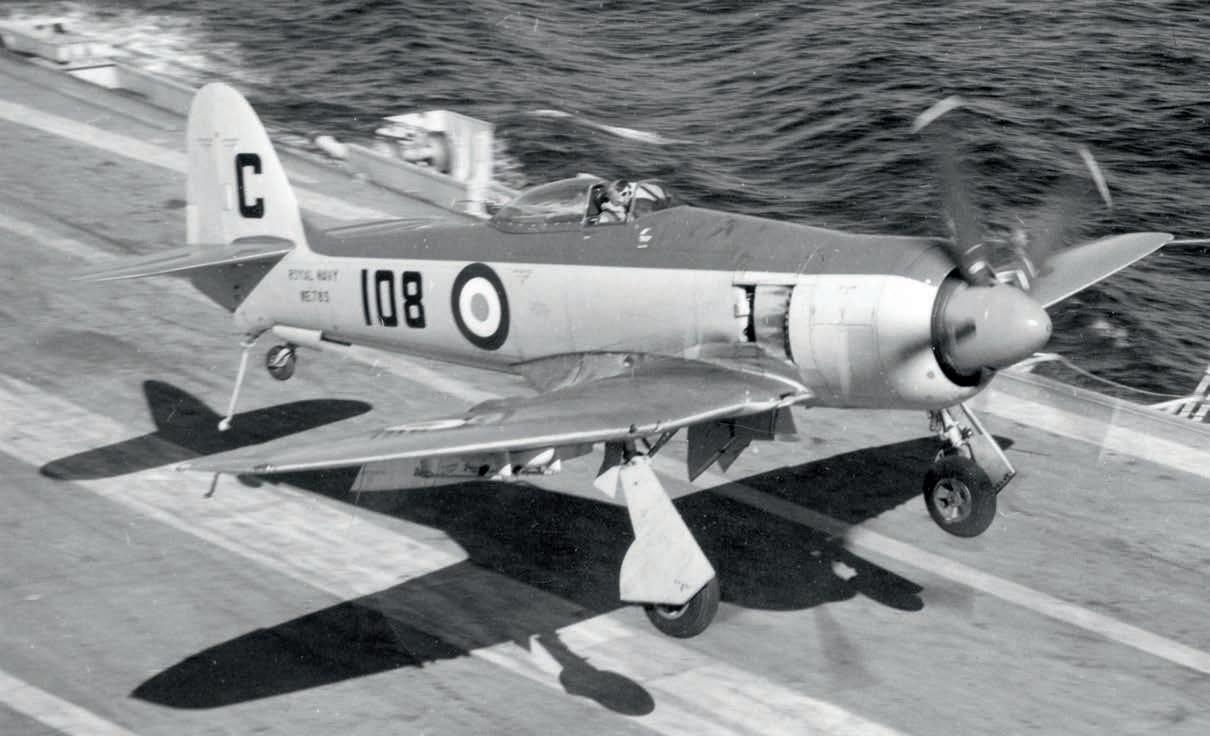
Of the four Centaur class aircraft carriers that entered service with the RN during the 1950s only HMS Centaur herself operated the Sea Fury, and then only for a short period in 1954/55. No.810 Squadron was the last RN front line unit to equip with the Sea Fury and only did so in order to act as a strike rather than a fighter unit, due to continuing problems with the upcoming Westland Wyvern and a consequent shortfall in its numbers. This photograph is included for its relative scarcity as it illustrates No.810 Squadron’s 108/C (possibly WE785 ‘Jasper’) after having just missed the wires on landing and flying off again. Ray Sturtivant
Authors can provide descriptions of the design, history and service career of the Sea Fury, deliver a technical description and present as much data as possible. However, in order to obtain a real impression of what the Sea Fury was like to y and operate we rely on the people that ew it. Several former Sea Fury aircrew have therefore very kindly supplied their recollections. Note that the selection of photos here is not especially related to the text, but has been chosen on availability and to illustrate various aspects of the Sea Fury’s career.
(No.801 Squadron, Korea, HMS Glory, 1952/53)
The Sea Fury was a superb aircraft – and very powerful which became clear during flying training. The route we took began with the Percival Prentice primary trainer, this was followed by the North American Harvard and then the Griffon-powered
Supermarine Seafire Mk.17, each more powerful than before in terms of engine and performance. But the Sea Fury had even more power. When you had become familiar with flying the Sea Fury you found that you could pretty well do what you wanted. Once I had the feel of the aircraft I never looked back – it was marvellous. For quite a long time I held the speed record between London and Malta (Hal Far) having broken it flying a Sea Fury. The fighter had no bad points and you came to love it, but it was an aircraft that would bite you if you did not respect it.
The Sea Fury was a delight to fly but not the easiest to land. In a Seafire you approached and landed with a natural three-point attitude, but in the Sea Fury you landed at 92 knots (106mph) and arrived over the back end of the carrier after a gentle turn. The huge engine and wide nose meant that it was very difficult to see on the approach. With your head leaning slightly out to the left you could just see the port side for the ship and the batman, and when he told you to cut the engine and
the nose dropped, it was actually the first time that you were able to see the whole of the carrier’s deck. The touchdown was tricky because the Sea Fury had a rather stiff undercarriage. American pistonengined fighters like the Chance Vought F4U Corsair had very long-stroke oleos which made you feel as if you were landing into a cushion, but the Sea Fury’s stiffer undercarriage meant you had to land on all three wheels. If you touched on just the two main wheels the aircraft could skip onwards or bounce, you would miss the wires and go into the barrier. RNAS Culdrose, itself quite a small airfield, was used for practice landings. These were made after flying a circuit and I completed a hundred practice ‘deck’ landings in a Sea Fury before ever going near a ship, by which time I was used to flying at the correct speed and coping with the limited view forward.
In Korea the type’s main role was interdiction – knocking down bridges, attacking and disrupting the enemy’s main supply routes to the front line and general ground attack work – which it achieved
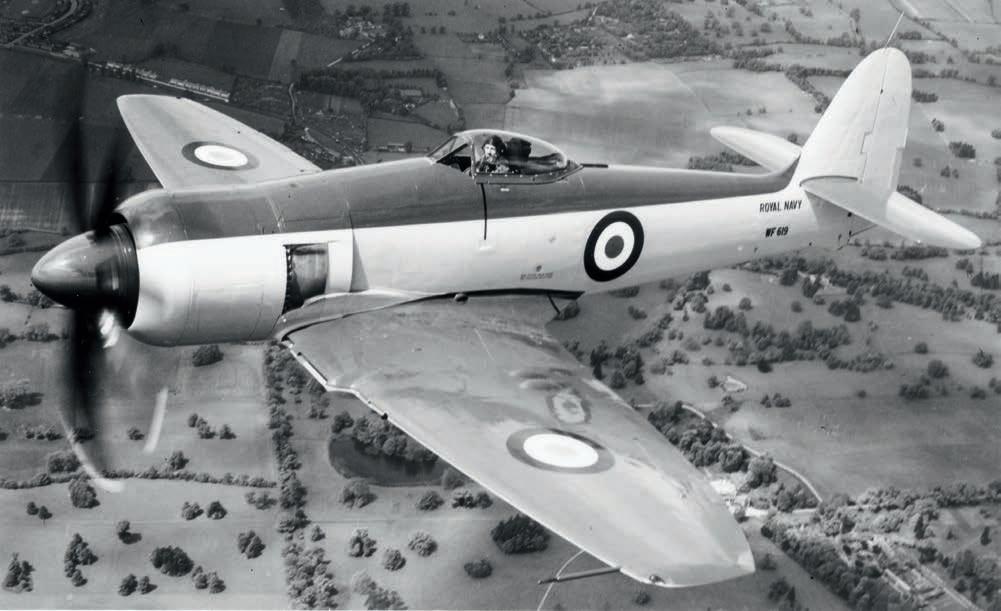
Sea Fury WF619 operated from HMS Glory with No.804 Squadron, it then joined No.1832 Squadron at Hal Far, next No.810 Squadron at Ford, before eventually being sold to Cuba.
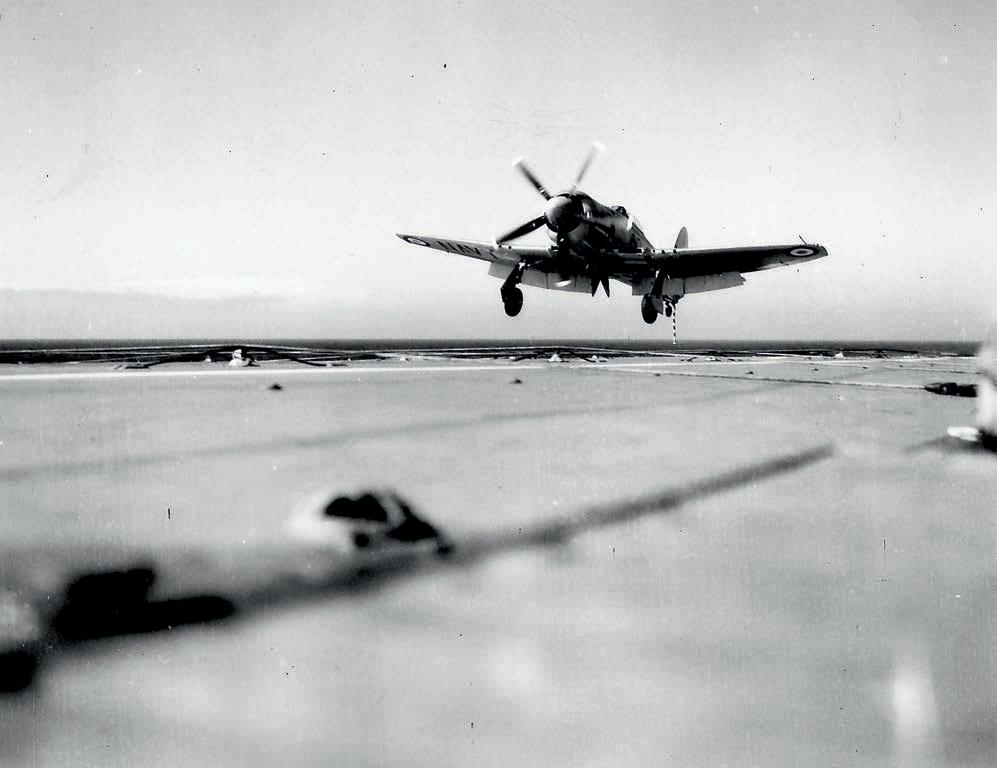

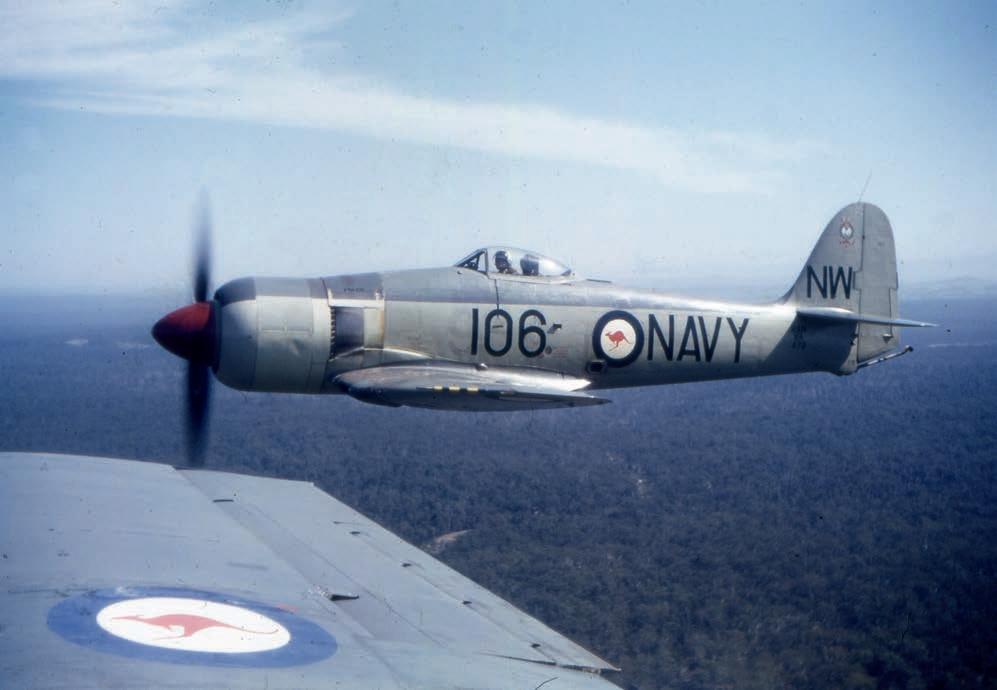
Lovely air-to-air photograph of Sea Fury WM479 106/NW of No.805 Squadron RAN. The picture was taken in 1957/1958 and shows a well-worn aeroplane. The ‘NW’ fin lettering refers to Nowra, the aircraft’s home base. David Eagles
with great success. With the usual load of two 500lb bombs the Sea Fury did a good job in making it difficult for the North Koreans to re-supply their front line, while you tried your best to make sure that you were not shot down. North Korea was really not the place to become a prisoner of war. For a dive-bombing operation you had to attack with a dive angle of 45° – if it was 44° or 46° then your bombs would drop short or go over the target. The dive would start at around 4,000ft with release at either 2,000ft or 1,500ft, depending on the accuracy that was required. The usual routine was to approach at 4,000ft, just above the enemy’s 40mm flak, at right angles to the point of aim to allow for the wind (upwind of course). Consequently, when you then rolled into the line of attack to begin the dive, the chances were that the aircraft would already be at 45°.
Prior to our arrival in Korea we had practised dive bombing using 28lb practice bombs which had the same trajectory as a 500 pounder. I managed something like 600 practice dives over Treligga, a disused airfield in North Cornwall. Constant practice meant that you knew when to turn and then automatically set the aircraft at the correct dive angle, the correct release height and the correct point of aim. This sounds difficult, but constant practice before arriving in Korea meant that you were eventually able to achieve the correct angle of attack as second nature – it was
all done by eye. There was little air-to-air combat although Sea Furies did fly Combat Air Patrols over their carriers, and other vessels as there was always a possibility of air attack, no matter how remote.
The Fleet Air Arm’s other pistonpowered aircraft used for attack operations was the Fairey Firefly, which was a relatively slow and ponderous aircraft compared to the Sea Fury. Consequently, it usually carried air-to-ground rocket projectiles and performed many of its operations over or near the coastline. The United Nations’ forces that conducted the war against North Korea had complete control over the sea and so a damaged Firefly could always ditch in the water with the crew knowing, if they survived the crash, that they should be safely picked up. The Sea Furies however, with their higher performance, flew further inland for ground attack duties. If they did encounter enemy Mikoyan MiG-15 jet fighters the Sea Furies would usually head towards the sea because their pilots knew the jets would not follow. The reason for this was that some of the MiG pilots were Russian and officially were not there, so the Communists could not risk one of them coming down in the sea and being captured. Most Sea Fury ground targets were inland, usually in the region of the Yalu River. We would fly in ‘finger four’ formation with each of the pilots busy watching the other’s tails. I never did fly a Sea Fury against a jet but
progressed onto Hawker’s next fighter, the jet Sea Hawk which was very easy to fly.
Later Sir Edward went to the Empire Test Pilots School (ETPS), in due course he became the resident naval test pilot on the Blackburn Buccaneer S.Mk.1 at Holme on Spalding Moor, then commanding officer of the first operational S.1 Squadron (No.801), then during the mid-1970s captain of the aircraft carrier HMS Ark Royal. He died on September 22, 2014, aged 85.
(No.802 Squadron, Korea aboard HMS Ocean, 1952)
Peter piloted one of the four Sea Furies that despatched a MiG-15 on 9th August 1952 (Brian Ellis, another, gives some of his recollections of the Sea Fury later in this chapter).
I felt that the Sea Fury was pretty good all round and great for ground-attack work in Korea. It was excellent for bombing and rocket firing and was also a very good gun platform for the fixed cannon – so good in fact that accuracy was never a problem. In general, the Sea Fury was able to operate well inland over the Yalu River and with little fear of interference because the Americans would often fly a Sabre-screen over this region as cover. The North American F-86 Sabre jet fighter was a strong opponent for the MiG-15 and the Sea Furies were only caught out by
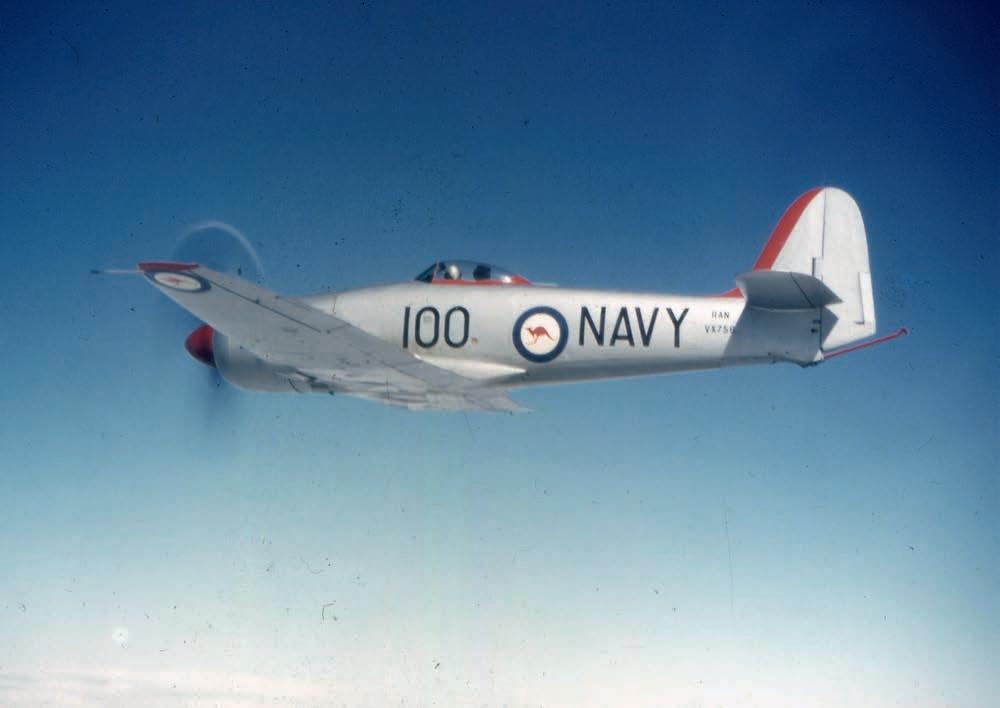
the enemy on those occasions when the Americans were grounded by fog.
A weakness of the Sea Fury could be, at times, its air-cooled Centaurus engine. The aircraft suffered quite a few engine failures from various causes. For example, it did not like having any water mixed with its fuel whereas the liquid-cooled Rolls-Royce Griffon that powered the Fairey Firefly was completely tolerant of water infiltration. In fact, on the very last day of HMS Ocean’s tour, Sea Fury flying had to be abandoned in the middle of the day because water had
got into the aviation fuel store on the ship and the filters had failed. One Sea Fury had to ditch after engine failure (the pilot was rescued) and I struggled to get back to the carrier after my engine began to run very roughly and cut out frequently. The problem had appeared when I was flying well inland near Pyongyang, so the job of nursing it back home was a long and quite unpleasant experience. An examination of the aircraft’s filters revealed the fuel to be heavily contaminated with water, and a full-scale inspection after the Sea Furies
had been grounded showed only two serviceable aircraft to be unaffected by the problem.
Of course I felt that the Centaurus was a good engine but thought perhaps it was not really suited quite so much to a fighter. It was more at home in bomber or transport types where it could run for long periods at relatively constant revs, as it did in the contemporary Bristol Brigand light bomber.
Peter later went on to fly the Supermarine Attacker and Hawker Sea
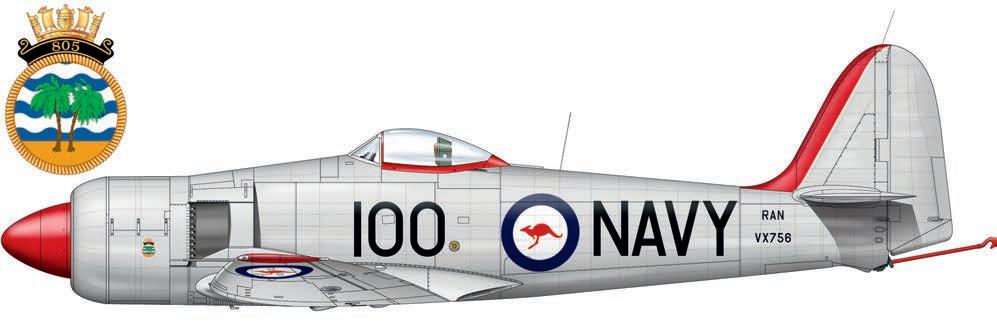
RAN WH587 ‘105’ of No.805 Squadron pictured in 1957/58. This aircraft is still in existence. David Eagles
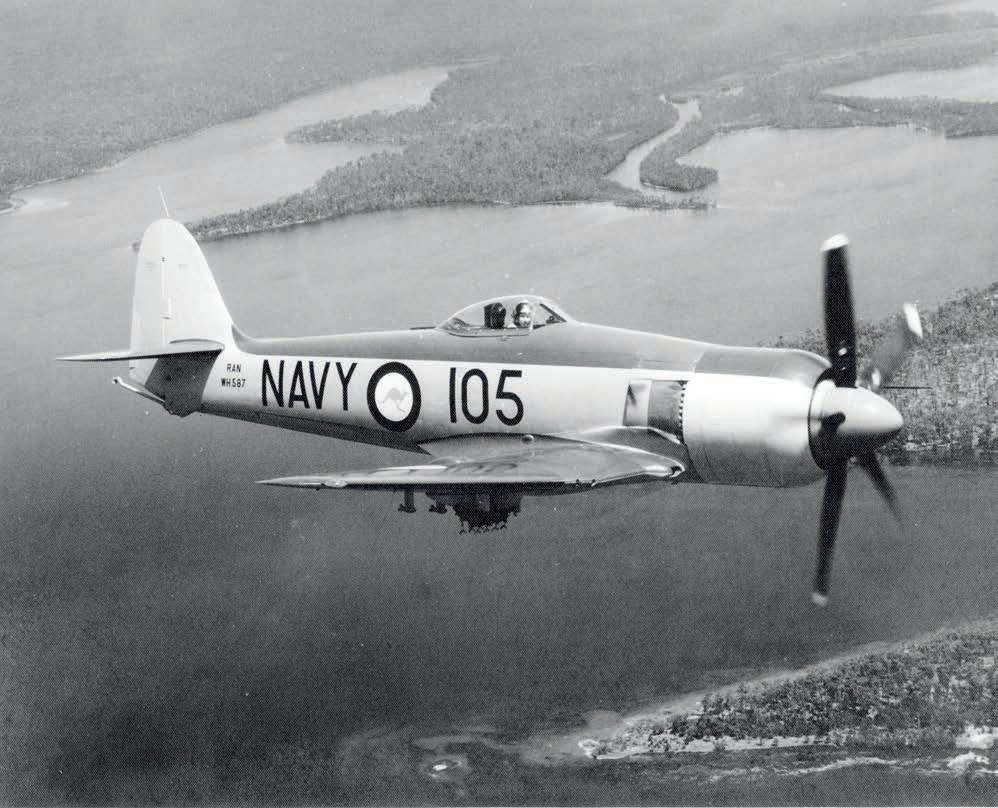
From June to October 1956 WH581 flew with No. 723 Squadron out of Nowra. It was given the code 922/NW. David Eagles
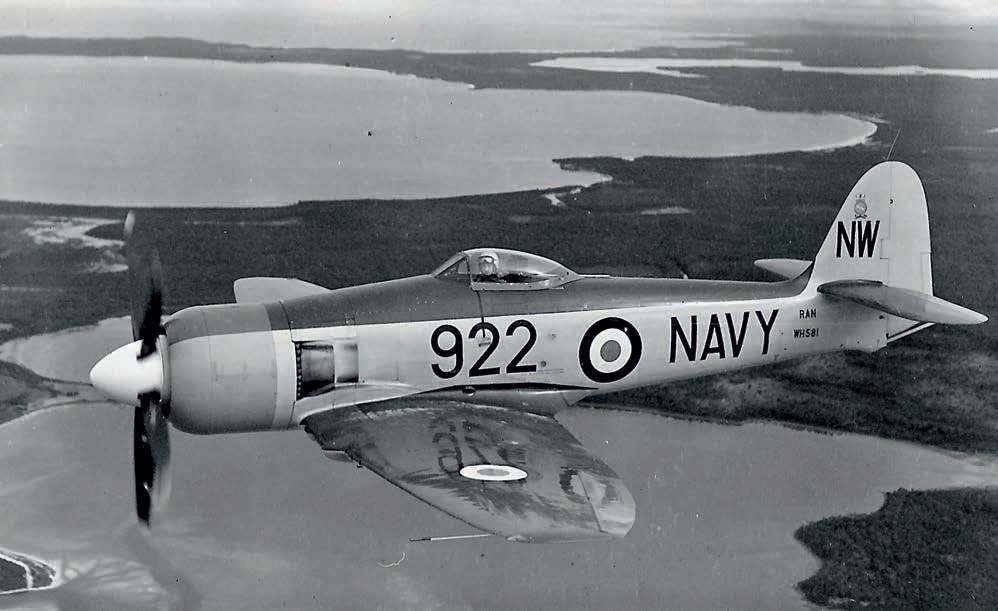
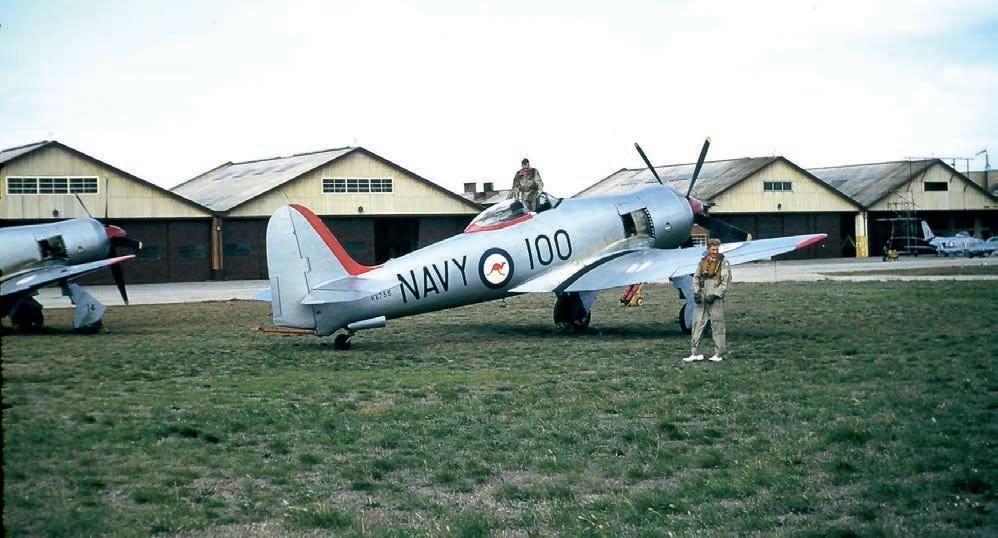
Two of No.805 Squadron’s display aircraft seen at RAAF Laverton on 12th March 1958 where they had landed en route to Melbourne for a formation aerobatic display over the city. In the picture are two of the team members – Lt Cdr Brian Stock and Lt Davidson. During March the team performed displays over Melbourne and Sydney, as a farewell to the Sea Fury with the squadron. A party was held in the wardroom and the aircrew had a red Fury spinner mounted on a wooden stand (duly cleaned out!) filled with Brandy Alexander. VX756, coded 100, illustrates the silver colour scheme worn by No.805 Squadron’s Sea Fury aerobatic team in 1958. Note the red spinner, wingtips, fin leading edge and arrester hook. The Sea Fury partially visible to the left is coded 114, most likely WH558, and was the team spare aircraft, the others being 100, 105 and 115. Although this would suggest that there were only ever four Sea Furies used by the team, in fact one, or perhaps two, aircraft were replaced and their replacements received the same code as the aircraft they displaced. David Eagles
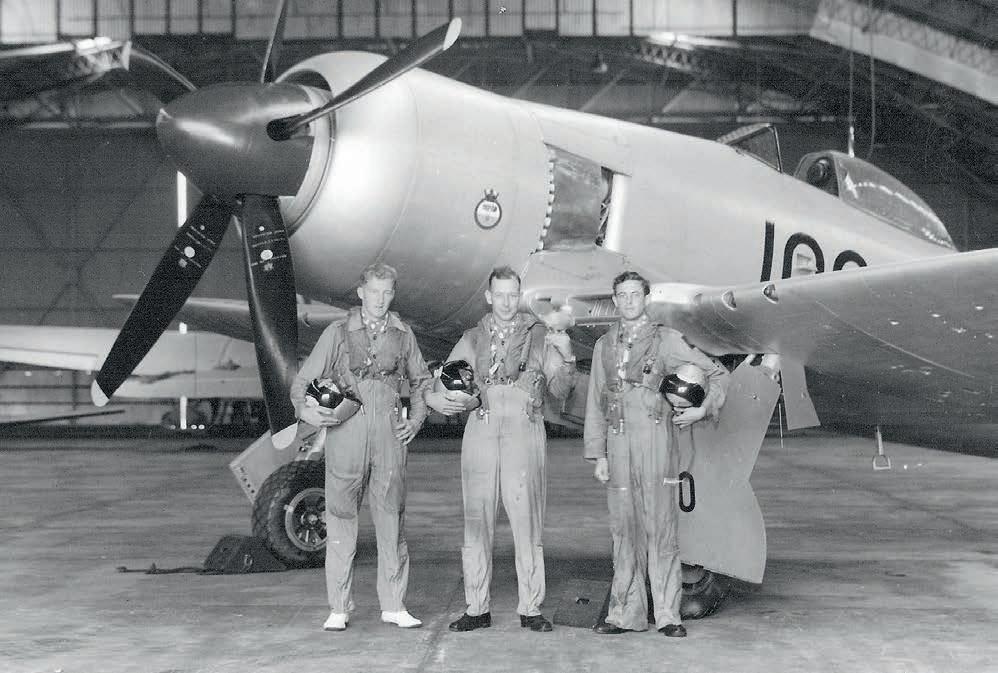
Hawk with No.736 Squadron and afterwards passed through ETPS and became a naval test pilot on the de Havilland Sea Vixen. He eventually became a tutor at the ETPS. He died in February 2013, aged 85.
First let me say there will be pilots around with more time on Sea Furies than I, and who will have operated them from the deck. I only ever flew them from an airfield (RANAS Nowra), and I did not serve in the Korean War. I joined the RN at the end of 1953 and, after around two years training, volunteered for two years Loan Service with the Royal Australian Navy and flew Sea Furies with 805 Squadron, completing about 320 hours of flying. I actually arrived on loan to the Australian FAA in June 1956, allegedly to fly the de Havilland Sea Venom, but was posted to a Firefly Squadron. Since I had finished my training on jets (the Grumman F9F Panther at Corpus Christie Texas, USA and de Havilland Vampire and Hawker Sea Hawk in the UK) I felt very unhappy and complained to the captain. I was bundled smartly out of his office and checked out on the Firefly! In November that year I had a mid-air collision with another Firefly and had to ditch in the sea in Jervis Bay, south of Sydney, then in January 1957 I was transferred to 805 Squadron which was equipped with the Sea Fury. For the next year and a half I flew mainly Sea Furies with the occasional Firefly and Vampire. Of the three the Sea Fury was by far the most enjoyable.
As you will know it had a Centaurus 18-cylinder sleeve valve radial engine with a single-stage, two-speed, supercharger that was used to restore boost at altitude. It was cleared to 425 knots below 10,000ft and it was just a delight to handle. The Centaurus
normally took in air through filters in intakes under the engine. A switch in the cockpit allowed the pilot to select unfiltered ram air from intakes in the wing root leading edges. This switch was normally wire locked in the ‘filtered’ position to help preserve engine life as sand of course could be expected to wear the sleeves, but it was permitted to select ‘ram air’ on test flights for data gathering, i.e. to record max speed at certain power and altitude conditions; the slight increase in power was certainly noticeable.
We were based at Nowra and never deployed to a carrier. Nowra is about a hundred miles south of Sydney and five miles to the west of the Tasman Sea coast. The squadron did practice dive-bombing, strafing and 3in rocketing as well as the usual navigation exercises by day and night. In my last year there I was acting as the station maintenance test pilot, though unqualified. But the most enjoyable activity was practising formation aerobatics. The squadron formed an unnamed three-ship team led by Lt Cdr Brian Stock – another RN pilot on loan. For the summer season in 1958, we had the aircraft painted a rather lurid silver with red spinner, fin leading edge and wing tips, and we visited various air shows all around New South Wales getting as far west as Broken Hill, the so-called Capital of the Outback. We were accompanied by a Vic of Fairey Fireflies that performed mock attacks during each show.
Even when going quickly to full power on take-off, the tendency to swing on the Sea Fury was easily controlled with rudder. I later flew the Spitfire which was a very different story, being so much lighter and with a much narrower landing gear. The Fury’s wide undercarriage and lockable tailwheel made it very much easier to
control. We often did Vic formation takeoffs from the runway with no problems. A favourite feature of the Fury came just after take-off when you could pull the pitch lever all the way back to the rear auto position and use the throttle in a single-lever fashion like a jet.
A series of cams altered the rpm appropriately as you wracked the throttle about. You couldn’t use the auto position if you were flying close formation because the automatic alteration of rpm with throttle movement gave slightly imprecise response. But for individual operation and particularly for aeros the system was wonderfully simple – especially after the Firefly. There was no aileron trim but a fixed tab could be adjusted on the ground if there was ever a bias, which was rare. The ailerons had spring tabs which made roll-response excellent and all the controls were light right up to maximum speeds. The aircraft was so responsive it just felt as though it was waiting for you to throw it around! Compared with the Spitfire there was much less trim change with speed for a given power setting and I think the only slight oddity was a slight lightening off in pitch when turning hard at height.
The spring tab is a device that made control forces lighter in the days of ‘reversible’ controls. In the case of the Sea Fury the ailerons incorporated them. In aircraft of that era flying at normal speeds of say up to 250 knots (288mph), when you put in lateral stick the rods or wires in the system pushed the ailerons up (and down) into the airflow to create a rolling moment. As speed was increased, the higher airflow pressure resisted the movement of the aileron into the airflow causing a need for higher forces at the stick to achieve any roll response.
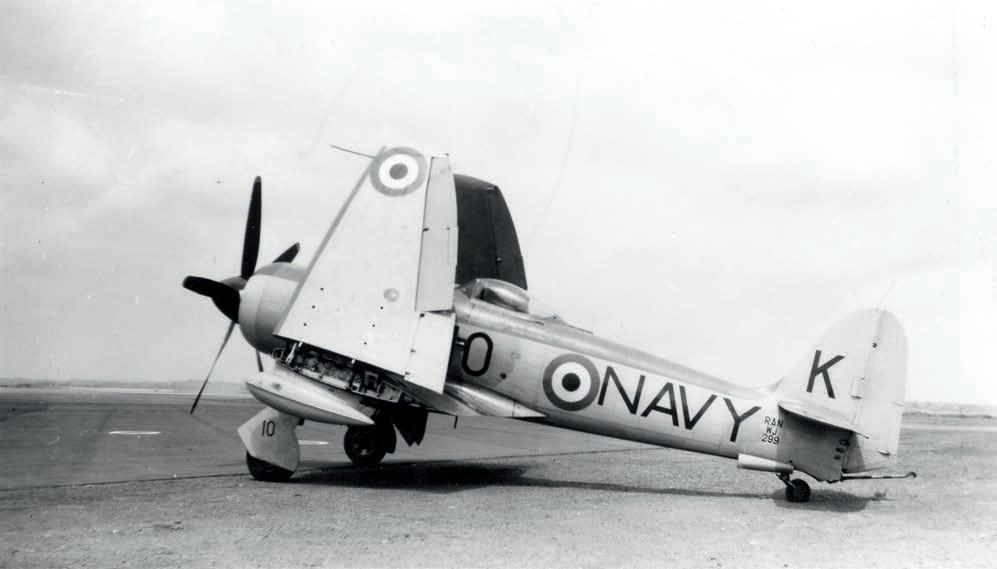
802 Squadron aircraft from HMS Vengeance lined up with a couple of Dutch Navy Sea Furies on 23rd June 1949. FAA Museum
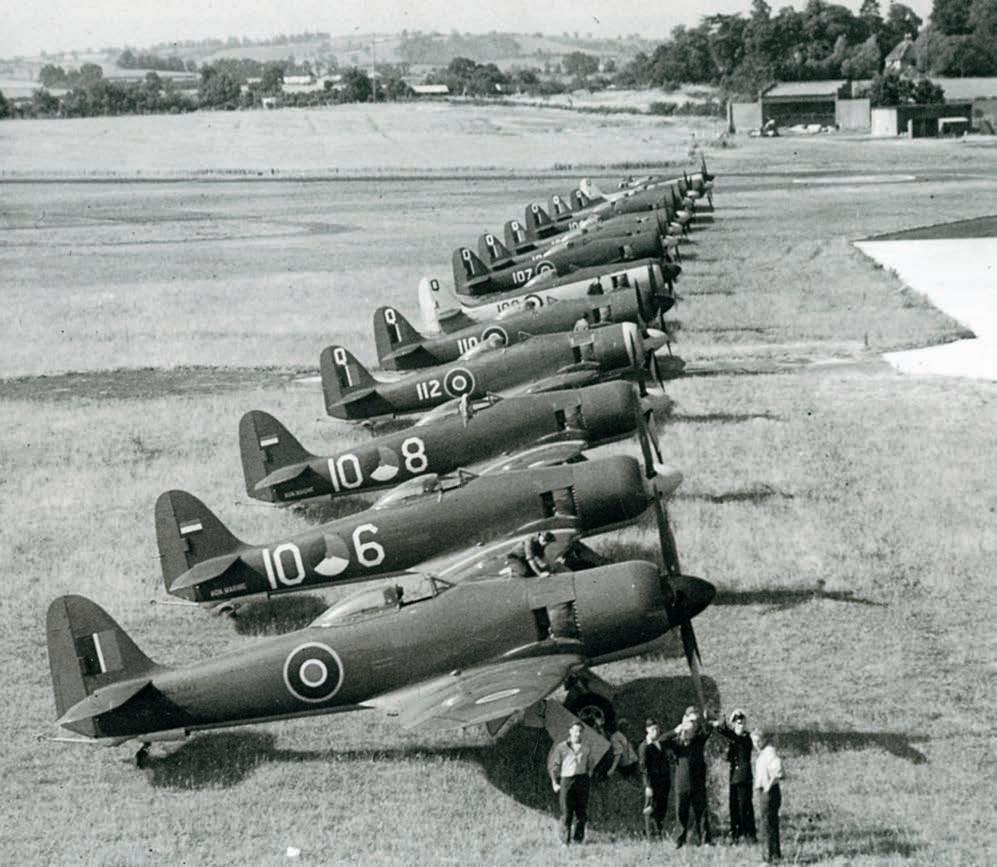
For several years in the 1950s Sea Fury T.20 VZ370 was used for training at Hal Far.
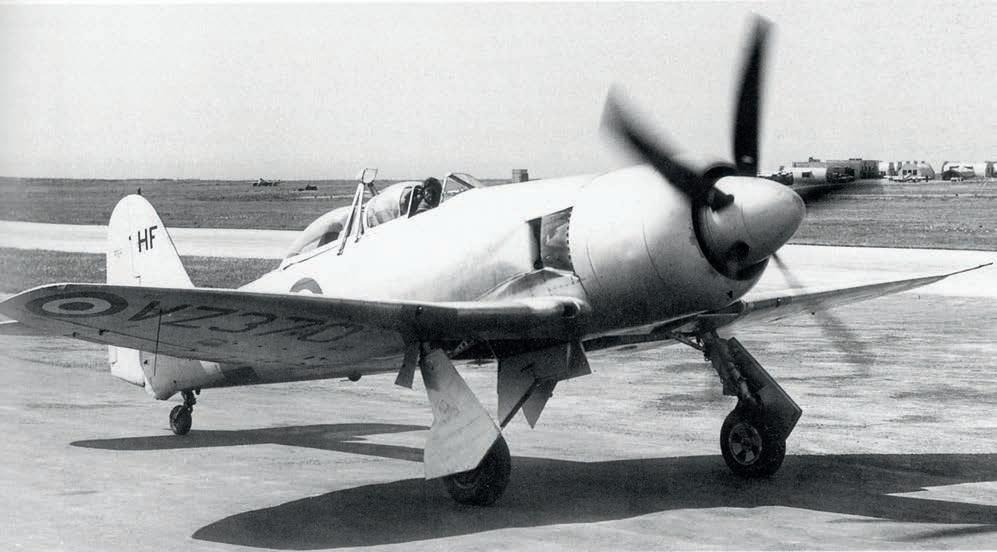
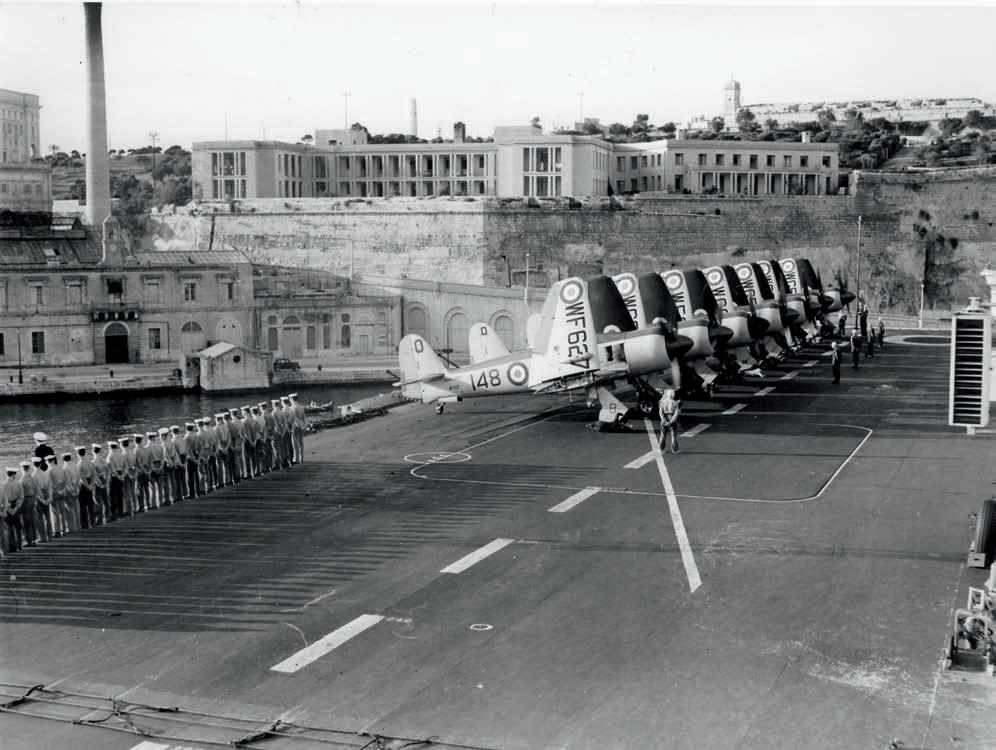
‘Pinwheeling’ was a process where aircraft were lined up across a carrier’s deck with their engines running to help the ship manoeuvre in harbour. Here we see No.898 Squadron’s Sea Furies doing just that aboard HMS Ocean in Malta. The nearest aircraft WF627 148/O was eventually lost in Korea. Brian Lowe
Lovely shot of VR933 on approach to land – with one underwing rocket projectile still on board. Brian Lowe
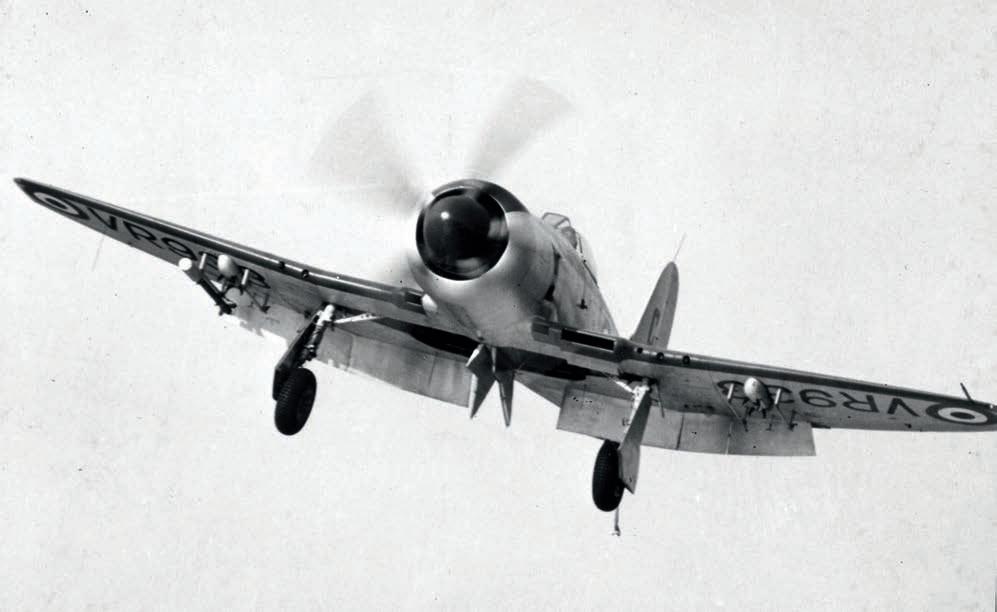
With the spring tab the force pushing the aileron was delivered via a toque tube. In other words, lateral stick applied a twisting motion to one end of a ‘rod’ and that twisting action was normally delivered at the other end of the rod and moved the aileron through suitable linkages. If there was resistance (at higher speeds), the rod (or torque tube) simply wound up and engaged another linkage which moved a small tab on the trailing edge of the aileron in the direction required to help aileron movement in the intended direction. I guess the clever bit is in so engineering this arrangement that there is no discernible difference felt at the stick, as the spring tab takes over the job from direct aileron input. The benefit of course was that the pilot was able to achieve good response to stick input without tiring high forces. As I said the Sea Fury didn’t have adjustable aileron trim – it had pre-set trimming tabs which could be adjusted only on the ground. I know that Freddie Page, who was my MD at Warton when I joined in 1968, had been responsible for much of the Sea Fury design, and I believe the spring tab design had been his baby. I’m not aware of which other aircraft had them but of course the arrival of hydraulically-powered ‘irreversible’ controls obviated the need.
In the 805 Squadron aerobatic team the aircraft was really very pleasant in formation aeros with the precise control making the whole affair very easy. I remember we used to deliberately leave the canopies open and unlocked for the
formation take off, and just before unstick speed all three canopies would suck closed with a thud! The cockpit cooling wasn’t very good in the Australian summer and the squadron used a small scoop that could be pushed into a hole in the cockpit wall, which was there to allow a Very pistol to be fired through. The scoop brought fresh air onto the pilot’s face. It was certainly the nicest single piston I flew but then I didn’t have the pleasure of many – North American Harvard and T-28, Hunting Provost and Boulton Paul Sea Balliol apart from the tiddlers. The Sea Fury was pretty reliable by the time I got to fly it. I had only one incident in my eighteen months on type, with an engine failure which led to a deadstick landing. The withdrawal of the Fury from RAN service coincided with my own return to the UK in June 1958 and many of the aircraft were sold on to the Warbird market, mainly to the USA. David also trained with the US Navy at Pensacola and graduated from the ETPS in 1963. Returning to the Royal Navy he became senior pilot of No.809 Squadron on Buccaneers in 1968, leading the unit’s aerobatic team at that year’s Farnborough Airshow. He later joined the British Aircraft Corporation (BAC) at Warton as a project pilot on the Panavia Tornado. In 1986 he was the pilot for the first flight of the British Aerospace EAP (Experimental Aircraft Project), which acted as a test bed and research aircraft for much of the technology later incorporated in the Eurofighter Typhoon.
(No.802 Squadron, Korea aboard HMS Ocean, 1952)
I went onto the Sea Fury after flying around a hundred hours on Griffon Seafire 15s and 17s during three to four months of training. The Seafire had been a quantum leap forward from the Harvard trainer, from Seafire to Sea Fury was less of a leap and was therefore reasonably easy to adapt to. However, part of the training also involved flights in the two-seat trainer Sea Fury for a demonstration of the torque-stall. If you were flying slow and low in a Sea Fury and then had to open the throttle quickly, you could find that it would begin to roll around its propeller from the rapid introduction of so much power. This problem had to be sorted with a QFI (Qualified Flying Instructor) and a new naval pilot really needed to learn properly how to fly the aircraft slowly in readiness to make carrier landings.
In fact on my first deck landing, flying in from Culdrose during training, I went straight into the barrier on HMS Vengeance. I did what everybody had told me to do, but ended up flying at such a huge angle of attack that the aircraft floated over the wires and into the barrier. At such a large angle it was just impossible to make the aircraft drop onto the deck, and there was no way that this situation could be simulated prior to the real thing. Lots of practice landings at Predannack (a satellite of Culdrose) were never quite enough to prepare you for the
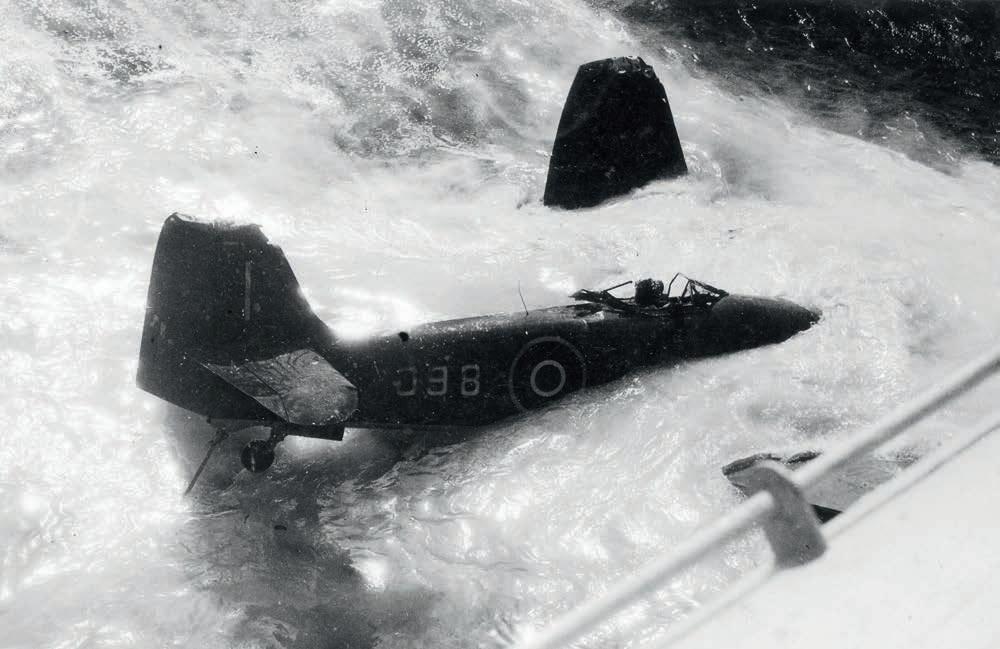
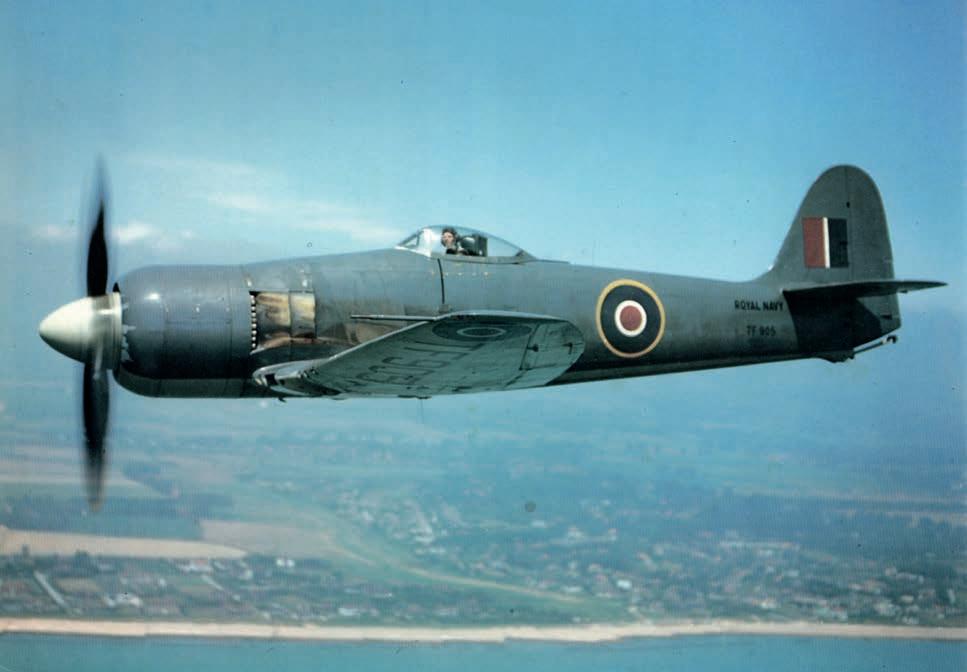
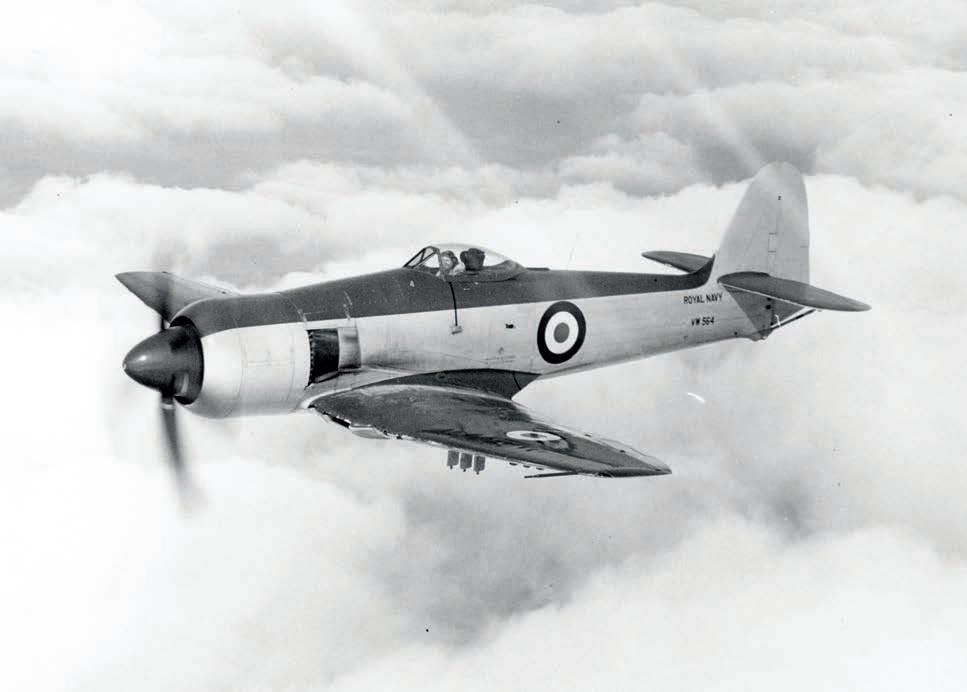
Comparison of colour schemes. Early Mk.X
the
well-known
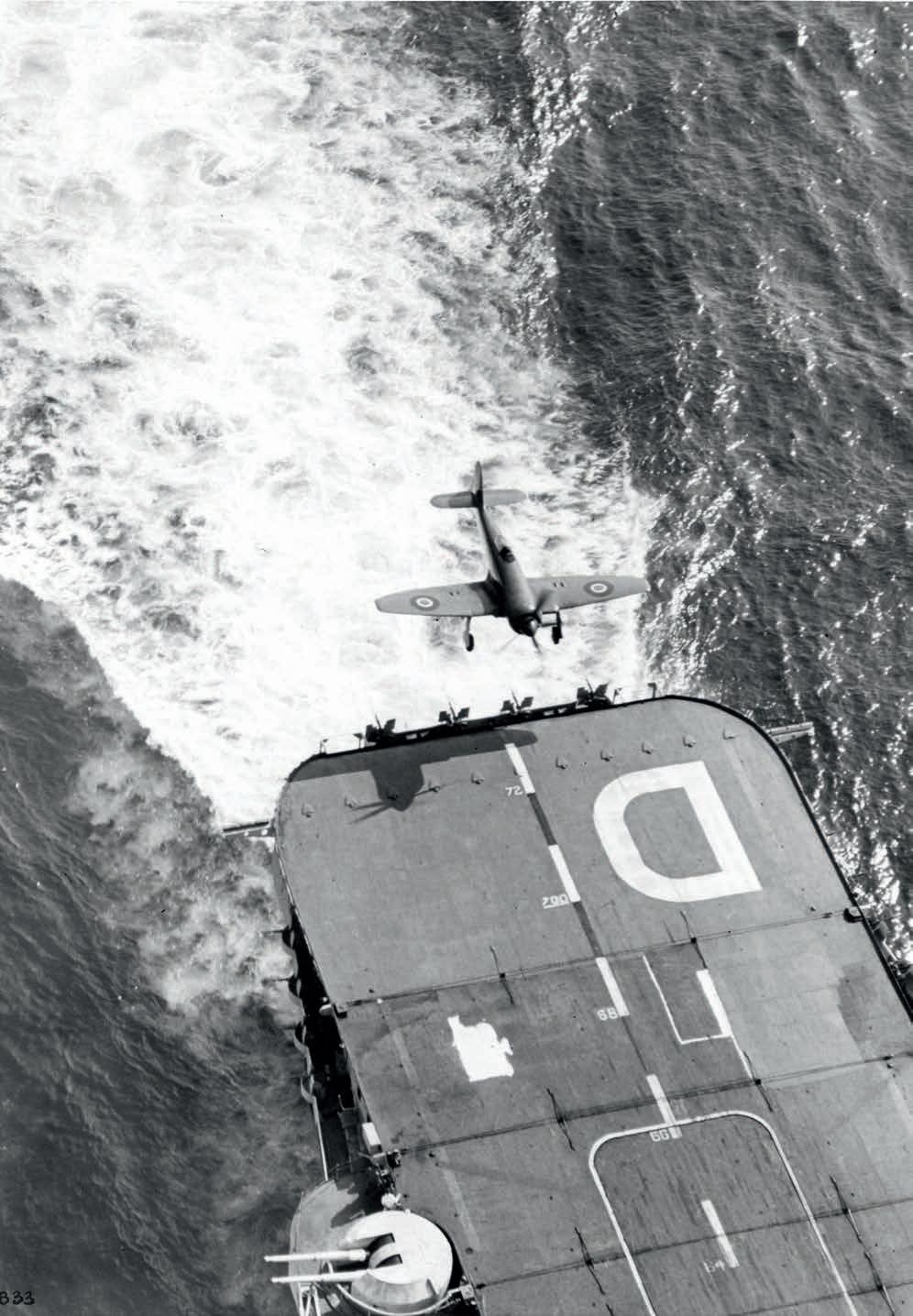
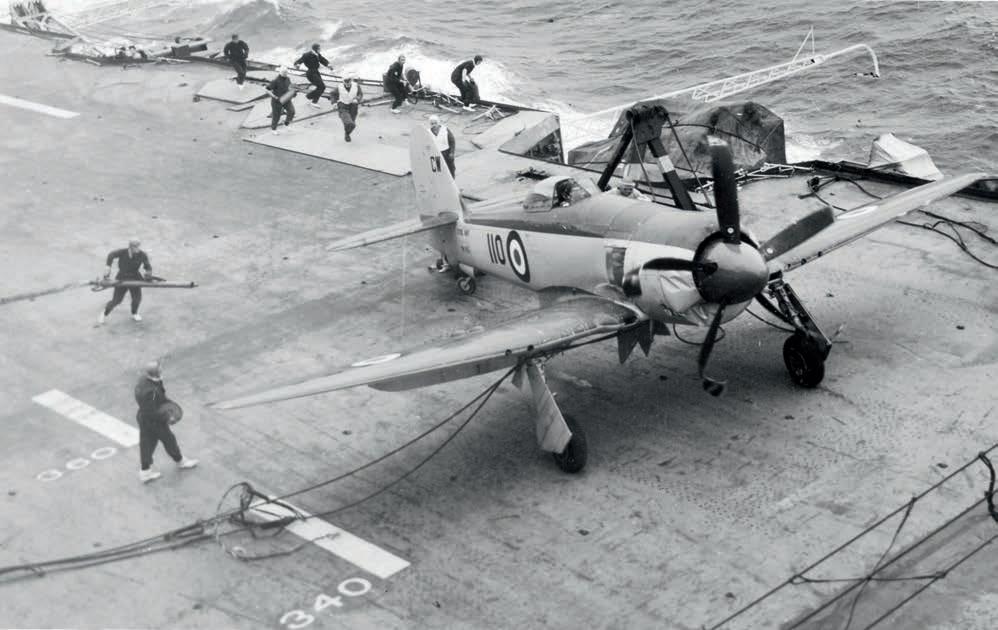
carrier. It is possible that the BBC has a sound recording of this incident because a broadcaster was on board at the time preparing a radio programme. I learnt my lesson and eventually completed 400 Sea Fury landings.
In Korea we flew ten days on, ten days off. One of our jobs was to keep the railway bridges down between Chinnampo on the North Korean coast and Pyongyang about 60 miles inland. In fact, Korea had the greatest density of railways in the world, a terrific system, and we had to regularly hit about twenty bridges on this route to keep them out of action because the Koreans would get them operating again as soon as they could. One of the problems when operating as a fighter-bomber came if you had a bomb hang up. If one failed to release, you never quite knew if it would finally come off when you arrived back on deck because the bomb might only be partly hooked onto the wing. Consequently, we would nearly always divert to Seoul to land as that was safer.
One particular memory of the war was when Lt P. G. ‘Pug’ Mather was shot down. His Sea Fury was hit by flak and he had to belly land on a Korean beach. The rest of us were directed by radio to the area to protect him and we could see North Korean soldiers close by. A half-hour battle followed – we picked off the enemy while ‘Pug’ took shelter (he only had a revolver for protection), until an American helicopter arrived to pick him up (‘Pug’ Mather was later shot down a second time and taken prisoner). US helicopters saved several
pilots and was an important consideration regarding operations in Korea, when we first arrived out there in HMS Ocean our ASR (Air Sea Rescue) aircraft was a Supermarine Sea Otter flying boat. The advent of the rescue helicopter for the first time in a conflict was a very welcome addition and in the Royal Navy’s case we later received the Westland Dragonfly.
I needed a helicopter’s assistance on one occasion as well, having failed to takeoff from the carrier’s catapult. Occasionally a Sea Fury could experience a slow-burning cartridge in the engine’s Coffman starter, which would make the propeller rotate slowly before fizzling out. It usually meant the engine would become sooted up and so the ground crew would have to open the top of the Centaurus, with aircraft queuing up behind, to give it a clout with a leather hammer. This usually did the trick, but in my case it released the jubilee clip on the oil pipe as well. As I went down the catapult the pipe came off, the airframe got covered in oil and the engine seized, and so I had to go into the sea alongside Ocean. Fortunately, the ASR helicopter was on hand to rescue me. I remember clearly how the aluminium propeller blades were bent backwards like flower petals as the Sea Fury hit the water. A Sea Fury would not float for very long, but it did give me enough time to get out.
In 1953, after my return to Britain, a huge number or warships from all over the Commonwealth collected at Spithead for a major naval review to mark the Queen’s Coronation. Afterwards this enormous
fleet, one of the biggest assemblies of Commonwealth vessels ever, was led by Mountbatten into the Mediterranean for a large series of manoeuvres. 802 Squadron’s Sea Furies went with them, we did a lot of flying and, at times, there were so many aircraft in the air that we had to complete any number of circuits before being given clearance to land. However, working with other ships from so many nations was worthwhile. Soon afterwards we lost our Sea Furies for Sea Hawks.
Brian later became an instructor at the Central Flying School (CFS), followed by a period as an instructor at RAF Valley, and then a mirror-control officer on the aircraft carrier HMS Albion. A period in West Germany followed, helping to create that country’s naval air arm, he then served with No.831 Electronic Warfare Squadron, and finally as flight deck officer on HMS Victorious.
(No.801 Squadron, Korea aboard HMS Glory, 1952/53)
The contemporary twin-engine fighter to the Sea Fury was the de Havilland Sea Hornet; ‘Spiv’ flew both and is well qualified to compare them.
If I had had to go to war, I would have preferred the Sea Fury because it had a radial engine, whereas the Sea Hornet had liquid-cooled inline engines which were more vulnerable to gun damage (although there were two of them of course instead of Sea Fury’s one). The Sea Fury was
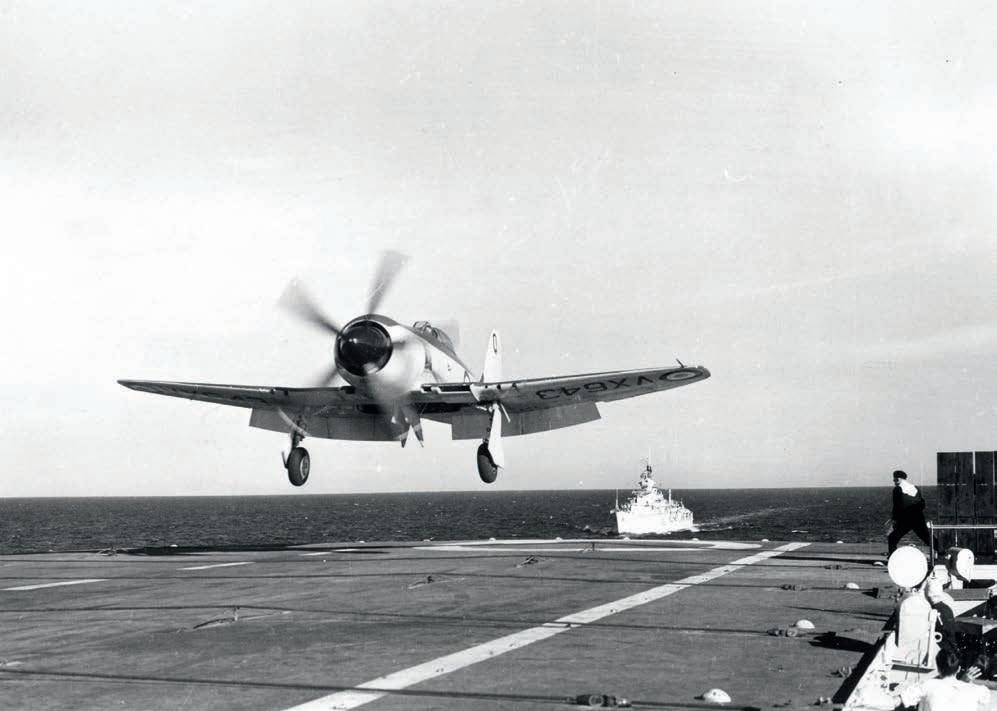
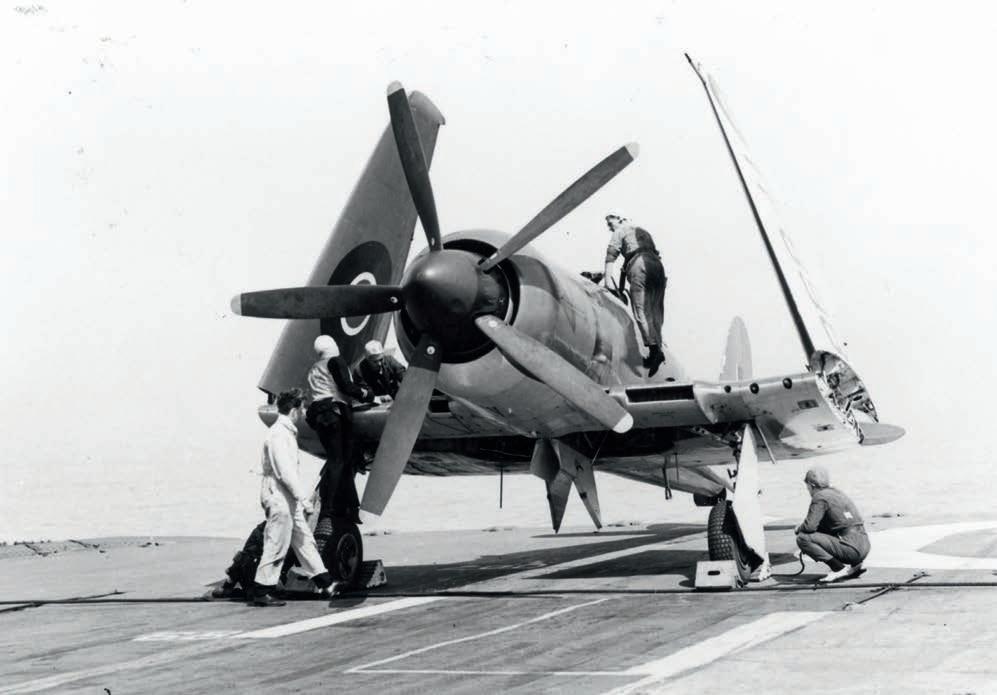
a bit more manoeuvrable than the Sea Hornet because it could pull very tight turns and had a very good rate of roll. It could be pulled around in very tight manoeuvres but to do that in a Sea Hornet, or simply make a Sea Hornet fly on its side, required moving the two heavy, widely separated Rolls-Royce Merlin engines around the axis of movement. That reduced the twin’s manoeuvrability a little. In fact, the Sea Fury was so manoeuvrable that anybody who tried to tangle with it would be in trouble – even a jet. The Sea Hornet was however just about the faster of the two, although in truth there was not a lot between them.
The Sea Fury did have some weaknesses, especially in its early service career days when there were problems with the oil cooling and oil circulation of its Centaurus power unit. If a pilot saw the engine temperature, or oil pressure rising, then he knew that his flight was nearly over and this was the cause of a number of aircraft making forced landings. Once sorted out however, I found the engine to be fine.
The Sea Fury was a tough aircraft and could take punishment. On one occasion during the Korean War, I had a round jam and then explode inside one of the cannons. In fact, it blew the cannon to bits and took off some of the top and bottom of the wing and caused other damage, but I was able to divert from the carrier to an Americanheld beach used as a diversionary airfield and landed there. I flew in Korea aboard
HMS Glory from September 1952 until April 1953. My squadron’s aircraft flew combat air patrols to protect the ship which also involved, if required, flying off to protect pilots who might have been shot down. If an aircraft was downed over land, the CAP duty fighters would immediately be despatched to supply cover to the pilot on the ground and relieve any aircraft that had originally been flying with the stricken machine.
However, the main job in Korea was interdiction – attacking the enemy’s routes to the front, hitting his transport, trains, tanks, trucks, indeed anything that moved, plus bridges, bases, etc. In some respects, this was similar to the air/ground war in Europe in 1944/45, although I must add that the Tempests and Typhoons operating there had far more opposition than we did in Korea. There were ‘hot spots’ in Korea of course, but even those were protected by rather fewer guns than the equivalent targets in Europe. The only time I became involved with MiG-15 fighters was when I was one of four Sea Furies attacked by a pair of these jets. The enemy aircraft made just the one pass before getting out of the area, fortunately, we spotted them coming and manoeuvred out of their way.
In 1953 I took part in a major exercise aboard HMS Illustrious while flying with a Dutch Navy Squadron. The Dutch had lost several aircraft through accidents and I took four FAA Sea Furies to join them and increase the unit’s numbers; the Dutch
pilots were very good and of the same quality and capability as their equivalents in the Royal Navy. The Sea Fury was also a magnificent solo aerobatic aircraft, ideal for air shows, I remember ‘Jock’ Elliot, who later became a test pilot at de Havilland and did much of the test flying for the Sea Vixen. Performing as an aerobatic pilot in the Sea Fury, Elliot was fantastic! He could execute every possible manoeuvre in front of a crowd and yet never make any of them look dangerous in any way.
One last memory comes from when I was instructing at RNAS Culdrose, the job in hand was to train students to perform 65° dive-bombing runs over the coast in the Sea Fury. On one occasion I followed them in a Seafire, which happened to be the only aircraft available. In the dive I was unable to catch the Sea Furies, and before I could reach their speed I found that I was losing control as well. The Seafire’s controls became heavy, the aircraft kept lurching off to starboard and I was forced to slow down before the controls would respond again. No such problems for the Sea Fury which pulled away from me without trouble. At low level Sea Fury was clearly faster and more stable at high speeds than the Seafire.
During his career ‘Spiv’ became one of the most experienced of naval pilots and the other types he flew included the Sea Hornet, Seafire, Sea Hawk, Supermarine Scimitar (becoming CO of No.803 Squadron, Scimitars in December 1959) and Buccaneer.
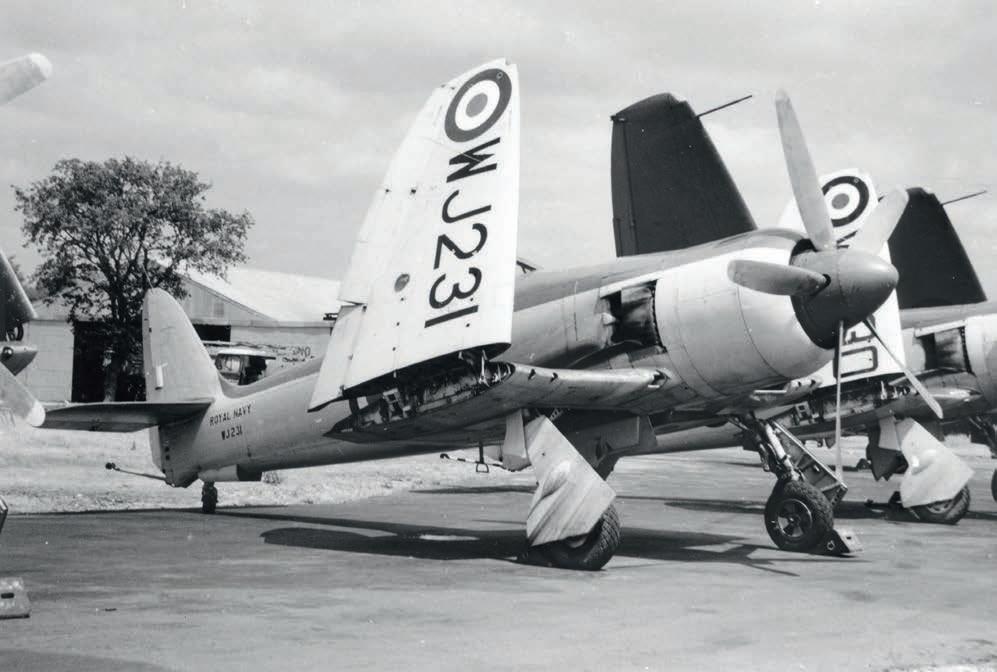
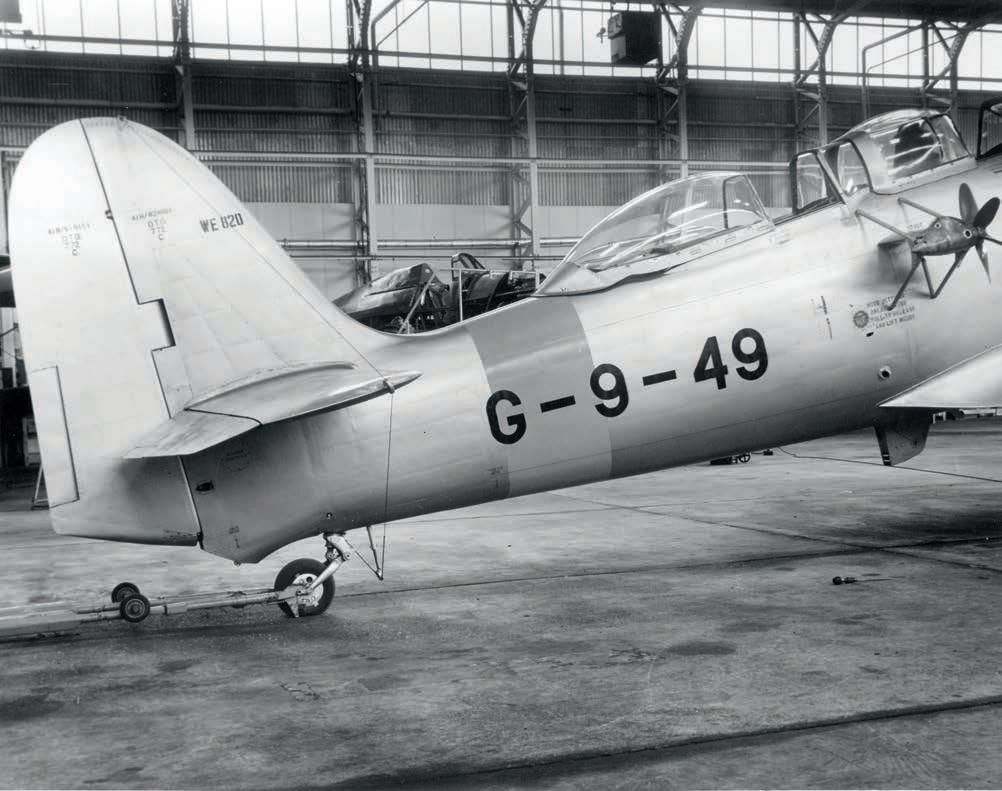
(No.825 Squadron, Korea aboard HMS Ocean, 1952. No.821 Squadron, HMS Glory 1952/53)
I took part in operations over Korea, flying the Firefly and it was only later that I had the opportunity to take a Sea Fury into the air, at Iwakuni in Japan. It was delightful, a lovely aircraft to fly and by far the nicest piston-engined aircraft I had ever flown. By comparison the Firefly was a bit of a ‘coal-burner’ and I was delighted to fly something as responsive as the Sea Fury, which was far superior in terms of handling and performance. Besides the greater power offered by the Centaurus, I recall how smooth the Sea Fury was in flight, yes, when the engine was idling it rattled the aircraft quite a bit, but after putting on the power there was little or no vibration at all, which was quite unusual for a piston aeroplane.
There is one point about flying from carriers in Korea. The reader may well have heard stories from World War Two pilots who, once they were flying over the sea away from their homeland or base, would imagine all sorts of false noises from the engine when, in reality, everything was fine. In Korea it was quite the opposite. Such was
the United Nations’ control of airspace over the sea that pilots were usually completely happy flying above water – it was only when they flew over unfriendly enemy territory that the ‘false’ engine noises began to manifest themselves.
Paul later became an Instructor on Sea Furies at the Navy’s Fighter School and graduated from ETPS in 1958. Afterwards he flew with the Aerodynamics Flight at the Royal Aircraft Establishment at Bedford where he was project pilot on the Bristol 188, Handley Page HP.115 and Short SB.5 research aircraft. On becoming senior experimental test pilot with BAC at Warton, he was project pilot on the Anglo-French Jaguar strike aircraft, and in 1974 took the Panavia MRCA Tornado on its maiden flight.
The Sea Fury was an absolute joyous aeroplane that almost always did what you asked it to do. I know that sounds obvious but it was beautifully balanced – that is the ailerons were balanced with the elevators and rudder, which was not something you could say about every aircraft (several Sea Fury pilots have raised this point – author). The Supermarine Attacker for example which I flew later, or even the Seafire 15s
and 17s I had flown before the Sea Fury, were certainly not so balanced. I started on Hawker’s piston fighter at Arbroath when Sea Furies were just being delivered, and it was my job to fly them down to Culdrose so that the flying schools would have enough aircraft available to begin training pilots on type. My Sea Fury training involved flying from Culdrose and HMS Vengeance with the Home Fleet. We also went out on exercises, made visits to Casablanca and Lisbon, and there was a high rate of accidents at the time.
The problem was that cuts in the financing for defence during the late 1940s meant that there was insufficient fuel for pilots to perform enough practice flying. In fact I became involved with a major study which showed that one in thirteen landings aboard carriers was actually some form of accident. It was only when more practice was permitted, plus the arrival of the angled deck, mirror landing sight and other features on the carriers themselves to assist with the handling of ever more powerful aeroplanes, that the ratio improved. It eventually reached one accident per one thousand landings.
On occasion Vengeance would offload No.802 Squadron to make room for a
visit by Royal Netherlands Navy aircraft from their carrier Karel Doorman, and so we would head off to Germany for some co-operation training with the army. This would involve very low-level flying over the flat plains of Northern Germany, and on one occasion I remember seeing a farmer on top of a hay wagon throwing his pitchfork into the air just in front of me. In fact it hit my Sea Fury and the metal fork became embedded in the wing. Although the handle broke away in the slipstream, the head was still there when I landed. There was also Armament Practise Camp with 802 Squadron at Sylt in 1950. On one occasion our return home was delayed and we finally took off in poor visibility. I lost contact with the rest of my flight and then found I had no radio. I also had to change direction to avoid flying over East Germany, and then realised that my fuel was getting low. On coming out of cloud I had no option but to land on an autobahn to find out where I was, parking out of the way on one of the access lanes. Soon enough a police car arrived and, after a discussion and map consultation, I was able to take off again and get into base at Wunstorf with just enough fuel left.
Still with 802 I became a member of a four-ship Sea Fury display team that was led by the famous test pilot Capt Eric Brown, who had now returned to Fleet Air Arm service. This was formed in 1950 in preparation to serve as the Navy’s aerobatic team for the 1951 season and the main feature of our display was that we did all of the manoeuvres in-line. As a consequence the chap at the back had the hardest job keeping up, having relatively little power to spare over the three machines in front of him. The other two members were Johnny Walker and Bill Newton. One final point regarding the Sea Fury was that it had the first properly-designed cockpit I had seen. Unlike the Seafire for example, the cockpit ergonomics of which were a mess, all of the Sea Fury’s instruments, dials and switches were in the right place for hands to reach them or eyes to see them.
‘Boot’ never served in Korea. He next joined No.702 Squadron, the Naval Jet Evaluation and Training Unit at Culdrose, as the air weapons officer flying Attackers and later Sea Hawks. Later, he became an air warfare instructor at the US Navy ‘Top Gun’ establishment at Miramar, California. He subsequently commanded No.801
Squadron and later still was appointed captain of the frigate HMS Loch Alvie in the Persian Gulf. From 1960 to 1965 he was Commander Air at Lossiemouth, later Commander Air on HMS Centaur, and finally went to the air weapons section within the Ministry of Defence.
(No.802 Squadron, Korea, aboard HMS Ocean and No.804 Squadron HMS Glory, both in 1952)
The Sea Fury was probably the best singleengined piston fighter of its time, although one or two American contemporaries came very close. A key point however, was the Centaurus engine which prevented the aircraft from being used for high altitude work. The Bristol powerplant was unable to get the Sea Fury to the same heights as the Rolls-Royce Griffon fitted in the Seafire, which had a two-stage supercharger where the Centaurus did not. On one occasion with my commanding officer I tried to intercept some MiG-15s but found that it took too long to climb to 28,000ft. In reality 25,000ft was the Sea Fury’s practical limit for operations but I did manage to get my aircraft up to 30,000ft on occasion
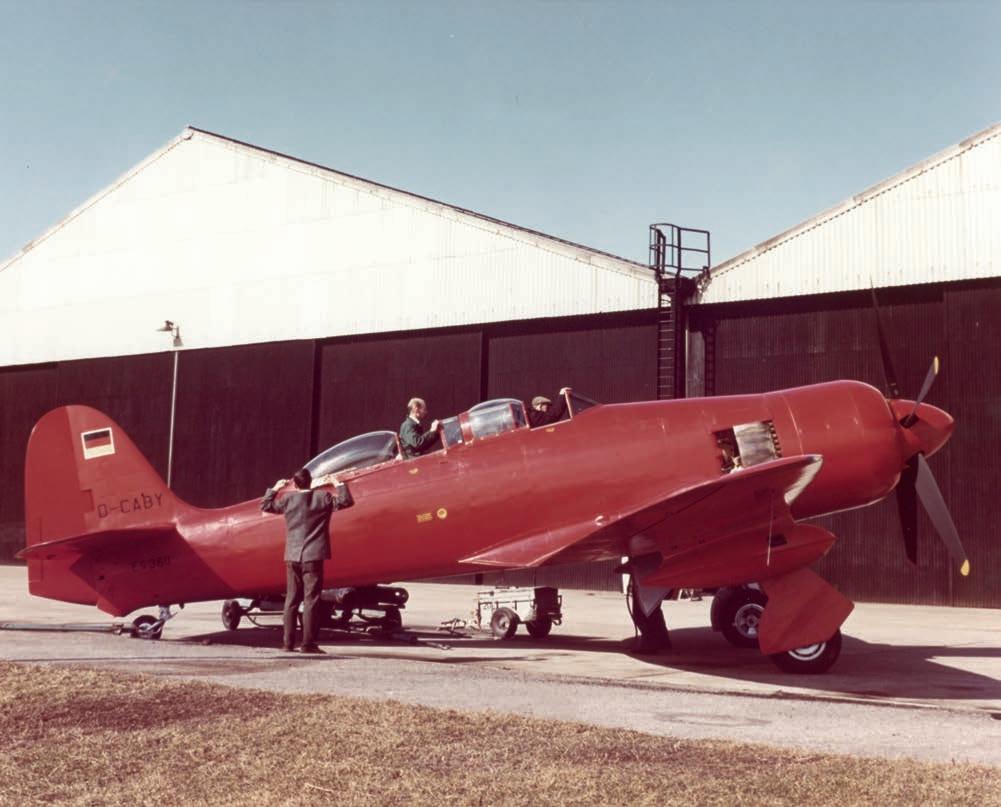
before diving at high speed back down to the carrier. In the early stages of the dive, at high altitude, I found the controls were pretty solid.
At low level, however, Sea Fury was better than a Seafire. Having an air-cooled engine also meant there was no worry about suffering damage to the cooling system from anti-aircraft fire, and the airframe itself was robust and strong. I felt that the Sea Fury’s harmonisation of controls was also better – the Supermarine fighter was light in pitch and prone to aileron reversal.
Peter also passed through the ETPS and as a test pilot flew with the RAE at both Farnborough and Bedford. He later became a senior tutor at ETPS and later, head of flight testing at the US Navy’s Test Pilot School.
(No.807 Squadron, Korea, aboard HMS Ocean, 1953)
From a Service point of view, I only flew the Sea Fury on a six-month tour in Korea, but I was also the Fleet Air Arm Historic Flight’s Sea Fury display pilot for many years and in addition flew several civilianowned machines. I entered the fray in Korea in 1953 after joining 807 Squadron and remained with the Sea Fury until it was replaced by the Sea Hawk in 1954. By the time I arrived the MiG-15s had moved away and so we never had to tangle with them. However, years later, if the opportunity presented itself, I would sometimes begin a mock combat with a jet fighter while waiting to perform an air display in Britain.
The Sea Fury was a beautiful aircraft to fly and I loved it, but at times it did need some care. The approach to a landing was always curved, and always a left-hand turn because the powerful piston engine gave so much right-hand torque. If an approach was made with a right-hand turn and then the pilot found he had to abort the landing and go round again, the torque was so great that the aircraft might turn over when the throttle was opened. The aircraft was beautifully balanced, helped of course by the spring tabs, and I loved the smooth sweet sound of the Centaurus. Actually the level of power could generate problems in other ways too because, apart from landings, it made some aerobatic manoeuvres a little difficult. Having so much power actually made keeping a straight line in a loop quite awkward and a lot of rudder was needed to get it right. The aircraft was tricky to fly accurately and,
for the same reason, it was also difficult to keep in a straight line on the ground –ground-loops were common.
The Pilot’s Notes stated that spinning the single-seat Sea Fury was prohibited, although it was allowed in the two-seat T.20 to demonstrate to new pilots the problems of spinning this high-performance fighter. I once torque-stalled a T.20 and dropped 4,000ft before recovering from the incipient spin that resulted.
On one occasion I was forced to make a right-hand turn prior to landing. After a four-ship bombing sortie over Korea we were told by Ocean that she was now in thick fog and so we must divert to a shore base. However, I had less fuel than the others and so the ship told me to try and land on board, and its controllers would help with a radar-controlled approach. The visibility was such however, that on the first attempt I saw Ocean’s bridge flash by my right wingtip, and on the second I never saw the carrier at all. In addition, Ocean could not see the destroyer that was steaming close by on rescue duty, so ditching in the sea was not promising. While circling for a third attempt the ship’s crew could hear my Sea Fury to starboard, so I had to make a right turn to try and line up with the deck. To my great surprise I found that I was in perfect line to land, I caught one of the wires a treat and came to a halt on the deck without any problems. A big Thank You to the Almighty, especially after learning that there was only about six gallons of fuel left in the tanks. My colleagues however, have never let me forget that I made a starboard landing.
For much of the time when operating from carriers, Sea Furies would be launched using a free unassisted take-off –that is running along the length of the deck to get into the air without a catapult. In fact, the FB.11 could get airborne from a free launch with a full load of bombs. Catapult launches were practised fairly often, and take-offs were also made using RATOG, but this was usually when space on the deck was in short supply due to the presence of a lot of parked aircraft. HMS Ocean was a relatively small carrier and 807 was a big squadron with twenty-four Sea Furies. In addition, 810 Squadron had a dozen Fireflies and there was also the Dragonfly search and rescue helicopters, so things could get a little crowded.
There was an occasion when there was so little wind that 807’s aircraft had to take a full deck run and use RATOG
assistance to get off. The rockets only ran for a few seconds and so timing was critical – fire them too early or too late and their benefit was lost. 807’s British pilots were well practised with this having learnt the technique on shore, but some Dutch pilots had joined the squadron and they had never operated RATOG from a carrier deck. The first fired his rockets too early and went over the bows into the sea (he was safely picked up). The second, in fact the most senior of the visiting pilots, fired his just a second too late. Those watching expected to see another splash but after a long struggle flying just above the waves, this Dutch pilot managed to begin climbing – by now well ahead of Ocean. His comments are unprintable, but the incident does illustrate how important training was for any pilot. The RATOGs were jettisoned when they had burnt out.
If there was a need to launch a lot of aircraft at once, the Sea Furies would perform an ‘elephant tango’. Aircraft with engines running and their wings folded would be parked one behind the other as close to the starboard side of the ship, and the island, as possible. They would face towards the stern of the ship and the idea was to leave as much space as possible on the port side to allow other aircraft to make a free take-off. As one fighter departed, the queue would gradually move towards the stern, with the next in line turning to face the bows and prepare for take-off. Obviously, the space available to make the take-off run was limited, but I do not remember anyone having problems with the ‘tango’. For those aeroplanes facing rearwards, with the wind coming from behind them, there was also the problem of trying to ensure that their engines did not overheat – power of course was needed to unfold the wings.
After leaving No.807 Squadron, Peter went to the Naval Air Fighting Development Unit at West Raynham for a year, then on to de Havilland Sea Venom all-weather fighters where he eventually became an instructor and, later still, de Havilland Sea Vixens when he became the solo display pilot on the type. He was CO of No.890 Squadron with Sea Vixens from 1971 and then took over the fixed wing ‘Standard’ Flight which assessed the Navy’s pilots. This required him to be current on every fixed wing aircraft in the Navy. Later he was Lt Cdr Flying on HMS Ark Royal, prior to flying Hawker Siddeley (BAE) Hawks at RAF Chivenor where he trained RN aircrew on the type. ■
The arrival of the early jet ghters, generally of relatively modest dimensions, brought a review of the overall size of the conventional airscrewdriven ghter. With the cramming of more cylinders and ever more power into the piston engine, and the attachment of more equipment, extra fuel tanks and weapons to the airframe, the conventional ghter had grown in size at an alarming rate. This trend had been particularly noticeable in Hawker’s Typhoon and Tempest, albeit with the added bene t of being able to absorb considerable punishment both in the air and from the ground.
Another factor which affected the growth of conventional fighters was the size of airscrew required to absorb the steep increase in power developed by the latest generation of piston engines. This called for large propeller diameters and, as a consequence, taller undercarriages. In order to break away from any further adaptation of the original fuselage structure used by the Typhoon, and to provide something that was smaller and faster than the Tempest, Sydney Camm chose an entirely new design for his Fury and Sea Fury.
As construction of the F.2/43 prototype commenced, it incorporated the first complete monocoque fuselage (defined as an outer shell that absorbs most of the stresses to which an aircraft is subjected) to be included in a Hawker aeroplane, and it encompassed all of the knowledge and experience gained by the company from earlier wartime experience. Other outstanding features of this aircraft were the special high-speed wing section adapted from the successful Tempest wing, Hawker’s patent spring-tab control and an improved view for the pilot, achieved by raising the position of his seat. The following relates to the Sea Fury although, apart from the Sabre prototypes discussed later, the land-based Fury was very similar, other than for the lack of naval fittings.
The Sea Fury F.Mk.10 was a high performance single-seat fighter with a lowmounted cantilever wing. It showed a strong resemblance to the Tempest II but was reduced in size to the smallest proportions consistent with the installation of the Centaurus 18 power unit. Even so, there
wasn’t much in it: the Tempest II was 34ft 5in long and 15ft high with a 41ft wingspan and 303.7sq ft wing area. The Sea Fury was 34ft 8in long and 15ft 10½in high with a 38ft 4¾in wingspan and 280sq ft wing area.
The Sea Fury’s monocoque fuselage comprised three sections with simple bolted connections at the joints. The first section consisted of the centre fuselage and contained the cockpit plus attachments for the engine, wings and rear fuselage. Behind this, the rear fuselage section extended almost as far as the tail unit to which was attached the final section that incorporated the fin, tailwheel and supports for the tailplane and rudder. The cantilever tailplane was bolted as a complete unit onto the rear end of the monocoque fuselage beneath the fin and it carried a pair of aerodynamically and statically balanced elevators, each of which had a trimming tab. The rudder was all-metal, the first on a Hawker aircraft, and had its skin prestretched during the covering process. This was also mass-balanced and had Hawker’s patent spring tab fitted. Hawker declared that all of these refinements contributed to the Sea Fury’s ease of control. The bottom of the rudder on the Sea Fury was cut away to allow a sting-type deck arrestor hook to be installed.
The centre fuselage consisted basically of four main longerons and a number of transverse frames and bulkheads, the whole being covered by a metal skin onto which longitudinal stringers were riveted. The totally enclosed cockpit was accessed by sliding the one-piece blown Perspex hood rearwards from the windscreen; in an emergency both the hood and a panel on the cockpit’s port side could be jettisoned. For protection the pilot was provided with armour plating behind him, plus a bulletproof windscreen and additional armour to protect various other vulnerable parts of the aircraft. The slightly humped forward fuselage provided a good view for the pilot over the nose and helped to make flight at low-level a little easier at all speeds. There was no ejection seat.
The wing assembly was a departure from the usual Hawker practice because it consisted of a plane built virtually in one complete unit. The whole was then fitted to the underside of the centre fuselage by
bolted attachments. Thus, the Sea Fury wing consisted essentially of Tempest outer planes joined along the centre-line and married to the fuselage as a one-piece unit, resulting in a reduction in span compared to the Tempest.
The wing assembly itself was a normal two-spar stressed skin type and housed the undercarriage, armament and some fuel. A well in the bottom of each inboard wing enclosed the main undercarriage legs, immediately outboard of these were fuel tanks between the main spars, and two 20mm Hispano cannon breeches were mounted aft of the rear spar (which itself was swept sharply forward to accommodate the guns). Although the rear spar was placed much further forward than was usual, it had no internal structure behind it. Servicing the four guns (which could be done with the wings folded) was thereby undertaken from behind the wings and a combined total of 580 rounds of ammunition was carried in magazine boxes beside the cannons. The outer pair of cannons were fed from magazines installed in the folding portion of each wing and presented some awkward engineering problems initially. The guns themselves could be fired in pairs or together.
The ailerons were given a new type of control in the form of a mass balanced modified Frise type made in sheet metal which was operated by push-pull controls, together with an inset trim-tab and patent Hawker spring tab on each. The Frise aileron was hinged in such a way that when the trailing edge lifted, the leading edge of the aileron would extend below the wing so as to increase the drag on the inside of the turn. When the aileron moved down again its leading edge remained shielded behind the wing. Hydraulically operated split trailing edge flaps extended in four portions from the port to the starboard aileron and were joined by a universal joint at the change in dihedral. The folding wings were also hydraulically operated and hinged outboard of the gun bays, and could only be folded when the undercarriage was down. Each wing could fold with either rocket projectiles or a 1,000lb bomb in place.
The wing aerofoil was a special highspeed section designed by Hawker which possessed a thickness:chord ratio of ➤
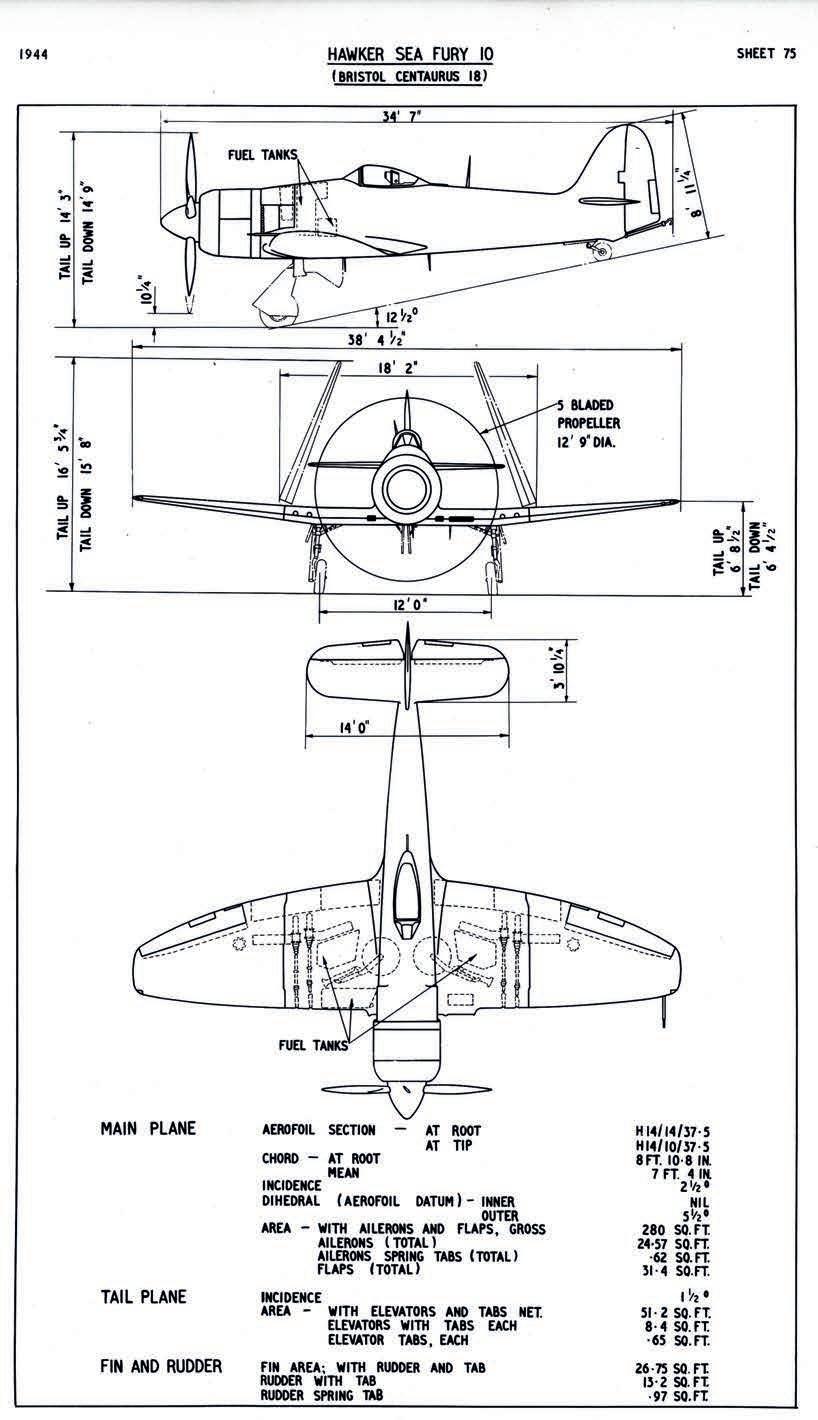
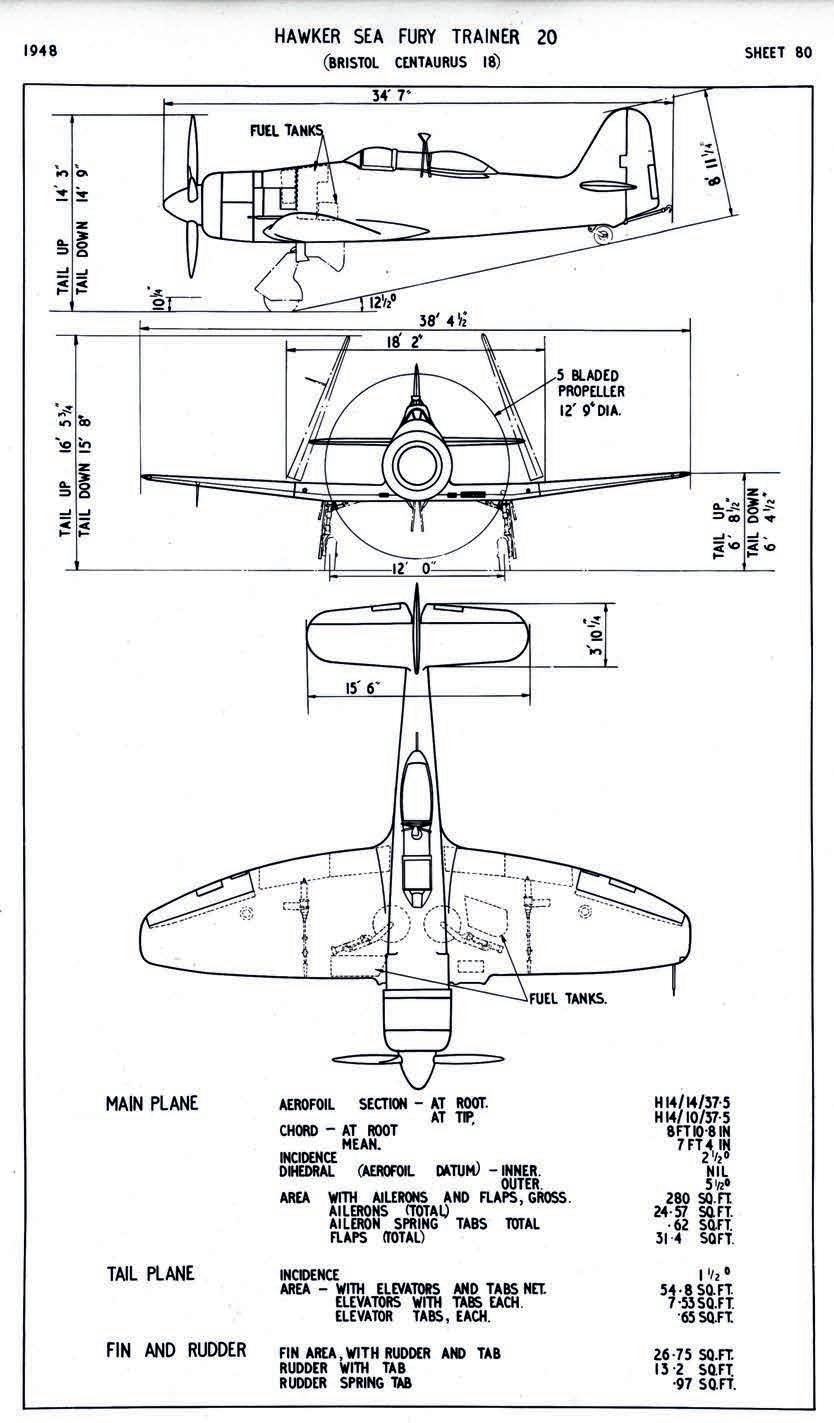
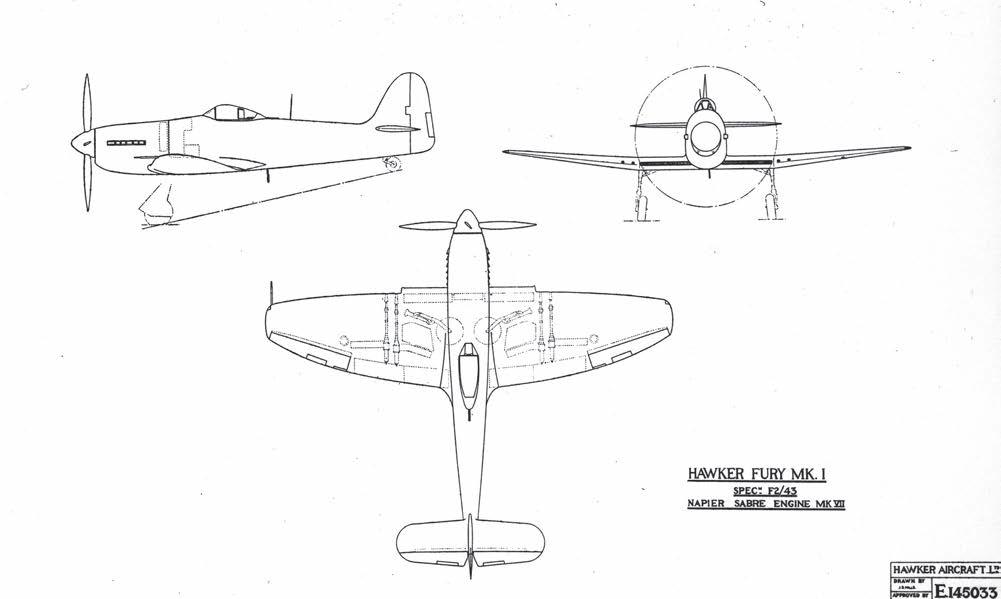
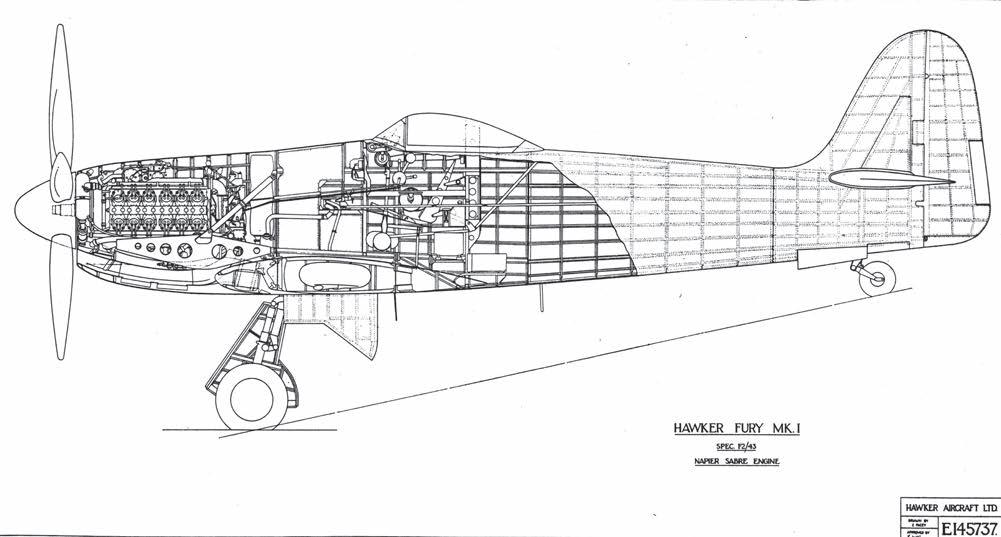
Cut-away drawing displaying engine and internal fuselage detail for the Sabre Fury.
14% at the root and 10% at the tip, and had its maximum thickness at 37.5% of the chord. This section was shown to have excellent characteristics over the whole speed range – it gave perfect control and stability at high speeds when in a dive or turns while at the same time delaying the effects of compressibility.
The powerplant comprised an 18-cylinder 2,480hp Bristol Centaurus radial engine carried on a flexible shock-absorbing rubber mount attached to a ring onto which
was bolted a tubular mounting structure formed with four pick-up eyes. These eyes were the main attachment points between the powerplant and fuselage; the rubber mounting was introduced to prevent engine vibration and proved successful. One aspect of the Sea Fury and its power-plant which did prove difficult to solve was the escape of carbon monoxide into the cockpit via the firewall. It was never fully resolved and obliged pilots to wear an oxygen mask throughout their flight.
The prototype Centaurus Fury had used a 12ft 9in diameter Rotol four-blade metal airscrew whereas most production Sea Furies used a constant-speed Duralumin unit of the same diameter but with five blades; these had a variable pitch range from 29° 15’ to 64° 15’. Twin entry air intakes were located one per wing near the wing roots, the air being led by ducts to the carburettor. The air passed through forty-eight louvres built into the rear cowling above the engine and was
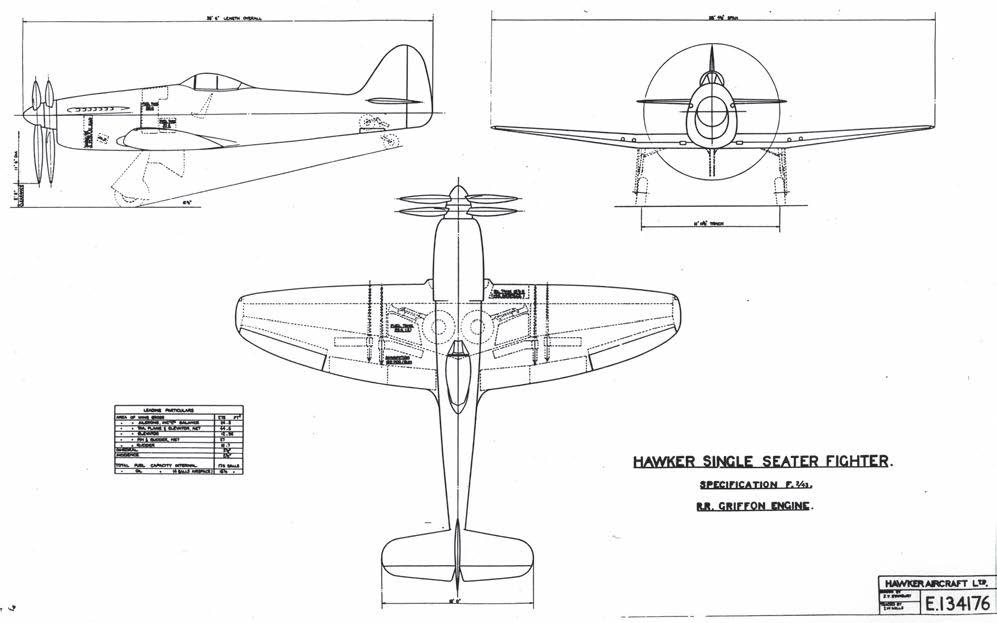
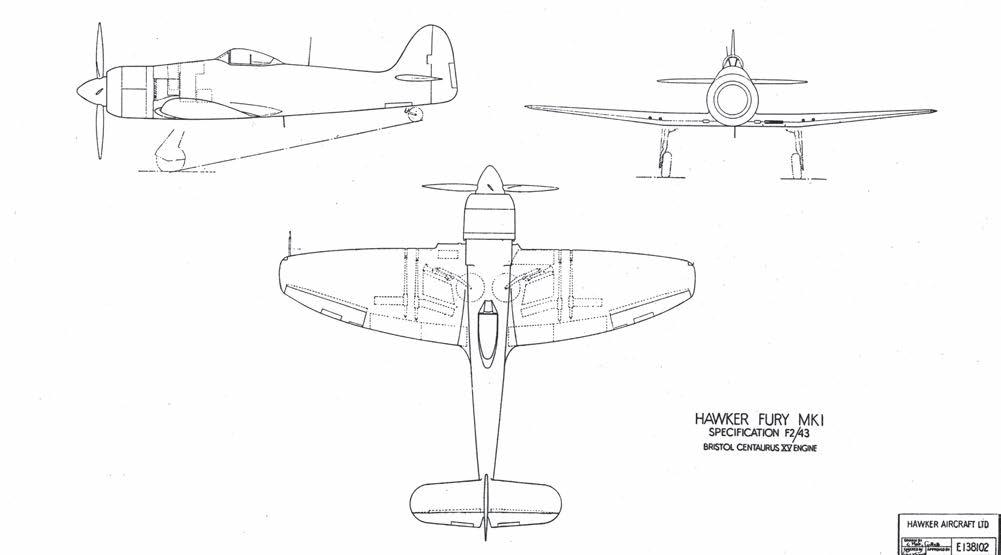
drawn through a Vokes filter and then a shutter box and duct head before reaching the down draught carburettor. The intakes could supply warm, cold or filtered air as required, the pilot making his selection from a remote-control electric motor. An oil cooler intake was placed in the port wing leading edge outside the air intakes. A ‘transfer’ fuel system was used in
the Sea Fury. This meant that fuel was always supplied to the engine from the main tank, after having been transferred to the main tank from the other tanks by air pressure. In all fuel was carried in five fixed self-sealing tanks, two in the fuselage aft of the front bulkhead (94-gallon main and 30-gallon auxiliary), there was a 28-gallon tank between the main spars in the inner
portion of each wing, and a 20-gallon tank in the leading edge of the starboard wing. Two 45-gallon or 90-gallon drop tanks could also be carried, one under each wing. The main shock-absorbing legs had been specially designed by Dowty to ensure that they could be accommodated inside the thin wing section, and pneumatically operated brakes were fitted. The
Prototype Fury NX798 with the ‘covers off’. The Centaurus installation was an extremely tight fit. Hawker Aircraft
This image shows some detail of the Napier Sabre Fury’s nose and powerplant. The wing-mounted radiators are well shown.
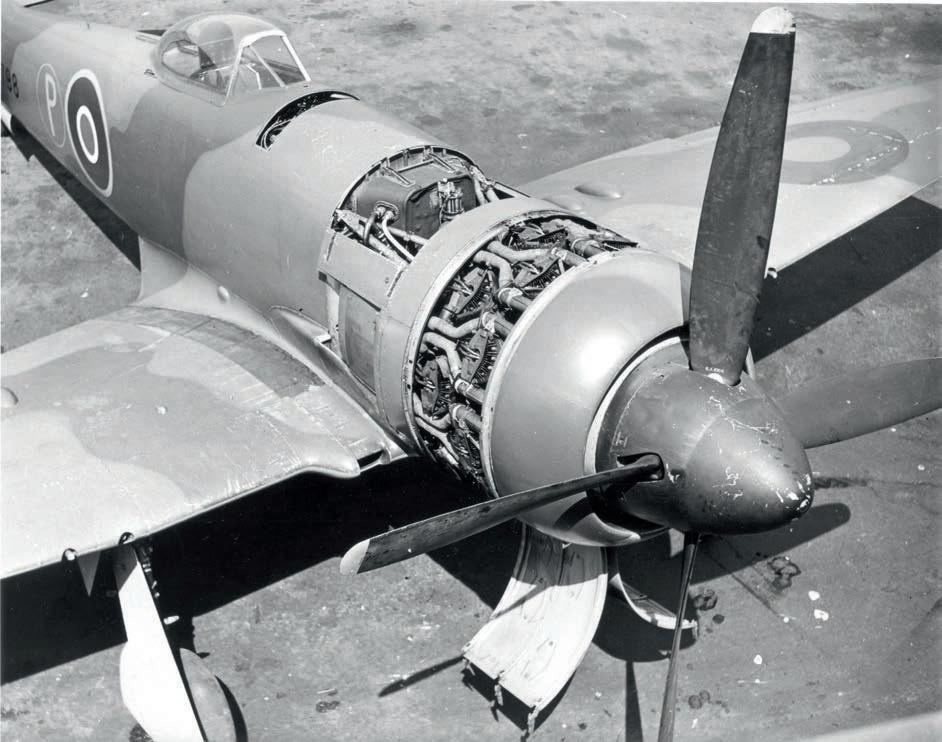

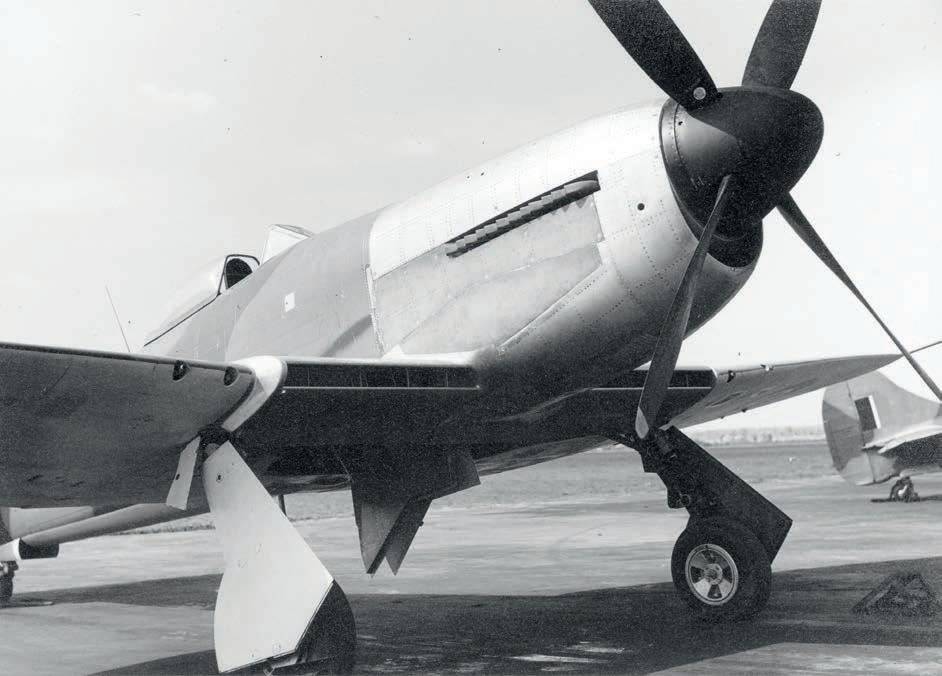
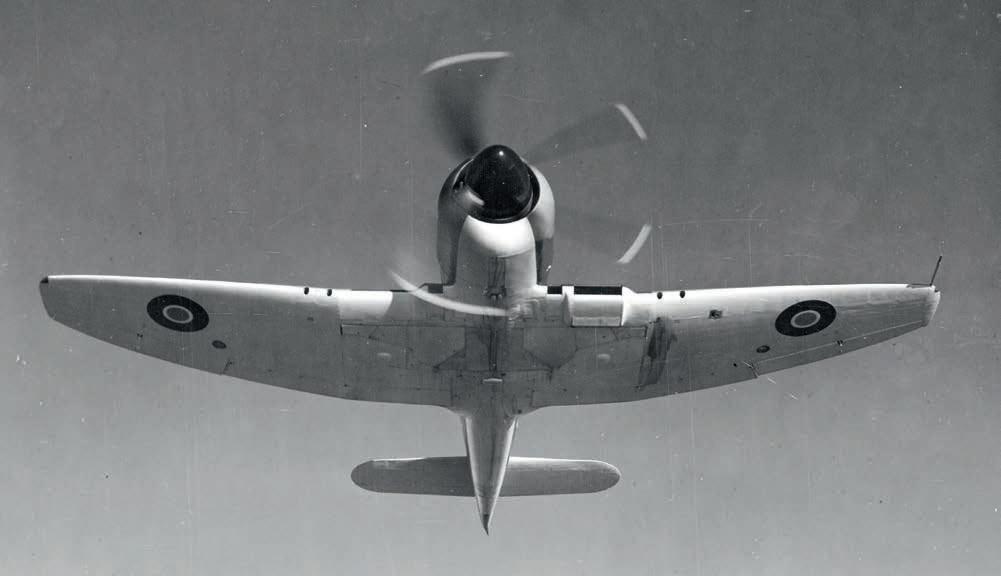
This air-to-air shot of what is thought to be Fury prototype NX802 displays the wing root air intakes and port wing oil cooler intake. Crown Copyright
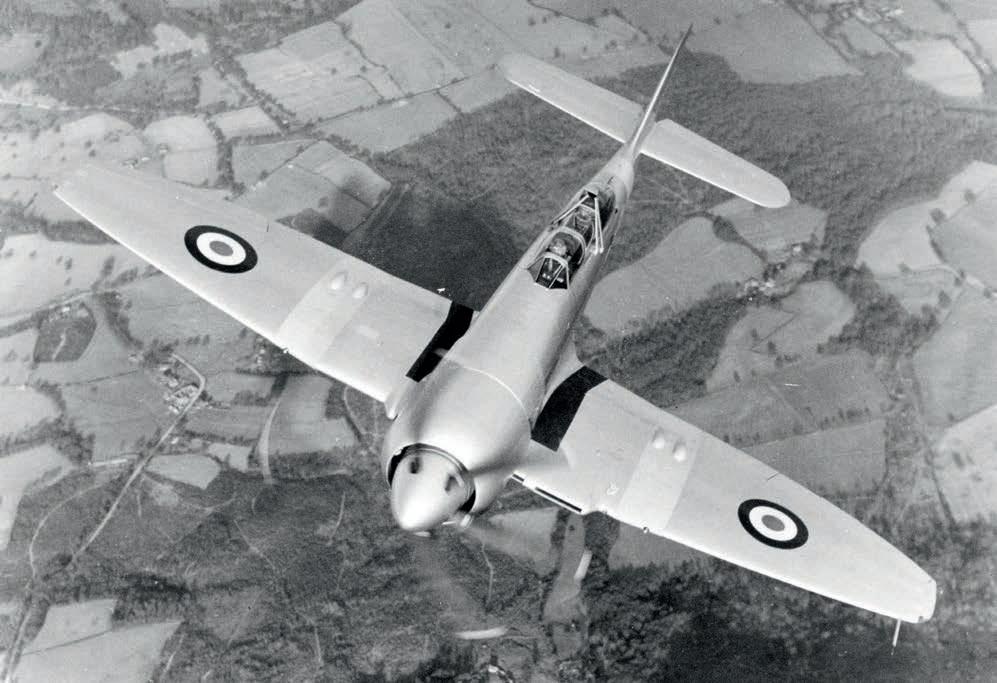
Another air-to-air photo, in this case what appears to be the T.20 prototype VX818. Hawker Aircraft
main undercarriage retracted inwards and slightly backwards into wells between the wing spars while the tailwheel unit retracted forwards into the fuselage. The final British single-seat Sea Fury was the FB.Mk.11 fighter-bomber,
which was simply an F.10 modified to carry Ministry bomb racks. The FB.11’s underwing load comprised two 500lb or two 1,000lb bombs, twelve rocket projectiles with 60lb heads, four rocket projectiles with 180lb heads, or Napalm
tanks. Schemes were also prepared for reconnaissance versions of the Sea Fury in two different types, one for ‘basic’ duties while the other was to be capable of more advanced ‘special’ missions. Neither of these was built.
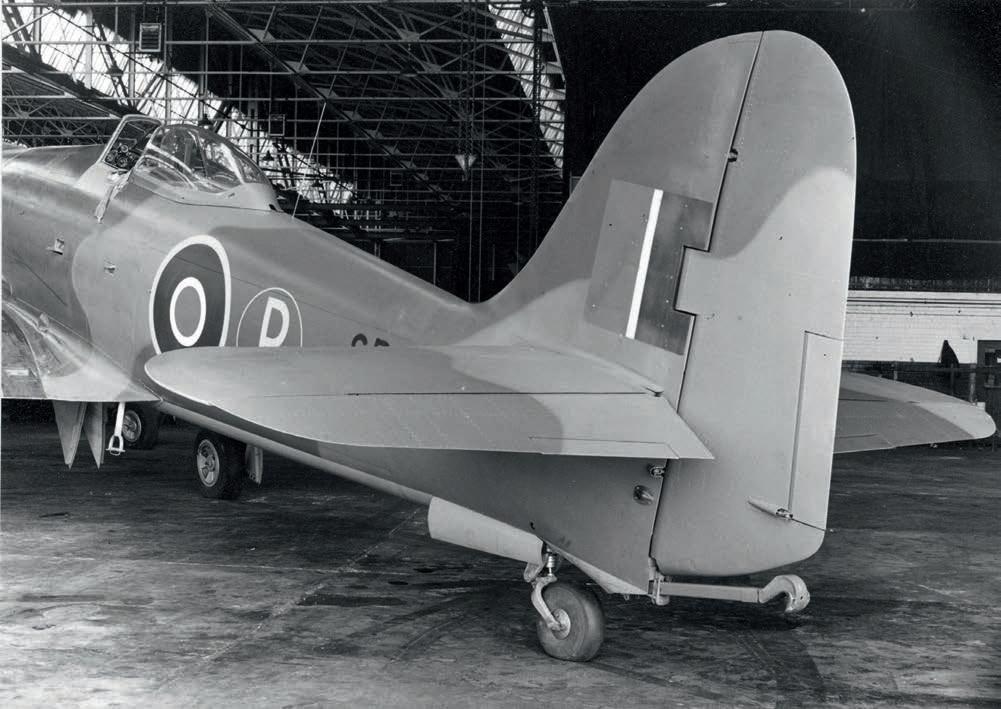
The Sea Fury’s tailplane, elevator, fin, rudder and arrestor hook arrangement is shown by this view of what is almost certainly prototype SR661.
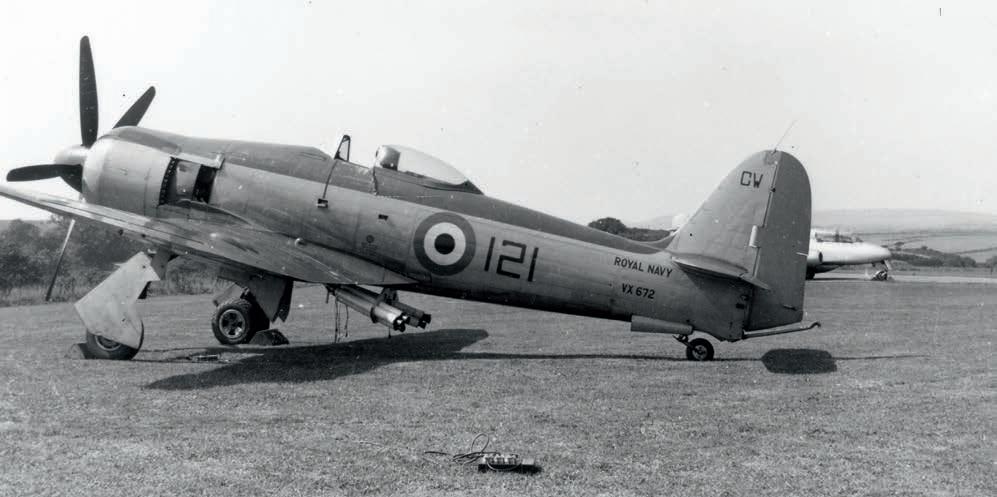
The instructor’s cockpit on the Sea Fury T.Mk.20 trainer was located immediately aft of the F.10’s existing cockpit and was furnished with a complete duplicate set of flying and engine controls together with a standard set of instruments;
it also featured a jettisonable hood independent of the front cockpit and was equipped with folding wings. The instructor and pupil had an electrical communication system. The T.20 could be equipped for deck landing and accelerated take-offs and
provision was made for a sting arrestor hook, but this was never fitted and the T.20 never operated from an aircraft carrier.
One feature peculiar to the T.20s supplied to the Royal Navy was the instructor’s gun sighting arrangement ➤
VW697 102/R of No.804
Squadron displays its lowered undercarriage, flaps and hook as it touches down on HMS Glory
Brian Lowe
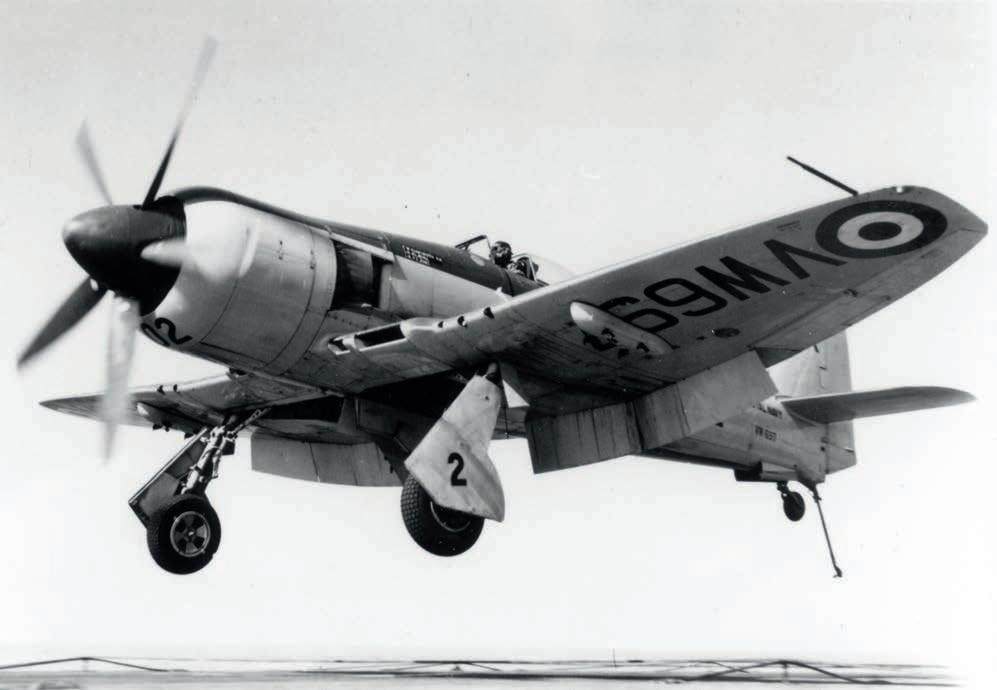
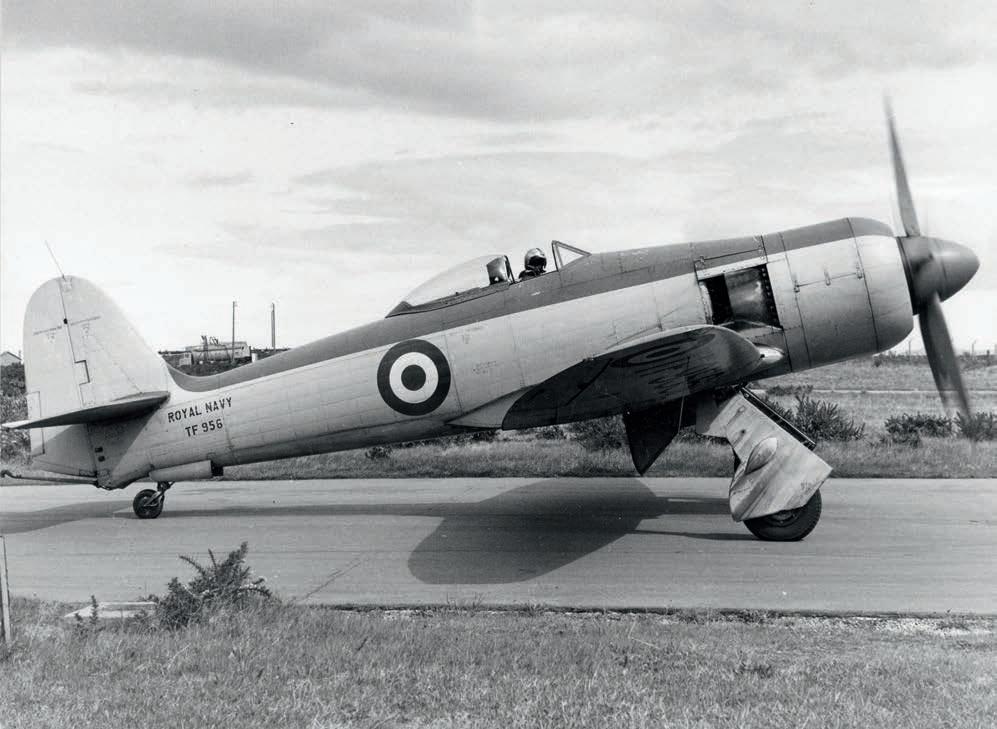
VR930 demonstrates the Sea Fury’s wing folding.

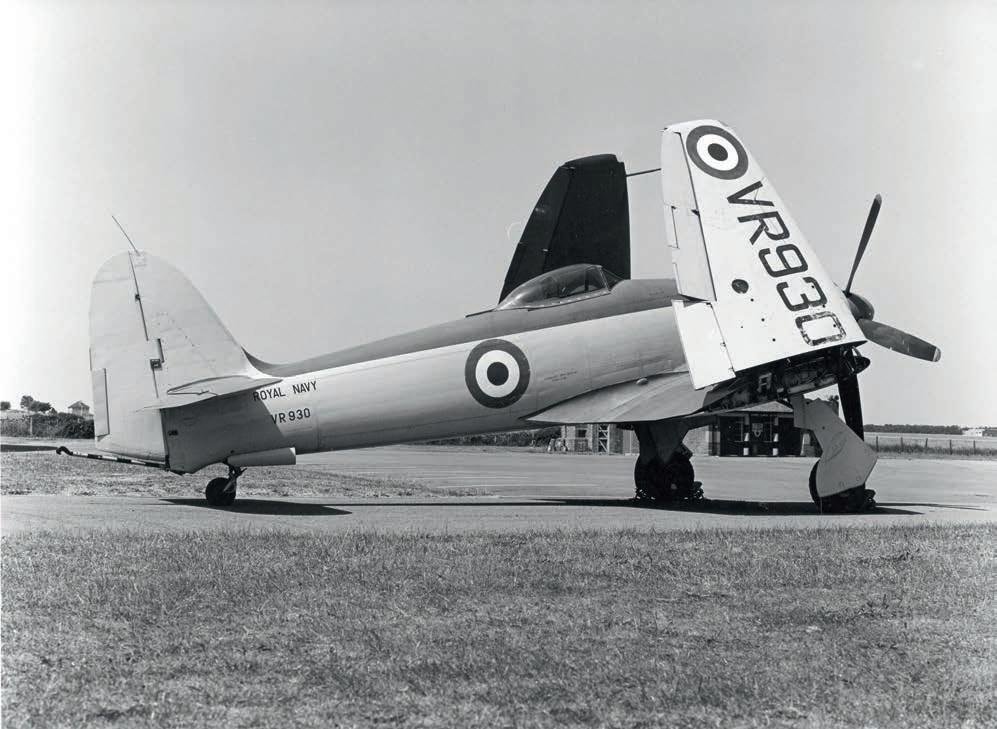
Side view of an unidentified twoseat T.Mk.20. The instructor’s gun sighting installation over the glass cockpit ‘tunnel’ is not fitted.

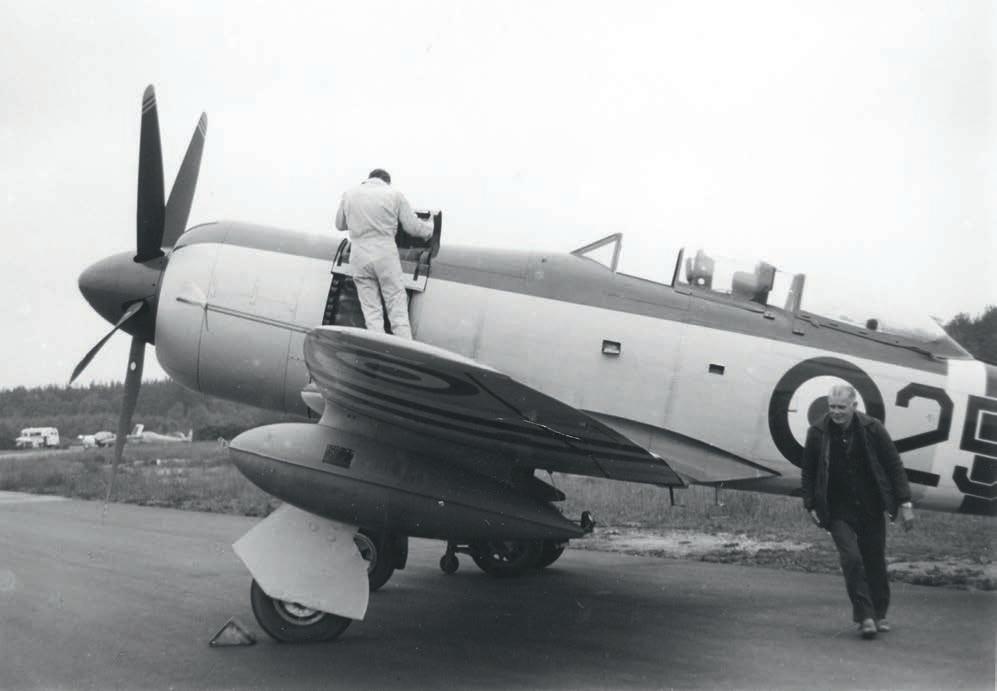
provides underside detail
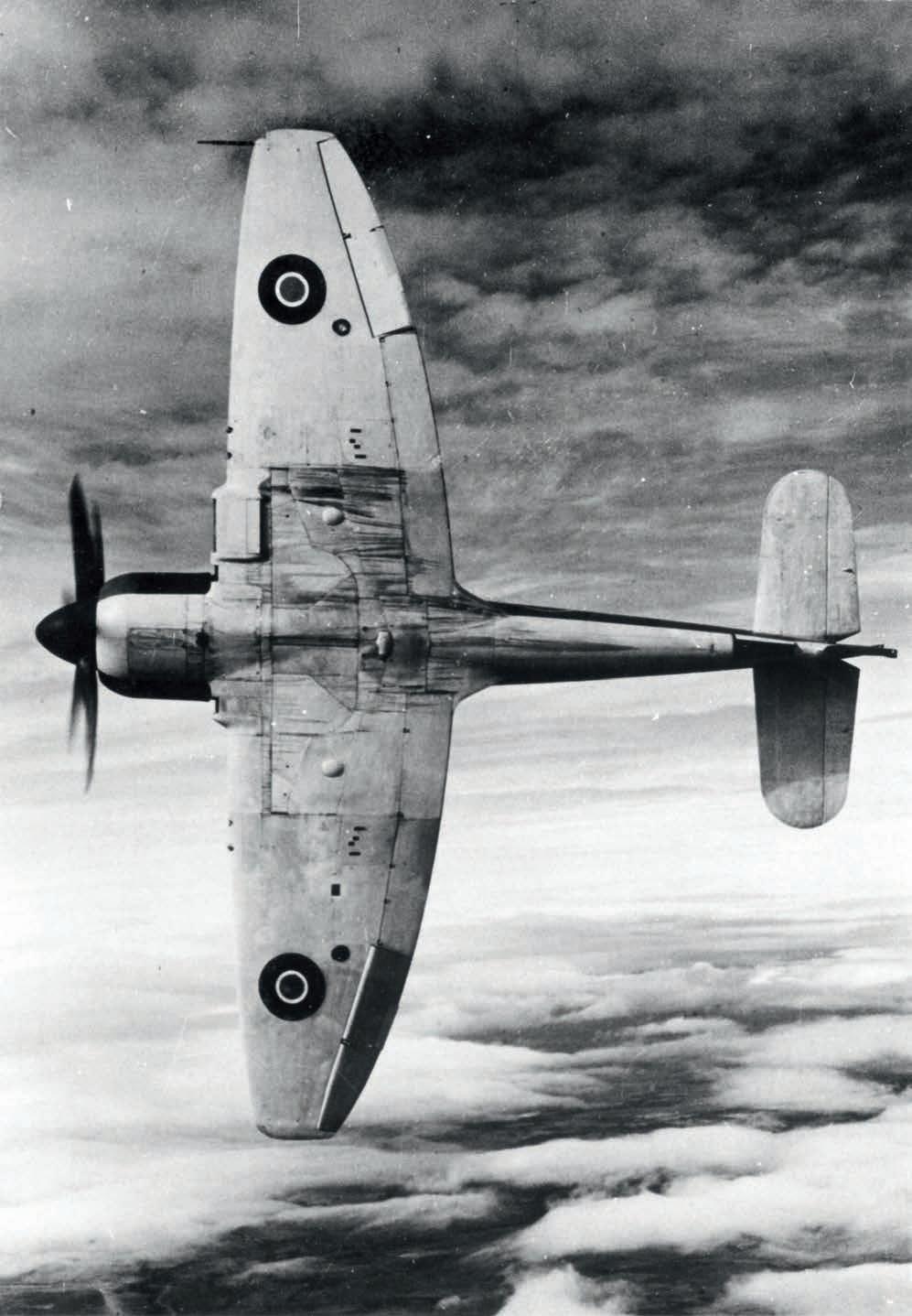
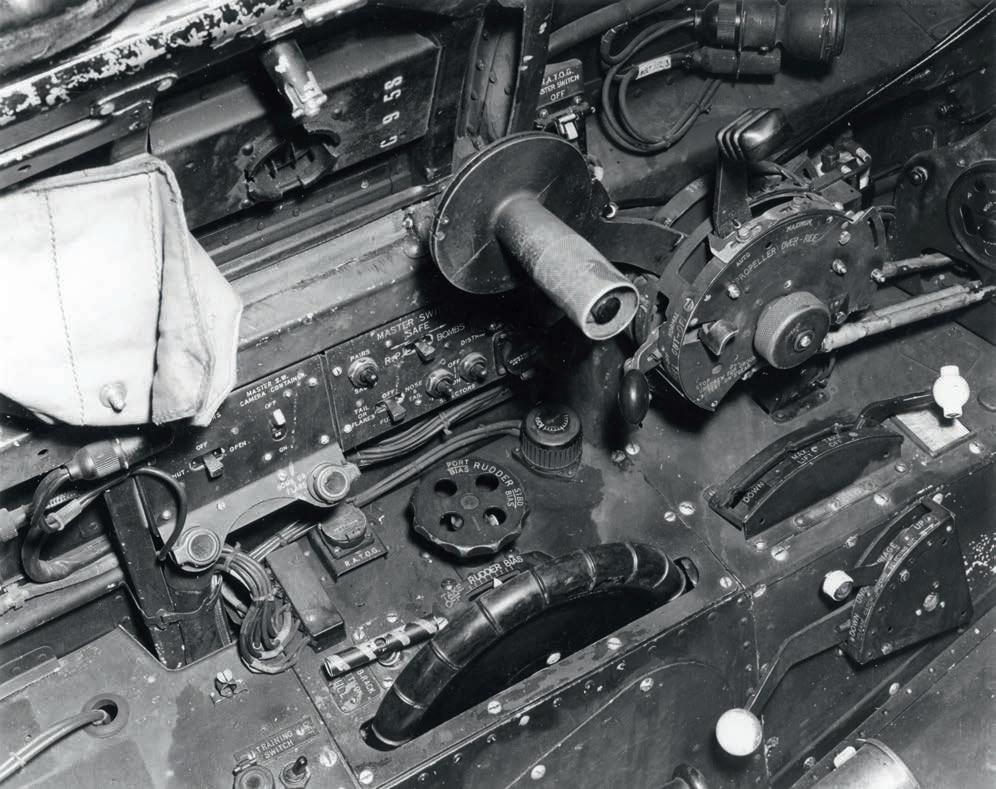
over the glass cockpit ‘tunnel’. This consisted of a forward inclined mirror mounted on struts above the rear gunsight which formed a periscope in conjunction with the reflector glass of the sight itself. It enabled the instructor to take aim over the head of his pupil and, as the two gunsights were interconnected, to make corrections on his own account. The T.20 had the same fuel tanks and system as the F.10, except that the starboard wing’s 28-gallon tank was omitted.
The Fury F.Mk.I’s principle difference over the Sea Fury concerned its engine, a 24-cylinder water-cooled Napier Sabre VII power unit producing 3,055hp. This was mounted on a pair of cantilever beams fabricated from light alloy sheet and channel extrusions to form box section assemblies. In turn, these were tied by large steel members to the fuselage top longeron attachments, while the engine feet were mounted on transverse box section light alloy beams. A resilient
rubber bush was provided for the front foot which allowed for engine expansion and reduced vibration. This employment of a composite light alloy beam on each side of the power unit represented a new feature in British aeronautical engineering practice.
The Fury F.I’s engine cooling was catered for by ducted radiators mounted in the inner portion of each wing and featured air cooler shutters on the lower surfaces forward of the front spar. The shutters were adjusted automatically by thermostatically controlled electric jacks in an arrangement which maintained the aircraft’s clean lines (in contrast to the earlier Tempest V and Typhoon which had also been powered by the water-cooled Sabre). The low-drag chin-type radiator bath used for the coolant system on both Tempest V and Typhoon had given way to a return to the system used in the prototype Sabre-powered Tempest I – i.e. ducted coolant radiators on both sides of
the aeroplane which provided even lower drag and very clean lines, features that accentuated the Fury’s already handsome appearance. Oil cooling and carburettor intakes were housed in the bottom of the engine cowling.
A very neat cowling enclosed the engine which was composed of detachable panels constructed as individual units, thereby dispensing with the need for a subsidiary frame structure. The lower cowling consisted of a forward section carrying the air inlet and ducting to the cooler and also incorporated the central air intake trunks together with air cleaners and louvred panel. The Fury F.I’s fuel system was similar to the Sea Fury’s Centaurus arrangement except that there was no wing leading edge fuel tank. In addition, the 30-gallon auxiliary tank in the fuselage was filled with a mixture of methanol and water which served as a self-contained and fully automatic engine booster system. ■
(Note: Almost all of the data is taken from original Hawker documents – some may be estimates. The figures for the FB.11 appear to have been based on a more detailed weight analysis.)
Dimensions
Wingspan: All Mks Fury and Sea Fury 38ft 4.8in
All Mks Sea Fury wings folded 18ft 2in
Gross wing area: Sabre variants: 284.5sq ft
Centaurus variants: 280sq ft
Thickness/chord ratio at root: 14.5%
Thickness/chord ratio at tip: 10%
Length: Prototype Fury NX798 (Centaurus XII) 34ft 6in
Prototype Fury LA610 (Griffon 81) 35ft 6in
Prototype Fury LA610 & Fury I (Sabre VII) 34ft 8in
Prototype Sea Fury F.10 SR666 (Centaurus XV) 34ft 7in
Production Sea Fury F.10, FB.11 and T.20 34ft 7in
Height: Sea Fury F.10 (5-blade prop one blade vertical at bottom, tail down) 13ft 7in
Wheeltrack: 11ft 11.5in
Production Fury I: One x Napier Sabre NS.93.SM (Sabre VII) liquid-cooled piston engine giving a maximum 3,055bhp in MS-Gear and 2,820bhp in FS-Gear for 5 minutes. Maximum power rating for up to 30 minutes 2,235bhp and 1,975bhp respectively. Five-blade 13ft 3in diameter Rotol Dural propeller.
Centaurus Fury: One x Bristol Centaurus XV radial air-cooled piston engine giving a maximum 2,480bhp in MS-Gear and 2,130bhp in FS-Gear for 5 minutes. Maximum power rating for up to 30 minutes
2,100bhp and 1,920bhp respectively. Fourblade 12ft 9in diameter Rotol Dural propeller.
Sea Fury F.Mk.10 and FB.Mk.11: One x Bristol Centaurus XVIII radial air-cooled piston engine giving a maximum 2,560bhp in MS-Gear and 2,300bhp in FS-Gear for 5 minutes. Maximum power rating for up to 30 minutes 2,160bhp and 2,000bhp respectively. Five-blade 12ft 9in diameter Rotol Dural propeller.
All up weight: Prototype Fury NX798 (Centaurus XII) 11,930lb
Production Fury I (Sabre VII + 150gal fuel) 12,120lb
Production Fury (Centaurus XV + 200gal fuel) 11,675lb
Production Sea Fury F.10 (200gal fuel) 12,030lb
Production Sea Fury FB.11 (200gal fuel, no stores) 12,350lb
Production Sea Fury T.20 11,930lb
Maximum Production Sea Fury take-off weight: FB.11 14,650lb
Internal fuel Sea Fury F.10, FB.11 permanent: and Centaurus Fury 200gal T.20 172gal Sabre Fury 150gal
Provision for two 45gal or 90gal auxiliary underwing tanks on each
Fixed armament: Four 20mm Hispano cannon with 580 rounds (T.20 two 20mm)
Underwing stores Two 500lb or 1,000lb (FB.11): bombs, twelve RP with 60lb heads or four RP with 180lb heads, or Napalm tanks. T.20 similar as required.
Production Fury I (Sabre 93 + 150gal fuel) at 12,120lb weight
Maximum speed: 422mph at sea level, 480mph at 20,000ft, 446mph at 30,000ft (Maximum power altitude = 457mph at 8,000ft and 483mph at 18,500ft)
Rate of climb: 5,480ft/min at sea level, 3,920ft/min at 20,000ft
Time to 20,000ft: 4.10 minutes
Maximum still air range with 2 x 90gal drop tanks: 1,940 miles at 15,000ft
Centaurus Fury (Centaurus XV + 200gal fuel) at 11,675lb weight
Maximum speed: 375mph at sea level, 454mph at 25,000ft, 448mph at 30.000ft
Rate of climb: 4,400ft/min at sea level, 3,070ft/min at 21,000ft
Time to 21,000ft: 5.70 minutes
Production Sea Fury F.10 (Centaurus XVIII + 200gal fuel) at 12,030lb weight
Maximum speed: 367mph at sea level, 440mph at 21,000ft, 433mph at 30,000ft
(some sources state 465mph at 18,000ft)
Rate of climb: 4,690ft/min at sea level, 3,400ft/min at 21,000ft
Time to 21,000ft: 5.40 minutes
Service Ceiling 36,180ft
Production Sea Fury FB.11 (Centaurus XVIII + 200gal fuel) at 12,350lb weight
Maximum speed: 380mph at sea level, 460mph at 18,000ft, 415mph at 30,000ft
Rate of climb: 4,320ft/min at sea level, 2,850ft/min at 20,000ft
Time to 20,000ft: 5.70 minutes
Maximum still air range with 2 x 90gal drop tanks: 1,800 miles at 290mph at 10,000ft
(some sources quote 1,600 miles)
Service Ceiling 37,800ft
Production Sea Fury T.20 (Centaurus XVIII)
Maximum speed: 445mph at 18,000ft
Service Ceiling 35,600ft ■
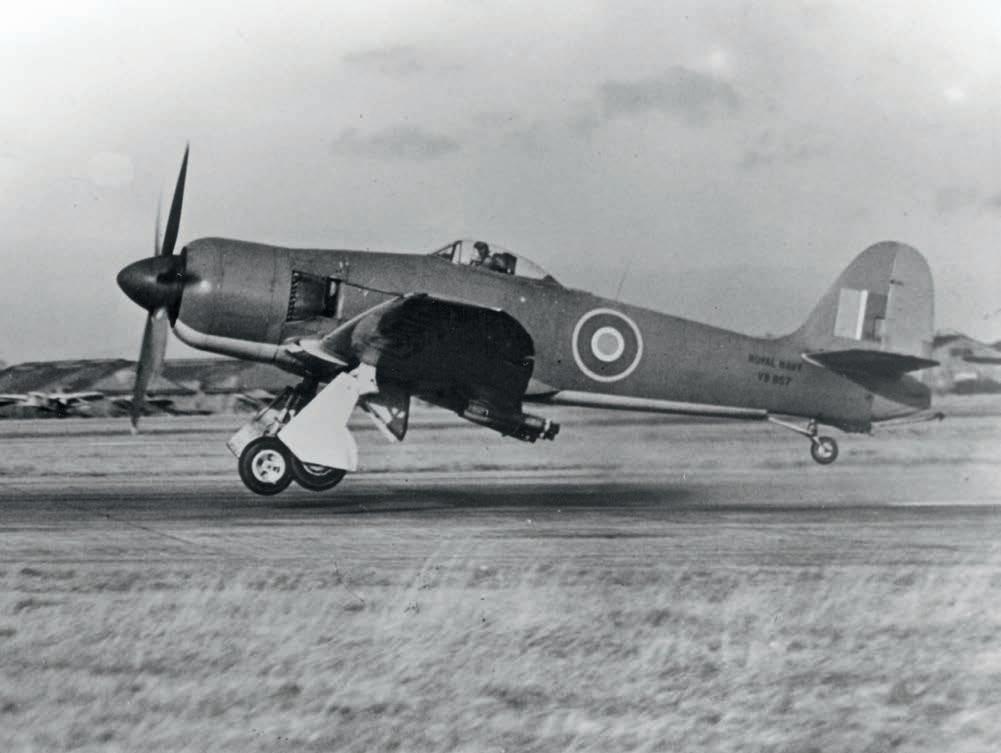
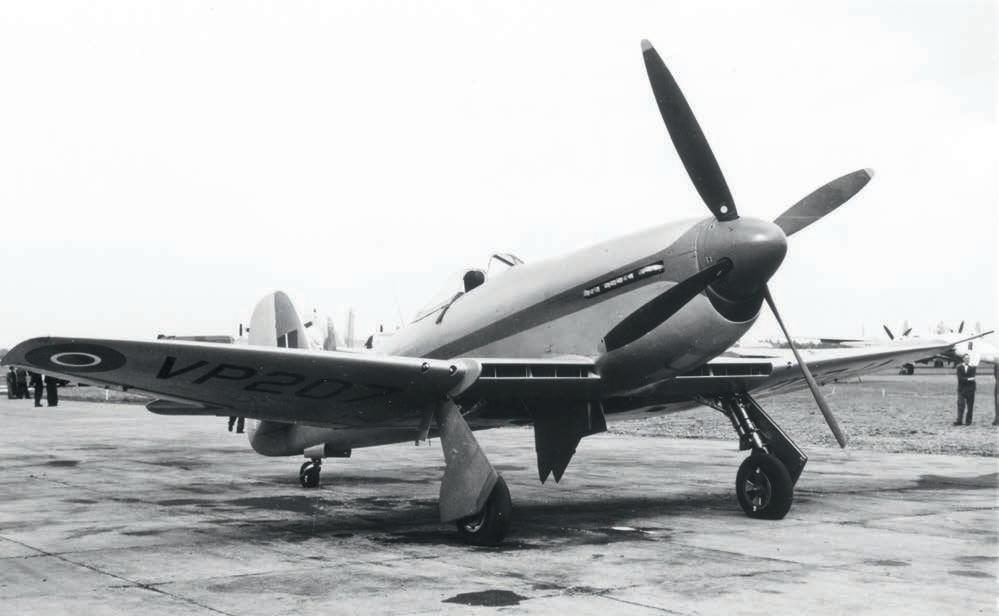
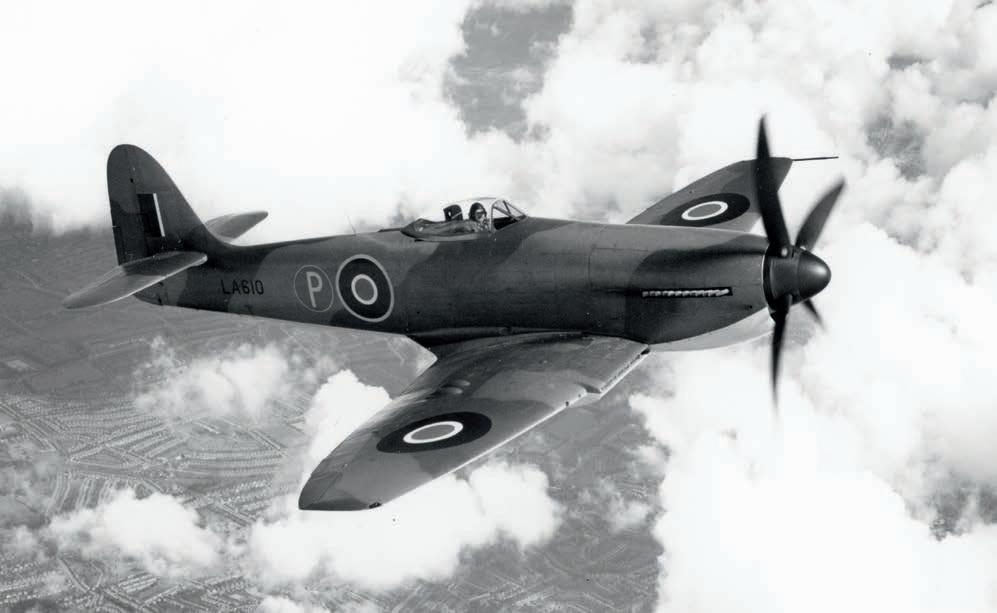
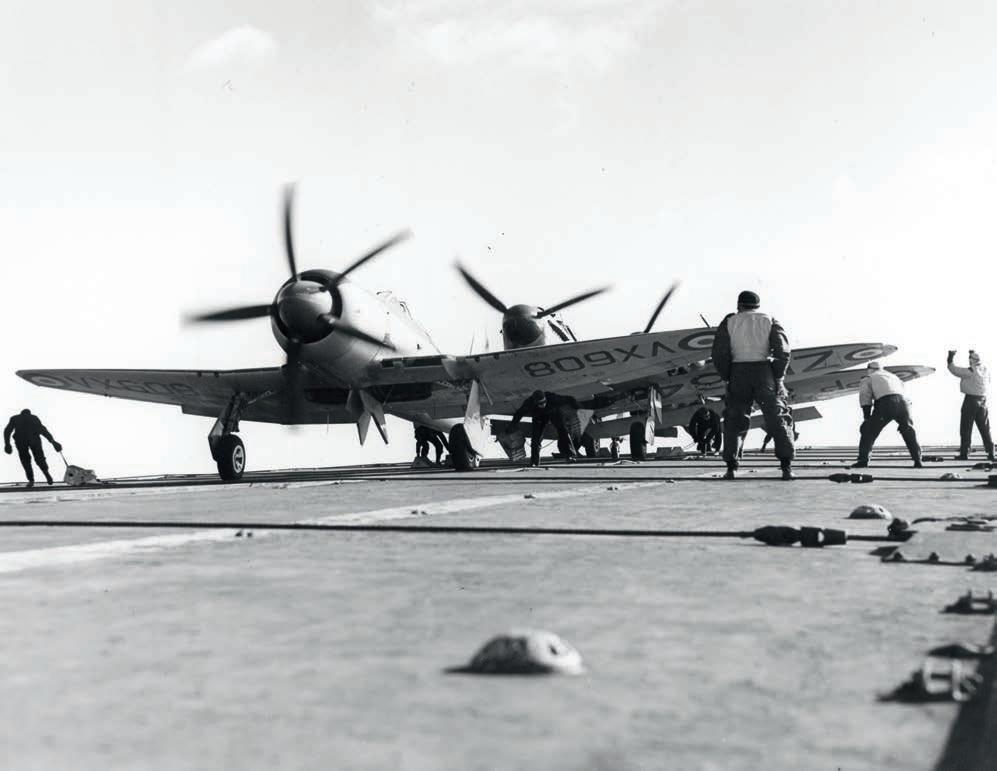
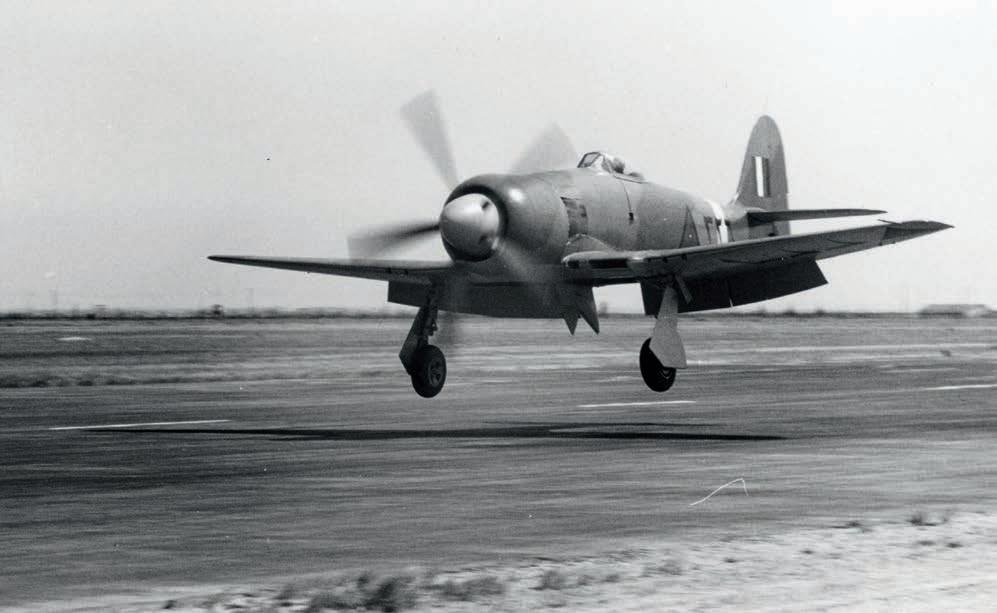
Rare photo of what is in fact an Iraq Fury, but included here because it demonstrates the power and speed of the fighter with its Centaurus engine, something which rarely comes across in a static photograph. Wg Cdr Cole
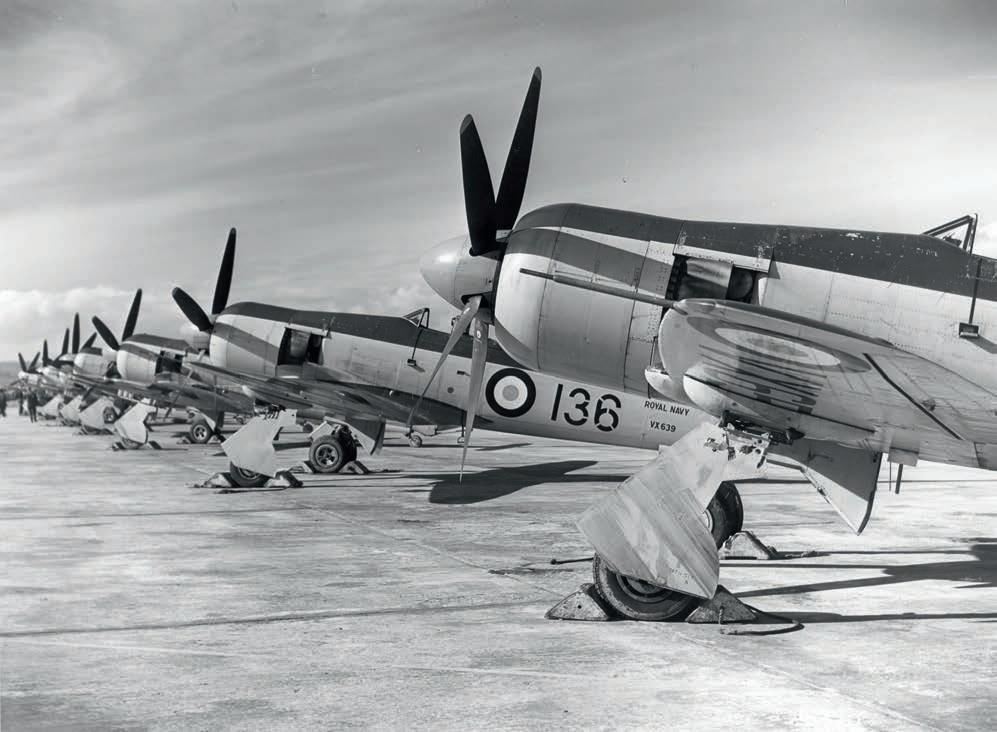
Sea Furies belonging to either No.736 or 738 Squadrons. The second nearest VX639 ‘136’ could be either 136/JB or 136/CW. Crown Copyright
Shore base locations refer only to the main periods in which Sea Furies were operated by a squadron, carriers usually just to cruises aboard speci c ships. Short detachments and visits for trials, etc, are generally excluded. The prime source for this information was The Squadrons of the Fleet Air Arm by Ray Sturtivant and Theo Balance, published by Air-Britain (Historians) in 1994.
No.1 SQUADRON RNethN
Responsible for the protection of the Dutch Antilles Islands but briefly operated Sea Furies in the Netherlands.
Variants Operated: FB.60 - 1951 to 12.51
Shore Bases: Valkenburg
No.3 SQUADRON RNethN
Formed to provide fighter pilots for No. 860 Squadron.
Variants Operated: FB.60 - 2.52 to 12.56
Shore Bases: Valkenburg
No.4 SQUADRON RNethN
Flew the first four Dutch Sea Furies for just a few months.
Variants Operated: F.50 - 4.48 onwards
Shore Bases: Valkenburg
No.700 SQUADRON
Part of the 50th Training Air Group.
Variants Operated: F.10 – 6.48 to 9.49, FB.11 12.55 to 1.56
Shore Bases: Yeovilton, Ford from 8.55
No.703 SQUADRON
The NASWDU/STU – the Naval Flight of the RAF’s Air-Sea Warfare Development Unit and Service Trials Unit. From April 1950 this became the Service Trials Unit only and throughout 703 operated several types of aircraft. Attachments were flown out to various carriers for training.
Variants Operated: F.10 – 6.48 to 2.52, FB.11 – 7.48 to 3.55, T.20 – 6.51 to 10.51
Shore Bases: Lee-on-Solent, Ford from 4.50
No.723 SQUADRON RAN
The Royal Australian Navy’s Fleet requirements unit which also undertook communications and ASR work. Several types on strength including two Sea Furies.
Variants Operated: FB.11 – 4.52 to 10.56
Shore Bases: Nowra (Australia)
No.724 SQUADRON RAN
When the Sea Fury first joined this squadron operated as a conversion unit and
an Operational Training School for the Royal Australian Navy. By the time of the aircraft’s second spell 724 was carrying out many different training and flying tasks – Fleet requirements, all-weather training, trials and conversion. Several types on strength.
Variants Operated: FB.11 – 6.55 to 10.56, and again 5.61 to 10.62
Shore Bases: Nowra
No.725 SQUADRON RAN
The Fleet Requirements and Communications Unit. Three Sea Furies on strength along with several other types. Variants Operated: FB.11 – 1.58 to 5.59
Shore Bases: Nowra
No.736 SQUADRON
The Naval Air Fighter School, within the 52nd Training Air Group (52nd TrAG), which at one stage operated as many as fifty Sea Furies.
Variants Operated: F.10 – 8.50 to 9.51, FB.11 – 5.49 to 8.52, T.20 – 3.50 to 8.52
Shore Bases: St Merryn, then Culdrose from 2.50 until disbanded as piston unit 8.52
No.738 SQUADRON
Part of the Naval Air Fighter School.
Variants Operated: F.10 – 5.50 to 8.51, FB.11 – 5.50 to 3.55, T.20 – 5.50 to 3.55
Shore Bases: Culdrose, Lossiemouth from 11.53 for remainder of Sea Fury period
No.739 SQUADRON
The Navy’s Photographic Development Unit. One Sea Fury attached for the installation and evaluation of cameras.
Variants Operated: FB.11 – 9.48
Shore Bases: Culham
No.744 SQUADRON
The Naval Air-Sea Warfare Development Unit. One Sea Fury attached.
Variants Operated: FB.11 – 5.54 to 10.56
Shore Bases: Culdrose to 10.54, then St. Mawgan until disbanded 10.56
No.751 SQUADRON
Radio Warfare Unit operating several types of aircraft.
Variants Operated: FB.11 – 8.52 to 3.56
Shore Bases: Watton plus long detachments to various carriers
No.759 SQUADRON
No. 1 Operational Flying School. Small number of Sea Furies only.
Variants Operated: FB.11 – 5.52 to 6.52, T.20 – 2.52 to 1.54
Shore Bases: Culdrose, Lossiemouth from 11.53
No.766 SQUADRON
Part of the Operational Flying School. Small number of Sea Furies only.
Variants Operated: T.20 – 9.51 to 8.52
Shore Bases: Lossiemouth
No.767 SQUADRON
Part of the 50th Training Air Group. For deck landing training. Various aircraft types on strength.
Variants Operated: F.10 - 1.50 to at least 1954, FB.11 – 11.49 to 6.52
Shore Bases: Yeovilton, Henstridge from 1.52
No.771 SQUADRON
Fleet Requirements Unit.
Variants Operated: T.20 - 7.50 to 12.50
Shore Bases: Lee-on-Solent
No.773 SQUADRON
A Fleet Requirements Unit formed for the Home Fleet. Several Sea Furies used during the 1949 Spring Cruise.
Variants Operated: FB.11 - 1.49 to 3.49
Shore Bases: Lee-on-Solent, North Front (Gibraltar)
No.778 SQUADRON
A Service and Intensive Flying Trials Unit which was disbanded into No. 703 Squadron in August 1948.
Variants Operated: F.10 – 3.47 to 7.47, FB.11 – 2.48 to 8.48
Shore Bases: Ford (1947), Tangmere to 5.48, then Lee-on-Solent
No.781 SQUADRON
A Communications Squadron which eventually took on training and instrument flying as well. The unit operated many types of aircraft.
Variants Operated: F.10 – 10.48 to 3.50, FB.11 – 12.53 to 2.55, T.20 – 5.50 to 9.54
Shore Bases: Lee-on-Solent
No.782 SQUADRON
A small number of Sea Furies joined this Officer Flying Training Unit.
Variants Operated: FB.11 – 6.48 to 6.50, T.20 – 5.51 to 10.51
Shore Bases: Donibristle
No.787 SQUADRON
This was the Air Support Development Section of the Naval Air Fighting Development Unit, which undertook
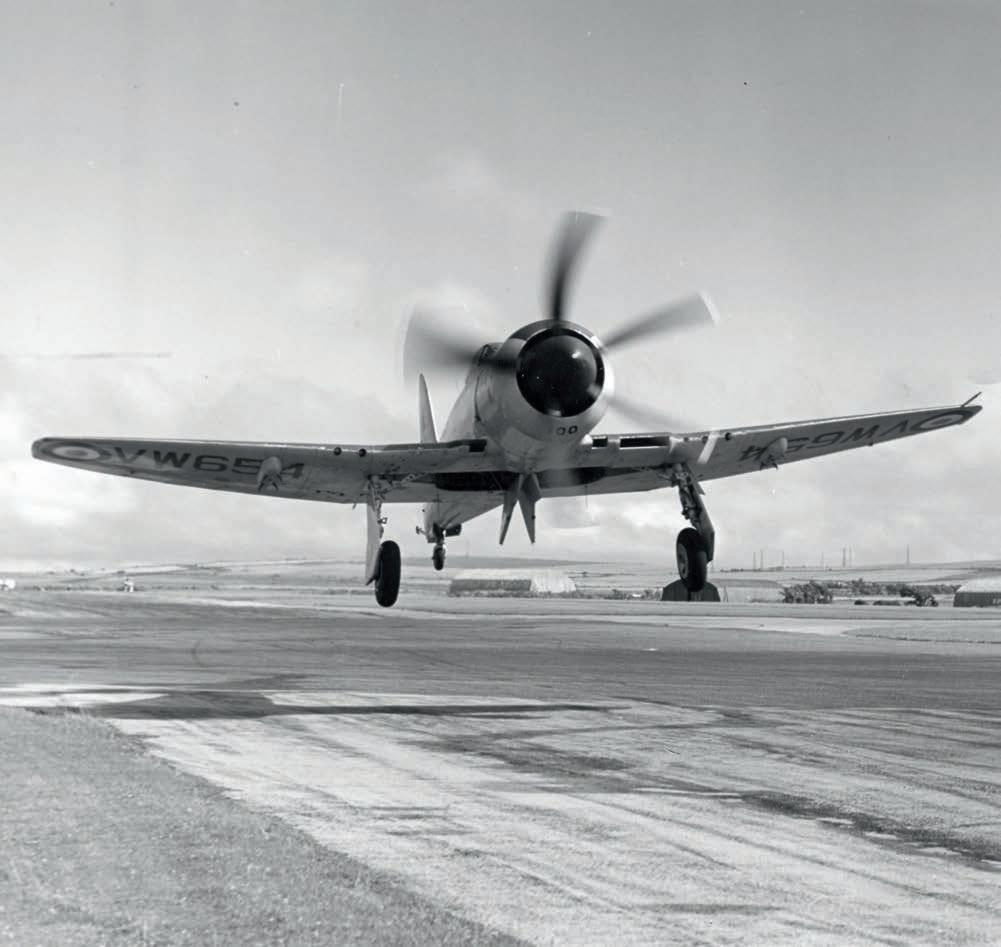
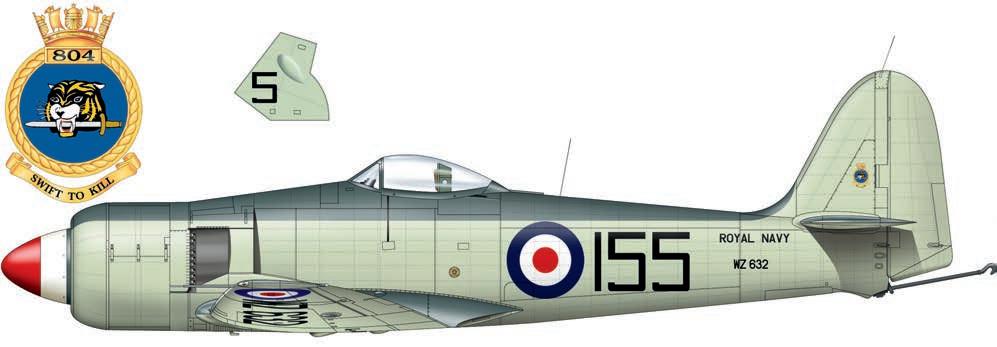
trials with new fighter aircraft types.
Variants Operated: F.10 – 5.47 to 7.48, FB.11 – 2.49 to 1954
Shore Bases: West Raynham
No.799 SQUADRON
Part of the 50th Training Air Group which handled refresher flying.
Variants Operated: F.10 – 9.48 to 10.49, FB.11 – 5.49 to 11.51, T.20 – 4.51 to 5.51
Shore Bases: Yeovilton
No.801 SQUADRON
Variants Operated: FB.11 – 3.51 to 1.55, T.20 – 12.51 to 1.55
Shore Bases: Lee-on-Solent, Hal Far (Malta - periods in 1952 and 1953), Lossiemouth (period in 1953), Ford from 7.54
Carriers: Vengeance mid-1951, Indomitable 1951 and 1952, Glory 1952, 1953 and 1954, Illustrious long detachment 1953
No.802 SQUADRON
Variants Operated: F.10 – 4.48 to 6.48, FB.11 – 5.48 to 12.52 & 2.53 to 3.54, T.20 –6.50 to 2.54
Shore Bases: Lee-on-Solent, Eglinton from 5.48, Yeovilton from 12.48, Culdrose from 3.49, Hal Far (periods in 1952 and 1953), Arbroath 2.53, Brawdy (period in 1953), Lossiemouth from 11.53
Carriers: Vengeance 1948 to 1951, Indomitable 1951, Illustrious 1951, Theseus 1951, 1952 and 1953, Ocean 1952
No.803 SQUADRON RCN
Variants Operated: F.10 – 8.47 to 2.50, FB.11 – 4.48 to 5.51
Shore Bases: Eglinton, Dartmouth (Canada) from 2.48
Carriers: Magnificent
No.804 SQUADRON
Variants Operated: FB.11 – 7.49 to 1.54
Shore Bases: Hal Far, Nowra 10.51, Lee-on-Solent 6.52, Culdrose 7.52, Brawdy 11.52, Hal Far 2.53, Brawdy 7.53, Lossiemouth 10.53
Carriers: Glory 1949 to 1952, Theseus 1952 and 1953
No.805 SQUADRON RAN
Variants Operated: F.10 – 8.48 to 2.49, FB.11 – 8.48 to 3.58
Shore Bases: Eglinton, Nowra from 5.49 Carriers: Sydney
No.806 SQUADRON
Re-formed as the RN Aerobatic team with three aircraft types for North American tour.
Variants Operated: FB.11 – 5.48 to 9.48
Shore Bases: Eglinton, Dartmouth Carriers: Magnificent (transit only)
No.807 SQUADRON
Variants Operated: F.10 – 8.47 to 12.48, FB.11 – 2.48 to 5.54
Shore Bases: Culdrose, Eglinton from 9.47, Culdrose from 3.48, Donibristle from
5.48, Lee-on-Solent from 12.48, Yeovilton from 3.49, St Merryn from 10.49, Culdrose from 5.50, Ford from 6.50, Hal Far from 8.51, Stretton from 12.53, Anthorn from 1.54
Carriers: Theseus 1948 to 1950 and 1952, Ocean 1951 and 1952 to 1953, Glory 1952
No.808 SQUADRON RAN
Variants Operated: FB.11 – 4.50 to 10.54
Shore Bases: St Merryn, Nowra from 12.50 Carriers: Sydney 1950 to 1953, Vengeance 1953 to 1954
No.809 SQUADRON
A Sea Hornet squadron which used the odd Sea Fury T.20.
Variants Operated: T.20 – 11.51 to 1.52
Shore Bases: Coltishall, Culdrose from 12.51
Carriers: None
No.810 SQUADRON
Variants Operated: FB.11 – 3.54 to 3.55
Shore Bases: Ford, Hal Far from 8.54
Carriers: Centaur 1954 and 1955
No.811 SQUADRON
Variants Operated: FB.11 – 8.53 to 12.54
Shore Bases: Leuchars, Hal Far and Sembawang (Singapore) in 1954, Lee-onSolent 12.54
Carriers: Warrior in 1954
No.850 SQUADRON RAN
Variants Operated: FB.11 – 1.53 to 8.54
Shore Bases: Nowra
Carriers: Vengeance 1953, Sydney 1953 to 1954
No.860 SQUADRON RNethN
Variants Operated: FB.60 – 7.50 to 6.56
Shore Bases: Valkenburg (the Netherlands), St Merryn from 1.51, Valkenburg from 12.51
Carriers: Indomitable 1951, Karel Doorman 1952 onwards, Illustrious (period 9.52)
No.870 SQUADRON RCN
Variants Operated: FB.11 – 5.51 to 3.54
Shore Bases: Dartmouth, Scoudouc (Canada) from 6.53, Summerside (Canada) from 9.53
Carriers: Magnificent 1954
No.871 SQUADRON RCN
Variants Operated: FB.11 – 5.51 to 8.56
Shore Bases: Dartmouth Carriers: Magnificent 1951 and 1953 to 1955
No.883 SQUADRON RCN
Variants Operated: FB.11 – 9.48 to 5.51
Shore Bases: Dartmouth Carriers: Magnificent 1950 to 1951
No.898 SQUADRON
Variants Operated: FB.11 – 7.51 to 1.53
Shore Bases: Arbroath, Hal Far from 8.51 Carriers: Ocean 1951 and late 1952, Theseus 1952, Glory 1952
No.1830 SQUADRON RNVR (Scottish Air Division)
Variants Operated: T.20 –10.52 to 10.54
Home Base: Abbotsinch
No.1831 SQUADRON RNVR (Northern Air Division)
Variants Operated: F.10 - 8.53 to 1955, FB.11 – 8.51 to 6.55, T.20 – 10.50 to 6.55
Home Base: Stretton
No.1832 SQUADRON RNVR (Southern Air Division)
Variants Operated: F.10 - 2.53 onwards, FB.11 – 8.51 to 8.55, T.20 – 10.50 to 6.56
Home Bases: Culham, Benson from 7.53
No.1833 SQUADRON RNVR (Midland Air Division)
Variants Operated: FB.11 – 2.54 to 7.55, T.20 – 10.50 to 10.55
Home Base: Bramcote
No.1834 SQUADRON RNVR (Southern Air Division)
Variants Operated: FB.11 – 10.53 to 4.55, T.20 – 10.53 to 4.55
Home Bases: Benson, Yeovilton from 1.54
No.1832B/1835 SQUADRON RNVR (Southern Air Division)
Variants Operated: FB.11 – 10.52 to c8.55, T.20 – 10.52 to c6.56
Home Bases: Culham, Benson from 7.53
No.1832A/1836 SQUADRON RNVR (Southern Air Division)
Variants Operated: FB.11 – 10.52 to c8.55, T.20 – 10.52 to c6.56
Home Bases: Culham, Benson from 7.53
Airwork Services Ltd
The civilian-operated Fleet Requirements Unit (FRU) operated several different types including Sea Furies.
Variants Operated: FB.11 – 10.55 to 4.61
Home Base: Hurn
VT-40
The RCN’s fixed-wing training unit which is understood to have been formed from No.1 TrAG (the Operational Flying Training School) on 2.5.54.
Variants Operated: FB.11 – 5.54 to 1956
Home Base: Dartmouth (Canada)
Gevechtsvliegopleiding (GVO) RNethN
The Dutch Navy’s Fighter Pilots Combat School.
Variants Operated: FB.50 – 4.48 to 7.50
Home Base: Valkenburg
Note: Examples were also operated by RAE Farnborough and A&AEE Boscombe Down, by the Joint Warfare Establishment from 1948 to 1952 at Yeovilton (F.10, then FB.11), ten Station Flights used either a T.20 or FB.11, and the Northern Communications Squadron at Donibristle had a T.20 in 1955/56. ■
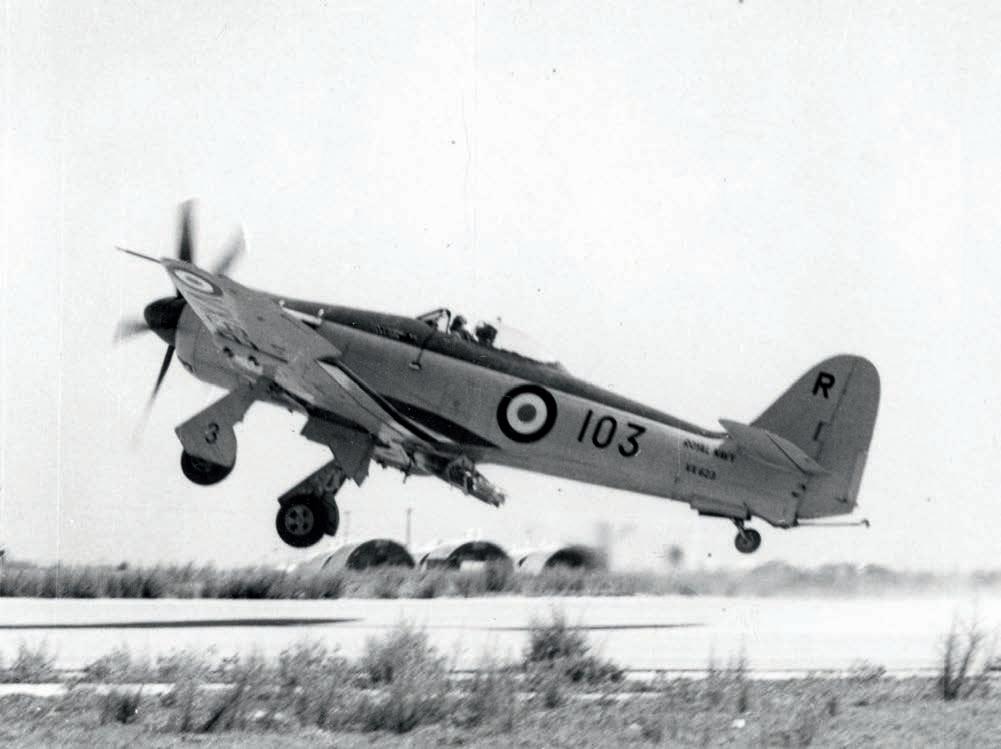
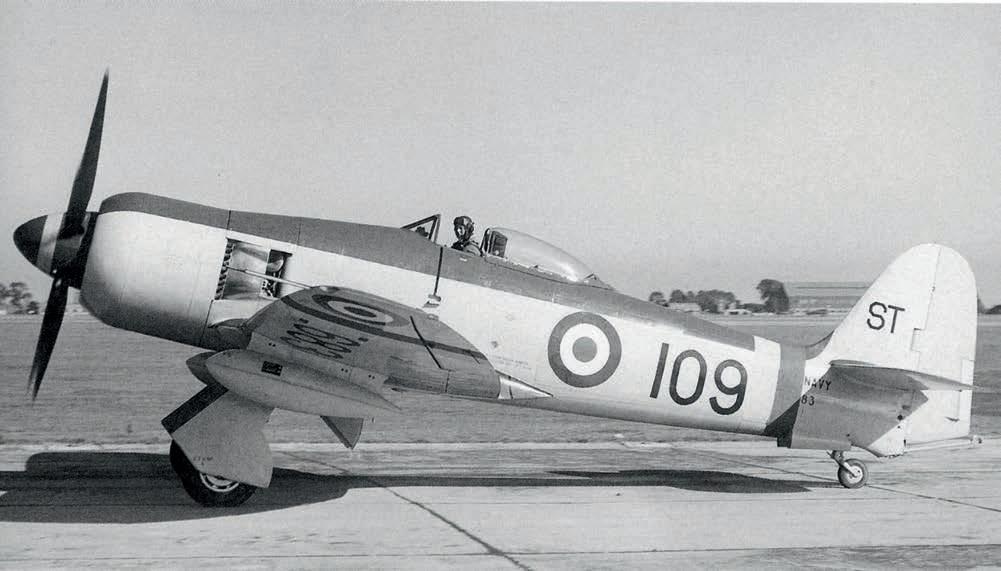
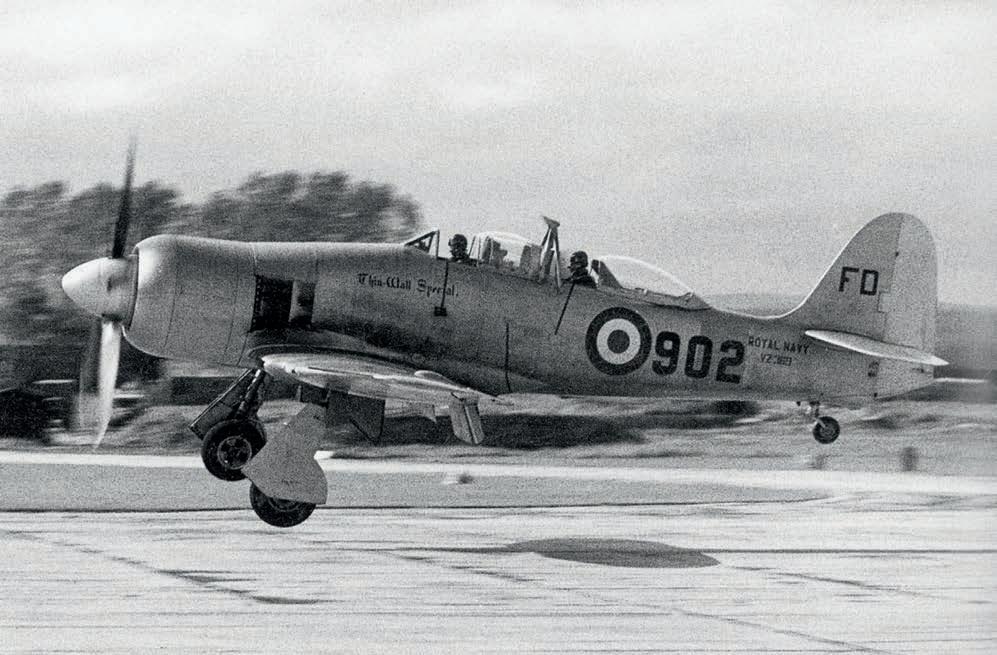
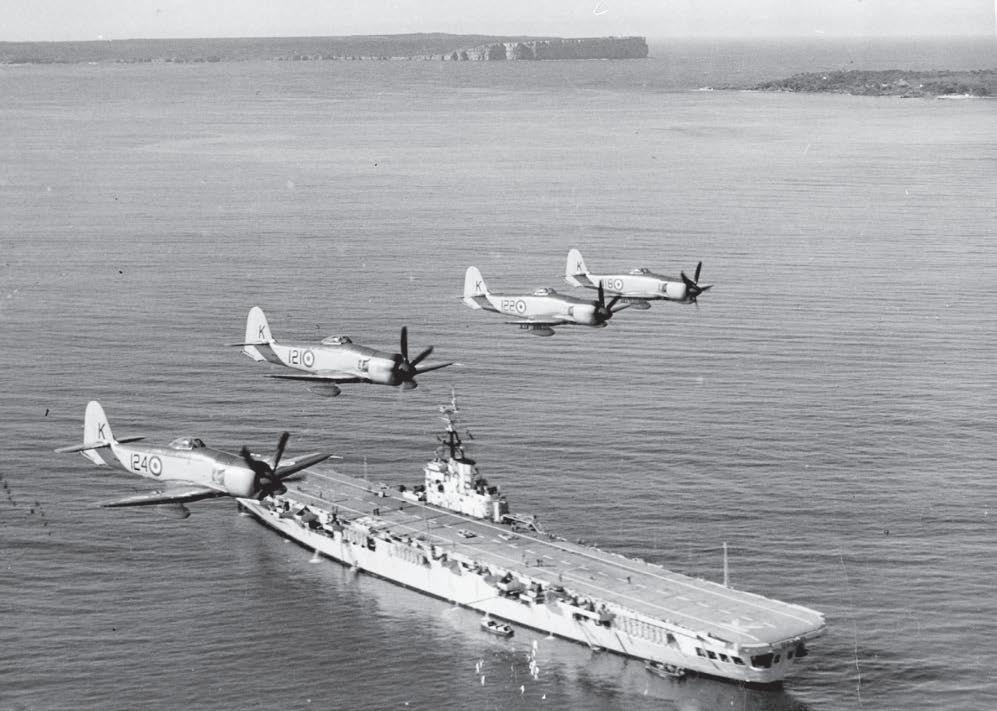
In the course of the Sea Fury’s service life the ghter embarked on a number of different aircraft carriers and the following gives a brief career history for each vessel. All of the ships listed operated Sea Fury squadrons from their decks – carriers which only received Sea Furies for trial purposes, training or just to take them overseas are not included. Most Sea Fury carriers fall into the Light Fleet category, a modest-size utility class of ship developed during the Second World War which proved very successful.
Displacement; full load: 18,200 tons
Length: 695ft overall
Speed: 25 knots – less at full load displacement Armament by 1950s: 40mm Bofors guns (2pdr multiple pom-poms extant in some vessels)
Aircraft: Originally designed to accommodate 48 aircraft in World War Two Catapult: One
HMS Centaur
This was the most modern Royal Navy carrier to operate the Sea Fury. Larger and faster than the Light Fleets, she was one of a group of ships the construction of which was started in 1944. Built by Harland & Wolff Centaur was launched in April 1947 but not completed until 1953 – part of the delay was the desire to incorporate wartime experience. In due course she operated the
Navy’s biggest jet fighters but was paid off into reserve in 1966 and scrapped in 1972.
HMS Glory
A Light Fleet Carrier of just over 18,000 tons deep load displacement, and also built by Harland & Wolff, Glory was launched in November 1943 and completed in 1945. She served with great distinction in Korea but the new types of jet fighter introduced later in the decade made the Light Fleets obsolescent, limiting their future usefulness. Glory was broken up in 1961.
HMS Illustrious
One of the heavier Fleet carriers started before 1939, Illustrious was built by Vickers-Armstrong at Barrow and completed in 1940. She had a very busy wartime career, and then spent eight years as a trials and training carrier which occasionally involved the embarkation of a front-line squadron for exercises. Illustrious went for scrap in 1956.
HMS Indomitable
One of Illustrious’s sister ships, Indomitable was also built by Vickers-Armstrong at Barrow and completed in 1941. After refit she rejoined the Home Fleet in 1950 and served as a front-line carrier before going into reserve in 1953. She was scrapped in 1955.
HrMs Karel Doorman
This was the former HMS Venerable, a Light Fleet Carrier built by Cammell Laird, launched in December 1943 and
completed in early 1945. In 1948 she was bought by Holland as the Karel Doorman and, after her ‘Sea Fury’ career had ended, was thoroughly modernised in the 1950s for jet operations. In 1969 she was sold to Argentina as the Veinticinco de Mayo and was finally sold for scrap in 1998.
HMCS Magnificent:
A second-batch Light Fleet built by Harland & Wolff, launched in November 1944 and completed in 1948 after work had stopped at the end of the War. It was the interest from Canada in acquiring her that brought the resumption and in 1948 she went on loan to that country and stayed until June 1957. Before embarking the Canadian Navy’s Sea Fury units, in 1948 the ship played host to No. 806 Squadron during its North American tour. Magnificent was scrapped in 1965.
HMS Ocean
Light Fleet built by Stephen, Ocean was launched in July 1944 and completed in 1945. She followed a similar career to Glory and went for scrapping in 1962.
HMAS Sydney
The former Light Fleet carrier HMS Terrible was built at Devonport and launched in September 1944, but again work was halted in 1945. Australia’s interest brought a restart and she was transferred to her new owners as Sydney in 1948 and completed in 1949. After Korea she switched to flying training, in the 1960s became a fast transport and was broken up in 1976.
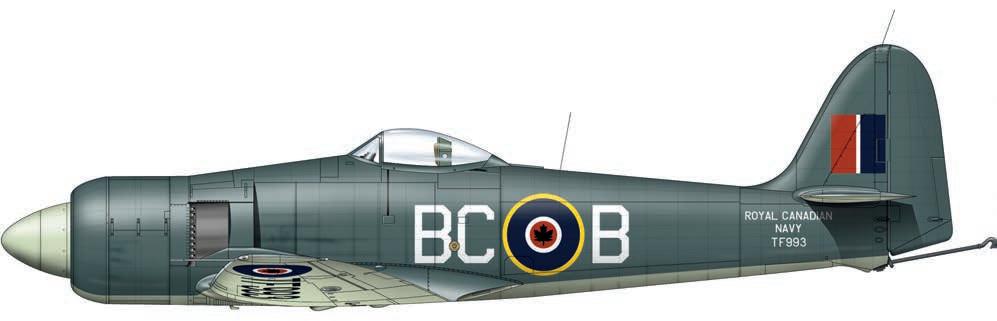
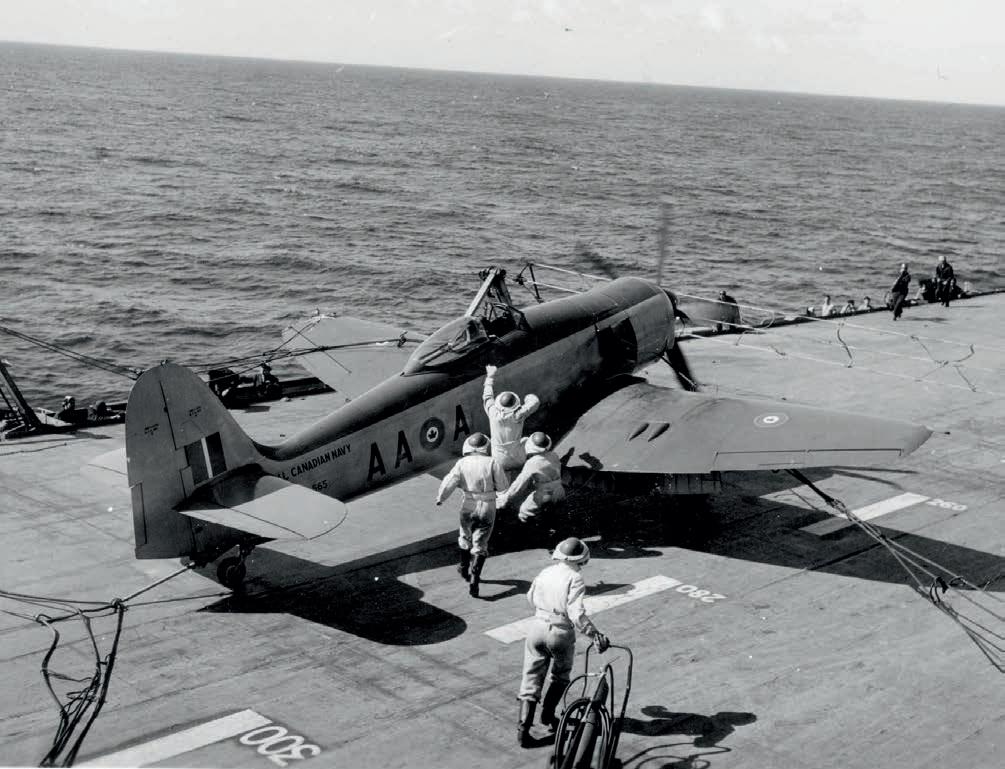
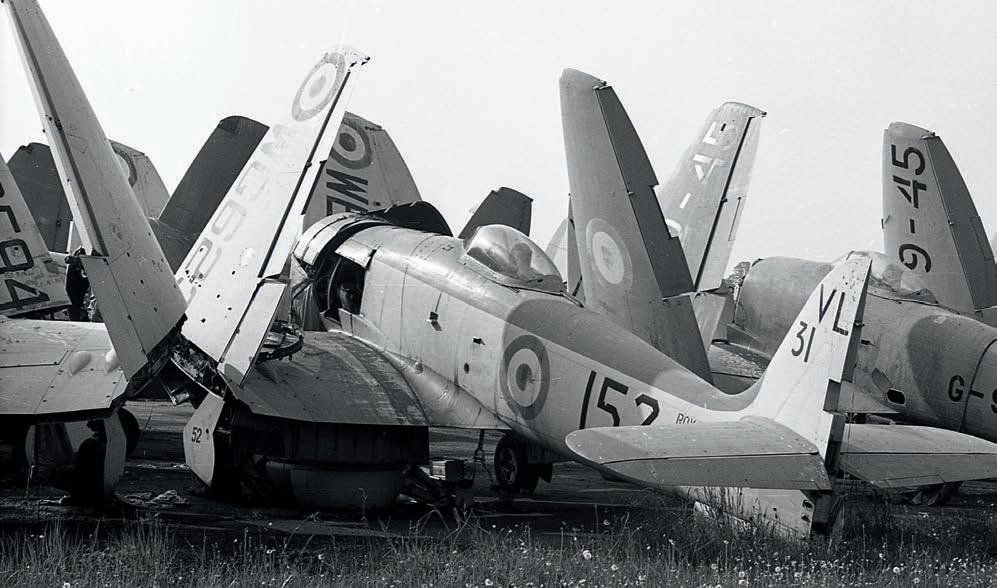
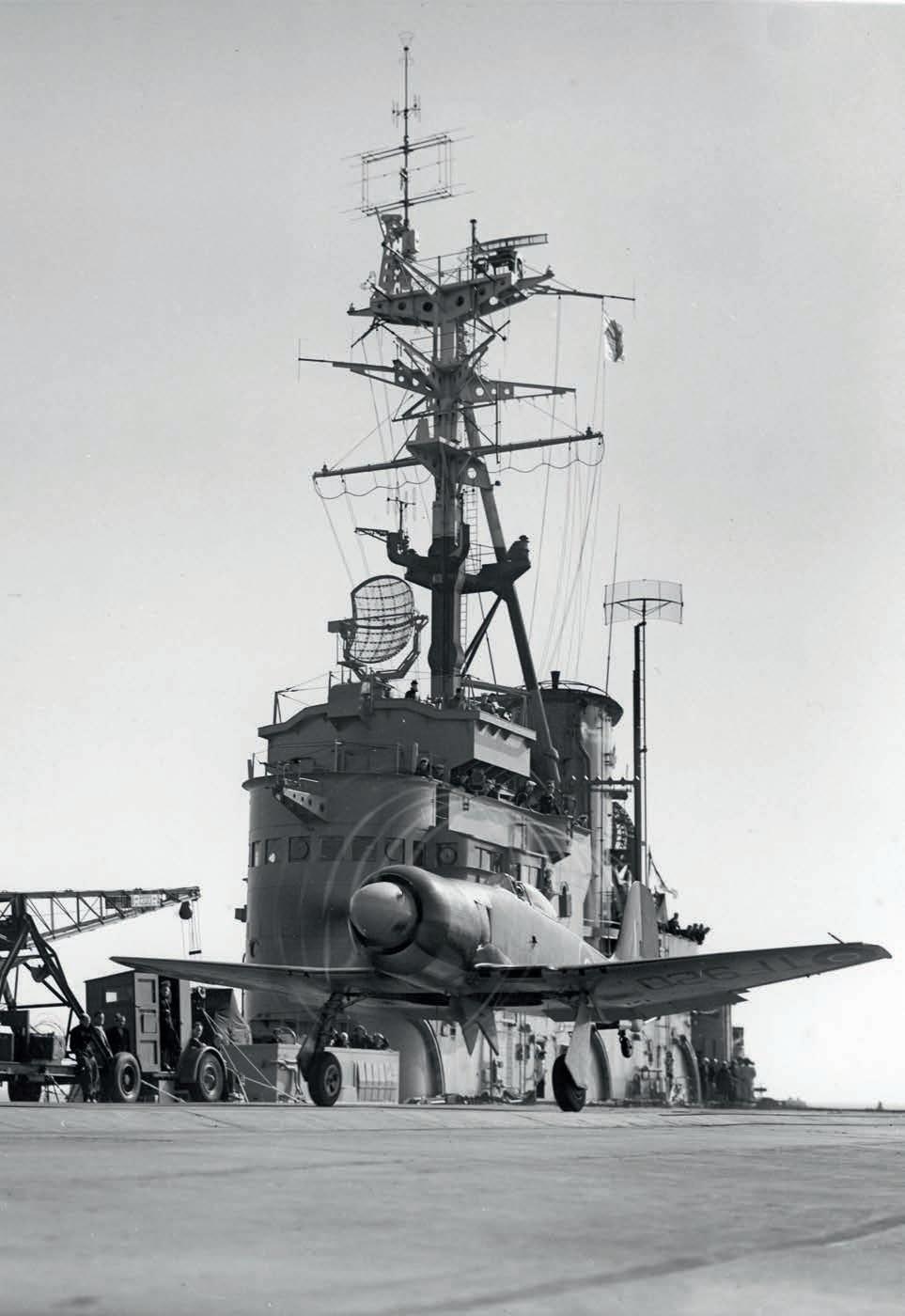
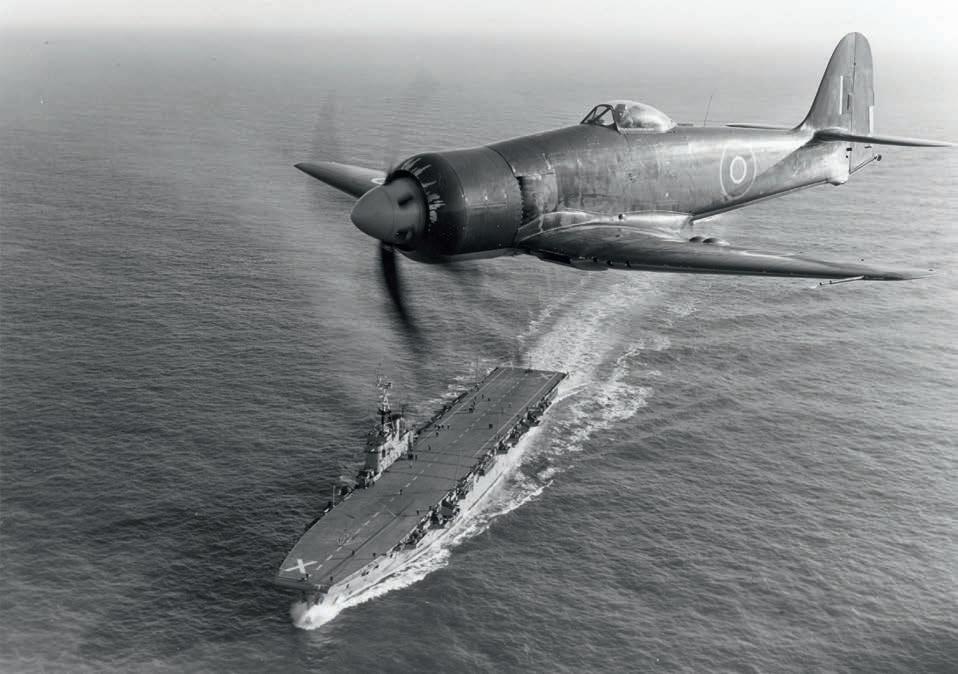
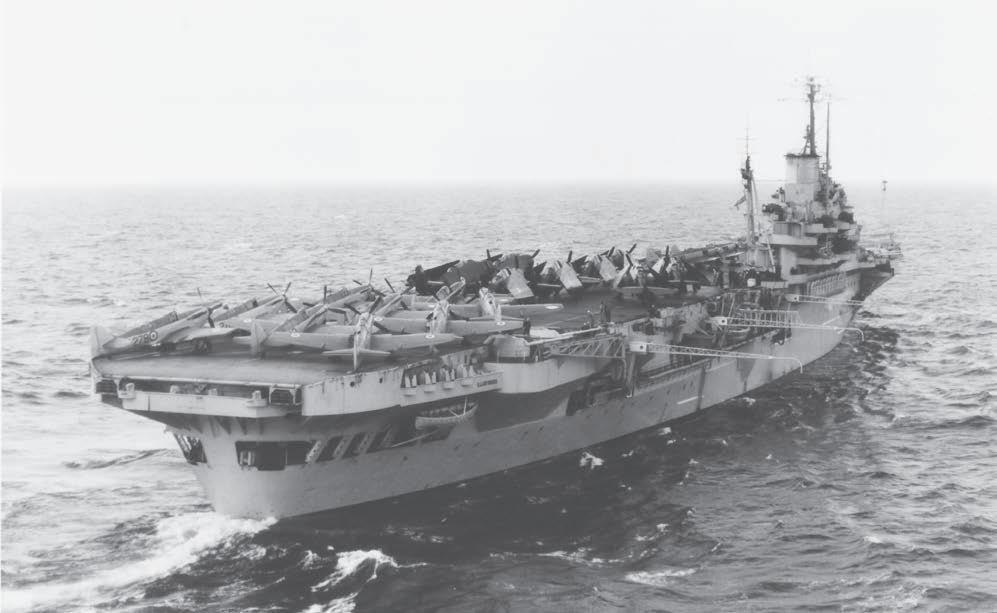
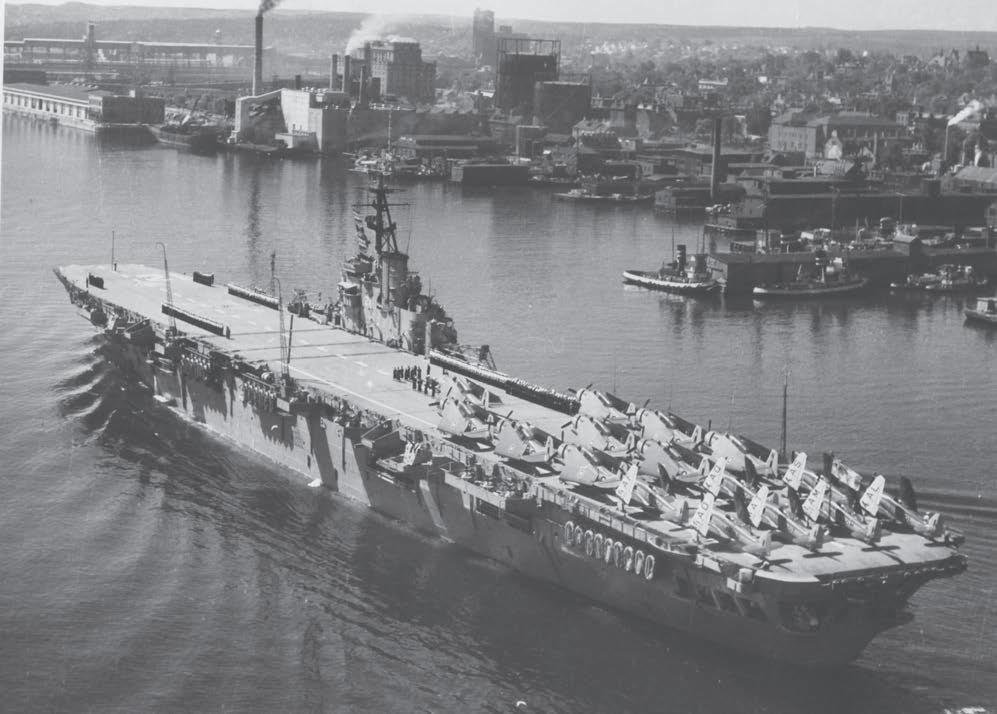
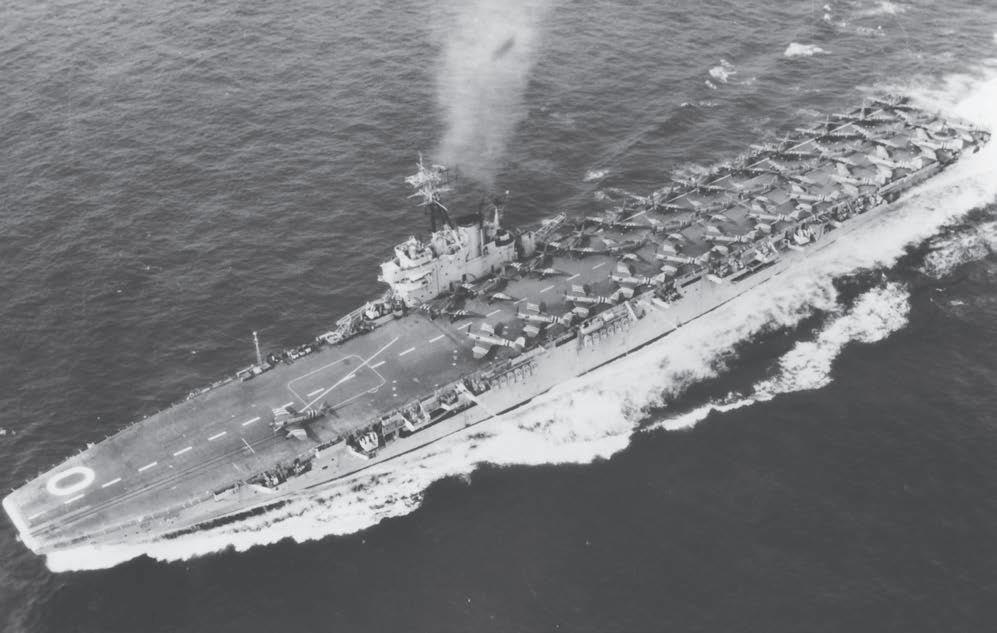
HMS Theseus
Another Light Fleet, Theseus was built by Fairfield, launched in July 1944 and completed in 1946. Again outdated by new aircraft types after Korea, this ship was scrapped in 1962.
HMS Vengeance
Vengeance was built by Swan Hunter as a Light Fleet, launched in February 1944 and completed in early 1945. Never in Korea, she went on loan to the RAN between 1952 and 1955 prior to the completion of another carrier (HMAS Melbourne), and then in 1957 joined the Brazilian Navy as the Minas Gerais She remained in service for a long time and did not go to the breakers until 2004.
HMS Unicorn
Built by Harland and Wolff, HMS Unicorn was laid down in 1939, launched in 1941 and commissioned in March 1943. This vessel was unusual in that it was designed to maintain and repair aircraft but could, if required, operate as a conventional aircraft carrier because she had an unobstructed flight deck, unlike the later HMS Perseus and Pioneer (Colossus class) mentioned above. This vessel operated throughout the Korean conflict remaining in theatre for over 37 months and performing a number of roles, details of which can be found in Chapter Three. HMS Unicorn returned to Britain at the end of 1953 and was then laid up until scrapped in 1959/60.
HMS Warrior
The last of the Light Fleet Carriers to operate the Sea Fury, this ship was built by Harland & Wolff. She was launched in May 1944 but not completed until 1946. After a loan period with the Royal Canadian Navy between 1946 and 1948, Warrior was employed on deck landing trials which in 1948/49 included experiments with a flexible ‘soft’ deck to receive fighter aircraft that had no undercarriages. Following modernisation she served as Headquarters Ship for the nuclear trials programme at Christmas Island in 1957, and then in 1958 was sold to Argentina. As the Independencia she was discarded in 1971. ■
In the preparation and writing of this book the author consulted a large number of original documents held in the ‘Air’ and ‘Avia’ les of the National Archives, plus material in the hands of The Brooklands Museum. The following publications were also consulted: British Combat Aircraft in Action since 1945: David Oliver; Ian Allan, 1987. British Secret Projects: Fighters and
Bombers 1935-1950: Tony Buttler; Midland Publishing, 2004.
Hawker Aircraft Since 1920: Francis K. Mason; Putnam; 1991.
Hawker Sea Fury (Warpaint No. 16): W.A. Harrison; Hall Park Books, 1998.
Hawker Tempest and Sea Fury: Robert Jackson; Blandford Press, 1989.
Sea Fury: Ray Williams; Aeroplane Monthly, Dec 1985-April 1986.
The RAF Hath No Fury: Tony Buttler; Air Enthusiast No. 86, March/April 2000. The Squadrons of the Fleet Air Arm: Ray Sturtivant and Theo Ballance; Air-Britain (Historians), 1994.
Warships of World War II: H.T. Lenton & J.J. Colledge; Ian Allan, 4th Ed’n, 1970. With the Carriers in Korea: The Sea and Air War in SE Asia: John R.P. Lansdown; Crecy Publishing, 1997.
A&AEE Aircraft & Armament Experimental Establishment at Boscombe Down
AFC Air Force Cross
AHU Aircraft Holding Unit
ASI Air Speed Indicated
ASR Air Sea Rescue
BAC British Aircraft Corporation
‘C’ Sqn Naval aircraft assessment section at A&AEE
CAG Carrier Air Group
CAP Combat Air Patrol
Capt Captain
Cdr Commander
CFE Central Fighter Establishment
CFS Central Flying School
CO Commanding Officer
CofG Centre of Gravity
CS(A) Controller of Supplies (Aircraft)
DFC Distinguished Flying Cross
DSC Distinguished Service Cross
DSO Distinguished Service Order
ETPS Empire Test Pilots School
FAA Fleet Air Arm
Flt Flight
FRU Fleet Requirements Unit
FS Fully Supercharged
FTS Flying Training School
HMAS Her/His Majesty’s Australian Ship
HMCS Her/His Majesty’s Canadian Ship
HMS Her/His Majesty’s Ship
HrMs Harer Majesteits (Her Majesty’s [Ship}) (Netherlands Navy)
IF Instrument Flying
KCB Knight Commander of the Order of the Bath
Lt Lieutenant
MBE Member of the Order of the British Empire
MLD Marine Luchtvaartdienst (Royal Netherlands Naval Air Service)
MoS Ministry of Supply
MS Medium Supercharged
NAFS Naval Air Fighter School
OBE Officer of the Order of the British Empire
OFTS Operational Flying Training School
OGV Opleiding Gevechtsvlieger (Netherlands Navy Fighter Pilots School)
RAAF Royal Australian Air Force
RAE Royal Aircraft Establishment at Farnborough
RATOG Rocket-Assisted Take-Off Gear
RAN Royal Australian Navy
RANAS Royal Australian Naval Air Station
RCN Royal Canadian Navy
RCNAS Royal Canadian Naval Air Station
RN Royal Navy
RNAS Royal Naval Air Station
RNethN Royal Netherlands Navy
RNVR Royal Naval Volunteer Reserve
RP Rocket Projectile
SAD Southern Air Division (RNVR)
SAR Search and Rescue
SOC Struck Off Charge
Sub-Lt Sub-Lieutenant
TrAG Training Air Group
UK United Kingdom
UN United Nations
US United States
USN United States Navy
USS United States Ship
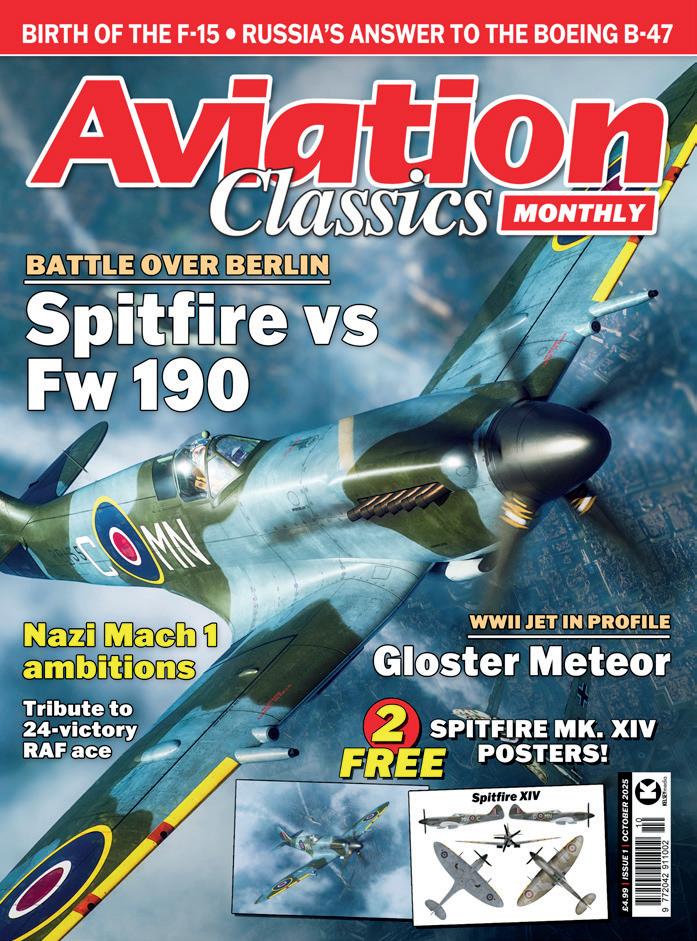
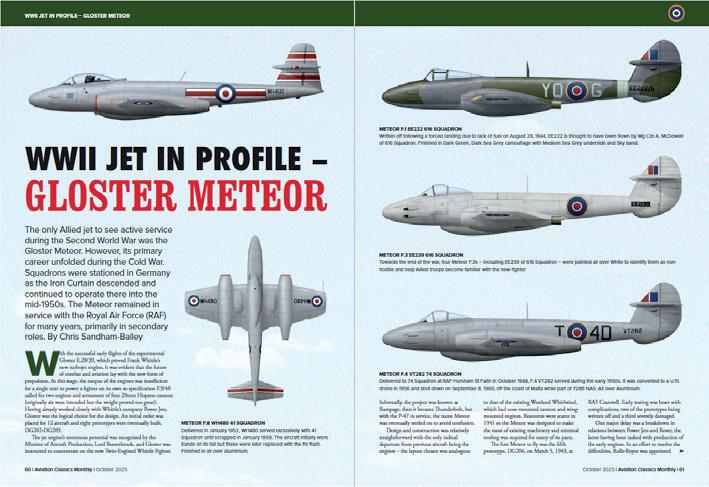
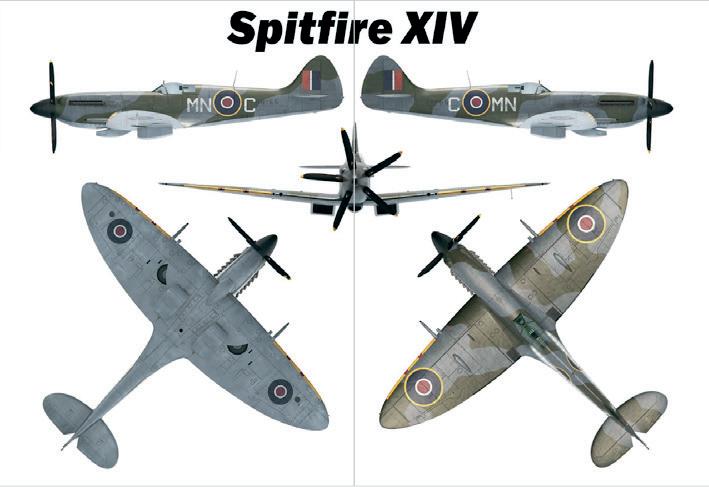
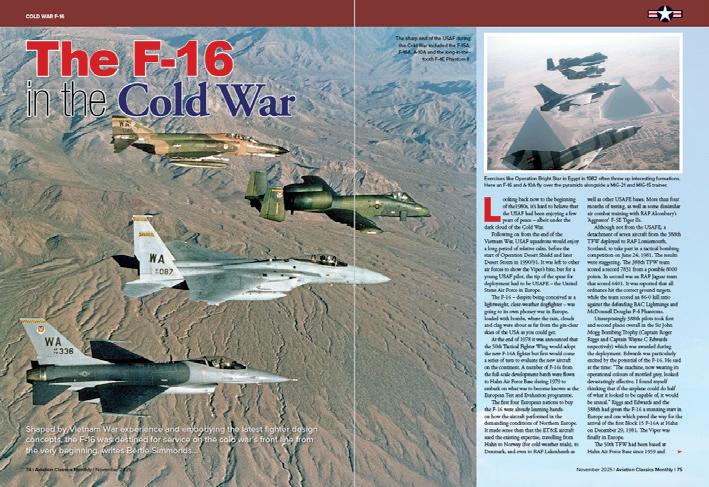
Aviation Classics Monthly is a new high-quality magazine dedicated to the legendary aircraft that ruled the skies from World War II through to the end of the Cold War. Each issue features iconic warplanes, from the piston-engine fighters and bombers of WWII, such as the Spitfire, B-17, and Zero – to the jet-powered marvels of the Cold War such as the F-86 Sabre, MiG-21, and B-52 Stratofortress. With meticulously researched features, rare archival images and specially commissioned art, Aviation Classics Monthly brings to life the engineering and operational histories of these famous machines as well as commemorating the skill and sacrifice of those who built, flew and maintained them. Whether recounting combat missions, explaining development
histories, or reviewing restoration efforts, the magazine honours the crews and the machines that shaped aerial warfare over the decades. Every 88-page issue includes a gatefold eight-page cover with poster artwork suitable for framing.
REASONS TO SUBSCRIBE:
• NEW ART... Fantastic new highquality artworks every month.
• GREAT STORIES... Compelling tales of aircraft and air combat, illustrated with rare photos.
• AIRCRAFT PROFILES... Detailed development histories of iconic aircraft.
• IN-DEPTH HISTORY... Authoritative writing from top aviation history specialists.
• LATEST NEWS... Keep up to date on historic airframes, air museums and shows.
Available to order in print from shop.kelsey.co.uk/aviation Also available on and


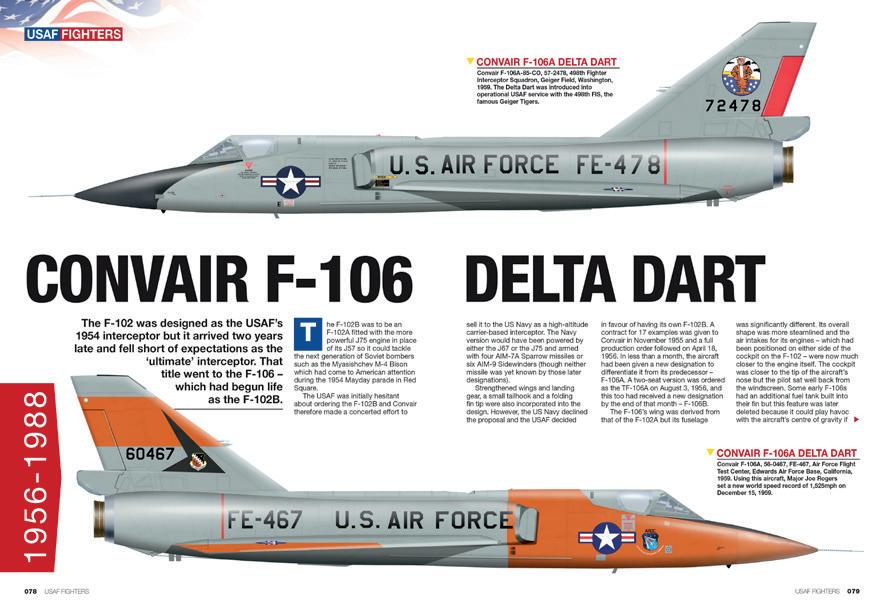
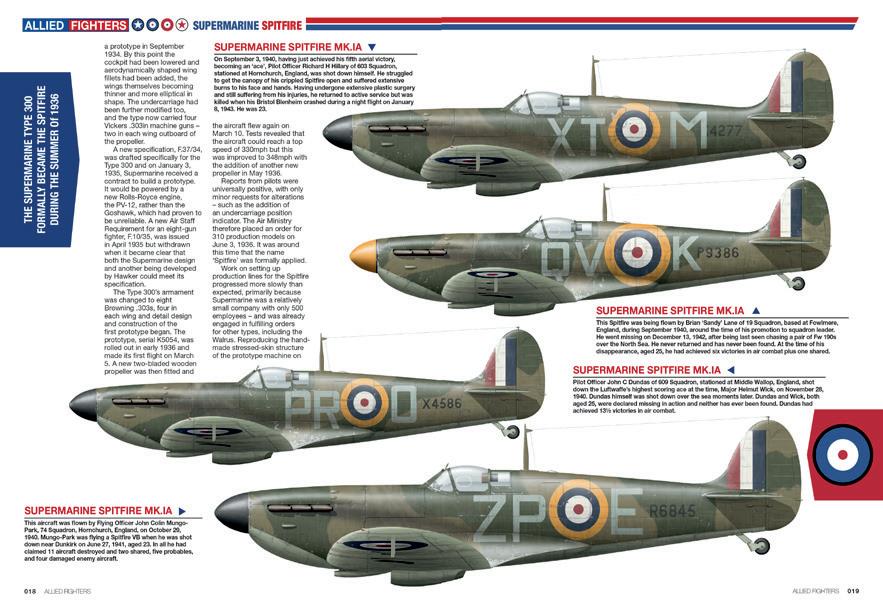
The colours and markings worn by aircraft have been a source of fascination for aviation enthusiasts and modellers since the dawn of aviation itself. Camouflage patterns, national insignia, unit markings, nose art and even streaks of oil and dirt can reveal everything about an aircraft – from the air force flying it to its operational role, theatre of service and even the identity of its pilot. Every issue of Aviation in Profile, published quarterly, features more than 150 highly detailed and expertly-drawn profile artworks depicting famous and noteworthy aircraft from a particular air force, conflict, time period or nationality. Whether it be jet fighters of the USAF, piston engine fighters of the RAF, bombers of the Luftwaffe, French combat
aircraft or aerobatic display teams, Aviation in Profile offers a wealth of incredible artworks to marvel at. Alongside the art can be found full aircraft development histories, as well as detailed captions explaining the background of each airframe depicted – where and when they served, the unit or company to which they belonged, the pilot or crew who flew them and more. For aircraft modellers, the collectable Aviation in Profile series will prove a valuable source of inspiration with each issue offering a wide variety of liveries and colour schemes to consider. For aviation history enthusiasts, the series provides a fascinating look at how each aircraft type was developed from drawing board to the end of its service career.
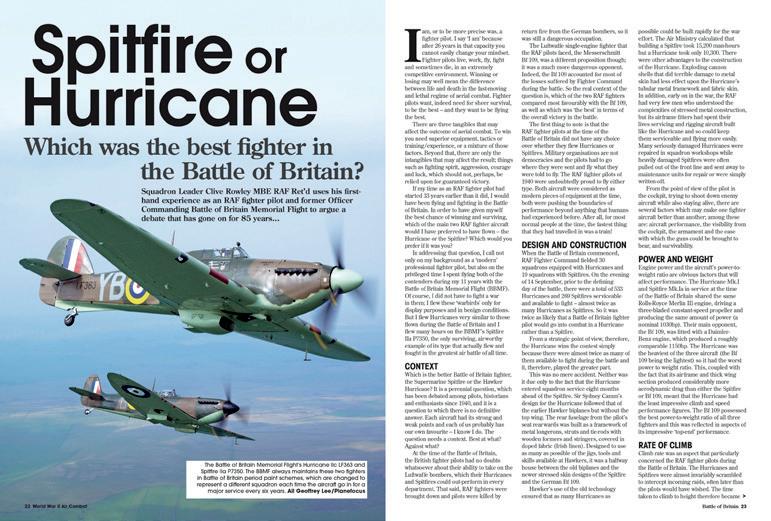
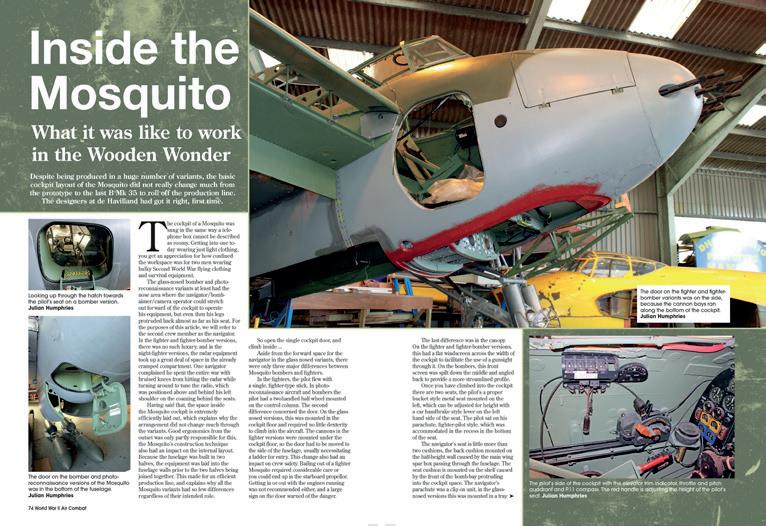
The World War II Air Combat series covers every aspect of the 1939-1945 air war, from deadly combat missions to the crews themselves and the aircraft on which their lives depended.
Each issue, published quarterly, offers in-depth historical analysis, technical detail and tales of real heroism, illustrated with rare period images and outstanding colour artworks. Critical campaigns, such as the Battle of Britain and the attack on Pearl Harbor, are reviewed with a focus on both the pilots who took the fight to the enemy and their combat aircraft.
Strategic objectives, successes and failures are examined as well as the eventual outcome

and its impact on the wider war. The complete story of famous and successful aircraft of the RAF, USAAF and Luftwaffe, such as the revolutionary de Havilland Mosquito, the iconic North American P-51 Mustang, the mighty Boeing B-17 Flying Fortress and the outstanding Focke-Wulf Fw 190, is told from the drawing board to the front line and beyond, with a look at surviving airframes and the museums that preserve them for future generations to come.
World War II Air Combat is a collectable series that delivers a compelling and informative account of the aerial conflict which decided the fate of the world and paved the way for Air Power as we know it today.

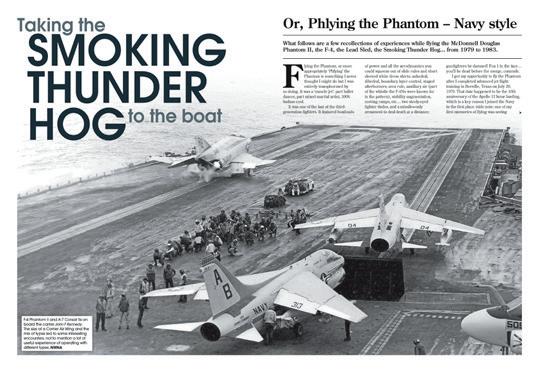
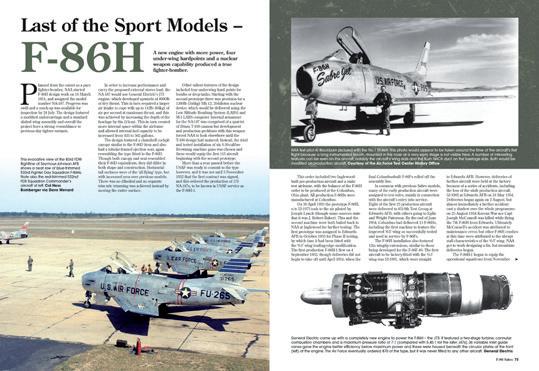
Modern combat aircraft are able to dominate the battlefield as never before – applying overwhelming force to limit, deny and destroy their adversaries. The Air Power series profiles the world’s most capable air combat platforms from the last years of the Cold War right up to the present day. Covering the strategic might of the Boeing B-52 Stratofortress, the remarkable stealth capabilities of the multirole Lockheed F-35 Lightning II, the air superiority prowess of the McDonnell Douglas/ Boeing F-15 Eagle and Lockheed F-22 Raptor and much more, Air Power focuses on aircraft able to carry out their mission against even the most capable and hostile opponents.
The best photography, colour illustrations and graphics all help to tell the tale of these incredible aircraft and the people who build, fly and maintain them. Operational histories of aircraft, pilots and units active during the conflicts in Iraq, Afghanistan, Syria and Yemen are reviewed and explained in detail.
Air Power is a collectable series that delivers compelling and informative accounts of technologically advanced military aircraft, their weapons, their equipment, their capabilities, their employment in active service and their impact on international events. It’s a must-read for anyone who loves modern aircraft and follows the ongoing global contest for true aerial superiority.
Devoted to the world’s greatest flying machines, the Classic Warplanes series celebrates legendary aircraft from the beginning of the Cold War right up to the spectacular innovations of the present day. Every issue, published quarterly, tells the complete story of an aerospace legend such as the rugged multirole McDonnell Douglas F-4 Phantom II fighter, the magnificent Avro Vulcan bomber or the innovative cannon-armed scourge of MiG Alley – the North American F-86 Sabre. The origin of each type is fully explored, including the designers and engineers whose meticulous and painstaking work brought them to life. Prototypes and early testing, entry into service and operational careers are all examined and explained in authoritative detail. Period and modern photography, colour illustrations and graphics all help to tell the tale of these incredible aircraft and the people who designed, built, flew and maintained them. And what’s more, lesser-known features and unusual missions are highlighted and discussed too, to give a fully rounded account of exactly what made these outstanding machines so special – ensuring their status as true classics. Compelling, informative and collectable, the Classic Warplanes series is a must-read for anyone who loves aircraft and aviation.
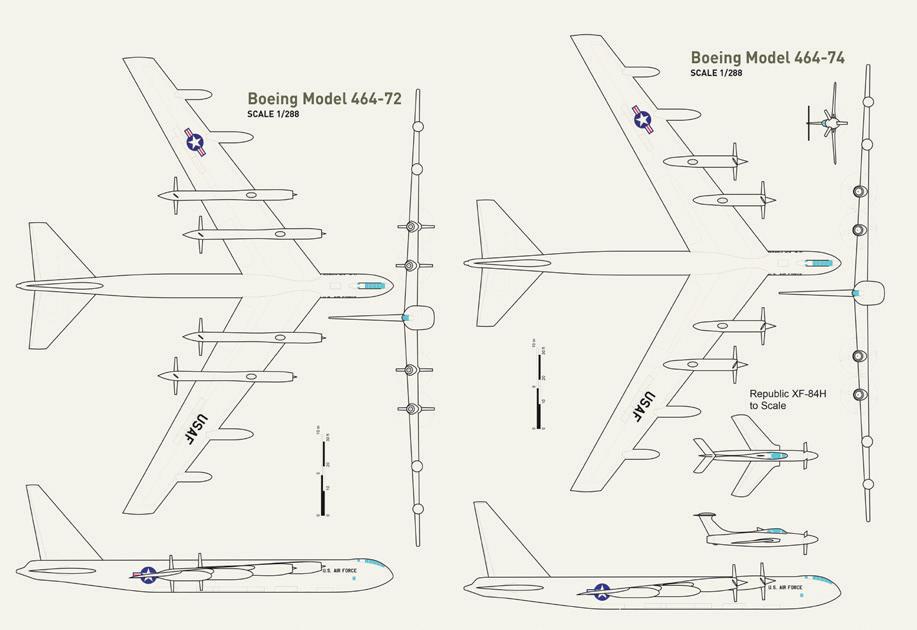
Behind every world-famous American aircraft – from the cutting-edge Lockheed F-22 Raptor to the long-serving Boeing B-52 Stratofortress – there exists a secret history of aircraft designs that were planned but never built. For every Rockwell B-1 Lancer or General Dynamics F-16 Fighting Falcon that has entered production there have been dozens, perhaps even hundreds, of concepts; evolutionary steps which saw the final design gradually growing and taking shape on the
designers’ drawing boards. In the US Aviation Secret Projects series, American aerospace engineer and aircraft development specialist Scott Lowther looks in detail at the vast range of different variants and configurations proposed for some of the United States’ most innovative and advanced aircraft. Each issue is fully illustrated throughout with scale diagrams showing the many different designs studied, with dimensions and technical information provided where known.
and
A hidden, high-stakes race between British and German engineers to build the most powerful piston-engine fighter – uncovered through new archival research and designer memoirs –ultimately shaped air superiority and the outcome of the Second World War.
A richly illustrated history of the US Navy’s 1950 Convoy Fighter competition, revealing the bold - and often bizarre –tailsitter aircraft designs proposed to defend merchant ships from nuclear attack during a daring postwar push for rapid aerospace innovation.
A revealing look at how fifthgeneration fighters use stealth, sensor fusion, and networked warfare to detect, track, and destroy threats beyond visual range – ushering in a new era of manned-unmanned, computer-driven air combat.
A comprehensive history of Soviet and Russian bombers –from reverse-engineered B-29s to modernised Tu-95s, Tu-22Ms and the supersonic Tu-160 –tracing how these aircraft evolved into powerful tools of strategy, engineering, and global influence.
A detailed account of Germany’s experimental WWII jet and rocket fighter projects, presenting extensively researched designs, rare documents, and images that reveal the Luftwaffe’s ambitious, often radical attempts to advance aerial warfare technology.
A richly illustrated, authoritative look inside Westland’s lesser-known fixed – and rotary-wing secret projects and innovations – revealing decades of experimental aircraft, unbuilt concepts, and cuttingedge technologies drawn from the company’s own archives.