FINCHES CANARIES
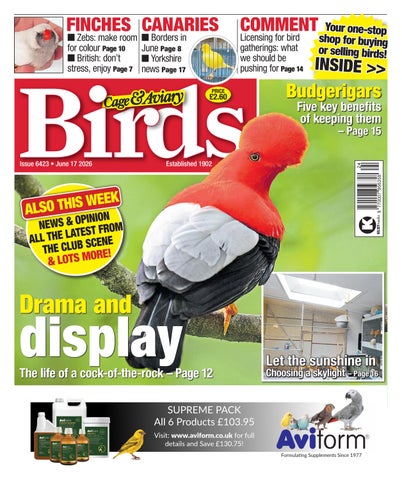
■ Zebs: make room for colour Page 10
■ British: don’t stress, enjoy Page 7
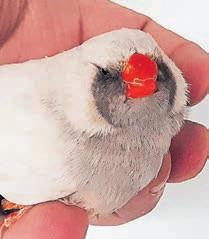
■ Borders in June Page 8
■ Yorkshire news Page 17
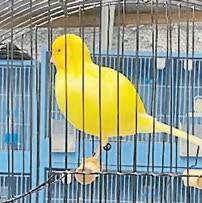
Licensing for bird gatherings: what we should be pushing for Page 14







Contact Customer Services cs@kelsey.co.uk 01959 543 747
AIPZ lifted in England, Wales and Scotland
By Katherine Weir
AT NOON ON June 4, the Animal and Plant Health Agency (APHA) lifted the avian influenza prevention zone (AIPZ) for poultry and captive birds in England, Wales and Scotland.
Guidance on the gov.uk website says that: “All bird keepers should continue to take steps to prevent bird flu and stop it spreading at all times and be vigilant for signs of disease.”
“
The latest risk assessment – based on current epidemiological and scientific evidence – indicates that the risk from the disease has now reduced in both poultry and wild birds.
spread of bird flu. APHA said they had been “vital” in protecting flocks across the country from the virus that circulates in wild birds.
Dr Christine Middlemiss, the UK’s chief veterinary officer, confirmed the move. She said: “The evidence clearly shows that the risk of avian influenza to poultry across Great Britain has reduced, making this the right time to lift the pre-
was closed on May 20.
In Northern Ireland, the AIPZ was lifted on May 15, and all mandatory restrictions were removed as of May 31.
Dr Middlemiss continued: “It remains vital that keepers remain vigilant and maintain high levels of biosecurity to keep flocks safe. Low risk does not mean no risk.”
Low risk does not mean no risk – Dr Christine Middlemiss, UK’s chief veterinary officer
vention zones.
The measures were originally used for the whole of England in December 2024, to prevent the


“This has been possible because of the hard work of all bird keepers, who have upheld high biosecurity standards for many months.”
The last bird-flu case in England
●On June 2, DEFRA and APHA announced Poultry Biosecurity Review funding, which forms part of the Animal Health and Welfare Pathway. Poultry keepers can apply for funding towards three biosecurity reviews at each of their sites.
Each site must hold a minimum number of chickens (1,000), ducks (500), geese (500) and turkeys (500).
Keepers can claim £430 for each review. The scheme closes on March 31, 2029.
Also in the news...
NI curlew eggs hatch after wildfire rescue
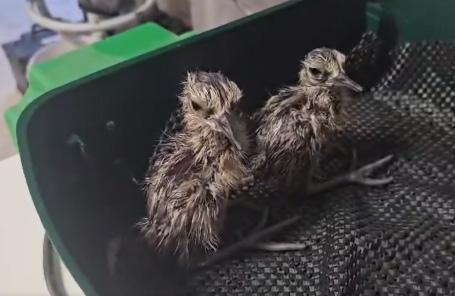
IN A HEART-WARMING update, the curlew eggs that were saved from a wildfire in Brookeborough, County Fermanagh (see News, May 20) have now hatched.
Róisín Normanly of the RSPB told BBC News NI that the curlew nest had been fenced off to protect it, but within 24 hours a wildfire had broken out.
At the height of the wildfire, 85 firefighters from the Northern Ireland Fire and Rescue Service (NIFRS) battled the blaze and although challenging, managed to protect the nest.
Ms Normanly said: “The fire was about a metre from the nest when we got there, so it was really close to the bone. But we got there just in time.”
There are thought to be only 150 breeding pairs of curlews left in Northern Ireland.
The eggs were collected care-
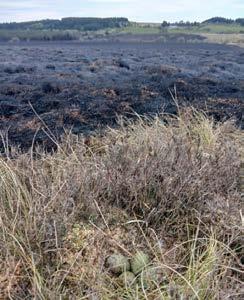
fully, wrapped up individually and packaged into a biscuit tin to be transported to the incubation facility.
Chairman of the Sliabh Beagh Curlew Conservation Trust, Dr John Cusack, said the eggs were incubated for just under four weeks.
He said: “All four [chicks] are happy and healthy and thriving and we’re delighted about that. We’re going to release them and hopefully they’ll do well.”
● The Sliabh Beagh Curlew Conservation Trust Facebook page has a video of the chicks hatching.

WITH regular monthly meetings and an open-door attitude to anyone interested in budgies, the club offers a supportive environment focused around friendship, tea and (very importantly) cake
– Tony Kenneson-Adams sets out the benefits of Bristol BS membership in due order of priority. See page 15
BLUE


CALL FOR SPARROWHAWKS
called to the scene, which resulted in tree surgeons putting down their tools. The BBC reported that no further action was to be carried out until the end of the nesting season.
BIRD FLU
Saved from the flames: the curlew chicks are said to be strong and healthy RESCUE
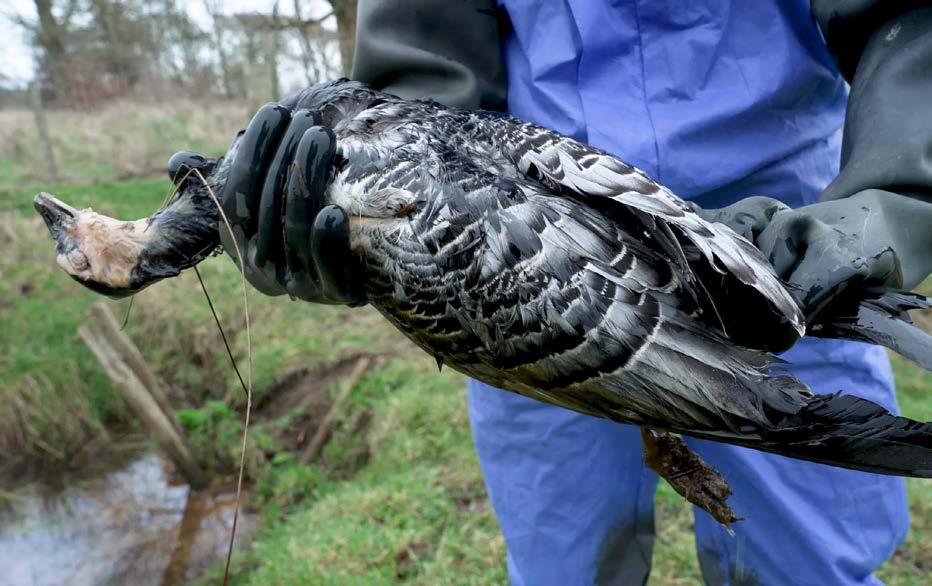
The worst period to date for bird flu was late autumn 2022 to early 2023 when cases reached their highest levels across the UK. In the 2025 to 2026 outbreak, England was hit hardest with 79 confirmed cases. This flu victim was a barnacle goose
Photo: RSPB
DID YOU KNOW?


● We’re on sale in many WH Smith and Easons stores, selected Morrisons and Tesco, and lots of independent retailers.


● To place a regular order, simply take this copy along to your newsagent

RISING GLOBAL TEMPERATURES and increasingly severe heatwaves could pose a major threat to birds around the world, according to new research from Lund University in Sweden. The study highlights how humidity, lifestyle and overall health influence how well birds can cope with extreme heat.
Researchers reviewed previous studies into birds’ heat tolerance and found that many species may be more vulnerable than first thought. While birds are known to use a variety of cooling strategies, such as panting and seeking shade, the scientists warn that prolonged exposure to extreme weather can still have serious consequences.
The study suggests that humidity has been overlooked in much of the earlier research. According to the researchers, high humidity can make it harder for birds to cool themselves effectively, increasing the risk of overheating during heatwaves.
The team also found that factors, such as age, health and life-
style, may affect how individual birds respond to extreme temperatures. Species living in already hot environments may not necessarily be better protected if conditions become even more severe.
The researchers hope their work will improve predictions about how climate change may affect wild bird populations in the
future. They have proposed a series of “sensitivity indicators” that could help scientists assess which species are most at risk from heat stress.
Biology researcher at Lund University and lead author of the study, Andreas Nord, explained: “Our study provides both a framework and a prioritisation scheme


● Or you can get us delivered to your home. See our fantastic subscription offer, page 9!
Scientists reveal how extreme heat affects birds
for determining when and why birds suffer or even die from overheating, and what we need to find out to make this a less likely outcome in the future.”
The findings from this study could help conservationists identify vulnerable species before population declines become severe. The researchers say that further
studies will now be needed to better understand how different birds cope with changing climates and increasingly frequent heatwaves.
Scientists have already warned that climate change is affecting breeding success and food availability for some bird species in parts of Europe.
UK nightingale populations show signs of recovery
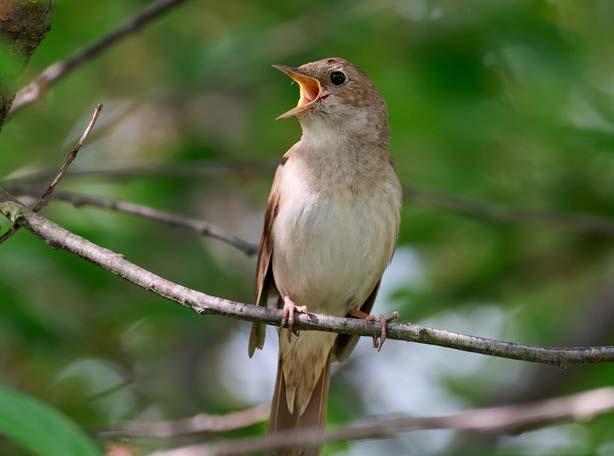
ONE OF BRITAIN’S most beloved songbirds is making a comeback on RSPB nature reserves, with new figures showing encouraging increases in the number of singing male nightingales across parts of south-east England.
The RSPB recorded 176 singing males on its reserves in 2025. That amounts to a 7 per cent rise com-
pared with the previous year and the second-highest total in more than a decade. Conservationists say the results are a positive sign for a species that has suffered dramatic declines in the UK over recent decades.
Between 1995 and 2024, the UK breeding population dropped by 34 per cent. The species is currently on the UK Red List of Birds of Conservation Concern, with

only about 6,700 breeding males thought to remain nationwide.
The RSPB says targeted habitat management has played a major role in the recent improvements. Work on reserves has included coppicing, scrub creation and woodland management to provide the thick vegetation nightingales need for nesting and feeding.
Some of the strongest populations have been recorded at reserves including Northward Hill in Kent and Minsmere in Suffolk, both of which have become important strongholds for the species.
Alan Johnson, RSPB England Area Manager, commented: “It is fantastic to see nightingale numbers increasing on RSPB nature reserves thanks to the hard work of staff and volunteers to create safe havens for this incredible migratory species. The growing numbers show effective conservation action and a great example that nature can thrive when given a chance.”
Despite the positive news, conservationists warn that nightingales still face major pressures from habitat loss, climate change and predation. Changes in woodland man-
agement and increasing deer populations are also thought to have contributed to long-term declines.
The entire UK breeding population spends the winter in a relatively small region of West Africa, so conditions can have a significant
effect on how many birds successfully return to Britain each spring. Nightingales are also highly faithful to their nesting sites, often returning to the same location year after year, making the availability of suitable habitat especially important.
Nightingales migrate to breed in the UK from mid-April after spending the winter in Africa. The work to improve habitats in the UK is paying off © Shutterstock.com/Mykola Moroz
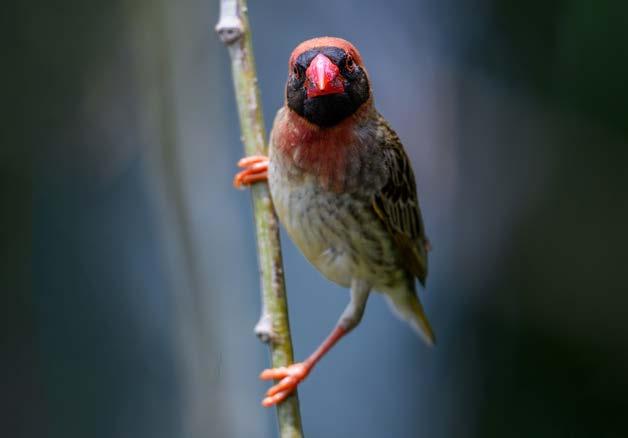
(Quelea quelea)
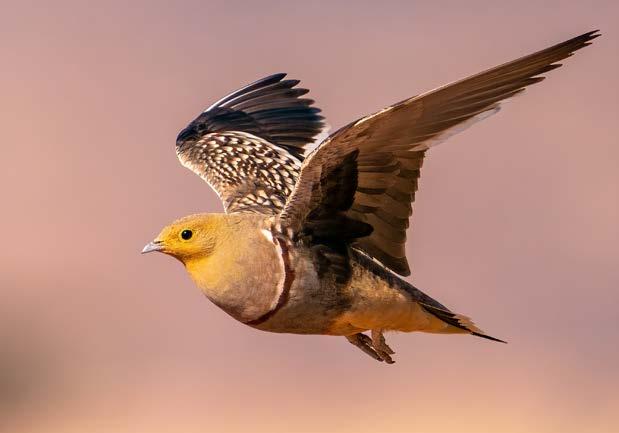
(right) Namaqua sandgrouse (Pterocles namaqua)
GOT A QUESTION?














Our expert team is here to help!
Send your birdkeeping queries to: Ask Cage & Aviary Birds (see top of page 2 for editorial office address) or email: birds.general@kelsey.co.uk
Breeding results: no softbills for the first time in 30 years
By Katherine Weir
NORFOLK FOREIGN BIRD Association (FBA) has revealed the breeding results for 2025, adding to the vast amount of data collated since breeding records began in 1975.
In that period, members have bred just over 86,000 birds from 340 different species.
250 down compared to 2024. In the seedeater section (exAustralian), only six different species were represented in the total of 152 bred. This total was nearly 100 down on 2024, with three less
“15 members sent in breeding results, which was the lowest for some time – Nick Elliston, Norfolk FBA publicity officer
For 2025, 15 members sent in breeding results – the lowest for some time. A total of 1,247 birds were reported as bred, which was
species bred. African silverbills dominated with 116 bred. Java sparrows numbered 14 and Indian silverbills, 13.
The number bred in the Australian section was down 190 on 2024 with 222 birds bred from 10 species (12 in 2024). The most numerous bred were Gouldian finch with 54, star finch with 48, cherry finch with 39 and Heck’s grassfinch with 30.
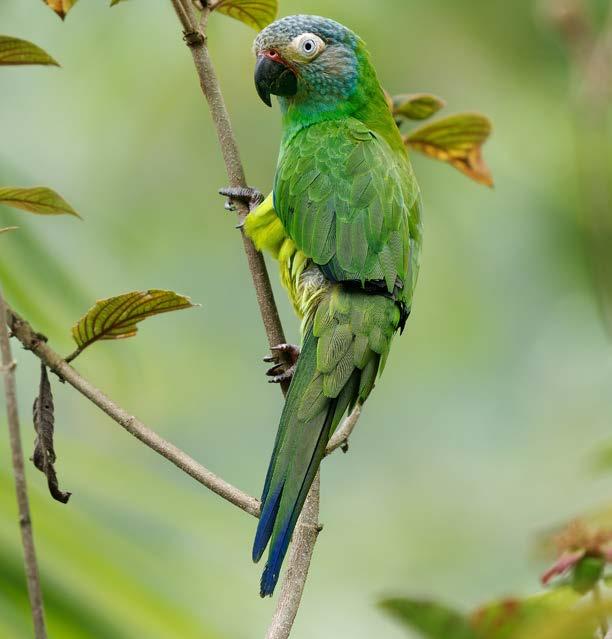
Parrotlike species bred totalled 125; almost the same as 2024. The number of different species bred was 14, the same as last year. One new species was bred: the dusky conure. Five conure species were recorded, with the green-cheeked conure easily the most numerous with 36 bred. There were five Abysinnian lovebirds bred.
For the first time in nearly 30 years, no softbills were reported as bred.
There were 95 pigeons and doves bred; an increase from 2024 from seven different species. Not surprisingly, diamond doves were the most numerous with 65 bred. This year’s total included three species of fruit pigeon, cape doves and Luzon bleeding-heart pigeon.
The number of pheasant and quail was 144, a small decrease on 2024. The most numerous were Chinese painted quail with 83
Spate of bird rescues at Pawz
an animal charity in Sunderland, has been inundated with bird rescues lately of all species.
At the end of May, a little puffin was brought in from Ryhope Beach after being found weak and covered in ticks. After receiving treatment, removing the ticks and making sure she had plenty to eat,
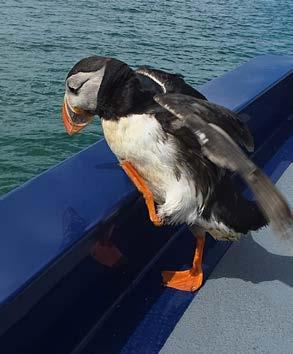
“Penelope” was deemed strong enough to take a boat journey back to the Farne Islands for release.
Off the hook
Another call for help came in for a cygnet at Silksworth Pond that had become entangled in a fishing hook and line. Pawz’ swan expert, Howard, sprang into action, and managed to remove the hook from its back.
The fishing line had travelled down the cygnet’s throat, so it was rushed to Westway Veterinary Hospital in Newcastle for emergency treatment after X-rays confirmed
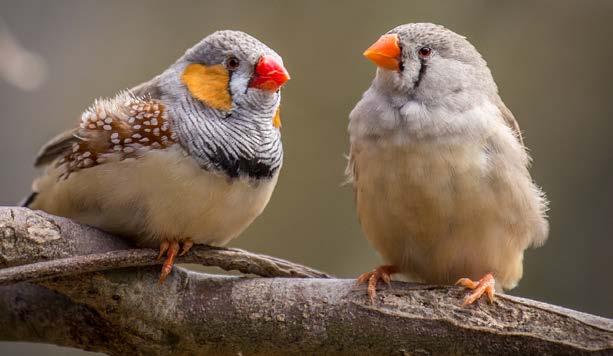
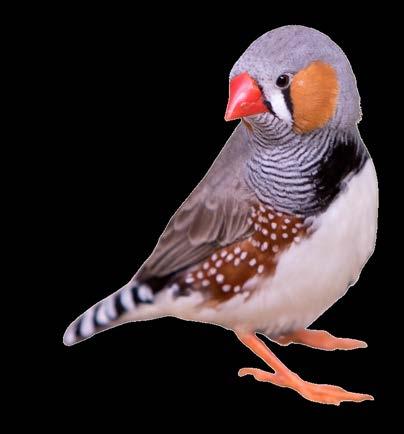
recorded. Also noted were 217 Bengalese and 292 zebra finches, both higher than 2024.
As for breeding medals, gold was given to Dave Brown and Sarah Bradford, and silver to David & Kim Woodhouse – all for overall breeding success covering a number of different species.
Trevor Tooley was awarded a gold medal for breeding parrotlike
species, and Colin Jackson received a gold medal in the any other variety (AOV) category.
All members who submitted a return has also received a breeding certificate.
● A full report – including a summary of breeding results over the 50-year period the Norfolk FBA has been collating them – will appear in Club News in an upcoming issue.
the presence of the line and weight. Everything was safely removed.
After recovery, the cygnet was reunited with its family.
Good intentions
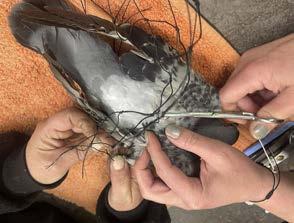
A concerned homeowner called Pawz after a pigeon became tangled in netting attached to a chimney to prevent nesting.
Rescue volunteer Anna – who has been campaigning for safer alternatives to bird-proof netting –attended the rescue alongside the team at Tyne and Wear Rescue. Working together, they were able to carefully and safely free the pigeon.
Although very distressed and injured from the netting, this rescue was described as having a “happy ending”.
The charity said: “While often installed with good intentions, netting can be difficult to maintain and, when it deteriorates, gaps can form that trap birds. Sadly, hundreds of birds lose their lives this way every year.”
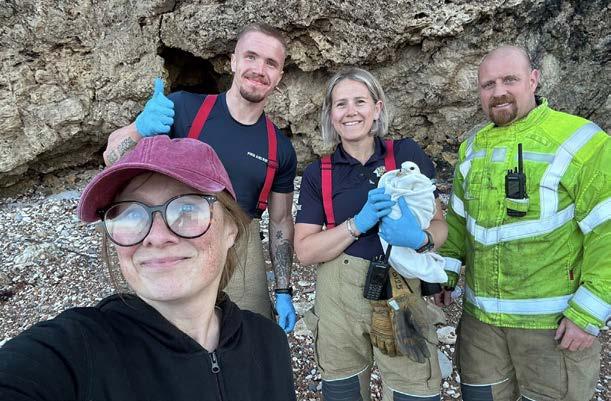
Cliff hanger
Last, but not least, was the rescue of Bert the fulmar. A concerned member of the public had spotted the fulmar suspended from the middle of a 50ft cliff by multiple strands of discarded fishing line. With the help of volunteers and County Durham & Darlington Fire and Rescue Service, the bird was carefully freed from the cliff face and caught with a tarp. Firefighter
then patiently removed the tightly wound fishing line from around the legs and wing. Bert (named by the firefighters) was then brought to the rescue for assessment and care.
● If you would like to learn more about safer and more humane alternatives to bird netting, please visit endbirdnetting.uk. You can also sign the petition to ban netting for good: petition.parliament.uk/petitions/752959
An exciting new addition to the 340 species noted since records began: the 2025 breeding results included a dusky conure for the first time © Shutterstock.com/Martin Pelanek
Zebbies had a great year with 292 bred – up on the 2024 results © Shutterstock.com/Paul Looyen
PAWZ FOR THOUGHT,
Smiles all round: Pawz For Thought volunteer Sarah (front) with three members of the County Durham & Darlington Fire and Rescue Service after rescuing Bert the fulmar
Ben
All Photos: Pawz For Thought
Taking the leap: although initially nervous, Penelope eventually re-joined the other puffins on the Farne Islands 100s of bird lose their lives by becoming tangled in bird-proof netting


WANTED
Cage and Avairy birds ● Budgies
● Cockatials ● Ring necks
Parrots ● Finch ● Quails ● Rabbits
● Guinea pigs ● Reptiles ● Tortoise ● Rodents
● Small exotic animals
Aviary clearences undertaken full collections / studs purchased. Collection can be arranged anywhere in the uk.
All animals collected in vehicles that are type 2 animal transport approved for commercial purposes
All wanted fair trade prices paid cash upon collection. Please ring 07701 303 102. 0151 944 1584 Or email mikeclan@live.co.uk
There’s more to the hobby than showing
THERE are many of your readers – I am one – who do not show their birds. Recently, I’ve enjoyed reading articles by Stuart Mason, Adam Kendall, Andy Johnson and Chris Green, and also anyone who’s writing about Gouldian finches. Yet when these people start talking about showing, I switch off. I last exhibited in 2017.
There’s a pub in Shropshire (the county where I live) where a club meets at weekends. There you can meet 30-plus people talking about birds. The people there charged me £10 each for goldfinches. (The rings are genuine.) Genuine bird men and women.
I know of some hobbyist birdkeepers who breed hybrid canaries. They are not bothered about quality of birds, they only want easy breeders for muling. Personally, I still wish for quality birds to breed for pleasure – NOT show. And at the moment I must say I have some quality birds
PET PESTICIDE
“GARDEN birds exposed to harmful pet pesticides, study finds” reads your headline last week (June 10, page 3).
Round where I live, the number of pet dogs and cats has trebled since the covid petbuying boom. That’s three times the volume of “pest” treatments in the environment, then.
I love pets, but I’m struck by the myth that petshops are pushing, that you can and should “cure” your pet of what we consider bad breath or smelly farts, by buying the right product from the shop. The ideal animal is the totally sanitised animal, they imply. But sanitising always means chemicals, doesn’t it?
When will we learn that our gardens and wider world should be exposed to fewer artificial

around me.
Can I attend a bird sale with the intention of buying birds? I’m not registered as I’m a hobbyist. I don’t have the codes that bird exhibitors have. [In order to buy stock at a licensed bird sale, you need to provide proof of registration, yes – Ed.] Jim Wall.
■ Right from its launch in 1902, Cage Birds – later, Cage & Aviary Birds – has been primarily aimed at a readership of exhibition hobbyists. At all times in its history, the paper has carried stories of broader interest as well, and we still do. For example, we publish stories about colony-breeding birds for pleasure not show. That said, our primary concern is with best practice in keeping/breeding birds, and for that we turn to writers such as those Mr Wall mentions, whose expertise is honed by successful selective breeding for exhibition.
chemicals, not more?
James Green.
UP AND AWAY
■ The quality of irrelevant press releases flying our way seems to be on the increase. Here’s Alex Stone of MRH London: I WANTED to pitch a story idea about how private aviation is changing.
As luxury travellers increasingly prioritise flexibility, privacy and personalised service over traditional ownership models, a growing number of HNW and UHNW [high/ultra high net worth] individuals are moving away from jet ownership and rigid charter programmes in favour of more relationship-driven ways of flying.
Becky Ezekiel, co-founder of Bermuda-based Private Jet Club,
letters
Such writers are the best qualified to advise on the challenges of breeding birds.
Last week, Dave Brown made a telling comment on this subject (C&AB June 10 page 8). Dave pointed out that the main reason there are quality birds out there for sale – birds of the quality that Mr Wall appreciates – is that by and large they have been bred for show.
It is the exhibition breeders who sustain the quality of birds available for the whole hobby
is seeing this shift first-hand. Founded in 2022, the business has built a niche serving Bermuda, the Caribbean and North America through a flexible membership model that offers access to private charters, empty legs [Can’t you get special stockings for that? – Ed], shared journeys and concierge-led travel experiences.
The next paragraph’s about canaries. Only kidding!
FROM OUR PUBLISHERS
■ Cage & Aviary Birds and other Kelsey Publishing magazines have been asked to place the following item in their next issue:
YOU may have seen recent news reports regarding the planned closure of a number of TG Jones
may be edited and shortened. We reserve the
any medium or format. Views expressed in Letters
– including countless nonexhibitors – to enjoy. That’s one reason why C&AB’s main focus continues to be on the exhibition hobby – Ed.
● Special request: Mr Wall helps out his friends in the fancy by painting the interior of their carrying cages and boxes. He’s asked for a list of the show-cage paint colours used across the range of showbirds, with British Standard (BS) numbers.
I don’t have ready access to such a list – can anyone help?
stores, formerly WH Smith. At present, it remains unclear whether the store from which you currently purchase this magazine will be affected. To ensure you continue receiving future issues without interruption, we encourage you to consider one of the following alternative options should your local store close.
■ Why not subscribe – see page 9 of this issue for fantastic subscriber offers.
■ Go online to our Kelsey shop, where you can buy a copy and have it delivered to your door: shop.kelsey.co.uk
■ Use the on-line store finder to see other stockists in your area. www.frontline-group.co.uk/ store-finder
■ Order a copy at your local newsagent for collection by yourself or request home delivery.
Editor’s Letter
MARK JONES MAKES a point in his article on page 7 that I hadn’t thought through before. Birdkeeping is good for us, says Mark, because it’s an area of our life where we exercise control. We set the agenda – which in much of our life, we don’t. Of course our plans are often interrupted, but it’s still our hand on the tiller. And that applies whether we’re breeding birds for show, or – like Mr Wall, left – simply keeping them for pleasure.
Budgie man Tony Kenneson-Adams makes an allied point on page 15. Tony sets out five ways in which keeping budgies (specifically) can benefit our wellbeing. All are well considered and convincing. Personally, I’d broaden the outlook to include all cage birds, not only budgies. And I’d make two further points:
1 Birdkeeping confers wellbeing because it’s a strategic hobby. To put it bluntly, it gives us a reason to look forward to and plan for next year. It encourages us to have faith in the future.
Tony sets out five ways in which keeping budgies benefits wellbeing
2 It’s a field in which senior citizens can excel – including in competition. That’s a huge bonus. Our society is disastrously youth-fixated – on every side the clamour for novelty drowns out the voice of experience. But in the bird world it’s still different: in this game, if you’re good enough, you’re young enough. Is there a moral? Not a new one – simply that we all probably know people who’d be happier and healthier if they kept birds. Something to consider while you’re in the birdroom this week.
■ The voice of the screaming piha, writes Bill Naylor on page 12, is so loud that it endangers human hearing. It does nothing for the blood pressure either, I can add. Many an attempted sound recording has been ruined for me by the cacophonous interjections of these wretched creatures. As a result, I’ve recorded some of the rudest things I’ve ever heard on tape. Control, you see? You exercise more of it in the peace of your own birdroom! Enjoy your birds this week. There’s no way they’ll be as loud as that one.








www.cageandaviarybirds.co.uk
CAGE & AVIARY BIRDS Kelsey



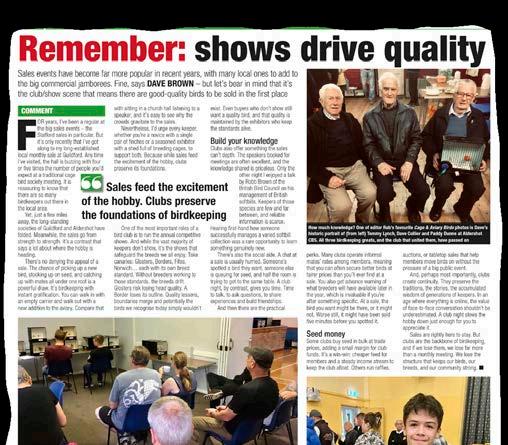
‘Shows drive quality’ was Dave Brown’s message in last week’s issue
Canaries: Pages 8 & 17
Finches: Page 10
Species profile: Pages 12-13
Comment: Page 14
Budgies: Page 15
Birdrooms: Page 16
More control means less stress
For all birdkeeping’s unpredictability, by and large we’re in the driving seat! MARK JONES believes that’s why the hobby is an effective de-stressor
AS I write, it’s the middle of spring. Early in the morning
I’m in the flights, the skies are blue, the sun is rising, I’m feeding the birds, there are chicks in the nest and other pairs are building. Can life get much better?
Well, the scenario just described left me feeling buoyant and asking that question. Birdkeeping does have its ups and downs, but when it goes well it lifts the spirits. In life we cannot control everything, but we do have significant control over our birds.
I recall reading something about stress and heart attacks. It referred to the incidence of heart attacks with comparison between the chief executive of a large corporation and the doorman at the foot of the corporate building.
Not what you’d think
On the face of it, you would assume that the incidence of heart attacks would be greater among chief executives, with the continual stress of high office, rather than doormen, who don’t have such pressure. However, apparently the opposite was true.
In the study described, it was the doormen who were more prone to heart attacks than the chief executives. The reason given was that the top officials
have more control over what they do through the working day, whereas the humble doormen do not. It was the lack of control that was seen as the cause of stress, which made the risk of heart attack greater.
When keeping birds, the control is ours. We make the decisions in terms of feeding, pairing, etc. That might be, for some people, the only part of the day when they have total control of what they do. Is this one aspect of the hobby that makes it so enjoyable and a buster of stress?
Why did he die?
While I’m on the topic of stress, an early example here was the sudden loss of one half of a pair. On April 14 I found a cock siskin on the flight floor. His partner was incubating at that point, so she was left to parent alone.
He had showed no signs of illness, so I wondered whether it was a collision caused by a sudden fright. I don’t believe that he would have suffered from a vascular problem, as he was only two years old and fit as a flea. We’ll never know. He wasn’t the first to pass in that way and he won’t be the last.
It’s always a shock and a disappointment, yet I would rather lose a bird in such a way than witness the long slow decline of ill health that ends in a bird
being lost. And over the years I have lost a few birds after such a decline.
Some years ago, I received a goldfinch off Johnny Ball, which had great colour. It was in good health and I showed it on a number of occasions. It would split the birds of George Nairn when coming up against them. Then it entered ill health and, despite all my efforts, it just wouldn’t pick up.
I took it to an avian vet in Cheshire. Blood and stool samples failed to discover the problem and I lost the bird several months later. And I have had similar experiences with a couple of young birds: a promising cock goldfinch and hen siskin.
Some recent reading drew my attention to necrotic enteritis. This is an infection of the gut that causes damage and impairs a bird’s ability to digest food efficiently. Treatment may rid the gut of the causing bacteria, but sadly the damage is done. I suspect that the birds I’ve referred to here, along with the hen goldfinch I wrote about in my article last
month, all suffered from this problem.
A solo effort
In returning to more positive matters, the widowed hen siskin did a grand job of rearing the youngsters. Three hatched and fledged. I like the look of them, even though they are yet to moult. They are off my second pair, in other words not the pair that I expected to get my best youngsters from. Despite that, they look better than the chicks off the first pair. I dare say that there will be better siskin chicks bred around the country, but that won’t lessen their qualities! I have no doubt that one or two will be useful additions to the team.
When all is said and done, I proceed on the basis that if I am happy with them then I’m not too bothered what others think or whether there are better birds on the bench.
Mark Jones is a committee member of the National British Bird & Mule Club.
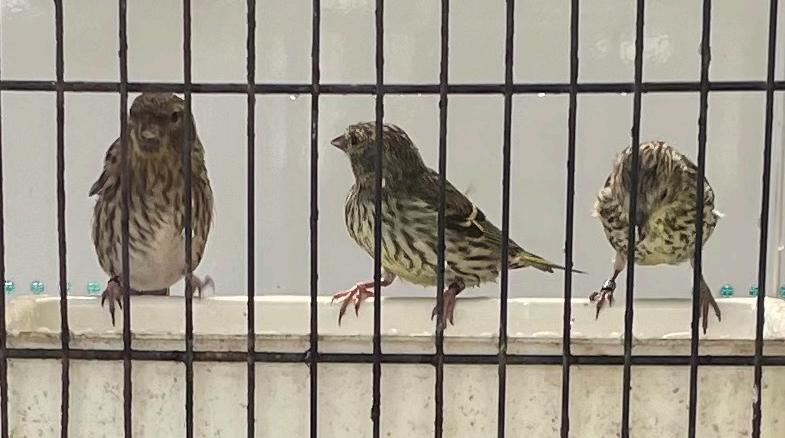
‘My first young of 2026, removed from their flights and together in large cages. Siskins and (left) a redpoll, keen to cool down in hot weather’
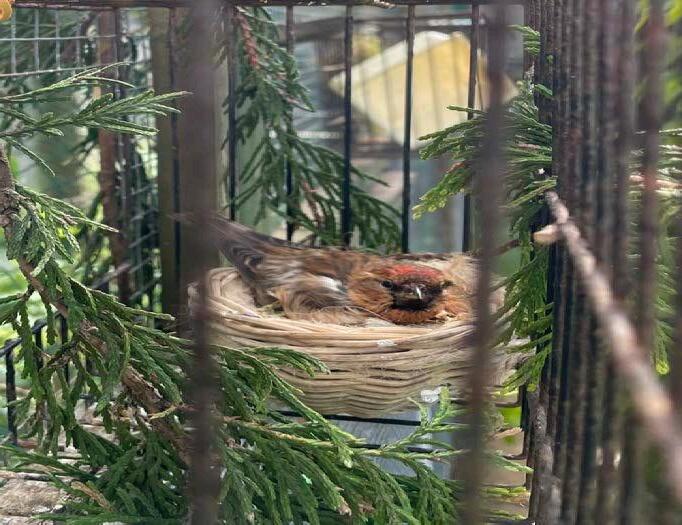
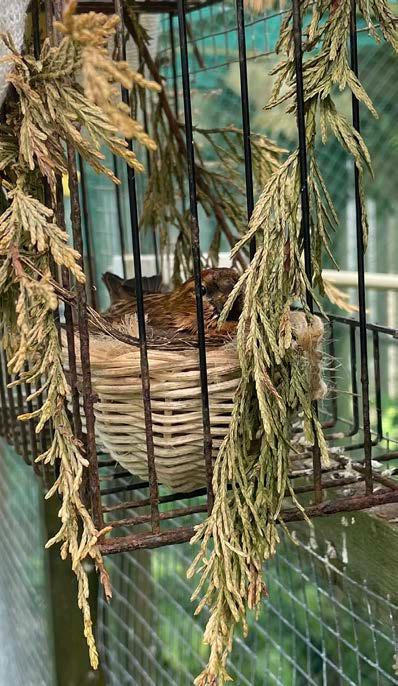
Hen redpoll on the nest. Says Mark: ‘The metal basket holds a bird bath, which I remove to put seed and food containers in the basket. This hen was showing interest in nesting in one of the seed dishes, even though it was in full view. I provided a nest basket and a bit of cover for privacy and off she went’ Photos: Mark Jones
Transition, not relaxation
For STUART MASON, June in the Border canary birdroom is not a chance to slump – it’s about managing every bird, adult or young, into the next stage of its development
BY THE time we reach June, many canary breeders across the country will finally begin to feel that the pressure of the breeding season is starting to ease.
After months of preparation, pairing up, checking eggs, ringing youngsters, monitoring feeding and trying to balance work, family life and the birdroom, June often becomes a month of assessment as much as activity.
For some fanciers, particularly those who started to breed early using additional light and heat, the season may already be winding down. Others will still have late nests in the cages and perhaps one final round of youngsters to rear. Either way, June marks a turning point in the birdroom calendar because our focus gradually shifts away from breeding and towards management of the moult and development of the young birds.
One thing I have learned over many years with Borders is that what happens during June and the early moulting period can have a huge influence on the quality of birds that you eventually show in the autumn. A good breeding season can quickly be undone if youngsters are not carefully managed through the moult.
One season ends
There comes a point where breeders must decide when enough is enough. It is always tempting to squeeze one more nest from a particularly good hen or to continue breeding from a cock that is still driving hard. However, experienced fanciers know that pushing birds too far can create problems later on.
on too long and end up with weak youngsters and exhausted breeding stock.
Late-bred youngsters can still make excellent birds, but they often require more patience and careful management through the moult. Timing is everything.
As the breeding season closes down, the moult gradually begins. This is one of the most demanding periods in a canary’s year. Nature is asking the bird to completely replace its feather covering while still maintaining general health and body condition.
Many newer breeders underestimate just how stressful moulting can be.
A bird in heavy moult is often quieter than normal. Some become nervous or lethargic. Others appear slightly off colour and may spend long periods resting. This is perfectly natural to a point, but it also means we must avoid adding unnecessary stress during this time.
The quality of feather produced during the moult will directly affect the appearance of the bird for the coming show season. Tight, silky feather with good texture and condition does not happen by accident. It is largely the result of careful feeding, cleanliness, sensible ventilation and keeping stress levels to a minimum.
During periods of hot weather, youngsters can quickly become stressed if the conditions are too close or humid. Poor ventilation often results in birds sitting with their wings slightly away from their body, appearing uncomfortable and unsettled. Feather quality can also suffer badly if the atmosphere in the birdroom becomes stale.
A simple routine of allowing fresh air into the room during the cooler parts of the morning and evening can make a tremendous difference. Clean air, sensible temperatures and dry surroundings are every bit as important as good feeding during the moult.

Feeding and bathing
In June, feeding should focus on maintaining condition without overdoing rich foods. Youngsters, especially, require a balanced diet because they are still developing physically while simultaneously replacing feathers.
A quality seed mixture remains the foundation. I also like to continue with a good softfood several times each week, particularly while the birds are actively dropping feathers.
Experienced fanciers know that pushing birds too far can create problems later on
Ventilation in hot weather
By June, many hens are beginning to lose condition. The constant cycle of laying, feeding and rearing chicks takes a tremendous amount out of them physically. Cocks, too, can begin to look tired after weeks of feeding youngsters and servicing hens.
Knowing when to stop is important. Personally, I would rather finish slightly early with strong healthy birds than carry
Good ventilation becomes absolutely critical during warm June weather. A birdroom that feels comfortable to us can quickly become stuffy and oppressive once the temperatures rise, especially where several cages of youngsters are housed together.
Fresh moving air is essential, but there is a major difference between good ventilation and cold draughts. I always prefer steady air circulation rather than opening everything up and creating sudden cold currents through the cages.
the condition of the feather can improve tremendously.
Watch for bullying
This is an issue that must not be overlooked.
Once youngsters are weaned and grouped together, problems can sometimes develop very quickly. During the moult, birds are particularly vulnerable because growing feathers contain blood supply while developing. Damage to wings or tails at this stage can seriously affect the bird for the entire season.
Looking towards 2027
One thing that always fascinates me is how quickly breeders begin planning ahead.
Even while this year’s youngsters are only partially moulted, many fanciers will already be mentally selecting birds for the 2027 breeding season. Certain youngsters immediately catch the eye, perhaps because of their head qualities, feather texture, stance or overall promise.
One thing I strongly encourage during the moult is regular bathing. If manageable, offering birds a bath each morning can make a remarkable difference to feather quality and general wellbeing. Most canaries thoroughly enjoy bathing during this period and it undoubtedly helps to soften old feather and encourage clean new feather growth.
I have found that adding a small amount of bath salts can be very beneficial. Products such as the VerseleLaga bath salts are excellent and widely used by many successful breeders.
Birds often look noticeably brighter and cleaner after bathing regularly, while
Youngsters that are damaged in overcrowded cages are painful to see, and in my experience it is very often the better birds that suffer most. Many breeders will recognise the frustration of finding a promising youngster with blood around the wing or tail where a flight or tail feather has been tugged out by another bird.
If more than one bird is housed in a cage, keep a close eye on behaviour. Some stronger youngsters become dominant and repeatedly peck or pull at weaker birds. Tail-pulling and wingfeather damage are common signs of bullying and should never be ignored.
Any bird that shows aggressive tendencies should be separated immediately. Equally, timid birds may benefit from quieter accommodation where they can moult peacefully without harassment.
Overcrowding is one of the biggest causes of feather damage during June and July. Giving youngsters sufficient cage space can make a massive difference.
Of course, young birds can change dramatically during the moult and nothing should be decided too early, but most of us cannot help quietly earmarking one or two favourites as they develop. That anticipation is part of what keeps the hobby so enjoyable.
Conclusion
June may feel quieter than the frantic breeding weeks of spring, but it remains one of the most important months in the birdroom. Manage your birds carefully through the moult and you give yourself every chance of seeing healthy, well-feathered youngsters sitting proudly on the show bench later in the year.
As I have said many times before, successful canary keeping is often about doing the simple things consistently well. Cleanliness, observation, sensible feeding and reducing stress will usually reward the breeder far more than constantly chasing miracle products or shortcuts.
Stuart Mason of the McGougan & Mason partnership is a long-standing breeder and exhibitor of Border canaries. Stuart enjoys sharing his practical knowledge to help others improve their bird management and breeding success throughout the year.
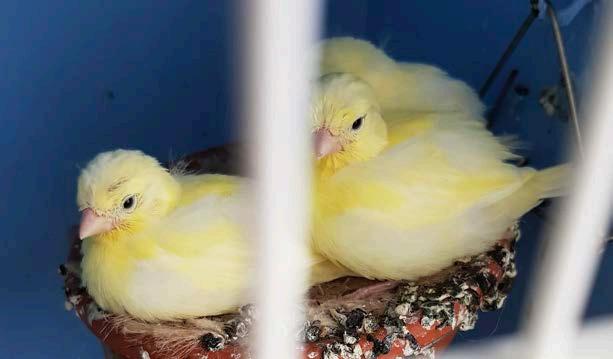
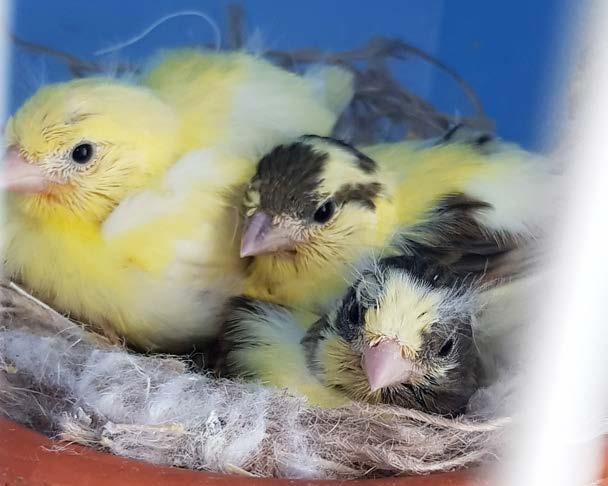
Above: young Borders in the nest but ready to jump. Left: Stuart says: ‘I would rather finish slightly early with strong healthy birds’
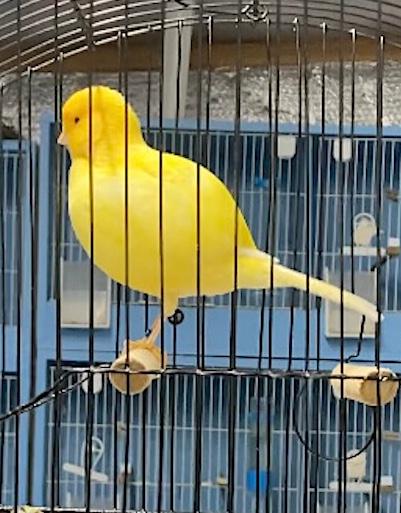
Early appraisal: one of Stuart’s young Borders in a training cage for assessment
Photos: Stuart Mason













New colours: you can contribute
For dedicated breeders of zebbies, there is no need to stick 100 per cent to the same mainstream mutations, says DAVE BROWN. Here’s how to maximise your birdroom space creatively
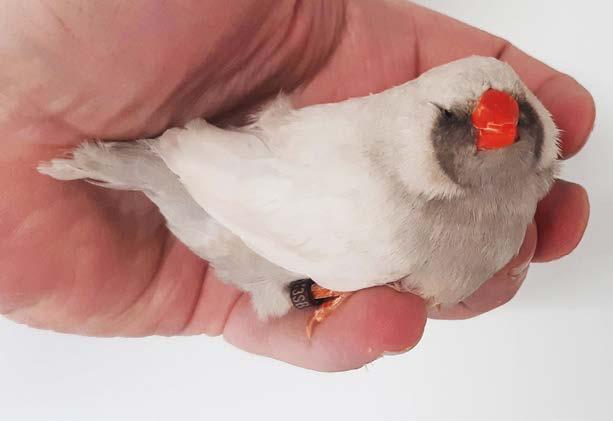
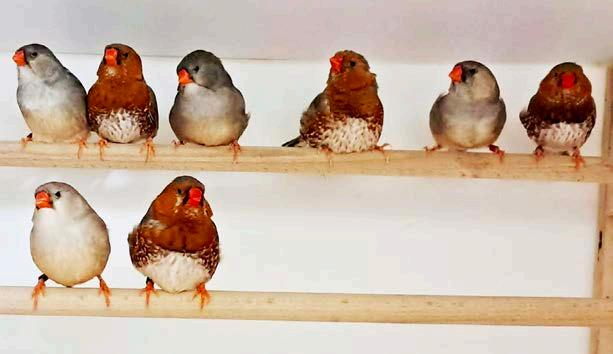
THE zebra finch has long been admired for its variety, versatility and sheer enthusiasm for life. A newcomer to the hobby is often drawn first to the more colourful or unusual varieties such as black‑cheeked, orange‑breasted, black‑faced, dilutes and the many combinations that can be created from them.
It can therefore come as quite a surprise, on a first visit to a specialist show, to discover that these striking birds are often under‑represented on the show bench. Instead, the preponderant classes tend to be normals, fawns and lightbacks.
There are good reasons for this. The show standard places its greatest emphasis on type: the cobby, powerful shape that is now so characteristic of exhibition zebra finches. Size also plays a major role, even if that isn’t explicitly stated. A large, well‑balanced pair will almost always defeat a smaller pair of equal quality.
Those features occur more readily in the traditional varieties, which explains why they continue to dominate. It’s worth noting, however, that black‑breasted and black‑cheeked birds have achieved major honours in
recent years, but that combining excellent type and size with multiple colour mutations remains a significant challenge. A triple‑orange cock, for example, ideally needs to be shown alongside a matching hen – a tall order for even the most experienced breeder.
Why diversify?
While it pays to specialise in only a couple of mutations for the show bench, there is certainly an argument for experienced fanciers to take on a “specialist” variety. First, this will help to preserve UK stocks and enable fanciers to see see some of those varieties and combinations out on the show bench.
While the aim for many established breeders would be to try and create, say, birds in the orange combinations to UK show type, there are after all standards laid down by the Zebra Finch Society (ZFS) to recognise many of these combinations. And when you see some of the bird photos coming out of Bahrain, Kuwait and Dubai, that is certainly achievable.
There could also be an argument for the reintroduction of a “colour” section, as seen at Stafford some years ago, where colour and clarity took priority over type alone, which potentially allowed unusual combinations more reason to be shown.
Multiple breeding seasons
However, most fanciers have limited time, limited birdroom space and a limited total of breeding cages. To introduce even one additional colour line can require several extra cages, which in turn increases the workload of feeding, cleaning and maintenance. Many folk simply cannot justify expanding their birdroom to accommodate multiple specialist lines.
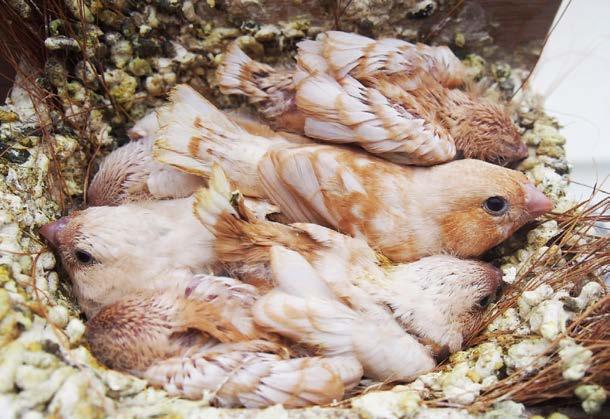
Fortunately, zebra finches themselves offer a solution. Unlike canaries, which are strongly seasonal breeders, zebra finches are opportunistic. Their Australian origins have equipped them to breed whenever conditions appear favourable. This flexibility allows fanciers to stagger their breeding season deliberately, focusing first on their main show lines and then turning to colour combinations later in the year.
The key requirement is access to some space in non‑breeding flights during the main breeding season. Colour‑combination birds can be housed there temporarily, while the primary show pairs occupy the breeding cages. The colour combo birds can be conditioned gradually and then paired once the main show lines have been broken up. By this stage, breeding cages are free again, and the fancier can devote time and attention to the colour birds without compromising the main team.
Inside and out
Another approach is to maintain a small colony of zebra finches in an outdoor flight, while keeping exhibition birds separately in the birdroom. Many fanciers still enjoy the lively, social behaviour of a colony, and this set up
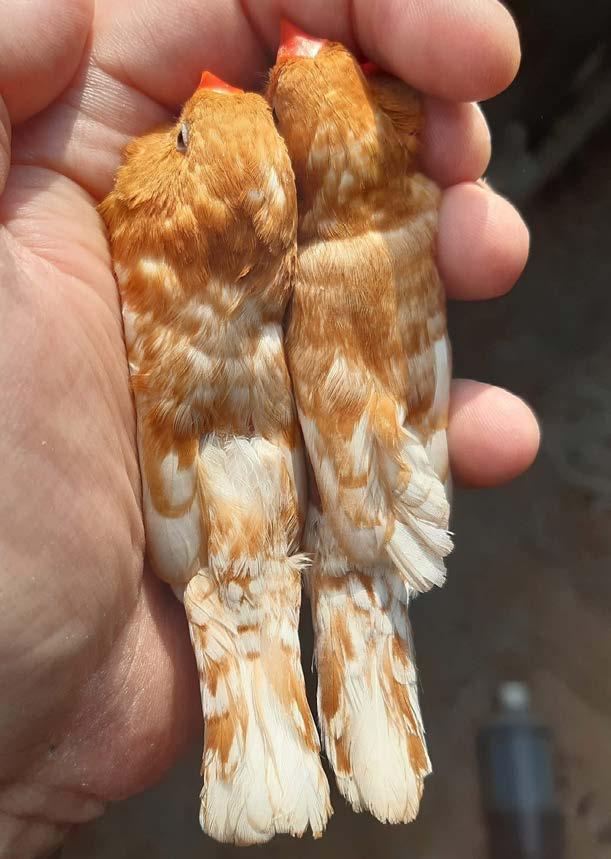
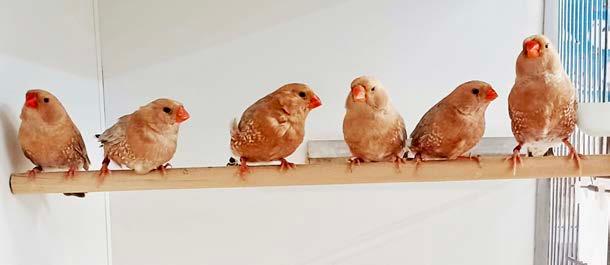
can be used strategically. By selecting aviary birds that display or carry the desired mutations, it is possible to create a colony that naturally produces colour combinations without the need for strict pairing control. A colony designed around orange‑factor birds, for example, will reliably produce orange‑breasted, orange‑cheeked and triple‑orange youngsters. A black‑mutation colony might include black‑faced and black‑cheeked cocks running with black‑cheek hens, resulting in a proportion of black‑faced black‑cheek youngsters emerging each season. That method does not guarantee perfect show birds, but it will provide a steady supply of youngsters that carry the right genes. Promising individuals can then be selected and brought into the birdroom for more controlled breeding. In this way, the fancier maintains a manageable workload while still contributing meaningfully to the development of colour combinations.
Champion breeder/exhibitor Dave Brown is a panel judge of the ZFS.
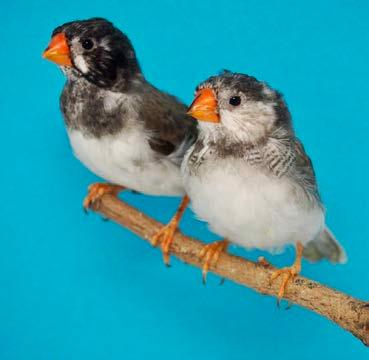
ZEBRA FINCHES
Lightback triple orange males
A nest of orange combinations
Young black-cheek penguins
An aviary devoted to colony-breeding colour combinations can increase numbers quickly
Dilute charcoal
Photos: Dave Brown




We supply pdf artwork for you to print (A4 size)




Club name, show name/
(supply if
To order FREE (we email you the pdf artwork for you to print out at home), Email: birds.general@kelsey.co.uk AND TELL US:
● Which diploma design you’d like (General, Canaries, etc). (Only one design per club please)
● “Starburst” information if required
● Your name, club name and contact details
Deadline for requests: one month before your show date












South America’s legends of the lek
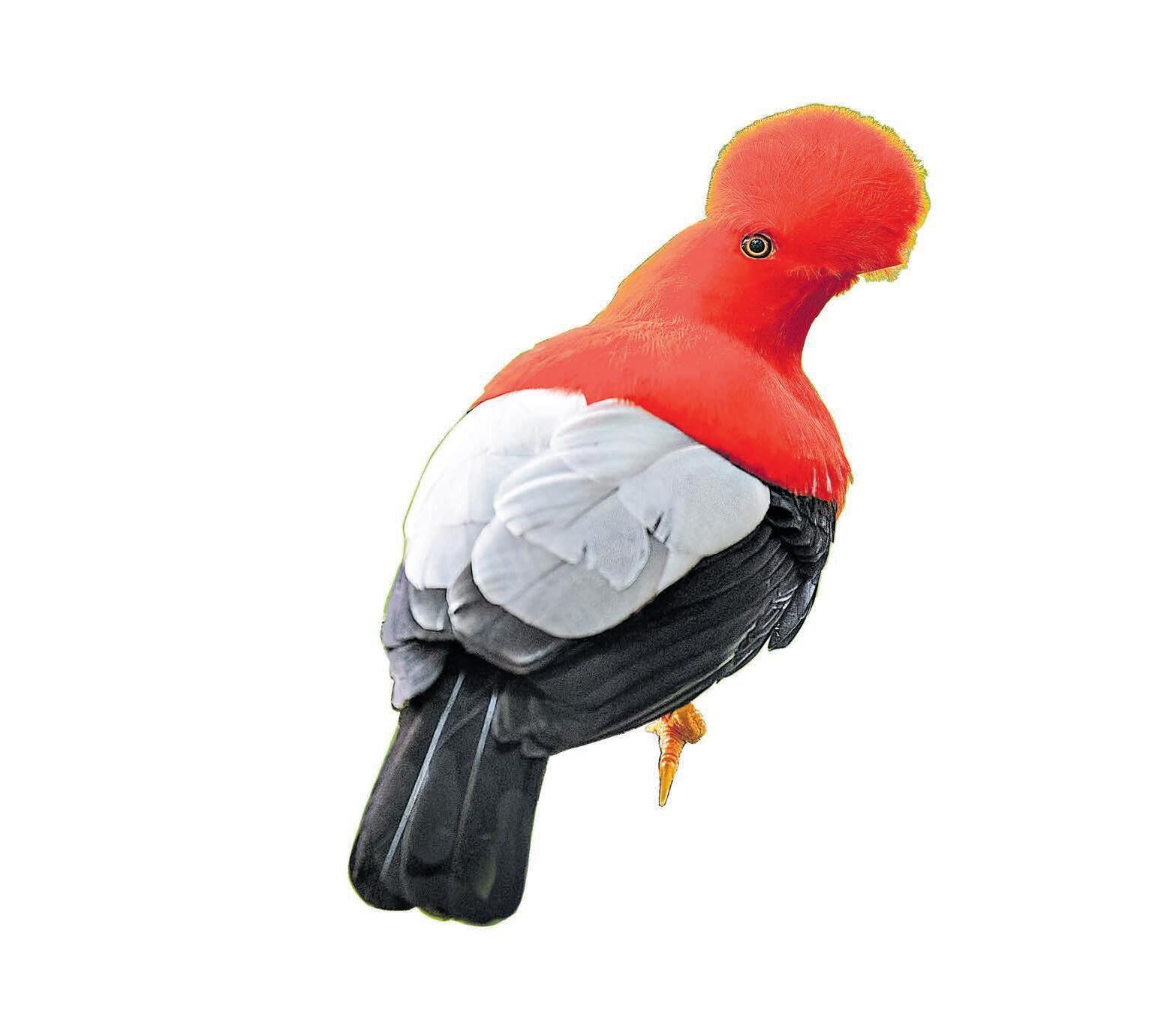
Once regularly represented in zoos and birdparks, the two fabulous cock-of-the-rock species are now much rarer in captivity. If you ever get the chance to see them in action, grab it, says BILL NAYLOR – though for a full-on mass lek experience you’ll need to head for somewhere interesting in South America
THE cotingas are a bird family closely related to the New World manakins. Arguably, they form the most diverse family in the avian kingdom. They inhabit Central and South America, which contains the richest bird fauna on earth.
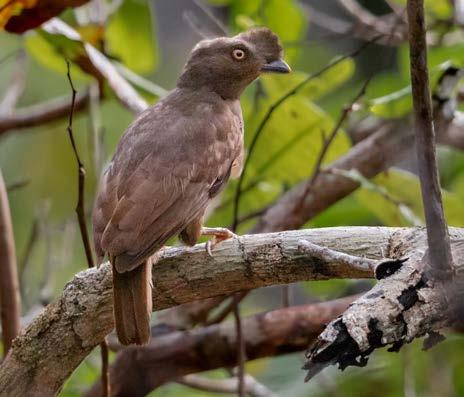
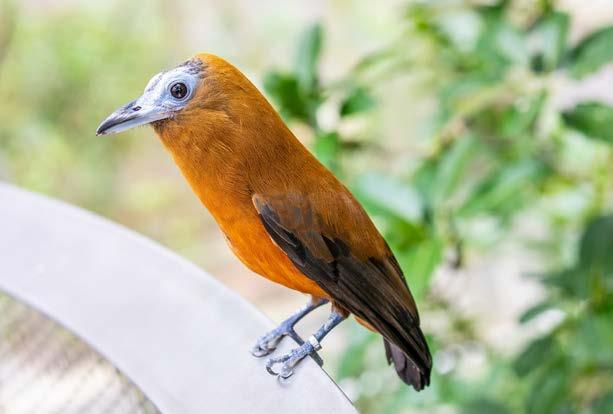
Many cotingas could be mistaken for tanagers, but others, such as the umbrellabirds and capuchinbird, are more bizarre. Some cotinga vocalisations are also unique: the tolling of bellbirds rings out from the tree canopies and capuchinbirds sound like car alarms. And anyone who has watched a recent “jungle” movie will unwittingly be familiar with a sombre brown cotinga, the screaming piha (Lipaugus vociferans ), which produces the loudest call in the bird world – an ear-splitting 116 decibels, which exceeds the danger level for human hearing.
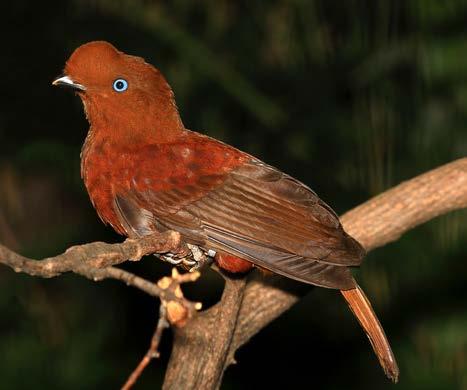
There is general agreement that the most iconic cotingas, on a par with some birds of paradise (and not dissimilar in lifestyle) are the cocks-of-the-rock. The orange, Guianan, or eastern cock-of-therock (Rupicola rupicola ) is native to the lowland north-eastern forests of South America. In the highlands, the Andean, western, or red cock-of-the-rock (R. peruvianus ) ranges in the Andean cloud forests from Venezuela to Bolivia, where it is the national bird. The hens of both species are smaller and more sombrely plumaged, with reduced crests. In former times, the sanguinolentus subspecies of Andean cock-of-the-rock, from Colombia and north-west Ecuador was much sought after by aviculturists because of its blood-red plumage.
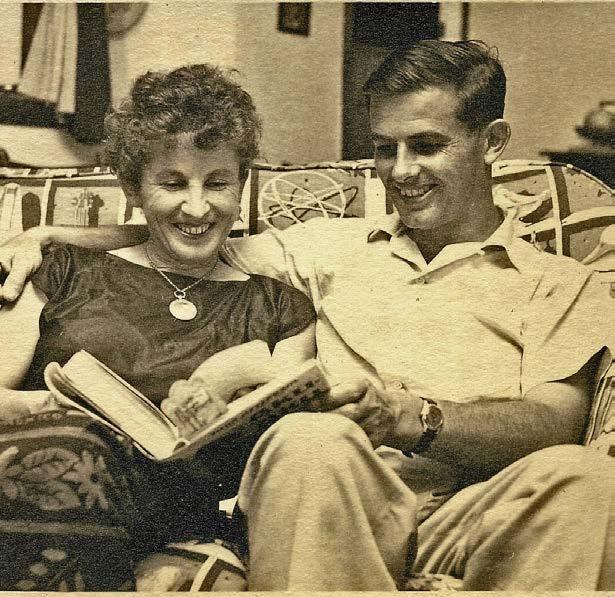
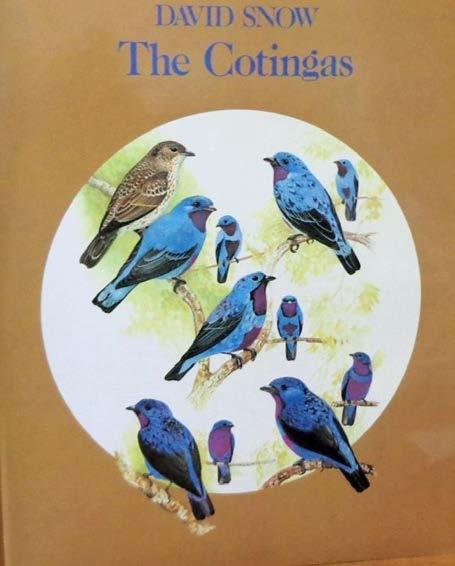
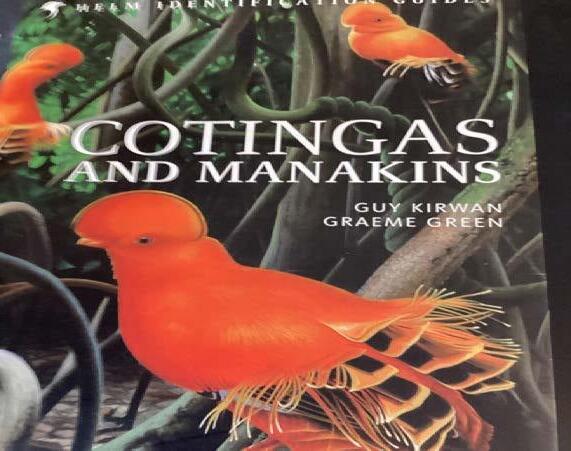
classic The cotingas & related birds (1984). Guy Kirwan and Graeme Green, the authors of the Helm guide 2011 Cotingas & Manakins acknowledge Snow’s major contribution – specifically, that he was instrumental in the cocks-of-the-rock being reclassified with the cotingas.
Human decoration
Cock-of-the-rock plumage was part of the traditional feather art worn by Amerindian tribes of Colombia and Brazil. A breast-plate incorporating feathers of the Andean cock-of-the-rock and the stunning black-necked red cotinga (Phoenicircus nigricollis ) is on display in the Pitt Rivers Museum in Oxford.
Most cotingas frequent the canopy and the breeding biology of many species still remains unrecorded. By contrast, cocks-of-the rock occupy the lower levels of the forest.
The species is polygamous and the sexes only meet up to mate. Nests are built in caves usually near water (in captivity they are avid bathers) and hens often roost in the nesting caves outside the breeding season. The large nests are constructed from mud and wet vegetation, with saliva used to mould the deep cup. Here, the female incubates one or two eggs for 28 days.
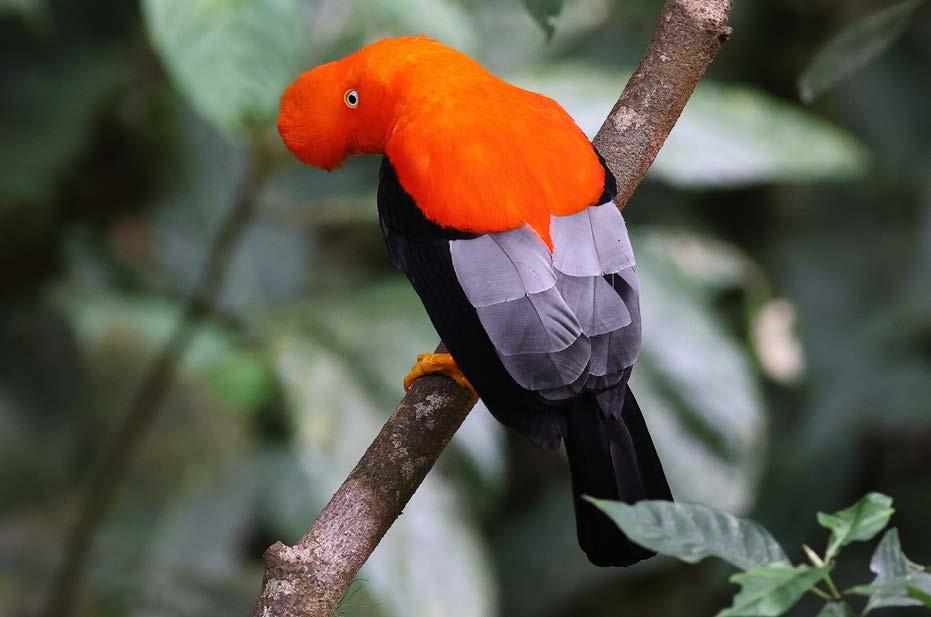
display their plumage and dance moves in return for mating, which is devoid of family responsibilities. (By contrast, screaming pihas at their leks compete with other males exclusively by vocalisation.) Intensity of sunlight is important to a cock-of-the-rock display and the performers remove leaves from branches to admit more rays. The arenas are kept clear of leaf debris.
Sunlight is important to a display and the performers remove leaves from branches
to admit more rays
Both species were described in 1700s, and together they once occupied their own family. The pioneer in cotinga research was the English ornithologist David Snow (1924-2009), who wrote the
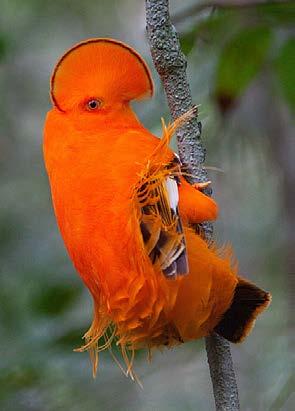
The arena displays of the orange cock-of-the-rock is mainly based on a single study in Suriname. Like a variety of bird species from various bird families, cocks-of-the-rock use arenas (leks) as a form of speed-dating, where males
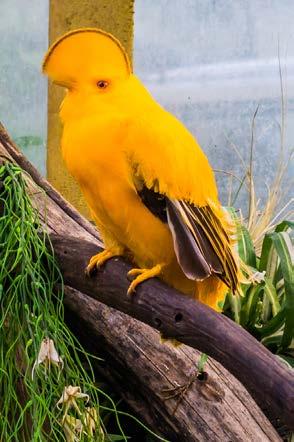
Each performer repeatedly jumps from a low branch into the arena, whirring their wings like a winged leaf-blower. The whistling sound that the orange species makes is produced by a modified vane on its 10th primary feather. Performers include those from three years of age – when they become sexually mature and usually have full adult plumage – and older birds.
Some mature males still have
residual brown juvenile plumage, which is the same colour as the female’s.
Flocks of conspicuous, noisy and excitable birds seen at the beginning of the breeding season, though formerly assumed to be females, are almost certainly immature males.
Up to 50 male orange cocks-of-therock have been observed performing at a lek. The alpha males in the centre are the ones hens mainly mate with. From what little is known, the Andean species’ display arenas involve fewer birds. One observation records five males displaying on branches 4-6m off the ground, cawing like crows. When a female appeared (females often visit several leks), the males would jump to the ground. A female nudging a male on the rump is an invitation to mate.
A classic frugivore
Like all cotingas, these birds feed mainly on a wide variety of fruits supplemented with amphibians, reptiles and various
invertebrates. When first kept in zoos, they were fed on grape-sized pellets of diced fruit and beef. (For captive softbills, beef heart – which is high in protein – was a common food, though it is now known to be high in fat.) Meat is now usually excluded due to cotingas’ susceptibility to iron storage disease. Animal protein for the maintenance diet and rearing food for nestlings is usually now provided via pinkie mice, crickets, locusts, mealworms and anoles. The last is a common South American lizard, often included in the natural diet of cocks-of-the-rock. (It was once commonly sold in UK petshops as “the South American chameleon”.)
Certain Amerindian tribes formerly hand-reared cocks-of-the-rock for export. It was virtually a cottage industry, and they were the commonest imported cotinga. Some were imprinted and some could be aggressive and unpredictable. At one time in the 1960s there was a glut of both species, though mostly
Male Andean cock-of-the rock: some traditional lek sites are surprisingly accessible. For example, one is just outside the town of Jardin in the Andes of Colombia. Before the day becomes too hot, you can simply stroll down a quiet back road to view it © Shutterstock.com/Gergo Nagy
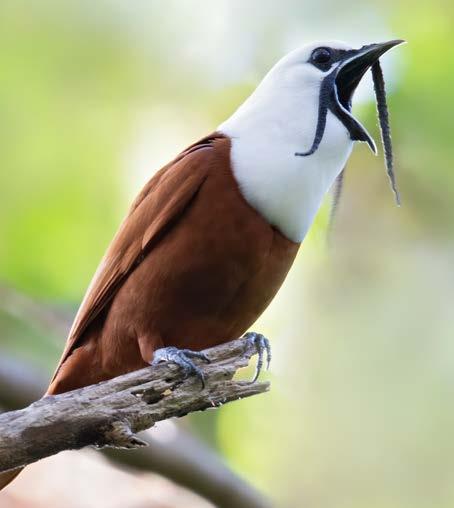
Male Guianan cock-of-the rock: his long filamentous plumes are distinctive
Captive male Guianan cock-of-the rock: this species is far less often photographed than the Andean
© Shutterstock.com/Charlotte Bleijenberg
Female cocks-of-the rock: left, Andean and right, Guianan. In their female plumage, the two species are closely similar
© Shutterstock.com/John L. Absher/Hector Bottai
Andean, and they became less expensive. In addition to being housed in zoos they were also kept by private birdkeepers, and exhibited on the show bench. Colour feeding was essential to retain the colour following the moult.
Attempts at maintaining pairs together permanently were often unsuccessful. Keepers were unaware that the sexes did not mix outside the breeding season. In the 1960s, at the tropical collection Winged World, male cocks-of-the-rock, of both species, shared separate enclosures with similar-sized softbills and fed on a diet of insectivorous mixture and diced fruit. Tame but aloof, they enjoyed catching food that keepers threw for them.
House crickets used to breed in the heating system and as the singing insects strolled out of the heating vents in each enclosure they were eagerly pounced on by cricket fans including the resident cocks-of-the-rock.
Captive breeding
Houston Zoo in Texas experienced numerous failed breeding attempts from 1965 onwards, when the eggs of an Andean pair were destroyed in a storm. Finally, in 1979, Houston succeeded in the first breeding of this species and repeated the success in 1987. San Diego Zoo also had a breeding success in 1988. Outside of America, Chiba Zoo (Japan) and Wuppertal Zoo (Germany) raised single birds.
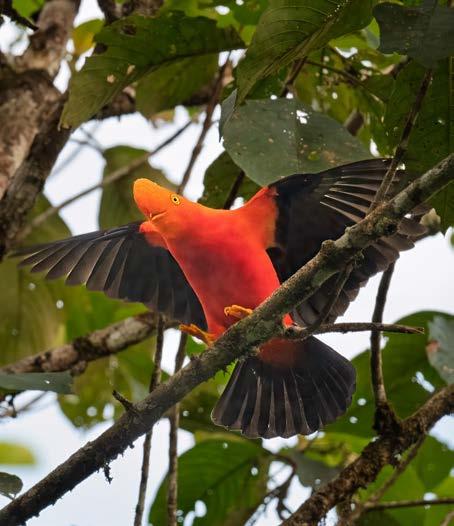
Males display their plumage and dance moves in return for mating, which is devoid of family responsibilities
Charles Everitt of the Marshal Boehm aviaries in California writes about a male cock-of-the-rock that relished mealworms and once caught and ate a house mouse. As with other large cotingas, small birds and nestlings are on record as being predated in the wild and captivity. These are substantial birds, some 12in long, with long legs and powerful claws equal to those of a corvid.
Orange cocks-of-the-rock were less frequently imported, and were not bred in captivity till 2008 when a single chick was raised at the Dallas World Aquarium, from a group imported from Venezuela in 2000. Two females of this group have continued to lay every year since.
Avicultural Magazine Vol: 131 No.1 (2025) reports that Brookfield Zoo in Chicago has had success with Andean cocks-of-the-rock. Yet I was puzzled at the reported decision to use a plant-
based hand-rearing formula (mainly blueberries and papaya), which caused bloating in the chicks till it was substituted. Snow and others record vertebrate prey taken by both species, and Kirwan and Green state: “Vertebrates (even small snakes) are probably more important to nestlings, but the greater part of adult and nestling diets is fruit.” The Journal of Natural History February 2025.56(9-12) 543-556 includes the first photographic evidence of orange cock-of-the-rock nestlings being fed vertebrates, namely a lizard and a passerine nestling. Finally, a note regarding longevity. In 1974, Jean Delacour owned a 20-year-old Andean cock-of-the-rock and at another collection a male Andean reached the age of 18.
Bill Naylor has first-hand experience of numerous bird species from his career as a professional keeper in the UK and overseas.
Male Andean cock-of-the rock in active display
Capuchinbird: this strange cotinga is found in many areas where Guianan cocks-of-the rock occur. To editor Rob the lekking call sounds like an outboard motor starting up
Three-wattled bellbird: a spectacular and very noisy cotinga that is confined to Central America © Shutterstock.com/Agami Photo Agenc
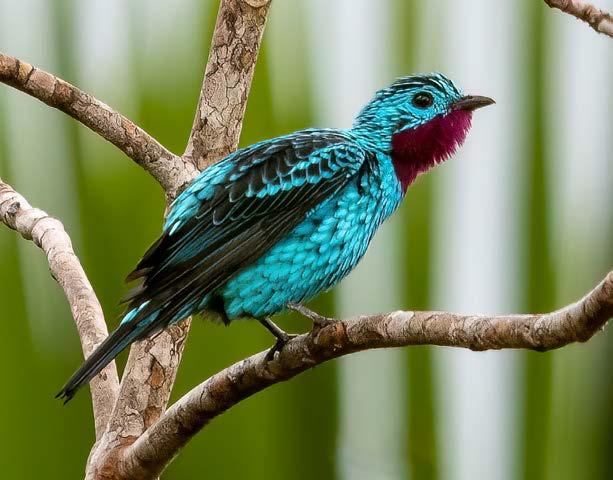
Spangled cotinga: one of the sublime species of blue cotingas © Shutterstock.com/Ney Matsumura
The late David Snow with his wife Barbara, with whom he worked on his pioneering cotinga studies. Few authors have taught us so much about any group of birds Photo: Dr Ted Hill
Cotinga classics: both key references on this amazing bird family are by Brits! Snow’s is more ‘academic’ (but very readable) Cover photos: Bill Naylor
Licensing: what we should push for
At this time of challenge for sales and shows that involve cage and aviary birds, club chairman PAUL SWATTON considers the priorities that face us in negotiating with DEFRA
IWRITE in response to the various articles that have appeared in Cage & Aviary Birds regarding DEFRA and the current debate in relation to the licensing of bird gatherings.
First, I would like to applaud the work and progress being made by the NCA’s Cage Bird Group, along with others who are fighting the cause on behalf of the hobby. However, I would like to pick up on one point.
significant concerns in 2026, some 21 years after the introduction of the original licence.
Further, if these measures are indeed so “unworkable”, how is it that bird gatherings have been held very successfully during this period of time and up to present day? In Cage & Aviary
2025, which was when the Specific Licence came into operation. It is definitely the case that my intention to challenge and work towards bringing about change began at this point.
If DEFRA was my business, I would take the lockdown approach every time
I have reservations regarding the Contingency Plan, and in particular the discussion in relation to “locking down an event”.
I undertook research regarding bird gatherings and have had sight of the first General Licence, which was issued in 2005 – that was the year when bird gatherings commenced being regulated. Although the wording differs from that used in the current Licence, the requirement for a Contingency Plan, or a written detailed action plan, has in fact existed within the General Licence since that time.
Given this longstanding requirement, I find it difficult to understand why the Cage Bird Group now describes such measures as “unworkable”, to use their own terminology, and why contingency planning and the potential lockdown of events have suddenly become such
Birds , May 13, the Editor’s Letter referred to the fact that the sales arm of the fancy is not in a close season. (Has this arm of the fancy been approached and their views sought? They seem to be finding a way.)
I would also ask whether the Cage Bird Group has sought the views of the wider hobby. Both Havant CBS and Solent CBS are affiliated to the NCA, yet no communication has been received by me as chairman of those clubs seeking our views. Rather than going off on a crusade, I would have thought a better approach by the Cage Bird Group would be to survey the wider hobby and seek their views.
When the game changed
Difficulties only arose with bird gatherings being held in December
It has been stated several times in Cage & Aviary Birds that “no recorded cases of notifiable disease have been caused by attending a cage bird gathering.” It has been further suggested with reference to contingency planning and potential lockdown measures that “we all know we would never need to use it.”
So what is the issue? It appears contradictory to claim that bird gatherings present a very low risk or no risk of avian influenza, yet share significant concern about having contingency plans in place for a situation we also claim unlikely to occur.
I can assure Cage & Aviary Birds readers that DEFRA is not acting in a discriminatory manner towards our hobby. Indeed, having conducted further research, I have found that a wide range of animal gatherings are subject to licensing and biosecurity controls, and that these include requirements for contingency planning in the event of suspected notifiable disease at a gathering.
How likely, how much?
Having worked in the private sector for all of my working life, I find that when considering risk, two factors play a significant role:

1 The probability of an event occurring.
2 The costs involved.
On probability: from my limited knowledge, I can find no examples in history since 2005 where a bird gathering has been locked down. The article on page 6 in Cage & Aviary Birds May 13 states: “You would never need to use it.” Therefore it would be fair to say that we would agree that the probability of an event requiring “locking down” would be extremely low.
When it comes to cost, I have to make an assumption at this point. An alternative to locking down an event could be birds returning home. I make this assumption because the same article states: “You cannot allow

potentially infected birds to travel home and infect more birds!” (Speaking for myself, I would agree with this approach wholeheartedly. I cannot imagine the heartbreak of working a lifetime building a stud of birds, only to take an infected bird home and find the consequences were that my lifetime’s work was wiped out.)
As an example, I would like to use the National Exhibition that takes place in October. Conservatively speaking, let’s say that a thousand people attend, either to sell, purchase or exhibit birds. This event attracts people from across the UK.
If the event were to be locked down, then the costs would include travel by a team of vets to one location and time spent examining the birds.
The alternative is that vets would have to attend a thousand locations across the UK to examine birds. It doesn’t take a genius to work out which option would be more cost-effective and therefore if DEFRA was my business I would take the lock-down approach every time.
Conclusion
When negotiating, it is always important to know which points to push and which to concede.
And on this point, here is what I think the Cage Bird Group ought to do: “Let sleeping dogs lie.”
Paul Swatton is the chairman of Havant & Solent Cage Bird Societies.

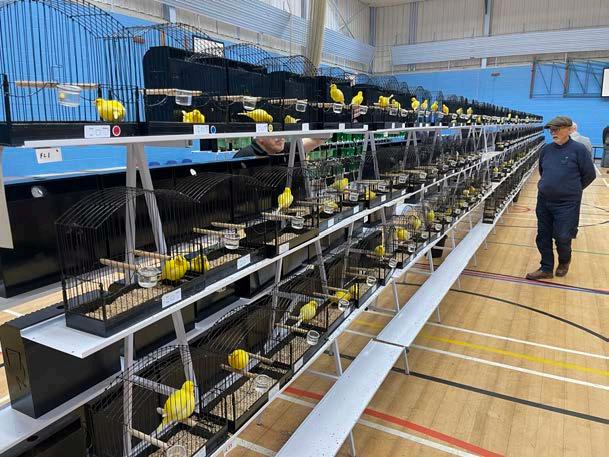
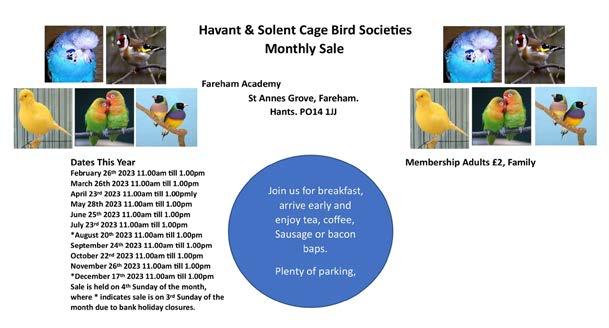
The Havant and Solent clubs, of which Paul is chairman, stage both regular shows and sales
The National: what would be the consequences of lockdown here?
Paul Swatton: he has been involved independently in seeking political support for the cage bird fancy and in speaking to DEFRA. Readers are referred to C&AB May 6 Photo: Paul Swatton
Not only cage birds: Paul points out that other livestock gatherings are required to fulfil licensing conditions that include contingency plans © Shutterstock.com/Ihar Halavach/photito
Photo: Neil Randell/Parrot Society
BUDGERIGARS AND BETTER DAYS: routine, purpose and community
Seasoned fanciers may take the budgerigar hobby’s benefits for granted! Yet they’re worth spelling out, says TONY KENNESON-ADAMS of Bristol BS, because so many more people ought to enjoy them. Time to spread the word!
IN TODAY’S fast-moving, increasingly digital world, it’s getting harder for many people to find meaningful routine and real social connection. That applies especially to the retired, the young and the neurodivergent (i.e., those whose “brain wiring” differs from what’s considered “the norm”.)
Research consistently shows that hobbies can provide that stability. And, as the RSPB has noted, birding (birdwatching) as a hobby is now at an all-time high, in particular drawing young people away from their screens and back towards the real world.
At its best, a hobby offers a gentle framework for better mental well-being, improved organisation and growing confidence in social settings without pressure, and at a pace set by the individual. For me, keeping, breeding and exhibiting budgerigars does exactly that. It offers far more than just a pastime. In five simple thoughts, I will explain why.
1Asimple presence that makes a difference
There is something uniquely restorative about spending time with budgerigars. The routine of feeding and cleaning, and the simple act of watching birds go about their day can be surprisingly calming.
Research into animal companionship consistently highlights reduced loneliness, improved mood and increased emotional resilience. And budgerigars, owing to their size and intelligence, fit comfortably into this picture.
From my own perspective, that is something I have come to value deeply. Since retiring, I needed focus and routine and I find that budgies have given me that renewed sense of purpose. There is always something to be done, however small, and that matters.
2Routine: the hidden strength of the hobby
If there is one aspect of budgerigar keeping that stands out above all others, it is routine.
Birds thrive on consistency. And, as keepers, we quickly fall into patterns: morning feeds, water changes, regular cleaning, checking condition, observing behaviour. These small tasks add up to a reliable daily structure.
The important point here is that structure – be it for young people, retirees or anyone else – is not imposed artificially, it grows naturally from the needs of the birds. However, it is important to note that you must not get too many birds too quickly, as routine will quickly become a heavy chore. You also need to have a plan for when you are away for more than a weekend. Can a family member or neighbour be trained to look after your bird or birds?

young birds and keeping records. It teaches attention to detail, really getting to know your birds; something that cannot be rushed or overlooked. Each pairing, each chick, and each result adds to a growing understanding.
For young people in particular, this kind of hands-on learning can be invaluable. It is practical, immediate and meaningful. You see the results of your actions, good or bad, and adjust accordingly. And do not underestimate the sheer joy of having your budgie jump up on to your finger or seeing the hatch of your first chick and even teaching them to say the odd word.
Since retiring, I needed focus and routine, and budgies have given me that renewed sense of purpose
What makes them particularly effective is their characters and their responsiveness to their human keepers. They are alert, aware and interactive. A budgie notices when you enter the room, calls out and often seeks engagement. That small but consistent feedback creates a sense of connection that can lift mood and encourage engagement with the world.
3Learning through doing: organisation and responsibility
As many readers will know, budgie keeping has a natural progression. What often starts with one or two birds can develop into a small stud, and eventually into breeding and exhibiting.
It is at this stage that the organisational benefits become clear.
Breeding requires planning: selecting pairs, managing nest-boxes, monitoring
4From birdroom to club room: building confidencesocial
Perhaps the most underestimated benefit of the hobby is its ability to connect with people.
The community around budgerigars is large and welcoming, with some 2,000 members just in the Budgerigar Society. Across the UK, local societies
continue to provide a vital and social outlet, especially for newcomers, and clubs are now learning how to adapt to encourage the integration of new members young old and with specific needs.
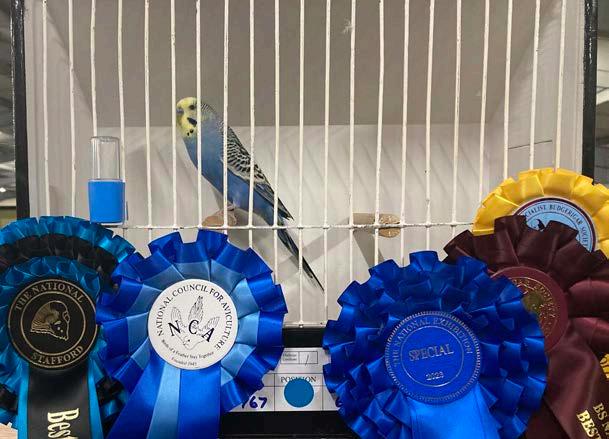
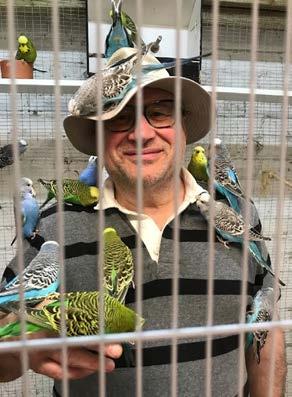
Take Bristol BS as a case in point. With regular monthly meetings and an open-door attitude to anyone interested in budgies, it offers a supportive environment focused around friendship, tea and (very importantly) cake, which helps people take their first steps into the hobby.
I have seen this first-hand at meetings and shows. People who might initially sit quietly soon find themselves being gently approached and are soon asking questions, sharing experiences and becoming part of the group.
5Exhibiting: structure, goals and resilience
For those who take the next step, exhibiting adds another layer to the hobby.
Preparing birds for a show introduces another level with goals and timelines: conditioning birds, selecting entries, presenting them properly, understanding
how a bird meets the required judging standard. Putting a bird into your first show brings a sense of achievement, whether that is winning a class or simply taking part.
It also teaches resilience. Not every bird wins. Not every pairing produces the hoped-for result. Learning to accept that, adjust, and try again is an important life lesson.
The UK show scene, supported by the Budgerigar Society and other growing societies, continues to provide opportunities at all levels, helping to maintain a structured pathway within the hobby.
A closing thought
For those of us already involved, much of this may seem obvious. We know what budgies bring to our lives because we experience them every day.
However, for local clubs to benefit from these new members, they must be able to offer an attractive programme, with meetings that will engage all, and thus be willing to adapt to new challenges that will bring vitality and longevity to our hobby.
You will not attract or keep new members if every meeting is rows of mostly men reading through the minutes or listening to another lecture on “how we have done it this way for years”.
For me, the birds have provided structure and purpose in retirement, something I hadn’t fully anticipated, but now value immensely. They have also introduced me to new friends and kept me engaged in a way that feels both productive and rewarding.
For newcomers, whether young people finding their own way, or adults looking for renewed purpose, or those who may have diverse needs, the budgerigar hobby offers a pathway that is simple, accessible and quietly life-enhancing.
So, if you are considering getting a budgie or a few budgies, contact your local club and see how budgerigars can be more than just a feathered friend. ● To learn more about Bristol Budgerigar Society, or contact us, see our Facebook Page.
Illustration by author generated on Chat GPT
Skills rewarded: the competitive scene
motivation
Photo: Cage & Aviary Birds
Tony and friends Photo: Tony Kenneson-Adams
Reach for the sky
A well-thought-out skylight is an excellent way to enhance natural lighting inside your birdroom, says DAVE BROWN – just make sure you have a heat-moderation plan as well
BIRDROOMS
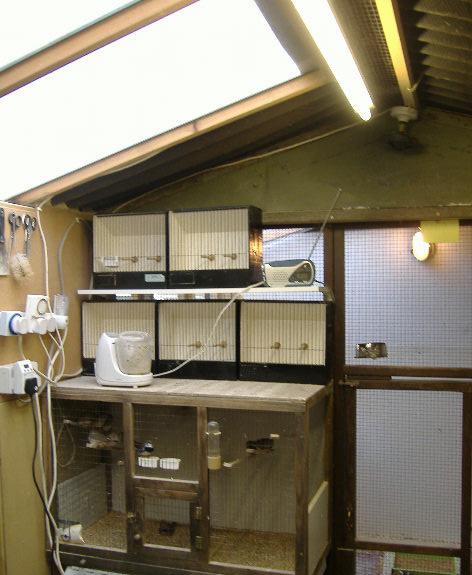
NATURAL light is one of the greatest assets you can add to any birdroom, and a well-planned skylight can transform both the atmosphere and the birds’ condition. Breeders of canaries and British birds have long known that bright, natural daylight helps bring birds into breeding condition more smoothly. Even though glass and PVC filter out vitamin D, birds still relish the warmth and clarity of real daylight. There are practical benefits too, with a skylight: artificial lighting can often be switched off during the day, which saves money, and a skylight can mean you don’t need so many windows in your walls – that frees up valuable wall space for cages or storage.
excessive heat loss and are robust, though they do require a strong supporting structure due to their weight. There are also dome-style skylights that sit proud of the roof surface and are often the easiest to fit, especially on felted roofs. Their raised profile naturally sheds water, which puts them among the least leak-prone options. Many are opaque, and that helps to reduce the interior heat in summer.
straightforward. This was an option I went for when I was reroofing one of my birdrooms. I opted to try and further improve its insulating qualities by fitting two layers about 6in apart. Double layering will act as a safety measure. If you lose the top exterior sheet to harsh weather or some other accident, the sheet below in the interior still blocks any potential escape route.
A skylight can mean you don’t need so many windows in your walls
Alternatively, for those who prefer a more hands- on approach, polycarbonate sheeting is an excellent DIY option.
Skylights come in several forms, and each has its advantages, depending on your birdroom design. Standard framed skylights – those most commonly seen in DIY stores – are double-glazed, often with optional low- E coatings to reduce heat gain. They allow ventilation without
Lightweight, easy to cut and naturally insulating (thanks to its twin-wall construction), polycarbonate is ideal for sheds and birdrooms.
Get up on that roof!
Fitting a DIY skylight using conservatory roofing materials is surprisingly
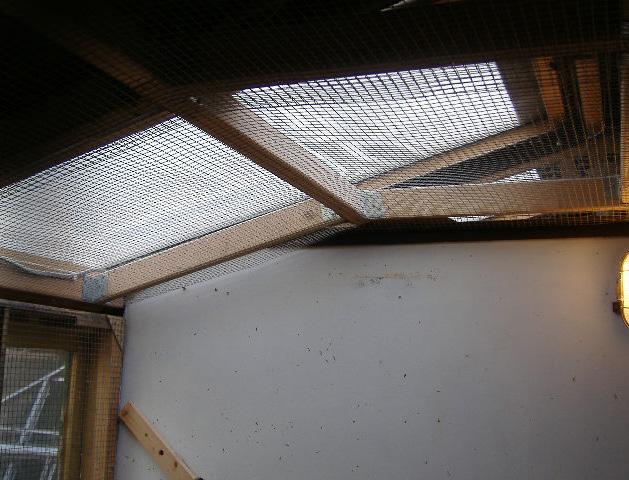
After marking and cutting the opening, you must build a solid timber frame between the rafters to support the polycarbonate sheet. Although the material is light, the frame must be rigid, to prevent movement. The sheet is then secured using the glazing bars (or similar) designed for conservatory roofs. The most important step is sealing. Every joint must be fully waterproofed using appropriate sealants, and flashing tape should be applied where the new skylight meets the existing roof. A poor seal is the most common cause of leaks, so take your time and check your work carefully.
Off-the-shelf solutions
Commercial skylights call for a slightly different approach. On tiled roofs, tiles around the opening must be removed before you cut the aperture. The skylight frame is fixed directly to the rafters, and the manufacturer’s flashing kit is installed to interlock with the tiles and stop water running in. Once the flashing is in place, the surrounding tiles are replaced.
On timber or felted roofs, the opening
is cut and reinforced with additional framing, then the skylight is fixed flush to the roof surface. Bitumen- compatible flashing and sealants are essential to ensure a watertight finish.
Never too hot
Heat management is another important consideration. Skylights can increase temperatures in summer, when reflective film, internal blinds or mesh screens can help to reduce solar heat. Good ventilation, whether through roof vents or extractor fans, also helps to maintain a
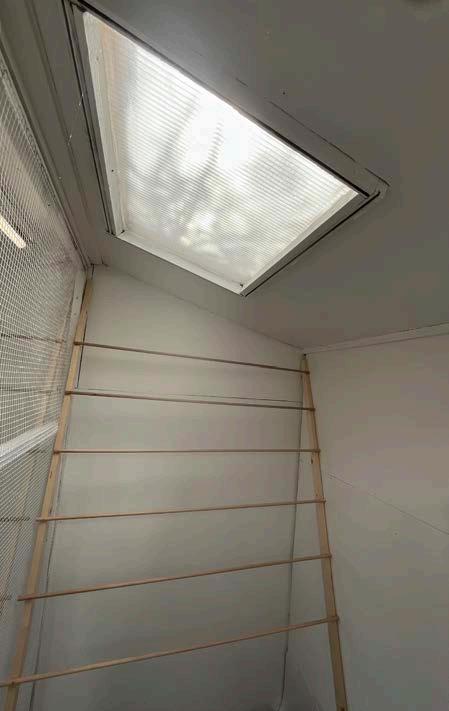
safe environment. Opaque dome skylights and low- E coatings on glass models naturally reduce heat build-up.
And finally, you must consider safety. Any opening skylight should have a wire grille fitted beneath it to prevent escaped birds from flying straight out or injuring themselves against the glazing.
To sum up: a well-installed skylight is one of the most rewarding upgrades you can make to a birdroom. It enhances the birds’ wellbeing, reduces energy use and creates a brighter, more enjoyable space for both birds and keeper. ■
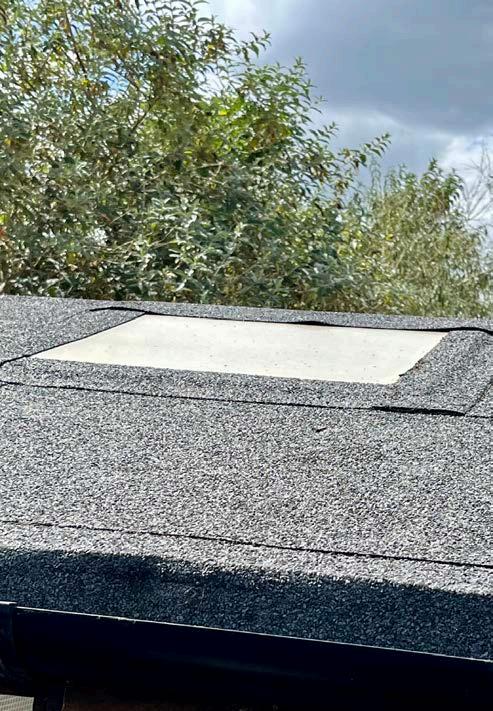
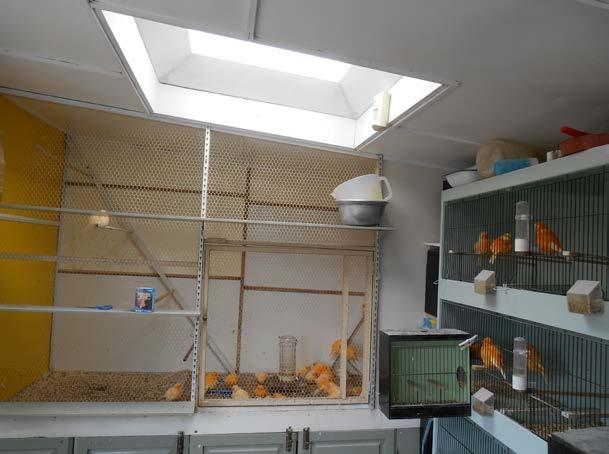
One of the skylights recently fitted in my birdroom change-around
Outside, the skylight is sealed with extra felt to prevent leaks
Skylights in a birdroom provide more natural light Photos: Dave Brown
Mesh covers offer protection in case the skylight is damaged
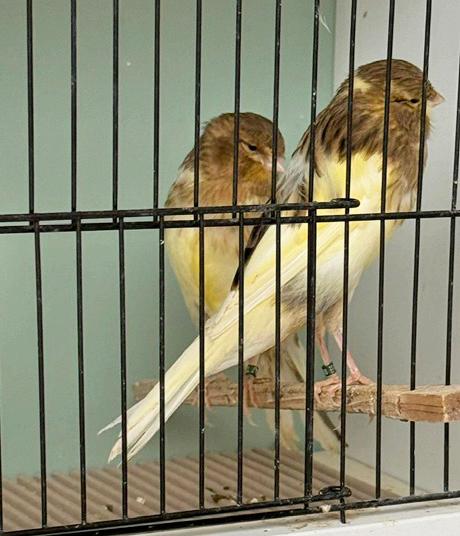
Birdroom skylight: ideal for canaries that respond to light as a trigger to breeding condition
Canaries Month by Month:
MY EARLY start to the 2026 breeding season was a disaster, with well over 30 nests of clear or deserted eggs and as a result, relatively few youngsters. I blame myself entirely and I won’t make the same mistake next year. Thankfully, by the end of May turning into June, I had about 30 chicks on the go, with more nests of eggs due to hatch. I shall end up with enough chicks from which to make my annual selections. I always look to rear about 40 chicks, and anything above that number is a bonus.
Breeding chicks later in the season has knock-on effects, the first of which is having birds ready for the earlier shows, as generally speaking, the birds are not fully moulted out. That is an important consideration for exhibitors, as nothing harms a bird more than subjecting it to the rigours of the show season by sending it out when it is still moulting. It is even worse for colour-fed canaries, as the contrast between old and new plumage gives a piebald effect – and they stand little chance of winning in that condition. The worst case is if they get a chill, which can cause serious setbacks, even death in some cases, or at least a delayed completion to their continuing moult. Soft moults are another concern, so overall, the risk of exhibiting is certainly one that experienced fanciers will avoid.
of the young birds as they move towards the next year’s breeding season. Having said that, I have proved with my own birds that late-bred canary hens are often among the first birds to lay, and even cock birds as young as eight months old are mature enough to fertilise eggs.
My feeder birds have been strange, too. I had assembled a team of 20 mosaics consisting of eight cocks and 12 hens, then decided before the breeding season that was too many and so cut them back to just two trios. Two of these hens have fertile Yorkie eggs and another is happily raising two Yorkie chicks, yet the remaining hen hasn’t even bothered to build a nest or lay eggs. She is an unflighted bird, so her report card so far reads “could apply herself better!”
I have proved with my own birds that late-bred canary hens are often among the first birds to lay
I have a couple of Yorkshire canary hens that have not performed at all, and these are now in a flight cage together with a couple of cock birds I will no longer use this season.
I have also had one egg-bound hen – something that I haven’t seen for many years. When speaking to a friend recently, I learned that he also has suffered with this, losing four hens when generally he doesn’t lose any. Strange times!
Brian’s in bounce-back mode – after an initial flop, his breeding Yorkies have settled into the task and his seasonal target is looking doable. Elsewhere, he looks forward to some stimulating days in meeting room and show hall, and shares details of an unusual open-air judging engagement
continues. Which leads us to thinking of the show season ahead.
Shows and judging
midst again in Sheffield.
Come on you feeders!
The second consideration is the maturity
Having said all that, the younger birds already away from their parents are developing nicely and starting to take colour food. It is amazing how rapidly they grow once out of the nest and by six weeks of age they can be assessed with relative accuracy in terms of quality assuming their development
I am greatly looking forward to the Yorkshire Canary Club Show meeting in July, where we will fine-tune arrangements for our 2026 annual show and our winter show in January 2027 where we will again incorporate an old and rare canary section. Kevin McCallum has once again agreed to judge the section for us, and we look forward to welcoming as many as possible exhibitors of old and rare canary breeds into our
While we are on the subject, Liverpool & District YCC have a celebrity judge officiating at our show in late October this year, Colin Mifsud from Malta. Colin is an extremely active birdkeeper and has done much to encourage Yorkshire breeders back in Malta. He is active on the internet, has attended several major exhibitions and has also attained his COM/OMJ certification. Given that Colin has recently retired, I expect to see a lot more of him at many of our major Yorkie exhibitions throughout the world.
Talking about shows brings me on to judging. Over the years, I have judged many different varieties, including most canaries, British finches and even occasionally foreign birds. I used to smile at my friend Edwin Henshall, who was once presented with a golden eagle to assess at a World Show – he joked he gave it 94 points in case it attacked him.
However, even after so many engagements of so many kinds, it was a new experience for me when, early one June evening, I was invited to judge a sandcastle-making competition by our local Scout troop at local Crosby beach in Liverpool. (That’s the one that’s famous for the Iron Men sculptures by Anthony Gormley).
Sandcastles, I learned, are a lot easier to judge than canaries are. They don’t move, for one thing – in fact they are as steady as a rock!
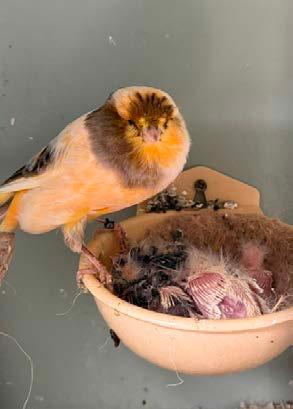
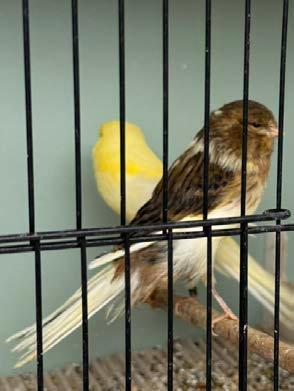
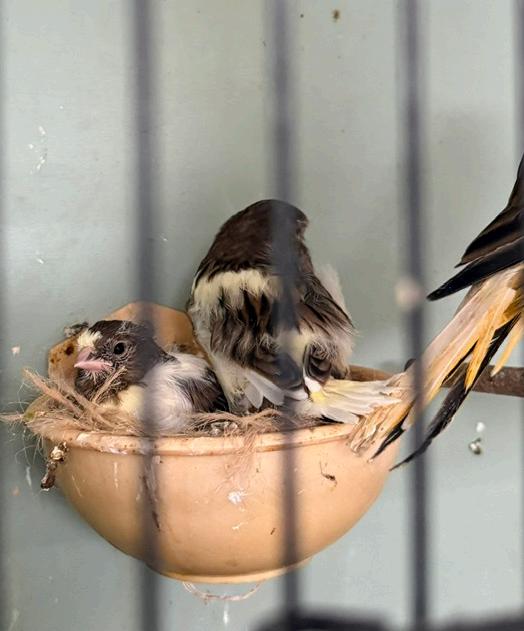
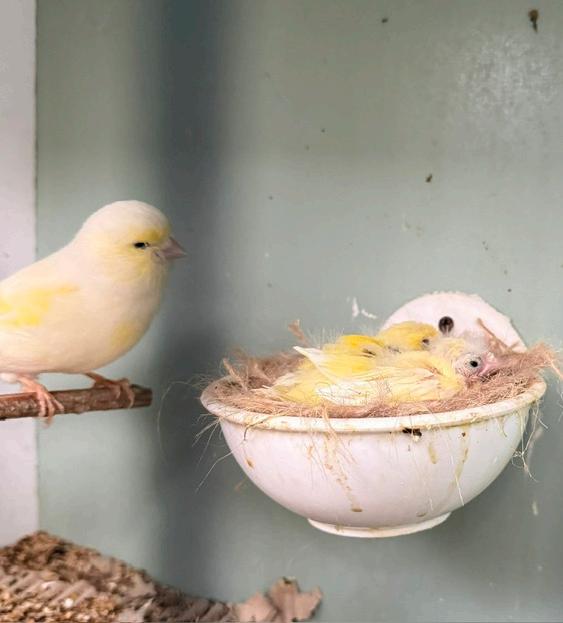
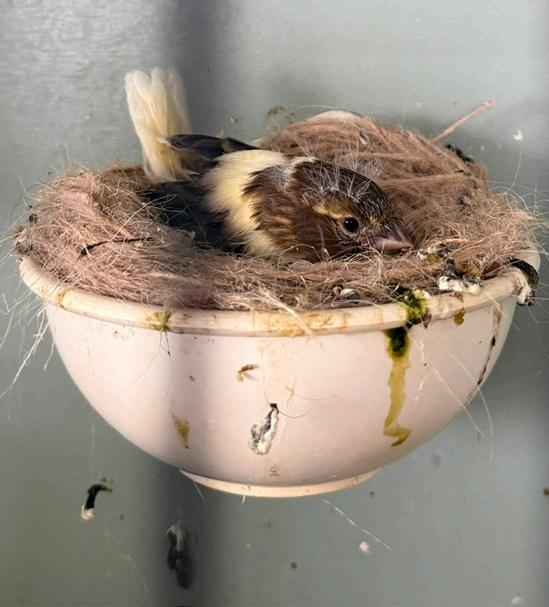
Rapid recovery: after too many early setbacks, Brian has been seeing plenty of young Yorkies coming through Photos: Brian Keenan
Regular contributor Brian Keenan is the chairman of Liverpool & District YCC.
Proud mum with her four young
Another two in and out of the nest
Two
Forty years of finches celebrated with friends and cake. Page 19
Details on Parrot Society Summer Show. See ‘Club roundup’, page 20
Club News
Owl and raptor night
THE chairman Paul Swatton opened the meeting by welcoming members and guests to the April 9 meeting. Sadly, Maureen Williams was unwell and therefore unable to attend.
The chairman introduced Leila Pitcher who was representing Liberty’s Owl, Raptor and Reptile Centre, which is based in Ringwood, Hamp-
shire. Lila’s chauffeur for the evening was Andy, her father. Lila presented to the members and guests five birds that she had brought with her, detailing each bird, its attributes, comparing some of these to humans to highlight their unique prowess and ability. She presented with confidence and a tremendous degree of knowledge for her subject matter. It was very clear to see that her audience
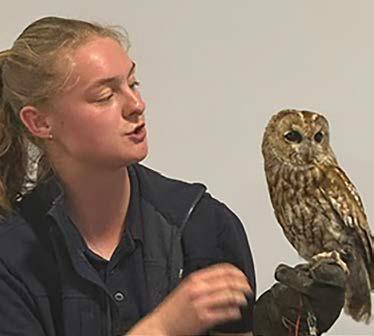
were enthralled and listened attentively throughout the presentation.
The birds presented were in this order:
Frodo – a Southern white-faced owl
Woody – a tawny owl
Flymo – a kestrel
Tootsie – an eagle owl
Maloo – a peregrine.
Following a break for
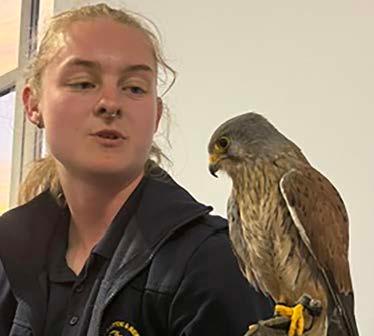
Club roundup
SHOW DATES
BEVERLEY CBS open show on November 1 at its now usual venue of Beverley Racecourse, York Road, Beverley HU17 8QZ. The society is looking forward to meeting its friends again this year and schedules will be sent previous exhibitors. Any new exhibitors should contact Sylvia Hardcastle on 07927 366 846 for a schedule.
BIRMINGHAM AREA BORDER & FIFE
CLUB will be holding its open show on October 18 at Dudley Sports and Social Club at Brierley Hill. To receive a schedule, please call Gary Haynes on 07967 048 214. There will be £100 best in show bags of seed, and cash prizes for exhibitors in all sections.
BORDER CANARY ASSOCIATION following the 2026 AGM, the Border Canary Association had Fraser Anderson stand down as secretary. This position has now been taken by Brian McAulay. This year’s show will go ahead on its usual date of November 7 at the new venue in Heiton Village Hall, Main Street, Heiton, Kelso TD5 8JR. For any queries or
refreshments and the raffle, Lila remained with a Q&A session relating to not only the birds that she had brought with her, but other birds of prey that are kept at Liberty’s.
The audience thanked her for a tremendous presentation with a well-deserved round of applause.
The chairman had checked that this would not frighten the birds before the applause began.
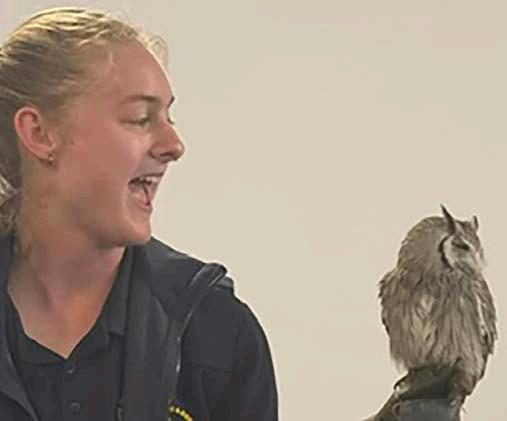
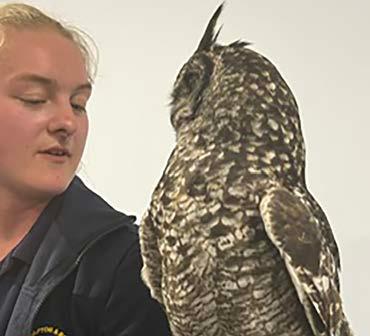
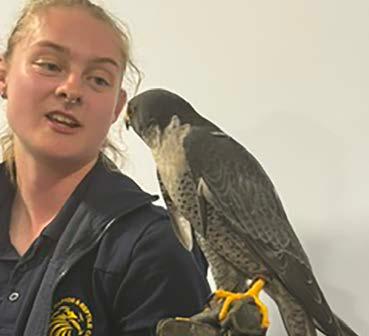
information, please contact Brian on 07817 257 326 or email: brianmcaulay54@gmail. com
BRITISH BORDER FCC open show will be held November 21-22 at the Frodsham Community Centre, Fluin Lane, Frodsham WA6 7QN. Judges engaged are A. Telford, D. Sommerville and L. Rowland. For enquiries, contact Jeff Hamlett on 07568 345 101.
CUMBRIA BORDER & FIFE CC open show will be held on December 13 at Low Hesket Village Hall, Carlisle, Cumbria CA4 0ES. Entries to Malcolm Pape, 1 Saint Lawrence Place, Burgh by Sands, Carlisle. Tel: 07557 146 461. Judges to be confirmed.
DUNBARTONSHIRE BS open show on August 29 at The Riverside, Parish Church Hall, High Street, Dumbarton G82 1NB. Tel: 07806 777 098.
GREEN, CINNAMON & WHITE BORDER
FCC open show will be held on November 7 at Almondsbury Sports & Social Club, Gloucester Road, Bristol BS32 4AA. Judges engaged are Paul Meacock and Keith
Wadkin. For more information contact chairman Dean on 07780 525 487 or secretary John 07870 888 724.
HASTINGS BS will hold its gold championship open show on August 16 in Northiam Village Hall, Ken TN31 6LP. Judging will be performed prior to lunch after which time the show will be open to the public. A number of birds will be available for sale so a good opportunity to pick up a quality outcross. Enquiries to 07549 229 669.
HIGH SPEN CBS has hosted the club shows of the Northern Border Canary Club and Northumberland & Durham Foreign Bird Society successfully for the past 20 years in a combined format and will again do so this year. The combined event will take place at Greenside Community Centre, Greenside Road NE40 4AA on November 29. The judges engaged are N. Cowan and F. Anderson (Borders); P. Gillot and P. Warren (Fifes); L. Robson (British and any other variety canaries) and G. Lee (foreign and budgies). All enquiries to M. Scott on 07709
LANCASHIRE BB&HC will hold its 40th anniversary open show on November 15 at the Stub Shaw Cross, Sports and Community Centre, Ashton Makerfield WN4 8TP. Judges for the show are Dave Henderson, Colin Patterson and Ivon Rowlands.
The club is selling mugs with the club’s logo on to celebrate the occasion, and each attendee will receive a special badge to commemorate the 40 years. Those interested can phone 01942 209 111.
MARKINCH OS CAGE BIRD SECTION the annual open show will be held on November 1 at Victoria Hall, Main Street, Coaltown of Balgonie, Fife KY7 6HS. The monthly sales gathering help to fund this annual show. Intake of birds Saturday 6-8.30pm, and again 7.30-9am Sunday morning. Postal entries to show secretary Diane Bowman, 20 St Abbs Crescent, Pittenween, Fife KY10 2LT.
For further enquiries, contact chairman Simon Wehrle on 07512 760 467, secretary Mark Wehrle on 07980 706 862 or Diane
MIDLAND BA specialist & rare variety gold show on July 5 at The Village Hall, Hall Drive, Stoke Golding, Nuneaton, Warwickshire CV13 6DX. Schedules are now being posted out to everyone who has shown in the last two years. If you would like a schedule, please message New Midlands Budgerigar Association Facebook page, email: Alan@rcidesign.co.uk or tel: 07974 329 784.
MORPETH CBS open show on November 8 at Bomarsund Sports & Social Welfare Centre, Stakeford NE62 5UD. Contact Norman Wallace for more details. Tel: 07716 896 119 or email: pam.norm@icloud.com (NORTH OF ENGLAND COMBINED CAGE BIRD EXHIBITION, with North Of England Gloster Club).
NORTHERN BORDER FCC will have its show in conjunction with HIGH SPEN CBS on November 29 at Greenside Community Centre, Greenside, Ryton, Tyne Wear NE40 4AA. The judges will be F. Anderson and N. Cowen. Show
Readers may recognise Lila from these C&AB pages usually pictured with her budgerigars. Here she is holding Frodo, a Southern white-faced owl
939 007.
bowman on 07587 207 883.
● All club meetings and time-sensitive club news must reach us by 3pm on Wednesday for inclusion in the issue on sale on Wednesday of the following week ● Club News enquiries to: birds.general@kelsey.co.uk
Special cake cutting for 40th year
NORFOLK & SUFFOLK AUSTRALIAN FINCH SOCIETY
THE March meeting was fraught with frustration, simply because the society could not obtain a licence to have birds at the meeting – or for show or sale – until two days before the meeting date, when I received the email and 10 pages of conditions, reports Tony Goldson.
The bottom line being the society could have birds at the meeting, but I would be responsible for safety, bird health etc, and if anything went wrong, I could be prosecuted. Not a nice feeling, but a risk I was willing to take.
There were numerous phone calls and emails alerting members that they could bring birds. Several birds were brought to the meeting and all the rules followed. I have applied for licences for the remainder of the year.
What surprised me was that the local environmental officers could visit us at any time and check us out and ensure we are following the rules. Apparently, DEFRA have devolved their authority to the local council. I wonder how long this will last.
A great deal of work is
being carried out by the NCA in negotiations with DEFRA trying to bring reality to the current situation with licences and all the paperwork involved, and its necessity. I think we should all be very grateful for what they are doing on our behalf behind the scenes.
April was the society’s 40th year and a special meeting was planned. Many of the original members are still alive and were invited to join and help celebrate 40 years.
Some 30 members arrived, some with birds for sale. A total of 23 birds were available for sale and I could not resist buying a pair of Timor finches myself.
A speaker from a local owl sanctuary gave a talk on their work and the owl hospital. This is a talk that I can recommend to other clubs. A buffet was provided by members.
It was cakes galore including a special 40 anniversary cake and plenty of talking about birds, how the society was formed 40 years ago and the ways it hopes to take it in the future.
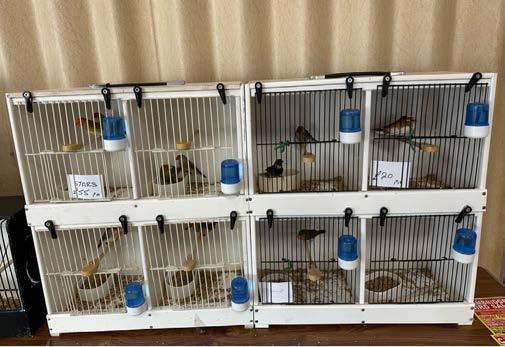


Club roundup
enquiries can be had from I. Wishart on 07789 737 909 or G. Eltringham on 07855 539 123.
NORTH EAST BBM&HC open show to be held on November 29 at Nettlesworth Community Centre, Front Street, Nettlesworth, County Durham DN2 3PN. For enquiries, contact the secretary Bill Passmoor on 07742 418 441 or alternatively, email: billpassmoor@hotmail. com
NORTH OF ENGLAND GLOSTER CLUB open show to be held on November 8 at Bomarsund Sports & Social Welfare Centre, Stakeford NE62 5UD. For enquiries, tel: 07716 896 119 or email: pam.norm@ icloud.com (NORTH OF ENGLAND COMBINED CAGE BIRD EXHIBITION, with Morpeth CBS).
NUNEATON CBS open show is planned for November 7 at the Attleborough Liberal Club, 32B Bull St, Nuneaton CV11 4JX. For
more information and schedules, contact secretary Daniel Lane via email: team21Aviarys@gmail.com or tel: 07484 801 193.
POOLE & PARKSTONE CBS the 2026 open show is to be held at Canfordheath Community Centre, 7 Mitchell Road, Poole, Dorset BH178SA on November 22. Judges Peter Cannon, Barry Durant and Martin Lettice. For more information, contact Neil Johnson on 01202 740 504 or email:
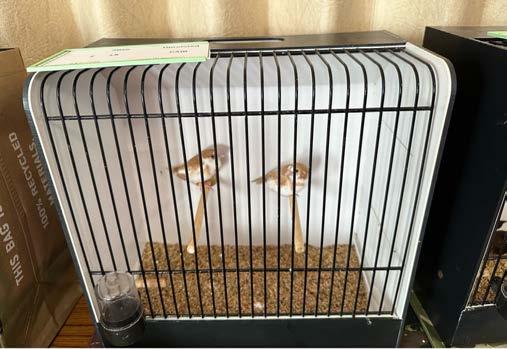
chilfrome@gmail.com
PORTKNOCKIE CBS is to incorporate the NORTH OF SCOTLAND ALL GLOSTER for the first time. To be held on November 15 at the McBoyle Hall, Portknockie, Banffshire AB56 4NE. Judges will be Ron Phillips, Borders and Fife fancies; Fergie Birdie, British; Colin Harper, Glosters; Brian Forbes, budgies; Jim Duguit, foreign and any other variety.
For any enquiries contact secretary
Donny Bailey on 07858 175 177 or email: donnybailey123@gmail.com
PRINCES RISBOROUGH & AYLESBURY CBS will hold an open show on December 5 at St Mary’s Church Hall, Church St, Princes Risborough HP27 0AF. For a schedule and further details, tel: 07889 443 600.
SCOTTISH BB&MC the 2026 open show will be held on December 6 at the same venue as 2025: Chalmers
Members past and present reunited to celebrate 40 years of the Norfolk & Suffolk Australian Finch Society
Some of the birds for sale at the recent meetings the past two months
Three of the original members: Alex Cable, Dave Brown and Gary Wincomb Finches for sale before it was cake cutting time to mark the society’s 40th
Club roundup
Hall, Linlithgow Bridge, West Lothian EH49 7PW. Contact the show secretary Dave Henderson (07555 202 963) for more information.
SOUTH COAST OPEN SHOW (HAVANT CBS & SOLENT CBS) will take place on November 8 at Fareham Academy, St. Annes Grove, Fareham, Hampshire PO14 1JJ. For more information, tel: 07904 083 806.
SOUTH EASTERN BUDGERIGAR CLUB
open show on September 13 at Smallfield Village Hall, Wheelers Lane, Surrey RH6 9PT. Judges are Neil Johnson, Andy Thorpe and Mike Freeborn. Contact for schedule is 07788 737 061.
SOUTHERN LIZARD CANARY CLUB The
2026 open show will be at a new venue of Weston Turville Village Hall, School Approach, Aylesbury HP22 5RW on November 21. Find out more at: southernlizard.co.uk or message the club’s Facebook page.
SWINDON CBS open show will be held on November 28 at Pinetrees Community Centre, Swindon SN2 1RF. Tel: 07931 643 356.
WAKEFIELD CBS open show November 29, Outwood Memorial Hall, Leeds Road, Outwood WF1 2NE. For enquiries and
Show reports, dates, club notices
CHICHESTER CBS – June 23, Village Hall, North Mundham, Chichester, West Sussex PO20 1LA, 7.30pm. Meeting. R affle and refreshments available. Enquiries: 01243 551 093 or visit: www. facebook.com/ChichesterBirdClub
DAGENHAM CBS – June 20, Wantz Hall, Dagenham, Essex RM10 7DX, 10am-12pm. Songbird competition. Winner chosen by members. Enquiries: 07748 184 049.
DARTFORD BIRD SOCIETY – June 17, Royal British Legion Hall, South Darenth, Kent DA4 9AB, 7.30pm. Steve Chennells will be delivering part 2 of his presentation covering stages 5 to 8, which deals with the fixation
schedules, tel: 01924 218 979.
WALSALL CBS 2026 open show, November 14 at Cheslyn Hay Academy, Saredon Road, Cheslyn Hay, Walsall WS6 7JQ. For enquiries, contact the show secretary Sharon Kendall on 07816 687 698 or email: sharonandsadie@gmail.com You can also search for the society on Facebook.
WEST MIDLAND GLOSTER ASSOCIATION
the open show on November 1 will be held at Drakes Broughton Community Centre, Walcot Lane, Drakes Broughton, Pershore WR10 2AJ. Tel: 07971 687 775.
CLUB NOTICES
AUSTRALIAN FINCH SOCIETY will have its usual stand in the Prestwood Annexe at the Parrot Society Summer Show at Stafford Showground on July 5. The Parrot Society requests that all AFS members wishing to sell birds on the AFS stand should enter the event via The Sandylands Centre with the new required paperwork.
Please take care to fill this in correctly to assist a smooth quick entry. Members should then proceed straight to the society’s stand in the Prestwood Centre.
The “NEW” required paperwork can be found on the society’s website: www. australianfinchsociety.co.uk Please remember no more than two birds per
small/show cage (clean and disinfected). Cages must be clearly labelled with the seller’s name, membership number and price.
All required paperwork must be completed before placing the birds on the stand and to include your valid CPH number. The AFS reserves the right to reject any birds that display possible health issues and any cages for display or boxes for transport that are deemed unfit (dirty/ contaminated). To conform with current legislation, any other bird transactions e.g. exchanges, gifts etc, taking place on the society’s stand must have traceability paperwork completed. A fee of £1 per bird sold will be retained by the society. Due to the dishonesty of some people, the society will no longer be able offer the service of holding purchased stock for collection later. All sales must be taken when purchased.
MIDLAND BA as an incentive to become a MBA member, the MBA committee will offer a draw for two separate prizes of wristbands for entry to this year’s Budgerigar Society Club Show in Blackpool. All current members and honorary life members will be eligible.
The draw will take place at the MBA specialist & rare show on July 5, so please do renew or join the MBA to be entered into the draw.
If you are interested in joining the MBA, all details are on the MBA website. All MBA
Club meetings nationwide
Includes sales held by clubs to benefit their members. For other sales, please book an advert
of characteristics, uniformity and cloning. Enquiries: Steve Allwright: 07885 186429.
HIGH WYCOMBE CBS – June 17, Hazlemere Community Centre, Rose Avenue, High Wycombe, Buckinghamshire HP15 7UB, 8pm. Dave Brown and his birds. Enquiries: birdmanhw@gmail.com
NEWARK CBS – Thursday June 25, members only social evening, skittles, food and bring your own drinks. To be held at NG23 6AF (Norwell Road, Caunton, Newark), 7pm. Enquiries: John 07947 342325 or Robert 07940 122453.
NUNEATON CBS – June 21, Bedworth Ex-Servicemens’ Social
meeting are conducted over the internet so it’s never been easier to be a committee member.
NEWARK CBS welcomed Derrick Smith in March, a well-known breeder and exhibitor of exhibition mules and hybrids, to give an in-depth talk on bird selection for breeding, nesting sites, feeding regimes and show training.
In April, the club had champion breeder and exhibitor Jim Egg. He gave an interesting talk on breeding and showing
PARROT SOCIETY
his champion greenfinches. Jim starts his breeding season early in the year, with his birds doing well in the current year bred (CYB) classes. He was presented with a brand new British No3 show cage, kindly donated by Bob Allen. Members enjoyed their talks and both speakers were thanked by chairman John Gaskin. New members are welcome to join. Meetings are on the last Thursday of the month at St Giles Community Centre, Main Street, Balderton, Newark.
THE June issue of the Parrot Society’s magazine (volume 60) is out now, fea turing an African grey cover star.
This issue includes a 2025 breeding register, news on the Society’s upcoming Summer Show and free and donated members’ advertisements.
Focus features this month are on the threatened swift parrot, splendids, pionus and the rare night parrot on remote Queensland Cattle Station. Find out more about the Parrot Society and its monthly magazine at: www. theparrotsocietyuk.org
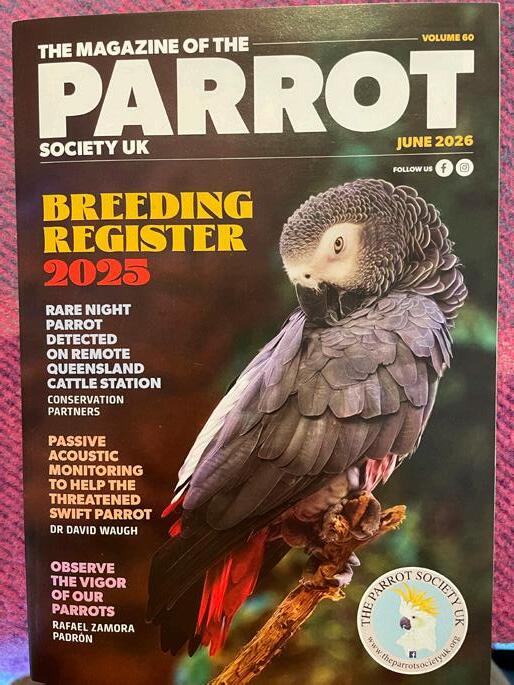
The BS is hiring
BUDGERIGAR SOCIETY
APPLICATIONS are now open for a Budgerigar Club administrator’s role. This pet owners’ club was launched in 2021 by the Budgerigar Society to provide a support network to all owners of budgerigars and those who breed budgerigars mainly for pets. Interested parties (individuals or small teams) can apply to BS vice chairman Adrian Terheege (GeneralCouncil@budgerigarsociety.com) or social secretary Steve Holland (secretary@budgerigarsociety.com). Applications close end of June.
Club, Bedworth, Warwickshire CV12 8JH. Auction. 9am booking in, 11am auction starts. Enquiries: team21Aviarys@gmail.com or tel: 07484 801 193.
TRIMDON CBS – June 24, Trimdon Colliery and Deaf Hill WMC, The Square, Trimdon Station, Trimdon, Co. Durham TS29 6AJ, 8pm. Meeting. Enquiries: 07970 391 873.
WEST GRINSTEAD BIRD
SOCIETY – June 19, Partridge Green Village Hall, Horsham, West Sussex RH13 8HX, 7.45pm. Exhibition zebra finches and mutations by Dave Brown Enquiries: 07753 110 958 or email: davepadwick4@gmail.com
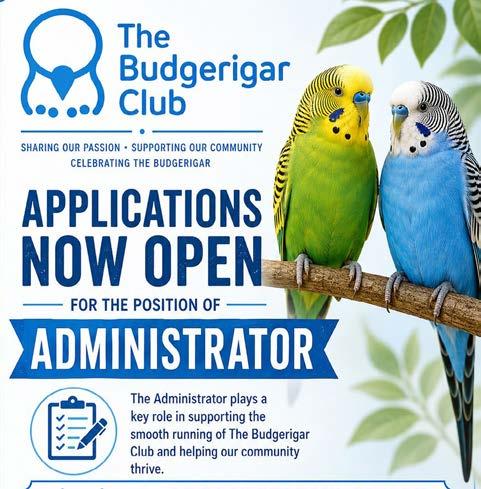


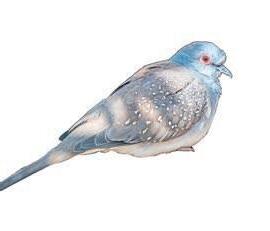









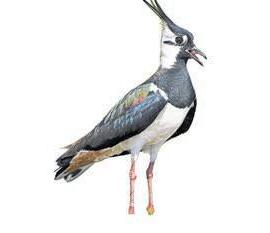


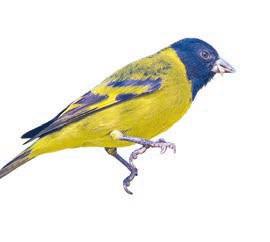


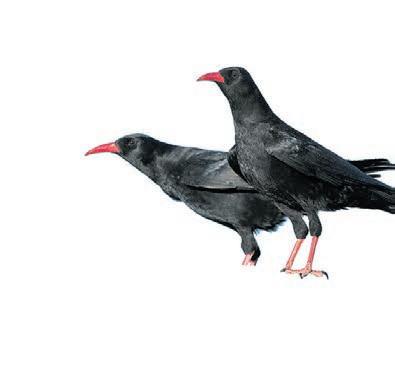








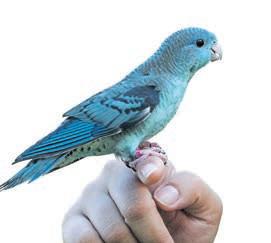


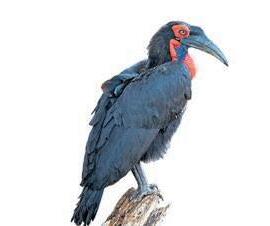

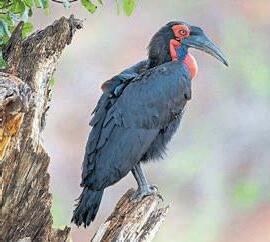


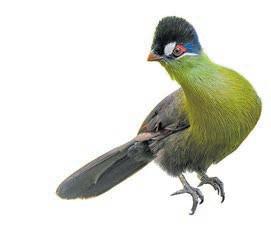











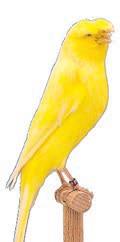



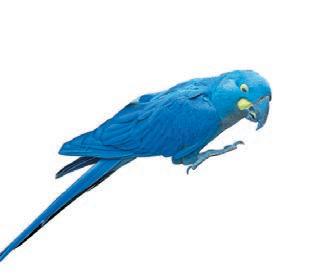






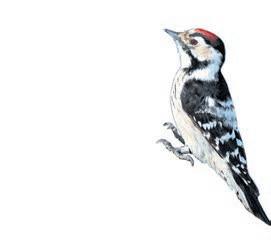




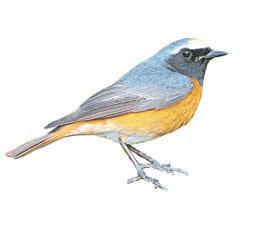



Please
BARGAIN BOX COUPON
Or email sophie.lamb@kelsey.co.uk ensuring you complete all information set out below or fill out our online form here: tinyurl.com/cabbargainbox
SECTION 1: tick relevant category
SECTION 2: complete advert and advertiser details
ADVERT DETAILS
FIRST LINE OF TEXT (WILL APPEAR IN BOLD): DETAILS (30 WORDS MAX): ALL BIRDS OR OTHER ITEMS FOR SALE IN BARGAIN BOX MUST BE CLEARLY PRICED (NO £POA)
BARGAIN BOX
Advertise birds, equipment and accessories UP TO £200 absolutely FREE!
PARROT - LIKE BOURKES PARAKEETS
£65 each. Cocks and hens. 2026 Rosa mutation, very pink strong birds. DNA sexed with certificates. Please call 07730 202912. West Sussex (80.8) EXCHANGE Exchange. Bristol area, meet to swap birds. Rubino and Lutino Rosellas to swap for Splendids, no green birds. Lutino violet, red breasted young bird. Please call the landline 01454 430511. Bristol. (80.8)
BUTTERCUP KAKARIKIS
£60 each. Male and female beautiful healthy birds. Please call 07831 785520. Burton on Trent. (80.3)
BRITISH BIRDS
GOLDFINCHES
TELEPHONE NUMBER TO APPEAR IN ADVERT (MOBILE RECOMMENDED):
ADVERTISER DETAILS
NAME:
TEL*:
* INCLUDE INTERNATIONAL CODE IF OUTSIDE THE UK
EMAIL (OPTIONAL): ADDRESS:
TOWN: COUNTY (MUST INCLUDE): POSTCODE: COUNTRY:
SECTION 3: read terms & conditions, complete declaration
• We reserve the right to refuse any advert.
• Adverts are published subject to space.
• This service is for private advertisers only. Anyone trading more than 12 adverts in a year will be regarded as trade.
• Each advert can be no more than 30 words. Kelsey Media reserves the right to edit down adverts that exceed this word limit.
• Kelsey Media cannot be held responsible for illegible or inaccurate advert descriptions.
• Kelsey Media customer service representatives reserve the right to terminate telephone calls if the caller becomes abusive.
• By submitting advertisements to Kelsey Media you are agreeing to the above Terms & Conditions.
• Any item advertised that contravenes the Pet Animal Act 1951 will not be published.
• All advertisers must state a price for each item listed.
• No other correspondence can be entered into.
CHAMPION FIFES
£30. Complete stud, 25 birds selling - top bloodlines, pairs or joblot. Selling due to health. Please call 07718 845841. Warwickshire (70.7)
GLOSTER CANARIES
£30 pair. Bred from top bloodlines flighted and unflighted birds. Pairs and few spare birds. Please call 01283 704755. Derbyshire. (70.7)
LIZARD CANARIES
£20 each. Top quality, flighted and unflighted gold,silver birds. Bred from top bloodlines. Please call 07827 708733. Leicestershire (80.5)
NORWICH CANARIES
£20 each. Selling up! 2 cocks for sale. Please call 07907 176726. Liverpool (80.4)
£100 a pair. Two pairs of goldfinches - closed ringed. Also selling nest-boxes, new budgie or finch £20. Please call 07857 045922. Somerset (80.5)
GOLDFINCH MULES
£100 each. Goldfinch Mule cocks 2025 bred - good songsters. Please call 07376 742127. Devon (80.2)
REDPOLL PAIRS
£60 a pair. 2 pairs of lesser redpolls, nice birds. Please call 07522 670421. Norfolk (80.6)
BUDGERIGARS
EXHIBITION BUDGERIGARS
From £30. Good quality exhibition budgies available. Can be couriered. Can send pics via email jbibbens@ btinternet.com. Please call 07718 184436. South Suffolk (80.7)
BUDGERIGARS
RED FACTORS
£25 each. Red factor canaries, quality birds, 2025 pairs and 2026 young available. Please call 07522 670421. Norfolk (80.6)
RED FACTOR STUD
£30 per pair. Complete stud of quality red factor canaries, breeding pairs. 2025 and 2026 young, new wire cages and all equipment included. Please call 07522 670421. Norfolk (80.6)
ROLLER CANARIES
£30 per pair. Roller canaries for sale, contest strain. Please call 07551 996300. Cheshire (70.9)
FOREIGN BIRDS
HECK GRASS FINCH
£20 each. For sale. Please call 01162 789637. Leicester (80.9)
REDHEADED FINCH
£80. 2 cocks and 1 hen for sale Please call 01162 789637. Leicester (80.9)
FIFE SHOW CAGES
£60 each. In 2 bars with 5 cages in each bar. All in good order. Please call 07957 713509. Manchester (70.7)
BORDER/FIFE SHOW CAGES
£55 each. In 2 dinky bars with 4 cages in each. All in order. Training cages also available. Please call 07957 713509. Manchester. (70.7)
WANTED
BARABANDS
Wanted. Baraband cock bird wanted - plus two hen blue celestial. Please call Nigel on 01623 758753. Nottingham. (80.8)
HEN EUROPEAN GOLDFINCH
Wanted. Hen European Goldfinch, can travel and willing to pay good price for 2024/2025 bird. Please call 07984 175935. Herefordshire (80.8)
HEN BULLFINCH
Wanted. Hen bullfinch wanted. Please call 07513 869481. Leicestershire. (80.0)
TURQUOISINE PARAKEETS
Wanted. Turquoisine parakeets cocks and hens. Please call Eric on 07730 202912. West Sussex (80.4)
BOURKES PARAKEETS
Wanted. Bourkes parakeets, rubino and lutino 2025/6 hens and cocks. Please call Eric on 07730 202912. West Sussex (80.3)
YORKSHIRE CANARIES
LAVENDER FINCH
£50. For sale. Please call 01162 789637. Leicester (80.9)
• DEFRA will provide a list of endangered species on request
• Eggs cannot be sold in this section
• It will be assumed that readers who email adverts to gracie@talk-media.uk and adverts entered on cageandaviarybirds. co.uk have agreed to all the above “Conditions of Acceptance”. CONDITIONS
• It is an offence to buy or sell most wild birds (and other animals), dead or alive, without a licence or exemption from DEFRA or (for dead birds only) registration under section 6 of the Wildlife and Countryside Act 1981
• It is prohibited to organise Bird Sales/Auctions without a valid pet shop licence or exemption letter for the auction premises. The publisher has the right to refuse ads that do not carry a current Pet Shop Licence or Exemption letter from the organiser's Local Authority
• Kelsey Media uses a multi layered Privacy Notice giving you brief details about how we would like to use your personal information. For full details visit www.kelsey. co.uk, or call 01959 543524. If you have any questions please ask as submitting your details indicates your consent, until you choose otherwise, that we and our partners may contact you about products and services that will be of relevance to you via direct mail, phone, email and SMS. You can opt-out at ANY time via email data.controller@kelsey.co.uk or 01959 543524.
• It is the responsibility of the advertiser to ensure that they are legally permitted to sell birds and animals in accordance with all current legislation and that they are in possession of any necessary certification which can be made available upon request.
From £60. Coloured black headed miniatures. All BS rings 2026. Please call 07307 854353. Lincolnshire (80.5)
PIGEONS/DOVES
RACING PIGEONS
£25 each. Racing Pigeons, sprint/middle distance. Youngsters & stock birds available. Courier can be accommodated. Please call 07599 252781. North Wales (80.8)
CANARIES
FIFE CANARIES
From £15. Fifes for sale. All bred down from birds of a present day champion. Very successful show winning stud. Please call 07765 708287. Bristol (70.9)
GLOSTER CANARIES
I hereby confirm that I am legally permitted to sell the birds listed in this advertisement, in accordance with all current legislation, and that I have the necessary certification etc in my possession for this purpose which can be made available if required.
£30 pair. Consorts and coronas, cocks and hens from champion winning stock. Please call 07725 867758. Lancashire (80.3)
CHERRY FINCH
£20 each. 2 cocks for sale. Please call 01162 789637. Leicester (80.9)
SIBERIAN BULLFINCH
From £70. Normal paid, yellow pair plus 2 spare hens. £120 a pair or £70 for hens. Grab a bargain! Selling due to illness. Please call 07776 028052. Derbyshire (80.8)
AMERICAN GOLDFINCH
£200 each. Hens only or will exchange for some cocks. Please call 07552 650888. Northamptonshire. (80.4)
JAVA SPARROWS
£150 for the lot. Selling up! 12 Java sparrows for sale. Whites, silvers and fawns. Please call 07907 176726. Liverpool. (80.0)
MISCELLANEOUS
LIVE MEALWORMS
From £4. Succulent juicy mealworms from UK breeder. Postage, sent in letterbox friendly packaging. Please call 07598 362581. Wales. (80.1)
Wanted. White Yorkshire canaires wanted in pairs or odd ones. White or mainly white, can collect from anywhere. Please call 07944 526089. Staffordshire (80.8) OLD ENGLISH GAME Wanted. Bantams wanted. Please call 07546 720107. Lincolnshire (80.4)
EXHIBITION ZEBRA FINCHES Wanted. Wanted exhibition zebras. Returning member. Normals, fawns and penguins. May consider any exhibition types. Please call 07718 845841. Warwickshire (70.7)
ZEBRA FINCH SHOWCAGES Wanted. New style zebra finch show cages. Please call 07718 845841. Warwickshire. (80.1)
FIFE BORDER SHOWCAGES Wanted. Training or show cages wanted for Fifes or borders. Willing to travel. Please call 07484 293252. North Wales. (70.7)
HEN JAY
Wanted. I am after a Hen Jay. Please call 07513 869481. Leicestershire.(70.6)
IRISH FANCY CANARIES Wanted. Irish Fancy canaries and breeding cages- local if possible. Please call 01226 245413. South Yorkshire (80.3)
BIRDMART







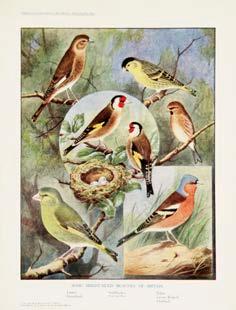












Johnson, author of C&AB’s “Border Bulletin”, is building a collection of Border Canary Memorabilia. He’d like to acquire:
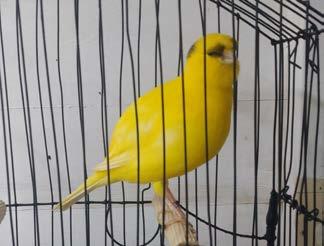
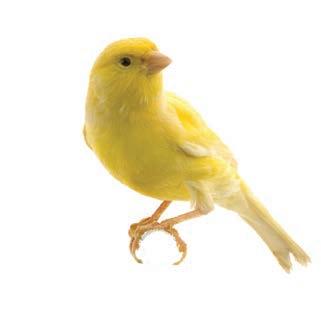
Science-Led Healthcare for Cage & Aviary Birds

Since 1977, Aviform has supported fanciers worldwide with veterinary approved, UK-made supplements.
Every product is formulated and manufactured in our own UFAS, BETA NOPS, ISO 9001:2015 and ISO 14000:2015 accredited facility in Norfolk – giving you complete confidence in what goes into every bottle.
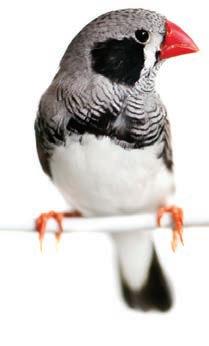

All-in-One ‘Super Tonic’ for daily addition to the drinking water. Specifically formulated to provide optimum health and condition. Help prevent protozoa and internal parasites/worms.
Powerful antioxidants boost birds’ natural defenses. Improved moulting with better feather condition. Intestinal health and reduce risk of infection.
Assistance during stressful periods. Boosts essential gut flora for firmer droppings.
High potency liquid breeding and immunity supplement for addition to drinking water at a rate of only 2ml per litre.
Enriched with Vitamin E, Vitamin B12, together with the amino acid L-Carnitine and Postbiotics (the next level from Pre or Probiotics) for enrich fertility, provide efficient egg production and enhance your bird’s immunity.
For rapid recovery.
Avian Approved Soluble Probiotic (providing one billion seven hundred twenty-eight million CFU in each 5g serving), Prebiotic and Electrolyte formulation for rapid recovery after illness.
We believe this makes Prolyte the best avian recovery product available.
Simply add to 5g per half litre drinking water or add to seed/ softfood 5g per 500g (can be combined with all other Aviform avian products).


Fully water-soluble calcium with high levels of Vitamin D3, addressing calcium deficiency and supporting optimal breeding conditions in birds.
High concentrate requires from only 2.5ml per litre.
VITALITY & SUPREME PACKS

All your favourites. One unbeatable price.
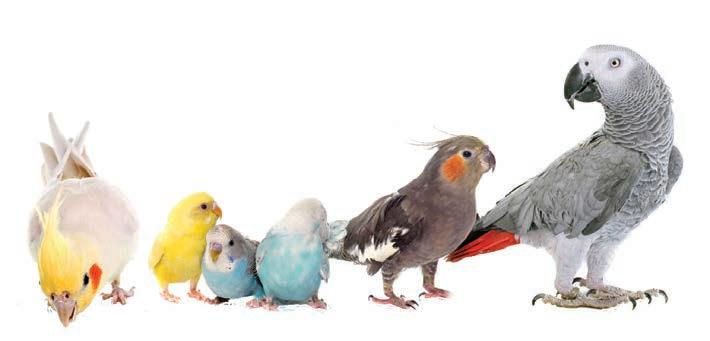
All-in-One Super Tonic 1,000ml£40.95 2,500ml£56.95
Prolyte-C 250g£28.95
Pre & Probiotics 500g£38.95
Calciform HiD3250ml£28.95
Calcium + D3 500ml£35.95
Fetura-12 250ml£28.95
Breeding/Immunity 500ml£35.95
HOW TO ORDER:
Online: www.aviform.co.uk or scan the QR code
Full product details and prices are available online. Telephone: 01953 528008 Monday to Friday 9 ‘til 5 and from 9:30 ‘til 1:30 on Saturday.
Postage & Packing: Free & Fast UK Delivery on every order over £30, otherwise please add £2.95.
Aviform Ltd, Chestnut Drive, Wymondam, NR18 9SB