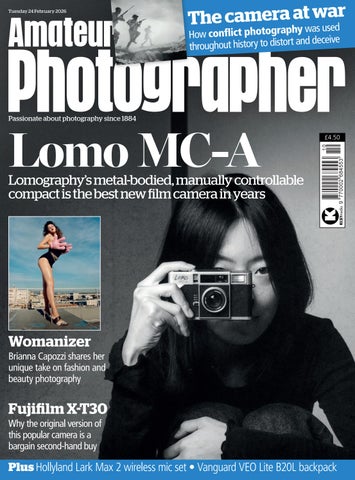
Lomography’s metal-bodied, manually controllable compact is the best new film camera in years

Brianna Capozzi shares her unique take on fashion and beauty photography
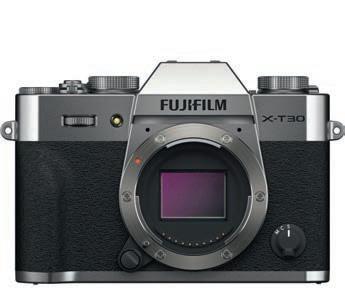
Fujifilm X-T30
Why the original version of this popular camera is a bargain second-hand buy
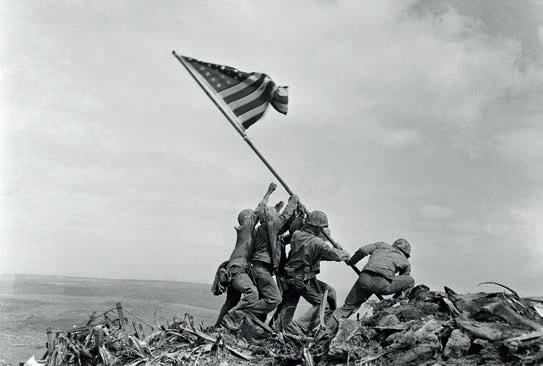
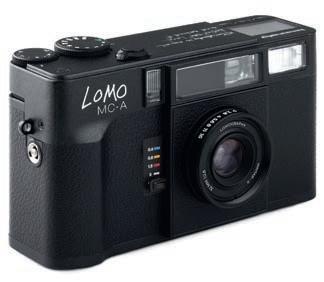








The film revival has been under way for a while now but most new cameras have been fairly basic with limited controllability. It’s been some years since we had a metal-bodied 35mm camera offering both auto and full manual control of exposure and focusing. The Lomo MC-A is just such a beast. Read all about it in our Big Test this week. We also interview Hilary Roberts, former Head Curator of the Imperial War Museum Archive, about her fascinating new history of war photography, which reveals how things were not always as they were made to appear at the time. Propaganda? Of course. Deception? You bet. Our second feature – on trendy US fashion photographer Brianna Capozzi – could not be more of a contrast in tone and subject matter, though of course her scenarios are equally staged. Nigel Atherton, Editor
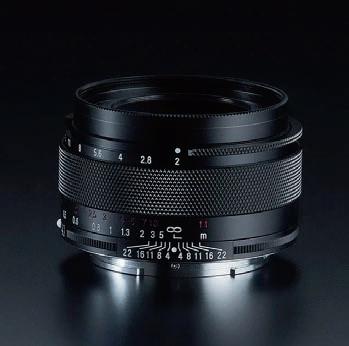
Voigtländer has released a new 40mm f/2 prime pancake lens for full-frame Nikon Z and Sony E mounts – the Septon 40mm F2 Aspherical. As camera historians and antique camera collectors will know, the Septon name featured on standard lenses developed for the Bessamatic and Ultramatic lens-shutter SLRs. They were marketed in the late 1950s and 1960s as a new platform to replace rangefinder cameras. ‘Septon is recognised as one of Voigtländer’s legendary lenses,’ said the company.
Coming back to the present, the new lens achieves an f/2 aperture while retaining the benefits of the compact Orthometar type design. This is accomplished by adding one aspherical lens to the six-element Orthometar type; the Orthometar type is characterised by its short optical length and extremely low distortion.
The Nikon version supports the delivery of EXIF information, in-body image stabilisation (3-axis), and three types of focus assist functions: focus assist via focus point frame colour change, focus assist via peaking function, and focus assist via magnification button. The Sony version, meanwhile, incorporates a distance encoder, making it compatible with models featuring 5-axis in-body image stabilisation that utilises subject distance information for shift blur correction. It also enables magnified
viewfinder display via focus ring operation.
With a compact overall length of 30mm from the mount flange (32mm for Z-mount), the lens is easy to carry around, while the 40mm angle of view makes it a handy everyday lens. The minimum focusing distance of 0.3m is also useful for close-ups.
Both E-mount and Z-mount versions include a dome-shaped metal screw-on hood keeping everything nice and compact, and the hood’s outer circumference has a 52mm thread.
The Voigtländer Septon 40mm F2 Aspherical is on sale now for £499 from robertwhite.co.uk
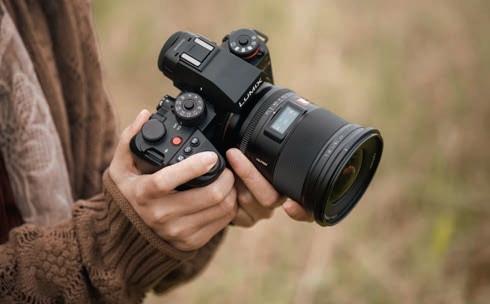
Staying with lenses, Viltrox has launched its first autofocus lens for L-Mount system cameras, after joining the L-Mount Alliance back in September.
The Viltrox AF 16mm F1.8 L, which is already available for Nikon Z and Sony E mounts, offers a 16mm (105.6°) field of view, along with 15 lens elements in 12 groups – including 3 aspherical and 4 extra-low dispersion elements. This optical design controls distortion, chromatic aberration, and coma, ensuring consistent sharpness from frame centre to edge, Viltrox claims.
Other features include a stepping motor for fast and accurate autofocus, with support for eye and face detection on compatible cameras. Last but not least, a 0.96in colour information panel shows the current focus distance, as well as the depth of field, aper ture and other settings.
The Viltrox AF 16mm F1.8 L is available now for £530 from bit.ly/newviltroxl
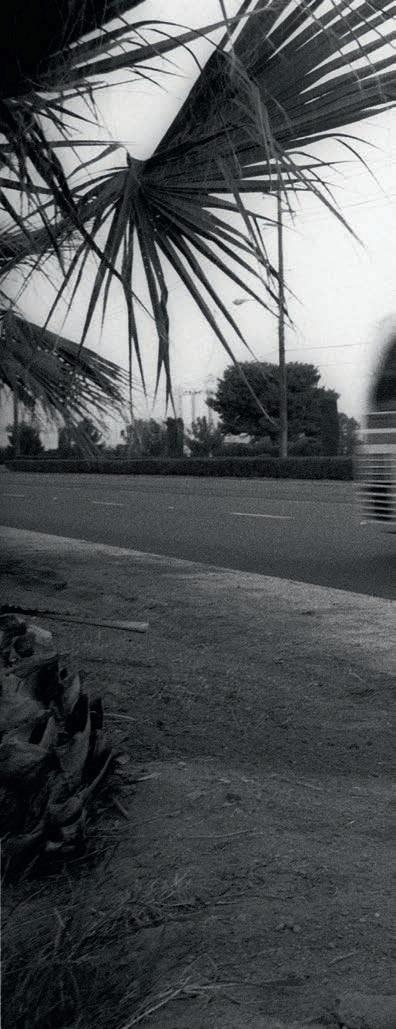
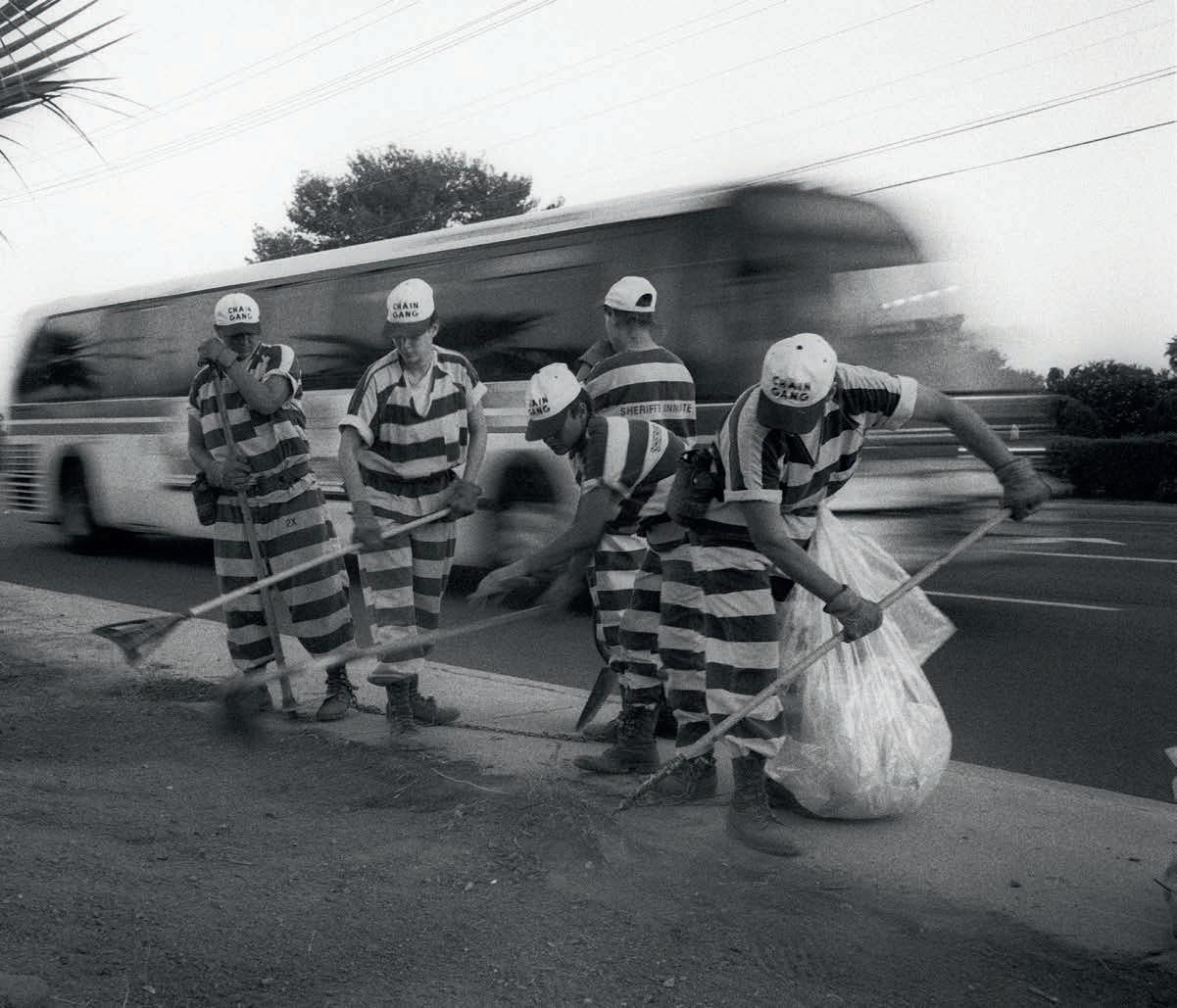
Shortlisted entrants for this year’s Deutsche Börse Photography Foundation Prize will be on show at The Photographers’ Gallery in London from 6 March to 7 June. The exhibition includes this striking image by US photographer Jane Evelyn Atwood, from her Too Much Time – Women in Prison project. Back in the 1990s, Atwood accompanied incarcerated women in 40 prisons across nine countries, with the project taking ten years. Other shortlisted entrants include Weronika Gesicka, Amak Mahmoodian and Rene Matic.
Jane Evelyn Atwood’s image – ‘The first women’s chain gang in the United States, 1994’ – is among the shortlisted work for this year’s Deutsche Börse Photography Foundation Prize
By the time this issue goes on sale, there will be just over two weeks to The Photography Show, which returns to the Birmingham NEC this year. Key speakers include Lindsay Adler, Charlie Waite and Dennis Morris, while makers exhibiting include Canon, Sony, Nikon, Fujifilm, OM System, Adobe, Sigma and Tamron. AP will also have a stand (A61), where you can meet the team and enjoy winning images from the latest Amateur Photographer of the Year contest. You can get 20% advance entry tickets with the code AMPHO26 – see bit.ly/APTPS
Nikon has released its third quarter 2025 financial results, revealing losses of ¥103 million (around £493 million). Whilst this seems a lot of red ink, the losses of note are in the Digital Manufacturing Business, rather than the imaging business – this recorded a profit, albeit with a slight decline over previous periods. Nikon has also lowered its sales forecasts to 900,000 cameras and 1.3million lenses for the quarter ending 31 March. The company noted the impact of price rises, particularly as a result of US trade tariffs.

We all need to be more Corporal Jones (Don’t panic!) and less Frazer (We’re all doomed!), reckons our columnist
as the internet and now AI doomed photography as an artform? Seems a crazy supposition when photos and video are everywhere and creatives theoretically have an endless global marketplace to share ideas.
But while we have increased visibility, photography’s very ubiquity has reduced the perceived value of its practitioners’ work. The same is true for journalism. The expectation to read articles on any subject for free online has print titles in a death spiral. Journalists and pro photographers alike are now expected to be podcasters and YouTubers, not just writers or visual storytellers.
The fact is photography is going through a transformative period, with a chaotic combination of disruptive AI and over-saturated social media platforms. It now appears less about getting the technical aspects right and more about storytelling. Once-popular picture-sharing sites like Instagram have shifted to prioritising video. And while my creativity has always involved pursuing my own singular passions and ideas, now algorithms are pushing us all to create a certain type of ‘content’ if we want our posts seen. And to provide it all for free.
From despair to where?
I think the only logical response is that we should just be taking pics, not chasing clicks. Viewing photography for personal satisfaction, not internet acclaim. There’s always someone else with more followers and likes, so why compete? It’ll only lead us to dissatisfaction. At one time we might have been envious of our immediate neighbour. Today, we have a whole global online neighbourhood to compare ourselves to… but there’s only one of you, so turn uniqueness to your advantage.
Let’s also turn existential despair into

Don’t miss our videos for the latest kit, tutorials, behind the scenes tours and exclusive interviews with top photographers
SOME RECENT VIDEOS
a catalyst for personal growth, focus on growing our skillset, not (just) our followers. Rather than doomscrolling, and letting the algorithm steer you, start a photographic project to expand your creative horizons… value authenticity not ubiquity. Popularity doesn’t always equal quality, after all.
While the photo hobbyist might despair, spare a thought for the pros. Now that smartphones have made everyone a ‘photographer’, they’ve arguably been the hardest hit by cultural and technological shifts and have needed to up their game. That’s not necessarily a bad thing.
Plus, with print now seen as a luxury in our digital age, the tangibility of a physical copy is one way the work of photographers can be perceived as premium, and dedicated shutterbugs can distance themselves from TikTok-ers chasing mass engagement, but mostly falling short.
So, it may feel like everything is getting worse, but as ever, the alternative to giving into doom mongering is to get more creative. Meet the challenge head on rather than burying our heads in the sand. Or, to dig out another Dad’s Army catchphrase: ‘Don’t panic!’
Gavin Stoker has been writing about and reviewing all things photographic for the best part of 25 years.
Do you have something you’d like to get off your chest? Send us your thoughts in around 500 words to the email address on page 3 and win a year’s digital subscription to AP.



To find our channel simply point your smartphone camera at this QR code or type our name into Google: YouTube/AmateurPhotographerTV






































Free. The Photographers’ Gallery, London. Until 19 April. See thephotographersgallery.org.uk for opening times
An opportunity to see some ultra-rare black & white work of the legendary photographer is a must, says Amy Davies
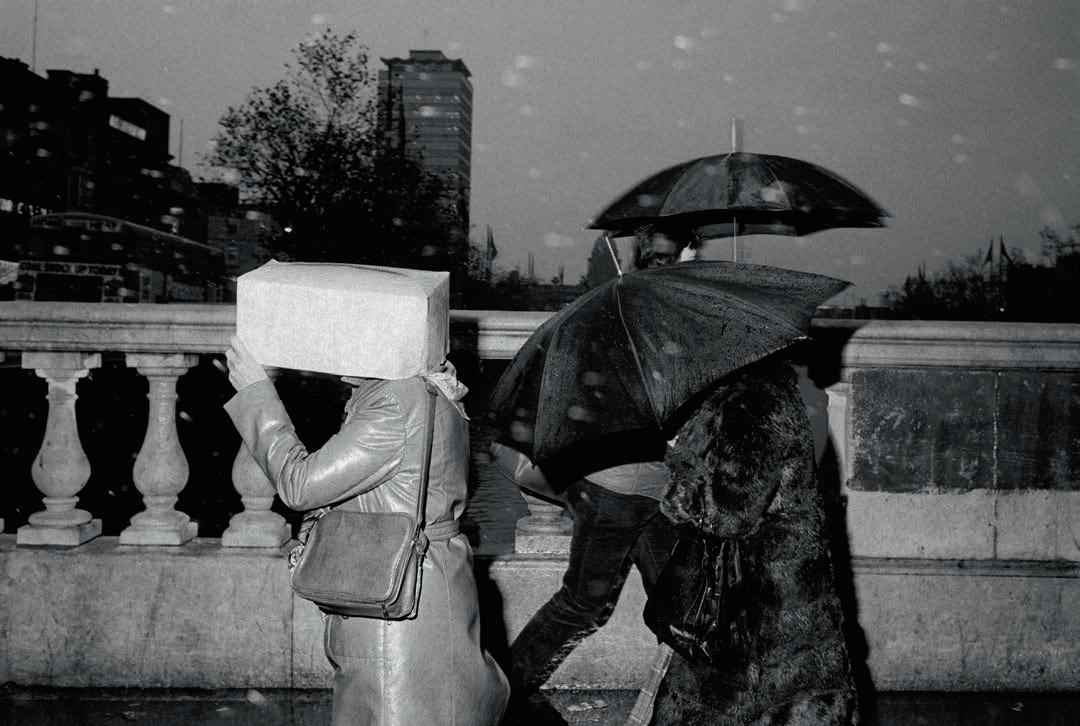
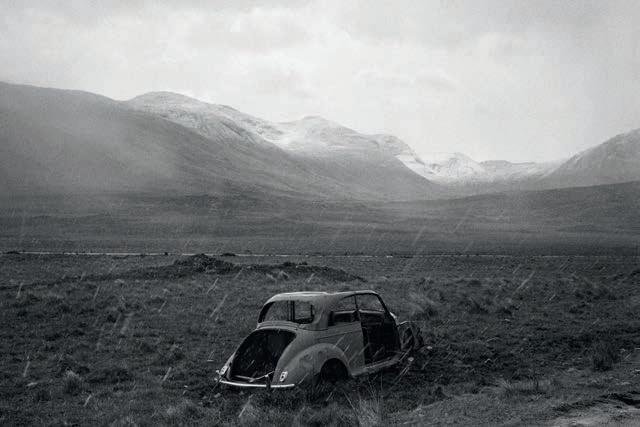
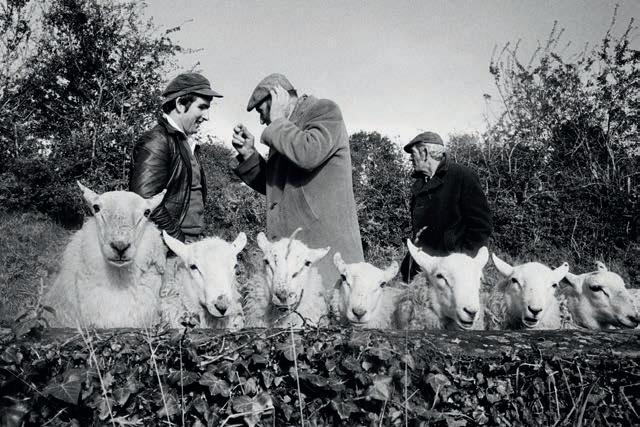
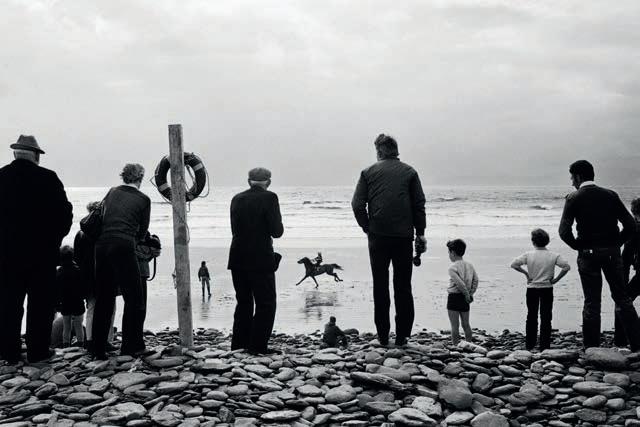
The Martin Parr: A Fair Day exhibition displays some of the pioneering and controversial street photographer’s work from the early 1980s, back when he was working in black & white.
Long before Martin Parr became known for his garish, in-your-face colour photography, his black & white work proves that even back then, he still had a fantastic eye for spotting a moment.
‘Fair Days’ were opportunities for communities in rural Ireland to come together for either trade, entertainment or to observe a religious festival. Many of the celebrations photographed by Parr still take place today,
but all of this work in the show hails from the early 1980s.
On display we see cattle trading, horse fairs, folk musicians and dance halls, and we also get a great glimpse of pictures that could only come from the 1980s, with cars and fashions of the time prominently featured.
To create this work, Parr spent two years in Ireland, getting to know his subjects and observing them with patience and kindness. The images display plenty of the wit and charm that he would later become known for, albeit in a more staid way thanks to the lack of colour.
This was Parr’s last major project in black &
white, so it’s a good opportunity to see some early work that helped shape one of the most well-known photographers of our time.
Over the course of his long career, Parr was exhibited many times at The Photographers’ Gallery, including most recently as part of the 2024 By the Seaside show. Following his death in December 2025, the gallery says it is committed to honour the late photographer’s legacy and celebrate the huge impact he had on British photography.
As the exhibition is taking place in the Print Sales Gallery, you can buy all of those on display. Being early, black & white and signed, the prints are extremely rare. Prices start from £5,500 per print – but it could perhaps be a wise investment for the future.
Entry to this part of the gallery is free (other shows at TPG are ticketed) so if you just want to pop in and have a look, I’d highly recommend it.
The latest and best books and exhibitions from the world of photography
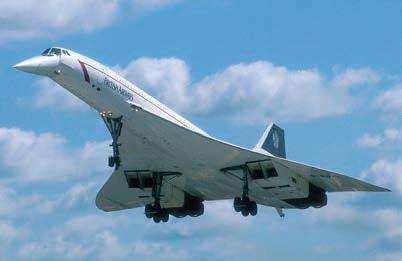
£25, The History Press, 120 pages, ISBN: 9781803998466

On January 21, 1976, Concorde made its first commercial flight. The supersonic planes made nearly 50,000 flights, carrying more than 2.5 million passengers during its time with British Airways, before being grounded for good in 2003 after 27 years.
In the book Concorde, A Collection in Photographs, Robbie Shaw, a former air traffic controller and lifetime aviation enthusiast, presents a huge variety of images from the history of the opulent aircraft.
Spanning a period which covers early test flights in the 1960s right up to retirement day, it also covers both British Airways and Air France Concorde, showcasing the collaboration between the two nations that helped to realise one of the most famous aircraft of all time.
More than 140 colour images are included here, many of which have never been published before. Highly recommended for fans of aviation history. AD

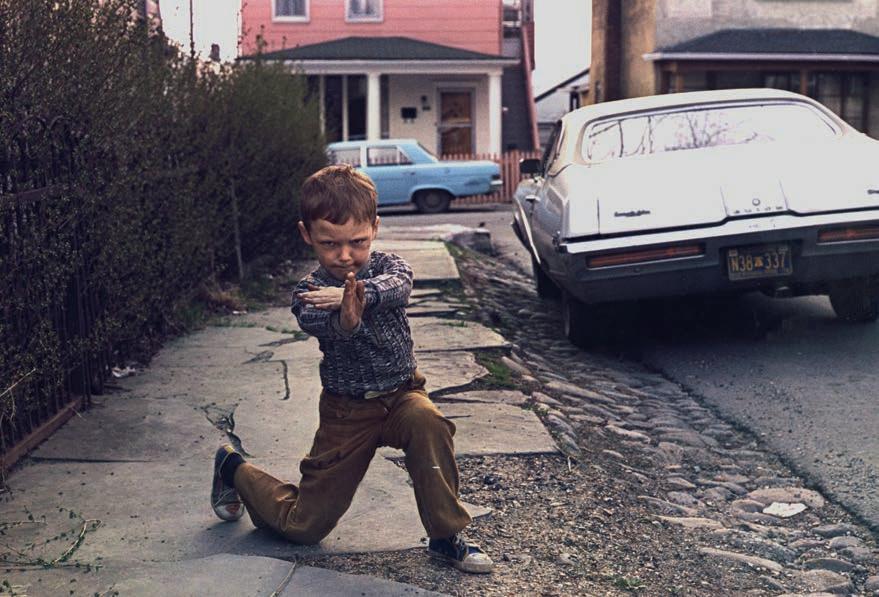
£40, Prestel, Hardcover, 188 pages, ISBN: 9783791393544
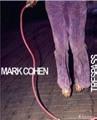
Mark Cohen’s Trespass is a characteristically confrontational book, one that advances rather than softens the abrasive, close-range visual language that has characterised his work for decades. It doesn’t attempt to explain or apologise for that approach but doubles down on it.
The colour photographs are tightly cropped and often disorientating. Limbs, torsos, gestures and fragments of clothing fill the frame. Faces are frequently cut off or obscured. Context is withheld. Location is secondary. There’s impact between photographer and subject, body and space, viewer and image. Cohen’s use of flash flattens the scenes and heightens detail – creases in clothing, scuffed shoes and clenched hands.
The title is poignant. The images feel like acts of intrusion, seized without negotiation. There’s a rigorous visual intelligence at work reinforced by the sequencing. Images mirror one another through posture, gesture and colour rather than narrative or place. The result is a relentless rhythm that refuses to comfort.
The accompanying text by Phillip Prodger provides useful context. It places Cohen within a broader photographic and cultural history. The book wisely allows the images to dominate. It’s often difficult to interpret Cohen’s photographs, more physical than descriptive, visceral than intellectual.
Trespass will not appeal to everyone. It’s not meant to. It’s abrasive and unapologetically narrow in focus. But within that lies a book by a photographer who knows exactly what he wants from the medium. Cohen continues his craft with undiminished intensity. For all its aggression, Trespass feels less like a challenge to the viewer than a statement of absolute conviction. Peter Dench
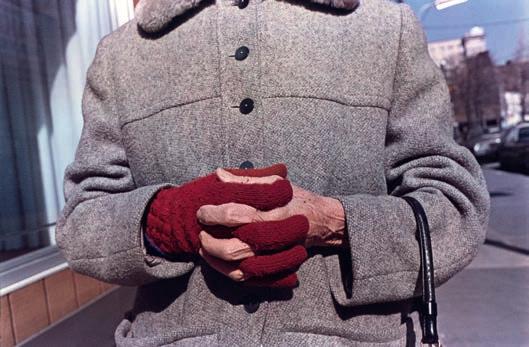
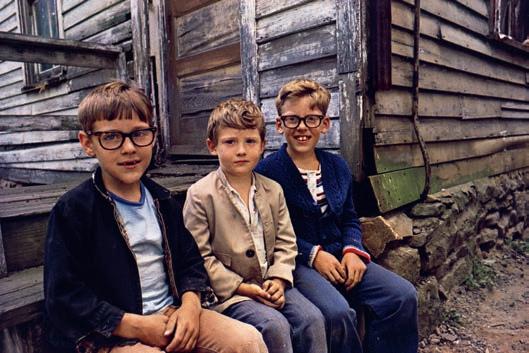
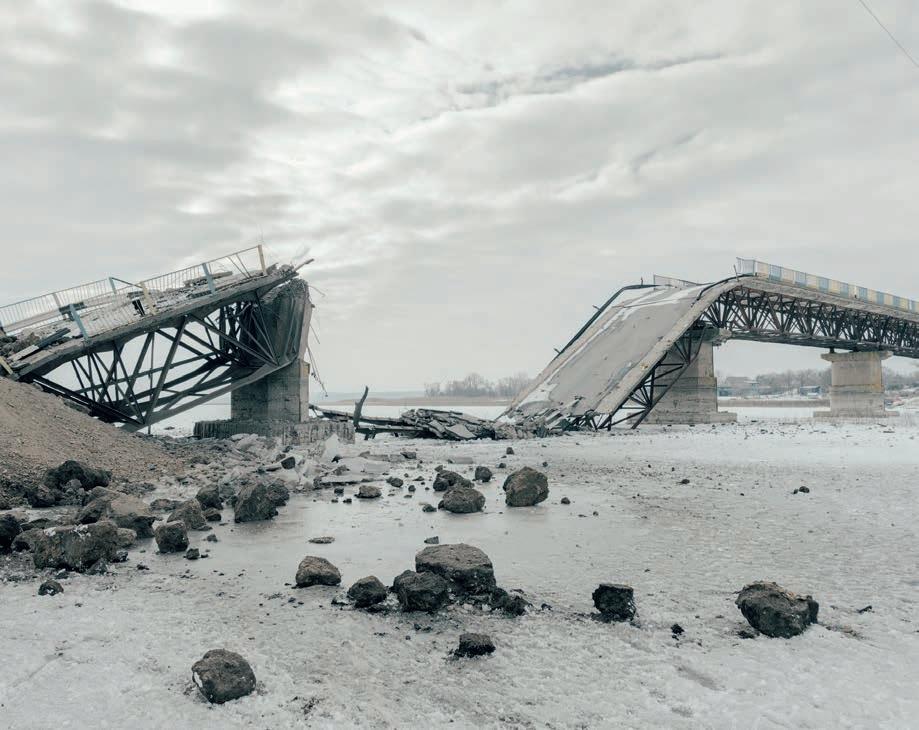
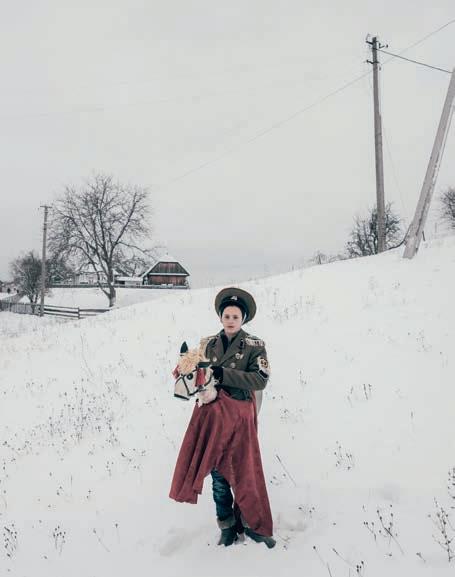
Left: Bridge II, Gorochowatka, Oskil River, Ukraine, 2023
Below: Malanka II, Krasnoilsk, Ukraine, 2018
by Robin Hinsch
£45, GOST Publishing, Hardback, 154 pages, ISBN: 9781805980186
Robin Hinsch’s Lonely Are All the Bridges is among one of the more restrained photobooks emerging from Ukraine over the past decade and as a result, one of the most affecting. Hinsch is careful to state that this is not a war book, at least not in the conventional sense. There are no decisive moments or scenes of frontline drama. His approach allows a more melancholic portrait of a country shaped by historical fracture, political instability and the decimation of certainty.
Hinsch first visited Ukraine in 2010. The landscapes are heavy with mist, rain and snow. Soviet ruins and monuments sit uneasily alongside contemporary interiors, workplaces and fields. People appear carefully placed within these environments, often distant or absorbed, rarely heroic. The sequencing challenges narrative clarity. Images move between monochrome and muted colour. The lack of captions or dates helps merge them into a harmonious book.
You could view the animals that drift through the book as symbols of abandonment and survival – feral cats and
dogs, wild horses and a bear pacing inside a zoo enclosure. A child is photographed wearing a bear costume. A woman leans on a camel. These moments introduce a faintly surreal, allegorical quality. Recurring images of bridges reinforce this idea; structures designed to connect stand alone, suspended between opposing sides. The title feels apt, borrowed from a poem by Ingeborg Bachmann.
Hinsch cites Andrei Tarkovsky’s film Mirror as an influence, the comparison is well judged and like Tarkovsky, favours fragmentation over linear storytelling. Memory, observation and atmosphere coexist without explanation. Julian Stallabrass’s essay rightly frames the work as an accumulation of time rather than an argument.
Today, we are necessarily confronted with urgent, often brutal imagery from Ukraine. Lonely Are All the Bridges offers a welcome space to reflect. It is a rare book about uncertainty, endurance and the long shadows cast by history. The reader is trusted with that ambiguity rather than forced to seek a resolution. Peter Dench
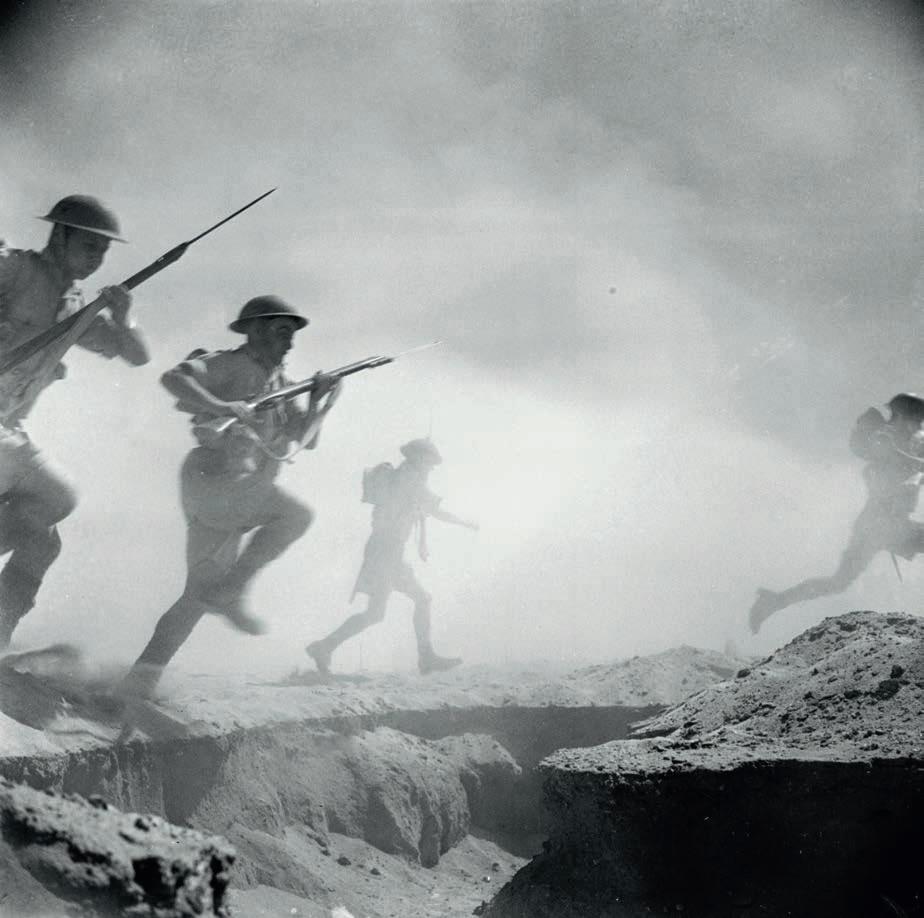
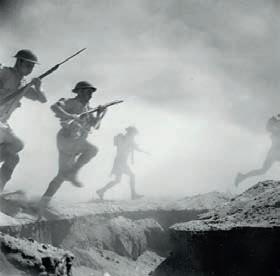
British Infantry Charge an Enemy Position through the Dust and Smoke of the Battle, El Alamein, Egypt, 1942. The Army Film and Photographic Unit was established in 1941 and produced images of combat in North Africa, some of which were authentic. This image is a staged reenactment of British infantry advancing in battle, taken by one of the Unit’s photographers, Sergeant Len Chetwyn. Thunder flashes and grenades were detonated to create dust and smoke.
Conflict photography has been manipulated in a range of ways since the medium began, as Hilary Roberts reveals in her new book. She talks to David Clark
War photography is a unique genre in the sense that conflict images are created but also censored and manipulated on behalf of warring countries. This is done for reasons ranging from national security and propaganda to maintaining public morale. The old adage, ‘the first casualty of war is the truth’ is as true today as it has ever been, especially now images can be altered with sophisticated digital technology including generative AI.
The numerous ways in which, throughout photography’s history, images have been manipulated, altered and purposely created to deceive is the subject of a new book, The Camera at War: 170 Years of Weaponizing Photography. The book also examines cases in which manipulation has been used to inform, engage and entertain audiences, and to create works of art.
For the author, Hilary Roberts, war photography has remained a fascinating subject throughout a distinguished curatorial career that has included 17 years as the Head Curator at the Imperial War Museum’s Photographic Archive.
‘The fascination of conflict photography for me is that it’s a very broad genre involving many types of photography, amateur and professional,’ Roberts says. ‘But it also has many complexities and I’ve always been interested in manipulation in conflict photography and the impact it has had.’
The book, she continues, is not intended to offer a canon of conflict photography but is entirely focused on manipulation – ‘the art, the techniques, the application and the motivation.’ Its intention is ‘to look at the ways in which individuals and institutions have intervened in pictures, what has driven that intervention and the consequences for the events at the time, but also the legacy of that intervention.’
The importance of photography in shaping the narrative of conflicts has been understood by governments from the medium’s earliest years. During the Crimean War (1853-56), Roger Fenton, now seen as one of the first war photographers, was commissioned by his publisher to travel from England to the Crimean battlefields. He
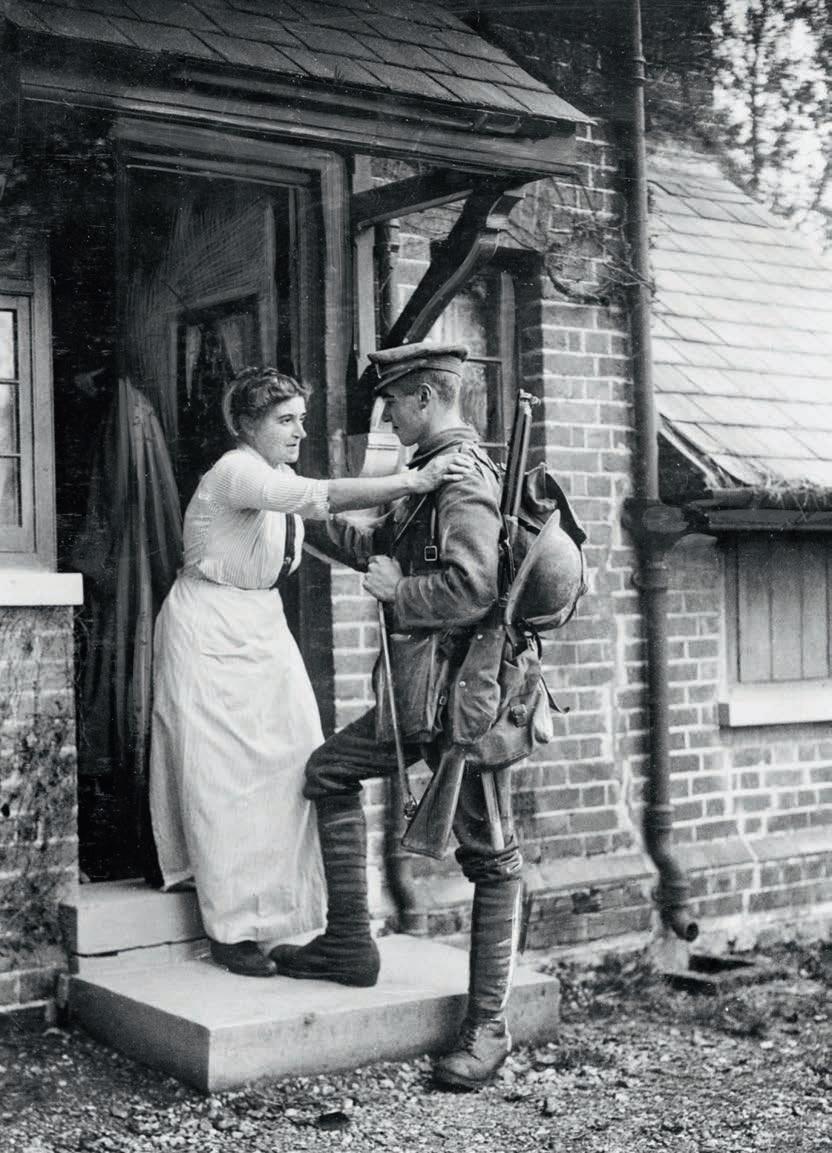
Fourteen Days’ Leave, England, c.1917. This is one of a sequence of posed propaganda photographs by Horace Nicholls for the British Department of Information during the First World War. It shows a mother saying goodbye to her son, who is returning to battle, and was created to publicise the War Office’s announcement that troops serving on the Western Front were eligible for 14 days’ leave every year. The ‘mother’ and ‘son’ may not have even known each other before this carefully-arranged shot was taken, but the public would probably have assumed it was authentic.
worked with very cumbersome and technically-limited equipment and used it to produce positive images of a conflict that was unpopular with the British public.
Fenton’s Crimea images famously include his alleged re-arrangement of Russian cannonballs in his image ‘Valley of the Shadow of Death’ to create a more dramatic scene. In the following years, ways of presenting images broadened to include handwritten annotations and picture mounts that guided the viewer towards perceiving images in certain ways. Printing techniques also developed to include composite images.
By the time of the First World War, sophisticated composites were being made from many different individual shots that showed scenes such as battlefields which would have been technically difficult or physically dangerous to take as single images in the field. However, although photographers such as Frank Hurley, then an Australian official war photographer, argued that image manipulation was necessary to create ‘truthful’ images, others believed it was wrong to pass off fake images for real ones.
Roberts continues, ‘Due to the scale of events in that war, and the public’s desire to gain a truthful understanding of what was going on, falsification of photographs came to be seen as completely unethical, whereas previously it was seen as acceptable because of technical limitations.
‘The First World War was also a turning point in conflict photography in terms of access and controls. That was when photography became a mass medium of communication and initially the major powers sought to deal with this by either ignoring it or excluding photographers.
‘However, amateur photographers – soldiers and nurses with cameras – were telling the story in their own way, and that was the point at which the world, in terms of governments and armed forces, woke up to the fact that controlling the narrative is essential.’
Accordingly, in the Second World War, conflict images documented events in greater detail than ever before, but were also much more strictly controlled by all governments involved. In the UK, images of damage caused by German
bombing taken by press photographers, for example, were heavily censored to avoid undermining public morale or to obscure locations for operational reasons. At the same time, the propaganda value of images that strengthened morale, including posed and staged images, were used by all sides.
Photography of later conflicts, such as the Falklands and Iraq, were also subject to various forms of control, while in the current Ukraine-Russia war ‘text-to-image’ artificial imagery has been used by both sides as propaganda and disinformation material, spread particularly via social media.
Today, with generative AI making it easy to convincingly alter existing images or even create them from nothing with a few clicks, can people believe anything they see in conflict photography? Roberts says we are now at risk of all-out cynicism and disassociation from photographs as a means of communicating conflict, but believes there’s still very much a place for photographs of conflict today.
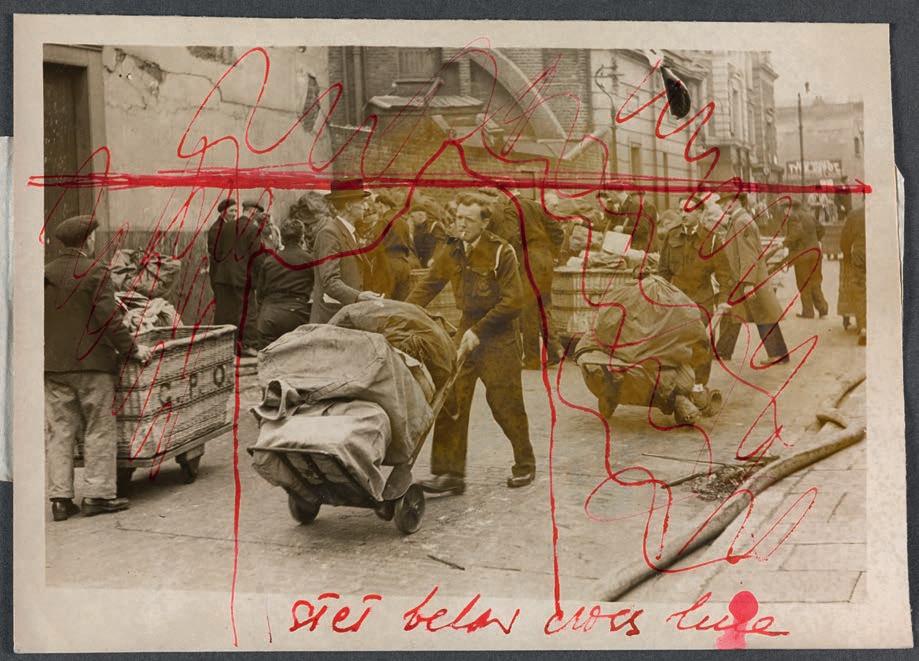
The Destruction of Mount Pleasant Parcel Sorting Office, London, 18 June 1943. On the day this image was taken, by an unknown photographer for the Evening Standard newspaper, a German incendiary bomb destroyed the building where parcels were sorted. Two workers were killed and 77,000 parcels destroyed. The red marks on this print show how the censor cropped the image to decontextualise it and remove details that show the scale of the damage.
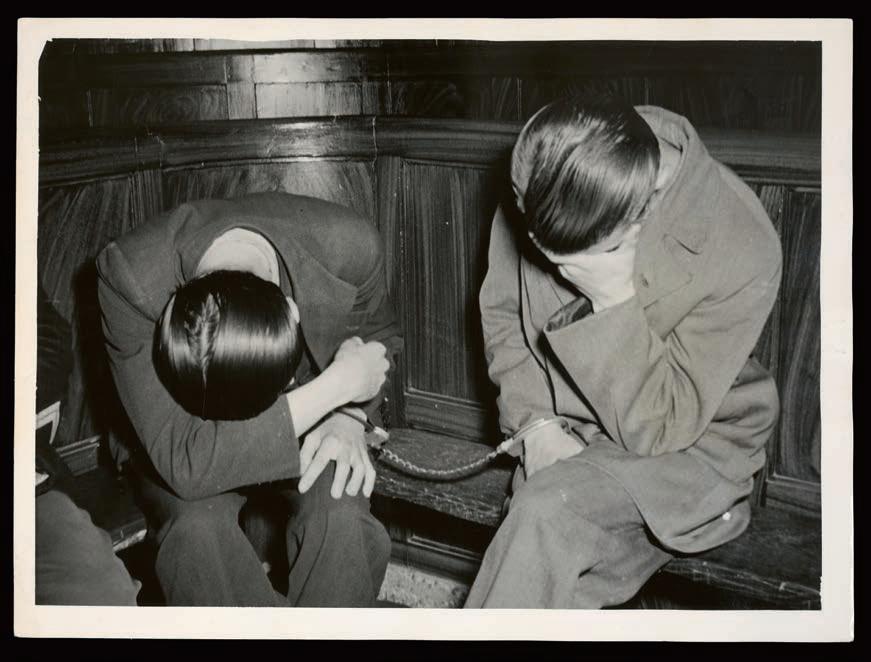
First Trial for Treason in Liberated France, Cherbourg, France, 8 July 1944. This shot, by Richard Boyer, an official photographer for the United States Office of War Information, was taken in France a month after D-Day. The two people in the image, Roger Leroy and Jean Tournu, were on trial accused of espionage on behalf of the Germans and were subsequently convicted. Photographing prisoners in this way during wartime was intended to humiliate and intimidate the prisoners and undermine the cause they represented.
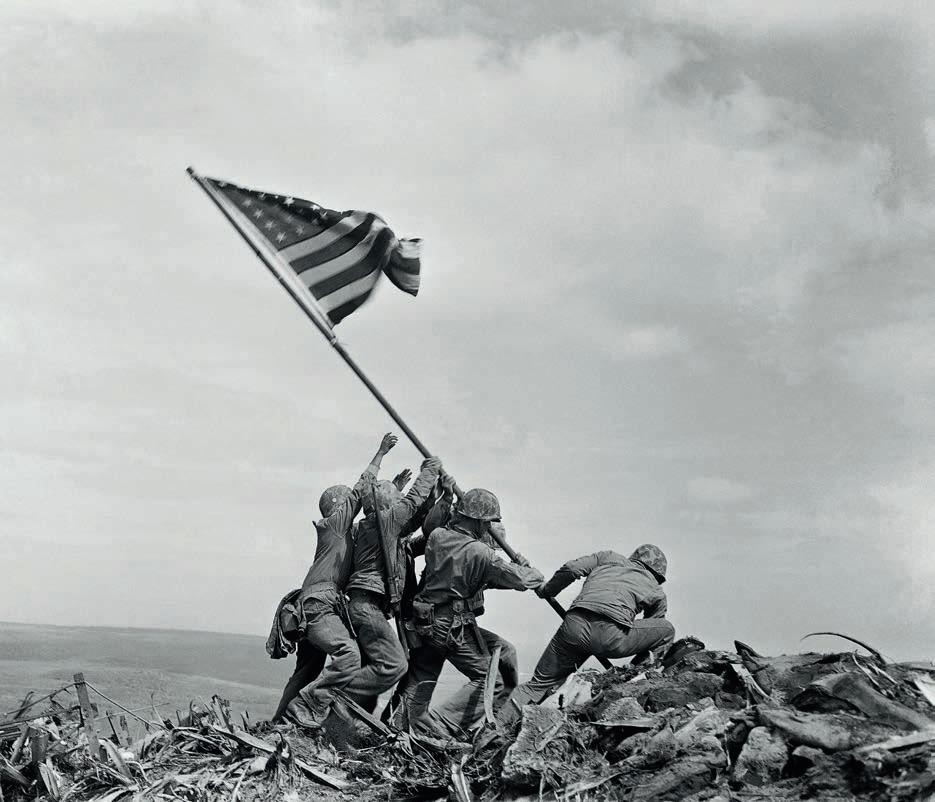
Raising the Flag on Mount Suribachi, Iwo Jima, 23 February 1945. The island of Iwo Jima was the site of a major battle in the Pacific during the Second World War, lasting from 19 February to 26 March 1945. This famous image, taken by Joe Rosenthal, shows US Marines and a US Navy Corpsman raising the American flag on Mount Suribachi, just four days after the battle began and long before it ended. The scene shows a re-enactment of an earlier flag-raising, ordered because the first flag was smaller and not visible from below. The image raised public morale as it was seen as a sign that victory for the US was imminent and subsequently became one of the war’s most iconic images.
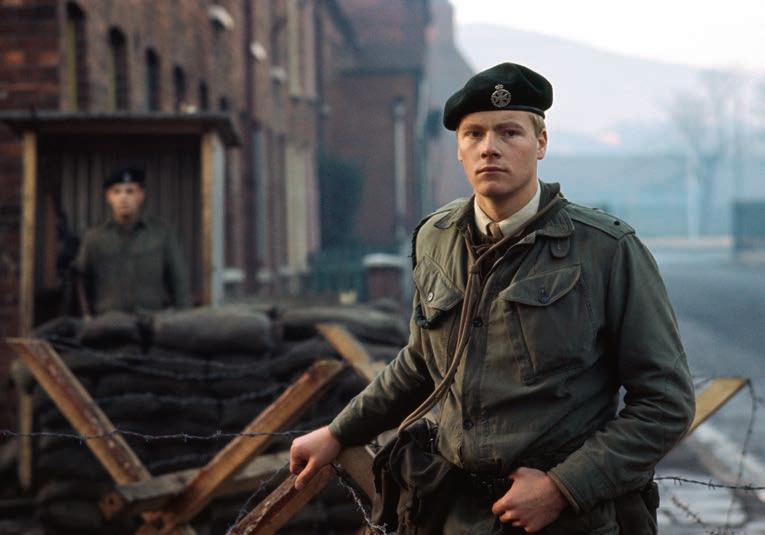
Royal Green Jackets Man a Street Barricade in Belfast, Northern Ireland, Autumn 1969. When the British Army deployed to Northern Ireland in August 1969, a response to increased sectarian violence, images were needed that reinforced the message that the troops were a neutral force with a peacekeeping role. This propaganda image of troops on barricades, taken by an unnamed British Army official photographer, shows 2nd Lieutenant James Dean (foreground) and Riflemen Peter Edge of the Royal Green Jackets.

‘Our society is led by images more so than at any other time in the past, and when there’s a piece of news, we look for images of it. But we all have a responsibility to engage with photography rather than simply consume it,’ she says.
‘We have to think how images were created and for what purpose. We shouldn’t simply passively click on images that pop up on our phones and forward them without establishing to our satisfaction whether we’re perpetrating misleading information. We have to look for evidence that substantiates a picture in other formats – a piece of film, a piece of writing or anything else that might shed some light on it. When it comes to a lot of the content that passes before our eyes, there is evidence there, we just have to take the time to look for it.’
The Camera at War: 170 Years of Weaponizing Photography, by Hilary Roberts, is published by Ilex Press, RRP £40.
Defusing a landmine in the desert, 1990. When the British 7th Armoured Brigade was sent to Kuwait in 1990 as part of preparations for the First Iraq War, it had to deal with large minefields laid by Iraqi forces in the Kuwaiti desert. It was impractical to photograph mine defusing in the field, so this image, taken by a British Ministry of Defence official photographer, was staged in a studio. The details, including the type of landmine and the beads of perspiration on the soldier’s forehead, make it look as realistic as possible.

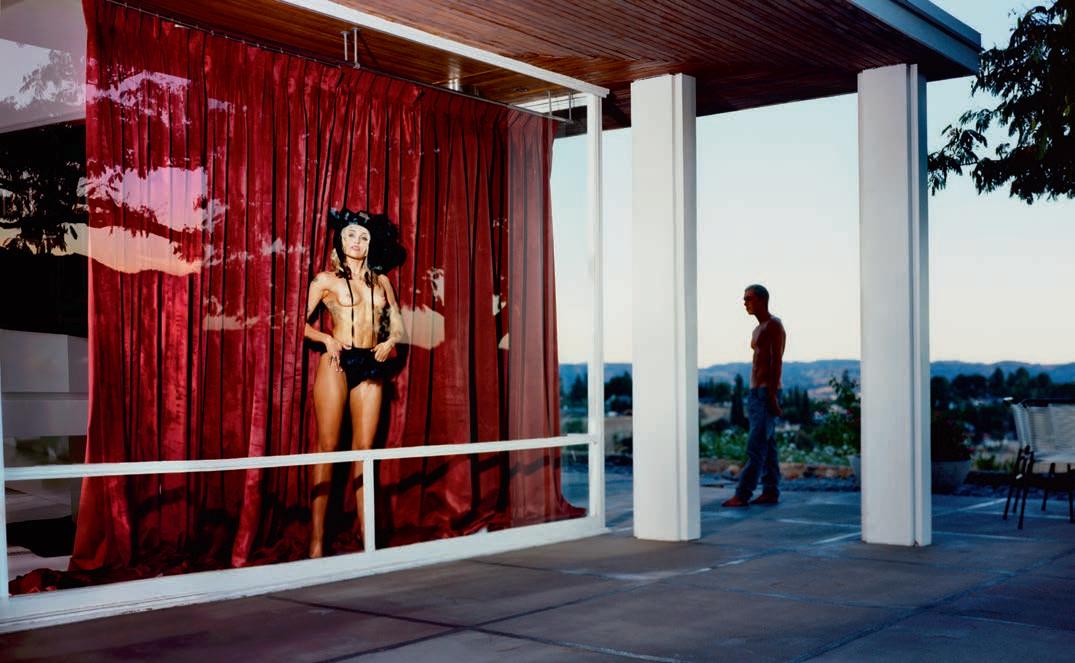
Brianna Capozzi’s stylish new book, Womanizer, casts a female eye over fashion and beauty. Steve Fairclough spoke to her to discover more about her career and work…
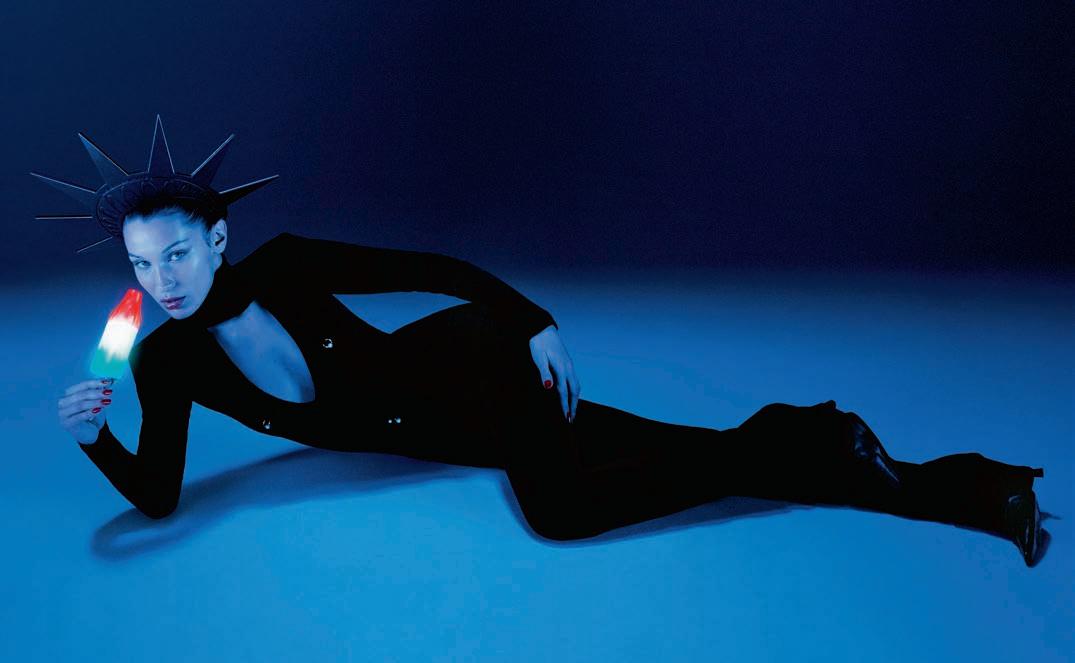
As a fashion photographer, when you’ve got a CV that includes photographing Jennifer Lopez, Sabrina Carpenter, Chloë Sevigny, Pamela Anderson, Dua Lipa, Miley Cyrus, and supermodels like Bella Hadid and Alek Wek… you’ve clearly arrived. All of them have posed for New York-based Brianna Capozzi, who has carved out a huge reputation for capturing the zeitgeist of modern fashion and sisterhood with her humorous, stylish, surreal and provocative imagery. Add to that more than 128,000 Instagram followers and three books to her name and it’s clear to see that Capozzi’s career is skyrocketing since first being published in 2014.
Her latest book, Womanizer, follows in the footsteps of 2018’s Well Behaved Women and 2024’s Sisters; both of which amply demonstrated Capozzi’s ability to photograph women with style, sensitivity and a splash of sexiness.

Womanizer is a 176-page tome from the Rizzoli stable that showcases Capozzi’s innate talent for capturing the female form with nods to high fashion, pop culture and an underlying eroticism.
The book’s foreword is penned by the actress Chloë Sevigny, who states, ‘Brianna’s photos always convey both power and humour –an unlikely, but magical, combination that produces images that vibrate with wonder and surprise.’ To find out the inside story AP caught up with Brianna Capozzi to discover her motivations, inspirations and her career journey thus far…
The New Jersey-born Capozzi originally planned to pursue a career in fashion design. In 2006, when aged 18, she moved to New York City and started studying what was known as an ‘integrated design curriculum’ at Parsons School of Design in the Greenwich Village
neighbourhood of the city.
She explains, ‘I was in college when I first started taking photos. I had been making garments and wanted to document them. I started shooting a series that became more about portraying an imagined world and characters than about the clothes I was making… and the shift from designing clothing into photography felt natural. I became more interested in the image-making process and all the elements that go into creating a character than the clothes themselves.’
A self-taught photographer, Capozzi’s photographic breakthrough came when an art director saw her pictures on her Tumblr account, which she admits was ‘small’ at the time, and this led to a commission to shoot a Victoria Beckham look-book... not a bad way to kickstart a career in fashion photography! After the Beckham shoot she quickly quit her job in a Dimes store and decided to pursue her passion for
Brianna Capozzi is a New York-based photographer. She has spent the past decade contributing to a movement of contemporary female-led fashion photography with her trademark surreal style. Her work has been published in American Vogue, British Vogue, Vogue Italia, Dazed Magazine, Interview, Pop Magazine, Double Magazine, M: Le Monde, Re-Edition Magazine, and others. She’s photographed campaigns for Gucci, Marc Jacobs, Calvin Klein, Cartier, Nike, Adidas, Victoria’s Secret, Fenty, Rare Beauty and Burberry. Capozzi shot the album cover Endless Summer Vacation for musician Miley Cyrus and her first two books were Well Behaved Women (2018) and Sisters (2024). Instagram: @briannalcapozzi

photography, which initially often involved working with friends and lighting shoots with a hardware store ‘clamp lamp’.
Capozzi ponders on what was her big break and reveals, ‘I don’t know if I had a big break, but working with
[actress] Chloë Sevigny was a pivotal moment in my career. I started shooting her a year or two into my career, thanks to [fashion stylist] Haley Wollens, and – while we were young, ambitious, and scrappy – she trusted us. At the time, I didn’t
Above: Bella Hadid, New York City, 2018
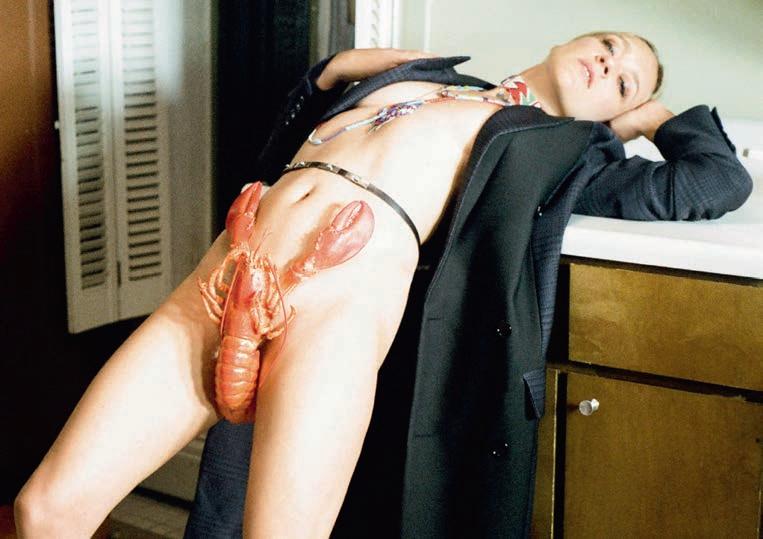
Below: Chloë Sevigny, Edgewater, New Jersey, 2014
realise how unique it was for someone of her calibre to be so open to experimenting and pushing boundaries. It’s truly rare. We made this incredible shoot with her playing different characters, and people noticed that story.’
The shoot that Capozzi’s referring to, saw Sevigny playing those characters for fake movie posters that Wollens and Capozzi had dreamt up, including wearing a lobster as underwear, which Sevigny claims was later offered up for dinner to Capozzi’s parents. The pictures were shot for the magazine Marfa Journal and in the foreword to Womanizer, Sevigny recalls, ‘It was a low-budget affair – folding tables for hair and make-up on Brianna’s parents’ deck. The humour she [Capozzi] projects on set, and in to the work itself, was something I hadn’t experienced in a long time, if ever. It’s still the main reason she has come to be my first request.’
In her foreword Sevigny also describes Capozzi as having ‘bravery and passion’, so I put it to Capozzi that she might inject that bravery and passion into her photography. She fires back, ’I am from New Jersey and Italian. Passion is in my blood.’
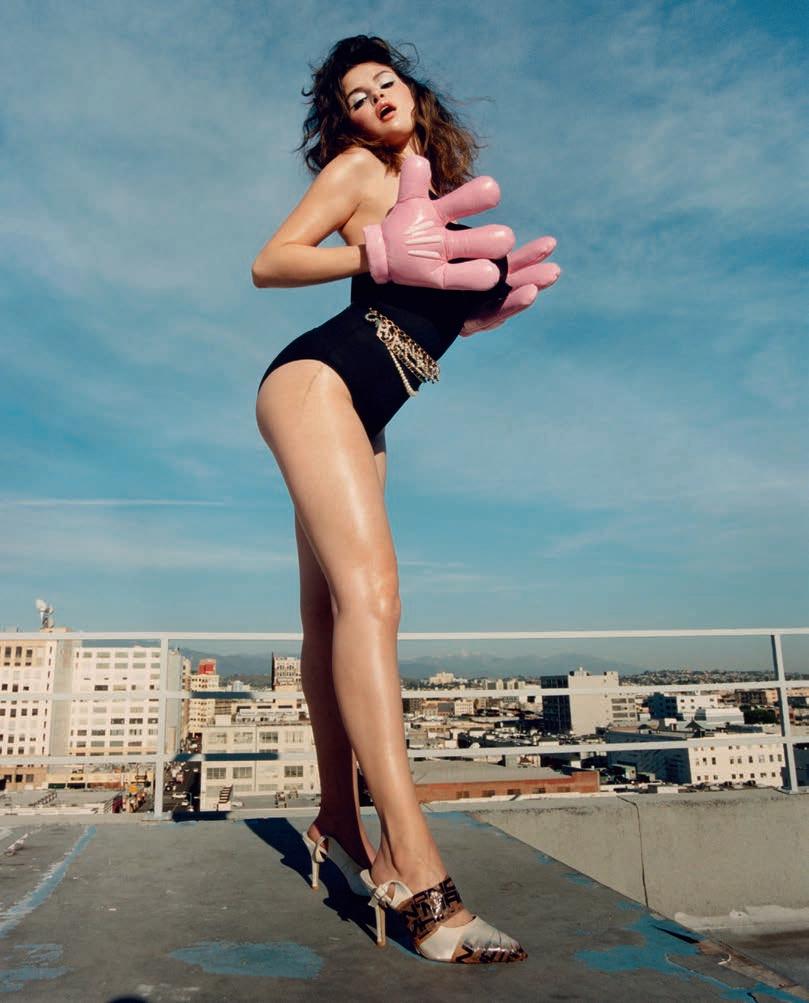
Although she was never a straightout photography student, Capozzi’s style has been inspired by several famous photographers. ‘I’d say my biggest influence is Helmut Newton. I feel very aligned with his ideas and subjects. His photographs are never boring. Even his most simple images have a sense of tension and excitement to them. Besides him, Steven Meisel, Guy Bourdin, and Cindy Sherman are all photographers whose work I am moved by.’
She recalls, ‘I always aspired to be in fashion in some form. Originally,
I wanted to be a designer and was focused on making one-of-a-kind garments by hand, which led me into photography. I love clothing and style. It articulates so much personality in the world. A specific garment can inspire me to want to make an image, and keeps me interested in making new work. I’m especially drawn to archival fashion and fashion history within specific eras and designers.’
Her images are shot on a variety of formats – 35mm, medium format, 4x5 and Polaroid. During a period of Covid quarantine she also notably shot a Vogue Italia session
with supermodel Bella Hadid via FaceTime, calling Hadid back when a new idea was ready in terms of hair, make-up and props.
The conversation then switches to her creative process and, in particular, I ask her about the images in Womanizer. Capozzi replies, ‘My process varies.
Sometimes it’s very D.I.Y. where I’m working entirely alone with my subject. Other times I’m collaborating with incredible teams of stylists, hair and make-up artists, set designers, lighting etcetera.
For the images made specifically for this book, I started with the woman. I sent casting director Julia Lange a list of women who I have always wanted to photograph but hadn’t yet, as well as cast models and close friends who I have a long-standing rapport with. I would concept the idea around them, building up from the character I want them to play.
‘My previous book was a lot of intimate nude portraits that were very stripped-back. I was excited to take it back to my roots and go full-throttle fashion for Womanizer.’ I float the idea to Capozzi that her being a woman might be a driving factor in her being able to capture such powerful images of other women, but she quickly slaps that suggestion down. ‘I don’t think of it like that personally, and have no idea what it’s like to be a man and photograph these women. I just know that I love shooting women more than anything, and I feel very powerful when I’m around them and collaborating with them.’
Her 2024 book Sisters was shot over a six-year timespan and deliberately focused on sisters in their homes across the US, but Womanizer takes a much broader-brush approach. Capozzi explains, ‘While I was working on Sisters I started to look through my archive. I went through each shoot and each roll, tens of thousands of images, and started to see my work through the lens of a specific energy and type of woman: sexy, cheeky, and in-your-face, timeless and dominant.
‘Seeing specific images sit together emphasised the nuance of my images and characters in a way I had not seen so directly and vividly. With that idea in mind, it felt
like the perfect time to put something out that spanned the duration of my career, mixing early works alongside new.’
That mixture in Womanizer includes actors, singers, models, icons, and family members, with over 130 different images, many of which exude style but would probably be filed, perhaps unfairly, under the NSFW bracket. Notably, Capozzi both dived into her archive and decided to shoot fresh work for Womanizer
In her intro to the book Capozzi writes, ‘Whether I am shooting for my best friend in my small Brooklyn apartment, with dollar store make-up and press-on nails, or a supermodel in a garden at Villa Vizcaya, I push for that moment,’ so I ask her what that means. She reveals, ‘There is a level of intrigue and exuberance that I’m always searching for within each image that I make. I push through ideas as I’m behind the camera until something hits.
‘It could be the way their body is positioned, the expression they suddenly make, a light change, the way the hair is falling, or the composition I finally find. That
makes the image mine. I know it when I see it.’
She adds that the main challenge of the book project was, ‘…once I decided I wanted to shoot new work for it and not have it be only a retrospective. It was hard to find the time to concept new shoots and make them all happen in the midst of campaigns and editorials.’
To edit down her career portfolio thus far to fit into the constraints of a book format ‘took months’, but Capozzi didn’t do it as a solo project – she actively asked for input and opinions. ‘I looked through every shoot and every film roll I have made for over a decade... tens of thousands of images, starting in 2012. I focused on the energy of the image. The photo had to be fun and it had to feel like the essence of my woman was coming through.
‘Once I had narrowed it down I then asked my closest friends, stylists, boyfriend and agent their opinions. I love to ask people their opinions. From there I worked closely with Carina Frey and Stephanie Barth, who designed the book, to finesse then finalise the selection, the order and layout.’
The photographs in Womanizer do clearly display artistic nods to the timeless photography of Helmut Newton – notably a shot of three models surrounding a car, clothing, styling and an inherent lack of fear when addressing nudity in pictures. There are also hints of Guy Bourdin’s influence with some of her close-up images of glossy red lips and her use of colour. But there’s also a playfulness and freshness to Capozzi’s images that projects a more modern approach, and she states she wants to ‘excite and entice’ anyone viewing her images.
As the interview draws to a close I ask Brianna Capozzi what she’s most proud of from her career and get a typically frank answer.
‘Honestly, it sounds cliché to say this, but this book. It’s such a special accomplishment to have a Rizzoli book with this many fabulous people in it shot by me… and that I continue to love the images and work that I make. I stuck to my authentic vision through the years as I navigated the industry and my evolving career. That’s not always easy and is something I hold a lot of value in.’




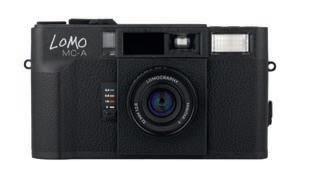
l 3 5mm film camera
l 32mm f/2.8 lens
l Manual settings control
l DX coding
l Top-plate LCD screen
l Available in black or silver
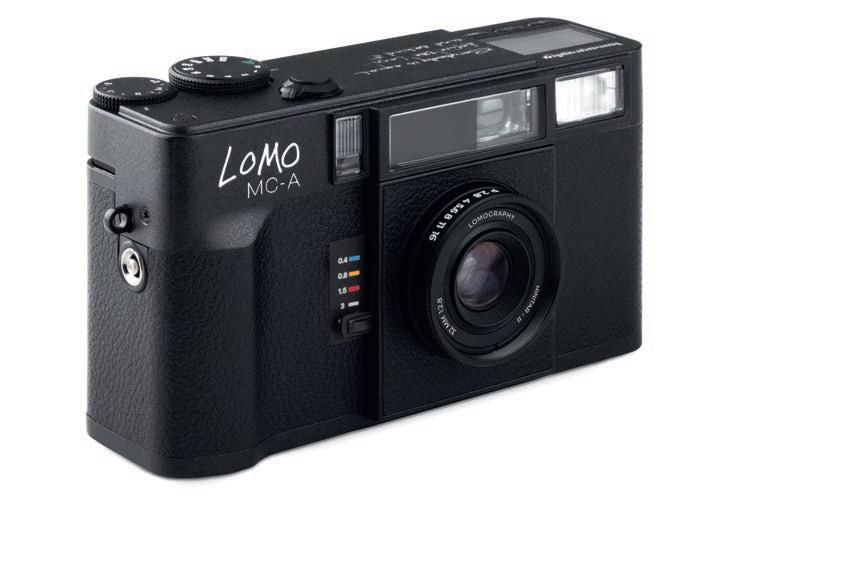
Lomography’s ambitious new 35mm film compact boasts premium metal build and manual settings control. Jon Stapley finds out how well it works
For and against
Stylish, sturdy metal body
DX-coding compatible
Manual settings control
Lens performs quite well
Small, cramped viewfinder
AF can be unreliable
Some image bleed between frames
Lens 32mm f/2.8
Lens elements 5
Minimum aperture f/16
Minimum focus 40cm
Shutter speeds 1-1/500sec + bulb
Film speeds ISO 12-3200
Exposure modes Manual, Aperture Priority, Auto Exposure
Viewfinder
It’s fair to say there was a fair bit of excitement, both in the AP offices and beyond, when Lomography took the wraps off the MC-A. The Lomo MC-A was not just a brand-new film camera, but was a lovely-looking, metal-bodied machine, with full manual control dials, a manual film winding lever, and a Minitar II-branded 32mm f/2.8 lens on its front. Could this finally be the modern analogue point-and-shoot boasting both style and substance?
At a starting price of £449, the Lomo MC-A isn’t a cheap camera, though it does notably undercut the similar Rollei 35AF, and comes at about the same level as the half-frame Pentax 17. Indeed, the retro throwback market has been rather rife with overpriced disappointments of late, not least of which is
Fujifilm’s £699 ‘digital half-frame’ novelty item, the Fujifilm X-half. So, the pressure was on. I was keen to see whether the Lomo MC-A would finally be the premium modern point-and-shoot that analogue shooters have been hankering after. So, I took it out to the streets of London and ran a couple of rolls of 35mm film through it to find out.
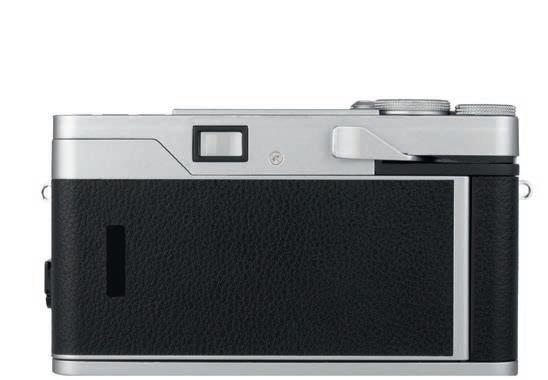
If you’re used to cheap modern film point-and-shoots like the Kodak Ektar H35N, then the first time you pick up the Lomo MC-A is going to feel like a wonderful breath of fresh air. Out, out cheap plastic – this baby is built around a chassis of solid metal, and has a gorgeously reassuring heft to it. It weighs 332g, and measures 125.8mm x 69.5mm x 42mm. On the top plate, you have most
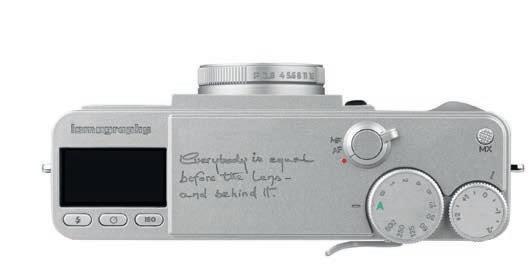
of your controls, including dials for shutter speed and exposure compensation, as well as buttons for flash, self-timer and manual ISO input. On the right-hand side is an ‘MX’ button, which you could be forgiven for not knowing refers to multiple exposures. A ring-style switch around the shutter button ser ves as the AF/ MF toggle, while also serving to power the camera on and off. Composition is accomplished via a small optical viewfinder, sitting above the lens. A bright top-plate LCD on the left side gives you a shot counter, remaining battery, as well as displaying the current focus and flash mode. It displays settings info when you half-press the shutter, and also plays a neat little reminder animation if you try to shoot without winding on. On the subject of winding on,
this is accomplished via a delightfully slick lever that sits nicely under your right-hand thumb. It has quite a bit of travel, and you may find yourself caught out a few times when you can’t capture your next frame because you didn’t quite push it to the full extent. Once you get used to it though, it feels very satisfying. When the camera is booted up, the little 32mm f/2.8 lens extends very slightly, revealing a fiddly but serviceable aperture ring. To the right of the lens, you have the manual focus switch that allows you to select various focus zones, from 0.4m to infinity. The front of the camera is textured plastic, and there’s a little raised bump on the right-hand side that vaguely gestures towards the idea of being a handgrip. The camera is powered by a CR2 battery –
though, in a nice touch, Lomo has included a rechargeable CR2 in the box, and this can actually be removed and topped up via USB-C.
Now, I’m going to talk about something that may seem a bit trivial, but was invariably the first thing commented upon by every single person I showed this camera to. On the top plate, unmissably centred, is a handwritten inscription, reading ‘Everybody is equal before the lens – and behind it.’ I don’t take any issue at all with that sentiment. All the same, I would happily pay a premium to get a version of the camera that did not have this written on it, and I suspect I’m not alone.
Or maybe I’m just being a grinch. Ultimately, the build quality of the Lomo MC-A is just what it needs to be. It’s small
enough to be pocketable, but doesn’t feel cheap. It’s an attractive object that you want to pick up and use.
The star feature of the Lomo MC-A is its lens. A 5-element optic with Minitar-II branding, this 32mm f/2.8 specimen is made with multi-coated Lomo glass. It can focus as close as 40cm, which you either can let the LiDAR autofocus take care of, or handle yourself by putting the camera in MF mode, then using the switch on the front to select one of the focus zones – 0.4m, 0.8m, 1.5m, 3m, and infinity. Indeed, in pretty much all aspects of the camera’s operation, you have the choice between auto and manual.
Shutter speed can be left to its own devices, or dialled in
The MC-A offers either automatic or manual control of focus and exposure settings
The top-plate LCD screen on the Lomo MC-A displays a shot counter, flash settings and self-timer settings. When the shutter button is half-pressed, it changes to show exposure settings, and it also plays a winding animation if the shutter is pressed without winding the film.
Using the top-plate control dials, the user can set the MC-A’s shutter speed to a specific value, or leave it in Auto mode. The exposure compensation dial allows the user to set up or down by up to 2EV, in half-steps.
With the switch set to AF, the MC-A will use its LiDAR autofocus to select an appropriate focusing zone. When it’s set to MF, the user manually selects their own focusing zone via a sliding switch on the front.
The 5-element, multicoated lens offers aperture control from f/2.8 to f/16. Its focal length of 32mm makes it well-suited to street and general-purpose photography.
The long manual winding lever on the right-hand side has a spring-loaded action and a long throw. It sits nicely under the thumb and winds with a smooth action.
An unfolding crank on the base plate makes it easy to manually rewind film once the roll is completed. The rewind button must first be pressed to avoid damaging the mechanism or the film.
from 1sec to 1/500sec, with a bulb mode also available. For this, you’ll likely want to make use of the tripod screw thread on the bottom, which is unavoidably tucked off to one side, due to the base-plate rewind crank taking up most of the real-estate.
Aperture runs from f/2.8 to f/16. The camera can recognise DX coding, meaning it will read DX-coded film to set ISO automatically to the appropriate value. But you can manually override and set it to any value from 32 to 3200 if you want to shoot above or below box speed – great if you plan to push or pull your film in development. The MC-A also has the ability to create multiple exposures, and you can expose the same frame of film as many times as you like.
Elsewhere, you’ve got a built-in flash, with an auto mode as well as front-curtain and rear-curtain
sync, and the option for PC sync flash connection for studio shots. There’s a self-timer function for selfies and group shots, with up to 30 seconds available. Lomography has also packed out the box with extras, including a wrist strap, a book of inspirational images and quotes, some coloured gel filters for the flash, a protective wrap for transportation, and the ‘Splitzer’ lens attachment, which works with the multiple exposure function to create split-image effects.
One of the best compliments I can pay the Lomography MC-A is that it feels like you’re using a proper camera, which isn’t something you can take for granted when it comes to new film compacts. That satisfying metallic weight, that whip-snap wind-on lever, the real bona-fide aperture ring – all of it adds up to
a camera that feels like a camera. I was testing this model at the same time as a new point-and-shoot – the Kodak Snapic A1, from Reto Project –and the MC-A made that camera feel like a child’s toy.
It’s not all plain sailing, though. I wasn’t a fan of the MC-A’s viewfinder; it’s small and cramped, with pronounced distortion that sees straight lines becoming bendy. I would have loved a bigger viewfinder, not only to aid composition, but also because some more visual real-estate might have allowed Lomo to put some useful information in there. As I mentioned earlier, the top-plate LCD displays exposure settings when the shutter button is half-depressed – but when I’m half-depressing the shutter button, I’m only ever looking in one place: through the viewfinder. So, anything I need to know really should go there!
You do get some blue and orange lights in the viewfinder and referring to the manual will inform you that blue means the focus is set (it blinks if you’re too close), while orange is a warning that the shutter speed is below 1/30sec, meaning there’s likely to be image blur. Better than nothing, but if Lomography takes another crack at this camera, an improved viewfinder is going to be
at the top of my wishlist.
The aforementioned visual wind-on reminder on the screen is a handy prompt, especially when you’re getting used to the camera. But – and I’m going to be vulnerable with you now – do you know what would have been a more useful reminder, for me personally? The damn lens cap. Laugh if you want. I did. But the tiny, adorable lens cap is so easy to forget about, especially when the only warning you get that it might still be on is a vague orange glow, obliquely saying: hey, your shutter speed is kinda slow for some reason.
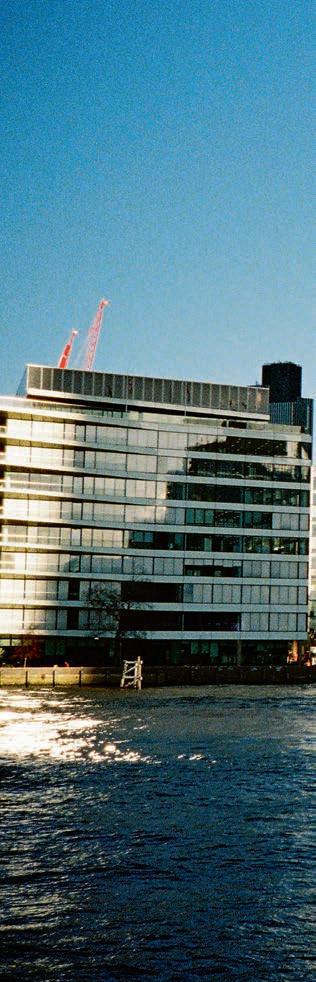
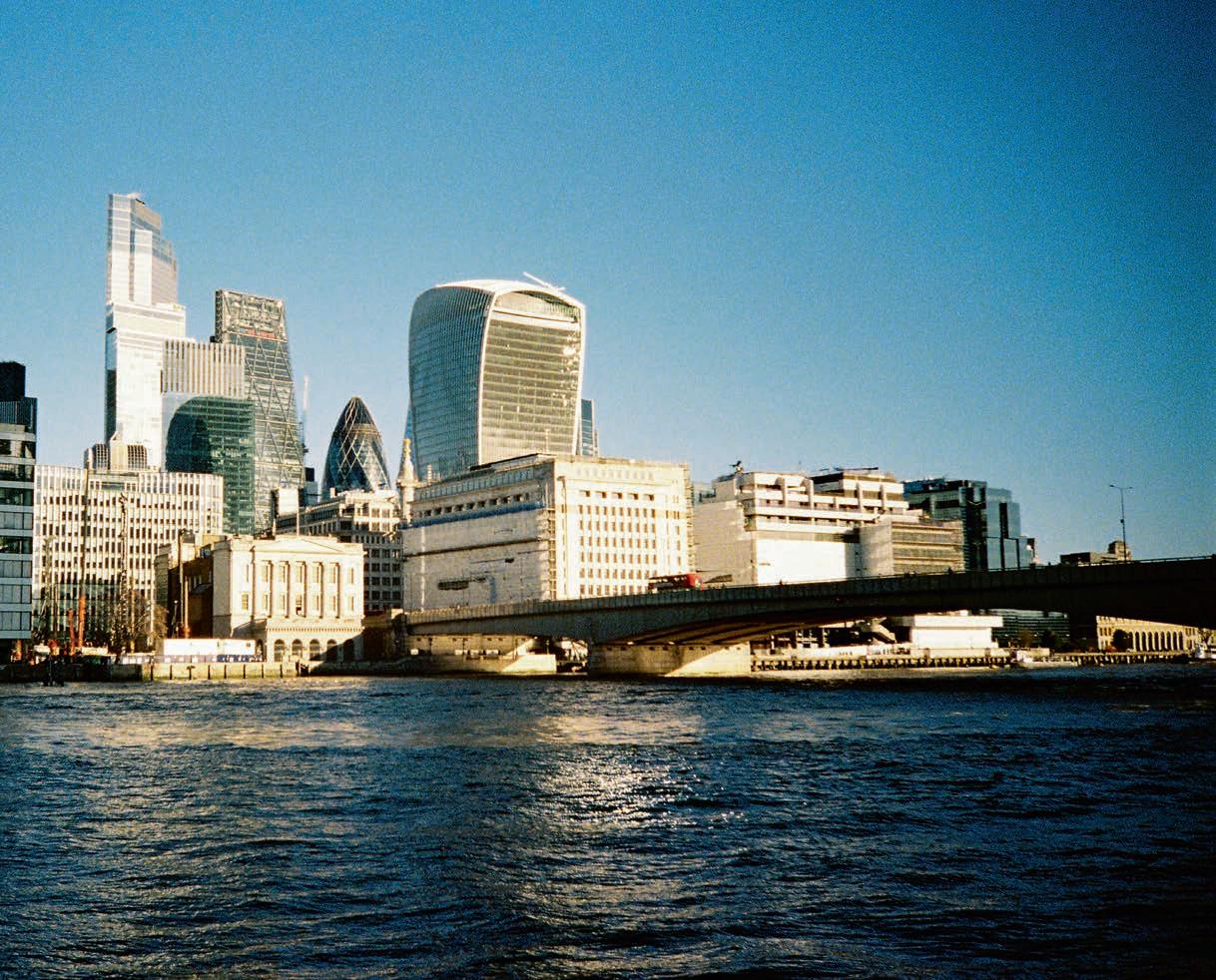
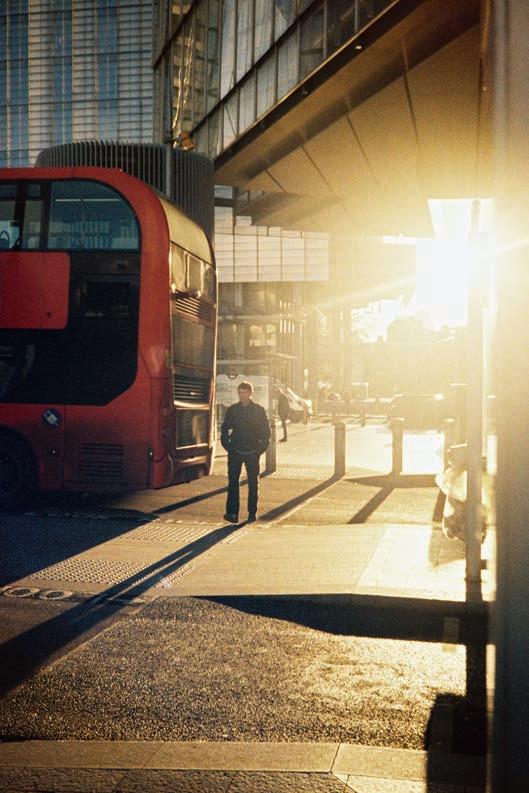
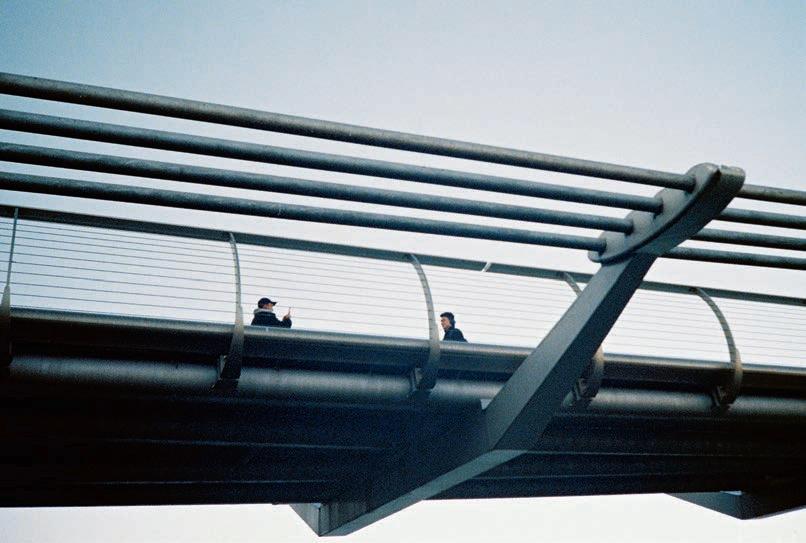
Still, I was pleased overall with my images from the Lomo MC-A. I rattled through two rolls of color negative film, and the glass-elements lens produced a decent percentage of keepers. Exposures are accurate and well-balanced, and while there’s sometimes a little vignetting from the lens, it’s nothing to be overly concerned with – and in many cases enhances the retro feel of images.
My landscape-style images tended to be a lot more successful than my attempts at close-focusing – it pays to be aware of the limits of the LiDAR autofocus system. In complex scenes, it can get confused and focus on the muddy background rather than the pretty flower
I ENJOYED using the Lomography MC-A. Like any camera, you have to take some time to get used to its various quirks and eccentricities, but it looks beautiful and has a satisfyingly premium feel.
(or, apparently, on nothing at all).
When dealing with fast-moving targets like cyclists and scooterriders, I decided to use the MF switch and set the focus zone manually, and I reckon this is the best bet in situations where you want to focus on anything smaller than a building.
In a couple of my images, I noticed a slight image-bleed from one frame into another, on the right-hand side. I don’t think this is the result of light leak – given the sharply delineated nature of the bleed, I suspect that it might have been me not quite pulling that long-travel wind-on lever to its full extent, and the camera allowing the next exposure anyway. So, make sure you always give the lever a good firm pull, as far as it’ll go!
While the price-tag is significantly higher than many other analogue compacts, the shooting experience is a good deal better, and I think Lomo has done a much better job of justifying the price-tag here than the Pentax 17. I’d happily have traded the flashy but not-that-useful top LCD screen for a bigger and better viewfinder, though.
Otherwise, if you’re tempted by the Lomo MC-A, I think it’s well worth buying. It’s a fun camera to use, it produces solid results that will only improve as you get used to using it, and it feels well-built enough that it should last you many years of happy shooting.
Recommended
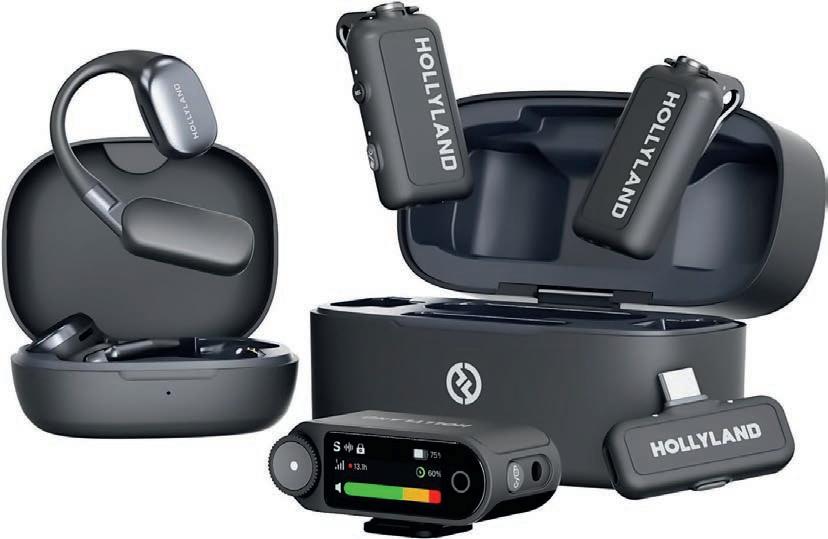
The Ultimate Combo kit includes wireless earphones with a range of 100m from the RX.
Battery life
We should get up to 11 hours of recording in one go. The case will recharge the TX and RX 2.5 times, giving a total of 36 hours.
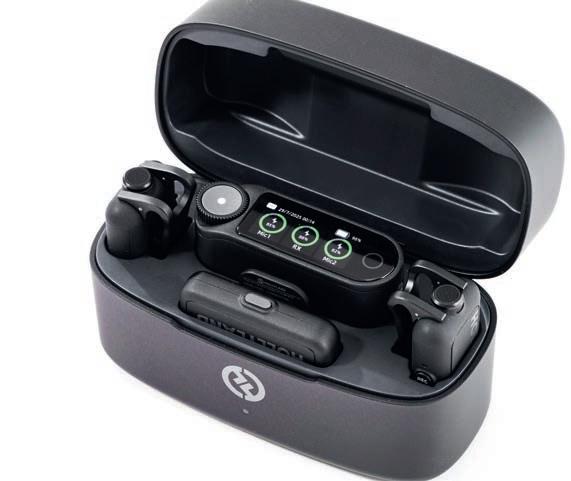
The TX units are small, light and designed to be easily hidden with no bright logos in sight.
There are so many wireless microphone systems on the market Hollyland needed to do something extra to stand out, says Damien Demolder. Are wireless earphones the answer?
Not all microphones are equal, but neither are ears. And while plenty of listeners can tell good from bad, many fail to pay enough attention to notice. I’m glad I don’t develop microphone systems, as I’d imagine it’s hard to sell them on audio quality alone. Hollyland has a great history of delivering very good quality, but not everyone can see that. However, everyone can recognise the appeal of this nicely designed kit, with its unique monitoring earpieces
that connect wirelessly to the receiver and/or your phone.
Stand-out features of the Lark Max 2 include the ability to connect four microphones to a single receiver, and process them all either into a single mono channel, or into a pair of stereo channels carrying signals from two of the mics each. The kit comes with two transmitters, but extras are available individually. Hollyland says the transmitter and receiver will communicate
Standard Combo l W ireless mic set
l Up to four TX units
l W ireless earphones
l A I noise cancellation
l 32-bit float recording and output
l 8GB internal memory
l www.hollyland.com
when up to 340m/1115ft apart. The transmitters are tiny, but conceal 8GB of built-in storage so they can transmit audio and record it at the same time. As is almost essential these days, 32-bit float is available, enabling wide dynamic-range recordings to the transmitter’s own storage. And 8GB allows 10 hours of chat to be held, or 14 hours if you elect for 24-bit sound. You can also output a 32-bit signal via USB-C to an iPad, iPhone or Mac computer – but not to a camera. For matching audio clips to each other and to camera footage, the Lark Max 2 offers Timecode recording and output via the TRS jack and the USB-C port on the rear of the receiver.
There’s a choice of noise cancelation levels, with options between 5 and 25dB in 1dB steps. Noise cancellation is AI-driven, and has been trained to recognise and cut such things as road noise, restaurant chatter and the hum of machinery. We also have EQ pre-sets for Hi-Fi, Low Cut and Vocal Boost, and gain settings of +/-20dB or Auto for individual mics.
The transmitter units have no 3.5mm port for Lavalier mics themselves. But they come with neat little caps that clip onto the bottom via the USB-C port, which allows mics to be connected.
The Ultimate Combo kit includes a pair of wireless earphone monitors that connect to the receiver unit via Bluetooth,
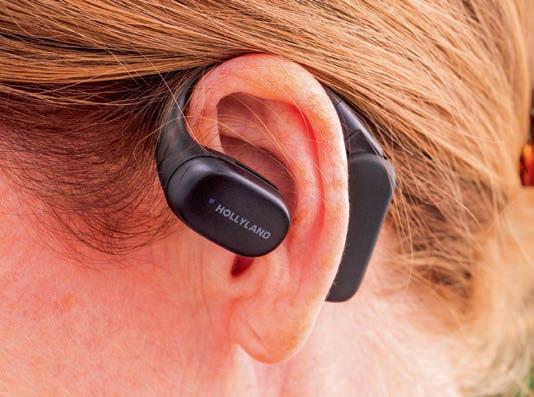
The earpieces are lightweight and comfortable
and allow us to hear what the microphones are recording/ transmitting without having to plug headphones into the camera. The arm of the OWS Monitor Earphones sits between the top of the ear and your head, and the speaker hovers by the tragus and over the concha to direct the sound down your ear’ole. The earpieces are very lightweight, and while they feel as though they are balanced somewhat precariously, I found they remain nicely in position and become comfortable very quickly. As they hover over the ear, and are not thrust down it like earphones usually are, I wondered if they would deliver isolated sound effectively. Remarkably they do, while, like open backed headphones, we can still hear what’s going on in the environment. For some reason, though, the OWS kit isn’t compatible with four-transmitter
Transmitters don’t pull down on clothing
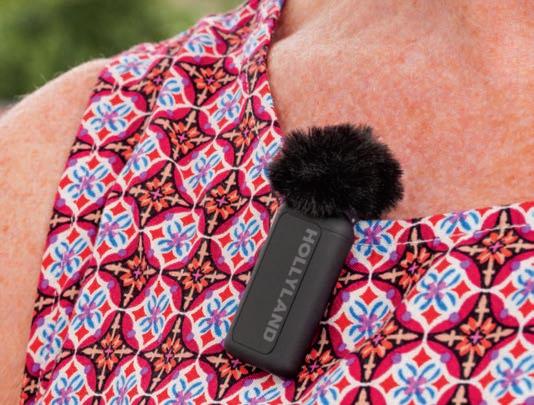
set-ups. So then you’ll need to use the 3.5mm port on either your camera or the receiver.
Perhaps one of the things you’ll notice first about this kit is that it just feels nice. The case, the TX/ RX units and the OWS earphones all have a smooth velvety finish. Not important especially, but a nice touch – literally.
The next thing you’ll notice is that the transmitters are really small and lightweight, at 23x10x 45mm and just 14g. Their long, thin design allows them to be concealed easily and means they don’t pull at clothes. The smooth finish of the TX unit reduces rustling when inside a shirt, and it feels nice to the skin on a long shoot.
Inevitably the control panel on the receiver is pretty small, but it is surprisingly usable. The interface is straightforward and we have buttons, a touchscreen and a control wheel for navigation. Even when four TX units are connected, the display is more than sufficient for controlling each of them in turn.
The wireless range is very good, and as usual is better with a static camera and a moving transmitter than vice versa. I was impressed that the TX can still be picked up when 80m away and behind a building, and it coped well with a body in the way too when at distance. Even with a moving camera, the range is more than sufficient for most needs. With a body in the way, I measured 75m with my roving camera test.
THIS is a really nice wireless mic kit, whether or not you get the wireless earphones and extra transmitters. It also costs significantly less than similar kits that offer some of the same features and similar sound quality. I’ve been very impressed with the audio and the abilities of the noise cancellation, and particularly the way the cancellation can be tailored to suit a wide range of environments and the degree to which we want to include or exclude background sound.
The 32-bit built-in recording feature is great, and allows recording even without an RX unit. Files are easy to get off the TX unit directly, but it would be nice if we could access them via the charging case too. It’s brilliant to have wireless monitoring earphones, as we can walk away from the camera without pulling it over, and everything is just a lot neater with fewer cables. The OWS unit works remarkably well.
The clincher on top of all that though is the size, shape and weight of the transmitter units, and how easily they can be hidden away or positioned in plain sight, and how we can add Lav mics if we want to. It’s a really practical kit, beautifully designed and it all sounds very good to boot.
+ Small system
+ E asy to use
+ Many great features
+ Very good audio quality
+ A ll fits in one carry case
– C an’t download recorded files via the charging case
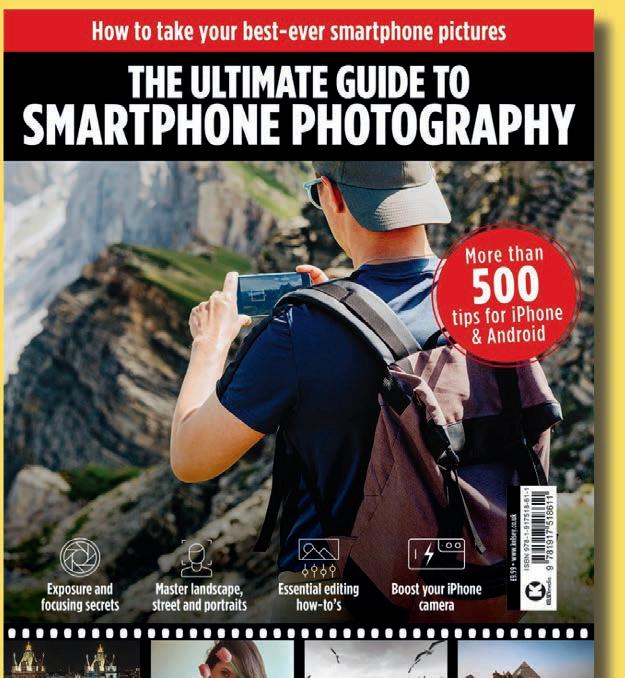


‘The best camera is the one that’s always with you’ is one of the most famous adages in photography, which is why we’ve put together this packed, 132-page guide on getting the best possible shots from your smartphone. For most of us, our phone is always there in our pocket or bag, but not everyone makes the most of the increasingly powerful capabilities of modern smartphone cameras. Discover more with The Ultimate Guide to Smartphone Photography!
Small, light, and discreet, the X-T30 is the ideal travel companion for those working to a strict budget
The X-T30 entered the scene in 2019, two years after its predecessor, the X-T20. It inherited a selection of advanced features from the flagship X-T3, with the main benefits being that it was smaller, lighter and more affordable. The 26.1MP APS-C X-Trans CMOS 4 sensor provides an ISO range expandable to 80-51,200. There’s 8fps burst shooting using its mechanical shutter (up to 30fps with electronic shutter) as well as custom AF-C modes to enhance focus tracking. Other features include a 2.36m-dot OLED EVF, two-way tilting touchscreen, 4K/30p video, single SD card slot and a joystick to shift the AF point or navigate the menu. It was made in black, silver and charcoal silver.
l This camera was considered, and still is considered, the bargain of the century.
l It’s a great candidate for travelling, leaving plenty of space for lenses and other essentials.
l The body is constructed to a high standard. It has a more robust feel than the X-T100 but isn’t as hardy as the X-T3.
l The X-T30 is a marvellous mirrorless camera that provides an excellent specification and performance for the price.
The X-T30 has been succeeded by both the X-T30 II and the X-T30 III, however it remains a popular and highly respected camera today. Focusing speed and accuracy in low-light isn’t as advanced as its superiors, while it also lacks the newer Classic Neg and Eterna Bleach Bypass film simulation modes. The screen resolution also falls behind modern alternatives.
X-T30’s can be picked up from £659 in like new condition, or you can make a saving of around £40 by choosing one in excellent cosmetic condition. With the latter you’ll just want to bear in mind it might have a few minor scuffs, marks or scratches. If your budget is closer to £500 you’ll want to look at examples in good cosmetic condition, which typically sell for around £529. Used charcoal-silver finish examples are harder to find.
The X-T30 III arrived in October 2025 and goes head-to-head with the Nikon Z50II and Canon EOS R10. Its 26MP APS-C sensor is paired with the latest X-Processor 5, allowing more advanced subject detection autofocus. It also gains a Film Simulation dial, making colour profiles more accessible. Video with 6K in 10-bit colour and 4K up to 60fps is also available.
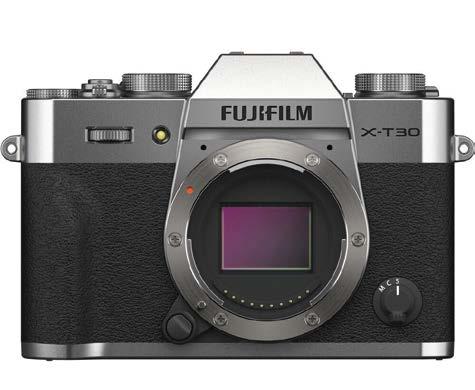
Users get a choice of either 117 selectable AF points laid out into a 9×13 grid, or there’s a 425-point layout consisting of a 17×25 grid
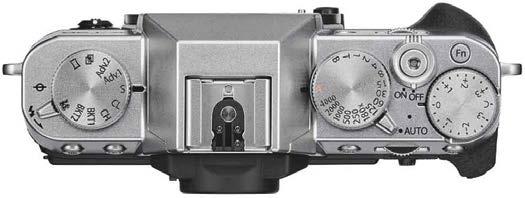
The top and base plates are made of lightweight magnesium alloy, which contribute to a solid feel, albeit not weather-sealed or as robust as the X-T3
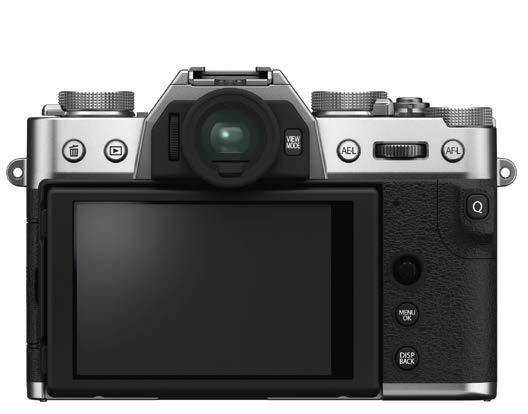
The quick menu button is found on the thumb hook, which has a more prominent profile than the X-T10 and X-T20
body only (good used condition)
l 26.1 APS-C X-Trans CMOS 4 sensor
l ISO 160-12,800 (80-51,200 extended)
l 3in, 1.04m-dot two-way tilting LCD
l 4K/30p recording with 4:2:2 10bit HDMI output
l 383g (with battery and card)
For and against
+ Superb image quality
+ Supports face and eye detection in continuous autofocus
+ Well supported by excellent Fujifilm XF lenses
+ Wi-Fi and Bluetooth connectivity
– Lacks IBIS and weatherproofing
– SD cards can be quite fiddly to insert/remove
– Touchscreen operation is basic
– Battery life (380 shots)
Three Fujifilm X-T30 users give their verdict
When I got my Fujifilm X-T30 in 2019, it immediately felt like the right camera for me, and somehow it still does. It’s been my go-to for street photography ever since, and I use it almost every day, for both stills and video. It’s small and light enough to always come along, and at this point I know it so well that it feels less like a piece of gear, and more like a trusted sidekick. I don’t have to think, I just shoot. The fact that it’s a small interchangeable-lens camera is a huge bonus. I can change focal lengths depending on the situation, which makes it feel like the camera can keep up with whatever idea I have at the time. It’s surprisingly sturdy, too.
What initially attracted me to the X-T30 was its physical look and compact size. Originally owning a Canon EOS 5D Mark III, I really like the vintage look of the camera body. I also wanted to have a small, lightweight camera to easily carry around on my travels as well as something discreet, so it wouldn’t draw too much attention from people when trying to take candid portraits.
But it’s not perfect. The small size can work against itself; I find the handgrip to be very shallow, which can make it hard to feel like you’re holding your camera securely. I also find using the viewfinder a little uncomfortable as my nose presses up on the touchscreen, occasionally moving the focus. The 26MP sensor works great in most situations, but in my wide landscapes I’m usually looking for more fine detail. In this aspect, the camera doesn’t quite reach the level I’d
Like all Fujifilm cameras, colour rendition is lovely
Fujifilm X-T30, XF 33mm F1.4 R LM WR, 1/500sec at f/9, ISO 640
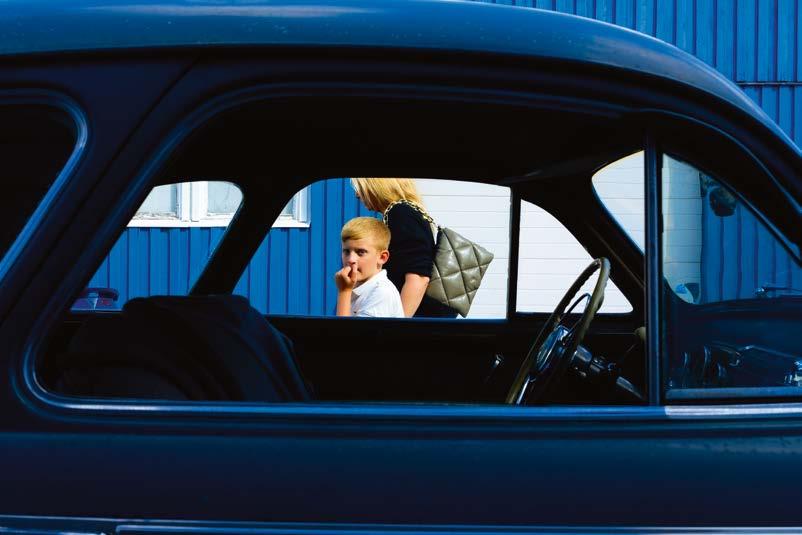
I’ve accidentally dropped it a couple of times, and it’s been with me in temperatures down to -25°, in snow and rain. Even though it’s not weather-sealed, it’s never given me any issues. I’m probably a bit biased when it comes to this camera, since I’ve
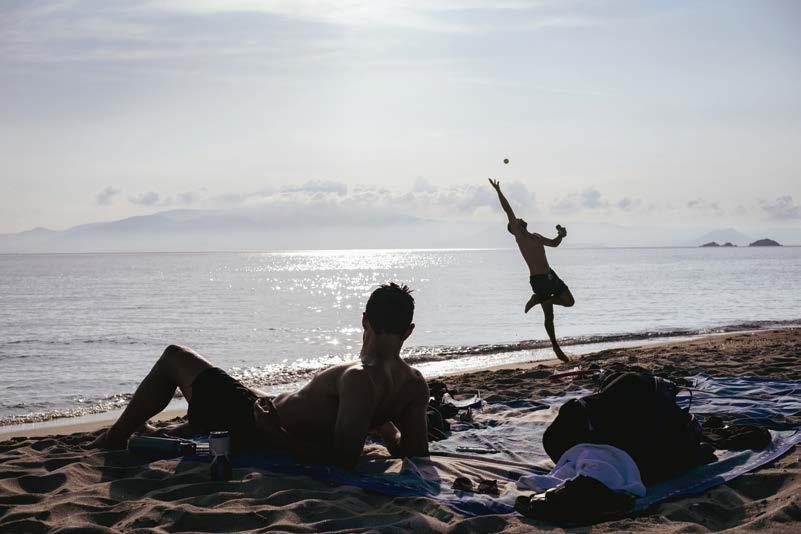
Archer finds the small size perfect for travel
Fujifilm X-T30, XF 35mm F2 R WR, 1/1400sec at f/5, ISO 80
taken most of my favourite images with it. I’m also not great with change and tend to get attached to things, so having this camera with me for so many years has made it feel very personal. Morten’s Instagram account is @morten.clicks
For and against
+ Small and lightweight
+ Affordable
– Placement of the Quick Menu button
– Not the best grip for big hands
like. Overall, though, it’s a great entry point into photography, delivering decent AF and image quality for the size and price. Archer is on Instagram @archer_roelants
For and against + Good choice for discreet shooting
– Images lack fine detail
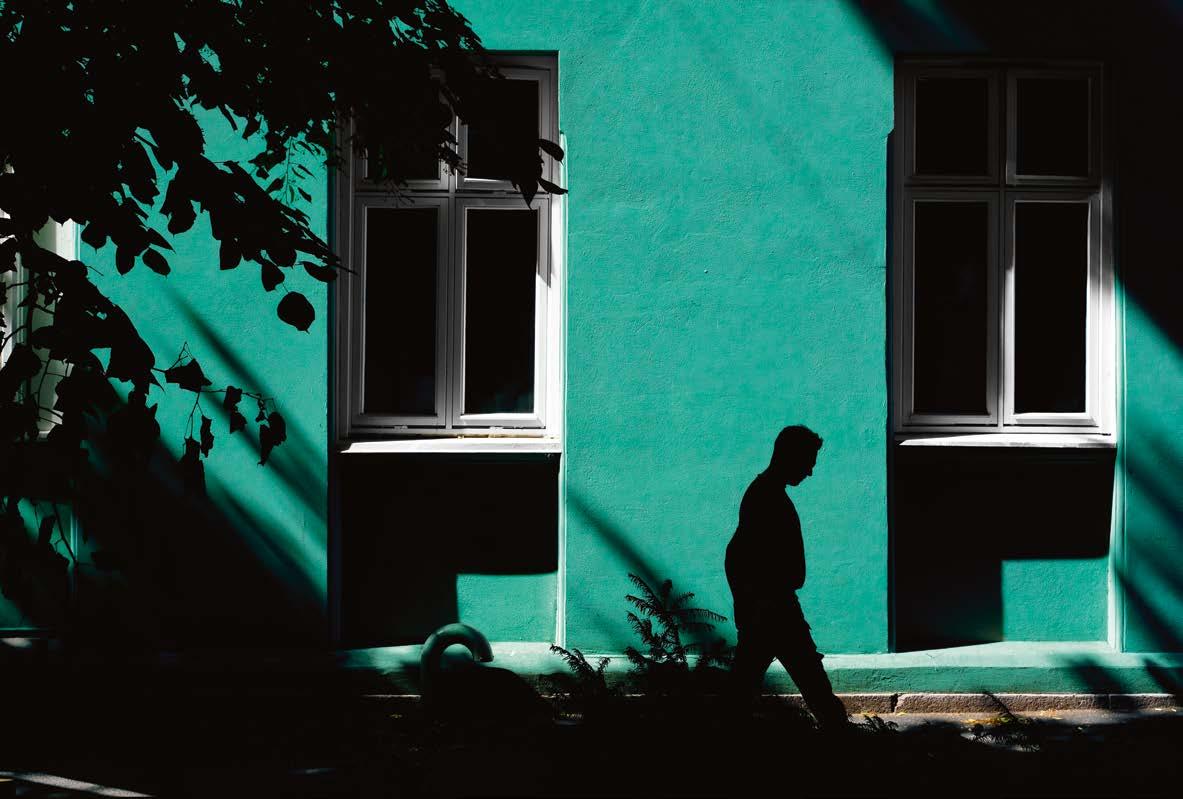
My introduction to this camera actually began with the X-T10, which I borrowed for a trip to the United States in 2017. I was struck by how enjoyable it was to shoot with. Fast forward to 2023, and I came across a second-hand X-T30 at a price that was simply too good to ignore. Since then, it has become one my most-used cameras.
The X-T30 is ideal for travel photography. I had grown tired of carrying heavy gear, particularly on city breaks, and this camera strikes an ideal balance between portability and capability. Paired with Fujifilm’s legendary 35mm f/1.4, the X-T30 really sings. The 26MP sensor delivers more than enough resolution, while Fujifilm’s colours are brilliant straight out of camera. Low-light performance is also impressive for its size. Where the X-T30 truly excels is in street photography. Its small, understated design allows you to
blend into your surroundings and shoot unobtrusively. It’s the kind of camera that encourages you to keep it with you at all times. When I’m ambling through a far-
flung country, you can bet I’ve got this camera slung over my shoulder.
More of Joshua’s images are on Instagram @acarasfinds
For and against + Fujifilm colours straight out of camera – Single SD card slot
Andy Westlake tests a lightweight camera backpack that’s designed to look anonymous
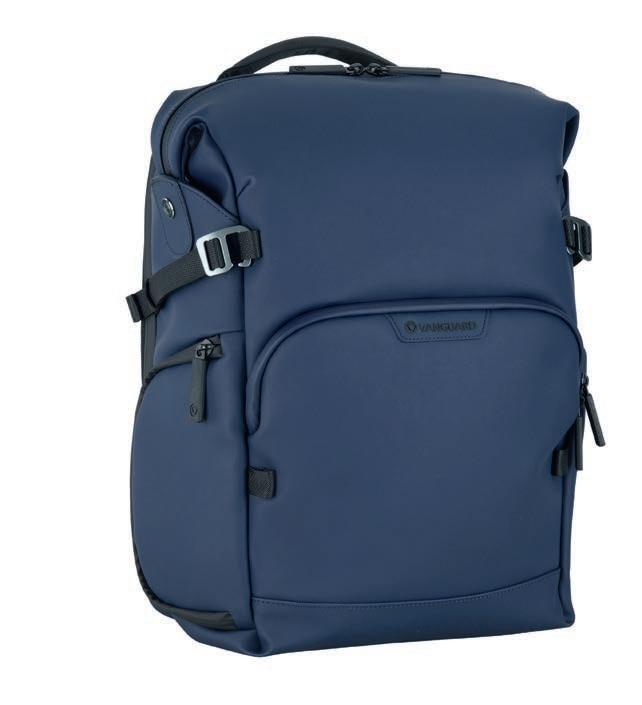
The Vanguard VEO Lite B20L is a camera bag that’s designed to look like a regular backpack. It employs a two-section design, with the camera compartment at the bottom, and the top half set aside for carrying personal items. It’s constructed from PVC-coated polyester fabric, which is designed to be waterproof, durable and easy to clean. Vanguard also makes a larger version, the B25L, for £150. There’s a separate laptop/tablet pocket on the back panel, so you don’t leave these expensive electronics exposed when you unzip the back to access your camera. You can also remove the main divider between the two inner sections and use the entire space as a conventional backpack.
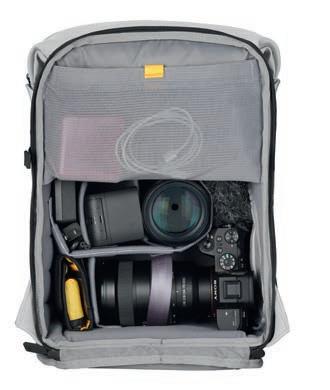
In terms of capacity, there’s room for a camera and three or four lenses. It’s possible to carry a full-frame body with a 70-200mm or 100-400mm telezoom attached, plus wideangle and standard zooms alongside. Alternatively, you could carry two smaller lenses in place of the telezoom. For example, I was able to fit a Sony A7 V with a 24-105mm f/4 attached, plus 16-35mm f/4, 50mm f/1.4, and 90mm f/2.8 macro lenses. A zip-open panel on one side provides quick access to your camera.
Vanguard has provided a good array of internal pockets for organising your accessories, along with a large flat pocket on the front. You get a carrying handle on top, plus an attachment point on one of the shoulder straps for a camera carrying clip. There’s even a cable pass-through point, so you can charge your camera or phone externally from a powerbank inside the bag.
The design does, however, have some minor drawbacks. I’m not a huge fan of the straight top opening, as it provides slightly restricted access compared to a more conventional zipped flap. There’s no waist belt, either, and while much of the time that isn’t a problem, I found the bag uncomfor table to carry when it’s fully packed.
The Vanguard VEO Lite B20L certainly has its strong points. It’s nicely made, and that coated fabric keeps your kit dry while being very easy to clean. It holds a sensible amount of kit and personal stuff, too. Overall this is a perfectly nice design, but personally, I’d be inclined to spend a bit more on one of its VEO Metro stablemates instead.
A slim strap on the back allows the bag to be slipped over the handle of a wheeled suitcase.
An elasticated expanding pocket on the side can be used to carry a water bottle or tripod.
There’s a hidden AirTag pocket, plus a concealed pocket for your passport on the back.
A neat fold-out pocket on one shoulder strap is designed to hold your smartphone.
● Holds a camera and 3 or 4 lenses
● Separate compartment for 14in laptop and tablet
● 290 x 205 x 420mm (external)
● Weighs 1500g
● Available in red, cream, or blue
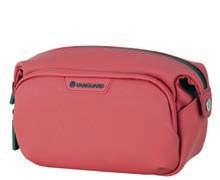
If you need a bit of extra storage space, the Veo Lite backpacks are designed so you can clip the Veo Lite S2L compact shoulder/sling bag (right) onto the front. This measures 25 x 11.5 x 15cm and features an array of internal organiser pockets. It comes in the same three colours as the backpacks, and costs £40.
Following on from dynamic range enhancement, Professor Newman explains selective adjustments
n my most recent article, I discussed dynamic range enhancement modes, making the distinction between the input dynamic range (the range of local exposures that can be recorded), and output dynamic range, i.e. the range of exposures that can be distinguished as different tones in the output. The enhancement modes discussed there worked by using tone curves which provided greater differentiation between tones in the highlights and shadows, at the cost of compressing the mid-tones. This technique could be called tone curve adjustment. In this article an enhancement of it will be explained, selective tone curve adjustment. Examples of this method include Sony D-Range Optimise, Nikon Active D-Lighting, and Canon Auto Lighting Optimiser.
The major problem that has to be overcome in the design of these modes is that most output devices have a range of eight or so stops. Compressing an input exposure range larger than this into that tonal range can create unrealistic, flat looking results. The way out involves an understanding of the working of the human eye. The instantaneous dynamic range of the retina is between six or seven stops. ‘Instantaneous’ here means without time to make chemical adjustments, which can provide perhaps another ten to twelve stops. But adaptation takes between four seconds and thirty minutes, depending on the scale required. The other, more rapid, adaptation mechanism is
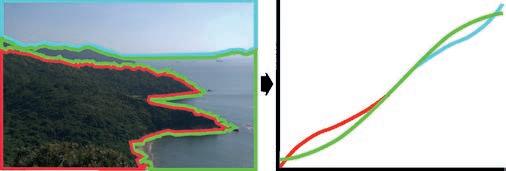
To produce an apparently high dynamic range image the base image is segmented. Different tone curves are applied to the different segments, darkening highlights and lifting shadows
the iris, which can change aperture from f/2 to f/8 very quickly. This provides an extra four stops of range, but not instantaneously. The key to this is the capability of the visual cortex in the brain, which is always composing images from the data arriving from the eyes. As the eyes move and look around a scene their irises continually adapt to the lighting in that part of the scene, the brain composes the images together and the result is perception of an image which appears to have a much larger dynamic range than is actually recordable by the retina.
This behaviour of human vision provides a way of apparently rendering a output dynamic range greater than the range of the output medium. If the image is to be presented at a size (and viewing distance) where the viewer will look around it, rather than taking it all in without any eye movement, then different parts of the scene can be rendered with different tone curves, and the visual cortex will compose the scene to a perceptual whole. This has been a well-used method both in the analog and digital eras of photography. In analog days it
would have involved dodging (withholding enlarging exposure) or burning (extending enlarging exposure) the darker and lighter areas respectively. In digital it involves making three layers, masking two of them to include only light or dark regions, and then applying different tone curves to each.
This same technique is used in the in-camera dynamic range modes. The camera’s processor scans the image for regions containing predominantly highlights or shadows and separates these from the rest of the image. It’s not looking for individual highlights or shadows, but contiguous regions (the technical term is segments) which contain them. When the image is rendered to an incamera JPEG file, these will use tone curves which respectively drop the highlights or lift the shadows, merging with the normal tone core in the central part of the curve. Since only rendering to the JPEG file is affected, the raw file remains unchanged. However, some versions of this mode do include a hidden change in the effective ISO rating to protect the capture of shadows or highlights.

We reveal the well-deserved winners of the HONOR Night Photographer of the Year competition
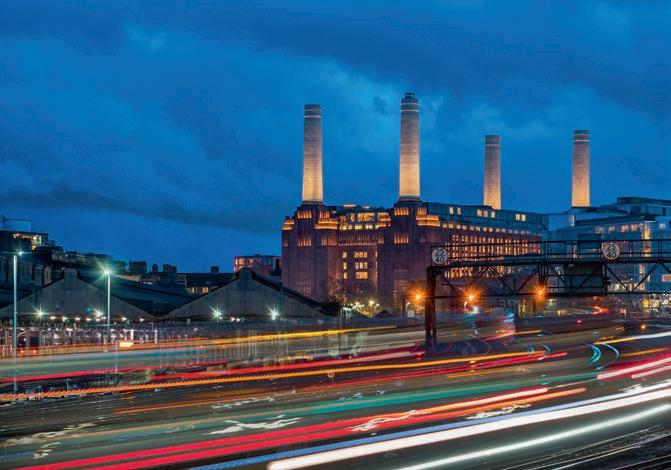
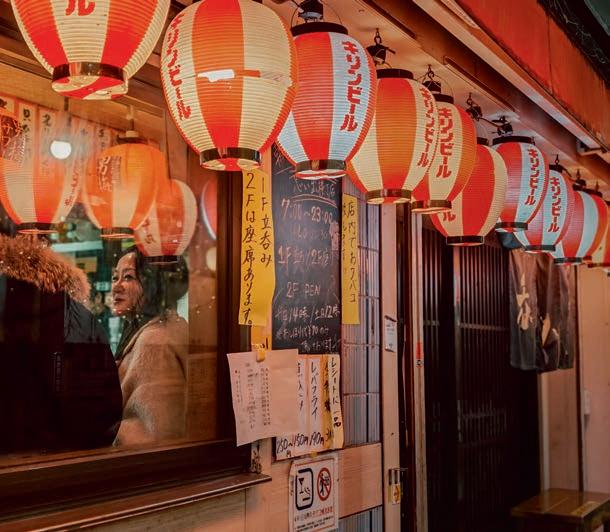
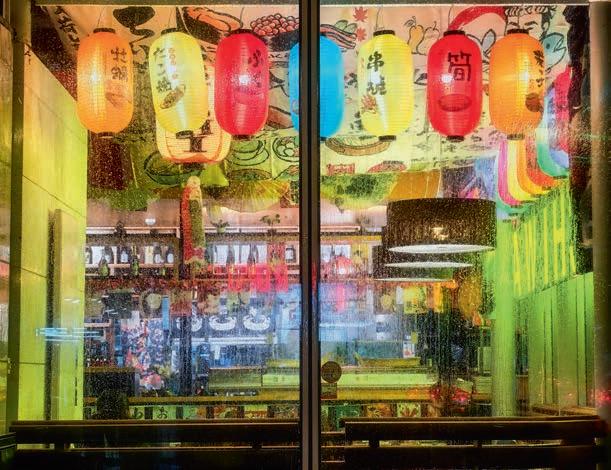
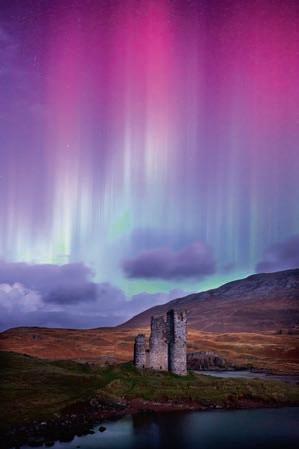
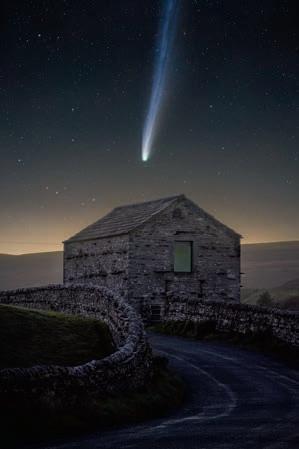
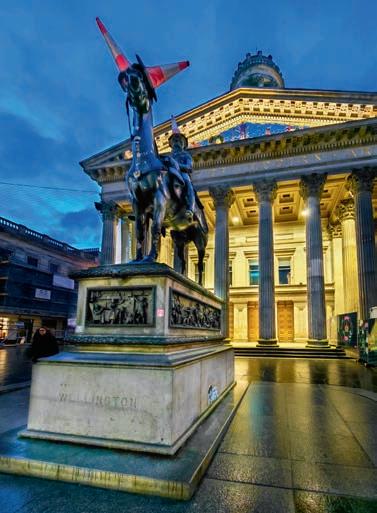
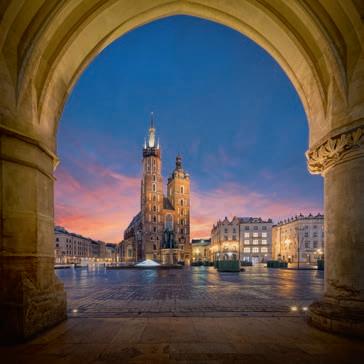
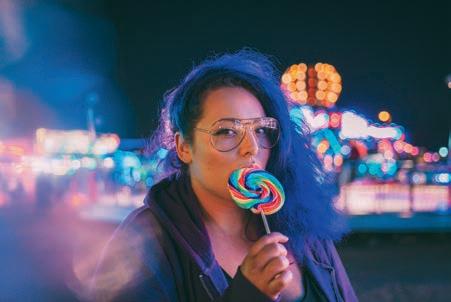
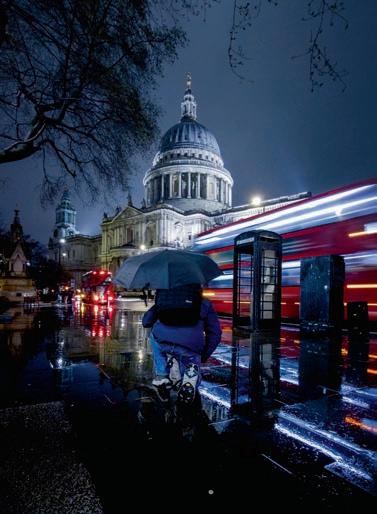
Towards the end of last year, Amateur Photographer teamed up with leading Android smartphone maker HONOR to organise the free-to-enter HONOR Night Photographer of the Year competition.
Entrants were invited to send in night and low-light images taken on any capture device (any camera or any phone), and from judging all the entries we drew up a shortlist of six photographers.
These six photographers were then sent HONOR’s latest flagship phone, the HONOR Magic8 Pro, to take more night and low-light shots with this powerful new model – which is particularly strong when it comes to night telephoto performance.
The three winners
After receiving an impressive number of high-quality entries from all over the UK and Ireland, we are now pleased to announce that Ming Cheng from London has been named overall winner of the HONOR Night Photographer of the Year contest.
For his prize, Ming gets the HONOR Magic8 Pro phone to keep, as well as a city break to Barcelona from 18 February to 3 March, where he will be HONOR’s guest at the massive Mobile World Congress show on 2 March.
Ming is also our guest at the glittering Amateur Photographer Awards in London on 26 February, where he will receive a trophy from Amateur Photographer editor, Nigel Atherton (see more about the awards in AP’s next issue).
Meanwhile, Bircan Harper from Truro came second in the competition, winning through with some atmospheric night shots taken during a recent holiday to Japan. She gets the HONOR Magic8 Pro for her prize. In third place came Pawel Zygmunt from Oldtown in County Dublin, Ireland. He also gets the Magic8 Pro as a prize. Well done both.


Amateur Photographer Customer Service Team, Kelsey Publishing Ltd, Kelsey Media, The Granary, Downs Court, Yalding Hill, Yalding, Maidstone, Kent ME18 6AL
Find current subscription offers on our website shop.kelsey.co.uk/APB Already a subscriber?
Manage your subscription online at shop.kelsey.co.uk/site/loginForm
Classifieds Telephone 0906 802 0279. Premium rate line, operated by Kelsey Publishing Ltd. Calls cost 65p per minute from a BT landline; other networks and mobiles may vary. Lines open Mon-Fri, 10am-4pm Email ads@kelseyclassifieds.co.uk Kelsey Classifieds, Kelsey Media, The Granary, Downs Court, Yalding Hill, Yalding, Maidstone, Kent ME18 6AL Distribution in Great Britain Frontline Distribution Solutions 2 East Poultry Avenue, London, EC1A 9PT Tel 020 7429 4000
Distribution in Northern Ireland and the Republic Of Ireland
Newspread. Telephone +353 23 886 3850
Kelsey Media 2026 © all rights reserved. Kelsey Media is a trading name of Kelsey Publishing Ltd. Reproduction in whole or in part is forbidden except with permission in writing from the publishers. Note to contributors: articles submitted for consideration by the editor must be the original work of the author and not previously published. Where photographs are included, which are not the property of the contributor, permission to reproduce them must have been obtained from the owner of the copyright. The editor cannot guarantee a personal response to all letters and emails received. The views expressed in the magazine are not necessarily those of the Editor or the Publisher. Kelsey Publishing Ltd accepts no liability for products and services offered by third parties.
Kelsey Media takes your personal data very seriously. For more information of our privacy policy, please visit www. kelsey.co.uk/privacy-policy. If at any point you have any queries regarding Kelsey’s data policy you can email our Data Protection Officer at dpo@kelsey.co.uk.


Write to the Editor at ap.ed@kelsey.co.uk and include your full postal address. Please don’t send letters in the post as there is no one in the office to receive them. Replies are from the Editor unless otherwise stated
Your lens review sent me on an excursion to a central London camera shop, keen to heft the Sigma 20-200mm. A staff member kindly unlocked the cabinet, presenting the lens. But my eye was caught by Sigma’s new aluminium marvel beside it. The camera I held a moment later felt like a beautifully engineered paradox: no eyepiece, no card slots, a minimalist curve that seemed to defy its very purpose. As I handed the BF back, the staff member met my puzzled silence with the dry summation: ‘Very trendy. Makes a good doorstop. Not a practical camera.’ We shared a laugh,
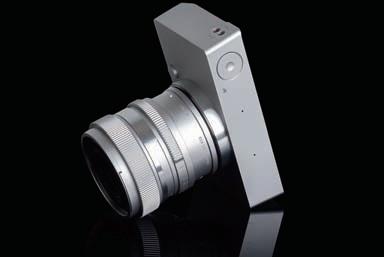
but it left me thoughtful. In reaching for the shiny unknown, I’d almost overlooked the superb, practical lens Sigma is rightly famed for – the very reason for my visit. Sometimes, the true object of desire isn’t the conversation piece on the shelf, but the tool that quietly, brilliantly, does the work. My thanks to AP for guiding us back to those. Navin Kukadia

My Nikon D90 and D7100 were the last DSLRs I owned before moving to mirrorless. Previously I used Nikon F-401 and F-801s film cameras. But I recall having a lot of Nikon prime lenses, zooms from Vivitar and Tokina and a 500mm Tokina Mirror lens. I had a pretty lowly-paid job in the construction industry but had no trouble buying all these lenses, plus speedlights, filters,
tripods, data backs etc. Now, the price of kit is astronomical and I find it hard to accept they are anywhere near equivalent to the ’90s. As a percentage of my income, modern kit is significantly higher and I wonder how this can be justified. With modern production methods, costs should have come down, not gone up. I would be very interested in what other people think.
John D Ryan
This might be a case of rose-tinted specs, John. I have the Aug 26 1989 issue in front of me and the Nikon F-801 plus 35-70mm kit lens cost £549.99. My inflation calculator says that would be £1,994 now. I also have the Oct 8 1994 issue where the F-801s is in a CCE clearance sale for £699 (£1,925 today). You can buy a Nikon Z5II with 24-105mm Nikon lens for £1,999 right now, which is an infinitely superior kit.
I am now the wrong side of 80 and find walking difficult. Rewind about ten years and I was using a Canon EOS-1D X with long lenses for motor sport and wildlife, but its weight eventually forced me to change to an Olympus OM-D E-M1X. This served me well until I had mobility issues and sold it to pay for my granddaughter’s trip to Europe. That left me with just my iPhone 16 Pro Max, which I still use now. A few years ago, as an experiment, I photographed different scenes on both the Oly and iPhone, printed them to A4 and challenged three family members to identify which was which. Two eventually got it right but only after scrutinising the photos very closely. The conclusion I drew was that my iPhone is perfectly okay for the vast majority of ‘ordinary’ work.
Mike Dodman
I was writing to compliment AP on an excellent 2025, guiding us through the highs and lows of the photographic world, when I read Nigel Atherton’s ar ticle Quality photography is dead, says Instagram chief (AP 13 Jan 2026) which stopped me in my tracks. I admire Mr Atherton’s restraint and journalistic expertise in his constructive response. I’ve never used Instagram but it (unhappily) amazes me that one person can have so much influence on the photographs we can see and yet have a background in something completely different. Hopefully most of us will see through Mosseri’s rambling nonsense and use alternative channels that appreciate the art of photography.
Tim Slaughter
What is your biggest photography pet peeve? You said... Share your photos and comments with us on social! See page 3 for how to contact us
Brian Curran
When you’re pestered by dogs that aren’t on leads, scaring the wildlife away while you’re trying to photograph it.
@ronthephotographer0
I think people picking on people for their cameras.
@jaymakesamess
The non-acceptance of different styles of street photography.
Tim Mitchell
When you take ages working out a shot, getting the composition, aperture, shutterspeed and lighting just right, and post it online and the first comment you get is ‘AI SLOP!!!’
Matt Scott
Photographers who look down on those who don’t use manual mode, therefore they aren’t ‘proper’ photographers.
@david_oxtaby Camera snobbery.
Caroline Allington
Relatives at weddings videoing on their phones blocking the bride and groom walking down the aisle etc.
@shropshirewandering
Unsolicited criticism/ advice… no thank you.
Rowan Chamberlain
Adobe being subscription-based.
@lloydy110 Gatekeeping.
Roy Frankland
When people use AI and pretend they are photographers.
Mark Cann
‘Nice picture, you must have a really good camera...’
Andrew Lindop
People triggered when they see a DSLR whilst ignoring the 12,000 phones that just walked past.
@p23way_ photos Not knowing the exposure triangle.

Our favourite photos posted by readers on our social media channels this week

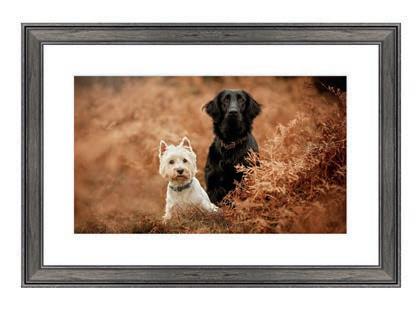

The AP Pic of the Week winner will receive a beautifully framed print of their winning image worth up to £100. If you Love it, Frame it! ThisPicture.com is an experienced, high-quality framing company with a unique, easy-to-use website. Build single or multi-image frames with a few clicks of your mouse and select from a wide range of frames, window mounts and glazing options. Each frame comes with a three-year guarantee and FREE P&P within the UK. Visit thispicture.co.uk

by Ian Holloway
Fujifilm X-T5, 16-50mm F2.8-4.8, 1/480sec at f/8, ISO 3200, 50mm
‘This was taken on a two-day trip to Snowdonia, Wales. When we arrived, we went up the classic trek opposite Tryfan to capture the mountain at sunset. When we got halfway up, we heard the mountain rescue helicopter in the distance. I grabbed my camera and quickly took the shot.’ Instagram @ian.hollowayphotos
Nikon D7200, AF-S Nikkor 18-140mm f/3.55.6G ED VR, 1/500sec at f/7.1, ISO 400, 48mm
‘Late afternoon winter light bathes Bath’s Circus in cold gold. A car pauses; offering its windscreen like a canvas, reflecting stone curves into a fleeting, abstract composition of reflection and architecture.’ Instagram: @dunkablebath
by Mark Forsyth
Canon EOS R7, Canon RF 24-105mm
‘This photo was taken on a stunning winter’s morning on New Year’s Day. I arrived at Kilchurn Castle during golden hour as the light danced through the clouds across the mountain tops. Loch Awe was frozen and reflecting the castle ruins beautifully.’
Instagram: @mf_dslr_photography
Fujifilm X-T3, 18-55mm, 10mm extension tube, 1/25sec at f/16, ISO 160
‘I wanted to create an image with dramatic tones of black and white, and the idea of two lilies turning in towards each other appealed to me. I used a black card as background so the lilies were isolated, and another black card on the left, to deepen the shadows, with a single light source on the right. I converted the image to mono in Lightroom, with final edits in Photoshop.’
Instagram: @richpix999
Want to see your pictures here? Simply share them with our Instagram or Facebook communities using the hashtag #appicoftheweek. Or you can email your best shot to us at ap.ed@kelsey.co.uk. See page 3 for how to find us.

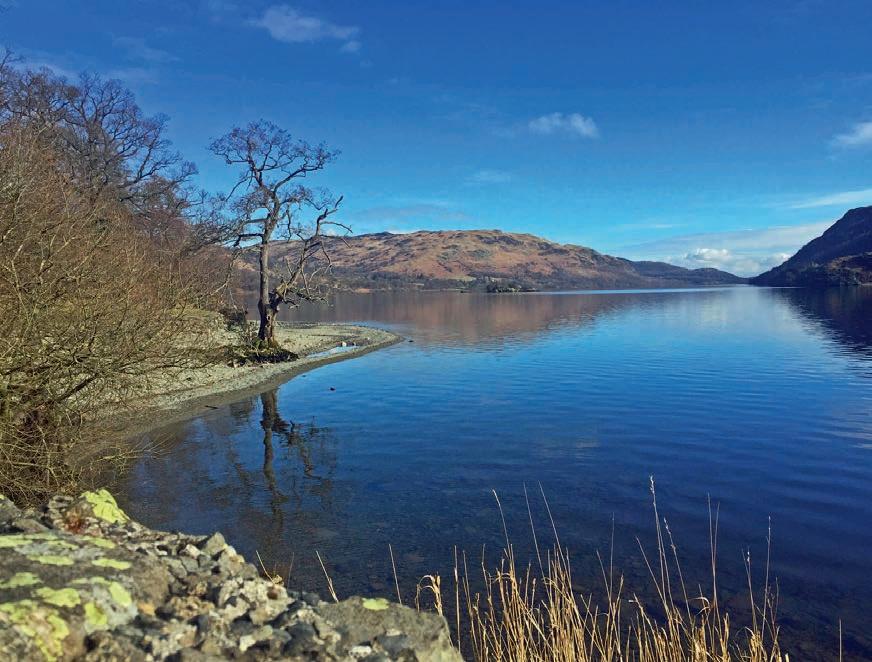
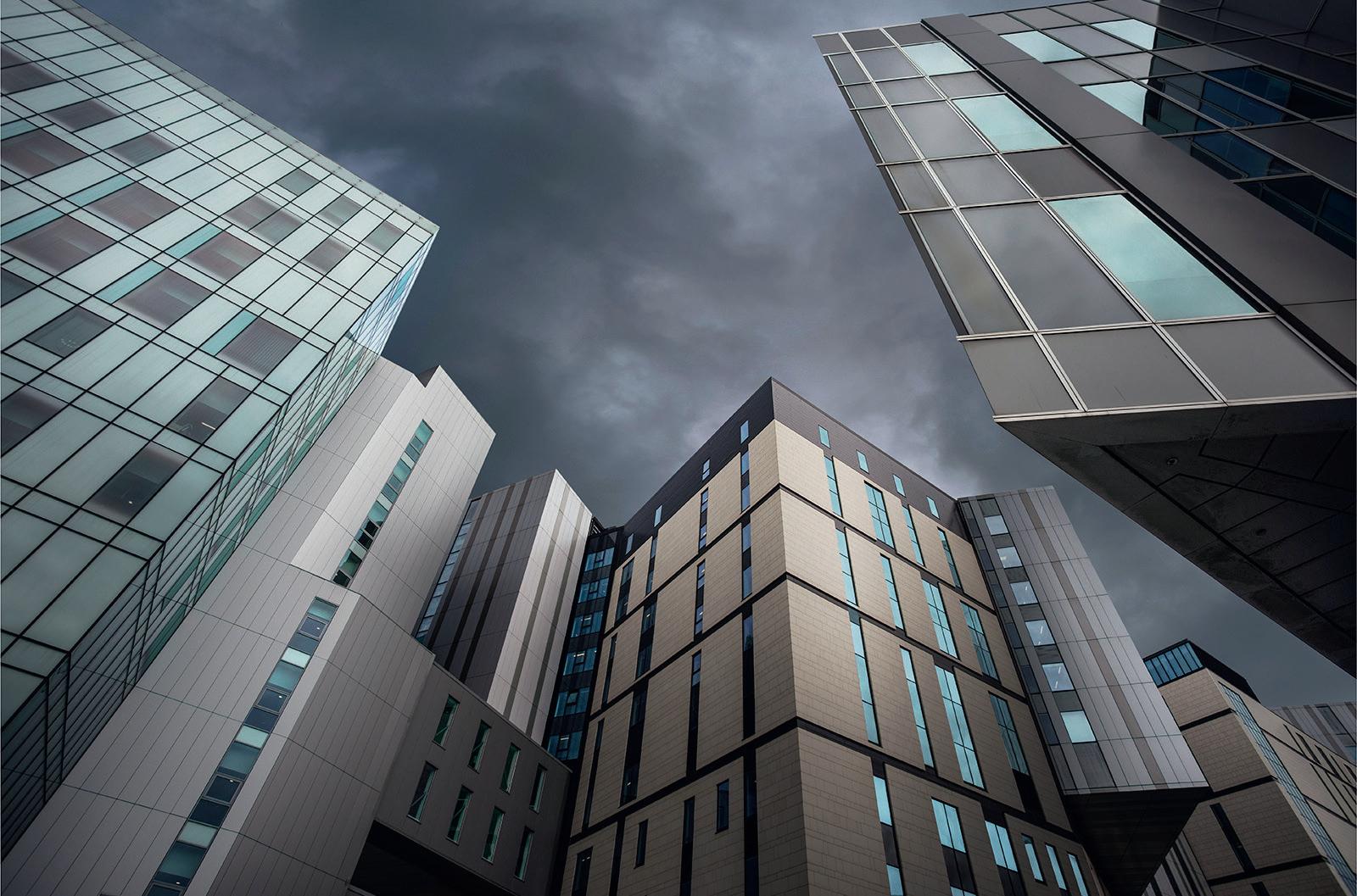
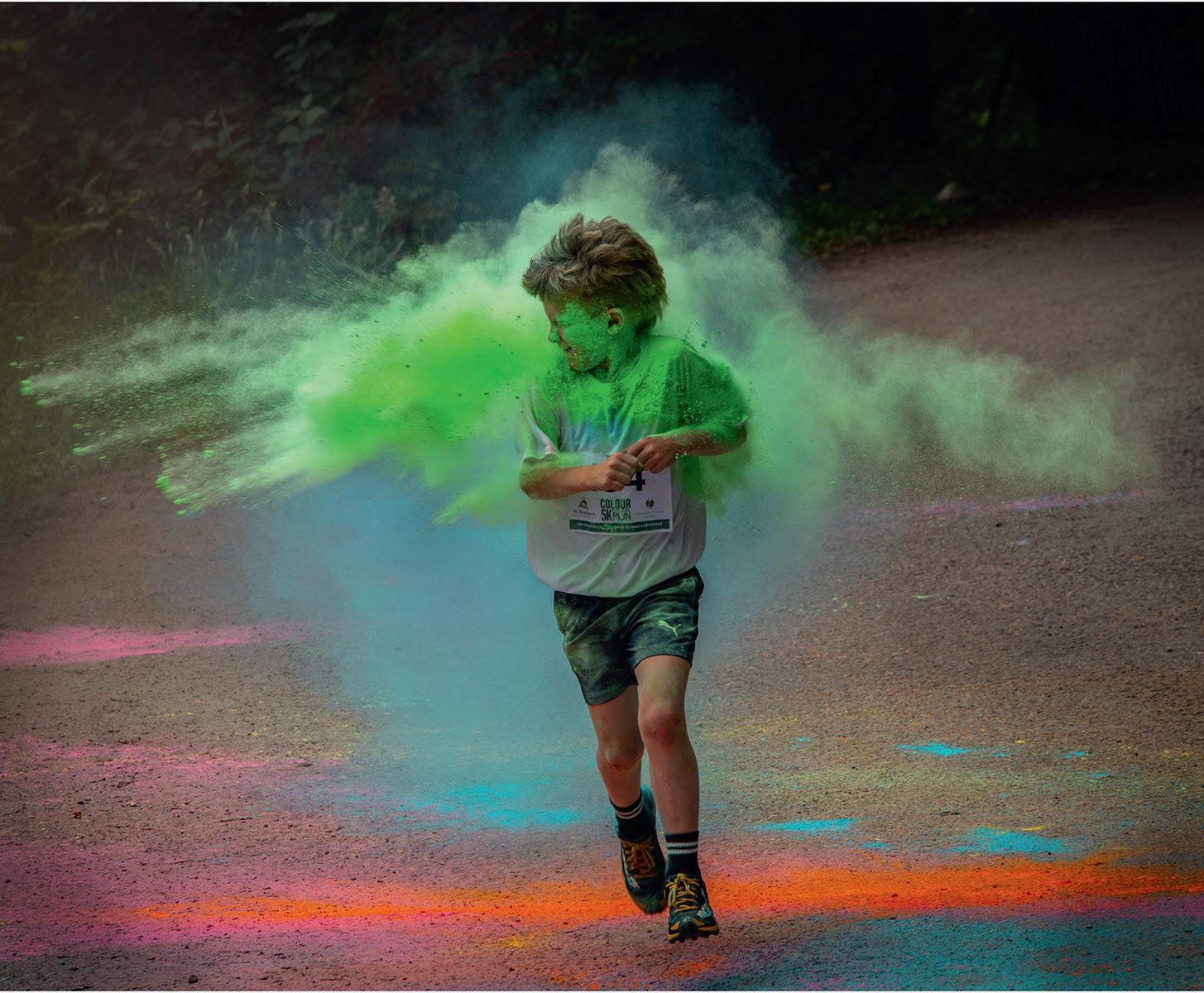
This club in North Wales has regular outings and welcomes members of all skill levels
When was the club founded?
The club was inaugurated in the late 1940s and was known as ‘Rhyl and District Camera Club’.The club met at Rhyl High School. Membership was in excess of 100 with many active members and was the largest photography club in North Wales.
Club competitions mainly consisted of monochrome prints, cibachrome, images and slides and were divided into three categories: beginner, intermediate and advanced. Many members were so successful in their photography that they turned professional. In order to emphasise the professional element, it was decided that the club should become a society and in 1968 the Rhyl and District Camera Club became the Rhyl Photographic Society.
Following changes at the high school, the club relocated to the community centre in Ffordd Las, but for various reasons this venue was
considered unsuitable and the club moved to the Wellington Road Community Centre. Due to venue issues, the club has moved a further three times. During this period the club owned a large amount of equipment and maintained a book library that members had access to. After COVID, the club moved to our current location, Rhuddlan Community Centre. We are affiliated to the North Wales Photographic Association.
What does your club offer to new members?
We are a friendly bunch and offer a warm welcome to new members, regardless of experience and skill level. We have several members who are happy to mentor and offer editing tuition and advice if required.
Describe a typical club meeting
Our meetings are a mixture of face-to-face, held at our venue
and virtual meetings via Zoom. However, on occasions meetings may also be held at other locations where the programme indicates, and this may include field trips or visits to other clubs.
Do you invite guest speakers?
We have regular guest speakers on various topics, many of them free of charge (expenses only) from the Photographic Alliance of Great Britain’s online approved list, which is also where we get many of our guest judges from.
Do members compete in regional or national competitions?
A few of our members do compete in the British Photography Exhibitions along with international salons including FIAP, PSA and GPU, members are also encouraged to provide entries for the annual North Wales Photographic Association (NWPA) club PDI and Print competitions as well as the NWPA individual competition, we also have a couple of battles with other North Wales clubs, such as Ruthin and Llandudno.
How many members do you have? Currently 25.
Are any residential trips or outings planned?
We have regular outings, especially during the closed season where a few of us get together and have trips out in the locality. We are in an
ideal spot because we have Eryri National Park on one side of us and Liverpool on the other, so we are able to find something that’s suitable for most of our members, whatever their preferred genre.
Do you have any funny stories about the club?
Back in early 2024 a club outing to photograph a waterfall in Clocaenog Forest didn’t go quite as planned. After a long trek from the cars down the forest tracks we helped each other down a very steep bank to the river – only to find that we were quite a way downstream and it was impossible to follow the river up towards the waterfall. We then had to choose if we somehow could manage to get back up the bank or to cross the river and go up the other bank through tall weeds and brambles.
Cameras held high and with wet feet, we eventually made it back to the track and, disheartened, set off back to the cars ….only for someone to discover a shorter way to the waterfall. We declined the offer of having another go and left it to another occasion! (We have since revisited and had a more successful outing!)
What are the club’s goals for the future?
We aim to improve our membership and to support all aspects of photography, and generally to enjoy the company of like-minded people in our chosen pastime.
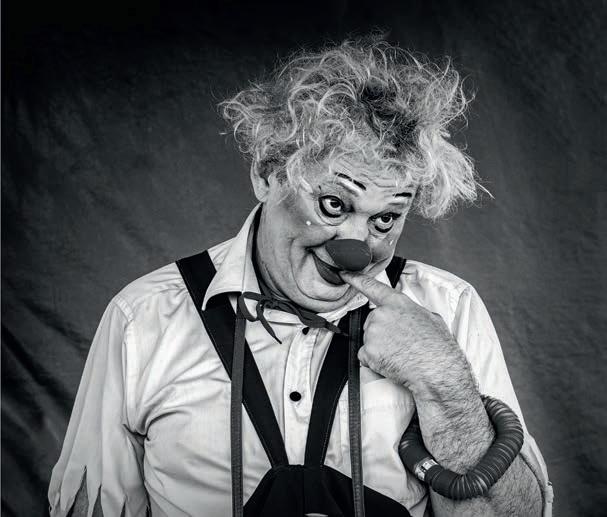
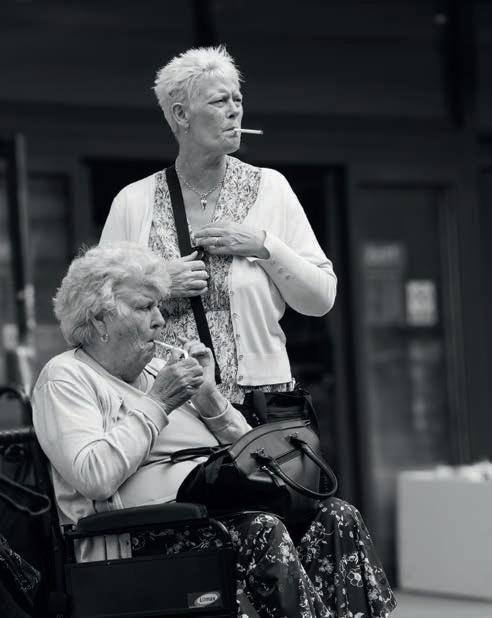
Rhuddlan Community Centre, Parliament Street, Rhyl, LL18 5PU
Meets: 19.00 Tuesdays, September to April
Membership: £40 per year (No other charges)
Contact: clubsec@rhylphotosoc.co.uk
Website: rhylphotosoc.co.uk
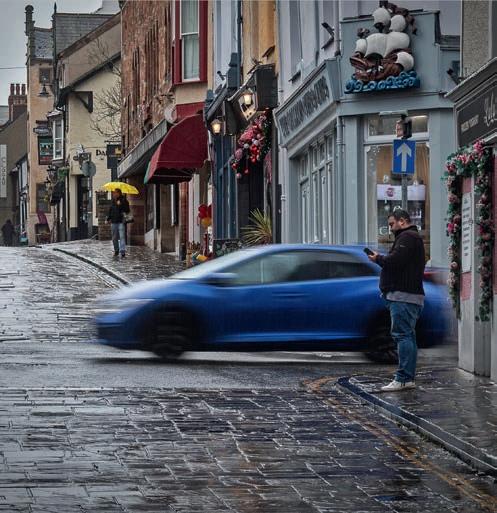
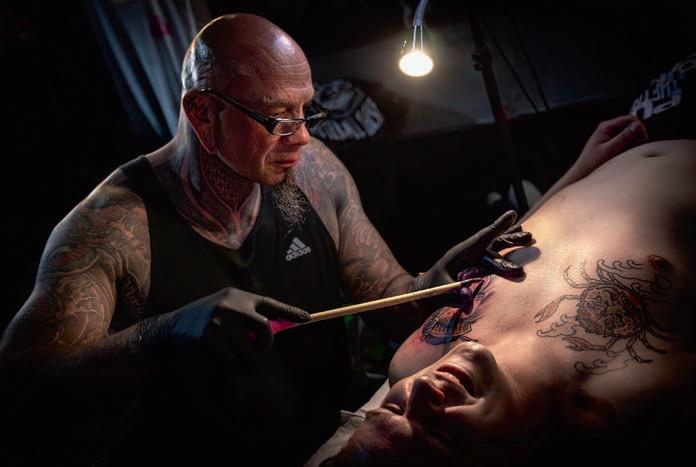
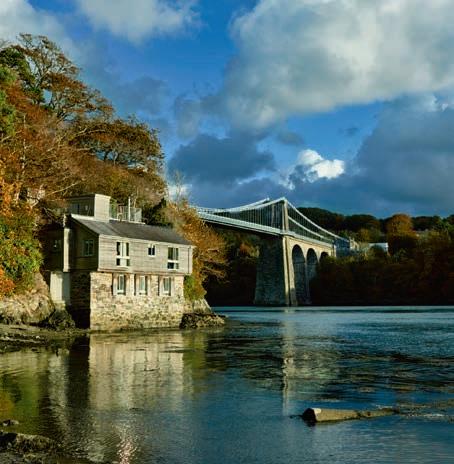
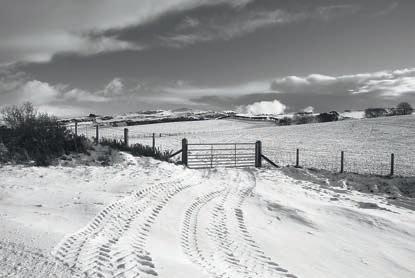
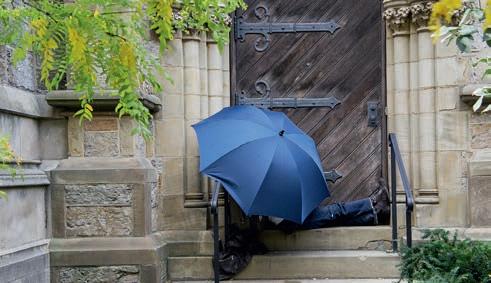
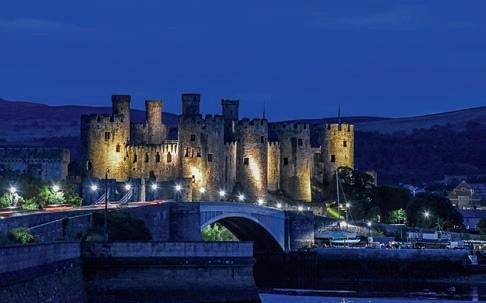
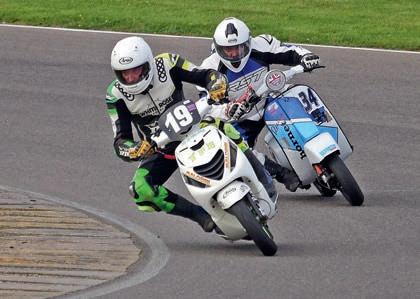
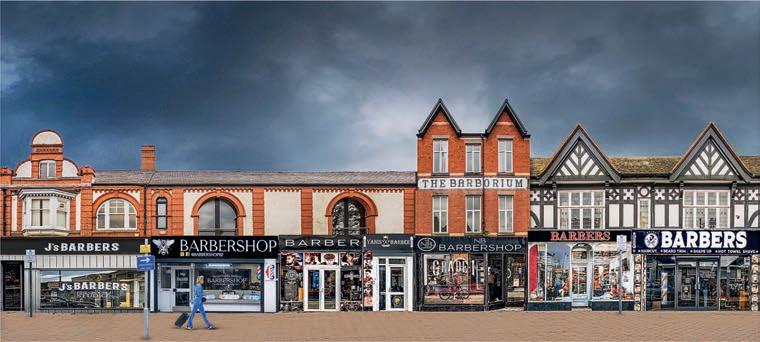
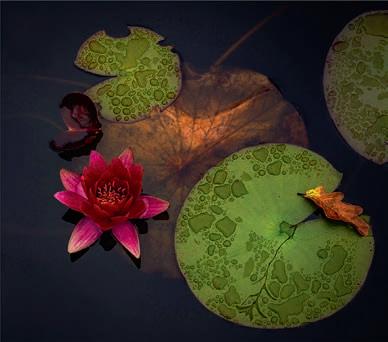






l £499 l explore.omsystem.com
This latest model in a long line of classleading rugged cameras is waterproof to 15m, shockproof against a 2.1m drop, crushproof and freezeproof. The 25-100mm equivalent lens is paired with a 12MP sensor, with in-body stabilisation to combat shake. Viewing is via a 3in LCD. The TG-7 is also one of the few cameras of its type that can record raw files.
★★★★★ Reviewed 2 Apr 2024
Review 9 Apr 2024 IN ASSOCIATION WITH
l £949 l ricohgr.eu/en-gb
A favourite of street photographers, the GR III combines a 24MP APS-C sensor and a sharp 28mm equivalent f/2.8 lens in a slim, pocketable body. It offers sensitivities up to ISO 102,400 and 4fps shooting, while in-body image stabilisation helps keeps image sharp. Viewing is via a fixed 3in rear LCD or an optional optical viewfinder that slots onto the hot shoe.
★★★★★
Reviewed 3 Aug 2019
A round-up of the AP testing team’s favourite and most highly rated kit, including both cameras and all kinds of accessories, across a wide range of price points
l £699 l www.canon.co.uk
This lovely little pocket camera provides a good range of features for both photography and video. You get a 20MP 1in sensor, 24-100mm equivalent f/1.8-2.8 zoom lens, 4K 30p video recording, and a tilting rear screen. It’s ideal for those who’d like more advanced controls than on a smartphone.
★★★★★ Reviewed 28 Sep 2019
l £1,049 l www.sony.co.uk
Sony has somehow crammed a 24-200mm equivalent zoom, pop-up electronic viewfinder, tilting screen, 20fps shooting and 4K video recording into a body that you can slip into a jacket pocket. With the firm’s latest AF technology also on board, it’s without doubt the most accomplished pocket camera on the market. ★★★★
Reviewed 5 Oct 2019
l £1,599 l www.fujifilm.eu/uk
The sixth version of Fujifilm’s charismatic rangefinder-styled compact boasts a 40MP APS-C sensor in front of its fixed 23mm f/2 lens. It also gains in-body stabilisation while barely increasing in size. Traditional analogue control dials are joined by a unique hybrid optical / electronic viewfinder and a tilting touchscreen on the back. It’s a truly fabulous camera. ★★★★★
l £1,499 l www.sony.co.uk
This sets a new standard for superzoom cameras, with a 24-600mm equivalent lens, 20MP 1in sensor, and 24fps continuous shooting. Its SLR-shaped body hosts a large electronic viewfinder and a decent set of physical controls. It’s the best all-in-one camera for wildlife or travel photography that you can buy right now.
Reviewed 2 Dec 2017
l £769 with 18-55mm IS lens l www.canon.co.uk
One of the smallest DSLRs around, the EOS 250D strikes a great balance between portability and usability. It’s equipped with a novice-friendly Guided Mode, while Canon’s Dual Pixel CMOS sensor provides excellent autofocus in live view. Image quality is very good, delivering vibrant colours and plenty of fine detail.
Reviewed
7 Sep 2019
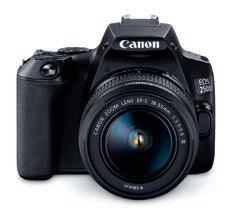
l £749 with 14-42mm lens l www.olympus.co.uk
With a charismatic retro design, fine handling, highly effective in-body stabilisation and attractive JPEG output, Olympus has made a camera that’s more pleasant to use than its entry-level competitors. Its 20MP sensor delivers good results up to ISO 3200 at least, and its tilting screen can be set to face forwards beneath the camera.
★★★★
Reviewed 26 Sep 2020
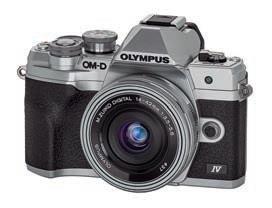
l £1,699 body only l www.fujifilm.eu/uk
Fujifilm’s latest X-T model is a great choice for serious enthusiast photographers. It boasts a 40MP APS-C sensor housed in a retro-styled body covered with traditional analogue control dials. Subject-detection autofocus, in-body stabilisation and Fujifilm’s lovely colour modes round off an extremely desirable package.
Reviewed 3 Jan 2023
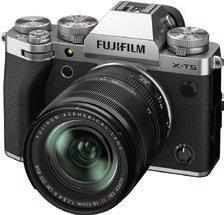
l £899 with 15-45mm lens l www.canon.co.uk
With the EOS R50, Canon has fitted some impressive technology into a compact and lightweight body. It boasts highly capable subject recognition autofocus coupled with rapid continuous shooting. Image quality is very pleasing too, with attractive files direct from the camera. It also works well with EF-mount DSLR lenses.
Reviewed 6 Jun 2023
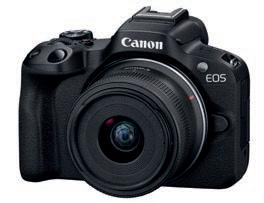
l £1,299 body only l www.fujifilm.eu/uk
Fujifilm’s mid-range line takes a major step up, with a 40MP sensor and in-body image stabilisation. Traditional analogue dials control exposure settings, while the firm’s peerless Film Simulation colour modes get their own selection dial for the first time. The compact body is ideal for travel. ★★★★★
Reviewed 30 Jul 2024
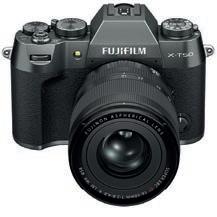
l £1,999 body only l www.panasonic.com/uk
Panasonic’s flagship Micro Four Thirds camera is aimed at videographers, but holds its own when capturing stills as well. Its 25MP sensor delivers plenty of detail, while enabling 5.7K recording at 60fps, or 4K at 120fps. Autofocus is much improved over the firm’s older models, too. Pro-spec video functionality and effective in-body stabilisation round off a fine package.
Reviewed 5 Nov 2024





l £999 with 15-45mm lens l www.fujifilm.eu/uk
Fujifilm’s X-S10 brings a distinct change in design. It looks much like a conventional DSLR, with electronic dials for changing exposure settings. But you still get Fujifilm’s signature fine image quality, along with in-body image stabilisation. The result is a camera that’s perfect for APS-C DSLR users looking to upgrade to mirrorless.
Reviewed 23 Jan 2021
l £1,199 body only l explore.omsystem.com
This small, fully featured and weathersealed mirrorless camera is both a pleasure to use, and capable of great results. Its petite body finds space for an extensive complement of controls, along with class-leading 5-axis in-body image stabilisation, yet weighs in at just 414g. On-chip phase detection enables fast, decisive autofocus.
★★★★★
Reviewed 13 Dec 2022
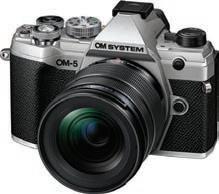
l £2,199 body only l explore.omsystem.com
Updated version of this high-speed powerhouse gains some handy new features. It’s capable of shooting at 120fps with focus fixed, or 50fps with AF, but now with double the buffer for extended bursts. AI subject detection recognises vehicles, animals and birds. It also boasts IP53-rated weather-sealing and includes class-leading stabilisation.
Review 12 Mar 2024





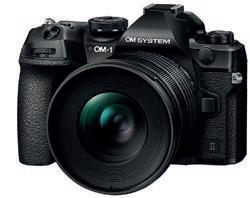






l £2,149 body only l www.nikon.co.uk
This lovely-looking full-frame mirrorless model combines plenty of substance with its classic retro styling. It boasts tactile top-plate dials for shutter speed, ISO and exposure compensation while delivering lovely image quality in both JPEG and raw. There’s some cutting-edge technology on board too, including impressive subject detection autofocus.
Reviewed 9 Jan 2024
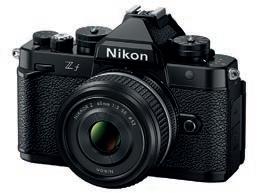
l £2,179 body only l www.sony.co.uk
Sony’s enthusiast-focused full-frame mirrorless model sets a new standard in its class. Its 33MP full-frame sensor delivers excellent image quality, and it can shoot at up to 10fps. Its practically foolproof subject-detection AF can now recognise birds as well as humans and animals. A large, clear viewfinder and fully articulated touchscreen round off the package.
★★★★★
Reviewed 11 Dec 2021
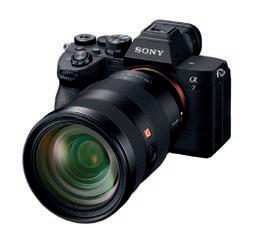
l £2,699 body only l www.nikon.co.uk
This brilliant professional all-rounder provides a winning combination of high resolution and speed. Its 45.7MP sensor produces fine results at high ISOs, and the autofocus is incredibly responsive and accurate. Build quality and handling should satisfy the most demanding of users. It’s an absolutely sensational camera capable of tackling any type of subject.
l £2,899 body only l www.nikon.co.uk
Nikon has delivered a sensible update to its flagship high-res model, with an additional SD card slot and slightly faster shooting. As before, its 45.7MP sensor gives stunning image quality, backed up by 5-axis in-body image stabilisation and fast, accurate autofocus. The viewfinder is superb, and F-mount SLR lenses can be used via the FTZ adapter.
Reviewed 6 Feb 2021
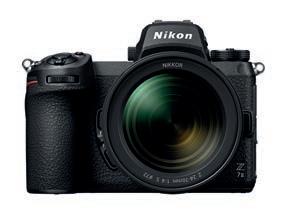
l £3,789 body only l www.nikon.co.uk
This stunning camera takes all the best bits of Nikon’s flagship Z9 and places them in a smaller, less-expensive body. Combining high resolution, rapid speed, cutting-edge autofocus and pro-level build, it’s capable of shooting 45.7MP raw files at 20fps. It can also record 8K video. With its superb viewfinder and tilting rear screen, it’s a stunningly capable camera.
Reviewed 11 Jul 2023
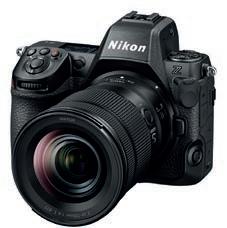
l £2,779 body only l www.canon.co.uk
l £3,699 body only l www.sony.co.uk
With its 61MP full-frame sensor, the A7R V provides class-leading image quality while adding a whole array of improvements over its predecessor. These include subjectdetection AF, a larger, more detailed viewfinder, and a more flexible rear LCD design. For those whose needs are more about image quality than speed, it’s probably the best full-frame camera you can buy. ★★★★★
Reviewed 17 Jan 2023
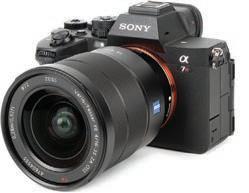
l £7,299 body only l uk.leica-camera.com
Leica’s 60MP full-frame rangefinder is a beautful anachronism – a camera type that has been obsolete for decades, yet which still remains an object of desire for many photographers. This elegant mix of the old and the modern offers tripleresolution raw recording, including 36MP and 18MP options, and vastly improved battery life. It’s a really lovely camera that can deliver stunning results.
Reviewed 8 Mar 2022
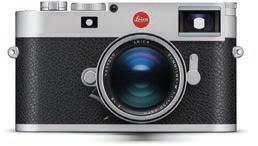
l £5,499 body only l www.fujifilm.eu/uk
Based around a 24MP full-frame sensor, this brilliant all-rounder will do almost anything you might ask it to. It combines reliable subject-detection AF, rapid continuous shooting, and effective image stabilisation in a body that handles well and gives great results. It also works well with adapted EF-mount DSLR lenses.
Reviewed 21 Oct 2017
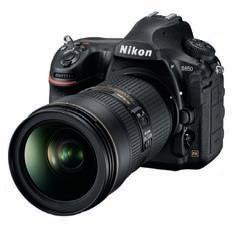



Reviewed 21 Mar 2023

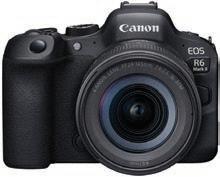

Fujifilm’s second-generation super-high resolution camera places a 102MP mediumformat sensor in a body the size of a fullframe DSLR. On-chip phase detection provides rapid autofocus while in-body stabilisation allows the camera to be used handheld easily. It’s perfect if you need to shoot in the field with compromising image quality.
Reviewed 8 May 2021
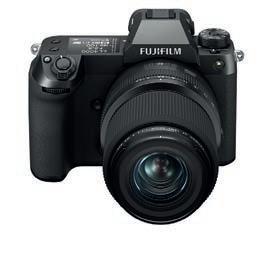
l £293 l www.billingham.co.uk
The latest model in this iconic line of British-made satchel-style bags includes some well-considered updates, such as a detachable shoulder strap. It’s impeccably constructed from premium materials to keep your kit protected, including Billingham’s signature triple-layer canvas that’s impermeable to water. It’s pricey, but will last for decades.
★★★★★ Reviewed 5 Oct 2019

l £160 l www.vanguardworld.co.uk
Vanguards’s VEO Active backpacks are designed for hiking. This model is small enough to carry on a plane, but still has space for a camera and three lenses, plus a 13in laptop and personal items. It offers excellent protection thanks to its metal frame and padded insert.
Reviewed 19 Jul 2022
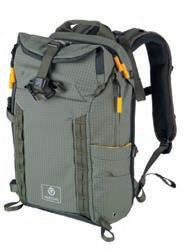
l £239 l www.gitzo.com/uk-en
This sizeable backpack will hold a pro-spec DSLR with a 70-200mm lens attached and a second body plus up to 4 lenses. An expandable roll top provides plenty of space for personal items, and the bag also boasts tablet and laptop compartments. It’s comfortable to carry fully loaded and offers first-class protection.
Reviewed 8 Sep 2018

l £90 l www.clifforth.co.uk
Many photographers either still enjoy shooting film, or have old negatives and slides that they’d like to digitise. Probably the best way to do this is to copy them using a DSLR or mirrorless camera. This easy-to-use device holds film flat over a lightbox for copying. It gives excellent results and is much quicker than using a scanner. ★★★★★
Reviewed 29 Aug 2020
l £29.90 l nisioptics.co.uk
If you use strong neutral density filters, this device makes it much easier to work with the long exposures required. It connects to your smartphone by Bluetooth and is controlled by NiSi’s free ND Calculator app. Camera connection cables cost £5.90 each.
★★★★ Reviewed 11 Jan 2022
l £70 l www.ukdigital.co.uk
This neat 27cm-tall mini tripod has two-section carbon-fibre legs that can be set to three different angles, and chunky rubber feet that unscrew to reveal ground spikes. The matched MBH-25 ball head (£60) provides impressive strength, and an optional centre column is available for £30.
l £299 l www.manfrotto.com/uk-en
With 4-section carbon fibre legs that can each be set to four angles, this sturdy, versatile tripod achieves a maximum height of 147cm while folding down to 45cm, and weighs 1.35kg. But its party trick is a centre column that can be set horizontally for overhead or low-level shooting.
Reviewed 1 Jun 2019
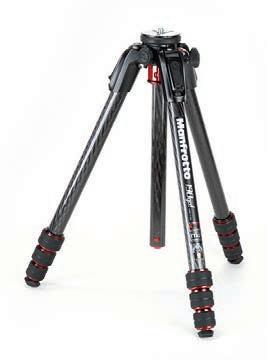
l £169 l www.benroeu.com
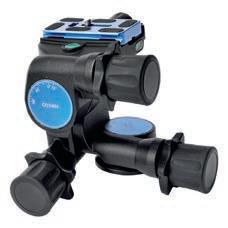
This relatively lightweight and portable geared head employs an Arca Swiss type quick release. Three large control knobs, one for each axis of movement, drive the camera directly in the corresponding direction, allowing highly accurate setting of composition. With its sturdy magnesium alloy construction, it’s rated to support a 6kg load.
★★★★★ Reviewed 26 May 2018
l £99 l www.vanguardworld.co.uk
This unusual monopod boasts an extended height of 1630mm, a folded height of 565mm and a maximum load capacity of 6kg. Three foldable legs at the base provide a tri-stand platform, and are linked to the four-section carbon fibre leg via a ball joint that allows smooth panning and tilting motions.
Reviewed 30 May 2015
Reviewed 6 Feb 2021
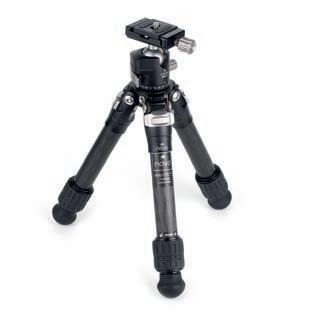
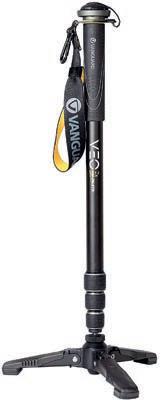
l £372 l www.adaptalux.com
This clever modular LED system is perfect for lighting small subjects creatively. The pack includes a control pod with a built-in rechargeable battery, four flexible lighting arms (two white, one blue and one green), plus three diffusers and two colour filters. Always-on LED lighting makes it easy to visualise the results in real time.
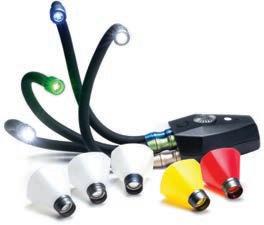
Reviewed 20 Sep 2022
l £82 l en.rode.com
RØDE’s updated compact on-camera video microphone brings a number of welcome improvements. Along with a much-improved Helix shock-mount, it comes with cables for use with both cameras and smartphones, plus a choice of foam or furry windshields. Audio quality is a dramatic improvement over most cameras’ built-in mics, too.
★★★★★ Reviewed 20 Jun 2023
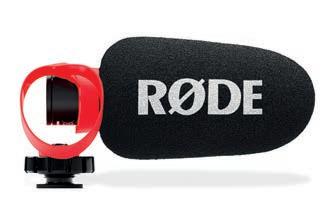
l £20 l uk.tenba.com
Not all handy accessories have to cost a fortune. This well-designed tech organiser pouch features a dual-compartment layout, with a shallow space on one side for cables, and a deeper one on the other for such things as battery chargers or computer mice. The simple rectangular design fits easily into a bag and the tough transparent covers make it easy to see what’s inside.
l £345 l www.formatt-hitech.com
This 85mm filter kit is ideal for APS-C or Micro Four Thirds users. It includes a polariser, 6-stop neutral density, and 3-stop soft-edge and hard-edge ND grads. It’ll fit filter threads up to 77mm, with step rings for 72mm, 67mm and 58mm supplied in the box.
Reviewed 6 Feb 2021
l £500 l www.colourconfidence.com
Previously known as X-Rite i1 Studio, this kit enables users to adopt a completely colour-managed workflow, from capture through display to print. It allows profiling of cameras, scanners, monitors, projectors and printers, and works with both Mac and Windows computers. It’s a great tool for any photographer who likes to print at home.
★★★★★ Reviewed 19 Jan 2019
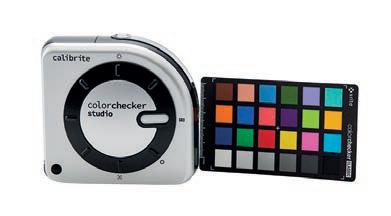
l £230-£285 l www.kasefilters.com
l £219 l www.epson.co.uk
An update to the XP960, which won our coveted gold award, this impressive multifunctional unit provides A3 printing ability while retaining a compact footprint. Along with a conventional USB connection, it can print over Wi-Fi, or directly from an SD card or USB stick, controlled using the excellent colour LCD touchscreen. Other useful features include an A4 scanner and double-sided document printing.
l £70 l uk.bioliteenergy.com
Powerbanks can be invaluable when you want to keep shooting for longer. This device houses a 20,000mAh Li-ion battery, which is capable of replenishing the average camera battery up to ten times. It can also be used to power certain cameras directly.
★★★★★ Reviewed 10 Jul 2021
l £115 l www.instax.co.uk
These clever kits include circular polarising, 3-stop and 6-stop neutral density filters that snap magnetically onto adapters that screw into your lens. This considerably speeds up the process of using filters and encourages you to use them creatively. Kits are available in 77mm, 82mm, and 95mm sizes, with adapter rings from 49mm up.
Reviewed 20 Sep 2022
Reviewed 21 Feb 2023
Powered by a built-in rechargeable battery, this smart little printer connects to your smartphone via Bluetooth and is controlled using an attractively designed and intuitive app. It’s small enough to slip into a coat pocket or bag, and delivers gorgeous little prints with fine detail and vivid colour.
Reviewed 30 Aug 2022
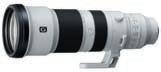
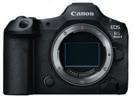
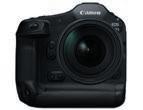




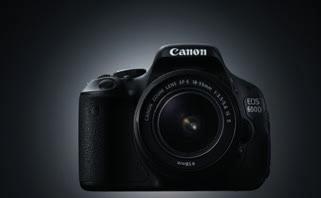
Radical simplicity
The Sigma BF represents a new, more intuitive way to use a camera. It is streamlined to make the act of photography as effortless as possible. Sigma have replaced the shooting mode dial – itself a holdover from the days of film photography – with direct access to the five elements that decide the photograph.


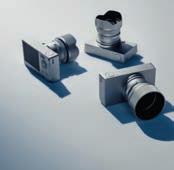


f/2.8
This lens offers a full-frame focal range that covers wide to standard subjects, which is ideal for photographers and hybrid creators who want to shoot different genres with a single portable zoom. With a constant f/2.8 aperture it provides consistent exposure and control over depth of field, while maintaining excellent low-light capability.




EOS 6D Mark II from £389
EOS 90D from £459
EOS 70D from £194
EOS 600D from £69 CANON MIRRORLESS
EOS R5 C £2,439
EOS R5 from £1,609
EOS R6 Mark II from £1,269
EOS R6 from £899
EOS R8 from £579
EOS R from £689
Check
This lens is the successor to the highly acclaimed 28200mm F/2.8-5.6 Di III RXD, reborn as an advanced 2nd-generation “G2” model. It offers improved image quality and faster, more precise autofocus powered by TAMRON’s VXD linear motor focus mechanism. Experience the full potential of an all-in-one zoom, reimagined.
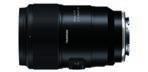


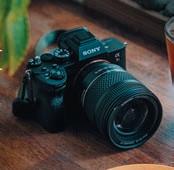


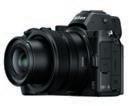
NIKON DSLRS
D6 from £1,209
D800 from £209
D5100 from £111
D3500 from £294
NIKON MIRRORLESS
Z7 from £819
Z6 from £504
Z5 II £1,149
ZF from £1,219
ZFc from £402
Z50 from £339
Lead the Scene
The new DJI RS 5 features touchscreen subject selection with the new tracking module, smooth balancing from fine-tuning knobs, and direct control via the new briefcase handle - all backed by faster charging and extended battery life.


FUJIFILM CAMERAS


GFX100S from £2,569
GFX50S II from £1,919
GFX100RF from £3,859
X-T4 from £799
X-E4 from £639
FUJIFILM LENSES GF 55mm f/1.7 R WR £1,829 GF 250mm f/4 R LM OIS WR £1,909
80mm f/2.8 R LM OIS WR Macro £689 XF 100-400mm OIS WR £769 XF 150-600mm OIS WR £1,239
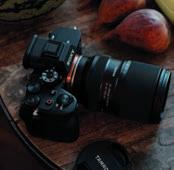







FREE SHIPPING ON ALL ORDERS OVER £150

It’s better for the environment and kinder on the wallet



Canon
Canon
Canon 20mm f2.8 USM EF
Canon
Canon 28-80mm f3.5-5.6 USM EF IV
Canon 35-135mm f4-5.6 USM EF
Canon 50mm f1.8 EF II
Canon 55-200mm f4.5-6.3 IS STM EF-M
Canon 70-200mm f2.8L IS USM EF
Canon 75-300mm f4-5.6 III EF
Canon EOS 2000D DSLR & 18-55mm
Canon EOS 250D DSLR & 18-55mm IS
Canon EOS 70D DSLR Body
Canon EOS 7D Mark II DSLR Body
Canon EOS 80D DSLR & 18-135mm IS
Canon EOS 850D DSLR & 18-55mm IS
Canon EOS 90D DSLR Body
Canon EOS M50 Mirrorless & 15-45mm
Canon EOS R50 Mirrorless & 18-45mm
Canon EOS R50 Mirrorless Body
Canon EOS R7 Mirrorless Body
Canon EOS R8 Mirrorless & 24-50mm
Canon EOS RP Mirrorless Body
Canon RF 15-30mm f4.5-6.3 IS STM
Canon RF 24-50mm f4.5-6.3 IS STM
Canon RF-S 18-150mm f3.5-6.3 IS STM
Canon RF-S 55-210mm f5-7.1 IS STM
Fujifilm 50-140mm f2.8 R LM OIS WR XF
Fujifilm 50-230mm f4.5-6.7 OIS XC
Fujifilm 55-200mm f3.5-4.8 R LM OIS XF
Fujifilm X-E4 Mirrorless Body
Fujifilm X-T5 Mirrorless Body (2,000 Shutter Count)
Nikon 10-24mm f3.5-4.5G ED AF-S DX NIKKOR
Nikon 10.5mm f2.8G ED DX Fisheye
Nikon 105mm f1.4E ED AF-S NIKKOR
Nikon 105mm f2.8G IF-ED AF-S VR Micro-Nikkor
Nikon 18-105mm f3.5-5.6G ED AF-S DX VR NIKKOR
Nikon 18-140mm f3.5-5.6G ED AF-S DX NIKKOR VR
Nikon 24-70mm f4 S Nikkor Z
Nikon 24mm f1.8G ED AF-S NIKKOR
Nikon 28mm f1.8G AF-S
Nikon 500mm f5.6E PF ED AF-S NIKKOR VR
Sony 50mm f2.5 G
Sony 55-210mm f4.5-5.6 E OSS
Sony 70-200mm f2.8 GM OSS FE
Sony 70-200mm f4G OSS FE
Sony 70-200mm f4G OSS
Nikon 50mm f1.8 AF-D NIKKOR
Nikon 55-300mm f4.5-5.6G ED DX AFS VR
Nikon 70-300mm f4-5.6G AF
Nikon 70-300mm f4.5-5.6G IF-ED AF-S VR
Nikon Coolpix P950 Bridge Camera
Nikon D3500 DSLR & 18-55mm VR
Nikon D5300 DSLR & 18-55mm (1,000 Shutter Count)
Nikon D5600 DSLR & 18-55mm VR
Nikon D7200 DSLR Body (22,000 Shutter Count)
Nikon D750 DSLR Body
Nikon D7500 DSLR Body (3,100 Shutter Count)
Nikon Z 14-30mm f4 S
Nikon Z 24-70mm f2.8 S Nikkor
Nikon Z 50mm f1.8 S
Nikon Z fc Mirrorless & 16-50mm & Grip
Nikon Z6 II Mirrorless Body (8,500
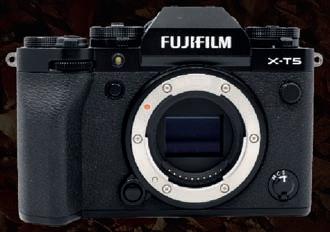

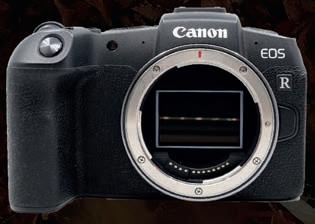
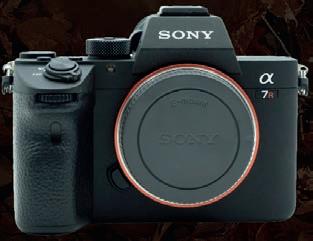


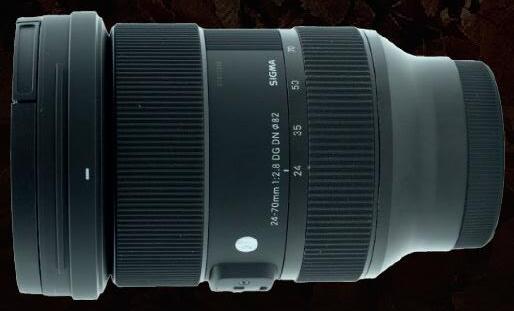








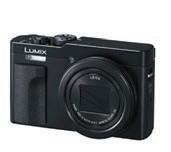
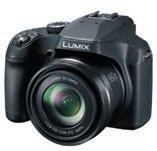

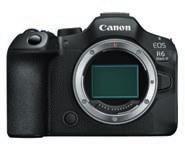
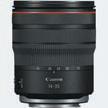









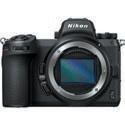
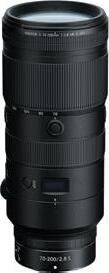
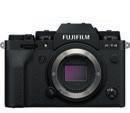
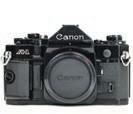











Greatnews!Theglobalmarketforqualitydigitalandfilmcameras, lensesandaccessoriesisasstrongasever. Withaworldwidenetworkofcustomerswe'repayingourhighestpricesforNikon, Canon,Leica,Fuji,Sony,Olympus,Panasonic,Contax,Voigtlander,Hasselblad, Minolta,Sigma,Tamron,Tokina,Bronica,Mamiya,Pentax,Schneider,Zeiss, Linhof,ShenHao,Ebony,Wista,Chamonixandothertopqualitybrands.




ike a rubberneck on the motorway, I am irresistibly pulled into this disturbing scene.
A high-speed collision on the M62; a shiny red sports car upturned; metal and fuel erupting in flames.
Yet ‘Crash and Burn’ by British photographer Stephen King points to something other than mechanical brake failure or a brief lapse in driver concentration. This unconventional car crash appears to be more performative than accidental.
This quasi-realistic image is part of Stephen’s project Firehawks; it took five years to make and was completed in 2025. Creatively and sensitively, the work explores the littleknown practice of firesetting – a deliberate and potentially dangerous behaviour not uncommon among children coping with trauma.
The firehawk, an Australian bird, uses fire as a survival technique. By carrying burning sticks away from existing fires and dropping them elsewhere, it deliberately starts new fires to flush out prey. Firesetting in children can also be a survival technique: a silent signal when words are not an option.
Speaking to Stephen I could sense a profound emotional connection to the topic, and I wasn’t surprised when he explained that as a child, he had set fires. Sometimes, when feeling anxious he would plan a fire, mentally storyboarding the act from stacking up matches to watching the fire engines arrive. ‘It’s all very
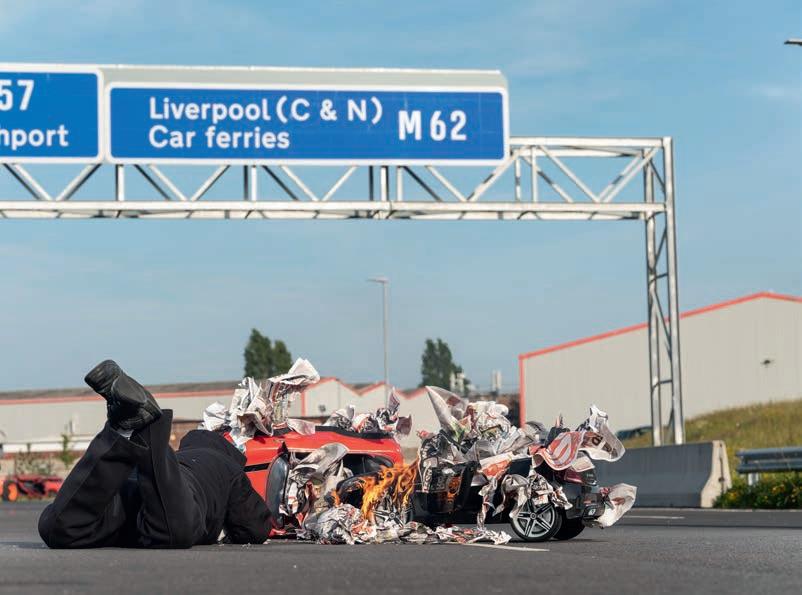
dramatic,’ he says, ‘what a way to be as a kid, no one’s listening to me so I’ll set the world on fire.’
Decades later, as childhood memories began to resurface, Stephen decided to explore this territory photographically. The process posed significant creative, ethical, and practical challenges; and a great amount of groundwork was undertaken before the photography could begin. Stephen, eager to include multiple firesetting stories in his project, worked hard to build relationships with key organisations and persuade ex-firesetters to get involved.
‘Crash and Burn’ presents a paradoxical performance where fragile mental spaces, triggered
by memorable places, play out an evocative drama.
The set, recently constructed for the fire brigade to practise extinguishing fires, is a life-sized model of the M62. ‘I’m going to set up some lights, but I’m not really going to shoot,’ says Stephen. ‘Just play with it and see how you get on.’
An ex-firesetter, wearing all black, hovers awkwardly on the edge of the scene; there is no script, no direction, no expectations. Then, somewhere within, an eight-year-old boy scrunches up old newspapers and stuffs them into matchbox cars, leaving just enough space for hot air.
The man in black, ignited by the memory, surrenders to the
role. Lying on his belly, legs folded into child’s pose, he loses himself on the M62.
Judiciously, he manoeuvres the two miniature cars into the fast lane, enthusiastically cramming paper into the shiny red and black vehicles. Then, lighting a long, thin paper wick, he acts out a catastrophic car crash.
Mesmerised, he watches as the vehicle driven by his father spectacularly erupts into flames.
‘Crash and Burn’ is an extraordinary image, a visual conversation between two ex-firesetters, built with the silent language of survival and a whole lot of trust.
Stephen King’s work can be seen at stephenkingphotography.co.uk
Maria Falconer MA, MSc., FRPS, is a photographic practitioner, teacher and writer. A Fellow of the Royal Photographic Society, Maria runs various photography workshops across the UK and in Europe. For more on her latest workshops and to book your place, visit www.mariafalconer.co.uk