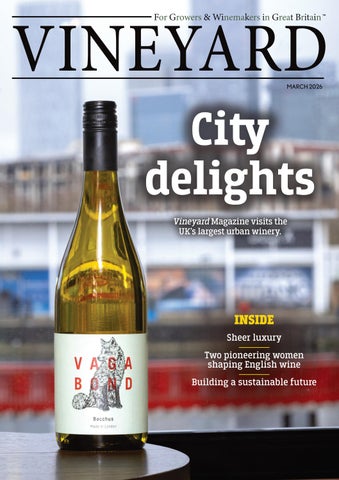
City delights


Specialists in controlled atmosphere stores
Rapid chilling systems for soft fruit and fresh produce
Secondary cooling systems with energy efficient defrosting using air source heat pump technology
Retrofitting of existing high cost electrical defrost heaters with air source heat pumps
Electrical engineers and contracting
Refrigeration and Electrical service, maintenance, and breakdown cover


Testing and certification to NICEIC
Mains power solutions for distribution and installations
Temperature controlled wine storage solutions using DX or Secondary refrigeration with heating options
Qualified to install EV chargers
Refrigeration gas leak detection systems
F-gas compliance and record keeping
Refrigeration system controls with remote
www.vineyardmagazine.co.uk
VINEYARD
Kelsey Media, The Granary, Downs Court Yalding Hill, Yalding, Maidstone, Kent, ME18 6AL 01959 541444
EDITORIAL
Editor: Rebecca Farmer vineyard.ed@kelsey.co.uk
Features: Malcolm Triggs
GRAPHIC DESIGN
Jo Legg Flair Creative Design jo.legg@flair-design.co.uk
ADVERTISING & MARKETING
Jamie McGrorty 01303 233883 jamie.mcgrorty@kelsey.co.uk
PHOTOGRAPHER
Martin Apps www.countrywidephotographic.co.uk
MANAGEMENT
]CHIEF EXECUTIVE OFFICER: Steve Kendall
DIVISIONAL MANAGING DIRECTOR: Fiona Mercer
PUBLISHER: Jamie McGrorty
RETAIL DIRECTOR: Steve Brown
SUBSCRIPTION MARKETING MANAGER: Claire Aspinall
PRINT PRODUCTION MANAGER: Kelly Orriss
DISTRIBUTION
Distribution in Great Britain: Seymour Distribution Limited 2 East Poultry Avenue, London EC1A 9PT Tel: 020 7429 4000 www.seymour.co.uk
Distribution in Northern Ireland and the Republic of Ireland: Newspread Tel: +353 23 886 3850
Kelsey Media 2026 © all rights reserved. Kelsey Media is a trading name of Kelsey Publishing Ltd. Reproduction in whole or in part is forbidden except with permission in writing from the publishers. Note to contributors: articles submitted for consideration by the editor must be the original work of the author and not previously published. Where photographs are included, which are not the property of the contributor, permission to reproduce them must have been obtained from the owner of the copyright. The editor cannot guarantee a personal response to all letters and emails received. The views expressed in the magazine are not necessarily those of the Editor or the Publisher. Kelsey Publishing Ltd accepts no liability for products and services offered by third parties.
Kelsey Media takes your personal data very seriously. For more information on our privacy policy, please visit https://www.kelsey.co.uk/privacy-policy/ If at any point you have any queries regarding Kelsey’s data policy you can email our Data Protection Officer at dpo@kelsey.co.uk

The Vine Post Vineyard scouting: knowledge is power.
Matthew Jukes Sheer luxury.
The agronomy diary Test soils to tailor nutritional plans.
WineGB launches new entrants guide

Biodegradable sleeve for hedge and small-scale planting protection
Tubex, a brand of Magnera, has launched Nature Easysleeve, a new addition to its biodegradable tree protection portfolio.

A world view Andrea Ontiveros Flores, a sommelier and marketing & communications specialist from Alicante, Spain discovers how international tourists are rediscovering Alicante through local wine.
Upcoming inheritance tax changes
Shaping the future of English wine Strategic choices for the 2030s.
Vineyard & Winery Show 2026 date confirmed
Bubbling to perfection Enartis Perlage range for a flawless tirage


16

28

40

Features
Posing with alcohol
To celebrate International Women’s Day, Alice Griffiths talks to two pioneering women shaping English wine.
City delights
With a full view of London’s iconic skyline, Vagabond Winery Canada Water is joining the new community and business space that is developing around the Canada Dock area.
Building a sustainable future
Making wine in a way that respects the environment is not just a laudable ethical approach, but also one that makes good financial sense.
50
Better spraying, lower disease risk
While product choice will always matter, the way sprays are applied is just as important.


From the editor
“She has strict orders as to her behaviour. She’s to keep to two subjects the weather and everybody’s health”
Pygmalion Act III, George Bernard Shaw
This month has seen some remarkable efforts including the journey of Sam Stables, a sheep farmer from Herefordshire who walked over 140 miles from Ross on Wye to London to raise awareness of the mental health support that is available to the farming community. It was heartening to hear that many joined him on his walk and it reminds us that community is more than a word; it has power to support, build and change for the better.
Viticulture, like many aspects of agriculture can be a lonely occupation with many tasks undertaken in solitude and is subject to the sometimes hostile weather conditions. This pruning season has been beset by such weather and since the last appearance of this column it has hardly stopped raining. Most of England and Wales, except the north of England, had seen the entire long term average rainfall for February before the 14th day of the month. Having faced such difficulties, it will be good to see the vineyard community come together to celebrate the art of pruning. The annual pruning competition referred to as “The battle of the secateurs” is a showcase of skill and joyful celebration of the start of another growing season. The good humoured rivalry encourages conversation to flow and I am sure the recent weather will be a significant point of discussion.
On a positive note the extended weather pattern has refilled many of the essential reservoirs that had been much depleted over the long summer of 2025. Reports from the end of 2025 suggested that in some places reservoirs were within six weeks of running dry. For example Bewl Water the largest stretch of open water in the south east has seen water levels increase by 25% since the 1 January and Roadford Lake in Devon has seen a 15% increase in the same period. I am therefore reminded that although the weather has recently been grey and gloomy, the carpet of flowering crocus have appeared once more and are opening their blooms to take full advantage of those fleeting moments of sunshine. We can take heart from their example.


National Wine Careers Week
National Wine Careers
Week returns, backed by growing industry momentum.
National Wine Careers Week will return from 9-15 May 2026, building on the positive industry and trade engagement generated by its launch last year and continuing its mission to raise awareness of the wide range of careers available across the UK wine sector.
Led by Plumpton College, home of the UK Wine Education Centre, and founding partner Nyetimber – the pioneers of English sparkling wine, and long-time supporters of Plumpton College – the campaign aims to showcase the broad spectrum of roles across the wine trade and production sectors and to collaborate with businesses across the wine sector to help amplify and highlight the diverse career paths available.
The initiative is also supported by WSET, WineGB and Drinks United.
Now in its second year, National Wine Careers Week also promotes the extensive training and skills development opportunities that support long-term career progression within the industry.
The UK wine sector is a huge asset to the UK, both in terms of its contribution to the economy and the number of jobs it sustains, generating some £8.9 billion in Gross Value Added and supporting over 412,000 jobs*. Within this, the UK’s domestic wine industry continues to
expand, now employing around 3,300 full-time equivalent roles, alongside approximately 13,000 seasonal positions, with further workforce growth (21%) forecast in the coming years**.
Despite this scale and growth, careers within the wine sector remain relatively under the radar among job seekers. National Wine Careers Week aims to address this by improving visibility, sharing real career stories and providing practical routes into the sector.
Throughout the week, activity will take place both digitally and in person. A dedicated website, social media campaign and targeted PR programme will support the initiative, alongside industry-led events and opportunities designed to showcase career pathways and training routes. Further details of activities will be announced over the coming weeks.
The campaign will also feature a network of industry ambassadors from across the sector, sharing their career journeys and helping to illustrate the breadth of opportunities available.
Jeremy Kerswell, Principal of Plumpton College, said: “The wine industry is an exciting and dynamic sector that offers opportunities at many different levels.
National Wine Careers Week helps demonstrate the wide range of skills and

talents that are needed across the industry and encourages more people to consider wine as a rewarding long-term career.”
Eric Heerema, Owner and CEO of The Nyetimber Group, said: “We are proud to support National Wine Careers Week and its focus on encouraging people to explore careers in wine. At Nyetimber, we think in generations, not years, and as one of the UK’s largest employers in the wine industry, we recognise the importance of nurturing new talent. The sector offers a wide range of career pathways, and initiatives like this are vital in helping the industry continue to grow and thrive.”
Businesses and individuals across the wine sector are encouraged to support the campaign by sharing career stories, hosting events or engaging online. A participation toolkit is available to help organisations get involved.
Further information: www.winecareersweek.co.uk
* WSTA The UK Wine and Spirit Trade In Focus Report, published July 2025: Including WSTA Economics Analysis study of Wine & Spirit industry conducted by Cebr analysis of NIQ off-trade and CGA on-trade data | total wine & spirits | MAT 2022 data, HMRC Alcohol Bulletin, MESAS, HMRC Trade Info
** WineGB Annual Report published July 2025
Join the campaign
We’re calling anyone in the trade and industry who would like to support this initiative to contact us and get involved: host an event, organise a discussion panel, or just post something on social media and engage with the campaign online.
A toolkit has been devised with hints and tips on how to get involved, or you can share your story about how you got into a career in wine: https://forms.office.com/e/8LdDjqKUGb
For more information, visit www.winecareersweek.co.uk or contact Julia Trustram Eve for more information by emailing julia@trustrameve.com

THE VINE POST
Vineyard scouting: knowledge is power
Good decisions start with good information.
‘Knowledge is power’ may be the familiar phrase, but in today’s vineyards knowledge increasingly comes from data. Good quality data gives growers a clearer picture of their vineyard’s performance. At the heart of that process sits scouting – the process of gathering visual and field-based data from the vineyard to build an accurate picture of vineyard performance over time.
Why scouting matters
Scouting is often talked about as something everyone knows they should do, yet in practice it can slip down the priority list. In the UK, it is still common for scouting to happen from the tractor cab, or as an informal add-on during an agronomist’s visit. While experience and instinct are important, neither replaces structured observation. Scouting is, at its core, a visual exercise: you can only respond to what you can see. That makes how, when and where you look critically important.
Traditionally, scouting involved a notebook and pen, recording growth stages such as budburst, flowering and veraison, alongside visible pest and disease pressure. That foundation still matters. However, thanks to technology, the way we capture and use information is changing, offering growers the chance to move from isolated observations to a long-term dataset that supports better decision-making.
Representative data
Effective scouting means assessing more than just a handful of vines. Because no one can inspect every vine, scouts rely on sampling patterns to gain a representative picture. These may include W or M-shaped walks across a block, stratified sampling at set intervals, repeated checks on sentinel vines, or randomised sampling. Each approach has advantages and limitations. Sentinel vines can work well in uniform vineyards for tracking growth and yield but are less reliable for
disease monitoring. In practice, a sufficiently large, randomised sample often provides the most balanced overview.
Most scouting takes place during the growing season, with essential visits timed around key growth stages and weather events. Frost, prolonged rain or warm, humid conditions all raise the risk of disease. A good vineyard manager understands these triggers and uses them to plan scouting, looking for early signs of powdery mildew, downy mildew or botrytis before problems escalate.
Technology vs walking the vines
The tools used by scouts have evolved. Clicker counters, hand lenses and sample bags are now often supported by digital tools. Remote sensing is frequently described as the next generation of vineyard scouting. Techniques such as infrared imagery and NDVI can map vine vigour, highlight variability and identify missing vines, and are well established tools in large wine regions.
While remote sensing excels at showing vigour patterns, it struggles to identify early-stage pests, trunk diseases or subtle canopy issues at a microclimate level. For UK viticulture, with its small, dispersed and highly variable sites, these tools can be expensive and, on their own, insufficient.
That reality brings us back to a familiar conclusion: there is still no substitute for “boots on the ground”. Intimate knowledge of a vineyard’s layout, its low-airflow corners, vigorous patches and historic disease

ChBuck ley Bu rector
hotspots are invaluable. Walking the vines allows scouts to spot issues long before technology alone would raise a flag.
Observation into insight
Where technology really comes into its own is in supporting and organising what we see. Digital record keeping is rapidly becoming the norm. Apps and platforms can log scouting observations with photos and GPS locations, track spray programmes, record yield estimates and build year-on-year comparisons. UK-focused tools are now emerging that better reflect the realities of our vineyards. The benefit of this digital shift is not complexity, but clarity. Over time, consistent data collection allows growers to compare seasons, refine spray timing and make better-informed decisions. The longer you gather data, the more valuable it becomes. Scouting does not need to be complicated, but it does need to be deliberate. Done well, it turns observation into insight and experience into evidence.

Photo: ©Daria Szotek
A WORLD VIEW Beyond Rioja
Andrea Ontiveros Flores, a sommelier and marketing & communications specialist from Alicante, Spain discovers how international tourists are rediscovering Alicante through local wine.
For the past couple of years, I have spent time between London, UK, and Alicante, Spain – two very different wine worlds that have given me a front-row view of the contrast between longestablished producers and emerging regions.
Moving back and forth between these markets has revealed not just differences in production styles, but also in how wines are perceived, chosen, and enjoyed towards both regions, even as many consumers remain unaware that England and Wales are becoming serious wine-producing countries. With this context in mind, my recent articles have explored consumer perceptions of established producers such as Spain and Italy in comparison with English and Welsh wines, where scepticism about the islands’ potential continues to surface. This time, however, I flip the script, following international tourists, mostly from England, as they travel Spain’s Wine Routes (Rutas del Vino) and experience the country as a wine destination. Along the way, I explore who these wine travellers are, the consumer attitudes and market behaviour, and how their preferences influence the way they discover and consume local wines.
When you think of Alicante, one of the first things that comes to

mind is the classic sun-and-beach image of the Costa Blanca, yet the region’s connection to wine runs far deeper than tourism, with a history that stretches back even further than celebrated regions such as Rioja and Ribera del Duero. Alicante is home to one of the oldest Denominación de Origen (DO) not only in Spain, but in Europe with evidence of viticulture that dates to the 7th century BC, considered one of the oldest wineries on the Iberian Peninsula. Today, the region is best known for Monastrell, a powerful local red, and Moscatel de Alejandría, used for aromatic whites and sweet wines. The legendary Fondillón – a unique, long-aged red matured for over a decade, remains a source of local pride and cultural identity. Bringing this heritage together, the Ruta del Vino de Alicante links more than a dozen municipalities across the Vinalopó and Marina wine areas, offering tastings, food pairings, and cultural visits, and providing an ideal introduction to Alicante’s terroir and signature grape varieties. So why, with such a rich wine history, is Alicante still less recognised than headline regions like Rioja or Ribera del Duero, especially among international visitors? The answer lies not in a lack of quality or relevance, but in limited promotion and awareness.

Central Market Alicante – wine tasting tour

Fortunately, this has begun to change over the past decade, thanks to a growing number of local and international campaigns aimed at positioning Alicante alongside Spain’s more famous wine regions. As a result, perceptions are slowly shifting, particularly among overseas tourists. To understand this evolution, it’s worth taking a closer look at who today’s visitors to Alicante are, and how open they are to trying local wines.
International visitors to Alicante range from casual holidaymakers to dedicated food and wine travellers. As a Ruta del Vino brand however, Alicante tends to attract visitors who are more open to engaging with local wine culture. Wine routes and wine-focused events encourage tourists to go beyond simply tasting wine, offering context around grape varieties, food pairings, and local viticulture. Informative tastings and storytelling are central to the experience, turning a glass of wine into a deeper connection with the region rather than just a casual sip. According to the Spanish Association of Wine Cities (ACEVIN), advanced wine knowledge is not a requirement for visiting Spain’s Wine Routes, but its latest report shows that most wine tourists are enthusiasts (36.8%), followed closely by passionate or highly engaged visitors (32.2%), a segment that has grown significantly in recent years. Beginners account for 15.8%, while professionals represent 12.9% – the fastest-growing group. Visitors with no connection to wine remain marginal at just 2.39%, a figure that continues to decline.
Across these segments, less experienced wine drinkers and casual travellers often rely on guides, sommeliers, or organised tours to introduce them to Alicante’s wine styles – learning about varieties

such as Monastrell and Moscatel, and discovering Fondillón as a local speciality rather than defaulting to better-known Spanish regions, where perceived quality, familiarity and international brand recognition tend to be stronger. By contrast, wine enthusiasts and returning visitors are more inclined towards deeper, educational experiences, such as winery visits, barrel tastings, and time spent with winemakers. These travellers are typically curious about local terroir and winemaking techniques and are willing to look beyond Spain’s most famous labels, even if their prior exposure to the Alicante DO has been limited. In terms of international visitor groups, profiles vary, but most show a strong openness to discovering local wines. UK and Irish visitors form the largest group, with moderate wine knowledge but a high willingness to engage when guided.
Nordic travellers stand out for their interest in sustainability, adventurous palates, and local identity, while visitors from Germany and the Benelux tend to approach wine more analytically, valuing terroir explanations and a strong quality–price balance. Meanwhile, tourists from the USA and Canada are highly experience-driven and particularly receptive to premium local wines, making them one of the most responsive groups overall.
To see this through the eyes of the visitor, I visited two of Alicante’s most popular wine experiences for international tourists: Alicante Tasting Club, one of the city’s leading wine and food experiences for global visitors, offering visits to local wine bars and wine pairings with Mediterranean dishes, ideal for beginners and casual travellers; and Pepe Mendoza Vineyard – Wine Tasting Experience, led by one of the most respected winemakers in south-east Spain. <<

Pepe Mendoza Vineyard
A WORLD VIEW
This boutique, family-owned winery is renowned for its organic, artisanal Mediterranean wines made from indigenous grape varieties such as Monastrell, and offers guided tastings and vineyard tours that are particularly well suited to wine enthusiasts and highly engaged visitors interested in local terroir and traditional techniques.
During my visit to the Alicante Tasting Club, I met Carlos, a local Alicantino and tour guide with long experience of working with international visitors. He explained that until about a decade ago, wine culture played only a minor role in Alicante’s tourism scene, with most visitors opting for beer or the ever-popular sangria. At the time, Rioja dominated wine lists across bars and restaurants. Today, the picture looks different: local wines now lead the offering, while Rioja and Ribera del Duero have taken on an increasingly secondary role. Carlos attributes this shift to the sustained efforts of the Ruta del Vino initiative and its young leadership, which has introduced fresh ideas aimed at positioning Alicante wines alongside Spain’s more established regions. While progress is clear, he acknowledges that there is still work ahead.
Most participants in Alicante wine tastings, he notes, are beginners, yet they arrive curious and eager to learn. International visitors, particularly from England, Germany, the Nordic countries and the Netherlands, show the greatest interest, and he was even surprised to encounter Australian visitors already familiar with Monastrell. Fondillón remains less familiar to global audiences, but it often leaves a lasting impression. Visitors frequently compare it to sherry or vino de Jerez, usually with pleasant surprise at its depth and historical character. It is among the wines most commonly taken home as a souvenir, alongside other local products from the Central Market (Mercado Central). Carlos estimates that at least a quarter of tour participants choose to purchase or consume something local during their visit.
It came as little surprise that, on my second visit – this time to the Pepe Mendoza vineyard, both international and local visitors explored local wine styles with increasing confidence, often setting aside familiar names in favour of regional expressions. During a tasting, one of the guides observed that many visitors arrive already engaged with the winery’s production methods, indigenous grape varieties, and terroir. This interest aligns closely with the philosophy of Casa Agrícola, Pepe Mendoza’s winery, which is grounded in respect for tradition, environmental care, and the Mediterranean character of
Alicante wines. The vineyards are dry-farmed, organically managed, and frequently planted on ancient terraced plots with dry-stone walls, reflecting long-established agricultural practices. The focus remains on local grape varieties, particularly Monastrell, alongside Moscatel de Alexandria and Giró, with Syrah and Alicante Bouschet used selectively. The estate is located in the Marina Alta zone of DO Alicante, with additional vineyards in the Alto Vinalopó comarca, this is not an especially easy location to access, requiring roughly an hour’s journey from Alicante city, which partly explains why the winery tends to attract a wine-focused audience, sometimes including sommeliers from around the world. However, this does not exclude less experienced visitors: both local and international tourists with limited prior wine knowledge still make the journey, drawn by curiosity and a willingness to learn and engage with local wine culture. Such adventurous attitudes are expected when visiting longestablished wine-producing regions.
This contrast becomes evident when compared with emerging wine countries such as England and Wales, where choosing local wine often requires a more open-minded drinking behaviour, as the country itself plays a stronger role in shaping perceptions of quality, risk and value. Spain, by contrast, is one of the world’s oldest wine-producing nations, where origin alone carries deep cultural credibility. In Alicante and its surrounding towns, wine shelves are dominated by Spanish labels, and both locals and visitors tend to choose domestic wines by default. In England and Wales, however, wine lists are largely composed of international bottles from a wide range of producing countries. Overall, international tourists in Alicante do not limit themselves to well-known Spanish names such as Rioja, particularly when engaging in wine tourism experiences. Many arrive curious and open to learning, guided by tastings and storytelling that bring Alicante’s distinctive wine heritage into focus. While some visitors initially gravitate towards familiar labels, a significant number prove more adventurous, leaving with a deeper appreciation for local grape varieties and the region’s winemaking identity. As a result, although Rioja, Ribera del Duero and other major Spanish appellations remain reassuring reference points for some tourists, Alicante wines receive considerable attention, especially through structured tastings and guided wine tours.

Central Market Alicante – wine tasting tour
Upcoming inheritance tax changes
What they mean for vineyard and winery owners.
Following the Government’s changes to Inheritance Tax in 2024, which were not well received by farmers or business owners; a quiet announcement before Christmas might be a small gift. The Government has increased the limit on Inheritance Tax relief for business assets, which is set to come into effect from April 2026. The limit for 100% relief will now be £2.5m, rather than the previously announced £1m.
There is a lot of attention on these changes and their impact on farmers; however, they can affect others too, such as wineries and associated businesses.
What has changed now?
The changes relate to Business Relief and Agricultural Relief, which replace Agricultural Property Relief and Business Property Relief. Initially, the government announced that from April 2026, 100% Inheritance Tax relief for business assets will be limited to £1m. This was a drastic change for many, as previously there was no limit for 100% relief. This change meant that Inheritance Tax would be charged on many businesses, which would have a significant impact on succession plans.
However, in December 2025, the government announced that the 100% allowance would be £2.5m, allowing an individual to pass on a business worth £2.5m without Inheritance Tax. Above the £2.5m allowance, 50% relief will be available; making the effective rate of tax 20%, instead of 40%.
Another seemingly minor change means that this allowance can be passed to a surviving spouse. This allows a couple to pass on up to £5m, without complex planning being required.
These changes do not remove the potential for tax to be charged entirely; instead, it reduces the impact for some. It is worth noting that the allowance increase also applies to trusts. Before the introduction of the limits on relief, trusts were a popular vehicle for transferring business assets between generations, allowing the Capital Gains on business assets to be deferred.
The introduction of the allowance meant
that assets worth more than £1m would be subject to a lifetime Inheritance Tax charge, reducing their usefulness. Now with the newly increased limits, they are once more viable for succession planning.
What is staying the same?
Although there have been changes that will be impactful for many, Inheritance Tax remains otherwise unchanged. The main rate remains at 40%, and the Nil-Rate Band and the Residence Nil-Rate Band (RNRB) are frozen at £325,000 and £175,000 respectively. Together, these allow a couple to pass on up to £1m of non-business assets without paying any inheritance Tax. However, if the value of your estate exceeds £2m, the RNRB is reduced. Because your estate is valued before Business Relief is given, relying on business relief and retaining a high-value estate could impact the RNRB available.
What can go wrong?
The RNRB threshold can catch out couples, where often the whole estate will be retained by the survivor after one spouse dies. This may mean being left with
How Carpenter Box can help

an estate of over £2m that was not planned for and losing some relief, particularly where the value of assets continues to increase and tax thresholds are frozen.
Another pitfall is a change in the nature of business assets. Where assets are passed to a surviving spouse, the availability of Business Relief is dependent on the assets continuing to qualify. If the business stops or the assets are sold, then Business Relief may no longer be available. This can lead to Inheritance Tax that could have been avoided with different planning.
Photo: Will George
What does it mean for you?
With the changes in the Inheritance Tax landscape, it is essential to be proactive. Wills that met your needs in the past may now leave your estate with an unexpected tax bill, and the conventional wisdom around long term tax planning may no longer be appropriate.
Each of us has different wishes and ever changing circumstances, and with the ongoing adjustments to Inheritance Tax it is crucial to be proactive with succession planning and seek expert guidance.
Contact our team on 01903 234094 or visit www.carpenterbox.com to discuss how these changes may affect your vineyard, business, family, and long-term goals.
Sarah Fitzgerald, Partner, Vineyard Sector
ENVELOPE sarah.fitzgerald@carpenterbox.com
Sarah is a partner in the Business Services Group advising owner managed businesses from new start-ups to established family businesses. She specialises in the viticulture sector, advising in business development and strategic planning alongside providing professional tax and accounting support.
David Rainford, Tax Manager
ENVELOPE david.rainford@carpenterbox.com
David is a Chartered Accountant (ACA) and Chartered Tax Adviser (CTA). Working as part of the Tax Advisory team in Brighton and Worthing, David helps vineyard clients minimise their tax exposure and take the stress out of their tax returns.


Shaping the future of English wine


Strategic choices for the 2030s writes Kate Davidson of Athena Strategic Thinking Ltd.
English wine enters the second half of the 2020s in a paradoxical position. Quality is deemed high, global recognition is growing, and investment continues to flow into vineyards and production. Yet beneath this progress sits a more fragile reality: market relevance and demand are not keeping pace with supply or ambition.
This research, conducted by Athena Strategic Thinking, set out to understand where English wine stands today, and what must change to secure its future into the 2030s.
2010s: 2020s 2030s Quality & Credibility
Expansion & Recognition
Understanding the market English wine is actually competing in
The UK drinks market is diverse, crowded and increasingly valuedriven. Wine competes not just with other wine categories, but with beer, spirits, low-alcohol and no-alcohol alternatives and experience-led consumption. Against this backdrop, English wine occupies an ambiguous space.
Consumers are aware of it, but struggle to define it. Buyers recognise its quality, but face barriers around price, consistency, volume and ease of access. Producers hold differing views on whether the category should focus on premium positioning, affordability, sustainability, localism or innovation.
The absence of a clear, shared identity weakens the category’s ability to convert interest into loyalty.
Consumer behaviour is fast changing
Relevance, Access & Demand
The next phase is not about better wine, it’s about better connection
Primary consumer research revealed a widening gap between how English wine is perceived and how people make decisions when buying alcohol.
While consumers express strong values around sustainability, local provenance and national pride, purchasing decisions are still dominated by price, accessibility and occasion fit. Wine consumption overall is declining, particularly among younger adults, who are more selective, health-conscious and experience-driven.
This presents both a threat and an opportunity. English wine can no longer rely solely on heritage-style narratives or technical prestige alone. It must compete for relevance in moments that matter to consumers’ lives.
The missing link: customer understanding. “Awareness is not the problem. Conversion to trial and repeat purchase is.”
Across consumer surveys, buyer interviews and producer focus

groups, one issue consistently surfaced: the knowledge gap between producers and consumers.
Consumers lack confidence navigating the category and perceive risk in buying an expensive product which may not be recognised by others; many producers lack robust, evidence-led customer insight to guide pricing, range architecture, communication and experience design. This limits demand and reinforces the perception of English wine as “special occasion only”.
If producers knew their customers as well as they know their soil, the category’s growth trajectory would look very different.
Eight strategic challenges for the 2030s
The research identified eight strategic challenges that will shape English wine’s future:
1. Developing the identity of English wine
2. Building an effective marketing funnel
3. Closing the producer–consumer knowledge gap
4. Adapting to demographic change and declining consumption
5. Broadening the product range into affordable premium
6. Positioning vineyards as experience-led memory makers
7. Addressing the value–action gap
8. Restoring industry equilibrium through scale, focus and collaboration
Two challenges stand out as particularly urgent.
First, price and access. The current price positioning excludes most UK wine drinkers. Growth will require credible offerings below £20 that protect quality while unlocking the mass-affluent market.
Second, structural balance. Supply is outpacing demand. Larger producers face pressure to scale, consolidate, export and reduce costs, while smaller producers must lean into premium positioning, direct-to-consumer routes and distinctive experiences. As the market polarises to niche and large players, the middle ground becomes a tricky spot for producers. “Supply is growing faster than demand and structural imbalance is becoming harder to ignore.”
A strategic choice, not an inevitability
The future of English wine is not pre-determined. If the industry fails to align with evolving consumer behaviours and expectations it risks stagnation, admired, but increasingly marginal. However, those producers who reimagine their proposition, manage costs actively, invest in experience and storytelling, and collaborate at local and national levels stand to shape a new era of sustainable growth. “The next decade will not be defined by who makes the best wine, but by who builds the strongest connection with the people drinking it.”
This research was never intended to sit on a shelf. It forms a strategic toolkit designed to support informed decision-making,
“Awareness is not the problem. Conversion is.”
from individual business workshops to regional collaboration and national strategy development.
The question now facing the industry is simple but uncomfortable: will English wine shape its future deliberately or allow the market to decide it for us? Key findings are now available along with a full report and workshop facilitation.


Two pioneering women shaping English wine
This month, to celebrate International Women’s Day on 8 March, we raise a glass to the incredible women working in English wine. I chat to Wendy Outhwaite and Collette O’Leary, two winemakers redefining excellence in English sparkling wine.
Collette O’Leary began her career in PR and marketing. But after travelling the world visiting vineyards and tasting wine, she took the plunge and retrained as a winemaker at Plumpton College, joining the UK wine industry in 2011.
She travelled overseas to work with renowned sparkling wine producers, including J Vineyards in California and Graham Beck in South Africa, where the magic of the bubble truly captured her. In early 2019, she joined Henners as Head Winemaker and has since helped guide the estate from a small boutique producer to one of the top ten wineries in England.
Established in the early 2000s in the picturesque village of Herstmonceux, East Sussex, Henners sits just five miles from the English Channel. This coastal influence is key to their success, with sea breezes minimizing frost risk, reducing disease pressure and bringing a crisp salinity to their wines. The vineyard benefits from low elevation and rich, free-draining clay soils, making the site ideally suited for quality sparkling and still wine production.
Under Collette’s stewardship, Henners has evolved from its origins into a more sophisticated operation. The winery has expanded significantly in recent years, introducing new wines and grape varieties to the lineup. But perhaps most importantly, Collette has championed a network approach to grape sourcing that sets Henners apart in the single-estate dominated English wine landscape.
Working with growers across the South East of England, Henners sources fruit from a mix of terroirs and climates, allowing them to
COLLETTE O’LEARY – Henners
produce excellent wines year after year regardless of vintage variation.
As Collette explains, referencing advice from a French winemaker: “If you are playing the piano and only have three keys, you limit the tune you can play. By adding more keys, the greater the options and the more beautiful the tune you have available.” Their partner growers and vineyards are those extra keys, vital to the tune Henners plays.
This approach allows Collette to work with multiple vine clones and varieties, giving her a broad palette for final blending. She uses reserve wines and oak barrels to contribute character, depth, richness and layers to their wines. All wines are fermented and bottled on-site, with a small dedicated team responsible for every aspect of production.
Collette’s role draws on many different sides of her personality, from the physicality of working in the vineyard and winery to the creativity involved in crafting a blend and watching it develop in bottle. The travel that brought her to winemaking continues, taking her to bucket-list destinations around the world. “My job is essentially adult potionmaking, and I feel incredibly fortunate to call it my career,” she says.
Since 2017, Henners has been part of Boutinot Wines, an international producer and distributor with a family of wineries spanning France, Italy, South Africa and New Zealand. This connection allows Collette to share ideas, experience and inspiration with sister vineyards around the world

Henners
DESKTOP www.henners.com


while celebrating the “Englishness” that makes Henners wines special. The result is wine shaped by both local character and a wider world of winemaking knowledge.
Sustainability sits at the heart of Collette’s production philosophy. Henners is a founder member of Sustainable Wines of Great Britain, established in 2020, and both their vineyard and winery sustainable under the WineGB scheme. The commitment extends to reducing carbon footprint, improving soil health and conserving the vineyard environment.
Collette has always found the wine industry incredibly welcoming, with endless opportunities. Her journey from PR to winemaking, from California to South Africa to Sussex, proves that there are multiple paths into this industry, and that diverse experience can be an asset rather than a hindrance. At Henners, that global perspective combined with local passion is producing some of England’s most compelling wines.

Alice Griffiths

a wide portfolio to help you manage key disease threats. And you’ve the support you need: our horticulture and viticulture team can provide expert advice, not just on products, but on effective IPM.
Alice Griffiths is a wine communicator boosting the profile of English and Welsh Wine on social media. Alice has worked within the agriculture industry for the past 20 years, spending time as a lecturer and a smallholder before discovering her passion for viticulture, winemaking and wine tasting.
Get in touch to have your events featured:
ENVELOPE Posingwithalcohol@gmail.com
DESKTOP www.alicegriffithswine.com
INSTAGRAM Alice can be found on social media under @alicegriffithswine on Instagram.
POSING WITH ALCOHOL
WENDY OUTHWAITE – Ambriel
Twenty-five years as a human rights barrister might seem an unusual apprenticeship for winemaking, but for Wendy Outhwaite of Ambriel Vineyard, it proved the perfect foundation. The same exacting standards and unwavering conviction that defined her legal career now drive one of England’s most distinctive single-estate producers.
When Wendy and husband Charles planted their first vines on West Sussex greensand in 2008, they made strategic decisions that set them apart from the outset. Planting 9.5 hectares with Burgundian clones of Chardonnay and Pinot Noir alongside Pinot Meunier, they prioritized fruit flavour and complete quality control. The decision to remain exclusively a single-estate producer, overseeing everything from grape to glass, gives Ambriel absolute control over quality. Their mantra is simple but uncompromising: “palate not wallet.” The blind blending process is theatrical, with wines spread across a long table, tasted and paired down until the perfect combination emerges, often to the dismay of distributors watching potential volume disappear in favour of excellence. Even their entry-level sparkling wine spends seven years on lees, while prestige cuvées like the English Reserve and limited releases such as Cuvée 10 showcase the potential of extended ageing on England’s unique terroir.
That greensand rock beneath their vines is Ambriel’s secret weapon, retaining heat overnight and eliminating frost risk. This geological advantage allows Wendy to focus on regenerative viticulture. Solar panels power the operation, while green roofs and wildflower margins promote biodiversity.
Ambriel’s winemaking philosophy centres on meticulous attention at every stage. Each clone and plot is vinified separately in temperaturecontrolled stainless steel tanks or aged oak barrels. Tank size deliberately limits production, ensuring quality over quantity remains paramount across their range of six sparkling wines, from the Classic multi-vintage to specialist releases like the 2018 Rosé.
Her brand identity makes her values visible. Ambriel’s signature purple, silver and green deliberately echo suffragette colours, honouring her human rights background. It’s serious winemaking with a sense of humour, demonstrated by wine names like “The Wendling Blanc de Blancs,” referencing both the gentle wend of a bubble and Wendy’s own nickname.
Distribution reflects careful balance: roughly one-third export, one-third on and off-trade, and one-third direct to consumer. The estate’s tasting room and gardens, planted with flavours found in the wines from rhubarb to strawberries, welcome visitors for tours and tastings. Recent ventures into winter dinners and events expand their hospitality offering, alongside the vineyard’s successful wine clubs, Sipsters and Fizzicists.
Yet Wendy’s influence extends far beyond Ambriel’s 9.5 hectares. A past board member of WineGB and a familiar face across the English wine scene, she brings the same conviction to championing the industry that she does to her own wines. From human rights law to pioneering winemaker to industry advocate, Wendy proves that English wine’s success is built on passion, conviction and the courage to forge your own path.


Cost effective and proven frost protection
For vine growers, frost is more than just a weather event – it is a source of intense anxiety that can cause irreversible physiological damage and devastating financial losses overnight. However, growers using CropAid AntiFrost are finding peace of mind through a quiet, clean, and simple protection programme.
By spraying ahead of a forecast frost and maintaining coverage through the risk period, growers gain a logistical advantage with predictable per-hectare costs and protection that lasts up to 14 days per application. CropAid AntiFrost is made in England and designed specifically to meet the rigorous demands of modern viticulture.
The science of resilience
CropAid AntiFrost is a biological concentrated liquid containing natural enzymes, minerals and organic material. Supported by ADAS trials in the UK, this biostimulant works by inducing the plant’s natural defences.
◆ Antifreeze protein production: It stimulates vines to produce their own internal antifreeze proteins.
◆ Ice nucleation prevention: These proteins provide protection during frost events by preventing ice from forming within the plant tissue.
◆ Increased tolerance: Research and field results show that AntiFrost increases the natural cold tolerance of crops including vines by up to 7°C below their natural limit.
◆ Nutrient conversion: After the frost risk passes, these proteins are converted back into essential nutrients, fuelling further growth and vitality.
Key benefits
◆ Enhanced bud survival: Stimulates the growth of more buds and protects them from late spring “burn”.
◆ Soil conditioning: Includes nitrogenfixing bacteria to improve the long-term health of your vineyard soil.
◆ Increased yield and quality: Promotes better fruit set and overall vine health, leading to a more profitable harvest.
◆ Organic and ecological: A proven ecological solution that is safe for the environment. Approved for organic use by the Soil Association.
◆ Exceptional value: High-level protection at a price equivalent to a cup of coffee per hectare, per night.
Proven in the field
In recent trials, Tim Spakouskas at Yorkshire Heart Vineyard has integrated CropAid AntiFrost into their spraying programme.
When a -1°C frost was forecast, AntiFrost was applied 24-48 hours prior. Despite temperatures reaching -0.8°C, the vines suffered no issues. Beyond frost protection, the vineyard also reported improved vine health and increased yield and quality at harvest. “We feel it really helped with the health of the vines and improved the yield and quality at harvest,” said Tim.
Further south, at the award-winning Mallard Point Vineyard & Distillery in Lincolnshire, CropAid AntiFrost delivered extraordinary results under challenging conditions. Despite severe vineyard conditions that saw temperatures drop to -4°C no frost damage was recorded during potentially devastating May frost events. Additionally there was a yield increase of 50% which indicates a significant production growth compared to the previous season. Andrew Beamish noted: “We’ve never seen leaf health so abundant. It’s 100% obvious – why would you not be smiling to see vines as they are?”.
Martyn Pollock, Nine Oaks Vineyard, Kent, has also adopted the use of CropAid AntiFrost: “I have been using it for three years and I noticed an increase in buds and quality of buds. This is a low-cost solution that every grower should have.”

Yorkshire Heart Vineyard has integrated CropAid AntiFrost into their spraying programme


AWARD WINNING CROP FROST PROTECTION INCREASES PLANT RESISTANCE TO FROST AND COLD
Bringing you the latest technology in frost and heat protection for over 20 years
info@ cropaid.com 01702 296888 www.cropaid.com
Raquel Tanseli from CropAid and Andrew Beamish at Mallard Point Vineyard
2026 date confirmed
Vineyard Magazine, organisers of the Vineyard & Winery Show are pleased to announce the date of this year’s show as the 25 November 2026. Now in its 6th year, the show will once again be taking place at the Kent County Showground, Detling Kent.

In association with
The Vineyard & Winery Show is aimed at supporting the continued growth of English and Welsh wines, offering a chance for growers, winemakers and buyers to come together at this showcase for great wine. Along with tasting some of the best wines, visitors from across England and Wales have the opportunity to meet top notch manufacturers, equipment specialists and technical experts. The Vineyard & Winery Show provides the perfect atmosphere to swap notes, check out the latest technology, innovations and equipment and catch up after a busy harvest.
Partnered by WineGB who host the popular seminars throughout the day, this year’s show will again feature WineGB’s Golden 50, where wines are shortlisted from English and Welsh wines that have won gold medals or higher across a range of national and international competitions during the year. “Sommeliers, wine writers and the trade are all taking notice of which wines make
Vitifruit Equipment Sales and Hire


magazine during the year. “We often hear that wines featured by Matthew in Vineyard Magazine and at the show sell out quickly, especially when only small quantities are available, so it is essential to recognise what good publicity can do,” said Jamie. Matthew will also be hosting his ever-popular masterclass at the show sharing his insight and knowledge with humour and panache.
Plans are in place for a third wine tasting area this year, enabling anyone who is interested in English and Welsh wines to sample the very best on offer. “With 2025 providing excellent growing conditions we are very excited about the wines that will be featured at this year’s show, creating an excellent showcase,” added Jamie.
The Vineyard & Winery Show are pleased to announce the continuing support of major sponsors – Vitifruit, Hutchinsons, NFU Mutual and Autajon Labels. The 2026 show also will see Itasca Wines become a major sponsor for the first time. “We are really pleased that Itasca Wines have become a major Sponsor of The Vineyard & Winery Show,” said Jamie. “We have known Malcolm Walker and his team since they first announced plans for their vineyard and winery in Hampshire, back in 2019. Each year Itasca’s presence has got bigger, not just at our show but in the UK in general, with a second winery in Essex opened last year.”
Sponsors play a vital role in supporting the show and Vineyard Magazine are delighted to have such strong support from across the industry. With an extra hall being created this year to fit in new exhibitors, visitors to the show can also look forward to seeing the latest machinery, learning about the latest developments in viticulture and meeting up with industry colleagues. “There were 2,400 visitors to the show in 2025, our highest number yet, with exhibitors commenting that they were busy all day and creating new contacts, which is really nice to hear,” concluded Jamie.
EXCEPTIONAL WINES CALL FOR EXCEPTIONAL LABELS
Cost-effective solutions for short to long run requirements
40 years of knowledge & experience
State-of-the-art
HD print capabilities
Extensive material options
Hot foil & multi-level embossing
High-build & decorative varnishes
Quality assured ISO9001 & BRC certified
berkshirelabels.co.uk

THE SOVEREIGN – THE FIRST BRITISH-MADE SPARKLING WINE BOTTLE – IS HERE.
Designed to elevate and support the growing English and Welsh winemaking industry, the Sovereign closes the provenance loop from vineyard to bottle. With distinct amber glass, the Sovereign not only delivers a strong shelf presence but also clearly signals the British origin of the sparkling wine inside to consumers.
Scan the QR code to find out more.

First ever British sparkling wine bottle
Croxsons, a 150-year-old family business that manufactures premium glass packaging for the food and drink sector, has developed the country’s first British-made sparkling wine bottle.
The Sovereign bottle has been designed to elevate and support the burgeoning English and Welsh wine-making industry closing the provenance loop from vineyard to bottle. Winemakers have until now relied entirely on imported bottles transported across Europe.
The English and Welsh wine industry is one of the fastest growing agricultural sectors in the country with over 1,000 vineyards (WineGB July 2024) and is estimated to be worth £422m in 2025 growing at a CAGR of 3.5% over the last five years (IBISWorld November 2025).
Sales of sparkling wine have risen 187% since 2018, from 2.2m bottles to 6.2m in 2023 (WineGB), making this the perfect time to bring sparkling wine bottle production home.
The Sovereign bottle will be produced in England and rather than the traditional green colour of European sparkling wine bottles, the British bottle will be made using a distinctive amber glass. This will give the bottle a strong shelf standout and clear British provenance.
Tim Croxson, CEO of Croxsons commented on the launch: “We are incredibly proud to launch Sovereign, the UK’s first British made sparkling wine bottle, delivering improved sustainability while
ensuring British drinkers enjoy wine that is British through and through.
“Six generations of our family have been involved in the wine trade, beginning as a bottle supplier to the London wine trade 150 years ago, so it feels particularly fitting that we are now helping the English and Welsh winemaking industry deliver a truly British sparkling wine bottle.”
The Sovereign bottle uses 77% recycled content which improves its sustainability credentials and with a shorter journey from factory to vineyard, it will reduce road-miles for millions of bottles traditionally transported from France, Germany and Italy.
This launch builds on Croxsons’ wine expertise working alongside English wine brands including Lyme Bay and Ridgeview Wines.
Matt Gayler, Operations Director at Ridgeview Wine said: “Seeing a UK-made sparkling wine bottle available to producers is a great milestone – it shows just how far the industry has come.
“As we continue to build the reputation of English wine both at home and internationally, having domestically manufactured, high-quality packaging supports our identity, sustainability and ambitions.
“It’s a positive step forward and we’re grateful to those who’ve worked hard to make it happen.”
Tim Croxson CEO of Croxsons with the UK’s first British made sparkling wine bottle
Specific equipment for each vine grower
The concept of Viticulture Solutions brings together four medium sized manufacturers who have extremely innovative ideas.
"This explains our presence in about thirty wine-growing countries because we have equipment to offer everywhere due to our immensely wide range,” commented Denis Regnier, the founder of this concept.
The representation of some or all of these four manufacturers can be offered to a local or national dealership. The concept promotes excellent communication between partners, provides knowledge of markets and benefits from an appreciable synergy for the activity. The manufacturers are: Freilauber (Germany), Semas/Perrein (France), MGV Balligand (France) and Rocky-Agri (Italy).
"Positivity, passion and sustainable development are the keys to the success for Viticulture Solutions”, concluded Denis. www.viticulture-solutions.com


“Host Nation” initiative
London Wine Fair is approaching capacity on its inaugural Host Nation initiative, which was first announced in the autumn. The initiative has been introduced to showcase a specific country or region as the centrepiece of London Wine Fair. For the first year, the focus will be on British producers, including English and Welsh wine. With the original English Wine stand sold out, this dedicated space has now doubled in size, with 50% of this already allocated; expectations are that more than 100 UK producers will sign up in time for May, exceeding the original target; an almost five-fold increase on 2025, indicating both optimism and growth within this category.
Since the acquisition of London Wine Fair by Vindustrious on 31 October, several prominent English wine producers have come on board, including: 1276 Wines, Balfour, Bolney; Chapel Down, Everflyht, Flint Vineyards, Roebuck, Sandridge Barton, and Williams Family Wine. These join other leading wine producers, including Gusbourne – coming to the fair for the first time – and Simpsons, along with 30 producers from Defined Wines, which will host a pop-up tasting on the middle day.
Jordan Painter, Sales Director, Balfour Winery, commented: "Balfour Winery, one of the UK's leading wineries, is delighted to be making a return to the London Wine Fair this year as part of the fair's spotlight on home nation producers. We are looking forward to exhibiting our broad range of premium still and sparkling wines alongside other prominent English wineries. Our participation also gives us a platform to amplify and celebrate our wine tourism offering – part and parcel of our overall brand DNA, and an added value proposition for both domestic and overseas visitors."
Samantha Cross, Marketing Controller, Bolney Wine Estate said:
“We are thrilled to be part of this year’s London Wine Fair, especially as a contributor to the Host Nation campaign showcasing the best of English winemaking. At Bolney, we are proud of the craftsmanship and character behind our wines, and London Wine Fair provides the perfect platform to present them alongside other outstanding producers. We look forward to celebrating the innovation, quality and passion that is driving the momentum of English wine today.”
Michael Kennedy, CEO at Roebuck Estates, remarked: “We are thrilled to be exhibiting at the 2026 London Wine Fair for the first time ever. Building on our success in both domestic and export markets, we are very much looking forward to showing our individual Roebuck vintage sparkling wines to existing and potential new partners from the UK and further afield. English Wine is an exciting and growing category and it’s great to see the team at the 2026 London Wine Fair champion our domestic wine industry in such an impactful way by bringing together some of the UK’s leading wine producers as part of a newly curated English Wine stand.”
WineGB is also supporting Host Nation and is taking a stand within the Host Nation area, with an education focus. Nicola Bates, WineGB’s CEO said: “WineGB is delighted to be returning to London Wine Fair in what will be a landmark year, with the show’s inaugural Host Nation initiative. Our participation is key to supporting our exhibitors, and also wider members, as we bang the drum for the whole category. One of our key strategic aims is to help our producers market their wines, and this gives them a brilliant opportunity to take centre stage where the trade comes together. It also happens to be the first time that we roll out our new marketing campaign at a UK exhibition allowing us to call on everyone to ‘Create New Traditions and Drink English and Welsh Wines.”
London Wine Fair 2026 will take place from 18-20 May at Olympia. Visitor registration is now open. The Host Nation for 2027 will be announced at this event. Enquire to exhibit: www.londonwinefair.com


Sheer luxury
Three estates that focus solely on unmitigated indulgence and sheer luxury.
I think it’s fair to say that we have collectively cracked the sparkling wine code in the UK. We have a complete range of styles, price points, flavours, formats and colours. Job done. Or is it?
Have we, as a movement, fully considered not only wines that fulfil specific tasks, like celebrations, gift-giving, aperitif duties, and the most basic requirement of quenching one’s thirst, but also one other crucial occasion? I think there is one more sector that we are just coming to terms with, and that is wines that are considered as downright spoiling, treat-worthy, luxurious, and hedonistically pleasurable above all else. MV

These pure, emotional triggers are not usually realised by expensive wines that impress, command respect and shock with their scale or grandeur of flavour. No, I mean wines that you crave, simply because they are downright delicious, all-encompassing and decadent. These are guilty-pleasure wines that don’t necessarily cost the earth, but which change the mood for the better with every single sip. These are also wines you need to buy a couple of bottles of, and not just one!
This month, I have found three wines from three famous estates that focus solely on unmitigated indulgence and sheer luxury. Go on, you know you deserve it.
www.selfridges.com www.harrods.com www.ocado.com www.amazon.co.uk
It’s funny, standing back from this piece and noticing that Langham gets a Chardy write-up, while Nyetimber, an estate whose Chardonnays I have almost exclusively focused on since the 1992 Blanc de Blancs release, warrant a mention for its rosé. This is progress indeed!
I have never written up this winery’s multi-vintage rosé, and yet seemingly in an instant, it has released a wine of unedifying beauty that will rank among the most exuberant and best value examples of this style of wine from anywhere on earth (and I say best value at £47, let alone the scandalous £32 that Amazon was quoting the other day!).
The quality of the red grapes buried in this wine is nothing short of imperial, and they must have been glistening during harvest, such is the sheen and buoyancy found here. This is a strident, opinionated, bold and determined rosé, while at the same time possessing tenderness and poise rarely found in a wine of this style.
If you are seeking to impress friends with a rosé packed with both flair and gravitas, this is it.


The first Langham wine I ever wrote up was the 2011 Brut Classic Cuvée Reserve in a huge English Wine Compendium I compiled for my column in the Daily Mail back in 2016. I wonder if this was one of the first wines this estate released!
Interestingly, I remember it well, and what I find worthy of unprecedented admiration is the stratospheric evolution this winery has undergone in the intervening decade.
In fact, my featured, soon-to-be-released, ‘new label’ Blanc de Blancs is based on the 2021 vintage and, with an imposing 44% reserve wine addition (the previous 2020-based wine utilised only 10% reserve wine), is yet another landmark for this brand.
I understand that the fruit was picked relatively late, which adds an extra boost of intensity, and,
coupled with a very low dosage (1.5g/L) and cunning oak augmentation, this is a wine dripping with gorgeously decadent upholstery.
The evolution in this Blanc de Blancs has been remarkable and relentless, with this wine the apogee, and it manages to nail the brief, in terms of its crystalline frameworks, but eclipses one’s wildest dreams with the drapery and filigree finishes of its heavenly fruit.
It is a worthwhile exercise to track down the ‘old label’ and compare it to this newly released wine. Not only does it show an extraordinary step forward in terms of winemaking acumen, but it also reveals the innate quality and potential of the fruit from this forensically tended farm. In the blink of an eye, Langham has unleashed one of the most luxurious Blanc de Blancs this country has seen.
I have long been a fan of this heady, seductive wine. I am not alone in admiring its attributes from all angles, and this is precisely what Mark Driver set out to achieve when he launched this programme many moons ago. I have a feeling he set the bar for this wine first and raised it above any other in his portfolio because he personally adores this strident style. But there is more.
In keeping with the handful of truly great BdNs that pass muster in my notes, this wine brings with it a heady sense of perfume and mystery long before you take a sip. This is critical in selling the story of a white wine made from red grapes.
It then gets even better with a veritable cornucopia of Pinot notes laid out on the palate for inspection. Once again, and in keeping with my overarching theme, every fruit note, berry, flower and delicate spice is polished to perfection. There is a sense of volume while maintaining vital momentum, and this is critical, too. No one wants a richer sparkler to apply the handbrake in the middle of your palate, and then need a bump start to roll it over the finish line! And while Rathfinny skips along to a tidy, prim finish, it manages to scatter rose petals and peonies in a final, ostentatious fanfare.
Gosh, this is an impressive wine, and it will silence even the stuffiest of fizz aficionados who continue to baselessly decry the absolute qualities of our country’s finest sparkling wines.


Mark Driver
City delights
With a full view of London’s iconic skyline Vagabond Winery Canada Water has joined the new community and business space that is developing around the Canada Dock area. Canada Water is an expanding sustainable central London District that has community and wellbeing as the focal point.


The Canada Water basin, where historically timber from Canada arrived in the UK, is a central feature of this fantastic development where Vagabond Urban Winery Canada Water, officially opened on 4 December 2025. Directly adjacent to the tube and bus station, the UK’s largest urban winery has outstanding links to all parts of the nation’s capital and is right at the heart of this thriving development. The growing popularity of Vagabond Battersea has led to the winery itself being relocated to Vagabond Canada Water and the move
has opened significant possibilities for this creative urban winery.
“We had reached absolute maximum capacity at the Battersea facility with 20,000 bottles produced,” explained José Quintana head winemaker at Vagabond. All the wine that is produced by Vagabond is sold through their various bars in London and Birmingham. The wine bars at Vagabond utilise self serve machines so consumers are able to explore on their own terms and with well over one hundred wines from across the globe the bars provide a relaxed but eye opening journey into the wine world. In this way Vagabond offer a

context to the English wines produced at the Urban Winery which are regularly sold out.
“The bar at Battersea is getting busier, all the bars have a different feel but the one at Battersea is a real neighbourhood bar and is just getting busier and busier and customers were having to be turned away. The winery was taking space that was actually needed and when Vagabond became part of Majestic it made capital investment a possibility,” José explained.
The
new location of Vagabond at Canada Water will have the ability to produce between 80,000-100,000 bottles a year and will be able to process up to 100 tonnes of fruit in the coming years
With this in mind the team at Vagabond set out to find a suitable home for the new Vagabond Winery. “This is not just an urban winery, the model we have put together has three facets, the winery, events and education,” said José. There will be the possibility for interested people to study WSET courses here “but it is not just about WSET exams we recently held a wine and music seminar here,” said José with enthusiasm.
The team had very specific criteria for the new facility. The first of these was space. Having reached maximum capacity at Battersea it was important that the new winery had plenty of room to increase production. The new location of Vagabond at Canada Water will have the ability to produce between 80,000-100,000 bottles a year and will be able to process up to 100 tonnes of fruit in the coming years. This increase in production was necessary in order for all the Vagabond bars to be able to fully showcase the Vagabond Winery’s multiple award winning wines, sold by the glass.
Another important criteria is location. The very centre of London is too difficult logistically. Being outside the Congestion Zone is vital to ensure grape delivery from the winery’s growing partners.
“We also wanted to make sure we had the right type of space,” José continued. At Battersea the lack of space meant that harvest had to take place outside of the bar hours but with the wine press neatly tucked into a corner at Vagabond Canada Water is ready for the first harvest which will take place in 2026 with guests able to book a literal front row seat to watch the action while sipping a glass. The bespoke winery space has been expertly designed and the team at Vagabond have, with their usual attention to detail, worked with numerous suppliers including Bevtech, WR Services and Core Equipment to ensure it is not just practical but also eye catching. The new winery is part of the bar space with a mezzanine floor which allows guests to become uniquely immersed in the working experience of the winery.

Core Equipment have been part of Vagabond’s journey to become London’s largest urban winery. Core supplied a range of stainless steel vessels from Letina, carefully selected to match Vagabond’s production requirements and space-efficient cellar layout. In addition, Core provided a Bucher Vaslin Delta LOB pump, a highly versatile rotary pump designed to efficiently handle the transfer of grapes, musts, and wines, support bottling operations, pump lees, and integrate seamlessly with filtration systems.
The installation included a red wine variable capacity tank alongside multiple storey fermentation and storage tanks. Variable capacity and multi-storey tank designs are particularly well suited to urban winery environments, where floor space is limited and efficient use of vertical space is critical.
The new wine tanks reach the same level as the mezzanine and therefore catch the eye of anyone sitting in this space drawing them into the activity below.
Jeaffreson Paterson, Business Manager at Core Equipment, commented: “I’ve known Vagabond’s Head Winemaker José since our time together at Plumpton College, so it’s been fantastic to see his vision for Vagabond’s wines become a reality. Vagabond’s expansion is a great example of how ambition, technical expertise, and the right equipment can come together to create something truly impressive.”
It is also possible to host events among the steel tanks and barrels which are marked up with the vintages and the wine style for all to see. This creates a refreshing sense of transparency to the winemaking at Vagabond. The wines are regularly praised in competitions and
The new winery is part of the bar space with a mezzanine floor which allows guests to become uniquely immersed in the working experience of the winery.
press articles for their innovation, imagination and quality but Vagabond Canada Water blends this with an inclusive atmosphere. The full barrels that are now at Vagabond Canada Water were first moved from the Battersea site in January 2025 before they arrived at their new permanent home. “The site at Battersea was so tight there was no room for a forklift or even a pallet truck,” said José with a smile lighting up his face. In the end the team managed to find a boom lift for small spaces that enabled the precious cargo to be transported to its new home.
Wayne Russell, Managing Director of WR Services explained: “Vagabond Canada Water presented new challenges for WR services and TR Equipments. Thermal regulation is a critical part of any winery and getting it correct takes a lot of planning and the urban setting also presented some new challenges; chiller placement, and noise reduction were key factors to consider. C02 extraction was also a very critical point for this build and the aesthetic of this equipment had to be taken into consideration to remain within the final decor plans. We worked closely with Vagabond and the other suppliers, and we are very proud to have been a part of this fantastic new build.”


Project Management & Installation Expertise for UK Wineries


José Quintana

An urban winery certainly has its own unique challenges. “Once at Battersea we had a problem where the official loading bay would not allow deliveries from the truck and trailer that had already been stuck in traffic because it was declared too small. We were really struggling to get the fruit into the winery and fellow urban winemaker Sergio Verrillo at the Urban Winery Blackbook lent us a Dolav bin so we could transport the grapes on a pallet truck from where the truck and trailer had been rerouted to. This was a very long way from the winery loading doors. At the end of a long day in the winery I then had to track down my own abandoned vehicle,” said José. This experience has given inspiration to Vagabond’s extremely popular Pinot Gris, Sauvignon Blanc blend – Night Tripper. “It is all about perspective,” said José with a warm smile.
There are seven vineyards that will be delivering grapes to these new facilities with growers from Kent, Oxfordshire, Essex, Suffolk and Sussex, meaning the grapes rarely travel for more than two hours to reach the winery. This allows Vagabond to work collaboratively with growers. Jack Merrylees, Head of Marketing and PR at Vagabond described this as a partnership relationship which allows Vagabond and the growers to create something truly special.
An urban winery is able to explore different grape growing regions and play with wine within the context of English and Welsh grapes. “I find the island climate creates amazing differences between fruit from Oxfordshire and fruit from Essex (a distance of slightly more than 100 miles) which is not seen in other wine producing regions. For example, if you travelled the same distance in the Mendoza region you would find variation but it would not be as significant,” said José.
Since José values the individuality of each vineyard he works closely with them throughout the season making several visits to each vineyard every year. In the winery José is bold, imaginative and not
“I find the island climate creates amazing differences between fruit from Oxfordshire and fruit from Essex which is not seen in other wine producing regions”

confined by rules. This is also true of his relationships with those who grow grapes. His praise for the work that happens in the vineyards is both warm and genuine. In response to a question about the sugar and acid levels he looks for in the grapes José explained: “It is in the vineyard and by tasting the grapes that I learnt to get balance so for me winemaking is not solely dictated by the numbers.”
The winery team work with vineyards that are small enough to take picking decisions late but it is also clear that José understands the challenges of agriculture. “I grew up on a farm at Cross in Hand, East Sussex so I understand that there are risks to these decisions and working as partners involves working closely. Once the grapes are picked that is the very best quality those grapes will ever be but grape ripeness has to be considered alongside the possibility of crop loss and that is where long term planning together can ensure that we are all pulling in the same direction,” he said. To ensure that all the grapes are treated with the respect they deserve the winery has a long harvest season. Working with different vineyards in different counties and different varieties meant that in 2025 the harvest season took place between 9 September and 22 October with the Pinot Noir for still wines being the last grapes to come through the winery.
The winery has quickly become part of the community at Canada Water and the wider Rotherhithe area. As we are talking there are several people who are curious about the new hospitality venue and its onsite winery. “We have been made so welcome here,” said Beth Brickenden, Head of Winery Events at Vagabond Canada Water. With the location so easily accessible it would be easy to assume that after work drinks would be the mainstay of the visitors to this new venue but Beth proudly explained: “There is a very strong local community here and we have already conducted tours and events across a broad and diverse spectrum of the community including Gen Z and local pensioners groups.” Beth has a background in theatre and has also worked as a sommelier giving her a unique approach to tours and events. “We hold masterclasses that are focussed on the technical aspects of wine but the technical is also intertwined with the romance of wine and that ‘sprinkles the magic’,” she said with a joyful look in her eyes.
Tours are £29 with four Vagabond wines to try. “We talk through the production and story behind each of those wines. People are most surprised when they taste the two different styles of Ortega in a side by side tasting,” Beth explained. Vagabond produce Ortega which is a classic steel fermented style producing a wine that clearly expresses its growing conditions.


It is the ability of Ortega to truly reflect site versatility that leads José to declare that it is his favourite grape to work with.
Ortega is also used to produce Solena, utilising 100% skin contact, made using a Solera system which started in 2018. Each new vintage adds two thirds to the volume and the number of bottles produced of this outstanding wine is limited to under 1000 each year. For a more detailed analysis of the qualities of this wine see Matthew Jukes’ review in the January 2026 edition of Vineyard. José explained that he is inspired by his love of travel and the learning experiences this can provide. The inspiration to incorporate flor and the Solera system came from Spain but the intention is always to innovate and never to replicate. José further explained this wine travel inspiration and how valuable he finds it to his winemaking imagination, citing the young growers and winemakers in Burgundy who have in the last 15 years started to gain attention for their use of the Aligote grape variety and the ground breaking wines they are producing. All the wines produced at Vagabond are outstanding. Remarkably the variation of style and variety that has been achieved will mean that every wine lover is certain to find at least one wine that will feel as if it was
tailor made for them “I want to make wines in the most transparent way possible,” José said with conviction. In every aspect of the winemaking process José is willing to explain the thought process behind the wine. The Pet Not 2023 he explained is a wine designed to give the celebratory nature of fizz but at an accessible price point. Using the Col Fondo method the still wine is bottled with yeast and sugar. The wine is not disgorged and will age all the time on lees and so the experience will be different every time. With an alcohol content of around 12% and lower pressure than traditional method sparkling wines José described the wine as “approachable, accessible and fun.”
“Bacchus is our most popular variety,” explained José. “If someone is new to wine, Bacchus as a grape can give them confidence they can easily pick out the notes in the wines and this can ensure they are put at ease and then they are open to an adventure,” he added. Again, this urban winery have added another dimension to the Bacchus variety. The same grapes from the same vineyard and the same vintage are used to make two very distinct wines, a classic style Bacchus full of the notes of elderflower sits alongside the Dios Mio which is a 50% skin contact wine with a texture and hint of salinity that make it truly special.
José is keen to point out that he is not looking for perfection, he is looking for honest adventure in wine and openly discusses how each wine will change for the better with the next production.
Speaking of the Chardonnay which has won numerous awards and has been widely acclaimed in the press José said: “The acidity of the wine gives the palate a structural journey, a taste memory and length but the oak will be slightly tweaked for the 2025 vintage. The oak will in effect become a figurative picture frame.”
Listening to José explain how each of the wines could be better and continuing his analogy of the picture in a frame it is not surprising that these wines in the Vagabond collection are masterpieces of collaboration between grower and winemaker involving fine tuning, bravery and skill at all levels.
“All wines are satisfying but originality is the most rewarding,” concluded José. Looking out from a working winery across the water at the reimagined, old Canada Dock towards the London skyline the statement seems to embody the past, present and future of Vagabond.


Photos: © Martin Apps, Countrywide Photographic
Jack Merrylees
Beth Brickenden

Bubbling to perfection
Enartis Perlage range for a flawless tirage season.
Sparkling wine production requires meticulous control of fermentation, stability and sensory development. Whether a winery follows the Traditional Method or the Charmat Method, yeast performance, nutrient balance and stabilization tools play a decisive role in shaping the final quality of the wine.
High performance yeasts for exceptional bubbles
The Enartis Perlage range offers targeted solutions designed to support clean fermentations, enhance aromatic expression, improve perlage finesse and ensure long-term stability.
In the Traditional Method, the second fermentation takes place inside the bottle, creating wines with fine and persistent bubbles, structured mouthfeel and complex autolytic notes. To achieve this, the choice of yeast is crucial. EnartisFerm Perlage is specifically selected for its reliability under pressure, resistance to low temperatures and its capacity to generate an elegant and persistent mousse. For producers seeking greater aromatic expression while preserving the technical rigour required by bottle fermentation, EnartisFerm Perlage Fruity offers a more fruit-forward profile, promoting fresh and delicate esters even during long ageing on lees.
Targeted nutrition for confident secondary fermentation
Fermentation success also depends heavily on nutrient management. During tirage, yeasts are in very stressful conditions due to pressure, alcohol and limited nutrient availability. Nutriferm Tirage provides the essential compounds yeasts need to ensure complete and regular secondary fermentation, minimizing the risk of slow or stuck fermentations and contributing to a stable formation of bubbles. For the preparation of pied de cuve, Nutriferm PDC supports healthy yeast growth and helps prevent deviations that may negatively impact the prise de mousse.
Once the second fermentation is complete, wine clarification becomes essential. Clairboutieille P, a bentonite specifically designed for remuage, ensures compact and easily removable lees. This improves efficiency during riddling and contributes to a brilliant, perfectly clear wine after disgorgement.
Protecting freshness, elevating finesse
To further refine the structure and protect the wine during ageing, tannins play a key role. EnartisTan SLI offers antioxidant protection while enhancing foam stability and contributing to a balanced structure. Hideki, with its strong antioxidant capacity, safeguards delicate aromas and maintains freshness throughout the tirage and ageing period, especially in wines where aromatic purity is essential. To improve texture and enhance the finesse of bubbles, Surlì Mousse plays a central role in both methods. This yeast derivative contributes to the stability and persistence of the foam while enriching mouthfeel with a smooth and creamy sensation. Its effect is particularly noticeable in Traditional Method sparkling wines which are being aged for a shorter time on lees.
Sustainable tartrate stabilisation
Finally, stability remains a decisive factor for both production methods. Zenith Perlage provides efficient tartaric stabilisation without the need for cold treatment, preserving freshness, protecting foam integrity and ensuring stability during storage and distribution. It is a strategic tool for wineries seeking to reduce energy consumption while maintaining high-quality standards.
Through specialised yeasts, targeted nutrients, functional yeast derivatives, selective tannins and innovative stabilisers, Enartis Perlage accompanies wineries through every stage of sparkling wine production. Whether the objective is the complexity of the Traditional Method or the aromatic purity of Charmat wines, these solutions offer the technical support needed to achieve a fine, stable and elegant perlage.
Test soils to tailor nutritional plans
With a new growing season just around the corner, Hutchinsons agronomist, Will Robinson explained how soil analysis can help growers better target nutritional inputs in the months ahead.
Late winter into early spring is an ideal time for sampling vineyard soils, to help highlight potential deficiencies before growth begins, and tailor fertilisers to the requirements of new or established sites.
DEFRA’s Farming Rules for Water require all vineyard soils to be tested for pH and key nutrients (phosphorus, potassium and magnesium) no less than every five years. Nitrogen levels may be determined by assessment of the soil nitrogen supply, rather than soil sampling and analysis.
A more frequent, three-year, testing regime is generally recommended to monitor trends more closely, particularly where there are historical issues, variable soils, or growers are targeting consistently high yields.
Nutrient offtake in harvested grapes and woody prunings may not be as high as many other crops, but key nutrients, such as potassium, still need replacing to maintain long-term soil fertility and productivity.
Monitoring soils regularly also helps identify any other underlying issues affecting vine growth, yields or quality, such as pH variations, poor drainage, structural issues, or nutrient imbalances.
Iron, for example, becomes far less accessible in more alkaline soils (over pH 7), while high copper, manganese, or zinc, are also known to cause iron ‘lock-up’.
Good time to test
From February into March, there is usually good moisture for soil testing, and sufficient time for remedial work and/or tailoring of fertiliser recommendations before the growing season begins or new vines are planted.
Various tests are available, from a basic P, K, Mg, pH test, to a broad spectrum soil evaluation, covering a range of parameters,
including macro and micro nutrients, pH, organic matter, cation exchange capacity, and textural properties.
Generally, test samples will be based on 15-20 representative soil cores per hectare, taken in a ‘W’ pattern across the site, focussing on the under-vine strip, as that is where the majority of the vine’s feeding roots are found. Avoid sampling when soils are very wet or waterlogged as this can comprise the accuracy of results. Equally, do not sample when soils are very dry (e.g in summer), as this will also affect sample quality and results.
Those looking for extra detail and accuracy should consider TerraMap digital mapping, which provides high-definition maps of up to 48 layers of information, including nutrients (plant available vs non-readily available), organic matter, carbon, active and buffer pH, and soil texture. Maps can also be used to generate variable rate application plans, allowing inputs to be accurately targeted exactly where required.
Act on results
Take time to interpret the results of any soil analysis and discuss the most appropriate remedial actions and fertiliser recommendations with your FACTS qualified advisor.
Lead times for fertiliser products can vary widely, so plan requirements and place orders in plenty of time.
Generally, most macronutrient requirements can be topped-up with a soil-applied fertiliser, however, with many vineyards located on sloping, free-draining soils, recognise the risks leaching may pose. Depending on how much you need to apply, consider whether a staged/split application may be more appropriate to minimise such risks.

Supplementary micronutrient requirements are typically met through foliar feeds, and where potential deficiencies are identified, it is important to act early. In the case of iron, for example, apply foliar iron as soon as there is sufficient leaf area to hit, ideally from the 3-5 leaf stage, and avoid doing anything around flowering, as iron can block pollen receptors.
Products in chelate form (such as Metalosate® Iron) are a good option, as the water-soluble molecules mix easily, do not bond with other nutrients, and are more easily absorbed through leaves, allowing faster uptake and correction of any deficiency. As a general rule, avoid applying any nutrients around flowering, as this can trigger vines to go into a vegetative, rather than reproductive, cycle, reducing fruit set and berry number.
If additional nitrogen is needed, ammonium nitrate is generally preferred over urea, as nitrogen is immediately available. In a really warm spring, vines can quickly go from bud burst to flowering, and if you have applied urea rather than AN, it takes a while to be broken down and taken up by plants, so might get into the vine too late. Note that in England, any urea fertiliser applied to soil in spring must incorporate a urease inhibitor to prevent ammonia losses.

Representing you
Working in partnership with Vineyard magazine for a developing UK wine industry.
WineGB is the national association for the English and Welsh wine industry. WineGB represents, leads, and supports the sustainable growth of the Great British wine sector.
If you are interested in wine production in the UK, find out more about WineGB and join us. Visit our website www.winegb.co.uk
WineGB launches new entrants guide
As the UK wine sector continues to grow, WineGB builds on its strong momentum and launches its New Entrants Guide. This significant 104-page document; ‘Making a success in UK viticulture and wine production’ is designed to give guidance and clarity to members embarking on their wine journey and is a helpful reference for those already in business to check up-to-date industry information and data.

The 2026 New Entrants Guide is a thoroughly revised edition, sponsored by NFU Mutual. The newly-designed guide, has been dedicated to the memory of Peter Hall, considered one of English Wine’s great pioneers.
It features a pre-investment business sense check, a focus on sustainable certifications and updates on how to make wine. While the guide is only accessible to Grower/Producer Members, people can join WineGB as an individual even if they aren’t yet growing or making wine, or if they are simply passionate about the sector and want to be a part of this growing community.
In a digital-only format, the New Entrants Guide features helpful links to access core data and statistics, as well as key WineGB website pages and external assistance. The revised guide includes an emphasis on business planning, education & training and regulation, as well as the core sections on viticulture, winemaking and – most importantly – routes to market.
The New Entrants Guide is one of many vital resources available to WineGB members via the Knowledge Hub, an extensive and growing library of key industry information.
Nicola Bates WineGB CEO commented: “The New Entrants Guide is an incredibly important and significant document for anyone thinking of starting a vineyard. Making wine is an expensive business, becoming more so with increases in taxes, labour, equipment and bottling costs. We want to ensure that members enter the sector with their eyes open as it can be as hard as it is rewarding. A great deal of work has gone into this thoroughly revised and expanded edition, aimed at helping members to make their decision, and ultimately, give them the best chance of success.”
Photo: Tom Gold Photography


6 March 2026
WineGB Pruning Competition
29 May - 7 June 2026
Welsh Wine Week
20-28 June 2026
English Wine Week
16 July 2026
WineGB AGM, Conference and Awards Ceremony
7 September 2026
WineGB National Press & Trade Tasting
Calling vineyard workers: WineGB 2026 Pruning Competition
The WineGB National Pruning Competition takes place on Friday 6 March, at Denbies Wine Estate in Surrey.
While pruning may seem like a simple task, it requires skill, training and experience. Poor pruning decisions can wound vines, reduce yield and impact vine health for the season.
The annual WineGB National Pruning Competition celebrates the expertise of Vineyard workers – the unsung heroes of the wine industry.
Teams and individuals can enter and judges will look for quality of work, cane selection and speed with prizes provided by NP Seymour.
Entry (including lunch) costs:
◆ £45 per teams (three people) for WineGB members / £75 for non-members
◆ £15 per individual for WineGB members / £25 for non-members
◆ £5 observer tickets are available (limited space so book in advance)
Register for the event, which is sponsored by Bekaert, Hadley Group, NFU Mutual (Haywards Heath), Vineyard Magazine and VineWorks, visit www.winegb.co.uk/pruning-competition
VI N EYAR D
Building a sustainable future

Making wine in a way that respects the environment is not just a laudable ethical approach, but also one that makes good financial sense. A sustainable vineyard seeks longevity in all things - not just in the soil where the vine roots grow, but also in the long-term viability of its commercial operations.
Vineyard Magazine talked to Emma Rix, the Sustainability and Creative Manager for WineGB to find out more about the Sustainable Wines of Great Britain (SWGB) scheme and to understand more about what it can offer to vineyards which make them great.
How did the scheme come into being?
SWGB was created as a stand-alone certification scheme by Chris Foss around 2019/2020 to help wine producers benchmark sustainability and align with global standards. SWGB was not originally integrated with WineGB but was brought into the organisation under Simon Thorpe MW a few years later and managed under Laura Tattam.
The scheme is supported and improved in collaboration with the members of SWGB through working groups and a sustainability council, it is very much a scheme for its members, by its members.
Who can join the SWGB?
Any wine-making or grape-growing member of WineGB is eligible to go through the SWGB certification. Members are provided with an account on the SWGB platform where they provide proof to a series of criteria varying from minimum standard (compulsory) to best practice (optional). Alongside this, they have to create a full carbon report based on their operations in the vineyard or winery through the carbon calculator (created with Farm Carbon Toolkit). Once all the standards have been satisfied, the members’ data is audited by
a third-party auditor via online/desk audit. They are then reaudited every three years, with improvements required at each audit, including meeting targets. Members’ desk audits are followed up by ‘spot check’ in person audits by the scheme manager once throughout their three-year audited period. The manager will go to the site with recommendations from the third party auditors as an extra layer of validation and a report is produced – this report is then moderated by the external auditors.
What sort of criteria is the certification assessed against?
The scheme has guidelines for each module (vineyard and winery). These cover a myriad of environmental sustainability topics such as energy use, water use, packaging, spraying, biodiversity, and vineyard maintenance. A new people section will be introduced this year which will support members in their social sustainability efforts.
What are the benefits for businesses who achieve the certification?
Benefits for those who complete the scheme includes access to markets –The scheme is continually working with supermarkets as well as export markets to ensure SWGB is recognised as a credible certification to allow members to gain entry to these markets with certification as proof of their sustainability efforts.
As with most certifications, it is also about climate mitigation – making sure that members are still able to make wine
in years to come. Additionally, it is about communicating members sustainability work, so it is recognised by trade and consumers alike.
How are vineyards who aspire to join the list, but don’t yet meet the criteria, supported on their journey?
WineGB provides ample resources throughout the year to support members to engage with and be successful in their accreditation.
For example, there are toolkits focussing on specific environmental and social sustainability areas of the business such as packaging and hiring. These toolkits help members with research and resources. They are especially useful for smaller members who don’t necessarily have the resources to do this work themselves.
There is a great community of SWGB certified members who support each other, a webinar programme, and annual sustainability reports which spotlight best practice and highlight support materials (including partners and patrons of WineGB who can provide assistance in one way or another, such as Knight Frank, or The Regenerative Viticulture Foundation).
The Sustainability and Scheme manager also provides 1-1 support throughout the auditing process from sign up to reaudit. Ensuring SWGB is an accessible certification is important to WineGB – some of members have less than five hectares and others have over 100 so it is important the scheme is adaptable to both ends of the spectrum.


Sustainability in practice
The Silverhand Estate near Gravesend in Kent has a very straightforward philosophy: “Drink English, drink local and drink sustainable.” Their model incorporates sustainable and organic practices, which has allowed them to become the first UK vineyard to reach carbon-negative status, without the use of any carbon offsetting. Vineyard Magazine caught up with CEO Gary Smith to find out more.
Please tell us a little about the history of the estate and why you chose to go down the route of sustainable production
We are very fortunate in that our estate was an organic cattle farm before we purchased it in 2018. That was very much part of the appeal and allowed us to continue to farm in this way.
However, we wanted to do more to ensure our land was at its absolute optimum. That meant going one step further and educating ourselves on regenerative farming. The sustainability aspect plays a huge part in
this because through the work we do across both the vineyard and our arable lands we are acutely conscious of the impact each has upon the other.
Learning how to work both business and land harmoniously has seen a huge benefit to our estate’s ecosystem. As a result the quality of all of our produce has improved – not just grapes, but our lamb, beef and estate-grown fruit and vegetables from our kitchen garden.
We started with a vision to create an immersive experience that encourages and
welcomes visitors to come and see what we do, all the aspects of a working farm, enjoy the great produce and be really proud of English wine!

What role do organic and regenerative farming play in production?
They go hand in hand and underpin our whole business ethos and what we are achieving on a daily basis. We continue to learn, grow and improve our methods and technology to ensure we are leaving this land in the best possible condition for people to enjoy for generations to come. Sustainability is the first crucial step but working towards being fully regenerative is the goal.
How was Silverhand able to become the UK’s first carbon-negative vineyard?
Through the tireless hard work and effort of the whole team. We were all driven to ensure this estate is mindful of its impact on the land and community. Our dedicated conservation and vineyard teams work closely together throughout the year ensuring the work each does is harmonious with the surrounding land.
The whole business is incredibly mindful of what it does. From sourcing lighter weight packaging, utilising water-based
biodegradable inks on our labels through to the dedicated recycling composting zone that ensures all parts of the grape growing and winemaking waste come full circle and are used again within the vineyards for the following year.
We were fully committed as a team to delivering on achieving carbon neutrality but as we progressed through our audit we were delighted to realise that the hard work had delivered a carbon negative status, and all without offsetting. It’s a huge achievement that we are incredibly proud of.

What advice would you offer to vineyards who are setting off on the journey to become more sustainable?
For us, being sustainable isn’t enough. You need to be looking at regenerative farming and really consider the future of the land you are working and of which you are a custodian. Sustainability is just the start – it is regenerative farming and embracing a drive to actively improve and restore what you have that will ensure protection of the vineyards or farming lands for generations to come.
If you are serious about being sustainable, the best thing is to plan for it really well. Research every aspect, ask questions and learn from those who have gone before and ensure you can be as effective and efficient as possible. Simple things like ensuring rows aren’t too narrow, trellising is high enough, having the infrastructure to ensure fencing around blocks is possible. These are things that are easily overlooked initially but once you are further down the line it makes it much harder to rectify.

Further funding sources
There has also been confirmation from DEFRA that the Farming in Protected Landscapes Programme will be extended for a further three years, with £30m confirmed for the next year.
“Partnership lies at the heart of the programme,” a statement from DEFRA said. “Bringing farmers, protected landscape organisations and local communities together to deliver change at a scale that no single holding could achieve alone.
“This extension will enable more farmers to deliver meaningful benefits for nature, the climate and local communities across England’s National Parks and National Landscapes.”
Full details of the programme, what it will pay for and who can
apply are available on the gov.uk website. Funding is open to farmers and land managers in National Landscapes (previously known as Areas of Outstanding Natural Beauty.) Schemes that deliver climate, nature, people or place outcomes without commercial gain can receive up to 100% of their funding. Those which also offer a commercial gain may be funded proportionately. DEFRA advises discussing ideas for projects with the protected landscape body in advance of making an application to receive advice and guidance. Applications will be open until March 2029 – although the sooner the better as that month is also the final date for project delivery. The application portal will also close sooner if all funding is allocated.
READ FULL GUIDANCE ON THE SCHEME: www.gov.uk/guidance/funding-for-farmers-in-protected-landscapes

Energy efficiencyelectric and hybrid tractors
In recent years, the launch of electric and hybrid tractors have given agricultural businesses a new opportunity to cut their emissions.
Fendt and Monarch already have electric tractors on the market. To buy one, prices for a basic specification model come in around the £200,000 mark for a full size plug-in electric tractor. Narrow models, like the Fendt V model, are 1.28m wide, making them a more vineyard friendly model.
One of the key benefits of these electric vehicles, beyond their lack of emissions, is the significant reduction in noise they make, compared to diesel versions, which can be an important consideration for businesses with a focus on agro-tourism.
Depending on the model, run times may vary, but operators can expect something like four to seven hours when using eco modes and assuming a partial load. Depending on the plug available, charge times can take one to five hours. Installing an appropriate wallbox kit for a 22kW AC charger adds over £800 to the installation costs, but is the best option for speed of charging balanced against the longevity of the cells.
However, the batteries are an important consideration when it comes to weighing up the true environmental cost of these machines. Fendt estimates that due to the heavy carbon emissions created by the production of their batteries, their electric tractors need around 2,500 hours of use before “earning out” their lifetime emissions and representing a lower-emission choice than a comparable diesel model.
Voltrac made the headlines last year when they raised €7m in seed funding to help scale up the production of their fully autonomous
electric tractor. This device, Thor, is aimed at solving labour shortages in agriculture by making autonomous machines that can be controlled remotely by their operator and have a high degree of compatibility with existing equipment thanks to their standard tow hitch.
The manufacturer is also claiming to have reached price parity with comparable diesel alternatives and are hoping to use their significant RND money to undercut them in the future.
The new Voltrac machine has already proved its worth in a surprising arena – frontline resupply missions in Ukraine. Its carrying capacity and ability to cope with rough terrain allows it to move ammunition around without any risk to human life, resulting in a reduction in lives lost in non-combat situations.

Sustainable Farming Incentive update
The Sustainable Farming Incentive was introduced to replace the EU’s Common Agricultural Policy approach. It is a key part of the government’s post-Brexit farmer payment packages and provides incentives for the maintenance and improvement of soil and water quality as well as food production.
The government’s sudden cap on the SFI scheme in March 2025 was disheartening for many agricultural businesses. The Department for Food, the Environment and Rural Affairs (DEFRA) said that the applications portal was closed as the maximum limit for farms that could be supported within the scheme’s annual budget had been reached. The National Farmers’ Union threatened a legal challenge and DEFRA later allowed farmers who were mid-way through the application process to complete it. Many small vineyards had only just become eligible for support – being too small to have received post-Brexit subsidies – only to have the door quickly closed on them again. The vineyards who were able to secure an agreement under the scheme will see their payments continue into 2026. However, the data from WineGBs sustainability report suggests that fewer than
one in five UK vineyards were able to access the funding, despite the high levels of interest. Commentators have pointed to difficulties within the administration and application processes as the reason behind the low takeup.
In response to widespread criticism from across the agricultural sector, the Environment Secretary, Emma Reynolds, told the Oxford Farming Conference in January that the SFI would be reformed this year.
Two rounds of simplified SFI applications have been confirmed for this year. Smaller businesses and those without an existing agreement will be able to apply in June, while a wider cohort will get the opportunity to apply in September.
DEFRA claims that SFI reform in 2026 will “simplify the scheme, level the playing field, and provide stable, predictable delivery”.
READ THE FULL TEXT OF MS REYNOLDS STATEMENT: https://questions-statements.parliament.uk/written-statements/detail/2026-01-08/hlws1229
THERE IS MORE INFORMATION ABOUT DEFRA’S PLANS ON THEIR BLOG. ACCESS THE DETAIL: https://defrafarming.blog.gov.uk/2026/01/08/the-new-sfi-offer-for-2026/

Clarification
In the September edition of Vineyard Magazine in a feature focussing on the Bacchus Variety we incorrectly stated that Hattingley Valley Entice was “The First English Style Ice Wine” whereas the correct wording should have been “The first English ice wine style made from 100% Bacchus.”
We have been informed by Tony Skuriat of Eglantine Vineyard that they produced the first Ice Wine style with their North Star which has been produced since 2000, winning an IWSC 2003 silver medal for North Star 2001, their first commercial vintage.
Photo: © Martin Apps, Countrywide Photographic


Biodegradable sleeve for hedge and small-scale planting protection
Tubex, a brand of Magnera, has launched Nature Easysleeve, a new addition to its biodegradable tree protection portfolio, developed specifically for hedge planting and small-scale landscaping schemes where collection at end of life may be difficult or impractical.
Designed to provide cost effective early-stage protection while naturally biodegrading in situ, Tubex Nature Easysleeve offers a lightweight, practical solution for slender plants used in hedgerows and similar planting environments. The shelters are expected to perform for up to three years, supporting survival and establishment during the most vulnerable early stages of growth.
Nature Easysleeve is manufactured from a bio-based material blend derived from plant and vegetable sources. The material has been independently tested to demonstrate biodegradability both on soil and in soil at ambient temperatures, breaking down over time through a natural microbiological process. The product has also been tested against OECD 207 and 208, and it is non-toxic, supporting its use in environmentally sensitive planting schemes.
The shelters feature Tubex’s proven twin-wall design, creating a protective microclimate around young plants while maintaining strength and stability. Available in 0.6 metre and 0.75 metre heights, Nature Easysleeve is supplied nested for efficient transportation.


Love at first dig
Giant JCB display stops Londoners in tracks.
A full-sized JCB digger dressed up like a collector’s scale model stole a few hearts on Valentine’s Day – and stopped Londoners in their tracks outside an iconic railway station.
The ‘JCB Backhoe in a Box’ drew huge crowds when it was first unveiled at the digger maker’s World HQ in Rocester, Staffordshire. Now the capital is digging the love for this innovative display as it arrives in London - proving romance really does come in all shapes and sizes, even giant, beautifully boxed ones.
The JCB Backhoe in a Box – a full-sized digger presented as though it were a scale model – has been carefully dismantled in Staffordshire and, transported south, before being lovingly reassembled and unveiled on Valentine’s Day outside King’s Cross railway station.
The striking installation was on display for a full week, giving commuters, visitors and Valentine’s Day couples the perfect spot for a memorable photo. Standing nearly 15 feet high and more than 20 feet across in its special packaging, the life-size display is impossible to miss. Visitors to King’s Cross can enjoy the exhibit day or night,
with the installation illuminated after dark to ensure the magic continues long after the evening commute.
JCB Deputy Chairman George Bamford said: “There’s no better day to celebrate something you love than Valentine’s Day - and Britain has loved the JCB backhoe loader for more than 70 years.”
JCB Worldwide Events Manager Alice Taylor has helped oversee the installation. She said: “King’s Cross is always buzzing, but this installation brings something truly unique to the area. It’s fantastic to engineer some romance in London by unveiling the Backhoe in a Box in London on Valentine’s Day.”
Its appearance in London marks the start of a UK-wide tour celebrating both JCB innovation and the enduring appeal of one of Britain’s best-known machines – invented by JCB in 1953. The next stop will be the Cheltenham Festival in March. First unveiled at JCB’s World HQ as part of the company’s 80th anniversary celebrations, the Backhoe in a Box is a playful nod to the popular 1:32 scale models cherished by enthusiasts.

Better spraying, lower disease risk
After a run of unsettled weather, many growers are already looking ahead and thinking about the disease pressure the coming season could bring. Damp conditions and slower drying times can quickly increase the risk of mildew and rot, placing extra importance on getting spray programmes right from the outset.
While product choice will always matter, the way sprays are applied is just as important. Uneven airflow, poor coverage or excessive drift can all leave gaps in protection – and those gaps are often where disease first takes hold. As a result, more attention is being given to application quality as a practical way to improve control while keeping input costs in check.
Traditional fan sprayers are widely used, but they do not always deliver the most controlled air movement in modern vineyard canopies. Adding a tower fan designs that direct air vertically through the row, helping improve penetration from top to bottom and achieving more consistent coverage in the leaf and bunch zone. Better airflow management also helps reduce turbulence
and minimise unnecessary drift. Coverage itself is another key consideration. The Martignani electrostatic sprayer uses electrically charged droplets to help spray adhere to plant surfaces and wrap around leaves and bunches. This can improve deposition on difficult areas such as leaf undersides while reducing run-off, meaning more of the product stays where it is needed. In practice, growers often find they can work with lower water rates and reduced chemical volumes, helping to lower overall spraying costs without compromising protection.
Drift reduction is also becoming increasingly important, both economically and environmentally. Recirculating systems like the Lipco sprayer enclose the canopy and capture spray that would otherwise be lost, returning it to the tank for reuse. By recycling this drift, chemical use can typically be reduced by around 35%–40%, offering significant long-term savings alongside more consistent application across the row.
VITIFRUIT EQUIPMENT


be one of the simplest ways to strengthen crop protection. Better airflow, improved coverage and reduced losses all help make each pass more effective.

As disease pressure becomes less predictable and input prices continue to rise, improving spray efficiency is proving to
Ultimately, reducing disease risk isn’t only about what goes into the tank, it’s about how well it reaches the crop. www.mmspray.it/en www.martignani.com/en www.lipco.com/en