THE OFFICIAL PUBLICATION OF THE KENTUCKY RURAL WATER ASSOCIATION
KENTUCKY RURAL WATER ASSOCIATION
MANAGEMENT CONFERENCE PREVIEW
Address Service Requested. Kentucky Rural Water Association – 1151 Old Porter Pike, Bowling Green, KY 42103
FALL 2026
JABO
SUPPLY CORPORATION
(800) 334-5226
PIPE • PVC PRESSURE PIPE • C900 • DUCTILE IRON • AQUAMINE • CORRUGATED PLASTIC AND GALVANIZED • CARBON & STAINLESS STEEL PIPE
VALVES • HYDRANTS • GATE, GLOBE, & CHECKS • BALL VALVES • BUTTERFLY VALVES • PLUG VALVES
FABRICATION SHOP • CUSTOM HDPE VALVE VAULTS • CUTTING & GROOVING SERVICES UP TO 24” • THREADING CAPABILITIES OF TO 6” • 10,000 SQ/FT HDPE FABRICATION SHOP • CUSTOM HDPE FABRICATION UP TO 24” AND SPOOLS UP TO 36” • HDPE SPECIALIST WILL COME TO YOUR JOBSITE & MEASURE & PROVIDE FULL CAD DRAWINGS • 2-36” HDPE FUSION MACHINES AVAILABLE TO RENT
ADDITIONAL SERVICES • IN-HOUSE VALVE ACTUATION SHOP • IN-HOUSE BULK HOSE AND ASSEMBLY SHOP
Huntington, WV Phone: (304) 736-8333
Norton, VA Phone: (276) 679-1224
Parkersburg, WV Phone: (304) 464-4400
Morganfield, KY Phone: (270) 389-3430
Beckley, WV Phone: (304) 252-0000
COUNT ON CORE & MAIN’S
DEPENDABLE EXPERTISE
A Leading Specialized Distributor of Water, Wastewater, Storm Drainage and Fire Protection Products, and Related Services
When you need the right product or relevant and expert advice to help you get your job done right, Core & Main is your trusted partner. With our nationwide footprint, we’re here to deliver solutions and core infrastructure products directly to Main Streets in your community. Count on us to be committed to the best solutions for your success, now and for the long term. Bowling Green
3352 Industrial Dr. 270-783-8721
Horse Cave (Geothermal) 106 Cherry St. 270-786-3010
Louisville
13106 Middletown Ind Blvd. 502-253-0002
Lexington
2141 Christian Rd. 859-253-3464
Solutions and support you can count on.
coreandmain.com
Water Treatment Chemicals, Equipment and Local Service Mini bulk delivery Tailored treatment programs designed specifically for your facility Large selection of equipment: pumps, tanks and so much more Hawkins Products: • Phosphorus removal • Corrosion control • Zebra mussel control • Bioaugmentation, biological controls • Settling aids • Dewatering polymers
• Disinfection chemicals • Odor control chemicals • Dechlorination chemicals • TSS (Total Suspended Solids) control • Lagoon sludge reduction • Antifoams
and so much more
������������� 877.767.7145
���.����������.������ ��������������.���
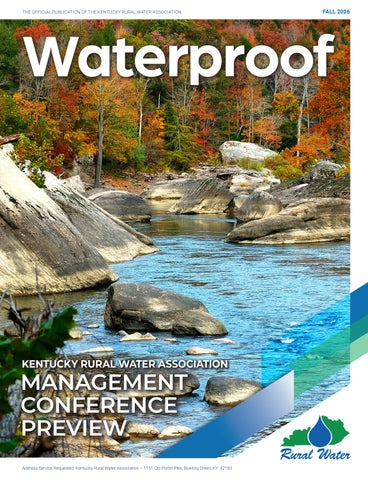
Autumn scene of the Eagle River in the Daniel Boone National Forest, Kentucky.
FALL 2026
Features 11 KRWA Named 2026 State Association of the Year to Success: Kentucky Rural Water Association’s 13 Keys 47th Annual Conference Wrap Up
18 When a Positive Becomes a Negative Asset Inventory to Funding: 20 From Turning Wastewater Needs into Projects Legacy Knowledge Retires, 22 When GIS Maps the Way Forward
24
KRWA Board of Directors
One Year to Go: Time to Complete Your Baseline Inventory
PRESIDENT David Peterson Caveland Environmental Authority, Inc. National Rural Water Association, Vice President
27 KRWA Honors Pam Byrd and Tim Blanton
VICE PRESIDENT Bob Pack Paintsville Utility Commission
New Symbol for KRWA’s 29 ARegistered Apprenticeship Program
SECRETARY Daren Thompson Lebanon Water Works Company and Springfield Water & Sewer Commission
Management Conference 32 KRWA Training Program & Session Descriptions
TREASURER Christina O’Bryan Daviess County Water District
Departments
DIRECTOR William Ballard East Clark County Water District
7 Message From the Executive Director 8 KRWA Staff
DIRECTOR Jon Blalock South Hopkins Water District
10 KRWA Staff Appreciation 39 Thank You to Our Corporate Partners
DIRECTOR Russ Rose Oldham County Water District
41 Upcoming Events 42 Advertiser Product & Service Center ©2026 Craig Kelman & Associates Ltd. All rights reserved. The contents of this publication, which does not necessarily reflect the opinion of the publisher or the association, may not be reproduced by any means, in whole or in part, without prior written consent of the publisher. Address Service Requested. Kentucky Rural Water Association – 1151 Old Porter Pike, Bowling Green, KY 42103
Waterproof is published by
Tel: 866-985-9780 Fax: 866-985-9799 www.kelman.ca
Please send address changes and corrections to: Bobbie Shanahan at b.shanahan@krwa.org
Lauren Drew Managing Editor Rod Evason Marketing Manager Kellee Breckman Design/Layout Stefanie Hagidiakow Advertising Coordinator
DIRECTOR Stephen Whitaker McCreary County Water District ASSOCIATE ADVISOR Clay Kelly Strand Associates GENERAL COUNSEL Damon Talley Stoll Keenon Ogden, PLLC
CELEBRATING 40 YEARS OF SAFE DIGGING
DID YOU KNOW
Kentucky 811 offers free training that qualifies for CEUs in water, wastewater, plumbing, and more? We also offer free training for online ticket entry. For more information about training, the dig law, or other assistance, please visit our website.
CONTACT
Director of Strategy, Outreach & Partnerships
Jamie Gaddis jgaddis@ky811.com
Message from the Executive Director
Thank You Scott Young, Executive Director, Kentucky Rural Water Association
D
ear Members and Friends,
As we head into the fall season, I want to take a moment to thank the water and wastewater professionals across Kentucky for the work you do every day. Much of what happens behind the scenes at our utilities goes unnoticed, but the service you provide is essential to every community in the Commonwealth. At KRWA, we stay focused on being a resource for you and your utility.
Whether you need technical assistance, training, workforce support, or simply someone to help point you in the right direction, our team is here to help. There is always something happening across Kentucky’s water and wastewater industry, and we are proud to work alongside our members, partners, and friends as we navigate the challenges and opportunities ahead. The strength of this industry comes from the people who are willing
POTABLE WATER
ELECTRICAL/ENERGY SAVINGS
WASTEWATER
REGULATORY ASSISTANCE
STORMWATER
ASSET MANAGMENT PLANNING
TRANSPORTATION
OPERATIONS ASSISTANCE
DAMS/LEVEES
FUNDING ASSISTANCE
to share their knowledge, lend a hand, and keep moving forward. Thank you for your continued support of KRWA and, more importantly, for the important work you do for the communities you serve. I hope you enjoy this issue of Waterproof and have a great fall season. Sincerely, Scott Young Executive Director Kentucky Rural Water Association
Kentucky Office
922 State Street, Suite 400, Bowling Green, KY 42101
270.297.1177 Corporate Office: 7256 Company Drive, Indianapolis, IN 46237 Regional Offices: Crown Point, Evansville, Fort Wayne, Huntingburg, Indianapolis North, and South Bend, IN | Bowling Green KY
commonwealthengineers.com
Click to return to Table of Contents
Waterproof | Fall 2026 | 7
KRWA Staff KRWA Board of Directors & Staff
Executive Director Scott Young
Circuit Rider Nathan Gassaway
Director of Workforce Development Heather Stevenson
Rate Analyst Mark Frost
Director of Programs and Operations Joe Burns
Circuit Rider Steffan Meredith
Education Coordinator Kenzie Jessup
Rate Analyst Scott Lawless
Director of Finance & Administration Daniel Reetzke
Circuit Rider Danny Stinson
Energy Efficiency Specialist Matt Glass
Rate Analyst Sue Purdy
Director of Information Technology Bryan Burns
Compliance Specialist Arianna Lageman
GIS Manager Jasper Wyatt
Rate Analyst Sam Reid
Accounting Pam Byrd
Compliance Specialist Jason Pennell
GIS Specialist Nii Aryee
Rate Analyst Tonya Taylor
Accounting Donna Meador
Compliance Specialist Todd Ritter
GIS Specialist Ashley Patterson
Source Water Specialist Chloe Brantley
ARC Circuit Rider Tim Blanton
Compliance Specialist Clem Wethington
GIS Technician Kaden Adams
Technical Assistance Specialist Pete Conrad
ARC Circuit Rider Tim Webb
Director of Education Randall Kelley
Marketing & Business Development Coordinator Savannah Goad
Technical Assistance Specialist Casey Greer
Circuit Rider David Flowers
Director of Professional Development George Haynes
Member Services Coordinator Bobbie Shanahan
Technical Assistance Specialist Victoria Lumpkins
8 | Waterproof | Fall 2026
Click to return to Table of Contents
KRWA Staff
Technical Assistance Specialist Elizabeth May
Technical Assistance Specialist Nancy Parker
UMI Coordinator Janet Cole
Technical Assistance Specialist Lauren McGaughey
Trainer Dell Harris
Wastewater Specialist Brittany Ditmer
Technical Assistance Specialist David Messer
Trainer John Quarles
Wastewater Specialist Chris Klotter
Custom Water Treatment Programs Designed by Professionals Since 1990
POTABLE
WASTE WATER
• Corrosion Inhibition • Iron & Manganese Control • Enhanced Disinfection • NSF Certified • EPA Approved • Chlorine dioxide for Stage 2 compliance assurance • DBP reduction
• Sludge Dewatering • Polymers • Dechlorination • Technical Support/Service • Testing
Randy Bush • randy@tmbwater.com (850)293-0219 • (800)762-9104 • FAX: (225)654-9533 P. O. Box 181 Zachary, Louisiana 70791 Click to return to Table of Contents
Waterproof | Fall 2026 | 9
KRWA Staff Appreciation The support and feedback we receive from utilities mean a great deal to us and also help demonstrate to lawmakers the vital role KRWA plays in assisting small communities with their water and wastewater needs. These notes and letters of appreciation not only encourage our team but also strengthen our efforts to advocate for programs that benefit rural communities across Kentucky. Scott Young, Executive Director Kentucky Rural Water Association 1151 Old Porter Pike, Bowling Green, KY 42103 Dear Mr. Young: Caveland Environmental Authority would like to sincerely thank Nathan Gassaway, Circuit Rider, for his assistance. Nathan came back in the spring of this year to explain and train our employees how to properly use our ultrasonic flow meter. Our main goal with the flow meter was to find leaks in our system. He helped us to isolate a 105 gpm that was under a driveway on our main line, with no visible water coming up on either side of the driveway. With the flow meter, we were able to pinpoint where to dig and repair the leak. Over the next couple of days, we called Nathan several times for additional assistance to help us to troubleshoot the flow meter. Since then, we have used the flow meter weekly to monitor flows on our main lines and to help lower our line loss. Any time we had issues with the meter, he would answer the calls quickly and was able to help us solve the problem. He simplified the process of using the meter and made it better for our employees to utilize it. We greatly appreciate Nathan Gassaway and all that Kentucky Rural Water Association does to provide the personal assistance that utilities need. Sincerely, Andrea Smith, Water Supervisor Chris Reed, Chief Operating Officer Mr. Scott Young, Executive Director Kentucky Rural Water Association 1151 Old Porter Pike, Bowling Green, KY 42103 Good Morning, Thanks again for Tim Blanton and Tim Webb for their service. They have used KRWA camera equipment to assist the Lincoln County Sanitation District in locating problem areas and offering solutions for correcting these present and future difficulties. In our recent engagement, the TV camera identified a number of problems in our 8 inch collection lines. With Tim’s advice, we were able to prioritize our jetting schedule. On behalf of the Board of Directors of the Lincoln County Sanitation District and our System Operator, Nate Bohlman, I would like to thank you and KRWA for this assistance. Tim and his camera system has been so helpful in locating I&I as well as numerous sites of debris and obstructions within our collection lines. He has also helped educate Nate and me about proper maintenance and operation issues. For this we are most appreciative. KRWA has been an invaluable aid for our startup collection system. Thanks for all you and your staff have done to support our efforts to keep our waters clean. Cooperatively, Bill Payne, Chair Lincoln County Sanitation District
Kentucky Rural Water Association 1151 Old Porter Pike, Bowling Green, KY 42103 Re: Apprenticeship Program To Staff: On behalf of Carrollton Utilities, I am so thankful for the apprenticeship program that one of our employees, Aden Stephenson, is enrolled in. I am also thankful for the personal interest that Randal Kelley and Jason Pennell had in helping Aden successfully complete his first license. I wish for continued success of the program and CU looks forward to hearing about all the success stories from around the Commonwealth of Kentucky. Sincerely, Terry A. Roach, PE General Manager Carrollton Utilities 10 | Waterproof | Fall 2026
Click to return to Table of Contents
KRWA NAMED 2026 STATE ASSOCIATION OF THE YEAR
T
he Kentucky Rural Water Association was honored as the 2026 State Association of the Year by the National Rural Water Association during the 2026 WaterPro Conference in Phoenix, Arizona. The award, NRWA’s most prestigious recognition for state rural water associations, recognizes outstanding work in areas including training, technical assistance, communications, legislative initiatives and member services. “This award belongs to the entire KRWA community,” said Scott Young, KRWA Executive Director. “Our members are doing incredibly important work every day to provide safe, reliable water and wastewater services to communities across Kentucky. It is a privilege for our team to support them.” The recognition is a reflection of the people who make KRWA what it is, from our utility members and associate members to our Board of Directors, staff, sponsors and industry partners. We are proud to share this honor with the people who continue to make our work possible and allow us to serve Kentucky’s water and wastewater community.
"Our members are doing incredibly important work every day to provide safe, reliable water and wastewater services to communities across Kentucky."
Click to return to Table of Contents
Waterproof | Fall 2026 | 11
(800) 747-2312 BrownEquipment.net
NEW · USED · RENTALS · PARTS · SERVICE
SW KRWA 7 x 4.625 OUTLINED.pdf
12 | Waterproof | Fall 2026
1
6/23/25
9:00 PM
Click to return to Table of Contents
Wrap up By Savannah Goad, Marketing & Business Development Coordinator, Kentucky Rural Water Association
F
rom August 24–26, 2026, more than 1,000 water and wastewater professionals gathered in Lexington for Kentucky Rural Water Association’s 47th Annual Conference & Exhibition. Held at the Central Bank Center and Hyatt Regency Lexington, this year’s conference centered around the theme “Keys to Success,” bringing together water and wastewater professionals from across Kentucky for three days of training, networking, collaboration, and celebration. PRE-CONFERENCE KICKOFF The conference officially got underway Sunday evening with the Welcome Reception, hosted by KRWA’s Platinum Partners, Hawkins, Inc. Attendees gathered in the Central Bank Center’s bright, window-lined space overlooking downtown Lexington, enjoying an evening of conversation and reconnecting with friends and colleagues before the week began. The evening also included the Women of Rural Water Social Hour, sponsored by The Sherwin-Williams Company. Held outside on the Terrace at Central Bank Center, the event gave the women of rural Click to return to Table of Contents
water an opportunity to network, relax, and enjoy time together ahead of the official start of the conference. MONDAY: GEARING UP FOR THE WEEK Monday morning started early with KRWA’s Golf Scramble at the University Club of Kentucky, where attendees teed off for a day of golf and fellowship. Rubin & Hays served as this year’s Golf Beverage Sponsor. We also extend a special thank you to our Golf Hole Sponsors:
Brown Equipment Company · Derby City Pump & Valve Service · G&C Supply Company, Inc. · Hawkins, Inc. · Kenvirons, Inc. · Kentucky 811 · Kentucky Engineering Group, PLLC · Raymond James · Rural Water Financing Agency · Rustoleum/High Performance Products · The Sherwin-Williams Company · Wascon, Inc. While golfers were on the course, continuing education was already underway at the conference center, with two tracks Waterproof | Fall 2026 | 13
Supporting Kentucky utility infrastructure
Interim loan program
Flexible term program
The tools rural communities need to grow stronger are well within reach, and we help local leaders use them wisely. Raymond James works with communities to cultivate a variety of development projects across the United States and right here in Kentucky. With over $2 billion in loan issuances for Kentucky Rural Water’s successful lending programs, our experienced and local banking team is committed to funding the progress of Kentucky’s utility infrastructure. Proud partner to Kentucky Rural Water’s successful lending programs
Program partners
$1,200,000,000+ in Interim Loan Program issuance (more than 500 loans)
Rural Water Financing Agency
$830,000,000+ in Flexible Term Program issuance (more than 350 loans)
Rubin & Hays
Raymond James Regions
RAYMOND JAMES FINANCE TEAM Nick Roederer
Bob Pennington
Sam Nagel
Kelly Schachleiter
Aaron Wesley
502.560.1274
859.232.8211
309.636.3765
859.232.8246
502.560.1295
R E L AT I O N S H I P S | I D E A S | E X E C U T I O N RJUSDAFIN AN CE.COM Data as of 2/5/2026. Raymond James is not affiliated with any other organizations mentioned. © 2026 Raymond James & Associates, Inc., member New York Stock Exchange/SIPC. 26-PF-1402 TA 2/26
Wrap up
available for Water & Wastewater Operators and Commissioners. At 12:30 PM, the Exhibit Hall officially opened, bringing together more than 120 companies showcasing the latest products, technology, equipment, and services for the water and wastewater industry. Rural Water Financing Agency served as the 2026 Exhibit Hall Sponsor, with Brenntag, BL Anderson, Rye Engineering PLC, and S4 Water Sales & Service serving as Supporting Sponsors. We also welcomed a new sponsorship opportunity this year, with Kentucky American Water serving as KRWA’s 2026 Utility Conference Host. Throughout the afternoon, attendees continued their training through breakout sessions, including new opportunities to learn directly in the Exhibit Hall through half-hour educational sessions. Brown Equipment Company was also recognized as the winner of the 2026 Best Booth Display Award. Monday wrapped up with the Exhibitor’s Reception, giving attendees and exhibitors another opportunity to connect and kick off a busy week of networking and learning. Click to return to Table of Contents
TUESDAY: TRAINING, BUSINESS & CELEBRATION Tuesday morning began with the 2026 Awards Breakfast. Susan Lancho of Kentucky American Water welcomed attendees to Lexington, while Phillip Combs, President of the National Rural Water Association, shared his vision for the future of rural water nationwide. The breakfast also featured the unveiling of KRWA’s new apprentice project video, highlighting the people, programs, and opportunities helping build the future of Kentucky’s water and wastewater workforce. Attendees also learned the finalists for the 2026 Wooden Bucket Award: Caldwell County Water District · Carroll County Water District · Larue County Water District #1 · Lincoln County Sanitation District · Meade County Water District · North Marshall Water District · Warren County Water District · Western Mason County Water District · Whitesville Water Works · Wood Creek Water District Following the Awards Breakfast, the Exhibit Hall opened for another full day of networking, with training sessions taking place throughout the hall. The Annual
Business Meeting was also held Tuesday morning, where members elected the following officers for 2026/2027: • President – David Peterson, Caveland Environmental Authority • Vice President – Bob Pack, Paintsville Utility Commission • Secretary – Daren Thompson, Lebanon Water Works Company & Springfield Water & Sewer Commission • Treasurer – Christina O’Bryan, Daviess County Water District The Associate Member Meeting, led by Clay Kelly, also took place Tuesday. After the morning sessions and business meeting, attendees gathered for Lunch with Exhibitors before heading back to training. Tuesday afternoon featured five concurrent tracks: Engineering & Professional Services, Regulatory, Workforce, Drinking Water, and Wastewater, giving attendees a variety of opportunities to earn CEUs and expand their knowledge. Tuesday evening concluded with the Member Appreciation Reception, sponsored by Zenner USA. The reception featured Zenner USA’s Ultimate Meter Challenge, where John Potter of Warren County Water District once again came Waterproof | Fall 2026 | 15
Wrap up out on top. With the win, John will travel to Phoenix, Arizona, to represent Kentucky in the Ultimate Meter Competition at the national level. The evening also brought one of the conference’s biggest announcements: Western Mason County Water District was named the 2026 Wooden Bucket Award Winner. KRWA also hosted the 2026 Best Tasting Water Contest, with 14 entries competing for the title. This year’s judges were: Jason Shelton, Hawkins, Inc. · Susan Lancho, Kentucky American Water · Mark Hogg, WaterStep · Bobby Young, Hach · Aaron Wesley, Raymond James Congratulations to Glasgow Water Company, which took home the 2026 Best Tasting Water Award! This marks the fourth time Glasgow Water Company has earned the honor. The Member Appreciation Reception also included the WaterPac raffle, which raised $5,295 this year, plenty of giveaways, and an evening full of fun, fellowship, and networking. KRWA also recognized several staff members for their years of service to the Association: Arianna Lageman – 10 years Danny Joe Stinson – 10 years Randall Kelley – 20 years Donna Meador – 40 years
16 | Waterproof | Fall 2026
WEDNESDAY: CONFERENCE FIRSTS & A LOOK AHEAD Wednesday brought two firsts for KRWA’s Annual Conference & Exhibition. For the first time, conference attendees had the opportunity to tour Kentucky American Water’s treatment plant, giving participants an inside look at the facility and its operations. The tour was a hit with attendees and provided a unique opportunity to see water treatment in action. Wednesday also featured KRWA’s firstever K9 Leak Detection class, introducing attendees to an innovative approach to identifying hidden water leaks. The session demonstrated how specially trained dogs can use their incredible sense of smell as a tool for leak detection. The final morning continued with additional training sessions through 11:30 AM, officially bringing the 47th Annual Conference & Exhibition to a close.
THANK YOU KRWA’s 47th Annual Conference & Exhibition would not have been possible without the support of the people who make this event such a success. We extend our sincere thanks to our partners, sponsors, exhibitors, speakers, instructors, volunteers, and attendees for making this year’s conference one to remember. From the first conversations at Sunday’s receptions to the final training session Wednesday morning, the 2026 conference was filled with opportunities to learn, connect, celebrate, and look toward the future. With the theme “Keys to Success,” this year’s conference reminded us that success in rural water is built on the people who show up, share their knowledge, support one another, and continue working to strengthen the communities they serve. We’re already looking forward to seeing everyone again in Lexington, April 26–28, 2027!
Click to return to Table of Contents
Wrap up
Click to return to Table of Contents
Waterproof | Fall 2026 | 17
WHEN A
POSITIVE BECOMES A NEGATIVE
O
n November 13, 1789, Benjamin Franklin wrote in a letter to Jean-Baptiste Le Roy the famous phrase, “In this world nothing can be said to be certain, except death and taxes.” Having been involved in Drinking Water Compliance in some shape or form, I would add one other thing to that quote: the chance of getting a positive bacteriological result in the summer. I don’t know how many positive BACTs I’ve seen in my life, but I’m quite positive that 95% of them have occurred during the summer months. Why is that exactly? Here are some of the key causes: • Faster Growth Rates: Warm water provides an ideal thermal environment for coliform and environmental bacteria to multiply rapidly. • Disinfectant Decay: Chlorine and other chemical disinfectants added to tap water dissipate much faster in hot weather, reducing the residual protection left inside pipes as the water travels to your tap. • Environmental Runoff: Summer storms and heavy rainfall can wash surface soil, organic matter, and animal or agricultural waste into raw water supplies and shallow groundwater wells. • Naturally Present Indicators: Many total coliform bacteria are naturally present in the environment and soil, thriving when ambient temperatures rise without necessarily pointing to a severe sewage leak. Now, most of you all out there are probably shaking your heads, thinking that’s all well and good, but we all know there are typically factors that come into play more than the ones above.
OUTSIDE SPIGOTS My cohorts in Compliance can attest that when someone calls and says, “I’ve had a positive BACT result. What do I do?” the first thing we ask is where they took the sample. I hate to use it again, but 95% of the time, it’s at an outside spigot. 18 | Waterproof | Fall 2026
By Todd Ritter, Compliance Specialist, Kentucky Rural Water Association
We get it, though. It’s far easier to get samples from those sites than any other sites you have. If you decide to continue to sample those locations, know that you are playing with fire because many RTCR MCL violations are associated with using an outside spigot. So, clean them well, and when you’re done cleaning them, clean them again. WASTEWATER SAMPLES This one may come as a surprise to you, but in years past, when I worked at the Division of Water a few times, I’d hear folks say that they got positive results because they had their BACT samples bagged up in a cooler alongside wastewater samples. I know it’s slim, but accidents do happen. PLUMBING ISSUES Dirty faucets, unclean aerators, and low-use areas are just a few things that can cause issues. WHAT HAPPENS WHEN A SAMPLE IS TOTAL COLIFORM POSITIVE? A total-coliform-positive result should never simply be ignored. When a routine sample is positive for total coliforms, the system must take additional action. Under the RTCR, the system must collect at least three repeat samples for each total-coliformpositive routine sample, generally within 24 hours of being notified of the positive result. Repeat samples are designed to help determine whether the positive result was isolated or whether there may be a broader problem within the distribution system. The repeat sampling locations are important. Generally, one repeat is collected at the original sampling location, with additional samples collected at locations upstream and downstream of the original site, or at approved alternative locations identified in the system’s sampling plan. Every total-coliform-positive routine or repeat sample must also be analyzed for E. coli. This is where the situation can become much more serious. Click to return to Table of Contents
WHAT IF THERE ARE TOO MANY POSITIVE SAMPLES? A single total-coliform-positive sample does not necessarily mean the water system has violated an MCL under the RTCR. However, multiple positive results can trigger additional requirements. The RTCR uses a treatment-technique approach for total coliforms. When a system exceeds specified frequencies of total-coliform occurrences, it may be required to conduct either a Level 1 or Level 2 assessment. For example, for systems serving 1,000 or fewer people, a Level 1 assessment is typically required when there are two or more total-coliform-positive samples in the same month. An assessment is essentially an investigation into why the positive samples occurred and whether the system has conditions that could allow contamination to enter the drinking water. LEVEL 1 AND LEVEL 2 ASSESSMENTS An assessment should not be viewed simply as another regulatory requirement or another piece of paperwork. It is an opportunity to look closely at the system. Operators and system personnel may need to examine things such as: • Sampling procedures and sampling locations • Distribution-system pressure • Water storage facilities • Treatment processes • Disinfection practices • Cross-connections • Potential sources of contamination • Leaks or main breaks • Sanitary defects • Dead-end lines and areas of low water use
• Recent maintenance or construction activities The purpose is to identify potential sanitary defects and determine what corrective action may be necessary. Any sanitary defects identified during the assessment must be corrected according to the applicable requirements. THE SERIOUSNESS OF AN E. COLI-POSITIVE RESULT While total-coliform-positive samples are an important warning sign, an E. coli-positive result raises the level of concern significantly. E. coli is associated with fecal contamination. Its presence can indicate that fecal material has entered the drinking water system and that other pathogens may also be present. Under the RTCR, an E. coli MCL violation can occur under several circumstances, including an E. coli-positive repeat sample following a total-coliform-positive routine sample or a total-coliform-positive repeat sample following an E. coli-positive routine sample. Failure to collect required repeat samples following an E. coli-positive routine sample can also result in an E. coli MCL violation. BE POSITIVE AND BE READY My recommendation is to always be prepared. If you have an E. coli MCL violation, why not have the public notification ready to go on your laptop so you can act within the required timeframe? You may never have to use it, but how nice would it be to have it there, along with a list of all the other things and people you need to contact and the other steps you need to take if an MCL violation occurs? So be positive, and be ready when that negative event occurs.
ProSource Water Products, Ltd. “We have a solution for your AMI/AMR system to perform at its fullest potential!”
AWWA BRONZE LOCKING DEVICE LOCATABLE H2O RATINGS UNDER LID END POINT MOUNT BRACKET
C-STYLE FRAME MADE IN USA LOCAL INVENTORY TO MEET URGENT DEMANDS SNAP STYLE CLOSURE LID AVAILABLE
Terry Hicks • 614-306-3798 • Sales@ProSourceWaterProducts.com • 14680 Pleasant Valley Click to return to Table of Contents
• Chillicothe, OH 45601
• Phone: 888-772-5478
• Fax: 740-772-5402 Waterproof | Fall 2026 | 19
By Brittany Ditmer, Wastewater Specialist, Kentucky Rural Water Association
FROM ASSET INVENTORY TO FUNDING:
TURNING WASTEWATER NEEDS INTO PROJECTS Know what you have. Prioritize what needs attention. Plan the project. Then find the right funding. When a wastewater system needs a major improvement, the first question is often, “How are we going to pay for it?” That’s an important question, but if it’s the first one, you might already be behind the ball. Before pursuing funding, a community needs to understand what it has, what needs attention, and what should be addressed first. A successful infrastructure project often starts long before a funding application is submitted. It starts with knowing your system. Start With Your Asset Inventory It is difficult to prioritize what you don’t know you have. An Asset Inventory is a great place to start because it gives a community a picture of its wastewater system. It should include major components such as treatment plant equipment, collection system assets, and lift stations. But an inventory should be more than a list of equipment.
20 | Waterproof | Fall 2026
It should help answer questions such as: How old is the asset? What condition is it in? How important is it to the system? How often does it have problems? How much longer can it reasonably operate? What would happen if it failed? Maintenance records, inspections, recurring problems, and emergency repairs are valuable pieces of an Asset Inventory and can help management understand the system. For example, an Asset Inventory may identify a lift station with aging equipment and a history of repairs as a growing risk before it becomes an emergency. Use Your CIP to Decide What Comes First Most communities have more needs than money to address them all at once. That is where the Capital Improvement Plan (CIP) comes in. The CIP takes the needs identified through the Asset Inventory and helps turn them into a plan. A good CIP should answer three basic questions: What needs to be done? When does it need to be done? How much will it cost?
An Asset Inventory may identify a deteriorated lift station, significant I&I, aging aeration equipment, an unreliable clarifier, outdated SCADA, or a treatment plant nearing its design capacity. All of these may be legitimate needs, but they may not all need to be addressed at once. The CIP gives management and elected officials a way to prioritize those needs and establish a realistic schedule for addressing them. A project that represents a high risk of failure or a significant compliance concern may need to move ahead of a project that can safely wait several years. This is where an Asset Inventory becomes more than a spreadsheet. It becomes a decision-making tool. Turning the Priority into a Project Once a community knows what needs to happen first, it is time to develop the project. This is where you turn a problem into a solution. If an Asset Inventory indicates that a lift station has structural deterioration, aging pumps, and electrical problems, Click to return to Table of Contents
the CIP may prioritize rehabilitation. The community can then determine what needs to be replaced, develop a scope and cost estimate, and assess whether additional studies or engineering are needed. Significant I&I may lead to collection system rehabilitation, while aging equipment or capacity concerns may lead to treatment plant improvements. At this point, the community has moved from identifying a need to defining a project. Now it is time to determine how to pay for it. Finding the Right Funding No single funding source works for every project. The best option depends on the project, the community’s financial situation, eligibility requirements, available funding, and timing. Potential funding sources include the Clean Water State Revolving Fund, state infrastructure authority programs, USDA Rural Development, Community Development Block Grants, regional water and wastewater assistance programs, Appalachian Regional Commission programs, the Delta Regional Authority, local funds and utility revenues, and bonds or other financing. Some programs offer grants, others provide low-interest loans, and many communities combine several sources to fully fund a project. The key is to find the funding that fits the project, rather than changing the project to fit the funding. Good Documentation Matters When a community applies for funding, it needs to explain why the project is needed. Instead of simply saying, “Our treatment plant is old,” the community can show which equipment is old, what condition it is in, and how often it has failed. The same applies to the collection system, where I&I and recurring maintenance problems can help demonstrate the need. The Asset Inventory provides the evidence. The CIP provides the priority and timing. The project provides the solution. The funding application tells the story. Don’t Start with the Money It can be tempting to see a funding opportunity and immediately try to figure out what project fits into it. Instead, start with your system. Click to return to Table of Contents
“The key is to find the funding that fits the project, rather than changing the project to fit the funding.” Look at your Asset Inventory. What’s in poor condition? What keeps giving your operators problems? Where are you spending money on repairs over and over again? Where are you seeing significant I&I? Which projects are already identified in your CIP? Once you have answered those questions, ask: “What funding sources can help us address these priorities?” The funding should follow the need, not the other way around. Keep Your Plan Current Don’t create an Asset Inventory and CIP once and put them on a shelf. Equipment ages. Conditions change. Costs rise. New problems arise. Projects are completed. Priorities shift. Take time each year to review your Asset Inventory and CIP. Update asset conditions, project costs, schedules, and priorities. Mark completed projects and add new needs as they arise. Over time, this creates a cycle: Inventory. Assess. Prioritize. Plan. Fund. Improve. Update. That cycle can help a utility move away from constantly reacting to emergencies and toward planning for improvements before they become emergencies.
The Bottom Line Finding funding should not be the beginning of the infrastructure planning process. It should be the result of good planning. Your Asset Inventory identifies the needs. Your CIP helps prioritize those needs. Your project defines the solution. Your funding strategy determines how to make it happen. Whether the right answer is federal, state, or local funding, or a combination of sources, a community is in a much better position when it understands its system and has a plan to address its needs. So, if your community is considering a major wastewater improvement, start with what you already know. Look at your Asset Inventory. Review your CIP. Talk to your operators. Identify the projects that matter most. Then start the funding conversation. The goal is not simply to find money for a project. You want to identify the right project and find the right funding to make it happen. Know your assets. Prioritize your needs. Plan your projects. Then find the funding.
LEADERS IN FUTURE FOCUSED DESIGN Wastewater/Water Treatment Storage/Containment Floodplain Modeling & Permitting
CONTACT US
www.summit-ae.com Lexington, KY - Pikeville, KY
859-264-9860
mhill@summit-ae.com
mstephens@summit-ae.com
Waterproof | Fall 2026 | 21
When LEGACY Knowledge RETIRES, GIS MAPS the WAY FORWARD By Ashley Patterson, GIS Specialist, Kentucky Rural Water Association
W
hat happens when the most knowledgeable leaders in a system retire? Does the history of a long and valuable career go with them? As an industry, we are on the cusp of a major shift in legacy knowledge. Many utilities are facing a wave of retirements and an influx of new employees entering the workforce. For many KRWA partners, this leaves a knowledge gap that cannot be bridged with a simple SOP. How do we preserve this invaluable knowledge and pass it on to the next generation? GIS maps the way forward by providing a place to preserve many careers’ worth of knowledge gained from middle-of-the-night line locates and hidden valves, long forgotten in aging records. As-builts cannot tell us that 20 years ago someone happened upon a long-lost asset, and the only way to know where it is, is to ask Punkin at McKinney. But what about when Cindi or Kendra have the day off, Brock can’t locate a line, and Punkin is busy in a no-cell-service area? GIS enters the chat. When Crab Orchard’s Bryan wants to go on vacation, his ringer stays on, just in case. What could grant him the time he deserves? GIS shows us the way. Harley can map what only lives in Kirk’s memory at Nicholas County Water District, so that he never misses a main when he needs access in a hurry. Harley isn’t the only one who benefits from the knowledge in Kirk’s brain; neighbors benefit, too. Kirk has a way of jumping in to help when neighboring systems need to know where a valve is at 2 AM. But one day, Kirk may want to retire. Kirk has put in a lot of time in his more than 20-year career and is only a few years from retiring to his cattle farm. What then will Harley do when there is a leak in the middle of the night? Fortunately, Kirk and Harley have been mapping
22 | Waterproof | Fall 2026
their system using GIS provided by Kentucky Rural Water Association. Each time a hidden gem is mapped, Kirk has passed another piece of his career’s knowledge and experience on to the next generation. Similarly, Chris in Livermore has already gotten a jump start with Tyler, mapping their meters from the comfort of the air conditioning and freeing up Andrea, who no longer has to stop what she is doing when they call to look up an address in her billing software. Now, that information lives in their maps. They can even add notes to identify which customer meters might have a dog to look out for at the property. Click to return to Table of Contents
All of this knowledge has never been more accessible than it is today with KRWA GIS maps in their corner. Erica is getting to know every corner of Southern Water Sewer System while working on her Service Line Inventory. Along the way, she is mapping what she learns in GIS and gaining the satisfaction of knowing their maps are the latest and greatest they have ever been. GIS is so much more than just maps. It is a place to preserve the legacy of those who have spent careers building invaluable knowledge of their systems and communities. These are careers that cannot be summed up in an SOP, but now, thanks to GIS, that knowledge can be mapped, documented, and passed on for generations to come. KRWA’s GIS team is here to help you map the way toward preserving that legacy. Our developers, analysts, and specialists are here to design and deliver custom maps so that you can document a lifetime of stories, experience, and knowledge to pass on to the next generation. Jasper, Nii, and I are part of KRWA’s GIS team, and we work closely with Rusty of TerraGraphics LLC, KRWA’s GIS partner, to deliver products for what is coming “down the pipeline,” including asset inventory, reports, one-calls, and more. We bundle your data into accessible, simple-to-use maps, and we train you on how to use them. It brings me great joy to offer you my time and talent along with my colleagues. Whether you prefer joining me as I lead classes at local Area Development Districts, working together over Zoom, or meeting in person to get you started or refresh a skill, I will be your support and cheerleader. If you are like me and a tactile or visual learner, I will sit with you and offer hands-on coaching while you get to know your maps. If you prefer listening, I will be glad to see you at Click to return to Table of Contents
It is a place to preserve the legacy of those who have spent careers building invaluable knowledge of their systems and communities. a Development District class. And if you just need a question answered, ring me on my cell. You can text me if you only have a moment or the job site is noisy, and I will text back. However you prefer to be supported, KRWA will find a way to help you pass on your legacy. The goal is not to replace the Punkins, Kirks, Bryans, Andreas, or any of the people who know their systems like the back of their hand. We couldn’t if we tried. The goal is to make sure that what they have learned over decades of muddy boots, midnight leaks, forgotten valves, and “I know it’s around here somewhere” moments does not disappear when they finally decide to turn off the ringer. Someday, Kirk deserves to be able to tend to his cattle without getting a 2 AM phone call about a valve. Bryan deserves a vacation where his phone really is on vacation, too. And Punkin deserves to retire knowing that when someone asks, “Where in the world is that line?” the answer no longer has to be, “Go ask Punkin.” They can just open the map. That is the legacy we are building at KRWA. One valve, one meter, one main, and one story at a time. Because eventually the boots retire. The knowledge doesn’t have to. Waterproof | Fall 2026 | 23
YEAR TO GO Time to Complete Your Baseline Inventory By Pete Conrad, Compliance Specialist, Kentucky Rural Water Association
W
hen you bring up Service Line Inventory, Baseline Inventory, or SLI to operators and staff at a water utility, the general feel of the place changes. While everyone stays polite, it’s not a popular topic. I work with SLIs every day, and I’ve yet to blame anyone for that. Five years ago, while running a water utility, I had the same stance. I sat in on multiple trainings with Arianna Lageman and asked her so many questions that she gently(ish) told me to stop, as the regulations were being finalized and many of my questions were yet to be explored. Fast forward to 2024. I got hired at KRWA to work with the Division of Water (DOW) to help systems complete their Initial Service Line Inventories. Arianna got her revenge. I can’t predict the exact date you got this magazine or digital copy of this Fall edition of Waterproof, but with this being the fall and all, you have right around one year to finish up all your work on the Baseline Inventory and submit it along with the accompanying documents by November 1, 2027. Let me say that again: you have less than a year to get going, finish up your Baseline Inventory, complete all the accompanying documents, and submit them to DOW. For the Initial Service Line Inventory submitted back in 2024, 97% of our water systems submitted their SLI on time. From what I know, the few systems that were late submitted within one month of the deadline. That is incredible, and it put Kentucky near the top of the list in on-time submissions. I have been in meetings and met vendors at WaterPro who thought I didn’t understand the question when I stated that 100% of our water systems here in the
24 | Waterproof | Fall 2026
The operators of the systems in Kentucky led the way on submitting the Initial Service Line Inventories. Commonwealth submitted their Initial Service Line Inventories. That was all of you: your staff, your contractors, and your customers, putting in the hard work on a project that was, and is not, most systems’ favorite project to work on. That hard work and perseverance is needed once again. Hopefully, you or someone from your utility has been able to attend classes that have been taught in the last two years, taken the time to keep working on your system’s SLI, and been watching for email updates on new policies that DOW has put out due to new guidance and information. There are committees made up of DOW staff, utilities, engineers, and service providers (aka KRWA and others) that have been working hard since the Initial Service Line Inventory submission to help DOW staff create the new documents that are in play for the Baseline Inventory submission on November 1, 2027. Baseline Inventories will need to include updates to information from the previously submitted Initial Service Line Inventory data. These updates include address cleanups and up-to-date locations. Systems need to work hard to get their unknown locations known and look at possibly reclassifying their Galvanized Requiring Replacement locations if possible. Connectors need to be identified and tracked. Supporting documents like the school and licensed daycare list, along with a testing schedule and new lead and copper sampling plans based
on the new tiering system, need to be identified. Validation waivers need to be submitted, and replacement plans created as appropriate to your individual utility. All of these documents need to be compiled and submitted again as appropriate. In addition, it is your system’s responsibility to know what documents your system needs to complete out of this list. Spoiler alert: no one else will do it for you. The majority of systems will not have to complete them all. Help is out there; you just need to reach out. The water systems of the Commonwealth of Kentucky set a standard most other states in the country could not keep up with. To have been a small part of that is a proud moment in my career, if I do say so. The thing is, we all have a year to go. Almost every system in the Commonwealth has some work to do on their SLI. Yes, we have one year until submission, but that time will fly by. I have no idea where your system is in the process. However, I do know that if you start working on just pieces of it today, slowly you will get it done. If you wait until October of 2027 to start working on your Baseline Inventory, there will not be enough time to get all the work done. The operators of the systems in Kentucky led the way on submitting the Initial Service Line Inventories. We need to do it again with the Baseline Inventory. To do that takes all of us at water systems, and that work starts now if you didn’t start yesterday.
Click to return to Table of Contents
YOUR TRUSTED PARTNER IN WATER & WASTEWATER OPERATIONS
Compliance isn’t optional. Peace of mind is. From staffing and compliance to asset management and emergency response, Veolia delivers full-service O&M solutions tailored to municipal needs, backed by decades of operational expertise and the resources of a global leader in water services.
What we deliver: Regulatory Compliance ---------------------------------------------------------------Certified Operators & Workforce Solutions ---------------------------------------------------------------24/7 Emergency Response ---------------------------------------------------------------Asset Management & Optimization ---------------------------------------------------------------Reliable, Cost-effective Operations -------------------------------------------------------
WV KY
VA
TN
NC
Serving 50+ Communities Across the Southeast
SC
MS AL
GA
We understand the region’s unique geography, climate, and regulations because we’re already operating right here.
A Proven Track Record:
FL
200+
1/16
Municipal Partnerships in North America
People in the U.S. have their wastewater, water and/or biosolids needs met by Veolia
IS YOUR CITY NEXT? Scan to learn more about our O&M Partnerships
50+ Years Serving O&M Clients in the US
Veolia | North America
veolianorthamerica.com tel: +1 833-4-VEOLIA Linkedin: Veolia | North America
Civil & Environmental Engineers
Celebrating
50 Years!
(502) 695-4357 770 Wilkinson Blvd Frankfort, KY 40601
www.Kenvirons.com
Celebrating a Combined 45 YEARS OF SERVICE: KRWA Honors Pam Byrd and Tim Blanton
By Savannah Goad, Marketing & Business Development Coordinator, Kentucky Rural Water Association
A
fter a combined 45 years of service to Kentucky Rural Water Association, two longtime members of the KRWA Team have begun a new chapter. Pam Byrd and Tim Blanton retired from KRWA at the end of September 2026, after decades of dedicated service to the Association and the water and wastewater professionals it serves. While their roles at KRWA have looked very different, both have played an important part in helping the Association fulfill its mission of helping water and wastewater utilities help themselves. PAM BYRD Pam Byrd joined KRWA on March 27, 2000, beginning a 26-year career with the Association. Over the years, Pam served as Office Administrator before transitioning into Accounting in 2023. Throughout her time with KRWA, Pam has been responsible for much more than the day-to-day business of the office. Her work has included management of the Association’s daily operations and financial control systems, human resources functions, accounting activities, budgets and audits, Board-related activities, and compensation and benefit surveys. She has also provided on-site office management training to KRWA member utilities. Much of Pam’s work has happened behind the scenes, but her responsibilities have touched nearly every part of the Association. Her attention to the details that keep an organization running has been an important part of KRWA’s success for more than two decades. When asked what she will miss most about KRWA, Pam said it will be her coworkers and the opportunity to interact with utility personnel. For Pam, retirement will mean having more time for family, especially her newest great-grandchildren, Charlie and Grace. TIM BLANTON Tim Blanton joined KRWA on November 3, 2006, bringing with him decades of experience in the water and wastewater industry. His career in the industry began long before his arrival at KRWA, including work in Grand Junction, Colorado, and Vermont. Click to return to Table of Contents
Tim’s path to KRWA began through a friend at Vermont Rural Water, who encouraged him to contact KRWA when he heard the Association was looking for someone. That connection brought Tim to Kentucky in 2006, beginning what would become nearly two decades of service to KRWA. Tim eventually became part of an Appalachian Regional Commission-supported effort that established a position focused on both water and wastewater. As a Circuit Rider and later a Water & Wastewater Specialist, Tim spent his KRWA career working directly with utilities, particularly systems facing significant challenges throughout Eastern Kentucky. Over the years, he has drawn on experience from across the water and wastewater industry, holding five different licenses in three states. His work has taken him into treatment plants, out into the field and alongside the utility personnel who keep Kentucky’s water and wastewater systems operating every day. When asked what he will miss most about KRWA, Tim kept it simple: his friends. His retirement plans are equally straightforward: “I’m going home.” After more than four decades in the industry, however, Tim has some advice for those just beginning their careers. He encourages newcomers to spend time working in treatment plants, explaining that plant experience makes a person a better field worker, just as field experience makes someone a better plant operator. That practical, hands-on philosophy has been a defining part of Tim’s career: learn the work, understand the systems and never stop gaining experience. A LASTING IMPACT For 26 years, Pam helped manage the people, finances and daily operations that kept KRWA moving forward. For nearly 20 years, Tim took KRWA’s mission directly into the field, working alongside utilities and helping them navigate the challenges of operating water and wastewater systems. Together, their careers represent 45 years of service to KRWA and to the utilities and professionals the Association serves. As Pam and Tim step into retirement, KRWA is grateful for the knowledge, dedication, friendship and countless hours they have given to the Association. Their contributions will continue to be felt long after their final days in the office and the field. Congratulations, Pam and Tim, and thank you for 45 years of service to KRWA! Waterproof | Fall 2026 | 27
Excellence in Engineering
SM
Your partner in solutions for industrial, commercial and municipal water treatment
■
■
■
Corrosion inhibitors Dispersants
■
■
■
■
EL
BRATIN LE
80
EN
L
brenntag.com
EXC
Contact us Greeneville, TN 423-422-6688 Henderson, KY 270-830-1200 contactus@brenntag.com
Ashland, Kentucky
YEARS
CE
G
■
■
Filter media Flocculants FOG reduction Odor control Phosphonates Phosphorus removal Solids reduction… and more!
SM
■
■
IN G
■
■
ER
■
Acids and alkalis Amines Antifoams Bio-additives Bioaugmentation Biocides Coagulants
IN
E
■
CE
■
IN ENG
www.strand.com
12 Locations • 502.583.7020
Multidisciplinary firm serving the public and private sectors
Water Supply Engineering Exploration / Modeling Source Water Protection Emerging Contaminants PFAS (e.g., PFOA + PFOS) GIS Solutions for Utilities Hands-On Training Mobile Work Orders Asset Management Regulatory Compliance Support Lead & Copper Rule Improvements
For The Best Advice on Earth®
Scan for more info
Contact: 614.256.1771 (Mark) mdbennett@bennettandwilliams.com
28 | Waterproof | Fall 2026
Click to return to Table of Contents
A New Symbol for KRWA’s Registered Apprenticeship Program
W
hen I think about KRWA’s Registered Apprenticeship Program, I think about much more than a training program. I think about people. I think about the operators who show up every day, often before sunrise and long after others have gone home, to make sure their communities have safe, reliable water. I think about the mentors who take the time to pass down what they have learned over decades in the field. And I think about the apprentices who are stepping into this profession with a willingness to learn, serve, and carry that responsibility forward. That is why I am especially proud to introduce the new logo for the Kentucky Rural Water Association Registered Apprenticeship Program.
The logo builds from the familiar Kentucky Rural Water Association mark, preserving the outline of the Commonwealth and the water drop that represents our shared commitment to Kentucky’s water resources. But this version adds something very intentional: a hand beneath the water drop. That hand represents the human infrastructure behind every water system. We often talk about infrastructure in terms of pipes, pumps, tanks, treatment plants, and technology. Those are all essential. But none of those systems work without trained, competent people operating and maintaining them. These services depend on operators who understand their systems, recognize problems, make sound decisions, and respond when their communities need them most. The hand is cradling the water drop, symbolizing that responsibility. Safe water does not happen by chance. It is protected, treated, tested, delivered, and maintained by Click to return to Table of Contents
By Heather Stevenson, Director of Workforce Development, Kentucky Rural Water Association
The logo builds from the familiar Kentucky Rural Water Association mark, preserving the outline of the Commonwealth and the water drop that represents our shared commitment to Kentucky’s water resources. skilled professionals. Operators truly have a hand in protecting public health and providing safe water to Kentucky communities. The ripples extending across the state represent the broader impact of that work. When one operator is trained, the benefit does not stop with that individual. When we invest in operators, that investment reaches far beyond one employee or one utility. It strengthens compliance, improves system performance, protects source waters, supports public trust, and creates a lasting ripple effect throughout the Commonwealth. KRWA’s Registered Apprenticeship Program was created to support that ripple effect. The program gives utilities a structured way to “grow their own” operators by combining supervised on-the-job training with related technical instruction. Apprentices learn the theory behind water and wastewater operations, but they also learn how to apply that knowledge in real-world situations under the guidance of experienced mentors. For many small and rural systems, this kind of structure is critical. Recruiting certified operators is not always easy, and retirements continue to create gaps in experience and institutional knowledge. Apprenticeship helps utilities prepare the next generation before that knowledge is lost. It creates a pathway for new hires, supports current employees working toward certification, and gives mentors a meaningful role in shaping the future of the profession. To me, this logo tells that story in a simple but powerful way. It honors the work of Kentucky’s water professionals while pointing toward the future. It reminds us that workforce development is not separate from public health, compliance, or water quality. It is the foundation that supports all of those things. The KRWA Registered Apprenticeship Program is about more than filling positions. It is about building capacity, preserving knowledge, strengthening utilities, and ensuring Kentucky communities continue to have safe, reliable water for generations to come. And at the center of it all are the operators – the people whose hands protect Kentucky’s water every day. At its core, this logo reflects the purpose of KRWA’s Registered Apprenticeship Program: to develop skilled operators, preserve institutional knowledge, and ensure Kentucky communities continue to have safe, reliable water for generations to come. Waterproof | Fall 2026 | 29
Interactive Edition available online
Staying connected and in the know has never been easier with both print and digital editions of Waterproof. Make sure to check out our highly interactive, mobile-optimized edition.
Visit krwa.org
Designed for water. Designed for you.
Never find yourself without options. Neptune® is the complete metering system you can count on and build on. Bill Howell - KY Sales Manager 502-424-5429 Brad Warning - Western KY TM 270-206-8566 Ed Holtshouser - Central KY TM 502-909-6695 Nicole Zaluski - Eastern KY TM 859-859-221-6331
neptunetg.com
30 | Waterproof | Fall 2026
Click to return to Table of Contents
KENTUCKY RURAL WATER ASSOCIATION
MANAGEMENT CONFERENCE
Training Program & Session Descriptions CROWNE PLAZA BY IHG | BOWLING GREEN, KENTUCKY | NOVEMBER 4–5, 2026 PROGRAM OVERVIEW Two days of training for utility managers, commissioners, operators, supervisors, and industry professionals, with sessions covering workforce development, financing, regulatory issues, resiliency, technology, cybersecurity, leadership, customer communication, and more. Credit Key: Commissioner = Water District Commissioner credit | DW = Drinking Water | WW = Wastewater
WEDNESDAY, NOVEMBER 4, 2026 MEETING ROOMS 1–2 SESSION 1A Building the Next Generation of Water Operators: How Registered Apprenticeship Can Strengthen Kentucky’s Water Utilities 8:00 AM – 9:00 AM 1.0 hour | Commissioner + DW/WW Heather Stevenson, Kentucky Rural Water Association Kentucky’s water and wastewater utilities face workforce challenges that go far beyond filling vacancies. An aging workforce, a limited pool of qualified operators, recruitment and retention difficulties, and the growing technical demands of modern water systems are putting pressure on utilities statewide. For water district commissioners, workforce development is more than a human-resources issue; it is a long-term 32 | Waterproof | Fall 2026
operational responsibility. This session introduces the Kentucky Rural Water Association’s Registered Apprenticeship Program as one strategy for building a qualified workforce and preserving the knowledge, skills, and leadership needed to provide safe, reliable, and affordable service for the next generation. SESSION 2A Kentucky Infrastructure Loan Programs 9:15 AM – 10:15 AM 1.0 hour | Commissioner + DW/WW Sandy Williams, Kentucky Infrastructure Authority Navigating Kentucky Infrastructure Authority (KIA) loan programs can be complicated and time-consuming, and some utilities may avoid the process altogether. This session breaks down the application process, explains the
information utilities should gather before getting started, and outlines the steps needed to develop a successful application. SESSION 3A Understanding Audits: Fixed Assets 10:30 AM – 11:30 AM 1.0 hour | Commissioner + DW/WW Brent Billingsley, Campbell, Myers & Rutledge, PLLC Sound audits are essential to utility financial accountability and may be required by state regulation or as a condition of borrowing. Audits provide an independent review of a utility’s finances, help identify problems, and help protect personnel responsible for financial management. This session covers audit fundamentals, fixed-asset considerations, preparing for an audit, selecting a qualified auditor, and key audit-related requirements utilities should understand. Click to return to Table of Contents
WEDNESDAY, NOVEMBER 4, 2026 11:30 AM – 1:00 PM | LUNCH BREAK SESSION 4A Alternative Rate Filing 1:00 PM – 2:00 PM 1.0 hour | Commissioner + DW/WW Tina Frederick, Stoll Keenon Ogden, PLLC; Noah Abner, Kentucky Public Service Commission The Alternative Rate Filing process, adopted in 1982, provides a simplified and less expensive method for eligible small utilities to adjust rates. The application relies heavily on the utility’s annual report, requires fewer supporting documents, and is designed to reduce the need for outside experts. This session explains the filing process, required information, and practical steps small utilities can take to complete an effective application. BALLROOM D SESSION 5B Satellite Technology for Water and Gas Utilities 8:00 AM – 9:00 AM 1.0 hour | DW/WW Richard Sanders, Zenner USA This session examines commercially available satellite technologies that utilities can deploy today to create immediate operational value. Participants will learn how the technology works, where it is most effective, and how satellite-derived intelligence can be integrated into existing maintenance and assetmanagement programs. SESSION 7B Leveraging FEMA Mitigation Funding to Improve Utility Resiliency 10:30 AM – 11:30 AM 1.0 hour | DW/WW Chris Brewer, EUDS Consulting This session provides a concise overview of disaster recovery, Click to return to Table of Contents
mitigation, and planning for water and wastewater utilities, with a focus on leveraging FEMA programs to strengthen resilience and streamline post-disaster restoration. Designed for operators, supervisors, managers, and utility leaders, the session highlights practical strategies for protecting critical infrastructure and maintaining continuity of service during and after disaster events. 11:30 AM – 1:00 PM | LUNCH BREAK SESSION 8B What You Should Be Asking Your Bank: Financial Best Practices for Water Districts 1:00 PM – 2:00 PM 1.0 hour | DW/WW Rhiannon Jenkens, US Bank This session will provide a practical overview of financial best practices tailored for water districts. Topics will include improving receivables through lockbox and electronic payment strategies, understanding today’s fraud threats and internal controls, navigating credit card surcharging considerations, and evaluating operating cash flows throughout the revenue cycle. SESSION 9B Working with the PSC: What Staff Needs, What Water and Wastewater Utilities Need, and How to Work Together (Part 1) 2:15 PM – 3:15 PM 1.0 hour | Commissioner + DW/WW Moriah Tussey, Assistant General Counsel, Kentucky Public Service Commission; Noah Abner, Revenue Requirements Branch Manager, Kentucky Public Service Commission; Tim Webb, Kentucky Rural Water Association; Russ Rose, General Manager, Oldham County Water District; Obe Cox, General Manager, Carroll County Water District; Damon Talley and Tina Frederick, Stoll Keenon Ogden, PLLC
Filing cases with the Kentucky Public Service Commission can be complicated, but understanding the process and required information can reduce delays and confusion. Part 1 covers requirements and best practices for filings such as Purchase Water Adjustments and Alternative Rate Filings. The panel will also discuss why Commission staff request items such as meeting minutes, best practices for obtaining utility easements, common issues that slow cases, and ways utilities and Commission staff can work together more effectively. SESSION 10B Working with the PSC: What Staff Needs, What Water and Wastewater Utilities Need, and How to Work Together (Part 2) 3:30 PM – 4:30 PM 1.0 hour | Commissioner + DW/WW Moriah Tussey, Assistant General Counsel, Kentucky Public Service Commission; Noah Abner, Revenue Requirements Branch Manager, Kentucky Public Service Commission; Tim Webb, Kentucky Rural Water Association; Russ Rose, General Manager, Oldham County Water District; Obe Cox, General Manager, Carroll County Water District; Damon Talley and Tina Frederick, Stoll Keenon Ogden, PLLC Part 2 continues the discussion from Session 9B, allowing panelists to expand on PSC filing requirements, common challenges, best practices, and practical questions from utility personnel.
Waterproof | Fall 2026 | 33
THURSDAY, NOVEMBER 5, 2026 BALLROOM D SESSION 11B Cybersecurity for Water and Wastewater Utilities 8:00 AM – 9:00 AM 1.0 hour | DW/WW Colin Glover and Ryan Lewis, CISA Cybersecurity continues to be a growing concern for water and wastewater utilities in the United States. Recent cyber incidents have affected more than 100 utilities across 12 states. This session reviews the current cyber threat environment facing utilities and offers practical actions organizations can take to reduce risk, strengthen resilience, and improve preparedness. SESSION 12B Understanding the Big Beautiful Bill 9:15 AM – 10:15 AM 1.0 hour | DW/WW Jerry W. Shelton, CPA, Shelton CPAs, LLP This session reviews payroll regulation changes associated with the “Big Beautiful Bill” and provides utilities with a practical roadmap for implementation. Topics include what qualifies as overtime under the legislation and changes to W-2 forms that utilities need to understand.
34 | Waterproof | Fall 2026
SESSION 13B Find & Fix: Louisville Water’s Approach to Private Lead Service Inventory & Replacement 10:30 AM – 11:30 AM 1.0 hour | DW only Joseph Sloan, Louisville Water Company Since publication of the Lead and Copper Rule Revisions (LCRR), Louisville Water Company has piloted several initiatives to evaluate existing records, replace known private lead service lines, engage customers, and examine current maintenance, operational, and capital procedures. Lessons from these pilots have helped refine strategies for complying with the Lead and Copper Rule Improvements (LCRI). This session shares Louisville Water’s current program for identifying and/or replacing approximately 48,000 unknown, lead, and galvanized private service lines. SESSION 14B Disaster Preparedness 1:00 PM – 2:00 PM 1.0 hour | DW/WW Joel Crawford, Service Specialties Modern water and wastewater utilities must plan for threats ranging from unreliable power and unsecured access points to legacy equipment. This session addresses disaster preparedness and continuity measures, including backups for personal computers and programmable logic controllers, uninterruptible power supplies, SCADA resilience, communication systems, and related infrastructure considerations.
SESSION 15B Black Belt Leadership Moves 2:15 PM – 3:15 PM 1.0 hour | DW/WW Shannon Elam, North Marshall Water District This presentation introduces The Waterline Standard, a leadership framework designed for water utility professionals. Rather than focusing only on traditional supervision, the framework emphasizes leadership behaviors that build trust, ownership, operational excellence, and long-term organizational performance. SESSION 16B Utility Communications with Customers 3:30 PM – 4:30 PM 1.0 hour | DW/WW Pete Conrad, Kentucky Rural Water Association Effective communication between utilities, customers, and partner organizations has never been more important. Technology has expanded the methods available, but utilities still need clear, timely, and intentional communication. This session explores why communication matters, how expectations are changing, and practical methods utilities can use to communicate more effectively with customers and other organizations.
Click to return to Table of Contents
A CONFLUENCE OF EXPERIENCE AND KNOWLEDGE Glenn Denton and Alex Blackwell, experienced legal counsel for the issues facing Kentucky’s water and wastewater utilities. Board Representation & Governance
Open meetings, open records and board counsel
PSC Guidance
Counsel through regulatory matters
Contracts & Construction
Procurement, contract review and construction matters
Employment & HR
Practical counsel for workplace matters
ENTON D L AW FIRM Prompt Response, Real Solutions
Click to return to Table of Contents
Visit our website at DentonFirm.com or call us at 270-450-8253
THIS IS AN ADVERTISEMENT
Waterproof | Fall 2026 | 35
THE HIDDEN COST OF DEFERRED MAINTENANCE Why “We’ll Fix It Later” Can Become One of the Most Expensive Decisions a Water or Wastewater Utility Makes WASCON, Inc. | Water & Wastewater Equipment Sales and Service SMALL PROBLEMS. BIG CONSEQUENCES. Major failures often begin with a worn bearing, deteriorating seal, excessive vibration, declining performance, a valve problem, or a control issue. Under demanding conditions, a minor defect can stress surrounding components and turn scheduled work into an emergency. THE REPAIR BILL IS ONLY THE BEGINNING • Emergency labor and overtime • Unplanned downtime and operator workload • Expedited freight and parts • Higher energy consumption • Secondary damage and shortened equipment life • Operational and compliance risk Running does not always mean healthy. Deferred maintenance rarely eliminates a cost. It moves the expense into the future, where it can return as a larger repair bill, an emergency callout, downtime, higher operating costs, or premature replacement.
PLANNED VS. EMERGENCY PLANNED MAINTENANCE More control. More options. Better preparation. Schedule around operations, order parts ahead, prepare backup equipment, budget the work, and evaluate repair, rebuild, upgrade, or replacement. EMERGENCY MAINTENANCE Less time. Fewer options. Greater disruption. The priority becomes restoring operation – often with overtime, emergency service, rush shipping, and decisions made under pressure. 36 | Waterproof | Fall 2026
A scheduled maintenance visit gives you choices. An unexpected equipment failure gives you a deadline. KNOW YOUR CRITICAL EQUIPMENT PUMPS • VALVES • BLOWERS • GEARBOXES • CONTROLS • PLCs • INSTRUMENTATION • CHEMICAL FEED • LIFT STATIONS • PROCESS EQUIPMENT Ask: Which asset would create the biggest operational problem if it failed tomorrow? Prioritize maintenance by age, condition, history, performance, parts availability, and importance to the overall process.
1
What fails hardest?
2
Any leaks, noise, vibration, or alarms?
3
When was it last serviced?
4
Are parts readily available?
5
Repair – or plan an upgrade?
PREVENTIVE MAINTENANCE = PREDICTABILITY Preventive maintenance is an investment in reliability. Inspections, testing, calibration, lubrication, adjustments, and equipment evaluations can identify developing problems before they become emergencies. Most importantly, it creates time to order parts, schedule repairs, build the budget, and choose the right solution instead of the fastest solution. Click to return to Table of Contents
INSPECT IT
MAINTAIN IT
PLAN FOR IT
SOMETIMES THE RIGHT REPAIR IS AN UPGRADE Repeated failures, obsolete components, poor efficiency, rising maintenance costs, or hard-to-find parts may signal the end of an asset’s practical service life. Compare continued repairs with rebuilding, replacing, or upgrading. New technology may improve efficiency, controls, monitoring, reliability, and serviceability. The goal is the best long-term value. FROM REACTIVE TO PROACTIVE • Start with the equipment that matters most. • Document assets and maintenance history. • Establish inspection and service intervals. • Track recurring problems and performance changes. • Budget predictable repairs and replacements. Do not let a manageable problem become an emergency simply because the equipment is still operating today. WASCON IS HERE TO HELP Since 1979, WASCON has served the water and wastewater industry with equipment sales and service, troubleshooting, preventive maintenance, repairs, rebuilds, replacements, and system upgrades. Our team supports pumps, valves, blowers, controls, PLCs, gearboxes, instrumentation, and process equipment – whether you are evaluating aging assets, planning an upgrade, or responding to a failure. Click to return to Table of Contents
REPLACE IT WHEN RIGHT
Compare continued repairs with rebuilding, replacing, or upgrading. New technology may improve efficiency, controls, monitoring, reliability, and serviceability. The goal is the best long-term value.
WASCON can help evaluate your existing equipment and determine whether repair, rebuild, replacement, or upgrading provides the best long-term solution.
DON'T WAIT FOR FAILURE. Schedule an Equipment & Maintenance Evaluation with WASCON WASCON, Inc. | Water & Wastewater Equipment Sales and Service 910 East Main Street Livingston, TN 38570 Office: 931-823-1388 24/7 Emergency Service: 800-952-4236 www.wasconinc.com
SOLUTIONS THAT MAKE A DIFFERENCE. Waterproof | Fall 2026 | 37
Thank You
to Our Corporate Partners PLATINUM
GOLD
SILVER
Click to return to Table of Contents
Waterproof | Fall 2026 | 39
ENGINEERING
oneWATER WWW.ARDURRA.COM
40 | Waterproof | Fall 2026
• Process Design • Pumping and Conveyance • Stormwater Infrastructure • Water Resources • Asset Condition Assessment and Management • Indirect/Direct Potable Water Reuse • Hydraulic Process Modeling • Regulatory Permitting and Compliance
Click to return to Table of Contents
Upcoming Events
OCTOBER 20–22 Wastewater Treatment Certification School Burkesville, KY 20–22 Drinking Water Distribution Certification School Burkesville, KY
SUNDAY
4–5
2026 Management Conference, Bowling Green, KY
17–19
Surface Water Treatment Certification School Gilbertsville, KY
17–19
Wastewater Collection Certification School Gilbertsville, KY
TUESDAY
WEDNESDAY
THURSDAY
FRIDAY
SATURDAY
1
2
3
4
JULY
AUGUST
SEPTEMBER
NOVEMBER
MONDAY
5
6
7
8
9
10
11
12
13
14
15
16
17
18
19
20
21
22
23
24
25
26
27
28
29
30
31
OCTOBER
NOVEMBER
DECEMBER 8–10 8–10
Wastewater Treatment Certification School Louisville, KY Wastewater Collection Certification School Louisville, KY
Click to return to Table of Contents
visit us online
www.krwa.org
Waterproof | Fall 2026 | 41
Advertiser Product & Service Center Waterproof is made possible by the companies below who convey their important messages on our pages. We thank them for their support of the KRWA and its publication and encourage you to contact them when making your purchasing decisions. To make it easier to contact these companies, we have included the page number of their advertisement, their phone number, and, where applicable, their website. COMPANY
PAGE
PHONE
WEBSITE
Ardurra
40
865-670-8555
www.ardurra.com
Bennett & Williams Environmental Consultants, Inc.
28
614-882-9122
www.bennettandwilliams.com
BL Anderson Company
42
513-889-4746
www.blanderson.com
Brenntag Mid-South
28
270-830-1200
www.brenntag.com
Brown Equipment Company
12
800-747-2312
www.brownequipment.net
Commonwealth Engineers
7
800-289-1177
www.commonwealthengineers.com
Core & Main
3
502-253-0002
www.coreandmain.com
Denton Law Firm
35
270-450-8253
www.dentonfirm.com
Dixon Engineering, Inc.
28
800-327-1578
www.dixonengineering.net
GRW
42
859-223-3999
www.grwinc.com
Hawkins Water Treatment Group
4
877-957-1510
www.hawkinsinc.com/groups/water-treatment
JABO Supply
2
800-334-5226
www.jabosupply.com
Kentucky 811
6
811
www.kentucky811.org
Kentucky Engineering Group, PLLC
43
859-251-4127
www.kyengr.com
Kenvirons, Inc.
26
502-695-4357
www.kenvirons.com
National Water Services, LLC
40
502-893-4405
www.national-water.com
NECO Water
30
513-851-8008
www.necowater.com
ProSource Water Products, Ltd.
19
888-772-5478
www.prosourcewaterproducts.com
Raymond James
14
859-232-8211
www.raymondjames.com
Rural Water Financing Agency
31
844-675-2627
www.ruralwaterfinance.com
Strand Associates Inc.
28
502-583-7020
www.strand.com
Summit Architects + Engineers
21
859-264-9860
www.summit-ae.com
The Sherwin-Williams Company
12
502-969-1125
www.sherwin-williams.com
Thornton, Musso & Bellemin, Inc.
9
800-762-9104
www.tmbwater.com
United Systems & Software, Inc.
35
800-455-3293
www.united-systems.com
USABlueBook
44
800-548-1234
www.usabluebook.com
Veolia North America
25
617-849-6600
www.veolianorthamerica.com
WASCON
38
800-952-4236
www.wasconinc.com
Wet Or Dry Water Tank Inspection Services
41
502-532-6190
www.aye.net/~diver
Redefining Water Treatment with
Silicon Carbide Technology
C e r t ifie dt o NSF/ANSI419 C e r t ifie dt o NSF/ANSI61
MADE IN USA
www.grwinc.com
42 | Waterproof | Fall 2026
blanderson.com ovivowater.com
Click to return to Table of Contents
Experience the Advantage Get the Best Treatment™ from a partner who has served the industry since 1991. • Over 55,000 products from leading brands • Fast shipping from our nationwide distribution network • Unsurpassed customer service • Free technical advice from industry experts • Satisfaction guarantee In the lab, plant and field, USABlueBook is your trusted ally in all things water and wastewater.
Request a catalog
FREE 1800-page catalog: usabluebook.com/maincatalog
800.548.1234 • usabluebook.com