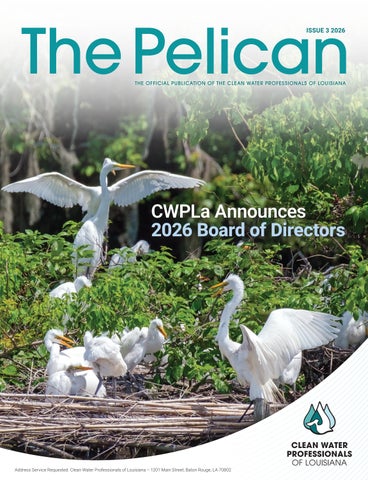
The Pelican ISSUE 3 2026
THE OFFICIAL PUBLICATION OF THE CLEAN WATER PROFESSIONALS OF LOUISIANA
CWPLa Announces 2026 Board of Directors
Address Service Requested. Clean Water Professionals of Louisiana – 1201 Main Street, Baton Rouge, LA 70802
A Best • Management • Products
Poll S rce! SNOUt'
inal Trash Capture Hood"
Over 100,000 Installations throughout North America Our Snout ® system has been leading the charge in stormwater management for over 25 years. Designed to last, it captures pollutants at the source and reduces downstream pollution. For optimal performance, add the Bio-Skirt ® and Turbo Plate ® .
Proven Stormwater Treatment You Can Trust Don't let trash flow downstream. The Snout ® stormwater treatment hood reduces floatables and sediment in storm drains. Pair it with the Bio-Skirt ® for enhanced oil capture and the Turbo Plate ® to tame high-velocity flows and increase sediment removals. Together, they deliver effective trash capture and sediment control without overcomplicating maintenance. \. 800-504-8008
@bmpinc.com
f 9 Matthews Drive, Unit Al-A2, East Haddam, CT 06423
ISSUE 3 2026
Features
16 18
Case Study: WWTP Converts Aging Drying Beds to AquaZyme Dewatering Equipment The Convergence Between Stormwater and Public Works
Departments 5 Message from the President 7 CWPLa News 21 Upcoming WEF Events 22 Advertiser Product & Service Center
Where
the Water Community
Connects New Orleans, Louisiana September 26–30, 2026 Register today at weftec.org
PRESIDENT Brenda Faz-Cresie
PRESIDENT ELECT Hannah Orgeron
SECRETARY Andrew Alleman
WEF DELEGATE Corwin Washington
PAST PRESIDENT Devon Ducote
VICE PRESIDENT Nadine Robertson
TREASURER Joseph Dupepe
DIRECTOR Nadine Robertson
Address Service Requested. Clean Water Professionals of Louisiana 1201 Main Street, Baton Rouge, LA 70802
THINK GREEN This document is printed on paper certified to the standards of the Forest Stewardship Council® (FSC®).
The Pelican is published by Managing Editor: Mathias Leiendecker Tel: 866-985-9780 Fax: 866-985-9799 www.kelman.ca
Marketing Manager: Chad Morrison Design/Layout: Tracy Toutant Advertising Coordinator: Sabrina Simmonds
©2026 Craig Kelman & Associates Ltd. All rights reserved. The contents of this publication, which does not necessarily reflect the opinion of the publisher or the association, may not be reproduced by any means, in whole or in part, without prior written consent of the publisher.
Water and Wastewater Treatment Chemicals and Equipment Mini bulk delivery Tailored treatment programs designed specifically for your facility Large selection of equipment: pumps, tanks and so much more
Local Service 877.688.8987
www.hawkinsinc.com • wtg@hawkinsinc.com
Hawkins Products: • Phosphorus removal • Disinfection chemicals • Corrosion control • Odor control chemicals • Zebra mussel control • Dechlorination chemicals • Bioaugmentation, • TSS (Total Suspended Solids) control biological controls • Lagoon sludge reduction • Settling aids • Dewatering polymers • Antifoams and so much more
4
|
| Issue 3 2026
RETURN TO CONTENTS
Message from the President
Moving Forward – Together Brenda Faz-Cresie, MSc, President, Clean Water Professionals of Louisiana Director of Strategic Accounts, Anua
T
here is something energizing about the beginning of a new chapter. It brings fresh ideas, renewed enthusiasm, and an opportunity to build on the accomplishments of those who came before us. That is exactly how I felt following our recent Board of Directors meeting, where I had the privilege of officially stepping into the role of President of the Clean Water Professionals of Louisiana. First and foremost, I want to express my sincere gratitude to the Board members whose terms have come to an end. Volunteer leadership is the backbone of professional organizations like ours, and the time, energy, and expertise these individuals have dedicated have helped position our organization for continued success. Their commitment to serving Louisiana’s clean water community has made a lasting impact, and I thank them for everything they have contributed. I also want to extend a warm welcome to our newest Board members. I am excited to work alongside this talented group of professionals as we continue to strengthen our organization and create opportunities that benefit our members and our industry. Louisiana’s water professionals face unique challenges, but we also have tremendous opportunities. Whether we work in utilities, consulting, manufacturing, regulation, operations, education, or research, we all share the same purpose – protecting public health and preserving one of our state’s most valuable resources. When we come together to share ideas, experiences, and solutions, our entire industry becomes stronger. That spirit of collaboration will be a guiding principle during my presidency. Our Board is already hard at work developing a calendar of events designed to provide value to members throughout the year. We’re planning regular membership meetings, networking and social events, educational programs featuring industry experts, and several opportunities to connect before, during, and after WEFTEC. These events are intended not only to keep members
informed, but also to strengthen the relationships that make our profession so rewarding. One of our priorities is ensuring that participation is accessible to everyone across Louisiana. Our state covers a lot of ground, and we recognize that attending every event in person isn’t always possible. That’s why many of our meetings and educational sessions will also be offered virtually, allowing members from every corner of the state to stay engaged, learn, and contribute. As our plans continue to develop, I encourage you to stay connected. Be sure to follow the Clean Water Professionals of Louisiana on LinkedIn and visit our website regularly for announcements, event registration, educational opportunities, and the latest organizational news. Most importantly, I invite you to become involved. Professional organizations thrive because of volunteers. Whether you’re a seasoned industry leader or someone just beginning your career, your experience and perspective have value. We are always looking for members who want to become more engaged – whether by serving on a committee, presenting at an educational session, creating technical content, mentoring young professionals, or simply attending meetings and sharing ideas. Every contribution helps strengthen our organization and our profession. As I begin this term as President, I am optimistic about what we can accomplish together. My goal is simple: to continue growing the Clean Water Professionals of Louisiana into an organization that delivers meaningful value to its members, promotes technical excellence, fosters professional connections, and supports the future of Louisiana’s water industry. Thank you for your confidence, your participation, and your commitment to our profession. I look forward to seeing many of you throughout the coming year and working together as we continue moving Louisiana’s clean water community forward. Together, we can accomplish great things.
“One of our priorities is ensuring that participation is accessible to everyone across Louisiana. Our state covers a lot of ground, and we recognize that attending every event in person isn’t always possible. That’s why many of our meetings and educational sessions will also be offered virtually, allowing members from every corner of the state to stay engaged, learn, and contribute.” RETURN TO CONTENTS
| Issue 3 2026 | 5
Wastewater Sampling Made Easy The WAVE Vacuum Sampler
An all-weather wastewater sampler built to handle extremes in any environment – hot or cold – while delivering pinpoint accuracy and minimal maintenance. • Vacuum Powered System delivers a more representative sample. Draws with vertical lifts of nearly 30 ft and 200 ft horizontally. • Exceeds EPA Standards: High-velocity purges (>3.75 FPS) remove contamination and ensure reliable transport of suspended solids. • Low Maintenance Design: Eliminates costly roller and tube replacements – no more frequent, expensive downtime. • Intuitive Controls: 7” full-color touchscreen for easy programming of sample size (20-500 mL), flow/time intervals, and temperature. • Built for Extremes: Rugged high-impact acrylic/ABS body – weatherproof outdoors, whisper-quiet indoors. Patent Numbers 11,598,696 & 11,768,132.
WWW.EMERALDCOASTMFG.COM
Made in the U.S.A.
Complete Billing in Hours. Not Days. With Muni-Link’s cloud-based software, you can save time on billing and optimize utility operations: • Easy-to-use, intuitive system • Everything you need in one place • Unlimited support
Learn more at muni-link.com/automation
6
|
| Issue 3 2026
RETURN TO CONTENTS
CWPLa News
CWPLa Announces 2026 Board of Directors
O
ur next board meeting is set for Thursday, September 17 at Providence Engineering in Baton Rouge. We will have a virtual link option that will be posted to our website and LinkedIn prior to the meeting, so members should continue to watch our page. We will also be posting events associated with WEFTEC in New Orleans soon – social events and opportunities for networking.
President Brenda Faz-Cresie brenda.faz-cresie@ anuainternational.com
Past President Devon Ducote devonducote@ providenceeng.com
President Elect Hannah Orgeron hannahorgeron@ providenceeng.com
Vice President Nadine Robertson nrobertson@azuria.com
Secretary Andrew Alleman andrew.alleman@ waggonereng.com
Treasurer Joseph Dupepe jdupepe@dow.com
Director Aimee Killeen aimeekilleen@ providenceeng.com
WEF Delegate Corwin Washington cwashington3@swbno.org
RETURN TO CONTENTS
| Issue 3 2026 | 7
CWPLa News
Where
the Water Community
Connects New Orleans, Louisiana September 26–30, 2026 Register today at weftec.org
8
|
| Issue 3 2026
RETURN TO CONTENTS
CWPLa News
WEFTEC is Where
the Water Community Connects WEFTEC brings together the people, ideas, and innovations advancing the industry. It’s where breakthrough technologies meet real-world application, conversations become collaboration, and shared challenges lead to solutions that keep progress moving forward. Join 23,000+ water professionals in New Orleans where ideas become action and momentum builds toward a more resilient, sustainable water future. Educational Content & Experiential Learning Gain access to a wide range of technical sessions, workshops, and leading insights on essential topics in water quality, treatment, and infrastructure.
Be part of the energy and excitement at the water industry’s premier event and leave inspired!
Innovations & Solutions Get expert guidance from 950+ providers at the forefront of water technology who can help solve your organization’s current challenges.
Register at weftec.org/register.
Relationship Building & Knowledge Sharing Join a collaborative community of water professionals to share ideas, solve challenges, and build meaningful partnerships.
See you in New Orleans, September 26–30.
Career & Workforce Development Stay current on industry trends, earn CEUs and PDHs, explore career-building opportunities, and gain insight into the skills and pathways shaping the future of the water sector.
RETURN TO CONTENTS
| Issue 3 2026 | 9
CWPLa News
Enhance Your WEFTEC Experience
Jammin'4Water — Powered by WEF
Workshops — Earn CEUs
Saturday, September 26 | Starting at 6:00 PM
Workshops leave you with insights, information, and solutions you can apply immediately to your job when you return home. CEUs are awarded for workshop participation.
May 5 – August 23: $75.00 August 24 – September 26: $100.00
Water quality professionals perform an eclectic mix of musical entertainment at Generations Hall. Born from a spontaneous jam session among WEFTEC attendees, Jammin’4Water (J4W) has grown from hotel lobby beginnings into a beloved WEFTEC charity event, uniting water professionals for a night of music, camaraderie, and purpose.
Facility Tours
Earn general contact hours. Observe construction, special projects, and/or operations at sites around New Orleans.
WEF Community Service Project Saturday, September 26 | 8:00 AM – 4:00 PM
No cost
Organized by WEF’s Students and Young Professionals Community. Be prepared to build and plant a bioswale at The NET: Gentilly, helping create a more sustainable and resilient campus for students and staff. Volunteers will install native plants and trees that capture stormwater runoff and support greener infrastructure in the local community. Volunteers receive transportation to and from the work site, lunch, and a Community Service Project ribbon for their WEFTEC badge.
5
10
|
| Issue 3 2026
RETURN TO CONTENTS
CWPLa News
The
Exhibition Exhibition Hours:
Monday, September 28 Tuesday, September 29 Wednesday, September 30
Exhibition Power Hours: Monday & Tuesday
8:30 AM – 5:30 PM 8:30 AM – 5:30 PM 8:30 AM – 3:30 PM
10:00 AM – 12:00 PM
Time dedicated to visiting exhibitors and participating in product launches, equipment demonstrations, and Technology Spotlights.
View Floor Plan and Exhibitor List
RETURN TO CONTENTS
| Issue 3 2026 | 11
Call for Articles! CWPLa is looking for articles for future issues of The Pelican. We want to highlight people, projects, and facilities in the State of Louisiana. Please get in touch with Mathias Leiendecker at mathias@kelman.ca for more information or to submit your article for consideration. Thank you so much for your contribution to The Pelican!
12
|
| Issue 3 2026
RETURN TO CONTENTS
CWPLa News
Cybersecurity and Water Resilience: What Recent Utility Incidents Can Teach Us WEF WaterBlog
T
he recent cybersecurity attacks affecting water and wastewater utilities across multiple states serve as an important reminder of a reality facing the water sector today. As utilities become more connected, resilience increasingly depends on both physical infrastructure and digital security. Just as utilities prepare for storms, floods, droughts, power outages, and equipment failures, they must also prepare for cyber incidents. Cybersecurity is no longer solely an IT function. It is a core component of operational resilience, and an essential part of ensuring communities continue to receive safe and reliable water services.
RETURN TO CONTENTS
Resilience is ultimately built by people. Technology matters, but trained operators, strong emergency plans, cross-functional coordination, and a culture of preparedness remain the foundation of effective utility operations. TURNING LESSONS INTO ACTION The good news is that many of the most effective cybersecurity measures are achievable for utilities of any size. The recent incidents highlighted a reality that applies across the sector: cybersecurity is not a one-time project or compliance exercise. Like emergency preparedness, asset management, and workforce development, it requires ongoing attention and continuous improvement.
While every utility’s needs and resources are different, there are several practical steps utilities can take today to strengthen resilience and reduce risk. 1. Review Internet-Facing Operational Technology Recent attacks specifically targeted internet-facing programmable logic controllers (PLCs). Utilities should review their OT environment, confirm that critical assets are not directly accessible from the public internet, and ensure remote access occurs through secure gateways or VPNs rather than direct connections. Even utilities with mature cybersecurity programs should periodically validate all external connections, including cellular
| Issue 3 2026 | 13
CWPLa News
modems and remote access solutions installed or managed by vendors and thirdparty partners. • https://www.cisa.gov/resources-tools/ resources/secure-connectivityprinciples-operational-technology-ot 2. Strengthen Authentication and Remote Access Controls Weak or default credentials remain one of the most common pathways for unauthorized access. Utilities should eliminate default passwords, implement multi-factor authentication wherever possible, and regularly review who has privileged access to operational and control systems. • https://www.cisa.gov/securebydesign 3. Assess Your Cybersecurity Posture Understanding where vulnerabilities exist is the first step toward reducing risk. Utilities should regularly evaluate their cybersecurity programs to identify gaps, prioritize improvements, and ensure protective measures keep pace with evolving threats. Routine assessments can help organizations focus limited resources where they will have the greatest impact. • https://www.awwa.org/resource/ cybersecurity-guidance • https://assets-002.noviams. com/novi-file-uploads/ mi-awwa/pdfs-and-documents/ WaterSectorCybersecurityRiskMgmt32d5bd97.pdf 4. Know Your Assets and Protect Your Data Utilities cannot secure systems they do not know exist. Maintaining a current inventory of internet-facing assets, operational technology, software, and connected devices is a foundational cybersecurity practice. At the same time, utilities should regularly back up critical systems and
data, test restoration procedures, and ensure backups are protected from network-based threats by isolating them from operational environments whenever possible. • https://www.epa.gov/cyberwater/forms/ cybersecurity-technical-assistanceprogram-water-sector • https://www.epa.gov/system/files/ documents/2024-07/backup-systemsnecessary_0.pdf
• https://www.epa.gov/cyberwater/ cybersecurity-exercises-and-technicalassistance-courses • https://www.cisa.gov/resources-tools/ programs/ics-training-availablethrough-cisa
5. Review and Exercise Emergency Response Plans The recent incidents demonstrated the value of preparation. Utilities should confirm they can safely transition to manual operations if automated systems become unavailable, verify emergency contact information is current, and ensure staff understand their responsibilities during a cyber incident. Just as importantly, response plans should be practiced through exercises and updated regularly based on lessons learned. • https://www.cisa.gov/resources-tools/ resources/water-and-wastewatersystems-sector-federal-roles-andresources-cyber-incident-response • https://www.cisa.gov/resourcestools/services/cisa-tabletopexercise-packages
HOW WEF IS SUPPORTING THE SECTOR At WEF, we view moments like this as opportunities for education, collaboration, and continuous improvement. Through workforce development, peer-to-peer knowledge sharing, and partnerships with organizations such as the WaterISAC, EPA, AWWA, and CISA, WEF helps utilities strengthen cybersecurity and operational resilience while embracing emerging technologies and best management practices. In response to the recent cyber incidents affecting water and wastewater utilities, WEF is also making A Guide to Cybersecurity for Water and Wastewater Utilities free for a limited time. No purchase will be necessary once a free profile is set up on Access Water, our digital content platform. The resource provides practical guidance on managing information technology systems, reducing risk, and supporting resilient utility operations.
6. Build a Culture of Cybersecurity Awareness Cybersecurity is not solely the responsibility of IT departments. Operators, engineers, supervisors, executives, and front-line staff all play a role in recognizing and responding to potential threats. Creating a culture of awareness through training, communication, and cross-functional collaboration helps ensure that cybersecurity becomes part of daily operations rather than an isolated function.
LOOKING AHEAD As utilities continue to modernize their infrastructure and adopt innovative technologies, cybersecurity must advance alongside that progress. Recent incidents serve as a reminder that resilience is built through preparation, collaboration, continuous learning, and investment in people. WEF remains committed to helping water professionals innovate securely and strengthen the systems that protect public health and the environment every day.
“Through workforce development, peer-to-peer knowledge sharing, and partnerships with organizations such as the WaterISAC, EPA, AWWA, and CISA, WEF helps utilities strengthen cybersecurity and operational resilience while embracing emerging technologies and best management practices.” 14
|
| Issue 3 2026
RETURN TO CONTENTS
TAP INTO SOUND SCIENCE Looking for a safer and easier way to know which sewer lines need cleaning?
SAVE TIME Get a reading in 3 minutes or less with no flow contact.
Our concern for the environment is more than just talk We are committed to publishing the magazine in the most environmentally-friendly process possible. So enjoy this magazine... and keep thinking green.
RETURN TO CONTENTS
SAVE MONEY
SAVE WATER
Screen 2+ miles per day at a fraction of CCTV costs.
Clean the pipes that truly need it.
Easy to use. Light to carry. EPA evaluated.
See and Hear the Difference Request a Demo Today 877-747-3245 • infosense.com sales@infosense.com
| Issue 3 2026 | 15
CASE STUDY:
WWTP Converts Aging Drying Beds to AquaZyme Dewatering Equipment Aqua-Zyme
The Challenge A municipal wastewater treatment plant had relied on traditional sludge drying beds for many years. While drying beds can provide a simple method for handling wastewater sludge, the process is highly dependent on weather, available space, and manual labor. Sludge often remained in the beds for days or even weeks before it was dry enough to remove and haul. Rainfall and high humidity created additional problems. Wet weather slowed evaporation, added water back into the drying beds, and delayed the entire sludge-handling process. When beds remained occupied longer than expected, the plant had less room available for incoming sludge. Operators also spent considerable time monitoring the beds, moving sludge, cleaning the area, and preparing material for disposal. 16
|
| Issue 3 2026
The plant needed a faster and more dependable solution, but building a large mechanical dewatering facility would have required a significant investment in infrastructure, equipment, and construction. AquaZyme offered a practical alternative that could work with the plant’s existing drying-bed area. The AquaZyme Solution The WWTP converted its outdated drying-bed operation to AquaZyme Dewatering Equipment. The AquaZyme system uses dewatering containers, properly selected polymers, and a controlled treatment process to separate water from sludge efficiently. Before dewatering begins, AquaZyme evaluates the sludge and performs polymer testing to identify the correct product and dosage. This is an important part of the process because
wastewater sludge can vary between facilities and even between different batches at the same plant. The proper polymer helps bind the solids together, allowing free water to drain from the sludge more effectively. Conditioned sludge is pumped into the AquaZyme dewatering container. Water drains through the system’s filtered discharge points while the solids remain inside the container. The separated water can be directed back to the plant for further treatment. As drainage continues, the sludge becomes concentrated and develops into a more manageable material that can be loaded, transported, and disposed of more efficiently. The system can process approximately 20,000-25,000 gallons of sludge per batch, depending on sludge characteristics, solids concentration, polymer performance, and site RETURN TO CONTENTS
conditions. In approximately 24 hours, the dewatered sludge can be ready to haul to a landfill or approved composting facility. Saving Time and Labor One of the most significant advantages of the AquaZyme system is the reduction in processing time. Traditional drying beds may require several days or weeks before sludge is dry enough to remove. The AquaZyme process can prepare a batch for hauling in approximately 24 hours, helping the plant maintain a more consistent sludge-processing schedule. The system also reduces the amount of hands-on labor required. With traditional beds, employees may need to repeatedly monitor sludge, remove standing water, turn or move material, clean the beds, and manually load partially dried solids. These tasks can take employees away from other important plant responsibilities. AquaZyme equipment provides a more contained and controlled process. Once the sludge has been properly conditioned and transferred into the container, drainage can continue with less operator involvement. The dewatered material remains contained until it is ready for
transportation, simplifying loading and reducing unnecessary material handling. Faster turnaround also means the equipment becomes available for the next batch sooner. This can help prevent sludge backlogs, improve plant capacity, and reduce the operational problems caused by drying beds remaining full after rainy or humid weather. The Results By converting its aging drying beds to AquaZyme Dewatering Equipment, the WWTP gained a faster, cleaner, and more dependable sludgemanagement process. The conversion allowed the plant to make productive use of its existing space while avoiding the expense and complexity of constructing a large mechanical dewatering facility. The plant’s primary benefits included: • Processing approximately 20,00025,000 gallons of sludge per batch. • Producing sludge ready to haul in approximately 24 hours. • Reducing dependence on weather and evaporation. • Lowering operator labor and manual material handling.
• Improving sludge-processing capacity and scheduling. • Simplifying loading, transportation, and disposal. • Using existing plant space and infrastructure more effectively. AquaZyme provides more than equipment. With polymer testing, equipment options, operator guidance, and more than 25 years of dewatering experience, AquaZyme helps WWTPs develop a system suited to their sludge, facility, and operational needs.
AQUA-ZYME DEWATERING EQUIPMENT ENGINEERED FOR CITY WWTP Convert Drying Beds to the Aqua-Zyme System These are real plants. Real results. Aqua-Zyme dewatering systems help municipal wastewater treatment plants modernize sludge handling by replacing again drying beds with a practical, spacesaving dewatering solution built for everyday operation
BENEFITS Reduces dependence on traditional drying beds Faster, cleaner sludge handling Compact system with simple plant integration Improved solids management and site efficiency Equipment setup, and operating support available
IDEAL FOR
REAL RESULTS Able to dewater 20–25 thousand gallons of sludge, ready for landfill and hauling in 24 hours.
• Municipal wastewater treatment plants • Drying bed conversion projects • Sludge management improvements • Plants needing a practical dewatering solution
DESIGNED FOR REAL-WORLD PLAN OPERATION
CONTACT AQUA-ZYME TO DISCUSS YOUR WWTP DEWATERING PROJECT Aqua-Zyme
RETURN TO CONTENTS
The Dewatering Specialist
979 245 5656
www.aqua-zyme.com
| Issue 3 2026 | 17
The Convergence Between Stormwater and Public Works How Effective Sweeping Delivers Water Quality Compliance Seth Brown, Ph.D. PE (Executive Director, NMSA) and Greg McPartlin (Principal Consultant, Urban Quarries Initiative)
F
or decades, municipal street sweeping sat squarely within the domain of public works maintenance. Operators deployed sweepers primarily for aesthetic, curb-appeal reasons: removing visible litter, clearing postwinter sand, keeping gutters free of debris, and maintaining a tidy urban core. However, a fundamental shift is reshaping local government operations. As Municipal Separate Storm Sewer System (MS4) permits grow increasingly stringent and Total Maximum Daily Load (TMDL) allocations require quantifiable pollutant reductions, stormwater managers are searching for costeffective, scalable solutions. Simultaneously, public works directors are seeking ways to maximize the return on investment of their vehicle fleets and operational budgets. This intersection marks the convergence of stormwater management and public works – a strategic alignment where routine street sweeping is elevated from a simple housekeeping task to a powerful, non-structural Water Quality Best Management Practice (BMP). 1. Why Street Sweeping Improves Water Quality: Stopping Pollution at the Source Urban roadways and parking lots act as massive catchment basins for atmospheric deposition, vehicle wear, vegetative decay, and urban runoff. When rain falls, these impervious surfaces flush concentrated loads of pollutants directly into storm drains and receiving waters. Street sweeping operates as a source control practice – it removes contaminants before they ever enter the conveyance system. Understanding the water quality benefits of sweeping requires looking at the specific pollutants present on pavement: • Fine Particulate Matter and Total Suspended Solids (TSS): While large debris is visible to the naked eye, research shows that the finest particles (those smaller than 250 microns) carry a disproportionately high concentration of pollutants. These fine sediments bind to heavy metals, hydrocarbons, and nutrients. Advanced regenerative air and high-efficiency vacuum sweepers excel at capturing these fine fractions, preventing TSS loading in local streams. • Nutrients (Phosphorus and Nitrogen): Autumn leaves, grass clippings, and organic debris on streets leak dissolved phosphorus and nitrogen when exposed to rainfall. Excess nutrients trigger algal blooms, oxygen depletion, and aquatic dead zones. Sweeping up organic material – especially before major rain events – removes significant nitrogen and phosphorus loads at a fraction of the cost of structural end-of-pipe controls.
18
|
| Issue 3 2026
• Heavy Metals and Hydrocarbons: Cadmium, copper, and zinc from brake pads and tire wear, alongside oil and grease from engines, settle on pavement. Modern street sweepers prevent these toxic compounds from accumulating in stream beds and bioaccumulating in aquatic food webs. • Trash and Microplastics: Sweeping acts as the first line of defense against macro-litter entering storm networks, while simultaneously capturing microplastics generated by tire degradation before they break down further and travel downstream. By intercepting these materials on the street, municipalities prevent storm drain clogs, reduce downstream dredging needs, and protect downstream ecological health. 2. What Is the Clean Streets = Cleaner Water (CS=CW) Initiative? Despite extensive academic and field research demonstrating the costeffectiveness of street sweeping as a stormwater treatment practice, its integration into formal regulatory frameworks has historically been limited. A review of state stormwater permits reveals significant inconsistency: • 40% of states provide no information or guidance regarding street sweeping as a stormwater treatment practice in their permits or manuals. • 25% of states mention street sweeping in statewide MS4 permits, but offer no specifics or quantitative guidance. • The remaining states utilize a patchwork of approaches. While a few regions (such as the Chesapeake Bay watershed and Minnesota) have developed clear crediting methodologies, most simply list sweeping as an unquantified requirement under “Maximum Extent Practicable” (MEP) programs. To bridge this gap between research, field operations, and regulatory policy, the National Municipal Stormwater Alliance (NMSA) launched the Clean Streets = Cleaner Water (CS=CW) Initiative. Co-led by Dr. Seth Brown (NMSA) and Greg McPartlin (Urban Quarries), the initiative brings together leading stormwater researchers, municipal practitioners, equipment manufacturers, and sweeping industry contractors. RETURN TO CONTENTS
The CS=CW Initiative is supported by a coalition of key industry and manufacturing partners, including 1-800-SWEEPER, the North American Power Sweeping Association (NAPSA), Elgin Sweeper, TYMCO, Schwarze, and Stewart-Amos. Clean Streets = Cleaner Water (CS=CW) Core Goals are: • Establish national regulatory consistency for sweeping BMP credits. • Elevate awareness of skilled operator impact on water quality. • Build robust, standardized technology verification (ASTM/STEPP). • Develop clear metrics for pollutant capture (TSS, N, P, Metals). • Optimize operational routing, timing, and dynamic sweeping models. • Curate and share a centralized repository of research data. • Demonstrate superior cost-effectiveness compared to structural BMPs. The vision of CS=CW is not to position sweeping as a silver bullet that replaces all other infrastructure, but rather to establish street sweeping as a core, quantifiable non-structural practice. By optimizing sweeping programs, municipalities can achieve required pollutant reductions at a lower cost-per-pound, freeing up local stormwater capital for green infrastructure, asset management, and flood resiliency projects. Guided by a dedicated Steering Committee composed of experts from universities (such as the University of New Hampshire and Minnesota), state regulatory agencies, federal agencies (e.g., the United States Geologic Survey or USGS), and industry leadership. 3. The Power of Collaboration: Stormwater and Public Works Historically, in the context of street sweeping and stormwater management, municipal public works and stormwater departments have operated in silos. Public works managed the sweeping budget and route schedules, while stormwater teams managed MS4 compliance, water quality monitoring, and permit reporting. The CS=CW framework provides a blueprint for these two departments to pool resources, align goals, and unlock mutual benefits.
Benefits to the Stormwater Program • Cost-Effective Pollutant Credits: Street sweeping as a nonstructural stormwater practice has been shown to be more cost-effective per pound of phosphorus or nitrogen removed than constructing and maintaining structural BMPs like bioretention cells or wet ponds. • Immediate System-Wide Implementation: Unlike capital infrastructure projects that take years to design, permit, and construct, an optimized sweeping program can begin delivering pollutant reductions across the entire road network immediately. • Extending Structural BMP Lifespan: Removing sediment and organic debris off the roadway reduces the maintenance burden and clogging frequency on downstream catch basins, hydrodynamic separators, and green infrastructure installations. Benefits to the Public Works Department • Access to Stormwater Utility Funding: In many jurisdictions, public works sweeping budgets are vulnerable to general fund cuts. By demonstrating quantifiable water quality benefits, public works departments can tap into dedicated stormwater utility funds or grant programs to upgrade fleets, purchase effective equipment, and expand coverage. • Data-Driven Operations: Aligning with stormwater metrics provides public works teams with modern tracking tools (GPS, mass-balance logging, route optimization), turning routine logs into verifiable performance metrics. • Recognition of Operator Value: Public works operators transition from being viewed purely as road maintenance crews to key stewards of local watershed health. 4. Case Studies in Success: Demonstrating Water Quality Impact The real-world value of street sweeping as a water quality practice is demonstrated by programs already leveraging data and targeted operations. Washington County, Maryland: Meeting TMDL Goals Washington County, Maryland, established a dedicated urban road cleaning and inlet maintenance program specifically designed to address Chesapeake Bay and local watershed TMDL requirements. By targeting approximately 200 miles of urbanized roadways, the county achieved significant annual pollutant reductions: Measured Parameter
Annual Reduction Achieved
Nitrogen Reduction
525 lbs./year
Phosphorus Reduction
210 lbs./year
Sediment Reduction
32 tons/year
These reductions directly translate into formal NPDES permit credits, illustrating how a modest investment in systematic sweeping yields measurable compliance outcomes.
“Urban roadways and parking lots act as massive catchment basins for atmospheric deposition, vehicle wear, vegetative decay, and urban runoff. When rain falls, these impervious surfaces flush concentrated loads of pollutants directly into storm drains and receiving waters.” RETURN TO CONTENTS
| Issue 3 2026 | 19
Dynamic, Weather-Informed Sweeping Recent research highlighted by CS=CW experts demonstrates that how and when sweeping occurs is just as critical as frequency. Traditional fixed schedules (e.g., sweeping every street once a month) often miss critical accumulation windows or run unnecessarily after heavy rains have already washed pollutants away. Advanced modeling, such as the Pollutant Transport Modeling frameworks evaluated by Dr. Andrew Sheerin, shows that shifting to dynamic, rain-based scheduling dramatically increases efficiency: • Standard biweekly sweeping reduces stormwater pollution by roughly 15% compared to no sweeping. • Targeted, predictive sweeping executed shortly before forecasted major rain events can reduce pollutant wash-off by up to 50%, while utilizing half the fuel, operational hours, and equipment wear. This dynamic approach offers a clear pathway for municipal programs: maximum environmental protection with minimal operational cost. 5. Connecting Industry and Policy: The Sweeper Summit Conference To accelerate the adoption of these practices and foster collaboration across sectors, national and state leadership are hosting focused educational gatherings. A premier event facilitating this convergence is Sweeper Summit 2026, taking place November 3-5, 2026, at the La Cantera Resort & Spa in San Antonio, Texas. Organized through a partnership between the Water Environment Association of Texas (WEAT) and the National Municipal Stormwater Alliance (NMSA), the Summit bridges the gap between stormwater practitioners, public works leaders, equipment manufacturers, and sweeping contractors. Key Target Audiences: • MS4 Permit Managers and Municipal Stormwater Leaders. • Public Works Directors and Fleet Maintenance Managers. • Environmental Engineers and Watershed Managers. • Power Sweeping Contractors and Equipment Manufacturers. What Attendees Will Experience: • Practical education linking sweeping operations to MS4 permit goals. • NMSA-provided Professional Development Hours (PDHs). • Hands-on Outdoor Equipment Expo evaluating modern sweeper tech. • Guidance on tracking routes, miles, and mass-balance pollutant data. Texas presents an ideal backdrop for this event, boasting over 140 established stormwater or drainage utilities and dozens more actively developing funding models. As municipal utility structures mature across the country, events like the Sweeper Summit provide public works and stormwater professionals with the exact tools, networking, and technical insight needed to build integrated programs. 20
|
| Issue 3 2026
Moving Forward: Building a Unified Strategy The message for municipal leaders is clear: street sweeping is no longer just about clean streets; it is an essential component of cleaner water. By participating in nationwide efforts like NMSA’s Clean Streets = Cleaner Water Initiative, breaking down municipal silos between public works and stormwater departments, and adopting data-backed operational strategies, local governments can achieve cleaner waterways, optimized budgets, and regulatory compliance. As research transitions into national standards and state crediting frameworks, the communities that align their sweeping operations with stormwater management today will be best positioned to lead the municipal sector tomorrow. Alternative (or additional) info re: Sweeper Summit for Sidebar if Filler space is needed. Two industries. One shared future. Water Environment Association of Texas (WEAT) is proud to join the National Municipal Stormwater Alliance (NMSA) at Sweeper Summit 2026, November 3-4 at La Cantera Resort & Spa in San Antonio. This collaboration will bring the street-sweeping industry and the stormwater and water-quality community together around a practical idea: material removed from streets cannot be carried by rain into storm drains and waterways. NMSA provides national leadership for MS4 communities. WEAT brings a statewide network of more than 5,600 Texas water professionals. The San Antonio River Authority and San Antonio River Foundation will add an important regional and community perspective. Sweeper Summit 2026 is designed to provide more than an industry conversation. It will give municipal and water professionals practical information they can use. NMSA will provide professional development hours for qualifying educational sessions. Programming will connect street-level operations with MS4 goals, pollutant prevention, documentation, equipment capabilities and broader stormwater planning. Attendees will have opportunities to: • Learn how sweeping can help remove material before it reaches storm drains. • Explore stronger documentation through routes, miles swept and material collected. • Connect public works and fleet decisions with water-quality objectives. • Exchange ideas with municipal peers, stormwater experts, researchers and industry leaders. • Experience equipment through the hands-on Outdoor Equipment Expo. Municipal leaders, MS4 permit holders, engineers, stormwater managers, public works directors, operators and consultants are encouraged to attend. https://www.sweepersummit.com/municipalities Access code: Municipal2026 RETURN TO CONTENTS
Upcoming WEF Events
JANUARY S
4
M
5
T
6
W
7
FEBRUARY
MARCH
APRIL
T
F
S
S
M
T
W
T
F
S
S
M
T
W
T
F
S
1
2
3
1
2
3
4
5
6
7
1
2
3
4
5
6
7
8
9
10
8
9
10 11 12 13 14
8
9
10 11 12 13 14
S
5
M
6
T
7
MAY
W
T
F
S
1
2
3
4
8
9
10 11
S
3
M
4
T
5
W
6
JUNE T
7
F
S
1
2
8
9
S
7
M
T
W
T
F
S
1
2
3
4
5
6
8
9
10 11 12 13
11 12 13 14 15 16 17
15 16 17 18 19 20 21
15 16 17 18 19 20 21
12 13 14 15 16 17 18
10 11 12 13 14 15 16
14 15 16 17 18 19 20
18 19 20 21 22 23 24
22 23 24 25 26 27 28
22 23 24 25 26 27 28
19 20 21 22 23 24 25
17 18 19 20 21 22 23
21 22 23 24 25 26 27
29 30 31
26 27 28 29 30
24 25 26 27 28 29 30
28 29 30
25 26 27 28 29 30 31
31
JULY S
5
M
6
T
7
AUGUST
W
T
F
S
1
2
3
4
8
9
S
M
T
W
T
SEPTEMBER F
S
S
M
1 4
5
6
7
8
6
7
OCTOBER
T
W
T
F
S
1
2
3
4
5
8
9
10 11 12
S
4
M
5
T
6
W
7
NOVEMBER
DECEMBER
T
F
S
S
M
T
W
T
F
S
1
2
3
1
2
3
4
5
6
7
8
9
10
8
9
10 11 12 13 14
S
6
M
7
T
W
T
F
S
1
2
3
4
5
8
9
10 11 12
10 11
2
3
12 13 14 15 16 17 18
9
10 11 12 13 14 15
13 14 15 16 17 18 19
11 12 13 14 15 16 17
15 16 17 18 19 20 21
13 14 15 16 17 18 19
19 20 21 22 23 24 25
16 17 18 19 20 21 22
20 21 22 23 24 25 26
18 19 20 21 22 23 24
22 23 24 25 26 27 28
20 21 22 23 24 25 26
26 27 28 29 30 31
23 24 25 26 27 28 29
27 28 29 30
25 26 27 28 29 30 31
29 30
27 28 29 30 31
30 31
SEPTEMBER
OCTOBER
10
Advancing Sustainability and Resilience in the Water Sector 1:00 -1:45 pm Xylem
26
17
CWPLa Board Meeting Providence Engineering Baton Rouge, LA
26
WEFTEC 2026 New Orleans, LA
RETURN TO CONTENTS
UNC Water & Health Conference Chapel Hill, NC
Visit us online at cwpla.org
| Issue 3 2026 | 21
Advertiser Product & Service Center
The Pelican is made possible by the companies below who convey their important messages on our pages. We thank them for their support of the CWPLa and its publication and encourage you to contact them when making your purchasing decisions. To make it easier to contact these companies, we have included the page number of their advertisement, their phone number, and, where applicable, their website.
COMPANY
PAGE
PHONE
WEBSITE
Aqua-Zyme Disposal Systems Inc.
17
979-245-5656
www.aqua-zyme.com
BMP, Inc.
2
800-504-8008
www.bmpinc.com
Emerald Coast Manufacturing
6
850-469-1142
www.emeraldcoastmfg.com
Giant Maintenance & Restoration, Inc.
15
847-388-3711
www.giant2u.com
Hawkins, Inc.
4
877-870-2917
www.hawkinsinc.com/groups/water-treatment
InfoSense, Inc.
15
877-747-3245
www.infosense.com
Murphy Cormier General Contractor, Inc.
4
337-474-2804
www.mcgc-hoot.com
Neptune Technology Group Inc.
6
800-633-8754
www.neptunetg.com/home
Sulzer
24
888-390-8588
go.sulzer.com/trusted-xfp
To reach professionals through The Pelican and its targeted readership, contact Chad at your earliest convenience to discuss your company’s promotional plans.
The Pelican ISSU E 3 2026
THE OFFIC IAL
PUBLI CATIO
N OF THE CLEA
N WATE R PROF
ESSIO NALS
The Pelic an
OF LOUIS IANA
ISSUE 2
THE OFF
ICIA L PUB
LICA TION
OF THE
CLE AN
WAT ER
PRO FESS
ION ALS
OF LOU
2026
ISIA NA
unces CWPLa Anno Directors 2026 Board of
Proactiv eW rehabilit ater tank ation in ru A Case S tudy from ral louisiana: the Villag e of Simps on
Address Service
Requested. Clean
Water Profess
ionals of Louisia
na – 1201 Main
Street, Baton
Rouge, LA 70802
Address
Service Requ
ested. Clean
Water Profe
ssionals
of Louisiana
– 1201 Main
Street, Baton
Rouge, LA
70802
CHAD MORRISON, Marketing Manager Toll Free: 866-985-9788 | E-mail: chad@kelman.ca 22
|
| Issue 3 2026
RETURN TO CONTENTS
Interactive Edition available online
Staying connected and in the know has never been easier with both print and digital editions of The Pelican. Make sure to check out our highly interactive, mobile-optimized edition.
Visit cwpla.org
ContraBlock Evo The ultimate solids handling system Maximize efficiency in wastewater operations with the ContraBlock Evo hydraulic system. Designed for superior clog-free performance, it handles challenging solids with ease, reducing downtime, lowering energy costs, and maintaining consistent pump performance. Count on reliable operation. Count on proven performance.
Authorized Representative
Red River Pump Specialist (318) 381-7554 www.redriverpump.com gabelandry@redriverpump.com