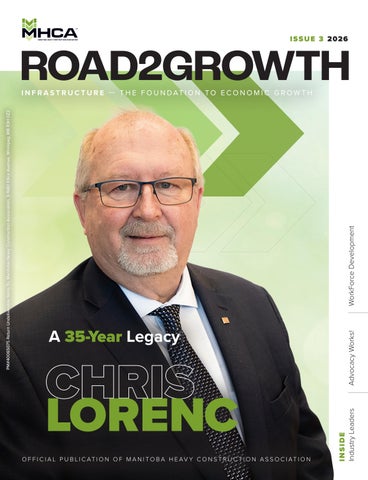
I S S U E 3 2026
WorkForce Development
CHRIS LORENC O F F I C I A L P U B L I C AT I O N O F M A N I T O B A H E AV Y C O N S T R U C T I O N A S S O C I AT I O N
Advocacy Works!
A 35-Year Legacy:
INSIDE Industry Leaders
PM#40065075 Return Undeliverable Items To: Manitoba Heavy Construction Association, 3-1680 Ellice Avenue, Winnipeg, MB R3H 0Z2
I N F R A S T R U C T U R E — T H E F O U N DAT I O N T O E C O N O M I C G R O W T H
WHEN IT COMES TO THE HEALTH AND GROWTH OF MANITOBA,OUR CONTRACTORS HAVE YOU COVERED.
AND WE’VE GOT THEM COVERED! MCIP CONTRACTORS ASSOCIATION OF MANITOBA
M A N I T O B A CONSTRUCTION INDUSTRY PLAN
• Health and Dental Benefits Designed Specifically for the Construction Industry. • Advocacy for Open Shop Contractors.
Visit us at meritmb.com
POWER THROUGH YOUR PROJECTS. Keep your operation at peak productivity with proven John Deere construction equipment and 24/7/365 support from Brandt.
Comprehensive Lineup
Technology Leaders
Superior Support
Find the machine you need at Brandt to keep your operation rolling with excavators, graders, loaders, and more.
With 15+ years of construction tech experience, Brandt will ensure your tech takes you to the next level.
With Brandt, you get 24/7/365 support, mobile techs, and the parts you need, when you need them.
Your time is money and we won’t waste either!
Scan the QR code to
Contact your Brandt dealer or learn more at brandt.ca/never-idle
Explore our construction equipment lineup
Your future on your terms
Selling your business can be a great way to fuel your personal and professional growth. It can also ensure your vision and hard work continue to deliver results for years to come. When you’re ready to take the next step, we can find the right buyer at the right price so you can close the deal with confidence. Brett Franklin, CPA, CA, President, MNP Corporate Finance Inc. 204.336.6190 | brett.franklin@mnp.ca
MNPCF.ca
ROAD2GROWTH
I S S U E 3 2025
F E AT U R E S
I N F R A S T R U C T U R E — T H E F O U N DAT I O N T O E C O N O M I C G R O W T H
22
AGGREGATES: BUILDING THE FOUNDATION OF CONSTRUCTION IN MANITOBA
28
RRC POLYTECH EXPANDS ACCESS TO INDUSTRY-DRIVEN TRAINING ACROSS MANITOBA
31
THE UNSEEN RESCUERS
17
A 35-YEAR LEGACY: CHRIS LORENC TO RETIRE AT END OF 2026
32
INVESTING IN PEOPLE: HOW GOLD SEAL EMPLOYERS ARE BUILDING A COMPETITIVE ADVANTAGE
EDITORIAL 7
From the Director’s Desk
10 Member Benefits 24 Industry Leaders 27 Innovation Alley
34 WorkSafely • Message from the Director • Training Schedule • Safety Spot Check
30 Advocacy Works!
BOARD OF DIRECTORS MHCA EXECUTIVE COMMITTEE Board Chair John Highmoor, B.A., B.Sc. (C.E.), Tri-Core Projects Vice-Chair Kevin Brown, P.Eng., G.S.C., Maple Leaf Construction Ltd. Immediate Past Chair Dennis Cruise, CET, G.S.C., Bituminex Paving Ltd. Secretary Tony Teixeira, J.C. Paving Ltd. Treasurer Marcel Machado, B.Sc. (C.E.), Green Infrastructure Partners Inc. President and CEO Chris Lorenc, B.A., LL.B. EXECUTIVE DIRECTORS AT LARGE Nicole Chabot, B.A. G.S.C. L. Chabot Enterprises Ltd. Richard Wilson CET, G.S.C. M.D. Steele Construction Ltd. BOARD DIRECTORS Michael Byrne Denis Collet, B.Comm Dr. Nelson Ferreira Michelle Magdic Joel Martens Peter Paulic Todd Turner
AON Reed Stenhouse Inc. Gravier Collet Gravel Inc. Trek Engineering BFL Canada Bayview Construction Ltd. Brandt Tractor Ltd. E.F. Moon Construction Ltd.
38 WorkForce Development 40 Industry Steps Out 44 You Gotta Know 46 Advertiser Product & Service Centre
Road2Growth is published four times per year by Craig Kelman & Associates Ltd. on behalf of the Manitoba Heavy Construction Association. Unit 3 - 1680 Ellice Avenue, Winnipeg, MB R3H 0Z2 Tel: 204-947-1379 www.mhca.mb.ca All rights reserved. Contents may not be reproduced without express consent of the publisher. ©2026 Publication Mails Agreement #40065075 Return Undeliverable Items To: Manitoba Heavy Construction Association, Unit 3 - 1680 Ellice Avenue, Winnipeg, MB R3H 0Z2 EDITORIAL AND ADVERTISING OFFICES 3rd Floor - 2020 Portage Avenue, Winnipeg, MB R3J 0K4 Tel: 866-985-9780 www.kelmanonline.com Managing Editor: Scott Kelman Marketing Manager: Kris Fillion Design/layout: Tabitha Robin Advertising Coordinator: Sabrina Simmonds
ABOUT The MHCA is a prominent membership-based advocate for the heavy construction and related industries in Manitoba, representing over 400 contractors, suppliers, and financial companies. Founded in 1943, the MHCA advances progressive public policies and innovative programs in a manner consistent with the broad public interest. The MHCA serves as the primary ‘go to’ resource for the heavy construction and related industries for information, networking, public policy advocacy and member services. It promotes sustainable investment in core infrastructure – streets, highways, bridges, water/wastewater systems, active transportation, water-control structures, trade gateways, and corridors – to support economic growth and social development that benefits our province and country. MHCA champions workplace safety education and training through its leading-edge WorkSafely program established in 1990. It actively participates in local, provincial, regional, and national advocacy groups and collaborates extensively with public and private-sector stakeholders to advance common core values, including economic growth, diversity, and safe work, which benefit our communities, province, and country. It has an earned reputation for effective advocacy.
6
I S S U E 3 2026
R E T U R N TO C O N T E N T S
Chris Lorenc, B.A., LL.B. President and CEO, MHCA
FROM THE PRESIDENT’S DESK
LOOKING BACK, LEADING FORWARD: A FINAL MESSAGE As I reflect on more than 35 years with the Manitoba Heavy Construction Association (MHCA), I am filled with a deep sense of gratitude. It has been a privilege to lead an organization with such a proud history of strong Board Chair and Board leadership, an engaged membership, professional staff, strong relationships with governments and colleague stakeholder organizations, and, most importantly, a willingness to think beyond the immediate – to look ahead, challenge assumptions and help shape what comes next. As this will be my final president’s message, I want to begin by saying thank you. Thank you for your trust, relationships, conversations, challenges, and shared commitment – all have made this journey so meaningful. When I began with the MHCA in 1991, I had little knowledge of the industry. What I did have was the extraordinary opportunity to learn from visionary leaders, including past chairs Barry Brown, Don Whitmore, Neil Wither, Colleen Munro, Chuck Lee, and Dick Mulder, to name only a few. They understood that the MHCA could, and should, play a meaningful role in shaping the future. They encouraged an approach to advocacy that went well beyond responding to issues of the day. They believed the MHCA should develop positions, R E T U R N TO C O N T E N T S
challenge assumptions, and help shape the conversation. That vision became embedded as an integral part of the organization’s DNA. Over the years, we have built on the MHCA’s reputation as an active participant in regional and national discussions, and as a strong voice with all three levels of government in Canada. Our advocacy has consistently been grounded in the bigger picture, particularly the vital connection between strategic infrastructure investment and economic growth.
economy we have while creating the capacity for it to grow. Economic growth is not the only priority, but it is an enabling priority. Growth creates the resources, opportunities, and confidence needed to address virtually every other social priority. That is why we believe the City of Winnipeg should establish a chief economic development officer position at the executive leadership level, working through the CAO with the mayor and Executive Policy Committee to provide citywide leadership on economic growth.
It has been a privilege to lead an organization with such a proud history of strong Board Chair and Board leadership, an engaged membership, professional staff, strong relationships with governments and colleague stakeholder organizations, and, most importantly, a willingness to think beyond the immediate – to look ahead, challenge assumptions and help shape what comes next. Infrastructure is not simply about budgets, projects, and construction schedules. It is about the condition of the assets we depend on, the competitiveness and resilience of our economy, and the opportunities we create for future generations. Growing the economy should be the primary job for every level of government. Strategic, long-term planning and investment in infrastructure must be at the core of that thinking, sustaining the
It is encouraging to see this kind of core-function thinking emerging at the provincial level with the Premier’s Business and Jobs Council work, the provincial economic development strategy, and the pending announcement of a Manitoba Economic Development Agency. At a time of uncertainty in our relationship with the United States, the need to build resilience, diversify beyond dependence on a single market, and I S S U E 3 2026
7
FROM THE PRESIDENT’S DESK
ensure that internal trade across Canada is truly barrier-free, has never been more important. These initiatives are firmly in the best interests of our communities, our province and our country. CentrePort Canada provides a powerful example of what is possible when leaders are prepared to think differently. In its early days, there was considerable skepticism about the concept. But visionary
political and organizational leadership, particularly the support of Premier Gary Doer and former president and CEO Diane Gray, helped transform an ambitious idea into an economic asset of national significance. They were willing to believe. They were willing to invest. And they were willing to take risks. That is what leadership can accomplish when it has the courage to challenge
BUILT ON INTEGRITY, FOCUSED ON QUALITY Land Development Road Construction Asphalt and Concrete Paving Milling Commercial Parking Lot Construction Sewer & Water Installation and Repairs Aggregate Production and Sales Stone, Gravel, Granite, and Crushed Concrete Heavy Equipment Rentals complete with GPS Street & Lot Sweeping Snow Clearing & Sanding Services Hydro Excavation Services Design Build
4000 McGillivray Blvd., Oak Bluff, Manitoba | 204.254.7761 estimating@bayviewconstruction.ca bayviewconstruction.ca
8
I S S U E 3 2026
conventional thinking. That same courage is needed today and tomorrow. But visionary leadership cannot succeed in isolation. Strong relationships, collaboration, trust, and a willingness to challenge the status quo are equally essential. Some of the MHCA’s greatest accomplishments have come from bringing people together around a shared objective and demonstrating that progress is possible when we choose to work toward it together. Leadership, ultimately, is about leaving things better than you found them. I hope the legacy of my time with the MHCA is not simply a list of its accomplishments. I hope it is also a culture – one that continues to ask bigger questions, speak with conviction, think beyond the next budget cycle, and advocate boldly for the growth and prosperity of Manitoba and Canada.
What we need is the confidence to believe in what Manitoba can become, and the leadership and courage to make it happen. I leave this role with enormous optimism. Our province has resources. We have geography. We have the people. We have the experience and the capacity to achieve far more than we sometimes believe possible. What we need is the confidence to believe in what Manitoba can become, and the leadership and courage to make it happen. I am optimistic because I believe we have those ingredients. And I believe Manitoba can become a ‘have’ province. Thank you for allowing me to be part of the journey. It has been one of the great privileges of my life.
Chris Lorenc, B.A., LL.B. President and CEO, MHCA R E T U R N TO C O N T E N T S
HIGH PROJECT COSTS HOLDING YOU BACK? OUR BONUSES CAN HELP. For building envelope projects completed before March 31, 2027, we’re increasing our current incentives by 25% for buildings heated with electricity and by 10% for buildings heated with natural gas.
Supplier Bonus: Receive a $250 supplier bonus when you submit an application on behalf of your customer and complete the project before March 31, 2027. Learn more at efficiencyMB.ca/building-envelope.
ANY COMPANY WORKING WITH THE HEAVY CONSTRUCTION INDUSTRY IN MANITOBA
WILL BENEFIT FROM MEMBERSHIP.
Members say five of the biggest reasons they value the association are:
1
NETWORKING Our members, big and small companies throughout Manitoba, meet and learn from each other at our premier events and by participating in our standing committees, where industry, policy, and budget concerns are addressed.
2
ADVOCACY The MHCA is a prominent advocate respected across Manitoba for its informed and progressive approach to shaping public policy. It is often sought out for advice and opinion by media, governments, and the public.
3
MEMBERSHIP DIRECTORY & EQUIPMENT RENTAL RATES GUIDE This directory is the ‘go-to’ tool used by contractors, suppliers, government, and purchasers of all industry services in Manitoba. It includes the annually updated and relied-upon equipment rental rate guide.
4
SAFETY TRAINING The MHCA WorkSafely Program, established in 1990, provides workplace safety and education training to reduce workplace incidents. This includes the Certificate of Recognition (COR®) recognized by SAFE Work Manitoba as the required safety training standard.
5
HEAVY NEWS Our weekly newsletter keeps members aware of MHCA activities, events, concerns, advocacy activities, and includes tender ads and results.
Are You Interested in Joining? Visit https://mhca.mb.ca/membership or contact Christine Miller, MHCA Operations Manager, at 204-594-9053 or christine@mhca.mb.ca. 10
I S S U E 3 2026
R E T U R N TO C O N T E N T S
MEMBER BENEFITS
CALENDAR OF EVENTS NOVEMBER 9 20
Leaders’ Forum on Growing the Economy
Victoria Inn and Conference Centre
Awards Breakfast, AGM, Chair’s Gala
RBC Convention Centre
Be sure to read the Heavy News, check out www.mhca.mb.ca, Facebook, Instagram, LinkedIn, or contact Christine Miller, Operations Manager, at 204-594-9053 or christine@mhca.mb.ca for information on additional events throughout the year.
Our concern for the environment is more than just talk
We are committed to publishing the magazine in the most environmentallyfriendly process possible. So enjoy this magazine... and keep thinking green.
BUILD YOUR AMBITION WITH US Amrize is the partner of choice for the professional builders of North America, covering every project need from foundation to rooftop. With over 1,000 sites, 19,000 teammates, and a highly efficient distribution network, we deliver advanced building solutions for infrastructure, commercial and residential projects in every U.S. state and Canadian province. We are ready to build your ambition. Learn more at amrize.com
Regent Park Tower Toronto, ON
BUILD YOUR AMBITION
R E T U R N TO C O N T E N T S
I S S U E 3 2026
11
MHCA PUBLICATIONS ESSENTIAL BUSINESS TOOLS
MHCA’s publications are widely circulated, reaching the desks of the heavy construction industry, purchasers of its related services, stakeholder and business associations, government leaders, senior decision makers, and numerous other government officials at all levels.
I S S U E 3 2026
WorkForce Development Advocacy Works!
A 35-Year Legacy:
CHRIS LORENC
INSIDE Industry Leaders
PM#40065075 Return Undeliverable Items To: Manitoba Heavy Construction Association, 3-1680 Ellice Avenue, Winnipeg, MB R3H 0Z2
I N F R A S T R U C T U R E — T H E F O U N DAT I O N T O E C O N O M I C G R O W T H
O F F I C I A L P U B L I C AT I O N O F M A N I T O B A H E AV Y C O N S T R U C T I O N A S S O C I AT I O N
QUARTERLY MAGAZINE Road2Growth – INFRASTRUCTURE: the foundation to economic growth MHCA produces a quarterly magazine, Road2Growth – Infrastructure: the foundation to economic growth, which focuses on profiling the work of the heavy construction industry, including MHCA advocacy and WorkSafely news.
HEAVY NEWS › Distributed to members, elected officials, senior public administrators, and related stakeholder communities. › Provides current tender ads and results. › Posted online at www.mhca.mb.ca and via social media; delivered electronically every week by email. 2026 MEMBERSHIP DIRECTORY &
UNIT 3 – 1680 ELLICE AVENUE, WINNIPEG, MB R3H 0Z2
204-947-1379
WWW.MHCA.MB.CA
2025
EQUIPMENT RENTAL RATES GUIDE
MHCA2026_Covers.indd 1
2026-02-11 3:30 PM
MEMBERSHIP DIRECTORY & EQUIPMENT RENTAL RATES GUIDE › The annual MHCA Membership Directory & Equipment Rental Rates Guide is the definitive reference guide and business tool used by industry and purchasers of its services. › This ‘go-to’ guide lists members and the full scope of the products and services they offer. › The only heavy equipment Rental Rates Guide in Manitoba. › Public and private sector project owners use the directory to contact suppliers of services, including contractors, materials, equipment, aggregates, oils, design, and engineering.
MHCA WEBSITE Our website – www.mhca.mb.ca – promotes our vision, mission, services and provides members with the latest news, policy briefs, and WorkSafely materials and resources, including the new e-News.
Connect with us on: @manitobaheavy
Manitoba Heavy Construction Association
Manitoba Heavy Construction Association
SPECIALIZING IN LARGE DIAMETER PIPE CLEANING
UNIT 121: DOUBLE 1-1/4" FLUSHER • UNIT 117: 12" VACUUM TRUCK
12" VACUUM TRUCKS WITH 6800 CFM BLOWERS THAT CAN DECANT LIQUID ON THE FLY AT OVER 1600 GPM CAPABLE OF CLEANING ANY DIAMETER PIPE WITH OVER 850m BETWEEN ACCESS POINTS DEEP TUNNEL CLEANING ANY OF DIAMETER LINE AT DEPTHS OF OVER 150ft DOUBLE 1-1/4" FLUSHERS WHICH RUN 2900psi PUMPS AT 236 GPM
50 OMANDS CREEK BLVD • WINNIPEG, MANITOBA
(204) 633 - 4879
MEMBER BENEFITS
MEMBER UPDATE Welcome New Members! Thank you to all our current members, and welcome to our newest members!
Do you have your people plan in place? Connect with experts at People First HR for customized solutions that meet your organization’s needs.
Find us online
→ Professional and management recruitment → Executive search → Fractional HR → Compensation and total rewards → Career transition and outplacement
info@peoplefirsthr.com Toll-free: 1.866.940.3950 peoplefirsthr.com
14
I S S U E 3 2026
Book a free consultation
Visit us at www.mhca.ca
R E T U R N TO C O N T E N T S
Geotechnical Engineering
Water Resources
Environmental Engineering
Materials and Construction
204.975.9433 | trekengineering.ca
T: 204.344.5760
Site Development | Sub-divisions | Road Building Surface Water Management | Retention Ponds Wastewater Stabilization Pond Construction & Maintenance Sewer and Water Services | Excavation Services Granular Supply | Custom Hauling | Mining Services
R E T U R N TO C O N T E N T S
Earth Max Construction Inc.
Phone: 204-344-5760 Fax: 204-480-1683 info@earthmax.ca www.earthmax.ca Stony Mountain, MB
I S S U E 3 2026
15
C E L E B R AT I N G
CHRIS LORENC After more than 35 years of dedicated leadership, Chris leaves an extraordinary legacy of service and advocacy for Manitoba’s heavy construction industry. In an evolving industry, Chris has remained a steadfast champion for our sector, leading with vision, integrity, and an unwavering commitment to strengthening the industry and province. Today, we celebrate Chris’s remarkable contributions, thank him for his many years of dedicated service, and wish him every success and happiness in a truly well-deserved retirement.
204-488-7070
mdsteele.mb.ca
26-1051 Kapelus Dr.
Congratulations, Chris, on an extraordinary career.
For more than 35 years, you have been a consistent and respected voice for Manitoba’s heavy construction industry. Your dedication to advancing our sector, supporting its people, and helping move the industry forward has been deeply appreciated. Your contribution has reached far beyond any one organization. You have helped strengthen the industry as a whole and have earned the respect of so many along the way. From everyone at EF Moon Construction Ltd., thank you for the years you have given to our industry. We wish you all the very best as you begin this well-earned next chapter.
16
I S S U E 3 2026
R E T U R N TO C O N T E N T S
A 35-Year Legacy:
CHRIS LORENC TO RETIRE AT END OF 2026
Mathias Leiendecker Contributor, Craig Kelman & Associates
After more than 35 years at the helm of the Manitoba Heavy Construction Association (MHCA), President and CEO Chris Lorenc will retire on December 31, 2026, closing one of the most influential chapters in the organization’s history. During his tenure, MHCA has evolved from a relatively small industry association representing just 73 members into one of Canada’s most respected construction advocacy organizations, now representing more than 400 member companies. Yet when Lorenc reflects on the accomplishments of the past three and a half decades, he is quick to point out that the story has never been about him. Instead, it has always been about the industry, the people, and the responsibility to leave Manitoba and Canada in a better place than he found it. That philosophy, instilled in him as a young boy around his family’s kitchen table, became the guiding principle for every major decision throughout his R E T U R N TO C O N T E N T S
career and continues to shape the way he views leadership today. “I was taught by my parents at our kitchen table that you have a responsibility as a citizen of this country to try your best to leave it in a condition better than you found it,” Lorenc said. “From a very early age, I was interested in politics and community activity.” He recalls debating federal politics with his grade five elementary school teacher about who would win a pending federal election and credits those early conversations with igniting a lifelong passion for public service and public policy. While his career eventually led him into law, municipal, provincial, and federal politics, that same desire to make a meaningful contribution never
disappeared. Rather than simply pursuing professional success, Lorenc always sought opportunities to help shape communities, influence public policy, and create lasting benefits for future generations. That passion ultimately led him to the MHCA in October 1991. At the time, Lorenc had already served eight years as a Winnipeg city councillor and was concurrently practising law. While he enjoyed the legal profession, he admits it never provided the same sense of purpose that public policy did. Then one day he came across an advertisement in the Winnipeg Free Press seeking a new president and CEO for MHCA. What caught his attention wasn’t simply the position itself, but opportunity. “I saw it as an opportunity to build I S S U E 3 2026
17
something and shape something,” he recalled. He interviewed for the position and was offered the job that very same day. When Lorenc first arrived at MHCA, the organization looked very different from what it does today. Membership stood at just 73 companies, the association had a much smaller profile, and the opportunity to influence municipal, provincial and national policy was still developing. Over the next 35 years, Lorenc helped transform MHCA into a trusted and respected voice for Manitoba’s heavy construction industry. That transformation didn’t happen because of one major initiative or one successful campaign. Instead, it came through years of relationship-building, thoughtful advocacy, and a commitment to bringing people together. He credits much of the association’s growth to the countless relationships developed with municipal councils, provincial and federal governments, deputy ministers, industry associations, business organizations, Indigenous communities, and stakeholders across Canada. Those relationships helped elevate MHCA’s voice well beyond Manitoba’s borders and established the organization as an influential contributor to conversations surrounding infrastructure, transportation, workforce development, trade, and economic policy. Throughout his career, Lorenc has often been asked to identify the accomplishment of which he is most proud. His answer is rarely a single project or policy because, as he puts it, “they’re all in different baskets.” Some achievements are measured by changes in government policy, while others are reflected in the industry’s growing influence or the relationships built along the way. Nevertheless, several accomplishments stand out. Among them is helping introduce the concept of the ‘infrastructure investment deficit,’ a phrase that 18
LOOKING BACK ON A 35-YEAR LEGACY 1990
1991 – Appointed President & CEO of the MHCA, becoming the longest-serving chief executive in the organization’s history. 1991-2025 – Served on the Canadian Construction Association’s Civil National Advisory Council, helping shape federal infrastructure investment policy. 1995 – Appointed President & CEO of the Western Canada Roadbuilders & Heavy Construction Association becoming the organization’s longest-serving leader. 1997 – Participated in international trade missions to Ukraine, Poland, and China supporting infrastructure collaboration and economic development. 1998, 2000 – Chaired Winnipeg’s Strategic Infrastructure Reinvestment Policy (SIRP) task forces, providing long-term guidance on municipal infrastructure renewal.
2000
2004 – Chaired and founded Manitoba’s SAFE Roads Committee, promoting safety leadership and awareness in the road construction industry. 2006 – Successfully advocated for Manitoba’s Gas Tax Accountability Act, dedicating fuel tax revenues to highway infrastructure investment. 2008 – Chaired Mayor Sam Katz’s Trade Council report, which was recognized as the catalyst for the creation of CentrePort Canada. 2009-2025 – Served on CentrePort Canada’s founding Board of Directors, including service as Chair, Vice-Chair, Governance Committee Chair, and Board Member. 2009-2016; 2024 to present – Served on the Workers Compensation Board of Manitoba, including leadership roles in prevention, governance, and modernization initiatives.
2010
2011 – Chaired the Infrastructure Funding Council report, influencing sustainable municipal infrastructure funding strategies and Winnipeg’s dedicated street renewal funding model. 2011 – Chaired the Canadian Construction Association’s Indigenous Engagement Best Practices Task Force, resulting in the construction industry’s first national Indigenous engagement framework. 2013 to present – Served on the Manitoba Labour Board. 2013-2019 – Served on the Board of Directors of the Winnipeg Football Club, including leadership roles in governance and community relations.
2020
2022 to present – Acted as Chair of a national group leading to development of the Canada Trade Infrastructure Plan (CTIP), unanimously adopted by Canada’s premiers in 2023.
2026
2026 – Appointed to the Canada West Foundation Board of Directors with whom he has worked for roughly 25 years.
I S S U E 3 2026
R E T U R N TO C O N T E N T S
has since become commonplace in discussions surrounding infrastructure funding across Canada. At the time, however, it represented a new way of framing the conversation. By encouraging governments to think of aging infrastructure as an investment challenge rather than simply a maintenance issue, MHCA helped shift public policy toward long-term planning and strategic investment. Today, the phrase appears regularly in government budgets, policy papers, and infrastructure discussions, a testament to the lasting impact of that work. Lorenc also points to the association’s advocacy surrounding dedicated infrastructure funding as one of its most meaningful achievements. He highlights the City of Winnipeg’s decision in 2013 to implement dedicated property tax increases specifically earmarked for local and regional road infrastructure as an example of how sustained advocacy can produce tangible long-term results. Rather than advocating for short-term, politically convenient investments, MHCA consistently argued for predictable, R E T U R N TO C O N T E N T S
long-term incremental funding that municipalities could rely upon when planning infrastructure improvements. That same philosophy shaped the association’s national advocacy efforts, where Lorenc championed the idea that governments should prioritize ‘shovel-worthy’ projects rather than simply ‘shovel-ready’ ones. Strategic investments in trade-enabling infrastructure, he argues, produce long-term economic returns that benefit every Canadian. With nearly 70% of Canada’s gross domestic product tied to trade, trade-enabling transportation infrastructure represents far more than roads and bridges; it is the backbone of the country’s economy. Perhaps no initiative better reflects that philosophy than CentrePort Canada. Lorenc, who chaired a 2008 Report entitled Mayor’s Trade Council was instrumental in creating CentrePort Canada. Lorenc became a founding board member and later Board Chair. He has long viewed CentrePort Canada as one of Manitoba’s most significant economic development and growth opportunities. Watching it evolve from
an ambitious concept into a thriving logistics hub remains one of the highlights of his career. In recent years alone, CentrePort has attracted more than $2 billion in privatesector investment, with billions more expected as development continues on its Winnipeg land footprint. Lorenc states that CentrePort represents far more than industrial development; it becomes possible when governments, businesses, labour, and industry organizations work collaboratively toward a shared vision. It is precisely the kind of long-term, trade-focused investment that he has advocated for throughout his career and one of the clearest examples of infrastructure creating lasting economic opportunity for future generations. If there is one message that has consistently defined Lorenc’s advocacy over the years, however, it is his belief that growing the economy must remain the top priority for every level of government. Not because economic growth is government’s only responsibility, but because it enables governments to accomplish everything else. I S S U E 3 2026
19
Healthcare, education, housing, social programs, and infrastructure all depend on a healthy economy capable of generating the revenue needed to support those investments. “Not as the only priority of governance, but as the enabling priority,” he stated. Without expanding revenue streams, governments cannot maintain existing programs, improve services or introduce new initiatives. Over time, that message began resonating throughout Manitoba’s political landscape. Lorenc points to Winnipeg Mayor Scott Gillingham’s emphasis on economic growth during the 2022 municipal election, as well as Premier Wab Kinew’s now well-known observation that “it is the economic horse that pulls the social cart,” as evidence that the conversation has shifted. For Lorenc, those moments reinforce the belief that thoughtful advocacy can gradually influence the way governments think about public policy. While policy accomplishments often receive the most public attention, Lorenc believes his greatest lessons came through working with people. Throughout more than three decades, he collaborated with premiers, cabinet ministers, members of Parliament, municipal leaders, deputy ministers, labour organizations, Indigenous communities, business groups, and industry partners from coast to coast. Those experiences taught him that successful advocacy has far less to do with confrontation than with collaboration. Over the years, he developed four guiding principles that became the foundation of his leadership philosophy and continue to shape the advice he gives to young leaders entering the profession. The first, he says, is understanding that “advocacy is a marathon, never a sprint.” Meaningful policy change rarely happens overnight, and those hoping to influence public policy must be prepared for years of persistence. The second principle is equally important: “You can go faster alone, but you’ll go further together.” Lasting change requires coalitions, partnerships, and relationships built on trust rather than individual accomplishment. 20
Third, Lorenc believes “you can disagree without being disagreeable.’ “It’s important to agree and to disagree, but never to be disagreeable. Don’t burn bridges.” he advises. Today’s disagreement may become tomorrow’s partnership, and maintaining respectful relationships often proves more valuable than winning a single argument. Finally, he frequently returns to a paraphrased quotation from Winston Churchill that has guided him throughout his career: “Never give in, except for principle, honour, and public interest.” Together, those four principles became the foundation upon which MHCA built its reputation as one of Canada’s most respected advocacy organizations. Having spent time on both sides of government as an elected official and later as an industry advocate, Lorenc has developed a profound appreciation for public service. His years of working alongside elected officials across the political spectrum have given him a deeper understanding of the challenges governments face and the complexity of balancing competing priorities.
I S S U E 3 2026
“I’ve had the enormous privilege of meeting people coast to coast,” he reflected. “It’s given me a much better understanding of what makes this country tick and why it is so difficult to govern.” More importantly, those experiences have strengthened his respect for those willing to enter politics. Regardless of political affiliation, Lorenc believes public servants deserve recognition for dedicating themselves to improving their communities. He also values the ability to work alongside people with very different viewpoints while maintaining mutual respect. “The ability to work with people who don’t agree with you and still leave a meeting as friends and colleagues, that’s something I’ll miss.” As retirement approaches, Lorenc isn’t planning to step away from public policy entirely. Earlier this year, he was appointed to the Board of Directors of the Canada West Foundation, an organization he has collaborated with for approximately 25 years. The appointment provides another opportunity to continue promoting economic growth and public policy throughout Western Canada while R E T U R N TO C O N T E N T S
remaining involved in many of the issues that have defined his career. Closer to home, he credits MHCA’s success to visionary board chairs and boards of directors leadership supported by committed members, and a devoted, professional, and collegial staff who demonstrated a commitment to advancing the propositions for which the MHCA exists and stands. “I could not have led the MHCA without terrific board leadership and consistent office support. I will always remember and be grateful for their dedication,” said Lorenc. Lorenc is equally optimistic about MHCA’s future. Felicia Wiltshire will assume the role of president and CEO following a carefully planned transition, something Lorenc believes positions the association for continued success. “I believe Felicia is an excellent choice,” he said. “I’m very confident she has what it takes to take the organization to its next level.” He also praised MHCA’s Board of Directors for implementing a transition
plan that allows knowledge, relationships, and experience to be passed along gradually, ensuring continuity for both staff and members. When asked what he will miss most after more than 35 years, Lorenc’s answer comes quickly. It isn’t the meetings, policy papers, or advocacy campaigns. It’s the people. The relationships built across Manitoba and throughout Canada have been, in his words, “the enormous privilege” of his career. The opportunity to work alongside passionate individuals, influence positive change and eventually watch those efforts translate into real improvements for communities remains the most rewarding aspect of his professional life. Looking back, he measures success by whether the work helped improve Manitoba and strengthened the communities that depend upon it.
Asked how he hopes history will remember his time leading the MHCA, Lorenc’s answer once again returns to the values that have guided him since childhood. “I hope to be remembered as a principled, passionate leader whose focus was always on the public’s best interest.” Judging by the remarkable growth of MHCA, the influence it now enjoys across Canada and the countless relationships forged throughout his 35-year career, it is a legacy that has already been firmly established.
Congratulations, Chris Lorenc on an outstanding career. Your hard work and commitment have left a lasting mark on our industry.
Wishing you a happy, healthy, and well-deserved retirement, from all of us at Bayview Construction.
4000 McGillivray Blvd., Oak Bluff, Manitoba | 204.254.7761 | estimating@bayviewconstruction.ca | bayviewconstruction.ca
R E T U R N TO C O N T E N T S
I S S U E 3 2026
21
BUILDING THE FOUNDATION OF CONSTRUCTION IN MANITOBA Julia Waterer Contributor, Craig Kelman & Associates
“Aggregates really are the foundation of every construction project. Whether we’re talking about road base for streets and highways, gravel roads and driveways, drainage stone, concrete, or asphalt, there isn’t a project out there that gets completed without aggregates in some form, whether it’s limestone, sand, gravel, or granite.” Merle Balsillie, manager of Standard Limestone Quarries in Stonewall, grew up in the quarry industry, and she knows its history as well as anyone. “The bulk 22
of the aggregates in this region initially came from the Birds Hill gravel pits. That was really the main source until the 1990s, when demand began shifting more toward limestone from the Rockwood quarries. Now, the limestone from the Rockwood quarries supplies the majority of aggregates to the region,” she said. “Most people might not know this, but Manitoba has some of the best quality aggregates in the world,” said Scott Wozny, area manager for aggregate in Manitoba at Heidelberg Materials. “Cement production is responsible for 8% of all CO2 emissions worldwide. Because the Manitoban aggregates are so high quality, less cement is required to make concrete, reducing emissions significantly. We’re also able to electrify
I S S U E 3 2026
a lot of our production, working closely with Manitoba Hydro. This reduces the need for diesel, as well as overall costs. The construction industry in Manitoba is very, very lucky to have such a plentiful and high-quality resource.” “I may be biased, but I really do believe that aggregates are the foundation of the heavy construction industry,” said Scott Aikman, land and resource manager at Glacial Aggregates Inc. “They are utilized in virtually every project and piece of public infrastructure in some form or another. While they are often overlooked by the public, aggregates are essential to the quality, durability, and affordability of the infrastructure that supports our communities and economy. R E T U R N TO C O N T E N T S
“As communities and governments focus on infrastructure renewal, sustainable development, and longterm resource management, I think the importance of aggregates has become more widely recognized,” continued Aikman. “In fact, one of the first things many contractors look at when pricing a project is what quality aggregate resources are available nearby, as the source and haul distance can have a significant impact on both cost and project feasibility. The demand for aggregate resources continues to grow, but at the same time, obtaining permits, securing land, and building support among stakeholders and local communities have become more involved and increasingly complex.” One of the biggest challenges to the aggregate industry is managing public expectations and reactions to operations, quarry lifespan and remediation initiatives. “Open-pit quarries like the ones in south central Manitoba are a very visible type of resource extraction: they aren’t hidden away in the woods or deep underground,” said Wozny. “Quarries are only getting to be more visible as they expand over time and get closer to towns and highways, and with new municipal approval requirements, are under increasing scrutiny. We are seeing pushback from communities because the base of knowledge as to why and how the quarry is operating, just isn’t present as it needs to be.” The industry response to local pushback? Embracing opportunities for transparency and endorsing community initiatives. “One of the biggest changes I have seen is the increased emphasis on community engagement and responsible resource development,” said Aikman. “We’ve hosted guided quarry tours that allow stakeholders to see firsthand how modern quarry development and progressive rehabilitation differ from quarries that were developed in the 1970s. Tours help demonstrate how environmental practices, reclamation planning, and community involvement has R E T U R N TO C O N T E N T S
evolved over time, while also emphasizing the importance of protecting local aggregate resources. We’re continuing to build on that through a series of community open houses and by looking at ways to adjust certain operational practices based on feedback. The goal is to create a better understanding of what we do, encourage open dialogue, and ensure we’re being good neighbours in the communities where we operate.” “When it comes to remediation of old or spent mine sites, we need to be clear with stakeholders that quarry lifespans are very long,” added Wozny. “Remediation planning and ‘second life’ plans are looking 30, 40 years into the future, not next year.” Local initiatives in the area also seek to preserve the oldest quarry infrastructure, ensuring the history of the area’s earliest industry isn’t forgotten. “In 2018, I became involved in the ‘Save the Kilns’ project with the Town of Stonewall,” Balsillie said. “Through the support of Amrize, Glacial Stone,
Maple Leaf Construction, and Standard Limestone Quarries, we were able to raise $1,175,000. That project is especially important to me because it helps preserve the quarry heritage that shaped Stonewall and the surrounding area.” The ‘Save the Kilns’ project is a campaign to rescue and rebuild the century-old limestone draw kilns at Stonewall Quarry Park. With better awareness of the industry locally, the hope is that this understanding will extend to more people realizing just how vital aggregates are to everyday life. “Outside of the construction industry, I think a lot of people don’t realize just how important aggregates are because they’re usually hidden from view – covered by concrete or asphalt, or, in the case of drain stone, buried with backfill,” said Balsillie. “It may not be the most glamorous part of construction, but it’s essential. Without aggregates, the infrastructure people rely on every day simply wouldn’t exist.”
I S S U E 3 2026
23
INDUSTRY LEADERS
MERLE BALSILLIE: BUILDING ON THE SOLID FOUNDATION OF MANITOBAN AGGREGATES Julia Waterer Contributor, Craig Kelman & Associates
“I was born into the business, and as long as I can remember, the quarry fascinated me. I always knew this was what I wanted to do.” Merle Balsillie is a second-generation quarry operator from Stoney Mountain, MB. She was born and raised in the aggregate industry and has lived her entire life in and around the quarries. “My dad started the quarry in 1959, and after he passed away in 1974, my mom kept the business going. At that time, she was the only woman in the quarry industry, and then I later became the second. She has been my mentor, and she taught me the importance of doing the right thing,” said Balsillie. “I’m very fortunate to have her as a role model.” As a lifelong resident in the Rural Municipality of Rockwood, Balsillie said that growing up in area kept her humble and grounded in the community and it’s needs. “I grew up with many of the kids that had family members that worked at the quarries, and years later I worked alongside them in the pit,” she said. “That gave me a real appreciation for the hard work they did day in and day out, especially considering the working conditions in the 1970s and 1980s, when air conditioning was unheard of and dust control wasn’t mandatory. To me, building lasting relationships is key, whether that’s with employees, customers, neighbours, or local government.” It’s these long-term relationships which Balsillie is most proud of, and which she believes have had the longest and most profound impact on 24
how the industry works in and around Rockwood. “The Rockwood quarries are very fortunate to have a municipality that is willing to work with the industry. I credit former Reeve Garnet Thieven for bringing the operators together in 2005 to form the Rockwood Quarry Advisory Committee. It has been a great work in progress in helping improve community relations with industry – and I say ‘work in progress’ because we are always striving to improve. More than 20 years later, and after a few council changes, I am grateful the RM of Rockwood has continued the relationship that Reeve Theiven started.” This collaborative attitude didn’t only come from outside the industry; support came from within as well. “When I first started working in the quarry, I was really impressed by the strong relationships among the foremen from all the neighbouring quarries,” said Balsillie. “Even though we were competitors, everyone helped each other out, and that sense of community still exists among us today. I was fortunate to have them take me under their wings when I first started in the business.” Balsillie notes that the Rockwood Quarry Advisory Committee helped bring that same quality of relationship to upper management. “This is integral to building community relationships. One thing everyone can agree on is that people don’t enjoy living through construction projects, but they really appreciate them once they are completed. Quarries are, by nature,
I S S U E 3 2026
When I first started working in the quarry, I was really impressed by the strong relationships among the foremen from all the neighbouring quarries. Even though we were competitors, everyone helped each other out, and that sense of community still exists among us today. – Merle Balsillie, Quarry Operator long-term construction projects that can sterilize and disrupt land for many years. End-use plans often cannot move forward until nearby quarry operations R E T U R N TO C O N T E N T S
INDUSTRY LEADERS
Balsillie with a red tailed hawk she rescued from the water in the quarry.
are complete, to avoid conflicting land uses,” she said. “People outside the industry may not see what happens behind the berms or understand the rules and regulations operators must follow. As a result, blasts, truck traffic, and dust are often what people associate most with quarries. That is why communication and building relationships in the community are so important. The more people understand the work being done, the reasons behind it,
and the efforts being made to operate responsibly, the better opportunity we have to address concerns, build trust, and maintain strong relationships.” To continue this relationship building, Balsillie has started and supported multiple local initiatives to support community infrastructure. “I initiated and partnered with all the Rockwood quarry operators to sponsor music nights as a fundraiser for South Interlake Rockwood Agricultural Society at The Red Barn in 2024 and 2026. Both events were very successful and showed what can happen when the industry works together to support the community. The Kinsmen Splash Pad at Kinsmen Lake in Stonewall Quarry Park was the first community project supported by all the Rockwood quarries. It was meaningful because it created a lasting space for families to enjoy. In 2018, I became involved in the ‘Save the Kilns’ project with the Town of Stonewall. Through the support of Amrize, Glacial Stone, Maple Leaf Construction, and Standard Limestone Quarries, we were able to raise $1,175,000. That project is especially important to me because it helps preserve the quarry heritage that shaped Stonewall and the surrounding area.”
Balsillie stands beside the crusher her dad used when he started the quarry. She says she is fortunate to still have this amazing piece of history.
R E T U R N TO C O N T E N T S
Balsillie beside the 988H she purchased in 2011.
This heritage is very important to Balsillie, who said that this local aggregate industry is a vital part of the identity of the area’s families. “As the Town of Stonewall has grown and moved away from its mining roots, I feel it is more important than ever to preserve that quarry heritage – not only from an industry standpoint, but for the families who initially worked in the quarries and helped build this great community. I don’t want to see Stonewall become a quarry town in name alone. Our specific and unique heritage needs to be preserved, recognized, and understood as an important part of the community’s enduring identity.” For Balsillie, a crucial aspect of preservation is showing the community that the quarries can continue to be a part of their lives. “Seventy-five years after the first quarry was started in Stonewall in 1880, Kinsmen Lake was built. Then, in 1985, Stonewall Quarry Park opened. To me, that is living proof that mined-out quarries can be transformed into lasting benefits for the community and surrounding areas for generations to come. Ultimately, I hope it shows how quarries can help build communities during their operating life and continue contributing to them long after the work is done,” she said. I S S U E 3 2026
25
GIP is Canada’s leading infrastructure partner with over 100 years of experience self-performing the essential infrastructure our communities need, from raw materials and engineering to construction and major projects. GIP supports public and private sector projects with integrated capabilities across specialty infrastructure solutions, integrated infrastructure solutions, major projects, and materials. By self-performing more of the work, we help clients move with greater certainty.
Our Services
Green Infrastructure Partners
Integrated Infrastructure Solutions | Specialty Infrastructure Solutions | Major Projects | Materials
gipi.com
INNOVATION ALLEY
DEFINING A CENTURY: GRAHAM CENTENNIAL SPOTLIGHT Anna Savard Contributor, Craig Kelman & Associates
In 1926, Graham began as a small, family-owned company in Saskatchewan working on the railway. One hundred years later, it has grown into a leading employee-owned construction firm delivering complex infrastructure, buildings, and industrial projects across Canada and the United States. Today, Graham operates across five divisions: Buildings, Infrastructure, Industrial, Services, and Development. These divisions reflect a century of steady diversification, and one the company is marking this year under the theme ‘Defining a Century.’ For the organization the theme captures both where the company has been and where it’s headed. While the anniversary is an opportunity to honour 100 years of progress, the focus remains firmly forward-looking on meeting the demands of increasingly complex projects. Central to that legacy is Graham’s structure: the company is employeeowned. By giving employees a genuine stake in the business, Graham has encouraged a culture where people take real pride in the projects they deliver and in the long-term impact of their work. Graham now employs more than 3,000 people and generates over $4.8 billion in revenue, a remarkable trajectory from its railway-contracting roots. But according to Drew Monnier, operations manager at Graham, the growth story isn’t only about the size of the organization. “Our growth is less about how big we’ve become and more about the opportunities it has created for our people, our clients, and the communities we work in,” Monnier said. R E T U R N TO C O N T E N T S
“There’s a real sense of pride in knowing that we’ve played a meaningful role in building manufacturing and processing facilities, roads and bridges, power generation facilities, schools, hospitals, and multi-family housing.” Monnier said what matters most is that the company has grown without losing what made it successful in the first place. “We’re now a North American construction company, but at our core, we’re still a people-driven business,” he said. “When people have a genuine stake in the success of the company, it creates a different level of accountability, pride and commitment.” Manitoba has become an important part of Graham’s national impact, thanks to a diverse provincial economy spanning agriculture, advanced manufacturing, aerospace, transportation, mining, healthcare, and education. Monnier said the Winnipeg team’s deep understanding of local markets, paired with the resources of Graham’s national network, has made the region a strong platform for growth. “The strength of Graham is the combination of a large national organization with strong local teams,” Monnier stated. “That local impact,
combined with Graham’s broader national capabilities, is what makes Manitoba an important part of our overall business.” Two Manitoba projects stand out to Monnier as examples of that impact: the Portage la Prairie Bypass and the Southeast Event Centre in Steinbach. The bypass, Monnier said, showcased the collaboration required to keep traffic moving while delivering major bridge and highway improvements. The event centre, meanwhile, turned a community’s vision into a multi-purpose gathering place for hockey games, concerts, trade shows, and more. “One is about keeping people and goods moving and strengthening Manitoba’s infrastructure; the other is about creating a place where people work, play, and come together,” Monnier said. “Both required strong collaboration, innovation and a commitment to delivering something that provides lasting value.” As Graham marks its centennial, the company says its attention remains on advancing new approaches to innovation and organizational effectiveness and integrating emerging technologies into engineering and construction as construction projects grow more complex. I S S U E 3 2026
27
RRC POLYTECH EXPANDS ACCESS TO INDUSTRY-DRIVEN TRAINING ACROSS MANITOBA
RRC Polytech is Manitoba’s only polytechnic, and largest institute of applied learning and applied research. As a post-secondary institution and partner across sectors, industry, and community, RRC Polytech prepares graduates for future careers while helping today’s workforce build new skills through upskilling and reskilling. We are proud to support Manitoba’s heavy construction sector through industry-connected training, including degree and diploma programs, plus micro-credentials that prepare workers for essential roles across the sector. Through RRC Polytech’s network of program advisory councils – which bring together leaders from industry-specific employers and associations, including 28
the Manitoba Heavy Construction Association – we’re able to create and update programming to ensure it remains industry-driven and responsive to labour market needs. Expanding access across Manitoba The addition of the South Winnipeg Campus (SWC) – formerly the Manitoba Institute of Trades and Technology (MITT) – is another way RRC Polytech is creating greater access to a polytechnic education, particularly for learners located in south Winnipeg and southern Manitoba. Nineteen unique and aligned programs transitioned from MITT to RRC Polytech for delivery this fall, with the majority being offered at the SWC. The programs complement existing programming across
I S S U E 3 2026
our campuses, supporting Manitoba’s labour market needs, specifically in the skilled trades and healthcare sectors. “Building upon the strong foundation laid by MITT, combined with a polytechnic model of education, the programming at the South Winnipeg Campus will include high-quality instruction, student support services, and the RRC Polytech credentials that are recognized and highly sought after by employers,” said Fred Meier, president and CEO, RRC Polytech. New and expanded offerings, including the electrical applications, industrial welding, and industrial mechanic (millwright) programs, train workers who are typically employed on infrastructure, industrial, and commercial construction projects. R E T U R N TO C O N T E N T S
As RRC Polytech embarks on its new chapter at the South Winnipeg Campus, current MITT students will complete their programs, receiving an MITT certificate. Throughout program completion, they will have access to student services and supports to ensure a positive and fulfilling academic experience. Training built around industry needs As industry and jobs evolve, RRC Polytech works directly with employers, industry, and communities to develop customized training through its Corporate Solutions area. Tradesfocused micro-credentials and customized training help businesses and individuals build in-demand skills, improve productivity, support growth, and address skills gaps. “Corporate Solutions has a strong track record of helping over 100 Manitoba organizations on nearly 600 projects to date, plus the opportunity to access training funding,” said Meier. One example is Corporate Solutions’ partnership with Minegoziibe Anishinabe (Pine Creek) First Nation to deliver fully funded pre-employment electrical training to strengthen the local workforce. The program was supported through additional funding from First People’s Development and Training, and Training and Employment Services Manitoba, enabling learners to access training closer to home. Delivering education within the community helps remove barriers by reducing travel time and keeping learners connected to their support networks. Learners in Pine Creek First Nation gained knowledge and skills in workplace safety, electrical codes, and wiring practices. After completing the training, participants could continue into an apprenticeship program and may be eligible to transfer credits from the course. As Pine Creek First Nation advances local infrastructure projects, graduates of the program can use their new skills to support the community’s growth. R E T U R N TO C O N T E N T S
Preparing graduates for a changing workforce Across its nine campuses – including SWC – RRC Polytech delivers in-demand training that helps graduates get hired. The 93% graduate employment rate demonstrates that a polytechnic education provides the knowledge, skillset, and work-integrated learning opportunities that prepare graduates for the workforce. Our goal is to prepare learners for the realities of the workforce, not just today but in the future. Through workintegrated learning and partnerships with employers and industry associations, students gain firsthand experience in real-world settings. In turn, employers benefit from the skills and knowledge students develop through their training at RRC Polytech. As new technologies reshape the world of work, jobs in heavy construction and the skilled trades will remain essential. Technology can support skilled tradespeople, but it cannot replace the hands-on expertise, problem-solving, and craft required to build, maintain, and repair the infrastructure around us. Heavy construction and skilled trades play a vital role in Manitoba’s economic growth. And that growth depends on a strong, skilled workforce. Together with industry employers and associations, we can mentor the next generation of skilled tradespeople and foster skillbuilding within the existing workforce, paving pathways to good-paying careers. In doing so, we support the people, communities, and industries that help Manitoba prosper. To explore work-integrated learning partnership opportunities for employers visit www.rrc.ca/wil or customized training available through RRC Polytech Corporate Solutions, visit www.rrc.ca/custom-training. RRC Polytech is in front of what’s ahead – responding to meet the needs of learners, industry and community. The Polytech continues to extend its reach throughout the province to deliver programming that’s industry driven and strengthens Manitoba’s workforce now, and for the future.
PROGRAMS TRANSITIONING TO RRC POLYTECH
In January 2026, MITT announced it would wind down operations, prompting the transition of postsecondary and high school programs to RRC Polytech. This transition helps preserve Manitoba’s skilled workforce training capacity by integrating key programs into a larger polytechnic institution with expanded industry partnerships, broader resources and enhanced opportunities to meet evolving labour market needs. The following 19 unique (new) and aligned post-secondary programs are now being delivered by RRC Polytech as of fall 2026. South Winnipeg Campus › Automotive Technician › Carpentry › Culinary Skills › Cybersecurity (New) › Early Childhood Education › Electrical Trades › Electronics Technician (New) › Hairstyling › Health Care Aide/Personal Support Worker › Industrial Mechanic/Millwright › Medical Assistant (New) › Medical Assistant and Patient Care (New) › Network and Systems Administrator › Pharmacy Technician › Rehabilitation Assistant (New) › Welding Other RRC Polytech Campuses › Administrative Assistant › Application Development and Delivery › Business Administration – Logistics and Supply Chain Management
I S S U E 3 2026
29
ADVOCACY WORKS!
PROGRESS REPORTS The ‘strength in numbers’ equation is solid in industry advocacy, especially for an industry that relies on long-term investment planning. The MHCA’s advocacy gets results: CONTINUING DISCUSSION ON THE MANITOBA JOBS AGREEMENT Continuing discussions with industry colleagues and government officials about the Manitoba Jobs Agreement (MJA), announced by the Province of Manitoba in September 2025, to ensure they are aware of the significant challenges it poses for our industry. In July, the Province provided MHCA, the Winnipeg Construction Association, and the Construction Association of Rural Manitoba with the opportunity to review an amended version of the MJA and to provide feedback. Those discussions are ongoing. LEADING A CROSS-SECTOR REVIEW TO IMPROVE MANITOBA’S UTILITY LOCATE SYSTEM AND SERVICE DELIVERY Chairing and participating in a Utility Locates Working Group, which is mandated to conduct a comprehensive review of Manitoba’s utility locate system and provide consensus-based recommendations to support timely, reliable delivery of utility locates. The Working Group comprises utility providers, industry stakeholders, and government.
IDENTIFYING OPPORTUNITIES TO DIVERSIFY MANITOBA’S TRADE PORTFOLIO As a member of the Premier’s Business & Jobs Council (PBJC), President and CEO Chris Lorenc chaired the Trade Diversification Subcommittee – Working Group 4, which brought together stakeholders from across Manitoba representing a broad range of industries, including manufacturing, transportation, agriculture, film and creative industries, tourism, settlement services, heavy construction, organized labour, economic development agencies, business councils, and Indigenous-led economic development organizations. The working group’s mandate was to identify practical opportunities to strengthen the province’s economic resilience, expand domestic and international markets, and support sustainable, long-term growth. The group’s report was submitted in mid-September. FOSTERING COLLABORATION BETWEEN THE AGGREGATE PRODUCERS AND THE COMMUNITY Continuing engagement with the South Interlake Planning District through an industry working group to revise its proposed development plan to ensure access to tens of millions of tonnes of aggregate resources is protected. In September, we collaborated with the aggregate producers to host another open house to connect with the RM of Rockwood and Stonewall communities. The event featured great conversation, and the aggregate producers want to continue that dialogue with the community.
Engineered to Outshine, Built to Last. Solar + Gas Hybrid LED Light Tower Rentals
Request A Quote:
Brandon • Winnipeg T: 800.661.7346 | E: info@atstraffic.ca store.atstraffic.ca
30
I S S U E 3 2026
R E T U R N TO C O N T E N T S
THE
UNSEEN
RESCUERS CAA Manitoba
Every day, tow truck operators, paramedics, firefighters, and police officers risk their safety assisting others on the side of Manitoba’s busy highways and roads. For these workers, near-misses are a regular occurrence as many drivers fail to ‘Slow Down and Move Over’ (SDMO), a law that’s been in place in the province since 2011. Despite widespread support for SDMO (99% of CAA Members support the law), many drivers still don’t understand what’s required of them nor are they fully aware of the penalties associated with disregarding the law. This knowledge gap, combined with dangerous winter road conditions on the horizon, creates significant risks for roadside workers and motorists alike. No margin for error: the perils of roadside work For tow operators and emergency responders, the roadside is their workplace. Their ‘office’ is an active highway where speeding vehicles pass by, only inches away. While most drivers instinctively slow down for police cars, ambulances, and fire trucks many fail to extend the same caution to tow trucks – despite identical dangers. This disparity puts tow operators and stranded drivers at particular risk at the roadside. R E T U R N TO C O N T E N T S
A recent CAA Manitoba survey revealed gaps in driver awareness. While 80% of respondents have heard of SDMO, only half know the correct actions to take and just one-third of respondents are aware of the penalties. Ewald Friesen, CAA Manitoba’s manager of government and community relations, said education is key. “Every time a driver ignores the SDMO law, they’re gambling with someone’s safety. Tow operators and other emergency responders are required to work mere inches from vehicles traveling at high speeds,” said Friesen. “When drivers fail to slow down or move over, they’re not just breaking the law, they’re putting real people at risk. But, when we know better, we tend to do better. If motorists understood the correct action to take as well as the consequences for failing to comply, we’d see fewer close calls, fewer injuries, and fewer families devastated by preventable tragedies.” Why fall brings greater risks As the days get shorter and the weather changes, there are heightened dangers for roadside workers. Snowfall in October means roads will soon be slippery and snow-covered, making it even more critical for drivers to follow SDMO laws. The law states: › Slow down: drivers must slow down to 60 km/h in 80 km/h or higher speed zones, or 40 km/h if the speed limit is less than 80 km/h.
› Moving over to an open lane if safe to do so. Ignoring the law creates additional hazards: › Near-misses force responders to spend more time on scene (as they pause what they’re doing, move to safety, sometimes needing to reposition equipment), prolonging risks. › Sudden braking or swerving can trigger secondary collisions or dangerous chain reactions. › Traffic backups increase frustration and impatience, escalating risks further. Enforcement and new safety measures CAA Manitoba continues to partner with Manitoba government and RCMP to increase awareness of the SDMO law and encourage greater enforcement. According to Sergeant Mark Hume of Manitoba RCMP’s Northwest Traffic Services, violations carry a minimum $298 fine plus two demerit points, with aggravated cases subject to more severe penalties. On January 1, 2026, Bill 38, the Highway Traffic Amendment (Traffic Safety Measures), came into effect in the province of Manitoba. These new safety measures strengthen protections for tow operators and other emergency workers including allowing tow operators to place traffic control devices, such as pylons, behind their vehicles to improve visibility and create safer working zones. A shared responsibility for safer roads “Through advocacy and awareness, we can make lasting change,” said Friesen. “This isn’t just about avoiding a ticket. It’s about helping everyone make good, informed decisions on the road so we can all come home safely.” When it comes to road safety, everyone has a part to play. Remembering to ‘Slow Down and Move Over’ can save lives. That tow truck driver? They’re someone’s family. That police officer or paramedic? Someone’s child. When we make Manitoba’s roads safer for workers, we make them safer for everyone. I S S U E 3 2026
31
INVESTING IN
PEOPLE: HOW GOLD SEAL EMPLOYERS ARE BUILDING A COMPETITIVE ADVANTAGE
Canadian Construction Association
Canada’s construction industry is facing a pivotal moment. Labour shortages continue to challenge employers, competition for skilled talent remains intense, and expectations around leadership and industry standards are rising. To succeed, organizations need more than a strong project portfolio, they need a workforce strategy that supports growth. That is where the Gold Seal Employer Program comes in. Administered by the Canadian Construction Association (CCA), the Gold Seal Employer Program is a national designation recognizing organizations that support employee development and industry excellence. It also offers a competitive advantage by helping employers attract talent, strengthen retention, enhance their reputation, and prepare for the future. These themes were echoed by industry leaders during CCA’s recent webinar, Inside the Gold Seal Employer Program: Building the Future Through People, where representatives from Lindsay Construction, Ledcor, CGI Constructors, and Simpson Building Contractors discussed how investing in workforce development supports business success. 32
A distinction that sets employers apart The Gold Seal Employer designation signals to employees, clients, partners, and owners that a company values continuous learning, leadership development, and high industry standards. It demonstrates that the organization actively supports Gold Seal Certification and invests in building a capable, credible, and future-ready workforce. For prospective employees, the designation reflects a workplace that supports growth and advancement. Strengthening engagement and retention As workforce challenges persist, construction leaders are focused on creating environments where employees can build lasting careers. Supporting Gold Seal Certification helps establish clear pathways for advancement, giving employees opportunities to strengthen their skills, expand their knowledge, and take on greater leadership responsibilities. When people can see a future within an organization, they are more likely to remain engaged and committed to its success. Just as importantly, investing in employee growth helps companies build stronger leadership pipelines and deepen the expertise within their teams. The result is a workforce that is better equipped to adapt to changing industry demands while maintaining a high standard of performance.
I S S U E 3 2026
“Connecting learning to the certification helped increase motivation. Employees can see a path that contributes to broader career progression,” said Carly Giesbrecht, senior director of talent and engagement, Ledcor. Who can become a Gold Seal Employer? The Gold Seal Employer Program is designed for organizations, including general, trade, civil, and specialty contractors, as well as public and private owners. To qualify, organizations must enroll at least two employees as Gold Seal Interns (GSI) or Professional Gold Seal Certified (P.GSC) within the current year. To maintain the designation, employers must continue to have at least two employees progressing through the program each year. What it means to be a Gold Seal Employer At its core, the Gold Seal Employer designation reinforces that developing talent is not only good for employees but also a strategic advantage for employers. The program recognizes employers that support certification, encourage learning, and understand the connection between workforce capability and business success. As the industry evolves, employers that develop talent and foster leadership will be better positioned to meet growing expectations. R E T U R N TO C O N T E N T S
Being a Gold Seal Employer means success. It’s part of our strategic plan, it involves our people, and without people, you can’t have success.
When asked “What does it mean to be a Gold Seal Employer,” Marc Dixon, P.GSC and regional director of Lindsay Construction, said, “It means success. It’s part of our strategic plan, it involves our people, and without people, you can’t have success.”
Supporting the next generation of construction leaders The program’s impact extends beyond organizations and directly benefits the professionals who work within them. Gold Seal Certification is recognized across Canada as the standard for excellence in construction management. It validates an individual’s experience, education, and dedication to continuous improvement while helping open doors to new opportunities and leadership roles. For professionals considering certification, the advice from industry leaders is consistent: start early, seek out mentorship, embrace learning opportunities, and view certification as an investment in your future. The skills, knowledge, and credibility gained through the process can help set the foundation for a rewarding and successful career.
Building a stronger future The future of construction depends on organizations that develop talent, strengthen leadership, and create opportunities for growth. The Gold Seal Employer Program helps companies achieve those goals while differentiating themselves in a competitive marketplace. For employers, it represents recognition and a strategic business advantage. For employees, it demonstrates a clear investment in their success. Together, these benefits contribute to a stronger workforce, stronger organizations, and a resilient construction industry. Learn more about the Gold Seal Employer Program on the CCA’S website or contact the team at goldseal@cca-acc.com.
The full line of Chevron products now available in the Prairies Gear Oil & transmission fluid Hydraulic fluid Engine oil Grease Coolant / antifreeze
We keep your equipment running stronger, longer. Distributor & Manufacturer
R E T U R N TO C O N T E N T S
I S S U E 3 2026
33
THE MOST DANGEROUS PERSON ON YOUR SITE MIGHT NOT BE WHO YOU THINK I’ve been thinking a lot lately about experience. In our industry, we value it, and rightly so. Experience is earned. It comes from years of long days, difficult projects, changing weather, tight deadlines, and learning lessons that no classroom can teach. When a challenging job comes up, who’s the first person we call? Usually the one who has “done it a hundred times.” And that’s exactly why this topic has been on my mind. If I asked you to picture the person most likely to get hurt on your site, who comes to mind? Maybe it’s the young worker who has only been on the job for a few weeks. Maybe it’s someone who’s never worked around heavy equipment before. Or maybe it’s the worker who is still learning the ropes. Those are all reasonable answers. But I’d argue there’s another person we should be paying just as much attention to. It’s the operator who can almost run the machine by instinct. The foreman who has walked hundreds of job sites. The crew member who has tied thousands of loads, completed countless pre-job inspections, and can spot a problem from across the site. The one everyone trusts. Because here’s the funny thing about experience: the longer we do something, the less we have to think about doing it. That’s not a flaw; it’s how our brains are designed to work. 34
Think about driving home after work. Have you ever pulled into your driveway and realized you barely remember the drive? You weren’t being careless. Your brain recognized a familiar routine and quietly took over. The same thing can happen at work. Not because every jobsite looks the same; they don’t. Every project brings different ground conditions, different crews, different equipment, different traffic patterns, different weather, and a different set of challenges. But many of the tasks feel familiar. Another trench. Another lift. Another morning equipment inspection. Another load to secure. Another traffic control setup. Another excavation to enter. After years of doing similar work, it’s easy for our brains to say, “I’ve got this.” Most days, they’re right. Until that one day something is different. The spotter is standing somewhere you didn’t expect. The soil conditions changed after last night’s rain. The overhead powerline isn’t where it was on the last project. A subcontractor is working in an area that was clear yesterday. A member of the public drives through the traffic control because they’re distracted, or simply impatient. The work may feel familiar.
I S S U E 3 2026
The hazards never are. That’s why complacency doesn’t usually arrive with bad intentions. It arrives quietly. It sounds like, “I’ve done this before.” It sounds like, “It’ll only take a second.” It sounds like, “Nothing’s ever happened.” The challenge for all of us isn’t to become less experienced. It’s to stay curious. To pause before a routine task and ask one simple question: What’s different today? It’s amazing how often that question uncovers something we hadn’t noticed. As leaders, we spend a lot of time coaching our newest workers, and we should. They’re learning the trade, building confidence, and developing safe work habits. But perhaps we should spend just as much time reminding our most experienced people that experience isn’t permission to go on autopilot. It’s the reason they’re worth protecting. Because the most valuable people on our jobsites are often the ones who have been there the longest. I’ll leave you with one thought: This week, take five minutes. Ask your most experienced worker one question: “What’s different about today’s job?” The answer might surprise both of you.
Jacquelyn Oduro Director, MHCA WorkSafely R E T U R N TO C O N T E N T S
Jacquelyn Oduro Director, MHCA WorkSafely Education & Training
MESSAGE FROM THE DIRECTOR
TRAINING CALENDAR
TRAINING SCHEDULE WINNIPEG OFFICE – 3-1680 ELLICE AVENUE
BRANDON – SAFE WORK MANITOBA OFFICE, 3A-457 9TH STREET
OCTOBER
OCTOBER
6&7
COR® Leadership in Safety Excellence
6
COR® Hazard Identification & Risk Control
8
COR® Hazard Identification & Risk Control
13
COR® Hazard Identification & Risk Control
15
FlagPerson
28 & 29 COR® Leadership in Safety Excellence
20
COR® Principles of Health & Safety Management
NOVEMBER
21 & 22 Traffic Control Coordinator
10
COR® Principles of Health & Safety Management
27
Roadbuilder Safety Training System (RSTS)
17
Workplace Incident Investigations
29
Auditor Refresher
25
COR® Hazard Identification & Risk Control
NOVEMBER
DECEMBER
3&4
COR® Auditor
2&3
5
COR® Hazard Identification & Risk Control
VIRTUAL TRAINING
9
Workplace Safety and Health Committee and Worker Safety and Helath Representative
OCTOBER
COR® Auditor
8
Auditor Refresher
14
Workplace Safety and Health Committee and Worker Safety and Helath Representative COR® Hazard Identification & Risk Control
10
Prime Contractor
12
Workplace Incident Investigations
17 & 18
COR® Leadership in Safety Excellence
20
19
FlagPerson
28 & 29 COR® Leadership in Safety Excellence
24
Auditor Refresher
NOVEMBER
25 & 26 Traffic Control Coordinator
18
COR® Hazard Identification & Risk Control
DECEMBER
24
COR® Principles of Health & Safety Management
1
COR® Principles of Health & Safety Management
DECEMBER
2
COR® Hazard Identification & Risk Control
8
COR® Hazard Identification & Risk Control
3
Workplace Inspections
10
Auditor Refresher
9 & 10
COR® Auditor
15 & 16
COR® Auditor
For more information and to see all upcoming classes, visit https://swmb.bluedrop.io/storefront/mhca-worksafely. R E T U R N TO C O N T E N T S
I S S U E 3 2026
35
SAFETY SPOT CHECK
SHINY THINGS AND BAD DECISIONS Bobbie Kiesmen CRSP, Education & Training Lead, MHCA WorkSafely
If you’ve ever sat in on one of my safety training courses, you’ve probably heard this story. But it’s worth repeating because it proves that no matter how much training you have, you’re still human, and humans make mistakes. A while back, I was working on my 1985 Volkswagen Cabriolet, trying to track down a rough idle. I suspected a vacuum leak, so I grabbed a can of carburetor (carb) cleaner and started spraying around the hoses. Standard troubleshooting stuff. Then I noticed something – the carb cleaner wasn’t just helping me find the leak, it was cutting through decades of baked-on grease. Old oil was running off the engine, and underneath was actual shiny metal. And I like shiny things. A lot. Suddenly, I wasn’t troubleshooting anymore. I was detailing an engine bay. Every time I sprayed another spot, more grease disappeared and more shiny metal appeared. It was incredibly satisfying. The vacuum leak? Completely forgotten. The ventilation? Not even a thought. The fact that I was basically marinating myself in chemical fumes? Apparently not important. Future Bobbie would deal with that later. Hours later, I had a cleaner engine and felt absolutely terrible. I had inhaled enough carb 36
cleaner to make myself genuinely sick for the next day. Now here’s the embarrassing part. I’m a safety professional. I teach hazard recognition. I understand chemical exposure. I know what PPE is. I know how ventilation works. None of that mattered in the moment. My brain had found something rewarding and decided that was the mission. The real kicker? I later discovered I could have used a spray bottle with water and Dawn dish soap. It finds vacuum leaks because it bubbles, it cuts grease, and it cleans the engine – all without leaving you feeling like you’ve lost a fight with a chemistry set. Problem solved. So why didn’t I use Dawn dish soap in the first place? Because the carb cleaner was already in my hand. It worked immediately. And my brain did what human brains do. It convinced me that what I was doing was perfectly reasonable because it would ‘only take a minute.’ Sound familiar? It should. Every day on job sites, people make the same kind of decision. We skip a spotter because we’re only backing up a few feet. We bypass a guard because we’re just clearing one quick jam. We take a shortcut because we’ve done it a hundred times before and nothing
I S S U E 3 2026
bad happened. We don’t do these things because we’re stupid. We do them because we’re human. That’s an important distinction. For years, we’ve treated incidents as if the solution is simply getting workers to pay more attention. Someone gets hurt, we find the ‘human error,’ and then we add another rule, another procedure, or another piece of paperwork. Meanwhile, the same problems keep showing up. The truth is most of us take the path of least resistance. I do. You do. Workers do. Supervisors do. If the easy way and the safe way are different, eventually somebody is going to choose easy. That’s not a character flaw. That’s human nature. You can get mad about that reality if you want, but it won’t change it. People are people. Good safety works with that instead of pretending it doesn’t exist. R E T U R N TO C O N T E N T S
SAFETY SPOT CHECK
The best safety solutions I’ve seen aren’t the ones with the thickest binders or the most paperwork. They’re usually simple. They’re practical. They make the safe way the easiest way. They’re the Dawn dish soap solution. The answer wasn’t another warning label on the carb cleaner. It was finding a better way to do the job in the first place. The people doing the work usually know where those solutions are hiding, too. They know which procedures create frustration. They know which steps get skipped. They know where the workarounds happen. Ask them. Not to catch them – to learn from them. Because if people are consistently finding a shortcut, that’s valuable information. It tells us something about the way the work is designed. At the end of the day, we need to stop expecting people to be robots. People get distracted, people get tired, and people get complacent. And sometimes people get completely mesmerized by shiny metal under 40 years of engine grease. The goal isn’t to create perfect workers. The goal is to create systems that still work when imperfect humans show up to do the job. That’s how we reduce injuries, cut through the administrative noise, and get everyone home. The answer usually isn’t asking people to be less human. It’s designing work that works with human nature instead of against it. And that’s why my carb cleaner now stays on the shelf while the Dawn dish soap gets the job.
Bobbie Kiesman, CRSP, Education & Training Lead at MHCA WorkSafely. She still likes shiny things, now cleans her engine bay with Dawn dish soap, and still hasn’t fixed that vacuum leak. If you’d like to hear about the gasoline leak, the transmission pan gasket, or the squirrels that colonized her convertible soft top, you’ll have to register for one of her upcoming safety classes. R E T U R N TO C O N T E N T S
Proud to serve Northern Manitoba for over 75 years!
Gold Seal Employer & Supporter
EXPERIENCE MEANS YOU’VE COVERED A LOT OF GROUND That’s Maple Leaf Construction
• Aggregates • Asphalt Paving • Excavation & Base Work • Concrete • Diamond Grinding & Maintenance
• Highway Paving • Material Recycling • Product Sales • Rural Construction • Sewer & Water Services, CCTV Inspection and Sewer Cleaning
SEE WHY WE’RE A SUCCESS! mapleleafconstruction.ca · info@mapleleafconstruction.ca 777 Erin Street · Winnipeg, MB R3G 2W2 · Phone: (204) 783-7091 · Fax: (204) 786-3106
I S S U E 3 2026
37
WORKFORCE DEVELOPMENT
CAROL PAUL: EXECUTIVE DIRECTOR OF MANITOBA CONSTRUCTION SECTOR COUNCIL Julia Waterer Contributor, Craig Kelman & Associates
“The construction companies with the best retention aren’t necessarily the ones always hiring the highest-skilled worker for every position. They hire the person who best fits with the workplace culture.” Changing workplace culture for the better has been the keystone of Carol Paul’s career, taking an innovative approach that starts from the ground up, and makes a big impact on an even bigger scale. As executive director of the Manitoba Construction Sector Council (MCSC), Paul has been able to introduce new programming and education initiatives that have fundamentally changed the workplace culture of construction. “Chris Lorenc, president and CEO, Manitoba Heavy Construction Association (MHCA), hired me as executive director of the MCSC in 2012, and I have him to thank for the opportunity to get where I am today and make the changes that have been made,” she said. “When I started as ED, there was a lot of existing education programming I couldn’t simply duplicate. I created a working group with representatives from local colleges, vocational schools, and high schools, with the goal of doing something more than just job training. We needed to widen our approach and try to understand more comprehensively how to remove barriers from employment.” Paul’s holistic approach to encouraging people from marginalized communities to integrate into the 38
workforce starts with understanding the importance of mentorship. “Folks from very small or marginalized communities, they don’t always have a mentor, or someone to teach them about the expectations inherent in entering the Canadian workforce,” she said. “What we’ve seen, time and again, is once these workers have someone in their corner, the sky is the limit. We give them the tools and support they need, and they can just fly.” When it comes to giving employment opportunities to those who really need them, Paul said that the barriers can multifaceted, compounding, and very difficult to understand for those who have never been in a truly disadvantaged situation. “For most, it is impossible to fully comprehend the challenges encountered by a refugee newly arrived in Canada trying to enter the workforce, and most people on social assistance in Manitoba are refugees. Getting a steady job in the construction industry can help clear a lot of hurdles, including helping to get off social assistance, and learning transferrable skills that can be the start of a career. MCSC has programs with this sole purpose of getting people off social assistance, including courses on how to both get these valuable construction jobs and keep them.” Paul noted that MCSC also has programming to encourage women, Indigenous people, and youth to start a career in the trades. “This includes partnering in national projects like ‘Be More than a Bystander’,
I S S U E 3 2026
Carol Paul kicking of the LiDAR and Extended Reality (xR) training at New Media Manitoba’s Studio Lab XR, in 2025.
which encourages men to be better allies with their female co-workers and help to shift the culture into one that welcomes and uplifts women,” highlighted Paul. “We also offer incommunity training for Indigenous peoples, with guaranteed job placement after course completion.” Throughout her career, Paul has used outside-the-box thinking to both get good jobs for those who need them while also moving the construction sector ahead. “The sector can be slow to adopt new technology, and is not always willing to do training themselves for new tech. An example of this is the adoption of drone technology. In response to this, MCSC has a library of different drones which can be loaned to companies to try out and assess. We also offer introductory and advanced drone courses for operators, R E T U R N TO C O N T E N T S
WORKFORCE DEVELOPMENT
to support this new technology in the real world on the jobsite.” Job retention is, as always, a significant challenge for the construction sector. Paul’s advice? Have the difficult conversations. “When conflicts arise at work, too often, the solution is to dismiss rather than resolve. This approach doesn’t help anyone: the company is down a worker, and the dismissed employee hasn’t learned anything,” she said. “By being up front, naming the problem, having an open discussion, and offering support, issues can be solved instead of passed off. Work with the people you have, to keep the people you have.” As she gets ready to retire later this year, Paul looks back on all the support MCSC has given to those who really needed it. “This was driving force throughout my career, the desire to change people’s lives for the better. And, as I tell people when they leave the programs; think of the people who are now coming up behind you. Think of ways you can support them as you were supported. When you encourage a workplace culture where employees encourage one another, help where needed, and try to fix problems when they arise, you see workers wanting to stay in that job and in that company.”
R E T U R N TO C O N T E N T S
Left to right: Colleen Munro of Munro Group, Carol Paul, Sietta Marsden and Ethel Anderson with Pinaymootang First Nation, at the Press Conference for the MCSC Manitoba Women in Trades Conference in 2022.
Carol Paul (foreground) with Andrea Aiello, Canadian Manufacturers & Exporters, and Deja Lee Cromarty, Maple Leaf Construction at the MCSC Quarterly Gathering Circle in 2024.
I S S U E 3 2026
39
INDUSTRY STEPS OUT
MHCA SPRING MIXER Tuesday, June 9, 2026, Assiniboia Downs
Thank you to our sponsors! RACE SPONSORS
TABLE WINE SPONSORS
EVENING EATS SPONSOR
40
I S S U E 3 2026
R E T U R N TO C O N T E N T S
INDUSTRY STEPS OUT
MHCA GOLF CLASSIC Wednesday, August 12, 2026 WINNERS 1st place low gross:
DESERT CONTESTS Putting Contest Sponsor:
OAK CONTESTS Putting Contest Sponsor:
Score: Total Gross 54 (count back) › Todd Dokken › Peter Campbell › Rob Redford
Prize: Home Depot gift card Winner: Jared Nielson
Prize: Rona gift card Winner: Peter McDougall
Hole #2: Longest Drive Sponsor:
Hole #3: Closest to the Pin Sponsor:
Prize: Cabela’s gift card Winner: Brett Fargher
Prize: Safeway gift card Winner: Chris Wilson
Hole #3: Closest to the Pin Sponsor:
Hole #5: Hole in One Sponsor:
Prize: Montana’s gift card Winner: Jaden McGonigal
Prize: $10,000 Winner: N/A
Hole #4: Longest Drive Sponsor:
Hole #6: Longest Drive Sponsor:
Prize: Amazon gift card Winner: Brad Machado
Prize: The Keg gift card Winner: Brendan Mitchell
Hole #6: Closest to the Line Sponsor:
Hole #7: Closest to the Line Sponsor:
Contest Ball Sponsor:
Prize: Piazza De Nardi gift card Winner: Bruce Querel
Prize: Canadian Tire gift card Winner: Todd Dokken
Prize: Liquor Mart gift cards Winner: Penn-co Construction
2nd place low gross:
Score: Total Gross 54 › Kurt Chekosky › Brian Melville › Jamie Brewster › Kyle Devisser
Congratulations to all the winners and thank you to our sponsors!
QUARRY CONTESTS Hole #1: Longest Drive Sponsor:
Prize: Miller’s Meats gift card Winner: Miguel Delaquis Hole #2: Closest to the Pin Sponsor:
Prize: WestJet gift card Winner: Dennis Cruise Hole #5: Longest Drive Sponsor:
Prize: Best Buy gift card Winner: Lucas Graceffo Hole #7: Closest to the Line Sponsor:
Prize: JOEY gift card Winner: Todd Dokken
Hole #9: Longest Drive Sponsor:
Prize: Kenaston Wine Market gift card Winner: Brett Ens
R E T U R N TO C O N T E N T S
I S S U E 3 2026
41
INDUSTRY STEPS OUT
42
I S S U E 3 2026
R E T U R N TO C O N T E N T S
INDUSTRY STEPS OUT
Thank you to our sponsors! MAJOR EVENT SPONSOR
LUNCH & RECEPTION SPONSOR
PIN FLAG SPONSOR
GOLF CART SPONSORS
REGISTRATION DESK SPONSOR
BEVERAGE CART SPONSORS
SAND TRAP SPONSOR
FOOD TRUCK SPONSORS
PARKING LOT SPONSOR
HOLE SPONSORS
R E T U R N TO C O N T E N T S
I S S U E 3 2026
43
YOU GOTTA KNOW
WHEN TO CALL 007 Ivan Holloway Holloway Thliveris LLP, Construction Lawyers
You’re not getting paid on your contract. Your lien rights have expired. Or maybe it’s a project where you don’t have lien rights? Maybe the party that owes you is going bankrupt? What can you do? Have you tried calling Bond? No, not James Bond – though it is no doubt tempting to call someone who has a license to kill. Try calling Labour and Material Payment Bond. Labour and material payment bonds, or L&M bonds, are increasingly more common in the construction industry but are often overlooked and even more frequently misunderstood. In short, an L&M bond may pay your receivables when all other options seem hopeless. What is an L&M bond? An L&M bond is a legal instrument in which a surety (typically also an insurance company) guarantees payment obligations of a contractor or subcontractor under certain conditions. So, if you are a subcontractor or supplier to a contractor who is a principal on an L&M bond, and you have not been paid within a certain period of time, you can potentially submit a claim for payment to the surety under the bond. What is the purpose of an L&M bond? L&M bonds are sought by owners (or sometimes prime contractors) to protect themselves from liens, project interruptions, project delays, and other potential liabilities arising from payment issues lower down in the contractual chain. They are more commonly, but not exclusively, used on government-funded projects. 44
I S S U E 3 2026
How do they work? Where certain conditions under the bond are met (nonpayment by prime contractor, etc.), a claimant (as defined in the bond, such as subcontractor or supplier) makes a written claim to the surety. The surety investigates the claim and, if the claim meets certain threshold requirements, the surety will compensate the claimant up to certain limits. How do I know if my project has an L&M bond? Not all projects have L&M bonds. If your project does not have one, then you are out of luck. If you do not know whether your project has an L&M bond, you should ask the party or parties higher up the contractual chain. The party that obtained the L&M bond for its own benefit must answer honestly, and there could be legal consequences if it fails to do so. Are there deadlines? Yes. You need to be aware of time limitations to pursue bond claims. The bond document itself tells you what the time limits are. Not all forms of bond are the same, so read the terms carefully. However, the 2024 CCDC L&M bond form provides the following deadlines: › For holdback amounts, claimants must submit a claim within 120 days after the claimant should have been paid in full under its contract; › For non-holdback amounts, claimants must submit a claim within 120 days from the last day on which labour or materials were provided; › If required, any legal action to enforce the bond must begin within one year after the date on which the principal last performed work on the contract. R E T U R N TO C O N T E N T S
YOU GOTTA KNOW
What happens if I miss a deadline? If you miss a deadline to provide a notice of claim to the surety, you may still be OK. Applying provincial insurance legislation, courts have given claimants some leeway to notice deadlines. However, the deadline to sue the surety on the bond is interpreted more strictly. Wherever possible, carefully follow all applicable deadlines.
Partners in Growth
Who can I call if I need help? Making a bond claim is not complicated but the legalese in the bond forms can be intimidating and there are certain technical requirements which should be followed. If you need help, consider calling one of our James Bond-like construction lawyers. We may not have watches that shoot laser beams, but we do have some special gadgets to deal with non-paying bad guys.
Consulting engineers can make a valuable contribution to projects at all stages of development, from determining and defining the scope and setting preliminary budgets, through to commissioning of the completed works.
Ivan Holloway | 204-289-1521 Stephan Thliveris | 204-289-1522 Scott Cannon | 204-289-1524 Jared Wheeler | 204-410-7075 Evan Podaima | 204-410-7076 Derek Novosel | 204-694-1105
www.acec-mb.ca
HURT AT WORK?
HERE’S WHAT TO DO. Tell your employer immediately, seek medical treatment and report it to the WCB.
Get the support you need. It’s your right.
WCB.MB.CA
R E T U R N TO C O N T E N T S
Report and manage your claim through our Worker Connect app. Learn more.
I S S U E 3 2026
45
ADVERTISER PRODUCT & SERVICE CENTRE
is made possible by the companies below who convey their important messages on our pages. We thank them for their support of MHCA and its publication and encourage you to contact them when making your purchasing decisions. To make it easier to contact these companies, we have included the page number of their advertisement, their phone number, and, where applicable, their website. COMPANY
PAGE
PHONE
WEBSITE
365 Technologies
16
204-488-3655
www.365tech.ca
Amrize
11
204-958-6333
www.amrize.com
Assiniboine Credit Union
48
877-958-8588
www.acu.ca
Association of Consulting Engineering Companies – Manitoba
45
204-774-5258
www.acec-mb.ca
ATS Traffic – Manitoba Ltd.
30
204-233-1600
www.atstraffic.ca
Bayview Group
8, 21
204-254-7761
www.bayviewconstruction.ca
Brandt
3
888-227-2638
www.brandt.ca
Catalys Lubricants
33
204-788-1030
www.catalyslubricants.ca
CHABOT
16
204-224-1565
www.chabotenterprises.ca
Earth Max Construction Inc.
15
204-344-5760
www.earthmax.ca
EF Moon Construction Ltd.
16
204-857-7871
www.efmoon.ca
Efficiency Manitoba
9
204-944-8181
www.efficiencymb.ca
ENG-TECH
46
204-233-1694
www.eng-tech.ca
GIP Inc.
26
204-773-2586
www.gipi.com
M.D. Steele Construction Ltd.
16
204-488-7070
www.mdsteele.mb.ca
Manitoba Construction Sector Council
39
204-272-5091
www.mbcsc.com
Maple Leaf Construction Ltd.
37
204-783-7091
www.mapleleafconstruction.mb.ca
MERIT Contractors Association of Manitoba
2
204-888-6202
www.meritmb.com
MNP Corporate Finance Inc.
4
204-775-4531
www.mnpcorporatefinance.ca
No Limits Underground Ltd.
23
204-771-0091
www.nolimitsunderground.com
People First HR Services
14
204-940-3979
www.peoplefirsthr.com
Smook Contractors Ltd.
37
204-677-1560
www.smook.ca
Tire Stewardship Manitoba
47
204-661-3242
www.tirestewardshipmb.ca
TREK Engineering
15
204-975-9433
www.trekengineering.ca
Uni-Jet Industrial Pipe Services
13
204-633-4879
www.unijet.ca
WD Industrial Group
15
204-896-1333
www.groupwd.com
Workers Compensation Board of Manitoba
45
855-954-4321
www.wcb.mb.ca
ROAD2GROWTH I N F R A S T R U C T U R E — T H E F O U N DAT I O N T O E C O N O M I C G R O W T H
To reach Manitoba’s heavy construction rofessionals through Road2Growth and its targeted readership, ENGINEERING AND TESTING SOLUTIONS THAT WORK FOR YOU
420 TURENNE STREET, WINNIPEG, MANITOBA, R2J 3W8 P: (204) 233-1694 F: (204) 235-1579 ENGTECH@MYMTS.NET WWW.ENG-TECH.CA
46
I S S U E 3 2026
please contact Kris at your earliest convenience to discuss your company’s promotional plans.
Kris Fillion, Marketing Manager kfillion@kelman.ca
866-985-9798
R E T U R N TO C O N T E N T S
Turn your tires into something beautiful. Manitobans recycle over 2 million tires every year, protecting our land for future generations.
Give your tires a second chance and help us reduce Manitoba’s carbon footprint.
Learn How at RecycledTiresMB.ca
Built for businesses like yours. Assiniboine Credit Union offers a wide range of commercial financing options to help your business thrive. From business loans and lines of credit to commercial mortgages and leasing solutions, we provide personalized support and local expertise to align with your vision. Our BFC advisors can help you make informed business decisions and drive long-term success. Get expert financial guidance from ACU’s Business Financial Centre. Visit acu.ca/business 204.958.8588 | Toll-free 1.877.958.8588