
2026 MANITOBA REGIONAL EVENTS:
April 21 – Still Time To Consign To This Event featuring a Major Realignment for H. Baudry Construction (1980) Ltd.

Consign it from your yard or ours – 2 locations in Manitoba to serve you –5350B Limestone Road East in Brandon and 459 Service Road in Ste. Agathe. June 11 July 23 Sept 28 Nov 17
TWO LOCATIONS IN MANITOBA: Brandon and Winnipeg (Ste. Agathe) auction sites


*All dates subject to change, please visit rbauction.com for most current auction schedule MIKE MANELUK
Winnipeg North, Eastern Manitoba and Interlake Region 204-557-0805
mmaneluk@ritchiebros.com PETER UNRAU
Winnipeg South, Southern Manitoba 204-791-1096
punrau@ritchiebros.com ANDREW RITCHIE
Brandon, Portage La Prairie, and Western Manitoba 204-402-0320
aritchie@ritchiebros.com
Brandon
Ste. Agathe


Amrize
With
Learn


ROAD2GROWTH

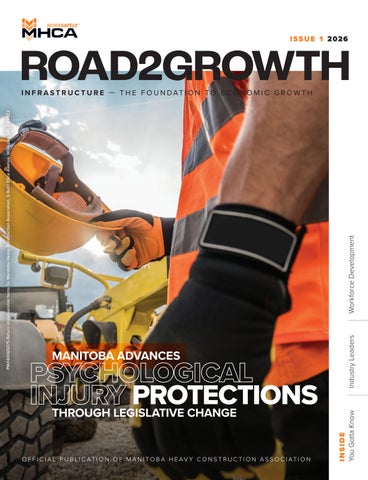
MANITOBA ADVANCES
PSYCHOLOGICAL INJURY PROTECTIONS THROUGH LEGISLATIVE CHANGES
BOARD OF DIRECTORS
MHCA EXECUTIVE COMMITTEE
Board Chair John Highmoor, B.A., B.Sc. (C.E.), Tri-Core Projects
Vice-Chair Kevin Brown, P.Eng., G.S.C. Maple Leaf Construction Ltd.
Immediate Past Chair Dennis Cruise, CET, G.S.C., Bituminex Paving Ltd.
Secretary Tony Teixeira, J.C. Paving Ltd.
Treasurer Marcel Machado, B.Sc. (C.E.), Green Infrastructure Partners Inc.
President and CEO Chris Lorenc, B.A., LL.B.
EXECUTIVE DIRECTORS AT LARGE
Nicole Chabot, B.A. G.S.C. L. Chabot Enterprises Ltd.
Richard Wilson CET, G.S.C. M.D. Steele Construction Ltd.
BOARD DIRECTORS
Tyler Bennett, M.E.T. Sigfusson Northern Ltd.
Michael Byrne AON Reed Stenhouse Inc.
Denis Collet, B.Comm Gravier Collet Gravel Inc.
Dr. Nelson Ferreira Trek Engineering
Michelle Magdic BFL Canada
Joel Martens Bayview Construction Ltd.
Peter Paulic Brandt Tractor Ltd.
Todd Turner E.F. Moon Construction Ltd.

Design/layout: Tabitha Robin
Advertising Coordinator: Sabrina Simmonds


WORKSAFELY TAKES OVER: WHY SAFETY MATTERS MORE THAN EVER AND WHAT’S AHEAD
This issue of Road2Growth feels big –and honestly, really special.
This is the first time we’ve ever dedicated an entire issue of the magazine to workplace health and safety, and that alone says a lot about this industry. The fact that our members and partners support a full safety takeover speaks volumes about what safety means in heavy construction. It’s not an add-on. It’s not a box to check. It’s part of who we are and how we work.
As I reflect on my past two years with the MHCA and the WorkSafely program, what stands out most to me are the companies and relationships we’ve started to build. There has been a real openness and honest conversations. The willingness from companies to share what’s working has really stood out, and just as importantly, what isn’t working. I’m grateful for the trust industry has placed in our team as we work to improve the program and ensure it delivers real value for the industry.
the people and companies we serve. I hope that you’re starting to see that transition take shape and feel its impact in practical, meaningful ways.
Heavy construction has embraced safety for a long time, and we’ve come a long way – but there’s no sugar-coating the reality that serious incidents and fatalities still happen. I genuinely believe we can do better. I believe we can get to a place where far fewer families get that phone call, where more workers go home safely at the end of every day, and where safety is fully embedded in how business is done.
At WorkSafely, we can lead, guide, and provide tools, training, and information, but the real work happens on jobsites and in boardrooms. It happens through the choices companies make every day: how work is planned, how people are treated, how contracts are procured, and how safety shows up as a core value, even when pressures are high.
The fact that our members and partners support a full safety takeover speaks volumes about what safety means in heavy construction. It’s not an add-on. It’s not a box to check. It’s part of who we are and how we work.
There’s been a lot happening behind the scenes. Changes, improvements, growing pains, and learning moments –all with the goal of better supporting
And I know those pressures are real. Running a business in this industry isn’t easy. There are tight timelines, contract penalties, workforce transitions,
seasonal demands, and competing priorities that pull attention in every direction. Choosing to slow down, to show care, to put people first – that takes intention. It takes leadership. And I have the utmost respect for the individuals and companies who continue to do that work, even when it’s hard.
This issue isn’t just about where we’ve been – it’s about where we can go. I truly believe we can do more together. That excellent businesses are safe businesses. And that an industry willing to dedicate space, time, and attention to safety is an industry that cares deeply about its people.
Not every industry gets to say that.
So, thank you – for the trust, feedback, collaboration, and for allowing me to bring my passion into this work. This special issue of Road2Growth exists because of you, and it’s for you –the leaders, workers, and companies who show up every day committed to sending people home safe.
I’m incredibly proud of this industry, excited about what’s ahead, and grateful to be part of this journey with you.

Jacquelyn Oduro Director, MHCA WorkSafely Education & Training
Jacquelyn Oduro Director,
ABOUT
The MHCA is a prominent membership-based advocate for the heavy construction and related industries in Manitoba, representing over 400 contractors, suppliers and financial companies.
Founded in 1943, the MHCA advances progressive public policies and innovative programs in a manner consistent with the broad public interest.
The MHCA serves as the primary ‘go to’ resource for the heavy construction and related industries for information, networking, public policy advocacy and member services.
It promotes sustainable investment in core infrastructure – streets, highways, bridges, water/wastewater systems, active transportation, water-control structures, trade gateways and corridors – to support economic growth and social development that benefits our province and country.
MHCA champions workplace safety education and training through its leading-edge WorkSafely program established in 1990.
It actively participates in local, provincial, regional and national advocacy groups and collaborates extensively with public and private-sector stakeholders to advance common core values, including economic growth, diversity, and safe work, which benefit our communities, province and country.
It has an earned reputation for effective advocacy.

CALENDAR OF EVENTS
APRIL
9 Chair’s Reception
JUNE
9 MHCA Spring Mixer
AUGUST
12
MHCA Golf Classic
Delta Hotel Winnipeg
Assiniboia Downs
Quarry Oaks, Steinbach, MB
Be sure to read the Heavy News, check out www.mhca.mb.ca, Facebook, Instagram, LinkedIn or contact Christine Miller, Operations Manager, at 204-594-9053 or christine@mhca.mb.ca for information on additional events throughout the year.
MEMBER UPDATE
Welcome New Members!
Thank you to all our current members, and welcome to our newest members!


MHCA PUBLICATIONS ESSENTIAL BUSINESS TOOLS
MHCA’s publications are widely circulated, reaching the desks of the heavy construction industry, purchasers of its related services, stakeholder and business associations, government leaders, senior decision makers and numerous other government officials at all levels.


QUARTERLY MAGAZINE
Road2Growth – INFRASTRUCTURE: the foundation to economic growth MHCA produces a quarterly magazine, Road2Growth – Infrastructure: the foundation to economic growth, which focuses on profiling the work of the heavy construction industry, including MHCA advocacy and WorkSafely news.
HEAVY NEWS
› Distributed to members, elected officials, senior public administrators and related stakeholder communities
› Provides current tender ads and results
› Posted online at www.mhca.mb.ca and via social media; delivered electronically every week by email
MEMBERSHIP DIRECTORY & EQUIPMENT RENTAL RATES GUIDE
› The annual MHCA Membership Directory & Equipment Rental Rates Guide is the definitive reference guide and business tool used by industry and purchasers of its services
› This “go-to” guide lists members and the full scope of the products and services they offer
› The only heavy equipment Rental Rates Guide in Manitoba
› Public and private sector project owners use the directory to contact suppliers of services, including contractors, materials, equipment, aggregates, oils, design and engineering

MHCA WEBSITE
Our website – www.mhca.mb.ca – promotes our vision, mission, services and provides members with the latest news, policy briefs and WorkSafely materials and resources, including the new e-News.

Manitobans recycle over 2 million tires every year, protecting our land for future generations.

Give your tires a second chance and help us reduce Manitoba’s carbon footprint.
Learn How at


ANY COMPANY
WORKING WITH THE
HEAVY CONSTRUCTION INDUSTRY IN MANITOBA WILL BENEFIT FROM MEMBERSHIP.
Members say five of the biggest reasons they value the association are:
1 2 3
NETWORKING
Our members, big and small companies throughout Manitoba, meet and learn from each other at our premier events and by participating in our standing committees, where industry, policy and budget concerns are addressed.
ADVOCACY
The MHCA is a prominent advocate respected across Manitoba for its informed and progressive approach to shaping public policy. It is often sought out for advice and opinion by media, governments and the public.
MEMBERSHIP DIRECTORY & EQUIPMENT RENTAL RATES GUIDE
This directory is the go-to tool used by contractors, suppliers, government and purchasers of all industry services in Manitoba. It includes the annually updated and relied-upon equipment rental rate guide.
4
SAFETY TRAINING
The MHCA WorkSafely Program, established in 1990, provides workplace safety and education training to reduce workplace incidents. This includes the Certificate of Recognition (COR®) recognized by SAFE Work Manitoba as the required safety training standard.
5
HEAVY NEWS
Our weekly newsletter keeps members aware of MHCA activities, events, concerns, advocacy activities and includes tender ads and results.
Are You Interested in Joining?
Visit https://mhca.mb.ca/membership or contact Christine Miller, MHCA Operations Manager, at 204-594-9053 or christine@mhca.mb.ca.
BUILDING SAFETY EXCELLENCE
Mathias Leiendecker Contributor, Craig Kelman & Associates

Excellence begins with visible commitment from management and meaningful engagement from employees. Policies alone are not enough; employees must feel empowered to speak up, participate, and continuously improve.
– Natalina Urso, OHS, Safety Advisor
Safety excellence in construction is often measured in certifications, policies, and statistics. For industry leaders, Matt Atkinson, Marc Routhier, and Natalina Urso, safety is less about paperwork and more about culture. Across their respective organizations, safety is not treated as a compliance requirement, but as a leadership responsibility and an operational foundation.
At InterMountain Contracting, that foundation begins long before crews arrive on site. Over the past several years, the company has deliberately
shifted its approach to ensure safety is embedded into the planning stage of every project. Rather than treating hazard mitigation as a secondary step, risk is assessed and addressed as part of the core execution strategy.
“Safety isn’t an add-on or an afterthought; it’s integrated into the innerworkings of every job,” said Matt Atkinson, Project Supervisor. “When safety is truly embedded in your culture, it stops feeling like a requirement and starts feeling like the natural way to work.”
That proactive approach has strengthened not only job site performance but also team confidence. When expectations are clear and consistent from the outset, crews operate with greater predictability and accountability and that stability translates into stronger overall outcomes.
For Marc Routhier, Director, Cross Country Field Services, safety excellence is fundamentally about culture and shared responsibility. In fast-paced environments where
timelines shift and operational pressures are constant; the true test of a safety program is whether it holds firm under strain. Routhier believes that commitment must be visible and unwavering.
“For us, safety excellence goes far beyond compliance; it’s about culture,” he said. “It’s about building an environment where every employee feels personally responsible for safety and where the shared goal is simple: everyone goes home safe at the end of the day.”
Consistency across job sites has been a key focus for Cross Country. Establishing uniform standards, regardless of project size or location, reinforces expectations and builds trust internally and externally.
“No matter what job site you visit, our expectations and safety standards remain the same,” said Routhier. “That uniform approach builds confidence within our crews and with our clients.”
At Barnes & Duncan, safety leadership is equally intentional. Natalina Urso, OHS, Safety Advisor, emphasizes that excellence begins with visible commitment from management and meaningful engagement from employees. Policies alone are not enough; employees must feel empowered to speak up, participate, and continuously improve.
“Safety excellence starts with visible leadership and genuine commitment at every level of the organization,” said Urso.
Safety isn’t an add-on or an afterthought; it’s integrated into the innerworkings of every job. When safety is truly embedded in your culture, it stops feeling like a requirement and starts feeling like the natural way to work.
– Matt Atkinson, Project Supervisor


Safety excellence goes far beyond compliance; it’s about culture. It’s about building an environment where every employee feels personally responsible for safety and where the shared goal is simple: everyone goes home safe at the end of the day.
– Marc Routhier, Director
“Everyone plays a role in safety, and everyone’s voice matters.”
Ongoing training and communication are central to that philosophy. In an industry where environments and risks evolve, maintaining competency is non-negotiable.
“The day someone isn’t properly trained is the day they’re not safe,” she said. “We want safety to become second nature, something that’s simply part of how we operate every day.”
While culture drives daily behaviour, formal recognition through COR® certification reinforces accountability across all three organizations. Beyond being a prerequisite for bidding on certain projects, COR serves as thirdparty validation that safety systems are documented, measured, and continuously improved.
“It demonstrates to our customers that we are capable, professional, and committed to high standards,” said Atkinson. “In a competitive environment, COR gives us a distinct advantage.”
Routhier agrees that certification reflects more than compliance. “It’s not just a credential; it’s a reflection of our operational discipline and our values,” he said.
For Urso, the rigour behind certification is what gives it meaning.
“Anyone can produce a safety manual, but COR requires documented proof that safety is being implemented and maintained. It shows due diligence and commitment,” she said.
Ultimately, all three leaders point to the same outcome: when safety is prioritized, everything else improves. Morale strengthens. Productivity stabilizes. Reputation grows. Employees feel valued, and clients gain confidence in the organization’s reliability.
Safety excellence, they agree, is not a single milestone. It is a continuous process of refinement. Identifying gaps, strengthening systems, and reinforcing culture requires leadership that sets the tone, planning that anticipates risk, and teams that understand their shared responsibility.
DISTRACTED DRIVING:
A GROWING THREAT TO ROADSIDE SAFETY

Distracted driving is now the leading cause of road fatalities in Manitoba, surpassing both impaired and speeding as a cause.
DISTRACTED

When we think
about
the risks faced by construction workers, tow operators, and others who work along Manitoba’s roads, hazards like speeding traffic, weather conditions, and narrow work zones often come to mind. Increasingly, one of the most serious threats is a distracted driver.
Distracted driving is now the leading cause of road fatalities in Manitoba, surpassing both impaired and speeding as a cause. This has serious implications for anyone who works on or near active roadways. Construction crews, maintenance workers, and tow operators often operate just inches from moving traffic, making them especially vulnerable when drivers are not fully focused on the road.
The
reality behind the numbers
According to Manitoba Public Insurance data, distracted driving contributed to 675 collisions and 34 fatalities in 2024. These are not abstract figures. Each number represents a moment when a driver’s attention wandered away from the road, and someone else paid a tragic price. There were also more driving licence suspensions for drivers caught in the act in 2024 than in any of the previous four years.
Reduced reaction time is at the centre of this issue. When drivers are not watching the road, they cannot respond quickly to lane shifts, construction signage, flaggers, stopped vehicles, or roadside workers. In work zones, conditions change rapidly. Even a delay of a second or two can lead to devastating outcomes.
Distracted
driving is more than phones
videos, or interacting with passengers. CAA Manitoba’s latest research shows that nearly half of Manitoba drivers admit to driving distracted, and more than six in ten say they have witnessed a close-call collision or a traffic violation caused by distraction. Thirteen per cent report being involved in a collision caused by another distracted driver, with rear-end crashes being the most common.
For roadside workers, these behaviours pose a constant and unpredictable risk. A driver glancing away from the road to enter a GPS destination or reach for a coffee may fail to notice cones narrowing a lane, a stopped tow truck on the shoulder, or a construction worker stepping into position.
Why roadside workers are at a greater risk
For construction workers and tow operators, their workplace is often the shoulder, the median, or the lane itself. While signage, barriers, and traffic control plans are critical, they rely on one key assumption that drivers are paying attention.
Distracted drivers are more likely to miss warning signs, fail to slow down, drift into work zones, or ignore slow down and move over requirements. This puts roadside workers at disproportionate risk of serious injury or death. Every inattentive driver passing through a work zone increases the risk.
Manitoba
Manitoba’s current distracted driving law focuses on the use of handheld electronic devices. While we have some of the strongest penalties in Canada, driver-reported data shows that distractions extend beyond the use of handheld devices.
Drivers are frequently distracted by eating, drinking, personal grooming, adjusting GPS systems, watching
For the heavy construction industry, distracted driving is not just a public safety issue; it is a workplace safety issue. Protecting workers means addressing all the factors that make roads unsafe, including driver distraction in all its forms.
The case for a comprehensive distracted driving law
Despite having strict penalties for handheld devices, Manitoba’s distracted driving law does not explicitly address many other high-risk behaviours. In practice, this makes enforcement more difficult and public messaging less clear.
CAA

Other Canadian provinces have moved beyond device-only laws. The strongest approach is in Alberta, where any activity that distracts a driver from the task of driving is prohibited. These laws recognize the science of distraction and reflect how people actually behave behind the wheel.
A comprehensive distracted driving law in Manitoba would do the same. It would make it clear that distraction of any kind is unacceptable and dangerous. It would also reinforce that distracted driving is as serious and socially unacceptable as impaired driving.
cultural change. Distracted driving now demands the same level of commitment, particularly since it has become the number one cause of traffic deaths in Manitoba.
Public support for strong action
CAA Manitoba’s research shows that the public understands the seriousness of distracted driving. Many Manitobans support tougher penalties, especially for repeat offenders, along with increased enforcement and public education. There is broad recognition that distraction is not a minor lapse in
Reducing distracted driving is about saving lives, preventing serious injuries, and making roadside workplaces safer. By modernizing distracted driving laws and changing how society views distraction behind the wheel, Manitoba has an opportunity to protect its workers and foster a significant change in attitude on the dangers of distracted driving.
Society did not change attitudes toward impaired driving overnight. It took decades of strong laws, enforcement, education, and
judgement but a behaviour that puts lives at risk.
For industries whose workers spend their days on the roadside, stronger
laws and clearer expectations benefit everyone. They create safer work conditions and reduce the likelihood of devastating incidents that impact families, employers, and communities.
A shared responsibility
Legislation alone will not solve the problem of distracted driving. It must be supported by consistent enforcement, meaningful penalties, and sustained public education. Drivers need to internalize a simple message: when you are driving, driving is your only job.
For construction workers, tow operators, and others who work on Manitoba’s roads, this issue is deeply personal. These are people with families, coworkers, and communities who depend on them coming home safely at the end of the day. Reducing distracted driving is about saving lives, preventing serious injuries, and making roadside workplaces safer. By modernizing distracted driving laws and changing how society views distraction behind the wheel, Manitoba has an opportunity to protect its workers and foster a significant change in attitude on the dangers of distracted driving.


A psychologically safe workplace is described as ‘a workplace in which the psychological well-being of workers is promoted, and active measures are undertaken to prevent harm, whether negligent, reckless or intentional, to the psychological wellbeing of workers.’

MANITOBA ADVANCES PSYCHOLOGICAL INJURY PROTECTIONS THROUGH LEGISLATIVE CHANGE
Mathias Leiendecker Contributor, Craig Kelman & Associates
Recent amendments to Manitoba’s Workplace Safety and Health Act (WSH Act) are bringing greater attention to an often-overlooked aspect of workplace illness and injury: psychological safety.
With the passage of Bill 29 in June 2025, psychological safety is now formally recognized as a core component of workplace health and
safety. This legislative update reflects a growing understanding of how psychological hazards in the workplace can affect people, according to Melissa Hyytiainen, Director of Prevention and Return to Work Services at SAFE Work Manitoba, a division of the Workers Compensation Board.
“The change in the legislation acknowledges that psychological hazards can be just as harmful as physical hazards,” explained Hyytiainen. “Employers have a duty to ensure, so far as reasonably practicable, the safety, health and welfare of all workers. That includes their psychological safety.”
The amended WSH Act now includes a clear definition of what constitutes a psychologically safe
A key part of building psychological safety is engaging workplace safety and health committees or worker representatives. These groups should be involved throughout the development and implementation of safety management systems, including identifying potential psychological hazards, recommending improvements, and monitoring outcomes.
PROTECTIONS

workplace. It is described as “a workplace in which the psychological well-being of workers is promoted, and active measures are undertaken to prevent harm, whether negligent, reckless or intentional, to the psychological well-being of workers.” This definition emphasizes prevention, responsibility and proactive engagement on the part of employers.
For many organizations, understanding what psychological safety looks like in practice can feel overwhelming. That’s why the WCB’s SAFE Work Manitoba division, in collaboration with the Province of Manitoba and industry partners, is actively developing tools and resources to help employers navigate this space. “We are working to support and educate Manitoba employers on achieving psychologically safe workplaces,” said Hyytiainen. “Many organizations are already further along than they may realize.”
A key part of building psychological safety is engaging workplace safety and health committees or worker representatives. These groups should be involved throughout the development and implementation of safety management systems, including identifying potential psychological hazards, recommending improvements, and monitoring outcomes.
“Employers need to assess the workplace for potential psychological hazards, track results and foster a psychologically healthy and safe environment,” explained Hyytiainen. A range of resources are available through the wcb.mb.ca website to support these efforts.
The legislative definition of psychological safety closely aligns with the Canadian Standards Association’s (CSA) Psychological Health and Safety in the Workplace Standard, a framework that many employers may already recognize. Hyytiainen said this alignment is intentional and beneficial.
“The CSA Standard is well-established and built around 13 psychosocial factors that impact mental health in the workplace,” she said.
These factors, including workload management, organizational culture and psychological support, provide a practical framework for employers to assess existing programs and policies. By conducting a psychosocial risk assessment using
the 13 factors, employers can identify current hazards, determine risk levels and implement appropriate controls.
“A psychosocial risk assessment helps reduce psychological harm by identifying gaps and prioritizing actions,” noted Hyytiainen.
For employers just beginning to explore psychological health and safety, Hyytiainen encourages starting with education. The SAFE Work Manitoba Training Portal offers two free online courses: Psychological Health and Safety for Employers and Psychological Health and Safety for Workers, which provide a strong foundation for understanding key concepts and responsibilities.
From there, employers should collaborate with their workplace safety and health committee or representative and conduct a psychosocial risk assessment. SAFE Work Manitoba developed a tool that allows organizations to evaluate their current workplace through the lens of the CSA’s 13 psychosocial factors.
“Most workplaces already have programs, policies and procedures that help reduce psychological harm,” explained Hyytiainen. “You’re not starting from scratch.”
Her message to employers is clear: psychological safety is not a separate initiative; it is an extension of existing safety efforts. “You need to look at your current programs through the lens of psychological safety, not just physical safety,” she said.
As Manitoba workplaces adapt to these legislative changes, the focus on psychological safety represents an important step toward healthier, more supportive work environments. With the guidance, tools and education available, employers are well-positioned to meet their legal and regulatory obligations while supporting the well-being of their workforce.

USING CLEAR HAND SIGNALS TO PREVENT WORKPLACE INCIDENTS
On many worksites, achieving full traffic segregation can be challenging. As a result, hand signals are often the primary communication method with equipment operators and crews on the ground.
Hand signals are what the operators rely on to maintain safe distances from
hazards. They are crucial for all heavy equipment operations, but one of the most common places hand signals are used is with equipment for ready mix concrete work.
Operators rely on clear, consistent hand signals to maintain safe distances from hazards such as workers on foot, trench edges, overhead utilities, fixed structures, live traffic, and other mobile equipment.
Hand signals are particularly important in concrete work because concrete placement has large blind spots, tight jobsite conditions, backing and maneuvering around crews, rotating equipment (like chutes, conveyors, pump booms), and noise levels that make verbal communication unreliable.
Spotters play a critical role in reducing the risk of incidents.
Spotters play a critical role in reducing the risk of incidents. They assist operators who may have obstructed or limited views, helping them safely navigate hazards when backing up or working in congested areas.


They assist operators who may have obstructed or limited views, helping them safely navigate hazards when backing up or working in congested areas.
Before any movement occurs, the spotter and operator must clearly define the travel path and agree on precise, easy-to-understand signals.
Spotters are responsible for maintaining clear communication and
positioning themselves where they remain visible to the operator, ideally on the driver’s side toward the rear when safe to do so. They should never move directly behind a vehicle unless it is fully stopped and the operator confirms it is safe, and they must never step out of view without first stopping the vehicle.
When directing mobile equipment or vehicles, spotters must maintain eye contact, stay out of blind spots and
avoid placing themselves in the danger zone. They should continuously scan for other equipment, vehicles or workers entering the travel path and ensure the vehicle is fully secured once in position. If unsafe conditions develop, the operation must stop and be reassessed. In lowlight conditions, spotters should use a flashlight or wand, and in high-risk or congested areas, additional spotters may be required to ensure safe operations.
Photo supplied by: Amrize Building Materials
The risks are serious when working near underground utilities. Digging into an electrical cable can cause serious injuries or death. Digging into a natural gas pipe can result in a gas leak, fire or explosion. Damages can also result in disrupted power or gas service to the entire neighbourhood, and you may be on the hook for expensive repairs.

WORKING NEAR MANITOBA HYDRO INFRASTRUCTURE?
SAFETY IS THE ANSWER.
Click Before You Dig
Working around electrical lines and natural gas infrastructure can be a dangerous task and the use of heavy equipment can increase the risk. It’s important to be aware of these potential hazards and take precautions so you and your crew can work safely.
Click Before You Dig is not just for building a deck or planting a garden. It applies to large-scale construction projects as well, to ensure crews can work safely and avoid damage to crucial infrastructure. If your work will disturb the ground any deeper than 15 cm (6 inches), you must place a line locate request at clickbeforeyoudigMB.com at least three business days before digging, drilling, or excavating.
The precautions don’t stop there. It’s important to dig safely, even after Manitoba Hydro has located underground lines in the work area. Locate markings identify the approximate location of buried utilities. That means if you’re digging within one metre of the markings (or five metres from high pressure pipelines), you must carefully expose the line with hand tools to determine its exact location. This will prevent any accidental contact
Manitoba Hydro

ANSWER.

If you contact an underground gas pipe, take these steps:
› Warn others and leave the area quickly
› Immediately call 911 or your local emergency services and Manitoba Hydro
› Do not use electricity or fire, as a spark could ignite leaking gas
› Leave equipment; do not turn off engines or generators
› Leave the excavation open; do not bury the line
› Stay away from the area until Manitoba Hydro says it is safe to return
Warning signs of a gas pipe leak include:
› A rotten egg smell
› A hissing sound
› Dirt spraying into the air
› Continual bubbling in a pond or creek
For more information, please visit the Click Before You Dig page on Manitoba Hydro’s website.
While operating equipment, keep a safe distance or at least ten metres (about the length of a school bus) away from all power lines. Even better, use a spotter to help you steer clear. These precautions will help you and your crew avoid potential costly damages, serious injury, or death.
If your equipment contacts a power line, take these steps:
› Stay on the equipment and warn others to stay away
› Call 911 or your local emergency services
In the rare case that fire forces you to exit, take these steps:
› Push the doors of your equipment wide open
› Hold your arms at your sides, but don’t hang onto the equipment
› Jump and land with both feet together
› Don’t run
with the line. When in doubt, follow instructions provided by Manitoba Hydro. The risks are serious when working near underground utilities. Digging into an electrical cable can cause serious injuries or death. Digging into a natural gas pipe can result in a gas leak, fire or explosion. Damages can also result in disrupted power or gas service to the entire neighbourhood, and you may be on the hook for expensive repairs. Don’t put yourself, your crew, or your community at risk!
Watch out for overhead power lines
When working around overhead power lines, remember to survey the area and warn others of their location before starting your work. Even without direct contact, electricity can jump or arc through the air to a conducting object. This includes metal, water, and even people, which is why it’s so important to always be aware of your surroundings when working near power lines.
› Keep your feet together and jump or hop until you are at least ten metres away
For more information, please visit the Emergency Situations page on Manitoba Hydro’s website.
When operating heavy equipment, it’s important to take every precaution to work safely, whether the lines are overhead or underground. Talk to your crew members about risks and safety measures when working around Manitoba Hydro infrastructure. It could save lives.
ROLLOVERS WHAT IT REALLY TAKES TO PREVENTTRUCK

Anna Savard Contributor, Craig Kelman & Associates
Defensive driving is the single most important habit a truck driver can build. Taking time, not rushing, and never treating the road as a competition are the basics that experienced drivers live by and inexperienced ones too often ignore.
Despite advances in vehicle safety and industry training, truck rollovers remain a persistent hazard in the heavy construction sector. For Rob McKeen, owner of McKeen’s Trucking Service, trucking rollovers are not a matter of chance but rather stem from a consistent set of preventable causes.
“Most rollovers come down to inexperienced drivers or drivers who
The combination of proper training, daily hazard reviews, and a culture that doesn’t pressure drivers to push through unsafe conditions is what separates companies that have incidents from those that don’t. Rollovers are preventable, he said, but only if the groundwork is laid before drivers set out on the road.

Soft shoulders are a constant hazard on northern gravel roads, and they don’t always look dangerous until it’s too late. McKeen said holding daily safety talks with drivers and reviewing road hazards every morning is one of the most effective tools a company has for keeping people alert to conditions that change by the hour.
Black ice in spring and fall is another threat that demands respect.
“If conditions are too bad, hold off driving,” said McKeen. “Timelines are important, but there are situations when it just does not pay.”
When it comes to keeping themselves and others safe on the road, McKeen argued that defensive driving is the single most important habit a truck driver can build. Taking time, not rushing, and never treating the road as a competition are the basics that experienced drivers live by and inexperienced ones too often ignore.
ROLLOVERS TRUCK
are inexperienced in specific job applications,” said McKeen. “Gravel hauling with a tri-axle end dump on secondary roads is a completely different skill set than highway driving.”
McKeen said load management is one of the most overlooked factors in rollover risk. Drivers who don’t account for uneven load distribution or don’t understand weight limits on trailers are
setting themselves up for trouble before they even hit the road.
Winter conditions add another layer of danger that catches drivers off guard. Gravel loads can freeze and stick inside end dump or side dump trailers, and McKeen said too many drivers skip the pre-load trailer check that would catch the problem before it becomes a crisis.
McKeen’s Trucking manages rollover risk through a structure built on daily communication and proper supervision. Every driver completes a field-level risk assessment each day, and safety meetings are held every morning to discuss the specific hazards crews will face as conditions shift.
“Just because someone has their Class 1 doesn’t mean they know the specifics of different tasks,” he said, reflecting on the limits of a Class 1 licence when it comes to job-specific work.
“Hauling goods and hauling gravel in an end dump are not the same thing.”
New employees at McKeen’s Trucking receive hands-on training and extra supervision from the start, with mentorship built into the onboarding process until they’ve demonstrated they can handle the demands of the work independently.
McKeen said the combination of proper training, daily hazard reviews, and a culture that doesn’t pressure drivers to push through unsafe conditions is what separates companies that have incidents from those that don’t. Rollovers are preventable, he said, but only if the groundwork is laid before drivers set out on the road.

PREVENTING MUSCULOSKELETAL INJURIES WITH GENERATIONAL STRATEGIES
Erin Black WorkSafely Program Development Leader
Musculoskeletal injuries (MSI) remain one of the most frequent and costly injuries in Manitoba’s heavy construction industry. Repetitive strain, awkward postures, heavy lifting, and cumulative fatigue affect workers on every jobsite. But with today’s workforce spanning up to four generations, safety leaders have an important opportunity: tailoring MSI-prevention strategies to how different age groups learn, communicate, and work.
A one-size-fits-all approach to injury prevention is no longer enough. Understanding generational strengths and challenges helps employers build safer worksites – and a stronger, more engaged workforce.
Generational differences that influence MSI prevention
Younger workers (Gen Z and Millennials)
› Workers, who are early in their career, often have strong physical capacity but may underestimate strain or take unnecessary risks. They thrive with:
› Short, interactive, digital learning
› Hands - on coaching and fast feedback
› Clear links between safe behaviour and long-term career success
Tailoring MSI-prevention strategies to generational needs benefits more than injury rates. It improves communication, engagement, morale, and retention. Younger workers feel supported and connected, while older workers feel respected and valued. Together, they build a resilient, collaborative workforce.
› Technology-supported tools like apps, videos, or virtual reality training
› Establishing good ergonomic habits early helps prevent injuries that could follow workers throughout their careers.
Older workers (Gen X and Baby Boomers)
› Experienced workers bring valuable knowledge and skill but may be more susceptible to chronic strain or slower recovery. They respond best to:
› Structured, detailed training
› Practical demonstrations and experience-based learning
› Respect for their existing expertise
› Adjustable equipment and ergonomically optimized workstations
› Supporting them with proper tools and task rotation helps extend safe, productive careers.
Generational strategies that reduce MSI risk
1. Start-of-shift stretch programs: Warm-ups improve flexibility and reduce strain for workers of all ages.
› Younger workers: Add digital participation tracking or friendly competition.
› Older workers: Offer modified routines focused on joint health and stiffness reduction.
2. Work hardening and conditioning: Gradual strength-building prepares workers for physical demands.
› Younger workers: Introduce foundational conditioning with trackable progress.
› Older workers: Emphasize safe progression, mobility, and recovery time.
3. Standardized proper techniques: Consistent, high-quality training ensures safe lifting and movement.
› Younger workers: Use videos, simulations, or digital reminders.
› Older workers: Hands-on training and mentorship reinforce best practices.
4. Job rotations and ergonomic assessments: Rotations reduce repetitive strain; assessments eliminate hazards before injuries occur.
› Younger workers: Gain skill diversity and avoid early overuse injuries.
› Older workers: Reduce cumulative strain and accommodate physical changes.
5. Early intervention and reporting: Quick reporting prevents minor discomfort from becoming chronic injury.
› Younger workers: Normalize reporting and use easy digital tools.
› Older workers: Leverage experience to identify early warning signs and provide feedback.
6. Process redesign and equipment upgrades: Improved tools, redesigned workflows, and modern equipment reduce MSI risk for everyone.
› Younger workers: Involve them in innovation and testing new tools.
› Older workers: Ensure equipment is user-friendly and reduces physical load.
Understanding generational strengths and challenges helps employers build safer worksites – and a stronger, more engaged workforce.
Addressing shared MSI risk factors
Despite generational differences, common risks include:
› Heavy or awkward lifting
› Repetitive motions
› Awkward postures
› Fatigue from long hours or seasonal workload
› Poorly designed workstations
Training workers to recognize these risks – and empowering supervisors to correct them – creates safer jobsites.
Building a stronger, multi- generational safety culture
Tailoring MSI - prevention strategies to generational needs benefits more than injury rates. It improves communication, engagement, morale, and retention. Younger workers feel
supported and connected, while older workers feel respected and valued. Together, they build a resilient, collaborative workforce. By meeting each generation where they’re at, employers create an environment where all workers can perform safely, confidently, and sustainably, reducing MSIs and strengthening Manitoba’s heavy construction industry for years to come.


• Aggregates
• Asphalt Paving
• Excavation & Base Work
• Concrete
• Diamond Grinding & Maintenance
• Highway Paving
• Material Recycling
• Product Sales
• Rural Construction
• Sewer & Water Services, CCTV Inspection and Sewer Cleaning


Workplace Safety and Health Committee and Worker Safety and Helath Representative


NEW COR® COMPANIES

This Company has been verified by (and certified through) WorkSafely as meeting all elements of the COR® program.
MHCA applauds all of its members who have achieved the nationally recognized COR® through any member of the Canadian Federation of Construction Safety Associations (CFCSA).
2026 – QUARTER 1 As of January 23, 2026: › RDW Recycling and Bin Rentals Inc.


WHAT WORKERS NEED TO KNOW ABOUT HYDROGEN SULFIDE
Anna Savard
Contributor, Craig Kelman & Associates

A colourless gas that smells like rotten eggs, hydrogen sulfide (H₂S) is responsible for some of the most sudden and preventable workplace fatalities.
Travis Knight, Safety Advisor, Westman Region at MHCA WorkSafely, works daily with clients on health and safety concerns, conducting audits, performing site visits, and delivering safety and legislative training. Knight believes H₂S remains one of the most underestimated hazards in the field.

ENGINEERING AND TESTING SOLUTIONS THAT WORK FOR YOU

TURENNE STREET, WINNIPEG, MANITOBA, R2J 3W8 P: (204) 233-1694 F: (204) 235-1579
Continuous air monitoring, functioning gas detectors, and proper ventilation form the foundation of any safe operation in an H₂S risk area. Every worker entering a potentially affected space should have completed H₂S Alive training and understand what their personal monitor alarms mean and how to respond.
“It sinks to low spots, it smells like rotten eggs, and it can kill your sense of smell fast,” he said. “Just a couple of breaths at high levels can drop someone or kill them right away.”
H₂S turns up in sewage and wastewater systems, rotting sludge, wet soil, decaying animal and organic matter, and anywhere near oil and gas lines or contaminated ground.
The gas is heavier than air, which means it can collect in places workers routinely enter, like manholes, trenches, confined spaces, and tie-in points. Any work, such as cleaning or maintenance, performed on dirty or contaminated equipment presents another serious exposure risk, with the possibility of H2S pockets or gas trapped in compartments or mud and debris.
“Workers think if they can’t smell it, it’s gone,” said Knight. “That’s when people get hurt or killed.”
Preventing H₂S incidents doesn’t require complicated solutions. It requires discipline around fundamentals that are already well established.
Continuous air monitoring, functioning gas detectors, and proper ventilation form the foundation of any safe operation in an H₂S risk area. Every worker entering a potentially affected space should have completed H₂S Alive training and understand what their personal monitor alarms mean and how to respond.
Confined space protocols must be followed without exception. That means proper entry permits, attendants stationed outside, and rescue plans in place before anyone goes in – not after something goes wrong.
“Only trained workers should be doing work or anything around sewage, bad soil, or oil and gas lines,” said Knight. “Clear communication, checking safety equipment often, and making sure people wear the right PPE goes a long way in stopping H₂S issues before they happen.”
If H₂S is suspected or confirmed, the response is straightforward: get out immediately and move upwind to clean air. No one should be attempting to assess the situation unless they are trained and equipped with the appropriate respiratory protection.
The area must be isolated, ventilation established where it can be done safely, and air quality confirmed by monitoring before re-entry is even considered. Rescue operations are strictly for trained responders.
“The main thing is keeping people back, keeping communication clear, and not saying it’s safe until it’s actually confirmed,” he said.
Training programs only work if they’re treated as more than a checkbox. Workers need a genuine understanding
of what they’re dealing with, and that understanding must be tested regularly.
Man-down drills should be run on a regular basis so that when an alarm sounds, workers respond automatically rather than freezing. Emergency plans should be reviewed before any job involving H₂S risk ensures the entire crew knows what to do, where to go and their role in the event of an emergency before work begins.
“Keeping it simple and practicing what to do is what helps make it second nature,” said Knight.
Despite well-established protocols, the same preventable errors appear repeatedly. Workers skip bump tests on their monitors, assume nothing will happen because nothing has before, or overlooking or not being trained on self-contained breathing apparatus or supplied air breathing apparatus air checks must be done before entering a space.
Most of those failures trace back to poor planning, lack of oversight, and a culture that allows corners to be cut.
“You can avoid most of that by having clear rules, planning the job properly, and actually watching what’s going on instead of leaving everyone to figure it out on their own,” he said.
H₂S incidents are rarely the result of bad luck. They are the result of gaps in training, preparation, accountability or complacency. Closing those gaps is what keeps workers safe.


Consulting engineers can make a valuable contribution to projects at all stages of development, from determining and defining the scope and setting preliminary budgets, through to commissioning of the completed works.
WORKING IN SAFETY: A DAY IN THE LIFE
Anna Savard Contributor, Craig Kelman & Associates

A near miss is a signal, and ignoring signals is how minor deviations become accepted normals and accepted normals become serious injuries. Getting workers to report near misses is one of the most important and most difficult parts of the job.
As the Health, Safety, and Environmental Manager for Green Infrastructure Partners Inc. (GIP), Ray Bissonette’s day often starts before he reaches the office.
“If there’s been something like a theft overnight or anything like that, there are usually messages on my phone before I even get in,” said Bissonette. “On my way into work, I’m already making calls, finding out what happened, making sure people are starting incident reports.”
That kind of before-the-bell problemsolving sets the tone for what the role of a health and safety professional actually looks like. Bissonette manages the full safety and health program for GIP East, and no two days run the same.
Bissonette drives through job sites regularly, scanning for hazards and calling superintendents or foremen directly to flag what he notices. Documentation reviews, WCB claims, return-to-work planning, insurance matters, and meetings with
government agencies like Workplace Safety and Health fill whatever space is left.
“I love coming into work and all of a sudden there’s chaos, and I’ve got six things in the air,” he said. “I think you’ve got to be a certain kind of person where that’s exciting to you.”
For Bissonette, the chaos is manageable because the foundation underneath it is solid. One of his core beliefs is that incidents should never be treated as occasions for blame. When something goes wrong, his focus moves immediately to the root cause and to closing whatever gap let it happening.
“How did we miss this? How did it fall through the cracks?” he said. “And then make sure those cracks are fixed.”
Bissonnette focuses on developing near-miss reporting for the same reason. A near miss is a signal, and ignoring signals is how minor deviations become accepted normals and accepted normals become serious injuries. He said getting workers
to report near misses is one of the most important and most difficult parts of the job.
“Sometimes guys have been doing it a certain way for a while and it becomes normal,” he said. “If you don’t address it, it’s really hard to bring them back –especially when nothing has happened yet. The problem is, you just haven’t come up snake eyes yet.”
Bissonette’s path into safety wasn’t planned from the start. He studied human resources at RRC Polytech before enrolling in one of the institution’s first safety and health continuing education programs – an accelerated, aggressive course of study that he credits as his most valuable formal training. The decision to pursue it was personal.
After leaving a mill job in his hometown of Canora, Sask., a friend was killed there. Looking back, Bissonette could see the gaps in the safety program that contributed to it. That experience had been sitting in the back of his mind when the opportunity at RRC appeared.
The regulations are written in blood. Everything in there exists because someone got hurt. I want everybody going home at the end of the day. That’s it.
– Ray Bissonette, Health, Safety, and Environmental Manager, Green Infrastructure Partners Inc.
“I talked to my wife. It was going to be eight more months of school,” Bissonette said. “But I wanted to do it.”
He graduated with honours, spent time with the Construction Safety Association of Manitoba, then joined Nelson River Construction, now GIP, where he has worked for nearly 20 years. He credits that longevity largely to the leadership of CEO Gord Lee, a former MHCA Board Chair (2007-08), who understood safety well enough to give the program room to grow.
“That’s usually what happens – safety professionals move around a lot because the organization just doesn’t get it,” he said. “Gord got it. That’s kept me here.”
One of the things Bissonette is most proud of is the culture his team has built. This past year, GIP East operated without a safety coordinator due to resourcing challenges. He said the crew stepped up without being asked twice.
“They were doing what we’ve trained them to do,” he said. “That’s what a safety program really is –training people to understand not just what to do, but why.”
The why, for Bissonette, is simple. Nobody kisses their family goodbye in the morning expecting not to come home. He extends that thinking beyond the job site too, offering first aid training

to any worker who wants it and not chasing down employees who take home a pair of safety glasses.
“The regulations are written in blood,” he said. “Everything in there exists because someone got hurt. I want everybody going home at the end of the day. That’s it.”


Time is money—why not save both?
Brandt Finance will meet you on your terms and turf (literally).
With dozens of locations from coast to coast, Brandt can get to you fast, wherever the road takes you.
Brandt works for YOU and will get creative to deliver the affordability and flexibility your business needs.


Learn more at brandt.ca/Bank-on-Brandt
MHCA CURLING BONSPIEL
Thursday,
January 29,
2026, The Heather Curling Club
‘A’ EVENT WINNERS
Sponsored by Heidelberg Materials Canada Ltd. Team: Bituminex Paving
› Karl Loder
› Kurt Chekosky
› Justin Gerardy
› Mike Armstrong
‘B’ EVENT WINNERS
Sponsored by Amrize Canada Inc. Team: E.F. Moon Construction
› Murray Moon
› Brendan Moon
› Shane McCulloch
› Reid Perkins
‘C’ EVENT WINNERS
Sponsored by Manitoba Heavy Construction Association Team: SWS Training & Consulting/ Bonneville Transport
› Nash Sugden
› Tyler Fehr
› Tanner Treichel
› Ryan Thiessen
‘D’ EVENT WINNERS
Sponsored by BFL Canada Risk & Insurance Services Ltd. Team: CPWA – MB Chapter
› Darren Wanless
› Keenan Boles
› Rob Loudfoot
› Randy Pitz
CONSOLATION PRIZES
Sponsored by Worksafely
‘A’ Event Consolation
AAE Tech Services
‘B’ Event Consolation Hitrac (1974)
‘C’ Event Consolation
Bayview Construction
‘D’ Event Consolation

BEST DRESSED TEAM WINNER
Sponsored by Superior Asphalt Paving Co. Ltd.
Team: Wolseley Waterworks
Honourable mention to teams: MacMor Industries & ENG-TECH
Consulting Limited
ICE SPONSORS
› Bayview Construction Ltd.
› Hitrac (1974)
› MB1Call Inc.
› Multicrete Systems Inc.
› SWS Training & Consulting Inc.
› Wanless Geo-Point Solutions Inc.
› White Cap Canada Inc.
› Wolseley Waterworks Group
Complimentary beverage sponsored by Western Surety Company.
BFL Canada Risk & Insurance Services
HOG LINE CONTEST WINNER
Sponsored by Joe Johnson Equipment Name: Tiana Hacault


Lunch sponsored by Glacial Aggregates Inc.
Coffee and Muffins sponsored by Nancy & Michael Byrne
Thank you to our sponsors!


NANCY & MICHAEL BYRNE
MHCA CURLING BONSPIEL
Thursday, January 29, 2026, The Heather Curling Club


'A' Event Winners
'D' Consolation Winners
Best Dressed Team Winner
'B' Event Winners
'C' Event Winners


Wednesday, December 17, 2025, David Livingstone School


MHCA 2025 HEAVY SANTA

WHOSE RESPONSIBILITY IS IT ANYWAYS? UNDERSTANDING SAFETY LIABILITY IN MULTI-PARTY WORKPLACES

Under Manitoba’s Workplace Safety and Health Act (WSHA), C.C.S.M. c. W210, various parties, including owners, employers, and contractors, owe workers specific duties.
When a workplace accident occurs, liability may arise from these duties. Complexity arises where a party
occupies more than one role. For example, an owner may also be an employer, raising the question of how to allocate liability.
The Supreme Court of Canada (SCC) in R v Greater Sudbury (City) examined who bears responsibility under safety legislation when a worker
or member of the public is injured: the owner, employer, contractor, or some combination of them. The SCC confirmed that the answer largely turns on statutory definitions, the existence of safety breaches, and the availability of a due diligence defence, with control being a key consideration.
Allison Kilgour
Taylor McCaffrey LLP
Facts and court history
The City of Greater Sudbury (City) contracted Interpaving Limited to repair a downtown water main. During the project, an Interpaving employee operating a road grader in reverse struck and killed a pedestrian at an intersection.
At the time of the accident, there was no fence separating the construction site from the public way, and no signallers were assisting the driver – both of which were required under Ontario’s Occupational Health and Safety Act (OHSA) regulations. As a result, the City was charged –as an employer – for failing to ensure compliance with required safety measures under OHSA.
The City argued that it was the project owner only, delegated control of the worksite to Interpaving as constructor, and therefore, was not an employer responsible for the safety violations. At trial, the City was acquitted. The court found it wasn’t an “employer” under OHSA because it did not exercise direct control over the workers or the worksite, having delegated control to Interpaving as the sole employer. This was upheld by the Provincial Offences Appeal Court (POAC), however, overturned by the Ontario Court of Appeal (ONCA), who found the City met the statutory definition of an “employer” because it employed quality control inspectors on site and had contracted Interpaving for services. The City appealed to the Supreme Court of Canada (SCC).
The three-step test
The SCC was evenly divided, and as a result, the City’s appeal was dismissed and the ONCA decision stood. Despite the split, the SCC clarified the analytical framework for determining when an “owner” may be liable as an “employer” under safety legislation, setting out a three-step test for cases in which an owner contracts with a “constructor” or “contractor” and faces prosecution for a safety breach.
1. The prosecution must prove beyond a reasonable doubt
When a workplace accident occurs, liability may arise from these duties. Complexity arises where a party occupies more than one role. For example, an owner may also be an employer, raising the question of how to allocate liability.
that the owner is an “employer” as defined in applicable safety legislation. Considering the specific OHSA definition, the City met this requirement by employing quality control inspectors at the site and contracting Interpaving to perform the construction work.
2. If the owner is found to be an employer, the court must then determine whether the employer breached safety legislation. In this case, the court established a breach because the construction site lacked fencing separating it from the public way, and signallers did not assist the equipment operator, contrary to the requirements in OHSA.
3. Once a breach is proven, the onus shifts to the accused to show, on a balance of probabilities, that they exercised due diligence, the statutory defence that one did everything reasonably practicable to prevent the breach. Control becomes relevant at this stage.
The SCC identified several nonexhaustive factors to consider in assessing due diligence, including:
1. the accused’s degree of control over the workplace or workers;
2. whether the accused delegated control to compensate for their lack of skill, knowledge, or expertise;
3. whether the accused assessed the contractor’s ability to comply with

safety regulations before contracting; and
4. whether the accused effectively monitored and supervised the contractor’s work to ensure regulatory compliance.
The SCC found that the first two steps of the test were satisfied, however, did not rule on step three because the POAC had not addressed that issue. The matter was returned to POAC to consider due diligence.
Due Diligence Applied
On reconsideration, the POAC concluded the City had exercised due diligence because it:
› Did not exercise meaningful control over the worksite. Its inspectors attended only periodically and focused on quality assurance and contractual compliance, without directing the work.
› Delegated responsibility to Interpaving to overcome its own lack of construction expertise by appointing it as constructor.
› Evaluated Interpaving’s ability to comply with safety legislation. Evidence showed that the City had worked with Interpaving on approx.


Owners who contract for construction services should be aware they may wear multiple hats, and qualify as “employers” under safety legislation.
40 prior projects and required bidders to ensure workers completed necessary safety training.
› Monitored the project appropriately by responding to public complaints, identifying signage and fencing issues, attending progress meetings, and communicating concerns to Interpaving.
As a result, the City – as employer –successfully demonstrated due diligence and avoided liability. This decision was ultimately upheld on further appeal.
Key Takeaways
Although R v Greater Sudbury considered Ontario legislation, its principles are transferable to Manitoba under WSHA. While WSHA does not use the term “constructor,” it does define “contractor,” as well as “prime contractor” and similar analytical issues arise.
Owners who contract for construction services should be aware they may wear multiple hats, and qualify as “employers” under safety legislation. With this in mind, care should be taken when contracts are developed with respect


to language used around safety and health obligations, and owners should not assume that all duties can simply be delegated through the contract alone.
Owners should proactively position themselves to rely on a due diligence defence regardless of contractual language, and consider the factors outlined by the SCC in this regard. This includes considering carefully the amount of direct control they have over the worksite, delegating work to address gaps in expertise where appropriate, carefully vetting contractors’ safety records and training programs, and actively – but not intrusively – monitoring compliance through inspections, meetings, and reporting mechanisms, to an extent reasonably practicable.
Care should be taken when contracts are developed with respect to language used around safety and health obligations, and owners should not assume that all duties can simply be delegated through the contract alone.
This will always be a fact-based, contextual analysis. Obtaining advice when developing contractual language, along with a proactive plan to address contractor or prime contractor engagement, helps ensure due diligence steps are in place, such that owners may better avoid liability that would otherwise arise as an employer under WSHA.
Taylor McCaffrey LLP is a fullservice law firm, dedicated to being trusted advisors by listening, understanding and providing counsel with commitment and integrity. Our firm and our lawyers are committed to excellence in the practice of law and to contributing to the communities in which we live.


Land Development
Road Construction
Asphalt and Concrete Paving
Milling
Commercial Parking Lot Construction
Sewer & Water
Installation and Repairs
Aggregate Production and Sales Stone, Gravel, Granite, and Crushed Concrete
Heavy Equipment Rentals complete with GPS
Street & Lot Sweeping
Snow Clearing & Sanding Services
Hydro Excavation Services
Design Build

Proud to serve Northern Manitoba for over 75 years!
ADVERTISER PRODUCT & SERVICE CENTRE

Assiniboine
is made possible by the companies below who convey their important messages on our pages. We thank them for their support of MHCA and its publication and encourage you to contact them when making your purchasing decisions. To make it easier to contact these companies, we have included the page number of their advertisement, their phone number, and, where applicable, their website.
ROAD2GROWTH

BUILT WHERE IT MATTERS
AGGREGATES EARTHWORKS ROADS
FLOOD PROTECTION
EVERY PROJECT STARTS BELOW THE SURFACE. WE BRING THE MATERIALS, THE EQUIPMENT, AND THE EXPERIENCE TO BUILD IT RIGHT. FROM FIRST CUT TO FINAL GRADE.

FOR THE INFRASTRUCTURE COMMUNITIES DEPEND ON


• The RoadPak HD is a highproductivity striping machine with double the output, the ability to stripe with 5 or more guns and many other upgrades that will increase your productivity and line accuracy.

ASPHALT EQUIPMENT SPECIALISTS

LINELAZER V 250DC HP REFLECTIVE SERIES SELF-PROPELLED GAS HYDRAULIC AIRLESS LINE STRIPER, 3 AUTO GUNS, 2 TANKS
• High-production dual color striping and reflective bead application capability and is ideally suited for airports, municipalities, DOTs or any application with highlight lines or dual-color stripes with reflective beads.
SR-850 EXTREME TRAILER W/ OPTIONAL EQUIPMENT
• Your all-in-one sealcoating trailer!
• 850 gal steel tank w/7 gauge heads, 10 gauge sidewalls and reinforced tank ends.
• With so many options & extra deck space, this sealcoating trailer is ready to work!

• Your all-in-one sealcoating trailer!
• 700 gal steel tank w/7 gauge heads, 10 gauge sidewalls and reinforced tank ends.
• Comes complete w/hyd agitation system and spray system, so all you have to do is add sealer and go to work!


• The first vibratory plate compactor specifically designed for asphalt applications. AP2000


SPHD 3.0 DUMP STYLE POTHOLE PATCHER IS THE KING OF HOT BOXES (52° DUMP ANGLE)
• 3, 4 and 6.75 ton units available.
• Low profile design + dumping capabilities, joined with oil jacketed heating system, make this the most advanced patching trailer in the world!
• Green friendly exhaust = Green back in your pocket!

120V (1-2 TON) SPLIT DRUM VIBRATORY ROLLER

• Efficient, reliable compaction in a compact package
• Split front drum with vibratory rear drum

• Smooth, consistent results on asphalt and base layers
• Ideal for parking lots, driveways, small subdivision streets, and patch work
• Excellent maneuverability and control in tight spaces
•


