NEW ENGLAND
Water Wayfinder Issue 4 – 2025
The official publication of the New England Section American Water Works Association
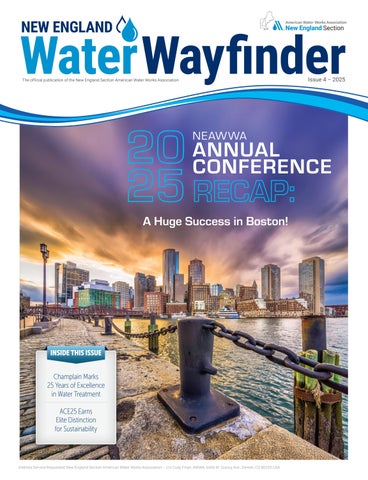
20 ANNUAL CONFERENCE 25 RECAP: NEAWWA
A Huge Success in Boston!
INSIDE THIS ISSUE Champlain Marks 25 Years of Excellence in Water Treatment ACE25 Earns Elite Distinction for Sustainability
Address Service Requested: New England Section American Water Works Association – c/o Cody Finan, AWWA, 6666 W. Quincy Ave., Denver, CO 80235 USA
www.aquasolutionsinc.net 866-711-AQUA (2782)
SEE OUR FULL LINE OF WATER TREATMENT OPTIONS
ROBERTS FILTER PRESSURE FILTER SYSTEMS
MRI HOSELESS CABLE-VAC SLUDGE COLLECTOR
SUEZ AQUA DAF FILTER EFFLUENT CONTROL - Superior Modulating Control Improves Filter Performance - 10 year Warranty offered for Filter Effluent Service
PMWI
Pleasant Mount Welding, Inc. WE’VE GOT YOU COVERED
Standard-Duty Aluminum Inter locking Flat Panel Covers “Innovative Aluminum Cover Design for Water and Wastewater Applications”
Cover Features √ Double Interlocking Construction
√ 1-Piece Extruded Hinge
√ 6” (Standard) or 3” Wide
√ Gasketed Interlock & Edge
Deck Planks
Handles
√ 20+ 6061-T6 Aluminum Extrusions
√ Interlock Beam/Support Members
√ 50 psf Live Load (Standard Design)
√ Santoprene Gaskets
√ 400 Lbs. Concentrated Load
√ Slide Latching System
√ L/240 Live Load Deflection Limit
√ Flush or Top Mount
√ Hinged & Non-Hinged Cover Panels
√ Sturdy Walk-Safe Cover
√ Easy Panel Removal
√ Slip Resistant Striations
√ NEBB Leak Test Certified
√ Standard 2-Year Warranty
www.pmwi.net
contents 11
Reflection Message from the Section Chair
9
Message from the Executive Director
11
Projection
Champlain Marks 25 Years of Excellence in Water Treatment 12 ACE25 Earns Elite Distinction for Sustainability 13
12
Technical Selection 2025 NEAWWA Annual Conference Recap: A Huge Success in Boston!
14
Investing in Water Infrastructure, Investing in Massachusetts’s Future
21
14 Issue 4 – 2025
5
contents CHAIR Ryan Shea Boston Water & Sewer Commission CHAIR-ELECT Richard Fedder Raftelis PAST CHAIR Christopher Woodcock Retired TREASURER Chi Ho Sham Independent Consultant
16
SECTION DIRECTOR Renee Lanza GEI Consultants Inc. MASSACHUSETTS TRUSTEE Peter Salvatore Boston Water & Sewer Commission MAIN TRUSTEE Patsy Root IDEXX Laboratories, Inc. NEW HAMPSHIRE TRUSTEE Sarah Trejo Aquarion Water Company RHODE ISLAND TRUSTEE Carleigh Samson Corona Environmental Consulting, LLC VERMONT TRUSTEE Andrew Evans RCAP Solutions
18
YOUNG PROFESSIONAL Cielo Sharkus Endicott College EXECUTIVE DIRECTOR Hillari Wennerstrom Mosaic AMC LLC
Direction
COMMUNICATIONS COMMITTEE Sarah Trejo – Editor and Chair
New England Section AWWA Events
24
New Section Members
25 New England Water Wayfinder is published by
Advertiser Product & Service Center
26
Tel: 866-985-9780 Fax: 866-985-9799 www.kelman.ca Managing Editor Design/layout Advertising Sales Advertising Co-ordinator
Mathias Leiendecker Tabitha Robin Megan Stanley Stefanie Hagidiakow
©2025 Craig Kelman & Associates Ltd. All rights reserved. The contents of this publication, which does not necessarily reflect the opinion of the publisher or the association, may not be reproduced by any means, in whole or in part, without prior written consent of the publisher.
6
Issue 4 – 2025
Address Service Requested. New England Section American Water Works Association c/o Cody Finan, AWWA 6666 W. Quincy Ave. Denver, CO 80235 USA
RETURN TO CONTENTS
Issue 4 – 2025
7
PFAS in Your Water? De Nora Has the Proven Solution. PFAS, “forever chemicals,” are persistent in the environment and now regulated by the U.S. EPA for drinking water safety. De Nora’s SORB™ and SORB FX systems provide proven, scalable solutions for PFAS removal, from pilot testing to full-scale operation. With more than 25 years of contaminant removal experience, De Nora delivers performance you can trust and systems designed for compliance, reliability, and ease of operation.
✔ Pilot-to-FullScale Systems ✔ Reliable,
Efficient, and Compliant Performance Proven PFAS Media: Ion Exchange, GAC & Novel Sorbents
✔
Contact Your Local F.R. Mahony Outside Sales Engineer to Discuss Your Application Call us today at (781) 982-9300 or visit www.frmahony.com
New Flomatic 12” Model 92 Swing Check Valves for Municipal & Industrial Water Systems Flomatic Valves is proud to announce the official release of its new AIS and BABA Compliant 12” Model 92 Swing Check Valve, a robust and versatile valve solution engineered for municipal and industrial water and wastewater applications that helps minimize the effects of water hammer during pump shutdown. Designed to meet the rigorous demands of modern infrastructure, Model 92 fully complies with ANSI/AWWA Standard C508, ensuring reliability and performance in critical environments. Model 92 is available in three versatile, field adjustable configurations to suit specific operating conditions: • Lever & Spring (3712LS) • Lever & Weight (3712LW) • Lever, Weight & Air Cushion (3712CS) Each model supports horizontal or vertical (flow up) pipeline installations, with field-convertible external controls thanks to a convertible shaft, dual keyed lever arm, and symmetrical cylinder mount, making installation and adjustment more efficient than ever. • Built for Strength & Longevity • Model 92 is engineered to withstand high stress and shock loads, with the valve being constructed from ductile iron for the body, cover, clapper arm, and disc holder. A replaceable stainless steel seat ring ensures positive sealing even in high solids environments, while the resilient one-piece cut seat seal provides a self-cleaning wiping effect and bubble-tight sealing across pressure ranges. • Smart Maintenance & Sustainability • All internal components are accessible and field-replaceable via the valve cover access port – no pipeline removal required, making them easy for upgrades and maintenance. The valve features NSF/ANSI 61 powder epoxy coating on both interior and exterior surfaces, and all internal ductile iron components, ensuring long-term corrosion resistance. • Made in the USA – AIS & BABA Compliant • Model 92 is proudly AIS and BABA compliant, manufactured with U.S.-sourced materials and components, supporting domestic infrastructure and sustainability goals. To explore Flomatic’s complete line of Swing Check Valves, please visit: www.flomatic.com/valves/check-valves/swing or contact our sales team at 518-761-9797.
8
Issue 4 – 2025
RETURN TO CONTENTS
Reflection
M E S S AGE F RO M T H E S ECT IO N C H A IR
From Capstone to Chair Ryan Thomas Shea, Section Chair
I
n 2014, as an undergraduate in Northeastern University’s Civil and Environmental Engineering program, I embarked on a senior capstone project focused on reducing unaccounted-for water. Like many of my peers, I wasn’t quite sure where to begin. Fortunately, that same year, the AWWA Annual Conference and Exposition (ACE) was held in Boston. I secured a discounted student badge and made my way to the Boston Convention and Exhibition Center, hoping to find some direction. I vividly remember being humbled by the scale and significance of the event, and finding myself sitting in on an AWWA M36 Water Loss Control Committee meeting. It was there that I met mentors from across the country, many of whom I remain in contact with to this day. Fast forward to 2018: now a master’s student once again at Northeastern, I had expanded that capstone into a full thesis, this time focused on developing a value proposition for recovering the water losses I had identified years earlier. Once again, I turned to AWWA for guidance. The only catch? ACE 2018 was in Las Vegas. My consulting utility was understandably hesitant to fund a young engineer’s trip to Vegas, so I paid my own way, covering the flight, hotel, and registration out of pocket. At ACE 2018, members of the M36 Committee were as generous with their time and expertise as ever, offering resources, contacts, and advice far beyond what I could have hoped for. RETURN TO CONTENTS
But the most pivotal moment came during the New England Section luncheon. I grabbed the first open seat I could find, next to Mr. John P. Sullivan Jr., P.E., Chief Engineer of the Boston Water and Sewer Commission, Fuller Award recipient, and past New England Section Chair. Mr. Sullivan took an interest in my thesis and ultimately offered me a position at BWSC, where I now serve as Director of Construction. None of this would have been possible without the collaboration between AWWA National and the New England Section. Today, as the incoming Chair of the New England Section of AWWA – following the disaffiliation and amid national political uncertainty, including the rollback of critical
environmental protections – I believe the only path forward is a united one. My first step on this path is to extend an open invitation to every member of NE-AWWA, NWWA Inc., and our affiliate organizations to collaborate. Together, we can maximize the value of our membership networks and work toward our shared goal: providing safe, affordable drinking water to the families and communities we serve. I welcome anyone who shares this mission to reach out and work alongside us. And if you remain firmly in favor of disaffiliation, I still want to hear from you, to better understand how the New England Section of AWWA can best serve its members. Issue 4 – 2025
9
VETERAN OWNED NEW ENGLAND BASED • GLOBAL DISTRIBUTION LEADING MANUFACTURER OF HIGH QUALITY MEDIA PRODUCTS
The Element In Your Every Day.
HIGH-QUALITY FILTRATION MEDIA
COMMERCIAL • INDUSTRIAL • MUNICIPAL COMPLETE RANGE OF EFFECTIVE SIZES AND UNIFORMITY COEFFICIENTS WATER WELLS DEWATERING WASTEWATER RECREATIONAL NSF/ANSI/CAN-61 CERTIFIED
BULK AND PACKAGED OFFERINGS TESTING FACILITY ON PREMISES MANAGED TRANSPORTATION 50 YEAR SUPPLY AWWA B100 COMPLIANT
HOLLISTONSAND.COM
10
Issue 4 – 2025
(401) 766-5010
RETURN TO CONTENTS
Reflection
M E S S AGE F RO M T H E E X EC U T I V E DIRECTO R
Thanks for Your Support at the 2025 Annual Meeting Hillari Wennerstrom, CAE, Mosaic AMC LLC, NEAWWA Executive Director
“COMING TOGETHER IS A BEGINNING. KEEPING TOGETHER IS PROGRESS. WORKING TOGETHER IS SUCCESS.” – Henry Ford
T
he Section’s inaugural annual meeting in October 2025 welcomed 186 members and supporters, providing an excellent opportunity to welcome a new era within the local association. The presentations were thought-provoking, exhibit hall discussions were engaging, and attendees actively participated across multiple sessions over the course of the two days. Initial feedback has been that the meeting was successful; however, our true accomplishment will be determined by the knowledge gained and progress sustained beyond this event. I extend my sincere appreciation to all who attended, presented, exhibited, and sponsored the program. Your support made this event possible, and planning is already underway for our next gathering in 2026. For those unable to attend this year, we hope you will be able to join us at future meetings! In addition, we are considering a one-day training session in the spring dedicated to utility management. We encourage everyone to remain engaged through our website, quarterly newsletters, and monthly email updates. I look forward to continuing collaboration and celebrating further achievements together. RETURN TO CONTENTS
“I EXTEND MY SINCERE APPRECIATION TO ALL WHO ATTENDED, PRESENTED, EXHIBITED, AND SPONSORED THE PROGRAM. YOUR SUPPORT MADE THIS EVENT POSSIBLE, AND PLANNING IS ALREADY UNDERWAY FOR OUR NEXT GATHERING IN 2026."
Issue 4 – 2025
11
Projection
Champlain Marks 25 Years of Excellence in Water Treatment AWWA Connections
C
hamplain Water District, the largest water utility in Vermont, has long been a leader in the sector, and its 25 years of recognition through AWWA’s Partnership for Safe Water program reinforces that reputation. As the first utility to receive the Excellence in Water Treatment Award — the Partnership’s highest possible achievement — in 1999, Champlain has sustained its exemplary status through a culture of innovation, collaboration, and continuous improvement. “We’re now in our 26th year,” said Travis Sheldon, director of water quality operations. “The procedures are in place, but what keeps us going is our resistance to complacency. We’re always looking for ways to optimize and improve water quality.” Sheldon joined the water district as an operator in 2013 and over the years, has observed how the partnership program shapes the utility’s approach. “It really does force you to sit down and look at the processes that you have,” he said, “and look at the improvements that you intended to do this year and see the progress you’ve made.” The Partnership for Safe Water is an alliance of seven drinking water organizations that aim to optimize operations in the name of improving water quality and protecting public health. To participate, member utilities commit to carrying out improvement programs that often exceed industry regulations and minimums for quality. “We display partnership logos on our vehicles and letterhead,” Sheldon said. “It features prominently in our public outreach. It allows us to show the community that we’re dedicated to going above and beyond.” As part of the program, each year participating utilities submit a detailed report on their performance-limiting factors and potential improvements. The report, Sheldon says, becomes a guiding document for aligning teams across departments and focusing on long-term growth. “If you’re able to identify and quantify and gather more data, you’re able to make better decisions going forward,” he said, adding that improvements don’t always need to be grand in nature. Take, for example, the district’s newly implemented filter surveillance program, which periodically examines core samples
12
Issue 4 – 2025
Champlain Water District received its Excellence in Water Treatment Award for the 25th consecutive year. of the filter media both before and after filter washes. The data is recorded and organized, which gives the utility year-over-year data and enables it to forecast maintenance and operational needs. “I think if organizations only look for big changes, it could be overwhelming,” he said. “This was not a huge undertaking, but it was a big improvement.” To support the district’s continued involvement in the partnership program, Champlain holds quarterly meetings that bring together operations, electrical technologies, transmission and distribution teams. “Everybody talks about lessons learned and different ways to operate,” Sheldon said. “It’s very helpful to talk about things we’ve learned in the past quarter and what we have coming up.” It not only keeps staff up to date on their progress, he added, but it fosters a commitment to the program across all departments. “This requires the entire staff,” he said. “We get great support from our board of commissioners and the community. It takes that buy-in across all those levels to really be successful at something like this.” RETURN TO CONTENTS
Projection
ACE25 Earns Elite Distinction for Sustainability AWWA Connections
T
he Events Industry Council (EIC) recently recognized AWWA’s 2025 Annual Conference and Exposition (ACE25) with its highest distinction – a Platinum Level Certification – for its event sustainability practices. This recognition places AWWA’s premier conference among an elite group of events around the world focused on enhancing sustainability. “We are so appreciative of the AWWA community – not only its staff, but also members, volunteers, and leaders – whose dedication and investment have been instrumental in driving ACE’s initiatives forward,” said Joanne Gaglia, director of conferences and events. “Their commitment to responsible practices continues to inspire meaningful change across the industry,” she added. The EIC’s standards, recognized globally, specify performance criteria in areas of organizational management; marketing, communications and engagement; climate action; water management; materials and circularity; supply chain management; diversity, equity and inclusion; accessibility; and social impact. To date, more than 300 professionals have participated in the review of the standards. At ACE25, which attracted over 11,000 water professionals from around the world, AWWA achieved each of the goals it aspired to: • Increase waste diversion from landfill to 43% (up from 21% in 2024). • Establish a sustainable procurement policy for all ACE materials. • Raise awareness of the ACE Carbon Offset Dashboard, which allows individuals to understand the carbon footprint of their travel to and from ACE. • Strengthen the Exhibitor Sustainability Pledge, which encourages at least one action from each participating exhibitor relating to energy use, waste diversion, and reduced food and beverage packaging. “Our partners and exhibitors signed the pledge, which expands the impact of our sustainable approach across the show floor and beyond,” Gaglia said. These 2025 Sustainability Allies are still currently featured on the ACE Sustainability and Impact page. ACE25 earned an exemplary audit point for offsetting the event’s total water use – 420,000 gallons – through the purchase of Water Restoration Certificates® from the Bonneville Environmental Foundation. This action demonstrates ongoing commitment to the water sector and RETURN TO CONTENTS
reinforces support for forward-looking sustainability efforts as represented in AWWA’s Water 2050 initiative. The Alliance for Audited Media conducted a comprehensive third-party audit, and AWWA collaborated with Honeycomb Strategies (HCS), event industry sustainability consultants, on the planning and certification process. HCS compiled the ACE25 Sustainability Report, which captures the effects of AWWA’s sustainability initiative, first launched in 2023. It also provides recommendations for continued growth.
ACE25 earned event industry’s highest honor for sustainability. “AWWA shares this report to foster transparency, encourage accountability, and inspire ongoing action across the ACE community,” Gaglia said. ACE26, taking place June 21-24 in Washington, D.C., will build on the success of ACE25 by: • Purchasing strategic offsets for travel, energy, and water. • Procuring materials through sustainable sourcing. • Offering a volunteer activity that supports the community. • Hosting a Wellness Lounge to promote attendee well-being. • Including Water Equation engagement to support future water professionals. “These returning initiatives reflect AWWA’s commitment to continuous improvement and long-term impact,” Gaglia said. “They build on what worked and will evolve with purpose.” Issue 4 – 2025
13
Technical Selection
20 ANNUAL CONFERENCE 25 RECAP: NEAWWA
A Huge Success in Boston!
BOSTON, MASSACHUSETTS – OCTOBER 29-30, 2025
T
his year’s Annual Conference brought together close to 200 water professionals from across the New England region, marking a successful inaugural conference. Set in the historic city of Boston, the conference delivered a dynamic blend of professional development, networking, award recognition, and fun in the exciting venue of Encore Boston Harbor. Celebrating Excellence in the Industry Each year, the New England AWWA Annual Conference takes time to recognize individuals who have gone above and beyond in their contributions to the water sector. Their dedication and passion continue to inspire the broader water community and elevate the standards of the industry. Congratulations to this year’s NE-AWWA Section Awards recipients: • Sponsor of the Year – Idexx • Volunteer of the Year – Pooja Chari, Renee Lanza, Andrew Evans To recognize and honor NE-AWWA members who have advanced the section through his/her volunteer time and efforts during the previous year. • Young Professional Member of the Year – Renee Lanza, Pooja Chari, Cielo Sharkus
14
Issue 4 – 2025
•
•
•
To recognize and honor young professional members of the NE-AWWA Section who have demonstrated outstanding service to the Section or Association through leadership and active participation in committees and/or YP programs. Innovation Awards – Chi Ho Sham, Andrew Evans, Cielo Sharkus To recognize members for fulfilling the vision of the Innovation Initiative. The current vision of the Initiative is “To inspire and implement innovative thinking and best practices” within the water industry. These annual awards are for those who have inspired or implemented an innovative idea, best practice, or solution to address a challenge facing the industry with significant positive results. Publications Honorable Mention Awards – Sarah Trejo, Brett Johnson, Cielo Sharkus To annually recognize and honor the effort of NE-AWWA members for contributions to the public water supply profession through NE-AWWA and AWWA publications. Publications include the Journal AWWA, AWWA Water Science, Opflow, and NEAWWA Water Wayfinder. New England Water Landmarks – Section Nominations for the AWWA Water Landmark Award – Mann Pump Station, Pennichuck Water Works To recognize and preserve a Water
• • •
Landmark at least 50 years old that has had a direct and significant relationship with water’s supply, treatment, distribution, or technological development. This nomination process allows for Section review and approval, as required for the American Water Works Associations American/Canadian/ Mexican Water Landmarks Award. Water Taste Test Winner – Boston Water & Sewer Commission Judges – Reid Campbell, Cody Finan, David LaFrance George Warren Fuller Award – Jim Marvel
Association Level Award Recipients: • Gold Water Drop – Gary Trachtman Representing 50 cumulative years of membership. • Life Member Status – Stephen Donovan, Carl McMorran, and Mehdi Zarghamee Representing those with 30 cumulative years of membership and at least 65 years of age. • Silver Water Drop – David Condrey, David Powers, Timothy Lescarbeau, Vincent Roy, Joshua Das Representing those with 25 years cumulative years of membership.
RETURN TO CONTENTS
Technical Selection
RETURN TO CONTENTS
Issue 4 – 2025
15
Technical Selection
F R O M T H E K E Y N OT E S P E A K E R
BBP – HOW AN UNFUNDED BUDGET CATEGORY CHANGED EVERYTHING George Hawkins, Founder and CEO, Moonshot Missions
B
“
BP” was a phrase I referenced to start my opening luncheon plenary for the fantastic New England Section of AWWA annual conference. BBP is an integral to overcoming the fists of challenges facing water utilities of every demographic and location. I have often talked of the FIST facing every utility, and certainly me at DC Water in 2009: index finger: aging and often decrepit infrastructure; middle finger: customers who do not know who their utility is or what they do; ring finger: chronic lack of capital and operating funds; pinky – resistance to innovation. Since 2009, there has been a range of additional challenges on a second hand: index – emerging contaminants; middle – extreme weather driving flooding and drought; ring – reduced federal and state funding support; pinky – cyber and security risks; and the thumb – personnel retirements. This one-two punch paints a bleak picture. Yet there is a block and counter that can win the fight – which starts with BBP.
by a factor of three or more. The meetings to determine which projects to fund were long and hard-fought. In one, our excellent CFO, Mark Kim and I asked what kind of project was in the BBP category. It was the last listed, and we never had any remaining funds. The answer? “BBP” stood for “Better Business Practices” and included projects that would enable us to run better as a business – more efficient, reduced costs, and even new revenues. We asked for an example, and the answer was a project to simplify and digitize our process to order and stock equipment and parts for Blue Plains. I learned later that the existing process took longer than 180 days, which meant either the staff bought the needed parts with a purchase card at the highest prices or ordered many more parts than needed to have everything for the future on hand. As a result, we had a huge warehouse with (literally) tons of inventory – often not needed for many years.
“BUTTRESSING THE BBP BUDGETING WITH UPDATED PROCUREMENT AND PERSONNEL RULES ENABLES AWARDS THAT MAY COST MORE UP-FRONT BUT SAVE FUNDS OR GENERATE REVENUES OVER TIME, AND REWARD EMPLOYEES FOR THEIR IDEAS.” BBP was a category of capital projects at DC Water that, in my first two years, we never funded. Like all infrastructure agencies, we had far more capital needs than we had sources of revenue – usually 16
Issue 4 – 2025
Mark and I became fixated on BBP projects – improvements in efficiency drive savings that deliver permanent cash flow flexibility. In short, we decided to incorporate the BBP perspective into every
capital decision by requiring business plans that included an analysis of alternatives that evaluated life cycle costs and return on investment. BBP changed everything. My message at the conference is that we will never have enough money in the water sector. We all support continued investment in the State Revolving Funds and other federal and state funding. Yet the reality is, no matter what the level, there is and will be a massive shortfall. Recent projections estimate a $110 billion shortfall each year, which measures a level of work not being done, adding to the backlog for the next year, which then grows by another $110 billion. While this news is bleak, there is a positive “BBP” path forward. At Moonshot Missions, we call it “Utility Performance Management” or UPM – which is a set of governance steps that update utility systems to drive continuous innovation, efficiencies and new revenues. Incorporating “BBP” as a lens through which all capital decisions are made is one example, paired with a “claw back” incentive scheme to allow Divisions which succeed in saving money to keep some of the savings in their budget to fund projects of their choice. Buttressing the BBP budgeting with updated procurement and personnel rules enables awards that may cost more up-front but save funds or generate revenues over time, and reward employees for their ideas. My experience was that these changes to systems that govern how we made decisions and rewarded outcomes led to projects that changed everything – driving down costs in every RETURN TO CONTENTS
Technical Selection
Moonshot's Mike Stuhr and Wendy Montalbano meet with Fred and Randee from City of Chiloquin Public Works and Klamath Tribes. operating program. Rates continued to rise mainly due to the breathtaking costs of the Combined Sewer program, but our customers also understood that in every other aspect we were getting more efficient and effective and deploying their money. The message: we must be as mindful about improving our balance sheets as we are about improving our pipes, pumps and treatment schemes. The excellent news: we can do both, for the one almost always can be paired with the other. Going back to DC Water and that giant warehouse, we implemented the BBP project for equipment and parts replacement and with an employeedeveloped automation scheme supported by a company out of Denver called Kona (now part of Xylem Vue) that reduced the RETURN TO CONTENTS
“THE MESSAGE: WE MUST BE AS MINDFUL ABOUT IMPROVING OUR BALANCE SHEETS AS WE ARE ABOUT IMPROVING OUR PIPES, PUMPS AND TREATMENT SCHEMES. THE EXCELLENT NEWS: WE CAN DO BOTH, FOR THE ONE ALMOST ALWAYS CAN BE PAIRED WITH THE OTHER.” average time of replacement from 180 to three days. We saved costs on the price paid for most parts, we tore down the giant old warehouse and replaced it with a stateof-the-art, just-in-time facility, and used the extra space we gained to design and build an anammox nutrient reduction facility incorporating a side-stream demon. BBP helped us improve performance and reduce costs for operations and maintenance in an amazing handful of ways!
That was a knock-out success for us. Moonshot Missions believes every utility should have the opportunity to learn how to adopt and adapt BBP/UPM principles. We would love to help you! Contact us at info@moonshotmissions.org and visit our website at www.moonshotmissions.org to learn more. And we will want your help in developing BBP into a full UPM program. Keep an eye out for more to come! Issue 4 – 2025
17
Technical Selection
KEEP FUNDS FLOWING:
HOW WIFIA HELPED SPRINGFIELD ACCELERATE A ‘MASSIVE CAPITAL PROGRAM’ AWWA Connections
“WITH WIFIA’S FLEXIBILITY, SPRINGFIELD WAS ABLE TO BUNDLE 31 CRITICAL PROJECTS INTO A SINGLE FINANCING PACKAGE, WHICH WAS, AT THE TIME, IN 2021, SOMEWHAT UNIQUE.” 18
Issue 4 – 2025
L
ike any utility, the Springfield Water and Sewer Commission in Massachusetts keeps a running tally of its infrastructure needs and prioritizes projects by risk, based on how soon components will reach the end of their life spans and potentially hinder drinking water or wastewater service. A few years ago, that list grew longer than the commission could feasibly tackle.
“When we looked at what the projects were, we couldn’t get them all done in a period of time that adequately reduced risk,” said Josh Schimmel, executive director of the commission. On top of that, state limits on state revolving funds, or SRFs, and restrictive bond provisions further hampered the financing options available to address much of the aging infrastructure. “We had a massive capital program and very limited ways to pay for it,” he said. RETURN TO CONTENTS
Technical Selection
“WIFIA AND OTHER FEDERAL FINANCING PROGRAMS ARE FACING CUTS IN THE US CONGRESS. WIFIA PROVIDES LONGTERM LOANS THAT CAN BE COMBINED WITH OTHER FUNDING TO TACKLE LARGESCALE INFRASTRUCTURE UPGRADES AND INVESTMENTS. THE LOWCOST LOANS MEAN LOWER COSTS FOR UTILITIES AND ULTIMATELY, RATEPAYERS.”
The construction site for the York Street Pump Station and Connecticut River Crossing Project in Springfield, Massachusetts.
That changed with the Water Infrastructure Finance and Innovation Act (WIFIA) program. With WIFIA’s flexibility, Springfield was able to bundle 31 critical projects into a single financing package, which was, at the time, in 2021, somewhat unique. The bundled approach allowed the commission to accelerate construction timelines, reduce costs, and improve service delivery. “We were able to do them quicker, which meant that they were cheaper – we could do them now rather than when costs rise – and we were able to reduce risk tremendously rather than waiting for these things to fail and responding then,” he said. The scope of work was unprecedented for the commission, which has been operating as an independent regional utility for about 30 years. With WIFIA and SRF funding combined, Springfield was able to take on $500 million in infrastructure improvements – far more than would have been possible through
conventional means. The financial structure also allowed the commission to shape its debt repayment in ways that traditional bonds couldn’t accommodate, resulting in an estimated $80 million in savings to ratepayers over 20 years. WIFIA and other federal financing programs are facing cuts in the US Congress. WIFIA provides long-term loans that can be combined with other funding to tackle large-scale infrastructure upgrades and investments. The low-cost loans mean lower costs for utilities and ultimately, ratepayers. A 2025 survey from the Value of Water Campaign found that 80% of voters support continued federal funding for water infrastructure. The American Water Works Association is elevating projects like Springfield’s to illustrate the critical importance of maintaining WIFIA and SRFs. A cornerstone project in Springfield’s package was a new drinking water treatment plant designed to serve
RETURN TO CONTENTS
250,000 residents. “Our treatment plants were just dated,” Schimmel said. “They could not treat to today’s standards.” The commission has been out of compliance for disinfection byproducts, and the new facility is essential to restoring safe, reliable service. Without WIFIA, the project would have been financially out of reach. “We were not going to be able to build this treatment plant,” Schimmel said. “I have no doubt we wouldn’t have been able to bond for it because it would have been too costly.” Other critical projects included a new wastewater pump station and new conveyance pipes across the Connecticut River, replacing one as old as 85 years, as well as updates to a wastewater treatment facility. For Schimmel, the decision to pursue WIFIA was clear. “We went from saying, ‘We couldn’t afford to do the work’ to ‘We couldn’t afford to not take advantage of the opportunity that WIFIA presented to us,’” he said. Issue 4 – 2025
19
NEW TANKS (270) 826-9000 ext. 2605 EXISTING TANKS (270) 826-9000 ext. 4601
Concept to commission. The AV LowPro® filtration system is designed to fit where others can’t, removing PFAS, 1,4-dioxane and other CECs within existing and new utility structures. Our concept -to-commission approach includes designing for the lowest cost of ownership, unbiased media selection, manufacturing, installation, and exceptional service.
Our concern for the environment is more than just talk As we continue to deliver valuable information through the pages of this magazine, in a printed format that is appealing, reader-friendly and not lost in the proliferation of electronic messages that are bombarding our senses, we are also well aware of the need to be respectful of our environment. That is why we are committed to publishing the magazine in the most environmentally-friendly process possible. So enjoy this magazine... and keep thinking green.
20
Issue 4 – 2025
Go to aqueousvets.com to see how engineers, contractors and water utilities across the nation, including east coast installations in PA, NJ, MA, VA, SC and FL - trust the team at AqueoUS Vets. 2017 First PFAS potable water treatment plant in CA. 1.3 MGD
2021
Largest PFAS treatment plant in the US again! 25 MGD
2023
2019 Largest PFAS treatment plant in the US. 8 MGD
2022
Largest US 1,4dioxane, peroxide quenching application. 82 MGD
Expands service area by establishing East Coast base of operations in Jacksonville, FL
aqueousvets.com • 925.331.0573 • info@aqvets.com
RETURN TO CONTENTS
Technical Selection
Water shapes every facet of our daily lives, but the infrastructure we depend on to make safe, reliable water for people and the environment possible is under mounting stress.
Funding vs. Need—A Growing Gap In 2025, Massachusetts received only 6% (about $275.3 million in federal funding) of the annual funding it needs for its water infrastructure, leaving many capital needs unmet. The costs of inaction compound over time: every year that needed investments are deferred, the price tag grows, and what isn’t covered by federal or state funding ultimately falls on local ratepayers.
Annual Wat er I nf r as t r uct ur e Needs
__ Over the next 20 years, the state requires $75 billion in investment to bring its water and wastewater infrastructure to a state of good repair. This equals roughly $3.8 billion each year—or $539 per resident per year.
D r i n k i n g Wa t e r I nfrastructure $1,786,001,941
P F AS R e mo v a l $14,469,645
Lead Servi ce Li ne R e p l a c e me n t $58,625,936 Wa s t e wa t e r + S u r f a c e Wa t e r I n f r a s t r u c t u r e $1,912,843,324 RETURN TO CONTENTS
Issue 4 – 2025
21
Technical Selection Consequences of Inaction When water infrastructure fails, it disrupts basic needs—safe homes, clean drinking water, and healthy ecosystems—and can stall growth and the economy. Just a 24-hour disruption in water and wastewater services would mean significant losses to key industries in Massachusetts. Sector
Daily Losses – Millions of Dollars
Accommodation and food service
$-88.7
Food and beverage
$-32.2
Chemical and pharmaceutical
$-30.6
Human health activities
$-162.6
Real estate activities
$-168.3
Arts entertainment and recreation
$-26.4
Water’s Economic Potential These aren’t just unavoidable costs for an essential service—closing the nation’s water infrastructure investment gap represents a major opportunity to strengthen Massachusetts’s economy, workforce, and communities for the long term. Every $1 invested in water infrastructure in Massachusetts supports $2.08 in economic output nationally. Meeting the national funding need over a 20-year period would support $1,048 per capita in economic output, contribute $4.13 billion to state GDP, create 32,700 jobs, and generate $2.45 billion in wages for Massachusetts annually. Sectors that are key to Massachusetts’s economy would also stand to gain. Sector
Annual Economic Output – Millions of Dollars
Direct Impacts
Construction
$2,901
Prof/Tech Services
$445
Real Estate & Leasing
$222
Government Enterprises
$125
Utilities
$22
Indirect and Induced Impacts
Real Estate and Rental and Leasing
$493
Finance and Insurance
$379
Health Care and Social Assistance
$350
Wholesale Trade
$348
Professional, Scientific, and Technical Services
$324
ShareThe d PEconomic rosperBenefits ity of Investing in Water Infrastructure: Massachusetts 22
TO CONTENTS Issue 4 – 2025 Water infrastructure investments rely on national supply chains for materials, equipment, andRETURN specialized services. When other states invest in water, Massachusetts benefits—and vice versa. Closing the national
Professional, Scientific, and Technical Services
$324
Technical Selection
Shared Prosperity Water infrastructure investments rely on national supply chains for materials, equipment, and specialized services. When other states invest in water, Massachusetts benefits—and vice versa. Closing the national gap also means other states’ water infrastructure investments benefit Massachusetts. The top three indirect sources of GDP growth would be: - New Hampshire: $45 million in GDP gains from investment in New Hampshire, largely to Massachusetts’s Professional, Scientific, and Technical Services industry ($3.9 million GDP impact). - Rhode Island: $36 million in GDP gains from investment in Rhode Island, largely to Massachusetts’s Professional, Scientific, and Technical Services industry ($4.1 million GDP impact). - New York: $35 million in GDP gains from investment in New York, largely to Massachusetts’s Publishing Industries industry ($3.7 million GDP impact). Likewise, investment in Massachusetts benefits other states’ GDPs. The top three beneficiaries by state GDP growth would be: - Texas: $102 million in GDP gains to Texas, led by Massachusetts’s connections to Texas’s Oil and Gas Extraction industry ($17.2 million GDP impact). - New Hampshire: $74 million in GDP gains to New Hampshire, led by Massachusetts’s connections to New Hampshire’s Building Material and Garden Equipment and Supplies Dealers industry ($8.5 million GDP impact). - New York: $59 million in GDP gains to New York, led by Massachusetts’s connections to New York’s Monetary Authorities-Central Bank industry ($4.6 million GDP impact).
Read the full report, The Economic Benefits of Investing in Water Infrastructure, at www.thevalueofwater.org.
The Economic Benefits of Investing in Water Infrastructure: Massachusetts RETURN TO CONTENTS
Issue 4 – 2025
23
Direction
Upcoming Events The New England Section is pleased to announce the return of our monthly Lunch & Learn Webinars. Although we are still finalizing some details, you can visit our website for a full list of events and registration information. We’re excited to start 2026 with these January programs:
WEBINAR
JAN
13
Hydrant Assessments for Asset Management
WEBINAR
JAN
30
YP Networking Session
We’re also preparing for the following in-person events:
APR
29 24
Utility Management Workshop Location: TBD
Issue 4 – 2025
OCT
21-22
Annual Conference & Tradeshow Location: Natick, MA
RETURN TO CONTENTS
Direction
New Section Members Name
Company Name
Name
Company Name
Adam Lirette
Jeremy Brakey
Alan Burke
Kristin-Faith Avenis
Amanda Thomas
Landon Glynn
David Ball
Lora Wade
Dina Wagdy
Schneider Electric
Marcelo Cloes
IDEXX
Doreen Goodrich
Watson-Marlow Fluid Technology Solutions
Matthew Scarborough
University of Vermont
Elizabeth Pereira
Wright-Pierce
Matthew Bertarelli
Simpson Spring
Eric Hillstrom
Abington Rockland Joint Water Works
Matthew Comeau
Lynn Water and Sewer Commission
Erik Nottleson
Nima Sakhaee
Fatmata Sesay
Philip Larocque
Georgia Herr
University of Alabama
Godwin Sunday Ian Mead
Environmental Partners, Inc.
Rayshelly Lizotte
Artifex AE
Robert Bernardo
Seekonk Water District
Samantha Sanford
Jack Durost
Sean McBeath
University of Massachusetts Amherst
Jared Genzabella
Stephen Smith
Abington Rockland Joint Water Works
Jarin Tasnim
William Cundiff
Southborough Public Works
visit us online
ne-awwa.org
RETURN TO CONTENTS
Issue 4 – 2025
25
Advertiser Product & Service Center New England Water Wayfinder is made possible by the companies below who convey their important messages on our pages. We thank them for their support of NE AWWA and its publication and encourage you to contact them when making your purchasing decisions. To make it easier to contact these companies, we have included the page number of their advertisement, their phone number, and, where applicable, their website.
COMPANY
PAGE
PHONE
WEBSITE
AqueoUS Vets
20
925-331-0573
www.aqueousvets.com
Aqua Solutions, Inc.
2
866-711-2782
www.aquasolutionsinc.net
Baker Water Systems, A Division of Baker Manufacturing Co, LLC.
7
800-356-5130
www.bakerwatersystems.com
CorrTech Inc.
23
888-842-3944
www.corrtech-inc.com
Coyne Environmental Services
7, 10
215-785-3000
www.coyneenvironmental.com
F.R. Mahony & Associates
8
781-982-9300
www.cummins-wagner.com/state/ f-r-mahony-associates-new-england
Flomatic Valves
4, 8
800-833-2040
www.flomatic.com
Holliston Sand Co. Inc.
10
401-766-5010
https://hollistonsand.com
Mott MacDonald
10
Pittsburg Tank & Tower Group Inc.
20
270-826-9000
www.pttg.com
Pleasant Mount Welding Inc.
3
570-282-6164
www.pmwi.net
U.S. Pipe
28
866-347-7473
www.uspipe.com
Water & Sewer Specialties
20
877-342-5318
www.waterandsewerspecialties.com
www.mottmac.com
NEW ENGLAND
Water Wayfinder The official publication of the New England Section American Water Works Association
r Water Wayfinde
NEW ENGLAND
Issue 4 – 2025
The official publication
of the New England
Section American
Water Works
Association
NU AL 20 AN CO NF ER EN CE 25 RECAP: NEAW WA
A Huge Success
in Boston!
To reach Water professionals through New England Water Wayfinder magazine and its targeted readership, please contact me. Megan Stanley, 866-985-9791 | megan@kelman.ca
INSIDE THIS ISSUE 25 Champlain Marks e Years of Excellenc t in Water Treatmen ACE25 Earns Elite Distinction for Sustainability
Address Service
26
Requested: New
England Section
American Water
Works Association
– c/o Cody Finan,
AWWA, 6666
W. Quincy Ave.,
Denver, CO 80235
USA
Issue 4 – 2025
RETURN TO CONTENTS
Call for Articles! Do you have an interesting project you’d like to share? NE-AWWA is looking for articles for future issues of Water Wayfinder. We want to highlight people, projects, and facilities in the New England area. Please get in touch with Mathias Leiendecker at mathias@kelman.ca or Sarah Trejo at strejo@aquarionwater.com for more information or to submit your article for consideration.
Thanks so much for your contribution to Water Wayfinder!
Recycled from this...
to this U.S. Pipe ductile iron pipe is a superior product made from a minimum of 90% recycled metal that is forged from scrap iron and steel. By using recycled metal, ductile iron pipe not only serves the community, but it protects the environment. One of the best things about ductile iron pipe is that it can be recycled again at the end of its life cycle. So, choose U.S. Pipe ductile iron pipe made right here in America. Recycle now and recycle for your future.
Scan the QR to learn more about ductile iron. © 2025 U.S. Pipe, A QUIKRETE® Company. All rights reserved.