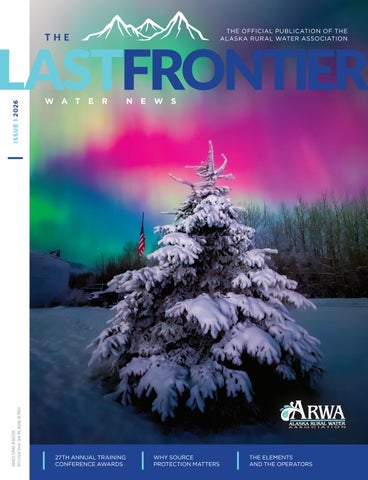
THE OFFICIAL PUBLICATION OF THE ALASKA RURAL WATER ASSOCIATION
LASTFRONTIER
ADDRESS SERVICE REQUESTED: 1075 S Check Street, Suite 106, Wasilla, AK 99654
ISSUE 1 2026
THE
W A T E
R
27TH ANNUAL TRAINING CONFERENCE AWARDS
N
E
W S
WHY SOURCE PROTECTION MATTERS
THE ELEMENTS AND THE OPERATORS
BUILD YOUR NEXT PUMP STATION
WITH US
COMPACT. RELIABLE. VERSATILE.
CUES
C
When it comes to pipeline inspection, having the right equipment for the job is essential. No two inspections are the same - different pipe sizes, conditions, and accessibility challenges require different solutions. That’s why we offer the most extensive variety of portable pipeline inspection systems in the industry. Whether you’re inspecting municipal sewer lines, industrial pipelines, or residential drains, we have a portable system to meet your needs!
To see our entire product line, scan or visit www.cuesinc.com
Gillian Wilson, RSM 971.369.6201 | gillianw@cuesinc.com
L
THE OFFICIAL PUBLICATION OF THE ALASKA RURAL WATER ASSOCIATION
LASTFRONTIER ISSUE 1 2026
THE
W A T E
R
N
14
Alaska Rural Water Association 1075 S Check Street, Suite 106 Wasilla, AK 99654-8067 ARWA STAFF Robyn Dombroski, Executive Director Kelly Comerford, Office Manager Kevin Schoneman, Circuit Rider Jordan Cameron, Circuit Rider Nicholas Sena, Wastewater Training & Technical Assistance Specialist Sarah Ramey, Source Water Protection Specialist
The Last Frontier Water News is published by:
Tel: 866-985-9780 Fax: 866-985-9799 www.kelman.ca Managing Editor: Lauren Drew Design/layout: Tabitha Robin Marketing Manager: Megan Stanley Advertising Coordinator: Stefanie Hagidakow The Last Frontier is published quarterly by Craig Kelman and Associates for the Alaska Rural Water Association. All rights reserved. The contents of this publication may not be reproduced in whole or in part without the express consent of the publisher. ©2026
E
W S
FEATURES 8
Why Source Protection Matters
10
State Water Programs Updates
14
The Elements and the Operators
15
From Pumps to Ponds: The Evolution of Wastewater Lagoons
16
27th Annual Training Conference Awards
17
2025 ARWA Water Taste Test Winner: The City of Whittier
DEPARTMENTS 7 Executive Director’s Message 18 Training Calendar
Cover Photo Credit: Stephanie Woods, Palmer, Alaska
22 Thank You to Our Advertisers
2026 Membership Application/Renewal
Alaska Rural Water Association 1075 S Check Street, Suite 106, Wasilla, AK 99654-8067 Office: 907-357-ARWA (2792) | Fax: 907-357-1400 | www.arwa.org
Water System or Company Name ________________________________________________________________________________ Operator’s Name ________________________________________ Phone #______________________________________________ Operator Email ________________________________________________________________________________________________ Accounting Contact Name _________________________________ Phone # ____________________________________________ Accounting Email _____________________________________________________________________________________________ Billing Address ________________________________________________________________________________________________ City ____________________________________________ State _______________________ Zip Code ________________________
MEMBERSHIP TYPE (CHECK ONLY ONE OF THE FOLLOWING)
Voting Member Categories
Connections:
* Level 2-4 pays base fee + connection fee
# Connections:
Connections x $0.25
Level 1
65 or less:
Level 2*
66 to 434:
X $0.25
Level 3*
435 to 1,304:
Level 4*
1,305 + :
TOTAL Connection Fee $0.00
Base Fee
Connection Fee PLUS Base Fee
+ $300.00
=$
=$
+ $325.00
=$
X $0.25
=$
+ $375.00
=$
X $0.25
=$
+ $425.00
=$
Non-Voting Member Categories
Individual Membership
$100.00
$
Member-At-Large (Vendor)
$375.00
$
Supporting Membership
$500.00
$
Nonprofit Supporting Member
$150.00
$
Additional Services
CCR Web Hosting
$100.00
$
2.5% Credit Card Fee
$
Total Enclosed: $ We accept Cash, Check, Purchase Order,
or
To pay with a credit card, please provide the following information. There is a 2.5% convenience fee added to your total if paying by card. Card # ______________________________________________ CVV __________________________ Billing Zip code______________ Exp Date _____ _____ / _____ _____
Name on Card _______________________________________________________
Annual membership dues are not pro-rated throughout the year and are renewable on January 1 of every year. Dues must be paid by April 1 in order for a member to be considered in good standing for that year. Voting members not in good standing will not be eligible to vote or place their name on that year’s election ballot.
EXECUTIVE DIRECTOR’S MESSAGE
Welcome 2026! By Robyn Dombroski, ARWA Executive Director
H
appy New Year! Hoping it is a great year for everyone! Our conference in October saw another great turn-out and included many great speakers. It was wonderful to see familiar faces again. Mark your calendars now for our 2026 training conference, which will be held once again at the Sheraton Anchorage Hotel and Spa October 19–22. Hopefully we will see all your smiling faces again! This time of the year also ushers in preparations for another visit in February with our Congressional delegates at the National Rural Water Rally held in Washington, D.C. This is an opportunity for us to talk with those in control of our federal funding dollars and share what we do to help all of you. We are always well received by our Alaska delegation and that makes our visits not only productive, but quite easy. These are important meetings as federal funding remains a contentious issue, as it likely always will, but we, as well as all rural water associations across the country, will continue to fight for the needs of small and rural water and wastewater systems in whatever way we can. The letters of support many of you have kindly sent to me go a long way toward demonstrating how beneficial our federally funded programs are throughout the state. I want to personally thank everyone who has sent one. They DO make a difference, and the folks in Washington like to read them. So, keep those letters coming! As a friendly reminder, a new year means membership renewal. Think about what our staff has done to help you and your system, and the cost savings realized because of that help. Received a sanitary survey? How much did that save you? Get help finding leaks to reduce
RETURN TO CONTENTS
water loss? What would that have cost if you had to pay for that service? Did you get your backflow devices tested for a very reasonable cost? More savings. These are very real, very tangible cost savings to your system. Supporting ARWA with your membership dues is a very small cost with a very big benefit, so get your dues paid to remain a member in good standing. We truly appreciate your support and wouldn’t be in business without you! Thank you! Speaking of supporting ARWA and rural water in general, we are still asking as many individuals as possible to sign the Rural Water Strong pledge to show your support for rural community funding. This is needed to show Congressional and federal agency leadership how important rural funding is across the nation. There is no commitment on your part. It is simply to show support for rural funding programs that help so many. We would really like Alaska to stand out among other states! The pledge and more information can be found here: www. ruralwaterstrong.org. Show your support by signing today, and thank you to those that have already signed! Please don’t forget to sign up to donate to ARWA when you shop at Fred Meyer. It costs you nothing but a few minutes of your time to make sure you designate ARWA for your contribution. Link your Freddie’s Rewards account to ARWA by going here: www. fredmeyer.com/communityrewards (our organization is CB055). We don’t get much, but every little bit helps us in our efforts to fulfill our mission. Lastly, remember that if you are in need of just a few CEU credits to renew your operator’s certification, we offer online training that can fulfill that need. Go to our website (www.arwa.org) and
click on the top right menu where it says Online Training. These courses have been fully approved for CEU credit by ADEC. If your system is a current member, you can receive a $30 discount per course. We are also working on adding an ARWA merchandise store to our website, so stay tuned for that! All of us at ARWA would like to wish everyone a very happy and prosperous new year!
Send Us Your Letters of Support What Are You Thankful For? • How has ARWA helped you and your system? • Have you saved any money attending any of our trainings? • Did an ARWA staff member help you solve a problem? • Have you been to one of our recent training events and thought the trainer did an excellent job? We need to hear from you! Letters of support will be included in our Annual Report for our Congressional Delegates. Your written support is important and will help us continue to serve rural water and wastewater systems throughout the state! Send letters of support to: Alaska Rural Water Association 1075 S Check Street, Suite 106 Wasilla, AK 99654-8067 Or email kelly@arwa.org
ISSUE 1 2026 | T H E LASTFRONTIER
7
WHY SOURCE WATER PROTECTION MATTERS By Sarah Ramey, Source Water Protection Specialist, sarah@arwa.org
W
hen you turn on your tap, you expect clean, safe water to flow out, but that expectation depends on a complex and often fragile water system. Protecting community water sources isn’t just an environmental issue. It’s a public health, infrastructure, and economic priority. Whether you work in water treatment, wastewater management, or environmental compliance, the quality of the source water upstream determines how much effort, energy, and money it takes to produce safe drinking water downstream. “Source water” refers to rivers, lakes, reservoirs, springs, and aquifers that supply drinking water to our Alaska communities. Each of these sources faces a unique set of stressors from mining operations runoff, industrial discharges, and failing septic systems. These pollutants don’t just threaten aquatic ecosystems. They also increase the treatment burden on utilities, sometimes pushing existing systems to their design limits.
8
T H E LASTFRONTIER | ISSUE 1 2026
For example, elevated nutrient levels from septic runoff or warming climates can lead to harmful algal blooms (HABs). The algal blooms can produce toxins that standard treatment processes aren’t always equipped to remove efficiently. Another example is contaminants such as PFAS (perand polyfluoroalkyl substances) and 1,4-dioxane that persist through conventional treatment, requiring costly advanced technologies that include activated carbon adsorption or reverse osmosis. PFAS can also carry through wastewater treatment plants out effluent discharge points, contaminating aquatic life and the organisms that live off these resources. Over time, every pollutant introduced into a watershed eventually shows up at the treatment plant intake. The more degraded the source, the more chemical, energy, and infrastructure demand it imposes on utilities. Increased coagulant doses, higher sludge production, membrane fouling, and taste and odor issues are just a
few of the operational impacts utilities face. From an economic perspective, it’s almost always cheaper to prevent contamination than to treat it later. Studies from the American Water Works Association (AWWA) show that every dollar spent on source water protection can save up to $20 in treatment costs over time. In short, protecting the watershed is one of the most cost-effective infrastructure investments a community can make. Source water protection isn’t limited to the drinking water side of the industry. Wastewater professionals are key players in maintaining watershed integrity. Optimized treatment processes, nutrient management, and proper biosolids handling all reduce the pollutant load that re-enters surface or eventually groundwater systems. Upgrading outdated infrastructure to address improperly treated wastewater and infiltration/inflow of sewer mains directly improves source water quality for communities downstream. In a sense, every well-operated wastewater plant
RETURN TO CONTENTS
Well that needs the rope removed and replaced with wire for pulling the pump and a hole in the well cap properly sealed to prevent potential contaminants from entering the well casing.
is a frontline defender of drinking water sources. Many of our rural communities are located on river systems. These rivers are used for both wastewater effluent discharge points as well as surface water intakes. They may be separated by several miles to hundreds of miles apart, but nonetheless one village’s wastewater enters the river and another village downstream has an intake drawing water from the river for a drinking water source. No single utility, municipality, or regulator can protect a watershed alone. Source water protection is inherently a collaborative effort involving local governments, industries, and the public who utilize the watershed lands for recreation, daily life, and subsistence. For professionals in the field, that means looking beyond facility boundaries. Participating in watershed councils, taking samples that could potentially identify contaminants early, and engaging in public outreach all strengthen the resilience of the water supply. How has source water protection become so important in current times? Climate change, or whatever you want to call warming temperatures of recent times, population growth, and emerging contaminants are reshaping
Intake Reservoir in Pelican, Alaska.
RETURN TO CONTENTS
the hydrologic landscape faster than many systems can adapt. Increased storm intensity leads to more runoff and erosion. Several of our communities in Western Alaska have seen devastating storms in recent years. Prolonged droughts, such as those experienced by western states in the U.S. in 2025, . concentrate pollutants in smaller volumes of water. The result is a growing pressure on both treatment plants and source watersheds, making proactive protection not just beneficial but essential and financially responsible. In closing, protecting your community’s water sources is about looking ahead for your community and stewardship of its essential resource. The quality of tomorrow’s drinking water depends on the decisions we make upstream today. Whether you are adjusting treatment parameters, maintaining surface water intakes and well systems, or monitoring watershed health, your role contributes to the usability of water for your community. It is up to Alaska communities to protect their water sources to prevent contaminants that need to be removed from drinking water in the future. Our communities want to protect what is theirs now to save that money in the future as a result of increased treatment costs or water plant upgrades. There are also immediate benefits to a grassroots source water protection plan. Your protection plans completed today can provide additional points on applications for State Revolving Funds (SRF) distributed by the State of Alaska. If those additional points for source water protection get your water system in the running for a grant, why wouldn’t you want to leverage this advantage? They also provide an avenue to obtain Alaska Clean Water Action (ACWA) grants administered locally. Other benefits include Non-Community Water Systems potentially being eligible for returning to reduced (monthly) Total Coliform monitoring. These source water protection plans not only protect your water source, but they are also an immediate savings to the water system in testing requirements. A source water protection plan may help water systems qualify for Outstanding Performance recognition. Under Alaska 18 AAC 80.430(c), a community water system may apply for recognition as having outstanding performance, which
0
200 400 Miles
Community Water System Non-Transient Non-Community Water System Transient Non-Community Water System A look at all the water systems in Alaska.
IT IS UP TO ALASKA COMMUNITIES TO PROTECT THEIR WATER SOURCES TO PREVENT CONTAMINANTS THAT NEED TO BE REMOVED FROM DRINKING WATER IN THE FUTURE. can reduce the frequency of sanitary survey inspections from every three years to every five years, with a few other actions related to source water protection needing to be completed. In the end, safeguarding source water is more than an environmental initiative. It’s a commitment to public health, operational sustainability, and the future of every community that depends on drinking water. And let’s face it, that is all of us. Water is more precious than oil or gold, and protecting it for the resource it is only assures your community and region an advantage as this valuable resource becomes more in need of protection. If you and your community are interested in a Source Water Protection Plan, please reach out to ARWA. As part of the many assistance providing activities I perform at ARWA, my main function is to write and implement source water protection plans for communities. As a small part of a bigger organization, National Rural Water Association, we have resources to assist your community as you take on this important task of preserving what is essential to life on this blue planet.
ISSUE 1 2026 | T H E LASTFRONTIER
9
STATE WATER PROGRAMS UPDATES
By Kevin Schoneman, Circuit Rider, kevin@arwa.org
I
t was great seeing all of you hard working water and wastewater professionals from all over the state of Alaska at the Alaska Rural Water Association Conference 2025! It’s always exciting and wonderful getting together and talking with everyone. After attending conferences and training sessions here in Alaska the past 25 years, I’m always quite pleasantly surprised to learn something new each time. I think we had some really interesting sessions during the Alaska Rural Water Conference 2025. I would like to highlight a couple of the interesting discussions presented by the State of Alaska DEC Program staff. Ron Crompton, with the Operator Certification Program, spotlighted the Water System Operator Reimbursement Program. This program, which went into effect July 2025, targets operators of water systems, especially operators of rural communities, but other systems can also apply for the reimbursement if they are approved by the operator certification program. You may also check on your system’s eligibility by visiting the operator certification website and download the List of
10
T H E LASTFRONTIER | ISSUE 1 2026
Eligible Water Systems here: https://dec. alaska.gov/water/operator-certification/ water-system-operator-reimbursementprogram. There are also other links on this site to find other questions you might have about the program
such as what courses are approved for the reimbursement. Definitely take advantage of this opportunity for your water system and community. Up to $2,000 may be available for your training costs.
RETURN TO CONTENTS
FUTURE PLANS AND SUMMARY FUTURE
The other presentation I thought was really interesting was the last session of the day on Wednesday, in Room 1. Jeanine Vance with the State of Alaska Drinking Water Program gave her presentation on a new program that provides public access to Alaska drinking water data called Drinking Water Viewer (DWV), which can be found here: https://akdwv.gecsws.com, or here: https://dec.alaska.gov/eh/dw/ drinking-water-data.
Many of you have probably used the older data program, Drinking Water Watch (DWW), to view your monitoring summary from time to time. Unfortunately, this summary was usually only updated once a year in February or March. You can still access the monitoring summary on the DWW, but on the same web page you can also access the new DWV. The DWV offers more real-time information on your drinking water system and includes new features not available in the DWW.
WHAT IS DW VIEWER? DW Viewer is an application built by GEC that provides public access to drinking water information tracked by DW Program through the state database (SDWIS).
• Source water assessment summary links. • Monitoring summaries – work on best way to deliver information leveraging DW Viewer (no change for 2026). • Explore logged in user feature and whether there is interest for water system staff od technical assistance providers. • Explore CCR data feature that might be a helpful tool for CWS (see Indiana DWV page). REMINDER • DW Viewer Help Page. • Use the Question icons and page descriptions. • Problems or questions? Contact your local EPS or if you don’t work directly with PWS, contact Statewide Data Quality group.
I THINK YOU WILL BE VERY SURPRISED AT THE EASE OF LOOKING UP SUCH INFORMATION AS WATER SYSTEMS, CONTACTS, SAMPLES, SAMPLE SCHEDULES AND RESULTS, AND MUCH MORE! For more detailed information about DWV, be sure to review the DWV Help page. Your customers can also see how your system is doing with compliance and other benchmarks, should they choose to do so. I encourage everyone to take a few minutes and check out this site. I think you will be very surprised at the ease of looking up such information as Water Systems, Contacts, Samples, Sample Schedules and Results, and much more!
RETURN TO CONTENTS
ISSUE 1 2026 | T H E LASTFRONTIER
11
ALASKA’S COMMUNITY WATER SYSTEM SPECIALISTS
Acoustic Condition Assessment
Tank Inspection and Cleaning
Leak Detection and Line Location
Water & Wastewater Utility Operation
GIS Mapping and Utility Digitization
Remote Monitoring Systems
Find out more at nusalaska.com or call (907) 222-4084
Mission is Simply More Intelligent Advanced Monitoring • Low Cost • Managed SCADA
Proactive Notifications
Secure Data
• Alarms dispatched • Defense–in–depth to all your devices— security policies phone, tablet, computer, fax, pager • Multiple security measures layered to • Customizable protect your system notifications • Securely access • Convenient alerts your data anywhere
Purpose–Built Hardware • Radio supports multiple carriers to ensure optimum connection • Standardized RTUs are economical
Convenient Support
Mission Managed
• U.S.–based technical • No software or support 24-7-365 cellular carrier relationships to • Live weekly training maintain webinars • Continual system • Audit trail for enhancements accountability • State–of–the–art
• Fast and easy installation increases • All resources at no charge efficiency
web portal features live data, multiple windows, and more
• Advanced remote– control business logic
• Comprehensive reports • All necessary components included—no hidden fees
Locally Represented by:
123mc.com
(907) 222-4084 • nusalaska.com
THE ELEMENTS AND THE OPERATORS By Jordan Cameron, Circuit Rider, jordan@arwa.org
T
yphoon Halong’s effects are going to be felt a long time with over 700 severely damaged or destroyed homes. Climate change has been a thing for hundreds of years, and the people of many cultures have had to adapt. Communities adapt in many ways and one that has been observed to be most common is to move whole cities for many reasons. Who makes the decision to move has been the elected leaders in most cases. There is,
14
T H E LASTFRONTIER | ISSUE 1 2026
of course, community benefits and consequences. On a smaller scale, the thought of a move takes a toll on families for many reasons. The financial toll on families is direct and very common in rural areas more so than it is in suburban areas with more resources. Also, separating people from their ancestral and subsistence grounds has deep emotional impacts. Rural Alaska just doesn’t get the news coverage either, like a city does, so
people’s challenges go unseen most of the time. So, the most affected have rarely been seen in the past, but social media is changing that lately. The communities affected also have infrastructure that is integral to these people’s lives. Running water and sewer collection systems for places such as Kipnuk and Quinhagak has been well established, but like all infrastructure its vulnerable to the elements. To add to the vulnerability to the infrastructure, the homes the system is connected to is what takes the brunt of the damage from the elements. The homes wrecked often belong to the year-round residents who work or run the towns. It’s times like this when folks have to empathize for the operators and leaders who have to take care of their own family and property, and also have the duty to keep infrastructure like water and sewer operating for the community. In normal conditions, keeping water treatment plants running properly is a lot of work and with flood water inundation into source water, power grid interruptions, distribution system breaks, and collection system infiltration those regular duties become almost back seat to disaster control. All those challenges without people mean none of it will work. One of the best parts of these small communities is how folks get together to help get things back in order so life can continue in the communities they have lived in for generations. With climate change and lack of construction funds it might get more difficult to live in these places, but that’s a decision the whole community has to agree on. You have to hand it to the people who work to keep the lights on and the water flowing and, if you happen to see them, remember to thank them, it’ll go a long way! We should also support these folks that have a desire for their communities to stay in place. For this year, damage control and resource management is the mode and lending a hand or parts will be very important for the rest of the winter. Putting together a MOA (memorandum of agreement) with your neighboring communities will really help with equipment and parts inventory sharing. Sharing expensive parts can lessen the burden on communities with less funds or hardest hit. Helping your neighbor is always a good thing!
RETURN TO CONTENTS
(I left the original word doc to show how he had the pics… she said to use what we can, best we will get.)
FROM PONDS TO PUMPS: The Evolution of Wastewater Lagoons
By Nicholas Sena, Wastewater Training & Technical Assistance Specialist, nicholas@arwa.org
W
astewater lagoons – those broad, seemingly simple basins on the edges of towns have a longer and more important history than most people realize. Long before the rise of complex treatment technologies, communities relied on the natural power of sun, wind, and microbes to clean their wastewater. Today, lagoons remain a vital part of wastewater management, especially in small or rural communities, even as mechanical plants dominate in urban centers. Understanding their evolution offers insight into how societies have balanced cost, complexity, and environmental protection over time. Lagoons thrived because of their simplicity. With few moving parts and minimal operational demands, they offered an affordable way to reduce pollutants. Oxygen entered from wind and photosynthesis, while bacteria broke down organic matter over time. Although these systems generally require large tracts of land, they deliver consistent
RETURN TO CONTENTS
treatment with surprising efficiency when properly designed and maintained. Mechanical wastewater treatment plants, however, emerged as urban populations surged and treatment standards became more stringent. Activated sludge systems, introduced in 1914, revolutionized wastewater management by dramatically accelerating the biological treatment process. Pumps, aerators, clarifiers, and chemical inputs allowed treatment to occur within hours rather than weeks. By the mid-20th century, mechanical plants had become the go-to option for cities where space was limited and rapid, highquality treatment was essential. Comparing lagoons to mechanical plants reveals a trade-off between land, energy, and complexity. Lagoons use free natural energy sunlight and wind although they require expansive sites and perform best in warmer climates. Mechanical plants, in contrast, can fit on relatively small parcels of land and meet strict effluent standards consistently, but
they depend on electricity, advanced training, and more frequent maintenance. Environmental considerations also differ. Lagoons produce fewer greenhouse gas emissions related to energy consumption, yet may emit more methane and odors if not properly managed. Mechanical plants tightly control treatment processes, reducing environmental risk, but generate a larger carbon footprint due to constant aeration and equipment use. Today, both systems continue to coexist. Lagoons remain popular for towns seeking low-cost, lowmaintenance treatment, while mechanical plants support growing cities with high regulatory requirements. As sustainability becomes a greater priority, engineers are developing hybrid systems and enhanced lagoon designs, blending the reliability of nature with the precision of modern technology. In many ways, the story of wastewater treatment is still being written, one pond and one pump at a time.
ISSUE 1 2026 | T H E LASTFRONTIER
15
27TH ANNUAL CONFERENCE RECAP
Annual Training Conference Awards
16
ALASKA WATER AND WASTEWATER SYSTEMS AND OPERATORS HONORED The Alaska Rural Water Association held its 27th Annual Training Conference from October 20 – October 23 at the Sheraton Anchorage Hotel in Anchorage. A highlight of this event is the recognition of rural water systems, wastewater systems, and their operators for outstanding achievements. Congratulations to the 2025 award winners! WASTEWATER OPERATOR OF THE YEAR Jason Hoffman – City of Homer Jason has worked for the system for 10 years. In that time, he has received Level 4 certification in both water treatment and wastewater treatment. In addition to operating and maintaining the largest ultrafiltration treatment facility in the state, he also operates and maintains the deep shaft, secondary treatment wastewater facility. The deep shaft treatment facility is the only one of its kind in the USA. He has spent countless hours troubleshooting and testing the onsite chlorine generation system in order to produce an adequate strength solution. Salt consumption and chlorine generator run times are down due to his effort, saving the city money in electric and chemical costs. In fact, annual salt consumption has been reduced by half, from 40,000 lbs. to 20,000 lbs. annually.
system’s ways. Amanda is hands-on and personable, and her charismatic way with people helps put their system in a good light with the public. Being family-minded, she is also empathetic to their operators and encourages a healthy balance with duty and family.
WATER OPERATOR OF THE YEAR Amanda Fleming – Talkeetna Water System
WATER SYSTEM OF THE YEAR City of Petersburg The City of Petersburg serves a population of 3,218 people. The operators deliver safe drinking water to many homes that are not connected to the distribution system. They have received recognition from both the ADEC and CDC for excellence in water quality performance for many years. As they are a small utility, like many systems in Alaska, their operators wear many hats from traditional plant functions, janitorial duties & all maintenance on equipment, to lab testing and operations and customer complaint resolution. Operator longevity benefiting the system and their residents, reflecting good management practices
Amanda is very knowledgeable in the industry and extremely sharp! She took on a small system with many issues in the past, and through their initiative reconciled many ills in the
WASTEWATER SYSTEM OF THE YEAR City of Palmer The Palmer treatment plant treats 500,000–600,000 gallons per day. The original plant was a lagoon system designed in the 1950s and upgraded to a MBBR process with Ultra violet disinfection in 2017 costing $12 million dollars. Since the upgrade, the plant has continued to stride forward in a positive way to meet compliance with the DEC. The operators of the plant demonstrate exceptional laboratory procedures in accordance with the standard methods. All personnel
T H E LASTFRONTIER | ISSUE 1 2026
operate the wastewater treatment plant with the highest professionalism and efficiency in their daily tasks and record keeping. Palmer demonstrates excellent troubleshooting skills to create methods to maintain compliance and regulatory parameters with the mindset of protecting the delicate receiving waters ecosystem. The plant operators show strong pride of ownership in the maintenance and housekeeping department in the plant; it looks like a park. SOURCE WATER PROTECTION SYSTEM OF THE YEAR City of Seward The City of Seward holds a State of Alaska source water program endorsement of their source water protection plan. They have completed four implementation strategies for source water protection to include CCTV, posting signs for source water protection areas, securing water tanks that had potential access, and mitigating any deficiencies related to wellheads during the last sanitary survey. They regularly visit the well locations and verify safe conditions of the wells. Seward has dedicated staff and source water protection team members that follow through with deliverables.
RETURN TO CONTENTS
2025 ARWA Water Taste Test Winner 27TH ANNUAL CONFERENCE RECAP
Every year Alaskan water systems bring a sample of their water to our Annual Training Conference in October to compete for the title of “Best Water in Alaska!” The samples are judged on clarity, taste, and odor by a three-judge panel. THE WINNER IS THE CITY OF WHITTIER! As the 2025 Water Taste Test champion, Whittier will send another sample of their water in February to Washington, D.C., where it will represent the State of Alaska in the Great American Water Taste Test, a national competition. ARWA is an affiliate of the National Rural Water Association, the nation’s largest utility membership organization with over 31,000 system members throughout the country.
WHITTIER WILL SEND ANOTHER SAMPLE OF THEIR WATER IN FEBRUARY TO WASHINGTON, D.C., WHERE IT WILL REPRESENT THE STATE OF ALASKA IN THE GREAT AMERICAN WATER TASTE TEST, A NATIONAL COMPETITION.
ARWA Membership Updates As we enter the new year, please be on the lookout for membership renewals in your mailbox. Membership dues must be paid by April 1 to be considered a member in good standing. If you are looking for more information on how ARWA can help you and your system, feel free to reach out and we will be happy to answer any questions you may have. A new year brings new deadlines. Check if your sanitary survey is due this year and email with your survey assistance request to get on the list. Slots fill up fast! This also goes for any assistance you may need in completing your 2025 Consumer Confidence Report. CCR assistance requests need to be submitted as soon as possible. We look forward to another exciting year helping Alaskan communities across the state.
RETURN TO CONTENTS
ISSUE 1 2026 | T H E LASTFRONTIER
17
TRAINING CALENDAR
Introductory courses that “qualify” the attendee for a provisional level certification upon passing the provisional level certification exam and applying for certification. The Provisional Level exams may be administered on the last day of the course.
Alaska Training Coalition Calendar Through collaboration with ADEC Division of Water, we are providing you with the most up-to-date training information for the State of Alaska. We hope this is helpful for you to fulfill your training needs. If you are interested in a particular course, you must call the contact listed to register for the course. Training classes may be canceled or rescheduled at the discretion of the instructor. Per Board Policy 2016-01, training must be at least one hour long to be eligible for CEUs.
Courses other than introductory courses that will have exams administered on the last day of the course. Webinars/webcasts that are NOT approved for the CEU credit unless prior arrangements have been made with the Operator Certification Program.
JANUARY Date
Course
12–23
Small Treated Water Systems The first week, classes will be held on January 12, 14, and 16 (MWF). The second week, class will be held on January 20, 21, and 23 (TWF) to account for Martin Luther King Day. Both weeks class will take place from approximately 10:00 am to 1:00 pm. At the conclusion of the course, operators can take their State of Alaska, Small Treated Water Systems Certification Exam in their home communities. https://dec.alaska.gov/water/operator-certification/ anthc-small-treated-january-2026-course-registration Please register before December 12, 2025 to reserve a place in the course.
Location
CEUs
Sponsor
Contact
Online
1.5 DW Core
ANTHC
bjberube@ anthc.org
Location
CEUs
Sponsor
Contact
FEBRUARY
18
Date
Course
2–13
Level 1 Water Distribution The course will be held on the Zoom platform from February 2–13, 2026, on Monday, Wednesday and Friday, from 10:00 am to 1:00 pm. At the conclusion of the course, operators can take their State of Alaska, Level 1 Water Distribution Exam in their home communities. https://dec.alaska.gov/water/operator-certification/ anthc-wd-level-1-february-2026-course-registration Please register before January 5, 2026 to reserve a place in the course.
Online
1.5 DW Core
ANTHC
kmwhelan@ anthc.org
3–5
2026 Virtual Operator Conference This virtual training conference offers drinking water operators a chance to learn more about timely topics, improve fundamental skills, and get support for specific challenges while earning CEU credit to maintain their license. While there is no substitute for in-person training, this virtual event was created to specifically target operators of small and rural public water systems who may not have the means or ability to travel. Conference instructors are technical assistance providers from the RCAP network. The event is funded by a grant from the U.S. EPA for technical assistance and training of water operators.
Online
1.2 Varies
Illinois State Water Survey/ RCAP
Jennifer Wilson
T H E LASTFRONTIER | ISSUE 1 2026
RETURN TO CONTENTS
Level 1 Water Treatment The course will be held on the Zoom platform from February 23 – March 20, on Mondays, Wednesdays, and Fridays, from 10:00 am to 1:00 pm. At the conclusion of the course, operators can take their State of Alaska, Level 1 Water Treatment Exam in their home communities. https://dec.alaska.gov/water/operator-certification/ anthc-wt-level-1-february-2026-course-registration Please register before January 26, 2026 to reserve a place in the course.
Online
3.0 DW Core
ANTHC
bjberube@ anthc.org
Location
CEUs
Sponsor
Contact
Online
1.5 DW Core
ANTHC
bjberube@ anthc.org
TRAINING CALENDAR
23 – Mar. 20
MARCH Date
Course
23 – Apr. 3
Small Treated Water Systems The class will meet March 23 – April 3, 2026, on Monday, Wednesday and Friday, from approximately 10:00 am to 1:00 pm. At the conclusion of the course, operators can take their State of Alaska, Small Treated Water Systems Certification Exam in their home communities. https://dec.alaska.gov/water/operator-certification/ anthc-small-treated-march-2026-course-registration Please register before February 16, 2026 to reserve a place in the course.
AMI WORKS BETTER WHEN IT’S BUILT FOR YOU Neptune’s R900® System can be adapted to how you operate, delivering a targeted AMI solution for your community. Get started at neptunetg.com/BuiltForYou
Flexible AMI solutions Works with existing infrastructure
RETURN TO CONTENTS
Forward & backward compatibility
ISSUE 1 2026 | T H E LASTFRONTIER
19
PFAS COST RECOVE RY PROG RAM
NO SIGN UP COST!
Phase 2 is now open! Register by July 12, 2026, to be eligible for settlements to help your utility with costs associated with PFAS.
REGISTER NOW https://nrwa.or g/issues/pfas/
20
T H E LASTFRONTIER | ISSUE 1 2026
RETURN TO CONTENTS
Fight Corrosion from Source to Tap Protect Your System with Solutions Designed for Every Stage of Water Delivery
ArmorTek® Coated Products Patented Protection Against Microbiologically Induced Corrosion (MIC)
Backflow Preventers
Automatic Control Valves
ArmorTek Products Meet NSF 61
Plate Strainers
Backed by the ONLY 8-Year MIC Warranty* on Ductile ACVs and H-Plate Strainers
Other Pre-Engineered Solutions Designed to simplify installation, improve efficiency & ensure code compliance
• SS304 and SS316 Star ACVs
• Full Lug Butterfly Valves
• LF High GPM, High PSI Direct Acting Pressure Reducing Valves
• Globe Body and Wafer Silent Check Valves
Contact your local Hollabaugh Bros. & Associates, Inc representative for more
• Stainless Steel Risers
ADVERTISER PRODUCT & INFORMATION CENTER
Thank You to Our Advertisers! This issue of The Last Frontier Water News is made possible by the companies that convey their important messages on our pages. We thank them for their support of the Alaska Rural Water Association, and encourage you to contact them when making your purchasing decisions.
COMPANY
PAGE
PHONE
CUES
4
800-327-7791
www.cuesinc.com
Diamond Maps
2
317-939-6941
www.diamondmaps.com
Hollabaugh Pacific
21
503-238-0313
https://hollabaughpacific.com
Harmsco Filtration Products
23
800-327-3248
www.harmsco.com
12–13
907-222-4084
www.nusalaska.com
Neptune Technology Group Inc.
19
800- 633-8754
www.neptunetg.com
Summit Consulting Services, Inc.
20
907-291-2339
www.scsalaska.com
Taylor Pump Stations
3
541-779-3565
www.taylorpumpstations.com
USA Bluebook
24
800-548-1234
www.usabluebook.com
Mission Communications/Northern Utility Services
WEBSITE
THE OFFICIAL PUBLICATION OF THE ALASKA RURAL WATER ASSOCIATION
LASTFRONTIER ISSUE 1 2026
THE
W A T E
R
N
E
W S
ADDRESS SERVICE REQUESTED: 1075 S Check Street, Suite 106, Wasilla, AK 99654
Please consider supporting ARWA, and our quarterly publication, by reaching out to our Marketing Strategist, Megan Stanley, to get your company featured in an upcoming issue.
22
27TH ANNUAL TRAINING CONFERENCE AWARDS
WHY SOURCE PROTECTION MATTERS
THE ELEMENTS AND THE OPERATORS
T H E LASTFRONTIER | ISSUE 1 2026
Megan Stanley, Marketing Strategist megan@kelman.ca
866-690-2808 RETURN TO CONTENTS
Experience the Advantage Get the Best Treatment™ from a partner who has served the industry since 1991. • Over 57,000 products from leading brands • Fast shipping from our nationwide distribution network • Unsurpassed customer service • Free technical advice from industry experts • Satisfaction guarantee In the lab, plant and field, USABlueBook is your trusted ally in all things water and wastewater.
Request a catalog
FREE 1800-page catalog: usabluebook.com/C133
800.548.1234 • usabluebook.com