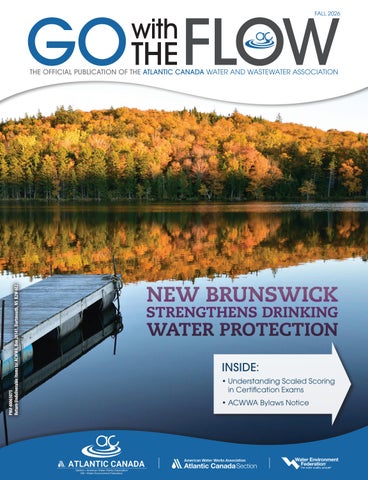
FALL 2026
PM# 40065075 Return Undeliverable Items to: ACWWA, Box 28141, Dartmouth, NS B2W 6E2
THE OFFICIAL PUBLICATION OF THE ATLANTIC CANADA WATER AND WASTEWATER ASSOCIATION
INSIDE: • Understanding Scaled Scoring in Certification Exams • ACWWA Bylaws Notice
Septic Tanks • Water Cisterns Pump Tanks • Holding Tanks Rain Water Harvesting Multi Usage • • • • • •
Multi Layer
Multi Coverage
Inner layer of FDA approved virgin HDPE, two inside layers of PE for improved stability, plus one outer layer of black and UV-stabilized PE Lifetime* corrosion protection and 5 years of labor insurance Strongest & heaviest poly tank on the market No water for backfilling required Low profile 100% watertight
Our multi-layered tank construction, consisting of virgin material surrounded by 3 layers of protection.
*see warranty for details
PREMIER TANK. OUTSTANDING WARRANTY. REMARKABLE SYSTEM.
Roth Global Plastics www.rothmultitank.com
866-943-7256
THE ENGINEERED SOLUTION FOR EFFICIENT POTABLE WATER TANK MIXING The ProFlex™ Style 710TT - A Passive Blending System Valve With a Twist
Stop Stagnation. Start Motion. The Proco Style 710TT - A patented blending system engineered to create a unique spinning motion that delivers a faster, more efficient mix in potable water and wastewater tanks.
Features Benefits 100% Mixing Capability CFD Modeling Available ANSI/NSF-61 Certified Valves standard Zero Maintenance
Contact Proco: www.procoproducts.com sales@procoproducts.com 2431 N. Wigwam Drive, Stockton, CA 95205
Meet Your Local Rep: EEP Technical Solutions 1000 Windmill Rd., Unit #32 Dartmouth, NS B3B 1L7 Ph: (902) 481-0300 Email: inquiry@eep.ca Web: www.eep.ca
Premium Ef ficient Chopper Pump Solution
ENERGIZING EFFICIENCY: Envision More with envie3 Barnes’ patented chopper technology effortlessly slices through tough solids in wastewater. From plastic bottles to baseballs, our pumps handle it all. With an IE3 rated motor and options for submerged or dry pit installations, Sithe Chopper pumps with an envie3 motor are your reliable solution. offer.cranepumps.com/envie3-pumps
Go With the Flow is published four times yearly by the Atlantic Canada Water & Wastewater Association, Box 28141, Dartmouth, NS B2W 6E2. Copyright 2026.
FALL 2026
Atlantic Canada Water & Wastewater Association Box 28141, Dartmouth, NS B2W 6E2 Phone: 902.434.6002 Fax: 902.435.7796 contact@acwwa.ca www.acwwa.ca
Section Office
ACWWA Executive Director Clara Shea contact@acwwa.net 902.434.6002 F: 902.435.7796
Board
Chair Wendy Krkosek, P.Eng. wendyk@halifaxwater.ca 902.483.4432 Past Chair John Lam, P.Eng. john.lam@afnwa.ca 902.830.9646 First Vice-Chair Lindsay Bolton, P.Eng. lbolton@cbcl.ca 506.633.6650 Second Vice-Chair Dave Galbraith dave.galbraith@sansom.ca 902.895.0252 F: 902.893.7584
TABLEofCONTENTS FEATURES
Test Your Knowledge!
15
Understanding Scaled Scoring in Certification Examinations
18
Meet Moroti Adegboyega: Winner of the Stockholm Junior Water Prize
20
New Brunswick Strengthens Drinking Water Protection
21
Port City Water Services Welcomes NBCC Students for Hands-on Water Treatment Training
23
ACWWA Bylaws Notice
25
Secretary-Treasurer Rob Gillis, P.Eng. robg@halifaxwater.ca 902.497.1740 WEF Delegate (2020–2026) Dave Galbraith dave.galbraith@sansom.ca 902.895.0252 F: 902.893.7584 AWWA Director (2026–2029) Jason Phillips, P.Eng. jphillips@stjohns.ca 709.576.8934 www.kelmanonline.com Tel: 866-985-9780 Fax: 866-985-9799 Managing Editor Design/layout Marketing Manager Advertising Co-ordinator
Monique Doyle Dani Goulet Chad Morrison Sabrina Simmonds
DEPARTMENTS Message From the Chair
6
AWWA Director’s Report
8
WEF Delegate’s Report
10
Membership Corner
14
ABEA News
16
Advertiser Product & Service Centre
26
Magazine Chair:
Dawson Mitchell dmitchell@dillon.ca
On the cover: Fall evening on Pickett Lake, New Brunswick. Dreamstime.com
This document is printed on paper certified to the standards of the Forest Stewardship Council® (FSC®).
Fall 2026
|5
MESSAGETHECHAIR from
Wendy Krkosek (Halifax Water)
An honour and a privilege
A
s we move into the fall season, I am reminded of the remarkable dedication and resilience demonstrated by water and wastewater professionals across Atlantic Canada. Throughout the year, our members have continued to deliver essential services while navigating evolving challenges related to infrastructure renewal, growth, climate impacts, regulatory requirements, workforce development, and increasing public expectations and affordability. This issue of Go With the Flow is especially meaningful for me, as it will be my final Chair's Message before I conclude my term as ACWWA Chair at the Annual General Meeting. Serving as Chair has been both an honour and a privilege. I have had the opportunity to work alongside an exceptional Board, dedicated volunteers, committee members, and industry partners whose passion and commitment continue to strengthen our Association and the communities we serve.
6|
| Fall 2026
“We focused on strengthening the long-term sustainability of the organization itself.” Over the past year, ACWWA made significant progress on several strategic priorities. In addition to continuing to deliver high-quality training, networking, and member engagement opportunities, we focused on strengthening the long-term sustainability of the organization itself. Highlights included advancing the development of a governance manual to support Board effectiveness and volunteer succession, reviewing committee terms of reference, and investing in the modernization of our digital platforms. These initiatives will improve membership management, communications, knowledge sharing, and the preservation of institutional knowledge for future generations. One of the greatest strengths of our industry is our willingness to collaborate, learn from one another, and share innovative solutions. ACWWA remains committed to supporting that collaboration through education, professional development, networking opportunities, and advocacy for our sector. I would like to extend my sincere appreciation to our volunteers, committee members, sponsors, presenters, partners, and Executive Director Clara Shea, whose contributions make ACWWA's programs and events possible. Your commitment continues to foster a strong and vibrant water community throughout Atlantic Canada. As I transition from the Chair role, I am pleased to welcome Lindsay Bolton as ACWWA's incoming Chair. Lindsay has been an integral member of our leadership team and a key contributor to many of the initiatives advanced this year. I know she will bring tremendous energy, vision, and dedication to the position, and I look forward to supporting her as ACWWA continues to grow and evolve. Thank you for your ongoing support of ACWWA. It has been a privilege to serve as your Chair and to work alongside so many talented and committed professionals. Together, we have strengthened our Association and positioned it for continued success. I am confident the future of ACWWA is bright, and I look forward to seeing all that the organization will accomplish in the years ahead.
Return to Table of Contents
Simple Solutions for Water
& Wastewater Treatment
CHEM-FEED® SKID SYSTEMS
Fully equipped and fully assembled complete metering systems.
ENHANCED CHEM-FEED® MD1
Enhanced for flawless performance. Sturdier construction, mistake proof check valves and MD1 handles pressure up to 180psi.
FLOW METERS
Simple, accurate and cost effective flow meters.
BABA
COMPLIANT
Fluid Metering Solutions Made Simple
®
Learn about our Skid Systems, MD1 and Flow Meters at www.blue-white.com
Made in the USA
AWWADirector’sReport
Jason Phillips, P.Eng. (City of St. John’s)
Take advantage of member benefits
T
his fall is a good time to talk about the benefits of membership with the American Water Works Association (AWWA). First of all, if you are not currently an AWWA member and are planning to attend the ACWWA conference, you can receive a discounted registration rate by becoming a member. There is only a slight difference between the conference registration discount and the cost of an AWWA membership, and membership provides you with many additional benefits throughout the year. These benefits include subscriptions to two AWWA publications: Journal AWWA, which provides technical articles addressing critical issues affecting the water industry, and OpFlow, which features articles focused on
the operation and maintenance of water systems. I personally enjoy reading OpFlow because the articles are geared toward water system operators and provide practical and helpful information for those of us responsible for maintaining our water systems. Other membership benefits include savings on AWWA events, including ACWWA sessions, as well as discounts at the AWWA Bookstore. The bookstore offers a wide range of resources, including training materials and study guides for water and wastewater operator certification. By becoming a member, you also become part of an association with more than 50,000 members who share a common commitment to the water industry and can provide support, knowledge, and resources to meet your unique needs as a water professional.
As part of AWWA’s strategic plan, several Wildly Important Goals have been established, including a goal to increase membership in the association. The goal for the end of 2026 is to reach 50,600 members. As of July, AWWA has 50,219 members, putting us well on our way to achieving this goal. I encourage anyone who is not currently a member to consider joining AWWA so you can take advantage of the discounted registration rate for the ACWWA Conference and the many other benefits of membership. If you are already an AWWA member, you understand the benefits of being part of this organization, and we thank you for your continued support. We also ask that you be a voice for AWWA by promoting the Association and encouraging your colleagues to become members.
water supply & storage
innovative, sustainable and practical engineering solutions.
water treatment water distribution wastewater collection wastewater treatment stormwater management
exp com 8|
| Fall 2026
Return to Table of Contents
LEADERS IN CORROSION PREVENTION
Petrolatum
Denso Petrolatum is a non-hardening, moisture-resistant wrap used for long-term anticorrosion protection and waterproofing of metal pipes, valves, flanges, and structural steel.
Viscotaq
Viscotaq™ is a visco-elastic coating protecting steel, concrete, PVC, metal, wood, and vinyl from corrosion, in standard, high, and extreme temperature.
Denso North America Inc. | 90 Ironside Crescent Unit 12 | Toronto Ontario M1X 1M3 | 416-291-3435 | sales@densona-ca.com | Densona.com
Return to Table of Contents
Fall 2026 |
|9
WEFDelegate’sReport
Dave Galbraith (Sansom Equipment Ltd.)
From WEF: Strengthening connections between Member Association committees & WEF Communities
D
ear Member Association (MA) leadership: On behalf of the CLC and MA Engagement Work Group, we are reaching out to encourage stronger engagement between Member Association committees and WEF Communities of Practice (WEF Communities). WEF Communities are increasingly serving as primary forums where members collaborate on technical topics, share emerging best practices, and advance thought leadership across the industry. The WEF Communities provide a valuable platform that complements – and can significantly enhance – the work of our MA committees.
With that in mind, we encourage you to consider the following opportunities:
1. Align existing MA committees with WEF Communities Where there is alignment in subject matter, please consider building intentional connections between your MA Committees and the corresponding WEF Communities. This may include: · Identifying MA committee members and leadership to participate in Community activities. Here is a link to WEF Unity: https://community.wef.org · Sharing updates and insights across both groups
·
Coordinating technical content, events, presentations, or publications For your information, based on survey responses and information available on MAs’ websites, a snapshot of existing alignment between MA Committees and WEF Communities is included on page 12. For clarity purposes, MA committees outside of the WEF Communities are not listed.
2. Leverage WEF Communities where MA committees do not yet exist You may find that WEF Communities are active in topic areas where your MA does not currently have a
Community Leadership Council – Organization Structure WEF Communities CLC Steering Committee Chair Vice Chair
Conveyance & Watershed
Leadership Development & Conferences
Collection Systems Community
Stormwater Community
Program Community
Manufacturers and Representatives Community (MARC)
Watershed Management Community
Students & Young Professionals Community
Specialty Conference Advisory Panel (By Invitation)
10 |
| Fall 2026
Initiatives
Environmental, Social and Governance Task Force
Operations & Maintenance Laboratory Practices Community OPS Challenge Community Plant O&M Community
Operator Initiative Advisory Panel (By Invitation)
Outreach
Awards & Recognitions Community
Membership Community
Public Communication & Outreach Community
Resilience
Resource Recovery
Training, Research & Regulation
Treatment Specialties
Intelligent Water Technology Community
Municipal Resource Recovery Design Community
Government Affairs Community
Air Quality & Odor Control Community
Safety, Cyber & Infrastructure Security Community
Residuals & Biosolids Community
Research & Innovation Community
Disinfection & Public Health Community
Water Reuse Community
Emerging Contaminants Community
Industrial Water Community
Small Systems Community
Utility Management Community
Technical Practice & Publication Advisory Panel (By Invitation)
Legend:
-CLC Steering Committee -Communities -Task Force/Accelerator - Advisory Panel
Return to Table of Contents
WEFDelegate’sReport
“Strengthening these connections will help ensure that MAs remain closely aligned with industry initiatives, fully leverage the value of WEF resources, and continue providing meaningful opportunities for member engagement.” standing committee. In these cases, I encourage you to: · Connect interested members directly with the relevant WEF Community via WEF Unity · Use that engagement to assess local interest and momentum · Explore whether establishing a new MA Committee aligned with that topic would be beneficial and leveraging the WEF Community to support start-up
3. Use WEF Communities as a pipeline for engagement and leadership WEF Communities can also serve as a valuable pathway for members – particularly emerging professionals – to build expertise, expand networks, and develop leadership experience that can then be brought back to the MA level. Strengthening these connections will help ensure that MAs remain closely aligned with industry initiatives, fully leverage the value
of WEF resources, and continue providing meaningful opportunities for member engagement. If helpful, we would be glad to assist in identifying relevant WEF Communities or facilitating introductions. Thank you for your continued leadership and commitment to advancing our field. –Scott Aurit, WEF Speaker of the House of Delegates –Ian Fife, WEF Community Leadership Council (CLC) Chair
VISIT US ONLINE www.acwwa.ca
Return to Table of Contents
Fall 2026 |
| 11
WEFDelegate’sReport
x
x
x
Watershed Management
Water Reuse
Utility Management
Students and Young Professionals
Stormwater
Small Systems
Safety, Cyber & Infrastructure Security
Residuals and Biosolids
Research and Innovation (RISE)
Public Communication & Outreach
Program
Plant Operations & Maintenance
Operations Challenge
Municipal Resource Recovery Design
Membership
Manufacturers & Representatives (MARC)
Laboratory Practices
Intelligent Water Technology
Industrial Water
Government Affairs
Environmental, Social and Governance
Emerging Contaminants
Disinfection & Public Health
Culture & Belonging
Collections Systems
Awards & Recognitions
MEMBER ASSOCIATIONS Atlantic Canada Water & Wastewater Association BC Water & Waste Association Reseau Environnement Water Environment Association of Ontario Western Canada Water Environment Association Alabama's Water Environment Association Alaska Water Wastewater Management Association Arkansas Water Environment Association AZ WATER California Water Environment Association New England Water Environment Association Chesapeake Water Environment Association Federal Water Quality Association Florida Water Environment Association Georgia Association of Water Professionals Hawaii Water Environment Association Pacific Northwest Clean Water Association Illinois Water Environment Association Central States Water Environment Association Indiana Water Environment Association Iowa Water Environment Association Kansas Water Environment Association Clean Water Professionals of Kentucky & Tennessee Clean Water Professionals of Louisiana WEA Michigan Water Environment Association Mississippi Water Environment Association Missouri Water Environment Association Montana Water Environment Association Nebraska Water Environment Association Nevada Water Environment Association New Jersey Water Environment Association Rocky Mountain Water Environment Association New York Water Environment Association NC One Water North Dakota Water Environment Association Ohio Water Environment Association Oklahoma Water Environment Association Pacific Northwest Clean Water Association Pennsylvania Water Environment Association Water Environment Association of South Carolina South Dakota Water Environment Association Water Environment Association of Texas Water Environment Association of Utah Virginia Water Environment Association West Virginia Water Environment Association Puerto Rico Water & Environment Association
Air Quality & Odor Control
WEF COMMUNITIES
x
x x x x x x
x
x
x x x x x x x x x x x x x x
x
x
x
x
x
x
x x x x x x x x x x x x x x x x x x
x x x x x x x x
x
x
x
x x x x x
x x x
x x x
x x x x
x x x
x
x
x
x
x
x
x x
x
x x x x x
x x x x
x
x x
x x x
x
x x x x x
x x x x x
x x
x x x x x
x x
x
x
x
x
x x x x x
x
x
x
x
x x x x x x x x
x
x
x x x x
x
x x x x x
x x x x x x x x x
x x
x x x
x
x
x x
x
x
x
x
x
x x x
x x x
x x x x x
x x x
x x x x
x
x x x
x x x x x x x
x x x x x x x
x
x
x
x x x x x
x x x x
x
x
x x
x x
x
x x x
x
x x x
x
x x x x x x x x
x x
x x
x
x x
x
x x x
x
x x x x
x
x
x x x x x x x x x x x
x x
x x x x
x x x
x x x
x x x x x x
x x
x x x x x x x x x x x x x x x x x x x
x
x x x
x x x x x
x x x x x x x x x x x x
x
x x x x x x x x
x
x x
x x x x
x x x
x x
x x
x
x x x x
x
x
x
x
x
x x x x
x x x x x x
x x x
x
x x
x x x x x x x x
x
x
x x x x x
x
x x
x x x
x x x x x x
x
x
x x x
x x
x x x
x x x
x x x x
x x
x x x x x x x x x x x x x x x x x x x x
x
x
x x
x x
x x
x x x x x
x
x
x
x
x x x x x x
x x x x x
x
x x x x
x
x x x
x
x x
x
x
x
x x x
x x
• Inspection of hydrants and valves • Preparation of unidirectional flushing programs and execution • Leak detection • AquaGEOTM hydraulic modeling software • Hazen-Williams Coefficient testing • Flow pressure and fire flow testing
25 Neptune Cres. (Woodside Ind. Park) Dartmouth, NS B2Y 4P9 Tel: (902) 468-9447 Cell: (902) 499-1965 tom@scotiatech.ca www.aquadata.com
12 |
| Fall 2026
• Aqua Zoom camera diagnosis of wastewater systems • Manhole inspections with 360 degree camera • Canalis Wastewater collection software
Return to Table of Contents
MEMBERSHIPCorner
Julie Stokes (ACWWA Membership Director)
Fall membership update A big welcome to our new members! Name
Organization
Martin Croney
West Hants Regional Municipality
Membership AWWA
Luke Evans
Mueller Canada
AWWA
Jordan Matheson
Municipality of the County of Kings
AWWA
Kelsey Green
Halifax Regional Water Commission
AWWA
New Minas Water Commission
AWWA
Cory Palmer
New Minas Water Commission
AWWA
Riley Gray
Dalhousie University
AWWA
Luke Swanwick
Municipality of the County of Kings
AWWA
Chandreshkumar Moradiya
WEF
Craig Trenholm
North Shore Micmac District Council Inc.
WEF
Neil Fougere
Design Point
WEF
Kevin Gray
Design Point
WEF
Greg Kleinheinz
University of Wisconsin-Oshkosh
WEF
Thousands of possibilities, one solution.
As of July 31, 2026 Total AWWA active members: 399 Total active WEF members: 94
TRUSTED. POWERFUL. PRECISE.
Clarifiers
Reliably Operate: Tanks
Pipework
Potable Water Tanks
Screw Conveyors
Water Filters
-
Quarter-turn valves Multi-turn valves Dampers Open/close applications Modulating applications SQ10.2 with AC01.2 controls
Slurry Pumps
Aerators
Shafts
For more information on how Belzona repair composites can be used to repair, protect, and improve water and wastewater equipment, please contact Belzona Atlantic Canada: Brock Hopkins, P.Eng. Technical Services Engineer bhopkins@belzonaatlantic.com 902.789.0479
14 |
| Fall 2026
belzonaatlantic.com
All while offering integral motor controls and compatible interfaces for a variety of plant control systems built for the Canadian Market (CSA Compliant).
infocanada@auma.com www.auma.com
Return to Table of Contents
TESTyour knowledge!
1. The CT concept used in disinfection refers to: A. Chlorine type × temperature B. Concentration of disinfectant × contact time C. Turbidity × detention time D. Dose × alkalinity 2. What is the primary purpose of coagulation in drinking water treatment? A. Kill bacteria B. Remove dissolved minerals C. Aggregate fine particles into larger flocs D. Increase alkalinity
4. Which parameter is most commonly used to evaluate biological activity in an aeration basin? A. Alkalinity B. F:M ratio C. Turbidity D. Conductivity 5. What does a Biochemical Oxygen Demand (BOD) test measure? A. Total suspended solids in water B. Oxygen required to chemically oxidize compounds C. Oxygen consumed by microorganisms over time D. Instantaneous dissolved oxygen concentration
3. What problem is most likely to occur if treated water has a low pH? A. Scaling in pipes B. Excessive hardness C. Corrosion of infrastructure D. Increased turbidity
5 – Answer: C. BOD reflects the amount of oxygen used by microorganisms to degrade organic matter, indicating treatment performance. 4 – Answer: B. The food-to-microorganism (F:M) ratio relates organic loading (BOD) to biomass and is a core control parameter in activated sludge. 3 – Answer: C. Low pH water is more acidic and can corrode metallic pipes and facilities. 2 – Answer: C. Coagulation destabilizes colloidal particles so they can form flocs and be removed in sedimentation/filtration. 1 - Answer: B. CT is defined as disinfectant concentration (mg/L) multiplied by contact time (minutes), a key parameter for pathogen inactivation.
Answers
Our concern for the environment is more than just talk
This publication is printed on Forest Stewardship Council® (FSC®) certified paper with vegetable oil-based inks. Please do your part for the environment by reusing and recycling.
Return to Table of Contents
Fall 2026 |
| 15
ABEANews
WWW.ABEA.BIZ
Education/training opportunities The ACWWA is currently planning the 2026/27 education/training sessions. Course contributions made by ABEA members and their affiliated manufacturers play a significant role in the education program. If you are interested in offering a technical session please notify the ACWWA of this intention by contacting the ACWWA office by email – Peter Larsen, plarsen@acciona.com (Operator Engagement Chair), or ACWWA at contact@acwwa.net.
To help the ACWWA education committee plan its curriculum we ask ABEA members wishing to offer training to please provide the following information to the ACWWA: 1. Contact information. 2. Available course topics. 3. Will your company provide training at no charge to ACWWA or its members and will you pay travelling and other related expenses?
4. In which regions are you able to provide training? NB, NS, PEI, NL (Please be specific – i.e., northern NB, Cape Breton, etc.). 5. Can you provide bilingual training? 6. Will you/your company object to your material being reviewed by the Education Committee prior to training? 7. If applicable, is the course approved by the provincial Department of the Environment
Current ABEA Board: President – Andrew Burgess – Flowstar Past-President – Evan MacCauley – Greatario Vice-President – Adam Harley – EMCO (NB) Senior Director – Noah Brace – EMCO (NL) Junior Director – Matt Stewart – McWane Sec./Treasurer – Kyle Gracie – Iconix (NS) Liaison – Catherine Cameron – Scotia Tech/Aqua Data
Contact information for our members, and applications for our Scholarship and Grant Program can be found at
www.abea.biz 16 |
| Fall 2026
Return to Table of Contents
WWW.ABEA.BIZ
2026/27 ABEA Host Suppliers Atlantic Branch Equipment Association ADS APS AquaStore Canada East Atlantic Waterworks Avensys AWI (Anthratech Western Inc.) Cambridge Brass Cameron Instruments Inc. Campbell's Concrete Canadian Plastics PVF Can-Am Instruments Chemline Continental Carbon CoreAqua Denso NA Denyg Mechanical DLR Piping Ebara HG EEP Ejco Electrosteel USA Endress& Hauser
Engineered Pipe Group Englobe Everest Automation Fernco Connectors Flowstar Galaxy Plastics GF Piping Systems GFL Environmental GIP Technical Solutions Gorman Rupp Greatario H2Flow HACH Hydreau Flo Services Iconix IDEXX Ipex John Brooks K&D Pratt Kamstrup Kemtag KTI
Wetland Treatment Solutions Wetland Treatment Solutions Treating Wastewater Naturally
Landmark Structures Les Compteurs Mabarex Inc. Magnor Maritime Infrastructure Maynard Reece McLennan/Emco McWane Metercor Mueller Neptune Netzsch Nexom Inc. Nulantic Omnitech P&E Mfg Pique Supply Corp. Pro-Line Fittings Prominent Reed Mfg Sansom Saunders Equipment
Scotia Tech/Aqua Data SFC Energy ShadComm SIGMA Corp Soleno Spartan Fire Hydrants Star Pipe Products Sulzer TCI Carbon Fibre Trojan Technologies Univar Veolia Veronics Victaulic VT Scada Waterloo Biofilter Westlake Pipe & Fittings Wolseley Xylem
Save Money, Make Money & Meet Your Carbon Reduction Goals
Treating Wastewater Naturally With WTS Engineered Wetlands & Carbon Offsets • Natural Green Infrastructure Centralized Big Projects and Small Decentralized Projects you pump sludge or have sludge tanks we can use our wetland sludge cells to treat • IfSustainable Sewage Treatment Centralized Big Projects and Small Decentralized Projects sludgeWinning in your town reducing pumper costs dramatically - 60—80% reductions. • Award Carbon Offset Generating Systems • Over $100,000 Transferred Back to Towns Proven award winning green technology.
Stephenville Municipal Wetland
Providing natural solutions without chemicals , moving parts or electricity.
Much lower operational costs
Marystown Decentralized Wetland than conventional mechanical
Sludge Cells, Stephenville
Marystown systems.Decentralized Wetland Marystown 35 Decentralized Home System Wetland
Sludge Cells, Stephenville
Engineered Wetlands for Towns of Any Size
Sltephenville Municipal Wetland Sltephenville Municipal Wetland Full town system - 7800 P.E.
• Proven green wastewater treatment solutions 35 Home System • Much lower operational costs than mechanical Now Generating Carbon Offsets and Handing Cheques Back to Towns systems Act now! Now Generating Carbon Offsets and Handing Cheques Back to Towns • Earn revenue through carbon offsets Full town system - 7800 P.E.
Return to Table of Contents
Visit our WTS/Sharp Management booth to learn more.
Large, or small, WTS has a lower cost green Start aWTS feasibility or preliminary solution wastewater forgreen your engineering study and let us show you what we Large, orfor small, hastreatment a lower cost town. solution for wastewater treatment for yourcan do for your town. town. lower operational costs than traditional Much
www.wetlandtreatment.ca
www.sharpmgmt.ca
mechanical Much lowersystems. operational costs than traditional mechanical systems. Generate carbon offsets and earn thousands of
709-793-7111 Fall 2026 |
| 17
Understanding scaled scoring in certification examinations Author: Water Professionals International (WPI) Communications and PSI
Ultimately, scaled scoring is a fundamental best practice in certification testing, promoting fairness, consistency, and clarity in score reporting.
I
n the world of certification exams, ensuring fairness, defensibility, and consistency is vital. One effective method to achieve this is through scaled scoring, which transforms raw test scores into a standardized scale, facilitating equitable comparisons across different test forms and administrations. This is why, in 2025, Water Professionals International (WPI) released new standardized examinations in the Core Four disciplines (water treatment, wastewater treatment, water distribution, wastewater collection) that used a scaled scoring method. WPI (formerly ABC) is an international organization based in the United States and the central water industry authority that ensures these operators are prepared to meet the standards that their communities can
18 |
| Fall 2026
trust in through our testing and certification services. WPI membership spans 49 U.S. states/territories, 12 Canadian provinces/territories, many Canadian First Nations and U.S. tribal entities, as well as many Eastern European, Caribbean, and Middle Eastern countries/territories. WPI’s examinations are used broadly, including by the Atlantic Canadian provincial operator certification programs. Thus, it is important that there is an understanding of the scoring methods and changes adopted by WPI’s exams. To understand scaled scoring, it is important to have basic knowledge of raw scores. A raw score represents the total number of test items a candidate answers correctly. For example, in a 100-item test, if a candidate answers 70 questions correctly, their raw score is 70. Traditionally, a specific raw
score, such as 70, might be set as the passing threshold. The challenge with raw scores is that when multiple forms of a test exist, even with efforts to maintain equivalent difficulty levels, slight variations are inevitable. Consequently, different forms might require different raw cut scores to account for these variations. For instance, Form A might have a cut score of 70, while the slightly easier Form B might have a cut score of 71. This discrepancy can lead to confusion among candidates, especially if two individuals achieve the same raw score on different forms but receive different pass/fail outcomes. Additionally, for organizations offering multiple credentials with tests of varying lengths (e.g., 80, 100, or 150 items), reporting raw scores can result in multiple score scales and cut scores, further complicating
Return to Table of Contents
score interpretation for candidates and stakeholders. While knowing the number of questions answered correctly through a raw score can be helpful, especially for understanding performance in different content areas, raw scores do not account for small differences in difficulty between exam forms. Scaled scores do. A statistical conversion is used so that the passing score reflects the same level of performance, even if one version of the exam is a little easier or harder than another. Scaled scores adjust for those small differences so that the passing standard stays the same from one exam administration to the next. A good way to think about this is your driving test. The examiner isn't counting what percentage of your turns were perfect. They're answering one question: is this person safe to put on the road? Now picture two people taking that test on different routes, and one route has trickier intersections. You wouldn't hold that person to a higher bar just because they drew the harder route, so you adjust for it, and passing means the same thing either way. Scaled scores indicate the same level of performance, regardless of which exam form a test taker has received. As WPI develops several versions of each exam, it was important to adopt a scoring method that compares an examinee’s score with the exam's difficulty level. This way, WPI can assess the examinee's ability rather than the difficulty of the specific test. To establish scaled scores, testing programs often employ standard-setting methods, such as the Angoff Method. This approach involves Subject Matter Experts (SMEs) evaluating each test item to determine the percentage of minimally competent practitioners who would answer it correctly. These evaluations inform the determination of the cut score – the minimum score required to pass the exam. After the cut score is established, equating is used to account for small differences in difficulty across exam forms. This statistical process helps ensure that the same passing standard is applied consistently, even
Return to Table of Contents
when one form is slightly easier or harder than another. Equating is a statistical procedure that adjusts the cut score to reflect differences in form difficulty, thus maintaining an equivalent passing standard. Equating ensures that: 1. Test takers who take an easier form are not given an unfair advantage, and 2. Test takers who take a more difficult form are not penalized. The shift to scaled scoring offers several benefits. First, it simplifies score interpretation by using a consistent scale and cut score across exam forms, making results easier for candidates and stakeholders to understand. Further, it promotes fairness by accounting for minor variations in test form difficulty, so candidates are held to the same standard regardless of the specific form they receive. For organizations that offer multiple
credentials or exams of different lengths, scaled scoring can reduce confusion by providing a unified way to report and interpret scores. Ultimately, scaled scoring is a fundamental best practice in certification testing, promoting fairness, consistency, and clarity in score reporting. By converting raw scores to a standardized scale, testing programs can ensure that all candidates are evaluated equitably, regardless of the specific test form or credentialing exam they undertake. This approach not only simplifies score interpretation but also upholds the integrity of the certification process. If you are interested in learning more about WPI, scaled scoring, and their testing and certification services, you can contact the team at wpi@gowpi.org and through WPI’s website: gowpi.org.
This article was contributed by the ACWWA Government Affairs Committee. For questions about the content or suggestions for future articles, please contact the Committee Chair via the ACWWA website.
■ Inspect and maintain ■ CL-625 load capacity ■ Outstanding strength &
structural stability ■ Design life of 50-60 years ■ Easy and fast installation
www.ACOStormBrixx.ca (877) 226-4255 • info@acocan.ca
Stormwater detention ACO StormBrixx and infiltration tanks
Fall 2026 |
| 19
Meet Moroti Adegboyega:
Winner of the Stockholm Junior Water Prize
Photo credit: Jonas Borg/Stockholm Water Foundation.
M
oroti Adegboyega, from St. John’s, recently represented Canada and won the 2026 Stockholm Junior Water Prize, one of the world’s leading competitions recognizing young people developing innovative solutions to water and environmental challenges. Moroti’s project, Ecoferroquatics: Novel Autonomous Plastic Cleanup Platform Integrating AI, Robotics and a Biocompatibility-Oriented Magnetic Suspension, brings together artificial intelligence, robotics and magnetic materials to explore a different way of removing plastic pollution from aquatic environments. The idea began when Moroti learned about research using ferrofluid – a liquid containing magnetic nanoparticles – to attract plastic particles in water. He was fascinated by the science but immediately began wondering whether the concept could be applied differently. Rather than treating small samples of water, he began thinking about how the technology could become autonomous. The result was Ecoferroquatics. The system uses an onboard camera and artificial intelligence to identify plastic in the water and determine how the robot should reach it. Plastic then comes into contact with a collection drum coated with magnetic nanoparticles before being moved into a collection area. When he began, his strongest background was in software and coding. He had significantly less experience in robotics, physics, water science or environmental engineering. That did not stop him. Instead, Ecoferroquatics became an iterative process of designing, testing, learning and redesigning. Now, he has had the opportunity to represent Canada internationally through water science. He travelled to Stockholm, Sweden as part of the competition, which included projects from 37 different countries. During the Stockholm Junior Water Prize judging process, Moroti presented his project to members of the International Jury, a seven-member panel representing a range of technical backgrounds. As the 2026 winner, Moroti received his award from the HRH Crown Princess Victoria of Sweden at the award ceremony on August 25.
20 |
| Fall 2026
Return to Table of Contents
New Brunswick strengthens drinking water protection
T
he Government of New Brunswick (GNB) has recently introduced important updates to strengthen the safety and reliability of regulated drinking water across the province. This initiative has aligned the province’s drinking water program requirements with Health Canada's Guidelines for Canadian Drinking Water Quality, reinforcing the multi-barrier approach to protecting public health and supporting the long-term sustainability of New Brunswick’s drinking water systems.
Updated drinking water quality guidelines The New Brunswick Drinking Water Quality Guidelines (www2.gnb.ca/ content/dam/gnb/Departments/h-s/ pdf/en/HealthyEnvironments/ DrinkingWaterGuidelines.pdf ) have been revised to reflect recent updates made by Health Canada. The revised guidelines introduce new drinking water parameters and update the Maximum Acceptable Concentrations (MACs) and Aesthetic Objectives (AOs) for several existing parameters.
Return to Table of Contents
To support these updates and expand our understanding of drinking water quality, a provincewide baseline sampling project was undertaken in 2025–26. Working in collaboration with the Research and Productivity Council (RPC) and local governments, GNB collected data on a broad range of previously unmonitored parameters. The results are being used to establish baseline water quality conditions throughout the province and to support evidencebased decision-making. New treatment and disinfection policy The new Drinking Water Treatment and Disinfection Policy (www2.gnb.ca/ content/dam/gnb/Departments/env/pdf/ Water-Eau/drinking-water-treatment-anddisinfection-policy-january-2026.pdf ) establishes clear treatment and disinfection expectations for drinking water systems based on Health Canada's guidance. The policy emphasizes the importance of effective treatment, disinfection practices, and ongoing monitoring to reduce the risk of waterborne
diseases and ensure safe drinking water is delivered to consumers. Further, to ensure treatment requirements are appropriate for the level of risk associated with each water supply, regulated groundwater system owners must assess whether their wells are under the influence of surface water through New Brunswick’s updated Groundwater Under the Direct Influence of Surface Water (GUDI) Protocol (www2.gnb.ca/ content/dam/gnb/Departments/env/pdf/ Water-Eau/gudi-protocol-january-2026.pdf). Since 2020, owners of local government groundwater systems completed Step 1 (Screening) through funding support from the Environmental Trust Fund. Supporting water system owners Recognizing that implementing new requirements takes time, New Brunswick has adopted a phased approach to the implementation of these new requirements. This allows water system owners to plan for future monitoring, treatment, and operational changes while continuing to provide safe drinking water to their communities.
Fall 2026 |
| 21
The Department of Environment and Local Government (DELG) is updating sampling plans and Approvals to Operate to reflect the new requirements. These updates identify revised monitoring requirements, sampling frequencies, and locations, as well as establishes compliance timelines for meeting new requirements. Regulated water system owners and operators are encouraged to review their updated Approvals to Operate and sampling plans as they are issued and use the identified timelines to support planning, budgeting, and operational improvements. Greater transparency As part of the goals established in GNB’s A Water Strategy for New Brunswick, the new Drinking Water Quality Data Portal (www.gnb.ca/ en/topic/environment-resources/water/
drinking-water-portal.html) was launched to provide the public with online access to drinking water quality results from 68 local government operated systems. By making monitoring data more accessible, the portal enhances transparency, strengthens public confidence, and gives resident New Brunswickers greater insight into the quality of their drinking water. Looking ahead The modernization of New Brunswick’s drinking water program will continue in the coming years. As part of this ongoing work, the province is advancing updates to the Clean Water Act to strengthen protections for water quality, update regulatory frameworks, and improve transparency and access to information. Following engagement in Fall 2025, GNB collected responses from
more than 500 New Brunswickers regarding their concerns for local air and water quality. All feedback has been summarized in the What We Heard Report (www.gnb.ca/content/ dam/GNB3/gov/consult/docs/elg-cleanwater-act-report-july2026-en.pdf ) and will be used to guide program development moving forward. Engagement with First Nations, the public, and stakeholders will continue throughout 2026–2027 to inform the development of proposed legislation and regulatory changes. Through collaboration with local governments, system owners, operators, laboratories, consultants, and industry partners, New Brunswick continues to build a drinking water program that is responsive to emerging challenges, informed by science, and focused on protecting public health. www.gnb.ca/water
This article was contributed by the ACWWA Government Affairs Committee. For questions about the content or suggestions for future articles, please contact the Committee Chair via the ACWWA website.
BUILDING RESILIENT INFRASTRUCTURE FOR TOMORROW A COMPLETE WATER MANAGEMENT PARTNER.
INFRASTRUCTURE INVESTMENT DEFICIT
CLIMAT-RESILIENT INFRASTRUCTURE
AGING STORMWATER INFRASTRUCTURE
Build Smarter Install Faster Maximize Every Dollar Invested
Manage More Water Reduce Peak Flows Build Resilience
Replace Reline Extend Infrastructure Life
Scan for more information on Soleno’s stormwater solutions.
22 |
| Fall 2026
1.888.477.6075 | SOLENO.COM
Return to Table of Contents
Port City Water Services welcomes NBCC students for hands-on water treatment training
P
ort City Water Services (PCWS), recently welcomed students from the New Brunswick Community College (NBCC) to the Saint John Water Treatment Plant for a unique learning experience that combined facility tours with real-world lab testing. The visit was organized for approximately 20 students enrolled in NBCC’s Process Controls Technicians program, part of the college’s broader water treatment and chemical training curriculum. Throughout the day, students had the opportunity to explore the inner workings of a live operating water treatment facility while learning directly from certified PCWS operations staff. “This is exactly the kind of experience that helps bridge classroom learning with real-world application,” said Peter Larsen, Project Manager, PCWS. “Giving students access to operational staff and a working treatment plant helps build the next generation of water professionals.”
From classroom theory to real plant operations As part of the visit, students participated in an on-site educational lab focused on coagulation and flocculation, where they conducted
their own jar tests in teams. The students then compared the optical results of their jar tests, reviewing analytical measurements including colour and turbidity, to determine the best overall chemical dosing and treatment performance. For many, it was their first opportunity to carry out hands-on testing in a fullscale treatment environment. “Being able to run jar tests in a working plant setting is amazing,” added Larsen. “It takes the theory they’ve learned and puts it into a real operational context.” A full tour of the treatment process The tour of the Saint John Water Treatment Plant included an overview of: • Source water characteristics and why treatment is required • Treatment chemicals used on site and where they are applied • The facility’s Dissolved Air Flotation (DAF) process • Chlorination and corrosion control methods • Operational monitoring through SCADA and PLC networks
• Cyber security considerations tied to modern plant controls Students also participated in discussions around how technology and automation support safe, reliable water treatment operations. “Our plant is a great example of how advanced water treatment has become,” said Larsen. “It’s not only about chemistry and filtration – it’s also about digital controls, systems integration, and cyber resilience.” Supporting the next generation of operators PCWS regularly partners with local educational institutions to support workforce development and strengthen community connections. Past plant tours have been highly successful, and PCWS noted that adding a hands-on lab component this year elevated the experience even further. “This type of collaboration is a win-win,” said Larsen. “Students gain valuable practical experience, and we help strengthen the talent pipeline for the water sector here in New Brunswick.”
CANADA
Return to Table of Contents
USA
Fall 2026 |
| 23
Trusted
Easier Than Ever Exceptional service | Reliable, competitive lead times | Same higher-copper brass
fordmeterbox.com | FMB.tv | 260.563.3171
24 |
| Fall 2026
Return to Table of Contents
BYLAWS NOTICE Dear ACWWA and/or ACSAWWA Member, As part of our efforts to continually improve our Association/Section/MA and ensure our strategic partnerships with American Water Works Association and the Water Environment Federation remain strong and aligned, our ACWWA and ACSAWWA Bylaws have been updated and will be presented for approval at the next Annual General Meeting in Moncton on October 5, 2026. The updated bylaws are linked below for your review. Atlantic Canada Water and Wastewater Association (ACWWA) and Atlantic Canada Section of the American Water Works Association (ACSAWWA) NOTICE OF ANNUAL GENERAL MEETING OF MEMBERS NOTICE IS HEREBY GIVEN that the Annual General Meeting of the Members of Atlantic Canada Water and Wastewater Association (the “Society”) and Atlantic Canada Section of the American Water Works Association (the “Society”) has been called by the Directors to be held at the Delta Beausejour in Moncton on October 5, 2026, at the hour of 12:00 pm (Atlantic Time) for the following purposes: 1. To approve revised Bylaws of the Society; 2. To approve a Special Resolution to be filed with the Registrar of Joint Stock Companies; and 3. To transact such further and other business as may properly come before the meeting or any adjournment thereof. Members can find a copy of the revised Bylaws by going to: www.acwwa.ca/about-us/bylaws.html Members may attend in person.
DATED at Dartmouth, Nova Scotia, this 3rd day of September 2026. Clara Shea, Executive Director { 902-434-6002 | contact@acwwa.net
• Meter Sales, Testing & Repairs • Meter Installation & Reading • Hydrant Repairs & Parts 25 Neptune Cres. (Woodside Ind. Park) Dartmouth, NS B2Y 4P9 Office: 902.468.2777 eric@scotiatech.ca office@scotiatech.ca
Return to Table of Contents
• Training Courses www.bishopwater.ca
Fall 2026 |
| 25
ADVERTISER PRODUCT&SERVICECENTRE
Go With The Flow is made possible by the companies below who convey their important messages on our pages. We thank them for their support of ACWWA and its publication and encourage you to contact them when making your purchasing decisions. To make it easier to contact these companies, we have included the page number of their advertisement, their phone number, and, where applicable, their website. You can also go to the electronic version of Go With The Flow at www.acwwa.ca and access direct links to any of these companies. Page
Phone
ACO Systems, Ltd.
Company
19
877-226-4255
www.acocan.ca
Website
Aqua Data Atlantic
12
902-468-9447
www.aquadata.com
Atlantic Backflow Specialists Ltd.
25
902-499-7745
www.atlanticbackflow.com
Atlantic Purification Systems Ltd.
28
902-469-2806
www.aps.ns.ca
Atlantic Waterworks Ltd.
9
902-809-2685
www.atlanticwaterworks.ca
AUMA Canada, Inc.
14
705-721-8246
www.auma.com
Belzona Atlantic Canada
14
902-789-0479
www.belzonaatlantic.com
Blue-White Industries, Ltd.
7
714-893-8529
www.blue-white.com
Campbell's Concrete Ltd.
27
902-368-3442
www.campbellsconcretepei.com
Can-Am Instruments
20
905-829-0030
www.can-am.net
CBCL Limited
11
902-421-7241
www.cbcl.ca
Concord Supply
24
877-436-3800
www.concordsupply.ca
Crane Pumps & Systems
4
905-457-6223
www.cranepumps.com
CTS Canada
23
800-387-0067
www.ctsgroupna.com
DomCast Municipal Castings Inc.
9
519-972-3901
www.domcastmetals.com
EEP Technical Solutions
3
902-481-0300
www.eep.ca
EXP Services Inc.
8
506-452-9000
www.exp.com
Ford Meter Box Company
24
260-563-3171
www.fordmeterbox.com
GEMTEC Consulting Engineers and Scientists Limited
16
877-243-6832
www.gemtec.ca
Greatario Engineered Storage Systems
24
519-469-8169
www.greatario.com
H2Flow Tanks & Systems Inc.
13
888-575-8642
www.h2flowtanks.com
Halifax Water
12
902-490-4840
www.halifaxwater.ca
Huntley’s Diving and Marine
24
902-678-7234
www.huntleyssubaqua.ca
McLennan Sales, Division of EMCO Corporation
6
506-634-3112
www.mclennansales.com
Roth Global Plastics
2
866-943-7256
www.rothmultitank.com
Scotia Tech Fluid Services Ltd.
25
902-468-2777
Sharp Management Inc.
17
709-330-7878
www.sharpmgmt.ca
Soleno
22
450-347-7855
www.soleno.com
To reach Atlantic Canada’s water industry professionals through Go With The Flow magazine and its targeted readership, contact Chad at your earliest convenience to discuss your company’s promotional plans. Chad Morrison, Marketing Manager 866-985-9788 | chad@kelman.ca
26 |
| Fall 2026
Return to Table of Contents
CAMPBELL’S CONCRETE LTD.
Campbell’s Concrete Ltd. believes their success rests on these three pillars – Customer Satisfaction, Employee Well Being and Partnership With Suppliers. Specializing in Municipal & Industrial Waterworks, our divisions include: • Precast • Waterworks Supply & Construction Products • Concrete Repairs
PROUD MEMBERS OF
Toll Free: 1-800-361-3442 Phone: 902-368-3442 Fax: 902-894-5581
Email: info@campbellsconcretepei.com www.campbellsconcretepei.com
420 Mount Edward Road Charlottetown, PE C1E 2A1
HEAVY DUTY PUMPS
Minimum maintenance; Maximum performance Flow rates up to 108,000 L/hr at 16bar No seals or valves to wear, clog or leak Transfer abrasive fluids with up to 80% solids Fluid Technology Solutions
wmfts.com
Choose better technology Accurate, versatile chemical pumps
Flow rates from 0.1 to 2000ml/min at 7bar Simple drop-in installation eliminates ancillary equipment
Solenoid
One minute tool-free maintenance PC pump
Fluid Technology Solutions
wmfts.com
APS proudly represents the following manufacturers in Atlantic Canada
Serving Atlantic Canada since 1970 695 Malenfant Blvd.
eppe, New Brunswick E1A 5T8
Dieppe, New Brunswick 695 Malenfant Blvd. 506-857-2880 Toll Free: 888-863-7867
sales@aps.ns.ca www.aps.ns.ca
Dartmouth, Nova Scotia 10 Ferguson Road 902-469-2806 Toll Free: 800-265-2300