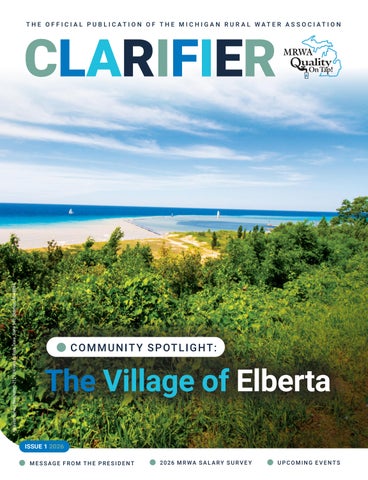
Clarifier Issue 1 2026

Page 1


CL ARIFIER

MICHIGAN RURAL

WATER ASSOCIATION

2127 University Park Drive, Suite 340

Okemos, MI 48864

P: 517-657-2601 www.mrwa.net

PRESIDENT

Todd Hackenberg, Village of Lawton

VICE PRESIDENT

Randy Seida, Lansing Charter Township

SECRETARY/ TREASURER

Michelle Thibideau, Village of Centreville

DIRECTORS

Tom Anthony, Village of Mattawan

Ron Bogart, City of Leslie

Darin Dood, Village of Lakeview

Andrea Schroeder, City of Davison

ASSOCIATE DIRECTORS

Bob Masters, Peerless-Midwest, Inc.

Dale Stewart, Northern Pump and Well Company

NATIONAL DIRECTOR

Chris Kenyon, City of lonia

MRWA A DMINISTRATIVE STAFF

Tim Neumann, Executive Director

Mike Engels, Director of Training/ Assistant Director

Melisa Lincoln, Membership & Marketing Director

Jennifer Lewis, Finance Director

PUBLISHED FOR MRWA

P: 866.985.9780 info@kelman.ca www.kelmanonline.com

MANAGING EDITOR Lauren Drew

DESIGN/ LAYOUT Tabitha Robin

MARKETING MANAGER Al Whalen

ADVERTISING COORDINATOR

Sabrina Simmonds

M R WA BOARD OF DIRECTORS

PRESIDENT EXECUTIVE COMMITTEE

CHAIR/STANDING MEMBER ON ALL COMMITTEES

Todd Hackenberg, Village of Lawton

125 S Main Street

Lawton, MI 49065

Phone: 269-624-6406

Phone: 269-624-6401 hackenbergt@lawtonmi.gov

VICE PRESIDENT

Randy Seida, Lansing Charter Township

3209 W Michigan Avenue Lansing, MI 48917

Phone: 517-485-5476

Phone: 517-819-8720

seidar@westsidewater.com

SECRETARY/TREASURER

Michelle Thibideau

Village of Centreville 221 Main Street Centreville, MI 49032

Phone: 269-467-6409

Phone: 269-506-6800 mthibideaucentreville@gmail.com

DIRECTOR/PAST PRESIDENT

Tom Anthony, Village of Mattawan

24221 Front Avenue

Mattawan, MI 49071

Phone: 269-668-2300

Phone: 269-217-4921 tom@mattawanmi.com

DIRECTOR

Ron Bogart, City of Leslie 602 W Bellevue Street PO Box 496

Leslie, MI 49251

Phone: 517-589-8236

Phone: 517-257-3094

manager@cityofleslie.org

DIRECTOR

Darin Dood, Village of Lakeview

208 S Lincon Street

Lakeview, MI 48850

Phone: 989-352-6322

Phone: 989-289-3110

manager@villageoflakeview.org

DIRECTOR

Andrea Schroeder, City of Davison

200 E Flint Street, Suite 2 Davison, MI 48423

Phone: 810-653-2191

Phone: 810-845-1682

aschroeder@cityofdavison.org

NATIONAL DIRECTOR

Chris Kenyon, City of Ionia DPU 720 Wells Street Ionia, MI 48846

Phone: 616-523-0165

Phone: 616-813-1263

ckenyon@ci.ionia.mi.us

ASSOCIATE DIRECTOR

Bob Masters, Peerless-Midwest, Inc.

505 Apple Tree Drive Ionia, MI 48846

Phone: 616-527-0050

Phone: 616-690-8139

bob.masters@peerlessmidwest.com

ASSOCIATE DIRECTOR

Dale Stewart, Northern Pump & Well 6837 W Grand River Avenue Lansing, MI 48906

Phone: 517-322-0219

Phone: 517-242-8949

dstewart@northernpumppwco.com

EXECUTIVE DIRECTOR

Tim Neumann

Michigan Rural Water Association 2127 University Park Drive, Suite 340 Okemos MI 48864

Phone: 616-401-5436

tneumann@mrwa.net

Advocating for Rural Water in Washington, D.C.

During the first week of February, representatives from Michigan Rural Water Association traveled to Washington, D.C. to stand alongside the National Rural Water Association in support of the initiatives that protect and strengthen rural water and wastewater systems across the country.

This trip was an important opportunity to meet directly with federal lawmakers and agency representatives to share the real-world challenges faced by small and rural utilities. From aging infrastructure and regulatory compliance to workforce shortages and affordability concerns,

these conversations help ensure that rural systems remain part of the national discussion when policy and funding decisions are made.

Advocacy at the federal level is critical to the long-term sustainability of rural systems. Your membership, engagement, and support make it possible for MRWA to represent you – not just in Lansing, but in Washington as well. Together, we can continue to protect the future of rural water.

And as always please join us March 17 to the 20 for our Annual Conference at Soaring Eagle Resort in Mt. Pleasant Michigan.

www.mrwa.net

M R WA STAFF

MRWA OFFICE

2127 University Park Drive

Suite 340

Okemos, MI 48864

Phone: 517-657-2601 www.mrwa.net

EXECUTIVE DIRECTOR

Tim Neumann

Phone: 616-401-5436 tneumann@mrwa.net

DIRECTOR OF TRAINING/ ASSISTANT DIRECTOR

Mike Engels Phone: 231-878-3285 mengels@mrwa.net

FINANCE DIRECTOR

Jennifer Lewis

Phone: 517-657-2601 finance@mrwa.net

MEMBERSHIP/ MARKETING DIRECTOR

Melisa Lincoln Phone: 517-657-2601 membersvcs@mrwa.net

COMMUNITY WATER AND WASTEWATER SPECIALIST

Kyle Bond Phone: 989-745-4405 kbond@mrwa.net

WATER CIRCUIT RIDER

John Monsees Phone: 989-529-1342 jmonsees@mrwa.net

WATER CIRCUIT RIDER

Jonathan Edwards Phone: 231-429-3289 jedwards@mrwa.net

WATER CIRCUIT RIDER

Troy Weiss Phone: 989-621-1057 tweiss@mrwa.net

WATER QUALITY ACTION SPECIALIST

John Holland Phone: 989-506-0439 jholland@mrwa.net

MEMBERSHIP/ MARKETING ASSISTANT

Cheri Laverty

Phone: 517-657-2601 training@mrwa.net

EPA TRAINING SPECIALIST

Joe VanDommelen Phone: 517-525-4553 jvandomnmnelen@ mrwa.net

SOURCE WATER PROTECTION SPECIALIST

Kelly Hon Phone: 989-621-2361 khon@mrwa.net

WASTEWATER TECHNICIAN

Matt Lumbert Phone: 269-908-3792

mlumbert@mrwa.net

WASTEWATER TECHNICIAN

Amanda White Phone: 616-633-4070 awhite@mrwa.net

ENERGY EFFICIENCY TECHNICIAN

Ginger Van Conet Phone: 517-444-1321 ggrant@mrwa.net

APPRENTICESHIP COORDINATOR

Rob Splane Phone: 586-596-0005 rsplane@mrwa.net

MESSAGE FROM THE EXECUTIVE DIRECTOR

Securing Michigan’s Water Future Through Apprenticeship

Clean water doesn’t happen by accident.

Behind every glass of safe drinking water and every properly treated gallon of wastewater is a skilled professional who understands complex systems, regulations, and the responsibility of protecting public health. But across Michigan – and the nation – that workforce is changing. Experienced operators are retiring, systems are becoming more technical, and rural communities are feeling the pressure to attract and retain qualified staff.

To meet this challenge head-on, the Michigan Rural Water Association (MRWA), in partnership with the National Rural Water Association (NRWA), has embraced Registered Apprenticeship as a long-term workforce solution

While the program is just getting underway, MRWA has begun laying the groundwork – developing structure, building partnerships, and preparing to educate communities about this workforce opportunity. The goal is to have the program fully operational by August 2026.

A PRACTICAL PATHWAY INTO ESSENTIAL CAREERS

Registered Apprenticeship offers a structured, proven model for developing Water and Wastewater System Operations Specialists. Rather than relying solely on classroom instruction or informal on-the-job training, apprentices participate in a carefully designed program that blends hands-on experience with related technical instruction

For many people, water careers are not something they discover in high school career fairs. Yet these roles offer stability, meaningful work, and long-term growth. Apprenticeship creates a direct, accessible pathway into the industry – allowing individuals to earn while they learn.

For small and rural systems in particular, apprenticeship offers a

sustainable strategy for succession planning. Instead of reacting to retirements, utilities can proactively grow their own workforce.

BUILDING AWARENESS

ACROSS MICHIGAN

Because the program is in its early stages, much of MRWA’s current focus is on outreach and education. Over the coming months, MRWA will be actively promoting the apprenticeship model to utilities, local officials, workforce agencies, veterans’ organizations, and community groups across the state.

The effort is not simply about recruitment – it is about awareness. Many communities are unfamiliar with Registered Apprenticeship as a workforce development tool. MRWA aims to help employers understand how the model works, how wage progression and training requirements are structured, and how apprenticeship can strengthen long-term workforce planning

At the same time, the program will introduce potential apprentices to a career field that offers both purpose and stability. Youth outreach initiatives and partnerships with workforce development boards will play a key role in building a strong future talent pipeline

alignment with NRWA standards, grant deliverables, and Department of Labor requirements

Participating employers will provide structured on-the-job training, while apprentices complete required related technical instruction. Progress – including training hours, mentor evaluations, and wage advancement – will be tracked through the NRWA Apprenticeship Tracking System. This structured approach ensures accountability and consistency statewide.

INVESTING IN THE LONG TERM

The launch of MRWA’s Registered Apprenticeship Program represents more than a new initiative – it signals a long-term investment in Michigan’s water infrastructure and the communities it serves.

By targeting August 2026 for full implementation, MRWA is taking deliberate steps to build a strong foundation. Outreach today will lead to trained operators tomorrow. Employers will gain a reliable pathway for workforce development. Apprentices will gain meaningful careers. And communities will benefit from stable, well-trained professionals who safeguard public health every day.

RATHER THAN RELYING SOLELY ON CLASSROOM INSTRUCTION OR INFORMAL ON-THE-JOB TRAINING, APPRENTICES PARTICIPATE IN A CAREFULLY DESIGNED PROGRAM THAT BLENDS HANDS-ON EXPERIENCE WITH RELATED TECHNICAL INSTRUCTION.

STRUCTURE, ACCOUNTABILITY, AND QUALITY

A successful apprenticeship program requires coordination and oversight. MRWA’s Apprenticeship Training Coordinator will manage the day-to-day operations of the program, ensuring

Water may flow quietly beneath our streets, but the workforce behind it is essential. Through Registered Apprenticeship, MRWA is preparing for the future – ensuring that Michigan’s water systems remain safe, resilient, and in capable hands for generations to come.

Please have each employee in the DPW complete their own Survey.

Ways to complete this survey:

https://www.surveymonkey.com/r/2026mrwasalarysurvey

Scan this QR Code

The Purpose

OR Complete the survey and email it to Melisa at membersvcs@mrwa.net.

If you have any questions, please contact Melisa Lincoln, Membership Director at 517-657-2601

Thank you for your help with this project.

To give community members an accurate picture on wages and benefits are by system size, location, etc.

If you do any of the following things, it means your survey will be invalid without being recorded and will not help you or any other community.

1. Leave your name and employer blank.

2. Use one survey for multiple people (we have no way of separating these and need as many individual responses as possible to get results that will be useful to you.

3. Leave questions unanswered.

Any paper or emailed surveys received will be destroyed once the answers are entered into the database. Be assured that the data collected will be handled with the required level of confidentiality and all data will be aggregated before reporting. All information gathered as part of this study to be treated as confidential. No information provided will be attributed to an individual or organization. Your participation in this study is voluntary.

BRIDGING THE GAP

INNOVATIVE TOOLS FOR SUSTAINABLE INFRASTRUCTURE FINANCING

Financing infrastructure projects is essential to the economic and social vitality of communities across the United States, particularly in rural areas. Quality infrastructure – such as water and sewer systems, roads, bridges, schools, and fire stations – forms the backbone of local communities. In rural America, where populations are more dispersed and private investment is often limited, public financing tools like municipal bonds and innovative financing programs play a crucial role in bridging the funding gap. These investments not only improve day-to-day life for residents but also make rural regions more attractive for businesses, helping to retain local jobs and spur new economic opportunities.

Bridging this gap necessitates strategic financial investments, and that’s where the significance of financing tools like the Rural Water Financing Agency (RWFA) comes into play. RWFA is a public agency headquartered in Bowling Green, Kentucky, and its primary function is to mobilize financial resources for governmental projects. Raymond James serves as Bond Underwriter for the RWFA Interim Program and as Municipal Advisor for the RWFA Flex Term Program. My colleagues at Raymond James and I have worked with RWFA and its predecessor (Kentucky Rural Water Finance Corporation) since 1995 to finance more than 800 projects for over $1.8 billion. The RWFA and Raymond James are committed to providing borrowers with quick access to affordable infrastructure financing in my home state of Kentucky and throughout the country.

The Rural Water Financing Agency plays a pivotal role in mobilizing financial resources from various channels, including the municipal bond market, to offer funds that can be strategically deployed for a variety of projects. The RWFA funding is available through its two financing programs to governmental borrowers throughout the country:

RWFA INTERIM PROGRAM

• Provides tax-exempt construction financing to borrowers with a USDA Takeout

• Streamlined and efficient application and documentation

• Fixed rate for the term of construction

• All costs included in the loan rate

• All interest is capitalized until the end of construction

RWFA FLEX TERM PROGRAM

• AA- rated program offers borrowers access to tax-exempt markets at low rates

• No debt service reserve requirement

• Fixed rate terms from 1-30 years for a variety of project types

• Funding can be provided in 60-120 days (depending on regulatory requirements)

• Projects not subject to federal regulations (BABA Act, American Iron and Steel, Davis Bacon)

The RWFA Flex Term Program has been particularly active recently as communities have determined that financing their projects quickly and without some of the federal regulations (BABA Act, American Iron and Steel, etc.) is most beneficial to them. Just in 2025, the RWFA Flex Term Program issued over $150,000,000 to fund 36 projects in 11 states. The upcoming December 2025 issuance is expected to provide approximately $70,000,000 in financing to nine projects in seven states. This increasing momentum has led to a variety of projects being financed by RWFA around the country such as water and sewer improvements, a new library, fire trucks and fire station renovations, a new parking facility, a new multi-purpose event center, healthcare facility improvements, a new correctional facility, school building improvements, land purchases, and refinancing.

These RWFA Flex Term loans have been secured by revenues, general obligation pledges, special obligation pledges or other tax revenues. This flexibility ensures that the unique challenges faced by different communities are addressed and fostered by a more effective, efficient and consistent financing approach.

Furthermore, the Rural Water Financing Agency plays a pivotal role in leveraging partnerships and collaboration. By facilitating alliances with governmental bodies and state rural water associations, RWFA amplifies its impact and creates a network of support for infrastructure projects. To date, RWFA has partnered with 19 state rural water

TRENCH SAFETY TRAINING

Competent Person Training

The Person to identify potential dangers of all excavation worksites and enforce trench safety best practices.

PFAS Cost Recovery Program

Phase 2

In partnership with the National Rural Water Association and Napoli Shkolnik PLLC, we are sharing this call to action with you concerning the Phase 2 Settlement Deadline for the PFAS Cost Recovery Program.

Is this supported by our Association?

Yes, this program was initiated in 2018 when National Rural Water Association engaged the law firm of Napoli Law to file litigation on behalf of its members and all public water supplies. We encourage your system to register into the settlement to lessen the financial burden on your system and rate payers.

Act Now to Access Funding

Gain access to $15.4 Billion Dollar Settlement for PFAS Detections and Contamination. Systems must register to receive this funding. There is zero cost to register into the program.

Deadlines and Urgency

3M/DuPont Settlements

Phase 1 of the 3M/Dupont settlement has ended.

Phase 2 of the settlement is now open for systems that tested after June 22, 2023. The deadline to register in the program to be eligible for the settlement is July 12, 2026.

Additional Settlements

Twelve other companies are in the settlement process with no set deadlines yet. Napoli Law will ensure your system is included in all applicable settlements.

Who is Eligible?

Any public water system that has tested and found detections of ANY PFAS chemical, at any level, is eligible to receive an award from this settlement based on level of detection and maximum daily flows. This includes all 29 PFAS compounds included in the UCMR5 monitoring rule.

Contingent Cost

There is no cost to register into the cost recovery program. Your utility will have no costs unless Napoli Law recovers funds for your system.

The amount will depend on the level of detection, the compound detected, and maximum daily flows. How much will my utility recieve?

There are no strings attached to the funding your system receives; the decision to utilize funds is at the discretion of the utility. There are no approvals or reporting requirements. Unrestricted Funds

PFAS Contamination

Estimated Awards

Additional Information

Register your system into the settlement at www.napolilaw.com/nrwa-pfas

There is no obligation. Hank Naughton or Sam Wade with Napoli Law will contact you to provide additional details and answer any questions you may have.

Is someone available to meet with our board/council?

Napoli Law welcomes the opportunity to connect with your board/council, staff or legal representative just give them a call or email.

Many systems have tested postive for PFAS across the nation. Time is of the essence, act now and protect your utility and ratepayers from the costs of PFAS remediation and treatment. To date, Napoli Law has recovered:

Wade,

In order to participate in these settlements, public water systems need to submit four different forms to the Claims Administrator:

Documents showing the maximum permitted flow rate per source. Documents showing the maximum flow rate per source. 03 02 Evidence of any remedial action taken for PFAS. 01 A completed IRS Form W-9.

Looking to Learn More?

You can visit NRWA’s website by scanning the QR Code below to learn more about the PFAS Cost Recovery Program and PFAS in general.

DIG SAFELY DIG SAFELY

MISS DIG 811 PROVIDES A FREE SERVICE, 24/7, 365 DAYS A YEAR BEFORE YOU DIG, CONTACT MISS DIG 811- IT IS THE LAW!

THE MISSION OF MISS DIG 811 IS TO SAFEGUARD THE PUBLIC, ENVIRONMENT, PROPERTY, AND INFRASTRUCTURE THROUGH, EDUCATIONAL OUTREACH AND THE ADVANCEMENT OF DAMAGE PREVENTION STATEWIDE.

For more than 100 years, DLZ professionals have focused on protecting our water resources.

With comprehensive expertise across water and wastewater services, DLZ is a leading design and consulting firm. Our team of more than 950 engineers, environmental specialists, and designers supports a fully integrated, multidisciplinary approach to water infrastructure projects.

OLD NEWTECHNOLOGY, APPLICATION

At some point in each wastewater operators’ career they will have lost sleep or agonized over the aeration, temperature, smell, mixing, pH, decanting, having enough

FOR

A SEASONED OPERATOR WHO HAS SEEN VAST INDUSTRY CHANGES IN REGULATION, ADVANCEMENT IN TECHNOLOGY AND “SNAKE OIL” PRODUCTS

OUTCOMES

THEY’LL NEVER ACHIEVE
TOUTING

COME AND GO, EVEN THE MOST CURIOUS CAN BECOME JADED TO NEW TECHNOLOGY AND HARD TO CONVINCE WHEN A NEW IDEA WALKS THROUGH THE DOOR.

space, cost, overall transport and fate of this ONE thing. It doesn’t matter how the waste is treated; whether it goes into a tank, a pond, lagoon or any type of mechanical treatment plant, BIOSolids are an ever present operational and managerial challenge that all Publicly Owned Treatment Work (POTW) operators deal with.

Over the years we have been introduced to products promising to reduce sludge volume, enhance digestion and increase

bug population. Presented with a myriad of exciting new designs touting greater efficiency; providing more air using less electricity or producing electricity without the need for air. For a seasoned operator who has seen vast industry changes in regulation, advancement in technology and “snake oil” products touting outcomes they’ll never achieve come and go, even the most curious can become jaded to new technology and hard to convince when a new idea walks through the door.

CURRENT HANDLING METHODS & REGULATION

Currently the most common options for disposal of biosolids include landfilling, incineration, Class A EQ distribution, Class B agriculture and reclamation. All of these come with a hefty price tag that continues to increase, while some are becoming less available due to constraints of contents or simply because there is no land available.

As the reality begins to hit the farmers using biosolids for fertilizer, rightfully so, many are becoming hesitant and questioning the application of the product, growing fearful that the land that keeps their family fed could be deemed unusable. This trickles down, all the way to the operator wasting and returning sludge each day.

In 2022, as a response to protecting farmland and water supplies from these “forever chemicals” the State of Maine, completely banned the land application of Biosolids. In 2024, Connecticut passed law banning land application of biosolids containing detectable levels of PFAS; while Michigan, New Hampshire, Vermont and Minnesota issued strict monitoring requirements and/or regulations on testing and reporting.

BIOSOLIDS REGULATION HISTORY

• 1990s: Federal Foundation – The EPA established 4CFR Part 503 in 1993, setting national standards for land application, pollutant limits and pathogen reduction.

• 1997: Michigan Rules – The DEQ (now EGLE) promulgated Part 24 rules to manage land application of sewage sludge, incorporating state-specific requirements.

• 2018: PFAS Regulation – In response to identifying PFAS contamination, EGLE launched initiatives to monitor & reduce industrial chemical loads in biosolids.

• 2020: EGLE requires electronic reporting for biosolids annually, for all POTWs in the State.

• 2021: EGLE implemented the Land Application of Biosolids Containing PFAS Interim Strategy, with subsequent modifications in 2022 & 2024. This strategy put in place thresholds for how biosolids may be land applied.

• 2022: EGLE includes land application criteria and

• 2024: EGLE requires all biosolids be tested for PFOS and PFOA compounds prior to land application approval.

A CASE STUDY

For City of Hart BIOPure Water Reclamation Superintendent Paul Cutter, all the above have been increasingly weighing on his mind. The City of Hart sewer utility serves just over 2,000 residents and two very large

Image 1: 4-acre sludge holding pond September d, 2025. Prior to ProO2 install. (Simpson, R. 2025)
Image 2: Close up of pond and aerators September 2, 2025. Prior to ProO2 install. (Simpson, R. 2025)

fruit and vegetable processing and packing facilities. Influent flow to the plant fluctuates from 0.250MGD in the winter, to upwards of 2.0MGD throughout harvesting season. Nutrient loading also increases throughout the summer as the products being processed naturally contain higher BOD.

What this means for Mr. Cutter and staff of the BIOPure facility, is a great deal of preparation and foreshadowing must be accomplished each Spring prior to production beginning, to ready the facility for increased loading. Bug population in mixed liquor is increased slowly throughout the summer to account for the increase in loading. An ammonia source must be added and carefully monitored to prevent the BioMass from upset due to nutrient imbalance in the raw water.

As summer comes to an end and the last carrot is processed, Mr. Cutter is left with an 8-acre activated sludge lagoon with a much higher MLSS than necessary and a lot of undigested fruit and vegetable (organic) solids. So, they waste. A LOT! To account for this the City’s annual budget for biosolids handling alone, is twice that of similar sized community’s entire annual operating budget.

As vegetable production waned in late summer of 2025, staff began preparing for

Reliable Macerating Results

Adjustable Cutting

Large Selection of Component Materials

Energy-Efficient Operation

Ease of Maintenance (MIP® )

Table 1: Data compiled and provided by Paul Cutter, City of Hart WWTP.
Image 3: Photo of pond on October 7, 2025 following decant of approx. 1MG of supernatant. Post ProO2 operation. (Simpson, R. 2025)

winter operations. They wasted millions of gallons of sludge into the facilities 4-acre sludge holding pond, drawing and filling as much as possible to concentrate the solids, until the pond was full. An approximate 4 million gallons of decanted and thickened sludge filled the pond to an average depth of 7 feet. Mr. Cutter could barely row the boat across when he measured sludge depth, it was so thick.

TECHNOLOGY THAT WORKS

That’s when a random visit from Ross Simpson of Eden Lakes LLC, began to change everything. Mr. Simpson, in not so many words, made that promise we operators know all too well, “I can reduce your sludge by half. You don’t have to take anything out of service and while we’re at it, let’s also reduce electrical consumption in your aerated basin.” Mr. Cutter was cautious, and as any tenured Class A Operator would respond, “PROVE IT.”

On September 2, Mr. Simpson and staff installed Eden Lakes “PrO2 System” into the sludge holding pond. Mr. Simpson agreed to install as a one-month trial for the city, and he hasn’t left as of February 2026.

From September 2 to October 7, 2025 the following reductions were achieved, and 2 million gallons of crystal-clear liquid was decanted back to the head of the plant.

Proprietary PrO2 technology offers a novel approach to wastewater treatment by fundamentally altering water chemistry. Through its process, specially treated “PrO2 water” is generated and introduced into the facility enhancing the conditions for microbial activity. Unlike traditional aeration systems, PrO2 increases the surface area available to both existing and supplemented microbiology, which accelerates the reduction of organic material and leads to significant advantages in many wastewater treatment processes. (Simpson, 2026)

The entire unit comes in an 8-foot covered trailer and draws no more than 50 amps of electricity at full capacity, during Michigan’s coldest winter in years. Two “legs” can be run off one unit. Each “leg” is about the size of a garden hose and culminates with a patented delivery device

Simpson designed specifically for pond, lake and wastewater sedimentation. During the initial experiment one leg was in the sludge pond and the other was in the aeration basin, each running at five gallons per minute, the highest setting. While volatiles were being consumed in the sludge pond, Mr. Cutter noticed that his blowers to the aeration basin had all ramped down to the lowest setting on their VFDS, only remaining on for mixing purposes.

SAVINGS TO SYSTEM

Further research is being conducted, at the writing of this article. However, early predictions and cost savings estimates expressed by Mr. Cutter are staggering. He strongly believes that he will not have to haul biosolids offsite for the first time in decades. There are still many findings he believes that will come from this that have not yet been seen. Initial tests of the supernatant from the sludge pond indicate that he may be able to utilize that water as an ammonia source (NH3), in lieu of spending thousands of dollars on chemical.

Mr. Cutter is now gladly compensating Eden Lakes for their equipment and time. He has freed up a portion of his treatment plant to allow Eden Lakes staff to conduct further research in a real-world setting, benefiting both parties for a host of reasons. Mr. Cutter is still counting the ways this cold call visit from Mr. Simpson has saved the City. Currently, he believes the City will be able to save over half their budgeted Biosolids monies this year, perhaps even more once energy costs and other costs are factored in. Sometimes taking that chance on new Tech, just might be worth it.

QUICK FACTS:

• Biosolids land applied in Michigan contain 50% or more VSS. (EGLE, 2025)

• Michigan produces around 300,000 dry US tons of sludge annually. (EGLE, 2025)

• Around 50% of Michigan Biosolids are land applied. (EGLE, 2025)

• Less than half of a percent of the total acres of harvested cropland in Michigan, is used for biosolids application. (EGLE, 2025)

• Nationally, around 40% of Biosolids are land applied. (Beecher et al., 2022)

MR. SIMPSON, IN NOT SO MANY WORDS, MADE THAT PROMISE WE OPERATORS KNOW ALL TOO WELL, ‘I CAN REDUCE YOUR SLUDGE BY HALF. YOU DON’T HAVE TO TAKE ANYTHING OUT OF SERVICE AND WHILE WE’RE AT IT, LET’S ALSO REDUCE ELECTRICAL CONSUMPTION IN YOUR AERATED BASIN.’

Beecher, Ned.; Juliana Beecher; Janine Burke-Wells; Malle Lono-Batura: Nora Goldstein; Greg Kester; and Bill Toffey. 2022. National Blosolids Data Project: Blosolids managements in the U.S. https://www.blosolidsdata.org accessed [(01.21.2026]

Figure 1 & 2: 2018 breakdown of biosolids disposal. (Beecher et al., 2022)

REFERENCES

Beecher, Ned.; Juliana Beecher; Janine BurkeWells; Maile Lono-Batura; Nora Goldstein; Greg Kester; and Bill Toffey. 2022. Nation Biosolids Data Project: Biosolids management in the U.S. https://www. biosolidsdata.org, accessed [Jan 2026]. Simpson, Ross. 2026. Eden Lakes LLC PrO2 System. http://www.edenlakes.co, accessed [Jan 2026] Cutter, Paul. 2026. City of Hart BioPure

RURAL AMERICA RELIES ON RURAL DEVELOPMENT

SUSTAINABILITY FOR RURAL COMMUNITIES

Small and rural communities rely on access to affordable loan and grant opportunities through USDA Rural Development to make repairs, upgrades, and to build new critical infrastructure for their communities.

While affordable financing is a vital component for these communities, it is not the complete solution. After these projects are completed, the need for training for water and wastewater operators does not go away. Technical assistance ensures the government’s and public’s investment is secured. For small and rural communities to remain sustainable, they need ongoing training and technical assistance.

Last year, Circuit Riders directly helped to protect the health and safety of 30,721,691 people - 42% of rural America.

1 in 5

Americans

Live in a Rural Community

Technical assistance for small and rural communities includes providing training, energy audits, certification, financial management, environmental compliance, governance, and on-site technical assistance necessary to ensure that water and wastewater facilities operate at the highest possible level. Through the grants provided through USDA WEP, these services are provided at no cost through technical assistance providers like NRWA and its State Affiliates. The loss of funding for this essential technical assistance will jeopardize the sustainability of rural water systems and their communities. System managers will be forced to choose between not addressing ongoing operational and management issues or contracting for these services at steep costs.

WEP is instrumental in helping rural America maintain affordable water access for all rural people, and it is imperative that Rural Water’s voice and priorities are heard within the Halls of Congress and within our nation’s leadership. Through our combined thousands of rural leaders from every state, we can ensure Congress and the Trump Administration know that WEP is the trusted partner for rural America and must be maintained.

USDA RURAL DEVELOPMENT WATER & ENVIRONMENTAL PROGRAMS (WEP)

State Rural Water Associations in partnership with USDA RD WEP provide the following technical assistance to rural communities: Circuit Rider Program

Disaster Recovery Circuit Rider Program

Wastewater Technical Assistance and Training Program

NRWA Apprenticeship Program

Manufactured Housing Program Energy Efficiency Program

Decentralized Wastewater Technical Assistance and Training Program

Scan the QR Code to learn more about how you can help keep Rural America Strong!

USDA RURAL DEVELOPMENT WATER PROGRAMS CREATE SUSTAINABILITY

THE IMPACT

WEP TRUSTED PARTNER FOR SUSTAINABILITY FOR UTE MOUNTAIN UTE TRIBE, COLORADO

RURAL AMERICA DESERVES

RURAL DEVELOPMENT

From a cultural and spiritual standpoint water is very sacred to the Ute Mountain Ute people and the funding provided by USDA RD has allowed upgrades and extensions of water and wastewater lines. USDA project funding for the Ute Mountain Ute Tribe and the support of technical assistance from other supporting agencies drives our growing community.

-Bernadette Cuthair, Ute Mountain Ute Tribe Director of Planning & Development

IMPACT IN ACTION

The Ute Mountain Ute Tribe has lived on the Ute Mountain Ute Reservation located in Montezuma, County in

UTE MOUNTAIN TRIBE, CO

2,000 TRIBAL MEMBERS

MHI 48% OF STATE AVERAGE

Colorado for more than140 years. The community has a median household income (MHI) of $43,466, compared to the state’s overall MHI of $89,302.

The Ute Mountain Public Works Department is responsible for not only the water and distribution systems, wastewater collection and oversight of their ten lagoons, but are also responsible for repairs to water services i.e., water heaters and faucet replacement within the tribal homes as well as sewer issues associated with septic tanks and leach fields. They perform most all water testing, utility location and construction oversight.

Since 2016, USDA Rural Development has provided over $15 million in WEP funding to the Tribe in both Colorado and Utah, helping fund much needed improvements.

The Tribe currently has in place a 9-phase project, only one of which is completed, to replace 20 total miles of water main line. The project started in 2019 when Ute Tribal Elders met with USDA Rural Development staff to discuss the federal funding necessary to help their disadvantaged community make upgrades to their community’s utilities.

USDA Rural Development has committed to funding the Ute Mountain Ute Tribe a minimum of $2 million per year for 10 years.

CALL TO ACTION

Fund Water Infrastructure - Stand Up for USDA Rural Development

Rural Development will continue to play a vital role in modernizing, preserving, and protecting rural America’s infrastructure and public health. You can help secure its future today by signing the pledge and writing to your Congressional representatives today.

Providing adequate support and resources necessary to protect and enhance the environment, public health, sustainability of utilities, and economic vitality of rural America with clean, affordable, and safe water service is a primary responsibility for our federal elected officials.

Visit www.ruralwaterstrong.org to learn more.

SYSTEM PROBLEMS BECOME LEADERSHIP PROBLEMS.

When your water systems are creating headaches everyone feels, Blue-Water Solutions partners with municipal water leaders to deliver proven systems and service that restore performance and trust.

Defining system decisions backed by pilots and references

Proven performance at scale trusted by municipalities

Immediate, reliable service that supports you long after installation

Millions

Meet BlueEdge™

BlueEdge™ delivers the future of water management with scalable solutions that integrate technology, software, and services. Gain visibility, manage assets, and optimize operations with confidence across your entire system.

Residential Ultrasonic Flow Meters

BEACON Software as a Service

The BEACON® Software as a Service (SaaS) solution combines the intuitive power of BEACON software suite with proven ORION® Cellular Network as a Service (NaaS), Traditional Fixed Network (AMI) and Mobile (AMR) meter reading technologies to provide utility management with greater visibility, control and optimized information.

E-Series G2® Residential Ultrasonic water meters use solid-state technology, ideal for residential and light commercial smart water applications. These meters have compact, encapsulated, weatherproof and UV-resistant housing and feature an easy-to-read, nine-digit LCD display.

MetriNet Multiparameter Water Quality Monitors

Systems and service municipal leaders can trust.

The MetriNet Multiparameter

Water Quality Monitor is a low-power, modular system for monitoring water quality and collecting data at remote locations. At the heart of the MetriNet system are M-Nodes smart sensors.

The Village of Elberta

A Village Built by Rail, Shaped by Water, and Sustained by Community

Situated along the Lake Michigan shoreline at the southern end of Grand Traverse Bay, the Village of Elberta is a small community with a history far larger than its footprint. Though quiet today, Elberta once stood at the center of a vital transportation and maritime network that helped move people, goods, and industry across the Great Lakes.

Founded in the late 1800s, Elberta grew rapidly with the arrival of the Ann Arbor Railroad, which established the village as a rail-to-ferry terminal connecting Michigan to Wisconsin. Rail cars and passengers arrived by train and were loaded directly onto ferries for the crossing of Lake Michigan – an engineering and logistical feat that made Elberta one of Michigan’s busiest rail-to-ferry ports.

At its peak, Elberta supported a workforce and level of activity that far exceeded what its

population might suggest today. The docks, rail yards, ferry slips, and shoreline were alive with movement, noise, and purpose – shaping the daily lives of generations of residents.

A WORKING TOWN FORGED BY RESPONSIBILITY

For decades, life in Elberta revolved around work tied directly to Lake Michigan and the railroad. Families depended on physically demanding jobs that required reliability, skill, and teamwork. In a village this size, coworkers were also neighbors, and success depended on people showing up and doing their part.

This same sense of responsibility extended beyond industry and commerce to safety on the water itself.

One of the most important – and often overlooked – parts of Elberta’s

history is the Elberta Life Saving Station

Established as part of the U.S. Life-Saving Service, a predecessor to the modern Coast Guard, the station played a critical role during an era when travel on the Great Lakes was dangerous and shipwrecks were common.

Crews stationed there patrolled the shoreline and responded to maritime emergencies, often launching small boats into violent storms or freezing conditions to rescue sailors and passengers in distress. These rescues demanded courage, physical endurance, and an unwavering commitment to protecting life – values deeply ingrained in the Elberta community.

Much like the railroad workers, the life-saving crews embodied the village’s working-class ethic: dependable, resilient, and ready to act when needed.

Kyle Bond, Community Water & Wastewater Specialist

DID YOU KNOW?

�� Elberta was once one of Michigan’s most important rail-to-ferry ports

�� Entire railroad cars were loaded onto ferries bound for Wisconsin

�� The Elberta Life Saving Station was part of the U.S. Life-Saving Service

❄ Crews performed rescues during severe storms and winter conditions

�� The station now serves as a community and cultural gathering space

CHANGE, RESILIENCE, AND REINVENTION

As transportation patterns shifted and rail ferry operations declined, Elberta – like many rural Michigan communities – faced a turning point. The industry that built the town slowly faded, but the people who called it home remained.

Rather than disappearing, Elberta adapted. The railroad yards quieted, and the shoreline that once bustled with industrial activity gradually took on new meaning. Historic structures remained, including the Life Saving Station, which no longer launches rescue missions but continues to serve the community in a different way.

Today, the Life Saving Station stands preserved and repurposed as a community and cultural space – a place for gatherings, events, and reflection. Its continued presence along the water serves as a powerful symbol of Elberta’s ability to honor its past while embracing new roles.

A VILLAGE DEFINED BY PLACE

Elberta’s setting is one of its greatest assets. Framed by Lake Michigan, forests, and nearby trails, the village offers a quiet lifestyle rooted in natural beauty and a strong sense of place.

Residents and visitors alike value:

• Lake Michigan sunsets and waterfront access

• A walkable village layout shaped by history

• Access to outdoor recreation and nearby communities

• A slower pace built on connection and continuity

Seasonal tourism brings renewed energy during warmer months, while year-round residents provide the stability and stewardship that carry the village through every season.

THE STRENGTH OF A SMALL COMMUNITY

What truly defines Elberta is its people. In small villages, community involvement is essential, not optional. Residents support local events, preserve historic spaces, and take pride in maintaining the character of the place they call home.

TODAY, THE LIFE SAVING STATION STANDS PRESERVED AND REPURPOSED AS A COMMUNITY AND CULTURAL SPACE – A PLACE FOR GATHERINGS, EVENTS, AND REFLECTION. ITS CONTINUED PRESENCE ALONG THE WATER SERVES AS A POWERFUL SYMBOL OF ELBERTA’S ABILITY TO HONOR ITS PAST WHILE EMBRACING NEW ROLES.

There is a shared understanding that:

• History matters and should be preserved

• Change should be thoughtful and deliberate

• Small communities thrive when people work together

These values – formed during Elberta’s railroad and maritime eras – continue to guide the village today.

LOOKING AHEAD WITHOUT FORGETTING WHERE IT STARTED

Like many rural communities, Elberta continues to balance preservation with progress. By honoring its railroad heritage, maintaining landmarks like the Life Saving Station, and embracing its natural setting, the village remains an important part of Michigan’s cultural landscape.

Elberta’s story is one of service, resilience, and adaptation. Built by rail, shaped by Lake Michigan, and sustained by its people, the village stands as a reminder that small communities are not defined by their size, but by their history, pride, and commitment to one another.

Best Water

Water Solutions Unlimited has been in business for over 30 years mastering water treatment and troubleshooting to assure the best quality water for your town.

✔ On-site testing and treatment for drinking water

✔ On-site testing and treatment for wastewater

✔ Industrial commodities

✔ Disinfection by-products solutions

✔ Agricultural chemicals

✔ Corrosion control studies

All of our water specialists are trained to work with you to develop a water program that works best for your system!

Our concern for the environment is more than just talk

As we continue to deliver valuable information through the pages of this magazine, in a printed format that is appealing, reader-friendly and not lost in the proliferation of electronic messages that are bombarding our senses, we are also well aware of the need to be respectful of our environment. That is why we are committed to publishing the magazine in the most environmentally-friendly process possible.

So enjoy this magazine... and keep thinking green.

Annual Conference

March 17–20, 2026

Soaring Eagle, Mt. Pleasant

Golf

June 23, 2026

Buck’s Run

Mt. Pleasant

Outdoor Expo

August 13, 2026

Michigan International Speedway

UP Conference

October 13–15, 2026

Marquette

U P C O M I N G EVENTS

March

March

March 9 Valve

March

March

March

March 13

March 30 Valve

March

March 31

April 1

April 2

April 3

March

April

April

April

April

April

April

April

Bacti Sampling/Chemical

A D V E RT I S E R PRODUCT & INFORMATION CENTER

CLARIFIER is made possible by the companies that convey their important messages on our pages. We thank them for their support of the Michigan Rural Water Association and its publication, and encourage you to contact them when making your purchasing decisions. To make it easier to contact these companies, we have included the page numbers of their advertisements, their phone numbers, and, where applicable, their websites.

AMERICAN Ductile Iron Pipe

Blue Water Solutions

Boerger, LLC

877-726-3743 www.boerger-pumps.com Core & Main

Dixon Engineering, Inc.

Fleis & Vandenbrink

Giant Maintenance & Restoration 21 847-566-9188 https://giant2u.com

Harmsco Filtration Products 21 800-327-3248 www.harmsco.com

Hawkins Water Treatment 9 877-355-7876 www.hawkinsinc.com/groups/water-treatment

Headwater Companies

Coatings

JGM Valve

JWC Environmental 4 877-873-4392 www.jwce.com

Kennedy Industries 22–23 248-684-1200 www.kennedyind.com

Kerr Pump & Supply

L.D. Docsa 17 269-349-7675 www.lddocsa.com

Michigan Pipe & Valve 6 989-817-4331 www.michiganpipe.com

MissDig 811 21 906-789-3083 www.missdig811.org

Neptune Technology 3 281-794-3133 www.neptunetg.com

Peerless Midwest 43 616-527-0050 www.peerlessmidwest.com

Plummers Environmental, Inc. 8 616-877-3930 www.plummersenv.com

Raymer Co. Inc. 35 800-441-4943 www.raymerwaterwell.com

ROWE Professional Services Company 36 800-837-9131 www.rowepsc.com

SAK 2 651-263-0498 www.sakcompanies.com

Statewide Aquastore, Inc. 35 315-433-2782 www.statewideaquastore.com

UIS Scada 36 734-424-1200 www.uisscada.com

USABlueBook 44 800-548-1234 www.usabluebook.com

Water Solutions Unlimited

Experience the Advantage

Turn static files into dynamic content formats.

Create a flipbook