
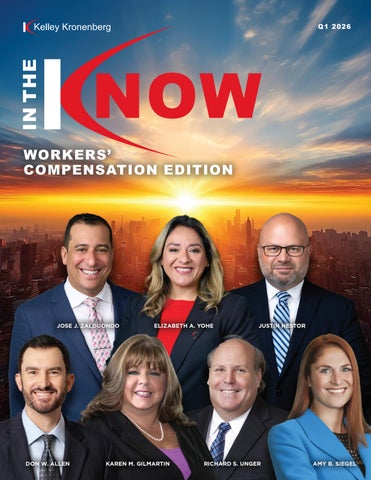
Kelley Kronenberg - In The Know - Workers Comp - Q1 2026

Page 1


EDITOR’S LETTER

WELCOME

I’m excited to introduce the inaugural issue of In the Know: Workers’ Compensation Edition. This publication represents what Kelley Kronenberg’s workers’ compensation team has been working toward for quite some time: a resource that provides practical, actionable guidance for the adjusters, risk managers, and employers we work with every day.

We practice workers’ compensation defense across Florida, New York, Indiana, and Illinois. Our team handles thousands of claims annually, and through that work, we’ve learned what actually helps our clients do their jobs better. This publication is designed to deliver exactly that— no fluff, no unnecessary citations, just straight forward analysis and guidance you can use immediately.

Each issue of In the Know: Workers’ Compensation Edition will focus on topics that matter to claims professionals. This inaugural issue features how recent decisions affect how you adjust files, manage claims, and how we defend claims. We’ve included articles on how we build strong relationships with our partnerships with you through communication, practical return to work

strategies, and fraud detection. You’ll also meet our Workers’ Compensation Business Unit Leaders from each of our states—the attorneys leading our practice and working directly with you to resolve claims efficiently and cost-effectively.

In the Know: Workers’ Compensation Edition is a team effort. While I’m honored to serve as editor, this publication reflects the collective knowledge and experience of our entire workers’ compensation team. We’re committed to making this resource valuable, relevant, and worth your time. As we continue building this publication, we’ll keep expanding our scope to address the challenges you face in your daily work.

We welcome your feedback and want to know what you think. If there are topics you’d like us to cover, cases you want analyzed, or areas where you need guidance, let us know. This publication exists to serve you, and we want to make sure it does exactly that.

Thank you for reading. We’re looking forward to sharing more with you in future issues.

Case Closed

Each quarter, we highlight recent decisions shaping the legal field, with the key takeaways that matter most to you and your business. As always, if any of these developments raise questions or concerns about your specific situation, don’t hesitate to reach out to our team.

The ruling in this case establishes that a fraud finding on one claim doesn’t automatically bar benefits for a separate, subsequent work injury. This clarifies an important distinction that affects how we handle claims involving prior misrepresentations.

The claimant injured her shoulder at work in 2021. During that claim, she made misrepresentations that barred her from receiving further benefits under Section 440.105. Straightforward enough—fraud happened; benefits stopped.

Pinellas County Transit Auth. v. Jackson

In 2022, she suffered a new industrial accident while turning a bus steering wheel and reinjured the same shoulder. When she filed a new claim, the employer/carrier denied it on two grounds. First, they argued that the fraud finding from 2021 foreclosed her from receiving any benefits for the 2022 injury. Second, they argued that doctors identified the 2021 shoulder injury as the major contributing cause of her need for benefits after the 2022 accident.

Both arguments failed on appeal. Here’s why that matters.

The First DCA went back to established precedent from Pearson v. Paradise Ford and Pizza Hut v. Proctor on the major contributing cause issue. The major contributing cause analysis only applies when a claimant’s need for treatment results from the combination of a workrelated accident and a pre-existing condition unrelated to employment. Both accidents here were work-related. That takes the major contributing cause analysis off the table entirely. You can’t use MCC to deny a claim when both the prior condition and the current injury arose from workplace accidents.

On the fraud issue, the Court drew a critical line between compensability and entitlement benefits. Compensability relates to whether a work-related accident and injury occurred. Entitlement to benefits relates to whether the claimant gets paid for it. The forfeiture of benefits from the prior claim based on misrepresentations didn’t render either the prior or the new accident non-compensable. Since the accidents were

compensable, the question was whether the claimant was entitled to benefits.

The Court held that the prior misrepresentation defense didn’t foreclose benefits for the separate 2022 workplace accident. The second accident was genuine— a new injury with a new mechanism of injury, even though it was the same body part - not merely an attempt to revive benefits from the previously barred 2021 claim.

How This Impacts Adjusting Files

We see this mistake happen: an adjuster pulls up a claimant’s history, sees a prior fraud finding on a shoulder injury, and reflexively denies the new shoulder claim. Same body part, prior fraud, easy denial. Except it’s not that simple.

Each accident gets analyzed separately for compensability. The fraud defense from the first claim doesn’t automatically transfer the bar on benefits to the second claim. Yes, you should absolutely note the prior fraud in your file. Yes, you should investigate the new claim carefully given that history. But you can’t simply stamp “prior fraud, claim denied” and move on.

You still need to investigate whether the new accident actually happened and whether it caused or aggravated the condition. You still need medical opinions connecting the current need for treatment to the new accident rather than the old one. The prior fraud raises red flags that warrant closer scrutiny, but it doesn’t eliminate your obligation to analyze the new claim on its own merits.

Here’s the other piece that trips people up: major contributing cause doesn’t help when both injuries are work-related. If you’re facing a claim where the prior injury and current injury both arose from workplace accidents, MCC isn’t your defense. You’ll need to focus on causation, apportionment, or other defenses that actually fit the facts.

The practical takeaway is this: analyze each claim independently. Prior fraud matters for that prior claim. It doesn’t create a lifetime bar against all future workers’ compensation benefits when a new, legitimate workplace injury occurs. Document the new accident thoroughly, get solid medical opinions on causation, and build your defense based on the current claim’s facts—not just the claimant’s history.

Noa v. City of Aventura and Florida League of Cities

This case answers a longstanding debate about average weekly wage calculations: performance bonuses can be included even when they’re not paid during the 13-week period before the accident. The question is when the bonus was earned, not when it hit the employee’s bank account.

The claimant worked for the City of Aventura and was injured at work. The parties stipulated that the City’s Pay Plan governed payment of merit bonuses. Under that Pay Plan, bonuses weren’t automatic. Employees became eligible on their anniversary date, and bonuses were only paid if the employee performed satisfactorily during the 52-week evaluation period.

The fight was whether the claimant’s merit bonus should factor into her average weekly wage calculation. The employer/carrier said no because the bonus wasn’t actually paid during the 13 weeks immediately preceding the accident. The claimant said yes because she earned it through her performance during that 13-week period.

The First DCA sided with the claimant and sent the case back for recalculation of the AWW to include a pro rata share of the performance bonus.

The Court started with the statutory definition: average weekly wage is onethirteenth of the total amount of wages earned during the 13 weeks immediately preceding the accident. Then it looked at how “wages” are defined—the money rate at which the service rendered is recompensed under the contract of hiring in force at the time of injury.

Here’s the key: established precedent holds that wages can be defined in terms of when they’re earned rather than when they’re paid. That distinction matters. The calculation isn’t always limited to money actually deposited in the claimant’s account during the 13-week period prior to the accident. It can include money earned during that period but not received until later.

The Court analogized the merit bonus to profits or commissions addressed in prior cases and held they should be treated the same way. The claimant performed well during the 13-week period before her accident, which qualified her for the bonus. That meant she earned a portion of that

bonus during the relevant 13 weeks, even though the actual payment came later.

The underlying purpose of calculating average weekly wage is establishing the value of an employee’s lost ability to earn future wages during disability. If the claimant would have continued earning those performance bonuses, had she not been injured, then those bonuses represent part of her lost earning capacity.

The Court held that one quarter of the bonus should be included in the AWW calculation— representing the 13-week period out of the 52-week evaluation period.

What This Means for Your Files

When you’re investigating a new claim, dig deeper than base salary or hourly wages. Ask about the employee’s complete compensation package. If the employee receives performance bonuses, commissions, profit sharing, or similar variable compensation, you need to understand how those payments work and when they’re earned versus paid.

Here’s what we recommend: Get copies of the employee handbook, pay plan, or employment contract that governs bonus payments. Understand what the employee needs to do to earn the bonus and whether performance during the 13-week preaccident period contributed to qualifying for it. If it did, factor it into your AWW calculation proportionally.

We’ve seen adjusters end up with inadequate reserves because the AWW calculation was based on incomplete information. There is also the risk that the other side may know more than you and win this issue giving them attorney fee entitlement. The key question isn’t when the money hit the employee’s bank account. It’s whether the employee earned that money through services performed during the 13 weeks before the accident. Think about it this way: if a bonus is based on annual performance and the accident occurred three months into the performance period, a pro rata share of that bonus likely belongs in the AWW calculation. The employee was working toward earning that

bonus during the 13-week period, even if payment wouldn’t come until the anniversary date months later.

The same analysis applies to commissions, productivity bonuses, profit sharing, and other forms of variable compensation. When they’re earned matters more than when they’re paid. Miss this piece and you’re setting reserves that don’t reflect the actual exposure on the file.

Impact on Employers

For employers, especially those with performance-based compensation structures, this decision affects how you should respond when your carrier requests wage information after an accident. Don’t just provide the employee’s base salary or most recent pay stubs. You need to explain your complete compensation structure—how bonuses work, when they’re earned versus paid, what performance metrics apply, and whether the injured employee was on track to receive those bonuses. Be prepared to provide your employee handbook, pay plan documents, and performance evaluation records. The more complete information you provide upfront, the more accurately your carrier can set reserves and evaluate the claim. If you’re a self-insured employer, you need to factor these bonus structures into your own AWW calculations from the start. Underestimating exposure because you didn’t account for earned, but unpaid bonuses can create significant budget and risk exposure problems down the line.

Sedgwick Claims Mgmt. Services v. Thompson

This case addresses whether Daubert evidentiary challenges can be used to exclude Expert Medical Advisor opinions in Florida workers’ compensation cases. The short answer is no, and understanding why matters for how we handle cases involving EMA opinions.

The claimant’s case involved an Expert Medical Advisor opinion, and the employer/ carrier attempted to exclude that opinion using a Daubert challenge. For those unfamiliar, Daubert is an evidentiary standard that requires expert opinions to result from analysis of reliable facts, use of reliable principles and methods, and reliable application of those principles and methods to the facts of the case. It’s essentially a gatekeeper function that trial courts use to keep unreliable expert testimony out of evidence.

The employer/carrier argued that the EMA’s opinion didn’t meet Daubert standards and should be excluded. The Judge of Compensation Claims allowed the opinion, and the employer/carrier appealed.

The First DCA affirmed, holding that Daubert challenges don’t apply to Expert Medical Advisor opinions under Florida’s Workers’ Compensation Act. This was a matter of first impression; the Court hadn’t addressed this specific question before.

The Court looked at the plain language of Section 440.25(4)(d) in conjunction with the evolution of Florida’s Workers’ Compensation Act over time. The statute

creates a specific framework for how EMA opinions function in workers’ compensation cases, and that framework doesn’t include Daubert as a screening mechanism.

The Court’s reasoning focused on the statutory structure. Expert Medical Advisors exist within a legislatively created system that has its own rules about how medical opinions are obtained, evaluated, and used. The Legislature specifically addressed how EMAs are selected, what they’re asked to do, and how their opinions factor into claim resolution. Importing Daubert standards into that system would contradict the statutory framework the Legislature created.

What This Means for Your Files

Here’s the practical impact: when an EMA issues an opinion you don’t like, we can’t use Daubert to get it excluded. That’s a tool that works in civil litigation, but it doesn’t work in workers’ compensation cases involving EMA opinions.

We’ve seen defense counsel in other contexts successfully use Daubert challenges to exclude expert opinions that rely on questionable methodology or unsupported assumptions. It’s an effective tool when it applies. But in Florida workers’ compensation, the statutory framework for EMAs supersedes the Daubert standard.

This doesn’t mean EMA opinions are beyond challenge. You can still attack the weight and credibility of an EMA opinion. You can point out factual errors, question the EMA’s reliance on incomplete medical records, argue that the EMA didn’t address relevant medical evidence, or present contrary

medical opinions from your own experts. The difference is that you’re challenging the opinion’s persuasiveness, not its admissibility.

When you’re facing an unfavorable EMA opinion, focus your strategy on undermining the opinion’s credibility rather than trying to exclude it entirely. Make sure whether the EMA had complete and accurate medical records. If records were missing or the EMA relied on inaccurate information, that goes to the weight of the opinion. If the EMA’s reasoning doesn’t account for objective findings or contradicts established medical literature, address that through cross-examination.

The flip side also matters. When you have a favorable EMA opinion, you now know that the claimant can’t use Daubert to exclude it. The opinion comes in, and the fight becomes about how much weight it deserves rather than whether it’s admissible at all.

From a strategic standpoint, this decision reinforces that the EMA process is a statutory creation with its own rules. The Legislature decided how EMA opinions should function in workers’ compensation cases, and courts won’t overlay additional evidentiary standards that don’t appear in the statute. Work within that framework— don’t waste time and resources trying to apply civil litigation standards that don’t transfer to the workers’ compensation system.

Building Trust Through Communication – The Kelley Kronenberg Way

We have all heard it: “the best claim is a closed claim.” But, how do we get there? To build relationships with our adjusters, employers/business owners, and even opposing counsels comes down to one very important tool - communication.

Early in our careers, most of us thought winning meant brilliant strategies and legal arguments. We learned quickly that wasn’t the whole picture. The cases that resolved efficiently, the claims that settled favorably, the clients who kept coming back—those successes came from something more fundamental: communication.

Effective workers’ compensation defense relies on maintaining clear communication channels with three key players: the adjuster, the employer or business owner, and opposing counsel. When all three lines stay open and active, claims resolve more efficiently, everyone understands where the case stands, and potential problems get addressed before becoming actual problems.

Early

Strategy Discussions Make a Difference

The most critical conversations happen early—before the case develops momentum in the wrong direction. The question of accepting a claim needs immediate attention to determine: 1) what does the evidence show?; 2) what additional facts can/need to be gathered?; and, 3) does the claim actually meet compensability requirements? Waiting to have this conversation until depositions are scheduled or discovery is underway means losing valuable time and potentially strengthening positions that don’t deserve it. Every claim has weaknesses on both sides. The question is whether those weaknesses get addressed proactively or exploited at the worst possible moment. Witness statements can make the most impact when they are secured before memories fade. Average weekly wage calculations need scrutiny before they become settled facts. Discrepancies in accident reports require explanation while there’s still time to gather supporting documentation. These issues don’t resolve themselves, and addressing them early creates options that won’t exist later.

Claim resolution deserves discussion from the outset, even when early settlement isn’t likely. Some claims should settle quickly because the facts support compensability, the medical treatment is reasonable, and the exposure is clear. Identifying those cases early and having frank conversations about resolution strategy saves defense costs and allows resources to focus on files that genuinely need intensive management.

Not every case requires litigation, and recognizing that benefits everyone involved.

Regular Updates Matter More Than You Think

Adjusters shouldn’t have to wonder where their cases stand. Updates focused on developments that actually matter—the ones that impact claim value or defense strategy. When something significant happens, immediate communication keeps the adjuster informed and in control. When decisions are needed, presenting clear options with specific recommendations and reasoning allows the adjuster to make informed choices rather than guessing at implications.

For uninsured employers, the communication needs are even more critical. These clients need guidance through the entire workers’ compensation system, not just legal representation. They’re learning the process while simultaneously defending a claim, which means explanations and education become as important as legal strategy.

Employers Know More Than Reports Capture

Initial accident reports capture the basics, but employers know considerably more about what actually happened. They know which employees witnessed the accident and what those witnesses actually saw. They know whether security video exists and where to find it. They know the claimant’s work history, attendance patterns, job duties, and workplace relationships. They remember conversations and observations that seemed insignificant at the time but become relevant once litigation starts.

This information matters for building an effective and efficient defense. Better preparation follows naturally from having as much information up front. Having his information gives us better control over the defense the claim so we can respond quickly to discovery and minimize litigation there. Direct access to the employer also means identifying which documents exist, where they’re located, and who has the key knowledge for depositions, but also for mediation. This becomes particularly valuable and shows when headed to trial so that we were already able to verify facts or locate specific documentation.

Beyond litigation, employers often have insights into light duty availability, return to work possibilities, or accommodation options that could facilitate settlement. They know facts about job requirements, workplace conditions, or circumstances surrounding the accident that strengthen defense positions. They may be aware of subsequent events or changed circumstances that affect the case. Having access to this information throughout the case means working with complete facts rather than discovering critical details too late to use them effectively.

For self-insured employers and businesses without coverage, this relationship becomes essential to understanding operations, concerns, and goals for resolving claims in the most cost-effective way possible.

Professional Relationships with Opposing Counsel Pay Off

Maintaining professional communication channels with opposing counsel minimizes unnecessary litigation costs and provides valuable insight into case strategy. When professional relationships exist from the beginning, opportunities emerge for frank discussions about case value and resolution that wouldn’t happen otherwise.

Early communication provides insight into opposing counsel’s approach. Some litigators fight every issue regardless of merit. Others take reasonable positions and focus on legitimate disputes. Understanding which type of attorney is handling the case helps shape more effective defense strategies and identify resolution opportunities before everyone has invested significant time and money in litigation.

Open communication throughout the case makes settlement conversations, informal issue resolution, and mediation scheduling happen more smoothly. Discovery disputes or procedural issues often resolve with a phone call rather than a motion. Instead of filing competing motions to compel over document production or deposition scheduling, reasonable compromises keep cases moving forward. Settlement possibilities can be explored before trial preparation costs mount. Mediation can be scheduled at the right time in the claim’s development rather than too early when the case isn’t ready or too late when positions have hardened.

This doesn’t mean being soft on defense or conceding issues that should be fought. It means being professional and reasonable to work with while still defending claims vigorously when the facts and law support that approach.

Communication as Strategy

Treating communication as a strategic tool rather than just a task requires commitment and consistency. It means keeping everyone informed, treating every relationship as important, and recognizing that information flows create opportunities that silence never will.

When communication channels stay open with adjusters, employers, and opposing

counsels, several things happen naturally. Claims resolve more efficiently when the facts support resolution. Clients stay informed and engaged throughout the process. Opposing counsel knows the defense is serious but reasonable. Defense costs stay manageable because problems get addressed before they escalate.

This approach isn’t complicated, but it does require intention. We, the Kelley Kronenberg workers’ compensation team build practices on strong relationships and fundamentally understand that it’s the foundation that makes everything else work. That’s true whether handling a single claim or managing an entire workers’ compensation defense practice across a certain state.

Work in Progress: A Claims Handler’s Guide to Getting Injured Workers Back on the Job

A Phased Approach

Phase 1, Preparation: Communicate with the injured worker, get written restrictions from the ATP, identify compliant light duty tasks, confirm wage calculations for potential TPD exposure, and prepare a written job offer letter. Consider your defense plan with a complex and/or catastrophic claim.

The goal of any workers’ compensation claim is to get the claimant the medical care they need and return them to work - with the same employer or a new one. How you focus on employability and transferable skills will shift as the claim evolves. Here’s a practical look at what claims handlers can do at each stage.

Phase 2, Transitional/Light Duty: Modified schedule, light duty assignments, supervisory oversight, weekly check-ins, and ongoing communication with the insured after each ATP visit. Track earnings carefully to ensure timely TPD payments and document any refusal of suitable employment.

Phase 3, Gradual Reintegration and PTD Strategy: Increase responsibilities and hours as restrictions allow. Provide retraining on any tools or processes that changed while the employee was out. Bring in vocational experts for complex or catastrophic cases.

Phase 4, Full Duty: Get a final medical release, confirm the ATP has cleared the employee without restrictions, and resume all pre-accident functions. Evaluate MMI status and any permanent impairment rating to assess impairment income benefit exposure.

Why It Matters

A solid return-to-work program reduces indemnity exposure, shortens claim duration, limits attorney involvement, improves morale and retention, demonstrates good faith compliance with Chapter 440, and strengthens defenses against PTD and wage loss claims.

Phase 1, Preparation

Getting the medical piece right from the start is where claims are won or lost. The information gathered early shapes every return-to-work decision that follows, and gaps in that foundation tend to be expensive. Having experienced defense counsel engaged early ensures the right information is in front of the right people before disputes have a chance to develop.

Get the Job Description in Writing

Before anything else, secure a clear outline of the claimant’s pre-accident job duties and any light duty role you’re considering. This means specific physical demands, environmental conditions, and the frequency of those demands. A vague job description creates room for disagreement later. A precise one doesn’t. Restrictions aren’t always physical; psychiatric restrictions may also come into play, touching on social interaction, supervisory responsibilities, and schedule consistency.

Conference with the Authorized Treating Physician

A physician conference is your chance to make sure work restrictions align with the statutory requirements. Physicians may rely on what the claimant tells them about their job, which isn’t always accurate or complete. Use this opportunity to present available alternative work and get a medical opinion on whether the injured worker can perform it. The goal is to establish that their specific work role is not the reason why they are placed out of work, it’s because they can’t perform any work, even at a sedentary level. It’s also a good time to discuss the expected timeline for restrictions so the employer can plan ahead.

This is one area where having defense counsel conduct the conference, rather than the adjuster alone, pays dividends. Attorneys bring established relationships to the table, understand the legal standards the restrictions must satisfy, and are better positioned to press for direct, complete answers that hold up when the claim is disputed.

Nurse Case Manager Assistance

Field case managers offer something physician conferences often can’t: real-time access. They’re in the room, which means they can seek immediate clarification on ambiguous restrictions, make sure DWC25 forms are completed correctly, and relay information on the spot. That immediacy reduces confusion, facilitates smooth returnto-work transitions, and helps prevent documentation gaps that can lead to costly indemnity exposure.

Phase 2, Transitional/Light Duty

Once medical restrictions are established, the focus shifts to keeping the injured worker connected to employment in a way that’s compliant, documented, and defensible. This stage requires coordination between the carrier, the insured, and the employee. This is where having knowledgeable defense counsel in your corner makes a real difference in claim outcomes.

The Basics

In Florida, the authorized treating physician (ATP), not the employer, determines when an injured worker can return to work and under what restrictions. If the worker is cleared for modified duty, the employer may offer work within those restrictions but isn’t required to. If light duty isn’t offered when it could be, indemnity benefits will generally be owed. When light duty is offered, it must comply with the restrictions, so staying in close communication with your insured after every ATP visit is essential. Any job offer should be in writing, with specific duties listed and a clear start date.

Transitional Employment

Many larger employers have transitional duty programs built in, typically sedentary desk work or administrative tasks. For employers without that option, vendors can place injured workers at off-site locations such as nonprofits or thrift stores. It’s not ideal, but it’s a workable solution when internal light duty isn’t available.

A Note on Sheltered Employment

In Florida, “sheltered employment” refers to work specially created by an employer that doesn’t exist in the competitive labor market, typically to limit PTD liability. Simply modifying an employee’s duties doesn’t make it sheltered employment, but the position must be legitimate and productive.

In Moore v. Servicemaster Commercial Services, 19 So. 3d 1147 (Fla. 1st DCA 2009), the court confirmed that a well-implemented return-to-work program won’t be penalized as sheltered employment as long as the light duty offer is both legitimate and suitable.

Phase 3, Gradual Reintegration and PTD Strategy

Not every claim ends with a return to the pre-accident employer, and in complex or catastrophic cases, vocational retraining becomes a critical piece of the strategy. Understanding how these programs work and how to use them effectively can mean the difference between a claim that lingers and one that resolves. Skilled defense counsel can help navigate this process, identify the right resources, and build a vocational plan that holds up.

Implementing a PTD Defense Strategy Through Vocational Experts

In claims where permanent total disability (PTD) exposure is a real concern, engaging a vocational expert early is essential. Vocational experts assess the injured worker’s transferable skills, educational background, work history, and functional limitations to identify jobs available in the competitive labor market that the worker can

realistically perform. That analysis becomes the cornerstone of a PTD defense.

A well-documented vocational evaluation can demonstrate that suitable employment exists, rebutting a claim that the worker is unable to perform any gainful work. Defense counsel should work closely with the vocational expert to ensure the evaluation addresses the specific medical restrictions in the claim and aligns with the legal standards under Chapter 440. The earlier a vocational expert is retained in a complex claim, the more options remain available for structuring a defensible return-to-work plan.

Career Training Through Vocational Rehabilitation

When returning to the pre-accident employer isn’t realistic, Vocational Rehabilitation (VR) programs through Florida’s Department of Education can open new options. VR offers skill assessments, personalized training, job coaching, and placement services aimed at aligning an injured worker’s capabilities with real market demand.

The Eligibility Process

A referral kicks things off, and injured workers can self-refer. After completing an online application, a VR counselor determines eligibility using input from treating physicians, prior education, and work history. That determination must happen within 60 days, though complex cases may take longer. Current SSDI or SSI recipients are automatically eligible. One common hurdle for workers’ comp claimants: a GED or high school diploma is generally required, though the State will sometimes help applicants obtain one.

Once eligible, the applicant is assigned to one of three categories based on disability significance, with Category 1 being most significant. The category determines priority and whether a waitlist applies.

From there, the applicant and counselor develop an Individualized Plan for Employment (IPE) within 90 days. The IPE outlines the job goal, services to be provided, daily structure, and any financial contribution required. Some services are entirely free. After completing VR services and securing employment, the case closes once the worker has been employed for 90 days.

The Bigger Picture

VR promotes employment equality by providing tailored training, job coaching, and workplace accommodations. It reduces systemic barriers and fosters financial independence for workers who might otherwise struggle to re-enter the workforce.

The earlier and more proactively you engage with the employer, the physician, and the injured worker, the better your outcomes will be for the claim and the person at the center of it. Experienced defense counsel makes that engagement count at every stage.

Phase 4, Full Duty

Reaching full duty is the goal every wellmanaged claim is working toward. When the ATP issues a final medical release clearing the injured worker without restrictions, the employer can resume all pre-accident functions and return the employee to their full job duties. But this phase isn’t just about getting back to business as usual; it’s also

about accurately assessing and closing out any remaining exposure.

MMI and Permanent Impairment Ratings

When the ATP determines that the injured worker has reached MMI, the next step is evaluating whether a permanent impairment rating applies. Under Florida’s workers’ compensation system, an impairment rating expressed as a percentage of the body as a whole drives the calculation of Impairment Income Benefits (IIBs). Claims handlers should confirm that the rating is based on The 1996 Florida Uniform Permanent Impairment Rating Schedule and that the correct calculations are made to determine IIB entitlement.

In complex or catastrophic cases, an Independent Medical Examination (IME) or specialized vendors may be warranted to verify the rating before exposure is finalized. Defense counsel can help identify what and how these strategies add value and how to use the results effectively.

Closing the File

A clean close requires confirming that all authorized medical treatment is complete, all indemnity benefits have been accurately paid, and any impairment benefits have been calculated and issued. If a settlement is being considered, ensure the Joint Petition for Order Approving Settlement accurately reflects the full scope of benefits and is consistent with the medical and vocational record. Defense counsel plays a key role in structuring settlements that resolve exposure while protecting the employer and carrier from future claims.

Conclusion

Return-to-work isn’t a single event. It’s a process that demands careful attention at every phase, from the initial medical evaluation through the final resolution of any impairment or wage loss exposure. Claims handlers who engage early, communicate consistently, and build a defensible record at each step are best positioned to control costs, protect their clients, and serve the injured worker.

The most effective return-to-work programs combine accurate medical management with proactive vocational planning and, where needed, a clear strategy for defending against PTD exposure. That combination doesn’t happen by accident. It happens when carriers, employers, physicians, and experienced defense counsel work together with a shared goal: getting the injured worker back to meaningful, sustainable employment as efficiently as possible.

Whether the path leads back to the same employer, a new one, or a vocational retraining program, the fundamentals remain the same: document thoroughly, communicate proactively, and never lose sight of the bigger picture. The claim is the mechanism. The outcome is what matters.

Spotting And Stopping Workers’ Compensation Fraud

Fraud costs insurance companies and the businesses they insure hundreds of millions of dollars every year. Those losses don’t disappear into thin air—they translate directly into higher premiums due to inflated claim costs, delays in benefit delivery and wasted resources that could be spent on legitimate injured workers. The problem isn’t going away, and frankly, it’s getting more sophisticated.

Florida law makes it a crime to “knowingly make, or cause to be made, any false, fraudulent, or misleading oral or written statement for the purpose of obtaining or denying any benefit or payment.” That’s a broad definition, and for good reason. Workers’ compensation fraud takes many forms, and recognizing those forms early can save significant money and resources.

What Fraud Actually Looks Like

Sometimes it’s the claimant who never actually got hurt but files a claim anyway. Sometimes it’s the employee who suffered a minor injury but exaggerates symptoms to extend benefits. Sometimes it’s the claimant who returns to work (or never stopped working) while collecting lost wage benefits. Sometimes it’s fabricated medical treatment, inflated bills, or providers billing for services that were never actually rendered.

We’ve seen cases involving staged accidents, completely fabricated injuries, workers collecting benefits while running their own businesses, and claimants on surveillance doing activities their doctors say are impossible given their alleged injuries and restrictions. We’ve investigated medical providers submitting bills for ghost patients and scenarios involving misrepresented applications for coverage.

The common thread in all these cases is simple: someone is lying to get money they’re not entitled to receive. The question becomes how to prove it and what to do once you have that proof.

Building The Fraud Case

Proving fraud requires more than suspicion. It requires evidence, documentation, and often a significant investment of time gathering facts from multiple sources. The investigative work spans both workers’ compensation and personal injury protection cases because the fundamental approach remains the same: does the evidence support what is being said?

Interviews and fact gathering form the foundation. That means talking to witnesses, employers, coworkers, and anyone else who might have relevant information. Detailed questions about the accident, the claimant’s activities before and after the injury, their work history, and any inconsistencies spotted in the initial reports often reveal the first cracks in a fraudulent claim. Sometimes the best evidence comes from people who know the claimant personally and can speak to what actually happened versus what got reported.

Records and documentation require careful review and scrutiny. Medical records that don’t match the reported mechanism of injury tell a story. Treatment patterns that don’t make clinical sense raise questions. Billing anomalies stand out. Social media posts provide powerful evidence. Employer records showing attendance or performance issues right before the reported accident establish motive. Prior claims history can reveal patterns. Banking records showing deposits that shouldn’t exist. Every document tells part of the story, and we have the experience to tell you when the complete picture emerges and how all those pieces fit together.

When the evidence supports it, the next step involves more than just defending the claim. Making recommendations for prosecution and coordinating with the appropriate authorities, such as the Bureau of Workers’ Compensation Fraud in Florida, or law enforcement who can hold fraudsters accountable in ways that go beyond any single case. Providing the documentation needed to pursue fraud cases through the criminal justice system sends a message that these schemes have real consequences.

Red Flags Worth Watching

Preventing fraud beats fighting it after money’s already been spent. The key is recognizing warning signs early, before significant costs accumulate on a fraudulent claim.

Some red flags are obvious. The claimant who reports an injury happened on Monday

when his last day worked was Friday. The accident with no witnesses that produces a serious injury requiring extensive treatment. The employee who’s worked at the company for three weeks and suddenly has a careerending back injury. The claimant who misses every medical appointment but somehow makes it to the beach. These scenarios practically announce themselves as problematic.

Other red flags require more industry knowledge to spot. Fabricated certificates of insurance are becoming increasingly common, creating exposure for general contractors and property owners who think they’re protected when they’re not. Uninsured or underinsured subcontractors get used on job sites regularly, and when someone gets hurt, the financial consequences can be devastating. These schemes are sophisticated and evolving, which makes staying current on emerging trends essential.

The timing of claims often reveals fraud. Injuries reported after layoff notices, disciplinary actions, or end-of-season work create immediate questions. So do injuries reported significantly after they allegedly occurred, especially when the delay lacks reasonable explanation. Monday morning back injuries with no specific incident, but plenty of weekend activity caught on social media deserve scrutiny.

Medical treatment patterns can signal fraud, too. Claimants who change doctors repeatedly looking for someone to support their narrative. Treatment that continues indefinitely without objective findings to

support it. Providers who seem to treat every patient the same way regardless of diagnosis. Bills that don’t match the documented treatment. Prescriptions that get filled but never used. The list can go on and on.

Employment-related red flags matter just as much. Claimants who claim total disability but maintain active business licenses. Workers who insist they can’t perform any job but post pictures of themselves doing physically demanding hobbies. Employees with significant financial pressures who suddenly report injuries right before major bills come due. While these scenarios don’t prove fraud by themselves, they justify deeper investigation.

Document Everything

Once you spot potential fraud, documentation becomes critical. Contemporaneous notes about inconsistent statements matter at trial. Preserved social media posts that later get deleted can make or break a case. Witness statements taken while memories are fresh carry more weight than recollections months later. Surveillance footage showing activities inconsistent with restrictions provides objective evidence that’s hard to dispute.

The documentation needs to be thorough and organized. Timelines that show when injuries were reported versus when they allegedly occurred. Comparisons between what the claimant told different doctors. Records of work search activities or lack thereof when receiving temporary benefits. Financial records showing income from

sources the claimant claimed didn’t exist. All of this evidence needs to be preserved, authenticated, and ready to present when needed.

When To Involve Authorities

Florida law establishes mandatory reporting requirements for suspected workers’ compensation fraud. Under Section 440.105(1)(a), insurance carriers, selfinsureds, and medical practitioners who have knowledge or believe that fraud has been committed must report that information to the Division of Criminal Investigations, Bureau of Workers’ Compensation Fraud. This isn’t optional. The statute uses the word “shall,” making it a legal obligation.

Beyond these mandatory reporting entities, employers also have the ability to report suspected fraud directly to the Bureau. When an employer spots red flags suggesting fraudulent activity, they can and should report it to the appropriate authorities. The same goes for adjusters and TPAs who handle claims on behalf of carriers—they fall within the mandatory reporting requirements when they have knowledge of suspected fraud.

Not every suspicious claim warrants a fraud referral. The standard for fraud is high. “Knowingly” usually means that mistakes, exaggerations, or even omissions don’t necessarily meet that standard. But when the evidence clearly shows intentional deception designed to obtain benefits fraudulently, reporting to the Bureau of Workers’ Compensation Fraud and potentially law enforcement makes sense.

The decision to refer a case for investigation and potential prosecution should be based on the strength of the evidence and the egregiousness of the fraud. Cases with clear documentation, multiple witnesses, and significant financial losses make stronger candidates. So do cases involving organized fraud rings or medical providers systematically defrauding the system. The Bureau reviews all reports and selects which cases warrant further investigation and potential prosecution.

Prosecution serves multiple purposes beyond any single case. It deters future fraud by demonstrating real consequences. It can recover money paid out fraudulently through restitution orders. It protects the integrity of the workers’ compensation system for legitimate injured workers who need and deserve benefits. And it sends a clear message that Florida takes workers’ compensation fraud seriously.

The Bigger Picture

Fighting fraud protects more than just claim costs on individual files. It protects premium rates for honest employers. It preserves resources for workers who genuinely need medical treatment and wage replacement. It maintains the credibility of the workers’ compensation system as a whole.

Fraud also creates operational headaches beyond the financial impact. Adjusters spend time investigating bogus claims instead of helping legitimate injured workers. Employers lose trust in the system when they see fraudulent claims getting paid. Medical providers who play by the rules get undercut by providers who don’t. The ripple effects

extend throughout the entire workers’ compensation ecosystem.

Staying vigilant about fraud requires ongoing attention and education. Schemes evolve as fraudsters learn what works and what doesn’t. New red flags emerge. Treatment mills close down and reopen under different names. Recognizing these patterns and adapting investigative strategies accordingly keeps us ahead of the problem rather than constantly reacting to it.

The goal isn’t to approach every claim with suspicion or treat every claimant

as a potential fraudster. Most claims are legitimate. Most injured workers deserve the benefits they’re receiving. But when red flags appear, investigating thoroughly and documenting carefully protects everyone involved in the workers’ compensation system. That’s not just good claims handling—it’s essential to keeping the system working the way it’s supposed to work.

Meet Our Team

Merrillville, IN | Indianapolis, IN | Chicago, IL 317-731-6243 | jnestor@kklaw.com

What drew you to this particular area of law initially?

Interestingly, I knew nothing about workers’ compensation when I graduated law school. My first job was with a medium sized firm that handled almost exclusively worker’s compensation defense. I have handled other areas of law throughout my career, but have found that I enjoy the overall collegialty of the practice in Indiana and Illinois.

What’s the best career advice you’ve ever received?

ABC: A = Always. B = Be. C = Closing. I have come to learn the value of closed claims for my clients. My practice is laser focused on pushing a claim toward resolution, whether it be via settlement or trial.

What’s one thing you wish every client knew before working with a workers’ comp defense lawyer?

Representing businesses, large and small, in workers’ compensation claims make a difference to each and every client as it can have great impact on their bottom line. I take it very seriously and treat every dollar spent on defending a claim or settlement like it is my own money at stake.

If your colleagues had to describe you in three words, what would they say? Attention to detail

Who has been a mentor or major influence in your career?

I have had had a variety of mentors and supervisors throughout my career. I like to think that I have taken both the good and bad experiences to make me who I am today.

What’s a hobby or interest that might surprise people?

I like to cook and enjoy cooking outside on my grill and smoker.

What do you do to unwind after a challenging day/week?

I maintain my practice to make sure I have time to spend with my family. Having three teenage daughters, they keep me plenty busy outside of work.

Meet Our Team

New York, NY

845-306-7867 |

What’s the best career advice you’ve ever received? Be Respectful when you disagree or argue with your adversaries.

If your colleagues had to describe you in three words, what would they say? Knowledgeable, tough, and fair.

What’s a hobby or interest that might surprise people? All I watch are documentaries.

What’s one book, podcast, or resource you recommend to others? Book: A Small Furry Prayer

If you weren’t a lawyer, what would you be doing instead? Sommelier

What’s a proud moment—big or small—you love looking back on? Helping a sea turtle lay eggs in order to avoid possible poachers.

Meet Our Team

If your colleagues had to describe you in three words, what would they say? Lord have mercy.

Who has been a mentor or major influence in your career?

I was not in the enviable position of having a mentor in my career. I was self-taught and selfmotivated. That’s why I aim to be a great mentor to others. I am always there to help and answer questions.

What’s a hobby or interest that might surprise people?

I like to hike. The most dangerous mountains in national parks. I did Angel’s Landing two years ago, the same day I did the Narrows. I’ve also hiked Half Dome – the most dangerous hike in the country. That kicked my butt. I haven’t hiked since then.

If you could go back and give your younger self one piece of advice, what would it be? Travel more.

What’s a life lesson that has stuck with you over the years?

You can’t get back time. I lost my mom to a brain tumor in her early 50s. She was my everything. I live every day trying to make her proud. Make the most of every moment you have. Don’t be shy about communicating and letting others know how you feel about them.

Meet Our Team

West Palm Beach, FL

561-684-5956 |

What drew you to this particular area of law initially? I took a WC class in law school and did very well, so when an opening came up at a respected Atlanta firm, I jumped on it .

What’s the best career advice you’ve ever received?

Don’t tell your opposing counsel what you’re going to do, show up with it already being done.

What’s one thing you wish every client knew before working with a workers’ comp defense lawyer?

Do not look for logic in the WC system.

If your colleagues had to describe you in three words, what would they say? Works too much

What do you find most rewarding about working with clients? The long-term relationships, some nearing 25 years.

If you weren’t a lawyer, what would you be doing instead? I would like to deliver flowers because even on bad days, it makes people smile, and nothing could be better than a job where you spend all day making other people happy.

What’s something on your bucket list?

A few weeks in an over-the-water bungalow on Bali.

What’s a life lesson that has stuck with you over the years? You want to do well, but you must do good.

Meet Our Team

West Palm Beach, FL

561-684-5956 |

What drew you to this particular area of law initially?

The investigative aspect of this area of law is fascinating. It resonates well with my prior FBI and US DOL experience.

What’s the best career advice you’ve ever received?

My dad always told me – if you’re going to do something, do it right the first time. Doesn’t mean we always get it right, but try your best from the start. That has always stuck with me.

What’s one thing you wish every client knew before working with a workers’ comp defense lawyer?

We’re all trying to help at the end of the day. That’s why we are here. You don’t bother us – we like hearing from you!

If your colleagues had to describe you in three words, what would they say? Friendly, funny and approachable.

What do you find most rewarding about working with clients?

Learning about the different industries and the unique issues I can address within the workers’ compensation sphere.

What’s a hobby or interest that might surprise people?

My family shows dogs. We compete in AKC dog shows to show off our furry family members. It’s definitely a competitive sport not for the faint of heart!

What do you do to unwind after a challenging day/week?

Definitely watch reality TV!

What’s something on your bucket list?

Travel to Southeast Asia.

Meet Our Team

Miami, FL

305-503-0850 |

What do you find most rewarding about working with clients?

I like to think I help make their job easier by offering what I like to call a “wickedly practical” approach to the defense of w/c claims. They seem to very much appreciate that I try to cut to the chase and assist them with getting their cases resolved as cheaply and efficiently as possible. I think (perhaps because I’m from Philadelphia) that I have a unique way of cutting through the usual BS to get them where they need to go and clarify the process at each step along the way.

If your colleagues had to describe you in three words, what would they say? Cheap, cheap & cheap! (I know that’s the same three words, but this is what I hear on the street)!

If you weren’t a lawyer, what would you be doing instead? I’d own and run a bridal shop.

Who has been a mentor or major influence in your career?

Our founding fathers, Chuck Kelley and Steve Kronenberg were the most wonderful mentors. I was the first female attorney they ever hired. I feel like they took a real chance on me (back in 1987, things were very different) and invested in my growth and future. They were both great teachers (in very different ways) and threw me into the deep end of the pond so that I could learn and grow, while still standing by with a lifeline if I needed one. Everyone should be so blessed to have such amazing mentors.

What’s something on your bucket list?

This is kind of a weird one, since it bears no relation to anything in my past or present, but I really want to go to the Kentucky Derby! I’m not an animal person at all. I think the allure for me would be getting to choose an over-the-top hat to wear and drink mint juleps!

Meet Our Team

Fort Lauderdale, FL

954-370-9970

What’s the best career advice you’ve ever received?

Treat every task, no matter how small, as important; never compromise on your integrity and build strong relationships.

If your colleagues had to describe you in three words, what would they say?

I possess strong analytical thinking, exhibit professional integrity and am a team player

What’s a hobby or interest that might surprise people?

I have two very strong hobbies: I enjoy the theater and performing arts as well as I am a “foodie”.

What’s one book, podcast, or resource you recommend to others?

I really enjoy listening to The Rewatachables, a podcast where the hosts revisit classic films and discuss their cultural impact, memorable moments, and behind-the-scenes stories with a great sense of humor.

I also like Smartless, hosted by Jason Bateman, Sean Hayes, and Will Arnett, whose conversations with guests are both entertaining and insightful.

If you weren’t a lawyer, what would you be doing instead?

Actor. Producer or Food Critic

What’s a proud moment—big or small—you love looking back on?

Being a good person and a good son.

LIST OF

CEU s

2024LawandEthicsUpdate

AStatutoryandCaseLawAnalysis

Accident Investigation

Adjuster Depositions

“Arising Out Of” and in the “Course and Scope” of Employment –How These Similar Legal Concepts are Totally Separate and Distinct

Burdens of Proof for Compensability in Workers’ Compensation Claims

DenialsforPre-ExistingConditions

DWC Forms and Key Documents: The Descriptions, Details, and Directions

Establishing Compensability and the Exceptions Thereto

Florida Workers’ Compensation 101

Major Contributing Cause in Florida Workers’ Compensation

Misrepresentation Defenses: The Practical Considerations

Return To Work Policies Make Cents

The Challenges of the One Time Change Statute

Traumatic Brain Injury

Valuing Claims- Categories, Components, and Calculations

WC Coverage Through PEOS and Staffing Agencies

Workers Compensation 101: What You Need to Know to Effectively Handle Any Claim

MEET THE

CONTRIBUTORS

Email Elizabeth A. Yohe

Elizabeth Yohe is a Partner and Business Unit Leader at Kelley Kronenberg, where her practice is dedicated to the defense of workers’ compensation matters. She serves as a Team Lead on the firm’s Fraud Fighters Team. She brings extensive experience in all phases of workers’ compensation litigation from inception through trial, representing carriers, third-party administrators, and employers ranging from major corporations to small businesses.

Prior to joining Kelley Kronenberg, Elizabeth opened and led a new Florida office for a national firm handling workers’ compensation cases. She previously served as a Partner at another law firm, where she gained comprehensive experience in workers’ compensation litigation, effectively negotiating settlements to mitigate risk exposure and implementing proactive communication strategies with clients. Her unique background also includes serving as Associate General Counsel and

Director of Enforcement for E-Commerce, where she prepared foundational policies and agreements based on intellectual property and antitrust law. Additionally, she served as an Intelligence Analyst for the Federal Bureau of Investigation and as an Investigator for the United States Department of Labor, where she researched and analyzed complex criminal, civil, and regulatory matters.

Elizabeth earned her bachelor’s degree from DePaul University. She received her Juris Doctor from Tulane Law School.

Elizabeth has received numerous awards recognizing her superior service, including multiple commendations from FBI personnel, a letter of commendation from the Assistant Director of the FBI Directorate of Intelligence, and a National Award from the Secretary of Labor. She was nominated by judges to participate in the Florida Office of Judges of Compensation Claims’ extended education program, recognizing her professionalism, community commitment, and potential to contribute to and lead the practice of workers’ compensation law. Her diverse background in federal law enforcement, intellectual property, and workers’ compensation litigation provides her with a comprehensive understanding of complex legal matters and investigative techniques that enhance her approach to workers’ compensation defense.

Carla Wester is a Partner in Kelley Kronenberg’s Workers’ Compensation Division, rejoining the firm where she previously practiced in the mid-2000’s. She brings nearly 25 years of comprehensive experience in workers’ compensation defense and litigation.

Prior to rejoining Kelley Kronenberg, Carla served as a Lead Attorney for various nationwide defense firms, where she represented employers and insurance carriers in workers’ compensation matters throughout every District in the State of Florida. She previously worked as Staff Counsel for AmTrust Financial, representing the insurance company directly and its insureds in workers’ compensation claims across the entire State.

Email Traci R. Dishman

Traci R. Dishman is an Attorney with Kelley Kronenberg, focusing her practice on workers’ compensation defense.

Prior to joining the firm, Traci served as Deputy Chief of the Special Victims Unit at the State Attorney’s

Her experience also includes serving as Lead Litigation Attorney for a boutique Jacksonville-based law firm, where she represented both injured parties and selfinsured employers in various matters including workers’ compensation and personal injury cases, as well as assisting Jacksonville-area residents in various family law matters. She has also worked as a Managing Attorney for an Atlanta-based firm, overseeing firm operations in their Florida offices, while also maintaining relationships with claims adjusters and employer representatives through marketing initiatives and continuing education programs.

Carla earned her Bachelor of Arts in English from Florida State University in 1996, where she was a member of the Phi Mu sorority, as well as playing in the drum line, known as Big 8, for the Florida State University Marching Chiefs. She went on to receive her Juris Doctor from Florida Coastal School of Law in 2000, where she participated in the Association of Trial Lawyers of America, Student Bar Association, Honor Court, and Phi Delta Phi.

Office, where she managed a team of attorneys while prosecuting complex criminal cases. Her extensive litigation background includes managing a felony division as a Public Defender, where she handled high-stakes cases including death penalty matters. Throughout her career, she has successfully tried numerous jury trials, conducted depositions, and managed comprehensive case preparation and motion practice.

Traci received her Bachelor of Arts in Social Anthropology from the University of Michigan. She went on to earn her Juris Doctor from Southwestern Law School.

ACCOLADES AWARDS AND FIRM AWARDS

Kelley Kronenberg has been the recipient of numerous awards and honors both firm-wide and for a number of our practices, including individual accolades. Below is a select list of recognition and awards:

WC ATTORNEY AWARDS AND RECOGNITIONS

Martindale Hubbell AV Preeminent Rating

Karen M. Gilmartin

Amy Siegel Oran

Executive Women of the Palm Beaches Foundation Women in Leadership

Amy Siegel Oran

Best Lawyers in America: Ones to Watch

Amy Siegel Oran

South Florida Legal Guide “Top Lawyers”

Amy Siegel Oran

Karen Gilmartin

Best Lawyers “Women in the Law”

Amy Siegel Oran WOMEN IN THE LAW

FWCI

Florida Workers’ Compensation Institute

Florida Workers’ Compensation Hall of Fame

Karen M. Gilmartin

Best Lawyers

Justin T. Nestor

Carol J. Sangster

Girl Scouts of Southeast Florida, Emerald Award, “Risk Taker”

Amy Siegel Oran

Florida Bar Board Certification in Workers Compensation

Don W. Allen

more than with over the convenience of

Employees Attorneys Locations

Founded in 1980, Kelley Kronenberg is an award winning, multi-practice national law firm. We are privileged to represent large public and private companies, small businesses, and individuals nationwide. With more than 40 practice areas, and growth on the horizon, we offer a comprehensive catalog of legal services to protect your legal interests in business and at home. Our firm is progressive and technologically advanced, while remaining true to our customer service heritage: integrity, ingenuity, and sincerity. Ever mindful of our history, but intensely committed to our future, we offer our clients a small firm feel with large firm resources.

LOCATIONS

FORT LAUDERDALE

10360 W. State Road 84

Fort Lauderdale, FL 33324

Phone: (954) 370-9970

ORLANDO

20 North Orange Avenue, Suite 704

Orlando, FL 32801

Phone: (407) 648-9450

TAMPA

1511 North Westshore Blvd., Suite 400

Tampa, FL 33607

Phone: (813) 223-1697

DAYTONA

128 Orange Avenue, Unit 306

Daytona Beach, FL 32114

Phone: (754) 888-5437

NEW YORK CITY

111 Broadway, Suite 1205

New York, NY 10006

Phone: (845) 306-7867

CHICAGO

20 N. Clark Street, Suite 1150

Chicago, IL 60602

Phone: (312) 216-8828

JACKSONVILLE

10245 Centurion Parkway N, Suite 100 Jacksonville, FL 32256

Phone: (904) 549-7700

MERRILLVILLE

233 E. 84th Drive, Suite 200

Merrillville, IN 46410

Phone: (317) 731-6243

BY APPOINTMENT ONLY

ALBANY

401 New Karner Road. Suite 301

Albany, NY 12205

Phone: (845) 306-7867

ATLANTA

1100 Peachtree Street NE, Suite 200

Atlanta, GA 30309

Phone: (404) 990-4972

MIAMI

220 Alhambra Circle, Suite 410

Coral Gables, FL 33134

Phone: (305) 503-0850

NEW ORLEANS

400 Poydras Street, Suite 2400

New Orleans, Louisiana 70130

Phone: (504) 208-9055

TALLAHASSEE

6267 Old Water Oak Road, Suite 250

Tallahassee, FL 32312

Phone: (850) 577-1301

DALLAS

5956 Sherry Lane, 20th Floor

Dallas, TX 75225

Phone: (983) 999-4640

WEST PALM BEACH

1501 Belvedere Road, Suite 500-504

West Palm Beach, FL 33406

Phone: (561) 684-5956

INDIANAPOLIS

10475 Crosspoint Blvd., Suite 218

Indianapolis, IN 46256

Phone: (317) 731-6243

NAPLES

3080 Tamiami Trail E., Suite 322

Naples, FL 34112

Phone: (239) 990-6490

SHORT HILLS

51 John F. Kennedy Parkway

First Floor West

Short Hills, NJ 07078

Phone: (908) 403-8174

Turn static files into dynamic content formats.
Create a flipbook