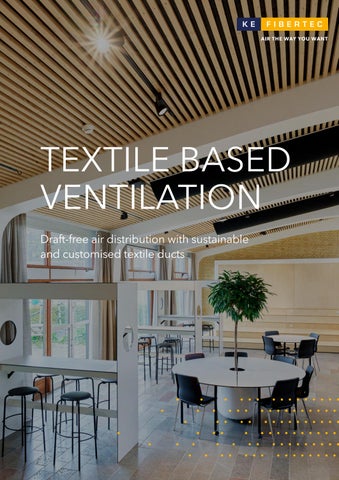
TEXTILE BASED VENTILATION
Draft-free air distribution with sustainable and customised textile ducts
TEXTILE BASED VENTILATION
Draft-free air distribution with sustainable and customised textile ducts
All information in this catalogue belongs to KE Fibertec AS. It may not be copied or used for any other purpose without the written consent of KE Fibertec AS.
Published by: KE Fibertec AS DK-6600 Vejen - Denmark www.ke-fibertec.com
About KE Fibertec
KE Fibertec develops, manufactures, and markets “Good indoor
climate” or air distribution systems based on fibre technology and
sustainability.
Sustainable technology
KE Fibertec develops, manufactures and markets sustainable air distribution systems based on fibre technology. The company was founded in 1963 by Keld Ellentoft and has since developed into a leading player in indoor climate solutions.
Innovation and documentation
KE Fibertec has been supplying advanced TBV systems since the 1970s. With inhouse full-scale laboratory, solutions can be tested and visualised, and the team is ready to document solutions –including via on-site measurements.
Sustainability and the environment
Environmental considerations are a core value. KE Fibertec reduces CO2 emissions through energy-saving measures and conducts environmental mapping every three years to ensure continuous improvement.
For KE Fibertec, a ‘good indoor climate’ is about more than just products – it is a combination of dialogue, expertise and customised solutions.
It is our objective to make “Air the way you want”
Through advanced use of fibre technology and competent advising we wish to give our customers the benefits of textile based air distribution (heating, ventilation and cooling) in all types of buildings.
We will continue to strengthen and develop our core competences in R&D, logistics and production of textile based ventilation products in order to be the supplier of choice on selected markets worldwide.
CSR - We Care
We take social responsibility seriously by following the UN Global Compact principles on human rights, the environment and anti-corruption.
Working environment and charity
The well-being and development of our employees is a high priority, and we are certified according to ISO 45001:2018, which ensures a good working environment.
In addition, we support a wide range of charitable causes and organisations.
KE Fibertec delivers worldwide
Today, KE Fibertec Group is represented worldwide and employs 160 people, most of whom work in our five sales companies in Denmark, England, Germany and the USA, as well as Euro Air CZ. The group also operates four production companies, KE Fibertec and KE Fibertec Væveri in Vejen, DK, Euro Air CZ and ADC in the USA.
Through controlled growth and acquisitions, the KE Fibertec Group has consolidated its position as the world’s largest manufacturer of textile ducts.


KE Partners KE/EA Distributors
The world’s first Cradle to Cradle certified ventilation duct
CradleVent® is the world’s first ventilation duct to be approved as a Cradle to Cradle certified product by the renowned EPEA organisation in Hamburg. CradleVent® is our contribution to a future-proof and sustainable product for air distribution in offices, schools, laboratories, sports halls, public buildings and other comfort environments.
The increasing demands on builders and architects regarding sustainability and resource efficiency make it attractive to include CradleVent® as a welldocumented component in construction.
The history of TBV
Textile ducts were originally used to delivery cold air into slaughterhouses in order to distribute large amounts of cooled air with minimal draught. In the 1970s, the focus was on function, not design.
At first, it was a simple cotton bag attached to a cooling unit. Over time, air distribution has evolved from simple blowing to the regulation of both warm and cold air via nozzles and laser holes, which has expanded its application, as the segment now includes not only cold rooms, but also very demanding comfort areas such as offices and schools.
Own weaving mill
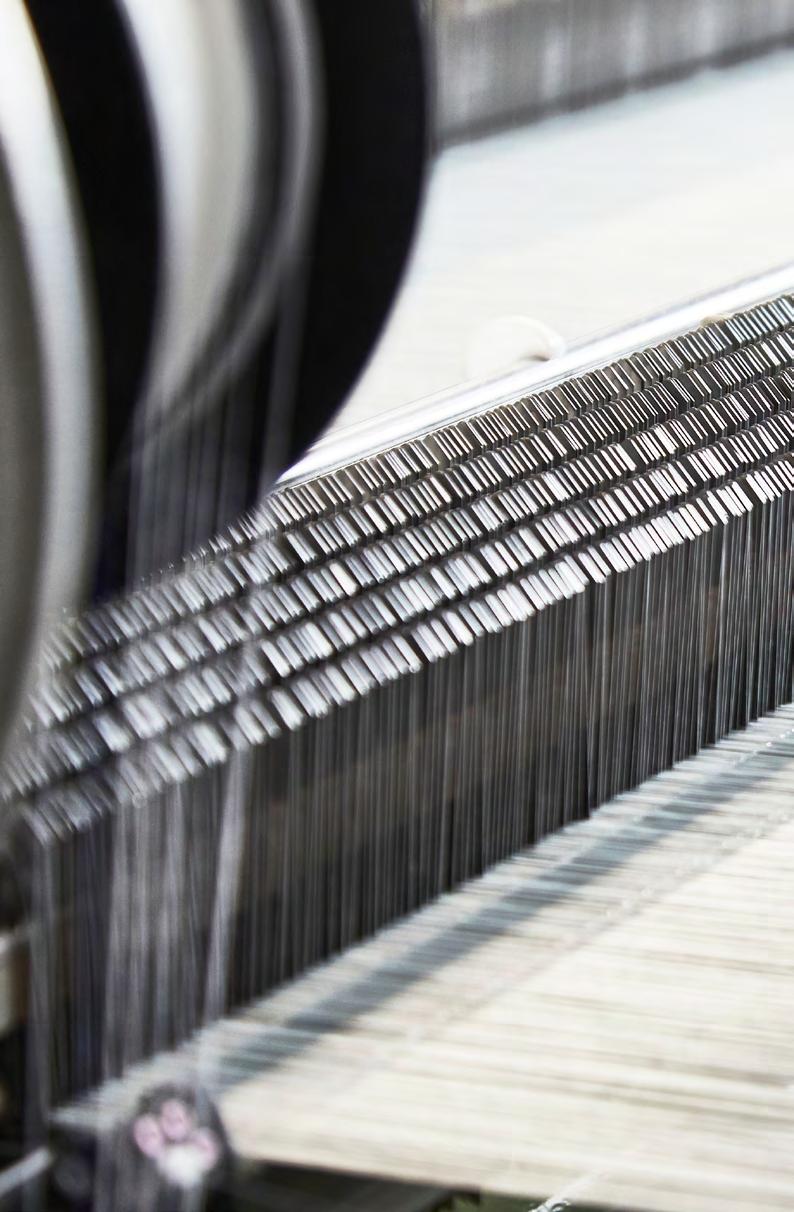
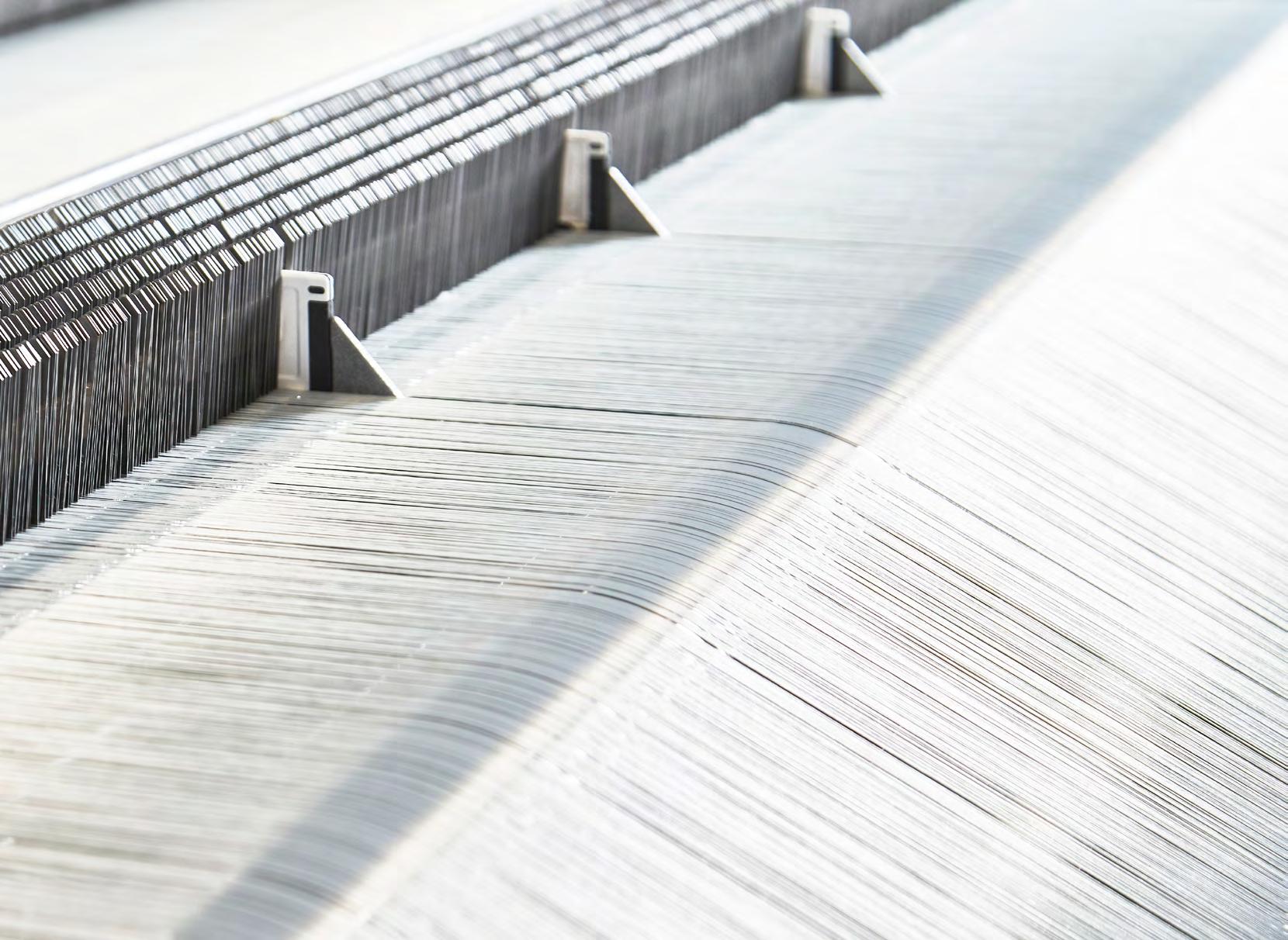
KE Fibertec is the only manufacturer of textile ducts in the world to have its own weaving mill. The company was founded in 1972 and is now run by the third generation of the family.
The weaving mill exclusively manufactures fabrics for textile duct ventilation which is a unique situation on the global market and which gives us a valuable know-how on these materials for the benefit of our customers.
To have our own weaving mill just across the parking lot gives us a very flexible cooperation partner who can meet our demands and requests on especially quality control and supply security. room in order to simulate various load situations.
Whatever the scope of the project, our experienced and dedicated R&D staff is ready to document the solution. This also applies for on-site measurements for the end user.
KE Fibertec Væveri has very strict demands on suppliers of yarn, and all raw materials are subject to extensive input control to ensure that the permeability is unchanged even after many washes.
A barcode enables us to monitor the fabric which gives us full traceability in relation to production date, permeability, etc. - from reel to finished product delivered and installed at the end user.
Further, the weaving mill supplies special materials such as Nomex, GreenWeave, MultiWeave and Antistatic GreenWeave materials.
KE Fibertec Væveri manufactures a large number of different permeabilities in many different yarn-dyed colours, in total almost 100 different product items. Most of the materials are Cradle to Cradle certified.
Advantages of textile ducts
• Efficient air distribution and good indoor climate
• Flexibility and customised solutions
• Unique materials and colours
• Fire tested and approved materials
• Hygienic and easy to wash
Why textile based ventilation?
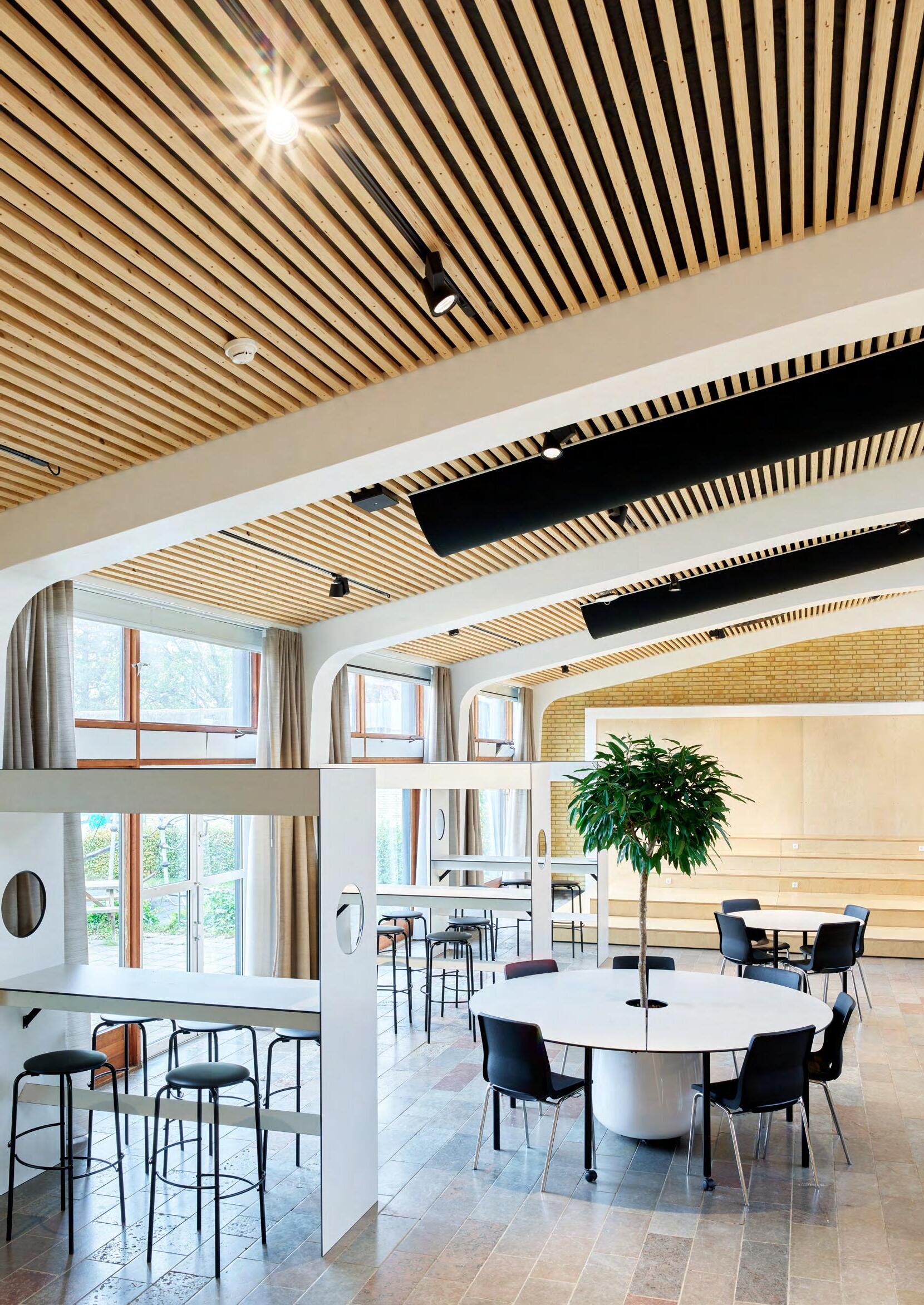
A textile duct is a round, semi-circular or quarter-circular duct made of lightweight textile material instead of galvanised or stainless steel or aluminium, and designed for supplying and distributing cold or heated air. Textile based ventilation is a good alternative to steel ducts.
• Great acoustic properties
• No condensation problems
• Quick installation and balancing
• Ergonomically advantageous with low weight
Good indoor climate
Textile ducts are ideal for efficient, uniform and draft-free distribution of fresh air without ‘dead zones’. Heavy and stagnant air can cause headaches and fatigue.
Textile ducts are lightweight, flexible and efficient for even and draft-free air distribution, ensuring a healthy indoor climate in rooms with many people.
Flexibility and tailored solutions
KE Fibertec’s TBV systems can be customised in size, layout, colour and material to suit the architecture and requirements of the building. The TBV system can be passive, hybrid or fully active.
Unique materials and colours
As the only manufacturer with its own weaving mill, KE Fibertec offers specially developed fabrics, optimised for uniform air permeability, shrinkage after washing, colour fastness and, not least, maximum dust holding capacity.
We offer a wide range of standard colours, and in addition, the fabrics can be dyed in any colour according to, for example, the RAL colour system at an additional cost.
Easy to transport and install
Our materials weigh 260-330 g/m2, so a TBV system weighs far less than steel ducts and is delivered in compact packaging. Suspension rails are cut to size for easy and quick installation. The system is designed for easy and quick installation.
Maintenance is essential
All ventilation ducts must be maintained at some point, regardless of whether they are low impulse systems where the air diffuses through the surface and the dust is retained on the inside or high impulse systems where induction dust settles on the surface and around the supply openings. The advantage of a textile duct is that it can be easily removed and washed.
Advantages of maintenance
A properly maintained textile based ventilation system ensures 20-25 years of trouble-free operation with a number of advantages:
Environmental washing process
KE Fibertec offers a comprehensive maintenance program with own in-house laundries in most major markets. All washing programs have been developed in collaboration with leading suppliers and they ensure a gentle and environmentally correct washing process.
In addition, KE Fibertec offers a certified Antibacterial treatment without harmful silver ions.
Lower energy consumption due to correct pressure loss and less clogging in the TBV duct. KE Fibertec offers impact calculations of optimal washing interval.
Healthier indoor climate as the particulate matter and other airborne particles are retained and washed out during the washing process.
Longer service life and as an extra benefit, the product warranty can be extended up to 15 years with an official KE Fibertec washing agreement.
Washing Service
Green thinking by KE Fibertec
The history of KE Fibertec
2030
KE Fibertec’s Danish factories become carbon neutral (Scope 1/Scope 2)
2026-2027
New extension and renovation of our factory in the Czech Republic. Heating and cooling will in future be provided by energy-efficient heat pumps.
2028
CSRD reporting in owner group is postponed until 2028.
2024
Introduction of third-party verified EPDs with complete CO2 documentation. Preparation of internal ESG reporting (sustainable ventilation). Weaving mill becomes 100% waste neutral.
2022
KE Fibertec participates in Climate Ready Production company (Scope 1, 2 and 3). Strategic co-operation on recycling of approx. 35 tons of textile waste. 62% lower carbon footprint with introduction of new packaging line.
2020
All yarn waste is recycled into bulb cords for suspension of KE Fibertec textile ducts.
2021-2025
Strategy ‘Sustainability as a business model’ 1: Carbon neutrality 2: Waste is a resource 3: Building certifications 4: Healthy materials
2023
Strategic agreement to recycle empty yarn cones into new product at our subcontractor. The MultiWeave material is Cradle to Cradle certified.
2021
Certification according to the UN Sustainable Development Goals. Complete documentation material according to DGNB, BREEAM and LEED standards.
2016
2016-2020
Focus on energy optimisation. Water-based cooling and new air handling units.
KE Fibertec is the first company in Denmark to be recertified acc. to the new ISO 9001:2015 and ISO 14001:2015 standard.
2012-2014
Certification according to the Cradle to Cradle standard.
1999
KE Fibertec Weaving Mill is established in Vejen.
1998
Certification according to ISO 9001 and ISO 14001 (today ISO 45001).
Green Thinking
KE Fibertec has a focus on sustainability and how we can contribute to a lower environmental impact.
Sustainability is essential in the construction industry due to global environmental problems and resource scarcity. Cradle to Cradle fits perfectly into that equation since you do not use new materials, but recycle materials wherever possible.
CradleVent® is our idea of a long-term and sustainable product for air distribution in offices, schools, laboratories, sports halls, public buildings, and other comfort environments.
KE Fibertec aims to be innovative and creative, setting the standard for textile based ventilation products worldwide in terms of both function and the choice of sustainable materials. We want to minimise our environmental impact in both production and transport:
• Because of the low weight of textile ducts the fuel consumption during transport (and therefore the carbon emission) will decrease remarkably compared to transporation of traditional steel ducts.
• A properly dimensioned textile duct system is able to operate optimally at a lower pressure drop than conventional ceiling diffusers.
• The air distribution with textile ducts is better, and it is therefore possbile to offer a solution that does not take in ”unnecessary” air. This results in energy efficiency - and a better indoor environment.
By choosing KE Fibertec textile ducts, you are doing something good for the environment.

KNOW-HOW
We want to supply the best quality in the market and on time. We do not compromise with quality, neither regarding design, documentation, nor finished products. Our goal is to be a professional partner with high demands on our performance, but also with high expections and demands on our suppliers and cooperation partners.

PRODUCT LIFETIME EXTENSION
A clean textile duct provides healthy indoor climate and energy savings that will benefit not only the environment but also the operating economy of the plant. With a complete programme of service and maintenance we offer solutions with an extended lifetime to our customers


BUILDING CERTIFICATION
With our Cradle to Cradle product certification, we support a number of international building certifications such as LEED version 4, BREEAM, NL.
RECYCLING
All aluminum included in the mounting rails and all bulb cords are made with a high degree of recycling. On all C2C products we offer a “buy-back programme” when the textile ducts are no longer functional.
CARBON REDUCTION
All electric power consumed is generated by wind turbines and thereby carbon neutral. KE Fibertec works with an ambitious goal of becoming carbon neutral by 2030. On top of that KE Fibertec is certified according to ISO 14001:2015 (Environmental standard).
UN GLOBAL GOALS
Since 2021, the UN’s 17 Sustainable Development Goals have been a central part of our approach to sustainability. We have selected four specific goals, 6, 7, 8 and 12, which we are purposefully working towards.
ENVIRONMENTAL MAPPING
In order to limit and monitor resource consumption, the KE Fibertec Group conducts an environmental survey every three years.
Cradle to Cradle
Since KE Fibertec obtained a Cradle to Cradle certification in 2012 by the EPEA institute in Hamburg a lot has happened. At the beginning it was only a white CradleVent duct, but today we can offer a large part of our material range in a number of colours (dopedyed yarns) approved according to the sustanability standard.
The Cradle to Cradle standard consists of five fundamental building stones (see below) and it is much more than just recycling a percentage of bottles or other waste materials in one cycle (cradle to grave). In the Cradle to Cradle concept you see waste as food for a new production, which creates balance in the cycle.
KE Fibertec works with the Cradle to Cradle elements as described below.
Cradle to Cradle Certified®
Product Scorecard
MATERIAL HEALTH
Version 3.1
MATERIAL REUTILIZATION
Version 3.1
RENEWABLE ENERGY & CARBON MANAGEMENT
Version 3.1
WATER STEWARDSHIP
Version 3.1
SOCIAL FAIRNESS
Version 3.1
Material Health
The goal is that KE Fibertec’s products only consist of materials and substances that are 99.99% harmless to humans
Material Reutilization
Our goal is to reach as high a recycling rate as is technically possible. The recycling rate on our products is 18-25% in 2021 figures. KE Fibertec offers a repurchase agreement on all CradleVent orders.
Renewable Energy
KE Fibertec currently uses 100% wind power, and we are working on a conversion from gas to a carbon neutral energy source for heating. KE Fibertec’s goal is to be carbon neutral by 2030
Water Stewardship
All waste water is collected and treated at a treatment plant. Yarn dyeing is used instead of piece dyeing, which gives a saving on waste water of approx. 67%
Social Fairness
All of KE Fibertec’s main suppliers have signed the ten principles of the UN Global Compact
Sustainability in practice
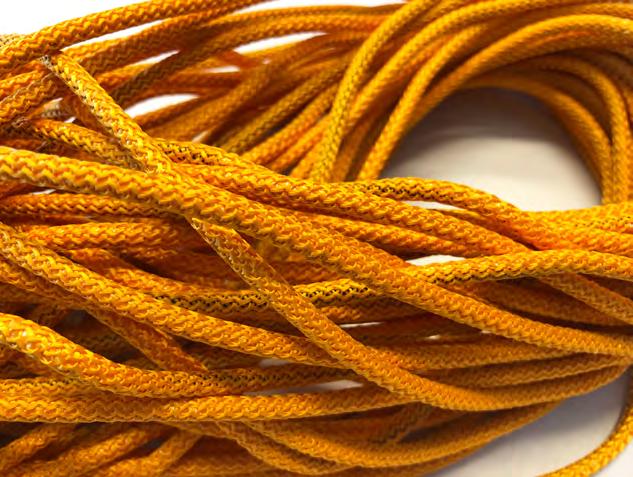
Our weaving mill, KE Fibertec Væveri uses all surplus warp yarn to produce bulb cords which are used for suspending the textile ducts in the mounting rails.
The surplus yarn is wound onto larger spools and recycled 100%. Therefore, there is typically a colour difference in the core of the bulb cords, but they are always covered by a material cover in the colour of the textile duct.
The advantage of this solution is that the bulb cords automatically comply with all the standards for which KE Fibertec’s materials have been tested, e.g. Cradle to Cradle, UL 2518, EN 13501 (B-s1-d0) fire certificates and in addition they are shrink-stabilised down to 0.5%.
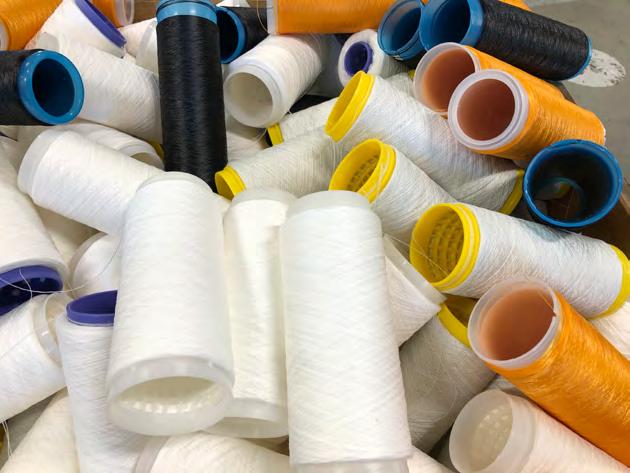
The excess plastic cones are sent for recycling to our supplier of DireJet nozzles. Read more in our sustainability brochure about how we work to optimise our solutions and recycle production waste.

EPD (Environmental Product Declaration)
For all projects KE Fibertec offers to calculate the environmental impact of the textile duct solution.
The values are stated as CO2 equivalents by converting all greenhouse gases (GHG emissions) so that they can be compared with other solutions.
CO2 equivalents are calculated dynamically in our TBV Designer programme and are based on the LCA (Life Cycle Assessment) analysis prepared by 2.-0 LCA consultants in Aalborg, DK.
Example:
The environmental impact for a Ø500 x 10,000 mm textile duct suspended in a Safetrack rail is 116 kg CO2 eq at a total air volume of 5,000 m3/h.
Choice of system
KE Fibertec makes customised solutions to provide efficient and healthy indoor climate in all types of buildings.
Where our products are used
Textile ducting can be used in almost any type of installation and building, irrespective of whether the requirement is for heating, cooling, ventilation or a replacement air system. Over the years, KE Fibertec and our partners have accumulated a large database of references covering every possible installation and we can safely guarantee that we have a solution to suit your inquiry. You will find a number of references at ke-fibertec.com

Why choose textile based ventilation?
Flexibility and tailored products are the hallmark of our TBV solutions. This allows you to freely choose the size that best suits your design rather than having to be tied to a particular number of standard solutions.
In addition to this, the options offered when it comes to selecting system layouts, colours, offsets, elbows, sockets and materials are endless, not to mention that you can choose whether the TBV system will be passive (low impulse), semi-active (hybrid) or active (high impulse). In a nutshell, there could not be more options available for achieving optimum air distribution.

UNIQUE MATERIALS
Our fabrics are woven in our own weaving mill with a focus on optimal air distribution, uniform permeability, high dust holding capacity, minimal shrinkage and standard colours at no extra cost.

EFFICIENT AIR DISTRIBUTION
Textile ducts are very well-suited for efficient, uniform, and draught-free distribution of fresh air without ”dead zones”. Stale and stagnant air may cause fatigue and headache. KE Fibertec’s textile ducts create an effective air change and a good indoor climate in schools, offices, shops, showrooms, and other types of rooms where many people are assembled.
EASY TO TRANSPORT AND INSTALL

Our materials weigh 260-330 g/m2 which is much lighter than metal spiral ducts. Textile ducts are easy to handle and transport as they are folded and packed in cartons of a maximum weight of 25 kg. The suspension rails are delivered in exact lengths rendering installation quick and easy

HYGIENIC AND EASY TO MAIINTAIN
All TBV systems can easily be taken down and washed in an ordinary washing machine. The materials absorb no more than 1% of water, even with a relative humidity of over 90% and are approved for the food industry. For extremely humid environments an antibacterial treatment is available that renders the textile ducts resistant to mould and microorganisms.

SUSTAINABLE VENTILATION
KE Fibertec offer a full sustainable ventilation solution, either certified according to the Cradle to Cradle standard with 100% recyclability and a disposal take-back-warranty, or sustainable Cradle to Cradle certified or quality tested yarns. Our production is certified to ISO 14001:2015 standard (Environment). Transportation and disposal of textile duct systems produce less carbon pollutants than conventional steel ducts.
Guide to selecting the best TBV system
In the following section we have created a product chart based on type of application matched with the best product choice. The approach taken when the charts were built was how to generate “added value or the best possible value for money”.
Application:
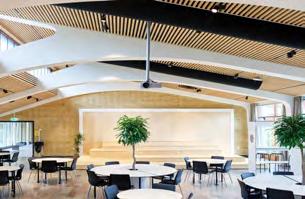
Comfort
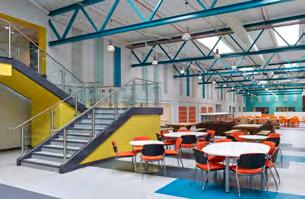
Showrooms
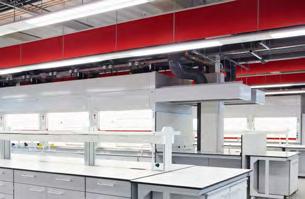
Laboratories
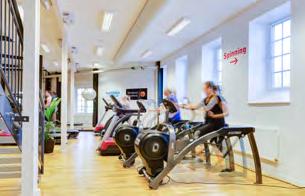
Sports & Leisure
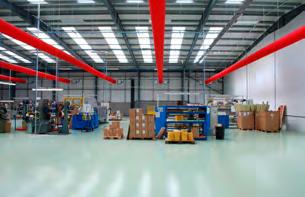
Recommended
However, other products can also be used for a particular installation if the assessment is based on other requirements.
KE-Low Impulse System
KE-Interior System
CradleVent®
FBS Panels
KE-Inject Hybrid System
KE-DireJet System
CradleVent®
KE-Low Impulse System
KE-Interior System
CradleVent®
FBS Panels
KE-Inject Hybrid System
KE-DireJet System
CradleVent®
KE-Low Impulse System
KE-DireJet System
KE-Inject Hybrid System
Low impulse ventilation / Displacement ventilation
Hybrid ventilation
Mixing ventilation
Hybrid ventilation
Low impulse ventilation / Displacement ventilation
Hybrid ventilation
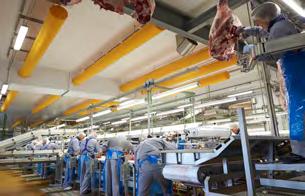
Food Industry
KE-Interior System
KE-DireJet System
KE-Low Impulse System
Low impulse ventilation / Displacement ventilation
Hybrid ventilation
Mixing ventilation
Mixing ventilation Industry
Low impulse ventilation / Displacement ventilation
Hybrid ventilation
Mixing ventilation
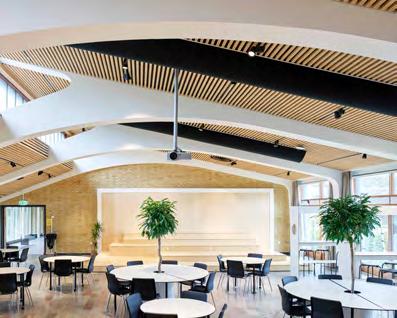
KE References for Comfort Ventilation
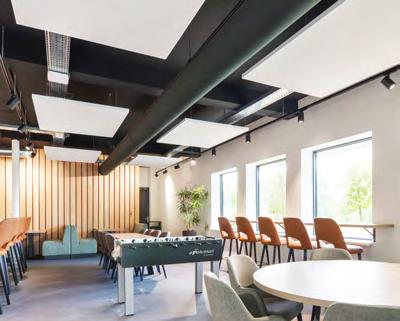
Offices, Canteens, Schools, Child care facilities, Lecture halls
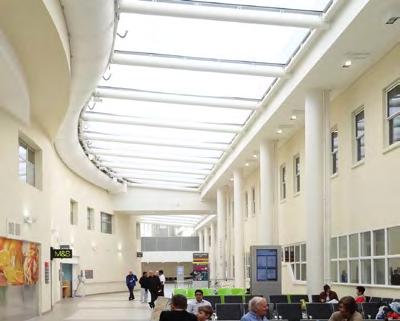
KE References for Showrooms/Public Buildings
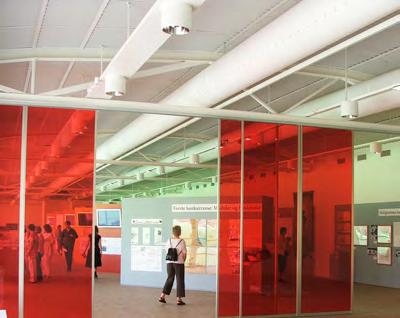
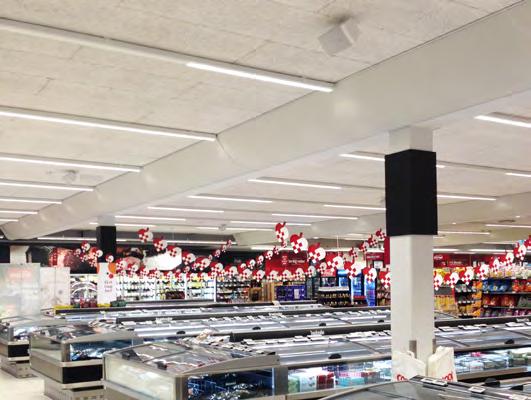
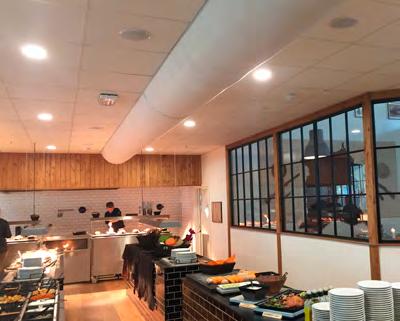
Showrooms, Supermarkets, Stores, Restaurants, Atriums, Exhibition centres
KE References for Laboratories
Production, Clean room laboratories
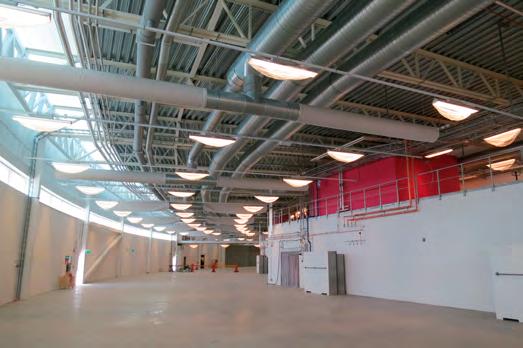
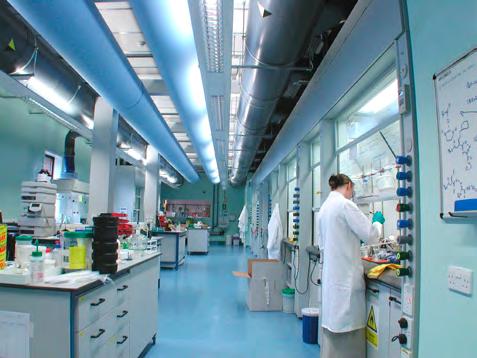
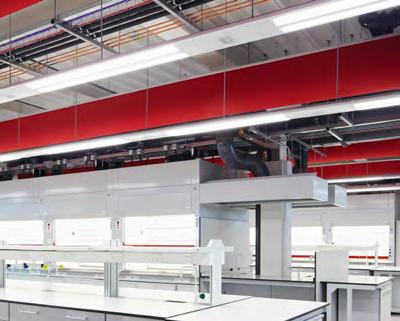
To explore more of our references, visit www.ke-fibertec.com
Nordager School, Denmark
KE Fibertec Benelux, Holland
Restaurant Flammen, Denmark
National museum, Norway
Broomfield Hospital, UK
MAX IV, Sweden
Pfizer Research Centre, UK
University of York, UK
KE References for Industrial Ventilation
Production premises, Storage rooms, Printing works, Vehicle workshops
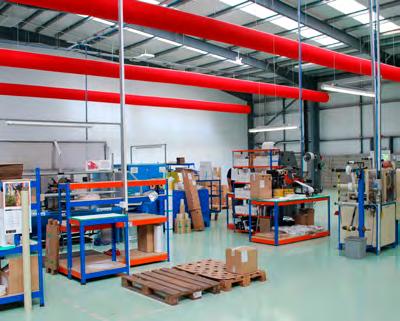
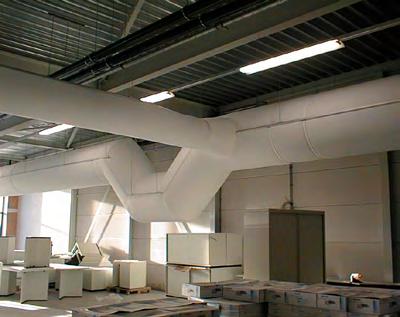
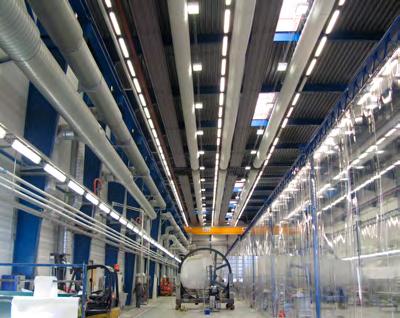
KE References for Industrial Cooling
Equalising rooms, Slicing rooms, Warehouses, Food terminals
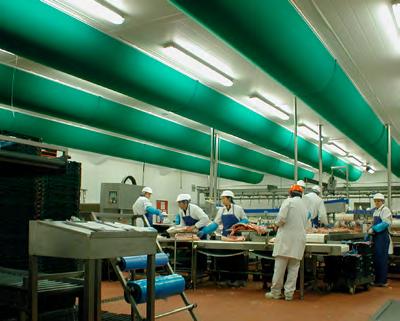
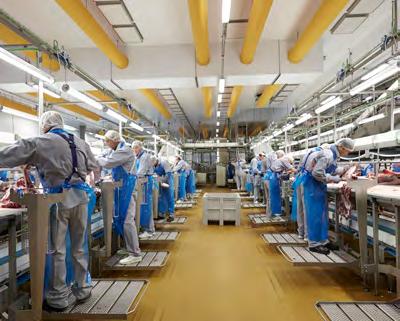
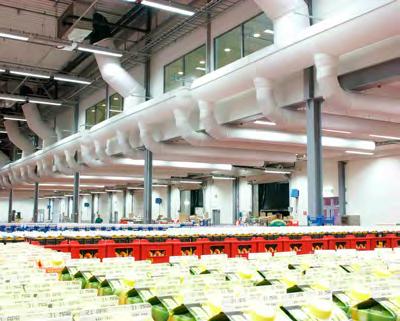
KE References for Sport and Leisure
Swimming pools, Sports arenas, Fitness studios
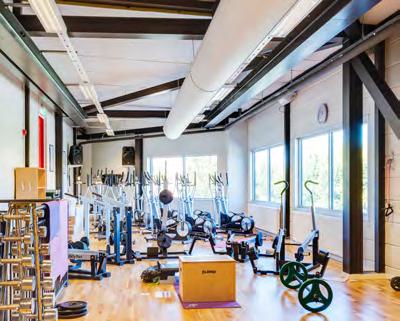
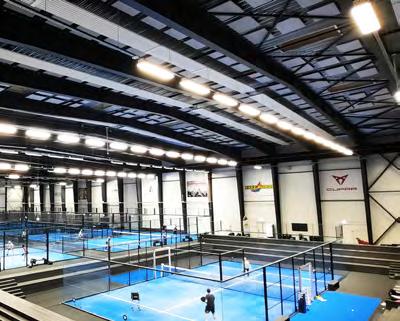
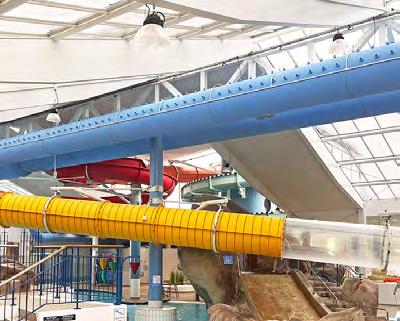
To explore more of our references, visit www.ke-fibertec.com
Danish Crown, Danmark
Arla Foods, Sverige
Plantijn Casparie, Holland
LM Wind Power, Danmark
KIF Padel Club, Denmark
Skallerup Seaside Resort, Denmark
Katrineholm, Sweden
Lohmann Tapes, England
Dalehead Foods, England
TBV Products
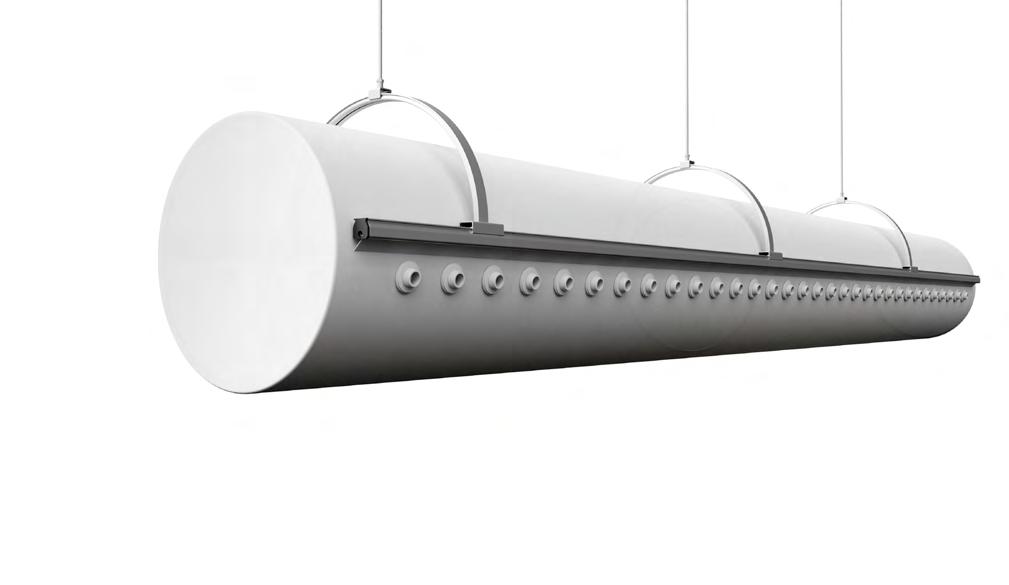
Flexibility and tailored designs characterise our textile based ventilation solutions.
Main products
KE Fibertec develops and markets three main TBV product groups, which can all be supplied in three different geometries. In passive low impulse systems the air diffuses through a permeable material. In high impulse systems air is distributed solely through holes (KE-Inject System) or nozzles (KE-DireJet System). The hybrid models are a combination of the passive low impulse systems and the lasered Inject holes or DireJet nozzles.
Air distribution principle
The air distribution principle used for a textile based ventilation system is fundamentally different from a conventional ventilation system equipped with steel ducting and traditional air distribution fittings. Most architects, consultants and fitters in the ventilation industry are already familiar with the general principles of TBV systems, but not all of them are familiar with the latest product versions and design options.
Product range: Low impulse systems
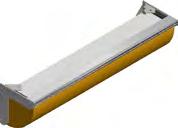
KE-Low Impulse System

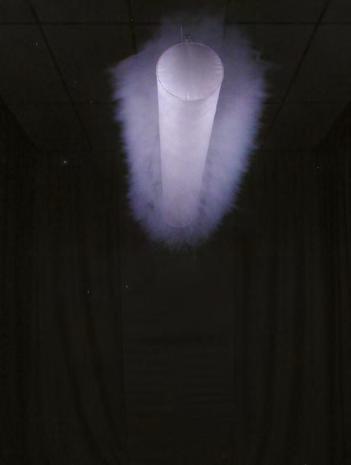


KE-Interior System (½D)
KE-Interior System (D)
Product range: High impulse systems
KE-Inject System
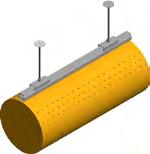
KE-DireJet System
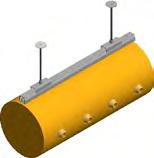
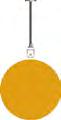
KE-Inject System (D)
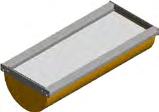
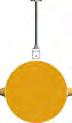
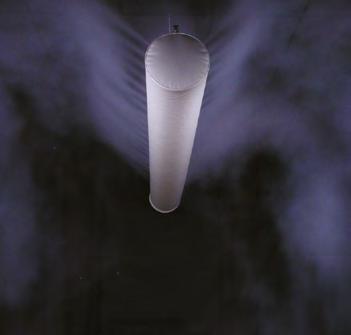

KE-DireJet System (D)
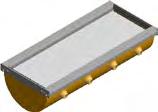

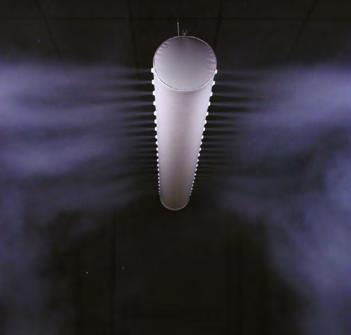
Product range: Hybrid systems
KE-Inject Hybrid System
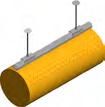

KE-DireJet Hybrid System
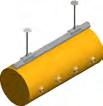

KE-Inject Hybrid System (D)
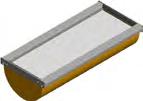

KE-DireJet Hybrid System (D)
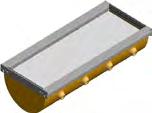

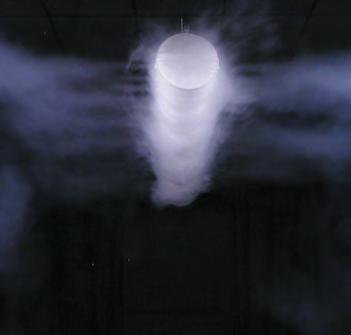
KE-Inject System (½D)
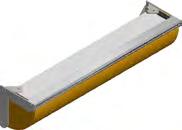

KE-DireJet System (½D)
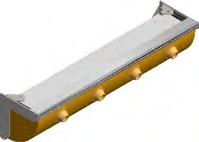

KE-Inject Hybrid System (½D)
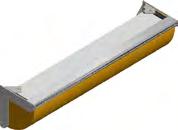

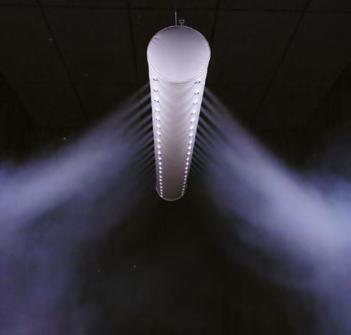
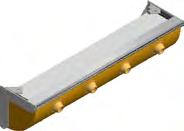
KE-DireJet Hybrid System (½D)

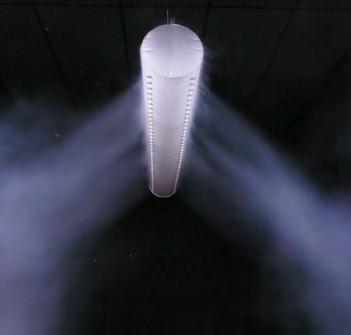
Low Impulse Systems
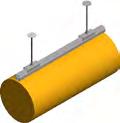

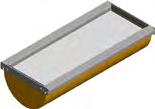

round ducts. Both systems use the same air distribution principle.
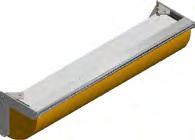

Occupied zone for low impulse systems
The occupied zone is the area in a room which people occupy for a long period of time and is defined as the area where efforts are made to maintain the indoor climate at a general level.
The occupied zone is not a standardised area, but a zone which is defined from one project to another in consultation with the architect and client. The occupied zone is often defined as the zone from the floor up to a height of 1.8 m above people who are in a standing position doing their job, while this height is set to 1.1 m for people who are seated
Near zone for low impulse systems
In the case of horisontal low impulse systems, the near zone is defined as the zone under the textile ducting where there is the biggest risk of a “cold downdraught” or of draughts in general.
The width of the near zone can be reckoned to be no more than three times the duct diameter. In the case of vertical low impulse systems, the near zone is defined as the local zone around the duct where the air velocity is too high in relation to the room’s comfort requirements (depending on the room category).
Horisontal low impulse systems
The air distribution principle for horisontal low impulse systems is based on passive thermal displacement where the air is supplied at a lower temperature in relation to the air in the room.
Because of the difference in density, with the cooled air being heavier than the warmer air in the room, the room air is displaced below the duct while the supply air continues moving towards the floor. The air flow in the room is then based on natural air movements where the air is driven by the difference in density and convection flows from heat-releasing activities and processes, hence the term “passive thermal displacement”.
A high level of heat activity from heat sources generates bigger convection currents, resulting in the air rising more strongly and greater entrainment of the air around the source. This results in stratification in the ventilated room where heat and pollution are drawn away from the occupied zone and extracted under the ceiling.
Zone 1
The airflow in zone 1 is particularly reliant upon the cooling load per running metre of duct (W/m). A large cooling load leads to a more powerful acceleration of the supply air into zone 1, which results in the air dropping down and mixing with the rest of the air.
Zone 2
In zone 2 the warmer room air is displaced by the cooled air from the low impulse duct. In low impulse flows there is almost no entrainment of the surrounding room air, which can reduce the velocity level before the flow reaches the occupied zone. This means that a higher starting level will result in a higher end velocity when the air enters the occupied zone.
Zone 3
The width of the near zone is also particularly reliant upon the cooling load per running metre of ducting. The larger the cooling load, the narrower the near zone. The width at the entrance to the occupied zone can be reckoned to be no more than three times the diameter of the low impulse duct.
A low impulse system can only be used for cooling purposes or for distributing large volumes of isothermal air, as warm air will settle under the ceiling like a blanket. When this occurs, the supply air is short circuited, which means a waste of energy.
KE Fibertec’s textile based low impulse systems are woven from GreenWeave polyester yarn, and the textile surface acts as a fine mesh, allowing the supply air to pass through the surface at a very low, uniform discharge velocity, which is normally less than 0.1 m/s. If the air needs to be distributed according to the low impulse principle the discharge velocity should be maintained below roughly 0.40-0.50 m/s. This is the limit at which the room air will start to be entrained and mixed with the low impulse flow.
The picture below illustrates the air distribution principle for horisontal low impulse systems.
Zone 1
Zone 2
Zone 3
1.8 m
Near zone
As has just been mentioned on the previous page, the cooling load per running meter of ducting is crucial to how the air flow will be under the ducting, but the location of the heat sources in the room also has a major influence on the air flow. The following parameters are crucial for air velocity and air temperature under the duct:
Cooling load per running metre of ducting
Large cooling demands result in higher discharge velocities and a greater temperature difference between the room air and the supply air (DT). Both these parameters end up accelerating the supply air’s velocity.
Location of heat sources
Measurements have shown that equally distributed floor heat accelerates the discharge velocity much more than heat sources located high up in the premises (1.5 to 2 m above floor level).
As mentioned previously, it is important to clarify how the heat load is distributed in the premises as it makes a big difference whether the heat loads come from machines, people or lighting, or whether it mainly takes the form of transmission heat from surrounding premises. As low impulse flows are only controlled by thermal forces, the location of heat sources and heat-releasing processes in the room is a vitally important parameter when calculating low impulse flows.
KE Fibertec’s room classification takes into account the heat distribution which normally occurs in different types of premises. The room classification gives clear guidelines on how large the cooling load can be with different comfort level requirements.
Unlike the cooling load per running metre of ducting, the static pressure, which keeps the textile duct inflated, does not have any particular influence on the air flow’s distribution in the room. No matter how great the static pressure is in the duct, there is not sufficient force (momentum) in the jet to give the air a throw length which is typical of KE Fibertec’s high impulse systems.
The static pressure, which keeps the textile duct inflated, does not have sufficient momentum to give the air a throw length which is typical of KE Fibertec’s high impulse systems. Due to the difference in density between the supply air and the room air, the supply air is displaced towards the floor immediately after passing through the textile surface.
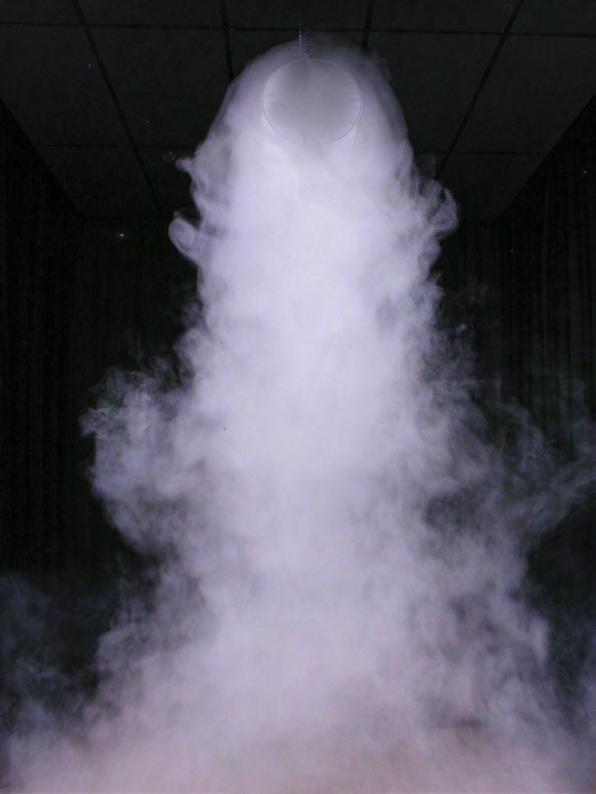
If the premises mainly has large concentrated heat sources it is important for low impulse ducts to be placed lower in the room and distributed between the heat sources rather than above in order to achieve a good displacement effect and prevent unnecessary mixing with the polluted air from the upper zone and buoyancy from machines.
This will help to flush the work zones under the textile ducting very effectively. It is extremely important that the number of textile ducts and their location precisely match that of the machines and that the ducting runs for the whole length of the heat source. If the heat sources are distributed more evenly, like in office premises for instance, the low impulse ducts should be placed in corridor areas or along walls to avoid a drop of cold air at fixed workplaces. If the upcoming convection heat blocks the low impulse current, undesirable stratification can occur, with cold air on top and hot air underneath.
Location of heat sources
At heat sources convection heat rises up and will, at a certain propagation angle, meet the downcoming air from the ducting. This phenomenon is also encountered with large window panels where the convection heat from radiators located under the windows counteracts the cold downdraught.
If the heat sources are located at a height the resulting air velocity will be somewhat lower when the current arrives down in the occupied zone. In other words, if the downcoming air velocity is greater than that of the upcoming warm air, the current will continue downwards, but at a reduced velocity.
In theory, you can calculate the convection velocities above almost every common heat source. If you also know the air velocity under the low impulse duct you can, in principle, calculate the resulting air velocity, but this procedure is definitely not to be recommended! In reality, you will come across countless instances where the cold current can “spread out” to the side and veer away from the duct’s centreline and continue at a greater velocity than expected, with the subsequent risk of draught problems.
To avoid a sudden drop of cold air, known as a “turbulence draught”, it is important to create a balanced system so that the risk of a drop of cold air does not arise.
The location of the exhaust grilles also affects the air distribution in the premises. Return flow towards an exhaust grille positioned at floor level can feel like a draught, especially in cold production facilities where even very low air velocities feel uncomfortable.
The usual recommendation is for extraction vents to be positioned at ceiling level, spread a certain distance apart. Large doors or windows which are opened regularly also have an impact on air distribution as the uneven pressure conditions can cause an inflow of air from outside and from surrounding premises.
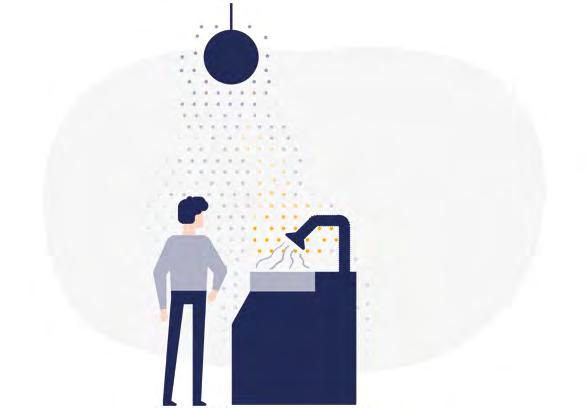
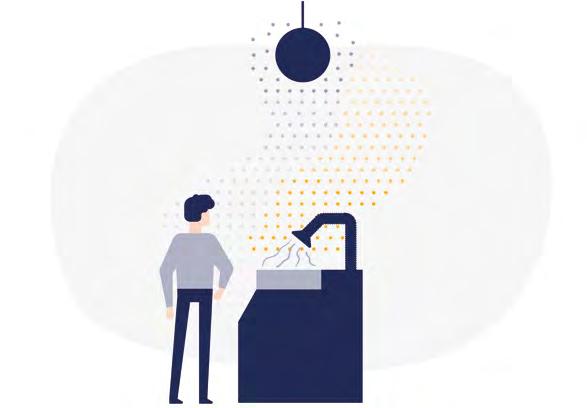
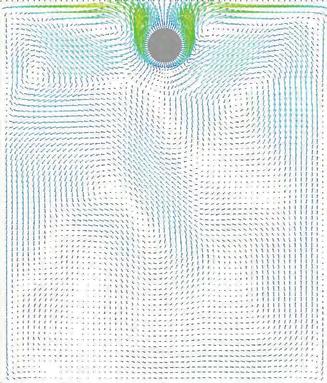
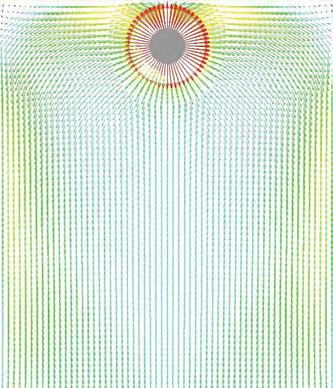
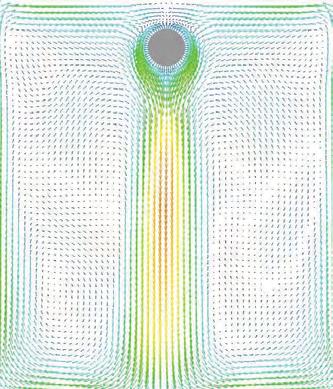
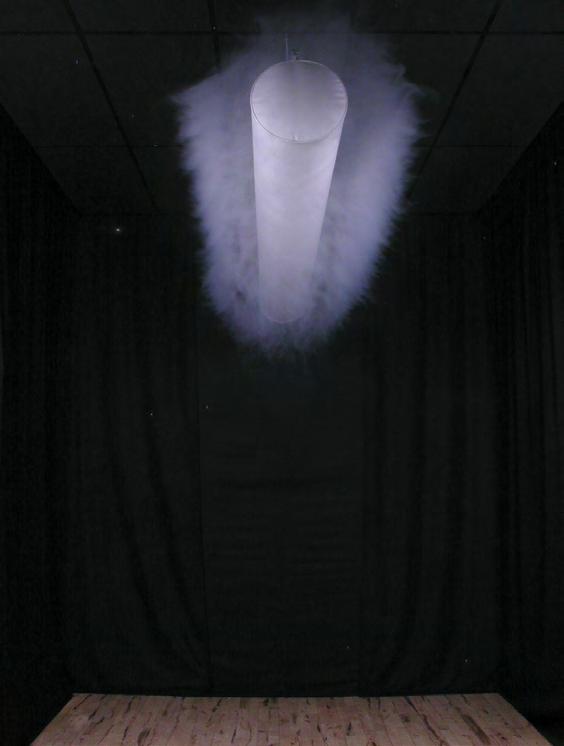
The figures below illustrate the typical flow pattern under a horisontal KE-Low Impulse System in a heating scenario, ventilation scenario and two
A
B
C
D
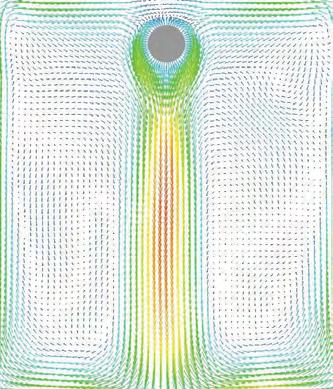
cooling scenarios with a different cooling load per running metre of ducting.
∆T < 0°C
A delivery of heated air results in the supply air being short circuited where the air forms a blanket under the ceiling. Low impulse systems are therefore not suitable for heating.
∆T = 0°C
A delivery of isothermal air produces a very diffuse flow pattern. Downward air movements (in the direction of the occupied zone) are often required, in which case the recommendation can be made to increase the discharge velocity to 0.40-0.50 m/s, which is the limit if the air is going to be supplied according to the low impulse principle. At discharge velocities above 0.50 m/s you can expect the surrounding room air to start being entrained.
∆T < 3°C
A delivery of supercooled air produces the typical downward flow pattern characteristic of low impulse ventilation using textile ducting. A delivery with a moderate cooling load does not, under normal circumstances, cause any discomfort in the near zone, even for those people who are seated. The maximum cooling load obviously depends on the distance from the low impulse ducting to the occupied zone.
∆T > 5°C
As the cooling load per metre of ducting increases, the flow pattern under the low impulse duct changes and the near zone becomes narrower, which means that the air velocities and air temperatures vertically under the duct may cause discomfort. A delivery of extremely supercooled air with a cooling load of more than 700 W/m of ducting should mainly only be used where comfort is a minor consideration. However, it is possible to deliver very large volumes of cool air, bearing in mind though that the air distribution will not be 100% perfect.
∆T < 0°C
∆T = 0°C
∆T < 3°C ∆T > 5°C
Vertical low impulse systems
The air distribution principle for vertical low impulse systems is, as with horizontal low impulse systems, also based on passive thermal displacement where the air is supplied at a lower temperature in relation to the room air. The air is supplied, as in conventional displacement ventilation, at floor level, directly in the occupied zone. This creates a stratified flow where the cooled supply air flows out into the room under the warmer room air.
In the same way as with horisontal low impulse systems, the flow in the room is based on natural air movements where the air is driven by a difference in density and by convection flows from heatreleasing activities and processes.
Convection flows at heat sources generate a vertical air flow in the room, thereby creating a clean zone on the bottom and a polluted zone on top. A high level of heat activity from heat sources generates bigger convection flows, resulting in the air rising more strongly and greater entrainment of the air around the source.
As the cold supply air only mixes to a small extent, it is important the air is supplied at a low velocity and slight temperature difference as otherwise there is a risk of a cold downdraught from the ducting, entailing the risk of a draught at floor level. The systems can, like horisontal low impulse systems, only be used for cooling purposes or for distributing isothermal air, as warm air will settle under the ceiling like a blanket.
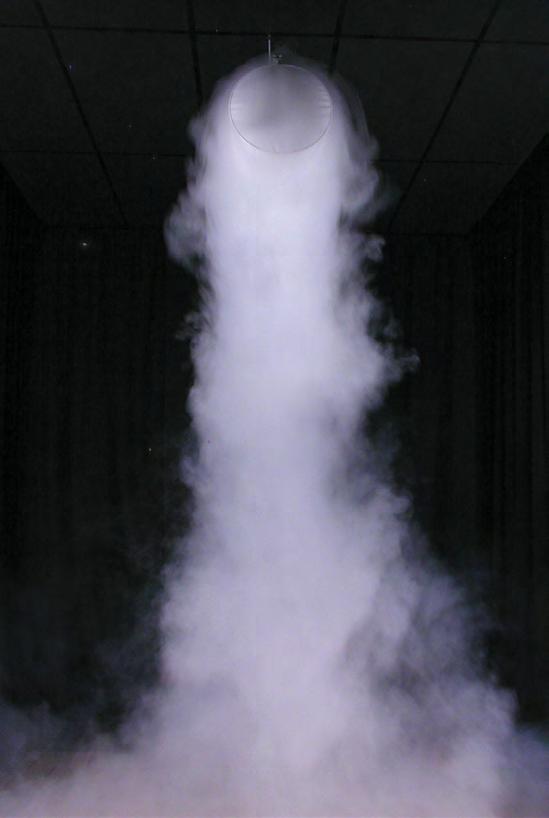
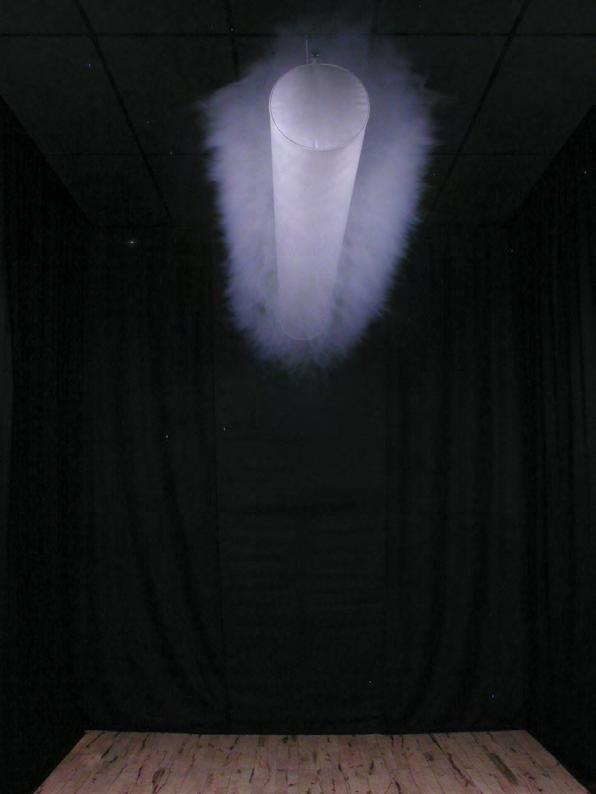
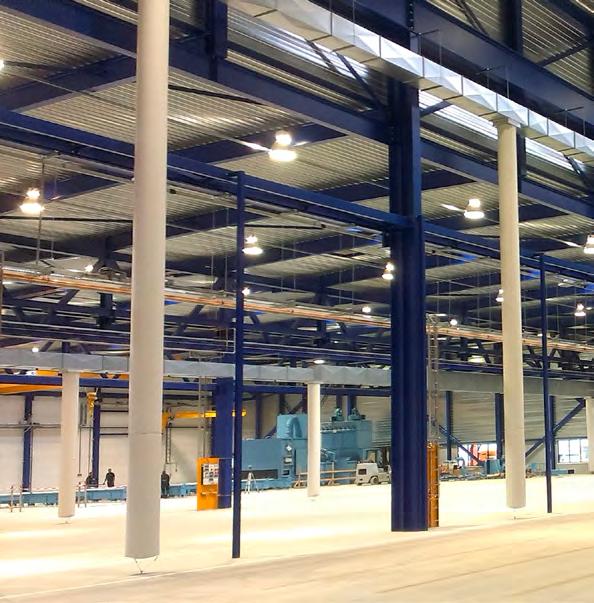
Vertical low impulse systems are particularly wellsuited to premises with high ceilings, excess heat and pollution as warm air and polluted particles are drawn up under the ceiling. As the flow generated in the premises is moving vertically upwards, the heat and pollution do not return to the occupied zone. The picture below illustrates the basic principle of vertical low impulse ventilation.
Zone 2 Near zone
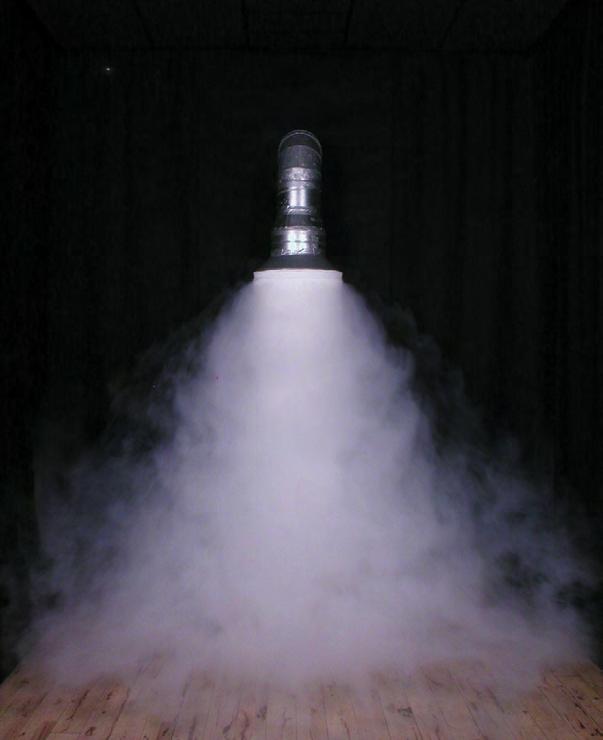
Zone 1
The airflow in zone 1 is particularly reliant upon the cooling load per running metre of duct. A large cooling load results in a greater downward acceleration for the supply air in zone 1.
Zone 2
The near zone, which should not be used as a permanent workplace, is defined as the distance from the duct before the velocity is reduced to an acceptable level, depending on the comfort requirement. The length of the near zone is particularly dependent on the cooling load.
Zone 3
It is very important that the volume of air from the vertical low impulse system has been adapted to the cooling requirement and that the volume of air supplied is at least equivalent to or greater than the convection flows generated by the heat sources. This helps to achieve the best displacement effect and create a clean zone at the bottom and a polluted zone on top.
Zone 3
Zone 1
The vertical textile ducts supply fresh air directly in the occupied zone, which will obviously result in stratification in the ventilated room. This will cause a temperature gradient through the room, with the coldest air at the bottom and the warmest on top.
This can be used beneficially to reduce the cooling load as the cooling load removed from the room is directly proportional to the difference in temperature between the supply air and extracted air. If the air is extracted from the top of the room this will be warmer than the air in the room’s occupied zone, allowing the same cooling load to be removed from the room with a higher supply temperature.
This results in energy savings when the cooling coil in the air conditioning unit is operating. It also means that free cooling can be used for longer periods of the year.
The required cooling load, combined with any comfort requirements, provides the basis for determining the volume of supply air and the supply temperature. To determine the necessary cooling load accurately, you need to calculate internal and external heat loads, while taking into account the heat accumulation in the building.
In the case of displacement ventilation, comfort requirements also include, apart from air velocity and air temperature requirements, the requirement for the maximum permitted thermal gradient in the occupied zone.
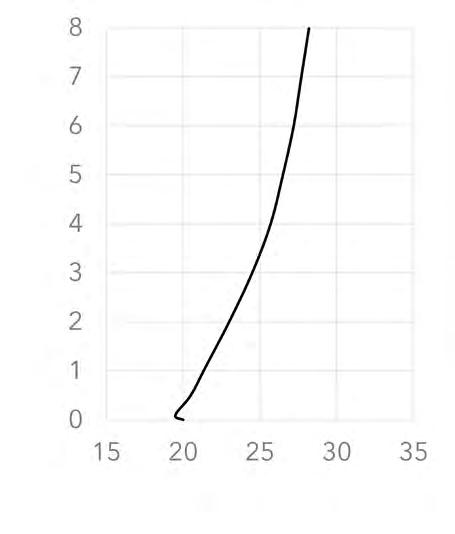
KE Fibertec recommends that the maximum thermal gradient in the occupied zone does not exceed 1-2°C/m as any bigger difference may feel like a draught. The vertical thermal gradient can be approximately calculated based on a so-called 50% rule, which states that half of the temperature rise from supply to extraction takes place at floor level, while the other half takes place between the floor and ceiling. Contact KE Fibertec’s development department for more information.
Designing a ventilation system with vertical low impulse ducts requires considerable knowledge about the heat distribution in the premises. It is vitally important that the ventilation system is dimensioned correctly so that it takes into account the level of comfort in the premises’ work zones and the heat and polluted air are carried upwards and out of the occupied zone.
To displace the polluted air it is important that the volume of air supplied is at least equivalent to the total convection flow volume in the room. If this is not the case, the front of the polluted air will be dragged down towards the occupied zone, thereby reducing the effectiveness.
Many factors affect the size of convection flows in the room, such as the shape, area and surface temperature of the heat sources. But factors like the ambient temperature in the premises also have an impact. This is why it is often difficult to determine accurately the convection currents and table values must be used instead.
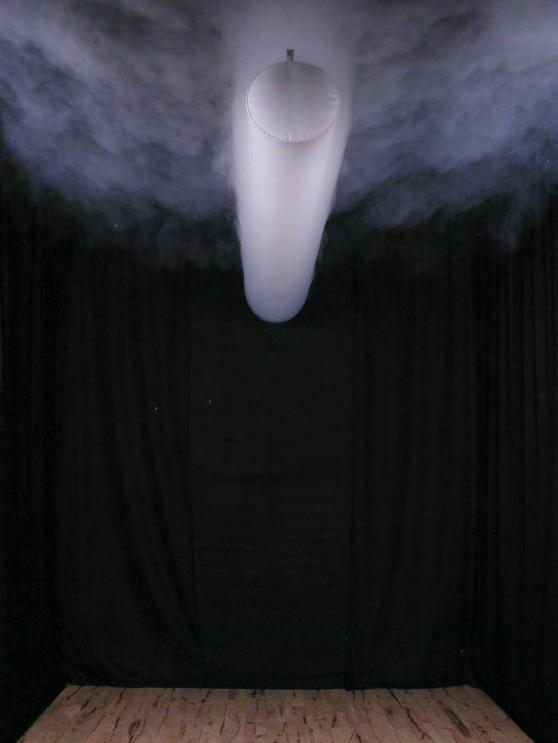
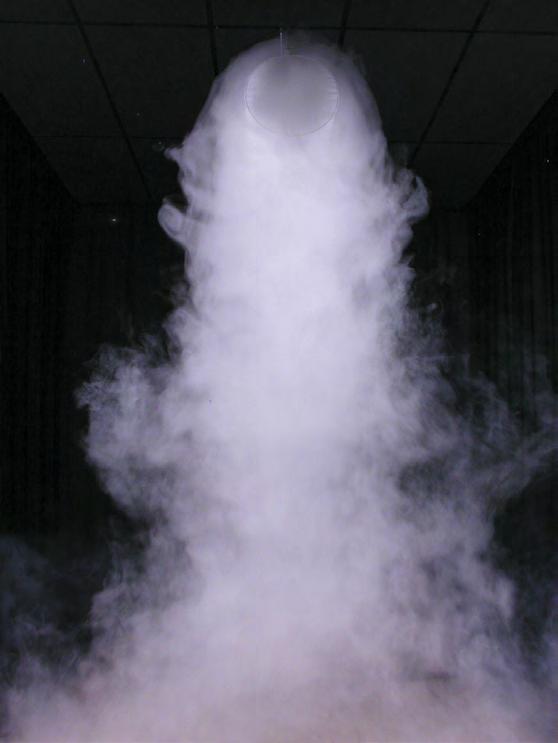
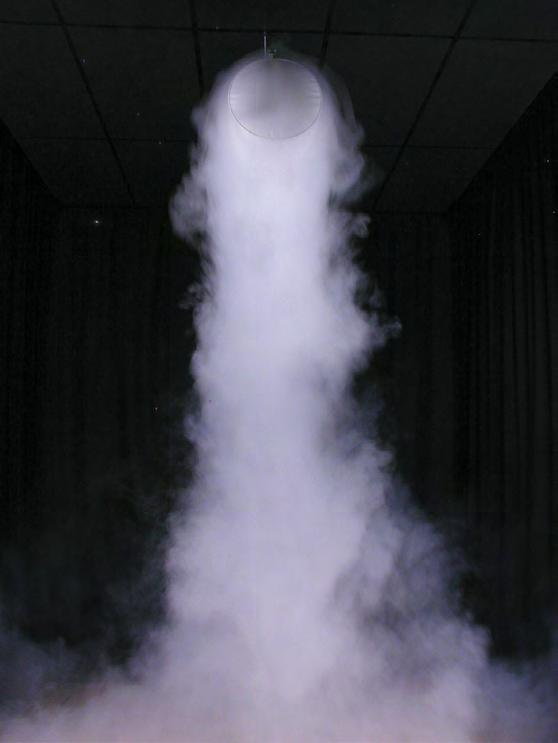
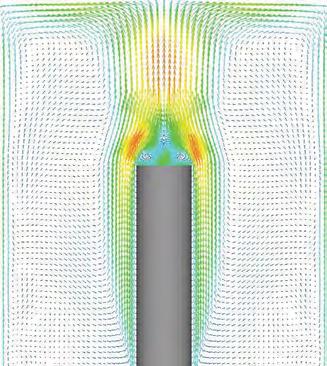
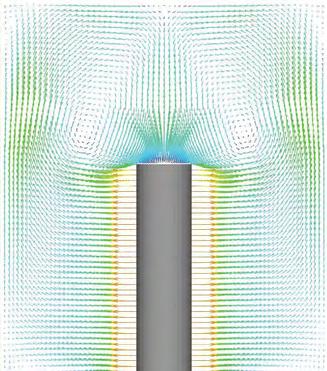
The figures below illustrate the typical flow pattern under a vertical KE-Low Impulse System in a heating scenario, ventilation scenario and two
A
B
C
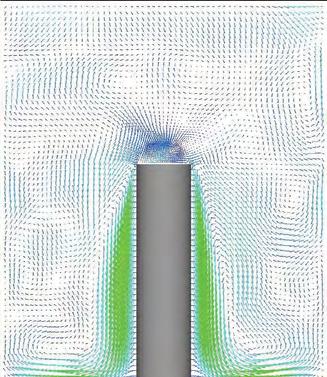
D
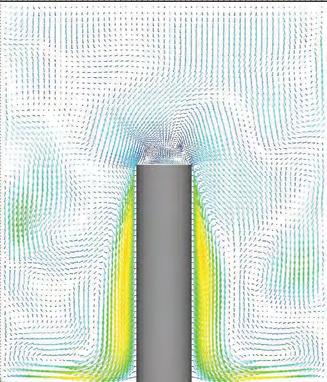
cooling scenarios with a different cooling load per running metre of ducting.
∆T < 0°C
Delivering heated air short circuits the supply air, which means that the system is not suitable for heating. However, the heated air has a certain penetration, which initiates air circulation in smaller premises. As a result, the system can be used, to a certain extent, to heat the room before work begins or it is used.
∆T = 0°C
Delivering isothermal air produces a very diffuse flow pattern, which does not generate a powerful displacement effect. Systems are suitable, to some extent, for supplying replacement air.
∆T < 3°C
If slightly supercooled air is supplied the air will slowly drop towards the floor and be distributed evenly around the duct. In the event of heat-releasing activities and processes, the convection flows will entrain the supply air, thereby creating stratification in the room where the heat and pollution are drawn away from the occupied zone and extracted under the ceiling.
∆T > 5°C
If extremely supercooled air is supplied the air will quickly move towards the floor, thereby causing a greater risk of draught problems around the duct as the length and width of the near zone around the duct are increased. In the event of heat-releasing activities and processes, the convection flows will entrain the supply air, thereby creating stratification in the room where the heat and pollution are drawn away from the occupied zone and extracted under the ceiling.
∆T < 0°C
∆T < 3°C
∆T > 5°C
∆T = 0°C
High Impulse Systems
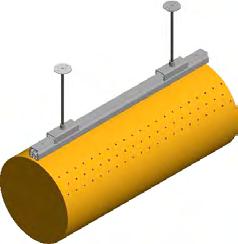
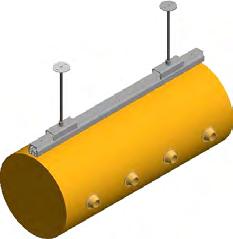
KE Fibertec offers two systems for high impulse ventilation, KE-Inject and KE-DireJet. Both are available as round, halfround or quarter-round ducts.
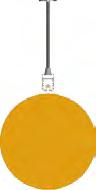
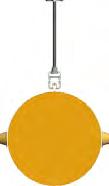
Occupied zone for high impulse systems
As with low impulse ventilation, the occupied zone is not a standardised area, but a zone which is defined from one project to another in consultation with the architect and client. The occupied zone is often defined as the zone from the floor up to a height of 1.8 m above people who are in a standing position doing their job, while this height is set to 1.1 m for people who are seated.
Working zone for high impulse systems
In the case of industrial premises, it may also be appropriate for high impulse systems to divide the room up into a working zone as the state of the air may vary from the general level as a result of industrial processes. Heat and pollution sources are often present which require special measures to be able to maintain a satisfactory indoor climate in the working zone. If processes are carried out which cause extreme pollution, textile based ventilation should therefore be supplemented with local extraction vents.
KE-Inject System
KE-DireJet System
Air distribution principle
KE Fibertec’s high impulse systems are based on mixing ventilation and are characterised by the fact that air is delivered at a high velocity outside the occupied zone. The high air velocity rate in the air jet will generate excess pressure, resulting in an inflow and entrainment of room air towards the air jet supplied.
During the first air flow cycle the air velocity will be high, but as the volume of room air that becomes mixed increases, the air velocity will decrease. If the system has been dimensioned properly the delivered air volume will be completely mixed with the room air before it reaches the occupied zone and the air velocity rate has dropped to the desired level, depending on the room category.
In a mixing ventilated room air velocities, air temperatures and humidity will be distributed identically and in theory, the air quality will be the same everywhere in the room.
A textile based high impulse system, unlike its low impulse counterpart, can be used for cooling, ventilation and heating.
Zone 1
The air is delivered at high velocity, often up to 15-18 m/s, through the holes (KE-Inject System) or nozzles (KE-DireJet System). This generates excess pressure in the centre of the air jets, resulting in an inflow and entrainment of the air in the room towards the air jet supplied.
Zone 2
As the volume of entrained air increases, the air velocity in the flow gradually decreases. The velocity decreases in inverse proportion to the distance from the duct.
Zone 3
In premises where a certain comfort level is required, the air velocity at the entrance to the occupied zone must be adapted to the conditions, which mainly depend on the level of activity of the people working there and what they are wearing (room category). To ensure that a suitable air velocity is achieved, the distance from the duct to the occupied zone must be greater than the calculated throw length (see definition on page 31).
The reason for this is that KE Fibertec’s high impulse systems, unlike its low impulse systems, are less dependent on external effects, such as convective heat currents in the room.
The supply air is delivered with high initial energy in the form of velocity (momentum) through holes or nozzles, with the effect that the air is discharged into the room instead of being distributed through a textile surface at low velocity. This means that KE Fibertec’s high impulse systems have what are known in flow engineering as a throw length and penetration length.
Compared with low impulse systems, the location of the exhaust grilles is only of minor significance to the air flows in the room. In practice, they are often positioned along the ceiling. The picture below illustrates the air distribution principle for high impulse ventilation.
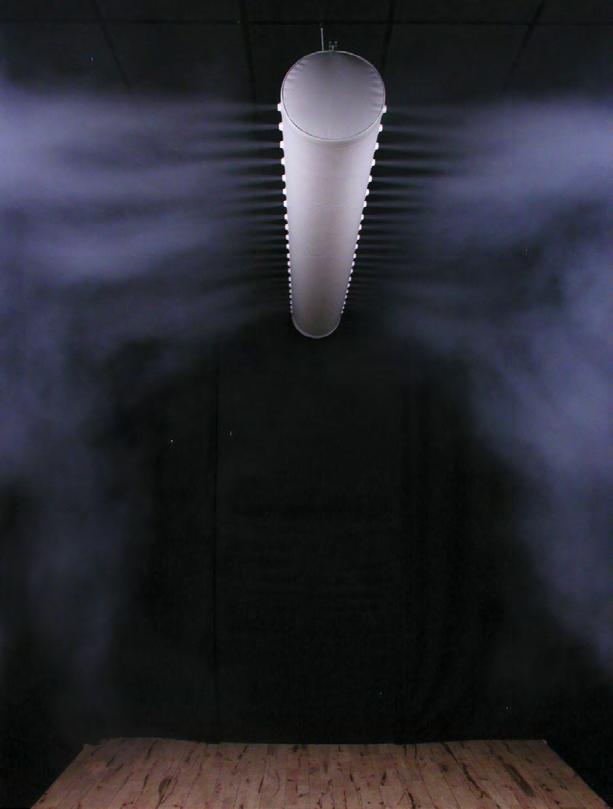
Zone 2
Zone 3
Zone 1
1,8 m
Short circuiting warning
It is important to be aware that mixing ventilation also entails a risk of the supply air being short circuited (accumulated under the ceiling). This problem may occur if overheated air is supplied combined with an excessively low discharge velocity, or if there are strong upward currents in the premises, preventing the air from reaching the occupied zone.
This problem becomes particularly apparent when the ∆T is more than 7-12°C. In the best case scenario, the poor heat distribution in the room can be compensated for by raising the supply temperature, but if the heating coil in the air conditioning unit does not have sufficient capacity to do this, the temperature in the occupied zone will fall. This situation is very inconvenient, both from an energy and comfort perspective.
To make sure that short circuiting is prevented, heated air must only be delivered if the supply temperature and discharge velocity are adjusted. This means that the warmer the supply air, the higher the discharge velocity needs to be to ensure that the air reaches the occupied zone. If the ceiling is particularly high (h > 8-10 m) the ducts need to be dimensioned for a high static pressure to be able to push the air down into the occupied zone. If this is not possible, the ducts can be positioned at a height of 5 metres, for instance.
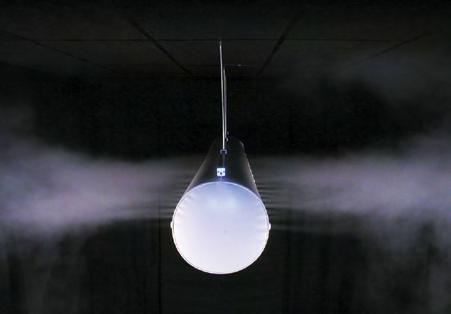
Free jet
If the air jet is directed outwards into the open room, this is what is known in flow engineering as a free jet. The turbulent air jet entrains air from its surroundings and the jet’s diameter increases in proportion to the distance from the duct, while the velocity in the jet decreases.
Wall jet
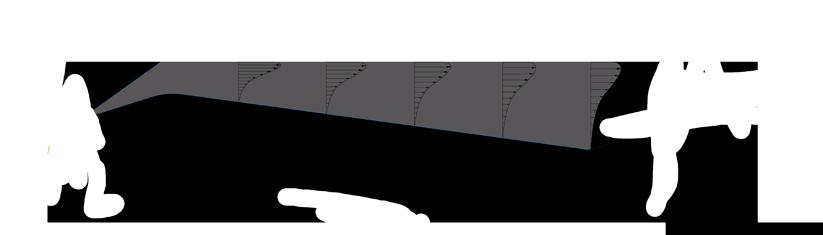
If the air jet is directed towards a surface, this is what is known in flow engineering as a wall jet. The flow can be regarded as a bisected open jet as the surface can be regarded as a plane of symmetry. The maximum velocity is achieved close to the surface and is 2 greater than the equivalent velocity for an open jet at the same distance from the duct.
Occupied zone
Free jets and wall jets
A crucial factor for the air distribution principle behind the KE-Inject System and KE-DireJet System is the main direction of the air jets. If the jet is directed outwards into the open room, this is what is known in flow engineering as a free jet and if the air jet is directed at a surface, this is a wall jet. The difference between these two flow phenomena is their ability to entrain room air. If the jet is directed towards the ceiling surface it will try to “stick” to this surface because a negative pressure is generated between the jet and the ceiling as no replacement air can be supplied for the volume of room air entrained by the jet.
This is known as the “Coanda effect” and it increases the throw length by a factor of 2 in relation to the throw length for a free jet, while the velocity rate in the jet decreases proportionally more slowly. The air velocity needs to be a minimum of 0.35 m/s to be able to utilise the Coanda effect.
Throw length
The throw length is defined as the largest distance from the supply duct to a specific point in the premises where the air velocity is precisely equal to the desired final velocity, e.g. viso = 0.20 m/s. It is important to note that the throw length, by its definition, is valid in isothermal conditions. As a result, the calculations for air velocities must be corrected if the supplied air is either colder or warmer than the surrounding room air.
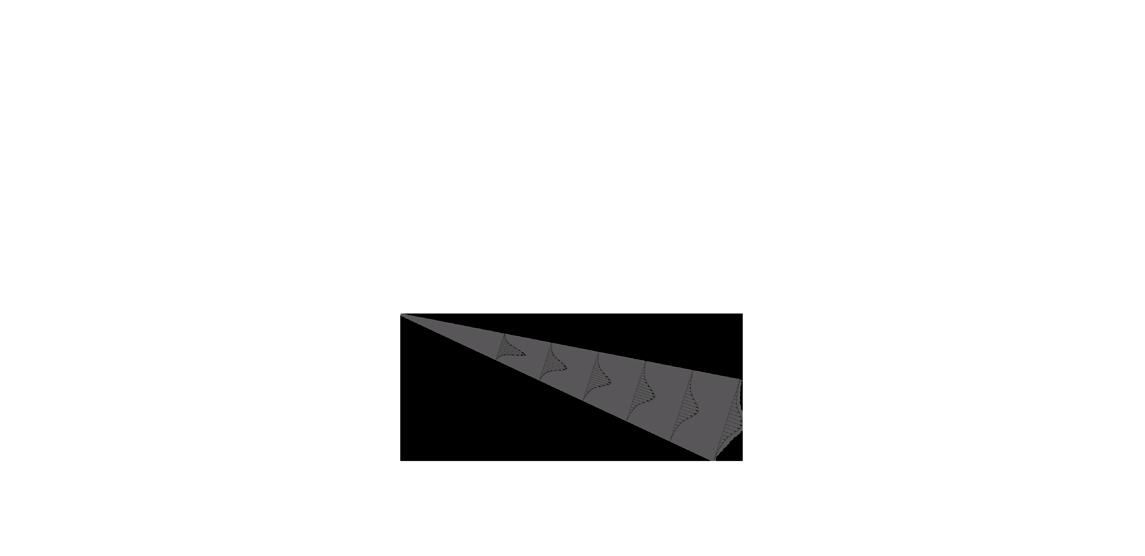
The throw length for a wall jet is 2 longer than for an equivalent free jet. The reason for this is that a wall jet will stick to the ceiling due to the Coanda effect and as a result, only half the volume of room air contributes to reducing the velocity rate.
Thermal penetration length
The thermal penetration length is absolutely crucial in determining whether the air is actually distributed as expected. The theory underlying wall jets is actually based on the fact that the jet will not become so “heavy” that it will leave the ceiling’s surface before it is supposed to. If it does, the air velocity at the entrance of the occupied zone will be higher than calculated. This means that it will feel uncomfortable for anyone located in the zone affected by the jet. To prevent any drop of cold air, the thermal penetration length must be checked to see that it is at least 75% of the horisontal distance along the ceiling, L, where the air is moving.
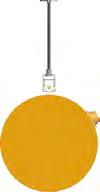
Using flow models
Both the KE-Inject System and KE-DireJet System are highly flexible systems and any direction at all can be chosen for the air jets. It is obviously important for the air jets to point in the main direction of the air flow following the desired air flow pattern in the room. As mentioned earlier, it is also important that the air flow is directed downwards towards the occupied zone when heating is required in order to prevent short circuiting. Apart from choosing the main direction for the air jet, secondary nozzle positions can be used. For instance, if the ceiling needs to be coated locally to avoid the formation of condensation or part of the area needs to be cooled down/heated, it is possible to direct individual nozzles or holes towards the relevant area. Nozzles can also be left out entirely in sections of the duct if no air needs to be supplied.
KE Fibertec uses three different flow models for textile based mixing ventilation in its everyday activities, which are flow models 1, 2 and 3 respectively. To be able to use KE Fibertec’s datasheets properly, you need to know which flow model is involved as all the datasheets have been specified for flow models 2 and 3, i.e. free jets.
100% customised solutions
All KE Fibertec’s textile based ventilation solutions are 100% customised. Any direction can be chosen for the holes in the KE-Inject System and for the nozzles in the KE-DireJet System. Depending on the system’s usage, the holes/nozzles can be pointed in any direction, specified at an angle from 12 o’clock.
It is important therefore to clarify what the user wants and needs in terms of the system, as well as to become familiarised with processes and activities before starting to dimension the final design for the high impulse system.
Using flow model 1 (wall jet) can bring some benefit, even though the throw length increases as a result of the Coanda effect. Air jets tend to become more stable when cooled air is delivered, while the risk of a drop of cold air or draughts in general in the occupied zone is kept to a minimum.
The Coanda effect also makes the blanket of air “stick” to the ceiling, which means that it will not be deflected by local heat sources, obstacles etc. Consequently, there is a greater likelihood of achieving the desired flow pattern in reality than with delivering an free jet. As was mentioned before, it is recommended to use flow model 2 or 3 for both the KE-DireJet System and KE-Inject System if the system is going to be used to provide heating. This will then eliminate the risk of the supply air being short circuited.
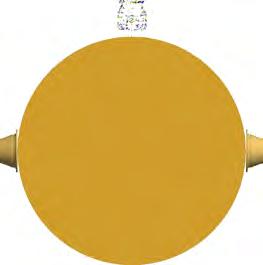
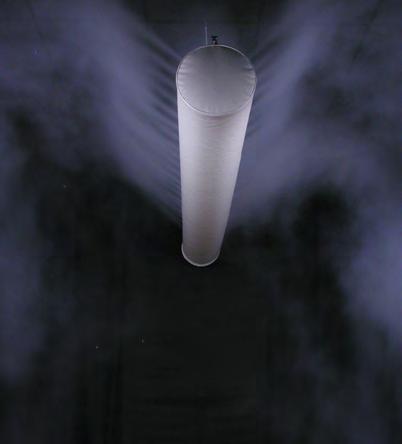
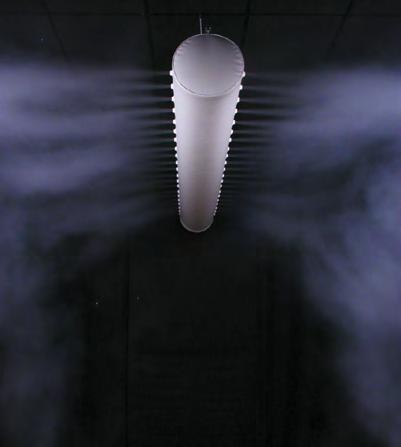
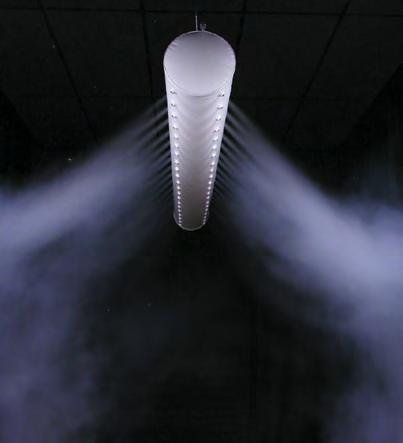
KE-Inject System
The KE-Inject System offers a high degree of flexibility. The system consists of groups of small holes in an airtight textile material.
Four Inject families
The inject system is divided into four families. The conventional inject system for comfort solutions consists of three different groups of fixed patterns (LV, MV and JET), which are characterised by a patented hole design with small Ø4 mm holes placed in sections along the length of the duct. The special hole pattern provides an excellent induction effect, where the secondary room air is mixed very quickly, reducing the air velocity in the jet and thus the risk of draughts in the occupied zone.
KE Fibertec has well-documented measurements of pressure loss, throw lengths and air penetration for the three conventional Inject types, where the final design is based on these hole patterns.
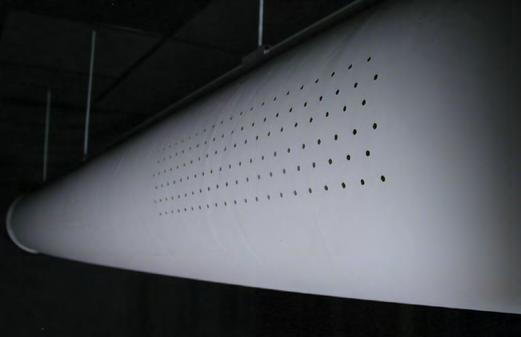
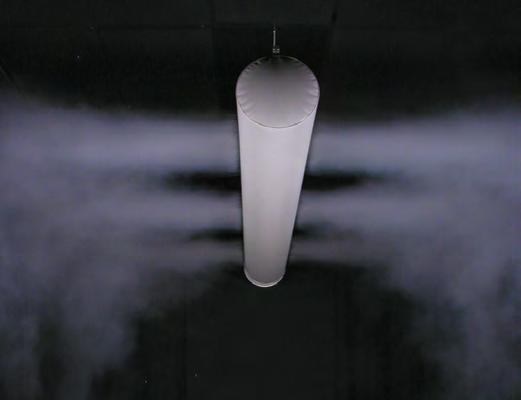
If the system layout requires additional flexibility, KE Fibertec recommends the KE-Inject Flex system.
The new Inject Flex family consists of three different groups (S, M, XL) with special hole sizes:
Inject Flex S has a hole diameter of 4 and 6 mm. Inject M is available with hole sizes from 6-25 mm, and Inject XL with long penetration length is available with hole sizes from 35-70 mm in diameter.
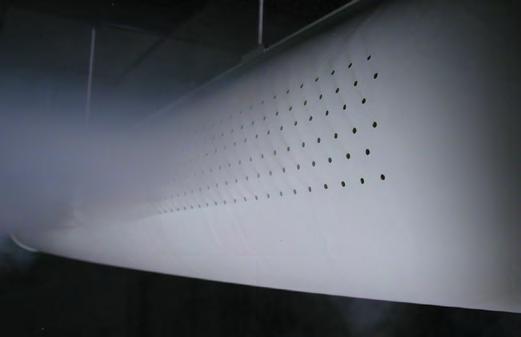
The KE-Inject System comprises small holes in coated textile material (airtight). The delivery of air through the holes causes induction of the room air on a large scale, resulting in a relatively rapid reduction in the air velocity rate in the jet compared to the KE-DireJet System.
Conventional KE-Inject (LV, MV, JET)
The special hole design produces an extremely good injection effect, i.e. the air jets operate like a row of small missiles. The high velocity rate generates a relatively large amount of low pressure behind the jets, which is crucial to the inflow of room air from zones around the KE-Inject duct.
The injection effect can be improved further if the air jets are directed towards the ceiling because the inflow of room air is reinforced as the heat naturally rises upwards in the premises. Another benefit from grouping the holes in a particular design is the opportunity it provides to control the flow. The air jets from the many holes will see their angle of propagation continually increase as room air is entrained and mixed. After a short time the air jets will converge and continue like a single blanket of air.
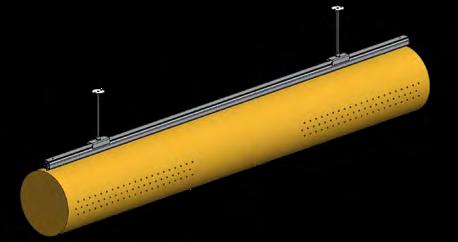
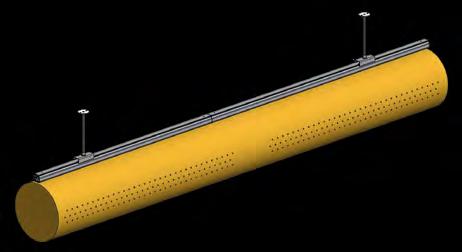
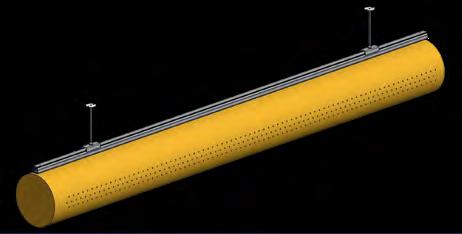
If the holes are grouped with a large distance between them a larger volume of room air needs to be mixed before the air jets converge and form an air blanket than if the holes are placed in a hole design with a small distance between them. As the drop in velocity in the jet mainly depends on how much room air is mixed in, it is obvious that KE Fibertec can control the flow very precisely by changing the hole design.
If the requirements are for short throw lengths and a large mixing capability, a KE-Inject Low Velocity System is used, with a large distance between holes in the groups of holes. Similarly, the KE-Inject JET System is used with a small distance between the holes if the blanket of air has a larger stretch to overcome. In these situations the KE-DireJet System is also ideal.
KE Inject Low Velocity (LV)
• Hole size: Ø4
• Suitable for both heating and cooling
• Extremely high induction effect (up to 15x)
• Hole sections divided 50/50% per m
• Air flow: 11.5 m3/h per m at 120 Pa (1 row)
KE Inject Medium Velocity (MV)
• Hole size: Ø4
• Suitable for both heating and cooling
• High induction effect
• Hole sections divided into 75/25% per m
• Air flow: 18 m3/h per m at 120 Pa (1 row)
KE Inject Jet (JET)
• Hole size: Ø4
• Suitable for both heating and cooling
• Efficient for spot or close-up ventilation
• Holes 100% - no sections (similar to a linear slot diffuser)
• Air flow: 23 m3/h per m at 120 Pa (1 row)
KE-Inject Flex (S, M, XL)
KE Fibertec has introduced a new flexible Inject family called Inject Flex. Unlike the conventional Inject family made with sections of hole patterns, the Inject Flex system can be made with an almost unlimited configuration with multiple patterns and orientations to perform in every environment from comfort to industrial.
At the same time, the Inject Flex can be made of every available customised material from KE Fibertec so that the flow pattern can be combined in an endless configuration, including a Cradle to Cradle certified solution.
How it works
KE Fibertec’s Inject system functions by supplying air into the room at a high velocity in the primary jet. The supply air mixes with room air, gradually reducing the air velocity prior to entry into the occupied zone.
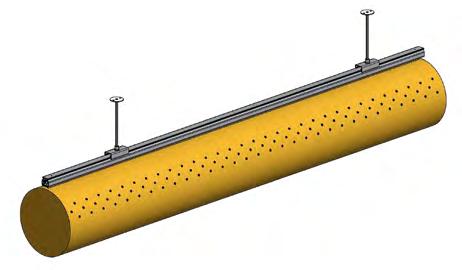
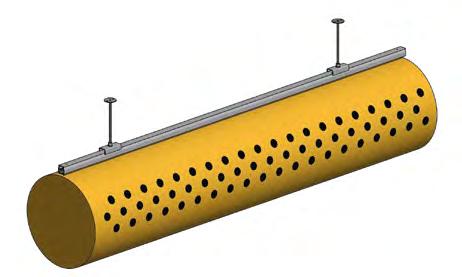
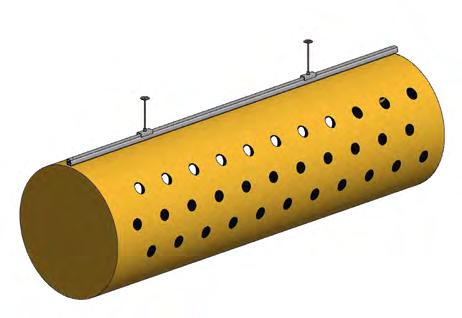
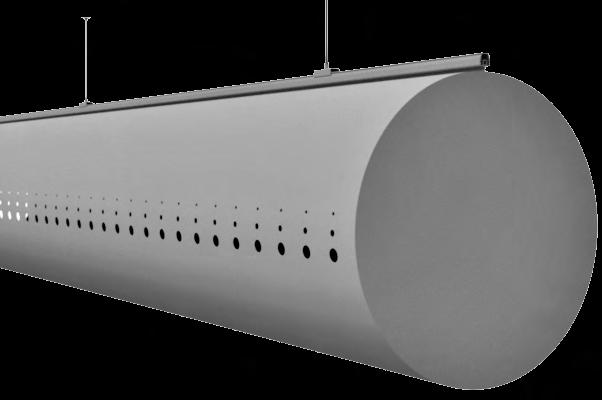
As the number of holes per metre may vary, all jets will impact on each other. With only one or a few holes per metre, the individual jet will act like a circular 3-dimensional jet, but with the maximum number of holes per metre, the air flow will change character to a 2-dimensional jet. The Inject Flex system can also be configurated as a linear slot diffusor. These different design factors have already been taken into account in KE Fibertec’s TBV Designer software.
KE Inject Flex S
• Hole size Ø4 and Ø6 mm
• Made with 21 holes or 42 holes per metre
• Suitable for both heating and cooling
• Air flow: 0.5-1 m3/h per hole at 120 Pa
• Short throw lenghts
KE Inject Flex M
• Hole size Ø6, Ø12 and Ø25 mm
• Made with 1-14 holes per metre
• Suitable for both heating and cooling
• Air flow: 1-15 m3/h per hole at 120 Pa
• Medium throw lengths
KE Inject Flex XL
• Hole size Ø32, Ø50 and Ø70 mm
• Made with 1-6 holes per metre
• Suitable for both heating and cooling
• Air flow: 30-130 m³/h per hole at 120 Pa
• Long throw lengths
KE-DireJet System
The KE-DireJet System is made of a coated or permeable textile material with rows of conical nozzles for 100% active, directional delivery.
Product features
The key difference between the KE-Inject System and KE-DireJet System is their ability to entrain room air. The KE-DireJet System is made of a coated or permeable textile material with rows of conical nozzles for 100% active, directional delivery.
The conical nozzles limit the induction of room air around the individual air jet, whereby the velocity in the jet decreases relatively slowly compared to the KE-Inject System. As a result of this, both the throw length and thermal penetration length are extended considerably for the KE-DireJet System.
KE Fibertec is the only distributor of textile ducts that offers five different nozzle sizes: Ø12, Ø18, Ø24, Ø48 and Ø60 mm. The flexibility in the choice of nozzle size offers great benefits as the KE-DireJet System can be used in virtually every type of premises that requires mixing ventilation, even in extremely large premises, such as high-bay warehouses or large sports arenas.
The nozzle size and flow model naturally depend on the requirements specification for the ventilation system, and KE Fibertec will obviously advise on the best choice of nozzle size and direction.
Ducts are often used with different nozzle types and flow models in the same duct.
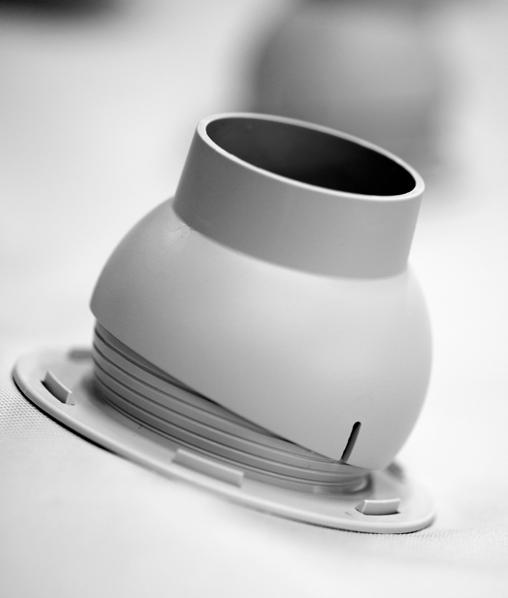
The Vario nozzle for directional air distribution
This allows you to achieve the flow pattern and air intensity in the various zones exactly how you want.
The conical nozzles are fitted in holes made of coated polyester fabric and are secured using a locking ring. The maximum number of nozzles per row per metre is 14 for the Ø12, Ø18 and Ø24 mm nozzles. If this is not sufficient, it is recommended using two or more rows of nozzles.
In the case of Ø48 mm and Ø60 mm nozzles, it is recommended using a maximum of six nozzles per metre. As the number of nozzles per metre is increased, the individual jets will have an impact on each other and they will change character from circular jets to 2-dimensional jets.
The velocity rate in the flow will also slow down as the induction of room air is limited the closer the nozzles are placed together.
The nozzles can be supplied with nozzle plugs to block the air flow temporarily in certain zones. This is used most often in cases where the system’s features need to be changed for a period of time, for instance, if the premises’ use changes.
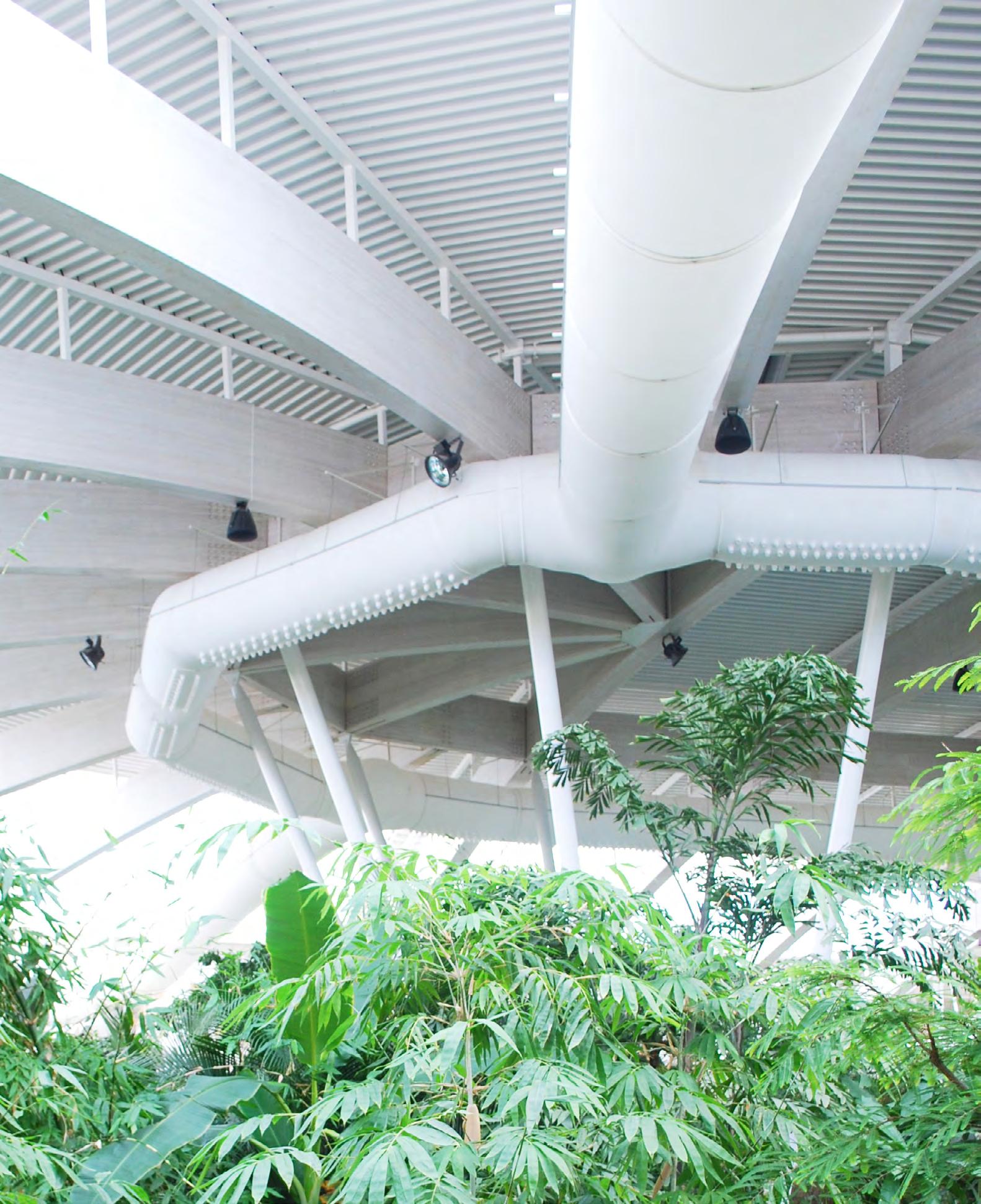
The KE-DireJet System is often used in large premises with large throw lengths. The choice of nozzle depends on the system’s performance, the relevant room and the indoor climate requirements.
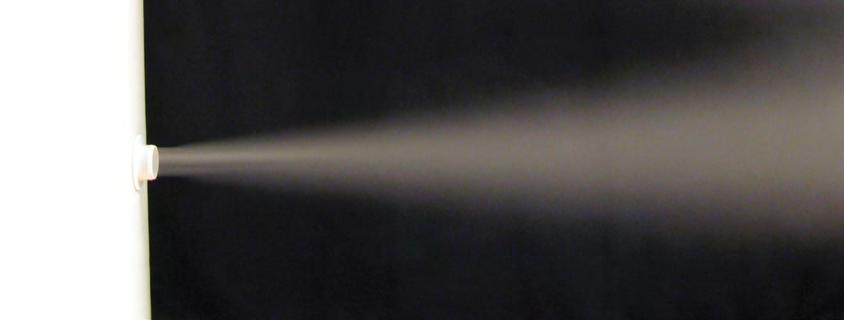
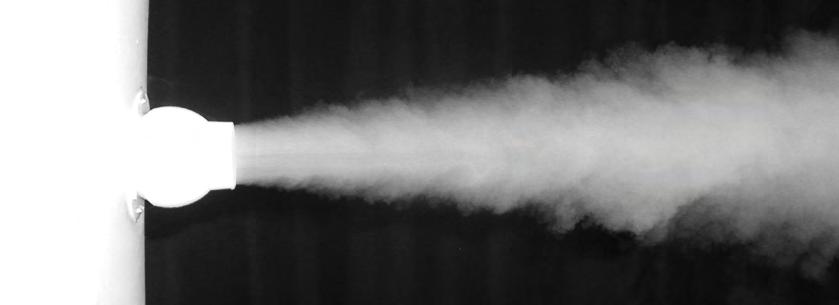
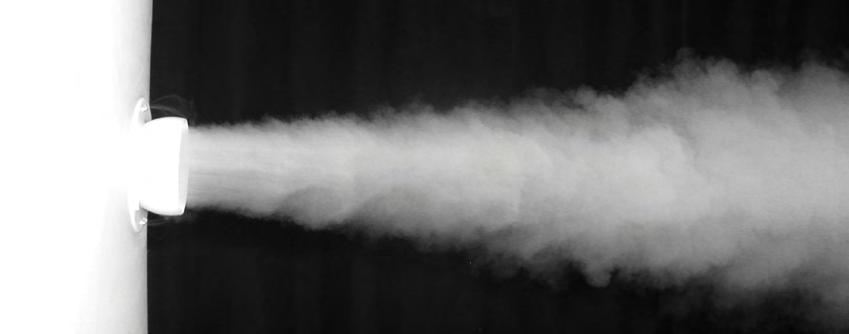
Ø12 mm nozzle
The Ø12 mm nozzle is used where directional delivery is required in a room and comfort requirements are important. Each nozzle delivers 5 m3/h with a static pressure of 120 Pa.
Ø18 mm nozzle
The Ø18 mm nozzle is used where directional delivery is required and often in process-orientated solutions, in a room where relatively large throw lengths are required. Each nozzle delivers 11 m3/h with a static pressure of 120 Pa.
Ø24 mm nozzle
The Ø24 mm nozzle is used for directional delivery in a room with large throw lengths. Each nozzle delivers 20 m3/h with a static pressure of 120 Pa.
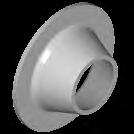
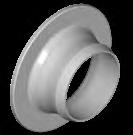
The Ø48 mm nozzle is used for directional delivery in a room with very large throw lengths. The flexible nozzle can be turned 30° in any direction around the nozzle’s centreline. Each nozzle delivers 81 m3/h with a static pressure of 120 Pa.
Ø60 mm nozzle
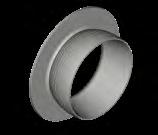
The Ø60 mm nozzle is made up of the bottom of the Ø48 mm nozzle and is used for directional delivery in rooms with very large throw lengths. Each nozzle delivers 139 m3/h with a static pressure of 120 Pa.
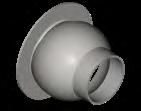
Ø48 mm nozzle (DireJet Vario)
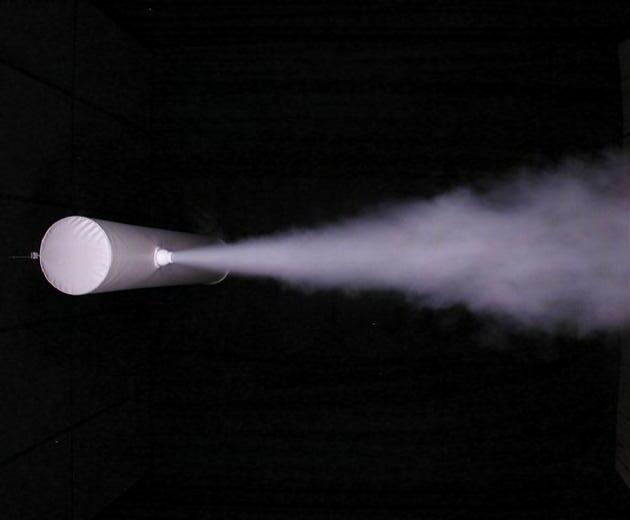
KE-DireJet Vario - The flexible solution
The latest development of the KE-DireJet System is called KE-DireJet Vario. It is a multi-adjustable nozzle that allows the direction of the air jet to be freely adjusted up to 30° in any direction in relation to the nozzle’s centreline.
When dimensioning a system, KE Fibertec takes as its starting point the room’s layout and function so that the nozzles are basically placed in the correct position (nozzle adjustment 0°).
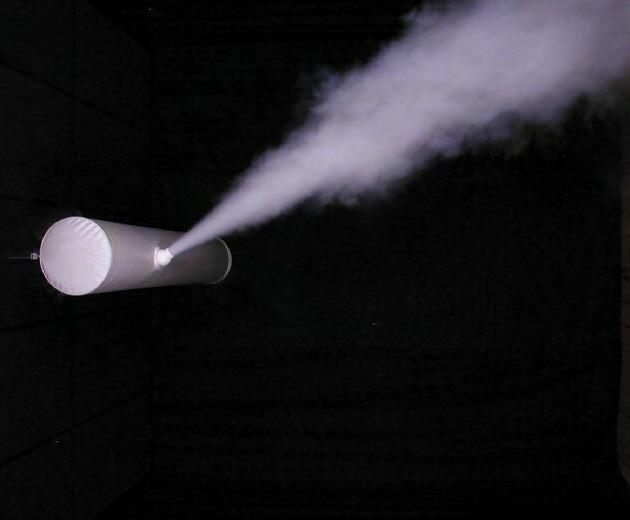
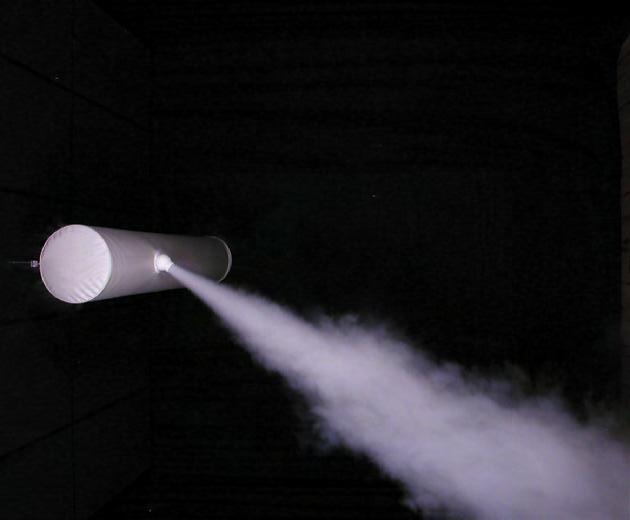
The KE-DireJet Vario nozzle can be adjusted manually so that the main direction of the air jets can be changed by up to -30° in relation to the nozzle’s centre line. This may be particularly appropriate if the room’s layout is changed after installing the system. This nozzle adjustment can also be used in situations where a large cooling load needs to be supplied in the room.
The manual adjustment can also change the main direction of the air jets by up to +30° in relation to the nozzle’s centre line. As mentioned above, this may be particularly appropriate if the room’s layout is changed after installing the system. This nozzle can provide great benefit if it is used in situations where a large heating load needs to be supplied for the room.
Hybrid Systems
KE Fibertec uses laser technology to laser cut small holes or insert nozzles into the textile material, making passive low impulse dutcs more active.
Hybrid Systems
It was previously mentioned that both the KEDireJet System and KE-Inject System can be regarded as active mixing systems, but this is not necessarily their only function. KE Fibertec uses laser technology to facilitate production of more advanced product versions, where passive low impulse ducts can be made more active by laser cutting a number of small holes or inserting nozzles in the textile material.
The more holes or nozzles the system has, the more active the textile ducts will obviously become. This will change how the system works from a passive low impulse system to an active mixing system or what is known as a hybrid textile duct.
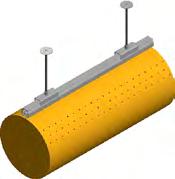
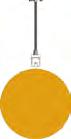
KE-Inject Hybrid System
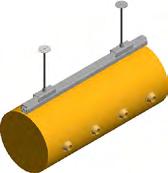
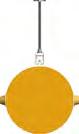
KE-DireJet Hybrid System
KE Fibertec markets two products for textile based hybrid ventilation: The KE-Inject Hybrid System and KE-DireJet Hybrid System. These systems are also produced in the form of round (Ø), half-round (D) or quarter-round (½D) ducts. From a ventilation technology perspective, the KE-Inject Hybrid System and KE-DireJet Hybrid System can be regarded as a combination of active high impulse ventilation and passive low impulse ventilation.
Occupied zone for hybrid systems
As with low impulse ventilation, the occupied zone is not a standardised area, but a zone which is defined from one project to another in consultation with the architect and client. The occupied zone is often defined as the zone from the floor up to a height of 1.8 m above people who are in a standing position doing their job, while this height is set to 1.1 m for people who are seated.
Air distribution principle
In a nutshell, hybrid systems comprise low impulse ducts which are made active by using holes or nozzles. As a result, the low impulse principle is combined with the high impulse principle, whereby part of the air volume in the system is distributed away from the near zone under the ducts.
This offers in particular obvious benefits if cooling is required where ΔT is higher than 5-6°C, as it helps avoid an immediate “cold drop” under the ducts. Instead the cooling load is distributed across a larger area in the room. Hybrid product versions therefore require air velocities etc. to be calculated for both the low impulse and the high impulse section. It must also be ensured, of course, that the air flow from each of these systems does not contribute to any discomfort in the room.
Manufacturing hybrid systems opens up a new world of flexibility, but it is also of paramount importance that you are aware of the requirement specifications for the ventilation system.
Zone 1
The air is delivered partially at high velocity through the holes or nozzles and at low velocity through the textile material. The excess pressure in the centre of the air jets generates an inflow and causes entrainment of room air, as well as part of the duct’s own air. The air’s acceleration under the duct (low impulse flow) is particularly reliant upon the cooling load per running metre of ducting.
Zone 2
The warmer room air is displaced by the cooled air from the duct under the hybrid duct. Part of the low impulse flow is entrained into the high impulse flow. The velocity gradually decreases in the high impulse flow. The velocity decreases in inverse proportion to the distance from the duct.
Zone 3
When entering the occupied zone, it is important to ensure that both the air velocity in the low impulse flow and the air velocity in the jet originating from the holes or nozzles have been adapted to the conditions so that the room’s comfort requirements are met.
Just a few rows of holes or nozzles can change the flow from a passive low impulse system to an active mixing system. But the major benefits of this new technology are that you can, in theory, actually dimension one and the same system to be passive in some zones and more or less active in others.
Hybrid systems are absolutely ideal for ensuring that optimum air distribution is achieved in systems with both cooling and heating requirements, as a textile duct with holes or nozzles gives the air energy in the form of movement, as has already been mentioned. This means that air currents are not only reliant upon thermals, as is the case with a low impulse system.
On the other hand, the air which passes through the textile will not make any significant contribution to air distribution in a system for heating. But the air which passes through the textile material does not disappear and short circuit under the ceiling. The majority of it will instead be entrained by the air jets which pass through the holes or nozzles.
1,8 m
Zone 1
Zone 2
Zone 3
Hybrid solutions for enhanced comfort
The job of hybrid textile ducts, as was explained on the previous page, is to shift part of the air volume away from the area under the duct. If you compare this to a low impulse system, a greater cooling load per running metre can therefore be added without generating a draught under the duct.
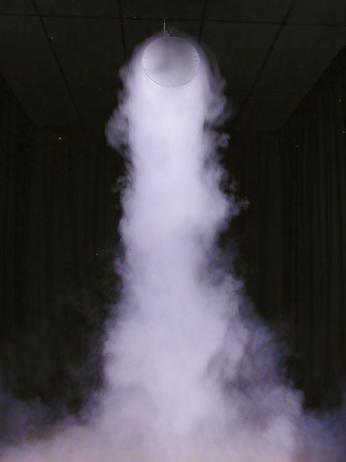
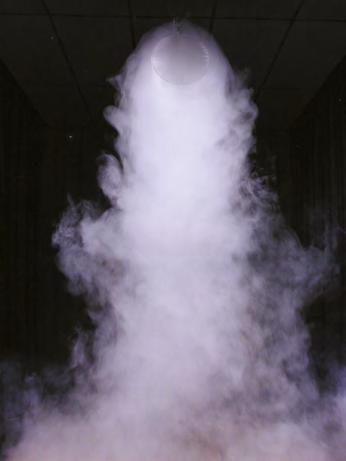
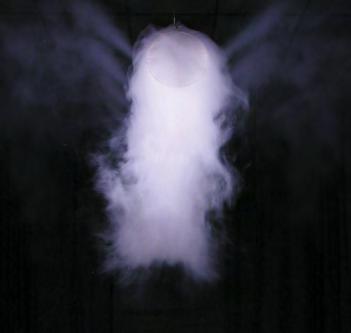
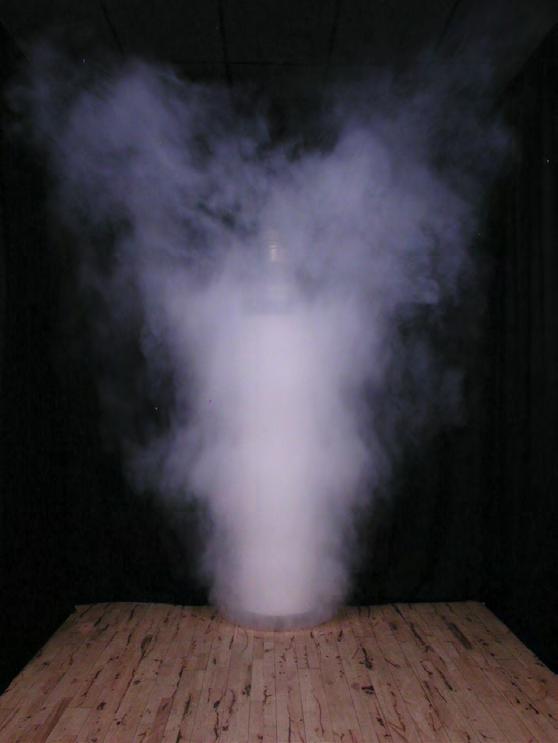
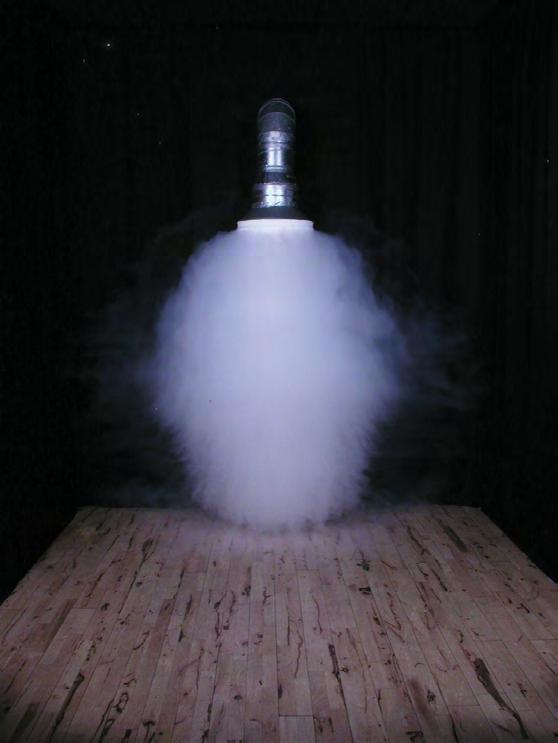
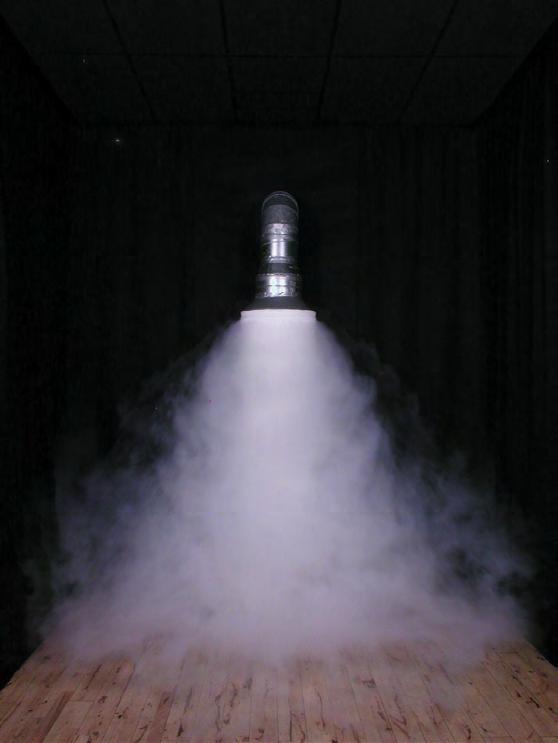
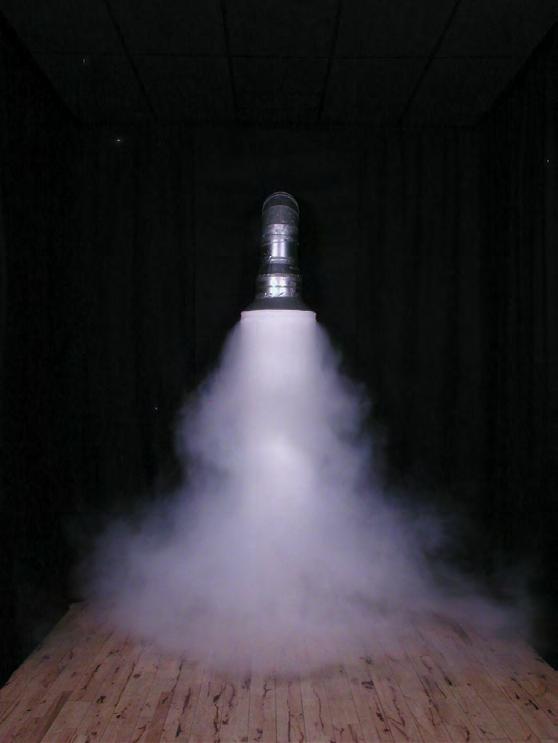
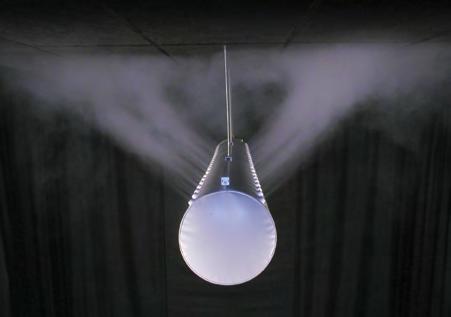
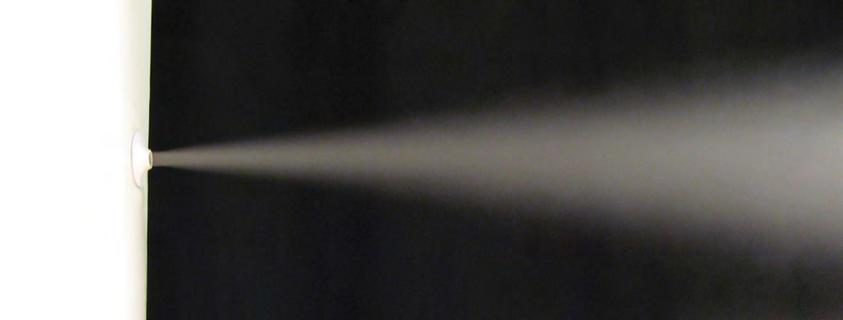
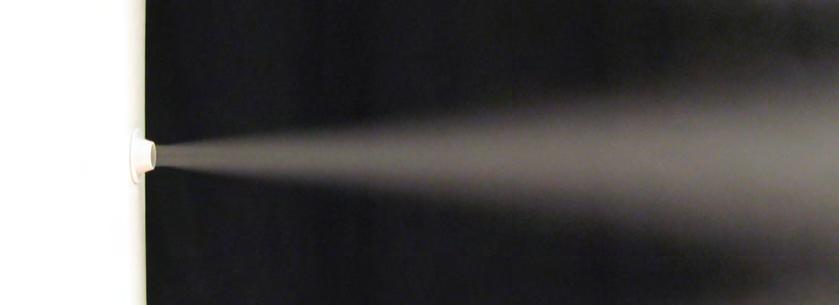
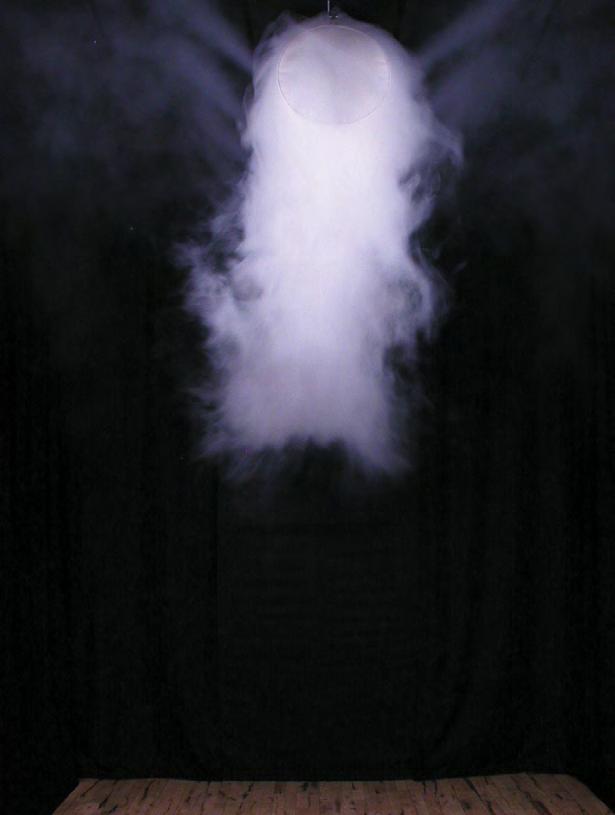
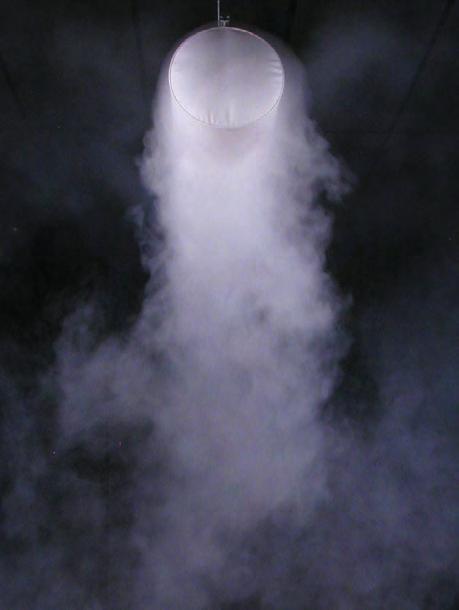
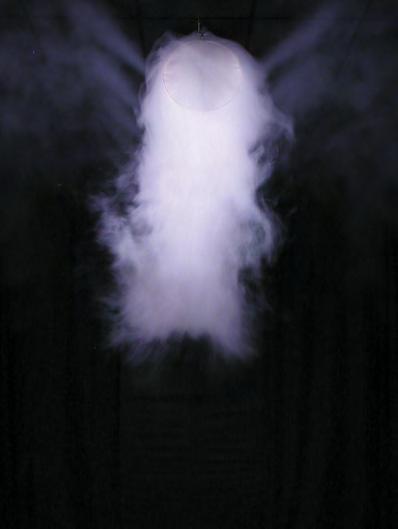
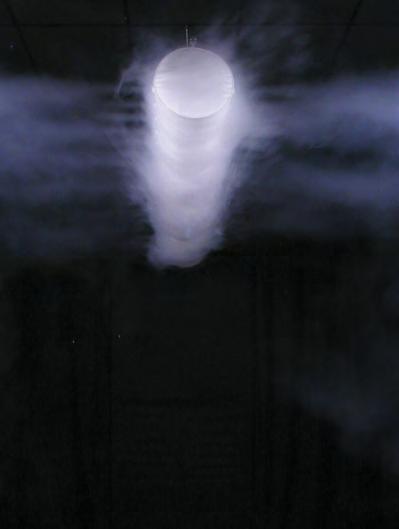
The pictures below show a smoke test where a comparison is carried out between a low impulse system and a KE-Inject System with 20% of the air passing through the holes. Both systems are supplied with the same volume of air at a ∆T of 5°C. It can be clearly seen from the density of the smoke in the near zone under the textile duct what a large difference there is in air velocity under the duct. It is obviously important to remember that the throw length for the air passing through the holes must be sufficient to prevent draught problems in the occupied zone.
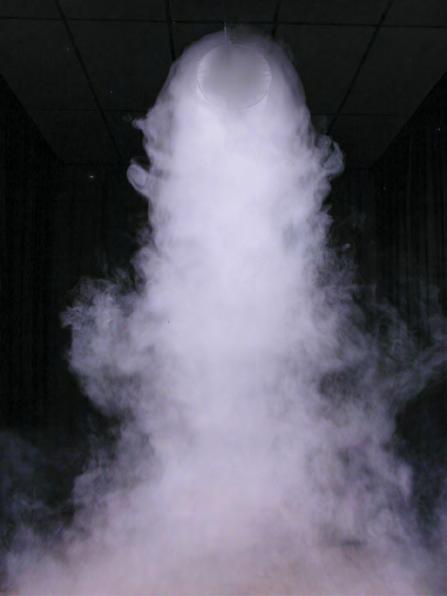
Low Impulse System 0%
Hybrid System 5-10% upwards
Hybrid System 15-30% upwards/side
Hybrid System > 40%
Changing the number of holes/nozzles in the textile material helps to combine high impulse systems with the low impulse principle, which means that basically three different types of flow patterns can be obtained.
Even a distribution between the textile material and nozzles/holes of 60/40 completely alters the way in which the system operates, from a passive thermal low impulse system to an active mixing system. Even if the distribution between the textile material and holes/nozzles is changed to 0/100, this does not make the flow pattern look noticeably different.
The air drops down right under the textile duct in cooling mode
The air drops down directly under the textile duct
Part of the air volume drops. Spread 2-3 m
The air spreads in the main direction of the holes
Passive thermal displacement/low impulse
Coating of ceiling due to condensation problems
Spread of near zone when cooling ΔT > 5-6°C
Active high impulse system
Smoke test comparing a KE-Low Impulse System and a KE-Inject Hybrid System. It can be clearly seen from the density of the smoke in the near zone under the textile duct what a large difference there is in air velocity under the duct. It is obviously important to remember that the throw length for the air passing through the holes must be sufficient to prevent draught problems in the area where the high impulse flow penetrates the occupied zone.
As can be seen from the table on the opposite page, the number of holes or nozzles per metre of ducting has a major impact on whether the delivery will be diffuse or come from a particular direction.
Model A (5-10% through holes/nozzles)
KE Fibertec therefore splits the hybrid systems according to three main principles: model A, model B and model C.
When model A is used, the delivery is very diffuse, similar to low impulse currents. Model A is used especially in premises with high comfort requirements, i.e. room category A+B. The high impulse principle can be beneficially combined with the diffuse flow pattern from low impulse systems if, for instance, there are periods when there is need for heating or the need for more directional ventilation above a particular machine or process. Furthermore, condensation problems on the ceiling in humid premises can also be rectified by simply placing a very small number of hole rows or nozzles, pointing towards the surface of the ceiling.
Model B (15-30% through holes/nozzles)
When model B is used a combination delivery is largely obtained between holes/nozzles and textile materials. Part of the volume flow will in a cooling scenario always drop below the duct, but most of the air is distributed according to the main direction of the holes or nozzles. The combination solution is typically used in premises where there are requirements for both cooling and heating, but with fairly high requirements for comfort in the room, i.e. category B+C.
Model C (>40% through holes/nozzles)
Model C is used for highly directional delivery, which is often used with process-oriented solutions or in large premises, such as sports centres. The air will only be distributed in the main direction of the holes or nozzles, which is the case with KE Fibertec’s conventional high impulse systems. Directional air distribution through the holes/ nozzles is incredibly effective and the flexible positioning of the hole rows and nozzles can, in a sense, meet every function in larger rooms.
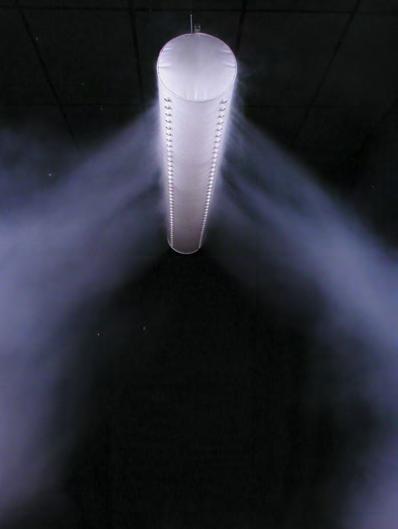
FBS Panels
Diffuse or directional ventilation in an aesthetic solution that does not detract from the appearance of the room.
Flexible air distribution
It can be difficult to create a good indoor climate in rooms with low ceilings without compromising on aesthetics. FBS ceiling panels from KE Fibertec are a space-saving and discreet solution that integrates into the ceiling and is available in several colours.
The panels provide draught-free ventilation with low pressure loss and a noise level below 20 dB(A). The patented hole pattern ensures even air distribution over a large area, and the entire textile surface is actively used.
KE Fibertec’s FBS ceiling panels have been developed with support from Aalborg University and counteract poor indoor climate conditions using either diffuse or directional ventilation.
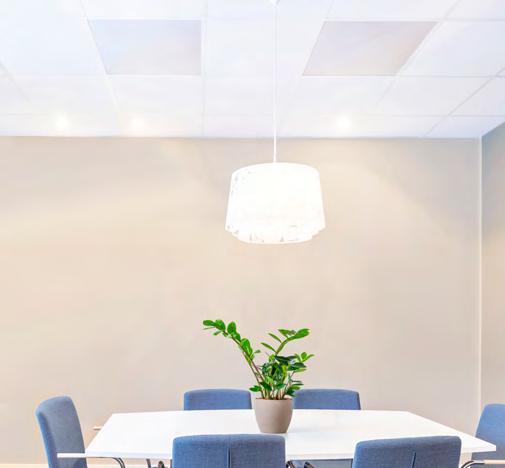
FBS ceiling panels are suitable for schools, offices and other comfort environments and are designed to operate at a lower air pressure than standard ceiling diffusers. This makes it a more energyefficient solution, which helps to reduce both operating costs and environmental impact.
The lightweight panels are installed without tools, are easy to maintain and meet fire safety requirements.
The panels can be used individually or connected in a row of up to four to form a pressure chamber without unnecessary pressure loss.
• Fully integrated in suspended ceilings
• Quick and easy installation and maintenance
• A flexible solution that is supplied as single panels or combined into a set of panels to form a pressure chamber (up to four panels)
• Available in standard and special colours
• Standard articles for delivery at short notice
Suitable for rooms with low ceilings
The flexible textile top of FBS panels makes them suitable for rooms with low ceiling heights and headroom above the ceiling. They are easily integrated into standard suspended ceilings and installed as regular ceiling panels without additional reinforcement.
The panels are available in 600x600 mm and 1200x600 mm with flexible sockets (Ø160–250 mm).
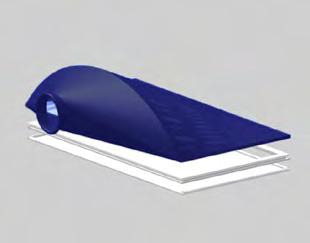
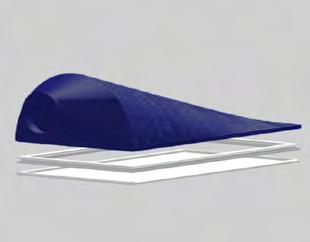
600x600 comes with a socket at the end, while 1200x600 is available with a socket on the side or end.
All sizes are available in the Combi model, which can be connected up to four panels. The panel does not require more room above the ceiling than the socket.
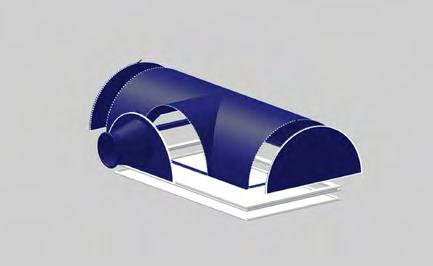
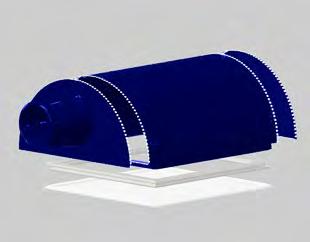
Side, End and Combi are available with DFC baffles and as a low impulse solution in three different permeabilities, respectively. KE Fibertec also offers tailored solutions upon request.
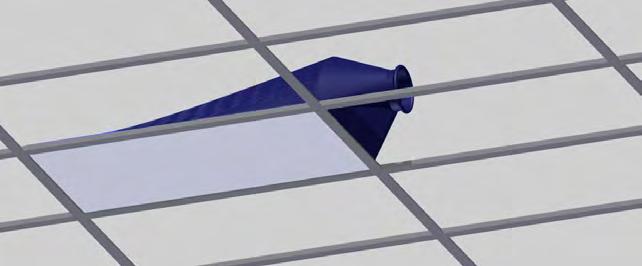
Single components
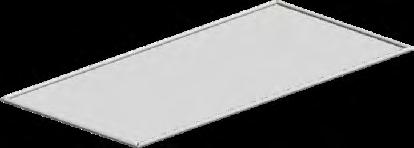
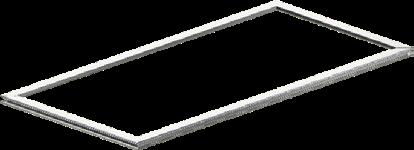
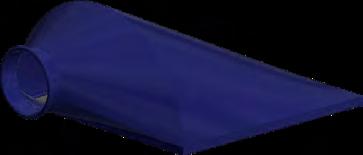
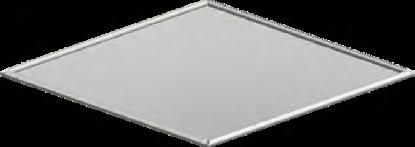
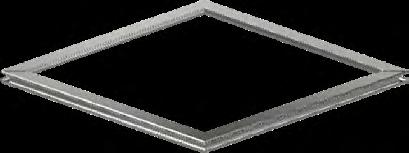
FBS Panels consist of three individual components that can be easily separated and replaced without special tools. This makes it easy to adapt the design, e.g. when moving to another position in the ceiling. The top and bottom parts can be replaced individually, e.g. when changing the duct connection or to renew the design.
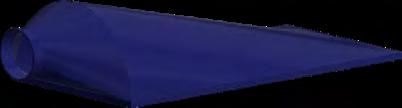
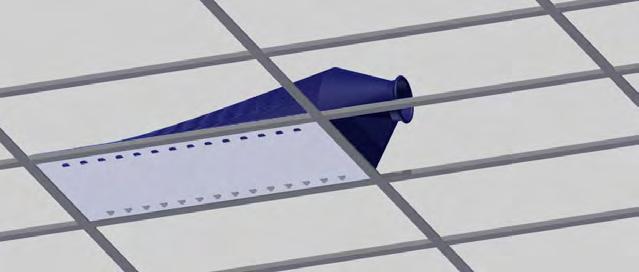
The bottom can be easily removed and washed, or you can refresh the design by replacing only the bottom. The panels can be used as a diffusion ceiling, i.e. where air is blown into the chamber above the suspended ceiling to diffuse through the permeable panel. In this case, you deselect the top part and order only the frame and bottom part.
Side 1200x600 End
Combi
1200x600
600x600 / 1200x600
Combi 600x600
Design example
600x600
Example: Type 1 (775) - 600x600
A pressure of 35 Pa and ΔT -2°C will generate an air volume of 100 m³/h, a velocity in the occupied zone of 0.17 m/s, and a sound power level of <10 dB(A), which means that this solution is consistent with the criteria of room category A acc. to EN 1752. Type 2 with baffles will generate a sound power level of 14 dB(A).
Occupied


Example: Type 1 (775) - 1200x600
A pressure of 40 Pa and ΔT -5°C will generate an air volume of 200 m³/h, a velocity in the occupied zone of 0.25 m/s, and a sound power level of 13 dB(A), which means that this solution is consistent with the criteria of room category B acc. to EN 1752.
Both examples are based on a room height of 2.5 m and an occupied zone of 1.8 m equivalent to a person standing upright.
Installation
It is important that the FBS Panel can be laid unhindered in the suspended ceiling and rest on the profiles that support the ceiling panels. In this way the FBS Panel will be flush with the ceiling panels.
Do not use tools and do not apply force when placing the panel.
See list of approved suspended ceiling types at ke-fibertec.com.
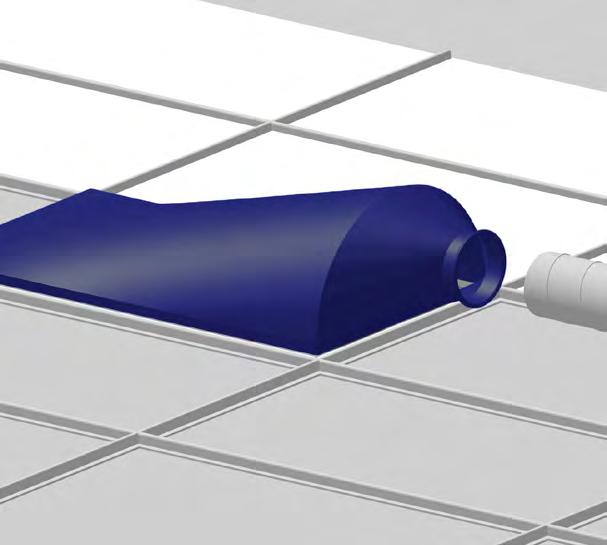
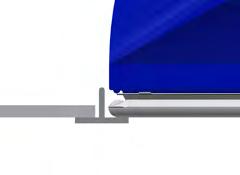

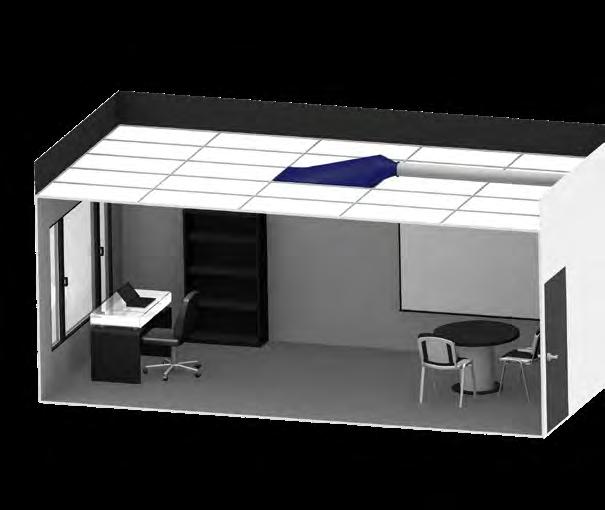
Washing
For washing of the panels only the visible part (bottom) is to be removed from the panel. Tools are not needed. The textile material should be washed at 40°C according to the washing instructions for the material.
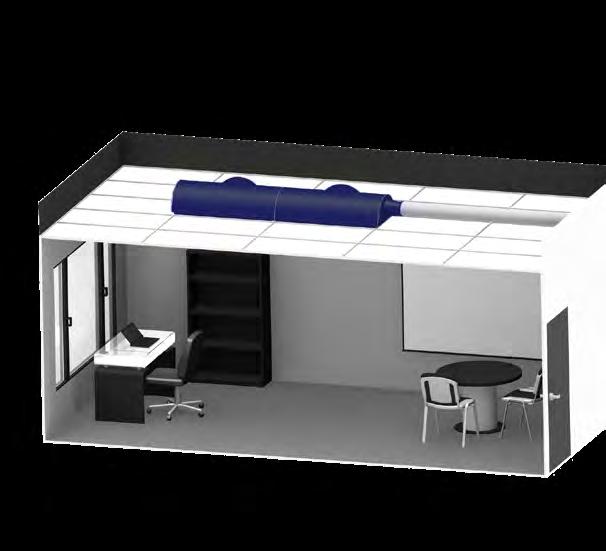

Complete Cradle to Cradle solution
The FBS ceiling panel is another Cradle to Cradle product in our range of textile based ventilation solutions approved by EPEA Hamburg according to the 3.1 standard.
Cradle to Cradle solution consisting of the following components:
• Base (bottom) in GreenWeave material
• Bulb cord produced from residual yarn from our own weaving mill
• Corner profile made from recycled yarn cone waste
• Top made from MultiWeave material
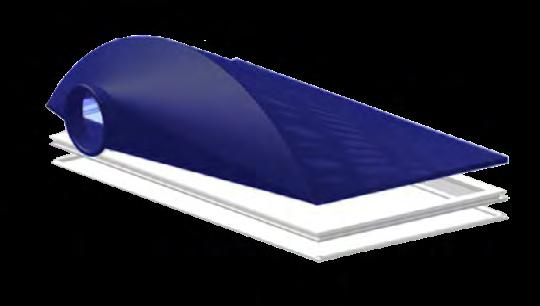

Choose from several attractive colours
/ 9010 / KE 0
Warranty
FBS ceiling panels are covered by a 10-year product warranty that covers both materials and operation.
TBV Designer
With our advanced 3D programme TBV Designer, we design your solution according to room dimensions and the desired placement of the FBS panels.

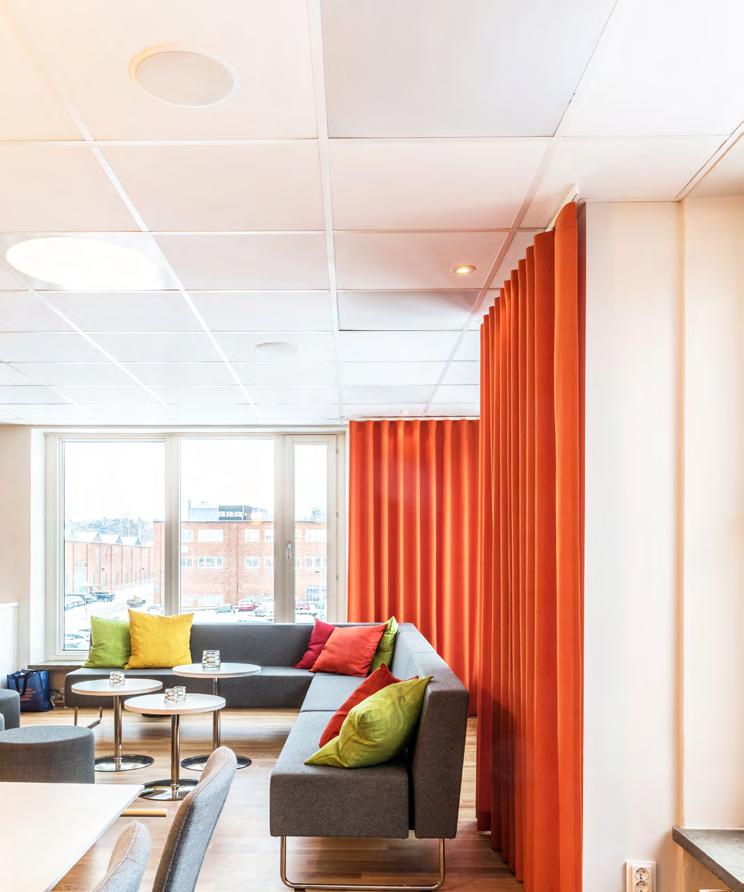
Base (bottom)
Top
Bulb cord
Corner profile
PANTONE / RAL / KE NO.
Suspension Systems
Our TBV systems can be supplied with various suspension systems for installation in most types of ceilings.
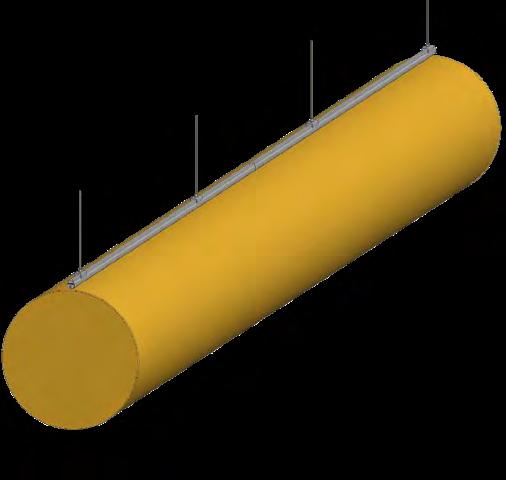
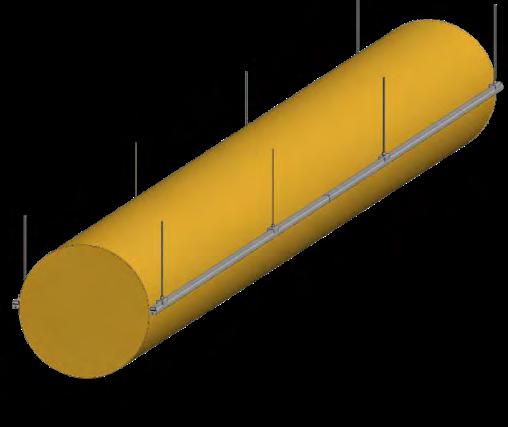
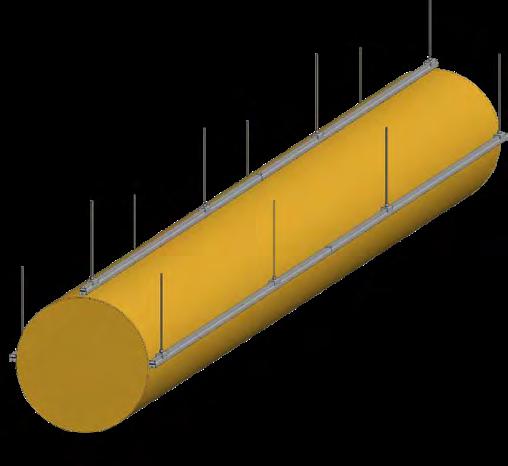
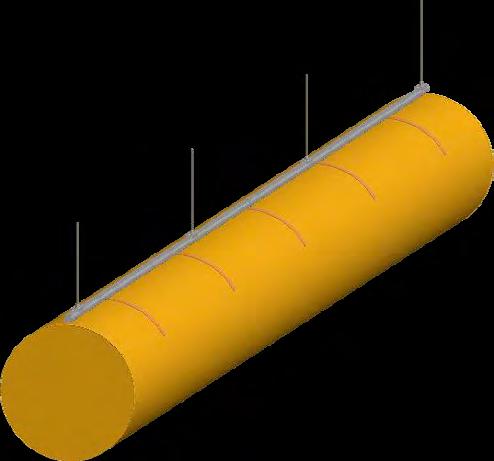
Single Row Suspension
Safetrack
Double Row Suspension
Safetrack
Triple Row Suspension
Safetrack
Single Row Suspension
Safetrack Duct Arch
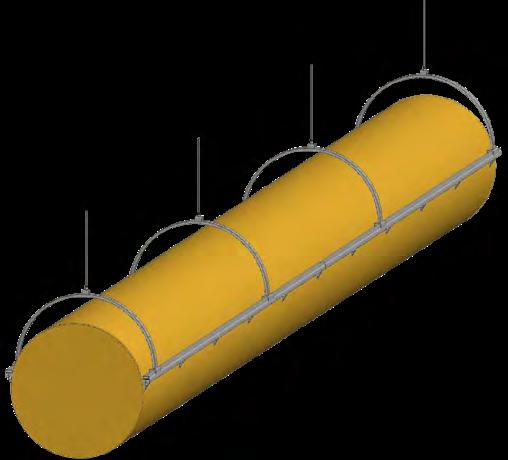
Double Row Suspension
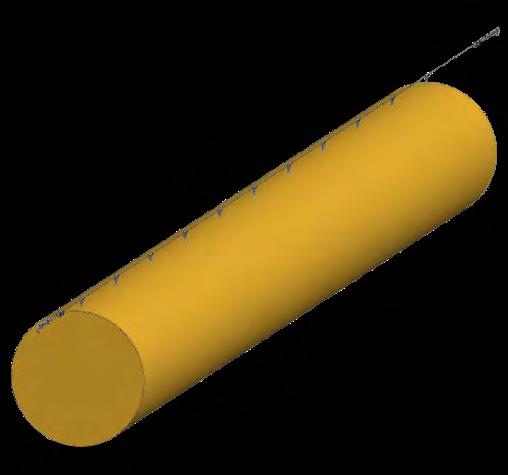
Single Row Suspension
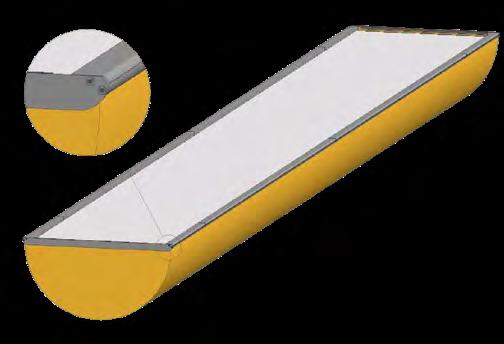
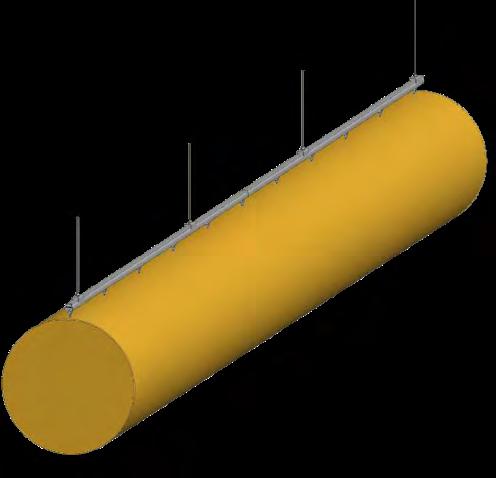
Single Row Suspension
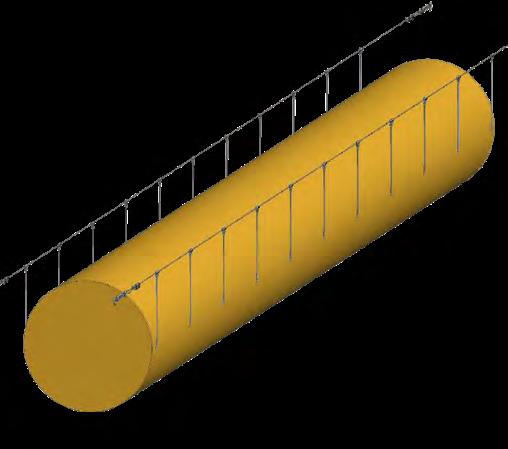
Row
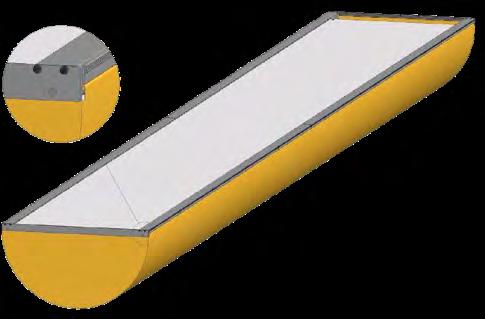
Safetrack Dual Arch
Safetrack 360
Wire
Double
Suspension Wire
D-Lite Alu
D-Alu
Suspension systems
KE Fibertec’s TBV systems can be supplied with different suspension systems which can be fitted to any type of ceiling. What all the suspension systems have in common is that they are supplied cut to the same length as the textile duct. They are also packaged with the necessary fixing components and a specific label indicating where they are meant to be installed. See also the installation instructions and other information at ke-fibertec.com.
Our textile materials weigh 260-330 g/m2 which is much lighter than metal spiral ducts. Additionally, textile ducts are much easier to handle and transport as they are folded and packed in cartons of a maximum weight of 25 kg.
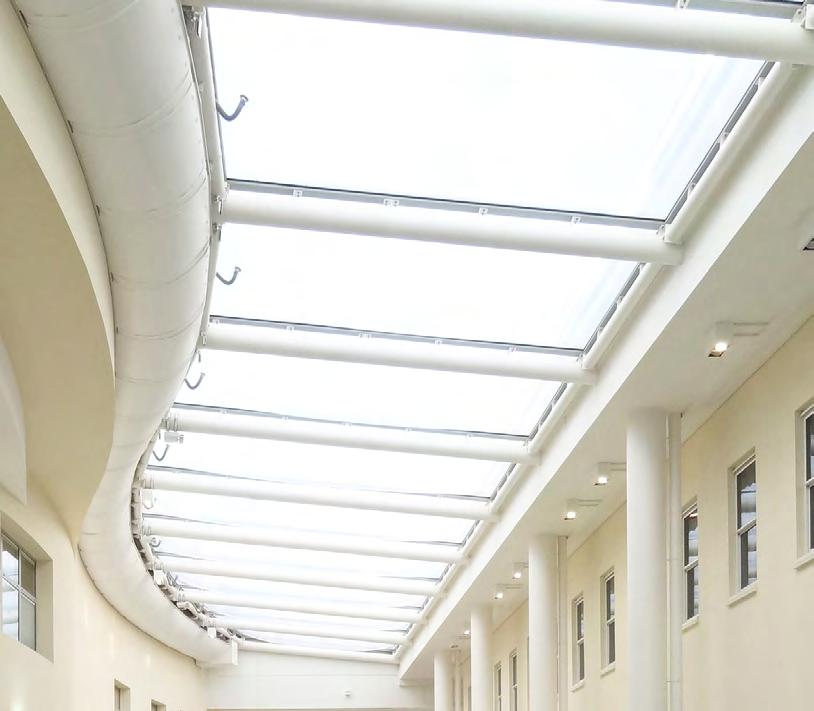
Curved textile ducts
Product development of the TBV design now enables us to offer curved textile ducts designed for a specific radius (min. 12 metres) and with Safetrack rails that conform to the shape of the duct. This product can naturally be combined with both ordinary passive low impulse systems and with our hybrid solution in which the low impulse system is made with lasercut inject holes.
A good example is above system that KE Fibertec delivered to Broomfield Hospital in Chelmsford, England.
Safetrack Arches
Dual Arch
Dual Arch mounting brackets utilise the stability of double rails and at the same time they are quick and easy to install. Large textile ducts will be stably suspended both with and without air and installation time is reduced considerably as the ducts are mounted in a single ceiling rail.
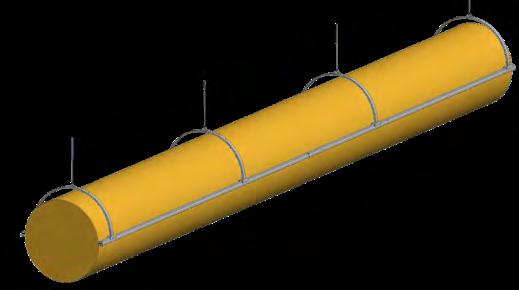
Duct Arch
Duct Arch is a pre-bent aluminium rail mounted in hidden sewn-in pockets in the TBV ducts. The Arches reduce sagging when the air is off and prevent popping with ON-OFF start. The unique Safetrack is designed in a way so that the Arch brackets are easily clicked onto the ceiling rail without any tools.
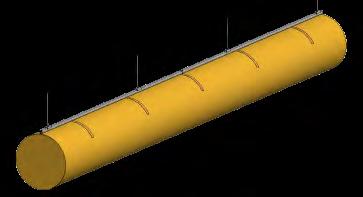
Safe 360
The Safe 360 system consists of removable rings per 1000 mm or 500 mm. The stainless steel rings are locked with velcro (12, 3, 6 and 9 o’clock) inside the ducts so that they can easily be removed for washing. The ducts will keep looking inflated, and it is our best solution if popping is a big problem.
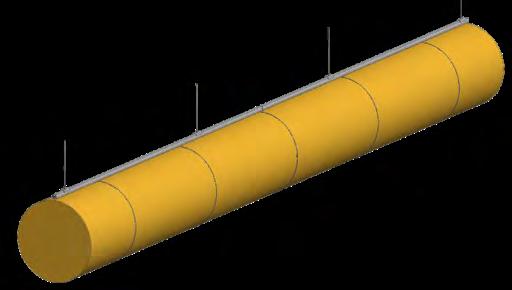
SafeStretch tensioning system
With the SafeStretch® solution the textile duct system will always look nice and taut with or without air pressure.
• Internal structure while still keeping a generally unobstructed airflow
• Eliminates inflation pop
• Eliminates sagging
• Eliminates wrinkles
• Easy installation and maintenance
The SafeStretch® System is easy to install and basically consists of two tensioning devices - a fasterning section at the duct inlet and a tightening device at the bottom that creates the necessary inflation of the duct.
A Safebracket is fed vertically into the textile duct and into the cross brace which is fitted to the included SafeStretch® bottom ring. Then the Safebracket is clicked onto the Safetrack rail and the duct can be stretched (typically 3-5 cm) until the duct is taut and without wrinkles. The desired position of the Safebracket is held in place by fastening the screw against the Safetrack rail.
The system is easily taken down for washing etc. without the use of special tools.
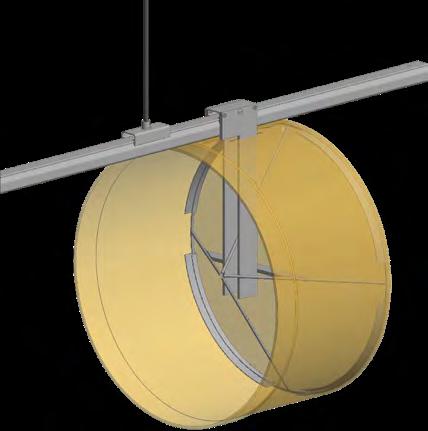
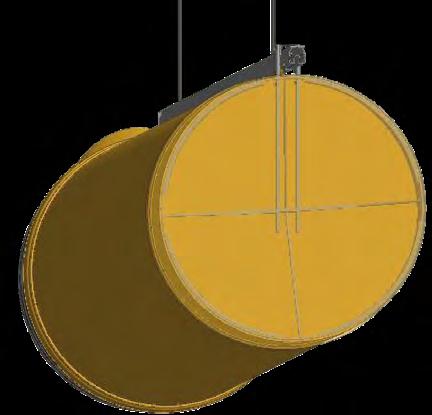
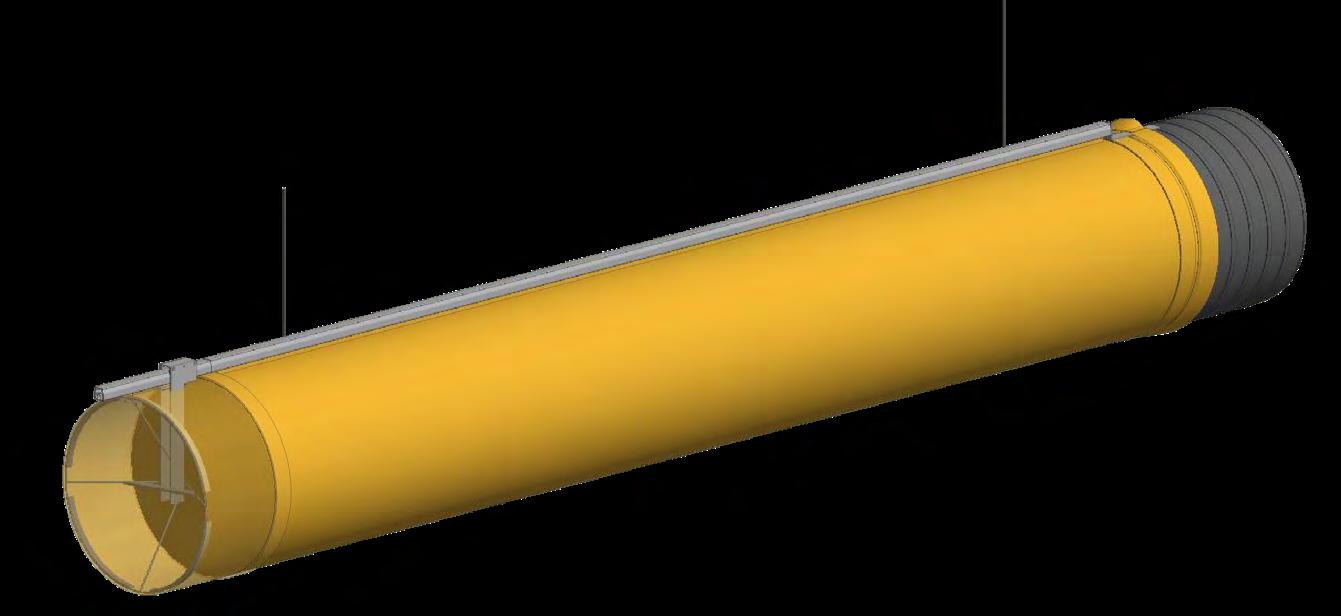
Typical layouts
KE Fibertec’s philosophy is to begin with our customer’s actual requirement and from there devise a technical solution with the purpose of creating the perfect indoor climate. This is why we call it: Design The Way You Want. The important aspect of all our solutions is that the relevant room conditions are compared with an ideal solution model so that the layout selected for the system will ensure that the air is distributed as it is supposed to be, without any problems with draughts, pulsations or noise.
Round ducts
A textile based ventilation system comprising round ducts can be assembled from many types of bends, elbows, fittings and offsets. What all the components have in common is that they are joined together using a zipper, providing a smart, practical solution.
The figures and pictures show different components which can be assembled to produce the final layout. Any angle can be selected for elbows and bends, and conical transitions and T-pieces can be produced in different designs.
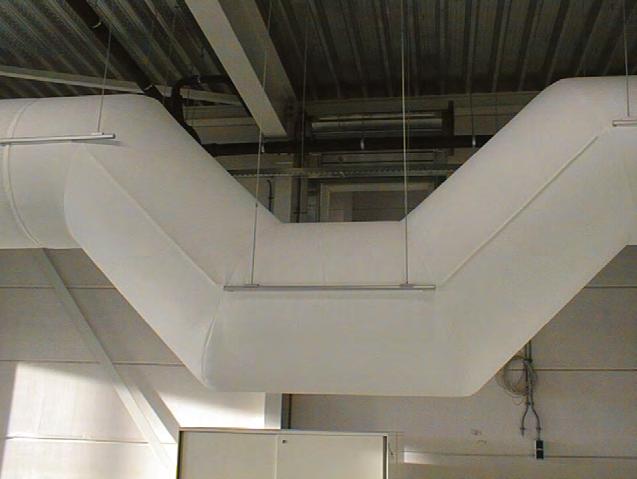
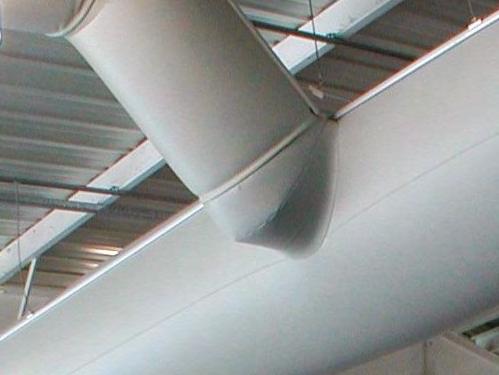
Available layouts:
• Round ducts
• D-shaped ducts
• ½D-shaped ducts
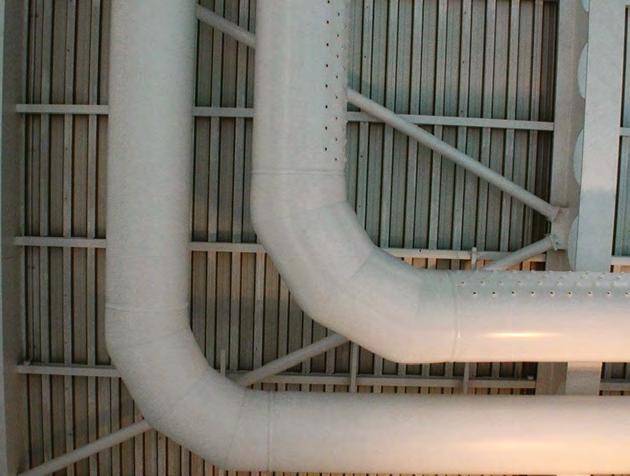
Offset with 45° elbows
Attachment with offset on top using a 45° elbow
90° bends
Examples of system layouts using round ducts
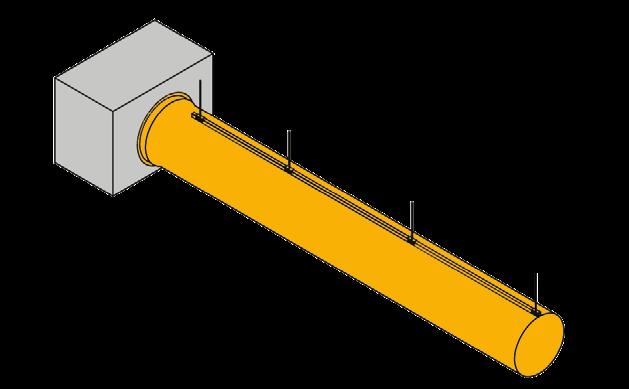
Half round (D) and quarter round (½D) ducts
D-shaped and ½D-shaped KE-Interior Systems have been specially developed for comfort ventilation, which is why there are often major requirements in terms of their finish.
As a result, KE Fibertec puts great emphasis on the fact that these systems are highly flexible and can be produced using countless layouts. A KE-Interior System based on these ducts can, just like round ducts, be created using many types of bends, fittings and offsets, which are joined together using a zipper, providing a smart, practical solution.
KE Fibertec offers a variety of air inlet options for KE-Interior Systems, specifically round inlet sockets, an inlet socket through the top, a D-shaped inlet socket and a rectangular inlet socket can be used as part of the installation.
In the case of false ceilings, it is recommended that the air inlet pass through the roof so that all the spiro ducting can be hidden. The top of the ducts (the roof) is made of a textile material which will allow a little part of the air through. This will also prevent any formation of mould between the duct and ceiling.
D-shaped ducts can also be produced as curved ducts which are easy to include as an elegant architectural element in office buildings, canteens etc.
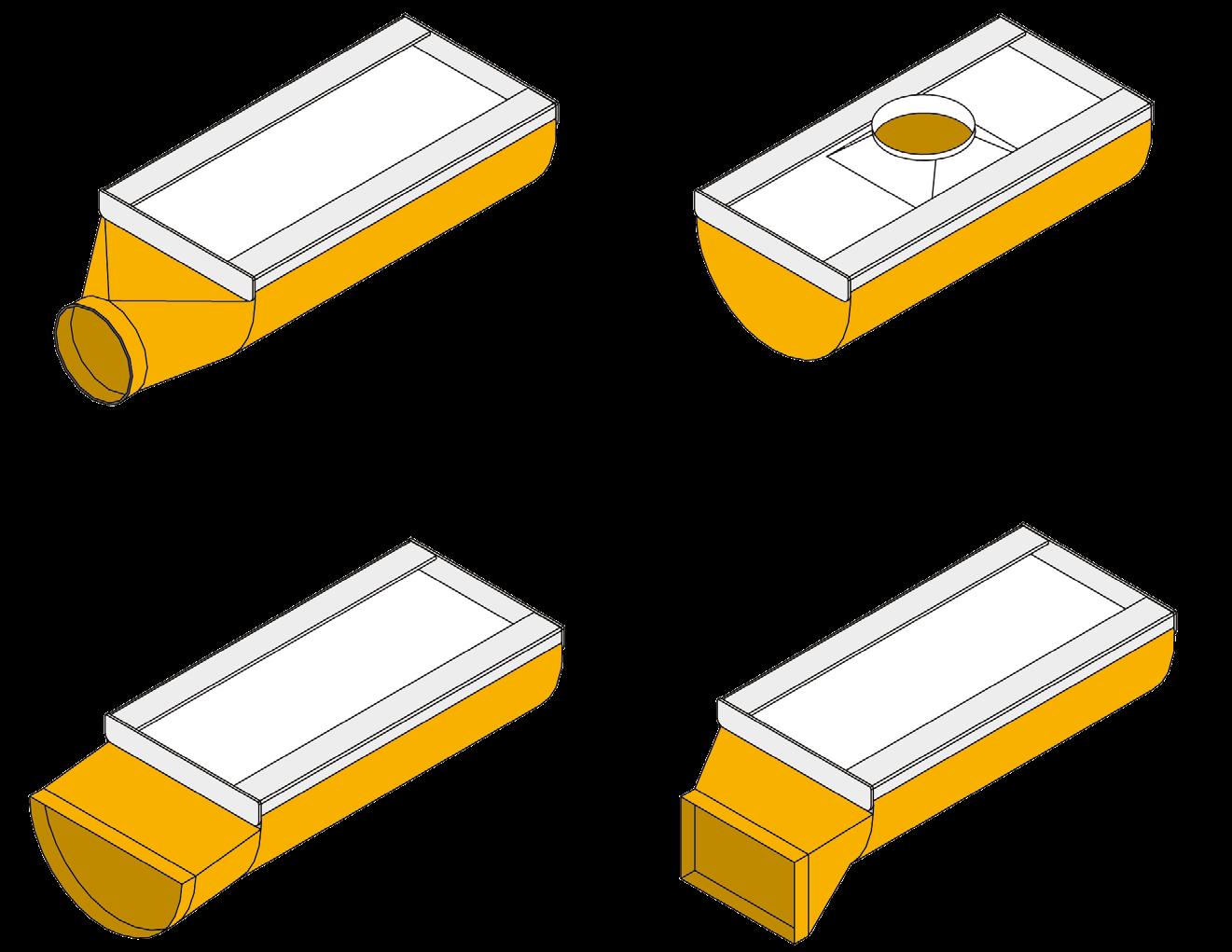
Round inlet socket at end
Round inlet socket in roof
Examples of system layouts using half round and quarter round ducts
Indoor Climate and Acoustics
A good indoor environment with proper acoustics is key for the well-being and concentration of the employees and requires a silent ventilation system.
A
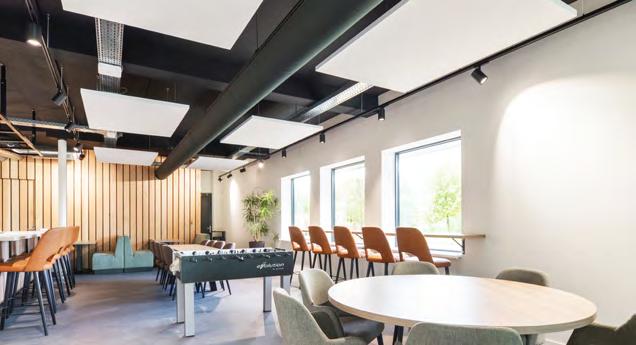
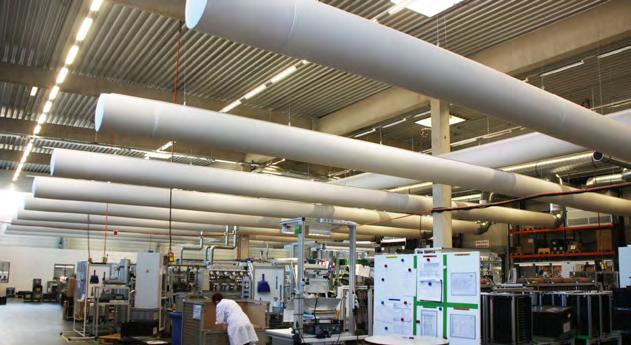
B
Room categories
A thorough needs analysis ensures that the solution matches the customer’s needs and can save money.
To simplify the process, KE Fibertec has developed room categories based on Professor Fanger’s comfort theories, which bring together the four most important thermal parameters for indoor climate.
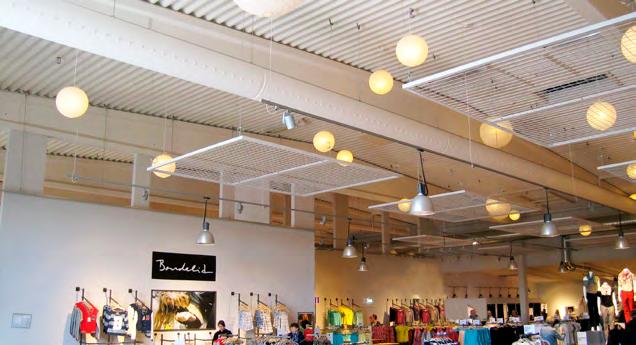
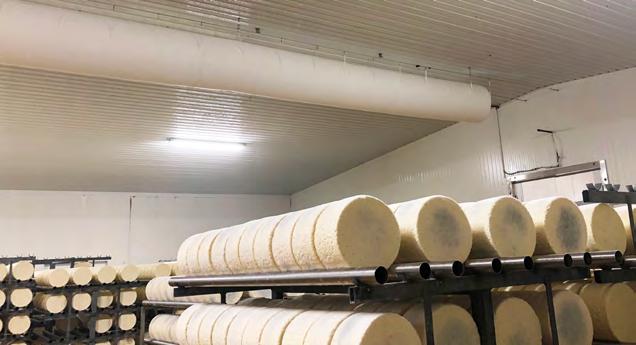
Low
impulse systems (horisontal)
Velocity through textile surface:
(1) Installation height: 4 m up to the bottom edge of the duct.
High impulse systems / Hybrid systems
Recomm. ΔT - KE-DireJet:
Recomm.
Throw length (ST-2)(2)
- KE-Inject LV
- KE-Inject MV
- KE-Inject JET
Recomm. min./max. room height
KE-DireJet System
- Ø12, Ø18, Ø24 mm
- Ø48, Ø60 mm
Throw length (ST-2)(2)
- KE-DireJet Ø12 mm
- KE-DireJet Ø18 mm
- KE-DireJet Ø24 mm
- KE-DireJet Ø48 mm
- KE-DireJet Ø60 mm
(2) Throw length calculated for one row of holes and one nozzle respectively at 100 Pa static pressure.
Note: The tables are only intended as a guide. Please contact KE Fibertec for further information.
Sound calculations
Noise is unwanted sound that can irritate, disturb or cause harm. Therefore, a well-designed ventilation system must be quiet. KE Fibertec carefully documents the noise levels of our textile based ventilation systems (TBV) and provides a brief explanation of sound calculation and the necessary data.
Where does the noise come from?
Noise in ventilation systems is caused by both the installations and the movement of air. The biggest source of noise is often the air handling unit, especially the fans. This noise must be dampened before the air reaches the TBV system, as fabric ducts do not act as noise barriers.
KE Fibertec’s documentation covers noise caused by the movement of air in the fabric duct – especially pressure loss and vibrations. In low impulse systems, the inlet velocity is typically the decisive factor, while in high impulse systems it is the outlet velocity through holes or nozzles.
What is sound?
Sound is small vibrations of air molecules in the atmosphere that can be perceived by the ear. When air molecules are set in motion (sound wave), they spread outwards and collide with other molecules until they hit the eardrum.
What is decibel?
Decibel (dB) is a logarithmic unit used for expressing the ratio of two powers. The most common use is in measuring sound power level and sound pressure level.
Sound power and sound pressure
Sound power, P, is a direct measure of how much sound power a sound source emits. Sound power is therefore directly linked to the sound source and is measured in Watts (W). Sound pressure, p, is a measure of the strength of sound at a given distance from the sound source, characterised by the pressure vibrations perceived by the ear or measured with a noise meter.
Sound pressure expresses how the listener perceives the sound and largely depends on the location of the sound source and the room’s acoustic properties. Sound pressure is measured in Pascals (Pa).
Sound power level and sound pressure level
Given that the human ear’s perception of sound is almost logarithmic, a logarithmic scale has been introduced to specify sound in the audible frequency range. As a result, when it comes to performing acoustic calculations, the concepts sound power levels, Lw, and sound pressure levels, L p are used.
The sound power level Lw is linked to the sound source and is independent of the room’s acoustics. The sound power level is expressed in decibels (dB). The sound pressure level Lp is directly dependent on the sound power level and expresses how the listener perceives the sound. It largely depends on the location of the sound source and the room’s acoustic properties. The sound pressure level is expressed in decibels (dB).
Room attenuation
Room attenuation specifies the difference between the sound power level transmitted and the sound pressure level exerted in the room. This means that the sound pressure level is obtained by subtracting the room attenuation (RA) from the sound power level generated by the source.
The relation between the sound power P and the sound power level LW is described by the following expression:
LW = 10 x log (P/Pre)
Where:
P
Actual sound power transmitted [W]
P re Reference sound power (10-12 W)
The relation between the sound pressure p and the sound pressure level Lp is described by the following expression:
L p = 20 x log (p/pre)
Where:
p Actual sound pressure [Pa]
pre Reference sound pressure (20 mPa)
Room attenuation specifies the difference between the sound power level transmitted and the sound pressure level exerted in the room.
RA = L w - L p
Where: RA Room attenuation [dB]
What influences the noise in the room?
Unlike the sound pressure level, the sound power level is a product-specific value. As a result, the TBV system’s acoustic features are specified at a particular sound power level. If the sound pressure level also needs to be used, the room attenuation has to be estimated.
Room attenuation is, as stated on the opposite page, an expression of the difference between the sound power level transmitted and the sound pressure level exerted in the room. Room attenuation is, by its nature, very complicated to calculate properly as it depends, e.g.:
• Geometry and dimensions of the room
• The room’s surface characteristics
• Location of the textile ducts
• Number of textile ducts
• Distance from the source to the recipient
When a sound is emitted from a sound source, it is received in the room as either direct sound or reflected sound. The further away the location of the source, the less the direct sound will contribute to the overall sound pressure level perceived by the ear.
The reflected sound will be of the same magnitude throughout the whole room and depends on the room’s soundproof properties, which can be described as an equivalent absorption area (A). The absorption area is specified in the unit m2 Sabine.
The most reliable method for determining the room attenuation is to take measurements of the reverberation time in the relevant room. However, as it is rarely possible to do this during the design phase the room attenuation can be estimated by using diagrams.
The relevant room’s volume is used as an input parameter for finding the equivalent sound absorption area. The distance from the textile duct is then used, along with the directivity coefficient to determine the room attenuation. The directivity coefficient can be estimated based on the table to the right.
Please, contact KE Fibertec for determining room attenuation.
What is noise?
Noise is undesirable sound that causes damage or is troublesome. We each experience noise in different ways.
What is sound power level?
The sound power level, Lw, is measured in dB and and is the acoustic energy emitted by the sound source. It is not affected by the surroundings.
What is sound pressure level?
The sound pressure level, Lp, is measured in dB and quantifies the magnitude of sound. The sound pressure level is influenced not only by the power of the source but also by the surroundings and the distance from the source to the recipient.
As shown in the table, the directivity coefficient for D-shaped ducts fitted in the ceiling will always be 2 or 4, depending on whether the duct hangs in the middle of the room or along a wall.
CASE: Walkden High School
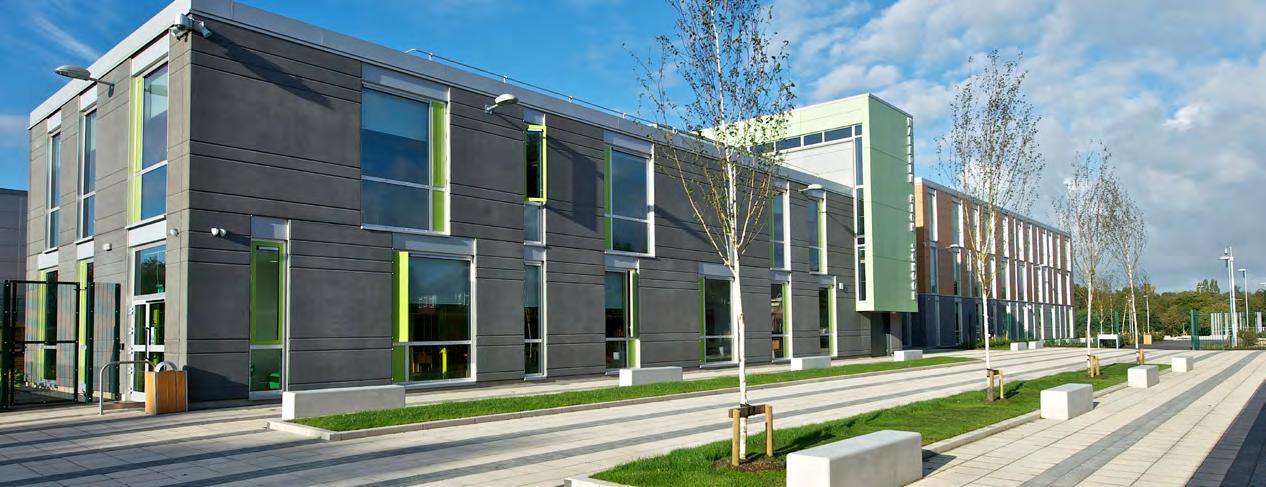
Walkden High School’s new building was constructed as part of BSF, Building Schools for the Future. To ensure that the class rooms would not receive any unnecessary noise from the ventilation ducts the consulting engineers requested a noise test in order to establish how much noise is absorbed by textile ducts.
The test was performed by the University of Southampton for the purpose of establishing the room attenuation effect through textile ducts.
KE Fibertec’s R&D department has carried out their own “equivalent absorption” calculation based on the results from the testing done at the University of Southampton.
Sound Absorption
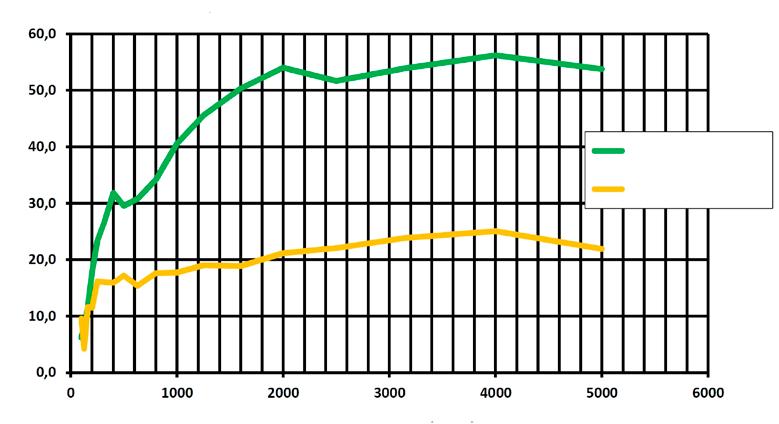
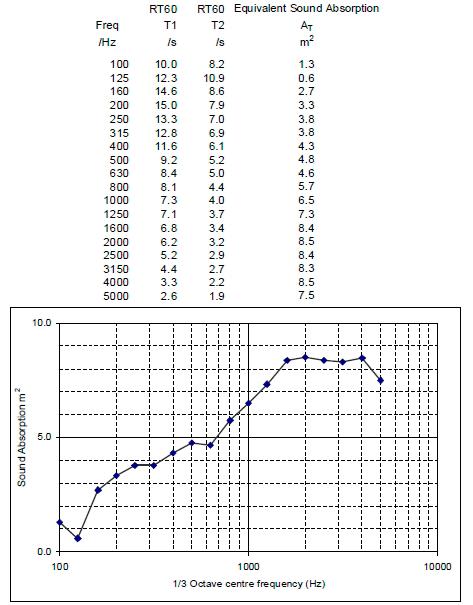
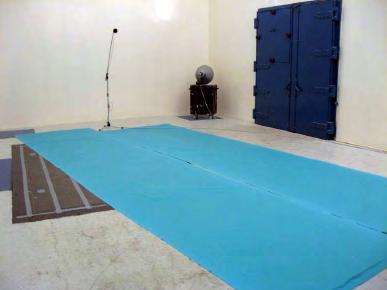
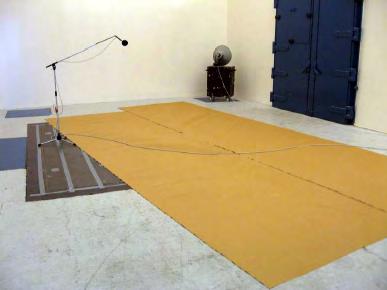
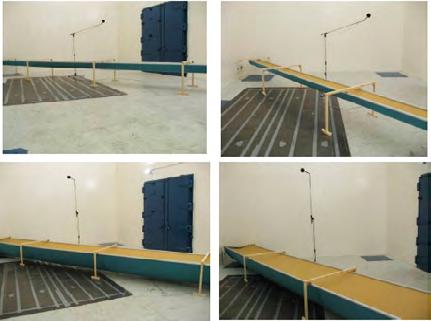
Sound requirements
There is often a requirement for a maximum noise level in an occupied zone. This requirement depends on how the room is used and how regularly. It is often specified as an LpA value or an NR value. The LpA value specifies the A-weighted sound pressure level which is standardised using an A-filter.
The A-filter makes an adjustment for the human ear’s different perception of the sound, with the high tones being assigned the most weight. All KE Fibertec’s sound data is adjusted using the A-filter, see the table below:
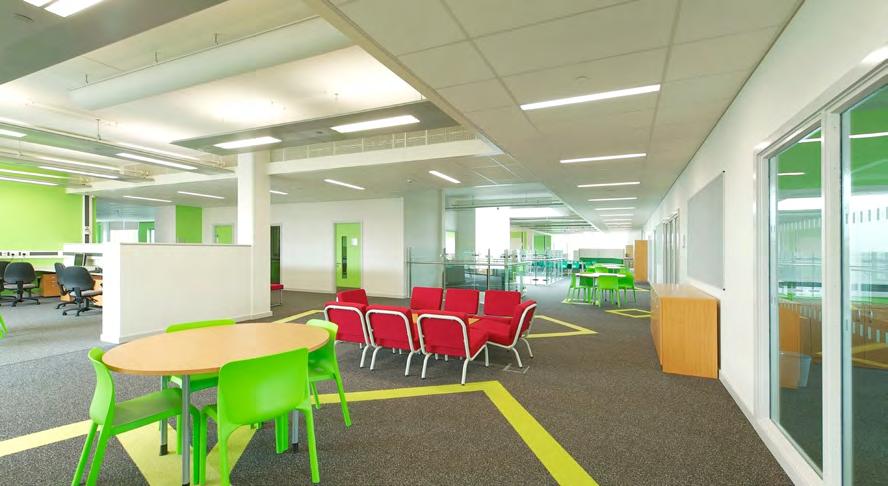
Because of their soft surface, textile ducts always have a positive impact on room attenuation as they act as a kind of sound absorber in the ceiling, absorbing and breaking up part of the sound reflected in the ventilated room.
When a sound wave disseminates in the air and hits a material, e.g., a wall, a portion of this energy is reflected. Some will be transmitted through the wall and some will be absorbed by the wall and transformed into heat energy.
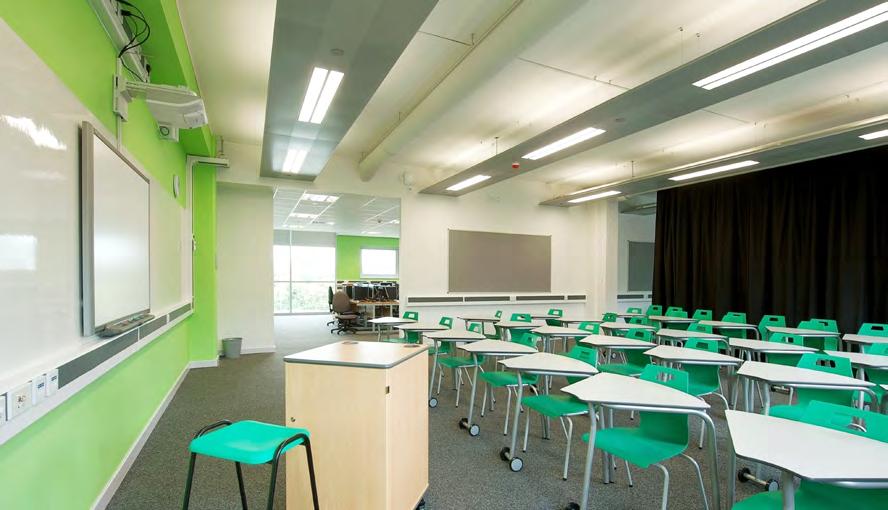
Originally LpA values would be applied up to 55 dB, LpB values would be applied within the range of 55-85 dB, and the LpC values would be applied above 85 dB, however, most often it is the A value range that is applied.
In the specific standards for mechanical ventilation systems, recommended design values most often are specified for the maximum A-weighted sound pressure level in different premises.
NR is short for Noise Rating. NR curves are approximately weighted to the human ears perception of sound and are standardised in accordance with the International Organization for Standardization (ISO). As a general rule of thumb, the following expression can be used for NR:
NR = LpA - 5
Sound measurements
All KE Fibertec’s sound data is based on relevant noise measurements. We have collaborated with the acoustic laboratory Peutz & Associes B.V. in the Netherlands and HN AKUSTIK AB in Sweden to carry out a noise test on our textile based ventilation systems.
The noise measurements have been taken in accordance with the requirements in ISO 3741 (Acoustics – Determination of sound power levels of noise sources using sound pressure – Precision methods for reverberation rooms) and ISO 5135 (Acoustics – Determination of sound power levels of noise from air-terminal devices, air terminal units, dampers and valves by measurement in a reverberation room).
System design
The sound power level generated by low impulse systems is dependent, to some extent, on the inlet’s location and, to a large extent, on the air’s inlet velocity.
In the case of KE Fibertec’s high impulse systems, the generated sound power level is particularly dependent on the outlet velocity through the holes/ nozzles, as well as on how many holes/nozzles per running metre of ducting are used.
There are innumerable possible ways of combining KE Fibertec’s textile based ventilation systems. For this reason, it is obviously not possible to carry out a noise test for every combination.
It is recommended allowing KE Fibertec to perform the final noise calculation for the specific installation. The noise calculation is performed automatically in our 3D dimensioning program TBV Designer, in the same way as for the pressure losses, air velocities etc.

FLUGT Museum Photographer R. Hjortshøj

Sample calculation
We will start with the value for a KE-Low Impulse System calculated according to pp 78-79. It is assumed that room attenuation can be calculated based on a normally attenuated room.
Maximum sound pressure level in room: 25 dB (A)
Input parameters: Pt = 118 Pa
Basic sound power level: = 28 dB(A)
Correction for duct length:
Input parameters: L = 9 m
Correction (approx.): + 3 dB(A)
Resulting sound power level per duct:
28 dB(A) + 3 dB(A) = 31 dB(A)
Resulting sound power level transmitted to room:
31 dB(A)+3 dB(A)+2 dB(A) = 36 dB(A)*
Input parameters:
Room volume = 825 m3, normal room
Result: Equivalent sound absorption area = 90 m2 Sabine
Input parameters:
r = (4.8 m - 1.8 m) = 3 m
D = 2 (placed on the ceiling) r / D = 3 / 2 = 2.1
Value taken for room attenuation: RA = 12 dB(A)
Resulting sound pressure level in room:
36 dB(A) - 12 dB(A) = 24 dB(A) < 25 dB(A)
*A logarithmic addition of the sound power levels is performed.
Design and Layout
As the only manufacturer in the world we offer customised textiles from our own weaving mill and a wide range of duct colours and layouts - that is freedom of design.
TBV Designer
Our TBV solutions are characterised by flexibility and customised solutions. You are free to choose dimensions, layouts, colours, materials, bends and system type – passive (low impulse), semiactive (hybrid) or fully active (high impulse). We offer a wide range of standard colours, and for an additional charge, the fabrics can be dyed in special colours to match the interior.
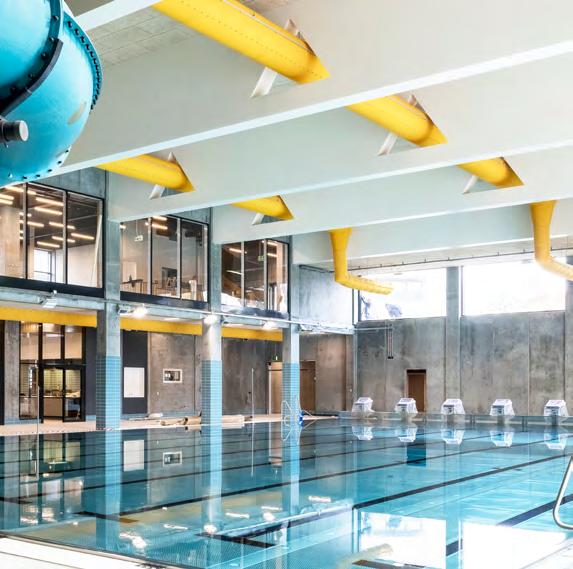
3D design programme
For dimensioning, we use TBV Designer, an advanced 3D programme developed by us. This ensures optimal adaptation to air velocity, room size and ventilation requirements. The programme also provides visual solutions and data such as pressure loss, sound level and carbon footprint –always based on the latest technology.
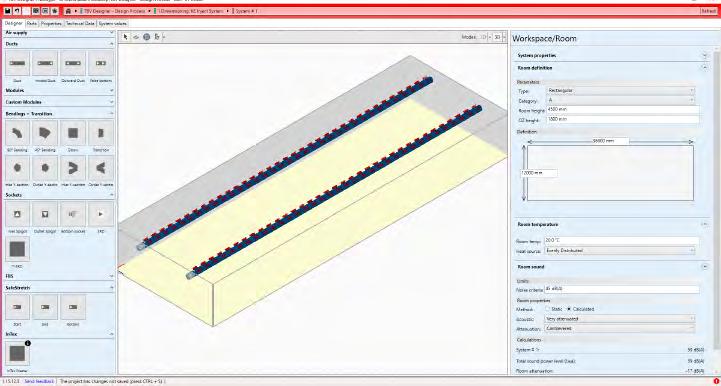
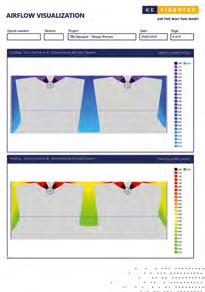
Revit plugin
Many consulting engineers and installers use Revit to design ventilation solutions. KE Fibertec has developed a plugin for Revit and can offer a wide range of duct systems as BIM components to suit all your project building applications enabling you to send the design directly from the user to and from KE Fibertec.
If you need any assistance, please view the user guide at www.ke-fibertec.com that will outline the step-by-step process. The plugin comes with KE families which are automatically loaded into Revit.
These families provide flexibility to the design of a textile based ventilation solution that does not collide with other elements of the building. However, technology is not an integral part, so pressure loss and velocities are not calculated, but can be stated by KE Fibertec.
When project quotations are loaded via this plugin, it is possible to see the associated description, technical data and quotation number of KE Fibertec.
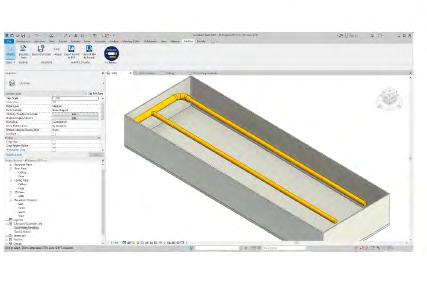

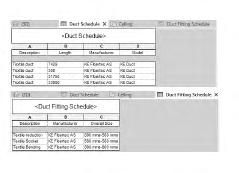
The round duct family contains:
• Straight duct
• Elbow
• Bend
• Conical transition round to round
• Conical transition square to round
• Inlet

Unique colours and materials
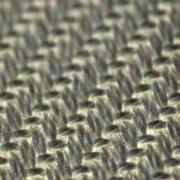
GreenWeave
Energy-efficient and sustainable textile duct material.
GreenWeave is especially suited for comfort installations with high demands on indoor air quality. Typical applications are offices, schools, laboratories, conference centres, and cold work rooms in food industry.
CRADLE TO CRADLE-MATERIALS / COLOURS - PANTONE / RAL / KE NO.
WHITE 11-0601-TP / 9010 / KE 0
BLACK 19-5708-TP / 9005 / KE 2
LIGHT GREY 12-4705-TP / 9002 / KE 3
DARK GREY 17-4402-TPG / 7042 / KE 10
DARK BLUE
19-3864-TP / 5002 / KE 8
YELLOW 14-0955-TP / 1028 / KE 6 RED 18-1655-TP / 3031 / KE 5
• Filters the supply air as an M6 prefilter acc. to EN779:2012
• Longer washing intervals with staple fibre yarns
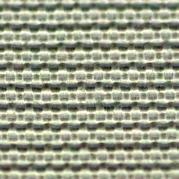
MultiWeave
Durable and versatile textile duct material.
MultiWeave is a multifunctional material that is highly suited for many different applications, from cleanroom facilities of ISO class 4, industrial facilities and sports halls to equalising rooms in meat factories.
WHITE
11-0601-TP / 9010 / KE 0
ANTISTATIC
• Dust holding capacity of 25 g/m² textile surface acc. to EN779:2012
• Fire tested acc. to EN13501 B-S1-d0
• 100% recyclable and Cradle-to-Cradle certified material
• GW materials are yarn dyed, which saves approx. 2/3 of the wastewater consumption compared to conventional piece dyed materials
CRADLE TO CRADLE-MATERIALS / COLOURS - PANTONE / RAL / KE NO.
WHITE 11-0601-TP / 9010 / KE 0
BLACK 19-5708-TP / 9005 / KE 2
LIGHT GREY 12-4705-TP / 9002 / KE 3
DARK BLUE
19-3864-TP / 5002 / KE 8
YELLOW 14-0955-TP / 1028 / KE 6
COLOURS - PANTONE / RAL / KE NO.
LIGHT BLUE 16-4132-TP / N/A / KE 9
DARK GREY
17-4402-TPG / 7042 / KE 10
GREEN
18-6024-TP / 6016 / KE 12
RED 18-1655-TP / 3031 / KE 5
BEIGE / TAN 15-1215-TP / 1019 / KE 11
• Material made of multi-filament yarn that works as a G2 prefilter
• Cleanroom certified as class 4 acc. to ISO 14644-1
• Fire tested acc. to EN13501
• Highly durable material. Tear strength 110 - 210 N (EN ISO 13937:2)
STOCK
Nomex
High-temperature resistant aromatic polyamide fibres.
The Nomex material of KE Fibertec is woven in a twill weave using staple fibres to ensure largest possible textile surface and uniform air permeability.
WOVEN COLOURS - PANTONE / RAL
NATURAL 11-0701-TP / N/A
MIDNIGHT BLUE 19-4023-TP / N/A
• Flame-resistant properties - it will neither melt, drip, nor combust in air
• Fire tested acc. to EN13501 B-S1-d0
• Used for applications where materials are required to be able to withstand intense heat
• Shrinkage- and permeability-stabilised material
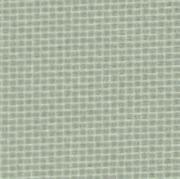
ZeroWeave
Airtight textile duct material.
Low-maintenance material with a wide range of application possibilities such as supermarkets, large sports arenas, swimming pools, high-bay industrial facilities, and rooms with high dust generation or limited accessibility.
Custom colours
WHITE 11-0601-TP / 9010 / KE 0
LIGHT GREY 14-4201-TP / 7047 / KE 910
DARK BLUE 19-3864-TP / 5002 / KE 8
• Airtight material with zero filter efficiency
• No PVC, halogens or other harmful substances
• Fire tested acc. to EN13501 B-S1-d0 without any finishing treatment
• No condensation issues when used in environments below 90% RH
In line with our strategy of offering sustainable ventilation solutions, we can now also offer digital printing as an alternative way of adding colour to textile materials. With environmentally friendly, water-based printing inks, transfer printing gives us a free choice of countless colours. A process that does not use water.
Contact KE Fibertec’s sales department for further information.
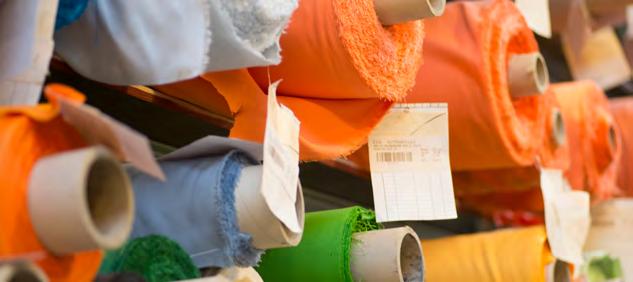
STOCK COLOURS - PANTONE / RAL / KE NO.
Dimensioning TBV systems
To be able to dimension a textile based ventilation system, it is important to understand a number of essential parameters and concepts. A textile based ventilation system is not fundamentally different from conventional ventilation systems, but there are a number of key points where it is important to be extra cautious.
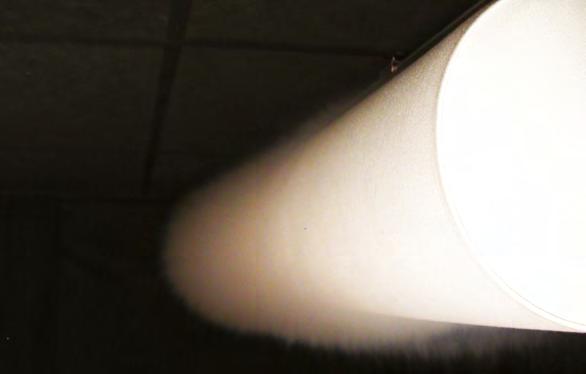
KE-Low Impulse System
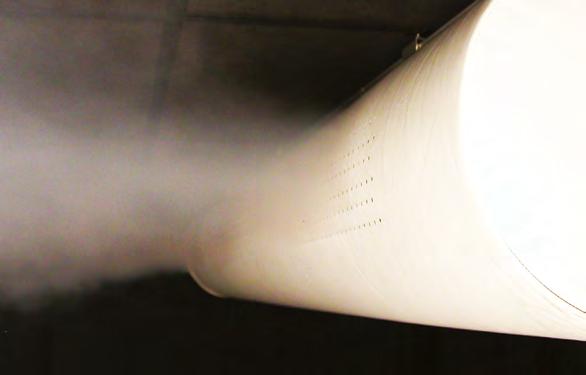
KE-Inject System
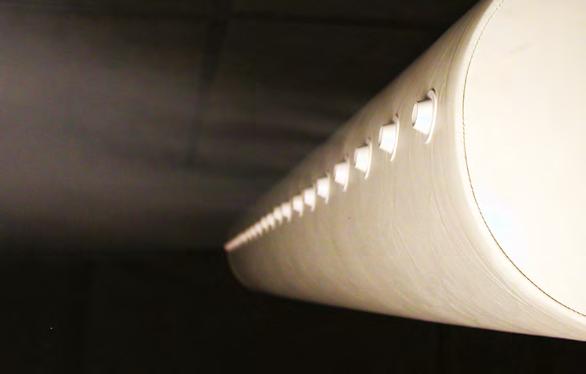
KE-DireJet System
A brief description is given below of the key parameters and concepts used when dimensioning KE Fibertec’s textile based ventilation systems.
Delivery areas
The entire surface of the KE-Low Impulse System is permeable, which means that the total delivery area corresponds to the geometric surface area. The geometric surface area, A, is given in [m2].
KE-Low Impulse System: A = diameter · π · duct length
KE-Interior System (D): A = (1/2) · diameter · π · duct length
KE-Interior System (½D): A = (1/4) · diameter · π · duct length
In the case of the KE-Inject System and the KE-Inject Hybrid System, KE Fibertec has, for the sake of manufacturability, grouped the holes in different standard patterns, depending on which type is selected, see page 34.
A standard pattern is made up of an exact number of hole steps and the delivery area can only be modified by changing the number of hole rows. Consequently, the unit, number of hole rows, is used as a parameter for the delivery area of the KE-Inject System. In the case of the KE-Inject Hybrid System, the whole of the duct’s surface, including the holes, will act as the delivery area.
In the case of the KE-DireJet System and KE-DireJet Hybrid System, the delivery area depends on whether a Ø12 mm, Ø18 mm, Ø24 mm, Ø48, or Ø60 mm nozzle is selected, as well as how many nozzles are used per running meter of ducting. With the KE-DireJet Hybrid System, the entire duct surface, including the nozzles, will act as the delivery area.
Pressure conditions in textile duct
As in any other air distribution system, pressure losses also occur in textile based ventilation systems. Calculating the pressure losses in a textile based ventilation system is not basically any different from the generally known practice.
The flow in a duct system is only dependent, to a limited extent, on whether the material is made of steel or fabric.
However, what is important to be clear about is that textile material is very flexible and it is only kept inflated by the static pressure in the system. As a result, even small turbulences can cause pulsations. This is why it is very important to perform pressure loss calculations to ensure that the textile based ventilation system is operating as it is supposed to without any pulsations, as well as ensuring the best possible energy economy.
Definitions of pressure
The types of pressure that occur in a textile based ventilation system are shown in the figure on the right.The total pressure (Pt) can be calculated anywhere in a textile based ventilation system as the sum of the static and dynamic pressures. The following expression applies:
P t = P s + Pd
Where:
P t Total pressure in the duct [Pa]
P s Static pressure in the duct [Pa]
Pd Dynamic pressure in the duct [Pa]
Total pressure
The total pressure is the pressure that needs to be produced by the fan to overcome the total resistance in the textile based ventilation system, i.e. the loss from the individual types of resistance, such as elbows, frictional loss and the static pressure in the system.
Static pressure
The static pressure, which is measured in relation to atmospheric pressure, has an identical impact in every direction and keeps the textile material inflated, as well as pushing the air out through the holes/nozzles.
Dynamic pressure
The dynamic pressure, or velocity pressure, has an impact on the direction of the air and carries it from A to B. The dynamic pressure is related to the mean air velocity in the duct and is calculated using the following expression:
Where:
r Density of the air [kg/m3]
v Mean air velocity in the duct cross section [m/s]
Pressure loss in textile ducts
The pressure loss which occurs in a textile based ventilation system originates from the following sources:
• Across cross section modifications
• Across branches
• Across elbows
• Friction
• Across flow components (SRD’s)
• Across holes, nozzles and textile material (“fittings loss”)
The pressure loss across these various components is a loss that is related to the velocity, and thus is proportional to the dynamic pressure, Pd, and dependent on what is known as the pressure loss coefficient, which is found when measurements are taken in KE Fibertec’s full-scale laboratory. The pressure loss across a component (DPe ) is determined using:
It is very obvious when a textile based ventilation system has been dimensioned incorrectly because the ducts will be oval and “sagging” when you look at them.
The difference in the static pressure between two parallel ducts may be quite considerable too. This not only has an impact on the aesthetic appearance, but to a great extent also on air distribution.
If the pressure distribution is uneven this can cause draught problems below and around the duct with the highest static pressure, while in the opposite case, the air quality will be poor in the area where the static pressure (and therefore the volume of air) is not sufficient.
KE Fibertec AS has documented pressure loss measurements for all the components featuring in our TBV systems. Contact KE Fibertec’s development department for further information.
Pulsations in textile ducts
Pulsations in textile ducts can most often be attributed to one or more of the following causes:
If a system has an turbulent air flow in front of the textile duct‘s inlet this can create a turbulence field in the duct causing pulsations in the textile material. One of the reasons for the turbulent air flow may be changes of direction in front of the textile duct.
It is therefore recommended to have a length at least three times the actual diameter in front of the textile duct where the flow profile has been restored. In addition to this, if the air velocity is too high in elbows and attachments, this can also pose the risk of pulsations in the textile material. The risk arises because low pressure may be generated locally in the textile based ventilation system due to return flow.
This is often observed inside an elbow where the low pressure will create a wave motion in the textiles surface.
In cross sections with turbulent air flow it may be beneficial to use a KE-SRD (Static Regain Diffuser), which regenerates the flow profile. This is done by forcing the air through a conical mesh so that the air flows perpendicularly on the side of the duct. This then converts the dynamic pressure wave in the duct to a static pressure, thereby preventing pulsations in the relevant cross section. This will obviously cause an additional pressure loss in the system as the static pressure in front of the SRD is raised. The fan must also overcome this pressure loss.
Textile ducts where the air is delivered from the side or from above, such as D-shaped ducts with an inlet in the roof, are at risk from pulsations. These types of systems are obviously designed with a low inlet
Textile ducts which are fitted onto sockets at the end of a rectangular steel duct, for instance, are at significant risk of pulsations as the supply air will become very turbulent when it hits the bottom of the steel duct. In these cases, pulsations can be avoided by fitting baffle plates in the steel duct (Solution 1), inserting a KE-SRD (Solution 2) or by extending the steel socket to at least 3 x D. A defective design also creates the risk of pulsations in the textile material. A defective design is often associated with the static pressure in the textile based system not being sufficiently large to compensate for the pressure loss in the sockets
velocity, but if the ventilation system’s parameters are not set properly this can easily generate pulsating movements at the inlet. The problem can be resolved by using a KE-SRD.
and elbows, with excessively high inlet velocities, an asymmetrical system layout or the wrong textile permeability.
To prevent pulsations, KE Fibertec recommends using a pulsation factor to ensure that there is sufficient static pressure available in the system. According to the pulsation factor, the static pressure in the outlet ducts must be greater than or equal to the sum of the dynamic pressure in the outlet duct and the total system pressure loss in the textile based ventilation system. 3 1 3 2


Pressure impact on system start-up
It is recommended that ventilation systems with textile ducting use a soft-starter, frequency converter or a control damper to ensure that the system starts up slowly. If this is not done the following sequence of events will occur:
Round textile ducts hang straight down when the ventilation system is not in operation, with the ducts hanging down slightly compared to when the system is on. The ducts contain absolutely no air.
In simple systems controlled using an ON/OFF mechanism the fan will reach full capacity very quickly after start-up. As the duct is still hanging down loosely, the duct’s cross-sectional area will be very restricted and the air velocity in the duct will therefore become very high. As no static pressure has yet built up in the duct, the horisontal air movement will generate a powerful wave motion travelling forward through the textile duct.
When the powerful horisontal air movement reaches the bottom of the textile duct, it will arrive with such force that it may cause the suspension system and textile duct to come loose with the vibration or even sustain serious damage. When the horisontal movement has reached the bottom of the duct, the static pressure in the duct will start to be exerted on the duct’s sides and the duct will be inflated from the end back towards the fan. This generates a powerful wave motion travelling backwards through the textile duct.
When the static pressure has built up to a normal level, the system will hang still, provided that the duct has been dimensioned correctly.
P s/Pd ratio
As a result of their permeable surface, the volume of air and air velocity in textile ducts, unlike in ordinary steel ducts, continually decreases along the duct. This means that the dynamic pressure falls along the duct, while the static pressure rises. This results in a large portion of the air being delivered at the end of the duct where the dynamic pressure is zero.
As the volume of air continually decreases along the duct friction loss may often be ignored. This means that the total pressure and static pressure will be more or less identical at the bottom of the duct.
One solution frequently used to ensure that air is distributed uniformly through very long ducts is to restore the dynamic pressure in the system by inserting a duct reduction, in the middle of the duct, for instance.
This will break the static pressure in the duct, thereby achieving a more even distribution of air. This is also the most economical solution if duct reductions are acceptable. To facilitate installation, single suspended ducts should have duct reductions with flat edge on top, while double suspended ducts should have centred duct reductions.
In order to produce a uniform distribution of air along the entire system’s longitudinal direction, the static pressure in the middle of the textile duct should always be at least double that of the dynamic pressure in the duct’s inlet.
KE Fibertec recommends that the ratio between the static pressure, Ps, and dynamic pressure, Pd, should at least follow the curve on the right. The longer the duct is, the higher the static pressure needs to be in the middle of the duct in relation to the dynamic pressure in the inlet, in order to ensure that the air is distributed uniformly.
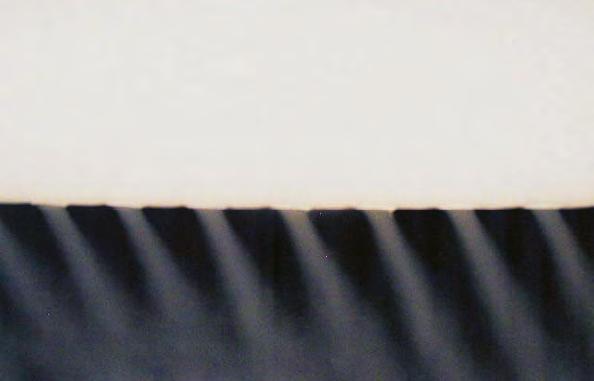
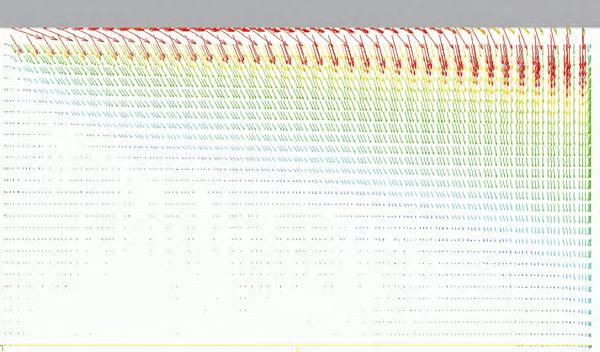
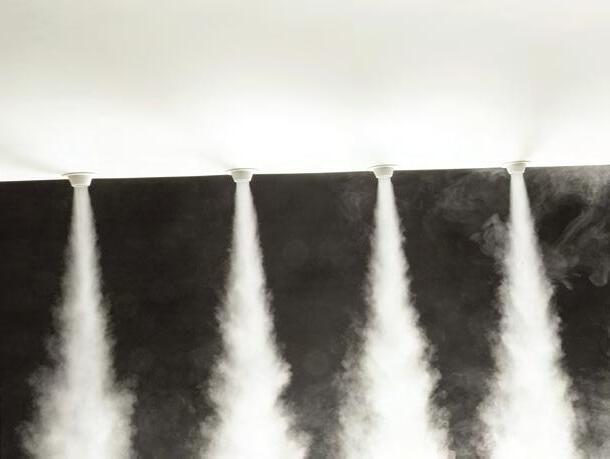
Permeability
Air permeability through the textile material’s surface is crucial to how great the static pressure will be for a given volume flow. The tighter the material’s weave, the higher the pressure will be as a function of volume flow.
For all KE Fibertec’s low impulse materials, the static pressure increase is given as a function of volume flow per m2 of the textile material’s surface. Permeability is expressed in the unit [m³/m²/h].
Entrainment in textile ducts
It is well known in flow engineering that holes positioned with a perpendicular direction in a long main duct can cause problems. The main problem is that the air has a tendency to veer away and flow parallel to the main duct, unless the holes or nozzles are fitted with baffle plates.
In the vast majority of cases, entrainment will cause problems with air distribution in the premises. At one end of the room (nearest the inlet), problems may arise with stagnant air, while at the other end of the room, entrainment may be the cause of major draught problems. Entrainment occurs if the inlet velocity is significantly higher than the outlet velocity through the holes in the textile material. To counter this inconvenient deflection of flow (entrainment), KE Fibertec recommends that the outlet velocity through the holes be at least 35% higher than the inlet velocity in the duct.
Another factor which has an impact on entrainment is the size of the hole that has been cut out. If air is supplied through large holes it will always have a tendency to deviate and flow along the duct.
The KE-DireJet System never has problems with entrainment. The nozzles are designed with a length that ensures the air is discharged perpendicularly to the main duct. In the KE-Inject System the holes are cut directly in the textile, which means that the use of baffle plates is not an option. On the other hand, entrainment does not occur to such a noticeable extent in this case either. The reason for this is because the air velocity at the centre of the hole, i.e. perpendicular to the main duct, is usually higher in the KE-Inject System than in conventional systems.
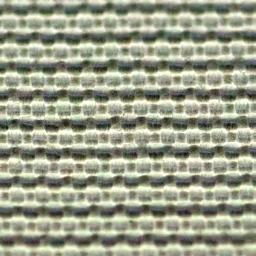
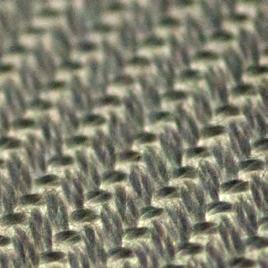
GreenWeave
MultiWeave
Maximum inlet velocities
The inlet velocity is a critical design parameter for textile based ventilation systems as it has a major impact on aspects such as pulsation, noise generation, the material’s durability and the air distribution from the duct.
The recommended inlet velocity for round ducts is no more than 6-8 m/s, depending on the entry method. In the case of KE-Interior Systems, air velocities of between 4 and 7 m/s may be permitted, depending on the entry method.
Outlet velocities - Low impulse
The outlet velocity through textile based low impulse systems depends on the geometric surface area as the air is slowly diffused through the whole surface of the textile material.
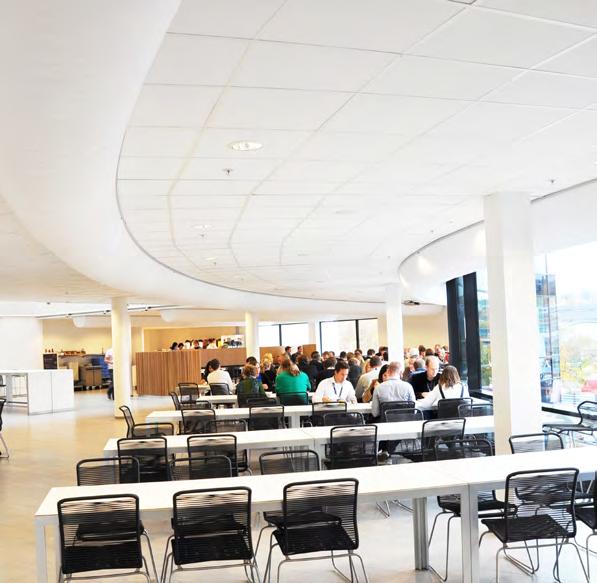
Outlet velocities – High impulse
The static pressure keeps the textile based ventilation system inflated, but the static pressure pushes the air out through the holes/nozzles and if necessary, through the textile material. The outlet velocity is a very significant parameter in the calculation of the throw length, thermal penetration length etc., but in reality, it is very difficult to measure.
On the other hand, any calibrated manometer can be used to measure the static pressure in the duct. With a standardised hole design and a detailed knowledge of the properties of the holes and nozzles, any given outlet velocity will always correspond to the same static pressure in the duct.
As already described on the opposite page, the air velocity in the KE-Inject System must be adapted to the outlet velocity. The minimum requirement is for the outlet velocity to be 35% higher than the inlet velocity.
Design process - practical examples
The examples below present quick estimated calculations for a KE-Low Impulse System, KE-Inject System and a KE-DireJet System. It goes without saying that KE Fibertec carries out extensive calculations for all specific installations using
Dimensioning: KE-Low impulse system
The following input data is provided:
Room dimensions (L x W x H):
our proprietary 3D-dimensioning program TBV Designer. We therefore recommend allowing us to perform the final calculation so that calculations for pressure drop, air velocities and sound levels are performed on the basis of detailed models.
15 m x 10 m x 5.5 m
Lower edge of duct: 4.8 m above floor level
Heat distribution in room Normal
Heat load in premises: 17400 W
Number of sockets and location: 3 sockets on the end wall
Inlet temperature and desired room temperature: 16°C / 20°C
Volume of air per socket: 4300 m³/h
Maximum air velocity in near zone: 0.20 m/s (room category B)
Total pressure available for textile ducts: 130 Pa
Room dimensions and layout
Calculation process
The following calculation process is used:
1. Determine the maximum cooling load per metre of ducting
2. Determine the required duct length
3. Determine the number of low impulse ducts
4. Determine the duct diameter
5. Determine the type of textile material
6. Check the air velocity at the entrance to the occupied zone
7. Calculate the pressure loss
8. Calculate the noise level
Maximum cooling load per metre of ducting
Input parameters: DT = 4°C and room category B
Result: F m = 500 W/m
Input parameters: d = 3 m and normal heat distribution
Correction, k, for duct location: k = 1.31
F max = F m x k = 500 W/m x 1.31 = 655 W/m
Required duct length
17400 W / 655 W/m = 27 m
Number of low impulse ducts and system layout
27 m / 10 m = 3 ducts at L = 9 m
Duct diameter
Input parameters: 4300 m³/h and max. 7-8 m/s for inlet velocity
Duct diameter: D = Ø500 mm, v = 6 m/s
Choice of textile material
Input parameters:
Surface area per duct: p x D x L = p x 0.5 m x 9 m = 14.1 m²
Permeability: 4300 m³/h / 14.1 m² = 304 m³/h/m²
Choice of material: GW320, Ps,mid = 112 Pa
Air velocity check
Maximum cooling load per metre of ducting: F max = 655 W/m
Actual cooling load per metre of ducting:
FActual = Q v x r x c p x ΔT / L
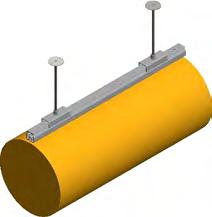
FActual = (4300 m³/h x 1/3600 s/h x 1.205 kg/m³ x 1007 J/(kg·°C) x (20°C - 16°C)) / 9 m
FActual = 644 W/m
FActual < F max = OK!
Pressure loss calculation
Ps,mid = 112 Pa
Pd,mid = ½ x r x (vmid)2 = ½ x 1.205 kg/m3 x (½ x 6 m/s)2 = 6 Pa
Pt,mid = Ps,mid + Pd,mid = 112 Pa +6 Pa = 118 Pa
P t,start = 118 Pa (friction loss = 0 Pa)
P s,start = P t,start - Pd,start = 118 Pa - ½ x r x (6 m/s)2 = 96 Pa (ESP)
P t,start = 118 Pa < 130 Pa OK!
Noise calculation
See the calculation in the chapter “Indoor Climate and Acoustics”.
Dimensioning: KE-Inject system
The following input data is provided:
Room dimensions (L x W x H):
36 m x 12 m x 4.5 m
Centre of duct: 4.1 m above floor level
Number of sockets and location: 2 sockets on the end wall
Inlet temperature and desired room temperature: 21°C / 21°C (isothermal)
Volume of air per socket: 6000 m³/h
Choice of material: ZeroWeave (impermeable)
Wall jet required: ST-1 (wall jet)
Maximum air velocity in near zone: 0.20 m/s (room category B)
Total pressure available for textile ducts: 120 Pa
Room dimensions and layout
Calculation process
The following calculation process is used:
1. Determine the number and length of KE-Inject ducts
2. Determine the duct diameter
3. Determine the volume flow per running metre of ducting
4. Determine the hole design
5. Determine the number of hole rows, the static pressure and throw length
6. Determine the air velocity at the entrance to the occupied zone
7. Calculate the pressure loss
8. Calculate the noise level
Number and length of ducts
2 sockets = 2 ducts
Room length: 36 m - Duct length 35 m
Duct diameter
Input parameters: 6000 m³/h and max. 7-8 m/s for inlet velocity
Duct diameter: D = Ø560 mm, v = 6.8 m/s
Volume flow per running metre of ducting
6000 m3/h / 35 m = 171 m3/h/m
Hole design
LV hole design chosen due to room category B (see p. 59)
Hole rows, static pressure and throw length
Input parameters: 171 m3/h/m
Number of hole rows per side: 8
Static pressure: 105 Pa
Min. throw length l0.20 = 3.8 m
Air velocity at entrance to occopied zone
Current throw length in room: 12 m/4 + (4.1 m - 1.8 m) = 5.3 m
Isothermal air velocity after 5.3 m: viso = (3.8 m/5.3 m) x 0.20 m/s = 0.14 m/s
Flow model 1 (wall jet): viso = 2 x 0.14 m/s = 0.20 m/s
Pressure loss calculation
Ps,mid = 105 Pa
Pd,mid = ½ x r x (vmid)2 = ½ x 1.205 kg/m3 x (½ x 6.8 m/s)2 = 7 Pa
Pt,mid = Ps,mid + Pd,mid = 105 Pa + 7 Pa = 112 Pa
P t,start = 112 Pa (friction loss = 0 Pa)
P s,start = P t,start - Pd,start = 112 Pa - ½ x r x (6.8 m/s)2 = 85 Pa (ESP)
P t,start = 112 Pa < 120 Pa OK!
Noise calculation
Input parameters: Pt,start = 112 Pa, basic sound power level: @ 43 dB(A)
Correction for length of duct and number of hole rows:
Input parameters: Number of hole rows in total = 16, L = 17.5 m
Correction: + 7.5 dB(A) + 3 dB(A)* = 10.5 dB(A)
Resulting sound power level per duct: 43 dB(A) + 10.5 dB(A) = 53.5 dB(A)
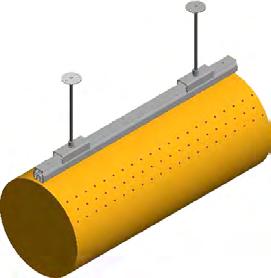
Resulting sound power level transmitted to room: 53.5 dB(A) + 3 dB(A)* = 56.5 dB(A)
*3 db(A) is added for the sound power level every time the number of ducts double.
Dimensioning: KE-DireJet System
The following input data is provided:
Room dimensions (L x W x H):
26 m x 8 m x 8 m
Centre of duct: 7.3 m above floor level
Number of sockets and location: 1 socket on the end wall
Inlet temperature and desired room temperature: 4°C / 4°C (isothermal)
Volume flow per socket: 5300 m³/h
Choice of material: ZeroWeave (impermeable)
Free jet required: ST-3 (free jet)
Maximum air velocity in near zone: 0.30 m/s
Total pressure available for textile ducts: 140 Pa
Room dimensions and layout
Calculation process
The following calculation process is used:
1. Determine the number and length of KE-DireJet ducts
2. Determine the duct diameter
3. Determine the volume flow per running metre of ducting
4. Determine the nozzle type
5. Determine the number of nozzles per metre, the static pressure and throw
6. Determine the air velocity at the entrance to the occupied zone
7. Calculate the pressure loss
8. Calculate the noise level
Number and length of ducts
1 socket = 1 duct
Room length: 26 m - Duct length 25 m
Duct diameter
Input parameters: 5300 m³/h and max. 7-8 m/s for inlet velocity
Duct diameter: D = Ø560 mm, v = 6 m/s
Volume flow per running metre of ducting
5300 m3/h / 25 m = 212 m3/h/m
Choice of nozzle
A Ø18 mm nozzle is selected.
Number of nozzles, static pressure and throw length
Input parameters: 212 m3/h/m
Number of nozzles per side: 10
Static pressure: 121 Pa
Min. throw length l0.30 = 6.0 m
Air velocity at entrance to occupied zone
Current throw length in room: 6.0 m (150° downward slant)
Isothermal air velocity after 6.0 m: viso = 0.30 m/s
Pressure loss calculation
Ps,mid = 121 Pa
Pd,mid = ½ x r x (vmid)2 = ½ x 1.205 kg/m3 x (½ x 6 m/s)2 = 6 Pa
Pt,mid = Ps,mid + Pd,mid = 121 Pa +6 Pa = 127 Pa
P t,start = 127 Pa (friction loss = 0 Pa)
P s,start = P t,start - Pd,start = 127 Pa - ½ x r x (6 m/s)2 = 106 Pa (ESP)
P t,start = 127 Pa < 140 Pa OK!
Noise calculation
Input parameters: Pt,start = 127 Pa, basic sound power level: = 48 dB(A)
Correction for length of duct and number of nozzles:
Input parameters: Number of nozzles per metre in total = 20, L = 25 m
Correction: + 7 dB(A)
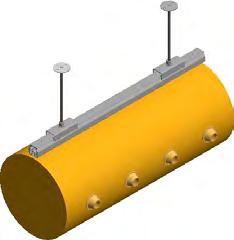
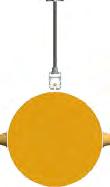
Resulting sound power level transmitted to room: 48 dB(A) + 7 dB(A) = 55 dB(A)
Product Life and Warranty
In
line with our entire foundation on sustainability,
we develop products and offer services that contribute to the longest possible product life.
Lifetime extension
Our strategy focuses on developing solutions and services that extend the life of our products – e.g. maintenance, repair, energy optimisation and recycling. The goal is an average service life of 2025 years with proper maintenance.
With experience dating back to 1974, KE Fibertec supplies durable, sustainable ventilation systems that ensure:
• A better indoor climate
• Less energy costs over time
• Longer product life of up to 20-25 years
• More satisfied customers
• Recycling of materials after end of use
In addition, we offer:


HIGHEST DUST HOLDING CAPACITY
GreenWeave material with staple fibre yarn allows for longer washing intervals and a dust holding capacity of over 25 g/m³ (EN779:2012).
LOWER PRESSURE LOSS
Textile based ventilation reduces system pressure compared to steel ducts and does not require balancing dampers.
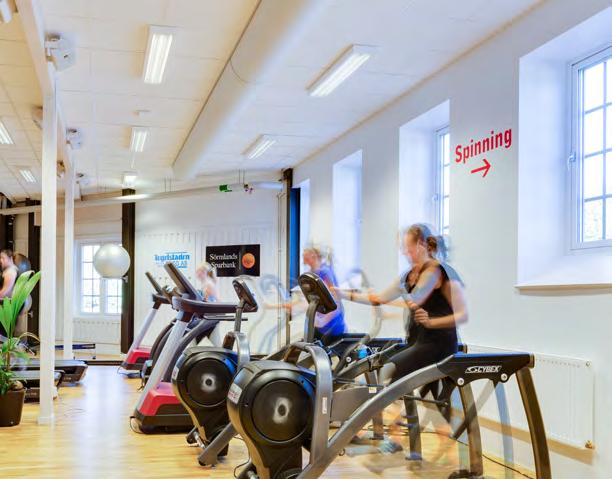

100% ACTIVE AND
DIRECTIONAL AIRFLOW WITH NOZZLES
The KE-DireJet nozzle system is an active high impulse system for mixing ventilation with 25% lower pressure loss compared to holes/ microperforation.


HEALTHY
INDOOR CLIMATE WITH CEILING PANELS
FBS ceiling panels ensure effective ventilation even in rooms with low ceilings – down to 10 Pa.
SHORTER INSTALLATION TIME
TBV ducts are installed 25–60% faster than steel solutions and require fewer working hours, not least because the suspension rails are supplied cut to size.

LOW WEIGHT AND EASY HANDLING
Our materials weigh 260-330 g/m², which gives a much lower total weight per duct than steel. Textile ducts are easier to handle and transport as they are folded and packed in cartons with a maximum weight of 25 kg. The system comes with complete documentation, and commissioning is quick as dampers can be omitted.
Life Cycle Cost (LCC)
The most expensive material is not necessarily the most expensive solution in the long term.
KE Fibertec offers an LCC calculation that shows the total lifetime costs for a TBV system, including:
• Investment and installation
• Operation (fan operation)
• Service (primarily cleaning and maintenance)
• Disposal at end of life
Operation and service typically represent the largest cost over time.
Facts
on operating costs
Faktorer, der påvirker tilstopning og vaskeintervaller:
• Outdoor air quality (actual particle rate at the building site)
• Correct prefilter (at least M6 or MERV 13)
• Air handler run time per year (affects energy consumption and washing frequency)
• The dust holding capacity of the ducts (the amount of dust that the fabric can accumulate when it operates at a specific air pressure rise)
The best warranty on the market
Example:
Duct diameter: 560 mm
mm
Installations per room: 2 ducts
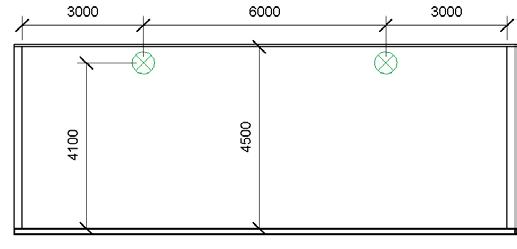
KE Fibertec AS offers four different types of warranty. An overview of the complete warranty terms and conditions is available at ke-fibertec.com/download. The terms there will always take precedence.
Period of warranty in years (from date of invoice)
GreenWeave, GW Antistatic, Nomex and MultiWeave with KE service agreement
GreenWeave,
1) Please refer to the general KE material specification for tolerances and properties.
2) TBV systems installed in aggressive environments, such as swimming pools, dairies, galvanising plants, etc., are covered by the standard 5-year warranty. The extended 10-year product warranty is only valid with a written agreement with KE Fibertec.
Design warranty on technical function
1-year guarantee on technical function of the system (including pressure loss and air velocity), if specified on the order confirmation. Faults must be documented, and KE Fibertec reserves the right to carry out its own measurements.
Liability for defective performance
Defects are covered for up to 12 months after commissioning (max. 18 months from invoice date). Remedied by repair or replacement if correct installation and use are documented.
Product warranty
Defects are covered by repair or replacement, including shipping. External costs are only covered by written agreement. The warranty is void in the event of incorrect use or maintenance. Changes in colour, logo and natural ageing are not covered.
Washing and Maintenance
All ventilation ducts require regular cleaning and maintenance. With textile ducting you have the benefits of easy maintenance.
A good indoor climate benefits everyone Buildings need proper ventilation to ensure a healthy and comfortable indoor climate. Poor air quality reduces concentration, irritates the eyes and nose, and can increase sickness-related absence, leading to significant costs for both companies and society.
All ventilation ducts require regular cleaning and maintenance. Textile ducts offer a clear advantage, as they can be easily removed and washed repeatedly, maintaining optimal hygiene and performance.
Dust Holding Capacity
No matter how well the air is pre-filtered, there will always be a certain amount of residual dust in ventilation ducts and fittings and in the room via the supply air. A KE textile duct filters out much of the remaining airborne dust. KE Fibertec offers two types of materials, MultiWeave and GreenWeave, with high dust holding capacity and long washing intervals.
Spare sets
In environments that require frequent cleaning of ducts, it may be a good idea to have an spare set ready. This saves both time and money, and the operation of the ventilation system is not interrupted during maintenance.
Washing Service
Long service life
When used correctly, KE Fibertec’s low impulse systems can achieve a long service life with up to 100 washes and services without any deterioration in air flow compared to a new product. The following should be observed:
• The systems must hang freely so that the textile material does not rub against fixed objects, thereby causing damage.
• The systems must hang still as pulsations can damage the textile material. Violent jolts must also be avoided when starting up the system as this can cause the suspension system or textile duct to come loose or sustain serious damage.
• The systems must be protected when being installed and removed so that the textile materials are not damaged.
• Outdoor air passing through the systems must be prefiltered – Class M6 – to avoid them quickly becoming clogged up.
• The systems must be washed, centrifuged and dried according to KE Fibertec’s instructions to prevent them from getting damaged.
Green thinking by KE Fibertec
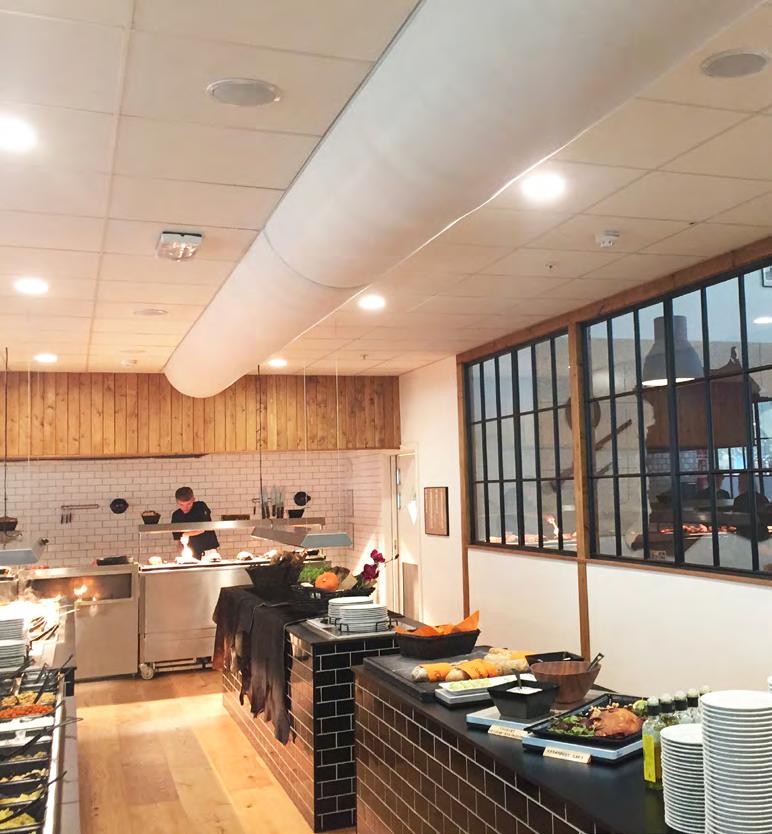
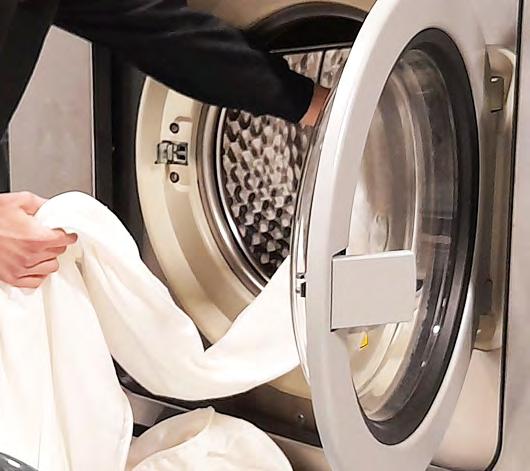
Washing service
KE Fibertec in Denmark and a number of international KE Fibertec partners have established inhouse washing services of textile duct systems and offer professional washing concepts that ensure optimal washing results. KE Fibertec’s washing and service concepts offer a range of options:
Documentation report included in service
Often, the most expensive material is not the most expensive solution when considering the entire product life cycle. We make an inspection of all textile ducts before wash and make a quality control ensuring the right treatment and to make any repairs. We offer a complete report after each wash explaining the treatment and as documentation of the wash.
Permeability measurement
Measurement of material air permeability before and after washing to ensure proper functionality.
Removal and installation
If you are short of manpower, KE Fibertec can help with the removal of the ducts before washing and the subsequent installation of the clean ducts.
Safe and easy storage
KE Fibertec will store your spare ducts. In this way they are guaranteed to be kept dry and safe until needed - it is easy and cheap.
Antibacterial treatment
For the food industry we offer an environmental friendly antibacterial treatment without silver ions. The Antibac-E treatment is approved according to EN-ISO 20645:2004 and EN ISO 20743:2013 for 3 washing cycles before the treatment must be renewed.
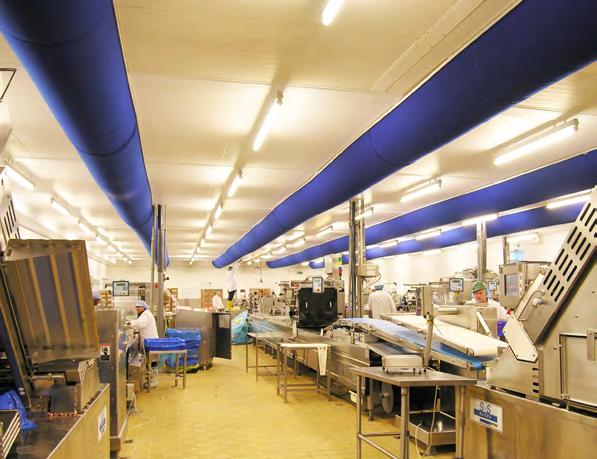
Warranty up to 15 years
KE Fibertec can offer an extended warranty scheme that covers the product for up to 15 years. This is on the condition that KE Fibertec is in charge of washing and maintenance of the textile ducts.
Please, contact KE Fibertec for further information.