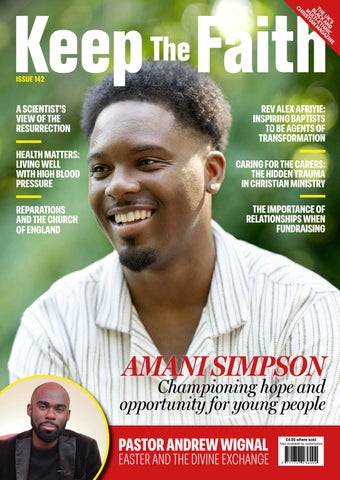
Keep The Faith magazine Issue 142

Page 1


A SCIENTIST’S VIEW OF THE RESURRECTION

HEALTH MATTERS: LIVING WELL WITH HIGH BLOOD PRESSURE REPARATIONS AND THE CHURCH OF ENGLAND

REV ALEX AFRIYIE: INSPIRING BAPTISTS TO BE AGENTS OF TRANSFORMATION

CARING FOR THE CARERS: THE HIDDEN TRAUMA IN CHRISTIAN MINISTRY

THE IMPORTANCE OF RELATIONSHIPS WHEN FUNDRAISING

EDITOR

Marcia Dixon MBE editor@keepthefaith.co.uk

GRAPHIC DESIGNER

Becky Wybrow

SUB-EDITOR

Jackie Raymond ADVERTISING

Valerie San Pedro advertising@keepthefaith.co.uk T: 0203 868 0664

MARKETING

Karen Seronay karen@keepthefaith.co.uk

Mairem Honrada-Magarro mairem@keepthefaith.co.uk

ACCOUNTS AND SUBSCRIPTIONS finance@keepthefaith.co.uk

PUBLISHED BY

MTD Publishing Ltd 71 -73 Sheldon Street London WC2H 9JQ T: 0845 193 4431 www.keepthefaith.co.uk

Facebook keepthefaithmag X @keepthefaithmag Instagram keepthefaithmag

THE PUBLISHER WOULD LIKE TO THANK:

Dr T Ayodele Ajayi, Shirley Anstis, Alton Bell, Gary Clayton, O’Neil Dennis Akosua DF, Katrina Douglas

Leondre Douglas, Chioma Fanawopo

Juliet Fletcher, Roy Francis

Vanessa Grossett, Liam Jagger, Sophia Jones, Kirly Sue, Esther Kuku

Dr Jacky McLeod, Revd Ronald Nathan

Joy Roxborough, Tab London, Verona White, Pastor Andrew Wignal our advertisers and supporters

The opinions expressed in this publication are not necessarily those of the Publisher.

Editor’s Note

Dear Readers

Spring is here, which means Easter, the most important period in the Christian calendar, will soon be upon us. The events of Easter are the reason why Christianity exists.

It’s a wonderful thing to know that God loved the people of the world so much He sent His only begotten Son to die for our sins, so that we could experience a right relationship with God, eternal life, peace of mind, increased faith, life transformation and spiritual blessings.

One of the things that has given me great pleasure – in my many years writing about the Christian community – is meeting individuals whose lives have been transformed and impacted by the Easter story and the central happening: the resurrection of Jesus.

This edition includes articles about the importance and significance of Easter, and features stories about changed lives and how

God has journeyed with His people through every stage of life. This has been my experience and that of countless believers over time.

At this pivotal time in human history, where there are wars and rumours of wars, great suffering and hardship, it’s my prayer that the world will experience the resurrection power of the Prince of Peace and undergo a transformation of heart and mind.

May the world see the difference that following Christ makes.

Happy Easter

If you enjoy reading this magazine, do consider supporting us by subscribing to the magazine. It costs just £25 for an individual subscription, or perhaps consider giving a donation. Our account details are:

Account name: MTD Publishing Ltd

Account no: 30121325

Sort code: 06-04-05

Bank: Tide (Clearbank)

Once you’ve made a payment, email your postal address to finance@keepthefaith.co.uk and we will set up your subscription.

05-06 Latest news

08 StepFWD Gospel News By O'Neil Dennis

10 Ntokozo Mbambo: A leading figure in the African worship movement By Akosua DF

12 Mark Walker: Musician to the stars By Juliet Fletcher

16 The Easter story and the Divine Exchange By Pastor Andrew Wignal

18 How do we know He lives? By Leondre Douglas

20 Enid Cork: A life well lived By Sophia Jones, Mercy Ships

22 Revd Canon Eve Pitts: A turning point in the Church of England By Roy Francis

24 Amani Simpson: Championing hope and opportunity for young people By Marcia Dixon MBE

28 Reparations, £100m and the Church of England By Alton Bell

30 Revd Alex Afriyie: Inspiring Baptists to be agents of transformation By Marcia Dixon MBE

32 Tab Kids Church: Raising a generation, shaping movement

34 Lord, help us pray By Gary Clayton

36 Because He first loved us: How a relationship with Christ shapes our parenting By Chioma Fanawopo

37 Honouring our elders in an age that values youth, speed and productivity By Katrina Douglas

38 Food 4 Thought By Marcia Dixon MBE

39 Stepfamilies, the Church and the journey of becoming truly blended By Esther Kuku

40 Black Church finances and ethical stewardship By Ronald A. Nathan

41 Fundraising is about relationships (even when it feels like spreadsheet penance) By Liam Jagger

42 Caring for the carers: Recognising hidden trauma in Christian ministry By Dr T Ayodele Ajayi

44 Supporting women through major life changes By Joy Roxborough

45 Overcoming the pain of grief and loss By Shirley Anstis

46 Are non-fiction lines declining? By Vanessa Grossett

48 What price will you pay for healthy hair? By Verona White

49 Living well with high blood pressure By Dr Jacky McLeod

50 Kirly-Sue’s Kitchen: Vegan food column By Kirly-Sue

COGIC CHURCH APPOINTS NEW LEADER

The Church of God in Christ (COGIC), Britain’s oldest Black Pentecostal denomination of the Windrush Generation, has a new national leader.

Bishop Geoffrey Folkes, senior pastor of COGIC’s branch in Tottenham, North London, has been appointed as the interim leader of COGIC UK and will be officially installed in the role later this year. He takes over from Bishop Alvin Blake, who has served as the Jurisdictional Prelate since 1999 and who has stepped down due to ill health.

Prior to Bishop Folkes making preparations to attend the COGIC USA Leadership Conference to be consecrated as an auxiliary bishop, it was decided that the leadership of the work in the UK Jurisdiction would be passed over to him, subject to approval and ratification.

He told Keep The Faith: “I follow in the path well-trodden by the leaders who have gone on before: Bishop McLachlan and his wife, Mother McLachlan, who started the church in the 1940s, followed by Bishop and Mother Bell, and now Bishop and Mother Blake. I have big shoes to fill.” COGIC currently has 21 branches across the UK. During his tenure, Bishop Folkes will have a focus on growing the church. “I will be encouraging our church to focus on reaching the younger generation – people aged between 18-40 – and to foster their spiritual development through teaching and mentoring.”

COGIC was started in Hackney, East London, by Mother McLachlan in 1948. She had arrived in the UK on the Empire Windrush. Her husband joined her and became the first leader of COGIC UK.

Bishop Folkes has been a Christian since the age of 18, having been brought up in COGIC for most of his life. He has worked in the youth department as a youth leader, Sunday school teacher and superintendent of that department. In addition to that, he has served as the National Sunday School Superintendent, and, in recent years, as well as being a pastor, he has been a district superintendent and the Administrative Assistant to the Bishop. He has been senior pastor of COGIC Tottenham since 2011, having previously pastored COGIC Aston, in Birmingham for seven and a half years.

Visit www.cogic.co.uk

AWARD WIN BOLSTERS HEALTH ADVOCATE’S MISSION

Health and fitness specialist, speaker and ministry leader Olivia Williams is rightly smiling from ear to ear. This former Keep The Faith columnist was the recipient of the Woman of Ministry Award at the annual Power of a Woman Awards, founded by Fredi ‘Kruga’ Nwaka, and held at the Connaught Hall, Central London.

Olivia has a passion to see Christians take charge of their physical, emotional and spiritual health and maintain a healthy lifestyle, so that they can be active and carry out God’s purposes. She hopes the increased visibility that comes from being an award winner will open new doors and propel her mission to greater levels of

success. Keep The Faith hopes so too, as Olivia’s mission is a much-needed one.

Visit www.scriptfit.org

LEGACY OF HISTORY-MAKING BLACK CHURCH LEADER BEING HONOURED

Steps have been taken to honour the legacy of the late Revd Dr Joel Edwards CBE, who made history by becoming the first Black person to serve as General Director of the Evangelical Alliance, the representative body of Christians here in the UK.

Three friends – Dr R David Muir, Herman Allen and Revd Dr Carver Anderson – were all personally mentored by Revd Edwards, and, due to the major role he played in their leadership development and his impact on the national stage, they are taking steps to ensure future generations know about him and his ministry, with support from family members and ministry colleagues.

They have been hosting prayer and reflections on Joel’s books during this Lent season, and have recently launched a website, where they have collated Revd Edwards’ sermons and writings. They have formed a strategic partnership with Christ The Redeemer College London to promote theological education and provide mentorship and scholarships for the next generation in ways that reflect Revd Edwards’ commitment to education, justice and kingdom impact.

In the autumn, they will set up a foundation in Joel’s honour, providing educational scholarships for pupils at the school Revd Edwards attended as a child in Jamaica, prior to coming to the UK.

Visit www.joeledwardslegacy.org

SERVING COMMUNITIES ON THE WORLD STAGE

Revd Ronald Nathan pays tribute to the life and achievements of the late Revd Jesse Jackson

The journey of the late Revd Jesse Jackson – from Baptist minister to international statesman – is not a departure from his Christian calling, but a profound expression of it. A graduate with a BSc in sociology and later a scholarship student at Chicago Theological Seminary, Jackson was ordained as a Baptist minister at a time when many of his peers had settled into the faithful rhythms of local church life. Yet even as a student at North Carolina Agricultural and Technical State University, he discerned that ministry had to reach beyond the pulpit. Confronting segregated libraries, theatres and restaurants, he embodied a Gospel that refused to be confined within four walls.

Mentored by Revd Dr Martin Luther King Jr and Revd James Bevel of the Southern Christian Leadership Conference, Jackson embraced a theology that insisted that faith must be seen as well as heard. His conviction was simple: ministry demands the dismantling of despair and instilling hope. ‘Keep Hope Alive’ was not merely a slogan; it was a pastoral charge to a wounded world.

In the United States, he carried that charge through the civil rights movement and even into two presidential campaigns, expanding the moral imagination of American politics. Yet his witness was

never parochial. For the Black Christian community here in the United Kingdom, Jackson’s repeated visits across the decades have been a source of solidarity and encouragement.

From standing in Trafalgar Square in the 1980s against apartheid, to addressing vast crowds in Hyde Park in 2003 opposing the Iraq War, he lent moral authority to British struggles for justice. His 2007 tour, marking the bicentenary of the abolition of the slave trade and culminating in the unveiling of the Nelson Mandela statue in Parliament Square, connected our history to a global freedom narrative. Through support of organisations, such as Operation Black Vote, and engagements with universities and churches, he affirmed the power of Black political participation and Christian social witness in Britain.

Internationally, through courageous diplomacy in Cuba, Syria and Iraq, and through advocacy for democracy and human rights, Jackson demonstrated that a Baptist minister could operate on the world stage without surrendering his pastoral heart.

Revd Jesse Jackson shows us that true Christian vocation is not limited by geography. It is enlarged by obedience.

KEEP THE FAITH LAUNCHES PODCAST

After months in the making, Keep The Faith has released its first-ever podcast: Servant Leaders.

Six church leaders – Apostle Marjorie Esomowei, Revd Les Isaac OBE, Bishop Claion Grandison, Revd Ade Omooba MBE, Revd Lola Oyebade and Bishop Mark Royal – spoke with Keep The Faith editor, Marcia Dixon MBE, about their lives, faith and leadership.

Marcia explained: “This podcast, which has been funded by generous donors, discovers how church leaders live out Christ’s directive for servant leadership. Listeners will learn gems about leadership and faith, as ministers share their Christian journey and experiences of church leadership, whilst negotiating various life challenges that include ill health, losing parents at a young age, and childlessness. All this makes for interesting listening.”

Keep The Faith is set to record a second Servant Leader podcast series, which will feature younger leaders, and plans are in motion to organise a screening of its debut documentary, Living Loving Serving – Women Leaders in the Church.

If you would like to support Keep The Faith’s second podcast series, please donate to our GoFundMe campaign at https://bit.ly/SLPodcast2

Apostle Marjorie Esomowei
Bishop Claion Grandison

God may be calling you to church ministry, but don't discount the value a theology degree can bring to so many other areas of society. I have never worked for a church, but God has used me in powerful ways.

Research Student, Master of Theology (MTh)

Explore Postgraduate opportunities with us: MA Biblical Studies // MA Theological Studies // MA Practical Theology and Ministry // Master of Theology (MTh) // Master of Philosophy (MPhil) // Doctor of Philosophy (PhD)

GOSPEL NEWS

MOBO 2026: THE YEAR THAT GOSPEL MUSIC WINS BIG!

For 30 years, the MOBO Awards has functioned as a cultural compass for Black British music. Long before algorithms decided what deserved attention, MOBO was mapping the terrain. Grime, UK rap, R&B, and Afrobeats are just a few movements the Awards identified before the mainstream caught the scent. As the organisation marks its 30th anniversary in 2026, its legacy feels firmly established. What began in 1996 as a corrective to industry blind spots has evolved into one of the most significant institutions in British music culture.

Thirty years is no small feat in an industry that reinvents itself every few seasons. The fact that the MOBO Awards has not only survived but also remained relevant speaks to the vision of founder, Kanya King CBE. At a time when Black music in the UK was routinely sidelined, King built infrastructure rather than waiting for an invitation. As she noted during the anniversary launch:

“For 30 years, MOBO has been more than an awards show; it has been a movement. This milestone is a reminder that when you celebrate culture, you don’t just preserve history; you shape the future.”

TIMES ARE SHIFTING

Over the past few years, gospel has migrated from the margins of the MOBO programme into a more visible and contested space. This progression has culminated in the 2026 nominations, where, for the first time, a gospel artist, DC3, has been nominated in the Best Newcomer category. This category traditionally functioned as a launchpad for breakout secular acts, like Stormzy or Little Simz. To see a gospel artist placed in that field changes the optics entirely. Best Newcomer has never been symbolic; it is predictive, marking artists on the cusp of significant cultural reach.

THE 2026 BEST GOSPEL ACT NOMINEES

The nominees reflect the diversity and creativity shaping UK Gospel today. They include sounds ranging from rap-driven expressions to Afro-influenced worship to contemporary R&B-infused music. Following their nominations for the Manchester ceremony at Co-op Live on March 26, these artists shared their reflections:

Annatoria: A returning nominee and the reigning Best Gospel Act winner, Annatoria has seen her blend of R&B and worship build momentum across UK charts and audiences in recent years. Her continued

presence on the MOBO shortlist confirms her position as one of the most recognised young voices in contemporary UK Gospel.

DC3: By earning nominations in both Best Gospel Act and Best Newcomer – a category traditionally filled with secular breakout artists – this Northampton-based rapper has become one of the most talked-about names in the 2026 awards cycle. His placement in Best Newcomer marks a milestone moment for gospel at the MOBOs.

Faith Child: A veteran of the UK Gospel scene, Faith Child’s inclusion continues his pattern of recognition at major platforms. His ongoing consistency and work within gospel music have kept him in the conversation for both audiences and industry commentators.

Imrhan: Representing a wave of melodic contemporary worship-influenced artists, Imrhan’s nomination reflects the broader

Annatoria
DC3
Faith Child

stylistic range recognised within gospel this year. His visibility on playlists and in scene reporting positions him as a meaningful voice among his peers.

Sondae: Known within the scene for crafting music that resonates with reflective and atmospheric listeners, Sondae’s name on the list points to gospel’s expanding sonic definition, indicating that more introspective expressions remain central to the genre’s evolution.

Still Shadey: A past MOBO Best Gospel Act winner, Still Shadey’s repeat nomination highlights his sustained impact in UK gospel rap and narrative-rich music that continues to attract wide interest. His career trajectory is often pointed to when discussing the growth of gospel within mainstream and genre-specific conversations

These nominees represent the growing reemergence and visibility of UK Gospel in the mainstream landscape. Between the 2026 nominees and historical context, it’s worth reflecting on the ecosystem that has made this possible. UK Gospel has grown – and not by accident. Artists, collectives, promoters and media platforms have invested over a decade to expand reach and visibility. Radio stations, charts, TV channels, magazines, online blogs, festivals, concerts, tours and more have provided consistent infrastructure, digital literacy and community support. Industry voices agree this groundwork is now paying off.

RECENT WINNERS AND THE AFROGOSPEL EXPLOSION

Looking back at the last few years, the Best Gospel Act category has reflected the genre’s increasingly mainstream reach:

2024 – Limoblaze: A pioneer of AfroGospel, Limoblaze’s win celebrated a fusion of Afrobeat rhythms and gospel lyricism. His sound demonstrates that African-rooted gospel is not just a sub-genre, it is a driver of mainstream UK music. Limoblaze has been instrumental in showing that AfroGospel can thrive on global playlists while retaining cultural authenticity.

2021 – Guvna B: A veteran artist whose work bridged complex themes of identity, grief and faith, demonstrating that gospel could carry nuanced stories and resonate across generations.

These wins highlight not only individual excellence but the evolution of UK Gospel as a genre capable of leading cultural conversation.

BY THE NUMBERS

The cultural significance of these nominations is underscored by tangible developments in how gospel music is measured and recognised in the UK. In March 2026, the Official Charts Company partnered with AStepFWD, the organisation behind the UK Christian Charts, to launch the Official UK Christian & Gospel Singles Chart. This new weekly chart tracks the most-streamed and best-selling Christian and gospel songs across the country. It is the first time a dedicated singles chart for the genre has been published alongside mainstream charts, giving real-time visibility to artists whose music is resonating with listeners week after week.

For years, AStepFWD’s monthly UK Christian Charts have been influential in spotlighting emerging and established talent across multiple styles and genres. The launch of a weekly singles chart now means that the scene is reflected in the same industry data ecosystem used to map broader UK music trends. Faith-based tracks are now regularly clocking millions of streams independently, long before radio play, with AfroGospel and lo-fi worship leading a Gen Z-driven surge. This gives clear evidence of growing audience demand for a sound that blends faith, rhythm and contemporary relevance.

LOOKING AHEAD

As the MOBO Awards steps into its third decade, gospel’s presence in headline

categories underscores why the platform remains essential. Thirty years ago, MOBO created space where there was none. This year, it expands that space again, proving that musical excellence does not need to conform to secular templates to make an impact.

In a recent article, Muyiwa Olarewaju OBE of Premier Gospel highlighted gospel’s unique role in connecting the Church to wider culture:

“At the heart of culture is music. At the heart of music is Black music. At the heart of Black music is gospel. That means when gospel music rises, culture changes with it.”

On this 30th anniversary of the MOBO Awards, the nominations reflect a decade of growth, increased output, and heightened visibility for UK Gospel. The artists celebrated here represent a generation unafraid to live out their faith creatively within culture and on their own terms. No matter who lifts the trophy this year, one thing is undeniable: gospel is shaping the future of UK music.

O’NEIL DENNIS Founder
Imrhan
Still Shadey
Sondae

NTOKOZO MBAMBO:

A LEADING FIGURE IN THE AFRICAN WORSHIP MOVEMENT

South African powerhouse Ntokozo Mbambo is widely recognised as one of the most influential worship leaders on the African continent. From her beginnings as a teenage child prodigy to her current status as a global multi award-winning solo artist, her career is a testament to consistency, vocal excellence and the grace of God. Akosua DF caught up with her to talk about her life and musical journey.

MARK WALKER: MUSICIAN TO THE STARS

Juliet Fletcher speaks to musician Mark Walker, who has played in bands for some of the world’s leading artists but has remained rooted in his Christian faith

Since I started out in gospel music, I’ve had the privilege of meeting and working with some of the most gifted, talented and anointed musicians and singers, including this young man: Mark Walker. I first met him as a teenager, and now, some 30+ years on, I wanted to find out how this man-musician has fared – right in the heart of the world of pop music – as a Christian.

RELATIONSHIPS OVER MUSIC

Before delving into Mark’s personal story, I’ll admit that I haven’t spoken to him for almost 25 years. There was no rift; life simply carried us along separate professional paths, and the demands of media and music created distance.

In recent years, we reconnected through Facebook, where, since the pandemic, there has been a steady and sobering flow of musicians – transitioning individuals of extraordinary musical genius. A few must be named.

For 25 years, Paul Reid served as Musical Director for Beverley Knight, while mentoring and encouraging young musicians. His passing in 2020 drew a powerful response and led, this year, to the formation of The Paul Reid Foundation by family and friends.

In 2021, Fritz McIntyre transitioned. A founding keyboard musician within NTCG (including Highgate Gospel Choir) in the 1970s, he went on in the 1980s to become a founding member of Simply Red, alongside Mick Hucknall, contributing significantly to its songwriting and production success.

In 2022, bassist Joey Grant, known for his work with Lady Gaga, Mel C, Stormzy, and Tinie Tempah, died after battling cancer – a prolific creative at the heart of his generation.

Then, near the end of 2025, percussionist and drummer Robert ‘Skins’ Anderson suddenly passed after illness. A long-time player for Alexander O’Neal, Robert had

also shared close musical brotherhood with Mark, who himself had long served as pianist for Alexander. These losses struck the gospel musicians’ community profoundly, as I noticed the heartfelt reflections shared by Mark Walker. Let us consider: every one of these musicians, past and present – rooted in faith, church and family – yet excelled at the heart of the pop industry, touring and performing before audiences numbering in the millions.

MUSICAL PRODIGIES AND LEGACIES OF GENIUS

In the late 70s & 80s, as I travelled around the UK promoting gospel music, I saw many individuals with the potential for musical mastery. These same musicians, years later, would become part of the bedrock of the UK pop scene.

Mark was introduced to me by Leeds musician (Le)Roy Johnson around 1986/87. I can never forget Mark in church, sitting at the keyboards, looking up at me with big innocent eyes. In those eyes I discerned a spirit of “genius”.

JULIET FLETCHER (JF): Give us a picture of how it all began for you.

MARK WALKER (MW): My parents are both Jamaicans. Desmond Walker (from St Thomas) and Sonia Mitchell-Walker (Clarendon) met and married here in the UK. They had me first and then my brother, Martin They were the first members of Leeds COGOP when it was still a house group!

JF: Are you and your brother musical?

MW: My brother plays the drums, but not professionally. I started on drums at three years old and I was eight years old when I started

playing the bass guitar. By the time I was 11, I had started trying out the piano and keyboards, because my Dad suggested: “Why don’t you give it a try?” So, I did. We had an upright piano, and my mum had a little home keyboard that I used to experiment on, recording myself or creating beats, lol. And since then, I never stopped. When I was 12–13 years old, the first song I fully played was ‘Amazing Grace’, and a year later, my first gospel concert as a band member was for the singer Dorothy Allen.

JF: I remember Dorothy – a phenomenal vocalist of the 80s. She sang on the groundbreaking People Get Ready Channel 4 TV show.

MW: Yes. I toured with Dorothy because of Roy (Johnson), who first mentored me. We were a support act for the Hawkins Singers concert during their first UK trip. It was amazing.

JF: How would you describe yourself?

MW: I’m a multi-instrumentalist, musical director and arranger. On stage, I’ll have multiple keyboards, programming and running different things.

JF: Who have been your greatest musical influences?

MW: In my younger days: Walter Hawkins, Daniel Hawkins, Jonathan DuBose, Andraé Crouch. But the initial massive influence on my keys style was David Bainbridge. I didn’t know it then, but he was in a progressive Celtic Christian rock band called Iona. Then the critically renowned keyboard and Hammond maestro Billy Preston. I’m working on a tribute album featuring the work of his first gospel release called Universal Love. That will be my first personal project.

CHURCH AND POP VIEW

JF: As musicians from gospel roots in Britain, operating in pop music and entertainment, how do you feel you’re viewed?

MW: Back in the 90s, right after the People Get Ready days, some of us were playing across the industry and still playing in church. I remember New T Conventions, playing together with other top musicians for TD Jakes’ visit. We were genuinely worshipping. Some people were confused by that. Some of us were going through stuff; some were misunderstood. There were changes, and some left church for personal reasons.

But many of us are here – in church, in faith, in purpose. Speaking personally, I don’t know any different than church. We nurture and encourage musicians to play better. Relationship plus purpose enables me to pass on what God has given me – the gift to pass on more than music – it’s showing JESUS in our interactions.

Andrew Smith, Junior Kirton, Mark Walker and Velroy Bailey
Mark Walker with Steve Thompson and Roy Johnson
Mark Walker with Janet Jackson

JF: How did you get onto the pop scene?

MW: Velroy Bailey (drummer) and Andrew Smith (guitarist) saw me playing at COGOP Convention, then at Youth Camp. I was 16, and they invited me down for a session in London. I played Hackney Empire’s 291 Club series. More than three decades later, we’re still doing multiple tours.

JF: Who have you worked with?

MW: A very, very long list: Beverley Knight, Westlife, Five, All Saints, The Jacksons. Many TV shows, like Later with Jools Holland for guests like Anita Baker, Mike Morrison. My work is mainly live, so countless recordings and ‘buy-out’ arrangements. I’m blessed. God is good to me.

JF: Any moments that felt especially significant?

MW: It was special when we came together to make the charity album through Lawrence Johnson and Les Moir, the One Voice recording – producers, musicians and singers from both sides of the Atlantic – a true UK–USA effort. And again, when we got together and recorded The Kingdom Choir’s first album (Smile! It’s a Brand New Day, released 2004) for Christian Aid.

The Lord said to me: “Music is the bait.” Our lifestyle speaks. God is answering my prayers. During performances, I’m praying over audiences. People engage me in deep life questions; many strangers have become life-friends. People sense something in my sound, and it’s even being studied at academic levels.

THE ESSENCE

Today, Mark is married to Dawn – a banking executive, church leader and author. Between them, they have four grown children, Kanaya, Alex, Jamie and Layla. Listening to Mark, British gospel musicians have been shaping the soundtrack of popular culture for decades – on bandstands, in studios, on tours and behind the scenes. Many have stood under bright stage lights, while carrying an unseen commitment: faith, church, family, and a disciplined life that does not always fit the stereotypes of the industry.

And yet, as the recent roll call of losses has shown, we too often wait until a ‘transition’ to recognise the scale of what these musicians have contributed – not only to gospel, but to British entertainment itself.

Mark Walker represents the living evidence of that contribution. He is not an exception; he is an example – a musician formed in church, mentored in community, and then sent into the mainstream with excellence in his hands and Christ in his heart.

My prayer: that God will continue to keep these musicians – in health, in purpose, in humility and in joy – and that He will comfort our community as we grieve those who have gone before us.

My proposal: that there should be a major, mainstream, televised gospel production – a full celebration honouring the musicians and singers who have served in the entertainment field across the years, while remaining rooted in faith. An event that tells the story properly.

Because, when we speak of British gospel legacy, we are speaking of a hidden engineroom – a training ground of excellence and character – that has fed the wider industry with sound, skill and soul.

We need to know stories like Mark’s until the value of what God has done through British gospel musicians is no longer hidden but honoured in the full light of day.

Connect with Mark Walker on Facebook at www.facebook.com/mark.walker.92798

JULIET FLETCHER

A SCIENTIST’S VIEW OF THE RESURRECTION

Revd Prof David Wilkinson provides evidence for Easter – that special time of year that commemorates the resurrection of Jesus Christ, the founder of Christianity

As someone who worked as a scientist in the field of astrophysics, I often get asked if I believe in miracles. For me, the test case has always been the resurrection of Jesus. In fact, it is because I am a scientist that I find the bodily resurrection of Jesus so compelling, for the following reasons.

First, I need to take evidence seriously I remember talking to a young undergraduate physicist who was surprised to find out that I was a Christian. He said, “How can you believe in such things?”

I said, “Have you ever sat down and read the gospel accounts of Jesus and looked at their historical reliability?”

“No”, he said, “but I heard in RE that some people don’t believe that Jesus existed.”

I said, “Have you ever seriously considered the evidence for the resurrection of Jesus?” What the best explanation is of the empty tomb, the appearances to the disciples and the growth of the Christian church.”

“No”, he said, “and even if I did it wouldn’t convince me, because dead people don’t come back to life”.

“Well”, I said, “if you want to be a scientist then you need to be guided by the evidence rather than ignoring it.”

For me, the historical evidence is extremely strong for the life, death and resurrection of Jesus.

Second, evidence leads me to believe things I cannot fully explain. At the beginning of the 20th century, scientists had evidence that light was both a wave and a particle. At that time no one could understand how it could be both – it should be one or the other. But nevertheless, the evidence was strong enough that you had to accept it was both. When it comes to the resurrection of Jesus, I cannot as a scientist explain how it happened. But I believe it based on the evidence.

Third, the resurrection of Jesus shows me that God can work in unusual ways in the Universe. I believe that the laws of nature, which are universal and constant, are a reflection of God’s

faithful sustaining of the universe. Indeed, it is because of these laws that scientists can explore and work with the universe in engineering and technology. But the resurrection shows me that God has the freedom as the Creator God to go beyond his normal ways of working and do things that go beyond our understanding. And if I believe this, then I am open to believing the other signs and wonders reported in the New Testament and today.

Fourth, the resurrection is God’s yes to science. The fact that God raised Jesus bodily shows that God is interested in the stuff or materials of the universe. The resurrection was not merely a spiritual one. God transformed the very body of Jesus into a resurrection body, a more than physical body – a body which could eat fish but at the same time appear in rooms with locked doors. And if God works with the very material of Jesus’ body, a couple of things follow. This is divine affirmation that the material world is important to God, and this means that scientists and technologists are important to God. Further, God’s plan is to transform the whole creation into his new creation of a new heaven and a new earth. Indeed, Paul writes in 1 Corinthians that the

resurrection of Jesus is the first fruits of that which is to come – the promise and model of what God will do with our bodies after death, and of what God will do with the whole universe.

‘THE RESURRECTION IS MORE THAN EVIDENCE. THE RISEN JESUS IS ALIVE AND CAN BE EXPERIENCED IN DAILY LIFE.’

Finally, I need to recognise the limits of evidence.

Scientific evidence is important, but it’s not the whole story. If I ask, ‘Does my wife love me?’, then as a scientist I can investigate the evidence – does she buy me a Valentine’s card, or run out of the room every time she sees me? This may indicate something! But ultimately, I only know the love of my wife when I trust myself into a relationship with her, and at that point I experience love. The resurrection is more than evidence. The risen Jesus is alive and can be experienced in daily life. This was an experience that happened for me at the age of 17. Having read the New Testament, I was convinced by the evidence of Jesus. And on the basis of that evidence, I felt God calling me into a relationship where I experienced the life, forgiveness and power of the risen Jesus. I experienced it then, and nearly 50 years on, I continue to experience it and rejoice in it now.

Revd Prof David Wilkinson leads the project Equipping Christian Leadership in an Age of Science at St John’s College, Durham. www.eclasproject.org

THE EASTER STORY AND THE DIVINE EXCHANGE

Pastor Andrew Wignal explains how Christ’s death on the Cross reconnected humanity back to God via a transformational divine exchange that gives joy, peace and wholeness

Have you ever had to exchange something at a department store? Perhaps the clothing was the wrong size, or the appliance didn’t work as expected. You take it back, and – on condition that it’s still in good shape – you exchange it for something similar, something of equal value. That’s how earthly exchanges work: equal value swapped for equal value.

But the Easter story reveals a completely different kind of exchange, one unlike anything we experience in our everyday lives. The Cross was a Divine Exchange, where the innocent was given for the guilty, holiness for sin, life for death. It was unequal, undeserved and overwhelming in its generosity.

And it changed the world forever. Scripture tells us, in Luke 23:13–25, that Jesus was brought before Pontius Pilate, the Roman Governor of Judea, accused of blasphemy and insurrection. The religious leaders said He “misled the people” and “stirred

them up.” Yet, after thorough examination, Pilate announced repeatedly: “I find no fault in this Man.” Herod, the king, reached the same conclusion. Jesus was innocent. Perfectly, unquestionably innocent. And yet, an exchange was demanded.

As the crowd gathered, something astonishing took place. A custom allowed one prisoner to be released during Passover, and the crowd cried out, not for Jesus, but for Barabbas, a convicted rebel and murderer. They shouted for the guilty to be freed and for the innocent to be crucified. They wanted to exchange Barabbas for Jesus. They wanted to exchange truth for lies. They wanted to exchange innocence for guilt

Pilate, confused and frustrated, asked a question that echoes through history: “What evil has He done?” There was no answer – only louder cries of “Crucify Him!”

Yet, while Pilate asked what evil Jesus had done, today I want to ask a different question:

“What good has He done?” And the answer is endless.

Everywhere Jesus went, good flowed from Him. And yet, the One who did nothing deserving death was sentenced to die a shameful death on the Cross

Throughout His earthly ministry, Jesus transformed lives. He gave sight to the blind. He fed the hungry. He restored dignity to the marginalised. He brought peace to troubled minds. He healed the brokenhearted. He lifted up the weary. Isaiah had prophesied over 700 years before His coming that the Messiah would proclaim good news to the poor; release the captives; set the oppressed free; and proclaim the year of the Lord’s favour (Isaiah 61). Everywhere Jesus went, good flowed from Him. And yet, the One who did

nothing deserving death was sentenced to die a shameful death on the Cross. Why? Because the greatest exchange in human history was about to take place.

It wasn’t ultimately the crowd who released Barabbas. It wasn’t Pilate’s decision. It wasn’t political pressure. The deeper truth is this: Jesus died so the guilty could go free. Barabbas represents every one of us. We may not be criminals by earthly standards, but Scripture tells us plainly: ‘All have sinned and fall short of the glory of God’ (Romans 3:23). Sin simply means missing the mark –and every human shares this condition. We are all, spiritually speaking, in the place of Barabbas: guilty, helpless, unable to save ourselves. But this is where the Divine Exchange shines in beauty.

On the Cross, Jesus took our place – literally, spiritually and eternally. We gave Him our sin; He gave us His righteousness. We gave Him our guilt; He gave us His innocence. We gave Him our spiritual deadness; He gave us eternal life. We gave Him our shame; He gave us honour. We gave Him our brokenness; He gave us wholeness. This is why the Cross is not a symbol of defeat but of victory. Jesus took upon Himself everything that separated humanity from God, so that we could receive everything Jesus rightfully deserves. A divine

exchange is never equal. You will always receive more from God than you could ever give.

When Jesus was condemned, a supernatural transaction took place. He was condemned so we could be acquitted. He was rejected so we could be accepted. He was cursed so we could be blessed. He died so we could live. This exchange means that your past no longer has the final say. Your failures no longer define your identity. Your sin no longer separates you from God. The curse has been reversed

In department stores, exchanges require the item to be in good condition. But God accepts what the world rejects. You don’t need to bring perfection. Bring what you have – the real you. Because God specialises in turning the worthless into the priceless. He exchanges ashes for beauty. He exchanges mourning for joy. He exchanges despair for praise. So, I ask you this Easter: What are you giving God on the altar of your heart? Not as payment, because the price has already been paid. But as surrender.

Because when you give God your life, He gives you His in return.

We often sing ‘Amazing Grace, how sweet the sound’. But grace is not merely sweet. It is powerful. It is world-changing. It is the force that moved heaven to earth and sent Jesus to

Thy Kingdom Come* (TKC) is a global ecumenical prayer movement that invites Christians around the world to pray from Ascension to Pentecost for more people to come to know Jesus.

Since it began in May 2016, God has grown TKC from a dream of possibility into a movement which unites more than a million Christians in prayer, in nearly 90% of countries worldwide, across 85 different denominations and traditions- so that friends and family, neighbours and colleagues might come to faith in Jesus Christ.

Every person, household and church are encouraged to pray during the 11 days in their own way.

Our hope & prayer, is that through these 11 days and beyond, those we are praying for who have not yet heard the Good News of Jesus Christ and His love for the world, will hear it for themselves and respond and follow Him. Will you join in?

14th -24th May 2026

Jesus didn’t just die for us, He died instead of us. That is the Divine Exchange. That is Easter. That is amazing grace.

the Cross for us. Grace is the reason Barabbas walked free. Grace is the reason you and I walk free. Grace is the reason death and sin no longer hold us captive. Jesus didn’t just die for us, He died instead of us. That is the Divine Exchange. That is Easter. That is amazing grace.

So, this Easter, may you stand in the full joy of the exchange Jesus made on your behalf. May you walk in the freedom He purchased. And may your heart overflow with hope, because the One who took your place now invites you to take your place in Him. He gave everything so you could gain everything. And that is the greatest exchange of all. PASTOR

‘Thy Kingdom Come has galvanised the church to come together in prayer and proclamation in the lead up to Pentecost for many years. In these divisive times, church unity is a key prophetic message for today. TKC had been an effective conduit to demonstrate the unity of the church in the proclamation of the good news of Jesus Christ. Let me encourage you to get involved.’

‘We join our sisters and brothers all over the world as we set aside the nine days between Ascension and Pentecost to pray, to welcome the presence of The Holy Spirit in our lives and in our churches, and to pray for the Kingdom of God to come in our villages, towns and cities, and in the hearts of all.’

Rt Revd Rose Hudson-Wilkin Bishop of Dover

ANDREW
Pastor of New Testament Assembly, Tooting, London.
*Thy Kingdom Come prayer movement was initiated by the Archbishop of Canterbury and The Archbishop of York and has since been endorsed by a wide range of ecumenical leaders including the Late His Holiness Pope Francis.
Bishop Mike Royal General Secretary, Churches Together in England

HOW DO WE KNOW HE LIVES?

Leondre Douglas writes that the death, burial and resurrection of Jesus Christ is a historical fact – proven by evidence and transformed lives – and proves He still lives

‘You ask me how I know He lives... He lives within my heart.’

Those famous words from Alfred Henry Ackley’s hymn He Lives have comforted believers for nearly a century. Yet, in a culture shaped by scepticism, scientific inquiry and the constant demand for proof, an honest question often arises:

Is That Enough?

Christian faith is deeply personal, but it is not blind. The resurrection of Jesus Christ is not simply a spiritual sentiment; it is a historical claim – one that stands up to serious examination.

So, what evidence do we actually have?

Did Jesus Really Die?

The starting point for any resurrection claim is the certainty of Jesus’ death. Here, history speaks with remarkable clarity.

Jesus of Nazareth was executed by Roman crucifixion, the most brutal and medically certain form of execution in the ancient world. Roman soldiers were highly trained; their own lives depended on ensuring a condemned man did not survive.

Before the crucifixion, Jesus was whipped continuously, a punishment so severe it could be fatal on its own. He was then nailed through His wrists and feet, left to suffocate over hours, and finally pierced in the side with a spear. The flow of blood and water described in the Gospel accounts is consistent with catastrophic internal trauma.

Any one of these injuries could have killed Him. Together, survival was impossible.

And this is not only recorded in the Bible. Every ancient source – Christian, Jewish and Roman – agrees that Jesus was executed. Roman historian Tacitus and Jewish historian Josephus independently confirm the crucifixion. No ancient historian disputes it.

Jesus died. That is historical fact.

The Empty Tomb

If Jesus had remained in His tomb, Christianity would have died in its first week.

The burial place was known. The authorities had every reason to guard it. A large stone sealed the entrance, and Roman soldiers were assigned to keep watch. Had Jesus’ body been present, the authorities could have ended the Christian movement instantly by producing it. Instead, the earliest explanation offered by opponents of Jesus was that the disciples stole the body.

But this raises more problems than it solves:

1. How could a small group of frightened followers overpower trained Roman guards?

2. How could they roll away a heavy stone without being noticed?

3. Why would they willingly endure imprisonment, torture and martyrdom for something they knew was a lie?

Two thousand years later, Jesus’ body has never been found.

We know where Muhammad is buried. We know where Buddha is buried. But Jesus’ tomb remains empty.

Eyewitness Encounters

The earliest Christian writings record that Jesus appeared alive on multiple occasions after His death: to individuals, small groups and large gatherings; to followers and sceptics; indoors and outdoors; in private moments and public settings.

These encounters took place over 40 days. Hallucinations cannot account for this – as some would like to believe – as hallucinations are private, individual and do not transform enemies into devoted witnesses.

Yet the resurrection did exactly that.

Lives Transformed

The disciples, who had scattered in fear at Jesus’ arrest, became bold public preachers of His resurrection, right in Jerusalem – the city where He was executed. They endured beatings, imprisonment, and, in most cases, martyrdom. People do not willingly die for what they know is false.

Even more striking are the conversions of former sceptics:

James, the Brother of Jesus

Once a doubter, he became the leader of the Jerusalem Church after encountering the risen

Christ. He, too, was executed for his faith.

Paul, Christianity’s Fiercest Early Opponent

A highly educated pharisee, he had every reason – social, religious and political – to suppress the Christian movement. Yet, after claiming to meet the risen Jesus, he surrendered his status, faced repeated imprisonment, and eventually died for the faith he once tried to destroy.

These transformations demand an explanation. The resurrection is the only one that makes sense.

Why the Resurrection Matters

Jesus did not simply present Himself as a moral teacher or a prophet. He claimed to be the Son of God, the Forgiver of sins, and the One who would judge the world. The resurrection is God’s public demonstration that these claims were and are true.

If Jesus truly rose from the dead, then everything changes:

• Death is not the end.

• Sin can be forgiven.

• Suffering has meaning.

• God is not distant from human pain.

So, whenever someone asks: “How do you know He lives?”, you can absolutely say: “He lives within my heart.”

But you can also answer:

With history.

With evidence.

With transformed lives.

LEONDRE DOUGLAS
Pastoral team member at Trinity Baptist Church and founder of Dioko

WHEN STEPPING AWAY LEADS YOU STRAIGHT INTO GOD’S PRESENCE

Most of us in ministry know that familiar rhythm. Week on week of giving, serving, caring, and leading. Sunday comes, then Monday, and too often before we know it another week has begun and we have barely paused to breathe, let alone sit quietly with God. Daily pressures crowd in, scrolling notifications demand our attention, and well-intentioned rhythms of prayer and worship get squeezed into tiny gaps between everything else.

And yet somewhere deep down we know that true spiritual refreshment doesn’t happen in stolen moments. It happens when we intentionally step out of our routine, when we step away from the noise, and when we allow God to gently call us to stillness.

That was exactly the experience of Emmanu’-EL Apostolic Church, a gospel choir and ministry team who have been visiting Christian Conference Trust venues for over a decade. Their story isn’t an isolated one. It is a living example of what happens when a church stops the endless spin of life and intentionally comes away to seek God together.

A place set apart

“We come here to disconnect from everyday life,” says Sister Ellah Kandi, the event organiser, reflecting on their time at Highgate House Conference Centre. “Places like this allow you to detox from your phones, your computers and other things that distract you.”

For this congregation, the purpose of their conference was simple yet deeply profound. To come before God as a group, undistracted. Away from the bustle, away from the to do lists, and away from the familiar walls of their own church building, they found space to lean into God in ways that weekly services alone simply can’t provide.

More than a break, a spiritual reset At home, after Sunday worship, there is always tomorrow waiting. There are children to care for, messages to respond to, meetings to prepare for, emails to answer. Before long, it is easy to drift back into that old pattern where

our spiritual life is fragmented and rushed.

But at Christian Conference Trust venues, whether it is at The Hayes in Derbyshire, High Leigh in Hertfordshire, or Highgate House in Northamptonshire, everyday life is purposefully out of reach and God becomes your primary agenda. Spacious grounds invite long prayer walks. Meeting halls become places of uninterrupted worship. Meals are shared conversations around tables, not rushed bites at the end of Sunday church. Quiet spaces invite reflection and consecration.

As Sister Ellah describes it, coming here is like pulling into a fuel station for the soul. You step out of the fast lane of life and get filled up for the journey ahead.

A community strengthened

What happened for this church was not just individual restoration. It was congregational transformation. Freed from distractions, their fellowship deepened. Worship flowed longer and more freely than usual. Conversations stretched into the evening. There was time to pray without watching the clock, time to listen to one another, and precious time to listen to God.

Stories of renewal and clarity rippled through their time together. People encountered God afresh, hearts were refreshed, and the

entire group returned home with a renewed sense of purpose. They did not leave because the programme ended. They left because God’s appointed time there had met them, equipped them, and sent them back.

Why this matters today

In a culture that prizes speed, efficiency, and constant connectivity, the idea of intentionally disconnecting can seem countercultural. But the advantage is not found in escape. It is found in alignment. When Christians gather in places set apart for God, something remarkable happens. Stillness makes room for God’s voice.

That is why Christian Conference Trust exists. Not simply to provide venues, but to create environments where churches, ministries, and Christian organisations can come, connect deeply with God and one another, and be sent out refreshed for mission.

Designed for ministry

Unlike typical conference venues, each Christian Conference Trust centre is exclusively for Christian groups. Meeting spaces are prepared with worship in mind and are fully-equipped with A/V gear. The grounds are ideal for prayer and reflection. 3 hot meals are provided each day, so that groups can focus on what matters. And unlimited Coffee & Tea keep energy levels high and conversations deep.

From only £99 per adult per night, and children from £36 all-inclusive, bringing your group away has never been simpler. Prices like these make it realistic for churches, ministries, and whole church families to get away together.

Take the next step

What could time away do for your church or ministry team?

To explore their venues or receive a tailored quote visit cct.org.uk or call 0300 111 4444

This is where the Church gathers

A LIFE WELL LIVED

Enid Cork arrived in the UK from Jamaica aged 17 and hit the ground running. She shares aspects of her journey and the role of faith in her life

Iwas born on 1 January 1944, in St Elizabeth, Jamaica, to Anna and Samuel Sherman.

As a sickly child, I was sent to live with my uncle Papi and his family, where my health improved. My school and church were nearby, and I enjoyed running up the hill to attend both. My favourite subject in school was English, and I enjoyed Sunday school and choir practice. I was confirmed at St Stephen’s Anglican Church in Nain, aged 14, and became a godmother to a neighbour’s daughter.

When I finished my Jamaica Local Examinations and graduated, my dad asked me whether I was interested in going to England. I said: “Yes”, so, in April 1961, aged 17, I left Jamaica to come to London.

ADJUSTING TO LIFE IN LONDON

My flight landed at Heathrow in the afternoon, and my brother was meant to come and meet me. I didn’t see him, so I shared a black taxi with some fellow passengers. My share of the fare was seven shillings to Kensal Rise in northwest London, where my brother lived. He was about to leave to meet me when I arrived!

Adapting to my new surroundings was like a roller-coaster ride. I cried a few times but then said to myself that there was no going back and I had to cope with it. The week I arrived, I took a job in a hospital laundry, where the mainly English women were very supportive. In my first two years, I kept busy, exploring museums, Kew Gardens, Madame Tussauds, St Paul’s Cathedral, as well as making friends and attending All Soul’s Church in Harlesden.

MARRIAGE AND CAREER

It was during this time that I met my husband, Linton Cork. We got married and not long after my son, Worrell, was born. We lived with my husband’s sister and her family for some time, and then eventually bought our own home

with a mortgage from the Greater London Council (GLC) in January 1967.

I became active in local community initiatives in the late 1970s, serving as a member of my residents’ association and acting as a road steward. My role involved collecting 50p annually from neighbours and raising their concerns with MPs and councillors.

In 1969, I trained at Neasden and Willesden Hospital to be a general nurse and, in 1972, did a postgraduate diploma in ophthalmic nursing at the Western Ophthalmic Hospital in Marylebone. After that training, I was headhunted by a matron at Neasden Hospital to join them in the Ophthalmic Unit.

I enjoyed my time there, but I realised I was taking on extra responsibilities without proper pay. I spoke with the nursing sister, who arranged for me to meet with the matron. After explaining all my additional duties, matron decided to offer me the senior post, with a higher salary.

I stayed at Neasden Hospital until the unit closed in 1976. We moved temporarily to Northwick Park and then permanently in 1977 to Central Middlesex Hospital. In 1982, I visited my father in Jamaica and, moved by a sermon on forgiveness at the Moravian church, felt called to greater commitment. Returning to London, I began attending St Michael’s Church, which was very active in evangelism and attracted many new members from St Raphael’s Estate.

In 1988, the government introduced clinical grading. Many nurses, including a lot of Black nurses, did not receive promotions. I was a union member and served as a shop steward, representing nurses in their efforts to get higher grades. Some succeeded and some did not. Despite being a union representative, I was not promoted. Because of this, I left Central Middlesex Hospital. While working at another hospital, I learned that the clinical grading was being reviewed. The union became involved again, and I appealed the original decision at the highest level – and won. I was upgraded and received back pay for the years I should have been at the higher grade. Fellow nurses often asked me how I achieved this, and I would tell them: “You must not give up on what is unjust, and fight for what is rightfully yours.”

THE LOSSES AND GAINS OF LIFE

I have always been guided by my faith, which led me to start the journey towards becoming a licensed lay minister in the Church of England. However, nothing is plain sailing, and I had to put training on hold because Linton sadly died in 1993.

I was eventually licensed at St James Alperton on 11 November 1995. From the time I joined St Michael’s Church, I had been involved in every area of lay ministry: I served as a sacristan, opening the church and preparing the altar, pulpit and sanctuary for all liturgies; I led the Sunday school for ten years with the help of a dedicated team; I served on the Parochial Church Council (PCC); and was a representative on the Willesden Area Synod, Willesden Area Bishop’s Council and the London Diocesan Synod. As a member of both synods, I would update the congregation and write reports in the church magazine. I was also a founding member of the Black Anglican Concerns Group. I visited local churches and would ask to speak for five minutes, encouraging people of colour to

attend the meetings, share their concerns, and learn how they could take part in all forms of church ministry.

I have completed several courses, including ‘Skilled Helper in Counselling’ at Harrow College and ‘Bereavement Counselling’. These studies have enabled me to listen more intensely and guide people in a professional manner. In 1996, I started a house group, which continued until 2015. We shared some glorious times together, reading the Scriptures and meditating upon them. I also arranged weekends away for the group.

By the time I retired, in 2005, I was a theatre sister in ophthalmic surgery at Watford General Hospital, heading a team of five consultants and six nurses. Looking back over my long and rewarding career, I can say I enjoyed my nursing to the fullest level. I had some challenges, and I had to be quite proactive and resilient to gain what I had achieved.

NEW ADVENTURES

Retirement was just the beginning of a busy new chapter for me, and it continues to be so.

Shortly after retiring, I went to Ghana to volunteer for Mercy Ships. I had supported them for many years, before spending two months on the Anastasia, a hospital ship.

Working on the Anastasia was challenging because I wasn’t fully briefed in the UK before I left, as they were desperate for experienced theatre nurses. So, I hit the ground running and had to quickly adapt during orientation – working in the theatre and outpatient clinic. I joined the worship group and, on my days off, visited nearby villages. I enjoyed socialising and meeting a variety of people, especially over lunch and dinner, with people of various nationalities. I would often join the surgeon when patients returned for check-ups. They were always overjoyed and grateful to have their sight back after many years of not seeing due to cataracts.

I loved this unique experience, and I continue to fundraise for Mercy Ships. My garden parties are legendary and raise a lot of money for the charity, which means a great deal to me.

I have never stopped being active during retirement. I was inspired by seeing people swimming on their days off in Ghana, so, when I returned home, I signed up for swimming lessons and haven’t looked back. I go at least four times a week and swim 20 lengths with ease. I am a regular at the gym and do Pilates and yoga three times a week, as well as body conditioning. After some falls in the last couple of years, I was told that, had I not been doing yoga, I would have broken my bones. Yoga and Pilates have kept me fit and supple, as well as my gardening.

I have taken numerous courses during my retirement, including IT for older people. I have also travelled the world. The question people ask me is: what country have I not visited? I am grateful, first and foremost, to the Lord for my long and happy life. Despite the ups and downs, I have always tried to be an encourager, a mentor, a role model and an example and inspiration to my community, friends and family over the years.

My favourite Bible verse is Jeremiah 29:11 – “‘For I know the plans I have for you,’ declares the LORD, ‘plans to prosper you and not to harm you, plans to give you hope and a future.’” God already has plans for us, but sometimes He calls us directly to walk out His plans. We should also remember that we should prayerfully put ourselves forward under His guidance.

mercyships.org.uk

Words by Sophia Jones

REVD CANON EVE PITTS

A TURNING POINT IN THE CHURCH OF ENGLAND

In 1994 Revd Canon Eve Pitts made history by becoming the first Black woman to be ordained in the Church of England. Roy Francis charts her rise and impact

On March 26, 2026, the Church of England (CofE) – for the first time in its long history – appointed a woman as the Archbishop of Canterbury. When the announcement was made, it raised eyebrows and prompted scepticism in equal measures. Yet the moment was deeply significant, for an old institution like the CofE, once the preserve of predominantly white men, it had finally opened its doors to change and progress.

In 1994, another historic event took place, with far less ceremony and fanfare: the appointment of Eve Pitts as the first Black female priest in the Church of England. A decade earlier and no less important, Wilfred Wood had been chosen to become the first Black bishop. Both appointments are deeply connected and, to make sense of them, they need to be understood within the historical context of the CofE’s relationship with Black communities, especially those in the Caribbean.

Forged on the plantations of the Caribbean, this relationship was a curious and deeply paradoxical one; Christianity was introduced to enslaved people, while at the same time the CofE, rather than condemning enslavement outright, sustained and supported it. Over time, however, this relationship evolved, so that today, any resistance to Black people’s involvement in the Church and its highest offices is fiercely resisted. The appointments, therefore, of Eve Pitts and Wilfred Wood are deeply significant and are also profound personal achievements.

I first came across Eve Pitts in the 1980s, when, as a fledgling researcher, I worked for Television South, the independent television company for the South and Southeast of England. The late Andrew Barr was both my boss and producer of the Human Factor series I worked on, which centred around humaninterest stories, and profiled the challenges and adversity people faced, exploring their experiences in overcoming them.

One of the programmes was ‘Racism in the Church of England’, and, because Eve Pitts was an outspoken critic of the racism she found in the Church – as well as the first Black female priest in the CofE – Andrew wanted to interview her. My responsibility was to research the content of the programme, which brought me into contact with Revd Pitts. The programme

caused a minor stir when it was broadcast, and propelled Revd Eve Pitts even more into the spotlight.

Now, 40 years later, Revd Canon Eve Pitts is well-known in the CofE, and remains forthright in pointing out and challenging racism, as well as being a much-loved member of her community. Although born in Jamaica, she has made Britain her home, and her family is based in the country. In 1986, she heeded the call to ministry training at The Queen’s Foundation in Birmingham to become a priest. Three years later, she was ordained a deacon, and, in 1994, became the first Black female priest in the Church of England.

Revd Pitts says: “It was a very exciting moment when I was first ordained. I did it on the day when the first lot of women became

priests, but I was the first Black woman to go through with it. It was the fulfilment of lots of hopes and dreams for me. To serve God in such an official way was terrifying, but glorious.”

On a personal level, Revd Pitts believed her ordination signalled that the CofE was at last willing to recognise women and Black Anglicans fully, with all the rights and responsibilities associated with being a member of the Church. It’s a right, she says, many people have fought for, and this has meant sweeping aside long-held customs, traditions and conventions, many of which has historically barred entry. It wasn’t plain sailing, Revd Pitts said, and although her appointment was hailed and applauded, it nevertheless was controversial, and at times, she said, she “felt like a trophy”.

In recent years, things have changed, as more women, Black people, and those from ethnic communities are appointed to positions within the Church. But there is always the spectre of racism – more often structural than intentional – that has to be addressed, and, rather than shy away from it and sit comfortably in her ministerial post, Revd Pitts confronts it head-on. It has often got her into trouble, like when serving at St Nicolas’ Church in Kings Norton, Birmingham, she publicly criticised her fellow clergies in a sermon, alleging they were ignoring and sidelining her. Her superior, the Bishop of Birmingham, claimed what she said made it “impossible for her to continue to serve in the church”, and she was asked to resign. Thankfully, with the help of the Association of Black Clergy, she was reinstated and given a new church to pastor.

With a new church at Highter’s Heath in Birmingham, Revd Pitts’ first task was to raise funds, as the church desperately needed rebuilding. Believing the church hierarchy had “sent her there to die”, they underestimated her resolve. Although the early days there were difficult, marked by a “real sense of trepidation”, gradually Revd Pitts’ confidence returned and with it her remarkable creativity. She devised a range of fundraising efforts and galvanised the church and community into helping to raise the funds for the refurbishment effort. She slept on the church roof for twelve hours; organised parish donations and coffee mornings; walked from Birmingham to Canterbury; and took part in walkathons and danceathons. She even disco-danced for twelve hours without a break, and, through these efforts, combined with two small grants, successfully raised the funds needed to refurbish the church.

Always strong on her identity as a Black woman, Revd Pitts attributes much of her resolve to her upbringing in Jamaica, and particularly the influence of her paternal grandmother, who was a member of the Pocomania church. ‘Poco’, as it’s known in

Jamaica, is a pejorative term meaning a ‘little madness’, and is a branch of Jamaican Revivalism which began during enslavement in the 19th century.

By her own admission, Revd Pitts says she is a complex person, and her theology is complex also. As an Anglican and an African Caribbean, she sees many of her religious practices as part of her theology and identity, as well as being uplifting and liberating. Yet, she says, she often has “a problem with God”, and from an early age was critical of Christianity’s portrayal of Christ as a white man, with blonde hair and blue eyes, and, given the place He’s from, she says this couldn’t possibly be so. Also, the idea of ‘whiteness, as synonymous with godliness’ – historically promoted by the CofE, Revd Pitts says – she finds repugnant. It has done “deep damage” to Black people, and although the Bible says ‘we are made in the image of God’, Black people often find it difficult to make this mental adjustment, preventing them from fully liberating themselves from what Pitts calls “mental slavery”.

Forever an outspoken critic of society and the Church, over the years Revd Pitts has faced persistent criticism and repeated calls to temper her voice, with demands for her resignation. A common refrain was that she was “too outspoken” and “too confrontational”. Some argued that her views were too “politically charged” for a priest – an assessment she believes fails to understand or value the depth of emotion and moral urgency that racism provokes, as well as its insidious and enduring effects.

With this background and her keen cultural awareness, Revd Pitts openly celebrated her Caribbean and African roots in her role as a priest in the Church of England. Alongside traditional Anglican liturgy, she has introduced Caribbean liturgical elements within her services, and each year before she retired, she conducted an ‘Emancipation Service’ that commemorates the Atlantic Slave Trade. She would approach the altar in her church in chains, as a stark reminder of the terrible suffering endured by the enslaved. Revd Pitts says the horror of slavery and the Atlantic Slave Trade should never be forgotten, and she has never failed to call out the Church on the evil of racism, nor when it falls below its own teachings.

These, and her faithfulness to God, are why Revd Pitts believes she’s been able to weather out the storms raged against her, and because of this, her life today stands as a testimony to her courage, perseverance and deep devotion. Her ordination came at the right time, a pivotal moment in the history of the Church, and this is what has given her the opportunity to serve, as well as a platform to advocate for women and Black people, and, when needed, to remind the Church of its historic calling, that in Christ, all are equal.

ROY FRANCIS

AMANI SIMPSON CHAMPIONING

HOPE AND OPPORTUNITY FOR YOUNG PEOPLE

Seven years ago, Amani Simpson became widely known in youth circles after releasing Amani, an autobiographical film recounting how he survived being stabbed and left for dead as a teenager. The film has since gained over four million views on YouTube. He now leads youth initiatives through his CIC, AVIARD Inspires, and serves as a school governor, college trustee, and board member of a leading Christian media production company. A Christian, he recently released Paying It Forward, documenting The AMANI Project, a mentoring programme for teenagers seeking a second chance, delivered in partnership with Goldman Sachs and Hogan Lovells. A husband and father, Amani spoke to Keep The Faith about his life, faith and his hopes for young people.

KEEP THE FAITH (KTF): Your new documentary Paying It Forward centres on young people finding belief, direction and second chances. What inspired you to produce this project and what kind of response has it generated?

AMANI SIMPSON (AS): Paying It Forward was inspired by my own lived experience of what my mentor did for me when I was 16; stepping away from a season of criminality; and looking for hope and a tangible opportunity that things could be different. I know what it feels like to be written off. I also know what it feels like when one person decides not to define you by your worst decisions. That intervention didn’t just support me in the moment; it changed the direction of my life.

The response has been humbling. Hearing the stories of young people, their parents and members of the community, who have sent me heartfelt messages about the impact the programme has had on them – but also now being able to follow the mentees’ journeys through the documentary and to hear their voices directly – is something I don’t take for granted. Watching them see themselves on screen and realise that their story matters has been powerful.

KTF: Your debut short film Amani has had over four million YouTube views. How did sharing such a vulnerable part of your teenage years impact your life and the path you have taken?

AS: It has fundamentally changed the direction of my life. I don’t take for granted that people see me as a role model, and, to an extent, even a celebrity. But that can definitely get to your head if you aren’t being driven by purpose and what Yahweh has actually asked you to do. I’ve had to make a conscious decision to do as much work as I can in private, in order to put myself in the best position for public life.

So, I decided to go to therapy, and it was a game-changer. I did therapy before I became a dad, and I went back and spoke to my parents. I was able to see things from their perspective in a way I hadn’t before. It allowed us to draw a line under certain parts of our story and begin creating new memories in unity. My daughter will now grow up seeing a unified relationship between me and my parents, and that is not something I take for granted.

KTF: Surviving being stabbed seven times is a life-altering experience. What role did faith play in bringing you through that difficult time, and how do you now interpret that moment in the context of faith, purpose and God’s hand on your life?

AS: When I got stabbed, it was a really dark time and experience. I remember my life flashing before my eyes. My mum came to the scene and was crying and praying in tongues, and all I could reach for was God, because that’s how I had been raised.

I remember saying: “I wish there was something else I could be proud of. I wish there were things I could achieve that I haven’t achieved yet. Can You give me another chance? And if You do, I will live to serve You and steer young people away from darkness.” That was my promise. Afterwards, I had depression, anxiety and PTSD. I had thoughts of revenge. But, because I knew about forgiveness and understood the power of God’s hand on your life and the purpose that can come from pain, I was able to let it go. That journey eventually culminated in me being baptised in 2014, but in the lead-up to that, I had a lot of questions.

KTF: Easter is a season of redemption, resurrection and new beginnings. How does the Easter message connect with your own journey of recovery, restoration and second chances?

AS: The Easter message, for me, is deeply personal. Redemption isn’t just a theological word; it’s something I’ve experienced many times. There have been so many moments in my life where I’ve been restored, where I’ve been redeemed. Easter reminds us not just of resurrection, but of suffering. Sometimes, we focus so much on the victory that we forget what Jesus actually went through. I was listening to a sermon recently that unpacked in detail what Christ endured, and it hit me again that He didn’t have to do it. He could have called down a legion of angels. He could have ended it. But He chose to endure it for us.

KTF: You work closely with young people, some dealing with the same challenges you once did. What are their biggest struggles and how are you able to help them?

AS: I think one of the biggest challenges young people face now is the narrative that tells them who they are before they’ve had a chance to decide for themselves. From the economy, to housing, to jobs, to knife crime, exploitation, grooming, mental health struggles and everything in between, these narratives are constantly placed on young people. And, when you begin to internalise that as your identity, it can have a serious impact on how you see yourself and your place in the world.

Amani on set
Amani with Michael B Jordan and Jamie Foxx
Amani at film premiere

So, I’m very intentional about counteracting that narrative. I’m actively working to introduce positive, asset-based messages that remind young people that more is possible for them.

KTF: In Paying It Forward, belief plays a central role. How do you help young people believe in themselves when life has repeatedly told them they won’t succeed?

AS: I think self-belief and confidence are built on the ability to reference moments in your life where you’ve achieved something. Even small wins matter. So, part of what I try to do is create spaces where young people can be celebrated and can achieve, because when that happens, confidence grows. And when confidence grows, momentum follows. And once momentum builds, your worldview starts to shift. You begin to think, ‘Maybe this is who I am. Maybe I am capable. Maybe I can do more.’

When you bring those things together – celebration, opportunity, consistent relationships, affirmation – it begins to rewire how a young person thinks.

KTF: As patron of The Amani Project, what impact are you most proud of, and what does meaningful change look like when working with young people at risk?

AS: I’m proud of the fact that we’ve supported 101 young people through the programme, but, more than the number, I’m proud that for many of them we are the first rung on the ladder. We are the ones who lean in when others have rejected them. I know the value of that because I experienced it at 16. Everywhere else, my reputation had gone before me. But one college teacher leaned in and said: “I don’t care what anyone else has said about you. I’m going to judge you on who you decide to be from today going forward.” That shift changed everything for me.

When we offer that same posture to a young person who feels like the odds are stacked against them; it gives them permission to dream. It empowers them to try. It supports them as they begin carving out a future they can be proud of.

KTF: In what ways do you feel churches could better support young people?

AS: I think the Church is uniquely placed to be a safe haven for young people who are looking for more. But it has to be done in a genuine “come as you are, we will meet you where you’re at” kind of way.

There needs to be more real conversation and vulnerability in church spaces. What’s needed are leaders and communities willing to journey with young people, flaws and all. Showing that, by the grace of God, you are who you are. Not pretending perfection, but modelling growth. That’s what we need more of in church.

KTF: You are now a husband and a father. How has family life reshaped your priorities and your faith?

AS: I’ve been married for just under 10 years and I’ve been with my wife for 18 years, so she really is my queen and my life partner. Being blessed with a baby girl completes our family. I feel deeply honoured to be given the responsibility to steward my family.

The work I do in the community is great and inspiring, but the work I do in private with my family is far more important. I don’t want my daughter to grow up not knowing me because I was busy raising everyone else’s

children. I don’t want my wife to only see me working, not making time for her and not sharing the load at home. That reality has forced me to prioritise differently and to think in systems, to delegate well and to manage the multiple responsibilities I carry as best as I can.

KTF: Looking ahead, what are your hopes for the next generation of young people you serve, and the kind of society you want them to grow up in?

AS: I would love to see a world marked by peace, equality and nurture. But I’m also very conscious of what the Bible says about the End Times. So, alongside that desire for peace, I want to see young people raised up as soldiers in the army of the Lord. Bold in faith. Willing to reclaim territory. Willing to share the Gospel. Willing to walk alongside those who need hope, encouragement and resources. I want young people to grow up believing that more is possible for them, no matter their starting point in life. Seeing the impact my film has had tells me there is space for more stories to be told – stories that give hope, shift narratives and challenge mindsets.

Visit www.amanisimpson.com

Paying It Forward can be viewed on YouTube

Islington Council is recruiting foster

All Islington foster carers receive:

y financial allowances and rewards from £415 to £895 a week y extensive ongoing training y support every step of the way

Best of all our foster carers say, ‘fostering is a life-transforming experience and tremendously rewarding in making a difference to a child’s life.’

Call us on 020 7527 7933

Email fostering@islington.gov.uk or scan the QR code to visit islington.gov.uk/ fostering today for more details.

Islington Fostering Service is looking for people who can open their hearts and homes to local children who need safety, stability, and care. If you can offer a nurturing home where a child can grow, develop and thrive, we would like to hear from you.

You don’t need special qualifications - just compassion, patience, and the desire to make a real difference. Your life experience could be exactly what a child needs.

All our foster carers receive generous weekly allowances from £415 to £895, 24/7 support, a dedicated social worker, and ongoing training to help you every step of the way.

You many have more to offer than you think. Talk to us today on 020 7527 7933 or email fostering@islington.gov.uk or visit www.islington.gov.uk/fostering.

REPARATIONS, £100m AND THE CHURCH OF ENGLAND

Alton Bell argues that the Church of England must ignore demands to redirect its £100 million fund aimed at addressing the damage caused by its role in the Slave Trade

Recent calls for the Church of England (CofE) to withdraw or redirect the £100 million fund –designated to address its historic complicity in the trans-Atlantic slave trade –raise profound moral, theological and ecclesial concerns. Such proposals are often framed as prudential, pragmatic, or pastoral and do not withstand ethical scrutiny. More seriously, they risk undermining the Church’s own confession, repentance and moral credibility.

There is no moral, theological or ecclesiological justification for redirecting the £100 million away from the descendants of those harmed by slavery. Although final decisions regarding the fund’s distribution remain pending, any retreat from its reparative purpose would constitute a reversal of repentance, a distortion of biblical justice, and a betrayal of the Church’s publicly declared commitments. Indeed, it would risk repeating history by allowing those who historically benefited from slavery to remain its continuing beneficiaries.

To understand why, a brief historical overview is necessary.

HISTORICAL FOUNDATIONS OF ECCLESIAL COMPLICITY

In the 1450s, Pope Nicholas V issued the papal bulls Dum Diversas (1452) and Romanus Pontifex (1454), granting Portugal authority

to conquer non-Christian lands and reduce peoples to perpetual servitude. These decrees provided religious-legal sanction for early European expansion and African enslavement.

The Protestant Reformation began in 1517 with Martin Luther. Although it weakened papal authority, it did not fundamentally challenge the legitimacy of slavery. In 1534, Henry VIII broke from Rome, establishing the English monarch as Supreme Head of the Church of England, thereby aligning ecclesial and state power.

By the 1560s, John Hawkins had initiated England’s involvement in the trans-Atlantic slave trade with the support of Elizabeth I. These ventures were commercial and imperial, yet they operated within a Christian monarchy where Church and state interests were deeply intertwined. Protestantism rejected papal supremacy, but it did not reject the racialised economic logic of slavery. Instead, slavery continued under new national and theological frameworks.

The CofE has publicly acknowledged that it invested in and profited from slaverylinked enterprises, benefited materially from an economy structured by racialised chattel slavery, and failed to oppose the institution with sufficient clarity or urgency. This acknowledgment constitutes an admission of institutional wrongdoing – not merely a symbolic gesture.

INSTITUTIONAL SIN AND INHERITED RESPONSIBILITY

Moral accountability does not expire with time, particularly where injustice generated accumulated, inherited and institutionalised wealth.

The Church of England continues to exist as a legal, financial and moral body. It retains assets derived – directly or indirectly – from an economy sustained by enslaved labour. If benefit is inherited, responsibility is likewise inherited. Arguments that present generations bear no responsibility misunderstand the nature of institutional continuity. Institutions persist across generations; so, too, does moral liability attached to their corporate identity.

To redirect the fund would be to acknowledge wrongdoing while refusing the cost of repair. Such a move would not represent prudence but moral evasion.

QUEEN ANNE’S BOUNTY AND IMPERIAL CAPITAL

In 1704, under Queen Anne, Parliament established Queen Anne’s Bounty to supplement the incomes of poorer Anglican clergy. While pastorally framed, its funding mechanisms reveal deep entanglement with imperial and commercial power.

The Bounty was capitalised through revenues from First Fruits and Tenths –

ecclesiastical taxes previously appropriated by the Crown – and through investments in government securities and commercial ventures connected to imperial expansion. Among these were financial instruments tied to the South Sea Company, whose asiento contract authorised Britain to supply enslaved Africans to Spanish colonies.

The Company’s profits were inseparable from the commodification of African lives. Anglican capital was not morally insulated; it circulated within and benefited from Britain’s slave-based economy. Queen Anne’s Bounty functioned as an active financial body whose growth depended upon imperial structures sustained by enslaved labour.

Through subsequent financial restructurings, the modern CofE remains a beneficiary of this accumulated capital.

THE CODRINGTON BEQUEST AND ECCLESIAL OWNERSHIP OF SLAVERY

The Codrington bequest makes ecclesial complicity even more explicit.

In 1710, Christopher Codrington, a Barbadian plantation owner, bequeathed his estates – including more than 300 enslaved Africans – to the Society for the Propagation of the Gospel in Foreign Parts (SPG). His will deliberately transferred enslaved persons as assets to the Church’s missionary arm to finance Anglican evangelism.

The SPG owned and operated the Codrington plantations for over a century. Enslaved Africans were branded with the word “SOCIETY” to mark ecclesial ownership. This was not passive inheritance but active participation in slavery as a profit-generating enterprise.

When emancipation occurred in 1833, compensation was paid not to the enslaved but to slave owners. The SPG received £8,823 8s 7d for the loss of 411 enslaved persons. Thus, the Church was compensated for the abolition of its own human property, further embedding slavery-derived wealth within Anglican institutional structures.

CODRINGTON COLLEGE AND INSTITUTIONAL CONTINUITY

The legacy of this wealth continues.

Codrington College in Barbados – funded by plantation profits – remains an Anglican theological institution within the global Communion. Its land, endowment and institutional foundations are inseparable from the coerced labour of enslaved Africans.

This continuity demonstrates that slavery was not a peripheral episode but a foundational contributor to Anglican global infrastructure. The issue at stake is therefore not merely historical memory but present ecclesial identity.

BIBLICAL REPENTANCE AND REPARATIVE JUSTICE

Biblical theology is clear: repentance requires restitution.

In Luke 19:8–9, Zacchaeus restores fourfold what he has unjustly taken; only then does Jesus declare salvation. Leviticus 6:1–7 mandates repayment plus compensation for economic wrongdoing. The prophets repeatedly reject repentance divorced from justice (Isaiah 1:16–17; Micah 6:8).

The £100 million commitment is therefore not an act of charity but of reparative justice. Charity gives from surplus; repair returns what was wrongfully taken. Repentance without restitution becomes performative rather than transformative.

ECCLESIAL INTEGRITY AND MORAL WITNESS

The Church of England has framed its reparative commitment as a theological act grounded in truth-telling, corporate repentance and relational repair. To redirect the fund would signal that repentance is negotiable and justice conditional.

Such a retreat would significantly damage the Church’s moral authority – not only in

racial justice but in its proclamation of reconciliation. A Church unwilling to bear the cost of its own repentance cannot credibly preach the cross, which is itself the costly repair of broken covenant.

CONCLUSION

The £100 million reparative commitment is imperfect but necessary.

There is no moral justification for redirection, because the harm was real and the benefit ongoing.

There is no theological justification, because repentance demands repair.

There is no ecclesial justification, because the wounded belong to the same body.

The question before the Church of England is not whether it can afford to honour this commitment, but whether it can afford not to. To retreat now would not be prudence but betrayal – of history, of theology, and of the Gospel the Church proclaims.

ALTON BELL

Chair, Movement for Justice and Reconciliation Visit www.mjr-uk.com

REVD ALEX AFRIYIE

INSPIRING BAPTISTS TO BE AGENTS OF TRANSFORMATION

The incoming President of the Baptist Union of Great Britain, Revd Alex Afriyie, spoke to Marcia Dixon MBE about ministry, life and his desire to see the Church play a major role in transforming lives and impacting society

This May, Revd Alex Afriyie will start his year-long tenure as President of the Baptist Union of Great Britain – the representative body of more than 1,800 Baptist churches across the UK. Revd Alex admits he was surprised at his appointment. “I was a bit shocked, even though I’d had prophetic words that it would happen. I sensed a while ago that God said I would bring influence and change to the Baptist Union of Great Britain. So, I feel like it’s something that God spoke to me many years about, when I wasn’t praying about doing it.”

Revd Alex is a minister who’s more passionate about the local church and seeing lives transformed by the Gospel than rising up the church leadership ladder. However, during his presidency, Revd Alex will use Ephesians 4 as his foundational Scripture, to encourage Baptists to focus on building their relationship with Christ; discover their calling; work to build God’s kingdom; and share the Gospel. He explained: “I want to remind the Church that every believer matters and to release that kind of apostolic environment where all the gifts – whether they’re prophetic, evangelistic, pastoral, teaching or gifts of service – that we recognise that the local church is where we’re releasing people into their potential, whatever they are called to, to be equipped to serve in church.”

He also wants to inspire Baptist members to be missionfocused and have impact in the wider world. “Beyond church, we’re equipping people to be a real influence into society. We’re teaching people to love Jesus, how to do well in life, and to be people who can actually bring change to our society.”

Revd Alex loves the Easter season. “Easter signifies absolute transformation. Easter is about the power of God, where that transaction between God and us took place, where Jesus took our sins on the cross, and didn’t just forgive us but also made it possible for us to be transformed. One of my favourite verses in the Bible is 2 Corinthians 5:17 – ‘If anyone be in Christ they are a new creation, old things have passed away. All things have become new.’”

Alex with his wife, Dorcas

The Baptist movement is one of the world’s oldest protestant denominations. It can trace its roots back to Amsterdam in 1609, where Church of England ministers John Smyth and Thomas Helwys led a Baptist congregation. Both men wanted to rid the Church of England of every vestige of Catholicism. They also articulated three core beliefs on which the Baptist church is based: (i) the Bible is the guide for all matters of life and faith; (ii) the Church should comprise of believers, not people in a parish; and (iii) church members should govern a congregation – not a church hierarchy.

Britain’s first Baptist church was founded in Spitalfields, London, in 1612. The Baptist Union of Great Britain was started in 1891 and it is estimated that currently 50% of Baptists in London are from the Black community.

Revd Alex has had an interesting journey into faith. Born in Ghana to an English mother and Ghanaian father, he came to Britain at eight months old. He lost contact with his father aged four and reconnected at 13. He grew up in Peckham, south London, with his mother, three younger siblings and one older brother. His mother was raised in a strict Christian household, rebelled against it, resulting in her having a liberal attitude to faith during Revd Alex’s childhood. He recalled: “Her input to us was ‘You can believe if you want or don’t believe if you don’t want to,’ so I didn’t. My mum was scared of God, so she wouldn’t even go into a church. She took us a few times to a Church of England church and sat in the back and then left. At night, I would sometimes pray: ‘God bless my mum. God bless my dad’ and that was about all I knew.”

However, God had a plan for Revd Alex’s life. When he was 13, whilst hanging out with friends, one of them suggested going to church, so they all went to the South London Tabernacle Baptist Church in Camberwell, southeast London. It was filled with predominantly elderly people. Revd Alex’s friends stopped going, but he continued to visit. He recalled: “This little Welsh preacher was preaching about Jesus and the cross, and something in my heart said: ‘This is true’ and so I tried to find out more. All I knew was this phrase: ‘Can I get confirmed?’ because I had heard that in the Anglican church. I repeated these words to the pastor’s wife, who told me to go to the local Anglican church, but I didn’t go. I stayed.”

Fortunately, Revd Alex got to talk with the pastor, who shared the Scriptures with him and he committed his life to the Lord, promising that he would serve Him for the rest of his life. At 15, when some Pentecostal believers joined his church, Revd Alex was filled with the Holy Spirit. It empowered him to share the Gospel and, as a result, his brother, sister and mother came to Christ. He also vowed to pursue sexual purity and told God he’d

only go out with the girl he’d marry. Three weeks later, Dorcas, the woman who is now his wife, attended the church youth club. She wasn’t a Christian, but the church shared the Gospel with her and she accepted Christ. Although Revd Alex liked her, he didn’t pursue her, deciding instead to treat her like a sister. He recalled: “When I was 17, I asked the Lord about Dorcas, and He told me that she would be my wife. We still didn’t go out straight away, but eventually did. At 21, we got married.”

Forty-three years and three children later, they are still in love, still doing ministry together.

“The Church is the place where every single community is coming together, that kind of intercultural environment where we’re transforming each other through the Spirit.”

It’s evident Revd Alex has been in ministry for a long time. He became a youth leader at 17, an elder and part-time pastor at 19, and also served as an evangelist, preaching and planting churches across London and beyond.

He is currently leading London Network Church (LNC) in Acton, west London, where he has served for over 30 years. When he took over the church – after much prodding from the Lord – growth was stagnant. However, under his leadership, LNC has become a growing inter-cultural, multi-generational church, committed to sharing the Gospel.

“We’ve seen a lot of young adults – between 18 and 35 – coming in recently.

One of the things we do is we have deep discussions on the different issues currently going on in the world. They asked us to do this. We’ve had incredible discussions about ‘What does Jesus say?’, ‘What is the truth in the Word?’ and ‘How can we deliver that in love into our confused world today?’ And many of the young adults said one of the reasons they’ve been coming is because they want clarity, truth, family, belonging and a sense of purpose.”

Like many Christian leaders, Revd Alex is concerned about the rise of Christian nationalism, but thinks it provides an opportune time for the Church to reach out and share the true Gospel. “When people come to church, they’re going to come for all kinds of reasons. But what is important is for the Church to disciple them, let them share heart together, and we disciple them so they love each other. The Church is the place where every single community is coming together, that kind of intercultural environment where we’re transforming each other through the Spirit.”

His desire is to see more Black people occupy leadership roles within the Baptist Union, with an emphasis on being Bible-based and Spirit-led. He wants the Church to provide a place where people of all backgrounds and political leanings – including Christian Nationalists – can repent and experience spiritual transformation – a place where members grow in unity, grace and giftings.

Revd Alex’s tenure as President of the Baptist Union of Great Britain is set to be an interesting one. Watch this space.

Visit www.baptist.org.uk

Alex with his family

TAB KIDS CHURCH: RAISING A GENERATION, SHAPING A MOVEMENT

The Tab is one of London’s most well-known Black Pentecostal churches. However, few know of their success reaching children via their Kids church. Read on to learn more

Across the UK, church leaders are grappling with a defining question of our time: how do we disciple the next generation in a rapidlychanging, digitally-driven world? At The Tab Church London, the response has been both intentional and visionary. Under the leadership of Pastor Mike White, the church has developed a contemporary, cutting-edge expression of ministry that meets 21st-century demands, while remaining firmly rooted in the timeless Gospel of Jesus Christ.

Widely recognised as one of the UK’s largest and fastest-growing Black-led churches, The Tab Church London is known for excellence across every area of ministry. Each week, thousands gather – both in person and online – to experience dynamic teaching, expressive worship, and a deeply welcoming atmosphere. It is not uncommon to see long queues forming outside the building on Sundays, a visible sign of the church’s growing

influence and appeal. Yet, beyond the packed auditorium and vibrant services lies a quieter, equally powerful story of transformation –.one unfolding among the youngest members of the church family through Tab Kids Church (TKC).

Tab Kids Church (TKC) is a direct outworking of the vision God has placed on Pastor Mike White’s heart for The Tab Church London.

As with many aspects of the church’s innovative ministry model, TKC was conceived as part of a wider commitment to the church’s purpose, which is to “present and promote the Person and the principles of Jesus to this generation for transformation.” While the message remains uncompromisingly Christ-centred, the method is intentionally adapted to the world children are growing up in today.

At the heart of TKC is what the church describes as a “fun-filled faith” approach. Children are taught about Jesus in age-

appropriate, engaging and joy-filled ways that make faith accessible, exciting and meaningful. The aim is not entertainment for its own sake, but formation-creating environments, where children encounter Christ, understand biblical principles, and begin developing a faith that is both personal and resilient.

Currently, TKC caters for children aged 5 to 11, organised into two creatively named classes that capture imagination while reinforcing identity and growth. Children aged 5-8 are part of Astrolights, while those aged 8–11 attend Stargazers. These classes run during both the main Sunday services, with two classes operating during the 9:30am service and two during the 12:30pm service, ensuring consistency, accessibility and capacity for the church’s growing families.

As of January 2026, an average monthly attendance across TKC stood at an impressive 215, supported by a committed and welltrained team of 25 teachers, including two

departmental heads. This level of organisation reflects the seriousness with which The Tab Church approaches children’s ministry – not as an add-on, but as foundational to the life and future of the church.

Leading TKC are Myrna Cross and Tascita Hinckson, two passionate and highly capable leaders who have faithfully carried and implemented the vision of the Senior Pastor with excellence and care. Under their leadership, TKC has developed strong systems, a nurturing culture, and a consistently high standard of delivery. Their heart for children ensures that every young person is not only taught the Word of God, but also genuinely seen, supported and safeguarded.

The fruit of this work is perhaps most powerfully seen through the testimonies of parents. Many now share stories of their children waking them up on Sunday mornings, eager to get to church. For some households, this represents a complete reversal of expectations. Children are asking spiritual questions at home, praying with confidence, and expressing a strong desire to be present in TKC. When children begin leading the way spiritually within the family, something deeply transformative is taking place.

A key factor in TKC’s effectiveness is the church’s intentional investment in state-ofthe-art technology and resources. The Tab Church London has embraced modern audiovisual equipment and interactive teaching tools to communicate biblical truth in ways that resonate with digitally fluent children. Faith is presented not as outdated or disconnected from real life, but as relevant, vibrant and deeply applicable.

Beyond the classroom, children also benefit from access to a dedicated garden space, allowing for outdoor activities, games and creative learning during the summer months (British weather permitting!). This holistic approach recognises that children grow best when spiritual formation is paired with play, movement and relational connection.

TKC sits within a broader ecosystem of innovative ministry expressions flowing from the same pastoral vision. This includes the church’s expressive and eclectic worship team, who also function as recording artists.

Their sound reflects the diversity, creativity and spiritual depth of The Tab Church London, reinforcing its commitment to excellence and cultural relevance.

From worship to teaching, from children’s ministry to digital engagement, The Tab Church London continues to demonstrate what it looks like to be fit for purpose in today’s world – without compromising theological depth or spiritual integrity.

Crucially, Pastor White does not see these innovations as achievements to be guarded, but as models to be shared. As he mentors leaders across the UK and beyond, he consistently encourages the development of similar platforms, so that the next generation can be equipped, prepared and discipled according to the Gospel of Jesus Christ. He states: “...reaching this generation requires more than tradition...it demands relevance.

At The Tab Church London, we believe children must encounter Jesus in ways that speak their language, reflect their world, and engage their imagination. When faith is both relevant and relational, it becomes personal, memorable and transformational...”

TKC is therefore more than a successful children’s programme. It is a living expression of a wider vision. One that believes the future of the Church is shaped by how well we steward today’s children. Under visionary leadership, empowered teams and the grace of God, The Tab Church London is raising a generation grounded in truth, joy and unshakeable faith.

Visit www.thetab.org.uk

LORD, HELP US PRAY

Gary Clayton wonders why we can find it hard to pray, and reminds us that our prayers should be about the things we care about and at those times when only God can help us

When I was a young Christian, I went for a job interview but forgot to pray first.

It was a well-known advertising agency, so I attempted to cut a dash by removing my raincoat with a dramatic flourish and – in one fluid movement – tossing it, James Bond-style, onto a nearby coat stand.

Unfortunately, all it did was hit the coatrack and practically knock it over.

Then, having been directed to the interview room, I strode purposefully over to the first pair of double doors I could see, flung them both open, and found myself standing in an empty boardroom. (I’d forgotten the instructions to climb the stairs to the first floor!)

The interview went predictably badly, and I’ve often wondered what would have happened if I’d actually prayed beforehand.

So, why didn’t I?

The God to whom I should have committed my ad agency interview is the unchanging One (Malachi 3:6), who gives power to the faint, and might to those lacking strength (Isaiah 40:28–29).

Gracious and compassionate (2 Chronicles 30:9 NIV), He gives us victory (Deuteronomy 20:4), bears our burdens (Psalm 68:19), and is an ever-present help in trouble (Psalm 46:1).

Abounding in faithfulness (Exodus 34:6–7), the God who by wisdom founded the earth (Proverbs 3:19) is ‘love’ (1 John 4:8, 4:16).

Maybe we’re ‘too busy’ to pray, though the Protestant Reformer Martin Luther once remarked: “I have so much to do that I shall spend the first three hours in prayer.”

Is it possible, then, that our lack of prayer might actually highlight our lack of faith, fervour or spiritual depth? Or that it indicates a problem with our priorities or our use of time?

Is that, perhaps, why so many prayer meetings are so badly attended?

Over the years, I’ve experienced a wide variety of approaches to prayer – not all of them helpful!

I can recall the passive aggressive prayers people made when they weren’t necessarily praying to God but sending out a kind of veiled distress signal to those around them.

“You know, Lord, how Your people don’t always see the burdens that others carry or how quick they are to overlook other people’s needs. We pray that their eyes will be opened so that those around them can receive encouragement and assistance. Help us, Lord, not to be hurt, angry or resentful when people do nothing to help.”

How on earth do you follow a prayer like that, except by taking the person aside gently, or ending the prayer meeting there and then?

Then there are those forceful, declamatory prayers, demanding that God should act immediately, and that the principalities and powers bow down and submit themselves to everything the pray-ee orders in Jesus’ Name?

Or what about the prayers that are slightly performative? The ones whose steady stream of loquacity is punctuated by a heady succession of verbal flourishes that stop others from praying and engulf those present in a never-ending torrent of words. The kind

of filibustering prayers that take up most of the meeting, leave the pray-er centre stage, and shyer church members left out.

Equally difficult are those ‘cancelling out’ prayers that attempt to negate the prayers previously prayed. “You know, Lord, how badly we err when we pray in ways that aren’t aligned with Your purposes or Your holy, revealed will...”

On the other hand, when things go wrong, it’s only too easy for us to pray properly.

I remember the time we were awaiting my son’s birth, were told that the umbilical cord had tied itself around his neck, and that my wife needed an emergency Caesarean!

Or the time when our car stalled on a busy motorway. It was dark, cold and raining, we had two small children asleep in the back, and our vehicle wouldn’t move!

I could mention other instances too, but what they all had in common was the need, there and then, to pray a frantic, heartfelt prayer to God – the only One able to help us in a crisis.

In other words, when it comes to a real need, time spent in endless introspection, frustration or inaction immediately ceases – sheer necessity prompts us to pray.

Want to pray? Find something you care about – something that really concerns or means something to you – then pray. Remember, too, that praying is something the Bible commands (1 Thessalonians 5:16–18).

Of course, if you have any problems praying, you could also ask God to help you pray!

GARY CLAYTON has been writing/editing for various missionary organisations since becoming a Christian in his early twenties.

THE TRANSFORMATIVE BENEFITS OF CHURCH OR YOUTH RESIDENTIALS: FAITH, FELLOWSHIP AND DISCIPLESHIP

A residential is one of the most powerful experiences a church or youth group can offer. In just a short weekend, groups often experience the equivalent of months of teaching, connection and spiritual growth. Stepping away from routines, screens and everyday pressures creates space for change that simply isn’t possible in a normal weekly programme.

At Rock UK, these benefits are amplified through outdoor and indoor adventure, faith inspired community, personal challenge and the encouragement of our dedicated Christian team. Together, these elements create an environment where people of all ages can flourish physically, spiritually and relationally.

1. Strengthening Relationships and Fellowship

Shared experiences build deep connections. Living, eating, worshipping and adventuring together accelerate relationships far faster than regular weekly meetings. Campfires, challenges and late night conversations create memories and trust that shape people’s faith journey of all ages.

Rock UK centres provide communal spaces, team building activities and opportunities for meaningful reflection. Moments of honesty and vulnerability emerge naturally on residentials, strengthening pastoral relationships and group unity.

2. Space to Encounter God

A residential creates spiritual breathing room. Away from distractions, people are more able to reflect, listen and engage with God. Rock UK’s peaceful outdoor settings and dedicated worship spaces to enhance prayer, contemplation and worship.

Groups can shape their own programme - devotionals, worship, small groups, one to ones or simply enjoying God’s creation. Leaders often find that people open up more, ask deeper questions and show a greater willingness to explore faith.

3. Character Formation Through Challenge - Guided by Christian Instructors

Outdoor challenges naturally connect with spiritual truths - trust, courage, perseverance, stepping out in faith and supporting one another. Rock UK’s Christian instructors

understand these opportunities and help groups link activities with discipleship. Their supportive presence models Christian values and helps turn adventurous moments into meaningful lessons.

Instructor Training Programme/Gap Year

Every year we welcome 20 Christian young people on our Instructor Training programme. Do you know any 18–24-year-olds who love Jesus and love the outdoors who are looking for a 2-year or gap-year programme?

Find out more visit www.rockuk.org/contactus/careers/become-an-instructor/

4. Experiencing Christian Community in Action

Throughout their stay, groups meet staff who live out their Christian faith daily. Young people encounter role models whose kindness, encouragement and integrity leave a lasting impression. Seeing adults live out faith in a work environment can be particularly inspiring.

These interactions often spark valuable conversations about the challenges and joys of following Jesus. Leaders appreciate how staff support their teaching theme while ensuring everyone feels safe, valued and encouraged.

5. Building Confidence Through Adventure

Outdoor adventure is central to the Rock UK experience. Activities, such as climbing, canoeing, archery, raft building or high ropes, help people step beyond their comfort zones in a safe, supportive environment. Achievements - big or small - boost confidence, resilience and self belief.

For churches seeking to develop mature, faith-filled disciples, these life-shaping skills are invaluable.

6. Making Lifelong Memories

Residentials create joyful memories that stay with people for years - funny moments, shared

victories, late-night chats and unexpected challenges. These stories become part of a group’s shared identity, strengthening long-term connection.

Many adults look back on residentials as defining moments in their faith journeytimes when they felt close to God, close to others, and truly seen for who they are.

Our

Mission

At Rock UK, our mission is Transforming Young Lives. We believe transformation happens not only through adventure but through creating opportunities to encounter Jesus and experience His power to change lives.

Your church family, hosted by ours!

Find out more, visit our website (www.rockuk.org) or contact one of our 4 centres direct:

CARROTY WOOD, KENT carroty@rockuk.org / 01732 361361

WHITHAUGH PARK, SCOTTISH BORDERS whithaugh@rockuk.org / 01387 375394

FRONTIER CENTRE, NORTHAMPTONSHIRE frontier@rockuk.org / 01933 654120

SUMMIT CENTRE, SOUTH WALES summit@rockuk.org / 01443 710090

On Valentine’s Day, my eldest son turned 21. That milestone caused me to pause and reflect – not just on how quickly time has passed, but on the journey it took to raise my boys with intention, faith and love. When I look back, I can clearly see how God’s love and grace shaped my parenting, especially during the hardest seasons of my life.

Becoming a parent has a way of bringing your own childhood to the surface. For me, it brought up trauma I had carried quietly for years. As a child, I lived in Nigeria while my parents and siblings were in the UK. The decision had been made with good intentions. It was seen as sacrifice. But, for me, it felt like abandonment and left deep emotional marks.

I grew up determined that my children would never feel what I felt.

That promise came from love – but it was also rooted in fear.

Without realising it, fear began to shape my parenting. I believed that if I could protect them from everything, I could guarantee their happiness. I became protective to the point of control.

At the same time, parenting brought another layer of healing to the surface. I knew I did not want to pass my pain on to my children. I wanted something different for them – more safety, more emotional freedom, more security. Wanting that was not enough, though. I needed healing.

My relationship with Christ showed me something I had never fully understood: I am loved unconditionally. Not for what I achieve nor for how strong I appear. Instead, it’s because God is love. ‘We love because He first loved us’ (1 John 4:19).

That Scripture became the foundation of

BECAUSE HE FIRST LOVED US:

HOW A RELATIONSHIP WITH CHRIST SHAPES OUR PARENTING

Chioma Fanawopo explains how her Christian faith has enabled her to become a more fearless, loving and involved parent

how I parented. When you know you are deeply loved, you begin to love differently. You no longer parent from panic; you parent from peace.

One of the most challenging seasons came when my 17-year marriage ended and I began co-parenting. It was a time of grief, change and uncertainty. I had to show up for my children while facing my own pain.

That season taught me a life-changing lesson: to love my children well, I first had to heal and learn to love myself.

For years, I had poured into everyone else and neglected myself. But God gently showed me that self-care is not selfish; it is stewardship. Healing meant going to counselling. It meant asking for help. It meant finding a supportive community – my village – who helped me raise my boys. It meant facing my triggers instead of ignoring them.

As I healed, my parenting changed. I learned to pause instead of react. I learned to apologise when I got it wrong. I learned that love does not need to be loud or perfect – just consistent. I learned to recognise when fear, not faith, was leading me.

Therapy and faith helped me see that my role was not to control my children’s lives, but to equip them for it. My job was not to remove every obstacle, but to teach them resilience, trust and responsibility.

God’s grace helped me break cycles I did not create but was determined not to repeat. I became more emotionally present, more compassionate and more patient – not because I had all the answers, but because I was learning to rest in God’s love rather than striving in my own strength.

Co-parenting required humility, boundaries and faith. It meant choosing peace – wherever possible – and keeping my children’s emotional well-being at the centre. It meant releasing bitterness and trusting God with what I could not control.

Parenting from a place of healing allowed me to create a home where my boys felt safe being themselves. A place where emotions were allowed. Where questions were welcomed. Where love was not withdrawn whenever mistakes were made.

As believers, we are not called to be “perfect parents”. We are called to be present ones. God’s love gives us courage to face our own brokenness so we do not pass it on. His grace strengthens us on the days we feel overwhelmed. His example teaches us that discipline can be firm and still kind.

Legacy is not about raising flawless children. It is about what they carry forward. As my son turned 21, I was grateful – not because the journey was easy, but because God was faithful. He loved me first. He healed me steadily. He taught me that protection is not the same as control. And He helped me love my children from a place of wholeness instead of hurt.

Today, in my work supporting families/ social impact, I carry that same message: healing is possible. Cycles can be broken. Fear does not have to lead. Love can.

And it all begins with this truth: we love because He first loved us.

CHIOMA FANAWOPO

Honouring our elders in an age that values youth, speed and productivity

K atrina Douglas calls on church and society to value senior citizens, enable them to live well, and have honest conversations about power of attorney and their end-of-life wishes

My grandfather lived to be 100 years old, and, by God’s grace, we were able to keep him living independently at home until the end of his life in February 2025.

In the last year of his life, I spent a great deal of time with him. Sometimes, we sat in comfortable silence. Other times, I listened to stories of his early life in Guyana. Occasionally, we went out for lunch or small outings. He was remarkable in many ways – not only in his longevity. He was the first Black man to own a house on his road in Cricklewood. He could still do 100 push-ups into his 90s. He had a lifelong fascination with astronomy and kept two telescopes permanently in his back garden, gazing at the night sky whenever he could. My grandmother told me he would even travel to remote places with portable telescopes for a clearer view of the stars. Years later, when I pivoted one of my businesses into aerospace, it felt random at the time. In hindsight, I can see that the seeds had been planted much earlier.

But why does this matter?

Because the elderly are treasures hidden in earthen vessels, too often overlooked in a society that prizes youth, speed and productivity over wisdom and endurance. Scripture calls us to honour our elders. ‘Wisdom is with the aged and understanding in length of days’ (Job 12:12). Grey hair is described as a ‘crown of glory’.

Spending extended time with the patriarch of our family in his final months deepened my appreciation not only for him, but for the elderly in general. I began to see ageing as a season to be honoured, not managed. In the very stage of life, when society is most inclined to overlook older people, they often have the greatest light left to give.

This is not only personal. It is societal. According to the Office for National Statistics, people aged 65 and over account for 18.6% of the UK population – around 10.5 million people – and this proportion will continue to rise. At the same time, the population under 20 is forecast to decline. Alongside this is the growing “sandwich generation”. ONS analysis from 2023 estimates around 1.4 million people in the UK are simultaneously caring for dependent children and ageing relatives. Many families are quietly carrying immense responsibility –often with limited support – trying to honour parents while raising the next generation.

There is a growing need to care well for our elderly. We can view this as a burden or a blessing. In truth, it can be both. As Christians, we are called to respond with compassion, wisdom and faith. The question is how we honour our ageing loved ones without becoming overwhelmed.

First, we must have honest conversations about wills, power of attorney, and end-of-life wishes. This is not morbid; it is wise. Clarity brings dignity and peace for everyone involved.

Second, we must leverage technology thoughtfully. My family worked tirelessly to keep my grandfather at home because we knew that relocating him would accelerate his decline. At OXLABS, we are developing habita to support families like ours by providing earlier insight into well-being. The aim is simple: help loved ones remain independent for longer, while giving caregivers greater peace of mind.

Third, we can give our time. Around 60% of elderly people in care homes do not receive visitors. Loneliness is one of the quietest forms of suffering. Even an hour a week, whether in person or through initiatives such as Adopt a Grandparent, can remind someone they are seen and valued.

Fourth, we must prioritise the elderly within our own families. There were things I did

not know about my grandparents until my grandfather’s final months. Near the end of life, he became softer, more open. That proximity was a gift I did not fully recognise at the time.

Finally, we must pray. Pray for strength, peace and dignity for the elderly. Pray for families and caregivers. And pray that we, as a society and as the Church, would recover a deeper reverence for age, wisdom and lives well lived.

One of the last things my grandfather asked of me was to officiate his funeral. It was one of the hardest things I have ever done – and one of the greatest honours. That moment did not simply mark the end of his life; it clarified the direction of mine. Leading OXLABS is my tribute to him. It is my way of helping more elderly people live well for longer. I hope you will join me in that mission, each of us in the way we are led.

Business leader, ordained Christian minister, and entrepreneur leading change and innovation in age-tech and aerospace

KATRINA DOUGLAS

FOOD THOUGHT

PLANTING SPIRITUAL SEEDS IN OUR YOUTH

Easter is the key celebration in the Christian calendar, and the 2026 commemoration of this transformative event comes at a time when news reports are filled with stories of a quiet revival taking place in British society.

This revival seems more apparent in the indigenous population, as there is always some form of revival taking place in the Black community, because Christianity remains our premier religion.

Lately, however, I’ve been hearing more and more stories from a growing minority of Christian parents, whose children are choosing to follow non-Christian-Bible-based religions, traditional African religions, or are embracing atheism, agnosticism or have become sceptical of any type of faith. This is worrying.

Children have a special place in God’s heart. Jesus described them as the “greatest in the kingdom of heaven” (Matthew 18) and encouraged His disciples to adopt the same open-heart posture as the children. However, it’s apparent the openness of children means they can be easily influenced by temptation and worldly mindsets which eat away the godly foundations created by the Church and parents alike. To counter this, parents and the Church must be even more vigilant in supporting the spiritual and moral development of our youth.

Within churches, Sunday schools and the youth departments are the first line of defence. Every effort should be made to make activities

age-appropriate, interesting and memorable, so that children look forward to events. Show them how faith in Christ relates to everyday life, and make every child feel cared for and loved. I have noted that teenagers drop out of church more quickly when youth leaders show little interest in them. It’s also important that parents must model the faith they preach about.

We live in an information age, where everything people want to know can be found on Google, using AI or watching YouTube. Wouldn’t it make sense to teach our children and youth how to use these tools to dig more deeply into Christianity (in age-appropriate ways), as well as how to defend their faith?

And, of course, every effort must be

‘Train up a child in the way he should go; even when he is old, he will not depart from it’ (Proverbs 22:6)

made to show that a godly life can be fulfilling and how to build their own special relationship with the Lord.

Scripture states: ‘Train up a child in the way he should go; even when he is old, he will not depart from it’ (Proverbs 22:6). I have seen this to be true, so remain steadfast and creative in teaching young people Christian truths. The spiritual seeds planted during an individual’s youth will bring bear fruit in the end, so don’t lose heart.

THANK GOD FOR OUR UNCHANGING GOD

Another thing we can be certain of in life, apart from death and taxes, is change. Everything changes. Our bodies, our lives, our faith, our circumstances, our relationships, society... Everything.

Take the area of how we communicate with each other. First (in the modern age), there were letters. Then came landline phones. Then faxes, followed by the mobile phone. Then came communication via internet, with apps like Skype, and we now live in an age where WhatsApp is king (for some). Change can be good but is often accompanied by seasons of uncomfortableness as we adapt to the new changes.

However, thank God for the one constant in our lives – Jesus. The Bible says He is ‘the same yesterday, today and forever’ (Hebrews 13:8). That is so comforting. It means that Jesus is reliable and faithful. Worthy of our trust, faith and hope. He is the one factor in this world who has remained the same, and this is something to be celebrated in a world where change is constant – and those changes aren’t always good.

A NEW VOICE ENTERS THE SINGLENESS DISCUSSION

Singleness – or rather the inability for (some) Christian women to find a life partner – has been a major topic of discussion in churches for decades.

The sell-out play Why Didn’t I Get Married? has reignited the debate, and now there’s an interesting Instagram account that is kinda disrupting the discussion around singleness in the Church.

The account holder, Kou Browne, was formerly a leader of a church singles’ ministry. He is now a married man and a girl dad.

His posts offer a very different perspective on the issue of singleness. His account is one where the feelings and emotions – including the painful ones – are articulated and understood by Christians of all races and from all denominational backgrounds. It is a space where they can discuss their singleness and their churches’ responses to it.

The account challenges the Church to think differently about the issue. It’s evident that single Christians are tired of the platitudes and gaslighting ministers regularly offer from the pulpit and, instead, want some empathy, recognition and support. And Mr Browne highlights that one of the main reasons for the high rates of singleness amongst women is the lack of men in churches for women to marry and the churches’ inability to appeal to them. Very few leaders want to have that conversation.

Anyway, have a visit and read what Kou Browne says for yourself. Follow on Instagram @koubrowne

Stepfamilies, the Church and the journey of becoming truly blended

No one dreams of being a stepparent, but, through reimagined dreams and repackaged plans, a new world awaits. I am grateful for the unique family God has entrusted to me.

One in three families in the UK is a stepfamily, so it’s important for the Church to grow in its understanding of stepfamily dynamics. Blended families should not feel ‘othered’, or less than the traditional family model.

A death, divorce or failed relationship will be the backdrop of a newly formed family. The restoring and redeeming hand of God will have come into play. It is not easy to pick yourself up and start again; it takes immense courage. It also takes courage and faith for the person who hasn’t experienced that level of loss to unite their heart with someone who is bringing a deep level of history – as well as children from a previous union – into the relationship.

The newly merged family will be lugging pain and a string of other negative emotions that wouldn’t be present in a first marriage. Stepfamilies are hard, initially, for all these reasons. It does get better. I know, as I have been on the journey for 13 years now.

I think about the lives God has allowed me to quietly influence. I see my stepchildren flourishing in life and growing into beautiful adults with their own dreams and desires.

If you’re in a stepfamily and reading this, know that you have been chosen for the family you are in. God has called you for such a time as this. Esther had been prepared physically to become queen; however, God had also prepared her to the point that He could trust her to ensure the deliverance of His people.

‘“For if you remain silent at this time, relief and deliverance for the Jews will arise from another place, but you and your father’s family will perish. And who knows but that you have come to your royal position for such a time as this?”’ (Esther 4:14).

One of the key things we need to know when we are following the purposes of God is when to exert influence. You will have many times to do this within your family; Esther strategically prepared herself through fasting and prayer. With wisdom and humility, she approached the King and found favour in his eyes. You will experience peace and favour in your home.

There will be a turning point in your marriage. One day you will wake up, and you will no longer be operating from a place of pain or uncertainty. Doors of opportunity for peace and a deeper relationship with your new family will emerge, because of the seeds of prayer and patience you’ve sown. It might even be now, as you are reading this. God has been preparing you to be a stepparent through every mountain and valley you have overcome to this point. He is calling you out of feelings of inadequacy. It’s time to arise and take your place. He has anointed you to heal and, through you, He will deliver and make everything beautiful in His time.

Stepfamilies are great examples of God’s grace. Remember, God doesn’t call the qualified; He qualifies those who are called.

‘But God has chosen the foolish things of the world to put to shame the wise, and God has chosen the weak things of the world to put to shame the things that are mighty; and the lowly things and the things that are despised, and the things that are not, to nullify the things that are so no one may boast before Him’ (1 Corinthians 1:27–29, NKJV/NIV).

Through the resurrection power that characterises your marriage and home, God is making you like broken bread and poured-out wine; you will feed and nourish others. A good marriage is never perfect; at its core are two people who refuse to give up.

How churches can help stepfamilies

• Use stepfamily language. If the leadership includes stepfamilies in their messages or teachings, it will become safer for others to do so. For example, on Mother’s Day or Father’s Day, include stepparents in the celebration.

• Use illustrations of stepfamilies in the congregation when promoting a ministry, mission trip or seminar. This lets other stepfamilies in the congregation know they aren’t the only ones.

• Have a specific counselling session for those getting married who already have children. Use Bible-based stepfamily resources to help the couple to learn about the unique dynamics associated with formation of a stepfamily. Address the common challenges they may face before the wedding.

• Recommend specific divorce recovery counselling for the divorced person remarrying. Many people sincerely think they have healed and forgiven their former spouse, but they haven’t.

ESTHER KUKU

Author of Stepping Up: A Devotional for Stepfamilies, a resource for churches and stepfamilies. Pre-order on Amazon

BLACK CHURCH FINANCES AND ETHICAL STEWARDSHIP

Rev Ronald Nathan challenges churches to use their financial resources to bring about economic liberation and community transformation

Black churches in the United Kingdom have long played a vital role beyond spiritual nourishment. They function as centres of community support, cultural preservation, social justice advocacy and economic empowerment. Given this influential position, it is essential that these churches use and invest their finances ethically, aligning financial decisions with Christian values, social responsibility and the longterm well-being of their congregations and communities.

At the heart of Christian teaching is stewardship. Churches are entrusted with resources given through tithes, offerings and donations – often sacrificially contributed by members. Ethical financial management honours this trust by ensuring transparency, accountability and integrity in the handling of funds. Clear governance structures, regular financial reporting and compliance with UK charity regulations are foundational practices that protect both the church and its members from mismanagement or misuse of funds. Beyond internal management, ethical investment is increasingly important. Black churches should consider where their money is held and how financial institutions use it. Investing in companies or funds that profit from exploitation, environmental harm, arms trading or predatory lending contradicts the moral mission of the Church. Instead, churches can pursue socially responsible or faith-based investment options that support fair labour practices, environmental sustainability, affordable housing, education and health care. Ethical investment allows churches to grow their resources without compromising their values.

Ethical finance also has a powerful local dimension. Many Black communities in the

UK face economic inequality, limited access to credit, and underinvestment. Churches can respond by supporting community-focused financial initiatives, such as credit unions, social enterprises, youth training programmes and small-business development. By directing funds toward projects that create employment, build skills and reduce poverty, churches embody practical faith and foster economic resilience within their congregations and neighbourhoods.

Scholars of Black theology have cautioned that the Black Church’s economic practices must do more than simply sustain institutional survival. In Economic Ethics & the Black Church, theologian Wylin D Wilson critiques what she describes as an “accommodationist” economic ethic, in which churches adapt to unjust economic systems rather than challenge them. Wilson argues that such an approach risks disconnecting the Church from the lived realities of Black communities facing persistent poverty and inequality. Instead, she calls for a liberative economic ethic – one that actively resists exploitative structures and aligns financial decision-making with the Church’s historic commitment to justice, dignity and

collective uplift. Applied to church finances, this perspective challenges Black churches not only to avoid unethical investments but to intentionally deploy their resources in ways that contribute to economic liberation and community transformation.

Moreover, ethical financial practices strengthen public witness. In an era of declining trust in institutions, churches that model responsible and compassionate use of money demonstrate credibility and moral leadership. This is particularly significant for Black churches, which have historically been voices for justice and dignity amid systemic inequality. Ethical finance reinforces this legacy and positions churches as credible partners with local authorities, charities and wider civil society.

Finally, investing ethically is an investment in future generations. Sound financial planning – including savings, property management, and pension considerations for clergy and staff – ensures sustainability. It allows churches to continue their mission without financial crisis, safeguarding spaces of worship, community care and spiritual formation for years to come.

In conclusion, ethical financial stewardship is not optional for Black churches in the United Kingdom; it is integral to their spiritual calling and social mission. By managing and investing finances ethically, Black churches honour God, respect their members, empower their communities, and strengthen their prophetic voice in society.

FUNDRAISING IS ABOUT RELATIONSHIPS

(even when it feels like spreadsheet penance)

Liam Jagger of the Cinnamon Network shares why relationships and community impact still matter when churches, charities and voluntary organisations seek funding

Fifteen years ago, I was delivering children’s and youth work at Primetime Young Leaders Network in Bradford and filling out funding applications simply because there was no one else to do it.

Fast forward a decade and a half, and fundraising has somehow become my profession. Right now, a lot of people are asking: “Is fundraising harder than it’s ever been?” My honest answer is yes... and no. Let me explain.

Unexpected open doors

COVID was a watershed moment that saw huge sums of money poured into community projects. Brilliant things happened. New initiatives were born. Organisations expanded. But, if 2020 was the year of the “funding explosion”, 2025 could be described as the “year of the big squeeze”. Government, local authorities, trusts and foundations are now reining spending back in – just as demand has exploded.

And yet – here’s the surprising bit – churches and faith-based organisations are more trusted than ever. One of the great legacies of the COVID pandemic has been a shift in the perception of faith-based social action. Funders saw clearly the value of rootedness, trust, long-term commitment and the volunteer base offered by churches. But it’s not a done deal. The battle for the hearts, minds and finances of funders is real.

Relationships change everything

If I had to reduce 15 years of fundraising to one sentence, it would be this: funding follows relationship and relationship is all about communication.

Whether you’re talking to grant-giving bodies, individual funders, local businesses or legacy donors, it’s the same story every time. Funders are not faceless vaults of cash. They are people with personal interests, values and aims, all trying to steward limited resources well. So, your first job as a fundraiser is to seek out those where there is connection. Here are a few practical truths I’ve learnt the slow way:

• Eligibility matters more than eloquence Before you pour hours into an application, check the criteria. If you’re not eligible, it doesn’t matter how beautifully worded your application is – it will fail.

• Pick up the phone

With a new funder, try to speak to them

before you apply. It’s a chance to let them know who you are, what you’re trying to achieve, and to ask any unanswered questions. Then, when your application lands in their inbox, it’s no longer a cold document.

• Transparency builds trust If you’re delivering evangelical work, be honest. If part of your work is explicitly faith-based and part is community-wide, match the funder to the activity.

• When things change (because they will), communicate early I’ve seen funders be incredibly flexible when organisations are open and proactive. Silence damages relationships; honesty strengthens them. When I sat on a grants board, we consistently favoured organisations that were open, reflective and adaptable. Not perfect – just honest.

Diversification is vital

One of the biggest red flags for funders is over-reliance on a single income stream, especially if you’re dependent on grant funding. Good stewardship means asking hard questions and thinking creatively:

• Can we reduce delivery costs through volunteers?

• Can we generate some income alongside our mission?

• Are we building resilience, or just surviving application to application?

When I was part of the team at Primetime Young Leaders Network, our turnover grew rapidly during COVID. It was wonderful, but we knew the funding bubble was about to burst. By redesigning delivery and involving more volunteers, we halved what we needed

to raise – without halving our impact. When you run a charity, you have to be prepared to think pragmatically. I’ve seen churches do this brilliantly too – often through partnerships, renting out space or offering paid training for those who can afford it.

Fundraising isn’t an afterthought

One of my biggest takeaways early on was realising I couldn’t do delivery and fundraising in the margins. Giving fundraising proper time wasn’t indulgent; it was faithful. Healthy organisations think intentionally about funding pipelines, nurturing relationships, and reporting impact. Ask yourself:

• What applications do we have in the pipeline?

• Which relationships are we nurturing?

• Who on the board can open doors?

• How are we communicating progress?

This rhythm matters whether you’re applying to the National Lottery Community Fund, Garfield Weston, Benefact Trust, local community foundations, or members of the Christian Funders’ Forum, who are literally praying to hear about the right projects. When we invest in relationships, communicate honestly, and stay focused on impact, we give funders the chance to join us in the difference we’re trying to make. And that, at its heart, is ministry.

LIAM JAGGER Business Development Director at Cinnamon Network and a fundraising consultant

CARING FOR THE CARERS: RECOGNISING HIDDEN TRAUMA IN CHRISTIAN MINISTRY

Dr T Ayodele Ajayi provides advice and insights on how those involved in frontline Christian ministry can practise self-care and be supported by others

This article grew out of reflections shared at the third Christian Leaders’ and Ministers’ Mental Health Workshop, hosted by Tripart Care on 14 February 2026. During this online gathering, 55 Christian leaders met across geographical and denominational boundaries to reflect on the emotional well-being of those in ministry. One theme emerged clearly: the hidden but deeply damaging effects of vicarious and secondary trauma on ministers and Christian workers.

Christian leaders often carry the burdens of others. Scripture calls us to ‘carry each other’s burdens’ (Galatians 6:2), yet this calling can come at a personal cost. Pastors, chaplains, youth workers and lay leaders regularly listen to stories of grief, illness, abuse and crisis. Over time, this exposure can affect emotional and spiritual health if it is not recognised and addressed.

UNDERSTANDING VICARIOUS AND SECONDARY TRAUMA

Christian ministry is a helping profession, and, like healthcare workers or counsellors, ministers are regularly exposed to the suffering of others.

Vicarious trauma develops gradually through repeated exposure to distress. Ministers may experience emotional exhaustion, reduced empathy or a loss of hope. Some begin to struggle with their sense of calling or question God’s purposes.

Secondary trauma can occur more suddenly after hearing about traumatic experiences. Symptoms may include anxiety, disturbed sleep, intrusive thoughts and emotional distress. Both conditions are more likely where leaders face constant demands, limited support or unclear boundaries. Even faithful ministers are not immune. The prophet Elijah, after intense ministry, became exhausted and discouraged (1 Kings 19), reminding us that spiritual leaders also need restoration.

RECOGNISING THE SIGNS

• Vicarious trauma may appear in several ways.

• Emotional signs include anxiety, sadness, irritability, emotional numbness or loss of joy in ministry.

• Physical symptoms often include fatigue and poor sleep.

• Behavioural changes may involve

withdrawing from colleagues or avoiding difficult pastoral situations.

• Cognitive changes can include difficulty concentrating or persistent negative thinking.

• Left unaddressed, these pressures can affect marriages, families and church leadership. Ministers may struggle quietly while continuing to serve others.

• Jesus Himself recognised the need for rest, saying to His disciples, “Come with Me by yourselves to a quiet place and get some rest” (Mark 6:31).

PRACTICAL RESPONSES FOR CHURCHES

Addressing trauma exposure requires both personal care and organisational wisdom.

Churches and Christian organisations can support leaders by providing regular supervision or pastoral oversight, where difficult experiences can be discussed safely. Trusted mentors or spiritual directors can offer prayerful guidance and perspective.

Simple practices within church life can help too. Leadership teams can include regular prayer for one another. Meetings can include brief check-ins about well-being. Retreats and quiet days allow leaders to reconnect with God and regain perspective.

Healthy boundaries are essential. Ministers need permission to take rest days and holidays without guilt. Congregations can support this by recognising that sustainable ministry requires balance.

Open conversations about mental health reduce isolation and encourage honesty.

PERSONAL PRACTICES FOR MINISTERS

Personal care is also vital. Scripture reminds us that our bodies are temples of the Holy Spirit

(1 Corinthians 6:19), encouraging responsible care of physical and emotional health.

Helpful practices include:

• Regular exercise and adequate sleep

• Prayer and reflection on Scripture

• Maintaining friendships outside ministry

• Taking time for rest and recreation

• Seeking counselling or professional support when needed

Practices, such as gratitude, prayer and forgiveness, are strongly linked with emotional well-being. These spiritual disciplines are often strengthened during seasons such as Lent, when fasting and reflection create space for renewal.

Fasting, when practised wisely, reminds believers of their dependence on God and encourages spiritual attentiveness. However, fasting should always be approached with care and adapted for those with medical conditions.

GROWTH THROUGH CHALLENGE

Exposure to suffering does not always lead to harm. Many ministers experience positive growth through difficult experiences. This may include deeper compassion, stronger faith and renewed purpose.

The apostle Paul expresses this hope when he writes that God ‘comforts us in all our troubles, so that we can comfort those in any trouble...’ (2 Corinthians 1:4).

Training, mentoring and peer support help leaders grow through challenges rather than becoming overwhelmed by them.

SUSTAINING HEALTHY MINISTRY

Christian ministry is a calling of great privilege but also real cost. Recognising vicarious and secondary trauma helps ensure that those who care for others are also cared for themselves. When churches support their leaders well, ministers are better able to serve with wisdom and endurance. Healthy leaders help build healthy churches, and caring for those in ministry is itself an act of faithful discipleship.

DR T AYODELE AJAYI

ESCHATOLOGY: UNDERSTANDING THE TIMES AND LIVING WITH HOPE

In a world marked by war in the Middle East, global instability, technological upheaval and increasing uncertainty about the future, many people are asking profound questions: What is happening in our world? Are we witnessing the “signs of the times”? How should Christians respond to global conflict, political upheaval and moral uncertainty? The study of eschatology – the biblical teaching on the last things and the fulfilment of God’s purposes in history – has never been more relevant.

Rather than fuelling fear or speculation, a sound theological understanding of the End Times provides clarity, discernment and hope in an anxious age.

This engaging, single-module course at Calvary Theological College will explore key biblical texts, examine contemporary world events through a scriptural lens, and equip participants to interpret prophecy responsibly while living faithfully in the present.

Why does the Bible speak so much about the future? How do we avoid sensationalism while remaining spiritually alert? What hope does Scripture offer for a troubled world? If you desire deeper biblical understanding and theological insight into these pressing questions, we warmly invite you to enrol in this transformative course.

Calvary Theological College will help you to unravel what is happening now and what we can expect in the future.

The Course runs from September until March. If you want to avoid disappointment, enrol now.

Please visit https://www.cogicctc.co.uk/ for further details.

Jointly written by Revd Dr Sheila Belgrave, Eschatology lecturer at Calvary Theological College; and Principal Dr B Edwards

Supporting women through major life changes

Joy Roxborough talks with Sharon Akpoguma about her work helping women cope with the challenges that come with the menopause

After Nurse Sharon Akpoguma began to experience sleep disruptions and a range of other life-impacting symptoms, and when other women started to reach out to her to share similar experiences, she realised there had to be more than coincidence to these common threads. Neither she nor the women who were speaking with her were ill. They were not unravelling at the seams. They were not going crazy. They were experiencing various aspects of the menopause.

Even though every woman knows what it is in theory, the menopause remains somewhat of a conundrum. This is perhaps because menopause is a transitional process that often begins well before a woman stops menstruating. The onset of symptoms before periods actually cease can be confusing and often misdiagnosed, as they were in a certain case, when one woman shared with Sharon that she had been put on anti-depressants. It took repeated visits to the GP before this woman’s case was correctly identified as menopause.

As a result of repeated concerns, Sharon decided to set up a series of workshops to help women navigate the challenges of this phase of their lives. Particularly in relation to the anxiety and resulting mental health impact that going through the menopause can have on women, she was keen to tap into her nursing background to serve the community of women around her.

Sharon is no stranger to project implementation. Through the CIC, A Gate of Precious Stones, that she established in 2021, the menopause workshops are just one of the projects she has identified as needing attention. Along with her theological training, Sharon is on a mission to serve women nationally, in a holistic way. Other initiatives instigated through A Gate of Precious Stones include a quarterly women’s empowerment gathering; an annual weekend retreat; regular Bible study sessions, and health workshops.

Sharon is especially passionate about expanding the menopause workshops to include not only face-to-face sessions in her local area but also sessions on Zoom to facilitate women further afield.

“It is really important for women to get together to discuss this and other issues they face,” Sharon said, “because it is so easy for individuals to feel as if they are on their own in the absence of an understanding community. Sometimes, even when women speak to

their GPs about certain aspects of the menopause, they fail to find that understanding, and anxiety and escalating mental health problems can easily arise.

“The menopause workshops are currently held monthly, and women have been finding them an oasis of sharing both socially and practically. Though the workshops are not intended as a substitute for medical advice, women have shared with each other help aids they have found useful as they navigated the menopause.

“Signposting is an important aspect of the workshops, as well as engaging professionals who can speak to the women about various topics that have a bearing on their overall well-being.”

Sharon recalled a recent public menopause forum at a GP’s surgery in her local area. Local women were invited to attend, and Sharon was one of those who attended. “The forum was packed,” Sharon said. “That highlighted for me the huge scale of the problem women have been facing in dealing with and even understanding the menopause. I want to create a regular space where women can find a listening ear and advice to help them through the transition.

“It is also important for men to be aware of this stage of a woman’s life, since they too can be impacted negatively if there is no real understanding of what their partner is going through.”

Sharon explained that every phase of a woman’s life is precious. “God gave me the name for the CIC,” she said. “The precious stones are from Revelation 21 and 22. To God, His precious daughters are precious stones. The menopause is not a time of brokenness for women. It’s different, and requires understanding if women are to go through it in a healthy way. I believe that God wants to bring restoration to a much-misunderstood area of women’s lives, and to speak life to women in much the same way as He spoke life to the woman with the issue of blood.”

For further details about menopause workshops and other health projects, email: agateofpreciousstone@gmail.com.

JOY ROXBOROUGH

Creative

OVERCOMING THE PAIN OF GRIEF AND LOSS

Shirley Anstis delves into the subject of grief, the different stages of grief, and advice on how to overcome grief

Grief is how we experience the loss of someone or something we hold dear. We often think of the loss of a person close to us, but I feel the whole world is grieving. How can we cope with this pervading sense of loss and mourning?

Whenever I allow myself to pause and connect, I grieve for many things: increasing world hunger, the rise in global conflicts, countries affected by rising sea levels, corrupt and cruel leaders... You will have your own list.

Many years ago, I experienced the devastating loss of my sister. I remember how our community helped my sisters and me to feel seen and supported, as we coped with the shock and sadness that took over our lives.

At this Easter time, we are reminded of Jesus’ death and resurrection. It’s a reminder that death is often followed by rebirth; endings lead to new beginnings.

Grief can affect our bodies and our ability to eat, move and sleep. It can affect appetite, motivation and an ability to switch off and rest. There may be lots of crying too. Grief hurts. And it changes over time. Maybe we grieve for shorter periods, or the grief is less intense and we recover more quickly. Maybe we become less numb and begin to rediscover what makes us smile.

We think of grief as having several stages: denial, bargaining, anger, depression and acceptance. These don’t happen in a linear way, and they will last as long or as short as necessary. We might also repeat stages in any order. And not everyone goes through all the stages; the process is unique to the individual. The stages help us make sense of our feelings as we grieve.

Denial may be a way to deal with the shock of the loss. It’s where we go when we can’t believe the loss has occurred. It gives us some time to acknowledge the reality of the loss.

We can become angry at who or what caused the loss. At this point, we need to blame someone. We may be angry at ourselves for not preventing the loss, even though we did not really have that power. In their book On Grief and Grieving, Elisabeth Kübler-Ross and David Kessler note that ‘anger surfaces once you are feeling safe enough to know you will probably survive whatever comes’. Anger is often followed by other emotions, such as sadness and hurt. It helps to confirm that you can still feel and that you have lost something that was important to you.

Bargaining may be our way of trying to negotiate with God and helps us to keep the pain of the loss at a distance. It might be accompanied by “If only... ’’ as we try to change what has occurred. Bargaining could be the way we move from one stage of grief to another.

Depression is the stage we get to when we acknowledge the reality of the loss and allow the intense sad feelings to linger. We’ve temporarily lost the joy in things. Everything feels pointless

and heavy. This is not mental illness and is an appropriate response to a loss. It helps with slowing down, going inward and starting over. Only if this stage persists and dominates everything else will there be a need for professional intervention, such as therapy.

Acceptance does not mean we are OK with what happened, but that we’re now in a place where we can accept the reality of the loss. This is when we begin to learn to live with the loss and our healing journey begins.

When someone is grieving, we do not need to know the right thing to say or do to be supportive. You could offer specific help such as cooking them dinner. You might simply sit with them in silence as they feel the loss.

Grieving in community allows us to support each other through our individual crises. Having a space where others mourn with you or acknowledge your loss is an incredible thing. All we can do is help others to feel seen and supported in their loss.

Faith does not protect us from or erase grief, but it can help with coping with it. We know there are many things we have no control over, and our best response, after we’ve done all we can, is to trust God. Like many before us, we can also lament and pray. We all need space and grace to grieve and heal.

ARE NON-FICTION LINES DECLINING?

Vanessa Grossett shares how sales of non-fiction books are on the decline and provides insight on how writers can achieve success writing non-fiction

I recently read an article stating that sales in non-fiction titles have dropped dramatically. There were many reasons why this is the case.

One theory said it was due to financial difficulties within the publishing industry. Another was people wanting escapism, which is why fiction books are more popular and why podcasts have taken over.

Though these reasons may be the case, no one mentioned the possibility that publishers were choosing popularity over manuscripts that readers actually want.

Whenever I present non-fiction to publishers, the main reason they get turned down is because they believe the author is not popular not enough on social media; they don’t even care about the manuscript.

Also, when I asked one publisher what type of manuscript she is looking for, this was her response: “It is not about the content; rather, if they are well known in their area and have a good following.”

However, a person can have a million followers, but it doesn’t mean every follower is genuine and will buy the author’s book – especially if the creator is not interested in their community and just cares about the views. People will eventually stop supporting.

There is also too much reliance on celebrities. I believe the celebrity culture is diminishing, and no one is really that interested in celebrities anymore, especially when they can access them through social media – unlike before, where you didn’t have access to information about their lives. Also, nowadays, anyone can become a celebrity when their posts go viral on the internet.

People want genuine non-fiction manuscripts they can relate to, written by people they can relate to. This is what some publishers are not seeing. They are not making publishing decisions on what readers actually want; rather, they are following trends and popularity, which can be short-term. Once the trend and popularity are no longer there, what happens? A decline in book sales.

Now, if you are a non-fiction author, you may be thinking, If sales of non-fiction are declining, what chance do I have. Shall I still write my book?

Yes, still write your non-fiction book, but remember the following:

It needs to have commercial value: Your non-fiction book needs to be relatable for the mass market. You need to think of something that is relatable to everybody, like self-help, relationships... even dietary books and cookbooks.

This is why books like Think and Grow Rich by Napoleon Hill sell well to this day. It was written decades ago – first published in 1937 –and it is still relevant.

Even though there are some faith elements in the book, it nevertheless appeals to a mass market, because it is about self-improvement, as well as how to grow wealthy, which is universally relatable.

Now, you may want to write a book about your childhood or about surviving abuse, you can still write that, but remember it doesn’t have commercial value, as not everyone has had traumatic experiences. I do agree that people want escapism, this is why writing hard-hitting non-fiction may not appeal to the mass market.

You want to write a book like Napoleon Hill, which can appeal to the mass market, have commercial value, and be read for decades.

Aim to use a narrative non-fiction writing style: Narrative non-fiction is written like a fiction story; the difference is that the non-fiction is based on true events. This type of writing style is very popular and will hook people into reading into your book.

Narrative non-fiction is particularly useful for memoirs. Many writers have approached me, wanting to write their memoir, but they are unknown.

Writing your memoir in a narrative non-fiction style can increase chances of commercial value. But remember, as an author starting out, you will need to market and self-publish to gain your credibility.

Even if you are writing self-help and you use examples, try and aim for a narrative non-fiction style of writing to keep the audience’s attention. Experience vs research: You may be interested in writing about a topic that you believe has commercial value, but you’re not an expert in that field. What do you do?

You can interview people who do have experience in the field, and let them know you will be including them in your book. It is not uncommon for authors to do this. Just have a great marketing plan.

Happy writing.

WHAT PRICE WILL YOU PAY FOR HEALTHY HAIR?

Celebrity hairdresser Verona White says we should give more attention to the products we put on our hair, and shares how we can love our hair by using natural products

Hair has never just been hair. It is identity, culture, confidence. It is often the first thing people notice before you have even spoken. So, when we talk about loving our hair, we are really talking about loving ourselves fully and unapologetically.

For years, many of us have tried to fit into standards that were never designed with textured hair in mind. We have straightened, relaxed, glued, sprayed and hidden our natural textures. We have chased trending hairlines, miracle growth oils and trusted products, filled with ingredients we can’t pronounce. Somewhere along the way, we became consumers of hair care without becoming students of our own hair.

Walk into any beauty supply shop and the shelves are packed with growth serums, protein reconstructors and leave-in conditioners promising instant transformation. Yet so many people are still battling dryness, breakage, thinning edges and irritated scalps. Something does not add up. More brands are now being questioned as awareness grows around the long-term effects of certain ingredients. People are beginning to realise that what we apply to our scalp matters. Beauty and health are connected. We deserve transparency, and we deserve better.

What if we approached hair care the same way we approach food? We have learnt to read food labels. We understand processed versus wholefoods. We are more mindful about what we eat. Why not apply that same awareness to our hair? Instead of blindly buying, what if

we started creating or reading?

Think of your hair routine as something intentional rather than artificial, blended with purpose instead of packed with unknown additives. You do not need a laboratory. A blender, a spatula, measuring jugs and curiosity are more than enough. Learn what different oils actually do. Understand how moisture works. Pay attention to protein balance and how your hair responds to it. Take jojoba oil, for example. It is one of the closest oils to the natural sebum our scalp produces. That means it absorbs beautifully, helps regulate oil production and supports scalp health without clogging pores.

Then there is shea butter, olive oil, fenugreek, aloe vera, castor oil and argan oil. These are not trends, they are traditions. They have been used for generations across different cultures. They may not come in glossy packaging or bright colours, but they are effective and accessible.

A simple moisturising shampoo you can prepare in five minutes is an aloe vera blend. All you need is fresh aloe vera, a little jojoba oil and one vitamin C capsule. Wash and peel the aloe, place the clear flesh into a blender and blend until smooth. Add a small amount of jojoba oil and empty the vitamin C capsule into the mixture. Blend again, then strain it through a fine sieve or cheesecloth. You have now created a fresh, moisturising shampoo that supports your hair – without overwhelming it, making it dry.

While writing my book 20 DIY Recipes for Afro Curly Hair, one thing became

very clear: the psychology behind many commercial products often centres on scent and presentation. We are naturally drawn to what smells beautiful and looks impressive. Natural blends rarely compete visually. They do not lather dramatically. They are not brightly coloured. They do not shout luxury. But ask yourself honestly, does your hair need theatrics or nourishment?

EDUCATION PROTECTS YOU

You can eat out every day or cook at home. Both have their place. But if you constantly eat out, you lose control over what goes into your body. The same principle applies to hair care. When every product is pre-mixed and pre-marketed, you surrender knowledge. Creating your own blends reconnects you to your hair and encourages you to observe what your strands actually need.

Plant-based ingredients often last longer than expected because a little goes a long way. They penetrate effectively, moisturise properly, and strengthen from within. They work with your hair rather than against it.

Whether you wear braids, wigs, silk presses, twist-outs or protective styles, the foundation must always be healthy hair. No style can compensate for neglected strands. Growth begins at the scalp. Strength begins with consistency.

Loving your hair means investing time. It means reading labels. It means questioning trends. It means recognising that not every recommendation aligns with your hair’s integrity. Start small. Replace one synthetic oil blend with pure jojoba or castor oil. Try a simple aloe vera leave-in. And, if making your own products feels overwhelming, choose brands whose ingredient lists you genuinely understand and trust.

Hair is part of who you are. When you suppress it, damage it or alter it beyond recognition in pursuit of approval, there is always a price – sometimes emotional, sometimes physical. Taking control of what goes into your hair is not just a beauty decision. It is self-respect.

For the love of hair, choose knowledge. Choose intention. Choose yourself.

VERONA WHITE
Hair stylist, wig technician, author and educator. To learn more about her courses, follow

LIVING WELL WITH HIGH BLOOD PRESSURE

High blood pressure is common - silently and potentially deadly. Dr Jacky McLeod provides insights on how to manage this condition with lifestyle changes and medication

Around one in four of us has high blood pressure (hypertension) by the age of 40, rising to one in two by retirement age. It is a very common, but ‘silent’ condition, with most people experiencing no symptoms at all. It is possible to feel completely well yet still have dangerously high readings, so regular blood pressure checks are essential.

Left untreated, high blood pressure can lead to serious health complications, like heart attacks, strokes, kidney damage, sight loss or dementia. It is wise to start checking at an earlier age if you are overweight, had high blood pressure during pregnancy, or have close relatives who were affected prematurely. High blood pressure does not improve by ignoring it, but the good news is that it can be managed well, through awareness, consistent lifestyle changes and, if need be, medication.

What we eat profoundly influences our well-being: too much salt (sodium) in our food causes the body to retain water, increasing blood pressure. The maximum recommended salt intake is about one teaspoon per day (5g salt/200mg sodium), but this is easily exceeded, since convenience foods – like takeaways, ready meals, processed meats, preserved fish, crisps and biscuits – are all high in salt.

Check the labels on your favourite foods and switch to low-salt options; swap crisps and biscuits for fruit and unsalted nuts. Your taste buds may take time to adjust to a lower salt intake, but they will adapt.

Cooking from scratch is a great way to control how much salt you eat, as fresh produce, like vegetables, fruit, beans, wholegrains, meat, fish and poultry, are all naturally low in salt and much healthier for

us. Salt-free herbs and spices, like garlic, ginger, thyme, coriander and peppers, add rich flavours without raising blood pressure. Wholegrains, such as oats and wholemeal, or rye bread are great breakfast choices, and adding beans, lentils and peas to your meals boosts fibre intake, supporting blood pressure control.

Did you know that all fruit and vegetables are naturally rich in potassium, which helps balance sodium levels and support healthy blood pressure? It’s another reason to eat at least five different portions a day – fresh, frozen and dried all count, just keep it colourful!

Improve your weight and waistline through better eating habits and increased activity. This also lowers blood pressure and reduces strain on the heart. As a simple guide, your waist measurement should be less than half your height. Even modest weight loss can make a difference, and gradual, steady changes are more sustainable than extreme diets. Choose lean proteins, like chicken, turkey, oily fish, and eggs, more often, instead of red meat. Remove skin, fat and choose to grill, bake, boil or steam food rather than fry, to reduce your intake of unhealthy fats. Also, low-fat milks and cheeses are great sources of protein and calcium, without excess saturated fat.

Move more to sustain a healthy weight and waistline, strengthen your heart, lower blood pressure and reduce stress. Aim for at least 30 minutes of any moderate activity most days – brisk walking, dancing, swimming, gardening and play activities with the children all count.

Water is essential for overall physical health, and naturally caffeine-free herbal drinks are a great way to stay hydrated. Mauby

and coconut water have also been shown to help lower blood pressure, so enjoy these in moderation.

Stress can gradually raise blood pressure and lead to unhealthy coping habits, such as comfort eating, inactivity or excess alcohol. Identifying sources of stress – whether work, family or finances – allows you to take practical steps to address them. Making time for rest, reflection and prayer can bring calm and perspective.

Quality sleep is equally important, so develop a relaxing bedtime routine: turn off your tech (TV, computer, phone), dim the lights, just be still, breathe deeply, give thanks, and embrace your body’s need for seven hours to restore and recharge

It is important to monitor and keep a record of your blood pressure readings measured at home and with your healthcare professional to help track progress and make informed choices. If you do need to start prescribed medication and remain on it, along with lifestyle changes, be proactive and persevere to find the dose or combination that works for you.

High blood pressure is serious, but it is not beyond your control. Small, consistent changes in eating habits, movement, weight management, stress reduction, sleep and a positive approach to treatment can protect your heart and help you live well for many years to come.

KIRLY-SUE’S KITCHEN VEGAN FOOD COLUMN

Enjoy my easy-to-make, mouthwatering recipes and cooking tips to make your time in the kitchen a breeze.

Some recipes arrive in your life loudly, dressed up and demanding attention. Others slip in quietly and stay forever.

This Red Lentil and Coconut Soup belongs firmly in the second category.

I first made a version of this soup on a day when everything felt a bit too much – one of those grey, overscheduled days when the to-do list was longer than was humanly possible and all I really wanted was something warm and easy to make. I didn’t want to follow a long, complicated recipe; I just wanted to chop, stir and let the pot do the work while I exhaled.

I already had red lentils in the cupboard (it’s one of my store cupboard staples); they’re reliable like that. A small butternut squash sat on the counter, slightly forgotten but still full of promise. Ginger and garlic went into the pan first, hitting warm oil and instantly changing the mood of the kitchen. That smell alone felt like a reset!

This is one of the quiet gifts of cooking plant-based food: it meets you where you are. You don’t need perfection, fancy tools or rare ingredients. You need warmth, time and a little trust in the process.

As the onions softened and the spices

released their fragrance, the soup began to feel less like a meal and more like a companion. Lentils were stirred in, then squash, then fresh coriander – each addition grounding the dish further. Coconut milk followed, turning everything silky and rich, and suddenly the pot held something far greater than the sum of its parts.

I let it simmer while I tidied the kitchen, checked emails, and slowly felt the edge of the day soften. There’s something deeply reassuring about soup bubbling away in the background. It doesn’t rush you. It doesn’t demand constant attention. It just asks for a little patience.

When I finally tasted it, the flavour surprised me – not bold or overpowering but layered and comforting. The gentle sweetness of the squash, the creaminess of the coconut milk, the warmth of the mild curry powder, and just enough cayenne to wake everything up. It tasted like comfort, like someone had thought about me.

Since then, this soup has become a regular in my kitchen. I’ve made it for friends who needed feeding more than conversation. I’ve made it in large batches for busy weeks and quiet Sabbaths. I’ve blended it smooth and left

it chunky, eaten it fresh and reheated it the next day when it somehow tasted even better.

What I love most is that it reminds me food doesn’t have to shout to be satisfying. It can be gentle. It can be simple. It can hold space for you when you need it.

This is the kind of recipe I encourage people to keep close, not just because it’s nourishing and affordable, but because it’s forgiving. You can adjust the spices; you can add more water or coconut milk. You can let it simmer a little longer while life happens around you. It will still show up for you.

And that, to me, is what good vegan food is all about: it feeds the body and it also steadies the heart.

RED LENTIL AND COCONUT SOUP

INGREDIENTS

• 1 tbsp oil

• 1 small onion, chopped

• 1 inch ginger root

• 1 clove garlic, chopped

• 1 cup (200g/7oz) dry red lentils

• 1/2 small butternut squash, peeled, deseeded and cubed

• 1/3 cup (40g/1½oz) fresh coriander, finely chopped

• 2 cups (500ml/1 pint) water

• 3/4 cup (185ml/¼ pint + 4 tbsp) coconut milk

• 2 tbsp tomato purée

• 1 tsp curry powder

• 1 pinch cayenne pepper

• 1 pinch ground nutmeg

• Salt and pepper, to taste

METHOD

• Heat the oil in a large saucepan over a medium heat, and gently cook the onion, ginger and garlic until soft and fragrant.

• Add the lentils, butternut squash and coriander, stirring to coat everything in the aromatics.

• Pour in the water and coconut milk, then stir in the tomato purée. Season with curry powder, cayenne pepper, nutmeg, salt and pepper.

• Bring to the boil, then reduce the heat and simmer for around 30 minutes, until the lentils and squash are tender.

• Taste, adjust seasoning, and serve warm.

KIRLY-SUE

Specialises in cooking vegan food. Find her on social media @KirlySuesKitchen

Why not spend a year serving God, exploring ministry and learning about yourself?

“What attracted me to MES was the chance to grow in faith while serving in a practical and meaningful way. I wanted to deepen my relationship with God, develop confidence in ministry, and gain a clearer sense of where God may be leading me. I also looked forward to the rhythm of prayer, study, and community that will help me grow both personally and spiritually.”

“As I feel called to ministry doing an MES year seemed like a no-brainer. A logical step towards discerning whatever God is calling me to in the future.”

Turn static files into dynamic content formats.

Create a flipbook
Keep The Faith magazine Issue 142 by Keep The Faith magazine - Issuu