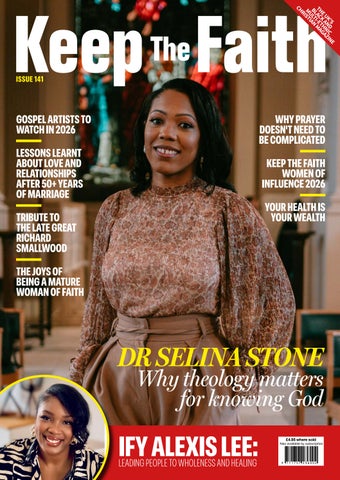
Keep The Faith Magazine Issue 141

Page 1


GOSPEL ARTISTS TO WATCH IN 2026

LESSONS LEARNT ABOUT LOVE AND RELATIONSHIPS

AFTER 50+ YEARS OF MARRIAGE

TRIBUTE TO THE LATE GREAT RICHARD SMALLWOOD

THE JOYS OF BEING A MATURE WOMAN OF FAITH

WHY PRAYER DOESN'T NEED TO BE COMPLICATED

KEEP THE FAITH WOMEN OF INFLUENCE 2026 YOUR HEALTH IS YOUR WEALTH

Hear the call to

build

Multi-award winning architects

Excellence in service, delivery and design

Specialising in conference centres, community buildings and residential schemes

EDITOR

Marcia Dixon MBE editor@keepthefaith.co.uk

GRAPHIC DESIGNER

Becky Wybrow

SUB-EDITOR

Jackie Raymond ADVERTISING

Valerie San Pedro advertising@keepthefaith.co.uk T: 0203 868 0664

MARKETING

Karen Seronay karen@keepthefaith.co.uk

Mairem Honrada-Magarro mairem@keepthefaith.co.uk

ACCOUNTS AND SUBSCRIPTIONS finance@keepthefaith.co.uk

PUBLISHED BY

MTD Publishing Ltd 71 -73 Sheldon Street London WC2H 9JQ T: 0845 193 4431 www.keepthefaith.co.uk

Facebook keepthefaithmag X @keepthefaithmag Instagram keepthefaithmag

THE PUBLISHER WOULD LIKE TO THANK:

Dr T Ayodele Ajayi, Dr Joe Aldred, Novelette Aldred, Shirley Anstis, Pastor Yvonne Brooks, Gary Clayton, O’Neil Dennis, Akosua DF, Chioma Fanawopo, Juliet Fletcher, Roy Francis, Vanessa Grossett, DJ Haych, Camelle Ilona, EP Louis, Dr Jacky McLeod, Rev Ronald Nathan, Faith Okrafo-Smart, Apostle Jacqueline Peart, Verona White, our advertisers and supporters

The opinions expressed in this publication are not necessarily those of the Publisher.

Editor’s Note

Dear Readers

Belated Happy New Year and welcome to the first edition of Keep The Faith for 2026.

We at KTF are thankful to God that we’ve lived to see another year and produce another edition of our inspirational and informative magazine, which aims to empower, encourage and inform.

I hope you enjoy the range of interesting articles we’ve collated for you. We have Dr Joe Aldred and his wife, Novelette, sharing the insights they’ve learnt about love and relationships after 51 years of marriage. Businesswoman Michelle Raymond sheds light on her business journey to success and our cover story, about theologian Dr Selina Stone, will increase understanding of the importance of theology and how it impacts our lives as believers.

There are also articles that touch on health, global politics, ageing, journalling, dealing with regret, prayer, and our annual

Women of Influence list, where you will learn about some of the great things Christian women are doing in church and the wider community.

It’s my prayer and desire that during 2026 Keep The Faith will get greater support from the Christian community that engages with our content. You can help us greatly by either subscribing to the magazine, sponsoring a Keep The Faith initiative, like our online talks or podcasts, or using our advertising platforms to publicise your initiatives. This will enable us to continue doing what we love to do: produce more faith-inspired media content that showcases what God is doing in Britain’s Black community and beyond.

Happy reading, and thank you in advance for your support.

If you enjoy reading this magazine, do consider supporting us by subscribing to the magazine. It costs just £25 for an individual subscription, or perhaps consider giving a donation. Our account details are:

Account name: MTD Publishing Ltd

Account no: 30121325

Sort code: 06-04-05

Bank: Tide (Clearbank)

Once you’ve made a payment, email your postal address to finance@keepthefaith.co.uk and we will set up your subscription.

05-06 Latest news

08 StepFWD Gospel News By O'Neil Dennis 11 Richard Smallwood: A life lived in total praise By Roy Francis

12 Where are our church songwriters? By Juliet Fletcher

14 Women of Influence making a difference By Marcia Dixon MBE

22 Dr Selina Stone: Why theology matters for knowing God By Marcia Dixon MBE

26 Israel: The birthplace of Christianity and land I love By Faith Okrafo-Smart

28 Love and marriage 51 years on By Dr Joe and Novelette Aldred

30 Ify Alexis Lee By Akosua DF 32 Michelle Raymond: Running a business built on faith By Marcia Dixon MBE 34 Sensitive souls, stronger spouses By Dr T Ayodele Ajayi 35 The role of international relations & global affairs in the biblical story By Ronald A Nathan

36 Prayer doesn't need to be complicated By Gary Clayton

37 Food 4 Thought By Marcia Dixon MBE

38 Leaders: The importance of embracing authenticity By Jacqueline Peart

39 Why the churched are becoming the de-churched By EP Louis

40 The joys of being a mature woman of faith By Pastor Yvonne Elizabeth Brooks

08 12 22 14 30 32

42 Your health is your wealth By Dr Jacky McLeod

44 The positive outcomes that can arise from regret By Shirley Anstis

45 The healing power of journalling By Camelle Ilona

46 Taking a book from print to the big screen By Vanessa Grossett

47 New year, new hair By Verona White

RETIRED MINISTERS APPOINTED TO NEW PASTORATE

Bishop Eric Brown and his wife, Revd Millicent Brown, have come out of retirement to become Senior Pastors of the Miracle Church of God in Christ (MCGC) in Bedford. They succeed Bishop Francis Vaughan, who is stepping down after 62 years of faithful leadership. They were inducted at a special service before a packed congregation, which included church members, a delegation from Brixton New Testament Church of God (NTCG) – Bishop Brown’s previous pastorate – as well as Bishop Claion Grandison, Head of NTCG, members of the NTCG National Executive Council, and representatives from other Christian denominations.

In his address to the congregation, Bishop Grandison said: “I count it an honour to release someone I view as both a friend and a father. Today, we gather to honour a servant of God whose life has been poured out in ministry for six decades.”

Other speakers included Revd Katei Kirby, Bishop Norman Gooden (who delivered the sermon), and outgoing minister, Bishop Francis Vaughan.

In his first address as Senior Pastor of MCGC, Bishop Brown said: “We answered this call to lead you. We do not do it for financial gain or for status, but for the advancement of the Kingdom of Jesus Christ. My wife and I come with a wealth of experience and anointing to help build this church.”

Bishop Brown and Revd Millicent also shared their commitment to empowering members, training young leaders, and serving the local community.

The couple have spent over five decades in ministry. Bishop Brown has served as National Youth Director and National Administrative Bishop within the NTCG, while Revd Millicent Brown has served as National Director of Women’s Ministries. Together, they have pastored several NTCG churches. Visit www.miraclecogic.org.uk

TV

SERIES ABOUT MERCY SHIPS LAUNCHED

GOD TV recently launched The Mercy Ships, a new TV series about the hospital ship charity. Broadcasting every Saturday until March 21, viewers will learn what life is like on a hospital ship, and watch as volunteer crew from all over the world live out their Christian faith by providing free, life-changing surgeries to women, men and children across sub-Saharan Africa.

The 10-week series will show how lives are transformed after people receive free surgery – a medical treatment that is usually out of reach for 9 out of 10 people in sub-Saharan Africa, meaning people – with conditions that are easily treatable – are robbed of years of healthy life.

Mercy Ships operates Africa Mercy and the Global Mercy. They are the world’s largest non-governmental floating hospitals, complete with state-of-the-art facilities, including operating theatres, intensive care units and low-dependency wards.

To watch, visit https://watch.god.tv , download the GOD TV app, or watch on your satellite TV. Visit www.miraclecogic.org.uk

FIRST NIGERIAN PRESIDENT OF A UK LAW SOCIETY INAUGURATED IN LEICESTERSHIRE

In a historic milestone for the Leicestershire Law Society, Chimdinma Nwaigwe has been inaugurated as its new President, becoming the first Nigerian to hold the presidency of any Law Society in the United Kingdom. She describes the achievement as “nothing short of the hand of God at work.”

Chimdinma, aged 33, is also the youngest President in the Society’s 166-year history. A dual-qualified solicitor, she began her legal career in 2016 and currently works at Edward Connor Solicitors. With over eight years of experience, she specialises in real estate law and has worked across Nigeria and the UK with top-tier Legal 500 and national firms.

Chimdinma’s presidency is centred on inclusion, with a strong focus on disability, mental health, and suicide prevention within the legal profession.

One of her first initiatives, The Buddy System, will pair every new Society member with a Main Committee member, to give guidance, support and a sense of belonging to foster a more connected legal network across Leicestershire.

Speaking at her inauguration, Chimdinma said: “I am honoured to serve. Let us walk this journey together, building a Society where well-being is a shared value, every voice matters, and our diversity is celebrated.”

Beyond her presidency, Chimdinma is passionate about supporting churches and charities with property matters. Drawing from her own experience serving on her church’s property purchase sub-committee, she is committed to helping organisations navigate complex property journeys.

GOSPEL SUPERSTAR NAMED IN SEXUAL ABUSE LAWSUIT

The Christian community is in shock after learning that a lawsuit has been issued against gospel superstar Donnie McClurkin by a former assistant, Giuseppe Corletto. The lawsuit claims McClurkin abused Corletto over several years and sent him an apology via email, where he described himself as a ‘dirty old man’.

The lawsuit was first revealed by American media outlet NBC. Corletto said he was 21 when he first met McClurkin in 2003. He was inspired after read McClurkin’s book about overcoming homosexuality and visited his church.

During the service, McClurkin talked about being raped as a child. His story resonated with Corletto, who met McClurkin after the service.

A friendship developed and Corletto was invited to ‘Pray the Gay Away’ sessions with McClurkin. That’s where he claims the abuse started. He also worked as McClurkin’s assistant at the time.

McClurkin has refuted the claims and published a statement on Facebook. It stated: “This accusation of salacious engagement or ANY misconduct that harmed, exploited or took advantage of anyone and misused my position, leadership, or influence in any way in these false accusations is emphatically untrue.”

McClurkin asked for people to pray for his accuser.

Corletto shared on Facebook his reasons for launching the lawsuit. He wrote: “Seeking justice is a deeply personal and difficult journey. For many years, I carried the weight of my experiences in silence, focusing on my mental health and my life. It was only RECENTLY, upon the discovery of specific, documented communications from 2013, that the full scope of the situation became clear and the path to legal accountability became possible.”

BIBLE SALES ON THE INCREASE

have increased by 134% since 2019. Last year, UK Bible sales totalled £6.3m, compared to £2.69m in 2019.

The question now being asked, is why have sales gone up, especially in a society considered increasingly secular.

Sam Richardson, CEO of SPCK Group, said: “[The Bible sales] are evidence of a significant cultural shift regarding matters of faith and religion in this country.

“As we face worldwide political and social change, including the after-effects of the COVID-19 pandemic, global wars, the rise of AI, and a growing mental health crisis, individuals are re-engaging with questions of meaning and spirituality.”

Richardson added: “The significant and sustained upward trend in Bible sales suggests that more and more people are investigating the Christian faith themselves and seeking to draw their own conclusions about its truth.”

BE INSPIRED BY KEEP THE FAITH

Keep The Faith Online talks are kicking off 2026 with a bang. Pastor Peter Nembhard –Founder and Lead Elder of ARC Global, a group of churches based in London, Birmingham and Essex – will give the first KTF talk of the year on the subject ‘Reaching Young Adults and Growing a Church’ on January 26 at 7.30pm. He will provide insight into the strategies that can be used to reach young people with the Gospel, grow churches, and train leaders to plant and pastor churches. To register, visit http://bit.ly/KTFTalkJan26

Revd Les Isaac and his wife Louise are scheduled to give the second KTF talk of 2026 on February 23 about relationships. Booking details will be available soon.

Lastly, after some false starts, the Keep The Faith ‘Servant Leadership’ podcast will be available online soon. Interviewees include Bishop Claion Grandison and Pastor Lola Oyebade.

If you are interested in sponsoring a KTF Online Talk or podcast, email editor@keepthefaith.co.uk

The Bible remains one of the bestselling books in the UK.
An analysis of Nielson Bookscan data by SPCK Books found that UK Bible sales

THE POWER OF COMMUNITY GOSPEL CHOIRS IN TODAY’S SOCIETY: AN INVITATION TO UNITE

Community gospel choirs are more than musical groups; they are catalysts for spiritual renewal. Groups like The Kingdom Choir led by Karen Gibson MBE and London’s first contemporary gospel choir, London Community Gospel Choir led by Bazil Meade MBE, exemplify how collective worship through music can inspire hope and break through societal and cultural barriers.

Historically rooted in spiritual resilience, gospel choirs as a whole foster an authentic sense of belonging. When voices unite, they create an atmosphere where God’s presence is tangible, offering healing and encouragement.

Singing collectively also has proven mental health benefits. According to an article* published by the Sing Up Foundation, singing in groups can increase feelings of social bonding, markedly reduce stress, and significantly boost overall well-being. The act of singing releases endorphins, the brain’s natural feel-good chemicals, which helps to alleviate anxiety and depression. For many, singing in a choir becomes a source of emotional healing, mental well-being and helps to combat those extreme feelings of loneliness and isolation.

Beyond worship, these choirs serve as platforms for outreach – impacting lives, breaking barriers, and promoting reconciliation. Many members find purpose, healing, and hope through singing, transforming their communities from the inside out.

Pastor Sam Adetona, founder of ‘Revive Britain: It’s Time to Believe!’ is answering the call of God to ignite revival throughout this nation, and part of this is the forming of a 300-strong, Revive Britain Community Gospel Choir, now known as The RBChoir, led by Choral Director, Magdalena Supel.

As we look ahead to the Revive Britain live event on 7-8 August 2026 at Central Hall Westminster, we invite Choir Directors, Worship Leaders, Pastors, and all believers who love to sing to unite and build this movement. Everyone is welcome – your voice, talent, and leadership are vital. Together, we can foster revival and bring hope to Britain and beyond.

If you would like to know more about Pastor Sam and the Revive Britain initiative, please visit www.revivebritain.com

*Sing Up Foundation (n.d.) Understanding singing for mental health. Available at: https://www.singupfoundation.org/ about-singing-for-mental-health/understanding-singingfor-mental-health/singing-health (Accessed: 27 April 2024).

DJ HAYCH’S ONES TO WATCH 2026

2025 has given us some great music, live shows and award shows. It has been a special year, but the ground in the UK feels fertile for even stronger growth of the Christian and Gospel music scene in 2026.

Here are just a few of my ones to watch this year.

Chantelle Rutendo

The UK project I played the most was Chantelle Rutendo’s To My Friend and My King. It is an incredible debut album and a strong introduction to Chantelle as an artist. Full of depth, vibe and, most importantly, rooted in praise to God, the project stands out in its own right. 2026 feels like it could be an even bigger breakout year for Chantelle and I’m grateful to be able to witness it.

DJ Shunz

Not only one of the most well-known gospel DJs in the scene, DJ Shunz is also a respected producer behind standout tracks such as ‘Blessings and Favour’ and ‘Christian Walk’. With a unique sound that consistently gets people onto the dance floor, especially on Gospel 2.0 Riddim, Shunz continues to set her own lane. We can hope that she keeps delivering those unmistakable DJ Shunz bangers.

Chantelle Rutendo
DJ Shunz

Deca OTA

Coming off the release of his latest album, The Human Condition, Deca OTA has had a strong year, building on a consistent 2024. One of my favourite collaborations of the year, alongside Y Shadey and Hunnid2Hebron, highlighted just how much Deca OTA continues to grow. He has shown that he deserves real respect within the scene, and I’m looking forward to seeing how his artistry continues to evolve in 2026.

Hunnid2Hebron

Alongside Deca OTA and DC3, Hunnid2Hebron has been one of my favourite rappers of 2025, with an incredible rise over the past year. Following the release of ‘Elohim’ in 2024, he carried that momentum into 2025 with ‘(Let Go &) Let God’. His features and overall sound consistently offer a fresh perspective and they hint at what 2026 could hold for him musically.

Turah Sadiq

Turah Sadiq may not have released her own singles outside of being part of the amazing

Warehouse Worship, but whenever she is featured as a lead, she brings a necessary maturity to her worship that translates beautifully through both the songs and her social media. I look forward to what 2026 holds for her growth, both with Warehouse Worship and as a worship leader in her own right.

DayThree Music

The Premier Gospel Award-winning group DayThree Music gave us the splendid live album Heaven’s Song (Live) in 2025, with the title song being played on repeat. DayThree Music have a beautiful sound and blend of music and voices, which gives me anticipation for the excellent worship they will be able to showcase in 2026 and in the seasons to come.

Nashe

Nashe* is a gifted worshipper who has consistently showcased who God is to her through her music at every opportunity. Although her only official release in 2025 was a feature on the ‘Smsmba’ song with

Rodwell, I truly believe that whatever God has in store for Nashe within worship and gospel music in 2026 will bless us throughout the year and beyond.

TKE3

Born in Nigeria and raised in the UK, TKE3 continues to showcase both his artistry and production skills in every song he creates. His sound is very distinct and perfectly displayed in songs like ‘Beam Me Up/Work Of Art’. One thing I am particularly excited about with TKE3 is how he tells a story, potentially through an EP or album in 2026.

Yourboywonder

Not only did Yourboywonder give us a great album, Before We Leave: AURORA, to kick off 2025, but he also closed the year with the YAGA EP, showcasing both his Caribbeaninfluenced sound and his impressive versatility. This makes me excited to see what he will create in 2026.

Follow DJ Haych on Instagram @dj haych

Deca OTA
Hunnid2Hebron
Nashe
(*not to be confused with NASHE)

HIT PLAY ABOUT SINGLES IN CHURCH TO TOUR UK

‘Why Didn’t I Get Married?’, a comedy drama about the longstanding issue of singleness in the Church by playwright Alan Charles, is currently on a UK tour. It kicked off in Luton on January 18 and audiences can see it at Hackney Empire on February 1, Broadway Theatre Catford on February 15, Sue Townsend Theatre, Leicester on March 1, and Crescent Theatre, Birmingham on April 5.

First staged last year to sell-out audiences, ‘Why Didn’t I Get Married?’ generated much discussion and received rave reviews. It made the audience laugh, cry and go “What?!!!”

Alan wasn’t surprised by the responses. “The play offers an honest, in-your-face, no-holds-barred examination of an issue that affects everyone,” he said. “Audiences – especially single women and men in the Black Church – have been really pleased that their stories and experiences are being addressed head-on in a way that’s honest, relatable and still humorous.”

Several factors motivated Alan to write ‘Why Didn’t I Get Married?’ He explained: “This play is inspired by three intersecting influences: a challenge to address the struggles of singles in the Church; the book Black, Christian and Single (edited by Keep The Faith Editor, Marcia Dixon), which suggested the Church bears responsibility for the high number of single Black women; and Dr Umar Johnson’s claim that the Black Church has a vested interest in keeping Black women single. The play explores whether the Church is complicit in singleness and whether it benefits from it.”

Alan believes the male/female ratio in the Church – more women than men – has serious consequences for both singles and marrieds. “This imbalance contributes to high levels of adultery within the Church, as some men take advantage of the abundance of single women, creating moral and relational tensions that are too often ignored.”

The play’s premise entails putting the Church on trial, charging it with being responsible for the large number of singles

in congregations. The cast, comprised of Christians from across the UK, gave evidence for and against the Church.

Humour is used heavily by Alan to deal with what is a sensitive and painful issue for many. “Humour in the play comes from our shared experiences,” he explained. “Often, we laugh not because the situation itself is funny, but because we relate to it and see the lighter side of serious, sensitive topics. Audiences want edge-ofthe-seat drama, but they also want a fun night out to laugh and forget their worries. I aim to balance this by ensuring the audience is both entertained and educated, creating a meaningful, ‘edutaining’ experience.”

A well-known figure within church circles, Alan has been writing and staging plays since 1998. His productions include: ‘I Am Getting There’, ‘Love Sax And All That Jazz’, ‘Da Mans Dem’, ‘Shoulda Coulda Woulda’, ‘Midlife Crisis’, and latterly, ‘Why Didn’t I Get Married?’

Alan has high hopes for ‘Why Didn’t I Get Married?’ – one of them being for the production to be a part in continuing the ongoing

discussion about singleness, marriage and relationships, in the Black Christian community. “Many single people are hurting, and the Church often appears unaware or indifferent to their struggles. Through the play and the accompanying seminars, I aim to provide guidance, solutions and opportunities for healing and understanding. Whether someone is single or married, the goal is to encourage reflection, growth and success in relationships, while fostering a more supportive and compassionate church community.”

Connect with Alan Charles on Facebook for ticket details.

O’NEIL DENNIS

Founder of AStepFWD.com, the UK Christian Charts, StepFWD Awards and more. To get in touch email info@stepfwd.com

Ican’t remember when I first came across Richard Smallwood’s music, but I can remember the moment his composition, ‘The Centre of My Joy’, gripped my attention. It wasn’t just for the beauty and tunefulness of the music, but also for that simple, profound and memorable phrase: ‘Centre of my joy’. From that moment on, Smallwood’s music demanded my attention, and when he released ‘I Love the Lord’, it cemented my admiration for who was then, to me, a new artist.

So impactful was his music that when I produced People Get Ready, the gospel TV programme in the 1980s, I included his song ‘I Love the Lord’ in one of the episodes. Beverly Wint delivered a memorable and deeply moving performance of it, and it became a standout moment of the programme. Yet, it was ‘Total Praise’ that truly stopped me in my tracks, and anyone who knows anything about me, knows that I love gospel, classical and choral music, and Smallwood seamlessly incorporates all three in that song.

I’ve also had the pleasure of presenting and promoting Richard Smallwood in concert in the UK on more than one occasion, and what struck me was he was a quiet, unassuming man, a maestro in the original sense of the word, and ‘a distinguished conductor and performer’. The vocals of his singers were unlike anything

A LIFE LIVED IN TOTAL PRAISE

Roy Francis pays tribute to gospel music maestro Richard Smallwood

I’d ever heard before in gospel – the nearest being the Clark Sisters in their prime. And, while it’s difficult to describe what makes a piece of music ‘great’, what we know is that any assessment, appraisal or evaluation is likely to be subjective, and it’s why we rely on experts to guide us. Yet, with Richard Smallwood’s music, there is complete unanimity, for not only was he a ‘great’ gospel artist/composer, but also one of the most significant and influential gospel artists.

‘Total Praise’ – undoubtedly his greatest hit song – is like no other, and when it was released, it signalled a fresh new, totally original gospel sound. It was majestic, modern, emotionally charged and completely different. His music reminds me of the sacred music of great composers like Handel, Bach and others, who I know Smallwood admired.

Smallwood’s musical journey, like that of many gospel artists, follows a familiar pattern. Born on November 30, 1948, in Atlanta, Georgia, Richard moved with his parents at the age of 10 to Washington DC, where from an early age, he started singing and playing in his father’s church. In his teens, while in school, he started his own gospel group. Roberta Flack, the famous soul singer, was one of his high school teachers.

A graduate of Howard University, Richard Smallwood is a classically trained composer, pianist and arranger, and along with a strong background in music theory and choral composition, his skills have become the hallmark of his sound. He credits gospel greats Roberta Martin, Clara Ward, Mahalia Jackson and James Cleveland among his influences, along with Edwin Hawkins and others, who are today foundational to the modern gospel sound. In the last few years of his life, he suffered from a variety of illnesses which had prevented him from performing, and when it was announced that he had died on December 30, 2025, gospel music lost

one of its towering figures and practitioners. Aside from making an indelible impact with his music recordings – 10 studio albums and six live albums – Smallwood's songs also impacted popular culture. ‘I Love the Lord’ was performed by Whitney Houston in the film The Preacher’s Wife, and other artists who have sung his songs include Yolanda Adams, Aretha Franklin, Chaka Khan and Karen Clark Sheard. He received numerous awards over the years, including four Dove Awards, six Stellar Awards and a President Lifetime Achievement Award, presented by former President Joe Biden.

Smallwood deserves to be ranked alongside the likes of ‘gospel greats’, such as Thomas Dorsey and Andraé Crouch. Many of his songs are now gospel standards –timeless compositions that transcend eras and style, which will forever be sung in churches and performed by choirs across the world. Smallwood added classical motifs and intricate vocal harmonies to gospel music. In so doing, he transformed it and elevated it to new levels of creativity and artistic expression.

Baby Smallwood Singers, White Stone Baptist Church, late 1950s
Richard Smallwood, MC Hammer and Edwin Hawkins

WHERE ARE OUR CHURCH SONGWRITERS?

Juliet Fletcher charts the development of songwriting within the UK’s Black-Majority churches and calls for greater appreciation for songs written by our own

It is now 77 Years (from 1948) since the growth of Black-Majority Churches (BMCs) throughout Britain and Ireland. Songs and music have been – and continue to be – a central driving force of how we express our faith, share our doctrine, and declare our convictions to each other and the world. But from then until now how many of those songs have been created by us – right here on these isles? Created, written and ministered by individuals in and from our very own churches? Who has been writing faith-filled songs with gravitas and depth to bless our churches, which are then spread to the wider Christian family?

Grumbling gospel: Old vs new songs

Over the years, I have heard many people in conversation – and now in social media posts – grumbling or outwardly complaining that we’re not singing enough of the old-time choruses and hymns that took our parents ‘through many dangers, toils and snares’. Those songs had meaning for many of us! Of course, I’m mainly talking about those who are 40 years and older – and that includes me!

I recall when the worship team phenomenon took a firm hold. Forty per cent turned to 50%, which turned to 75%, and now I would say 90% of the worship songs are chosen from the CCM (Contemporary Christian Music) style – the soft rock and pop that seems to have taken over. No one would argue that the

lyrical power of these songs is questionable. Do you think I’m arguing an insignificant point, or do you think there should be a balance? How can we regain cultural relevance to our time of worship? Because some people think it's missing. I know I’m not alone in this sensibility. To be truthful, sometimes it's almost like our original repertoire is treated like a ‘novelty song’ – sung out of fun instead of a genuine worship experience, when that’s what we did back in the day!

Taking our songwriters seriously

What about compositions from writers within our congregations? Don’t we have powerful, meaningful, theologically sound words to identify our spirituality in melodies? Think of the quality of our musicians and singers: isn’t there sufficient responsibility and commitment to allow our psalms, hymns and spiritual songs to arise, to be known? Of course there is! I can prove it – and I’ll tell you why things are the way they are!

Worship leaders, you’re choosing the songs. Why aren’t you considering the songs of your own denomination? Why aren’t you sharing the songs from other related denominations that have gospel music songwriters in them? If you are ready to consider your own fellow brethren and similar works, please consider taking our songwriters seriously by visiting https://SongSharebyGreenTree.com

Songwriters of our day

Below is a shortlist of writers who have made a mark over the past 25 years:

MARK BESWICK AND HOWARD FRANCIS

Mark Beswick and Howard Francis were lead collaborators and produced the significant double album (The King Is Coming & True Praises) of 2003. Released by Kingsway Music (now merged into Integrity Music), it was issued under the name Mark Beswick & Power Praise Band, utilising leading vocalists (such as Priscilla Jones-Campbell, Brendan Guyatt, Ruth Lynch-Waldron, Peter Francis) and musicians (such as Nicky Brown, Noel Robinson and Clive McKinley) during that time. Songs of note are: ‘The King Is Coming’, ‘Sing Unto The Lord’, ‘True Praises’, ‘Welcome’ and ‘Wave Your Hands’. This double album was never followed by others, which is quite sad because it did break new ground for worship songs and choruses from a Black gospel music expression. We began to sing these songs – and they are still brilliant – but we needed more!

MUYIWA OLAREWAJU AND EDDIE MARTIN

Almost in the same period, the music and lyrics heralded the arrival of Muyiwa & Riversongz, starting with the studio album

Mark Beswick
Howard Francis
Muyiwa Olarewaju

Restoration and followed by (at least five) LIVE albums. Spawned primarily in collaborative productive harmony with songwriter/producer Eddie Martin, the unity of these two amazing ministers of song brought what had not been experienced before: the true arrival of pure original British African praise and worship. Their joint efforts remind me of the Caribbean Beswick & Francis and, like them, it has been a sensational outcome. Songs from the early albums include: ‘Our God Is Good’, ‘We Want To See You’, ‘Once You Have Spoken’ and ‘Your Majesty’. Musicians include: Femi Temowo, Julien Brown, Andrew Smith, and vocalists include: Maria Awa, Paul Lee, Esther Adeyemi, Junior Robinson.

JAKE ISAAC

Then came Jake Isaac! 2013, in the heart of south London, a LIVE recording took place which helped catapult a group of young people start a fresh movement of song, spearheaded by Jake. They were called I = (Equals) Change. It has been the precursor to some of the Gen Z collective singing that has sprung up in the past 10 years and certainly introduced this gifted and anointed young man to us all. Jake emerged with songs including ‘As We Seek Your Face’, and more recently, ‘Greater Than It All’.

JUNIOR GARR

Songwriter/oroducer Junior Garr came to the fore in 2020 when he co-founded The Spirituals Choir with arranger conductor Marsha Morrison. Reimagining (the African American) spirituals, the Choir attracted over 27 million views (and counting) on their YouTube rendering of ‘Wade In The Water’. Junior was signed to Integrity Music, and has written other original works, including ‘Waters’, ‘Garden’ and the anthemic ‘Messiah’.

NOEL ROBINSON

For me, Noel Robinson is the greatest example of being a pro-active, consistent creative prophetic voice through his music. He has

over 25 years of making music, releasing albums, and an original conference event –Kingdom Worship Movement – reaching thousands in teaching and training across all denominational divides. Of all the songwriters, Noel’s music has the biggest imprint. Congregational renditions made popular across the nine albums he’s produced include: ‘O, He’s So Sweet’, ‘I Will Glorify Your Name’, ‘You Give Me Life’, ‘Great Are You Lord’, and ‘Seeking Your Face’, made popular by Roger Samuels. His most renowned congregational song is arguably ‘Rain’, co-written with worship leader Donna Akodu, who was an original member of ‘Nu Image’ – the band that led the way, with Noel introducing ‘worship team’ style of leadership within BMCs. The composition, ‘We Seek Your Kingdom’ co-written with Irishman Andy Flannagan, has become a civic Christian anthem.

UK songwriters, who have yet to be recognised but whose songs perhaps are sung at your church, include:

• Duke Kerr – ‘It Is To You I Give The Glory’

• Samantha Grandison – ‘Awesome Wonder’

• Lena Wright – ‘The Cry’

• Juanita Francis – ‘Fall Afresh’

• Jason Nicholson-Porter – ‘Send Your Fire’

There are others I could mention – yet to be known.

A future for our songs

We must advocate for singing our songs in our churches. Firstly, because if we do not sing them, why should anyone else? And when we have written songs, why aren’t our glorious ‘in-house’ renditions reaching others? Is it right that our songwriters need to go OUT to others before reaching the saints in the (BMC) house?

In 2018, I was secured as Music

Consultant for the Windrush Churches

National Thanksgiving Service at Westminster Cathedral – with a packed congregation of church, political and civic people was in attendance. However, prior to this, at the planning meeting, I was asked to recommend a song known across ALL CHURCHES but specifically written by a British Caribbean or African Christian. For all the research by myself and all those concerned, none was known. Should the Lord tarry, in 22 years’ time, when the Black-majority churches will have been here 100 years, we NEED to be in a position of musical strength, marking authentic original praise and worship that is culturally, theologically and spiritually relevant with transcendent works.

Let’s have our own British version of Richard Smallwood or Andraé and Sandra Crouch or Thomas Dorsey. (I bet you’ve already thought of at least one song by one if not all of them!) Listen to the difference they have made to the global Christian family – to countless lives. We need a system of change. Join me and visit https://SongSharebyGreenTree.com

JULIET FLETCHER
Creative Director of Green Tree Productions and Windrush Church and Music. She is also the founder of SongShare, www.songshare.co.uk
Eddie Martin
Jake Isaac
Junior Garr Noel Robinson

Women MAKING A DIFFERENCE

Our annual Keep The Faith of Women of Influence list features Christian women, who can be found in all sectors of society, from all over Britain: in church, at work, in business or participating in charitable endeavours. Wherever Christian women are present, it’s evident they are making a positive difference, touching lives and transforming communities.

Have a read and enjoy

DEBORAH AKINLAWON

Executive Director, Christian Police Association (CPA)

Deborah Akinlawon made history when, in March 2024, she became the first woman to be appointed as Executive Director of the Christian Police Association (CPA) since its inception in 1883. Initially founded to support the spiritual well-being of police officers, the CPA is now a national representative body for Christians within policing and serves as a bridge between the police service and the wider Christian community. In her role as Executive Director, Deborah is committed to enabling Christians to freely express their faith in the workplace and raise global awareness in the Church of the believers who serve in law enforcement. Deborah has been formally recognised for her policing work.

In 2020, she received the Queen’s Police Medal (QPM) for her work in Family Liaison and her involvement with the CPA Metropolitan Branch. With over 30 years of police experience, Deborah has participated in several high-profile cases, including the Damilola Taylor investigation; the Victoria Station stabbing; and mass fatality incidents, including the London Bridge terror attack. She recently retired from frontline police work and is a worship leader in her local church.

Visit www.cpauk.net

AMICKYCAROL AKIWUMI MBE

Founder/CEO, The AVOCADO Foundation (formerly Money4YOU)

As Founder and CEO of The AVOCADO Foundation, AmickyCarol Akiwumi MBE leads an organisation that provides financial education, entrepreneurship training, and capacity-building initiatives for individuals, charities and organisations in the UK and

abroad. Her work has fostered collaborations with major donors, community groups, and business leaders across four continents. Carol founded RAA Solutions, a consultancy and training agency specialising in business development in 2012.

From 2011 to 2021, she served in various roles at the Chartered Institute of Fundraising (CIoF), including Chair of Black Fundraisers UK, Vice Chair of the Board of Trustees, and Chair of the Equality, Diversity and Inclusion committee. Carol is the creator and host of popular podcasts Four Minutes in Fundraising, BonsaïBriefs and WorldChangers Podcast with AmickyCarol. She was awarded an MBE in Queen Elizabeth II’s New Year Honours List in 2021 for her significant contributions to financial education during the COVID-19 pandemic.

Visit www.theavocadofoundation.com

DR SANCHIA ALASIA

Diversity and Inclusion Lead at Transport for London, Businesswoman, Charity Trustee

Dr Sanchia Alasia is an award-winning professional and public servant. She is currently Diversity and Inclusion Lead at Transport for London and Managing Director of Sanchia Consulting Ltd. She is committed to promoting equitable and inclusive practices for her employer and clients. Alongside her professional work, Sanchia was a councillor in the London Borough of Barking and Dagenham for 11 years – the first of three Black women to be elected there – and held various positions, including chair of the planning committee. In 2018, Sanchia became the Borough’s first Caribbean female civic mayor. She has also stood as a candidate for European Parliamentary elections.

An endometriosis sufferer, Sanchia has been featured on national media to raise awareness of the condition. She is a trustee of Endometriosis

DEBORAH AKINLAWON
AMICKYCAROL AKIWUMI MBE
DR SANCHIA ALASIA

UK and an ambassador for research project Endometriosis 1000, led by Professor Andrew Horne at the University of Edinburgh. Sanchia has won numerous awards, including Outstanding Public Sector Figure at the Precious Awards in 2020, and was featured in a list of the 100 most influential and successful African business leaders by the African Chamber of Commerce in 2022.

Visit www.sanchiaalasia.com

OLIVIA AMARTEY

Executive Director, Elim Pentecostal Church UK and Ireland

Olivia Amartey is one of the most senior female leaders within Britain’s Pentecostal church movement. Since 2018, Olivia – an ordained minister – has served as Executive Director of Elim Churches UK, which has 500 churches in Britain and Ireland. Her role entails stewarding the charity’s organisational and governance work, so that local churches and ministries can flourish in their God-given calling. Olivia has senior leadership experience due to working within organisations like the NHS and the Anglican Church. She has also worked as a consultant and pioneered numerous community-based initiatives. One of her projects was featured on Channel Four’s Secret Millionaire.

Olivia is an author and sought-after speaker, regularly presenting on BBC Radio 4’s Daily Service, contributing to UCB and to leadership podcasts. She also serves as a director with Kyria Network and Spring Harvest, and is the Moderator of Churches Together England. Currently, Olivia is involved in establishing a women-centred NGO in Ghana that provides practical support and care to women in need. Her leadership, shaped by her

faith and love for the local church, longs to see Spirit-empowered communities bring hope and lasting change in the UK and beyond. Email olivia.amartey@elim.org.uk

OLA AWONUBI

Author, Creative Writing Tutor, Book Coach

Ola Awonubi is an award winning British Nigerian author, whose books are having cultural impact due to their focus on heritage and faith. A Nurse’s Tale, Ola’s first book for Harper Collins, is a historical novel based on a true story. It was a No.1 bestseller on Amazon’s Black and American Fiction chart. Her second book for Harper Collins – The Marriage Monitoring Aunties’ Association – hit the No.1 spot on Amazon’s Christian Romantic Fiction chart when released last year. A master’s graduate, Ola has spent more than two decades crafting stories that centre on love, identity and hope. Her novels and short fiction draw on her Nigerian roots and Christian faith, offering readers uplifting narratives.

Beyond her books, Ola empowers others to tell their own stories. She teaches creative writing in universities, libraries and community spaces, and works as a full time book coach supporting emerging and established writers. She is also a committed advocate for women navigating midlife reinvention to rediscover their voice and walk boldly in their God-given gifts.

Visit https://beacons.ai/resilientwriter

HANNAH AWONUGA

Founder & CEO, The Inclusive Foundations Programme; Cultural Transformation & Inclusion Consultant

Hannah Awonuga is an award-winning cultural inclusion leader and was featured in the 2025 list of Top 20 DEI Experts in the UK. She has over 20 years of corporate experience. Her senior roles included working at Knight Frank as Group Head of DEI, and as Global DEI Director at Barclays, where she enjoyed a 17-year-long career. Hannah has built an extensive global network of over 80,000 professionals on LinkedIn and is frequently called upon to advise leaders navigating complex cultural challenges and leadership development strategies.

She is also a sought-after keynote speaker, facilitator and trusted voice in the future of inclusive leadership. She is the founder and CEO of The Inclusive Foundations Programme –a pioneering culture consultancy that works with high-growth companies to help them embed inclusion in their structures. She is gearing up for the release of her book The Illusion of Inclusion, which will be published by Harriman House. It will feature Hannah’s lived experience as a Black executive leader who went from homelessness at 15 to the boardroom.

Visit www.hannahawonuga.com and www. theinclusivefoundationsprogramme.com

OLA AWONUBI
HANNAH AWONUGA
OLIVIA AMARTEY

DAWN CARTER-MCDONALD

Chief Executive, London Borough of Hackney

Dawn Carter-McDonald is a highly respected local government leader, whose career reflects deep commitment to public service. She was appointed Chief Executive of Hackney Council in 2024. Born and raised in Hackney, Dawn joined the council in 2002 as a solicitor, steadily rising through senior leadership roles. As Director of Legal, Democratic and Electoral Services, she played a pivotal role in strengthening governance, modernising council operations, and supporting major service reforms across the organisation.

As Chief Executive, she has championed equity, inclusion and transformation, leading delivery of Hackney’s strategic vision, Working Together for a Better Hackney, focused on creating a fairer, greener, healthier and safer borough. Her leadership has ensured continuity of high-performing services while driving organisational change in response to complex social and economic challenges. Recognised nationally within the sector, Dawn has also served as a judge for the MJ Achievement Awards, reflecting her standing among senior local government leaders.

Visit www.hackney.gov.uk

JANINE DYER

Founder/Director, Sheffield Community Choir

Janine Dyer is one of the UK’s most respected gospel vocalists. She founded Sheffield Community Choir (SCC) in 2013. Under her leadership, SCC has grown into one of Yorkshire’s most recognised community gospel ensembles. The choir regularly sells out major venues in Sheffield and surrounding areas, drawing diverse audiences to hear gospel music. In April 2025,

the choir captured national attention after singing at a major boxing event; a spontaneous backstage moment went viral online, reaching millions and showcasing the unifying power of worship in unexpected spaces.

Janine’s wider influence across the UK gospel scene is extensive. Her talent was honed in the New Testament Church of God Willesden choir and she has worked professionally as a backing singer. She was a member of MOBO Award-winning gospel group Raymond & Co, ministering across the UK and internationally. In 2016, Janine appeared on BBC’s The Voice UK, where three coaches turned for her performance. She continues to serve communities nationwide, through leading worship, running vocal workshops, and doing outreach and mentoring – using music to uplift, inspire and transform lives. Visit www.sheffieldcommunitychoir.co.uk

APOSTLE MARJORIE ESOMOWEI

Co-Pastor, Triumphant Church International; Founder, Wisdom for Women International; Founder, Wise Women Awards

Apostle Marjorie Esomowei is a highly respected Christian leader, whose impact spans ministry, leadership development and social transformation. She is co-pastor of Triumphant Church International, a vibrant global ministry with a presence across the UK, Europe and Africa. She is also founder of Wisdom for Women International (W4WI), a ministry dedicated to equipping and mentoring women for leadership in church, business and public life. Through W4WI, Pastor Marjorie has established the Wise Women Awards, an annual event that celebrates the achievements of Christian women in the Church and wider society. In March 2026, the awards will celebrate its 21st anniversary.

Apostle Esomowei is also known for her charitable initiatives, which include providing educational support for vulnerable children in Nigeria, and running an orphanage. Widely recognised for her influence, she is seen as one of the most influential Black Christian women in Britain and remains a sought-after international speaker and mentor, inspiring generations to lead with purpose, wisdom and faith.

Visit www.wisdomforwomeninternational. org and www.wisewomenawards.org

KEI-RETTA

FARRELL

Head of the Montserrat Government, UK Office

Kei-Retta Farrell is the Head of the Montserrat Government UK Office, representing the Caribbean island of Montserrat in the UK, and leads work across diplomacy, diaspora engagement, cultural heritage, and strategic partnerships. She works with UK government departments, parliamentarians, global institutions and community organisations to promote Montserrat’s development priorities, while strengthening and increasing visibility for small-island voices.

JANINE DYER
APOSTLE MARJORIE ESOMOWEI
KEI-RETTA FARRELL
SANDRA GODLEY OBE

Kei-Retta has revitalised Montserrat’s presence in the UK, through initiatives such as the Montserrat Diaspora Database, Business Directory, Diaspora Leadership Conference and wider community programmes. She also facilitates high-level engagements for visiting ministers and officials, supports cross-government collaboration, and champions opportunities for young Montserratians. Passionate about identity and heritage, she is committed to building resilient communities and deepening the connection between Montserrat and its global diaspora.

Visit www.montserrat-gov.org

SANDRA GODLEY OBE

Broadcaster; President, Coventry and Warwickshire Chamber of Commerce

A multi-talented professional, Sandra Godley OBE works in the fields of media, business, the creative arts and the charity world. She became heavily known in the Midlands for the radio show she used to present on BBC CWR and made history when she became the first woman to be appointed as President of the Coventry and Warwickshire Chamber of Commerce. Sandra is a MOBO-nominated, multi-award-winning singer-songwriter, and has received a British Citizen Award for her contribution to arts and music.

Sandra was awarded an OBE for her dedicated charitable work and continues to champion community initiatives across the region. She is an ambassador for several charities, and uses her platform to amplify local voices, support young people, and build meaningful connections between business, music, arts and community. She has also received two Lifetime Achievement awards for her inspirational work with women and a Wise Woman in Music award.

Visit www.sandragodley.org

MICHELLE JOHN Gospel Artist

Michelle John is a well-known UK gospel singer, songwriter and vocal coach. In 2024, she released her gospel album God Is, a project featuring original songs and covers of songs sung growing up in church. Last year, she embarked on a UK tour, performing in London, Birmingham and Manchester and is set to headline her own show at the prestigious Jazz Café venue in June later this year. Michelle was also featured on a BBC Songs of Praise gospel special (broadcast last year), and was a judge on the BBC Songs of Praise BBC Young Chorister of the Year alongside fellow judges Gareth Malone and Harry Bradford. Michelle honed her singing talent in the Pentecostal Church, and developed it further, singing with the London Community Gospel Choir, where she was a lead singer, touring extensively throughout the UK and Europe. Michelle’s visibility was raised considerably when she reached the finals of popular singing

show The Voice UK, singing before an audience of millions. Beyond her solo work, Michelle has experienced great success as backing singer for numerous high-profile artists, performing nationally and internationally at prestigious venues in the UK and abroad. She makes time to mentor and provide vocal coaching to others.

Visit www.meeshjohn.com

PASTOR LORRAINE JONES BURRELL MBE

CEO of the Dwayne Simpson Foundation and Dwaynamics Boxing Gym

Pastor Lorraine Jones Burrell MBE, who works as a minister and humanitarian, has come to the fore as leader of the Dwayne Simpson Foundation CIC (DSFCIC) and Dwaynamics – charities she leads to honour the life and legacy of her son Dwayne, who was a victim of a fatal knife crime. Through her work, she oversees programmes in boxing, mentoring, education and outreach. Pastor Lorraine was Chair of the Lambeth Independent Advisory Group for almost 10 years. She is part of the Prime Minister’s Knife Crime Coalition and the Metropolitan Police Learning & Development Programme. She is regularly invited onto national media programmes to talk about knife crime and to offer solutions. She recently published her book Let the Healing Begin, which shares her journey through grief, faith, transformation and the healing power of love. Last year, Pastor Lorraine was awarded an MBE for her work in youth empowerment and community safety. She is also the recipient of the Prime Minister’s 442nd Points of Light Award, presented by former PM Baron (David) Cameron, and has received commendations from the Metropolitan Police for her community work.

Visit www.dsfcic.co.uk

MAUREEN LEWIS

Chief Executive Officer, Walsall Black Sisters Collective

Maureen Angela Lewis is highly respected for her 30+ years of service within the voluntary and community sector. She is CEO of Walsall Black Sisters Collective (WBSC) and, under her leadership, it has become a well-established, influential organisation, running numerous community initiatives. These include the Be A Friend project that seeks to tackle loneliness and isolation; the Tree of Life Elderly Day Care Project; and the Heart to Heart Mental Support Group. In July 2026, the organisation will mark its 40th anniversary – a milestone made possible through Maureen’s dedicated stewardship. Her experience in community development has enabled her to play a key role in strengthening disadvantaged neighbourhoods and designing targeted interventions. Her work in developing women’s programmes has been particularly impactful, supporting women to overcome poverty, build confidence, and progress into training, education or employment opportunities.

MICHELLE JOHN
PASTOR LORRAINE JONES BURRELL MBE
MAUREEN LEWIS

In recognition of her work, Maureen received the Lifetime Achievement Award at the 2021 Multicultural Business & Community Champion (MBCC) Awards.

Visit www.walsallbsc.co.uk

CAROLINE MARSH

Christian Entrepreneur, Author, Inspirational Speaker

Caroline Marsh is a Christian businesswoman, accomplished property developer and personal financial educator committed to equipping aspiring entrepreneurs to fulfil their purpose in the marketplace. She is widely recognised for her appearance on BBC and Channel 4’s prime-time programme The Secret Millionaire, which brought her work and values to a national audience. Caroline uses her platform to educate individuals on building, managing and protecting wealth with integrity. She regularly speaks at events, sharing insights on how to build wealth. She is the author of 7 Secrets of Success and co-author of The Insider Secrets of Wealthy Black Women, where she blends practical financial insight with faith-based principles to inspire economic empowerment.

Caroline’s work has earned global recognition, including the Bank of Zambia Award for Exceptional Workplace Financial Education Programme, highlighting her impact beyond the UK. Known for her resilience, leadership and generosity, Caroline encourages people to pivot in uncertain times, recognise opportunity in shifting markets, and pursue lifelong learning. Through her faith-led journey, she continues to inspire others to create, lead and prosper with purpose.

Visit www.carolinemarsh.com

DR JENNIFER ARIOWA OBASEKI

Founder, Obaskeki Solicitors

Dr Jennifer Obaseki is an award-winning solicitor who works as senior partner at Obaseki Solicitors, the legal practice she founded in 2005. It has grown into a multi-jurisdictional firm with offices in London, Nigeria and Hong Kong, providing legal services in international law, property, and human rights. Under her leadership, the firm achieved Lexcel Accreditation and the CQS Quality Mark, managing over 8,000 instructions. Aside from her practice, Dr Obaseki is regularly called on to lecture and has spoken at Oxford University, the University of East London, and the UN Human Rights Council in Geneva. A lawyer with a commitment to social change, she contributed to the UK Black Churches Handbook on Domestic Violence (2020) and co-authored African Women in Europe (2018), a book designed to inspire women in the diaspora to overcome cultural identity barriers. She is active in the wider community and was a former chair of the Nigerian Law Forum and legal council to Central Association of Nigerians in the UK (CANUK) and the National

Youth Council of Nigeria (Europe). She has won numerous awards, including a Black Achievers Award and Women for Africa Award for her legal services. Her career is set to move in a new direction in forthcoming months, so she can focus on church ministry, writing, and coaching the next generation of business and legal leaders.

Visit www.obasekisolicitors.com

DR (PASTOR) SHOLA OLADIPO CEO of Food for Purpose CIC

Dr (Pastor) Shola Oladipo is CEO of Food for Purpose CIC, an organisation that seeks to address health inequalities in Black and global-majority communities, by running projects that align with their culture and faith. Community programmes run by Food For Purpose include: the Healthy Church Initiative, which seeks to encourage congregational health; the Black Male Church Leaders' Health Programme; and they partner with South East London Integrated Care Board (SEL ICB) to work with local people from African Caribbean, South Asian, Polish, Latin American, Portuguese and Spanish communities living or at risk of diabetes. Dr Shola was recently awarded a PhD for studying how faith, tradition and identity influence health behaviours in Black communities. Alongside leading Food For Purpose, Shola has over 29 years of experience working across the National Health Service and the nutrition industry. She is a registered dietitian. She is also a lecturer and researcher. Over the years, Shola has received numerous recognitions, including a Wise Woman Award for Leadership; she was listed in the NatWest/Wise Top 100 Leading Women in Social Enterprise in 2024; and was winner of the Equipping Christian Leadership in an Age of Science (ECLAS) Award in 2025. She also serves in a pastoral role at her local church.

Visit www.foodforpurpose.org

TOLA ONIGBANJO

Founder of Woman4Africa, Coach, Speaker

As Founder of Women4Africa, Tola Onigbanjo has created one of Europe's most prominent platforms to celebrate/recognise the achievements of African women via Women4Africa, which includes an annual sell-out awards event. The Commonwealth Secretariat has identified Women4Africa as the largest celebration of African women in the Commonwealth. Sometimes known as ‘WiseTola’, her career spans education, events management, media, coaching and women’s empowerment. Aside from her work with Women4Africa, Tola serves as an independent chair and panel member to UK public sector schools.

She is also a bestselling author of parenting books, such as Conversations with My Teenage Girls and Conversations with My Teenage Boys, that seek to bridge generational gaps between child and parent. Her expertise as a parenting

CAROLINE MARSH
DR JENNIFER ARIOWA OBASEKI
DR (PASTOR) SHOLA OLADIPO

authority has led her to feature prominently on notable media platforms, including Sky News Sunrise With Eamonn Holmes and Premier Christian Radio. Tola is a passionate advocate for women’s visibility and empowerment. Through various initiatives and her coaching, she mentors women to amplify their voices and achieve personal and professional growth. Tola’s life philosophy has consistently revolved around the mantra “If no one gives you a platform, create one.”

Visit www.women4africa.com and www.tolaonigbanjo.com

NATASHA ORUMBIE

Businesswoman

Natasha Orumbie is a Christian businesswoman making a major impact in the world of vegan food. Natasha, aka the Vegan Patty Lady, is founder of a fast-growing UK food brand that is bringing bold Caribbean flavour to the plant-based space via her vegan Jamaican patties – now available through major retailers like Ocado and independent stores across the UK. Natasha is known for proving that plant-based food doesn’t have to be bland, ultra-processed or disconnected from culture. Her business is making a mark. In 2024, she was named Best New Business at the Lewisham Awards. She has just launched her Postcode Patty Campaign, calling on people across the UK to share where they would like to see shops stock her vegan patties in order to increase their availability. Beyond the product, Natasha is building a mission-led business focused on representation, food equity, and opening doors for under-served founders. Through community pop-ups, national retail listings and speaking on industry platforms, she champions better food choices and better access to opportunity.

Visit www.theveganpattylady.co.uk

NIKKI SUTHERLAND

Entrepreneur, Faith-Based Leader, Financial Literacy Educator

Nikki Sutherland is a dynamic entrepreneur, faith-based leader, and social impact advocate with over 15 years of high-level banking experience. Making her first million by age 21, her career bridges the corporate and community sectors, blending financial expertise with a passion for empowering individuals, institutions and underserved communities to achieve sustainable growth.

She has built a strong reputation for delivering transformative education, programmes, and innovative strategies that meet national needs. She is currently mentoring a community of over 2,000 leaders worldwide across Jamaica, the UK, Netherlands, Trinidad, Barbados, USA, Qatar, Australia and Canada. Nikki has also created The Rebuild – a community which helps women to gain peace from their past, build their confidence, generate wealth, and live in purpose and she connects with women via meetings, conferences and retreats.

Visit www.nikkisutherland.co.uk

MILDRED TALABI

LinkedIn Coach, Speaker, Personal Branding Expert Mildred Talabi has become renowned for empowering women to enhance their visibility and influence online. With a background in journalism, PR and communications, Mildred combines storytelling, strategy and deep industry insight to help women show up powerfully and consistently on LinkedIn. A recognised LinkedIn Top Voice in Careers & Business, Mildred has built a community of over 50,000 followers on the platform, inspiring countless women through her popular book Start Being Visible, plus coaching programmes and speaking engagements.

Mildred is passionate about helping her clients build authentic personal brands that open doors to new opportunities, greater confidence, and increased impact. Mildred’s personal journey is marked by resilience. In 2019, she faced a life-altering health challenge when she was diagnosed with a brain tumour. Following surgery and a long recovery, Mildred has been open about sharing this story on various podcasts and platforms, discussing the role of faith, identity and purpose in navigating adversity.

Visit www.mildredtalabi.com

PAULETTE WATSON MBE

Founder/Managing Director, Academy Achievers, Creator #BeMeDigitalInclusion initiative

Paulette Watson MBE is Founder and Managing Director of Academy Achievers, a non-profit organisation empowering Black girls and women aged 13–25 with the digital, leadership and confidence skills needed to thrive in STEM

NATASHA ORUMBIE
MILDRED TALABI
TOLA ONIGBANJO
NIKKI SUTHERLAND

and AI. Through innovative, community-led programmes, Academy Achievers tackles systemic underrepresentation by creating clear pathways into technology, entrepreneurship and leadership. She is the founder of the #BeMeDigitalInclusion movement, a global EdTech initiative with chapters across the UK, Ghana, Nigeria, Rwanda and Kenya, connecting education, industry and community to unlock opportunity for underrepresented talent. An international speaker and thought leader on Responsible and Ethical AI, Paulette champions inclusive innovation and

equitable leadership in the design and deployment of emerging technologies. Her work seeks to ensure marginalised voices are part of shaping the future of work. Paulette is the author of She Disrupts: A Black Woman’s Journey in STEM and AI Industries, and hosts She Disrupts Africa events in Accra, exploring how AI is transforming jobs, leadership and business models. In 2024, she was awarded an MBE for services to STEM and AI education in the UK and internationally.

Visit www.paulettewatson.com and www.academyachievers.io

MARTINA WITTER

Director, Rapha Therapy & Training Services; Founder of Black Mental Wealth; Co-founder of Black Women in Business and Professionals Network

Martina Witter is a well-being and mental health leader with over 20 years’ experience supporting individuals and organisations to build resilience, improve performance and enhance productivity. She is Director of Rapha Therapy & Training Services, Founder of Black Mental Wealth, and Co-founder of the Black Women in Business and Professionals Network (BWIBP).

Martina delivers transformational training, coaching and psychological therapy through accessible approaches. Drawing on her lived experiences – including bereavement, divorce, and chronic stress – she connects authentically with clients and audiences, demonstrating how adversity can be transformed into growth, leadership and purpose. Her passion for business and community well-being is reflected in Black

Mental Wealth, a platform raising awareness of mental health within Black and Mixedheritage communities, while promoting culturally-relevant support and solutions. Her BWIBP hosts quarterly networking events, featuring business leaders and professionals, and provides a space for Black women to connect, grow and access local and national resources. Martina’s work has been featured in various media outlets, including HuffPost, The Voice, the Financial Times, and BBC Radio Manchester.

Visit www.raphatherapyservices.com

PAULETTE WATSON MBE
MARTINA WITTER

DR SELINA STONE:

WHY THEOLOGY MATTERS FOR KNOWING GOD

Dr Selina Stone is a leading Black British theologian. Currently serving as a lecturer in Theology and Ethics at Edinburgh University, Dr Stone is also the author of three books – the latest entitled A Heavy Yoke, a podcaster and speaker. She spoke to Keep The Faith about her books, the role of theology, and women in the Church.

KEEP THE FAITH (KTF): Congratulations on the publication of A Heavy Yoke. What impact would you like this book to have on the Church’s understanding of abuse and power?

DR SELINA STONE (DSS): Thank you. I wrote the book because I could see how the Bible, church teachings and Christian beliefs were implicated in horrific stories of abuse in the Church, and I wanted to say something helpful as a theologian. Psychologists, journalists and some church leaders have stated that there are issues with theology, and I thought I would take on the challenge of thinking about it in an organised way.

I hope that A Heavy Yoke will allow those of us who have attended, still attend or lead churches to think about how our beliefs impact our behaviour. How we speak about God, and what we say about God, can cause harm or it can cause healing. We need to be mindful of that, especially in relation to those who are vulnerable to exploitation – which is all of us in some form or other.

KTF: This is your third book, and your writing feels both deeply spiritual and scholarly. Do you see writing as part of your ministry?

DSS: If by ministry you mean the work I feel called to do, then yes. Writing is a very spiritual activity for me. I have kept journals since I was a child, where I would write during devotions, and I feel like my books are organised and professional versions of those journals.

I write about what I am wrestling with, learning, praying about and thinking through. By the time a book is published, I feel my work is done and it now belongs to the world. I always find I am not alone in the themes and topics I address, and I have the emails to prove it. This is proof to me of God’s Spirit at work in me as I write and in the reader as they read, and that makes me very grateful and is humbling.

KTF: You are considered a leading female voice in the theological space. Growing up Pentecostal, did you ever imagine becoming a theologian? How did that journey unfold?

DSS: I did not even know this was a job people did, let alone a job I would do! But I do look back and see it was in God’s mind. My plan after doing my degree in French and Spanish studies was to work either for the UN or to go into a politics or industry role in Europe.

As I was making my plans, God began to guide me to go to Bible college, which I did after much fighting. I didn’t want to become a pastor, which is what I thought would happen. That began my journey of academic study and I haven’t looked back. I kept going because I enjoyed it, I kept meeting the right mentors and friends, and doors kept opening in good places. That has led me to where I am now.

KTF: Your work brings theology into everyday life. Why does theology matter for ordinary Christians?

DSS: By theology, I just mean teachings and beliefs about God. We are all impacted by theology every day, and we all have theologies which shape how we think and live. Most of us inherit these from our families or churches, and don’t think too much about who decided they were important or true, where they were developed, or what the motivations were.

My job as a theologian is to understand the history of these ideas and to ask what they might mean for us today, and how we might speak in even better ways about God and the message of the Christian faith.

In addition to my podcast, which I have been hosting for three years, I will be trialling an introductory online course in theology in 2026 for those who are interested. Details to follow!

KTF: Can you share a little about your upbringing and what shaped your love for God and learning?

DSS: I am the oldest of four children, and we grew up in Handsworth in Birmingham, in a terraced house with our two parents. We had a very rich and colourful childhood in terms of our experiences – both of my parents were very active in creating a positive environment of learning and love. We had gospel, jazz and classical music playing at different times, and

so many books on everything from Christian faith to classic novels, and Black history. We would be singing along to music as we did our chores on a Saturday (if you know you know), and we had Bible studies at home. We laughed a lot, and argued too, of course! It was the best foundation I could ask for, and has made me who I am.

KTF: How do you feel the Church currently regards women? Does that view need to change and if so, in what way?

DSS: Churches have always depended on women – from the first women who brought news of the resurrection until now – yet often the power to have a say, or make decisions has been denied to us, and that is a grave injustice. I now think that the Bible is a mirror that reflects your desires back to yourself. If you want a God who excludes women, you can find one, and if you want a God who includes women as equals to men, you can find that God too. As long as Galatians 3:28’s prophetic declaration that ‘there is no longer male nor female... for we are all one in Christ’ exists, the opportunity is there. If churches don’t take it, then we know where they stand and we shouldn’t allow ourselves to be gaslit and made to think the problem is in our heads.

KTF: Why are equity, diversity and decolonisation vital for theological education and the Church’s future?

DSS: There will always be a gap between who God actually is, the way God is and acts, and the words we manage to put together about God, because we are human and ‘seeing through a mirror darkly’. Historically, theology as a discipline, when taught, has tended to celebrate the theological questions and perspectives of white men from the west, at the expense of everyone else. That is inadequate, if we want to understand how God has revealed Godself in Christ, to humanity. This is especially a flawed approach when the centre of Christianity is not even in Europe, but in Africa, Latin America and especially women. The discipline is behind where the church is.

KTF: You often speak about connecting faith to justice and community life. How can believers today live out a faith that impacts society?

DSS: We need to love God above all else and love our neighbours as ourselves. We need to love God not just with emotions but with actions, risking our reputation and security to love as Jesus did – exposing evil, even among religious elites, and living out justice and mercy.

Healing and comforting work may seem small compared to empires and political

power, but this is how Jesus ministered, and He has not changed. If we followed Jesus more faithfully and rejected the lie that the goal is control and domination – which is an anti-Christian idea – the Church and the world could be radically changed.

KTF: Who have been the people/ theologians who have inspired your theological journey?

DSS: I have been inspired by Christians in my family with whom I had theological conversations before I knew that is what they were. Also, the Black women who went ahead of me as scholars in theology and religion in the UK, like Elaine Foster, Valentina Alexander, Dulcie Dixon McKenzie, Carol Tomlin, Marcia Clarke and others, who showed me it could be done. I would also say Keri Day, who became the first Black woman to be named full professor at Princeton and is also a Pentecostal.

KTF: As you look to the future – in your research, teaching and personal walk with God – what are you most excited or hopeful about in this next season?

DSS: I am excited to continue to develop and make use of the gifts God has been gracious to give me, in ways which honour God and serve others. I am enjoying Edinburgh, where I have the space to develop as a theologian, teacher and researcher. I have space to think

about, and with God, and that is my greatest joy. I feel particularly called to healing work and will be researching and writing more on abuses of power. I am also really looking forward to teaching my new course on Black Feminist/Womanist Theology and Ethics, which a good number of students have signed up for. I do not think a course like this has ever been taught in a UK university. Also, there are incoming PhD students, whose projects I will supervise, as they explore topics relating to questions of theology, ministry, power and healing, amongst other things. There are lots of things to look forward to, for which I am very grateful.

KTF: What words of encouragement do you want to leave with KTF readers and educators?

DSS: Teaching is a vital ministry for the Church, even if it is not seen as glamorous. Jesus was called rabbi because He taught people how to see God, themselves and the world. His teaching was embodied in how He lived.

Like Jesus, good teachers do not always affirm what we already think. They challenge us to go beyond our comfort zones because they can see further. There are teachers all around us who show us the way to God, life and goodness. We should reflect on who our teachers are and ask God for good ones.

HIV is important for everyone to think about, but many women assume it isn’t relevant to them and struggle to prioritise testing. With work, caring for family, supporting our communities, or simply trying to rest, finding time for an HIV test can be difficult – especially if you’re unsure whether it’s something you really need.

But it’s important to remember, particularly with a new partner or if you’ve never been tested. Women are more likely to be diagnosed with HIV than heterosexual men. Nearly 1,000 women were diagnosed with HIV in England in 2024. The good news is that’s slightly down from the previous year, but the more people we can get tested, diagnosed and on to treatment, the better.

HIV can affect anyone, at any age. More than 60% of new diagnoses for women were amongst over 35-year-olds, and 21% were over 50-year-olds.

It’s National HIV Testing Week from 9 to 15 February – the perfect time to get a test. In that week, you can order a free test kit to your home (or anywhere you’d like it delivered), and it’ll arrive in discreet packaging.

Whatever the result, testing allows you to take control of your health. If it’s positive, treatment protects your health and means you cannot pass on the virus. If it’s negative, you can take steps to stay negative, like talking to a sexual health doctor about whether PrEP, a drug which prevents HIV, is right for you.

There are still an estimated 4,700 undiagnosed people in the UK. With testing a normal part of our lives, we can help make sure that everyone living with HIV can get diagnosed quickly and get the support and treatment that’s needed.

ISRAEL: THE BIRTHPLACE OF CHRISTIANITY AND LAND I LOVE

Faith Okrafo-Smart recently travelled to Israel for the seventh time. She writes about her love for the country, its impact on her life, and her faith and experience visiting historic biblical sites

Iwas elated when I was offered the opportunity to travel to Israel – a country with which my faith and spirit have a strong affinity. In addition, the trip would involve visiting sacred sites chronicled in Scripture and pertinent to my faith.

This would be my seventh trip to Israel in nine years, and my joy of returning to the land that has changed the trajectory of my life and illuminated my purpose was simply indescribable; I couldn’t wait to go back!

The trip itself was relaxed, compared to my last visit in March 2025. I had travelled on my own, and the country was waiting to exhale, in relation to peace.

On that occasion, I spent my time at the Leonardo Hotel Jerusalem, totally focused on completing my second book, Chronicles of An Abstinent Woman (which was launched on my birthday last year). The atmosphere across the country was very sombre, compared to my five previous trips.

My arrival in Israel last November was a totally different experience from my trip earlier in the year. The atmosphere was quite tranquil, and I felt a sense of placidity the moment I disembarked the plane. I also met the other delegates, comprising of Christian leaders and media, who were my travelling companions for the six-day trip.

During my journey from Tel Aviv airport to the ‘Holy City’ of Jerusalem, I could see that a sense of peacefulness had returned. There was a feeling of easygoingness which had been absent during my March visit.

The delegation stayed at the Orient Hotel

in Jerusalem for two nights – one of the most beautiful hotels in Jerusalem. Our first dinner outing was at the Dolphin Restaurant, a quaint seafood spot with fantastic ambience and great food.

The itinerary for day one of the trip was full on. The first landmark we visited was Mount of Olives, also known as Mount Olivet. For Christians, no mountain holds more far-reaching importance than Olivet. This is the place where Jesus spent a significant amount of His time during His mission in Jerusalem: teaching His disciples, prophesying the destruction of Jerusalem, and weeping over its fate.

Walking down the slopes of Mount Olivet was a new experience for me, and the path led to the Garden of Gethsemane, where Jesus prayed in agony before His arrest and crucifixion. This monumental site always brings me to the point of great understanding of total surrender. It was in this place that Jesus wrestled between His divinity and humanity, with His purpose winning over His flesh; and where He totally submitted to the will of Abba Father to die for the sins of the world.

We also had an opportunity to pray at the Basilica of the Agony (the Church of All Nations), the church based on the grounds of the Garden of Gethsemane. I always leave this location tearful and in awe of the love of Christ Jesus – that He would die for me and the entire world.

Next stop was the Garden Tomb, located in a quiet enclosure just outside the Damascus Gate. This is the place of Jesus’ burial. We

visited His tomb, and Golgotha, the site of His crucifixion.

After that, we visited the Old City of Jerusalem, which is encapsulated by ancient walls. Within its environs is the Via Dolorosa – the Way of Suffering – the path on which Jesus carried His cross, then we visited the Church of the Holy Sepulchre, sited on the path the Saviour trod on the way to His crucifixion.

My last stop was the Western Wall, aka the Wailing Wall, which, for me, is one of the most important sites every Christian should visit. It is the holiest site in Judaism, and the only remaining remnant of the Second Temple of Jerusalem.

People all around the world visit the Wailing Wall to pray. It’s a place I visit all the time during my trips to Israel. And I pray there. I pray for my family, the members of my church, world problems, and my work as CEO of Melqosh Mission International, a charity and outreach ministry that supports the war amputees and victims of the Blood Diamonds (civil) war that took place in Sierra Leone. The God of Israel has answered many of my prayers for provision and guidance.

The next five days of my visit were a kaleidoscope of not only touring Jerusalem, but also going to the Dead Sea, Nazareth, Galilee, Caesarea and back to Tel Aviv, along with enjoying dinner with the delegation at the various hotels and restaurants.

The other sites we visited included:

• Masada, one of the fortresses built and fortified by Herod the Great, situated above the Dead Sea, along with the Qumran Caves, famous for housing the Dead Sea Scrolls, which were discovered in 1947

• Qasr el Yahud, the Jordan River site where Jesus was baptised by John the Baptist

• the Church of Annunciation, where the Angel Gabriel is believed to have announced to Mary that she would give birth to Jesus

• Mount of Beatitudes, the site where Jesus delivered the Sermon on the Mount

• Capernaum, a village situated on the Sea of Galilee, where Jesus met His first disciples Peter, Andrew, James, John and Matthew

• Tabgha, the lakeside site on the Sea of Galilee, where Jesus miraculously multiplied loaves and fishes

• Caesarea, the city built by Herod the Great in 20 BC

• Jaffa, the ancient port city of Israel, now part of Tel Aviv. Simeon the tanner lived in Jaffa, and Apostle Peter stayed at his home whilst there and received the vision that led to the inclusion of Gentiles into Christianity

The delegation party included Pastor Oladipo Oluyomi, CEO and Resident Pastor of Kingsway International Christian Centre; Bishop Paul Rochester, General Secretary of the Free Churches Group; Reverend Canon Samuel Robert Thomas Boyd, Rector, Glendermott Parish Church; Reverend Hayley Adams, Senior Minister of Lea Valley River Church and Reverend Nigel John Cairns, Minister of Religion, Londonderry St Augustine, Diocese of Derry and Raphoe.

We sat and shared reflections of our time in Israel and the sites that had impacted us the most. We all came to the same conclusion: we will visit Israel again.

Visiting Israel brings Scripture alive in an unprecedented way. For me personally, my life and the various ministries God has entrusted me with – the churches, charity and other Kingdom assignments that I oversee – have experienced a significant shift since 2016, when I began my annual pilgrimages to Israel. In fact, most of these assignments – apart from Melqosh – were conceived in Jerusalem. And every year I visited, God inspired a new Kingdom assignment for me to undertake. This is why Israel holds a special place in my heart; this is where I am filled, inspired and rejuvenated unto greater purpose.

I am looking forward to visiting Israel again in 2026. It will be a full decade since my first visit to Israel, which is truly God’s Holy Land – a nation blessed beyond description and a blessing to all.

You’ve got to visit to understand my statement, and I recommend that everyone visits Israel, for that once-in-a-lifetime experience of being in the land where Christianity was birthed.

FAITH OKRAFO-SMART

Church leader, author and founder/CEO of www.melqoshmissioninternational.org This trip was taken courtesy of the Israeli Tourist Board.

Love and Marriage 51 years on

Dr Joe Aldred and his wife Novelette share what they’ve learnt about love, marriage and life after 51 years of marriage

Novelette and I describe our life together as a combination of the blessing of divine providence – and hard work.

LOVE

Behind a popular meaning of love as ‘deep affection’ lies so much more. Christian theology of love as agapé signifies selfless, unconditional and sacrificial giving, exemplified by the life and death of Jesus, showing God’s love for humanity. We have found love to be near undefinable, yet deeply real. We hadn’t even begun to understand the meaning of the word when we got married, we just knew it was the right thing for us to do.

We met in church in London. Spotting a beautiful young lady, wearing a fetching blue and white hat, in the congregation, I (Joe) made enquiries resulting in a first meeting after the service. “You’re so ravingly ugly, you’d break a camera,” was my first utterance – an attempt at reverse psychology. It was interpreted as criminal rudeness, and I (Novelette) have still not forgiven him. The strategy worked, though, and telephone numbers were exchanged

before I (Joe) returned to Birmingham. For me (Joe), this was love at first sight – for Novelette, not quite so. Our long-distance relationship developed through telephone conversations, meetings at church conventions, and my (Joe’s) occasional trips to London. After a year or so of courtship, when I (Novelette) was asked about a date for getting married, the only one I thought of was my birthday, which, in 1974, just happened to be a Saturday.

Our wedding was simultaneously sublime and ridiculous. I (Novelette) was 19 on the day – so birthday and wedding anniversary coincide every year. Woe betide Joe if he ever forgets! We both worked, yet we had not yet saved up sufficient funds for a wedding, setting up home, and living the kind of life we hoped for. Both our pastors had encouraged us to wait! But we were focused on getting married and living happily ever after. On our honeymoon in Paris, we walked everywhere – we had so little money.

We have now come to the stark conclusion that love is not enough. Deep affection has to be accompanied by commitment, good

communication, romance, friendship, fun, individual and dual agency, and selfdetermination leading to a growing together spiritually and intellectually. Keeping the profound yet fragile flame of love alight has required spending quality and quantity time together, such as weekends away and longer holidays. Cultivating, nurturing and protecting love has enabled us to face life’s challenges together in sickness and health, in times of little and of much.

RELATIONSHIPS

We are an unlikely pairing. Novelette was born in Mocho, Clarendon, Jamaica, and travelled to London, England aged seven to join her mother. Joe was born in Top Mountain, St Catherine, Jamaica, and aged 15 years old travelled to Smethwick, West Midlands, England to join his parents. Both from working class backgrounds, I (Novelette), a love child, grew up without her father, and mainly with her grand aunt. I (Joe) grew up mainly with his mother, his father having emigrated to England for economic reasons. Having a shared

experience of father-deficit led to an interesting pursuit of security for us and our children. Inevitably, there are times of mutual doubt and suspicion, and I (Novelette) will forever remember reaching a vulnerable relational fork in the road, and Joe’s words that changed her married life forever were: “Nov, I am not your enemy.”

Three years after marriage, our first child arrived, two others followed. Making physical, psychological and spiritual room for our growing family became a wonderful life process. For a period, we created a ‘church’ in our house: our daughters were pastor, deacon and evangelist, and we the parents were members of the congregation! As grandchildren came, six in all (one stillbirth) and one adopted, we have doted on them as Grandma and Grandad. I (Joe) have been especially proud of instituting with the grandchildren what they named ‘Grandad Day’, as once a month they and I go out for a meal and sometimes games.

During our marriage, we have hosted many families, friends and acquaintances of mixed ethnicities, faith and social backgrounds – many of whom remain connected, as demonstrated at my (Novelette’s) 70th birthday. Beside our children, grandchildren, extended family and our wider circle, we have a small group, known as the ‘Fab Six’ – that’s us and two other couples – who meet periodically. Each time we put the world to rights. We still wonder why so little has changed!

FAITH

We are Christians in the Pentecostal and Evangelical traditions. For us, faith is not a crutch to lean on; rather, it’s an undergirding belief in an almighty God, upon which we work toward the things we desire. Our faith encourages us to enrich our marriage, by prayer and by acting decisively together in faith. We have learned that talking to God

and to each other leads to consensus, and sometimes gives the other the freedom to decide alone, as appropriate.

IN SICKNESS AND HEALTH

When we exchanged vows at the altar, those many years ago, we were not to know the true and costly meaning of ‘in sickness and in health, till death do us part’. Experiences of miscarriages, healthy births of our three daughters, a life-transforming major hip operation that left Novelette needing first a wheelchair, two crutches, and a stick over 18 months of recuperation, have been unwelcome yet life-affirming challenges along our journey.

Nothing, however, forewarned us of Novelette’s cancer diagnosis in 2024! Having been scrupulous about eating healthily, exercising, regular health screening checks for both of us, this cancer diagnosis after a biopsy came as a huge hit – just as we were preparing to celebrate our 50th wedding anniversary with family and friends in Morocco.

Joe’s promise to Novelette from the get-go was simple: “I will be locked in step with you every inch of this journey.”

Once the dust had settled on the words of the oncologist on that fateful morning, we faced the future as we have done throughout – together. Knowing that God is ever with us, even as in the words of the psalmist, we walk through the valley of the shadow of death, we prepared to follow the prescribed treatment pathway recommended by the NHS cancer specialists, plus support from ancillary services, like Macmillan.

Joe’s promise to Novelette from the get-go was simple: “I will be locked in step with you

every inch of this journey.” We have attended every appointment together for over more than a year of chemotherapy and radiotherapy treatment and are pleased to report that this has been successful. Novelette is now able to begin to return to normalcy. We don’t know what the future holds for us, but we are persuaded that God, in whom we live and have our being, our wonderful family, and a vast community of friends from all walks of life, are with us as we continue to live confidently into the future on purpose.

CLOSE

Now in our senior years, we have accumulated much: children and grandchildren; degrees, including diplomas, masters, a PhD; both of us are reverends; a home; and careers in chaplaincy, pastorates, counselling and psychotherapy; broadcasting, writing and ecumenism. One of our most poignant moments was the morning the postman delivered Novelette’s MSc degree and Joe’s PhD certificates together. What a happy coincidence! Our determination to stay together is blessed by God in ways we could never design. Today, we feel assured that God, in whom we have built our lives together, is ever present and has empowered us to make our marriage a successful one.

Thanks be to God, our family and friends.

Joe Aldred MMTh, PhD Theology & Novelette Aldred Dip Counselling, Dip Chaplaincy, MSc., were married by Novelette’s pastor, Bishop L R Graham, at the Church of God of Prophecy, Tubbs Road, London, on 10th August 1974.

IFY ALEXIS LEE: Leading people to wholeness and healing

Ify Alexis Lee is a bold, prophetic voice and dynamic speaker who calls the body of Christ back to God’s truth. She is a licensed psychotherapist, author, and founder of Soul Deep Wellness, where she weaves faith and mental health together to bring healing, wholeness and emotional resilience. With a background in church leadership, mentoring and organisational development, Ify equips believers with wisdom and grace to grow in maturity and to uncover opportunities for transformation. Akosua DF caught up with Ify Alexis Lee to trace her unique journey into ministry and to discuss the importance of being “whole”.

Akosua DF (ADF): For people who may be unfamiliar with your journey, please tell us how you got into ministry.

Ify Alexis Lee (IAL): I didn’t exactly plan on entering ministry, I’d say I stumbled into it. I don’t come from a long line of preachers, but after giving my life to Christ at 15, I became passionate about knowing God and understanding His heart. That passion followed me to university, where I became involved in campus Christian unions. By my final year, I was serving as president of a Christian society and had started a blog. The blog quickly became more than just a platform; it became a community of people being edified and transformed. After I graduated, things truly took off. For the next decade, I travelled for speaking engagements, hosted conferences, and ran university tours. Through the vehicle of Love Limitless, we built community groups across the UK with a singular, heartfelt goal: to see women encounter God’s love and be changed by it. I didn’t have a blueprint when I started, but I learned to trust how God was shaping me and the work He had called me to do.

ADF: You mentioned founding Love Limitless back in university. How did that ministry evolve into the work you’re doing with Soul Deep Wellness?

IAL: My work with Love Limitless came to an end around 2022, which marked about 10 years of working with young women. God had already been placing a

heavy burden on my heart for inner healing and wholeness. I decided to professionalise the gifts I’d been given by studying to become a counselling therapist. It was incredible to see how God sharpened those tools, helping me deliver therapy in a way that is sustainable for growth. That’s how Soul Deep Wellness was born. We believe wellness should go deeper than the surface. While we love a good spa day, we know that real health requires looking at the soul and the spirit. We’re here for the "totality" of your well-being.

ADF: Let’s talk about the intersection of faith and mental health. You recently sought professional qualifications to buttress your ministry. Why is this blend of spiritual and psychological depth so vital for the season we are in?

IAL: I always come back to 1 Thessalonians 5:23, where God says that He wants our whole soul, body and spirit to be kept blameless at the coming of Jesus. More than ever, I think a lot more of us are awake to the idea that God doesn't just want our spirits to be alive and on fire for Him but desires that we are whole. I am so grateful for the reminder that while the spirit drives us, the soul is equally vital. Our emotions, thoughts, memories and conscience –the very essence of who we are – matter deeply. When we neglect our soul, every other part of our lives suffers. I love that this intersection is finally being highlighted; it invites us into the truly holistic faith that God intended for us.

ADF: Yes, that's really good. In your experience, what are some of the common misconceptions that people from faith backgrounds (especially within the Black community) have about seeking therapy or using psychological tools?

IAL: There is a lingering misconception that therapy is reserved only for those in total crisis. Many of our elders were raised with a

'survival-first' mentality, where hard work was a necessity and grit was a badge of honour. To a generation taught to suppress emotion and simply ‘push through’, the idea of an emotional ‘MOT’ or wellness check can feel foreign – even jarring. However, this relentless stoicism often robs them of a truly fulfilling life. By operating from a state of chronic stress, they miss out on the tools needed to truly decompress and savour the beauty around them. While they mastered the art of survival, many never learned how to thrive. Even when life becomes stable, their nervous systems remain stuck in survival mode, unable to transition into a season of genuine peace and enjoyment. Many of my older clients start therapy thinking it's only for extreme cases, only to discover it’s actually a roadmap to a more bearable, joyful life. We’ve spent too long treating burnout and 'the grind' as badges of honour. Transitioning from ‘pushing through’ to ‘thriving’ is a generational shift that benefits everyone, no matter their age.

ADF: Let’s talk about your book. You released your first book last year, Seasons of the Soul. Congratulations. What was your inspiration for writing this book, and what do the seasons represent?

IAL: The book of Ecclesiastes speaks about seasons – there's a season for everything under the sun – and we all go through seasons. As a therapist, I have walked alongside many people going through the shifting landscapes of their lives. I’ve witnessed seasons of lavish abundance and seasons of quiet stripping away. Often, our greatest struggle isn’t the season itself, but our ability to transition between them or to recognise what God is teaching us in the now. I wrote Seasons of the Soul to serve as a companion for these transitions – to help you understand where you are, why you are there, and what God is doing in that space. This book is about giving you the language to name your experience, the tools to navigate transitions, and the grace to celebrate a friend’s ‘summer’ even when you are in the depths of your ‘winter’.

ADF: I’d love us to talk a bit about you personally. You have a beautiful family, three amazingly gorgeous young girls... I'm keen to know, what does a typical Saturday in the Lee household look like?

IAL: [Chuckles] A little bit of chaos, a little bit of stillness. On Saturdays, the pace finally slows. If I’m not away on ministry, you can find me enjoying a rare lie-in, while my husband handles the breakfast rush with our daughters. These days are the heartbeat of our home –unhurried and restorative. It’s inevitably a ‘hair day’ in our house, a time for refreshing styles and tending to the girls, often paired with the smell of batch-cooking, as we prepare for the coming week. I’ve learned to cherish the ‘easy’ Saturday; it’s the quiet fuel I need for everything else.

ADF: Before I let you go, what are your dreams and aspirations for 2026?

IAL: The word for the women of Soul Deep Wellness in 2026 is ‘Depth and Dominion’. Depth is the cultivation of the secret place – an unwavering commitment to intimacy with God. We recognise that our roots must be deep and stable for the tree to stand; everything we do flows from that inner well. But depth must lead to dominion. We are embracing our mandate to be fruitful, to lead, and to walk in productivity across every sphere God has assigned to us. My personal journey in this coming year includes the birth of my second book, which I am currently outlining. And yes, continue to grow in my faith, in my walk with God, and for our family to keep growing.

ADF: Did you say your family “to keep growing? “[Laughs]

IAL: [Chuckles] Keep growing in the knowledge of the Lord! Keep growing in peace. Keep growing in love. Amen. Amen. Akosua DF: Amen.

Visit www.ifyalexis.com

MICHELLE RAYMOND

RUNNING A BUSINESS BUILT ON FAITH

Michelle Raymond is an entrepreneur with a high profile in the Christian and business world. She is CEO of The People’s Partner, a business that helps clients with contracts, policies and workplace practices; founder of The Diverse Business Summit conference; provides leadership development coaching; and published her debut book, David’s Guide to Goliath: Strategies for Small Business Owners to Land Large Contracts, last year. Michelle shared with Keep The Faith her entrepreneurial journey, the role faith plays in her life and business, and her aspirations for the future.

KEEP THE FAITH (KTF): Your entrepreneurial journey has inspired so many. How did The People’s Partner come about?

MICHELLE RAYMOND (MR): My entrepreneurial journey didn’t begin with a big plan or a desire to run a business. I attended an event with my husband, Peter, and during one session, the moderator asked if anyone wanted to come on stage to talk about their business. I was completely relaxed because I didn’t have one. Then my husband nudged my arm into the air, and out of a room of 400 people, I was chosen.

I felt nervous, but on that stage I spoke about what I did know: HR, people dynamics, and why strong people practices are critical for business success. When I stepped down, people surrounded me, asking for help with contracts, policies, and workplace challenges.

That night, I prayed for direction. The name The People’s Partner came clearly. I registered the business and have never looked back. Ten years on, it continues to grow and adapt.

KTF: You’ve gone from adversity to influence. What mindset shifts were essential for you to build a thriving business despite past challenges?

MR: The biggest mindset shift was realising my past did not get to define me. I had to see that what I went through strengthened me, built resilience, and prepared me for what came next. That changed how I showed up in business.

Practically, I focused on consistency. I kept showing up, even when my confidence was low. That consistency built character and credibility. Over time, I learned to separate my identity and other people’s perceptions from the results I knew I could deliver.

When I shifted my focus back to genuinely helping people, opportunities followed. I’m still a work in progress.

KTF: You work a lot with women and Christian business owners. What one quality is it essential for women to have if they want to succeed in their business or career?

MR: Identity. Knowing exactly who you are in Christ. When you’re rooted in that, you stop shrinking, apologising and playing small. You start to understand just how important you are. Many Christian women are still asking for permission to be great. Undeserving, underselling, underrepresenting. It’s one thing to know God, but another thing to understand the principles of God and who WE are in Him! Every woman, who understands who she is in Christ, carries a strength that makes long-term success possible.

KTF: You recently published your debut book. What inspired you to write it, and what “giants” were you personally determined to defeat?

MR: David’s Guide to Goliath: Strategies for Small Business Owners to Land Large Contracts is written for people who want to face the giants in their life and in business. I wrote it to give entrepreneurs and professionals a practical blueprint for standing firm when things feel overwhelming. But it also comes from my own battles.

One of my biggest giants was the label placed on me in 2009 – “wife of a paedophile”. I carried that shame for years and made a conscious decision that it would not define my future. People often ask why I work so hard or how I access the opportunities I do. The truth is, I’ve done the inner work. I needed to prove to myself that I could face and defeat my own giants.

Writing this book was about defeating invisibility and limitation, while equipping entrepreneurs and small business owners with the mindset and strategies to win large corporate contracts and step confidently into bigger rooms.

KTF: Your faith plays a very important role in your life. What role did faith play in your early years growing up, and what aspects of your childhood shaped who you are now?

MR: Growing up in church from the age of seven, faith and prayer were the norm in a world that often felt unpredictable. My mum kept our home grounded in prayer, discipline and Bible reading, so I know no other way to live. When life threw challenges and I started to second-guess my walk with Christ, at the back of my mind I always knew God would deliver me. I’ve proven Him time and time again.

I was brought up in a church movement called Bibleway, from the old-school era: prayer and fasting, all-nighters, hat-wearing, no trousers, no jewellery. And though things have changed significantly, I hold fast to those days of being at the altar. I’m not perfect – far from it – so I depend on God even more.

KTF: You’ve faced extraordinary personal challenges, including discovering that your former husband was accused of a serious crime. How did your faith anchor you during that season?

MR: I couldn’t believe that I was in this situation. At times, I wanted to give up totally, especially when I fell into depression and social services threatened to take my daughter away from me.

But one Scripture that has comforted me throughout was Psalms 30:5 – ‘Weeping may endure for a night, but joy comes in the morning.’ My faith, family and good friends kept me standing during that season.

I had to re-learn how to trust Him, and that’s where my mum and aunt became like my guardians. They knew that this was for a season and prayed me through it – even when I could no longer pray. I learned that God’s presence doesn’t remove the pain, but it gives you the strength to survive it without losing yourself.

KTF: Many Christian entrepreneurs struggle with balancing faith and business demands. How has your relationship with God guided your decisions, especially during moments of uncertainty?

MR: Faith has never been something I switch on only when things go wrong. In moments when business isn’t working, when you’re doing everything you can to bring income in, and logic and strategy still aren’t enough, you’re forced to pray, even when you don’t feel like it.

Faith taught me that obedience often comes before understanding. That’s uncomfortable in business, but it’s powerful. Now I pray before every proposal is sent and before every meeting takes place. I don’t go alone. I can’t afford to.

KTF: You’re now living in Dubai to support your daughter as she builds her career as a realtor. How has this new season broadened your vision for business, faith and family?

MR: Living in Dubai to support my daughter has been a gift I didn’t expect. Watching her

build her career here and grow into the elegant young woman she’s becoming has been one of the most rewarding experiences of my life. Being in a Muslim country has also deepened my faith in unexpected ways. The discipline around prayer, community and reverence for God has challenged me as a Christian, in a good way. It’s made me reflect on how easily we can take the Name of Jesus for granted. My faith hasn’t weakened here. Instead, it has become richer and more intentional. Professionally, this season has expanded my vision. Opening a UAE arm of my business and working with high-net-worth individuals (HNWIs) and corporates across Dubai and Saudi has confirmed that I’m in a season of growth, and any trace of imposter syndrome has had to go.

KTF: Looking ahead, what future projects or assignments do you feel God is leading you towards, and how do you hope your story continues to empower others?

MR: I feel a strong sense that God is leading me into a season of expansion and responsibility. There are real opportunities opening up for my work within oil and gas, and professional services here in Dubai, and increasingly in Saudi as well.

I have plans to build a global ecosystem of suppliers, bringing together talent and expertise from different parts of the world to serve organisations across the GCC (Gulf Cooperation Council). That kind of collaboration feels right to me and definitely leans into my desire to help more people, globally.

My hope is that my story continues to show people what’s possible when you commit fully and take a risk. It was not an easy decision moving to the UAE, but if my journey gives someone else permission to believe that anything is possible, then my job here is done.

Visit www.thepeoplespartner.com

SENSITIVE SOULS, STRONGER SPOUSES: Building emotionally intelligent marriages God’s way

Dr T Ayodele Ajayi shares how couples can experience better marriages by demonstrating emotional intelligence

Christian marriage is more than shared vows; it’s shared values, shared feelings, shared growth and purpose. In a world where many of us were never taught how to understand or express emotions, Emotional Intelligence (EI) becomes a vital skill for healthy, holy relationships. Dr Marc Brackett, Director of Yale Center for Emotional Intelligence, notes that nearly 90% of people report never receiving emotional education. Yet Scripture reminds us: “My people are destroyed for lack of knowledge” (Hosea 4:6). God cares not only about what we say, but also about how we feel and respond.

What is emotional intelligence? EI is the ability to recognise, understand, express and regulate emotions – our own and those of others – in wise and loving ways. In simple terms, EI helps us pause, pray and proceed with purpose. As Viktor Frankl wisely observed, between stimulus and response there is a space. For believers, that space is where the Holy Spirit works, helping us choose grace over anger and love over offense (Galatians 5:22–23).

The five pillars of EI

Using clear and memorable alliteration, EI can be understood through five pillars:

1. Self-Awareness – Knowing Yourself: ‘Examine yourselves’ (2 Corinthians 13:5). Self-awareness means recognising your emotions, triggers, strengths and struggles. EI grows through reflection, journalling, prayer and honest feedback.

2. Self-Regulation – Governing Yourself: ‘Everyone should be quick to listen, slow to speak and slow to become angry’ (James 1:19). Self-regulation helps us manage strong emotions instead of letting them manage us. Techniques include deep breathing, counting before responding, and anchoring ourselves in Scripture.

3. Social Skills – Connecting with Others: Healthy marriages thrive on kindness, communication and cooperation. ‘A soft answer turns away wrath’ (Proverbs 15:1). Social skills help spouses resolve conflict and build unity.

4. Empathy – Feeling with Others: ‘Rejoice with those who rejoice; mourn with those who mourn’ (Romans 12:15). Empathy allows us to step into our spouse’s emotional world without judgment, offering understanding instead of advice.

5. Motivation – Moving with Meaning: God-centred motivation helps us act with purpose and perseverance. ‘Whatever you do, do it heartily, as unto the Lord’ (Colossians 3:23).

The blessings of EI

Emotionally intelligent spouses are better learners, better decision-makers, and better builders of lasting love. EI strengthens mental and physical health, improves communication, deepens intimacy, and enhances overall quality of life. Simply put, emotionally aware couples are better equipped to love well and lead wisely – at home and beyond.

The RULER approach to emotional wisdom Developed at Yale, the RULER framework aligns well with biblical principles:

• Recognise emotions in yourself and your spouse

• Understand what causes those emotions

• Label feelings accurately (anger, hurt, fear, joy)

• Express emotions appropriately, respecting faith and culture

• Regulate emotions prayerfully and productively

Listening with love: The ministry of the ear Undistracted listening is one of the greatest gifts we can give our spouse. Jesus modelled this when He listened with compassion before responding with truth. Active listening involves eye contact, open posture, nodding and reflecting back what you hear. Proverbs 18:13 warns: ‘To answer before listening – that is folly and shame.’

Practise listening for five uninterrupted minutes each day. Put away phones. Validate feelings. Observe body language. Listening heals, builds trust, and opens the door to deeper connection.

Ten simple steps to becoming an emotionally intelligent spouse

1. Listen actively and attentively

2. Lead with empathy

3. Manage emotions before they manage you

4. Communicate openly and honestly

5. Practise self-awareness through prayer and reflection

6. Learn from conflict instead of avoiding it

7. Create safe spaces for feedback

8. Use Scripture to guide responses

9. Grow together spiritually and emotionally

10. Love intentionally, not reactively

A gripping conclusion and call to action

Emotionally intelligent marriages are not perfect, but they are purposeful. They reflect Christ’s love – patient, kind and self-controlled (1 Corinthians 13:4–7). Emotional Intelligence is not a worldly trend; it is a biblical tool for building stronger spouses, steadier homes and stronger churches.

Today, make the decision to pause before reacting, to listen before speaking, and to love with understanding. Pray together. Practise daily. Invite God into that space between stimulus and response. When we grow emotionally, we grow spiritually – and our marriages become powerful testimonies of God’s transforming grace.

Call to action:

This week, commit to one intentional act of emotionally intelligent love: listen without interrupting, apologise without defending, or pray together without rushing. Strong marriages are built one wise response at a time.

AJAYI

The role of international relations & global affairs in the biblical story

Ronald

A Nathan encourages Christians to be ‘in the world, but not of it’ by getting involved in the political, social and cultural issues that impact local communities and the wider world

Christians are often reminded that we are ‘in the world, but not of it’; yet Scripture never calls us to retreat from public life. Instead, the Bible reveals a God who moves purposefully among the nations – a God who often works through His people positioned in strategic cultural, political and diplomatic spaces.

When we reflect on biblical personalities, such as Daniel, Deborah, Leah and Esther, we typically place them within the broader narrative of salvation. Too often, however, we detach them from the political and international contexts that shaped their lives. These were not abstract spiritual figures; they lived within empires, royal courts, and societies marked by conflict and competing powers. Their faithfulness in such environments offers models of righteous leadership in a fractured world.

God’s hand among the nations

Scripture repeatedly affirms that God is active in world affairs. The book of Daniel is rich with international diplomacy, imperial politics, and prophetic insight into the rise and fall of kingdoms. Yet Daniel is not alone. Job 12:23 declares: ‘He makes nations great and destroys them; He enlarges nations and disperses them.’

Likewise, Jesus reminds us in Matthew 24:7 that “nation will rise against nation, and kingdom against kingdom.” These texts echo a consistent biblical message: global shifts – political, economic and military – never fall outside God’s sovereignty.

Gifts that make room in global spaces

Solomon teaches that ‘a man’s gift makes room for him and brings him before great men’ (Proverbs 18:16). This wisdom is as relevant in today’s geopolitical world as it was in ancient Israel. God continues to place His people –gifted in administration, diplomacy, negotiation,

counsel and policy – before decision-makers at national, regional, international and global levels.

Yet many Christians remain hesitant to engage politically, fearing corruption or compromise. In doing so, we separate the political from the spiritual, the diplomatic from the pastoral, and the anointed from the engaged. But the Bible never supports such a divide.

Biblical models of public service

Scripture is filled with believers who served faithfully within political and international systems:

• Prophets advised the kings and queens of Judah and Israel on matters of war, peace, justice and foreign alliances.

• Esther influenced imperial policy and preserved her people within the Persian Empire.

• Joseph shaped Egypt’s economic and international strategy during the famine.

• Nehemiah functioned as a trusted political advisor to the Persian king.

• Daniel served across multiple empires, offering diplomatic and administrative leadership.

In the New Testament, believers appear within the households of Herod, Caesar, and Queen Candace of Ethiopia, alongside respected figures, such as Gamaliel. Paul’s missionary work required spiritual anointing, cultural intelligence, multilingual skills, and the ability to navigate the laws and borders of the Roman Empire.

Writers, translators and messengers – roles essential to journalism and diplomacy – were vital to spreading the Gospel. Even the Book of Revelation depicts God interacting with the nations, implying the presence of faithful observers positioned to interpret global events.

A contemporary call to engagement

If we are to be the salt of the earth and light of the world (Matthew 5:13-14), then our presence is needed at:

• CARICOM Heads of Government meetings

• The Council of Europe

• The United Nations General Assembly

• The African Union

• The International Criminal Court

• Embassies and cultural missions

• International development agencies

• Mediation and peacebuilding tables

• Research institutions, think tanks, and national parliaments

From judges and presidential advisors to cultural attachés, researchers, mediators, development professionals, goodwill ambassadors, writers and translators, there is ample room for the spiritually grounded Christian professional.

Prayerful presence in global spaces

God has always used individuals whose gifts allow them to operate where nations meet, and decisions are made. Scripture is not silent about international relations –and neither should we be. The world needs believers who are spiritually grounded, culturally sensitive, professionally skilled, and globally engaged. The call of God is not limited to the sanctuary.

It extends to the world stage.

RONALD A. NATHAN
An elder of the African Methodist Episcopal Zion Church, World Politics Editor for the Star of Zion newspaper. Email rancilen@gmail.com

PRAYER DOESN’T NEED TO BE COMPLICATED!

Gary Clayton wonders why Christians make such a song and dance about praying to God, and shares insights on how to make our prayer times more meaningful

One of the things that fascinates me about writing or talking is that, once you’ve started, you never know what you’ll end up saying, how long it’ll take to say it, and how you’ll eventually conclude.

With writing, you can of course edit anything you’ve written (before it’s printed), but it’s not the same when chatting with friends, preaching in the pulpit, or praying in public.

Mind you, having said that, I’m not quite sure how – because I’m still writing it – this article you’re reading will actually end! So, sometimes just thinking about what we will actually say can tie us up in knots, particularly when it comes to praying.

The Bible, of course, reminds us that we don’t need to be stuck. As Romans 8:26-27 (NIV) tells us: ‘The Spirit helps us in our weakness. We do not know what we ought to pray for, but the Spirit himself intercedes for us through wordless groans. And he who searches our hearts knows the mind of the Spirit, because the Spirit intercedes for God’s people in accordance with the will of God.’

We sometimes forget that – on one level – prayer isn’t that mysterious. At its simplest, it’s simply talking to God – a loving, respectful conversation that praises Him for who He is; thanks Him for what He’s done; and listens to what He tells us.

It may be from His Word, through the prompting of our memory or conscience, through something we’ve heard or read that’s spiritually helpful, or by God directing our mind to an appropriate course of action. Prayer is also about bringing Him our concerns, as we would to a loving parent or close friend.

I’m sure there are many times when, although we don’t really know what to ask our heavenly Father, we could simply tell Him what’s on our mind or is troubling us –He knows it already! – and ask Him to do whatever He considers best.

Why do we make things far more complicated than we need when it comes to praying? God isn’t necessarily looking for inspired theologians, but faithful pray-ers! He’s looking for people who’ll glorify His Name, ask for His help, and then thank Him when He responds.

Or, to put it another way, all we need to do, as Matthew 7:7-8 tells us, is to ‘ask’, ‘seek’ and ‘knock’.

Like many parents, we encouraged our kids to pray when they were young. We didn’t wait until they were able to read vast theological tomes or prepare for seminary before we did so!

If you have young children, why not ask them what they’d like to pray about, then jot their prayers down in a handy notebook? Perhaps they’d like to choose a nice notebook from the shops, or decorate an exercise book with stickers or artwork.

Then, when they revisit it a month or so later, they’ll probably be surprised – and delighted – at how God has answered their requests. It’ll also be a great opportunity for them to praise Him!

Finally, in praying to God, we are of course doing so in the Name of Jesus, our loving Lord and merciful Saviour – the One who cares for us and who, while He was on earth:

• forgave sinners

• fed the five thousand

• turned water into wine (though the more puritanical of us would probably have preferred it the other way round!)

• calmed the storm

• enabled Peter to walk on water – albeit temporarily!

• rebuked the unclean spirit causing a boy to fall into the fire

• released a demon-possessed man, who’d been living in the tombs

• helped paralysed people to walk

• cleansed lepers

• gave sight to the blind

• cured a centurion’s servant from afar

• restored the man who was deaf and could hardly speak

• healed the woman who’d been subject to bleeding

• brought the synagogue leader’s daughter to life

• raised Lazarus from the dead

... and these are just some of the things He did! So, prayer in the Name of someone like that is certainly worth doing!

Jesus, the ultimate Alpha male, if you will, is “the Alpha and Omega, the First and the Last, the Beginning and the End” (Revelation 22:13). Because He is “the way and the truth and the life” (John 14:6), let’s follow His lead and lead a life of prayer.

What a blessing it is that we, who were called to serve and worship Him from the beginning (Ephesians 1:4-10), can call on Him for help, until He finally calls us home.

GARY CLAYTON has been writing and editing for a variety of Christian organisations and publications for over 35

years

FOOD THOUGHT

THE POWER OF A WOMAN

Women are inherently powerful – even more so when we become Christians – because the power of the Holy Spirit works in us and through us. He empowers us to hone our character and utilise our talents, so we make an indelible impact on the lives of others, and emboldens us to share the transformational message of the Gospel.

The Bible features several Scriptures about women – often as part of a Bible story – to describe our qualities or to encourage us to be God-focused. The book of Proverbs has Scriptures about women in all their guises. There are verses about women as temptresses: ‘For the lips of an immoral woman are as sweet as honey, and her mouth is smoother than oil. But in the end she is as bitter as poison, as dangerous as a double-edged sword’ (Proverbs 5:3-4 NLT). There’s mention

of a woman’s power in the home: ‘A wise woman builds her home, but a foolish woman tears it down with her own hands’ (Proverbs 14:1 NLT), and also how our physical attractiveness can be misused: ‘Beauty in a woman without good judgment is like a gold ring in a pig's snout’ (Proverbs 11:22 GNT). Finally, there’s Proverbs 31, which extols the skills and character of the ‘virtuous woman’ in verse 30 (NIV): ‘Charm is deceptive, and beauty is fleeting; but a woman who fears the Lord is to be praised.’

Let’s be honest. As women, we can put a great deal of effort into how we look and it can be worth it. Research indicates that people who look good experience greater social benefits than those who don’t. However, how we look is not where our true power as Christian women lies; it’s in our character and faith in God. 1 Peter 3:3-4 (NIV) states: ‘Your beauty should not come from outward adornment... Rather, it should be that of your inner self, the unfading beauty of a gentle and quiet spirit, which is of great worth in God’s sight.’

When I became a Christian, the older women in church weren’t too concerned about being fashionable. They were, however, concerned about the things of God – praying, fasting and doing good works. As a result, they were often the first people church members turned to whenever they needed prayerful or practical support when going through a difficult time. Now that’s power for you.

We live in a time when Christian women are making inroads into all spheres of society, which is great. However, as we grow in impact and power within our spheres of influence, let’s always be mindful that our true power comes from being women who pray, seek the Lord, and fulfil His calling for our lives.

UNCOMFORTABLE COMEDIC TRUTH

A huge debate about the African American Church – the Black megachurch, to be exact – is ensuing online, following a skit by internet comedic sensation Druski.

The skit, based in a church and which features a caricature of a Black pastor who is more concerned with optics, money and stunts in church, as opposed to preaching the Gospel and rightly dividing God’s Word of truth, has gone viral. At the time of writing, the skit has been viewed 56 million times on Instagram (45m on TikTok) and amassed 278,000 comments on Druski’s Instagram account.

It's said comedy reflects life and, unfortunately, this skit holds up a mirror to some of the unbiblical preaching and actions that have taken place in the Black American megachurch. It’s evident that parts of the Black American Church have some major problems that need to be remedied as soon as possible. Otherwise, some members of public will continue to see it as a joke.

IT’S BIBLICAL TO PRAY FOR HEALING

Nowadays, some believers are so ultra secretive when they are going through a major challenge – like a life-threatening illness – they are reluctant to inform their church family and ask for prayer.

I fully understand why an individual might want to maintain their privacy when dealing with a serious illness; however, surely this is the time when the prayers of fellow believers are needed more than ever?

James 5:14-15 (NIV) states: ‘Is anyone among you sick? Let them call the elders of the church to pray over them and anoint them with oil in the name of the Lord. And the prayer offered in faith will make the sick person well; the Lord will raise them up. If they have sinned, they will be forgiven.’

In 2026, don’t be fearful of asking for prayer support if walking through the valley of sickness. Doing so does not negate going to the doctors, having routine tests, eating healthily, exercising, following doctors’ orders, undergoing treatment where necessary, etc.; however, receiving prayer from others whilst ill and undergoing medical treatment will strengthen your spirit, calm your anxiety, and give you respite from the stress of your illness. God is still in the healing business. I believe it will also quicken your healing time and, in some instances, lead to a miraculous healing.

So, if you’re ill, don’t be afraid to ask for prayer. God and His saints will walk with you during your journey.

marciadixonpr.co.uk marciadixonpr Marcia-Dixon-Public-Relations

LEADERS: THE IMPORTANCE OF EMBRACING AUTHENTICITY

Leadership coach Jacqueline Peart shares that being authentic and regularly undergoing self-reflection can help leaders overcome the challenges that come with their role

As someone once said: “Leaders are human, and that truth is both their greatest vulnerability and their greatest strength.” Why? Because leaders hurt, they bleed, and they don’t always have all the answers. When we put them on pedestals, it’s easy for them to become what everyone wants them to be – or thinks they should be – instead of their true, real self.

Over the years, leaders have been viewed as the fount of all knowledge. Others expect them to be always available, always inspiring, endlessly patient, immune to stress, able to predict the future... superhuman!

The reality is, leadership is not so refined; it’s far more complex. It is multifaceted – from raising up the next generation of leaders, to vision casting, strategic goal setting, motivating teams, conflict resolution, safeguarding, and spearheading change – all in an environment of unpredictability and constant shifts. Authentic leadership demands the rootedness to resist shifting with every changing wind. At a time when it’s difficult to distinguish the real from the fake, people need real leaders who know they don’t need to be invincible, or to know it all, but, in recognising their limitations, they embrace vulnerability, and know they cannot do it all alone. They stand in who they are. And, when leaders do this, they avoid paying a huge cost.

The cost of leadership

The demands of leadership are immense, and burnout is real. Recent studies on Christian leadership* show that 70% of pastors experience burnout through stress, exhaustion, isolation and unmet needs. Around 38% have faced depression linked to ministry, while 54% feel their work is not appreciated by their congregation. And 40% of pastors now show a high risk of burnout – a nearly 400% increase since 2015. These statistics show that even those

who lead with faith and conviction are not immune to the toll of leadership responsibility. This is why leaders must offer themselves the gift of authenticity and healing – to rest, restore and renew. Without intentional rhythms of recovery, the well runs dry and the leader who once inspired others is at risk of collapsing under the weight of expectations.

Knowing who you are

Leaders who endure the test of time are those who know who they are. They own their faults, warts and strengths without comparing themselves to others. They understand that authenticity is more powerful than imitation. Learning from others is essential, but mimicking them is a trap. The courage to be human means embracing your unique identity, grounded in self-awareness and humility.

Leadership in seasons

Leadership is not static; it moves in cycles. There are seasons to plant new ideas, to nurture growth, and to prune and let go. The pruning season is often the hardest, because it requires releasing what no longer serves the mission and preparing individuals to grow in other parts of the vineyard. Pruning is essential for future growth. Leaders who discern the times and seasons they are in, adjust their approach with courage and clarity.

The courage to care for yourself

Leaders must remember this: look after yourself well, so you can look after others well. Leadership is not sustainable without self-care. The gift of rest, restoration and renewal is not indulgence; it is stewardship. The courage to be real means recognising that your well-being is not optional, but essential. A leader who tends to their own health is better equipped to serve, inspire and raise up others.

Reflecting at the start of the year

We have stepped into a New Year, so leaders are encouraged not only to reflect on their organisation’s goals, but also on their personal leadership journey. This reflection is not about perfection, but about intentionality and progress. It is a time to recognise that leadership as a calling requires times of drive and rest. The courage to be real means daring to pause, to ask hard questions, and to set goals that nurture both vision and well-being.

Practical reflection exercises

To make this real, here are three exercises you can use to shape your leadership in 2026:

• Personal leadership audit: Write down three strengths, three weaknesses, and three areas where you need support. And keep it real!

• Seasonal discernment: Identify which season your leadership is in right now: planting, nurturing or pruning. Then set one action that aligns with that season.

Jacqueline's latest book, Rooted: The Hidden Strength of Great Leaders, is out now. Visit www.deeppublishing.com to buy.

• Rest Plan: Schedule intentional times of rest and restoration into your calendar. Treat them as non-negotiable appointments, because your well-being is the foundation of leadership. *Source: Statistics on pastoral

burnout adapted from Barna Group and Lifeway Research reports (2023–2025)
JACQUELINE PEART Minister, leadership coach, speaker and author. www.jpiministries.org

WHY THE CHURCHED ARE BECOMING DE-CHURCHED

In her new book, Black, British and De-churched: Message to the Mainstream, EP Louis explores why Black believers are leaving Christianity to follow Bible-based religions

Thanks to social media, the ‘White Man’s Religion’ conversation has been thrust into the laps of church leaderships right across the country.

Why is the Christianity we know so white? Their Jesus looks white, the history looks white, the reading is white, the thinking is white, and the treatment of the other is... white. Trailblazers have long been working against racist ideologies within the structures of British churches, aiming to transform Christian sacred spaces into places where all are truly welcome.

In recent years, a new generation of Black Christian leadership, here and in the US, has developed Black Urban Apologetics, bringing light to the multicultural origins of the Bible and early development of the Church, whilst defending the core truth claims of the Bible. Books, such as Urban Apologetics (2021) by Dr Eric Mason, bring together the dignity demanded from the Black liberationist approach with historical and theological insights that equip Christians to answer tough questions about our faith.

It is common for many Black Caribbean people to be linked to someone who has left the Church or observes another Bible-reading religion, such as Rastafari. With roots well established throughout the UK, Black Bible religions have shown themselves to be an influential force on the fringes of the Black British community, drawing the attention of those who may become “de-churched”, i.e. someone who once actively attended church and no longer does so. I am talking about those who have left mainstream Christian churches and have joined or are influenced by another religion that engages the religious teachings

of the Bible.

Research into why this group of people have left mainstream churches has raised some illuminating challenges for the mainstream Church, which is currently caught in a political tension of extreme ideology.

Alongside the anti-racist work at play in European historical churches, such as the Church of England, Baptists and Methodists, there is the added dimension of far-right Christian nationalism – a present reality in the UK.

Black, British de-churched people offer unique insights into the health and performance of the British Church, and reveal the needs and religious desires of those Christians feeling the pull and intrigue of the far right. I will consider two themes from my book Black, British and De-churched: Message to the Mainstream that have come from listening to the de-churched.

The first theme is historical identity. For many who are Black and de-churched, it is important to understand how they, as descendants of enslaved African peoples, may feature as actors in the plan of the God of the Bible.

The (Black) Hebrew Israelites claim that those enslaved peoples were the true biblical Hebrews and teach that Deuteronomy 28 is a prophecy about the judgment the Hebrews would suffer as a result of idolatry, claiming links between the experiences of chattel slavery and centuries of subjugation with images from this text. Offering answers to the terror of racism and discrimination from a religious perspective has captured the imagination of many. The silence from the pulpit in the last few decades has, to the de-churched, been

interpreted as a loud admittance of guilt and refusal to change. Churches can remedy this issue through transparency in the teaching of both Scripture and church history, admission of wrongdoing, and creating opportunity for believers to engage more deeply with the Scriptures apologetically.

The second theme is upward mobility. The Windrush Generation came over as citizens of the Empire in the 50s and 60s, and struggled to integrate and flourish amid the racism of the white British. The Nation of Islam, finding dignity from their claim that the Black Man is [g]od, taught their followers to live and work in excellence in business, health and wealth, family and education.

This direct religious response to decades of disparity for many Black people in Britain has proved itself to be in demand for the de-churched who seek religious guidance for everyday living. By offering a more holistic ministry that speaks to parenthood, finances, health and local issues, it helps people to see and reflect God in the everyday demands.

The de-churched are on a mission to uncover true origins, true teachings and a truly religious life, and feel the mainstream Church is hiding important information. Black, British and De-churched: Message to the Mainstream explores this issue and considers ways for the mainstream Church to broaden its compassion and capacity to engage.

E.P. LOUIS (PhD)

Researcher and resource developer. Black, British and De-churched is available at https://scmpress.hymnsam.co.uk

THE JOYS OF BEING A MATURE WOMAN OF FAITH

Pastor Yvonne Elizabeth Brooks writes about the positive side of ageing and shares why it’s a blessing and privilege to get older and wiser as a Christian woman

There are some things only age can teach you – like the value of a good moisturiser, the blessing of silence, and the fact that God’s timing is both impeccable and occasionally inconvenient for our plans.

I was only eight when I swapped tropical sunshine for British drizzle, but somewhere between those two climates, I learned the art of endurance... and the necessity of humour.

The move from Jamaica to the UK required more adjustment than my young self could have imagined. At the time, I didn’t have words for what I was going through: culture shock, displacement, reunited with parents I didn’t know, silent questions... but I had a grandmother who prayed. Looking back now, I realise that some of the most profound lessons on resilience, identity and faith began back then. Even at the age of eight, God was preparing me for a journey that required both strength and softness.

As I have matured, I understand more deeply what the writer of Proverbs meant when he wrote: ‘Wisdom is the principal thing; therefore get wisdom. And in all your getting, get understanding’ (Proverbs 4:7 NKJV). But I have also discovered something wonderful – wisdom wrapped in joy is far more attractive than wisdom delivered with heaviness. Age has taught me how to carry depth without losing lightness, how to speak truth while still smiling, and how to share life lessons without sounding like I’ve forgotten what it feels like to be young and searching.

Three joys of maturity I celebrate today:

1. The joy of perspective: There was a time when I rushed decisions, fought to be

understood, and reacted quickly. But now, I treasure reflection. I have seen enough to know that not everything requires a response; some things just require prayer. The psalmist wrote: ‘Be still, and know that I am God’ (Psalm 46:10), and I must admit, stillness wasn’t always my strong suit. But maturity teaches you that silence is not weakness –sometimes it is wisdom.

2. The joy of prayerful confidence: In my younger days, I prayed determined prayers; now, I pray surrendered ones. When I was younger, I prayed: “Lord, please do this.” Now I say: “Lord, do what You know is best.” Maturity allows space for divine wisdom. As Paul wrote: ‘For when I am weak, then I am strong’ (2 Corinthians 12:10). I finally understand what that means: I have found strength in the moments I let go.

3. The joy of pouring into others: Perhaps the greatest joy of maturity is recognising that what I have learnt wasn’t just for me; it was to be passed on. Our experiences become someone else’s stepping stones. ‘Let the older women teach the younger...’ (Titus 2:3–4) –not as critics, but as mentors, encouragers, champions and living testimonies. I don’t share from perfection; I share from reflection. I don’t speak as one who has finished growing, but also as one who’s still growing, just from a different vantage point.

Humour, I’ve discovered, is a gift from God to help us digest hard-earned wisdom. I often say that maturity is when you can laugh at some of the things you once cried over. With years comes perspective – and the wonderful

' ..maturity is not just about the years you’ve lived, but about the lessons you’ve embraced..'

revelation that God truly does work all things together for good (Romans 8:28). It may not have felt good at the time, but it formed something good in us.

As I journey into this new season of writing, I do so with hope, humility and joy. My prayer is that through this column, someone will be encouraged, someone will laugh, someone will breathe easier, knowing they are not alone, and someone will dare to believe that their best season of faith may still be ahead – regardless of the number on their birthday cake.

To every woman reading this, whether you are 18 or 80, remember: maturity is not just about the years you’ve lived, but about the lessons you’ve embraced. And, if you’re still learning, still growing, still getting back up and trusting God, then you, too, are walking in the joys of being a mature woman of faith.

May your life continue to be seasoned with wisdom, anchored in grace, and occasionally sprinkled with laughter.

What Mary and Elizabeth knew

Luke’s story of Mary and Elizabeth foreshadows recent developments in medical science, empowering pregnant women via peer-to-peer knowledge

Luke’s gospel tells the story of an encounter between Mary, still trying to make sense of her stunning news from the angel, and her cousin Elizabeth, in the sixth month of her own pregnancy. There is an instant and powerful connection between the two women. Elizabeth’s very body testifies to the power of God as it registers the leaping movement of her own, late-life child. We imagine Mary with her hand on the bump: yes, I feel it too.

When pregnant people meet, there can be an unspoken understanding between them, born of the shared experience of the profound changes that are unfolding inside them. Tastes change, bones loosen. Flickers of movement become full-blooded kicks from within. Neither the partners of these people nor their doctors can quite understand what they really, truly know.

For many women, the lack of doctors’ understanding has proved fatal. In the United States, death rates for the babies of African American women run at double that for those of white women. Maternal death rates are three to four times higher.

Repeated research has shown that these results cannot be explained by different educational and economic circumstances. Rather, Black women are ignored and disbelieved by medical professionals when they raise concerns about what their bodies are telling them. They are offered false reassurance or condemned for making a nuisance of themselves. Knowing, on some level, what the response will be, some women may simply lack the confidence to ask.

These injustices are the inheritance of centuries of male-dominated medical science. In 18th century Europe, as men took over the profession of midwifery, female practitioners were pushed out. For those who could not afford the attention of a doctor, their only source of help was lost.

British mothers in the mid 20th century were routinely subjected to degrading, painful and medically unnecessary procedures by their male doctors. White women were told that pain was the result of their anxiety. Black women were assumed not to suffer much pain at all.

Pregnant women were reduced to objects, illustrations in medical textbooks. Their experiences, their voices, were lost for many years. They no longer knew their own bodies. Pregnancy, as a subject of medicine, became an illness.

To be sure, the medicalisation of childbirth has made it safer, at least for those who have access to it. But its advantages have been distributed unevenly, and have come with hidden costs. Rachel Zaslow, a midwife and founder of Mother Health International, had an epiphany about these inequalities. Initially, Zaslow developed a highly successful peer-based perinatal support scheme for women in Uganda. Later, she came to understand what the research revealed: that similar services were urgently required even in the wealthier context of the US. Support and advice from others who had a deeper affinity with childbirth was more effective than from institutionalised medicine. Peer assistance was the key to maternal and infant health, no matter what the setting.

And so Zaslow started up Sisters Keeper, a collective of 45 Black and Latina midwives and doulas (birth assistants) which now serves women in Virginia. In New Orleans, the independently established Birthmark Doula Collective offers a similar service to around 400 women every year, of all ethnicities and financial circumstances.

Both projects have dramatically improved perinatal outcomes for women and infants, not least in the emotional and psychological experiences of parents.

These inspiring stories, against their backdrop of racial and gender-based wrongs, echo the great hymn to justice that Mary sings in the Magnificat. Thanks to these women

and their allies, medical science is changing, slowly, to reinstate something of the embodied, peer knowledge of which Luke’s gospel speaks. The knowledge of women is validated and celebrated; lives are saved and dignity is restored. These emerging practitioners of medical science understand and build upon something of what Mary and Elizabeth knew.

Discussion Questions

• This story touches on how people’s experience of healthcare can depend on their identity, ethnicity or social background. Can you think of other examples?

• Research shows how Black women can sometimes be disempowered by the way that medical professionals talk to them. In what situations have you felt disempowered? In what situations do you have power over others?

• Can you think of any other gospel stories where women are given more respect than one might expect from the culture at the time?

YOUR HEALTH IS YOUR WEALTH

Dr Jacky McLeod shares how women can enjoy optimal health during 2026, and reveals details on free health checks available on the NHS

Whoever you are, and whatever age or stage of life you’re in, your experience as a Black woman is remarkable. Evidence shows that you have likely navigated or sustained adversity on account of your race and gender, and been expected to work twice as hard –often while facing unequal pay and slower career progression. Research also shows that you are likely to have extended practical, emotional, spiritual and financial support to family and community, usually without expecting it to be returned. Over time, this can lead to learned resilience, deep selfsufficiency, and an unhealthy familiarity with stress and trauma.

Outwardly, our appearance shows few signs of the “weathering” caused by years of pressure. Our supple skin and lack of wrinkles conceal the negative impacts of chronic stress, yet the toll is real. At least one in three Black women over 40 lives with one or more long-term health conditions, such as asthma, high blood pressure, diabetes, anxiety or depression, due to the cumulative impact of doing so much, for so many, for so long.

It is time for a reset. It is time to put on your own ‘oxygen mask’ before assisting others. Prioritise your well-being by allowing yourself rest, breaks and moments to decompress. Identify a safe space – whether with a trusted friend, family member, therapist or healthcare professional – where you can talk openly about stress and receive support, protection and understanding.

Despite the many demands on your time, it is essential to schedule routine health checks. Prevention and early detection save lives. The NHS Health Check is a free assessment offered to adults aged 40–74. It includes a questionnaire, physical checks, and blood and urine tests to assess your

cardiovascular health, help identify your risks of common conditions, and provides the opportunity to discuss how those risks can be reduced.

If you smoke, have a strong family history of illness, or experienced high blood pressure, raised blood sugar or low mood during pregnancy, ask your healthcare team whether you should have a check-up sooner.

If you’re living with a long-term condition, find a GP or specialist nurse with relevant expertise; the practice website or receptionist can guide you. Build trust with your clinician over time, so you can understand how best to manage your condition. Agree on an annual care plan, and know how often to schedule reviews and blood tests. Download the NHS App for quick access to appointments, repeat prescriptions, and test results.

When you receive your confidential invitation for free cancer screening, respond promptly! Screening saves lives because it detects early changes long before symptoms appear. Most women receive normal results, offering peace of mind until the next test is due. Arrange your free breast, cervical, and bowel screening for your own health and to provide reassurance to those you love.

To receive screening invitations, you must be registered with a GP. If you’ve recently moved, relocated for study, or arrived in the UK, re-register as soon as possible. Anyone in the UK is entitled to free primary care, and the Doctors of the World Advice Line can support you if you need help.

You do not need to suffer in silence with menstrual problems or menopausal symptoms, such as hot flushes, mood swings, brain fog, poor sleep or joint pains. Ask to see a GP with a special interest in women’s health to assess abnormal bleeding; check

for anaemia, thyroid or hormonal imbalance; arrange pelvic ultrasound scans; and discuss both lifestyle changes and treatment options, such as hormone replacement therapy (HRT).

Hormonal shifts in midlife can cause irregular, heavier, lighter, or skipped periods. Keeping a written record of your bleeding pattern helps your doctor give accurate advice and determine whether tests are needed. If you experience any bleeding more than 12 months after your last natural period (after the menopause), seek urgent medical attention. Even small amounts of spotting or pink/brown discharge should be investigated. Postmenopausal bleeding is not usually serious, but it can be a sign of cancer, and early diagnosis is key to better outcomes.

Support your hormonal health through diet and lifestyle. Including phytoestrogenrich foods, such as soy and flaxseed, as well as omega-3 sources, like oily fish and walnuts, may help with menopausal symptoms. Take a daily 1000 IU Vitamin D3 supplement and aim for at least 150 minutes of moderate-intensity physical activity each week to maintain bone health. Regular stretching exercises support flexibility and reduce stiffness.

You matter. Rest when you need it. Take that break. Seek the support you deserve. Book your regular health checks and screening appointments, so you can continue to thrive and live well for years to come.

This year, choose to look after you – your inner health will look just as good as you do on the outside!

Initiative

www.edwardconnor.com/flourishing2026

Why Kuk’s BBQ?

• Authentic Recipes: Passed down through generations, our family recipes offer the best of traditional BBQ with an irresistible African and Caribbean

• Fresh Ingredients: Only the highest quality meats and ingredients make it to your plate

• Personal Service: We bring the BBQ to you, offering tailored catering that makes every event special

Ready to transform your church summer fest, corporate event or intimate family gathering into a flavour-packed celebration?

The positive outcomes that can arise from regret

Regret is part of the human experience. Shirley Anstis shares how learning and reflecting on our regrets can help us make better decisions and live life more fully

When you look at your life, do you have any regrets? It is such a difficult thing to think about.

I certainly regret not paying enough attention to my fitness, and this becomes harder to improve – though not impossible – as I get older.

Most people can point to something they regret. These may be small or big, but how we respond to our regrets is the important thing. We can either face our regrets or ignore them. This is neither about wallowing in them, nor pretending we do not have any.

In writing his book The Power of Regret, Daniel Pink collated responses from thousands of people across more than 100 countries. From his large quantity of responses, he identifies four types of regrets:

1. Foundation regrets

2. Boldness regrets

3. Moral regrets

4. Connection regrets

Foundation regrets happen early on, and may be things like regretting not finishing high school or not saving when we were younger. Boldness regrets are about not being courageous. It could be something like regretting not asking someone out on a date or not applying for that job we wanted.

Moral regrets are regretting things like hurting or bullying someone, or witnessing it and doing nothing. This may also give rise to guilt and shame.

Connection regrets are about our relationships – perhaps not being there for a friend or partner, especially if they were supportive of us.

Each type of regret speaks to who we are now and what we value. The foundation regret is because we now value stability. The boldness regret is because we value learning. The moral regrets are because we value being good. The connection regret is because we value love and connection. So, how can we use these regrets to help us make better decisions going forward?

We can only make decisions with the knowledge and experience we have at the time. Be gentle with your self-talk and have compassion for yourself. Imagine you’re talking to yourself as you would a good friend and be kind.

You can use that feeling of regret to help you make decisions that fit better with your values now. These are the personal lessons you can get from your regrets, and I highlight a few questions below.

• What better foundations can you put in place now?

• Is there one bold move you’d like to take that feels right for you?

• Do your morals make you want to stand up for someone or something?

• Is there someone you feel called to protect and you can already see you will regret it if you don’t?

• Which of your relationships need more of your care and presence to keep them healthy?

I’ve had many clients share various regrets during our counselling and coaching sessions.

They regret:

• the course they studied at university

• moving to a new location

• moving back in with parents

• staying in a job too long

• dating the wrong people

• avoiding difficult conversations in relationships

• not buying a house when they were able to

• not caring for their body

Together we work to heal the past. Maybe there is guilt or crippling shame to work through. Then I support them to make the best decision they can, given the realities of their current circumstances and their hopes for the future.

There may be a way to turn the pain of regret into purpose by helping others. We can encourage ourselves and those we care for to tune in to that still, small voice within. I listened to my inner voice in my twenties, when I decided to leave one lucrative career path for a less lucrative one. So much of our education is about logical decisions. In the end, the heart will let you know if you chose well, so we need to listen to it too.

Create space and time to pause and reflect. You can try writing, prayer, meditation, being in nature, or various creative pursuits. You can journal on the questions shared earlier. I offer therapeutic writing workshops which can help you process your thoughts and emotions on your life experiences. You are welcome to sign up for these.

SHIRLEY ANSTIS

The healing power of journalling

Journalling is a powerful tool anyone can use. Camelle Ilona shares her personal experience of journalling and how others have used it as an outlet for grief, hope and clarity

My friends call me the “Journalling Queen”. I love to journal. I currently have a 1,400+ day journalling streak in my Day One App and I journal about everything! Conversations, prayers, ideas, worries, Scriptures, breakthroughs... even the things I don’t yet have language for. My journal has been my place of honesty, intimacy, creativity and prayer for years. But, even with all that practice, I found myself unable to write about one thing: my mum’s passing.

My mother lived with Alzheimer’s and dementia for 17 years. Seventeen years of slow fading. Seventeen years of loving her, while painfully grieving her at the same time. It was the kind of grief that builds quietly, layer upon layer, until one day you don’t recognise the weight you’re carrying. By the time she passed, I had words, books and journalling prompts for everyone else’s healing... but none for my own.

I remember one morning, sitting with my journal open, pen hovering, heart cracked. I whispered Psalm 23:3 under my breath: “He restores my soul” and, for the first time in a long time, I let myself write, not as an expert but as a daughter. A daughter who missed her mum. A daughter who needed God to hold the pieces I couldn’t.

That morning, something shifted. God met me on the page. And that is the heart of why I journal; why I teach journalling; and why I believe it is a powerful spiritual discipline for women today, especially those carrying silent grief, unseen responsibilities, and emotions we don’t always feel permitted to express.

When you write the words your heart feels, they become prayer and prophecy. Vulnerability leads to authenticity and that authenticity leads to authority.

Journalling as a spiritual discipline

We often think of journalling as a hobby, but throughout Scripture, we see writing used as a spiritual tool. ‘My tongue is the pen of a ready writer’ the Psalmist writes. God told the prophets, “Write the vision.” The scribes wrote what God whispered, and their words still transform us thousands of years later.

When we write, we slow our breath, we quiet the noise, and we bring our whole selves before God – mind, body, heart and spirit.

Journalling gives your emotions somewhere to land. It calms the nervous system, untangles racing thoughts, and makes space for God’s voice to rise above the noise of life. It turns the overwhelming into the understandable and transforms the pain into process and prayer.

Two stories of release

Earlier this year, during an online Grief & Loss Journalling Experience I led with participants from Kansas USA, I witnessed the power of journalling in a way I’ll never forget. One of the participants was a woman who had recently miscarried. She hadn’t spoken about it much; the pain was too deep and too complex for everyday conversation. But, in that quiet, guided journalling moment, something happened. She began to write the words she couldn’t speak. Tears became sentences and that silent sacred space became her release. Her writing captured what her heart had

been holding.

In that same session, a man going through a painful divorce described his mind as “spaghetti”! It was tangled, chaotic and impossible to organise. By the end of the journalling experience, he told us he felt clarity for the first time in months. His mind had settled, his emotions had space to land, and he finally felt grounded again. That is the power of taking intentional time to think, feel, process and find your divine flow.

From loss to clarity

It’s almost a year since my mum’s passing, but grief has no timeline. Many women reading this are carrying losses no one sees – the loss of a loved one, the loss of themselves, the loss of peace, dreams, confidence or hope.

If that’s you, remember, you don’t have to be strong all the time, hold it all in, or have the right words. Just start with honest words. Even if it’s messy, painful or just a whisper of ink on paper, God will meet you on the page.

My prayer is that your journal becomes a sanctuary, a place where your heart is safe, your emotions are welcome, and God sits with you on every line. Write bravely, heal gently, and may your own words transform you, then transform others through the life you live.

CAMELLE ILONA
Speaker, author and journalling facilitator, helping people think, feel, process and flow.

TAKING A BOOK FROM PRINT TO THE BIG SCREEN

Some authors desire to see their published work become a film – whether screened in the cinema, on TV or on social media. Vanessa Grossett shares how to make this happen

It is every author’s dream for their book to make it onto the big screen. Gone are the days of authors waiting for a film producer to come along and approach the publisher, or only well-known writers getting their manuscripts selected for television.

Nowadays, not only are authors producing their own TV adaptations, but they are also connecting with producers who will collaborate with them directly to bring their manuscript to life visually. And they are negotiating their own option deals. Furthermore, some authors are writing the screenplays themselves.

You may think, how is it possible? We are living in an age where possibilities are endless. For example, in the Nollywood industry, there are TV producers independently making their own films, uploading them to YouTube, and getting millions of views.

People are no longer relying on major networks but are independently creating adaptations, etc themselves. If others like and support your creativity, then you will flourish.

If you want to make your book into a TV or film adaptation, and don’t want to solely rely on AI, here are some tips to get started and to consider:

Collaborating and networking with TV producers: Did you know there are organisations that can create opportunities for you to meet with TV producers and have

a pitch session with one?

They include iPitch.tv, Stage 32, and Screenwriting Staffing. You will have to pay a fee to have a session with a TV producer – or to get an organisation to submit your work to a producer – but the investment is worth it, as you’ll get your name and work out there in the TV world. They also provide guidance and advice.

Before you connect with these organisations, be ready. Do research into how to create a pitch for TV, how to pitch to TV producers, and just go for it. Don’t let fear hold you back, as you could end up getting a TV option deal.

Take a screenwriting course: If you’re a novelist, you will be used to writing long, descriptive prose, but screenwriting is a very concise type of writing. With screenwriting, however, there are no long, descriptive words; the script is there to let the director, producer and actors know how they want each scene to be played, along with the dialogue.

Therefore, if you want to write the narrative yourself, it is important that you take a screenwriting course. Yes, you can learn screenwriting online or watch videos, but a lecturer may be able to tell you information that is not readily available online or through videos. Plus, you will have direct access to someone in the industry, and you will be

able to ask specific questions.

Funding: This is a crucial part to any adaptation. Let’s say you’ve done the script, got the actors and producers, and now need to fund the project, how do you go about doing that? You could crowdfund, using sites like gofundme.com. You could also try approaching film and TV investors, but you would need to present the project to them in a way that they would want to invest, and show them how they will see a return on their investment.

You don’t have to rule out the major TV networks completely; there is the ‘BBC Writersroom’, where they commission scripts, and which helps to secure funding.

In conclusion, the opportunities to get your book onto the screen are vast, and there are people who will connect with you to make your vision come to pass. Yes, this will require capital and collaborations, however you don’t have to wait on someone else to make it happen; you can take the reins and make it happen yourself.

Happy writing.

A new year is more than a fresh start; it’s an invitation to trust God with our next step.

Hair is something we can change and be bold about. Sometimes we stay stuck in what is comfortable, although we have the power to change and to walk boldly into who we are becoming.

For me, this year is about obedience, growth and courage, starting with my hair.

New hair often marks a new season, and I believe even the smallest changes can reflect deeper transformation within. My mum often said: “If you are feeling down, don’t look how you feel.”

This year, let’s choose boldness. That hairstyle you have always wanted? Just do it!

I’m stepping out of my comfort zone and allowing my hair to express confidence, healing and renewal. I want to encourage you to do the same.

If God has been stirring you to try something new – a style, colour or mindset shift – trust Him. Send pictures of your new hairstyle change to Keep The Faith, because this is the year we show up in faith, not fear.

Let’s talk about hair loss

Hair loss can be a deeply emotional journey. It can challenge how we see ourselves and even how we show up in the world. Whether caused by stress, illness, hormonal changes or years of tight styling, it’s important to remember this truth: you are still fearfully and wonderfully made.

There are several ways to grow your hair back, and restoration often begins with patience and proper care. While your hair is healing, you don’t have to feel uncovered or unseen. Our hairline wigs allow your natural hair to rest

NEW YEAR NEW HAIR

Verona White encourages readers to be bold in their hairstyle choices and to take courageous steps in their lives during 2026

and grow, while you continue to walk confidently. Protection is not weakness; it is wisdom and it allows you to show up and look good while you deal with your own hair underneath.

Colouring with care and intention

This year, I’m being intentional about what I place on my hair and into my body. Colouring the organic way allows us to enhance our appearance while honouring our health. God has entrusted us with our bodies, and caring for our hair is part of that stewardship. Join our live Instagram sessions on @afrohairgrowthchallenge – held every last Monday of the month – to learn more about natural hair care, growth and organic colouring.

New hair, new skill, new you

This season is not just about outward change; it’s about equipping ourselves with knowledge and skills. I am teaching absolute beginners how to make a wig, because I believe God gives us skills not only for ourselves, but to bless others. Learning to make your own wig the professional way is empowering. It removes dependence, saves money, and opens doors to creativity and business opportunities.

Working

smarter, not harder

I’m declaring it now – 2026 is about working smarter, not harder. God calls us to wisdom, not burnout.

Be intentional about the products you put on your hair. Learning to put a few ingredients together to make a product can be so satisfying. I have written a number of books – including The Hair Celebration Party and 20 DIY Recipes for Curly Afro Hair, which contains numerous recipes that will help condition and strengthen your hair and introduce you to the world of purely organic products.

If you feel led to invest in yourself this year, classes are available – from beginner wig-making to natural hair education.

New year. New hair. New skills. Bigger faith. Above all, remember this: you matter to God. How you feel matters to God too!

VERONA WHITE
Hair stylist, wig technician, author and editor. For more hair care tips and products Follow on IG @afrohairgrowthchallenge

Make time for

fellowship

When you take your church away, you make room for deeper fellowship and time with God. At High Leigh, The Hayes and Highgate House, you’ll find welcoming manor house venues dedicated to Christian groups, with comfortable en-suite bedrooms for everything from team retreats of 12 to conferences of up to 400.

Turn static files into dynamic content formats.

Create a flipbook
Issuu converts static files into: digital portfolios, online yearbooks, online catalogs, digital photo albums and more. Sign up and create your flipbook.