BS”D
Tradition, Inspiration and Celebration · August 2026 - Elul 5786
· Published by Chabad Tucson, Arizona
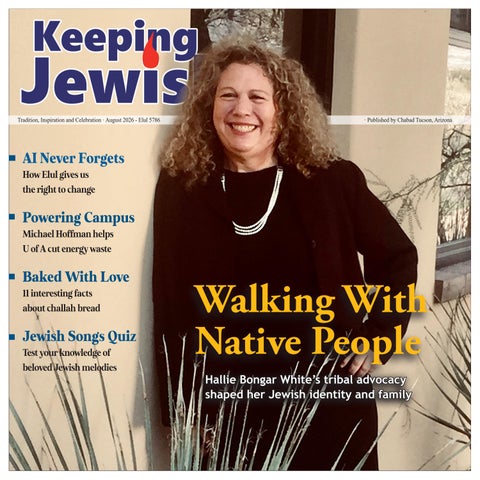
AI Never Forgets How Elul gives us the right to change
Powering Campus Michael Hoffman helps U of A cut energy waste
Baked With Love 11 interesting facts about challah bread
Jewish Songs Quiz Test your knowledge of beloved Jewish melodies
Walking With Native People Hallie Bongar White’s tribal advocacy shaped her Jewish identity and family
Keeping Jewish | August 2026 |
OPINION
The Jewish outreach and education network of Southern Arizona 2443 E 4th Street, Tucson, AZ 85719
The Right to Become Someone New
EXECUTIVE DIRECTOR Rabbi Yossie Shemtov
By Rabbi Yehuda Ceitlin
REBBETZIN Chanie Shemtov OUTREACH DIRECTOR Rabbi Yehuda Ceitlin PROGRAM DIRECTOR Feigie Ceitlin Affiliates: Congregation Young Israel, Chabad at the University of Arizona, Chabad on River, Chabad of Oro Valley, Chabad of Sierra Vista, Chabad of Vail and Lamplighter Chabad Day School of Tucson
EDITOR Rabbi Yehuda Ceitlin COPY EDITOR Suzanne Cummins CONTRIBUTING WRITERS Yehuda Altein, Hallie Bongar-White, Phyllis Braun, Feigie Ceitlin, Sari Kopitnikoff, Yvette Miller, Menachem Posner, Mordechai Schmutter, Benjamin Weiss PHOTOS Unsplash.com SPECIAL THANKS Chabad.org EDITORIAL & ADVERTISING Phone: 520-881-7956 #12 Email: info@ChabadTucson.com SUBSCRIPTION: ChabadTucson.com/SubscribePrint Keeping Jewish is published in print periodically by Chabad Tucson and is distributed free in Tucson and Southern Arizona. Chabad Tucson does not endorse the people, establishments, products or services reported about or advertised in Keeping Jewish unless specifically noted. The acceptance of advertising in Keeping Jewish does not constitute a recommendation, approval, or other representation of the quality of products or services, or the credibility of any claims made by advertisers, including, but not limited to, the kashrus of advertised food products. The use of any products or services advertised in Keeping Jewish is solely at the user’s risk and Chabad Tucson accepts no responsibility or liability in connection therewith. Note: “G-d” and “L-rd” are written with a hyphen instead of an “o .” This is one way we accord reverence to the sacred divine name. This also reminds us that, even as we seek G-d, He transcends any human effort to describe His reality.
2 | August 2026 | Keeping Jewish
Recently, a notification from ChatGPT appeared on my screen announcing an improvement to its memory. “ChatGPT is now better at keeping memory up to date,” it said, explaining that this would allow it to offer “more relevant, personalized replies.”
person yesterday, it must define him today. Human beings don’t work that way.
Our lives are filled with change. We change jobs, take up new hobbies, and enter new stages of life. Our priorities evolve. Even our most ordinary I use artificial intelligence regularly preferences aren’t fixed. We may love in my work, so I can appreciate its a certain food, book, or destination at convenience. If I tell it that I prefer a one stage of life and lose interest in it certain writing style, I would rather not at another. We accept these changes have to repeat myself each time. If it without giving them much thought. Why remembers my interests and preferences, should we assume that the deeper parts its answers can be more useful. of a person must remain frozen in place? But the notification made me think about the other side of memory: What happens when something remembers a version of us that no longer exists? The Wall Street Journal reported on this emerging problem. One man had told an AI chatbot (or LLM) that he was going through a divorce. Long afterward, the chatbot continued bringing up his divorce when he asked about unrelated subjects, from his schedule to problems at work. Another user mentioned that he was trying to lose weight, only for the chatbot to bring up his diet when he was looking for restaurants while on vacation. The information wasn’t necessarily wrong. The problem was assuming that because something was true about a
This idea has been on my mind as we approach Elul, the Hebrew month leading up to Rosh Hashanah and Yom Kippur. It is traditionally a time for introspection and teshuvah, commonly translated as repentance but more literally meaning “return.” Judaism certainly doesn’t advocate deleting our history. Teshuvah requires taking an honest look at the past. We are expected to recognize our mistakes, take responsibility for them, apologize when necessary, and resolve to do better. But then comes something equally important: We are allowed to become someone new. The great Jewish sage Maimonides describes the person who has sincerely repented as one who is so changed that
he can say, “I am a different person and not the same one who sinned” (Hilchot Teshuvah 2:4). People can change in ways both large and small. The shy child may grow into a confident adult. Someone who once had little interest in religion may later discover a deep spiritual connection. The career that once seemed perfect may no longer be what someone wants from life. We sometimes deny people the ability to change simply because we think we already know them. And we can do the same thing to ourselves. During Elul we look back at what we have done, while recognizing that it doesn’t have to determine what we will do next. Teshuvah requires confronting the past honestly, but it also insists that the past does not get the final word. Artificial intelligence is getting better at updating its memory of us. Perhaps this Elul, we can become better at updating our memories of one another and leaving room for the possibility that the person we remember is no longer the person standing before us. - Rabbi Yehuda Ceitlin is the Outreach Director of Chabad Tucson, the Jewish network of Southern Arizona
NEWS
Tucson Prepares to Welcome the Jewish New Year
Inspired for the new year: Rabbi Shmulie Shanowitz (left) with Chabad at the University of Arizona students on a Taglit-Mayanot Birthright trip to Israel this summer.
As the Jewish calendar enters its final month, Tucson’s Jewish community is beginning preparations for Rosh Hashana with prayer, reflection, special foods and community gatherings aimed at starting the new year on a meaningful note. The Hebrew month of Elul begins at sundown on August 13 this year and leads directly into Rosh Hashana, which begins at sundown on Friday, September 11, ushering in the Jewish year 5787. Traditionally, Elul is considered a time to take stock of the past year and prepare spiritually for the High Holidays. Practice during the month emphasizes teshuva, or “returning to G-d.” There is a focus on correcting past shortcomings, increasing prayer and demonstrating concern for others. Among the best-known Elul customs is the sounding of the shofar on weekdays as a spiritual wake-up call. Some also add special Psalms to their daily prayers, and many increase their charitable giving during this time. Elul is also traditionally a time when people often have the mezuzahs on their homes and their tefillin checked to ensure
that the handwritten parchment scrolls within them remain kosher. Rabbi Schneur Zalman of Liadi, founder of Chabad Chassidism, compared Elul to a time when “the king is in the field.” Instead of being secluded in his palace, the king goes out among the people, where anyone can approach him. This analogy describes Elul as a particularly accessible time to reconnect with G-d. In Tucson, that preparation is also taking place through community events. On Sunday, August 23, PJ Library will host “Sweet Beginnings: A Rosh Hashanah Family Experience” at the Tucson Jewish Community Center from 3 to 4:30 p.m. The free, community-wide program will feature more than 20 activity stations that introduce children and families to the holiday’s themes and traditions. Activities will include holiday crafts, games, sensory experiences and a mitzvah project. Children will be able to make headbands and bracelets, create intention stones and yarn art, build shofar mobiles, play with honey playdough and observe live honey bees through a protected observation hive.
Closer to Rosh Hashana, Jewish women and girls from across the community will gather for the annual Mega Challah Bake of Tucson on Wednesday, September 9, from 7 to 9 p.m. at the Tucson JCC. Organized by Chabad Tucson with participation from women representing synagogues and Jewish organizations throughout the area, the evening combines challah preparation with music and dancing. Rosh Hashana itself will also bring Tucsonans together around the holiday table. Chabad Tucson and Chabad Oro Valley will be among the local organizations hosting community Rosh Hashana meals, giving residents a place to join other community members and celebrate the holiday with traditional foods. Chabad Tucson will also continue its recent tradition of hosting Shofar in the Park at Himmel Park, allowing community members to hear the shofar outdoors on Rosh Hashana. Rabbis and volunteers will also visit homebound residents and others unable to attend synagogue and blow the shofar for them.
At home, another kind of preparation will soon begin in local grocery stores. Some Tucson residents will be scavenging the produce aisles in search of an unusual new fruit to eat on Rosh Hashana, a time traditionally used to recite the Shehechiyanu blessing. And, of course, there will be familiar holiday staples. Apples dipped in honey express the wish for a sweet new year, while pomegranates are associated with the hope for a year filled with mitzvot and good deeds. Round challahs, often made sweeter than ordinary Shabbat challah, are another fixture of many Rosh Hashana tables. Throughout Elul and the High Holiday season, Jews traditionally greet one another with wishes for a good and sweet year and, in Hebrew, “Leshanah tovah tikateiv veteichateim,” a wish to be inscribed and sealed for a good year. For Tucsonans, the coming weeks will bring the holiday preparations into homes, synagogues, community centers, parks and supermarket aisles as we get ready to welcome 5787.
Keeping Jewish | August 2026 | 3
COVER
Walking With Native People Life among another ancient people deepened the connection to my own By Hallie Bongar-White How and why has a traditional Jewish woman like me spent most of my life living and working with Native Americans?
it meant to be “the other.” They fully supported one another, brought their children to and nursed their babies in class, shared their food and celebrations, and remained deeply connected to their Peoples, languages, cultures, ceremonies, and traditional homelands.
I was raised in an “Ashkenazi Jewish bubble” in Madison, Wisconsin. Our lives revolved around the Jewish calendar and family. I was always conscious that we Jews were somehow “the other” in America. The adults in my life, subtly if unintentionally, communicated that safety could only be found within that bubble of family and community. My only childhood friends were my cousins.
They prayed and gave blessings openly and regularly in their own languages at most events and whenever moved to do so. When I missed class for Jewish holidays, they shared their notes with me. I could speak freely about insights or spiritual healing gained from fasting or ceremony. They encouraged me to deepen my own observance as a Jew, to pray in my own language, and to visit my own People’s homeland of Israel.
As corny as it sounds, my first real awareness of Native people was sparked one Sunday when my family took a short drive north to the Wisconsin Dells. People from the Ho-Chunk Nation, wearing their traditional regalia, waved at us from the cliffs, beckoning us to visit their Stand Rock Ceremonial event. The sound of their drums felt like they were beating in time with my own heart. Barbara Blackdeer-Mackenzie, an enrolled Ho-Chunk tribal member, educator and historian, later explained that there was a time when Ho-Chunk ceremonies, gatherings, music and dance were outlawed. Ho-Chunk citizens performed in traditional regalia for tourists not only to earn income but also as a way of keeping their traditions alive.
From Student to Advocate After earning an undergraduate degree in Native American Studies, I was gifted a Pendleton eagle blanket along with a dozen or so other Native graduates. “What will you possibly do with such a degree?” my parents bemoaned. There was plenty to do, it turned out.
Hallie Bongar-White (right) and Brenna Hanley [Navajo], COO of National Tribal Trial College
I started noticing Indigenous people and places within my own Ashkenazi bubble. The synagogue where we prayed and the mikvah where our women immersed were located at the base of a Native American effigy mound shaped like a bear.
grandparents and great-grandparents are buried also lies at the base of effigy mounds. The Ho-Chunk people were deeply rooted in this land, and now my own People had come to make a home here as well.
The Jewish cemetery where my
At 17, I left home to attend the University
4 | August 2026 | Keeping Jewish
of California at Berkeley. I was among 30,000 other students in a foreign, urban environment. I felt lost. An opening in my freshman class schedule led me to enroll in my first Native American Studies course. There I found a group of students from another culture who also knew what
My journey led me to the master’s program in American Indian Studies at the University of Arizona in Tucson. There, I met the preeminent Native American legal scholar and theologian, Vine Deloria Jr., of the Standing Rock Sioux Tribe. He became my lifelong mentor and, in the Indian “fictive kin” tradition, my uncle. Uncle Vine mentored me through law school and until the end of his life.
COVER
We spent many hours imagining how Native communities could build culturally rooted legal, healthcare, education, and social-service systems, much like the Jewish community had built its own rabbinic courts, hospitals, universities, emergency medical services, day schools, free-loan societies, and social-service organizations.
Another is the National Tribal Trial College. Many tribal communities are rural and remote, with too few attorneys to meet their legal needs. The program has trained hundreds of tribal court lay advocates to serve their own communities in matters ranging from domestic violence protection orders and family law to victims’ rights and appeals.
About 7.5 million Jews live in the United States, compared with 9.7 million people who identify as American Indian or Alaska s, Native, alone or in combination with another race. With comparable populations, Uncle Vine conjectured that Native people could similarly identify their own systemic challenges and then address them using so. their own people and culturally informed , practices to create healthy, lasting institutions.
Our work with culturally sensitive death investigations has felt especially familiar to me as a Jew. Many Native peoples, like Jews, have traditions requiring that the dead be treated with great care and laid to rest quickly. But when a Native person dies on tribal lands, the body may be taken off the reservation for a medicolegal investigation, delaying burial and sometimes conflicting with religious or cultural practices.
,
y.
That question has formed the basis of my entire legal career.
Somewhere along this journey, Hashem blessed me by bringing into my life Jim White, the father of my children. He was my longtime friend from the Citizen Potawatomi Nation, a fellow lawyer in and tribal court judge. He converted to Judaism, and we married under a chuppah. zen We raised our three “PotawataJew” children to walk two roads, as both Native Americans and Torah-observant Jews.
After a brief stint at the University of Arizona College of Law teaching tribal court trial skills and developing tribal domestic violence legal codes, the American am Bar Association provided $60,000 in seed money to establish the Southwest Center I for Law and Policy. Now in our 25th gal year, SWCLAP has become a vehicle for of empowering Native people to realize some me of Uncle Vine’s dreams.
Empowering Native Communities Three of SWCLAP’s grassroots projects reflect the kind of work Uncle Vine and I once imagined.
Jim White and Hallie Bongar-White with their children
SWCLAP works with coroners and medical examiners across the country to encourage timely, culturally sensitive and minimally invasive death investigations when Native Americans die on tribal lands. Though different in form, each of these projects reflects the same principle Uncle Vine taught me: communities are strongest when they can build institutions rooted in their own values and traditions. Native Americans have served as my teachers and as a kind of mirror, reflecting back my own culture and history. Through them, I have grown to understand, with great clarity, the Jewish People’s indigeneity to the Holy Land of Israel. I have been blessed in this lifetime to help Native people pursue greater safety, justice and healing, while raising Native From left: SAFESTAR creators Hallie Bongar-White, Cordelia Clapp (Pawnee), and Arlene O’Brien American-Jewish children who carry both (Tohono O’odham) legacies forward. All these years later, I One is SAFESTAR, developed in response of the Tohono O’odham Nation, helped am still walking those two roads. Each to high rates of sexual violence against develop the program. SAFESTAR trains has helped me understand the other more Native women and limited access to people within tribal communities to provide deeply. forensic examinations and healthcare in emergency first aid, preserve evidence and many tribal communities. My “sisters in connect survivors with medical, legal and the Indian way,” Cordelia Clapp, R.N. of traditional healing services when other the Pawnee Nation, and Arlene O’Brien resources are unavailable. Keeping Jewish | August 2026 |
5
Participants of the annual Mega Challah Bake of Tucson last year. Photo: Martha Lochert
JUDAISM 101
Baked With Love
10 facts about challah that everyone should know By Yvette Miller Challah is the rich braided bread that adorns Shabbat tables in Jewish homes around the world. Here are 10 interesting tidbits you might not know about this essential, delicious traditional bread: 1. Biblical Origins The word challah in the Torah first occurs when G-d describes to the Jewish people what life will be like for them in the Land of Israel: “When you come to the Land to which I bring you, it shall be that when you will eat of the bread of the Land, you shall set aside a challah (portion) for G-d” (Numbers 15:1819). Challah actually refers to the part of the dough that is meant to be given to G-d. 6 | August 2026 | Keeping Jewish
2. Challah in the Temple When the ancient Temple stood in Jerusalem, 12 special unleavened wheat loaves, also called challah, were displayed on a gleaming golden table, opposite the golden menorah. These delicious fresh loaves were changed weekly and represented each of the 12 tribes of Israel who together formed one whole: the Jewish people. The holiness of the Temple might be denied to us at the moment, but the holiness that resided in it did not disappear. Each of our homes can be a Mikdash Me’at, a miniature Temple. We do not have the magnificent golden menorah of the Temple, but we each can cherish the more modest lights of our Shabbat
and holiday candles in our homes. Although we no longer have the 12 show breads on the golden table of the Temple, we still place two loaves of luscious challah on our Shabbat and holiday tables.
To be sure that they did not need to gather manna on Shabbat, G-d sent a double portion of manna each Friday; it’s this double portion we recall through our double challah loaves on Shabbat.
3. Why Two Loaves?
4. Remembering the Temple Today
It’s traditional to place two loaves of bread on Shabbat and holiday tables. This represents the double portion of manna with which G-d fed the Jewish people as they wandered in the wilderness for 40 years after leaving Egypt.
We still observe the mitzvah of separating challah today. Jewish bakers, both home cooks and commercial bakeries, set aside a portion of dough, the size of a small egg, from each batch of bread they bake (with a blessing). This small portion is burned as a sacrifice for G-d.
As slaves, the Jews had been subjected to very harsh labor. They learned in the desert how to pause in their labor by observing Shabbat, when no work was done.
Note: Only batches of bread dough made with three or more pounds of flour (of any of the five grains:
JUDAISM 101 wheat, oats, spelt, barley or rye) are separated with a blessing. Batches of dough made with between two and three pounds of flour are separated without a blessing, and doughs made with less than two pounds of flour are not separated at all. It’s become the custom among many Jewish women to intentionally bake bread with extra flour, giving themselves the opportunity to perform the mitzvah of separating challah dough. 5. Flat Challah Many modern Jews think of challah as a delicious loaf of braided egg bread. But over the centuries, the definition of what type of bread this refers to has evolved. Flatter loaves of bread are still used in some Sephardic communities. Some Moroccan Jews serve round loaves of bread, sometimes sprinkled with spices and olive oil before baking, on Shabbat. Jews of Yemen traditionally served a flatbread called lachoch, fried in a pan, on Shabbat. Some Persian Jewish households place beautiful loaves of barbari, a flat glazed bread, on their Shabbat tables.
ch 6. Inventing the Braided Loaf Today, many people associate Shabbat challah with braided golden bread infused with eggs, and sometimes studded with sweet raisins.
According to some, Jews began baking these types of braided challahs in the 1400s in southern all Germany and Austria. Most Jews at y the time ate dark rye bread during the week; to distinguish Shabbat bread, cooks started baking with fine white wheat flour. Additions like eggs and raisins enhanced these h special loaves even more. Braiding made them look even more festive.
7. Salting Our Challah
10. A Sacred Moment
After saying the blessing over the challah (or any other bread), it’s customary to slice it and dip it in salt. This recalls the salt that the priests in the ancient Temple used to sprinkle on the sacrifices they offered to G-d and links us directly to the worship of our ancient ancestors in Jerusalem. Salt is also symbolic of the Jewish people: It never spoils, is always fresh, and brings out the beauty and flavor of everything it touches.
Some women like to compare the seven ingredients of traditional Ashkenazi-style challah to a different spiritual dimension. Water is often compared to the Torah and its wisdom. Yeast represents our ability to grow and expand and reach new heights. Sugar reminds us of the sweetness we hope to bring into our families and communities. Salt brings out the taste in other ingredients and also recalls the Jewish people; like salt, we never
spoil, but remain fresh always. Oil, in biblical times, was used to anoint kings and the priests who served in the Temple; it reminds us to bring majesty and holiness into our lives as well. Eggs represent the giving of life—something Jewish women through the ages have nurtured in our homes and communities. Flour represents nourishment: Just as the flour sustains us physically, we hope that the challah we consume on Shabbat and Jewish holidays sustains us spiritually.
8. Challah has Feelings? When Shabbat and holiday challah loaves are set on the table, they are draped with a beautiful cover, hiding them until it is time to make the Hamotzi blessing over bread. One of the reasons behind this custom reveals a great deal about the value that Judaism places on kindness and sensitivity to others; we cover the loaves of challah because it’s customary to make a blessing over wine on Shabbat and holidays before making a blessing over the challah, and we want to shield the challah from the knowledge that it doesn’t come first. If we take such pains to shield the feelings of mere bread, how much more care must we take to guard the feelings of our fellow men and women? 9. Beautiful Shapes Throughout the Jewish year, some communities bake challah in different shapes or incorporate different decorations. It’s common in all Jewish communities to eat round challah loaves from Rosh Hashanah, the Jewish New Year, all the way through Simchat Torah, several weeks later. The round shape of these special challahs symbolizes the circular nature of the Jewish year. They also recall crowns, recalling G-d’s majesty during the High Holy Days.
Mazel Tov Gail Dorney and Joan Yogev
On the sale of your home. Simchas in the years ahead.
Madeline Friedman Vice President, ABR, CRS, GRI
520.907.4141 TucsonHomeFinder@aol.com www.TucsonAZHomes.com Keeping Jewish | August 2026 | 7
LOCAL 1. What do you do, and what got you into this field? I started my career as a building-controls technician. I now lead a team of ten professionals focused on energy and utility efficiency across the University of Arizona campus. Our fault-detection system has helped the University avoid more than $1 million in annual energy costs.
At Work: Michael Hoffman
Energy Manager at the University of Arizona
11. What’s your go-to comfort food? I’m a born-and-bred Brooklynite, so I could eat pizza multiple times a day, if I were allowed. I’m also partial to pickled herring, beef tongue, and chicken pupiks and hearts. Sadly, I’m the only one in my house who feels that way.
3. What would surprise people about energy use in buildings? Heating and cooling are among the biggest energy users. Clogged filters, leaky doors, and poorly sealed windows can all make systems work harder than necessary.
5. How does Tucson’s desert climate affect your work? Extreme heat puts heavy demand on cooling systems. Then the monsoon season brings humidity, which requires significantly more energy to cool. Tucson can also experience temperature swings
8 | August 2026 | Keeping Jewish
9. What do you do outside of work? With three children, there’s always plenty happening. I enjoy reading and music. 10. What do you like most about Tucson? We moved here in 2007. I love the weather, except for the summers, and I appreciate the cross-sectionality of Tucson’s Jewish community.
2. What’s your favorite part of your job? The variety. Energy management is very multidisciplinary, so I get to work with people from many backgrounds and continually learn. I also love problemsolving.
4. How has technology changed energy management? Digital controls let us monitor systems in tremendous detail, improving efficiency, maintenance, and equipment life. But there are downsides, including cybersecurity risks.
about using resources responsibly and efficiently, respecting the resources Hashem provides us.
of more than 40 degrees in a day, creating another challenge. 6. What’s one simple way homeowners can reduce energy use? Pay attention to the thermostat. Using ceiling or tower fans can keep you comfortable at much lower energy cost than using the AC. Changing filters and sealing doors and windows also helps.
7. Share an accomplishment you’re especially proud of. I’m most proud of building our Commissioning & Analytics team. Today, ten talented professionals work with me and give me nachas. 8. How does being Jewish influence your work? The commandment of bal tashchit, “do not destroy,” is at the heart of what I do. Energy management is fundamentally
12. What’s your favorite Jewish expression? Lately I’ve been repeating two phrases: “Gam zu l’tovah,” this too is for good, and “This too shall pass.” Together, they bring a balanced approach to just about every challenge. 13. What are you looking forward to in the New Year? Our son is starting college, our daughters are busy with school and activities, and I’m taking graduate courses with an eye toward another degree. My wife and I are also planning some travel. Maybe I’ll even make more time for music.
d
d
KOSHER
Crispy Truffle Potato Salad By Feigie Ceitlin INGREDIENTS:
4. While the potatoes roast, very thinly slice the shallot and basil.
3 lb. baby potatoes, halved
5. In a large bowl, combine the mayonnaise and truffle oil.
1 shallot, very thinly sliced 1/3 cup mayonnaise
f I 5–7 basil leaves, thinly sliced ed 1 tbsp. paprika iks my ½ tbsp. garlic powder ½ tbsp. salt
s:
ey ut
½ tbsp. black pepper ½ tbsp. onion powder 3 tbsp. olive oil 1 tbsp. truffle oil DIRECTIONS:
in 1. Preheat oven to 400°F. 2. Toss the potatoes with the paprika, garlic powder, salt, pepper, onion powder, and olive oil.
3. Arrange the potatoes cut-side down ng on a baking sheet. Roast for about 40 re minutes, until golden and crispy.
6. As soon as the potatoes come out of the oven, add them to the bowl along with the shallot and basil. Toss everything together while the potatoes are still hot. The heat will slightly soften the shallot and bring the flavors together. 7. Serve warm. Enjoy! THE BLESSING: Bah-rookh ah-tah ah-doh-noi eh-lohhay-noo meh-lekh hah-oh-lahm boh-ray pi-ree hah-ah-dah-mah.
A legacy of caring Accredited by
Blessed are You, L-rd our G‑d, King of the universe who creates the fruit of the earth. — Rebbetzin Feigie Ceitlin is the program director of Chabad Tucson and head of school of Lamplighter Chabad Day School.
Providing our Tucson community with comfort, dignity and compassionate care. We’re here for you. A not-for-profit serving all in need in Tucson Available 24/7
(520) 827-5000 | hov.org Keeping Jewish | August 2026 | 9
COMMUNITIES
Exterior of the Touro Synagogue on Touro Street in Newport, Rhode Island. Photo: National Trust for Historic Preservation
17 Facts About Yemenite Jews From ancient Hebrew pronunciation to Operation Magic Carpet By Yehuda Altein While Yemen today is not the safest place for a Jew, it was historically home to one of the oldest Jewish communities in the world. Despite facing centuries of poverty and persecution, Yemenite Jews have not only endured but thrived, bringing their vibrant traditions to the Land of Israel and beyond. Here are 17 facts about the history and customs of this extraordinary community.
1. Their Origins Are Shrouded in Mystery When did Jews first settle in Yemen? No one knows for sure, but the legends are captivating. Some say Jews were exiled to Yemen by the king of Assyria 133 years before the destruction of the First Temple. Others believe Jews were already living in Yemen during King
10 | August 2026 | Keeping Jewish
Solomon’s reign and were the ones who told the Queen of Sheba—often associated with Yemen—about the king’s unparalleled wisdom. While the exact timeline is unclear, one thing is certain: Jews have lived in Yemen since ancient times.
2. They Are Also Known as Teimanim In Hebrew, Yemen is called Teiman, and Yemenite Jews are referred to as Teimanim. The name comes from the Hebrew word for “south,” as Yemen lies at the southern tip of the Arabian Peninsula, once the southernmost known point of civilization.
3. They Are Not Sephardim While Jewish communities are often classified as either Ashkenazi or
Sephardic (or Mizrachi), Yemenite Jews have always stood apart with their distinct traditions. Their culture evolved independently for centuries, creating a unique blend of customs that is unlike any other in Jewish life.
4. They Have an Ancient Form of Pronunciation How do you pronounce the Hebrew letter vav? Most Jews say “v,” but Yemenite Jews say “w.” Similarly, they pronounce gimmel with a dot like a soft “g” (as in “giant”) and tav without a dot as “th.” Some vowels also differ: The segol is pronounced like a patach, and a cholam is somewhat like the “u” in “put.” So words like vayomer become wayeumar, hagafen becomes hajofan, and bereishit becomes bereishith. Many believe this pronunciation is closest to the original
Biblical Hebrew.
5. They Learned Upside Down (Literally!) In Yemen, Hebrew books were scarce, so children learned from a single book shared in the classroom. The teacher (called “Mori”) would point to a letter, and students sitting around the table would learn to recognize it from their perspective—right-side up, sideways, or upside down! As adults, many Yemenites continued to orient their reading according to the direction they learned as children.
6. The Epistle of Yemen Breathed New Life In the late 12th century, Yemenite Jews faced intense persecution and the rise of
COMMUNITIES a false Messiah who misled many. Their leader, Rabbi Yaakov ben Nethanel, reached out to Maimonides (the Rambam) in Egypt for guidance. In his famous Epistle to Yemen, Maimonides responded with words of encouragement, providing clarity on how to identify a true Messiah and urging the community to stay strong despite their hardships. Maimonides opened the letter with glowing praise for the Yemenite Jews, commending their generosity in feeding the needy and hosting travelers, their devotion to studying the Bible and Talmud, and their meticulous observance of the mitzvot.
7. They Lionize Maimonides Maimonides’ influence on Yemenite Jewry was profound. His name was incorporated into their Kaddish prayer, and his halachic work, the Mishneh Torah, became the cornerstone of Jewish practice for Yemenite Jewry.
8. They Produced Many Great Scholars Over the centuries, Yemen produced many outstanding Jewish scholars and sages. Rabbi David al-Adani, for instance, compiled the Midrashic anthology Midrash Hagadol. Rabbi Shalom Shabazi, a prolific poet and celebrated saint, was so revered that his resting place in Taiz was visited by Jews and Arabs alike.
9. They Translate the Torah in the Synagogue In ancient times, Jews read the Torah along with an Aramaic translation to help everyone understand. Most communities stopped this practice long ago, but Yemenite Jews still preserve it today. In Yemenite synagogues, every verse is read first in Hebrew and then in Aramaic—often by a child. It’s a beautiful tradition—but it does make the Shabbat service significantly longer!
10. They Endured Harsh Persecution Life in Yemen under Muslim rule was often difficult. Jews faced discriminatory laws and were treated as second-class citizens. The 1680 Mawza Exile forced almost all Yemenite Jews into the desert, where many perished. In the 20th century, the infamous Orphans’ Decree led to Jewish orphans being taken from their families, forcibly converted to Islam, and raised by the state.
11. Most Left During “Operation Magic Carpet” In 1949–1950, nearly the entire Yemenite Jewish community was airlifted to Israel in a historic mission known as “Operation Magic Carpet” or “Operation Wings of Eagles.” Nearly 50,000 Jews were flown to their ancestral homeland.
12. They Are Integral to Chabad in Israel
dish that’s cooked overnight. While Ashkenazi Jews savor cholent (a stew of meat, beans, and potatoes), Yemenites prepare kubaneh or jachnun—varieties of scrumptious pastry dough baked overnight and enjoyed at Shabbat breakfast.
15. They Call Sidelocks “Simanim” Although Jewish law requires that males leave their sidelocks, or peyot, they may be trimmed within certain guidelines. Nevertheless, Yemenite men and boys traditionally grow their sidelocks long. This custom dates back to a 17th-century edict requiring Jews to maintain long sidelocks to distinguish themselves from their Muslim neighbors. Because of this history, Yemenite Jews call their sidelocks simanim, meaning “signs,” highlighting their role as visible markers of Jewish identity.
16. They Nursed a Strong Connection to the Holy Land The Yemenite Jews never stopped mourning the Holy Temple and their people’s exile. In fact, they followed the Talmudic dictum not to play instrumental music as a sign of their continued mourning. This led them to perfect their skills as vocalists and drummers.
17. Yemenite Communities Thrive Today While Jewish life in Yemen has all but been extinguished, Yemenite Jewry flourishes today, with many communities in the Land of Israel and beyond. Proud of their heritage, Yemenite Jews continue to preserve their rich traditions and vibrant way of life.
In Israel, the newly arrived Yemenite Jews found a warm welcome in the Chabad community, where they were encouraged to maintain their unique customs and appearance. In fact, the historic Chabad yeshiva in Lod, Central Israel, was officially known as the “Yeshiva for Immigrants from Russia and Yemen.”
13. There Are Shami and Baladi Not all Yemenite Jews share identical traditions. The community is typically divided into Baladi and Shami. While Baladi (“native”) Jews made every effort to maintain the unadulterated Yemenite Jewish traditions, Shami Jews are more heavily influenced by the Kabbalahinfused Sephardic traditions that they learned from their brethren in al-Sham (Syria). These differences manifest primarily in the text of their liturgy.
14. Kubaneh and Jachnun Are Shabbat Treats On Shabbat, many Jews enjoy a hot Keeping Jewish | August 2026 | 11
WORD
What Does “Shayne Punim” Mean? By Chabad.org Staff Shayne punim (alternatively pronounced SHAYN-eh PAW-nim or SHINE-eh POO-nim) is Yiddish for “pretty face.” Bear in mind that shayne punim can describe a cherubic countenance as well as the little person who bears it. So you can call your niece a shayne punim, and also tell her that you miss her dearly and cannot wait to kiss her shayne punim on your next visit. The more interesting element of this phrase is punim, face. The root of the word, P-N-M, actually means “inside,” which seems odd when one considers that a person’s face is external, not internal. To further complicate things, it is actually in the plural form, even though each of us has just one face. In other words, the Hebrew word for “face” actually means “insides.” Could it be because the face holds multiple portals into a person’s inner world? Perhaps this is the meaning of Solomon’s observation, “Man’s wisdom makes his face shine…” The sage Shammai instructed, “Receive every person with an expression of niceness on your face.” Translated into Yiddish, the last words of this adage would be, you guessed it, shayne punim. But there is a twist. The niceness of face here does not refer to physical beauty, but to the charm that comes from a generous and truly inviting host. In the words of Italian Rabbi Obadiah
12 | August 2026 | Keeping Jewish
Will mer day emp
Will Bertinoro: “When you invite wayfarers Hem into your home, do not give to them with Ger your face drooping to the ground. One In 1 who gives with a downcast face — even to jo if he gives all the gifts in the world — it San is as if he has given nothing at all.” By t The Month of the Shayne Punim thei Com The Chassidic masters tell us that gen Elul, the final month before the High prov Holidays, is an especially propitious thir time to approach G-d. Rabbi Shneur lear Zalman of Liadi explains with a parable: and Eng Before a king enters a city, all the lang townspeople go out to greet him in Fre the fields, and anyone who wishes is permitted to approach. For his part, The the king greets them with an open and for t pleasant countenance. When he enters 186 the city, they all follow him. Later, exp when he returns to his royal chambers, Tuc only the elite and people of privilege som may enter, and even then, only with stor permission. Jew
That’s right: using the same terminology In 1 Shammai used to describe the shayne man punim of a gracious host, Rabbi Shneur in T Zalman tells us that G-d greets us 186 warmly and happily, delighted that we in m are seeking Him out. But this Divine sold smile is more than just cosmetic. When he w G-d smiles at you, know that you can Alb approach Him with your deepest and of h most private requests in complete to h confidence that He will grant you a stre sweet new year. His
PIONEERS
Tucson’s Most Colorful Pioneer Merchant William Zeckendorf (1842-1906) By Benjamin Weiss William Zeckendorf was a Jewish pioneer merchant during the early territorial days who helped establish a business empire in the Southwest.
to depart for Tucson, William gave Julia a preliminary taste of the Wild West by exiting their hotel dressed as a bandit, complete with bandoliers of ammunition, pistols, and a shotgun.
William was born in 1842 in Hemmendorf, a small locality in the German region of Baden-Württemberg. In 1857, at age 14, he moved to America to join his brothers, Aaron and Louis, in Santa Fe, New Mexico.
When the married William returned to Tucson, aged thirty-three and soon to be a father, he began to take responsibility for the Zeckendorf store. He also attempted to grow his personal wealth and became partners with Zadoc Staab, a distant cousin and wealthy New Mexico merchant (this store lasted only two years, as the two could not agree on how to manage it). For the next decade, William attempted to open a few more stores but was hampered by bad credit and unfortunate fires. In 1891, he sold his remaining interests in the family store to his nephew.
By the time he joined his brothers, their business — the A. & L. Zeckendorf Company — was a success, selling general merchandise and supplying provisions for the army. He spent thirteen years in New Mexico, where he learned the ropes of the family business and became fluent in Spanish and English, adding them to the three other languages he already spoke: German, French, and Hebrew. The Civil War greatly disrupted business for the Zeckendorfs, but in the late 1860s the family was able to recover and expand their enterprise. They tested the Tucson market and found it lucrative, so somewhere around 1866 they opened a store here, first managed by a pioneering Jewish man, Philip Drachman. In 1868, William was designated the new manager of the A & L Zeckendorf store in Tucson, where he arrived in February 1869. William initially showed skill in managing the Tucson store, which sold American and foreign goods, and he would travel between Tucson and Albuquerque to ensure the safe delivery of huge wagon trains of merchandise to his store on Main and Pennington streets. His character was colorful and larger-
William and Julia Zeckendorf and their children
than-life, in both good and bad ways. He became a local celebrity for lavishing the Old Pueblo with ostentatious spectacles, including frequent fireworks displays. A man of the community, he helped organize public dances, parties, and parades, including the Fiesta de San Agustín. He was said to have fixed a lantern to the facade of his store that burned so bright he had to turn it off by 10:00 PM so the town’s chickens could go to sleep.
Hernándezes, a well-known, well-liked couple. This took place on August 8, 1873, and constituted the first lynching in Tucson’s history.
But two gruesome acts mark his life in Tucson: in April 1871, he scalped a Native American — a suspected cattle rustler — and kept the scalp as a souvenir. He was also involved in inciting a crowd to lynch four men who had robbed and murdered the
His behavior started to change in 1875, when he set off to New York to get married. On October 25, 1875, he married Julia Frank, a New Yorker unfamiliar with the “Wild West.” One anecdote recounts how, when the newlywed couple was in San Diego about
Zeckendorf ’s many feats won him the nicknames “Irrepressible Z” and, more blandly, “Mr. Z.” But his exploits did more than gain him fame and infamy in Tucson — they seriously impacted his family’s business, and the family had to bring in a different manager.
During his time in Arizona, Zeckendorf showed a commitment to public service: he served in the Eighth Territorial Legislature, served as chairman of the Pima County Democratic Committee, and advocated for the construction of railroads and wagon routes to connect Tucson to the rest of southern Arizona. Wanting to reunite with his and his wife’s family, Zeckendorf left Tucson in 1891 and moved to Far Rockaway, New York, where he passed away in 1906. He left behind an important, if checkered, legacy in Tucson. His brother Louis lived until the age of ninety-five, dying in New York in 1932. –This concludes our year-long series on the Jewish Pioneers of Southern Arizona, presented in collaboration with the Tucson Jewish Museum to honor the city of Tucson’s 250th anniversary. Visit tjmhc.org/profiles Keeping Jewish | August 2026 | 13
HUMOR
Kitten Around When your garage becomes a maternity ward By Mordechai Schmutter We apparently own a cat, or possibly two, or five. I don’t know. How do you take legal ownership of a cat? I ask because I don’t want to do it by accident.
babysit it when you go on vacation, but it’s really a waste of time because a kitten never grows up and gives you nachas.
We kind of fell into these cats. It started when one of my kids left the garage door slightly open for two weeks, and I couldn’t get out to do anything about it because my back went out. But then I finally decided—as a Sunday morning project—to go outside and close the door myself.
But I have this sense of responsibility, so I’m going to keep feeding them, but I’m not going to go out of my way to give them shots. I’m basically like a kitty hospice. I also don’t shut them in. I have them living in my kids’ playhouse outside, but I don’t close the door. They can leave. I want them to leave. Every morning I come outside and say, “Oh. You’re still here.”
That was Sunday. Then, on Wednesday, during supper, my 5-year-old said, “Hey! There’s a cat looking out the window of the garage!” So I opened the door, expecting whatever was in there to make a dash the second I got the door partially open, but no dashing happened. After climbing over several bikes and moving some drywall out of the way, we found four kittens, each about the size of my fist. Plus a mother, who was about the size of a mountain lion, and who scared the bejeebers out of me when I moved the last piece of drywall. I screamed, and she retreated to a different corner, behind the power saw. I was scared because you never know what a mother will do to protect her kittens. Probably turn on the power saw. So apparently, the mother had come in there to have her babies. Cats prefer to find a nice, quiet place to give birth, whereas humans give birth in a hospital. Either way, I didn’t want this cat kimpeturing in my garage. So we brought the kittens out of the garage, figuring that the mother would follow. Which she did not do.
14 | August 2026 | Keeping Jewish
I don’t even know what to feed kittens. Do they like milk? All we have is cow. Do they like soy milk? I’m just kidding. Nobody likes soy milk.
Then, with the mother still in our garage trying to figure out how to operate the power saw, we brought the kittens to a neighbor, who said we’d probably have to leave them in the garage for six weeks. Six weeks? Sukkos was in six weeks. And I’d have to get in to dig around and get my sukkah out. I can’t have 5 fullsize cats in there. So we left the kittens near the garage entrance overnight, next to the tuna, and in the morning, we found that the mother had made off with two of the kittens. And the tuna. So now we have two kittens and a really
mean mother who dumped them on us (she wasn’t nice to the kittens either!) I don’t know the first thing about taking care of kittens, but I don’t want them to starve.
I bought something called cat formula, which is as expensive as baby formula. And now I’m invested, which means they’re probably going to leave. I also discovered that because they’re so young, I can’t just pour it in a dish and expect them to know what to do. I have to bottle-feed them out of medicine droppers, which is adorable and takes like 3 hours out of my day. It’s like having twins. I have to sleep when they sleep… which I hear is 20 hours a day. I can live with that.
I didn’t ask for these kittens. I mean, my kids did. My kids asked for cats, and I kept saying no because I have kids. Whereas my kids don’t have kids, so they Either way, we can’t afford to keep cats wanted cats. and kids, time-wise. Especially since I have to sleep 20 hours a day. And I can’t What my kids don’t realize is that even give my kids away, because kids talk. one kitten is a whole responsibility – you have to feed it EVERY DAY and force it I guess my point is, does anyone want to bathe and take it to the doctor and cut kittens? Also, on an unrelated note, does its toenails and figure out who’s gonna anyone know if it’s legal to mail kittens?
FUN PAGE
Honey Cake Finger Maze By Sari Kopitnikoff - thatjewishmoment.com
Take the Jewish Songs Quiz What do you know about the melodies and prayers that define Jewish life? By Menachem Posner 1. Who wrote the words of “Adon Olam”? A. Rashi B. The Baal Shem Tov C. Yossele Rosenblatt D. The author is not known 2. Which 16th-century kabbalist composed “Lecha Dodi,” which welcomes Shabbat? A. Rabbi Yosef Karo B. Rabbi Shlomo Alkabetz C. The Arizal D. Rabbi Moshe Cordovero 3. “Oseh Shalom,” a line praying for peace, appears at the end of which two prayers? A. Shema / Amidah B. Amidah / Kaddish C. Kaddish / Havdalah D. Havdalah / Shema 4. “Ein Keloheinu,” a song affirming G-d’s uniqueness, is sung at the end of which service? A. Friday night Kabbalat Shabbat B. Morning services C. Weddings D. High Holiday Selichot 5. Who composed the most commonly sung tune for “Eishet Chayil”? A. Rabbi Ben Zion Shenker B. Debbie Friedman C. Leonard Bernstein D. Max Janowski
6. “Kuando el Rey Nimrod” is a Ladino song about which Jewish leader? A. Abraham B. Samuel the prophet C. Moses Maimonides D. Don Isaac Abarbanel 7. The words of “Kol HaOlam Kulo” (“The Entire World is a Narrow Bridge”) are attributed to whom? A. King Solomon B. King David C. Rabbi Nachman of Breslov D. Rabbi Dovber of Bridgeport 8. Who composed the words of “Hiney Mah Tov” (“How Good and Sweet are Brothers Dwelling Together”)? A. Rabbi Na’im Yomtov B. King David C. Solomon ibn Gabirol D. Ezra the Scribe 9. Which song welcomes angels to the Jewish home every Friday night? A. Shalom Aleichem B. Malach, Malach C. Shabbat Shalom, Hey! D. Malach Tov Amen
10. Who played music and sang in the Holy Temple? A. The priests (kohanim) B. The Levites (leviim) C. The Samaritans D. The Order of Elkanah
Answers: 1-D, 2-B, 3-B, 4-B, 5-A, 6-A, 7-C, 8-B, 9-A, 10-B.
Make it through the maze by collecting the ingredients usually needed to make honey cake
Keeping Jewish | August 2026 | 15
| August 2026 | Keeping Jewish