BS”D
Tradition, Inspiration and Celebration · September 2026 - Tishrei 5787
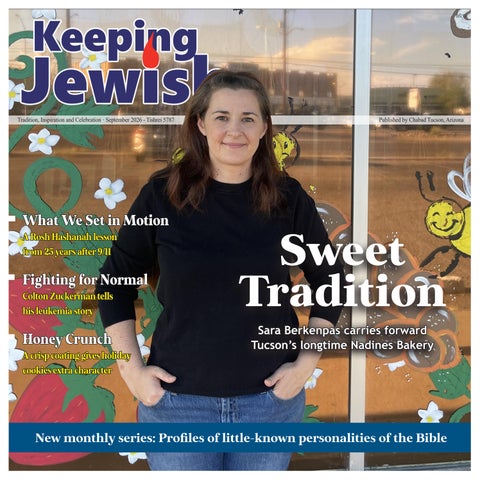
What We Set in Motion A Rosh Hashanah lesson from 25 years after 9/11
Fighting for Normal Colton Zuckerman tells his leukemia story
Honey Crunch A crisp coating gives holiday
Published by Chabad Tucson, Arizona
Sweet Tradition Sara Berkenpas carries forward Tucson’s longtime Nadines Bakery
cookies extra character
New monthly series: Profiles of little-known personalities of the Bible Keeping Jewish | September 2026 |
OPINION
What We Set in Motion
The Jewish outreach and education network of Southern Arizona 2443 E 4th Street, Tucson, AZ 85719 EXECUTIVE DIRECTOR Rabbi Yossie Shemtov
By Rabbi Yehuda Ceitlin
REBBETZIN Chanie Shemtov OUTREACH DIRECTOR Rabbi Yehuda Ceitlin PROGRAM DIRECTOR Feigie Ceitlin Affiliates: Congregation Young Israel, Chabad at the University of Arizona, Chabad on River, Chabad of Oro Valley, Chabad of Sierra Vista, Chabad of Vail and Lamplighter Chabad Day School of Tucson
EDITOR Rabbi Yehuda Ceitlin COPY EDITOR Suzanne Cummins CONTRIBUTING WRITERS Yehuda Altein, Hallie Bongar-White, Phyllis Braun, Feigie Ceitlin, Sari Kopitnikoff, Yvette Miller, Menachem Posner, Mordechai Schmutter, Benjamin Weiss PHOTOS Unsplash.com SPECIAL THANKS Chabad.org EDITORIAL & ADVERTISING Phone: 520-881-7956 #12 Email: info@ChabadTucson.com SUBSCRIPTION: ChabadTucson.com/SubscribePrint Keeping Jewish is published in print periodically by Chabad Tucson and is distributed free in Tucson and Southern Arizona. Chabad Tucson does not endorse the people, establishments, products or services reported about or advertised in Keeping Jewish unless specifically noted. The acceptance of advertising in Keeping Jewish does not constitute a recommendation, approval, or other representation of the quality of products or services, or the credibility of any claims made by advertisers, including, but not limited to, the kashrus of advertised food products. The use of any products or services advertised in Keeping Jewish is solely at the user’s risk and Chabad Tucson accepts no responsibility or liability in connection therewith. Note: “G-d” and “L-rd” are written with a hyphen instead of an “o .” This is one way we accord reverence to the sacred divine name. This also reminds us that, even as we seek G-d, He transcends any human effort to describe His reality.
2 | September 2026 | Keeping Jewish
In July 2025, I was traveling through Fort Lauderdale-Hollywood Airport when I noticed a television reporter setting up her gear near the security checkpoint. I asked what was going on, and she told me that the Transportation Security Administration (TSA) would no longer require passengers to remove their shoes. Fort Lauderdale was among the first airports where the new policy was being rolled out. “Everyone’s happy about it,” she said, smiling. “No one wants to take off their shoes.” She was right. Then I started thinking about why we had been taking them off in the first place. For almost two decades, millions of people removed their shoes at airport security because one man tried to blow up an airplane with explosives hidden in his shoes in 2001. His attempt failed, but what he did changed the routine of air travel for years afterward. For those of us who remember the 9/11 terror attacks, they do not feel like ancient history. Ask where we were that morning and many of us can answer immediately. But nearly a third of Americans today were born after 2001. University of Arizona students recently spoke about learning about 9/11 in school, watching documentaries, and hearing their parents describe that day. One student said that for his generation,
it is history rather than memory.
peace and happiness for our families.
Still, they have spent their whole lives with what followed.
This year I find myself thinking about the other side of that prayer: What are we going to contribute to the year that is being born?
For most of their lives, airport security has looked this way. Kirssa Ryckman, a University of Arizona professor, made a point that stayed with me: even when people are no longer thinking about 9/11, they can still be affected by the changes it produced. Over time, we tend to forget how something began, even as we continue to live with the results. There is something very Rosh Hashanah about that. The 25th anniversary of September 11 falls this year on Friday, September 11. That evening, Jews in Tucson and around the world will celebrate Rosh Hashanah and welcome the Jewish year 5787. The medieval Jewish scholar Maimonides writes that a person should imagine themselves, and the entire world, as balanced between merit and wrongdoing. A single action can tip the scale. At first, that seems like an enormous amount of weight to place on one action. On Rosh Hashanah we say, “Hayom harat olam,” today the world is born. Every action gives birth to the future. Naturally, we think about what we want from the coming year: health, livelihood,
September 11 taught us, terribly, how far a human action can reach. A few people made decisions that changed millions of lives and shaped a world that would be inherited by people who had not even been born. Thankfully, human influence works in other ways too. A mitzvah can have an impact we may never see. Kindness can be remembered and passed along. A few encouraging words may matter far more than the person saying them ever realizes. Last summer in Fort Lauderdale, I happened to watch one small consequence of an old act finally come to an end. After all those years, travelers could leave their shoes on. Most consequences do not end so visibly. As Rosh Hashanah begins this September 11, perhaps that is worth remembering. We may never know how far one action will travel. But that is exactly why the next one matters. - Rabbi Yehuda Ceitlin is the Outreach Director of Chabad Tucson, the Jewish network of Southern Arizona
NEWS
Jewish Youth Groups Bring Tucson Teens Together Jewish youth groups foster a sense of belonging, giving teens a safe place to explore their identity through shared cultural traditions, social activities, and leadership opportunities. Teens in the Tucson area have several youth group options. Long-established groups such as BBYO and USY have local roots dating back to the 1950s, while newer groups such as Chabad’s CTeen have joined the mix in the last few years.
By Phyllis Braun - Arizona Jewish Post
For more information, email arik@ chabadtucson.com or call 520-861-2705. Chabad of Oro Valley started its CTeen program for the Northwest Tucson area last year with five participants, says Adeli Zimmerman, a member of Chabad of Oro Valley’s leadership team. She is eager to meet more local teens at the CTeen OV kickoff event on Sunday, Aug. 23 at noon, a graffiti party to create a custom sign for the chapter, and throughout the year.
Chabad Tucson’s CTeen club is starting its third year. The group, which is open to students in eighth through 12th grades, is coordinated by Rabbi Arik Shemtov. Events are often held at outside venues such as Topgolf or The Breaking Point, which offers a rage room, an escape room, and more. In the rage room, Shemtov explains, the teens, wearing protective suits, get to shatter glass and other objects. CTeen’s opening event was held at Roadies on Sunday, September 6.
The Oro Valley CTeen club meets monthly, usually on Sunday afternoons. Events have included a MasterChefstyle competition, a game truck filled with video games, and an “Escape from Egypt” pre-Passover escape room adventure. A “Stump the Rabbi” event was so successful – the kids had very good questions, including queries about the afterlife, Zimmerman says – that Chabad of Oro Valley is planning an adult version.
Other social events include activities such as a honey cake bake with shofarmaking, a Chanukah party, and a trip to Phoenix to attend a basketball game along with teens from Chabad Oro Valley and Phoenix CTeen groups.
Zimmerman hopes to take local teens to the CTeen International Shabbaton in New York in February 2027. The teens “are spoiled completely” during the Shabbaton, with sightseeing trips around the city, lavish meals, educational sessions, and the Havdalah event in Times Square, which includes a concert, she says.
Last year, Shemtov taught a class through CTeen U, in which students earned college credits for learning Torah, in partnership with Yeshiva University. Shemtov estimates that some 2025 teens, “maybe a bit more,” will participate this year in Chabad Tucson’s CTeen events, which are held monthly or more frequently when Jewish holiday programs warrant extra meetings. There is an annual CTeen Shabbaton in New York with over 4,000 teens from 60
Shemtov also occasionally gives presentations at BBYO, and the two organizations keep their members informed about each other’s events.
For more information, email arik@ chabadtucson.com or call 520-861-2705 countries, he says. The weekend features a dedicated subway on Saturday night to take the CTeen kids to Times Square,
which is blocked off for the group, with CTeen messages playing on the iconic digital billboards. Keeping Jewish | September 2026 | 3
TISHREI 101
A Marriage Made in Heaven From Rosh Hashanah to Simchat Torah, a relationship is renewed By Rabbi YY Jacobson If G‑d is “perfect,” as Judaism says, what prompted Him to create the universe? What void was He seeking to fill? The answer provided in Jewish Mysticism is that G‑d desired marriage. Marriage necessitates the existence of someone distinct from yourself with whom to share your life, a union of husband and wife. G‑d chose humanity as His bride. What a marriage this has been—a roller coaster of romance, affection, quarrels and estrangement. In every generation, many counselors advocated a divorce while others proclaimed the Groom dead.
4 | September 2026 | Keeping Jewish
Yet, the relationship has endured because both partners intrinsically know that they belong together. When all veils are removed, man manifestly yearns for union with G‑d. According to the Kabbalah, the High Holiday season is the annual experience of the cosmic matrimony between G‑d and humanity. The five key spiritual moments of the season parallel the basic phases of a conventional courtship and union. The holidays invite us to journey through this process again and rejuvenate the relationship.
The Courtship The Hebrew month of Elul precedes the High Holidays. This month is described in Chassidic teachings as a time when “the King goes out to the field to meet with His people, greeting them with kindness and tenderness, displaying a joyous face to all.” We, in turn, “open our hearts to G‑d.” This time provides us with an opportunity to get to know G‑d.
The Groom Proposes The world goes haywire, says Master
Kabbalist Rabbi Issac Luriah. “During the night of Rosh Hashanah,” he writes, “the consciousness animating the universe becomes frail and weak.” The great Jewish mystics would, in fact, feel physically weak during the night of Rosh Hashanah. All of existence was brought into being for the sake of this proposed marriage. If we refuse Him, then it was all in vain. The entire cosmos awaits our decision.
The Bride Commits On the morning of Rosh Hashanah, a piercing sound rises from the Earth: the cry
TISHREI 101
of the shofar. It is a simple cry, expressing man’s yearning to connect with the Divine. We have decided. Our answer is yes.
The Wedding The wedding day arrives: Yom Kippur. A day described in the Kabbalah as “the time of oneness” in which the cosmic bride and groom forge a bond for eternity. In the Jewish tradition, the bride and groom fast on their wedding day. On the day we unite with G‑d, we abstain from food or drink as well. The Talmud teaches that upon marriage, all the sins of the groom and bride are forgiven. That’s why this day is called Yom Kippur, “the day of atonement.” The marriage ceremony begins with the stirring melody of Kol Nidre, in which we remove the power from vows and addictions that tie us down. During these profound moments, we attempt to free ourselves from compulsive behavior and negative habits and let go of resentment, animosity, anger, fear and envy.
The traditional Jewish marriage ceremony culminates in the bride and groom entering a secluded room (cheder yichud in Hebrew) to spend time alone together. Yom Kippur culminates with the Ne’ilah, or closure rse prayer, so called because as the sun of Yom ish Kippur sets, the gates of heaven close— eak with us inside.
During Ne’ilah, every soul is alone with or G‑d. e
The Celebration
When the bride and groom exit their private room, the party begins. From Yom Kippur we leap into the seven-day festival of Sukkot, described in the Torah as “the cry time of our Joy.”
These days are filled with feasting and ecstatic happiness, celebrating the union between G‑d and His people.
The Union The wedding feast is over. The guests and relatives have returned home. In a consummation of the relationship, the bride and groom experience intimacy for the first time, their lives melded together as husband and wife. Hence, following the seven days of Sukkot, we reach the zenith of the High Holiday season: Shemini Atzeret and Simchat Torah, described in the Kabbalah as the “time of intimacy with the Divine.” During these two charged days, the joy reaches its peak, as G‑d and His people merge into a seamless whole. A Divine seed is planted in each of our hearts. That’s why we recite special prayers for rain on the festival of Shemini Atzeret. What is rain? In the midst of intimacy between heaven and earth, procreative drops from heaven are absorbed, fertilized, and nurtured by Mother Earth, which in time will give birth to its botanical children.
The Life The honeymoon comes to an end and the excitement begins to fade. Now the marriage becomes about caring for each other and demonstrating trust and loyalty as we work through the daily grind of life. Of the twelve months in the Jewish calendar, the only one without a single festive day immediately follows the High Holiday season. The Hebrew month of Cheshvan is the time to build a genuine relationship with our marriage Partner in our everyday lives. This is the time to discover the joy born out of a continuous relationship with G‑d.
TISHREI AT A GLANCE (All times are for Tucson)
ROSH HASHANAH | TISHREI 1–2 | SEPT. 12–13 The Jewish New Year is observed for two days. We eat foods symbolizing blessing and sweetness, including apple dipped in honey. Because the first day falls on Shabbat this year, the shofar is not sounded on Sept. 12. It is sounded during the daytime on Sunday, Sept. 13. Tashlich is also recited that afternoon. Candle lighting: Friday, Sept. 11: 6:17 PM Saturday, Sept. 12: after 7:10 PM Holiday ends: Sunday, Sept. 13: 7:09 PM YOM KIPPUR | TISHREI 9–10 | SEPT. 20–21 The day before Yom Kippur includes festive meals, parents blessing their children and asking forgiveness from others. On Yom Kippur we refrain from eating, drinking, washing, applying lotions, marital relations and wearing leather shoes, devoting the day to pra‑ yer and repentance.
SUKKOT | TISHREI 15–21 | SEPT. 26–OCT. 2 We eat our meals in the sukkah, and each day except Shabbat take the Four Species: lulav, etrog, three hadassim and two aravot. Candle lighting: Friday, Sept. 25: 5:58 PM Saturday, Sept. 26: after 6:51 PM The first two Yom Tov days end: Sunday, Sept. 27: 6:50 PM Sukkot continues through Hoshana Rabbah on Friday, Oct. 2, followed immediately by Shemini Atzeret. SHEMINI ATZERET & SIMCHAT TO‑ RAH | TISHREI 22–23 | OCT. 3–4 On Simchat Torah we celebrate with se‑ ven hakafot, singing and dancing with the Torah scrolls. On Oct. 4, the final Torah portion is read, and the annual reading cycle immediately begins again with Bereishit.
Candle lighting: Sunday, Sept. 20: 6:05 PM
Candle lighting: Friday, Oct. 2: 5:49 PM Saturday, Oct. 3: after 6:42 PM
Fast begins: Sunday, Sept. 20: 6:19 PM
Holiday ends: Sunday, Oct. 4: 6:41 PM
Yom Kippur ends: Monday, Sept. 21: 6:58 PM
For more, visit Chabad.org/Tishrei
Keeping Jewish | September 2026 |
5
Participants of the annual Mega Challah Bake of Tucson last year. Photo: Martha Lochert
STORY
The Case of the Missing Etrog By Yvette Miller
It was the second day of Sukkot and my husband came home and cheerfully informed me that his lulav and etrog were nowhere to be found. He had given his set to a yeshiva student who was making rounds to hospitals and nursing homes to give patients the opportunity to fulfill this important mitzvah. The young man, in turn, had passed them on to someone else who promised to personally return the set. The chain broke down at that point, but it was clear that someone had my husband’s set of Four Species, and it was not him. Unfortunately, I was unable to digest this news with the same equanimity that my husband displayed given the costs we had incurred. Before I reacted, though, I recalled a story I heard in childhood about a poor rabbi who sold an heirloom set of tefillin, his only valuable possession, to afford a beautiful etrog. His wife was so incensed at what he had done that she grabbed the etrog and bit off its tip, rendering it unfit for a blessing. My sympathies at that moment were completely with the rebbetzin, and I probably would have done worse things to the etrog, had it been in my possession. But our precious set of Four Species was currently in the hands of a well-meaning yeshiva student, who at the moment was trudging around Brooklyn to find Jews who had not managed to acquire their own set. This image calmed me down somewhat, at least enough to ask through clenched teeth: “And if you must lend out 6 | September 2026 | Keeping Jewish
spent browsing the etrog market, trying to find the most perfect, unblemished fruit. But my husband had seen it differently: “All the hand-marks make the etrog more beautiful.” Putting the missing-etrog saga into perspective, I couldn’t be too angry. As the rabbi in the story had remarked to his etrog-chomping wife, family harmony is also a mitzvah, and if G‑d had seen fit to deprive them of one mitzvah, there was no reason not to have the other. The rabbi kept his peace, and so did I.
your lulav and etrog, why can’t you at least buy a cheap set just for lending?” “And why,” my husband inquired patiently, “should a Jew in the street make a blessing over a lulav and etrog less beautiful than the one I choose for myself?” I found it difficult to argue with his logic. People who spend over $100 on a set of fruit and branches will fall for a mystical argument anytime. I reminded myself of another childhood story, of a different rabbi (or maybe it was the same one?) who set out with the precious rubles he had hoarded all year to purchase a truly outstanding set of Four Species. Along the way, he passed a poor coachman whose horse had just keeled over and died. The poor man was now left without any means of support. Without hesitation, the
rabbi handed over the entire sum to the coachman to purchase a new horse. After all, he reasoned, blessing the Four Species is a mitzvah, and charity is a mitzvah, too. Applying the rabbi’s logic to my own situation, on the cosmic mitzvah scale, there really is no difference between my husband making a blessing over his set and that same set being used by hundreds of other Jews on the streets of Brooklyn. Mitzvah = mitzvah, right? Especially since the mitzvah is compounded many times over by all the people using it. I remembered one year when my husband’s etrog had been returned to him covered with brown splotches, testimony to the dozens of hands that had gripped it. I had looked distastefully at the bruised etrog, thinking of the many hours he had
We made do with borrowed etrogim for the duration of the holiday, as my husband’s set was never returned. I still wish he had found a more reliable agent, but mess-ups do happen. As we say in Yiddish, zol es zain a kapparah--”let it be an atonement,” and let our forgiving attitude in this instance stand us in good stead the next time we inadvertently lose or damage someone else’s property. I am writing this story nearly a year later. Looking back, I have to say that G‑d amply repaid us for the cost of the missing etrog. In fact, we were able to set aside enough money to easily cover all of this year’s holiday expenses, including the most beautiful lulav and etrog we could find. --Chaya Shuchat is the author of An End to Conflict and A Diamond a Day. A pediatric nurse practitioner and mother of nine, she writes and teaches Chassidic ideas for contemporary audiences.
STORY
No Longer a Stranger One man’s journey from distance to intimacy with Torah By Jay Litvin
I was first called for an aliyah to nd the Torah at age 36 at a Chabad center in Milwaukee, Wisconsin. It was a short walk from my seat to the reading table. But in that brief period, I became very anxious about what would be expected of me.
relevance in every area of my life. As its deeper meanings were laid bare for me through the study of Chassidic teachings, I found that I could turn to the Torah for guidance in every circumstance. Slowly, it penetrated my inner life, my career, my relationship with my children and parents, and my marriage. When first introduced to the Torah, I felt I was coming to know a distant relative whom I was aware of but had never met. With the passing of years, I began to feel that my learning and observance revealed that the Torah had always existed within me. The Torah became deeply embedded in my life, part of the weave and warp of my being.
ad I recalled the synagogue I attended infrequently as a boy, where the Ark stood at the front of a large, sterile o room, and only the richest, most e influential members were called to er. recite the blessings before the Torah. id In my boyhood, Judaism was very formal and distant, surrounded by ceremony void to me of meaning m or substance. The Torah in the my synagogue of my youth was a thing . removed, without relevance to my daily life and my family’s. Never before, in my 36 years of life, had I seen the inside of a Torah scroll.
I was not expecting to be called to the Torah this Shabbat morning in Milwaukee’s Chabad. I hesitatingly approached the group of men surrounding the reading table. I could see only their backs draped ear in white tallitot (prayer shawls). I expected grim, serious faces to be peering out from beneath the white we cloth pulled up over their foreheads. ney But when I approached the Torah, they turned to greet me with warm ost smiles. One of them, a person with d whom I had briefly spoken before the prayers began, gave me a gentle nudge of greeting with his shoulder. The others were chatting while the reader looked for a place to begin. I was told to touch the Torah with my tallit and then bring the cloth to my lips and kiss the spot that had
touched the parchment and letters. I stumbled through the English transliteration of the blessings, and then stood nervously while the Torah was read. I recited the second blessing and was gently moved to the side of the reading table while a mi shebeirach was said in my honor. The man I had met briefly put his arm around me while this was happening and joked with me a bit while we stood waiting for the next reading to begin. There was an atmosphere of informality and intimacy with the Torah that astonished me. “The Torah is no stranger,” the Chabad rabbi explained. “We live
with it every day.” In the following months and years, I learned just how intimate the Torah could become, both in the lives of the Lubavitchers I came to know so well, and in my own life. I went through several Jewish yearly cycles, experiencing times of awe and veneration for the Torah, and times of familiarity bordering on irreverence. To drunkenly hug and dance with the holy scrolls on Simchat Torah — who could have ever imagined! But just as I was to become intimate with the Torah, so it was to become intimate with me. As I began to study, I discovered the Torah’s
Now, when I rush forward in the synagogue to kiss the Torah, it is with much affection and familiarity. When, on Simchat Torah, I dance with the holy scrolls, my inhibitions and emotions loosen from l’chaims; I close my eyes and hug the Torah close, spinning in circles, enjoying a physical intimacy with the soft velvet cloth and the sacred writings it covers. Without losing its place as my revered teacher and guide, the Torah has become my familiar companion. Today, I continue to marvel that the most holy of G‑d’s creations allows itself to be embraced by me. –Jay Litvin (1944-2004) lived in Tucson, served as medical liaison for Chabad’s Children of Chornobyl program to save children from the nuclear disaster in Ukraine, and founded Chabad’s Terror Victims program in Israel Keeping Jewish | September 2026 | 7
LOCAL
What do you do outside of work? I am a mom, so I spend my time outside of work with my son.
When and how did you get into this line of work? My dad (Len Parker) had owned and operated Nadine’s since 1979. I always joke that I started working there when I was old enough to see over the counter. I spent a lot of time in the building and really loved growing up there. I worked until I started college, spent some time away going to school and pursuing other paths, and returned when my dad was getting ready to retire. I’ve been back running the business for about 16 years now.
How are you preparing for the High Holidays? Many of our employees are not Jewish, and some of them come into the store knowing nothing about Judaism. Before every Jewish holiday, I gather them in groups to talk about the holiday and its history and teach them key words they may hear in Hebrew and Yiddish. They also learn what foods are traditional and the meaning behind them.
What has changed since you took over? Honestly, not much. We are still very oldfashioned. We stick to our tried-and-true recipes. We have added many new ones over the years from our travels, but we have kept many of the originals.
I love sharing our history with my staff, and even those who have worked for Nadine’s for many years say they look forward to hearing my holiday “speeches.” You will find many of them saying “Shabbat Shalom” or “Shana Tova” to customers as they pick up their holiday treats.
What’s your favorite part of your job? My customers. I really enjoy knowing my regulars and being able to talk to them about their families or just their day. What’s a challenge you deal with? Juggling everything. What’s something about professional baking that most people would be surprised to learn? I think people don’t realize the sheer volume of items that we make and how big the batches are. What’s one baking tip that can make the biggest difference for home bakers? Don’t trust your oven temperature. It isn’t necessarily accurate. Also, the weather outside (humidity, heat, cold) really impacts your baking. Nadine’s has been part of Tucson for many years. What do you think has kept customers coming back? I hope that they appreciate the consistency, the nostalgia in what we offer, our love for our customers and, most importantly, the FLAVOR! 8 | September 2026 | Keeping Jewish
At Work: Sara Berkenpas Owner, Nadines Bakery What’s the most unusual or memorable order you’ve ever received? One year, the Target distribution center wanted to share more about other religions with its employees, so we made 1,000 honey cakes to distribute to them. At other times, we have made a coiled snake cake, a shark-head cake, and a cruise ship cake. Is there something customers have asked you to make that you refuse to make?
It’s not necessarily a refusal; people don’t realize what it takes to perfect a recipe. We don’t take in recipes from people who want one specific thing made for a single occasion. It’s not as easy as just whipping it up. Most recipes have nuances and details that can’t be achieved by making them just once. After working around baked goods all day, do you still enjoy eating them? I do still love sweets. I love a rugelach with a cup of coffee as my afternoon snack. Carrot cake is my favorite cake.
What are your bestsellers this season? I feel like with every holiday there are particular items that we all look forward to. Rosh Hashanah is the only time of year we make 4 flavors of rugelach (cinnamon-nut, chocolate, raspberry and apricot) and the only time of year we make mandel bread (almond, almond with nuts and chocolate chips, and chocolate with cherry, raisins and nuts). We try to introduce new things as well as the traditional. Last year we introduced the apple upside-down cake, and this year’s new item is apple cinnamon babka. What’s your wish for the New Year? Peace. Always peace. In our world, in our communities, in our homes and in our minds. * Nadines Bakery 4553 E Broadway Blvd, Tucson, AZ 85711 520-326-0735 Certified kosher pareve and dairy (not cholov yisrael) by Rabbi Israel Becker and Rabbi Yossie Shemtov
KOSHER
Turbinado Honey Cookies
de
By Feigie Ceitlin
We begin the new year with honey, hoping to start on a sweet note. These honey cookies certainly deliver, but what re makes them especially memorable is the n ts coating of turbinado sugar, which adds y an extra layer of crunch and sweetness. y The recipe comes from Gathered Around and the Table: A Modern Cookbook of Treasures and Traditions (Feldheim Publishers, 2014), with one modification our family added to make them just right. And just right they are. d
h,
m
eir
INGREDIENTS: 1⅓ cups oil 2 cups sugar 2 eggs
? ½ cup honey 4 teaspoons baking soda e ard 1 teaspoon salt 2 teaspoons vanilla
nd 4½ cups flour
Turbinado sugar or sparkling white sugar, for rolling
s). l as ed DIRECTIONS:
1. Preheat oven to 375°F. 2. In a large mixing bowl, stir together
the oil, sugar, eggs, honey, baking soda, salt and vanilla. Mix well. 3. Stir in the flour and mix gently. 4. Form the dough into 1-inch balls. 5. Roll the balls lightly in turbinado sugar or sparkling white sugar to coat, then place them 2½ inches apart on parchment-lined cookie sheets. 6. Bake for 9 minutes, until golden, lightly browned and slightly cracked. Yield: 35–40 cookies. Note: These cookies freeze very well. Enjoy! THE BLESSING:
A legacy of caring
Bah-rookh ah-tah ah-doh-noi eh-lohhay-noo meh-lekh hah-oh-lahm boh-ray mee-nay mi-zoh-noht.
Accredited by
Blessed are you L-rd our G‑d, King of the Universe, Who creates various kinds of sustenance. — Rebbetzin Feigie Ceitlin is the program director of Chabad Tucson and head of school of Lamplighter Chabad Day School.
our
ov
Providing our Tucson community with comfort, dignity and compassionate care. We’re here for you. A not-for-profit serving all in need in Tucson Available 24/7
(520) 827-5000 | hov.org Keeping Jewish | September 2026 | 9
VOICES
The Last Normal Day Tucson teen Colton Zuckerman shares how leukemia turned his life upside By Lillian Wasserman In 2023, Colton Zuckerman was a healthy, active 14-year-old. He rode with a bike club, completed El Tour de Tucson’s 102-mile ride and was passionate about martial arts. Then everything changed. Soon after turning 15, Colton was diagnosed with blood cancer. This is his story, in his own words:
exhausted and had a terrible headache. The pediatrician gave me antibiotics because he thought I had a sinus infection. At the next visit, the doctor ordered X-rays to check for Valley fever. That wasn’t it. By the end of September, I had completely lost my appetite. It was difficult to eat anything. I also got cold easily, especially my ears. On October 23, after my parents insisted, the doctor finally ordered blood work. Just basic blood work. It doesn’t sound like a big deal, but it was.
I was feeling good during the summer of 2024, but there were signs that things weren’t right. In early August, I went to get a haircut, and the stylist noticed red spots on my scalp. She had never seen anything like them before. My parents took me to a dermatologist, who did a biopsy. We were told it was nothing.
I remember coming home after having my blood drawn. I was exhausted and about to fall asleep when my dad came in and said, “We have to go to the hospital right away.” The blood work showed that 77% of the cells being examined were cancerous. I got to the ER, and I was so sick that I probably would have been hospitalized even without the blood results. I was there for hours. I had CT scans, X-rays and other tests.
Then I slowly started losing more weight, even though I wasn’t trying to anymore. By late August and early September, I could no longer lift the same weights at the gym that I had lifted a few months earlier. Any aerobic activity would overwhelm me, and I would go home and sleep. Because I was continuing to lose weight, my parents thought I might have an eating disorder. I was able to convince them that wasn’t the problem, and it wasn’t. In September, I was still losing weight, but my abdomen seemed to be getting bigger. So did my face. My cheeks puffed out and my neck would swell. My friends noticed that the (mastoid)
10 | September 2026 | Keeping Jewish
Then a doctor came in and just said, “You have blood cancer.” That was how I found out. That was the moment my life completely changed. bones behind my ears looked uneven. They were right. I could see it when I looked in the mirror. But the pediatrician said it wasn’t a concern. He was wrong. The day before my birthday, September
22, my dog died. I was devastated. Maybe that was a sign of something. I know it left me depressed. My birthday the next day was happier, but it was the last normal day of my life. On September 23, I woke up extremely sick. I had a relentless cough, was
It was leukemia, but it took some time to determine what type. The doctors were considering Acute Myeloid Leukemia (AML) or Acute Lymphoblastic Leukemia (ALL). Eventually, I learned I had ALL, which generally has a much better prognosis in children and teenagers. I suppose I was lucky to have ALL,
VOICES
although after going through a year of treatment, I’m not sure “lucky” is the right word. I wasn’t allowed to leave the hospital after that trip to the ER. The hospital became my home for the next 23 days. I had surgery to implant a medical port, and that same day, I started chemotherapy. Lumbar punctures also became part of my life, first weekly and eventually monthly, to treat cancer cells that had appeared in my spinal fluid. Chemo was overwhelming. The first phase was called induction therapy. That was what I received during my 23 days in the hospital. After I went home, I started the next phase, called consolidation. That was when I began getting really sick from the chemo. Throughout 2025, I went through course after course of treatment. I threw up a lot. I slept all the time. My life was dominated by chemo and its consequences. I also went through two courses of Blina infusion therapy, an immunotherapy using the drug blinatumomab. The medication was delivered intravenously from a backpack I wore 24 hours a day for 28 days. I had two separate courses of interim maintenance chemotherapy. I would go to the hospital for a 24-hour infusion, and then they would keep me for another 48 hours to watch for side effects. Two weeks later, I would start all over again. After a brief “medication vacation” in May 2025, almost eight months after chemo began, I went with my dad to his ranch in Moab, Utah. That was great. But when I came back, I started a nine-week round of chemo that made me violently and constantly sick. My hair began falling out. By the end of October, I had completed
the full intensive chemotherapy regimen. I thought that would be the end of the ordeal. It wasn’t. On November 4, I started maintenance therapy. This part of treatment runs in 86-day cycles, with chemotherapy at the beginning, five days of steroids, daily and weekly oral chemotherapy, and blood tests throughout. This will continue for at least another year. Another consequence of treatment came from the steroids I had been taking throughout much of the process. Near the end of my intensive treatment, they caused an unexpected and horrifying side effect: I had a psychotic episode that was diagnosed as steroid-induced psychosis. I have been taking decreasing doses of antipsychotic medication ever since. It was horrifying, but it is under control now. So what is life like today? I am still getting lumbar punctures. I still suffer from fatigue. But mentally, I am more or less back to myself, and my physical strength is slowly returning. Whenever I stop and think about everything that has happened, it is hard to process. I think, “Wow. I have cancer.” But I am trying to move forward, or maybe backward, toward my old self. I’ll let you know when I get there. Note: I have to thank the entire Tucson community and the Red Cross for the blood and platelet transfusions I have needed. I cannot count how many transfusions I have received. The blood and platelets were always there because people donated. There have been at least four blood drives in my honor. Blood donations saved my life. I hope everyone reading this who is able to donate blood will do so.
Mazel Tov Miles and Madi Baker On your ne w home.
May you share many Simchas in the years ahead.
Madeline Friedman Vice President, ABR, CRS, GRI
520.907.4141 TucsonHomeFinder@aol.com www.TucsonAZHomes.com Keeping Jewish | September 2026 | 11
WORD
What Is a Balabusta? By Chabad.org Staff Balabusta (pronounced ba-la-BUST-ah) is the Yiddish term for “homemaker,” generally denoting a woman who is exceptionally skilled at maintaining her home. The (imaginary) balabusta can host 20 guests for a holiday dinner in an immaculately clean home while keeping her kids entertained and well-behaved, all while maintaining calm composure and a clean outfit. To understand the meaning of balabusta, we must first learn some Hebrew words: Baal
is Hebrew for “master.”
Bayis , or bayit in modern Hebrew, means a house. Put them together and you get a baal habayis. The baal habayis is the master of the house. Beyond the context of home ownership, the baal habayis can refer to an employer or a host. In Yiddish, baal habayis was contracted into balabos (pronounced ba-la-BUSS). The True Balabusta In Yiddish, masculine Hebrew words are often made feminine by adding
1. G Whe dest the suffix “te.” Thus, a shadchan BCE (matchmaker) becomes a shadchante, Jew and a balabos becomes a balabuste capt (or balabusta, as it is often spelled in und English). It is interesting to note that app in the plural, the male balabos becomes Ahik baalei batim, reverting to proper Hebrew grammar. The balabusta, 2. H however, is so far removed from the The Hebrew original that the plural form is in th balabostes. whe and By far the most common application of and this word among English-speaking Jews Ged is in reference to a homemaker who has inst mastered her craft, ably running her as G household in the most optimal manner. been
At times, balabusta can be a euphemism 3. H for a wife. So, if a man is unsure if there Whe is room at the table for one more guest, Jere he may say that he needs to consult his Ged balabusta. G‑d one Most of us may never master the many for. skills known to the balabustas of yesteryear (do you really want to know 4. H how to pluck a chicken?). At the same For time, natural competitiveness and one- Ben upmanship (or is that womanship?) have our made the ideal balabusta an unrealistic ther goddess of feminine skill. But even an Ben unachievable goal can still be worthy 1100 and remind us of the women of valor late who preceded us. year peop kno
L’Shanah Tovah 12 | September 2026 | Keeping Jewish
5. H
From the Reco
mig as C
BIBLE PERSONALITIES
Gedaliah in the Bible 10 facts about the leader of Judea killed in a betrayal By Menachem Posner 1. Gedaliah Was the Leader of Judea When Nebuchadnezzar and his army destroyed Jerusalem around 586 BCE (including the Holy Temple), the Jewish leaders were killed or taken into captivity. The remaining Jews were left under the leadership of a Babylonianappointed governor: Gedaliah, son of Ahikam, grandson of Shaphan.
8. He Was Partly to Blame Scripture describes the dead as having been “struck by the hand of Gedaliah.” The sages of the Talmud ask: “Did Gedaliah kill them? Rather, because he failed to pay attention to the advice of Yochanan, he is considered responsible for the death that was visited upon his camp. Rabbah concludes from here: Although one may not accept evil reports, one must suspect that they may be true.”
2. His Story Is Told Twice in Scripture The brief story of Gedaliah is told twice in the Prophets: once in II Kings 25, where it takes up a total of six verses, and again in more detail in Jeremiah 40 and 41. In Kings, he is only referred to as Gedaliahu. In Jeremiah, there are a few instances in which his name is recorded as Gedaliah, the form that has since been popularized. 3. He Protected the prophet Jeremiah When the Babylonians released Jeremiah, he was given into the care of Gedaliah. Later, Jeremiah was told by G‑d to join Gedaliah, as he was to be the one through whom Israel would be cared for. 4. He Lived in Mitzpah For centuries, Mitzpah, in the land of Benjamin, was central in the lives of our ancestors. The people had gathered there during the terrible clashes between Benjamin and the other tribes around 1100 BCE. Approximately 100 years later, Samuel led the people there. Many years later, Judah the Maccabee led the people in prayer there, and it has been known historically as a place of prayer. 5. He Advocated for Peace Recognizing that fighting against the mighty Babylonians (also referred to as Chaldeans) was pointless, Gedaliah
9. His Death Marked the End of Jewish Life in the Holy Land Ishmael’s killing of innocent Jews and Babylonians brought an end to any hope for Jewish life in the Holy Land, until the return of the Babylonian exiles several generations later. Those remaining fled to Egypt against the admonishment of Jeremiah, who warned them that G‑d would not save them there. instead urged the people: “Do not fear the servants of the Chaldeans. Dwell in the land and serve the king of Babylon, and it will be good for you.” Gedaliah encouraged the Jewish refugees to gather food and return home, secure in the knowledge that he would plead on their behalf before the Babylonian rulers and maintain peace in the land. 6. He Naively Rejected Reports of a Conspiracy Among those who gathered around Gedaliah was Ishmael ben Netanya, a man of royal ancestry who believed the rulership was his inheritance. Yochanan ben Kore’ach warned Gedaliah that Ishmael had been sent by Baalis, king
of Amon, to kill him. Recognizing that Gedaliah’s death would spell the end of Jewish life in the Holy Land, Yochanan offered to kill Ishmael. Still, Gedaliah rebuffed the report, replying, “Do not do this because you speak lies about Ishmael.” 7. He Was Killed by Ishmael Ultimately Gedaliah gravely miscalculated. On the “seventh month” (Tishrei), Ishmael and 10 henchmen joined Gedaliah for a Rosh Hashanah meal. They then arose and killed Gedaliah and his men, including the Babylonian representatives. Their remains, as well as those of Jews who unwittingly happened upon the carnage, were thrown into a giant pit.
10. Tzom Gedaliah Commemorates His Assassination Gedaliah’s death, compared in its tragedy to the burning of the Temple, is so acutely felt that it is still commemorated every year on the day after Rosh Hashanah (or, when the day after Rosh Hashanah is Shabbat, one day later), which is observed as a fast day. This year, it falls on Monday, Sept. 14, 2026. In Tucson, the fast begins at 4:51 AM and ends at 6:57 PM. Since it occurs in the seventh month of the year, it is described by Zecharia as the “fast of the seventh.” Let us conclude with a prayerful wish that the words of Zecharia soon come to pass, and all fast days (including this one) be converted into days of celebration and rejoicing! Keeping Jewish | September 2026 | 13
HUMOR
The Price of Happiness Scientists discover that money may not buy happiness, but apparently it helps By Mordechai Schmutter Today I have some depressing news from the Office of National Statistics in England. “Wealthier people have a greater sense of wealth and happiness,” they stated.
pay taxes, whereas memories of life experiences last until your memory starts fading. And yes, the vacations themselves can be stressful, but looking back, people don’t remember the stressful part. In fact, the stressful parts are just remembered as funny. (“Hey, remember when we all got food poisoning at the same time, in that tiny hotel room? That was hilarious.”)
So just in case you were ever trying to decide whether to have more money or less money, their money is on the more money. Now you can make an informed decision. This seems like an obvious thing to say, but it also seems to conflict with the famous expression, “Money can’t buy happiness,” which was coined (oy!) by the rich so we won’t take any of their money. Is it true? I don’t know. Sure, money can’t buy happiness, but poverty can’t buy anything. But this new statistic isn’t some theory; it’s based on an actual poll. They asked thousands of people to rate their happiness on a scale of 0-10, and people with more money gave higher numbers.
2. Maybe happier people have more time to take a poll. Rich people who have time to take a poll are happy, whereas poor people who have time to take a poll are unemployed. 3. It could be that the general British public does not know Mishna.
Of course, this doesn’t mean that as people get more money, they become happier. Maybe happier people make more money. It’s like the Mishnah says in Pirkei Avot: “Who is wealthy? One who’s happy with his lot.” That’s how you get there.
But as far as the English expression goes, I think it’s meant to be literal – that money can’t literally buy happiness. You can’t walk into the store and say, “I’d like five pounds of happiness, please... Wait, is that fresh? If it’s not fresh, I’m not going to be happy.”
Okay, so that’s probably not what the Mishnah means – that if you’re happy with your lot, you’re more likely to make money. In fact:
But really, the expression should be, “Money doesn’t buy lasting happiness.” There’s definitely some happiness in money. Any boss who wants to make his employees happy doesn’t say, “Okay, let’s hire a clown.” He gives them more money. So I guess the question is what happiness means. If it means less stress, then yes, having more money causes less
1. The Mishnah is talking about actual happiness, whereas the study was about how happy people felt at the moment of the poll, relative to other people.
14 | September 2026 | Keeping Jewish
stress. Or does it? After all, we also have a Jewish teaching: “More money, more worry.” On the other hand, richer people can afford better therapists. interesting thing is that, according to the study, material possessions have little effect on happiness. Apparently, the stuff money buys can’t buy happiness; it’s just the money that buys happiness. I looked into it, and there have been many theories and studies on this topic over the years. A lot of money has been invested. And guess what? The scientists are still not happy. They keep doing more studies. For example, there’s University of Colorado Professor Leaf Van Boven, who found that you get higher levels of happiness if you spend the money on life experiences, rather than on material possessions. Material possessions depreciate over time, plus you have to
Buying a new phone, for example, doesn’t make you happy. You have to wait for it to come, then set it up, then whenever it doesn’t work you’re like, “Uch…,” and when it’s gone, you have no fond memories of the phone. (“Hey, remember that time I was on my phone at Chaim’s wedding? Here’s a picture of it… Oh, I don’t have any. Because the phone is also the camera.”) No, your final memories with your phone are all about being frustrated, yelling at it, giving it CPR, and finally deciding to pull the plug. In fact, if you are going to buy something, Leaf says, don’t buy it just to have it; buy it so you can have better experiences and, therefore, better memories. Don’t buy a boat to have a boat; buy it to go boating. Don’t buy something just because it exists when it’s not really going to make new memories. “Hey, remember the 4th phone I owned?” “Which one was that?” “The one after the 3rd.” Yeah, that memory would definitely make you happy.
FUN PAGE
Sukkot I Spy How many of each item can you find? Sukkot I Spy By Sari Kopitnikoff | thatjewishmoment.com | @thatjewishmoment
By Sari Kopitnikoff | @thatjewishmoment Count how many of each Sukkot image you see in the rectangle below.
Take the Bereishis Quiz How well do you know ‘the beginning’ By Menachem Posner A. Light and darkness B. Water and dry land C. The sun, moon and stars D. Animals and birds
2. What did G-d do on the seventh day, Shabbat? A. He created wine and bread for the first Shabbat meal B. He rested and blessed the seventh day C. He created Adam and Eve D. He gave Adam the first mitzvah
3. Which of the following is NOT one of the four rivers that flowed from Eden? A. Pishon B. Jordan C. Chidekel D. Perat
4. Which fruit did G-d tell Adam not to eat? Find lots more meaningful, creative, and printable Sukkot activities for all ages on thatjewishmoment.com/shop. And receive more printables like this one by joining Sari’s email list: visit bit.ly/getonsarislist.
A. The fruit of the Tree of Life B. The fruit of the Tree of Knowledge C. The fruit of the grapevine D. The Torah does not mention any forbidden tree
5. Why was the first woman named Eve, or Chava?
A. Because she was created toward the end of the sixth day B. Because she brought joy to Adam C. Because she was “the mother of all life” D. Because she was the first woman to speak to G-d
6. What were the occupations of Cain and Abel?A. They were both hunters
B. Cain was a shepherd and Abel was a farmer C. Cain was a farmer and Abel was a shepherd D. Cain was a builder and Abel was a hunter
7. Who said, “Am I my brother’s keeper?” A. Adam B. Abel C. Cain D. Seth
8. What was the name of the son born to Adam and Eve after Cain and Abel? A. Seth B. Lemech C. Enoch D. Noah
9. Which of Adam’s descendants lived even longer than he did? A. Jared and Methuselah B. Noah and Lemech C. Seth and Enoch D. Methuselah alone
10. Rashi Bonus: According to Rashi, with what might we have expected the Torah to begin? A. The Exodus from Egypt B. The first mitzvah given to the Jewish people, sanctifying the new moon C. The birth of Moses D. The giving of the Torah at Mount Sinai
Answers: 1-A, 2-B, 3-B, 4-B, 5-C, 6-C, 7-C, 8-A, 9-A, 10-B
1. What did G-d create on the first day?
Keeping Jewish | September 2026 | 15
| September 2026 | Keeping Jewish