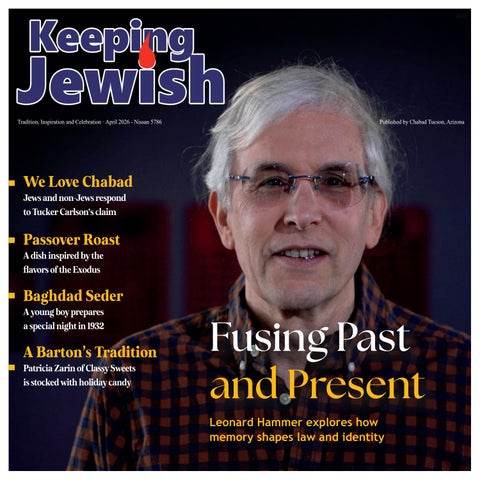
Jews and non-Jews respond to Tucker Carlson‘s claim
Passover Roast
A dish inspired by the flavors of the Exodus Baghdad Seder
A young boy prepares a special night in 1932
A Barton’s Tradition
Patricia Zarin of Classy Sweets is stocked with holiday candy
Fusing Past and Present
Leonard Hammer explores how memory shapes law and identity
Published by Chabad Tucson, Arizona
EXECUTIVE DIRECTOR
Rabbi Yossie Shemtov
REBBETZIN
Chanie Shemtov
OUTREACH DIRECTOR
Rabbi Yehuda Ceitlin
PROGRAM DIRECTOR
Feigie Ceitlin
Chabad of Sierra Vista, Chabad of Vail and Lamplighter Chabad Day School of Tucson
EDITOR
Rabbi Yehuda Ceitlin
COPY EDITOR
Suzanne Cummins
CONTRIBUTING WRITERS
Feigie Ceitlin, Sari Kopitnikoff, Anne Lowe, Menachem Posner, Tzali Reicher, Mordechai Schmutter, Yehuda Shurpin, Lilian Wasserman, Benjamin Weiss
PHOTOS
Unsplash.com
SPECIAL THANKS Chabad.org
EDITORIAL & ADVERTISING
Phone: 520-881-7956 #12
Email: info@ChabadTucson.com
SUBSCRIPTION: ChabadTucson.com/SubscribePrint
Keeping Jewish is published in print periodically by Chabad Tucson and is distributed free in Tucson and Southern Arizona. Chabad Tucson does not endorse the people, establishments, products or services reported about or advertised in Keeping Jewish unless specifically noted. The acceptance of advertising in Keeping Jewish does not constitute a recommendation, approval, or other representation of the quality of products or services, or the credibility of any claims made by advertisers, including, but not limited to, the kashrus of advertised food products. The use of any products or services advertised in Keeping Jewish is solely at the user’s risk and Chabad Tucson accepts no responsibility or liability in connection therewith.
Note: “G-d” and “L-rd” are written with a hyphen instead of an “o .” This is one way we accord reverence to the sacred divine name. This also reminds us that, even as we seek G-d, He transcends any human effort to describe His reality.
Tucker Carlson’s Myth About Chabad
By Rabbi Yehuda Ceitlin
Far-right commentator Tucker Carlson recently claimed that the ChabadLubavitch movement instigated the current war in Iran as part of a covert effort to rebuild the Holy Temple in Jerusalem. The claim is not only bizarre and unfounded; it reflects a basic misunderstanding of what Judaism is and how it operates.
It took me back to my days visiting Washington, D.C. alongside Rabbi Abraham Shemtov, one of Chabad’s most prominent figures and its representative in the nation’s capital.
At the time, I was a young rabbinic intern serving as his assistant. Based in Philadelphia, we would take an Amtrak train to Union Station and then head to the halls of power.
I watched him move through the corridors of the White House and Capitol, meeting senators and administration officials. He carried a sleek black attaché case. It held no maps of the Middle East or policy briefings. When he opened it, as a Washington Post profile once described, he took out a tray of lox, whitefish, and sable, alongside potato salad, cream cheese, and fresh rye bread.
Why would a rabbi schlep a kosher deli spread from Philadelphia to the heart of Washington? He would lay out the food, creating a setting where conversations could unfold and relationships could form.
The purpose of his visits, as he told the Post, was to serve as a “messenger.”
A lobbyist typically seeks a specific outcome. Shemtov’s goal was different. He wanted leaders to act with a deeper sense of purpose, to remember the “overall purpose of life.”
When a newly elected senator once asked if he was in town to discuss Soviet Jewry, Shemtov replied, “I am here for the whole world.” He saw this as a moral mandate, to be a “light unto the nations,” encouraging policymakers to act responsibly for the benefit of all people.
Shemtov, to whom I later became related through marriage, focused his decades of advocacy on education, which he viewed as the bedrock of society. He pushed for the creation of the Department of Education, served on the National Advisory Council on Adult Education, and helped establish “Education and Sharing Day, U.S.A.,” a national day dedicated to character building.
In those same marbled hallways, he spoke about the Sheva Mitzvos Bnei Noach, the Seven Noahide Laws, a basic moral framework for all humanity: respect for life, property, family, the treatment of living creatures, and justice, grounded in the recognition of a Divine authority.
This is where Carlson gets it wrong. He assumes religion operates as a form of power, that every belief conceals a strategy, and every movement advances an agenda. Judaism emphasizes obligation, not power. It measures success not by control over events, but by fidelity to a moral framework.
The Jewish role is to live by that framework and let it shape our actions. Chabad’s work reflects this premise. Its focus is on people, education, community, and the steady work of strengthening moral and spiritual life.
The claim that Chabad lobbied for a war to build a Temple misunderstands the entire enterprise. As Shemtov told a reporter in 1983, the Jewish task is constructive. “We have to build a better world,” he said with a smile. “G-d will take care of the Temple.”
The real danger of Carlson’s myth is not limited to people believing strange things or acting on them. It is the mindset that such thinking creates, where nothing is guided by principle, and everything is reduced to power.
And in that kind of world, even a Chassidic rabbi with a tray of whitefish starts to look like a threat.
- Rabbi Yehuda Ceitlin is the Outreach Director of Chabad Tucson, the Jewish network of Southern Arizona
The Jewish outreach and education network of Southern Arizona 2443 E 4th Street, Tucson, AZ 85719
Affiliates: Congregation Young Israel, Chabad at the University of Arizona, Chabad on River, Chabad of Oro Valley,
‘Here’s My
Chabad Story’
Jews and non-Jews impacted by Chabad share their appreciation
Nick Matau, a Navy veteran and commentator with a large following on social media, had seemingly no direct stake in an online argument about a Chassidic Jewish movement. But when he saw slanderous disinformation being spread online about the ChabadLubavitch movement by a pair of online provocateurs, Matau pulled out his phone and recorded a video.
He told the story of finding himself, during a moment of personal crisis during his military service in Hawaii, outside a Chabad center towards the end of Shabbat. The rabbi opened the door, and Matau told him he wasn’t Jewish and that he would be on his way.
“They didn’t care that I wasn’t Jewish; there wasn’t even a pause,” he said. “They fed me and included me in their activities. The rabbi took my number and told me to reach out if I ever needed anything.”
Matau’s video was one of thousands of messages of support for Chabad shared across the internet over the past week, after a conspiratorial podcast disingenuously spread falsehoods about basic Jewish beliefs, attempting to frame Chabad as a shadowy cabal behind the ongoing American and Israeli military operation in Iran.
From across the internet came the tributes and messages of gratitude. Jews who had lit Shabbat candles and wrapped tefillin for the first time at a Chabad center. Non-Jews who had been welcomed to a meal when they knew nobody in the city. College students who found their footing at a Chabad center on campus, and couples who had found their spouses at Chabad. Story after story, from every corner of the world.
By Tzali Reicher
Karol Markowicz, a columnist for the New York Post, described Chabad as “the warmest, kindest, most welcoming organization ever that does nonstop charity work.”
“They are an incredible organization that is spreading light in the world, including to non-Jews like myself,” Matau concluded in his post. “ … Anyone who is telling you otherwise is lying to you, and pushing an agenda, trying to divide an organization that is very much a light unto the nations in whichever community they’re in.”
Among those moved to respond was Harley Finkelstein, president of e-commerce giant Shopify.
On X, he described his years as a law student at the University of Ottawa, when the local Chabad on Campus center ran Friday-night dinners out
of a rabbi’s living room. Students packed every corner. “Total chaos. Total warmth,” is how Finkelstein pithily described the atmosphere.
Years later, Finkelstein made good on a promise he’d once made to the rabbi, donating $2 million to build a permanent Chabad center on campus—a building that today bears his family’s name. When the attacks on Chabad spread across social media, he and his wife, Lindsay, donated again, this time to 13 Chabad campus centers across Canada, encouraging others to join them.
“To everyone at Chabad: thank you,” he wrote. “From every Jewish person, and frankly anyone, you’ve been welcomed with open arms and genuine care over the years. Chabad is one of the most extraordinary organizations in the world. I’m deeply grateful to be part of this community.”
Finkelstein was far from alone. At the University of Florida, a donor contacted Rabbi Berel Goldman with an $18,000 gift. He was encouraged to show his support after hearing of the scurrilous attacks. Many others, both Jews and non-Jews, also shared that they were donating to their local Chabads, pushing against those who seek division and hatred. American Jewish activist Shabbos Kestenbaum, for example, donated to Chabad Tucson.
Most moved were those who shared Chabad’s impact on their Judaism and who were encouraged to learn more Torah and perform more mitzvot. Many men committed to laying tefillin the next day to show their solidarity.
Daniella Greenbaum Davis, a Jewish commentator and former producer on “The View,” shared her story.
After suffering repeated miscarriages and feeling unmoored, she felt the urge to restock her house with Jewish books and place mezuzot on her doors. But it was an hour before a major Jewish holiday, and all Jewish institutions were already closed. She reached out to Chabad, and a rabbi was at her home within 20 minutes with everything she was looking for.
“Geopolitical masterminds responsible for the Iran war? Not so much,” she wrote on X. “Just the kindest people you will ever meet who believe they are put here on this earth to spread goodness and godliness and help anyone, with anything, at any time.”
If you have a Chabad story or memory to share, email info@ChabadTucson.com
Chabad Rabbi Naftoli Schmukler embraces Hurricane Harvey survivor Ed Flower in Port Aransas, Texas (2017). Photo: Verónica G. Cárdenas / Chabad.org
Fusing Past and Present
Leonard Hammer explores how memory shapes law and identity
By Lillian Wasserman
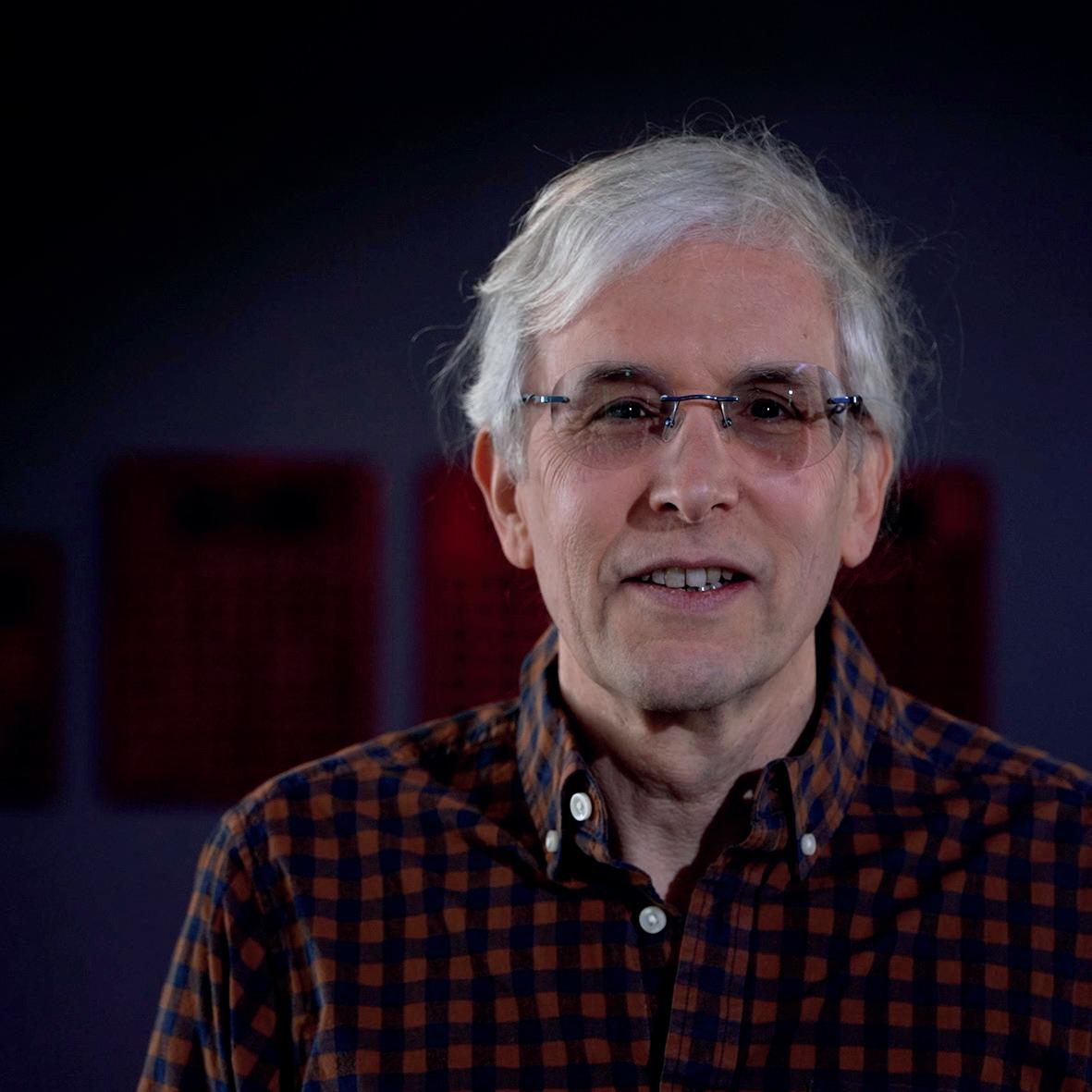
Leonard Hammer’s career has unfolded across continents, legal systems, and political cultures. He has taught in Jerusalem, conducted research in Taiwan, helped develop human rights law programs throughout the former Soviet Union, and lectured at universities worldwide.
Across these settings, a consistent question has guided his work: how societies remember their past, particularly when that past includes persecution and suffering.
Hammer, a faculty member at the University of Arizona’s Center for Judaic Studies and the Edwin and Alma Lakin Chair on the Holocaust, Human Rights, and Comparative Genocide, has spent decades examining the intersection of international law, religion, and memory. His work ranges from religious freedom to the legal status of sacred spaces in Jerusalem. Underlying it is a broader concern: how memory shapes identity, law, and moral responsibility.
His intellectual outlook developed early. Born in San Diego in 1964 and raised in an Orthodox Jewish family in New York, he attended Zionist schools where Hebrew and Jewish texts were part of daily life. Jewish history was not abstract but embedded in ritual and experience.
In 1988, he made Aliyah to the holy land of Israel, a decision rooted in a sense of
historical participation. “I saw it as an amazing historical opportunity to live as a Jew in a country where Jews are the majority,” he says.
He has maintained that connection ever since. His family lives in Israel, and the country remains central to his personal and intellectual life.
Hammer later pursued legal studies in the United States and Europe, earning a J.D. from Georgetown University, an LL.M. in international law from New York University, and a Ph.D. in law from the University of London.
His academic path soon expanded into international work. For a decade, he serves as an international scholar with the Open Society Foundation, helping establish graduate programs in human rights law across countries emerging from the Soviet sphere of influence. Working with universities in Azerbaijan, Georgia, Ukraine, and Kyrgyzstan, he helps develop legal education programs focused on human rights and democratic governance.
The experience exposes him to societies negotiating their relationships with difficult pasts. Legal systems are shaped by how those societies understand their histories. In some contexts, past injustices are openly confronted; in others, they are minimized or contested. The variation makes clear that memory
itself plays a decisive role in shaping law and public life.
The Purpose of Memory
In recent years, Hammer has focused more directly on memory as a social and cultural phenomenon. He studies how communities preserve traumatic pasts and transmit them across generations, and how those processes shape identity and moral discourse.
One focus is Holocaust memorialization. For Hammer, the issue is not only how the Holocaust is remembered, but how that memory continues to shape ethical frameworks today. He argues that Jewish tradition offers a distinctive model of collective memory—one that actively integrates the past into the present.
“For Jews,” he writes, “remembering is not simply recounting past events but an effort to fuse the past with the present.”
Jewish ritual provides concrete examples. At the Passover seder, participants recount the story of slavery in Egypt and are instructed to see themselves as part of the story. As the Haggadah reads, “In each and every generation, a person is obligated to see themselves as if they [personally] went out from Egypt.” Through this ritual, a distant event becomes a lived experience.
In this model, memory is not simply archival, he says. It becomes a shared framework that continues to shape identity and moral understanding across generations.
Hammer emphasizes this directly: “Memory is not solely about preventing the repetition of past mistakes; it is about recognizing the ongoing influence the past holds over the present.”
His own life reflects a similar continuity. He divides his time between the United States and Israel, maintaining homes in Jerusalem and in Shomera, a moshav near the Lebanese border. Although he spends much of the academic year in Arizona, Israel remains central to his family life.
In Times of Crisis
At the University of Arizona, Hammer teaches in the Center for Judaic Studies and works with the Human Rights Practice Program, a global online master’s program that brings together students from around the world. The program emphasizes applied
engagement, connecting students with practitioners working in areas such as refugee protection, international law, and humanitarian advocacy.
Because of his research interests and his public Jewish identity, students often turn to him to discuss issues affecting Jewish life on campus and beyond.
That role becomes more pronounced following the Hamas attacks on Israel on October 7, 2023, and the war that followed. Many Jewish students express increased anxiety about publicly identifying as Jewish.
Over time, Hammer observes a shift. While some students remain cautious, others seek stronger communal
The issue has become one of the most contested debates in international politics. Hammer approaches it through a legal framework, focusing on treaty definitions and the evidence required to establish intent.
Under the United Nations Genocide Convention, the central requirement is specific intent to destroy, in whole or in part, a national, ethnic, racial, or religious group. This threshold is deliberately high and requires proof of intent directed at the group as such.
Hammer aims to clarify how these standards function in practice—how courts interpret intent, evaluate evidence, and apply legal definitions in complex contexts.
For him, precision in applying the concept of genocide is also a matter of preserving memory. The term is historically tied to the Holocaust, and its misuse risks diluting its meaning.
As he explains, “We must be able to allow for real forms of memory actualization, reflective of how we (as Jews) understand memory. This could allow important past events like the Holocaust to remain clear and entrenched without falling victim to naysayers or Holocaust deniers.”
connections. Participation in Shabbat dinners hosted by Chabad at the University of Arizona more than doubles in the weeks following the attacks and has remained elevated.
For Hammer, such moments highlight how identity and memory interact. Periods of crisis often intensify the role of shared history in shaping how individuals understand themselves and their place within a broader narrative.
His work also extends into public engagement. On April 19, he will lead a workshop at Congregation Anshei Israel in Tucson examining whether accusations that Israel has committed genocide in Gaza meet the legal definition under international law.
In that sense, his work returns to a central idea: memory is not static. It is continually interpreted and applied, shaping how individuals and societies understand both their past and their responsibilities in the present.
* Genocide?! Examining the Accusation
Sunday, April 19, 3:00–4:00 PM
Cong. Anshei Israel
Registration required by April 15: www. tinyurl.com/HammerLecture
Passover 2026
What it is, why it matters, how to celebrate
By Benjamin Weiss
As the Sonoran Desert begins its lively spring bloom and the Tucson afternoon heat feels like summer arriving, the local Jewish community joins millions around the world in celebrating one of the most important festivals in the Hebrew calendar: Passover.
In 2026, Passover begins on the evening of Wednesday, April 1, and concludes after nightfall on Thursday, April 9. More than just a history lesson, Passover is a tribute to the birth of the Jewish nation and a profound reminder of the enduring power of faith.
At its core, Passover commemorates the Exodus—the liberation of the Israelites from over two centuries of Egyptian slavery. Under the leadership of Moses and guided by Divine intervention, a subjugated people was transformed into a cohesive nation bound by a unique spiritual mission.
The name Passover (Pesach in Hebrew) refers to the climactic moment of the Exodus. During the tenth and final plague—the slaying of the firstborn—G-d passed over the homes of the Israelites, sparing them while the Egyptians
were struck. This act of distinction marked the final step toward freedom.
Today, we celebrate this transition from bondage to liberty for eight days (seven in Israel). It is a time defined by specific rituals, most notably the removal of leavened grain (chametz) and the eating of unleavened bread (matzah).
The Search and the Spark
Preparing for Passover is often as significant as the holiday itself. It begins with a thorough cleaning
of the home to ensure not a single crumb of chametz remains. Chametz includes any food or drink made from wheat, barley, rye, oats, or spelt that has had more than 18 minutes to rise—symbolizing the puffiness of ego and pride.
This physical cleaning culminates on the night before the Seder with Bedikat Chametz, a candle-lit search for any remaining crumbs. It is a final meditative check to ensure our homes—and by extension, our hearts—are free from the leaven of arrogance. By Wednesday morning, April 1, any chametz found is
Chametz search of morning,
burned or nullified, and the home is officially ready for the festive week ahead.
The morning before Passover is also the time for the Fast of the Firstborn, a unique observance where firstborn males fast to commemorate being spared during the tenth plague. Many attend a Siyum (a celebration marking the completion of a section of Torah study) at their local synagogue on Wednesday morning, which allows them to break the fast with a celebratory meal.
Key dates to remember:
Search for Chametz: Tuesday night, March 31.
Burning of Chametz: Wednesday morning, April 1.
The First Seder: Wednesday night, April 1.
The Second Seder: Thursday night, April 2.
Chol Hamoed days: April 4-7
Final Days: Tuesday night, April 7 to April 9.
The Seder: A Night of Storytelling
The focal point of Passover is the Seder, a ritual meal held on the first two nights. Families and friends gather around a table set with symbolic foods, following the Haggadah—the guidebook that tells the story of the Exodus.
The Seder is designed to engage the senses and provoke questions, especially from children. We drink four cups of wine, representing the four expressions of redemption mentioned in the Torah: “I will bring you out,” “I will deliver you,” “I will redeem you,” and “I will take you to be My people.” We eat bitter herbs (maror) to taste the bitterness of slavery, and we recline comfortably to experience the luxury of freedom.
The star of the Seder is the Matzah. When the Israelites fled Egypt,
they left in such a hurry that their dough did not have time to rise. The resulting flat, unleavened bread is the Bread of Affliction that turned into the Bread of Freedom. For the best fulfillment of the mitzvah, many use handmade Shmurah Matzah, which is watched from the moment of harvest to ensure no moisture touches the grain prematurely.
Counting the Days
Beginning on the second night of Passover (Thursday night, April 2), we begin the mitzvah of Sefiras Haomer, or the Counting of the Omer. This is a 49-day verbal count that links the physical liberation of Passover to the spiritual revelation of Shavuot, which begins in 2026 on the evening of Thursday, May 21.
Passover Essentials Checklist
Clean Your Home: Thoroughly clean your home and car to remove all leaven (chametz).
Sell Your Chametz: Legally transfer any remaining leaven to a non-Jew at ChabadTucson.com/chametz
The Seder Plate: Prepare shankbone,
Candle Lighting Times – Tucson, AZ
Wednesday, April 1 (Erev Pesach): 6:25 PM
Thursday, April 2 (Pesach II): After 7:21 PM (From pre-existing flame)
Friday, April 3 (Pesach III / Shabbat): Before 6:27 PM
Historically, this period tracked the barley offering brought to the Holy Temple in Jerusalem; today, it serves as a vital time of self-refinement. Each of the seven weeks represents a different emotional attribute, such as kindness, discipline, or harmony. By counting the days and weeks, we move from the raw “slave-mentality” of Egypt toward the refined, elevated spiritual state required to receive the Torah at Mount Sinai.
The Miracle of the Sea
The concluding days of Passover are equally significant. The seventh day (beginning on Tuesday night, April 7) commemorates the greatest miracle of the Exodus: The Splitting of the Sea.
When the Israelites reached the banks of the Red Sea with the
egg, horseradish, charoset, karpas (vegetable), and chazeret (second bitter herb).
Three Matzot: Place three whole matzot on the Seder table.
Four Cups: Ensure enough red wine or grape juice for each guest to drink (minimum 3.5 ounces per cup).
Haggadahs: Provide guidebooks for all guests to follow the retelling of the Exodus.
Egyptian army closing in, G-d split the waters, allowing the Jewish people to pass through on dry land. This moment was the nation’s final birth pang. It was here that the Israelites broke into the “Song of the Sea,” a poetic expression of gratitude that we still recite in our daily prayers. It is customary to stay awake late into the night on the seventh eve to study Torah and sing the Song of the Sea, connecting with that original moment of sheer awe.
The eighth day carries a unique theme: The Future Redemption. On the final afternoon of Passover (Thursday, April 9), it is a Chassidic tradition to hold one last meal called Moshiach’s Seudah. Just as the first days celebrate our past redemption, the final moments focus on our belief in the ultimate, future redemption. We eat matzah and drink four more cups of wine, focusing on a time when the world will be filled with peace and G-dly knowledge.
This transition is intentional; we don’t just “finish” the holiday and go back to normal life. We exit the holiday by looking forward, carrying the freedom of the Exodus into our modern daily struggles. This final meal begins before sunset and serves as a bridge between the holiness of the holiday and our mission to refine the world in the days to follow.
Tuesday, April 7 (Erev Shvi’i shel Pesach): 6:29 PM
Wednesday, April 8 (Erev Acharon shel Pesach): After 7:26 PM (From pre-existing flame)
Thursday, April 9 (Holiday Ends): 7:26 PM.
Passover is not merely a history lesson; it is a spiritual rebirth. Every year, we are commanded to see ourselves as if we had personally gone out of Egypt. In 2026, as we gather around our tables in Tucson, we aren’t just remembering a 3,000-year-old event. We are celebrating that, despite all odds, the Jewish nation lives, grows, and continues to pursue its mission of bringing light and freedom to the world.
For more about the holiday and to find a Seder near you: Chabad.org/Passover
At Work: Patricia Zarin
Owner of Classy Sweets & Party Supplies
Store owner Patricia Zarin is always behind the counter during the operating hours of Classy Sweets, the most unusual (and only kosher-focused) candy store in Tucson. Located at Tanque Verde and N Sabino Canyon Road, Classy Sweets offers kosher candy, kosher for Passover candy, party favors, notary services, bagels, T-shirts, jigsaw puzzles, and anything else that Patricia decides fits into the tiny store’s offerings.
What got you started with Classy Sweets?
My father opened a party supply store in 1977. Classy Sweets is the 10th store. I started here in 2014.
What made you focus on Jewish products?
My heritage. I was raised keeping kosher as a young child. My grandfather was a kosher butcher in Belle Harbour, New York.
What is your Jewish name? Penina.
What is your favorite part of the job?
People are my favorite part. I love watching them taste something they have never had. I love it when people come in and say, “I hate dark chocolate,” and then they love what I give them to try.
Can you share a memorable moment?
When my son Ben was 4 or 5 years old, I would tell him, “When I am with a customer, don’t talk to me until they leave.” He followed my instructions to the “t,” and when he cut his finger and
started to bleed, he didn’t interrupt. Instead, he found a tampon, tied the cotton part to his finger with the string, put some tape on it, and said, “I found a new kind of band-aid.”
What has been your biggest challenge?
Money. This store is a labor of love, but it is not profitable. I keep it alive for love, but it is a financial strain. Still, I would not want to do anything else. I use my Social Security to subsidize it.
What has changed since you started? Covid just about stopped the business in its tracks. It has never fully recovered, even though I started stocking jigsaw puzzles because of Covid, and those still sell. (I have Jewish puzzles too!)
What is something exciting on the horizon?
I don’t know... I always hope more people will fall in love with what I have here. I want to teach people how to savor chocolate – and other candy – rather than just chew and swallow.
What do you do outside of work?
Puzzles – I got into them during Covid myself, and I can do them despite the pain from arthritis.
What is your go-to comfort food?
Chocolate, but in moderation.
What piece of advice do you live by? Honesty in all things.
Classy Sweets & Party Supplies
7051 E Tanque Verde Rd, Tucson, AZ (520) 322-5059
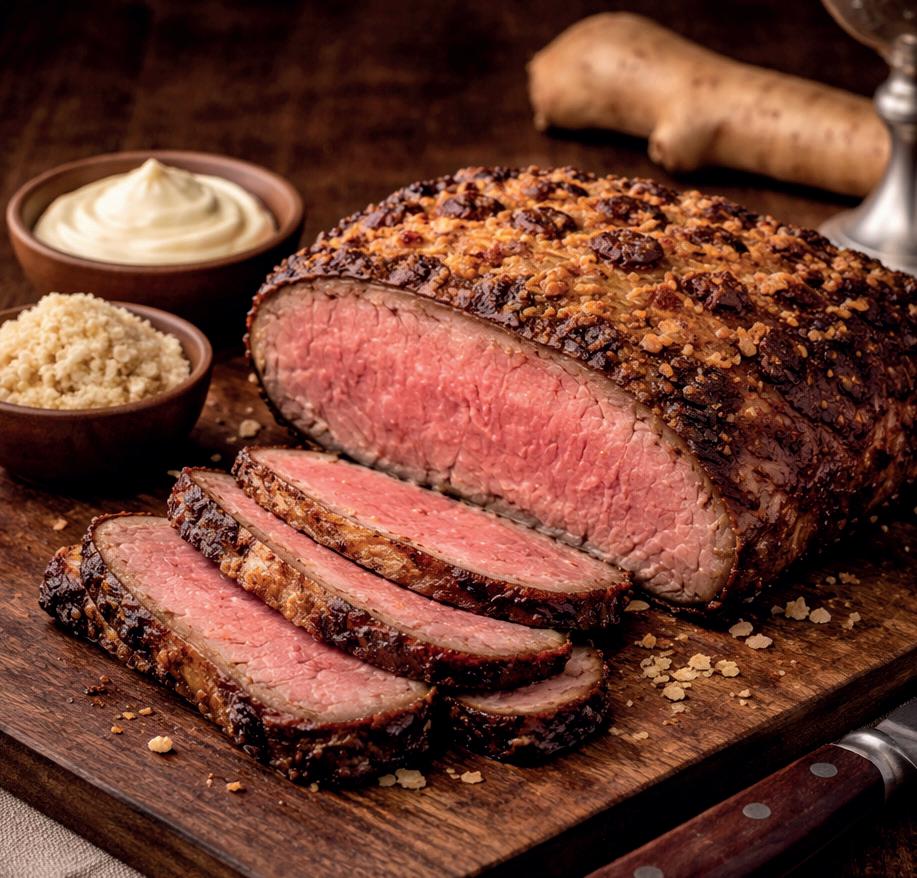
French Roast with Horseradish Crust
By Feigie Ceitlin
In ancient Jerusalem, during the era of the Temple, the sage Hillel was said to combine roasted meat from the Passover offering with bitter herbs and matzah into a kind of sandwich. This roast draws on those core Passover flavors, bringing together meat and horseradish in a simple, contemporary form.
Ingredients (ensure the ingredients are certified kosher for Passover):
Beef roast (French roast cut)
Salt
Freshly ground black pepper
Fresh horseradish root, grated Mayonnaise
Instructions:
1. Preheat the oven to 350°F (175°C).
2. Pat the roast dry.
3. Spread a thin, even layer of mayonnaise over the entire surface of the meat. Season generously with salt and
freshly ground black pepper, then coat with freshly grated horseradish, pressing it lightly so it adheres.
3. Heat a heavy pan over medium-high heat. Sear the roast on all sides until browned, approximately 10–15 minutes total, depending on the size of the roast. This method is calibrated for a rare to medium finish.
4. Transfer the roast to a roasting pan and place in the oven uncovered. Roast for 30 minutes.
5. Remove from the oven and allow the meat to rest before slicing.
Blessed are You, L-rd our G-d, King of the universe, by Whose word all things came to be.
A
The Baghdad Seder
young boy prepares with his family for Passover in 1932
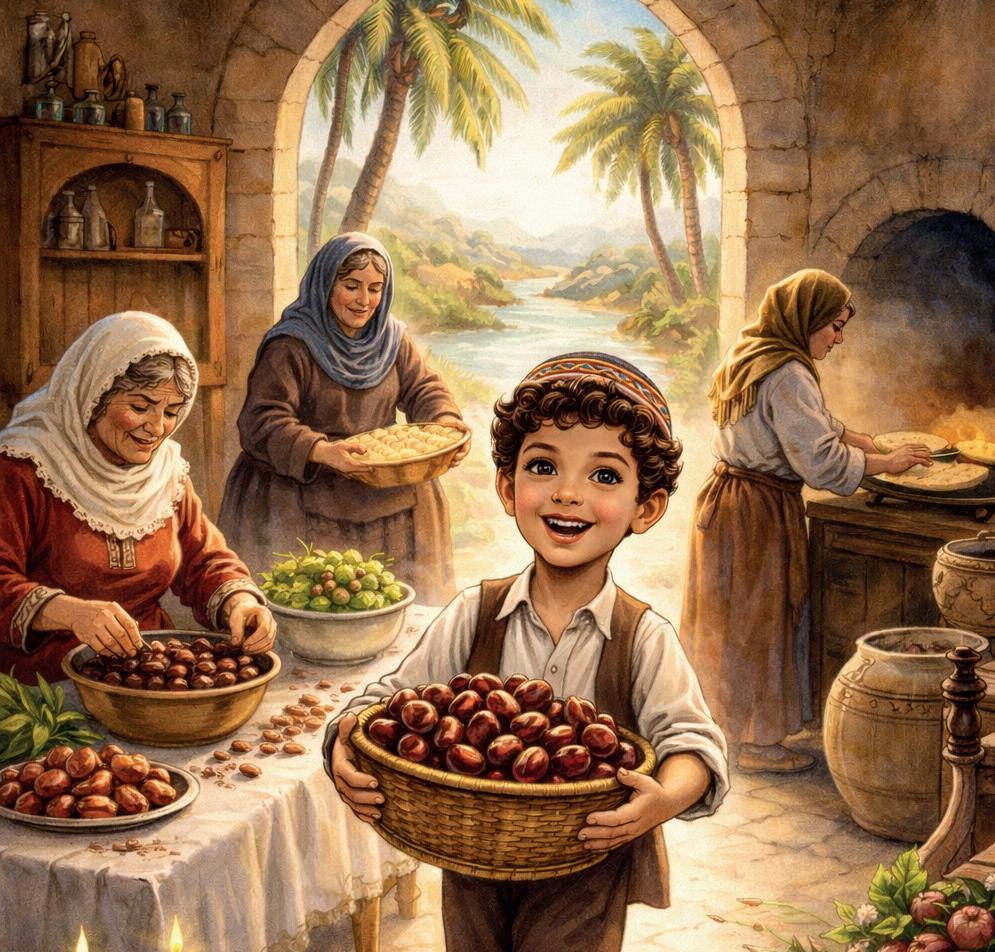
When Eli began helping his family prepare for Passover, he was excited. Earlier that day, in Baghdad in 1932, he and his friends had gone down to the Tigris River, shaking the date palms and gathering the fruit.
The boys filled their stomachs with dates, but Eli had a special task. He needed to bring home enough fruit for his aunt and grandmother to make charoses for the Passover seder the next night. Swinging his leather bucket filled with dates, he raced toward the kitchen.
Eli knew that charoses symbolized the mortar the Israelites used as slaves in Egypt thousands of years ago. Grandmother’s charoses was made from thick date syrup mixed with crushed walnuts. Every child (and grown-up) in the family looked forward to this treat. Special Passover foods made the holiday Eli’s favorite, and charoses was even better than marzipan candy or macaroon cookies.
When Eli burst into the kitchen, he saw his mother and Sarah the Burnt busy making round flat pieces of matzah. Matzah, Eli knew, reminded the Jews of their flight from slavery in Egypt. When Moses led them out, there was no time for their bread to rise.
In Baghdad, Sarah the Burnt went from home to home helping families bake their matzah. For as long as Eli could remember, that had been her name. She carried small burn scars on her face, arms, and hands from countless hours leaning over the hot ovens used to bake matzah from flour and water. But the scars never seemed to bother her. She was proud of her work. After all, no one could celebrate Passover without
by Anne Lowe
Finally, his mother glanced up. “Take your bucket of dates to Grandmere,” she told him.
At home, they spoke French, so he called his grandmother Grandmere.
“Grandmere,” Eli said, “on the way home from the orchard, I brought dates to Tante Claire. When I got there, I heard cousin Sasson singing ‘Mah Nishtanah.’ He was practicing the Four Questions!”
Grandmere looked at him over her glasses. “What is surprising about that?
It is time for him to take part in the seder. Last year, he carried the matzah on his back, as our ancestors did in Egypt. This year, he will chant the questions.”
Eli’s eyes widened. “You mean Sasson won’t be bringing the matzah this year?”
Grandmere smiled. “No, I’m sure that won’t be his job. So who do you think could do it?”
“I can! I can!” Eli shouted. He spun around in excitement until one of his sandals flew off. For a seven-year-old boy, wearing the special cloth filled with
matzah was a dream. Laughing with joy, he ran off to find Channah.
She was polishing silver Passover platters with two servants. Eli tugged her sleeve until she looked up impatiently.
“What do you want?”
“We have to find the sacred embroidered cloth. I’m bringing the matzah this year!”
Channah rolled her eyes. “I’m busy. Look in the Passover closet. It’s probably with the Haggadahs.”
He began planning everything he needed to become the old man from the desert who carried the matzah to the seder, but first he needed the embroidered cloth, white but yellowed with age. Maybe it was as old as Moses himself. He would also need a cane so he could walk bent over like an old man. Instead of his usual shorts, he would wear long black pants.
“Maybe I’ll borrow Grandpere’s cane,” Eli whispered to himself. “He only uses it when his knees ache, and surely they won’t ache on Passover.”
The cane was easy to find, leaning against the wall in his grandfather’s bedroom. On Eli’s bed lay the long black pants his mother had sewn to wear with his new white shirt.
But where was the matzah cloth?
Eli hurried to the Passover closet near the dining room. The door stood open while everyone polished silver and sorted dishes.
matzah.
The Haggadahs were stacked on a shelf. Eli pulled one out and sat cross-legged on the stone floor. As he opened it, memories of last year’s seder returned.
The pages fell open to the Ten Plagues: Blood, Frogs, Lice, Beasts, Blight, Boils, Hail, Locusts, Darkness…
This part of the seder always frightened him. When Grandpere dipped drops of wine from his goblet for each plague, Eli and the other children grew nervous. Did the wine contain the plagues? Was it cursed?
At the end of the seder, if any wine remained, a servant carefully carried it outside and poured it into the gutter, making sure none touched the walls of the house. Otherwise, the plagues might enter.
Eli quickly shut the book. He had more important things to do, like finding the cloth.
“How can I bring the matzah if I can’t find the cloth?” he muttered.
Soon, the entire household was searching. Channah, his mother, the servants, Grandmere, and even Sarah the Burnt helped him look.
The cloth had disappeared.
Eli finally crept back to his room. He threw the pants, shirt, and cane off his bed and collapsed onto the soft cotton coverlet, covering his face with his hands.
If he was supposed to be the old man from the desert, he had to be brave. But without the cloth, he could not bring the matzah. And without the matzah, how could the seder begin?
His mother came in and sat beside him, smoothing his hair.
“Mama, where could the cloth have gone?” he groaned.
“I know how much you want to be the old man from the desert tomorrow,” she said gently. “Why don’t I make you another cloth?”
“It wouldn’t be the same,” Eli replied. “Our cloth might have come from Moses himself.”
“Well, perhaps we will still find it. For now, can you help with the other preparations?”
Eli went outside with Grandmere to cut flowers for the seder table.
Later, she brought out the beautifully embroidered tablecloths she and her sisters had made decades earlier. For six months, they had stitched flowers, birds, and pomegranates into the fabric.
Eli and Channah each took a corner while Grandmere lifted the other side. She gently snapped the cloth, and it floated across the table.
As it billowed out, another cloth suddenly drifted into the air above it.
The matzah cloth.
It had been folded inside the tablecloth the previous year.
Eli stared as the small cloth floated downward and settled onto the chair where he always sat.
“I can’t believe it,” he whispered.
“The cloth knows who will wear it tomorrow,” Channah said softly.
For a moment, no one spoke.
Then Eli picked up the cloth. Embroidered across it were Hebrew words: “Let all who are hungry come and eat.”
Grandmere’s eyes filled with tears.
“Those are words from the blessing over the matzah,” she said. “It seems the
cloth has given you a blessing as well.”
When the guests gathered in the dining room, Eli slipped out the back door, circled the house, and knocked on the front door with his cane.
Papa opened the door and left it wide, as they always did for Elijah the Prophet and for all who were hungry.
Bent over his cane, Eli slowly limped inside.
Papa asked the traditional question. “Where are you coming from?”
“I am coming from Egypt,” Eli answered.
“And where are you going, old man?”
With great conviction, Eli replied, “I am going to the Land of Israel.”
“Then come,” Papa said. “Let us begin our seder.”
Eli smiled. His job was done. He had delivered the matzah so the Passover meal could begin. And this year, he would make sure the matzah cloth was packed away where he could find it again next Passover.
What Is Glatt Kosher?
By Yehuda Shurpin
Many supermarkets and caterers advertise as “glatt kosher,” which has come to mean “super-kosher” in common parlance. What does the term really mean, and how does one receive such a designation?
The word “glatt” actually means “smooth” in Yiddish, and refers to the lack of adhesions on the lungs of an animal. Most of the time, those would render an animal what we call “trief” - not kosher. That might lead one to believe that an animal is neither kosher nor “glatt” kosher if there are any adhesions in the lungs. But the road is not all that “smooth.”
Though, in the classical sense, glatt means there were no adhesions whatsoever, it is very uncommon to find totally smooth lungs in any cow. Most kosher meat sold nowadays as glatt relies on peeling and testing for adhesions to meet minimum standards for beef.
This, however, is the case only for beef. When it comes to other animals, such as deer, calves (veal) and lamb, all agree that no type of adhesion may be (or have ever been) present. Therefore, if you see such an animal being sold today as kosher, it would essentially be glatt kosher as well, or it would not be kosher at all.
Glatt is the Ashkenazic term and standard. The Sephardic equivalent, albeit more lenient, is called chalak (smooth in Hebrew), which follows the rulings of Rabbi Yosef Caro (“Beit Yosef”). In practice, many Sephardim follow the same guidance as the Ashkenazim to be certain about the meat they buy.
But to the extent there is differentiation, one can find three different types of kosher meat on the market: 1) plain kosher meat; 2) glatt kosher; and 3) glatt or chalak Beit Yosef, which follows the rulings of the Sephardim.
So if your local bakery advertises itself as “glatt,” it’s seemingly making the absurd claim that its cupcakes and donuts have healthy lungs. However, in colloquial speech, the term “glatt kosher” has come to be used—albeit inaccurately—to refer to something that is unquestionably kosher without relying on various leniencies.
At the same time, the opposite is also true. Nowadays, when the term “kosher non-glatt” is used for meat, it many times relies on various other questionable leniencies that have nothing to do with the issue of adhesions discussed above. This is just one of the reasons it is crucial, especially when it comes to beef, for kosher consumers to buy only products with reliable kosher certification.
PIONEERS
First Jewish Mayor of Tucson
Charles M. Strauss (1840–1892)
By Benjamin Weiss
Charles Moses Strauss was born in New York City on April 15, 1840, to Nathan and Rachel Strauss. In 1851, his father moved the family to Boston, where the young Charles started his education, studying Hebrew alongside his public schooling. At the age of sixteen, he began traveling between New York and Boston, where he worked for Converse & Harding Company and sometimes for his uncle.
Strauss moved to Memphis toward the end of the Civil War and met there
his future wife, Julia Kauffman. They married on May 10, 1868, and had their first daughter, Rosalie, a year later. They had three other children over the next decade. Sadly, Rosalie died at age 6.
Strauss’s political involvement may have begun in Memphis, where he served as secretary for Jewish citizens opposing Ulysses S. Grant’s presidential bid. Grant had ordered the expulsion of Jews from his military district, falsely claiming “Jews as a class” violated trade laws (President Abraham
Lincoln rescinded the order). Grant apologized during his campaign and, once elected, appointed many Jews to his administration.
In 1880, the Strauss family moved to Tucson, where he worked as the manager of the L. Zeckendorf department store. Two years later, Strauss announced his candidacy for mayor of the city. His opponent in the race was Hiram S. Stevens, who tried to boost his chances by exploiting underlying antisemitism among
Tucsonans. Stevens’ efforts failed, and Strauss was elected Tucson’s first Jewish mayor, with 444 votes to Stevens’ 419.
Strauss achieved many successes as mayor. He persuaded the city council to build a city hall, a public library, and a hospital, and to establish a street-grading program. Interestingly, Strauss’s tenure, which began on January 9, 1883, lasted just over a year and a half. He resigned on August 4, 1884, following a scandal involving an $11,350 budget deficit caused by the city’s excessive spending. Nevertheless, it was widely agreed that Charles Strauss had a stellar, if brief, mayoral career.
Despite the scandal, Strauss went on to serve in the public sector in Arizona in the years that followed. Among other things, he served as the Arizona Territory’s Superintendent of Public Education from 1886 to 1890 and advocated for education in rural areas. He was also a member of the Board of Regents of the University of Arizona, an institution whose founding he ardently supported and helped advance with other pioneering Jews such as Jacob Mansfeld and Selim Franklin.
Charles and Julia welcomed a fifth child—a daughter—in 1891. Sadly, his health began to deteriorate shortly after, and he passed away on March 13, 1892, at the age of 51. Tucsonans across the city mourned his death, and flags were flown at half-mast. He was initially buried in Tucson’s old city cemetery before his remains were moved to the Evergreen Cemetery.
–Presented in collaboration with the Tucson Jewish Museum to honor the city of Tucson’s 250th anniversary. For the full biography, visit tjmhc.org/profiles
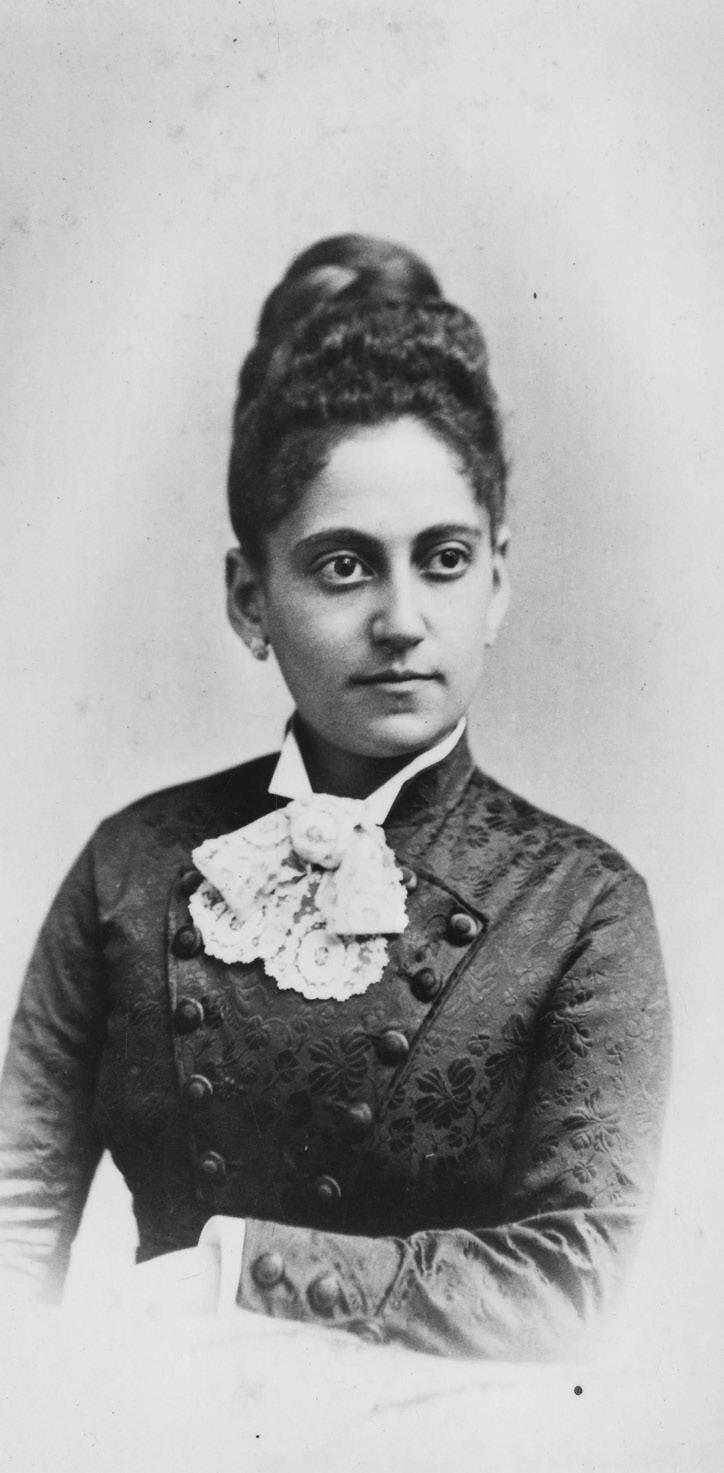
Julia Kaufmann Strauss, Charles and Levi Strauss posing as cowboys for a photo
Everything I Know About Cleaning
Because writing about Passover
preparations is easier than doing it
By Mordechai Schmutter
As a writer, I tend to spend a lot of time cleaning, mostly to push off writing articles. Except before Passover, when I write articles to push off cleaning. So today, the plan is to write an article about cleaning. I think the universe might explode as a result, but at least if it does, I can use that as an excuse to push off doing both of those things.
So, in my attempt to avoid cleaning for Passover, I am writing about a bunch of cleaning tips, which you can read as long as you bear in mind that my cleaning methods aren’t so much about getting results as they are about putting off doing other things. And at no time have I tested any of these cleaning tips, so don’t blame me if you decide to use untested stuff that you read about.
1. Passover cleaning may seem overwhelming, but the key is to remember you don’t have to clean under your refrigerator, because if you don’t move your refrigerator all year, there’s a pretty good chance you won’t move it on Passover either. Although this isn’t necessarily true, because you just know that the one year you don’t do it will be the year your kids decide to hide the afikoman by tossing it on top of the fridge, after which you hear it slowly sliding down the other side. Maybe you ought to clean under it just in case...
2. In order to stop garbage from piling up all over the house after you start cleaning, keep garbage cans everywhere. That way, everything will always be in a garbage can. Or near a garbage can. Or floating on top of it. I actually have a small garbage can near my desk, and for some reason, everyone in the house uses it more than they use the full-size garbage can in the kitchen. They literally travel across the house to put things in this tiny garbage can, so most of the time
I’m sitting at my desk and wrinkling my nose at the faint smell of old banana peels. So I’m thinking of putting my little can in the kitchen and putting the full-size can near me.
3. If you have any spoons that have at some point become treif and you cannot see a time in your life that you will ever remember to kasher them, you can use them to scrape things off your stove or the inside of your fridge. It’ll be your treif spoon! Every Jewish family needs one treife spoon. You can also pull it out when someone who isn’t Jewish comes for a meal.
4. If you have an entire room that’s dark and dingy, clean your light bulbs so you can see the dirt that needs to be cleaned up for Passover.
5. You can find several old yarmulkes behind the bed in your kids’ rooms. I don’t know what to do with them, but you should clean them for Passover anyway.
6. If your stove grates are too big for the sink, you can wash them in the bathtub. With the kids, I guess. Or have them do it. But they need to be washed for Passover.
7. To remove gum from something, such as a shoe or a yarmulke, stick it in the freezer for a while, and then occasionally go at it with a treif spoon. If there’s gum on your area rug, call your local supermarket and see if you can rent their freezer truck.
8. One thing people often forget to clean is their cleaning supplies. Some people might ask, “Why do I have to clean my sponge? I pour soap on it every day!” Yeah, and then you rub it against your dirty plates. Seriously, smell your sponge.
9. You can clean odors out of your fridge by refrigerating an open box of baking soda, if you can fit it in among all the rotting food. Or by removing the shoe.
10. Apparently, a lot of the tip sources
I’ve been looking at care less about chametz and more about hygiene. Like one of the articles said, if you want to keep your sponges from getting moldy, stand them upright using binder clips. Which is all well and good but the typical Jewish family has at least seven – fleishig, fleishig Shabbos, milchig, milchig Shabbos, pareve, pareve Shabbos, and treif. Every kosher house has a treif sponge. Maybe it’s for washing your treif spoon.
11. You can clean your treif sponge by putting it, along with some dish soap, into your treif microwave.
12. There’s no need to buy vacuum cleaner bags. Vacuum cleaner bags are a scam. You can just stick your finger into the bag’s opening and pull out dirt onto the garbage can while coughing hysterically. Though your husband, who’s sitting right there, won’t be thrilled. He’s finally trying to work.
“(Cough cough)! Did the universe just explode?”
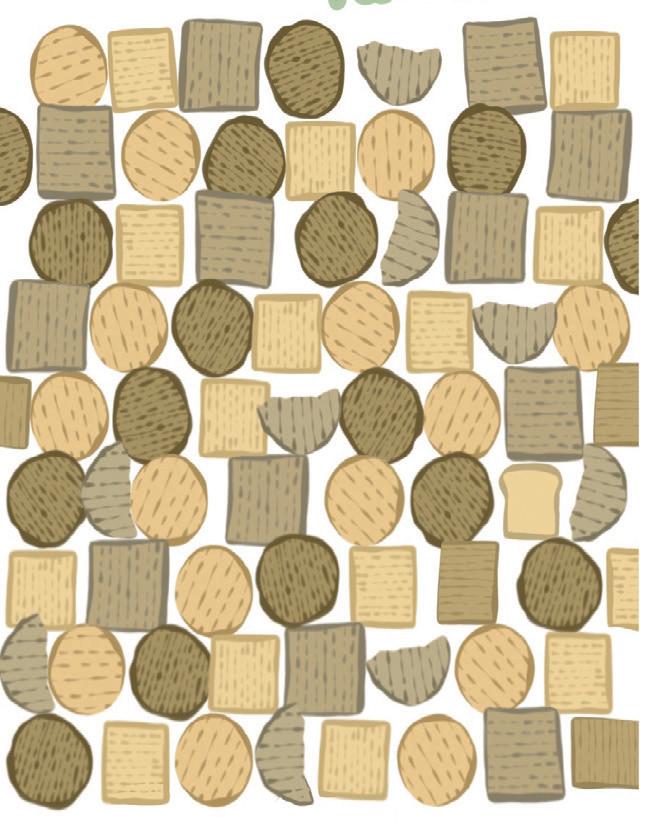
The Odd One Out Take the Splitting the Sea Quiz
By Menachem Posner
1. Which book of the Torah tells of the Parting of the Sea?
A. Genesis
B. Exodus
C. Leviticus
D. Numbers
2. Who passed safely through the sea?
A. Moses and his children
B. Miriam and the women
C. The Canaanites
D. The Israelites
3. Which people drowned in the sea?
A. The Egyptians, who pursued their erstwhile slaves
B. The Amalekites, who hated Israel
C. The Sufites, who lived near the sea
D. The Canaanites, who were punished
4. What did Moses raise for the sea to split?
A. His left sandal
B. His staff
C. A white banner
D. A flask of water from Pharaoh’s palace
5. Following the miracle, who led the People of Israel in song?
A. Moses
B. Aaron
C. Levi
D. Deborah
6. Who led the women in song?
A. Tzipporah, wife of Moses
B. Serach, who played the harp
C. Miriam, sister of Moses
D. Elisheva, wife of Aaron
7. When did the Parting of the Sea take place?
A. At night
B. At noon
C. In the early morning
D. The time is not known
8. True or false: The sea remained parted for a whole week