Keeneland Magazine - Spring 2026 Edition

Page 1


K EENELAND

celebrating bluegrass traditions

Saint Joseph Hospital named one of America’s 100 Best Hospitals in the nation.

Four years in a row.

Two of o o

FIERCENESS

MSW, Saratoga, 25 Aug

Won by 11¼ lengths

Breeders’ Cup Juvenile Won by 6½ lengths

2023 Eclipse Champion 2YO

Watch this space!

Fee: $50,000

Dermot Ryan, Charlie O’Connor, Adrian Wallace, Robyn Murray, Blaise Benjamin, Charles Hynes or Michael Norris. Tel: 859-873-7088.

April 9 & 10 th th Spring Diamond Event

April 25 th David Yurman Mother’s Day Shopping Event

BRUNCH LUNCH DINNER

Styled in partnership with Carl Meyers.

JOSEPH HILLENMEYER GARDEN DESIGN

At Joseph Hillenmeyer Garden Design we create spaces for connection and meaning, places with context and history. We bring new solutions to timeless tradition and practicality to our art. We derive inspiration from the bigger landscape in which each project is situated, knowing that meaningful outdoor spaces expand our lives. The best landscapes bridge architecture to nature and draw us outside. In each design, we aim to pair elegance with simplicity, to balance abundance with restraint, and to communicate a sense of grace.

FEATURES

56 POWER PLAYER

Spendthrift Farm goes from strength to strength with an enviable stallion roster, much success on hometown track Keeneland, and a strong hand for 2026.

76 FULL CUP

The Breeders’ CupWorld Championships have evolved from a controversial idea that required much compromise to America’s marquee racing event.

90

GROWING UP FAST

Keeneland’s early 2-year-old races reward precocity and quality.

106

LARGE AND IN CHARGE

Supersized lead pony Harley attracts attention far beyond the racetrack.

124 MAKING BEAUTIFUL MUSIC

The Central KentuckyYouth Orchestras, one of the nation’s oldest independently chartered youth orchestras, offers musical opportunities to hundreds of students.

138 CULTURE CLUB

Lexington’s new Camel Club offers a mix of coworking and social events in an eclectically designed space.

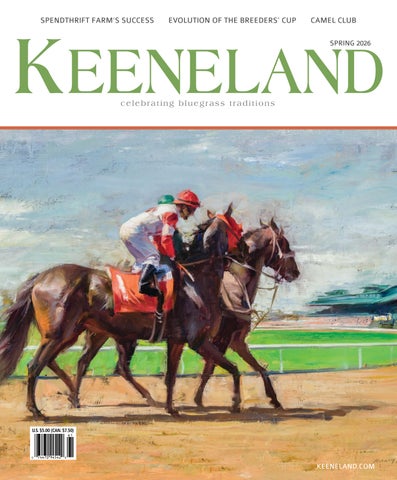
ON OUR COVER

Heading to Post Oil on board, 16” x 24” by Quang Ho

Ho came to America fromVietnam with his family at age 12 in 1975. His interest in art was apparent as early as age 3, and he graduated from the Colorado Institute of Art in 1985 with the Best Portfolio Award. He continues his interest in art and education as a teacher at the Denver Art Students League. After graduation, Ho was promoted by art dealer Mikkel Saks, and the artist’s clients have included Adolph Coors Company, Upjohn, Safeway, the Colorado Symphony, and the Chicago Symphony.

K EENELAND

celebrating bluegrass traditions

The offcial magazine of Keeneland Association, Inc. published by Blood-Horse LLC 821 Corporate Dr., Lexington, KY 40503 (859) 278-2361/FAX (859) 276-4450 KeenelandMagazine.com BloodHorse.com

Editor: Jacqueline Duke

Artists: Catherine Nichols (Art Director), PhilipTruman

Copy Editor: Judy Marchman

Visuals Director: Anne M. Eberhardt

Creative Services: Jennifer Singleton (Director), Forrest Begley

Account Executive: Katherine White

Sales Support: Catherine Johnston

CORPORATE OPERATIONS

Circulation Accounting Manager: Lauren Glover

General Manager: Scott Carling

PUBLISHED BY Blood-Horse LLC

BOARD OF DIRECTORS

Everett Dobson, James L. Gagliano, Carl Hamilton, Ian D. Highet, Brant Laue, Dan Metzger, David O’Farrell

Road P.O. Box 1690

Kentucky, U.S.A. 40588-1690 Tel: (859) 254-3412 (800) 456-3412 Keeneland.com

PRESIDENT’S MESSAGE

SPRING 2026

Lessons from a Dear Friend

There are moments in life that remind us of a simple truth that is easy to forget: Tomorrow is not promised. That reality is not meant to discourage us but to awaken us.

We lost our dear friend Tony this winter — a man who loved the sport of Thoroughbred racing, Thoroughbred auctions, and the fascinating people and life that come along with those. He too was a fascinating man, taken from us far too soon. He was larger than life, both in stature and in spirit. He traveled the world selling Blanton’s Bourbon, among his other business ventures, and was the ideal person to invest in our sport.

He understood through his own life experiences how sweet are the highs and how tough are the lows. Throughout all of his highs and lows, nothing else mattered as long as he was standing beside the love of his life, his wife, and their two sons — their whole world. Our friend introduced me to the legendary Italian tenor Andrea Bocelli, hosting us at his concert not once, not twice, but three times, the fnal time being the night Tony died. We had planned to go to the concert together with our families, but he found himself in the hospital for some tests. No one imagined he wouldn’t be with us for the next Bocelli concert.

When Bocelli sang at the Winter Olympics

opening ceremony, I know Tony was listening and smiling somewhere, delighting in the message Bocelli espoused that night: the importance of the world sharing moments of unity.

Unity does not require us to be the same; it asks only that we lead with respect, compassion, and a shared sense of humanity. Tony certainly lived his life leading with those principles. And along with his unforgettable sense of humor, zest for life, and fun, Tony made the most of each day. Making the most of each day does not mean living in haste or pressure. It means being present where we are, doing our best with what we have, and recognizing that even ordinary days present an opportunity to be kind and make the lives of those around us better.

We honor the uncertainty of tomorrow by living today with purpose, compassion, and gratitude.

“Do not squander time. For that’s the stuff life is made of,” said Benjamin Franklin.

We’ve been spending our time getting Keeneland ready for you to be with us this April during the spring meet. We can’t wait to see you at the races and to make the most of each day.

Cheers to blue skies ahead. KM

CONTRIBUTORS

WILLIAM BOWDEN (DevelopingTomorrow’s LeadersToday) most recently worked as publications editor atTransylvania University. He was formerly a writer and editor at the Somerset (Kentucky) Commonwealth Journal, the Lexington Herald Leader, and the NationalTour Association.

RICH COPLEY (Making Beautiful Music) spent 20 years as an arts and entertainment journalist for the Lexington Herald Leader. He is now a multimedia producer for the Presbyterian Church (U.S.A.) and a freelance writer and photographer based in Lexington.

LIANE CROSSLEY (Large and In Charge) has spent her career in Thoroughbred racing-related jobs in barns, press boxes, and offces. A seasonal member of Keeneland’s media team, she has had her work appear in BloodHorse, Daily Racing Form,Thoroughbred Daily News,ThoroughbredTimes, and other publications.

AMY GREGORY (On a Mission) recently retired as the longtime director of communications at Keeneland. She began her career in racing as a feature writer forTheThoroughbred Record and has held media relations positions with Breeders’ Cup and Churchill Downs.

JENNIFER KELLY (Growing Up Fast) is a lifelong racing fan, author, and historian specializing

in the AmericanTriple Crown. She is the author of “Sir Barton and the Making of theTriple Crown” and “The Foxes of Belair: Gallant Fox, Omaha, and the Quest for theTriple Crown.” She contributes regularly to America’s Best Racing,TwinSpires,Trainer Magazine, and BloodHorse.

AMY OWENS (Keeneland News/ Connections) is Keeneland Communications Associate.

TOM PEDULLA (Full Cup) wrote for USA Today from 1995 until 2012 and has contributed toThe New YorkTimes, the Los Angeles Times, America’s Best Racing, and BloodHorse among other outlets. He co-wrote Hall of Fame jockey Jerry Bailey’s critically acclaimed autobiography “Against the Odds: Riding for My Life.”

ROBIN ROENKER (Culture Club) is a Lexingtonbased freelance writer who reports on health care, higher education, travel, and all things uniquely Kentucky. In addition to Keeneland, her writing has appeared in AARP, Southern Living, USAToday, Atlanta magazine, and more.

LENNY SHULMAN (Power Player) is a senior correspondent for BloodHorse and the author of “Head to Head: Conversations with a Generation of Horse Racing Legends,” “Justify: 111 Days to Triple Crown Glory,” and “Ride of Their Lives:TheTriumphs andTurmoil ofToday’sTop Jockeys.

One Destination for Success.

April Selected Horses of Racing Age Sale

Proven runners and ready-to-race prospects come together in a high-energy live-auction setting, carrying the momentum of race day seamlessly from the track to the sales pavilion.

April 24 | Entries Close April 1

September Yearling Sale

Following a historic, record-breaking $531 million gross in 2025, the World’s Yearling Sale continues to set the standard for the global yearling market.

September 14-26 | Entries Close May 1

Championship Sale

Unique sales event for select offerings returns to the Breeders’ Cup at Keeneland.

October 28 | Entries Close October 8

November

Breeding Stock Sale

2026 SALES Premier Sales.

A global breeding stock sale defned by depth, trust and performance. With exceptional broodmares, broodmare prospects and weanlings on offer.

November 3-10 | Entries Close August 3

November Horses of Racing Age Sale

The trusted marketplace for proven race horses and promising prospects.

November 11 | Entries Close October 1

KEENELAND KICKS OFF HUGE YEAR WITH SPRING MEET

As host of the Breeders’ Cup World Championships on Oct. 30-31, Keeneland will be the focus of the Toroughbred world this year. Te action begins in April when Keeneland holds a lucrative 15-day spring meet from April 3-24. Te season marks the debut of the Paddock Building (page 34), the centerpiece of the track’s historic construction project.

Te spring meet has scheduled 19 stakes worth $9.55 million to set a season record for total stakes purses. Two marquee events for 3-yearolds — the $1.25 million Toyota Blue Grass (G1) for males and the $750,000 Central Bank Ashland (G1) for fllies — highlight the meet, which also includes three stakes that have been upgraded for 2026 and have received increased purses.

Te Kentucky Toroughbred Development Fund is contributing $2.25 million to stakes purses for the season.

“Keeneland’s spring meet is a celebration of the very best of Toroughbred racing,” Keeneland Vice President of Racing Gatewood Bell said. “Tis is a credit to the outstanding horses from leading owners, the competition among successful trainers and jockeys, and the knowledge and enthusiasm of our fans and horseplayers. Tey all contribute to Keeneland’s success, which generates a lot of pride throughout Central Kentucky.”

Upgraded spring stakes that received $50,000 purse hikes are the $400,000 Giant’s Causeway (G2) on April 12; the $400,000 Baird Doubledogdare (G2) on April 17; and the $350,000 FanDuel Limestone (G3) on April 10.

Opening day, April 3, presents four stakes — all for 3-year-olds — led by the year’s

frst grade 1 event for sophomore fllies: the 89th running of the Central Bank Ashland. Te other stakes that day are the $400,000 MiddleGround Capital Beaumont (G2); the

$600,000 UK HealthCare Transylvania (G3); and the $400,000 Lafayette.

On the meet’s frst Saturday, April 4, the 102nd Toyota Blue Grass headlines fve stakes on the card, annually Keeneland’s biggest race day of the spring season. Joining the Toyota Blue Grass are the $650,000 Resolute Racing Madison (G1); the $500,000 Appalachian (G2) Presented by Japan Racing Association; the $400,000 Valvoline Global Shakertown (G2); and the $350,000 Commonwealth (G3).

Te Toyota Blue Grass and the Central Bank Ashland both are worth 200 points on the Road to the Kentucky Derby and Road to the Kentucky Oaks, respectively. Te winners of each stakes will earn 100 qualifying points to the respective classic.

Te meet’s two other grade 1 races are both on the turf: the $650,000 Maker’s Mark Mile on April 10 and the $650,000 Jenny Wiley the following day.

On Friday, April 24, closing day of the season, Keeneland will showcase both racing and its world-famous auctions. Highlighting the race card is the $350,000 Bewitch (G3) Presented by Keeneland Sales. Afer the races, Keeneland will hold the April selected horses of racing age sale.

Troughout the meet, Keeneland will ofer exciting special events and wagering options. Te Hill, the popular tailgating area, will be open Fridays, Saturdays, and Sundays, weather permitting.

Post time for the frst race is 1 p.m. every day except April 24, when races begin at 12:30 p.m.

Keeneland will be closed for racing on Easter Sunday, April 5.

Visit Keeneland.com for more information.

During the Keeneland spring meet, racing unfolds against a backdrop of blooming trees and verdant grass.
COADY MEDIA MATHEA
The Toyota Blue Grass Stakes, worth $1.25 million, highlights opening weekend.
The $750,000 Central Bank Ashland Stakes for 3-year-old fllies will be contested for the 89th time.

TED NOFFEY LEADS CHAMPIONS FROM KEENELAND SALES

Undefeated Ted Nofey, a graduate of Keeneland’s world-famous September yearling sale, earned the 2025 Eclipse Award as champion 2-year-old male at the 55th annual Resolute Racing Eclipse Awards ceremony in January.

Owner Spendthrif Farm purchased the colt by Into Mischief for $650,000 during Book 1 of the 2024 September sale from the consignment of Taylor Made Sales Agency, agent. Winner of four races from four starts with earnings of $1.6 million, he took the Spendthrif Farm Hopeful (G1), Keeneland’s Claiborne Breeders’ Futurity (G1), and the FanDuel Breeders’ Cup Juvenile (G1) Presented by Toroughbred Afercare Alliance. Ted Nofey, who is trained by Todd Pletcher, was bred by Aaron and Marie Jones LLC.

Joining Ted Nofey as champions were other September sale graduates Super Corredora (2-year-old flly), winner of the NetJets Breeders’ Cup Juvenile Fillies (G1), and She Feels Pretty (female turf horse), winner of the E.P. Taylor (G1), the New York (G1) Presented by Rivers Casino, and the Modesty (G3) Presented by Veritas Prime. She Feels Pretty was based much of the year at Keeneland.

Sold as a yearling at Keeneland’s January horses of all ages sale, champion female sprinter Shisospicy won Keeneland’s FanDuel Limestone in April and trained at the track in October. She also captured the Prevagen Breeders’ Cup Turf Sprint (G1), the AGS Music City (G2), and the Mamzelle Stakes (G3).

In addition, 2025 Eclipse Award winners Godolphin (owner and breeder), Flavien Prat (jockey), and Bill Mott (trainer) all raced at Keeneland during the year.

Prat was the spring meet’s leading rider with 20 wins.

2025 IS RECORDYEAR FOR KEENELAND SALES

Thoroughbred auctions conducted by Keeneland had a record year in 2025 with total sales of nearly $836 million for 5,955 lots at fve on-site auctions and one of-site event. Bolstering fgures was a spectacular September yearling sale, which posted a record $531.7 million in sales for 3,078 horses — the highest gross ever realized at a Toroughbred auction worldwide.

In late October, Keeneland held the second Championship Sale in Del Mar’s paddock two days before the track hosted the Breeders’ Cup World Championships. Te sale, designed to move to each Breeders’ Cup host track, enables buyers to participate in the highest level of Toroughbred racing while enjoying a festive event before the World Championships.

Hill ‘n’ Dale at Xalapa paid $3 million for a share in leading sire Not Tis Time to record the highest price of the auction. In November, the breeding stock sale posted sales of $246 million for 1,986 horses to be the highest-grossing November sale since 2007. Te sale topper at $3.7 million was Lush Lips (GB), who had won Keeneland’s Queen Elizabeth II Challenge Cup (G1) Presented by Dixiana the previous month. She sold to William and Donna Shively’s Dixiana Farm.

“Tis year marked a watershed moment for Keeneland sales,” Keeneland President and CEO Shannon Arvin said. “From a record-shattering September yearling sale that topped $500 million in gross sales to the continued momentum into an outstanding November breeding stock sale, the confdence in this marketplace has never been stronger.”

At the November horses of racing age sale, Pedro Lanz, agent for KAS Stables, purchased multiple grade 3 winner Bishops Bay for $1.3 million as the highest price. Te son of Uncle Mo subsequently won the Cigar Mile (G2) and is to continue racing in the Middle East.

Momentum continued into 2026 at the two-day January sale, where the gross of $53.9 million for 702 horses was the highest for the auction since 2008.

Opening day featured Mandy Pope’s Whisper Hill Farm spending $3.2 million for sale topper Tifany Case, dam of 2025 champion Nitrogen and in foal to Not Tis Time. Other frst-day highlights included Greg Tramontin’s Greenwell Toroughbreds going to $2 million for grade 1 winner and broodmare prospect Simply in Front and Marc Gunderson’s MWG purchasing a yearling colt by Gun Runner for $800,000.

Lush Lips topped the 2025 November breeding stock sale, going to Dixiana Farm.
Ted Noffey won the Claiborne Breeders’ Futurity Stakes (G1) in October.
Mandy Pope’s Whisper Hill Farm spent $3.2 million to acquire Tiffany Case for the January sale’s top price.
ANNE M. EBERHARDT
ANNE M. EBERHARDT PHOTOS

the sire of 17 $1M+ YearlinGs in 2025

the onlY stallion to have ever topped the first four sessions of the Keeneland septeMBer YearlinG sale, includinG the $3,300,000 sale topper

the sire of the $2,200,000 Keeneland noveMBer WeanlinG sale topper

the leadinG sire of 2Yo GsWs and the co-leadinG sire 2Yo G1sWs in 2025

the sire of 12 Grade 1 Winners and 16 Millionaires, includinG Breeders’ cup Juvenile fillies (G1) Winner super corredora

As of press time, 3 of the Top 5 Horses on the Derby Dozen List are by Gun Runner

PADDOCK BUILDING OPENS FOR SPRING MEET

Keeneland will celebrate an exciting new chapter during the spring meet with the debut of the interior hospitality spaces within its newly constructed Paddock Building. Designed to honor Keeneland’s timeless traditions, the Paddock Building refects the organization’s commitment to attracting new fans and enhancing the way guests experience fresh, elevated hospitality.

“Te Paddock Building represents an investment in the Toroughbred industry and furthers Keeneland’s mission to support and grow the sport,” Keeneland President and CEO Shannon Arvin said. “It speaks to our confdence in racing’s future while creating new, meaningful ways to engage guests year-round. Tese new venues will enrich the experience for racing fans, sales customers, and special event guests and allow us to further showcase the

Top, a majestic structure along Keeneland’s east side, the new Paddock Building houses centrally located saddling stalls, a new jockeys quarters, a grand east entrance (above and at left), and a variety of ticketed venues available to the public for the frst time at the 2026 spring meet. Keeneland also will use the Paddock Building during its auctions and for private events.

DAVID COYLE
DAVID COYLE
KEENELAND PHOTO

very best of Keeneland’s world-renowned hospitality.”

Te Paddock Building has curated hospitality spaces that refect Keeneland’s heritage while reimagining the race day for today’s fans. Lexington-based designer Matthew Carter, celebrated for his skill in blending timeless Southern elegance with fresh interiors, led the interior design process.

Designed for year-round use, the Paddock Building will be a premier setting for race meets, auctions, and private events. Te new facility introduces more than 1,000 public dining tickets each race day, ofering guests a range of distinctive dining options alongside the reimagined saddling paddock and stakes winner’s circle, both of which debuted during the 2025 fall meet. Each venue provides a unique vantage point into the pageantry and preparation that defne a race day at Keeneland.

Here are the new venues in the Paddock Building:

1936 Room: Commemorating the year Keeneland opened for racing, this allinclusive hospitality space on the north side has lounge seating, high-top tables, passed heavy hors d’oeuvres, and a premium bar service in a reception-style setting. Guests will enjoy an up-close view as jockeys pass through the room on their way to the saddling paddock before each race. Te room also grants exclusive access to the paddock lawn, a landscaped green space beside the saddling paddock.

Sycamore Room: Ofering à la carte high-end dining featuring classic American cuisine, this room on the south end of the frst foor is adjacent to the stakes winner’s circle.

Dogwood Room: Tis second-foor venue, which overlooks the saddling paddock, features bufet-style dining.

Ivy Room: Tis second-foor space complements the Dogwood Room atmosphere and ofers traditional Keeneland dining. Te room is for private group gatherings and is not included in public ticket oferings.

Te Roofop: Tis area on the third foor has two distinct spaces with sweeping views of the saddling paddock and the entire Keeneland campus: a fully enclosed premium

Lexington’s Matthew Carter led the interior design process to ensure each space in the Paddock Building refects Keeneland’s heritage while reimagining the race day for today’s fan such as the 1936 Room (top), Sycamore Room (above), the Rooftop (above right), and the Dogwood Room (right).

indoor dining room and a covered outdoor space anchored by a bar and patio seating.

Each venue in the Paddock Building will follow a business casual dress code.

Fans can explore Keeneland.com/ paddockbuilding for additional details, including photographs and information on each dining space.

CONNECTIONS

1 | FOURTH TIME

Keeneland will host the 43rd Breeders’ Cup World Championships on Oct. 30-31.This marks the fourth time the event has been at Keeneland, following 2015, 2020, and 2022.

2 | FOUR KINGS

This image of (from left) jockeys Eddie Belmonte, Braulio Baeza, Jacinto Vásquez, and Ángel Cordero Jr. arriving at Monmouth Park in July 1969 via helicopter is featured in Keeneland Library’s latest exhibit, “Raíces: The Making of Latino Legacies in Racing.” The landmark bilingual showcase and education initiative highlights 100 trailblazing Latino men and women whose contributions have shaped Thoroughbred racing and breeding from the late 1800s to today. The exhibit is free.

3 | ART CLASS

Leading the 2025 Sporting Art Auction, a collaboration of Keeneland and Cross Gate Gallery of Lexington, were “Lady Liberty” by LeRoy Neiman, which brought $229,125, and Andre Pater’s “Breeders’ Cup 1999” which sold for $141,000. Total sales for the 13th edition of the auction in November reached $2.7 million.

4| MARINE HONOR

Former Keeneland Chief Financial Offcer Stan Jones received the James E. “Ted” Bassett III Spirit of the Corps Memorial Award from the Marine Corps Coordinating Council of Kentucky in November. Jones, who served in the Marine Corps from 1954-57, worked alongside Bassett for many years at Keeneland.

5 | WELL DESERVED

The late Edward L. Bowen, a journalist, author, and historian whose work often appeared in Keeneland magazine, was honored with the 2025 Eclipse Award of Merit and later this year will join the Racing Hall of Fame’s Joe Hirsch Media Roll of Honor.

SPOTLIGHT ON

Ferrin Peterson lives life to the fullest as a jockey, veterinarian, podcast host, and humanitarian.
FERRIN PETERSON

On a MISSION

FERRIN PETERSON BRINGS A BOUNDLESS PASSION TO HER MANY ENDEAVORS

Amy Gregory / Photos by Bill Straus

B“BOUNDLESS” IS A FITTING description for Ferrin Peterson. At only 33, she is already a multiple stakes-winning jockey, practicing veterinarian, podcast host, humanitarian, and world traveler.

Being boundless is a connecting thread that runs through Peterson’s life. It can be found in her passion for horses and as a student of Toroughbred racing, in her tremendous work ethic and her love for learning, in the use of her veterinary knowledge to help underserved communities around the world care for their animals, and in her desire to inspire young people to believe in themselves and their dreams.

Peterson is driven by a mix of perseverance and determination. A talented rider, she pursued her dream

of being a jockey despite the challenges female riders continue to face in a male-dominated sport. Her resolve to fnd a path into Toroughbred racing led her to earn a doctor of veterinary medicine from the University of California, Davis, Weill School of Veterinary Medicine to become a racetrack veterinarian.

She also channels her energies and interests in boundless, unconventional ways, sharing her love of horses and racing via her humanitarian eforts and inspirational outreach.

While in service to the latter initiative, Peterson last year launched “Te Boundless Podcast,” which she said “explores the stories of individuals who have accomplished the seemingly impossible by breaking molds and redefning success through unique challenges, pivotal moments, and unbreakable determination.”

Te idea for “Te Boundless Podcast” came to her afer listening to biographies of entrepreneurs and athletes on her long drives from track to track seeking riding opportunities. She was especially impressed by those who used their platforms to pay it forward. For that reason, she has featured humanitarian Kayce Anderson, executive director of For the Good, and Sandi Morris, Olympic silver medalist in women’s pole vault, in addition to racing personalities.

Peterson said she initially wondered if she had the standing or credibility as a jockey to do a podcast. But she wanted to set an example and inspire those who have encountered obstacles in pursuit of their dreams.

Peterson catches up with Jim Cox, head of marketing at Darley, during a stallion show at the Lexington farm.

For several of her frst guests, Peterson turned to her mentors, Racing Hall of Fame riders Steve Cauthen, Pat Day, and Chris McCarron. Since then, she’s featured an all-star lineup including female riding pioneers Diane Crump and P.J. Cooksey; prominent Toroughbred owner Bill Casner; and jockey Perry Ouzts and former jockey Dana Zook, whose resilient careers and tireless work ethic she admiringly calls the “gold standard.”

“To me, storytelling is so powerful, and I’ve been inspired especially by biographies of underdogs,” she said. “I know Steve Cauthen for winning the Triple Crown at 18. But I had gone through a [riding] slump afer almost being leading rider in New Jersey. And one of my friends told me Steve’s story of winning the Triple Crown, eventually moving to California, and then having a slump. And I talked to Steve about that. You just think they had smooth sailing.”

In particular, Peterson believes stories of perseverance reinforce the message “that you can do anything you put your mind to” for young people as they navigate their careers.

‘Te idea that sometimes you have to recreate yourself and change your goal a little bit doesn’t mean you have to be dissuaded from what you want to do,” she said.

Peterson cited her podcast conversation with Crump, who endured hostility, sexist rules, and harassment to become the frst woman to compete as a licensed jockey at a U.S. racetrack and who died on Jan. 1 of this year, as an impactful one for her and her listeners.

“I really liked her grace still at the end of her career,” she said. “Looking back and knowing she didn’t get the opportunities [to ride] she deserved. But that she can still look back and love the racing industry.

“You’ve dedicated your life to this and whatever your outcome was, you still lef a legacy and you still have an impact on people. I think ofen we don’t even notice as we’re in it. And that’s the neat thing about Diane. She talked about being in history books and having children do school presentations about her, and she just kept saying, ‘I’m a nobody from nowhere. Anyone can do it.’ And

SPOTLIGHT ON

even at the end of her career and with her passing, [look] how much the world took notice.”

Supporting the racing community and equinerelated causes around the world further prompted Peterson to create Te Boundless Foundation, a 501(c)(3) organization. (See sidebar for how to donate.)

“For years, I dreamed of having a nonproft because I do international veterinary mission work,” she said. “My friends were doing Doctors Without Borders and Engineers Without Borders, and I thought, ‘Why is there not Veterinarians Without Borders?’ It was hard to fnd many programs online, though now I’ve found more of them. I’d like to shine a light on the amazing work these organizations are doing.”

Peterson said her passion to provide outreach to underserved, rural communities is fundamental to her upbringing, instilled in her at a young age by her parents and other relatives who used their skill sets working abroad to help those in need.

In recent years, she has made multiple charitable mission trips to Southeast Asia to help refugees care for their animals, ofen backpacking as much as 10 hours through the mountains to bring veterinary knowledge and supplies to remote villages with no other access to care.

Peterson also spent time during veterinary school in Ethiopia collaborating with veterinarians and students at Addis Ababa University College of Veterinary Medicine and Agriculture on a research project to determine the major cause of abandonment of cart horses.

Recently, she traveled to Guatemala, where she helped educate villagers about the care of their horses.

In addition to its global eforts, Te Boundless Foundation also supports practical needs in the racing community. In one instance, the foundation funded necessities as basic but meaningful as purchasing rain pants and new riding boots for two female jockeys.

Peterson also serves on the Kentucky Race Track

Peterson takes veterinary skills and supplies to remote villages in Southeast Asia that have no other access to such care.
Right, she tends to a donkey and, below, a water buffalo during a missionary trip.

SPOTLIGHT ON

Chaplaincy board of directors.

AnativeofRoseville,California,justoutside Sacramento, Peterson grew up wanting to be a jockey though she had no idea how to pursue that dream.

“I didn’t have racetrack connections, but my mom taught me to ride,” she said. “I had an Arabian that lived at my grandparents’ [property]. I would take him on the trails and go as fast as I could. And I loved the movies ‘National Velvet’ and ‘Te Black Stallion.’ I think that’s what sparked my interest.”

She didn’t let her lack of knowledge about riding professionally deter her desire to work in the horse industry. Instead, she reimagined her role in racing.

“When I was in high school, I still didn’t know how to become a jockey,” Peterson recalled. “My parents said, ‘Well, maybe you should consider something else?’ I decided I

could be a racetrack veterinarian. And once I started doing externships, that was the frst time I went to racetracks. [Until then] I didn’t know I could have been an exercise rider. I’m kind of glad I didn’t fgure this out until I was already well on my path.”

Afer graduating from Oakmont High School, Peterson earned an undergraduate degree in animal science from California Polytechnic State University, San Luis Obispo. (A natural athlete, she competed as a pole vaulter in high school and at the Division 1 level in college, setting 11 records during her career.)

From there, Peterson entered the UC Davis School of Veterinary Medicine, earning her DVM in 2019. To learn about other racing jurisdictions, Peterson participated in externships in Japan, Hong Kong, and Dubai.

While working the graveyard shif in the ICU at UC Davis to help pay for school, she found her entrée into becoming a jockey.

Peterson met a technician, Monica Mason, who asked her why she chose to pursue veterinary medicine. Peterson replied that she

Peterson participates in a surgery during a veterinary school externship in Hong Kong.
Peterson never gave up on her childhoood dream to become a jockey.
PHOTOS COURTESY OF FERRIN PETERSON
RICK SAMUELS

SPOTLIGHT ON FERRIN PETERSON

never fgured out how to become a jockey. Mason told her, “My husband is a jockey, and we have a layup farm 20 minutes from Davis and a training track. We could teach you.”

Mason also connected Peterson with nearby Victory Rose Toroughbreds and owner Ellen Jackson. A smaller Toroughbred farm, Victory Rose proved a valuable hands-on learning experience for Peterson, providing her the opportunity to break 2-year-olds, foal mares, and assist with live stallion covers.

Tat time at Victory Rose was how she made her way to Golden Gate Fields, just an hour from UC Davis. Peterson rode her frst race professionally there on Feb. 1, 2018, and quickly recorded her frst win, aboard Lovely Lioness for trainer Anthony Stabile on March 11, 2018. She won 10 of 144 races that frst year of riding while also attending veterinary school.

Afer graduation in 2019, Peterson moved to Southern California to ride at Del Mar. Tere she met Racing Hall of Fame rider Julie Krone, who became her mentor and agent when the two traveled east to help establish Peterson’s career during the 2020 summer meet at Monmouth Park. Peterson made the most of her opportunity, compiling 42 wins, boosted by two four-win days, to

fnish second in the meet standings to perennial leader Paco Lopez. She also notched her frst stakes win with Share the Ride in the $100,000 Mr. Prospector Stakes.

Peterson followed Monmouth with stints at Aqueduct and tracks in the Mid-Atlantic before relocating her tack to Kentucky. Te strong yearround racing circuit in Kentucky along with easy access to tracks in Indiana and Ohio ofered more promising opportunities.

“Te thing I thought was tough in Southern California and New York was, if you’re not getting opportunities there, you can’t win a race for months,” she said. “In Kentucky, during the spring and summer, you can pop over to [tracks in nearby] states and still be based here.”

She relies on friendships with such legends as Cauthen, Day, and McCarron as well as Racing Hall of Fame rider Ramon Dominguez to provide a sounding board and insight. Each has publicly praised Peterson’s work ethic, athleticism, riding talent, and ability to put a horse in the best position possible for winning.

Peterson said she always asks her podcast guests what advice they would give their younger self. “Most ofen, which is my advice too, is to fnd good mentors,” she said, “because it is easy to fnd

Above, Peterson won her frst stakes race in 2020 aboard Share the Ride in the Mr. Prospector Stakes at Monmouth Park. Below, she also won the 2021 Boiling Springs Stakes at the track on Por Que No.

Home to No.1 Sires

No. 1 General Sire - 7 years running No. 1 Third-Crop Sire No. 1 Second-Crop Sire

No. 1 First-Crop Sire - Farm’s 4th straight

Into Mischief Omaha Beach
Vekoma
Yaupon

SPOTLIGHT ON

people who will doubt you.

“I’ve developed really good mentors while I’ve been in Kentucky,” she continued. “Chris McCarron took me on and worked with me. Pat Day, his family has become like a second family to me. Steve Cauthen has ridden me on all of his homebreds. And Ramon Dominguez became my mentor in New York. I really admire the way he’s given back to racing.”

To date, Peterson has recorded 169 wins and earnings of more than $5.7 million as she enters her ninth season of riding. Among her multiple stakes wins were two on June 2, 2023, at Belterra Park for trainer Mike Maker: the $100,000 Best of Ohio Diana Stakes with Squid and $100,000 Best of Ohio Green Carpet Stakes with Trojan Tale.

I CARE SO MUCH ABOUT GIVING BACK AND THINKING ‘WHAT CAN I DO THAT GOES BEYOND ME?’ ”
— FERRIN PETERSON

She won her frst race at Keeneland on April 21, 2022, a maiden special weight with Crackalacking for trainer Sarah Hamilton.

Settling in Kentucky also has enabled Peterson to fully integrate her twin passions: riding and veterinary medicine. She works four days a week as an emergency veterinarian at two small animal clinics near Cincinnati, about 20 minutes from Turfway Park. She said the clinics have allowed her the fexibility

Peterson visits the Keeneland January horses of all ages sale to keep up with contacts and make new ones.

to leave the practice to ride a race at Turfway, then return to fnish her shif.

“It’s very fulflling work in the ER,” Peterson said. “It’s intense and the emotions as you go from room to room are all diferent. But it’s kind of like being a jockey in riding a race where you have to stay in your zone. It’s fast-paced, making quick decisions, not getting too high or low. I think it fts me really well.”

Peterson is enjoying her boundless life, working toward her personal goals while helping others as they strive to accomplish their own dreams.

“I care so much about giving back and thinking ‘What can I do that goes beyond me?’ ” Peterson said. “I used to feel like being a professional athlete could be a selfsh endeavor because we have to be so focused on ourselves and our training regimen. But it’s also an amazing platform to think about how we can inspire people.” KM

THE BOUNDLESS FOUNDATION

The stated mission ofThe Boundless Foundation is “to resurrect a new passion, invite participation, and highlight viable career opportunities that young adults and graduates can aspire to in theThoroughbred racing industry, as well as to practically support and give back to the workers and equids throughout the world as well as within our own racing communities.”

For information on how to donate to The Boundless Foundation and to listen to “The Boundless Podcast,” visit ferrinpeterson.com.

POWER PLAYER

SPENDTHRIFT FARM goes from strength to strength with an enviable stallion roster, much success at hometown track Keeneland, and a strong hand for 2026

Lenny Shulman

Photos David Photos by David Coyle

by David Coyle

Leading sire Into Mischief holds pride of place among Spendthrift Farm’s impressive stallion lineup.

Photos

Ted Noffey, in Spendthrift’s purple and orange colors, completed an undefeated 2025 by winning the Breeders’ Cup Juvenile and earning an Eclipse Award as champion 2-year-old male. A minor injury will keep him out of action this year until summer.

Spendthrift’s Further Ado, who won his maiden at Keeneland by 20 lengths and then the Kentucky Jockey Club Stakes, is keeping Triple Crown hopes alive.

Callitarenaissance,asmashing second act, or a comeback that recalls its glory days some 75 years ago. Byanydescription,Spendthrif Farm in Central Kentucky is enjoying a return to the peak of the Toroughbred world.

Consider that in 2025, Spendthrif, which spreads over 1,200 acres on Iron Works Pike north of Lexington, was home to North America’s leading general sire (Into Mischief, for a remarkable seventh consecutive year), frst-crop sire (Yaupon), second-crop sire (Vekoma), and third-crop sire (Omaha Beach).

Tis dominance hasn’t evolved by happenstance. Te 30 stud horses that inhabit Spendthrif’s stallion complex represent the largest population of sires at any major farm on the continent. Spendthrif has, over the past two decades, made the fnancial commitment necessary to compete at the top echelon for the fnest Toroughbred stock. It is not only the stallions, however, that are making a name for today’s Spendthrif. A concerted efort to bolster its racing stable — with an eye toward eventually graduating stars into the stallion complex — has yielded promising results. Ted

ANNE M. EBERHARDT

Nofey, an undefeated son of Into Mischief who was crowned champion 2-year-old male of 2025, was the winter-book favorite for the Kentucky Derby before being sidelined with what was described as bone bruising. Also carrying the purple-and-orange Spendthrif silks is Further Ado, who scored his frst career win at Keeneland in October by an outlandish 20 lengths before winning again in the grade 2 Kentucky Jockey Club Stakes by 8½ lengths. He occupies most handicappers’ lists of top Derby prospects.

Tese achievements recall the halcyon days of Spendthrif, guided then by entrepreneur extraordinaire Leslie Combs II. Combs was a master who employed all types of persuasion to loosen the purse strings of his clients when it came to buying the yearlings foaled and raised on his farm.

Combs, who purchased the original 127 acres of the farm in 1937 (he would increase it to nearly 6,000 acres), named it in honor of the 1879 Belmont Stakes winner. Te equine Spendthrif was once owned by Combs’ great-grandfather, Daniel Swigert, who sold the horse to James R. Keene. Te Spendthrif name, however, belies the current operation’s philosophy, which is to apply the resources necessary to acquire promising colts. Te stallion game, as currently played, is a numbers game, and the more chips you acquire, the better your chances of winning.

Good Fortune

Te current iteration of Spendthrif began when entrepreneur B. Wayne Hughes, long active as a Toroughbred owner, sought to acquire a farm. Hughes wanted his grandchildren to experience rural life, as he had done. Having been part of the Dust Bowl migration from Oklahoma to California, Hughes eventually co-founded Public Storage in 1972, creating an industry that cleared out attics and basements nationally. Trough that brainstorm plus real estate investments, Hughes became a billionaire and began breeding and owning Toroughbreds. Afer many fallow years, his fortunes turned with horses such as Malibu Moon, champion Action Tis Day, and the Hall of Fame race mare Beholder, one of the greatest runners in the sport’s history.

Hughes didn’t intend to develop a commercial operation in 2004 when he fell in love with the Spendthrif property, which had descended into a state of semidisrepair. He’d made the savvy move of tapping Ned Tofey, who had overseen Hughes’ broodmares when Toffey was a manager at Tree Chimneys Farm, as his farm

welcoming

Authentic to Spendthrift Farm’s stallion complex, initially did not intend to develop a commercial Thoroughbred operation. But he became enamored of the historic property and committed to restoring Spendthrift to its former glory.

B. Wayne Hughes (top), shown
champion

POWER PLAYER

manager. (Today, Tofey is Spendthrif’s general manager.)

“I think when Mr. Hughes laid eyes on Spendthrif, he saw it as a special place where there was an opportunity to buy it reasonably, restore it, and put his own mark on it,” Tofey noted.

Although Hughes’ intention was to lease out the stallion operation, good fortune intervened. Malibu Moon, a son of prepotent sire A.P. Indy owned by Hughes, was beginning to make a name for himself standing stud in Maryland. Teton Forest, Don’t Get Mad, and Action Tis Day went to stud from Hughes’ racing stable. Hughes had sold his stake in Public Storage and wanted to devote more energy to his Toroughbred operation.

Tere was plenty to do. Te Spendthrif property had deteriorated and grown outdated since its heyday, and Hughes, with Tofey’s assistance, threw himself into a major renovation. First and foremost was the U-shaped stallion barn, famously named the “Nashua Motel” by his legendary groom Clem Brooks. Nashua, 1955’s Horse of the Year, became racing’s leading money earner during his career, which included victories in the Preakness and Belmont Stakes. Combs had to build a new cinder-block barn for Nashua because Lloyd’s of London refused to underwrite his insurance coverage for the existing wooden barn with no sprinkler system. Nashua was followed into his motel by important racehorses and

General manager Ned Toffey has helped fulfll the vision of his late boss by molding Spendthrift into a stallion powerhouse.

sires such as Seattle Slew, Gallant Man, Raise a Native, Afrmed, and dozens of others who are celebrated on a Wall of Fame in the original stallion barn.

Hughes and Tofey spearheaded the refurbishing and modernization of Spendthrif’s facilities. Two new breeding sheds have been constructed. Te stallion paddocks have been expanded and reconfgured to adjust for wear and tear along fence lines. Ofce space has been added to the original residence. Tis updating has allowed Spendthrif to operate as a premier modern facility while continuing to celebrate its past.

Spendthrift’s new owners restored and enhanced the stallion barn, known as the “Nashua Motel” during the Leslie Combs era.

POWER PLAYER

The Golden Era

Tat past is rich in history. Combs was as brilliant a salesman as he was a horseman. He hosted lavish parties on the grounds and then sought to place his yearlings in the most attractive light to be appreciated by his imbibing guests. Te young horses would graze on a picturesque hill for all to see or be paraded in barns with raised foors so they appeared larger than life. Did it work? For 16 consecutive seasons, Combs’ yearlings topped the Keeneland summer sale in average price, averaging six times the national yearling average during that time. He sold the frst $100,000 yearling at auction and the frst $200,000 yearling, and set records of $510,000 (Crowned Prince), $625,000 (Kentucky Gold), and $715,000 (Elegant Prince).

Combs also was at the forefront of advances such as utilizing soil analysis and the latest in feed nutrition to improve the health and growth of his horses. His profciency in both horse-

Triple Crown winner Seattle Slew spent part of his stallion career at Spendthrift Farm.

The Wall of Fame in the original stallion barn includes the names of such legends as Gallant Man, Raise a Native, and Affrmed.

manship and salesmanship attracted an all-star roster of partners and clients that featured the likes of George Widener, Harry Guggenheim, James Cox Brady, Marshall Field, Louis Wolfson, and Elizabeth Arden. Combs put together the frst modern stallion syndicate in North America when he raised more than $1.2 million to win the rights to stand Nashua.

Spendthrif’s frst golden era began losing its tarnish afer Combs’ son, Brownell Combs II, took over. He secured the breeding rights to Triple Crown winners Seattle Slew and Afrmed in the 1970s but then put the farm through a series of complex fnancial transfers. In 1985, Spendthrif became the frst Toroughbred operation to be listed on the stock exchange but ended up in bankruptcy. Subsequent owners came and went until Hughes stepped in with the resources to rebuild the brand.

Hughes was hardly an overnight success in the racing game. He spent more than a few years buying expensive stock and watching them underperform. His stable’s results improved markedly when he joined forces with California-based trainer Richard Mandella, who conditioned Action Tis Day to victory in the 2003 Breeders’ Cup Juvenile. Into Mischief, whom Hughes bought in 2007 at a 2-year-old auction, won the grade 1

CashCall Futurity that year for Hughes and Mandella. When Beholder, a half-sister to Into Mischief (out of Leslie’s Lady), showed up at the 2011 Keeneland September yearling auction, Hughes took her home for $180,000, the same amount he spent for Into Mischief. Sent to Mandella, Beholder laid down one of the greatest careers in modern Toroughbred history. Over fve seasons, she won 18 of 26 races, including two

No one could have predicted the success Into Mischief would achieve as a

Once standing for a stud fee of $10,000, the seven-time leading sire today commands $250,000 for a breeding.

Champion Beholder compiled a stellar race record before retiring to Spendthrift Farm to begin a broodmare career.
stallion.

Malibu Moon was an early and successful addition to the Spendthrift stallion ranks.

With 30 stallions, Spendthrift now has the largest such operation on the continent.

Breeders’ Cup Distafs and the Breeders’ Cup Juvenile Fillies. She was named champion 2-year-old flly of 2012, champion 3-yearold flly of 2013, and champion older mare in both 2015 and 2016, earning $6,156,600 in her career.

“Wayne was a character, a fun guy to be around,” Mandella recalled. “He was the kind of guy you talked very straight with. You didn’t have to skirt around an issue or fuf it up or play make-believe.”

Of course, it helps that Action Tis Day and Siphonizer, who won the grade 2 Del Mar Futurity in 2003, were among the frst horses Mandella trained for Hughes. And that a couple of years later, Mandella and Hughes’ racing manager Seth Semkin plucked Into Mischief and multiple grade 2 winner Crown of Torns out of a 2-year-old auction.

Into Mischief developed a foot problem at 3 that kept him out of the Triple Crown races. He returned to action later that year, but as Mandella recalled, “Wayne was starting to build up Spendthrif and took the horse of to stud. I was mad as hell. So mad, we didn’t get along for a couple of years. He was mad at me for being mad at him. Wayne cut me down to two horses — Beholder and [grade 1 winner] Jimmy Creed.

“I suppose the way things turned out, he did the right thing. Since I had a breeding right in the horse, when Into Mischief’s stud fee got over $100,000, I forgave Wayne.”

Into Mischief was hardly a can’t-miss stallion prospect when he

entered stud at Spendthrif. He had a nice pedigree and a solid if short race career, but nothing that jumped of the page. With the Toroughbred industry, like most others, stuck in neutral during the Great Recession, Hughes decided to ofer breeders a break by creating his “Share the Upside” program in 2009.

If a breeder agreed to send a mare to certain Spendthrif stallions for two consecutive seasons, that breeder would get a lifetime breeding right to that stallion. Into Mischief, who stood for $12,500 in 2009 and $10,000 a year later, was one of the original Share the Upside horses. Fewer than 10 breeders took advantage of the ofer. Tousands of others have been kicking themselves ever since.

“Mr. Hughes had an expression that he used regularly for horses and for life: ‘Nobody knows.’ Meaning all you can do is fnd horses you can give an opportunity to and let them do their thing,” Tofey said. “Tey can’t become successful unless we give them that opportunity. A good stallion can come from all levels of the market.

“Te big break that happened for Spendthrif was the day Into Mischief stepped of the van and into the stallion complex. He’s turned into a special horse for us — a farm-maker.”

Mischief’s Magic

Nobody knew. Into Mischief, whose current stud fee is $250,000, has become one of the most dominant stallions in the nearly two

centuries of Toroughbred breeding in North America. His seven (and counting) consecutive leading-sire titles tie Bold Ruler (who accomplished the feat in 1963-69) for the most in modern North American history. Only Glencoe (who totaled eight titles between 1847 and 1858) and Lexington, who dominated the breed with 14 straight leading-sire crowns from 1861 to 1874, surpass them. Into Mischief annually sires star performers such as Laurel River, Covfefe, Life Is Good, Authentic, Mandaloun, Goldencents, Audible, Practical Joke, Gamine, and Pretty Mischievous. Tree of his sons have captured the Kentucky Derby, including reigning Horse of the Year Sovereignty.

Above, Eric Gustavson, the late Hughes’ son-in-law, plays an active role in Spendthrift, having been involved in marketing and other roles at the farm before assuming an ownership role. Hughes’ daughter Tammy, below with jockey John Velazquez, also helps to continue her father’s legacy at Spendthrift.

PLAYER POWER

Tofey is not employing hyperbole when he notes that a stallion like Into Mischief can turn a farm into a top-tier operation almost singlehandedly. A.P. Indy performed similarly for Lane’s End Farm beginning in the 1990s through the frst decade of the 21st century. Tapit has elevated Gainesway, and Curlin has done the same for Hill ‘n’ Dale at Xalapa. Breeders send their best mares and, perhaps while visiting or studying stallion rosters, become impressed with other sires there.

“Tere is no question stallions like Malibu Moon and Into Mischief raise your credibility,” Tofey noted. “Tey drive trafc and are a huge tool for our salespeople. It brings in people who have mares at all diferent levels, and we try to ofer them value through our various stallions at all price points.”

Spendthrif has asserted itself as an aggressive buyer of young colts that have fashed talent in competition. In today’s Toroughbred world, that requires signifcant fnancial commitment, which Hughes was willing and able to provide in expanding the farm’s stallion holdings.

“Te one thing Wayne would say is we’re looking for brilliance,” said Mark Toothaker, Spendthrif’s stallion sales manager. “We want a horse that shows you brilliance. Wayne didn’t mind taking a shot on a horse that didn’t ft the absolute

Spendthrift didn’t balk when spending a considerable sum for Omaha Beach, the third-crop leading sire.
The young Vekoma ranks as the second-crop leading sire.

profle. He thought there wasn’t that much diference in its chances of succeeding compared to the top prospects, as long as we get him the mares.”

Hughes’ philosophy has remained in place following his death in 2021. His daughter and son-in-law, Tammy and Eric Gustavson, took over ownership of Spendthrif and continue to run it with Hughes’ vision. Because Eric Gustavson had been working for years in stallion marketing and other positions at Spendthrif, the transition has been seamless.

“Te sweeping success of our sires last year is a credit to ownership,” noted Tofey. “Tey have done a wonderful job of carrying on and even building on the legacy that Wayne Hughes started.”

Toothaker noted that Omaha Beach represented a sea change in Spendthrif proving its commitment by paying top money for a stallion prospect.

Spendthrift retains and also sells its yearlings, using different consignors at auctions.

The farm’s broodmares number between 90 and 100, and the goal, as it is with the stallions, is to continually upgrade.

“Tat was a real step up,” he said. “With Eric and Tammy and Ned on board, we started going afer a new type of horse. I was with Richard Mandella at Fair Grounds and he was grazing Omaha Beach when he told me, ‘I think this is the best horse I’ve ever trained.’ Tat’s quite a statement coming from him. I called Wayne as soon as I lef the barn. Every farm was afer him, yet Wayne fgured out a way to get the horse bought.”

Both Tofey and Toothaker give a major share of credit to the Spendthrif team that keeps the gears running smoothly behind the scenes.

“A crucial part of this is the team that we’ve been fortunate enough to put together — from the guys in the breeding shed, our

POWER PLAYER

managers, booking staf, salespeople — right across the board,” Tofey said. “Te combination of ownership and the team allows us to go out and acquire stallion prospects who have the potential to be successful. And then our breeders are also crucial. None of this happens without our breeders. We try to provide them a product at a price that allows them to succeed. Te results speak for themselves.”

Broad Approach

Today’s Spendthrif difers from the Leslie Combs era in one key aspect: For several years now, Spendthrif has not maintained a physical consignment at the Keeneland September yearling sale. Instead, the farm spreads its horses out among several consignors who have supported Spendthrif stallions, rewarding them for their business.

“Back when we were starting this, Wayne said he didn’t want to make himself a competitor to other consignors,” Tofey noted. “We think this way works better. Because we tend to breed predominantly to our own sires, selling our own wouldn’t be ideal because of placement in the sale. By using multiple consignors, we feel it allows them to work with Keeneland and get them in the ideal spot during the sale. Placement is crucial.”

THE BIG BREAK THAT HAPPENED FOR SPENDTHRIFT WAS THE DAY INTO MISCHIEF STEPPED … INTO THE STALLION COMPLEX.”

Spendthrif maintains a broodmare band that generally numbers between 90 and 100. With an eye toward continually upgrading its mares as well as its stallion roster, the farm last year kept 25%-30% of what it bred. Te past few years, the farm has placed an increased emphasis on its racing stable, which has grown to some 40 head. If a colt is seen as a possible stallion prospect down the road, he is likely to be retained. It is an evaluation process that is constantly evolving.

—NEDTOFFEY

“We have a few more horses in training than we’ve had in the past, and we partner up when we think it’s appropriate,” Tofey said. “Eric and Tammy have wanted to do that: partner on some of them to defray part of the risk while giving us a few more opportunities.

“We have horses we sell, horses we keep, and a lot of horses that we take to auction and let the market dictate what happens,” Tofey added.

Spendthrif also has horses it buys to deepen the roster of its potential stallion prospects. Ted Nofey required an outlay of $650,000 at Keeneland’s 2024 September yearling auction, and Further Ado was brought into the fold from a 2-year-old sale for $550,000. While Further Ado pursues the Kentucky Derby and Triple Crown trail in early 2026, Ted Nofey will hopefully return to the races in the second half of the season. Along with his championship honors and undefeated record in four starts, Ted Nofey has also gained attention for his unusual name.

Afer Ned Tofey was honored as the 2024 Kentucky Farm Manager of the Year, BloodHorse magazine ran a feature story on him. In a social media post to publicize the story, BloodHorse referred to him as Ted Nofey, transposing the frst letters of his name. A friend suggested that Tofey name a horse afer the mistake, an idea that Tofey quickly shot down. However, the name took on a life of its own.

“My kids got a big kick out of my ‘new’ name, and they forwarded the post to Eric,” Tofey said. “Apparently, he liked it as well. People have speculated that they gave the name to the top colt we had that year as a tribute to me because I’ve been here a long time. But as far as I know, the big, gray Into Mischief colt happened to be the next horse in line that needed a name.”

Further Ado, a Gun Runner colt, will have to carry the banner for Spendthrif heading into the Triple Crown series.

“It’s not easy to do, having a nice colt on the Derby trail,” allowed Tofey. “It’s exciting right now. Most everything we do here, one way or another, has the goal of feeding into our stallion barn and breeding shed.”

Reaching the heights that Spendthrif has scaled is one giant accomplishment. Now, the trick is to keep it going.

“We wake up every day trying,” Toothaker said. “If we can pull it of this year, we would have the leading frst-crop sire fve years in a row. Tat would be something. And with the reports we’re getting from Florida on the 2-year-olds by Jackie’s Warrior and Cyberknife, we have a fghting chance to pull it of.” KM

Photo: Matthew Donohue Studio

2026 Spring Meet Stakes

APRIL 3-24

$750,000 Central Bank Ashland (G1)

3YO fllies, 1 1/16 miles | $150,000 KTDF Contribution

$400,000 MiddleGround Capital Beaumont (G2)

3YO fllies, 7 furlongs | $100,000 KTDF Contribution

Apr 3

$600,000 UK HealthCare Transylvania (G3)

3YOs, 1 1/16 miles (turf) | $100,000 KTDF Contribution

$400,000 Lafayette (L)

3YOs, 7 furlongs | $100,000 KTDF Contribution

$1.25 Million Toyota Blue Grass (G1)

3YOs, 1 1/8 miles | $250,000 KTDF Contribution

$650,000 Resolute Racing Madison (G1)

4YOs & Up, F&M, 7 furlongs | $150,000 KTDF Contribution

$500,000 Appalachian (G2)

Presented by Japan Racing Association

Apr 4

3YO fllies, 1 mile (turf) | $100,000 KTDF Contribution

$400,000 Valvoline Global Shakertown (G2)

3YOs & up, 5 1/2 furlongs (turf)| $100,000 KTDF Contribution

$350,000 Commonwealth (G3)

4YOs & up, 7 furlongs | $100,000 KTDF Contribution

$650,000 Maker’s Mark Mile (G1)

4YOs & up, 1 mile (turf) | $150,000 KTDF Contribution

Apr 10

$350,000 FanDuel Limestone (G3)

3YO fllies, 5 1/2 furlongs (turf) | $100,000 KTDF Contribution

Apr 11

$650,000 Jenny Wiley (G1)

4YOs & up, F&M, 1 1/16 miles (turf) | $150,000 KTDF Contribution

$400,000 Stonestreet Lexington (G3)

3YOs, 1 1/16 miles | $100,000 KTDF Contribution

Apr 12

Apr 17

Apr 18

$400,000 Giant’s Causeway (G2) Presented by Keeneland Select 3YOs & up, F&M, 5 1/2 furlongs (turf) | $100,000 KTDF Contribution

$400,000 Baird Doubledogdare (G2) 4YOs & up, F&M, 1 1/16 miles | $100,000 KTDF Contribution

$400,000 VisitLEX Elkhorn (G2) 4YOs & up, 1 1/2 miles (turf) | $100,000 KTDF Contribution

$350,000 Ben Ali (G3) 4YOs & up, 1 3/16 miles | $100,000 KTDF Contribution

Apr 19

$300,000 Palisades (L) 3YOs, 5 1/2 furlongs (turf) | $100,000 KTDF Contribution

Apr 24

$350,000 Bewitch (G3) Presented by Keeneland Sales 4YOs & up, F&M, 1 1/2 miles (turf) | $100,000 KTDF Contribution

PURSES POWERED BY THE KENTUCKY THOROUGHBRED DEVELOPMENT FUND

* KTDF (Kentucky Thoroughbred Development Fund) contributions are subject to approval of the Kentucky Horse Racing and Gaming Corporation. Turf

more than 45 years, BACK Construction has partnered with Central Kentucky homeowners to design and transform homes with

Full Cup

THE BREEDERS’ CUP WORLD CHAMPIONSHIPS HAVE EVOLVED FROM A CONTROVERSIAL IDEA THAT REQUIRED COMPROMISE TO AMERICA’S MARQUEE RACING EVENT

Keeneland’s new Paddock Building will greet those attending the 2026 Breeders’ Cup, and the impressive structure showcases just how far the track and racing’s championship event have come together.
DAVID COYLE

FANS ATTENDING THE 43rd Breeders’ Cup World Championships in October at Keeneland will fnd themselves drawn to the paddock, to the majesty of the Toroughbreds, but also to the magnifcence of the new Paddock Building (see page 34). Te three-level structure, which houses the ultimate in modern amenities while celebrating the racetrack’s tradition-rich past, symbolizes how far the Breeders’ Cup and Keeneland have come together. When prominent owner and breeder John Gaines announced his Breeders’ Cup concept on April 23, 1982, it was met with immediate skepticism. D.G. Van Clief Jr., the frst executive director of Breeders’ Cup Ltd., recalled that one columnist commended Gaines’ proposal while rating the chances of uniting the sport’s disparate elements as “slim and none.”

Early months were spent wrangling about how money should be raised and spent. Tere was intense East CoastWest Coast debate about the inaugural running’s location. As much as the event was intended as a boon to breeders, Central Kentucky was never considered. Keeneland, long dismissed as being too small, was not awarded its frst Cup until 2015.

Now, Keeneland will provide its idyllic backdrop for the fourth time amid great expectations. Te event’s record for

total all-sources wagering was set at $189,060,373 when Keeneland last hosted in 2022. Te second- and third-highest totals are $182,908,409 in 2021 and $180,036,799 last year, both at Del Mar Toroughbred Club.

Te Paddock Building, the centerpiece of the largest capital project in Keeneland Association history, will only enhance the experience. It represents a shining example of the can-do attitude shared with those responsible for the extraordinary growth of the Breeders’ Cup from seven races worth

Horseman John R. Gaines proposed a championship day of racing, a Super Bowl-style event comprising seven lucrative races for horses of different ages and sexes, all run at the same track on the same day while being televised around the world.

$10 million in the frst edition at Hollywood Park in 1984 to the current two-day international extravaganza composed of 14 races with more than $34 million in purses and awards at stake.

“We’re the defnitive year-end championships of racing. Our brand and races have grown tremendously on a global scale. We continue to get the best horses from across the globe to compete in the Breeders’ Cup every year,” said Drew Fleming, president and CEO of Breeders’ Cup Ltd. since November 2019.

Like the Breeders’ Cup, Keeneland proved naysayers wrong. “Success isn’t measured by scale but by experience, attention to detail, and intentionality. In those categories, Keeneland delivers like no other,” said Shannon Arvin, the frst woman to lead Keeneland. “Over the past decade, we’ve proven our ability to adapt to demand, changing conditions [such as the 2020 Breeders’ Cup run during the height of COVID], and the unique needs of our horsemen, fans, and stakeholders.”

GROWTH THROUGH INNOVATION

Success for the Breeders’ Cup did not come easily. Tere were times when Van Clief questioned whether Gaines’ grand plan would ever be more than that. Diferences of opinion were so severe that many involved threw up their hands.

“Te whole thing had ground to a halt,” Van Clief recalled. “It was starting to look like it was DOA — dead on arrival.”

Basement ofces beftted the uncertain fnancial footing. “We probably had a staf of three and they weren’t sure if we were going to make the next payday,” Van Clief said. “We had about $75,000 in the bank and about $300,000 in payables that were coming due.”

Dora Delgado, now executive vice president and chief racing ofcer, was an ambitious teen when she started as a part-timer in the summer of 1983.

“It was such a small group. We were determined we were going to get this going,” she recalled. “I remember sitting in the kitchen one morning with D.G. Van Clief and we were literally naming the races. ‘What are we going to call the older female race? Let’s call it the Distaf. We’ll call the Breeders’ Cup for older boys the Classic.’ ”

Brilliant ideas start with someone capable of examining the present with unfinching candor while seeing far into the future. Ten they depend on the hard work of many people to transform that vision into reality.

When Gaines viewed the landscape he and other breeders were operating in, he felt the need for dramatic change. He presented his concept “as a means of our industry helping itself.”

Gaines died in 2005 at age 76. His widow, Joan, once said of her husband, “John had vision. I don’t know of an awful lot of

Knowledge is knowing a tomato is a fruit.

Wisdom is knowing it doesn’t belong in a fruit salad.

Need attention?

We provide complete equine, farm, and liability coverages.

NEUMAN EQUINE INSURANCE

Alex Neuman | 859. 231. 0213

equineinsuranc e.com

Full Cup

people who had what he did. He could get an idea like the Kentucky Horse Park or the Breeders’ Cup and understand what it would mean 25 or 30 years down the road. It’s an aptitude, and he had it.”

Gaines did much of the heavy lifing. He was joined by some of racing’s heaviest hitters, luminaries such as Claiborne’s Seth Hancock, Brownell Combs of Spendthrif Farm, Airdrie Stud’s Brereton Jones, John Nerud of Tartan Farms, and Charles Taylor of Windfelds Farm, among others.

“It was a concept whose time had come,” Van Clief said. “Everybody knew that the industry needed something to revitalize its marketing eforts.”

TeHollywoodParkdebutin1984provedtobeamarketer’s delight with Frank Sinatra, Cary Grant, and Gregory Peck among those providing star power. Great decision-making

has been a hallmark of the Breeders’ Cup. “Te management team and board of directors have done a very good job of sustaining it and growing it and making it an ever more important part of American racing and on the calendar internationally,” Van Clief said.

Status quo is never good enough. “We have innovated and changed things from day one,” Delgado said. “You have to keep reinventing yourself to make sure you stay in front of people’s consciousness.”

Te move to a two-day format in 2007 provided a boon. Fans attending Future Stars Friday at Keeneland will likely see the early Kentucky Derby favorite emerge from the FanDuel Juvenile. Championship Saturday ofen showcases the eventual Horse of the Year.

INTERNATIONAL APPEAL

Te Breeders’ Cup never fails to deliver. “It was designed to bring the best horses in the world together and we’ve certainly seen that with the Japanese impact recently and, obviously, the European infuence for years. It’s super important to the industry,” said Hall of Fame trainer Todd Pletcher, who ranks third with $31,078,030 in Breeders’ Cup earnings.

Ireland’s prestigious Coolmore Stud annually targets the season-culminating championships. “Te Breeders’ Cup puts on an incredible event every year,” said M.V. Magnier, head of Coolmore’s operations. “We’ve been supporting it for a long time and will continue to do that.”

TrainerAidanO’Brien,thefamed“MasterofBallydoyle” in Ireland, is tied with Bob Baffert for the all-time lead with 21 victories. He prizes each success against fields

The 2022 Breeders’ Cup at Keeneland set records and drew a standing-room-only crowd.
Drew Fleming, Breeders’ Cup president and CEO, is proud of the Breeders’ Cup’s growth and evolution.

Full Cup

The inaugural Breeders’ Cup at Hollywood Park was highlighted by the heart-pounding fnish of the frst Breeders’ Cup Classic, won by Wild Again (rail).

that are always large and deep.

“We never expect to have a winner. We do our best to have them right, but then accept the result,” O’Brien said. “We know how difcult it is to win Breeders’ Cup races. We’ve come for many years and not had any winners.”

Te rise of the Breeders’ Cup Challenge Series ensures ferce competition. Now in its 20th year, the “Win and You’re In” structure involves 14 countries on fve continents and ofers a record $6.5 million in entry fees. Domestic starters outside Kentucky receive a $10,000 travel allowance. Te travel stipend for those outside North America is $40,000.

If you ofer it, they will come. Horses from eight countries boast Breeders’ Cup triumphs: Argentina, Canada, France, Germany, Great Britain, Ireland, Japan, and the United States. Horses from Africa, Asia, Europe, North America, and South America were pre-entered last autumn. Fify-eight horses

from abroad were pre-entered overall.

Japan’s participation has been particularly encouraging. Nine Japan-based starters competed in 2023, followed by a record 19, and then eight. “Te consistency is what I’m really excited about,” said Kate Hunter, who serves as feld representative in Japan. “Clearly, the Japanese consider the Breeders’ Cup something they want to target.”

Far-reaching Japanese trainer Yoshito Yahagi made the frst breakthroughs in 2021. Loves Only You placed her name in the history books in the Maker’s Mark Filly and Mare Turf as Japan’s frst Breeders’ Cup winner two hours before Marche Lorraine shocked the world at nearly 50-1 in the Longines Distaf.

Te triumph all of Japan yearned for occurred last year at Del Mar, when globe-trotting Forever Young avenged a thirdplace fnish the season before with a thrilling half-length

Far left, Dora Delgado, Breeders’ Cup executive vice president and chief racing offcer, started working for the organization as a teenager.

Left, D.G. Van Clief Jr. saw the Breeders’ Cup through its early years as the frst executive director.

Full Cup

decision against defending champion Sierra Leone in the $7 million Longines Classic.

Te connections were beside themselves with joy. “We got the number one in America!” Yahagi exulted in a post-race interview on NBC.

Fleming, a Lexington native, was among those applauding. “We’ve been very fortunate throughout the years to witness many fne performances at the world championships and Forever Young’s victory in the Longines Breeders’ Cup Classic was absolutely a landmark moment in our history,” he said. “I think it symbolized the continued globalization of the Breeders’ Cup and the elite racing we have.

“It certainly demonstrated that the Breeders’ Cup is where international contenders can compete and excel at the highest level. It was an absolute thrill to watch Forever Young win the race, the excitement of his connections, the sportsmanship they had in bringing the horse over. Moments like that resonate beyond the sport itself and they reinforce the Breeders’ Cup’s relevance and prestige on the world stage.”

INDUSTRY TOUR DE FORCE

Wagering dollars follow the horses amid an unwavering commitment to the safest racing possible and to integrity. “Tey know when they come to

Trainers Bob Baffert, above, and Aidan O’Brien, left in black sunglasses, are tied at 21 with the most Breeders’ Cup wins.
Above, Forever Young gave Japan its frst Breeders’ Cup Classic victory when he triumphed over an accomplished feld at Del Mar in 2025.
Right, Flightline capped an undefeated career in the 2022 Classic at Keeneland.

Full Cup

the Breeders’ Cup, it is a level, fair playing feld,” Fleming said.

Veterinarians scrutinize all of the horsestomakecertaintheyareassound as possible. Pre- and post-race testing for illegal medications is rigorous.

Global wagering soared to a record $203.7 million in 2024. Tat represented a signifcant increase from the previous global mark of $189.1 million set in 2022, when Flightline attached an exclamation point to his undefeated career with an 8¼-length tour de force in the Classic at Keeneland. When Flightline all but few to the fnish, it evoked memories of 2015, when front-running American Pharoah stormed home by 6½ lengths to add the Classic to his Triple Crown laurels and complete the only Grand Slam to date.

As it prepares for its fourth Breeders’ Cup, Keeneland has exceeded expectations about its ability to host racing’s world championships.

Tere is something about having the Breeders’ Cup at Keeneland that feels so good, so right.

“Keeneland represents a vital connection to the foundations of our sport. Many Breeders’ Cup competitors are bred, raised, and developed right here, ofen passing through our sales ring before ever stepping onto a racetrack,” Arvin noted.

“As the world’s largest Toroughbred auction house, Keeneland is already an international destination with buyers and

participants from across the globe. Having Keeneland in the rotation lets everyone see the journey from foal to champion up close, something you can’t see everywhere.”

Beyond the races, fans have the opportunity to appreciate the lush pastures and the splendor of many of the world’s most infuential breeding farms.

“From the start, bringing the championships to Central Kentucky has been about celebrating this remarkable region,” Arvin said. “Tis is the beating heart of the Toroughbred industry, where generations of champions have lived their lives.

Keeneland President and CEO Shannon Arvin credits the track’s adaptability and international appeal for its Breeders’ Cup successes.
Keeneland’s educated fans knew they witnessed something special in 2015 when American Pharoah won the Classic after taking the Triple Crown earlier that year.

New saddling stalls will welcome Breeders’ Cup contenders this fall as part of the biggest construction project in Keeneland’s history.

So many of the horses competing at the Breeders’ Cup are born and raised just miles from our grounds.”

Just as the Paddock Building enhances Keeneland’s appeal, the opportunity to land the Breeders’ Cup had everything to do with the $455 million committed to the construction of a new Belmont Park in Elmont, New York. Breeders’ Cup ofcials wrote a letter to New York Gov. Kathy Hochul to assure her that the event would come if a reimagined Belmont was built.

“It was part of the narrative from the beginning. Te Breeders’ Cup was huge in terms of bringing an international event like that to the area, driving all sorts of ancillary economic output,” said David O’Rourke, CEO of the New York Racing Association.

While the Breeders’ Cup looks forward to returning to the nation’s largest market next year for the frst time since 2005, it will be forever mindful of Keeneland when future sites are determined. KM

KEENELAND PHOTO

WELCOME

We’re pleased to welcome Laura D’Angelo, J.D. as our newest Kirkpatrick & Co. Associate. With decades of exceptional service in equine & gaming law and leadership in equestrian organizations, she is well-poised to represent a discerning clientele.

After Hours Farm

One of only two properties within the Kentucky Horse Park, this farm has an exclusive location & a long history.

The William Lytle Todd House & Farm

Tucked inside 40513, this 32+ acres and c.1814 Federal home found a new steward.

Townsend Springs Farm

Kirkpatrick & Co. was pleased to

GROWING

UP FAST

Jennifer

Victory in an April 2-year-old race can indicate ability for greater challenges. Hootenanny, left, won his 2014 debut, then the Windsor Castle Stakes at Royal Ascot and the Breeders’ Cup Juvenile Turf.

Old Rosebud won stakes races at 2, including at the Kentucky Association track, then returned at 3 to win the 1914 Kentucky Derby. for careers

EEvery April, decades of tradition meet racing’s future at Keeneland Race Course. Tis is when the track’s 41⁄2-furlong races give nascent racehorses a foundation for careers to come and give fans a chance to see possible champions in the making.

Keeneland’s spring meet positions it as the ideal place to get a victory that could propel a horse to the next level just as its sales ring has welcomed any number of future champions, connecting potential with the people looking for the right equine athlete to pursue their dreams.

Te concept of shorter races in the spring for debuting horses is nothing new: Hall of Famer Ben Brush won the 41⁄2-furlong Cadet Stakes at Churchill Downs as a 2-year-old in 1895 before going on to win the Kentucky Derby the following year. Early 20th-

century stars Old Rosebud (another Derby winner) and Roamer started their Hall of Fame careers in these shorter races, both competing at the old Kentucky Association track in Lexington. Later, racetracks like Hialeah in Florida carded two- and three-furlong races as well, but in the latter half of the 20th century into the 21st, these have given way to the 4½-furlong races that are part of Keeneland’s spring meet.

Tese races target 2-year-olds who are forward enough to debut in this early part of the racing year. Keeneland Racing Secretary Ben Hufman cards these races “on Wednesdays and Tursdays, generally, throughout the meet. We card them early before there’s a lot of commotion, because they’re babies and they get spooked easily sometimes.

“From a horseman’s standpoint, I just like the babies to have as good and positive an experience as possible because the frst time

any racehorse, even if they wait until they’re 3 or 4 to make their frst start, they can be nervous.”

Each April, six to 10 of these races are contested over the Headley Course, which includes a chute that starts on the dirt oval’s backside and then connects with the far turn. “Tey come out of that chute, and they just have to make one partial turn for home, and that is 41⁄2 furlongs,” said Hufman. “You couldn’t have a race start without that chute, because it’d be starting on the turn, too close to the actual bend.”

Named for Hal Price Headley, Keeneland Association’s co-founder and frst president, the chute has been part of the racetrack since its earliest days. Initially, the chute was 40 feet short of a half mile, with races carded at that distance, and then

Keeneland Racing Secretary Ben Huffman tries to make early 2-year-old races positive experiences for young horses.

GROWING UP FAST

Above, a 2-year-old preparing for a Keeneland horses of racing age sale benefts from a steady lead pony. Below, trainer Wesley Ward is well known for his success with 2-year-olds at Keeneland and beyond.

extended to 4 furlongs and 152 feet in 1953 and then to its current 4½ furlongs in 1964. Tis setup is ideal for these newbies who might be farther along in their training than their peers but still need to gain racing experience before wading into deeper waters.

Trainers like Wesley Ward have made 2-year-old races a regular part of their training programs as these races are a boon to early developers. “I love the 41⁄2-[furlong] races at Keeneland because they’re so safe,” Ward said. “Because they run out of a chute, essentially they’re running straight and then gradually make a lef turn.”

Tese races not only ofer chances for early 2-year-olds to gain experience but also serve as an opportunity to show of their innate talent, which can be a boon for owners who might be open to selling and stables looking for horses to try in stakes later in the season. “A lot of times, you see these people down [in Florida for the Ocala Breeders’ Sales Company’s March Two-Year-Olds in Training Sale].

Trainers get jazzed up thinking about potentially buying a 2-yearold to run at Keeneland a few weeks later,” Hufman said.

“Other trainers buy weanlings and yearlings, knowing they’re going to have them ready for April. And if they run well, they’re going to get ofers to purchase those,” he said. “Guys that buy young horses with the goal of having them ready in April, they know if

GROWING UP FAST

they run well, whether they win or not, somebody’s going to call them and ask, ‘Are you going to sell this 2-year-old?’ So I can race them at Churchill Downs or Saratoga or wherever.”

How does a trainer know, though, when a young horse is ready for these tests? And what can a 2-year-old do with the foundation that these races can provide? Te records of trainers like Todd Pletcher and Ward show how much these early races can mean to a horse’s career.

Ward’s success with early 2-year-old races includes horses that have won on the turf in England at Royal Ascot — such as dual group 1 winner Lady Aurelia and 2014 Breeders’ Cup Juvenile Turf victor Hootenanny — as well as horses who continued achieving on the dirt, like 2014 Eclipse champion female sprinter Judy the Beauty and grade 1 winner Nakatomi. Ward’s training program helps him prepare nearly 50 young horses for the racetrack and identify those who could parlay a trip over the Headley Course into a run at the highest level.

When they are yearlings, “we put a lot of miles underneath them, just nice and slow miles. And we put them together. We break them together, couple to a stall, and turn them out together,” Ward said. “Tis way, he has a friend in the stall with him. Tey’re a lot more relaxed, and they learn a lot quicker and faster because [they’ve] got their friend right beside them.”

Lady Aurelia’s winning debut at Keeneland in 2016 promised greater achievements to come.
Lady Aurelia won twice at Royal Ascot, including the King’s Stand Stakes, above, as a 3-year-old.
Lady Aurelia, left, and a stablemate stretched their legs on the Keeneland turf course in preparation for European racing.

Commercial real estate transactions demand more than just legal knowledge—they require strategic problem-solvers who can manage multiple parties and complex issues. At RCSM, our attorneys bring proven experience to every transaction to achieve optimal results for our clients.

“In my 24+ years of real estate development, RCSM is the most responsive and competent law frm I’ve ever hired.”

By December, when Ward moves his horses to warmer weather in Florida, his students will gallop in sets and then, as they turn 2, will start galloping in a group before stepping up to workouts starting at a sixteenth of a mile. Works will gradually lengthen. “Everything is a controlled work where they’re starting on a weekly process to learn their competitiveness with their buddy. Not doing too much but still learning lessons,” Ward said.

In the process, the trainer observes which of his equine athletes shows him they are ready for the next step.

“I’ve been doing this for 35 years, so I can look at the horse, and not only do I look at the horse’s work, but I’m also looking at the horse’s eyes. You can really see if you watch a horse’s eyes as they’re working; you can see the competitiveness in him and his demeanor. A lot of the horses put their ears right back and they try real hard. Some are putting their ears forward where they’re just lollygagging around. And you’re watching everything about them, the way they move, their action.”

Pletcher has seen similar success with early 2-year-old races over the last quarter century. More Tan Ready blew away the feld in his 1999 debut and then went on to win multiple graded stakes and became a breed-shaping sire. Te Hall of Fame trainer also has used Keeneland’s spring meet to launch horses like Limehouse, Outwork, and Mission Impazible to their stakes-winning careers.

Hootenanny’s Breeders’ Cup Juvenile Turf victory gave trainer Ward his frst victory in the Breeders’ Cup.
Right, Ward-trained Judy the Beauty got her start in a Keeneland 2-year-old race and later won the Breeders’ Cup Filly & Mare Sprint and championship honors.
ANNE

GROWING UP FAST

Pletcher’s team starts looking for candidates in September, when early training begins for the yearlings coming into his stable. “We’re going to rely on the people that are doing that early preparation to give us an indication of which ones are perhaps precocious enough to even think about Keeneland,” Pletcher said.

“Generally, take an owner like Mike Repole, for example, who has a lot of 2-year-olds. Maybe we’ll have a conversation in February where we’ll ask, ‘Are any of these ones that you want to consider getting ready early?’ We’ll look at their conformation, their pedigree, to help decide some of that, and then also what they’re doing in their training at the farms to dictate if we’re prepared to move forward earlier, or if they’re going to need to be a little later on.”

Tese short debut races give these early 2-year-olds “a jump start, possibly, on some of these stake races that are in May, June, and July. So if you have the beneft of getting started for some of your competition, you have an upper hand in some of those races,” said Pletcher.

In the case of the aforementioned More Tan Ready, his 71⁄2-length April victory “set him up for a terrifc 2-year-old campaign that led to wins on Kentucky Derby day at Churchill and a couple of stakes at Belmont and the Sanford at Saratoga,” the trainer said. “He was super precocious, the perfect example of the type of horse that shows you that they’re catching on really quickly in their training. Tey’re catching on really quickly at the starting gate. Tey have natural speed, just everything. All of their training comes very easily to them. So he would be your prototypical perfect candidate for a 41⁄2-furlong race at Keeneland.”

In 1989, Preakness winner Summer Squall started his career in a 4½-furlong race at Keeneland, recording the frst of his 13

career wins. Trainer Neil Howard started him there afer early training in Aiken, South Carolina, under the tutelage of Dogwood Stable’s Ron Stevens. When Summer Squall joined Howard’s barn, “the horse had been training right along. He ran in the Aiken Trials [training races], so he was very precocious,” Howard remembered. “If he was doing OK when I got him and he kept on moving forward, all I had to do was blow him out and run him. He was ready to go.”

Tat early experience played a role in preparing Summer Squall for what became a classic campaign, with a second behind Unbridled in the Kentucky Derby before his Preakness win at Pimlico. What that early racing did for Summer Squall and can do for many young horses is provide the exercise-induced stress — the good kind — that can remake bone and help horses build physically for the future.

“I think most horsemen in general do feel, and even some of your top veterinarians, 2-year-old racing does add a degree of beneft,” said Howard. “Experts feel that [racing] lays down a foundation that does usually carry over to their 3-year-old year.”

At 2,970 feet, or just over half a mile, Keeneland’s 2-year-old races ofer young horses the opportunity to build both mental and physical strength for their future endeavors. Tese early tests can translate to a fall follow-up, a chance to show of their growth and experience to fans at Keeneland’s October meeting.

Whether they later race on dirt or turf, under the Twin Spires on Derby Day or in front of King Charles at Royal Ascot, these springtime debuts are a chance for Keeneland fans to glimpse future champions as the sport here in the Bluegrass and beyond has done for generations. KM

Trainer Todd Pletcher described More Than Ready, right, as a “perfect example of a horse that shows you that they’re catching on really quickly in their training.” More Than Ready won his Keeneland debut by 71⁄2 lengths.
Summer Squall’s winning Keeneland debut led to a number of top victories, including the 1990 Blue Grass Stakes and the Preakness.
ANNE M. EBERHARDT

& DINNER

Book ahead on OpenTable or call 859-785-3905

THINKING OF HAVING A PRIVATE EVENT?

We’ve got the perfect space for you.

Ceremonies, receptions, birthdays, corporate functions, working lunches, cocktail parties and more — we’ve got gorgeous venues, ready to meet your technology needs and top-notch catering. Call 859-785-3900 to learn more

GRAND HALL

7,500 sq. ft. AV capable, full bar, private dressing suite (customizable audio, lighting, projection), up to 300 guests seated, and up to 450 guests standing.

1,900 sq ft indoor, 900 sq ft outdoor, AV capable (audio, large screen display), up to 75 guests seated, and up to 100 guests standing.

Thanks to these moments…

…we can have these moments.

Harley draws a crowd wherever he goes, especially at Keeneland where owner/rider Monnie Goetz is happy to share the beloved lead pony with fans.

AND IN Large

charge

Supersized lead pony HARLEY attracts attention far beyond the racetrack

RPhotos

ACING FANS KNOW Harley when they see him. But then he’s hard to miss. Te massive dark horse with a black-dotted white rump towers over the Toroughbreds he escorts to the starting gate. And he towers over his fellow lead ponies in the post parade too. In fact, at about 17.2 hands, Harley towers over just about any horse that has ever worn a saddle.

He is an American Sugarbush Harlequin Draf (ASHD), a modern breed tracing only to the late 20th century. Te breed was developed by crossing Percherons, a draf breed, with lighter Appaloosas with the intention of creating attention-

Photos

charge AND IN Large

getting carriage horses. Te ASHD registry notes the durable breed is suitable for multiple purposes and “heavy enough for the stoutest rider and gentle enough for the smallest.” Harley’s patterned coat is fairly rare within the breed but is expected to become more common as the breed expands.

Harley (registered name Daisy’s Chief Dane) is ridden by his owner, Monnie (short for Monica) Goetz, a longtime pony rider on the Kentucky racing circuit. She owns several other ASHD horses who are kin to Harley, but these relatives are less noticeable given their slightly smaller statures and grayer coat color. Because gray is disallowed in the breed registry, they are described as “black blankets with varnish.”

As a pony rider, Goetz is one of many independent contractors paid by racehorse owners. She also subcontracts her extra assignments to riders who use her horses. Tey also are called “outriders,” but that term is correctly reserved for mounted track employees responsible for leading and following the post parade.

Harley is arguably the most wellknown of all lead ponies, which can be any breed. Many are unraced Toroughbreds or former runners. A few have celebrity status such as Hall of Famer Lava Man and 2002 Kentucky Derby third-place fnisher Perfect Drif, one of Goetz’s partners for four years.

With his popularity reaching far beyond the track, Harley has had his likeness replicated in holiday ornaments and other décor, and more than a few fans have requested his shoes and mane and tail hair.

Goetz attributes his continuing popu-

Harley has led many a wellknown horse to the starting gate, including 2025 Kentucky Derby winner Sovereignty.

Goetz and Harley lead a horse in the post parade at Keeneland.

COADY MEDIA/JOHN GALLAGHER
Above,
Left,
LEXINGTON,

larity to his high-profle job.

“He is noticed every year, especially in Kentucky Derby and Breeders’ Cup races,” she said.

Te supersized superstar is also commemorated as a collectible model by Breyer, the premier brand renowned for authenticity and quality. He has made meet-and-greet appearances at the annual BreyerFest at the Kentucky Horse Park in Lexington.

“We were in the Big Barn with the draf horses,” Goetz said. “I swear I must have signed hundreds of autographs. I enjoyed it, and as long as Harley was happy there with all the kids, I was happy.”

Harley’s fame has showcased his breed and brought demand for these horses revered as gentle giants.

“Harley has been an incredible ambassador,” said ASHD Association Registrar Bron Stark. “Every racing season, countless new fans discover Harley and

At 17.2 hands Harley towers over the other lead ponies, but his gentle demeanor helps him ft right in.
Harley’s black-dotted white rump never fails to get noticed.

charge AND IN Large

our breed. Breeders that are blessed with similar foals usually face quite the clamor from prospective buyers looking for their own Sugarbush Harlequin Draf that reminds them of Harley. And the Harley Breyer model is clearly a fan favorite.”

Stark credits Goetz with much of Harley’s far-reaching fame.

“He is a great example of the type, ability, temperament, and trainability found throughout our breed,” Stark said. “He has come so far not just because of that, but also because he has a fabulous rider and handler in Monnie, who has gone above and beyond to introduce him to fans the world over. She has made herself and Harley available whenever she can, no matter how famous they have gotten.”

Fans of Harley can see him and other members of his breed by following the ASHD Association on Facebook for regular updates.

HARDWORKING HARLEY

Lead ponies come from all backgrounds. Harley came from the internet.

Although Goetz has steered clear of cyberspace, she asked a friend to search for Appaloosa-draf horse crosses for sale. And there was 2-day-old Harley on the screen in another state. She expected him to become supersized because his dam was enormous.

“I called right away; if I hadn’t, he would have been gone,” she said. “I loved his size, and he had the markings.”

Born in 2010, Harley arrived at Goetz’s farm afer he was weaned, and his frst companion there was a small Shetlandtype pony.

“Tey were inseparable,” Goetz said. As he grew up, Harley was schooled

Goetz organizes the assignments of each of her lead ponies for the day’s card.
Goetz shares the saddle with young racing fan Nolan Theetge.

charge AND IN Large

in being ridden and in accompanying Toroughbreds at the track both during morning training at Churchill Downs and then afernoon work at Churchill and Keeneland. He soon became a pro at the job and at greeting patrons. Goetz and her peers make a point of stopping their steeds when time allows so racing fans along the track rail can stretch their arms for a touch and some photos.

Te generous gesture is a small yet signifcant act by the dedicated riders and their mounts who soak up plenty of the pageantry surrounding Toroughbred racing. But there is less glitz and glamour in their hard work behind the scenes.

During Keeneland’s spring and fall seasons, Goetz’s day begins before dawn and typically ends afer dark when she returns to her Mt. Washington farm about 30 miles southeast of Louisville.

In between, she handles barn chores,

commutes to Lexington, and organizes the afernoon schedule for herself and the several other riders she employs. Ten it is time to hoist Harley’s saddle on his back — a task she delegates to her younger counterparts — and climb aboard using a

Harley pauses from grazing to greet visitors to Keeneland’s stable area.
Harley and his oversize tack can be found in the barn for lead ponies during Keeneland race meets.

Building for the Future Honoring the Past

Photo credit: Keeneland Association

charge AND IN Large

step stool and the bed of her pickup truck. Unlike his owner, Harley does not make the commute. He remains stabled at Keeneland throughout the race meet in a designated barn for the ponies. He is cared for by members of Goetz’s team who also remain in Lexington and work as exercise riders in the morning. Harley is fed a breakfast of about 3 quarts of an oat mixture and another 5 quarts in the evenings, and he has access to unlimited hay or grazing when not under saddle. When the season ends, Goetz and her steeds head to Churchill for a similar schedule. During the winter months, Harley vacations on the farm and tops out at 2,200 pounds. He gets back in shape at Churchill in March before

“ HE IS A GREAT EXAMPLE OF THE TYPE, ABILITY, TEMPERAMENT, AND TRAINABILITY FOUND THROUGHOUT OUR BREED.”

—ASHD

ASSOCIATION

REGISTRAR

BRON STARK

his regular schedule renews. When at his fttest, Goetz estimates he weighs about 1,900 pounds.

Long days at the track and hours in the saddle are all Goetz has known.

“I was born to ride,” she said.

HARLEY’S PILOT

If Harley is the world’s most famous lead pony, then his owner must be the most well-known pony rider.

Goetz has been a steady sight at Kentucky tracks since she frst arrived in 1985. As the daughter of Nebraska-based trainer Tom Hawkins, Goetz grew up on the track where riding became a way of life. She lef her home state in 1985 to work

Caption
Two other American Sugarbush Harlequin Drafts (Rip at the rail and Jack on the outside) prepare to meet their charges for the next race.

charge AND IN Large

the inaugural race meet at Canterbury Downs (now Canterbury Park) in Minnesota. Known as an expert exercise rider, she was hired by Keeneland mainstay Rusty Arnold for morning work while spending afernoons escorting runners to the starting gate. As the season wound to a close, Arnold ofered the hesitant Goetz a job in Kentucky.

“I wanted to go back to Nebraska, but when he said the stable goes to Florida for the winter, there was no more thinking about it; I was gone,” she said. “When I frst came to Keeneland, I loved it. I knew I had not made a mistake.”

Goetz already knew Kentucky trainers such as eventual Hall of Famers D. Wayne Lukas and Bill Mott from their time in Nebraska, but Arnold introduced her to others.

“Rusty put me on the map in Kentucky,” she said.

While most pony riders work in anonymity, Goetz has become a fxture aboard Harley, especially on Kentucky Derby and Breeders’ Cup days. She remains more focused on her demanding schedule than her inadvertent fame.

“I have been doing this my whole life,” she said. “Tis is all I know. Hard work, seven days a week, and lots of responsibility, but it’s been a great life for me.”

And racetrack life also has been great for Harley, who shows no signs of needing a more sedentary style at age 16. He is an easy keeper who requires minimal special treatments beyond his joint supplements.

“He’ll tell me when he is ready to retire,” Goetz said. “He’s a very sound horse. Te breed is made for working.” KM

For Goetz, Harley’s fame has made her more visible than many lead pony riders.
Horsewoman Jetta Vaughns enjoys a ride on Harley.

3360 Shannon Road, Versailles KY

Turn-key 32 acre Equine Farm Facility with great location just 6 miles from Keeneland and the Bluegrass Airport! Property has wonderful amentities that include a brick ranch with nearly 4000 square feet of living space, a concrete block constructed horse barn complete with one bedroom living quarters, a 4200 square foot metal barn for hay/bedding and equipment storage, and one with a 3 bedroom, 2 bath apartment! The horse improvements are many and include the aforementioned 9 stall (14x14) barn with living quarters. There is also a shedrow style broodmare barn with 5 stalls, several run in sheds, 5 felds and 5 paddocks all with newly painted plank fencing.

Commercial

Marlendale Farm 2680 Newtown Pike

Over 197 acres in two tracts in one the most sought after locations in Lexington, Ky, adjacent to Fasig-Tipton Co., 3 miles to the Ky Horse Park, 1/2 mile to I-75, 1 mile to the Mar te Resort. Amenities include 32 stalls in 3 barns, a 3500 sqft brick residence, 2 employee residences, plank fences, paved roadways, and city water throughout all felds and paddocks. In addition, there is a 10 bent tobacco/hay barn, nearly 50 acres of undisturbed pasture land on the east side, and importantly, an owned access lane to Iron Works Pike. Listing Price $11,000,000

Indian Mound Farm 5335 Russell Cave Road

Located on the corner of Russell Cave Rd and Old Lemons Mill, this is one of the most iconic properties in Central Kentucky. The land and soils are excellent, consisting entirely of federally rated Prime Farmland. Amenities include 2 large feed barns, a barn dedicated to the working of cattle complete with individual pens, cattle chute with scales, over 9 large felds and 5 paddocks, o bedroom apartment, 2 equipment storage barns, a large concrete pad and retention for compost operations and 2 nearly new 3 bedroom/2 bath employee residences. Listing Price $10,500,000

Royal Oak Farm 613 Hutchison Road

Royal Oak farm is a well located 283 acre working Horse Farm between Lexington and Paris KY aris Pike. Amenities include a lovely 2 story brick main residence and pool, built in 2005 with over 5,500 sqft of living space that includes 5 bedrooms, 4 full baths, large kitchen, expansive great/family room, formal living and dining rooms, lovely freplaces, all with 10ft ceilings and antique hardwood foors. Farm improvements include 70 stalls in 6 barns, over 20 paddocks and 8 large felds, a maintence and hay storge area, employee residence, employee barn apartment and much more. Listing Price $6,450,000

Keeneland’s newly constructed Paddock Building blends tradition with a heightened guest experience. Offering unparalleled views of the Saddling Paddock and Stakes Winner’s Circle, it features distinctive social venues and over 1,000 new public dining seats, that provide a unique vantage point into the pageantry of racing.

Learn more at Keeneland.com/paddock.

MAKING beautiful MUSIC

The CENTRAL KENTUCKY YOUTH ORCHESTRAS, one of the oldest independently chartered youth orchestras in the United States, offers musical opportunities to hundreds of students

The Central Kentucky Youth Orchestras’ Symphony Orchestra performed at the Teen Arts Festival in the University of Kentucky’s

Singletary Center for the Arts.

JJAMES WEITKAMP STOOD in the sof light of computer screens, reading lamps, and control panels that illuminated the darkness in the wings of the Singletary Center for the Arts concert hall, his golden French horn tucked under his arm.

Applause swelled for Miriam Farley, the cellist who had just fnished playing the frst movement of Édouard Lalo’s Cello Concerto in D minor on stage. As she came through the door, James clapped and conductor Marcello Cormio, who exited with Miriam, told her, “I am so proud of you.” Ten Cormio turned his attention to James and asked, “Do you need water?”

Te 17-year-old sofly shook his head, and afer a moment for stagehands to clear the cellist’s chair and platform, Cormio patted James on the shoulder and said, “Let’s go.”

In a few strides, James was on stage and the gentle sound of his horn joining with the orchestra foated into the 1,500seat hall. On one of his breaks during the frst movement of Franz Strauss’ Horn Concerto Op. 8, James looked back at his colleagues in the orchestra and smiled, happy to share this rare moment for a musician of his age and instrument.

James’performancewaspartoftherecent Teen Arts Festival, a day of concerts that continued the dream of Howard Pence, a music teacher at Transylvania University and Lexington’s public schools who assem-

Above, James Weitkamp played the French horn in Franz Strauss’ Horn Concerto Op. 8.
Left, cellist Miriam Farley performed the frst movement of Édouard Lalo’s Cello Concerto in D minor.

MAKING beautiful MUSIC

bled a group of 14 high school string players and some fellow music educators in 1947 to start what would in two years grow into a full youth orchestra of nearly 50 players. In the ensuing 78 years, generations of musicians have played in the Central Kentucky Youth Orchestras (CKYO), some going on to major music careers.

While CKYO started as one youth orchestra, the plural is a key part of the organization’s name today as it comprises four classical orchestras, a percussion ensemble, two jazz ensembles, and two public school-based community programs helping draw more children into the world of music. Beyond its own concerts, CKYO frequently performs around town at events such as Keeneland race meets and, recently, the concert to celebrate Lexington’s 250th anniversary.

For some of the musicians on stage on Teen Arts night, their journey started in places like William Wells Brown Elementary School late on a winter Friday afernoon.

As students and staf were streaming out of the school for the weekend, two classrooms were bustling with activity as students got out violins, violas, cellos, and clarinets for MusicWorks, a program designed to make high-level music education available to more students.

In the school’s music room, CKYO staf members Anna Adams and Chris Leverenz led 13 string players through exercises that would be familiar to most anyone who played or had a young string player in their home, playing open strings in time and then transitioning to the simple melody of “Twinkle, Twinkle Little Star.” Leverenz showed the students bow techniques akin to windshield wipers and stirring a pot. Quizzing students on musical terms, he joked that, “When in doubt in music, if you’re saying anything Italian with an ‘o’ on the end, you’re close to right. Pizzicato. Staccato.” A student chimed in, “Eighth-note-o!”

Adams sat with a group of three girls, guiding them through a passage of “Twinkle, Twinkle,”

Above, Ehecatl Tzompaxtle-Ferreti is an 11-year-old student in Miller’s clarinet class.

In the Friends in Music program, high school students mentor middle schoolers.

Conductor Marcello Cormio rehearses with symphony members before their concert.
Top, Chase Miller is program director of CKYO MusicWorks.

MAKING beautiful MUSIC

Above, CKYO musicians like that the orchestras combine strings, brass, woodwinds, and percussion, unlike many school bands and orchestras.

Left, Raleigh Dailey, director of CKYO’s jazz ensembles helps expose students to the genre’s repertoire.

before taking them out in the hall for focused practice.

Adams, who was a CKYO student herself, points out that MusicWorks is inspired by El Sistema, a program that originated in Venezuela in the 1970s as a way to build discipline, teamwork, and integration into the lives of children living on the margins.

“It was the frst time that I had taught a large group of kids that were Black and brown,” Chase Miller, program director of CKYO MusicWorks, said of his initial experience with the group. “I was like, ‘Whoa. Tis is great. Tese kids look like me.’ ”

A Stanford, Kentucky, native, Miller didn’t have many opportunities to learn to play clarinet until a music educator from Danville took an interest in him and helped Miller develop to the point that he won a full

scholarship to the University of Kentucky, where he is now pursuing a doctorate and wants to write his dissertation on MusicWorks in part so other communities can duplicate the CKYO model.

Inhisclassroomofnineclarinetstudents, he maintains a positive tone even while frequently correcting students to focus on helping the young musicians take ownership of their development. He tells more advanced students not to blurt out answers to questions saying, “never take a learning opportunity away from another student,” while encouraging them to help their fellow students one-on-one.

“I love the way each key works together to make a note,” Ehecatl Tzompaxtle-Ferreti, an 11-year-old student in Miller’s clarinet class, said of learning the instrument. He

wants to eventually audition for CKYO ensembles and Fayette County Public Schools’ School for the Creative and Performing Arts (SCAPA).

He could fnd inspiration in Bayleigh Chinn, a MusicWorks alum who is now in the frst violin section of the CKYO Symphony, the organization’s top ensemble.

“It was really helpful to have two hours a day, every day as an elementary school kid, to get to play an instrument,” Bayleigh said before a Monday night Symphony rehearsal. “It was really close, because there were 10 kids to a class max.”

Bayleigh went on to CKYO’s other schoolbased program, Friends in Music, in which high school musicians mentor middle school music students once a week afer school.

Adams was a Friends in Music mentor

CKYO Executive Director Amelia Groetsch is a graduate of UK’s acclaimed voice program.

MAKING beautiful MUSIC

when she was in high school and CKYO and now co-directs the program. Te focused attention helps young musicians develop, but she sees benefts for them well beyond that.

“It also makes you a better musician,” Adams said. “It makes you a better person learning to be empathetic and to help build somebody up, and to really take the time to get to know somebody and learn. It’s really a community builder.”

Retired Bryan Station High School music teacher Patricia Price, herself a CKYO alum and now board member, recalled, “I was at Bryan Station Middle teaching when they started that, and I remember watching the kids get excited about helping other kids.”

Friends in Music meets once a week at Bryan Station and Leestown middle schools with hundreds of students now involved in the program.

Adams said that considering most instrumental musicians go into teaching in some way or another — whether a school music

“ THROUGHOUT ALL THE ENSEMBLES, IT’S ABOUT CREATING KIDS WHO UNDERSTAND WHAT FOCUS AND DISCIPLINE ARE AND WHAT IT MEANS TO HAVE PRIDE IN WHAT THEY ARE PRESENTING.”
—AMELIA GROETSCH, CKYO

teacher, private teacher, or another role — Friends in Music is a great frst opportunity for music students to try teaching.

Many people involved with CKYO say MusicWorks and Friends in Music are emblematic of the ways CKYO tries to make its

programs accessible to any student who has the desire to grow as a musician.

“Every staf member works so hard to make sure every student has what they need to succeed,” Adams said, highlighting things from helping students get concert attire and instruments to getting rides to rehearsals and concerts.

Cormio, who is also CKYO’s music director, said, “It’s part of our mission, to give access to the music education, to the whole experience of making music to everybody in our community, regardless of their social background and fnancial abilities.”

Te key person making that happen is CKYO Executive Director Amelia Groetsch, who found she had a knack for arts administration when she was a student in the University of Kentucky’s acclaimed voiceprogramandtookonrolessuchasproduction assistant to the executive producer of the opening and closing ceremonies of the 2010 World Equestrian Games at the Kentucky Horse Park. She joined CKYO’s

Violinist Rio Kawashima was one of three winners of CKYO’s annual concerto competition.

MAKING beautiful MUSIC

staf in 2012 and became executive director in 2017, around the same time Cormio became music director. She described the keys to making CKYO’s programs as accessible as possible as creative problem-solving, making connections, and having a willingness to change. MusicWorks and Friends in Music, for instance, have both made logistical changes over time to be more accommodating to students. CKYO also has a simple application process for scholarships for families that have trouble covering tuition for the ensembles.

“Excellence is the goal at every level. From the frst time a MusicWorks frst grader picks up a violin and learns their open strings, the goal is to hold them to a high standard musically, because that holds them to a high standard personally,” Groetsch said. “Te goal isn’t to make all of these little Yo-Yo Mas around town. Troughout all the ensembles, it’s about creating kids who understand what focus and discipline are and what it means to have pride in what they’re presenting.”

Groetsch, Cormio, and other CKYO

directors say students are learning skills at CKYO that they can use anywhere.

“I wrote a recommendation for a student going to GSP [Kentucky Governor’s Scholars Program] about how being a cello mentor would make him a better chemical engineer because of how he learns to break down a problem and really fgure out what doesn’t work, and how to communicate clearly, with compassion, and being empathetic,” Adams said.

“Music makes us more whole as humans — art does,” said Jessica Tzou, a CKYO alum who is now a physician in Seattle and is still a supporter of the youth orchestras. “I was not a sports kid … but CKYO was, for me, where I got to see a team come together under leadership and do really amazing things.”

CKYO does have its share of celebrated alumni such as violinist Nathan Cole, now concertmaster of the Boston Symphony Orchestra; cellist Ben Sollee, who has carved out a unique career as a composer and recording artist; and numerous other

musicians who have gone on to careers in orchestras, as soloists, and other aspects of performance.

Current CKYO Symphony trumpeter Matthew Barrington, an 18-year-old from Scott County High School, has his own favorite alum in Caleb Hudson, who has become one of the world’s foremost trumpet players.

“I had never played in an orchestra before, so just that many musicians in a room all focused on the same thing was really impressive,” Matthew said. “I’d always listened to orchestra music. I’d always loved it, but I’d never been in the same room that close with that many quality musicians.”

From alumni to current students, CKYO Symphony members said they love the chance to play the original scores of great works in the symphonic canon as opposed to arrangements to make the works easier for younger musicians.

“My approach was not to water down anything, to treat the students as young musicians who don’t know the professional level standards, but they can be

Left, Nancy Campbell and Lois Wiggins, above, co-direct CKYO’s Repertory Orchestra. Campbell is CKYO’s longest-serving director.

MAKING beautiful MUSIC

exposed to it,” Cormio said.

“Tese are young people that are starting on their instruments, but they don’t have a wide culture and knowledge of the repertoire,” Cormio said. “Very ofen, probably, they know less than the audience members that come to attend our concerts, in terms of, they don’t know Beethoven fve [Symphony No. 5] until they play it, and so they discover Beethoven fve through playing it.

“What’s more exciting than that?”

Similarly, CKYO’s jazz ensembles, the Jazz Repertory Orchestra and Jazz Arts Orchestra, focus on exposing students to a great repertoire of the genre. During the groups’ sets in the CKYO Teen Arts concerts, Director Raleigh Dailey recalled a famous musician being asked how to learn to play jazz.

“He said, ‘Learn the songs,’ which means learn the melodies,” Dailey said. “All the phrasing is there.”

CKYO alum Sherry Baker, who is now band director at Lexington’s Winburn Middle School, said playing original scores was a key attraction to the orchestra for her, particularly because band literature for horn is not very interesting.

both co-led by Nancy Campbell, CKYO’s longest-serving director.

“Nancy would remind me that this is their frst experience of orchestra, so let’s make it fun,” said Mary Elizabeth Henton, a CKYO alum who is now co-director of Bravo Strings. “Tey don’t have to be perfect, and I always appreciate that, because sometimes I think I get into the fne-tuning or refnement of making a fantastic concert, which it is, but it’s their concert. It’s not my concert.”

CKYO alums who rated enduring friendships alongside high-level musicianship as the things they loved most about the organization.

“I got to play with a lot of my friends that I went to high school with, people I’ve met at GSA [Governor’s School for the Arts], getting to play with people from other schools, because normally you’re in all-state or honor band, but not something year-round,” said Allison Weitkamp, band director at SCAPA at Lafayette High School.

“Tey’re preparing them really well for college orchestra playing and beyond because of that,” Baker said. “It’s just the challenge of the music, the high level. And then they do a great job of scafolding up to that.”

While some students audition right into CKYO’s upper-level classical ensembles, the concert and symphony orchestras, most start in the entry-level ensembles, the Bravo String Orchestra and Repertory Orchestra,

Tat sentiment played out at the end of the Repertory Orchestra concert at Teen Arts when during the ovation, at the point most conductors would take center stage, Campell and Repertory co-director Lois Wiggins parted to each side of the stage to give the students the spotlight.

Henton, also the learning and partnership programs coordinator for the Lexington Philharmonic, is one of several

Weitkamp marveled at how CKYO has expanded since her time in the orchestra and said, “It’s a completely diferent program,” but added, “as a private teacher and as a school teacher and as a mom, I’m really pleased with the whole program.”

Weitkamp is James’ mother, and she also has a younger son in CKYO, making the Weitkamps one of many Central Kentucky families that have had multiple generations go through the nearly 80-year-old organization. And at Teen Arts night she was proudly watching James perform as one of three winners of CKYO’s annual Borchardt Concerto Competition.

He and fellow musicians Miriam Farley and violinist Rio Kawashima were the winners out of 22 hopefuls that spent a fall Saturday in the intense audition.

“I feel proud that I did it,” James said before his fnal rehearsal with the orchestra before the concert. “But I’m also a little upset that some of my friends didn’t get it as well. But honored.”

As Cormio’s hand closed to silence the orchestra at the end of James’ concerto, applause flled the concert hall, James took his bow, and then he turned to wave attention to the orchestra … to his friends. KM

Conductor Cormio congratulates James Weitkamp after his performance.

Culture Club

LEXINGTON’S NEW CAMEL CLUB

OFFERS A MIX OF COWORKING AND SOCIAL EVENTS

Robin Roenker
Photos by Pat McDonogh
Roenker Photos Pat

The Camel Club’s name, front door knocker, and artwork reference the 1920s-era camel statue that marks Lexington’s zero milestone, or city center, at Phoenix Park.

Within the historic property at 509 East Main Street, a chic and inviting multigenerational gathering space has emerged.

Formerly headquarters for Cross Gate Gallery — now in business on Old Vine Street — the iconic pink-hued establishment has found a next chapter as the Camel Club, a new Lexington social club launched in April 2025.

While only operational for roughly a year, the club has quickly become a go-to gathering space for daytime business networking, intimate dinners among friends, and special events alike.

“In Lexington, there are a lot of places you can go for weddings and other large-scale events. But there weren’t a lot of places where 10 to 15 people could get together, get of their phones, and connect socially,” said club co-founder Tyler Bromagen, an experienced real

estate entrepreneur who with his wife, Caroline, also owns Frankfort’s Ashbrook Hotel.

“All of the spaces here are designed to promote socializing,” agreed fellow Camel Club co-founder Field Ladd, who in his earlier years lived in the property’s former upper residence, above his father’s frst-foor art gallery. “Our plan was always to preserve the building and create something that Lexington had been missing.”

A Welcoming Hub

From the start, the Camel Club’s founding partners — the Bromagens and Ladd, plus Hank Morris, Brian Babbage, and Will Ryan — knew they wanted to make the club a space where all members could feel comfortable and at home, regardless of their age or background.

“It was very important to us [in creating a social club] to not create a copy of something you might fnd in New York or elsewhere,”

The Camel Club occupies the site that previously housed Cross Gate Gallery, which has moved to new quarters on Old Vine Street.

OPEN YEAR- ROUND

Monday - Saturday | 9am - 5pm

Culture Club

said Morris, a veteran developer who also helped launch Lexington’s Manchester Hotel and Granddam restaurant, among other projects.

At the Camel Club, “we really wanted to create a program designed around Lexington,” Morris added. “Our goal was to create a place that would hit on all age groups and all walks of life here. We wanted the club to be a melting pot where people can come together and better themselves and be part of a real community.”

Aiming for a vibe that’s sophisticated but not pretentious, the Camel Club’s founders worked with New York City-based interior designer Jenny Bukovec to create warm color- and texture-rich spaces that invite conversation and connection. Furnishings were either custommade for the club or are vintage pieces. Te club’s foor tiles were custom-made at a Moroccan tile factory. Wallpapers came from Tokyo, London, and beyond. “We spent a year fnding these little cues from around the world that we thought would work well in the space,” Morris said.

Several of the art pieces on the walls come from artists who formerly had or still have ties to Cross Gate Gallery. In the stairway landing to the second foor, a newly commissioned large-scale painting of a camel dominates the space — a nod to the building’s new namesake, which itself was inspired, in part, by the 1920s-era camel statue

Clockwise from above, the ownership group comprises Caroline Bromagen (left), her husband, Tyler (center), and Field Ladd, whose father, Greg, founded Cross Gate Gallery; Hank Morris; and Brian Babbage (left) and Will Ryan. They bring diverse talents to the business.

WHEN you’ve practiced veterinary medicine as long as Hagyard, you understand it is as much of an art as it is a science. This is especially true as the racing schedule ramps up and the subtleties of each horse’s care during training and competition become more nuanced.

With over 50 masterful veterinarians, we can ensure each case is evaluated and treated with the in-depth care and focus your horse deserves. Call us, so that your horse can be the picture of health season after season.

Culture Club

that marks Lexington’s zero milestone, or city center, at Phoenix Park.

Te club’s design “tells the story of Lexington, while incorporating some global eccentricities by international artisans,” Morris said. “Many of the hues and tones take inspiration from the Bluegrass and all things bourbon, but in a way that pulls in a refned, global aesthetic.”

Engaging and Eclectic

Camel Club members have access to the full property, including the club’s expansive frst foor, which features a sunlit front parlor and chic central library and bar space, all designed with intimate seating to accommodate cocktails or fne dining. Te ground-foor “listening lounge” at the back of the property is outftted in funky, casual décor that mimics the vibe of a 1970s-era rec room.

Right, enjoying lunch in the club’s library are, from left, Dr. Gary Hoffman, Buzzy Kenney, George Van Meter, and Herb Miller. Below right, Caroline Siemers gets work done in the study. Below left, Izzy Taylor, owner of the Lexington-based hat company Kate Reconstructed, wears one of her creations to lunch at the club.

Upstairs, the property includes a lavish second-foor theater room; another, smaller bar; a small kitchen; a coworking lounge; a conference room; and multiple private phone booths for conference calls. In warmer months, guests can also opt to dine outdoors on the property’s upper terrace or in the courtyard garden. Membership also includes access to an in-house concierge service and private spirits lockers, among other perks.

Executive Chef Nathan Voorhees, formerly of Epping’s on Eastside and Coles 735 Main, oversees the club’s culinary menu, which changes monthly and focuses on locally sourced, seasonal specialties. Meanwhile, General Manager Brooks Sherrel, an experienced sommelier and former director of dining operations for the High Hampton resort in Cashiers, North Carolina, has set a goal of developing “one of the best — if not

Barbara Rubin (left) chats with Emma Caroline Carmon in the Camel Bar.

Culture Club

the best — wine programs in Kentucky” at the Camel Club, Bromagen said.

Currently, the club has approximately 450 members, with room still to grow. Memberships range from $125 to $250 per month for individuals, or from $200 to $350 per couple, and brand and corporate memberships are also available.

Many of the club’s members — who range in age from 21 to 80-something — have found the club to be a source of fulflling, new, intergenerational friendships. Connections on the property occur easily, Ladd said, thanks in large part to the club’s robust event schedule, which includes everything from private cooking and cocktail-making classes to a chef-led supper club, weekly wine tastings, a book club, flm screenings, a speaker series, live performances, and more.

“Our staf is so creative and interesting. Everyone is encouraged to suggest programming ideas, and we just run with them,” Bromagen said. “Every month, we’ll toss out new ideas, not knowing if they will all be a hit or not.”

One of the club’s biggest surprise programming successes to date was an immersive cinema experience, where Voorhees and his team curated a meal around the 1986 Kurt Russell flm “Big Trouble in Little China.” “Te movie mentioned egg rolls, and egg rolls came out. At another point in the flm, fog starts rolling in, and our staf

all came out with trays of dry ice, spilling fog around these amazing little cocktails. It was so seamless and really cool,” Bromagen said.

For his part, Ladd has enjoyed the camaraderie that’s possible when people put down their phones and truly engage with one another — a process that feels a little more natural in a space built for networking like the Camel Club.

Ladd’s recent Camel Club book club discussion of Hemingway’s “Te Sun Also Rises” led to a rich sharing of diferent interpretations, all based on members’ varied life experiences, for example.

“What I’ve been most surprised by is the diference in ages of the people who are enjoying the space,” he said. “I’m in my 40s, but I can easily name a dozen people who are in their 20s to their 60s or 70s whom I would never have met and become friends with, if not for the Camel Club.”

“I think [the club’s membership diversity] speaks to the fact that

The Phone Booth offers private workspace. Right, the club holds movie nights in its theater, showing classics such as “Pulp Fiction.”
The Camel Club’s rotating collection of art includes one of Leonardo da Vinci’s revolutionary portraits of women (right), reimagined by artist Christine Huskisson.

Culture Club

Clockwise from top left, popular Camel Club fare includes garlic noodles and broiled sardines with accoutrements. An old-fashioned beckons in the second-foor bar. Bartender Jacky Bullock shakes a mixed drink.

Unearth your next frontier.

Highly-educated, with a culture of innovation and commercialization, Kentucky’s Bluegrass Region is home to more than 450 global and national manufacturing companies. Like Space Tango®, whose zero-gravity research in space unearths answers to advance manufacturing technology and human health.

There’s no place greater.

There’s no

Culture Club

we’re trying to make a home for everybody,” Caroline Bromagen said. “I think we demonstrate great upscale hospitality but not in a restrictive way. No one feels out of place here.”

At the Camel Club, maximizing guests’ social experiences is the primary focus. Te founders see the space, as the club’s tagline says, as “Lexington’s frst culture and community-driven social house.”

“Unlike a country club, we don’t have to maintain an 18-hole golf course, pickleball courts, a pool, and all that. So, we can truly focus on elevating the social engagement opportunities we’re ofering to our members,” Tyler Bromagen said.

Flex Space

To fete the start of 2026, the club’s lavish New Year’s Eve party hosted roughly 200 attendees for a night of elevated celebration — complete with champagne and 11 kilos of caviar.

And while the property is expertly equipped to hold such special black-tie events, on an average day, members are more likely to use its café tables as their casual and comfy remote work headquarters.

“Te daytimes are my favorite time to go [to the Camel Club], because it has this calming energy about it,” said Leah Martin, vice president of LM Communications. “I get so much work done there. Te nights there are also fun, but the daytimes for me are the sweet spot.”

Martin added that the club goes out of its way to ensure its female members always feel comfortable there.

“Sometimes I feel like social clubs have a reputation of being a ‘boys club’ or an elitist club, and, for me, the Camel Club is the opposite of that,” she said. “Tey do a wonderful job with their programming and just the nature of the space to really make female members feel welcome and at home here.”

Another of the club’s biggest strengths is its ability to pull in an eclectic group of members — from all ages and all walks of life — who represent an array of industry and business sectors across town, said member Chase Fairchild, CEO and founder of Bolt Marketing.

Fairchild also ofen works remotely at the club, frequently hosting meetings with new clients over lunch. He’s found membership there to be a source of not only new friendships, but also new opportunities to network and grow his business.

“I’ve met people [at the club] who have become clients, and I’ve become clients of theirs as well, so [membership] has been mutually

benefcial across the board,” he said.

Te club’s easy fex from workspace to social space is intentional and part of its charm. “Te idea is, you can come during the day and work here, but then when fve o’clock comes, the laptops close,” Tyler Bromagen said.

And when it comes to post-fve o’clock socialization on-site, there are always plenty of options. Tat’s the Camel Club’s specialty. KM

THE CAMEL CLUB

509 E. Main Street, Lexington, KY 40508

Phone: (859) 788-6540 Online: camel.club

Co-owner Will Ryan tests his skills on an arcade shuffeboard game in the Rec Room.
Club members can enjoy The Garden, an outdoor dining space and place to unwind.

Bet from your phone with Keeneland Select. Earn a special $100 back after you wager $200 on Keeneland racing. Wager a total of $300 in the frst 30 days, and earn another $100 back with the standard sign-up bonus! Use code SPRING2026 at KeenelandSelect.com or on the app.

*Other exclusions apply. Visit keenelandselect.com for details.

MAKING A DIFFERENCE

LEADERSHIP LEXINGTON

Developing Tomorrow’s Leaders Today

LEADERSHIP LEXINGTON OFFERS PARTICIPANTS AN OPPORTUNITY TO HONE INDIVIDUAL SKILLS AND MAKE CONNECTIONS WITHIN THE COMMUNITY

Photos

Leadership Lexington’s class of 2025-26 gathers for orientation at Historic Boone Tavern Hotel & Restaurant in Berea.

Photos by Mark Mahan

LLeadership Lexington graduates ofen talk about their eye-opening experience going through the program.

Tanks to her participation in Leadership Lexington, Melissa Moore Murphy found ways to ofer hope for those who appear in her Lexington courtroom facing eviction proceedings. She is a judge in the Fayette County District Court.

“At the end of eviction hearings, I can provide contact information at resource places like Te Hope Center, Te Salvation Army, and the Catholic Action Center where individuals could possibly get assistance,” she said. “I can’t say I would have known those folks on the front lines of delivering services had I not been through Leadership Lexington.”

Tat scenario illustrates the twin purposes of Leadership Lexington — to develop leaders within their own businesses and organizations while also creating civic leadership for the beneft of Lexington’s and Central Kentucky’s overall prosperity.

“We want to make sure the program’s participants know what the issues are in our community,” said Robert L. Quick, president and CEO of Commerce Lexington, which includes Leadership Lexington as one of its premier programs. (Te ffh-oldest chamber of commerce in the country, Commerce Lexington was formed in January 2004 when the Greater Lexington Chamber of Commerce, Lexington United, and the Lexington Partnership for Workforce Development merged.) “Tey gain a knowledge of how various aspects — government, business, education, public safety, and more — can work together to make Lexington prosper in the long term.”

A RIGOROUS PROGRAM

Leadership Lexington, begun in 1979 and now boasting more than 1,800 graduates, is a rigorous 11-month fee-based program involving 10 monthly full-day sessions. Led by Director of Leadership Development Tyra Harbut, a steering committee of program graduates helps select the class and plans the day sessions. General topics include community dynamics, signature industries, and public issues. Each presenter discusses their leadership experiences and lessons learned.

A new class, typically about 50 people, begins the program each year in August with an overnight retreat and orientation at Boone Tavern in Berea and concludes with graduation the following June.

Individual leadership style is a key topic during the orientation. Participants take the DiSC personality test, a nonjudgmental

Fayette District Court Judge Melissa Moore Murphy benefted in multiple ways from her participation in Leadership Lexington. Court.

MAKING A DIFFERENCE

assessment that identifes four basic behavioral styles — dominance, infuence, steadiness, and conscientiousness/compliance.

“We utilize a consultant, Sutherland and Associates, to guide participants through that assessment,” said Harbut. “It provides them with a clear understanding of their specifc leadership style and strengths.”.

Murphy, for example, has always known she has a dominant personality, perhaps typical for most judges, who need to make frm decisions quickly while controlling procedures and overall decorum in the courtroom. Te leadership program helped her take a step back and reconsider her style.

“I can be a very big personality in a small space, but sometimes the situation doesn’t call for that,” she said. “I’ve become more self-aware. Leadership has taught me to read the room and know what I need to do in specifc environments.”

Next up on the orientation agenda is selection of a community project that all participants are required to work on during the coming months. Youth mentoring, public art, fnancial literacy, and hunger relief are examples of projects that have enhanced the community in the past.

Afer listening to ideas and voting to choose the top four, each class member selects one to work on. Tus, popular projects may have as many as 10-15 class members working together, which gives them a ready-made leadership experience. Tey also seek out sponsors to help advance their work.

‘LEADERSHIP’ HAS TAUGHT ME TO READ THE ROOM AND KNOW WHAT I NEED TO DO IN SPECIFIC ENVIRONMENTS.”
— FAYETTE DISTRICT COURT JUDGE MELISSA MOORE MURPHY

“Class members are always very excited about what they want to contribute to the community,” Harbut said. Current class projects include ways businesses can support nonprofts, fnancial literacy for young people, mentoring and empowering youth through golf, and creation of a land bank to revitalize vacant properties.

“Tese initiatives bring a lot of spirit to the community,” Quick said, noting such past accomplishments as creation of the Isaac Murphy Memorial Art Garden to honor the famed Black jockey

and the annual DiverCity Festival, a celebration of the multiple ethnicities within the city. “Working together also creates great camaraderie among the class members,” he added.

IMPROVING THE PROCESS

Murphy, a member of the 2015-16 leadership class, said the experience helped inspire her to seek ways to improve the workings of juvenile court.

Robert L. Quick, president and CEO of Commerce Lexington, says Leadership Lexington participants gain a greater understanding of the community’s issues.

For the second year in a row, $20 MILLION

was paid to breeders participating in the Kentucky Thoroughbred Breeders’ Incentive Fund (KTBIF) program for racing in 2025.

KTBIF has provided more than a

BILLION DOLLARS

to breeders of Kentucky-breds winning eligible races worldwide since the program was implemented in 2005.

Purses in 2025 hit an all-time high of $234,493,450

Kentucky remains one of the leading racing jurisdictions, averaging a near-record high purse per race of $112,648 and an average field size of 8.9

(with approximately from the

Keeneland’s Spring Meet (April 3-24) features 19 stakes races worth a spring record $9.55 million (with approximately $2.25 million from KTDF), highlighted by the $1.25 million Blue Grass S. (G1) and the $750,000 Ashland S. (G1).

MAKING A DIFFERENCE

“Tere was a plethora of things to deal with,” she said. “It was taking too long to bring juveniles to court from the detention center. Paperwork was taking too long, police ofcers weren’t getting subpoenaed, and thus things did not make the docket.

“I asked the other four judges [in district court] about convening a meeting with the Department of Juvenile Justice, prosecutors, defense attorneys, the sherif’s ofce, and our clerk’s ofce. Everyone was pointing the fnger at others. Tat meeting was the beginning of fnding solutions to the problem.”

Murphy was part of a group that chose improvements to Frederick Douglass Park in Lexington’s Georgetown Street neighborhood for their project (see sidebar). Tat project exemplifes her belief that learning about the community is essential to developing leadership skills. “Yes, the program helps you develop as a leader, but it also teaches you about Lexington in places you may have no idea even exist,” she said.

FREDERICK DOUGLASS PARK GETS A MAJOR MAKEOVER

The revitalization of Frederick Douglass Park and its surroundings is a shining example of the positive effects that participants in Leadership Lexington can have on the community.

Enhancing Douglass Park was an improvement project pitched by Leadership Lexington classmates Melissa Moore Murphy, a judge in Fayette District Court, and Brian Maynard, then a lieutenant with the Lexington Police Department and now an assistant chief. Both were in the class of 2015-16.The city park is a focal point in the Georgetown Street neighborhood.

The improvements were extensive, including new playground equipment and beautifcation of the grounds, which offer ample green space for sports activities and picnicking.There are basketball courts, a swimming pool, and walking trails.

As a member of the current (2025-26) leadership class, Jordan Saas echoes that sentiment when he says a primary beneft has been immersing himself more into the Lexington community. In his role as battalion chief for information technology with the Lexington Fire Department, he needs to be familiar with all the city’s workings.

“Te fre department identifes as an all-hazards agency,” Saas said. “Putting out fres is something we do the least of. Last year, 77% of our call volume was related to EMS [emergency medical services]. About 20 years ago we began to add staf to help with active-shooter incidents.”

In addition to giving immediate care in cases where people have been injured in accidents or fre, the fre department’s 375 paramedics reach out to the community to provide fre investigative services, help with doctor’s appointments, get prescriptions flled, and handle other nonemergency situations. Tat program began in 2018.

Murphy and Maynard engaged students from adjacent BookerT.Washington Elementary to help with the upgrades. “We had a feld day with the kids,” Murphy said, “to show them that the park is really part of the school.”

The O’Rear Community Center, a space within the park for neighborhood meetings and other activities, received major upgrades. New television sets were added, along with a microwave and refrigerator. With help from the nonproft On the Move Art Studio, the children created a mural for the facility.

The entire project was named “100 Hands for Douglass Park,” representing the hands of the 50 leadership class members and the 100th anniversary of the opening of the park.

It was established in 1916 as the frst city park for Black residents in a then-segregated Lexington.The class installed a plaque marking 100 years of the park’s existence.

The park is named for Frederick Douglass, the famed American social reformer, abolitionist, orator, writer, and statesman. He is widely recognized as being among the most important leaders of the African American civil rights movement in the 19th century.

The signifcance of Douglass Park in Lexington’s history and its importance for future generations were refected in the popularity of the improvement project among the leadership class members. “Of the 50 total people in our class, we had the most to choose this project, 22,” Murphy said. “Douglass Park is such a jewel in our community.”

Brian Maynard helped organize volunteers for a Frederick Douglass Park feld day.
Melissa Moore Murphy touted the park’s benefts to schoolchildren.
Brian helped volunteers a Frederick Park
Melissa Moore touted the park’s to schoolchildren.
Leadership Lexington alums Hallie Hardy of Horse Country and Dean Roethemeier of Keeneland presented on Equine Day. Keeneland and the Darley Flying Start class conducted a mock auction in the sales pavilion with retired Thoroughbreds to simulate what takes place behind the scenes.

MAKING A DIFFERENCE

Saas said that learning more about such things as the Lexington-Fayette County Health Department, Shriners Children’s, and God’s Pantry Food Bank is all part of his leadership role with the fre department. He has been with the department nearly 20 years and was previously a Community Service Bureau commander and public information ofcer.

“It’s so important to know that we are part of a network of agencies, industries, and people who are working together to make our community, our region, and our state stronger, more

resilient, and healthier,” he said.

For his community project, Saas chose GenLex, a program designed to equip high school seniors at Te Learning Center (part of the Fayette County Public Schools system) with the understanding and practical skills needed to make informed fnancial decisions. “We’re emphasizing things like budgeting, understanding a paycheck, taxes, how to gain wealth beyond a paycheck,” Saas said. “Each student will have access to a real checking account.”

Far

From left, program graduate Todd Ziegler talks to incoming participants during orientation. Current class member and health care professional Cecelia Yeary says the program has made her interested in nonprofts. Battalion Chief Jordan Saas, also in the current class, says the program is helping him become more familiar with all the city’s workings.
Right, Tyra Harbut, Commerce Lexington’s director of leadership development, leads the program.
right, participants learn about vital community programs such as God’s Pantry.

KEENELAND SUPPORTS LEADERSHIP PROGRAM

Keeneland has long been a supporter of the leadership development programs offered by Commerce Lexington and includes many graduates among its staff.

“At Keeneland, we believe that strong leadership — at every level — is essential to our long-term success,” said Kara Heissenbuttel, senior director of community relations. “Investing in the growth, development, and potential of our people is not just something we value; it’s something we actively support.”

Morgan Richardson, Keeneland’s horsemen relations manager, graduated from the 2017-18 class of Leadership Lexington. She came away with a much deeper appreciation of the value of collaboration.

“It was a reminder of how many people it takes coming together to make new initiatives successful,” she said. “Also, the power of listening to every voice in a conversation allows you to create solutions that have staying power.”

Cody Parks, a project manager at Keeneland, is a graduate of the

2025 class of Leadership Central Kentucky. He valued the opportunity to learn from proven leaders.

“There isn’t a lot of time in your everyday role to just pick your bosses’ mind and dissect what makes them successful,” he said.

“With this program, you get to do exactly that.This was an amazing opportunity for me to grow both personally and professionally.”

Heissenbuttel, a 2011-12 graduate of Leadership Lexington, thinks these programs have been well worth employees’ time and effort.

“Every one of our employees who has gone through these programs has added signifcantly to Keeneland’s ability to remain a pacesetter in theThoroughbred industry by letting us adapt to changing times for the betterment of racing,” she said.

Keeneland’s Kara Heissenbuttel is a 2011-12 program graduate. Kara is a 2011-12 program

MAKING A DIFFERENCE

IMMEDIATE BENEFIT

For Cecelia Yeary, another current participant, Leadership Lexington’s benefts began almost immediately at orientation when she and Saas talked about the fre department’s extensive paramedicine program and Yeary’s health care profession. She is vice president for cardiovascular, oncology, and clinical support services at Baptist Health.

No specifc collaborations have yet developed between the two organizations, but it was an eye-opener for Yeary to learn more about the fre department’s role in community health care.

“I did not understand the depth and extent of their paramedicine program,” Yeary said. “It’s impressive the things they do that I was not aware of. My discussion with Jordan led to a meeting I had with Fire Chief Jason Wells about their paramedicine model. At the end of the day, when you care for people, you’re caring for your community. It takes all of us to do this.”

As for her leadership style, Yeary said the program has made her more comfortable with her approach. “Communication, collaboration, and showing compassion are my key leadership styles,” she said. “But I sometimes fall a little toward the dominant type, and I’ve challenged myself to be more of a listener.”

For her community project, Yeary chose LexSupport, which primarily seeks to strengthen Lexington’s economic and social well-being by helping businesses support local nonprofts. “I have also become aware of other ways to support nonprofts besides just raising money, like providing them with conference room space.”

Todd Ziegler completed the Leadership Lexington program in 2005. He has been in the banking business for 27 years and is market executive at Republic Bank. Ziegler said he found the overall program experience has been invaluable to him in his career.

“You get to see how the different pieces of our community connect, complement one another, and work together,” he said. He saw parallels in that to his time as a University of Kentucky basketball player in the mid-1980s under the late head coaches Joe B. Hall and Eddie Sutton.

“Growing up in athletics, I’ve always been a team kind of guy,” he said. “It’s a locker room mentality, where I want the outcome to be group generated. Tat’s my leadership style. Humility, integrity, loyalty, consistency. A teamwork philosophy.”

Ziegler also gave credit to his employer and by implication to all the employers who support participation in Leadership Lexington by approving the time spent away from work.

Billie Dollins with Community Trust Bank undertook the program to build her confdence.

LOOKING FOR CONFIDENCE

Billie Dollins freely acknowledges that she needed to build confdence in her ability to become a leader when she signed up for Leadership Bluegrass (the former name for Leadership Lexington) in 1996. She is executive vice president and Central Kentucky region president at Community Trust Bank and was a new branch manager at the time.

“My manager urged me to get out into the community,” Dollins said. “Te leadership experience helped me tremendously with my confdence level and my willingness to accept responsibility. I made a lot of wonderful contacts who are still friends today.”

Dollins, you might say, is all in with the Leadership Lexington program, where she is vice chair of leadership development on its board. Moreover, her bank is the presenting sponsor for the program.

Ziegler, like Dollins, is a great booster of the program and has had many years to refect on the value of his experience. His thoughts provide an appropriate summation of the program’s lasting benefts.

“Sitting in your little corner of your organization or area of your community can give you a sense of service, but Leadership Lexington gives you an understanding of how that all fts within the greater good of the community. You get more out of this than you will ever realize.” KM

Turn static files into dynamic content formats.

Create a flipbook