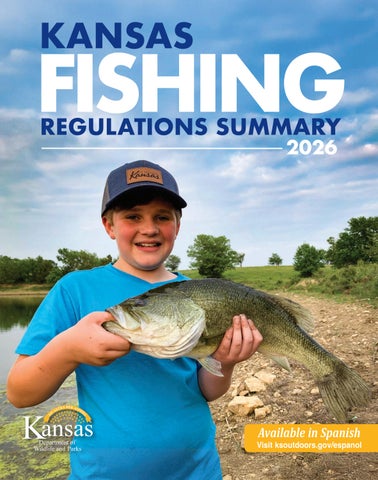
2026 Kansas Fishing Regulations Summary

Page 1


TABLE OF CONTENTS

ABOUT KANSAS DEPARTMENT WILDLIFE AND PARKS

The Kansas Department of Wildlife and Parks (KDWP) is a cabinet-level agency with a Secretary appointed by the Governor. KDWP dates back to 1905, when fish and game laws were first organized under the Kansas Fish and Game Department, and a new state law required a license to hunt. At KDWP, we are dedicated to the conservation and enhancement of Kansas’s natural resources for the benefit of both current and future generations. From hunters and anglers to birdwatchers and adventurers, KDWP offers sustainable outdoor recreation that fosters a deep connection between people and the natural world.

KDWP’s operations, programs, and staff are funded primarily through user fees and federal grants. Most fish, wildlife, and education programs rely on revenue from hunting and fishing licenses and from federal excise taxes paid by hunters and anglers on equipment purchases. The amount of federal aid received is based in part on the number of hunting and fishing licenses sold in Kansas. Your purchase of a hunting and fishing licenses and permits directly supports the conservation and enhancement of Kansas’ fisheries and aquatic resources, helping ensure that future generations can enjoy quality fishing opportunities.

The Kansas Wildlife and Parks Commission is a seven-member, bi-partisan board that serves in an advisory capacity to the Governor and Secretary in formulating policies and plans of the Kansas Department of Wildlife and Parks. Current Commissioners are:

Whitney Damron, Chair Topeka

Representative Will Carpenter El Dorado

Emerick Cross Kansas City

Warren Gfeller Russell

This brochure is not a complete list of regulations.

Delia Lister Pittsburg

Keith Mark Basehor

Bruce Riedl Ellinwood

Regulation changes may occur after this brochure has been printed. Updates will be posted on ksoutdoors.gov and the Go Outdoors Kansas mobile app once available.

For detailed legal information, contact the KDWP Law Enforcement Division at (620) 672-5911 Ext.6 or view the complete regulations online at ksoutdoors.gov/fishingregulations.

Advertisements are included in this brochure as a service to sportsmen and women, and do not necessarily reflect endorsement by KDWP.

Office of the Secretary 1020 S Kansas, Suite 200

Topeka, KS 66612-1327 (785) 296-2281

Pratt Operations Office 512 SE 25th Ave. Pratt, KS 67124-8174 (620) 672-5911

Region 1 Office 1426 Hwy 183 Alt., PO Box 338 Hays, KS 67601-0338 ............(785) 628-8614

Region 2 Office

300 SW Wanamaker Rd.

Topeka, KS 66606 (785) 273-6740

Region 3 Office

6232 E 29th St. North Wichita, KS 67220 (316) 683-8069

Region 4 Office 1001 W McArtor Rd. Dodge City, KS 67801-6024........(620) 227-8609

Chanute District Office 137 E 21st St. Chanute, KS 66720 (620) 431-0380

Colby District Office 915 E Walnut St. Colby, KS 67701 (785) 462-3367

Fort Scott District Office 1515 S Judson St.

Fort Scott, KS 66701 (620) 223-9671

Garden City District Office 785 S Old Hwy US-83 Garden City, KS 67846 (620) 276-8886

Kansas City District Office 8304 Hedge Lane Terr. Shawnee, KS 66227 (913) 422-1314

Mound City District Office 315 Main Courthouse Mound City, KS 66056 (913) 795-2218

Emporia Research & Survey Office 1830 Merchant, PO Box 1525 Emporia, KS 66801-1525 (620) 342-0658

STATE PARK OFFICES

Cedar Bluff .............................(785) 726-3212

Cheney/Sandhills (316) 542-3664

Clinton (785) 842-8562

Crawford (620) 362-3671

Cross Timbers (620) 637-2213

Eisenhower (785) 528-4102

El Dorado (316) 321-7180

Elk City ..................................(620) 331-6295

Fall River (620) 637-2213

Flint Hills Trail (785) 448-2627

Glen Elder (785) 545-3345

Hillsdale (913) 594-3600

Historic Lake Scott (620) 872-2061

Kanopolis/Mushroom Rock (785) 546-2565

Kaw River ..............................(785) 273-6740

Lehigh Portland (316) 683-8069

Little Jerusalem Badlands (620) 872-2061

Lovewell (785) 753-4971

Meade (620) 873-2572

Milford (785) 238-3014

Perry (785) 246-3449

Pomona (785) 828-4933

Prairie Center (785) 250-8369

Prairie Dog (785) 877-2953

Prairie Spirit Trail (785) 448-2627

Tuttle Creek (785) 539-7941

Webster (785) 425-6775

Wilson ....................................(785) 658-2465

COVER Photo: Rob McDonald

LICENSES, PERMITS, AND FEES

Prices include automation and vendor fees.

** Licenses and permits that expire 365 days after date of purchase and are eligible for auto-renew.

* Licenses and permits that are eligible for auto-renew but do not expire 365 days from date of purchase.

Fishing License Fees

Resident

** $27.50 Annual Fishing (age 16-64)

** $47.50 Annual Hunt/Fish Combo (age 16-64)

* $102.50 5-year Fishing (expires 1,825 days from purchase) (age 16-64)

* $182.50 5-year Hunt/Fish Combo (age 16-64 expires 1,825 days from purchase)

$42.50 Multi-year Youth Fishing (age 16-20, expires at 21)

$72.50 Multi-year Youth Hunt/Fish Combo (age 16-20, expires at 21)

** $15.00 Annual Fishing Senior (age 65-74)

** $25.00 Annual Hunt/Fish Senior Combo (Hunt/Fish age 65-74)

$52.50 5-year Fishing OR Hunting Senior (age 65-74)

$92.50 5-year Fishing AND Hunting Senior (age 65-74)

$6.00 One-day Fishing (ages 16+)

Nonresident

** $77.50 Annual Fishing

**$192.50 Annual Hunt/Fish Combo

$12.50 One-day Fishing

$27.50 Five-day Fishing

Kansas residents aged 75+ do not need a fishing license. Applicable fishing PERMITS are required regardless of age.

Lifetime License (by application only)

Resident Only

$502.50 Hunt or Fish or Furharvester (add $50.00 if paying quarterly)

$962.50 Hunt/Fish Combo (add $89.50 if paying quarterly)

$302.50 Hunt/Fish Youth Combo (age 5 and younger)

$502.50 Hunt/Fish Youth Combo (age 6 and 7 year old)

Boat Registration

Resident

$42.50 3-year Vessel (propelled by motor electric/fuel and or sail)

Nonresident

$42.50 3-year Vessel (propelled by motor electric/fuel and or sail) (Unless current registration is in another state)

Boats registered (current) in another state may be used on Kansas waters. Boats registered in the State of Kansas are not subject to Kansas property taxes. Boats purchased in another state, through a dealer, and registered in the State of Kansas are subject to Kansas sales tax at the time of registration.

Resident

** $8.50 Three-pole

Fishing Permit Fees

** $20.00 Trout (ages 16+)

** $7.00 Trout Youth (15 and younger)

$12.50 Paddlefish (six carcass tags)

* $27.50 Handfishing

** $14.50 Black Bass Tournament Pass

Nonresident

** $8.50 Three-pole

** $20.00 Trout (ages 16+)

$12.50 Paddlefish (six carcass tags)

$7.50 Paddlefish Youth (15 and younger) (six carcass tags)

* $27.50 Handfishing

** $14.50 Black Bass Tournament Pass

State Parks

Vehicle Permits

$5.00 Daily

$3.25 Daily Senior/Disabled (residents only)

$25.00 Annual

$15.50 Annual Park Passport (through local DMV)

$13.75 Annual Senior/disabled (residents only)

Camping Permits

$10.00 Daily

$252.50 Annual

$202.50 Annual (purchased Oct.1 - March 31)

$112.50 14-day

$9.00 Campsite - 1 Utility (add $2.75 transaction fee)

$11.00 Campsite - 2 Utilities (add $2.75 transaction fee)

$12.00 Campsite - 3 Utilities (add $2.75 transaction fee)

$2.00 Additional for Designated Prime Campsites

VARIABLE Cabins (add $13.75 transaction fee) go to campitks.gov for rates

VARIABLE Special Events (up to $201.50) contact specific park office for rates

Free Fishing Days - June 6-7, 2026; Anyone can fish on those days by legal means without a Kansas fishing license. Length and creel limits remain in effect.

Free State Park Entrance Day - April 22, 2026; Camping fees still apply.

AUTO-RENEW AND 365

Select annual licenses and permits purchased online include a voluntary auto-renew option, which automatically renews those purchases one year from the date of purchase.

License buyers may opt in or out of the autorenew feature at any time through their online KDWP account at gooutdoorskansas.gov Visit ksoutdoors.gov/auto-renew for more information.

Many annual licenses and permits are now valid for 365 days from the date of purchase or 365 days from the expiration date of your current license. Visit ksoutdoors.gov/365licenses for more information.

KANSAS OUTDOORS MOBILE APPS

Campit KS

Never misplace your fishing license or miss out on a camping adventure again. Download the GoOutdoorsKS and CampIt KS mobile apps from Google Play or the Apple App Store today!

No Judgment. Just Help. Text, Call, Chat 988. Suicide & Crisis Lifeline

LICENSES, PERMITS, AND FEES

Residents age 16 through 74 must have a resident license in possession while fishing in Kansas, unless exempt by law. All nonresidents 16 and older must have a valid nonresident license to fish in Kansas. Most licenses expire 365 days from date of purchase or 365 days from the expiration date of your current license, except one-day, five-day, five-year, multi-year youth, and lifetime fishing licenses.

Resident anglers age 65-74 are eligible for half-price 365-day fishing ($15) or fishing/hunting combination ($25) licenses. Landowners and their immediate family living with them, and tenants renting land for agricultural purposes and members of their immediate family living with them are exempt from fishing license requirements on waters on their own land, except as described below under “License Requirements on Private Land.”

Resident is defined as a person who has maintained the person’s place of permanent abode in the state for 60 days immediately prior to purchase. Domiciliary intent is required, evidence of which may include the location where the person votes, pays personal income taxes or obtains a driver’s license. A residency of at least one year is required to purchase lifetime licenses.

LICENSE REQUIREMENTS

Residents who are enrolled as an American Indian on a tribal membership roll, which is federally recognized by the United States Department of Interior, Bureau of Indian Affairs, may apply to KDWP for a free fishing license, which must be in possession when fishing. All other laws and regulations apply to American Indians.

Persons on active duty in the armed forces who entered the service while residents of Kansas may purchase resident fishing licenses. Nonresidents on active military duty stationed in Kansas and nonresident students going to school in Kansas qualify for resident fishing licenses, and they must have evidence of active duty or enrollment with them while fishing.

Active members of the Kansas Army or Air National Guard are eligible for free fishing and hunting licenses and park permits. Legal Kansas residents who have been separated from the armed services under honorable conditions and have a disability certified by the Kansas Commission On Veterans Affairs as being service-connected and such disability is equal to or greater than 30 percent may apply through the Pratt Operations Office (620) 6725911 for free hunting and fishing licenses. Applications are also available on the KDWP website, ksoutdoors.gov/fishing-applications.

PERMITS

SPECIAL EVENT PERMIT

Special events conducted on KDWP-managed lands and waters require special event permits if one of the following conditions exists:

1) an entrance, admission, or participation fee is charged;

2) food, merchandise, or services are offered for sale;

3) the exclusive use of a facility or a specified land or water area is required;

4) an organized or advertised competition will be conducted;

5) sound will be amplified that may disrupt area users; or

6) temporary structures, other than blinds or common camping equipment, will be erected.

An event sponsored by KDWP does not require a special event permit.

Applications for special event permits are available at KDWP offices. Each application for a special event permit shall be made to KDWP not less than five weekdays before the event. The special event permit fee is negotiated based on event type, required services, and lost revenue. The maximum fee is $200. Payment must accompany each application.

THREE-POLE PERMIT

Anyone, regardless of age, must purchase a three-pole permit to fish with three poles at one time.

LICENSE REQUIREMENTS ON PRIVATE LAND

A fishing license is required on all public waters. In addition, a license is required for fishing on many private lands, including the following:

• any private impoundment that has a stream or river going into and/or out of it, whether the stream is intermittent or not;

• a private impoundment that is owned or operated by more than one person or group, in which case the owner or operator or member of the group would be exempt from the license requirement only while fishing on the portion of the impoundment they own;

• guests of landowners or operators fishing on streams and rivers on land solely owned or operated; and

• any impoundment stocked by the state within the last 10 years.

The sole owner of an impoundment or the land through which a stream flows does not have to have a fishing license. Guests may fish private land without a fishing license if it is a private waters fishing impoundment. (See “definitions” Pages 54-55.)

ASSISTANCE PERMITS

Anyone with a permanent physical disability that prevents them from fishing may apply for a Disability Assistance Permit. The permit holder may designate another person to take, on behalf of and while accompanied by the permit holder, the permit holder’s legal limit of game or fish. The person designated by the permit holder shall not be required to hold any licenses, permits, stamps. (This law also applies to hunting.) For more information or applications, contact KDWP’s Law Enforcement Division, 512 SE 25th Ave., Pratt, KS 67124, (620) 6725911 or any KDWP regional office.

HANDFISHING

(PERMIT REQUIRED FOR ALL AGES)

Handfishing, for flathead catfish only, is legal from sunrise to sunset June 15 through August 31 at these locations: the entire length of the Arkansas River in Kansas, all federal reservoirs from beyond 150 yards of the dam to the upper end of the federal property, and on the Kansas River from its origin downstream to its confluence with the Missouri River. A special permit ($27.50) is required in addition to a fishing license. Anyone handfishing may not use hooks, snorkeling or scuba gear, or any other man-made device OR possess any fishing gear except a stringer. Stringers may not be used until the fish are caught by hand and are at or above the surface of the water. No man-made object — such as a barrel, box, or bathtub — may be used to attract fish.

LICENSES, PERMITS, AND FEES

SNAGGING (PERMIT REQUIRED)

The paddlefish snagging season is open March 15 through May 15 on posted areas inside Chetopa and Burlington city parks on the Neosho River; Neosho River at Iola, downstream from dam to city limits; Marais des Cygnes River below Osawatomie Dam, downstream to posted boundary; and Marais des Cygnes River on the upstream boundary of Marais des Cygnes Wildlife Area, downstream to the Kansas-Missouri border and the Browning Oxbow of the Missouri River. Paddlefish may be snagged using pole and line with not more than two single or treble barbless hooks. Catch and release is allowed in Burlington, Chetopa, and Iola except that once attached to a stringer, a fish becomes part of the daily creel. The daily creel limit for paddlefish is two and the season limit is six. On Missouri River boundary waters, there is a 32-inch minimum length limit. There is a 34-inch minimum length limit on the Marias des Cygnes River. Measure paddlefish from the front of the eye to the fork of the tail.

A paddlefish permit ($12.50) includes six carcass tags. Each paddlefish snagged and kept shall be included as part of the daily limit creel limit of the permit holder. Immediately upon attaching fish to stringer, anglers must sign a carcass tag, record the county/date/time of harvest, and attach the carcass tag to the lower jaw of the paddlefish taken. Anglers must stop snagging once the daily creel limit of paddlefish is reached.

Paddlefish caught outside the paddlefish season or in non-snagging areas may be kept if they are hooked in the mouth.

Carp, drum, grass carp, threadfin and gizzard shad, goldfish, gar, suckers including carpsucker and buffalo, goldeye, and bowfin may also be snagged in waters posted open to snagging during the paddlefish season. There are no limits on these fish.

No person may possess raw paddlefish eggs attached to the egg membrane of more than one fish.

No person may possess more than 3 pounds of raw or processed paddlefish eggs removed from the egg membrane.

No person shall ship, transport or intend to ship or transport to or from the state of Kansas any raw unprocessed, processed or frozen paddlefish eggs.

A paddlefish carcass must have all entrails removed before it is transported into or from Kansas.

TOURNAMENT PERMITS (PERMIT REQUIRED)

FISHING TOURNAMENTS

If you plan to hold a competitive fishing tournament on department-managed lands or waters, you may be required to obtain a special event permit. This includes tournaments launched from department facilities at state parks, state fishing lakes, or other department properties. You also may be required to pay a fee for the permit, depending on the size of the event and the services required. Contact the nearest KDWP office (see Page 4) at least 5 days prior to the tournament date(s) to determine what requirements apply.

BLACK BASS TOURNAMENTS

All vessels used by participants in a weigh-in bass fishing tournament must have a working livewell that contains an electrolyte chemicalwater solution, and the following procedures must be followed for weigh-in and release:

• one individual work crew support for each 10 anglers

• one weigh-in tank filled with an electrolyte-water chemical solution and fitted with recirculation and aeration accessories for every 25 anglers

• if the water at the tournament site is 75 degrees or cooler, the water in the weigh-in tank shall be maintained at the same temperature

• if the water temperature at the tournament site is warmer than 75F, weigh-in tank water shall be 5-10 degrees cooler but shall not exceed 85 degrees

• not more than four anglers shall be in the weigh-in line at any time

• weigh-in bags containing livewell water shall be reinforced, reusable, and capable of holding up to 15 pounds of live fish and 2 gallons of water

• the weigh-in site shall be located near the vessel mooring site and the release site, vehicle or vessel and under a portable awning, event tent or in the shade

Minimum requirements for releasing bass during a weigh-in fishing tournament include:

• fish shall not be released directly into the water after being weighed

• if release tubes, vehicles or vessels are used, holding tanks shall contain a one-half percent noniodized salt solution

• if release tubes, vehicles or vessels are not used, fish must be dipped in a 3 percent noniodized solution the same temperature as the lake water for 10-15 seconds before being released

• the release site must have water at least 3 feet deep with good circulation and hard bottom

Anglers participating in bass fishing tournaments from Sept. 1-June 15 and who possess a Tournament Black Bass Pass ($14.50) may keep five fish as part of their five-fish limit, to be released after the weigh-in, that meet the statewide 15-inch minimum length limit but that are under a special length limit for the lake being fished. Tournament Black Bass Pass holders fishing in tournaments may also cull their catch after the daily creel has been reached from January 1 through December 31, by releasing a small fish and replacing it with a larger one. The Tournament Black Bass Pass expires 365 days from date of purchase.

LICENSES, PERMITS, AND FEES

From Dec. 1-March 31, all anglers fishing on Type 1 waters (see right) stocked with trout must possess a trout permit ($20.00), including youth trout anglers 15 and younger ($7.00). Only anglers fishing for or possessing trout must have a trout permit on Type 2 waters. In addition, all residents age 16-74 and nonresidents 16 and older must also have a valid fishing license. Trout permits are available at KDWP offices, most county clerk offices, license vendors, or online at gooutdoorskansas.gov.

THE PERMIT IS VALID FOR 365 DAYS FROM DATE OF PURCHASE

Some local governments have their own trout stocking programs and may require a fee but not the state permit. Local city and county recreation departments have details. Approximate trout stocking dates and sites may be found online at ksoutdoors.gov/trout.

LIMIT: The daily creel limit is 5 trout unless otherwise posted. The possession limit is three times the daily creel.

PERMIT REQUIRED: Dec. 1-March 31

NEW

Blue Catfish Statewide Length and Creel Limit

Statewide length and creel limit for blue catfish changed to 10 fish daily creel limit, only one fish greater than 30 inches.

Length and Creel Limit Updates

Cheney Reservoir

Saugeye: 21-inch minimum length limit, 2 fish daily creel

• limit. Crappie: 10-inch minimum length limit, 20 fish daily creel limit. Blue catfish: statewide limits apply

Lovewell Reservoir

• Marion County Lake

Blue catfish: statewide limits apply

• daily creel limit

Largemouth bass: 15-inch minimum length limit, 5 fish

Overbrook City Lake

• Perry Reservoir

Channel Catfish: 5 fish day creel limit

• Wilson Reservoir

Blue catfish: statewide limits apply

Blue catfish: statewide limits apply

FOR 2026 TROUT

TYPE I WATER –TROUT PERMIT REQUIRED OF ALL ANGLERS

Clinton State Park-Lake Henry, Coffeyville-Lake LeClere, Dodge CityLake Charles, Eisenhower State Park-State Park Pond, Emporia-Kings Lake, Fort Scott-Gun Park East Lake, Garnett-Crystal Lake, Glen Elder Outlet, Historic Scott State Park-Barrel Springs Pond, Kanopolis Seep Stream, Mined Land Wildlife Area-Unit #30, Pratt Centennial Pond, Sedgwick County Park, Tuttle Creek State Park-Willow Lake, Webster Stilling Basin, Wichita-OJ Watson Park.

TYPE II WATER –

TROUT PERMIT REQUIRED ONLY FOR TROUT ANGLERS

Atchison City Lake No. 1, Cherryvale-Tanko Lake, Cimarron Grasslands Pits, Colby-Villa High Lake, Fort Riley-Cameron Springs, Fort Riley-Moon Lake, Great Bend-Veterans Memorial Park Lake, Herington-Father Padilla Pond, Holton-Elkhorn Lake, Hutchinson-Carey Park Pond, Kanopolis State Park Pond, Kill Creek Park Lake, Lake Shawnee, Meade State Fishing Lake, Salina-Lakewood Lake, Shawnee Mission Park Lake, Sherman County Smoky Gardens Lake, Syracuse-Sam’s Pond.

Resident Senior 5-Year Licenses

Resident Senior Hunting or Fishing License (valid for five years from date of purchase), 65 years of age through 74 years of age - $52.50

Resident Senior Combination Hunting and Fishing License (valid for five years from date of purchase), 65 years of age through 74 years of age - $92.50

Trout Permit Fees

Trout permit (valid for one year from date of purchase) - $20.00

Type II Trout Waters

Added: Kanopolis State Park Pond, Shawnee Mission Park Lake and Kill Creek Park Lake

REGULATION CHANGES

This publication is not a comprehensive explanation of all regulations currently in effect. Persons should not rely solely on the summaries in this publication when determining the legality of their actions. Regulation changes may occur after this brochure has been printed. Updates will be posted on ksoutdoors.gov and the GoOutdoorsKS mobile app once available. For detailed legal information, contact the KDWP Law Enforcement Division at (620) 672-5911 Ext.6 or view the complete regulations online at www.sos.ks.gov or scan the QR code to the right.

LOCATIONS, LENGTH, AND CREEL LIMITS

STATEWIDE CREEL AND LENGTH LIMITS

Individual waters may have different length and creel limits than those listed below. Check individual listings on pages 10-30.

Daily Creel Limits Length Limits

Channel catfish

Blue catfish (only 1 fish greater than 30 inches)

Walleye, sauger, saugeye (single species or in combination)

Rainbow trout, brown trout (single species or in combination)

Black basses

(largemouth, smallmouth, spotted, single species or in combination)

Flathead catfish

Northern pike

Wiper (white bass/striped bass hybrid)

Crappie

Black basses

(largemouth, smallmouth, spotted)

Sauger

Saugeye

Northern pike

The 15-inch minimum length limit for walleye, sauger and saugeye does not apply in rivers, streams and tailwaters.

POSSESSION LIMIT ON ALL FISH IS THREE TIMES THE DAILY CREEL LIMIT

Creel limits for similar species, including largemouth bass, smallmouth bass, and spotted bass; or walleye, saugeye, and sauger; apply to single species or in combination. For example, at Kanopolis Reservoir, an angler may keep five walleye OR three walleye and two saugeye OR any other combination of the two. Blue catfish and channel catfish now have separate creel limits. A blue catfish is identified by having 30 or more rays in the anal fin. A channel catfish has less than 30 rays in the anal fin.

No person may possess live fish when departing a designated aquatic invasive species (AIS) water. Designated AIS waters are listed on page 38. Livewells and bilges shall be drained and the drain plugs removed from all vessels being removed from any waters of the state before transport on any public highway.

Once a daily creel limit of any particular species has been possessed, any other fish of that species that is caught must be released immediately, unharmed, into the water. It may not replace another fish already in the creel, except for participants in a weigh-in black bass tournament who possess a Tournament Black Bass Pass.

RESERVOIRS, STATE FISHING LAKES, AND COMMUNITY WATERS

The Community Fisheries Assistance Program (CFAP) leases fishing rights on more than 200 community lakes to ensure anglers are not charged additional fees. Some community lake listings that are not enrolled in CFAP may charge additional fees for fishing.

FFF When you see this text next to the listing of a Community Fisheries Assistance Program (CFAP) lakes you’ll know it’s family friendly. At these locations, no alcohol is allowed, there are flush toilets, security patrols are conducted regularly, security lighting is in place, and fishing spots are easily accessible.

The length and creel limits on pages 10-30 apply to those bodies of water from the property dam, upstream to the public property boundary.

STATEWIDE WALK-IN FISHING AREAS (WIFA)

Impounded WIFA Waters

Channel Catfish - 2 fish daily creel limit. Flathead Catfish - 5 fish daily creel limit. Crappie - 50 fish daily creel limit. Largemouth Bass - 18-inch minimum length limit, 2 fish daily creel limit. Walleye - 15-inch minimum length limit, 5 fish daily creel limit.

WIFA Stream sites

Channel Catfish - 10 fish daily creel limit. Flathead Catfish - 5 fish daily creel limit. Crappie - 50 fish daily creel limit. Largemouth Bass - 15inch minimum length limit, 5 fish daily creel limit. Walleye - 5 fish daily creel limit. Wiper - 5 fish daily creel limit.

Aquatic invasive species (AIS) pose a threat to native aquatic wildlife and plants. AIS species include the zebra mussel, New Zealand mud snail, bighead carp, silver carp, white perch, purple loosestrife, saltcedar, fertile grass carp, rusty crayfish and Eurasian watermilfoil. A red “AIS Alert” means AIS species are present at the location. Livewells and bilges shall be drained and the drain plugs removed from all vessels removed from any waters of the state before transport on any public highway. See pages 38-41 for details.

LOCATIONS, LENGTH, AND CREEL LIMITS

RESERVOIRS

Big Hill Reservoir

1,240 acres, 4 1/4 miles E of Cherryvale.

Channel Catfish - 10 fish daily creel. Flathead Catfish - 5 fish daily creel limit. Crappie - 50 fish daily creel limit. Largemouth Bass - 15- to 21-inch slot length limit, 5 fish daily creel limit.

Smallmouth Bass - 18-inch minimum length limit, 5 fish daily creel limit. Spotted Bass - 15-inch minimum length limit, 5 fish daily creel limit. Walleye - 18-inch minimum length limit, 5 fish daily creel limit.

Cedar Bluff Reservoir

6,869 acres, 13 miles S on K-147 from I70 exit 135 Ogallah.

Channel Catfish - 10 fish daily creel.

Flathead Catfish - 5 fish daily creel limit. Crappie - 50 fish daily creel limit. Largemouth Bass - 15-inch minimum length limit, 5 fish daily creel limit.

Smallmouth Bass - 15-inch minimum length limit, 5 fish daily creel limit.

Spotted Bass - 15-inch minimum length limit, 5 fish daily creel limit. Walleye - 21-inch minimum length limit, 5 fish daily creel limit. Except up to 2 walleye greater than 15 inches but less than 18 inches may be included in the 5 fish daily creel.

Wiper - 2 fish daily creel limit.

AIS Alert - Eurasian Watermilfoil and Zebra Mussels

Cheney Reservoir

9,550 acres, 20 miles W of Wichita.

Channel Catfish - 10 fish daily creel.

Flathead Catfish - 5 fish daily creel limit. Crappie - 10-inch minimum length limit, 20 fish daily creel limit. Largemouth Bass - 15-inch minimum length limit, 5 fish daily creel limit. Walleye - 21-inch minimum length limit, 2 fish daily creel limit. Wiper - 21-inch minimum length limit, 2 fish daily creel limit. Striped Bass - 21-inch minimum, 2 fish daily creel limit. Saugeye - 21inch minimum length limit, 2 fish daily creel limit.

AIS Alert - White Perch and Zebra Mussels

Clinton Reservoir

7,000 acres, 5 miles W of Lawrence on K-10.

Channel Catfish - 10 fish daily creel. Flathead Catfish - 5 fish daily creel limit. Crappie - 10-inch minimum length limit, 20 fish daily creel limit. Largemouth Bass - 18-inch minimum length limit, 5 fish daily creel limit. Smallmouth Bass - 18-inch minimum length limit, 5 fish daily creel limit. Walleye - 15-inch minimum length limit, 5 fish daily creel limit. Sauger15-inch minimum length limit, 5 fish daily creel limit. Saugeye - 15-inch minimum length limit, 5 fish daily creel limit. Wiper - 18-inch minimum length limit, 2 fish daily creel limit.

AIS Alert - Zebra Mussels

Council Grove Reservoir

3,280 acres, 1 mile N of Council Grove on K-177.

Channel Catfish - 10 fish daily creel. Flathead Catfish - 5 fish daily creel limit. Crappie - 20 fish daily creel limit. Largemouth Bass - 15-inch minimum length limit, 5 fish daily creel limit. Spotted Bass - 15-inch minimum length limit, 5 fish daily creel limit. Walleye - 15-inch minimum length limit, 5 fish daily creel limit. Saugeye - 15-inch minimum length limit, 5 fish daily creel limit. Wiper - 18-inch minimum length limit, 2 fish daily creel limit.

AIS Alert - Zebra Mussels

El Dorado Reservoir

8,000 acres, 3 miles E, 2 miles N of El Dorado.

Channel Catfish - 10 fish daily creel. Flathead Catfish - 5 fish daily creel limit. Crappie - 20 fish daily creel limit. Largemouth Bass - 15-inch minimum length limit, 5 fish daily creel limit. Smallmouth Bass - 15-inch minimum length limit, 5 fish daily creel limit. Spotted Bass - 15-inch minimum length limit, 5 fish daily creel limit. Walleye - 21-inch minimum length limit, 2 fish daily creel limit. Wiper21-inch minimum length limit, 2 fish daily creel limit. Rainbow Trout - 5 fish daily creel limit.

AIS Alert - White Perch and Zebra Mussels

Elk City Reservoir

4,450 acres, 4 miles NW of Independence.

Channel Catfish - 10 fish daily creel. Flathead Catfish - 5 fish daily creel limit. Crappie - 50 fish daily creel limit. Largemouth Bass - 15-inch minimum length limit, 5 fish daily creel limit. Saugeye - 15-inch minimum length limit, 5 fish daily creel limit.

Fall River Reservoir

2,500 acres, 56 miles E of Wichita on US-400.

Channel Catfish - 10 fish daily creel. Flathead Catfish - 5 fish daily creel limit. Crappie - 50 fish daily creel limit. Largemouth Bass - 15-inch minimum length limit, 5 fish daily creel limit. Spotted Bass - 15-inch minimum length limit, 5 fish daily creel limit.

Glen Elder Reservoir

12,586 acres, 12 miles W of Beloit on US-24.

Channel Catfish - 10 fish daily creel. Flathead Catfish - 5 fish daily creel limit. Crappie - 10-inch minimum length limit, 20 fish daily creel limit. Largemouth Bass - 18-inch minimum length limit, 5 fish daily creel limit. Smallmouth Bass - 21inch minimum length limit, 5 fish daily creel limit. Spotted Bass - 15-inch minimum length limit, 5 fish daily creel limit. Walleye - 18-inch minimum length limit, 5 fish daily creel limit. Wiper - 2 fish daily creel limit. Striped Bass - 2 fish daily creel limit. Rainbow Trout - 5 fish daily creel limit.

AIS Alert - Zebra Mussels

Hillsdale Reservoir

4,580 acres, 3 miles NW of Paola. Channel Catfish - 10 fish daily creel. Flathead Catfish - 5 fish daily creel limit. Crappie - 10-inch minimum length limit, 20 fish daily creel limit. Largemouth Bass - 18-inch minimum length limit, 5 fish daily creel limit. Walleye - 18-inch minimum length limit, 5 fish daily creel limit.

AIS Alert - Zebra Mussels

AIS ALERT - Live fish and aquatic bait may not be transported from this water

LOCATIONS, LENGTH, AND CREEL LIMITS

John Redmond Reservoir

9,400 acres, 2 1/2 miles N of Burlington on US-75.

Channel Catfish - 10 fish daily creel. Flathead Catfish - 5 fish daily creel limit. Crappie - 50 fish daily creel limit. Largemouth Bass - 15-inch minimum length limit, 5 fish daily creel limit. Walleye - 15-inch minimum length limit, 5 fish daily creel limit. Saugeye15-inch minimum length limit, 5 fish daily creel limit. Wiper - 2 fish daily creel limit.

AIS Alert - Zebra Mussels

Kanopolis Reservoir

3,550 acres, 33 miles SW of Salina on K149 and K-141.

Blue Catfish - 35-inch minimum length limit, 5 fish daily creel limit.

Channel Catfish - 10 fish daily creel. Flathead Catfish - 5 fish daily creel limit. Crappie - 20 fish daily creel limit. Largemouth Bass - 15-inch minimum length limit, 5 fish daily creel limit. Walleye - 18-inch minimum length limit, 5 fish daily creel limit. Saugeye - 18-inch minimum length limit, 5 fish daily creel limit. Wiper - 2 fish daily creel limit. Rainbow/Brown Trout - 5 fish daily creel limit.

AIS Alert - Zebra Mussels

Keith Sebelius (Norton)

2,300 acres, 3 miles SW of Norton off US-36.

Channel Catfish - 10 fish daily creel. Flathead Catfish - 5 fish daily creel limit. Crappie - 50 fish daily creel limit. Largemouth Bass - 15-inch minimum length limit, 5 fish daily creel limit. Spotted Bass - 15-inch minimum length limit, 5 fish daily creel limit. Walleye - 18-inch minimum length limit, 5 fish daily creel limit. Saugeye18-inch minimum length limit, 5 fish daily creel limit. Wiper - 5 fish daily creel limit.

Kirwin Reservoir

5,000 acres, 15 miles SE of Phillipsburg on K-9

Channel Catfish - 10 fish daily creel. Flathead Catfish - 5 fish daily creel limit. Crappie - 50 fish daily creel limit. Largemouth Bass - 15-inch minimum length limit, 5 fish daily creel limit. Walleye - 15-inch minimum length limit, 5 fish daily creel limit. Wiper - 5 fish daily creel limit.

La Cygne Reservoir

2,600 acres, 5 miles E of La Cygne

Blue Catfish - 5 fish daily creel limit. Channel Catfish - 10 fish daily creel. Flathead Catfish - 5 fish daily creel limit. Crappie - 50 fish daily creel limit. Largemouth Bass - 18-inch minimum length limit, 5 fish daily creel limit. Smallmouth Bass - 18inch minimum length limit, 5 fish daily creel limit. Wiper - 18-inch minimum length limit, 2 fish daily creel limit. Striped Bass - 18-inch minimum length limit, 2 fish daily creel limit.

Lovewell Reservoir

2,986 acres, 4 miles E, 10 miles N of Mankato on US-14.

Channel Catfish - 10 fish daily creel. Flathead Catfish - 5 fish daily creel limit. Crappie - 10-inch length limit, 20 fish daily creel limit. Largemouth Bass - 15-inch minimum length limit, 5 fish daily creel limit. Walleye - 18-inch minimum length limit, 5 fish daily creel limit. Wiper - 2 fish daily creel limit.

Marion Reservoir

6,160 acres, 4 miles NW of Marion off US-56.

Channel Catfish - 10 fish daily creel. Flathead Catfish - 5 fish daily creel limit. Crappie - 20 fish daily creel limit. Largemouth Bass - 18-inch minimum length limit, 5 fish daily creel limit. Walleye - 18-inch minimum length limit, 3 fish daily creel limit. No more than 1 fish 21-inch or longer. Wiper - 5 fish daily creel limit.

AIS Alert - Zebra Mussels

Melvern Reservoir

7,000 acres, 35 miles S of Topeka on US-75.

Channel Catfish - 10 fish daily creel. Flathead Catfish - 5 fish daily creel limit. Crappie - 10-inch minimum length limit, 20 fish daily creel limit. Largemouth Bass - 18-inch minimum length limit, 5 fish daily creel limit. Smallmouth Bass - 18-inch minimum length limit, 5 fish daily creel limit. Spotted Bass - 18-inch minimum length limit, 5 fish daily creel limit. Walleye - 18-inch minimum length limit, 5 fish daily creel limit. Sauger18-inch minimum length limit, 5 fish daily creel limit. Saugeye - 18-inch minimum length limit, 5 fish daily creel limit.

AIS Alert - Zebra Mussels

Milford Reservoir

16,020 acres, 5 miles NW of Junction City on US-77.

Blue Catfish - 28- to 40-inch slot length limit, 10 fish daily creel limit, may include only one fish 40 inches or longer. Channel Catfish - 10 fish daily creel. Flathead Catfish - 5 fish daily creel limit. Crappie - 50 fish daily creel limit. Largemouth Bass15-inch minimum length limit, 5 fish daily creel limit. Smallmouth Bass15-inch minimum length limit, 5 fish daily creel limit. Spotted Bass - 15inch minimum length limit, 5 fish daily creel limit. Walleye - 21-inch minimum length limit, 2 fish daily creel limit. Wiper - 5 fish daily creel limit.

AIS Alert - Zebra Mussels

Perry Reservoir

11,600 acres, 18 miles NE of Topeka on US-24.

Channel Catfish - 10 fish daily creel. Flathead Catfish - 5 fish daily creel limit. Crappie - 10-inch minimum length limit, 20 fish daily creel limit. Largemouth Bass - 18-inch minimum length limit, 5 fish daily creel limit. Smallmouth Bass - 18-inch minimum length limit, 5 fish daily creel limit.Walleye - 18-inch minimum length limit, 5 fish daily creel limit. Saugeye18-inch minimum length limit, 5 fish daily creel limit. Sauger - 18-inch minimum length limit, 5 fish daily creel limit.

AIS Alert - Zebra Mussels

Pomona Reservoir

4,000 acres, 25 miles S of Topeka on US-75.

Channel Catfish - 10 fish daily creel. Blue Catfish - 5 fish daily creel limit. Flathead Catfish - 5 fish daily creel limit. Crappie - 50 fish daily creel limit. Largemouth Bass - 15-inch minimum length limit, 5 fish daily creel limit. Walleye - 18-inch minimum length limit, 5 fish daily creel limit. Saugeye - 18-inch minimum length limit, 5 fish daily creel limit. Wiper - 18-inch minimum length limit, 2 fish daily creel limit. AIS Alert - Zebra Mussels

LOCATIONS, LENGTH, AND CREEL LIMITS

Toronto Reservoir

2,800 acres, 15 miles W of Yates Center on US-54.

Channel Catfish - 10 fish daily creel. Flathead Catfish - 5 fish daily creel limit. Crappie - 50 fish daily creel limit. Largemouth Bass - 15-inch minimum length limit, 5 fish daily creel limit. Spotted Bass - 15-inch minimum length limit, 5 fish daily creel limit.

Tuttle Creek Reservoir

10,900 acres, 6 miles N of Manhattan on K-13.

Channel Catfish - 10 fish daily creel. Flathead Catfish - 5 fish daily creel limit. Crappie - 50 fish daily creel limit. Largemouth Bass - 18-inch minimum length limit, 5 fish daily creel limit. Saugeye - 15-inch minimum length limit, 5 fish daily creel limit.

AIS Alert - Zebra Mussels

Webster Reservoir

3,780 acres, 8 miles W of Stockton off US-24.

Channel Catfish - 10 fish daily creel. Flathead Catfish - 5 fish daily creel limit. Crappie - 50 fish daily creel limit. Largemouth Bass - 15-inch minimum length limit, 5 fish daily creel limit. Smallmouth Bass - 15-inch minimum length limit, 5 fish daily creel limit. Walleye - 15-inch minimum length limit, 5 fish daily creel limit. Wiper - 5 fish daily creel limit. Rainbow Trout5 fish daily creel limit

Wilson Reservoir

9,040 acres, 8 miles N on K-232 from I70 exit 206 Wilson.

Channel Catfish - 10 fish daily creel. Flathead Catfish - 5 fish daily creel limit. Crappie - 50 fish daily creel limit. Largemouth Bass - 15-inch minimum length limit, 5 fish daily creel limit. Smallmouth Bass - 15-inch minimum length limit, 5 fish daily creel limit. Spotted Bass - 15-inch minimum length limit, 5 fish daily creel limit. Walleye - 15-inch minimum length limit, 5 fish daily creel limit. Striped Bass - 2 fish daily creel limit.

AIS Alert - White Perch and Zebra Mussels

STATE FISHING LAKES

Atchison SFL

66 acres, 2 miles N, 2 miles W of Atchison.

Channel Catfish - 15-inch minimum length limit, 2 fish daily creel limit. Flathead Catfish - 5 fish daily creel limit. Crappie - 20 fish daily creel limit. Largemouth Bass - 18-inch minimum length limit, 2 fish daily creel limit. Smallmouth Bass - 18inch minimum length limit, 2 fish daily creel limit. Walleye - 15-inch minimum length limit, 5 fish daily creel limit.

Barber SFL Lower

51 acres, 1/4 mile N of Medicine Lodge. Channel Catfish - 5 fish daily creel limit. Crappie - 50 fish daily creel limit. Largemouth Bass - 15-inch minimum length limit, 5 fish daily creel limit. Walleye - 15-inch minimum length limit, 5 fish daily creel limit.

Barber SFL Upper (Periodically Dry)

26 acres, 1/4 mile N of Medicine Lodge. Channel Catfish - 5 fish daily creel limit. Crappie - 50 fish daily creel limit. Largemouth Bass - 15-inch minimum length limit, 5 fish daily creel limit.

Big Hill Wildlife Area

14 acres, 6 miles E of Cherryvale.

Channel Catfish - 10 fish daily creel. Flathead Catfish - 5 fish daily creel limit. Crappie - 50 fish daily creel limit. Largemouth Bass - 21-inch minimum length limit, 5 fish daily creel limit.

Black Kettle SFL

8 acres, 2 miles N, 1/2 mile E of Moundridge.

Channel Catfish - 15-inch minimum length limit, 5 fish daily creel limit. Flathead Catfish - 5 fish daily creel limit. Crappie - 50 fish daily creel limit. Largemouth Bass - 18-inch minimum length limit, 5 fish daily creel limit.

Bourbon SFL

103 acres, 4 miles E of Elsmore.

Channel Catfish - 15-inch minimum length limit, 2 fish daily creel limit. Crappie - 50 fish daily creel limit. Largemouth Bass - 15-inch mini-

mum length limit, 5 fish daily creel limit. Spotted Bass - 15-inch minimum length limit, 5 fish daily creel limit. Walleye - 18-inch minimum length limit, 2 fish daily creel limit. Saugeye - 18-inch minimum length limit, 2 fish daily creel limit.

Brown SFL

62 acres, 8 miles E, 1 miles N of Hiawatha.

Channel Catfish - 15-inch minimum length limit, 2 fish daily creel limit.

Flathead Catfish - 5 fish daily creel limit. Crappie - 20 fish daily creel limit. Largemouth Bass - 18-inch minimum length limit, 2 fish daily creel limit. Walleye - 15-inch minimum length limit, 5 fish daily creel limit.

Browning Oxbow

100 acres, 1/2 mile W, 1/2 mile N of Elwood.

For full regulations on Browning Oxbow and the Missouri River

Boundary Waters see page 12.

AIS Alert - Bighead Carp, Silver Carp, White Perch

Butler SFL

124 acres, 3 miles W, 1 mile N of Latham.

Channel Catfish - 15-inch minimum length limit, 2 fish daily creel limit. Flathead Catfish - 5 fish daily creel limit. Crappie - 50 fish daily creel limit. Largemouth Bass - 15-inch minimum length limit, 5 fish daily creel limit. Walleye - 15-inch minimum length limit, 5 fish daily creel limit.

Chase SFL

109 acres, 2 1/2 miles W of Cottonwood Falls.

Channel Catfish - 15-inch minimum length limit, 5 fish daily creel limit.

Flathead Catfish - 5 fish daily creel limit. Crappie - 50 fish daily creel limit. Largemouth Bass - 13-18-inch slot limit, 5 fish daily creel limit.

Smallmouth Bass - 15-inch minimum length limit, 5 fish daily creel limit.

Spotted Bass - 15-inch minimum length limit, 5 fish daily creel limit.

Walleye - 18-inch minimum length limit, 5 fish daily creel limit. Saugeye18-inch minimum length limit, 5 fish daily creel limit.

AIS Alert - Zebra Mussels

Clark SFL

LOCATIONS, LENGTH, AND CREEL LIMITS

300 acres, 8 1/2 miles S, 1 W of Kingsdown.

Channel Catfish - 5 fish daily creel limit. Flathead Catfish - 5 fish daily creel limit. Crappie - 50 fish daily creel limit. Largemouth Bass - 15-inch minimum length limit, 5 fish daily creel limit. Walleye - 15-inch minimum length limit, 5 fish daily creel limit.

AIS Alert - Eurasian Watermilfoil

Clinton State Park - Lake Henry

3 acres, 1/4 mile S of Clinton State Park maintenance shop.

Channel Catfish - 2 fish daily creel limit. Crappie - 50 fish daily creel limit. Largemouth Bass - 18-inch minimum length limit, 5 fish daily creel limit. Rainbow Trout - 5 fish daily creel limit.

Clinton State ParkPicnic Area Pond

0.5 acre, 1/2 mile W, 1/4 S of Clinton SP Office.

Channel Catfish - 2 fish daily creel limit. Crappie - 50 fish daily creel limit. Largemouth Bass - 18-inch minimum length limit, 5 fish daily creel limit.

Concannon SFL (Periodically Dry)

50 acres, 15 miles NE of Garden City

Channel Catfish - 5 fish daily creel limit.

Cowley SFL

84 acres, 13 miles E of Arkansas City on US-166.

Channel Catfish - 15-inch minimum length limit, 5 fish daily creel limit. Flathead Catfish - 5 fish daily creel limit. Crappie - 50 fish daily creel limit. Largemouth Bass - 15-inch minimum length limit, 5 fish daily creel limit. Walleye - 15-inch minimum length limit, 5 fish daily creel limit.

AIS Alert - Eurasian Watermilfoil

Crawford SFL

150 acres, 9 miles N, 1 mile E of Girard. Channel Catfish - 15-inch minimum length limit, 5 fish daily creel limit. Flathead Catfish - 5 fish daily creel limit. Crappie - 50 fish daily creel limit. Largemouth Bass - 18-inch minimum length limit, 2 fish daily creel limit. Spotted Bass - 15-inch minimum length limit, 5 fish daily creel limit. Walleye - 18-inch minimum length limit, 2 fish daily

creel limit. Saugeye - 18-inch minimum length limit, 2 fish daily creel limit. Wiper - 18-inch length limit, 2 fish daily creel limit.

Douglas SFL

180 acres, 1/2 miles N, 1 E of Baldwin. Channel Catfish - 15-inch minimum length limit, 5 fish daily creel limit. Flathead Catfish - 5 fish daily creel limit. Crappie - 50 fish daily creel limit. Largemouth Bass - 13-18-inch slot limit, 5 fish daily creel limit. Saugeye - 18-inch minimum length limit, 2 fish daily creel limit.

Fall River State Park Kids Pond

1 acre, Fall River State Park. Youth/Mentoring Pond: Licensed adults, 18 years or older, may fish Youth/Mentor designated waters only if accompanied by a person younger than 18 years of age, who is actively engaged in fishing. Channel Catfish - 15-inch minimum length limit, 2 fish daily creel limit.

Largemouth Bass - 18-inch minimum length limit, 2 fish daily creel limit.

Ford SFL (Periodically Dry)

48 acres, 3 miles N, 5 miles E of Dodge City.

Channel Catfish - 5 fish daily creel limit. Crappie - 50 fish daily creel limit. Largemouth Bass - 18-inch minimum length limit, 5 fish daily creel limit.

Geary SFL

97 acres, 8 1/2 miles S, 2 W of Junction City.

Channel Catfish - 5 fish daily creel limit. Flathead Catfish - 5 fish daily creel limit. Crappie - 50 fish daily creel limit. Largemouth Bass - 15inch minimum length limit, 5 fish daily creel limit. Smallmouth Bass - 15inch minimum length limit, 5 fish daily creel limit. Saugeye - 18-inch minimum length limit, 5 fish daily creel limit.

AIS Alert - Zebra Mussels

Glen Elder

State Park Pond (Periodically Dry)

5 acres

Channel Catfish - 10 fish daily creel limit. Largemouth Bass - 18-inch minimum length limit, 5 fish daily creel limit. Walleye - 18-inch minimum length limit, 5 fish daily creel limit. Rainbow Trout - 5 fish daily creel limit.

AIS Alert - Zebra Mussels

Goodman SFL (Periodically Dry)

40 acres, 5 miles S, 2 1/2 miles E of Ness City.

Channel Catfish - 5 fish daily creel limit. Crappie - 50 fish daily creel limit. Largemouth Bass - 13-18-inch slot limit, 5 fish daily creel limit.

Grand Osage Wildlife Area

54 acres, E of Parsons

Limited access (620) 432-5053

Channel Catfish - 15-inch minimum length limit, 2 fish daily creel limit. Largemouth Bass - 13-18-inch slot length limit, 5 fish daily creel limit.

Hain SFL (Periodically Dry)

53 acres, 5 miles W of Spearville. Channel Catfish - 5 fish daily creel limit. Largemouth Bass - 15-inch minimum length limit, 5 fish daily creel limit.

Hodgeman SFL (Periodically Dry)

87 acres, 4 miles E, 2 miles S of Jetmore.

Channel Catfish - 5 fish daily creel limit. Largemouth Bass - 15-inch minimum length limit, 5 fish daily creel limit.

Jeffrey Energy Center (Limited Access)

125 & 450 acres, 5 miles N, 3 miles W of St. Mary's.

Channel Catfish - 5 fish daily creel limit. Flathead Catfish - 5 fish daily creel limit. Crappie - 50 fish daily creel limit.Largemouth Bass - 15inch minimum length limit, 5 fish daily creel limit. Smallmouth Bass - 15inch minimum length limit, 5 fish daily creel limit. Sauger - 15-inch minimum length limit, 2 fish daily creel limit. Walleye - 15-inch minimum length limit, 2 fish daily creel limit. Wiper - 2 fish daily creel limit.

AIS Alert - Zebra Mussels, White Perch

Jewell SFL

57 acres, 6 miles S, 2 W of Mankato. Channel Catfish - 15-inch minimum length limit, 5 fish daily creel limit. Crappie - 50 fish daily creel limit. Largemouth Bass - 18-inch minimum length limit, 5 fish daily creel limit. Bluegill, redear, green sunfish and their hybrids - 6- to 9inch slot length limit, 5 fish daily creel limit for fish over 9 inches, no daily creel limit for fish less than 6 inches.

LOCATIONS, LENGTH, AND CREEL LIMITS

Kanopolis State Park Pond

2 acres, 33 miles SW of Salina on K149 & K141

Youth/Mentoring Pond: Licensed adults, 18 years or older, may fish Youth/Mentor designated waters only if accompanied by a person younger than 18 years of age, who is actively engaged in fishing.

Channel Catfish - 2 fish daily creel limit. Crappie - 50 fish daily creel limit. Largemouth Bass - 18-inch minimum length limit, 2 fish daily creel limit. Wiper - 2 fish daily creel limit.

Kingman SFL

144 acres, 7 miles W of Kingman. Channel Catfish - 15-inch minimum length limit, 2 fish daily creel limit. Flathead Catfish - 5 fish daily creel limit. Crappie - 50 fish daily creel limit. Largemouth Bass - 18-inch minimum length limit, 5 fish daily creel limit. Northern Pike - 30-inch minimum length limit, 2 fish daily creel limit. AIS Alert - Eurasian Watermilfoil

Kiowa SFL

21 acres, NW corner of Greensburg.

Channel Catfish - 5 fish daily creel limit. Flathead Catfish - 5 fish daily creel limit. Crappie - 50 fish daily creel limit. Largemouth Bass - 15inch minimum length limit, 5 fish daily creel limit. Wiper - 18-inch minimum length limit, 2 fish daily creel limit.

Leavenworth SFL

160 acres, 3 miles W, 1 mile N of Tonganoxie.

Channel Catfish - 15-inch minimum length limit, 2 fish daily creel limit. Flathead Catfish - 5 fish daily creel limit. Crappie - 50 fish daily creel limit. Largemouth Bass - 15-inch minimum length limit, 5 fish daily creel limit. Smallmouth Bass - 18inch minimum length limit, 2 fish daily creel limit. Walleye - 15-inch minimum length limit, 5 fish daily creel limit. Wiper - 18-inch minimum length limit, 5 fish daily creel limit. AIS Alert - Zebra Mussels

Logan

SFL (Periodically Dry)

60 acres, 2 miles N, 2 W of Russell Springs.

Channel Catfish - 5 fish daily creel limit. Largemouth Bass - 15-inch minimum length limit, 5 fish daily creel limit.

Lyon SFL

135 acres, 12.5 miles N of Emporia on K99, 1.8 miles E on Rd. 270

Channel Catfish - 15-inch minimum length limit, 5 fish daily creel limit. Crappie - 50 fish daily creel limit. Largemouth Bass - 13-18-inch slot limit, 5 fish daily creel limit. Saugeye - 18-inch minimum length limit, 5 fish daily creel limit. Northern Pike - 30inch minimum length limit, 2 fish daily creel limit. Wiper - 2 fish daily creel limit. Walleye - 18-inch minimum length limit, 5 fish daily creel limit. AIS Alert - Zebra Mussels

Marais des Cygnes

Wildlife Area

1,967 acres, 7 miles N of Pleasanton on US-69.

Channel Catfish - 10 fish daily creel. Flathead Catfish - 5 fish daily creel limit. Crappie - 50 fish daily creel limit. Largemouth Bass - 15-inch minimum length limit, 5 fish daily creel limit.

McPherson

SFL

46 acres, 6 miles N, 2 1/2 W of Canton. Channel Catfish - 15-inch minimum length limit, 2 fish daily creel limit. Flathead Catfish - 5 fish daily creel limit. Crappie - 50 fish daily creel limit. Largemouth Bass - 13-18-inch slot limit, 5 fish daily creel limit. Saugeye - 21-inch minimum length limit, 2 fish daily creel limit. AIS Alert - Rusty Crayfish .

Meade SFL

80 acres, 8 miles S, 5 miles W of Meade on K-23

Channel Catfish - 5 fish daily creel limit. Flathead Catfish - 5 fish daily creel limit. Crappie - 50 fish daily creel limit. Largemouth Bass - 1318-inch slot limit, 5 fish daily creel limit. Rainbow Trout - 5 fish daily creel limit. Saugeye - 18-inch minimum length limit, 2 fish daily creel limit.

Melvern River Pond

90 acres, 35 miles S of Topeka on US-75

Channel Catfish - 15-inch minimum length limit, 2 fish daily creel limit. Flathead Catfish - 5 fish daily creel limit. Crappie - 10-inch minimum length limit, 10 fish daily creel limit. Largemouth Bass - 13-18-inch slot limit, 2 fish daily creel limit. Walleye18-inch minimum length limit, 2 fish

daily creel limit. Wiper - 18-inch minimum length limit, 2 fish daily creel limit.

AIS Alert - Zebra Mussels

Miami SFL

101 acres, 8 miles E, 5 miles S of Osawatomie.

Channel Catfish - 15-inch minimum length limit, 5 fish daily creel limit. Flathead Catfish - 5 fish daily creel limit. Crappie - 50 fish daily creel limit. Largemouth Bass - 13-18-inch slot length limit, 5 fish daily creel limit. Bluegill, redear, green sunfish and their hybrids - 6- to 9-inch slot length limit, 5 fish daily creel limit for fish over 9 inches, no daily creel limit for fish less than 6 inches.

Middle Creek SFL

280 acres, 7 miles S of Louisburg. Channel Catfish - 15-inch minimum length limit, 5 fish daily creel limit. Flathead Catfish - 5 fish daily creel limit. Crappie - 50 fish daily creel limit. Largemouth Bass - 18-inch minimum length limit, 2 fish daily creel limit. Saugeye - 18-inch minimum length limit, 2 fish daily creel limit. Wiper - 18-inch minimum length limit, 2 fish daily creel limit.

Milford Hatchery

Water Supply Pond

(see posted notice for use restrictions) 100 acres, Below Milford Dam. Channel Catfish - 2 fish daily creel limit. Crappie - 10 fish daily creel limit. Largemouth Bass - 15-inch minimum length limit, 2 fish daily creel limit. Smallmouth Bass - 15-inch minimum length limit, 2 fish daily creel limit. Spotted Bass - 15-inch minimum length limit, 2 fish daily creel limit. Walleye - 15-inch minimum length limit, 2 fish daily creel limit. Saugeye15-inch minimum length limit, 2 fish daily creel limit. Sauger - 15-inch minimum length limit, 2 fish daily creel limit. Wiper - 2 fish daily creel limit.

Milford State Park Pond

2 acres, Milford State Park.

Channel Catfish - 5 fish daily creel limit.

Mined Land Wildlife Area

1,500 acres, Crawford, Cherokee, and Labette Co’s.

Channel Catfish - 15-inch minimum

LOCATIONS, LENGTH, AND CREEL LIMITS

length limit, 5 fish daily creel limit. Crappie - 50 fish daily creel limit.

Largemouth Bass - 13-18-inch slot limit, 5 fish daily creel limit. Spotted Bass - 15-inch minimum length limit, 5 fish daily creel limit. Walleye - 18-inch minimum length limit, 2 fish daily creel limit. Wiper - 18-inch minimum length limit, 2 fish daily creel limit. Rainbow/Brown Trout - 5 fish daily creel limit.

AIS Alert - Eurasian Watermilfoil

Montgomery SFL

105 acres, 3 miles S, 1 mile E of Independence.

Channel Catfish - 15-inch minimum length limit, 5 fish daily creel limit. Crappie - 50 fish daily creel limit. Largemouth Bass - 13-18-inch slot limit, 5 fish daily creel limit.

Nebo SFL

38 acres, 7 miles E, 1 mile S of Holton. Channel Catfish - 15-inch minimum length limit, 2 fish daily creel limit.

Flathead Catfish - 5 fish daily creel limit. Crappie - 50 fish daily creel limit. Largemouth Bass - 18-inch minimum length limit, 2 fish daily creel limit. Saugeye - 18-inch minimum length limit, 2 fish daily creel limit.

Nemaha WA

18 acres, 1 mile E, 5 miles S of Seneca

Channel Catfish - 10 fish daily creel limit. Crappie - 50 fish daily creel limit. Largemouth Bass - 15-inch minimum length limit, 5 fish daily creel limit.

Neosho SFL

92 acres, 6 miles S, 1 mile W of St. Paul.

Channel Catfish - 15-inch minimum length limit, 5 fish daily creel limit. Crappie - 50 fish daily creel limit.

Largemouth Bass - 18-inch minimum length limit, 5 fish daily creel limit.

Neosho Wildlife Area

800 acres, 1 mile E of St. Paul on K-57. Channel Catfish - 15-inch minimum length limit, 5 fish daily creel limit. Crappie - 50 fish daily creel limit. Largemouth Bass - 15-inch minimum length limit, 5 fish daily creel limit.

Osage SFL

140 acres, 2 miles S, 1/2 mile E of Carbondale.

Channel Catfish - 15-inch minimum length limit, 2 fish daily creel limit.

Flathead Catfish - 5 fish daily creel limit. Crappie - 10 fish daily creel limit. Largemouth Bass - 13-18-inch

slot limit, 5 fish daily creel limit. Smallmouth Bass - 18-inch minimum length limit, 2 fish daily creel limit. Walleye - 15-inch minimum length limit, 2 fish daily creel limit. Wiper - 18-inch minimum length limit, 2 fish daily creel limit.

AIS Alert - Zebra Mussels

Ottawa SFL

138 acres, 5 miles N, 1 mile E of Bennington.

Channel Catfish - 5 fish daily creel limit. Flathead Catfish - 5 fish daily creel limit. Crappie - 50 fish daily creel limit. Largemouth Bass - 15inch minimum length limit, 5 fish daily creel limit. Saugeye - 15-inch minimum length limit, 5 fish daily creel limit.

AIS Alert - Eurasian Watermilfoil

Pottawatomie 1

24 acres, 5 miles N of Westmoreland. Channel Catfish - 15-inch minimum length limit, 5 fish daily creel limit. Flathead Catfish - 5 fish daily creel limit. Crappie - 50 fish daily creel limit. Largemouth Bass - 15-inch minimum length limit, 5 fish daily creel limit.

Pottawatomie 2

75 acres, 1 1/2 E, 2 1/2 miles N of Manhattan.

Channel Catfish - 5 fish daily creel limit. Flathead Catfish - 5 fish daily creel limit. Crappie - 50 fish daily creel limit. Largemouth Bass - 15inch minimum length limit, 5 fish daily creel limit. Smallmouth Bass - 15inch minimum length limit, 5 fish daily creel limit. Walleye - 15-inch minimum length limit, 5 fish daily creel limit. Bluegill, redear, green sunfish and their hybrids - 6- to 9inch slot length limit, 5 fish daily creel limit for fish over 9 inches, no daily creel limit for fish less than 6 inches.

Pratt Centennial Pond

3 acres, 2 miles E, 1 mile S of Pratt. Rainbow Trout - 2 fish daily creel limit, all other species are catch and release only.

Pratt Kid's Fishing Pond

1 acre, 2 miles E, 1 mile S of Pratt. Fishing hours are from 6 a.m. to 10 p.m. Children ten (10) years of age or less must be accompanied by a person sixteen (16) years of age or older. Two fish daily creel limit of a single species or a combination of species.

Rooks SFL (Periodically Dry)

67 acres, 2 1/2 miles S, 2 miles W of Stockton.

Channel Catfish - 5 fish daily creel limit. Flathead Catfish - 5 fish daily creel limit. Crappie - 50 fish daily creel limit. Largemouth Bass - 18inch minimum length limit, 5 fish daily creel limit.

Saline SFL (Periodically Dry)

38 acres, 1 1/2 miles N, 1/4 mile W of Salina

Channel Catfish - 5 fish daily creel limit. Largemouth Bass - 15-inch minimum length limit, 5 fish daily creel limit.

Scott SFL

115 acres, 11 miles N of Scott City.

Channel Catfish - 5 fish daily creel limit. Crappie - 50 fish daily creel limit. Largemouth Bass - 15-inch minimum length limit, 5 fish daily creel limit. Walleye - 18-inch minimum length limit, 5 fish daily creel limit. Saugeye - 18-inch minimum length limit, 5 fish daily creel limit. Rainbow Trout - 5 fish daily creel limit.

AIS Alert - Eurasian Watermilfoil, Rudd

Shawnee SFL

135 acres, 7 miles N, 2 1/2 miles E of Silver Lake.

Channel Catfish - 5 fish daily creel limit. Flathead Catfish - 5 fish daily creel limit. Crappie - 50 fish daily creel limit. Largemouth Bass - 15inch minimum length limit, 5 fish daily creel limit. Walleye - 18-inch minimum length limit, 2 fish daily creel limit.

AIS Alert - Zebra Mussels

Sheridan SFL

67 acres, 11 miles E of Hoxie. Channel Catfish - 5 fish daily creel limit. Flathead Catfish - 5 fish daily creel limit. Crappie - 50 fish daily creel limit. Largemouth Bass - 15inch minimum length limit, 5 fish daily creel limit. Saugeye - 15-inch minimum length limit, 5 fish daily creel limit. Wiper - 5 fish daily creel limit.

AIS Alert - Eurasian Watermilfoil

St. Francis Sand Pits

5 acres, 1 mile W, 2 S of St. Francis.

Channel Catfish - 5 fish daily creel limit. Crappie - 50 fish daily creel limit. Largemouth Bass - 15-inch minimum length limit, 5 fish daily creel limit.

AIS Alert - Eurasian Watermilfoil

LOCATIONS, LENGTH, AND CREEL LIMITS

Tuttle Creek River Pond

165 acres, Tuttle Creek State Park, below the Tuttle Creek Dam.

Blue Catfish - 5 fish daily creel limit. Channel Catfish - 10 fish daily creel limit. Flathead Catfish - 5 fish daily creel limit. Crappie - 50 fish daily creel limit. Largemouth Bass - 18inch minimum length limit, 5 fish daily creel limit. Saugeye - 5 fish daily creel limit.

AIS Alert - Zebra Mussels

Tuttle Creek Willow Lake

10 acres, Tuttle Creek State Park River Pond Area, below the Tuttle Creek Dam.

Channel Catfish - 10 fish daily creel limit. Crappie - 50 fish daily creel limit. Largemouth Bass - 18-inch minimum length limit, 5 fish daily creel limit. Rainbow Trout - 5 fish daily creel limit

AIS Alert - Zebra Mussels

Washington SFL

65 acres, 7 miles N, 3 miles W of Washington.

Channel Catfish - 5 fish daily creel limit. Flathead Catfish - 5 fish daily creel limit. Crappie - 50 fish daily creel limit. Largemouth Bass - 15inch minimum length limit, 5 fish daily creel limit. Saugeye - 21-inch minimum length limit, 2 fish daily creel limit.

AIS Alert - Eurasian Watermilfoil

Wilson SFL

110 acres, 1 mile S, 1 mile E of Buffalo. Channel Catfish - 15-inch minimum length limit, 5 fish daily creel limit. Flathead Catfish - 5 fish daily creel limit. Crappie - 50 fish daily creel limit. Largemouth Bass - 15-inch minimum length limit, 5 fish daily creel limit. Spotted Bass - 15-inch minimum length limit, 5 fish daily creel limit. Walleye - 18-inch minimum length limit, 5 fish daily creel limit.

Woodson SFL

180 acres, 5 1/2 miles E of Toronto.

Channel Catfish - 15-inch minimum length limit, 2 fish daily creel limit. Flathead Catfish - 5 fish daily creel limit. Crappie - 10-inch minimum length limit, 10 fish daily creel limit.

Largemouth Bass - 13-18-inch slot limit, 5 fish daily creel limit. Smallmouth Bass - 18-inch minimum length limit, 2

fish daily creel limit. Walleye - 15-inch minimum length limit, 2 fish daily creel limit. Wiper - 18-inch minimum length limit, 2 fish daily creel limit.

COMMUNITY LAKES

Agra City Lake (Periodically Dry)

6 acres

Channel Catfish - 15-inch minimum length limit, 5 fish daily creel limit.

Largemouth Bass - 18-inch minimum length limit, 2 fish daily creel limit.

All other statewide limits apply.

Alma City Lake

80 acres, 2 1/2 miles SE of Alma.

Channel Catfish - 10 fish daily creel.

Flathead Catfish - 5 fish daily creel limit. Crappie - 50 fish daily creel limit.

Largemouth Bass - 18-inch minimum length limit, 5 fish daily creel limit.

Smallmouth Bass - 18-inch minimum length limit, 5 fish daily creel limit. Walleye - 18-inch minimum length limit, 5 fish daily creel limit.

Altamont City Lake -

Idle Hour Lake - East and West 34 acres, 4 miles S of Altamont.

Channel Catfish - 15-inch minimum length limit, 5 fish daily creel limit. Crappie - 50 fish daily creel limit.

Largemouth Bass - 13-18-inch slot limit, 5 fish daily creel limit.

Andover - Lake George FFF

3 acres, 1607 E Central Ave.

Channel Catfish - 2 fish daily creel limit. Largemouth Bass - 18-inch minimum length limit, 2 fish daily creel limit.

Andale City Pond

1 acre, 61st. St. N and Chelsee Ct., Andale See Local Regulations

Anthony City Lake FFF

116 acres, 1 mile N 1/2 mile W of Anthony.

Channel Catfish - 10 fish daily creel. Flathead Catfish - 5 fish daily creel limit. Crappie - 50 fish daily creel limit. Largemouth Bass - 15-inch minimum length limit, 5 fish daily creel limit.

Arkansas City - Knebbler #1

16 acres, US-77 Bypass and US-166, Arkansas City.

Channel Catfish - 5 fish daily creel limit. Crappie - 50 fish daily creel limit. Largemouth Bass - 15-inch minimum length limit, 5 fish daily creel limit.

Arkansas City - Knebbler #2

5 acres, US-77 Bypass/US-166, Arkansas City.

Channel Catfish - 5 fish daily creel limit. Largemouth Bass - 15-inch minimum length limit, 5 fish daily creel limit.

Arkansas City Veteran’s Pond

16 acres, 6th street & Taylor, Arkansas City. Channel Catfish - 5 fish daily creel limit. Flathead Catfish - 5 fish daily creel limit. Crappie - 50 fish daily creel limit. Largemouth Bass - 15inch minimum length limit, 5 fish daily creel limit.

Arma City Lake FFF

1 acre, Hookie Park, Arma. Channel Catfish - 15-inch minimum length limit, 2 fish daily creel limit. Crappie - 50 fish daily creel limit.

Largemouth Bass - 18-inch minimum length limit, 2 fish daily creel limit.

Atchison City Lakes 1-4, 6-9, 24 51 acres, 2 miles N, 2 miles W of Atchison.

Channel Catfish - 15-inch minimum length limit, 5 fish daily creel limit. Flathead Catfish - 5 fish daily creel limit. Crappie - 50 fish daily creel limit. Largemouth Bass - 15-inch minimum length limit, 5 fish daily creel limit. Wiper (City Lake #7)18-inch minimum length limit 2 fish daily creel limit, Rainbow Trout (City Lake #1) - 5 fish daily creel limit.

Atchison County Lake

60 acres, 5 miles W of Huron. Channel Catfish - 15-inch minimum length limit, 5 fish daily creel limit. Crappie - 50 fish daily creel limit. Largemouth Bass - 15-inch minimum length limit, 5 fish daily creel limit.

LOCATIONS, LENGTH, AND CREEL LIMITS

Atchison Warnock Lake (City Lake 23) FFF

39 acres, 1/2 mile W, 1/2 mile S, and 1/2 mile E of Atchison off of K-59.

Channel Catfish - 15-inch minimum length limit, 5 fish daily creel limit.

Flathead Catfish - 5 fish daily creel limit. Crappie - 50 fish daily creel limit. Largemouth Bass - 15-inch minimum length limit, 5 fish daily creel limit.

Atwood Lake

31 acres, Junction of K-25 and K-36.

Channel Catfish - 15-inch minimum length limit, 5 fish daily creel limit. Crappie - 50 fish daily creel limit. Largemouth Bass - 18-inch minimum length limit, 2 fish daily creel limit. Saugeye - 15-inch minimum length limit, 5 fish daily creel limit.

Baldwin - Spring Creek Lake

7 acres, 1/4 mile E of N100 and e 1800, 1 mile S, 1 1/4 miles E of Baldwin.

Channel Catfish - 10 fish daily creel.

Flathead Catfish - 5 fish daily creel limit. Crappie - 50 fish daily creel limit. Largemouth Bass - 15-inch minimum length limit, 5 fish daily creel limit.

Bartlett City Lake

19 acres, NW Bartlett.

Channel Catfish - 15-inch minimum length limit, 5 fish daily creel limit.

Basehor - Civic Campus Pond

1 acre, 159th St. and Paralle Rd., Basehor See Local Regulations

Baxter Springs

Riverside Park Pond

1 acre, E side of Baxter Springs on Spring River

Channel Catfish - 15-inch minimum length limit, 5 fish daily creel limit. See Local Regulations

Belleville City Lake (Rocky Pond) FFF 27 acres, Belleville.

Channel Catfish - 15-inch minimum length limit, 5 fish daily creel limit. Crappie - 50 fish daily creel limit. Largemouth Bass - 15-inch minimum length limit, 5 fish daily creel limit.

Benton - Poling Lake

2 acres, SW 20th and Prairie Parkway.

Channel Catfish - 5 fish daily creel limit. Largemouth Bass - 18-inch minimum length limit, 2 fish daily creel limit.

Blue Mound City Lake

19 acres, 1 mile N, 2 miles W of Blue Mound.

Channel Catfish - 15-inch minimum length limit, 2 fish daily creel limit. Crappie - 50 fish daily creel limit.

Largemouth Bass - 15-inch minimum length limit, 5 fish daily creel limit.

Bonner SpringsNorth Park Lake

3 acres, S of 134th and Kansas Ave.

Channel Catfish - 2 fish daily creel limit. Crappie - 50 fish daily creel limit. Largemouth Bass - 15-inch minimum length limit, 5 fish daily creel limit.

Saugeye - 15-inch minimum length limit, 5 fish daily creel limit. Wiper - 2 fish daily creel limit.

Bone Creek Reservoir FFF

540 acres, 7 miles N, 5 miles E of Girard.

Channel Catfish - 15-inch minimum length limit, 5 fish daily creel limit.

Crappie - 20 fish daily creel limit.

Largemouth Bass - 18-inch minimum length limit, 5 fish daily creel limit.

Walleye - 18-inch minimum length limit, 2 fish daily creel limit. Saugeye18-inch minimum length limit, 5 fish daily creel limit.

Bourbon Co. Cedar Creek

220 acres, 4 miles W, 3 miles S, of Ft. Scott.

Channel Catfish - 15-inch minimum length limit, 2 fish daily creel limit.

Crappie - 50 fish daily creel limit. Largemouth Bass - 21-inch minimum length limit, 2 fish daily creel limit.

Smallmouth Bass - 18-inch minimum length limit, 2 fish daily creel limit. Walleye - 18-inch minimum length limit, 2 fish daily creel limit.

Bourbon Co. Elm Creek Lake

106 acres, 1 mile E, 2 miles N of Hiattville.

Channel Catfish - 15-inch minimum length limit, 2 fish daily creel limit.

Crappie - 50 fish daily creel limit.

Largemouth Bass - 21-inch minimum length limit, 2 fish daily creel limit. Smallmouth Bass - 18-inch minimum length limit, 2 fish daily creel limit. Walleye - 18-inch minimum length

limit, 2 fish daily creel limit. Saugeye18-inch minimum length limit, 2 fish daily creel limit.

Carbondale East Lake

265 acres, 2 miles E of Carbondale. Channel Catfish - 10 fish daily creel limit. Flathead Catfish - 5 fish daily creel limit. Crappie - 50 fish daily creel limit. Largemouth Bass - 18inch minimum length limit, 2 fish daily creel limit. Walleye - 18-inch minimum length limit, 2 fish daily creel limit. Saugeye - 18-inch minimum length limit, 2 fish daily creel limit. Wiper - 18-inch minimum length limit, 2 fish daily creel limit. AIS Alert - Zebra Mussels

Centralia City Lake

400 acres, 2 miles S, 1 mile W of Centralia.

Channel Catfish - 10 fish daily creel limit. Flathead Catfish - 5 fish daily creel limit. Crappie - 50 fish daily creel limit. Largemouth Bass - 18inch minimum length limit, 5 fish daily creel limit. Saugeye - 18-inch minimum length limit, 5 fish daily creel limit. Wiper - 2 fish daily creel limit

Chanute City Lake (Santa Fe Lake) FFF

80 acres, S edge of Chanute. Channel Catfish - 15-inch minimum length limit, 2 fish daily creel limit. Flathead Catfish - 5 fish daily creel limit. Crappie - 50 fish daily creel limit. Largemouth Bass - 15-inch minimum length limit, 2 fish daily creel limit. Spotted Bass - 15-inch minimum length limit, 2 fish daily creel limit. Saugeye - 18-inch minimum length limit, 2 fish daily creel limit.

Chanute

Highland Park Pond FFF

1 acre, Chestnut and Kansas St., Chanute. See local regulations.

Cherryvale City Lake (Tanko) 11 acres, 1 1/2 miles S of Cherryvale. Channel Catfish - 15-inch minimum length limit, 5 fish daily creel limit. Crappie - 50 fish daily creel limit. Largemouth Bass - 18-inch minimum length limit, 5 fish daily creel limit. Rainbow Trout - 5 fish daily creel limit.

LOCATIONS, LENGTH, AND CREEL LIMITS

Cimarron Grasslands

Fishing Pits

15 acres, 8 miles N of Elkhart.

Channel Catfish - 5 fish daily creel limit. Largemouth Bass - 15-inch minimum length limit, 5 fish daily creel limit. Rainbow Trout - 5 fish daily creel limit.

ClearwaterChisholm Ridge Lake

5 acres. 1 mile E of Clearwater.

Channel Catfish - 5 fish daily creel limit. Largemouth Bass - 18-inch minimum length limit, 2 fish daily creel limit.

Coffey County Lake

5,090 acres, 2 miles N, 1 mile E of Burlington off US-75.

Blue Catfish - 5 fish daily creel limit.

Channel Catfish - 10 fish daily creel limit. Flathead Catfish - 5 fish daily creel limit. Crappie - 12-inch minimum length limit, 5 fish daily creel limit. Largemouth Bass - 18-inch minimum length limit, 2 fish daily creel limit.

Smallmouth Bass - 18-inch minimum length limit, 2 fish daily creel limit.

Walleye - 21-inch minimum length limit, 2 fish daily creel limit. Wiper - 21inch minimum length limit, 1 fish daily creel limit. No trotlines or setlines allowed.

AIS Alert - Boat inspection required AIS Alert - Zebra Mussels

Coffeyville LeClere Lake 7 acres, Coffeyville.

Channel Catfish - 5 fish daily creel. Crappie - 50 fish daily creel limit. Largemouth Bass - 18-inch minimum length limit, 2 fish daily creel limit. Rainbow Trout - 5 fish daily creel limit.

Colby - Villa High Lake 2 acres, Colby.

Channel Catfish - 5 fish daily creel limit. Smallmouth Bass - 15-inch minimum length limit, 5 fish daily creel limit. Saugeye - 15-inch minimum length limit, 5 fish daily creel limit. Rainbow Trout - 5 fish daily creel limit.

Coldwater City Lake 250 acres, 1 mile S, 1 mile W of Coldwater.

Channel Catfish - 5 fish daily creel limit. Crappie - 50 fish daily creel

limit. Largemouth Bass - 15-inch minimum length limit, 5 fish daily creel limit. Wiper - 5 fish daily creel limit.

Columbus - VFW Pond

2 acres, 1 mile S of K-96/K-7 junction, and one block W.

Channel Catfish - 15-inch minimum length limit, 2 fish daily creel limit. Largemouth Bass - 15-inch minimum length limit, 2 fish daily creel limit.

Colwich City Lake

10 acres, Colwich.

Channel Catfish - 2 fish daily creel limit. Largemouth Bass - 18-inch minimum length limit, 2 fish daily creel limit.

Council Grove City Lake

434 acres, 3 miles W of Council Grove on US- 56, N 1 mile.

Channel Catfish - 5 fish daily creel limit. Flathead Catfish - 5 fish daily creel limit. Crappie - 20 fish daily creel limit. Largemouth Bass - 1318-inch slot limit, 5 fish daily creel limit. Spotted Bass - 15-inch minimum length limit, 5 fish daily creel limit. Walleye - 18-inch minimum length limit, 5 fish daily creel limit.

AIS - Certification Required ksoutdoors.gov/AIS-Certification

AIS Alert - Zebra Mussels

Critzer Reservoir

220 acres, 7 miles W of Mound City.

Channel Catfish - 15-inch minimum length limit, 2 fish daily creel limit.

Largemouth Bass - 18-inch minimum length limit, 2 fish daily creel limit. Smallmouth Bass - 18-inch minimum length limit, 2 fish daily creel limit. Walleye - 18-inch minimum length limit, 2 fish daily creel limit.

Derby - High Park FFF

4 acres, 2700 E Madison, Derby.

Channel Catfish - 5 fish daily creel limit. Largemouth Bass - 18-inch minimum length limit, 2 fish daily creel limit.

Derby - Rainbow Valley

2 acres, 1442 E Warren Ave, Derby. Channel Catfish - 5 fish daily creel limit. Largemouth Bass - 18-inch minimum length limit, 2 fish daily creel limit.

Derby - Stone Creek

2 acres, 2712 Button Bush and 63rd St.

Channel Catfish - 5 fish daily creel limit. Largemouth Bass - 18-inch minimum length limit, 2 fish daily creel limit.

Dodge City - Demon Lake

1 acre, Located by Dodge City High School.

Posted time restrictions Catch and Release Only.

Dodge City - Lake Charles

1 acre, Dodge City Community College. Channel Catfish - 5 fish daily creel limit. Crappie - 50 fish daily creel limit. Largemouth Bass - 18-inch minimum length limit, 2 fish daily creel limit. Rainbow Trout - 5 fish daily creel limit.

Dodge City - Mariah Hills Golf Course 2 acres, Dodge City. Catch and release only.

Doniphan countyTroy 4-H Lake 5 acres, 1/2 mile S W of Troy. Channel Catfish - 15-inch minimum length limit, 5 fish daily creel limit.

Flathead Catfish - 5 fish daily creel limit. Crappie - 10 fish daily creel limit. Largemouth Bass - 13-18-inch slot limit, 5 fish daily creel limit.

Douglas CountyLonestar Lake

195 acres, 4 miles SW of Lawrence. Channel Catfish - 15-inch minimum length limit, 10 fish daily creel.

Flathead Catfish - 5 fish daily creel limit. Crappie - 50 fish daily creel limit. Largemouth Bass - 13-18-inch slot limit, 5 fish daily creel limit. Smallmouth Bass - 18-inch minimum length limit, 2 fish daily creel limit. Wiper - 18-inch minimum length limit, 5 fish daily creel limit.

AIS Alert - Eurasian Watermilfoil

Edgerton - Bridgewater Lake 2.5 acres, W 7th St. & Nelson Rd., Edgerton.

Channel Catfish - 15-inch minimum length limit, 10 fish daily creel. Largemouth Bass - 15-inch minimum length limit, 5 fish daily creel limit.

AIS Alert - Eurasian Watermilfoil

LOCATIONS, LENGTH, AND CREEL LIMITS

Edgerton City Lake

5.2 acres, S of RR tracks, W of Sunflower Rd., Edgerton.

Channel Catfish - 10 fish daily creel. Flathead Catfish - 5 fish daily creel limit. Crappie - 50 fish daily creel limit. Largemouth Bass - 15-inch minimum length limit, 5 fish daily creel limit.

Edna City Lake

11 acres, 2 miles W, 1 mile S of Edna.

Channel Catfish - 15-inch minimum length limit, 5 fish daily creel limit. Crappie - 50 fish daily creel limit. Largemouth Bass - 18-inch minimum length limit, 5 fish daily creel limit.

El Dorado - East Park Pond

1 acre, City of El Dorado. See local regulations.

AIS Alert - Zebra Mussels

Ellis City Lake FFF

(Periodically Dry)

30 acres, Ellis.

Channel Catfish - 5 fish daily creel limit. Flathead Catfish - 5 fish daily creel limit. Crappie - 50 fish daily creel limit. Largemouth Bass - 15inch minimum length limit, 5 fish daily creel limit. Saugeye - 15-inch minimum length limit, 5 fish daily creel limit.

Emporia - Jones Park Ponds

3 acres, Emporia.

Youth mentoring. No seine or cast net.

Channel Catfish - 15-inch minimum length limit, 2 fish daily creel limit. Flathead Catfish - 5 fish daily creel limit. Largemouth Bass - 18-inch minimum length limit, 2 fish daily creel limit.

Emporia - Peter Pan Park 3 acres, Emporia. No seine or cast net.

Channel Catfish - 15-inch minimum length limit, 2 fish daily creel limit. Flathead Catfish - 5 fish daily creel limit. Largemouth Bass - 18-inch minimum length limit, 2 fish daily creel limit

Emporia State UniversityKing Lake 10 acres, Emporia.

Channel Catfish - 10 fish daily creel limit. Largemouth Bass - 15-inch minimum length limit, 5 fish daily creel limit. Crappie - 50 fish daily creel limit. Rainbow Trout - 5 fish daily creel limit.

Eskridge - Lake Wabaunsee

Additional local fees may be required. 214 acres, 4 miles W of Eskridge. Channel Catfish - 10 fish daily creel. Flathead Catfish - 5 fish daily creel limit. Crappie - 50 fish daily creel limit. Largemouth Bass - 18-inch minimum length limit, 5 fish daily creel limit. Smallmouth Bass - 18inch minimum length limit, 5 fish daily creel limit. Walleye - 18-inch minimum length limit, 5 fish daily creel limit. Saugeye - 18-inch minimum length limit, 5 fish daily creel limit.

AIS Alert - Boat inspection required

AIS Alert - Zebra Mussels

Eureka City Lake

259 acres, 4 miles N of Eureka on State St.

Channel Catfish - 15-inch minimum length limit, 5 fish daily creel limit. Flathead Catfish - 5 fish daily creel limit. Crappie - 50 fish daily creel limit. Largemouth Bass - 18-inch minimum length limit, 5 fish daily creel limit. Spotted Bass - 18-inch minimum length limit, 5 fish daily creel limit. Walleye - 18-inch minimum length limit, 5 fish daily creel limit. Saugeye - 18-inch minimum length limit, 5 fish daily creel limit. Wiper - 2 fish daily creel limit.

Fort

Riley Ponds

Fort Riley Military Reservation. See page 11 for additional information concerning Fort Riley fishing.

AIS Alert - Boat inspection required

Fort Scott CC Lakes

2 acres, FSCC.

Channel Catfish - 15-inch minimum length limit, 2 fish daily creel limit. Crappie - 50 fish daily creel limit. Largemouth Bass - 18-inch minimum length limit, 2 fish daily creel limit.

Fort Scott - Gunn Park

Lake East (Fern Lake)

2 acres, NW corner of Fort Scott. Channel Catfish - 15-inch minimum length limit, 2 fish daily creel limit.

Flathead Catfish - 5 fish daily creel limit. Crappie - 50 fish daily creel limit. Largemouth Bass - 21-inch minimum length limit, 2 fish daily creel limit. Rainbow Trout - 5 fish daily creel limit.

Fort ScottGunn Park Lake West 11 acres, NW corner of Fort Scott. Channel Catfish - 15-inch minimum length limit, 2 fish daily creel limit. Flathead Catfish - 5 fish daily creel limit. Crappie - 50 fish daily creel limit. Largemouth Bass - 21-inch minimum length limit, 2 fish daily creel limit.

Fort Scott - Lake Fort Scott

350 acres, 2 miles S, 3 miles W of Fort Scott.

Channel Catfish - 15-inch minimum length limit, 2 fish daily creel limit. Crappie - 50 fish daily creel limit. Largemouth Bass - 18-inch minimum length limit, 2 fish daily creel limit. Smallmouth Bass - 18inch minimum length limit, 2 fish daily creel limit. Spotted Bass - 15-inch minimum length limit, 2 fish daily creel limit. Walleye - 18-inch minimum length limit, 2 fish daily creel limit.

Fort Scott - Rock Creek Lake

75 acres, 1 mile S, 2 1/2 miles W of Ft. Scott.

Channel Catfish - 5 fish daily creel limit. Flathead Catfish - 5 fish daily creel limit. Crappie - 50 fish daily creel limit. Largemouth Bass - 15inch minimum length limit, 5 fish daily creel limit.

Frontenac City Lake

5 acres, N Cherokee Street, Frontenac. Channel Catfish - 15-inch minimum length limit, 2 fish daily creel limit. Crappie - 10-inch minimum length limit, 20 fish daily creel limit. Largemouth Bass - 18-inch minimum length limit, 2 fish daily creel limit.

Gardner City Lake

100 acres, 1 mile N of Gardner. Channel Catfish - 15-inch minimum length limit, 2 fish daily creel limit. Flathead Catfish - 5 fish daily creel limit. Crappie - 50 fish daily creel limit. Largemouth Bass - 15-inch minimum length limit, 5 fish daily creel limit. Saugeye - 18-inch minimum length limit, 2 fish daily creel limit.

AIS Alert - Zebra Mussels

LOCATIONS, LENGTH, AND CREEL LIMITS

Garnett - Cedar Valley Reservoir

350 acres, 6 miles S, 2 miles W of Garnett. Channel Catfish - 5 fish daily creel limit. Flathead Catfish - 5 fish daily creel limit. Crappie - 50 fish daily creel limit. Largemouth Bass - 18inch minimum length limit, 5 fish daily creel limit. Walleye - 18-inch minimum length limit, 2 fish daily creel limit. Wiper - 18-inch minimum length limit, 2 fish daily creel limit.

Garnett City Lake North FFF

55 acres, N edge of Garnett.

Channel Catfish - 15-inch minimum length limit, 2 fish daily creel limit. Flathead Catfish - 5 fish daily creel limit. Crappie - 10-inch minimum length limit, 10 fish daily creel limit. Largemouth Bass - 15- to 21-inch slot length limit, 5 fish daily creel limit. Smallmouth Bass - 18-inch minimum length limit, 5 fish daily creel limit. Walleye - 18-inch minimum length limit, 2 fish daily creel limit. Wiper - 18-inch minimum length limit, 2 fish daily creel limit.

Garnett City Lake South(Crystal Lake) FFF

25 acres, S edge of Garnett.

Channel Catfish - 15-inch minimum length limit, 2 fish daily creel limit. Flathead Catfish - 5 fish daily creel limit. Crappie - 10-inch minimum length limit, 10 fish daily creel limit. Largemouth Bass - 13- to 18-inch slot limit, 5 fish daily creel limit. Walleye - 18-inch minimum length limit, 2 fish daily creel limit. Wiper18-inch minimum length limit, 2 fish daily creel limit. Rainbow Trout - 5 fish daily creel limit.

Graham CountyAntelope Lake

80 acres, 2 miles W, 1 mile N of Morland. Channel Catfish - 5 fish daily creel limit. Crappie - 50 fish daily creel limit. Largemouth Bass - 13-18-inch slot limit, 5 fish daily creel limit. Saugeye18-inch minimum length limit, 5 fish daily creel limit. Wiper - 5 fish daily creel limit. Bluegill, redear, green sunfish and their hybrids - 6- to 9inch slot length limit, 5 fish daily creel limit for fish over 9 inches, no daily creel limit for fish less than 6 inches. AIS Alert - Eurasian Watermilfoil

Graham County - Trexler Lake

43 acres, 3.5 miles N of Hill City

Channel Catfish - 5 fish daily creel limit. Crappie - 50 fish daily creel limit. Largemouth Bass - 15-inch minimum length limit, 5 fish daily creel limit. Walleye - 18-inch minimum length limit, 2 fish daily creel limit.

Great Bend Stone Lake

50 acres, SW of Great Bend.

Channel Catfish - 5 fish daily creel limit. Crappie - 50 fish daily creel limit. Largemouth Bass - 15-inch minimum length limit, 5 fish daily creel limit. Smallmouth Bass - 18inch minimum length limit, 5 fish daily creel limit. Wiper - 18-inch minimum length limit, 2 fish daily creel limit.

Striper - 5 fish daily creel limit. AIS Alert - Zebra Mussels

Great Bend

Veteran's Park FFF

13 acres, Great Bend.

Channel Catfish - 5 fish daily creel limit. Crappie - 50 fish daily creel limit. Largemouth Bass - 15-inch minimum length limit, 5 fish daily creel limit. Saugeye - 21-inch minimum length limit, 5 fish daily creel limit. Rainbow Trout - 5 fish daily creel limit.

Greenbush Community Lake

5 acres, 7 miles W of Girard.

Channel Catfish - 15-inch minimum length limit, 2 fish daily creel limit. Crappie - 50 fish daily creel limit. Largemouth Bass - 18-inch minimum length limit, 2 fish daily creel limit.

Gridley City Lake

33 acres, 1 mile N of Gridley on Emmer Rd. Channel Catfish - 15-inch minimum length limit, 2 fish daily creel limit. Crappie - 10-inch minimum length limit, 10 fish daily creel limit. Smallmouth Bass - 18-inch minimum length limit, 2 fish daily creel limit. Largemouth Bass - 15inch minimum length limit, 5 fish daily creel limit. Walleye - 15-inch minimum length limit, 2 fish daily creel limit. Wiper - 18-inch minimum length limit, 2 fish daily creel limit.

Harvey Co. Camp Hawk FFF

2 acres, SW of Newton.

Channel Catfish - 15-inch minimum

length limit, 2 fish daily creel limit. Largemouth Bass - 21-inch minimum length limit, 2 fish daily creel limit.

Harvey County East Lake FFF

254 acres, 7 miles E of Newton.

Channel Catfish - 5 fish daily creel limit. Crappie - 50 fish daily creel limit. Largemouth Bass - 18-inch minimum length limit, 5 fish daily creel limit. Walleye - 18-inch minimum length limit, 2 fish daily creel limit. Saugeye - 18-inch minimum length limit, 2 fish daily creel limit.

Harvey County West Lake FFF

15 acres, 4 miles N, 3 miles W of Halstead.

Channel Catfish - 15-inch minimum length limit, 5 fish daily creel limit. Flathead Catfish - 5 fish daily creel limit. Crappie - 50 fish daily creel limit. Largemouth Bass - 18-inch minimum length limit, 2 fish daily creel limit. Saugeye - 18-inch minimum length limit, 2 fish daily creel limit. Wiper - 18-inch minimum length limit, 2 fish daily creel limit.

Haysville - Dorner Park Lake

10 acres, SE Haysville

See Local Regulations

Haysville - Riggs Lake FFF

1 acre, 525 Sarah Lane, Haysville. Channel Catfish - 2 fish daily creel limit.

Hays - Vineyard Park Pond

0.5 acres, NE of I-70 in Hays.

Channel Catfish - 2 fish daily creel limit. Crappie - 50 fish daily creel limit. Largemouth Bass - 15-inch minimum length limit, 5 fish daily creel limit.

Herington -

Father Padilla Pond 2 acres, Broadway & Vine, Herington. Channel Catfish - 5 fish daily creel limit. Largemouth Bass - 18-inch minimum length limit, 5 fish daily creel limit. Rainbow Trout - 5 fish daily creel limit.

Herington City Lake - New 555 acres, 2 1/2 miles W of Herington.

Channel Catfish - 10 fish daily creel. Flathead Catfish - 5 fish daily creel

LOCATIONS, LENGTH, AND CREEL LIMITS

limit. Crappie - 50 fish daily creel limit. Largemouth Bass - 18-inch minimum length limit, 5 fish daily creel limit. Walleye - 18-inch minimum length limit, 5 fish daily creel limit. Wiper - 2 fish daily creel limit.

Herington City Lake - Old

367 acres, 1 1/2 miles SW of Herington.

Channel Catfish - 10 fish daily creel.

Flathead Catfish - 5 fish daily creel limit. Crappie - 50 fish daily creel limit. Largemouth Bass - 18-inch minimum length limit, 5 fish daily creel limit.

Hiawatha City Lake

7 acres, 1 mile S of Hiawatha.

Channel Catfish - 15-inch minimum length limit, 5 fish daily creel limit.

Largemouth Bass - 15-inch minimum length limit, 2 fish daily creel limit.

Holyrood City Lake (Periodically Dry)

12 acres, 10 miles N of Holyrood

Channel Catfish - 5 fish daily creel limit. Largemouth Bass - 15-inch minimum length limit, 5 fish daily creel limit.

Holton - Elkhorn Lake 4 acres, Holton.

Channel Catfish - 15-inch minimum length limit, 5 fish daily creel limit. Crappie - 10 fish daily creel limit.

Largemouth Bass - 13-18-inch slot length limit, 5 fish daily creel limit. Rainbow Trout - 5 fish daily creel limit.

HoltonJackson Heights HS Pond

1 acre, 3.2 miles N of Holton on Hwy 75, just S of school building.

Channel Catfish - 15-inch minimum length limit, 5 fish daily creel limit.

Crappie - 50 fish daily creel limit.

Largemouth Bass - 18-inch minimum length limit, 2 fish daily creel limit.

See Local Regulations.

Holton City (Prairie) Lake FFF

78 acres, 1 1/2 miles N, 3 1/2 miles W of Holton.

Channel Catfish - 15-inch minimum length limit, 5 fish daily creel limit.

Crappie - 50 fish daily creel limit.

Largemouth Bass - 18-inch minimum length limit, 2 fish daily creel limit.

Horsethief Reservoir

450 acres, 8 miles W of Jetmore on US156.

Channel Catfish - 5 fish daily creel limit. Crappie - 50 fish daily creel limit. Largemouth Bass - 15-inch minimum length limit, 5 fish daily creel limit. Walleye/Saugeye - 15inch minimum length limit, 5 fish daily combined creel limit.

Horton Little Lake

10 acres, E of Horton on K-20

Channel Catfish - 15-inch minimum length limit, 5 fish daily creel limit. Flathead Catfish - 5 fish daily creel limit. Crappie - 50 fish daily creel limit. Largemouth Bass - 18-inch minimum length limit, 2 fish daily creel limit. Wiper - 18-inch minimum length limit, 2 fish daily creel limit.

Horton Mission Lake

125 acres, Horton

Channel Catfish - 15-inch minimum length limit, 5 fish daily creel limit.

Flathead Catfish - 5 fish daily creel limit. Crappie - 50 fish daily creel limit. Largemouth Bass - 18-inch minimum length limit, 2 fish daily creel limit.

Howard - Polk Daniels Lake

69 acres, 1 mile E of Howard. Channel Catfish - 15-inch minimum length limit, 5 fish daily creel limit.

Flathead Catfish - 5 fish daily creel limit. Crappie - 50 fish daily creel limit. Largemouth Bass - 13- to 18inch slot length limit, 5 fish daily creel limit. Spotted Bass - 15-inch minimum length limit, 5 fish daily creel limit. Saugeye - 18-inch minimum length limit, 5 fish daily creel limit.

Humboldt -

Franklin Street Pond

0.2 miles W of N 7th Street..

Channel Catfish - 15-inch minimum length limit, 2 fish daily creel limit. Largemouth Bass - 18-inch minimum length limit, 2 fish daily creel limit. Crappie - 10-inch minimum length limit, 10 fish daily creel limit.

Humboldt -

Neosho River Park

Bridge St., West side of Humboldt

Channel Catfish - 10 fish daily creel. Flathead Catfish - 5 fish daily creel limit. Walleye - 18-inch minimum

length limit, 5 fish daily creel limit. Sauger - 15-inch minimum length limit, 5 fish daily creel limit. Saugeye - 15-inch minimum length limit, 5 fish daily creel limit. Wiper - 2 fish daily creel limit. Crappie - 50 fish daily creel limit.

Hutchinson - Carey Park Pond

2 acres, east end of Carey Park, N of golf course

Channel Catfish - 5 fish daily creel limit. Flathead Catfish - 5 fish daily creel limit. Crappie - 50 fish daily creel limit. Largemouth Bass - 15-inch minimum length limit, 5 fish daily creel limit. Rainbow Trout - 5 fish daily creel limit

AIS Alert - White Perch

HutchinsonCarey Park Lagoon FFF

5 acre, S End of Main St in Carey Park. Channel Catfish - 5 fish daily creel limit. Flathead Catfish - 5 fish daily creel limit. Crappie - 50 fish daily creel limit. Largemouth Bass - 15-inch minimum length limit, 5 fish daily creel limit.

AIS Alert - White Perch

Hutchinson - North Pond FFF

2 acres, N Hutchinson, Hwy 61 and E 43rd Ave.

Channel Catfish - 15-inch minimum length limit, 2 fish daily creel limit. Largemouth Bass - 18-inch minimum length limit, 2 fish daily creel limit.

HutchinsonDillon Nature Center FFF

3 acres, NE of Hutchinson.

Channel Catfish - 5 fish daily creel limit. Flathead Catfish - 5 fish daily creel limit. Crappie - 50 fish daily creel limit. Largemouth Bass - 15-inch minimum length limit, 5 fish daily creel limit.

HutchinsonRiver Access Park

Arkansas River Access

Statewide Regulations

Inman - County Park Pond

1 acres, NE Inman. See Local Regulations

Iola - Cedarbrook Ponds

3 acres, NE Iola

See Local Regulations

LOCATIONS, LENGTH, AND CREEL LIMITS

Jackson County - Banner Creek Reservoir FFF

535 acres, 1 mile W of Holton on K-16.

Channel Catfish - 15-inch minimum length limit, 5 fish daily creel limit.

Flathead Catfish - 5 fish daily creel limit. Crappie - 20 fish daily creel limit. Largemouth Bass - 18-inch minimum length limit, 2 fish daily creel limit.

Smallmouth Bass - 18-inch minimum length limit, 2 fish daily creel limit. Walleye - 18-inch minimum length limit, 2 fish daily creel limit. Sauger18-inch minimum length limit, 2 fish daily creel limit.

Jackson Heights HS Pond

1 acres, S of Jackson Heights high school. Statewide Regulations

Jetmore City Lake

(Periodically Dry)

106 acres, 2 miles S, 3 miles W of Jetmore.

Channel Catfish - 5 fish daily creel limit. Largemouth Bass - 13-18-inch slot limit, 5 fish daily creel limit.

Wiper - 18-inch minimum length limit, 2 fish daily creel limit

Jewell City Lake FFF (Emerson Lake)

(Periodically Dry)

10 acres, W edge of Jewell.

Channel Catfish - 15-inch minimum length limit, 5 fish daily creel limit.

Largemouth Bass - 18-inch minimum length limit, 5 fish daily creel limit.

Johnson Co. Antioch North & South Ponds

1 acre, 6501 Antioch Rd., Shawnee Mission.

Channel Catfish - 15-inch minimum length limit, 2 fish daily creel limit. Crappie - 50 fish daily creel limit.

Largemouth Bass - 18-inch minimum length limit, 2 fish daily creel limit.

Johnson Co.Heritage Park Lake

20 acres, 160th and Pflumm Rd., Olathe.

Channel Catfish - 10 fish daily creel. Crappie - 50 fish daily creel limit.

Largemouth Bass - 15-inch minimum length limit, 5 fish daily creel limit. Wiper - 15-inch minimum length limit, 2 fish daily creel limit. Rainbow Trout - 5 fish daily creel limit.

Johnson Co. -

Kill Creek North Pond

1 acre, 11670 Homestead Ln, Olathe.

Channel Catfish - 15-inch minimum length limit. 2 fish daily creel.

Largemouth Bass - 18-inch minimum length limit, 5 fish daily creel limit.

Johnson Co. -

Kill Creek Park Lake

28 acres,11670 Homestead Ln., Olathe.

Channel Catfish - 15-inch minimum length limit, 2 fish daily creel limit. Crappie - 50 fish daily creel limit.

Largemouth Bass - 15- to 18-inch slot length limit, 10 fish daily creel limit. Smallmouth Bass - 18-inch minimum length limit, 2 fish daily creel limit. Walleye - 18-inch minimum length limit, 2 fish daily creel limit. Wiper - 18-inch minimum length limit, 2 fish daily creel limit. Rainbow Trout - 5 fish daily creel limit.

Johnson Co.-

Kill Creek South Pond

1 acre, 11670 Homestead Ln, Olathe

Channel Catfish - 10 fish daily creel. Largemouth Bass - 18-inch minimum length limit, 5 fish daily creel limit.

Johnson Co. -

Shawnee Mission Park Lake

121 acres, 79th & Renner Rd., Shawnee Mission

Channel Catfish - 15-inch minimum length limit, 2 fish daily creel limit. Crappie - 50 fish daily creel limit.

Largemouth Bass and/or Smallmouth Bass - 18-inch minimum length limit, 5 fish daily creel limit. Wiper - 15-inch minimum length limit, 2 fish daily creel limit. Rainbow Trout - 5 fish daily creel limit.

Johnson Co. -

Shawnee Mission Pond

1 acre, 79th and Renner Rd., Shawnee Mission

Channel Catfish - 15-inch minimum length limit, 2 fish daily creel limit.

Largemouth Bass - 18-inch minimum length limit, 5 fish daily creel limit.

Johnson Co. -

Lexington Park Lake

27 acres, 8850 Sunflower Rd., Desoto, KS.

Channel Catfish - 15-inch minimum length limit, 2 fish daily creel limit.

Largemouth Bass - 15-18-inch slot limit, 5 fish daily creel limit.

Crappie - 10-inch minimum length limit, 15 fish daily creel limit. Rainbow Trout - 5 fish daily creel limit.

Johnson Co. - Stoll Park

2 acres, 12500 W 119th St. Overland Park

Channel Catfish - 10 fish daily creel.

Largemouth Bass - 15-inch minimum length limit, 5 fish daily creel limit.

Junction City - Bluffs

5 acres, Caroline and Goldenbelt Blvd.

Channel Catfish - 5 fish daily creel.

Largemouth Bass - 15-inch minimum length limit, 5 fish daily creel limit.

Junction City - Helland Pond

8 acres, NE of US Hwy-77 and Hwy-18

Channel Catfish - 5 fish daily creel limit. Largemouth Bass - 15-inch minimum length limit, 5 fish daily creel limit.

Junction City - Homer's Pond (Rim Rock Lake)

5 acres, 1st & Eisenhower, Junction City.

Channel Catfish - 5 fish daily creel limit. Largemouth Bass - 15-inch minimum length limit, 5 fish daily creel limit.

Junction City - Riverwalk

7 acres, just off of I-70 at exit 298.

Channel Catfish - 5 fish daily creel.

Largemouth Bass - 15-inch minimum length limit, 5 fish daily creel limit.

Junction City - Wetland Park

2 acres, just off of I-70 at exit 298.

Channel Catfish - 5 fish daily creel limit. Largemouth Bass - 15-inch minimum length limit, 5 fish daily creel limit.

Kansas State Fair - Lake

Talbott

1 acre, N Hutchinson State Fair grounds, Lake Talbott Ave. and Ft. Leavenworth Blvd

Channel Catfish - 5 fish daily creel limit. Largemouth Bass - 15-inch minimum length limit, 5 fish daily creel limit.

Kechi Lake

LOCATIONS, LENGTH, AND CREEL LIMITS

1 acre, 6300 N Oliver, Kechi.

Channel Catfish - 2 fish daily creel limit. Largemouth Bass - 18-inch minimum length limit, 2 fish daily creel limit.

Kingman - Hoover Pond

1 acre, Riverside Park Kingman.

Channel Catfish - 10 fish daily creel. Largemouth Bass - 15-inch minimum length limit, 5 fish daily creel limit.

AIS Alert - White Perch

La Crosse Warren Stone

Memorial Lake (Periodically Dry)

30 acres, 2 miles E of LaCrosse.

Channel Catfish - 5 fish daily creel limit. Largemouth Bass - 15-inch minimum length limit, 5 fish daily creel limit.

Lansing - Billy Blackwell Lake

2 acre, Lansing.

Channel Catfish - 2 fish daily creel limit. Largemouth Bass - 15-inch minimum length limit, 5 fish daily creel limit.

Larned City Pond

2 acres, SW Larned. See Local Regulations

Lawrence - Mary's Lake FFF

6 acres, 1/2 mile E of Haskell and 31st St., Lawrence.

Channel Catfish - 2 fish daily creel limit. Flathead Catfish - 5 fish daily creel limit. Crappie - 50 fish daily creel limit. Largemouth Bass - 15inch minimum length limit, 5 fish daily creel limit. Wiper - 2 fish daily creel limit.

LawrenceOregon Trail Park Pond

1.5 acres

Largemouth Bass - 15-inch minimum length limit, 5 fish daily creel limit. Channel Catfish - 2 fish daily creel limit.

Lawrence Pat Dawson Billings

North & South 10 acres, 27th and Crossgate.

Channel Catfish - 2 fish daily creel limit. Crappie - 50 fish daily creel limit. Largemouth Bass - 15-inch minimum length limit, 5 fish daily creel limit.

Lawrence Sandra J. Shaw

Community Health Park Pond

3 acres, W 2nd St. and Maine St.

Channel Catfish - 2 fish daily creel limit. Largemouth Bass - 15-inch minimum length limit, 5 fish daily creel limit.

LeawoodIronwoods Park Pond

1.5 acres, Ironwood Ct. and Mission Rd., Leawood.

Channel Catfish - 2 fish daily creel limit. Largemouth Bass - 15-inch minimum length limit, 5 fish daily creel limit.

Leawood - Tomahawk

Parkway Middle Pond

1 acre, N of 119th on Tomahawk Prkwy, Leawood.

Channel Catfish - 2 fish daily creel limit. Largemouth Bass - 15-inch minimum length limit, 5 fish daily creel limit.

Leawood - Tomahawk

Parkway North Pond

3 acre, N of 119th on Tomahawk Prkwy, Leawood.

Channel Catfish - 2 fish daily creel limit. Largemouth Bass - 15-inch minimum length limit, 5 fish daily creel limit.

Leawood - Tomahawk

Parkway South Pond

1 acre, N of 119th on Tomahawk Prkwy, Leawood.

Channel Catfish - 2 fish daily creel limit. Largemouth Bass - 15-inch minimum length limit, 5 fish daily creel limit. Wiper - 2 fish daily creel limit.

Lebo City Lake

70 acres, 2 miles E, 1 mile N of Lebo. Channel Catfish - 15-inch minimum length limit, 2 fish daily creel limit. Flathead Catfish - 5 fish daily creel limit. Crappie - 10-inch minimum length limit, 10 fish daily creel limit. Largemouth Bass - 18-inch minimum length limit, 2 fish daily creel limit. Smallmouth Bass - 18inch minimum length limit, 2 fish daily creel limit. Walleye - 18-inch minimum length limit, 2 fish daily creel limit. Wiper - 18-inch minimum length limit, 2 fish daily creel limit.

AIS Alert - Eurasian Watermilfoil and Zebra Mussels

Lebo Kid's Pond

Additional local fees may be required. 2 acres, City of Lebo.

Channel Catfish - 2 fish daily creel limit. Largemouth Bass - 18-inch minimum length limit, 2 fish daily creel limit. Local rainbow trout fishery

Lenexa - Lake Lenexa FFF

30 acres, 1 mile S of 83rd st. on Monticello Rd., Lenexa.

Channel Catfish - 10 fish daily creel. Largemouth Bass - 13-18-inch slot length limit, 5 fish daily creel limit. Bluegill, redear, green sunfish and their hybrids - 6- to 9-inch slot length limit, 5 fish daily creel limit for fish over 9 inches, no daily creel limit for fish less than 6 inches

Lenexa - Mize Blvd. Lake

5 acres, N of K-10 from Cedar Creek Pkwy

Channel Catfish - 2 fish daily creel limit. Largemouth Bass - 15-inch minimum length limit, 5 fish daily creel limit.

Lenexa - Resurrection Pond

2 acres, Pond lies within Resurrection Catholic Cemetery at 83rd and Quivira. Channel Catfish - 5 fish daily creel. Largemouth Bass - 15-inch minimum length limit, 5 fish daily creel limit.

Lenexa - Rose's Pond FFF

2 acres, 87th and Lackman, Lenexa. Channel Catfish - 2 fish daily creel limit. Largemouth Bass - 15-inch minimum length limit, 5 fish daily creel limit.

Lenora City Lake (Periodically Dry)

40 acres, 2 miles E, 1 mile S of Lenora. Statewide Regulations

LiberalArkalon Recreation Area

5 acres, 10 miles E of Liberal. Open April 1-Oct. 15. Catch and release only for all species.

Lincoln Co.McReynolds Park

Saline River Access, S edge of town Statewide Regulations

Linn Co. Strip Pits

1 acre, 1 mile N, 3/4 mile E of Prescott. Channel Catfish - 15-inch minimum length limit, 2 fish daily creel limit. Crappie - 50 fish daily creel limit. Largemouth Bass - 13-18-inch slot limit, 2 fish daily creel limit.

LOCATIONS, LENGTH, AND CREEL LIMITS

Logan City Lake

25 acres, 2 1/2 miles S of Logan.

Channel Catfish - 15-inch minimum length limit, 5 fish daily creel limit.

Flathead Catfish - 5 fish daily creel limit. Largemouth Bass - 18-inch minimum length limit, 5 fish daily creel limit.

Louisburg City Lake

23 acres, SE edge of Louisburg on Metcalf.

Channel Catfish - 5 fish daily creel. Crappie - 50 fish daily creel limit. Largemouth Bass - 13- to 18-inch slot length limit, 5 fish daily creel limit. Saugeye - 15-inch minimum length limit, 5 fish daily creel limit.

Louisburg -

Lewis Young Park Lake

2 acres, 263rd and US-69, Louisburg.

Channel Catfish - 5 fish daily creel. Crappie - 50 fish daily creel limit. Largemouth Bass - 15-inch minimum length limit, 5 fish daily creel limit.

Madison City Lake

114 acres, 2 miles S of Madison on K-99.

Channel Catfish - 15-inch minimum length limit, 5 fish daily creel limit.

Flathead Catfish - 5 fish daily creel limit. Crappie - 50 fish daily creel limit. Largemouth Bass - 18-inch minimum length limit, 2 fish daily creel limit. Saugeye - 18-inch minimum length limit, 5 fish daily creel limit. Wiper - 2 fish daily creel limit.

Manhattan Jerry

Dishman Lake FFF

6 acres, W Anderson Ave.

Channel Catfish - 10 fish daily creel. Crappie - 50 fish daily creel limit. Largemouth Bass - 15-inch minimum length limit, 5 fish daily creel limit.

Marion County Lake FFF

153 acres, 2 miles E, 2 miles S of Marion.

Channel Catfish - 15-inch minimum length limit, 5 fish daily creel limit.

Flathead Catfish - 5 fish daily creel limit. Crappie - 20 fish daily creel limit. Largemouth Bass - 15-inch minimum length limit, 5 fish daily creel limit. Smallmouth Bass - 18inch minimum length limit, 5 fish daily creel limit. Spotted Bass - 15-inch minimum length limit, 5 fish daily creel limit. Walleye - 18-inch

minimum length limit, 2 fish daily creel limit. Saugeye - 18-inch minimum length limit, 2 fish daily creel limit. Wiper - 18-inch minimum length limit, 2 fish daily creel limit.

AIS Alert - Boat inspection required

Marquette -

Eisenhower Park Pond

1 acre, NW of the town of Marquette

Channel Catfish - 15-inch minimum length limit, 2 fish daily creel limit.

Marysville Country Club Lake

10 acres, E of US-36.

Channel Catfish - 10 fish daily creel. Crappie - 50 fish daily creel limit. Largemouth Bass - 15-inch minimum length limit, 5 fish daily creel limit.

McPherson City Ponds

McPherson

Statewide limits apply

Melvern River Trail

NE of Melvern along the Marias des Cygnes R.

Statewide Regulations

Moline New City Lake

185 acres, 1 mile N of Moline.

Channel Catfish - 15-inch minimum length limit, 5 fish daily creel limit. Flathead Catfish - 5 fish daily creel limit. Crappie - 50 fish daily creel limit. Largemouth Bass - 18-inch minimum length limit, 5 fish daily creel limit. Saugeye - 18-inch minimum length limit, 5 fish daily creel limit. Wiper - 2 fish daily creel limit.

Moline Old City Lake (South)

65 acres,1 mile S on Rd. 12, 1/2 mile W on Cyclone Rd. from Moline.

Channel Catfish - 15-inch minimum length limit, 5 fish daily creel limit.

Flathead Catfish - 5 fish daily creel limit. Crappie - 50 fish daily creel limit. Largemouth Bass - 13-18-inch slot limit, 5 fish daily creel limit.

Mound City Lake

148 acres, 4 miles W of Mound City. Channel Catfish - 15-inch minimum length limit, 2 fish daily creel limit. Crappie - 50 fish daily creel limit. Largemouth Bass - 13-18-inch slot limit, 5 fish daily creel limit. Walleye18-inch minimum length limit, 2 fish daily creel limit.

Moundridge - Park Pond

2 acres, NW part of Moundridge. See local regulations.

Mt. Hope -

Woodland Park Pond

2 acres, Mt. Hope.

Channel Catfish - 2 fish daily creel limit. Largemouth Bass - 18-inch minimum length limit, 2 fish daily creel limit.

Mulberry Park Lake

3 acres, N side of Mulberry.

Channel Catfish - 15-inch minimum length limit, 2 fish daily creel limit. Largemouth Bass - 15-inch minimum length limit, 2 fish daily creel limit.

Mulvane - Cedar Brook Pond

1 acre, 1900 E 111th St S, Mulvane.

Channel Catfish - 2 fish daily creel limit. Largemouth Bass - 18-inch minimum length limit, 2 fish daily creel limit.

Neodesha Community Lake

2.2 acres

Channel Catfish - 15-inch minimum length limit, 5 fish daily creel limit.

New Strawn City Lake

Additional local fees may be required. 3 acres, center of Strawn City.

Channel Catfish - 15-inch minimum length limit, 2 fish daily creel limit. Crappie - 10 fish daily creel limit. Largemouth Bass - 21-inch minimum length limit, 2 fish daily creel limit. Smallmouth Bass - 18inch minimum length limit, 2 fish daily creel limit. Walleye - 15-inch minimum length limit, 2 fish daily creel limit. Wiper - 18-inch minimum length limit, 2 fish daily creel limit. Rainbow Trout - Local Regs Apply

Newton - Sand Creek

20 acres, Newton

Channel Catfish - 5 fish daily creel limit.

Newton - Spring Lake Ponds (Upper, Middle and Lower)

7 acres, Newton

Channel Catfish - 2 fish daily creel limit. Largemouth Bass - 15-inch minimum length limit, 2 fish daily creel limit.

LOCATIONS, LENGTH, AND CREEL LIMITS

North Newton - Sunfield Pond

2 acres, City of North Newton.

Channel Catfish - 2 fish daily creel limit. Largemouth Bass - 15-inch minimum length limit, 2 fish daily creel limit.

Oaklawn - Idlewild Pond

3 acres, Oaklawn See Local Regulations.

Ogden City Lake

24 acres, Ogden.

Channel Catfish - 5 fish daily creel limit. Flathead Catfish - 5 fish daily creel limit. Crappie - 50 fish daily creel limit. Largemouth Bass - 15inch minimum length limit, 5 fish daily creel limit.

Olathe -

Black Bob Park Pond FFF

1 acre, 14500 W. 151St., Olathe. Channel Catfish - 2 fish daily creel limit. Largemouth Bass - 15-inch minimum length limit, 5 fish daily creel limit.

AIS Alert - Hydrilla

Olathe - Cedar Lake

56 acres, Lone Elm Rd., 1/2 mile S of 151st.

Channel Catfish - 2 fish daily creel limit. Flathead Catfish - 5 fish daily creel limit. Crappie - 50 fish daily creel limit. Largemouth Bass - 18inch minimum length limit, 5 fish daily creel limit. Saugeye - 15-inch minimum length limit, 5 fish daily creel limit.

OlatheEast High School Pond

1 acre, 1/2 mile E of 127th & Black bob Rd. Olathe.

Channel Catfish - 5 fish daily creel. Largemouth Bass - 15-inch minimum length limit, 5 fish daily creel limit.

Olathe - Frisco Lake

12 acres, Dennis and Sunset, Olathe. Channel Catfish - 2 fish daily creel limit. Crappie - 50 fish daily creel limit. Largemouth Bass - 15-inch minimum length limit, 5 fish daily creel limit.

OlatheHeatherstone Park Pond 1 acre, 12310 S. Pflumm Rd., Olathe. Channel Catfish - 5 fish daily creel. Largemouth Bass - 15-inch minimum length limit, 5 fish daily creel limit.

Olathe - Lake Olathe

172 acres, 2 miles W of Olathe on Dennis.

Channel Catfish - 5 fish daily creel. Flathead Catfish - 5 fish daily creel limit. Crappie - 50 fish daily creel limit. Largemouth Bass - 18-inch minimum length limit, 5 fish daily creel limit. Saugeye - 15-inch minimum length limit, 5 fish daily creel limit. Wiper - 18-inch minimum length limit, 2 fish daily creel limit.

Olathe - Mahaffie

Farmstead Pond

1 acre, 1031 E. Cothrell St., Olathe. Channel Catfish - 2 fish daily creel limit. Crappie - 50 fish daily creel limit. Largemouth Bass - 15-inch minimum length limit, 5 fish daily creel limit.

Olathe -

North Waterworks Park Lake 1 acre, Sheridan & Curtis St. Olathe. Channel Catfish - 2 fish daily creel limit. Largemouth Bass - 15-inch minimum length limit, 5 fish daily creel limit. Wiper - 2 fish daily creel limit.

Olathe - Oregon Trail Pond

2 acres, Robinson Dr. & Old US-56, Olathe. Channel Catfish - 5 fish daily creel limit. Largemouth Bass - 15-inch minimum length limit, 5 fish daily creel limit.

OlathePrairie Center Park Pond FFF

1 acres, W of ballfields in Prairie Center Pk. Olathe.

Channel Catfish - 2 fish daily creel limit. Crappie - 50 fish daily creel limit. Largemouth Bass - 15-inch minimum length limit, 5 fish daily creel limit.

Olathe - (KDWP)

Prairie Center Pond FFF 5 acres, 135th and Cedar Niles Rd. Olathe.

Channel Catfish - 2 fish daily creel limit. Crappie - 50 fish daily creel limit. Largemouth Bass - 15-inch minimum length limit, 5 fish daily creel limit. Saugeye - 15-inch minimum length limit, 5 fish daily creel limit. Wiper - 2 fish daily creel limit.

Olathe - Settler’s Park Pond

1.5 acres, S Woodland Drive, Olathe. Channel Catfish - 2 fish daily creel limit. Largemouth Bass - 15-inch minimum length limit, 5 fish daily creel limit.

OlatheStagecoach Park Pond

5 acres, Kansas City Rd. and Ridgeview Rd. Olathe.

Channel Catfish - 15-inch minimum length limit, 5 fish daily creel. Largemouth Bass - 15-inch minimum length limit, 5 fish daily creel limit.

Olathe - Waterworks Lake

6 acres, Sheridan and Curtis St, Olathe. Channel Catfish - 2 fish daily creel limit. Crappie - 50 fish daily creel limit.Largemouth Bass - 15-inch minimum length limit, 5 fish daily creel limit. Wiper - 2 fish daily creel limit.

Olpe - Jones Park Pond

1 acres, Olpe.

Youth mentoring. No seine or cast net.

Channel Catfish - 15-inch minimum length limit, 2 fish daily creel limit. Largemouth Bass - 18-inch minimum length limit, 2 fish daily creel limit.

Olpe City Lake

90 acres, 1/2 mile W, 1 mile S of Olpe. Channel Catfish - 15-inch minimum length limit, 5 fish daily creel limit. Flathead Catfish - 5 fish daily creel limit. Crappie - 50 fish daily creel limit. Largemouth Bass - 18-inch minimum length limit, 5 fish daily creel limit. Saugeye - 18-inch minimum length limit, 5 fish daily creel limit. Wiper - 2 fish daily creel limit.

Osage City Lake

49 acres, 1 1/2 miles S of Osage City. Channel Catfish - 15-inch minimum length limit, 5 fish daily creel limit. Crappie - 50 fish daily creel limit. Largemouth Bass - 18-inch minimum length limit, 2 fish daily creel limit. Walleye - 18-inch minimum length limit, 2 fish daily creel limit. Wiper - 18-inch minimum length limit, 2 fish daily creel limit.

Osawatomie - Beaver Lake

3 acres, 1.5 miles N, 2 1/4 miles W of Osawatomie.

Channel Catfish - 15-inch minimum length limit, 5 fish daily creel limit. Crappie - 50 fish daily creel limit. Largemouth Bass - 13-18-inch slot limit, 5 fish daily creel limit.

LOCATIONS, LENGTH, AND CREEL LIMITS

Osawatomie City Lake

21 acres, 1/2 mile N, 2 miles W of Osawatomie.

Channel Catfish - 15-inch minimum length limit, 5 fish daily creel limit.

Flathead Catfish - 5 fish daily creel limit. Crappie - 50 fish daily creel limit. Largemouth Bass - 13-18-inch slot limit, 5 fish daily creel limit.

Overbrook City Lake

3 acres, NE side of Overbrook along K-56. Channel Catfish - 5 fish daily creel limit Crappie - 50 fish daily creel limit. Largemouth Bass - 13-18-inch slot limit, 2 fish daily creel limit.

Smallmouth Bass - 18-inch minimum length limit, 2 fish daily creel limit. Walleye - 15-inch minimum length limit, 2 fish daily creel limit. Wiper - 18-inch minimum length limit, 2 fish daily creel limit.

Overbrook - Kids' Pond FFF

3 acres, Overbrook.

Channel Catfish - 2 fish daily creel limit. Largemouth Bass - 15-inch minimum length limit, 2 fish daily creel limit. Wiper - 2 fish daily creel limit.

Overland ParkAmesbury Lake

3.65 acres, N of 143rd and Westgate St., Overland Park.

Channel Catfish - 15-inch minimum length limit, 2 fish daily creel limit. Largemouth Bass - 15-inch minimum length limit, 5 fish daily creel limit.

Overland ParkKingston Lake

8 acres, 15254 Lowell Ave., Overland Park

Channel Catfish - 2 fish daily creel limit. Largemouth Bass - 15-inch minimum length limit, 2 fish daily creel limit.

Overland Park - Regency Lake

3 acres, 14800 Lamar Rd., Overland Park

Channel Catfish - 2 fish daily creel limit. Largemouth Bass - 15-inch minimum length limit, 2 fish daily creel limit.

Overland ParkSouth Lake FFF

5 acres, 7601 W 86th St., Overland Park. Channel Catfish - 2 fish daily creel limit. Crappie - 50 fish daily creel limit. Largemouth Bass - 15-inch minimum length limit, 2 fish daily creel limit.

Overland ParkSummercrest Lake

1.35 acres, 112th St. and Riley, Overland Park.

Channel Catfish - 15-inch minimum length limit, 2 fish daily creel limit.

Largemouth Bass - 15-inch minimum length limit, 5 fish daily creel limit.

Overland ParkWilderness Lake

3 acres, E of 161st & Rosewood Dr., Overland Park.

Channel Catfish - 15-inch minimum length limit, 2 fish daily creel limit.

Largemouth Bass - 15-inch minimum length limit, 5 fish daily creel limit.

Paola - Lake Miola FFF

220 acres, 1 mile N, 1 mile E of Paola.

Channel Catfish - 10 fish daily creel. Flathead Catfish - 5 fish daily creel limit. Crappie - 50 fish daily creel limit.

Largemouth Bass - 13-18-inch slot limit, 5 fish daily creel limit. Walleye15-inch minimum length limit, 2 fish daily creel limit. Saugeye - 15-inch minimum length limit, 5 fish daily creel limit. Wiper - 5 fish daily creel limit.

AIS Alert - Zebra mussels

Park City -

Chisholm Pointe FFF

3 acres, 2516 N Grove.

Channel Catfish - 5 fish daily creel limit. Largemouth Bass - 18-inch minimum length limit, 2 fish daily creel limit.

Parker City Lake

7 acres, 3/4 mile S, 1/2 mile W of Parker. Channel Catfish - 15-inch minimum length limit, 2 fish daily creel limit. Crappie - 50 fish daily creel limit.

Largemouth Bass - 13-18-inch slot limit, 2 fish daily creel limit.

Parsons City Lake

980 acres, 4 miles N, 3 1/2 miles W of Parsons.

Channel Catfish - 15-inch minimum length limit, 5 fish daily creel limit.

Flathead Catfish - 5 fish daily creel limit. Crappie - 50 fish daily creel limit. Largemouth Bass - 15-inch minimum length limit, 5 fish daily creel limit. Saugeye - 18-inch minimum length limit, 5 fish daily creel limit.

Parsons - Tolen Creek Pond

5 acres, 1/4 mile SE of Junction US-59 and US-400 Parsons.

Channel Catfish - 15-inch minimum length limit, 5 fish daily creel limit.

Parsons - West Pond

1 acre, 32nd and Chess Ave., Parsons.

Channel Catfish - 15-inch minimum length limit, 5 fish daily creel limit.

PittsburgLakeside Park Lake

4 acres, Pittsburg.

Channel Catfish - 15-inch minimum length limit, 2 fish daily creel limit.

Crappie - 50 fish daily creel limit.

Largemouth Bass - 15-inch minimum length limit, 2 fish daily creel limit.

Pittsburg - Lincoln Park Lake

1 acre, 710 W. 9th St., Pittsburg.

Channel Catfish - 15-inch minimum length limit, 2 fish daily creel limit.

Largemouth Bass - 15-inch minimum length limit, 2 fish daily creel limit.

Pittsburg - University Lake 2 acres, Pittsburg.

Channel Catfish - 10 fish daily creel. Crappie - 50 fish daily creel limit.

Largemouth Bass - 15-inch minimum length limit, 5 fish daily creel limit.

Pittsburg - Wilderness Pond 3 acres, Pittsburg.

Channel Catfish - 15-inch minimum length limit, 2 fish daily creel limit.

Largemouth Bass - 15-inch minimum length limit, 2 fish daily creel limit.

Plainville Township Lake

90 acres, 2 miles W of Plainville.

Channel Catfish - 5 fish daily creel limit. Flathead Catfish - 5 fish daily creel limit. Crappie - 50 fish daily creel limit. Largemouth Bass - 18inch minimum length limit, 5 fish daily creel limit. Wiper - 18-inch minimum length limit, 2 fish daily creel limit.

Pleasanton City Lake - East 127 acres, 1 mile N, 1/2 mile E of Pleasanton.

Channel Catfish - 15-inch minimum length limit, 2 fish daily creel limit.

Crappie - 50 fish daily creel limit.

Largemouth Bass - 21-inch

LOCATIONS, LENGTH, AND CREEL LIMITS

minimum length limit, 2 fish daily creel limit. Smallmouth Bass - 15inch minimum length limit, 2 fish daily creel limit. Walleye - 18-inch minimum length limit, 2 fish daily creel limit. Saugeye - 18-inch minimum length limit, 2 fish daily creel limit. Wiper - 18-inch minimum length limit, 2 fish daily creel limit. Striped Bass - 18-inch minimum length limit, 2 fish daily creel limit.

Pleasanton City Lake - Old 11 acres, Pleasanton

Channel Catfish - 15-inch minimum length limit, 2 fish daily creel limit. Crappie - 50 fish daily creel limit. Largemouth Bass - 21-inch minimum length limit, 2 fish daily creel limit.

Pleasanton City Lake - West

32 acres, 1/2 mile W of Pleasanton.

Channel Catfish - 15-inch minimum length limit, 2 fish daily creel limit. Crappie - 50 fish daily creel limit.

Largemouth Bass - 21-inch minimum length limit, 2 fish daily creel limit. Smallmouth Bass - 15-inch minimum length limit, 2 fish daily creel limit. Spotted Bass - 15-inch minimum length limit, 5 fish daily creel limit.

Pottawatomie Co. Cross Creek Lake

49 acres, 6 miles S, 1 1/2 miles W of Havensville.

Channel Catfish - 5 fish daily creel limit. Flathead Catfish - 5 fish daily creel limit. Crappie - 50 fish daily creel limit. Largemouth Bass - 13-18-inch slot limit, 5 fish daily creel limit.

Pratt County Lake

51 acres, 2 1/2 miles E of Pratt.

Channel Catfish - 15-inch minimum length limit, 2 fish daily creel limit.

Crappie - 50 fish daily creel limit.

Largemouth Bass - 18-inch minimum length limit, 2 fish daily creel limit. Walleye - 18-inch minimum length limit, 2 fish daily creel limit. Wiper - 18-inch minimum length limit, 2 fish daily creel limit.

Pretty Prairie - Golf Course Ponds

2 acre, 1 Power Dr., Pretty Prairie See Local Regulations

Renwick USD 267 Pond Andale.

Channel Catfish - 2 fish daily creel limit. Largemouth Bass - 18-inch minimum length limit, 2 fish daily creel limit.

Richmond City Lake

21 acres, 1 mile S, 1 1/2 miles E of Richmond.

Channel Catfish - 15-inch minimum length limit, 2 fish daily creel limit. Crappie - 50 fish daily creel limit.

Largemouth Bass - 13-18-inch slot limit, 2 fish daily creel limit. Walleye18-inch minimum length limit, 2 fish daily creel limit.

Riverton - Empire Lake

840 acres, SE of Riverton.

Channel Catfish - 10 fish daily creel. Flathead Catfish - 5 fish daily creel limit. Crappie - 50 fish daily creel limit. Largemouth Bass - 15-inch minimum length limit, 5 fish daily creel limit.

Spotted Bass - 15-inch minimum length limit, 5 fish daily creel limit. Walleye - 15-inch minimum length limit, 5 fish daily creel limit.

Rose Hill - School Street Pond

9 acres, Rose Hill

Channel Catfish - 15-inch minimum length limit, 2 fish daily creel limit. Largemouth Bass - 18-inch minimum length limit, 2 fish daily creel limit.

Sabetha - Pony Creek Lake

171 acres, 2 miles N of Sabetha on US-75.

Channel Catfish - 15-inch minimum length limit, 5 fish daily creel limit.

Flathead Catfish - 5 fish daily creel limit. Crappie - 20 fish daily creel limit. Largemouth Bass - 18-inch minimum length limit, 2 fish daily creel limit. Smallmouth Bass - 18inch minimum length limit, 2 fish daily creel limit. Walleye - 21-inch minimum length limit, 2 fish daily creel limit. Wiper - 18-inch minimum length limit, 2 fish daily creel limit.

Sabetha City Lake

100 acres, 6 miles W of Sabetha. Channel Catfish - 15-inch minimum length limit, 5 fish daily creel limit. Flathead Catfish - 5 fish daily creel limit. Largemouth Bass - 18-inch minimum length limit, 2 fish daily creel limit. Walleye - 18-inch minimum length limit, 2 fish daily creel limit. Saugeye - 18-inch minimum length limit, 2 fish daily creel limit.

Salina - Indian Rock Pond (Periodically Dry)

2 acres, in NE Salina. Channel Catfish - 5 fish daily creel limit. Flathead Catfish - 5 fish daily creel limit. Crappie - 50 fish daily creel limit. Largemouth Bass - 18inch minimum length limit, 5 fish daily creel limit.

Salina - Lakewood Lake FFF

6 acres, N end of Salina. Channel Catfish - 2 fish daily creel limit. Flathead Catfish - 5 fish daily creel limit. Largemouth Bass - 18inch minimum length limit, 5 fish daily creel limit. Rainbow Trout - 2 fish daily creel limit.

Sedan Old City Lake (North)

55 acres, 4 miles N of Sedan on KS-99. Channel Catfish - 15-inch minimum length limit, 5 fish daily creel limit. Flathead Catfish - 5 fish daily creel limit. Crappie - 50 fish daily creel limit. Largemouth Bass - 13-18-inch slot limit, 5 fish daily creel limit. Saugeye - 15-inch minimum length limit, 5 fish daily creel limit.

Sedan New City Lake (South)

70 acres, 2.5 miles N, of Sedan on KS-99. Channel Catfish - 15-inch minimum length limit, 5 fish daily creel limit. Flathead Catfish - 5 fish daily creel limit. Crappie - 50 fish daily creel limit. Largemouth Bass - 13-18-inch slot limit, 5 fish daily creel limit. Saugeye - 15-inch minimum length limit, 5 fish daily creel limit.

Sedgwick Co. Lake Afton FFF

258 acres, 25 miles SW of Wichita. Channel Catfish - 5 fish daily creel limit. Crappie - 50 fish daily creel limit. Flathead Catfish - 5 fish daily creel limit. Largemouth Bass - 18-inch minimum length limit, 5 fish daily creel limit. Saugeye - 21-inch minimum length limit, 2 fish daily creel limit. AIS Alert - White Perch and Zebra Mussels

Sedgwick Co. Park Lakes FFF

63 acres, 6501 W 21st, Wichita. Channel Catfish - 5 fish daily creel limit. Crappie - 50 fish daily creel limit. Largemouth Bass - 18-inch minimum length limit, 2 fish daily creel limit. Rainbow Trout - 5 fish daily creel limit. (Artificial flies only on Slough Creek).

AIS Alert - White Perch

LOCATIONS, LENGTH, AND CREEL LIMITS

Sedgwick - North and South Ponds

4 acres, Sedgwick

See local regulations.

Severy City Lake

10 acres, 2.5 miles E of Severy on Rd. 22.

Channel Catfish - 15-inch minimum length limit, 5 fish daily creel limit. Flathead Catfish - 5 fish daily creel limit. Largemouth Bass - 13- to 18-inch slot length limit, 5 fish daily creel limit.

ShawneeMonticello Springs Lake

1.5 acres, in Monticello Springs Park, 1 mile N of Monticello Rd. and 83rd St., Shawnee.

Channel Catfish - 5 fish daily creel limit. Largemouth Bass - 15-inch minimum length limit, 5 fish daily creel limit.

Shawnee Co.Lake Shawnee FFF

416 acres, 3139 S E 29th St. Topeka.

Channel Catfish - 10 fish daily creel.

Flathead Catfish - 5 fish daily creel limit. Crappie - 50 fish daily creel limit. Largemouth Bass - 18-inch minimum length limit, 2 fish daily creel limit. Smallmouth Bass - 18-inch minimum length limit, 2 fish daily creel limit. Walleye - 18-inch minimum length limit, 2 fish daily creel limit. Wiper18-inch minimum length limit, 5 fish daily creel limit. Rainbow Trout - 5 fish daily creel limit

AIS Alert - Eurasian Watermilfoil and Zebra Mussels

Shawnee Co.Shawnee Jr. FFF

2 acres, W of Lake Shawnee.

Channel Catfish - 2 fish daily creel limit. Flathead Catfish - 5 fish daily creel limit. Crappie - 50 fish daily creel limit. Largemouth Bass - 15inch minimum length limit, 5 fish daily creel limit.

Sherman CountySmoky Gardens

11 acres, Goodland.

Channel Catfish - 15-inch minimum length limit, 5 fish daily creel limit. Largemouth Bass - 18-inch minimum length limit, 2 fish daily creel limit. Rainbow Trout - 5 fish daily creel limit.

See local regulations.

Spring Hill City Lake

38 acres, US-169 and Lone Elm Rd., Spring Hill

Channel Catfish - 10 fish daily creel. Crappie - 50 fish daily creel limit.

Largemouth Bass - 15-inch minimum length limit, 5 fish daily creel limit.

Spring Hill

Woodland Ridge Pond

2.5 acres, Barker Rd. & Skyline Ln., Spring Hill

Channel Catfish - 15-inch minimum length limit, 2 fish daily creel limit. Crappie - 50 fish daily creel limit.

Largemouth Bass - 15-inch minimum length limit, 5 fish daily creel limit.

Sterling City Lake FFF

10 acres, Garfield & Lake Streets, Sterling.

Channel Catfish - 10 fish daily creel. Largemouth Bass - 15-inch minimum length limit, 5 fish daily creel limit.

Saugeye - 21-inch minimum length limit, 5 fish daily creel limit. Wiper - 2 fish daily creel limit.

St. Francis - Keller Lake

3 acres, NW edge of St. Francis.

Channel Catfish - 5 fish daily creel limit. Crappie - 50 fish daily creel limit. Largemouth Bass - 15-inch minimum length limit, 5 fish daily creel limit.

AIS Alert - Eurasian Watermilfoil

Syracuse - Sam’s Pond

50 acres, 1 mile S of Syracuse on K-27. Channel Catfish - 5 fish daily creel limit. Largemouth Bass - 15-inch minimum length limit, 5 fish daily creel limit. Rainbow Trout - 5 fish daily creel limit.

Thayer City Lake (New)

45 acres, 1 1/4 mile W, 1/4 mile S of Thayer.

Channel Catfish - 15-inch minimum length limit, 5 fish daily creel limit. Crappie - 20 fish daily creel limit. Largemouth Bass - 13-18-inch slot limit, 5 fish daily creel limit.

Thayer City Lake (Old)

30 acres, 1 mile W, 1/4 mile S of Thayer.

Channel Catfish - 15-inch minimum length limit, 5 fish daily creel limit. Crappie - 20 fish daily creel limit. Largemouth Bass - 13-18-inch slot limit, 5 fish daily creel limit.

TopekaAuburndale Park Stream

2 acres, E of McVicar and I-70, Topeka. Channel Catfish - 2 fish daily creel.

Topeka - Cedar Crest Pond

3 acres, I-70 and Fairlawn.

Channel Catfish - 2 fish daily creel limit. Flathead Catfish - 5 fish daily creel limit. Crappie - 50 fish daily creel limit. Largemouth Bass - 15inch minimum length limit, 5 fish daily creel limit.

Topeka - Central Park Lake

3 acres, 1534 Clay, Topeka.

Channel Catfish - 2 fish daily creel limit. Crappie - 50 fish daily creel limit. Largemouth Bass - 15-inch minimum length limit, 5 fish daily creel limit.

Topeka - Clarion Lake

4 acres, 37th and Fairlane, Topeka.

Channel Catfish - 2 fish daily creel limit. Crappie - 50 fish daily creel limit. Largemouth Bass - 15-inch minimum length limit, 5 fish daily creel limit.

AIS Alert - Eurasian Watermilfoil

Topeka - Freedom Valley Lake 1 acre, 14th and Illinois, Topeka.

Channel Catfish - 2 fish daily creel limit. Largemouth Bass - 15-inch minimum length limit, 5 fish daily creel limit.

Topeka - Governor's Ponds East & West 1 acre, I-70 and Fairlawn.

Channel Catfish - 2 fish daily creel limit. Flathead Catfish - 5 fish daily creel limit. Crappie - 50 fish daily creel limit. Largemouth Bass - 15inch minimum length limit, 5 fish daily creel limit.

AIS Alert - Eurasian Watermilfoil

Topeka - Horseshoe Bend Park Pond

1 acre, Horseshoe Bnd Dr./SE 43rd Terr., Topeka.

Channel Catfish - 2 fish daily creel limit. Largemouth Bass - 15-inch minimum length limit, 5 fish daily creel limit.

Topeka - West Lake FFF

6 acres, Gage Park, 6th and Gage, Topeka

Channel Catfish - 2 fish daily creel

AIS ALERT - Live fish and aquatic bait may not be transported from this water

LOCATIONS, LENGTH, AND CREEL LIMITS

limit. Flathead Catfish - 5 fish daily creel limit. Crappie - 50 fish daily creel limit. Largemouth Bass - 15-inch minimum length limit, 5 fish daily creel limit. Wiper - 2 fish daily creel limit.

Troy - 4-H Lake

5 acres, ¼ mile W of Jct. US-36 & K-7, turn North on Walnut to lake

Channel Catfish - 15-inch minimum length limit, 5 fish daily creel limit.

Flathead Catfish - 5 fish daily creel limit. Largemouth Bass - 5 fish daily creel limit. Crappie - 10 fish daily creel limit.

Uniontown School Pond

2 acres, Uniontown.

Channel Catfish - 15-inch minimum length limit, 2 fish daily creel limit.

Largemouth Bass - 18-inch minimum length limit, 2 fish daily creel limit.

Valley Center -

Arrowhead Park Lake

5.4 acres, Valley Center.

Largemouth Bass - 18-inch minimum length limit, 2 fish daily creel limit.

Valley CenterMcLaughlin Pond

3 acres, 716 McLaughlin, Valley Center.

Channel Catfish - 2 fish daily creel limit. Largemouth Bass - 18-inch minimum length limit, 2 fish daily creel limit.

Wamego City Lake FFF

5 acres, Wamego

Channel Catfish - 10 fish daily creel. Crappie - 50 fish daily creel limit.

Largemouth Bass - 15-inch minimum length limit, 5 fish daily creel limit.

Waterville City Lake

9 acres, 1 mile W, 1 mile N of Waterville

Channel Catfish - 10 fish daily creel.

Crappie - 50 fish daily creel limit.

Largemouth Bass - 15-inch minimum length limit, 5 fish daily creel limit.

Wellington -

Hargis Creek Lake FFF

65 acres, E edge of Wellington

Channel Catfish - 15-inch minimum length limit, 5 fish daily creel limit.

Flathead Catfish - 5 fish daily creel limit. Crappie - 50 fish daily creel limit. Largemouth Bass - 18-inch minimum length limit, 2 fish daily creel limit.

Saugeye - 18-inch minimum length limit, 2 fish daily creel limit.

Wellington City Lake

674 acres, 5 miles W, 1 1/2 miles S of Wellington.

Channel Catfish - 15-inch minimum length limit, 5 fish daily creel limit.

Flathead Catfish - 5 fish daily creel limit. Crappie - 20 fish daily creel limit. Largemouth Bass - 18-inch minimum length limit, 2 fish daily creel limit.

Saugeye - 18-inch minimum length limit, 5 fish daily combined creel limit. Wiper - 18-inch minimum length limit, 2 fish daily creel limit.

AIS Alert - Zebra mussels

Wichita - Arkansas River

Above Lincoln St. Dam, Wichita. Fishing and bait collection is prohibited in the Lincoln Street Fishway.

AIS Alert - White Perch

WichitaChisholm Island Pond FFF

5 acres, N Woodlawn and 29th St., Great Plains Nature Center

All fishing shall be with artificial flies and lures only, except for during KDWP sponsored fishing clinics. All species are catch and release only.

WichitaChisholm North Lake FFF

23 acres, N Woodlawn and K-96 Bypass, Wichita

Channel Catfish - 5 fish daily creel limit. Crappie - 10 fish daily creel limit. Largemouth Bass - 18-inch minimum length limit, 2 fish daily creel limit. Saugeye - 18-inch minimum length limit, 2 fish daily creel limit.

AIS Alert - White Perch

Wichita - K-96 Lake FFF

35 acres, SE of I-135 and K-96 Bypass, Wichita

Channel Catfish - 5 fish daily creel limit. Crappie - 10 fish daily creel limit. Largemouth Bass - 18-inch minimum length limit, 2 fish daily creel limit.

Wichita - Dillon's Pond FFF

2 acres, 10515 W Central and Maize Rd, Wichita

Channel Catfish - 5 fish daily creel limit. Crappie - 10 fish daily creel limit. Largemouth Bass - 18-inch minimum length limit, 2 fish daily creel limit.

Wichita - East KDOT

7 acres, Access Hydraulic and 45th St., Wichita.

Channel Catfish - 5 fish daily creel limit. Crappie - 10 fish daily creel limit. Largemouth Bass - 18-inch minimum length limit, 2 fish daily creel limit.

WichitaEmery Park Pond FFF

7 acres, 2325 E MacArthur Rd, Wichita. Channel Catfish - 5 fish daily creel limit. Largemouth Bass - 18-inch minimum length limit, 2 fish daily creel limit.

WichitaHarrison Park Lake FFF

1 acre, 1300 S Webb Rd, Wichita.

Channel Catfish - 2 fish daily creel limit. Largemouth Bass - 18-inch minimum length limit, 2 fish daily creel limit.

Wichita - South Lake

17 acres, 55th St. S and Seneca, Wichita.

Channel Catfish - 5 fish daily creel limit. Crappie - 10 fish daily creel limit. Largemouth Bass - 18-inch minimum length limit, 2 fish daily creel limit.

AIS Alert - White Perch

WichitaBlackbird Pond (SP1)

4 acres, 4182 N 135th St. W

Channel Catfish - 5 fish daily creel limit. Largemouth Bass - 18-inch minimum length limit, 2 fish daily creel limit.

WichitaSunflower Pond (SP2)

8 acres, 4182 N 135th St. W

Channel Catfish - 5 fish daily creel limit. Largemouth Bass - 18-inch minimum length limit, 2 fish daily creel limit.

WichitaOJ Watson Park Lake FFF

42 acres, 3055 S Old Lawrence Rd., Wichita

Channel Catfish - 5 fish daily creel limit. Crappie - 10 fish daily creel limit. Largemouth Bass - 18-inch minimum length limit, 2 fish daily creel limit. Wiper - 18-inch minimum length limit, 2 fish daily creel limit. Rainbow Trout - 5 fish daily creel limit.

LOCATIONS, LENGTH, AND CREEL LIMITS

Wichita - West KDOT

10 acres, Access is from Hydraulic and 45th St.

Channel Catfish - 5 fish daily creel limit. Crappie - 10 fish daily creel limit. Largemouth Bass - 18-inch minimum length limit, 2 fish daily creel limit. Saugeye - 21-inch minimum length limit, 2 fish daily creel limit.

AIS Alert - White Perch

Windom City Pond

1 acre, S end of Main St. Windom. Channel Catfish - 2 fish daily creel. Largemouth Bass - 15-inch minimum length limit, 5 fish daily creel limit.

Winfield City Lake

Additional local fees may be required. 1,200 acres, 10 miles NE of Winfield

Channel Catfish - 10 fish daily creel. Flathead Catfish - 5 fish daily creel limit. Crappie - 20 fish daily creel limit. Largemouth Bass - 15-inch minimum length limit, 5 fish daily creel limit. Smallmouth Bass - 18inch minimum length limit, 5 fish daily creel limit. Spotted Bass - 15-inch minimum length limit, 5 fish daily creel limit. Walleye - 18-inch minimum length limit, 5 fish daily creel limit. Wiper - 18-inch minimum length limit, 2 fish daily creel limit.

AIS Alert - Zebra Mussels

Winfield - Island Park Lake

7 acres, N of Winfield.

See Local Regulations

Wyandotte Co. Big 11

3 acres, 11th and State Ave., Kansas City

Channel Catfish - 2 fish daily creel limit.

See Local Regulations

Wyandotte Co.

Park Pond (Bonner Lake)

7 acres, 126th and State Ave. Bonner Springs

See Local Regulations

Wyandotte Co. Lake

Additional local fees may be required. 407 acres, Leavenworth Rd. and 91st St. Kansas City. See Local Regulations

AIS Alert - Zebra mussels

Wyandotte Co.

Pierson Park Lake

Additional local fees may be required. 12 acres, 55th & Douglas, Kansas City.

See Local Regulations

Yates Center Kid’s Pond

4 acres, Yates Center.

See Local Regulations

Yates Center City Lake

200 acres, 2 miles W, 3 S of Yates Center

Channel Catfish - 15-inch minimum length limit, 2 fish daily creel limit. Crappie - 20 fish daily creel limit. Largemouth Bass - 15- to 21-inch slot limit, 5 fish daily creel limit. Walleye - 15-inch minimum length limit, 2 fish daily creel limit. Wiper18-inch minimum length limit, 2 fish daily creel limit.

Yates Center - South (Owl)

250 acres, 1/2 mile S of Yates Center

Channel Catfish - 15-inch minimum length limit, 2 fish daily creel limit. Crappie - 10-inch minimum length limit, 10 fish daily creel limit. Largemouth Bass - 18-inch minimum length limit, 5 fish daily creel limit. Walleye - 15-inch minimum length limit, 2 fish daily creel limit. Wiper - 18-inch minimum length limit, 2 fish daily creel limit.

AIS ALERT - Live fish and aquatic bait may not be transported from this water

FISHING ON THE MISSOURI RIVER AND BROWNING OXBOW

In agreement with the Missouri Department of Conservation, KDWP has established special rules regarding the portion of the Missouri River that borders both Kansas and Missouri. All fish caught from the Missouri River Boundary Waters that are a size or number that is illegal to possess shall be released unrestricted to the water immediately.

Licensing: Anglers with either a valid Kansas or Missouri fishing license may fish any flowing portion and backwaters of the Missouri River and any oxbow lake through which the river flows. They may fish from and attach any legal fishing equipment to the land adjoining these waters

Limitations: Tributaries of the Missouri may not be fished without a valid fishing license from the state through which the tributary flows. If any law or regulation governing fishing in the Missouri River is different from the corresponding law or regulation in the state for which the angler has a license, the more restrictive state’s law or regulation will apply. Each angler must keep all legally caught fish restrained separately from any other angler.

Aquatic invasive Species (AIS) Alert – bighead carp, silver carp, zebra mussels, and white perch.

SPECIES

Largemouth, Smallmouth, Spotted Bass*

Crappie

Channel Catfish

Blue Catfish

Flathead Catfish

White Bass, Yellow Bass, Striped Bass*

Wiper

Sauger, Saugeye, Walleye*

Shovelnose Sturgeon

Paddlefish

Rock Bass, Warmouth *

All Other Species

*Single species or in combination

More restrictive Missouri regulations apply.

FISHING FORECAST: TOP 10

Below is a preview of the 2026 Kansas Fishing Forecast, highlighting the top 10 locations for some of Kansas’ most popular fish species – channel catfish, black bass, walleye, crappie, wiper and saugeye.

Included in this preview are the top locations for each species, density rating,

CHANNEL CATFISH

preferred rating, lunker rating and biggest fish caught during sampling. Ratings are averages of all samples collected in the previous three years. Density Rating is the number of catchable-size fish captured per unit of sampling effort. Preferred Rating identifies the relative number of preferred-size fish in the samples. And Lunker Rating rep-

resents sampling catch rate of memorable-size fish and serves as an index of trophy angling potential.

To view a complete version of the 2026 Kansas Fishing Forecast, visit ksoutdoors.gov/fishingforecast or call (620) 672-0756 to receive a printed brochure.

CRAPPIE (Black and White)

BLACK BASS (Largemouth, Smallmouth, Spotted)

RESERVOIRS

PERCIDS (Walleye and Saugeye)

Visit ksoutdoors.gov/Fishing-Reports for up-to-date information at your lake of choice.

District fisheries biologists and department staff attempt to update fishing reports on individual lakes regularly whenever information is available. Reports are seasonal, usually starting

ONLINE FISHING REPORTS

in April and continuing through October. However, there may be times throughout the year when reports will be updated because new information is available or reports don’t change because new information is not available. In some instances, biologists are stationed a considerable distance away from a lake under their manage-

ment and they may not have the latest information.

Before travelling a long distance to fish, it’s a good idea to check several sources for current lake information; call a local bait shop, state park office or local angler, in addition to checking the online fishing reports.

GENERAL INFORMATION

BULLFROGS

Bullfrog season is open July 1 through October 31. Daily creel limit is eight. Possession limit is 24 bullfrogs. A valid fishing license is required to take, catch, or kill bullfrogs, unless exempt. Bullfrogs may be taken any time of day or night by dip net, gig, hook and line, hand, bow and arrow, or crossbow. A line must attach bow to arrow, and the arrow must have a barbed head. Any other method of taking bullfrogs is prohibited.

CHUMMING

There are no state regulations about chumming, however, some cities and counties have local ordinances against chumming. Please check city and county ordinances for waters managed by those entities.

FISH LADDERS

No person may fish or collect bait within, cast fishing line or throw nets into or over, or trespass with the intent of fishing within a fish passage, fish ladder or fishway. A fish passage, fish ladder, or fishway is defined as a structure that facilitates the natural migration of fish upstream on, through or around an artificial barrier or dam.

FISHING PRIVATE LAND

Except in waters enrolled in the WIFA program (see Page 49), anglers must obtain permission from the landowner or tenant to fish on private land. This also applies to anglers fishing from roadways, bridges, or railroad rights-of-way. Unless otherwise posted, all streams in Kansas other than the Arkansas, Missouri, and Kansas rivers are under private ownership of adjoining landowners. Those three large rivers are public up to the normal high-water line; however, anglers must obtain landowner or tenant permission before crossing private property to fish them. (See License Requirements Page 6.)

FORT RILEY FISHING

The Fort Riley military installation or portions of it may be closed at any time, without prior notice, due to military activities. The military mission has precedence over the announced seasons. Fort Riley has 29 ponds and several streams that may be open to fishing. For more information, go to fortriley.isportsman.net or call (785) 239-6211. All individuals 16 and older are required to have a Visitor’s Access Pass to recreate on Fort Riley, which can be acquired at the installation’s Visitor Control Center, located just south of Henry Gate Access Control Point (Exit 301, I-70).

ICEFISHING

Icefishing with baited hooks or lures is legal on lakes, reservoirs, and streams. In addition to the allowed two rods, eight tip-ups may be used to icefish, unless otherwise posted. Tip-ups may have a maximum of two hooks each. Unattended tip-ups must be tagged plainly with the angler's name and address. County or city lakes may have local laws controlling such activity.

Motorized electric or gasoline-powered two-wheeled vehicles, all-terrain vehicles, work-site utility vehicles, golf carts, and snowmobiles may be operated on ice-covered department waters only for the purpose of ice fishing from one-half hour before sunrise to one-half hour after sunset. These vehicles shall enter onto the ice only from boat ramps and points of entry as established by posted notice.

Holes cut in the ice of public waters may be no more than 12 inches in diameter or 12 inches square.

LEGAL BAIT

Legal bait for fishing includes artificial baits, lures, baitfish (as defined on page 54), prepared bait, vegetable materials, worms, insects, crayfish, leeches, amphibians*, mussels, domestic animal parts, wild-caught bait ( page 55 ), commercial bait (page 54) and legally taken fish or wildlife in part or in whole. Legally taken wildlife, subject to the restrictions listed in “Wild-Caught Bait” below, may be used, including fish of legal length taken by hook and line.

Species listed as prohibited may NOT be possessed live or utilized as live bait. Species which are listed as threatened, endangered, or in Species In Need of Conservation (SINC) may NOT be used as bait. See listed species at ksoutdoors.gov/TandE.

Commercial Bait

Live fish and crayfish species may be bought and sold commercially as fishing bait in the state of Kansas, through licensed bait dealers, and include the following: black bullhead, bluegill (including hybrids), fathead minnow (including "rosy reds"), golden shiner, goldfish (including "black saltys"), green sunfish (including hybrids), yellow bullhead, and crayfish (Virile, Calico and White River). It is illegal to release live commercial baitfish and crayfish into any water. Unused commercial baitfish and crayfish should be dispatched and disposed of responsibly at designated disposal sites.

Dead fish species that may be bought as commercial bait in the state of Kansas include: bighead carp, emerald shiners, gizzard shad, silver carp, skipjack herring, and threadfin shad. Earthworms and leeches (native to or naturalized in the continental United States) and insects that are native to or naturalized in the state of Kansas, prepared baits, and nonliving fish and animal parts are also considered as legal commercial bait.

Commercial bait may not be harvested from department lands and waters or federal and state sanctuaries. For a full guide to the Commercial Sale of Fishing Bait, visit ksoutdoors.gov/Bait-Dealer-Application.

Wild-caught Bait

Wild-caught bait includes baitfish and wildlife taken, or caught, for use as fishing bait for noncommercial, personal use. Legal wild-caught baits also include worms, insects, crayfish, leeches, amphibians* and mussels. Wild-caught bait also includes fish legally harvested by hook and line within appropriate length and creels limits.

Methods of take for wild-caught bait may include by hand, rod and reel, fishing line, seine (except on department managed waters), fish trap, dip net, cast net or legal method of take for wildlife species. (see definitions regarding each of these methods of take on pages 54-55).

Baitfish, except gizzard shad and prohibited species (e.g. silver and bighead carp), may not exceed 12 inches in length. Prohibited species may not be possessed, transported or used alive. The possession limit on baitfish is 500 per person. Unless exempt by law, a fishing license is required to collect baitfish. Wild-caught bait may be taken statewide, except that seining is prohibited on department managed lands and waters.

Live baitfish, crayfish, leeches, amphibians*, and mussels may be caught and used as live bait only within the same drainage where they were taken and may not be transported or used upstream of any dam or barrier that prevents the normal passage of fish. These species collected from designated aquatic invasive species (AIS) waters may be possessed or used as live bait only on that specific waterbody and may not be transported alive from that water. An exception applies to bluegill and green sunfish collected from non-designated AIS waters, which may be possessed and used as live bait anywhere in the state.

Species listed as prohibited may not be possessed live or used as live bait.

GENERAL INFORMATION

Species which are listed as threatened, endangered, or Species In Need of Conservation (SINC) may not be used as legal bait.

*(no more than 5 total of any combination of amphibians may be possessed per person or domicile)

LEGAL EQUIPMENT

Bowfishing

All waters are open to bowfishing, unless posted otherwise. Some bowfishing is permitted at city, county, township, or private lakes, but regulations vary, so consult local rules. Grass carp, common carp, freshwater drum, threadfin shad, gizzard shad, longnose gar, shortnose gar, spotted gar, and their hybrids, bigmouth buffalo, smallmouth buffalo, black buffalo, and their hybrids, river carpsucker, quillback, white sucker, golden redhorse, shorthead redhorse, goldfish, goldeye, shovelnose sturgeon, and fish species listed as prohibited species can be legally taken by bowfishing wherever bowfishing is allowed. Blue catfish, channel catfish and flathead catfish may not be taken by bowfishing in rivers and streams but may be taken by bowfishing in other waters where no length limits for these species are in place. Crossbows are legal. Bowfishing anglers must have in possession a valid Kansas fishing license, unless exempt by law. Arrows must have barbed heads, and each arrow must be attached by a line to the bow. Waters within 50 yards of an occupied boat dock or ramp, occupied swimming area, occupied picnic site or camping area, and other occupied public-use areas are closed to bowfishing.

Floatline Fishing

Floatline fishing is allowed year-round, 24 hours a day at Council Grove, Elk City, Fall River, Glen Elder, Hillsdale, John Redmond, Kanopolis, Lovewell, Tuttle Creek, Pomona, Toronto, and Wilson reservoirs. Anglers are allowed no more than eight floatlines. All floatlines must be under immediate supervision of the angler and must be removed from the water when fishing ceases. All float material shall be constructed only from plastic, wood, or foam and shall be a closed-cell construction. A "closed-cell" construction shall mean a solid body incapable of containing water.

Rod and Reel Fishing

Each angler is limited to two rods (three with three-pole permit) with no more than two baited hooks (single or treble) or artificial lures per line. If two artificial lures are used,

the fishing line shall not exceed six hooks. The Umbrella Rig, also known as the Alabama Rig, may have up to five hooks.

Snagging

The following fish may be snagged in designated waters during designated seasons (page 7): paddlefish, grass carp, common carp, freshwater drum, threadfin shad, gizzard shad, longnose gar, shortnose gar, spotted gar, and their hybrids, bigmouth buffalo, smallmouth buffalo, black buffalo, and their hybrids, river carpsucker, quillback, white sucker, golden redhorse, shorthead redhorse, goldfish, goldeye, shovelnose sturgeon, and fish species listed as prohibited species. Fish not included in this list or outside of designated waters or designated seasons that are hooked anywhere but in the mouth should be returned, unrestrained, to the water immediately.

Spearfishing/Gigging

Unless otherwise posted, spears, spearguns or gigs without explosive charge, may be used to take grass carp, common carp, freshwater drum, threadfin shad, gizzard shad, longnose gar, shortnose gar, spotted gar, and their hybrids, bigmouth buffalo, smallmouth buffalo, black buffalo, and their hybrids, river carpsucker, quillback, white sucker, golden redhorse, shorthead redhorse, goldfish, goldeye, shovelnose sturgeon, fish species listed as prohibited species in waters posted open to scuba and free diving and bullfrogs. Spears must be attached to speargun or person by a line.

Trotlines, Setlines, Floatlines

In addition to two rod and reels, an angler may set one trotline with no more than 25 hooks, OR eight setlines with no more than two hooks each, OR eight floatlines with no more than two hooks each. Trotlines, setlines, and floatlines may not be set within 150 yards of any dam. Trotlines, setlines, and floatlines must be checked at least once every 24 hours. Trotlines, setlines, floatlines, tip-ups, and unattended fishing lines must be tagged securely and plainly with the angler’s name and address or KDWP number. A setline must be anchored at one point by an anchor weighing at least 25 pounds or attached to a fixed and immovable stake or object. Any float used with a setline or trotline shall be constructed only from plastic, wood, or foam and shall be a closed-cell construction (a solid body incapable of containing water).

Trotlines and setlines are prohibited on all department-managed waters under 1,201 surface acres. Other restrictions may be applied by posted notice.

LIVEWELLS/BILGES

Livewells and bilges must be drained and drain plugs removed from all vessels being removed from waters of the state before transport on a public highway. No person may possess any live fish upon departure from any designated aquatic invasive species body of water (see Page 38.)

POSSESSION

All fish taken, subject to a length limit, shall have the head, body, and tail fin attached while in possession on the water. Fish taken must be kept until consumed, processed, taken home, given to another person, properly disposed of, or released.

Legally taken fish may be given to another if accompanied by a dated, written notice that includes the donor’s printed name, signature, address, and permit or license number.

STATE FISHING LAKES

Motorboats may be used on state fishing lakes for fishing and hunting only, unless otherwise posted. Wading and float tubing in state fishing lakes is legal as part of fishing, hunting, bullfrogging, and trapping.

TURTLES

Common snapping turtles and soft-shelled turtles may be taken year-round. Daily creel limit is eight, single species or in combination. Possession limit is 24. A valid fishing license is required (unless exempt). Legal equipment: hand, hook and line, setline, hand dip net, seine, turtle trap, or gig.

UNLAWFUL ACTS

It is unlawful to refuse to allow law enforcement officers to inspect fish or wildlife in possession or devices or facilities used in taking, possessing, transporting, storing, or processing any wildlife. It is also unlawful to sell fish except as specifically authorized under a commercial fishing permit.

It is illegal to clip the fins, tag, or otherwise mark fish if they are to be released after catch.

BOATING

Any vessel propelled by sail or machinery of any kind (including trolling motors) used on Kansas public waters must be registered. Boat registration fees are $42.50 for a three-year registration for all motor- or sail-propelled boats. Any boat required to be registered must have a Certificate of Registration on board and properly displayed registration numbers.

All boats, including kayaks and canoes, must be equipped with at least one wearable, Coast Guard-approved personal flotation device (PFD) – serviceable and readily accessible – for each person on board or being towed.

Persons 12 years and younger are required to wear PFDs when on board or being towed by any vessel.

In addition, boats 16 feet and longer, except kayaks and canoes, must be equipped with at least one throwable PFD on board. This applies to all vessels, and such devices must be readily accessible.

Motorboats may be used on state fishing lakes for fishing and hunting only, unless otherwise posted.

NOTE: Any person under the age of 21 must complete an approved boater safety education course before operating a motorboat or sailboat on public waters in Kansas without being under direct and audible supervision. The law applies equally to residents and nonresidents. Get the Kansas Boating Regulations Summary wherever licenses are sold and at ksoutdoors.gov/boatingregulations.

PERSONAL FLOATATION DEVICES (PFDS - LIFE JACKETS)

Older life jacket categories (Type I, II, III, and IV) have been phased out. Life jackets with the older labels are still legal as long as they are approved by the U.S. Coast Guard, in good serviceable condition, fit properly, and are used as the label directs.

Under the new system, life jackets are grouped into two categories, “wearable” and “throwable.” Wearable life jackets have five buoyancy levels: 50, 70, 100, 150, and 275 Newtons. The numbers represent the jacket’s buoyancy power, with higher numbers providing more buoyancy.

When choosing a life jacket, pick one that fits the activity you’re doing. Always check the label to ensure it is U.S. Coast Guard-approved. Some life jackets, like those with a level 50 rating, may not meet Coast Guard approval, so read labels carefully.

A curved arrow symbol on the label means the jacket is designed to turn an unconscious wearer face-up in the water. If there’s a slash through the arrow, the jacket won’t perform this function.

For comparison:

• A Type I life jacket would now have a 100 or 150 Newton rating and can turn an unconscious wearer face-up.

• A Type II life jacket would have a 70 Newton rating and can turn an unconscious wearer face-up.

• A Type III life jacket would have a 70 Newton rating, but won’t turn an unconscious wearer face-up.

SIZE AND FIT

• A Type IV is labeled as a throwable device.

• A Type V jacket, or special purpose vest, will now have a 70, 100, 150 Newton rating. It will also include icons showing the specific activity it is designed for.

Check label for user weight and chest size. Different body types float differently. A good fit is secure, comfortable, and adjustable

PERFORMANCE

Lower number offers greater mobility, comfort, and style with good floatation for most people. Higher number offers greater floatation, turning, and stability in the water.

RISK MANAGEMENT

In over 80 percent of boating fatalities, the person was not wearing floatation. Most of these are sudden falls overboard or capsize of a smaller boat. The first moments in the water are critical, even for experienced swimmers. Cold water shock causes gasping, loss of muscle control and swim failure.

Long term immersion in cold water requires thermal protection and floatation position to conserve energy.

Near Shore (Calm Waves)
Offshore

BOATING

FIRE EXTINGUISHER REQUIREMENTS

Every vessel, unless exempt, must have the correct quantity, size (rating) and type (hand-held or fixed system) of Coast Guard approved fire extinguishers. Fire extinguishing type must be serviceable and readily accessible. Hand-held fire extinguishers must be expired from use 12 years after the manufacture date stamped on the bottom of the extinguisher.

Former hand-held type fire extinguisher size ratings include the B-I and B-II ratings, the updated ratings for hand-held type fire extinguishers are 5-B and 20-B. The newer 5-B rating is related to the B-I rating and the 20-B rating to the B-II.

Fixed-type systems refer to a permanent fire extinguishing system in the machinery space of a vessel.

Vessels less than 16 feet in length require a hand-held type fire extinguisher ONLY if the vessel has one or more of the following:

• an inboard engine;

• closed compartments under thwarts and seats where portable fuel tanks may be stored;

• double bottom construction not sealed to the hull or not completely filled with flotation materials;

• closed compartments in which combustible or flammable materials are stored;

• permanently installed fuel tanks;

VESSEL MODEL YEAR 2018 AND NEWER: Require 5-B or 20-B rated only.

VESSEL MODEL YEAR 1953-2017: 5-B / B-I or 20-B / B-II rated may be used.

VESSEL CLASS and LENGTH

Class A: Less than 16 ft.

Class 1: 16 ft. to less than 26 ft.

Class 2: 26 ft. to less than 40 ft.

Class 3: 40 ft. to less than 65 ft.

Minimum number of 5-B or B-I rated portable fire extinquishers required by Model Year.

WITHOUT FIXED SYSTEM

One 20-B / B-II rated portable fire extinguisher may be substituted for two 5-B / B-I portable fire extinguishers. All extinguishers must have a date stamp.

FIXED SYSTEM refers to a permenent fire extinguishing system in the machinery space of a vessel

KNOW THE DIFFERENCE

COMMON SNAPPING TURTLE

ALLIGATOR SNAPPING TURTLE

The alligator snapping turtle is part of a reintroduction and recovery effort in the Caney, Verdigris and Neosho rivers in Kansas and Oklahoma. Abandoned or unattended trotlines, setlines, and floatlines are a serious threat to turtles and other wildlife. Alligator snapping turtles are easily snagged, usually on the upper shell behind the head. Trotlines, setlines, and floatlines must be checked once every 24 hours. If an alligator snapping turtle is captured on a trotline, setline, or floatline, simply cut the line and free the turtle. If you believe you have found or caught an alligator snapping turtle, please take a photo and send it to rare.species@ks.gov, before releasing it back to the water.

Adults have raised ridges on shell
Adults have smooth shell
Beak SMALLER than Alligator Snapping Turtle
Beak LARGER than Common Snapping Turtle
EXTRA Row of scales on sides of shell
SINGLE Row of scales around shell

FISH CONSUMPTION ADVISORIES

The Kansas Department of Health and Environment and the Kansas Department of Wildlife and Parks (collectively, “Kansas”) have issued the following fish consumption advisories for 2026 The following advisories identify types of fish, or other aquatic species, that should be eaten in limited quantities or, in some cases, avoided altogether because of contamination. General advice and internet resources are provided to aid the public in making informed decisions regarding the benefits and risks associated with eating locally caught fish from Kansas waters.

DEFINITIONS

Bottom-feeding fish: buffaloes, carps, catfishes, sturgeons, and suckers.

Shellfish: mussels, clams, and crayfish.

Serving size (skinless fish fillets before cooking):

Adults and Children age 13 and older = 8 ounces

Children age 6 to 12 = 4 ounces

Children younger than 6 = 2 ounces

STATEWIDE MERCURY ADVISORIES FOR FISH

There are many health benefits associated with going outside and catching and consuming fish; however, all fish contain some amount of mercury. Consumption of mercury-rich fish can harm the development of fetuses, nursing babies, and growing children. As a result, anyone who routinely eats fish or serves fish to children, including store-bought fish, should carefully consider the type and amount of fish eaten. Therefore, mercury-sensitive individuals (women who are pregnant, nursing, or may become pregnant, and children 17 or younger) should follow the guidelines presented below for eating Kansas-caught fish.

FISHING AND EATING GUIDELINES

1. Eat smaller portions – a fillet about the size of your palm.

2. Eat types of fish that have less mercury (Preferred Choice Fish in chart on Page 37).

3. If you don’t know the type or size of fish you are eating, wait at least a week before eating fish again.

4. When fishing, keep fish shorter than your forearm (fingertips to elbow) or less than 20 inches as regulations allow: see ksoutdoors.gov/fishingregulations

Reduce the recommendations above if you tend to keep fish larger than about 20 inches to:

1. Preferred Choice Fish – not more than 1 serving per week

2. Second Choice Fish – not more than 1 serving per month

For specific questions or concerns about mercury in Kansascaught fish, contact KDHE. For information about mercury in fish caught in other states, store-bought fish, and other types of seafood, visit the U.S. Environmental Protection Agency and U.S. Food and Drug Administration EPA-FDA Advice about Eating Fish and Shellfish | US EPA website.

WATERBODY SPECIFIC ADVISORIES FOR ALL CONSUMERS

Kansas recommends restricting consumption of bottom-feeding fish to 1 serving per month from the following location because of PCBs:

1. Cow Creek in Hutchinson and downstream to the confluence with the Arkansas River (Reno County).

2. K-96 Lake in Wichita (Sedgwick County).

3. Little Arkansas River from the Main Street Bridge immediately west of Valley Center to the confluence with the Arkansas River in Wichita (Sedgwick County).

Kansas recommends restricting consumption of bottom-feeding fish to 1 serving per month from the following location because of arsenic:

1. Mill Creek from Madison Road east of Morrowville to confluence with Little Blue River (Washington County).

Kansas recommends not eating specified fish or aquatic life from the following locations:

1. Antioch Park Lake South in Antioch Park, Overland Park (Johnson County); all fish due to pesticides dieldrin, heptachlor epoxide, chlordane and dichlorophenyltrichloroethanes (DDTs).

2. Arkalon Park Lakes in Liberal (Seward County) – Kansas recommends not eating any aquatic life because the lakes are sustained solely by treated municipal wastewater.

3. Arkansas River from the Lincoln Street dam in Wichita downstream to the confluence with Cowskin Creek near Belle Plaine (Sedgwick and Sumner counties); bottom-feeding fish due to PCBs.

4. Kansas River from Lawrence (below Bowersock Dam) downstream to Eudora at the confluence of the Wakarusa River (Douglas and Leavenworth counties); bottom-feeding fish due to PCBs.

5. Mill Creek from Washington (below 18th Road) downstream to confluence of Little Blue River (Washington County); shellfish due to arsenic.

6. Shoal Creek from the Missouri/Kansas border to Empire Lake (Cherokee County); shellfish due to lead and cadmium.

7. Spring Creek from the confluence of Center Creek to the Kansas/Oklahoma border (Cherokee County); shellfish due to lead and cadmium.

FISH CONSUMPTION ADVISORIES

PREFERRED FISH

Blue and Channel Catfish

Common Carp

Crappie

White Bass, White Perch, Wiper, Striped Bass

Walleye, Sauger, Saugeye

Bullhead Catfish

Drum

Sunfish (Bluegill, Green, Redear, etc.)

SECOND CHOICE FISH

Buffalo (Black, Bigmouth, Smallmouth)

Flathead Catfish

Bass (Largemouth, Smallmouth, and Spotted)

1 or 2 SERVINGS PER WEEK

1 or 2 SERVINGS PER MONTH

WATERBODIES AFFECTED BY HARMFUL ALGAE BLOOMS

To date, measured algal toxin levels in fish samples collected from waters affected by harmful algal blooms suggest the fish are safe to eat. However, please take the following precautions:

• Avoid skin contact with water.

• Wear gloves when handling wet fish and equipment.

• Rinse fish with clean water.

• Remove skin from fillets and rinse with clean water prior to cooking or freezing.

• Eat only skinless fillets.

• Do not eat shellfish.

BLUE-GREEN ALGAE

Most bodies of water in Kansas are excellent homes for blue-green algae. Blue-green algae are bacteria that grow like plants. Blue-green algae in large numbers are common in standing water such as ponds or lakes especially during the summer months. When water temperatures warm and nutrient conditions are right blue-green algae will multiply very rapidly in what are referred to as algae blooms.

Blue-green algae have the ability to produce natural poisons (toxins) that can affect human and animal health. During the algae bloom the amount of toxin in the water can increase to dangerous levels. At larger lakes in Kansas, you may see signs posted warning that harmful algae is present and that contact with water should be avoided. Please obey the warnings for your own safety. On small lakes or ponds if you see a scum that looks like green paint in the water, the water has an unpleasant musty odor or you notice that several fish have died, avoid the water.

Recreational activities like swimming, wading, water skiing and boating increase the risk of exposure and ingestion. Contact with or ingestion of the water when high levels of toxins are present can cause nausea, vomiting, diarrhea, skin rash, eye irritation and respiratory distress. To protect yourself and your pets you should avoid contact and never drink the water. Pets and animals that drink waters that contain toxins are at risk for serious illness and possible death. If you have concerns that you or a pet may have become ill after an exposure to toxins in the water call your doctor or veterinarian or your local county health department.

Visit ksoutdoors.gov/Blue-Green-Algae-Information for more information.

GENERAL ADVICE FOR REDUCING EXPOSURE TO CHEMICALS IN FISH

• Keep smaller fish to eat (regulations permitting) and let the big ones go.

• Avoid eating fish parts other than fillets.

• Trim fat from fillets and/or use cooking methods that allows fat to drip away.

• Avoid subsistence fishing (relying on wild-caught fish for daily nutritional needs) in rivers within or immediately downstream of large urban/industrial areas.

• Do not eat fish or aquatic life from wastewater outfalls, waste treatment lagoons or storm water retention ponds.

OTHER INFORMATION FROM KDHE,

KDWP, EPA

AND THE AMERICAN HEART ASSOCIATION

To view the advisories online – and for information about KDHE’s Fish Tissue Contaminant Monitoring Program

– Fish Tissue Contaminant Monitoring Program | KDHE, KS.

For information about fishing in Kansas – including licensing, regulations, fishing reports and forecasts

– Fishing in Kansas | KDWP.

For information about the health benefits and risks of including fish in your diet, visit

– Eating fish twice a week reduces heart, stroke risk | American Heart Association.

For technical information regarding the U.S. EPA risk assessment methods used to determine advisory consumption limits, visit

– EPA Guidance for Developing Fish Advisories | US EPA.

BILGES AND LIVEWELLS

Livewells and bilges must be drained and drain plugs removed from all vessels being removed from waters of the state before transport on a public highway. No person may possess any live fish upon departure from any designated aquatic invasive species body of water (see Page 38).

AQUATIC INVASIVE SPECIES (AIS)

AIS WATERS

Waters containing bighead carp, silver carp, rusty crayfish, white perch, and/or zebra mussels are classified as AIS designated waters. Anglers fishing AIS designated waters may not leave those waters with any live fish. AIS designated waters are listed below. New waters may be included whenever bighead carp, silver carp, white perch, rusty crayfish, and/or zebra mussels are discovered. AIS designated waters will be posted with the sign illustrated to the right.

ALLEN COUNTY

Neosho R.

ATCHISON COUNTY

Brewery Cr. • Camp Cr. • Crocked Cr. • Deer Cr. • Independence Cr. • Little Stranger Cr. • Little Walnut Cr.

• Missouri R. • Mooney Cr. • North Fork Stranger Cr. • Owl Cr. • Spring Cr. • Stranger Cr. • Walnut Cr. • Whiskey Cr.

BARTON COUNTY

Great Bend Stone Lake

BROWN COUNTY

Buttermilk Cr. • Euchre Cr. • Fox Cr.

• Middle Fork Wolf R. • Mulberry Cr.

• Noharts Cr. • North Fork Wolf R. •

Pedee Cr. • Pony Cr. • Roys Cr. • South Fork Wolf R. • Spring Branch

• Spring Cr. • Squaw Cr. • Terrapin Cr. • Walnut Cr. • Wolf R.

BUTLER COUNTY

El Dorado East Pk. Pd. • El Dorado Res. • Walnut R.

CHASE COUNTY

Chase SFL • Cottonwood R. • Panther Cr.

CHEROKEE COUNTY

Neosho R.

CLAY COUNTY

Milford Res.

CLOUD COUNTY

Solomon R.

COFFEY COUNTY

Coffey Co. Lake. • John Redmond Res. • Lebo City Lake • Neosho R.• Wolf Creek

COWLEY COUNTY

Arkansas R. • Timber Cr. • Walnut R. • Winfield CL

DICKINSON COUNTY

Kansas R. • Smoky Hill R. •

Solomon R.

KINGMAN COUNTY

Cheney Res.• Kingman Hoover Pd.• North Fork Ninnescah R. • South Fork Ninnescah R.

LABETTE COUNTY

Neosho R.

LEAVENWORTH COUNTY

Branch Cr • Brush Cr. • Buckhorn Cr.

• Buttermilk Cr. • Corral Cr. • Cow Cr.

• Cramer Cr. • Dawson Cr. • Fall Cr. • Fivemile Cr. • Hog Cr. • Island Cr. • Jarbalo Cr. • Kansas R. • Kent Cr. • Leavenworth SFL. • Little Kaw Cr. • Little Sandy Cr. • Little Snell Cr. • Little Stranger Cr. • Missouri R. • Mud Cr. • Murray Cr. • Ninemile Cr. • Plum Cr. • Pony Cr. • Prairie Cr. • Quarry Cr. • Salt Cr. • Sevenmile Cr. • Stranger Cr. • Threemile Cr. •Tonganoxie Cr. • Walnut Cr. • West Brush Cr. • Wolf Creek

LINCOLN COUNTY

Saline R. • Wilson Res.

DONIPHAN COUNTY

Browning Oxbow • Brush Cr. • Cedar Cr. • Charlie Cr. • Cold Ryan Branch • Coon Cr. • Fox Cr. • Halling Cr. • Independence Cr. • Jordan Cr.

• Kenney Cr. • Mill Cr. • Mission Cr. •

Missouri R. • Mosquito Cr. • Nelson Cr. • North Branch Independence Cr. • Pennell Cr. • Peters Cr. •

Rittenhouse Branch • Rock Cr. •

Smith Cr. • Springs Branch

• Spring

Cr.

• Striker Branch • Squaw Cr. •

Walnut Cr. • Wolf R.

DOUGLAS COUNTY

Captain Cr. • Chicken Cr. • Clinton Res. • Coal Cr. • Kansas R. • Little

Wakarusa Cr. • Mud Cr. • Spring Cr.

• Wakarusa R.• Washington Cr.

ELLIS COUNTY

Smoky Hill R.

ELLSWORTH COUNTY

Kanopolis Res. • Smoky Hill R.

FRANKLIN COUNTY

Marais des Cygnes R.

GEARY COUNTY

Geary SFL • Kansas R. • Lyons Cr.

• Milford Res. • Republican R. •

Smoky Hill R.

JEFFERSON COUNTY

Crooked Cr. • Dawson Cr. •

Delaware R. Fall Cr. • Howard Cr. • Hulls Branch • Indian Cr. • Kansas R.

• Mooney Cr. • Mud Cr. • Ninemile

Cr. • Perry Res. • Plum Cr. • Prairie

Cr. • Scatter Cr. • Walnut Cr.

JOHNSON COUNTY

Blue R. • Camp Branch • Captain Cr.

• Clear Cr. • Camp Cr. • Cedar Cr. •

Coffee Cr. • Coon Cr. • Gardner City

Lake • Hillsdale Res.

• Indian Cr. •

Kansas R.

• Kill Cr. • Little Cedar Cr.

• Little Mill Cr. • Mill Cr. • Negro Cr. • Spoon Cr. • Tomahawk Cr. • Turkey Cr. • Wolf Creek

OSBORNE COUNTY

Glen Elder Res.

OTTAWA COUNTY

Saline R. • Solomon R.

POTTAWATOMIE COUNTY

Big Blue R. • Jeffery Energy Center Make-up Lake. • Jeffery Energy Center Auxiliary Lake. • Kansas R. • Tuttle Creek Res. • Tuttle Creek River Pd. • Willow Lake

RENO COUNTY

Cheney Res. • Hutchinson Carey Park Pd. • Hutchinson Carey Park Lagoon

RILEY COUNTY

Big Blue R. • Kansas R. • Tuttle Creek Res. • Tuttle Creek River Pd. • Willow Lake

RUSH COUNTY

Smoky Hill R.

RUSSELL COUNTY

LINN COUNTY

Linn Valley Lakes-Main Lake • Marais des Cygnes R.

LYON COUNTY

Cottonwood R. • John Redmond Res • Melvern Res. • Neosho R. • Lyon SFL

MARION COUNTY

Cottonwood R. • Marion Res.

MARSHALL COUNTY

Clear Cr. • Manley Cr. • Pole Cr. • Tuttle Creek Res. • Tuttle Creek Res.-River Pd.

MCPHERSON COUNTY

Emerald Lake. • Smoky Hill R. • McPherson SFL

MIAMI COUNTY

Hillsdale Res. • Bull Cr. • Marias des Cygnes R. • Dorsey Branch • Paola CL (Lake Miola) • South Wea Cr.

MITCHELL COUNTY

Glen Elder Res. • Solomon R.

MORRIS COUNTY

Canning Cr. • Council Grove CL • Council Grove Res. • Neosho R.

NEMAHA COUNTY

Burger Cr. • Clear Cr. • Deer Cr. • Fisher Cr. • Fourmile Cr. • Harris Cr. • Honey Cr. • Illinois Cr. • Manley Cr. • Negro Cr. • North Fork Wildcat Cr. • Pole Cr. • Rattlesnake Cr. • Rock Cr. • South Fork Big Nemaha R. • South Fork Wildcat Cr. • Tennessee Cr. • Turkey Cr. • Wildcat Cr. • Wolf Pen Cr.

NEOSHO COUNTY

Neosho R.

OSAGE COUNTY

Camp Cr. • Carbondale East Lake • Marais des Cygnes R. • Melvern Res. • Melvern River and Rearing Ponds • Osage SFL • Pomona Res. • Strowbridge Cr. • 110-Mile Cr.

Saline R. • Smoky Hill R. • Wilson Res.

SALINE COUNTY

Saline R. • Smoky Hill R. • Solomon R.

SEDGWICK COUNTY

Arkansas R. • Big Slough • Cheney Res. • Chisholm North Lake • Clearwater Cr. • Emerald Bay • Lake Afton • Ninnescah R. • North Fork Ninnescah R. • South Fork Ninnescah R. • Sedgwick Co. Park Lakes • Spirit/Boeing Employee Assoc. Lake. • Wichita-South Lake • MS Mitch Mitchell Floodway • Wichita-West KDOT

SHAWNEE COUNTY

Camp Cr. • Deer Cr. • Kansas R. • Lake Shawnee • Little Soldier Cr. • Shawnee SFL • Shunganunga Cr. • Soldier Cr.

SUMNER COUNTY

Arkansas R. • Chikaskia R. • East Prairie Cr. • Ninnescah R. • Prairie Cr. • Wellington CL

TREGO COUNTY

Cedar Bluff Res. • Smoky Hill R.

WABAUNSEE COUNTY

East Branch of Mill Cr. • Kansas R. • Lake Wabaunsee • Mill Cr. • South Branch Mill Cr.

WOODSON COUNTY

Neosho R.

WYANDOTTE COUNTY

Betts Cr. • Brenner Heights Cr. • Conner Cr. • Eddy Cr. • Honey Cr. • Island Cr. • Jersey Cr. • Kansas R. • Little Turkey Cr. • Marshall Cr. • Mattoon Cr. • Mill Cr. • Missouri R. • Munice Cr. • Nearman Cr. • Piper Cr. • Turkey Cr. • West Mission Cr. • Wolf Creek • Wyandotte Co. Lake.

AQUATIC INVASIVE SPECIES (AIS)

Please Remember CLEAN•DRAIN•DRY Boats and equipment www.ksoutdoors.gov

It is illegal to transport certain species in Kansas. Protect yourself and your natural resources. Livewells and bilges must be drained and drain plugs removed from all vessels being removed from waters of the state before transport on a public highway. Before leaving any body of water:

CLEAN – Inspect all equipment for anything attached (plants, animals, and mud) and remove anything that is found.

DRAIN – Drain all water from equipment (livewell, bilge, bait buckets) before using at a different location.

“Together, we can prevent the spread.” Learn more: www.ProtectKSWaters.org

WILD-CAUGHT BAIT

DRY – Dry all equipment for a minimum of 5 days before using again. If you need to use it sooner, wash with hot (120ºF) water.

Non-native species pose a serious threat to Kansas waters. If you find one of these species, do not release it back into the water. Contact the Emporia Research Office at (620) 342-0658 or your local KDWP office. For more information, visit ksoutdoors.gov/ais.

www.dontletitloose.com

Live baitfish, crayfish, leeches, amphibians*, and mussels may be caught and used as live bait only within the same drainage where they were taken and may not be transported or used upstream of any dam or barrier that prevents the normal passage of fish. These species collected from designated aquatic invasive species (AIS) waters may be possessed or used as live bait only on that specific waterbody and may not be transported alive from that water. An exception applies to bluegill and green sunfish collected from non-designated AIS waters, which may be possessed and used as live bait anywhere in the state.

* (no more than 5 total of any combination of amphibian may be possessed per person or domicile)

WHITE PERCH

• White perch are found in the Kansas lakes and impoundments designated with the red “AIS Alert - White Perch” in the “Locations, Length and Creel Limits” listing on pages 9-30. Fish may not be transported live from these waters.

• White perch have been associated with declines in both walleye and white bass populations.

• They out-compete native fishes for food and space.

• They hybridize with white bass.

• KDWP has added white perch to the prohibited species list. The possession of live white perch is prohibited. Dead white perch may still be possessed or used as bait on the waters where they were taken.

• Spiny and soft dorsal fins are connected; both fins pop-up when spiny dorsal manually erected.

ZEBRA MUSSEL

• Zebra mussels are found in the Kansas lakes and impoundments designated with the red “AIS Alert - Zebra Mussels” in the “Locations, Length and Creel Limits” listing on pages 9-30, as well as the rivers that flow from these impoundments. Fish may not be transported live from these waters.

• They filter vast quantities of water, removing plankton that native fish and other aquatic organisms rely on, disrupting the entire food web within a waterbody. Although this filtering action may clear up the water in some instances, it often leads to harmful algae blooms and allows more sunlight to reach and damage fish eggs. Their filtering also concentrates toxins within their tissues, exposing mussel-eating waterfowl and fish to illnesses such as botulism.

• They attach in clusters to hard surfaces and can reach high densities, damaging docks, boat motors, and recreational equipment. They can also clog pipes, water intake systems, and municipal water supplies. Nationwide expenditures to control zebra mussels in industrial plants alone are estimated at $310 million per year.

• They have sharp shells that can cut the unprotected skin of humans or pets. Shoes or other protective clothing are recommended when wading in zebra mussel infested water.

• All aquatic users play an important role in preventing the spread of zebra mussels to other waters in Kansas. Always Clean, Drain, and Dry your watercraft, trailer, and equipment before moving between waterbodies. Protect our waters by following control recommendations and tell other how to prevent the spread of zebra mussels.

AQUATIC INVASIVE SPECIES (AIS)

BIGHEAD CARP, SILVER CARP

• Bighead and silver carp can be found in the Kansas, Missouri and Wakarusa rivers and their tributaries. Fish may not be transported live from these waters.

• These fish are highly adaptive, prolific spawners, and directly compete with other fish for food and space.

• Silver carp pose a physical danger to boaters because of their leaping ability.

FERTILE GRASS CARP

• It is illegal to possess or import fertile grass carp.

GOLDEN MUSSEL

• The first detection of golden mussel in the U.S. occurred in California in October of 2024. Golden mussels have not yet been reported in Kansas, but are considered a priority species because of the significant impacts they could cause if they were to become established in the state.

• Golden mussels are similar in appearance, biology, and impacts to zebra and quagga mussels, but they can tolerate a much wider range of environmental conditions, including lower calcium levels, colder temperatures, and brackish water. This adaptability allows them to establish in a wider range of habitats, greatly expanding their potential invasion range.

• Everyone who uses Kansas waters plays an important role in prevention. Protect our waters by following all aquatic invasive species control recommendations and sharing information with others on how to prevent the spread of golden mussels.

SALTCEDAR (TAMARISK)

• Saltcedar is a small tree or shrub that produces pink flowers May through October and can be found in 49 Kansas counties.

• It forms dense monocultures and dramatically changes vegetation structure and animal species diversity.

• It accumulates salt in its tissues, which is later released, making soil unsuitable for many native plant species.

• Infestations of saltcedar can reduce or eliminate water flow in streams.

• Leaves, twigs, and seeds are extremely low in nutrients, and, as a result, very few insects or wildlife will use them.

NEW ZEALAND MUD SNAIL

• The New Zealand mudsnail (NZMS) has not been reported in Kansas, but is considered a priority species because of the late 2004 introduction into Colorado.

• Mature New Zealand mudsnails average 5mm (2/10inch) in length and have brown or black cone-shaped shells with five whorls.

• NZMS disrupt the food chain by consuming algae in the stream and competing with native bottom-dwelling invertebrates. A population crash of invertebrates can follow the introduction of NZMS, which reduces fish forage. With a decrease in food availability, fish populations may decline as well.

• Mudsnails are able to withstand desiccation, a variety of temperatures, and are small enough that many types of water users (anglers, swimmers, pets) could inadvertently transfer them. It takes only one snail to start an infestation.

QUAGGA MUSSEL

• Quagga mussel has not yet been detected in Kansas but is considered a priority species due to introductions in nearby states.

• Similar in appearance, biology, and impacts of zebra mussels, but are typically a little larger, these mussels can colonize both hard and soft substrates, are found at greater depths, and are more tolerant of colder water temperatures, allowing them to inhabit a wider range of environments.

• They often outcompete zebra mussels in shared environments and have been shown to dominate in various ecosystems.

• Everyone who uses Kansas waters plays an important role in prevention. Protect our waters by following all AIS control recommendations and sharing information with others on how to prevent the spread of quagga mussels.

EURASIAN WATERMILFOIL

• Eurasian watermilfoil forms dense mats on the water's surface.

• It reproduces by fragmentation, and plant fragments can be transported by boaters.

• It will shade out native vegetation and reduce oxygen levels during decomposition.

• Eurasian watermilfoil forms a dense canopy that hinders recreational activities.

Image by: Boltovdskoy

AQUATIC INVASIVE SPECIES (AIS)

INVASIVE PHRAGMITES

• Invasive phragmites are native to Europe with strains likely introduced to the U.S. during the 1800s in ship ballast water.

• It is a tall, perennial grass that can grow 15 feet or more in height. Stems are light tan in color and hollow. Leaves are blue green in color, flat and wide. Flower heads are dense, fluffy, and gray or purple in color.

• It is a fast-growing plant that forms dense stands that consume available growing space and push out native plants that are vital to birds, fish and wildlife. It degrades wetland and wildlife habitats with dense growth, thus reducing critical resources for birds and other wildlife. Dense stands impede the movement of boaters, fish and wildlife. Large populations alter hydrology, dry up wetlands, impede water movement, and increase the potential of fire risks.

• Invasive Phragmites spread predominantly through seed dispersal – seeds are dispersed from November through January and each seed head can produce up to 2,000 seeds. It can spread to new areas when fragments break off a parent plant and are moved to a new location where they can root. This can happen through natural events such as wind and water. Humans can also unintentionally disperse seeds via contaminated equipment, gear or boats. It easily colonizes muddy soil in disturbed and open areas free of competitors.

• Well-established stands are difficult to control. Herbicide treatments containing glyphosate and imazapyr can be used to control and reduce large populations. Herbicide treatments in conjunction with prescribed fire, mechanical pulling or cutting, and flooding can be used to control, but treatments usually need to be repeated annually to control dense stands. Thoroughly inspect equipment, gear and boats for loose vegetation and remove.

KEEP THE WATER SAFE AND CLEAN FOR FUTURE FISHING

Report dumping and pollution to the EPA at 1-800-223-0425.

RUSTY CRAYFISH

• The normal distribution of the rusty crayfish includes Illinois, Indiana, and Ohio. In recent years, its distribution has expanded because of the use of live crayfish as fishing bait. The rusty crayfish was recently found for the first time in Kansas in McPherson State Fishing Lake.

• Rusty crayfish have large, black-tipped claws and rust-colored spots on its carapace.

• Rusty crayfish displace native crayfish, and destroy plant bed abundance and diversity.

• Since females carry fertilized eggs, this species can spread very easily.

CURLY-LEAF PONDWEED

• Curly-leaf pondweed is a native to Eurasia, Africa, and Australia. By 1950, curly-leaf pondweed had infested most of the U.S.

• Curly-leaf pondweed is a fast growing perennial with a flattened and sometimes branching stem. It is 1 to 3 inches long and mostly 1/8 of an inch wide. The leaves are simple, long, narrow and attached directly to the stem. The flowers are brownish and inconspicuous and usually occur from May to October.

• In the spring, it forms dense mats which interfere with recreation and limit the growth of native aquatic plants. This plant does die back in mid-summer.

• Mechanical, biological, and chemical control techniques can be effective. Contact the Kansas Department of Agriculture for specific recommendations. Early detection of isolated populations may help prevent their spread. Your help to report new sightings and to prevent their spread is vital.

PURPLE LOOSESTRIFE

• Purple loosestrife is established in several areas across Kansas.

• Loosestrife restricts native wetland plant species, including some federally endangered orchids, and reduces habitat for waterfowl.

• It is highly tolerant to disturbance and reproduces through the dispersal of thousands of tiny seeds.

FISH IDENTIFICATION GUIDE

STRIPED BASS

The striped bass, or striper, is a saltwater native that has adapted to fresh water. Populations are maintained through stocking from fish produced at the Milford Fish Hatchery. Stripers have slender bodies: measurement from belly to back is generally less than one-third their length. They have distinct unbroken horizontal stripes. It is common for them to reach and exceed 20 pounds. Their spiny and soft dorsal fins are not connected; both fins do not pop-up when the spiny dorsal is manually erected. The back of the tongue has TWO tooth patches. Striped bass are temperature sensitive and fishing is usually best in winter, spring, and early summer.

WIPER

Wipers are a hybrid of white bass and striped bass, and they grow fast and fight hard. Populations are maintained through stocking. Small wipers look like white bass. They are deep-bodied: measurement from belly to back is generally more than one-third their length. They have distinct broken horizontal stripes. They may exceed 10 pounds. Spiny and soft dorsal fins are not connected; both fins do not pop-up when the spiny dorsal is manually erected. The back of the tongue has TWO tooth patches. Casting jigs, spoons or topwater plugs in spring and early summer is the most exciting way to catch them.

WHITE BASS

Native to eastern Kansas rivers, white bass have been stocked in reservoirs throughout the state. White bass are deep-bodied: measurement from belly to back is generally more than one-third their length. They generally do not have distinct horizontal stripes. They seldom exceed 3 pounds. Spiny and soft dorsal fins are not connected; both fins do not pop-up when spiny dorsal is manually erected. Back of tongue has ONE tooth patch. The spring spawning run is a great time to catch white bass in rivers and streams above reservoirs.

WHITE PERCH

White perch are an invasive species and it is illegal to possess them alive. However, many anglers fish for them and enjoy eating their white, delicious meat. It’s important for anglers to be able to tell them apart from white bass. White perch do not have a central tooth patch on their tongue and they do not have defined horizontal lines like white bass. Notice, too, that the spiny dorsal and soft dorsal fins are connected.

LARGEMOUTH BASS

The largemouth bass is native to many streams in eastern Kansas and has been stocked in most reservoirs, lakes, and ponds throughout the state. Largemouths are usually found near aquatic vegetation or other structure. The largemouth’s upper jaw extends beyond the eye. April and May are the best months to fish for largemouths. Best lures include spinnerbaits, jig-and-pig combinations, plastic worms, and crankbaits.

SMALLMOUTH BASS

Smallmouth bass are native to just a few streams in southeastern Kansas, but they have been stocked in several lakes and reservoirs. Smallmouths prefer clear water around rip-rap and rocky points. Brown to olive-green markings and an upper jaw that does not extend beyond the eye distinguish the smallmouth. The best months to catch smallmouths include April, May, and June. Best baits include curly-tail jigs, tube jigs, spinner baits, and crankbaits.

SPOTTED BASS

Spotted bass, or Kentucky bass, are native to the clear streams of the Flint Hills. They have been stocked in several reservoirs and lakes. The upper jaw does not extend beyond the eye, and they have distinct dark-green, diamond-shaped blotches along the upper half of the body. They also may have rows of dark spots along the lower belly. Small jigs, spinners, crankbaits, wooly worms, wooly buggers, and poppers are best baits.

Fish illustrations by Joseph R. Tomelleri

FISH IDENTIFICATION GUIDE

FLATHEAD CATFISH

Native to most of the state’s rivers, the flathead has adapted well to reservoirs. Flatheads are mottled brown/black to pale yellow in color. They have a broad flat head which has a lower jaw that extends beyond the upper jaw. Flatheads are generally much larger than channel cats, with weights of over 100 pounds reported. The anal fin has less than 30 supporting rays with round edges and the tail is a square and nonforked. Banklines, rod and reel, and trotlines are all popular methods, using live bait.

BLUE CATFISH

The blue catfish is native to rivers in northeast Kansas and has been stocked in select Kansas reservoirs, where it has flourished. Blues are pale blue in color although white or dark blue and black are not uncommon. The head generally appears small with a distinct hump in younger fish. The lower jaw is even with the upper jaw and weights of over 100 pounds have been reported. The anal fin is long, containing 30 or more supporting rays with a flat edge and the tail is forked. Blues are usually caught with cut or dead bait.

CHANNEL CATFISH

Channel catfish are native to Kansas and each year millions are stocked in community, state, and urban fishing lakes. They are often brownish-yellow in color with a white belly. Juveniles will have black or brown spots (See inset illustration) and spawning males can be dark blue in color. The lower jaw is even with the upper jaw and weights rarely exceed 30 pounds. The channel’s anal fin is shorter than the blue’s, with less than 30 supporting rays and a round edge. The tail is forked. Reservoirs, streams, state fishing lakes and ponds all provide excellent channel catfish angling opportunities. They can be caught using bank lines, trot lines and rod and reel, using dead or prepared bait – the smellier the better.

BULLHEAD

There are three species of bullheads in Kansas: the black, yellow, and brown. The black bullhead is common to streams and ponds, and the less common yellow is found mostly in the eastern half of the state. The bullhead is dark-green or yellow-green with a white or yellowish belly. The black bullhead is usually larger than the yellow and the barbels on the lower jaw are darker than the surrounding skin. The yellow’s barbels on the lower jaw are white. Bullheads exceeding 2 pounds are uncommon. Bullheads are great fish for young anglers, biting readily on worms, liver and dead bait.

BLUEGILL

Bluegill are native to eastern Kansas streams and have been stocked in ponds and lakes throughout the state. A saucer-shaped sunfish with a namesake blue tab on its gill cover, the bluegill is a popular fish that readily takes bait or small lures. It is a fine eating fish as well. Early June, when they move into the shallows and dish out small nests for spawning, is a great time to catch them. Fly gear is particularly effective at this time.

GREEN SUNFISH

The green sunfish is one of the most abundant sunfish in Kansas. It has the blue tab on its gill cover, but is somewhat less saucer shaped than the bluegill and has a noticeably larger mouth. Fins are usually edged in yellow. The green sunfish, or “greenie,” is a great fish for kids and will nearly always hit small baits and lures.

Fish illustrations by Joseph R. Tomelleri

FISH IDENTIFICATION GUIDE

REDEAR SUNFISH

The redear sunfish is an introduced species, stocked in small lakes and farm ponds. It is similar in shape to the bluegill and has a red trim around the tab on its gill cover. Redears get bigger than bluegill and are generally more difficult to catch. Called shellcrackers in the South, redears will feed on snails and other mollusks. Redears generally prefer deeper water than other sunfishes and are not usually found near shorelines.

BLACK CRAPPIE

The non-native black crappie has been stocked in reservoirs, and especially in smaller lakes and ponds. Black crappie have a dark green, uniform speckled coloration with no vertical barring. There are seven or eight spines in the dorsal fin. Black crappie prefer clear lakes or ponds and are not as prone to overpopulating as white crappie. April and May are best months to catch black crappie, and jigs, minnows, and small spinners are best baits.

WHITE

CRAPPIE

The native white crappie is one of the most abundant and popular fish in Kansas. Vertical barring evident in the speckled coloration on white crappie distinguish them from black crappie. White crappie have six spines in the spiny dorsal fin, while black crappie have seven or eight. White crappie are generally found in large schools. April and May are the best months to catch white crappie, and best baits include minnows, jigs and small spinners.

PADDLEFISH

The unusual paddlefish is found in a few of the larger rivers of eastern Kansas, common in the spring when they move upstream to spawn. They feed on plankton, and the only way to catch them is snagging. A special snagging season has been established on a few streams during the spring migration. Anglers use heavy tackle and hooks tied specifically for snagging. Paddlefish are long and thick bodied. They are blue in color with white bellies. They have a long snout, which readily identifies the fish from other species. Weights of over 100 pounds have been reported but 30 to 50 are more common.

WALLEYE

Stocked in many Kansas reservoirs, the walleye is a member of the perch family. The walleye is thick-bodied and brown/black and yellow in color with indistinct blotches on the sides, not extending below the lateral line. The spiny dorsal fin has indistinct streaks or blotches with a distinct dark blotch at its rear base. The cheekplate is smooth with few scales. April, May and early June are the best months to catch them. Anglers troll crankbaits or drift jigs with live bait to catch these fish.

SAUGER

Sauger are common in the Missouri River, and some may be found in the Kansas River. They have been stocked in several northeast Kansas reservoirs. The sauger is thinbodied and brown/black and yellow in color, with distinct blotches on the sides extending below the lateral line. The spiny dorsal fin is colorless with distinct circular black spots throughout. Their cheekplates are rough with scales. Drifting jigs or spinner rigs tipped with bait over main-lake points and mudflats is a popular angling technique with these fish.

SAUGEYE

The saugeye is a hybrid of a sauger and walleye and was first stocked in Kansas in 1990. Like other hybrids, the saugeye is hardy and grows fast.The saugeye is thickbodied and brown/black and yellow in color, with distinct blotches on the sides extending below the lateral line. The spiny dorsal has distinct streaks, often with one or two rows of spots at the base along with a dark blotch at the rear base of the fin. It’s cheekplate is rough with scales. Saugeye are often caught drifting flats and mainlake points with jig-night crawler combinations and trolling crankbaits.

Fish illustrations by Joseph R. Tomelleri

FISH IDENTIFICATION GUIDE

NORTHERN PIKE

The northern pike is a rare introduced species. It was stocked in the late 1960s as a means of controlling panfish. However, few Kansas waters provide the northern with suitable habitat. The northern pike prefers clear, weedy water. They are long and thick bodied. Occasionally, smaller lakes are stocked with northern pike to help control populations of undesirable fish, as well as provide anglers with an exciting opportunity.

BIGMOUTH BUFFALO

The bigmouth buffalo is native to the larger rivers of eastern Kansas, and has become abundant in many reservoirs. The buffalo feed on plankton. With an angled sucker mouth, the buffalo doesn’t feed on the bottom. At one time, it was an important commercial fish, and is still taken by commercial netters for fish markets. The buffalo prefers deep, still pools and can become quite numerous in oxbows and reservoirs.

COMMON CARP

The common carp was brought to the U.S. from Asia in the late 19th century. Originally stocked as a food source, its adaptability soon made it invasive. Carp are common in nearly all waters in Kansas. They feed mostly on invertebrates and plant material. Anglers use dough baits or corn to catch carp, and they fight hard. Intermuscular bones require special preparation for eating, but it has many fans who have learned to prepare it.

DRUM

The drum is a common native to Kansas rivers and streams and has adapted well to reservoirs throughout the state. Also called sheepshead, the drum can create a grunting, or drumming, noise with special muscles that vibrate against the swim bladder. Jigs, jigs tipped with night crawlers, and crankbaits will catch drum, although a plain hook baited with worms still-fished might be the best technique. Although, not a commonly sought after fish, their meat is white and tasty.

GRASS CARP

The grass carp is an introduced species brought to the U.S. from Asia. The grass carp’s diet is entirely vegetation, and it has been stocked to control aquatic vegetation. Only non-fertile, or triploid, grass carp may be stocked. Grass carp get big and are extremely powerful swimmers. Anglers have discovered they can be caught on small flies imitating bits of vegetation, and hooking a large grass carp can be a wild experience.

RAINBOW/BROWN TROUT

Trout provide a seasonal fishing opportunity where they are stocked. Populations are maintained through winter stocking, and generally most are caught during the Dec. 1 –March 31 season. Anglers are required, during the season, to have a trout stamp in addition to required fishing licenses. A variety of fishing methods and baits are popular, from fly tackle, spinners, worms and PowerBait fished on the bottom.

Fish illustrations by Joseph R. Tomelleri

FISH IDENTIFICATION GUIDE

LONGNOSE

GAR

The longnose gar is native to most of the rivers in the eastern half of Kansas and is the most abundant and largest of the three gar species. It is greenish in color with dark spots on its sides and fins and can be distinguished by its long, narrow snout, which is more than twice as long as the distance between the edge of the eye and the back of the head. The bony mouth makes it almost impossible to hook, so anglers use spinners with nylon thread instead of hooks. The nylon tangles in the fine teeth that line their jaws.

SHORTNOSE GAR

The shortnose gar has jaws less than twice the length of its head. They have spots on their fins but differ from the spotted gar by the absence of spots on their body and head. The shortnose gar is common only in the larger rivers of eastern Kansas. Most shortnose gar are less than 24 inches long.

SPOTTED GAR

The spotted gar has jaws less than twice the length of its head. They have dark, round spots on their bodies and on the top and sides of its head. Most spotted gar are less than 30 inches long. Like other gars, it is covered with a tough armor of thick, heavy scales. It may be confined to the lower Neosho basin where it prefers still pools.

PALLID STURGEON

Pallid sturgeon are native to the Missouri and Mississippi River drainages and are present in the Kansas River. The largest one documented in Kansas was over 40 inches long. It is listed as an endangered species in Kansas and can be distinguished from the more common shovelnose sturgeon by the four fringed barbels in arched line across the underside of the snout, and the belly is usually scaleless. The dorsal fin has 37-43 rays and the anal fin has 24-28 rays. Young pallid sturgeon that are stocked into the Missouri River may have florescent-colored tags on the underside of the snout. If you catch a sturgeon that is larger than 30 inches or weighs more than 5 pounds, it is likely a pallid sturgeon and must be released immediately.

SHOVELNOSE STURGEON

The shovelnose sturgeon is common in the Missouri, Kansas and Republican rivers and in lower parts of the Blue and Smoky Hill rivers. There is also a single record from the Arkansas River in Sedgwick County. Adults are usually 20-25 inches long. Often caught by anglers fishing using worms, the shovelnose can be distinguished from the endangered pallid in that the belly has small bony scales, and the four fringed barbels beneath the snout are in a straight line. The dorsal fin has 30-36 rays and the anal fin has 18-23 rays.

LAKE STURGEON

The lake sturgeon may be found in the Missouri and Kansas rivers in Kansas. The largest documented lake sturgeon was caught in Atchison County on the Missouri River and weighed 12.5 pounds and was 40 inches long. It is considered endangered in Kansas and can be distinguished from the other Kansas sturgeon by its short, bluntly-shaped snout that is not upturned. It's overall body shape is blunter than the other two sturgeon, with a shorter tail and tail fin. The pectoral fins just behind the gills are smaller in comparison to body size than the other Kansas sturgeons.

Fish illustrations by Joseph R. Tomelleri

Bass, Largemouth

Bass, Smallmouth

Bass, Spotted

KANSAS AWARDS AND RECORDS

STATE RECORD FISH

Bass, Striped 44 lbs.

Bass, White 5.67 lbs.

Bluegill

Buffalo (bigmouth)

lbs. Buffalo (smallmouth)

Common Carp

Catfish, Blue

Catfish, Bullhead

Catfish, Channel

Catfish, Flathead*

Crappie, Black 4.63 lbs.

Crappie, White 4.02 lbs.

Drum, Freshwater

American

Longnose

Gar, Shortnose 9.64 lbs.

Redear

Shovelnose

Records

RECORD APPLICATION

A potential state record fish must remain intact until officially confirmed.

Weigh the fish on certified scales as soon as possible. The weighing must be done before the fish is frozen and must be witnessed.

The fish must be species confirmed by a KDWP fisheries biologist, Fisheries Division regional supervisor, and observed by KDWP Law enforcement personnel. (A tissue sample may be required.)

A color photograph of the fish must accompany the application. Fish species that are threatened or endangered will not be accepted.

All applications for state records require a waiting period before certification.

Contact the KDWP Fisheries Division at (620) 672-5911 or visit ksoutdoors.gov/Record-Fish for more information. Only species listed under “state record fish” shall be considered for potential state records.

MASTER ANGLER

If you catch a fish in Kansas, by any legal means, that is at least as long as the lengths shown below, you are entitled to a Master Angler Award. Measurements are in inches.

Bass, Largemouth

Bass White

Bass, Wiper

Bass, Yellow

Catfish, Blue

Crappie (Black & White) 15

Drum, Freshwater

Gar, Longnose

Gar, Shortnose

Gar, Spotted

Goldeye

For Master Angler Award application information Scan the QR code or visit ksoutdoors.gov/ MasterAnglerAward.

Sauger

Saugeye

Walleye

Percid, Yellow Perch

Shovelnose Sturgeon

Sunfish, Bluegill

Sunfish, Green

Sunfish, Hybrid (green/bluegill)

Redear

Sunfish, Warmouth

Trout, Brown

Trout, Rainbow

A close-up photograph of each fish submitted for an award must accompany this application to allow positive identification. In case of doubt, contact a local KDWP employee. Send application and photo to Public Affairs, Kansas Department of Wildlife and Parks, 512 SE 25th Ave., Pratt, KS 67124.

MASTER ANGLER AWARD APPLICATION

Name of angler:

Address:

Species:

Where caught:

Witness to measuring:

Length of fish:

Method of take: (rod & reel, trotline, etc.)

Bait or lure used:

When taken: Date Time a.m. / p.m.

Signature of angler:

Angler’s phone number:

PROGRAMS

FISHING CLINICS

Fishing clinics are conducted by department employees at state fishing lakes, parks, and city lakes and ponds. Most are geared toward younger children and others who may not have much experience with fishing techniques and tactics. They are held throughout the spring and summer months and occasionally in the fall.

Content covered in a clinic varies by presenters, but all have fishing as a central theme. Fish identification, management, casting demonstrations, equipment, water safety, and even fish cooking are a few areas covered. Plenty of time is devoted to baiting hooks and catching fish, too. The primary species caught during fishing clinics include bluegill, green sunfish, channel catfish, and largemouth bass.

Rods, reels, and other necessary fishing equipment will be provided for use in clinics.

Fishing clinics serve to educate and entertain thousands of Kansas youngsters each year. Information and experience gained during these clinics remain with children forever. Those involved learn to appreciate the joys fishing can offer and the rewards of a fine day on the water.

If you would like more information on fishing clinics in your area, contact the nearest KDWP office or the Pratt Operations Office at (620) 672-5911.

TROUT PROGRAM

KDWP annually stocks rainbow trout that average one-half pound each at more than 30 locations across the state. The trout fishing season is Dec. 1March 31. For information on stocking locations and schedule, see Page 8 or visit ksoutdoors.gov/trout.

ANGLER INSTRUCTOR EDUCATION

If you have a passion for the outdoors and enjoy sharing your knowledge with others, this program may be for you. The Angler Education Program is designed to recruit individuals who have a passion for fishing and want to share it with others. KDWP’s mission to reconnect kids with nature, strengthen family bonds, and instill a responsibility for stewardship of our natural resources.

Similar to KDWP’s Hunter Education Program, Angler Education will certify instructors who will become volunteers of the State of Kansas. Certification events will qualify instructors to teach everything from class design, and working with children, to environmental stewardship, knot tying, fish identification, and casting.

Certified instructors may work alone or with other instructors to teach general fishing information, specific fishing techniques, or just take families fishing.

If you are interested in any of these programs or to become a certified Kansas Angler Instructor, visit ksoutdoors.gov/fishks for upcoming certification events in your area.

OUTDOOR SKILLS PROGRAMS FOR WOMEN

The Kansas BOW program is a bi-annual event that aims to inspire outdoor learning, participation, and advocacy in women through hands-on educational opportunities provided by enthusiastic volunteer instructors in a supportive, lowpressure environment. Courses taught by women, for women, will cover a variety of outdoor topics including, hunting, fishing, camping, shooting sports, wildlife watching, paddle sports, archery, outdoor cooking, and more!

Spring BOW will be held April 24-26, 2026 at Rock Springs 4-H Center in Junction City.

Fall BOW will be held September 25-27, 2026 at Rock Springs 4-H Center in Junction City.

Event and registration information can be found at ksoutdoors.gov/bow

For questions, contact Shelby Stevens at shelby.stevens@ks.gov.

URBAN FISHING PROGRAM

To improve fishing opportunities in urban areas where the demand for fish exceeds the supply, KDWP created an urban fish stocking program. Eighty lakes currently are stocked with 3/4- to 1 1/2-pound channel catfish and hybrid sunfish as often as every two weeks from April through September. If you live in the listed counties, you have an urban lake near you. These are great locations for a quick family fishing trip. Just throw the gear in the car and make the short drive to the nearest designated urban fishing lake. The counties served by the program are Atchison, Barton, Butler, Douglas, Ellis, Finney, Ford, Johnson, Leavenworth, Lyon, Ottawa, Seward, Pottawatomie, Reno, Riley, Saline, Sedgwick, Shawnee, Thomas, and Wyandotte.

To get a complete list of the individual lakes and a stocking schedule, contact your nearest KDWP office or the KDWP website at ksoutdoors.gov/urbanfishingprogram.

Walk-In Fishing Access (WIFA), formerly known as the F.I.S.H. program, has gained popularity with landowners and anglers alike. The program enrolled 1,900 acres of ponds and more than 70 miles of streams on private land for public fishing access. The program includes ponds and lakes ranging in size from 1 acre to more than 70 acres, as well as access to stream reaches formerly unavailable to the public.

WIFA sites are open to the public from March 1 through October 31, with some open year-round. Impounded WIFA

PROGRAMS

WALK-IN ACCESS PROGRAMS

waters have a creel limit of two channel catfish, a creel limit of two largemouth bass, and an 18-inch minimum length limit on largemouth bass. Otherwise all Kansas fishing regulations and statewide creel limits apply. It’s especially important for anglers using the sites to respect and follow the rules that apply on WIFA properties. You do not need to contact the landowner for permission on WIFA waters.

Anglers who want more information should contact the nearest KDWP office or the Pratt Operations Office at

Landowners:

Similar to WIHA, the WIFA program leases ponds and streams for fishing access. Earn extra dollars from your farm or ranch land by enrolling your fishing waters in this program.

Highlights of the program:

• KDWP pays you to allow fishing access on your land.

• KDWP posts signs to inform anglers of property boundaries.

• KDWP game wardens patrol the land.

• Access is by walk-in only – no vehicles are allowed.

• State law limits normal liability.

• A printed and online atlas shows all properties enrolled.

• Visit ksoutdoors.gov/private-lands for more information.

(620) 672-5911 for a Kansas Fishing Atlas, also available at ksoutdoors.gov/fish-atlas

Landowners who are interested in enrolling waters in the program should also phone the nearest regional KDWP office or the Pratt Operations Office.

For Walk-in Program information Scan the QR code or visit ksoutdoors.gov/ Walk-In-Access

Landowners:

Contracts are simple and can be cancelled at any time. Rates vary based on access period, location, habitat quality/diversity, and size of enrolled properties. Fall lease payments are made around December 1 and spring-only leases around May 1.

iWIHA links the limited-use concept of KDWP’s “Special Hunts” program with the GoOutdoorsKS app, an interactive web-based service. This option helps landowners limit the number of hunters on their property on any given day, while still receiving competitive rates for participating. Hunters are required to check-in and out of each tract. More information can be found at ksoutdoors.gov/iWIHA.

For additional information on private landowner programs, visit ksoutdoors.gov/private-lands.

COMMUNITY FISHERIES ASSISTANCE PROGRAM

KDWP’s Fisheries Division will continue the Community Fisheries Assistance Program (CFAP) in 2026. Using matching funds from federal excise taxes on fishing equipment and motor boat fuel, KDWP leases fishing rights on nearly 240 community lakes statewide, removing additional fishing and boating fees for anglers on approximately 13,000 acres of water. The program uses federal aid from the Sport Fish Restoration Act.

Communities that participate in this program no longer charge anglers to fish. In the past, some communities

charged boating and fishing fees for anglers. KDWP officials hope removing this barrier increases opportunities for anglers to fish close to home.

Lakes that were not charging fees are also included in the program. Lease money for these lakes can be used to improve fisheries and angler facilities. KDWP has designed a lease rate formula based on the number of surface acres, quality of the fishery and facilities at these lakes. Larger lakes offering more facilities will receive greater lease amounts than smaller lakes with fewer facilities. This formula allows KDWP to offer the program to everyone.

Along with the lease payments, KDWP provides participating local governments with increased access to resources and contact with district fisheries biologists. Lakes in the program also receive priority for fish stocking, habitat improvement services, and additional improvement grants. This ultimately improves fisheries management and facilities for Kansas anglers.

All waters enrolled in CFAP are listed on pages 9-30 under “LOCATIONS, LENGTH, AND CREEL LIMITS.” Community lakes not enrolled in CFAP are designated with text identifying “Additional local fees may be required.”

STATE PARKS

The Kansas Department of Wildlife and Parks manages 29 state parks across the state. Most provide utility and primitive camping, cabins, and access to reservoirs, trails, and wildlife areas. A few are preserved natural areas, allowing visitors to enjoy unspoiled wild Kansas. Many parks host annual events such as concerts, festivals, and competitions. Whatever your outdoor interest hiking, camping, wildlife observation, fishing, bike riding, horseback riding, or just plain relaxing, a Kansas state park has what you’re looking for. If you’ve never been to a Kansas state park, use the following map and charts to help find the nearest one and plan a visit. Current park fees are listed on Page 5 and on ksoutdoors.gov/parkfees. Call one of the offices listed on Page 4 for details on our parks services. If you haven’t visited a state park recently, look again there’s more than meets the eye.

STATE PARKS

Biologist

CONTACTS

FISHERIES BIOLOGISTS

District of Responsibility

Scott Waters (785) 628-8614 Region 1 & 4 Supervisor (western Kansas)

Luke Kowalewski (785) 256-3723 Region 2 Supervisor (northeast Kansas)

Sean Lynott .

.(620) 431-0380 Region 3 Supervisor (southeast Kansas)

Nick Kramer (785) 246-4514 Atchison District

Dave Spalsbury (785) 726-3212 Cedar Bluff District

Micah Waters

George Schaffer .

.(620) 459-6922 Cheney District

. . .(620) 227-8609 Dodge City District

Craig Johnson (316) 322-7513 El Dorado District

Carson Cox (620) 342-0658 Fall River District

Paul Stockebrand .

. .(785) 545-3345 Glen Elder District

Seth Lundgren (620) 331-6820 Independence District

Zach Ramsay (913) 422-1314 Kansas City District

Jim Miazga (785) 887-6882 Lawrence District

Ely Sprenkle

.(785) 539-7941 Manhattan District

Brett Miller (785) 461-5402 Milford District

Don George (913) 795-2218 Mound City District

Justin Morrison

Connor Ossowski

.(620) 637-2748 New Strawn District

. . .(620) 231-3173 Pittsburg District

Mark Shaw (785) 425-6775 Stockton District

Travis Riley (785) 658-2465 Wilson District

STATE HATCHERIES

Love Our Lakes

Manager

Josh Jagels .

Phone Hatchery Location

.(620) 362-4166 Farlington Fish Hatchery

Kansas Aquatic Biodiversity Center

Jason Vajnar (620) 873-2701 Meade Fish Hatchery

Daric Schneidewind (785) 238-2638 Milford Fish Hatchery

Mike Hassler .

.(620) 672-0749 Pratt Fish Hatchery

PROGRAM CONTACTS

Coordinator

Chris Steffen .

Phone Program

.(620) 342-0658 Aquatic Invasive Species (AIS)

Chelsea Hofmeier (620) 672-0770 Boating Education

Shelby Stevens (620) 672-0751 Becoming an Outdoors-Woman (BOW)

Diedre Kramer (620) 672-0792 Chickadee Checkoff

Jeff Conley

John Reinke

.(620) 672-0786 Community Fisheries Asst. Program (CFAP) Trout Program, Urban Fishing Program, and Walk-in Fishing Access (WIFA)

.(785) 256-3720 Fishing Clinic Coordination and Sportfishing Education

Dave Foster (620) 672-0768 Hunter Education

Riston Landwehr (620) 672-0741 Land and Water Conservation Fund (LWCF)

Cherie Riffey

.(620) 672-0745 Recreational Trail Program (RTP)

TRANSFERRING FISH OR GAME TO ANOTHER PERSON

Stay legal. Make sure you provide the following information with each transfer:

Hunting/Fishing license,

• transaction, or big game permit number*

Person giving fish/game

• Person receiving fish/game

• Date taken

• Date transferred

• Fish/game type and quantity

• Signature of giver

• Address of giver

*A hunter education card number or date of birth may be substituted for a hunting license number for hunters under 16 years of age.

You can view bathymetric maps of many of the smaller state fishing lakes at ksoutdoors.gov/bathymetric-maps. For topo maps of larger lakes and reservoirs, contact the sources listed below:

• Geological Survey maps may be purchased from the Kansas State Geological Survey, 305 Moore, University of Kansas, Lawrence, KS 66045, (785) 864-3965, or the Publications Sales Office, 4150 Monroe, Wichita, KS 67209, (316) 943-2343, or FAX 316-943-1261.

• Kansas Biological Survey & Center for Ecological Research https://biosurvey.ku.edu

Allen (620) 212-0183

Anderson (785) 221-2694

Atchison

Barber

.(785) 230-8466

.(620) 770-9035

Barton (785) 496-0074

Bourbon (620) 432-5058

Brown

.(785) 230-8466

Butler (316) 215-2123

Chase (620) 340-5968

Chautauqua (620) 388-7643

Cherokee

431-8834

Cheyenne (785) 342-7382

Clark (620) 262-7019

Clay

Cloud .

.(785) 818-2050

.(620) 770-9085

Coffey (785) 207-3151

Comanche (620) 727-4822

Cowley

.(620) 229-3104

Crawford (N ½) (620) 432-5058

Crawford (S ½) (620) 431-8834

Decatur (785) 230-5960

Dickinson

.(785) 452-0478

Doniphan (785) 230-8466

Douglas (785) 230-2148

Edwards

Elk

Kansas Game Wardens

Anyone who finds evidence of wildlife crime while afield should contact their local game warden. Details of the crime and any other information, such as license tag numbers, dates, and times, should be noted. Local game wardens can be contacted through county sheriffs’ offices, by phoning the KDWP’s Operation Game Thief, 1-877-426-3843, or by phoning one of the numbers listed below, for the county in which the crime was witnessed.

Do NOT use these numbers for general information calls. General information may be obtained by phoning the department's Operations Office in Pratt, (620) 672-5911 Ext. 6, or by calling local offices listed in this publication.

If you’re an active outdoorsman or woman, or just concerned about conservation in your area, get to know your local game warden. They protect the resource in your area. The following list of game warden numbers and the counties for which they are responsible are provided to help concerned citizens curb wildlife crime in Kansas:

Greenwood (620) 431-8775

Hamilton (620) 282-7009

Harper

Harvey

.(620) 727-6893

.(316) 215-2119

Haskell (620) 388-7790

Hodgeman (620) 450-7194

Jackson

.(785) 940-0665

Jefferson (E ½) (620) 450-7185

Jefferson (W ½) (785) 256-3619

Jewell (785) 250-7028

Johnson

.(785) 250-8129

Kearny (620) 282-7009

Kingman (620) 727-6893

Kiowa

Labette

.(620) 727-4822

.(620) 875-2275

Lane (620) 770-6218

Leavenworth (785) 256-1204

Lincoln

.(620) 450-7190

Linn (785) 230-3567

Logan (785) 230-5593

Lyon (620) 431-9873

Marion

.(620) 770-9564

.(620) 388-7643

Ellis (620) 770-6148

Ellsworth (785) 342-7276

Finney

.(620) 388-7790

Ford (620) 450-7194

Franklin (785) 221-2694

Geary (785) 338-0096

Gove

.(785) 483-0504

Graham (785) 342-7265

Grant (620) 388-2951

Gray

Greeley

.(620) 450-7194

.(620) 282-7009

.(620) 242-4122

Marshall (785) 256-1207

McPherson (620) 242-4122

Meade

Miami

.(620) 262-7019

.(913) 205-2155

Mitchell (785) 243-0553

Montgomery (620) 432-5057

Morris

.(620) 340-5968

Morton (620) 388-2951

Nemaha (N ½) (785) 940-0665

Nemaha (S ½) (785) 940-0665

Neosho (N ½)

. .(620) 212-0183

Neosho (S ½) (620) 875-2275

Ness (620) 770-6218

Norton

Osage

.(785) 342-7311

.(620) 450-7264

Osborne (785) 342-0553

Ottawa (620) 450-7190

Pawnee

Phillips

.(620) 770-9564

.(785) 342-7311

Pottawatomie (785) 256-3603

Pratt (620) 770-9035

Rawlins

.(785) 260-1149

Reno (316) 215-2124

Republic (620) 770-9085

Rice (N ½) (785) 342-7276

Rice (S ½) . . . . . . . .(316) 215-2124

Riley (785) 256-3614

Rooks (785) 342-7265

Rush .

Russell

.(785) 496-0074

.(620) 770-6148

Saline (785) 452-0478

Scott (785) 230-5593

Sedgwick .

.(316) 215-2119

Seward (620) 262-7019

Shawnee (785) 230-4434

Sheridan (785) 230-5960

Sherman .

.(785) 342-7382

Smith (785) 250-7028

Stafford (620) 770-9564

Stanton

Stevens

.(620) 388-2951

.(620) 388-2951

Sumner (620) 326-1866

Thomas (785) 260-1149

Trego

.(785) 483-0504

Wabaunsee (785) 230-4434

Wallace (785) 342-7382

Washington (785) 256-1207

Wichita .

.(785) 230-5593

Wilson (620) 875-1976

Woodson (620) 875-1976

Wyandotte .

. . . .(785) 256-1204

Artificial Bait (Lure): A man-made fishing device made of artificial or nonedible natural materials used to mimic prey. Each device mimicking individual prey shall be limited to no more than three hooks. A treble hook is considered one hook. Each device mimicking multiple prey shall be limited to no more than five hooks.

Baitfish: Fish used as legal bait either live or dead, wild-caught or commercially sold. Wild-caught baitfish includes the following; minnow family (Cyprinidae), sucker family (Catostomidae), top minnows or killifish family (Fundulidae) , shad family (Clupeidae), sunfish family (Centrarchidae), black basses and crappie legally harvested by hook and line within appropriate length and creel limits. Commercially sold or distributed baitfish are subject to additional restrictions. See Commercial Bait (as defined) for more information. Also included are prohibited species that are dead and may not be possessed or transported alive. Baitfish excludes fish species listed as Kansas threatened, endangered, or Species In Need of Conservation (SINC).

Bowfishing: The use of bow and arrow to harvest fish and bullfrogs. The arrow with a barbed head is attached to the bow by means of an attached fishing line and reel.

Calendar day: A 24-hour period from midnight to midnight.

Cast net: A hand operated circular or conical, weighted device used to take wild-caught baitfish. Designed to be cast, mouth downward, and retrieved by line attached to its margin. Legal netting (mesh) hole size shall be no larger than 1 inch. Non-target species must be returned to the water immediately, unharmed. Prohibited species should be immediately dispatched for use as bait or disposed of.

Chum (chumming): A method of attracting targeted species of fish using attractants like ground up baitfish, fish parts, blood, and fish oils to create a scent concentration that encourages feeding activities.

DEFINITIONS

Commercial Bait: Designated species of fish and crayfish sold alive by licensed bait dealers for bait. Also included in commercial bait are earthworms and leeches (annelids), insects, nonliving fish, animal parts and prepared baits that are commercially packaged. See page 10 (Commercial Bait under Legal Bait) for more information.

Creel limit: The maximum number of a species of fish, turtle or frog that can be taken per person in a calendar day.

Culling: Replacing one live fish held by an angler for another live fish of the same species.

Department-managed lands and waters: State parks, lakes and all other recreational or wildlife areas controlled by KDWP, including federal reservoirs.

Dip net: A hand-held device with a rigid support that has netting (mesh) attached used to land fish or take wildcaught bait. Legal netting (mesh) hole size shall be no larger than 1 inch.

Fish Ladder: A structure that facilitates the natural migration of fish upstream on, through or around an artificial barrier or dam.

Fishing Line: Any hand-operated string or cord, using hooks that may be used in conjunction with rods, poles, reels, bows, or spearguns.

Fish Trap: Method of attaining wildcaught bait. An enclosed device often consisting of a frame covered in wire mesh or netting with a bait inside placed under water to attract baitfish and crayfish that allows easy access into the device, but restricted access out. Fish traps may contain netting (mesh) hole size no larger than 1/4 inch with a trap throat no larger that 1 inch in diameter. Fish traps must be tagged with the anglers name and address or KDWP number. Fish traps should be checked at least once every 24 hours.

Floatline: Free-floating device attached to a single line with no more than two hooks. All float material shall be constructed only from plastic, wood, or foam and shall be a closed-cell construction. A "closed-cell" construction shall mean a solid body incapable of containing water.

Gigging (Gig): Using a spear tipped with a multi-pronged point or head to harvest fish and bullfrogs.

Legal Bait: Includes artificial baits, lures, baitfish (as defined), prepared baits, vegetable materials, worms, insects, crayfish, leeches, amphibians*, mussels, domestic animal parts, wildcaught bait (as defined), commercial bait (as defined), and legally taken fish or wildlife in part or in whole. Legally taken fish or wildlife, subject to the restrictions listed under “Wild-Caught Bait”, may be used, including fish of legal length taken by hook and line. Species listed as prohibited may not be possessed live or used as live bait. Species which are listed as threatened, endangered, or Species In Need of Conservation (SINC) may not be used as legal bait.

* (no more than 5 total of any combination of amphibian may be possessed per person or domicile)

Length Limit: Length of fish as measured from the tip of the snout to the end of the tail, with mouth closed and tail lobes pressed together. (Except for paddlefish – see page 7.)

Possession limit: The maximum total number of a species that can be retained per person at one time.

Prepared Bait: Baits for fishing made from combining plants, fish, animal matter, or other attractants to create dough baits or scented baits or prepackaged fishing baits sold commercially.

Prohibited species: Walking catfish, silver carp, bighead carp, black carp, snakehead fish, round goby, white perch, zebra mussel, quagga mussel, New Zealand mudsnail, fertile (diploid) grass carp, marbled crayfish, monk parakeet, Asian raccoon dog, crucian carp, largescale silver carp, Prussian carp, wels catfish, Eurasian minnow, stone moroko, European perch, Nile perch, roach, amur sleeper, zander, common yabby. (It is illegal to possess or release any live wildlife species listed above.)

Rig: A man-made fishing device made of artificial or non-edible natural materials used to mimic prey to catch fish.

Rod and Reel, Pole, Fishing Line: A device fashioned to catch fish utilizing a flexible pole or rod, often with guides for fishing line and a reel (device for holding and winding fishing line) that allows for throwing baits or reaching fish in deep water that can be retrieved or used to fight hooked fish.

Seine: Method of attaining wild-caught bait. Creates a vertical wall of netting that has both weights and floats attached that is pulled through the water to trap aquatic species for collection. Seines may be up to 15 feet long and four feet deep with netting (mesh) hole size no larger than 1/4 inch. Seining is not allowed on department managed waters.

Setline: A string or cord that is anchored at one point by an anchor weighing at least 25 pounds or is attached to a fixed and immovable stake or object, does not have more than two hooks, and is not associated with a hand-operated mechanical reel. Any float used with a setline shall be constructed only from plastic, wood, or foam and shall be a closed-cell construction.

DEFINITIONS

Slot Limit: A length limit range that requires fish measuring within that range to be returned to the water unharmed. Snagging: The hooking of a fish in any part of its body other than the inside of the mouth.

Spearfishing: The use of a barbedheaded spear or speargun that propels a barbed-headed arrow to harvest fish and bullfrogs. Spear must be attached to a person by a line or speargun. Spearfishing is done while scuba diving, free diving or snorkeling.

Tip-up: An icefishing device designed to signal the strike of a fish.

Take: To harass, harm, pursue, shoot, wound, kill, molest, trap, capture, collect, catch, possess or otherwise take or attempt to take.

Trotline: A line anchored at one point, with more than two hooks and not more than 25 hooks, and not associated with a hand-operated mechanical reel.

Private water fishing impoundment: One or more water impoundments: 1) constructed by man rather than natu-

IMPORTANT REMINDERS

NATURAL RESOURCE OFFICERS

• It is illegal to refuse to allow a natural resource officer to check your license or inspect any fish in your possession.

POSSESSION/WANTON WASTE

• All fish taken that have a length limit shall have the head, body, and tail fin left attached while in possession on the water.

• Fish taken shall be retained until 1) cleaned, 2) taken home, 3) taken to a taxidermist or processor, 4) given to another person, 5) eaten, or 6) let go in the waters from which taken.

EQUIPMENT

• Fishing rods must be attended at all times unless tagged. Only two rods may be used unless a three-pole permit (Page 6) is purchased.

• Firearms may not be used to take fish.

• Nets may not be used to take fish other than bait fish. Dip or cast nets (mesh no larger than 1 inch) and seines (mesh no larger than 1/4-inch) may be used to take bait fish. Seines are prohibited on state fishing lakes.

VEHICLES ON PUBLIC LAND

• Vehicles on public lands are restricted to maintained roads and must have vehicle registration.

STOCKING

• It is illegal to release any fish into public waters unless caught from that water. (See Aquatic Invasive Species on Pages 38-41.)

ral, located wholly within the boundary of the lands owned or leased by the person operating the private water impoundments; and 2) entirely isolated from other surface water so that the impoundment does not have any connection either continuously or at intervals, except during periods of floods, with streams or other bodies of water so as to permit the fish to move between streams or other bodies of water and the private water impoundments, except that the private water impoundments may be connected with a stream or other body of water by a pipe or conduit if fish will be prevented at all times from moving between streams or other bodies of water and the private water impoundment by screening the flow or by other means.

Wild-caught Bait: Species of fish and wildlife legally taken for use as fishing bait for noncommercial purposes. These baits include baitfish, worms, insects, crayfish, leeches, amphibians, mussels and prohibited species. Excludes species listed as Kansas threatened, endangered or Species In Need of Conservation (SINC). See page 32 (“Wild-caught Bait” under “Legal Bait”) for more information.

LENGTH LIMITS DEFINED

Minimum length limits mean that fish shorter than a certain length cannot be kept. If the minimum length limit for bass is 15 inches, all bass shorter than 15 inches must be released immediately.

A slot-length limit prevents anglers from keeping fish within a certain size range. For example, if the slot length limit for bass is 13-18 inches, bass between 13 and 18 inches long must be returned to the water.

All fish caught that do not meet length limit requirements must be returned to the water immediately, unrestrained.

To determine fish length, measure from the tip of its snout, with its mouth closed, to end of the tail, lobes pressed together. However, the length of a paddlefish is taken by measuring from the front of the eye to the fork of the tail.

When using a flexible measuring device such as a tape, lay the tape on a flat surface and lay the fish along or on top of the tape to get an accurate measurement.

Turn static files into dynamic content formats.

Create a flipbook