By REBECA PEREIRA and RACHEL WACHMAN / Concord Monitor
Her laugh was contagious. Her mission was electrifying. Her plans for the future were inspiring.
Christa McAuliffe was the perfect choice for the Teacher in Space program. She understood that she was an ordinary person who was bringing us along on her extraordinary journey. It was a responsibility she took to heart. Christa sought to document her experiences and share them with the American public, to make the Space Age relatable and to illuminate the vital importance of teachers everywhere.
Christa believed in the power of education and motivated her students, both literally and metaphorically, to “reach for the stars.” In her American history classes, she favored not the heroic odysseys of great American generals but the quiet stories frontier women told in the privacy of their personal diaries. She reached despondent and socially isolated students and drew them out. She validated them as people.
As she told the Concord High School class of 1986, “Push yourself as far as you can. Because if I can get this far, you can do it too.”
Since the Challenger disaster in 1986, the story of her vivaciousness has been retold numerous times. This special section explores her legacy as a teacher, astronaut, pioneer woman and
IN THE CLASSROOM
Christa’s students reflect on those inspiring and trying times while today’s students absorb the meaning of her mission. Pages 4 and 5
ordinary citizen. Here in Concord, 40 years later, we remember her, especially, as one of our own.
This publication reflects on Christa’s mission and that of the whole Challenger crew: to explore space and advance humanity’s understanding of the cosmos. Seven lives were lost in the Challenger tragedy, but the crew’s mission lives on.
This is one part of the Monitor’s coverage of the anniversary of the Challenger launch. Online and in print, through stories, photos, a podcast episode, and an in-person panel, we hope to take readers on a journey from the green grass in front of the State House, where Christa’s statue greets young school children, to the outer reaches of the atmosphere.
Explore her innovative approach to the classroom and meet Christa through the eyes of the students she taught. Discover the history of the ever-evolving Space Age, with a particular focus on the shuttle program. Learn about the living legacy of the Challenger crew and the learning centers preserving their mission for future generations. Read essays penned by members of the community reflecting on how Concord’s Teacher in Space touched their lives. Hear from Christa, in her own words, and get to know her yourself.
As we mark 40 years since the Challenger disaster, Christa McAuliffe’s vivid words still speak to us from the annals of time. She invites us to see value in neighbors and strangers, to be curious about the natural world, to hold fast to unshakeable convictions and to aspire, with bravery, to greater frontiers.
A PLACE IN HISTORY
Despite the Space Shuttle program’s failures in 1986 and 2003, NASA and private companies continue to forge ahead into new frontiers. Pages 8 and 9
THEIR PERSPECTIVES
What Christa means to them: Hear from state and city leaders, a former student, an author and the former director of the Discovery Center. Pages 14-16
Photos by Monitor, NASA and AP
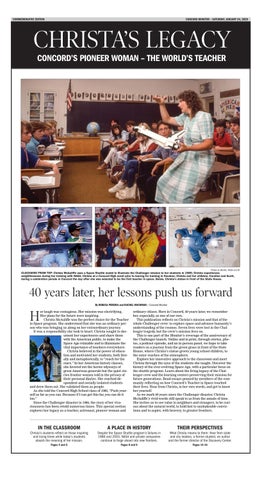
CLOCKWISE FROM TOP: Christa McAuliffe uses a Space Shuttle model to illustrate the Challenger mission to her students in 1985; Christa experiences weightlessness during her training with NASA; Christa at a Concord High event prior to leaving for training in Houston; Christa and her children, Caroline and Scott, during a celebration parade in Concord the day after she was selected to be the first teacher in space. Below, Christa’s statue in front of the State House.
DRIVEN TO CONNECT
By RACHEL WACHMAN Concord Monitor
hrista McAuliffe stood on stage in a gold
Cblazer with a red rose pinned beneath her collarbone. Hands clasped in front of her, fingers interlaced, she listened patiently as Vice President George Bush made the announcement: She, as a teacher, would be the first private citizen to venture to space.
The cameras, broadcasting to viewers across the country, panned to Christa as Bush read out her name. A grin broke across her face, a laugh of pure delight ringing out. She and Bush gripped each other’s hands for a moment, his laughter mirroring hers, as the crowd of 10 finalists in which she stood erupted in applause.
She stepped away from the group and walked up to the microphone, beaming and blinking back tears at the overwhelming emotion of the moment.
“It’s not often that a teacher is at a loss for words. I know my students wouldn’t think so.” Here, she paused for a moment to collect herself. “I’ve made nine wonderful friends over the last two weeks,” she said of her fellow finalists.
“And when that shuttle goes, there might be one body —” her voice broke, and she paused for a moment, pressing a finger to her lips before continuing, “but there’s going to be ten souls that I’m taking with me.”
Christa wasn’t interested in fame. She wanted to go into space to share the experience with the world, especially students and educators. For her, the opportunity meant the chance to inspire others to pursue their dreams as much as she was pursuing hers.
Her space adventures gave the public insight into the life of an everyday person, which was a value the Concord High School history teacher carried with her long before her name ever entered the national consciousness.
When I was teaching American history, I was always concerned that the military, political and economic history was in the textbook, but we never found out what happened to the ordinary person, because social history is not there,” she said in an interview in 1985.
‘An ever-increasing list of opportunities’: The early years Christa’s mother, Grace Corrigan, described her daughter as being ahead of her years.
“She was a very self-confident child, and always did things very well. She even walked at an early age. Christa was the first of five children, so we figured all children acted that way. What we found out, of course, was that they didn’t,” Corrigan told the Monitor in 1985.
Christa, born in Boston in 1948, was the eldest of the five Corrigan kids. The family moved to the small city of Framingham, Mass. when she was around five. The Corrigans attended church at St. Jeremiah Parish, and Christa played softball and basketball as a kid. She also took to the stage during multiple school theater productions and participated in her high school debate team.
Christa joined the Girl Scouts at a young age and remained an active member for twoand-a-half decades, eventually rising to become a troop leader. She even took a Girl
Scout pin into the space shuttle Challenger with her.
Her full name was Sharon Christa Corrigan, but she only discovered she had been going by her middle name around the time of her confirmation in eighth grade. Years later, when she was selected to go into space, some of her former classmates didn’t initially recognize her name because few in her life knew her as Sharon. To most, she was simply Christa.
She grew up watching an era of space exploration unfold on black-and-white television.
“When Alan Shepard made that first suborbital flight, my parents were so excited, and I can remember sitting there and watching it and then watching it again at school, and it was so exciting,” she told Channel 12 in 1985. I mean, this was such an impact on history that space flight was actually going to continue, and we would be herded into the cafeteria when these things were on or herded into the gymnasium, and I got caught up in that excitement.”
While attending Marian High School, a now-closed parochial school in her hometown, she met her future husband, Steven McAuliffe. They fell in love and quickly became inseparable.
Christa always remained thoughtful of her younger brothers and sisters.
“When I would wake up in the morning, she would always have a little something next to Betsy’s and my dresser, like a book or maybe a piece of candy, and I thought that was an unusual thing for a teenager to go out on a date and think about her siblings. And that’s just who she was,” Bristol said in a Netflix interview.
According to lore at the Framingham History Center, Christa was the first student at Marian to ever wear a strapless dress to prom. She was a pioneer, even then.
That thrill of experiencing history in the
making never dissipated for her.
During college at Framingham State, Christa studied American history and secondary education, in addition to leading the debate team, teaching CCD, working a parttime job and commuting to campus.
I was always impressed by her, because she seemed to have a clear idea of where she was going in the things that she was doing back then, said Mary Liscombe, a college friend.
A physical science class Christa took early on brought her to a conference in New York, where she got to meet several NASA astronauts.
Never envisioning she d one day join their ranks, Christa held onto that interaction.
“As a woman, I have been envious of those men who could participate in the space program and who were encouraged to excel in the areas of math and science,” she wrote in her Teacher in Space application. I felt that women had indeed been left outside of one of the most exciting careers available. When Sally Ride and other women began to train as astronauts, I could look among my students and see ahead of them an ever-increasing list of opportunities.
‘To be a participant’: Christa in Concord
Marrying Steven, in 1970, Christa began her career in education as a substitute teacher and quickly moved into a full-time role at a high school in Lanham, Maryland, where she taught American history, civics and English. In 1976, she gave birth to her first child, Scott. Two years later, she graduated from Bowie State College with a master’s in education for secondary administration and supervision. That same year, the family moved to Concord.
By the end of the decade, Christa welcomed her second child, Caroline, and began working first at Rundlett Middle School, teaching American history and English, and then at Bow High School, where she taught ninthgrade English, before joining Concord High School. Her husband once tried to convince her to become a lawyer.
“She said, ‘nah.’ She loved teaching,” he told the Monitor in 1985. I think she likes the idea that she has such a great impact on so many students, and that she is able to impart not only knowledge but life values.
Her teaching philosophy was cutting-edge in the 1980s. She tried to get every student as involved as she could, to instill strong democratic ideals and the tools to be useful citizens,” as she wrote in her Teacher in Space application. To that end, she devised hands-on lessons, simulations and field trips to breathe life into academic material.
While at Concord High School, she founded a course called “The American Woman,” which centered on the social history of everyday women throughout the decades and drew from first-person accounts, such as journal entries and oral histories. The course remains a staple of the curriculum today.
In an 1985 interview, one of her students described her teacher’s outlook as “What the heck, you’ve got to live life.”
“When she was first applying for this, she said, ‘I don’t know if I’ll make it or not, but I’ll try it and it’ll be fun.’ That’s the attitude she goes into everything with, the student told the Monitor.
On a trip to Washington, D.C. with her students in the fall of 1984, Christa had walked past a stand displaying Teacher In Space applications and grabbed a few for herself and her colleagues. It wasn t until the day before the deadline, in typical Christa fashion, that she finalized the bulk of her essays and postmarked the application.
And then the waiting began.
‘This pioneering trip’: Teacher in space
Christa found herself in a pool of over 11,000 applicants to be the Teacher in Space. As NASA narrowed down its search to two teachers from every state and then to ten overall, she remained in the running, keeping her students abreast of any developments regarding her application.
Her first thought when she learned she was in the top ten was, “This is a joke.”
She blended her excitement for space exploration with her passion for education throughout her Teacher in Space candidacy.
“Not only as a woman, but as a person, an ordinary person who feels that I live history every day, I really feel important that a teacher is able to look at things so much differently, be able to kind of demystify the space age and take all the acronyms that the astronauts that use, that the government uses, and put them into simple words so that they can really describe what happens, not look at it from a technological point of view but as a person who is taking this pioneering trip for the first time,” she told Channel 12 while still a fi-
AP file
Vice President George Bush shakes hands with Concord High teacher Christa McAuliffe after handingher atrophy,following hisannouncement thatshewas chosenforthe Teacher In Space program on July 19, 1985.
Christa McAuliffe signs an autograph during a visit to Concord after her selection to join the Challenger mission.
In her own words
By RACHEL WACHMAN Concord Monitor
hrista McAuliffe had a bubbly
Cwarmth that rendered her immediately familiar, a contagious enthusiasm for learning and sharing knowledge, and an unending desire to inspire others to dream big.
She captivated not only her students and the Concord community but the entire nation and even the world at large as the first teacher chosen to venture to space.
Throughout all the worldwide attention, she was an ordinary person, just like the people she relished having her history students study.
She had an infectious sense of humor, one that shone through in interviews, in NASA training and among her loved ones. Upon returning home from the selection announcement, she slept in one morning until 11 a.m.
“It was wonderful. Now I only have one set of wrinkles under my eyes,” she told the Monitor in 1985.
After entering the limelight, a senator told her the hardest part of dealing with media attention was answering the same questions over and over again.
“I laugh when I think about it because that’s what teachers do all the time. We teach the same things and answer the same questions year after year,” she said to the Monitor.
The best way to learn about Christa is to let her tell you herself. To that end, the Monitor has sifted through its archive and curated a selection of quotes to show who she was as a person and the values she held close.
Here she is, indelible as ever, in her own authentic voice.
On ordinary people
Christa was a lifelong journaler. She found comfort in putting her thoughts to paper and valued the use of journals and first-person accounts as primary historical sources in her teaching.
Her proposed Teacher in Space project was a three-part journal chronicling the experiences of the Challenger voyage.
“I would humanize it,” Christa told the Monitor after her selection in 1985. People would say, There are real people up there.’”
She hoped this message would especially resonate in classrooms around the world.
“I’ve always been very concerned that ordinary people have not been given their place in history,” she said. “I need to have that link up with the students, because if the students don’t see themselves as a part of history, they don’t really get involved. I would like to humanize the space age by giving the perspective of a non-astronaut. I think the students will look at that and say that an ordinary person is contributing to history, and if they can make that connection, they are going to get excited about history and the future.”
On living in Concord
When it came time to pay her local property taxes in 1981, Christa arrived at City Hall an hour before
“My mother told me jade brings good luck. So I wore her jade bracelet, she told the Monitor.
On education beyond the classroom
Christa organized field trips and put together simulations for her students. Her law class in the spring of 1984 visited Franklin Pierce Law Center, District Court and the state prison.
While at District Court, the class heard the case of a Concord High School student who had been convicted of drunk driving.
“It was uncomfortable on both sides. Hopefully, in seeing that, some of the kids would think twice,” she told the Monitor.
At the state prison, the group met with a woman sentenced to 8-12 years for hiding her boyfriend’s drugs.
nalist.
Captivating the nation with her zest for life and her acute level of relatability, Christa quickly worked her way into the hearts of millions, especially following her selection in July 1985.
“I think my philosophy of living is to get as much out of life as possible and to certainly involve other people in that enjoyment, but also, because of the country that we live in, to be a participant,” she said in a NASA interview during the selection process.
Everything she planned to do in space, she wanted to do for others. Her proposed project drew from her lifelong love of journaling. Christa envisioned writing a three-part journal of her adventures, to then be shared widely as a primary source of the space age. The trilogy would begin with her selection and take readers throughout the training process, then chronicle the flight itself and conclude with reflections upon returning to Earth.
She wanted to bring the world with her to feel the cramped cabin, to float in the weightless silence, to see the majesty of the Earth from the window.
Just as the pioneer travelers of the Conestoga wagon days kept personal journals, I, as a pioneer space traveler, would do the same,” she wrote in her application.
June Scobee Rodgers, wife of Challenger Commander Richard “Dick” Scobee, befriended Christa during the training process and described her as “delightful in every way” and “a real team member.”
the deadline.
“I always pay the last day. It’sa tradition,” she told the Monitor.
She was known for running up against the clock, including when it came to arriving at Concord High School for her classes. As she later told the country in different interviews, she even mailed in her Teacher in Space application the day before the deadline after finalizing the bulk of it right before. It was part of her personality, one many found endearing.
“I really don’t mind paying for city services, she said after paying her property taxes, which had gone up $300 from the previous year. “I like the place. It s nice knowing that wherever you go, you’re likely to run into someone you know. I like to do outdoorsy things, and you can certainly do them here.”
She and her husband had signed a petition earlier that year urging the school board to vote against the consolidation of neighborhood schools.
“It’s friendly. It’s family-oriented,” she said in the interview at City Hall. “I like the neighborhood schools. Put that in there. I really like the neighborhood schools.”
On becoming the Teacher in Space
In the hallway outside the press room where Vice President Bush would soon announce the Teacher in Space, Christa stood talking to Ann Bradley, a NASA senior official, who tipped her off. Bradley told her that her hus-
band would have to stock up on a year’s worth of cornflakes to feed her children.
Christa s joyful shout echoed throughout the hallway.
“Then I felt my knees growing weak, but the nine other teachers hugged me and told me they’d help me get through it,” she told the Monitor.
She and the other teachers went out to the stage, where the whole world learned what Christa had just found out: She would be the Teacher in Space.
Bush s televised announcement was followed by a media frenzy as reporter after reporter sought comment from Christa.
She moved around the room from interview to interview, pinching her cheeks as she went.
“I’m still floating in the air and I don’t know when I’ll come back to Earth,” she said.
Reporters asked her why she thought she’d been chosen.
“I feel I’m a really good communicator,” she said. “I love people. I enjoy my job. I feel that I’m real enthusiastic about teaching, but all ten of us were like that and I’m not really sure what extra edge I had over somebody else. I think they felt I was somebody everybody could identify with.”
The question kept coming up.
“I still don’t have a good answer for that one because I just don’t know,” she said in subsequent interviews.
Still, she had come prepared to the selection announcement with a talisman for good luck.
“She wasn’t a tough person,” Christa said. “She just got caught up in something. She was in the wrong place at the wrong time. It’s so easy for kids to get pressured into doing things. Someone else got the stuff but you’re there. That’s why I think it hit home.”
As the faculty advisor for the Close Up group, which provided students opportunities to learn more about their state and federal governments, Christa organized a trip to Washington, D.C. and worked with students ahead of time to cover topics such as civil rights and social welfare. We ll see parts of government that other people might not see: cabinet offices, government agencies and representatives offices. That’s quite an opportunity for a high school student,” she told the Monitor in 1984.
On dreaming big
When Christa decided to apply for the Teacher in Space project, she told the students in her classes that she was submitting an application. Throughout the selection process, she kept them updated whenever she had more information to share.
“I always asked my students to go seek what they feel they can do and reach a little higher. This gives students an opportunity to see somebody reach and try for something. If I can try for this, they can strive for something,” she told the Monitor right after her selection.
Reaching high became one of the points of inspiration she brought to her new role.
Part of me sees a goal, and if it s not realistic, I might alter it, but another part of me likes to push myself and do new things, she said.
“She didn’t have to have all the attention. In fact, every chance she got, she brought attention to the rest of the crew,” Scobee Rodgers said. “In fact, one of her lessons was going to be, Yes, I m the teacher, but let me tell you what the rest of these crew members do,’ and point out each of them with what they were doing, what they were contributing to that mission to make it successful.
She was slated to undertake a tour of the country to speak with teachers and help them develop their own space-related lessons. Even as she became a national sensation, Christa held fast to her life as an “ordinary person” in the ways she could. She visited home during her training as she was able to and relished time with her family.
Scobee Rodgers described Christa’s “delight in her marriage, how much she loved Steve, her children, how she would want to get home to make them a Halloween costume.”
Keeping up with her Concord High School ties, Christa also corresponded with her students throughout the year, writing college recommendations for those who asked and celebrating their accomplishments from afar.
The 37-year-old knew she was a symbol to teachers and students everywhere and hoped that her visibility would inspire current students to pursue teaching as a profession and consider their own teachers in a new light.
As Christa addressed the Concord High School Class of 1986 at the start of the school year, she left them with a piece of advice.
“Push yourself as far as you can,” she said. “Because if I can get this far, you can do it too.
Monitor file
Christa McAuliffe hoped her message would resonate beyond Concord High to classrooms across the world and locally, including Cindy LaPrad’s third-grade class at the Kimball School in Concord.
Courtesy
ChristaCorrigan, right,withsiblings, fromleft,Lisa,Betsy, Stevenand Christopher. They grew up in Framingham, Mass.
CHRISTA’S STUDENTS
CONCORD HIGH REMEMBERS
By REBECA PEREIRA Concord Monitor
Grief still catches in MaryJo Drewn’s throat when she tries to talk about the Challenger tragedy.
She can still feel the harrowed silence of the auditorium at Concord High School, where she and other students gathered to watch the space shuttle launch in January of 1986.
Moments earlier, the room full of young adults buzzed with a shrill chorus of noisemakers. A pall of confusion settled over the room when, 73 seconds after liftoff, the shuttle exploded. “You could hear a pin drop.”
But when Drewn thinks of Christa McAuliffe, who respected every student’s personhood and who demonstrated that history belonged to each one of them, her voice sings with effervescent laughter.
I will always remember that she was an awesome teacher,” Drewn said. “Her class on American women it was the first social studies class I took that I actually loved.”
Christa McAuliffe’s students say she was an exemplary teacher. She made learning practical for everyone. She lifted students out of their despondency and insisted on their participation. She amplified ordinary voices in her teaching of social studies, and she empowered young women to see themselves shaping the course of American history. For the students who would become teachers themselves, she provided the blueprint they hope to honor.
Graduates of the class of 1986, including Drewn, passed through Christa’s classes and followed her process of applying to the Teacher in Space program more closely than any other students.
When she was selected to venture into space, they celebrated her triumph. When she spoke at their senior assembly, they gathered to bid her goodbye on the steps of Concord High. When she died aboard the Challenger, their hearts broke.
Forty years later, they continue to hold their love for their teacher and their enduring sorrow over her untimely death in the same open palm.
Drewn remembers three consecutive summers in the 1980s when she worked coating license plates for the state’s Department of Safety, her mother s employer at the time. She was sitting in the office one day in July of 1985, when Christa was selected to be the first ordinary citizen to go to space.
She tore off her Walkman and leapt from her seat: Oh my God! They just picked Christa!”
While she prepared her college applications later that year, she reached out to Christa, who was training for the Challenger launch in Houston, Texas, to ask for a recommendation. Christa’s vote of confidence helped land Drewn at the University of Southern Maine, but it was the letter that accompanied her recommendation that left a lasting impression.
“This is her sense of humor: She said how things were going, and she mentioned, ‘I’m still trying to get used to my makeup running all the time because of the hot lights from the camera.’ That’s her, just bubbly and laughing all the time, Drewn said. For Tammy Hickey, Christa’s sense of decency and sincerity of heart were the underpinnings of her open personality.
As Christa mulled her answers to her space program application, recruiting suggestions from her students, Hickey quietly nurtured the certainty that among thousands of educators nationwide, her teacher would be chosen. I just knew she was going to get it. I couldn’t imagine her not getting it,” she said.
The reason was simple, and patently obvious, to Hickey, who’d been in Christa’s homeroom and history class: Christa was an adult that students respected because she respected them. She was personable, not reprimanding. She looked down on no one.
“In the hallways, she was more like a friend, Hickey recalled. She was just a special person who loved to teach.” During her training to travel aboard the Challenger and withstand the physical demands of space flight, Christa returned to Concord High with samples of space ice cream for students to taste. She told
them how weightlessness felt and entertained their silliest questions, like how going to the bathroom works in zero-gravity.
She sent Hickey a postcard from Houston that she s held onto in a big folder of high school mementos. The truth is that Christa left Hickey with more than a piece of paper.
Hickey works as a physical education teacher at Buffalo Creek Middle School in Palmetto, Florida. She didn’t enter into the teaching profession because of Christa, she said, but she became the kind of educator she is because of the kind of educator Christa was.
“We all looked up to her before she was going to be the first teacher in space, so I m not saying this because she was famous. It’s because it’s important that you make these kids feel like they re people, Hickey said. “Her two sayings stick with me to this day as a teacher: I really do touch the future, and you really do tell your students to reach for the stars. She was just a good example.”
That’s the case for Holly Merrow and Kris Coronis-Jacques, too. Like Hickey, both studied under Christa and both became teachers themselves.
Merrow, who teaches students in
grades two through five in Belfast, Maine, still remembers Christa with awe. After she was chosen to go to space, Christa hired students, including Merrow, to help with hosting dinner parties. Even with her training, her involvement at the school and the demands of family life, Christa prepared all the food herself that she served to guests.
“She was still in her robe getting ready once, and she turned and said, ‘I need someone to help me frost this cake.’ And I remember thinking that one time, ‘Why the heck is she cooking all this food?’ It’s amazing that she did all the work that she
did.”
These days, Merrow’s students turn to her in awe.
She recalled an occasion when a student chose to profile Christa for a project on heroic historical figures. Beaming with excitement over the girl’s choice, Merrow brought to school her “giant scrapbook” full of newspaper clippings, patches, stickers, magazine covers and yearbook tributes to Christa.
She said to me, You re living history!’ I thought it was really cool,” Merrow said.
Coronis-Jacques, who is a fifthgrade teacher in Hopkinton, shares Merrow’s wonder about Christa about her extraordinary accomplishments and her ordinary authenticity. Her recollection of the story of Christa s application to the Teacher in Space program shines in more vivid color:
She was like, You ll never guess what I did last night. At the 11th hour, I filled out the application, and I ran into the post office in my pajamas because it had to be postmarked by a certain date.’ She always made herself human, like, ‘Even I procrastinate, and I can still get stuff done.’ She didn’t make it like this standard that you can’t reach as a human being. She just was so real with everybody.”
Christa’s light shone brightly, and an exceptional sadness washed over the school when it was extinguished.
Coronis-Jacques remembers the memorial service hosted in the school gym as a dark day of profound mourning. Cliques dissipated. Adults set their grief aside to support students.
“It didn’t matter who you were. If you were crying, you got a hug,” she said.
These memories, although painful, are hard to stifle on the occasion of an anniversary.
Laura Martino, a student of Christa s who graduated in 1983, chooses to remember her for cultivating a welcoming environment in class. Then a resident of small-town Bow, Martino found attending Concord High intimidating. Christa’s warmth coaxed her out of her shell. Around each anniversary of the Challenger tragedy, Martino tributes Christa by sharing memories of her on Facebook with friends.
The platform is a double-edged sword. The already unshakeable memory of Christa’s death became impossible to ignore in a digital age, agreed MaryJo Drewn, but so did the singular magic of having personally known Christa McAuliffe.
The constant reminder is there, but it’s a good thing in a way because it makes us remember things that I think were really important, especially today, given the reality that we’re living in,” Drewn said. “I remember her, and she was such a good person. We need to remember people like that, because there’s so much terrible negativity and hate in the world. We need more people like that.”
“Her two sayings stick with me to this day as a teacher: I really do touch the future, and you really do tell your students to reach for the stars. She was just a good example.”
TAMMY HICKEY, former student who now teaches in Florida
Monitor file
Concord High students watch a televised address by President Ronald Reagan following the tragedy.
Monitor file
Christa McAuliffe sstudents oftenrecount howshe was able to connect on many levels.
Monitor file
Christa McAuliffe,on the second tobottom step, poses for a group photo with students in 1985.
Monitor file
Christa McAuliffe gives a farewell speech to Concord High students and staff in September of 1985 prior to leaving for training.
TEACHING ABOUT THE TEACHER
TODAY’S CLASSROOMS
By REBECA PEREIRA Concord Monitor
At the start of each school year, Kimberly Bleier stands before a new crop of students taking her Street Law course at Concord High School and does not presume they know much about Christa McAuliffe.
Four decades have elapsed since the euphoria of Christa’s selection as the Teacher in Space swept Concord. Even students at Concord High School who recognize her name may not know exactly who she was. Most don t realize she taught there, according to Bleier, head of the school’s history department, and nearly all assume she was a science teacher.
Bleier dedicates time to that conversation. She points out the classroom in which Christa taught and discusses the courses she created. She tells them that Christa, who would be 77 today, was “groundbreaking in her time here.”
Mainly, she directs her students focus not to the tragedy that ended Christa’s life but to the legacy she left behind.
“Enough time has passed that we no longer live in a world where everyone comes here and just knows that this is where she worked. Now is the time to re-examine and reframe the conversations we have to honor her in our community,” Bleier said. “I really want to look at what made her so extraordinary, the impact she had, her love of learning and students and history.”
Christa McAuliffe boarded the Challenger space shuttle with six other crew members on Jan. 28, 1986. The shuttle exploded 73 seconds into its flight. Forty years after the ill-fated mission, her passion for education and championing of ordinary people have persevered. Her memory is alive wherever troubled students receive understanding, textbooks are traded for personal histories and educators regard the world as an extension of their classrooms.
Christa’s philosophy of teaching still pervades classrooms at Concord High. The teacher in space, who would have orbited the globe filming lessons from the Challenger, insisted on encouraging her pupils to think beyond the confines of the classroom. Her economics students researched how construction projects impacted Concord, while her American history students sought out records of people who lived through each decade of the 20th century in the capital city.
She chaperoned her students to courthouses where they could observe the turning gears of the legal system, an approach Bleier honors in form and spirit with her Street Law curriculum.
The class might have been unrecognizable to Christa before Bleier picked it up more than a decade ago. Over the years, it had morphed into a deep academic study of Supreme Court cases that neglected practical learning. Now, students look forward to visiting the federal courthouse to perform mock sentencing hearings with Judge Landya McCafferty before watching her preside over the real thing. Souvenirs from class visits to the New Hampshire State Prison candy dishes crafted by inmates from repurposed license plates line the walls of Bleier s office.
Street Law, she said, has become the third most popular elective among the school’s nearly 1,500 students.
We have this amazing, rich community filled with law professionals. We have more courthouses in Concord than anywhere else. We have more law offices than anywhere else. We have a prison here,” she said. There s so much value in seeing things with your own eyes and making your own value judgment and assessment. We give them the tools to formulate their opinions it’s not my job to tell them what to think but to give them all this information so that they can become informed citizens.”
‘I touch the future. I teach.’
Virginia Drew contends with the weight of introducing young students to Christa McAuliffe almost every day of the school year.
In the halls of the State House on a Thursday morning in early January, she distilled the legislative process for a group of fourth-graders
from the Gilmanton Elementary School.
Imagine a tax on candy bars, she prompted. “What if you really like candy bars? Maybe Logan creates an amendment that taxes only purchases of 10 candy bars or more,” she said, plucking one boy out of the restless single-file line.
The fourth-graders from Gilmanton, two classes totaling 35 students, buzzed at their distinction as the first cohort to tour the State House in 2026. They reviewed other notable firsts with Drew as their knowledgeable tour guide: New Hampshire sent the first American astronaut into space, Alan Shepard, from Derry. New Hampshire, second to none, holds the first presidential Republican primary. On January 5, 1776, New Hampshire became the first colony to adopt a constitution.
And New Hampshire, Drew explained to the children gathered under a towering bronze statue of Christa McAuliffe, had the honor of being selected to send the first teacher to space.
Fourth-graders like to deal in concrete information. Drew hosts thousands of students from across New Hampshire each year and fields their every question: What grade did Christa teach? How long did it take for her to go through training? She explains the significance of the statue of Christa outside, the first statue of a woman on the State House lawn and the first statue many kids can connect to their personal lives.
Children see plenty of eternalized statesmen. To witness the bronze likeness of a teacher, however, stands out.
“Connections to history make it much more meaningful. For the kids in Concord and the kids in New Hampshire, it’s about knowing that
Christa was a New Hampshire person, one of ours,” Drew said in an interview. “We talk about things like the first American in space, and then we say the first teacher in space, and it’s a sensitive thing because we celebrate Christa’s adventures, but we also mourn what happened.”
From the State House lawn, the children paraded inside to the visitor center, where they faced a wall crowded with campaign memorabilia like a graffiti-covered underpass of buttons, bumper stickers and MAGA hats. The center is a treasure trove of collectibles. A gaggle of pony-tailed girls surrounded a display case where four pieces of moon rock are preserved. One child recognized an illustration of Christa teaching at Concord High School from a poster near the gym at Gilmanton Elementary.
Fourth-grader Bentley Ward stood transfixed, observing a Revolutionary War diorama with friend Mason Minery. He pressed his finger against the glass and pointed to a figurine: Look at George Washington!
Standing under the statue of Christa outside “made me feel happy, he said.
The statue, and the window of opportunity to speak to children about Christa McAuliffe, meant more to chaperone Susan Hoodlet, a paraprofessional at the elementary school. She was at home in Gilmanton feeding the youngest of her two children when she saw the Challenger explode in a spiral plume.
She had never met Christa she was a few years older than Hoodlet and had attended a girls’ parochial school, not the public high school in Framingham, Mass. but Christa was a legendary figure in their shared hometown. The sight of the statue reminded her of the monumental weight of Christa’s life.
“She got picked. Just think of how big that is,” Hoodlet said.
The exuberance of Christa’s selection as the first Teacher in Space, and the devastation of her loss, are represented in time capsules from the past that Drew invites every fourth-grade student in New Hampshire to share in when they step through the doors of the State House.
“Just imagine over 10,000 teachers all over America who applied to be the first teacher in space, and when it finally came down to the choice, it was New Hampshire’s Christa. Now, it ended in a disaster, but it is really important to remember how brave she was,” Drew said. An ordinary person with a lasting legacy
Bleier was just older than the state’s fourth-graders when Christa first entered her consciousness. She was 11 years old in 1986, a sixth-grader at the Conant School, later known as Abbot-Downing, whose babysitter was a high schooler in one of Christa’s classes. She knew nothing of the national theater surrounding Christa’s flight; rather, she marveled at the substance of the woman who daily graced her television screen. After school, she would sit with her father and clip newspaper articles about Christa’s training at NASA to add to her scrapbook. It was the human story. Here was this woman, this brave, amazing woman who was well loved by everybody who knew her, that was going on this adventure this ordinary human doing this extraordinary thing.”
By the time Bleier became a teacher, the project-based learning that Christa had championed at Con-
cord High was no longer a novelty she’d learned about hands-on teaching in her methods classes at UNH, but that wasn’t the standard approach in the 1980s. As a social studies teacher at Concord High, Christa challenged students in innovative ways. She hoped students would leave her class “with strong democratic ideals and the tools to be useful citizens,” she wrote in her Jan. 1985 application to the Teacher in Space program.
Her landmark curriculum, a course titled ‘Herstory,’ provided a semester-long examination of American history through the personal lives and reflections of ordinary women. Forty years later, the history department still offers her class to students, with the addition of other historically excluded perspectives, like those of Indigenous women.
Rummaging through the department s book closet, Bleier recently found a book from which Christa would have pulled excerpts to assign her students. A stamp dates the title by Joanna Stratton back to 1984: ‘Pioneer Women: Voices from the Kansas Frontier.
Christa identified with the chorus of women whose histories were recorded in books like Stratton s: “Just as the pioneer travelers of the Conestoga wagon days kept personal journals, I, as a pioneer space traveler, would do the same,” she proposed in her application.
She did that at a time when women were not yet a focal point of history, they were a footnote,” Bleier said. “The whole design of that course is the idea that the average citizen played an important role in history, and now the person who created that curriculum has become an average person who played an important role in history.”
“Here was this woman, this brave, amazing woman who was well loved by everybody who knew her, that was going on this adventure this ordinary human doing this extraordinary thing.”
KIMBERLY BLEIER, Concord High teacher on why she was so captivated by Christa McAuliffe as an 11-year-old at Conant School
GEOFF FORESTER / For the Monitor Concord students PriscahKabezea (left), Maya Jawitz, Rachel Hilts,and Deagan Hines study their lines as prosecutors at the mock trial at Merrimack County Superior Court.
GEOFF FORESTER / For the Monitor
Gilmanton fourth-grade student Ryder Shirley looks over the Christa McAuliffe materials on exhibit at the visitor center of the State House during his school s tour on Jan. 8.
GEOFF FORESTER / Monitor file Teacher KimberlyBleier givesinstruction tostudents during the mock trial on Jan. 16.
THEIR MISSION ENDURES
By RACHEL WACHMAN Concord Monitor
It started as a conversation, or rather, many conversations bleeding into each other in the weeks and months after their worlds shifted irrevocably.
Every person aboard the shuttle Challenger was someone’s parent, someone’s spouse, someone’s child, someone s friend. Their absence left tremendous, unthinkable voids. And in the sudden public tragedy of their deaths, their loved ones worried that the crew a vibrant group of seven people with a myriad of passions and backgrounds would be remembered only for how they died.
They set out to keep their memory alive by preserving the strongest link uniting the Challenger Seven: a deep, abiding passion for exploring outer space.
“I knew that NASA would continue the space mission, but I wondered who would create their mission, their Teacher in Space mission,” said June Scobee Rodgers, wife of Challenger Commander Francis Richard “Dick” Scobee.
If all had gone according to plan, Christa McAuliffe would have taught several lessons broadcast from space and shared her experiences with classrooms across the world. Following the flight, she was slated to tour the country, visiting as many schools and students as her schedule allowed.
In discussing how to honor the Challenger crew beyond statues, monuments and plaques, their families decided to create a living legacy,” Scobee Rodgers said, one that would bring space to the students who had been eagerly anticipating Christa doing the same.
We all agreed, yes, let kids fly their mission. So, Christa’s Teacher in Space mission would be continued with the children flying. Dick Scobee’s flight as commander of that mission will continue. Their
mission will continue, and we all agreed we don’t have to have their names out front. To just let it belong to a classroom of students. It’s their mission, Scobee Rodgers said.
The children wouldn’t be flying in shuttles like Challenger. Rather, they’d be recreating the plan for that mission and ones similar to it to experience firsthand the thrill of teamwork in unexplored frontiers through an outer space simulator.
Scobee Rodgers and the other Challenger families banded together to create a nonprofit organization dedicated to science education. Thus, the Challenger Center was born in April of 1986, mere months after the space shuttle tragedy occurred on live television.
It was an effort at healing, not only for the families but for all the students and educators who had been tuned in that day. “A lot of sweat and tears went into those equipment designs, but it doesn t come alive until the students are flying their mission and you can hear them, Scobee Rodgers said. “You can hear the excitement in their voices, where they re shouting, and
JUDY
someone in Mission Control is responding to someone in the space station.
The organization opened its first Challenger Learning Center in 1988 at the Houston Museum of Natural Science in Texas. In the time since, they’ve grown their numbers to 33 centers, including one in South Korea, with two more opening in the U.S. this year.
Their mission simulations now take students to the Moon, Mars, the International Space Station and beyond, giving students a taste of the cosmos and the intricacies of exploration.
Holly Merrow, one of McAuliffe’s former students who herself became a teacher in Belfast, Maine, visited the Challenger Learning Center in Bangor last year. What she saw blew her away. “All I could think is, ‘Christa would love this. This is what she would’ve wanted.’ And I wonder if all of this would have happened if she had lived, Merrow said.
At Christa’s alma mater, Framingham State University, the integrated science learning center bears her name. Inside it resides a Challenger Learning Center, which opened in 1994. For the past three decades, this interactive
RESNIK
educational space has brought Christa’s values to life for students in her hometown, who visit on field trips through school or organizations like Girl Scouts.
From 1994 to 2013, one of her college friends, Mary Liscombe, oversaw the program as director of the Christa Corrigan McAuliffe Center for Integrated Science Learning, incidentally housed at the site of the former cafeteria where Liscombe and McAuliffe became friends decades prior.
Every chance she got, Liscombe talked about Christa with the students who came into the center. She’d ask them to turn to the classmates on either side of them and guess what they’d do in the future. When they’d say, “I don’t know,” she’d reply with, “Well, I sat next to somebody right here in this area before it was McAuliffe Center, and I really couldn’t have figured out what she would do. What she did do, do you know what that might have been?”
Christa’s mother, Grace Corrigan, lived nearby and used to come to the center regularly to meet students and educators. Liscombe recalled how special it was to see Corrigan talk about her daughter s mission with
She was a vibrant, brilliant engineer
By RACHEL WACHMAN Concord Monitor
W
ith an early interest in music and a passion for math and science, Judith “Judy” Resnik had many talents. Born in Akron, Ohio, in 1949 to a Jewish family, Resnik was even bat mitzvahed before it was common for girls to participate in this religious ceremony. Throughout her childhood, she was an accomplished pianist and a dedicated student one who received a perfect SAT score. Resnik graduated as valedictorian in 1966.
Though she considered pursuing a career as a concert pianist, her love of math and science triumphed. After majoring in electrical engineering at Carnegie Institute of Technology, she obtained a PhD in that same discipline from the University of Maryland. Throughout the 1970s, she worked as an engineer at multiple companies while staying active flying, biking, or running and carrying her love of music into adulthood.
Resnik joined NASA’s Class of 1978 as one of six women out of the 35 total selectees.
Becoming an astronaut hadn’t been her initial goal, but the program lit a fire within her.
“It was accidental that I heard about it, and I just took a chance and applied,” Resnik said once in a TV interview. Even among such an accomplished group, she shone for her vibrancy and intellect.
AstronautJudithA.Resnik,41-D missionspecialist,andCharlesWalker,payload specialist for a June 1984 flight,prepare for some scheduled intravehicular activity involving the continuous flow electrophoresis systems experiment.
“I thought she was really, really bright, obviously a very beautiful person, flirtatious, funny,” recalled astronaut Rhea Seddon in an Astronauts Memorial Foundation article. “She was just a live wire. At NASA, she worked on orbiter development, training techniques and the robotic arm. Resnik felt inspired by Sally Ride, the first female American astronaut. Her first flight, a weeklong mission and the first voyage of Discovery, took place in 1984, making Resnik the second American woman and the first Jewish American to venture into space. She helped conduct experi-
ments involving solar cell wings and satellite deployments, in addition to making 96 orbits around the Earth. NASA awarded her the Space Flight Medal of Honor for operating the robotic arm to break off perilous ice particles on the exterior of the shuttle.
After Resnik was assigned to fly aboard the Challenger STS-51L mission, Commander Francis Richard “Dick” Scobee described her as “probably one of the most knowledgeable people in the astronaut office.” She didn’t act like she was breaking ground for women she just did it,
her footsteps. For Ayoub, Christa’s legacy is one of making learning accessible. She tries to share this with the students who come into the center as much as she can. I tell them about her, and I tell them about how she taught and how she wanted to be able to teach other kids from what she learned by going to space,” Ayoub said.
Seddon said in a Netflix interview. Resnik died at age 36, survived by her brother, Charles Resnik. Academic scholarships, schools, a university dormitory, a sculpture garden and more carry her name, as do a star, a crater on the moon and a crater on Venus. The Society of Women Engineers established both a Resnik Challenger Medal and a Judith Resnik Memorial Scholarship.
Charles Resnick, who viewed his sister as “brilliant,” paraphrased a quote from her in a 2016 WBALTV interview: “Hard work and perseverance can get you anywhere you want to go.”
younger generations.
Beyond those meaningful interactions, her favorite part of the job was watching students unlock their inner potential by taking on leadership roles in their teams, using creative problem-solving and gaining exposure to a different side of science learning.
“Even more important than saying ‘mission accomplished,’ at that age, they were empowered,” she said.
Alix Ayoub, a current Framingham State senior who works at the McAuliffe Center facilitating mission simulations, shared how her sixth-grade trip to the center changed her entire trajectory.
“Being specifically in this space, it was a field trip of my dreams, like it was my favorite field trip I’ve ever had,” said Ayoub, who focused her college application essay on the experience. “I think what I wrote was that it changed my view on science, because I didn’t love science, but this showed me that science could be fun and interactive instead of memorizing stuff.”
Like Christa, Ayoub wants to become a teacher. She finds a poetic parallelism in studying at Christa’s former university and following in
Current McAuliffe Center Director Dr. Irene Porro is working on adapting the missions to as many age ranges as possible. With a background in astrophysics, she studied at MIT, where there is a building named after Challenger Mission Specialist Ronald McNair. She aims to bring interactive science education to as many students in the Framingham community as possible. 40 years later, at least for me, it’s reaching out to as many young people as possible, giving them this experience,” Porro said. “You know, Christa was not a science teacher, something I have to remind people. To me, that’s important, because it shows you don’t need to be a scientist to be part of this experience, to be part of this effort.” The number of Challenger Learning Centers continues to grow. Scobee Rodgers, a former educator herself, finds power in the interactivity of the missions. Historically, she said, lessons are typically taught on paper, through books and displays. The Challenger Learning Centers, in addition to being that “living legacy” the families discussed four decades ago, offer something different, something enriching in new, innovative ways. If a child can apply the lessons in a real-world experience, then they never forget how they applied that lesson, she said. “And if it has a space theme, that’s even better, because in the future, we need to focus on our flights and space and benefit our country and the planet.
McNAIR
He excelled during challenging times
By RACHEL WACHMAN Concord Monitor
Ronald E. McNair grew up in rural South Carolina with an innate sense of perseverance.
He was born in Lake City, South Carolina, and took an early interest in the Russian satellite Sputnik.
“Way back in high school, I had the thoughts of science and space, astronauts, etc,” he once said in a TV interview. “But, you know, where I came from, that wasn’t the kind of thing a Black kid thought about. You know, how do you get to do something like that? What do you do?”
In 1971, he graduated with a Bachelor of Science in physics from North Carolina A&T State University before pursuing a PhD in physics from MIT.
He met his wife, Cheryl McNair, in Massachusetts, and the pair eventually moved to California, where he began working at Hughes Research Laboratories as a staff physicist.
Joining NASA’s space shuttle Class of 1978 as one of only three African Americans to be accepted he became a mission specialist, flying on Challenger in 1984 as the second African American in space.
In the early 1980s, he and his wife welcomed two children, Joy and Reginald. Then, McNair was assigned to fly aboard the Challenger STS-51L mission, which filled him with that same sense of determination he showed in childhood.
“I had the privilege of being part of the crew a couple years ago that made the first landing here at the Cape, and I intend to be a part of the crew to make the first return landing to the Cape,” he said at a press conference
ahead of the 1986 flight. He died at age 35. Both his daughters were under the age of four at the time.
Fellow astronaut Richard Covey remembered McNair’s presence at NASA. Ron McNair was relatively quiet, but he was extraordinarily skilled at karate,” Covey said in a Netflix interview. He was an accomplished saxophonist. Those were the ways that Ron spoke out.
McNair held a 5th-degree black belt and served as an instructor. Beyond playing jazz, he enjoyed running, boxing, football, playing cards and cooking. Carrying his love of the saxophone with him everywhere, McNair had sought to play from Jean Michel Jarre’s album “Rendez-Vous” aboard Challenger in 1986.
Academic programs such as the Ronald E. McNair Post-Baccalaureate Achievement Program have been established in his name. There’s a monument dedicated to him in Brooklyn, New York, as well as a building at MIT, a boulevard in his hometown, a parks and recreation center in Florida, a crater on the moon, numerous schools and more.
RONALD
REBECA PEREIRA / Monitor
Dr. Irene Porro stands in the lobby of theChrista Corrigan McAuliffe Center for Integrated Science Learning, where aChallenger Learning Center is housed. Challenger Center
Students workto completetheir missioninside theinteractive simulatorat aChallenger Learning Center.
McDONNELL DOUGLAS / Courtesy
NASA
Ronald E. McNair doubled as “director” for a movie being “produced” aboard Challenger during a 1984 flight.
DICK SCOBEE
Commander was a leader known for modesty
ABy RACHEL WACHMAN Concord Monitor
irplanes were an early fascination for Francis Richard Dick Scobee.
When he was little, his aunt gifted him a toy plane with wheels so he could sit inside and scoot around. He used it so much that the wheels wore out, so his father hung it from a cherry tree in their yard in Washington state, and his parents pushed him in the plane as a swing. His childhood bedroom boasted aviation art, books about flight and model airplanes dangling from the ceiling.
“More than anything, he wanted to fly airplanes,” his wife, June Scobee Rodgers, told the Monitor. Scobee, born in 1939 in Cle Elum, Washington, enlisted in the Air Force in 1957, determined to make his dreams of flight come true. He attended night school and amassed two years of college credits before being selected for the Airman s Education and Commissioning Program.
He graduated with a degree in aerospace engineering from the University of Arizona. While in the Air Force, he participated in a combat tour in Vietnam and became a test pilot. He logged over 6,500 hours of flight time in 45 types of vehicles and rose to the
Pilot was ready for first flight
By RACHEL WACHMAN Concord Monitor
ichael Smith knew early on
Mhe wanted to become an astronaut.
Before his scheduled maiden voyage piloting Challenger, Smith told the press how excited he was.
We re just all looking forward to getting in orbit and getting the secret handshake,” he said.
It would have been a long time in the making.
He was born in Beaufort, North Carolina, in 1945 and obtained a Bachelor of Naval Science from the U.S. Naval Academy. He later pursued a Master s in Aeronautical Engineering from the U.S. Naval Postgraduate School. He earned his wings from the Navy in 1969 before becoming a training instructor and serving in Vietnam.
Smith married his wife, Jane, when they were in their early 20s.
Following test pilot school, Smith worked on missile guidance systems before serving two Mediterranean deployments. Throughout his career, he piloted 28 kinds of aircraft military and civilian and logged over 4,860 hours of flight time.
In 1980, he was selected by NASA to begin training.
“It was never: ‘I’m an astronaut’ with his chest puffed out. It was just his job,” his daughter, Alison Smith Balch, said in 2011.
At NASA, Smith held a variety of roles, including commander of the Shuttle Avionics Integration Laboratory and deputy chief of the Aircraft Operations Division. His January 1986 Challenger flight was slated to be his first of that year, followed by a second in the fall.
The last voice heard on the tape recorder from the flight deck before the shuttle exploded was Smith’s: “Uh oh.”
He was 40 years old and was survived by his wife, Jane, and his three children, Scott, Allison and Erin.
“I see his twinkle in the eyes of my children and grandchildren, Jane Smith Wolcott told The Charlotte Observer.
His legacy lives on at the Michael J. Smith airfield in his hometown. He was posthumously awarded the Defense Distinguished Service Medal and, during his lifetime, earned the Navy Distinguished Flying Cross, three Air Medals, 13 Strike/Flight Air Medals, the Navy Commendation Medal with “V” Device, the Navy Unit Citation and the Vietnam Cross of Gallantry with Silver Star.
Dick Scobee grew up dreaming of flying planes and eventually flew 45 types of aircraft while in the Air Force. In 1984, he piloted the Challenger on a seven-day mission. NASA
ranks of lieutenant colonel.
When NASA advertised spots for the Space Shuttle Class of 1978, he eagerly applied. And in 1984, the little boy who grew up loving planes piloted a seven-day satellite repair mission on the space shuttle Challenger.
Despite his many accomplishments, Scobee Rodgers remembers her husband as quick to spotlight others.
“He was very special, very kind, very modest. Didn t really want his picture taken. Wanted to put other people out in front, wanted to give them the attention. It was hard for him once he was an astronaut, because we’d go out and everybody would want to run over and meet the astronauts,” she said.
He was a family man and relished spending time with his children, Kathie and Richard.
Flying was a hobby, too. The family owned a small Starduster, an open-cockpit Boeing aircraft. Scobee Rodgers remembers the thrill of soaring through the air with her husband, goggles on their faces, “kind of like Snoopy and the Red Baron.”
Scobee was 46 when he died aboard Challenger on that frigid January day. He and June had been married for 26 years.
She thinks of him every day.
When she opens her computer, his face lights up the screen. She charts time in terms of how old he would have been or how many years they would have been married. His legacy lives on in many ways. 2004 marked Scobee’s induction into the U.S. Astronaut Hall of Fame. Numerous schools have been named after him, as well as an education center and planetarium at San Antonio College. A Cygnus cargo vehicle carrying Scobee’s name traveled to the International Space Station in 2024 as part of a commercial resupply mission. He didn’t set out to be an astronaut but his achievements came from hard work and overcoming obstacles. Still, his modesty lingers. When Scobee Rodgers thinks about how her husband would have wanted to be remembered, the answer is quite simple: “He would say, ‘Oh, June, whatever. I just wanted to be a pilot, and I worked hard. And if anything’s remembered about me is that I flew airplanes,’” she said.
His words forever connected to travel
TBy RACHEL WACHMAN Concord Monitor
he soccer ball, now faded and fraying with faint remnants of handwriting still inscribed on the surface, carried Ellison
Onizuka’s dreams back into space.
It had been a gift from his daughter s soccer team at Clear Lake High School. He had helped coach the players, and they’d written him signed notes ahead of his scheduled Challenger mission. He’d placed the ball in a locker within the shuttle’s cabin before the flight. Onizuka would bring a piece of home with him into space. When he died with the rest of the crew, the ball, somehow, survived. It was recovered from the wreckage of the cabin. His family donated the ball to the school, where it lived for three decades.
In 2016, Onizuka’s memento was placed in another spacecraft, this time by astronaut Shane Kimbrough, whose son attended the same high school. Kimbrough brought the ball with him aboard the International Space Station and returned it to Clear Lake following the mission.
Onizuka’s name can be found on the last page of every U.S. passport alongside a poignant quote: “Every generation has the obligation to free men s minds for a look at new worlds to look out from a higher plateau than the last generation.”
He was a pioneer in his own right, marking a series of firsts on his initial flight aboard Discovery in 1985: first Asian American, first person of Japanese descent, first Hawaiian, first Buddhist in space.
Born in 1946 in Kealakekua, Hawaii, Onizuka was one of four siblings. His parents were secondgeneration Japanese Americans. After graduating with honors
Gfrom Konawaena High in 1964, he studied aeronautical engineering at the University of Colorado, where he also pursued a Master of Science in the same field.
Then, Onizuka s dreams took flight when he joined the Air Force in 1970. After four years of active duty as a flight test engineer and a test pilot, he attended Air Force Test Pilot School and stayed on, rising to Lieutenant Colonel.
Competing against around 8,000 applicants, he joined NASA’s Class of 1978, comprised of 35 individuals selected to fly in the space shuttle age that awaited.
Onizuka felt the significance of the uncharted territory he and his
colleagues were set to explore.
“There are a lot of outcomes from these projects which will affect both our society and the rest of the world,” he told Hawaii News Now.
His first mission, which took place in January of 1985, was classified by the Department of Defense. He spent 74 hours in space before returning to Earth.
Then, a year later, the 39-yearold prepared to fly as part of the Challenger crew. He was a mission specialist and an “expert on the tracking relay satellite, as his commander, Francis Richard “Dick” Scobee, described him.
Members of the Space Shuttle Class of 1978 recall his delight in
sharing food with others.
“He prided himself on Hawaiian food, and specifically, roasting a pig,” astronaut Frederick Gregory said in a Netflix interview.
Onizuka was survived by his wife, Lorna, and his two daughters, Janelle and Darien, who were 16 and 10, respectively. His name lives on, especially in Hawaii, at the Ellison Onizuka Kona International Airport at Keahole and the Onizuka Center for International Astronomy.
Multiple Air Force locations have been named for him, and the Onizuka Memorial Committees hold yearly Space Science Days in Hawaii and California.
A satellite expert with an adventurous streak
By RACHEL WACHMAN Concord Monitor
regory Jarvis eagerly anticipated his space voyage, describing the Challenger mission at a pre-flight panel as “a dream come true.”
Jarvis’s responsibilities aboard Challenger entailed amassing new information about liquid fueledrockets and their design, specifically by studying liquids in weightless environments.
As a satellite engineer, he had applied for the NASA payload specialist position and was selected from among 600 candidates at Hughes Aircraft Company. He began training, but it took longer than expected to get into the air. Twice, he was assigned to missions and then replaced by legislators who would fly in his seat. When NASA put Jarvis on the Challenger crew for January 1986, he was beyond ready.
“The first time you put on a blue flight suit you kind of walk around, Maybe I ll let them walk in front of me and they won’t see me’ but after
a while, you think, you do they things that they do, you work around the orbiter, and you say, ‘I know what I m doing here, I belong, he once said in a TV interview.
Born in Detroit, Michigan, in 1944, Jarvis graduated high school in Mohawk, New York, before studying electrical engineering at the University of Buffalo. He then moved to Boston to obtain a Mas-
ter s in the same field at Northeastern University. During this time, he met his wife, and they married before he joined the Air Force. While stationed in California, he pursued a Master’s in management science at West Coast University Los Angeles. After leaving the Air Force, Jarvis was hired at Hughes. His specialty was communication satellites that were going to be
launched from the shuttle, and when the program presented itself at Hughes that they could fly a payload specialist, he was so ecstatic about that,” said Marcia Jarvis. “They narrowed it down to the final 10 and so he called me at work, and he just says, ‘I got number one.’” In 1985, he returned to the University of Buffalo to deliver a commencement address. “You can reach for the stars by always giving your best in performance and attitude,” he told the graduating class. Jarvis had an adventurous streak and loved cross-country skiing, backpacking and whitewater rafting. He also played classical guitar. When Jarvis finally boarded Challenger for his mission in January 1986, he took with him a flag from his alma mater. The flag survived the explosion and was later recovered. The University of Buffalo named an engineering building after him, and there is a memorial sculpture in his honor. Similarly, his high school later renamed itself in his memory. There is also a hydropower dam on Hinckley Lake in New York bearing Jarvis’s name.
MICHAEL SMITH
GREGORY JARVIS
NASA
GregoryJarvis (center),withRonald McNairandChrista McAuliffeas they practice emergency escape procedures at Launch Pad 39B.
ELLISON ONIZUKA
Onizuka in orbit on the shuttle Discovery STS-51C in 1985.
PUSHING
SPACE TRAVEL’S EVOLUTION
By RACHEL WACHMAN Concord Monitor
It was a sight that made some laugh, others gasp in awe and many roll their eyes: A red Tesla Roadster with a dummy dressed in a spacesuit floating through space while action music played over the broadcast.
The televised SpaceX launch of Falcon Heavy in 2018 captured attention around the world for the superfluous nature of its payload, which is still floating somewhere beyond Earth s orbit eight years later.
Yet the mission was more than a publicity stunt.
The private company that unleashed a car into the cosmos is now a primary partner for NASA, regularly taking astronauts and supplies to the International Space Station.
While the concept of a reusable spacecraft was developed at NASA, the engineering breakthrough of reusable rockets launched by SpaceX, landing back where they took off, has propelled the company to become a leader in space exploration.
SpaceX is working toward a vision that NASA, as a public agency, once held back in the 1980s: Regular launches pushing the boundaries of space travel to new frontiers.
A reusable space airplane
Over the course of 30 years, NASA’s Space Shuttle Program flew 135 missions and sent more than 300 people into space.
From 1981 to 2011, the shuttle changed space travel. Coming in the wake of the moon landing and the Apollo missions, the shuttle was intended to be the vehicle of the future, the machine that would carry men and women into space, maybe, to even live there permanently.
“It was really sold by NASA, in the end, as a sort of all-purpose vehicle for everything that you might want to do in space,” said Dr. Jennifer Levasseur, a space history curator at the National Air and Space Museum, where she oversees the shuttle exhibit. Prior to the shuttle, spacecraft were designed for one-time use only. At the start of the 1970s, however, NASA sought to change that.
“The idea was, well, it’s a really unaffordable model to just keep building these things and throwing them away. So why don’t we build something that s reusable? Levasseur said.
The shuttle, which proved instrumental in building the International Space Station, took the form of a space cargo plane, an idea NASA had been toying with for decades but hadn’t been able to fully execute because of its complexity.
That model was built, this idea that you could have a spacecraft shaped like an airplane that could go up into space, come back, kind of be fixed up a little bit, and then be rolled right back out for another mission,” Levasseur said.
A NASA reportstated the shuttle was “capable of launching like a rocket, reentering Earth s atmosphere like a capsule, and flying like a glider for a runway landing.”
The shuttles delivered multiple satellites into orbit and helped repair the Hubble Space Telescope while serving “as a platform for scientific research within a range of disciplines that included biotechnology and radar mapping.”
In other words, it was a jack-of-all-trades spacecraft.
Over the course of the Space Shuttle Program, NASA constructed six such vehicles, officially named Space Transportation Systems, or STS for short: Enterprise, Columbia, Challenger, Discovery, Endeavor and Atlantis. While Enterprise served as a test vehicle and never flew in space, these shuttles collectively traveled 537,114,016 miles and orbited the Earth 20,952 times, according to NASA data.
In 1981, Columbia was the first shuttle to launch, ushering in a new age for space exploration. In the years that followed, NASA experienced great success in launching multiple missions per year. The more success the organization had, the more it promised both to Congress its funder and to the American public.
‘One of America’s finest: A teacher’
Until the 1980s, only trained astronauts and a few lucky politicians had gone up into space. NASA devised a plan to send up a civilian, something the organization knew would garner widespread attention and stoke excitement for space travel in a new way.
NASA needed to find ways to keep the public invested in its work. After all, who would be more relatable than a teacher?
On August 27, 1984, President Ronald Reagan addressed the nation
Today I m directing NASA to begin a search in all of our elementary and secondary schools and to choose as the first citizen passenger in the history of our space program, one of America s finest: a teacher,” he said. “And when that shuttle lifts off, all of America will be reminded of the crucial role that teachers and education play in the life of our nation.
With that, the Teacher In Space Project was born. Over 11,000 educators from across the nation applied. The pool was narrowed down to 10 finalists, with the final pick announced on July 19, 1985: Sharon “Christa” McAuliffe, a high school social studies teacher from the small city of Concord, New Hampshire.
“Not everyone knows a test pilot, not everyone knows an aerospace engineer, but everyone knows a teacher, and I think her selection for the Challenger crew and to fly on Space Shuttle, really made it something tangible, said Astronaut Richard “Ricky” Arnold, who participated in a shuttle flight aboard Discovery and took McAuliffe’s lessons into space during the 2017-2018 school year.
The timing for McAuliffe’s selection was ideal because NASA needed the buzz from the Teacher in Space project to deflect from the increasingly stark evidence that it could not keep up with its promises. In 1985, the organization promised at least one shuttle launch a month, but only nine of the scheduled flights took place. NASA vowed to launch even more frequently in 1986. McAuliffe was assigned as a payload specialist to the crew of Challenger, which would launch in January of 1986 with six others aboard: Commander
“Because we did go back to space after Challenger, and we went back to space after Columbia, and almost everything we do and every technology that we use, if it fails, we come back, we do it again. ... That’s sort of part of our processes to continue moving forward and learning from the things that go wrong and implementing change in order to make sure that doesn’t happen again.”
DR. JENNIFER LEVASSEUR,
space history curator at the National Air and Space Museum
NASA
In this 2019 photo, U.S. astronauts Jessica Meir of Maine, left, and Christina Koch pose in the International Space Station ahead of the first all-female spacewalk to fix a broken part of the power network.
AP
SpaceX launches their Falcon 9 rocket on Jan. 12 with a batch of Starlink satellites from Cape Canaveral, Florida.
NASA
On July 10, 2011, the space shuttle Atlantis is pictured prior to a perfect docking with the International Space Station.
New frontiers emerge
Francis “Dick” Scobee, Pilot Michael Smith, Mission Specialists Judith Resnik, Ronald McNair and Ellison Onizuka, and Payload Specialist Gregory Jarvis.
In the months prior to the January launch, McAuliffe underwent 114 hours of training and spent time sharing her experiences with the American public through television interviews.
Challenger, whose mission pertained to satellite deployment, was initially scheduled to launch on Jan. 22 after being moved from December. But due to a series of delays, including inclement weather and a faulty door seal, the launch ultimately got pushed to Monday, Jan. 28. That morning was unseasonably frigid in Cape Canaveral, Florida, where icicles had formed on the outside of Challenger overnight. The launch was pushed back several hours to right after 11 a.m. to allow time for icicle removal.
It was going to be a big day for the United States. President Ronald Reagan would deliver the State of the Union that evening.
‘If it fails, we come back, we do it again’
Challenger was cleared to launch, but what happened next left the nation permanently scarred.
One minute and 13 seconds after leaving the launchpad, the shuttle exploded in the air, killing all seven members of the crew while millions tuned in on live television and cheers turned to gasps of confusion and then horror and disbelief.
An investigation ultimately concluded that the rubbery ORings in the seal of the solid rocket boosters had become brittle in the cold. Rather than stretching as they were supposed to under extreme heat, they let gases escape, leading to the explosion. (To learn more about the scientific and communication failures that led to the disaster, read the Monitor’s story on NASAs systemic failures and the changes that resulted from them on Page 11.)
Challenger marked a moment in American history that continues to resonate in the national consciousness.
“There was a lot of attention on the space program because of a teacher being part of this mission,” Arnold said. “So a lot more people were paying attention. There was a lot of visibility. And then when the tragedy happened, the country paused in a way that you don’t really experience all that often in your life.”
As national mourning unfolded, the space shuttle program continued. For their bravery and contributions to space exploration, the Challenger Crew was posthumously awarded the Congressional Medal of Honor in 2004.
Modifications were made and safety procedures tightened, but the risks persisted.
Dr. Irene Porro, who serves as director of the Christa C. McAuliffe Center for Integrated Science and Learning at Framingham State University, explained that the Challenger disaster provided confirmation that the enthusiasm for going into space did not match the reality of the challenges that space flight posed.
“These machines we send to space are extremely complex machines, and when you have something anything that goes to space or anywhere else that s very complex, the probability that something goes wrong increases, said Porro, who has
a background in space science technology and astrophysics.
In 2003, another tragedy took place on a similar scale as Challenger. The shuttle Columbia was returning from a 16-day mission involving microgravity experiments when it exploded upon re-entry into the atmosphere. The seven-person crew, all of whom were killed in the disaster, had only around 15 minutes left in their voyage before landing back on Earth.
And still, the shuttle program continued, with many efforts made to learn from the mistakes of these tragedies.
Levasseur views the story of the shuttle program as one that includes the idea of recovery.
“Because we did go back to space after Challenger, and we went back to space after Columbia, and almost everything we do and every technology that we use, if it fails, we come back, we do it again,” she said. “Just because a plane crashes doesn’t mean we don t fly on planes anymore, or just because our car engine dies doesn’t mean we re never going to drive a car again. That’s sort of part of our processes to continue moving forward and learning from the things that go wrong and implementing change in order to make sure that doesn’t happen again.”
Addressing ‘challenges as human beings’
For Arnold, the risk of space flight is one that he said people tend to accept “quietly. For him, it was worth it.
“I don’t think most Americans are aware of how dangerous space flight can be,” he said. “In a world that is rife with turmoil and challenges that the entire globe has to come together and face, we have a model in the International Space Station. We have a group of people around the world and a group of people off the world working together on a project that brings us together and addresses challenges as human beings, not as Americans, not as Russians, not as Japanese, but as human beings. And I think that lesson that the International Space Station is teaching us is worth the risk of going there.
In recent years, the rise of private space companies, such as SpaceX, Blue Origin and Axiom Space, has changed the dynamic of exploration beyond Earth. The idea of a private-public partnership is not new, with payload specialists from different scientific companies flying on public spacecraft for decades. Now, however, NASA provides the astronauts while SpaceX manufactures the rockets.
For some people, they want to invest because they see that there will be a return on investment, Porro said. “That’s the only reason why they want to do it. Other people want to go to space because they want to explore. For other people, I think it’s part of our human destiny to, so the motivation that brings people to these kinds of things are different.”
While no human lives have been lost in any commercial space launch to date, the danger of leaving the Earth’s atmosphere won’t change, especially as people look to venture further into the solar system to Mars and beyond.
“There was always going to be a risk,” said Levasseur, the space history curator. “There always has been. There always will be, because you’re going at 17,500 miles per hour to a place where there s no oxygen, there sa vacuum. These dangers are very real and that shouldn’t be minimized.
REACHING FOR NEW FRONTIERS
MERCURY – REDSTONE 1
FIRST LAUNCH: 1961; HEIGHT: 83 feet – about the size of a tall oak tree; THRUST: 78,000 pounds of thrust at launch; PAYLOAD: about 5,000 pounds, including capsule; COMPUTING POWER: No flight computer on board (although there were various transistorized flight systems and relays that operated solenoids and other components). Guidance and avionics computers were ground-based, including reliable pre-transistor vacuum-tube computers; PROJECT MERCURY (1958-1963) OBJECTIVE: To orbit a crewed spacecraft around Earth, recover both safely, and evaluate human performance capabilities in space. Project Mercury consolidated various competing initiatives from the Air Force, Army, Navy and a civilian agency under the newly created NASA in 1958. The first American flight (New Hampshire native Alan Shepard in 1961) used the reliable Redstone rocket on a ballistic trajectory ascending into space and returning without achieving orbit. In 1962, John Glenn became the first American to orbit the Earth after Mercury missions transitioned to the more powerful Atlas launch vehicle. Mercury adapted existing military ballistic missiles for human spaceflight.
GEMINI – TITAN 2
FIRST LAUNCH: 1964 (uncrewed); 1965 (with crew); HEIGHT: 109 feet – about the length of the Durgin Bridge in Sandwich, NH; THRUST (at launch): 430,000 pounds of thrust at launch; PAYLOAD: about 8,000 pounds, including capsule; COMPUTING POWER: 60 pound transistorized computer for avionics and guidance; static memory of 19.5 kilobytes. For comparison, a phone with 512gb of memory (512,000,000kbs) has more than 26 million times more memory; PROJECT GEMINI (1961-1966) OBJECTIVE: To prepare for the Apollo moon landings by learning how to rendezvous and dock with another spacecraft and by flying longer, more demanding missions.
APOLLO – SATURN V 3
FIRST LAUNCH: 1967 (uncrewed); 1968 (with crew); HEIGHT: 363 feet, about the size of Hyperion, a redwood that is the world s largest known tree; THRUST: 1,600,000 pounds of thrust at launch; PAYLOAD: About 100,000 pounds, including capsule and lunar landing module; COMPUTING POWER: 80 pound transistorized computer for avionics and guidance; static memory of 36 kilobytes and 2kb or RAM. For comparison, a phone with 512gb of memory has about 13 million times more memory; APOLLO PROGRAM (1961-1972) OBJECTIVE: To land a crewed vehicle on the moon and return the crew safely to Earth.
SPACE SHUTTLE 4
FIRST LAUNCH: 1981; last flight 2011; HEIGHT: 184 feet, about the height of the Leaning Tower of Pisa; THRUST: 6,500,000 pounds of thrust; PAYLOAD: 50,000 pounds of crew and cargo (does not include weight of Space Shuttle vehicle); COMPUTING POWER: Five IBM AP101 units as the primary flight computer for avionics, guidance and other controls, Honeywell HDC-601 for engine controls, all later updated and further supplemented by portable computers for additional computing power. The original IBM AP101B units had static memory of 416 kilobytes. For comparison,
SPACEX
5
and several thousand pounds of cargo and supplies; COMPUTING POWER: Starting with the modern era of rockets, this ceases to be a useful comparison; SPACEX CREW DRAGON OBJECTIVE: Crew Dragon is a crew capsule designed to transport astronauts and cargo to and from the International Space Station, restoring
CHRISTA’S LOST LESSONS
By RACHEL WACHMAN Concord Monitor
Astronaut Richard Ricky Arnold floated aboard the International Space Station in 2019, steadying floating orbs of water with his fingertips as he looked straight into the camera speaking not to scientists or engineers, but to classrooms full of children.
Three decades earlier, Christa McAuliffe had intended to do the same. As national mourning continued over the loss of the Challenger crew, her lessons faded into the periphery. Arnold and fellow astronaut Joseph Acaba set out to change that. Like Christa, both had been teachers with big dreams of exploring the cosmos. Christa’s Teacher in Space backup, Barbara Morgan, eventually helped create the Astronaut Educator program, which brought on Arnold and Acaba as astronauts.
Nearly a decade ago, the pair flew back-to-back missions to the International Space Station.
“Could we do anything to help bring the Challenger mission to completion? said Arnold, who spent 197 days aboard the floating station. “And when we talked about it, we realized there were some lessons that were developed that Christa was going to do, and it was time to get those lessons done, to honor not only her, but the entire crew of Challenger.”
She had spent months amid her 114 hours of training devising a set of lessons to show the world but especially students the ins and outs of exploring beyond Earth. She wanted students to see how water behaved without gravity, how astronauts slept, how ordinary routines became extraordinary once Earth fell away beneath the windows.
Arnold and Acaba revisited McAuliffe’s lesson plans to bring her teaching to life. The series, entitled “Christa’s Lost Lessons,” included video demonstrations and a corresponding curriculum for classroom teachers.
“As educators, our job is to inspire every day,” Acaba said in an interview with the Monitor. “That’s what we do with our students, and that’s what our goal is. You can give them content, but if they’re not inspired, they’re not motivated. They’re not going to take that in. And so we’re trained in that. We have years of practice doing that, and I think that’s something that we brought with us to the Astronaut Office.” Arnold, who grew up dreaming of either playing for the Baltimore Orioles or becoming an astronaut, began his career teaching middle school science in Maryland. He also spent a decade teaching math and science overseas. The more he taught, the more his interest in space grew.
“It seemed like it was something out of reach, Arnold said. I just felt like, as someone telling students you got to be willing to at least try, raise your hand and volunteer, and I felt like I should probably practice what I preach a little bit and try to pursue that dream.
NASA
On Oct. 17, 1985, Christa McAuliffe floats weightlesslywith NASA specialist Bob Mayfield aboard a KC-135 aircraftwhiletesting anexperimentsheplannedto conductthefollowingJanuaryinorbit aboardthespace shuttle. The experiment was a study of mixing oil and water in zero gravity. The KC135 aircraft can produce a few seconds of weightlessness with a steep dive and is used in astronaut training.
Acaba, on the other hand, became a teacher after serving in the Marine Corps Reserves and the Peace Corps. He taught a year of high school and four years of middle school in Florida before applying to NASA.
Acaba and Arnold became Educator Astronauts in 2004 alongside Dorothy “Dottie” Metcalf Lindenburger. Their participation in space exploration put them in a very small group, uniquely positioned to carry
1972: President Richard Nixon announces the creation of the Space Shuttle program, which would make space transportation more accessible and more routine.
April 1981: First space shuttle test flight.
August 1984: President Reagan announces that a teacher will be the first civilian to fly in space. Christa McAuliffe is among 79 applicants from New Hampshire, more than 11,000 nationwide.
on a special part of the immense legacy of Christa McAuliffe.
“I was there, ultimately, in space because of her, because of the decision that was made initially to take a teacher into space,” said Arnold, who flew alongside Acaba on the shuttle Discovery in 2009 on an International Space Station assembly mission. “Somehow, I ended up way down the line getting my opportunity to go to space.” Throughout her NASA career,
Metcalf-Lindenburger felt the presence of McAuliffe and the Challenger crew in the work she did, including on a 2010 mission to the International Space Station and through involvement in other projects as a mission specialist.
“I think that it would have been amazing to hear the perspectives of the Challenger crew when they first had a chance to look back at Earth on that mission and for Christa but since they weren’t able to do
SHUTTLE PROGRAM TIMELINE
April 16, 1985: A committee selects McAuliffe and Robert Veilleux, an astronomy and biology teacher from Central High School in Manchester, to represent New Hampshire in the National Aeronautics and Space Administration s Teacher in Space competition.
June 23, 1985: McAuliffe, Veilleux and 118 other teachers, two from each state and U.S. territories, begin a five-day course on the space program. The week includes interviews with a panel of judges that includes Dr. Robert Jarvik, inventor of the first artificial heart; Pam Dawber, television personality; Wes Unseld, former pro basketball star; the presidents of American University, Duke University and Vassar, and four former astronauts.
July 1, 1985: McAuliffe is named one of 10 finalists in the competition.
July 7, 1985: The 10 finalists arrive at the Johnson Space Center in Houston for a week of physical and psychological tests.
July 12, 1985: McAuliffe and her colleagues board a NASA plane that allows them to experience weightlessness.
July 19, 1985: Vice President George Bush announces that McAuliffe will be the first civilian in space.
July 20, 1985: McAuliffe is welcomed home with a parade through Concord. Shouts of Atta girl, Christa and Go for it greet the civilian astronaut along the parade route.
that, then I really feel that it sa chance for those of us that have flown, we continue to talk about it,” she said.
All of these teachers in space Morgan, Arnold, Acaba and MetcalfLindenburger have prioritized sharing their experiences with younger generations.
“We want students to see the future and be a part of that future,” said Metcalf-Lindenburger, who interacts with students as much as possible through substitute teaching, classroom visits, the Seattle Museum of Flight and more. “After 40 years, they might not even have parents that were alive during the Challenger days. But we want them to understand not only that space is for them, but we also want them to learn the ways that astronauts work, and because that can be so impactful, even if you don’t go into a STEM environment or into a STEM job. So we want them to talk about teamwork and leadership.”
To celebrate the memories of their loved ones and the values they lived for, the families of the Challenger crew banded together in the year after the shuttle s explosion to form the Challenger Center, a nonprofit geared towards STEM education, with learning centers established around the country. MetcalfLindenburger has sat on the board for over a decade and will become the next chair in August. Morgan, too, has played an active role in the Challenger Center.
While NASA did not continue the Educator Astronaut program, it opened up application requirements to include people with a background in teaching, Acaba said. And the work they ve done, just as Christa did, continues to highlight the teaching profession.
I feel like I m just a small part of this really big endeavor that is just trying to inspire students and highlight the work that we are doing here at NASA,” he said. “Making that entire crew proud for the sacrifice that they made. And I think that’s what we’re all trying to do,” he said.
Looking back at Earth reminds you that it’s your home, Metcalf-Lindenburger said.
“The whole Earth, not just your hometown,” She said. “I think that being able to convey that, especially in a time when we sometimes find so many ways to divide ourselves, to argue about things it makes you kind of emotional but part of why Christa was really inspiring is that she was so positive.”
Metcalf-Lindenburger strives to share this sense of positivity and connectedness with as many people as she can. Arnold, too, continues to carry on the educational component of Challenger.
“I spend a lot more time talking to students about their place potentially in this exploration the solar system, that there are roles that they probably couldn t imagine astronauts, one of them but there’s so many amazing career paths that are out there to be a part of this grand endeavor that I just want to do what I can to move that needle a little bit, he said.
July 31, 1985: McAuliffe appears on the “Tonight Show” with Johnny Carson, one of many appearances on national and local television shows.
Aug. 13-15, 1985: The 10 finalists meet in Washington to design the lessons to be taught by McAuliffe during her flight on the space shuttle Challenger, set for launch on Jan. 22, 1986. The first class is titled The Ultimate Field Trip.
Sept. 8: McAuliffe and her alternate, Barbara Morgan of McCall, Idaho, begin 18 weeks of training at the Johnson Space Center.
Sept. 11, 1985: Secretary of Education William Bennett fills in for McAuliffe for a day at Concord High School.
Oct. 11, 1985: McAuliffe takes a break from training and returns to Concord to be with her family and to be honored by the state chapter of the National Education Association.
Christa undergoes testing in Houston in 1985 in the lead-up to her selection. NASA
NASA
In 2019,astronaut Richard “Ricky” Arnoldconducts oneof ChristaMcAuliffe’s lostlessons aboardthe International Space Station.
SAFETY IN SPACE FLIGHT
TRAGEDIES AND CHANGE
By RACHEL WACHMAN Concord Monitor
Tributes to fallen astronauts endure throughout NASA.
Trees bear names of the dead outside the Johnson Space Center in Houston. Inscribed plaques of missions that met tragedy hang on the walls inside conference rooms. At Cape Canaveral, a mirrored monument elevates into the sky the name of every astronaut who died venturing into space.
Even after decades, these astronauts’ presences linger, along with the lessons that their deaths taught the organization about the eternal importance of prioritizing safety in everything it does. Each tribute to a lost crew member carries the weight of a life lost and, collectively, represents the repercussions of decisionmaking that led to disaster.
Apollo 1, Challenger, Columbia
Preceding the nationally televised Challenger tragedy by nearly two decades, a fire in the cabin of Apollo 1 ignited during a pre-flight test in 1967. By the time NASA officials got the hatch open to rescue the three astronauts inside, it was too late. Then, nearly twenty years after Challenger, the space shuttle Columbia exploded upon re-entry to the Earth’s atmosphere in 2003, killing all seven crew members.
Several other astronauts have been killed over the decades in different training accidents.
Retired NASA astronaut Cady Coleman, who has logged over 4,300 hours in space, holds these tragedies close to her heart.
“We all know that we could have accidents, but when they really happen, they happen to real people, and it touches a part of us that was just so hopeful that anything is possible,” said Coleman.
Over time, NASA has implemented new communications protocols and safety procedures to reduce the risks of future accidents. But what hindsight and investigations into these tragedies have shown is that each one, in its own way, was preventable.
Lessons from disaster
A few common factors have led to spaceflight accidents over the decades, according to NASA historian John Uri. He cited launching under the pressure of a schedule, a general acceptance of danger that had not yet caused harm, and a hierarchical structure that was not conducive to people speaking up about unseen risks
After Challenger exploded 73 seconds into its flight, information surfaced about pre-existing concerns related to the O-rings in the solid rocket boosters, designed to launch the shuttle into space.
“We should have learned the lesson when we had a non-fatal burn through the O-rings,” he said. “But you know how it is, right? There’sa bad intersection, everybody says, ‘We need a stop sign,’ and the city says, ‘No, we can’t afford it.’ And then somebody gets killed, and they said, ‘Oh, okay, now we’ll put up a stop sign, right?’ That’s kind of a weird
human way of thinking. Until something bad happens, no one’s going to take action.
Engineers at Morton Thiokol, the corporation producing the solid rocket boosters, had flagged the Orings as presenting problems even a year prior, when they began returning from flights singed and with holes burnt through them. But, before Challenger’s launch, when they brought their findings up the chain of command and to NASA, they were overridden.
It was frustrating that even though we understood we could have a catastrophic failure, NASA wanted to have an increased number of launches, and so every launch became nerve-wracking to me,” said Morton Thiokol engineer Brian Russell in an interview with Netflix.”
Many of his colleagues shared the same fears.
There was “schedule pressure,” as Uri called it, with a dozen and a half launches slated for that year. And the Challenger launch, the second of 1986, had already been pushed back multiple times for weather and a mechanical problem with the hatch door.
So when the morning of January 28 rolled around six days after the initial scheduled launch Challenger’s flight would coincide with President Ronald Reagan’s State of the Union address.
Given the unseasonably frigid
Oct. 30, 1985: McAuliffe witnesses her first space shuttle launch. The shuttle is the Challenger, blasting off on its ninth voyage into orbit.
Dec. 26, 1985: NASA announces a one-day delay in the launch of the Challenger to Jan. 23 to fulfill training requirements and allow for the postponement of an earlier shuttle flight.
temperatures that morning, the shuttle had to be de-iced before launch. They pushed the flight back a couple hours, and then it was go time. But the O-rings, made of a rubbery material, had never been used for a launch in such low temperatures. In that environment, they became brittle, losing their seal and allowing hot gases to escape and fire to ignite.
The other thing was kind of this acceptance of deviance, you know, the normalization of deviance that we know we had these O-ring problems before, but they didn’t result in an accident, so we accepted it as well, Uri said.
Following the tragedy, President Reagan created the Rogers Commission to investigate the causes. It quickly became apparent that the culture of NASA had to shift.
One effort to this end was the establishment of an independent safety organization to help mitigate risk. This body did not answer to the shuttle program.
“They were able to make decisions in isolation of these programmatic pressures to launch into whatever else was going on, they could just say, ‘Stop. It’s not safe for X, Y and Z reasons. Go fix those. Come back and talk to us again, and then we’ll see if we can fly,’” Uri said.
Beyond that, chairs of different boards and committees within NASA were encouraged to give anyone in
the room regardless of rank a chance to speak up, something Uri described as a dramatic change. A representative from the Astronaut Office began attending meetings with different branches of NASA to keep the astronauts informed and safety at the forefront.
The organization instituted mandatory safety training, something which continues to this day.
But again, over the years, you get complacent, and that’s how we ended up with Columbia. A lot of similar factors were in play there, Uri said.
‘We all have some responsibility’
Judith Hayes, who started working at NASA in her 20s prior to Challenger and is now the Chief Science Officer of Human Health & Performance, said she has seen the organization more fully emphasize the importance of every single person s role in the overall mission.
“We all have a way of contributing, and we all have some responsibility to make sure that everything we do every day is safe, whether it’s launching people on rockets, but even just when we’re testing them or training them. It’s important every day,” she said.
For Coleman, as an astronaut, the risks were always present. But, she said, she trusted that the people around her were doing all they could to mitigate danger.
“I think that people did their best
SHUTTLE PROGRAM TIMELINE
Jan. 23, 1986: The launch of the Challenger is delayed for three days by problems launching and landing the shuttle Columbia the week before and poor weather conditions at an emergency landing site in North Africa.
Jan. 26, 1986: The threat of thunderstorms forces NASA to call another delay in the launch of Challenger.
Jan. 27, 1986: First a frozen bolt on the Challenger’s hatch and then high winds at Cape Canaveral keep McAuliffe and her companions on the ground for another day.
Jan 28, 1986: At 11:28 a.m., the Challenger lifts off from Cape Canaveral, but the spacecraft disintegrates 72 seconds later in an explosion, killing McAuliffe, Commander Francis B. Scobee, Pilot Michael J. Smith, Judith Resnick, Ronald E. McNair, Ellison S. Onizuka and Gregory B. Jarvis.
January 31, 1986: NASA suspends all shuttle flights pending investigation.
February 3, 1986: President Reagan establishes the Rogers Commission to investigate the disaster.
with the tools that they had, but I think they learned more about what the definition of safe could mean,” Coleman said. “And if there’s anything that I think can comfort people from any of these accidents, it’s that by paying a lot of attention after something goes wrong, we ve learned things that keep other astronauts safe.”
Astronaut Richard Ricky Arnold had a similar experience when he joined the organization in 2004, a year after Columbia.
“With Challenger, with Columbia, when I arrived, there was a lot of a lot more transparency about some of the shortcomings of some of the decisions made in the institutional shortcomings that NASA and the contractors involved with the space program,” he said. “Certainly a lot more transparency about the culture that resulted in those two accidents, and how dangerous it was that we were actually able to lose two vehicles with similar cultural issues.”
When an accident occurs, Coleman said it wakes people up to underline the fact that space flight will never be safe.”
Each January, NASA holds an annual Day of Remembrance to honor the crew members lost in Apollo 1, Challenger and Columbia. But for decades-long NASA employees like Hayes and Uri, the lessons learned from the tragedies commemorated then hold true every single day, from the moment they walk into their office in the morning to the moment they leave at night.
Educator Astronaut Joseph Acaba, who has served as chief of the Astronaut Office, among other roles at NASA, feels these ever-present reminders around him. The Day of Remembrance and all the other ways fallen crews are commemorated play a large role in NASA culture, he added.
“It’s not just pictures on a wall; it is something that we talk about on a regular basis here, he said. And when you get new employees that come in, or when we work with our commercial partners, they don t have that history. And we feel it’s important to share it with them as well. With the commercialization of spaceflight and NASA’s collaboration with private for-profit companies, safety will continue to be at the forefront of the conversation, especially given the potential for financial pressures to lead to launch pressure. NASA remains committed to maintaining its safety standards in these partnerships, Hayes said, and continually improving upon them.
Still, the human cost of spaceflight accidents far outweighs anything else. For Apollo 1, Challenger and Columbia, these safety improvements are too little too late.
“It’s a dangerous business,” said Hayes. “And I think most folks would say accidents in spite of everything we do, they’re the unknowns, and we’re trying to address all of those risks. But you know, I suspect at some point we will see another accident, and I even hate saying that, but I believe that NASA is trying to do everything that we can do to prevent that.”
June 9, 1986: The Rogers Commission publicly identifies the O-ring design flaw and cold-weather launch pressures.
August 1986: NASA begins a major redesign of the shuttle solid rocket boosters.
September 29, 1988: Shuttle program returns to flight with Discovery (STS-26).
Feb. 3, 2003: On its return to Earth, Space Shuttle Columbia disintegrates as it re-enters the atmosphere over Texas and Louisiana, killing all seven astronauts on board.
July 2011: Space Shuttle Atlantis completes the program s final flight. Over its 30 years in flight, the space shuttle program
AP A child in Concord the day after. NASA
Physicist Richard Feynman discusses O rings. AP
NASA images
Inside the mission control room at the Johnson Space Center in Houston.
ABOVE: A plaque for McAuliffe at the base of a tree in her honor outside Johnson Space Center.
LEFT: A conference room at the Johnson Space Center displays the badges of Apollo 1, Challenger and Columbia.
FROM THE ARCHIVES
By REBECA PEREIRA Concord Monitor
Between 1985 and 1986, a flurry of media attention surrounded Christa McAuliffe, America’s first Teacher in Space. Yet before McAuliffe became a familiar face on the national stage, signing autographs and courting viewers on the Tonight Show with Johnny Carson, she was simply Concord’s Christa: a history teacher, a devoted wife and mother, a cherished
KBy RACHEL WACHMAN Concord Monitor
athleen Young had a daunting task: to take the larger-thanlife legacy of Christa McAuliffe and condense it into a half-hour film. So many people were witness to it and were affected by it,” she said. “So when I looked at approaching it, I thought, ‘how do you make something so personal, collective? A collective experience?'” Young, a producer at NHPBS, set out with two goals: to render the widespread impacts that Christa had not only on the Concord community but the world at large, and to celebrate her life rather than dwell on her death. The project itself, aptly titled “CHRISTA,” stemmed from an idea that came out of the Governor’s commission working to establish the statue.
member of the local community.
Monitor staff writers accompanied Christa along her journey from Concord to Cape Canaveral, perhaps none more closely than Robert “Bob” Hohler. In the archival deep-dive curated below, you’ll read many of Hohler’s columns detailing Christa’s selection process, intensive training and testing and innermost thoughts on her preparations for the space shuttle Challenger’s launch.
You’ll also find, from former Monitor science writer Ralph Jimenez, explain-
ers on the mechanics of space exploration. We revisit these slivers of our collective past in remembrance of Christa McAuliffe and in reverence of the approaching 40th anniversary of the Challenger tragedy, which claimed her life and those of her six fellow crewmates.
This slideshow is a part of our special project, ‘Christa’s legacy: Concord’s pioneer woman, the world’s teacher,’ which launches in full at the end of the month.
Inside the vault at Discovery Center
By RACHEL WACHMAN Concord Monitor
Handwritten letters from school children in the United Kingdom.
A poster-sized pencil etching from the Soviet Union depicting Christa McAuliffe being named Teacher in Space, teaching in the classroom, putting on her space helmet.
Condolence cards drawn in marker and crayon from an elementary school in Florida.
A postcard from India. Plates. Plaques. Lace pillows. Scrolls. Banners.
In the aftermath of the Challenger tragedy, Concord High School received a material outpouring of support in droves from across the world. Now, these artifacts reside in the archives of the McAuliffe-Shepard Discovery Center and are being methodically cataloged for research purposes.
Archivist Amber Woods said she thinks all 50 states have items represented in the mix, as well as numerous countries, including Mexico, Canada, England, India and more.
“All of these pieces show that it doesn t matter where we were politically,” she said.
“Even when we’re considering the space race, how we were competitors, everyone around the world just forgot about all the competing narratives, and we just focused on the loss of the first teacher in space and the program in itself, and how impactful Christa was, which I think is very beautiful.
Some of these items will be on display at the Discovery Center s new Christa McAuliffe exhibit, slated to open on Wednesday, Jan. 28. As the exhibit prepares for its unveiling, work at the archives continues, since there are many more artifacts to sort through and catalog both physically and digitally.
“We just want to be a resource to anybody in the community that wants to do any research on their own, if they’re writing a paper, a
book or just their own personal interest,” Woods said. When the Christa McAuliffe Planetarium now part of the Discovery Center opened in 1990, Concord High transferred to its possession all the items people had mailed from across the world.
Woods described how staggering it s been to see the scope of the international mourning following Challenger.
“Even if they didn’t know Christa, weren’t in the state, didn t have a teacher, they still felt the need to write in and talk about how impactful she was, she said.
Having spent countless hours sorting through the archives, Woods sees the scope of the grief people expressed both for Christa and in expressions of empathy for her family. No matter where people were sending letters from, they conveyed their condolences at the loss of the Challenger crew. Beyond that, however, Woods has noticed a cultural difference.
“Americans, I feel like we just focused on how we can better the space program. Is the Teacher in Space going to continue? But the rest of the world focused on the disaster more than anything,” she said. She wonders sometimes about the people who wrote letters and ponders ways to connect with them in the future.
That is also something I would be very interested in as we go forward, making these available online, it d be so nice if we could eventually see if people remember, if they wrote a letter, let us know, ‘hey, that was me. I wrote that letter,'” she said. The new exhibit will serve as a launchpad for the firstever public access to these items.
“We’ll be adding new things as time goes on, but it ll be a starting point for people to start looking and see what we have, and let people know we have this trove of Christa’s legacy,” Woods said.
Behind filmmaker’s lens
Archival footage from the Concord Historical Society allowed Young to bring Christa to life in her own voice. She also conducted over 20 interviews with former students, colleagues and friends of Christa’s, as well as leaders involved with the creation of her statute, unveiled outside the New Hampshire State House on Christa’s birthday in September of 2024. “I had hours upon hours of footage to sift through, and I watched it all, and the ones that I chose definitely represent what I felt were most meaningful to who she
was,” Young said. Her documentary, funded in large part thanks to New Hampshire Humanities, introduces viewers to Christa’s teaching, her deep Concord connections and her widespread impacts. The film also chronicles the creation and erection of her State House statue a year and a half ago.
“I think it’s really powerful that she is an emblem of women, just her being the first woman on the State House lawn. I think also being an educator is really important,” she said.
Young interviewed renowned
sculptor Benjamin Victor, who created the statue.
“He lives in Idaho, and he talked about how much he was touched by her,” she said. “So you can tell that it does reverberate around the country, and we forget that here, because we just forget that other people were touched by her too.”
Throughout the process, Young felt struck by how many lives Christa changed through her advocacy not only for education and the teaching profession but also the importance of everyday individuals capable of extraordinary things.
“I think that is a fantastic legacy for a young student who is learning about history to see that somebody who was like them, just an ordinary citizen who s, perhaps, a young girl who has a big dream, that they could do something that could be inspirational for other people, she said.
From the start, Young knew she didn’t want any narration or voiceovers. She wanted the story to speak for itself.
The further she dove into Christa’s legacy, the more she could feel Christa’s emphasis on ordinary people. It became quickly evident what motivated the Concord High School social studies teacher to apply to go into space.
“She could have cared less that she, Christa, was being put on a pedestal,” she said. “She did it for her students, and she did it for the teaching profession.”
RACHEL WACHMAN / Monitor
McAULIFFE WALKING TOUR
PATH OF A TRAILBLAZER
By REBECA PEREIRA Concord Monitor
Bare trees surround White Park in Concord. Branches heavy with snow reach skyward like rawboned fingers.
New Hampshire is frigid and serene this time of year. Low temperatures made this the first winter in recent memory when the White Park pond opened for public skating before January first. The wind whistles and bites at bare skin.
Somewhere among this silent platoon of trees are seven living memorials honoring the crew of the Challenger space shuttle. What little we know about these seven trees comes from a UPI article published in April of 1986, three months after the space shuttle Challenger exploded mid-air, extinguishing the lives of Concord teacher Christa McAuliffe and her six crewmates.
The story is short, it doesn’t say much: “Three students from the Dewey Elementary School shoveled dirt to secure the last tree, a white birch, after workers had anchored the other trees at separate locations Thursday. Seven different types of trees were planted in a corner of White Park, near the quiet neighborhood where McAuliffe lived with her husband, Steven, and two children.” It’s just one example of the many ways Christa is memorialized in Concord. Here s a walking tour in Christa’s honor.
New Hampshire State House
107 North Main St., Concord
Christa McAuliffe is the first woman in New Hampshire history to be honored with a statue on the State House lawn. Created by Idaho sculptor Benjamin Victor, the 8-foot-tall bronze statue depicts McAuliffe in motion, walking like she did aboard the platform to the shuttle. On one side is her motto: “I touch the future; I teach.” The statue was unveiled on what would have been Christa’s 76th birthday: Sept. 2, 2024.There, on the State House plaza near the statue, a memorial service was held for Christa on Jan. 31, 1986
White Park
1 White Street, Concord In April 1986, students at the Dewey Elementary School planted seven trees at White Park near Christa McAuliffe’s residence in the heart of Concord. The plantings were sponsored by the New Hampshire Arborists Association to mark Arbor Day. Charles Foley, then-principal at Concord High School, said the trees were an appropriate tribute to Christa and the Challenger crew. ‘A tree is life,’ he said. ‘Probably the closest thing to immortality is a tree.’ Reported originally by UPI, this story has been independently verified by the Monitor through the Arborists Association.
McAuliffe-Shepard
Discovery Center
2 Institute Drive, Concord The Discovery Center, which opened in June of 1990 as the Christa McAuliffe Planetarium, is a local epicenter of space education. The museum hosts exhibits on everything from spacecrafts to a simulated future lunar colony, and it is home to an observatory and planetarium that orient our eyes and minds toward the sky. In addition to memorializing Christa and taking up her educational mantle, the Discovery Center also honors New Hampshire astronaut Alan Shepard. The Discovery Center is open Wednesdays through Sundays from 10:30 a.m. to 4 p.m.
Concord High School
170 Warren Street, Concord
Christa was a social studies teacher at Concord High School at the time of her selection as the first Teacher in Space. She led a law course and created an American Women s History curriculum that is
COMMUNITY EVENT
still taught there today.At Christa McAuliffe Day in Concord, held in August of 1985, Christa told a crowd: “When I’m up in that shuttle, and I m not going to be teaching at Concord High School, I want everybody working real hard to make education what it should be in this country. To hear her full remarks, aired live on Channel 12 Concord and preserved by the Concord Historical Society, visit concordmonitor.com/christaslegacy.
Christa McAuliffe School 17 N Spring Street, Concord 03301
The Christa McAuliffe School is the product of Concord’s elementary school consolidation effort of 2012, when three new schools were built over a period of 18 months. The McAuliffe School stands where the Kimball School used to be the same school where Christa’s son, Scott McAuliffe, attended.
In 1986, as Christa prepared for the launch of the Challenger, Scott’s
An evening of
exploration
The Concord Monitor joins The McAuliffe-Shepard Discovery Center at NHTI’s Sweeney Hall for a panel on the legacy of Christa McAuliffe. Moderated by News Editor Rebeca Pereira and Community Editor Rachel Wachman, this panel features astronaut Ricky Arnold, filmmaker Kathleen Young, Discovery Center’s Amber Woods and former McAuliffe student Kris Coronis Jacques. Join us for an evening exploring the ways in which Christa’s legacy lives on in the Concord community and in the world at large. Attendees will have a chance to ask questions.
Tickets: starhop.com/reachforthestars Where: NHTI s Sweeney Hall When: 6:30 p.m. Wednesday, Jan. 28
MONITOR PODCAST
classmates from the Kimball School followed him to Cape Canaveral for a week-long trip that involved visiting Disney World, touring the Kennedy Space Center and watching the launch. Their former school now stands in homage to Christa McAuliffe and bears her name.
Blossom Hill Cemetery
207 North State Street, Concord, Block M, Lot 51L, Grave 2 Christa McAuliffe’s epitaph re-
members her as a pioneer woman. She was curious and sought to learn who we are and what the universe is about. She relied on her own judgment and moral courage to do right,” it reads. All victims of the Challenger disaster are honored with a memorial at Arlington National Cemetery in Virginia. NASA worked with their family members to erect the memorial, which depicts Christa and her fellow crew members on a bronze plaque.
Ricky Arnold Astronaut who took Christa’s lessons into space in the 2010s
Kathleen Young Produced NHPBS documentary film Christa” last year
Amber Woods Oversees the Discovery Center’s archival trove of memorabilia
Kris Coronis Jacques Former student of Christa’s and a current teacher in Hopkinton
CLOCKWISE FROM TOP LEFT: The Christa McAuliffe statue in front of the State House; White Park; The McAuliffe-Shepard Discovery Center; and the steps leading to the Christa McAuliffe Auditorium at Concord High.
A Christa Walking Tour episode can be found at concordmonitor.com.
Q&A with an author SHARING
By REBECA PEREIRA Concord Monitor
Adam Higginbotham is the author of ‘Challenger: A True Story of Heroism and Disaster on the Edge of Space,’ a narrative account of the first tragedy to mark NASAs shuttle program.
Higginbotham spoke to the Monitor about the discoveries of his reporting process, his fidelity to the precise science of space exploration and the personal stories of each Challenger crewmember and his interest in the mid-to-late 1980s a period of time on the cusp of becoming history. He explained his intention to treat “something that had happened only 30 years ago as you would treat events in Victorian England or revolutionary Russia.”
His book, originally released in May of 2024, will be rereleased in paperback on Jan. 27, the day before the 40th anniversary of the Challenger tragedy.
What follows is an edited version of Higginbotham’s conversation with Monitor news editor Rebeca Pereira.
REBECA: We came to write about Christa because we’re Concord residents who work at the Concord Monitor, and she was a Concord person. How did you come to immerse yourself in the Challenger story and invest so deeply in this particular tragedy?
ADAM: You know, I had been fascinated with the space program when I was a kid. And I began my career as a magazine and newspaper writer, so I ve written about the space program in various different ways over the years, but I’d always wanted to write about NASA.
But also, when I was working on the Chernobyl story, I became gradually aware that there were these commonalities between the Chernobyl accident and the Challenger accident, which were sort of interesting to explore. The reasons that the accidents happened were quite similar. They both shared the fact that there was this concatenation of individual mistakes and miscalculations over more than 10 years, each one of which, on its own, would not have resulted in a terrible accident but that eventually lined up in this kind of deadly way that ultimately resulted in catastrophe.
They were the result of what sociologists call the normalization of deviance. Engineers working on these complex technologies unconsciously, over time, expand their understanding of what they regard as acceptable risk, up to a point where they start considering things that, if you d approach them at the beginning of a project they would have recognized as being profoundly dangerous, they accept as perfectly reasonable a risk worth taking.
I also recognized that in the years since the Challenger accident, and then subsequently the Columbia accident in 2003, these had really begun to overshadow all of the amazing achievements of the shuttle program in the years between 1981,
F
orty years ago, two Monitor reporters followed Christa McAuliffe’s voyage into space: Robert Hohler and Ralph Jimenez. Decadeslater, RebecaPereira and Rachel Wachmancarried that reporting forward byfocusing on her enduring legacy as ateacher, a pioneer, and an explorer. Their extensive work allows us all to rediscoverwhat made hersuch an inspiration. Due to the personal natureofthese stories,theMonitor chose to refer to Christa by her first name,encapsulating theessenceof who she was: an ordinary person who believedinthe powerofeverydayindividuals. Pereira andWachman soughtto capture the legaciesof all seven Challenger crewmembers, acknowledging but not dwellingon the disaster thatprematurely endedtheir lives. Throughout thepast few
when the first launch took place, and ‘86 when the first accident took place. People, particularly generations of people who weren’t around at the time, had forgotten what an amazing achievement it was to get the shuttle into space in the first place and all the fantastic things that had happened in those years, like Bruce McCandless becoming the first untethered human satellite in orbit.
REBECA: An example that illustrates what you re saying Rachel [Wachman] and I wouldn’t have known otherwise, but at the time, space shuttles could not launch and land in the same place. They would launch and land in the ocean. That was not self-evident.
ADAM: If you look back at that period of the first half of the 1980s, the shuttle was really a symbol of American dominance, both culturally and technologically in the world. There s this web project that has just gone up that gives you access to all of the videos ever shown on MTV from the beginning to the end, and you can see that one of the first images that was broadcast on MTV was of the shuttle launching. Back at that time, the shuttle was on posters, on t-shirts before the accident, the shuttle was a symbol of technological brilliance. Before the image from January 28, 1986, of the shuttle disintegrating became embedded in the cultural memory, the
shuttle itself, successfully flying, was similarly part of the national consciousness.
REBECA: And it became so pervasive a symbol that it wound up on MTV. You sought to bring the story of each Challenger crewmember to the awareness of your audience, their accomplishments, who they were prior to the launch. Over the course of your research, who did you come to understand the crewmembers to be as people?
ADAM: Each of them have these sort of amazing stories. Ronald McNair is the example that I usually turn to, because he’s someone I’ve always just been bewildered why he doesn t have a biography dedicated just to him. He overcame so many hurdles in order to become an astronaut. He grew up in a segregated town in South Carolina, in circumstances where he and his older brother used to pick cotton when school was out in order to make extra money.
And yet, he went on to graduate with a doctorate in laser physics from MIT. He became a black belt in karate and ended up running a program where he would teach kids in Houston to learn karate in the months running up to the Challenger launch. He was an accomplished jazz saxophonist, and he ended up working with the French electronic musician Jean-Michel
Jarre, who was going to and ultimately did stage this massive concert in Houston. He and Ron had this plan that McNair was going to take a saxophone into space, and Jean Michel Jarre had written a piece of music specifically for McNair to play and rehearsed it with him over the phone in the months leading up to the Challenger launch. The idea was that Ron was then going to play this piece of music live from orbit during the course of this concert that Jarre was putting on in Houston. It turned out not to be possible, but because of timing and ultimately because Dick Scobee, the mission commander, refused McNair permission to take the saxophone into space, but McNair was just this kind of extraordinary person who was kind of not only amazingly accomplished in all of these different fields but also filled with enthusiasm and excitement about about the mission of space exploration and of teaching people.
REBECA: It’s hard not to notice your enthusiasm when you talk about this story. At this point in your career, where you’ve authored two books that dissect historical events that, like you said, were on the cusp of becoming history – and that I think through your work, have become calcified as a part of history would you characterize yourself as a historian or as a journalist, or a little bit of both?
ADAM: Well, thank you. I can t remember even how long ago it was, but look, whenever I graduated from college, I studied history. I have a degree in history, but I never really thought of myself as a historian. I still think of myself as a journalist and a writer. If I feel like I want to take myself really seriously, I would probably describe myself as a historian. But I hesitate to describe myself that way, partly because it’s something that s just the very recent past. It’s so close at hand. There are increasingly fewer people around from that time that you can talk to, but because I lived through it, it doesn’t seem like history to me. I should say that one of the most fascinating parts of reporting the book was to come across people who d never been interviewed before. And there were people who said, “I would not have talked about this at the time, but I’m really glad that you were doing this now,” because at a certain point you become aware that if you don’t tell somebody, then your experience and your memories and your view of what happened is just going to be lost.
Christa’s Legacy: About the series
months,theyhave spokenwithover three dozen people who either have a personal tie tothe Challenger crew or havebeen impactedby their legacy in some way.
Inthefall, thepairventuredtogether to FraminghamState University, Christa’salma mater,where a Challenger Learning Center offers mission simulationsthat fostercuriosity aboutspace foryounger generations. Pereira and Wachman mined the Monitor’sarchive of photos and stories, as well as the trove of video footage from Concord Channel 12, stewarded by the Concord Historical Societyover thedecades. Visits tothe McAuliffe-ShepardDiscovery Center produced archivalfinds, too, including condolence cards, news re-
ports and art from around the world.
Pereira centered her reporting in Concord,interviewing Christa’s formerstudents, eye-witnessestothe Challengertragedy andcommunity memberswho carryon theteacher in space’s legacy. She also traveled to CapeCanaveral forNASA’s annual Day of Remembrance.
Wachman focused herefforts on bringing to life the Challenger’s crew, their mission and their living legacy in education,as wellas chronicling the evolutionof spaceexploration and the paths of astronaut educators who followed in Christa’s footsteps.
Many people proved instrumental to facilitatingthis reportingprocess, although their namesdo not appear in print. The Monitorwould like to
REBECA: Can you give examples of people you interviewed who hadn’t been interviewed before, or information that you hadn’t come across before, even with the wealth of reporting that’s been out there for decades, that you discovered through your reporting?
ADAM: I knew when I began outlining what I thought the story would be, that I wanted to make one of the principal protagonists of the story one of the engineers at Morton Thiokol who had tried to stop the launch taking place in the first place, the night before the accident. It’sa complicated technical story that is literally rocket science, so I knew that I wanted to have a human being through whom I could tell that story so it wasn’t this dry, technical narrative that people wouldn’t be able to engage with.
The one person I was particularly interested in was Roger Boisjoly, because he was such an extraordinary character and a kind of an oddball. But I began work on the project in 2020, and Boisjoly had died in 2012, so I knew there was no way I was going to be sitting there talking to him, and there wasn’t really that much information out there about him. I was delayed getting into the federal archives because of COVID-19, so it wasn’t until quite late in the process that I managed to get into the National Air and Space Museum archive in Chantilly, Virginia. I went looking for something completely different, but there wasn’t really very much there. I was halfway through the second day I d scheduled to spend in that archive, and I just thought, “Well, this is it, I m done. And then with Robert Caro’s dictum about “Turn every page,” you know, it was like, well, There s another half-box of stuff here.” Right at the end of the second box, there was a padded envelope that had a plastic jewel case, a covering letter, and there was this CD. I went over and looked at it and started to scroll down this document it was a 600 page memoir that Boisjoly had written before he died but had never been published, and it covered his entire career. He kept every document that passed across his desk at Morton Thiokol. He had kept an engineering diary. There was a day-by-day notebook of everything he did and the phone calls he made. He’d written this memoir that provided me with a way of narrating this whole story.
More about the author: Adam Higginbotham is a British-American writer born in England in 1968. His first book, “Midnight in Chernobyl,” was published in 2019. The winner of the 2020 Andrew Carnegie Medal for Excellence in Nonfiction and the Colby Award for Military and Intelligence History, “Midnight in Chernobyl” was named one of the New York Times’ Ten Best Books of 2019 and became an international bestseller translated into 22 languages. His second book, Challenger: A True Story of Heroism and Disaster on the Edge of Space,” was published in May 2024. A New York Times bestseller, “Challenger” won the 2024 National Book Critics Circle Award for Nonfiction and the 2024 Kirkus Prize for Nonfiction. The book was a finalist for the 2025 Carnegie Medal in Nonfiction. Higginbotham’s work has appeared in newspapers and magazines, including The New Yorker, Wired, Smithsonian and The New York Times Magazine.
A former U.S. correspondent for The Sunday Telegraph Magazine and editor-in-chief of The Face, he lives with his family in New York City.
Hohler
Challenger: A True Story of Heroism and Disaster on the Edge of Space’,a bookby AdamHigginbotham
thank John McBrine at NASAs JohnsonSpace Centerand JuliaBarney at the Astronauts Memorial Foundation;Jennifer Kretovicat theConcord Historical Society; retired AssociatedPress reporterDavidTirrellWysocki, ofCanterbury; thestaff at the McAuliffe-Shepard Discovery Center;and AnnaTucker atthe Framingham History Center.
The Monitorinvites youto continue learningabout Christa McAuliffe, theChallenger crewand theirmission throughthefollowing selection of readingand viewing material.
Further reading
‘I Touch the Future:The Story of Christa McAuliffe’,a bookby Robert
‘The burningblue: Theuntold storyof ChristaMcAuliffeand NASAs Challenger Disaster ,a book by Kevin Cook
‘Children’s Symptoms in the Wake of Challenger: A FieldStudy of Distant-TraumaticEffects andanOutline ofRelated Conditions’,a 1999 study in the American Journal of Psychology
Further viewing
‘Christa’, a documentary by Kathleen Young for New Hampshire PBS
‘Challenger: The Final Flight’,a Netflix Documentary
Archival footage collected by ConcordChannel 12and preservedby the Concord Historical Society
Challenger crew, from left, Christa McAuliffe, Gregory Jarvis, Judy Resnik, Dick Scobee, Ronald McNair, Michael Smith and Ellison Onizuka.
RACHEL WACHMAN / Monitor
Some of the Christa McAuliffe memorabilia at the Discovery Center.
I was Christa’s student: A lifetime of lessons
By TAMMY HICKEY
I remember Christa McAuliffe not just as a symbol of courage and aspiration, but as a teacher, a neighbor, a mentor and almost as a friend. She was an inspiration in our own community of Concord and at Bow Memorial School. It was impossible not to know her name and especially at Concord High School. By the time she was chosen to become the first teacher in space, she had already left a mark on all of us who attended Concord High School. Her determination, her warmth as a person and her unshakable dedication to education are qualities that many of us witnessed firsthand.
I recall walking the halls of Concord High and hearing stories about Christa from classmates who knew
her there was never a bad story. She was not distant or unreachable, she was one of us. Her excitement about teaching and her belief in the potential of every student was contagious even before the Challenger mission. She would portray that ordinary people could do extraordinary things if they were willing to dream and work hard. She was especially excited about teaching us from space. She shared every aspect of the selection process with us. She sent me a postcard from Houston stating that she made it to the top 10. I still have that postcard. We were able to try space ice cream and she explained how the toilets worked in the space shuttles. She was one of the most personal, downto-earth teachers I probably ever had. She treated us like people, an
equal to her, not just like a student.
The memory of the day of the explosion is just like yesterday very vivid. I was in the cafeteria, watching it on the TV when one of the teachers told us all to shut the hell up, because what we thought were the rocket boosters separating from the shuttle was actually the explosion and we were all cheering. When the teacher screamed in the cafeteria to shut up that s when we heard something tragic happened.
It was a shock. It was heartbreakingly personal. We lost someone who was not just a figure on the news, but someone who felt like she belonged to our town, to our school, to our shared hopes. The shock and grief rippled through Concord High and beyond. Our school received hundreds of banners stating how
sorry people were from around the world and they were all displayed throughout the hallways. It put our small town on the map. Her story became more than a tale of tragedy. It became a lesson of courage and curiosity and the idea that you can do anything you put your mind to.
Reach for the stars.
It is this lasting impact that makes me hope Concord High School would establish a tradition of observing a moment of silence each year on the anniversary of the Challenger explosion. A simple yet profound gesture that would honor not only Christa McAuliffe’s life, but also the ideals she represented: a commitment to learning, exploring and inspiring others. A moment of silence would serve as a reminder to each student that the path to discov-
ery and growth is often in line with challenges, but it’s worth pursuing with courage.
Her story is a touchstone for our community. It reminds us that people we admire most often lift others as they climb, see the potential in everyone around them and dedicate themselves to leaving the world a little brighter. Her influence on us may never be measured by awards, but by the lives she inspired.
We are better for having known her. Let us pause, reflect and carry forward her spirit every year on that solemn anniversary.
Tammy Hickey was a former student of Christa McAuliffe at Concord High School. She currently teaches physical education at a middle school in Florida.
Genuine, especially behind the scenes Amid tragedy, we came together
Robert Hohler penned a biography on Christa McAuliffe in the months following her death. He had shadowed her as a Concord Monitor columnist for 200 days prior to her historic space flight, traveling to Texas, Massachusetts, back to New Hampshire and, finally, Florida, to chronicle her journey. Here is an excerpt from the first chapter of his book, “‘I touch the future’: The story of Christa McAuliffe.”
By BOB HOHLER
In the quiet just after dawn, Christa McAuliffe kicked her feet out of her king-size bed and stepped into the thick, cool carpet. She groped through the dark to the picture window, and her stomach started to tingle as she tugged open the curtains on the day, maybe her glory day. The morning sun burned soft and white. A swimming pool shimmered below her window, and the water seemed as inviting now as it had seemed the day before when she had dived in for a few moments of peace. But there was no time for that today, she thought. Christa and nine companions had an appointment at the White House. They were teachers social studies, science and language teachers, second-grade and thirdgrade teachers. When the last school bell rang in June 1985, they converged on Washington from as far as Texas and Idaho, each of them trying to convince the National Aeronautics and Space Administration that they should pioneer the high frontier for the common man.
Nearly 11,500 had entered NASA’s teacher-inspace sweepstakes, and now there were 10. Soon there would be one, and as Christa laid out her clothes in a suite on the fourteenth floor of the L’Enfant Plaza, a posh hotel in the shadow of the capitol, she hoped to heaven it would be her.
She glanced out the window again as a breakfast cart rolled past her door. She thought about her colleagues down the hall, nine men and women who had helped her survive two weeks under the bright lights of NASA’s test labs and the magnifying glass of the media. They had become friends under fire, and now, she remembered, they faced the terrible possibility of walking into the White House like contestants in a low-budget beauty pageant. The tingle in her stomach stopped.
Christa knew why they might be cast in a public spectacle. President Ronald Reagan had piqued the nation’s curiosity eleven months earlier when he announced to students at a junior high school in downtown Washington that a teacher would be the first private citizen in space, a backseat rider on the space shuttle Challenger in January 1986. As the news spread, millions of ordinary Americans began to believe that if a teacher could enter a world once limited to daredevil pilots, well, maybe, someday they could too. They were restless to meet the pioneer. The network cameras were poised, but the president was in the hospital, a cancer patient, leaving Vice President George Bush to introduce the space-bound teacher. Bush’s people intended to get the most for their media punch by keeping the winner s name a secret until the ten teachers stood before the spotlights and Bush informed the lucky one he or she would live forever in history a television news clip for the ages. Never mind the other nine, whose jaws would drop as they stood by the podium and pondered their futures as footnotes. No, thank you, thought Christa, a high school social studies teacher from Concord, New Hampshire. Here we are, ten professionals who have invested a lot of energy and emotion, and now they want to make this an absolute circus. No, thank you. It’s not fair to any of us. She could see the videotape now. “And the winner is Miss New Hampshire. She would unravel right there in the White House. She knew it. Even worse, what if it was Miss Maryland? Or Mr. Massachusetts? How would she react then? How would the others react?
A few of them were already strained. At a birthday party for Kathleen Beres, a finalist from Baltimore, two nights before the White House
announcement, Beres’s boyfriend watched the teachers mill anxiously about the backyard barbecue. After dinner he tapped Beres on the shoulder.
“This group is really wound up,” he said. “I mean, boy, there s only one normal person here.
“Oh?” Beres asked softly, expecting to hear her name.
Yeah, he said. Christa. The rest of you guys are wired for sound.”
Only Christa found time to buy Beres a gift, a small plaque that said FRIENDS ARE UPLIFTING. On the back she wrote, “Dear Kathy, We already have a lifetime full of memories. Love, Christa. She also brought a birthday cake.
Like an angel from Madison Avenue, Christa seemed to be the perfect match for a space agency trying to renew America s romance with the heavens. At thirty-six she was just the right age not too old, not too young. She was pretty but not too pretty; brown-eyed with an engaging smile; and thick chestnut hair fell in curls to her shoulders.
Her husband, Steve, a lawyer, was her high school sweetheart, and they had two lively children, Scott, eight, a lover of stuffed toy frogs and the Star Wars trilogy, and Caroline, five, a fan of Michael Jackson and spaghetti. They lived in a modest Victorian on a shady, all-American street.
Christa appreciated classical music, but she preferred Carly Simon, Bob Dylan and the Beatles. She taught Sunday school and spent the rest of the week dashing from Concord High School to theater rehearsals and co-ed volleyball games, one community activity to another, correcting school papers along the way. On summer nights she enjoyed a cold beer and a Ms. Pac Man video game. On a misty New England morning, she liked to rise early and jog with friends past the duck pond near her house. Full of life, she had no time for people who believed that you die a little every day.
She was even a Girl Scout. Who better to sell the wonders of space than a woman who once sold more Girl Scout cookies than anyone in her
NASA
neighborhood? And she still had the touch. She was bold, charming and convincing, and when she said in her teacher’s voice “I want to prove that space is for everyone,” people believed her. But did NASA believe her? Did NASA want her?
The night before the White House announcement, she sneaked away from the hurly-burly of a hotel banquet with Peggy Lathlaen, a finalist from Friendswood, Texas. They walked several blocks to a small café near the Smithsonian Institution and settled at a corner table where they ordered drinks and talked about their chances.
Overnight, it seemed, the odds of winning a six-day ride on Challenger dropped from nearly 11,500 to 1 to 113 to 1, and now to 10 to 1. Everyone from the bellhops at their hotel to the reporters covering the story had bet on a winner, but Christa was stumped. Each of the candidates was so articulate, so creative, she said, so perfect. Why not just pick a name out of a hat?
She told Lathlaen she had done her best to convince NASA that she could “humanize the technology of the space age by showing the world that “there are real people up there.” She had passed the high-tech medical tests, survived a series of simulated space sensations and satisfied a psychiatrist that she was willing to risk her life for an adventure she described as the ultimate field trip. And if she was lucky enough to win NASA’s talent search, she knew her family was ready to live without her for a year of training and public relations work. She worried only about her husband’s diet: when she was away, he had a peculiar habit of trying to survive on cornflakes.
Still, Christa slept easily that night. Ignoring the advice of a NASA official who told each of the finalists to prepare a victory statement, instead she called her husband, her parents, her friends and relatives across the country. Then she settled into her king-size bed, content that she had made the most of this crazy summer vacation. Tomorrow night, win or lose, she would sleep at home, and that was as comforting as a summer breeze.
By BYRON CHAMPLIN
I never had the opportunity to meet Christa
McAuliffe.
In 1985, when Christa was going through the selection and training processes to become the first teacher in space, my wife and I were in our first year of marriage. Our oldest child wouldn’t be born until the summer of the following year, so we were not yet engaged with Concord s school system or familiar with its teachers. Still, we became caught up in the city s excitement as one of our own competed with more than 11,000 teachers from across the U.S. to become the first teacher in space. Like the rest of Concord, we tracked Christa’s progress and celebrated when she was chosen to ride the Challenger and teach from Earth’s orbit.
In retrospect, I m struck by how the entire Teacher in Space Program, in what now seems a simpler time, honored the role that teachers play in society guiding and shaping and encouraging, as they do, the citizens of the future. With her springy gait and broad smile, Christa seemed to personify an optimistic, can-do attitude that was infectious. She represented what was best in teaching as well as what was and is best in Concord itself forward-thinking and brave.
At the time of the Challenger launch, I was working for New Hampshire’s House of Representatives, and on launch day I joined other House staff in front of the TV in the Speaker’s State House office, eager to see history made. We were stunned and stricken at the mission’s catastrophic failure, looking at each other slackfaced and asking, “What just happened?” Later, in Monitor photos, we saw that same look on the faces of Christa’s stunned students at Concord High. In the days that followed, the city s residents came together to support each other and mourn, and the community closed ranks around the McAuliffe family, honoring their desire to grieve in private. This was when I first appreciated the character of the city in which I lived.
The shock of loss was tangible and collective. We are a small city, and it was impossible not to know someone whose life had touched Christa McAuliffe s. Even for someone like me, who had arrived in Concord just a few years before. I don t think it s an exaggeration to say that people were kinder and more considerate of each other. Our emotions were tender and at the surface and we made allowances for our neighbors. We were protective of each other as Concord briefly became the epicenter of a national and international news frenzy. As we look back on this anniversary, I hope we remind ourselves that our best moments as a city are when we are forwardthinking and brave. When we show concern for each other. When we dedicate ourselves to the future we create for the next generation. And when we remember that within our community, there are always those with the aspiration and potential to blaze new trails.
Byron Champlin is the mayor of Concord.
Christa McAuliffe enjoys a meal during training for the Challenger launch in 1985.
Her presence is still felt across our state
By KELLY AYOTTE
Forty years ago today, people across New Hampshire and the nation gathered in a spirit of patriotism and pride to watch Christa McAuliffe embark on a brave mission to become the first teacher in space. It was an especially meaningful day for the Granite State: One of our own was set to make history on the Challenger shuttle.
Everyone who witnessed the launch remembers exactly where they were on that fateful day.
I was with my classmates at Nashua High School, glued to the television to cheer on the social studies teacher from Concord. You didn’t have to know Christa McAuliffe to feel like you did. She was easy to like: a role model who was also very real. She showed us that an ordinary per-
son from right here in New Hampshire could do something extraordinary even travel into space.
Beloved at Concord High School, Christa McAuliffe brought to the classroom a passion for teaching, a joyful spirit and a commitment to going above and beyond for her students. With a few simple words, she conveyed the power of teaching: “I touch the future…” Christa McAuliffe taught a course called “The American Woman.” She then had the courage to make history herself.
On the morning of the Challenger’s launch, Christa McAuliffe brought with her the hopes and dreams of the American people especially teachers and students. When the shuttle tragically broke apart, it was as if the world stopped. Excitement and joy turned to shock,
sadness and heartbreak. Forty years later, the vivid emotions of that day are still raw.
As we celebrate and honor Christa McAuliffe today, we remember her commitment to excellence in teaching, her strong belief in public service, and her eagerness to pioneer new frontiers. From Concord High to NASA, Christa McAuliffe lived boldly in service to others leaving behind a legacy that will surely stand the test of time.
In so many special ways, Christa McAuliffe’s spirit continues to touch countless lives. The McAuliffe-Shepard Discovery Center in Concord is named in her honor and shares her story. It hosts thousands of visitors each year who can learn about Christa McAuliffe’s life and be inspired to reach for the stars.
There’s the Christa McAuliffe
School here in Concord. It’s one of dozens across the nation and around the world that were named in her honor a profoundly fitting way to keep alive the memory of a teacher and pioneer who loved learning and wanted to make a real difference in the lives of young people.
At the State House, the new Christa McAuliffe statue forever enshrines her place as one of a handful of New Hampshire’s greatest citizens. It’s particularly important for the students who visit. They can see Christa McAuliffe as she was: with a smile on her face, looking to the heavens while keeping her feet planted firmly in New Hampshire.
Perhaps the most meaningful reflection of Christa McAuliffe’s legacy are those she inspired to become teachers. For generations to come, aspiring educators will look to her as
Discovery Center is a living memorial
By JEANNE GERULSKIS
On Jan. 28, 1986, I was living with my infant son Jaki, stepdaughter Holly and their father in a community of floathouses in Mud Bight, 10 ½ miles north of Ketchikan, Alaska. Like my neighbors, my little red cabin atop a cedar log raft had no electricity, phone or cable. So I was unaware of the loss of Christa McAuliffe and her crewmates aboard the Space Shuttle Challenger until I headed to town two days later. As a new mother, shocked and saddened by the news, my first thoughts were of the children who had just lost their mother. Eleven years later, Jaki and I left Alaska for New England. I applied to be executive director of the Christa McAuliffe Planetarium not because of the association with Christa McAuliffe, but due to an abiding interest in astronomy and space exploration, and a love for New Hampshire. Not until I began working at the planetarium in January 1998 did I develop a deeper understanding of who Christa McAuliffe was, what she meant to Granite Staters and why she was chosen over 11,000 other applicants to be NASA’s first Teacher-in-Space.
I soon realized that to truly honor Christa and her mission and vision, the planetarium had to become something more. The first time I saw the place, it was dark and sad. With no parking lot, it was hard to find. Half the tiny lights along its entry walkway were broken. The interior felt mournful, with its low lighting and blue, gray and black color scheme. The planetarium equipment state-of-the-art when first installed was aging, subject to frequent breakdowns. Staff were primarily housed in a mechanical room with cement floors and walls next to a dirt berm, with no win-
dows possible. My office was lovely, but right outside stood a display about the loss of the Challenger, including TV footage played on a never-ending loop of Christa s parents watching as the Challenger exploded. In marked contrast, bright, happy children and families poured through the doors each day, not to mourn but to learn and explore. I turned off the TV and took the display down.
Seven months after I stepped into the job, America’s first astronaut, native Granite Stater Alan Shepard, passed away. Immediately, a group of planetarium commissioners, state officials, volunteers and staff began to discuss how best to honor Shepard. What if we jointly honored the legacies of Christa and Alan with a museum filled with
light and life? A place of active learning and exploration with a 50-foot high atrium that made one’s spirit and imagination soar, complete with interactive, engaging exhibits indoors and out, an upgraded planetarium, an observatory and educational programs for community members young and old? We opened the McAuliffe-Shepard Discovery Center in March 2009, inspired to overcome all challenges we faced by the bravery of the teacher who flew to space and the fellow New England astronaut who inspired her to go. We all will pass from this Earth someday. When we do, we want to be remembered for who we were, what we did, who and what we cared about, whose lives we touched not for how we died. I am sure in my heart that Christa would feel the same
way. So when Jan. 28 rolled around each year and the Discovery Center felt pressured to commemorate Christa’s loss instead of her life and legacy, we would do something respectful but low-key, and urge people to instead join us on Sept. 2, Christa’s birthday, to celebrate her. Some years we’d have birthday cake on Christa’s birthday weekend, some years we’d show a video or have programs about her life and her mission. I was truly delighted that Gov. Chris Sununu felt the same way, and arranged the unveiling and dedication of the bronze statue of Christa McAuliffe at New Hampshire s State House lawn, on what would have been her 76th birthday.
For the 27 years that I helmed the science center dedicated to this intrepid educator, mother and spacefarer, I strove to create a place of learning and wonder that she and Alan Shepard would be proud to have bear their names.
I met people from all over the world who traveled here to explore this living memorial. And I would recall Christa’s words, I touch the future: I teach,” when encountering parents bringing their children to the Discovery Center who first visited years before, as children themselves, on school field trips! I got to see the future, as the young children inspired by Christa McAuliffe passed the torch of learning and exploration on to the next generation. Now retired, I enjoy seeing how imaginatively the Discovery Center’s new leadership and dedicated staff find ways to, in Christa’s words, “Reach for the stars!”
Jeanne Gerulskis is the former executive director of McAuliffe-Shepard Discovery Center, where she served for 27 years.
the true mark of excellence in teaching and educational innovation. That’s something I see in schools here in New Hampshire, with dedicated and talented teachers who continue Christa McAuliffe’s mission of touching the future through teaching.
With deep gratitude for Christa McAuliffe’s extraordinary life, I join citizens across our state and the nation in remembering her bravery, celebrating her courage and committing to forever honor her legacy. Christa McAuliffe will remain forever in our hearts as a special source of inspiration the pioneer teacher from Concord who showed her fellow Americans how to make a difference in the world.
Kelly Ayotte is the governor of New Hampshire.
Christa still has something to teach us
By JEANNE SHAHEEN
Forty years ago, I sat at home with my onemonth-old baby, watching the launch of the Space Shuttle Challenger. Across New Hampshire that morning, televisions were rolled into classrooms, including those where my older daughters watched with their classmates at school, because one of our own was on board. Christa McAuliffe was not just a teacher at Concord High School she was someone people across the state recognized themselves in and whose story had captured the attention of the country.
I was especially drawn to Christa because I was a former teacher. I saw in her the daily work of standing in front of a classroom full of students and making history come alive. When her application to NASA’s Teacher in Space program was chosen from more than 11,000 applicants, it felt like a recognition of the profession itself.
Christa spoke with excitement about space as a place of endless possibility, and about what it could open up for students. She imagined space as an extension of the classroom, a way to spark curiosity and encourage students to explore and ask questions. As people heard her talk about the mission, interest grew throughout New Hampshire. That interest was evident the summer before her flight, when she rode in a parade down Main Street in Concord. In the months that followed, anticipation built as her training continued, fueled by the way she invited people into the shared sense of discovery.
Then, just moments after liftoff, as the shuttle rose against a clear sky, the Challenger was lost. Classrooms went quiet as teachers helped students through shock and confusion. My daughters still remember exactly where they were that morning, the classmates and teachers around them, and how quickly the televisions were turned off and everyone sent back to their seats.
In the hours and days that followed, Concord High became a gathering place for grief and remembrance. Community memorials and vigils appeared across the city and state. Flags flew at halfstaff as schools and churches opened their doors. At a time when schools had no counselors or guidance for moments like this, parents and teachers did their best to answer questions when there were no clear answers to give.
As difficult as that time was, it was something we went through together as a nation. Parents with their children, husbands and wives, friends and neighbors were watching and trying to understand what had happened. Christa had stepped forward not for personal gain, but on behalf of others. In that moment, it was natural to wonder whether that impulse would endure after such a loss.
In New Hampshire, the response was marked by steadiness, especially in classrooms and communities. Kids went back to school. Parents went back to work. Teachers helped students work through hard questions, even as they were processing what had happened themselves. The teacher’s apple pin Christa wore into space, a gift from the National Education Association, was returned to New Hampshire and put on display. There was grief, but there was also a shared sense of responsibility to continue the work Christa represented.
That commitment to learning and exploration did not fade once the moment passed. In the years that followed, New Hampshire invested in places like the McAuliffe-Shepard Discovery Center, ensuring that Christa’s belief in curiosity and exploration remained part of how students experience science and space.
Forty years later, Christa McAuliffe still has something to teach us. She believed ordinary people should be part of our national story, and that working on behalf of others was what mattered, not self-promotion. At a time when it can be harder to hold onto a sense of shared responsibility, Christa’s passion for exploration and learning offers a reminder of what once brought our state and nation together.
Jeanne Shaheen has represented New Hampshire in the U.S. Senate since 2009.
AP file
Richard Greene adjusts a letter as he sets up a billboard outside a Concord motel on Thursday, Jan. 30, 1986.
GEOFF FORESTER / Monitor file
Former Discovery Center director Jeanne Gerulskis in front of the moonscape exhibit at the Christa McAuliffe Planetarium porior to her retirement. Sheled the center afterarriving in New Hampshire in 1997.