WWW.KBIC-NSN.GOV
ISSUE 35
KBIC NEWS OCTOBER AND NOVEMBER 2025
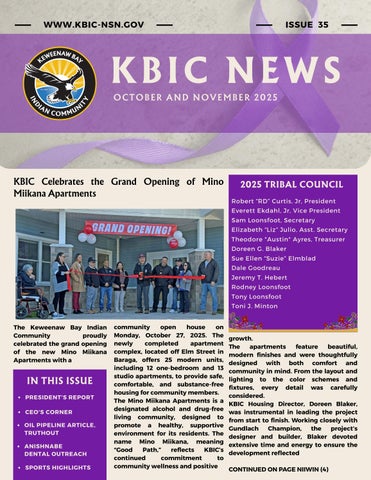
KBIC Celebrates the Grand Opening of Mino Miikana Apartments
2025 TRIBAL COUNCIL Robert “RD” Curtis, Jr, President Everett Ekdahl, Jr, Vice President Sam Loonsfoot, Secretary Elizabeth “Liz” Julio, Asst. Secretary Theodore "Austin" Ayres, Treasurer Doreen G. Blaker Sue Ellen “Suzie” Elmblad Dale Goodreau Jeremy T. Hebert Rodney Loonsfoot Tony Loonsfoot Toni J. Minton
The Keweenaw Bay Indian Community proudly celebrated the grand opening of the new Mino Miikana Apartments with a
IN THIS ISSUE PRESIDENT’S REPORT
CEO'S CORNER OIL PIPELINE ARTICLE, TRUTHOUT ANISHNABE DENTAL OUTREACH SPORTS HIGHLIGHTS
community open house on Monday, October 27, 2025. The newly completed apartment complex, located off Elm Street in Baraga, offers 25 modern units, including 12 one-bedroom and 13 studio apartments, to provide safe, comfortable, and substance-free housing for community members. The Mino Miikana Apartments is a designated alcohol and drug-free living community, designed to promote a healthy, supportive environment for its residents. The name Mino Miikana, meaning “Good Path,” reflects KBIC’s continued commitment to community wellness and positive
growth. The apartments feature beautiful, modern finishes and were thoughtfully designed with both comfort and community in mind. From the layout and lighting to the color schemes and fixtures, every detail was carefully considered. KBIC Housing Director, Doreen Blaker, was instrumental in leading the project from start to finish. Working closely with Gundlach Champion, the project’s designer and builder, Blaker devoted extensive time and energy to ensure the development reflected CONTINUED ON PAGE NIIWIN (4)
President’s Report Boozhoo Anin Gakina, For the month of September the Tribal Council held four regular council meetings. The following actions were taken: Meeting 9/3/2025 Approved to waive the first reading of proposed Ordinance 2025-11 Approved a donation in the amount of $25,000, which includes the reallocation of the returned $5,000 donation to NAIV Approved a donation for “Let’s Eat” in the amount of $1,250 Approved the preferred bid from Keweenaw Chevrolet/GMC for a 2025 Chevrolet Silverado 2500HD in the amount of $61,155 as presented Meeting 9/10/2025 Approved the Employment Agreement with Rachel Clisch Approved a donation in the amount of $8,400 to assist with the expenses to organize the Ishpeming Pow Wow Approved the Letter of Engagement with Dorsey Law for Frostbite Approved the Mino Miikana apartment rental application Approved to offer the position of KBIC Tribal Attorney to Ariel Gougeon Approved Resolution KB-034-2025 as presented Approved a donation in the amount of $1,000 and a basket for the spaghetti dinner for Rhonda event as presented Approved the UPPCO Distribution Facilities Installation AGreement as presented Meeting 9/17/2025 Approved a donation in the amount of $1,000 to assist with KBIC member Elizabeth Johns with her medical treatment and related costs Approved the Employment Agreement with Inga Johnson LMSW as presented
1 - BEZHIG
Meeting 9/25/2025 Approved a donation in the amount of $1,500 and use of a KBIC van Approved a donation in the amount of $1,500 for the 16th Annual Domestic Violence Awareness Walk in Memory of Chelsey LaFernier Approved a donation in the amount of $500 for the Baraga Youth football team to attend the NMU vs. MTU college football game on October 25, 2025 Approved the Change Order #2 for the L’Anse 30 Acres Housing Development project with Daneilson Contracting, Inc. as presented Approved payment for the Secretarial Election workers same as Tribal Election workers, $400 per day Approved moving land, building and improvement assets in the amount of $148,471.13 from the Ojibwa Holding Company to Ojibwa Housing, along with $750,000 cash from fuel refunds, and transferring $430,711.20 in debt to the Pines, eliminating a total of $1,329,182.33 in OHC debt from the Ojibwa Housing books as discussed. The $430,711.20 in debt will be paid through a loan from the Pines and will be repaid to the Pines with future fuel refunds.
CEO’s Corner November is here, and with it comes the heart of the holiday season. This time of year often brings both joy and the busyness of gatherings, gift-giving, travel, and expectations that can easily pile up. My hope for everyone is that this season brings more peace than pressure that you find yourself fully present with the people you love most. Remember, the best moments often come when we let go of comparison and focus simply on being in the moment. To help make that a little easier, here are a few simple ways to destress and stay grounded during the holiday season: Simplify where you can. Focus on what really matters like meaningful traditions, not perfection or excess. Spend time outdoors. Even a short walk or a few minutes of fresh air can reset your mind and lift your mood. Limit screen time and social comparisons. Social media often highlights the “perfect” side of the holidays. Real joy happens offline. Practice gratitude daily. Jot down a few things you’re thankful for. Gratitude has a powerful way of shifting your perspective. Move your body. Whether it’s stretching, yoga, or a quick workout, physical activity helps release built-up tension and stress. Rest without guilt. Slow down. Watch a movie, nap, or simply enjoy quiet. Reconnect intentionally. Share laughter, stories, and meals with loved ones. The simple act of connection is one of the best stress relievers there is.
✅ ✅ ✅ ✅ ✅ ✅ ✅
November is also Native American Heritage Month, a time to honor, celebrate, and reflect on the strength, history, and resilience of Indigenous peoples across this nation. For the Keweenaw Bay Indian Community, this month holds special significance as we recognize the many generations who worked to preserve our sovereignty, culture, and identity. Our government departments and community partners are taking part in this celebration by hosting a variety of events designed to educate,
connect, and celebrate who we are as Anishinaabe people. From traditional medicine clinics and beadwork nights to the Boarding School Update and Ojibwe creation story event, each gathering provides a chance to learn, share, and strengthen the bonds that unite us. Here is a glimpse of what November looks like at KBIC: Cultural and Learning Opportunities: Social beading, traditional medicine, and regalia workshops celebrate the beauty of our craftsmanship and teachings. Community Connection: Events like “The Story of Turtle Island” and “Cooking with Manoomin” encourage families and youth to connect with our stories and traditional foods. Health and Wellness: Sessions such as “Cooking the Catch: Wild Game Edition” highlight the importance of food sovereignty and healthy living. Honoring History: The KBIC Boarding School Update reminds us of the importance of truth and healing — acknowledging our past to create a stronger future for the next generations. Cultural Pride: From “Rock Your Mocs” to “Ribbon Skirt Day,” every week offers opportunities to show pride in our heritage and share it with others. These events remind us that culture is living and it grows, adapts, and thrives when we come together in community. As we celebrate this month, may we continue to honor the legacy of those before us and carry their teachings into the future with pride, strength, and love for our people. You can find out more about each and every one of these events on our official Keweenaw Bay Indian Community Facebook page. The month of October for the CEO’s office was spent moving forward with getting approved Department budgets together and complete. On October 15th, the FY26, a $64,163,549 budget, was proposed and approved for Government operations and programming. 76% of our proposed budget comes from Grant and/or Contract Revenue and Fees/Other Revenue. The rest of the budget is supported through a Government Distribution or Tribal Support ($13,992,972). The CEO and CFO offices provide Council with the upmost relevant information during the budget process for informed decision making. Changes and decisions are made from there and departments act on what was motioned
2 - NIIZH
CEO’s Corner and implement what’s required as directed. Kudos to each and every person responsible for their part in getting this budget together, balanced, and approved!
I want to remind everyone that Government offices are closed for Veterans Day, (November 11th), Thanksgiving (November 27th) and Native American Heritage Day (November 28th). All my best, Brigitte
I provided a chart displaying a breakdown of the FY26 budget. This budget reflects a strong investment in the overall health, safety, and wellbeing of the community. The largest portion, 31.5%, is dedicated to Health, Social Services, Victim Services and Substance Abuse, emphasizing ongoing support for medical, behavioral health, and social service programs that strengthen family and community wellness. Government and Administration, including Safety, accounts for 24% of the budget and supports essential operations, administrative services, and public safety functions that ensure effective governance and protection for all community members. Housing represents 17.7% of the total budget, demonstrating KBIC’s continued commitment to providing safe, affordable, and quality homes for its members. Natural and Cultural Resources make up 16.3%, reflecting the Tribe’s dedication to the stewardship of land, water, and cultural heritage through environmental management and cultural preservation efforts. The remaining 10.5% is focused on Youth and Elders, investing in education, early learning, and elder services to honor tradition and prepare the next generation for leadership. Altogether, the FY2026 budget totals align resources with KBIC’s core values of health, sustainability, culture, and community.
3 - NISWI
Housing Department CONTINUED FROM COVER PAGE
KBIC’s vision for high-quality, culturally grounded housing. “Doreen really took this project by the horns,” said KBIC CEO, Brigitte LaPointe-Dunham. “Her leadership and dedication guided the entire process, from design to construction, and her collaboration with the Housing Maintenance Department, the KBIC Realty, and the KBIC Grant Department was key to making these beautiful apartments a reality.” Reflecting on the project, Director Blaker shared her gratitude and pride in the collaborative effort. “This project represents more than just new housing, it’s an opportunity for community members to live in a safe, supportive environment that fosters wellness and independence. I’m so proud of our team and what we’ve accomplished together.” The Mino Miikana Apartments mark another milestone in KBIC’s ongoing efforts to enhance housing opportunities and strengthen the community’s foundation for future generations.
Entry way in the 1 bedroom apartments
Entry way closet in the 1 bedroom apartments
Doreen Blaker, KBIC Housing Director stands in one of the kitchens of the 1 bedroom apartments
4 - NIIWIN
Housing Department
Kitchen in the 1 bedroom apartments
Shower in the 1 bedroom apartments
Living room in the 1 bedroom apartments
Bedroom in the 1 bedroom apartments
Bathroom in the 1 bedroom apartments
5 - NAANAN
Housing Department
Kitchen in the studio apartments
Bedroom closet in the 1 bedroom apartments
Living room in the studio apartments
Entry to the studio apartments
6 - NINGODWASSWI
Housing Department
Laundry room at Mino Miikana Apartments
Walk in closet in the studio apartments
Photos from the 47th Annual Maawanji’iding line the hallways
Bathroom in the studio apartments
Photos from the 47th Annual Maawanji’iding line the hallways
7 - NIIZHWAASWI
Around the Community
8 - ISHWASSWI
Around the Community
9 - ZHAANGASWI
Around the Community Honoring Orange Shirt Day: Every Child Matters Submitted by: Jade Forcia, KBIC Victims Services On September 30th, our community joined in recognizing Orange Shirt Day, a day set aside to honor the children taken from their families and communities through the Indian Residential School system in the United States and Canada. Orange shirts carries the message “Every Child Matters” a reminder to acknowledge these truths, honor the survivors, and remember the children who never came home. To mark the day KBIC Victim Services staff placed tealights in front of the Assinins site. Two Hundred small lights glowed in the evening, forming a powerful display of remembrance and solidarity. Each candle stood as a symbol of resilience, memory, and hope for healing.
10 - MIDAASWI
Anishinaabe Dental Outreach November is Diabetes Month - The Native youth also experience worse outcomes with diabetes, suffering higher mortality and morbidity impact on our youth rates compared to non-Indigenous youth. If the sugar level is high in the blood, it is high in the saliva, too. Bacteria which form plaque, a sticky, harmful film, use sugar as food. These bacteria can cause tooth decay and gum disease. Both conditions can lead to tooth loss. Symptoms of diabetes are dry mouth thirst, urinating often, weight fluctuation, feeling tired, weak, or shaky, having mood changes, blurry vision, infections, such as gum, skin, vaginal infections, and slow-healing sores.
Diabetes Mellitus affects how the body uses blood sugar (glucose). Glucose is an important source of energy for the cells that make up the muscles and tissues. It is also the brain's main source of fuel. Insulin is a hormone made by the pancreas that allows the human body to use sugar (sucrose) from carbohydrates for immediate energy. And insulin allows the body to store glucose for future use. These metabolic activities keep the blood sugar level from getting too high (hyperglycemia) or too low (hypoglycemia). In diabetic disease, the pancreas does not function. This leads to excess sugar in the blood. Too much sugar in the blood weakens white blood cells. These are the body’s soldier-cells to fight infections. Diabetes can lead to serious health problems affecting various organs, including the heart, eyes, kidneys, feet, legs, and nerves.
If Native youth ate only the pre-Columbian diet, they would be far healthier with less diabetes. Lots of fresh fruits and vegetables are recommended for diabetics. Without healthy teeth, diabetics tend to eat soft, processed foods which are high in carbohydrates, causing dangerous plaque. This leads to more tooth decay and gum disease, leading to tooth loss. Dental disease is an infection which can cause insulin levels to fluctuate. This unhealthy cycle can spiral out of control, making diabetes harder to manage. If you have diabetes, a healthy mouth is even more important.
Here is a quick look at how diabetes can take its toll on your oral health: Less saliva causes a dry mouth. More cavities. The gums may become inflamed and bleed often. Loose teeth. Infections and sores in the mouth can take Native American youth have Type II diabetes at a longer to heal. rate up to sixty-four times their non-Native peers. Pain That's according to a systematic review published last week in Diabetologia, a peer-reviewed medical Here are important tips to keep your mouth healthy journal on diabetes. Bottom of Form and happy: Brush your teeth at least twice a day with Youth from the Akimel O'odham & Tohono O'odham fluoride toothpaste. and Gila River Indian Communities showed the Floss your teeth at least once a day. highest prevalence of Type II diabetes at 6.4%. Tell your dentist if you have diabetes. Young Native women bear the highest burden of the If you smoke, quit. Smoking increases your risk of disease, with AI/AN female youth having diabetes at gum disease and can worsen your diabetes. rates 77% higher than their male counterparts. Stop all alcoholic drinks. Drinking can worsen Diabetes in AI/AN youth has risen 3-8 times in the your diabetes and increases your risk of dental past four decades. disease. Regular dental visits.
11 - ASHI-BEZHIG
Anishnaabe Dental Outreach
When you have diabetes, uncontrolled high blood sugar can damage the entire body — including your teeth and gums. The good news? Help is available. Ask your tribal health center for advice. Also, The Native Diabetes Wellness Program is a Center for Disease Control program which honors AIAN cultural practices and supports tribal efforts to reclaim traditional foods. Prevention is in your hands. Take charge of your dental health. ·https://www.cdc.gov/diabetes-ndwp/index.html https://diabetologia-journal.org/ https://pmc.ncbi.nlm.nih.gov/articles/PMC866573 3/ https://www.healthline.com/health/diabetes/effe cts-on-body https://nativenewsonline.net/health/nativeamerican-youth-face-type-ii-diabetes-rates-upto-64-times-higher-than-non-native-peers
Jessica A. Rickert, DDS, Anishinaabe Dental Outreach 231-313-8407, jrickert@deltadentalmi.c om; jarickert@charter.net
12 - ASHI-NIIZH
Around the Community 16th Annual Domestic Violence Awareness Walk Honors the Memory of Chelsey LaFernier On an unseasonabley warm autumn day, community members gathered once again for the 16th Annual Domestic Violence Awareness Walk in Memory of Chelsey LaFernier. Each year, this event brings together family, friends, and supporters to honor Chelsey’s memory and to raise awareness about the ongoing issue of domestic violence within our communities. Chelsey tragically lost her life in 2009 due to domestic violence, and since then, her story has inspired an annual movement for change and healing. The walk begins at the corner of McGillan and Lyons Street, where participants join together in reflection before making their way through the KBIC Housing area and along M-38, ultimately ending at the Niiwin Akeaa Community Center. The event serves not only as a time of remembrance but also as a call for continued advocacy and support for victims and survivors. Following the walk, attendees gathered at Niiwin Akeaa Center for a community feast, drumming, guest speakers, and a prize drawing fundraiser to benefit the KBIC Victim Services Department.
13 - ASHI-NISWI
Around the Community
14 - ASHI-NIIWIN
Health System WIC the Special Nutrition Program
Supplemental
WIC is a Special Supplemental Nutrition Program for Women, Infants, and Children. WIC is available to pregnant, breastfeeding, and postpartum women, infants, and children up to 5 years of age who meet the income guidelines (100 to 185% Federal Poverty Level) For example, a family of four with an annual income of $59,478 qualifies for WIC Women, infants, and children with Medicaid are income eligible WIC provides healthy foods, including fresh fruits and vegetables, milk and cheese, yogurt, brown rice, whole wheat/whole grain breads, corn or whole wheat tortillas, canned beans, and peanut butter WIC is also a breastfeeding support program that employs International Board Certified Lactation Consultants and Breastfeeding Peer Counselors For women who can not breastfeed, WIC provides infant formula Additionally, WIC provides Nutrition education, registered dietitian consultations, and referrals to local resources. For more information on WIC, please call 3534527. This institution provider.
15 - ASHI-NAANAN
is
an
equal
opportunity
Around the Community
16 - ASHI-NINGODWAASWI
Around the Community
17 - ASHI-NIIZHWAASWI
Around the Community
18 - ASHI-ISHWAASWI
Truthout Oil Pipeline Threatens Catastrophe for Tribes in Michigan – Again
hat comprise 20 percent of the world’s remaining fresh water supply and provide drinking water for 40 million people in the U.S. and Canada.
“The Environmental Protection Agency only responds if there’s an oil spill on land,” Gravelle explained, “while the U.S. Coast Guard responds if there’s an oil spill on water. We’ve challenged them both with our worst-case scenario: ‘What if there’s By Frances Madeson , Truthout an oil spill in January, and the straits are covered Published October 13, 2025 with ice? What are you able to do when the break is four miles beneath the water, pluming oil up, and This Indigenous Peoples Day, the approximately covered in a foot of ice. How are you gonna get to it? 2,700 Ojibwe tribal members of the Bay Mills Indian How?’ They have no answer, they just stare at us Community in northern Michigan are marking the blankly.” holiday amid fear that their region could face another environmental catastrophe like the one that The unfortunate reality is that even without a occurred in 2010, when Enbridge’s Line 6B oil catastrophic oil spill, the Great Lakes are under pipeline burst and spilled over a million gallons of tar serious threats from climate change; extractive sands crude oil, contaminating the Kalamazoo River industry; plastic and shipping pollution; invasive species like the Quagga mussels; algae blooms in and over 40 miles in its watershed. Lake Erie; and what Gravelle described as a general Today, the community is afraid that an even more lack of care. “We have seen a major decline in the potentially devastating event is looming: a future volume of our treaty fishery as well as a major rupture of another Enbridge relic, the antiquated 72- decline in the water quality of the Great Lakes,” she year-old Line 5 pipeline, which originates and ends in said. The pipeline, built to last 50 years but already Canada but travels across Wisconsin and Michigan, operating over 70, has spilled oil multiple times and crucially, through the Great Lakes under the along its 645 miles, sometimes in their treaty territory. The single 30-inch pipeline becomes two Straits of Mackinac. 20-inch pipelines for the 4.5 miles it runs under the “There were two questions everyone asked when Line Straits “and if it opens in the straits, that’s the be all 6B broke,” tribal president Whitney Gravelle told and end all. We’re done after that, the Great Lakes Truthout. “It felt like the entire state of Michigan was are done,” Gravelle warned. “That’s the heart attack like, ‘There’s pipelines in Michigan? ’And then… that kills the Great Lakes.” ‘Where are they?’” After members of the public learned that Line 5 ran under the Straits where Lakes It would also be an attack on the fundamental way Michigan and Huron conjoin, and that it had been of life for Anishinaabeg, whose teachings passed installed in 1953 without consideration of treaties down from time immemorial describe the with the Anishinaabeg tribes — the Ojibwe, Odawa relationship between humans and the waters as and Potawatomi — or even informing them, the sacred and reciprocal — “If we take care of the lakes, momentum to decommission Line 5 really grew, she they will take care of us,” Gravelle said. “That’s why said. Fifteen years later, the fight to uphold their we do the work we’re doing.” But their resistance, rights under the Washington Treaty of 1836 — and to inspired by the Idle No More movement and the forestall a monumental tragedy for all of humanity — uprising against DAPL at Standing Rock, has been is still ongoing, as every passing day without a spill in frustrated, especially since Trump’s Day One the Straits is a tenuous miracle defying increasingly executive order declaring a national energy emergency. That order, Gravelle said, empowered losing odds. Enbridge, which is aggressively pursuing three Fifteen attorneys from Earthjustice and Native permits to build the Great Lakes Tunnel, a neverAmerican Rights Fund, plus their internal team, have before attempted feat of engineering that will try to been writing comments and briefs; collecting encase Line 5 in concrete and move it from where it evidence; and submitting documents, information, currently is on the lake bed. One permit was and expert testimonies in order to push multiple granted from the Michigan Public Service federal agencies to eradicate the risks to the waters t Commission, but an appeal will be heard by the In 2010, an Enbridge pipeline burst. Tribes are concerned about another one built without their permission 72 years ago.
19 - ASHI-ZHANGASWI
Truthout Michigan Supreme Court; another is before the Environment Great Lakes and Energy Division, and is currently in a comment period; and a third from the U.S. Army Corps of Engineers is expected to be granted. Additionally, there are two cases proceeding in federal court with the state of Michigan, one in which Attorney General Dana Nessel sued Enbridge under the Public Trust Doctrine to permanently remove Line 5 and another, where Enbridge sued Michigan Gov. Gretchen Whitmer for revoking their permits to operate on the lake bed, which is on its way to the U.S. Supreme Court — a turn of events Gravelle calls “worrisome.” In the weeks running up to Indigenous People’s Day, the broader communal focus turned to ceremony, culture, history, community engagement, and preparing for the traditional harvest of manoomin (wild rice). Members of all three confederated tribes — the Ojibwe, Odawa and Potawatomi — and their guests were invited to build a lodge and gather for Three Fires, One People, “a four-day ceremony held on the north and south shores of the Straits of Mackinac with fires lit on each side of the water. We gather to honor the ancestors who rest here, to lift prayers and make offerings together.”
“These Waters Are Everything to Us” Paula Carrick, the tribal historic preservation officer in the Bay Mills history department, told Truthout that manoomin was essential to their origin story. “At the beginning of time, we came from the great salt seas of the east, and we were told to leave the east to go and find the food that grows on water — manoomin,” she said. According to teachings, their ancestors were led west by ajiijack (cranes), who brought them to the rapids where the St. Marys River reached Lake Superior, which is how they became Boweting inini — the People of the Falls. “This is where we ended up, Ontario is just across the river,” Carrick said, pointing to the mountains that explain why Enbridge found it cheaper to build their pipeline on the U.S. side where the terrain is flatter, having been carved out by an enormous glacier. The common wisdom is that the Ojibwe were not forcibly removed to Oklahoma like the tribes in Southern Michigan because the fur traders and settlers that might’ve displaced them could not
survive so far north without them. “They would’ve starved, sickened and died if we hadn’t helped them,” Carrick said. But ownership of the territory of their ancestral lands was greatly curtailed. “These waters are everything to us — we work with clams shells in art or crushed for binder in pottery, we eat clams too. We make clay pots — slab and coil or pinch pots — the clay comes from the Big Lake [Lake Superior]. We fish of course, commercially and subsistence fishing, we have cranberry bogs,” Carrick explained. Traditionally, they also used the markings on the shells of sand turtles for calendars — 13 spaces (moons) ringed by 28 smaller spaces. “Everything about us is connected to the water.” Carrick’s colleague, archivist Kayla Perron Assinewe, has assumed a leadership role in restoring the community’s relationship to manoomin, which was largely eradicated in the area by loggers who dynamited stacks of logs on the shore to float them down the river. She has organized the community to seed the waters with 800 pounds of wild rice seed, scattered from rice buckets on canoes. Assinewe is the first to admit the seeds stink. “They smell like manure,” she said. “But when you plant a manoomin seed, it has these little barbs on the end, so it torpedoes down when it drops, and then it hits that surface layer, and on that little barb it hangs in there and germinates through the winter. Then it will grow in the spring.” Both Carrick and Assinewe are drawn to the story of Ozhaguscodaywayquay, who was married at age 14 to an Irish trader John Johnston, but maintained her cultural practices. In their joint telling: The story with her is that she didn’t want to come here from Wisconsin. No, she didn’t. They forced her here, and they said that when she first got here, she sat in the corner of the room, put a blanket over her head, and wouldn’t leave the room or talk to anyone forever. And then she ran away home, didn’t she? She ran away home, and her father was mad and sent her back, and sent her brother back with her to make sure she stayed here. Then her husband bought her this fancy stove, and she took it and threw it out in the yard and refused. She only cooked over a fire. She still only spoke Anishinaabemowin. She had her medicine garden. She refused to transition to the modern times. Our ways were her heart.
20 - NIIZHTANA
Truthout “Sometimes We Need to Slow Our World” Allyn Cameron, who directs the Bay Mills Cultural Program, told Truthout that the Straits of Mackinac are very dear to the community, though they’re 50 miles away. “When we talk about Mackinac Island, the Straits of Mackinac, the whole Great Lakes area, we call that the heart of Turtle Island,” Cameron explained. “Our people, historically, moved all through this area, the straits, through Boweting, [the city of] Sault Ste. Marie, and we worked and lived and cycled all around based on the seasons, the fish that were available, the foods that were available, where the good hunting was, where the good berries were. We moved into the straits area to help trade and move things and survive, so that area is really significant to us.” With that migration came dispersed burial grounds, many of them so old or remote as to be unmarked. The most gruesome aspect of his job is confronting the reality of grave robbing. “We have people out there with metal detectors, and they dig through all these old graves looking for anything they can put on the market, anything of value. A lot of these old artifacts that come up that you may see at auction, there’s a good chance they may have been looted,” said Cameron. But for Cameron, nothing compares to the crime of allowing for the possibility of the Great Lakes to become Enbridge’s ecological wasteland when Line 5 inevitably ruptures. “We go to the faucet, we turn it on, we get a drink of water, it’s easy to become complacent,” he says. “But I’ve been in ceremonies that helped me to understand what our four-legged and winged relatives go through, and so we have that empathy, compassion, and that understanding that sometimes we need to slow our world. We’re only just a part of creation.” Above all, he said, he has a great respect for the powers of the water, and for that reason, he doesn’t go out on the ice much. Cameron remembers when his good buddy talked him into going ice fishing a little late in the season, when most of the fishing shacks had already been removed from the ice.
21 - NIIZHTANA ASHI-BEZHIG
“I’m looking out, I can see pressure cracks on the ice. And as I’m taking a step, I see water at the pressure crack. He kept saying, ‘It’ll be fine, don’t worry.’ So I get a line and throw it over into the water. And no sooner did I throw it, I heard a splash and turned around. There’s my cousin standing on the ice, dripping because he went down and he was right back up. We tiptoed off that little lake.” Through the obvious perils, Gravelle, who is a lawyer and served as a tribal attorney and tribal judge before being elected president, holds one particular treaty provision especially dear to maintain a holistic clarity as to her mission and her relationship with creation. “Our treaty says the tribes in the area would continue to maintain the ‘usual privileges of occupancy in the treaty ceded territory.’ And I always like to highlight that language — the usual privileges of occupancy — because it’s not just the right to fish, it’s also the right to dance with the fish,” she said. “Because when you dance with fish, it’s about you going out, learning where to fish from your uncles, bringing that fish home, learning how to cook that fish with your mom, bringing that fish to ceremony, eating it with your elders, dancing in ceremony. And yeah, we do play with fish, and laugh with fish, and dance with fish. It is part of who we are. And so for me, in dignity, our Indigenous people say our ancestors fought for that language to be included in the treaty — the usual privileges of occupancy. There are reasons they wanted that language there.”
Reprinted with permission truthout https://truthout.org/articles/oil-pipeline-threatenscatastrophe-for-tribes-in-michigan-again/
Around the Community
22 - NIIZHTANA ASHI-NIIZH
Health System
23 - NIIZHTANA ASHI-NISWI
Around the Community Handicapped Guidelines
Accessible
Van
Eligibility Enrolled KBIC members and their non-KBIC family members who are not mobile enough to be transported without a wheelchair lift (Eligible User) are eligible to use the Handicap Accessible Van (HAV).
Overview The driver of the HAV assumes the duty of obeying all motor vehicle laws, maintaining the vehicle properly at all times, and complying with the following guidelines.
Vehicle Purposes The HAV shall be used for transportation to medical appointments or other purposes approved by the CEO or Tribal President.
Authorized Driver Drivers must have a valid and unrestricted driver’s license and be able to drive a HAV. The HAV allows drivers to perform approved transportation activities safely, efficiently, and economically while promoting a positive image of the KBIC. Drivers are required to operate the HAV safely and responsibly. The Tribal Center Receptionist shall instruct first-time HAV drivers on operating the wheelchair lift before their first trip.
The following rules apply to using the HAV: Only authorized individuals may drive. The vehicle must be picked up at the assigned location and returned to that location after use. It must also be locked, and the keys must always be secured. The driver must review the vehicle's use in the Driver Log, which is to be kept in the HAV at all times and returned for review at the end of use. The driver and all passengers must wear available personal restraints, including seatbelts. Eligible users must be secured in the rear of the HAV utilizing the available locking straps. Report all accidents immediately to the appropriate police and the CEO's office (906)353-4104.
Maintenance Drivers and eligible users must maintain the HAV at all times. The HAV must be returned in the same condition it was issued: clean and with a full fuel tank. The eligible user is to pay for the fuel cost. The HAV should not be operated with any defect preventing safe operation during current and foreseeable weather and lighting conditions. Preventative maintenance, such as regular oil changes, tire pressure, and fluid checks, determines to a large extent whether eligible users will have a reliable and safe vehicle to drive. Please report any issues with the HAV you experience during your use of the CEO’s office. The use of tobacco products by all occupants in the vehicle is prohibited and includes cigars, cigarettes, chewing tobacco, ecigarettes, and all other forms of tobacco.
24 - NIIZHTANA ASHI-NIIWIN
Around the Community Traffic Violations Fines for parking, moving violations, etc. are the personal responsibility of the driver/eligible user.
Accidents Involving the HAV In the event of an accident: Do not admit negligence or liability. Do not attempt settlement, regardless of how minor. If possible, get the name, address, and phone number of the injured person(s) and witness(s). Exchange vehicle identification, insurance company name, and policy numbers with the other driver. Take a photograph of the scene of the accident if possible. Call the police. Complete the vehicle accident report in the HAV. Turn all information over to the CEO’s office upon your return.
Thefts In the event the HAV is stolen, notify local police immediately. Failure to comply with these guidelines will result in denied future use and may result in additional costs to the eligible user. The Driver/Eligible User is responsible for the actual possession, care and use of the HAV.
Members wishing to utilize the HAV can contact the Tribal Center Receptionist at (906)353-6623 or receptionist@kbic-nsn.gov to reserve it.
25 - NIIZHTANA ASHI-NAANAN
Current Job Postings Government CURRENT POSITIONS Teaching Assistance RN or LPN Diesel Mechanic Fisheries-Field Technician HVAC Mechanic Accounting Clerk Youth Natural Resources Worker Assistant CFO/Controller Legal Assistant Dental Hygientist Physician Treatment Counselor AANIKANOOTAGEWIN (Speaker on behalf of others) Health System IT Help Desk Technician Jail Diversion Case Manaager Grant Accountant
ONGOING RECRUITMENT Cleaning Person/Laborer Pharmacist or Pharmacy Technician Receptionist/Clerical Worker RN’s or LPN’s Unit Manager Unit Manager Van Driver or Prep Cook Wildland Firefighter Youth/Fitness Worker
CLOSING DATE November 14, 2025 at 4 pm November 14, 2025 at 4 pm November 20, 2025 at 4 pm November 20, 2025 at 4 pm Open Until Filled Open Until Filled Open Until Filled Open Until Filled Open Until Filled Open Until Filled Open Until Filled Open Until Filled Open Until Filled Open Until Filled Open Until Filled Open Until Filled
CLOSING DATE Open Continuous Open Continuous Open Continuous Open Continuous Open Continuous Open Continuous Open Continuous Open Continuous Open Continuous
For complete job announcement and application requirements, contact:
KBIC Personnel Department 16429 Beartown Road Baraga, MI 49908 (906) 353-6623 ext. 7178 or 4140 or 4175 Visit us at: www.kbic-nsn.gov
26 - NIIZHTANA ASHI-NINGODWAASWI
Current Job Postings Enterprises BARAGA Housekeeper Maintenance Worker (Casino & C-Stores) Internal Sales Specialist
MARQUETTE
CLOSING DATE Continuous Open Until Filled Continuous
CLOSING DATE
Account Executive/Sales Cage Cashier Count Team Member Dealer Server Housekeeper Internal Sales Specialist
Open Until Filled Continuous Continuous Continuous Continuous Continuous Continuous
CONTINUOUS POSTINGS
DEPARTMENT
Account Executive/Sales Bar Back/Busser Bartender Board Operator Cage Cashier Casino Housekeeper Count Team Member C-Stores Cashier C-Stores Kitchen Cook C-Stores Maintenance Worker Dealer Dishwasher F&B Cashier Front Desk Clerk Gift Shop Clerk Guest Services Clerk Internal Sales Specialist Line Cook Maintenance Worker Prep Cook Room Attendant Security Officer Server Shuttle Driver Slot Attendant Solid Waste Attendant Surveillance Monitor APPLY ONLINE: https://www.ojibwacasino.com/employment Baraga HR Office: (906) 353-6333 x4188 Marquette HR Office: (906) 249-4200 x4705 27 - NIIZHTANA ASHI-NIIZHWAASWI
Eagle Radio Food & Beverage Food & Beverage Eagle Radio Cage Housekeeping Cage Pines, MSS, & Rez Stop Pines Pines & MSS Table Games Food & Beverage Food & Beverage Hotel Marquette Casino Guest Services Eagle Radio Food & Beverage Maintenance Food & Beverage Hotel Security Food & Beverage Guest Services Slots Solid Waste Surveillance
Around the Community Upcoming HACCP Training
Adult family members of any Red Cliff, Bad River, Keweenaw Bay or Bay Mills licensed fisherman currently working at a family’s fish shop. Any enrolled member from any GLIFWC member tribe (i.e. enrolled members of Fond du Lac, Mille Lacs, Red Cliff, Bad River, St. Croix, Lac Courte Oreilles, Lac du Flambeau, Sokaogon, Lac Vieux Desert, Keweenaw Bay, and Bay Mills). This includes subsistence fishermen and those active in harvesting and processing fish The costs for Tribal fisheries and conservation staff of GLIFWC member tribes will also be covered. Participants must attend all three days to obtain the HACCP certificate and to have their travel costs reimbursed by GLIFWC.*After participants complete the three-day class, they will sign a GLIFWC travel form for mileage and per diem (meals) reimbursement based on Federal GSA rates. If you are unable to make these dates and would like to look at other course offerings visit AFDO’s website: https://www.afdo.org/training/sha/courses/
The Association of Food and Drug and the Seafood HACCP Alliance have developed a uniform and costeffective AFDO/Alliance hazard analysis & critical control point (HACCP) training program for fish and fishery products. The primary purpose of the AFDO/Alliance HACCP Training Protocol is to assist the implementation of HACCP programs in commercial and regry settings. The primary audience is the seafood processing and importing industry, and regulatory officials based in the United States. The Basic HACCP course teaches the principles of HACCP and empowers processors to develop HACCP plans specific for each seafood products they handle or produce.
Please reach out to Lauren Stigers (Jescovitch) (jescovit@msu.edu) or 906-487-2974 with any questions.
For Great Lakes Indian Fish & Wildlife Commission (GLIFWC) members: GLIFWC will pay the $148.40 HACCP Registration fee (which includes the course book), provide hotel rooms, and food and mileage reimbursements* for the following qualified participants: Any Lake Superior commercial fisherman licensed by Red Cliff, Bad River, Keweenaw Bay or Bay Mills.
28 - NIIZHTANA ASHI-ISHWAASWI
Around the Community
29 - NIIZHTANA ASHI-ZHAANGASWI
Around the Community Impressive Catch from Lake Superior
KBIC Commercial Fisherman Glen Tolonen reeled in an incredible 55-inch Sturgeon from Lake Superior on Friday, October 31, 2025. What a remarkable catch and a proud moment representing our community’s deep connection to the waters.
30 - NISIMIDANA
Elders
31 - NISIMIDANA ASHI-BEZHIG
Elders
32 - NISIMIDANA ASHI-NIIZH
Elders
33 - NISIMIDANA ASHI-NISWI
Around the Community
34 - NISIMIDANA ASHI-NIIWIN
Youth Halloween Parties
35 - NISIMIDANA ASHI-NAANAN
Sports
The L’Anse High School Girls’ Cross Country team took 1st Place at the Ironwood Invitational. The team was also awarded Conference Team of the Year. The team won six of The L’Anse Junior High Football team finished its season its eight meets this season. KBIC youth include, from left, undefeated at 6-0. KBIC youth make up more than half of Keira Dix, Dalanna Connor, Payton LeClaire (4th from left), the team’s roster. Breyelle Bowers, Kwynn Voskuhl, Princess Pierre (8th from left), and Aaliyah Maki (11th from left).
KBIC youth, Aaliyah Loonsfoot, goes up against the Ontonagon defense during their 8th-grade girls basketball game against Ontonagon. Baraga came out on top 50-16.
The L’Anse High School Girls’ Cross Country team took home the school’s first-ever Cross Country state title. The team won the Division 3 UP Finals Championship trophy on Saturday, October 19th. UP Finals were held at the Pictured Rocks Golf Course in Munising. KBIC youth include Dalanna Connor (2nd from left), Aaliyah Maki, Kwynn Voskuhl (6th from left), Princess Pierre, and Breyelle Bowers.
KBIC youth, Aaliyah Loonsfoot, looks to make a pass inside during their 8th-grade girls basketball game against Ontonagon. Baraga came out on top 50-16.
36 - NISIMIDANA ASHI-NINGODASWI
Sports Smith Brothers - Reunited
Dasan said he is excited to be playing football with his brother Talon again, and is looking forward to getting back to motivating each other as they did growing up; playing hockey, football, wrestling and track. Talon Smith #78 - finished his high school career with academic and athletic honors. Talon is part of the National Honor Society and received a scholarship for a 3.9 GPA. Talon was also Lineman of the Year; he was the only player in Michigan to be recognized as an All-State player for both offense and defense. He was also Runner-up for the Mr. Football award and received recognition for All Conference and All -UP.
The Smith brothers are reunited and they are playing Division -1 football for the Central Michigan's Chippewas. Dasan Smith #73 - has his first season in the books and said he learned a lot from the previous year. Dasan made his college football debut at the home opener last year against Central Connecticut, with a winning score of 66-10. Dasan played a total of 4 games during his redshirt freshman year, though he was listed as a backup, he travelled with the team and he was always ready to play. During spring training (2025), Dasan sustained an injury to his hand, requiring surgery. Since then, Dasan has made a full recovery and maintained his backup position on the depth charts at the beginning of the 2025 season. Currently, he is listed as a starter and started in the Central vs Pittsburgh game (9/6), as the team had a tough win over San Diego the previous week and sustained some injuries. Since then, Dasan has maintained a starting position on the offensive line (left guard), where he started against University of Michigan, at "The Big House", (9/13) which had over 110,000 people in attendance. Though it was an upsetting loss in Ann Arbor, Dasan played his heart out having several "pancake" blocks, zero missed assignments, and zero penalties. He was also listed as a starter in the Wagner vs Central (9/20), Central's home opener. This happened to be Talon's college football debut.
37 - NISIMIDANA ASHI-NIIZWAASWI
After high school, Talon reported to summer training, where he was recorded as the fastest lineman at Central Michigan. Talon said he is happy to be back with his brother and is eager to show the coaching staff what he is capable of doing. Right now Talon is on the practice squad and is transitioning from high school football to college division 1 football smoothly. Talon said that he has a lot to learn and is happy while getting to know the college football environment. Towards the end of the Wagner game, Talon was able to play the right guard position, and both bothers took the field at the same same time, something they haven't been able to share in a game for nearly two years. For those who want to follow the Smith Brothers, most of their games are on ESPN or ESPN+. Fire Up Chips!!!
Casino Promotions
38 - NISIMIDANA ASHI-ISHWAASWI
Keweenaw Bay Indian Community 16429 Beartown Road Baraga, MI 49908
Stay Connected! Join our email list to receive the digital edition of our newsletter. Tribal Elders may also request a printed copy by mail quarterly (January, April, August, and December). To sign up or request a copy, contact Sheila Royal, Marketing Communications Coordinator at sroyal@kbic-nsn.gov or call (906) 353-6623.