ISSUE 1 - JAN 2015
|| VIVECHANA || A
C
S
R
M
A G A
Z
I
N
E
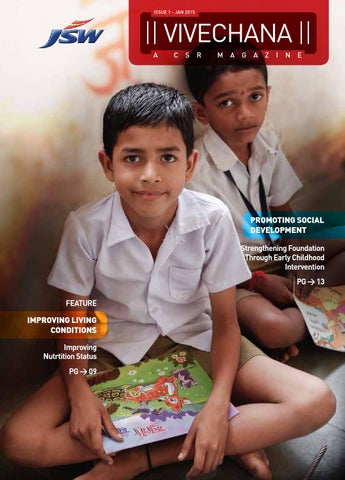
Promoting Social Development Strengthening Foundation Through Early Childhood Intervention PG > 13 FEATURE
IMPROVING LIVING CONDITIONS Improving Nutrtition Status PG > 09
2
JSW CSR FOOTPRINT
Kutehr
Barmer
Sonahatu Raigad Tarapur
Kalmeshwar
Vasind Dolvi Salav Ratnagiri
Vishakhapatnam
Vijayanagar Goa Nandyal
Salem
Salboni
// VIVECHANA //
EDITOR’S NOTE
Editor Mukund Gorakshkar
ENABLING PARTNERSHIPS tHROUGH CSR
Associate Editor Chandra Shekhar Jha
CONTENTS
Mukund Gorakshkar Executive Officer, JSW Foundation
09
13
15
Imroving nutrtition status in Thane, Palghar and Bellary
Friends
Strengthening foundation through early childhood intervention
the society with skills, and capabilities, fortunately have found willing
Building skill, one student a time
was put in place in 2000. In 2003 involvement with NGOs commenced
17
Taking a stand for better future
19
Long term partnership is the way forward
21
Committed to Nirmal Gram in Konkan
For someone who has boarded JSW’s CSR journey in its early stage, this feeling of inviting you all on board is overwhelming. ‘Vivechana’ is the story of our partnerships. Our efforts to empower participants from public and private sector as well as civil society. Corporations which have committed to a social cause alone can project an image of being well managed. With this motivation, JSW Steel ltd formalized the JSW Foundation in 1987. A professional CSR positioning with a shared vision that resulted in the structuring of need based community projects. In 2009 we adopted the Millennium Development Goals framework. As a forward looking strategy, JSW Steel has been contributing 2% towards CSR since 2011. In view of the recent amendment to the Companies Act, 2013 the JSW Foundation is reviewing challenges with renewed vigour. Our focus now is “JANAM SE JANANI TAK….JSW AAP KE SAATH” to enable our work with women and children, the most deprived sections within the communities in which we operate. We are proud of our ‘Mission against Malnourishment’ in Maharashtra and Karnataka and hope that our strategy will be worthy of scale up. Seeking your good wishes and involvement! Mukund Gorakshkar
4
JAN 2015
From here the future looks bright Sangita Jindal Chairperson, JSW Foundation JSW Foundation is working relentlessly to create a happy and socio-economically allencompassing India. It leads concerted efforts of social development with an aim to reach out to every individual in India. My vision is to create a perfect trajectory where quality education, supreme health conditions and excellent livelihood opportunities converge to make living conditions better in our great nation. I firmly believe that unless we reach out to the less fortunate and marginalized a sustainable bright
reduce malnutrition among children under the
future in not possible. JSW Foundation is working
age of six. We are also committed to 100 percent
to create a society which is empowered through
institutional deliveries in our plants’ vicinity.
concerted interventions in various spheres of life. I also encourage the culture of volunteerism in
I get deeply saddened as so many women in
JSW to enable deployment of time and expertise
our country use opens spaces for defecation;
to developmental causes.
a major health and safety concern for them. We have taken up the cause of improving the
I am firm in my conviction that aligning our
sanitation scenario in the villages by providing
efforts to the national missions and goals of
low cost toilets to households via part cash
development can be significant in bringing
support, cement support and construction
the meaningful and desired changes. We have
material support such as sanitation pan and
already started shifting our focus from projects
pipes.
in various areas of interventions to national
working on the sanitation and best hygiene
missions. We have redrafted the Corporate Social
practices awareness campaign to bring people
Responsibility policy for JSW Group, embedding
into participation mode.
The
Foundation
is
simultaneously
women at the center of all interventions. We are calling the new theme ‘JANAM SE JANANI TAK,
We are also making continuous efforts to
JSW AAP KE SAATH’ as it strives to address
encourage, train and enable individuals to
various challenges from antenatal stage of life to
acquire the necessary employable skills at
the reproductive age of 45 years.
our vocational training centres in Vasind, Vijayanagar
and
Ratnagiri.
We
are
also
Our Foundation has taken up the mission to
supporting many government industrial training
tackle malnutrition in Thane, Palghar and Bellary
institutes – setting benchmarks in public private
districts, in collaboration with governments of
partnership sphere.
Maharashtra and Karnataka respectively. The
5
major expected outcome of the initiative is to
I see a great future for all of us Indians from here.
// VIVECHANA //
CSR is a cornerstone in JSW Group’s philosophy Sajjan Jindal Chairman and Managing Director, JSW Steel A corporate’s role is much beyond profit
We are growing as a group, spreading our
making. It is about building a nation, brick-by-
footprint across the country. At most of the
brick; JSW is doing its bit. For me, CSR is going
places our plants are located in the rural India.
beyond allocating mandatory funds. It is about
I grew up in close proximity with agriculture
our employees adding value to CSR to ensure
as my father started off as a farmer. I believe
inclusive growth.
agriculture,
if
supported
with
scientific
knowledge and modern technology, can yield The communities sacrifice their land to
great dividends for both our country and the
allow industries to set up the manufacturing
farmers. The time has come to reinstitute
facilities. It is an emotional matter and must
yet another green revolution embedded with
be handled with utmost care and sensitivity.
improved sustainable technologies. In the
Our Group’s CSR philosophy is to provide a
year 2013, we have pledged to extend all the
wholesome solution to the people who are
supports to farmers in their endeavour. In
displaced or whose lands have been acquired
this regard, we have launched a “Integrated
by us; money is one small component of the
Watershed Management Project” in Bellary
solution we offer to them. I am firm in my
District. The project started in association
belief to make them part and parcel of the
with International Crops Research Institute
development that is coming up on their land.
for the Semi-Arid Tropics (ICRISAT) and the
So, we make farmers the shareholders, to give
Government of Karnataka, to undertake soil
them an opportunity to grow with the company.
and moisture conservation and agriculture
And this is how we go ahead with all our land
productivity enhancement. We are committed
acquisitions across India.
to take the learnings from this project to all the JSW locations’ in due course of time.
Our nation is moving from strength to strength, supported by attractive demographics, rising
For me smiling children are as important as my
industrialization and rapid urbanization. On
plants rolling out best quality steel, energy and
the other hand, the country is facing major
cement. If our efforts towards reaching out to
challenges in education, health, nutrition
communities results in reducing the problem of
indicators in women and children, maternal
malnutrition among children and ensures their
and child mortality, skill development of
healthy upbringing, I shall be a very satisfied
youths, sustainable livelihood, lack of rural
man. We can definitely supplement the ongoing
infrastructure; and the list goes on. It is not
efforts of the government to optimize the
government alone who is responsible to
resources and skills. Some of my colleagues
tackle these issues; it is all of us, especially
at JSW have already started sharing their skills
the corporates, who need to come forward
through our volunteering programme, I am
and contribute.
confident of more and more joining in to extend their support.
6
JAN 2015
Our Way Ahead Janam Se Janani Tak Dr. Srinivas Kedar Advisor, JSW Foundation
W
hile
bureaucrat
ones living in the most remote parts of the
for more than 3 decades, I was
serving
as
a
country. Ironically these are the areas where
privileged to serve mostly in the
governmental instruments are not the most
social and development sectors. Involved at
shining and vibrant, though they tend to be so
both policy formulation and roll out levels,
in more endowed areas. Challenges to help
my roles enabled me to travel across the
these vulnerable groups are not inherently
length and breadth of this great country and
insurmountable,
interact with every section of society. It may
both during policy formulation as well as
not have been a great revelation, but still it
implementation. Sensitivity and subjectivity
made me accept that society has two sets
needed to handle these issues often baffle
of people; one, who can move on their own,
bureaucracy at the district, state and national
just needing opportunities and the other who
levels.
but
definitely
daunting,
carry historical baggage of disadvantages, craving for both support and opportunities.
On the eve of my joining JSW Group, I
Professionals in bureaucracy, public services,
spent considerable time and energy getting
non-government organizations and private
exposure to their programmes and shared
trusts must strive to create an enabling
the vision of the Chairman of the Group and
environment, throwing challenges to the first
the Chairperson of JSW Foundation. I was
set of people, and comfort and confidence to
awed by their commitment to squarely take
the second, the vulnerable group.
up this tremendous challenge with rarest sense of dedication to their plants, mostly
7
The most vulnerable among the set are
located in remote areas. I was just left to
the women and children, especially the
make patent what were already latent, not so
// VIVECHANA // difficult tasks of synthesising their heartfelt
seven phases are exemplified by bringing in
hard work to a thematic focus,which can
seven rainbowcolours; signifying the quality
touch the soul and minds of one and all,
and brightness of life.
furthering the great convictions. Thus was born the dream ‘Janam Se Janani Tak
All the missions have clearly spelt outcomes
– JSW Aap Ke Saath’, to reflect JSW’s
which are aligned with the national goals in the
commitment to reach out to the most
specified sectors. CSR is committed to bring
vulnerable section of the society, a long term
in these national goals within our reach in a
commitment extending physical services to
time span of 10 years. The approach is not to
meet their pressing needs and campaigns
substitute the government; but to complement
aimed at empowering these people living in
and supplement it; building collaborations
the Direct Influence Zone of our plants.
with like minded non-governmental entities and continuous evaluation by external agency
Our CSR adopted a life cycle approach;
to ensure midcourse corrections. Some of
weaving together missions for enhancing
these missions are likely to be trend setters
quality of life for different phases of life of
for the society.
people through well-defined time bound missions encompassing outcomes, beyond
“I will not be satisfied with anything less than
mere outputs.
These seven phases are –
JSW being cited as a role model for CSR in the
Pregnancy, Child Birth, Anganwadi (0 to 6
corporate world”,’ emphasized our Chairman.
years), Schooling (6 to 14 years), Adolescent
We are visualizing ‘Janam Se Janani Tak’
(14 to 19 years), Empowerment (19 to 24 years)
inspiring inter generations and Corporate
and Earning Women (24 to 45 years). These
CSRs in the near future.
Ch ild Bir th
wadi Angan rs) a (o-6 ye
Earni ng (24-4 Women 5 year s)
y anc n g Pre
Sc 6- hoo 14 li ye ng ar s
t en rm rs) we ea po 4 y Em 19-2 (
Adolecent (14 -19 years) 8
JAN 2015
FEATURE
Improving Living Conditions
Imroving nutrition status in Thane, Palghar and Bellary
M
ost of us, here in India, are used to
Malnutrition in early childhood has serious,
seeing children with sunken eyes,
long-term consequences because it impedes
swollen bellies and withered skin.
sensory,
cognitive,
social
and
emotional
They are everywhere, in just a few kilometers
development. Damages happening to brain
from most of the major cities, many a time in
during first 1000 days of childhood due to
city limits also.
malnutrition are irreversible (Mother 100 Days 2012 Report). Malnourished children are less
The HUNGaMA survey, conducted across the
likely to perform well in school and more likely
country in 2011-12 to understand the child
to grow into malnourished adults, at greater
nutritional status, revealed an appalling
risk of disease and early death. Inadequate
situation. It says, “42 percent of children
care of women and girls, especially during
under five years of age are underweight and 59
pregnancy, results in low- birth weight babies.
percent are stunted. The rates of underweight
Nearly 30 per cent of all newborns have a
children and stunting are significantly higher
low birth weight, making them vulnerable to
among women with low level of education;
further malnutrition and disease.
a result of lack of awareness about healthy
9
child nutrition practices. More than 50 percent
Considering the abysmal condition of nutrition
mothers did not give colostrum (first milk)
among women and children in the districts
soon after birth and 58 percent mothers fed
where JSW Group is present, JSW Foundation
water to their infants before six months.�
has prepared a template of intervention for
// VIVECHANA //
the Group. Based on the template, JSW Group has started working to address the issue of Malnutrition in Thane, Palghar and Bellary districts. The target is to reach out to every child in the age group of under six years who is suffering from severe to moderate malnutrition. In all the three districts, the Foundation is working closely with the respective state governments to complement the ongoing efforts to tackle malnutrition. Government of Maharashtra (GoM) issued a resolution that allows the Public- Private Partnership (PPP) through Corporate Social Responsibility (CSR) of the lead companies in Maharashtra. JSW is the first corporate which joined hands with the GoM in addressing the issue of child malnutrition, since the government resolution. The initiatives of the JSW Foundation are recognized by the GoM and it has invited Mrs. Sangita Jindal to the core team of ‘Maharashtra Alliance Against Malnutrition’ (MAAM). MAAM is state level secretariat which is chaired by the Honorable Chief Minister. Thane and Palghar Project The major aim of the project in Thane and Palghar is to reduce malnutrition among children from 49% to 35% at the time of start; and to reduce Low Birth Weight (LBW) babies from 35% to 25%. The capacity building of state government’s on ground cadre, through regular
government departments for a concerted
training is most crucial strategy adopted
push to defeat malnutrition. The important
by the JSW Foundation. The training covers
ingredients of these trainings are persuasion
Integrated Child Development Scheme (ICDS)
skills, confidence building, assertiveness and
Supervisor, anganwadi workers and helpers,
effective communications. So far, two Training
Accredited
(ASHA)
of Trainers, eighteen cluster level trainings, six
workers, Axillary Nurse Midwife (ANM), Gram
taluka level reviews, two district level advocacy
Sevaks, and government school teachers. They
workshops and two task force meeting
receive regular training inputs to enhance their
have been organized in association with the
learning and so their performances. The effort
government. The trainings have covered more
is also to develop convergence among various
than 1000 government cadres.
JAN 2015
Social
Health
Activist
10
Improving Living Conditions
Another major thrust is given to the utility of available technology to monitor every child. An android mobile based application is used in line listing the vital status of each child, such as location (GPS), photo, age, weight, length/ height, mid upper arm circumference, and birth weight. So far 8724 children (4384 male children and 4339 female children) have been tracked and validated through the use of this application. The mission is facilitating line listing of all the pregnant & lactating mothers and children below 6 years, providing need based micronutrient sprinklers and supplementary feed, equipment such as infant meters and laptops to anganwadi supervisors. The recent report from the government shows that there is five percent increase in the number of children in normal category in Jawahar 2 ICDS project and significant decrease in the number of severely malnourished children. Bellary Project In Bellary district, the Foundation is working on a hypothesis that if a severely malnourished child is administered on the intake of Spirulina
The impetus has been given to creating
(a globally used nutrition supplement) for 156
awareness among communities, explaining
days, the child’s nutrition level returns back
what Malnutrition is and how it effects the
to normal level. Spirulina is supported by
development of brain and body of children. A
organizations like United Nations and World
lot of success stories related to Spirulina are
Health Organization.
shared with the people to raise the awareness; many medical students are also involved in the
Physical examinations of children, pregnant
mission. The effort is to reach each beneficiary
and lactating mothers along with providing
either through direct contact or via phone call
Spirulina are the main salient features of the
to bust the myths on consumption of Spirulina
mission at Bellary. So far the Bellary project
and also sensitize the person on importance of
has benefitted 10725 individuals, including
cleanliness, washing hands with soap before
children and mothers. The four month data
food and after toilet.
collected and computed from the date of the
11
beginning of the mission suggests 16 percent
There are several awareness tools which are
rise in average weight gain, hemoglobin
being used in the mission, such as rallies, street
count going up to 10.1 hb (sample size – 162
plays, community games, wall paintings, door
beneficiaries) and 46.4 percent decrease in
to door visits, magic shows, group discussions,
malnutrition cases; although a details study
posters-fliers-banners, orientation programs
shall be conducted in six months, since the
for anganwadi workers and facilitators. So
beginning of the mission, to take the scientific
far more than 200 awareness programs are
inferences.
organized in 120 villages.
// VIVECHANA //
“In government, we have huge resources at
learning experience to our cadre which will help
our disposal. But the same comes with its own
them with tools to dispense their tasks more
limitations; we channelize these resources to
skillfully. The training is reviving the traditional
the schemes, made by the state or the central
knowledge and using it to further strengthen the
government. We do not have much to innovate in the
efforts. I am looking forward to scale this approach
whole process. So we bring private organizations on
to the other districts of Maharashtra.”
board to fill this vital gap. They can think innovatively and then the ongoing efforts can be blended with
Mr. Shekhar Gaikwad, CEO, Thane Zillah Parisad
new initiatives to better the results. The same we are doing with JSW Group’s CSR team. In less than
“The
a year, our combined effort is considered the best
strengthening the communication and training
model in Rajmata Jijau Mother-Child Health and
aspect. It is playing a critical role as far as the
Nutrition Mission. This is a rare feat. In this mission,
behavioral changes among our cadre on ground
we are using technology, to the best it can offer.
are concerned. I am quite positive for the desired
The field data now is available with our anganwadi
outcome of our combined efforts.”
association
with
JSW
Foundation
is
workers to use it scientifically. Our supervisors now have laptops and android based mobile phones to
Mr. Pravin Bhavsar, Deputy CEO, Women and Child
track and validate data on the field. The experience
Development, Thane Zillah Parisad
so far has given us an opportunity to introspect and improve our internal systems.
“The initiative taken by JSW will go a long way in our fight to defeat malnutrition. We must aim for 100
Our combined effort is to keep the approach direct
percent elimination of severe malnutrition cases
so that the benefits of the scheme reached to the
from the district and beyond.”
beneficiaries directly, not in layers. The capacity building aspect of the whole program is a new
Mr. Sameer Shukla, District Collector, Bellary
12
JAN 2015
Promoting Social Development
Strengthening foundation through early childhood intervention
A
ccording
available
amganwadi inaugurated in November 2014.
at the Ministry of Women and Child
to
the
statistics
These early childhood educators support
Development, there are 13.42 lakh
Anganwadi sevikas in engaging children in
Anganwadi Centres (AWCs) spread across the
different learning exercises throughout the
states and union territories of India. These AWCs
day. The company also provides teachers
are covering 3.82 crore children between the age
handbooks, kids handbooks, and weekly
of 3 and 6 years and 1.96 crore pregnant and
calendars for activity plans and educational
lactating women. These AWCs offers six services,
toys for the children.
supplementary nutrition, nutrition and health check-up, pre-school non-formal education,
In the words of one of the early childhood
referral services, and immunization; the pre-
educators ‘Pragati Mhatre’, her experience is
school non-formal education reaches 3.71 crore
phenomenal. Speaking to the representative
children between the age group of 3 to 6 years.
of JSW Foundation, she said, “I joined AWC three months back and each day I look
13
JSW Group is providing facilitation to 302
forward to coming here and being with the
AWCs across its plant locations. Case in point,
children. I consider myself lucky to have this
JSW Steel Coated Products Vasind Works is
opportunity. My own child used to come here
supporting 43 AWCs. The company provided
in this Anganwadi centre and I had always
early childhood educators to 10 AWCs here
thought to come and serve in my own humble
and has been working towards constructing
way. I am thankful to JSW Foundation for
3 model AWCs, out of which one model
facilitating training for me which enabled me
// VIVECHANA //
I joined three months back, and I look forward each day to come here and be with these children. I consider myself lucky to have this opportunity. to share valuable lessons with these children. The teaching tools provided by the Company are thoroughly useful for us to plan our day and give individual and group exercises to the children. Children also enjoy playing with the toys and learn a lot in the process. You can see for yourself how enthusiastic they are.� She further adds, “I have noticed, parents now are sending their children every day to the AWC. Most of them want their kids to optimally utilize their time, not just come for the meal. The parents are giving their children all the required study materials, as and when required. I can assure you now with confidence that the children here spend their three and a half hours judiciously, learning and enjoying. For me it is a blessing as I am earning my livelihood doing the job I love most.� One
of
the
other
early
childhood
educators, Sarika Pawar, shared a similar experience working with the AWC. The common observation was almost hundred percent attendance of children in the AWCs. These educators also interact with parents on daily basis to get their feedbacks and assured to conduct a formal meeting parents
with every
month.
14
JAN 2015
Promoting Social Development
Building skill, one student a time - Father Victor
W
e at Father Agnel’s are strongly guided by the clarion call given by our Founder Rev. Fr. Conceicao
Rodrigues, namely “My Land My People”. All our educational and charitable endeavors are viewed from this prism. Reading the signs of the times we realized that development of skill was the crying need of our nation and hence we decided to channel all our energies in the endeavour. I strongly believe that nothing happens by chance. We are guided by a superior power for the greater good of humanity. In one of our meetings with the CII representatives we were introduced to JSW Foundation. Thus in the year 2004 began the journey of Father Agnel and
visited Vasind to attend the convocation
JSW Foundation leading to the establishment
ceremony and was overwhelmed by the
of the OP Jindal Centre (OPJC) for Vocational
enormous work being done in the field of
Training at Vasind. We have recently started
skill training. We had trades for girls, like
our second OPJC at Jaigad, Ratnagiri.
tailoring and fashion designing, professional beautician. The trades for the boys included
My involvement with the OPJ Center for
electrical,
Vocational Training began in the year 2007,
information technology. Since then the trades
welding,
electronics,
and
September 17 to be precise. That day, I first
have been upgraded and a few more have been added, like two and three wheeler mechanic, fitter and CO2 welding. I was very impressed by the proactive approach of Mrs. Sangita Jindal. Her interaction with the students where she asked them what more JSW could do to enhance their training was inspiring to say the least. I thought to myself, here are the right people with the right approach, and our collaboration and partnership since then has been strengthened manifold. According to me, the success story of OPJ Centre Vasind is the result of the proactive stance of the JSW Foundation and Father Agnel. We
15
// VIVECHANA // JSW industry experts interact with our students, conduct a few guest lectures, look for ways and means as to how students can get firsthand experience of industry by way of internship, appoint a placement officer for the Father Victor Father Agnel Technical center, improve upon our tools, Institute equipment and infrastructure.
design an annual plan for our Centre, assess
of the success story is the instructor. We
it in terms of resource allocation and ensure
take great pain to recruit the best person to
that it has necessary financial resources to
impart the knowledge, skill and attitude to
deliver realistic training to the students. Before
our students. Hence training of the trainers is
deciding upon a particular trade, we religiously
taken very seriously at the OPJ Center.
conduct manpower need survey to acquaint ourselves with the felt need of the industries
Looking ahead, in order to keep ourselves
around. A job potential survey is carried out at
relevant, I think we need to continuously
different places to apprise ourselves of the job
rediscover and reinvent ourselves. To keep
market in the nearby industries. We strongly
our success story going we have taken a
believe that once the student completes the
conscious decision to make available to our
course he / she must be industry ready and
students opportunities for vertical mobility.
either join the industry or commence his / her
JSW industry experts interact with our
own start up. We do not rest on our laurels
students, conduct a few guest lectures, look
and hence every year a feedback survey of our
for ways and means as to how students can
past trainees is conducted at Centre to find out
get firsthand experience of industry by way
their employment status, their problems and
of internship, appoint a placement officer for
understand the validity of the trades.
the center, improve upon our tools, equipment and infrastructure. Finally, our dream is
I am proud to say that a vast majority of our
to give an opportunity to school leavers to
students are either gainfully employed in nearby
someday acquire a diploma, degree or even a
industries or are self-employed. Another key
PhD in the trade he / she has taken up. May
person involved in the actual development
God grant success to the work of our hands!
16
JAN 2015
Addressing Social Inequalities
Taking a stand for a better future - Vinita Vijay Hilam
A
ll 11 members of our Self Help Group
1000 bricks a day for less than 100 Rupees and
(SHG) are dynamic leaders. I am Vinita
by the time we reached home, we would be
Vijay Hilam, feeling fortunate to get an
dead tired, unable to perform any household
opportunity to lead this SHG, to take it to new
chores. But, we had no choice, other than to
achievements in future. It all began in the year
get going with our lives; most of us are early
2007 when we were living a very hard life; a
school drop-outs. All the women in this SHG
life full of despair, back breaking hardship
group were married between the age of 15 to
and no hope in sight for better days. I get very
17, in a few cases at ages even less than that.
emotional when I remember those days. Most
We gave birth to our first child quite early in our
of us vividly remember how we used to climb
lives and had additional responsibilities while
steep hills to collet fire wood to sell them in
things were quite challenging already.
the local market for a meagre 20 Rupees a
17
bundle and how our contractor used to force
The moment of joy was destined to come our way
us to work hard at the local brick making unit.
when we heard that government has schemes
Every single one of us used to move more than
for women. I started exploring by talking to our
// VIVECHANA //
Vinita Vijay Hilam SHG Group Leader
Gram Sevak and at Taluka level. When I came to know that the government’s schemes are for women SHGs, I decided to discuss this with few of my friends. To my surprise some of them immediately agreed to form a group and very soon our group swelled to 11 members and we named it ‘Vanvashi Bachat Gut’. As the day progressed, we tried to break the ice with the Gram Panchayat and Zilla Parisad members but to no avail. We were not getting any benefit from the government’s schemes. The
real
change
happened
when
Ispat
company representatives got in touch with us in 2008. They encouraged us to take charge
We would like to acknowledge here, it is because of JSW Foundation’s help and guidance, each one of us today own a piece of agriculture land, which we otherwise never would have had. Each of us filed a RTI to get our rights on ownership of forest agriculture land under government’s scheme ‘Van HaqueKayda’.
of our lives by saving. Being tribal women, saving and lending were alien concepts to us.
Panchayat, Zilla Parisad and District Labour
We brainstormed and decided that we will
Office. Thanks to JSW Foundation for bringing
save and deposit the amount in the common
this day in our lives.
SHG fund and facilitate internal lending. We received constant training support from Ispat
When we look back, we are able to see how far
on how to manage our funds. The life-changing
we have travelled. And we are moving forward.
moment for us was when we first time went to
Our first pay cheques have made us richer by
the bank to open an account in the name of our
thousands. We are sending our children to
SHG. As expected, we were rejected for quite
school now and I am sure that our collective
some time. But at the end, our persistence paid
endeavor shall keep our children motivated to
off. From that day onwards we are maintaining
do better in their lives.
a healthy balance in our SHG account and are free from the clutches of external lending from
We acknowledge JSW Foundation’s help and
informal institutions which exploit innocent
guidance, because of which each one of us
tribal communities with heavy compound
today owns a piece of agriculture land today,
interests rates.
which would otherwise have been a far-fetched dream. The Foundation guided us to file a Right
Things got even better for us when JSW
to Information application to get our rights of
Foundation representative started interacting
ownership on forest agriculture land under the
with us. Today, I am proud to say that we are
government’s ‘Van Haque Kayda’scheme.
our own bosses. We have registered ourselves as official contractor for the gardening jobs in
We have a comfortable job and a brighter future
JSW Steel Dolvi Works’ plant premises. The
ahead. Our collective struggle has made us
Foundation guided us on every step to fulfill
robust and confident to take up any challenge
all the required processes with the Gram
that comes our way. Today, we are leaders.
18
JAN 2015
Addressing Social Inequalities
Long Term Partnerships is the way forward - Shankar Jadhav
I
come here every day with the commitment
has since then seen nearly 2.5 lakh children
to work for the improvement of lives
passing through it and is regarded as one of
of the children who are living here at
the best observation homes in our country
Children Observation Home, Umerkhedi. The
today. I am confident that we shall do even
Observation Home houses destitute, delinquent
better in times to come. Despite some
and victimized children under the provision
challenges, which are our major bottlenecks
of Juvenile Justice and Act. At any given point
in the journey ahead – not sufficient and
of time we have 350 boys and 150 girls living
permanent manpower, lack of trained staff
in the house. Most of them come from having
to take care of special children, digitization
lived on the streets and so are prone to many
of information at the time of admission and
physical and psychological ailments which need
insufficient maintenance of the premises by
medical interventions on priority. Accrediting
the responsible government authorities, we
and building of self-confidence, encouragement
align our efforts to utilize whatever resources
and reassurance, emotional support and reality
are available to us.
orientation are some of the major interventions that are conducted by the trained staff of
I am thankful to all the individuals and
Observation Home.
institutions for continuously helping us with their donations in both cash and kind. But,
Established in 1927, the Observation Home
19
to move forward we need support beyond
// VIVECHANA //
donations; we seek long term partnerships, driven by planning and strategies. One such partnership that I cherish is our collaboration with JSW Foundation. The Foundation is working shoulder to shoulder with us to fill the most vital gaps, without which it becomes very difficult to run this home. The Foundation
Shankar Jadhav Superintendent, Children’s Home
is supporting in improving the infrastructure of the observation home and alongside proving manpower support for better children care and development. Our partnership is also focusing on improving the sanitation and hygiene condition of the home. At present, JSW Foundation is helping us coordinate with the Observation Home and NGOs with the help of permanently appointed staff. The trained staff is also appointed by JSW to work closely with the special children. It is also helping us to locate the parents of the missing children to reunite them; a fulltime program officer is appointed for the same. It has also provided us a set of washing machines to take care of the laundry for the children and water tanks to store drinking water. As we move forward, I personally feel that
I am thankful to all the individuals and institutions for continuingly helping us by giving donations in both cash and kind. But to move forward we need support beyond donations; we seek long term partnerships, driven by planning and strategies. One such I cherish is our collaboration with JSW Foundation. The Foundation is working solder to solder with us to fill the most vital gaps, without that it becomes very difficult to run this home.
the premise must have its own medical facility, matching the medical care of any good government hospital; this will cease our present dependency on J.J Hospital. We need the support of good NGOs to work on the child related advocacy. I also feel digitization is critical to keep the information of the children safe and can be very handy to track their parents and other vital details. I take this opportunity to appeal to all of you to come forward to help these children. The Observation Home can provide great opportunities for volunteerism. Looking forward to assist you in your quest to give back to someone who needs the most.
20
JAN 2015
Addressing Social Inequalities
Committed TO Nirmal Gram in Konkan - Dr. S.V. Mapuskar
A
s per the 2011 census, nearly 56 percent
of
rural
households
in
Maharashtra practice open defecation,
against the national average of 67.33 percent. In the same context, only 44.20 percent of rural households in Maharashtra have toilets in their premises, faring better than the national average of 32.67 percent. Nobody can really ignore this social and health hazard anymore, and I am no exception. As Mahatma Gandhi once said, “No matter how insignificant the thing you have to do, do it as well as you can, give it as much of your care and attention as you would give to the thing you regard as most important. For it will be by those small things that you shall be judged.� I have been working in the field of rural sanitation for the last 50 years towards implementing the principles of appropriate technology and community ownership, from the time when these were not part of the national consciousness. I am active in the field, advocating the use of decentralised, low cost sanitation options. I would like to extend many thanks to JSW Foundation for taking up the problem of sanitation in a big way, in and around all its plants’ operations, especially in the Konkan region. The region which is known for its pristine beauty and wonderful climate has some glairing blots that need addressing. One of the most prominent among them is the minimum penetration of toilets in the rural households in the region. I am talking about
21
// VIVECHANA //
the region where once lived Shri. Appasaheb Pathwardhan, a man we fondly remember as the Konkan Gandhi. He designed the still relevant two pit latrines, locally known as ‘SopaSandas’, in 1946 and biogas unit attached
Dr. S.V. Mapuskar Secretary, Appa Saheb Patwardhan Safai Tantra Niketan
to the latrine. The concept was a concrete step towards providing households both hygiene and extra source of income through sale of compost and generation of gas. I started promoting ‘SopaSandas’ model from 1980 and later, worked on the modification of the original design made by Appasaheb and developed the Malprabha biogas toilet. Later, decentralised on-site integrated waste management (DOSIWAM) was developed and is now implemented in 25 sites across the country. I also set up two organisations, the Jyotsna Aarogya Prabodhan and the Appasaheb
JSW’s efforts are proving that the technology of two pit latrines can successfully function with the laterite stone, very easily found in the region. The JSW Foundation is also successfully implementing the night soil based biogas plant, the first in Ratnagiri district.
Tantraniketan, to work on health awareness and appropriate technology. My team is now working on biogas composters for vegetable waste, monitoring for the Sant Gadge Baba Abhiyaan, and lobbying for policy change in the field of sanitation and hygiene. JSW’s efforts are proving that the technology of two pit latrines can successfully function with the laterite stone, very easily found in the region. The JSW Foundation is also successfully implementing the night soil based biogas plant, the first in Ratnagiri district. The effort is against the myth that cattle dung is the only appropriate feed for biogas units. I see this effort having the potential to become a role model project for entire Maharashtra state.
22
JAN 2015
KALADHAM AT VIJAYANAGAR
Jindal Mansion, 5A, Dr. G Deshmukh Marg, Mumbai - 400026