Internet Telephone Security
www.nexicom.net
downtowndreams.org
Start, Move or Grow Your Business in one of four downtowns in Kawartha Lakes. COBOCONK
FENELON FALLS
LINDSAY
OMEMEE
Join us when we announce the four winners Wednesday June 6, 2018, 5-8pm Academy Theatre, 2 Lindsay St S, Lindsay, ON K9V 2L6 Food & Refreshments, Cash Bar This project is funded in part by the Ontario Ministry of Agriculture, Food and Rural Affairs.
Helping parents and educators raise
creatively alive
children since 1903.
SELECTED FOR INCLUSION IN BEST BOOKS FOR KIDS & TEENS MAGAZINE! Thirteen-year-old Richard Bennett thought his biggest problem in the summer of 1883 was his relationship with his father. But when Michael Killian, an Irish extremist, arrives in Hopewell Hill Richard and his friend learn that he intends to capture Fredericton to claim a new Irish homeland in New Brunswick – and he has no problem with getting blood on his hands to do it. Against the backdrop of the mighty Hopewell Rocks, the future prime minister must find the courage to stop the invasion before the young country of Canada is ripped apart by a mad man willing to do anything to achieve his goals.
Available at the Kent Bookstore in Lindsay or on Amazon.ca
TABLE CONTENTS
OUR OPPORTUNITY RODERICK BENNS, PUBLISHER
8. 8 Free Things To Do In The Kawartha Lakes 9. Basic Income In Lindsay - How It Might Transform Our Community And Usher In A New Era Of Social Policy In Canada 12. Local Politicians On Board With Basic Income 13. Madame Assia Enjoying Small Town Life In Lindsay 14. Lindsay’s Opioid Challenge
16. Blue Rodeo’s Jim Cuddy Says Canada Should Share Its Prosperity Better 18. Lindsay’s ‘Temp’orary Secret 20. Trolley Car - A Symbol Of Kawartha Lakes Spirit
23. Soup Kitchen & Sunday Supper - St. Andrew’s Church Works To Build Community 25. The Depression Era - Lindsay’s 1931 Citizens’ Relief Association
You are holding in your hands the very first edition of The Lindsay Advocate. We’re pretty excited to have you as a reader, and thankful for our advertisers who have made this possible. We started off as an online magazine in late August, soon after the Province announced Lindsay would be a crucial pilot site for basic income. The response has been overwhelmingly positive, from the design of our news site to the vision we are carrying. Now, we have a monthly print magazine that also supports our intention for Lindsay and Kawartha Lakes. What is that vision? It has to do with the social and economic wellness of our community, and choosing to be co-architects of that vision along the way. So much media is passive and merely records history. We pledge to be active, conscious advocates for the change we all wish to see. I grew up in in the east end of Lindsay – and I’m pretty sure I have a clear understanding of the different forms poverty can take. As publisher of the Advocate, I want to support the well-being of my home town, its small businesses, the aspirational goals of the City, and the people who live here. To get there we need better incomes for people in Lindsay and the rest of Kawartha Lakes because income is the greatest predictor of health and well-being. We also need more education opportunities, better work, better food security, early childhood development…all this and more matters and connects to one another, these social conditions in which we find ourselves living. Feel free to contact me using our online contact page at lindsayadvocate.ca and let us know how we’re doing, or to share an idea. See you online – and see you next month!
5
www.lindsayadvocate.ca
UPFRONT
LINDSAY TECH START-UP AWARDED
P
$1.7 MILLION FOR CODING PROGRAMS
innguaq, the Arctic-inspired, Lindsay tech startup, was awarded $1.7 Million to develop and deliver coding programs across Nunavut and Muskegowuk Aski in Northern Ontario.
“Because of the cheaper cost of living (compared to Nunavut) much of the training and development of the curriculum we will be delivering will be done in the Lindsay area,” Oliver says.
Ryan Oliver, the owner of Pinnguaq (and tech columnist for The Lindsay Advocate), says they were selected as recipients for Canada’s new “CANCODE” program.
“Beyond job creation, we are hoping our presence in the Kawartha Lakes to develop this program will help foster an atmosphere of innovation in the area,” Oliver tells The Lindsay Advocate.
Delivered by the Department of Innovation, Science and Economic Development, Pinnguaq will receive a contribution that will allow for expansion of their te(a)ch program towards a sustainable coding curriculum. This funding will allow Pinnguaq to create between 4-7 jobs in Lindsay, specifically, says Oliver, jobs that will mainly be targeted at curriculum developers, tech workers and teachers. “Most of the jobs we post are posted are in Lindsay and in Nunavut and we accept applicants from both,” he says. Qualified applicants have an option as to where they work. Oliver has already hired three positions, since they’ve had access to the funding since November, two in Lindsay and one in Nunavut. The funding will also sustain seven existing jobs in Lindsay.
MINISTER OF CROWN-INDIGENOUS RELATIONS AND NORTHERN AFFAIRS, CAROLYN BENNETT, LINDSAY’S RYAN OLIVER, AND SPECIAL ENVOY TO THE EUROPEAN UNION AND EUROPE, STEPHANE DION.
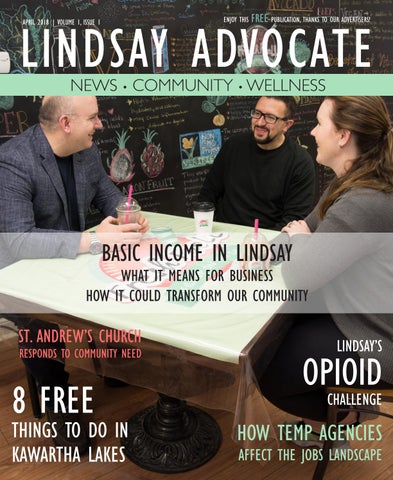
Volume 1, Issue 1 • Publisher: Fireside Publishing House, a proudly Canadian company The Lindsay Advocate is published 12 times a year and distributed to a wide variety of businesses and locations within Kawartha Lakes. We are a proud member of the Lindsay and District Chamber of Commerce. Printed by Maracle Inc. For advertising information call 905-666-1249. Cover photo: Mike Perry, left, Luis Segura, centre, Leanna Segura, right. Photo by Erin Smith Photography. Publisher and Writer-at-Large: Roderick Benns • Contributing Writers: Nancy Payne, Trevor Hutchinson, Ian McKechnie, Jamie Morris Research: Joli Scheidler-Benns Advertising Sales: Judith Stoltz, James Craig, Jennifer Bain • Graphic Design: Robyn Barton and Barton Creative Co. Twitter: The Lindsay Advocate @lindsayontario, Roderick Benns @roderickbenns • Facebook: /The Lindsay Advocate The Lindsay Advocate is independently owned and operated. The opinions expressed herein are the views of the contributors and do not necessarily reflect those of this magazine. Photos, text, and art work contained in The Lindsay Advocate are copyrighted and may not be published, broadcast, or rewritten without the express permission of the Publisher. Liability for incorrectly displayed advertising is limited to publishing corrections or advertising credit for subsequent issues. The Publisher reserves the right to reject, revise, cancel, omit, discontinue or even decline to print advertising without reason or liability, and without notice. The Publisher has made every effort to ensure information contained herein was accurate at press time. The Publisher does not assume and hereby disclaims any liability to any party for damage, loss, or disruption caused by errors or omissions.
www.lindsayadvocate.ca
6
UPFRONT J
LABOUR LEADER URGES SUPPORT ON NATIONAL DAY OF MOURNING
ames Mulhern, president of the Lindsay and District Labour Council, is hoping there will be 100 people in Lindsay who will take the time to show support for workers on April 28, the National Day of Mourning. The purpose of the event is to honour the people who have lost their lives or who have been injured on the job. As well, says Mulhern, it’s a time to renew the need to be vigilant in health and safety in the workplace to stop further deaths or injuries “for just doing one’s job.”
“It’s also important that we honour the families and friends who have been affected by workplace tragedies,” says Mulhern. Mulhern is grateful that the City’s parks, recreation, and culture division helped install the small monument to the National Day of Mourning in Victoria Park, and as well they maintain it. The local labour leader says just in Ontario alone about 200-300 people are killed every year on the job. “No one goes to work thinking they’re going to get hurt – so we still need to be vigilant about this issue, and stand shoulder to shoulder.” “One death is too many.”
Typically, the labour organizations gets about 4050 people out to Victoria Park in Lindsay to show support. Mulhern would love to see those numbers swell to 100 this year. “Every worker has the right to return home safe and sound at the end of each work day,” says Mulhern. The local labour leader says there will be a keynote speaker, someone from the City of Kawartha Lakes, and both MP Jamie Schmale and MPP Laurie Scott will be invited to the 30-minute event.
ADVERTISING SALES TEAM
JUDITH STOLTZ SALES REP
7
JAMES CRAIG SALES REP
JENNIFER BAIN SALES REP
www.lindsayadvocate.ca
8 FREE THINGS TO DO IN THE KAWARTHA LAKES
1. Ken Reid Conservation Area
Offers several loop trails that lead through forests, meadows, and wetlands. Includes the popular floating boardwalk that winds through MacLaren Creek Wetland. During the summer you can spot red bellied snakes, snapping turtles, and leopard frogs.
2. EarlyON
With many locations in Kawartha Lakes, including Lindsay, Fenelon Falls, and Bobcaygeon, these fully equipped, child-based learning centres for infants to age six even have free toy lending libraries.
3. Kawartha Lakes Public Libraries
Offers many free programs for kids. Craft and Storytime programs, Lego, and special programs and events for kids throughout the year and including during March Break.
4. Lindsay Seniors Association PHOTO BY ERIN SMITH PHOTOGRAPHY
Award-winning journalist Roderick Benns spent more than two years with one key purpose – using advocacy journalism to get leaders across Canada talking about the potential of a basic income guarantee. Available on Amazon.ca or at Kent Bookstore in Lindsay.
Has many programs for adults 50 and over, from knitting, tai chi, art, carpet bowling, Bingo, pool, Scrabble, euchre, shuffleboard and more.
5. Victoria Recreation Corridor
The Victoria Recreation Corridor is a rail trail that stretches from Lindsay to Kinmount 55 km in length. The trail is used year-round for hiking, horseback riding, cycling, snowshoeing, cross-country skiing and snowmobiling.
6. Bobcaygeon Swing Bridge
Built at the locks it was originally constructed in 1921, and remains an important part of the landscape of the community. Just a short distance from the locks and very popular with tourists.
7. Kawartha Lakes Boys and Girls Club
This institution is well known and yet has more programs for children, youth, and families than people realize. Programs and participation is free for lower income families and affordably priced for all. For a full list of programs see their website.
8. The falls at Fenelon Falls
The lock and waterfalls are located right downtown so it’s very accessible to restaurants and stores. A beautiful place to sit and enjoy nature, complete with a park and washrooms. Even better in the summer but great to see year round.
www.lindsayadvocate.ca
8
BASIC INCOME IN LINDSAY
How it might transform our community and usher in a new era of social policy in Canada.
I
t has been two years since Fresh Fuell opened its doors in downtown Lindsay with a vision to provide fast, healthy food for people on the go. Like with most small businesses, it wasn’t a slam dunk right away for owners Luis and Leanna Segura, despite the enthusiastic response of the community. There are overhead costs like rent and supplies. There are employee wages to consider. All of this happens before they even get a chance to pay something to themselves. So money is tight for the Seguras, who also have a young family of four to feed. When they heard how Ontario was going to test the merits of a basic income policy in Lindsay and two other communities in Ontario, they realized that despite perceptions that business owners are well off, they might even qualify. They were right. By 2018, the Seguras were approved to begin receiving a basic income guarantee from the Province to help make ends meet. “People think because you’re a business owner you’ve got it made,” Luis tells The Lindsay Advocate. “But if you look at what you’re making, you make less than what you’re paying you’re employees sometimes.” In order to participate in the pilot, individuals must be: • • •
18 to 64 years old (for the entire duration of the three-year study) living in one of the selected test regions (like Lindsay) for the past 12 months or longer (and still live there) living on a low income (under $34,000 per year if you’re single or under $48,000 per year if you’re a couple)
A basic income guarantee ensures everyone an income that is sufficient to meet their basic needs and live with dignity, regardless of work status. It’s a way to ensure no one ever drops below (or at least near) the poverty line. The Province has been signing people up who are currently on Ontario Works or the Ontario Disability Support Program (ODSP), but more commonly it’s the so-called ‘working poor’ who are qualifying to sign up – even small business owners like the Seguras.
9
About 70 per cent of the people living in poverty in Canada are working – but just not enough to stay out of poverty.
Game Changer Mike Perry is Executive Director, City of Kawartha Lakes Family Health Team, as well as the chair of the Lindsay and District Chamber of Commerce. He was also chair of the Kawartha Lakes Food Coalition last year and led lobbying efforts to get Lindsay chosen for the pilot. Perry believes that the basic income pilot is “going to be a game changer here.”
“It’s really going to help people – it’s an incentive to get out of the welfare trap. I see it as a trampoline.”
He envisions a wide variety of people benefiting, from people on social assistance, to students from Fleming College’s Frost campus, struggling farmers, and new small business owners – like the Seguras – who are trying to find their footing. “There is a definite need” in Lindsay for basic income, Perry says, with the town’s income levels sitting at below the provincial average. “Lindsay is going to be poked and prodded and analyzed,” he adds, “so we have a responsibility to make sure this goes well.”
www.lindsayadvocate.ca
In fact, out of the 4,000 participants, who will be invited to participate, 1,000 will be from the Hamilton/Brantford area and another 1,000 will be from Thunder Bay. However, 2,000 participants will be invited from Lindsay, making it a vital part of the Ontario pilot to test behaviours, work patterns, health and mental health outcomes, housing stability, educational attainment, and how the community as a whole may benefit. Many community leaders have stepped up to lend their support to the basic income pilot. Chief John Hagarty, Lindsay’s forward-thinking police chief, says he believes “that people need hope and an opportunity to succeed.” That’s why Hagarty is a strong supporter of basic income for Lindsay. Without that sense of optimism, it can result in too many forms of escapism, he says, including the abuse of legal and illegal substances.
Basic Income and the Business Community Mike Perry estimates that the basic income pilot will generate $50 million in local spending in the community by the time it’s complete. He believes that basic income will be good for the local economy because the people that need the money most will be able to spend more on what they need for themselves and their families, most doing so locally at small businesses. As well, he says it will only serve to increase the profile of Lindsay and the Kawartha Lakes and “enhance our influence with the provincial government in terms of advocating for what we need municipally.” Perry, who was also named Lindsay’s ‘Citizen of the Year’ recently, says the more people “who see all we have to offer here in our area,” the better.
“This harms them, their families and most importantly their children who often get caught in a cycle of hopelessness,” the chief says.
This includes “the environment, the food and shops, the people, the lack of traffic,” all great for attracting tourism, business and new residents, he says.
“I think the basic income pilot is a step in the right direction to help some break that cycle.”
Perry notes that having the basic income program here, along with increased media, gives the town more time on a provincial stage.
Dr. Bert Lauwers, the progressive CEO of Ross Memorial Hospital, told a crowd at a recent basic income policy conference in Lindsay that allowing poverty was a social policy choice and that he hoped basic income would help change that. He noted that we spend way too much time and money on acute care instead of the social determinants of health, which are essentially the living conditions that we experience. “We have to re-purpose our economy to put human beings at the heart of our society,” Lauwers told the crowd, pointing to the better health outcomes of the more egalitarian Nordic nations.
PUTTING ACTIVE LIVING IN MOTION • CHIROPRACTIC
• PHYSIOTHERAPY
• ACTIVE RELEASE TECHNIQUES
• MASSAGE THERAPY
• ACUPUNCTURE
• PERSONAL TRAINING
• CUSTOM ORTHOTICS
• NATUROPATHIC MEDICINE
• LASER THERAPY
• SHOCKWAVE THERAPY
• SPINAL DECOMPRESSION
• & MORE!
He has no patience for people who dismiss the pilot on grounds of either cost or that no one will work. “My first response is ‘how’s the current system working for you?’ because I can tell you no one likes the current system.” Perry says to imagine if Tommy Douglas, Canada’s founder of Medicare, had given up because it sounded too hard or too complex to set up. “We may never have had universal health care.” Perry also points out that “no one is getting rich on basic income.”
CONT’D PAGE 11
branding + design web + automation social media marketing content creation
705.878.0463 • frontoffice@kawarthatherapeutic.com
www.kawarthatherapeutic.com • d c e i
www.lindsayadvocate.ca
10
He would tell someone who is receiving the basic income that it’s also “an incentive program.”
“You can still go out and earn income – and that’s an incentive. Go get active in the labour force. Everyone I know of who has a low income wants to work,” he says. Perry notes there is an equal responsibility for basic income policy architects to never give up on creating good, sustainable jobs. Participants currently receiving child benefits, such as the Canada Child Benefit (CCB) and the Ontario Child Benefit (OCB), will continue to be eligible to receive them during the pilot. The hope is that a basic income will support people to begin or continue working, or to further their education.
WHAT BASIC INCOME means to you
Students
While student loans and grants help pay for tuition, books, and some living expenses, a basic income guarantee ensures that someone who decides to go to school (or go back to school) will not be penalized for trying to improve their lives.
Employers
Employers who can only offer part-time work should feel more secure that the difference for employees is made up with a basic income and that their employees are then more stable in their lives. Stable, content employees make for a more stable workplace. A basic income would also ensure more people have more money to spend. People who earn lower incomes inevitably need to spend most of their money, and they do so locally for the things they need.
Employees
Many employees are stuck in so-called ‘precarious’ work – contract jobs or temp jobs, seasonal employment, or part time, usually without benefits. The unpredictable hours can take a toll on people’s lives and on family life. Basic income can help here. Dead-end jobs with poor working conditions aren’t likely to be supported any longer, at least not without better levels of compensation. This tips the balance of power back some to employees in an era of decreased unionization.
Unemployed
For people who are laid off from work, a basic income provides a clear safety springboard for them to not only avoid poverty and the kind of traps that come with our current social assistance model, but to spring into new opportunities.
Entrepreneurs and Creatives
A basic income could have a meaningful impact on a person’s chance of success in choosing to become an entrepreneur, start a social innovation enterprise, or pursue a talent as a writer, actor, or other creative worker. It would reduce the amount of risk an individual incurs. --with files from Basic Income Canada Network.
11
www.lindsayadvocate.ca
LOCAL POLITICIANS ON
BOARD WITH BASIC INCOME M
RODERICK BENNS
P Jamie Schmale, MPP Laurie Scott, and City of Kawartha Lakes’ Mayor Andy Letham are all on board in supporting the basic income pilot in Lindsay. Haliburton-Kawartha Lakes-Brock Conservative MP Jamie Schmale tells The Lindsay Advocate he’s all for the pilot if Ontario Works is eliminated and the so-called ‘boutique tax credits’ go. “If basic income is a switch from the current way of doing things, then absolutely,” he says. “However, if this pilot program is in addition to our sizable bureaucracy and complicated tax system, the program will be unaffordable. At the end of the day though, people keeping more of the money they earn is a good thing and that is what the basic income does.”
“If you can lift people up, be it through a job, or in this case basic income, I’m sure their health will improve,” she says. The MPP thinks the basic income pilot will certainly help the local economy. “Money in people’s pockets is money they’ll spend, my father used to say,” she says, referring to the late former federal Member of Parliament, Bill Scott. Mayor of the City of Kawartha Lakes, Andy Letham, says he gives kudos to the Province of Ontario for testing a basic income here. “The cost of poverty on people’s mental health is real,” says Letham. “So how do we break these cycles? Because the way we’re doing things now, as a society, doesn’t seem to be working.” The mayor also acknowledges that precarious work – work that is part-time, temporary, or contractbased – is another cause of concern. “The fact is, the same kind of jobs aren’t there anymore and people are struggling – sometimes barely keeping their heads above water.”
Boutique tax credits are a nickname for small tax credits given to narrow segments of the population and have typically been used to curry favour with particular voters. People in the pilot could receive up to $16,989 per year for a single person and up to $24,027 per year for a couple, less 50 per cent of any earned income. People with a disability would receive up to an additional $500 per month. Haliburton-Kawartha Lakes-Brock MPP Laurie Scott says she is certain that as incomes increase under a basic income, or through finding a better job, it would lead to improved health. The Progressive Conservative MPP says she is “glad Lindsay was chosen” and that she welcomes the basic income pilot. Scott, who was a registered nurse, says the link between poverty and income is clear. In fact, income has been identified by Health Canada as the single most important determinant of health.
www.lindsayadvocate.ca
12
MadameAssia
ENJOYING SMALL TOWN LIFE IN LINDSAY W
FRIENDS & NEIGHBOURS WITH JAMIE MORRIS
hat a difference an hour-and-a-half drive can make. Toronto is one of the most multicultural and diverse cities in the world. Over half the population was born outside of Canada and over half of Torontonians belong to a visible minority group. Lindsay? Not quite so diverse. But that’s slowly changing, and though everyone has a story to tell, maybe we should be paying particular attention to the stories of those who have come here from other countries and cultures. What has brought them here? What fresh perspectives do they offer and how are they shaping and being shaped by our community? With that preamble, meet Assia Bah — “Madame Assia” to the kids at Leslie Frost Public School, where she is a French monitor, assisting the teachers by working with a few kids at a time to improve their ability to speak, understand, read and write French. Assia, who is now 26, was born in Guinea, a West African country that is one of the 21 French-speaking countries on the continent. She is the eldest of three children. Her parents, Muslim Peuhls (members of the Falu tribe), were both professional engineers and two of her grandparents were teachers.
But there was a different kind of froideur (coldness) as well. She was the new kid at school and it was hard to make friends. Assia explains: “In Guinea there’s warmth between people. Everybody speaks to everybody and nobody is left out. It wasn’t like that in Quebec.” Her French accent was different from the Quebecois, so it took a while to make that adjustment, too. Meanwhile, her mother was facing different challenges. She had to navigate the immigration and citizenship process (which was complicated 10 years later when Assia’s siblings arrived and the family was reunified). She took additional engineering courses but couldn’t find a Montreal engineering position. Instead, she worked in a daycare and did lots of volunteering, helping new arrivals and assisting at a centre that advocated for renters’ rights. CONT’D PAGE 17
In Assia’s culture, as girls approach puberty they are expected to undergo excision (female genital mutilation). Her mother was determined to save her daughters from this. She wanted a different, better life for her children, and when Assia turned 10 made the decision to seek refuge in Canada, known for its freedoms and safety. Montreal was the obvious choice: francophone, and already home to some of her mother’s relatives. Assia and her mother left her siblings and father behind. They arrived in Montreal in November. What hit her first, coming from the tropical heat of Guinea, was the cold. November in Canada, eh?
13
ASSIA WITH AFRICAN-MADE FABRIC. www.lindsayadvocate.ca
LINDSAY’S OPIOID CHALLENGE
THE OPIOID EPIDEMIC IS HITTING LINDSAY HARD, BUT AN IMPRESSIVE COORDINATED EFFORT IS WORKING TO HELP THOSE MOST AFFECTED
A
NANCY PAYNE
sk anyone involved in front-line health care in Lindsay, and they will tell you the same thing: opioid overdoses in our area are rising at an alarming rate. There aren’t necessarily more people using drugs, authorities say, but those who do are endangered by a drug supply poisoned with fentanyl and its derivatives. At the Ross Memorial Hospital in Lindsay, the number of emergency visits due to opioids has leapt from 27 between April 2016 and March 2017 to 50 between April and December of 2017.
of well-being, or because they were not properly weaned off the painkiller they were prescribed. They fall into misuse and then illicit use, ultimately seeking out drugs they don’t realize have been laced with deadly additives.
As well, Ontario Drug Policy Research Network numbers show Kawartha Lakes ranking fourth out of 49 municipalities in the rate of opioid users in 2015, and fourth in the rate of opioid overdose deaths as of 2013, the most recent years for the statistics ODPRN provides. (These rates were measured among those who are eligible for the Ontario Drug Benefit program, not the general populace.)
“Any use of a highly addictive drug can lead to misuse in some people,” Smith adds, noting that addiction shows up in a wide range of people. “The strongest predictive factors are a history of childhood trauma, and mental illness.”
Opioids are a group of drugs including legal pain relievers such as codeine, morphine, Percocet or Vicodin, as well as heroin. All reduce the perception of pain and produce a sensation of pleasure and wellbeing, even euphoria—the sensation people are chasing when they become addicted. There are two common scenarios for those in our area struggling with addiction to opioids, according to Denise Smith, substance misuse prevention and harm reduction coordinator with the Haliburton, Kawartha, Pine Ridge District Health Unit. The first sees an adult suffering from pain who is given a legitimate prescription for opioids, in many cases for a product that doctors recommended based on manufacturer’s assurances it was unlikely to cause addiction. The patient continues using the drugs even after the pain is under control, whether to continue the sense
The other type of person is likely to be younger— someone who experiments with medications they find in the home, or who takes what they think is a safe street drug, often while their judgement is already impaired by alcohol or other drugs.
Kim Dolan is the executive director of Peterboroughbased PARN, which works to reduce HIV by giving injection drug users clean equipment. PARN’s expertise in harm reduction meant it was a logical partner when the province boosted its response to the opioid epidemic late in 2016. “We can’t make any assumptions about who is addicted to opioids,” Dolan says. “It crosses all socioeconomic realities.” PARN and the health unit are just two of several players working together in Lindsay and the larger Central East Local Health Integration Network. Others include the police, Fourcast Addiction Services and Ross Memorial Hospital. Numbers from the health unit’s entire coverage area in 2016 show 74 emergency room visits, 23 hospitalizations and eleven deaths due to opioids. The crisis moves so fast that up-to-the-minute information is essential to ensuring prevention, CONT’D PAGE 15
www.lindsayadvocate.ca
14
treatment, enforcement and harm reduction—the four pillars of responding to drug addiction—are as effective as possible. “We need better data to inform planning,” says Smith, something network members are working on. Police are also tracking the presence of fentanyl in street drugs sold locally. “That has created the biggest problem when it comes to overdoses and deaths,” says Dolan. In September, 2017, Kawartha Lakes Police Chief John Hagarty told the police services board that officers in Lindsay responded to more than seven times as many opioid overdoses in one eightweek period as in the same period in 2016. Hagarty added he supports the basic income guarantee pilot underway in Lindsay precisely because he feels it can provide hope and at least some economic security. That might be enough to keep some people from trying opioids to combat despair, or to prevent them from turning to trafficking. It’s easy to moralize about those in the grip of addiction, but that brings further danger, says Smith. “Whenever there’s a huge amount of stigma, that causes people to go underground and that’s when you run into problems with unsafe use.” Each interaction between a health-care provider and someone who uses opioids is a chance to educate them and open a door if they want to reduce or quit. “We approach every person without judgement. When you have somebody in front of you, you have no idea what their particular circumstances are, whether it’s drug-seeking behaviour or whether it spiralled out from a prescription.” Communities across North America have been crippled by the fast-developing increase in opioid addiction, overdoses and deaths. Employees miss work, emergency rooms are overtaxed, police time is stretched. There are other, less tangible costs, too, says Smith. “One death from whatever cause means grief reverberates throughout the community.” Although local health-care organizations have been playing catch-up, they are harnessing increased provincial funding to tackle the crisis with tools such as Naloxone, which interrupts an overdose. The next few months will see two vans staffed by health care workers travelling the area to educate people and give out Naloxone kits. Those kits are also now
15
available for free, without a prescription, at five Lindsay pharmacies and the health unit office.
Find a participating provider here: https://www.ontario.ca/page/where-getfree-naloxone-kit.
Give 1 spray in nostril PEEL, PLACE, PRESS.
give 2nd spray
Community agencies that work with those who are addicted or at risk of addiction will be getting education and Naloxone kits to distribute. A popup distribution site at the Ross Memorial Hospital in 2017 saw 20 kits given out in just a few hours. Although many people are uncomfortable with providing help for those who use illicit drugs, Smith points out that you can never know who is coping with an addiction. “You may not approve, but it’s all about safety and saving lives.” And to those who question whether such help is needed in our community, she asks where they would put the threshold. “Is one needless accidental death enough to cause a concern?”
www.lindsayadvocate.ca
BLUE RODEO’S JIM CUDDY SAYS CANADA SHOULD SHARE ITS PROSPERITY BETTER
T
he co-front man for one of Canada’s greatest bands, Jim Cuddy of Blue Rodeo, says people are born into economic and social circumstances that either shows a wide horizon before them, or a small horizon – and when it’s small, it’s “suffocating.” The singer spoke to The Lindsay Advocate from St. John, New Brunswick, while on tour with the Jim Cuddy band to promote his recent solo album. Blue Rodeo is performing in Lindsay on March 22 at the Academy Theatre in support of Women’s Resources. In a wide-ranging discussion of social issues, he says he doesn’t buy the stereotype about low income people being lazy. “People who are lower income often don’t know doctors and lawyers and other people who could make a difference in their lives. It’s so much about being able to look out your window and see the different possibilities…
PLUCK!
That’s Good Tea! Introducing our new line of
Where the Past... is the Present.
Available Exclusely at
COMMON GROUNDS 17 William St. S. Lindsay
join us April 27TH, 28TH and 29th FENELON FALLS COMMUNITY CENTRE
OVER 100 VENDORS • ENTERTAINMENT A GREAT SOURCE FOR YOUR SPRING PROJECT!
FOR MORE INFORMATION PLEASE CALL 705.887.3409
OR VISIT WWW.FENELONFALLSCHAMBER.COM
He recalls when he first started out in the service industry as a waiter, he couldn’t make a decent living. “Luckily I just met the right people,” to get into the music business and do something different, he says, noting he has family members who come from a wide variety of economic circumstances. When it comes to basic income and the Ontario pilots being tested in Thunder Bay area, Hamilton/ Brant County, and Lindsay, Cuddy says he doesn’t know a lot about the program in detail, but he does believe in sharing the national wealth better.
“I think generally, that prosperity should be shared with those who are in need,” he says, in a country as wealthy as Canada.
Organic & Specialty Tea and House Made Tea Lattes.
705.324.8117
and when you lack that, it’s suffocating,” Cuddy says.
www.settlersvillage.org | info@settlersvillage.org 85 Dunn Street, Bobcaygeon, ON | 705.738.6163
“It just makes sense to me,” he says, noting that if basic income brings someone from about $720 a month to about $1,400 per month, “that money is 100 per cent recycled into the local economy.” “I can’t see how that’s not a good idea. It’s a sane and humane idea, to bring a level of decency into their lives that can only have a positive effect,” Cuddy says. The Canadian Music Hall of Fame band singer says their concert at Women’s Resources is “important” and “there’s a lot of need out there.” CONT’D PAGE 22
www.lindsayadvocate.ca
16
(Let’s hit “pause” on our story for a second and note that though we can’t always control our circumstances, we do have some control over our reactions to them. You should know that as Assia shares her story there’s not a trace of self-pity; in fact, over a two-hour chat, the prevailing mood is good humour and there is lots of laughter (an important feature of her culture, she tells me). Back to the story. Assia went through the public school and CEGEP system, then on to university, first (hoping to become an immigration agent) completing a certificate in immigration and intercultural relations, then a bachelor’s degree in political science and international development from the Universite de Montreal (UdeM). She graduated last year.
It was time for a change. “For the past couple of years I hadn’t seen myself evolving,” she says. “I felt I was stuck in the same position.” Change has come; in fact, two big changes. Lindsay has provided the second of those changes. The first was a three-month internship helping farmers learn small business skills in a small village in Senegal, a country just along the coast from Guinea (where her father now lives). It was a return to her African roots after 16 years away, her first opportunity to immerse herself in African culture again. It was also a chance to have time with her father. (“I spent the whole week crying — happy tears!” she says). And the second life-changing experience was coming here, to Lindsay, last August. As of last year, officially a Canadian citizen (after 16 years in Canada), Assia had decided to leave Quebec. “I told myself ‘Canada is a huge country’,” she says. She had applied and been approved for Odyssey, a federal/ provincial program created to promote our two official languages, and was given a few choices. She’d already visited and enjoyed Halifax — attracted by its historic connection to black culture — and she’d seen PEI, but decided on Ontario, where she also has relatives. She chose the placement at Leslie Frost Public School because she was told Lindsay had a good
17
transportation system. (She laughs when she tells me this; I laugh too). What were her impressions of Lindsay? “After Montreal it’s small, but that’s what I wanted. It’s quiet and I like that. Everybody smiles and says ‘hi’ and people are helpful. In that way, it’s like Guinea.” What’s really had an impact is her work at Leslie Frost. It works both ways — the school’s had a real impact on her and she is contributing to the school. Assia admires the administration and teachers and the way everybody is so involved — not just in teaching but in extracurricular activities as well. She’s learned that she loves to teach. “The kids always want to read with me and try to speak with me in French,” she says. Clearly she has an aptitude for teaching, and it has been recognized. Teachers and the vice principal have seen her patience and the way she interacts with the kids and have asked if she’d ever considered becoming a teacher.
For some of the children, Assia is the first black woman they’ve known. “Why is your skin a different colour from mine?” she’s been asked. And “How do your braids stay on without an elastic?” The world gets a little bigger and more complex for the kids. Assia has been helping with extra-curriculars and enjoyed teaching during black history month. Who knew that the inventors of the ice cream scoop and of traffic lights were black? Assia, obviously, and now the Leslie Frost students do too. They also learned about other kinds of contributions to Canadian culture. At the end of June the students will say goodbye to Assia. Shortly after, sadly, she’ll be saying goodbye to Lindsay. Next stop? After her Lindsay experience she has decided to apply to a Faculty of Education so she can become a teacher.
www.lindsayadvocate.ca
LINDSAY’S ‘TEMP’ORARY SECRET
TREVOR HUTCHINSON ON HOW TEMP AGENCIES AFFECT OUR TOWN’S SOCIAL WELLNESS “I was always worried. Am I going to have a job tomorrow?” You can physically see the frustration and anger as Joe recalls to me his combined seven years of working between two of Lindsay’s largest manufacturing employers, Armada Toolworks and Holsag Canada, three of them as a temp worker. Both jobs were a placement through Lindsay’s Global Human Resources, a for-profit company that supplies workers to both companies and is the legal employer of employees like Joe. Joe is a hard worker in a working-class town. Despite what the City may want to project and what the new Greater Toronto Area arrivals may want to blissfully ignore, Lindsay has always been a working-class town. During its modern manufacturing hay-day, everything from chain, brake pads and plastic bags was made in Lindsay and all of those factories had jobs like the ones Joe took: physically demanding and often repetitive. Globalization, free trade, automation and also the governments’ failure to grow infrastructure might have drastically reduced the number of those jobs available in Lindsay, but to some degree there have always been manufacturing jobs at the bottom of the pecking order here. Unless you had a connection, you started at the bottom with the lowest wage. It has always been thus, with one glaring exception: Back in the day if you got a job making lawn furniture or food casings in Lindsay, the company paid you a living wage. Today in Lindsay, as in the rest of Canada, there is a good chance that the company you are working for is paying an employment agency a premium per hour to not be your legal employer. It is easier to get a Mason to show you their secret handshake than find out the mark-up that employment agencies make on such arrangements, but most analysts peg the rate at between 25 and 100 per cent, depending on the contract. “I was desperate. I had a kid. I had bills to pay” Joe ended up at the employment agency when he lost his job when Fleetwood closed. His $18.53 an hour job vanished, and after his Employment Insurance claim an out, desperate for work, he applied to Global, which would be his legal employer for most
of the next two years. He started at $8.50 an hour. Like every ‘temp,’ Joe was drawn to the promise of being hired by the company he was actually doing work for. Joe described his time at Holsag like it was two different jobs. As a temp, if he was absent, he would be given the “the nastiest job” upon his return – a job that was so arduous it would usually be assigned to several workers over a shift. Bonuses (another carrot use by companies who use employment agencies) were held back or denied for seemingly minor offences. He was once sent home without pay after officially launching a harassment complaint. Another time, he says he lost a $256 bonus for passing wind. When he was hired directly by the company, 19 months after, a lot of that changed. Absences weren’t singled out for punishment, supervisors didn’t call him ‘a temp.’ His hourly rate eventually climbed to $13.05 an hour.
Working Class
I’m a working-class guy myself. And – full disclosure – I’ve been verbally and physically abused by a Lindsay employer – so I worry that I am just too biased; that I want to believe Joe when he says “I was treated like a piece of dirt.” So I ask Steve, who has been a full-time unionized employee of Armada Toolworks for over 14 years, about how temp workers are treated. “Like disposable pieces of meat. Like sub-humans,” he matter-of-factly replies. Steve is proud of the work he does. He is a skilled worker with a specialized knowledge set. Over the course of a three hour interview Steve describes how temp workers have often been used as a pawn in management-union negotiations during his time at Armada. He admits that some of his co-workers have looked upon temps as people stealing possible overtime from their own pocket.
Why are temp agencies used?
Joe never forgot how he was treated as a temp. “Why am I going to work hard for a company that treats me like dirt?” he asks rhetorically. Five other former clients of Global I spoke to echoed similar sentiments. Why does a company use the services of a firm like Global? Why pay your lowest employees an even lower wage than you are capable of paying, giving them no
www.lindsayadvocate.ca
18
security, protections or benefits? And what premium are they paying firms like global? To try to get these answers, I prepared a list of nonleading questions (including some real softball ones designed to portray their companies in a positive light) and sent them to three local companies. All declined to participate. Holsag did tell me in writing that they use Global as a recruiting tool and that they would “use their services indefinitely.” They also said that they do not use the word ‘temp’ there, which is nice. This is met with laughter and flatly denied by three former Holsag temps who I had interviewed. I turn to Global Human Resource for clues. I try to speak to them but no one returns my calls. Wanting to use their words, I turn to their website. To prospective businesses they offer the benefits of “cost certainties,” an “arms-length relationship with your workforce, as they are Global employees, and the employer burden is ours” and, wait for it, “the added benefit of an indefinite probationary period.” So let me get this right: Placing an employee on probation indefinitely is a good thing? I am a capitalist. I believe that workers should be paid according to the value they add to the company, but this just sounds Dickensian to me. Why do businesses use the services of employment agencies like Global Human Resources? Certainly it can’t be the lack of benefits, the complete labour fluidity, and indefinite probation? Is it the high costs of recruitment (a fraction of what it once was because of social media)? I’m sorry, but if it takes two years to decide whether or not you are recruiting someone, your recruiting skills leave something to be desired or you are taking advantage of people. Companies like Armada and Holsag are by no means unique in this. And companies like Global are proliferating. The Toronto Star has reported that employment agency companies have increased in number by 20 per cent in the last decade. In interviewing former Global clients I do not get stories of the outright abuse that were documented last year in the Star. Some decried the Workplace Hazardous Materials Information System (WHIMIS) training, claiming they were told where to find the answers, but to be fair, anyone who has had to do that test (I have to do it every year myself) knows that WHIMIS certification is beyond a joke.
19
Ian C. commented: “They must not have read my form very well. I applied with over two decades of specialized computer knowledge and I specifically mentioned my bad back which prevents me from standing in one spot for long periods of time. They placed me at Armada. My work involved standing at the same machine for the entire shift.” This is perhaps not ‘seamlessly fitting’ “the best personnel” to employers “unique job requirements” as the Global website declares, but we all get a little carried away in our marketing materials sometimes. I ask Deena Ladd, coordinator of Toronto-based Labour Action Centre (LAC) and a leading advocate for marginalized and precariously employed workers about Bill 148. That’s The Fair Workplaces and Better Jobs Act – some provisions of which came into effect Jan 1, 2018: Will it improve the lives of people who work for companies like Global? Ladd has 20 years’ experience fighting for marginalized workers so for every story I’ve heard, she has heard thousands. She seems cautiously optimistic as she describes the equal pay for equal work measures as an “entry point to challenge employers who hire workers and call them anything but” full-time workers for their company. She explains that the biggest challenge might be the Employment Standards Act itself. “It is a complaints-driven process and most people who use employment agencies are vulnerable,” whether by economic status, race or gender. Vulnerable people are the least likely to complain, let alone unionize. She almost gets me hopeful that hiring 175 more government employees is a good thing, in this case compliance investigators for the Ministry of Labour. Bill 148 attempts to address what Ladd describes as “30 years of deteriorating employment conditions in Ontario.” The LAC continues to advocate for transparency in placement agency commissions. Why knowing what percentage of the hour you just worked is being paid to a third-party private company should be considered with such secrecy is beyond me, but it’s possible that I’m just not smart enough to understand why a full-time job at a Lindsay factory used to keep you above the poverty line. Joe feels he has learned his lesson. “Would you ever consider going back to a company like Global, if your situation were to change?” I ask. “Never. You couldn’t pay me enough to do that.”
www.lindsayadvocate.ca
RODERICK BENNS
Michael Bryant has a bit of the dreamer in
him. What better person, then, to notice an old, rusting trolley car sitting in a field and see it as an opportunity for community building. The San Francisco-style trolley car was once owned by the City of Kawartha Lakes, but it fell into disrepair after the City stopped using it. When Bryant saw it rusting away in a field he contacted the Economic Development department to see if he could buy it. Turns out, the rules dictated it had to go to public auction. Bryant competed there against many others from across North America and walked away (well, he couldn’t very well drive it yet) with his very own trolley car. For the last 18 months, the restoration of this trolley car has been a labour of love, and not just for Bryant and his wife, Pauline Kiely. In fact, a number of people and organizations stepped forward to lend a hand. The principal of Lindsay’s I.E. Weldon Secondary School, along with a shop teacher there and a small army of students offered to sand down its iconic wooden exterior and interior. “They really brought it back to life,” says Bryant, who lives in Little Britain. Little Britain Auto helped get it running. Classic Car Repairs has helped them keep it going. A
lawyer from Peterborough offered his services pro bono, while two volunteer drivers from Little Britain and Lindsay help keep it moving. This is but a snapshot of the number of volunteers who have aided the trolley car’s new lease on life.
“I call it good karma — magical people have come out of the woodwork to help us bring it back to life. We’ve got some great people in our community,” says Bryant, including the City of Kawartha Lakes, which was very supportive of the new trolley owner.” The trolley car was built in 1998 on a GM Frame. It can hold 30 guests at once and even has a handicap lift.The interior of the trolley car is constructed of oak and is designed like the trolley cars of a century ago. A working bell, San Francisco style, clangs as it stops or arrives. On the modern side, it has a complete PA and sound system, and next soon it may even have a flat screen with karaoke capability. The trolley car isn’t the only thing Bryant and his wife, Kiely, focus on when it comes to community building. Their farm, known as Dromoland, is named after an old Irish castle they both loved when they visited Ireland.
www.lindsayadvocate.ca
20
The Kawartha Lakes farm is old Irish land that dates back to 1850. “We wanted a place to rescue some horses, and we revived an old apple orchard at the same time,” says Bryant. Bryant and Kiely opened it for children, as a place where kids could have fun horseback riding, and to experience a working apple orchard, old fashioned cars, and, of course, the working trolley car. They’re both big believers in helping out people with low income. That’s why they offer free pony rides and horseback rides in the spring on a day in April or May each year, as well as at Kawartha FarmFest in late September. Dromoland also opens its doors to teach youth through the ‘Me to We’ organization throughout the summer each Wednesday, to learn about organic farming and apple trees. Bryant would like to work with Kawartha Lakes Boys and Girls Club to get some of their kids out for a farm experience. As for the trolley car, it sees most of its work in Lindsay and is frequently put to work for weddings and special gatherings. Last year, 300 residents came for a free ride on the trolley during the last Farmfest. Bryant can even see a role for the trolley in some sort of official way, given there is reduced bus service in Kawartha Lakes compared to years past. The trolley owner says Kawartha Lakes is “still emerging as a major tourist area, like Muskoka.” He’s happy they’ve been able to create a few jobs. The trolley now employs drivers, cleaners and maintenance mechanics.
INFO@DROMOLAND.CA | WWW.TOWNTROLLEY.CA CALL TOLL FREE 1.800.979.2913
21
Right now, the trolley is available for charity events and private for-hire events. Sometime this year Bryant wants to launch a tour to leave from Lindsay that would go to Bobcaygeon for lunch, then over to Fenelon Falls for dinner, and back to the Academy Theatre in Lindsay for a play.
www.lindsayadvocate.ca
“We’ve always been associated with women’s shelters in Toronto,” so this Lindsay concert made sense for the band, he says. The Advocate pointed out that Blue Rodeo has a long tradition of speaking up for social or political causes. Stealin’ All My Dreams excoriated the previous federal Conservative government for a long list of things, much of it connected to environmental and indigenous issues. Fools Like You, on the Lost Together album, took former Prime Minister Brian Mulroney to task for his Meech Lake Accord that didn’t include indigenous input. When asked how this federal government is doing overall, and in particular for indigenous people, Cuddy says he likes what he sees for the most part.
“And the theme that emerged is that because of my age, I’ve experienced a lot now. The loss of relationships and people, and some of the constancies in my life like love and friendships,” he says. He says there isn’t “a lot of memory songs” on the album. “This was more a reflection of a present state of mind.” Cuddy says that Blue Rodeo is definitely going to “slow down” in the coming years. “We’ll play the summer for sure, but we’re not going at this at breakneck pace anymore.” Their last album as a band was 2016’s 1,000 Arms.
“I think this government is doing pretty well,” although he says he is “very confused with some of their economic policies.” “Some of it I don’t agree with, like what they’re trying to do to small businesses,” with Finance Minister Bill Morneau’s small business tax changes. But Cuddy says he thinks the “sense of urgency” this government is operating under to deal with indigenous issues gives him hope. He believes the work of the late Gord Downie of The Tragically Hip has helped galvanize the issues, too, and brought more awareness to the Truth and Reconciliation report.
JIM CUDDY OF BLUE RODEO
“I think some serious bridges are being built between indigenous Canada and the rest of Canada. It seems to me the prime minister is actually committed to doing something. I’m a believer in this government.”
Constellation Touring now to support Constellation, a solo album, Cuddy says he didn’t have a theme in mind when he wrote it, “but one did emerge.”
www.lindsayadvocate.ca
22
SOUP KITCHEN AND SUNDAY SUPPER:
ST. ANDREW’S CHURCH WORKS TO BUILD COMMUNITY RODERICK BENNS
F
or 16 years Reverend Linda Park has ministered at St. Andrew’s Presbyterian Church in Lindsay, and she vividly remembers the vandalism and break and enters in the early days. They happened at the downtown church all too often.
Donna Chatland is the administrator of the Sunday supper and has been for over 15 years. She says the number of people needing the program has increased as much as 20 per cent over the years she has been involved.
Then the church started running their Sunday supper program – and there hasn’t been a single incident since then.
Aside from the Sunday supper program, Chatland is also the administrator for St. Andrew’s community soup kitchen, which runs every Monday, Wednesday and Friday from 11:30 am to 1 pm, from September through June. That programs runs with over 50 volunteers and seven cooks, serving anywhere from 25-40 people each day it runs.
Park finds that more than coincidental. “The people have taken ownership of this church,” she tells The Lindsay Advocate. “We now have people come to our supper – even if most don’t attend the Sunday church service – and declare that it’s ‘their church,’ and I think that’s wonderful,” she says. Every second and fourth Sunday of the month the church serves a three-course meal for anybody who needs one. It’s all paid for by the congregation. There are three rotating teams, with over 40 volunteers involved, including three to four cooks. Each Sunday it operates they serve about 45 to 75 people, including families. “We have whole families come out now,” says Park. “We had to increase our number of high chairs because of the number of kids. We also installed a change table,” she says. Park says most are young people, with a number of seniors.
23
The soup kitchen program runs exclusively on community donations and the only means test to qualify is that people can’t show up if they have been drinking or doing drugs. St. Dave’s Diner and Durham Café donate soup once per month, while all buns are donated by Kawartha Wholesale Bakery. As well, other community churches are involved in helping St. Andrew’s. These are: Fairview Baptist, St. Mary’s Catholic, Cambridge St. United, and the Christian Reformed Church. Reverend Park says it’s “one of the ways that we’ve opened our doors.”
www.lindsayadvocate.ca
“I think, as minister, we should always be looking for ways we can make a difference in the community.” Someone once said something to the reverend that has stayed with her. “If you closed your doors tomorrow,” the person asked, “would anyone know your church is gone?” “That had a big impact on me. We want to make a difference,” the reverend says. Park says not everyone in the larger community may be interested in spiritual fulfillment at this moment in their lives, “but they may be interested in a warm meal.” Dan Miller, a former high school geography teacher at both I.E. Weldon Secondary and LCVI, is one of the cooks for Sunday supper who has been helping to provide those warm meals. He’s been helping out for about 18 months now, cooking for ‘team 3’ every six weeks.
WE WELCOME YOUR LETTERS TO THE EDITOR!
He has also been working at the Monday soup kitchen since he retired three years ago. “I took on the task as a result of need,” says Miller. “I have a number of good friends at St. Andrews and due to home entertaining I apparently have gained a reputation as a decent cook,” Miller says. “Generally, it is usually a very positive response and keeps me coming back,” he says. While some have gone beyond the free meals to attending some church services at St. Andrew’s, Park says it’s enough that so many people want to help out and that there is a need to fill.
DID YOU ENJOY THE FIRST ISSUE OF THE LINDSAY ADVOCATE? TELL US WHAT’S ON YOUR MIND. thelindsayadvocate@gmail.com
Park was very happy that Lindsay was chosen as the key site for Ontario’s Basic Income Pilot. “They couldn’t have chosen a better community. Lindsay is in desperate need,” she says. The reverend points out the cost of living has increased and there are “a lot of young families without meaningful employment.” “It’s our hope this program will make a real difference for a lot of people in town.” In the meantime, St. Andrew’s and its community partners are doing what they can in that spirit of community.
www.lindsayadvocate.ca
24
the DEPRESSION ERA Lindsay’s 1931 Citizens’ Relief Association
IAN MCKECHNIE
O
n July 12 last year, a number of local citizens gathered in the Academy Theatre for a screening of I, Daniel Blake. The fourth installment in the TIFF Films on the Scugog series, organized under the auspices of the Kawartha Art Gallery in collaboration with the Academy Theatre, I, Daniel Blake paints a poignant picture of poverty in contemporary Britain. The solution to poverty, the film strongly implied, is best dealt with through the practical work of compassionate human beings, not by relying on faceless computing machines brought in by government-imposed austerity measures. Things were different almost 90 years ago, particularly in small towns like Lindsay. During the Great Depression, when computers were nonexistent and human interaction was a little less impersonal than it is in the era of smartphones, the whole community was called upon to support their less fortunate friends and neighbours. It still is, and the good work being done by the Basic Income Canada Network, the Salvation Army, the Kawartha Lakes Food Source, and other organizations carries on a long tradition of Lindsay lending a helping hand. One of the best (if often-forgotten-about) examples of the community cooperating to help those in need was the Citizens’ Relief Association. Established in the autumn of 1931, the Citizens’ Relief Association was a joint venture between the Kiwanis and Rotary Clubs, and was designed “…to find work, homes, and food for those in want.” Circumstances had become increasingly dire
25
for many families since the onset of the Depression two years before, as the following comments made by a prominent local citizen two weeks before Christmas, 1931, attest:
We have been in direct contact with homes where little children cry for bread and look into the eyes of parents who are unable to supply it; where they ask for clothing but must continue to shiver; where one meal of porridge without milk is the sole diet for 24 hours; where three or four young children are without milk; where a man with three years’ record in the trenches has been without steady work for over one year but is endeavouring to support a wife and child. To compound the problem, a steady stream of unemployed men were making their way through town by riding illegally on passing freight trains and lodging overnight in the police lockup. Often, these “hobos,” or “transients,” would be offered a warm meal by private homeowners in exchange for some work: chopping firewood or cutting weeds, for instance. Unfortunately, there was for every goodhearted citizen and grateful transient a few individuals who made the situation more challenging. Over the summer of 1931, a significant number of these “knights of the road” began to loiter in the vicinity of the “south iron bridge” at the easternmost edge of Durham Street. Here they found shelter in a ramshackle barn, Canadian National Railway cabooses, empty railway passenger cars, or sometimes simply the long grass surrounding what came to be called “The Jungle.”
www.lindsayadvocate.ca
Several brawls broke out, panhandling in the surrounding neighbourhoods became a problem, a passenger coach was accidentally set afire, and the sanitary conditions of the camp - now a beautiful park bordering the Scugog River - were deemed unsuitable. “The Jungle” was dismantled on November 2, 1931. It was about this time that the work of the Citizens’ Relief Association ramped up. Adopting the slogan “Nobody Hungry, Nobody Cold,” the Citizens’ Relief Association organized under the leadership of T.H. Stinson, M.P. (1881-1965), and Frank L. Weldon (1899-1985), the youthful county clerk and president of the local Rotary Club. Seven subcommittees were struck, and these dealt with finance; supply; investigation; distribution; job-getting; the proposed soup kitchen; and publicity. Local citizens were urged to find odd jobs for those in need, and several anonymous individuals came forward with donations of food for the supply committee. In the November 13, 1931 edition of the Lindsay Daily Post, for example, we read about a man who, having already sold the committee a bag of
Don’t miss 13-year-old Pierre Trudeau in the adventure of a lifetime! Set in Canada’s Yukon and Northwest Territories.
carrots, “…said that he was poor but that he wanted to contribute two bags of potatoes and a bag of turnips as his donation.” The Lindsay Women’s Institute committed itself to canning fruit and vegetables, and even the Boy Scouts got in on the act, soliciting scrap wood to make toys for local children. The town’s movers and shakers stepped up to the plate, with Lady Hughes - widow of the infamous Sir Sam Hughes - contributing a generous $50 (almost $830 CAD today) to the Relief Fund during the second week of December.
Perhaps the Citizens’ Relief Association’s greatest undertaking was the soup kitchen, which opened for business at the armouries on December 7, 1931. Faced with the influx of transients - for which the local police department could do very little in terms of feeding them - and looming winter weather, the Citizens’ Relief Association joined forces with the local regiment, which volunteered to contribute two-thirds of the cost of dishes, to provide wholesome meals to those in need. As with other initiatives undertaken by the relief association, the public response was heartening, with many businesses, private citizens, and organizations making in-kind donations of canned tomatoes and jam; baked goods; milk; honey; and even meal tickets for the Lindsay Café. By December 22, 1931, the soup kitchen was preparing upwards of 40 meals a day, The work carried out by the Lindsay Citizen’s Relief Association in the latter part of 1931 remains an overlooked footnote in local history, but it’s one that should inspire us as a community to, in the words of Reverend John Wesley (1703-1791), “Do all the good you can, by all the means you can, in all the ways you can, in all the places you can, at all the times you can, to all the people you can, as long as ever you can.”
www.lindsayadvocate.ca
26
Kawartha Lakes' finest magazine. Quality journalism. Issues that matter. Help us shape the community we all want to see. To advertise, contact thelindsayadvocate@gmail.com
BASIC INCOME, LIVING WAGE, MINIMUM WAGE... WHAT’S THE DIFFERENCE? Basic Income, a Living Wage, and a Minimum Wage are not at all the same things. In fact, they will all ideally work together in a healthy economy and society. A Basic Income ensures no one drops below, or at least near, the poverty line. It is given in times of need and is phased out once adequate employment is found. A Minimum Wage is set at a specific rate (soon to be $15 an hour in Ontario) to ensure an income floor that is above the poverty line. Living Wages are simply wages that reflect the real cost of living in whatever region of the country one might happen to be living. For instance, according to Living Wage Canada, in the city of Kamloops, British Columbia, a Living Wage was calculated in 2017 to be $16.90. In the Northwest Territories in 2015, it was $20.68. These numbers reflect what it means to live a decent life, over and above minimum wage. 27
www.lindsayadvocate.ca
A century of CARING. A century of COMMUNITY.
For over 100 years Mackey Funeral Home has been a fixture in the community it serves. A funeral is a sacred contract between your family and the people you entrust with your loved one.
WE’VE NEVER LOST SIGHT OF THAT TRUST. We’ve never lost sight of the people we are here to serve.
AFFORDABLE
SECURITY MATTERS
Funerals are not as expensive as people think. Talk with one of our advisors today.
Your pre-arranged funeral together with your will and Power of Attorneys, make a proper estate plan. Make sure you’re looked after, should a sudden death occur. Talking about death does not hasten its arrival, but it does offer personal security should something happen.
VARIETY OF STYLES Funerals do not have to be a ‘certain’ way. Talk to us about the kind of funeral you want your loved one to have.
33 Peel St, Lindsay, ON • 705.328.2721 • info@mackeys.ca • mackeys.ca