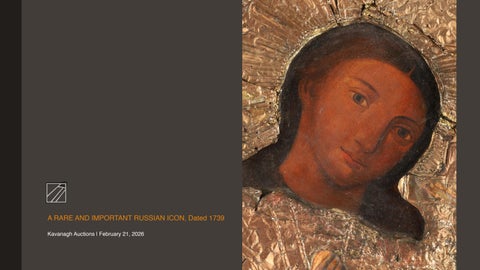

A RARE AND IMPORTANT RUSSIAN ICON, Dated 1739
Kavanagh Auctions | February 21, 2026
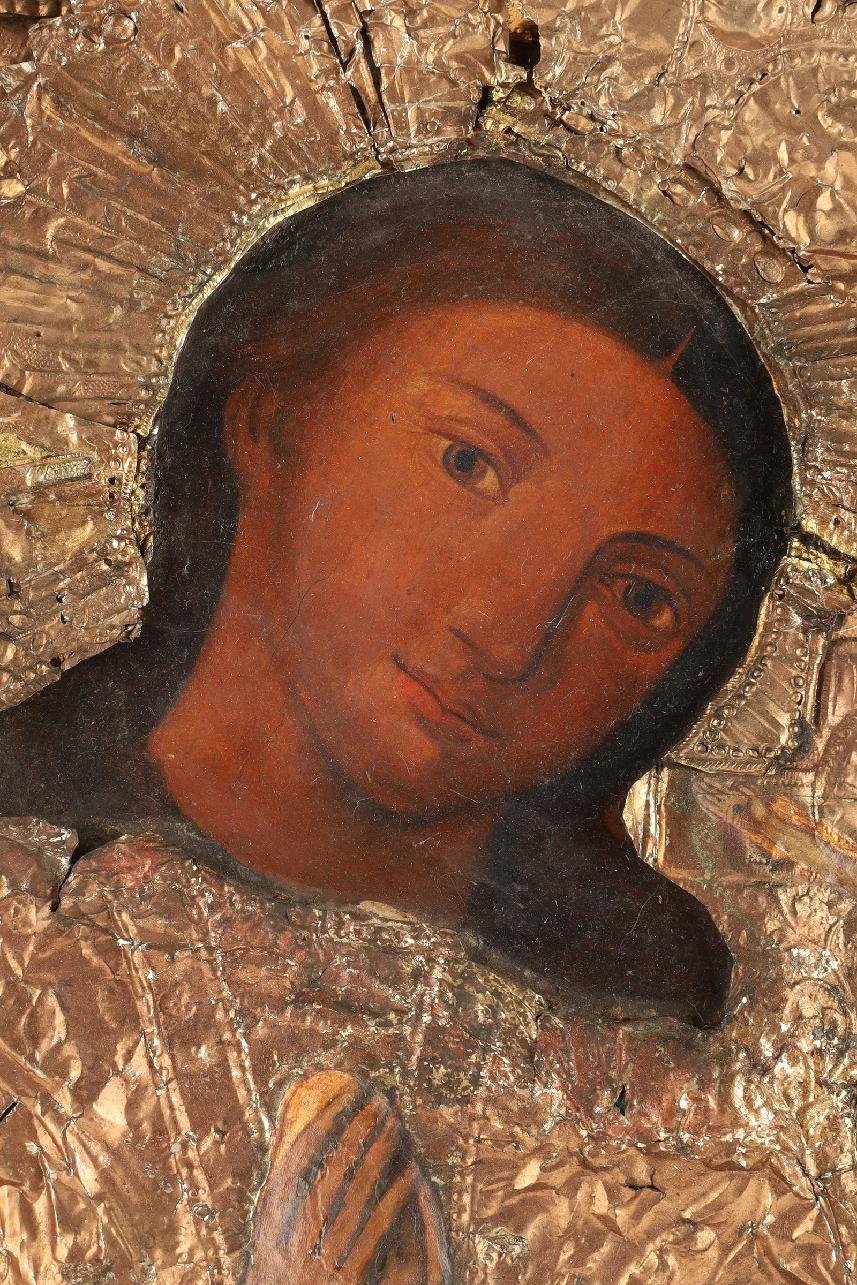
AN ICON OF MONUMENTAL PRESENCE
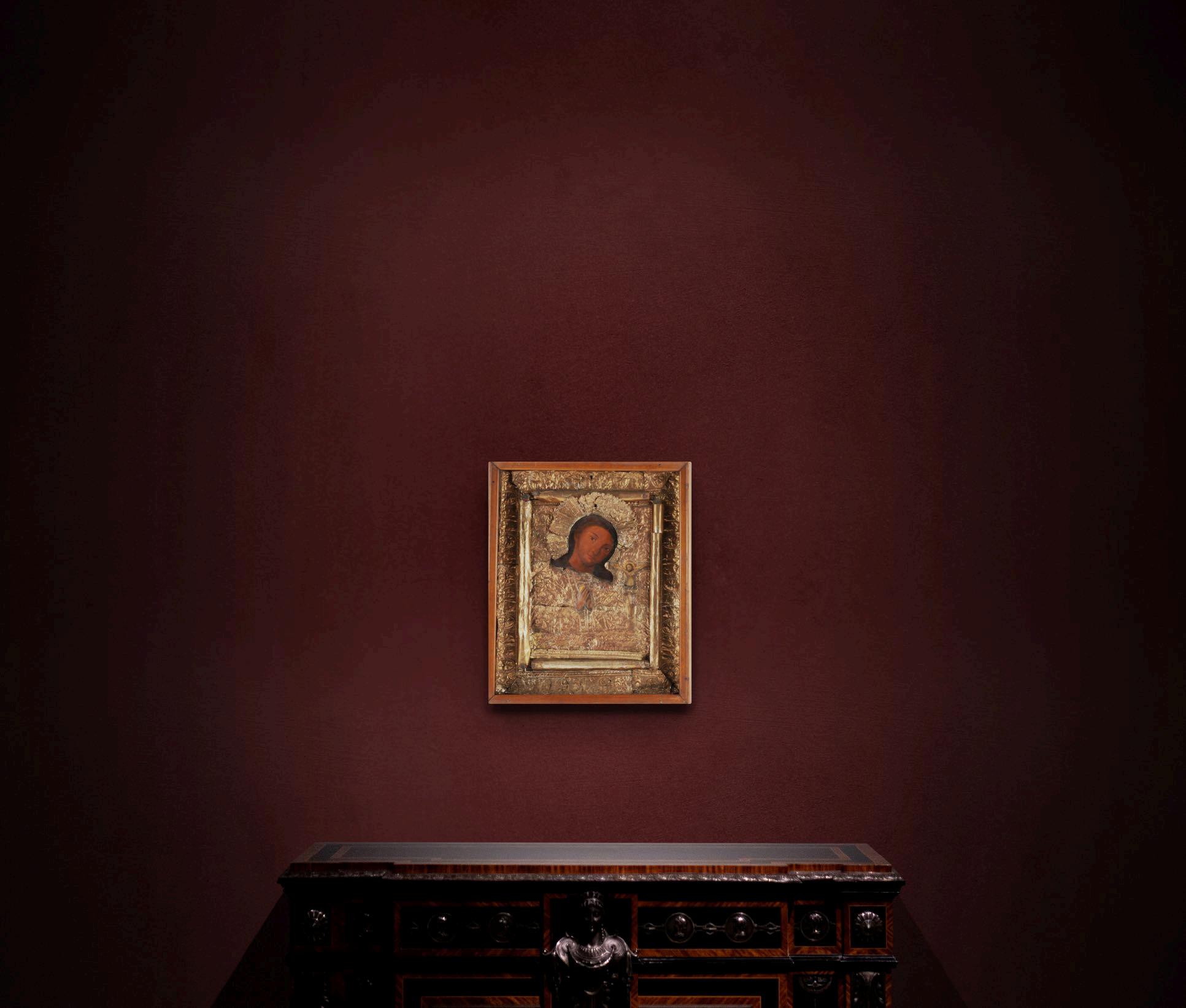
The Mother of God with the Crucified Christ
Egg tempera on panel with original repoussé copper oklad
Upper Volga region (Yaroslavl–Kostroma school), 18th century
A monumental early-18th-century Russian Orthodox icon of exceptional scale and refinement, retaining its original dated copper oklad and bearing a rare handwritten inscription.
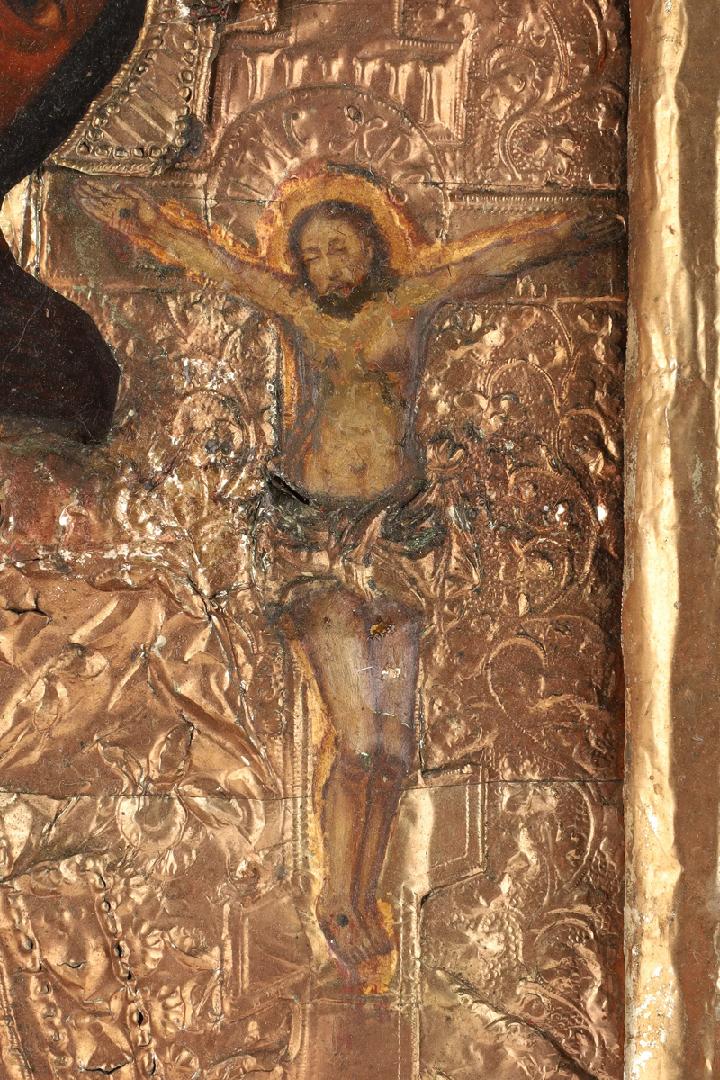
This large-format Russian icon depicts the Mother of God in solemn contemplation, paired with a miniature Crucifixion of Christ, a powerful devotional combination emphasizing intercession, sacrifice, and maternal sorrow. Painted in egg tempera on a traditional two-plank wooden panel with a recessed kovcheg, the icon retains its original repoussé copper oklad, engraved with the date 1739.
Icons of this scale were not produced for ordinary domestic devotion. Their size, complexity, and costly metal coverings indicate a commission intended for a prominent church interior or the private chapel of a wealthy patron, reflecting both deep piety and social standing.
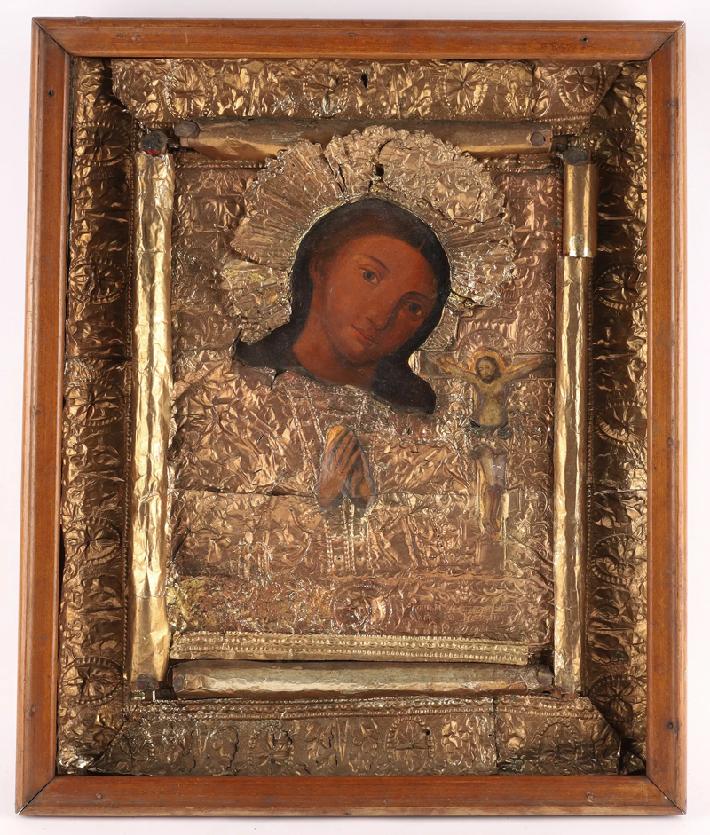
THE MOTHER OF GOD AND THE CRUCIFIED CHRIST
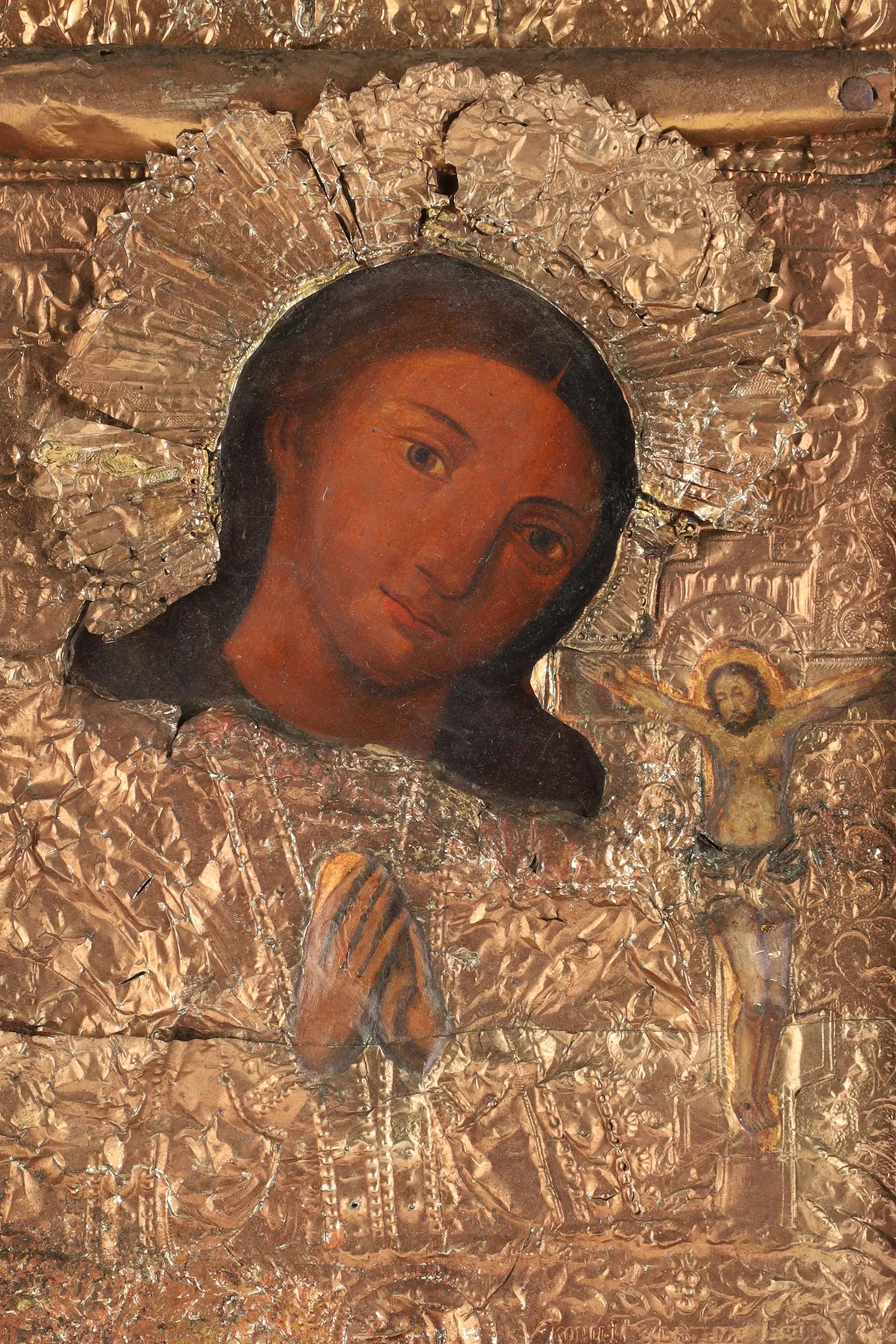
The pairing of the Virgin with the Crucifixion reflects a sophisticated theological program rooted in Orthodox spirituality. The Mother of God is presented not merely as a passive witness, but as an intercessor—contemplating Christ’s sacrifice on behalf of humanity.
The miniature Crucifixion intensifies the icon’s emotional gravity.
The viewer is invited to meditate simultaneously on divine redemption and maternal grief, a dual focus that became increasingly prominent in late Muscovite and early Petrine devotional culture.
Such icons were intended for prolonged contemplation rather than narrative reading, serving as focal points for prayer and remembrance.
THE UPPER VOLGA TRADITION
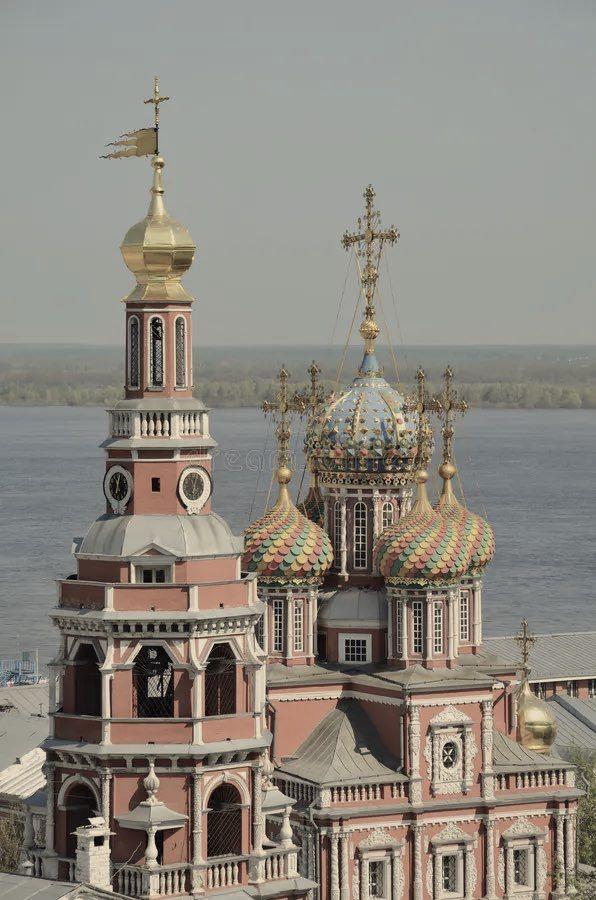
The icon is attributed stylistically to the Yaroslavl–Kostroma school, among the most refined regional traditions of Russian icon painting in the late 17th and early 18th centuries.
Characteristic features include:
Softly modulated flesh tones
Elegantly tapered fingers
Calm, introspective expressions
Balanced compositions with restrained emotional tone
Unlike more rigid provincial icons, Upper Volga works
display painterly confidence and subtle psychological depth, reflecting highly trained workshop practices and elite patronage.
A DATED AND ORIGINAL METAL COVER
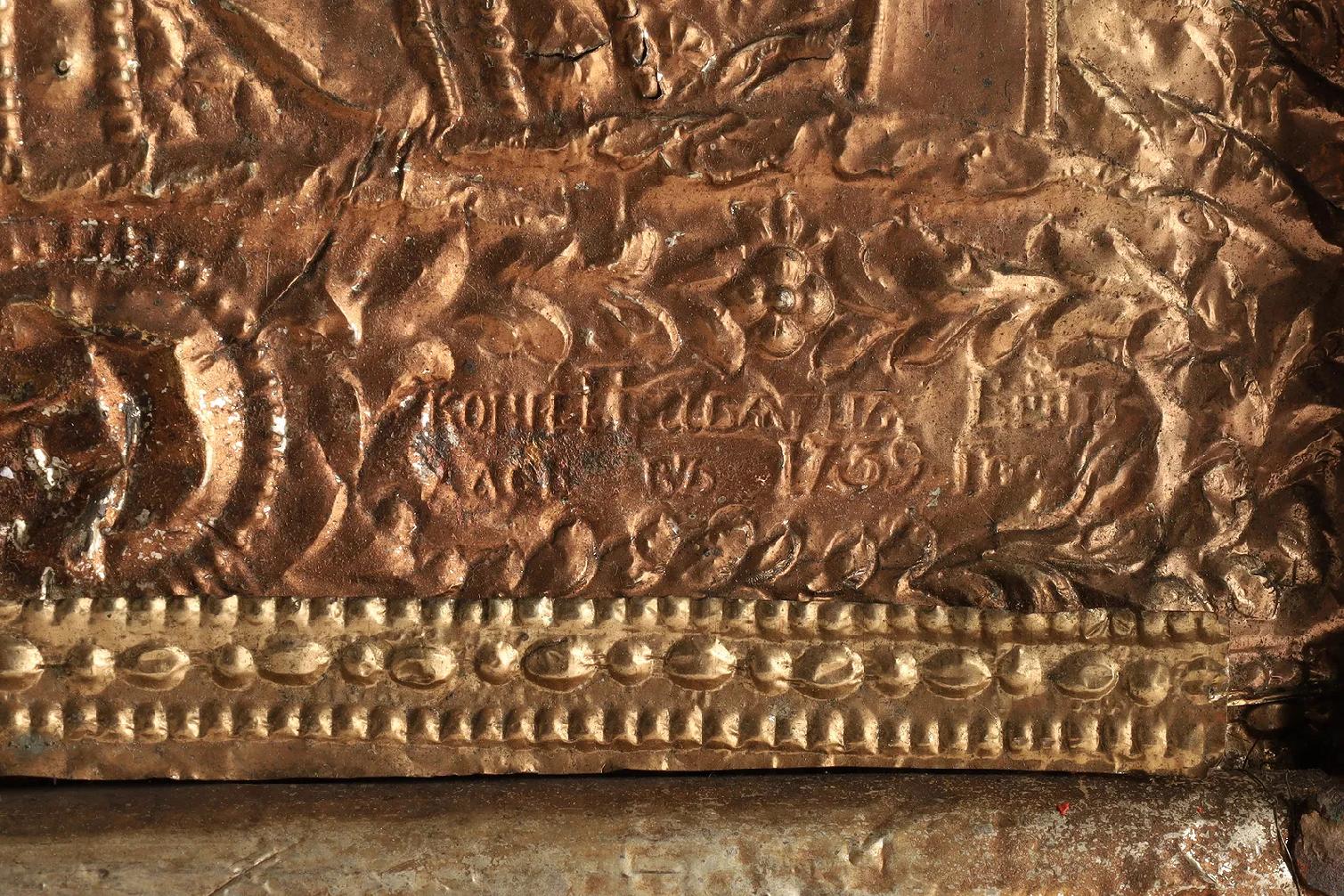
The repoussé copper oklad, engraved with the date 1739, rmly anchors the icon in the early 18th century. Its Baroque oral ornament and beaded borders reflect Western decorative uences entering Russian ecclesiastical art during the Petrine period.
A partially legible maker’s mark reading “…РОМЕ…” appears above the date, likely referencing a provincial copper-working center associated with the Romen metalworking tradition. Despite losses, deformation, and tears from devotional handling, the oklad remains original, authentic, and historically integral to the icon.
TECHNICAL DETAILS
Object: Orthodox icon
Subject: Mother of God with the Crucified Christ
Date: 18th century; oklad dated 1739
School: Upper Volga (Yaroslavl–Kostroma)
Medium: Egg tempera on wood
Panel: Two-plank with original kovcheg
Oklad: Original repoussé copper, Baroque ornament
Inscriptions: Partial metalworker’s mark “…РОМЕ…”
Dimensions: 51 × 42 cm (20 × 16½ in.)
Provenance: Private European Collection
Comparable icons are preserved in major institutional collections, including the State Tretyakov Gallery and the State Russian Museum, where early 18th-century Upper Volga works demonstrate similar figural elegance, compositional restraint, and refined flesh modeling.
RARITY AND IMPORTANCE
Large-format Russian icons retaining their original dated oklads are exceptionally rare. Fewer still combine monumental scale, refined artistic quality, clear regional attribution, and a personal inscription.
This icon represents a compelling acquisition for advanced private collectors, institutions, and museums, standing well above typical provincial examples in both quality and significance.
Selected Literature
Lazarev, V. N., Old Russian Icons
Ovchinnikova, E. S., Yaroslavl Icon Painting of the 17th–18th Centuries
Alpatov, M. V., Russian Icon Painting
Icons of the Upper Volga Region, Tretyakov Gallery catalogue
Russian Icon: From the Middle Ages to the Modern Era, Russian Museum
Kavanagh Auctions | February 21, 2026