Hidden Brains Insights Stay ahead of technology paradigm shift
11 Nov 2020
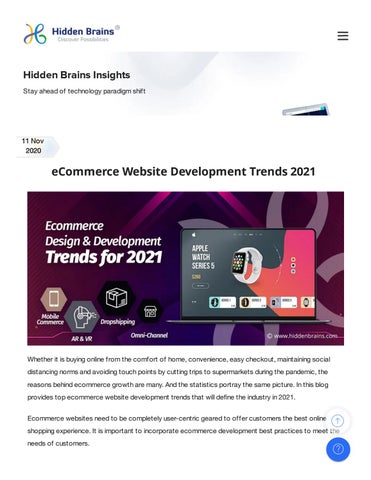
eCommerce Website Development Trends 2021
Whether it is buying online from the comfort of home, convenience, easy checkout, maintaining social distancing norms and avoiding touch points by cutting trips to supermarkets during the pandemic, the reasons behind ecommerce growth are many. And the statistics portray the same picture. In this blog provides top ecommerce website development trends that will de ne the industry in 2021. Ecommerce websites need to be completely user-centric geared to offer customers the best online

shopping experience. It is important to incorporate ecommerce development best practices to meet the needs of customers.
Companies are scrambling to adjust to the world that is getting borderless with markets opening up across different geographies. It is important to partner with a leading eCommerce website development company to get bene ts from the latest trends.
COVID-19 & its Impact on Ecommerce COVID-19 has made the biggest impact on ecommerce. Due to lockdown, several stores were shut for people. However, due to the crisis, online shopping came to the rescue of people looking to buy essential items or groceries. People have now accepted online shopping as the way of living. Custom ecommerce website development is one of the most effective solutions to minimize the business impact of the pandemic and stay a oat during tumultuous times.
eCommerce Website Development Trends 2021 Voice Assistant Voice-enabled technology is fast becoming the buzzword for ecommerce. Come 2021, voice assistants are slated to become the future of online shopping. Voice commerce uses voice recognition technology to facilitate buying of goods and services. It eliminates customers to make purchases through voice commands instead of typing out keywords. T he buying process encompasses searching through a microphone, with which customers search and buy online with the help of a virtual digital assistant (VDA) such as Google Assistant, Siri, or Amazon Alexa. Voice commerce provides businesses with an entirely new way to revamp shopping experience in everyday life. T his statistic presents the number of smart speaker buyers in the United States from 2019 to 2021. In 2019, the number of internet users who had made at least one purchase via smart speaker during the year amounted to 18.3 million. T he number of U.S. smart speaker buyers is projected to reach almost 23.5 million in 2021.

It is important to prepare your site for voice-based navigation on your website and mobile app. Voice-friendly navigation for mobile applications and ecommerce sites. Incorporate schemas for not only seamless navigation, but also helping search engines decipher your site. Rise above clutter to ensure simplicity in buying with a simple command of voice. Optimize and focus on high performance with emphasis on fast and uid mobile use. Actions and skills on Alexa and Google Assistant.
Rise of Contactless Payment T he rising expectations of consumers and the COVID-19 pandemic have seen a surge in the demand for contactless payment across the ecommerce industry. With the era of omnichannel ecommerce, voicebased smart devices are playing a critical role in facilitating contactless payment with speed and convenience. Contactless payments can be made through different modes (credit, debit cards, net-banking, UPI, wallets). Retailers need to integrate order management systems for effective inventory management from the backend. Consumers mostly use contactless cards for buying the essentials. Here’s a breakdown: Grocery: 85% Pharmacy: 39%

Retail: 38% Quick service restaurants (QSRs), fast food: 36% Transit: 9% According to Mastercard Contactless Consumer Polling, more than half (51%) of Americans are now using some form of contactless payment, which includes tap-to-go credit cards and mobile wallets like Apple Pay. While it goes without saying the contactless payment will grow exponentially in the year 2021. However, the expectation also revolves around payment options. Consumers are looking for more options to make payment effortless. Option to use payment providers, irrespective of the location. Also, hassle free online shopping, easy checkout and shipping while using global retail giants such as Amazon. With increase in online shopping triggered by pandemic, e-retailers are coming up with different ways of ecommerce payment with various types of payment gateways: Gateway takes customers to the payment page of a paytech company such as PayPal to complete the transaction. Payment on ecommerce sites, but the payment processing off site. Payment and processing without any third parties directly on the site. Option to use digital wallets or net banking to complete the checkout. Frictionless payment options will improve site abandonment. Ecommerce sites need to integrate Apple Pay, PayPal, GPay and more.
Mobile Shopping: Major growth for ecommerce Mobile shopping will continue to strengthen its dominance and witness innovation.

By 2021, 72.9 percent of all ret ail e-commerce is expect ed t o be generat ed via m-commerce, a not iceable increase f rom 58.9 percent in 2017. T here are several f act ors behind t he growt h of mobile shopping such as rapid prolif erat ion of smart phones, increasing power of millenials and a signi cant growt h of mobile- rst economy.
Headless Commerce COVID-19 pandemic has brought about a phenomenal shift in the buying patterns. T here is a need to bring about a complete change so that ecommerce businesses meet new demands of customers. It requires a lot of exibility. Enter -Headless Commerce. Headless commerce brings about a change and to put it in simple layman’s terms, it is separation of the front end and back end of an ecommerce application. Headless commerce empowers brands to build custom experiences that shoppers can’t get anywhere else and requires APIs to ensure coordinated and consistent experiences across any device, not just the standard screen. Headless commerce eliminates complexities involved related to IT, making front-end changes simple because it does not require back-end updates.
eCommerce Statistics: Current and Future Statistics indicate around a total of 258.9 million digital buyers in the United States in 2018 with an expected increase of over 307 million buyers in 2023, reaching 79.2 and 90.8 percent of U.S. internet users respectively.

Global eCommerce sales in the retail industry are expected to reach $4.5 trillion by 2021. T he year 2020 is likely to witness B2B eCommerce sales outpace B2C eCommerce sales. (
HubSpot , 2018) 92 billion – the estimated number of global digital buyers in 2019. It’s expected to reach 2.14 billion by 2021. (Statista ) 67% of millennials prefer online over in-store shopping due to convenience. (BigCommerce , 2017) By the year 2040, it’s estimated that 95% of all purchases will be through eCommerce. (Nasdaq)
Here are 2020 trends in ecommerce Product-Market Fit Varies by Region and Country It is essential to understand geography to make strategic decisions on the product-market. T here are several questions to ask before you target global markets such as understanding the need for the product and validating demand, as well as providing the opportunity for your offerings within new areas. It is vital to gauge the importance of lucrative online industries based on region and align those verticals with your expansion plans. Equally important is understanding the potential of each targeted geographies. Understand market segment and de ne geographic areas De ne the existing competition in the local market De ne the market’s potential Anticipate market share and selling price
Stay Focused on Localized Language and Currency It is essential to go native with the site’s language to make or break global sales. Language plays an essential role in understanding where they shop and whether they buy. Localization can often imply that everything needs to be country-speci c.
Getting heavily scrutinized areas of a site right is critical: headlines and product titles. Only after you’ve gained traction does full-scale translation using a native copywriter, and local idioms make sense.
Payment Preferences When it comes to eCommerce, online payment options can be a big factor in buying decisions. However, it is often easily overlooked by many people. It is vital to take into consideration different aspects of buying habits. Without considering different factors, it might be not possible for companies to implement payment factors which might help the audience across the globe. While credit cards are number one, several digital payment systems like PayPal and Apple Pay are closing the gap. At the global scale, credit cards and those same digital payments also dominate. For some, the differences in preference are small. For others, the gap is wide. However, while local differences in payment methods, language, and currency matter,
Here are top platforms to launch for your eCommerce site Shopify One of the most widely used eCommerce platforms, Shopify is growing in terms of popularity, making it one of the most comprehensive platforms around. Shopify is an eCommerce platform that provides a point of sale feature to grow and transform your business. Shopify provides a plethora of features which are easy to build and manage your online store. It provides themes by world-renowned designers to simply give your website looks on Shopify. Shopify seamlessly integrates with 100+ external payment gateways from across the world right from bitcoin to PayPal. Inventory management Manage the entire inventory with Shopify with an entire option to track stock counts, and stop selling products when inventory exhausts Product variations Product variations, such as multiple sizes, colours, materials with its rates/pricing, SKU, weight, and inventory. Product organization

Organize products based on different elements such as category, type, season, sale, and more.
Use smart collections to sort products based on vendor, price, and inventory level automatically.
Multiple images Add multiple images for your products to show off your product from all angles. SEO product tags Optimize product pages for search engines with product speci c meta tags, titles, and URL handles. Digital products Customers can quickly order and download digital products right from the online store. Import/Export Seamlessly import or export your products using CSV les or Shopify’s importer/exporter apps. Unlimited products No cap or unlimited type of products you can sell in your online store.
Magento Feature-rich eCommerce platform solution, Magento offers complete exibility and control over the functionality of an online channel. Magento’s administration interface provides the option to tailor your site based on business requirements. Scalable and backed by a vast support network, Magento is the ultimate platform with search engine optimization, catalogue management, and marketing tools give merchants the ability to create sites that provide an unrivalled shopping experience for their customers. Magento is open-source and can be downloaded and installed on its own servers. It comes with additional plans that offer hosted cloud versions. However, it is a fairly advanced matter that is almost impossible to set up without technical knowledge. Magento doesn’t offer any custom designs for stores either, so you’ll have to shop for templates. Magento has both free and paid with the Community Version free. T heir Enterprise option, perfect for thousands of products and tons of traf c is expensive with prices ranging from $15,000 to even $50,000 a year. Marketing, Promotions, and Conversion Tools Site Management Catalog Management Catalogue Browsing Product Browsing
Order Management Checkout, Payment and Shipping
WooCommerce/WordPress Powering almost 30% of sites, WordPress is one of the most powerful tools in the internet era. It is straightforward to use with the ability to build a website of almost any complexity or magnitude. While closest to free, anyone can build a website on WordPress. However, making an eCommerce store is dif cult. With the right plugin based on your requirements, this changes completely. And that’s where WooCommerce comes into play. An exponentially popular plugin, WooCommerce gives you almost every feature you could need from an ecommerce store. For regular WordPress user, WooCommerce will be as easy to operate. Furthermore, it is effortless to build and design. Taking just a few minutes for installation, it has a wide range of features for the community. T he setup wizard provides stores’ basic con guration and the room to explore. T he plugin is free for WordPress site. However, there are few moderately-priced extensions, but the core product costs nothing. T he extensions are easy to use and enable as a regular WordPress plugin.
BigCommerce BigCommerce is a robust eCommerce software containing a complete suite of features to build an online store. However, don’t just mistake it for a website builder. T his eCommerce platform offers tools to streamline online business, allowing you to focus on what you do best. It has excellent features such as handling orders, products, and customers and in-built CRM, with different marketing tools, analytics dashboards, and free themes. Construction and design might give a dif cult time to non-tech savvy. But they have a seamless 24/7 customer support. Just on the lines of WooCommerce, BigCommerce provides its own tour/tutor system introducing several useful features, which we highly recommend. Manage orders and inventory
Powerful control panel to completely process and ful l orders end to end from a single location. Accept payments from leading providers.
BigCommerce doesn’t put any additional rates or costs for using your preferred payment gateway.
Marketing features Ecommerce website is search engine optimization friendly aimed to increase organic traf c. Optimized for conversion Drive traf c and empower to get more sales out of the traf c. It comes with a free 15-day trial. However, BigCommerce is a paid-only platform with three different plans; the most economical plans start with a very reasonable $29.95 monthly. Against the price, you get unlimited -products, storage, as well as bandwidth. T he only ipside is this plan is at 1.5% per-order transaction fee. If you don’t pay the payment, you’ll need to upgrade to a $79.95 plan and their most expensive plan will cost $249.95. You can also decide to buy custom themes, typically ranging from $125-250.
Conclusion: T he Ecommerce industry is at the cusp of change and consistently evolving. It is important for ecommerce companies to stay updated with the latest trends. While these trends are just a few, there are emerging trends creating a buzz in the ecommerce industry such as drones, facial recognition in stores, AI in customer sourcing and more. In such scenarios, it is important to understand your business needs and target audience. While the ability to innovate will help stand tall in a highly competitive industry, Merely copying a trend with applying business logic will not yield any result.
You may also be interested in Comprehensive List of eCommerce Tools For Business Productivity Amazing Multi Vendor Marketplace Platforms for your eCommerce Store How to Build Omnichannel Ecommerce Experience
 Are you looking for eCommerce development design and development solutions? Get in touch.
Get a Quote
Share the knowledge!
written by Albert Smith for eCommerce section(s).
Back
Search By Keyword
eCommerce Development Company | Expand Your Online Business HiddenBrains.com/Web-Development /eCommerce Award-Winning Custom eCommerce Website Development Services aimed to increase traf c and leads and help you succeed by leveraging the latest technologies. Get a Free Quote!
WordPress Development Company | Solutions for Different Verticals HiddenBrains.com/WordPress/ Custom WordPress Development Services using Latest Standards in CSS3, HT ML5, Javascript, PHP & MySQL. We are specializing in developing custom WordPress website, Contact Us Now!
Guest Contributor We are looking f or passionate industry experts to contribute thought leadership blogs. Write f or us

Work Portfolio
View Portfolio
Request a Quote Tell us about your requirment and we will get back to you soon.

Categories Android Apple Application Development Application Maintenance Services Apps Arti cial Intelligence Augmented Reality Big Data Services Blockchain Chatbot
Archives Select Month
Be Social with us on
Company
About Us
Our Team
Inf rast ruct ure
Test imonials
Cont act Us Services
Hire Dedicat ed Developers
Web App Development

Mobile App Development
Front end Technologies
Microsof t Technologies Industries
Healt hcare
Educat ion
Ret ail
Logist ics
Oil & Gas Solutions
Inst ant Messaging
Virt ual Classroom
T ime & At t endance
Telemedicine
Mult i Vendor Market place Have Questions? USA
Skype
+1 323-908-3492
UK
+44 (0)20-7993-2188
Australia
+61 2 6145 2066
hiddenbrains
India
+91-989-802-1433
biz@hiddenbrains.com
Incept ed in 2003, Hidden Brains is an IT company of f ering a suit e of web & mobile applicat ion development services f or diverse indust ry vert icals. We act as an invaluable cat alyst f or building a cult ure of innovat ion. Our breakt hrough solut ions have t he capabilit y t o challenge t he limit s and give business a compet it ive edge.
Get Free Estimation
© 2003-2020 Hidden Brains Infotech. All rights reserved. Privacy Policy
|
Terms of Use
|
FAQ
|
Sitemap