Katherin e Lee
po r tfoli o
01
01
03
ARC36 9 Dive rse Mo d al i tie s
ARC201 ‘ To Ar c h’ C ommunity C e nter e d Space s
ARC11 2 W oodbine Beac h W inte r Pavi ll ion
Date: Jan - Present
Instructor: Fiona Lim Tung
Course: ARC369
This studio project explored the design of a food-centred urban intervention at Toronto Municipal Carpark 104 in the Bloorcourt Village neighbourhood. Working within a collaborative, multi-modal framework, the project investigated the site’s social, spatial, and infrastructural context to develop a meaningful public place focused on food culture and community engagement. Through a sequence of Place, Object, and Story assignments, the work progressed from site analysis and spatial strategy to the design of a detailed architectural element and a comprehensive narrative proposal. The final project integrates urban context, program, and material thinking to propose a cohesive intervention that connects food, public life, and the everyday experience of the city.
Detailed floor plan illustrating individual rental kitchens and seating areas designed for small businesses and independent users. The layout positions cooking as a visible, shared activity, emphasizing interaction through watching, preparing, and dining. The space is organized around interface—between cook and viewer, food and audience, and production and consumption.


Date: Sept 2025 - Dec 2025
Instructor: Carol Moukheiber
Course: ARC201
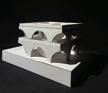
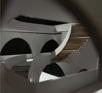
This project centered on model making and experimenting with different materials to explore how forms can shape space. Guided by the verb “to arch,” I focused on creating structures that emphasize flow and openness, promoting inclusivity and encouraging movement, interaction, and gathering. Throughout the process, I considered key project requirements, such as exploring scale, materiality, and spatial relationships, while designing a final model that serves as a social gathering space for students, balancing creativity with functional and welcoming design.
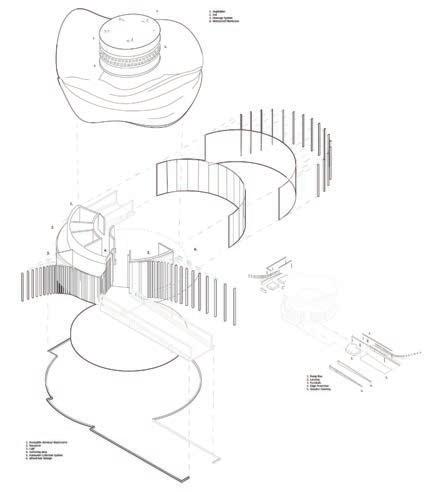
The project explores a small-scale social building developed through an extended grid logic to organize relationships between program, circulation, built form, and site. Structured as a sequence of nine interconnected spaces, the design negotiates field and figure through varied spatial conditions in plan and section. Arch forms were used as a spatial device to model and connect spaces, promoting air flow, visual continuity, and spatial cohesion. The final proposal is presented as an axonometric drawing within its site context near the University of Toronto, envisioned as a social space serving the surrounding student community.
Date: Jan 2025 - April 2025
Instructor: Jennifer Davis
Course: ARC112
The objective was to design a winter pavilion at Woodbine Beach, Toronto, Ontario, with a strong emphasis on universal and handicap accessibility. The project was developed as a team through site visits, design development, and coordination between architectural and engineering approaches. The work was supported by simulated client meetings and monthly design reviews with Omar Gandhi Architects, including office visits, to discuss design expectations, accessibility strategies, and the spatial, structural, and experiential performance of the pavilion within its seasonal and coastal context.
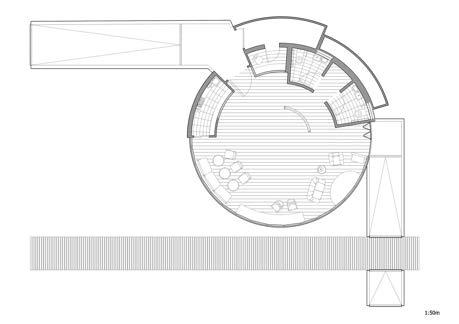
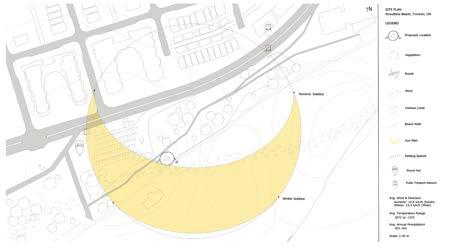
The site lacked accessible recreational space, with no universal pathways to the beach, limited inclusive amenities, and no year-round facilities such as winter washrooms or gathering areas. Existing buildings were underutilized and operated only seasonally, contributing to low site activity and limited community engagement. In response, the pavilion was designed to provide an accessible, inclusive, and sustainable year-round space that supports both public use and the surrounding natural environment.
Analysis
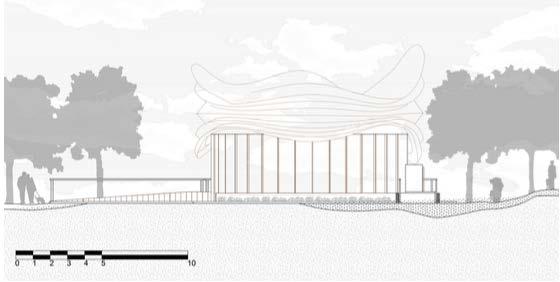
The proposal prioritizes durability and resilience to the corrosive soil conditions at Woodbine Beach, assuming worst-case scenarios and identifying the need for detailed geotechnical investigation. A helical pile foundation system was explored through preliminary comparative calculations, with the understanding that precise structural analysis and load verification must be completed by a professional engineer. Further development includes refined structural and drainage calculations for rain and snow loads, a sloped green roof with adequate drainage for extreme weather, and additional design considerations such as roof maintenance strategies, improved ramp integration, lighting and flooring design, enhanced interior spatial quality, stronger connections to the outdoors, and the exploration of alternative design options.