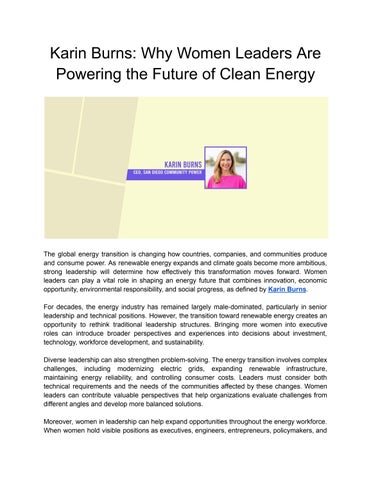
Karin Burns: Why Women Leaders Are Powering the Future of Clean Energy
The global energy transition is changing how countries, companies, and communities produce and consume power. As renewable energy expands and climate goals become more ambitious, strong leadership will determine how effectively this transformation moves forward. Women leaders can play a vital role in shaping an energy future that combines innovation, economic opportunity, environmental responsibility, and social progress, as defined by Karin Burns. For decades, the energy industry has remained largely male-dominated, particularly in senior leadership and technical positions. However, the transition toward renewable energy creates an opportunity to rethink traditional leadership structures. Bringing more women into executive roles can introduce broader perspectives and experiences into decisions about investment, technology, workforce development, and sustainability. Diverse leadership can also strengthen problem-solving. The energy transition involves complex challenges, including modernizing electric grids, expanding renewable infrastructure, maintaining energy reliability, and controlling consumer costs. Leaders must consider both technical requirements and the needs of the communities affected by these changes. Women leaders can contribute valuable perspectives that help organizations evaluate challenges from different angles and develop more balanced solutions. Moreover, women in leadership can help expand opportunities throughout the energy workforce. When women hold visible positions as executives, engineers, entrepreneurs, policymakers, and
project leaders, they can inspire younger generations to consider careers in the industry. This representation can help energy companies attract talent from a wider pool while creating stronger pathways for professional growth. The transition also requires collaboration between governments, utilities, technology companies, investors, and local communities. Effective leaders must communicate clearly, build trust, and balance competing priorities. Increasing women’s participation in decision-making can strengthen the range of leadership approaches available to organizations navigating these relationships. Supporting women leaders does not mean choosing representation over qualifications. Instead, it means removing unnecessary barriers that may prevent qualified professionals from reaching leadership positions. Companies can make progress through fair hiring practices, mentorship, professional development, flexible workplace policies, and transparent promotion opportunities. Ultimately, the energy transition is not simply a technological shift. It is also a transformation of industries, workplaces, economies, and communities. Women leaders should have a meaningful role in directing that change. By creating stronger pathways for women to lead, the energy sector can gain more perspectives, expand its talent base, and build a cleaner, more innovative, and more inclusive energy future.