1
Copyright 2026 by Latinos Organizing for Understanding and Development (LOUD) and Oscar Mireles The book author and each artist here retains sole copyright to their contributions to this book. No part of this book may be reproduced in any form or by any electronic or mechanical means without prior permission in writing from Latinos Organizing for Understanding and Development (LOUD), Oscar Mireles and the individual artists. ISBN: 9798192369234
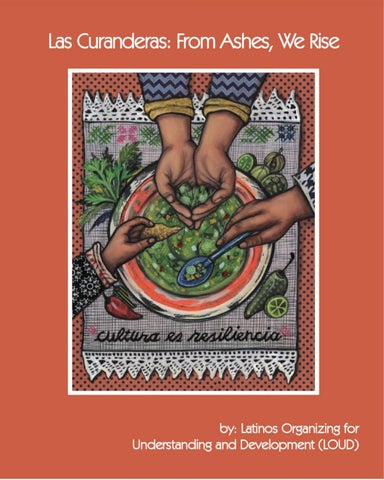
Catalog Designed by Karen M. Gutfreund, www.KarenGutfreund.com, @karengutfreundart Art on Cover: Angelica Contreras LOUD Logo: from the mural by Reynaldo Hernandez 2
Las Curanderas: From Ashes, We Rise
Latinos Organizing for Understanding and Development (LOUD) The Gallery at Truax / Madison College
September 15 – October 15, 2026
3
From the Publisher The idea for Las Curanderas: From Ashes, We Rise began with a conversation and a shared vision for creating greater visibility and opportunities for Latina artists in Dane County and throughout Wisconsin. We were honored to invite my friends and visual artists Issis Macias and Jessica M. Gutierrez to create, develop and curate Las Curanderas. Their knowledge, artistic insight, and commitment to supporting Latina artists laid the foundation for this powerful and evocative exhibition. Through their leadership, we received submissions from more than two dozen Latina artists representing communities throughout Wisconsin, each bringing unique perspectives, cultural experiences, and creative expressions to this important showcase. I had the privilege of speaking with Nicole Sandoval of Madison College, who understood LOUD’s commitment to celebrating Latino arts and culture and suggested a collaboration with the Madison College Gallery. That initial conversation opened the door to what has become a meaningful partnership and an opportunity to showcase the creativity, experiences, and voices of Latina artists from across our state. Along this journey, I was fortunate to connect with artist Rene Arceo through a mutual friend Kai Yael Luanda Gardner Mishlove who thought we might have a lot in common. During a visit to his studio, I was inspired by his extensive collection of artist catalog books and his dedication to documenting and preserving the work of Latino artists. That experience sparked a conversation about the importance of creating professional-quality publications that honor artists and provide a lasting record of their contributions. Rene introduced me to California curator and artist Karen M. Gutfreund, whose exceptional work in creating artist catalogs and publications helped shape the vision for this exhibition catalog. With this vision in mind, I presented the exhibition concept to Madison College. Marisa Rushing. Nicholus Loveland and Rhoda McKinney embraced the idea and responded with enthusiasm, professionalism, and a commitment to making this collaboration a success. From that moment, the project moved forward with a shared belief that exhibitions and publications can serve as powerful tools for recognition, education, and community building. I also want to express my sincere appreciation to Diana Gonzalez for her insights, guidance, and willingness to ask me the challenging questions that helped strengthen this project. Her thoughtful perspective and encouragement pushed me to think more deeply about the purpose, impact, and possibilities of Las Curanderas once again. This exhibition represents more than an art display—it reflects the growing presence and impact of Latina artists in Wisconsin. It celebrates the stories, traditions, identities, and contemporary voices that continue to enrich the cultural landscape of our communities. I want to extend my deepest gratitude to some of our supporters who believe in the importance of investing in artists and cultural expression: Joe and Mary Ellyn Sensenbrenner, Paula Bonner and Ann Schaffer, Diane Ballweg, and Dierdre Garton. Their leadership, generosity, and commitment to the arts have helped make projects like Las Curanderas: From Ashes, We Rise possible. Thank you to the artists, curators, partners, designers, supporters, and everyone who contributed to bringing this exhibition and catalog to life. May this publication serve as a celebration of the remarkable talent of Latina artists in Wisconsin and as a reminder of the power of art to connect, inspire, and transform communities. — Oscar Mireles Founder/Director Latinos Organizing for Understanding and Development (LOUD)
4
Latina Art: Community Care As Artistic Practice It is not an overexaggeration to state that there are not enough exhibitions on Latina artists. For reference, Latina Art: Showcase ’87 at the National Museum of Mexican Art (then Mexican Fine Arts Center and Museum) brought the artwork of twenty-two women across the U.S. to the Midwest. In 2017 and 2018, the traveling exhibition Radical Women: Latin American Art, 1960–1985 gathered the artwork of more than one-hundred Latina artists from across the Americas. These examples are far and few between. Hence, at a moment of increased surveillance, threats to bodily autonomy, and uncertainties about the future, Las Curanderas: From Ashes, We Rise is timely and necessary. The narrative surrounding this lack of Latina representation in the artworld has arguably remained the same. As women, Latinas continue to be the lowest-paid demographic in the U.S. workforce, a statistical figure that does not account for the other forms of unpaid labor with familial obligations and responsibilities. In many mainstream museums and galleries, Latina artists complicate the national origin line of a tombstone label. The contributions of Latina artists are frequently overlooked by their male counterparts. Therefore, Latina art has been marked by a severe neglect, and in our current moment, the stakes are much higher. Despite these circumstances, Latina art and artists continue to demonstrate boundless resilience that is forged out of necessity, but also through intense forms of care. The word curator originates from the Latin verb curare which means “to take care of” or “to heal”—this is exactly what Jessica M. Gutiérrez and Issis Macias, the curators of Las Curanderas: From Ashes, We Rise are activating with this exhibition. As they lead this initiative to fill the gap on exhibiting Latina artists in Wisconsin, they highlight how these artists have similarly developed a praxis of care. At a time where the future feels questionable, these artists turn to embodiment, intergenerational coalition building, and tap into the power of ancestral care. This care, however, differs from what has been packaged and sold as ‘self-care’; they demonstrate how community care is equally necessary to sustain the self, and one another. When faced with a challenge, our communities—formed by sisters, mothers, grandmothers, friends, and lovers—hold us and heal us. As the feminist slogan goes, me cuidan mis amigas [my girlfriends care for me]. By invoking the figure of la curandera, a folk healer or medicine woman in Latin America and the Caribbean, the artworks here demonstrate the transformation and subversive knowledge that comes with the practice. Though she may remedy physical ailments, she also works with the energy and spirit of dolores, pain, sorrow, and grief that can be metamorphosized. Take for example, Vanesa Knutson’s Las manos de mi abuela (2026) which depict her grandmother’s hands holding cempaxochitl or cempasúchil, the orange marigold placed in offering for visiting souls on Day of the Dead (Día de Muertos). In Angelica Contreras’ Salsa (2025) multiple hands come together to represent the collective effort to keep traditions alive that metaphorically, physically, and spiritually nourish. In the theme of multiplicity, Che Correa’s Triple Brujas (2022) conjures the wisdom and realm-bending talents of the bruja as informed by Yoruba epistemologies.
Other artworks bring into frame some of the most intimate exemplars of care in community settings. Samantha Lezama’s T.Q.M. (2025) presents an older woman braiding a young woman’s hair, an act of affectionate love as referenced by the painting’s title. Mizuleyka McCarthy’s McCarthy Girls (2025) utilizes multiple exposure to layer generations of girlhood and womanhood. Care is not only a strategy of survival and artistic method. It is a practice that is ongoing, cyclical, and regenerative, as represented by Carina Vargas-Nuñez’s Cycles (2022). So, it will be a matter of time before we can see another exhibition on Latina artists. by Marina M. Álvarez _______________________________
Alondra Cervantes and Jie Zong, “Latina Equal Pay Day: Seven Key Facts on Pay and Economic Disparities,” (Los Angeles: Latino Policy & Politics Institute, 2025), https://latinodatahub.org/#/research/latina-equal-pay-day-2025. 1
5
Marina M. Álvarez is a curator, scholar, and an educator. She was a 2026 Latino Studies Predoctoral Fellow at the Smithsonian American Art Museum supported by the National Museum of the American Latino. The year prior she was a Crossing Latinidades Mellon Humanities Research Fellow. From 2021-2023, she was the Andrew W. Mellon Visual Arts Curatorial Assistant at the National Museum of Mexican Art in Chicago, Illinois, and in 2019 she was a Latino Museum Studies Fellow at the Smithsonian National Museum of American History. In 2023, she was a Richard E. Greenleaf Library Scholar through the Latin American and Iberian Institute (LAII) at the University of New Mexico. Marina holds an MA in Spanish Language and Literatures from Loyola University Chicago and is pursuing a Ph.D. in Art History from the University of Illinois Chicago. At UIC, she is examining twentieth century Mexican, Indigenous, and Chicana/o/x art through decolonial feminist theories. Her dissertation analyzes the understudied figure of la maestra rural in post-revolutionary Mexican art to understand how language is visualized, and how contemporary Indigenous and Latinx/Chicanx artists contend with Indigenous language loss and retention efforts. She has also published articles on the political potential of feminist graffiti on both sides of the U.S.-México border; her article, "Monumentality and Anticolonial Resistance: Feminist Graffiti in Mexico" was published with Public Art Dialogue in 2022. Apart from her scholarly and creative ventures, Marina loves to teach, mentor, and guide other first-generation college students.
6
Las Curanderas: From Ashes, We Rise Curators’ Statement As self-taught Latina artists, we understand art as more than an act of creation. Our own artistic journeys have been shaped by intuition, ancestry, and the desire to tell stories that have too often gone unseen. These shared values inspired us to curate Las Curanderas: From Ashes, We Rise. Created during a time marked by political injustice, violence against our communities, and collective resistance, this exhibition brings together Latina artists from across Wisconsin whose work reflects the many ways we heal, care for one another, and transform. The call for art was inspired by María la Curandera by Natalia Lafourcade, particularly the lyric,“Que los queme el fuego, que los queme el fuego y vengan nuevas flores” (“Let the fire burn them, let the fire burn them, and may new flowers emerge”). The song honors the Curandera. She is more than a healer. She is a protector, a storyteller, a memory keeper, and a visionary. She is our abuelitas, our tías, our mothers, the women who mended generations without ever being called healers. This exhibition honors that lineage and extends it. Each artist is beautifully singular, yet together they reveal our collective power to alchemize destruction into hope, grief into power, and ashes into bloom. Through painting, sculpture, photography, beadwork, and mixed media, the artists share lived experiences shaped by migration, motherhood, ancestry, identity, loss, joy, and love. Together, their works offer distinct perspectives on what it means to be a Latina artist in Wisconsin, revealing the power of art to make visible what has been silenced and to cultivate belonging and hope. This exhibition is more than a collection of artworks. It is a ceremony of healing, resistance, and belonging, created by Latina artists, for Latina artists, and shared with all who are willing to witness. Here, grief is acknowledged, resilience is honored, and hope continues to bloom. May these works remind us that even after the fire, new flowers can emerge from the ashes. Jessica M. Gutiérrez and Issis Macias Curators
7
The Curators
Issis Macias is a self-taught abstract painter, emerging curator, and daughter of Mexican immigrants whose work explores the emotional spectrum of human experience through vibrant, intuitive abstraction. Born in Los Angeles, California, and based in Madison, Wisconsin, her practice is rooted in intuition, color, memory, and matrilineal resilience. Macias turned to painting during a transformative period of motherhood and career transition amid the pandemic. Working primarily with acrylic and oil pastel, she draws upon memory, intuition, and shared emotion to create vibrant, layered compositions that invite viewers into a sanctuary of introspection and emotional connection. She was named the 2025 Latina Artist of the Year and received the 2024 Micaela Salinas Artist Fellowship through Latinos Organizing for Understanding and Development. Macias was also a 2023–2025 Bridge Work artist at Arts + Literature Laboratory and a 2023 Forward Art Prize finalist through the Women Artists Forward Fund. Her work includes public art commissions for the Madison Public Market and LunART Festival and is held in the collections of UW Health, as well as private collections throughout the United States, Mexico, and Europe. Beyond her studio practice, Macias is passionate about using art as a tool for connection through teaching, bilingual artist talks, curatorial work, and collaborative projects. She is committed to creating opportunities that support Latine, BIPOC, and other underrepresented artists while fostering meaningful dialogue and community across Wisconsin. issismacias.com / @issis.unstrung
8
The Curators
Jessica M. Gutiérrez is a self-taught Nicaraguan-American Watercolor and Mixed Media Collage Artist residing in Madison, WI. The daughter of a Nicaraguan immigrant and born in Central Wisconsin, she studied psychology, philosophy, creative writing, and social work. She now works as a licensed mental health therapist who integrates her visual and creative nature into her practice and her healing focus into her art. Over the past 15 years, Jessica has shown her work throughout the Madison community, participating in events such as MMoCA Gallery Nights, The Latino Art Fair and La Alianza’s Immigrant Justice Week. Her contributions to public art include the City of Madison’s 2023 Utility Box Project and the 2024 “Flock to State” pedestrian mall mural. She was a 2023 finalist for the Women Artists Forward Fund Art Prize and was a 2023–25 Bridgework Program Artist at the Arts + Literature Laboratory. Her work has been published in The Shallot: Journal of Mental Health, Art, and Literature (Vol. 5, Issue 1, 2026) and in Corpus Callosum (Spring 2022, 2024) and selected for Planned Parenthood’s permanent collection through the 2023 Forward Art Initiative. Recent projects include Colectivo Coffee’s Guest Artist Series: Reimagining Co-Optiva, Connections earring collaboration with Virginia Ayala of De La Luna Designs, the SEED Original Project at West Side Elementary inspired by her Gifts from the Dark exhibition and co-designing the cover of Sara Alvarado’s memoir Dreaming In Spanish. jessicamgutierrez.com / @inspiritartist
9
The Gallery at Truax The Gallery at Truax provides diverse experiences by exhibiting creativity, innovation, and collaboration for Madison College and its community. The Gallery is an educational destination for discovery and expression, while promoting Madison College and its community. A note from the gallery team: When the LOUD team approached us with the vision for Las Curanderas: From Ashes, We Rise, we knew Madison College was the right place for this exhibition. The Gallery exists not only to showcase artistic work but also to create space for stories and perspectives that reflect the lived experiences of our students, employees, and community. At a time when many communities face uncertainty, discrimination, and attempts to diminish their voices, Madison College remains committed to fostering a campus where every student has the opportunity to learn, grow, and thrive. We are proud to partner with organizations like LOUD to elevate the voices of Latina artists and to celebrate the contributions of Hispanic and Latino communities. To our Madison College community—your stories, cultures, and perspectives enrich and strengthen our college. We hope this exhibition offers a place of reflection, connection, healing, and joy for our students, neighbors, and all who walk through these doors. We are honored to share this experience with you. Marisa Rushing Administrative Coordinator School of Business and Applied Arts | Madison College 1701 Wright St. A1005, Madison, WI madisoncollege.edu/about/community/facilities/gallery gallery@madisoncollege.edu 608.243.4576
10
ARTISTS Nicole Acosta Alanis Sujhey Beisser Reyli Cerda-Martinez Angelica Contreras Yesica Coria Che Correa Sara Isabel Donoso Natalie Ergas Xela García Ariana Gutierrez Ellia Ana Hill Vanesa Knutson Samantha Lezama Mayra Linares Juliet Maya Paola Mayorga Mizuleyka McCarthy Kanoe Montaño Chele Ramos Gabi Rivero / Gabi Creations Linda P. Santiago Alexandra Torres Him Angelica Valenciano Carina Vargas-Nuñez Sophia Voelker Ekphrasis Poetry: Dana Maya
11
Nicole Acosta
Milwaukee, WI atsocanicole.com
Bio: Born and raised in Milwaukee, Wisconsin, photographer and painter, Nicole Acosta is a Mexican-Indigenous identifying artist whose work explores identity, culture, memory, experience, and storytelling. Her photographs are included in the permanent collections of The Pfister Hotel and the Racine Art Museum, while her paintings are in private collections. Acosta created the nationally recognized HOOPS Project, which shares the portraits and stories of people with deep connections to hoop earrings. In 2023, she was named the 14th Artist in Residence at The Pfister Hotel and premiered the HOOPS stage play in Milwaukee and Boston.
Artist Statement: Whether through painting, photography, or dance, my creative process is guided by self-sovereignty, story, and reclamation. By painting imagined worlds, photographing people for the HOOPS Project, and adorning myself in Mēxihcah regalia to dance, I honor what has lived within me since birth: the enduring presence of my ancestors. I create for the ancient and the future because this work is eternal.
Lisette, from the HOOPS Project, 2023, printed 2024
Digital inkjet print, edition 1/2, 36 x 24 inches Racine Art Museum Permanent Collection (top)
Despojos, 2024 Gouache on wood panel, 48 x 48 inches Carol Alexander Permanent Collection (bottom)
12
13
Alanis
Milwaukee, WI Instagram: @chiki.drawings
Bio: Alanis is a self-taught Mexican artist, born and raised in Milwaukee, WI. Her most commonly used mediums are graphite, acrylic paint and magazine collages to convey political messages or emotional expression. Alanis uses her experiences as a Chicana, knowledge of history and personal journal entries as a young adult to draw artistic concepts. Since she was young, Alanis has used artistic expression to make sense of things and sees it as a necessary part of her life.
Artist Statement: : The piece I submitted represents an aspect of what 'healers, truth-tellers and agents of transformation' can mean. The conditions that my family in Mexico experience happens many times over to other Chicanas/Latinas. This piece is meant to bring forth these injustices to those unaware and give truth as an agent for transformation. “Imperialism” is a sketch of semi-colonial conditions in Latin America as it's under US Imperialism. During the Cold War, there have been many instances of Latin American States and the US suppressing political movements showing anti-imperialist sentiment as shown by the grave markers and the air bomber flying overhead. Dates on the markers refer to: - Tlatelolco Massacre, Mexico - 1968 - El Mozote Massacre, El Salvador - 1981 - Guatemalan Civil War or the Guatemalan/Maya Genocide - 1960 to 1996 Though today there's no Cold War, Latin America continues to be under imperialism as highlighted by the conditions of the peasantry and agricultural workers. This form of colonialism plunders the wealth of Latin America for the interests of the US. Whether it's the presence of transnational companies or cartel activity, imperialism has taken on a new appearance today.
Imperialism, 2026, graphite on paper, 14 x 11 inches
14
15
Sujhey Beisser
Madison, WI Instagram: @5SensesPalate Facebook: @5SensesPalate fivesensespalate.com
Bio: Sujhey Beisser is a Venezuelan-born artist and personal chef based in Madison, Wisconsin. Her work explores food as a vessel for memory, identity, and transformation, shaped by her experience as an immigrant and her deep connection to her cultural roots. Through cooking, styling, and photography, she creates images that carry ancestral knowledge while reflecting her present reality. Her practice is deeply personal, grounded in storytelling through food. This marks her first exhibition submission.
Artist Statement: My work explores food as a way to hold memory, identity, and transformation. As a Venezuelan immigrant and personal chef based in Wisconsin, I cook and photograph dishes that live between where I come from and where I am now. The fish empanadas in this series are inspired by my grandmother, who sold them by the beach. Through her, I learned that food carries ancestral knowledge—something passed down through hands, through repetition, through care. When I make them, I return to her, to that place, to a rhythm of life that still lives in me. These memories are part of what I carry—lo que no se quema. Chivo en coco speaks to the present. A traditional Venezuelan dish, reimagined with locally sourced goat from a Wisconsin farm. In my work as a personal chef, this is where I stand—honoring tradition while allowing it to shift and take new form. A practice rooted in memory and present reality. My process is deeply personal. I cook, style, and photograph each dish myself, creating scenes that invite the viewer to the table, where food becomes a shared and lived experience, shaping the story from beginning to end. In this work, I explore how what we carry can transform without being lost—how even through distance and change, something essential continues to grow.
Lo Que No Se Quema (Empanadas: De Cazón a Halibut), 2020 Digital food photography, 14 x 12 inches (top)
Chivo en Coco (De cenizas, Nuevos Sabores), 2022 Digital food photography, 14 x 12 inches (bottom)
16
17
Reyli Cerda-Martinez
Milwaukee, WI Instagram: @reyli_martinez29
Bio: Reyli is a Mexican American Artist who was born and raised in Milwaukee, WI and attends the University of Wisconsin-Madison. Her art primarily discusses what she felt it was like growing up in America as a person of color and the daughter of immigrants. She tries to talk about her mental health, being queer, and being a woman in America. Inspired by the stories of women around her and the heritage she prides herself in. Nonetheless, making any sort of art whether 3D or 2D that incorporates these topics and further educating people but also making it always about “Por mi Dios, mi gente, y mi tierra,” “For my God, my people, and my home”.
Artist Statement: My work is a remembrance of where I come from and who got me to where I am. It’s my way to honor the determination of my family who made a home out of nothing. Therefore, I show the pride in my heritage through my body by being in the nude; showing vulnerability yet strength in who I am. Using vibrant colors, flowers, and icons of my Mexican heritage to represent such pride in who I am and who I want to continue to be. Nonetheless, I want to be someone who never gives up but rather rises from the ashes, someone who is unapologetically themselves, someone who in a world that doesn't see them as worthy of life sees the beauty in the hardships and grows from it.
De un campo de Espinas, 2026 Acrylic, fake flowers, and paint markers on canvas, 24 x 18 inches (top) Conciencia, 2025, acrylic, 30 x 40 inches (bottom)
18
19
Angelica Contreras
Madison, WI Instagram: @senoritagalleta angelicacontreras.net
Bio: Angelica Contreras was born in Whittier, California and moved to Guadalajara, Jalisco at an early age. She attended the University of Guadalajara, receiving a B.A. in art in 2008 and a Masters in Art Education in 2016. Her artwork has been shown in the U.S. and Mexico, including at the Madison Museum of Contemporary Art and Latino Arts, Inc. in Milwaukee, and was a recipient of the 2020 Forward Art Prize, an annual award targeted to support the work of female artists in Dane County. She currently lives and works in Madison, Wisconsin, where she continues to create and showcase her art.
Artist Statement: Renewal grows through care, community, and the passing down of culture. I believe that life is replenished when people come together to nurture one another. For generations, food has been much more than sustenance; it has been a remedy, an identity, and a deep connection with our roots. Through simple ingredients and fire, our ancestors have concocted food as a way to heal and nurture us. The preservation of these recipes is an act of true cultural resilience.
Salsa, 2025, mixed media on canvas, 12 x 9 inches
20
21
Yesica Coria
Milwaukee, WI Instagram: @coriagraphicarts
Bio: Yesica Coria is a visual artist and a graduate of the Universidad Veracruzana with a specialization in graphic design. She has been working with art, and specifically with corn husk, since 2012, 14 years of dedicated practice. Her work with this material began as a way to reconnect with her roots and cultural heritage after living in the United States for 19 years. Over the years, Yesica has explored a variety of expressions with corn husk: from dolls and flowers to sculptures, functional objects, and textured pieces, developing a personal language that blends tradition, research, and contemporary creativity.
Artist Statement: Corn husk has deeply influenced the way I understand culture beyond my country of origin. Through research and practice, I discovered that this material does not belong to a single place, but has been used around the world in weaving, utilitarian objects, furniture, clothing, and sculpture. My work explores this vast universe of possibilities that exists beyond my own roots, recognizing corn husk as a living material shaped by each culture and each hand that works with it. Through this exhibition, I seek to highlight its capacity for transformation and continuity, while inspiring new generations to preserve and reimagine this tradition.
Catrina, 2026, corn husk, chicken wire, paper mache, and sawdust clay, 18 x 11 inches (top) Monumental Catrina, 2026 Corn husk, chicken wire, PVC, pipes, paper mache, and sawdust clay 84 x 32 inches (bottom)
22
23
Che Correa
Neenah, WI Instagram: @calypso.inaru
Bio: Originally from Puerto Rico, I moved to Wisconsin in my early 20s. I began my journey in Photography in 2009 and enjoyed it so much, I also completed an Associate’s Degree in Graphic Design & Technology from Northeastern Wisconsin Technical College. Currently my career has taken me to be part of a team at a local food and product photography studio for the last 8 years, and I continue to express myself in my photography through self portraiture.
Artist Statement: Atabey: Mother of All shows my interpretation of Atabey: The Mother Of All as a self portrait. She is one of two ancestral spirits in Taino mythology. She was worshipped as a Zemi, which are the embodiment of nature and spirits. She is my ancestor. This image showcases power, beauty, and ancestral wisdom.
Triple Brujas is my interpretation of the concept of the Mother, Maiden, & Crone but instead of show casing them in different stages of live, each one already resides in every Bruja and they tend to act through the Bruja in every aspect of your life. Each individual deity archetype takes the reins and performs the magic needed to help propel you forward… the whole. The sum of the three.
ATABEY Mother of All, 2022, photography, 24 x 18 inches (top) Triple Brujas, 2022, photography, 24 x 18 inches (bottom)
24
25
Sara Isabel Donoso
Madison, WI Instagram: @donosita_drawz
Bio: Sara Isabel Donoso is a recent graduate from the University of Wisconsin-Madison where she studied Psychology and Communication Sciences and Disorders. She is a multi-media artist from Sun Prairie, Wisconsin that incorporates vibrant colors and contrasts geometrical patterns with flowy imagery. Her art is introspective and focuses on self-exploration and acceptance of identity across time.
Artist Statement: Choclo Dorado or Golden Corn describes my interpretation of what cultural identity rebirth and reconnection feels like during a process of healing. Specifically this healing stems from a place of not knowing yourself and feeling the pressure of everyone else telling you who you are. As an Ecuadorian-American woman, this piece captures my introspective journey of understanding and embracing the connections between my Ecuadorian and American identities. Choclo Dorado showcases bright colors and flowy imagery to illustrate how this non-linear process is rooted in cultural exploration and pride. I attempt to bring together aspects of past, present, and future lived experiences to show how dynamic and intergenerational our experiences are as we heal. I was largely inspired by the Ecuadorian-Indigenous artist Oswaldo Guayasamín, whose works have inspired me throughout my life to use art as a way of healing through storytelling and using symbolism to unveil societal injustices.
Choclo Dorado, 2020, Posca paint markers, 18 x 18 inches
26
27
Natalie Ergas
Madison, WI Instagram: @native.essence.art Facebook: @nativeessenceart nativeessenceart.com
Bio: Natalie Ergas is a mixed media collage artist who creates layered hand cut collages through her practice—Native Essence Art. Natalie’s identity as a multiracial Latina woman directs the symbolism and inspiration within her work. Her passion lies in capturing an essence, spirit or feeling in her work using research, intuitive practices and symbolism. Social entrepreneurship, social justice and community connection are also important foundations of her practice. Natalie has many years of experience as an artist and art educator, and her work has been recognized through many publications, art shows, and custom work for clients such as UW Health.
Artist Statement: What informs how we identify as Latina women? What ties us to our cultures—and is it strong enough to endure generations? What are those symbols that have endured? What is the potential to rise from the ashes—to discover, reclaim, and fortify our cultural ties? Some of my earliest memories are sitting on the laps of my family members and seeing their shiny gold medals sanctifying a religious figure. Specifically, I want to use this symbol yet reimagine what or who is sanctified. Instead of depicting religion, I depict self-liberation, collective care, generational wisdom and tenacity through various cultural symbols. Language is a long list of paradoxes. A vessel, an obstacle, a means of being “enough,” exclusionary in its nature, a beautiful connection point, or at times a colonization tool. The act of translating “seek liberation,” or other phrases into Spanish was another form of art and self-empowerment within the pieces. Memories and traditions from our ancestors become symbols that will endure forevermore. Our family, our ancestors simply will not let us forget what ties us to our cultures and communities—no matter the assimilation, colonization, or generations that pass. We simply have to listen.
Busca por la liberación (seek liberation), 2026, mixed media collage, 20 x 16 inches (top) Árbol de la Vida, 2026, mixed media collage, 20 x 16 inches (bottom)
28
29
Xela García
Milwaukee, WI Instagram: @b4trendz Bio: Marcela “Xela” Garcia is a Xicana artist and cultural strategist whose work weaves memory, ancestral knowledge, and community‑rooted practice to create spaces of healing and transformation. Based in Milwaukee, she leads Walker’s Point Center for the Arts, bringing her artistic values into organizational leadership and public arts advocacy. A double graduate of UW–Madison, her impact has been recognized by Americans for the Arts, BoardSource, Wisconsin’s Most Powerful Latinos, and the Milwaukee Business Journal’s 40 Under 40. She serves on the Milwaukee Arts Board, Wisconsin Arts Board, and the National Assembly of State Arts Agencies, and co‑founded Raíces Revolucionarias.
Artist Statement: Manita, Tú Eres La Medicina abre un portal para la replenitud, el arraigo profundo y el renacimiento. Esta obra es un poema para mi manita: una composición de elementos que nos regalan protección y sanación, y que nos devuelven a los rituales de nuestra línea ancestral y a nuestro poder. La sanación es comunal y a través de la presencia, la memoria y la visión, cada una de nosotras porta medicina. Manita— enciendes fuegos altos que conectan la tierra y el cielo. Te invito a sonreír, a vivir, a recibir los regalos de los dioses. Te honran como familia, te invocan visión, te nombran verdad. La Tierra tiembla para abrazarte, haciendo campito, abriéndose para que pases con tu luz encendida. Caminas con el dios del trueno, cuidando, renaciendo, mientras las hierbas prendidas con el calor de tu corazón encienden lo más profundo de tu oscuridad, iluminando lo que pide ser visto, lo que por fin puede soltarse, lo que vuelve a nacer en ti. 30
Manita, Tú Eres La Medicina, 2026, acrylic on canvas, 24 x 18 inches 31
Ariana Gutierrez
Madison, WI Instagram: @algutierrez.art
Bio: Ariana Gutierrez is a Mexican-American multidisciplinary artist whose practice is rooted in the experiences of being a bi-ethnic individual, expressed through traditional forms of making: painting and sculpture. Gutierrez earned her Bachelor of Fine Arts from Milwaukee Institute of Art and Design in 2024 and has exhibited her work in Madison, Beloit, and Milwaukee, WI. By exploring the idea of Nepantla: a Nahualt word meaning “in-betweenness,” her work has been a tool of liberation and aspiration to foster bicultural confidence.
Artist Statement: As a Mexican-American multidisciplinary artist, my work explores the in-between space of Nepantla, reflecting the complexities of a bi-ethnic identity shaped by both Mexican and White cultural experiences. Through painting, sculpture, and self-portraiture, I navigate themes of belonging, disconnection, and self-representation. Incorporating both traditional and unconventional materials, my practice becomes a process of transformation—reworking fragmentation and doubt into resilience and renewal. Rooted in self-healing and collective care, my work aligns with a lineage of Latina artists as healers and truth-tellers, offering visual narratives that affirm identity and foster bicultural confidence while creating space for others to see themselves reflected.
Reparar, 2025, oil, terracotta, and ribbon, 15 x 1 inches (top) Dear Miss India Maria, 2024, oil and lace on wood, 32.4 x 32.4 inches (bottom)
32
33
Ellia Ana Hill
Milwaukee, WI Instagram: @Greenbeanbaby
Bio: Ellia Ana Hill is a Puerto Rican author and artist who creates hand cut illustrations. Her work and stories are influenced by familia, culture, and childhood adventures. She has participated in local and national gallery shows including a solo show at the Latino Arts. She has illustrated five children's books, writing two of them. Ellia and her family live in Milwaukee, WI.
Artist Statement: Our culture’s past and present are held within the blood and bones of our mothers. They are the ones that hold the hidden stories, both beautiful and tragic. They carry the dreams and memories, layered with sacrifice and resilience. And It is our maternal ancestors who wept tears that fed the seeds on our lands, their laughter shelters our secrets. A mother’s sacred responsibility is carried through generations before and after. Survive. Thrive. Heal. Create. We can hear our mothers in the music. We can hear them in the songs and in the stories. We can smell them in the food and see them in the art. And while many mothers down the lineage are wounded, healing, and scarred, there are layers of sacrifice and resilience within the blood and bones.
A mother’s sacred responsibility is what keeps our heart pumping.
Motherhood-Sacred Responsibility, 2025, cut paper, 18.5 x 11, 28 x 16 inches framed
34
35
Vanesa Knutson
Middleton, WI Instagram: @vanesitakfr
Bio: Vanesa Knutson is a self-taught Mexican mixed media artist based in Madison, Wisconsin, where she has lived for six years. With a background in biochemistry and microbiology, she is particularly drawn to small and intricate forms. Her work combines beadwork, embroidery-inspired texture, painting, and playful color (especially pink!) to explore beauty, science, heritage, and mythology. Inspired by Mexican pre-Hispanic history, Aztec mythology, family traditions, classical art, and pop art, she creates tactile pieces filled with detail, color, and joy.
Artist Statement: My submitted works respond to the theme by looking at healing as something we inherit, practice, and return to. For me, rising is not only an individual act of strength; it is also the result of being held by the love, teachings, and memories of the women who came before us (mothers, grandmothers, tías, sisters, and chosen family). In my family, the figure of the curandera lives most closely through my grandmother: Gabina Castellanos Trujillo, a Mexican woman from Veracruz whose hands seemed to make magic. Her hands cooked, gardened, sewed, decorated graves with cempasúchil, offered comfort, told stories, passed down values, and sometimes disciplined with love. Her Day of the Dead rituals taught me that care can be both ordinary and sacred, and that honoring the dead can also bring the living together. My works carry that inheritance through beadwork, color, texture, and personal symbolism. The Coatlicue-inspired piece connects my love of Mexican pre-Hispanic history and Aztec mythology with the strength of ancestral mother figures. While the work inspired by her hands and cempasúchil reflects care, remembrance, and family ritual. Together, these two pieces are offerings to the women whose love continues to heal me, and are proof that memory, heritage, and tenderness can become sources of resilience when most needed.
Coatlicue, 2026, mixed media, 20 x 16 inches (top) Las manos de mi abuela, 2026, mixed media, 20 x 16 inches (bottom)
36
37
Samantha Lezama
Madison, WI Instagram: @Lezama.arts
Bio: Samantha Lezama is a Chicago-born Chicana artist and entrepreneur. Her artistic journey began at an early age when she learned community muralmaking from her mentor, Bel, inspiring her to launch an Etsy shop and print-on-demand brand at just 16 years old. Bridging creativity with business, she earned an associate degree from DeVry University while in high school and graduated from UW–Madison in May 2026 with a bachelor’s in management and a studio art certificate. Guided by the Mayan phrase “In Lak’ech Ala K’in,” her work reflects raw connection, shared humanity and collective healing. Artist Statement: María is a digital print that is a direct homage to the legendary Mazatec medicine woman, María Sabina Magdalena García. Just as Natalia Lafourcade drew inspiration from the healer, this artwork independently honors María Sabina's enduring legacy. The print depicts the curandera enveloped by radiant energy and sacred medicinal herbs, inscribed with the empowering phrase, “Tú eres la medicina” (You are the medicine). It incorporates the profound poetry shared by the Oaxacan healer, who famously noted that she did not take credit for her words; the sacred spoke through her. Ultimately, the piece celebrates powerful feminine energy and honors curanderismo as a living, ancestral practice. It serves as a vibrant reminder that true healing begins within ourselves and deepens through our connection to nature, spirit, and community.
T.Q.M. explores healing through the intimate ritual of a mother braiding her daughter's hair. Inspired by memories of my own mother caring for me, the braid becomes a symbol of protection, love, and inherited wisdom passed through generations of women. A symbol of connection—between past, present, and future; between mother and daughter; between pain and growth. Through this simple act of care, I reflect on how healing is woven into everyday gestures and relationships. Together, these works embody the spirit of Las Curanderas: From Ashes, We Rise by honoring the women who nurture, guide, and help us rebuild ourselves through love, memory, and ancestral knowledge. They celebrate healing not as a solitary act, but as a legacy carried forward through generations.
Maria, 2026, original print on paper, 24 x 18 inches (top) T.Q.M., 2025, water-soluble oil on canvas, 16 x 20 inches (bottom)
38
39
Mayra Linares
Madison, WI Instagram: @maylinares
Bio: Mayra Linares is a bicultural imagemaker. Through photography, she reveals the beautiful and intimate complexities of being “ni de aquí, ni de allá” and now “de aquí y allá.” Her portfolio includes shoots for National Public Radio, American Girl, and the Fulbright Commission in Mexico, as well as freelance work for families and small businesses. Currently, she directs food and service photography for The Deliciouser and lives in Madison with her family.
Artist Statement: The heartbeat of “La Curandera,” the steady drum, is the driving force of the song. It’s the through line that provides a solid foundation for change, for birth and rebirth. I recalled my birthing experience, which led me to the placenta. Specifically, my second placenta. This vital organ appeared out of nowhere to help create a life that will flourish without her, akin to parenthood, a journey I was thrust into. These images are an expression of life, death, creation and destruction, love and hate. New Family. During our session, I thanked her, I mourned her, I photographed her. We went through it, and now her job was done. Ephemeral, as it goes, and yet, we keep going.
Mi Corazon, 2023, photography, 16 x 20 inches (top) Nacer y Renacer, 2023, photography, 20 x 16 inches (bottom)
40
41
Juliet Maya
La Crosse, WI Instagram: @julietmayarts julietmayarts.com
Bio: Juliet Maya is a Colombian-born artist based in La Crosse, WI. Maya’s practice frequently engages with the transmutation of emotions, themes of motherhood and its social burdens, examining these experiences across generations and within global contexts. Working across painting, drawing, and textile processes, she uses material and gesture as tools for exploration and expression. Informed by her professional background in marketing and communications, Maya brings a strong awareness of visual language, narrative, and audience engagement to her artistic practice. She is also a mom, loves to go on walks and eating ice cream.
Artist Statement: Juliet Maya's work explores themes of identity, memory, and emotional transformation. While motherhood is a central point of departure in her practice, Maya's work extends beyond it to examine how social expectations, cultural narratives, and relationships shape personal experiences. Through color, texture, and symbolic imagery, Maya invites viewers to reflect on care, vulnerability, resilience, and the invisible traces that life experiences leave on our bodies, environments, and connection to others. Drawing from personal narratives and the stories of women in her community, and research, the work creates visual spaces where personal and collective intersect, inviting viewers to recognize fragments of their own lives within the experiences of others.
Asi empezo todo. This is how it all began, 2025, acrylic on canvas, 32 x 24 inches (top) Elha and Alba. January 21, 2018. Portland, OR 7:08 pm, 2025 Acrylic on canvas, 36 x 24 inches (bottom)
42
43
Paola Mayorga
Madison, WI Instagram: @paolamayorgaa
Bio: I’m a self-taught artist from Puebla, Mexico, working primarily with acrylic painting and murals. My artistic journey began as a way to explore my emotions and personal experiences. My work is deeply connected to my roots, memories, desires, and the emotions that shape how I move through the world. Through vibrant color and flowing brushstrokes, I create movement and invite reflection. I’m constantly learning, experimenting, and allowing intuition to guide my process. Every piece becomes a visual story, reflecting both where I come from and the person I continue growing into through art and life.
Artist Statement: My paintings are shaped by my culture, history, memories, dreams, and the thoughts that linger just beneath the surface. I paint to understand what I feel, to let go of what weighs on me, and to give form to what words often fail to express. Each piece becomes a space where past and future can meet—where longing, hope, and reflection exist together in motion. There’s a balance between stillness and chaos in color, and within that space, I trust the rhythm to guide me. My work often explores nature, the human figure, and cultural elements—rooted in my Mexican heritage with a magical touch. I approach each painting intuitively, allowing emotion to shape composition, palette and form. I see my art as a quiet kind of storytelling—not linear, but emotional. I paint to share my deepest emotions, my love for where I come from, and the way I see the world around me. My art is a space for connections, for vulnerability, and for finding comfort in life’s constant movement.
A Dance Beyond the Veil, 2025, acrylic, 36 x 36 inches (top) Tēyōllia, 2026, acrylic, 36 x 36 inches (bottom)
44
45
Mizuleyka McCarthy
Madison, WI Instagram: @stratosphere_productions
Bio: My work reflects a lot of my experiences and experiments of techniques and pre production plans. My intent for artwork is that people are able to find a connection with the shared human experience, though varied. In teaching I find that in order to connect with people of all age groups there is a certain empathy that is necessary to create a genuine relationship, it’s important to me that all beings in a classroom feel safe and respected.
Artist Statement: The theme for this exhibition is something very near to me. The evidence of rebirth and redirection is not only evident in how Latine live but how the culture continues. Connection and shared experience is what all of us strive for and art is one avenue. Art is a powerful way to show care and resilience in joy while feeling weight. I hope my artwork will help guide others to look within to find solace for themselves and more of a shared care of others as we all evolve.
Be Good, 2025, printmaking, 16 x 12 inches (top)
McCarthy Girls, 2025, printmaking, 14 x 12 inches (bottom)
46
47
Kanoe Montaño
Milwaukee, WI Instagram: @colormekanoe
Bio: Kanoe Montaño (She/her/ella) is a visual artist, muralist, digital designer, and community advocate based in Milwaukee, WI. She earned her dual B.A. in Studio Art and Psychology from Lake Forest College and went on to graduate with her M. Ed. from Marquette University. Her art is inspired by the relationship between intersectional feminism, queer empowerment and the natural world; particularly how oppressive power dynamics can impede the progress of social and environmental justice. Her work celebrates Black, Brown, and Indigenous womanhood and queerness with an emphasis on the relationship we have with natural beings and energy.
Artist Statement: Latine and indigenous spirituality have influenced Montaño's perspective on justice, grief, and hope since she was a child listening to her mom tell her about the nā akua (great gods and goddesses) who embodied and took care of our natural world. Growing up with her paternal Catholic Mexican family challenged those stories and made them feel less real than the stories in the bible. So it made me wonder—if legitimacy is in what stories survived throughout time, then what is my responsibility as an artist to legitimize the stories of indigenous spirituality and faith in a time of hyper-Christian conservatism? Muxe Muse discusses gender, beauty, peace, and radical self/ancestral acceptance in a time of persecution and homogeny.
Muxe Muse, 2025, gouache on paper, 11 x 14 inches
48
49
Chele Ramos
Sun Prairie, WI Instagram: @chele.ramos.7 Facebook: facebook.com/cheleramos.art cheleramos.com
Bio: Chele Ramos is a Madison raised, fourth generation MexicanAmerican Artist whose work explores human emotion, identity, and mental health through expressive realism. She began painting in 2016 after a long hiatus from drawing, discovering through art a way to hold both vulnerability and strength. Rooted in close observation and emotional honesty, her work centers on the complexities of being human; the moments we hide, the moments that shape us, and the moments that quietly transform us.
Artist Statement: My work centers on the emotional and psychological landscape of the human experience. Through expressive self-portraiture, I explore the moments we hide, the moments we feel deeply, and the moments that quietly reshape us. I am drawn to what lives beneath the surface; tension, vulnerability, resilience, and the subtle shifts that occur when we allow ourselves to be seen. My process is intuitive and reflective, shaped by journaling, observation, and lived experience. Color, gesture, symbolism, and atmosphere guide each piece, allowing feeling to lead form. In my ongoing series, Shades of the Mind, self-portraiture becomes a way of mapping emotional terrain; moments of overwhelm, clarity, grief, grounding, and transformation. Each painting holds a quiet act of honesty and healing. My painting titled Transcendence speaks to my own growth and resilience through the Shadow Work that I've done, but it also reflects something larger than myself. In a time marked by violence, erasure, and political attacks on our communities, staying rooted in who we are as Latinas feels especially urgent. Healing is an act of remembrance, resistance, and reclamation. While refusing to shrink, disappear, or surrender our voices, we transform pain into power and continue to rise beyond the limitations imposed on us. Through the process of healing and becoming we flourish together as a community.
Transcendence, 2026, acrylic and oil on canvas, 48 x 36 inches (top) Dance of Birds, 2024, acrylic on canvas, 48 x 36 inches (bottom)
50
51
Gabi Rivero / Gabi Creations
Madison, WI Instagram: @gaby.creations
Bio: Gabi Rivero is a Venezuelan-born, self-taught artist based in Madison, Wisconsin. Working in highly detailed realism, she creates animal portraiture that explores emotional duality, resilience, and instinct. Through careful attention to texture, shadow, and gaze, her work examines the tension between ferocity and restraint revealing vulnerability and protection as interconnected forces rather than opposites. Influenced by her experience as a Latina immigrant navigating new cultural landscapes, Gabi views wildlife as a metaphor for survival and adaptation. Her practice reflects on the quiet strength required to endure displacement, establish boundaries, and reclaim sovereignty.
Artist Statement: El Guardian reflects my relationship with home, memory, and healing. As a Venezuelan artist, I am interested in how survival demands both softness and strength. As an immigrant, I find healing in nature. Macaws remind me of home, their strength, and imposing presence live within me. In the context of Las Curanderas: From Ashes, We Rise, the image serves as an archetype of resilience. Speaks to the strength we discover after loss. The beauty in a back and white memory that reflects my own journey of honoring my roots. Like a guardian, memory protects what matters most, reminding us that healing is not forgetting, it's carrying our history forward as we continue to grow.
El Guardián, 2023, ink on paper, 10.5 x 13.5 inches
52
53
Linda P. Santiago
Milwaukee, WI Instagram: @linda_p_santiago
Bio: Linda P. Santiago is a 22-year-old multidisciplinary Hispanic artist born and based in Milwaukee, Wisconsin, and raised in Veracruz, Mexico. Working across painting, mixed media, murals, and other mediums, her practice explores emotion, identity, resilience, and transformation through deeply personal experiences. Drawing from memories, dreams, and moments of change, Santiago creates visual narratives that document growth and healing over time. Each piece serves as a record of where she was emotionally and psychologically during its creation, reflecting her belief that art can reveal both struggle and transformation. Her work invites viewers to reflect on their own experiences of change, healing, and self-discovery.
Artist Statement: My artistic practice explores healing as an ongoing process of transformation, resilience, and self-discovery. My work is deeply informed by experiences of instability, disability, healing, and growth. What may begin as an expression of pain, confusion, or vulnerability often transforms into evidence of growth and rebirth. Looking across my body of work, I see a timeline of becoming—a collection of moments that reveal how identity continuously shifts, rebuilds, and evolves. Through this process, art becomes a form of healing: a way to honor lived experience, reconnect with oneself, and imagine new possibilities.
Closet with a Heart, 2025, acrylic on wood, 17.5 x 11.5 x 6 inches
54
55
Alexandra Torres Him
Milwaukee, WI Instagram: @abotdanggot
Bio: Alexandra Torres Him is a Panamanian-born, self-taught artist based in Milwaukee, Wisconsin. Her work is often done in watercolor and gouache painting. She uses color, human form, and nature to express emotion and complex thoughts, usually laying out a story through her mixing of different imagery. Art to her is a vehicle to break down barriers to communication and express true vulnerability with others. She works full-time in healthcare and keeps her art practice active as a way to remain creative and introspective. She has participated in local gallery nights in Milwaukee.
Artist Statement: The work submitted depicts a girl, her heart exposed by flames, surrounded by humming birds and sunflowers. The heart and fire represent a connection to the spiritual, the flames expose the heart inviting introspection and change, while the girl emerges from sunflowers a renewed entity in the midst of examining herself. Despite fire being seen as volatile or dangerous, both the flowers and the birds seem just as drawn to it, just as the girls’ own attentions are. On the whole, the work shows transformation not as something that happens in the wake of tragedy, difficult situations, or destruction, but as the by product of real, true introspection. The heart is exposed by the flames not because it is a wound but because it shows true transparency.
From the Fire, 2026, gouache and watercolor painting on paper, 30 x 22 inches
56
57
Angelica Valenciano
Madison, WI Facebook: Angelica Alvarez
Bio: Angelica Alvarez Valenciano is an artist, writer, and poet born in Aguascalientes, Mexico, and raised in Madison, Wisconsin. As a student at UW Odyssey and Madison College, her work explores themes of identity, culture, resilience, and transformation. Influenced by a journey of personal growth and sobriety, she uses art and writing to explore healing, connection, and the experiences that shape the human spirit.
Artist Statement: This painting is a sentiment of resilience, beauty, and acceptance I hold. It is the manifesting change and channeling power that flows through me. Each stroke holds the spirit of my metamorphosis. The deep blue is a sentiment to the 13 years I spent drinking and numbing my spirit and soul. I drank and smoked the darkness until I was 33 years old. The shade of blue kept me alive but not living; I shattered the bottle and chose freedom on January 12, 2025. The weight of the bottle no longer holds me captive, and I am slowly beginning to live life on life’s terms. Who you see is the womyn I buried at the bottom of a tequila bottle. She is life incarnate; a force that reaches the heavens and rests on the wings of sacred magenta clouds. Each slit of melted glass is a reminder to stay gentle but fierce, humble and true, loving yet honest. I chose to fly “high” through this art piece. The melted glass revealed la más bonita. La Que Sabe. Through my art, I am rediscovering who I am, and this painting is a dedication to the part I left for dead for 13 years. Last but certainly not least, to the upper left is my magnificent, majestic, miraculous “Bear,” la medicina, a symbol for my son; he is the balance and wonder to my existence. To the upper right, I present Tito, our beloved family familiar. This piece is my spirit.
La Que Sabe, 2026, acrylic, 36 x 24 inches
58
59
Carina Vargas-Nuñez
Madison, WI Instagram: @cari_na_vn carinavargasnunez.com
Bio: Carina Vargas-Nuñez is a multidisciplinary artist working across paint, textile, and sculpture. Carina has presented solo exhibitions at the Oh Art Foundation and Cam Contemporarie, and recently participated in group shows at Zlati Ajngel, Epiphany Arts Center, Overture Center For the Arts, the Chicago Athletic Association, the Bridgeport Art Center, and the Zhou B Art Center. Carina has participated in residencies with Unpack Havana in Havana, Cuba, Cam Contemporarie in Chicago, IL and The Chicago Artists Coalition, further enriching their artistic practice. Carina is self taught and has spent the past few years cultivating their artistic practice and community.
Artist Statement: Stories are vessels—histories carried on tongues and whispered across generations. They ground us, connect us, entertain us, teach us, and help us understand our place in the world. Carina’s work is rooted in storytelling- collaging through paint and textile images from family narratives, cautionary tales, folklore, mythology, and personal history. Las Curanderas speaks to rebirth, renewal, and resilience. Carina’s work positions world building as a revolutionary act—constructing new futures through the practice of imagination. Their work speaks to the transformation of culture across time and place and the importance of preserving stories, knowledge, and tradition through image making.
Cycles, 2022, acrylic on canvas, 30 x 40 inches (top) Reflections, 2023, oil on canvas, 40 x 30 inches
60
v
61
Sophia Voelker
Madison, WI Instagram: @Theblackbutterflystudio Linktree: linktr.ee/blackbutterflystudio blackbutterflystudio.com
Bio: Sophia Voelker is a self-taught visual artist who sells and exhibits her work in Cambridge and Madison, Wisconsin. Her artwork reflects whimsy, thought-provoking moments, and introspection found in her daily experiences. Her art pieces are created either with acrylic paint on stretched canvas, driftwood, clay, or digital art.
Artist Statement: It is Sophia's wish to see art used as a continued form of support for daring concepts and reflection of society and one’s community, through an artistic lens. It is important to note that while times can be trying, laughter should not be shamed if the artwork's purpose is to bring joy. It is also this artist's wish that admiration, contemplation, and understanding are felt when observers view her art.
Face All of Me, 2025, arcylic on canvas, 40 x 30 inches
62
63
ELLA ES LA MEDICINA / SHE IS THE MEDICINE by Dana Maya Cúrate, mi niña, con amor del más bonito, y recuerda siempre que tú eres la medicina - Natalia LaFourcade
La tierra recalls itself through your twenty-six names. The antepasados speak through your syllables, saying: she is the place under the volcanoes : Lezama, & the sitio where the oak grows : Xela she is the mist that hangs over the mountain : Kanoe she comes from the place by the sea : Acosta, & the bank by the river : Rivero she is the tender linden tree : Linda, & the branching of its boughs : Ramos
she is sunlight : Sujhey, y la luz más brillante : Ellia & Mizuleyka, she is the gift : Donoso. And her gift is wisdom : Sophia she is the watchtowers : Torres–where the seers Jessica y Yesica see the future And where two messengers of la diosa, las Angelicas, lift wing she is darkness too: cave-black sap of ancient myrrh : Mayra, & thick cuerda of black hair : Cerda. Dark strap & snap of reins : Correa she is of us, the people : Voelker. She labors over & with the land : Ergas she is the vast land shrunk to a pebble in the palm : Alanis she is small as spark or black ash, flying : Paola. she is the breastbone of small birds, flying : Carina she is a mariposa, pāpālōtl, a flame in flight : Vanesa she is the most holy : Ariana, & she is la reyna con su corona : Issis. (también nombrada La Virgen y Cōātlīcue y Atabey) she is the one who leaves no trace, only remembrance : Maya
64
ELLA ES LA MEDICINA II: FIRE, WATER, ASH
We didn’t say curandera, but mi Abuelita alchemized plantas in inky firewater–aguardiente de hierbas– she poured the alcohol in orange-lidded Tang jars. I saw a bottled sea, dark with swaying kelp. A cottonball soaked orange-green wiped raw knees & foreheads on fire. A cold spoon scorched my tongue. I swallowed silence. La receta for all suffering was the same: aguardiente de hierbas. Now, I am calling–my voice is fire across a hot line: Mami, ¿te acuerdas? I am chasing the dead through mothermemory. I want the cure. She understands the assignment, names the plants like ancestors: ruda manzanilla naranjas hierbabuena albahaca tomillo orégano romero laurel hierba de burro cola de caballo ajo árnica (rue chamomile oranges mint basil thyme oregano rosemary laurel tail of burro & horse garlic corn silk arnica). She instructs,
On the first day of March, every year, you gather the herbs in the market. Put them in the aguardiente & place the jars outside, a recibir “el sereno”—
to receive the night dew. Then, let it steep for weeks. Then, you have aguardiente.
*** Like yours, my abuelita is corn husk, skin of cebolla, black peel of ripe plátano, the tomatillo’s cáscara, a gummy green web. Mi mamá is caña–sugar cane. It was her only candy as a child. She knifed the rind to pull the skin from syruped flesh. My mothers are like this: hidden under husk. To enter, you must use care. You must know how life ripens, how to use a blade tenderly. *** My mother & I speak of nixtamal–of ashes, ceniza–how the juniper trees are burned to black dust, the soot used to soften the hull of maiz & release its nutrients. She tells me,
To grind masa, mi Tia Meche kneeled on a metate on the floor. Once the nixtamal had been made, the corn husks removed, the transformation began. . . Women took “la mano,” (the name for the volcanic stone implement is ‘hand’) in hand & the transformation began, nixtamal to masa. Pushing and pulling the masa, the women’s hips rolled back & forth too, their bodies a wave moving over land . . . It was beautiful, she says, a dance *** Know this: aguardiente de hierbas is simply the memory of plants, stilled. And ash is only fire, remembered.
65
Dana Maya
Madison, Wi Instagram: @danamaya.poeta danamaya.net
Bio: Dana Maya is a poet, essayist, editor, and educator who descends from a line of single Mexican mothers. She has created with painters, animators, video artists, students, and community organizations and taught writing in colleges, public schools, and community organizations for over 30 years. Her award-winning work appears in collections including Migrations and Home: Elements of Place, Basta: 100+Latinas Against Gender Violence, Listen to Your Mother, and A Line Meant as well as in journals, museums, memorials, and other public sites. She is founder of the visual poetics project POEMA [] PINTURA, was an archivist of Chicanx prison poetry, has been a poet with Writing the Land since 2023, and was the 2025 DANE Arts/Starting Block Artist in Residence.
Artist Statement: I am from what Américo Paredes called “Greater Mexico”—a space transcending geopolitical, cultural, linguistic, and creative borders. My matrilineage and my inheritance of other marginalities inform both my art and my solidarity. My poetry, art collaborations, teaching, and community work make up a single interconnected project exploring margins, memory, intimacy and strangeness, belonging and longing, and everyday joy. I am interested in what (and who) goes beneath notice or is cast out and how to celebrate and re-member what has been dis-membered from the collective body. In practice, I seek out hybrid literary forms, make poems in public spaces, and form multilingual and multimedia collaborations with painters, animators, video artists, curators, and fellow writers. What gives me joy is responding to the creativity of others and together, finding a vocabulary for what wants expression.
Art, for me, is serious play. My interest is in projects that support Latinx, BIPOC, and LGBTQ+ people; people experiencing social exclusion or stigma from migration, gender inequity, incarceration, mental illness, or poverty; and the creatures, lands, and living beings we share life with.
66
THANK YOU TO: Ava Albelo Christian & Miriah Albouras Melissa Alexander Shalina Ali Sara and Carlos Alvarado Marina Alvarez American Players Theater Eli Asnein Jesse Ayala Jr. Tony and Madeline Ayala Clara Barbosa Javier Barbosa Herman Baumann Antonio “Luis” Baez Diane Ballweg Samantha Becker Crownover Bang Data Dr. Edith Beltran Minehan Bob’s Copy Shop Paula Bonner Matthew Braunginn Sally & Mark Buffett Allison Burns Ferro Gabriel Burns-Gonzalez Jerry Butler Sharon Byjrd Rick & Diane Broughman Amira Caire Kaleem Caire Lisa Peyton Caire Emmet Campos Grupo Candela Paloma Ciles Carbajal Capital City Hues Leah Caple Rodrigo Carapia Denis Carey Carminia Carmona Justice Castañeda Tony Castañeda Denise Oyuki Castillo Gloria Castillo Posada Center for Community Stewardship Centro Hispano of Dane County Lalo Cervantes Jerry Chapa
Charango Agoza Rowan Childs Common Wealth Development Angelica Contreras Zeus Corona Patrico Crooker Rolando Cruz Pina Gina Chavez Jovan Chavez Nora Cruz Rolando Cruz Carlos Cumpian Cumbia Cachaca Eduardo Castro Tim & Amy Daley Dave Dahmer Dulce Damel Dane Arts Dane Dances Developing Artists, Murals and Alliances (DAMA) James Danky Angela Davis Cristina Daza Raoul Deal Dr. Marlene De la Cruz-Guzmán Gene Delcourt Theresa Delgadillo Benito De Leon William Del Moral Eric de los Santos Gabriela Dieguez James & Jessica Doyle Lisa Dugdale Stevie Dunk Maurice “Bo” Ellis Natalie Ergas Natalie Erdman Micha Espinoza Areli Estrada Julie Evert Evjue Foundation Toni Fay Manny Fernandez Peter Jay Fernandez Heidi Figueroa-Velez
Veronica Figueroa-Velez J.H. Findorff Alan Fish Stephen Fleischman Sergio Fornes Nute Mark Fraire Ambassador Claudia Franco Hijuelos Chris & Sara Fortune Jess Gallegos Johan Ricardo Galindo Rojas Kai Yael Luanda Gardner Deirdre Garton Pamela Gates Alice Good Coffee Silvia Gomez de Soriano Susan Goodwin Goodman Jewelers Anna Gonzalez Brenda Gonzalez Diana Gonzalez Ricardo Gonzalez Jon Gramling Bryan Grau Carmen Guerrero Gilbert Guerrero Javier Guerrero Zarco Guerrero Gerri Gurman Karen M. Gutfreund Jessica Gutierrez Carl Hampton Peter Haney Joe Hankey John Hayes Linda Harfst Patty Heaston Jimmy & Gabrielle Hernandez Reynaldo Hernandez Edgar Hernandez Sandy Hills-Sorenson Steve Hingle John Hitchcock Joan Hoyer Frances Huntley-Cooper Armando & Veronica Ibarra Reyna Jarquin 67
Martin & Kim Jenich Michael Johnson Jerry & Nyra Jordan Frank Juarez Carolyn Smythe Kallenborn Claire Kannapell Erika Monroe Kane Nancy Kathman Anne Katz Valerie Kazamias Fatima Khan Darcy Kind Carol Koby Willie Lanier Stuart Lee Stacy Levins Karen & Roberto Michel Gloria Ladson-Billings Lapiztola Latino Arts Strings Program Institute for Latino Arts Tom Linfield Susan & Jon Lipp Joe Loehnis Janet & Jay Loewi Richard Lopez-Hernandez Nicholus Loveland Anne Lucke Issis Macias Jose Madera Norma & Doug Madsen Madison Arts Commission Madison Area Technical College Madison Museum of Contemporary Arts (MMOCA) Madison Reading Project Madison Symphony Orchestra Madison Textile Museum Oscar Magallanes Dan Malacara Seso Marentes Dinorah Marquez Isabel Martinez MG&E Foundation Roberto Torres Mata Adriana Mateus Sara McKinnon Leigh Mills Noel Miranda Alex Miranda Cruz Elaine & Nick Mischler Mariachi San Jose 68
Dana Maya Dinorah Marquez Abiadano Paola Mayorga Mari & Dan McCarty Rhoda McKinney Karen Menendez–Coller Mexican Consulate of Milwaukee Nicholas & Elaine Mischler Megan Miller Carlos Mireles Jesse Mireles Ernesto Mireles Richie Morales Luis & Lupita Montoto Carmen Murguia National Association of Latino Arts and Culture (NALAC) Kirby Nelson Next Wave Studios Willy Ney Frank Nicotera Glenda Noel Network for Good Oasis Legal Group Susan O’Brien Augie Olvera One City Learning Ben Orozco Lori Orum Overture Center for the Arts Park Bank Geraldine Paredes-Vasquez Victor Patterson PBS Wisconsin Melisa Pereya Benny Pekela Kari Peterson Amy Piggott Eugenia Podesta Johanne Preciado Alina Puente - Oby Angela Puerta Pump House Regional Art Center Alexander Punguil Bravo Bob Queen Chele Ramos Sergio Mata’u Rapu Robert Reed Mike Reyes Tony Reyes Roberto Rivera
Ashley Rodriguez Tiffany Rodriguez Ramona & Francisco Rosales Erika Rosales Garcia Marisa Rushing Leo Salazar Jay Salinas Amber Samdahl Pablo Sanchez Mario Rico Sandoval Nicole Sandoval Jorge Luis Santana Kim Santiago Sam Santiago Majid Sarmadi Carolina Sarmiento Walter Sava Romelia & John Schlueter Kay Schwictenberg Jordan Siegler Maria Amalia Sierra Charlie Sepulveda Laura Serrato Sara Serrato Alex Shade Ann Shaffer Ivonne Simmons Fals Revel Sims Rozalia Singh Noami Smith Bob Sorge Brianna Stehling Santacruz Ralph Stern Joe & Rosanne Strohl Carol Stotlar Jan Sternbach Patricia Swann Mayra Tepepa Tomy Tepepa Vanessa Tejeda Theran Creative Christie Tirado Angela Titus Alice Traore Nick & Judy Topitizes Angela Trudell-Vasquez Elizabeth Tucker Charles & Cynthia Tubbs Center for Latin American and Iberian Studies, UW-Madison Chicanx/e & Latinx/e Studies, UW-Madison
Chicana/o & Latinx Studies, UW-Oshkosh School for Workers, UW Madison Eder Valle Brendan Vandenburg-Carroll Vic Villacrez Marc Vitale Gary Vargas Richard Vargas Carina Vargas-Nuñez Johanny Vasquez-Paz Nuria Vega Moffat Adam Villegas Marc Vitale Sophia Voelker Edward Wade Omar Waheed Mark Weller Patricia & George Whitely Wisconsin Arts Board Wisconsin Public Radio Wisconsin Humanities Committee Karin Wolf Gary Wolter Noble Wray Natalie Yahr Jeniffer Zamora Andrea Zarate Catherine Zdeblick Mary & Mike Zinn Dora Zúñiga
69
Madison is a city that continues to grow more diverse each year. Latinx artists have long created powerful, meaningful work here, often without the platforms, resources, and recognition they deserve. That is why Latinos Organizing for Understanding and Development, known as LOUD, is so vital to our arts scene. We are so lucky that our community has a nonprofit organization dedicated to supporting Latinx arts and artists in Wisconsin. LOUD also supports cultural diversity, artistic expression, and community engagement for all. What makes LOUD so essential is its role as a bridge that connects individual artists, arts organizations, and the broader community around a shared cultural purpose. LOUD’s impact shows up in tangible ways throughout the year. There are not many venues for Latinx artists to display their work in Madison and LOUD’s work filling that gap is critically important. Its annual Latino Art Fair gives local painters, photographers, potters, jewelry makers, and musicians a stage to share their work with the wider Madison community, often for the first time. Its Conference on Latino Arts and Culture brings artists and administrators from across the state to learn from one another, collaborate, and build the kind of organic connections that turn into new projects and lasting partnerships. LOUD’s Art Party networking events have been instrumental in bolstering the whole creative sector through in-person interactions that just wouldn’t occur otherwise. Beyond individual events, LOUD addresses something deeper: visibility. Latinx communities in Wisconsin are often highly visible and invisible at the same time, our news is dominated with terrifying stories of ICE and immigration, and that threat is real, but it is only part of the story. Every day, stories of contributions to the city, by a community that makes up a quarter of the Madison school district go untold. LOUD gives artists the chance to tell their own stories, on their own terms, through their own creative work. Organizations like LOUD are what make it possible for our artists, our beloved creative strategists, to lead the way through crisis and grief. Organizations like LOUD give artists a platform, a peer support network, and a place to be seen and heard.
In a moment when so much public conversation about Latinx communities is shaped by headlines and politics rather than live experiences, LOUD offers something different: a movement built by and for Latinx artists, where their creativity, culture, and voice is centered. That is why LOUD’s presence in Madison, and throughout Wisconsin, matters so much, not just for the artists it supports, but because it enriches the entire state’s arts and cultural ecosystem. Karin Wolf Arts & Culture Administrator City of Madison Department of Planning & Community & Economic Development 215 Martin Luther King Jr. Blvd., Ste. 017 Madison, Wisconsin 53703 70
Fire is an essential element that is often misunderstood. For many, fire is seen as a destructive force which destroys everything in its path. Curanderas, linked to Mother Nature, know fire as rebirth. The works in Las Curanderas: From Ashes, We Rise, reflect this duality. Their art is as beautiful as it is inspiring. The power of their creations is thought provoking and challenges and confronts myths and narratives. Las Curanderas de Wisconsin present their work in various mediums that reflect the flames in our lives. These internal fires fuel the passion of their art and give them the strength to fight for our communities and themselves. On behalf of the Board of Directors of LOUD, we are proud to continue supporting Latino artists and fostering cultural connection throughout Wisconsin. It is an honor to co-sponsor Las Curanderas and their art, which provides cleansing and renewal that is so much needed in these times.
Roberto Rivera, Dr. Armando Ibarra PhD, Reyna Jarquin, and Christian Albouras Latinos Organizing for Understanding and Development (LOUD), Board of Directors
71
As the leading nonprofit organization serving the Latinx population in Dane County for over 40 years, Centro of Dane County recognizes that securing community empowerment requires a holistic approach—one that couples workforce, education, and family services with rich, vibrant cultural expression. LOUD is our vital, trusted partner in achieving that vision.
Our organizations share a deep-seated commitment to a mutual partnership aimed at uplifting Latino artists, youth, and families across Wisconsin. Centro Hispano and LOUD intentionally combine social advocacy with cultural enrichment. This synergy is best demonstrated by our collaborative hosting of the annual Wisconsin Conference of Latino Arts and Culture. By opening the doors of our brand-new facility in South Madison to serve as the physical hub for LOUD’s statewide conferences, we create an ecosystem where community resource navigation and artistic representation live under one roof. LOUD’s programming—ranging from youth mariachi performances to the iconic Latino Art Fair—does more than just showcase talent; it builds a strong sense of personal identity for our youth and provides an essential platform for emerging local artists. LOUD directly enhances Centro Hispano’s community impact by expanding the cultural and educational spaces available to the thousands of individuals we support annually. Together we are deeply rooted in community connections, and a collaborative spirit. I am committed to a robust, mutual partnership with LOUD because it fosters a more vibrant, connected, and equitable Wisconsin!
Together in community always, Karen Menendez Coller PhD Executive Director
72
For over 35 years, I have worked personally and professionally on a variety of projects, programs, events and celebrations as well as providing strategic management with arts organizations in tandem with the founder and director of Latino Organizations Under Development (LOUD), Oscar Mireles. We have worked together to bring greater visibility and recognition of the many talented artists who represent the Latino community from storytellers to printmakers to muralists to theater artists, performers, musicians, writers, historians, dancers and more. It is with great pleasure to see the growth and impact Mr. Mireles and LOUD are having in Wisconsin in their effort to support and advocate on behalf of artists who are Latino. LOUD came in five years ago and provided an outlet for new and primarily self- taught artists, to have an opportunity to showcase their work as Latinos on exhibits such as Day of the Dead and Latino Art Fair at Common Wealth Gallery. Over 75 visual artists, artisans, and mixed media artists were featured, many for the first time. Prior to that, artists such as Richie Morales, from Guatemala, and Angelica Contreras, from Mexico, have established themselves as master artists in the Madison area. Currently another half dozen artists who were supported through Dane Arts in partnership with LOUD, have now enjoyed solo exhibits. These artists include Rodrigo Carapia, R-Lo, Jessica Gutierrez, Paola Mayorga, Issis Macias, and Chele Ramos. LOUD will continue to build its resources to offer the necessary support for the growing list of artists in Dane County who are Latino. Sí, se puede.
Mark J. Fraire, MBA Director of Dane County Arts and Cultural Affairs, Dane Arts City-County Bldg., Room 421 210 Martin Luther King Jr. Blvd. Madison, WI 53703
73
74