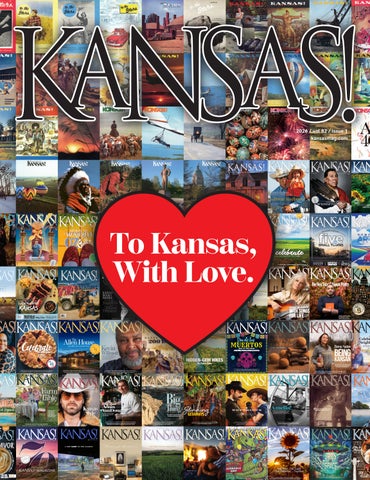
2026 / vol 82 / issue 1 kansasmag.com
kansasmag.com
winter 2011 volume 67 issue 4 $4.99
e ion pee doi tpl
kansasmag.com
sharing stories
of kansas’ cultures
Pictur
artfu
$4.99
fall 2015 | vol 71 | issue 3 | kansasmag.com
GE the BEVERA ISSUE
FALL 2016 | VOL 72 | ISSUE 3 | KANSASMAG.COM
e Z issu The O
rip Road T
SUMMER 2016 | VOL 72 | ISSUE 2 | KANSASMAG.COM
SPRING 2016 | VOL 72 | ISSUE 1 | KANSASMAG.COM
PE the DSCA LANISS UE
WINTER 2016 | VOL 72 | ISSUE 4 | KANSASMAG.COM
SPRING 2017 |
Issue
To Kansas, With Love. winter 2015 | vol 71 | issue 4 | kansasmag.com
Native-American Pride
hit the road make the most of your summer “staycation”
years of
Kansas! magazine
vol 68 issue 4
kansasmag.com summer 2014 | vol 70 | issue 2
vol 68 issue 4
artistic mark on the
World’s Fair
peopl edi tio e n
in Kansas $4.99
summer 2015 | vol 71 | issue 2 | kansasmag.com
Buffalo Soldiers
tallgrass filmmakers
small-batch bread bakeries
FA L L 2 0 1 9
WINTER 2017
ANSASMAG.COM
|
VOL 73
|
ISSUE 4
|
SUMMER 2018
KANSASMAG.COM FA L L 2 0 1 8
| VOL 74
|
ISSUE 3
|
KANSASMAG.COM
Literary
ers’ Readoice Ch
adventures
ad
te intersta
70
KANSAS in
WAFFLES &
A
K A N S A S
SUMMER 2020
| VOL 76
|
ISSUE 2
|
KANSASMAG.COM
SPRING 2018
WINTER 2020
| VOL 76
|
ISSUE 4
|
KANSASMAG.COM
Allen House
VOL 74
|
ISSUE 2
|
KANSASMAG.COM
WINTER 2018
|
VOL 74
|
ISSUE 4
|
|
VOL 75
|
ISSUE 3
|
KANSASMAG.COM
KANSASMAG.COM
Travel Issue!
2021
and other Iconic Kansas Homes
|
great spots to grab a slice
celebrate our home on the range
no ment to tion
SPRING 2019
|
VOL 75
|
ISSUE 1
|
luminary walks
WINTER 2019
KANSASMAG.COM
|
VOL 75
|
ISSUE 4
Burger Joints
KANSASMAG.COM
|
|
ISSUE 1
ISSUE 2
|
|
KANSASMAG.COM
KANSASMAG.COM
tuned to nature,
with songs for life
2021
| VOL 77
|
ISSUE 4
|
The work of Robin Macy
KANSASMAG.COM
2021
| VOL 77
|
ISSUE 5
|
KANSASMAG.COM
Kevin
( D ay o f t h e d e a d )
2022
| VOL 78
|
ISSUE 1
|
KANSASMAG.COM
Huascar Medina Steps into the Role of the State’s Poet Laureate 2022
| VOL 78
|
ISSUE 2
|
CHOCOLATE GOODNESS across the state
| VOL 78
A Celebr Neighb
From Big Cities to Rural Connection
Being Kansan
HIDDEN-GEM HIKES
An entire issue of stories, photography, and art from the Native tribal nations and communities within Kansas A L S O I N T H I S I S S U E // Atchison’s Best Haunts // The Great Airship Scare A New Poem from the Poet Laureate // A Paw Paw Harvest Recipe The Wild West Returns (in Podcast) // Mead Makers // Pumpkin Patches // And More!
A L S O I N T H I S I S S U E // Cowboy Polo: A Flint Hills Tradition // A Big 50 for Sedgwick County Zoo The Growing Appetite for Kansas Soy // National Spotlight on Lake Kanopolis // Railroad Adventures Sod Home Histories // Harvey House Heritage // and more!
S T O R I E S O F A R T , C R A F T S A N D C R E A T I O N S // Discover Some of the State’s Best Public Murals // Our Rich, Delicious History of TV Cooking Shows // Wichita’s Indigenous Super Hero (and the Creative Mind Behind the Mask) // Keep-Safe City Driving Tours // And More!
2022
KANSASMAG.COM
Being Native
A Cultural Holiday of Celebration and Reflection Across the State
Five Trails to Explore
O U R S P E C I A L H O M E A N D L A N D I S S U E // P A G E 3 0 Looking at Kansas history through community cookbooks // P A G E 3 6 Settling the often-hostile plains; one woman’s story of a new land // P A G E 4 0 Examining what we know about the earliest homes in our state
|
The New Face of Kansas Poetry
you voted & you chose the state’s six favorite destinations.
Hit the Road with your dog or even your cat!!
Oscar-winning filmmaker and Kansas native Kevin Willmott talks about art, America and his home state.
O U R S P E C I A L F E S T I V I T I E S I S S U E Where to Go, What to Plan, How to Celebrate once We’re Done Staying Home // P A G E 2 8 A family business revives its 100-year-old barbeque sauce for new generations // P A G E 3 2 The state celebrates Kansas connections to the Pony Express
Classic
wintertime
our national parks / explore garden city / kansas art gatherings
giraffes
VOL 74
| VOL 77
Reader choice s’
Willmott
m
H O M E
with
The
with pie Our list of
CE
How Rural Southwest Kansas Communities Rallied to Recover from Fire
2018
munch
TA K E A T R I P TO
PANCAKES Baking Tradition TOP-CITY SASMAG.COM
S’ CHOI
ART
Summer
$5.00 / Display until Nov. 2018
$5.00
|
Pets & Animals
KANSAS BOOKS INSPIRE
Local Journeys and Grand Dreams
Local Eateries
avel grinders Evel Knievel
issue
ADER
Touring the don’t- miss
with the family
kansas’
RE
A L S O I N T H I S I S S U E // Award-Winning Youth Photography Strawberry Hill’s Povitica: Richly Historic, Always Fresh // Holiday Cookie Shops // Barn Quilt Revival Holiday Mansion Tours // Our New Kansas Poetry Section // And More!
A L S O I N T H I S I S S U E // Jimmy Beason on sharing stories of Native heroes // Mona Cliff and Ric Dunwoody on creating Native art for the future // Alex Red Corn on teaching Native history Rhonda LeValdo on the language of the land // Jared Nally on new school mascots ... and much more!
A L S O I N T H I S I S S U E // Rural Gro Stone Bridges of Cowley County //
SMAG.COM
A L S O I N T H I S I S S U E // Lil Grizz Outfits the World: Authentic Western Hats by a New Almelo Master Send Them Some Kansas: Our Guide to Elegant and Affordable Kansas-Themed Gifts // Snow Season! Sledding and Skating Spots // Home-State Pecans // Historic and Restored Opera Houses ... and much more!
Farm Table 2022 | VOL 78
Meet farmers and chefs reviving the authenticity and enjoyment of local meals
shioned summertime fun across , pools, carousels and more.
deric Remington’s Kansas Legacy at The Garage in Salina flower State memories!
2024 | vol 80 | issue 1 | kansasmag.com
2023 | vol 79 | issue 4 | kansasmag.com
2023 | vol 79 | issue 2 | kansasmag.com
2024 | vol 80 | issue 3 | kansasmag.com
WA
Big Stunning
the
W E A R E A
The White Linen’s
Kansas Adam VanDonge Style
I N K A N SAS
And other award-nominated chefs and great restaurants across the state
The state’s record-setting locations and attractions
Ryan Martin creates vintage Western wear for ranch hands and fashion fans
A L S O I N T H I S I S S U E // Sylvan Grove’s Fly Boy // Wheat Weavers Marysville’s Black Squirrel Festival // Labertew Apiaries’ fields of honey Good Shepherd Conservancy’s heritage breeds // Apple orchards to visit ... and much more!
A L S O I N T H I S I S S U E // The Elephant and Renaissance for Destination Dining // Longford’s Coachlight and Other Small-Town Restaurants // The Art of Bread at 1900 Barker // Brookville Hotel Reopens as Kansas Legacy // The Rye: Pies and Midwest Flavor // Beaumont’s Fly-In Dining Ladybird and Servaes Create New Brews // Meet the State’s New Poet Laureate ... and more!
A L S O I N T H I S I S S U E // Abilene’s Big Belt Buckle // Salina’s Dunbar School Legacy Do-B’s Hot Pepper Burger and Other Food Challenges Across the State Paper Moon 50-Year Anniversary Celebrations // K-State’s Wildcat Dining Star Centralia’s Free-Throw Record-Holder ... and more!
A L S O I N T H I S I S S U E // Five Ways on the Byways // A Wandering Vine Recipe Salina’s Boom! Festival // DeArmond’s Landscapes // Heartland Farm at Pawnee Rock Rolf Potts Is Vagabonding Again ... and More!
2025 | vol 81 | issue 2 | kansasmag.com
2025 | vol 81 | issue 3 | kansasmag.com
2025 | vol 81 | issue 4 | kansasmag.com
2025 vol 81 issue 1 / kansasmag.com
a new light on the classics
Reenactors help connect with Kansas history
Amelia Earhart Hangar Museum lands a top spot in our list of 24 essential statewide attractions to visit in 2024.
GETAWAYS
A L S O I N T H I S I S S U E // Historic Hotels // Crispin’s Drug Store Museum New Year’s Eve Celebrations // Holiday Lights at Botanical Gardens Small Town Christmas Celebrations // Pheasant Season ... and More!
75TH ANNIVERSARY ISSUE
GE the BEVERA ISSUE
winter 2015 | vol 71 | issue 4 | kansasmag.com
2024 | vol 80 | issue 2 | kansasmag.com
2023 / VOL 79 / ISSUE 1 / KANSASMAG.COM
to
Kid Again
OM
| I S S U E 5 | K A N S A S M AG . CO M
2023 | vol 79 | issue 3 | kansasmag.com
|
ALSO IN THIS ISSUE Brown v Board: 70 years // Dockum Drug Store Sit-In Preserving Quindaro // Legendary Ballparks Geary County Black History Trail A Recipe that Ike Might Like ... and More!
KANSASMAG.COM
2025 / vol 81 / issue 5 kansasmag.com
L O O K I N G
T O
T H E
Our Wild Kansas Landscapes
SKIES SPACE THE
AND
years of
Kansas! magazine small-batch bread bakeries
Kansas After Dark
|
VOL
Summer
F U T U R E
Through History
SUMMER 2018
2024 | vol 80 | issue 5 | kansasmag.com
Our Story, Our Land Our Tomorrow ... Together O U R 7 5 T H A N N I V E R S A R Y P H O T O G R A P H Y I S S U E // T H E M E S O F Community, People, Wild, Skyline and Storms // W I T H Next Generation Kansas Talent // E S S A Y S B Y Jim Richardson, Caryn Mirriam-Goldberg, Cheryl Unruh, Tim Stauffer and George Frazier
EDITION
TA L E S O F A L I E N S , P I L O T S , A S T R O N A U T S , A N D S TA R - S E E K E R S
Pets & Animals Travel Issue!
munch with
giraffes
Hit the Road wit
WARM UP TO WINTER FUN IN TOPEKA! Experience the magic of winter in Topeka, where holiday cheer comes alive with dazzling events for the whole family! Stroll through the glowing wonder of Zoo Lights at the Topeka Zoo, enjoy festive performances like Dear Mrs. Claus at Topeka Civic Theatre, A Christmas Wager at The Beacon, and the Holiday Fling at Stormont Vail Events Center, and don’t miss the timeless tradition of The Nutcracker at Topeka Performing Arts Center. Cap off the season with the beloved 30th Annual Miracle on Kansas Ave Parade in Downtown Topeka. From sparkling lights to stage classics, Topeka is your destination for holiday joy!
e e r F • e B • e e S
– in –
VISITTOPEKA.COM
Celebrate the season in WELLINGTON Shopping Dining Museums Parks Golfing Bowling and MORE!!
Wellington 6 67152 7152
Wellington
WHAT’S INSIDE /
featured
featured stories
28
Kansas History, Reimagined
After three years, the Kansas Museum of History is reopening with a reimagined visitor path, thematic galleries and fresh perspectives on beloved artifacts
35
The Spirit of Kansas Four women artists interpret the state’s spirit through their own lenses of history, landscape and home ILLUSTRATION Shannon Trevethan
44
County to County
Explore the four corners of Kansas, its geographic center—and some quirky spots in between
3 KANSAS! magazine
ining in Outdoor d hattan n Man w o t n w o The Spirit of Kansas LivesDHere Discover a community where innovation meets tradition, where the prairie inspires progress, and where neighbors become friends. Experience Manhattan – the heart of the Flint Hills.
VISITMANHATTANKS.ORG
WHAT’S INSIDE /
departments
kansas DETAILS
10
80 Years
A Look Back at How
KANSAS! Covered Kansas
12
Cuisine
14
Heartland
Fine Food and Good Eats
People and Places That Define Us
16
Culture
18
Air
Arts and Experiences
The Freshness of Outdoor Life
We 20 Reasons Love Kansas Caves
wide open SPACES
for the Stars 24 Reach How Kansas’ motto embodies the state’s
resilience, perseverance and freedom
kansas TASTE
Secret 58 The Ingredient
For 36 years, Wheatland Cafe and Catering has
been serving up Kansas
PHOTO COURTESY Kansas Tourism
comfort foods
IN EVERY ISSUE 7 8
The Extra Details
Hello From Our Publisher
52 Kansas Gallery
64 From the Poet Laureate On the Cover A look at some of our favorite covers over the past 80 years.
5 KANSAS! magazine
KANSAS TOURISM, A DIVISION OF THE KANSAS DEPARTMENT OF COMMERCE
Andrea Etzel PUBLISHER
Laura Kelly GOVERNOR
David Toland
LT. GOVERNOR & SECRETARY OF COMMERCE
Bridgette Jobe TOURISM DIRECTOR
SUNFLOWERPUB.COM | LAWRENCE, KANSAS KSMAGAZINE@SUNFLOWERPUB.COM
DESIGN & PRODUCTION
Bill Uhler
Bob Cucciniello
Shelly Bryant
Gina DeBacker
Alex Tatro
Leslie Clugston Andres
Joanne Morgan
Beccy Tanner
PUBLISHER
DIRECTOR
DESIGNER/ART DIRECTOR
MANAGING EDITOR
ADVERTISING DESIGNER
MANAGING EDITOR
MARKETING JMORGAN@SUNFLOWERPUB.COM
ADVENTURE
CONSULTANT
WWW.SHERIDAN.COM
PRINTER
Susan Roberts ACCOUNT EXECUTIVE
Dan Lautner
ACCOUNT MANAGER
KANSAS! (ISSN 0022-8435) is published five (5) times per year by Kansas Tourism 915 SW Harrison St, Ste 250, Topeka, KS 66612; 785.296.3479; TTY Hearing Impaired: 785.296.3487. Periodical postage paid at Topeka, KS, and at additional mailing offices. Newsstand price $6 per issue; subscription price $25 per year; $45 for two years. All prices include all applicable sales tax. Please address subscription inquiries to: Toll-free: 800.678.6424 KANSAS!, 915 SW Harrison St, Ste 250, Topeka, KS 66612 Email: kansas.mag@ks.gov | Website: www.KansasMag.com POSTMASTER: Send address change to: KANSAS!, P.O. Box 146, Topeka, KS 66601-0146. Please mail all editorial inquiries to: KANSAS!, 915 SW Harrison St, Ste 250, Topeka, KS 66612 email: kansas.mag@ks.gov The articles and photographs that appear in KANSAS! magazine may not be broadcast, published or otherwise reproduced without the express written consent of Kansas Tourism or the appropriate copyright owner. Unauthorized use is prohibited. Additional restrictions may apply.
Plan your stay with us at VisitSalina.org
6 KANSAS! magazine
KANSAS /
the extra details
Rebel With a Cause
In this issue, we challenged four local women artists to capture the “spirit of Kansas” through their work—and their creations couldn’t have been more different. (Turn to page 35 to see how they turned out!) This isn’t the first time an artist has been tasked with capturing Kansas’ spirit. Just last year, Phyllis Garibay-Coon unveiled Rebel Women, now on permanent display at the Kansas Statehouse. Covering an entire wall on the first floor, this stunning mural pays tribute to the state’s strong and determined suffragists, from Anna O. Anthony to Lutie Lytle. Kansas women gained the vote in school elections as early as 1861, municipal voting rights in 1887, and full state suffrage in 1912— notably ahead of many states in the east and south. This forward-thinking mindset has always been part of the spirit of Kansas.
the extra details KANSAS! Calendar
If you subscribe to 20 c a l e 26 KANSAS! magazine, nda r you should find our 2026 KANSAS! calendar included with your copy of this issue. If you are not a magazine subscriber, order a calendar for yourself or as a gift by calling 800.678.6424 or visiting kansasmag.com and looking for the “Calendar” tab. A sup pleme nt to
KANS AS! ma gazine
PHOTOS (FROM TOP) Andrea Etzel, Courtesy Poppy DeltaDawn
Around the State 1 Lyons / page 13 2 Strong City / page 19 3 Kanopolis / page 21 4 Galena / page 22 5 Russell / page 43
Contemporary Kansas Artists
Get ready, art lovers! Kansas is turning the spotlight on contemporary artists working in the state with its inaugural Kansas Triennial 25/26. This year’s exhibition, which will recur every three years, features beadwork, sculpture, textiles and pyrography by artists Mona Cliff, Mark Cowardin, Poppy DeltaDawn and Ann Resnick—four Kansas artists whose creativity spans mediums and lived experiences. The exhibition is on display at Kansas State University’s Marianna Kistler Beach Museum of Art through May 2026.
7 KANSAS! magazine
6 Tribune / page 47 7 Doniphan / page 48 8 Kinsley / page 49 9 Garden City / page 51
7 5 6
3 1
9
2
8
4
hello F R O M O U R P U B L I S H E R
The Spirit of Kansas
ANDREA ETZEL
PUBLISHER, KANSAS! MAGAZINE
facebook.com/KansasMagazine KansasMagazine
(get spotted; use #kansasmag to tag us)
8 KANSAS! magazine
PHOTO Andrea Etzel
In every issue of KANSAS!, we strive to embody the spirit of our state. To us, it’s the stories of the people and places. Kansas is resilient, diverse, friendly and unexpected. It’s home. The beauty of defining the “spirit of Kansas” is that it means different things to different people. Inspired by Mary Bartlett Pillsbury Weston’s painting titled The Spirit of Kansas, commissioned for the 1893 World’s Columbian Exposition in Chicago, we asked five female Kansas painters to create a piece that represents the “spirit of Kansas” to them. Each artist, based in a different part of the state and shaped by her unique experiences, offered a personal interpretation. You can see their artwork and read the story on page 35. To celebrate our 80-year anniversary, we’ve included an anniversary piece in each issue over the past year. For our final one, we look back at the editors of Kansas, three of whom have left a lasting legacy: Don Richards, Frances Smith and Andrea Glenn. If it weren’t for their vision and guidance, we might not have the magazine we have today. I’ve spent much of this past year going through our magazine’s history and found a few fun surprises. The cover of our winter issue in 1981, for instance, was captured by famed photographer Pete Souza. After graduating from Kansas State University, Souza worked as a photojournalist in south central Kansas before serving as the White House photographer for presidents Reagan and Obama. What are some other fun facts about our magazine’s history? We’ve covered the Pancake Race in Liberal more than any other event in the state. From before his presidency to the present day, we’ve profiled Dwight Eisenhower more than any other Kansan. And the magazine has had 13 editors and more than 300 writers contributing stories over the last eight decades. As the new year approaches, I’m turning my sights toward the future. From America’s 250th birthday and Route 66 turning 100, to the World Cup, 2026 is sure to be a year we will all remember. Kicking off that excitement, I’m pleased to share that we’ve moved! As of October, our offices are now located in the newly renovated Docking State Office Building. This will definitely be a year full of excitement.
75th Anniversary November 29, 2025
The year was 1948 and two WaKeeney businessmen had a dream! In 1950, their dream was fulfilled. Downtown WaKeeney was transformed into a holiday light display centered around a 32 foot live greenery tree.
Every Saturday after Thanksgiving, WaKeeney downtown has been known as “The Christmas City of The High Plains”
Come make wonderful memories with us!
9am – 4pm | Christmas Bazaar, Trego County Fair Grounds (13th St) 10am – 4pm | Christmas Themed Scavengar Hunt, Trego County Historical Society Museum (13th St) 2pm | WaKeeney Public Library, (610 Russell Ave) 4:30pm – 7pm | Community Soup Supper, VFW Hall 4:30pm – 8:30pm | Santa’s Downtown Workshop, various locations, free horse & wagon rides. Kids train rides, food, live reindeer 6pm | Live Music Entertainment, Main Street Square, Santa lights the tree then goes on to greet the children at North Pole Park.
Find lodging options at: WaKeeney.org • Scan the QRcode for full schedule
GetWaKeeney@gmail.com •
@GetWaKeeney
80 Years / K A N S A S D E T A I L S
They Left a Legacy The visionary editors of KANSAS! helped generations see their home in a new light, inspiring Kansans for years to come Story by Andrea Etzel Photos courtesy Kansas Tourism
k
ANSAS! has always been more than words on a page—it reflects who we are as Kansans. Behind its enduring spirit are the editors who shaped its vision, guided its storytelling, and championed the beauty of this place. Over the last 80 years, 13 editors-in-chief have led the magazine. Three editors in particular helped move it forward: Don Richards, Frances Smith and Andrea Glenn. Their lasting legacies continue to define KANSAS! today. Don Richards / 1953-1964 When Don Richards first joined KANSAS! in 1951, camera in his hand and curiosity in his heart, he saw Kansas through a storyteller’s lens. A Kansas State University graduate in industrial journalism, Richards brought fresh visual energy to the magazine when he became editor in 1953. His photography and thoughtful narratives helped readers rediscover their state, revealing a living story within the landscape. Frances Smith / 1966-1977 In 1953, Frances Smith was promoted from an administrative role to assistant editor of KANSAS! A University of Kansas graduate, Smith made history in 1966 as the magazine’s first female editor. Her steady and insightful leadership expanded the magazine’s voice and reach, earning her the title of Kansas Woman Journalist of the Year in 1970. Her leadership built bridges between Kansas communities, showing readers that every horizon holds a story close to home.
Above clockwise, from left: Don Richards, Frances Smith, Andrea Glenn
10 KANSAS! magazine
Andrea Glenn / 1978-2001 Andrea Glenn took the helm in 1978, guiding KANSAS! into a new era. A Kansas State graduate—and the magazine’s longest-serving editor—Glenn celebrated daily life in Kansas through lifestyle storytelling and photography. Her vision transformed the magazine into more than just a publication; it became a beloved tradition. In addition to publishing the magazine, Glenn spearheaded the release of two photography books: Kansas in Color (1983) and The Four Seasons of Kansas (1988). She also launched the annual wall calendar and the first children’s magazine. As KANSAS! marks its 80th year, the moment calls for gratitude—both to the editors who shaped its pages and to the readers who have shared in its story. Richards, Smith and Glenn helped Kansans see our state’s extraordinary landscapes and people. Through their passion and purpose, generations have discovered a new sense of pride and endless inspiration in the place they call home.
Rooted in the Beach Museum of Art’s deep commitment to Rooted Rooted in in thethe Beach Beach Museum ofexhibition of Art’s Art’s deep deep commitment commitment toto the region, this newMuseum signature — happening every the the region, region, this this new new signature signature exhibition exhibition — — happening happening every three years — showcases the diverse and dynamic voicesevery of three three years years — showcases showcases thethe diverse diverse and and dynamic dynamic voices ofusof artists who—call Kansas home. The exhibition seriesvoices invites artists artists who who callcall Kansas Kansas home. home. The exhibition exhibition series series invites invites usus to reflect on Kansas’ spirit of The growth and transformation, towhere to reflect reflect on on Kansas’ Kansas’ spirit spirit of of growth growth and and transformation, transformation, the energy of place meets a culture of forwardwhere where thethe energy energy of of place place meets meets a culture a culture of of forwardforwardthinking expression. The 2025 inaugural installation features thinking thinking expression. expression. The The 2025 2025 inaugural inaugural installation installation features features works by Mona Cliff, Mark Cowardin, Poppy DeltaDawn, and works works byby Mona Mona Cliff, Cliff, Mark Mark Cowardin, Cowardin, Poppy Poppy DeltaDawn, DeltaDawn, and and Ann Resnick. Ann Ann Resnick. Resnick. Related free public programs at beach.k-state.edu/calendar Related Related free free public public programs programs atat beach.k-state.edu/calendar beach.k-state.edu/calendar
cuisine / K A N S A S D E T A I L S
A City Worth Its Salt Lyons celebrates its salt mining history by unveiling the ‘world’s largest salt shaker’ Story by Cecilia Harris
Photography by Andrea Etzel
KANSAS DETAILS /
cuisine
e
plus.
ver since a developer drilling for oil and natural gas This recent installation coincides accidentally struck a salt bed in 1887, Lyons has built a legacy with Lyons’ Salt and Art Project, a around this underground resource. Today, the city is still home public art initiative that celebrates to two operating salt mines. To honor its salt mining heritage, the city’s salt history. The project Lyons recently unveiled a new and exciting attraction—the involved 10 salt carts donated by “World’s Largest Salt Shaker.” mining companies Lyons Salt and The 15-foot-tall salt shaker, made of metal and glass panels, stands Compass Minerals. Retired from the 64 times larger than an old-fashioned diner salt shaker, which it was mines, these carts have been placed designed to resemble. throughout the “We thought it was a great idea to pay homage community “We thought it was a great to the salt miners and the many years they have and painted been mining salt, not just in Lyons but in Rice by local artists idea to pay homage to the County,” says city administrator Troy Houtman. in a variety salt miners and the many “It pays tribute to those who toiled in the mines in of styles tied the early days, as well as the two salt companies years they have been mining thematically that operate near the community today.” to the business salt, not just in Lyons but in The salt shaker is displayed in front of a vibrant where they are Rice County.” mural painted by artist and designer Chris Garcia, parked. aka “lastdeviant.” Boasting the words Lyons, “They are —TROY HOUTMAN Kansas, Worth our weight in SALT, a strong and actual salt carts hardworking miner stands within the letter ‘A.’ from many, Garcia used a dark blue aptly named “Salty Dog” to paint the mural’s many years ago,” Houtman says. “They background, he says on the Rice County Community Foundation are about the size of an office desk, website. He also added more than 8,000 dots to illustrate the salt dunes. maybe a little bit smaller … 4 feet long, Both the salt shaker and mural can be found in Salt Miners Park, 2 to 3 feet tall, and 3 feet wide.” a new park that has replaced a vacant lot on the courthouse square, Visit the city website for a map Houtman says. Blending art, history and community, the park serves as identifying the locations of the salt a space for gatherings and educational opportunities, as well as being a carts scattered around Lyons. lyonsks.org / 620.257.2320 draw for tourists.
Salt Well Discovery Site / South Hutchinson / Hutchinson and South Hutchinson are home to one of the
largest salt deposits in the nation. It all began in 1887, when the South Hutchinson’s founder, Ben Blanchard, believed a vast oil supply lay under the town’s soil. He hired a firm to drill for “black gold,” but the firm instead discovered a rich vein of salt. This disappointed Blanchard, but the salt processing plant that was established the following year, and the 20 salt companies that were formed by 1910, all played a pivotal role in the development of the town. Today, you can view Blanchard’s original uncovered well through a clear glass top at the discovery site in South Hutchinson, which also displays a 1,260-pound block of locally mined salt and educational signage about the discovery of salt and the process of salt extraction. southhutch.com / 620.663.7104
Murder in the Mine / Hutchinson / Descend 650 feet underground for an interactive dinner
theatre show like no other. On December 12–13, Strataca presents It’s a Wonderful Knife, a holiday spin on the classic film It’s a Wonderful Life, as a part of Strataca’s suspense and mystery series, Murder in the Mine. Dress in themed costumes, question motives and collect clues, all while dining on a locally catered meal held in an active salt mine that’s been in operation since the 1920s. Guests must be 18 years of age to attend. Proceeds benefit Strataca, the Kansas Underground Salt Museum, which offers tours on the history and geology of salt mining. Look for other Murder in the Mine events, typically offered three times a year. underkansas.org / 620.662.1425 Opposite Lyons latest attraction, a 15-foot-tall salt shaker, stands 64 times larger than an old-fashioned diner shaker.
13 KANSAS! magazine
Lyons, Hutchinson
Where Bison Roam … Again These Kansan ranchers are restoring native prairies through bison preservation Story by Amber Fraley
m
glimpse of these large animals on illions of bison once shaped the Kansas prairie. As a that much acreage. keystone species—a species on which other species in an “There’s about a 50-50 chance ecosystem largely depend—bison grazed, wallowed, and of seeing the bison if you drive fertilized the land, creating conditions that plants and through on your own,” Smith animals relied on. But in the 19th century, as settlers moved explains. “That’s why we opened up in and bison were slaughtered, the prairie ecosystem’s health began [Friends of Maxwell], so to decline. Kansans turned to domestic cattle and other we could give tours on methods to keep the land healthy. Today, a dedicated group “The prairie the parts of the refuge of bison ranchers is working to preserve and restore this ecosystem is that are not accessible to species to its native environment. the public.” Maxwell Wildlife Refuge in McPherson County was diminishing. Established in 1993, established in 1949, but its history dates even further back. We try to make Friends of Maxwell In 1859, Henry Gault Maxwell established a homestead. As he lived on the property, he noticed buffalo wallows and sure everything offers 45-minute guided tours twice a eventually wanted the state to bring back the buffalo. He has a fighting week. Volunteers with dreamed of preserving a piece of the prairie as it existed the organization use before settlement. In 1944, his son Henry Irving Maxwell chance.” nutritional supplements deeded 2,560 acres to the Kansas Department of Wildlife —EVA YEAROUT to entice bison, who and Parks to establish the refuge. The KDWP later added otherwise freely roam an additional 260 acres, and a small bison herd was later and graze within the refuge. reintroduced to the prairie. The nonprofit Maxwell Wildlife Today, the Maxwell refuge manages about 200 bison and 50 elk. Refuge is dedicated to protecting “It is not a state park, but it is open to the public 24/7,” says Trisha and preserving this native species. Smith, director of the Friends of the Maxwell Wildlife Refuge. However, the largest bison herd in There’s no cost to drive through the park. Guests can follow a Kansas is located in south-central public access road that goes through the middle of the refuge. But, Kansas near the Oklahoma border. contrary to what one might think, it’s not always easy to catch a Above Maxwell Wildlife Refuge in McPherson is open to the public 24 hours a day, 7 days a week, at no cost.
14 KANSAS! magazine
KANSAS DETAILS /
heartland
Garden City, McPherson, Strong City
PHOTOS COURTESY Ricardo Reitmeyer, Kansas Tourism
Z Bar Ranch, a privately owned ranch dedicated to preserving the prairie, currently manages 2,000 bison on 42,400 acres. Over the last 25 years of working with the ranch, interim ranch manager Eva Yearout has witnessed the positive impact that rotational grazing from bison can have in restoring the prairie. In fact, it has been vital in bringing back native species of plants and animals. “The prairie ecosystem is diminishing,” Yearout says. “We try to make sure everything has a fighting chance. You can’t pick one thing over another, and you don’t have to. You can have wildlife diversity and habitat and still have a profitable, productive ranch.” Yearout knows their efforts haven’t been in vain. Groups such as Pheasants Forever, the U.S. Forest Service and Kansas Wildlife and Parks routinely visit the ranch to survey various plant and animal populations, and the numbers don’t lie. For example, the Bird Conservancy of the Rockies surveyed the area 15 years ago. “A quarter of the scissor-tail flycatchers in their whole survey were on the ranch, which was great,” Yearout says. “It lets you know if your grasses and ecosystems are improving or not doing as well.” Each year, ranch employees gather up the bison for annual health checks. In addition, employees train the bison with range cake to avoid overgrazing in any one spot on the ranch. Otherwise, they’re “pretty self-sufficient,” Yearout says. The herd at Z Bar produces about 500 calves a year. To maintain proper herd size, about 300 are sold as meat each year. “This is a business,” Yearout explains. Most of the profits go toward supporting their bison herds and revitalizing the prairie. “You have to be good stewards of the land,” Yearout says. “You have to have healthy soil, healthy grasses, a healthy environment for all the native plants.” maxwellwildliferefuge.com / tedturner.com
Above During the Friends of Maxwell refuge tours, guests learn that the bison, grasses and flowers are all part of one interconnected ecosystem.
15 KANSAS! magazine
plus. Sandsage Bison Range
This range near Garden City is home to about 31 bison. Established in 1924 by President Woodrow Wilson, it is managed by Finney County and the Kansas Department of Wildlife and Parks. Visitors are urged to schedule tours in advance through Friends of Sandsage Bison Range. Volunteer-run tours may be reserved from March 2 to October 31. Self-guided tours are not available. 620.290.8776
Tallgrass Prairie National Preserve
In the heart of the Flint Hills, the Tallgrass Prairie National Preserve is a unique privatepublic partnership between the Nature Conservancy and the National Park System. With 10,894 acres north of Strong City, it is the largest expanse of tallgrass prairie left in the world. Since 2009, it’s also home to about 100 bison. There is no entrance fee to explore the visitors’ center, which is open every day except major holidays. Visitors can also explore the walking and hiking trails on foot—there are no public driving roads through the preserve. Selfguided tours are open year-round; reservations for group educational tours must be scheduled at least two weeks in advance to ensure staffing. 620.273.8494 (ext. 270)
A Legacy in Bloom
The Kansas State University Gardens wrap up their historic 150th-year celebration Story by Debbie Leckron Miller
Photography by Joan Wasser
KANSAS DETAILS /
a
culture
s winter approaches and the Kansas State University Gardens wraps up its 150th anniversary year, the campus flora continues to put on a stunning show. “The garden doesn’t just die down because it’s winter,” says longtime University Gardens volunteer Nancy Cole. “Instead, you see a different kind of beauty than in summertime. It’s serene and it’s quiet, especially when snow dusts the landscape.” The KSU Gardens first took root in 1871, when the university—formerly named Kansas State Agricultural College—purchased the Gale farmstead, a plant nursery that would become the KSU Gardens. In 1978, during the construction of Bluemont Hall, the gardens, as well as their distinctive Victorian-style conservatory, were forced to relocate to their current site. The visitor center took over the Dairy Barn and Milk House, a barn and adjoining cottage where student workers once milked cows in exchange for room and board. Despite the uprooting, the gardens remained a hands-on learning laboratory for horticulture students and a welcoming place for the public to admire its natural beauty. “My goal is to make sure we’re providing a world-class display and educational garden, while keeping it free admission,” says Scott McElwain, who took over as director in 1997. McElwain began his work with the KSU Gardens in the 1990s, when he chose the space as the focus of his horticulture honors project. “At that time, the gardens had a very informal design,” he says. “My thought was to create something very special at a special place.” Eventually, he did just that. As director, he gradually converted the space to a formal garden, adding paved walkways, fountains, sculptures, lighting and hand-selected plantings. Today, it’s the happy retreat McElwain always dreamed of. “It’s such a special place. For everyone who visits here, it puts them in a better place,” he says.
Volunteer David “Wally” Wasser spends his time weeding, pruning and planting. “The gardens provide an instant reconnection with the natural world that sometimes gets pushed aside,” he says. “There’s so much beauty, and no two years are exactly alike.” Although cows no longer graze these lush lawns, the 1930s limestone building that houses the visitor center is a striking starting point for a garden stroll. Largescreen images and history exhibits line the walls inside, where visitors can also find self-guided tour brochures and helpful volunteers. Outside, the cottage garden rambles with herbs, vegetables, fruits, flowers and, in springtime, a dazzling display of 10,000 tulips. Circle the centerpiece fountain, past the wisteria-draped pergola to the native garden, where crouching life-size wildcat sculptures oversee plantings that mimic Kansas’ natural areas. A shady walkway leads past the fluttering butterfly garden to the rose collection and its counterparts, the iris, peony and daylily collections. They surround a 13-foot-tall tiered castiron fountain and the gardens’ newest addition, a 50-foot-long reflecting pool. As the warm days draw to a close, a quiet beauty emerges. “On those calm, crisp days when there’s snow cover, I appreciate the muffled sounds, birds chirping, sun glistening on the snow and the unique beauty of snow covering the plants,” McElwain says. Watch for the oakleaf hydrangeas’ showy cinnamon-colored bark, which peels, curls and stands out in the winter landscape. “You don’t necessarily appreciate bark when leaves cover the plant,” he adds. “It’s a great time of year when leaves aren’t stealing the show.” Don’t be surprised to see early spring bulbs like crocus or hellebores poking through the wintry ground. It’s the prelude to the spring green-up for the gardens’ 151st year. The gardens are open to the public, dawn to dusk. k-state.edu/gardens
Opposite Blazing stars and prairie coneflowers take bloom in the adaptive and native plant display at Kansas State University Gardens. Right A water lily shows off its vibrant color near the garden’s new reflecting pool.
17 KANSAS! magazine
garden gaiety Look for these upcoming events hosted by the Kansas State University Gardens. •
November 21: In-Person Poinsettia Sale Buy a variety of poinsettia displays at the visitors center, or order online, November 3–24.
•
December 4: 150th Garden Celebration Finale Wrap up the anniversary year with holiday-themed garden lighting, music and festive displays.
•
April 18: Annual Open House KSU’s biggest annual event features a mix of campus tours, live music and tours of the gardens.
•
April 25: Run for the Roses Support the gardens by participating in its annual fundraiser, a 5K run and 1K walk. This event includes performances by the KSU band, free face painting and a stunning display of 10,000 tulips.
Follow one of these Kansas trails for a winter hike wrapped in cold-weather splendor Story by Michael Pearce
w
Table Mound Trail / Independence For a steady, family-friendly hike that may offer wildlife sightings, make your way to the Table Mound Trail in Elk City State Park near Independence. This 857-acre park is located on the east shore of the Elk City Reservoir—a beautiful body of water where the prairie meets the rugged Chautauqua Hills. The Table Mound Trail is one of the park’s diverse trails. At 2½ miles each way, it offers a variety of scenery and topography. The trail begins by tracing the reservoir’s shoreline, eventually making its way up through mature hardwood forests and into the legendary rimrock of the Chautauqua Hills. As with all Kansas reservoirs, it’s common to see bald eagles in winter, along with deer and flocks of waterfowl. For a more physical challenge, opt for the park’s 15-mile Elk River Trail, which has earned national acclaim.
18 KANSAS! magazine
Above A trail spur at the Lower Fox Creek Schoolhouse takes hikers through miles of tallgrass prairie.
PHOTO COURTESY Kansas Tourism
The Paths Less Traveled
inter is a great time to explore Kansas’ more than 4,000 miles of hiking trails. The colder months reveal a quieter side of Kansas without the crowds, intense heat, ticks and poison ivy that are common in summer. Best of all, the chances of seeing wildlife such as majestic bald eagles, deer and clouds of blackbirds are better now than at any other time of year. Follow our guide to trails that are especially rewarding this winter season.
KANSAS DETAILS /
air
Konza Prairie Trails / Manhattan Hiking the Kansas prairie in late fall and early winter provides the best view of its autumnal colors, since the native prairie plants’ hues can last for months. It’s hard to find a better example than the native tallgrass at Konza Prairie, south of Manhattan. Although most of its 8,616 acres are off-limits to the public, three moderate-level public trails wind through lowland gallery forest and into native prairie. Sharing a common trailhead, each route ranges from 2 to 6 miles with some incline (although most abut the ridges, making it easier to walk). Dress for cool weather, as the wide-open prairies can experience strong winds. Allow enough time to explore the new educational pavilion near the trailhead parking lot. Trails are open dawn to dusk; pets, bikes and smoking are not allowed.
PHOTO Michael Pearce
Tallgrass Prairie National Preserve / Strong City A nighttime winter hike through the prairie should be on every Kansas hiker’s bucket list. Open 24 hours a day, the Tallgrass Prairie National Preserve near Cottonwood Falls is a great place to experience one. This 10,894-acre property offers more than 40 miles of trails through tallgrass prairie with no artificial lights, save a few at the preserve’s headquarters. Best of all are the majestic views of the skies and stars on clear, cold, moonless nights. A trail spur at the restored Lower Fox Creek Schoolhouse takes hikers northward into the heart of the preserve. Whenever hiking at night, be sure to take the proper precautions and stay on the trail. Watch out for wildlife such as snakes. At Tallgrass, particularly steer clear of the Windmill and West Traps Pastures, home of the preserve’s bison herd. Look for signage and metal cattle guards that mark the pasture. Red Oak Falls Trail / Olathe In winter, it is rare to find a dirt trail open to hikers and mountain bikers. The 1-mile Red Oak Falls Trail at Cedar Niles Park in Olathe is a multi-use path that winds through rolling hardwood ridges and hills. Notably, it passes four beautiful waterfalls along its route. Cedar Niles is one of Johnson County Park and Recreation District’s newest parks. Covering 957 acres, it offers 4 miles of paved trails and 10 miles of dirt trails. Lengthening the trails is an ongoing process. Above It’s common to see bald eagles during winter hikes, along with deer and flocks of waterfowl.
19 KANSAS! magazine
plus. First Day Hikes / Kick off the new year with an outdoor adventure. Kansas State Parks offer guided hikes across some of the state’s best trails on the first day of the year. In 2025, more than 3,500 Kansans trekked along one of the First Day Hikes, a program sponsored by America’s State Parks. Hikers met at one of the 24 participating Kansas parks; state park officials predict about the same number in 2026. The annual event first came to Kansas in 2014, although the inaugural event was held in Massachusetts in 1992. Today, all 50 states participate. Generally, Kansas First Day Hikes take place along a few miles of easy terrain so entire families can participate. Some state parks even offer treats at the end of the route, such as chili or hot cocoa and cookies. Vehicle permits are required unless otherwise stated. Pre-registration is not necessary, although watch for notices about inclement weather that may postpone or cancel some hikes. ksoutdoors.gov
Manhattan, Strong City, Independence, Olathe
Kansas REASONS WE LOVE
By Cecilia Harris
Scott City, Kanopolis, Council Grove, Iola, Galena
IN THIS ISSUE
Caves
Put on your hiking boots and uncover caves hidden throughout Kansas
KANSAS DETAILS /
reasons we love kansas
FARIS CAVES Kanopolis / In the 1880s, a miner named Charles Griffee set to work with a pick and a shovel—the tools of his trade—and began to chip away at a 60-foot-high Dakota sandstone bluff. He excavated a series of three caves along the Smoky Hill River in Ellsworth County, where he lived for a time. This dwelling is now known as the Faris Caves. It’s easy to spot the caves along the trail. Three distinct openings are visible along one side of a bluff, two of which are the size of a standard doorway. Another doorway was chiseled out of the 3-foot interior wall separating the two largest rooms, according to an article published by the Ellsworth County Historical Society. Two of the caves where Griffee lived are fairly large, measuring nearly 12 feet long and 12 feet wide with 10-foot arched ceilings. The third cave, however, is smaller with an equally small doorway leading into the space. A natural spring
sends fresh drinking water through a trough cut into the floor, according to the Ellsworth article. This design kept Griffee’s food and supplies cool in the hot summer months. Then in 1893, Faris Caves are one of the stops Griffee sold the land to Winfield along the Kanopolis Lake Legacy and William Faris, Trail, an 80-mile self-guided tour prosperous cattlemen that highlights the area’s history in the area. Winfield constructed a large before the construction of the wood frame house Kanopolis dam. nearby, but he continued to use the caves as a spring house, storage The site, tucked within Kanopolis room, generator room and—for a State Park, is accessible only by a short time—schoolhouse. Today, only hiking trail that runs through the the foundation of the Farises’ home Smoky Hill Wildlife Area. The property remains near the parking lot. is owned by the U.S. Army Corps of “The caves can be entered Engineers, which leases it to the although it is fairly wet inside,” says Kansas Department of Wildlife and Christine Reinhardt, Parks, according to Reinhardt. chief of public affairs Faris Caves are one of the stops for the U.S. Army Corps along the Kanopolis Lake Legacy of Engineers in Kansas Trail, an 80-mile self-guided tour that City. “It’s generally safe highlights the area’s history before the with no rattlesnakes, but construction of the Kanopolis dam. we can never make any This tour explores 27 historic sites guarantees. Care should along paved, gravel and graded dirt be taken for falling roads that visitors should avoid in wet rocks around the caves, weather. Visit the Kanopolis State Park as they are carved into office to pick up a copy of the guide. a sandstone wall with kanopoliskansas.com loose rocks overhead.” 785.546.2565
Safety & Etiquette
PHOTOS PHOTOS Tanner NickColvin Krug
Be sure to follow these precautions when exploring a cave. • • • • •
Never explore alone Wear a hard hat Bring a first-aid kit Bring at least three light sources Be prepared to get wet
21 KANSAS! magazine
• • • •
Leave all electronics outside the cave to avoid water damage Do not litter Do not move or take rocks Do not disturb any plants or animals
Local lore says the infamous outlaw Jesse James may have hidden in Galena’s Schermerhorn Cave, based on newspaper clippings that reported James and his gang visited the area in the 1870s.
A GREAT MARKETING TOOL FOR YOUR BUSINESS
to advertise, contact Joanne Morgan jmorgan@sunflowerpub.com | 785.832.7264
JOHN BROWN’S CAVE Iola / A small cave in Lehigh Portland State Park near Iola has been known as John Brown’s Cave since the end of the 19th century. An 1899 issue of the Iola Register reported, “A picnic party opened the season at John Brown’s cave yesterday afternoon,” which is the first public use of this name. Though legend ties him to the cave, there’s no evidence the abolitionist ever used it. At the time, he was living near Osawatomie, about 50 miles away, and working as a “conductor” on the Underground Railroad, providing enslaved people fleeing Missouri safe passage to the North. The cave, at 300 feet long, is just large enough to walk inside. Known as a “solutional cave,” it was formed as groundwater dissolved soluble rock and, over time, expanded to its cavernous shape. John Brown’s Cave features a small intermittent stream that flows along its floor and exits below the bluffs. Hike along the Cave Trail South, a 2-mile singletrack trail within the Lehigh Portland State Park, to visit the cave and walk through parts of it. lehightrails.com/poi/johnbrowns-cave 620.365.8128
SCHERMERHORN CAVE Galena / The Schermerhorn Cave, near Galena, is considered the most biologically diverse cave in Kansas. A halfmile long, it is home to tricolored bats and the occasional gray myotis as well as quite a few amphibians, including the endangered grotto and cave salamanders, which inhabit the spring flowing through the cave. The wide cave mouth is open to the public, but visitors aren’t permitted further into the delicate interior habitat, which is protected by a steel gate. Stop by the Southeast Kansas Nature Center, operated by the Kansas Department of Wildlife and Parks and located inside Schermerhorn Park’s historic scout cabin, to read up on animals and plants native to the area. And be on the lookout for signs of Jesse James. Local lore says the infamous outlaw may have hidden in the cave, based on newspaper clippings that reported James and his gang visited the area in the 1870s. galenaks.gov/directory/ schermerhorn-park 620.783.5265
22 KANSAS! magazine
SANCTUARY CAVE Scott City / In 1878, a historic battle took place at Punished Woman’s Fork. It began when Lt. Col. William H. Lewis, commander of Fort Dodge, was dispatched to capture the Northern Cheyenne who had fled an Oklahoma reservation to return to their former home. But the Northern Cheyenne set up an ambush, hiding their women, children and elderly in what is now known as Sanctuary Cave. After the battle, Lewis was mortally wounded, and the Northern Cheyenne escaped during the night. This event marked the last battle in Kansas between the United States military and the Native Americans. Today, a historical monument overlooks the Battle of Punished Woman’s Fork National Historic Site, which is about 1 mile southeast of Lake Scott State Park. It offers stunning views, overlooking the canyons, bluffs and cave where the Cheyenne once took shelter. Visitors can even see the rifle pits on the hilltops where the Cheyenne positioned themselves for the ambush. Hike along the trails to view this site, journeying into the canyon a short distance to access Sanctuary Cave. Alternatively, sign up in advance for a free guided bus tour of the area through the El Quartelejo Museum, which offers tours to historic sites throughout the year. elquartelejomuseum.org/ historic-sites 620.872.5912
HERMIT’S CAVE Council Grove / In the spring of 1863, 62-yearold Italian Giovanni Maria de Agostini, locally known as Father Francesco, took up temporary residence in Council Grove, living in a cave now known as Hermit’s Cave. Five months later, he left Kansas with a Santa Fe Trail wagon train and walked the entire 550 miles to New Mexico. As a religious mystic, Agostini performed “miracle cures” for large crowds before retreating into a nearby mountain, earning the nickname Hermit of El Porvenir (“the future”). Hermit’s Cave is located on Belfry Street, a prominent landmark in the Neosho River valley that overlooks Council Grove and once served as a campsite for Santa Fe Trail travelers. Listed on the National Register of Historic Places, the cave is one of 25 historic sites in Council Grove. It is accessible from the street, where a small flight of stairs leads visitors to the small dwelling. councilgrove.com/ history 620.767.5413
During the last battle in Kansas between the United States military and the Native Americans, the women, children and elders of the Northern Cheyenne hid from the conflict in Sanctuary Cave at Punished Woman’s Fork. 23 KANSAS! magazine
WASHINGTON
COUNTY TOURISM
785.325.2116 | washingtoncountyksed.com FISHING AND PUBLIC HUNTING
The Washington County State Fishing Lake is located 12 miles NW of Washington
Scott Bean Photography
K A N S A S L A N D S C A P E A N D N AT U R E P H O T O G R A P H S
785-341-1047 | SCOTT@SCOTTBEANPHOTO.COM
www.scottbeanphoto.com
WIDE OPEN
Reach for the Stars How Kansas’ motto embodies the state’s resilience, perseverance and freedom
Story by Patricia E. Ackerman
24 KANSAS! magazine
spaces
spaces
a
d Astra per Aspera. Most Kansans know the words. Fewer know the heated debates and bold decisions that gave rise to them. In 1859, amid the turmoil of “Bleeding Kansas,” delegates gathered in Wyandotte for the territory’s fourth and final constitutional convention. The issues on the table were as urgent as they were divisive: slavery, state boundaries and women’s rights. Other matters, such as homestead protections, stirred less controversy but carried lasting importance for the people who would call Kansas home. The Wyandotte Constitution that emerged was remarkably progressive for its time; it prohibited slavery, established homestead protections and even offered limited rights (property ownership, child custody and school-election votes) to women. It also settled the state’s size and boundaries, issues that had pitted regional and economic interests against one another. The voters approved the constitution on October 4, 1859, and after more than a year of heated congressional debate (preceded by nearly seven years of political conflict), President James Buchanan approved the constitution and admitted Kansas to the Union as a free state on January 29, 1861. For Kansans, these struggles would become more than history; they would be crystallized in a motto that continues to speak across generations: Ad Astra per Aspera—“to the stars through difficulties.”
PHOTOS Adobe Stock/Paul, courtesy Kansas Historical Society
WIDE OPEN
The Power of Words John James Ingalls, a member of the Wyandotte Constitutional Convention who helped shape the Wyandotte Constitution, first proposed the Latin
Left The 22-foot-tall Ad Astra statue depicting a strong Native American warrior aiming an arrow at the stars, has sat atop the Kansas State Capitol since 2002. Right The Kansas state seal reflects the state’s frontier roots and is a symbol of hope and prosperity.
25 KANSAS! magazine
phrase as the state motto. As an attorney, abolitionist and scholar of literature and journalism, this young man who had settled in Atchison understood the importance of words with both gravity and grace, capable of withstanding the tests of time. The motto captures a two-part philosophy. Ad astra—“to the stars”— suggests striving and aspiration, a perpetual becoming rather than a fixed state of being. The preposition ad conveys direction or purpose, while astra, the plural form of astrum (“star”), is a metaphor for Kansans’ highest ideals. Together, this phrase calls on Kansans to keep advancing the principles enshrined in the Kansas Constitution. Per aspera, in contrast, grounds the motto in reality. Literally “through difficulties,” it acknowledges Kansas’ journey to statehood was not an easy one. Violence, debate and hard-won compromise marked those years. By using per—“through”—Ingalls implied that hardship is not only inevitable but also essential. Progress is forged in struggle, and nothing worthwhile is earned without effort.
WIDE OPEN
spaces
The Power of Imagery Ingalls, who served as secretary of the first state senate in 1861, also designed the state seal displayed on the state flag. Although it has been modified over the years, the seal retains key elements: a rising sun, covered wagons, a farmer plowing his field, a rustic cabin, Native Americans, and a herd of bison. Near the top of the seal, the motto “Ad Astra per Aspera” arches above a constellation of 34 stars, identifying Kansas as the 34th state. This imagery reflects the state’s frontier roots and serves as a symbol for hope and prosperity. To the Stars Through Difficulties After attaining statehood in 1861, Kansas continued to face difficulties. In 1863, proslavery guerrillas massacred more than 150 people in Lawrence and burned the city during what became known as Quantrill’s Raid. This violence solidified Kansas’ antislavery resolve. In the 1890s, Kansas was at the center of the Populist Party as farmers faced crop failures, falling prices and mounting debt. The party was disbanded in 1908, but its ideas about economic reform, regulation and political fairness Above John James Ingalls sat for this portrait during his tenure as a U.S. senator (1873–1891).
26 KANSAS! magazine
John James Ingalls, a member of the Wyandotte Constitutional Convention who helped shape the Wyandotte Constitution, first proposed the Latin phrase as the state motto. As an attorney, abolitionist and scholar of literature and journalism, this young man who had settled in Atchison understood the importance of words with both gravity and grace, capable of withstanding the tests of time.
PHOTO COURTESY Kansas Historical Society
helped shape the Progressive movement nationwide. Then, in 1954, Kansas was again part of a pivotal moment: Brown v. Board of Education. That landmark Supreme Court case declared state-sanctioned segregation in public schools unconstitutional, overturning the “separate but equal” doctrine established by Plessy v. Ferguson and paving the way for broader civil rights legislation in the 1960s. Nearly 165 years later, “Ad Astra per Aspera” still speaks to Kansas’ identity, reminding its people that adversity is not the end of the road but the path by which resilience forges greatness. As Ingalls once wrote, “The aspiration of Kansas is to reach the unattainable; its dream is the realization of the impossible.”
Get your copy of Rock on Rachel
Journey along with Rachel in this educational and entertaining Flint Hills adventure. During her prairie travels, Rachel gain’s courage and curiosity while spreading Kansas kindness. Mysteries, riddles, and songs add to this epic reading enjoyment. Back at home, Flint Hill’s memories help Rachel successfully face the painful experiences of being bullied at school through her own acts of kindness.
Kindness shines and unites us.
Officially recognized by the State of Kansas! Available for purchase at prairiesongrocks.org Gail Radke, author radkegail@gmail.com A Perfect Holiday Gift
V I S I T D O D G E C I T Y . O R G / H O L I D AY
H O L I DAY F U N AWA I T S A ROU N D E V E RY C O R N E R I N D O D G E C I T Y Winter arrives bringing with it the twinkling lights of our enchanting Christmas celebrations. Dodge City offers an unforgettable journey through the most wonderful time of the year with our annual Parade of Lights, holiday light tours aboard our trolley, Santa visits, carriage rides, and much more.
1- 8 0 0 - O L D -W E S T
KANSAS HISTORY, Reimagined
After three years, the Kansas Museum of History is reopening with a reimagined visitor path, thematic galleries and fresh perspectives on beloved artifacts Story by Nick Spacek Photography by Nick Krug
M
ark your calendars for November 22! The Kansas Museum of History will reopen in grand fashion after a three-year transformation—the first major renovation since it opened in west Topeka in 1984. Talk of redesigning the museum began in 2008, according to a timeline mapped out for the Kansas House Appropriations Committee by Patrick Zollner, executive director of the Kansas Historical Society. The project resumed in 2015, when a feasibility study recommended raising the necessary funds through a capital campaign. That same year, the Hansen Foundation donated the first $1 million toward the project, and the Sunderland Foundation added another $1 million in 2019. Conceptual designs were approved in 2021, and dismantling began in September 2022. The last three years have felt like a complete home renovation, says exhibits director Nate Forsberg. It wasn’t until three months ago that the walls were painted, the carpets and flooring were installed, and the “home” started to feel fresh and new. “But [if you had talked with me] six months, a year ago? We were down to concrete floors and a big empty space,” Forsberg explains. The process may have been daunting at times, but now that the reopening date is drawing closer and the designs are taking shape, the museum staff is excited about the reimagined space. “There’s an energy right now that I don’t think we had even a few months ago,” Forsberg says. Sarah Bell, the director of the Kansas Museum of History, agrees. She describes that energy as the momentum that’s pushing them toward the finish line. “I have all the feelings. It’s excitement, it’s terror, it’s joy, it’s ‘I can’t believe this is finally happening,’”
Bell says. “We’ve been looking at all of this on a computer screen for months and months, so for it to actually be physically in place and getting to see it come together is really exciting.” A stroll through the in-progress space immediately reveals a Kansas Museum of History that is both familiar and brand new. Gone are the tight quarters and maze-like feel of the past four decades. Now there is room to step back and fully take in the exhibits, which are no longer in chronological order but thematically reorganized. The museum staff is most excited about the new ramp, the biggest addition to the space. It moves visitors up, down and through different museum experiences from various vantage points. On the ramp, visitors can see some of the museum’s most beloved artifacts, including the log cabin, 1914 Longren biplane, and, of course, the treasured centerpiece of the Kansas Museum of History, the Atchison, Topeka & Santa Fe locomotive #132. The ramp also takes visitors to the new interactive boxcar exhibit, allowing visitors to go inside the boxcar and experience what it was like to live in one. —SARAH BELL “The boxcar provides us the opportunity to share the story of Mexican families who migrated to Kansas in the early 1900s,” Bell says. Many of these families temporarily lived in boxcars due to limited housing, and this new exhibit will feature a few of their oral histories. The ramp is something that Forsberg says he hasn’t seen in many museums. “The excitement of having people coming in and seeing it …,” Forsberg says. “We know it’s something that people are going to talk about. It’s something that kids are going to remember.”
“We are highlighting some different stories that we haven’t highlighted before. That, to me, I think is even more exciting— that people are going to have this new entry into understanding Kansas history because of this [remodel].”
31 KANSAS! magazine
Odds & Ends Here are a few of the most unusual items on display at the Kansas Museum of History. • • • •
A 1930s WPA outhouse from a farm near Dorrance Former governor Alf Landon’s bulletproof lead podium from his 1936 presidential campaign A 10-foot-tall robot named Strom from Kevin Wilmott’s 2013 film Destination: Planet Negro A new mural by artist Stan Herd that features images from the 1960s and 70s (Search for depictions of an album cover from Topeka’s classic rock legend Kansas and of journalist Bill Kurtis on air during the 1966 tornado.)
Renovating the space also revealed some hidden treasures as staff sorted and cared for the artifacts. Collections manager Nikaela Zimmerman was responsible for cleaning the fragile 1914 biplane. “In doing so, [Zimmerman] found words that had been written on the wing that said, ‘wind from south,’ which we had never seen before,” says director of communications, Bobbie Athon. The biplane, which has been part of the museum since it first opened, once hung in a dark space where visitors struggled to see it. But now, the ramp improves access to the museum’s most popular displays, culminating with a view into the log cabin’s top floor—a perspective the public hasn’t had before. It’s an astonishing transformation that lets visitors see familiar pieces in a new way. Another exciting change to the museum will delight four decades’ worth of children—past and present. “We have good news for all the people who are wanting to see the diner again,” Bell says. “It’s going to be on display and usable in our lobby.”
Don’t Miss It!
Because the diner has always been a reproduction and not an artifact, Forsberg and his team were able to disassemble and restage it in the lobby’s vending and dining area. Now, folks can not only sit in the diner, but eat at it, too—something kids have wished for since the museum first opened. But for Bell, the ramp is the heart of the museum’s remodel because people will walk away and remember how they felt about the experience. Those feelings, much like the nostalgia entwined with the diner, will drive people to come back and experience it again, she says. “We are highlighting some different stories that we haven’t highlighted before,” Bell says. “That, to me, I think is even more exciting—that people are going to have this new entry into understanding Kansas history because of this [remodel].” “We didn’t really tell many people’s stories in the older gallery,” Athon says. “[The exhibits were] based on the artifact, and less on people … it’s been really fun to delve into those.”
While touring the Kansas Museum of History, be sure to stop by “Celebrating KANSAS!”—a special exhibit honoring 80 years of the magazine. The experience begins with a striking illustration by Galen “Duke” Senogles, who served as the magazine’s art director for more than 30 years. Inside, oversized panels styled like magazine pages lead visitors through themes such as Notable Figures, Quirky Kansas, and Unique to this Region. Artifacts from the museum’s collection add historical depth and context. The exhibit also pays tribute to the hundreds of editors, writers, photographers and artists who have shaped the magazine. Among those highlighted are renowned photographer Jim Richardson and Flint Hills writer Zula “Peggy” Bennington Green. Along the gallery walls, a timeline traces significant milestones in the magazine’s history. Created in partnership with Kansas Tourism, publishers of KANSAS!, and the Kansas State Historical Society, “Celebrating KANSAS!” debuts with the grand reopening of the museum’s main gallery on Saturday, November 22, and will remain on view through May 2026.
33 KANSAS! magazine
Story by Barbara Waterman-Peters
Robin Valenzuela
Garden City / Finding My Star acrylic on canvas, 36 inches by 24 inches “Living in Kansas means being grounded in your history, experiences, culture and aspirations,” says Robin Valenzuela when asked what it means to be a Kansan. “It means digging deep under your feet to claim your place but reaching high into the wideopen spaces to allow your mind to explore. It means having the opportunity to create community and becoming wealthy with friends.” Valenzuela primarily uses mixed media, oil and cold wax, and acrylics, which she layers and “disturbs” to find a unique mix of colors and textures. Always working with a bold palette, she sometimes “dares herself” to create a representational painting. “The image came to me very clearly,” Valenzuela says about this project. “However, distinct ideas can often close the mind to needed changes or corrections. So I stumbled and then became blocked. As artists do, I gave it a rest and then continued. I’ve learned that our expectations can be overwhelming, so you have to calm down and just create from your heart. You have to be fearless.” Her painting features a woman carrying a large star and a handful of sunflowers. Walking down a dusty path between wheat fields, the woman’s hair billows behind her, caught in our ever-present wind. Behind her, a richly colored sunset gives way to stars, making a subtle reference to Kansas’ state motto, “Ad Astra per Aspera.” “The piece was inspired by the experiences of my parents, who grew up in small towns in western Kansas,” Valenzuela says. “They built their lives from humble beginnings … and used their determination, talents and dreams to achieve success. The woman in the painting symbolizes them. … She digs into the earth as she walks, facing obstacles with resilience, holding sunflowers and a star as symbols of fearlessness and hope.” Valenzuela became a visual artist in 2017, after earning associate degrees with emphases in apparel design and fine art. Today, she is the gallery director at Garden City Arts, where she also teaches art workshops.
Mary Bartlett Pillsbury Weston, a 75-year-old Lawrence resident, painted The Spirit of Kansas, a vibrant work of art that looks to a hopeful future. The painting was created for the 1893 World’s Columbian Exposition in Chicago—an event that drew 27 million visitors to celebrate 400 years of American progress. Standing an impressive 5 feet tall, 6 feet wide, it features a young woman with long, flowing hair sitting side-saddle atop a white horse. She is dressed in white and pink, with an American flag tied around her chest. In her right hand, she carries a dove (a symbol of hope); in her left hand, she holds a long stick. The woman rides across the Great Plains and into the light, leaving behind a dark and stormy scene as well as a rattlesnake (a symbol of tyranny) that has entwined itself around her horse’s hind legs. While Kansas was healing from its turbulent past (Bleeding Kansas, the Civil War), Weston wished for the state to move forward peacefully. Her painting shows a strong woman leaving behind the darkness and entering the light. Today, her painting is part of the Kansas Museum of History’s permanent collection. How would a contemporary woman artist embody the “spirit of Kansas?” Would there be big differences or small similarities? What would she consider worth painting? When I was approached by KANSAS! magazine to create a work of art that expressed my vision of the spirit of Kansas, I was eager to participate in the project. At once, I began to reflect on what I love about Kansas and what I might paint. Much to my delight, the editors also invited three additional women artists to create their visual interpretations of Kansas, much like Weston. Each of us hails from a different county: Russell, Finney, Sedgwick and Shawnee. Our perspectives promised to be unique, as our art styles greatly vary. Capturing the spirit of Kansas proved to be a challenging task. How does one grasp such an intangible idea and fit it neatly onto a surface of limited size? But Weston found a solution, and so did my colleagues and I.
36 KANSAS! magazine
Chiaw-Weai Loo
Wichita / Idyllic ICT KS ink and watercolor on Xuan paper, 16 inches by 18 inches Using controlled brush strokes, Chiaw-Weai Loo specializes in working with ink and watercolor on Xuan paper. This paper, made through a complicated process using blue sandalwood bark and rice straw, beautifully diffuses the layers of colors. “I found it challenging to paint an intangible subject,” Loo says about conveying the “spirit of Kansas.” “But I have lived in Kansas most of my life and raised my children here. It’s my home and ‘there’s no place like home.’” Loo chose a high-key color palette to convey the brilliance of Kansas’ light and its future. Her painting features an airplane soaring in the distance and drawing a delicate heart with its contrail; bright and beautiful sunflowers fill the foreground. “There is a freedom that comes from looking toward the future,” Loo says, whether it’s looking to the skies as an airplane travels across a sunset, or at a sunflower in bloom, reminding us that nature, too, faces forward. “That comfort entwined with hope embodies the spirit of Kansas.” Her painting also highlights the Keeper of the Plains, an enduring symbol in Wichita that reminds us, she says, that “the people of this land before us understood and shaped that spirit.” Born in Malaysia, Loo worked as an architect before turning her pursuits to the fine arts in 2011. Today, she lives in Wichita and serves on the Friends of the Wichita Art Museum Board. She is the former president of the Wichita Asian Association and Gallery 12, and some of her mural work can be found at Wichita’s Botanica Chinese Garden.
39 KANSAS! magazine
40 KANSAS! magazine
Barbara Waterman-Peters Topeka / My Kansas oil on canvas, 24 inches by 36 inches
“Showing in an image everything I love about my home state is impossible,” Barbara Waterman-Peters says about capturing the “spirit of Kansas.” “Just finding a few things to represent the many was a challenge.” After hours of research—and many discarded sketches—she settled on a final image that reflects on Kansas’ varied landscapes. Peering north from the southern border, the painting showcases some of the state’s most notable landscapes: the Flint Hills, Red Hills, Monument Rocks and Cheyenne Bottoms. To the right, the Kansas Turnpike stretches toward the horizon, where the viewer can spot the State Capitol in the distance. Using rich colors, she has created majestic clouds, storms, sunrise, sunset, smoke from a spring burning, and 34-star studded night sky to showcase the glory of the state. “Kansas to me is home,” WatermanPeters says. “It’s the place I’m always drawn back to by some invisible force. Like my house, the state is filled with beautiful things that I love. In my painting, I tried to capture the spirit of living among all the wonders of Kansas.” Waterman-Peters keeps herself busy as an award-winning artist whose work can be found in museums and corporate and private collections. She has degrees in fine arts from Washburn University and Kansas State University, where she also taught for a time. She was a founding member of the Collective Art Gallery, a charter member of Circle of 7, and the founder of STUDIO 831, an art and studio space that closed last year. Although she spends much of her time drawing, painting and illustrating, she also enjoys writing creative nonfiction, poetry and magazine articles.
41 KANSAS! magazine
Shannon Trevethan
Russell / Storm Watchers oil on canvas, 36 inches by 48 inches Working in both figurative painting and mixed media assemblage, Shannon Trevethan enjoys creating richly intriguing works of art. When asked to capture the “spirit of Kansas,” she says the biggest challenge was narrowing down the images in her head to what she could make work on canvas. In her painting, Trevethan depicts foreboding clouds—a common sight in a state known for its unpredictable weather. Two young women look to the skies, and a third is turned directly toward the viewer with an unreadable expression. “I aimed to capture the resilience of the land and its people,” Trevethan says. “The vastness of the land and the brooding storm clouds illustrate the challenges of prairie life, while the women represent strength against those challenges.” A few other notable symbols hint at Kansas’ rich history: post rocks, limestone posts early settlers used for fencing, and an ammonoid fossil, “symbolizing a connection between the past and present,” she explains. “The narrative of the painting encourages viewers to explore their connection to history and the natural world,” Trevethan adds. In 2010, Trevethan and her husband relocated from Montana to Kansas so that he could pursue a master’s degree in paleontology. She says it was “serendipitous” to have the opportunity to study studio art at Fort Hays State University. Today, she is the executive director of the Deines Cultural Center in Russell, where she hosts exciting exhibits that bring in artists from across the United States.
COUNTY TO COUNTY EXPLORE THE FOUR CORNERS OF KANSAS, ITS GEOGRAPHIC CENTER— AND SOME QUIRKY SPOTS IN BETWEEN
STORY BY BECCY TANNER
KANSAS IS partially made of rocks and clay, wheat and bluestem grasses, sand and sagebrush, and plenty of grit thrown across our 83,000 square miles. But our story is a tapestry of diversity, best discovered county by county.
With the sixth highest number of counties in the nation (on average, U.S. states have 60 counties), Kansas has
105 distinct counties, each with its own history and hidden gems waiting to be uncovered. Here, we’ve crafted
state’s counties, chosen
5
for their geographic
6 7
variety. Journey to the
four corners of the map, stand at its geographic
center, and explore some of the quirkiest finds
3
throughout the state. Our
7 7
105 counties are what
Butler County
South Central Kansas / Organized in 1855 At 1,446 square miles, Butler is the largest county in Kansas. In El Dorado, visit the Kansas Oil Museum and Stapleton No. 1 Historic Well Site, which opened one of the richest oil fields in the nation. Butler is also known for its beautiful ranching countryside; El Dorado Lake, which offers some great swimming beaches and hiking trails; and the Beaumont Hotel, notable for inviting pilots to taxi up the street and park their airplane for breakfast and dinner.
4
7
5
Biggest County
one
2
6
make Kansas the “Heart of America.”
5
6
1
7
5
2
Smallest County Wyandotte County Northeast Kansas Founded in 1859
Wyandotte may be Kansas’ smallest county (152 square miles of land and 4.6 miles of water), but it is the fourth most populated. Named after the Wyandot people, it boasts Kansas City, Kansas. Highlights include the annual Kansas City Renaissance Festival in Bonner Springs, as well as Kansas City’s newest attractions: Margaritaville Hotel, a beach-themed resort; and Atlas 9, a narrative-driven immersive art experience. Strawberry Hill and Polish Hill also stand out as some of the county’s many cultural neighborhoods.
46 KANSAS! magazine
PHOTOS COURTESY Kansas Tourism
a guide to some of the
3 FOUR Least Populated
Greeley County Southwest Kansas Organized in 1888
As one of the last of the 105 counties established, Greeley County is also the least populated, with about 1,200 residents. The county was named after Horace Greeley, a New York Tribune editor and avid supporter of Kansas’ entry into the Union as a free state. It doesn’t boast many tourist attractions, but even the locals will joke that visitors can watch uninterrupted sunrises and sunsets. Be sure to stop by the Horace Greeley Museum in Tribune and remember—Greeley County operates on Mountain Time.
Most Populated Johnson County
Northeast Kansas / Founded in 1855 Johnson County is one of the most populated counties in Kansas, with more than 628,500 residents, and one of the wealthiest (the average household income is $107,300). During early settlement, more than 100 miles of historic trails crossed through the county, including the Santa Fe Trail and Oregon Trail. Visit the Mahaffie Stagecoach Stop & Farm Historic Site in Olathe, the only working stagecoach stop left along the Santa Fe Trail, or the 1950s AllElectric Ranch House, the signature (and coolest) exhibit at Johnson County Museum in Overland Park.
47 KANSAS! magazine
FIVE Four Corners of Kansas Cherokee County
Doniphan County
To experience Route 66 in Kansas—all 13¼ miles of it—visit Cherokee County. In Galena, stop by Cars on the Route to take a selfie with the rusty tow truck that inspired the character “Tow Mater” in the animated film Cars. Then head west to Riverton and order a sandwich at Eisler Brothers Old Riverton Store, which is largely unchanged from when it was first built in 1925. To finish your drive along the “Mother Road” drive south to Baxter Springs, Kansas’ southeasternmost county. Cherokee is also home to Big Brutus in West Mineral, the world’s largest electric shovel and the last vestige of southeast Kansas’ heyday in the mining industry.
This glaciated region, known for its hills and boulders, was the first county formed in Kansas. Walk up the Four State Lookout in White Cloud for beautiful views of Kansas, Nebraska, Missouri and Iowa. The Lewis and Clark Historic Trail runs through Doniphan, and it is said that Abraham Lincoln visited Troy in 1859. While in White Cloud, don’t miss the Piggy Bank Monument that honors Wilbur Chapman—a young boy who bought a baby pig, raised it, sold it, and donated his profits to the Leper Mission. His generosity inspired other children to save their spare change for charitable donations, which eventually led to the piggy bank.
Southeast Kansas / Organized 1866
Northeast Kansas / Organized in 1855
Cheyenne County
Southwest Kansas / Organized in 1886 Morton County is home to most of the Cimarron National Grasslands, 108,175 beautiful acres of shortgrass and sand sage prairie dedicated to water conservation and wildlife management. Managed by the U.S. Forest Service, it is the largest public land in Kansas—and an excellent place to watch for wildlife. About 33 miles of the Santa Fe Trail also runs through the grasslands. Make sure to visit Point of Rocks, one of the prettiest lookouts on the trail.
48 KANSAS! magazine
Northwest Kansas / Organized in 1866 Primarily in Cheyenne County, the Arikaree Breaks stretch from Rawlins County and into Colorado and Nebraska. This majestic strip of ravines and canyons was formed thousands of years ago by wind, water and loess soil deposits. Though much of the breaks are on private property, visitors can travel the backroads to experience the unique and rugged beauty without trespassing. While in Cheyenne, make sure to stop by Big Ed’s Steakhouse in Bird City. In 2023, it was named the No. 1 steakhouse in the nation by readers of TravelAwaits.
PHOTOS COURTESY Kansas Tourism
Morton County
Smack Dab in the Middle Osborne County
Smith County
Edwards County
In 1891, surveyors picked a spot near Osborne to represent the “geodetic center of North America” while working on a reference system for longitudinal and latitudinal marks. Although it was later discovered not to be the actual center of the United States, a historic marker near Osborne highlights this part of Kansas. Because the original marker is on private property, a replica is located just south of the city. It is also worth admiring Osborne County’s historical courthouse. Completed in 1908, it was built in the Romanesque style from post-rock limestone. It features carvings of a lion’s head, Medusa, and John Wineland, an early settler who watched the construction of the courthouse each day.
On a tiny patch of land in Smith County, Brewster Higley wrote a six-verse poem in 1872 that he called “My Western Home.” It was set to music by Dan Kelley of nearby Gaylord, who’d been a bugler during the Civil War. Kelley submitted the song to Smith County judge John Harlan and his family, who added the chorus, “A home! A home! Where the deer and the antelope play / Where seldom is heard a discouraging word, and the sky is not cloudy all day.” The song became the state song of Kansas, “Home on the Range.” Smith County is also home to Lebanon, the geographic center of the 48 contiguous states.
If you have ever wondered what it might be like to stand in the middle of the country, you can do it at the famous “Midway USA” sign in Kinsley. Posted at the junction of highways US-56 and US-50, it is exactly 1,561 miles between San Francisco and New York. The sign was erected in 1939 when both coastal cities hosted world fairs.
North Central Kansas Founded in 1867
Northwest Kansas Founded in 1872
Southwest Kansas Formed in 1874
6
Our Quirkiest Counties
50 KANSAS! magazine
Ellsworth County
Elk County
This is a great county for exploring natural oddities. Mushroom State Park is composed of Dakota sandstone rock formations that resemble giant mushrooms. Native American petroglyphs, believed to be at least 150 years old, are located across the lake at Kanopolis State Park. The Faris Caves are man-made caves carved by an early settler in the late 1800s. Most notable, the city of Wilson boasts the World’s Largest Czech Egg, a hand-painted work of art that stands 20 feet tall.
If you are into bathroom humor, be sure to attend one of the funniest festivals in Kansas. The Elk Falls Outhouse Festival is held each November on the Friday and Saturday before Thanksgiving. Locals decorate an outhouse to compete for votes amid food, music and potty absurdity. While in Elk County, make sure to visit the 1893 Iron Truss Bridge for a spectacular view of Elk Falls, and the Elk Falls Pottery Works, a 22-acre art studio and homestead. In Howard, stop by Hubbell’s Rubble to see a collection of grassroots metal art sculptures, then grab a snack at Toot’s Drive-In.
North Central Kansas / Organized in 1867
Finney County
PHOTOS COURTESY Kansas Tourism
Southwest Kansas / Formed in 1883 The Finney County Historical Museum displays the county’s rich history, and one of Kansas’ quirkiest exhibits—the World’s Largest Hairball. Found in a cow that was slaughtered at a nearby meatpacking plant, the hairball weighed 55 pounds when it was discovered. Also, stop by the Finney County Courthouse to glimpse the sculpture of C.J. “Buffalo” Jones. In the late 19th century, Jones was a Garden City buffalo hunter and promoter credited with saving the animal from extinction. Finally, the Windsor Hotel is an icon in downtown Garden City, with a three-story atrium, mahogany staircase and a skylight that runs the length of the building. The Windsor closed in 1977, but the Finney County Preservation Alliance is working to restore the hotel and offers tours of the property.
Southeast Kansas / Organized in 1875
Russell County
North Central Kansas / Founded in 1871 Russell County has a lot to offer. Lucas bills itself as the Grassroots Art Capital of Kansas, and the town does not disappoint. It is home to Samuel P. Dinsmore’s Garden of Eden, the Grassroots Art Center and other great delights, including one of the largest public toilets. In a national contest, it was rated the second best public bathroom.
51 KANSAS! magazine
Rush County
Southwest Kansas / Organized in 1874 Known as the Barbed Wire Capital of the World, LaCrosse is home to the country’s first barbed wire museum and the city’s famous Barbed Wire Swap & Sell. Held the first weekend of May, this annual event invites collectors to buy, sell and trade this spiky fencing material. The county also boasts the Nekoma Bank Museum, which tells the story of rural banking.
Patricia Wachtel / Ellsworth County
52 KANSAS! magazine
53 KANSAS! magazine
Scott Bean / Riley County
54 KANSAS! magazine
Spencer Johnson / Sedgwick County
55 KANSAS! magazine
Kelsey Beckman / Chase County
56 KANSAS! magazine
10-4pm Wed-Sat I 1-Spm Sun
(785) 887-6148 I www.lecomptonkansas.com
Enjoy the Magic of
Lemon Park Lights
Pratt, Kansas
November 22 - January 2
For More Information visit: www.prattkansas.org
57 KANSAS! magazine
Visit Pratt for the holidays and take a one-mile drive through Lemon Park, Pratt’s oldest & most scenic park, adorned with thousands of lights and animated displays. A second holiday park has been added nearby featuring the Twelve Days of Christmas. Many enjoy the lights from the walking paths or on hay rack rides. Dusk till 11:00 PM nightly. Make Pratt one of your holiday destinations.
The Secret
INGREDIENT For 36 years, Wheatland Cafe and Catering has been serving up Kansas comfort foods Story by Meta Newell West
Photography by Julie Mead
KANSAS
taste
PHOTO Adobe Stock/MSPhotographic
t
Opposite Twice a month, customers go to Wheatland Cafe and Catering for a buffet of comfort foods, including their signature panfried chicken.
he secret to a restaurant’s longevity isn’t complex. Restaurants that consistently provide quality food keep people coming back. And for 36 years, Wheatland Cafe and Catering in Hudson has served exactly that: delicious homemade comfort foods. “Wheatland has created a big footprint in the region and across the state,” says Chris Zeman, who bought the café in 2024. Twice a month, customers can visit the cafe for a buffet of comfort foods, including Wheatland’s legendary pan-fried chicken. “We cut up whole chickens and dredge them in self-rising flour seasoned with salt and pepper,” Zeman explains. The café’s flour is sourced from Stafford Flour Mills, one of the last independent flour mills in the United States, and located just up the road. This includes the self-rising flour that makes Wheatland’s fried chicken—and its crisp crust—so popular. This signature dish is usually accompanied by jazzy green beans (seasoned with bacon, minced onions and a little brown sugar), homemade dinner rolls and mashed potatoes. The restaurant’s Sunday buffets have become immensely popular, but the café’s primary business is catering. Favorites off the catering menu include hand-breaded chicken fried steak with country gravy and a fall-off-the-bone roast. The roast is served as an entrée or piled on homemade bread and smothered in brown gravy for a hearty hot beef sandwich. Giant shoulder beef clods supplied by Ellinwood Packing Company are cooked low and slow. “I use the same menu as in the past,” Zeman says. “Why invent the wheel when you have a good thing going?” But making good comfort food takes time. “Our apple dumplings are so laborintensive that we only make them in the fall,” he adds. The café orders cases of Washington Red Delicious apples to core, peel and stuff with a brown sugarcinnamon mixture, before wrapping them in homemade pie dough and baking. They are served drizzled with caramel sauce and homemade vanilla ice cream.
59 KANSAS! magazine
Darrell Bauer first opened Wheatland Cafe and Catering in 1989. Back then, it was a stand-alone eatery open six days a week for lunch and dinner. It wasn’t until the 1990s that the restaurant changed up its operations.
recipe. Hudson Cream Flour Biscuits These biscuits are made using Hudson Cream Self-Rising Flour, a touch of salt and just the right amount of baking powder. This recipe comes directly from the mill’s website (hudsoncream.com), which features many other tried-andtrue recipes, a complete listing of their products and a detailed history of the mill. Yield: About 1 dozen (2-inch) biscuits INGREDIENTS
• • •
1/3 cup shortening 2 cups Hudson Cream Self-Rising Flour 3/4 cup milk
INSTRUCTIONS
one. Preheat oven to 425 degrees. two. Cut shortening into flour until mixture resembles coarse crumbs. three. Add milk. Stir until dough clings together. four. Place dough on a lightly floured surface and gently knead 4 to 5 times. five. Roll out to ½-inch thickness, and cut into rounds using a 2-inch cutter. six. Place on ungreased baking sheet with sides touching. seven. Bake for 15 minutes, or until golden brown.
recipe. Frozen Strawberry Fluff This old-fashioned, no-bake dessert is the most popular “salad” on Wheatland Cafe and Catering’s salad bar. Served frozen, it has a soft consistency and a creamy texture. Enjoy this spoonful of nostalgia as a sweet salad or a dessert. Yield: About 18 (1/2 cup) servings INGREDIENTS
• • • • •
2 egg whites* 1/2 tablespoon lemon juice 1/2 cup granulated sugar 8 ounces frozen unsweetened strawberries, thawed 1 (8-ounce) tub frozen whipped topping, thawed
INSTRUCTIONS
one. In a bowl, add egg whites, lemon juice, sugar and strawberries. Using an electric mixer set to high, whisk ingredients until stiff peaks form, about 3 minutes. two. Fold in whipped topping. three. Store in a freezer-safe container, seal and freeze overnight. four. Serve frozen. * The Centers for Disease Control and Prevention recommends using pasteurized eggs for dishes that contain raw or lightly cooked eggs to reduce the risk of Salmonella infection.
60 KANSAS! magazine
taste
“A customer asked us to cater a wedding, and that soon became a big part of the business,” Bauer explains. These days, the cafe is open the first and third Sunday of the month, 11 a.m. to 2 p.m., with “nonstop catering” the rest of the time, Zeman says. “There’s no such thing as a free weekend,” he laughs. “I’m lucky to get two days off in a month!” Located in an early 1900s brick structure that once housed a grocery store, the cafe’s interior features its original tin ceilings and wood floors. Antique memorabilia hanging from the walls add to its welcoming ambiance. In a town with less than 100 people, Wheatland’s twice-monthly Sunday buffets attracts anywhere from 125 to 150, with more than 200 in attendance on special occasions such as Mother’s Day and Easter. The crowd is usually a fiftyfifty blend of people from local counties (Stafford and Barton), and surrounding counties (Pratt, Russell, Hutchinson and other parts of the state). It’s also not uncommon to welcome customers who used to live in the area. Groups from all across the state book the café for special events. The restaurant often sets up buffets for traveling sports teams or out-of-town groups touring nearby attractions such as the Quivira National Wildlife Refuge. Even though the cafe is not officially open during the week, locals stop in for coffee, including former owner Bauer. “I’m usually at the café during the week,” Zeman says. “I just leave the front door open so [the locals] can help themselves to freshly brewed coffee. Sometimes I even offer leftover cake.” When he’s not catering, Zeman is prepping for upcoming events. He and his staff have delivered food to Kansas City, Wichita, Hoxie, Garden City and Dodge City. Attendees of Stafford’s annual alumni dinner always look forward to the food, says one of the event organizers, Linda Mayes Hiebert, “especially their chicken fried steak and yummy desserts.”
PHOTO Adobe Stock/weyo
KANSAS
Wheatland Cafe and Catering 112 N. Main, Hudson / 620.458.4761
Chris Zeman, who bought the café in 2024, is grateful to his team, which he describes as dependable and trustworthy.
Cutline will go here
KANSAS
Stafford County Flour Mills The Stafford County Flour Mills, located just down the road from Wheatland Cafe and Catering, sources its wheat within a 30-mile radius. “We know where our wheat comes from and the farmers who grow it,” says company president Reuel Foote. This independently owned mill has been grinding wheat since 1905. Over the years, it has taken advantage of new technology and innovations, but it’s always held true to its original purpose: to produce quality flour at a fair price. Decades ago, independent flour mills used to dot the Kansas landscape. Today, Stafford is one of the few still in operation. Foote points to the foresight of the company’s past leaders. “They kept to their values, maintained high standards, and held on to their brand name,” he says. “While they paid dividends to stockholders, they always made sure to retain enough so that the company could continue to grow.” Operating Stafford County five days a week, Flour Mills the mill grinds 108 Church Street, Hudson about 9,000 800.530.5640 bushels of wheat hudsoncream.com each day. That translates to 10 semi-loads of flour per day. Using high-quality wheat averaging 12% protein, the company creates several flour varieties, including allpurpose (bleached, unbleached and organic), bread, self-rising and whole-wheat (regular and white). This flour is branded Hudson Cream Flour. Flour is made using the short patent milling process, a once-common process where flour is sifted more times than is standard, “leaving only the heart of the wheat kernel,” Foote explains. The result is a smoother, finer flour that makes light and fluffy baked goods. “Hudson Cream Flour was the flour of choice in my mother’s pantry,” says Kim Moore Fritzemeier, a home baker and blogger who lives near the Stafford and Reno County border. “As someone who loves to bake, I appreciate the short patent flour that produces high-quality and consistent baked goods.”
taste
Before Zeman owned Wheatland, he spent a lot of time in Hudson visiting his brother and sister-in-law, even though he lived in Kansas City. During these long weekends, he became familiar with the community and often helped out at Wheatland, where his sister-in-law worked. One day, Bauer suggested Zeman move to Hudson and buy the restaurant. “I never thought I’d be in this business,” says Zeman, who was born the same year the restaurant first opened. “But this type of work seems to come naturally to me. Growing up, my maternal grandmother was always cooking for her large family and harvest crews. I learned [a lot] as I worked at her side.” Zeman is grateful to his team of workers, who have been an immense help to the restaurant’s continued success. The ladies on staff (including his sister-in-law) have been with the restaurant since before Zeman took ownership. “I have the type of staff that is not only dependable but instills a sense of trust in our customers,” he adds.
A combination of high energy and a “go-go” attitude helps Zeman maintain his hectic schedule. On one particular Sunday, he describes, “I arrived at the restaurant at 3 a.m. to prepare and deliver food for a catered breakfast in Wichita for 150 people. I spent the next few hours frying chicken for our monthly Sunday dinner. By the end of a day, I reeked of cooking oil and was ready for a shower and some rest.” Although people from other towns have tried to lure Zeman away, he has big dreams for his café. “One day I’d even like to build a new facility,” he says. “Wheatland belongs in Hudson!” Facebook: Wheatland Cafe & Catering
62 KANSAS! magazine
F o r t
S c o t t
K a n s a s
Christmas on The Bricks December 4th-7th 2025
Synthetic Ice Rink Candlelight Fort Tours Carriage Rides Holiday Marketplace Late Night Shopping Artist Showcase Live Entertainment Living Nativity Floral Centerpiece Class Christmas Parade Holiday Fireworks
Firepits with S’mores Bourbon & Beer Tasting Pictures with Santa Christmas Paint Party Gingerbread House Contest Late-Night Singo Christmas Karaoke Cookie Decorating Pictures with Santa Trolley Tours & More!
Maxwell Wildlife Refuge LOCATED IN THE HEART OF THE SMOKY HILLS
Old Fashioned Christmas On The Prairie Saturday, December 13th & Saturday, December 20th Experience a good old family Christmas Prairie tour. Hot drinks and cookies with story telling by the tree. Starts at 10:00 MENTION THIS AD FOR A FREE TRAM PASS! LIMIT 1 PER GROUP
Make your reservations today for an up close personal experience of one of the last remaining Bison herds roaming our Kansas native prairie. Tram tours offered throughout the year.
Some events require pre registration don’t miss out!
MaxwellWildlifeRefuge@gmail.com MaxwellWildlifeRefuge.com
Give the Gift of Kansas Shop two gift box options at Shop.FromtheLandofKansas.com. Supporting local producers and promoting Kansas grown, raised, and produced since 1978. Shipping available to all 50 states. Call for large orders.
FromtheLandofKansas.com 785-564-6759
poems W R I T T E N B Y K A N S A N S A N D C U R A T E D B Y P O E T L A U R E A T E T R A C I B R I M H A L L
Spirit of Kansas
First, a cry rolls across an ancient green sea. Fossils fold themselves into limestone. Crustaceous funnels into fastidious flint—the gentle Stars warn: ‘they are coming, they are coming.’ The sea drains, makes way for bluestem roots while Giants roam, forage, and feast. Meadowlarks sing. Monstrous adaptations fill the patient prairie. Sonorous Cyclones roar: ‘they are coming, they are coming.’ New nations cross rivers to bathe in the earthen sea, to carve their Names into smoky hills. There is dancing. There are sunflowers. Beyond the walking, there is riding. Beyond the riding, there is praying. People of the South Wind whisper: ‘they are coming, they are coming.’
Railroad tracks give way to sky-scraping windmills. Weathered ideas Persist. Land honors the grit. Beast, Human, Grass, and Sky: claims of Prairie seeds feed on fire (even as we remember the water). We dream. We insist. We sing to the future: ‘it is coming, it is coming.’
CHERYL SEELY SAVAGE lives in
Manhattan, where she is a musician, poet, graduate student and mother of eight. She is the author of four poetry collections—Give Me a
Fragment, Carve a Place for Me,
We Have Time, and Shadowing— and was shortlisted for the 2022
Lascaux Prize in Poetry. Her work has appeared in Exponent II,
Inscape, and Manhattan Neighbors
Magazine. While working full-time as a collaborative pianist/accompanist, Cheryl is pursuing a master’s degree in music education at Kansas State University, writing another poetry
collection, raising children, feeding three cats, walking at sunrise,
reading voraciously, and planning her next travel destination.
PHOTO COURTESY Cheryl Seely Savage
Soon, there is the breaking of bread. The sweat of immigrants Plows grasses into field; wheat grows next to startled thistles. Memories of oceans fade in the palms of sun-darkened hands. Hazy breezes cry: ‘what more is coming? what more is coming?’
Home of the Last Remaining Lockheed Electra 10-E Explore interactive STEM and history exhibits! www.AmeliaEarhartHangarMuseum.org
VisitLeavenworthKS.com
Nov 29 Dec 14 Dec 19
Shop Small Saturday Vintage Homes Tour Cody Choraliers Holiday Show
Dates subject to change - check QR code
E N T E NR T EARI NT IANI GN IFNEGS TF EI VSATLI VS A L S
M U RMAUL RS A&L SP U&BPL UI CB LAIRCTA R T
T H E TFHREE FE RGEREE GART EBAETNBDEBNRDI TB R I T S P A SUPGAHUZGOHO Z O O
T R ATI LR AOIFL LOI FG HLTI GS H&T SH O&L HI DOALYI D A Y F E S TF EI VSATLI V A L
THE FREE GREAT BEND BRIT SPAUGH ZOO
CHEYENNE BOTTOMS & KANSAS WETLANDS EDUCATION CENTER
C H ECYHE ENYNEENBNOET BT O TMTSO &M SK A&NKSAANS S A S W E TWL AE TNLDASNEDDSUECDAUT CI OANT ICOENNCT E NR T E R
ENTERTAINING FESTIVALS
F A MFI AL YM IFLUYNF U N
U N I QU UNEI QSUHEOSPHP OI NPGP I N G
And So Much More!!
UNIQUE SHOPPING
TRAIL OF LIGHTS & HOLIDAY
And AndSo SoMuch MuchMore!! More!!
CHEYENNE BOTTOMS & KANSAS www.exploregreatbend.com WETLANDS EDUCATION CENTER
THE FREE GREAT BEND BRIT SPAUGH ZOO
FAMILY FUN MURALS & PUBLIC ART
UNIQUE SHOPPING
And So Much More!!
FAMILY FUN
T R A I L O F L I G H T S & H O LFIEDS AT IYV A L FESTIVAL
HIKE & BIKE PATH
MURALS & PUBLIC ART
H I K EH I&K EB I&K EB IPKAET PHA T H
REAT BEND GREAT BEND Explore