2026 / vol 82 / issue 3 / kansasmag.com
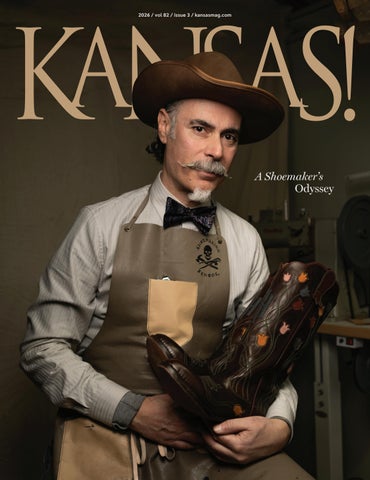
A Shoemaker’s Odyssey
your adventure starts here
Hike the trails at Kaw River State Park, Paddle your kayak across the Kansas River, enjoy the views from Burnett’s Mound, or walk the paved loop around the scenic Lake Shawnee. In Topeka, there’s something for everyone under the sun.
visittopeka.com
2025
COMMUNITY
OF THE YEAR
“Where people of all ages truly want to live, learn, work, & retire.” – Community Playmaker LEARN WHY
Find events and more at VisitHays.com • @VisitHays
See the Smithsonian in the Kansas City Metro!
Wyandotte County Historical Museum 631 N. 126th St, Bonner Springs, KS May 30-July 5, 2026 Americans is based on an exhibit of the same name at the National Museum of the American Indian in Washington DC. Photographs, videos, and hands-on activities help tell the stories of Native Americans and our national identity. Visit humanitieskansas.org for more information.
WHAT’S INSIDE /
featured
featured stories
36
Against All Odds
PHOTO COURTESY Sporting Kansas City
A look at some of the Kansas athletes who faced the odds and earned their place in sports history
44
Kansas Pioneers of the Pitch How Kansas laid the groundwork for American soccer
3 KANSAS! magazine
WHAT’S INSIDE /
departments
kansas DETAILS 10
Cuisine
14
Heartland
Fine Food and Good Eats
People and Places That Define Us
18
Culture
Arts and Experiences
the Scenes 22 Behind A Conversation With KANSAS! Contributors
24 Captured Life in the Sunflower State We 26 Reasons Love Kansas
Interactive Dining Destinations
wide open SPACES & Sole 30 Heart After surviving an earthquake in Italy, a master shoemaker found his way to southeast
Kansas, where he now crafts custom cowboy boots for clients around the world
kansas TASTE Education 58 World-Class The Culinary Center of Kansas City celebrates 30 years
with global classes inspired by the international soccer PHOTO COURTESY Library of Congress
tournament
IN EVERY ISSUE 7
The Extra Details
52
Kansas Gallery
8
64
On the Cover Sam Vasta displays a pair of handmade cowboy boots at his workshop in Eureka. Photograph by Aaron Patton
5 KANSAS! magazine
Hello From Our Publisher From the Poet Laureate
KANSAS TOURISM, A DIVISION OF THE KANSAS DEPARTMENT OF COMMERCE
Andrea Etzel PUBLISHER
Laura Kelly GOVERNOR
David Toland
LT. GOVERNOR & SECRETARY OF COMMERCE
Bridgette Jobe TOURISM DIRECTOR
SUNFLOWERPUB.COM | LAWRENCE, KANSAS KSMAGAZINE@SUNFLOWERPUB.COM
DESIGN & PRODUCTION
Bill Uhler
Bob Cucciniello
Shelly Bryant
Gina DeBacker
Alex Tatro
Leslie Clugston Andres
Joanne Morgan
Beccy Tanner
PUBLISHER
DIRECTOR
DESIGNER/ART DIRECTOR
MANAGING EDITOR
ADVERTISING DESIGNER
MANAGING EDITOR
MARKETING JMORGAN@SUNFLOWERPUB.COM
CONSULTANT
KANSAS! (ISSN 0022-8435) is published five (5) times per year by Kansas Tourism, 1000 SW Jackson St., Suite 100, Topeka, KS 66612; 785.296.3479; TTY Hearing Impaired: 785.296.3487 Periodical postage paid at Topeka, KS, and at additional mailing offices. Newsstand price $6 per issue; subscription price $25 per year; $45 for two years. All prices include all applicable sales tax. Please address subscription inquiries to: Toll-free: 800.678.6424 KANSAS!, 1000 SW Jackson St., Suite 100, Topeka, KS 66612 Email: kansas.mag@ks.gov | Website: www.KansasMag.com POSTMASTER: Send address change to: KANSAS!, P.O. Box 146, Topeka, KS 66601-0146 Please mail all editorial inquiries to: KANSAS!, 1000 SW Jackson St., Suite 100, Topeka, KS 66612 email: kansas.mag@ks.gov The articles and photographs that appear in KANSAS! magazine may not be broadcast, published or otherwise reproduced without the express written consent of Kansas Tourism or the appropriate copyright owner. Unauthorized use is prohibited. Additional restrictions may apply.
6 KANSAS! magazine
KANSAS /
the extra details
Rock Island Bridge Opens
After more than three years of construction and multiple delays, the world’s first entertainment district on a bridge is now officially open. Spanning the Kaw River in Kansas City, the 35,000-square-foot Rock Island Bridge is built on a repurposed 1905 railroad bridge and offers stunning views of the historic Strawberry Hill neighborhood. The main deck serves as a public crossing and features River House, the city’s first river-top restaurant with a bar. The top deck features a private event space suitable for weddings, corporate functions and concerts.
the extra details Pete Felten
Kansas’ Newest Byway
Kansas is proud to announce its newest byway—the Pony Express Historic Byway. This historic stretch follows the same northeastern route where young riders once delivered mail at astonishing speeds. Although the Pony Express operated just 18 months in 1860–1861, it fundamentally transformed westward communication. To relive these early days on the frontier, begin in Elwood, the first Kansas stop for Pony Express riders. Then drive through Troy, Everest, Horton, Fairview, Seneca and Marysville to Hanover, home to the least altered Pony Express station still standing on its original site.
We were saddened to learn of Pete Felten’s death, which came just two days after he received the 2026 Governor’s Art Legacy Award. For more than 70 years, Felten created beautiful works from Kansas limestone, many of which can be found in Hays. In 1967, he carved the Monarch of the Plains, a buffalo sculpture for the Fort Hays State Historic Site. Throughout his career, he also sculpted iconic Kansans, including Amelia Earhart, William Allen White and Wild Bill Hickok. His talent was tremendous and his presence will be greatly missed. We extend our condolences to his family and honor Felten and his work.
Around the State 5
PHOTOS COURTESY Rock Island Bridge, Kansas Tourism (4)
1 3 6 7
4
2
1 Assaria / page 10 2 Ashland / page 19 3 Bazaar / page 19 4 Liberal / page 28
7 KANSAS! magazine
8
5 Overland Park / page 28 6 Eureka / page 30 7 Rolla / page 38 8 Humboldt / page 43
hello F R O M O U R P U B L I S H E R
One thing Kansans are known for is being good hosts.
ANDREA ETZEL
PUBLISHER, KANSAS! MAGAZINE facebook.com/KansasMagazine KansasMagazine
(get spotted; use #kansasmag to tag us)
8 KANSAS! magazine
PHOTO Andrea Etzel
It’s time to roll out the welcome mat. This summer, Kansas is hosting global travelers for the world’s largest international soccer tournament: the FIFA World CupTM. When I hear the estimates of how many visitors will be coming through the Kansas City metro—and beyond—it’s almost impossible to fully grasp the scale. I can’t help but feel a deep excitement to share the very best of the Sunflower State with them. Events like Unbound Gravel already draw athletes from around the world to our state each year, but the World Cup takes that energy to an entirely new level. In “Kansas Pioneers of the Pitch” on page 44, we explore not only what’s ahead, but the deep roots of soccer in Kansas—a legacy that reminds us this opportunity didn’t happen by chance. This issue also looks back at defining moments in our sports history. On page 36, writer Beccy Tanner highlights Kansas athletes who defied the odds and prevailed. We also pause to honor those we’ve lost—figures like Knute Rockne and the 1970 Wichita State University football team—and those whose legacies still echo today. As the world turns its attention here, may we meet it the Kansas way: with pride in where we’re from, generosity in how we welcome others, and an understanding of the legacy we carry forward.
YOU’RE NOT BORED. YOU’RE JUST NOT HERE YET.
Fort Scott, Kansas Something happening every weekend. Historic streets made for wandering. Flavor worth the drive.
PLAN YOUR GETAWAY NOW. VISITFORTSCOTT.COM
Hidden Trattoria This kitchen is bringing Italian cuisine to the heartland Story by Lisa Waterman Gray Photography by Tanner Colvin
Open Thursdays, Fridays and Saturdays, Renaissance Café occupies a 1919 former high school with dining tables surrounding the original sunken gymnasium.
KANSAS DETAILS /
cuisine
or a taste of Italy in rural Kansas, visit the Renaissance Café in Assaria, population 400. Located 6 miles north of Lindsborg and 6 miles south of Salina, this hidden gem is the small town’s only restaurant. Having just marked its 25th year, Renaissance Café, 210 N. Center Ave., offers a small but delectable menu of quality food along with a great selection of craft cocktails and wine. Housed in a former high school built in 1919, the beautifully renovated restaurant exudes Old World charm. Vintage books and framed art fill the walls, and varnished hardwood tables welcome guests. Lace curtains and lamps on the windowsills cast a warm, inviting light throughout the dining space, which surrounds the former high school’s sunken gymnasium. “Most of our food is from local farms. The Chef Adrienne Lynn supports local businesses by cooking from scratch seafood we fly in fresh, but we work a lot whenever possible. “Home is always with local farmers. Because we only [offer] better,” she says. “Most of our food is from local farms. The seafood we fly three meals a week, we only need a little bit in fresh, but we work a lot with local of quantity, not huge bulk.” farmers. Because we only [offer] three meals a week, we only need a little bit – CHEF ADRIENNE LYNN of quantity, not huge bulk.” Renaissance Café—open Thursdays, Fridays and Saturdays—frequently changes its menu but always offers gourmet Italian-inspired cuisine. Start off with a crunchy, grilled Caesar salad with creamy dressing and fresh bread, or an amuse-bouche of buttery Castelvetrano olives and a small cheese wedge. Pair that with an antipasto platter such as prosciutto asparagus or caponata burrata. Lynn emphasizes that the menu is always changing. It’s part of Renaissance Café’s charm—a dish that delighted customers a month ago may not be available on a return visit, but there will always be something new to savor. The menu caters to a variety of tastes with hearty entrees such as an extravagant duck breast in a blood orange reduction served with polenta, or a simpler but still impressive penne pasta with artichoke, spinach and cherry tomatoes drizzled with a wine cream sauce. Steak lovers can also savor grilled ribeye or tenderloin Andrea Etzel
f
11 KANSAS! magazine
Above Chef Adrienne Lynn (left) has run Renaissance Café for nearly 17 years. She embraces its ever-evolving menu, noting that it keeps the customer experience fresh.
cuisine / K A N S A S D E T A I L S
Salina, Assaria, Overland Park
plus. Viona’s Italian Bistro
Overland Park / Nestled in downtown Overland Park, Viona’s Italian Bistro is resilience personified. The restaurant dedicated to fresh Italian fare opened mere months before the pandemic. Thanks to plentiful outdoor seating, efficient takeout service and loyal customers, Roy and Donice Applequist opened Renaissance Café 25 years ago. It remains the only restaurant in the small town of Assaria. Viona’s not only survived but thrived. An extensive lunch paired with crispy shallots or a rich menu offers generous portions of specialty pasta dishes, including spinach-andblackberry merlot sauce. cheese-stuffed ravioli and penne Bolognese with a bacon sauce. Entrees feature End the evening by indulging in house favorites like fettuccine alfredo, baked ziti and homemade lasagna. a small scoop of the restaurant’s Seafood lovers can savor shrimp and scallops alfredo or linguini with clams, while rotating selection of sorbet or a meat lovers can opt for stromboli or customized pizza. The perfect finish to any memorable dessert like a generous meal is a slice of tiramisu or a cannoli. vionasitalianbistro.com / 913.232.8818 slice of three-chocolate cheesecake. Martinelli’s Little Italy Enjoy it in the restaurant or Salina / For 25 years, Martinelli’s Little Italy has delighted visitors with packaged in a take-home container. authentic, family-style Italian cuisine. Begin the meal with an appetizer— While the menu may shift from garlic bread, toasted ravioli with beef, bruschetta layered with olive tapenade, visit to visit, one thing guests can tomato and capers, or a vegetable side dish to pair with the main course. always count on is good food. Lynn Chicken parmesan, salmon piccata and the ribeye are great options, but pasta strongly recommends making a is the restaurant’s specialty—penne, fettuccini, linguine or tortellini. End the reservation, especially for guests evening with a decadent molten chocolate cake or crème brûlée cheesecake. traveling long distances, as sell-out Alternatively, for parties of four or more, meals can be ordered family-style. evenings are common. renaissancecafeassaria.com Rather than limiting taste buds to one main dish, choose several appetizers, 785.667.5535 entrees and desserts to share. martinellisonline.com / 785.826.9190
12 KANSAS! magazine
Home of the Last Remaining Lockheed Electra 10-E AmeliaEarhartHangarMuseum.org
VisitLeavenworthKS.com
May 25 June 25-27 June 27
Memorial Day at 2 Nat’l Cemeteries Summer Spirit Festival Buffalo Bill Wild West & Military History Festival 13
Dates subject to change - check QR code
KANSAS! magazine
Welcome to the Anomaly Atlas9 brings a ’90s cinematic mystery to life in Kansas City’s new immersive experience Story by Gina DeBacker
Cutline will go here
KANSAS DETAILS /
heartland
PHOTOS Kansas Tourism (2)
s
tepping into Atlas9 feels like traveling through time. Outside, the structure is a 45,000-square-foot windowless warehouse, its only distinctive feature a giant robot emerging from the ground to greet passersby. The moment visitors cross the threshold, however, they are hit with a wave of nostalgia. Every detail, from the geometric carpeting and glowing neon signage to the costumed performers, transports guests directly to 1995, the peak of the Hollywood blockbuster era. Atlas9, 1100 N. 98th St., Kansas City, Kansas, is the brainchild of Randall Statler and Tucker Trotter. During the pandemic, Statler, executive creative director at Dimensional Innovations, an Overland Park-based design firm, and Trotter, CEO, began to rethink the business. They talked about how much fun it would be to build something of their own. “We never really thought about doing a thing for ourselves,” Statler says. “That’s how we reframed our thinking: ‘Let’s make a thing that people can walk through and experience that’s our own doing, our own devising.’” Dimensional Innovations creates solutions for large-scale spaces such as stadiums, museums, hospitals and event centers. Designing the Atlas9 experience was an entirely new endeavor. Armed with a team of designers, fabricators, engineers, welders, product managers and technologists—and even a 3D printer the size of a car wash—they were confident they could pull it off and bring something unique to Kansas. But why a movie theater? The concept is rooted in the company’s origins. Dimensional Innovations first found success during the 1990s multiplex boom, working with theater chains such as AMC, which, serendipitously, got its start in Kansas City. For Statler, however, the “aha moment” came when he realized a movie theater could serve as a narrative engine. This familiar setting would allow him not only to bring stories to life in exciting ways but also to create a natural space for spin-offs and sequels. “There’s nothing riper for interesting stories than a movie theater,” Statler says. “It literally houses stories.” Above Admission to Atlas9 is $40 for adults and $30 for children, but the adjacent Splice Bros. Pizza is free to enter.
From there, the idea for Atlas9 was born, although explaining the concept to newcomers can be something of a challenge. It is an experience akin to Meow Wolf, the popular immersive art collective with locations in Las Vegas, Denver and Santa Fe, among others. At Atlas9, you are not a passive viewer but an active participant, shaping your own experience throughout this carefully crafted multiplex universe. According to the narrative, a government agency recently tracked a burst of “cinemorphic energy” to this movie theater in 1995, after its projector malfunctioned catastrophically and released movie elements into the real world. As guests enter Atlas9, they become agents equipped with wristbands to scan at designated stations throughout the multiplex. The objective is to track the released “anomalies” by finding clues, solving puzzles and unlocking missions. Guests are free to explore Atlas9 at their own pace, engaging with as much or as little as they wish. The more they interact with the environment, the deeper they become immersed in its layered narratives. While most visitors typically complete their journey in about two hours, dedicated explorers can spend entire afternoons hunting for clues. The experience shares DNA with popular escape rooms, featuring hidden passages and detailed sets such as messy offices and break rooms filled with clues. Atlas9, however, expands on that format by integrating AI-generated elements, original artwork from local and national artists and live performances. Tucked within the space, for example, is an Art Deco jazz club where you can watch trumpet players, elaborately costumed dancers and even aerialists take to the stage. And don’t miss the legendary Holomax Theater, the very room where the “anomalies” first emerged. The theater hosts live performances and screens snippets from the multiplex’s nine invented films. Search the space for hidden elements, or walk up its staircase to inspect the malfunctioning projector. “The projection room above the Holomax was one of the first things we made,” Statler says. “It was the perfect combination of our narrative and a found object that has a history.”
15 KANSAS! magazine
Atlas9’s unassuming exterior gives no hint to the whimsical rooms hidden within. In one (above), an Art Deco jazz club features daily performances. In another, VHS films and retro TVs holds a musical surprise.
PHOTOS Kansas Tourism (2)
KANSAS DETAILS /
heartland
If solving puzzles isn’t your priority, wander the universe to soak in its atmosphere. “Anomalies” are everywhere you look. One room overflows with giant buckets of popcorn. Another is saturated with psychedelic projections rumored to hypnotize anyone it encounters. Elsewhere, a large sculpture called the Mesmerite features an hour-long custom sound and light show. And a speakeasy is hidden within the walls, offering carefully crafted cocktails and a place to rest. For childlike fun, there’s also a classic arcade, photo booth, and retrofitted snack station with plenty of seating. Statler, who graduated high school in 1995, says he drew inspiration from movies of his youth like The NeverEnding Story and The Matrix. Listening to him enthusiastically describe the narratives he helped create, and those still to come, shows a deep passion for storytelling. That passion is precisely what makes a project like Atlas9 possible. To bring it to life, Dimensional Innovations, responsible for the art and technology, partnered with local companies: Quixotic handles the live performances, and Swell Spark manages the daily operations. Statler also highlights the contributions of Kansas City-born artist and production designer Cory Hinesley. “Hinesley was crucial … she set the stage,” he says. “I want to prioritize [employing local artists] going forward. … Now that we’re on the map, we’re going to have the gravity to champion their art here.” Since its opening in September 2025, Atlas9’s success has the team looking toward the future. With several rooms left unoccupied, Statler is eager to fill them with new stories and build on the overarching narrative. By expanding the space and rotating live performances, they plan to keep the experience fresh for returning visitors. Additionally, they have planned a monthly lineup of classic ’90s films that will be shown in the Holomax Theater. Admission to the experience is $40 for adults and $30 for children. Before or after your visit, step into the adjacent Splice Bros. Pizza. The restaurant is open to the public, blasts ’90s tunes, serves artisan pizzas and cold brews, and even hides a talking popcorn machine behind the bar. “I love seeing the different age groups,” Statler says. “From the kid in the harness who can’t walk yet, looking around the room with wide eyes, to the grandma shuffling around as best she can … I love seeing people have a good shared experience.” atlas9.com / 913.708.8081
17 KANSAS! magazine
Scott Bean Photography
K A N S A S L A N D S C A P E A N D N AT U R E P H O T O G R A P H S
785-341-1047 | SCOTT@SCOTTBEANPHOTO.COM
www.scottbeanphoto.com
Where We Go to Remember Honoring fallen athletes at memorials across Kansas Story by Cecilia Harris
KANSAS DETAILS /
culture
PHOTOS COURTESY Kansas State Historical Society, Wikimedia Commons
m
arch 31, 1931, was a disastrous day in sports history. A small airplane crashed in the Flint Hills in rural Chase County near Bazaar, killing all eight men aboard. Among the passengers was the University of Notre Dame’s legendary football coach, Knute Rockne. The day after the accident, the Kansas City Star reported that Rockne had been visiting his two sons, who attended school in Kansas City. According to the Knute Rockne Memorial Society, he was headed to Los Angeles for speaking engagements and to meet with film studios about a proposed motion picture celebrating Notre Dame football. It wasn’t until after his death, in 1940, that a movie about his football career was released: Knute Rockne, All American, starring Pat O’Brien. Rockne, the mastermind behind Notre Dame’s gridiron record, had led his teams to national championships in 1924, 1929 and 1930. The accident drew national attention and, in the weeks that followed, hundreds of Kansans visited the crash site. Now, 95 years after the crash, memorials across Kansas honor his legacy. Four years after the accident, a monument was erected at the crash site, which is on private property. The names of all eight passengers were etched into its granite surface. About 14 miles southwest of the crash site, along U.S. 50, a historical marker highlights Chase County and the Bluestem Pasture Region, and, in passing, notes that Rockne died nearby. In 1965, another memorial marker was raised, this time at the Matfield Green service area on the Kansas Turnpike, just 8 miles from the crash site. When the turnpike’s new service area opened in 2004, the Kansas Turnpike Authority replaced the marker with a more substantial memorial inside the center. The 175-square-foot exhibit featured large photographic panels describing various aspects of Rockne’s life, audio clips from his famous motivational speeches, and a life-sized cutout of the man himself.
Opposite The 1931 plane crash that killed eight men, including football coach Knute Rockne, drew national attention. In the weeks that followed, hundreds of Kansans visited the crash site.
plus.
Ashland Wichita Bazaar
Jesse Harper Memorial
Ashland / Jesse Harper was another household name in football. In 1913, during his first year as head coach at Notre Dame, he employed the forward pass to upset the Army Cadets, 35-13. Although the move was legalized in 1906, most teams used it only once or twice a game. Harper’s willingness to unleash it against this powerhouse put Notre Dame on the map and changed the game forever. His star player was Knute Rockne. “He’s the one who taught Rockne to play,” explains Pioneer-Krier Museum director Tony Maphet. “Rockne was one of his star players.” Before ending his coaching career four years later, Harper helped Rockne secure the spot as his successor. During this time, Harper ranched in Clark County and served as president of the Kansas Livestock Association. In 1931, he was only 100 miles away when he heard that his friend was in a plane crash. “Harper was called when that plane went down,” Maphet explains. “He identified the body.” He accompanied Rockne’s body on the train from Kansas to South Bend, Indiana. Shortly after the crash, Notre Dame asked Harper to serve as its athletic director, a position he held until 1934. He returned to ranching and, following his death in 1961, was inducted into the National Cowboy & Western Heritage Museum’s Hall of Great Westerners for blending athletic leadership with ranching ethos. Today, the Pioneer-Krier Museum in Ashland honors Harper with a special exhibit that showcases several of his belongings, including items from his years at Notre Dame. pioneer-krier.com / 620.635.2227
19 KANSAS! magazine
Above The 1913 Notre Dame football team.
Follow the Follow the Follow Road to to Road Adventure in Adventure in Adventure Chanute, KS! Chanute, KS! Chanute, Small Town Charm, Worldwide Connections
Chanute is home to the world-famous Martin and Chanute home tothe theworld-famous world-famous and Chanute isishome to Martin took and Osa Johnson Safari Museum. The Johnsons Osa Johnson Safari Museum. The took Osa Johnson Safari Museum. The Johnsons took the roads less traveled in Africa, the South Seas theroads roads less traveled in1920s Africa,and the ‘30s. South Seas the traveled in Africa, Seas andless Borneo in the andBorneo Borneo in the 1920s and in the 1920s and ‘30s. Chanute is also home to: Chanuteisisalso also home home to: Chanute
~ The Chanute Art Gallery TheChanute Chanute ArtGallery Gallery ~~ ~ The Art Chanute Historical Museum ChanuteHistorical Historical Museum Chanute ~~ ~ Cardinal Drug StoreMuseum Cardinal Drug Store ~ ~ Cardinal Drug Store Old Fashioned Soda Fountain OldFashioned FashionedSoda SodaFountain Fountain Old
~ Howard’s Toys for Big Boys Howard’s ~~ Howard’s Toys for Big Boys Boys Antique Car Museum Antique Hill Car Gardens Museum Soap Shop Antique Car ~ Summit Summit Hill Hill ~~~ Summit Gardens Soap Soap Shop Shop Veterans Memorial Veterans Memorial ~~ Veterans
For more information: 620-431-3350 Formore moreinformation: information:620-431-3350 620-431-3350 For information@chanutechamber.com information@chanutechamber.com information@chanutechamber.com www.chanutechamber.com www.chanutechamber.com www.chanutechamber.com
Understanding Medicare Insurance Can Be Overwhelming, But It Doesn’t Have To Be!
culture / K A N S A S D E T A I L S
Several years later, after the service area was renovated, part of the display moved to the Chase County Historical Museum and Library in Cottonwood Falls. Today, it has been incorporated into an exhibit featuring Rockne and the crash, according to the museum’s director and curator, Dawn Sisson. “We put up four of the panels,” Sisson says. “One has a large picture of Rockne in his football uniform when he played football for Notre Dame, one is more of a headshot of Rockne, and the others talk about the plane and the crash.” The display includes pieces of the wreckage, such as the plane’s propeller, as well as photographs, official documents, extensive newspaper accounts and other memorabilia. A 1932 Rockne Studebaker, named for the coach, is also on display, on loan from the Rockne family. “They purchased it in the mid-1980s and refurbished it,” Sisson adds. “They were going to put it into storage but asked if we would like to have it on loan because they would rather have it out where people could see it.” Another part of the display features Easter Heathman, a Chase County resident who was among the first to arrive at the crash scene. “Heathman was only 13 years old at the time of the crash,” Sisson says. “Because he was so young and it left such a big impression on him, he became the storyteller and memory keeper.” Heathman
Let our professional advisers help you learn exactly what you need and then find the right products to fit your situation. Capper’s Insurance Service works with 17 major insurance providers to customize a plan and a rate that’s right for you.
Medicare Supplement Plans
Annuities and Life Insurance
Medicare Advantage Plans
Prescription Drug Plans
Long-tTerm and Short-Term Care Insurance
Critical Care Conditions Insurance
Accident/Disability Insurance
Dental, Vision, and Hearing Insurance
PHOTO COURTESY WIkimedia Commons
CREATING CONFIDENCE IN RETIREMENT
Knute Rockne in 1921
SERVING RURAL AMERICA SINCE 1932
We’re here to help. Call 800-678-7741. www.CappersInsurance.com
20 KANSAS! magazine
KANSAS DETAILS /
culture
devoted most of his life to maintaining the Rockne memorial and offering tours of the crash site. In 2019, the Kansas Turnpike Authority partnered with the University of Notre Dame to add a bronze bust of Rockne to the memorial inside the Matfield Green service area. Rockne coached at the University of Notre Dame from 1918 to 1931. He won 88% of his games, a record that stood for more than 50 years as the highest winning percentage of any college or professional football coach. Rockne was inducted into the inaugural class of the College Football Hall of Fame in 1951. chasecountyhistoricalsocietymuseum.org 620.273.8500
plus. Memorial ’70
Wichita / Another disastrous day in college sports history was October 2, 1970. In preparation for a football game against Utah State University, Wichita State University football players, athletic staff members and team boosters boarded two planes bound for Logan, Utah. The plane designated the Black Plane made it safely to its destination. The other plane, the Gold Plane, did not. It crashed into the side of a mountain near Silver Plume, Colorado, along present-day I-70. With 36 passengers and a crew of four on board, only nine people survived. Pieces from the crash still remain at the crash site. Each October 2, in remembrance of the crash, a wreath is placed at Wichita State’s Memorial ’70 on the west edge of campus. Here, two monuments honor the victims of that flight, one bearing the names of the 31 victims. Also to honor the deceased, a display case featuring photographs and mementos is located in the Koch Arena concourse. On the 50th anniversary of the crash, a survivors’ monument was designed in the shape of a fuselage, the area of the plane that broke and allowed the survivors to escape the wreckage. The monument is positioned between the two original Memorial ’70 structures and lists the name of the eight football players who survived the crash. The names of the teammates aboard the Black Plane, which landed safely, were added to the back of the upright monument. wichita.edu/memorial70 / 316.978.3142
21 KANSAS! magazine
10-4pm Wed-Sat I 1-Spm Sun
(785) 887-6148 I www.lecomptonkansas.com
behind the scenes / K A N S A S D E T A I L S
o n i s c h a t
The historic riverfront town in eastern Kansas is known for spooky homes, ghostly legends and things that go bump in the night s t o r y
b y
Beccy Tanner with Nick Spacek and Lisa Waterman Gray
p h o t o g r a p h y
b y
BriJoRae’ Pusch-Zuniga
38 KANSAS! MAGAZINE | 2021 ISSUE 5
It’s that inexplicable feeling between slight apprehension and mortal fear one might have when tippytoeing among reputedly haunted sites in Kansas. Every region of Kansas has one of these heebiejeebie–giving sites, if not several. Go during the day. Or at night, if you dare. It doesn’t matter when. You are likely to have a feeling you aren’t alone. And depending on whom you ask, you might not be. The Harris Poll, a market research and analytics company, conducted a survey in 2013 showing that roughly 42 percent of Americans believe in ghosts. And most who don’t believe in ghosts are not averse to encountering them. Touring haunted locations has become a popular pastime. Nationally, ghost hunting has been featured on television shows and is the subject of countless books, YouTube videos and events across the nation. The popularity of the TV shows and movies has created a niche market—paranormal tourism. In fact, one of the most popular blog posts on TravelKS.com, the state’s official tourism website, is one that details the 13 spookiest places in Kansas (see related story on page 44). But of all the haunted spots in Kansas, Atchison is best known for apparitions. According to Lisa Hefner Heitz’s 1997 book, Haunted Kansas: Ghost Stories and Other Eerie Tales, the city along the banks of the Missouri River is the most haunted town in Kansas. “Atchison appreciates its ghosts. Atchison cultivates its ghost stories. This historic and beautiful Kansas town along the banks of the Missouri River abounds in legends of all kinds—ghost legends in particular,” writes Heitz. “Nestled among the hills and river bluffs, Atchison has a unique sense of history, demonstrated in its commitment to preservation of its historic landmarks, original brick streets, magnificent 19th-century mansions … [and] a truly impressive collection of ghosts!” Go to the visitatchison.com website, click on “Haunted Atchison,” and you’ll discover that there
2021 ISSUE 5 | KANSAS! MAGAZINE
are a plethora of places in town for those who enjoy otherworldly diversions, making the city a hotspot for ghost-seeking tourists. The haunting experience is big business. “I would say that 90 percent of the online traffic that we see through our websites and social media is haunted-related,” says Andrea Clements, deputy director for the Atchison Area Chamber of Commerce. “And I would say maybe 70 percent of the visitors that we see here at the Visitors Center or interact with are here because of something related to haunted.” Since Heitz’s book came out, national celebrity ghost hunters have flocked to the city. “It has just skyrocketed,” Clements adds. “I think it’s [a factor with] the unknown. I think with people, even if they are not true believers in the paranormal world, there is still a level of curiosity. It’s something you can explore on your own and take in as much or as little as you want.” During the Covid pandemic, interest in Atchison’s ghostly tours increased, Clements says, in part because families could tour haunted places together by making reservations and not be exposed to others. But the height of ghost tourism season is always in the fall, toward Halloween. And this year, as always, Atchison—with all its haunts and ghosts—will be waiting.
“This place is amazing! We had some crazy things happen to us over the weekend we were here. This place definitely overwhelmed some of our guests and 100 percent gets my haunted location approval. Thank you Kansas, it’s been real.” –erik knapp, hunting the haunted
THE McINTEER VILLA It is a monstrous two-and-a-half–story mansion encompassing nearly a city block. When I visited in late spring, dark rain clouds hung heavy over the villa and its four-story turreted tower. Spooky? Indeed. And that is why it has become such an attraction. John McInteer, for whom the mansion is named, was an Irish immigrant who settled first in Philadelphia, then Indiana, and finally in Kansas by the early 1860s. Having made a fortune manufacturing harnesses and saddles that he sold to Euro-American
40 KANSAS! MAGAZINE | 2021 ISSUE 5
2021 ISSUE 5 | KANSAS! MAGAZINE
settlers moving into the West, he built his namesake Queen Anne brick mansion in 1889–1890. Over the decades, when it was not used a private residence, the McInteer was a rooming house. It is also believed to have been the site of nine deaths, a fact that—if you believe in such occurrences— accounts for its numerous reports of haunting. Stephanie Neal, the current owner, offers tours and overnight stays in the home, now decorated with a haunted house motif. The house feature skeletons, skulls, Chuckie Dolls and other creepy factors along with gorgeous woodwork, winding stairs, stained glass windows and wood floors that creak in the night. Neal said she became interested in searching out paranormal experiences about eight years ago. That’s when she and her husband spent a night at the Crescent Hotel in Eureka Springs, Arkansas, long considered one of the most haunted hotels in America. There, she had a haunting experience with room service and a squeaky food cart— though that type of service wasn’t offered when she heard it—at 3 a.m. After the Neals and Stephanie’s father bought the McInteer in 2018, they began having their own experiences in Atchison. After he installed a chandelier on the first floor, Jeff heard a woman’s voice tell him “That looks nice.” He was, of course, alone. Paranormal experiences, Stephanie Neal says, are a little like riding a roller coaster. “You get that really nervous feeling and then you want to do it again,” she says. Visitors who spend the night are encouraged to bring their own bedding. Beds are full and twin size, not king or queen. Those who don’t want to spend the night may tour the house in a group of up to 10 people. Neal says visitors come to the home for many reasons, but mostly out of curiosity. “I have a woman who’s probably been here 10 times with her daughter,” Neal says. “I think they enjoy the scared feeling. They’ve made friends with the spirits in the Villa. She says, ‘Hi Frank!’ I mean, she knows more about who is roaming the house than I do. And then other people like the history— what might have happened here. Others are more scientific about it.” Those scientific-approach visitors have included Brian Murray and Richel Stratton, paranormal investigators on the A&E television show Ghost Hunters.
... the house would manifest abnormal cold spots, all of which were documented by Sightings in a series of in-depth reports and later examined by numerous other national and local programs. 42 KANSAS! MAGAZINE | 2021 ISSUE 5
Finney, who is believed to have used the downstairs front rooms as an office and patient examination space in the late 1800s. The story goes that one night, a mother rushed in with her 6-year-old daughter, Sallie, who was suffering from abdominal pain. The doctor thought it was appendicitis and that the young girl was in danger of her appendix soon bursting. In a rush to perform life-saving surgery, the doctor administered anesthesia, but it had yet to take full effect by the time he began to operate. The girl screamed in pain and soon died on the operating table. Her spirit would become the first that is believed by some to haunt the premises. The Finney family continued residing in the house for the next several decades, and then a single woman lived there for the better part of the middle of the 20th century. It wasn’t until Tony Pickman and his wife, Debra, moved into the house in 1993 that the house gained notoriety. Over the course of the next two years, Debra and Tony noticed strange apparitions. Tony would suffer mysterious cuts, rashes, and abrasions, and the house would manifest abnormal cold spots, all of which were documented by Sightings in a series of indepth reports and later examined by numerous other national and local programs. Sightings was the first to document the phenomena, but the details have since found their way into the vernacular of those who follow the paranormal. Video tours of the home have appeared on A&E, the Travel Channel, the Discovery Channel, Syfy, and in other national media outlets. Many who tour the house or stay overnight have reported seeing apparitions or hearing voices during their visits. Others have claimed to witness toys moving in a child’s room or noticing a girl’s voice from a bedroom closet. For the past years, the Sallie House has been owned and operated by Visit Atchison, the city’s official tourism office. The organization arranges all tours and overnight stays and includes the home as part of its official tour of the city’s most haunted locations. HERE A HAUNT, THERE A HAUNT Ghost-story writer Lisa Hefner Heitz notes that Atchison “scored additional points for its innovative yearly salute to its least visible residents” through its Haunted Atchison Trolley Tours, which takes riders past the most haunted areas of town during the fall.
46 KANSAS! MAGAZINE | 2021 ISSUE 5
THE SALLIE HOUSE As haunted as the McInteer Villa is reported to be, the title for the most haunted home in the most haunted city most often goes to the Sallie House. Built sometime between 1867 and 1871, the Sallie House became the residence of Dr. Charles C.
43
Spirit’s Mile: According to legend, on this spot along K-7 Highway, witnesses have seen misty apparitions standing on the roadside and the likeness of deceased friends passing by in cars. The Braun Home: Built by German immigrant Henry Braun, this house remained a family home for many years after Braun’s wife, Anna, died here and then continued to visit as a spirit. She has been believed to send keys flying from a pegboard and to play the parlor piano. The Shisler House: Visitors to this late-1800s home have reported hearing footsteps, noticing sudden chills, and spotting unexplained movement of furnishings. The incidents are often attributed to a young girl who died from rheumatic fever in the house. 622 N. 4th Street: Unexplained orbs have appeared in many photographs taken of a framed picture inside this Victorian home. Paranormal investigation even captured footage of orbs emerging from the picture. Docents have also reported hearing mysterious footsteps coming from the upstairs.
“Nestled among the hills and river bluffs, Atchison has a unique sense of history, demonstrated in its commitment to
101 Commercial Street: Built in the 1870s, this building has served as a railroad office, a boarding home, a brothel and a restaurant. After the building became a restaurant, managers reported that lights turned off when nobody was near a switch and that unexplained footsteps could be heard from the upstairs.
preservation of its historic landmarks, original brick streets, magnificent 19thcentury mansions … [and] a truly impressive collection of ghosts!”
–lisa hefner heitz,
haunted Kansas: ghost stories and other eerie tales
Theatre Atchison: Several ghostly encounters— including doors rattling and voices calling out— have been reported from this late 1940s building. Waggener Home: Built in the mid-1880s, this ornate Victorian home has appeared on the Travel Channel in a segment about its reported history of mysterious gargoyles and hauntings. Evah C. Cray Historical Home Museum: Various apparitions and unexplained sounds have been reported at this house, believed to have been built over the city’s first graveyard.
2021 ISSUE 5 | KANSAS! MAGAZINE
Or so we thought. Things got spookier as the night went on. In the middle of the night, I accidentally knocked over a life-size decorative witch doll who shook and trembled as I caught her and put her back in place. Diane said she was “creeped out” by some of the decorations in the house but that had more to do with décor preference than paranormal activity. “I had a lot built up in my mind,” Diane said. “But I don’t feel like there were any odd experiences while we were there.” Call us boring old folk, but it was the architectural details of the house that fascinated us the most. The villa features exquisite woodwork, carved wood railings and stained-glass windows. According to the house’s nomination form for the National Register of Historic Places, it was built around 1889–1890 for an estimated cost of $14,000. We wondered what it would cost to build today. “Its chief significance is in its appearance; its remarkability is signified by the abundance and overabundance of ornamentation and detail in stone, brick, wood and metal,” the form reads. It is a fine structure. But even nice architecture gives way to the imagination in the deep of the night. At 3:30 a.m., I woke to the sound of low growling, a few feet from my head. I was terrified—until I realized it was one of my fellow ghost hunters snoring. Not long after that, the middle cushion of Diane’s Victorian couch was mysteriously pulled out from under her. If anyone asks, I’ll blame a ghost for that one, a ghost who allowed me to sleep until daybreak. By 7 a.m., we were dressed and ready to leave the house. The only ghosts any of us had encountered were the growlers though, apparently, others had heard the same growling from somewhere around me. Apparently, we all snored. We discovered something else after reviewing Kent’s footage and electronic records. Sometime during the night, the REM-pod was activated by something. The pod flashed for about 30 seconds and the brand-new batteries went dead. At the same time that the REM-pod activated, the video camera that Kent had placed in the attic recorded what appeared to be tiny flying objects, which when magnified resembled a headless torso. “I don’t have a clue what’s going on with that type of paranormal activity,” Kent said. “I don’t dismiss it.” None of us did. —Beccy Tanner
Beccy Tanner Beccy Tanner is a fourth-generation Kansan. Born in Larned and raised on a farm in Stafford County, she earned her journalism degree from Kansas State University. Though she has lived all over the state, she spent most of her career writing for the Wichita Eagle. Today, she contributes to the Kansas Leadership Center’s Journal, KMUW public radio, and KANSAS! magazine. Her work has taken her across the state and introduced her to countless fascinating people. After more than 40 years, she considers it a privilege to have worked alongside so many gifted editors. What inspired you to pursue a career in freelance writing? Ever since I was 5 years old, I’ve wanted to be a writer. That feeling never went away—I love writing, and I love reporting. Best of all, I’ve been blessed with readers who always encourage me to keep going. What do you enjoy writing about the most? It should come as no surprise that I absolutely love telling stories about Kansas, whether it’s about her people, her history or even the folklore of her geographic regions.
In addition to McInteer Villa and Sallie House, be sure not to miss these other haunted Kansas locations …
Eyewitness Tales: Villa Paranormal Party n the midst of a pandemic, KANSAS! magazine called, wanting to know if I’d spend a night in Atchison’s haunted McInteer Villa. I’ve been asked to do many things in my journalism career, but this was a first. Sure, I said, but could I take a friend with me? I took two. First was Diane Getty, a friend from St. John since kindergarten. She’s a no-nonsense kind of farm woman who has your back and doesn’t put up with foolishness. Next was Kent Burklund, a retired calibration technician from Wichita’s Spirit Aerosystems. He’s a gadget guy who counters with logic and common sense when it comes to approaching the seemingly inexplicable. The two were a great combination for a night of thrills and chills. But even then, I wasn’t taking chances. I decided we would all sleep in the same room. Even though we were all well beyond our sleepover party days, we laid our sleeping bags on the floor close enough to watch over one another. Diane later moved her sleeping bag to a Victorian fainting couch in the front room, but we were still all gathered on the first floor because we didn’t want to negotiate the winding stairs on the second floor or attic. It was more convenient that way, but I also knew that if we were spooked, we could get out quickly. Little did we know what awaited. At 8:30 p.m., we heard footsteps on the stairs. A quick investigation revealed this was Kent, setting up two digital cameras and specifically a REM-pod, a Radiating EM Antenna Paranormal Ghost Hunting Tool, loaned to us by Stephanie and Jeff Neals. As he was setting up his equipment, a door on a secondfloor room mysteriously popped open as he walked by. That wasn’t Kent. “At the time, I thought it was an old door. I thought well, it’s just the vibration and the walking that popped it open. But the door just opened right as I walked by,” Kent said. While he had the cool gadgets, I was tasked with a K2 meter, a magnetic field detector that can detect energy such as that found in electrical outlets, cell phones and perhaps … ghosts? Its lights flashed occasionally for no reason I could explain. At 8:46 p.m., Kent spoke directly to the ghosts, asking them to make themselves known. Nothing happened.
41
Murray noted they were particularly intrigued after a backpack weighing 50 pounds fell off a couch inside the villa. “Richel and I would say [McInteer Villa] was very active,” Murray wrote in an email. “We had a very large group inside McInteer, and we still had footsteps, shadows, whistling, and objects moving.” Neal welcomes visitors who bring in cameras, gadgets and meters. “I like that they do this, but I like to hear things with my own ears because, to me, that is a little more terrifying.” Indeed, as she is showing visitors the second floor there is a small noise. “Did you hear that? It was like someone whispered ‘Hey!’” In the visitors’ book, people share other experiences. Erik Knapp, who stars in the paranormal reality show Hunting the Haunted, wrote in the journal on November 10, 2019, “this place is amazing! We had some crazy things happen to us over the weekend we were here. This place definitely overwhelmed some of our guests and 100 percent gets my haunted location approval. Thank you Kansas, it’s been real.” And still another visitor on October 10, 2020, wrote from the group Women Investigating Spirit Phenomena, “…we saw 2 stick figures that were in the Attic and on the 1st and 2nd floors as well. Did not go to basement, had a bad feeling about that. Our music box went off. A lot! Had to shut it off in the Library as it would not stop. K2 meters went off in many rooms. Lots of activity in the kids room, but none in Lucy’s room or Goldie’s room. Saw a couple of shadows and curtains moving. Will review tapes (video) once we get home.” Neal says the actual ghost population might be larger than she realizes. “I don’t know how many spirits are here. I’ve been told there are lots of children here who play hide and seek. I’ve heard babies, men and women. I heard little kids and heard someone with a British accent.” Murray said he plans on returning to the haunted mansion. “McInteer Villa is absolutely haunted, and we will be back for more haunts,” he wrote.
2021 ISSUE 5 | KANSAS! MAGAZINE
44 KANSAS! MAGAZINE | 2021 ISSUE 5
I
39
BEHIND THE SCENES WITH
45
Eyewitness Tales: The Chilly Charm of the Sallie House
M
y wife, Tanya, and I prepared for our overnight stay at the Sallie House just as we might for any road trip. We packed a game to play and loaded up our tablet with a choice of movies to watch. Because it was December, we also brought warm clothes and sleeping bags just in case. And then there was the research theme—that part wasn’t typical. Prior to our visit we read about reported hauntings and viewed several documentaries and episodes of the ’90s paranormal investigation program Sightings. Fortified with this knowledge, Tanya and I set out for Atchison on a clear winter afternoon. We hoped to enjoy a nice drive, visit an interesting location and leave with a story to tell the next time ghosts came up in conversation. Though we were well-versed in the particulars of the Sallie House, as well as what paranormal investigators suggest looking for when entering a haunted house, neither of us were traveling to the Sallie House as what you might call “believers.” Had we been looking for portents, we might easily have found one when we had to detour from our route to avoid an SUV that had caught fire alongside Highway 59 about 50 miles south of our destination. We arrived in Atchison as the sun was setting, pulled up on Second Street, parked and walked up to the Sallie House. As we explored the house, Tanya and I were struck by how much cozier the house seemed in contrast to its looming presence in paranormal lore, or simply in contrast to how large it seemed from the front sidewalk. The ground floor rooms were spacious, with the living and dining rooms taking up the better part of half the first floor. The décor was much like you would expect in a house last regularly occupied in the 1990s. The stereo—which is always left on because the house evidently likes it—was fuzzily playing Christmas music as we explored. It’s certainly a unique contrast to hear the theme to National Lampoon’s Christmas Vacation as you wander around a house with a reputation for being haunted, but it seemed quite normal after an initial inspection. Since the house itself is in the heart of Atchison’s historic riverfront and downtown area, we took some time to explore nearby downtown Atchison and the surrounding neighborhood before the sun and temperature dropped. We figured the ghosts—who had reportedly been haunting for decades if not a century— would not mind waiting a bit to haunt us. After about an hour, we headed back to the Sallie House.
“This is the weirdest Airbnb ever,” Tanya quipped as we waited for paranormal guests and dug for silverware to eat the dinner we’d brought with us. The aura was more cozy than creepy. Aside from the clock in the corner of the dining room that chimed every quarter hour, the house was peaceful. Outside, the neighborhood was lit by streetlights, passing cars and homes decorated for the holidays. The knocking began early—around 7 p.m. Some reports attribute it to spirits banging around the house, but it didn’t sound any different from a typical furnace in a house that’s over 150 years old. The home we live in is much newer, but the furnace makes nearly as much noise. Predictably, the heat would kick on about 30 seconds after we’d hear the noise though it was certainly unnerving that the knocking started barely five minutes after my mom texted to ask if we had heard any strange sounds. We listened to knockings and Christmas music played by a St. Joseph radio station as we sat in a drafty, historic house on an old couch and played the game Qwixx at an octagonal table. It felt like a childhood sleepover at our grandparents’ house, complete with a bathroom that smelled of bygone-era wholesomeness and old-fashioned bar soap. Ultimately, we turned off the chimes on the dining room clock, threw some sleeping bags on the bed in the upstairs bedroom and had a good night’s sleep. If anything, we slept in much later than we would have at home, thanks to the absence of both poltergeists and our cats, who typically crawl all over us for breakfast. For us, the visit was neither disturbingly paranormal nor boringly normal—it was … lovely. Next time we’ll head out earlier in the day to spend some time in and around the town. Thanks for the hospitality, ghosts. Thanks for having us, Atchison. You’re both pretty charming. —Nick Spacek
2021 ISSUE 5 | KANSAS! MAGAZINE
47
What do you enjoy reading? I love reading about Kansas history. Some of my favorites include From the Reservation to Washington: The Rise of Charles Curtis by Debra Goodrich, The Darkest Period: The Kanza Indians and Their Last Homeland, 1846–1873 by Ronald D. Parks, and Petroglyphs of the Kansas Smoky Hills by Rex Buchanan, Burke Griggs and Joshua Svaty. Another favorite that I’ve read multiple times is The Last Cattle Drive by Robert Day. It’s just a fun read! Currently, I’m reading James by Percival Everett. How do you approach finding a subject to write a story about? I approach every story with curiosity. A professor once told me that my readers wouldn’t be interested in a story if I wasn’t interested too. So I always look for sources who are not only knowledgeable about a topic but also passionate. In everything I write, I want my readers to feel something or, by the end of the story, to have at least learned something. It’s all about finding the most interesting elements of the
22 KANSAS! magazine
KANSAS DETAILS /
behind the scenes
story. After all, the writer is a reader’s eyes and ears. In the end, it comes back to asking yourself, “Is this story worth telling? Is it something that will benefit the reader?”
“I am an introvert, but writing on a deadline has taught me to talk with people I might never have otherwise met. Their words matter, and they put their trust in you to tell their stories. Be courageous. Be observant. Be fair. Your words matter—and so –BECCY TANNER does your integrity.”
Can you share a memorable experience you’ve had while working on an article? I’ve had quite a few memorable experiences. When I worked for the Hutchinson News, I had the opportunity to interview folk singer Pete Seeger. He was performing a free concert at Bethel College in North Newton under the condition that he could ride in an Amish buggy at a nearby farm. After the show, I went backstage and asked if I could tag along when he went to the farm. His press agent said no, but Seeger agreed. The photographer who accompanied us was Pete Souza. He was also working at the Hutchinson News but is now famously known as President Barack Obama’s official White House photographer. It was an unforgettable morning riding with the two Petes in a buggy! I was also the first person in 126 years to spend the night in the Home on the Range Cabin in Smith County. This took place during Kansas’ sesquicentennial; I wanted to experience what Brewster Higley did when he wrote the words to our state song. What he captured then still rings true today.
What is a subject you would love to write about someday? I’ve pretty much been able to write wherever my curiosity has taken me. But what I love most about this new stage of my life is that I can dive deeper into subjects that really capture my interest. I’m currently working on a cookbook that celebrates our nation’s 250th anniversary. It will feature recipes once prepared by the people who lived in south-central Kansas. I’ve gotten to research what Spanish conquistadors would have eaten during their explorations, as well as Native Americans, cowboys, homesteaders and more. I am always curious about the cultures of people who lived before us.
What has been one of your favorite articles to write for KANSAS! magazine? To research an article that appeared in a 2022 issue of KANSAS!, I spent the night in the Haunted 1899 McInteer Villa in Atchison. It was a bit spooky, so I invited two friends along. Has an article you were writing taken you anywhere special, unexpected or interesting? Through my career, I have visited every county in Kansas. I am truly amazed by our state’s diversity, beauty, history and people. Some of my favorite places include the Four State Lookout at White Cloud, where you can look across the Missouri River into Nebraska, Iowa and Missouri while standing in Kansas; the Arikaree Breaks in the far northwest corner of the state, where the land resembles a miniature Grand Canyon; the Quivira National Wildlife Refuge, where it’s easy to hear the roar of the geese and sandhill cranes taking flight; and Z-Bar Ranch in Barber County, where hundreds of buffalo roam.
In your opinion, what are the most important skills that every freelance writer should develop to be successful? There have always been storytellers, and there will always be storytellers. How we tell stories now is different from how we told TO them 50 years ago, and how we tell stories in the future will change, too. That’s as it should be. The best thing a writer can do is be flexible to those changing platforms and stay curious.
COUNTY COUNTY EXPLORE THE FOUR CORNERS OF KANSAS, ITS GEOGRAPHIC CENTER— AND SOME QUIRKY SPOTS IN BETWEEN
What advice would you give to an aspiring freelance writer? Writing forces you to go outside yourself. I am an introvert, but writing on a deadline has taught me to talk with people I might never have otherwise met. Their words matter, and they put their trust in you to tell their stories. Be courageous. Be observant. Be fair. Your words matter—and so does your integrity. STORY BY BECCY TANNER
23 KANSAS! magazine
captured / K A N S A S D E T A I L S
24 KANSAS! magazine
KANSAS DETAILS /
captured
Hodgeman County
“This picture captured a cherished moment with my youngest daughter and her black-and-white 4-H bucket calf, Dandelion (my son’s calf, Dodge, is on the right). The two were quite the pair. At the 4-H fair, she stood petting Dandelion’s nose as the judge walked around the arena. It was such a sweet and innocent moment. Raising my kids in a rural lifestyle has always mattered to me, and this photo really shows the compassion that animals teach them.” –Ashley Walker
Ashley Walker / Photographer @Vintage at Heart Homestead @Ashley Walker Photography When Ashley Walker became a stay-at-home mom, her passion for rural photography grew into a career she could shape around her own schedule. Using her Nikon D850, she captured this joyful moment just before heading to town with her daughter to sell the calf. Her daughter had raised the animal through the 4-H program—a program that has meant so much to her family over the years.
25 KANSAS! magazine
Kansas REASONS WE LOVE
By Cecilia Harris
IN THIS ISSUE
Interactive Dining Destinations
These Kansas joints offer good food with a side of fun
Liberal, Minneapolis, Wichita, Topeka, Overland Park
KANSAS DETAILS /
reasons we love kansas
PHOTOS PHOTOS Nick DaveKrug Mayes (2)
THE FARM & THE ODD FELLOWS Minneapolis / Capitalizing on a rising trend in the food industry called “eatertainment,” in which venues blend dining with interactive entertainment, several Kansas establishments are drawing customers who value fun and social connection as much as a tasty meal. These innovative restaurants are going beyond the traditional experience by offering multifaceted activities such as bowling, board games, arcades and even self-pour tap walls. Keir and Ashley Swisher, owners of The Farm & The Odd Fellows in Minneapolis, 205 W. 2nd St., wanted to create a unique environment that cultivates meaningful relationships and memorable outings for their customers. “The world has changed,” Keir says when explaining the prevalence of people who constantly look at their phones while dining out. “Our vision for The Farm was not to become another bar or restaurant. It was to become an experience.” Each of the three floors in the historic, fully renovated 1916 building offers three unique atmospheres. On the top floor, The Hops is a brewhouse where patrons can view the brewing tanks. Its main room features a selfpour tap wall of the venue’s craft beers created in-house.
To create an authentic dining environment, the Swishers retained much of the historic building’s unique architecture. “Our ‘shock and awe’ feature on that level is the ceiling,” Keir says about the original tin ceiling tiles. “The ceiling is original, and it was one of only two Odd Fellows buildings that had a ceiling like that in the country. There’s an inscription on the panels: FLT. It’s part of the Odd Fellows creed and stands for friendship, love and trust.” Antique chandeliers cast a warm glow, completing their vision of making the room feel like a 1920s cigar bar without the smoke. Leather chairs and sofas arranged for conversation invite guests to settle in while small tables offer more intimate seating. “We didn’t want to be a restaurant, so we chose to [offer] flatbreads and charcuterie boards, [foods] that are unique and different,” he says. “These are things you typically take your time with consuming and also invite conversations with whomever you are with.” On this floor, the Swishers occasionally host live performances by comedians, illuminists and musicians. The brewhouse occasionally offers fivecourse tasting dinners that pair its craft beers with carefully curated foods. For an in-depth look at the brewing process, guests may sign up for a two-hour class. Here, the brewmaster describes what components go in beer and what the process entails, Keir says. With the aid of the brewmaster, class members will collectively develop a new beer by choosing its style and
27 KANSAS! magazine
some of its notes and flavors, as well as a name. The resulting craft beer will later debut on the taphouse wall. Moving to The Farm’s main floor, The Bean is a cozy café that offers specialty coffees, homemade pastries, traditional breakfast items, sandwiches and desserts. “Coffee is near and dear to [me and Ashley],” Keir says. “Coffee has always been a central part of our conversations and our life.” The Bean has become the cornerstone of The Farm. Near the café, visitors can play a game of pickleball on the venue’s large court. “We knew we had a big open space, and we wanted to have something where people in the cold months or bad weather could be active inside,” he says. Adding sliding glass doors allows those seated in the café to watch their friends and family play. Guests can reserve a playing time online. On the lowest level is the venue’s family-friendly recreation area, The Seed. The ceiling’s exposed studs give the space a certain “speakeasy feel,” Keir says. It was inspired by the annual shuffleboard competitions held on Ashley’s family farm. The large open area includes a 10-person foosball table, shuffleboards, pool tables and a space where customers can simply relax with food and drinks. “Our vision of The Farm was to combine experiences we’ve had in our life and put them all under one roof,” Keir explains. thefarmminneapolis.com 785.392.6614
LAWRENCE, KS
BY THE NUMBERS OVER 200
UNIQUE DINING OPTIONS (including 2 2025 James Beard Award nominees!)
14 HOTELS TOP TEN COLLEGE TOWN 30+ MUSEUMS, VENUES, AND ATTRACTIONS Scan the QR code to plan your trip @EXPLORELAWRENCE EXPLORELAWRENCE.COM
CHISHOLM TRAIL MUSEUM Open May thru November Call for current days of operation Hours: 1-5 PM
502 N. Washington Wellington, KS 67152 620.326.3820 facebook.com/ctmuseum www.ctmuseumks.com
A GREAT MARKETING TOOL FOR YOUR BUSINESS
to advertise, contact Joanne Morgan jmorgan@sunflowerpub.com | 785.832.7264
This spring, Tap Ins at the Greenhouse in Overland Park expanded its minigolf offerings with the new, outdoor 18-hole Prairie Pines course. It joins the existing Desert Dunes course, set inside a climate-controlled, 30,000-squarefoot greenhouse that allows for flexible indoor and outdoor play. BILLY’S BLUE DUCK BBQ AND AYR LANES Liberal / Billy’s Blue Duck BBQ and Ayr Lanes in Liberal scores a strike with fantastic food, an on-site bowling alley, full arcade and fan-favorite Skee-Ball that kids and adults alike enjoy. The family-owned establishment, open seven days a week, has been ranked among the top local restaurants five years in a row by the restaurant guide Where the Locals Eat. It first opened in 2007, after owner Bill Hill “adopted a duck” from the Liberal Chamber of Commerce and won $8,000 from the annual duck race fundraiser. He used the prize money to help start this popular example of “eatertainment.” Specializing in barbecue, Tex-Mex and seafood, Billy’s offers everything from wings, calf fries and pepper jack cheese cubes to ribeye steak, cheeseburgers and tacos. Locals rave about the Southern-fried catfish, barbecue sandwiches and seafood platters. billysblueduckbbq.com Restaurant: 620.626.4400 Bowling alley: 620.624.6228
TAP INS AT THE GREENHOUSE Overland Park / For a winning combination of putt-putt and upscale dining, visit Tap Ins at the Greenhouse in Overland Park. Its 18hole mini-golf course, affectionately known as Desert Dunes, is fully enclosed in a 30,000-square-foot greenhouse with retractable glass, offering indoor and outdoor flexibility. Prairie Pines, its outdoor 18-hole minigolf course, opened this spring. Don’t miss the yard games and Tap Ins’ PuttView Lounge, where guests can practice their putt or play putting games using augmented reality technology. Dining is led by E9 Grill, a nod to playing an extra nine holes. Guests can order classic pub fare, such as wood-fired pizza, tacos and burgers, as well as more upscale foods like antipasto boards and Mediterranean bowls. Regulars love the miso salmon bowl. tapins.golf 913.391.5888
28 KANSAS! magazine
THE TEE BOX Topeka / Rain or shine, the fairways are always open at The Tee Box in Topeka. This family-owned and operated restaurant features golf simulation bays where players of any skill level can tee up. Simply book a tee time in advance to play a virtual round. But don’t worry—the dining experience isn’t just par for the course. Fueling hungry players is an elevated pub fare menu, featuring dishes like smoked barbecue nachos with jalapeño cream cheese, white cheddar macaroni mixed with blackened shrimp and jalapeño cheddar sausage, and beef or chicken street tacos drizzled with cilantro lime aioli. Be sure to order an extra bucket of donut holes for the table or try one of the restaurant’s handcrafted cocktails. The Tee Box also offers an extensive brunch menu, including favorites such as the pulled pork and egg sandwich and the chicken and waffles flatbread. Not a golfer? Anyone is welcome to come for the drinks and food. theteeboxgroup.com 785.329.2519
THE VAGABOND Wichita / The Vagabond in Wichita’s historic area of Delano combines board games with coffee and cocktails. Customers can hole up at one of the venue’s casual sitting areas to play chess and checkers or any of the board games from the Vagabond’s packed shelf. For food, the menu offers muffins, cookies and cheesecake. By day, Vagabond is a coffee shop, offering lattes, espressos, Americanos, cappuccinos and mochas as well as regular java with simple add-ins like whipped cream and flavored syrups. Noncoffee drinkers can order a hot chocolate, root beer, Italian soda, milk or juice. Vagabond is also a full-service bar stocked with craft beers, wine and mixed drinks—perfect for afternoon and evening visitors looking to meet up with friends, have a cold drink and play some games. vagabondcafe.shop 316.303.1110
Whether aiming for a birdie or simply looking for indoor entertainment, the Tee Box in Topeka offers virtual fun. It fuels the competition with pub fare such as smoked barbecue nachos drizzled with jalapeño cream cheese and buckets of donut holes. 29 KANSAS! magazine
Maxwell Wildlife Refuge Located in the heart of the Smoky Hills visit our website for more information
MaxwellWildlifeRefuge.com tickets can be purchased online or reservations accepted by email or phone
MaxwellWildlifeRefuge@gmail.com
620.654.7230
Don’t miss out on Baby Bison Spectacular! See and learn more about the newborn bison calves (red dogs) May 9th and 16th
Heart & Sole After surviving an earthquake in Italy, a master shoemaker found his way to southeast Kansas, where he now crafts custom cowboy boots for clients around the world Story by Katherine Dinsdale
Photography by Aaron Patton
WIDE OPEN
spaces
s
Opposite Unlike a cobbler, who mends soles, master shoemaker Sam Vasta is an artist who sculpts leather into wearable works of art. Above The bottoms of Vasta’s boots are entirely handstitched.
am Vasta is a master shoemaker from Italy, and he looks the part. In the workshop at his home near Eureka, he sports a trim gray beard and mustache along with a homemade, knee-length leather apron. Although he began his career making traditional fine shoes for men and women in Europe and the northeastern United States, he now earns his Midwest bread and butter crafting cowboy boots. And crafting cowboy boots, he says, is a lot more fun. “It’s like writing a song,” Vasta says, describing the surge “Shoe- and boot-making is art you of creativity he unleashes while can wear. Boot-making allows designing the shaft of a pair of custom boots. me to channel people’s desire to “A loafer is a loafer,” he express themselves. My work is adds. There’s only so much you can do to a shoe to make about creating an object that will be it stand out. But the cowboy treasured and remain, in time, my boot, because of its culture footprints in the sand.” and tradition, allows for more –SAM VASTA creativity in decorative design. This may be in part because of But how does a master shoemaker its more expansive palette. from Italy end up in southeast Kansas? People who order cowboy boots often Vasta was born in the Calabria region bring their own dreams into the shop. Vasta’s of southwest Italy, commonly known as first boot customer at his Kansas shop the “toe” of the boot. He still remembers was a woman from Emporia. She wanted walking with his mom through sprawling flowers. She wanted color. And she wanted to outdoor markets, bustling with various incorporate her ranch brand. craftsmen and vendors selling fresh “Let me do a sketch for you,” Vasta told produce, meats, bread and cheese. It was her, and set to work. here he first came across leather shoe Vasta always submits drawings and color vendors and fell in love with their designs samples to his customers. For this floraland its inviting aroma. themed commission, he researched various His family immigrated to the U.S. when designs and discovered an ornate pair of Vasta was 11 and settled in Rochester, New boots made famous by legendary Hollywood York, where his mother’s parents tailored Western star Tom Mix. Drawing from that for the century-old suit maker Hickey inspiration, Vasta designed a repeating fourFreeman. Vasta’s father, a butcher who color tulip motif and placed her ranch brand had always taken pride in his own artistry on both the front and back of the boot shaft. and skill in meat carving, had to take a His boots start at $3,000 and go up maintenance job at Kodak. from there. “There is a lot of work in a Vasta earned his undergraduate pair of custom boots and many steps in degree in history and anthropology at the the process,” he says. “It takes me at least State University of New York (SUNY) at a full two weeks to complete a pair. It may Brockport, near his family in Rochester. seem like a lot of money, but I would bet a He then did a two-year stint in the U.S. professional plumber makes more per hour Army before returning home to complete than I do.”
31 KANSAS! magazine
WIDE OPEN
a master’s degree in history. It was during that time back at school that he met Aga Mazur, who had come from Poland to study abroad. On September 11, 2001, Vasta joined Aga in Poland; the two soon married in Italy. After that, Vasta thought long and hard about his future. “I realized I’d always loved shoes,” he says. “I knew I didn’t have many career prospects with a couple of history degrees.” The couple searched Italy in hopes of finding an apprenticeship with a master shoemaker, but finding one proved difficult. “It is hard to find an apprenticeship unless you are born into a shoemaker’s family,” he explains. “The secrets of shoemaking are jealously guarded.” Through a friend, Vasta finally met Maestro Testella, a thirdgeneration shoemaker who was near the end of his career. He agreed to take Vasta on as an apprentice, and over the next five years, taught him everything he knew in his characteristically small and cluttered Italian workshop. After the apprenticeship, Vasta managed to make a living in Italy, but he and Aga thought Ireland might offer better economic opportunities. The move didn’t pan out, and the couple returned to Vasta’s hometown in Italy. By then, Aga was pregnant with their first daughter, but Vasta says they were saddened to find that the area, surrounding a large port, had grown rife with crime. The family moved again, this time to Central Italy, where Vasta resumed his business. Then, disaster struck. In 2009, a magnitude 6.3 earthquake destroyed the couple’s home and workshop. More than 150,000
Above When making his shoes, Vasta uses industrial machine stitching for the seams on the shafts as well as the decorative topstitching.
32 KANSAS! magazine
spaces
people were displaced across the region, and the family was forced to live in a tent city for eight months. The couple returned to Rochester in 2011. Vasta set up a workshop downtown, where he made shoes for nearly a decade, once even trading a pair of shoes for a dress suit. For a time, he also ran a shoemaking school. Still searching for the right business sweet spot, the family moved again, this time to Vermont. It took less than two years there to learn how expensive life in New England could be. In 2021, an online search for affordable housing brought new inspiration. The Vastas had heard that Kansas was more relaxed and less expensive than Vermont. They bought a fixer-upper and drove a U-Haul to their new home in Kansas. Vasta put his business on hold for three years to renovate the house and convert the detached garage into a workshop. During that time, he drove for Uber and happened to give a ride to a factory owner from Wichita. “The gentleman liked the Reader’s Digest version of my journey that I shared during the drive, and he took it upon himself to contact various media outlets,” Vasta explains. He was persistent with his calls, and a story broadcast on Wichita’s KMUW 89.1 NPR affiliate was picked up by the Kansas City NPR affiliate. The resulting attention helped Vasta’s business take off. With that boost from the press, coupled with word-of-mouth accolades from customers across the U.S. and Europe, his shoemaking business was finally back on its feet. Today, Vasta’s life—and shop—looks different from what he would have known in Europe. His workshop has barn doors instead of a shop door hung with bells on a busy city street, and he no longer walks to the outdoor markets to buy what he needs. But he feels a strong sense of community in the Midwest. “People hold the door for you, and they will stop on the road if they see you need help,” he says. “The Midwest represents the best of old America.”
Although his American shop looks different from those he had in Europe, Vasta has found a new rhythm and a strong sense of community in Kansas.
WIDE OPEN
A Shoemaker’s Secrets for LEATHER THAT LASTS Sam Vasta was recently wearing a pair of his handcrafted Italian box calf shoes in his workshop. “The box calf is the same calf they use for filet mignon,” he explains. “Its leather is the lightest, most desirable and durable leather. You pay more for box calf shoes, but they will last a lifetime.” Though the shoes were 25 years old, they looked brand new. A potential customer couldn’t help but ask, “What’s the secret of making your fine leather goods last a lifetime?” “If you do your part to care for your shoes, you can hand them down through the generations, still in beautiful condition,” he replied. To keep leather looking like new, Vasta offers the following guidelines. How often you care for your boots or shoes depends on how frequently you wear them. • • • •
Don’t wear the same leather shoes daily. Give them time to dry inside and out. Use a leather conditioner to replenish the leather’s moisture. Use a polish cream to deepen the dye, nourish the leather and cover any scuffs. Use a leather wax to protect the leather’s surface and repel moisture.
Cutline will go here
spaces
For Vasta, Kansas embodies the pioneer spirit. “When the pioneers traveled to and through Kansas, they left something of themselves through the struggle, searching as they did for the ‘promised land,’” he explains. “I feel strongly connected to that. In many ways, that’s been my life as well.” Scattered around Vasta’s shop are tools, books, sketches and piles of leather, some of which are sourced from a Pennsylvania tannery that’s been in business since 1867. His materials palette include alligator, crocodile, ostrich and calf leather. The rich scent of leather permeates the air. “Shoe- and boot-making is art you can wear. Boot-making allows me to channel people’s desire to express themselves,” he says. “My work is about creating an object that will be treasured and remain, in time, my footprints in the sand.” All of Vasta’s boots’ bottoms are handstitched, while the seams on the shafts and the decorative topstitching require industrial machine stitching. He uses an awl for hand welting, which consists of hand-stitching the boot upper, welt and insole together. He finishes the soles with lemonwood pegs for durability. Vasta also crafts handbags, belts and, of course, dress shoes. He sees customers by appointment only. But don’t call him a cobbler. A cobbler repairs shoes. Sam Vasta is an artist—an Italian artisan from a family of makers and tailors. He is a master shoemaker.
34 KANSAS! magazine
Above (from top) These traditional wooden lasts— used for molding and shaping shoes—decorate Vasta’s workshop; Vasta also crafts handbags and belts.
VisitManhattanKS.org
Welcome, World! Manhattan, Kansas is ready to shine! Feel the energy of our lively downtown, celebrate in Aggieville, and soak in the purple-proud passion that fills the Flint Hills. No matter where you’re from, we are here to cheer with you and share our one-of-a-kind college-town hospitality.
AGAINST ALL ODDS
A look at some of the Kansas athletes who faced the odds and earned their place in sports history STORY BY BECCY TANNER
PHOTOS COURTESY (clockwise, from top left) ©International Olympic Committee, All Rights Reserved; The Negro Star, 1923; Jackie Stiles; McPherson Museum; Kansas Historical Society; Jackie Stiles
M
ost of us Kansans are ordinary folk. We set our rhythms by routine. We go to bed, get up, put on our pants and go about our rather ordinary lives. Some of us even trip on sidewalks if we aren’t careful. Yet this place demands a quiet toughness from us all, and for a lucky few, it has forged something remarkable, almost magical. It has produced Kansans who stared down the odds and won. Through grace and grit—against history, circumstance, and even their own bodies—they have woven their names into the legacy of not just this state, but the world. These are some of their inspiring stories.
KANSAS FLYER
A young boy who would become one of Kansas’ greatest athletes nearly lost the ability to walk before he ever learned to run. But through grit and determination, he forged an enduring legacy. Glenn Cunningham’s story began in the southwest corner of Kansas, on a farm near Rolla, on the morning of February 9, 1917. One bitterly cold day, 7-year-old Glenn, his 13-yearold brother, Floyd, and two other siblings walked to Rolla Sunflower country school. It was so cold that morning, Glenn writes in his book, Never Quit (Chosen Books, 1981), he could see his breath, and it was his and his brother’s job to get the school’s fire going. As Floyd stacked chunks of coal on top of wood in the potbelly stove, Glenn walked toward him. That’s when Floyd reached for a 5-gallon can of accelerant. “A blinding flash seared my eyes and made my head swim,” Cunningham said in his book. “An awful force, as if from hell itself, hurled me painfully back against the wall. Dimly I heard Floyd scream, ‘I’m on fire.’ I tried to open my eyes to see what was happening. I couldn’t. Nothing but black-red, stabbing pain raced down the throbbing corridors of my mind. Suddenly I realized it. ‘I’m burning, too!’” On February 16, 1917, the local newspaper, Hugoton Hermes, reported on the incident: “Mistaking it for kerosene, they put some gasoline in the stove and an explosion followed, the burning gasoline from the busted can striking them on the lower part of the body and the legs; they at once ran to their home 2 miles away but the saturated clothing continued on fire and the burns were deep.” The burns from the explosion ultimately killed Floyd and damaged Cunningham’s legs so badly the family doctor wanted to amputate. Cunningham and his parents refused and, slowly, he recovered. Through
38 KANSAS! magazine
PHOTO Kansas Historical Society
sheer willpower, intensive therapy and creative exercises—he placed himself behind the family cow and used her tail to pull himself along—he built the strength to walk, and eventually to run. Then, he became one of the greatest track stars of all time. Nicknamed the “Kansas Flyer,” he was a five-time U.S. champion in the 1,500 meter run and, in the 1936 Olympics, won a silver medal in the same event. He also set numerous world records. In the 1930s, he won the Sullivan Award as America’s top amateur athlete, and he won the prestigious Wanamaker Mile at New York’s Millrose Games six times. Later, in the 1970s, he was recognized as the best athlete in the 100-year history of Madison Square Garden.
LEGENDARY NO. 10
Another world-renowned Kansas athlete with a long list of achievements is women’s basketball star Jackie Stiles, who grew up in Claflin. A prolific scorer from an early age, she capped her high school career by being named a Women’s Basketball Coaches Association AllAmerican and the MVP of the 1997 WBCA High School All-America Game. She went on to play at Missouri State University, then known as Southwest Missouri State. In 2001, she not only led the Lady Bears on a remarkable run to the NCAA Final Four but also capped off her senior season by becoming the first NCAA Division I women’s player to score more than 1,000 points in a single season. Stiles scored 3,393 points over her collegiate career, becoming the women’s NCAA Division I all-time leading scorer—a record she held for 16 years. A three-time WBCA AllAmerican, two-time first team All-American and a three-time Missouri Valley Conference player of the year, among other accolades, Stiles also claimed the 2001 Wade Trophy, the Honda Sport Award for basketball and the Honda-Broderick Cup, a sweep that recognized her as both the nation’s top women’s basketball player and its top female collegiate athlete. She left the program as one of the most decorated players in school history. Selected as the fourth overall pick in the 2001 WNBA Draft by the Portland Fire, Stiles was named WNBA Rookie of the Year and selected as a WNBA All-Star, establishing herself as one of the league’s premier young guards. But her professional career was soon complicated by a string of serious injuries. Over the next several years, she underwent numerous procedures and worked hard to return to full strength. Despite her determination and repeated rehabilitation, the injuries ultimately shortened her time in the league. Even so, her impact on the game endured. In 2016, Stiles was inducted into the Women’s Basketball Hall
40 KANSAS! magazine
of Fame, cementing her legacy as one of the sport’s most dynamic scorers. Today, she channels her lifelong passion for the game into basketball camps, clinics and personal training, sharing her love of the sport with the same drive that once carried her from a small Kansas town to the national stage.
PHOTOS COURTESY Jackie Stiles (opposite); The Negro Star, 1923
WICHITA MONROVIANS
Then there were the Wichita Monrovians. On June 21, 1925, this all-Black semi-pro baseball team took to the field against an opponent that stood for everything that Kansas is not: the Ku Klux Klan. The 5,000-seat stadium was packed as the Monrovians played against the Wichita Ku Klux Klan No. 6 at Island Park along the Arkansas River in downtown Wichita. The summer heat was a broiling 102 degrees by the time the first pitch was thrown. Local newspapers had advised spectators to leave their weapons at home— fears of violence as oppressive as the heat hung in the air. The game took place five years after Andrew “Rube” Foster founded the Negro National League at a Kansas City, Missouri, YMCA, and 20 years before Jackie Robinson broke the color barrier in the major leagues. At the time, sustaining a Black league was a struggle, but there was no doubt that the Monrovians were good. Their 1922 record stood at 52 wins with only eight losses. But how did this game against the KKK even come about? According to Wichita State University history professor John Dreifort, writing for the Wichita Eagle on June 18, 2021, the klan did not schedule the game out of the spirit of sportsmanship. “The KKK was under heavy pressure from politicians in the state to begin behaving a little bit more appropriately,” Dreifort said. “They were not nice guys. But they were in danger of losing their charter. It wasn’t that they were eager to play the Wichita Monrovians. They needed to show themselves as being a bit more civil than they had been. Keeping in mind, the KKK was anti-Black, anti-Catholic, antiimmigrant.”
In some ways, Wichita was the perfect place to hold the game. Henry J. Allen, publisher of the Wichita Beacon and governor of Kansas, was adamantly opposed to the klan. Along with his journalist friend William Allen White, Allen helped break the political and economic grip the organization had held on Kansas. Earlier that year, the klan had lost its charter to do business in the state. They needed a win, not just on the scoreboard but in the court of public opinion. Although much of the game’s detail has been lost, we know this much for certain: The Monrovians defeated their opponents, 10-8. A few days later, the Wichita Eagle called it “the best attended and most interesting game in Wichita.” Much of the Monrovians’ history has faded with time, but we remember that for one sweltering June afternoon, they took a stand against intolerance and won. In that historic moment, they proved that hate has no home here.
KANSAS WHIRLWIND
Wrestler Pete Mehringer is another Kansas athlete who refused to be ordinary. Twisting and turning in a style all his own, competing like no one had seen before, he earned the nickname “Kansas Whirlwind.” Growing up in Kinsley in the 1920s, Mehringer wanted to wrestle. Because his school did not have a wrestling program, he subscribed to the “Frank Gotch and Farmer Burns School of Wrestling and Physical Culture,” a correspondence course that taught him the necessary moves.
41 KANSAS! magazine
He studied hard and, as only a high school sophomore, was appointed the school’s wrestling coach. He formed a team and taught his fellow students how to wrestle with some success—at the 1928 state tournament, he won his first individual title and his team placed fourth. Two years later, he claimed his second state title, though getting there proved challenging; according to Dave Webb, author of 399 Kansas Characters (Kansas Heritage Center, 1994), Mehringer had to hitchhike to the meet. He qualified for the Los Angeles Olympics in 1932, a time of great uncertainty as the Great Depression gripped the nation, and went on to win the gold medal in wrestling. Afterward, Mehringer returned home to pursue a career in football. He played for teams in Los Angeles and Chicago before working as a stuntman in Hollywood, where he appeared in more than 40 movies. In 1983, four years before his death, he was inducted into the National Wrestling Hall of Fame.
reached up and pitched the ball downward into the hoop, much like a cafeteria customer dunking a roll in coffee.” The Olympic team members from Kansas included Joe Fortenberry—the world’s first dunker—Tex Gibbons, Francis Johnson, Jack Ragland, Willard Schmidt and Bill Wheatley. Gene Johnson served as the assistant coach.
Four years after Mehringer claimed gold in wrestling, another group of Kansans set out to prove themselves on the world’s biggest stage. Basketball made its Olympic debut at the 1936 Berlin Games. The American team that swept the competition, defeating teams from 21 other countries, included six players from an amateur basketball team in Kansas called the McPherson Globe Refiners. In the 1930s, local businesses and industries often sponsored amateur teams to promote their products and build name recognition. The Globe Refiners were coached by Gene Johnson, an innovative leader who developed strategies for faster, more exciting basketball. He helped develop such tactics as the fast break, fullcourt zone pressure, and something the game had never seen before: the dunk. The term itself was coined by a sports journalist watching the Globe Refiners warm up. “They left the floor,
42 KANSAS! magazine
The championship game against Canada was played in heavy rain on a clay court, a surface choice that betrayed a fundamental misunderstanding of the sport. The conditions turned the court into a slippery, mud-caked mess that made dribbling and passing next to impossible. But the Americans still found a way, grinding out a low-scoring, hard-earned 19-8 victory. James Naismith, the inventor of the sport and the first-ever coach of a Kansas basketball team, presented the Olympic gold medal to the U.S. team that day in a fitting full-circle moment for the man who started it all 45 years earlier.
PHOTO COURTESY McPherson Museum
McPHERSON GLOBE REFINERS
Gale Sayers, the “Kansas Comet,” was born in Wichita and raised in the small town of Speed. In the 1965 NFL draft, Sayers was the first-round choice of the Chicago Bears and later named Rookie of the Year. He was also the youngest player inducted into the Pro Football Hall of Fame, despite his career being cut short by injuries. Most notable, however, was his relationship with white teammate Brian Piccolo. The pair were the first racially mixed roommates in NFL history, and their friendship was featured in the 1971 ABC television movie Brian’s Song.
MORE LEGENDARY NAMES
Barry Sanders, another Kansas football star, grew up in Wichita. Despite early doubts about his 5-foot-8-inch stature, he is considered one of the NFL’s greatest running backs after his 10-year career with the Detroit Lions. He was inducted into the Kansas Sports Hall of Fame in 1998.
The legacy of Kansas sports runs deep through generations of athletes who simply refused to quit. Here are just a few more who have made history.
Wilt Chamberlain, also known as “Wilt the Stilt,” played college basketball under legendary coach Phog Allen from 1956 to 1958. Before moving up to the NBA, he played a season with the Harlem Globetrotters and was a part of their historic Soviet Union tour. Lynette Woodard, born in Wichita, was the first woman to play for a men’s professional basketball team when she signed with the Harlem Globetrotters in 1985. Long before that, she made headlines setting records. She played on the American women’s basketball team that won Olympic gold in 1984 and set an NCAA career scoring mark with 3,649 points, a record that stood until 2024. She excelled as a player and as a coach and worked as the director of athletics for the Kansas City, Kansas, school system. She was later inducted into the Kansas Sports Hall of Fame, Naismith Memorial Basketball Hall of Fame, and Women’s Basketball Hall of Fame. Walter Johnson from Humboldt is one of baseball’s greats. They called him “Big Train” Johnson because, it was said, his pitching arm was just that powerful. As the legendary American outfielder Ty Cobb once said, “Every one of us knew we’d met the most powerful arm ever turned loose in a ball park.” Jim Thorpe (Sac and Fox/Potawatomi) attended Haskell Indian Nations University in Lawrence and later was hailed as one of the greatest athletes of the 20th century. He went on to win Olympic gold at the 1912 Stockholm Games in the pentathlon and decathlon. He also played six seasons of professional baseball, nine seasons of pro football and two years of basketball with an allIndian team. Billy Mills (Oglala Lakota Sioux) also attended Haskell. He won Olympic gold at the 1964 Tokyo Games for the 10,000-meter run. Considering Mills was virtually unknown at the time, this win not only was an upset but also broke records, cementing his legacy in the world of track and field. He remains the only American to win Olympic gold in the 10,000 meter.
KANSAS! magazine
ILLUSTRATION Torren Thomas
44
Kansas
Pioneers of the Pitch
How one state laid the groundwork for American soccer
Story by Kari Williams
46
KANSAS! magazine
PHOTO COURTESY Sporting Kansas City
S
porting Kansas City alumnus Matt Besler root in the Kansas City area, including the Johnson has always been proud of his home state. County Soccer League, Kansas City Legends and A Kansas native who grew up in Overland Brookside Soccer Club. Clubs like these helped kids Park—and the first Kansan to play in the cultivate a passion for the sport from an early age. FIFA World Cup 2026TM—Besler starred for Sporting Many of today’s national soccer athletes got their for 12 years and has competed against athletes from start playing as children, including Besler, who first all over the world. Throughout his soccer career, touched a soccer ball after his parents signed him up however, he has encountered bias from international for Blue Valley Recreation. players about where he’s from—a response that’s only While Hunt helped position the state for a national deepened his pride. soccer presence, Klaus Kollmai, an esteemed “It was always, ‘You’re not as soccer coach of 13 years good as us.’ … That’s something and referee of 32 years, was that I have experienced many, simultaneously working to many times, and it started at expand playing opportunities This summer, thousands of a young age,” Besler says. “It’s for Kansas youth. soccer fans from all over the a big piece of who I became, Kollmai moved to and eventually one of the Wichita from Berlin in 1956. world—each bringing their biggest reasons I am so [proud] He remembers watching own cultures and customs— of being from Kansas and immigrants who had also are traveling to the Kansas showcasing that.” settled in Kansas gather in City metro. Many of them will Kansas has a long, deeply local parks to play soccer. A be looking to Kansans for help rooted history with soccer. As the men’s league likely took shape navigating the experience. home of one of the largest youth in the late ’50s and early As you encounter visitors soccer clubs in the country, a ’60s, he says, and some high who may be lost, need world-class professional stadium school-aged players suited up and a passionately dedicated fan alongside the adults. transportation advice, want base, the Sunflower State has “It was fun to see,” he restaurant recommendations, rightfully earned its reputation says. “Unfortunately, it didn’t or simply could use a friendly as the Soccer Capital of America. involve what I wanted to do, face, remember that a smile It has helped elevate the sport and that was to make it a high speaks volumes and a little not just in the Midwest but school sport.” patience can go a long way. across the entire nation. At the time, youth teams This is our moment to show organized under the American the world what we’ve always A Budding Interest Youth Soccer Organization Bringing soccer to the Midwest were already active in the known: that in Kansas, anyone started with one man: Lamar Wichita area. But Kollmai can call this place home. Hunt. Best known as a key noticed a gap: Once players —Gina DeBacker figure in football history—he hit a certain age, they craved was a principal founder of the something more competitive. American Football League “I wanted to have kids when and famously coined the term “Super Bowl”—Hunt’s they hit that age, freshman going into high school,” he influence on American soccer was just as significant. says. “[That age can] start playing competitive soccer.” He was a founding member of the United Soccer He started a school soccer club in 1977 while teaching Association in 1967, which later merged with a rival at Wichita South High School. By 1985, the boys’ teams organization to form the North American Soccer League were competing at the state level. A couple of years later, (NASL), the first American soccer league to find success the same opportunity opened up for the girls. on a national level. Besler, a 2005 Blue Valley West High School According to a 2025 KCUR article, Spurs general alumnus, was among the wave of kids embracing the manager John Tyler explained that revenue generated sport as it gained traction. from the NASL helped establish the Heart of America “It was the popular thing to do at the time,” Besler Soccer Association, an influential amateur league. says. “It was still a relatively new sport but seemed From there, more youth soccer organizations took like a lot of the kids were trying it.”
“Welcome to Kansas!”
47 KANSAS! magazine
By third grade, Besler had joined the Kansas City Football and Cheerleading Alliance, where he played through his senior year of high school. Since then, he has become a five-time Major League Soccer (MLS) All-Star. Mission Hills native and Kansas City Current forward Mary Long says some of her best memories as a young player come from the Heartland League. “One tournament, you’re playing four games in one day. It was so much fun,” Long recalls. “Weekends like that are the reason I fell in love with the game.” A Shawnee Mission East High School alumna, Long later helped lead her professional team to a bronze medal at the 2024 FIFA U-17 Women’s World Cup.
morning sports talk show in Kansas City caught the attention of Sporting KC early on. Over time, fans have told him that his passion for soccer shows in how he talks about it and helped spark their own interest in the sport. “If the people covering sports don’t think it’s a legitimate thing and think it’s something to be mocked instead of taken seriously, then why would the audience take it seriously?” Bukaty asks. Besler says he feels lucky and grateful to have been part of an environment that was “so special” during his Sporting KC tenure. “It was a fun time because it all felt new and organic. We were going through a lot of these experiences together with the fans and with the Lamar Hunt and the MLS city because nobody had ever Dedicated to growing soccer experienced it before,” Besler in the United States, Hunt says. “We had a brand new purchased the professional stadium, a rebranded identity team Kansas City Wiz in 1995. … We were going through The following year, the Wiz everything together.” became one of 10 original charter Long describes a similar members of MLS. After its sense of building something inaugural season, the Wiz was amazing. She remembers renamed the Wizards after a attending soccer games that branding dispute. drew maybe 1,000 to 2,000 fans. According to Nate Bukaty, Now, her matches are almost author of the new book Pitch always sold out. Perfect: How Kansas City Became “I definitely don’t remember the Heart of American Soccer it being like that when I was (Triumph Books, 2026), Hunt’s younger,” she laughs. influence was essential. Without For Kollmai, watching soccer him, Bukaty says there’s “no gain popularity in Kansas has —Matt Besler way” the Wiz would have been an been emotional. original charter member. “We had to take magic markers Bukaty, a former Sporting KC in the early years and put them broadcaster, adds that interest in the Kansas-based over T-shirts so we could number them,” he recalls. team had begun building years before he joined the “To see the facilities, to see the smiles on kids’ faces, booth in 2015. When Hunt announced his intent to sell see little ones dressed up in uniforms … Seeing the the Wizards in 2004, a grassroots campaign called “Save sport become what I would say is a legitimized varsity the Wizards” emerged to keep the team in the area. program throughout the entire United States is The effort paid off. OnGoal purchased the club probably what’s made me the happiest.” from the Hunt Sports Group on August 31, 2006, But the biggest contributors to the sport’s growth— allowing the team to remain in the metro area. Within and to the growing awareness of Kansas players on three years, plans for a new soccer stadium in Kansas the national stage—are the Kansans themselves, City, Kansas, were announced. In 2011, the team Besler says. They’re what makes the state such a officially rebranded as Sporting KC. “special place to live and grow up.” “Our people have a lot of pride,” Besler adds. From Magic Marker Jerseys “We are proud of where we came from, where we to Stadium Sellouts live, and we like showing other people what Bukaty, a Wyandotte County native who is now an we’re about because we care about our state MLS play-by-play announcer on Apple TV, says his and our cities.”
“[Kansans] have a lot of pride. We are proud of where we came from, where we live, and we like showing other people what we’re about because we care about our state and our cities.”
48 KANSAS! magazine
PHOTOS COURTESY Sporting Kansas City (above), Kansas City Current
49
Kansas natives Matt Besler (above) and Mary Long (No. 19) have built impressive careers on the soccer field. KANSAS! magazine
The FIFA World Cup 2026™️ What in the arrives in the Kansas City area this summer, bringing World Is dozens of international Happening? teams and passionate fan bases to the region. For Kansans, it raises questions about what to expect. Here’s what’s worth knowing. The global event kicks off with four group matches: Argentina vs. Algeria on Tuesday, June 16; Ecuador vs. Curaçao on Saturday, June 20; Tunisia vs. Netherlands on Thursday, June 25; and Algeria vs. Austria on Saturday, June 27. These will be followed by two knockout matches on Friday, July 3, and Saturday, July 11. All told, these matches are expected to bring an estimated 650,000 visitors to Kansas City and the surrounding area, with a direct economic impact topping $653 million. Beyond the surge of visitors, the tournament will also leave its mark on local communities in the weeks leading up to the first match. Two national teams have chosen to establish training base camps in the state, making Kansas their “home away from home” throughout the event. They’ll live in these cities and train at local facilities to prepare for battle on the pitch. And they won’t be traveling lightly, as each team is accompanied by its coaches, medical staff, security and media crews. Team Argentina—led by the legendary Lionel Messi—will set up camp at Compass Minerals National Performance Center in Kansas City, Kansas, the training home of Sporting Kansas
City. Meanwhile, Rock Chalk Park in Lawrence will serve as Team Algeria’s training base. “This is a big deal,” said CEO of KC2026 Pam Kramer in a recent keynote speech. “We’ve never had a Super Bowl [in this area], never had an Olympics. This is as big as it gets. We have a lot to do, and we’re operating with a sense of urgency and purpose.” The nonprofit KC2026 is overseeing host city duties for the event. To help locals and business owners welcome international visitors with confidence, they have created the KC Game Plan, a handbook filled with hospitality tips, cultural insights and practical data to equip businesses for potential surges in visitors. Read it online at kansascityfwc26.com/kc-game-plan. The impact from this event is exciting, but it’s worth noting that driving around town this summer may require some extra planning. With such a significant number of visitors expected, I-70 and other major routes will experience heavier-than-normal congestion, especially on match days, according to Lawrence 2026. This means commuters should adjust their routes or plan for extra time behind the wheel. To help ease that congestion, ConnectKC26 is offering bus service to help fans and residents get around more easily. The service will provide shuttles from the stadium and fan festival to popular Kansas destinations like the Oak Park Mall in Overland Park, the Lenexa City Center and the Legends Outlets in Kansas City, as well as to nearby cities such as Mission and Lawrence.
PHOTO COURTESY Sporting Kansas City
—Nick Spacek
50 KANSAS! magazine
PHOTOS COURTESY Kansas Tourism (5)
Getting Out of Town If the soccer excitement starts to feel overwhelming and you’re craving a breather from the city, use this tournament as an excuse to explore other parts of our great state. To dive into our history, head southeast and cruise along historic Route 66 as it celebrates its 100th birthday. Or drive through Wichita to soak up Kansas sports history at the Kansas Sports Hall of Fame inside the iconic Wichita Boathouse, where you can learn about legends Lynette Woodard and Willie Jeffries, among many others. For something delightfully quirky, pay homage to the World’s Largest Hand-Painted Czech Egg in Wilson or count the Dala horse statues dotting Lindsborg’s charming streets. If tranquility is what you’re after, lose yourself in the Arikaree Breaks near St. Francis, marvel at the mushroom-shaped rock formations near Brookville or stand atop the highest point in Kansas at Mount Sunflower in Wallace County. When you’re ready, come back to the festivities with a renewed sense of what it means to be a Kansan. —Gina DeBacker
51 KANSAS! magazine
Bruce Hogle / Republic County
52 KANSAS! magazine
kansasgallery
53 KANSAS! magazine
Brooke Buck / Gove County
54 KANSAS! magazine
Rashell Chastain / McPherson County
55 KANSAS! magazine
Seth Sanchez / Douglas County
56 KANSAS! magazine
57 KANSAS! magazine
World-Class The Culinary Center of Kansas City celebrates 30 years with global classes inspired by the international soccer tournament Story by Meta Newell West Photography by Doug Stremel
KANSAS
taste
a
s the FIFA World Cup 2026TM draws international travelers to Kansas City, local restaurants are rolling out the welcome mat. The Culinary Center of Kansas City (CCKC), in particular, is offering classes that explore the unique flavors and culinary history of several participating countries. For 30 years, CCKC has been a culinary pillar in Overland Park’s historic downtown. “Now it has a chance to strut its stuff on the world stage,” explains CCKC co-owner Darren Palmet. The CCKC has always prided itself on welcoming novices and professionals alike. Its guests have included everyone from retired couples taking classes for fun and young adults mastering basic skills, to professionals refining their expertise. The center offers about 500 classes each year, with international dishes such as tamales and sushi ranking among the most popular. General manager Heather Minor credits the three decades of success to experienced instructors, a well-rounded class lineup and a fantastic facility. Ultimately, she adds, people keep coming back for the welcoming atmosphere. “We choose to call class participants ‘guests,’” she says, “because they are truly guests in our kitchens.”
More than 30 cooks and chefs make up the CCKC instructor pool, each building their own classes around personal skills and interests. For 2026, Minor challenged them to create classes with international ties, and the response was overwhelmingly enthusiastic. Chef Bruce Campbell, having recently returned from Lisbon, designed a class to share Portuguese food and culture. His menu will feature dishes such as caldo verde, a hearty soup made with vegetables and sausage, and piri piri, a spicy grilled chicken, alongside a traditional drink made with Portuguese cherry liqueur. As an award-winning BBQ pitmaster, Campbell also wanted to design a class around Kansas City’s world-famous barbecue. Perfect for international travelers, this hands-on class will cover KCstyle rubs and sauces, grilling and smoking techniques, and local barbecue history. Inspired by the Netherlands’ match against Tunisia in Kansas City on June 26, Chef Sergio Lara chose to build a class around Dutch cuisine. He was drawn to its practical nature and, in particular, to Dutch apple pancakes, a simple dessert he describes as a cross between a pancake and a crepe. His menu will feature it alongside traditional
CULINARY CENTER
of Kansas City 7920 Santa Fe Dr. Overland Park
Right With more than 500 classes offered each year, the Culinary Center of Kansas City teaches basic skills and helps experienced cooks refine their techniques.
913.341.4455 kcculinary.com
59 KANSAS! magazine
recipe. Dutch Baby Pancakes Chef Sergio Lara shares his stepby-step instructions for the Dutch Apple Pancakes featured on his Dutch cuisine menu. However, try as he may, he says it’s impossible to replicate the in-person, one-onone instruction from a supportive teacher. Yield: 8 (6-inch) pancakes INGREDIENTS
• • • • • • • •
4 Granny Smith apples 4 large eggs 1⅓ cups all-purpose flour 1 cup whole milk 1 tablespoon granulated sugar ½ teaspoon kosher salt 2 tablespoons unsalted butter, melted and divided 8 tablespoons unsalted butter
INSTRUCTIONS
one. Peel apples and cut into ⅛-inch-thick slices. Set aside. two. In a blender, combine eggs, flour, milk, sugar, salt and melted butter. Mix for about 1 minute. Batter should be runny. three. In an 8- or 10-inch nonstick or ceramic skillet set over mediumhigh heat, melt 1 tablespoon butter for the first pancake. four. Pour 1/4 cup batter into the pan and quickly tilt it in a circular motion until batter is spread across the bottom to form a thin pancake. five. Working quickly, top with ⅛ of the sliced apples and cook 15 to 20 seconds until the bottom is golden brown. Flip over and cook an additional 15 to 20 seconds until golden brown. six. Remove from pan and roll it up, apple-side in. seven. To cook additional pancakes, repeat steps #3–6. Serve hot or warm. Additionally, they can be served with vanilla ice cream, drizzled with maple syrup or topped with whipped cream.
KANSAS
taste
Dutch comfort foods such as Limburg stew, a sweet-and-sour meat dish, and stamppot, mashed potatoes mixed with vegetables like kale or sauerkraut. During the class, guests will learn techniques for tenderizing tougher cuts of beef, discover common Dutch marinade flavors, and explore the rich history behind each dish. Chef Catie Wiley, who specializes in baking, has always incorporated global cuisine into her classes. This summer, she plans to highlight baked goods such as Old World sourdough, Italian pizza, Czech kolaches, Eastern European povitica and French croissants. These menu-based classes combine instruction with hands-on participation. Guests sample the dishes they prepared and end class with a shared meal. The center collaborates with farmers markets to source fresh and local products and structures classes around classic concepts such as surf and turf or French cuisine. Currently, all-day bonebroth workshops are very popular.
Inspired by the Netherlands’ match against Tunisia in Kansas City on June 26, Chef Sergio Lara chose to build a class around Dutch cuisine. He was drawn to its practical nature and, in particular, to Dutch apple pancakes, a simple dessert he describes as a cross between a pancake and a crepe. 61 KANSAS! magazine
KANSAS
Downtown Overland Park
taste
Co-owner Joe McConnell emphasizes that the CCKC has always made an effort to provide something for everyone without “jump[ing] onto every trend.” When the CCKC first opened in 1996, it operated out of a beautifully restored turn-of-the-century buggy shed. Over the years, it has expanded to cover 6,900 square feet, with facilities that include the Santa Fe kitchen, which accommodates up to 16 guests; the larger Tuscan kitchen, which holds 24 to 36 guests, depending on the level of class participation; and the Sonoma room, a large meeting space for cocktail parties and the like. A retail shop also carries the highquality pots, pans, knives and tools used in classes.
DESTINATIONS The entire Overland Park community is working overtime to make their spaces soccer-ready. Culinary Center of Kansas City owners Joe McConnell and Darren Palmut point to a few of the best culinary destinations in their area. Overland Park’s Farmers Market: This long-standing farmers market has been newly renovated and offers farm-fresh produce, local foods and specialty items. 8101 Marty St., Overland Park
“We continue to push the boundaries. Our ‘secret sauce’ is that we are selling more than classes and wooden spoons. We are building community and creating an environment where guests can be the best they can be.”
Kate Smith Soirée: Specializing in custom wedding cakes and macarons, McConnell and Palmut says this delicately sweet bakery also makes some of the best croissants in the city. 7911 Santa Fe Dr., Overland Park 913.667.9433 / katesmithsoiree.com
– JOE McCONNELL Their website organizes classes by whether they are for adults, kids or private events. Sign up at kcculinary. com, and ask about bus groups for large parties. Additionally, the CCKC hosts many private events, including rehearsal dinners, bridal and baby showers, and birthday celebrations. These events can be formatted to feature customizable menus, interactive cooking experiences or elegant sit-down dinners. Corporate and social groups like to book team-building events throughout the year, including one inspired by the television series Chopped. This year marks CCKC’s 30th anniversary, and it is clear that founder Laura Laiben’s dream has been fully realized: inspiring both novice and seasoned chefs to expand their skills, explore the culinary arts and appreciate the ever-growing role food and wine play in our lives. “We continue to push the boundaries,” McConnell adds. “Our ‘secret sauce’ is that we are selling more than classes and wooden spoons. We are building community and creating an environment where guests can be the best they can be.”
Strang Hall: Five chef-driven restaurants, all under one roof, offer authentic food, from Southeast Asian cuisine to sushi, tacos, pizza and sandwiches. Located in a casual, modern space, this eatery operates much like a food court. 7313 W. 80th St., Overland Park 913.701.7041 / stranghall.com Tasteful Olive: This specialty food store offers an extensive selection of fresh, high-quality flavored olive oils and aged balsamic vinegars that customers can taste before buying. 7945 Santa Fe Dr., Overland Park 913.649.7900 / thetastefulolive.com
62 KANSAS! magazine
Opposite Chef Sergio Lara demonstrates how to make the perfect Dutch Baby Pancake by pouring batter into a hot skillet.
63 KANSAS! magazine
poems W R I T T E N B Y K A N S A N S A N D C U R A T E D B Y P O E T L A U R E A T E T R A C I B R I M H A L L
besties for millennia, blended family even, hanging at home together at least 45 centuries before now, which is to say we go way back, before sunflower’s globetrotting to Spain with sailors, ventures across larger Europe as an ornamental (its cheerful smile, its starring role in Van Gogh there & there & there), & before the journey spilled sunflower seed for a spell in Russia, rendering oil so brand new the Orthodox substance ban for dry fasting days missed it altogether, a holy oversight securing today’s global boom (& look: rows upon rows of bottled oil teetering atop grocery shelves in Turkey, Bulgaria, Ukraine, Argentina & gaze in wonder at China’s billion-squared seed snacks or jars over jars of Moldovan sunflower butter)— because folks know a good party when they see one, crash what Great Plains peoples started years back with sunflower granola, purple shell dyes, medicine made of root or leaf & yet regardless of which clan mapped the planting, the tongue used for naming, sunflower tilts its sweet open face to wend the arc of a moving sun, the point here being we earthlings the world over seek kinship with our sunflower traveling day’s light.
KRISTIN VAN TASSEL lives and teaches in rural Central Kansas. She writes essays
and poetry about place, travel and teaching. Her work has appeared in Whale Road Review, Wraparound South, Porcupine Literary, Cagibi, I-70 Review, The Under
Review, Ecotone, and The New Territory. Her writing has been nominated for Best of the Web and the Pushcart Prize.
64 KANSAS! magazine
PHOTO COURTESY Adobe Stock/sb.161, Kristin Van Tassel
Kansans & sunflowers
Kansans & sunflowers,
V I S I T D O D G E C I T Y . O R G / S P R I N G
FUN AND ADVENTURE AWAIT AROUND EVERY CORNER IN DODGE CITY Relive the wild west in the city nicknamed the “Wickedest Little City in the West”, sip a sarsaparilla in the world famous Long Branch Saloon, and discover more than 60,000 artifacts of western heritage and culture. Explore the art and history of Historic Downtown, catch a concert or show, or enjoy a delicious meal at any of our fabulous local restaurants.
1- 8 0 0 - O L D -W E S T
Weekend in WaKeeney Located halfway between Kansas City and Denver at the intersection of Interstate-70 and Highway 283.
WaKeeney.org • GetWaKeeney@gmail.com @GetWaKeeney Smoky Valley Scenic Byway