2026 / vol 82 / issue 2 kansasmag.com
NATIVE STORIES
then & now
your adventure starts here
Make memories at the Topeka Zoo, explore the expanded Kansas Children’s Discovery Center, step back in time at Old Prairie Town, or dive into history at the Kansas Museum of History. This spring and summer, enjoy vibrant festivals like IrishFest, Fiesta Topeka, and India Mela. In Topeka, there’s something for everyone under the sun.
visittopeka.com
VisitLeavenworthKS.com “Spirit of the Buffalo” Art Trail
March 17 March 21 April 11
St. Patrick’s Day Parade Flower, Home & Garden Show Dark River Artifact & Fossil Show
Dates subject to change - check QR code
Get your copy of Rock on Rachel
Journey along with Rachel in this educational and entertaining Flint Hills adventure. During her prairie travels, Rachel gain’s courage and curiosity while spreading Kansas kindness. Mysteries, riddles, and songs add to this epic reading enjoyment. Back at home, Flint Hill’s memories help Rachel successfully face the painful experiences of being bullied at school through her own acts of kindness. Kindness shines and unites us.
Officially recognized by the State of Kansas! Available for purchase at prairiesongrocks.org Gail Radke, author grradke@yahoo.com
WHAT’S INSIDE /
featured
featured stories
38
The Trails that Shaped Kansas
Follow these historic trails to trace the story of America’s westward expansion
44
Breaking Barriers
These courageous trailblazers made a lasting impact on Kansas history
3 KANSAS! magazine
V I S I T D O D G E C I T Y . O R G / S P R I N G
FUN AND ADVENTURE AWAIT AROUND EVERY CORNER IN DODGE CITY Relive the wild west in the city nicknamed the “Wickedest Little City in the West”, sip a sarsaparilla in the world famous Long Branch Saloon, and discover more than 60,000 artifacts of western heritage and culture. Explore the art and history of Historic Downtown, catch a concert or show, or enjoy a delicious meal at any of our fabulous local restaurants.
1- 8 0 0 - O L D -W E S T Kansas Magazine 2026.pdf
1
1/13/26
2:35 PM
THE PARSONS CONFERENCE CENTER Pr o u d l y We l c o m e s
s a s n a K t s a e h t u o S 7 2 0 2 e h T r a n i m e S s d e Register of De
M
Y
Y
Y
8,000 Total sq. ft. • Seats 250 Classroom & 200 Banquet Style Sub-dividable - Up to 4 Break Outs • Green Room • Warming Kitchen 80 Room Hotel & 2 Miles of Walking Trails Adjacent to Meeting Space
WHAT’S INSIDE /
departments
kansas DETAILS 10
Cuisine
12
Heartland
16
Culture
18
Air
Fine Food and Good Eats
People and Places That Define Us
Arts and Experiences
The Freshness of Outdoor Life
the Scenes 20 Behind A Conversation With KANSAS! Contributors
22 Captured Life in the Sunflower State We Love Kansas 24 Reasons Historic Cabins
wide open SPACES Rosie Effect 28 The At 101, Kansas’ own “Rosie the
Riveter” hasn’t lost her spunk or her strong work ethic
Kansas 32 Native From ancient settlements to
modern communities, Native
Americans have never disappeared from the Kansas landscape
kansas TASTE of the Past 58 Echoes In north-central Kansas, a farm-to-
table dining experience transforms local food into heartfelt meals
IN EVERY ISSUE 7
The Extra Details
52
Kansas Gallery
PHOTO Amy Meng
8
64
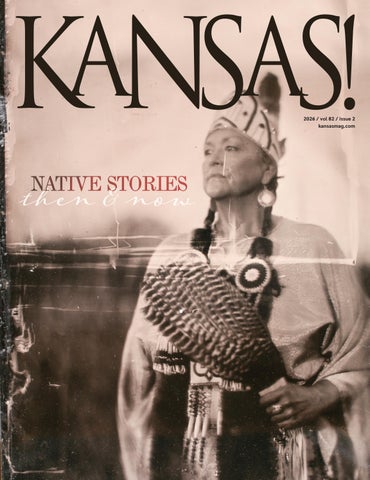
On the Cover Nicole Jay Nesahkluah (Apache) is one of the participants in the film and photography project First People of Kansas. Photo by Bo Rader.
5 KANSAS! magazine
Hello From Our Publisher From the Poet Laureate
KANSAS TOURISM, A DIVISION OF THE KANSAS DEPARTMENT OF COMMERCE
Andrea Etzel PUBLISHER
Laura Kelly GOVERNOR
David Toland
LT. GOVERNOR & SECRETARY OF COMMERCE
Bridgette Jobe TOURISM DIRECTOR
SUNFLOWERPUB.COM | LAWRENCE, KANSAS KSMAGAZINE@SUNFLOWERPUB.COM
DESIGN & PRODUCTION
Bill Uhler
Bob Cucciniello
Shelly Bryant
Gina DeBacker
Alex Tatro
Leslie Clugston Andres
Joanne Morgan
Beccy Tanner
PUBLISHER
DIRECTOR
DESIGNER/ART DIRECTOR
OPEN DAILY NEAR MINNEAPOLIS FREE ADMISSION 14 & UNDER
MANAGING EDITOR
ADVERTISING DESIGNER
MANAGING EDITOR
MARKETING JMORGAN@SUNFLOWERPUB.COM
CONSULTANT
WWW.SHERIDAN.COM
PRINTER
Susan Roberts ACCOUNT EXECUTIVE
Dan Lautner
ACCOUNT MANAGER
KANSAS! (ISSN 0022-8435) is published five (5) times per year by Kansas Tourism 1000 SW Jackson St., Suite 100 Topeka, KS 66612; 785.296.3479; TTY Hearing Impaired: 785.296.3487. Periodical postage paid at Topeka, KS, and at additional mailing offices. Newsstand price $6 per issue; subscription price $25 per year; $45 for two years. All prices include all applicable sales tax. Please address subscription inquiries to: Toll-free: 800.678.6424 KANSAS!, 1000 SW Jackson St., Suite 100 Topeka, KS 66612 Email: kansas.mag@ks.gov | Website: www.KansasMag.com POSTMASTER: Send address change to: KANSAS!, P.O. Box 146, Topeka, KS 66601-0146.
Maxwell Wildlife Refuge
Please mail all editorial inquiries to: KANSAS!, 1000 SW Jackson St., Suite 100 Topeka, KS 66612 email: kansas.mag@ks.gov The articles and photographs that appear in KANSAS! magazine may not be broadcast, published or otherwise reproduced without the express written consent of Kansas Tourism or the appropriate copyright owner. Unauthorized use is prohibited. Additional restrictions may apply.
Located in the heart of the Smoky Hills
visit our website for more information
MaxwellWildlifeRefuge.com tickets can be purchased online or reservations accepted by email or phone
MaxwellWildlifeRefuge@gmail.com
620.654.7230
Don’t miss out on Elk Days! The elk are out for viewing until March and then we bounce right into spring babies.
6 KANSAS! magazine
KANSAS /
the extra details
First People of Kansas
This issue features First People of Kansas, a photography and film project on display at the Homecoming Hall & Museum in St. John. Showcasing 15 portraits, 13 videos and a documentary, this exhibit spotlights Native American community members. The project honors a local photographic legacy: The Stafford County Historical Society holds one of the nation’s largest collections of 19th-century glass plate negatives. First People of Kansas’ portraits were created using this same historic technology. See stunning examples of this work by photographer Bo Rader in our article “Native Kansas” on page 32.
the extra details Meet SemiQuinn
America is Turning 250!
Our nation is gearing up for its semiquincentennial, and the celebration starts now. Instead of waiting until July 4, each state is rolling out a full year of activities as a way to reflect on our past and look ahead to our future. Here is a look at what Kansas has planned. Find all the details and more at travelks.com/kansas-250.
SemiQuinn the Bison, the official mascot for the Kansas 250 Commission, is on a celebratory stampede across the state. This adventurous stuffed ambassador has already visited the Watkins Museum of History in Lawrence and made memorable stops around Topeka and Hutchinson. Keep an eye out for him on your travels, or adopt a SemiQuinn at travelks.com/kansas-250. 9
6
4
PHOTOS COURTESY First People of Kansas, Watkins Museum of History
5
Kansas 250 Bookshelf Get into the literary spirit with the State Library of Kansas. Each month brings a new themed reading list and live events celebrating Kansas authors and stories.
Kansas 250 Outdoor Recreation Challenge If you love to spend time outside, join the Kansas Department of Wildlife & Parks and log 10 of your favorite outdoor activities before July 4, 2026, to receive a certification of completion.
Kansas 250 Specialty Gift Box Treat yourself, or someone special, with a curated box of Kansas-made goodies—honey, burger seasoning, kettle corn, plum jelly, lip balm and chocolate wine sauce, oh my!
7 KANSAS! magazine
7
1
2
Around the State
8
3
1 Strong City / page 10 2 Scott City / page 12 3 Eureka / page 15 4 Council Grove / page 17 5 Dodge City / page 17 6 Hays / page 19 7 Osawatomie / page 25 8 Augusta / page 27 9 Esbon / page 58
hello F R O M O U R P U B L I S H E R
They followed trails that were anything but guaranteed.
ANDREA ETZEL
PUBLISHER, KANSAS! MAGAZINE
facebook.com/KansasMagazine @KANSASMag KansasMagazine
(get spotted; use #kansasmag to tag us)
8 KANSAS! magazine
PHOTO Andrea Etzel
Holding this issue in my hands, I keep coming back to the idea that Kansas has always been shaped by people willing to lead the way. Whether carving lines across the land or taking to the sky, Kansas trailblazers have etched their legacies across our state. In this edition, we highlight the people who shaped Kansas—and those still shaping it today. In “Native Kansas” on page 32, writer Beccy Tanner connects the history of Kansas’ first people to the present day. Our Native nations are not confined to the past tense—they are vibrant, contemporary communities that carry their cultures forward. One of my favorite stories in this issue belongs to Connie Palacioz. At 101 years old, Connie is still telling her story with clarity, grit and grace. During World War II, she worked on B-29 bombers for Boeing as one of Kansas’ own “Rosie the Riveters.” In a rapidly changing world, millions of women felt it was their duty to take on these roles, even if they weren’t fully accepted. You can read her story on page 28. As you read this issue, a common thread is that Kansas history isn’t something that happened back then. It surrounds us. It’s something we still carry, still shape, and for which we are still responsible. I consider it a privilege that KANSAS! can share these stories with you.
Street Nihonga: The Art of Jimmy Tsutomu Mirikitani Open through June 28 Jimmy Tsutomu Mirikitani, untitled (white tiger with orange eyes), date unknown, Collection of Linda Hattendorf, Taos, New Mexico, EL2024.177
SPENCER MUSEUM OF ART
Home of the Last Remaining Lockheed Electra 10-E AmeliaEarhartHangarMuseum.org
‘Little Restaurant on the Prairie’ For three hours a week, Chef Stan’s Place becomes a culinary destination with a devoted following Story by Lisa Waterman Gray
n the heart of the Flint Hills, just beyond a gravel driveway in Strong City, sits Chef Stan’s Place. This charming restaurant is housed in a renovated white church built in 1905. Since opening in 2021, this once-a-week lunch spot, dubbed the “Little Restaurant on the Prairie,” has become a popular culinary destination. Inside, vintage wood tables and chairs seat up to 30 guests. The original wood floors, beautifully restored, complement the crisp white walls. A small wood stove and bar with a corrugated-metal facade punctuate the serene dining space, where sunlight pours in from the broad windows, offering tranquil views of fields and train tracks. Chef Stan Lerner, owner, chef and self-proclaimed dishwasher, cooks his Sunday brunches entirely from scratch. “In four years, our basic Sunday menu has not changed, and neither have the waitress and chef,” Lerner says. “I try to add seasonal specials, but people drive hours to eat the same food they had last time and come back because we don’t change anything.”
i
10 KANSAS! magazine
Photography by Dave Leiker
Customer favorites include super-chunky Tuscan tomato soup; crunchy, herbed sourdough bread; and enormous, decadent Magic Cookie Bars, which are drenched in chocolate sauce and topped with shredded coconut and chopped walnuts. The lunch menu also includes a hearty quiche with feta, gruyere and spinach; a savory bowl of three-cheese ravioli; and classic grilled cheese sandwiches. Plenty of fresh herbs garnish each dish. Opening a restaurant in a city of 400 people was a Above Chef Stan’s Place in Strong City is open only on Sundays, 11 a.m.–2 p.m.
KANSAS DETAILS /
cuisine
dramatic shift from Lerner’s early years in Los Angeles as an these three [open] restaurant hours. I’m artist, art dealer, film producer, author and chef. Lerner grew up also the florist and the arborist … I grow in California, where he frequently visited his aunt and uncle, two some ingredients in our raised beds.” socialites in Los Angeles who enjoyed taking their nephew to upLerner grows most of the produce and-coming restaurants. himself and locally sources whatever On one such occasion, when Lerner was just 12, he met Wolfgang else he can. He even makes his sweet Puck, who was preparing food for a party thrown by Lerner’s aunt. corn chowder with corn from the Lerner had always enjoyed cooking, but it wasn’t until he met Puck surrounding fields, thanks to an that he realized he could turn his hobby into a career. arrangement with the farmers. Puck showed the young Lerner a few tricks of the trade, “I want Chef Stan’s Place to be a including how to make his signature garlic chicken from his days unique, real, and very simple farm-torunning Spago in Beverly Hills. The trick, Lerner explains, is table experience … like going back in stuffing a handful of garlic cloves under the skin of the chicken time,” he adds. “I want my customers breast before baking it, then delicately removing them without to leave the world behind when they breaking the skin before searing the chicken on the grill. are here.” Facebook: Chef Stan’s Place Lerner first visited Kansas when checking on the production 213.400.4559 process for his book Criminal. “I had become fascinated with the idea of living a more normal life. I wanted to see what life was “I try to add seasonal specials, but people drive like outside of the [California] hours to eat the same food they had last time and bubble I lived in,” he says. “The only small town I had a connection come back because we don’t change anything.” with was Winfield.” – STAN LERNER In 2013, he moved to Winfield and opened the first of his three restaurants, Chef ’s Table. In 2020, he opened Chef ’s Table Roadhouse in Wichita. It closed in 2021, and Chef ’s Table closed in 2022. Before 225 Church Street was home to Chef Stan’s Place, the building served many purposes: it was a church, an American Legion post and even a youth tech center. Once Lerner purchased it, he spent three years restoring it. “I realized I really liked renovating,” he says. Lerner still spends about 40 hours per week renovating abandoned homes, leaving just enough time to create his exceptional once-a-week menu. The restaurant is open only on Sundays, 11 a.m.–2 p.m. This schedule first took shape to accommodate Lerner’s busy schedule operating his other restaurants. “I used to prepare food at Chef’s Table and bring it with me,” he says. “About 40 hours of cooking go into
11 KANSAS! magazine
Above To evoke a simple farm-to-table experience, Chef Stan Lerner grows most of the produce himself and locally sources whatever else he can.
The Steele homestead, which has been preserved as a museum, still features the family’s original furniture and tools.
12 KANSAS! magazine
KANSAS DETAILS /
heartland
A Heart of Steele
Two of Scott County’s earliest pioneers worked to share their homestead—and its extraordinary history—with the public Story by Cecilia Harris
Photography by Julie Mead
w
hen Herbert Steele, one of Scott County’s first European-American settlers, homesteaded what is now Historic Lake Scott State Park, he had no idea that hidden beneath the prairie just north of his homesite was the foundation of a much older home: the northernmost pueblo in the United States, built two centuries before. In 1892, Herbert married Eliza Landon, who was a teacher before the two met. The following year, Eliza purchased land near Ladder Creek for $225. It was here the newlyweds built their first home in a dugout hollowed into an east-facing slope, according to the article “The Steeles’ House of Stone” on ksoutdoors.gov. Nestled within Ladder Creek Canyon, the site drew its protection from the steep bluffs that lined the creek and its water supply from the area’s natural springs, says Greg Mills, manager of Historic Lake Scott State Park. In 1894, the couple used limestone to build a twostory addition, expanding the home to seven rooms. The entrance to the original one-story main floor faces west, but the new two-story addition faces east. Kansas Tourism
In their home, Eliza and Herbert carried out the typical tasks of homestead life. Eliza canned and preserved fruits and vegetables in the summer kitchen. She also wove cloth on a loom, while Herbert repaired tools in his workroom. Although the Steeles raised cattle and crops, their livelihood came from selling fruits and vegetables from their garden, which they hauled by wagon to Scott City. Over the years, they continued to expand their land holdings. One day while working the fields, Herbert made an unusual discovery. Accounts vary on the specifics—he either found ancient pottery shards or burnt corn, a crop he had never planted—and he contacted a professor at the University of Kansas to investigate. The archaeologist unearthed a sevenroom pueblo and believed the site to be part of El Cuartelejo, Mills says. In the late 1600s, two Pueblo Indian groups, the Taos and Picuris, fled Spanish rule in New Mexico for the Great Plains. These groups established a village among the Plains Apache known as El Cuartelejo. Later excavations from 26 sites throughout Ladder Creek
Above Herbert Steele discovered that his land contained the northernmost pueblo ruins ever found in the United States.
13 KANSAS! magazine
Touring the Steele homestead gives visitors a glimpse into pioneer life.
KANSAS DETAILS /
heartland
Canyon recovered artifacts such as tools, ornaments and pottery shards, all characteristic of the Plains Apache. These discoveries confirmed that the canyon was part of El Cuartelejo. The Steeles wanted to share the beauty and the history of their beloved land with the public, leading to the creation of Historic Lake Scott State Park. Unfortunately, both Herbert and Eliza died before seeing this dream fully realized—Herbert in 1929 and Eliza in 1930, just one month after the park opened. Today, the El Cuartelejo Archaeological District, a National Historic Landmark, surrounds the Steeles’ home, which is now a museum. Listed on the National Register of Historic Places, the home still features the Steeles’ original furniture and tools. State park guides remain on site during tourist season. Although the home is closed in the winter to protect the artifacts, visitors can always call the park office for a tour, Mills says. “[A tour] gives you a moment of what life was like back then. Pretty much everything is still there,” Mills says. “You can see Eliza’s stove and piano … Eliza’s loom in the workroom, their Victrola record player and Herbert’s tools. … It gives you a glimpse into their life rather than just reading a sign.” ksoutdoors.gov/state-parks/locations/historic-lake-scott 620.872.2061
plus.
Scott City Eureka
Teter Rock
Eureka / Hoping to settle along the Cottonwood River, pioneers in Greenwood County often found themselves lost in the rolling hills of the open grassland. They would ask local cattle ranchers for directions so often that, in the late 1800s, a pioneer named James Teter made a change. To help settlers find their way, he stacked a pile of flat rocks on the highest point of his property, now known as Teter Hill. But during the oil boom of the 1920s, construction workers carelessly, and without permission, used these rocks as building material. It wasn’t until the 1950s that Murle Teter hired pipeline workers to replace his grandfather’s original guiding post with a large limestone monolith. This leaning tower stands 16 feet tall, with 6 feet underground for stability. It is 8 feet wide at the base, 10 feet wide at the top, and 18 inches thick. gwhistory.com / 620.583.6682
15 KANSAS! magazine
G PRIN S R OVE CE DISC
REN W A IN L
explorelawrence.com
CAR SHOW • FOOD TRUCKS • LIVE ENTERTAINMENT CORNHOLE TOURNAMENT • BEER GARDEN • CRAFT VENDORS
April 25, 2026 3 pm - 9 pm Riggs Park, Haysville, KS
FOR MORE INFORMATION ABOUT THIS EVENT hellohaysville.com/ partyinthe060
Patriotism in Paint Abilene’s newest mural commemorates America’s 250th year Story by Cecilia Harris
Above Veterans (from left) Joe Black, Jim Thiel, Donald Gray, Triss, Scott Hayes and Bill Marshall stand in front of the General Dwight D. Eisenhower Veterans of Foreign Wars Post #3279 building in downtown Abilene.
Photography by Dave Mayes
16 KANSAS! magazine
KANSAS DETAILS /
culture
More Kansas Murals That Tell Our Story
t
he new Abilene Celebrates America 250! mural paints a picture of patriotism and civic pride. The project was unveiled in August 2024, kicking off Kansas’ celebration of our nation’s founding. It decorates the General Dwight D. Eisenhower Veterans of Foreign Wars (VFW) Post #3279 building in downtown Abilene. In 1976, Abilene celebrated the nation’s bicentennial by installing 11 informative markers at historic sites throughout the community. Julie Roller Weeks, director of the Abilene Convention and Visitors Bureau, has long admired these markers, which were installed before she was born. She believes present-day communities should create something lasting for future generations to commemorate the country’s semiquincentennial. “It’s important that we leave something for the next 50 years,” she says. “This mural is a great way to do that.” The mural, painted by Mindy Allen of Mindy’s Murals, uses various symbols of our nation’s heritage to honor its founders and military history. Look for America’s first official flag, designed by Betsy Ross and featuring a circle of 13 stars to represent the original colonies, as well as today’s American flag, featuring 50 stars to represent the states. The mural also features each branch of the military and silhouettes of both a minuteman from the American Revolution and a modern American soldier. But the mural’s central figure is the American bald eagle—a symbol the Founding Fathers chose in 1782 as the centerpiece of the Great Seal to represent America’s strength, freedom, independence and sovereignty. The project was a collaborative effort, Weeks says, with ideas and funding coming from the local VFW Post, the Abilene Chapter of the National Society Daughters of the American Revolution (NSDAR) and the Abilene Convention and Visitors Bureau. Additional funding was provided by a Community Foundation of Dickinson County grant and the NSDAR’s America 250! Celebration Grant, Weeks adds. “When you think of patriotic communities, Abilene certainly stands among the best,” she says. “One of our travel writers [who visited Abilene] said that when you look up the definition of Americana, it just says ‘See Abilene, Kansas.’” abilenekansas.org / 785.263.2231
For more information on other murals across Kansas, visit TravelKS.com/Murals.
Santa Fe Trail Council Grove / Located on the south wall of the Trail Days Arts & History Center, this mural depicts development along the Santa Fe Trail, from an Indian trail to a busy trade route. Threshing in Kansas Hutchinson / Painted inside the Hutchinson Post Office during the New Deal era, this mural depicts agricultural life on the Kansas plains, reflecting the role of farming, labor and rural communities in shaping central Kansas during the early 20th century. Restoration Lawrence / Located on the 31st Street
underpass near Haskell Indian Nations University, this mural highlights the Indigenous presence and the wetland landscape that shaped the Lawrence area.
Amelia Earhart Earthwork Atchison / While not a mural, this 1-acre portrait of Amelia Earhart stretches across a hillside overlooking Warnock Lake and celebrates the pioneering aviator’s life and legacy. It was composed with permanent plantings, stone and other natural materials. Border Gateways Fort Scott / This New Deal-era mural
in the Fort Scott Post Office (and former courthouse) reflects Fort Scott’s role as a 19th-century border outpost, depicting settlers in covered wagons arriving in Kansas in 1954.
Mining and History Museum Mural Galena / Inside
the Mining and History Museum, once the Missouri-Kansas-Texas Railroad Depot, this mural reflects the area’s railroad, mining and Route 66 history.
Native American Bison Dance Hays / This mural on
Main Street depicts the area’s landscape and Native peoples before European settlement. A bison dance and tribal symbols appear against a shortgrass prairie backdrop, reflecting both cultural tradition and an environment later altered by settlement.
Stagecoach Dodge City / This four-story mural, painted in 1979 on the side of the First National Bank Building, depicts a stagecoach descending a hill, using scale and perspective to convey movement. It celebrates the role stagecoaches played in Kansas history.
17 KANSAS! magazine
Flocking to Kansas Why prairie chickens have made west-central Kansas a global birding destination Story and photography by Michael Pearce
a
part-time eco-tourism business in west-central Kansas is attracting visitors from all around the world, and they are coming for a chance to see one of our prairie’s most striking feathered friends. “We’re up to people from 42 states and 20 countries,” says Jim Millensifer, who started Prairie Tours & Guide Service in 2019. “That includes most of Europe and Asia. We especially get a lot from the U.K.” The bird in question? Lesser prairie chickens. “If someone wants to see lesser prairie chickens, especially displaying on their breeding grounds, we’re about the only option,” Millensifer says. “It’s us or the annual Audubon of Kansas festival in Hays. They do a great job, too.” Lesser prairie chickens, which are smaller and paler than the greater prairie chickens of the Flint Hills and Smoky Hills, primarily live in the mid- to short-grass prairie of southwest and west-central Kansas. Jackie Augustine, the executive director of the Audubon of Kansas and a leading authority on prairie chickens, says that 2022 estimates place the range-wide lesser prairie chicken population at about 27,000 birds. Of those, roughly 75%— the majority—live in Kansas, mostly in the western Smoky Hill River basin. However, their range extends into parts of Colorado, Oklahoma, New Mexico and Texas.
18 KANSAS! magazine
Above Each spring, male lesser prairie chickens gather on their breeding grounds, called leks, to perform a theatrical mating dance.
KANSAS DETAILS /
air
On an ordinary day, these birds’ mottled coloring camouflages into the grasslands. Each spring, however, the males gather on their breeding grounds, called leks, where they perform a theatrical mating dance: they display their vibrant eyebrows, inflate air sacs in their throats and erect long plumes on their necks. Stomping their feet up to 17 times per second, their dance draws attention to their booming calls, and it’s all to mate with as many females as possible. Seeing lesser prairie chickens in person, however, has become increasingly difficult because of their dwindling population. Loss of habitat has greatly reduced the range and numbers of many grassland species, particularly the lesser prairie chicken. For the past decade, these grouse have found themselves on and off federal endangered or threatened listings due to legal challenges from various environmental, agricultural and energy interests. Reservations for Prairie Tours & Guide Service in Oakley are sometimes made up to 18 months in advance. Because tours fill quickly, many hopeful birders end up on a waitlist. When last-minute spots open up, some birders have been known to rush to the airport to catch flights to reach the birds’ breeding grounds in time for their early morning dance. Some of America’s top wildlife photographers book camouflaged shelters (known as blinds) for entire weeks. Opportunities to view these birds increased in 2018, when Kansas Tourism teamed up with Stacy Hoeme, a Gove County rancher, and the Smoky Valley Ranch, a property owned by The Nature Conservancy. Hoeme’s ranch and Smoky Valley Ranch were well known for their high numbers of lesser prairie chickens before their partnership. Both had already supported indepth research and facilitated bird-relocation efforts to other areas. But Hoeme was interested in an organized way to share this valuable resource while protecting the birds, their habitat and their ranching activities. He wanted to give guests a realistic look at why lesser prairie chickens thrive in the area. “It’s important people see that ranching and wildlife can thrive together,” Hoeme says. “We can show them that grazing is an important part of maintaining a healthy prairie and good wildlife populations, like prairie chickens.” Prairie Tours and Guide Services offer guided lek viewings from March 15 to May 15. Customers always arrive eager with anticipation, Hoeme says, and leave smiling at what they’ve seen. “If they’re serious birders, they really get into it,” he adds. “They thank us not only for what they just watched, but for taking care of wildlife while we’re ranching. It’s a good deal for them, the birds and western Kansas. We have something really special out here.” Above Some of America’s top wildlife photographers book blinds for weeks to view lesser prairie chickens on their breeding grounds.
19 KANSAS! magazine
don’t miss. Oakley Scott City Hays
Guided Tours
Prairie Tours & Guide Service, run by Jim Millensifer, offers guided tours in Oakley and Scott City from March 15 to May 15. To avoid putting too much pressure on the birds, tour dates and locations vary. Most viewing dates are reserved for tour groups although Millensifer sets aside days for the general public. kansasringneckclassic. com/nwkcf/lesser-prairiechicken-tours or email Millensifer at jhmillensifer@ gmail.com Audubon of Kansas’ annual Kansas Lek Treks PrairieChicken Festival in Hays usually takes place the second week of April. As well as lek viewing for lesser and greater prairie chickens, the festival also arranges field trips to a variety of natural wonders in western Kansas. Pre-registration is encouraged because the 150 available spaces fill quickly. audubonofkansas.org 785.537.4385
behind the scenes / K A N S A S D E T A I L S
BEHIND THE SCENES WITH
Rachael Sebastian Rachael Sebastian has lived in Kansas all her life. She was born in Marshall County and now lives near the Colorado border in Horace. She credits her mother, a journalist, for fostering her love of photography and teaching her how to shoot on film cameras when she was growing up. Sebastian, who studied journalism and Spanish at the University of Kansas, is now self-employed with Mira 3 Photography and manages social media and photography for Tongue River Ranch near Dumont, Texas. @mira3photography
What was your first camera? My first camera was a Kodak 110. When I got more serious about photography in middle school, I shot on a Pentax K1000. I used it so much I had to hold it shut with a rubber band. I still have it; it sits on my shelf.
Mira 3 Photography
see the horses’ legs, but they’re perfectly in sync, and their heads are lined up. I love the smooth, forward movement of the photo and Jaytyn’s cool expression. He’s in control. Tell us about the moments leading up to one of the photographs in this collection of your work. Some of my favorite moments are behind the bucking chutes at rodeos. It’s fun to see the athletes get ready. In a shot included here, you can see Cade Bell, a bronc rider, preparing his mind and tack. He’s ready to battle the broncs, who are already fighting each other in the background. In the photo, you can see the dust they’re kicking up.
What is one of the hardest subjects to photograph badly? To photograph well? It’s hard to take a bad photo of a cowboy. They’re so photogenic when they do their jobs— they’re usually stoic and rugged, even when they’re not busy. Their tack provides a lot of texture, from shiny spurs to stitched reins. Horses, however, are difficult to photograph well. You have to have the right lens and angle or they come out looking like donkeys. You also want to represent them well; you don’t want their legs crossed over wrong or their mouths gaping at the bit.
What is your most common advice to beginning photographers? SHOOT. Whatever camera you have is the best one. I also encourage young photographers to learn composition. Leading lines, framing, symmetry, foreground and background can all make stronger photographs. I recommend viewing and enjoying fine art to strengthen the knowledge of composition.
How would you describe your photography in terms of a color wheel? Is “dust” on the color wheel? Working in western Kansas and West Texas, I tend to photograph lots of dusty, back-lit photos. … Taupe, gold, sage and rust are the main colors in my photos.
What’s a Kansas location that you return to again and again to photograph? Monument Rocks. Particularly, Pyramid Ranch at Monument Rocks. My best friends manage it, and I keep a horse there. I love the tones of the rock formations and the canyonlands in the pasture. It’s pretty cool that it’s a huge working ranch, but the rock portion is open to the public to explore. I hold a western photography workshop called West of East there each year with Justine Johns of Open Triangle Photography.
Tell us about the shot that got away. I have a friend and model who rides ranch broncs (bucking horses ridden by cowboys in rodeos). He always does well … unless I’m there with my camera. I think my camera might be bad luck for him. I have countless photos of him working as a cowboy and at ranch rodeos, but none on a ranch bronc! What is your favorite chance photo taken in Kansas? My favorite chance photograph, which is in this collection of photos, is of Jaytyn Hash, a college rodeo athlete and pickup man. I was shooting photos for a shirt company where rodeo athletes were modeling the shirts, when Jaytyn flew by me picking up a bronc. That’s when I happened to catch the perfect shot. He’s on his pickup horse, reaching down for the bronc rein, and the other pickup man’s horse is also in the shot. You can’t
What’s a Kansas location you have never photographed, but would like to? I’ve never photographed the Gyp Hills but have always wanted to. Kansas has this reputation for being flat, but areas like the Gyp Hills, Monument Rocks, Arikaree Breaks, Little Jerusalem and the Flint Hills prove we have a really interesting terrain.
20 KANSAS! magazine
PHOTOS COURTESY Rachael Sebastian
mira3photography.shootproof.com
“Whatever camera you have is the best one.” –RACHAEL SEBASTIAN
captured / K A N S A S D E T A I L S
22 KANSAS! magazine
KANSAS DETAILS /
captured
Franklin County
“This picture captured cruise night at the Ol’ Marais River Run in Ottawa, when antique cars cruise downtown playing 50s and 60s music over their speakers. Growing up, I looked forward to going to this show each year with my dad. Now, being able to see not only past generations still attend, but the current generation and future generations enjoying what the past has brought … it’s just really cool to see.”
–Amanda Overton
Amanda Overton / Photographer amandaovertonphotography.mypixieset.com @amanda.overton.photography @amanda.overton.photography
Amanda Overton, who lives in a small town just outside Ottawa, got into photography in 2015. She looks forward to shooting the Ol’ Marais River Run, hosted by Over the Road Gang, each year. Using her Nikon D750, she captured this image by crossing the street during cruise night. It remains one of her favorite photos.
23 KANSAS! magazine
Kansas REASONS WE LOVE
By Cecilia Harris
Athol, Blue Rapids, Augusta, Ottawa, Osawatomie
IN THIS ISSUE
Historic Cabins
More than relics, these structures represent the resilience of the homesteaders who helped shape our state
KANSAS DETAILS /
reasons we love kansas
PHOTOS PHOTOS Nick COURTESY Krug Kansas Tourism
ADAIR CABIN Osawatomie / Although abolitionist John Brown is a prominent name in Kansas history, his half-sister Florella Adair and her husband, Rev. Samuel Adair, were actually the first members of the Brown family to settle in the territory. Relocating from Ohio, the couple moved into a log cabin just west of Osawatomie shortly after the KansasNebraska Act passed in 1854. This act repealed the Missouri Compromise and introduced popular sovereignty, allowing settlers to decide whether to allow slavery. This drew pro- and antislavery settlers—like the Adairs—into Kansas to control the territory’s future. Florella and Samuel worked alongside abolitionists to ensure Kansas entered the Union as a free state. The following spring, five of Brown’s sons also moved to Kansas to support the abolitionist movement. Brown arrived in Kansas shortly after receiving letters from his family describing the political upheaval and violence taking place. The one-room Adair cabin had once been a trading post, so it was about twice the size of a typical cabin for that time, says Grady Atwater, site administrator of the John Brown Museum State Historic Site. Its location was also strategic for the Brown family.
Just 20 miles east of the Missouri border, the cabin quickly became a station on the Underground Railroad. To support this dangerous work, the family made a few significant changes to the cabin, such as adding a back room concealing an underground cellar that hid freedom seekers. Brown and his sons also built a loft in the original cabin. It provided privacy for the women and safety for the children. “Home invasion was a common thing back then on both sides of the issue. If there were going to be bullets flying, they wanted the children upstairs,” Atwater says. “Rev. Adair knew his house was being watched [by proslavery forces]. He had a $50 price on his head as an abolitionist minister and leader. I’ve read stories that he sometimes slept outside in the woods because he knew they were waiting for him.” In 1912, this historic log cabin was moved from its original location to John Brown Park in Osawatomie. Enclosed in a stone pavilion, it now stands on the grounds where Brown fought in the Battle of Osawatomie—a violent battle between 30 Free-Staters and 250 proslavery forces. Although the Free-Staters lost the battle and Osawatomie burned, it was here that Brown earned the nickname “Osawatomie Brown” for his violent reputation. Following the battle, proslavery forces went to the Adair cabin in search of Brown. Had it not
25 KANSAS! magazine
been for Florella’s intervention, it too would have been burned, Atwater says. “She was eight months pregnant, and she stepped outside. They had a cannon pointed toward the cabin and 24 men surrounding it,” he adds. “She walked out and talked them out of burning the cabin down. They took everything from them—horses and whatever else they had—but they spared the cabin because only Florella and the family were there.” The main room of the cabin at the historic site looks like it did when the Adairs lived there, with family furnishings, household items, and other belongings on display. Among these is a melodeon, a musical instrument Atwater describes as “an accordion in a box.” It provided a simple pleasure the family enjoyed during that turbulent time. “It would fold up into a box, which made it portable,” he says. “It was a gift from Brown to his daughter Ruth when she got married in 1846, and it was played at his funeral.” The back room is filled with artifacts belonging to John Brown, including his holster, rifles and sword. In the surrounding exhibit gallery, the story of Brown’s role in the KansasMissouri Border War is shared through a rotating collection of artifacts. What people seem to love about this historic site, Atwater adds, is the sense of physical proximity to this trailblazer: “They are standing where John Brown once stood.” kansashistory.gov/john_brown 913.755.4384
Fort Scott, Kansas
An American Downtown, Then and Now.
Fort Scott's downtown during the Kansas Dairy Show, early 1910s
Discover Fort Scott for yourself! Stroll our historic streets, enjoy local flavors, and see why this small town's charm has lasted over a century.
Visit Fort Scott: Experience history, culture, and modern attractions all in one unforgettable destination
Fort Scott Downtown Present Day
In 1872, near his rustic cabin on the Smith County frontier, Dr. Brewster M. Higley wrote the poem “My Western Home.” These words became the lyrics for “Home on the Range,” which was later adopted as the Kansas state song. The cabin itself, completely restored in 2013, still stands in its original location. HOME ON THE RANGE CABIN Athol / This rustic cabin in Smith County holds a special place in American music history. It was the frontier home of Dr. Brewster M. Higley when he wrote “My Western Home,” the poem that became the lyrics for “Home on the Range.” Inspired by the rolling prairies surrounding the cabin, Higley wrote about the area’s beauty in 1872 while sitting on the bank of West Beaver Creek near his cabin. He later gave the poem to his friend Dan Kelley, who set it to music; Kelley gave it to his friend John Harlan, who sang it publicly with his family band. Thus, the iconic song was born. It became a favorite of President Franklin D. Roosevelt and many others across the nation. In 1947, it became the official state song of Kansas. Today, the Home on the Range Cabin is owned and managed by Peoples Heartland Foundation, a nonprofit organization chosen by former property owners Pete and Ellen Rust to ensure the cabin is maintained in its original location. In 2013, it was completely restored. Today, you can visit the museum from daylight to dark. homeontherangecabin.com 785.476.5216
DIETRICH CABIN Ottawa / When Jacob and Catherine Dietrich emigrated west in 1857, the couple stopped to camp on a hillside in Franklin County. The two German settlers were so impressed by the site’s beauty that they decided to make it their home. Unfortunately, their first cabin and most of their possessions were lost in a prairie fire the following year. To afford a new cabin, Catherine worked for a neighbor in exchange for room and board while Jacob worked to earn money for building supplies. The new cabin, located near presentday Princeton, was built on the same site as the first cabin, overlooking a timbered valley and near a fresh-water spring. It was constructed from handhewn native walnut logs with dovetailed corners and includes a sleeping loft. Measuring 18 by 21 feet, the cabin was moved to Ottawa’s City Park and restored in 1961 to serve as the focal point of Franklin County’s Kansas Centennial that same year. olddepotmuseum.org 785.242.1232
26 KANSAS! magazine
C.N. JAMES LOG CABIN & TRADING POST Augusta / The oldest building in Augusta is also one of only two log cabins in Kansas still on its original site. In 1868, C.N. James bought 80 acres of land and built a cabin of cottonwood logs from the banks of Walnut River. The growing settlement was incorporated on February 8, 1871, upon the petition of James and eight town taxpayers. The twostory building initially served as a home, trading post and general store, and later as the town’s first post office and school. Because there were no stairs inside the cabin, students and community members who needed to reach the upstairs loft had to climb a ladder on the outside of the building and crawl through a window. The furnished cabin, which is listed on the National Register of Historic Places, is part of the Augusta Historical Society complex and sits next door to the Augusta Historical Museum. Its artifacts depict life in Augusta from the mid-1800s through the 1940s, spanning the eras of early pioneers, the railroad’s arrival and the oil boom. augustahistoricalmuseum.com 316.775.5655
HOLM CABIN Blue Rapids / Around 1872, Swedish emigrants Frank and Augusta Sjoholm constructed this cabin on their farm 8 miles southeast of Blue Rapids. Because of their neighbors’ difficulty pronouncing their Swedish name, the Sjoholms became the Holms. The 12-by26-foot cabin was built to include two rooms and a sleeping loft. The couple used handhewn oak logs for the walls and walnut for the door frames. The lengthwise logs were shaped to a point, v-notched into the next log, and pinned with wooden pegs. The cabin was used for various purposes until 1996, when it was moved to Blue Rapids and placed on the south side of Fountain Park. bluerapids.org 785.268.0577
10-4pm Wed-Sat I 1-Spm Sun
(785) 887-6148 I www.lecomptonkansas.com
Scott Bean Photography
K A N S A S L A N D S C A P E A N D N AT U R E P H O T O G R A P H S
785-341-1047 | SCOTT@SCOTTBEANPHOTO.COM
The C.N. James Log Cabin & Trading Post in Augusta is one of only two log cabins in Kansas still on its original site. This two-story building initially served as a home, trading post and general store, and later as the town’s first post office and school.
27 KANSAS! magazine
www.scottbeanphoto.com
The
Rosie Effect
At 101, Kansas’ own “Rosie the Riveter” hasn’t lost her spunk or her strong work ethic Story by Beccy Tanner
Photography by Justin Lister
28 KANSAS! magazine
c
onnie Palacioz has always been a hard worker. At age 15, she was working her first job pressing uniforms in Newton for 25 cents an hour. So a few years later, when she heard on the radio that Boeing was hiring women for more than she was currently earning, Palacioz applied. What began as a practical decision eventually cemented her legacy. One of America’s original “Rosie the Riveters,” Palacioz, now 101 years old, helped build B-29 Superfortress bombers at the Boeing Wichita plant during World War II. She is celebrated not only as a Kansas treasure but also a national one. Becoming a Rosie During World War II, more than 6 million women entered the workforce to replace the men who reported for military duty. Today, there are about two dozen “Rosies” still living, according to a New York Post article from April 17, 2024. These women were honored with Congressional Gold Medals— the highest civilian honor given by Congress. The Boeing radio and newspaper advertisements first caught Palacioz’s attention when she was just 18 years old. “Boeing needed employees, especially riveters,” Palacioz says. Each workday, she took a bus from Newton to the Orpheum Theatre in Wichita. From there, she would walk to the Broadview Hotel, which is now the Drury Plaza Hotel. “They had instructors that would teach you how to rivet, how to drill—everything,” she adds. For the first two weeks, Palacioz took these training courses and was paid 50 cents an hour. When she completed the courses, she began work as an official Boeing riveter, which paid 75 cents an hour. Every day, she commuted by bus with 35 other Boeing employees to work 10-hour shifts. “I was kind of disappointed on the first day that I went to Boeing because I didn’t get to rivet. They had me take rivets from
Left Connie Palacioz is one of America’s original “Rosie the Riveters,” having helped build B-29 Superfortress bombers at the Boeing Wichita plant during World War II. Of the more than 6 million women who became factory and shipyard workers during World War II, only about two dozen “Rosies” are still living today.
29 KANSAS! magazine
the cages. I would go get the size of rivets that people wanted and hand them to them. And that’s all I did on the first day,” Palacioz says. “On the third day, my boss told me that he had a bucker.” For every successful riveter, there is a bucker—these two would work as a team. The riveter would press a special gun against an inserted rivet, while at the same time, the bucker would hold a heavy “bucking” bar against the opposite end. The pressure from the gun would smash the rivet flat against the bar, locking it into place. However, no one wanted to work with this particular bucker. “They had her cleaning bathrooms,” Palacioz explains. “I asked, ‘Why don’t they want to work with her? I’ll work with her!’ But he told me that they didn’t want to work with her because she was Black.” Palacioz, the daughter of Mexican immigrants—her father was from Monterrey and her mother from Guadalajara—was no stranger to prejudice and racial discrimination. “I said I didn’t mind working with her … I’m a minority, too,” she says. The bucker’s name was Jerri Warden. “She looked at me and said, ‘Are you sure you want to work with me?’ I said, ‘Yeah, I came to work. I didn’t come here to be giving other people rivets.’ She said ‘OK.’ And you know what? She was the best bucker … we really became a team.” Both Palacioz and Warden had to get creative with their problem-solving when applying rivets to a plane’s pilot section, also known as the nose. This cramped space was often the hardest area to
During World War II, cities such as Wichita transformed almost overnight into major manufacturing centers. The B-29s that Connie Palacioz helped build were designed to fly faster, climb higher, and carry a heavier payload than any previous bomber. The challenge, though, was to get these planes combat-ready for the Pacific theater as quickly as possible. The U.S. Army Air Forces ordered 250 B-29s on September 6, 1941—months before the attack on Pearl Harbor. However, the planes could not be built in Wichita until Boeing’s new factory was completed in January 1943. Fulfilling this order required an army of workers recruited from across Kansas and neighboring states. New air bases were also being constructed throughout Kansas as the state emerged as a major training center for pilots and their crews. Eventually, the army ordered more B-29 Superfortress bombers. This enormous, seemingly impossible effort to build, modify, train and deliver thousands of bombers for Europe and the Pacific became known as the “Battle Over Kansas.” At the peak of this effort, 45 percent of Boeing’s 29,000 employees were women, according to Doc’s Friends, the B-29 restoration organization’s website.
spaces
rivet because of its odd shape. One of the most difficult tasks, Palacioz says, was positioning the bucking bar. Warden would draw pictures that showed how the bars needed to be angled for each tight spot. “I couldn’t have done it without her,” Palacioz says. Together, the two women riveted 1,644 pilot sections of the B-29s at Boeing’s Wichita plant, with their work consistently passing inspection. “They were passing four pilot sections a day because the Air Force wanted those planes,” Palacioz says. “We had to get them out.” Of course, there were times when both Palacioz and Warden faced discrimination, mostly from male co-workers who did things they could never get away with in a modern workplace. For example, their work involved using green clay between the planes’ metal skins. “[Some men] would make figures [out of the clay] and throw them at me,” she says. “One made a breast—like a woman’s breast. I just threw it right back at him. That made me so mad.” Restoring Doc In 1987, a B-29 Superfortress nicknamed “Doc” was found at the China Lake Naval Air Weapons Station in California—a boneyard where old aircraft are left to decay. Doc had sat untouched in the Mojave Desert for 42 years. In 2000, an effort began to restore Doc to flying condition. He was hauled back to Wichita in sections on flatbed trailers. When Palacioz heard about the restoration project, she volunteered to help. She was surprised to learn that she and Doc were actually old friends. She and Warden had installed the rivets in this plane’s pilot section.
Above Two women work on the inside of a Boeing plane part.
30 KANSAS! magazine
PHOTO Copyright © 2022 The Boeing Company. All Rights Reserved.
The Battle Over Kansas
WIDE OPEN
WIDE OPEN
spaces
“The rivets are still the originals that I put in. … Only seven were missing,” she says. Remarkably, Doc remained in good condition despite spending four decades in China Lake—a site where old planes were used for target practice. Doc was fully restored in 16 years. “I worked really hard to clean it,” Palacioz remembers. “It was out there so long in the desert. … Pigeons had gotten in, and it was really dirty, nasty and messy. I spent three months in coveralls and goggles cleaning it.” Since its restoration, Palacioz has frequently joined the crew to show off the plane and help raise money for Doc’s Friends, a nonprofit that manages the fully restored aircraft. A 2017 video from the Wichita Eagle shows Palacioz seated and ready to take her first ride in Doc. In the video, she makes the sign of the cross and prays for a safe ride. Palacioz’s daughter, Leticia Nielsen, is undeniably proud of her. “She’s met thousands of people and signed thousands of autographs. People have really embraced her and her story … that’s what America is all about,” Nielsen says. “Doc is family to my mom and to all of the volunteers, who are all dedicated retired employees from Boeing.”
I told her that was because I learned my Spanish first but that I was born in Peabody. She started a petition to throw us out,” Palacioz says. “The dean of the college told her that if they had to get rid of the Palaciozes, then all the GIs must go.” Eventually, the petition was dropped. Palacioz later divorced and, as a single mother, raised her three sons, a foster son, and a daughter. She supported her family by working as a hairdresser. Although she lost contact with Warden, she never fails to mention their friendship in any presentation she makes about being a “Rosie.” “My mom taught me to respect everybody,” Nielsen says. “That’s one aspect Mom has carried through life. Even now, as we travel to all these air shows and meet all different kinds of people. ... We’ve been really blessed with her life and that she’s able to be with us and is still of sound mind and pretty good health. The only thing is her hearing. Every once in a while, I have to repeat something.” In recent years, Palacioz has been recognized both at home and abroad for her contributions at Boeing. In 2022, Palacioz was inducted as the inaugural member of the Women in Aviation – Kansas Women’s Hall of Fame. Last year, she was one of 150 veterans flown by American Airlines to Normandy, France, to commemorate the 80th anniversary of D-Day. “Every night, when we’ve gone to bed, she talks about those volunteers who did not live to see [Doc] fly,” Nielsen says. “That’s how unselfish my mom is.” Reflecting on her time as a “Rosie,” Palacioz simply says, “I’m glad I could do it.”
After the War After the war ended in 1945, Palacioz married. Her husband attended Emporia State University using the GI Bill, which provides educational benefits for returning veterans. But while living in Emporia, she faced discrimination from a neighbor who asked if she was a war bride. “I told the woman I was a Kansan. She said I had an accent.
31 KANSAS! magazine
Above Palacioz shows off her Congressional Gold Medal next to jars of sand she brought back from Normandy, France, when she and 150 other veterans were flown there to honor the 80th anniversary of D-Day.
Native Kansas
From ancient settlements to modern communities, Native Americans have never disappeared from the Kansas landscape
Story by Beccy Tanner Photography courtesy First People of Kansas
WIDE OPEN
spaces
f
Opposite Rod Pocowatchit of the Comanche, Pawnee and Shawnee nations is a Wichita filmmaker who aims to see more Native Americans represented in popular culture. Above Loretha Joy Lewis of the Yuchi Tribe of the Muscogee Nation is a Native American artist and specializes in bronze, copper and silver jewelry.
or generations, Kansas students, propped behind their history books, have learned that Native American tribes were nomadic and forced out of Kansas during the 19th century. While that’s true, it’s not the whole story. Today, historians and educators are sharing a more expansive and diverse history, one that honors resilience and ingenuity in Native American communities as they navigate a modern, changing world. The Haskell Cultural Center & Museum is one place that is always working to share and preserve the history, culture and art of Native American “We’ve learned the trading routes peoples. Each year, more than among different Native groups were 4,000 people visit the center, and many of them ask the way more extensive than we used same questions: “Do Native to think. This definitely says there Americans still live in tipis?” “Do they still hunt buffalo?” was some trading going on between No, says Travis Campbell, groups that we didn’t think existed.” director of the Haskell Cultural Center & Museum. – KEN SPURGEON Probably not. contemporary identities are all shaped “It’s stagnation,” he says. “They view by their histories and environments. us as being stagnant and stuck in the 19th Conversations that treat Native century, when we are very much in this Americans as a monolith erase their place and part of the modern world. … They immense diversity. view us as tourism objects.” Campbell (Cherokee, Choctaw, Delaware) encourages people to reach out Managing Misconceptions to the museum and learn all that they can There are misconceptions surrounding about Native American tribes. “I strongly Indigenous peoples, many of which are encourage K–12 educators to do that. We steeped in a lack of education about the hear about specific points in history, but subject matter. other points are glossed over. There’s no “I think the largest misconception cohesive narrative,” he adds. is that tribes are viewed in a historical context rather than a contemporary one,” Unraveling the Past Campbell says. “People tend to think that The truth is that Native Americans have tribes ceased to exist at the end of the 19th lived on the Kansas prairie longer than century, and that’s definitely not the case.” any other group. Another common misconception, “I don’t know that we have a date of Campbell adds, is that some people “tend origin,” says Ken Spurgeon, a prominent to group tribes as one stereotypical being Kansas-based filmmaker, writer and rather than diverse cultures from different historian. “But we do know that they were geographical regions.” here several thousand years ago. Who There are 574 federally recognized they were is maybe the most interesting tribes in the United States, each with its question—What tribe? What people? That own language, system of governance and is a bit unsolved.” spiritual beliefs. Their unique cultures and
33 KANSAS! magazine
WIDE OPEN
During the late 18th and early 19th centuries, the tribes who inhabited the land of present-day Kansas included the Kanza, Osage, Wichita, Kiowa, Kiowa/Apache, Comanche, Pawnee, Cheyenne and Arapaho. “One of the earliest tribes we can track or attribute to the area would be the people who are part of the Wichita—the Caddoan group or Quiviran,” Spurgeon says. “We used to think they were mobile … we are finding that there were some very long-lasting, sedentary communities.” After recent archaeological digs near Arkansas City, the understanding of nomadic Native Americans is changing. Evidence suggests a massive population of Native Americans, the Etzanoans, lived on this site for centuries. Their society was complex and their trade network impressive. “We’ve learned the trading routes among different Native groups were way more extensive than we used to think,” says Spurgeon, who points to the discovery of items from our region in the southwest and on the East Coast as evidence. “This definitely says there was some trading going on between groups that we didn’t think existed.” But the arrival of Europeans in the Americas set in motion profound changes. As American expansion pushed westward in the 19th century, the U.S. federal government negotiated treaties with Native American nations—but repeatedly broke them and forcibly removed Native tribes from Kansas. In 1862, President Abraham Lincoln signed the Homestead Act, opening Indigenous lands to settlement by U.S. citizens and prospective citizens who met its requirements, a policy that disproportionately benefited White settlers. Native Americans were not eligible to reclaim
Above Rani (left) and Chuck Rivas, of Chickasaw and Spanish heritage, live in Wichita. Chuck worked as a deputy sheriff in the Sedgwick County Sheriff’s Office for 20 years.
34 KANSAS! magazine
spaces
their land under the act because they were not recognized as American citizens until 1924. Federal policies toward Native Americans did not end with removal; officials also pursued assimilation as another response to Native presence. From 1819 to the 1960s, about 526 government-funded boarding schools operated across the United States, but they were most often intended to erase Native American culture. Hundreds of thousands of Native children were taken from their homes by U.S. government authorities, often through coercion or pressure on families, and placed in boarding schools, where they were forbidden to speak their native language and forced to cut their hair and give up their traditional clothing. Instead of practicing their religions, they were taught to practice Christianity. Although the children learned useful life skills, they were punished if they did not assimilate into Western culture. For 87-year-old Chuck Rivas, understanding his Chickasaw and Spanish heritage has been a lifelong mission. Although he has spent most of his life in Wichita, he was born in Oklahoma and resided in a government boarding school there. “[My parents] put me in a government school when I was in the seventh grade,” he says. “I didn’t understand why. They dropped me off there and said, ‘This is where you will stay until the end of the year.’ Then they went home.” Like many Native families, Rivas’ parents made the decision within a system that offered few real alternatives. Devastated, Rivas hitchhiked home to demand answers. His parents said that, until they found financial stability, he and his brother would have to live there. Rivas remembers the hurt he felt being separated from his family. After graduating, he attended the Haskell Institute, then served in the U.S. Army during the Vietnam War. He did not see his mother for another six years.
Don Blakeslee (left) is a Great Plains archaeologist of Native American cultures, and Loretha Joy Lewis spent a lot of her career as a museum curator and specialized in Native American exhibits.
WIDE OPEN
Clifford Stone, of the Kiowa, CheyenneArapaho and Cherokee tribes, is the head man at the Veterans Intertribal Powwow sponsored by the Wichita Warriors Society.
spaces
WIDE OPEN
spaces
“I walked up and knocked on [her] door,” says Rivas about returning home after so long. “When she answered the door, she fainted. I picked her up … and said, ‘What’s wrong?’ She said, ‘I thought you were dead.’” He couldn’t write home to her during the war. Despite decades of forced displacement and assimilation, a significant Native presence remained in Kansas. The Iowa, Kickapoo, Prairie Band Potawatomi Nation, and Sac and Fox Nation maintained reservations within the state. And in the decades that followed, many returned for new opportunities—laboring on railroads, working in Wichita’s aircraft manufacturing plants during World War II, and otherwise serving their communities. That, Spurgeon says, is what has been left out of textbooks. “They are still here,” he says. “They never left. They have always been here. If anything, we have ignored them. We have done them wrong by ignoring their presence and influence.” Rivas’ story offers one example of how those policies played out in a single life. Despite the years away from family, his Native spirituality never dimmed. This, he says, is what helped him understand his past, present and future. Now, at 87, he says that he is helping one of his adopted sons find peace during an illness. “He told me, ‘Dad, I think I’m going to go. I’ve seen that river. I’m ready to cross. … I hear Grandpa and Grandma and my dad and mom talking in the kitchen, and they’re not there.’ He said, ‘It’s getting close, but I’m ready.’ I said, ‘Son, go to that valley where the grass is green and soft. Look at those flowers. You will see multiple colors. Beautiful colors. Smell the aroma and enjoy that soft wind that caresses you. It is going to be okay … an easy way home.’” Even after decades of separation and loss, the spiritual traditions of Rivas’ childhood continue to guide him—and the generations that follow.
Above (from top) Greg Victors (Ponca) and Pauline Sharp (Kanza).
37 KANSAS! magazine
First People of Kansas P R O J E C T The photos in this article feature some of the people who were interviewed in the documentary series First People of Kansas. This series shares formerly untold stories of Native Americans who live in the Wichita area and whose ancestors lived in the Stafford County area. The photos, taken by Bo Rader, capture what make each person and their tribe unique. Rader used a 19thcentury photography technique that requires the photographer to coat a special glass plate with light-sensitive material, then expose and develop the photo while the plate is still wet. Author Beccy Tanner was the project director of this film and photography project.
Bob Rader photographs Greg Victors
Follow these historic trails to trace the story of America’s westward expansion STORY BY MICHAEL D. KING
the trails that shaped kansas
here is a particular kind of quiet that settles over the Kansas prairie, a silence so vast it feels like a presence. At first glance, there is nothing here but the enormous sky and an ocean of swaying tallgrass. It’s the sort of place you might call empty. An ordinary world. But that’s a mistake. If you look—really look—you begin to see the allure. Faint, shallow depressions in the earth, like old scars, curve away toward the horizon. Easily missed, they are the ghosts of roads long traveled—the Santa Fe Trail, the Western Cattle Trail, the Pony Express—their ruts worn deep by the passage of a nation on the move. Standing here on the 250th anniversary of the Declaration of Independence, one feels an odd sort of connection. The words written on parchment in 1776 were a promise, the ideas of liberty and the pursuit of happiness. But here, etched into the very soil of Kansas, is the proof of that journey to claim the promise. And in the distance, a pair of steel rails glints under the sun, a subtle warning that all eras must, eventually, come to an end.
journal entries of travelers like Dr. Rowland Willard and Harriet Bidwell Shaw capture the beauty and challenges of this trail. Willard, whose account details the trail’s early years, expressed anxiety over finding safe resources, while Shaw, who experienced a more established route, highlighted her battle with mosquitoes, underscoring that the true challenge was enduring hardships, not just conquering land. The Trail of Thunder and Dust If the Santa Fe Trail was like a calculating merchant, the cattle trails were its restless younger brothers. The Chisholm and Western Cattle Trails sprawled across Kansas, driven by a stark post-Civil War economic imbalance—steers worth $4 in Texas could sell for $40 in Kansas. This price gap inspired young entrepreneurs like Joseph G. McCoy, who built stockyards in Abilene to serve as cattle-drive destinations. From 1867, millions of longhorns flooded northward. The initial route of the famous Chisholm Trail ran from South Texas through Indian Territory to Abilene. But as land was claimed, the Western Cattle Trail opened further west to Dodge City, the “Queen of the Cowtowns.” Here, after long, tedious months on the trail, cowboys could shed their responsibilities, celebrating with drinks and games before returning to grueling work. However, the myth of the carefree cowboy masks a more complex reality. The drives were organized supply chains that moved cattle steadily to gain weight, and many laborers were young and of Hispanic or African American descent. Letters from Charles Robinson, a farmer-turnedcattle driver in 1886 and 1887, reveal his struggles on the drives. At 30, feeling profoundly lonely and earning $35 a month, he left his farm. His wife, Mollie, reported their infant son’s distress in his absence. Behind each cowboy’s revelry on the cattle trails lay stories of quiet sacrifice—not for glory, but for love.
The Trail of Commerce My journey into this hidden world begins on the Santa Fe Trail, a path shaped more by shrewd merchants than idealistic pioneers. It ran from the Missouri border, splitting into Cimarron and Mountain routes near Dodge City, where the ruts remain clear—a lasting mark on the land. One of the earliest trails for American expansion in the Old West, the Santa Fe Trail emerged in 1821, not from dreams but from desperation, with William Becknell, a trader at risk of bankruptcy, as its unlikely hero. His westward trip was a final gamble that opened new opportunities when Mexico, newly independent, welcomed him as a trader. Returning to Missouri, he transformed a $3,000 investment into an astounding $91,000, establishing a crucial commercial route connecting the United States to Mexico. However, this trail later became a military path during the 1846 invasion of Mexico, illustrating the blurred line between commerce and conquest. The
The Trails of Whispers and Warnings Not all the trails crossing Kansas were created for endurance. Two notable examples stand out for their intensity: the Pony Express and the Smoky Hill Trail.
40 KANSAS! magazine
PHOTOS COURTESY Kansas Tourism
One of the earliest trails for American expansion in the Old West, the Santa Fe Trail emerged in 1821, not from dreams but from desperation.
41 KANSAS! magazine
The Pony Express operated for a brief and dazzling 18 months in 1860 and 1861. Throughout Kansas, much of the trail overlapped with the well-established Oregon Trail. The overlap was deliberate, as traders, trappers and immigrants had traveled the Oregon Trail through the region’s difficult terrain for more than half a century. The Pony Express took advantage of the established thoroughfare. To achieve its speedy deliveries, this legendary mail service relied on a network of stations spaced 10 to 15 miles apart. Riders mounted a fresh horse at each station, and new riders switched out every 75 to 100 miles. Its riders were the wizards of this operation, although they were little more than boys and described as “young, skinny, wiry fellows ... willing to risk death daily,” according to a famous advertisement. They were paid between $100 and $125 a month to ride through peril … and peril they encountered. One rider was crushed to death when his horse stumbled over an ox in the dark. Another lost his mail when he drowned crossing the Platte River. A third rider, an inexperienced German boy, lost his way near Fort Kearney and froze to death. The sheer
grit required was immense; a 35-year-old rider named William Boulton—one of the older riders in service—found himself a mere 5 miles from the station when his horse became exhausted. In an effort to make his post, he took his mail pouch off the horse and rushed the rest of the way on foot. While the Pony Express worked to mend a divided nation, the Smoky Hill Trail carried the dreams of individual fortune-seekers. Prompted by the Pike’s Peak Gold Rush in 1859, promoters convinced desperate prospectors it was the fastest route from the Missouri River to the gold fields of Colorado. Newspapers in nearby towns, eager for business, published wildly optimistic accounts of a well-provisioned path. The reality, however, was a desolate, poorly marked track that quickly earned a more sinister nickname: the “Starvation Trail.” One particular group of travelers, known as the Blue brothers, became so hopelessly lost, the only survivor resorted to cannibalism. The Rocky Mountain News condemned the trail’s promoters, declaring they stood “in the sight of Heaven, guilty of manslaughter” on what it called
Explore
FREE ZOO
GREAT BEND CONVENTION & VISITORS BUREAU
www.exploregreatbend.com
42 620-792-2750 3111 10th St. Great Bend, KS 67530 KANSAS! magazine
COMMUNITY EVENTS
HISTORY
CHEYENNE BOTTOMS
Above ????????????
the “fated Smoky Hell route.” The Smoky Hill Trail thus stands as a grim monument to the human cost of Manifest Destiny when ambition outpaces preparation. The Arrival of the Iron Serpent The end of the age of trails did not come quietly, but with the roar of steam and screech of steel. The arrival of the railroad was like the emergence of a magnificent “Iron Serpent” that consumed the prairie, obliterating the old ways and ushering in a new era. For 60 years, the Santa Fe Trail had been the lifeline of the Southwest. However, in February 1880, when the Atchison, Topeka, and Santa Fe Railway reached Santa Fe, the trail’s purpose faded into history. The same fate awaited other trails. As the railroad pushed relentlessly westward—accelerated by President Abraham Lincoln’s 1862 Homestead Act— arduous cattle drives became unnecessary and the era of stagecoaches came to an end. The logic of the trails was based on adaptation—travelers followed the landscape, seeking river fords and gentle slopes. But the railroad inverted this logic. With the aid of bridges and dynamite, it did not adapt to the land but rather imposed its will in straight lines of iron. This new power was undeniably creative. It built cities where none had existed prior, transforming quiet towns into bustling hubs. By 1890, Kansas boasted more miles of railroad track per capita than any other state or country in the world. It brought jobs, attracted settlers of all faiths and cultures, enabled commercial agriculture across the state and connected Kansas to the broader world. However, this force of progress had a profoundly destructive side. The railroad facilitated the removal of Native American tribes from their homeland and the great slaughter of the bison. Between 1872 and 1874 alone, railroads shipped more than 7 million hides from the Great Plains, contributing to the neartotal eradication of the herds that had sustained the Plains tribes for centuries. This was the dismantling of one world to make way for another.
Ironically, the trails themselves had unwittingly contributed to their own demise. The commerce along the Santa Fe Trail, the vast cattle industry of the Chisholm and Western Trails, and the national demand for connection exemplified by the Pony Express—all these successes established a compelling business case for the railroad. The pioneers and cowboys, through their struggles and triumphs, demonstrated that the West was worth the substantial investment, ultimately paving the way for the very force that would render them obsolete. The Inheritance in the Dust I find myself back where I began, by the side of the road, as the sun bleeds across the horizon. The prairie no longer appears empty; it is vibrant, filled with the echoes of merchants and missionaries, lonely cowboys and doomed gold-seekers, boys on fast ponies, and the great “Iron Serpent” that followed them all. The quiet is still here, but now it carries a different weight. Historian Frederick Jackson Turner famously argued that the American character was forged on the frontier, suggesting that the process of “winning a wilderness” created a new type of person— independent, inventive, democratic. As America prepares to commemorate 250 years since its founding declaration, it’s evident that the promise made in Philadelphia was both tested and shaped right here. The pursuit of happiness came with mosquitoes and swollen rivers. Liberty was discovered at the end of a long, dusty cattle drive. Life itself was a fragile commodity, risked daily for mail, for gold, or for a piece of land to call one’s own. The ideals of 1776 were a beautiful dream, but its fulfillment was not inscribed on parchment. It was etched, mile by painful mile, into the soil of Kansas. These ruts in the earth serve as America’s other founding document.
Story by Marsha Henry Goff
PHOTO COURTESY (FROM LEFT) Library of Congress, Wikimedia Commons(2), Library of Congress
These courageous trailblazers made a lasting impact on Kansas history
45 KANSAS! magazine
Curtis 1860–1936
46 KANSAS! magazine
PHOTO COURTESY Library of Congress
Charles
Few vice presidents are remembered beyond their time in office, but that doesn’t make their contributions any less significant. Curtis, who served as President Herbert Hoover’s vice president, broke racial barriers as the first person of color to be vice president and the only vice president known to have Native American heritage. Curtis was a member of the Kaw Nation. After his mother died when he was three and his father joined the Union Army, his Native American grandmother took him in, and he lived with her on a reservation in Council Grove. She later sent him to live with his white grandmother in Topeka so that she could support his education. Everything he achieved, Curtis later said, he owed to his French-Kaw grandmother. At 21, he passed the bar and served as an attorney for Shawnee County. Kansans later elected him to Congress, where he served in the House of Representatives for 14 years. This led to a seat in the United States Senate for an additional 20 years, where he became the Senate’s first official majority leader. Then in 1928, he sought the Republican nomination for president, but ended up as Hoover’s running mate. His legacy, however, is not without its complexities. As a senator, he sponsored the Curtis Act of 1898, which undermined Native American sovereignty by abolishing tribal courts and placed residents of tribal lands under federal law. As a child, Curtis was forced to choose between his two cultures. When he lived with his white grandmother, he was taught that the best way for Native Americans to succeed was to assimilate—a belief he held through adulthood. But Curtis also advocated for granting U.S. citizenship to Native Americans and was a strong champion of women’s rights. He introduced the Equal Rights Amendment in the Senate in 1923. After the Hoover-Curtis term ended in 1933, Curtis returned to law and practiced in Washington, D.C., until his death.
PHOTO COURTESY Kansas State Historical Society
While Susan B. Anthony’s and Elizabeth Cady Stanton’s roles in the women’s suffrage movement are well-known, few know of Nichols’ efforts. Nicknamed the “Forgotten Feminist of Kansas,” Nichols led the successful fight for women’s first voting right in the state—a ballot in school board elections. Nichols, who was originally from Vermont, had three children with her first husband. But due to his emotional abuse, she divorced him and took her children to her parents’ home. She began work as a reporter for the Windham County Democrat, where she met George Nichols, the newspaper’s editor and publisher. The two married after her divorce was final. During this time, Nichols wrote about women’s rights, drawing on her understanding of how divorce laws unfairly favored men in matters related to their children. Over the years, as George’s health failed, she quietly became editor. She moved to Kansas after the passage of the Kansas-Nebraska Act of 1854, which allowed Kansas settlers to decide whether Kansas would enter the Union as a free or slave state. As a staunch abolitionist, she was determined to fight for the rights of both women and Black individuals. She moved to Lawrence with her two older sons in October 1854, then later brought her husband and their young son to Kansas. In 1855, her advocacy for women’s rights earned her an invitation to speak on the issue at the proposed Free-State Constitutional Convention in Topeka. Her husband’s death prevented her from appearing. Despite this missed opportunity, Nichols used her platform to convince Kansas representatives to include a number of women’s rights in the Kansas Constitution, such as the right to own property outright, to gain custody of their children in cases of divorce, and to vote in school board elections. In 1856, at the instance of Horace Greeley, Nichols spent about two months lecturing in western New York for the Kansas National Aid Committee and organizing women’s relief efforts. She won over audiences, especially the men, with her keen sense of humor and less strident delivery than that of other contemporary feminists. Preachers, whom she often debated, appreciated her ability to quote Bible passages. Nichols devoted the rest of her life to advocating for women’s rights. She left Kansas in 1872 for California, where she continued the fight until her death in 1885.
Clarina Irene
Howard Nichols 1810–1885
47 KANSAS! magazine
McDaniel 1893–1952
48 KANSAS! magazine
PHOTO COURTESY Wikimedia Commons
Hattie
McDaniel delivered an outstanding performance in Gone with the Wind, winning the 1940 Academy Award for Best Supporting Actress and making history as the first African American to win the award. But her talent was not limited to the silver screen. She was a skilled comedienne, singer, songwriter and dancer with big dreams. Born in Wichita, McDaniel was raised by her parents, who had formerly been enslaved. Despite her mother’s protests, McDaniel dropped out of high school her sophomore year to pursue a career as an entertainer. She traveled with her father and brother’s minstrel show and sometimes performed with a comedy group. In 1931, she moved to California to try her luck in the film industry. Unfortunately, most roles for people of color were either enslaved people or servants. She earned minor roles in several movies, but her big break came when she landed the role of Mammy in Gone with the Wind. McDaniel also faced criticism from the Black community for this role because it played into racial stereotypes. She quieted critics by saying, “I’d rather play a maid for $700 a week than be one for $7.” With segregation still prevalent across the country, McDaniel and the other Black cast members were not allowed to attend the movie’s premiere in Atlanta. When she was nominated for an Academy Award, she was forced to seek special permission to attend the event, which was held at a “whites only” hotel in Los Angeles. She was not permitted to sit with her white cast members and was required to use a separate entrance. Following the success of Gone with the Wind, McDaniel went on to build a long and fruitful career. During World War II, she starred in several films a year and organized entertainment for Black soldiers. She performed on the radio and, in 1947, landed the lead role in the radio version of The Beulah Show, which, in 1950, became the first television sitcom to star an African American actress, a role originated by Ethel Waters. McDaniel died from breast cancer at age 59. Her wish to be buried in the Hollywood Forever Cemetery was denied due to her race. In 1999, the cemetery’s new owner sought to fix the past owner’s mistakes and offered to move her remains. Her family didn’t want her disinterred, so the cemetery erected a beautiful pink marble memorial in its scenic Garden of Legend to honor McDaniel and her legacy.
Langston
Hughes
PHOTO COURTESY Library of Congress
1902–1967 Hughes is well known for shaping American literature with his influential books, plays and jazz poetry. He became known as the “Poet Laureate of Harlem” early in his career and was a significant figure in the Harlem Renaissance. His first book, Not Without Laughter (1930), was a semi-autobiographical novel that featured several characters based on his memories of living in Lawrence. He spent much of his childhood in Kansas with his maternal grandmother, who was a great influence on his life. She taught him about the KansasMissouri border war and its historic consequences. In 1932, he traveled to the Soviet Union to film Black and White, which aimed to show the racial discrimination prevalent in the American South and in the American film industry. Although the production was canceled, Hughes briefly stayed in the Soviet Union and traveled to other parts of the world. He returned home with a broader international perspective. In his autobiographical novel I Wonder as I Wander, he recounts a lesson he learned from his grandmother, who once gave him a bruised apple he did not want to eat. “My grandmother said, ‘What’s the matter with you, boy? You can’t expect every apple to be a perfect apple. Just because it’s got a speck on it, you want to throw it away. Bite that speck out and eat that apple, son. It’s still a good apple,’” he writes. “That’s the way the world is, I thought, if you bite the specks out, it’s still a good apple.” That optimistic attitude is reflected in his poem “Youth”: “We have tomorrow / bright before us / like a flame.” Hughes carved a legacy for himself, becoming the first Black American to earn his living solely from his writing and public lectures. Through his writing, he was a powerful voice of the Black American experience and inspired generations of activism. Almost 60 years after his death, Hughes’ words remain timeless.
49 KANSAS! magazine
Olive Ann Co-founder of the Beech Aircraft Company, Ann was both the first woman to lead a major aircraft company and a key figure in establishing Wichita as the “Air Capital of the World.” John Brown This radical abolitionist was known for his violence during “Bleeding Kansas,” making him a polarizing figure in American history. John Steuart Curry One of the state’s most famous artists, Curry’s infamous (and controversial) mural inside the Kansas State Capitol depicts John Brown as a maniacal figure standing in front of a wild prairie. Robert J. Dole Known for his bipartisan legislation, Dole represented Kansas in the House for eight years and the Senate for more than 27 years before running for the presidency in 1996.
More Notable Trailblazers
Amelia Earhart Though she broke numerous aviation records, Earhart’s most notable achievement is being the first woman to fly solo over the Atlantic Ocean. Dwight D. Eisenhower One of Kansas’ most celebrated figures, Eisenhower was a five-star general in the U.S. Army. He served as the supreme commander of Allied Forces during World War II and was the 34th president of the United States. During his presidency, he created America’s interstate highway system. Ben Hibbs After earning a degree in journalism from the University of Kansas, Hibbs became an influential editor working for both the Saturday Evening Post and Reader’s Digest. He collaborated with President Dwight D. Eisenhower on articles for the magazines. James H. Lane Lane was the commander of the Free State militia force known as the Jayhawkers, and one of the first Union leaders to recruit black soldiers into the federal army. He was also one of Kansas’ first senators. Karl Menninger A pivotal figure in American psychiatry,
50 KANSAS! magazine
Menninger co-founded the Menninger Clinic in Topeka, one of the world’s most respected centers for mental health care and research. Carrie (“Carry A.”) Nation A devout supporter of Prohibition, Nation became famous for wielding a hatchet and smashing saloons. Her radical anti-alcohol actions built momentum for the 18th Amendment, but she died before it was ratified. Gordon Parks Despite humble beginnings, Parks became an award-winning photographer, composer, author, poet and filmmaker. He was the first Black staff photographer at Life and the first Black director of a major Hollywood film. Edmund G. Ross This U.S. senator’s defining act was his vote to acquit President Johnson on his impeachment charges, which kept Johnson in office—and angered many Kansans. Jim Ryun This three-time Olympian was the first high school athlete to run a mile in under four minutes. He set more records throughout his career and later became a U.S. congressman. Milburn Stone Stone is an actor best known for his performance as “Doc” on the popular TV series Gunsmoke. He won an Emmy for this role and appeared in more than 600 episodes. Clyde Tombaugh This American astronomer, who started building telescopes on his family farm in Pawnee County, discovered Pluto in 1930. Lynette Woodard One of Kansas’ greatest basketball players, Woodard remains KU basketball’s all-time leading scorer, is an Olympic gold medalist, and was the first woman to play for the Harlem Globetrotters. William Allen White Highly regarded as the unofficial spokesman for Middle America, White was an influential newspaper editor who won the Pulitzer Prize in 1923. In 1924, he ran for governor to free Kansas from the disgrace of the Ku Klux Klan.
VisitManhattanKS.org
Celebrate 250 Years of America Right Here in Manhattan, KS From prairie roots to bold ideas, Manhattan, Kansas reflects the spirit that built America. As we honor America 250, explore a place where history, innovation, and community pride continue to shape the future. Visit Manhattan. Find Your Manhappiness.
Amanda Overton / Franklin County
52 KANSAS! magazine
kansasgallery
53 KANSAS! magazine
Lauren O’Dea / Leavenworth County
54 KANSAS! magazine
Shawna Bethell / Linn County
55 KANSAS! magazine
Tom Arnhold / Johnson County
56 KANSAS! magazine
57 KANSAS! magazine
In north-central Kansas, a farm-to-table dining experience transforms local food into heartfelt meals Story by Meta Newell West Photography by Amy Meng
KANSAS
taste
p
ast meets present at Echo Dell Home-grown onions, potatoes, veggies, Farm, a farm-to-table dining fragrant herbs—even the edible flowers destination in northcentral used to garnish foods—add freshness to Kansas. Tucked away in a small, each meal. peaceful valley, dinner guests can “We like to say that we cook from the enjoy a selection of locally sourced foods ground up,” Shoemaker-Shea says. accompanied by the gentle, distant echoes Chef Chris Coffman thrives on the of farmers tending their fields. challenge of working in a rural setting. The farm was first homesteaded in “The weekly harvest is the biggest 1871 by a Civil War veteran inspiration for our menus,” named John Livers, says Sue Coffman says. “We change Shoemaker-Shea, who opened them every week based on Echo Dell Farm three years what is fresh and available. ago. “His son later sold it to my We try really hard to never 779 J Road, Esbon parents, who lived here for 74 repeat an exact dish, 785.691.6040 years,” she adds. though there are a few Opening Echo Dell Farm fan favorites, including Facebook was a way to honor her our French onion bisque @Echo Dell Farm parents, Shoemaker-Shea and butternut and acorn says, as well as the generations squash bisque. They come Instagram of farmers, ranchers and back once a year.” @echo_dell_farm Native Americans who have Planning a multi-course worked this land. “When dinner is all about the my mom was in her 90s, she details. Like a well-directed told me that the original owner called this play, the stage is set to create a memorable place Echo Dell Farm. I immediately knew evening. As soon as guests arrive, they it was the name we’d use for our dining are served aperitifs in vintage hand-cut destination,” she says. champagne coupes. Next, ShoemakerKeeping the menu full of wholesome, Shea greets the guests and offers a toast Kansas-sourced food is Shoemaker-Shea’s before sharing some of the farm’s history top priority. The artisan breads are made in and an explanation of the seven-course a small cottage bakery just down the road. meal they are about to enjoy. Meats come from local ranchers, jellies Showcasing classic, historical and jams from local farmers markets. Most flavors, the menu served at my dining seasonal produce comes from the farm. experience was inspired by America’s
Echo Dell
FARM
Opposite Sue Shoemaker-Shea (left) and her husband, Pat Shea, work to make Echo Dell Farm a one-of-akind experience. Right Before it became a dining destination, Echo Dell Farm was homesteaded in 1871 by a Civil War veteran.
59 KANSAS! magazine
KANSAS
recipe. Essence of the Prairie Bison Stew with Savory Sage Cornbread Chef Chris Coffman modified one of his popular recipes for Echo Dell Farm diners to make it easier to prepare at home. “This is a true one-pot meal,” he says. “It’s a hearty and soulful stew that is perfect for a cold day. The secret is patience. Browning the meat properly and letting it simmer slowly creates an incredibly rich flavor that can’t be rushed.” Substitute the bison for beef, if you prefer. Makes 8 servings. INGREDIENTS
Bison Stew • 2 pounds bison chuck roast or beef, cut into 1½-inch cubes • ⅓ cup all-purpose flour • ½ teaspoon smoked paprika • 1 teaspoon kosher salt • ½ teaspoon freshly ground black pepper • 3 ounces bacon or salt pork, diced • 1 large yellow onion, chopped • 2 carrots, peeled and cut into ½-inch thick half-moons • 2 celery stalks, cut into ½-inch slices • 3 cloves garlic, minced • 1 cup dark beer (like a stout or porter) or strong black coffee • 4 cups low-sodium beef broth • 1 bay leaf • 3 sprigs fresh thyme • 1 pound Yukon Gold potatoes, peeled and cut into 1-inch cubes • 2 parsnips, peeled and cut into 1-inch cubes • 1 tablespoon Worcestershire sauce • Fresh parsley, chopped (for garnish) Cornbread • 1 cup yellow cornmeal • ¾ cup all-purpose flour • 1½ tablespoons granulated sugar • 2 teaspoons baking powder • ¾ teaspoon coarse sea salt, or ½ teaspoon fine sea salt • 1 large egg • 1 cup buttermilk • ¼ cup unsalted butter, melted • ¾ cup sharp cheddar cheese, shredded • 1½ tablespoons fresh sage, finely chopped
INSTRUCTIONS
one. In a large bowl, whisk together the flour, smoked paprika, salt and black pepper. Add the bison cubes and toss until evenly coated. Set aside. two. In a large, heavy-bottomed Dutch oven, cook the diced bacon over medium heat until crispy. Remove the bacon with a slotted spoon and set aside, leaving the rendered fat in the pot. Working in batches, brown the floured bison cubes on all sides until a deep, dark crust forms. Add more cooking oil as needed. Set aside browned meat. three. Add onion, carrots and celery to the pot, using more cooking oil as needed. Sauté for 8 to 10 minutes, scraping up browned bits from the bottom, until softened. Add minced garlic and cook for another minute until fragrant. four. To deglaze, pour in the dark beer or coffee, scraping the bottom vigorously. Let it reduce for 2 minutes. Return browned bison to the pot. Add beef broth, bay leaf and thyme. Bring to a simmer, then reduce heat to low, cover, and let it gently bubble for at least 2 hours. The longer it simmers, the more tender it will become. five. Add potatoes and parsnips to the pot. Return to a simmer, cover, and cook for another 45 to 60 minutes, until the vegetables and bison are completely fork-tender. six. While the stew finishes cooking, preheat oven to 400 degrees and grease an 8-inch cast-iron skillet. seven. In a bowl, whisk together cornmeal, flour, sugar, baking powder and salt. eight. In a separate bowl, whisk together egg and buttermilk. Pour the wet ingredients into the dry ingredients. Mix in melted butter until just combined. Fold in the cheddar and sage, then pour the batter into the skillet. Bake for 20 to 25 minutes, until a toothpick inserted in the center comes out clean. nine. Remove the bay leaf and thyme stems from the stew. Stir in Worcestershire sauce and reserved bacon. Season to taste. ten. Ladle hot stew into bowls and garnish with parsley. Serve with a warm slice of the cornbread.
60 KANSAS! magazine
taste
KANSAS
taste
250th anniversary. We started out with a grazing platter loaded with crudités, pickled vegetables and an array of cheeses made from goat, cow and sheep’s milk. But it was the pumpkin hummus, served in small, hollowed-out pumpkins, that left diners audibly delighted. Echo Dell Farms can accommodate between 20 and 30 guests. On the evening I visited, 23 diners gathered to enjoy this intimate experience. Our group ranged in ages and backgrounds, yet conversation flowed easily, a reminder that the language of good food has become universal. Guests compared notes on the rosemary-infused water and savored a velvety soup of smoky poblano and sweet potato brightened with cilantro oil, which delighted even cilantro-averse diners. We all have our preferences, of course. For me, tarragon all too often overpowers a dish. But I started to question my long-held belief after trying the farm’s heirloom tomato and tarragon salad. For the main course, Coffman served bison, a dish that many of the guests had never tasted before. Coffman’s slow-cooked pot roast,
“The weekly harvest is the biggest inspiration for our menus. We change them every week based on what is fresh and available. We try really hard to never repeat an exact dish, though there are a few fan favorites, including our French onion bisque and butternut and acorn squash bisque. They come back once a year.” – CHRIS COFFMAN
61 KANSAS! magazine
KANSAS
a Victorian-Era banquet Although lavish multi-course meals were beyond the reality of many Kansas families in the late 1800s, they were nevertheless a part of the state’s early culinary history. According to Food in Kansas, an educational cookbook created by the Kansas State Department of Education in 1986, such a meal was served to General George Armstrong Custer and his fellow officers at Fort Leavenworth in 1870. Soup was followed by four separate entrées, including fish, fowl, veal and ham. Vegetables and salads complemented each course. Desserts included charlotte russe, ice cream, blancmange, cake, nuts, oranges and coffee. Menus such as this show that dining, at least for the upper class, was becoming a social event where guests could savor flavors.
taste
served with rutabaga and parsnip, was both tender and tasty. To end the evening, pastry chef Tammy Cooper served a classic apple crisp, accompanied by flavored whipped cream, an edible shard of caramel-flavored sugar glass, and a pot of French press coffee. Meals last about two and a half hours. The various courses are served on assorted vintage dishes and paired with eclectic silverware, making each place setting unique. When the weather allows, guests gather around dining tables set outside among the tall trees. During inclement weather, the tables are moved inside the family’s farm home. However, Shoemaker-Shea’s plans for 2026 include opening an indoor venue, which will serve as a cozy space for smaller weddings, celebrations, and even cooking classes. Before and after dinner, guests are invited to tour the property. The Old Man of the Forest, a sculpture carved from one of the trees on site, is a favorite among guests. The grounds are filled with other eye-catching metal sculptures made from parts of old farm equipment and tools. This working farm also likes to show off its menagerie— everything from miniature pigs and donkeys, to emus, alpacas, geese, guineas and goats. Guests looking for a cozy retreat after dinner can relax in front of one of the fire pits, cup of coffee in hand, often beneath a starlit sky. Handcrafted cocktails are available at the Grain Bin Bar, a round metal grain bin that Shoemaker-Shea’s husband, Pat Shea, turned into a bar. Within its rounded walls, experienced bartenders mix cocktails using spirits from Dodge City’s Boot Hill Distillery. Order one of the bar’s unique selections, such as Echo Dell Sunset, Goat’s Mustache or Farmer’s Old-Fashioned, which features a wheat-based bourbon from Kansas. Handcrafted beers from Irrigation Ales in Courtland are also available; their beers are made with locally sourced ingredients, including Kansas-grown malt, hops, fruits, veggies and herbs. Echo Dell Farm may be off the beaten path, but reservations are a must. This experience is typically booked a couple of months in advance. Although the farm attracts diners from surrounding counties, it also draws people from all over Kansas and nearby states.
62 KANSAS! magazine
Inspired by America’s 250th, Chef Chris Coffman prepared a smoky poblano and sweet potato bisque (above) and a slowcooked bison served with rutabaga and parsnip (opposite).
63 KANSAS! magazine
poems W R I T T E N B Y K A N S A N S A N D C U R A T E D B Y P O E T L A U R E A T E T R A C I B R I M H A L L We see the old drafts of stories in town square statues, in landscapes wounded with railroad stitches, and know the past or at least the way the rumors of history taste around the campfire. But we tell our flawed histories anyway, our memories erasing, rephrasing the west into destiny. We go on painting the ruined barn a ripe cherry red, even though the roof remains ready to fall because we want to see it as a testament to sheltering against the elements one last time. We decipher the Rorschach blots on rocks that lichen made and see it is a constitution written by the wilderness that reads: We the survivors of the seasons hold this truth, that all life is created equally gorgeous in the right light. We rebuild the post office brick by blonde brick after the tornado thunders through. We archive sepia family photographs of honeymoons to National Parks and our imagination paints the waterfalls white, the sunset a jubilee pink. We know the lakes we stand next to were carved by a glacier’s brutal artistry, but we can’t see the fact, just endless blue. We know the prairie was once a sea, and somehow that almost seems real when the wind makes and remakes the roll of waves through the grasses. We remember it all imperfectly—how we rewrote the trails of bison with freeways, how we recast iron into towers, how we scribbled out ghost towns and poured fresh cement. We want our histories to survive as long as the stars we’ve been studying, lying on warm earth with our boots on, listening to crickets heal the story of summer by revising it into a song.
1. Publication Title
Statement of Ownership, Management, and Circulation (All Periodicals Publications Except Requester Publications)
KANSAS! Magazine 4. Issue Frequency
2. Publication Number
10/31/2025
5. Number of Issues Published Annually
$25
1000 SW Jackson St, Ste 100 Topeka, KS 66612
11/01/2025
(785) 213-0126
1000 SW Jackson St, Ste 100 Topeka, KS 66612 9. Full Names and Complete Mailing Addresses of Publisher, Editor, and Managing Editor (Do not leave blank) Publisher (Name and complete mailing address)
Kansas Tourism 1000 SW Jackson St, Ste 100 Topeka, KS 66612
(2)
Mailed In-County Paid Subscriptions Stated on PS Form 3541 (Include paid distribution above nominal rate, advertiser’s proof copies, and exchange copies)
(3)
Paid Distribution Outside the Mails Including Sales Through Dealers and Carriers, Street Vendors, Counter Sales, and Other Paid Distribution Outside USPS®
(4)
Paid Distribution by Other Classes of Mail Through the USPS (e.g., First-Class Mail®)
c. Total Paid Distribution [Sum of 15b (1), (2), (3), and (4)]
Editor (Name and complete mailing address)
Managing Editor (Name and complete mailing address)
10. Owner (Do not leave blank. If the publication is owned by a corporation, give the name and address of the corporation immediately followed by the names and addresses of all stockholders owning or holding 1 percent or more of the total amount of stock. If not owned by a corporation, give the names and addresses of the individual owners. If owned by a partnership or other unincorporated firm, give its name and address as well as those of each individual owner. If the publication is published by a nonprofit organization, give its name and address.) Full Name Complete Mailing Address
State of Kansas / Dept of Commerce
13707
1000 SW Jackson St, Ste 100 Topeka, KS 66612
(4)
poems have appeared in publications such as The New Yorker, The Nation, Orion, The New Republic, Poetry, New York
Times Magazine and The Atlantic. She’s received fellowships from the National Endowment for the Arts, the National
Park Service, the Academy of American Poets and Purdue University Library’s
Special Collections to study the lost poem drafts of Amelia Earhart. She’s currently
the poet-in-residence at the Guggenheim
Museum and the poet laureate of Kansas.
Statement of Ownership, Management, and Circulation (All Periodicals Publications Except Requester Publications) Average No. Copies Each Issue During Preceding 12 Months
No. Copies of Single Issue Published Nearest to Filing Date
b. Total Paid Print Copies (Line 15c) + Paid Electronic Copies (Line 16a)
14757
14304
c. Total Print Distribution (Line 15f) + Paid Electronic Copies (Line 16a)
15257
14804
13279
d. Percent Paid (Both Print & Electronic Copies) (16b divided by 16c Í 100)
1050
1025
14757
14304
Free or Nominal Rate Distribution Outside the Mail (Carriers or other means)
�
I certify that 50% of all my distributed copies (electronic and print) are paid above a nominal price.
17. Publication of Statement of Ownership � If the publication is a general publication, publication of this statement is required. Will be printed
Publication not required.
2/23/26 in the ________________________ issue of this publication.
d. Free or (1) Free or Nominal Rate Outside-County Copies included on PS Form 3541 Nominal Rate Distribution (2) Free or Nominal Rate In-County Copies Included on PS Form 3541 (By Mail and Free or Nominal Rate Copies Mailed at Other Classes Through the USPS Outside (3) (e.g., First-Class Mail) the Mail)
Andrea Etzel 1000 SW Jackson St, Ste 100 Topeka, KS 66612
Prodigal (Copper Canyon, 2024). Her
a. Paid Electronic Copies
(1) Mailed Outside-County Paid Subscriptions Stated on PS Form 3541 (Include paid distribution above nominal rate, advertiser’s proof copies, and exchange copies) b. Paid Circulation (By Mail and Outside the Mail)
collections of poetry, including Love
16. Electronic Copy Circulation
a. Total Number of Copies (Net press run)
Telephone (Include area code)
University. She is the author of five
Average No. Copies No. Copies of Single Each Issue During Issue Published Preceding 12 Months Nearest to Filing Date
Contact Person
Andrea Etzel
8. Complete Mailing Address of Headquarters or General Business Office of Publisher (Not printer)
of creative writing at Kansas State
14. Issue Date for Circulation Data Below
KANSAS! 15. Extent and Nature of Circulation
6. Annual Subscription Price
5 7. Complete Mailing Address of Known Office of Publication (Not printer) (Street, city, county, state, and ZIP+4 ®)
13. Publication Title
3. Filing Date
0022-8435 _
TRACI BRIMHALL is a professor
18. Signature and Title of Editor, Publisher, Business Manager, or Owner
Date
11/02/2025
500
500
e. Total Free or Nominal Rate Distribution (Sum of 15d (1), (2), (3) and (4))
500
500
f. Total Distribution (Sum of 15c and 15e)
15257
14804
h. Total (Sum of 15f and g)
15257
14804
i. Percent Paid (15c divided by 15f times 100)
96.7
96.6
I certify that all information furnished on this form is true and complete. I understand that anyone who furnishes false or misleading information on this form or who omits material or information requested on the form may be subject to criminal sanctions (including fines and imprisonment) and/or civil sanctions (including civil penalties).
g. Copies not Distributed (See Instructions to Publishers #4 (page #3))
11. Known Bondholders, Mortgagees, and Other Security Holders Owning or Holding 1 Percent or More of Total Amount of Bonds, Mortgages, or None Other Securities. If none, check box Full Name
* If you are claiming electronic copies, go to line 16 on page 3. If you are not claiming electronic copies, skip to line 17 on page 3.
Complete Mailing Address
12. Tax Status (For completion by nonprofit organizations authorized to mail at nonprofit rates) (Check one) The purpose, function, and nonprofit status of this organization and the exempt status for federal income tax purposes: Has Not Changed During Preceding 12 Months Has Changed During Preceding 12 Months (Publisher must submit explanation of change with this statement) PS Form 3526, July 2014 [Page 1 of 4 (see instructions page 4)] PSN: 7530-01-000-9931
PRIVACY NOTICE: See our privacy policy on www.usps.com.
PS Form 3526, July 2014 (Page 2 of 4)
PS Form 3526, July 2014 (Page 3 of 4)
64 KANSAS! magazine
PRIVACY NOTICE: See our privacy policy on www.usps.com.
PHOTO COURTESY Traci Brimhall
Historical Restoration