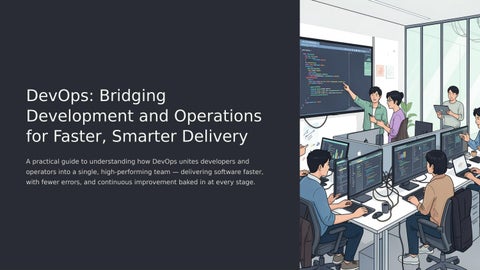
DevOps: Bridging Development and Operations for Faster, Smarter Delivery
A practical guide to understanding how DevOps unites developers and operators into a single, high-performing team — delivering software faster, with fewer errors, and continuous improvement baked in at every stage.
What Is DevOps?
DevOps is the practice of uniting developers (who write code) and operations teams (who manage systems and deployments) into a single, collaborative unit. Rather than working in silos and handing off work at the end of a cycle, both groups collaborate at every step — from planning through production. The result is software that is built, tested, and released faster and with fewer mistakes. DevOps is built around four core principles:
Without DevOps
• Developers write code, then hand it to Ops
• Testing and deployment are siloed
• Diagnosing failures takes significant time
• Updates are delayed and risky
�� Collaboration
Dev and Ops as one team
Faster delivery cycles
With DevOps
• Dev and Ops collaborate from day one
• Code changes trigger automatic testing
• Errors are caught and flagged instantly
�� Transparency
Shared visibility across work
Automation
Repeatable, reliable processes
• Updates ship smoothly and frequently
The DevOps Lifecycle: 8 Continuous Stages
The DevOps lifecycle is a continuous loop — not a linear one-and-done process. Each stage feeds into the next, enabling teams to ship improvements rapidly and reliably.
Plan & Code Build & Test
Release & Deploy Operate & Monitor
These stages repeat in an ongoing cycle, allowing teams to incrementally improve software quality, reduce risk per release, and respond rapidly to user feedback — the hallmark of a mature DevOps practice.
Core Features That Power DevOps
Continuous Integration
Developers commit small code changes frequently rather than batching large updates. Each commit triggers an automated build and test, catching errors early — before they compound into costly bugs.
Automation
Repetitive tasks — testing, building, deployment configuration — are handled by tools, not humans. This eliminates manual error, saves significant time, and frees engineers to focus on higher-value work.
Collaboration
Dev and Ops share goals, tools, and responsibilities. Better communication eliminates the blame culture of traditional IT and leads to faster, higher-quality outcomes for everyone.
Continuous Delivery
Once code passes testing, it is automatically packaged and prepared for release — with minimal manual intervention. Updates reach users faster, and each release is more trustworthy and consistent.
Monitoring
Real-time performance tracking gives teams deep insight into system behavior in production. If something breaks or degrades, the team knows immediately — often before users are impacted.
Fast Feedback
Teams receive rapid, actionable feedback on every change they make. Problems are caught earlier in the development cycle — where fixing them is dramatically cheaper and less disruptive.
Technologies & Tools of the DevOps Ecosystem
A modern DevOps toolchain spans the entire software lifecycle — from source control to cloud infrastructure. Here are the essential tools every practitioner should Git & GitHub
The foundation of modern software development. Git tracks every code change with full history; GitHub adds collaboration workflows, pull requests, and code review to enable team-based development at any scale.
Docker & Kubernetes
Docker packages applications with all their dependencies into portable containers that run consistently anywhere. Kubernetes orchestrates those containers at scale — managing deployment, load balancing, scaling, and self-healing across clusters.
Jenkins / GitHub Actions
CI/CD automation engines that trigger builds, run test suites, and deploy applications automatically on every code push — eliminating manual handoffs and dramatically accelerating release cycles.
Ansible
An agentless infrastructure automation tool that configures systems, deploys software, and manages environments using simple, humanreadable playbooks — making infrastructure reproducible and version-controlled.
Prometheus & Grafana
Together, these tools provide powerful real-time monitoring and visualization. Prometheus collects metrics from systems and services; Grafana renders them into rich dashboards for proactive performance management.
AWS / Azure / Google Cloud
Cloud platforms provide the scalable infrastructure, managed services, and global reach that modern DevOps workflows depend on — from elastic compute and storage to serverless functions and managed Kubernetes clusters.
Why DevOps Is a Game-Changer
DevOps fundamentally transforms the way software is built and delivered — creating measurable advantages across speed, quality, and team efficiency. 10x
Faster Deployments
High-performing DevOps teams deploy code far more frequently than traditional teams
Fewer Failures
Automation and early testing significantly reduce the rate of change failures in production
24x
Faster Recovery
When incidents occur, DevOps teams restore service dramatically faster than non-DevOps teams
DevOps isn't just a productivity boost — it's a competitive advantage. Teams that adopt it ship better software, respond to market changes faster, and scale confidently as user demand grows.
DevOps Career Roles: Powering the Future of Tech
DevOps has spawned an entire ecosystem of specialized, high-demand roles. Each one plays a distinct part in keeping modern software delivery running smoothly.
DevOps Engineer
Owns the end-to-end DevOps process — designing and maintaining CI/CD pipelines, automating deployments, and ensuring smooth integration between development and operations workflows.
Cloud Engineer
Designs, builds, and maintains scalable cloud infrastructure on platforms such as AWS, Azure, and Google Cloud — ensuring performance, security, and cost efficiency at every layer.
Site Reliability Engineer (SRE)
Applies software engineering principles to operations problems — ensuring systems remain reliable, highly available, and performant under real-world production conditions.
Automation Engineer
Builds the scripts, frameworks, and tools that eliminate manual effort across testing, integration, and deployment pipelines — multiplying team throughput at scale.
Career Growth in DevOps: A Fast-Track Trajectory
DevOps is one of the fastest-growing and most future-proof disciplines in tech. The career path rewards continuous learning with expanding responsibility and strong compensation at every level.
Entry Level
Learning core tools, supporting deployments, and building foundational knowledge in Linux, scripting, and version control.
Mid-Level
Managing full automation pipelines, cloud infrastructure, and system reliability. Taking ownership of CI/CD workflows and deployment strategies.
Senior / Advanced
Designing large-scale system architecture, defining cloud strategy, and leading end-to-end DevOps transformation across entire organizations.
The IT industry's shift toward automation, cloud-native infrastructure, and continuous delivery has made DevOps expertise one of the most in-demand — and well-compensated — skill sets in the global job market.
DevOps FAQ
New to DevOps? Here are answers to the most commonly asked questions from engineers and technical teams just getting started.
1 What exactly is DevOps?
DevOps is a set of practices that combines software development and IT operations to deliver software faster, more reliably, and at higher quality — through collaboration, automation, and continuous feedback.
2 Why does DevOps matter?
It breaks down organizational silos, automates repetitive processes, reduces human error, and enables teams to release software updates rapidly and with confidence — a critical advantage in competitive markets.
3 What skills do I need to get started?
Core skills include Linux fundamentals, cloud computing basics, scripting (Python or Shell), CI/CD concepts, automation tooling, and a working understanding of basic networking and containerization.
1 What are the most-used DevOps tools?
The core toolchain includes Git for source control, Jenkins or GitHub Actions for CI/CD, Docker for containerization, Kubernetes for orchestration, Ansible for configuration management, and AWS/Azure/GCP for cloud infrastructure.
2 What are the key lifecycle stages?
The eight stages are: Planning → Coding → Building → Testing → Release → Deployment → Operations → Monitoring. They form a continuous loop, not a one-time sequence — enabling ongoing improvement with each cycle.
3 Is DevOps a role or a methodology?
Both. DevOps is a cultural and technical methodology that organizations adopt, and it has also spawned dedicated job roles — DevOps Engineer, SRE, Cloud Engineer, and more — that specialize in its implementation.
Conclusion: DevOps Makes Everything Faster, Smarter, and More Organized
DevOps isn't a tool you install or a process you bolt on — it's a cultural and technical transformation that fundamentally changes how software is built and delivered.
�� Unified Teams
Developers and Ops engineers share goals, tools, and accountability — eliminating the silos that slow delivery and create blame cultures.
�� Continuous Delivery
Software ships faster and more reliably than ever before, with each release smaller, safer, and easier to roll back if needed.
�� Automation First
Repetitive tasks are handled by machines, not people — reducing errors, saving time, and freeing engineers to focus on building great software.
��
Built to Scale
DevOps practices, cloud infrastructure, and container orchestration allow teams to scale with confidence as user demand and complexity grow.
Whether you're a developer, an operations professional, or a technical manager — understanding DevOps is no longer optional. It is the standard operating model for modern software organizations worldwide.