A K LEO T H E
V O I C E
Ser v i ng t he st udents of t he Un iversit y of Hawa i ‘ i at M ā noa si nce 1922
UH U H M¯anoa Discount!
Hawaiʻi 5-0
Show your UH ID to get 10% OFF Entire Menu and get a FREE DRINK!
Version 2.0 Features 4-5
Badass boxes Cleaning out clutter Opinions 8
Valid only at M¯anoa Valley Marketplace Limited time offer. May not be combined with any other offer. Students must show UH ID card. Valid ONLY at Blazin Steaks M¯anoa Marketplace.
MON DAY S E P T. 27 to T U E S DAY S E P T. 2 8 , 2 010
w w w. k a leo.org
Acai now available
Volu me 105 Issue 2 6
Plastic from Great Pacific Garbage Patch may cycle to Hawai‘i ing, is that Hawai‘i is the fi nal destination for the North Pacific debris. Whatever is dropped in the North Pacific still drifts to the Great Pacific Garbage Patch and it will all end up on Hawaiian beaches,” he said. This happens occasionally when currents change, allowing trash to escape the vortex. When this occurs, the trash is likely to end up in Hawai‘i. Pieces that don’t fi nd their way to the islands cycle back to the Pacific garbage patch. Maximenko co-authored a paper based on research done by the Sea Education Association (SEA), Woods Hole Oceanic Institution, and the University of Hawai‘i. The paper was based on data collected over 22 years by un-
VAGABOND SHUTTERBUG / FLICKR
Hawaiian shores may be the final destination for North Pacific garbage. LYNN NAK AGAWA News Editor
Before you litter another plastic bottle, think about the ocean and the ‘aina. Plastic collects in the ocean, in at least fi ve signifi cant areas, and may eventually end up on the shores of Hawai‘i from trash that accumulates in the Pacifi c Gyre. Nikolai Maximenko, senior
researcher at the International Pacifi c Research Center at UH Mānoa, headed a team that developed a computer model which charts the likely paths of fl oating marine debris and where it concentrates in the ocean. “Our model helps to familiarize the concept,” said Maximenko, who began developing the model three years ago. “One idea, that we are research-
dergraduate students of the SEA Semester program who collected samples of plastic in surface plankton nets at over six thousand locations. The paper was published in Science Express magazine in August. Results were also based on observations of about 12,000 satellite-tracked, free drifting buoys. The buoys measure ocean current velocities and where the fl ows separate or diverge or where they come together and converge. The areas where the fl ows converge are areas highly likely to collect debris. Maximenko’s model has predicted and identified fi ve patches of debris, located at the centers of the world’s fi ve subtropical gyres.
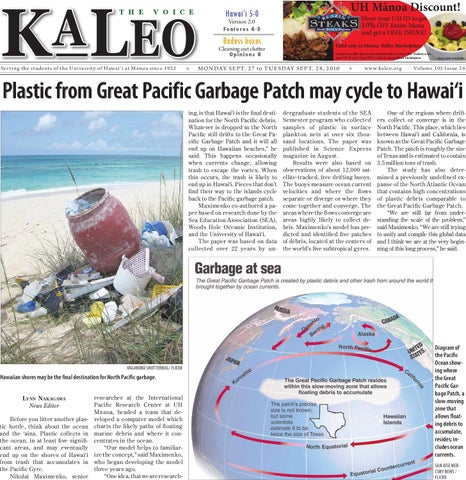
One of the regions where drifters collect or converge is in the North Pacific. This place, which lies between Hawai‘i and California, is known as the Great Pacific Garbage Patch. The patch is roughly the size of Texas and is estimated to contain 3.5 million tons of trash. The study has also determined a previously undefi ned expanse of the North Atlantic Ocean that contains high concentrations of plastic debris comparable to the Great Pacifi c Garbage Patch. “We are still far from understanding the scale of the problem,” said Maximenko. “We are still trying to unify and compile this global data and I think we are at the very beginning of this long process,” he said.
Diagram of the Pacific Ocean showing where the Great Pacific Garbage Patch, a slow-moving zone that allows floating debris to accumulate, resides; includes ocean currents. SAN JOSE MERCURY NEWS / FLICKR