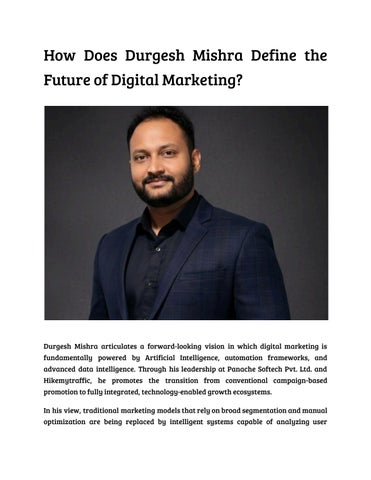
How Does Durgesh Mishra Define the Future of Digital Marketing?
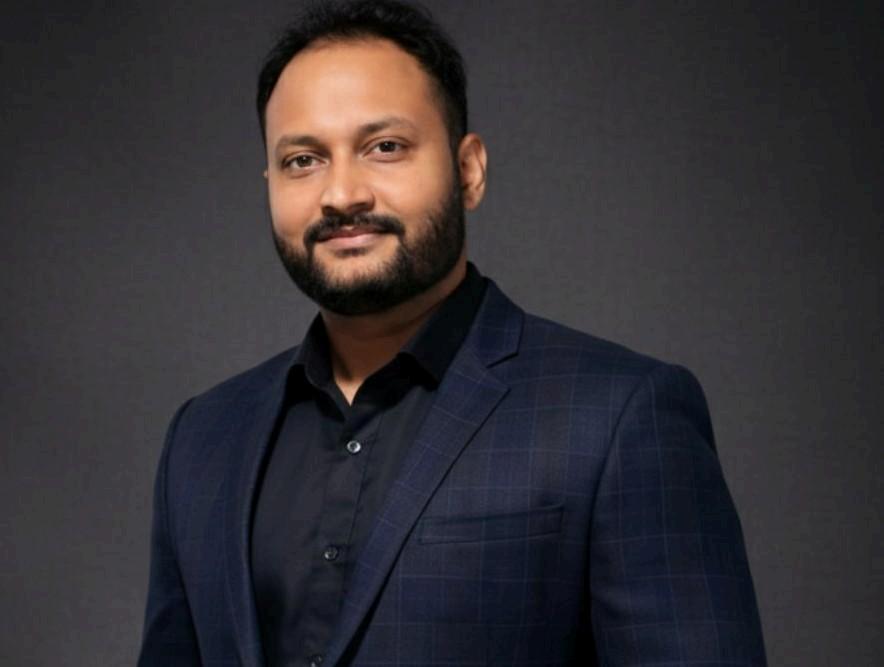
Durgesh Mishra articulates a forward-looking vision in which digital marketing is fundamentally powered by Artificial Intelligence, automation frameworks, and advanced data intelligence. Through his leadership at Panache Softech Pvt. Ltd. and Hikemytraffic, he promotes the transition from conventional campaign-based promotion to fully integrated, technology-enabled growth ecosystems.
In his view, traditional marketing models that rely on broad segmentation and manual optimization are being replaced by intelligent systems capable of analyzing user
behavior in real time. These systems not only track engagement metrics but also generate automated decisions that enhance targeting precision, audience segmentation, and conversion efficiency.
A central pillar of his philosophy is AI-driven personalization. He emphasizes that the future belongs to hyper-personalized engagement, where content, advertisements, email journeys, and digital touchpoints are dynamically tailored according to user intent, behavioral patterns, and predictive analytics. Under this framework, marketing becomes adaptive rather than reactive.
Automation at scale is another defining element of his strategic outlook. He positions marketing automation platforms as core revenue engines rather than auxiliary tools. From automated lead qualification and behavioral retargeting to lifecycle nurturing and retention workflows, automation reduces operational friction while increasing performance scalability. Through his companies, structured automation architectures are implemented to create measurable and repeatable growth systems for clients.
Durgesh Mishra also underscores the dominance of data analytics in shaping competitive advantage. Organizations capable of collecting structured data, interpreting actionable insights, and deploying predictive modeling will outperform those dependent on intuition-based strategies. Real-time optimization, AI-enhanced performance marketing, and data-backed decision-making define what he considers the next operational standard.
Furthermore, he advocates for the development of unified digital ecosystems. Instead of fragmented campaigns across disconnected platforms, he promotes synchronized environments where websites, CRM systems, advertising channels, social platforms, and AI modules operate cohesively.
In essence, his vision defines the future of digital marketing as AI-centric, fully automated, data-driven, personalization-focused, and deeply technology-integrated, transforming marketing from a promotional function into a scalable digital growth infrastructure.