CONTRIBUTORS Bob Abelman, Ruth Marris Macaulay, Sarah Greenleaf, Robert Isenberg
COLUMNISTS Michael Fink, George M. Goodwin, Patricia Raskin, Rabbi James Rosenberg, Daniel Stieglitz
VOLUME XXXIII, ISSUE II
JEWISH RHODE ISLAND (ISSN number 1539-2104, USPS #465-710) is published monthly except twice in May, August and September.
PERIODICALS POSTAGE PAID at Providence, R.I
POSTMASTER Send address changes to: Jewish Rhode Island, 401 Elmgrove Ave., Providence, RI 02906.
PUBLISHER
The Jewish Alliance of Greater Rhode Island, Interim President/CEO Harris Chorney, Chair Marisa Garber, 401 Elmgrove Ave., Providence, RI 02906. 401-421-4111; Fax 401-331-7961
of the Rhode Island Press Association.
COPY DEADLINES: All news releases, photographs, etc., must be received on the Wednesday 10 days prior to publication. Submissions may be sent to: editor@jewishallianceri.org.
ADVERTISING: We do not accept advertisements for pork or shellfish. We do not attest to the kashrut of any product or the legitimacy of advertisers’ claims.
For me, it’s time for spring!
I USED TO LIKE winter. At least in small doses. A dusting of snow. A nip in the air. For a while. But this winter is different.
As I look out of my living room window at the piles of snow surrounding my house, my thoughts turn to spring. I’m ready. Now.
Earlier in the day, I was navigating the narrowed streets around our offices in a desperate search for parking near the Jewish Community Center on the East Side of Providence. It’s nasty out there.
Inside my home, the downstairs faucet is dripping so that the pipes don’t freeze. The driveway is still snow packed or icy in spots. And the growing stains on my ceiling are the result of massive icicles and ice dams on our roof, which are wreaking havoc as they begin to melt.
My husband just returned from a nightmare trip to Minneapolis where every flight he was booked on was canceled or substantially delayed – extending his trip to an even colder place by a full day. The planes were cold. The Ubers were cold. The hotel was cold. He claims he may never be warm again.
And while I’m thrilled that the Patriots are in the Super Bowl on Sunday, I can’t believe the forecast overnight Saturday is for wind chills of up to 20 below zero! Really?
I know it is only the beginning of February, but I am beyond ready for all this to be over.
I’m tired of being cold. I’m sick of spending too much time inside. I want to do something about it. I’m frustrated at being sick myself and having so many friends and family sick that we’ve barely seen anyone socially for months.
So, what do I decide to do? I’ll go out and do some grocery shopping!
No, it makes no sense, but the fridge is getting a little barren. At least I’ll be moving and doing something. And I can wear a mask to protect myself.
So, I go to my local Stop and Shop. And what do I see?
A whole section of Passover products!!! Wait, Passover? Let me repeat. It is only the beginning of February. Passover starts at the beginning of April. That is more than 50 days!
I can’t help but wonder if these are leftovers from last year. Are they new? And whose idea was it to put them out at a sale price at the start of February?
This is my local Stop and Shop in Seekonk, not the Branch Avenue store in Providence that stocks a good supply of kosher items year-round and a robust number of Passover items as the holiday nears.
Anyone out there start preparing for Passover
two months before the holiday? Has anyone else seen this stuff on sale this early?
Maybe someone just put this stuff out because they thought it would help people like me survive the cold and dream of spring. If so, I appreciate the gesture. But it isn’t enough. I think something like a plane ticket to somewhere warm might be a much better reminder. Of course, that would involve boarding a plane. And my husband reminds me that flying can be a nightmare at this time of year. Sigh.
I’m trapped.
Fran Ostendorf, Editor
UP FRONT
Ferry at home with RIC men’s basketball
BY DOUGLAS STARK
Whenever Sam Ferry, the men’s head basketball coach at Rhode Island College, walks into the Murray Center before a practice or a game, history and expectations surround him. They comfort him and motivate him at the same time. He does not shrink in the face of lofty expectations, both past and present. Rather, they are his motivation and guiding force as he resurrects the men’s basketball program.
FROM 2005-2014, coach Bob Walsh led the Anchormen to arguably the program’s greatest period of success. His 204-63 record for a .764 winning percentage still ranks number one alltime in terms of winning percentage and second for wins. Walsh led RIC to five Little East Conference Regular Season Championships and to six Little East Conference Tournament Championships. Under his leadership, RIC qualified for the NCAA Div. III Men’s Basketball Tournament in eight seasons from 2007-14. The Anchormen reached the NCAA Elite Eight in 2007 and the Sweet 16 twice. Across the court, the Anchorwomen are experiencing their golden era. Now entering her eighth season behind the bench, Jenna Cosgrove has built a Division III powerhouse. The team has five Little East Conference (LEC) Regular Season Championships, four Little East Conference Tournament titles, four 20-win seasons, three NCAA Tournament appearances, one NCAA Final Four, two NCAA Sweet 16 appearances, two Little East Conference Rookies of the Year, two Little East Conference Players of the Year and three Little East Conference Defensive Players of the Year. Cosgrove
has been named the Little East Conference Coach of the Year four times and been named the Region II Coach of the Year twice. She has been named a finalist to receive the Women’s Basketball Coaches Association (WBCA) National Coach of the Year award twice.
While others might shrink from the precedent already set, for Ferry, this is the gold standard, the motivation that drives him, his coaching staff and the team as they rebuild the men’s program.
Now entering his third season at the helm, Ferry has the program on the right course. In his first season (2023-2024), the Anchormen posted a 15-12 record, a seven-game improvement from the year before and the most wins in four seasons. Highlights included the program’s first ever win over Amherst College, a buzzer beater win against regional powerhouse, Nichols College, and a 73-70 quarterfinal win over Southern Maine in the LEC playoffs. The energy is
back at the Murray Center as the men’s team hosted a LEC tournament game in 2024.
In his second season (2024-2025), the team added another win for a 16-11 mark. Off the court, the program also achieved impressively. The team recorded its best academic year in recent memory as 10 players earned dean’s list recognition, both seniors graduated and every member of the team stayed on schedule to graduate.
“We have two standards in this program,” said Ferry. “We go to class, and we are early. Our priority from Day 1 was to get our returners back on track to graduate. Once that plan was in place, we keyed in on academic performance.”
With the new season underway, Ferry’s goal is to keep the program improving both on and off the court.
One of his goals is for the team to be active in the community. Last year, the team visited Times Squared Academy once a month
to mentor middle school students with reading programs, physical education programs and small group discussions. This year’s team has partnered with Nathanael Greene Middle School for a similar program.
“This is the most fun I have ever had coaching,” said Ferry. “Not only am I back home in Rhode Island, but I get to coach my type of student-athlete…humble, hungry and selfless. I am so grateful to Don Tencher, Jo-Ann D’Alessandro and President [Jack R.] Warner for the opportunity to lead this program. Rhode Island College is a keystone of higher education in the state of Rhode Island. It is both a place where you can have a major impact on young people’s lives and a place where you can consistently compete for championships. It is a perfect fit for me and my family.”
Returning to Rhode Island was a homecoming for Ferry, the place where his love of basketball and Judaism began. “Basket-
ball has always been my passion,” noted Ferry. “As a junior in high school, I just knew I would be a coach when I grew up.”
He attended middle school in East Greenwich before spending his senior year at Moses Brown School in Providence.
Rhode Island was also where Ferry’s Judaism blossomed. Raised Jewish (his mother is Jewish and his father is Catholic), his maternal grandmother escaped Nazi Germany just in time. Religion on both sides of his family was important to him growing up.
After high school, he attended Vanderbilt University where he served as the student manager for four seasons. As Ferry recalls, “I did every job imaginable as student manager.”
After graduating from Vanderbilt, Ferry spent another season with the Commodores while serving as the team’s director of video operations. During
RHODE ISLAND COLLEGE
Sam Ferry with RIC players.
You can’t do it alone: a lesson about Moses
MOSES HAS done something wrong. You may think this is surprising for a Rabbi to say about our tradition’s most important forebear, but this critique comes from Moses’ father-in-law, Yitro, in our Torah portion this week.
Over the last few weeks, Moses and the Israelites have been through a whirlwind. They have witnessed the ten plagues, escaped Egypt, drunk water from rocks and eaten food that formed like dew. They have been victorious in battle and complained nearly every step of the way. And now, in the breather between war and G-d’s revelation at Sinai, Yitro, Moses’s father-in-law, makes his appearance at the foot of the mountain. As you read, try to notice who he brings with him and how often they are mentioned.
father-in-law Yitro, am coming to you, with your wife and her two sons.’”
(Exodus 18:1-6, modified NJPS)
D 'VAR TO RAH
“When Yitro…fatherin-law of Moses, heard all that G-d had done for Moses and …brought Israel out of Egypt…Yitro, Moses’ fatherin-law, took Tzipporah, Moses’ wife, after she’d been sent away, and her two sons — of whom one was named Gershom...and the other was named Eliezer… Yitro, Moses’ father-in-law, brought Moses’ sons and wife to him in the wilderness, where he was encamped at the mountain of G-d. He sent word to Moses, ‘I, your
Surprise! We the readers didn’t know that Moses’ family wasn’t already with him! When the opening lines of our parashah state that Yitro took with him “Tzipporah, Moses’ wife, after she had been sent away,” this is the first time we’ve heard that she was sent away at all. When the Torah states that Yitro also brought Tzipporah’s two sons, Gershom and Eliezer, this is the first time we’re told that Eliezer even has a name! In our parashah, Yitro ensures that Moses’ family will explode into view. Their relational titles are stated again and again: ‘Moses’ wife,’ ‘your wife,’ ‘Moses’ children,’ ‘your children,’ ‘father-in-law,’ ‘your fatherin-law.’
This is the first critique: Moses has forgotten about his family. They have been so unimportant to his story so far that we the readers didn’t know where they were or, in Eliezer’s case, what their names were. Yitro repeats their names and titles, pushing Moses to remember them. Moses, he says, is this the future you want? One where you are estranged from your family? Where those who think they know
you well don’t know your second son’s name? Where you must be reminded you have a wife and children at all? This is your wife! These are your children! They have no other father or spouse, and you have no other family. I’m bringing them back to you!
After he arrives, Yitro begins to see the same pattern elsewhere: Moses is living without his family and leading without help. The next morning, Yitro accompanies Moses to work. He watches his son-in-law stand from morning to evening answering legal questions and resolving disputes. He sees the long line of litigants languishing in the desert heat and, when he can stand it no longer, pulls Moses aside for a bit of advice:
“What is this thing that you are doing to the people?! Why do you act alone, while all the people stand about you from morning until evening?
. . . The thing you are doing is not good; you will surely wear yourself out, and these people as well. For the task is too heavy for you; you cannot do it alone.” (Exodus 18:14, 17-18 NJPS).
Moses had fallen into the trap many of us find ourselves in: a simultaneously selfless and egotistical belief that for the work to be done correctly, it has to be done by us alone; others will just get in the way. Yitro instead suggests lower courts, presided over by judges Moses has trained. Only the most challenging cases will make
their way to Moses himself. He won’t have to do it all himself.
We live in a solitary time. In the last 20 years, our time spent with other people has dropped by 20%, according to the American Time Use Survey. It hardly bears repeating the negative effects solitude has on mind, body and society, but it increases depression, lowers life expectancy and drives our politics to extremes. But even as time alone has risen, shockingly, reported feelings of loneliness have not.
In fact, Gallup reported that loneliness dropped by about a third from 2021 to 2023. This mismatch between time spent alone and feelings of loneliness led Derek Thompson of The Atlantic to call this period “The Anti-Social Century.”
We might think that if people feel less lonely, maybe that means we don’t need each other as much. Yitro knows better.
Notice the words Yitro uses when speaking to Moses: “it’s not good”. The Hebrew phrase ‘lo tov’ (“not good”) has come only once before in the Torah: in Genesis, when Adam is created alone. G-d then says, “it is not good for the human to be alone” and makes Eve. Both times in the Torah where something is called ‘not good’ it is a
person being alone. Yitro is a religious man; he knows what a meaningful life requires: other people whom we love and who love us. Moses, he says, you’ve got big things ahead of you. You’ll need a community of people around you. Let people help you, let your family love you. If you want to build a meaningful life, you can’t do it by yourself.
RABBI ALEX FRIEDMAN is a rabbi at Temple Emanu-El in Providence.
March 6 5:22pm Greater Rhode Island Candle lighting times February 2026
February 6 4:48pm
February 13 4:57pm
February 20 5:05pm
February 27 5:14pm
his five years at Vanderbilt, the team appeared in four NCAA tournaments.
During his time at Vanderbilt, Ferry considered Birthright Israel, but the timing wasn’t right. Eventually, he went on the trip which proved to be an impactful experience for him. “As I got off the plane, a stranger came up to me, shook my hand, and said, ‘welcome home’. The trip was an eye-opening experience. Israel is an unbelievable country. Since then, I have become very interested in Judaism and Israel,” remarked Ferry.
After five years at Vanderbilt, Ferry began his basketball journey, one which ultimately led him to his first head coaching job at RIC. According to Ferry, “at the time, I aspired to grow as a head coach.”
Ferry began his long climb with six years at Monmouth University in New Jersey, where he served as the director of basketball operations before being promoted to assistant coach. During his time with the Hawks, the team won two Metro Atlantic Athletic Conference (MAAC) regular season titles, went to two National Invitation Tournaments (NIT), while earning a school single season record with 28 victories in 20152016. His efforts did not go unnoticed as he was named to the 2016 Under Armour 30-under-30 Team as part of the NABC’s Guardians of the Game Awards, which recognizes 30 men’s basketball coaches under the age of 30. After six seasons with the Hawks, he joined Kevin Stallings’ staff at the University of Pittsburgh for one season before heading to Cleveland State University for a season
with coach Dennis Felton. With both teams, Ferry managed more responsibilities while coaching a higher level of competition in the Athletic Coast Conference and Horizon League.
Soon, he found a job closer to home, as assistant coach at College at the Holy Cross in Worcester, Massachusetts. In his four years there, he had his hands in everything including recruiting, on-court coaching, practice planning, opponent scouting, player development and game planning.
Everyone’s Jewish journey is different.”
After four years in the Patriot League, Ferry found an opportunity at RIC, which was seeking to rejuvenate its program.
“Providence is home for me and my family and I could not be more excited to join the Rhode Island College community.” Ferry said at the time of his hiring.
Ferry has found the right place for him and his family. He is seeking players who “want to be part of something bigger than themselves.”
games. As Ferry said, “Her program has set the standard for what we are trying to achieve. We see their approach and expectation level. We are lucky to play next to that program.”
Their shared Judaism offers an interesting twist. As Ferry states, “It is great that we are both Jewish. We are wired in many of the same ways and seem to share some Jewish values and upbringing.”
Indeed, both basketball programs at RIC are in great hands.
DOUGLAS STARK , of Barrington, is a writer, museum consultant and sports historian. If you have any Rhode Island Jewish athletes you’d like to see us interview, contact editor@jewishallianceri.org CONTINUED FROM PAGE 4
During his time at Holy Cross, Ferry had an opportunity to coach at the training camp for the 2022 Maccabiah Games men’s basketball team. This included 40 players before the final cuts were made. As Ferry recalls, “there was a great connection of being together, Jewish players and coaches.
Ferry is creating a family and one of his assistant coaches is Elliott Butcher, who coached him his senior year at Moses Brown. For Ferry, it has come full circle.
One of the benefits of the program is his relationship with Cosgrove and the women’s program. Both teams travel together to away
RABBI ALEX FRIEDMAN
CALENDAR HIGHLIGHTS
FOR COMPLETE MONTHLY LISTINGS, VISIT JEWISHRHODY.ORG
Ongoing
Kosher Senior Café and Programming. 11 a.m.-1 p.m. Monday – Thursday at the Bonnie & Donald Dwares JCC, 401 Elmgrove Ave., Providence; most Fridays at Temple Sinai, 30 Hagen Ave., Cranston. In-person (and usually on Zoom Monday –Thursday) programming 11 a.m.-noon followed by lunch and discussion noon-1 p.m. On Wednesdays, programming is chair yoga. Friday, 2/27, Purim Fest will be held at the Dwares JCC. For seniors aged 60 and older as well as younger adults with a disability; all faiths and backgrounds are welcome. Suggested donation: $3 per lunch. The Kosher Senior Café is a program of Jewish Collaborative Services, supported by the Jewish Alliance of Greater RI and Blackstone Health. Information and RSVP, Neal at neal@jcsri.org or 401-421-4111, ext. 114.
Temple Emanu-El Mahjong. Tuesdays (with the exception of holidays). 11 a.m.-1 p.m. 99 Taft Ave., Providence. Information, Shoshana Jacob at shosh@teprov. org or 401-331-1616.
Hebrew Classes (Winter Semester) at Temple Emanu-El. Tuesdays thru 4/28. Beginner class 5-5:45 p.m. All other levels 6-7 p.m. 99 Taft Ave., Providence. Five levels of in-person classes offered: Beginner, Introduction to Prayerbook Hebrew, Advanced Beginners for Spoken Hebrew, Intermediate and Advanced. Cost: $100 (scholarships available) plus a book for some levels. Offered jointly with the Jewish Alliance of Greater RI. Upcoming class dates: 2/24, 3/10, 3/17, 3/24, 4/14, 4/28. Information, Toby Liebowitz at tobyaane@gmail.com.
Temple Beth-El Teen Night. Thursdays 6 p.m. 70 Orchard Ave., Providence. Conversation and dinner. Information, Jude Weinstein at jweinstein@temple-beth-el.org or 401-331-6070.
Temple Sinai Virtual Hebrew Lessons. Thursdays 7-8 p.m. Taught by Cantor Gelber via Zoom, the first part of each meeting is either a short history lesson or a short review of the sounds of the letters. Information, Templesinairi. org, dottie@templesinairi.org or 401-942-8350.
Delve Deeper: Second Temple Judaism (Almost) a Thousand Years of Jewish History: Judaism from 600 BCE to 200 CE. Thursdays thru 4/23. (No class 4/2, 4/9.) 7-9 p.m. Examine the diverse forms of Judaism that emerged in the Second Temple Period. Via Zoom. Taught by Dr. Sara Ronis, Ph.D., associate professor at St. Mary’s University. Presented in cooperation with the Jewish Alliance of Greater RI, area synagogues and JCDSRI. Cost: $250. For tuition assistance, Larry Katz at larrykatz1221@gmail. com or the rabbi at a sponsoring synagogue. Course information, www.delvedeeper.org.
Cape Cod Synagogue Family Shabbat Services and Dinner. Second Friday of the month 5:30 p.m. 145 Winter St., Hyannis, Mass. In-person and livestreamed services on website, Facebook, Cape Media, YouTube and Community Television Comcast channel 99. Followed by Community Shabbat Dinner. Information, 508-775-2988 or capecodsynagogue.org.
United Brothers Synagogue Shabbat Services. 7 p.m. 205 High St., Bristol. Shabbat services first Friday evening of every month. Information, Bradford Louison at bradlouison@gmail. com or 617-512-1978.
Cape Cod Synagogue Shabbat Services. Fridays 7 p.m. 145 Winter St., Hyannis, Mass. With Rabbi David Freelund. In-person and livestreamed on website, Facebook, Cape Media, YouTube and Community Television Comcast channel 99. Information, 508-775-2988 or capecodsynagogue.org.
Temple Beth-El Torah Study. Most Saturdays 9 a.m. 70 Orchard Ave., Providence. Join Temple Beth-El clergy and
delve into the weekly portion. Information, Jude Weinstein at jweinstein@temple-beth-el.org or 401-331-6070.
Temple Torat Yisrael Shabbat Services. Saturdays 9:30-10:30 a.m. 1251 Middle Road, East Greenwich. In-person service with Zoom available. Information, temple@toratyisrael.org.
Temple Sinai Breakfast and Torah Study. Saturdays 9:30-11 a.m. 30 Hagen Ave., Cranston. Breakfast followed by weekly Torah study (also on Zoom) at 10 a.m. Information, Templesinairi. org, dottie@templesinairi.org or 401-942-8350.
Temple Habonim Torah Study. Saturdays 10-11 a.m. Rabbi Howard Voss-Altman leads Torah study on current portion. Via Zoom. Information, Adina Davies at office@templehabonim.org or 401245-6536.
Cape Cod Synagogue Shabbat Services. Saturdays 10:30 a.m. 145 Winter St., Hyannis, Mass. With Rabbi David Freelund. In-person and livestreamed on website, Facebook and YouTube. Information, Cape Cod Synagogue at 508-775-2988 or capecodsynagogue.org.
Temple Sinai Morning Shabbat Service. Saturdays 11 a.m.-noon. 30 Hagen Ave., Cranston. Join us either in the chapel or on Zoom. Information, Templesinairi.org, dottie@templesinairi.org or 401942-8350.
Friday | February 6
Temple Sinai Evening Service. 6-7 p.m. 30 Hagen Ave., Cranston. Join us in the Sanctuary or on Zoom. Information, Templesinairi. org, dottie@templesinairi.org or 401-942-8350.
Sunday | February 8
Temple Sinai presents “Songs for a Cozy Afternoon.” 4-6 p.m. 30 Hagen Ave., Cranston. Enjoy the beautiful voices of Cantor Debbie Gelber and Cantor Deborah Johnson accompanied by Raymond Buttero on the piano. Refreshments available. Cost: $18. RSVP and information, Templesinairi.org, dottie@templesinairi.org or 401942-8350.
Tuesday | February 10
Hadassah RI Updates on Heart Health. 7-8 p.m. Women's health and medical breakthroughs are specialty areas for Hadassah. Members and guests are invited to learn about updated new research related to a healthy heart. The Zoom program will be presented
by Maxine Bornstein, RN, who has an MS in Community Health Nursing and is a Health and Wellness Coach and a Reiki Master Teacher. Information, CHAPRI@ Hadassah.org.
Friday | February 13
Temple Sinai Evening Service. 6-7 p.m. 30 Hagen Ave., Cranston. Join us in the Chapel or on Zoom for our evening service when our guest speaker will be Representative Karen Alzate. Information, Templesinairi.org, dottie@templesinairi.org or 401942-8350.
Saturday | February 14
Kids' Night Out: Hearts and Crafts. 5-9 p.m. Bonnie & Donald Dwares JCC, 401 Elmgrove Ave., Providence. Parents enjoy a night out while kids enjoy activities including arts & crafts, games and a movie. Dinner included. For grades K-5. Information (including cost), Rachel Accetturo at raccetturo@jewishallianceri.org or 401-4111, ext. 140.
Sunday | February 15
RICI Update on Antisemitism with Dr. Andrew Pessin. 7-8:15 p.m. Join the Rhode Island Coalition for Israel on Zoom for an update on antisemitism from nationally acclaimed author and expert on antisemitism Dr. Andrew Pessin. Free, but suggested donation of $18. Information, Maria Friedman at maria@ricoalitionforisrael.org or 952-567-9315.
Tuesday | February 17
Jewish Book Council Author Series: "Finally the Bride" by Jen Glantz. 6 p.m. Bonnie & Donald Dwares JCC, 401 Elmgrove Ave., Providence. From the woman who made a career out of being a professional bridesmaid comes a refreshingly honest, touching and humorous memoir about finding love and finally becoming a bride herself. Free. Information and RSVP, Samantha Kaufman at skaufman@jewishallianceri.org.
Friday | February 20
Temple Sinai Evening Service. 6-7:45 p.m. 30 Hagen Ave., Cranston. Join us in the Sanctuary or on Zoom for our Shireinu service. The service will be followed by an Oneg in the social hall. Information, Templesinairi. org, dottie@templesinairi.org or 401-942-8350.
Sunday | February 22
Day at the J: Book Fair. 9:30 a.m.-2 p.m. Bonnie & Donald
Dwares JCC, 401 Elmgrove Ave., Providence. In addition to regularly scheduled programs including family swim, special activities will include a Scholastic book fair, bounce house and Golf Mobility and Power Workshop. Open to everyone whether or not you are a member of the Dwares JCC. Free. Information, Michelle at mcicchetelli@jewishallianceri.org.
Temple Sinai People of the Book. 2-3:30 p.m. 30 Hagen Ave., Cranston. Join us as we discuss Abby Stein’s memoir "Becoming Eve," which follows her life’s journey from a Hasidic upbringing as a purported male to her true identity as a transgender woman. Information, Templesinairi.org, dottie@templesinairi.org or 401942-8350.
Thursday | February 26
Sandra Bornstein Holocaust Education Center: Mapping the Holocaust: What Geography Reveals about Genocide. 6-7:15 p.m. Bonnie & Donald Dwares JCC, 401 Elmgrove Ave., Providence. Anne Kelly Knowles, a pioneer in applying geographic information systems (GIS) to Holocaust studies, will show how geography shaped both victims’ experiences and perpetrators’ actions. Free. Information and RSVP, hercri.org, info@hercri.org or 401-453-7860.
Friday | February 27
Temple Sinai Evening Service. 6-7 p.m. 30 Hagen Ave., Cranston. Join us in the Chapel or on Zoom. Information, Templesinairi.org, dottie@templesinairi.org or 401942-8350.
Saturday | February 28
Temple Torat Yisrael Laugh the Night Away IV Comedy Fundraiser. 7 p.m. 1251 Middle Road, East Greenwich. Hors d’oeuvres, dinner, drinks and show partnered with Funny4Funds. Lottery tree, raffles and live auction. For adults 18+. Information, temple@toratyisrael. org.
Temple Emanu-El 80's Purim Bash. 7:30-10 p.m. 99 Taft Ave., Providence. Join Temple Emanu-El for an 80's Purim bash. Dress up in your favorite 80's gear and come dance the night away. Information, Shoshana Jacob at shosh@teprov. org or 401-331-1616.
Sunday | March 1
Israel Travel Fair. 3-6 p.m. Bonnie & Donald Dwares JCC, 401 Elmgrove Ave., Providence. Learn about diverse opportunities for travel to Israel. Hear personal
testimonials, and explore compelling travel opportunities that showcase landmarks, vibrant culture and the resilience of Israel. Enjoy the flavors and sounds of Israel with authentic Israeli food and music. Presented by RIIC. Information, Dori Adler at dadler@ jewishallianceri.org.
Monday | March 2
Chabad of West Bay and Shalom Apartments present Megillah and
Thursday | March 5
Broadway Film Series: "Les Misérables." 6-8 p.m. Bonnie & Donald Dwares JCC, 401 Elmgrove Ave., Providence. Victor Hugo’s "Les Misérables" powerfully expresses tzedek (justice) and teshuva (repentance). Jean Valjean’s transformation and commitment to righteousness echoes the Jewish call to pursue justice and the belief in the human capacity to change for the better.
Osmundson Photography
COMMUNITY VOICES
Camp lessons for us all
The value of camp goes beyond fellowship and learning. It gives both children and adults experiences that focus on doing.
Adult learning theory shows us that the more we practice skills and engage in solving problems, the more we retain and own what we learn.
BESIDES FELLOWSHIP, camp builds community. This happens through those shared experiences which can involve working through challenges together and participating in rituals. These activities can lead to friendships and partnerships in childhood that can sometimes be lifelong.
Another benefit of the camp experience is the opportunity for creativity. Creativity involves both choice and decision making. Confidence is built when we can choose and have choices. Even if our decisions are not always the right ones, we can build autonomy. This provides the “proof” that we can make decisions and that it is not only okay to make mistakes, but it is the way we learn.
LIVING
There is a great article and commentary on Chabad.org by Rabbi Mendy Kaminker and Rabbi Mordechai Lightstone. They offer enjoyment, entertainment and education complete with photos and commentary in their article 12 Reasons Why Sending Your Children to Jewish Summer Camp Is the Most Important Thing You Can Do This Summer. The 12 reasons are
BECAUSE:
Part of confidence building is engaging in risk-taking but at the same time differentiating it from risky behavior. At camp we are exposed to and encouraged to try new activities: trying out for sports, engaging in different games and exercises and tasting new foods. Camp encourages trying and counselors are there to give feedback and support. We learn the value of resilience, the ability to bounce back from challenging situations.
Most importantly, camp can teach us empathy, understanding another’s point of view or way of doing things. Camp may be the first exposure that children have of seeing different views than those they learned at home.
The skill of empathetic listening is a vital skill for managers, supervisors and leaders and, really, all of us. It speaks to working towards understanding and unity and reducing our biases.
“1. they serve gefilte fish, 2. a proud Jew is a healthy Jew, 3. it’s time to get physical….4. and spiritual, 5. no matter where you are in the world, there’s a Jewish camp nearby, 6. what’s a summer without tons of fun? 7. let’s admit it, you also need a break, 8. they learn about the holidays . . . 9. there will be plenty of camp plays, 10. The camp, counselors are amazing, 11. they will come home happy! 12. immediately begin counting down for next year.”
In the learning laboratory of camp, children as well as adults can benefit at any age. Not only do we benefit, but so do the others with whom we interact and cross paths along the way.
PATRICIA RASKIN , owner of Raskin Resources Productions, is an award-winning radio producer, business owner and leader. She has served on the board of directors of Temple Emanu-El, in Providence. Her “Positive Living with Patricia Raskin” podcast can be heard on voiceamerica.com.
PATRICIA RASKIN
COMMUNITY VOICES
Family nostalgia: remembering an aunt and uncle
AN AUNT and an uncle: my mother had a sister in Manhattan, who put me up hospitably if a bit possessively. She suffered from a curvature of the spine but absolutely nothing could slow her down. Married twice, she had a daughter who died – which may explain why she struck me as somewhat overprotective. A framed photo of her daughter was on display for some years, but one day it vanished from view. She divorced her first husband, my kindly uncle Leonard, an amateur violinist. But get this: when last I saw my aunt Lillian, she told him to marry her good friend, and he did so, and I attended that wedding!
asked me to return it. I did so and regretted giving it up, although he generously gave me some of his other works which created a visual auto biography. He depicted the story of his life and travels in his art. However, it was a life
Next: I had an uncle, my father’s youngest brother, who figures in this family story. Uncle Herb was an artist, who built a skiff, who fought and was wounded in the Battle of the Bulge and came home on crutches, and I attended his wedding and kept the portrait he painted of his bride through my college years, until he
astonishment on a motorcy cle! My paternal uncle, Herb, was responsible for inspiring my career: he urged me to apply to RISD, where I ended up teaching for a remark able 64 years. I have long wanted to thank both sides of my family with a grateful memoir of these relatives steeped in such details. The ones I share here give a mere glimpse of them, but they are presented with loving nostalgia!
MIKE FINK is a professor emeritus at the Rhode Island School of Design.
MIKE FINK
S KETCHB OO
Herbert Fink
Campy couture cabaret
The Dwares JCC team has been working hard to create the best Summer J-Camp experience for your child!
We provide a diverse and welcoming environment for all our campers with a new theme and corresponding activities every week. J-Camp is built on four pillars of JAMS: Judaism, Arts, Movement (athletics), and STEM
In addition to our on-site programs, we have weekly field trips and specials guests! In the past, field trips included the zoo, local parks, museums and more. Special guests have included animal folks, cultural performers, storytellers and more.
COMMUNITY VOICES
A photo in R.I.; A connection to Israel
BY DANIEL STIEGLITZ
FOR THOSE OF YOU who do not know me personally or are unaware, my dear father, Dr. Ezra Stieglitz, passed away at the end of December. I found the shiva experience (the traditional seven-day period when visitors come to offer condolences and comfort the mourners) to be a deeply cathartic experience. There are many, many positive stories I could share about my seven-day experience (which I observed here in Rhode Island) during what has arguably been the most painful time of my life. As my articles are generally related to my life in Israel, I will share one shiva experience that is connected to my life in Israel. It blew my mind in terms of the odds of it even happening.
Jonathan Apfel, originally from Leeds in northern England, has been a dear friend since we became roommates in Israel several years ago. I eventually suggested that he go out with a young lady, Joanna, whom I met at a Shabbat meal. Joanna is now Jonathan’s wife and the mother of their two children. Here in Rhode Island, I have known Dr. Michael Bharier for over 30 years.
In that time, he has not only been my family’s neighbor, but a dear friend to my father. While chatting with him during the shiva, he mentioned growing up in northern England. I knew he often assisted my father in finding places to stay with his family in Manchester, England, when my father was there on business. However, it was Dr. Bharier’s use of the words “northern England” that stood out to me when describing where he grew up. Since meeting my friend Jonathan, I have always associated northern England with Jonathan’s hometown of Leeds. I also knew that Jonathan’s grandfather was a rabbi in Leeds. I asked Dr. Bharier if he by any chance knew Rabbi Apfel or anyone from the Apfel family in Leeds. He replied, “Yes, and I even have a photograph of him in an album back in my house up the street.” I asked him to send it to me, which he did. He specified that the photo was labeled “Apfel” and was taken in 1958. It depicted a man in a rowboat, facing the camera. There was also a lady in the boat with her back facing the
camera.
I sent the picture to Jonathan asking him, “Is there any chance that this is your grandfather?” Jonathan replied that at first, he was uncertain, since he never knew his grandfather to be the type of person to use a rowboat. However, he was positive that the lady with her back to the camera and whose face could not even be seen, was almost definitely his grandmother.
He showed the photograph to someone who used to know his grandfather, expressing his uncertainty based solely on the rowboat aspect of the photo. The family friend explained that, not only was he confident that it was Jonathan’s grandparents but, back in his early years, Jonathan’s grandfather was a more “comical” person and therefore would have been the type to use a rowboat . As if all the pieces didn’t already add up, Jonathan sent the photo to his father, David. His father confirmed that those were his parents and even explained what they were doing at that particular place with the rowboat in the summer of 1958, since he was there, too.
When I shared these details with Dr, Bharier, he told me that he remembered one of Rabbi Apfel’s sons was there. Dr. Bharier was there with a summer camp group. He said he took the photograph
because he thought it was cute sight to see Rabbi Apfel and his wife in the rowboat.
For the majority of my life, this photograph was right down the street from my home. In Israel, many years later, I met Jonathan Apfel. We became good friends, we were roommates, and eventually I helped introduce him to his wife. And then, during shiva for my father, I helped discover a photo of Jonathan’s grandfather that the Apfel family had never seen.
To me, the odds of all of these factors coming together were astronomically low.
During the grieving process for my father, I have had occasional moments, which I know are common, where I hear or see something and think, “I should tell dad about this. He’d love to hear the story.” And then, a moment later, the harsh reality sets in
that I can no longer tell him. I told a friend that I wished I had put together this information about Dr. Bharier and my friend Jonathan’s Apfel’s shared home area in northern England while my father was still alive. A moment later, I realized that this improbable and happy chain of events, involving dear friends of both my father and myself, all came together when I needed it the most.
DANIEL STIEGLITZ (dstieglitz@ gmail.com), originally from Rhode Island, immigrated to Israel in 2007 and currently lives in Jerusalem. He works in a nursery school for visually impaired children via the Jerusalem Municipality. His collection of short stories, “Tavern of the Mind,” is available for paperback and Kindle purchase on Amazon. www. amzn.to/2Izssrz.
Who is my Grandfather George?
BY GEORGE M. GOODWIN
I LOVED MY maternal grandfather, George, after whom I was named in 1948. Yes, as Reform Jews, our family did not know about or accept the traditional Jewish custom of naming children after deceased relatives. I was fortunate to know my grandfather until he reached 85 years, and I always enjoyed, respected and admired him.
Born on Washington’s birthday in 1893, it seemed quite natural to our family that his name was George Washington Rosenthal. Indeed, he
In 1857, my grandfather’s grandfather, Samuel sailed
from Germany to Baltimore, where many Jews settled. Samuel, however, sought an even larger community, so he traveled to Cincinnati, which had one of the largest Jewish populations in the West. Fortunately, Samuel learned a trade in his town near Frankfurt, so he began working as a printer. Even better, he found a wife, Fannie, also from Germany. During the Civil War, Samuel enlisted in the 28th regiment of Ohio’s infantry. Eventually a first lieutenant and a
quartermaster, he fought in various battles in Maryland and Virginia, including one of the war’s bloodiest, Antietam. He was wounded there and he received a small but lifelong pension.
Upon his return to Cincinnati (pronounced “Cincinnata”), Samuel established a family business, S. Rosenthal, which prospered for four generations. The other family enterprise was children, for Fannie gave birth to 11 (8 boys and 3 girls). Among them were Nathan, Abraham,
and Moses and Henry who was my great-grandfather. You can figure out the day when Benjamin Franklin Rosenthal was born.
The Rosenthals affiliated with the Reform movement that Rabbi Isaac Mayer Wise founded in Cincinnati, and that is where its seminary, Hebrew Union College, was established. Indeed, Grandfather George’s younger sister, Evelyn, married a rabbinic graduate in 1916, and she joined him at his second
DANIEL STIEGLITZ
HOME
The photo that the writer discusses.
No rest for the weary
I AM TIRED. As I said to my young daughter the other night, being Jewish is amazing, fulfilling, joyful and exhausting. I have a deep respect and admiration for converts, who actually choose this path. My wife’s friend described it as joining an oppressed minority, the joy notwithstanding.
The other night I took myself to the movies. The last in a series of previews was for a film, “The Voice of Hind Rajab” the third and perhaps most intense of films focusing on the death of a 6-year-old Palestinian girl during the conflict in Gaza. The film uses the actual cellphone audio of this young child’s last hours combined with reenacted dramatic footage. It has already won many awards and the longest standing ovation at the Venice Film Festival, besting “Pan’s Labyrinth.” A number of “A” list Hollywood stars have signed on as producers ensuring its wide distribution. As I sat in the almost empty theater, away from other viewers (post-COVID habit), I felt a wave of pain, and loneliness, and sadness and anger and fear that almost had me running out of the theater.
Although there have been a number of critiques of the moral and ethical questionability of using this girl’s voice, anguish and death in a dramatized manner, they have been overridden by the girl’s mother granting permission to the filmmaker and by the quality and effectiveness of the film. It is a case of the end giving a wide berth to the means.
What is the end? War is hell. War is unjust suffering, War is innocence destroyed. I am a father. A child’s pain, let alone death, fills me with despair. I do not know if I will ever be able watch this film in its entirety and do not know how the filmmaker has framed the overall conflict.
I do not know if I will ever be able to grieve for this girl and her family the way I want to. I am still grieving for Oct. 7, children murdered, children taken as hostages, posters of children ripped down to impede their safe return. I can ask where were the filmmakers then, but I know there will be silence.
I am already tired, unfortunately, bracing for the next wave of hate, anger and selective outrage that this film might provoke. I did not con-
CONTINUED ON PAGE 19
From the Chair of the
Board OPINION
‘We Gotta Get Out of This Place’
“We gotta get out of this place
If it’s the last thing we ever do
We gotta get out of this place Girl, there’s a better life for me and you”
I don’t know why these words from 60 years ago from a hit song from the British rock group The Animals, have continued to stick with me. At the time of the song’s release, I was not even a fan of rock music; I much preferred Pete Seeger’s banjo, the saxophone magic of John Coltrane and the classical music of Igor Stravinsky and Bela Bartok.
“Go forth from your homeland, from your birthplace, from your father’s house to the land which I will show you.” (Gen. 12.1-4)
When the song came out in 1965, I didn’t even realize that The Animals’ lyrics concerned a young couple’s desperate attempt to escape from an urban slum: “In this dirty old part of the city / where the sun refused to shine / people tell me there ain’t no use of tryin’.”
And I did not know until a couple of months ago that a very large number of American soldiers in Viet Nam considered this song to be their “anthem,” expressing their deepest wishes: “We gotta get out of this / place / if it’s the last thing we ever do.”
Upon reflection, this longago rock song by The Animals, through the persistent perversity of my Muse brings me to the third parashah (weekly Torah portion) of Genesis, with God calling out to Abraham in Hebrew, “Lech lecha, Go forth:”
Of course, this portion refers to the very beginning of the story of Abraham roughly four millennia before The Animals fleeting lyric hit the airwaves in 1965. Nevertheless, I imagine Abraham, at the dawn of Jewish consciousness, urging his wife, Sarah, his nephew, Lot, and their many servants “to get out of this place, if it’s the last thing we ever do.”
RABBI JAMES ROSENBERG
And I hear Abraham continuing to his entourage: “We are by no means poor, not trapped ‘in the dirty old part of the city / where the sun refused to shine.’ We are certainly not hungry; as a matter of fact, we have been living in luxury in the city of Haran, privileged to be nourished by fine food, sleeping on comfortable beds.” The central problem for Abraham, the first Jew, then, was not physical but spiritual. He felt “cabin’d, crib’d, confined” by the materialism of his idolfilled world.
There is an ancient story found in the rabbinic Midrash known as B’resheet Rabba; it was not until my undergraduate years that I came to learn that this story is found nowhere in our Torah itself. Many of you have heard this story, this Midrash many times: as a teenager, Abraham finds himself alone in his father Terach’s shop, mind-
ing the store, as it were, in the place where his dad makes a good living fashioning idols of all shapes and sizes to be sold to his pious customers.
In a flash of angry awakening, Abraham realizes that the idols his father has been making were simply objects of stone without a drop of spirit within them –certainly not worthy of being called “God.” In his rage, the young Abraham – the world’s first iconoclast – smashes every single icon in his father’s shop, except for the largest one.
When his father returns to his shop and beholds the mess of shattered stone, he screams at his son: “WHAT HAVE YOU DONE?”
“Who me?” replies Abraham. “I haven’t done anything. That big idol over there took a hammer and smashed up all the others.”
Terach, now red with rage: “Don’t mock me! Idols can’t do anything.”
“If idols can’t do anything, then how can you make them and go on to sell them to gullible customers who treat them as gods??” Abraham asks.
Indeed, Abraham has lived a life of privilege because his dad has made a good living fashioning idols and selling them. However, once Abraham has heard the voice of God, “Lech Lecha!, he has no choice but to “Go forth!” Abraham harkens to this Voice, and that has made all the difference.
JAMES B. ROSENBERG is a rabbi emeritus at Temple Habonim in Barrington. Contact him at rabbiemeritus@templehabonim.org.
Update on CEO transition at the Alliance
BY MARISA GARBER
AS WE RECENTLY announced, Adam Greenman has stepped down from his role as CEO and president of the Jewish Alliance of Greater Rhode Island to pursue opportunities in public office. We extend our sincere gratitude to Adam for his nearly nine years of devoted service to our agency and community. Adam’s commitment and leadership have made a lasting difference, and we wish him all the best as he undertakes this new
endeavor.
We are pleased to share that Harris Chorney, immediate past board chair, will begin serving as interim CEO on Feb. 2. Harris is no stranger to the Alliance; he has been deeply engaged in the Rhode Island Jewish community for many years. His insight into our work, our culture and the value of supporting the Alliance’s professional staff uniquely positions him to provide steady leadership and ensure continuity in the months ahead. Harris will closely collaborate with staff
and leadership to keep priorities, programs and daily operations advancing smoothly and without disruption. Search Committee UpdateA search committee, formed in early fall, continues its dedicated work to identify the Alliance’s future CEO. With support from the Jewish Federations of North America (JFNA), the committee will soon start reviewing applications and launch the interview process. We are committed to a thorough and thoughtful search as we seek the right leader for the Alliance’s
next chapter. The continued support and engagement of the entire Rhode Island Jewish community means a great deal during this transition. We will keep you informed as the process progresses. If you have concerns or suggestions, don’t hesitate to contact me at chair@jewishallianceri.org.
MARISA GARBER is chair of the board of the Jewish Alliance of Greater Rhode Island.
Jewish Rhode Island publishes thoughtful and informative contributors’ columns (op-eds of 500 – 800 words) and letters to the editor (300 words, maximum) on issues of interest to our Jewish community. At our discretion, we may edit pieces for publication or refuse publication. Letters and columns, whether from our regular contributors or from guest columnists, represent the views of the authors; they do not represent the views of Jewish Rhode Island or the Alliance.
Investing in ourselves today for tomorrow
BY JENNIFER ZWIRN
In a time defined by swiftness, instant gratification and convenience – breaking news, viral campaigns, social media likes, quarterly returns – the very idea of endowment can feel outdated, even daunting. And yet, in Jewish life, endowment has always been deeply meaningful and quietly progressive: a commitment to a Jewish future grounded in responsibility to the past and obligation to generations not yet born.
THAT COMMITMENT is embodied through the Jewish Alliance’s Federation Foundation, whose purpose is not merely to preserve resources, but to deliberately safeguard our community’s ability to thrive over time – starting now.
As Austrian philosopher and Holocaust survivor Viktor Frankl observed, “A meaningful life can be extremely satisfying even in the midst of hardship, whereas a meaningless life is a terrible ordeal no matter how comfortable it is.” Jewish endowment reflects this truth. It is a choice of meaning over immediacy, purpose over plentitude. Endowment, at its core, is not simply a financial instrument; it is a worldview.
This worldview rests on a distinctly Jewish understanding that continuity is intentional –that institutions do not endure on passion or prayer alone, and that moral responsibility extends beyond any
CONTINUED FROM PAGE 11
congregation in Los Angeles. My great-uncle, Edgar Magnin, led Congregation B’nai B’rith (also known as Wilshire Boulevard Temple) for 63 years, and my sister and her family still belong there.
Grandfather George and his sister learned German at the private school they attended. In 1913 he earned a bachelor’s degree in mechanical engineering at Cornell.
Not long after launching his career at S. Rosenthal, Grandfather George enlisted in the navy to fight in World War I. He trained in Norfolk and at Annapolis and then sailed to the Azores, Gibraltar and the Madeira Islands. Although never endangered, he always remained proud of his military service. He encouraged his son George to follow in his footsteps, and he did so during World War II.
During the late 1920s, when still in his thirties, Grandfather George decided to retire or take a long absence from S. Rosenthal. It probably lasted two years, until the Depression required that he, his wife Marion, and their children, George and Madeline, return from Southern
single lifetime. Through the Federation Foundation, our community acts on this belief, investing collectively in synagogues, day schools, human service agencies and cultural institutions that anchor who we are together.
In moments of economic uncertainty, rising antisemitism, global unrest and growing social need, endowment is essential. It stabilizes our institutions and ensures our values are never compromised by circumstance. It allows our community to respond to crisis without sacrificing dignity or access – making Jewish education more affordable, protecting our most vulnerable populations and giving our institutions the freedom to innovate without jeopardizing their futures.
In this same spirit, endowment reshapes how we sustain our dayto-day work through the Community Campaign – not as an annual scramble driven by urgency alone,
California to Cincinnati. During that time they lived in Beverly Hills, only a few blocks from the Magnins, who had two young children, Henry and Mae.
My grandparents also chose to live in Beverly Hills because my grandmother’s widowed sister, Evelyn Rheinstrom Hirsch, was courting a new husband there. My mother was a flower girl at Evelyn’s marriage to Julius Jacoby, whose German-born family established a successful chain of clothing stores in L.A. Fortunately, when he really retired, Grandfather George and my grandmother wintered in Los Angeles. Following Marion’s death in Cincinnati in 1967, George quickly remarried a Los Angeleno, who, coincidentally, was Julius Jacoby’s first cousin. I grew ever closer to Grandfather George, who passed away in 1978 and was buried beside Marion in Cincinnati.
For decades I’ve studied Rosenthal and Goodwin history in great depth, but only a month ago I became alarmed by a shocking – almost unfathomable – discovery that I made online.
In December of 1911, George
but as a lasting expression of shared responsibility. Through endowment, giving to the Community Campaign in perpetuity becomes manageable and intentional. Legacy gifts, endowed campaign contributions and planned giving carry our values forward.
An endowed Community Campaign gift ensures that the essential work of caring for one another, educating our children and supporting those most in need remains steady, regardless of shifting headlines. This is a powerful act of faith – faith that our community will endure and is worthy of being sustained.
Most importantly for all of us, endowment is an act of love – love for our children and grandchildren, who deserve a Jewish community that is strong and welcoming; love for our elders, who built the institutions we now rely on; and love for one another, ensuring that no community member faces hardship alone.
Jewish continuity, however, is never guaranteed. It is shaped by where we invest, what we sustain and which values we choose to carry forward. The Foundation aligns philanthropic vision with these priorities, ensuring that today’s generosity becomes tomorrow’s stability. Long before sustainability became a buzzword, Jews practiced dor l’dor – from generation to generation –not as sentiment, but as structure. Endowment is how that principle becomes operational, transforming
Washington Rosenthal, only 19 years of age, had married in Los Angeles. Wasn’t my grandfather still at Cornell? Had he ever been to L.A.? And who was Ethel McCown? What became of her? Did my grandfather ever utter a word about his first marriage? I had to dig for answers, and eventually I found some.
Miss McCown married a George Washington Rosenthal who was born in Baltimore in 1865. A son of Sigmund and Bettie, he had at least eight siblings with such names as Henry, Max, Samuel and Benjamin Franklin. This G.W.R. lived in many places, including San Francisco, Kansas City, Missouri and Omaha. I found a letter written by the American Foreign Service stating that he had died in Paris in 1945 and was buried in the “Hebrew section” of a local cemetery. Copies of this letter were sent to some Rosenthal relatives in Omaha and to his unnamed wife in Paris. I had to do more digging to further exonerate my grandfather and our family I found that this other G.W.R. earned his medical degree at the Baltimore University of Medicine (the first in this country) and interned in Omaha. I also found out more
values into lasting practice. Done well, endowment is mission-driven, transparent and responsive. It balances long-term preservation with strategic spending, advancing Jewish life, social justice, creativity, security and communal resilience. Its reach extends beyond Jewish life as well – supporting healthcare, education, refugee aid and civil rights initiatives – reflecting the Jewish belief that sustaining our community and repairing our world are inseparable obligations.
Endowment sends a message of confidence. It declares that this community, these institutions and these values will matter decades from now because they must. In a time of uncertainty, when so many are searching for greater meaning, that message matters. Communities that plan only for today rarely survive tomorrow. We cannot afford that, and we will not allow that.
The call to action is simple and urgent: invest in our Jewish endowment. Not someday. Now. Jewish continuity has never been accidental, and securing our future – ensuring our lives have meaning beyond our lifetimes – is work that only we can do.
JENNIFER ZWIRN is chief development officer at the Jewish Alliance of Greater Rhode Island.
about Ethel McCown, presumably Dr. Rosenthal’s first wife. In 1920, she was still living in Los Angeles, but with her widowed mother, Ethel, and her brother, Paul, who was born in Ohio in 1898. During the 1930s, if not earlier, Dr. Rosenthal’s brother, Benjamin Franklin, was also living in L.A., but eventually returned to Omaha, where he is buried at Pleasant Hill, its Jewish cemetery.
I haven’t yet checked to see how many Rosenthals remained in Baltimore, but couldn’t many be my distant cousins?
Nevertheless, I am sorry, Grandfather George, for becoming so upset by my initial discovery. I still consider you a gentleman and a patriot. You may have never heard nor used the word, but you may also be considered a mensch.
Interestingly my middle name is Marion. And I have a first cousin, Henry Rosenthal, who named his son, George, in his grandfather’s and his father’s memory.
GEORGE M. GOODWIN , of Providence, is the editor of Rhode Island Jewish Historical Notes.
Save time, tackle dinner with these great quick recipes FOOD
(FAMILY FEATURES)
If hectic weeknights leave you feeling like time is constantly slipping away, saving a few extra minutes in the kitchen can begin with alternative cooking methods and easy recipes without all the fuss. Rather than waiting for the oven to preheat, you can tackle family dinners by stir-frying and air-frying your way to delicious meals.
FOR A FAST and flavorful dinner, this Simple Chicken Stir-Fry is packed with tender chicken, crisp veggies and savory soy sauce to hit the spot without calling for takeout. It deliv-
ers on both taste and ease with the addition of Minute Sticky Rice Cups. Ready in 1 minute, they provide a perfect sticky texture to complement bold flavors. In just 15 minutes,
Simple Chicken Stir-Fry
Prep time: 5 minutes
Cook time: 10 minutes
Servings: 2-4
INGREDIENTS
2 Minute Sticky Rice Cups
2 tablespoons sesame oil
1 pound boneless, skinless chicken breast, cut into thin strips
1 cup mixed vegetables
3 tablespoons soy sauce
2 green onions, chopped
1 tablespoon sesame seeds (optional)
DIRECTIONS
Heat rice according to package directions. In large skillet or wok over medium-high heat, heat sesame oil. Add chicken and saute 6 minutes until chicken is evenly browned and cooked through. Add mixed vegetables to skillet and stir-fry 4 minutes, or until tender but still crisp. Add cooked sticky rice to skillet. Pour in soy sauce and mix thoroughly, ensuring rice is evenly coated and heated through. Remove from heat, stir in chopped green onions; garnish with sesame seeds, if desired; and serve hot.
you’ll plate a delicious recipe that’s sure to become a weeknight staple.
Delivering the same set-it-andforget-it convenience of baking but typically with a shorter preheating wait, air-frying is another solution for creating tasty family meals while taking back precious time. Loaded with rice, vegetables and melted cheese, these Air Fryer Veggie Rice Bites make for an easy, cheesy snack or light meatless meal.
With just a few simple ingredients and minimal prep, they’re ready in less than 10 minutes with Minute Butter & Sea Salt Jasmine Rice Cups serving as a rich and savory base that complements the mixed veggies
and ooey-gooey cheddar.
Don’t forget, you can take them to the next level with flavorful dipping sauces like:
• Ranch dressing: A classic choice that adds a creamy, herby flavor.
• Barbecue sauce: Adds a sweet and smoky touch.
• Sriracha mayo: This spicy, tangy dip is a great match for those who like a bit of heat.
• Honey mustard: A sweet and tangy combination that’s complementary to the mix of flavors.
• Garlic aioli: Rich and garlicky to enhance overall taste.
Air Fryer Veggie Rice Bites
Prep time: 5 minutes
Cook time: 9 minutes
Servings: 1-2
INGREDIENTS
1 Minute Butter & Sea Salt Jasmine Rice Cup
1/4 cup frozen mixed vegetables, thawed
1 egg
1/4 cup cheddar cheese, shredded
1/2 teaspoon garlic powder
1/8 teaspoon salt Barbecue sauce or ranch dressing (optional)
DIRECTIONS
Preheat air fryer to 390 F. Heat rice according to package directions. In blender, roughly chop vegetables. In bowl, combine vegetables, egg, cheddar cheese, garlic powder and salt. Freeze 5 minutes to slightly firm up. Divide rice mixture into four portions and hand form into mounds. Air-fry 8 minutes, or until golden brown. Serve with barbecue sauce or ranch dressing for dipping, if desired.
A quick stir fry.
Veggie Rice Bites.
FAMILY FEATURES
FAMILY FEATURES
R.I. faith leaders bring message to State House
About 100 poverty advocates, faith leaders and Rhode Island’s elected officials - including nearly all statewide leaders - joined together on Jan. 8 at the State House rotunda for the Rhode Island Interfaith Coalition to Reduce Poverty’s 18th annual Fighting Poverty with Faith Vigil. Held every year at the start of the legislative session, the vigil serves to reaffirm that we all have a moral obligation to fight poverty and inequality. The faith leaders also pray for each elected official for the work they have ahead, and priorities and opportunities for partnerships are shared.
“THIS YEAR , an election year where we are all watching, we need to be proactive, not reactive to the atrocities and relentless attacks coming from D.C. God tells us fighting for justice is a mandate,” new Interfaith Coalition director and lead organizer Alisha A. Pina said. “The crises right here in Rhode Island – in education, in our healthcare
systems, with our lack of affordable housing. God tells us fighting for equity is a mandate. The needs of those with less such as the child who only eats because of the free meals she gets at school; the teacher who is living in his car because there isn’t enough money for even the basics; the small business owner who wants to do right by her staff but can’t
afford healthcare for herself never mind her team; and the parents who stopped bringing their children to school, church and the playground because ICE is using looks, accents and misdemeanors to separate and destroy families. God tells us fighting for one another is a mandate.”
The Coalition’s 2026 priorities are: Funding for Safe and Affordable Housing School Meals for All Funding and Transportation Improvements for RIPTA Reforming Criminal Code (Specifically Adjusting the Misdemeanor Max from 1 Year to 364 Days)
Supporting the Right for Home Healthcare Aids for People with Developmental Disabilities to Organize
Raising Revenue and Increasing Tax Fairness with a 3% Surtax on the Top 1% of Earners
Replacing Losses Caused by Federal Funding Reductions and Eliminations with State Funding
In their remarks, Governor Daniel McKee, House Speaker K. Joseph Shekarchi and Senate President Valerie Lawson each shared how many of the Interfaith Coalition’s priorities are their priorities. For example, the Governor’s FY2027 proposed budget, released the week after the vigil, included a millionaire’s tax to increase revenue, the state’s first child care tax credit of $325 per child per year and doubled the allocation to Rhode Island Community Food Bank from $1 million to $2 million. The vigil’s keynote speaker was Bishop Bruce Alan Lewandowski, the new bishop of the Roman Catholic Diocese of Providence. He said, “We should never ask of God what we’re not willing to do or work for ourselves. If you lift your hands in worship, you better get your feet ready to walk.”
Submitted by the R.I. Interfaith Coalition to Reduce Poverty
David Perolman, education director/song leader at Temple Habonim, in Barrington, blows a shofar to start the vigil.
GLENN OSMUNDSON
Faith leaders from around the state gathered for the 18th annual Fighting Poverty with Faith Vigil at the Rhode Island State House.
Rabbi Jeffery Goldwasser of Temple Sinai in Cranston addresses the crowd.
Rabbi Preston Neimeiser, of Temple Beth-El, joins in the singing of "This Little Light of Mine."
The crowd gathers in the rotunda.
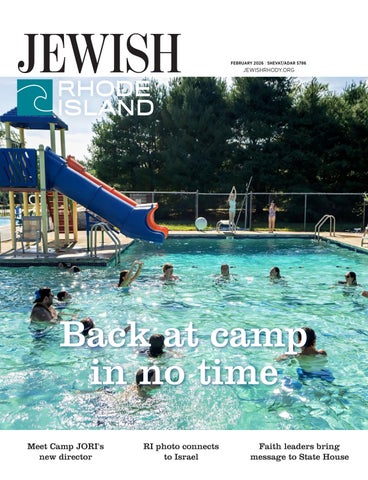
New JORI director really loves camp
BY SARAH GREENLEAF
Louis Lasko grew up going to camp, first at camp JORI, then at day camp and finally at Camp Wah-Nee in Torrington, Connecticut, which is where he said it really clicked. “I went to JORI a little too young in the summer,” Lasko said with a laugh recounting his time as a home-sick elementary school kid. His experience years later at Wah-Nee was when his love of camp really began. “My favorite memories were spending time in the evening with the friends I made,” he said.
NOW, LASKO, 37, is Camp JORI’s new director. And he is looking forward to keeping the beloved traditions at the Wakefield camp and building out activities for all types of campers. “I plan to keep the traditions people love, like the Olympics and some of the Shabbat and Havdalah traditions.”
Lasko’s background is focused on youth and camp programming. After high school, he earned a bachelor’s degree in Elementary
Education from Elmira College and went on to serve in a wide range of camp and after-school programs. He was the director of day camp at the Jewish Community Center in Springfield, Massachusetts; he served as the assistant director at Camp O-la-mi; he was the director of the after-school program at the Stamford JCC and the assistant director at Camp Laurelwood in Connecticut. Lasko has been married for a decade to his wife,
Kristin, and couple has two children and a dog named Matzoh Ball. He lives about an hour from Camp JORI in Colchester, Connecticut. After a brief stint in the Midwest, he is glad to be back home in New England and heading to Camp JORI.
“JORI is really unique,” he said. “Jewish camping is so expensive, and JORI includes everyone regardless of need.”
He pointed to JORI’s origin as a place for Jewish
orphans as foundational to its inclusive nature. “It’s a great community,” Lasko said, describing his experience meeting with parents and past campers.
Choosing a camp can be a big undertaking and Lasko recommends that parents, “really connect with the staff and director.” He pointed out that activities are similar at all camps so the important thing to look
for is “that feeling of connection – this will become their camp family, and it should feel that way.”
Other tips for parents include making sure your children are ready for overnight camp. “People used to start their kids in 2nd or 3rd grade, but that doesn’t work for every kid,” he cautioned. “It is more important to start
The impact of summer camp is unmatched
BY RACHEL ACCETTURO
When summer camp comes to mind, what are some things you think of right away? Is it that camp is in the summer, or that it is outside or it’s a place for kids to go while parents and guardians are at work? Those are all true, but if you dive a little deeper, camp is much more than that.
Camp is a place where kids can truly be themselves, where it is okay to be silly. The counselors encourage campers to sing silly camp songs, tell funny jokes, and dress-up in weekly themed outfits. Camp creates a safe space where everyone is accepted.
Camp is a place where kids can make their own friends, perhaps for the first time.
Parents and guardians sometimes help kids with introductions and guidance to develop friendships, but at camp they form organically. Because of this kids learn new social skills including active listening, sharing, and respecting personal space.
Camp is a place where kids can find their passion. Campers choose from an assortment of programs that include swimming, arts and crafts and sports and games, options they may have never had before.
Camp is a place where kids can take a break from technology. Instead of interacting with peers through video games or instant chat messengers, they give up screen time for in-person conversations.
Camp is a place where kids have the chance to set and accomplish goals. With the number of activities and programs offered they can learn how to swim, get over a fear of performing in
front of others, or conquer homesickness.
Camp is a place where kids can learn about healthy lifestyles. Healthy eating and physical activity are encouraged. There are abundant chances to participate in all kinds of programs that include swimming, team building exercises, sports and games, at all skill levels.
Camp is a place where kids can just be kids. During the school year, kids are used to the routine of going to school and doing homework or an extracurricular activity. Camp is a little less structured and allows kids more spontaneous play and freedom. Free play helps them develop creative thinking skills and explore their imaginations.
RACHEL ACCETTURO is the director of school age programs at the Jewish Alliance of Greater Rhode Island. Want information about camp at the Dwares Jewish Community Center? Go to jewishallianceri. org/explore-programs/forchildren/summer-j-camp
Camp offers time for group activities or time alone.
PHOTOS GLENN OSMUNDSON
COMMUNITY
BUSINESS
28 | OBITUARIES 29
Rhode Island Torah Network offers
home for unaffiliated Jews
BY SETH CHITWOOD
PAWTUCKET – With an estimated 15,000 unaffiliated Jews in Rhode Island, a surprising number surpassing the state’s visibly engaged Jewish community, Rabbi Yehoshua Singer wondered where those seeking connection and tradition could go.
Thus, in Summer 2024, the Rhode Island Torah Network was established offering a unique place for Jews of all backgrounds to explore, learn and belong.
“There’s a vibrant Jewish community here. And as people start connecting their Judaism and with other Jews, they quickly find more venues and ways to expand and enhance what they’re connected with,” said Rabbi Singer. “It becomes so much more meaningful for them.”
The network is about providing opportunities for Jews across Rhode Island to connect with their heritage, each other and a sense of purpose, without pressure to join a temple. Whether someone is looking for spiritual growth, cultural understanding or simply community, the organization bridges the gap for those who may feel left out by traditional structures.
“We want to be a gateway to
the broader community, not an alternative,” said Rabbi Singer.
The network focuses on programming and Torah study, social events and oneon-one learning, all designed to be accessible and inclusive.
Rabbi Singer, alongside several other local leaders and educators, brings a wealth of experience to each of the events and classes. Born in New York and raised between New Jersey and Maryland, Rabbi Singer gained rabbinic ordination from the esteemed Yeshivas Rabbeinu Yisrael Meir HaKohen (Yeshivas Chofetz Chaim) in Queens. He holds an advanced certificate in synagogue management.
His background includes outreach and education roles in Los Angeles, Savannah and the Greater Washington area.
“I definitely grew up in the Orthodox world, where Torah was part of the home,” he said. “As a kid, I was more comfortable with the classroom, but as I grew into teaching and helping others, I realized it’s not so much about classroom learning… it’s about connecting, helping people and offering perspective.”
After nearly a decade serving Am HaTorah, Rabbi
Singer and his family moved to Rhode Island where he became the Rav of Sha’arei Tefilla in 2024.
“For us, the temperature was actually an incentive. We’re very happy to be in the Northeast,” he said.
It wasn’t long after arriving in Pawtucket, that Rabbi Singer went to work to bring the RI Torah Network to fruition. He lives in the area with his wife Rebbetzin Serena Singer and six children Nachi, Tehilla, Kalman, Chana Bracha, Meir Herschel and Ayala.
“People wanted an organization offering something outside formal worship, a place for the unaffiliated to connect with Judaism,” he said, adding that the network isn’t about formal religious instruction or membership.
“We’re just teaching Torah. Exploring Jewish heritage together. If someone comes to us and says, ‘Can I explore my Judaism from a conservative or reform standpoint?’ we say, of course. You can do whatever you want with the information.”
Co-founded alongside Rabbi Ahron Michel Plotsker, events and classes range from Torah study sessions and discussions on practical Jewish philosophy, to social gath-
erings such as holiday-themed parties, women’s groups, poetry readings and mental health panels.
“Almost every event we do, we meet new people,” Rabbi Singer added.
“And the community leaders have been very positive, they see we’re building bridges, not silos.”
The impact is felt not just in the turnout at events but in the tone RI Torah Network strives to set in the state, according to Rabbi Singer, who said there is a real sense of acceptance among people who attend events.
“There’s respect for other people’s right to live their lives. We want to enhance the Jewish experience, especially for those who haven’t connected with existing networks by providing an open place to explore their Judaism,” he said.
The network encourages Jews of every background to take part, emphasizing that every journey is valid, and as the organization grows, Rabbi Singer says the vision
remains clear: more events, deeper connections, more lives touched.
“We’re always interested in what would be valuable for the community. Our door is open,” he said.
To learn more about RI Torah Network, contact Rabbi Singer at 240-9942906 or e-mail at, info@ riTorahnetwork.org, or visit ritorahnetwork.org.
SETH CHITWOOD (www.sethchitwood.com), of Barrington, is a features reporter for The Standard-Times, in New Bedford, Massachusetts. He is also the creative director of the award-winning Angelwood Pictures production company.
COMMUNITY
them when they are ready so they can really grow their love of camp.” The worst thing that can happen is sending a kid who isn’t ready and negatively impacting their view of camp, so they don’t want to go at all.
When asked what set JORI apart Lasko pointed out that it is a newer camp facility with beautiful (and air conditioned!) indoor spaces like the dining hall and theater. “The lake is the most beautiful spot,” he said, describing the current quiet. “I know that won’t be the case in the summer!” he said. The camp is also surrounded by a nature preserve making it feel like a world away.
Camp JORI is a device-free zone. “No campers can bring anything that connects to the internet, and staff are not allowed to have their phones out when they are with campers,” he explained. Though some kids, especially teenagers, can really
SIMCHAS
struggle with this change, Lasko pointed out that “it is up to the camp to make it more interesting than whatever might be on a device.”
Downtime is when things like homesickness really flare up so “it is important to have activities and really present and available staff,” Lasko said.
As someone who has been involved in the camp world, Lasko has seen a lot of change. “The biggest change is the camper experience,” he said, “having social workers on staff and making sure kids have the resources they need.”
Lasko points out that this is not to turn camp into a therapeutic environment, but to have extra layers of attention and expertise.
“Camp back in the day was much more of a free for all,” he said. “Here are the activities and you figure it out, which worked for the time, but we are much more focused on camper care.”
In his personal life Lasko is a family man who loves spending time with his 3-year-old and 10-week-old, cooking, and hosting. He hosts Thanksgiving and the first two nights of Passover, with family coming in from out of town for both. At these events, he does what he hopes to do at camp – invites people in, makes them comfortable, and creates a fun experience.
This summer you’ll find Lasko on the archery range, at every meal, at the ropes course, and everywhere in between. The one place you won’t find him? “You won’t find me in my office during the summer,” Lasko said with a laugh.
SARAH GREENLEAF
(sgreenleaf@jewishallianceri. org) is the digital marketing manager for the Jewish Alliance of Greater Rhode Island and writes for Jewish Rhode Island.
Happy 100th birthday!
NATHALIE LEVITT KOSSOVE of Gainesville, Florida, recently turned 100 years old.
Sandy Ross, of Providence, her daughter, Nancy Bloch, and Ross’ grandson, Sam Bloch, visited to celebrate. (They are pictured.)
Also celebrating with Kossove, who is originally from Providence, was her daughter, Pam Schneider, of Gainesville, along with Pam’s children and most of her grandchildren.
Celebrations!
ELLEN RAPPOPORT of Cranston and family recently traveled to Aruba and took JRI with them! Travelers are (from left to right): Michael Murphy, Gus Candiotto, Taylor Rappoport-Murphy, Barry Rappoport, Kailey Murphy, Nicole Rappoport and Ellen Rappoport. Not only did the trip include daughter Nicole and family but it was a celebration of her husband, Barry’s 70th birthday.
CONTINUED FROM PAGE 12
vert. I was born Jewish. But I too choose each day to be Jewish. I will wear my yarmulke in public. I will put on tefillin in an airport after evaluating the safest spot to do so. I will go to Temple with my family and thank the security guards who keep us safe. I will try and have clear conversations with those who continuously accuse Israel of crimes even as they ignore their own crimes and those of others. (Have you seen any films on the horrify-
ing abduction of 20,000 Ukrainian children by Russia?)
Even in my exhaustion my Torah reminds me that with every fiber of my being I must pray for peace and so I will do so. Perhaps you will join me?
Gershon Stark Providence, R.I.
Join us for a night of stand-up comedy with THE hilarious Liz Glazer, hot off the Tonight Show and her YouTube special.
Walking the museum
RHODE ISLAND Coalition for Israel (RICI) president Ken Schneider and executive director Maria Friedman recently went on a tour of the
Rhode Island Jewish Museum with its president Shelley Parness The museum is housed Sons of Jacob synagogue.
RICI in the news
RHODE ISLAND Coalition for Israel (RICI) held a peaceful rally in support of the Iranian people near Brown University’s campus on Jan 22. Those at the rally in an interview with the Brown Daily Herald, were able to highlight the need for the West, and Rhode Islanders, to stand with the Iranian people as they demonstrate against the regime in power.
The interior of Sons of Jacob Synagogue in Providence.
Ken Schneider, Shelley Parness, Maria Friedman RIJM
Demontrators from the Rhode Island Coalition for Israel make their voices heard on Jan. 22.
RICI
COMMUNITY
Black Germans and the Holocaust
BY LAURA AUKETAYEVA
The Holocaust is most often remembered through the persecution and murder of the Jews in Europe, the central crime of the Nazi regime. Yet Nazi racial ideology also targeted Black people living in Germany and occupied Europe, a history that remains far less visible. Among the least known victims were Afro-German children born in the 1920s after France stationed colonial troops in the German Rhineland following World War I. Nazi racial scientists tracked these children, photographed them and cast them as a “biological threat.” In 1937, at least 385 adolescents, some as young as 13, were forcibly sterilized after what historian Paul Weindling describes as “psychological, anthropological and genetic evaluations” designed to turn racist theory into state policy.
THIS VIOLENCE did not emerge in isolation. It grew from older currents of colonial “race science” developed during Germany’s imperial past, particularly in German Southwest Africa, today Namibia. Weindling traces a direct line from anthropological studies of racial mixing in the colonies to Nazi public health policies that treated “blood” as destiny. Hitler’s Mein Kampf framed sterilization as a necessary remedy for what he called damage to the nation’s hereditary stock, and Nazi law soon made these ideas actionable. The 1935 Nuremberg Laws criminalized relationships not only between Germans and Jews but also between Germans and non-White people, while a Nazified medical establishment helped identify, classify and punish those deemed racially “undesirable.”
Afro-Germans and Black soldiers were thus targeted for exclusion, sterilization, imprisonment and social erasure under a regime obsessed with racial purity. Drawing on colonial-era racism and transatlantic white supremacist ideas, the late USHMM archivist Robert W. Kestling demonstrated that the Nazis barred Black people from education and employment, criminalized interracial relationships and forcibly sterilized at least 365 Afro-German children in 1937. This history reveals how Nazi ideology
weaponized race across multiple groups and exposes the broader machinery of white supremacy that underpinned Nazi rule.
Daily life for Black Germans reflected this escalating exclusion. They lived as a small, highly visible minority whose presence increasingly marked them as outsiders. They were pushed out of schools and professions, harassed in public and subjected to laws that defined them as racially inferior. There was no single experience of being Black in Nazi Germany, but all were forced to navigate a society that steadily denied their right to belong. Some survived by attempting to remain invisible, avoiding attention that could lead to denunciation or arrest. Personal testimonies convey the human cost of these policies. Hans Hauck, who was forcibly sterilized as a teenager, later recalled being taken with other adolescents for days of examinations and procedures, saying, “We all were too scared to object,” and later describing the aftermath as leaving him feeling “only half human.” That Hauck was one of the very few to speak publicly underscores how stigma and fear silenced most survivors.
Persecution also extended into the Nazi camp system, though Black prisoners
LIBRARY OF CONGRESS
Slide shown during lectures at the State Academy for Race and Health in Dresden. The daughter of a white German woman and a Black French soldier stands among white classmates, Munich, 1936. This image was included as a slide for lectures on genetics, ethnology, and race breeding at the State Academy for Race and Health in Dresden, Germany.
2026 JCC Maccabi Toronto games scheduled for August
Now is the time to think about participation
BY DOUGLAS STARK
For many Jewish athletes, competing with and against Jews from around the world has been a transformative experience. Sharing a safe space with Jewish athletes has led Jewish teenagers to make friends, foster a sense of belonging and create a deeper connection to Judaism.
SPORTS AND JUDAISM have been intertwined for centuries as sports helps Jews create community, overcome stereotypes and teach life-long values such as discipline, self-improvement, collaboration and ethical and moral conduct.
If you are a Rhode Island Jewish teenager (age 13-17) who likes competing, meeting new people and exploring your Judaism, you are strongly encouraged to consider the opportunity to participate in the 2026 JCC Maccabi Toronto Games.
Beginning in 1982 as a pilot program, the JCC Maccabi Games started as a fiveday Olympic-style sporting event for Jewish teenagers in North America. Since then, the program has blossomed into a major international event that emphasizes Jewish identity, community and sportsmanship alongside athletic competition.
Annually, the JCC Maccabi Games is the single
rarely appeared as a distinct category. Records from the International Tracing Service archive, held by the Wiener Holocaust Library, show that race often appeared alongside political or security accusations on prisoner files, indicating that Blackness itself could be a contributing factor in arrest and incarceration.
Gert Schramm, a mixed-race German teenager arrested in 1944, was sent to Buchenwald, where his prisoner card explicitly listed his racial classification as a reason for
largest gathering of Jewish teens outside of Israel. Maccabi week is an international sports festival infused with Jewish content and Jewish pride, where teens can explore their Jewish connections in a safe, secure and supervised environment.
The week includes Olympic style Opening Ceremonies, 3-4 days of sports competition (culminating in GOLD-SILVER-BRONZE medals), nightly fun social events, home housing in groups of 2 or more and so much more. While sports is the entree to the Games, the Magic of Maccabi is in the making of lifelong friends from places near and far, and all the fun the teens have in between and after the games. Regardless of the score of the games, every participant has a meaningful and transformative experience in terms of Jewish identity and connections as well as socially and
detention. “They didn’t need a reason,” Schramm later recalled, “Being Black was reason enough.”
Other Black prisoners entered the camp system through wartime repression across occupied Europe.
Raphael Elizé, a veterinarian and former mayor from Martinique, and Baba Diallo of Mali were deported to Buchenwald during mass Nazi roundups and died there. The United States Holocaust Memorial Museum documents the case of Bayume Mohamed Husen, a former colonial soldier from
athletically.
According to the JCC Maccabi website, “JCC Maccabi is about much more than sport competition. A great athlete or leader is not defined by fame or wins, but their actions towards fellow human beings. Six official JCC Maccabi Midot (values) guide the JCC Maccabi program, helping us remember the greater mission of the Games. We emphasize Tikkun Olam (repairing the world), Kavod (respect), Rina (joy), Ga’ava (pride), Lev Tov (big hearted) and Amiut Yehudit (Jewish peoplehood). Those who exemplify these Jewish values and the true meaning of Maccabi may be lucky enough to earn a
Team Springfield (Springfield, Massachusetts) comprises a regional delegation which includes athletes from Rhode Island, Connecticut, Massachusetts, Vermont, New Hampshire, Maine and Westchester County, New York. Team Springfield will be competing in Toronto and any Rhode Island Jewish teenager who is interested is invited to fill out an Interest form and meet with Betsy Bertuzzi, the coordinator of Team Springfield. Six weeks remain in the recruiting period. Once teams have been finalized, there is a virtual all-team meeting in May followed by a team party in June in person in Springfield. The competition is from Aug. 2-7.
‘Annually the JCC Maccabi Games is the single largest gathering of Jewish teens outside of Israel’
Midot medal at the Games, the highest honor for a JCC Maccabi participant.”
The main World Maccabiah Games for older athletes will be in Israel in July 2026, but the JCC Games (for teens) are in Toronto and Kansas City for different sports/age groups.
what is now Tanzania, who was imprisoned in Sachsenhausen for alleged “racial defilement” after relationships with white German women and died in custody in 1944. As Holocaust experts Elise Bath and Roxzann Baker note, these fragmented records show how Nazi racial ideology operated through overlapping justifications, leaving many Black victims invisible both during the war and after it.
After the war ended, Weindling notes that none of the sterilized Rhineland adolescents received compen-
The sports that are available are basketball, dance, golf, ice hockey, soccer, softball, baseball, swimming, track and field, volleyball (girls) and Star reporter.
Beginning in 2015, Team Springfield adopted five Rhode Island athletes and three coaches for three years (2015-17) as part of its delegation. In 2022, a Rhode Island athlete participated in the games in San Diego, however, since then, there
sation, and the scientists who orchestrated the program were never prosecuted. Most victims remain unnamed, their lives reduced to files, photographs or racial classifications. This silence mirrors the stigma imposed on them during the Nazi era itself. Including the persecution of Black people within Holocaust history helps demonstrate how Nazi ideology, colonial racism and antisemitism were intertwined, and how state institutions such as medicine, law and bureaucracy could be mobilized to inflict lasting harm. Remem-
have been few interested Rhode Island Jewish athletes, and none has committed.
Team Springfield is hoping to reverse this trend and encourage more Rhode Island Jewish teenagers to participate in the program. It is a great way to pursue your athletic interests in a Jewish environment while meeting Jewish athletes from all over North America.
As Bertuzzi states, “it is a great way to see a broad spectrum of the Jewish community. It is a transformative experience.”
For more information, feel free to email Betsy Bertuzzi, at bbertuzzi@springfieldjcc.org or visit the team webpage: https://www. springfieldjcc.org/jcc-maccabi-games/. The social media handles include Facebook group: https:// www.facebook.com/ groups/476289279143082 and Instagram: https://www. instagram.com/teamspringfieldmaccabi/
DOUGLAS STARK , of Barrington, is a writer, museum consultant and sports historian. If you have any Rhode Island Jewish athletes you’d like to see us interview, contact editor@jewishallianceri.org
bering Black victims alongside Jewish victims does not fragment Holocaust memory. It reveals the full reach of Nazi racial ideology and reinforces why confronting racism in all its forms remains an urgent moral task.
LAURA AUKETAYEVA, Ph.D., is director of education and programs at the Sandra Bornstein Holocaust Education Center in Providence.
Learning, ritual and remembrance: sharing the vision of Heschel and King
BY ABIGAIL ANTHONY
In March 1968, just weeks before Dr. Martin Luther King Jr. was assassinated, Rabbi Abraham Joshua Heschel and Dr. King stood together before thousands of rabbis at the Concord Hotel in the Catskills and sang “We Shall Overcome,” with Heschel singing in Hebrew. Each year, the small congregation at Temple Shalom in Middletown re-enacts that moment during its Martin Luther King Shabbat, designed to reinforce their commitment to justice and pass it on to children and adults alike.
TEMPLE SHALOM’S Martin Luther King Shabbat is a decades-long tradition, born from relationships and interfaith dialogue between the late Rabbi Marc Jagolinzer, Newport’s Black churches and the local NAACP, and carried forward today by Cantor Fred Scheff. Central to the service is the enduring partnership between Dr. King and Rabbi Heschel in the civil rights movement, grounded in their shared belief that all people are created in God’s image.
Children are introduced to that shared vision through a reading of “As Good as Anybody,” which tells the story of the friendship between Dr. King and Rabbi Heschel. They learn the context behind the iconic 1965 photograph of the two men crossing the Edmund Pettus Bridge in Selma, Alabama, a moment Rabbi Heschel later described by saying, “I felt my legs were praying.”
The learning becomes embodied through action.
Children create a paper chain of “dreams” for justice, fairness, peace and dignity, then symbolically march across a bridge as the congregation sings “Lo Yisa Goi ” and “Down by the Riverside.” The reenactment echoes the Selma-to-Montgomery march and reinforces the idea that prayer happens not only through words in the synagogue, but through action in the world.
As voices rise together to “Lift Every Voice and Sing,” the congregation is
reminded of Rabbi Heschel’s call to make more room for God in the world through how we treat one another. Temple Shalom is a small community, but through learning, ritual and remembrance, it continues to honor and recommit to the shared Jewish and Black civil rights legacy, and to pass it forward.
ABIGAIL ANTHONY is a member of Temple Shalom in Middletown.
ISRAEL TRAVEL FAIR
Learn about organizations that o er diverse opportunities for travel to Israel.
MARCH 1 | 3 – 6 PM | AT THE DWARES JCC
Whether Israel feels like home, a long-awaited dream, or a place calling you back, this event offers a welcoming space to explore, connect, and be inspired.
Enjoy the flavors and sounds of Israel with authentic Israeli food and lively music, creating an atmosphere that captures the spirit, warmth, and resilience of the country.
Happy times!
YOUNG PROFESSIONALS enjoy a drink at Track 15 on Thursday, Jan. 8, during the happy hour event held every month and sponsored by the Jewish Alliance of Greater Rhode Island. For more information, contact Samantha Kaufman at skaufman@ jewishallianceri.org.
who was willing to lay down his life for his spiritual home. We talked a lot about what that meant, but I don’t think I really grasped it fully at the time. Some 10 years later I reconnected with Larry, by which time he had spent considerable time in Israel, married an Israeli opera singer, and become a struggling but wildly imaginative and experimental playwright.
experience for which I am beyond grateful.
For more information on upcoming sessions of Delve Deeper, go to delvedeeper.org
RUTH MARRIS-MACAULAY, a retired educator, is the copy editor for Jewish Rhode Island.
Monday, June 8, 2026
Warwick Country Club
394 Narragansett Bay Avenue Warwick, RI
Learn more about sponsorship opportunities and registration information at JewishAllianceRI.org/Golf or scan the QR Code
COMMUNITY American and Israeli teens join in harmony at gala concert
Singers from the Providence HaZamir chapter will join hundreds of HaZamir: The International Jewish Teen Choir members from across the U.S. and Israel to perform a Gala Concert on Sunday, March 15, 2026, at the Wu Tsai Theater, David Geffen Hall at Lincoln Center in New York City.
THE HAZAMIR concert combines music, Judaism, community and spirituality in a powerful blend. A variety of musical styles will be performed, including popular music and classic Israeli and Jewish American selections in English and Hebrew, as well as several pieces that were commissioned or arranged just for HaZamir.
“HaZamir gives young people an outlet to celebrate their Jewish heritage, connect with one another and feel a sense of belonging and pride through the creative outlet of music,” says Vivian Lazar, Director of HaZamir. “Now, more than ever, this supportive community is crucial to teens.”
Members of HaZamir rehearse regularly in their local chapter and meet for regional retreats and leadership events throughout the year in addition to the annual concert. Teen participant Jaynie sums up the joys of joining the other singers in concert: “We have a lot in common: We’re Jewish, we love to sing, and we’re all committed to music. When we perform, it’s so special because we’ve worked on this all year, and then we come together and get to know each other. At the same time, the songs have such great meaning, and it becomes very emotional. All in all, it’s an amazing experience.”
HaZamir was created by Matthew Lazar, founder and director of the Zamir Choral Foundation, to provide an opportunity for accomplished young singers to perform great Jewish music at the
highest standard of excellence.“This is a life-changing opportunity for these young people, as they express their Jewish identities through their love of music. They build leadership skills and strong connections to peers from a range of backgrounds,” adds Vivian Lazar. “The chance to be part of something bigger than themselves and perform on the world’s greatest stages also instills a sense of confidence and achievement.”
The international HaZamir choir includes teens from 25 American chapter locations including Baltimore; Bergen County, New Jersey; Boca Raton; Boston; Brooklyn; Central New Jersey; Chicago; Cleveland; Detroit; Houston; Los Angeles Valley; Long Island, New York; Los Angeles; Manhattan; MetroWest New Jersey; Miami; Minneapolis; New Haven; Orlando; Philadelphia; Pittsburgh; Providence; Silicon Valley, California; Washington, D.C.; and Westchester County New York; and in seven cities in Israel. The 2026 HaZamir: The International Jewish Teen Choir concert takes place Sunday March 15, 2026, at 2:30 p.m. at the Wu Tsai Theater at David Geffen Hall at Lincoln Center, 10 Lincoln Center Plaza, New York, NY. Tickets are available at https://www.lincolncenter. org/home. To contact HaZamir Providence, email conductor Cantor Brian Mayer at bjmayer@teprov.org
For additional information visit www.hazamir.org
TENNIS
COMMUNITY
FROM THE JEWISH FEDERATION FOUNDATION
Women’s Alliance Endowment Fund seeks grant proposals for upcoming fiscal year
The Women’s Alliance Endowment Fund (WAEF), chaired by community leaders Susan Leach DeBlasio and Amy Paige DeBlasio, is seeking grant proposals for the upcoming fiscal year, July 2026 through June 2027. WAEF supports programs and services that benefit Jewish women and children and demonstrate the potential for positive, long-term impact. Educational, cultural and religious initiatives will be considered, as well as programs in the health and social services fields. This year, WAEF will award nearly $11,700 in grants, to be distributed by June 30, 2026.
SINCE ITS FOUNDING in 1993, WAEF has awarded 159 grants totaling over $165,700 to a wide range of programs and service providers. Jewish organizations, agencies and synagogues in Rhode Island, southeastern Massa-
chusetts and overseas whose missions align with the Jewish Alliance of Greater Rhode Island are encouraged to apply.
Recent grant recipients include Jewish Collaborative Services for Hanukkah
gifts for seniors, Jewish Community Day School for social-emotional learning lunch groups and, in Israel, ELEM for emotional and medical support for at-risk Haredi girls and the Jaffa Institute’s Welfare to Well-
being program.
WAEF currently has 103 members, all of whom are encouraged to participate in the annual grant process. Membership requires a minimum contribution of $1,000, payable over three years. The fund is invested as part of the Jewish Alliance of Greater Rhode Island’s endowment and relies on new members and additional gifts to increase the income available for annual grantmaking. This year, to honor the mother-daughter co-chairs, new intergenerational and familial memberships are encouraged to support the fund’s growth.
The request for proposals will be distributed to local synagogues and Jewish agencies, as well as to organizations that have received WAEF funding in previous years. The RFP is available to download at www.jewishallianceri.org/ WAEF. Grant applications must be received by Friday, March 13. Funding decisions will be made at the WAEF annual meeting in May with award recipients notified in June. For more information about WAEF membership or the grants process, contact endowment@jewishallianceri.org.
Empowering students, supporting our global community
BY BRAD SWARTZ
Ethiopian National Project (ENP)’s School Performance and Community Empowerment (SPACE) Afula [Israel} has proven to be a transformative, holistic after-school program serving Ethiopian-Israelis and other at-risk 7th–12th grade students. The program provides comprehensive scholastic, socio-emotional, experiential and nutritional support, ensuring that students have the tools they need to succeed inside and outside the classroom. Working in small groups, students receive targeted academic guidance alongside mentorship from Ethiopian-Israeli professionals who serve as role models. ENP partners closely with parents and community leaders, strengthening broader networks that support student success.
THE DOLLARS RAISED through the Jewish Alliance Community Campaign are critical to making this work possible.
In times of war and heightened uncertainty, SPACE becomes even more essential. The program offers critical emotional support to help students navigate trauma, anxiety and disruption, while continuing to cultivate self-confidence, leadership and personal growth. By addressing social and emotional challenges that can interfere with learning, SPACE helps students stay engaged and focused during some of the most difficult moments of their lives. Grace Rodnitzki, Director of International Relations said, “With Alliance’s support of the Ethiopian National
Project’s SPACE program in Afula, we’re making a difference that will have lasting repercussions for Afula and the Jewish community in Rhode Island. Together we’ve provided intense emotional support of Ethiopian-Israeli youth and their families during wartime, meeting dire needs while safeguarding Afula’s most vulnerable community.”
Beyond academics, students benefit from free lunches, motivational mentors and speakers, hands-on enrichment and field trips – including visits to universities that broaden horizons and open doors to their futures. These experiences reinforce possibility, aspiration and belonging to students who would otherwise not have these opportuni-
ties at their fingertips.
Campaign contributions from our generous donor base allow us to allocate resources where needs are greatest – supporting global partners like ENP while sustaining vital programs and services here at to home. This collective giving model ensures that we can respond quickly in times of crisis, invest strategically in long-term impact and maintain an interconnected Jewish community.
ENP’s SPACE aligns seamlessly with the mission of the Alliance by safeguarding vulnerable Jewish populations, strengthening global Jewish identity, nurturing meaningful partnerships and ensuring access to essential human services.
SPACE empowers students to focus, thrive and envision a stronger future for themselves and their communities.
The Jewish Alliance’s giving priorities – education, community engagement and social and human services, all ensuring a strong Jewish tomorrow – guide every allocation decision. Support for ENP is made possible only through gifts to the Community Campaign.
This year, the Alliance’s goal is to raise $4 million through the Community Campaign. Meeting this goal would expand partnerships, deepen impact and ensure that Jewish communities here and abroad can thrive, even in a rapidly changing world. Every donation strengthens the shared future of the Jewish community.
Every gift plays a key role in protecting and strengthening our shared Jewish future. Those interested in making a difference be it by contributing to the Community Campaign and/or getting involved in the allocations process through committee membership should visit: jewishallianceri.org/support-us/featured/donate-now or contact Brad Swartz, Fundraising and Partnership Manager, directly: bswartz@ jewishallianceri.org.
OBITUARIES
Joyce Falcofsky, 79 WARWICK, R.I. – Joyce C. Falcofsky passed away on Jan. 23, 2026, at the Brentwood Nursing Home in Warwick. She was the beloved wife of the late Aaron H. Falcofsky for 35 years. Born in Providence, a daughter of the late Bernard and Beatrice (Garfinkel) Schneider. Joyce was a bench jeweler for many years, while she enjoyed the creative freedoms of the job. Later she joined Ross Simons as a jewelry consultant who specialized in customer success and retention through her friendly service and warm demeanor.
In the early ’70s Joyce moved to Warwick and was a proud resident for over 55 years. She and Aaron raised their sons to be committed members of their community. She was a proud mother of Eric Falcofsky, his wife, Holly, of Warwick; and the late Ari Falcofsky of Lebanon, Tennessee. She was the loving grandmother of Sophie, Harrison, Sloane and Gavin. Contributions in memory of Joyce Falcofsky in honor of Ari Falcofsky may be made to the Inner City Rugby of Nashville (ICRON [https:// www.icrontn.org/donate], or a charity of your choice.
Charlotte Feld, 100 MILL VALLEY, CALIF. –Charlotte Goldman Feld died peacefully on Jan. 28, 2026. Charlotte was born Jan. 17, 1926, growing up in South Providence with her late parents, J. Samuel and Gussie Goldman, and seven siblings. She met her husband, Ben Feld, at a Rosh Hashanah dance, and settled in Warwick where they raised their 2 children. They co-founded Temple Beth Am. She volunteered in the temple gift shop and with cancer survivors, and she was a 62-year survi-
vor of breast cancer. Charlotte loved traveling, calligraphy, painting, bowling, music boxes, Scrabble, seahorses and monkeys. She was still a whiz at crossword puzzles until her late 90s.
Charlotte lived out her last 15 years at The Redwoods in Mill Valley, near her daughter where she enjoyed many activities and new friendships. Charlotte was the loving mother of Randall (Nancy), and BatSheva; devoted baba of Adam (Christine), Amanda (Glenn) and Shoshana (Ofir); and the proud big baba of Penelope, Levi, Isabella and Logan. She also leaves a sister-in-law and many nieces and nephews who loved her dearly.
Donations may be made to The Breast Cancer Research Foundation (BCRF) at give. bcrf.org
Phyllis Fleisig, 92
JOHNSTON, R.I. – Phyllis E. Fleisig died peacefully with her devoted family by her side on Dec. 19, 2025, at the Gardens in Briarcliffe Manor. She was the beloved sister of Dr. Norbert Fleisig and Samuel Fleisig. Born in Providence, Phyllis was a daughter of the late Maurice and Celia (Mills) Fleisig. She had lived in Providence for most of her life prior to moving to Johnston in 2022. Mills Sisters Dress Shop was originally started in 1940 by Phyllis’ mother, Celia. After her mother’s passing, the store was passed to Phyllis, who continued to operate the store for 10 years, closing in 1996.
Phyllis was a longtime member of Temple Beth-El, a synagogue that allowed her the honor of receiving her Bat Mitzvah in her late fifties. She was a lifelong member of Hadassah and a frequent flyer of the beaches that pepper the
Rhode Island coast, holding a special place in her heart for Narragansett State Beach. She was the devoted aunt of four: Micah, Rachel, Mark and Deborah. She was the dear sister of Dr. Norbert and his wife, Jean Fleisig, of Warwick, and Samuel and his wife, Susan Fleisig, of East Greenwich.
Contributions may be made to Hadassah [https:// donate.hadassah.org/secure/ donate-hadassah], 40 Wall Street, 8th Floor, New York, NY 10005.
Marian Golditch, 95 PROVIDENCE,
R.I. – Marian B. (Malenbaum) Golditch, of Providence, passed away on Dec. 31, 2025, after a brief illness. She was the wife of the late William Golditch. Born in Providence, a daughter of the late Nathan and Mella (Bazar) Malenbaum, she was a lifelong resident of the city.
Marian enjoyed watching Jeopardy and always answered the questions correctly. She was a longtime member of Temple Emanu-El. She is survived by her two sons, Neil Golditch and his wife Elizabeth, of Johnston; and Gary Golditch and his wife, Manuela, of Cranston; and four grandchildren, Tatiana, Jeffrey, Ethan and Ryan. She was the mother of the late Jason and Tamra Golditch. Donations may be made to Jewish Collaborative Services, 1165 North Main St., Providence, RI 02904.
Judith Goodman, 85 WARWICK, R.I. – Judith H. Goodman died on Jan. 8, 2026, at Saint Elizabeth Home on the Bay in East Greenwich. She was the beloved wife of Norman Goodman for 64 years. Born in St. Louis, Missouri, a daughter of the late Paul and
Ruth (Davis) Gershman, she had lived in Warwick for over 35 years, previously living in West Warwick. She was a member of Temple Torat Yisrael, the Miriam Hospital Women’s Association and Women’s Association for the former Jewish Home for the Aged and a life member of Hadassah.
She was the devoted mother of Linda Weisman and her husband, Bruce, of Warwick; and Andrew Goodman, of Boston. She was the dear sister of Pam Cohen and her husband, Joel, of Warwick. She was the loving grandmother of Stacey Boisvert and her husband, Brett. She was the cherished great-grandmother of Nathan and Lucie.
Contributions may be made to HopeHealth Hospice & Palliative Care, 1085 N. Main St., Providence, RI 02904; Temple Torat Yisrael, 1251 Middle Road, East Greenwich, RI 02818; Saint Elizabeth Home on the Bay, 1 St. Elizabeth Way, East Greenwich, RI 02818 or Jewish Collaborative Services, 1165 N. Main St., Providence, RI 02904.
Nora Howard-Gitlin, 73
PROVIDENCE, R.I. – Nora J. HowardGitlin, 73, died on Jan. 17, 2026, at home. She was the beloved wife of Louis Gitlin for 48 years. Born in Tampa, Florida, a daughter of the late Bertram and Zelda (Krellenstein) Howard, she had lived in Providence, previously living in New Bedford, Massachusetts. Nora was a member of Temple Emanu-El and a former member of Tifereth Israel. She earned a bachelor’s degree from Tufts and a master’s degree from
Columbia University. She was the devoted mother of Zachary Howard Gitlin, of Providence, and Ariel Rebecca Gitlin, of Brooklyn, New York. She was the dear sister of Dr. Jack A. Howard and his wife, Leslie, of South Dartmouth, Massachusetts, and Alan B. Howard and his wife, Patti, of Waccabuc, New York. She was the cherished pet parent of Waldo.
Contributions may be made to House of Hope and the Kosher Food Pantry.
Lawrence Hershoff, 76 SUNSET BEACH, N.C. –
Lawrence Stephen Hershoff of Sunset Beach, North Carolina, passed away peacefully on Jan. 30, 2026, at Lower Cape Fear LifeCare in Bolivia, North Carolina, after a courageous battle with pancreatic cancer.
Mr. Hershoff is survived by his wife, Eleanor Mulford of Sunset Beach. He is also survived by his sister, Andrea Hershoff Johnson, and her husband, Ken, of Worcester, Massachusetts; his nephew, Greg Johnson, of Attleboro, Massachusetts, and his wife, Stacey; his niece, Emily Johnson Finkel, and her husband, Noah Finkel, MD, of Chelmsford, Massachusetts; and his beloved grand-niece and grand-nephews, Madeline and Alden Finkel and Thomas Johnson.
Mr. Hershoff enjoyed a long and distinguished professional career in banking, finance and education. He served as Executive Vice President of Fleet Bank and its various subsidiaries in Rhode Island, and later as Senior Vice President of Citizens Bank and its various subsidiaries. He generally
In February 1961, the Jewish Herald printed this little tribute to its readers. The vignette, which is designed like a regular advertisement, compliments its readership for their “lively minds” and asserts that “Herald readers are born, not made.” Curiously, this piece has no stated call to action; it doesn’t ask the public to buy a subscription, place an ad or write a letter to the editor. The minimalist, hand-drawn image is typical for the era and shows a man with a brimmed hat – a men’s fashion that would fade over the next few years. The stylized atomic symbol was also common at the time, here hinting at readers’ intelligence. Newspaper courtesy Rhode Island Jewish Historical Association
OBITUARIES
held one job in banking and one in education. Following his banking career, he worked as a finance consultant and served as an Adjunct Lecturer in Finance at Bryant University in Smithfield, retiring in 2011. A leader by instinct and a teacher by nature, he valued clarity over comfort and substance over style – whether in a boardroom, a classroom or a community organization. He was demanding-of himself and others.
His civic involvement was extensive and reflected a lifelong commitment to stewardship and service. He served as treasurer of multiple 501(c) (3) organizations in Rhode Island, including the Jewish Federation of Rhode Island and Tech Access of Rhode Island. He also served on the boards of the American Red Cross and Clark University, was chairman of the San Miguel School in Providence, and most recently served as treasurer of Brunswick County Habitat for Humanity. In Sunset Beach, he served as chair of the Sunset Beach Board of Adjustment. He held himself to the same high standards he held others, and those who worked with him knew both the expectations and the trust that came with meeting them.
Mr. Hershoff was a proud
graduate of Clark University in Worcester, Massachusetts; the Simon School of Business at the University of Rochester; and the CAGS program at Bryant University, where he also served as Interim Dean of the Graduate School of Business.
In addition to his professional and civic pursuits, Mr. Hershoff was the founder and lead male singer of Chip and the Old Blocks, performing with the group until his retirement from music in 2024. Larger than life in both presence and spirit, he was many things to many people: a husband, a brother, an uncle, a mentor, a singer, and an orator. He brought the same intensity to his passions outside of work as he did to his professional life.
A resident of Sea Trail for more than 13 years, he served as treasurer of the Sea Trail Men’s Golf Association and spent as much time as possible fishing and playing bridge. An avid golfer, he routinely played more than 200 rounds of golf annually.
Someone who met life head-on and refused to waste time second-guessing decisions, Larry fought for every second on this earth with the same resolve that defined the rest of his life. He did not waste time. He lived fully. Donations may be made to
the San Miguel School, 525 Branch Ave., Providence, Rhode Island 02904.
Larry Kahn
CRANSTON, R.I. – Larry Kahn, a longtime resident of Rhode Island, passed away after an extended illness on Jan. 11, 2026. Larry was the beloved husband of the late Susan Sandler Kahn and Ellen Peterson Kahn for the past 22 years. He was the son of the late Melvin and Mae Kahn.
He was a graduate of Rhode Island College. He spent a rewarding career teaching in the Smithfield public schools. He also served as Master of Lodge for the former Roosevelt Masonic Lodge # 42. Larry was an avid reader and enjoyed traveling and, most of all, spending time with his wife, Ellen, and family. He loved playing with his grandchildren, riding motorcycles and sharing the joy of a dry sense of humor.
Larry is survived by his daughter, Shannon Peterson, and sons, Aaron Kahn (wife Rachel), Michael Peterson (wife Stacey), Seth Kahn (wife Dana) and Brian Peterson (wife Alicia). His loving grandchildren are Owen, Alex, Sawyer, Nathan, Lily, Charlie, Chase, Oliver and Declan. Larry’s brother is Ronald Kahn (wife Pamela).
Please honor his memory by reaching out to an old friend or family member to share a few moments of your time.
Yakov Karlin, 94 PROVIDENCE, R.I. – It’s a great sadness we announce the passing of Yakov M. Karlin, who departed this life peacefully in the Rhode Island Hospital on Jan. 25, 2026. He was born in Donetsk City (Stalino at that time) of USSR on Feb. 18, 1931. He was a son of Sura-Riva and Khaim Karlin, the only one of their three children who survived the Holocaust. Yakov was the husband of the late Ada Karlin for 40 years.
He was a hardworking man who built a career as an architect, designing buildings that stand as a testament to his talent and vision. This was before he emigrated as a refugee from Ukraine to the USA on Aug. 4, 1997.
He was a great photographer and liked cars, music, reading and traveling. Yakov was a devoted father to his son and daughter-inlaw, a proud grandfather to 2 grandchildren and 3 great-grandchildren. His kindness, generosity and love for his family and friends will never be forgotten.
Alexander Kingsbury, 42 MARLBOROUGH, MASS. –Alexander Factor Kingsbury, of Marlborough, passed away on Dec. 7, 2025, at Brigham and Women’s Hospital in Boston. Alex was born and raised in Massachusetts and was a graduate of St. John’s High School, Class of 2001. He went on to attend Sarah Lawrence College, where he earned a bachelor’s degree in liberal arts in 2006.
Those who knew him remember his intelligence, imagination, love of music, feelings of indignity at society’s wrongs and thoughtful nature. His potential was always enormous.
He is survived by his loving mother, Maxine Factor Kingsbury; his father, Barry Kingsbury, and Barry’s partner, Mary Knuth; his aunt, Judith Factor, and her husband, Robert Wechsler; and his cousins, Adam and Diana. He will be deeply missed by his family and all who knew him.
Carol Mann, 76 WEST BLOOMFIELD, MICH. – Carol E. Mann, 76, of West Bloomfield, passed away peacefully on Jan. 16, 2026. Born in Providence, Carol was a beloved daughter of the late Muriel (Hassenfeld) Mann, the late Leon S. Mann and the late Inga (Freudenberg) Basch Mann.
Carol grew up in Providence and graduated from Lincoln School, Case Western University ‘72 and the University of Michigan School of Social Work, from which she earned her M.S.W. in 1974.
Carol dedicated her life to helping other people. As a social worker for the State of Michigan and then in private practice for many years, Carol supported countless patients. Along with her family, Carol was proud of her community and philanthropic work with many organizations in Michigan, Rhode Island and nationally. She was a proud supporter of non-profit organizations that focused on education, women’s causes, diabetes research and animal rescue. Along
with her brother, Robbie, she established the Mann Endowment Fund and the Mann Child Policy Externship at Case Western Reserve’s Schubert Center of Child Studies. Carol loved spending time at her lake house in Caseville, Michigan, visiting her large and growing family, and being with her beloved Maltichon rescue dog, Callie. Carol leaves her brother, Robbie Mann (Judy), of Miami Beach, Florida; sister, Susan Fink (Bill), of Palm Beach Gardens, Florida; and sister, Joan Chesner (the late Dr. Lou Chesner), of La Jolla, California. Carol was a devoted aunt to her niece and nephews: Jonathan (Kate) Chesner, Michael (AnnieKate) Chesner, Andrew (Amelia) Fink, Lauren (Brett) Perlmutter, Zachary (Hannah) Mann and the late Maxwell Mann. She was proud to be great-aunt to Teddy, Liza, Emersyn, Ivy and Liam. Contributions may be made to Michigan Animal Rescue League, 790 Featherstone Street, Pontiac, MI 49342 or at https://marl.org/donate/ memory-honor-donation/.
Beverly Pollack, 79 WARWICK, R.I. – Beverly N. Pollack died at Kent Regency Center on Dec. 26, 2025. She was the beloved wife of Steven Pollack for 53 years. Born in Brighton, Massachusetts, a daughter of the late Benjamin and Ethel (Herman) Neudel, she lived in Warwick for 10 years before moving to Kent Regency in 2024. She held a degree in stenotyping and was a court stenographer for the state of Massachusetts and was often asked to stenotype for the Alcohol Commission by the Attorney General in the 1970s.
She was the devoted mother of Edward Pollack, of Albany, New York, and Michelle Pollack of blessed memory, of Yonkers, New York. She was the dear sister of Robert Neudel and Martin Neudel (z”l). She was the loving grandmother of Nolan Pollack and Oliver Pollack. Beverly devoted her life to her family and will be missed by everyone who knew her.
Contributions may be made in her name to the COPD Foundation.
Pamela Pulner, 72 ALEXANDRIA, VA – Pamela Pulner passed peacefully on the morning of Jan. 2, 2026, surrounded by her loving sisters.
Born in Providence, and
Certified by the Board of Rabbis of Greater Rhode Island
Jacquelyn Aubuchon, Funeral Director
OBITUARIES
later residing in Alexandria, Virginia, Pam pursued a degree in psychology, well equipping her for a successful career that spanned 43 years of representing news media talent nationally.
Pam was passionate about many things and happiest on the water, where she spent much time throughout her life. She was a voracious reader and an engaged humanitarian. She cared passionately about climate change, protecting wildlife and defending the underserved globally.
Pam leaves her mother, Norma Ryan; her sisters, Kathy Karsten and Angie Gonzalez; and her niece and nephew, Stephanie and Andrew Pulner. She was predeceased by her brother, Louis Pulner, and her father, Sidney Pulner.
Beloved by many, Pam will be very much missed. Memorials will be private in Atlanta, Georgia. Contributions may be made to the International Rescue Committee, www.rescue.org.
Joel Robinson, 88 WARWICK, R.I. – Joel Robinson, Esq., passed away on Jan. 24, 2026, at HopeHealth Hospice. Born in Providence, he was a son of the late Fred and Fannie (Kohn) Robinson. A lifelong Rhode Islander, Joel graduated from Hope High School, class of 1955; He continued on to the University of Rhode Island receiving a bachelor’s degree, then swiftly received his LLB from Boston University in 1961. After joining the RI Bar Association, he served Rhode Island for nearly 55 years specializing in real estate, family law and creditors rights, retiring in 2012. Joel was a Captain and a JAG Officer in the United States Army. Joel was deeply dedicated to his family and took great pride in his home. When he wasn’t working, he found joy in painting and fixing things around the house. Joel enjoyed playing tennis and backgammon, but some of his favorite moments were the quiet ones – lying in the sun on Cape Cod with a book in his hand and his beloved Red Sox on the radio, while working on his tan! He was a devoted father of Gary Robinson and his wife, Natalie; Michael Robinson and his wife, Mara; and Jamie
Berman and her husband, Garrett. He was the loving grandfather of Lauren, Todd, Madison, Jacob, Victoria, Lindsay and Mia. In addition to his parents, Joel was predeceased by his siblings, Judge Shayle Robinson and Libby Robinson.
Contributions may be made to HopeHealth Hospice, attn. Philanthropy, 1085 North Main St., Providence, RI 02904 [https://www.hopehealthco.org/ways-to-give/ donatenow/].
Dietrich Rueschemeyer, 95
PROVIDENCE, R.I. – Dietrich Wilhelm Godfried
Augustus Rueschemeyer passed away peacefully on Sept. 27, 2025, in Providence, surrounded by so much love. He is survived by his wife, Marilyn Rueschemeyer, their adoring daughters
Julia (Benjamin Bailey) and Simone (Mike Hauser), five cherished grandchildren: Talia, Solomon, Noe, AJ and Bella; his siblings Christoph and Mella; and numerous nieces and nephews.
Born in Berlin, Germany, Dietrich was the third of six children of Philipp and Eufemia Rueschemeyer. He earned a degree in economics and a doctorate in sociology from the University of Cologne. A Rockefeller Fellowship brought him to Columbia University where he met Marilyn Schattner. They married in London in 1962.
After teaching at Dartmouth and the University of Toronto, they settled in Providence in 1967. At Brown University, Dietrich held multiple named professorships. A world-renowned scholar, he shaped the study of democracy, development and state formation. His influential works – “Capitalist Development and Democracy,” “Bringing the State Back In,” “Comparative-Historical Analysis in the Social Sciences , ” and “Usable Theory: Analytic Tools for Social and Political Research” – remain foundational in sociology and political science.
Students and colleagues remember him as a mentor of extraordinary generosity, challenging them to pursue ideas, both insightful and actionable. Ten years ago, he published “Westrup: A Private Novel,” reflecting his fascination with human relationships, intellect and
history.
Dietrich’s love for Marilyn was extraordinary. Together, they built a life filled with family at the center. Their home was a gathering place for many, filled with lively discussions, music and shared meals. They created a community through the Friday Group which was foundational to raising their daughters in a secular way filled with a love for Jewish culture, history, music and dance. Dietrich unconditionally supported his daughters and grandchildren, fostering a passion for learning, adventure and curiosity. His warmth, humility, and deep kindness continue to be felt by all.
A longer version of his obituary can be found at: https:// www.dignitymemorial.com/ obituaries/providence-ri/diet
Barbara Samuels, 97 DARTMOUTH, MASS. –
Barbara Samuels died on Jan. 4, 2026, at Rhode Island Hospital.
She was the beloved wife of the late Eli Samuels. Born in New Bedford, Massachusetts, a daughter of the late Bernard and Rose (Minkin) Kestenbaum, she had lived in Dartmouth for 50 years, previously living in New Bedford. Barbara was a member and former president of Congregation Tifereth Israel.
She was the devoted mother of Elaine Quinlan and her husband, Eddie, of Rockland, Massachusetts; Stanley Samuels and his wife, Safi, of Thousand Oaks, California; and Susan Rudnick and her husband, Donny, of Dartmouth, Massachusetts. She was the dear sister of the late Richard and Maynard Kestenbaum. She was the loving grandmother of Brooke, Kyla, Emily and Elyse. She was the cherished great-grandmother of Lilly, Maya, Ava, Ellyana and Eli.
Contributions may be made to Congregation Tifereth Israel, 145 Brownell Ave., New Bedford, MA 02740.
Elizabeth Steinfeld, 78 PROVIDENCE, R.I. –
Elizabeth Sara (Gardner) Steinfeld, of Providence and formerly of California and New York, passed
away on Jan. 9, 2026, at her residence surrounded by her loving family. She was the wife of Michael Steinfeld, with whom she shared 58 years of marriage.
Born in Brooklyn, New York, she was the daughter of the late Moses and Theda (Siegel) Gardner.
A graduate of Queens College, she went on to study and teach at the Boston Architectural Center and built a thriving landscape design practice. Liz lived in many different places – from New York to Mt. Kisco to Brookline to Los Angeles and Santa Rosa – along the way making her art, building her practice, cultivating community and forming lifelong friendships wherever she was.
In addition to her husband, Michael, she is survived by her daughter, Rebecca Steinfeld, and her husband, David Frockt, of Seattle, Washington; her son, Benjamin Steinfeld, and his wife, Katherine Hewitt, of Providence; three grandchildren, Annabelle Frockt, Samuel Frockt and Leo Steinfeld; and dear nieces, nephews, cousins and friends. She was the sister of the late Deborah Gardner.
Contributions may be made to Descanso Gardens, 1418 Descanso Drive, La Cañada Flintridge, CA 91011 or to the ACLU, 125 Broad St., 18th floor, New York, NY 10004.
A legacy that runs deep.
Every gift tells a story. Yours can tell one of hope, connection, and community — a story that continues long after today.
A planned gift or bequest to the Jewish Alliance ensures that future generations inherit not only our traditions but a strong commitment to one another
Because when we invest in the future, we honor the past — and we keep our community anchored in what truly matters.
For more information on ways to leave your Jewish legacy, please contact Endowment@JewishAllianceRI.org visit JewishAllianceRI.org/JFF or scan the QR Code